Maharashtra Board Class 10 Political Science Solutions Chapter 5 Challenges faced by Indian Democracy

Balbharti Maharashtra State Board Class 10 Political Science Solutions Chapter 5 Challenges faced by Indian Democracy Notes, Textbook Exercise Important Questions and Answers.

Maharashtra State Board Class 10 Political Science Solutions Chapter 5 Challenges faced by Indian Democracy

Question 1. Choose the correct option from the given options and complete the sentences. (1) In a democracy …………………….. participate in elections and get political power. (a) political parties (b) courts (c) social organisations (d) none of the above Answer: (a) political party Maharashtra Board Solutions (2) The major challenge faced by all democratic nations in the world is ……………………. . (a) Religious conflicts (b) Naxal activities (c) Deepening the roots of democracy (d) Importance to muscle power Answer: (c) Deepening the roots of democracy Question 2. State whether following statements are true or false. Give reasons for your answer. (1) Alertness is required to sustain democracy. Answer: The above statement is True.

  1. In order to make democracy successful it should be practised by people in all aspects of their life. It should not remain limited at the government level.
  2. Conscious effort should be taken to keep the rights of the people intact.
  3. The different challenges faced by democracy like corruption,violence and criminalisation should be tackled timely and strictly. It is necessary that people and the government should remain alert for the sustenance of democracy.

(2) Importance of the problems of farmers and tribals has increased in the left extremist movement. Answer: The above statement is False.

  • Landlords confiscated lands of farmers and tribals.
  • Naxalite movement was started to remove injustice against the landless farmers and tribals.
  • But later the problems of farmers and tribals lost its focus and became violent.
  • They adopted violent ways like to attack army, police and oppose the government.
  • The importance of farmers and tribals decreased in the leftist movement.

(3) People may lose confidence in the democratic process due to corruption during elections. Answer: The above statement is True.

  • In order to strengthen democracy, it is important to conduct elections in a free and fair atmosphere.
  • There are instances of .the election process getting affected by corruption.
  • Bogus voting, bribing the voters, abducting voters and ballot boxes, distributing articles to lure voters and other such things take place.
  • All these things make people lose faith in the democratic process.

Maharashtra Board Solutions Question 3. Explain the concept. (1) Left-extremism (2) Corruption Answer:

  • It is a form of dishonest or unethical conduct for personal gain by people at influential position.
  • It is found at all levels economic, political, social and at government levels. The misuse power is also corruption.
  • Bogus voting, giving bribe to voters, are examples of corruption in the election process.
  • Hoarding of goods and then selling them at price more than the market yalue is also a way of corruption.
  • Corruption in the public and private sector is the biggest problem in India.
  • People develop distrust and dissatisfaction about the entire system. They lose trust in democracy because of corruption.

Question 4. Answer the following questions in brief. (1) Which factors are required for the success of democracy in India? Answer: The following factors are required for the success of democracy in India:

  • Though democracy is the government of majority the opinions of minorities, religious, ethnic and lingustic should be included in the decision-making process.
  • Stringent laws must be implemented to stop criminalisation of politics.
  • Efforts should be made not only at the level of the government but also at social and personal level.
  • Decisions about important public policies should be taken after interaction with the people.. Participation of people should increase in all government undertakings.

(2) What are the effects of criminalisation of politics? Answer: The following effects are seen due to criminalisation of politics:

  • Money and muscle power gets undue importance.
  • Violence increases during elections and it becomes difficult to hold elections in free and fair environment.
  • Terror seizes the mind of people and their participation becomes less in administration.
  • People lose their tolerance and the development of democracy does not take place.

(3) What efforts are undertaken to bring transparency in political process? Answer: The following efforts are made to bring transparency in political process:

  • An independent Election Commission is appointed to hold free and fair elections.
  • Stringent laws are made to stop criminalisation of politics.
  • Laws are formed to stop corruption in politics and elections.
  • Courts have banned people who are corrupt and those having criminal background or criminal allegations from taking part in political process.

Maharashtra Board Solutions Project (1) What measures will you suggest to control corruption? Make a list of it. (2) Organise a group discussion in your class on the problem of terrorism in India. (3) Present a street play on ‘how to get rid of addiction? Answer:

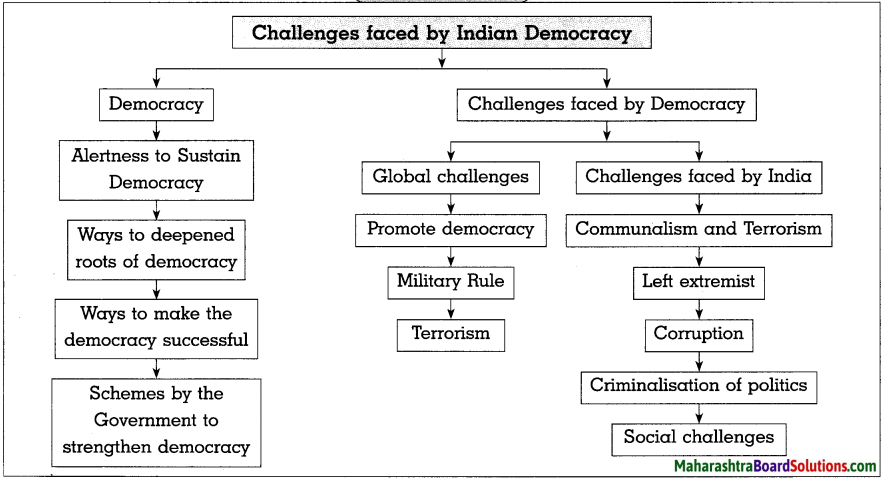
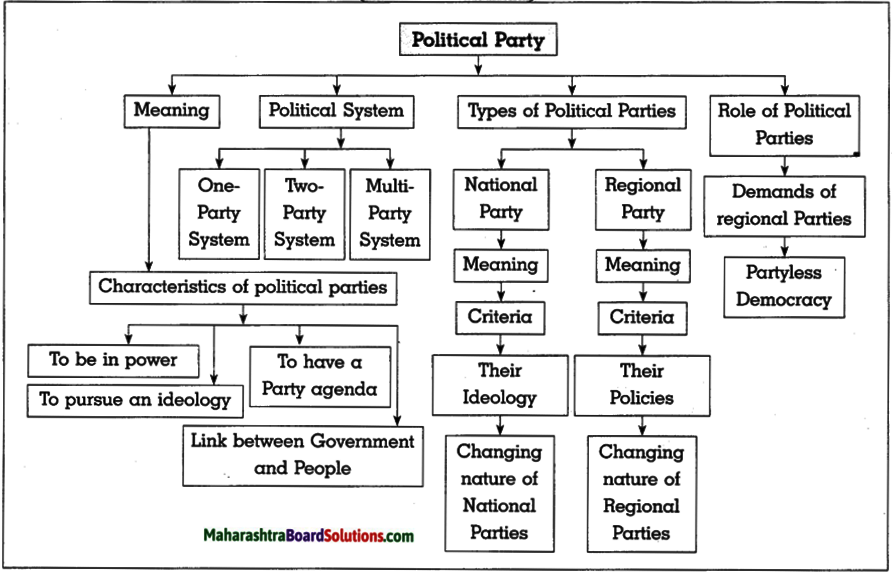
Memory Map Maharashtra Board Class 10 Political Science Solutions Chapter 5 Challenges faced by Indian Democracy 1

Question 5. Choose the correct option from the given options and complete the sentences: (a) ………………….. is a continuous and living process. (a) Military rule (b) Democracy (c) Dictatorship (d) Monarchy Answer: (b) Democracy (b) The main objective of democracy is ………………….. . (a) to hold elections (b) public welfare (c) public campaigns (d) social work Answer: (b) public welfare (c) Voting, elections, government structure, etc. is only ………………….. form of democracy. (a) economic (b) political (c) social (d) all-inclusive Answer: (b) political Maharashtra Board Solutions (d) In order to make democracy meaningful the Government of India adopted …………………. . (a) internal party elections (b) public welfare schemes (c) decentralisation of power (d) protection of democratic values. Answer: (c) decentralisation of power (e) Naxalite movement began to remove injustice done to …………………. . (a) workers and dalits (b) middle and lower class (c) poor and common class (d) landless farmers and tribals Answer: (d) landless farmers and tribals (f) The …………………. in India is making conscious efforts to make political process transparent, (a) Parliament (b) Government (c) Judiciary (d) Political parties Answer: (c) Judiciary (g) Due to increase in ………………….., there is increase in religious conflict. (a) communalism (b) terrorism (c) corruption (d) casteism Answer: (a) communalism Maharashtra Board Solutions (h) In order to make democracy successful in India, participation of …………………. should increase. (a) government (b) people (c) political parties (d) social organization Answer: (b) people Question 6. Explain with reasons whether the following statements are true or false: (a) Communalism does not cause much harm to the nation. Answer: The above statement is False.

  • Increase in communalism leads to religious conflict in the country.
  • Increasing conflicts in turn create frictions in society and destroy social unity.
  • It creates division in society resulting in terrorist activities.
  • People’s participation also reduces in the democratic process.
  • This ultimately creates instability in society and democracy comes in danger.

Hence communalism harms the nation to a great extent. (b) The opinion of the minorities should not be taken into consideration. Answer: The above statement is False.

  1. Even though the government of the majority community comes to power, it should adhere to the democratic principle that government should work for the welfare of all communities.
  2. In democracy, opinion of all the communities should be valued instead of giving importance only to the majority community.
  3. All religious, linguistics, ethnic and caste groups should be part of the decision-making process of the government. Hence, to avoid injustice to minorities their opinion should also be taken into consideration.

(c) Democracy is the best form of governance. Answer: The above statement is True.

  • The freedom and rights of the people remain intact in democracy.
  • In democracy, values like liberty, equality, social justice, secularism and fraternity are nurtured in the real sense.
  • Welfare of the people is the main aim of’ democracy.
  • People do not enjoy so much freedom in any other form of government. Hence, democracy is the best form of governance.

Maharashtra Board Solutions (d) Majority opinion has a lot of importance in Democracy. Answer: The above statement is True.

  • In a democracy, the political party getting majority of votes comes to power.
  • Parliament takes all the decisions by majority.
  • Democracy aims at the welfare of the majority of the people.

Therefore, majority opinion has a lot of importance in Democracy. Question 7. Explain the concept: (a) Decentralisation: Answer:

  • If complete power rests in the hands of government it gives rise to dictatorship.
  • Therefore division of power between legislature, executive and judiciary is essential.
  • This division of power is known as Decentralisation.
  • Decentralisation safeguards the freedom of the people.
  • People participate in the functioning of the government.
  • With increased participation, people become aware of their responsibilities.
  • Decentralisation has great importance in democracy.

(b) Criminalisation of politics: Answer:

  • Participation of criminals in political process is criminalisation of politics. It is a serious problem and a threat to our democratic system.
  • Political parties or candidates spread terror among people using money and muscle power.
  • Political parties who give candidature to people with criminal background are responsible for violence during elections.
  • Such candidates after coming to power continue their criminal activities.

They create financial scams and trouble the opponents. Criminalisation of politics weakens democracy. Question 8. Write short notes: (a) Communalism and Terrorism: Answer:

  • Communalism and Terrorism causes great harm to nation. Communalism emerges out of narrow religious pride.
  • Increasing communalism triggers religious conflict in the country. Religious conflict hampers social stability.
  • Society gets divided on communal lines. Communalism gives rise to terrorism.
  • People’s participation in democratic process in reduced to a great extent due to terrorism.
  • It causes great damage to our nation.

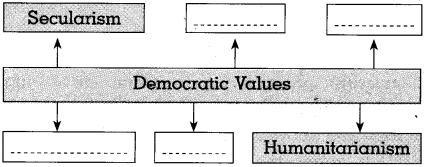
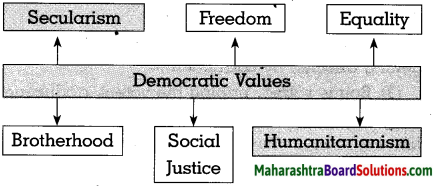
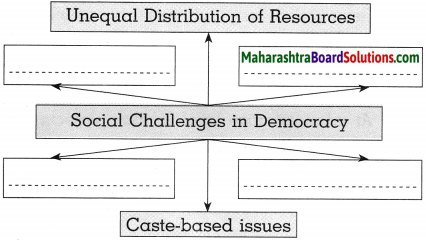
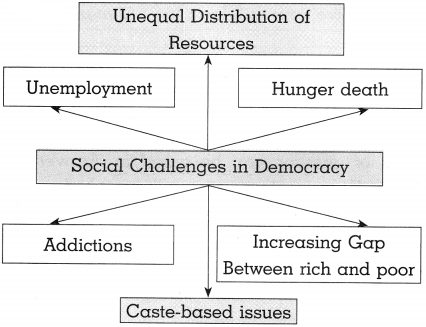
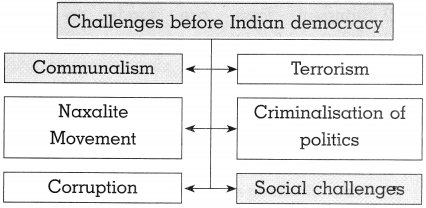
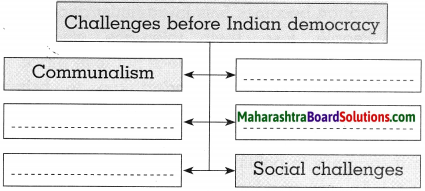
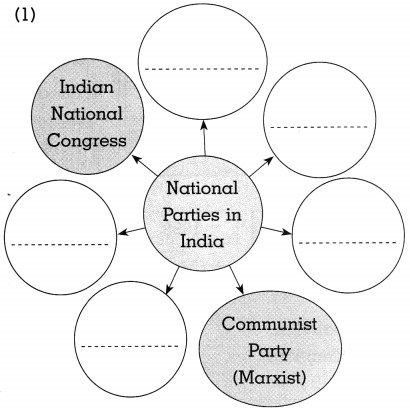
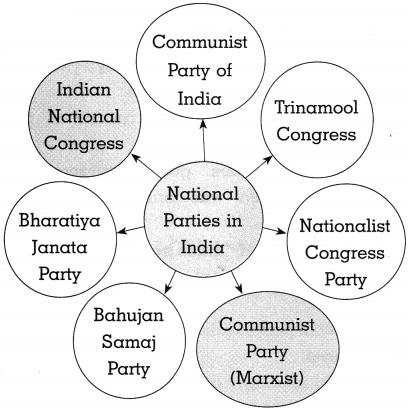
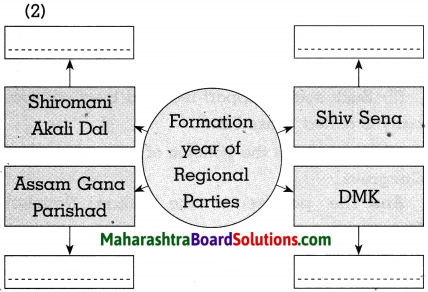
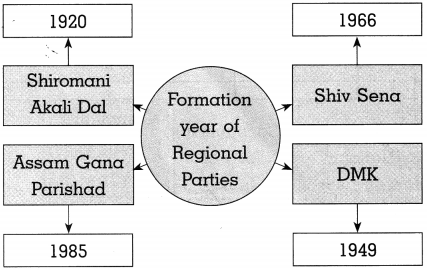
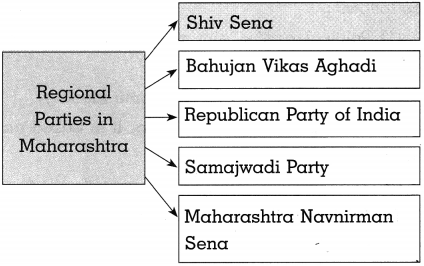
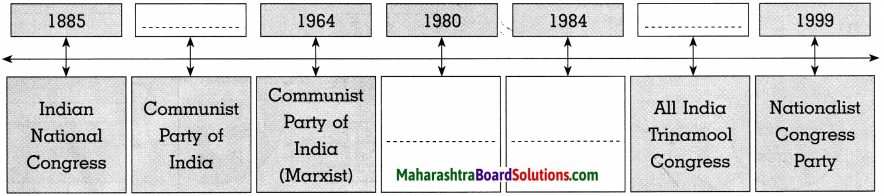
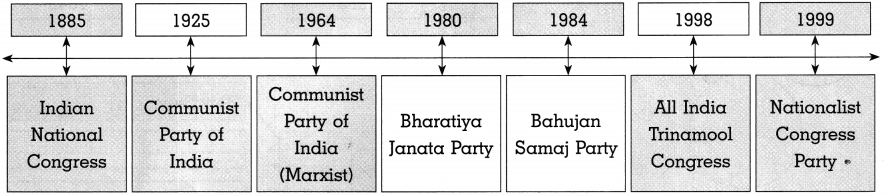
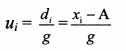
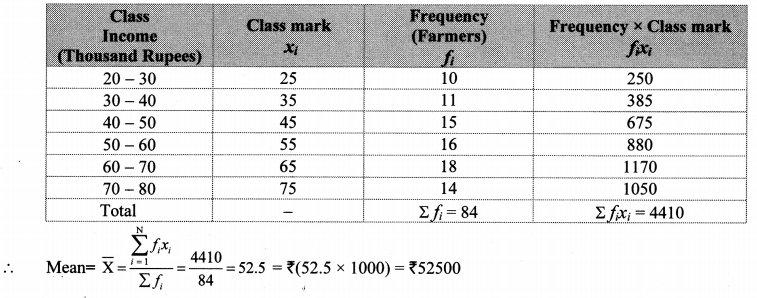
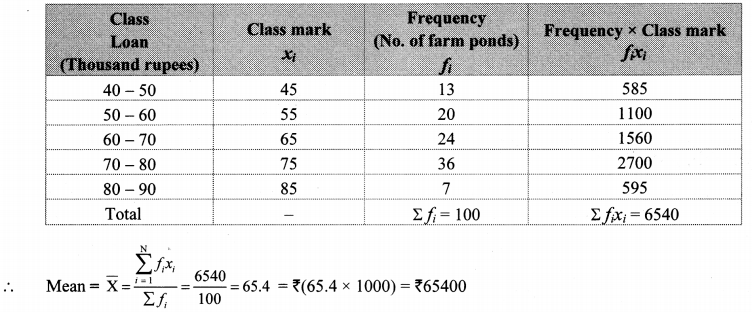
Maharashtra Board Solutions Question 9. Do as directed: (1) Maharashtra Board Class 10 Political Science Solutions Chapter 5 Challenges faced by Indian Democracy 2 Answer: Maharashtra Board Class 10 Political Science Solutions Chapter 5 Challenges faced by Indian Democracy 3 (2) Maharashtra Board Class 10 Political Science Solutions Chapter 5 Challenges faced by Indian Democracy 4 Answer: Maharashtra Board Class 10 Political Science Solutions Chapter 5 Challenges faced by Indian Democracy 5 Maharashtra Board Solutions (3) Maharashtra Board Class 10 Political Science Solutions Chapter 5 Challenges faced by Indian Democracy 6 Asnwer: Maharashtra Board Class 10 Political Science Solutions Chapter 5 Challenges faced by Indian Democracy 7 (4) Maharashtra Board Class 10 Political Science Solutions Chapter 5 Challenges faced by Indian Democracy 8 Answer: Maharashtra Board Class 10 Political Science Solutions Chapter 5 Challenges faced by Indian Democracy 9 Maharashtra Board Solutions Question 10. Answer the following questions in brief: (a) What challenges are faced at global level by democracy? Answer: The following challenges are faced by democracy at global level:

  • Many democratic countries in the world face the threat of military regime.
  • It becomes important to propagate democracy which safeguards people’s rights and freedom.
  • All-inclusive democracy is real democracy which should be adopted and practised instead of adopting just political form of democracy.

(b) What improvements are required for democracy to be deep rooted? Answer: The following improvements are required for democracy to be deep rooted:

  • Values like freedom, equality, fraternity, justice, peace and humanitarianism should be practised and nurtured by all sections in the society.
  • Autonomy should be given to various social organisation and assimilqje all the sections of the society.
  • Empowerment to the citizens, free and fair elections and independent judiciary is necessary.
  • Adoption of a form of democracy which gives preference to public welfare.

(c) What measures are adopted by India to strengthen democracy? Answer: In order to strengthen democracy following measures are adopted by India:

  • Decentralisation of power.
  • Reservation for minorities and women so that they get a share in power.
  • The values of liberty, equality, secularism and social justice adopted by our Constitution.
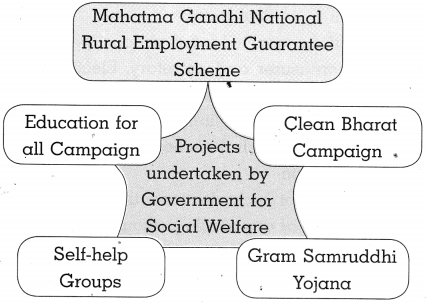
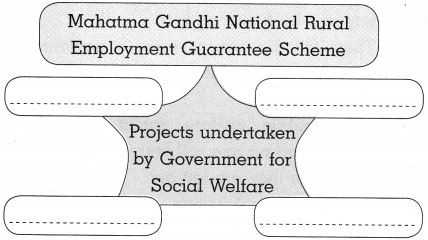
  • At administrative level various projects like Education for all, Clean Bharat campaign.
  • Gram Samruddhi Yojana, Mahatma Gandhi National Rural Employment Guarantee Scheme are undertaken.

Question 11. Give your opinion: (a) What is your opinion about participation of people in various undertakings of the government? Answer:

  • There will be change in the public policies of the government.
  • There will be interaction between all sections of society and exchange of ideas.
  • There will be transparency in government administration and problems like corruption will be tackled.
  • More public welfare schemes will get implemented and no one will feel that injustice is done to them or they are left out.

Maharashtra Board Solutions (b) Are internal elections held by political parties? Answer:

  • It is mandatory to hold internal elections in a political party.
  • Elections are held for various posts like president, treasurer and secretary.
  • Elections are held after every 3 years as per the niles laid down by the Election Commission of Itdia.
  • The paity which does not abide by the rule loses recognition.
  • Because of such elections, there can never be dominance of any single person on a party.
  • Democracy sustains within the party. In Indian democracy the internal elections are held by all the parties regularly.
  • Another challenge before democratic nations is to ensure that democracy becomes deep rooted.
  • Freedom, equality, fraternity and justice, peace, development and humanitarianism are the values that should be practiced at all levels of the society.
  • The mass support for this purpose can be gathered only through democratic means.

(c) In spite of economic reforms China accepted dominance of only one party. Is China a democratic nation? Answer:

  • After the Communist revolution in 1948 China became a republic.
  • After the formation of the republic, the Communist party of China became a dominant party.
  • All the offices in the party are elected through internal elections.
  • But in practice, there is dictatorship of the Communist party. Democracy is for namesake in China.
  • In such a situation, the people do not enjoy freedom as in true democracy.
  • However, China accepted economic reforms and became part of World Trade Organization.
  • Another challenge before democratic nations is to ensure that democracy becomes deep rooted.
  • Freedom, equality, fraternity and justice, peace, development and humanitarianism are the values that should be practiced at all levels of the society.
  • The mass support for this purpose can be gathered only through democratic means.

(d) Do you think there should be family monopoly in politics? Answer:

  • There is no place for family monopoly in politics.
  • The elected representatives serve the people till their term lasts.
  • People vote out the inefficient representatives out of power in next election.
  • If there is monopoly of one family, the perspective of democracy becomes narrow, common people cannot share power.
  • If any inefficient heir comes to power, he or she could be a great loss for the party, people as well as the nation.
  • Family monopoly in politics is a major problem before democracy in India.
  • Monopoly of just one family in politics reduces democratic space. Common people cannot participate in the public sector.

Maharashtra Board Solutions Hence there should be no family monopoly in politics.

Maharashtra Board Class 10 Science Solutions Part 1 Chapter 10 Space Missions

Balbharti Maharashtra State Board Class 10 Science Solutions Part 1 Chapter 10 Space Missions Notes, Textbook Exercise Important Questions and Answers.

Maharashtra State Board Class 10 Science Solutions Part 1 Chapter 10 Space Missions

Question 1.
Fill in the blanks and explain the statements with reasoning:
a. If the height of the orbit of a satellite from the earth’s surface is increased, the tangential velocity of the satellite will ………………
Answer:
If the height of the orbit of a satellite from the earth’s surface, is increased, the tangential velocity of the satellite will decrease.
Explanation: The gravitational force (F) exerted by the earth on the satellite will decrease if the height of the orbit of the satellite from the earth’s surface is increased. Hence, the tangential velocity of the satellite will decrease.
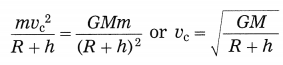
The formula
Maharashtra Board Class 10 Science Solutions Part 1 Chapter 10 Space Missions 1
shows that υc decreases with increasing h.

b. The initial velocity (during launching) of the Mangalyaan must be greater than ………… from the earth.
Answer:
The initial velocity (during launching) of the Mangalyaan must be greater than the escape velocity from the earth.
Explanation: If a satellite is to travel beyond the gravitational pull of the earth, its velocity must be more than the escape velocity from the earth.
[Note: The velocity must be atleast equal to the escape velocity. Refer the definition of escape velocity.]

Maharashtra Board Class 10 Science Solutions Part 1 Chapter 10 Space Missions

Question 2.
State with reasons whether the following statements are true or false.
a. If a spacecraft has to be sent away from the influence of the earth’s gravitational field, its velocity must be less than the escape velocity.
Answer:
False.
Explanation: The escape velocity of a body is the minimum velocity with which it should be projected from the earth’s surface, so that it can escape the influence of the earth’s gravitational field. This clearly shows that the given statement is false.

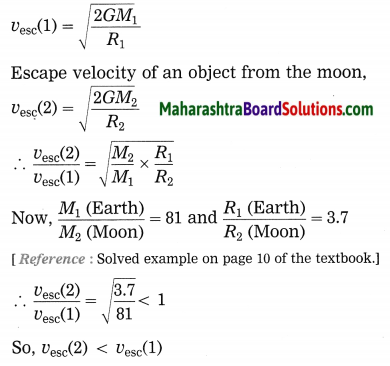
b. The escape velocity on the moon is less than that on the earth.
Answer:
True.
Explanation: Escape velocity of an object from the earth,
Maharashtra Board Class 10 Science Solutions Part 1 Chapter 10 Space Missions 2

c. A satellite needs a specific velocity to revolve in a specific orbit.
Answer:
True.
Explanation:
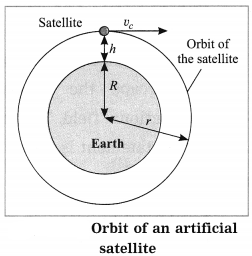
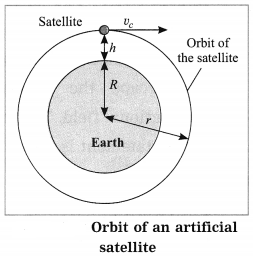
Centripetal force on the satellite \(\frac{m v_{c}^{2}}{R+h}\) = gravitational force exerted by the earth on the satellite \(\frac{G M m}{(R+h)^{2}}\)
where,
m: mass of the satellite
υc: critical velocity of the satellite
h: height of the satellite from the surface of the earth
M: mass of the earth
R: radius of the earth
G: gravitational constant
∴ \(v_{\mathrm{c}}^{2}=\frac{G M}{R+h}\)
∴ \(v_{\mathrm{c}}=\sqrt{\frac{G M}{R+h}}\)
Thus, if the value of h changes, the value of υc also changes. It means a satellite needs to be given a specific velocity (in the tangential direction) to keep it revolving in a specific orbit.
Maharashtra Board Class 10 Science Solutions Part 1 Chapter 10 Space Missions 3

d. If the height of the orbit of a satellite increases, its velocity must also increase.
Answer:
False.
Explanation:
Centripetal force on the satellite \(\frac{m v_{c}^{2}}{R+h}\) = gravitational force exerted by the earth on the satellite \(\frac{G M m}{(R+h)^{2}}\)
where,
m : mass of the satellite
υc : critical velocity of the satellite
h : height of the satellite from the surface of the earth
M : mass of the earth
R : radius of the earth
G : gravitational constant
∴ \(v_{\mathrm{c}}^{2}=\frac{G M}{R+h}\)
∴ \(v_{\mathrm{c}}=\sqrt{\frac{G M}{R+h}}\)
Thus, if the value of h changes, the value of υc also changes. It means a satellite needs to be given a specific velocity (in the tangential direction) to keep it revolving in a specific orbit.
Maharashtra Board Class 10 Science Solutions Part 1 Chapter 10 Space Missions 4
As per the formula υc = \(\sqrt{\frac{G M}{R+h}}\) , if the value of h increases, the value of υc decreases. Hence, if the height of the satellite from the surface of the earth increases, its velocity decreases.

Maharashtra Board Class 10 Science Solutions Part 1 Chapter 10 Space Missions

Question 3.
Answer the following questions:
a. What is meant by an artificial satellite? How are the satellites classified based on their functions?
(OR)
Write the importance of artificial satellites in your words. (Practice Activity Sheet – 3)
Answer:
A manmade object orbiting the earth or any other planet is called an artificial satellite. Satellites work on solar energy and hence photovoltaic panels are attached on both sides of the satellite, which look like wings. Satellites are also installed with various transmitters and other equipment to receive and transmit signals between the earth and the satellites.

Classification of satellites depending on their functions:
(1) Weather satellites: weather satellites collect the information regarding weather conditions of the region. It records temperature, air pressure, wind direction, humidity, cloud cover, etc. this information is sent to the space research station on the earth and then with this information weather forecast is made.

(2) Communication satellites: In order to establish communication between different places on the earth through mobile phones or computer assisted internet, communication satellites are used. Many artificial satellites placed at various locations in the earth’s orbit are well interconnected and help us to have communication with any place, from anywhere, at any time and in any form including voicemail, email, photographs, audio mail, etc.

(3) Broadcasting satellites: Broadcasting satel¬lites are used to transmit various radio and television programs and even live programs from any place on the earth to any other place. As a result, one can have access to information about current incidents, events, programs, sports and other events right from his drawing room with these satellites.

(4) Navigational satellites: Navigational satel¬lites assist the surface, water and air transportation and coordinate their busy schedule. These satellites also assist the user with current live maps as well as real time traffic conditions.

(5) Military satellites: Every sovereign nation needs to keep the real time information about the borders. Satellites help to monitor all movements of neighboring countries or enemy countries. Military satellites also help to guide the missiles effectively.

(6) Earth observation satellites: These satellites observe and provide the real time information about the earth. These satellites also help us to collect information about the resources, their management, continuous observation about a natural phenomenon and the changes within it.

(7) Other satellites: Apart from these various satellites, certain satellites for specific works or purposes are also sent in the space. E.g. India has sent EDUSAT for educational purpose; CARTOSAT for surveys and map making. Similarly, satellites with telescopes, like Hubble telescope or a satellite like International Space Station help to explore the universe. In fact, ISS (International Space Station) provides a temporary residence where astronauts can stay for a certain short or long period and can undertake the research and study space activities.
The various functions listed above show the importance of artificial satellites.

b. What is meant by the orbit of a satellite? On what basis and how are the orbits of artificial satellites classified?
Answer:
Orbit of a satellite is its path around the earth.
Orbits of artificial satellites can be classified on various basis.
(1) On the basis of the angle of the orbital plane: Orbital plane of a satellite can be the equatorial plane of the earth or it can be at an angle to it.
(2) On the basis of the nature of the orbit: Orbital plane can be circular or elliptical in shape.
(3) On the basis of the height of the satellite: Orbit of a satellite can be HEO, MEO or LEO.

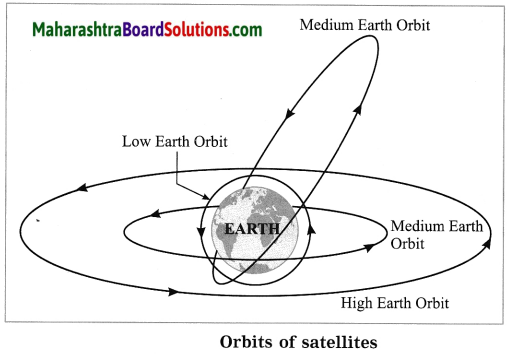
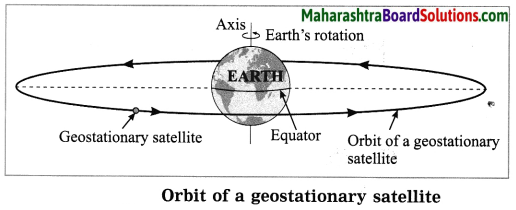
(i) High Earth Orbit (HEO) satellite: A satellite orbiting at a height equal to or greater than 35780 km above the earth’s surface is called a High Earth Orbit satellite. The critical velocity (υc) of a satellite revolving in an orbit at 35780 km above the earth surface is 3.08 km/s. Such a satellite will take about 23 hours 54 minutes to complete one revolution around the earth. The earth completes one rotation about its axis in the same time. The orbital plane of such a satellite is the equatorial plane of the earth. The satellite’s relative position appears stationary with respect to a place on the earth. This satellite is, therefore, called a geostationary satellite or geosynchronous satellite.

(ii) Medium Earth Orbit (MEO) satellite: A satellite orbiting at a height between 2000 km and 35780 km above the earth’s surface is called a Medium Earth Orbit satellite. The orbital path of such a satellite is normally elliptical and passes through the North and the South polar regions. These satellites take about 12 hours to complete one revolution around the earth.
Maharashtra Board Class 10 Science Solutions Part 1 Chapter 10 Space Missions 5

(iii) Low Earth Orbit (LEO) satellite:
A satellite orbiting at a height between 180 km and 2000 km above the earth’s surface is called a Low Earth Orbit satellite. Normally, these satellites take 90 minutes to complete one revolution around the earth. Weather satellites, space telescopes and International Space Station are Low Earth Orbit satellites.

c. Why are geostationary satellites not useful for studies of polar regions? (Practice Activity Sheet – 4)
(OR)
Explain the following statement. A geostationary satellite is not useful in the study of polar regions. (Practice Activity Sheet – 1)
Answer:
Geostationary satellites have two distinct characteristics:
(1) Geostationary satellites are HEO satellites and are placed at 35780 km above the earth’s surface.
Maharashtra Board Class 10 Science Solutions Part 1 Chapter 10 Space Missions 6

(2) A geostationary satellite revolves in the equatorial plane of the earth, and thus, it can never fly above the polar regions.
Hence, geostationary satellites are not useful for studies of polar regions.

d. What is meant by a satellite launch vehicle? Explain the satellite launch vehicle developed by ISRO with the help of a schematic diagram.
Answer:
A rocket used to carry an artificial satellite to a desired height above the earth’s surface and then project it with a proper velocity so that the satellite orbits the earth in the desired orbit is called a launch vehicle. A satellite launch vehicle needs a specific velocity as well as a thrust to reach the desired height above the earth’s surface. The velocity and the thrust of a satellite launch vehicle depend on the weight and orbital height of the satellite.

Accordingly, the structure of the launch vehicle is decided and designed. The weight of the fuel also contributes a major portion in the total weight of the launch vehicle. This also influences the structure of the launch vehicle. In order to use the fuel optimally, multiple stage launch vehicles are now designed and used.

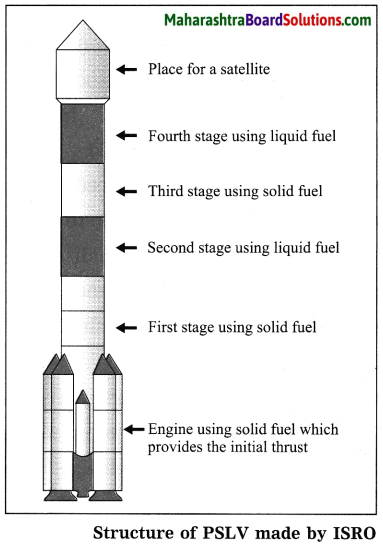
The Polar Satellite Launch Vehicle (PSLV) developed by ISRO is shown below in a schematic diagram.
Maharashtra Board Class 10 Science Solutions Part 1 Chapter 10 Space Missions 7

e. Why is it beneficial to use a satellite j launch vehicle made up of more than one stage?
Answer:
Earlier Satellite Launch Vehicles (SLV) used to be of a single stage vehicles. Such SLVs used to be very heavy as well as expensive in terms of its fuel consumption. As a result, SLVs with multiple stages were developed.

In multistage SLVs, as the journey of the launch vehicle progresses and the vehicle achieves a specific velocity and a certain height, the fuel of the first stage is exhausted and the empty fuel tank gets detached from the main body of the launch vehicle and falls back into a sea or on unpopulated land. As the fuel in the first stage is exhausted, the engine in the second stage is Ignited. However, the weight of the launch vehicle is now less than what it was earlier and hence it can move with higher velocity, Thus, it saves fuel consumption. Hence, it is beneficial to use a multistage satellite launch vehicle.

Maharashtra Board Class 10 Science Solutions Part 1 Chapter 10 Space Missions

Question 4.
Complete the following table:
Maharashtra Board Class 10 Science Solutions Part 1 Chapter 10 Space Missions 8
Answer:
Maharashtra Board Class 10 Science Solutions Part 1 Chapter 10 Space Missions 9

Question 5.
Solve the following problems:
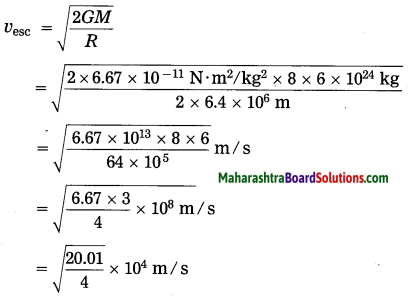
a. If the mass of a planet is eight times the mass of the earth and its radius is twice the radius of the earth, what will be the escape velocity for that planet?
Answer:
Given:
(1) The mass of the planet (M) is eight times the mass of the earth, i.e., 8 × 6 × 1024 kg
(2) The radius of the planet (R) is twice the radius of the earth, i.e., 2 × 6.4 × 106 km
(3) G = 6.67 × 10⁻¹¹ N·m2/kg2
Escape velocity for that planet
Maharashtra Board Class 10 Science Solutions Part 1 Chapter 10 Space Missions 10
= 2.237 × 10⁴ m/s
= 22.37 km/s

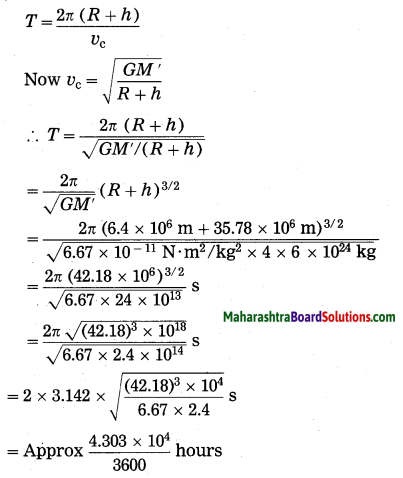
b. How much time would a satellite in an orbit at a height of 35780 km above the earth’s surface take to complete one revolution around the earth, if the mass of the earth were four times its original mass?
Answer:
Given: R (Earth) = 6400 km = 6.4 × 10⁶ m,
M (Earth) = 6 × 1024 kg
∴ M’ = 4M = 4 × 6 × 1024 kg
h = 35780 km = 3.578 × 10⁷ m = 35.78 × 10⁶ m,
G = 6.67 × 10⁻¹¹ N·m2/kg2, T = ?
The time that the satellite would take to complete one revolution around the earth,
Maharashtra Board Class 10 Science Solutions Part 1 Chapter 10 Space Missions 11
= Approx 4.303 × 10⁴ s
= Approx 11.95 h
or 11 hours 57 minutes 10 seconds.

Maharashtra Board Class 10 Science Solutions Part 1 Chapter 10 Space Missions

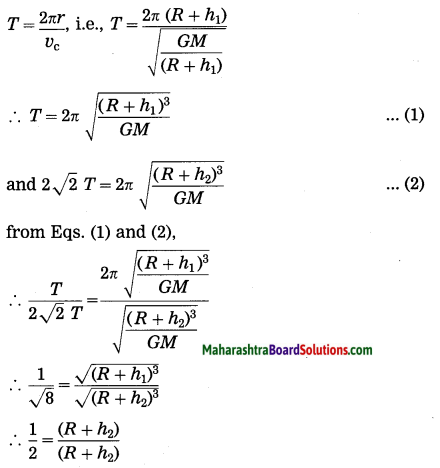
c. If the height of a satellite completing one revolution around the earth in T seconds is h1 meters, then what would be the height of a satellite taking 2\(\sqrt{2}\) T seconds for one revolution?
Answer:
Given:
(1) Time: T seconds
(2) Height: h1
Let us assume the height of the satellite completing one revolution in 2\(\sqrt{2}\) T seconds as h2.
Maharashtra Board Class 10 Science Solutions Part 1 Chapter 10 Space Missions 12
∴ R + h2 = 2R + 2h1
∴ h2 = R + 2h1

Project:

Project 1.
Collect information about the space missions undertaken by Sunita Williams.
Hints:
The following sources can be used to get the information on the above topic:
(1) Google Search Engine
(2) YouTube
(3) E-books on Sunita Williams
(4) English and other regional language books on Sunita Williams available in your library
(5) Newspaper clippings

Based on the information you have collected from the above sources, complete the project in about 5 pages. You can do value addition to your project with the help of suitable photos, clippings, charts, graphs and sketches.

Project 2.
Assume that you are interviewing Sunita Williams. Prepare a questionnaire and also the answers.
Answer:
Points to make a list of a questionnaire for the interview of Sunita Williams :
(1) Primary and higher education
(2) The source of inspiration to become an astronaut
(3) Information about her mentor
(4) General and specific training
(5) Initial experience of being an astronaut
(6) First space mission, its nature, duration and experience
(7) Natureofresearchcarriedoutinspace
(8) Some special memories
(9) Future plans
(10) Tips and guidance for the younger generation.

Maharashtra Board Class 10 Science Solutions Part 1 Chapter 10 Space Missions

Can you recall? (Text Book Page No. 135)

Question 1.
What is the difference between space and sky?
Answer:

  1. The visible portion of the atmosphere and outer space seen by simple eyes, without any equipment from the earth, is known as the sky.
  2. The infinite three-dimensional expanse in which the Solar system, stars, celestial bodies, galaxies and the endless Universe exist is known as space.
  3. Both sky and space lack a definite boundary. However, the sky is a very tiny part of space.

Question 2.
What are different objects in the Solar system?
Answer:

  1. Our Solar system is a very tiny part of a huge Galaxy-Milky Way.
  2. The Sun is at the centre of the Solar system. Sun is a star.
  3. Mercury, Venus, Earth, Mars, Jupiter, Saturn, Uranus and Neptune are planets in our Solar system. These planets revolve around the Sun. Some of these planets have their own natural satellites.
  4. Besides, there are asteroids, meteoroids, comets and meteors in the Solar system.

Question 3.
What is meant by a satellite?
Answer:

  1. An astronomical object orbiting any planet of our Solar system is called a satellite.
  2. Mercury and Venus have no satellites.
  3. Some planets have more than one satellite. E.g. Jupiter has 69 satellites.

Question 4.
How many natural satellites does the earth have?
Answer:
The earth has one natural satellite called the moon.

Question 5.
Which type of telescopes are orbiting around the earth? Why is it necessary to put them in space?
Answer:
(1) The following three types of telescopes are orbiting around the earth:

  • Optical Refracting Telescope.
  • Optical Reflecting Telescope.
  • Radio Telescope.

(2) Visible light and radio waves emitted by celestial bodies in space pass through the atmosphere before reaching the earth’s surface. During this journey, some light is absorbed by the atmosphere. Hence, the intensity of the light reaching the earth’s surface decreases. Besides, temperature and air pressure cause the atmospheric turbulence. Hence, light rays change their path, resulting in a change in the position of the image of a celestial body.

City lights during night, and bright sunlight during day also put limitations on usage of optical telescopes on the earth. To minimize these problems, optical telescopes are situated on mountain top, away from inhabited places. However, limitations caused by the atmosphere still persist.

To get rid of these problems scientists have successfully launched telescopes in space. Images obtained by these telescopes are brighter and clearer than those obtained by the telescopes located on the earth’s surface.

Can you recall? (Text Book Page No. 135)

Question 1.
Where does the signal in your cellphone come from?
Answer:
In nearby area of our residence, many mobile towers are installed at various places. Cellphones receive signals from one of these mobile towers.

Question 2.
Where from does it come to mobile towers?
Answer:
All mobile towers are connected to satellites. Cellphone signal reaching the nearest mobile tower in our vicinity is first transmitted to the satellite. The satellite transmits the signal to the mobile tower near the destination.

Question 3.
Where does the signal to your TV set come from?
Answer:
(1) Television Centre or Studio transmits the TV program which first reaches the satellite. The dish antenna of the cable operator in our area receives these signals. The TV programs reach our TV set through a cable connected between the cable operator’s receiving station and our TV set.

(2) Alternatively, a small portable dish antenna fixed on the rooftop is also used to receive the TV signals directly from the satellites. Finally, a cable connected to the dish antenna and TV set brings the programme to our TV set.

Maharashtra Board Class 10 Science Solutions Part 1 Chapter 10 Space Missions

Question 4.
You may have seen photographs showing the position of monsoon clouds over the country in the newspaper. How are these images obtained?
Answer:
Weather satellites take photographs of the sky above the earth’s surface at regular intervals. Some satellites, capable of receiving radio signals, also collect the information of weather conditions and finally images of the sky are built with computers. Territorial boundaries of the states and the country are drawn later on these images. Such satellite images with imposed boundaries are printed in media or shown on the television.

Fill in the blanks:

Question 1.
A man-made object revolving around the earth in a fixed orbit is called …………..
Answer:
A man-made object revolving around the earth in a fixed orbit is called an artificial satellite.

Question 2.
Chandrayaan-I discovered the presence of ………….. on the moon.
Answer:
Chandrayaan-I discovered the presence of water on the moon.

Question 3.
Apart from launching a satellite around the earth, India has been able to launch a satellite around ……………
Answer:
Apart from launching a satellite around the earth, India has been able to launch a satellite around Mars.

Question 4.
All satellites work on …………… energy.
Answer:
All satellites work on solar energy.

Question 5.
……………. are used to carry and place a satellite in a specific orbit.
Answer:
Satellite launchers are used to carry and place a satellite in a specific orbit.

Question 6.
USA has developed ……………. as an alternative to space launch vehicles.
Answer:
USA has developed space shuttles as an alternative to space launch vehicles.

Question 7.
Hubble telescope is a ………….. satellite.
Answer:
Hubble telescope is a Low Earth Orbit (LEO) satellite.

Question 8.
……………. executed the first ever mission to the moon in the world.
Answer:
Russia executed the first ever mission to the moon in the world.

Maharashtra Board Class 10 Science Solutions Part 1 Chapter 10 Space Missions

Question 9.
………… executed the first manned mission to the moon in the world.
Answer:
USA executed the first manned mission to the moon in the world.

Select the appropriate answer from given options:

Question 1.
Which one of the following is a Low Earth Orbit (LEO) satellite?
(a) Navigational satellite
(b) Geostationary satellite
(c) International Space Station
(d) All of the above
Answer:
(c) International Space Station

Question 2.
Which of the following satellite launchers is developed by India?
(a) INSAT
(b) IRNSS
(c) EDUSAT
(d) PSLV
Answer:
(d) PSLV

Question 3.
Which of the following astronauts travelled through space shuttle ‘Discovery’ first time? (Practice Activity Sheet – 4)
(a) Kalpana Chawla
(b) Rakesh Sharma
(c) Sunita Williams
(d) Neil Armstrong
Answer:
(c) Sunita Williams

Considering the correlation between the words of the first pair, pair the third word accordingly with proper answer. (OR) Considering the first correlation, complete the second.

Question 1.
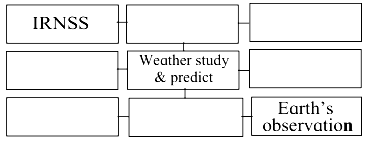
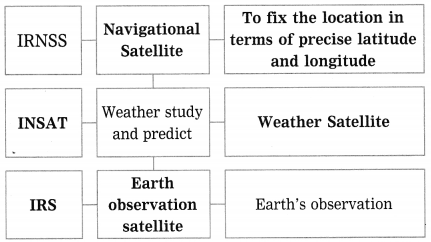
IRNSS : Direction showing satellite :: INSAT :………… (Practice Activity Sheet – 1)
Answer:
IRNSS : Direction showing satellite :: INSAT : Weather satellite

Question 2.
Hubble telescope : 569 km high from the earth’s surface :: Revolving orbit of Hubble telescope :………. (Practice Activity Sheet – 2; March 2019)
Answer:
Hubble telescope : 569 km high from the earth’s surface :: Revolving orbit of Hubble telescope : Low Earth Orbit.

Match the column:

Question 1.

Column AColumn B
(1) Clouds over India(a) Low Earth Orbit
(2) Global communication(b) PSLV
(3) Launch vehicle made by ISRO(c) Communication satellite
(4) International Space Station(d) EDUSAT
(5) Navigational satellite(e) Weather satellite
(f) Medium Earth Orbit

Answer:
(1) Clouds over India – Weather satellite
(2) Global communication – Communication satellite
(3) Launch vehicle made by ISRO – PSLV
(4) International Space Station – Low Earth Orbit
(5) Navigational satellite – Medium Earth Orbit.

Maharashtra Board Class 10 Science Solutions Part 1 Chapter 10 Space Missions

Answer the following questions in one sentence each:

Question 1.
What do you mean by the orbit of a satellite?
Answer:
Orbit of a satellite is its path around the earth.

Question 2.
Which factor decides the orbit of a satellite?
Answer:
The function of a satellite decides the orbit of the satellite.

Question 3.
What is a High Earth Orbit satellite?
Answer:
A satellite orbiting at a height equal to or greater than 35780 km above the earth’s surface is called a High Earth Orbit satellite.

Question 4.
Give two examples of Low Earth Orbit satellites.
Answer:
Weather satellite and International Space Station are Low Earth Orbit satellites.

Question 5.
What is a launch vehicle?
Answer:
A rocket used to carry an artificial satellite to a desired height above the earth’s surface and then project it with a proper velocity so that the satellite orbits the earth in the desired orbit is called a launch vehicle.

Question 6.
Name the launch vehicle developed by India.
Answer:
The launch vehicle developed by India is known as PSLV, i.e., Polar Satellite Launch Vehicle.

Answer the following questions:

Question 1.
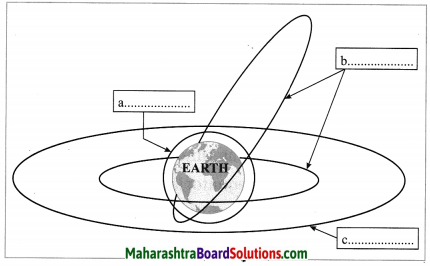
Write the proper name of the orbits of satellites shown in the following figure with their height from the earth’s surface. (Practice Activity Sheet – 4)
Maharashtra Board Class 10 Science Solutions Part 1 Chapter 10 Space Missions 13
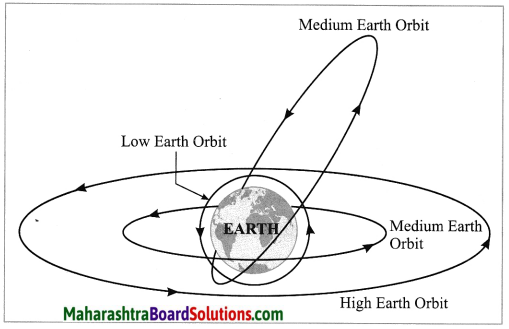
Answer:
Maharashtra Board Class 10 Science Solutions Part 1 Chapter 10 Space Missions 14
(a) Low earth orbits: height above the earth’s surface: 180 km to 2000 km
(b) Medium earth orbits: height above the earth’s surface: 2000 km to 35780 km
(c) High earth orbits: height from the earth’s surface > 35780 km

Maharashtra Board Class 10 Science Solutions Part 1 Chapter 10 Space Missions

Question 2.
Explain the need and importance of space missions.
Answer:
Man has always been curious about the sun, moon, stars and the world beyond the earth. Initially, man tried to observe space with the help of telescopes. However, later he dreamt to fly into space and finally succeeded to reach into space.

Space missions are now essential to understand the origin and evolution of our solar system as well as to study the Universe beyond the Solar system.

Space missions have given us many benefits and made our life simpler. It is because of space missions that the real-time immediate communication and exchange of information across the globe is now possible. We can receive the abundant information at the desk at our home or office. We also get information about any topic at any time and anywhere at fingertips through the Internet. Besides, the advanced alerts about some natural calamities like cyclones or storms are received through satellites sent as a part of space missions. Satellites have also helped us in entertainment. Programmes, sports events, etc., can be telecast live and can reach millions at a time throughout the world.

Satellite surveillance of the enemy, exploring the reserves of various minerals resources, access to various activities like trade, tourism and navigation, and easy global reach to make world a global village is all possible due to the space missions. Thus, space missions are extremely important in defence, communication, weather forecast, observation, direction determination, etc.

Question 3.
What are space expeditions? Explain their need and importance in your words. (Practice Activity Sheet – 2)
Answer:
A mission planned (i) for establishing artificial satellites in the earth’s orbit, using them for research or for the benefit of life, or (ii) for sending a spacecraft to the various components of the solar system or outside is called a space expedition.

Man has always been curious about the sun, moon, stars and the world beyond the earth. Initially, man tried to observe space with the help of telescopes. However, later he dreamt to fly into space and finally succeeded to reach into space. Space missions are now essential to understand the origin and evolution of our solar system as well as to study the Universe beyond the Solar system.

Space missions have given us many benefits and made our life simpler. It is because of space missions that the real-time immediate communication and exchange of information across the globe is now possible. We can receive the abundant information at the desk at our home or office. We also get information about any topic at any time and anywhere at fingertips through the Internet. Besides, the advanced alerts about some natural calamities like cyclones or storms are received through satellites sent as a part of space missions. Satellites have also helped us in entertainment. Programmes, sports events, etc., can be telecast live and can reach millions at a time throughout the world.

Satellite surveillance of the enemy, exploring the reserves of various minerals resources, access to various activities like trade, tourism and navigation, and easy global reach to make world a global village is all possible due to the space missions. Thus, space missions are extremely important in defence, communication, weather forecast, observation, direction determination, etc.

Question 4.
What are the objectives of the space mission?
Answer:
Man initially tried to satisfy his curiosity to know the world and universe beyond the earth with the help of telescopes. However, it has some obvious limitations and to overcome these limitations, man later ventured into space missions.

Space missions carried out by man were aimed at four specific objectives:

  1. To launch artificial satellites in the earth’s orbit for study and research.
  2. To launch artificial satellites in the earth’s orbit for various purposes like telecommunication, weather forecast, radio and TV programme transmission, etc.
  3. To send artificial satellites beyond the earth’s orbit to observe, study and collect the information from other planets, meteors, meteoroids, asteroids and comets.
  4. To sense and understand space beyond the solar system.

Maharashtra Board Class 10 Science Solutions Part 1 Chapter 10 Space Missions

Question 5.
Write on significant space missions carried out by man.
Answer:
Man has carried out many space missions within and beyond the earth’s orbit. Significant space missions are as follows:
(1) Space missions within the earth’s orbit: Man has so far sent many artificial satellites of various types in the earth’s orbit. These satellites have made the life of man simpler. Besides, it has also helped us in resource management, communication, disaster management, etc.

(2) Moon missions : Moon is the natural satellite , of the earth and it is the nearest celestial body to us. Naturally, our initial space missions were directed to the moon. As of now, only Russia, USA, European Union, China, Japan and India have successfully undertaken . moon missions. Russia executed 15 moon missions between 1959 and 1976. Of these, last 4 missions brought the stone samples from the moon for study and analysis. However all these missions were unmanned. USA executed moon missions between 1962 and 1972. Some of these missions were unmanned.

However, the historic moon mission took place on 20th July, 1969, when American astronaut Neil Armstrong became the first human to step on the moon. India has undertaken the moon mission. Indian Space Research Organisation (ISRO) successfully launched Chandrayaan-I and placed it in orbit of the moon. It sent useful information to the earth for about a year. The most important discovery made during the mission was the presence of water on moon’s surface. India was the first country to discover this.

(3) Mars mission: The second nearest celestial object to the earth is Mars and many nations sent spacecraft towards it. But only few of them have been successful. However, the performance of Mangalyaan, the Indian spacecraft sent by ISRO towards Mars, was remarkable. Mangalyaan was launched in November 2013 and was placed in the orbit of Mars successfully in September 2014. It has obtained useful information about the surface and atmosphere of Mars.

(4) Space missions to other planets: Other than moon and Mars missions, many other space missions were undertaken for studying other planets. Some spacecraft orbited the planets, some landed on some planets, and some just observed the planets, passed near them and went further to study other celestial bodies. Some spacecraft were sent specifically to study asteroids and comets. Some spacecraft’s have brought dust and stone samples from asteroids for the study.

All these space missions are very useful in getting information and helping us in clarifying our concepts about the origin of the earth and the Solar system.

Question 6.
Bring out the contribution of India’s space missions.
Answer:
Successful space missions as well as scientific and technological accomplishments by India in space technology have made a significant contribution in the national and social development of our country.
India has indigenously built various launchers and these launchers can put the satellites having the mass up to 2500 kg in orbit.

Indian Space Research Organisation (ISRO) has designed and built two important launchers: Polar Satellite Launch Vehicle (PSLV) and Geosynchronous Satellite Launch Vehicle (GSLV).

Many satellites in INS AT and GSAT series are active in telecommunication, television broadcasting, meteorological services, disaster management and in monitoring and management of natural resources. EDUSAT is used specifically for education while satellites in IRNSS series are used for navigation. Thumba, Sriharikota and Chandipur are Indian satellite launch centers.

Vikram Sarabhai Space Centre at Thiruvananthapuram, Satish Dhawan Space Research Centre at Sriharikota and Space Application Centre at Ahmedabad are space research organizations of India.

Maharashtra Board Class 10 Science Solutions Part 1 Chapter 10 Space Missions

Question 7.
What is meant by space debris? Why is there need to manage the debris? (March 2019)
Answer:
In a space nonessential objects such as the parts of launchers and satellites, revolving around the earth are called the debris in space.

The debris can be harmful to the artificial satellites. It can collide with the satellite or spacecrafts and damage them. Therefore the future of artificial satellites or spacecrafts are in danger.
Hence, it is necessary to manage the debris.

Solve the following examples/numerical problems:
[Note: See the textbook for the relevant data.]

Problem 1.
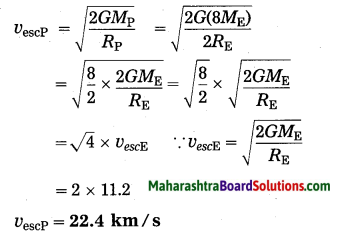
If the mass of a planet is 8 times that of the earth and its radius is twice the radius of the earth, what will be the escape velocity for that planet? (Escape velocity for the earth = 11.2 km/s) (Practice Activity Sheet – 2)
Answer:
Given:
Mass of the planet = 8ME radius of the planet, Rp = 2RE,
escape velocity for the earth, υescE = 11.2 km/s
escape velocity for the planet, υescP = ?
Maharashtra Board Class 10 Science Solutions Part 1 Chapter 10 Space Missions 15

Maharashtra Board Class 10 Science Solutions Part 1 Chapter 10 Space Missions

Problem 2.
Calculate the critical velocity (υc) of the satellite to be located at 35780 km above the surface of the earth.
Answer:
Given:
G: 6.67 × 10⁻¹¹ N·m2/kg2,
M(Earth): 6 × 1024 kg,
R(Earth): 6.4 × 10⁶ m,
h: 35780 km = 35780 × 103 m,
υc = ?
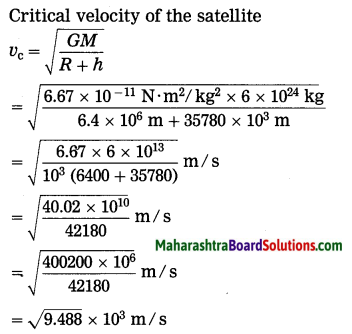
Critical velocity of the satellite
Maharashtra Board Class 10 Science Solutions Part 1 Chapter 10 Space Missions 16
= 3.08 × 10³ m/s
= 3.08 Km/s.

Problem 3.
In the above example (2) how much time will the satellite take to complete one revolution around the earth?
Answer:
Given:
R: 6400mkm = 6.4 × 10⁶ m
h: 35780 km = 3.5780 × 10⁷ m
v: 3.08 km/s = 3.08 × 10³ m/s
T = ?
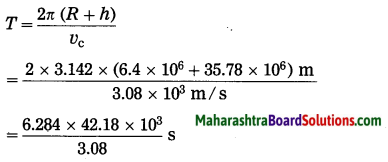
The time required for the satellite to complete one revolution around the earth,
Maharashtra Board Class 10 Science Solutions Part 1 Chapter 10 Space Missions 17
= Approx 86060 s
= 23 hours 54 minutes 20 seconds

Problem 4.
Calculate the critical velocity (υc) of the satellite to be located at 2000 km above the surface of the earth.
Answer:
Refer to the example (2) above.
Here,h = 2 × 10⁶ m
υc = 6902 m/s

Maharashtra Board Class 10 Science Solutions Part 1 Chapter 10 Space Missions

Problem 5.
In the above example (4), how much time will the satellite take to complete one revolution around the earth?
Answer:
Refer to example (3) above.
Approx 7647 s
= 2 hours 7 minutes 27 seconds.
[Note: For more solved problems and problems for practice, refer Chapter 1 (Gravitation)]

Maharashtra Board Class 10 Political Science Solutions Chapter 4 Social and Political Movements

Balbharti Maharashtra State Board Class 10 Political Science Solutions Chapter 4 Social and Political Movements Notes, Textbook Exercise Important Questions and Answers.

Maharashtra State Board Class 10 Political Science Solutions Chapter 4 Social and Political Movements

Question 1.
Choose the correct option from the given options and complete the sentences.
(1) ………………………….. is the main demand of farmers movement.
(a) Right to cultivate on the forest land
(b) To get the right price for agricultural product
(c) Protection of consumers
(d) Building of dams
Answer:
(b) To get the right price for agricultural products

Maharashtra Board Solutions

(2) To increase agricultural production and become self-sufficient with regard to food grains ………………………….. was initiated.
(a) Water revolution
(b) Green revolution
(c) Industrial revolution
(d) White revolution
Answer:
(b) Green revolution

Question 2.
Explain the concepts.
(1) Tribal movement
Answer:

  • Tribal community was always dependent on forest wealth for their living.
  • The British had prohibited the tribals from making use of forest wealth to earn their livelihõod
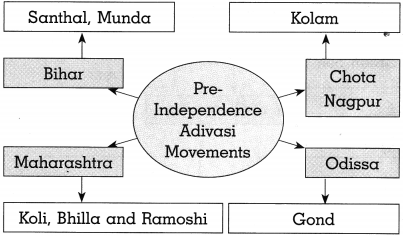
  • Kolam, Gond, Santhal, Koli, Bhilla, Munda Tribals of different parts of India revolted against the British.
  • Even after independence their problem to earn a livelihood is not solved. Their right on the forest land, to gather forest products and to cultivate on forest land is not yet recognised.

Therefore, for these demands, Tribal Movement is active in many parts.

(2) Labour movement
Answer:

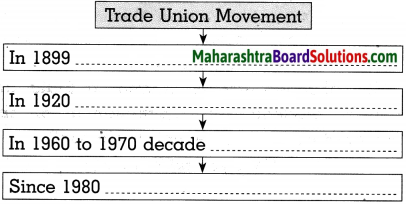
  • Industries in public and private sector like textile mills, railway companies started in India in the latter part of the nineteenth century.
  • Due to industrialisction, a large number’ of labour force came into existence.
  • Thiš led to lot of labour issues. In 1920, All India Trade Union. Congress was established to solve their problems.
  • Many unions were formed after independence. The Trade Union Movement was very effective from 1960 tifi 1980s.
  • After 1980s trade union movement lost its momentum and slowly disintegrated. Globalization gave a final blow to the movement.

Question 3.
Answer the following questions in brief.
(1) Explain the activities/role/functions of environmental movement.
Answer:
(i) Role : The environment movement rias played a key role in –

  • Creating public awareness about the importance of balance in environment through television, newspapers, and other mediums.
  • Opposing developmental projects with environmental concerns.

Maharashtra Board Solutions

(ii) Functions : The function of the environment movement is to make efforts silently or rigorously to protect natural areas through afforestation, recycling or pollution control. Forest department and the pollution board are actively involved and extend support by making stringent laws to book the culprits.

(iii) Activities : Different activities are conducted to promote the environment movement:

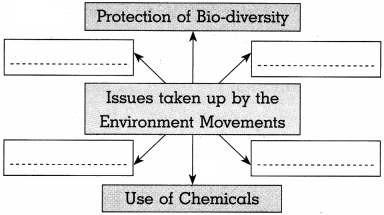
  • Environmental degradation has become a serious issue not only in India but also in the world.
  • The issues of degradation was discussed at. Rio-de-Janeiro, Paris and Kyoto Conferences.
  • Even in India many movements are active for conservation of the environment like the Chipko movement, Appiko movement ana Vanmahatsov.

(2) Explain the nature of farmers movement in India.
Answer:

  1. The Indian farmers organised themselves in pre-independence era to fight against the anti-agricultural policies of the colonial British rulers.
  2. The farmers were inspired by the thoughts of Mahatma Phule, Justice Ranade and Mahatma Gandhi. They organised satyagraha against revenue collection in Bardoli and Champaranya.
  3. Farmers’ movement slowed down because of tenancy laws under land reforms. Green revolution failed to improve conditions of the poor farmers.
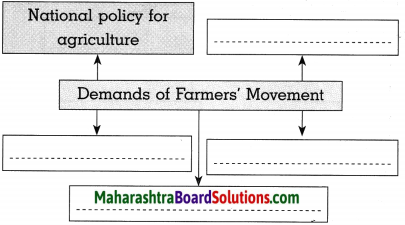
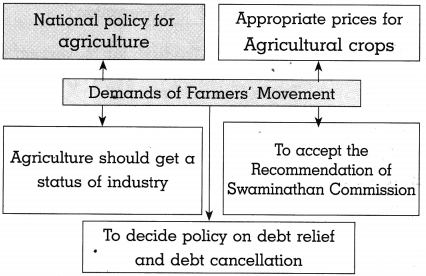
  4. Farmers’ movement gained momentum with demands like, appropriate price for agricultural products, debt relief and debt cancellation after recommendations from Swaminathan Commission.

(3) For which reforms were the women’s movement in the pre-independence period fighting?
Answer:
In the pre-independence period women’s movement were working for the following reforms :

  • Eliminating injustice against women.
  • To put an end to the exploitation of women and help them lead a respectful and dignified life.
  • They should be able to participate actively in social life.
  • To end the practices like Sati, child marriage, polygamy and bring about reforms such as widow remarriage and women’s education.

Question 4.
State wheather the following statements are true or false. Give reasons for your answer.
(1) Movements are important in a democracy.
Answer:
The above statement is True.

  • People organise themselves and start a movement to solve social issues.
  • Leaders and activists provide all the information regarding those issues to the government.
  • The government takes, notice of the problems because of the movement.
  • Some movements aim at opposing some policies of the government and certain decisions. This is the most recognised method of protest in democracy.

Hence, movements have great importance in democracy

Maharashtra Board Solutions

(2) Movements do not need a strong leadership.
Answer:
The above statement is False.

  • The success of any movement depends on leadership. The movement remains active because of the strong leader.
  • The decisions regarding the objective of the movement, programme of action, strategy of agitation are decided and taken by the leader.
  • Firm leadership has a wide reach. They can get public support making the movement very effective. So, the need of a strong leadership is utmost essential.

(3) Consumer movement came into existence.
Answer:
The above statement is True.

  • The consumers faced different problems because of changing economy and social system.
  • Adulteration increased the cost of products and faulty weights and measures are some of the problems faced by the consumers.
  • To protect the consumers from such frauds the Consumer Protection Act was passed in 1986.
  • The Consumer Protection movement was started to create awareness among the consumers about their rights and their safety.

Project
(1) Collect the news in the newspapers about various activities of social movements.
(2) Write a report on movements in your area which are working to resolve general problems.
(3) Prepare a format of a complaint you will submit under consumer protection act if you are cheated in purchase of vegetables or grains
Answer:

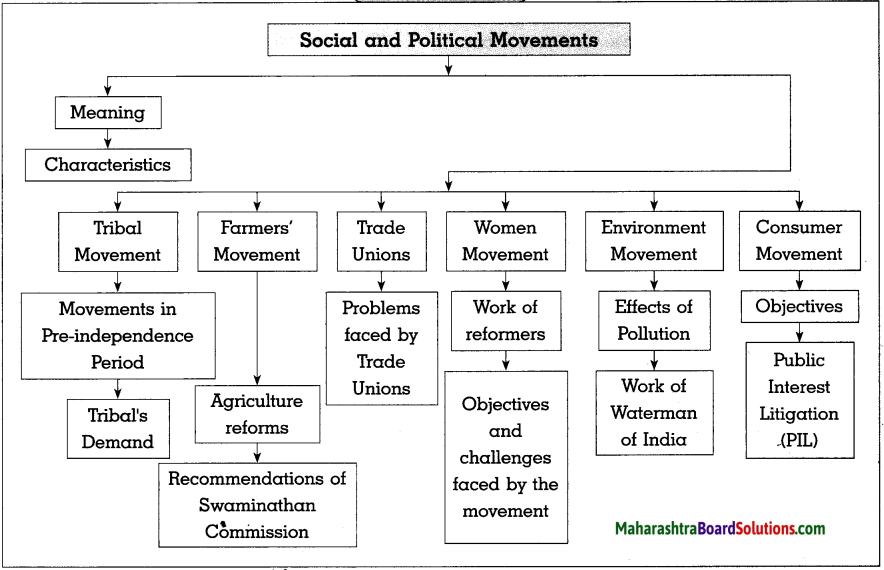
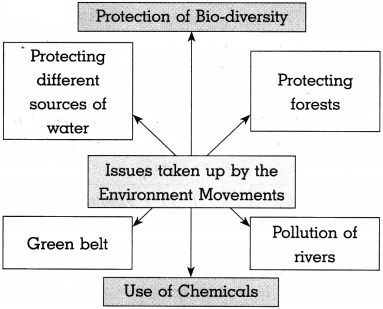
Memory Map
Maharashtra Board Class 10 Political Science Solutions Chapter 4 Social and Political Movements 1

Maharashtra Board Solutions

Question 5.
Choose the correct option from the given options and complete the sentences :
(a) In …………………., movements have more importance.
(a) socialist rule
(b) dictatorship
(c) democracy
(d) communist rule
Answer:
(c) democracy

(b) In democracy, Right to …………………. is considered an important right.
(a) rehabilitate
(b) pursue questions
(c) behave with control and responsibility
(d) protest
Answer:
(d) protest

(c) is the objective of Green Revolution.
(a) To stop degradation of environment
(b) Protection of the forests
(c) Increase in agricultural output
(d) To stop the felling of trees.
Answer:
(c) Increase in agricultural output.

(d) The trade union movement in India has background of ………………… .
(a) freedom struggle
(b) globalisation
(c) prestigious past
(d) industrialisation
Answer:
(d) industrialisation

(e) In 1899, …………………. workers called for a strike.
(a) railway
(b) mill
(c) handloom
(d) rice mill
Answer:
(a) railway

Maharashtra Board Solutions

(f) Dr. Rajendrasinh Rana had brought about …………………. in Rajasthan.
(a) White Revolution
(b) Water Revolution
(c) Green Revolution
(d) Consumer Revolution
Answer:
(b) Water Revolution

(g) Dr. Rajendrasinh Rana is known as the …………………. of India.
(a) Farmer man
(b) environment affectionate
(c) Man of the Millennium
(d) Waterman
Answer:
(d) Waterman

(h) Tribals in Bihar revolted against the British under the leadership of ………………… .
(a) Rajendrasinh Rana
(b) Birsa Munda
(c) Umaji Naik
(d) Kajarsingh
Answer:
(b) Birsa Munda.

(i) Swadeshi movement is an important …………………. movement.
(a) political
(b) social
(c) economic
(d) cultural
Answer:
(c) economic

(j) …………………. is one of the problems faced by consumers.
(a) Cancellation
(b) Malnutrition
(c) Adulteration
(d) Transportation
Answer:
(c) Adulteration

(k) The main demand of the farmer’s movement was to accept suggestions of the …………………. Commission.
(a) Sunderlal Bahuguna
(b) Verghese Kurien
(c) Swaminathan
(d) Kothari
Answer:
(c) Swaminathan

(l) In 1986, …………………. Act came into force.
(a) Consumer Protection
(b) Women Empowerment
(c) Child Marriage
(d) Environment Protection
Answer:
(a) Consumer Protection

Maharashtra Board Solutions

(m) The post-1980 movements are called ………………… .
(a) New
(b) Neo-social
(c) Broad
(d) Globalisation
Answer:
(b) Neo-social

(n) …………………. was established in 1920.
(a) Farmer’s Organization
(b) Bhartiya Kisan Union
(c) All India Trade Union Congress
(d) All India Kisan Sabha
Answer:
(d) All India Trade Union Congress.

Question 6.
Explain the following statements by giving reasons :
(a) Political parties can concentrate on one particular issue.
Answer:
The above statement is False.

  • Political parties contest elections to solve problems of common people.
  • Parties have to take into consideration all matters from public cleanliness to roads to space research. They have to have a national perspective and take decisions.
  • Political parties should have programmes for the development of all the sections of society like youth, senior citizens, businessmen, women, farmers and labourers.
  • This – means that political parties cannot concentrate on just one particular issue.

(b) People’s active participation is expected in the movement.
Answer:
The above statement is True.

  • A. movement is started to solve issues of public interest.
  • People offer support to the movements which are related to their cause or a particular issue.
  • Deciding upon the issues of the people a programme is decided and a group is formed.

(c) Dr. Rajendrasinh Rana is called the Waterman of India.
Answer:
The above statement is True.

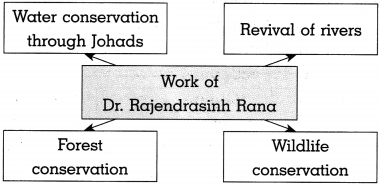
  • Dr. Rajendrashinh Rana built thousands of ‘Johads’ in Rajasthan.
  • He revived many rivers in the desert region of Rajasthan.
  • He formed an organisation – “Tarun Bharat Sangh” which built eleven thousand Johads to harvest water. .
  • He started a campaign for Water conservation, revival of rivers, forest conservation and wildlife conservation.
  • He worked continuously for this cause for 31 years building 11 thousand johads bringing about water revolution in Rajasthan. Therefore, is called the Waterman of India.

Question 7.
Explain the concept :
(a) Movement:
Answer:

  1. When people organise themselves to resolve a certain issue it is called a movement.
  2. Movements increase the participation of people in social life.
  3. Movements are for public welfare and to solve issues. The aim of any movement is not only to pressurize the government but also to oppose its decision or policies.
  4. A movement is started for different reasons like religious, social, cúltural, protection of the environment, ill practices and traditions.

Maharashtra Board Solutions

(b) Public Interest Litigation:
Answer:

  1. A litigation is filed if an individual or group feels that fundamental rights which are enshrined in the Constitution are undermined by the government.
  2. To safeguard human rights, citizens can file a litigation in High Court or Supreme Court. Such a litigation is known as Public Interest Litigation.
  3. Public Interest Litigation is filed for problems such as pollution, government avoiding public works and for social problems such as violence, discrimination and ostracising someone.
  4. It is the most effective way of seeking justice.

(c) Environment Movement :
Answer:

  • Different activities are conducted to promote the environment movement in India.
  • Environment degradation has become a serious issue not only in India but also all over the world.
  • The issues of degradation were discussed at Rio-de-Janeiro, Paris and Kyoto Conferences.
  • Even in India many movements are active for conservation of the environment like the Chipko movement, Appika movement and Vanmahatsov.

Question 8.
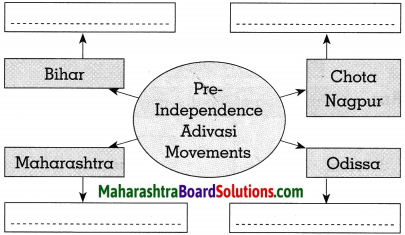
(A) Complete the graphical representation :

(1)
Maharashtra Board Class 10 Political Science Solutions Chapter 4 Social and Political Movements 2
Answer:
Maharashtra Board Class 10 Political Science Solutions Chapter 4 Social and Political Movements 3

(2)
Maharashtra Board Class 10 Political Science Solutions Chapter 4 Social and Political Movements 4
Answer:
Maharashtra Board Class 10 Political Science Solutions Chapter 4 Social and Political Movements 5

Maharashtra Board Solutions

(3)
Maharashtra Board Class 10 Political Science Solutions Chapter 4 Social and Political Movements 6
Answer:
Maharashtra Board Class 10 Political Science Solutions Chapter 4 Social and Political Movements 7

(4)
Maharashtra Board Class 10 Political Science Solutions Chapter 4 Social and Political Movements 8
Answer:
Maharashtra Board Class 10 Political Science Solutions Chapter 4 Social and Political Movements 9

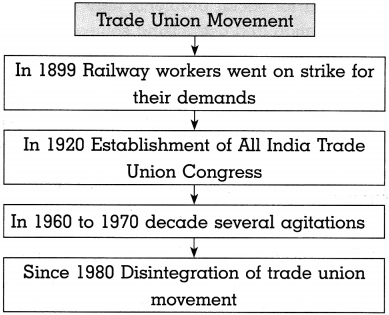
(B) Explain the events in Trade Union Movement:

Maharashtra Board Class 10 Political Science Solutions Chapter 4 Social and Political Movements 10
Answer:
Maharashtra Board Class 10 Political Science Solutions Chapter 4 Social and Political Movements 11

Maharashtra Board Solutions

Question 9.
Answer the following questions in brief:
(a) Explain the features of a movement.
Answer:

  • A movement is a collective action which has active participation or support of the people.
  • People take up a particular issue and organise themselves.
  • A movement requires strong leadership. A strong leader makes the movement effective.
  • If people feel connected to the issue, then they extend their support to the movement.

(b) What are the demands of Trade Union Movement?
Answer:
The Trade Uniin Movement makes demands regarding following issues :

  • Contract labour and unstable employment..
  • financial insecurity and unfavourable conditions at workplace.
  • Unlimited working hours and health hazards.
  • No protection of labour laws.

(c) How did the objectives of women’s movement change after independence?
Answer:

  1. In the pre-independence era the aim of the women’s movement was to put an end to the unjust practices against women and end their exploitation.
  2. After independence, the aim of their movement changed because they realised that though the Constitution had given equal rights both to men and women in practice they were never considered equal.
  3. The objective of the women’s movement was to achieve freedom in real sense, i.e. they should be treated as human beings and should get equal rights and to live a dignified life.

(d) Which issues were taken up by the women’s movement after independence?
Answer:
Many issues were taken up by the women’s movement for welfare of the women after independence. Some are:

  • Health and education of women
  • financial independence
  • Social security
  • To be treated as human beings and have a status and prestige.

(e) Which issues are handled through movements?
Answer:
Movements arise out of public issues, which could be social, political, economic and religious.

  1. To protect the rights of the citizens like voting, freedom and for similar issues, political movements are organised.
  2. financial security, minimum wages, employment, insistence on an indigenous product are the reasons for economic movement.
  3. Social and religious movements are organized to eliminate ill practices like untouchability, entry of women in temples,’ discrimination and social issues.
  4. Movements are organised to raise voice against injustice done to a particular region, language and for issues like cleanliness, environment and movements for development like Green revolution and White resolution.

Maharashtra Board Solutions

(f) Which movements started in India are actively working for rehabilitation of the displaced and to secure their livelihood?
Answer:
People who got displaced started this movement for different reasons. Some movements lasted for short time while some lasted long.

  • “Narmada Bachao Andolan” was a popular movement.
  • People living in Maharashtra and Gujarat continued it for 28 years.
  • People in the Sindhudurg district who got displaced due to the Talamba dam started movement for rehabilitation. It lasted for 32 years.
  • Farmers who got displaced because of Pune-Nagpur highway or for the planned Purandar airport launched movements on a large scale. Such movements are going on all over India.

(g) Name the policies started by the government for the welfare of farmers and landless labourers?
Answer:
The government has started the following policies for the welfare of the farmers and landless labourers :

  • National agriculture policy
  • Crop insurance scheme (FASAL Bima Yojana)
  • Jalyukt Shivar
  • Indira Gandhi Niradhar (old), landless, destitute women farm labour scheme.
  • Neem Coated Urea.
  • Name the policies started by the government for the welfare of farmers and landless labourers.

(h) Name the movements started by Mahatma Gandhi, Mahatma Phule, Sant Gadge Maharaj and Dr. Babasaheb Ambedkar.
Answer:

  • Mahatma Phule laid the foundation of the movement for education of women and social equality.
  • To stop the practice of widow tonsure he called for a strike of barbers in Mumbai.
  • Mahatma Gandhi adopted the technique of satyagraha and started the movement for farmers in Champaranya and Kheda.
  • He also started the Non-cooperation Movement and Civil Disobedience Movement..
  • Sant Gadge Maharaj started the cleanliness campaign.
  • Dr. Babashaeb Ambedkar launched satyagraha to allow untouchables to use water from a public tank in Mahad..
  • He also led the movement in Nashik for Dalits so that they could get entry into the Kalaram temple.

(i) All movements have ideologies. (Discuss : Textbook page 92)
Answer:

  • Even though movements are launched for social welfare there is always an ideology behind every movement.
  • The scope of movements against child marriage or dowry prohibition is not limited to oppose the social evil practice but have wider aim of social reformation.
  • The movements started against female foeticide ‘Beti Bachao Beti Padhav’, violence against women and to empower women had objectives to achieve equal social status for women and their protection.
  • Movements like cleanliness campaign, Chipko Andolan, Save Trees aim not only at environment protection but also aim at saving humanity.
  • These movements have faith in democratic values like equality and brotherhood and humanity. This shows all movements have ideologies.
  • Generally the movements are devoted to one particular issue but have an ideology behind them.
  • For example movements against child marriage, dowry believe in values of democracy, women empowerment and social equality.
  • Sometimes some movements gradually get transformed into political parties.

Maharashtra Board Solutions

Question 10.
Give your opinion :
(a) Do you think, if all the movements co-ordinate with each other, the result will be more effective?
Answer:

  • Our society has witnessed many movements from pre-independence times.
  • If all these movements co-ordinate with each other they will be definitely, effective.
  • With each other’s cooperation they can work together to find the root cause of the problem and also find a solution.
  • The manpower will not get divided. The work will get divided and that would save time and energy to a great extent.
  • The movement will be more effective.

(a) On which issues does the ‘Sons of the Soil’ movement in India insist? (Discuss : Textbook page 93)
Answer:
People migrate for various reasons within the country. They create lot of problems in their newly adopted homeland which give rise to the ‘Sons of the Soil’ movement. The main reasons for the movement are :

  • Sons of the Soil, i.e. local people lose out on employment opportunities.
  • They are deprived of their jobs.
  • Their land is confiscated.
  • Housing becomes expensive.
  • The migrants pose a threat to the language and culture of local people.
  • Sons of the Soil lose economic monopoly as well as political influence.

Maharashtra Board Class 10 History Solutions Chapter 9 Heritage Management

Balbharti Maharashtra State Board Class 10 History Solutions Chapter 9 Heritage Management Notes, Textbook Exercise Important Questions and Answers.

Maharashtra State Board Class 10 History Solutions Chapter 9 Heritage Management

Question 1.
(A) Choose the correct option from the given options and complete the statement.
(1) Lovre Museum has in its collection the much-acclaimed painting of …………..…….. by Leonardo da Vinci.
(a) Napoleon
(b) Mona Lisa
(c) Hans Sloan
(d) George II
Answer:
(b) Mona Lisa

Maharashtra Board Solutions

(2) …………..…….. at Kolkata is the first museum in India.
(a) Government Museum
(b) National Museum
(c) Chhatrapati Shivaji Maharaj Vastusangrahalay
(d) Indian Museum
Answer:
(d) Indian Museum

(B) Identify and write the wrong pair in the following set.
(1) Maharaja Sayajirao University – Delhi
(2) Banaras Hindu University – Varanasi
(3) Aligarh Muslim University – Aligarh
(4) Jivaji University – Gwalior
Answer:
(1) Wrong Pair: Maharaja Sayajirao University – Delhi

Question 2.
Explain the following statements with reasons.
(1) Archives and libraries publish research journals, informative pamphlets, leaflets, posters, etc.
Answer:

  • Libraries preserve and conserve old’ books and artefacts discovered during excavation.
  • If these documents and artefacts are not exhibited then they are kept in archives.
  • All the historical sources are our assets and they should reach the people.
  • Libraries not only preserve these documents but also carry out research, to know the authenticity.

In order to make the historical events, personalities, and historical research known to the people, archives and libraries publish research journals, informative pamphlets and leaflets.

(2) Only trained persons, who are duly qualified can take up the tasks involved in the work of conservation and preservation.
Answer:

  1. While conducting historical research, one has to do the different tasks carefully like collecting sources, preserving, exhibiting, etc.
  2. The skill required for every task is different. The procedure followed for each task is different as well as the preliminary preparations.
  3. It is essential to know about precautions to be taken.
  4. Hence only trained persons who are duly qualified can take up the tasks involved in the work of conservation and preservation.

Maharashtra Board Solutions

Question 3.
Write notes:
(1) Sthalakosh
Answer:

  • History does not shape itself in oblivion. It takes place at some place.
  • Geographic information is essential to study history.
  • Chakradhar Swami, of Mahanubav sect, visited many villages and details of those villages were noted by Muni Vyas.
  • Siddheshwarshastri Chitrav wrote Prachin Bharatiya Sthalkosh. It gives us information on various places mentioned in Vedic literature, Kautiliya’s Arthashastra, Panini’s Grammar, Ramayana.
  • Mahabharata and also in Buddhist Jain Greek, Chinese and Persian literature.
  • Sthalakosh gives us information on ancient cities and history of those cities. It serves as an important written source of history.

(2) Vishwakosh
Answer:

  • The first Chief Minister of Maharashtra, Shri Yashwantrao Chavan, established the ‘Maharashtra Rajya Sahitya Samskruti Mandal.
  • The objective of making Vishwakosh was to develop and enhance Marathi language and literature.
  • Tarkteerth Lakshmanshastri Joshi was appointed as the chief editor. 20 volumes of Vishwakosh are published till date.
  • Marathi Vishwakosh contains knowledge about all possible subjects which exist in the world. It has important entries about history.

(3) Samdnya Kosh
Answer:

  1. While studying any subject we come across many new words. If their exact meaning is not understood, it can create a lot of confusion.
  2. Terms in history like colonialism, imperialism, liberalisation, globalisation, socialism, communism need explanation and clarity. In order to avoid such confusions, this kosh is prepared.
  3. In Samdnya Kosh, all subject related concepts are collected and explained. Information on what led to the development of concepts is provided.
  4. Samdnya Kosh is very helpful for research students, teachers of history as well as common people.

(4) Saraswati Mahal Granthalay
Answer:

  • The Saraswati Mahal Granthalay was built in 16-17th century in Tanjavur, Tamil Nadu during the reign of Nayak Dynasty.
  • In 1675, Maharaj Vyankojiraje Bhosale conquered ‘ Thanjavur and established his independent rule. He and his successors contributed to the expansion of this library. ‘
  • Sarfojiraje Bhosale contributed the most in expanding and enriching the library. Because of his contribution, to honour him, the library was renamed as ‘The Thanjavur Maharaj Sarfoji’s Saraswati Mahal Library’.

Maharashtra Board Solutions

Question 4.
Give elaborate answers to the following.
(1) Why is library management important?
Answer:
Library is not just about a collection of books but managing it is equally important.

  • Readers can easily get the books they want if the library is properly organised.
  • The location of the book should be easily traced. It saves the time and efforts of readers as well as the librarian.
  • Preservation and conservation of books is done effectively with proper management. It prolongs life of books and causes less damage.
  • If the management is well acquainted, they will have good collection that will make available good quality books to reader.
  • Instead of collecting books on one subject there should be variety in the collection so as to cater of different readers who are very selective in their choices.
  • Facilities like proper catalogues, indexes, computerised systems and modern facilities are provided by effective management of library.
  • If the management is creative it will organise exhibitions, advertise, have seasonal offers for vacations, conduct competitions to increase membership.

(2) Which tasks are important in archives management?
Answer:
The following tasks are important in archives’ management:

  • Important documents to be preserved and care should be taken that document with important contents are preserved in their original condition. Confidentiality of important papers should be maintained.
  • To classify the documents by preparing indexes and to create accurate systems of retrieval of documents.
  • Documents from the archives are supposed to be very reliable.
  • Therefore, it is important to safeguard the papers from humidity, fungus and other environmental factors.
  • It is important to remain updated with latest technology in archive management.
  • Computerise/Digitalse all systems. To make use of information technology in managing libraries and archives.
  • To establish regional and local archives*.
  • To preserve national, cultural and historical heritage.
  • To create a hasslefree system.

Question 5.
Complete the following Concept chart.
Maharashtra Board Class 10 History Solutions Chapter 9 Heritage Management 1
Answer:
Maharashtra Board Class 10 History Solutions Chapter 9 Heritage Management 2

Maharashtra Board Solutions

Project
Obtain information about the important libraries in Maharashtra. Visit the library in your vicinity and learn about its functioning.

Question 6.
Complete the sentences by choosing the correct option:
(a) Documents and artefacts which are not exhibited are kept in …………………… .
(a) Museum
(b) Library
(c) Archives
(d) Government office
Answer:
(c) Archives

(b) ……………………. was the 16th century artist who worked under the patronage of French King Francis I.
(a) Leonardo-da-Vinci
(b) Michaelangelo
(c) Raphael
(d) Dante
Answer:
(a) Leonardo-da-Vinci

(c) The collection in ……………………. increased to a great extent because of the antiquities brought by Napoleon Bonaparte.
(a) National Museum of Natural History
(b) British Museum
(c) Louvre Museum
(d) The Calico Museum
Answer:
(c) Louvre Museum.

(d) ……………………., a natural scientist handed over about 71 thousand objects in his collection to the British Museum.
(a) Sir Hans Sloan
(b) King George II
(c) Napoleon Bonaparte
(d) King Francis I
Answer:
(a) Sir Hans Sloan

(e) The Museum of Natural History which 8 houses more than 12 crore specimens of fossils is in ……………………. .
(a) England
(b) France
(c) Switzerland
(d) USA.
Answer:
(d) USA

(f) Chhatrapati Shivaji Maharaj Vastu-sangrahalay was built to commemorate the visit of ……………………. .
(a) King George I
(b) Queen Elizabeth
(c) Prince Charles
(d) Prince of Wales
Answer:
(c) Prince of Wales

(g) The building of Chhatrapati Shivaji Maharaj Vastusangrahalay is built in ……………………. style.
(a) Mughal
(b) Indo-Greek
(c) Indo-Gothic
(d) Indo-Persian
Answer:
(c) Indo-Gothic

Maharashtra Board Solutions

(h) ……………………. is given status of Grade I heritage building in Mumbai.
(a) Chhatrapati Shivaji Maharaj Railway Terminus
(b) Chhatrapati Shivaji Maharaj Vastusangrahalay
(c) Reserve Bank of India
(d) Jehangir Art Gallery
Answer:
(b) Chhatrapati Shivaji Maharaj Vastusangrahalay.

(i) The Royal Library of Ashurbanipal, the ……………………….. Emperor in Mesopotamia is one of the earliest libraries in the world.
(a) Hispanic
(b) Assyrian
(c) Mongol
(d) Akkadian
Answer:
(b) Assyrian

(j) The ……………………….. in Thanjavur, Tamil Nadu was built in 16th-17th century during the times of Nayak dynasty.
(a) Vyankojiraje Bhosale
(b) Sarfojiraje Bhosale
(c) Saraswati Mahal Granthalay
(d) Vidya Niketan
Answer:
(c) Saraswati Mahal Granthalay

(k) The first official archives of India, the ……………………….. was established in 1891 C.E. in Kolkata.
(a) National Archive
(b) Federal Record of Nation
(c) Archive National
(d) Imperial Record Department
Answer:
(d) Imperial Record Department

(l) There are about five crore Modi documents related to Maratha history in the Pune branch which are referred as ………………………. .
(a) Peshwa Daftar
(b) Bhosale Daftar
(c) British Daftar
(d) Maratha Daftar
Answer:
(a) Peshwa Daftar

(m) ……………………….. prepared during the reign of Chhatrapati Shivaji Maharaj is considered as an important encyclopaedia.
(a) Bharatiya Vyavahar Kosh
(b) Rajavyavaharkosh
(c) Vyavaharik Kosh
(d) Bharatiya Prachin Charitrakosh
Answer:
(b) Rajavyavaharkosh.

Maharashtra Board Solutions

Question 7.
Identify the wrong pair in the following and write it:
(1)

(1) Maharaj Sayajirao UniversityDelhi
(2) Banaras Hindu UniversityVaranasi
(3) Aligarh Muslim UniversityAligarh
(4) Jivaji UniversityGwalior

Answer:
Wrong Pair: Maharaj Sayajirao University – Delhi.

(2)

(1) Sangeetshastrakar va Kalavant Yancha Itiha£Lakshman Dattatray Joshi
(2) Krantikarakancha CharitrakoshS. R. Date
(3) Svantantryasainik CharitrakoshN. R. Phatak
(4) Bharatvarshiya Prachin Aitihasik KoshShridhar Vyankatesh Ketkar

Answer:
Wrong Pair: Bharatvarshiya Prachin Aitihasik Kosh – Shridhar Vyankatesh Ketkar

(3)

(1) Bharatvarshiya CharitrakoshSiddeshwar Shastri Chitral
(2) Marathi VishwakoshRaghunath Bhaskar Godbole
(3) Bharatiya Samskruti KoshPandit Mahadevshastri Joshi
(4) Maharashtriya DnyankoshShridhar Vyankatesh Ketkar

Answer:
Wrong Pair: Marathi Vishwakosh – Raghunath Bhaskar Godbole

(4)

(1) SthanapothiMuni Vyas
(2) Index of Marathi PeriodicalsS. G. Date
(3) First Encyclopaedia of Natural HistoryDenis Diderot
(4) Asiatic Society of BengalFirst museum in India

Answer:
Wrong Pair: First Encyclopaedia of Natural History – Denis Diderot

Maharashtra Board Solutions

Question 8.
Complete the following concept chart:
(1)
Maharashtra Board Class 10 History Solutions Chapter 9 Heritage Management 3
Answer:
Maharashtra Board Class 10 History Solutions Chapter 9 Heritage Management 4

(2)
Maharashtra Board Class 10 History Solutions Chapter 9 Heritage Management 5
Answer:
Maharashtra Board Class 10 History Solutions Chapter 9 Heritage Management 7
(3)
Maharashtra Board Class 10 History Solutions Chapter 9 Heritage Management 8
Answer:
Maharashtra Board Class 10 History Solutions Chapter 9 Heritage Management 9

Maharashtra Board Solutions

Question 9.
Explain the concept :

(a) Archives:
Answer:

  1. An archive is a place where documents with important content in their original conditions are preserved in a scientific manner.
  2. Artefacts and documents which are not exhibited in museums or libraries but have historical importance are kept in archives.
  3. Archives provide documents to the § government, research students and local public when required. Technically, the management of archives is akin to library management.
  4. The documents in the archives are preserved in their original condition and hence no changes can be made to it. Documents from archives are very reliable.

(b) Encyclopaedia:
Answer:

  1. Encyclopaedia can be defined as a systematic compilation of words with meaning, information or knowledge on various topics.
  2. A specific method is adopted to compile the information or to organise the available knowledge. g
  3. Accuracy, meticulousness, objectivity, standardised format of presentation and updated information are the special features of good encyclopaedia.
  4. The objective of making an encyclopaedia is to make the available knowledge easily accessible to the readers.

(c) Dictionaries:
Answer:

  • A type of encyclopaedia giving word meaning arranged in alphabetical order is a Dictionary.
  • Dictionaries help the readers to know meaning of the words and enrich their vocabulary.
  • Dictionaries have word meanings, synonyms and etymology.
  • Dictionaries are of various type like comprehensive dictionaries, dictionaries of terminology, etymology, thesaurus and dictionaries of idioms and proverbs.

(d) Comprehensive Encyclopaedia (Vishwakosh):
Answer:

  • Comprehensive Encyclopaedia (Vishwakosh) means a book which has information on all subjects known, i.e. all subjects under the sun.
  • Vishwakosh is an important medium” of documenting and disseminating information.
  • The information is included in encyclopaedia after thorough research and study.
  • (a) There are two types of encydopaedias – one that includes all subjects like ‘Encyclopaedia Britannica’, Maharashtriya Dnyankosh, Marathi Vishvakosh.
    (b) The other type of encyclopaedia includes comprehensive information on one chosen subject, e.g. Bharatiya Samskruti Kosh, ‘Vyayam Dnyankosh1.

(e) Index:
Answer:

  • Index means a list.
  • Index is at the end of a book which includes alphabetical lists of individuals, subjects, key words, reference books, etc.
  • As the list is in alphabetical order, the reader finds it easy to access required information.
  • The index of Marathi periodicals prepared by S. G. Date and index of ‘Marathyancha Itihasachi Sadhane1 is well-known.

Maharashtra Board Solutions

(f) Charitrakosh (Encyclopaedia of Biographies):
Answer:

  1. Charitrakosh contained biographies of individuals who lived in a particular period and their work which inspired and motivated all the people in the society.
  2. Charitrakosh enables the researcher and scholars to know about the historic period, with regard to social structure and social life.
  3. Bharatvarshiya Prachin Aitihasik Kosh written by Raghunath Bhaskar Godbole is the earliest encyclopaedia of this kind.

(g) Bharatiya Samskruti Kosh:
Answer:

  • It contains the description of Indian history, geography, religions, sects, culture, traditions, beliefs, ethnic and lingual groups residing in our country.
  • Bharatiya Samskruti Kosh throws light on, people living in a particular region, festivals and their culture.
  • Mahadevshastri Joshi edited and published 10 volumes of this Kosh.
  • Chakradhar Swami, of Mahanubav sect, visited many villages and details of those villages were noted by Muni Vyas.

Question 10.
Write short notes:
(a) Louvre Museum:
Answer:

  • The Louvre Museum in Paris was established in the 18th century.
  • It has antiquities collected by the royal family of France.
  • The world famous painting of Mona Lisa by Leonardo-Da-Vinci is kept in this museum.
  • The antiquities brought back by Napoleon Bonaparte on his return from conquests are exhibited in this museum.
  • Presently, the museum has more than 3 lakh and 80 thousand artefacts.

(b) British Museum:
Answer:

  • The British Museum was established in the 18th century in London.
  • It has a collection of 71 thousand objects given by natural scientist Sir Hans Sloan to King George. II.
  • Several books, pictures, specimens of preserved plants are included in it.
  • The ancient objects and artefacts which the Britishers have collected from their colonies are exhibited in this museum.
  • At present, it has about 80 lakh objects in its collection.

(c) National Museum of Natural History:
Answer:

  • The National Museum of Natural History was established in Washington DC in 1846.
  • The Smithsonian Institute managed the museum from its inception. This is a museum of natural history.
  • Remains of animals, plants, organisms and thousands of specimens of fossils are kept in it.
  • It also has human fossils, minerals, rocks, shells, artefacts. All together it has a collection of more than 12 crore (120 million).

(d) Chhatrapati Shivaji Maharaj Vastusangrahalay:
Answer:

  1. Chhatrapati Shivaji Maharaj Vastusangrahalay was built to commemorate the visit of Prince of Wales to India. Some influential residents in Mumbai decided to establish a museum in 1904.
  2. The foundation of the building was laid on 2nd November 1905 and the construction was completed in 1922. The museum was named as ‘Prince of Wales of Western India’. In 1998 C.E. it was renamed as ‘Chhatrapati Shivaji Maharaj Vastusangrahalay.’
  3. The museum building is constructed in Indo-Gothic style and has been awarded the status of Grade I heritage building.
  4. The museum has about 50 thousand antiquities which are divided into three categories, viz.. Arts, Archaeology and Natural History.

Maharashtra Board Solutions

(e) Bharatvarshiya Prachin Aitihasik Kosh:
Answer:

  • Raghunath Bhaskar Godbole wrote Bharatvarshiya Prachin Aitihasik Kosh.
  • It is the first dictionary of Biography in Indian regional language.
  • We get information on Manu and many ancient personalities from Mahabharat.
  • We come to know about legendary people who lived in Bharatvarsha and were renowned.
  • Information about their women, their sons, religions, lands, capitals, mountains and rivers.
  • Which flowed in their land their entire history is given in this encyclopaedia.

(f) Bharatiya Samskruti Kosh:
Answer:

  • Pandit Mahadevshastri Joshi edited and published 10 volumes of Bharatiya Samskruti Kosh.
  • He wrote about Indian history, geography, about people speaking different languages and how they created history.
  • Detailed information on culture of India and festivals, geography, traditions, ideas, is taken into consideration.

Therefore these koshs are useful for readers and research scholars.

Question 11.
Explain the following statements with reasons:

(a) Encyclopaedias should be created in as many languages as possible.
Answer:
Encyclopaedias symbolise the richness and vast gamut of words a language has.

  • It fulfils the curiosity of readers and solves the confusion of a layman.
  • Encyclopaedias inspire to carry out more research as one gets information, knowledge and references.
  • Encyclopaedias provide complete information and knowledge to researchers and students which enriches their previous knowledge.
  • Encyclopaedias represent intellectual and cultural development of a society.
  • Many languages in India and the world are rich and resourceful and hence encyclopaedias should be created in as many languages as possible to raise intellectual level of society.

(b) Encyclopaedia and history are related.
Answer:

  • Encyclopaedias contain information about personalities, events and ancient cultures.
  • In order to gather information it is essential to take the help of history,
  • The common factors between an encyclopaedia and history are objectivity and authenticity.
  • Research scholars of history need to refer to encyclopaedias to find information on events, personalities, concept, places, etc. as encyclopaedias are created with the help of history. Hence encyclopaedia and history are related.

(c) Improved versions of Encyclopaedia or supplements to original editions need to be published.
Answer:

  1. Encyclopaedia is a systematic compilation of information or knowledge on various topics ranging from people, places and events to concepts, word meanings, etc.
  2. With the passage of time the spectrum of knowledge has widened.
  3. With the advent of new technology new words are added. Latest or updated information, knowledge, concepts enrich the language.
  4. The references of the past events change in context of the new research. If all these changes are not incorporated in the encyclopaedias, they will become outdated.

Therefore, encyclopaedia or supplements to original editions need to be published.

Question 12.
Answer the following questions in 25-30 words:
(a) What are the ways to preserve and conserve oral resources?
Answer:

  • Folk songs ancl folk tales are collected and compiled.
  • Collected material is classified. It is interpreted and analysed after compilation.
  • The result of research conducted is then published.

Maharashtra Board Solutions

(b) What steps are taken to preserve written sources?
Answer:
Written sources have great importance in the writing of history. To preserve written sources we need –

  • To collect old books, historical books, pictures, photographs, copper plates, manuscripts and official records and edit them.
  • To decide upon the historical values of collected documents.
  • To exhibit the selected documents.
  • To publish edited documents and research reports.
  • To complete necessary chemical and mechanical process of cleaning for conserving and preserving the documents.

(c) What methods should be followed while studying material source?
Answer:
The following methods should be followed by research scholars while studying material source:

  • To collect the artefacts and classify them according to their historical date and type and prepare indexes.
  • To arrange exhibitions of selected artefacts or their replicas.
  • To write and publish research articles about artefacts.
  • To complete required mechanical and chemical processes of cleaning for conservation and preservation of the collected documents.

(d) Write about the earliest libraries in the world.
Answer:
Libraries were established in different parts of the world in ancient times:

  • The Royal Library of Ashurbanipal is the earliest library dating back to the 7th century B.C.E. in Mesopotamia. The library was owned by the Assyrian emperor.
  • A library was discovered at Alexandria in Egypt which was built in 4th century C.E.
  • The library at Takshashila university in 5th century B.C.E. – 5th century C.E. as it was a noted centre of learning.

(e) Write about format of Encyclopaedias.
Answer:
Format of Encyclopaedias:

  • Encyclopaedias are made according to selected subjects; therefore encyclopaedias are classified according to the subjects.
  • Encyclopaedias are framed according to alphabetical order or as per the order of topics.
  • They provide the exact meaning of words and give information on concepts.
  • The type of order is kept according to the convenience of the readers. An index is provided at the end of the encyclopaedia for this purpose.

(f) Write about Encyclopaedic Literature.
Answer:

  • It appears similar to an encyclopaedia but differs in composition.
  • Information and scholarly articles on all possible aspects of a subject is covered.
  • Experts are called to write on different topics which are compiled to create encyclopaedia
  • ‘Maharashtra Jeevan’ Volume I and II; ‘Shahar Pune’ Volume I and II; Yearbook like Manorama, etc. are the examples of Encyclpaedic Literature.

Maharashtra Board Solutions

(g) Give information on early encyclopaedias made in the west.
Answer:

  • The process of making encyclopaedias started in before 1st century C.E. in the west. Pliny wrote the first encyclopaedia on natural history between 23 C.E.-79 C.E.
  • In the 8th and 9th century, encyclopaedias were written in England, France and in Arab countries.
  • French Philosopher Denis Diderot wrote Encyclopaedia in the 18th century C.E.
  • The important milestone in this process was ‘Encyclopaedia Britannica’ published in 1767 C.E.
  • Wikipedia is considered equivalent to encyclopaedia. The information given in this encyclopaedia is highly reliable and updated.

(h) Write about ancient Indian encyclopaedias.
Answer:

  • In the 7th century C.E., Nighantu, a dictionary (information on ancient medicine) in Sanskrit language was written. Dictionaries like Dhatupath were written.
  • In tjie medieval times, encyclopaedic text was composed by Mahanubhav sect.
  • Amarsimha wrote a thesaurus in Sanskrit ‘Amarkosha’.
  • Raghunath Pandit prepared Rajavyavaharkosh as directed by Chhatrapati Shivaji Maharaj.

Question 13.
Read the following passage and answer the following questions:
(a) Which factors influence Encyclopaedia?
Answer:
The influence of national policies, ethical values and ideals, philosophy and traditions is seen in an encyclopaedia.

(b) What is the common factor between history and encyclopaedia?
Answer:
History and encyclopaedia both are objective.

(c) Explain the statement: Encyclopaedias are looked upon as outstanding achievements of a society.
Answer:

  • The knowledge in all the spheres of society is made accessible to everyone is the major reason behind making an encyclopaedia.
  • What inspires people to create encyclopaedias is the instinct to gain knowledge and spread it.
  • Encyclopaedias reflect the collective intellect and creativity of society.
  • One develops a sense of pride after knowing about nation’s progress through it.

Hence encyclopaedias are looked upon as outstanding achievements of a society.

Question 14.
Give elaborate answers to the following: (3 marks each)

(a) What kind of training is required to study written sources?
Answer:
While studying and handling written sources the following training is required:

  • The students should have knowledge of scripts like Brahmi, Modi, Persian and their development.
  • They should know ways to obtain information about the social organisations and traditions.
  • They should know about the literature and writing style in past societies.
  • They should have basic knowledge about administrative systems, dynasties and cultures of the past.
  • They should study prevalent schools of painting and sculpture.
  • They should be able to collect information on types of paper, know about ink and colour of ancient document and ways to handle.
  • They should be well acquainted with properties of stones and metals used for inscriptions.
  • Articles published earlier on case study should be read.
  • They should know the chemicals and equipment used in various processes of cleaning and preserving the documents.
  • Modern know-how of approaches of managing exhibitions in museums, galleries and information technology.

Maharashtra Board Solutions

(b) What kind of training is required to study material sources?
Answer:
Student should have following knowledge to study material resource:

  • They should have basic knowledge of archaeological method and theory.
  • They should be acquainted with the history of ancient civilisations.
  • They should have knowledge of various techniques of excavation.
  • Stones, minerals and clay used to make artefacts and their characteristics to be studied.
  • They should be well-acquainted with the sources of the material used and their chemical properties.
  • They should also know about various styles of making artefacts and development in their making process.
  • They should have the knowledge and skills of making replicas of artefacts and fossils.
  • They should read research papers previously published on his case study.
  • They should acquire information about the approaches of arranging exhibitions and administrations.
  • They should know about the equipment and chemicals necessary for the cleaning of artefacts.
  • They should be able to write research reports and articles.

(c) Write information about museums in India.
Answer:

  • ‘Indian Museum’ established by the Asiatic Society of Bengal in Kolkata was the first museum in India in 1814.
  • The ‘Government Museum’ established in Chennai in 1851 C.E. was the second museum in India. The National Museum was established in Delhi in 1949.
  • The foundation of the Prince of Wales Museum was laid in Mumbai in 1905. Its construction was completed in 1922. It was renamed as Chhatrapati Shivaji Maharaj Vastusangrahalay in 1998 C.E.
  • At present, there are many museums in various states of India.
  • Many museums are connected to libraries and archives. Some are connected to Universities.
  • Such museums offer courses in Museology also.

(d) Give information on “National Archives of India.
Answer:

  • The first official archive of India was established m Kolkata in 1891 C.E. as the ‘Imperial Record Department’.
  • It was moved to Delhi in 1911 C.E.
  • In 1998 C.E. it was made accessible to the public by the then President of India K.R. Narayanan.
  • It was renamed as ‘National Archive’ (National Archive of India). Archives come under the Ministry of Culture of the Indian Government.
  • This archive has papers, maps, books and micro films preserved in chronological order since 1748.
  • Records in English, Arabic, Hindi, Persian, Sanskrit, Devanagari and Modi languages are preserved.
  • Papers kept in archives are classified into public, oriental, manuscripts and private papers.
  • The National Archives of India is the largest in Asia and technologically advanced.

(e) Explain the statement: A nation should have museums and libraries.
Answer:
Museums and libraries mirror the history of the country and that is the reason they are very valuable for a nation.

  • Museums and Libraries make it easy for the research scholar to write history.
  • Historical events and life stories of important people reach the masses.
  • People get an idea about past social, political and cultural conditions.
  • A visit to museums increases one’s interest.
  • A change in a prejudiced view about history is seen.
  • Information on animals, microorganisms, birds and elements of nature.
  • Museums contribute to the process of gaining and dissemination of knowledge.
  • Ancient historical sources are preserved.
  • Tourism is promoted.
  • It creates opportunities for employment.

Maharashtra Board Solutions

Hence it can be said that it is important for a nation to have museums and libraries as they both are symbols of nation’s progress and glory.

Memory Map
Maharashtra Board Class 10 History Solutions Chapter 9 Heritage Management 9

Maharashtra Board Class 10 History Solutions Chapter 2 Historiography Indian Tradition

Balbharti Maharashtra State Board Class 10 History Solutions Chapter 2 Historiography Indian Tradition Notes, Textbook Exercise Important Questions and Answers.

Maharashtra State Board Class 10 History Solutions Chapter 2 Historiography Indian Tradition

Question 1.
(A) Choose the correct option from the given options and complete the statement.
(1) …………………..…….. was the first Director-General of the Archaeological Survey of India.
(a) Alexander Cunningham
(b) William Jones
(c) John Marshall
(d) Friedrich Max Muller
Answer:
(a) Sir Alexander Cunningham

Maharashtra Board Solutions

(2) …………………..…….. translated the Sanskrit text of ‘Hitopadesh’ in the German language.
(a) James Mill
(b) Friedrich Max Muller
(c) Mountstuart Elphinstone
(d) Sir John Marshall
Answer:
(b) Friedrich Max Muller

(B) Identify and write the wrong pair in the following set.
(1) ‘Who were the Shudras’ – subaltern History
(2) ‘Stri-Purush Tulana’ – Feminist writing
(3) ‘The Indian War of Independence 1857’ – Marxist History
(4) Grant Duff – Colonial History.
Answer:
(1) Right Pair: ‘Who were the Shudras’ – subaltern History
(2) Right Pair: ‘Stri-Purush Tulana’ – Feminist writing
(3) Wrong Pair: ‘The Indian War of Independence 1857’ – Marxist History
(4) Right Pair: Grant Duff – Colonial History.

Question 2.
Explain the following with its reason.
(1) Writing of the regional history received a momentum.
Answer:

  • Indian historians trained in the British educational system showed an inclination to restore the self-esteem of Indians They started writing Nationalistic historiography.
  • Historians from the different regions of India criticised the prejudiced history of India written by the British officers.
  • Their attention was drawn towards geographic conditions and history of different regions of India.
  • The nationalistic historiography helped in triggering the independence movement.
  • It provided a momentum to the writing of regional histories for e.g.
  • Nationalistic writings in Maharashtra were inspired by Vishnu Shastri Chiplunkar.

Hence, writing of the regional history received momentum.

(2) Bakhar is an important type of historical documents.
Answer:

  • Bakhars are important source of history like coins, inscriptions, texts, copper plates and travelogues.
  • Bakhars contain eulogies of the heroes, historic events, stories of lives of great men and description of battles.
  • It portrays a picture of prevalent society, religions and economic life.
  • Bakhars are of various types which contain biographies of kings, dynastic history, description of events, sects, autobiographies, mythologies, administration of kings, etc.
  • These descriptions are helpful for writing historiography.
  • Among well-known Marathi. Bakhars ‘Sabhasad Bakhar’ written by Krishnaji Anant Sabhasad requires a special mention Bhausahebanchi Bakhar and Panipatachi Bakhar describe the ‘Battle of Panipat’.

Hence, Bakhars are important type of historical document.

Maharashtra Board Solutions

Question 3.
Write detailed Answers the following questions in detail.
(1) What is Marxist History?
Answer:

  1. In the post-independence era, new trends emerged in writing Indian historiography. Marxist historiography is prominent among them.
  2. Historiography which is based on ideas of Karl Marx is known as Marxist Historiography. In Marxist Historiography, more importance was given to class struggles.
  3. Marxist Historiography reflects concerns for means and modes of production as well as the industrial relations. These became centre of writings of the Marxist historians.
  4. How every social event affects the life of people was analysed and it became the theme of Marxist historians Marxist historians studied the transitions that took place in the caste system.
  5. Notable Indian historians who adopted Marxist ideologies were Damodar Kosambi, Comrade Shripad Dange, Sharad Patil and Ram Sharan Sharma.
  6. Their writings reflected Marxist ideology. Comrade Dange was the founder member of the Indian Communist Party

(2) What is the contribution of Itihasacharya V.K. Rajwade to historiography?
Answer:

  1. V.K. Rajwade is well-known for his writings in Marathi on subjects like history, linguistics, etymology and grammar. His contributions are as follows:
  2. He compiled and edited 22 volumes of Marathyanchya Itihasachi Sadhane.
  3. He stated that history is the all-inclusive image of the past societies.
  4. V. K. Rajwade was of the view that history does not include only the stories of political images, conspiracies and Wars for seizing power.
  5. He was of the firm opinion that we should write our own history and insisted that history . should be written only using the authentic sources.
  6. He was of the opinion that description of any human event in historiography should have balanced combination of three factors namely – Time, Space and Personalities.

Question 4.
(a) Complete the following chart.

HistorianName of the Book
James Mill‘The History of British India’
James Grant Duff……………………………………………
……………………………………………‘The History of India’
S.A. Dange……………………………………………
……………………………………………‘Who were the Shudras’

Answer:

HistorianName of the Book
James MillThe History of British India
James Grant DuffA History of Mahrattas
Mountstuart ElphinstoneThe History of India
S. A. DangePrimitive Communism to Slavery
Dr. Babasaheb AmbedkarWho Were the Shudras

Maharashtra Board Solutions

(b) Complete the following concept chart.
Maharashtra Board Class 10 History Solutions Chapter 2 Historiography Indian Tradition 1
Answer:
Maharashtra Board Class 10 History Solutions Chapter 2 Historiography Indian Tradition 2

Question 5.
Explain the following concepts.
(1) Orientalist historiography.
Answer:

  1. In the later part of the eighteenth century many European scholars felt curious to know about civilisations and countries of the East.
  2. These scholars who studied the Indian Civilization had respect and admiration for it. They were known as ‘Orientalists’.
  3. They studied similarities between Sanskrit and some of the European languages, focussing more on Vedic traditions and Sanskrit literature.
  4. It resulted in the notion that an ancient language could be the mother of all Indo-European languages.
  5. Notable Orientalist scholars are Friedrich Max Muller and William Jones.

(2) Nationalistic historiography.
Answer:

  1. English education started in India in the nineteenth century. The Indian historians who were trained in English education system realised the glory of their past.
  2. They showed an inclination to restore the pride in the ancient glory of India and the self-esteem of the Indian readers.
  3. They laid the foundation of Nationalistic writing. Nationalistic writings in Maharashtra were inspired by ‘Vishnushastri Chiplunkar’.
  4. Nationalistic historians opposed the prejudiced history written by the British officers.
  5. Mahadev Govind Ranade, Vinayak Damodar Savarkar, Ramesh Chandra Majumdar are renowned Nationalistic historians.
  6. Nationalistic historiography inspired freedom struggle against the Britishers and gave momentum to write about regional history. While glorifying the past, at times they are blamed for ignoring to critically analyse the truth.

Maharashtra Board Solutions

(3) Subaltern history.
Answer:

  • History of deprived classes or communities who were deprived of all rights is known as subaltern history.
  • The seeds of subaltern history can be traced in the Marxist history. Italian historian Antonio Gramsci has special importance in writing the subaltern history.
  • He presented the idea that history should be written starting from the bottommost ranks of people in the society.
  • Ranjit Guha, an Indian historian, has given prominence to subaltern history and played a major role in establishing it as an important academic school of historiography.
  • Similar thoughts were expressed by Mahatma Phule and Dr. Babasaheb Ambedkar which can be found in their writings.

Project
Prepare an illustrated manuscript with the help of the internet giving more information about the historians mentioned in this lesson.
Answer:

Memory Map
Maharashtra Board Class 10 History Solutions Chapter 2 Historiography Indian Tradition 3

Question 6.
Complete the sentences by choosing a correct option:
(a) The first written document found in India was inscribed during the rule of Emperor ……………….. .
(a) Akbar
(b) Harshavardhan
(c) Ashoka Maurya
(d) Aurangzeb
Answer:
(c) Ashoka Maurya

(b) Banabhatta wrote King Harsha’s biography titled ………………… in the 7th century CE.
(a) Meghdoot
(b) Rajtarangini
(c) Rasratnakar
(d) Harshacharit
Answer:
(d) Harshacharit

Maharashtra Board Solutions

(c) In the 12th century C.E., ………………… wrote a book ‘Rajtarangini’ about history of Kashmir.
(a) Banabhatta
(b) Kalhana
(c) Ziquddin Barani
(d) Patanjali
Answer:
(b) Kalhana.

(d) The historians in the courts of Muslim rulers were influenced by ………………… historiography.
(a) Greek and Roman
(b) Arabic and Persian
(c) English and French
(d) Arabic and Urdu
Answer:
(b) Arabic and Persian

(e) We get information about the rule of Chhatrapati Shivaji Maharaj from ……………….. .
(a) Bhausahebanchi Bakhar
(b) Panipatachi Bakhar
(c) Sabhasad Bakhar
(d) Holkaranchi Bakhar
Answer:
(c) Sabhasad Bakhar

(f) ‘Bhausahebanchi Bakhar’ describes Battle of ……………….. .
(a) Raigad
(b) Panipat
(c) Plassey
(d) Vasai
Answer:
(b) Panipat

(g) The first book written by a British historian on Indian history is ……………….. .
(a) The History of India
(b) The History of Maharaj
(c) The History of British India
(d) The Sacred Books of the East
Answer:
(c) The History of British India

(h) Nilkanth Janardan Kirtane and V.K. Rajwade exposed the limitations in writings of ……………….. .
(a) Friedrich Max Muller
(b) Colonel Todd
(c) Grant Duff
(d) William Wilson Hunter
Answer:
(c) Grant Duff

(i) …………………, an Indian historian played a major role in establishing subaltern history as an important academic school of historiography.
(a) Comrade Sharad Patil
(b) Ranjit Guha
(c) Dharmanand Kosambi
(d) Ram Sharan Sharma
Answer:
(b) Ranjit Guha.

Maharashtra Board Solutions

(j) The writings of British officials on India display strong influence of ……………….. .
(a) Marxism
(b) Colonalism
(c) Feminism
(d) Capitalism
Answer:
(b) Colonalism

(k) The Nationalistic Historiography in Maharashtra was inspired by works of ……………….. .
(a) Vinayak Damotfar Savarkar
(b) Ramkrishna Gopal Bhandarkar
(c) Vishnushastri Chiplunkar
(d) Justice Mahadev Govind Ranade
Answer:
(c) Vishnushastri Chiplunkar

(l) The two volumes written by ……………….. on Indian history show impartial treatment of the subject.
(a) Colonel Todd
(b) William Wilson Hunter
(c) Grant Duff
(d) James Mill
Answer:
(b) William Wilson Hunter

(m) ‘Primitive Communism to Slavery’, represents ……………….. the historiography.
(a) Colonial
(b) Orientalist
(c) Nationalistic
(d) Marxist
Answer:
(d) Marxist

(n) ‘Stripurush Tulana’ was written by ……………….. is acknowledged as first feminist book in India.
(a) Meera Kosambi
(b) Dr. Sharmila Rege
(c) Tarabai Shinde
(d) Pandita Ramabai
Answer:
(c) Tarabai Shinde.

Question 7.
Identify the wrong pair and write it:
(1)

Name of the BookTypes of Historiography
(1) Who were the(a) Subaltern history
Shudras(July ’19)
(2) Stripurush Tulana(b) Feminist writing
(3) The Indian War of Independence(c) Marxist History
(4) Grant Duff(d) Colonial History

Answer:
Wrong pair: The Indian War of Independence – Marxist History.

(2)

Name of the BookHistorian
(1) The Rise of the Maratha Power(a) Justice Mahadev Govind Ranade
(2) Marathyanchya Itihasachi Sadhane(b) Vishnushastri Chiplunkar
(3) Maratha Riyasat(c) Govind Sakharam Sardesai
(4) Gulamgiri(d) Mahatma Phule

Answer:
Wrong pair: Marathyanchya Itihasachi Sadhane- Vishnushastri Chiplunkar.

Maharashtra Board Solutions

(3)

WorkScholars
(1)  Bharat Itihas Samshodhak Manda(a)   V. K. Rajwade
(2)  Asiatic Society(b)   Sir William Jones
(3)  Inspiration for Nationalistic historiography(c)  Vishnushastri Chiplunkar
(4)  Discovery of Harappan Civilization(d)  James Mill

Answer:
Wrong pair: Discovery of Harappan CIvilization – James Mill.

(4)

HistoriographyHistorian
(1) Nationalistic Historiography(a) V. D. Savarkar
(2) Marxist Historiography(b) Damodar Kosambi
(3) Subaltern Historiography(c) Ramchandra Guha
(4) Feminist Historiography(d) Sharmila Rege

Answer:
Wrong pair: Subaltern Historiography – Bamchandra Guha.

Question 8.
Do as directed:
(1)

Answer:

(2)

Answer:

(3) Prepare a flow chart on Literary work of Max Muller:
Answer:
Maharashtra Board Class 10 History Solutions Chapter 2 Historiography Indian Tradition 8

Maharashtra Board Solutions

Question 9.
Explain the concepts:
(a) Colonial Historiography:
Answer:

  • The history written by British officers and Christian missionaries in support of British rule and colonialism is known as Colonial historiography.
  • It reflected their prejudiced mindset about Indian culture. They ridiculed the Indian culture as being primitive.
  • Their writings justified the colonial British rule.
  • The distinct example of colonial historiography is ‘Cambridge History of India’ in five volumes published during 1922-1937.

Question 10.
Write short notes:
(a) Alexander Cunningham:
Answer:

  • British rulers started archaeological exploration and research in India in the 20th century.
  • They established the Archaeological Survey of India and appointed Sir Alexander Cunningham as its first Director General.
  • He mainly chose the sites mentioned in the Buddhist texts for excavations.
  • Many other ancient sites were excavated under his supervision.

(b) James Mill:
Answer:

  • James Mill, a‘British historian, had written the monumental book ‘The History of British India’. He published it in three volumes in 1817.
  • The book is important as it was the first book written by a British officer on Indian history.
  • The book: lacks objective perspective and is prejudiced about various aspects of the Indian culture.

(c) Grant Duff:
Answer:

  • Grant Duff, a British officer, wrote the book ‘A History of Mahrattas’, in three volumes.
  • His name stands out among the British officers who wrote about Maratha history.
  • The tendency of the British historians to condemn Indian culture and history is found in Grant Duff’s writing.
  • Historians Nilkanth Janardan Kirtane and Vishwanath Kashinath Rajwade exposed the limitations of Grant Duff’s writings.

(d) Indian Feminist Historiography:
Answer:

  1. Tarabai Shinde, Pandita Ramabai and Dr. Rukhamabai were feminist historians before independence.
  2. They wrote about employment of women, their right to political equality, treatment meted out to women at their workplace and gender discrimination.
  3. A lot of literature is available unfolding the viewpoint of Dalit women on problems like social class, caste, etc. In the post-independence era.
  4. Dr. Sharmila Rege included her essays on the autobiographies of Dalit women in her book, ‘Writing Caste, Writing Gender: Reading Dalit Women’s Testimonies.’
  5. Meera Kosambi’s book, ‘Crossing Thresholds: Feminist Essays in Social History’ contains essays on the life stories of women like Pandita Ramabai and Dr. Rukhamabai, the first practising lady Doctor of India.

Maharashtra Board Solutions

Question 11.
Explain the following with reasons:
(a) The history of Indian civilization dates back to 3rd millennium BCE.
Answer:

  • Indian civilisation is among the various ancient civilisations in the world.
  • Excavations at Harappa took place in 1920 under the supervision of Sir John Marshall, then Director General of Archaeological Survey of India (ASI). This led to the discovery of Harappan Civilization.
  • This discovery prqved helpful to trace the antiquity of Indian history which dates back 3rd millennium BCE or earlier.

(b) It became necessary to rethink of women’s position in history.
Answer:

  • For a considerable period of time, mainly male scholars were involved in the writing of Indian history.
  • It was obvious that the perspective was male-dominated.
  • The work of the women historians was neglected for long. So it became important to highlight this fact.
  • It was a huge challenge in front of the women: historians to compile the work and do research which would prove to be a medium to put forth their status in society.

Hence, it became necessary to rethink about the position of women in history.

(c) Govind Sakharam Sardesai was addressed as ‘Riyasatkar’.
Answer:

  • Govind Sakharam Sardesai had a momentous achievement to his credit by publishing ‘Maratha Riyasat’.
  • He published several volumes of Maratha history.
  • His work became so popular that people began to address him as ‘Riyasatkar’.

Question 12.
Answer the following in 25-30 words:
(a) Which things are included in the description by Emperor Babur in bis autobiography?
Answer:
Babur, the founder of the Mughal empire, in his autobiography entitled Tuzuk-i-Babari describes:

  • The battles fought by him.
  • Recordings of minute observations of various regions and cities visited by him noting minute observations.
  • Observation of the local customs, economy, fauna and flora of the region travelled by him.

(b) What is the contribution of Swatantryaveer Savarkar to nationalistic historiography?
Answer:

  1. The writings of Swatantryaveer Savarkar were infused with nationalistic ideas. He looked at the revolt of 1857 as the First War of Independence and wrote the ‘book ‘The Indian War of Independence, 1857’.
  2. His book gave inspiration to Nationalistic historiography which helped in triggering independence movement of the Indian people against the British. Even the writing of regional history got momentum.
  3. The attention of historians was drawn towards the history and geographic conditions and variations in the South Indian region.

(c) Write about the contribution of Banabhatta in writing historiographies.
Answer:

  • It was considered an important step in the Indian historiography to write biographies of kings and dynastic histories.
  • Banabhatta wrote Harshacharit, King Harsha’s biography, in the 7th century C.E.
  • It portrays a realistic picture of the social, economic, political, religious and cultural life during the period when King Harsha ruled.

Maharashtra Board Solutions

(d) Write information on ‘Rajtarangini’.
Answer:

  • Rajtarangini was written by Kalhana in the 12th century C.E. It traces the history of Kashmir.
  • These eight books contain records of dynasties which ruled Kashmir, local traditions, coins, remains of monuments and inscriptions. Kalhana wrote the text after critically examining the various sources.
  • The book is a good example to show how scientific technique is applied in writing history.

(e) Write about historiography in the post-independence period.
Answer:

  • In the post-independence period, along with dynastic history, cultural, social and economic histories were also written.
  • New schools of thought like Marxist, Subaltern and Feminist History were included in historiography.
  • The scholars in this era began to feel the need of writing histories of various communities, sciences, economic systems, political ideologies, cultural aspects, etc.
  • They presented the new schools of ideologies. These changes increased the scope of writing historiography.

(f) What are the objectives of writing history according to Ziauddin Barani?
Answer:

  • Ziauddin Barani explained the ’ objectives of historiography. According to him, the duty of a historian does not end with recording the ruler’s valour and welfare policies.
  • He should also write about the ruler’s failings and incorrect policies.
  • He further adds that a historian should also take into account the impact of the teachings of the wise, the learned and the saints on the cultural life of people.

Thus, Ziauddin Barani holds important place as he expanded the scope of historiography.

(g) What are the salient features of writings of historians in the courts of Mughal emperors?
Answer:
The salient features of writings of historians in the courts of Mughal emperors are:

  • Historians praised the Mughal emperors in their writings.
  • Their loyalty towards the rulers is exhibited.
  • The custom of adding suitable poetic quotes was introduced. The historians started to include beautiful pictures as well.

(h) Write about the importance of Tarabai Shinde in writing feminist historiography. *
Answer:

  • Tarabai Shinde has a prominent place among the feminist historians who wrote about women in the nineteenth century, i.e. pre-independence era.
  • She wrote a book Stripurush Tulana which was published in 1882. It is acknowledged as the first feminist book published in India.
  • Her writings attacked the male-dominated social system and the caste system.

Question 13.
Read the given passage and answer the questions given below:
(a) Complete the graphical presentation:

Answer:

(b) What was considered more important by the historians in the Mughal Court?
Answer:
Praising the Mughal emperor and exhibition of loyalty was considered more 8 important by the historians in the Mughal Court.

(c) Why is Abbul Fazl’s writing considered realistic?
Answer:

  • Abul Fazl’s Akbarnama reflects his critical viewpoint.
  • He collected authentic historical documents for this book.
  • He scrutinized these documents to affirm their reliability. Therefore, his method is looked upon as devoid of bias and hence realistic.

Maharashtra Board Solutions

Question 14.
Write detailed answers to the following questions:
(a) Write information about historiography in the ancient period of India.
Answer:

  • In the ancient period, stories of great deeds of ancestors, mythological lore, memories of social transitions were preserved through oral traditions.
  • The art of writing was mastered by Indians as early as 3rd millennium B.C.E. But Harappan script is not deciphered yet.
  • The earliest written documents found in India were in the form of inscriptions that are as old as 3rd century B.C.E. during the period of Emperor Ashok. His edicts are inscribed on natural rocks and stone pillars.
  • Inscriptions started to occur on coins, metal images and sculptures and also on copper plates from the 1st century B.C.E.
  • Epics like Ramayana, Mahabharat, Puranas, Jain and Buddhist texts are important sources of ancient Indian literature.
  • Historical accounts by Indian authors and travelogues by foreign travellers are also important sources of history.

(b) Explain the works of Dr. Babasaheb Ambedkar and Mahatma Phule in Subaltern History.
Answer:

  • History of the deprived classes expressed in folklore was known as ‘Subaltern History’.
  • Similar thoughts were expressed by Mahatma Jotirao Phule and Dr. Babasaheb Ambedkar.
  • Mahatma Phule unfolded the history of the Shudratishudra communities in his book ‘Gulamgiri’.
  • He drew attention to show how women, Shudras and Atishudras were exploited under the name of religion.
  • Dr. Ambedkar focused on the idea that in spite of having a significant role in shaping the cultural and political aspects of India, the role of Dalits was not duly acknowledged in colonial and nationalistic historiography.
  • Injustice done to the Dalits was mostly written by him. ‘Who Were the Shudras’ and ‘The Untouchables’ are his books which can be cited as examples of subaltern history.

Question 15.
Observe the given picture and answer the question given below:

Maharashtra Board Solutions

(a) Write a short note on Copper-plate inscriptions.
Maharashtra Board Class 10 History Solutions Chapter 2 Historiography Indian Tradition 11
Answer:

  • The copper-plate shown in the picture was found at Sohagaura in Gorakhpur district in Uttar Pradesh.
  • It is supposed to be from the Mauryan period and the inscription on it is in Brahmi script.
  • Many symbols are inscribed on it ‘Tree-in-railing’ and ‘Mountain’ at the beginning of inscription occur on punch marked coins.
  • A structure created on four pillars is indicative of a granary.
  • The inscriptions have a record of royal order that the grains stored in the granary should be distributed carefully.
  • This order is suggestive of precautionary measures taken during famine.

Maharashtra Board Class 10 Political Science Solutions Chapter 3 Political Parties

Balbharti Maharashtra State Board Class 10 Political Science Solutions Chapter 3 Political Parties Notes, Textbook Exercise Important Questions and Answers.

Maharashtra State Board Class 10 Political Science Solutions Chapter 3 Political Parties

Question 1.
Choose the correct option from the given options and complete the sentences.
(1) When people come together and participate in electoral process, to acquire political power, such organisations are called ………………………….. .
(a) Government
(b) Society
(c) Political parties
(d) Social organisations
Answer:
(c) Political parties

Maharashtra Board Solutions

(2) National Conference is a party in ………………………….. this region.
(a) Odisha
(b) Assam
(c) Bihar
(d) Jammu and Kashmir
Answer:
(d) Jammu and Kashmir

(3) Justice Party- a non-Brahmin movement was transformed into ………………………….. Political Party.
(a) Assam Gan Parishad
(b) Shivsena
(c) Dravid Munnetra Kazhagam
(d) Jammu and Kashmir National Conference
Answer:
(c) Dravid Munnetra Kazhagam

Question 2.
State whether the following statements are true or false. Give reasons for your answer.
(1) Political parties act as a link between government and people.
Answer:
The above statement is True.

  • The political parties convey the demands and complaints of the people to the government.
  • Information about various government policies and schemes are conveyed to the people by the political parties.
  • People’s reaction to the policies and their expectations are conveyed to the government too by the parties. In this way, political parties act as a link between government and the people.

(2) Political parties are social organisations.
Answer:
The above statement is True.

  • People who have similar views come together voluntarily and form a party, so it can be said that political parties are an integral part of our society.
  • The political parties try to solve the problems of the people.
  • Some political parties represent the role of a particular community in society, its ideology and work to achieve it. Hence it can be said that political parties are social organizations.

Maharashtra Board Solutions

(3) Coalition politics leads to instability.
Answer:
The above statement is False.

  • As no single party got majority after the elections held in 1989, coalition government came to power at the centre and many states.
  • Parties had to set aside their policies and programmes and concentrate on a common agenda to run the government.
  • Both Congress Party and the Bharatiya Janata Party made an experiment of establishing a coalition government.
  • The National Democratic Alliance formed by BJP and its partners and the Democratic Front government formed by Congress and its partners ruled at the centre and state level effectively.

Therefore, the belief that the coalition government brings instability was proved wrong.

(4) Shiromani Akali Dal is a national party.
Answer:
The above statement is False.
The Election Commission of India recognises a political party as National or Regional party on the basis of specific criteria namely:

  • The number of seats secured in Parliament and Legislative Assembly or percentage of votes secured.
  • Shiromani Akali Dal does not meet the criteria listed above.
  • As its influence is limited to the state of Punjab and not in any other state.
  • The Election Commission has given recognition to it as regional party.

Question 3.
Explain the following concepts.
(1) Regionalism
Answer:

  • India is a vast country with great physical diversity. People belonging to different regions have their own language, culture and traditions.
  • Along with the physical diversity, we find diversity in literature, education, history and movements.
  • Each one feels an affinity for his language, traditions and history of social reforms. This gives rise to linguistic identity.
  • This affinity towards all the above-mentioned aspects develops into identity consciousness and gives rise to excessive regional pride.
  • People start giving preference only to the development of their language and region.
  • This is known as Regionalism.

Maharashtra Board Solutions

(2) National Parties
Answer:
A party which functions at the national level is known as National Party.

  1. The Election Commission has laid certain criteria for a party to get recognised as a Political party. The political party should secure at least f 6% valid votes in four or more states in the earlier Lok Sabha. OR
  2. State Assembly elections and minimum four members should be elected in the Lok Sabha from any state or states in the earlier elections. OR
  3. The candidates of a party should be elected from a minimum three states or should be elected from a minimum 2% constituencies of the total Lok Sabha constituencies. OR
  4. It is important to get recognition as a state party in at least four states.

Question 4.
Answer the following questions in brief.
(1) What are the major characteristics of political parties?
Answer:
The main features of political parties are as follows:

  • Political parties aim at securing power by contesting elections.
  • Every political party has some ideology.
  • Every party has an agenda. It is based on the party’s ideology.
  • The party that gets majority seats in election forms the government and the one that does not secure the majority act as opposition parties.
  • Political parties are a link between the people and the government and work to gain the support of the people.

(2) What changes have taken place in the nature of political parties in India?
Answer:
The following changes were seen in the party system in India:

  • Indian- National Congress was the only dominant party in states and at the centre after independence.
  • All other parties came together and formed a coalition in 1977 and defeated the Congress.
  • For the first time in history, the two-party system got importance over one-party system.
  • The one-party system came to an end after the 1989 elections.
  • Regional parties got importance and the coalition government was formed at the centre and in the states.

Project
(1) In a map of Maharashtra, point out the Loksabha constituency that includes the names of your parents.
(2) In a map of India, point out the places where national political parties have their influence.
Answer:

Memory Map
Maharashtra Board Class 10 Political Science Solutions Chapter 3 Political Parties 1

Maharashtra Board Solutions

Question 5.
Choose the correct option from the given options and complete the sentences:
(a) The party which fails to secure majority is known as ………………………. party.
(a) Ruling
(b) Opposition
(c) Independent
(c) Coalition
Answer:
(b) Opposition

(b) ‘Bharatiya Janata Party’ which was formed in 1980 after a split with ………………………. a component of Janata Party.
(a) Jan Sangh
(b) Lok Dal
(c) Independent party
(b) Janata Dal
Answer:
(a) Jan Sangh.

(c) Social support received by a political party is called ………………………. .
(a) Democracy
(b) People’s rule
(c) Mass base
(d) Public relation
Answer:
(c) Mass base

(d) Promotion of the Marathi language is the objective of the ………………………. .
(a) Dravida Munnetra Kazhagam
(b) Shiromani Akali Dal
(c) Shiv Sena
(d) Assam Gana Parishad
Answer:
(c) Shiv Sena

(e) There are ………………………. recognised parties in India.
(a) five
(b) seven
(c) nine
(d) six
Answer:
(b) seven

(f) The main objective of the political party is to capture ………………………. and retain it.
(a) publicity
(b) victory
(c) power
(d) information
Answer:
(c) power

Maharashtra Board Solutions

(g) The ideology of the Communist Party of India is based on ………………………. Philosophy.
(a) Capitalist
(b) Marxist
(c) Democracy
(d) Imperialist
Answer:
(b) Marxist

(h) Shiromani Akali Dal is a prominent regional party in ………………………. state.
(a) Odisha
(b) Assam
(c) Punjab
(d) Jammu and Kashmir
Answer:
(c) Punjab

Question 6.
State whether the following statements are true or false. Give reasons for your answer:

(a) Political parties do not need support of the people.
Answer:
The above statement is False.

  • To secure power is the main aim of political parties.
  • Political parties have to implement various policies and programmes for the welfare of people and to gain the support of the people.
  • The party which solves the issues related to the welfare of the people get support.
  • Without the support of the people they can never get a mandate.

Hence, all political parties require support of the people.

(b) The Communist Party of India was split.
Answer:
The above statement is True.

  • The Communist Party of- India was established in 1925. The Communist Parties follow Marxist ideology.
  • In 1962, due to differences in the leadership a rift was created in the party.
  • The main reason for the split was about which political line to follow.

(c) Sometimes the sentiments of regionalism gets strengthened in the country.
Answer:
The above statement is True.

  1. A country like India has diversity of government language, region and culture. This diversity creates affinity towards a region.
  2. This affinity gives rise to excessive regional S pride and initiating movements to save it. The significance of such movements is claimed to be for preserving culture.
  3. Asserting to be rightful claimant of material resources, job opportunities and development of the region these movements strengthen the regional pride.
  4. Thus, this excessive regional pride turns morbid taking the form of regionalism.

Maharashtra Board Solutions

(d) Regional parties have no influence on National Politics.
Answer:
The above statement is False.

  • No single party got majority in the elections to Lok Sabha held in 1989.
  • The national parties formed coalition government at the centre taking help of regional parties.
  • As regional parties share power at the centre they have influence on national politics.

Question 7.
Explain the concept:
(a) Regional Parties:
Answer:

  1. The groups having a proud feeling about the different identity of their region and who compete to capture power to bring about regional development are ‘Regional Parties’.
  2. The influence of such parties are limited to their region. They give importance to regional problems. Development of one’s own region is the prime objective of these parties.
  3. Sometimes they demand for independent state or autonomy. They influence the national politics because of their dominance in the region.
  4. They have passed through various phases, from separatism to autonomy and have then merged with mainstream national politics.

(b) Political Party:
Answer:

  1. A Political Party is a kind of social organisation of like-minded people. The main aim of any political party is to contest election and secure power.
  2. The stand taken by various political parties on issues becomes their political ideology.
  3. In democracy, political parties are at the centre of all political activities. They are a link that connects common people, democracy, representation and elections.
  4. The party that secures a majority becomes the ruling party and the rest are known as the. opposition.

Question 8.
Write short note:
(a) Party System:
Answer:

  1. If one party remains in power in a country for a long period and no other party has any kind of influence the party system it is called ‘One- Party System’.
  2. When there are two equally strong parties which alternatively come to power. It is called ‘Two-Party System’.
  3. In a country where many political parties exist and compete with each other to capture power and have more or less influence in different states is called ‘Multi-Party System’.
  4. Democracy develops in Multi-Party System.

(b) Indian National Congress:
Answer:

  • The Indian National Congress was established in 1885.
  • The party represented the hopes and aspirations of Indians and led the freedom struggle.
  • Groups having diverse ideologies became part of the Congress to fight for freedom.
  • It believes in democratic socialism, social equality and international peace.
  • After independence, the Congress Party was a dominant party for almost four decades and ruled at the centre and in the states.

Maharashtra Board Solutions

(c) Communist Party of India:
Answer:

  • The Communist Party of India was established in 1925. The Communist Party follows the Marxist ideology.
  • The party aims at working to protect the interests of workers and labourers.
  • The main objective of this party is to oppose capitalism and protect the interests of workers.
  • The party split due to ideological differences in 1964. Those who walked out of the party formed Communist Party (Marxist).

(d) Nationalist Congress Party:
Answer:

  • Nationalist Congress Party (NCP) is the splinter or breakaway party from the Congress Party.
  • It considers the values like democracy, equality and secularism important.
  • It became part of United Progressive Alliance (UPA) and came to power in Maharashtra.
  • It was in power in Maharashtra from 1999 to 2014 and at the centre from 2004 to 2014.

(e) Trinamool Congress:
Answer:

  • All India Trinamool Congress was established in 1998.
  • The Election Commission of India gave it recognition in 2016.
  • Democracy, Secularism and protection of the weaker sections of the society are some of the policies of the party.
  • Presently (April 2019), this party is in power in the state of West Bengal.

(f) Shiv Sena:
Answer:

  1. The Shiv Sena was founded in 1966.
  2. The main objective of the party was to fight for the cause of Marathi-speaking people and preservation of Marathi language.
  3. They resisted the people from other regions.
  4. In 1995, it became the ruling party with BJP in Maharashtra and its strategic tie-up with BJP helped it to enter national politics.
  5. It was in power at the centre with BJP from 1998 to 2004. Again it has shared power with the BJP at the centre and state since 2014.

(g) Shiromani Akali Dal:
Answer:

  • Shiromani Akali Dal was formed in 1920.
  • It is a dominating party in Punjab.
  • It gives preference to nurture religious and for the regional pride.
  • The party has retained power in Punjab for many years.

(h) Dravid Munnetra Kazhagam:
Answer:

  • Justice party, a non-Brahmin movement, started in 1920. In 1944, it transformed into a political party called Dravid Kazhagam.
  • In 1949, a group within the party got split and formed Dravid Munnetra Kazhagam (DMK).
  • The party works for the protection of Tamil identity.
  • This party implemented many policies for welfare of the people and therefore has support from all the sections of society.
  • Another group separated from it in 1972 and formed All India Dravid Munnetra Kazhagham.
  • It remained in power for a long time in Tamil Nadu and for sometime at the centre.

Maharashtra Board Solutions

Question 9.
Do as directed
(a) Complete the concept map:
Maharashtra Board Class 10 Political Science Solutions Chapter 3 Political Parties 2
Answer:
Maharashtra Board Class 10 Political Science Solutions Chapter 3 Political Parties 3

Maharashtra Board Class 10 Political Science Solutions Chapter 3 Political Parties 4
Answer:
Maharashtra Board Class 10 Political Science Solutions Chapter 3 Political Parties 5

Maharashtra Board Solutions

(3)
Maharashtra Board Class 10 Political Science Solutions Chapter 3 Political Parties 6
Answer:
Maharashtra Board Class 10 Political Science Solutions Chapter 3 Political Parties 7

(b) Complete the Time-line writing the name of the party or the year of establishment:
Maharashtra Board Class 10 Political Science Solutions Chapter 3 Political Parties 8
Answer:
Maharashtra Board Class 10 Political Science Solutions Chapter 3 Political Parties 9

Question 10.
Answer the following questions in brief:

(a) What is called “mass base”?
Answer:

  • Every political party is formed with some ideology.
  • Political parties take a certain stand towards public issues.
  • Their ideology and their stand towards public issues are conveyed to the people through various programmes.
  • If the people agree with their role and ideology, they get the support of the people.
  • Such social support received by a political – party is called ‘mass base’.

(b) Write about the policies of Indian National Congress.
Answer:
The policies of the Indian National: Congress are as follows:

  • Equal rights for the minorities and weaker sections of society.
  • Secularism, all-round development and social welfare are its objectives.
  • Introduction of socialist democracy.
  • Belief in values like international peace and social equality.

Maharashtra Board Solutions

(c) Explain the role of Bharatiya Janata Party.
Answer:
Bharatiya Janata Party was formed in 1980 with the following objectives:

  • To preserve Indian culture and traditions.
  • To create a strong and rich India.
  • To give importance to economic reforms for development of India.

(d) Write about the policies of Communist Party of India (Marxist).
Answer:
Communist Party of India (Marxist) was formed in 1964 with the following objectives:

  • The party advocates socialism, secularism and democracy.
  • The main policy of the party is to work for the welfare of farmers, landless labourers and workers.
  • The party opposes imperialism.

(e) Why was Bahujan Samaj Party formed?
Answer:
The Bahujan Samaj Party was formed in 1984 to achieve the following objectives:

  • To bring socialist ideology into practice.
  • To secure power for ‘majority’ comprising of scheduled castes, scheduled tribes and other backward classes.
  • To give power in the hands of ‘majority’.

(f) What do the regional parties give preference for?
Answer:
The regional parties give preference to the following issues:

  • Importance should be given to regional issues and bring about development.
  • Regional issues should be handled* at regional level.
  • The power rests in the hands of regional people. ‘
  • People living in that region should get preference in administration and jobs. .

(g) What changes are seen in the nature and role of regional parties?
Answer:
The role of regional parties changed over period of time. The changes are as follows:

  • After independence, regional identity gave rise to separatists movements and demands were put up by regional parties for separate state.
  • They wanted to break away from the Indian union and form a separate state.
  • The demands of the regional parties changed gradually and these parties started asking for autonomy.
  • In the later period, for the development of their region and people the parties demanded representation of their people in the state and central government.
  • Regional parties in the north eastern region also started demanding more autonomy after split up.
  • The journey of the regional parties began with a split up and then a demand for autonomy going on to share power in federation and then entry into mainstream national politics.

Maharashtra Board Solutions

(h) What are the objectives of Assam Gana Parishad?
Answer:
Assam Gana Parishad was formed in 1985 with the following objectives:

  • To preserve the uniqueness of Assam’s culture, language and social identity.
  • To make efforts for economical development of Assam.
  • To resolve problems of displaced people.

(i) What are the criteria for a regional party to get recognition?
Answer:

  • In the last general .elections to the State Assembly, the party should not secure less than 6% of the total number of valid votes polled.
  • At least 2 members to be elected to the Legislative Assembly (Vidhan Sabha).
  • 3% seats of the total seats of Legislative Assembly or at least 3 seats in Legislative Assembly.

(j) What work is done by political parties?
Answer:
The following work is done by political parties:

  • To propagate policies and programmes of the party and contest elections.
  • They implement various policies when they come to power.
  • If they fail to secure power, they act as opposition party and try to gain support of the people.
  • They communicate the demands and complaints of the people to the government and the policies and programmes of the government to the people.

Question 11.
Give your opinion:

(a) Imagine you are opposition party leader and you have observed that the ruling party has not done good work in the field of health. What will you do as a leader of opposition?
Answer:
As opposition leader, I will do the following to make the government realise its negligence in the health field:

  • I will question the government in Parliament and point out their shortcomings and ask about the prolonged projects.
  • I will create awareness among the people by writing articles in newspapers.
  • I will give interviews,on radio and television and criticize the government.
  • I will organise rallies and meetings to sensitize among the people.

(b) Think and write
What has to be done to bring partyless democracy in modern times?
Answer:

  • The recognition of all the parties should be cancelled. ‘
  • People should be given the right to make decisions.
  • In order to improve the decision-making power, people should be educated on political issues.
  • To improve the moral character of the people who want to take the leadership.
  • To initiate direct democracy and prepare the people for the same.
  • Stress should be given for decentralization.
  • Mahatma Gandhi, Vinoba Bhave and Jayprakash Narayan put forth the idea of partyless democracy.
  • What has to be done to bring such democracy in modern times?

Maharashtra Board Solutions

Question 12.
What do you understand by the following news in newspapers? Explain in brief.

(a) Opposition parties held a meeting in Mumbai to resist the Ruling party. Will take up the issue of farmers?
Answer:

  • The ruling party did not undertake any work for the welfare of farmers. Therefore all the opposition parties decided to trap the government on this issue.
  • The opposition parties have kept aside their differences and come together for this cause.
  • It is the duty of the opposition party to question the negligence of the government.
  • This news makes us aware of the line of action taken by the opposition.
  • Opposition parties held a meeting in Mumbai to resist the Ruling party. Will take up the issue of farmers?
  • Ruling party organised ‘Samvad Yatra’ in rural areas.

(b) Ruling party has organised ‘Samvad Yatra’ in rural areas.
Answer:

  • Political parties adopt different ways to popularise their party and influence the people.
  • As the means of communication are limited in rural areas they organise the Yatra.
  • It shows the efforts of the government to understand problems of people in rural areas.
  • It is essential to have dialogue with people to know their problems and opinions.
  • As the initiative is taken by the government, people will develop faith in government.
  • The news conveys to us that the ruling party is carrying out its duties properly.
  • The faith in government becomes profound when people feel that government is sensitive towards them.

Maharashtra Board 10th Class Maths Part 1 Problem Set 6 Solutions Chapter 6 Statistics

Balbharti Maharashtra State Board Class 10 Maths Solutions covers the Problem Set 6 Algebra 10th Class Maths Part 1 Answers Solutions Chapter 6 Statistics.

Problem Set 6 Algebra 10th Std Maths Part 1 Answers Chapter 6 Statistics

10th Geometry Problem Set 6 Question 1.
Find the correct answer from the alternatives given.

i. The persons of O – blood group are 40%. The classification of persons based on blood groups is to be shown by a pie diagram. What should be the measures of angle for the persons of O – blood group?
(A) 114°
(B) 140°
(C) 104°
(D) 144°
Answer:
Measure of the central angle = \(\frac { 40 }{ 100 } \) × 360° = 144°
(D)

ii. Different expenditures incurred on the construction of a building were shown by a pie diagram. The expenditure of ₹ 45,000 on cement was shown by a sector of central angle of 75°. What was the total expenditure of the construction?
(A) 2,16,000
(B) 3,60,000
(C) 4,50,000
(D) 7,50,000
Answer:
Measure of the central angle = \(\frac{\text { Expenditure of cement }}{\text { Total expenditure }} \times 360^{\circ}\)
Maharashtra Board Class 10 Maths Solutions Chapter 6 Statistics Problem Set 6 1
(A)

iii. Cumulative frequencies in a grouped frequency table are useful to find.
(A) Mean
(B) Median
(C) Mode
(D) All of these
Answer:
(B)

iv. The formula to find mean from a grouped frequency table is \(\overline{\mathrm{X}}=\mathrm{A}+\frac{\sum f_{i} u_{i}}{\sum f_{i}} \times g\)
in the formula ui = _________.
Maharashtra Board Class 10 Maths Solutions Chapter 6 Statistics Problem Set 6 2
Answer:
Maharashtra Board Class 10 Maths Solutions Chapter 6 Statistics Problem Set 6 3
(C)

v.
Maharashtra Board Class 10 Maths Solutions Chapter 6 Statistics Problem Set 6 4
The median of the distances covered per litre shown in the above data is in the group
(A) 12 – 14
(B) 14 – 16
(C) 16 – 18
(D) 18 – 20
Answer:
(C)

vi.
Maharashtra Board Class 10 Maths Solutions Chapter 6 Statistics Problem Set 6 5
The above data is to be shown by a frequency polygon. The coordinates of the points to show number of students in the class 4 – 6 are.
(A) (4, 8)
(B) (3,5)
(C) (5,8)
(D) (8,4)
Answer:
Class mark = 5
Frequency = 8
∴ Co-ordinates of the point = (5, 8)
(C)

Statistics Problem Set 6 Question 2.
The following table shows the income of farmers in a grape season. Find the mean of their income.
Maharashtra Board Class 10 Maths Solutions Chapter 6 Statistics Problem Set 6 6
Solution:
Maharashtra Board Class 10 Maths Solutions Chapter 6 Statistics Problem Set 6 7
∴ The mean of the income of the farmers is ₹ 52,500.

Statistics Problem Set Question 3.
The loans sanctioned by a bank for construction of farm ponds are shown in the following table. Find the mean of the loans.
Maharashtra Board Class 10 Maths Solutions Chapter 6 Statistics Problem Set 6 8
Solution:
Maharashtra Board Class 10 Maths Solutions Chapter 6 Statistics Problem Set 6 9
∴ The mean of the loans given by the bank is ₹ 65,400.

Question 4.
The weekly wages of 120 workers in a factory are shown in the following frequency distribution table. Find the mean of the weekly wages.
Maharashtra Board Class 10 Maths Solutions Chapter 6 Statistics Problem Set 6 10
Solution:
Maharashtra Board Class 10 Maths Solutions Chapter 6 Statistics Problem Set 6 11
∴ The mean of the weekly wages of the workers is ₹ 4250.

Problem Set 6 Algebra Class 9 Question 5.
The following frequency distribution table shows the amount of aid given to 50 flood affected families. Find the mean of the amount of aid.
Maharashtra Board Class 10 Maths Solutions Chapter 6 Statistics Problem Set 6 12
Solution:
Maharashtra Board Class 10 Maths Solutions Chapter 6 Statistics Problem Set 6 13
∴ The mean of the amount of aid given to families is ₹ 72,400.
[Note: The above problems are solved using direct method. Students can solve these problems by using other method.]

Problem Set 6 Algebra Class 10 Question 6.
The distances covered by 250 public transport buses in a day is shown in the following frequency distribution table. Find the median of the distances.
Maharashtra Board Class 10 Maths Solutions Chapter 6 Statistics Problem Set 6 14
Solution:
Maharashtra Board Class 10 Maths Solutions Chapter 6 Statistics Problem Set 6 15
Cumulative frequency which is just greater than (or equal) to 125 is 180.
∴ The median class is 220 – 230.
Now, L = 220, f = 80, cf = 100, h = 10
Maharashtra Board Class 10 Maths Solutions Chapter 6 Statistics Problem Set 6 16
∴ The median of the distances is 223.13 km (approx.).

Algebra 10th Class Problem Set 6 Question 7.
The prices of different articles and demand for them is shown in the following frequency distribution table. Find the median of the prices.
Maharashtra Board Class 10 Maths Solutions Chapter 6 Statistics Problem Set 6 17
Solution:
Maharashtra Board Class 10 Maths Solutions Chapter 6 Statistics Problem Set 6 18
Cumulative frequency which is just greater than (or equal) to 200 is 240.
∴ The median class is 20 – 40.
Now,L = 20, f = 100,cf = 140, h = 20
Maharashtra Board Class 10 Maths Solutions Chapter 6 Statistics Problem Set 6 19
∴ The median of the prices of different articles is ₹ 32.

10th Algebra Problem Set 6 Question 8.
The following frequency table shows the demand for a sweet and the number of customers. Find the mode of demand of sweet.
Maharashtra Board Class 10 Maths Solutions Chapter 6 Statistics Problem Set 6 20
Solution:
Maharashtra Board Class 10 Maths Solutions Chapter 6 Statistics Problem Set 6 21
Maharashtra Board Class 10 Maths Solutions Chapter 6 Statistics Problem Set 6 22
∴ The mode of the demand of sweet is 397.06 grams.

Question 9.
Draw a histogram for the following frequency distribution.
Maharashtra Board Class 10 Maths Solutions Chapter 6 Statistics Problem Set 6 23
Solution:
Maharashtra Board Class 10 Maths Solutions Chapter 6 Statistics Problem Set 6 24

Question 10.
In a handloom factory different workers take different periods of time to weave a saree. The number of workers and their required periods are given below. Present the information by a frequency polygon.
Maharashtra Board Class 10 Maths Solutions Chapter 6 Statistics Problem Set 6 25
Solution:
Maharashtra Board Class 10 Maths Solutions Chapter 6 Statistics Problem Set 6 26 Maharashtra Board Class 10 Maths Solutions Chapter 6 Statistics Problem Set 6 27

Problem Set 6 Question 11.
The time required for students to do a science experiment and the number of students is shown in the following grouped frequency distribution table. Show the information by a histogram and also by a frequency polygon.
Maharashtra Board Class 10 Maths Solutions Chapter 6 Statistics Problem Set 6 28
Solution:
Maharashtra Board Class 10 Maths Solutions Chapter 6 Statistics Problem Set 6 29 Maharashtra Board Class 10 Maths Solutions Chapter 6 Statistics Problem Set 6 30

Question 12.
Draw a frequency polygon for the following grouped frequency distribution table.
Maharashtra Board Class 10 Maths Solutions Chapter 6 Statistics Problem Set 6 31
Solution:
Maharashtra Board Class 10 Maths Solutions Chapter 6 Statistics Problem Set 6 32
Maharashtra Board Class 10 Maths Solutions Chapter 6 Statistics Problem Set 6 34

Question 13.
The following table shows the average rainfall in 150 towns. Show the information by a frequency polygon.
Maharashtra Board Class 10 Maths Solutions Chapter 6 Statistics Problem Set 6 35
Solution:
Maharashtra Board Class 10 Maths Solutions Chapter 6 Statistics Problem Set 6 36
Maharashtra Board Class 10 Maths Solutions Chapter 6 Statistics Problem Set 6 33

Question 14.
Observe the given pie diagram. It shows the percentages of number of vehicles passing a signal in a town between 8 am and 10 am.
i. Find the central angle for each type of vehicle.
ii. If the number of two-wheelers is 1200, find the number of all vehicles.
Maharashtra Board Class 10 Maths Solutions Chapter 6 Statistics Problem Set 6 37
Solution:
Maharashtra Board Class 10 Maths Solutions Chapter 6 Statistics Problem Set 6 38
∴ The total number of vehicles is 3000.

Problem Set 6 Geometry Class 10 Question 15.
The following table shows causes of noise pollution. Show it by a pie diagram.
Maharashtra Board Class 10 Maths Solutions Chapter 6 Statistics Problem Set 6 39
Solution:
Maharashtra Board Class 10 Maths Solutions Chapter 6 Statistics Problem Set 6 40

Question 16.
A survey of students was made to know which game they like. The data obtained in the survey is
presented in the given pie diagram. If the total number of students are 1000,
i. how many students like cricket?
ii. how many students like football?
iii. how many students prefer other games?
Maharashtra Board Class 10 Maths Solutions Chapter 6 Statistics Problem Set 6 41
Solution:
Maharashtra Board Class 10 Maths Solutions Chapter 6 Statistics Problem Set 6 42
∴ 225 students like cricket.

ii. Central angle for football (θ) = 63°
Maharashtra Board Class 10 Maths Solutions Chapter 6 Statistics Problem Set 6 43
∴ 175 students like football.

iii. Central angle for other games (θ) = 72°
Maharashtra Board Class 10 Maths Solutions Chapter 6 Statistics Problem Set 6 44
∴ 200 students like other games.

Question 17.
Medical check up of 180 women was conducted in a health centre in a village. 50 of them were short of hemoglobin, 10 suffered from cataract and 25 had respiratory disorders. The remaining women were healthy. Show the information by a pie diagram.
Solution:
Total number of women = 180
Maharashtra Board Class 10 Maths Solutions Chapter 6 Statistics Problem Set 6 45

Question 18.
On an environment day, students in a school planted 120 trees under plantation project. The information regarding the project is shown in the following table. Show it by a pie diagram.
Maharashtra Board Class 10 Maths Solutions Chapter 6 Statistics Problem Set 6 46
Solution:
Total number of trees planted = 120
Maharashtra Board Class 10 Maths Solutions Chapter 6 Statistics Problem Set 6 47

Maharashtra Board Class 10 Maths Solutions

Maharashtra Board Class 10 English Solutions Unit 1.4 All the World’s a Stage

Balbharti Maharashtra State Board Class 10 English Solutions Unit 1.4 All the World’s a Stage Notes, Textbook Exercise Important Questions and Answers.

Maharashtra State Board Class 10 English Solutions Unit 1.4 All the World’s a Stage

Maharashtra State Board Class 10 English Solutions Unit 1.4 Warming Up Questions and Answers

Question 1.
Pair work

  • Talk to your friend about all the things related to ‘Seven.’
    For example Seven wonders of the world.
  • Pair up with your partner and name those given below all of the under :

(a) The seven wonders of the world
………………………………………………………
(b) The seven continents
………………………………………………………
(c) The seven colours of the rainbow
………………………………………………………
(d) The seven notes of the music
………………………………………………………
(e) The seven seas of the world
………………………………………………………
Answer:
(a) The Seven wonders of the world : The Great Wall of China, Christ the Redeemer Statue, Machu Picchu, Chichen Itza, The Roman Colosseum, The Taj Mahal and Petra.
(b) The Seven continents : Asia, Europe, Australia, Africa, North America, South America, Antarctica.
(c) The Seven colours of the rainbow : violet, indigo, blue, green, yellow, orange, red
(d) The Seven notes of the musical scale : sa-re-ga-ma-pa-da-ni./doh-re-me-fa-so-la-ti
(e) The Seven seas of the world : Arctic Ocean, Antarctic Ocean, North Atlantic Ocean, South Atlantic Ocean, Indian Ocean, North Pacific Ocean, South Pacific Ocean.

Maharashtra Board Solutions

Question 2.
Life is often compared to many things. Write down 7 things that life can be compared to and justify the comparison. For example,
(a) Life is a keyboard, because if you press the right keys you have typed a good destiny.
(b) ………………………………………………………
(c) ………………………………………………………
(d) ………………………………………………………
(e) ………………………………………………………
(f) ………………………………………………………
(g) ………………………………………………………
Answer:
(a) Life is a keyboard; if you press the right keys, you have typed out a good destiny.
(b) Life is a river-always flowing.
(c) Life is like a seed; it will never grow unless planted, nourished and nurtured.
(d) Life is like an elevator, with lots of ups and downs. ‘
(e) Life is like an onion. You peel off layer after layer. Sometimes it makes you weep.
(f) Life is like a jigsaw puzzle. You have all the pieces, but you have to put them together correctly.
(g) Life is like a jack-in-the-box. You never know : when you are going to get a box on your chin.

Question 3.
Match the approximate ages with the stages.

No.Age-groupStages
1Birth to 2 yearsateenage/adolescence
23 years to 12 yearsbold age/second childhood
313 years to 17 yearscmiddle-age
418 years to about 44 yearsdbabyhood/infancy
5About 45 years to 60 yearsesenior citizen/elderly person
665 years up to 75 to 80 yearsfadulthood
7Above 80 yearsgchildhood

Answer:

No.Age-groupStages
(1)Birth to 2 years(d) babyhood/infancy
(2)3 years to 12 years(g) childhood
(3)13 years to 17 years(a) teenage/adolescence
(4)18 years to about 44 years(f) adulthood
(5)About 45 years to 60 years(c) middle-age
(6)65 years up to 75 to 80 years(e) senior citizen/ elderly person
(7)Above 80 years(b) old age/second childhood

Maharashtra Board Solutions

Maharashtra Board Class 10 English Kumarbharati Unit 1.4 Questions and Answers

Question 1.
Read the words in given clouds. Match them with what they signify.
Maharashtra Board Class 10 English Solutions Unit 1.4 All the World’s a Stage 1
Answer:
(1) Stage – Life
(2) Characters – Roles played by human beings
(3) Script – Story of life
(4) Dialogues – Conversation
(5) Entry – Birth
(6) Exit – Death

Question 2.
Read the poem carefully and complete the following table.

Ages of ManRoleQualities/Actions
11.
2.
21.
2.
31.
2.
41.
2.
5Maharashtra Board Solutions1.
2.
61.
2.
71.
2.

Answer:

Firstinfant(1)   frightened
(2)   crying, puking
Secondschoolboy(1)   unhappy
(2)   whining, creeping unwillingly to school
Thirdlover(1)   woeful
(2)   sighing, singing sad ballads
Fourthsoldier(1)  jealous in honor, ambitious
(2)   quarreling, facing danger

Question 3.
Write down in your own words the differences between the following stages of a man’s life.
2nd stage and 4th stage …………………………………
……………………………………………………………………
……………………………………………………………………

3rd stage and 5th stage …………………………………
……………………………………………………………………
……………………………………………………………………

1 st stage and 7th (last) stage …………………………………
……………………………………………………………………
……………………………………………………………………
Answer:
2nd stage and 4th stage:
The second stage is that of a school boy, complaining and crying. He goes to school early in the morning, with a well-scrubbed, shining face. He carries his school bag and creeps slowly, like a snail, unwillingly to school.

‘Full of strange oaths and bearded like the pard, Jealous in honour, sudden and quick in quarrel.’

3rd stage and 5th stage:
The third stage is that of a lover, who is’ breathless and sighing with passion. He sings sad Songs dedicated to the beauty of his lover.

The fifth stage is that of , a mature middle-aged man with a round belly. He is stern and formal and full of wisdom. He is full of wise sayings and gives modern examples.

1 st stage and 7th (last) stage:
The first stage is that of an infant, crying weakly and throwing up in his nurse’s arms. He is unaware of what is happening around him.The baby, at this stage, is without teeth, without vision, without taste and without anything.

The last stage of all, which ends one’s eventful life, is when man becomes senile and enters his second childhood. He is again unaware of what is happening around him. This final stage is when he is once more without teeth, without vision, without taste and without anything.

Maharashtra Board Solutions

Question 4.
Pick out lines that contain Imagery (a picture created in the mind by using words) of the following people.
(a) School boy …………………………………
(2nd stage) …………………………………
(b) Soldier …………………………………
(4th stage) …………………………………
(c) Judge …………………………………
(5th stage) …………………………………
(d) Senior citizen …………………………………
(6th stage) …………………………………
Answer:
(a) a snail
‘The whining schoolboy, with his satchel and shining morning face, creeping like a snail unwillingly to school.’

(b) acts like the pard
‘Full of strange oaths and bearded like the pard, Jealous in honour, sudden and quick in quarrel.’

(c) In fair round belly with good capon lined
With eyes “severe and beard of formal cut

(d) His youthful hose, well-saved, a world too wide
For his shrunk shank

Question 5.
You will notice that there is no Rhyme-scheme in the poem. It appears similar to the poem 1.1 ‘Where the Mind is Without Fear by Tagore.

However Tagore’s poem has no steady rhythm/meter either it is called Free Verse. Shakespeare uses lines with a steady rhythm of 5 beats in each. It is termed as Blank Verse. (No rhyme-scheme but uniformity in rhythm) Copy the lines from “Ánd all the men and women merely players” to “sudden and quick in quarrel”. Put a stress mark on each of the syllables stressed in the lines as for example, And all the men and women merely players;
Answer:
The poem is written in free verse without any rhyme scheme or consistent metre. There are many figures of speech e.g. Repetition. Metaphor, Alliteration, etc. An Important figure of speech is Personification. ‘Where tireless striving stretches its arms towards perfection’. Here, we can actually visualize ‘tireless striv1ng stretching Its arms to reach its goal.

The poem is a prayer to God. Tagore addresses God as ‘my Father’ and asks Him to awaken his country Into a heaven of freedom, where there is total freedom of good thoughts, good words and good actions. He wishes for a country where people would be free from fear, where knowledge would be free to all individuals and people from all castes and religions would be united.

Maharashtra Board Solutions

Question 6.
Think and write on your own.
(a) What is the theme/central idea of this poem?
(b) Which two stages of man, described by Shakespeare sound humorous? Say why.
(c) The last (7th) stage of life sounds very sad and miserable. How can you make old age also cheerful and happy?
Answer:
(a) The theme of this poem is the cycle of life.
It tells us how one starts out an infant, helpless and unaware of the surroundings, and ends the same way, i without being aware of what is happening around one.

(b) The second and third stages are humorous. One can just imagine the school boy, complaining and whining, creeping to school slowly with a well-scrubbed and shining face. The third stage, where the lover sighs loudly and sings sad poems and songs, is also humorous.

(c) We can make the last stage joyful by preparing for it beforehand. We know that most of us will reach this stage before our final exit. Hence, we must maintain good health, and keep good relations with our family and the people around us. We must save enough money to get us through this stage without any stress on ourselves or others.

Question 7.
(A) The poem is entirely metaphorical. Pick out the comparisons from the poem.
(a) world …………………………………
(b) actors …………………………………
(c) birth and death …………………………………
(d) school boy …………………………………
(e) the lover’s sigh …………………………………
(f) spotted leopard …………………………………
(g) last stage (old age) …………………………………
Answer:
(a) stage
(b) –
(c) entrances and exits
(d) a snail
(e) a furnace
(f) bearded soldier

(B) Pick out from the poem two examples of each.
(a) Simile
(1) …………………………………
(2) …………………………………
Answer:
Simile. Two dissimilar objects are compared using the word ‘like’.

(b) Onomatopoeia
(1) …………………………………
(2) …………………………………

(c) Alliteration
(1) …………………………………
(2) …………………………………

(d) Metaphor
(1) …………………………………
(2) …………………………………

(e) Inversion
(1) …………………………………
(2) …………………………………

(f) Transferred Epithet
(1) …………………………………
(2) …………………………………
Answer:

(a) Simile(1)   Creeping like a snail
(2)   Soldier bearded like the pard
(b) Onomatopoeia(1)   And then the whining schoolboy
(2)   Sighing like a furnace
(c) Alliteration(1) They have -their exits and their entrances
(2) His youthful hose, well- saved, a world too wide
(d) Metaphor(1)   They have their exits and their entrances
(2)   men and women merely players
(e) Inversion(1)   His acts being seven ages.
(2)   With eyes severe and beard of formal cut
(f) Transferred Epithet(1)   with a woeful ballad Maharashtra Board Solutions
(2)   Into the lean and slippered pantaloon

Question 8.
Read the summary of the play ‘As You Like It’ by William Shakespeare using the Internet. Find out which character has narrated the above poem and on what occasion. Also, make a list of all the characters of the play.
Answer:
The character who has narrated the above poem in the play ‘As You Like It’ by William Shakespeare is Jacques. He narrates it in Act II, Scene VII.

Some of the other characters in the play are Celia, Rosalind, Orlando, Oliver, Duke Senior, Duke Frederick, Touchstone, etc.

Question 9.
Read the poem again and write an appreciation of the poem in a paragraph format. (Refer to page no. 5)
Answer:
Point Format
(for understanding)
The title of the poem : All the World’s a Stage’
The poet : WIlliam Shakespeare
Rhyme scheme : blank verse I.e. no rhyme scheme, but there is a steady rhythm of five beats In each line.
Figures of speech : Metaphor, Simile, Alliteration, Repetition. etc.
Theme/Central idea : The theme of the poem Is the cycle of life.

Paragraph Format
The poem ‘All the World’s a Stage’ is by William Shakespeare. It is taken from Shakespeare’s play ‘As you like It’. It is a monologue by one of the characters in the play.

The poem is written in blank verse i.e. there is no rhyme scheme, but there Is a steady rhythm of five beats i.e. iambic pentameter in each line. There are many figures of speech, like Simile. Alliteration and Repetition. but the one that stands out Is Metaphor. In the lines ‘All the world’s a stage, And all men and women are merely players’, there is an implied comparison between two different things.

In this poem, Shakespeare compares life to a stage. He has divided life Into seven stages. each having its own varied qualities and features. The theme of the poem is the cycle of life. It tells us how one starts out as an Infant, helpless. without understanding. and ends the same way, without being aware of what Is happening around one.

Maharashtra Board Solutions

Question 10.
Complete the following diagram:
Answer:
Maharashtra Board Class 10 English Solutions Unit 1.4 All the World’s a Stage 2

Question 11.
Match the following :

AB
(1) Infant(a) acts like the pard
(2) School boy(b) mewling and puking
(3) Lover(c) whining,
(4) Soldier ‘(d) sighing like furnace

Answer:

(1) Infant (b) mewling arjd puking
(2) School boy (c) whining
(3) Lover (d) sighing like furnace
(4) Soldier (a) acts like the pard

Question 12.
Complete the following : (The answers are given directly and underlined.)
Answer:
(1) ‘Exits’ and ‘entrances’ refer to deaths and births.
(2) Reputation is like a bubble because one does useless things for one’s reputation, which can burst like a bubble in one instant.

Question 13.
Name and explain the poetic devices used in the following lines:
(a) Soldier bearded like the pard
Answer:
Simile. Two dissimilar objects are compared using the word ‘like’,

(b) Sighing like a furnace
Answer:
Simile. Two dissimilar objects are compared using the word ‘like’.

(c) men and women merely players
Answer:
Metaphor. Implicit comparison between two different things.

(d) They have their exits and their entrances
Answer:
Alliteration. Repetition of the sound of ‘t’ and ‘e’.
Metaphor. Implicit comparison between two different things.

Maharashtra Board Solutions

(f) With a woeful ballad
Answer:
Alliteration. Repetition of the sound of ‘w’.
Transferred Epithet. It is not the ballad that is woeful but the lover.

Question 14.
Complete the following diagram :
Answer:
Maharashtra Board Class 10 English Solutions Unit 1.4 All the World’s a Stage 3

Question 15.
Write if the following statements are True or False :
Answer:

  • Man in the fifth stage of life is full of wisdom. (True)
  • Man in the sixth stage has a fair, round belly. (False)
  • The last few lines are full of melancholy. (True)
  • In the last stage, man is unaware of his surroundings. (True)

Question 16.
Write down in your own words the differences between the following stages of a man’s life :
(a) 5th and 6th stage :
Answer:
The fifth stage is that of a mature middle-aged man with a round belly. He is stern and formal and full of wisdom. He is full of wise sayings and gives modern examples.

In the sixth stage, man has become old, with thin legs in slippers and loose pants. He has spectacles on his nose and a pouch by his side. The close-fitting stockings, which he had saved from his younger days, are now too big for his thin legs, which have shrunk with age. His loud voice, which was once manly, has now become childish and shrill. There are whistling sounds when he talks.

Question 17.
Complete the following table based on the extract. (The answers are given directly.)
Answer:

Stages of ManRolequalities/Actions
Fifthadult man(1)   fat, serious and wise
(2)   giving advice
Sixthmiddle-aged man(1)   thin and shrunken
(2)   talking in a shrill-voice
Seventhvery old man(1)   senile, child-like
(2)   oblivious to his surroundings

Question 18.
The poem is entirely metaphorical. Pick out the comparison from the extract: last stage (old age)

Answer:
last scene

Maharashtra Board Solutions

Question 19.
Name and explain the figures of speech used in the following lines :
(a) His youthful hose, well-saved, a world too wide
Answer:
Alliteration. Repetition of the sound of ‘w’.

(b) For his shrunk shank
Answer:
Alliteration. Repetition of the sound of ‘s’.

(c) Turning again towards childish treble
Answer:
Alliteration. Repetition of the sound of ‘t’.

(d) Sans teeth, sans eyes, sans taste, sans everything.
Answer:
Repetition. The word ‘sans’ is repeated for emphasis.

Maharashtra Board Class 10 Social Science Solutions

Maharashtra State Board Class 10 Social Science Book Solutions

Maharashtra State Board Class 10 History Solutions Answers

Maharashtra State Board Class 10 Political Science Solutions Answers

Maharashtra State Board Class 10 Geography Solutions Answers

  • Chapter 1 Field Visit
  • Chapter 2 Location and Extent
  • Chapter 3 Physiography and Drainage
  • Chapter 4 Climate
  • Chapter 5 Natural Vegetation and Wildlife
  • Chapter 6 Population
  • Chapter 7 Human Settlements
  • Chapter 8 Economy and Occupations
  • Chapter 9 Tourism, Transport and Communication

Maharashtra Board Class 10 Science Solutions Part 1 Chapter 7 Lenses

Balbharti Maharashtra State Board Class 10 Science Solutions Part 1 Chapter 7 Lenses Notes, Textbook Exercise Important Questions and Answers.

Maharashtra State Board Class 10 Science Solutions Part 1 Chapter 7 Lenses

Question 1.
Match the columns in the following table and explain them:

Column 1Column 2Column 3
FarsightednessNearby object can be seen clearlyBifocal  lens
PresbyopiaFaraway object can be seen clearlyConcave  lens
NearsightednessProblem of old ageConvex  lens

Answer:

Column 1Column 2Column 3
FarsightednessFaraway object can be seen clearlyConvex  lens
PresbyopiaProblem of old ageBifocal  lens
NearsightednessNearby object can be seen clearlyConcave  lens

1. Farsightedness:
Hypermetropia or farsightedness is the defect of vision in which a human eye can see distant objects clearly but is unable to see nearby objects clearly.
In this case the image of a nearby object would fall behind the retina instead of on the retina.

Possible reasons for hypermetropia:
(1) Curvature of the cornea and the eye lens decreases. Hence, the converging power of the eye lens becomes less.
(2) The distance between the eye lens and retina decreases (relative to the normal eye) and the focal length of the eye lens becomes very large due to the flattening of the eyeball.
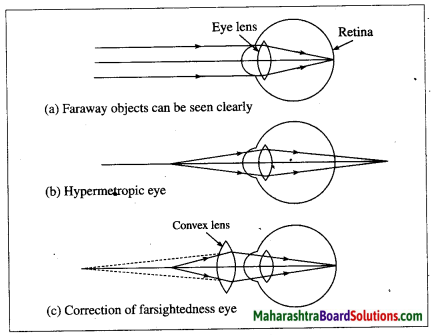
Maharashtra Board Class 10 Science Solutions Part 1 Chapter 7 Lenses 1

2. Presbyopia:
Presbyopia is the defect of vision in which aged people find it difficult to see nearby objects
comfortably and clearly without spectacles.

Reason of presbyopia: The power of accommodation of eye usually decreases with ageing. The muscles near the eye lens lose their ability to change the focal length of the lens.

Therefore, the near point of the eye lens shifts rarther from the eye, This defect is corrected using a. convex lens of appropriate power. The lens converges light rays before they fall on the eye lens such that the action of the eye lens forms the image on the retina.

3. Nearsightedness:
Myopia or nearsightedness is the defect of vision in which a human eye can see nearby objects distinctly but is unable to see distant objects clearly as they appear indistinct.
In this case the image of a distant object is formed in front of the retina instead of on the retina.
[Figs. 7.29 (a), 7.29 (b)]

Possible reasons for myopia:
(1) The curvature of the cornea and the eye lens increases. The muscles near the lens cannot relax so that the converging power of the lens remains large. (2) The distance between the eye lens and the retina increases as the eyeball elongates.

Myopia is corrected using a suitable concave lens. Light rays are diverged by the concave lens before they strike the eye lens. A concave lens of proper focal length is chosen to produce the required divergence. Hence, after the converging action of the eye lens, the image is formed on the retina. [Fig. 7.29 (c)]
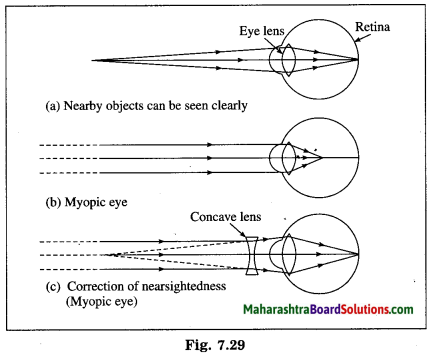
Maharashtra Board Class 10 Science Solutions Part 1 Chapter 7 Lenses 2

Maharashtra Board Class 10 Science Solutions Part 1 Chapter 7 Lenses

Question 2.
Draw a figure explaining various terms related to a lens.
Answer:
(1) Centre of curvature (C): The centres of the spheres whose parts form the surfaces of a lens are called the centres of curvature of the lens. A lens has two centres of curvature C1, and C2 for its two spherical surfaces.

(2) Radii of curvature (R1, R2): The radii of the spheres whose parts form surfaces of a lens are called the radii of curvature of the lens.

(3) Principal axis: The imaginary straight line passing through the two centres of curvature of a lens is called the principal axis of the lens.

(4) Optical centre (O): The point inside a lens on the principal axis, through which light rays pass without changing their path is called the optical centre (O) of the lens.

(5) Principal focus (F): When light rays parallel to the principal- axis are incident on a convex lens, they converge at a point on the principal axis. This point is called the principal focus (F) of the convex lens. Light rays travelling parallel to the principal axis of a concave lens diverge after refraction in such a way that they appear to be coming out of a point on the principal axis. This point is called the principal focus of the concave lens. A lens has two principal foci F1 and F2.
[Note: In this chapter, the terms focus and the principal focus are used in the same sense.]

(6) Focal length (f): The distance between the optical centre and the principal focus of a lens is called the focal length (f) of the lens.
Maharashtra Board Class 10 Science Solutions Part 1 Chapter 7 Lenses 3
C1, C2: Centres of curvature, R1, R2: Radii of curvature, O: Optical centre.
The cross sections of convex and concave lenses are shown in parts (a) and (b) of Fig. 7.4. The surface marked as 1 is part of sphere S1 while the surface marked as 2 is part of sphere S2.
Maharashtra Board Class 10 Science Solutions Part 1 Chapter 7 Lenses 4
P1, P2, P3: Incident rays of light,
Q1, Q2, Q3: Refracted rays of light, O: Optical centre
Maharashtra Board Class 10 Science Solutions Part 1 Chapter 7 Lenses 5
F1, F2: Principal foci of the lens, f: Focal length of the lens

Maharashtra Board Class 10 Science Solutions Part 1 Chapter 7 Lenses

Question 3.
At which position will you keep an object in front of a convex lens so as to get a real image of the same size as the object? Draw a figure.
Answer:
At 2F1.
Maharashtra Board Class 10 Science Solutions Part 1 Chapter 7 Lenses 6

Question 4.
Give scientific reasons:
a. A simple microscope is used for watch repairs.
Answer:
(1) when an object is placed within the focal length of a magnifying glass or simple microscope (convex lens), its larger and erect image is obtained on the same side of the lens as that of the object.

(2) By adjusting the distance between the object and the lens, the image can be obtained at the minimum distance of distinct vision. Thus, a watch repairer can see the minute parts of a watch more clearly with the aid of a magnifying glass (a simple microscope) than with the naked eye, without any stress on the eye. Hence, watch repairers use a magnifying glass (a simple microscope) while repairing the watches.

b. One can sense colours only in bright light.
Answer:
(1) The retina in the eye is made of many light sensitive cells. The rod-shaped cells respond to the intensity of light while the cone-shaped cells j respond to various colours.
(2) The cone-shaped cells do not respond to faint light. They function only in bright light. Hence, one can sense colours only in bright, light.

c. We cannot clearly see an object kept at a distance less than 25 cm from the eye.
Answer:
(1) When we try to see a nearby object, the eye lens becomes more rounded and its focal length decreases. Then a clear image of the object is formed on the retina of the eye.
(2) The focal length of the eye lens cannot be decreased beyond some limit. Therefore we cannot clearly see an object kept at a distance less than 25 cm from the eye.

Question 5.
Explain the working of an astronomical telescope using refraction of light.
Answer:
Construction of a refracting telescope: It consists of two convex lenses called the objective lens (directed towards the object) and the eyepiece (directed towards the eye). The focal length and diameter of the objective lens are respectively greater than the focal length and diameter of the eyepiece. The objective lens is fitted at one end of a long metal tube.

A metal tube of smaller diameter is fitted in this metal tube and the eyepiece is fitted at the outer end of the smaller tube. With the help of a screw it is possible to change the distance between the eyepiece and the objective lens by sliding the tube fitted with the eyepiece. The principal axes of the objective lens and the eyepiece are along the same line. A telescope is usually mounted on a stand.
Maharashtra Board Class 10 Science Solutions Part 1 Chapter 7 Lenses 7

Working: When the objective lens is pointed towards the distant object to be observed, the rays of light from the distant object, which are almost parallel to each other, pass through the objective lens. The objective lens collects maximum amount of light as it is large in size. It forms a real, inverted and diminished image in the focal plane of the objective lens. Now, the position of the eyepiece is adjusted such that this image falls just within the focal length of the eyepiece and serves as the object for the eyepiece which works as a simple microscope.

The final image is highly magnified, virtual, on the same side as that of the object and inverted with respect to the original object. The final image can be observed by keeping the eye close to the eyepiece. If the image formed by the objective lens lies in the focal plane of the eyepiece, the final image is formed at infinity.

Maharashtra Board Class 10 Science Solutions Part 1 Chapter 7 Lenses

Question 6.
Distinguish between the following:
a. Farsightedness (Hypermetropia) and Nearsightedness (Myopia).
Answer:
Farsightedness:

  1. In hypermetropia, a human eye can see distant distinctly but is unable to see nearby objects clearly.
  2. In this case, the image of a nearby object would be formed behind the retina.
  3. This defect can be corrected using a convex lens of appropriate power.

Nearsightedness:

  1. In myopia, a human eye can see near objects distinctly, but is unable to see distant objects clearly.
  2. In this case, the image of a distant object is formed in front of the retina.
  3. This defect can be corrected using a concave lens of appropriate power.

b. Concave lens and Convex lens.
Answer:
Concave lens:

  1. A concave lens has its surfaces curved inwards.
  2. It is thicker at the edges than in the middle.
  3. It can form only a virtual image.
  4. It can form only a diminished image.

Convex lens:

  1. A convex lens has its surfaces puffed up outwards.
  2. It is thicker in the middle than at the edges.
  3. It can form a real image as well as a % virtual image.
  4. It can form a magnified, diminished or the same sized image (relative to the object) depending on the position of the object.

Question 7.
What is the function of the iris and the muscles connected to the lens in the human eye?
Answer:
When the incident light is very bright, the muscles of the iris stretch to reduce the size of the pupil. When the incident light is dim, the muscles of the iris relax to increase the size of the pupil. Thus, the iris controls the size of the pupil and thereby regulates the amount of light entering the eye. (Fig. 7.26)

When a distant object is to be observed, the ciliary muscles relax so that the eye lens becomes flat. This increases the focal length of the lens. Therefore, a sharp image of the distant object is formed on the retina.
Thus, we can see a distant object clearly. (Fig. 7.27)
Maharashtra Board Class 10 Science Solutions Part 1 Chapter 7 Lenses 8
when an object closer to the eye is to be observed. the ciliary muscles contract increasing the curvature. of the eye lens. The eye lens, therefore, becomes rounded. This decreases the focal length of the lens. Therefore, a sharp image of the nearby object is formed on the retina. Thus, we can see a nearby object clearly. (Fig. 7.27)
Maharashtra Board Class 10 Science Solutions Part 1 Chapter 7 Lenses 9

Question 8.
Solve the following examples:
i. Doctor has prescribed a lens having I power + 1.5 D. What will be the focal length of the lens? What is the type of the lens and what must be the defect of vision?
Solution:
Data: P = + 1.5 D, f = ?
Focal length of the lens, f = \(\frac{1}{P}=\frac{1}{1.5 \mathrm{D}}\)
= \(\frac{10}{15}\) m = 0.6667 m = 0.67 m
P is positive. This shows that the lens is convex. The defect of vision is farsightedness (hypermetropia).

ii. 5 cm high object is placed at a distance of 25 cm from a converging lens of focal length of 10 cm. Determine the position, size and type of the image.
Solution:
Data: Converging lens, f = 10 cm
u = – 25 cm, h1 = 5 cm, v = ?, h2 = ?
Maharashtra Board Class 10 Science Solutions Part 1 Chapter 7 Lenses 10
Maharashtra Board Class 10 Science Solutions Part 1 Chapter 7 Lenses 11
The height of the image = -3.3 cm (inverted image ∴ minus sign).
(iii) The image is real, inverted and smaller than the object.

iii. Three lenses having powers 2, 2.5 and 1.7 D are kept touching in a row. What is the total power of the lens combination?
Solution:
Data: P1 = 2 D, P2 = 2.5 D, P3 = 1.7 D, P = ?
Total power of the lens combination,
P = P1 +P2 + P3
= 2 D + 2.5 D + 1.7 D
= 6.2 D.

iv. An object kept 60 cm from a lens gives a virtual image 20 cm in front of the lens. What is the focal length of the lens? Is it a converging lens or diverging lens?
Solution:
Data: u = -60 cm, v = -20 cm, f = ?
Maharashtra Board Class 10 Science Solutions Part 1 Chapter 7 Lenses 12
∴ The focal length of the lens, f = – 30 cm. As f is negative, it is a diverging lens.

Project:

Question 1.
Make a Powerpoint presentation about the construction and use of binoculars. (Do it your self)

Maharashtra Board Class 10 Science Solutions Part 1 Chapter 7 Lenses

Can you recall? (Text Book Page No. 80)

Question 1.
Indicate the following terms related to spherical mirrors in figure 7.1: pole, centre of curvature, radius of curvature, principal focus.
Maharashtra Board Class 10 Science Solutions Part 1 Chapter 7 Lenses 13
Answer:
Maharashtra Board Class 10 Science Solutions Part 1 Chapter 7 Lenses 14

Question 2.
How are concave and convex mirrors constructed?
Answer:
The given part of a hollow spherical glass can be converted into a concave mirror by (i) polishing (silvering) its inner side (inner surface or concave surface) to make it reflecting or (ii) coating its outer side with a thin layer of silver and painting it with red colour to protect the silver coating.
[Note: Case (i) corresponds to the front surface silvered concave mirror.]

The given part of a hollow spherical glass can be converted into a convex mirror by (i) polishing (silvering) its outer side (outer surface or convex surface) to make it reflecting or (ii) coating its inner side with a thin layer of silver and painting it with red colour to protect the silver coating.
[Note: Case (i) corresponds to the front surface silvered convex mirror. ]

Use your brain power! (Text Book Page No. 85)

Question 1.
From equations (1) and (2) what is the relation between h1, h2, u and v?
Answer:
M = \(\frac{h_{2}}{h_{1}}\) …….(1)
Also, M = \(\frac{v(\text { image distance })}{u \text { (object distance) }}\)……(2)
\(\frac{h_{2}}{h_{1}}\) = \(\frac{v}{u}\)

Maharashtra Board Class 10 Science Solutions Part 1 Chapter 7 Lenses

Try this (Text Book Page No. 88)

(1) Try to read a book keeping it very far from your eyes.
(2) Try to read a book keeping it very close to your eyes.
(3) Try to read a book keeping it at a distance of 25 cm from your eyes.
At which time do you see the alphabets clearly? Why?
Answer:
Minimum distance of distinct vision: Though the focal length of the eye lens is adjustable, it cannot be decreased below a certain limit. Hence, if an object is very close to the eye, it cannot be seen clearly. For a normal human eye, the minimum distance from the eye at which an object is clearly visible without stress on the eye, is called the minimum distance of distinct vision. For the normal human eye, it is 25 cm.

Use your brain power! (Text Book Page No. 89)

Question.
(1) Why do we have to bring a small object near the eyes in order to see it clearly?
(2) If we bring an object closer than 25 cm from the eyes, when can we not see it clearly even though it subtends a bigger angle at the eye?
Answer:
(1) when a small object is brought near the eyes, its apparent size increases. Therefore, it is
seen clearly.

(2) Minimum distance of distinct vision: Though the focal length of the eye lens is adjustable, it cannot be decreased below a certain limit. Hence, if an object is very close to the eye, it cannot be seen clearly. For a normal human eye, the minimum distance from the eye at which an object is clearly visible without stress on the eye, is called the minimum distance of distinct vision. For the normal human eye, it is 25 cm.

Try this (Text Book Page No. 91)

Question 1.
Take a burning incense stick in your hand and rotate it fast along a circle.
Answer:
A circle of red light is seen.

Question 2.
Draw a cage on one side of a cardboard and a bird on the other side. Hang the cardboard with the help of a thread. Twist the thread and leave It. What do you see and why?
Answer:
The bird appears to be inside the cage. This happens due to persistence of vision.
Persistence of vision: We see an object when its image is formed on the retina. The image disappears when the object is removed from our sight. But this is not instantaneous and the image remains imprinted on the retina for about \(\frac{1}{16}\) th of a second after the removal of the object. The sensation on the retina persists for a while. This effect is known as the persistence of vision.

It is due to persistence of vision that we continue to see the object in its position for about \(\frac{1}{16}\) th of a second after it is removed.
Example: When a burning stick of incense is moved fast in a circle, a circle of red light is seen.

Maharashtra Board Class 10 Science Solutions Part 1 Chapter 7 Lenses

Can you tell? (Text Book Page No. 91)

Question 1.
How do we perceive different colours?
Answer:
(1) In nature we field objects of various colours. Perception of colour means to be able to respond to colour.
(2) We can distinguish between various colours due to perception of colour.
(3) The cone-shaped cells on the retina of the eye respond to the various colours when light is bright and communicate to the brain about the colours of the image formed on the retina. This gives us the proper idea about the colours of the object.
(4) If, in the retina of a person, the cone-shaped cells responding to certain specific colours are absent, the person is unable to distinguish between the colours. As a result, he lacks perception of colour.

Fill in the blanks and rewrite the statements:

Question 1.
The focal length of a………..lens is positive.
Answer:
The focal length of a convex lens is positive.

Question 2.
The focal length of a………..lens is negative.
Answer:
The focal length of a concave lens is negative.

Question 3.
The magnification produced by a………..lens is always positive.
Answer:
The magnification produced by a concave lens is always positive.

Question 4.
The power of a………..lens is positive.
Answer:
The power of a convex lens is positive.

Question 5.
The power of a………..lens is negative.
Answer:
The power of a concave lens is negative.

Question 6.
The focal length of a lens with power 2.5 D is………..
Answer:
The focal length of a lens with power 2.5 D is 40 cm (0.4 m).

Question 7.
The power of a lens with focal length 20 cm is………..
Answer:
The power of a lens with focal length 20 cm is 5D.

Question 8.
The minimum distance of distinct vision for a normal human eye is………..
Answer:
The minimum distance of distinct vision for a normal human eye is 25 cm.

Question 9.
If two lenses with focal lengths 10 cm and 20 cm respectively are kept in contact with each other, the effective power of the combination is………..
Answer:
If two lenses with focal lengths 10 cm and 20 cm respectively are kept in contact with each other, the effective power of the combination is 15 D.

Maharashtra Board Class 10 Science Solutions Part 1 Chapter 7 Lenses

Question 10.
A………..lens is used as a simple microscope.
Answer:
A convex lens is used as a simple microscope.

Rewrite the following statements by selecting the correct options:

Question 1.
Inside water, an air bubble behaves………..
(a) like a flat plate
(b) like a concave lens
(c) like a convex lens
(d) like a concave mirror
Answer:
Inside water, an air bubble behaves like a concave lens.

Question 2.
…………represents the lens formula.
Maharashtra Board Class 10 Science Solutions Part 1 Chapter 7 Lenses 15
Answer:
(b) \(\frac{1}{v}-\frac{1}{u}=\frac{1}{f}\) represents the lens formula.

Question 3.
The power of a convex lens of focal length 25 cm is………..
(a) +4.0 D
(b) 0.25 D
(c) -4.0 D
(d) -0.4D
Answer:
The power of a convex lens of focal length 25 cm is +4.0 D

Question 4.
A lens does not produce any deviation of a ray of light passing through………..
(a) it’s centre of curvature
(b) it’s optical centre
(c) it’s principal focus
(d) an axial point at a distance 2F from its centre
Answer:
A lens does not produce any deviation of a ray of light passing through its optical centre.

Question 5.
The image formed by a concave lens is always………..
(a) virtual and erect
(b) real and erect
(c) virtual and inverted
(d) real and inverted
Answer:
The image formed by a concave lens is always virtual and erect.

Question 6.
A convex lens forms a virtual image of an object placed………..
(a) at infinity
(b) at a distance 2F from the lens
(c) at a distance F from the lens
(d) between the principal focus and the optical centre of the lens.
Answer:
A convex lens forms a virtual image of an object placed between the principal focus and the optical centre of the lens.

Question 7.
When an object is placed at 2F1 of a convex lens, its image is formed………..
(a) at F1
(b) at 2F2
(c) beyond 2F2
(d) on the same side as the object
Answer:
When an object is placed at 2F1 of a convex lens, its image is formed at 2F2

Maharashtra Board Class 10 Science Solutions Part 1 Chapter 7 Lenses

Question 8.
To obtain an image of the same size as that of an object with the help of a convex lens, the object should be placed………..
(a) at infinity
(b) beyond F1
(c) between F1 and 2F1
(d) at 2F1
Answer:
To obtain an image of the same size as that of an object with the help of a convex lens, the object should be placed at 2F1

Question 9.
When an object is placed between O and F1 in front of a convex lens, the image formed is ………..
(a) enlarged and erect
(b) diminished and erect
(c) real and enlarged
(d) diminished and inverted
Answer:
When an object is placed between O and F1 in front of a convex lens, the image formed is enlarged and erect.

Question 10.
When an object is placed at any finite distance from a concave lens, the image is formed ………..
(a) between F1 and 2F1
(b) beyond 2F1
(c) at F1
(d) between F1 and O on the same side as the object.
Answer:
When an object is placed at any finite distance from a concave lens, the image is formed between F1 and O on the same side as the object.

Question 11.
A student obtained a clear image of window grills on the screen. But the teacher told him to get the image of a tree far away, instead of the window. To get a clear image, the lens must be ……….. (Practice Activity Sheet – 2)
(a) moved towards the screen
(b) moved away from the screen
(c) moved behind the screen
(d) moved far away from the screen
Answer:
A student obtained a clear image of window grills on the screen. But the teacher told him to get the image of a tree far away, instead of the window. To get a clear image, the lens must be moved towards the screen.

Question 12.
The image obtained while finding the focal length of a convex lens is ……….. (Practice Activity Sheet – 3)
(a) real and erect
(b) virtual and erect
(c) real and inverted
(d) virtual and inverted
Answer:
The image obtained while finding the focal length of a convex lens is real and inverted.

Maharashtra Board Class 10 Science Solutions Part 1 Chapter 7 Lenses

Question 13.
Yash found out f1 and f2 of a symmetric convex lens experimentally. Then which of the following conclusions is true? (Practice Activity Sheet – 4)
(a) f1 = f2
(b) f1 > f2
(c) f1 < f2
(d) f1 ≠ f2
Answer:
(a) f1 = f2

State whether the following statements are true or false: (If a statement is false, correct it and rewrite it.)

Group (A)

Question 1.
Power of a lens, P = \(\frac{1}{f}\).
Answer:
True.

Question 2.
If the power of a lens is 2 D, its focal length = 0.5 m.
Answer:
True.

Question 3.
A concave lens is a converging lens. (March 2019)
Answer:
False. (A concave lens is a diverging lens.)

Question 4.
A convex lens is a diverging lens.
Answer:
False. (A convex lens is a converging lens.)

Question 5.
A concave lens always forms a virtual image.
Answer:
True.

Question 6.
A convex lens always forms a virtual image.
Answer:
False. (A convex lens forms a real image or a virtual image depending on the object distance.)

Maharashtra Board Class 10 Science Solutions Part 1 Chapter 7 Lenses

Question 7.
Due to the light sensitive cells in the eye, we get information about the brightness or dimness of the object and the colour of the object.
Answer:
True.

Question 8.
The focal length of a concave lens is negative.
Answer:
True.

Question 9.
The magnification produced by a concave lens is positive or negative depending on the object distance.
Answer:
False. (The magnification produced by a concave lens is always positive.)

Question 10.
The magnification produced by a convex lens is positive or negative depending on the object distance.
Answer:
True.

Question 11.
A concave lens is used as a magnifying glass.
Answer:
False. (A convex lens is used as a magnifying glass.)

Question 12.
A convex lens is used as a simple microscope.
Answer:
True.

Question 13.
A concave lens is used to correct myopia.
Answer:
True.

Maharashtra Board Class 10 Science Solutions Part 1 Chapter 7 Lenses

Question 14.
A convex lens is used to correct hypermetropia.
Answer:
True.

Group (B)

Question 1.
When red light falls on the eyes, the cells responding to red light get excited more than those responding to other colours and we get the sensation of red colour.
Answer:
True.

Question 2.
When an object is placed in front of a concave lens, its image is obtained on the opposite side of the object.
Answer:
False. (When an object is kept in front of a concave lens, its image is obtained on the same side of the lens as the object.)

Question 3.
The image formed by a concave lens is always virtual.
Answer:
True.

Question 4.
The principal focus of a convex lens is virtual.
Answer:
False. (The principal focus of a convex lens is real.)

Maharashtra Board Class 10 Science Solutions Part 1 Chapter 7 Lenses

Question 5.
An object of height 2 cm forms an image of height 3 cm when placed in front of a concave lens.
Answer:
False. (An object of height 2 cm forms an image of height less than 2 cm when placed in front of a concave lens.)

Question 6.
Absence of rod like cells results in colour blindness.
Answer:
False. (Absence of conical cells results in colour-blindness.)

Question 7.
Nearsightedness can be corrected using spectacles having convex lenses.
Answer:
False. (Nearsightedness can be corrected using spectacles having concave lenses.)

Question 8.
Farsightedness can be corrected using spectacles having convex lenses of suitable focal length.
Answer:
True.

Question 9.
As one grows old, ciliary muscles become weak.
Answer:
True.

Question 10.
In a simple microscope, the object is placed within the focal length of the convex lens.
Answer:
True.

Question 11.
A compound microscope forms an erect and real image of a small object.
Answer:
False. (A compound microscope forms an inverted and virtual image of a small object.)

Question 12.
In a compound microscope, a real image acts as an object for the eyepiece.
Answer:
True.

Maharashtra Board Class 10 Science Solutions Part 1 Chapter 7 Lenses

Question 13.
In television, we see a continuous picture due to persistence of vision.
Answer:
True.

Question 14.
The conical cells can respond differently to red, green and blue colours.
Answer:
True.

Question 15.
The rod like cells respond to colours and communicate the presence of colours in the retinal image of the brain.
Answer:
False. (The rod like cells respond to the intensity of light and communicate the degree of brightness and darkness, to the brain.)

Question 16.
The conical cells respond to the intensity of light and communicate the degree of brightness and darkness to the brain.
Answer:
False. (The conical cells respond to colours and communicate the presence of colours in the retinal image to the brain.)

Question 17.
Generally, using the same objective lens, but different eyepieces, different magnification can be obtained.
Answer:
True.

Find the odd one out and give the reason:

Question 1.
Simple microscope, Compound microscope, Telescope, Myopia.
Answer:
Myopia. It is a defect of vision; others are instruments.

Question 2.
Myopia, Presbyopia, Hypermetropia, Spectrometer.
Answer:
Spectrometer. It is an instrument; others are defects of vision.

Question 3.
Presbyopia, Retina, Nearsightedness, Farsightedness.
Answer:
Retina. It is a part of the eye; others are defects of vision.

Question 4.
Compound microscope, Kaleidoscope, Simple microscope, Astronomical telescope.
Answer:
Kaleidoscope. Others are optical instruments.

Maharashtra Board Class 10 Science Solutions Part 1 Chapter 7 Lenses

Question 5.
TV, Motion picture, Complete circle formed by a revolving burning incense stick, Colour blindness.
Answer:
Colour-blindness. Others are examples of persistence of vision.

Question 6.
Planets, Stars, Satellites, Rainbow.
Answer:
Rainbow. Others are celestial bodies.

Considering the correlation between the words of the first pair, pair the third word accordingly with proper answer:

Question 1.
Nearsightedness: Elongated eyeball :: Farsightedness:………
Answer:
Flattened eyeball

Question 2.
Convex lens : Converging :: Concave lens :………..
Answer:
Diverging

Question 3.
Object at 2F1 of a convex lens : Image at 2F2 :: Object at F1 :………..
Answer:
Image on the opposite side at infinity

Question 4.
Magnification positive : Erect image :: Magnification negative :………..
Answer:
Inverted image

Question 5.
Convex lens : Positive power of the lens :: Concave lens:
Answer:
Negative power of the lens.

Maharashtra Board Class 10 Science Solutions Part 1 Chapter 7 Lenses

Question 6.
\(\frac{1}{f(\text { in metre })}\) : Power of the lens (in dioptre) :: \(\frac{\text { Image distance }}{\text { Object distance }}\)
Answer:
Magnification.

Question 7.
Focal length : Metre :: Power of a lens :………..
Answer:
Dioptre.

Question 8.
Iris : Pupil :: Ciliary muscles :……….
Answer:
Eye lens

Question 9.
Nearsightedness : Concave lens :: Farsightedness :………..
Answer:
Convex lens

Question 10.
Nearsightedness : Image in front of the retina :: Farsightedness :………..
Answer:
Image behind the retina

Question 11.
Observation of stars and planets : Telescope :: Repairing a watch :……….
Answer:
Simple microscope

Question 12.
Cinema : Persistence of vision :: Rainbow :………
Answer:
Refraction, dispersion and internal reflection of light.

Match the following:

Question 1.

Column AColumn B
(1) Conical cells(a) Intensity of light
(2) Rod like cells(b) Colour of an image
(3) Pupil(c) Iris
(4) Cornea(d) Aperture
(e) Transparent

Answer:
(1) Conical cells – Colour of an image
(2) Rod like cells – Intensity of light
(3) Pupil – Aperture
(4) Cornea – Transparent.

Maharashtra Board Class 10 Science Solutions Part 1 Chapter 7 Lenses

Question 2.

Column AColumn B
(1) Magnification(a) \(\frac{1}{f}\)
(2) Power of a lens(b) \(\frac{h_{2}}{h_{1}}\)
(3) Focal length(c) f
(4) Distance of an object from a lens(d) u
(e) \(\frac{h_{1}}{h_{2}}\)

Answer:
(1) Magnification: \(\frac{h_{2}}{h_{1}}\)
(2) Power of a lens: \(\frac{1}{f}\)
(3) Focal length: f
(4) Distance of an object from a lens: u.

Question 3.
Maharashtra Board Class 10 Science Solutions Part 1 Chapter 7 Lenses 16
Answer:
(1) Lens: \(\frac{1}{f}: \frac{1}{v}-\frac{1}{u}\)
(2) Magnification: \(\frac{h_{2}}{h_{1}}\)
(3) Refractive index: \(\frac{\sin i}{\sin r}\)

Question 4.

Column AColumn B
(Convex lens)(a) Image virtual, erect and enlarged
(1) Object at 2F1(b) Image real, inverted and of the same size
(2) Object between F1 and 2F1(c) Image real, inverted and highly diminished
(3) Object between O and F1(d) Image real, inverted and highly enlarged
(4) Object at infinity(e) Image real, inverted and enlarged

Answer:
(1) Object at 2F1 – Image real, inverted and of the same size
(2) Object between F1 and 2F1 – Image real, inverted and enlarged
(3) Object between O and F1 – Image virtual, erect and enlarged
(4) Object at infinity – Image real, inverted and highly diminished

Question 5.

Column AColumn B
(1) Nearsightedness(a) Ciliary muscles become weak
(2) Farsightedness(b) Image in front of the retina
(3) Presbyopia(c) Colour-blindness
(d) Image behind the retina

Answer:
(1) Nearsightedness – Image in front of the retina
(2) Farsightedness – Image behind the retina
(3) Presbyopia – Ciliary muscles become weak

Question 6.

Column AColumn B
(1) Convex lens(a) To see small objects clearly
(2) Astronomical telescope(b) To observe minute objects
(3) Compound microscope(c) To observe astronomical objects such as stars, planets, etc.
(4) Simple microscope(d) Presbyopia
(e) Power of a lens

Answer:
(1) Convex lens – Presbyopia
(2) Astronomical telescope – To observe astronomical objects such as stars, planets, etc.
(3) Compound microscope – To observe minute objects
(4) Simple microscope – To see small objects clearly.

Maharashtra Board Class 10 Science Solutions Part 1 Chapter 7 Lenses

Question 7.

Column AColumn B
(1) Persistence of vision(a) Lenses and mirrors are used
(2) Reflecting telescope(b) To see objects far away from us
(3) Telescope(c) Motion picture
(4) Compound microscope(d) To observe blood
(e) Convex lens

Answer:
(1) Persistence of vision – Motion picture
(2) Reflecting telescope – Lenses and mirrors are used
(3) Telescope – To see objects far away from us
(4) Compound microscope – To observe blood corpuscles.

Name the following:

Question 1.
Name the lens which forms a real image or a virtual image depending on the position of the object.
Answer:
A convex lens.

Question 2.
Name the lens which produces magnification always less than 1.
Answer:
A concave lens.

Question 3.
Name the lens which always forms an image virtual and smaller than the object.
Answer:
A concave lens.

Maharashtra Board Class 10 Science Solutions Part 1 Chapter 7 Lenses

Question 4.
Name the lens used to obtain the image on a screen.
Answer:
A convex lens.

Question 5.
Name the lens for which the image always lies between the object and the lens.
Answer:
A concave lens.

Question 6.
Name the instrument used to observe bacteria.
Answer:
A compound microscope.

Question 7.
Name the instrument used to observe planets.
Answer:
An astronomical telescope.

Answer the following questions in one sentence each:

Question 1.
An object is placed at 60 cm from a convex lens of focal length 20 cm. State the nature and size of the image relative to that of the object.
Answer:
The image is real, inverted and smaller than the object.

Question 2.
If an object is placed at 50 cm from a convex lens of focal length 25 cm, what will be the image distance?
Answer:
The image distance will be.50 cm.

Question 3.
An object is placed at 40 cm from a convex lens of focal length 20 cm. State the nature and the size of the image relative to that of the object.
Answer:
The image is real, inverted and of the same size as that or the object.

Maharashtra Board Class 10 Science Solutions Part 1 Chapter 7 Lenses

Question 4.
An object is placed at 30 cm from a convex lens of focal length 20 cm. State the nature and the size of the image relative to that of the object.
Answer:
The image is real, inverted and larger than the object.

Question 5.
An object is placed at 15 cm from a convex lens of focal length 25 cm. State the nature and size of the image relative to that of the object.
Answer:
The image is virtual, erect and larger than the object.

Question 6.
State the type of lens that can be used to burn paper in sunlight at noon.
Answer:
A convex lens can be used to burn paper in sunlight at noon.

Question 7.
State the type of lens used to correct myopia.
Answer:
A concave lens is used to correct myopia.

Question 8.
State the type of lens used to correct hypermetropia.
Answer:
A convex lens is used to correct hypermetropia.

Question 9.
If two lenses with focal lengths 10 cm and – 20 cm respectively are kept in contact with each other, what will be the effective power of the combination of the lenses?
Answer:
The effective power of the combination of the lenses will be + 5 D.

Question 10.
If two lenses with focal lengths – 10 cm and 40 cm respectively are kept in contact with each other, what can you say about the behaviour of the combination of the lenses?
Answer:
The combination of the lenses will behave as a concave lens.

Answer the following questions:

Question 1.
What is a lens?
Answer:
A lens is a transparent material bound by two surfaces, out of which at least one surface is spherical.
[Note: A lens is normally made of glass or plastic.]

Question 2.
In which instruments have you seen a lens?
Answer:
We have seen a lens in a microscope and a telescope.

Question 3.
How is a lens different from a mirror?
Answer:
A mirror has one reflecting surface. By reflection of light, it forms an image of the object placed in front of it. A mirror is not transparent. A lens has two surfaces that form an image by refraction of light. A lens is transparent.

Question 4.
Make a list of optical devices you know.
Answer:
Microscope, telescope, binoculars, camera, projector.

Question 5.
Do you know which is the natural optical device?
Answer:
Yes. The eye is the natural optical device.

Question 6.
What is a convex lens?
Answer:
A lens having both spherical surfaces puffed up outwards is called a convex lens or double convex lens or biconvex lens. It is thicker in the middle than at the edges.
[Note: A convex lens is also called a converging lens.]

Question 7.
What is a concave lens?
Answer:
A lens having both spherical surfaces curved inwards is called a concave lens or double concave lens or biconcave lens. It is thicker at the edges than in the middle.
[Note: A concave lens is also called a diverging lens.]

Maharashtra Board Class 10 Science Solutions Part 1 Chapter 7 Lenses

Question 8.
Draw neat labelled diagrams: Types of lenses.
Answer:
Maharashtra Board Class 10 Science Solutions Part 1 Chapter 7 Lenses 17
[Note: Positive meniscus behaves as a convex lens as it is thicker in the middle than at the edges. Negative meniscus behaves as a concave lens as it is thicker at the edges than in the middle.]

Question 9.
In general, when a ray of light passes through a lens, there occurs a change in its direction of propagation. Why?
Answer:
The working of a lens is similar to that of a triangular prism. When a ray of light passes through a lens, it is refracted twice: When entering the lens and when emerging from the lens. There is a change 5 in its direction of propagation every time and as both the changes occur in the same sense, the direction of propagation of the emergent ray is different from that of the incident ray.

Question 10.
State the rules used for drawing ray diagrams for the formation of an image by a convex lens.
Answer:
Rules used for drawing ray diagrams for the formation of an image by a convex lens:
(1) When the incident ray is parallel to the principal axis, the refracted ray passes through the principal focus.
Maharashtra Board Class 10 Science Solutions Part 1 Chapter 7 Lenses 18
(2) When the incident ray passes through the principal focus, the refracted ray is parallel to the principal axis.
Maharashtra Board Class 10 Science Solutions Part 1 Chapter 7 Lenses 19
(3) When the incident ray passes through the optical centre of the lens, it passes without changing its direction.
Maharashtra Board Class 10 Science Solutions Part 1 Chapter 7 Lenses 20

Question 11.
In the case of a convex lens, show the path of the refracted ray when the incident ray of light (1) is parallel to the principal axis of the lens (2) passes through the focus of the lens (3) passes through the optical centre of the lens.
Answer:
1.
Maharashtra Board Class 10 Science Solutions Part 1 Chapter 7 Lenses 21

2.
Maharashtra Board Class 10 Science Solutions Part 1 Chapter 7 Lenses 22

3.
Maharashtra Board Class 10 Science Solutions Part 1 Chapter 7 Lenses 23

Maharashtra Board Class 10 Science Solutions Part 1 Chapter 7 Lenses

Question 12.
Draw neat and well labelled ray diagrams for image formation by convex lens when an object is (1) at infinity (2) beyond 2F1 (3) at 2F1 (4) between F1 and 2F1 (5) at focus F1 (6) between focus F1 and optical centre O. Also, in each case, state the position, nature and size of the image relative to that of the object.
Answer:
(1) Object at infinity:
Maharashtra Board Class 10 Science Solutions Part 1 Chapter 7 Lenses 24
In this case, the image is formed at focus F2 of the convex lens. It is real, inverted and highly diminished (point-sized).

(2) Object beyond 2F1:
Maharashtra Board Class 10 Science Solutions Part 1 Chapter 7 Lenses 25
In this case, the image is formed between F2 and 2F2. It is real, inverted and diminished.

(3) Object at 2F1:
Maharashtra Board Class 10 Science Solutions Part 1 Chapter 7 Lenses 26
In this case, the image is formed at 2F2. It is real, inverted and of the same size as that of the object.

(4) Object between F1 and 2F1:
Maharashtra Board Class 10 Science Solutions Part 1 Chapter 7 Lenses 27
In this case, the image is formed beyond 2F2. It is real, inverted and magnified (enlarged).

(5) Object at focus F1:
Maharashtra Board Class 10 Science Solutions Part 1 Chapter 7 Lenses 28
In this case, the image is formed at infinity. It is real, inverted and infinitely large (highly magnified).

(6) Object between focus F1 and optical centre O:
Maharashtra Board Class 10 Science Solutions Part 1 Chapter 7 Lenses 29
In this case, the image is formed on the same side of the lens as the object. It is virtual, erect and larger than the object.
[Note: Here, the image is virtual. Hence, it is shown by a dotted line.]

Maharashtra Board Class 10 Science Solutions Part 1 Chapter 7 Lenses

Question 13.
Observe the following figure and complete the table: (March 2019)
Maharashtra Board Class 10 Science Solutions Part 1 Chapter 7 Lenses 30
Answer:

PointAnswer
(i) Position of the objectBetween F1 and O
(ii) Position of the imageOn the same side of the lens as the object
(iii) Size of the imageVery large
(iv) Nature of the imageVirtual and erect

Question 14.
At which position will you keep an object in front of a convex lens to get a real image smaller than the object? Draw a figure.
Answer:
The object should be placed beyond 2F1.
Maharashtra Board Class 10 Science Solutions Part 1 Chapter 7 Lenses 31

Question 15.
State the rules used for drawing ray diagrams for the formation of an image by a concave lens.
Answer:

  1. When the incident ray is parallel to the principal axis, the refracted ray, when extended backwards, passes through the principal focus.
  2. When the incident ray is directed towards the principal focus F2, the refracted ray is parallel to the principal axis.
  3. When the incident ray passes through the optical centre of the lens, it passes without changing its direction.

Question 16.
State the characteristics of an image formed by a concave lens.
Answer:
The image formed by a concave lens is always virtual, erect and smaller than the object. It is on the same side of the lens as the object. Generally, it is formed between the optical centre of the lens and the principal focus F1. If the object is at infinity, the image is a point image formed at F1.

Question 17.
In the case of image formation by a concave lens, what can you say about the position, nature and size of the image relative to the size of the object?
Answer:
Image formation by a concave lens :
(1) If the object is at infinity, the image is formed at the focus of the lens, on the same side of the lens as the object. It is virtual, erect and much smaller than the object (point image).

(2) If the object is at any finite distance from the lens, the image is formed on the same side of the lens as the object and between the focus and the optical centre of the lens. It is virtual, erect and smaller than the object. The image distance is less than the object distance.

Maharashtra Board Class 10 Science Solutions Part 1 Chapter 7 Lenses

Question 18.
Draw a ray diagram to show image formation by a concave lens.
Answer:
Maharashtra Board Class 10 Science Solutions Part 1 Chapter 7 Lenses 32
PQ : Object
P’Q’ : Image (virtual, therefore shown by a dotted line),
O : Optical centre,
F1 : Principal focus,
f : Focal length of the lens
[Note: If in a Board examination, incomplete diagram (as shown below) is given, students should complete it and label its parts as shown in Figure.]
Maharashtra Board Class 10 Science Solutions Part 1 Chapter 7 Lenses 33

Question 19.
State the Cartesian sign convention for refraction of light (image formation) by a lens.
Answer:
Cartesian sign convention for refraction of light (image formation) by a lens:
In this case, the optical centre (O) of the lens is taken as the origin and the principal axis of the lens is taken as X-axis of the coordinate system.

(1) The object is always placed at the left of the lens.
All distances parallel to the principal axis are measured from the optical centre of the lens.
(2) All distances measured to the right of the origin are taken as positive while distances measured to the left of the origin are taken as negative.
(3) Distances measured perpendicular to and above the principal axis are taken as positive.
(4) Distances measured perpendicular to and below the principal axis are taken as negative.
(5) The focal length of a convex lens is positive and that of a concave lens is negative. (Fig. 7.21)
Maharashtra Board Class 10 Science Solutions Part 1 Chapter 7 Lenses 34
Maharashtra Board Class 10 Science Solutions Part 1 Chapter 7 Lenses 35

Question 20.
(i) What is a lens formula? (ii) State it.
Answer:
(i) The relationship between the object distance (u), image distance (v) and focal length (J) of a lens is called the lens formula.
(ii) It is \(\frac{1}{v}-\frac{1}{u}=\frac{1}{f}\)
[Note: The lens formula holds good for all values of u and v and is applicable to a convex lens as well as a concave lens. The sign convention for u, v and f must tie used in solving numerical examples.]

Maharashtra Board Class 10 Science Solutions Part 1 Chapter 7 Lenses

Question 21.
What is meant by the magnification produced by a lens? State the formulae for it.
Answer:
The magnification (M) produced by a lens is the ratio of the height of the image (h2) to the height of the object (h1).
M = \(\frac{h_{2}}{h_{1}}\)……….(1)
Also M = \(\frac{v(\text { image distance })}{u \text { (object distance) }}\)……………(2)

Question 22.
When is the magnification produced by a lens (1) positive (2) negative?
Answer:
The magnification produced by a lens is
(1) Positive when the image is virtual (as it is erect)
(2) Negative when the image is real (as it is inverted).

Question 23.
Express the magnification produced by a lens in terms of the focal length of the lens and (1) the object distance (2) the image distance.
Answer:
Magnification (M) produced by a lens
Maharashtra Board Class 10 Science Solutions Part 1 Chapter 7 Lenses 36
where f is the focal length of the lens:
Maharashtra Board Class 10 Science Solutions Part 1 Chapter 7 Lenses 37
(2) From eq. (2), we have
Maharashtra Board Class 10 Science Solutions Part 1 Chapter 7 Lenses 38

Question 24.
An object is kept in front of a lens of focal length + 10 cm. Describe the nature of the image in the following cases: (1) The object” distance is 25 cm. (2) The object distance is 5 cm.
Answer:
Since, the focal length of the lens ( +10 cm) is positive, it is a convex lens.
(1) If an object is kept at 25 cm from the lens, the image will be real, inverted and smaller than the object.
(2) If an object is kept at 5 cm from the lens, the image will be virtual, erect and larger than the object.

Maharashtra Board Class 10 Science Solutions Part 1 Chapter 7 Lenses

Question 25.
Anu and Anand have concave and convex lenses respectively. They took lenses in sunlight and tried to burn two pieces of paper of equal areas and temperature. State which lens will burn the paper. Give the reason. Explain with the help of a diagram, why the other paper did not burn.
Answer:
(1) The convex lens will burn the paper. See Fig. 7.22 for reference. The ray of sunlight will converge at the principal focus of the lens. Hence, if the paper is held at the focus, it will burn due to concentration of heat energy.
Maharashtra Board Class 10 Science Solutions Part 1 Chapter 7 Lenses 39
(2) The paper held in front of the concave lens, will not burn. For reference, see Fig. 7.23. The concave lens will diverge the rays of sunlight falling on it. Hence, the paper will not burn.
Maharashtra Board Class 10 Science Solutions Part 1 Chapter 7 Lenses 40

Question 26.
To obtain a magnified real image of a small film strip, which type of lens is used? Where is the film strip placed to obtain the image on the screen?
Answer:
To obtain a magnified real image of a small film strip, a convex lens is used. The film strip is placed between F1 and 2F1 and the screen is placed on the other side of the lens.

Maharashtra Board Class 10 Science Solutions Part 1 Chapter 7 Lenses

Question 27.
When an object of height 2 cm is placed in front of a convex lens, the height of the image is found to be 3 cm. State the nature and position of the image giving reason.
Answer:
When an object is placed between the optical centre and the principal focus of a convex lens, the image formed by the lens is virtual and larger than the object. When an object is placed between F1 and 2F1 the image formed by the lens is real and larger than the object.

In the above case, if the image is virtual, it will be erect and on the same side of the lens as that of the object. If the image is real, it will be inverted and beyond 2F2 on the other side of the lens with respect to the object.

Question 28.
You are given a lens which gives a virtual, erect and enlarged image. What type of lens is it?
Answer:
Since the lens gives a virtual, erect and enlarged image, it must be a convex lens.

Question 29.
When an object of height 3 cm is placed in front of a concave lens, the height of the image is found to be 6 cm. State, giving the reason, whether the given statement is true or false.
Answer:
When an object is placed in front of a concave lens, the image formed by the lens is always smaller than the object. In the statement given in the question, the height of the image is reported as greater than that of the object. Hence, the statement given in the question is false.

Question 30.
State two uses of a concave lens.
Answer:

  1. A concave lens is used to correct myopia (nearsightedness).
  2. In some optical instruments, a combination of a concave lens and a convex lens is used.

Question 31.
State two uses of a convex lens.
Answer:
A convex lens is used (1) to read words in small print (2) to correct hypermetropia (Far-sightedness).

Maharashtra Board Class 10 Science Solutions Part 1 Chapter 7 Lenses

Question 32.
An object is kept in front of a lens of j focal length – 20 cm. Describe the nature of the image when the object distance is 25 cm.
Answer:
Since the focal length of the lens (- 20 cm) is negative, it is a concave lens.
If an object is kept at 25 cm from the lens, the image will be virtual, erect and smaller than the object.
[Note: The nature of the image is independent of the object distance as it is a concave lens.]

Question 33.
An object is placed in front of a convex lens of focal length 20 cm. If the object distance is changed from 60 cm to 40 cm, what can you say about the size of the image relative to that of the object?
Answer:
In this case, the focal length (f) of the lens is 20 cm.
∴ 2f = 40 cm.
When the object distance is 60 cm (which is greater than 2f), the image will be smaller than the object. When the object distance becomes 40 cm (which is equal to 2f), the image will be of the same size as that of the object.

Question 34.
What is the power of a lens?
Answer:
The capacity of a lens to converge or diverge incident rays is called its power. The power (P) of a lens is the inverse of the focal length (f) of the lens.
P = \(\frac{1}{f}\)

Question 35.
What is the unit of power of a lens? Define it.
Answer:
The unit of power of a lens is the dioptre (D).
One dioptre is the power of a lens whose focal length is one metre.
1 dioptre (D) = \(\frac{1}{1 \text { metre }(\mathrm{m})}\)
[Note: The dioptre, the SI unit of power of a lens, is denoted by D.]

Question 36.
What is the sign of the power of (i) a convex lens (ii) a concave lens?
Answer:
The power of a convex lens is positive while that of a concave lens is negative.

Maharashtra Board Class 10 Science Solutions Part 1 Chapter 7 Lenses

Question 37.
If there is an increase or decrease in the focal length of a lens, what will be the effect on the power of the lens?
Answer:
The power of a lens is the inverse of its focal length. Hence, if there is an increase in the focal length of a lens, the power of the lens will decrease accordingly. Similarly, if there is a decrease in the focal length of a lens, the power of the lens will increase accordingly.

Question 38.
If two lenses of focal lengths f1 and f2 are kept in contact with each other, state the formula for the focal length of the combination. If P1 and P2 are the powers of these lenses, state the formula for the power of the combination.
Answer:
If two lenses of focal lengths f1 and f2 are kept in contact with each other, the focal length (f) of the combination is given by \(\frac{1}{f}=\frac{1}{f_{1}}+\frac{1}{f_{2}}\)
Maharashtra Board Class 10 Science Solutions Part 1 Chapter 7 Lenses 41
[Two lenses kept in contact with each other]
If P1 and P2 are the powers of these lenses, the power (P) of the combination is given by P = P1 + P2.
[Note: The figures are given only for reference.]

Question 39.
Draw a neat labelled diagram to show the structure of the human eye.
Answer:
Maharashtra Board Class 10 Science Solutions Part 1 Chapter 7 Lenses 42

Question 40.
What is cornea?
Answer:
The cornea is a thin and transparent cover (membrane) on the human eye through which light enters the eye. Maximum refraction of light rays entering the eye occurs at the cornea.

Maharashtra Board Class 10 Science Solutions Part 1 Chapter 7 Lenses

Question 41.
What is iris?
Answer:
The iris is a dark fleshy screen (muscular diaphragm) behind the cornea in the human eye. Its colours are different for different people.

Question 42.
What is pupil?
Answer:
The pupil is a small circular opening of changing diameter at the centre of the iris in the human eye.

Question 43.
What is the use of the pupil in the human eye?
Answer:
The pupil in the human eye is useful for controlling and regulating the amount of light entering the eye. The pupil contracts in the presence of too much light and dilates when light is insufficient, thus changing the amount of light entering the eye.

Question 44.
With reference to the functioning of the pupil in the human eye, what is adaptation?
Answer:
The tendency of the pupil in the human eye to adjust the opening for light, depending on the intensity of incident light, to control and regulate the amount of light entering the eye is called adaptation.

Question 45.
What is the shape and the size of the human eyeball?
Answer:
The human eyeball is approximately spherical in shape with a diameter of about 2.4 cm.

Question 46.
Name the part of the human eye that forms a transparent bulge on the surface of the eyeball.
Answer:
The cornea forms a transparent bulge on the surface of the eyeball.

Question 47.
Which part of the human eye is located just behind the pupil?
Answer:
A transparent biconvex crystalline lens is located just behind the pupil in the human eye.

Question 48.
What is retina?
Answer:
The retina is a light sensitive screen consisting of a delicate membrane with a large number of light sensitive cells.

Maharashtra Board Class 10 Science Solutions Part 1 Chapter 7 Lenses

Question 49.
What is the nature of the eye lens and what does the eye lens do?
Answer:
The eye lens is a double convex transparent crystalline lens, just behind the pupil. The eye lens provides small adjustment of focal length to form a real and inverted sharp image on the retina.

Question 50.
What happens when light falls on the retina?
Answer:
When light falls on the retina, light sensitive cells of the retina are activated. They generate electrical signals which are passed by optic nerves to the brain. The brain interprets the signals and processes the information such that we perceive the object as it is.

Question 51.
What are ciliary muscles?
Answer:
The muscles which hold the eye lens in its position, and bring about changes in the shape (curvature) of the eye lens, and hence of focal length are known as ciliary muscles.

Question 52.
What is the focal length of the eye lens of a normal eye in relaxed position of eye muscles?
Answer:
The focal length of the eye lens of a normal eye in relaxed position of eye muscles is about 2 cm.

Question 53.
Where does the second focal point of the eye lens of a normal eye in relaxed position of eye muscles lie?
Answer:
The second focal point of the eye lens of a normal eye in relaxed position of eye muscles lies on the retina.

Question 54.
What is meant by power of accommodation of the eye?
Answer:
The ability of the eye lens to adjust its focal length is called the power of accommodation of the eye.

Question 55.
Explain the term power of accommoda¬tion of the eye.
(OR)
Write a short note on the power of accommodation of the eye.
Answer:
Power of accommodation of the eye: The eye lens is held in its position by the ciliary muscles. When we look at a nearby object, the ciliary muscles compress the eye lens so that it becomes rounded. Hence, the focal length of the eye lens decreases. Therefore, the image is formed on the retina of the eye and hence the nearby object is seen clearly.

When we look at a distant object, the ciliary muscles relax so that the eye lens becomes flat. Hence, the focal length of the eye lens increases. Therefore, the image is formed on the retina of the eye and hence the distant object is seen clearly. This ability of the eye lens to adjust its focal length is called the power of accommodation of the eye.

Maharashtra Board Class 10 Science Solutions Part 1 Chapter 7 Lenses

Question 56.
What is meant by accommodation? How is it brought about?
Answer:
The process of focusing the eye on objects at different distances is called accommodation. It is brought about by changing the curvature of the f elastic eye lens making it thinner or thicker.

Question 57.
The human eye is very similar to a photographic camera. The figure given shows the main parts of a photographic camera. Now answer the following questions:
Maharashtra Board Class 10 Science Solutions Part 1 Chapter 7 Lenses 43
(1) Name the parts of the human eye similar to the following parts of the photographic camera :
(a) Photographic film (b) Aperture.
(2) State one difference between the human eye lens and camera lens.
(3) Name the muscles which adjust the curvature of the eye lens.
(4) Which phenomenon of light is responsible for the working of the eye?
Answer:
(1) (a) The retina in the human eye is similar to the photographic film in a camera.
(b) The pupil in the human eye is similar to the aperture in a camera.
(2) In a photographic camera, the focal length of the lens changes when the position of the lens is changed. In the human eye, the focal length of the eye lens is changed by the ciliary muscles and the distance of the image from the eye lens is fixed.
(3) The ciliary muscles adjust the curvature of the eye lens.
(4) The refraction of light is responsible for the working of the eye.

Question 58.
Have you seen a photographic camera in which a film is used? Compare the human eye with it. State similarities between them. State the points of difference between them.
Answer:
Yes, we have seen a photographic camera in which a film is used.
Cameras, in general, have various shapes and sizes. Some cameras are much bigger than the human eye while some are smaller than the human eye. Here we shall consider a simple camera.

Similarities: In the case of a camera as well as the human eye, it is possible to control the amount of incoming light with the help of a diaphragm and an aperture. Both use a convex lens for focusing. The photographic film in a camera is coated with a photosensitive material. The retina in the eye consists of a large number of light sensitive cells. The photographic film in a camera is processed using chemicals and then prints (photographs) can be obtained using the appropriate paper.

In the human eye, the electrical signals generated by light sensitive cells are passed by optic nerves to the brain which interprets them.

Differences: Cameras come in a variety of sizes and shapes unlike the human eye. Unlike the human eye, a wide variation in exposure time is possible in the case of cameras. The human eye is sensitive in the visible region (red to violet) of the electromagnetic spectrum, while a much wider range of the electromagnetic spectrum can be covered with cameras designed for specific J purposes. In comparison with the human eye, a wider view and range can be covered by a camera.

In comparison with the human eye, a wider intensity (of light) range can be covered with a camera. The retina is indispensable in the human eye, while cameras without a photographic film have been designed with the help of photosensitive materials and are in current use.

[Note: With advances in technology, improved cameras are designed all the time, and the list of differences between the human eye and a camera in general would be practically endless.]

Question 59.
What is meant by the minimum distance of distinct vision?
Answer:
The minimum distance from the normal eye, at which an object is clearly visible without stress on the eye is called the minimum distance of distinct vision.

Maharashtra Board Class 10 Science Solutions Part 1 Chapter 7 Lenses

Question 60.
Explain the term minimum distance of distinct vision.
(OR) Write a short note on distance of distinct vision.
Answer:
Minimum distance of distinct vision; Though the focal length of the eye lens is adjustable, it cannot be decreased below a certain limit. Hence, if an object is very close to the eye, it cannot be seen clearly. For a normal human eye, the minimum distance from the eye at which an object is clearly visible without stress on the eye, is called the minimum distance of distinct vision. For the normal human eye, it is 25 cm.

Question 61.
State four reasons related to problems of vision.
Answer:
Problems of vision are related to (i) weakening of ciliary muscles (ii) change in the size of the eyeball (iii) irregularities on the surface of cornea (iv) formation of a membrane over the eye lens.

Question 62.
What is myopia or nearsightedness? What are the possible reasons of myopia? How is myopia corrected? Explain with diagrams.
Answer:
Myopia or nearsightedness is the defect of vision in which a human eye can see nearby objects distinctly but is unable to see distant objects clearly as they appear indistinct.
In this case the image of a distant object is formed in front of the retina instead of on the retina. [Figs. 7.29 (a), 7.29 (b)]

Possible reasons of myopia: (1) The curvature of the cornea and the eye lens increases. The muscles near the lens cannot relax so that the converging power of the lens remains large. (2) The distance between the eye lens and the retina increases as the eyeball elongates.

Myopia is corrected using a suitable concave lens. Light rays are diverged by the concave lens before they strike the eye lens. A concave lens of proper focal length is chosen to produce the required divergence. Hence, after the converging action of the eye lens, the image is formed on the retina. [Fig. 7.29 (c)]

Maharashtra Board Class 10 Science Solutions Part 1 Chapter 7 Lenses 44

Question 63.
Observe the following diagram and answer the questions.
(a) Which eye defect is shown in this diagram?
(b) What are the possible reasons for this eye defect?
(c) How is this defect corrected? Write it in brief.
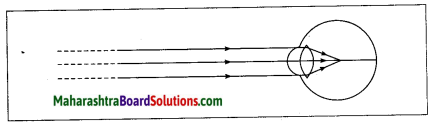
Maharashtra Board Class 10 Science Solutions Part 1 Chapter 7 Lenses 45
Answer:
(a) Myopia or Nearsightedness

(b) Possible reasons for the defect:
(i) The curvature of the cornea and the eye lens increases. The muscles near the lens cannot relax so that the converging power of the lens remains large.
(ii) The eyeball elongates so that the distance between the lens and the retina increases.

(c) Correction of the defect: This defect can be corrected using spectacles with concave lenses.
A concave lens diverges the incident rays and these diverged rays can be converged by the lens in the eye to form an image on the retina.

Question 64.
What is the sign of the power of the lens used to correct myopia?
Answer:
The power of the lens used to correct myopia is negative.
[Note: It is a concave lens. Negative focal length Negative power.]

Maharashtra Board Class 10 Science Solutions Part 1 Chapter 7 Lenses

Question 65.
In a Std. X class, out of 40 students, 10 students use spectacles, 2 students have ( positive power and 8 students have negative power of lenses in their spectacles.
Answer the following questions:
(1) What does the negative power indicate?
(2) What does the positive power indicate?
(3) Generally which type of spectacles do most of the students use?
(4) What defect of eyesight do most of the students suffer from?
(5) Give two possible reasons for the above defect.
Answer:
(1) The negative power indicates a concave lens or myopia.
(2) The positive power indicates a convex lens or hypermetropia.
(3) Generally, most of the students use spectacles with concave lenses.
(4) Most of the students suffer from myopia.
(5) Two possible reasons for myopia:

  1. The curvature of the cornea and the eye lens increases. The muscles near the lens cannot relax so that the converging power of the lens remains large.
  2. The distance between the eye lens and the retina increases as the eyeball elongates.

Question 66.
What is hypermetropia or farsightedness? What are the possible reasons of hypermetropia? How is hypermetropia corrected? Explain with figures.
Answer:
Hypermetropia or farsightedness is the defect of vision in which a human eye can see distant objects clearly but is unable to see nearby objects clearly.
In this case the image of a nearby object would fall behind the retina instead of on the retina.
[Figs. 7.31 (a), 7.31 (b)]

Possible reasons of hypermetropia:
(1) Curvature of the cornea and the eye lens decreases. Hence, the converging power of the eye lens becomes less. (2) The distance between the eye lens and retina decreases (relative to the normal eye) and the focal length of the eye lens becomes very large due to the flattening of the eyeball.
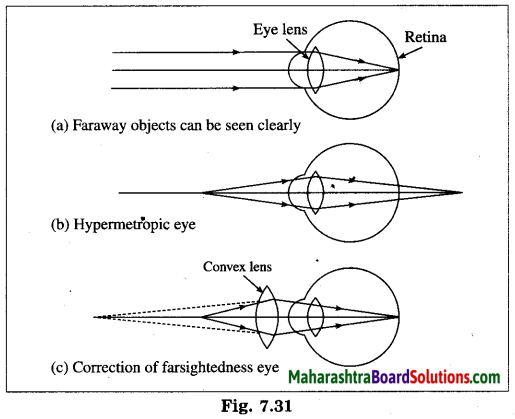
Maharashtra Board Class 10 Science Solutions Part 1 Chapter 7 Lenses 46
Hypermetropia is corrected using a suitable convex lens. Light rays are converged by the convex lens before they strike the eye lens. A convex lens of proper focal length is chosen to produce the required convergence. Hence, after the converging action of the eye lens, the image is formed on the retina. [Fig. 7.31 (c)]

Question 67.
What is the sign of the power of the lens used to correct hypermetropia?
Answer:
The power of the lens used to correct hypermetropia is positive.
[Note: It is a convex lens. Positive focal length ∴ Positive power.]

Question 68.
Given below is a diagram showing a defect of human eye.
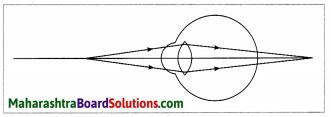
Maharashtra Board Class 10 Science Solutions Part 1 Chapter 7 Lenses 47
Study it and answer the following questions:
(1) Name the defect shown in the figure. (Practice Activity Sheet – 3)
(2) Give two possible reasons for this defect of eye in human beings.
(3) Name the type of lens used to correct the eye defect.
(4) Draw a labelled diagram to show how the defect is rectified by using the lens.
Answer:
A lens having both spherical surfaces puffed up outwards is called a convex lens or double convex lens or biconvex lens. It is thicker in the middle than at the edges.
[Note: A convex lens is also called a converging lens.]

Maharashtra Board Class 10 Science Solutions Part 1 Chapter 7 Lenses

Question 69.
Observe the following figures and complete the table. (Practice Activity Sheet – 1)
Answer:
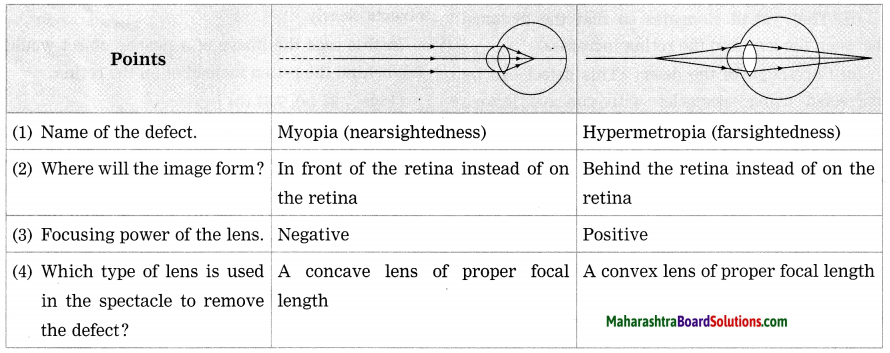
Maharashtra Board Class 10 Science Solutions Part 1 Chapter 7 Lenses 48

Question 70.
What is presbyopia? State the reason for this defect. How is presbyopia corrected?
Answer:
Presbyopia is the defect of vision in which aged people find it difficult to see nearby objects comfortably and clearly without spectacles.

Reason of presbyopia: The power of accommodation of eye usually decreases with ageing. The muscles near the eye lens lose their ability to change the focal length of the lens.
Therefore, the near point of the eye lens shifts farther from the eye.

This defect is corrected using a convex lens of appropriate power. The lens converges light rays before they fall on the eye lens such that the action of the eye lens forms the image on the retina.

Question 71.
What is a bifocal lens?
Answer:
A bifocal lens is a lens of which the upper part is a concave lens to correct myopia and the lower part is a convex lens to correct hypermetropia.

[Note: A person suffering from myopia as well as hypermetropia, uses a bifocal lens. Nowadays, the defects of vision such as myopia and hypermetropia can be corrected using contact lenses or by laser surgery.]

Question 72.
(A) Anil cannot see the blackboard writing clearly, but he can see nearby objects clearly.
(i) What is the eye defect he is suffering from?
(ii) How is it corrected?
(B) Anil’s uncle cannot see nearby objects clearly, but he can see distant objects clearly.
(i) What is the eye defect he is suffering from?
(ii) How is it corrected?
Answer:
(A) Anil cannot see the blackboard writing clearly, but he can see nearby objects clearly.
(i) This defect is called myopia (nearsightedness).
(ii) It is corrected using spectacles having concave lenses of appropriate power.

(B) Anil’s uncle cannot see nearby objects clearly, but he can see distant objects clearly.
(i) This defect is called hypermetropia (farsightedness).
(ii) It is corrected using, spectacles having convex lenses of appropriate power.

Question 73.
When are bifocal lenses used in spectacles?
Answer:
When a person cannot see nearby objects as well as distant objects clearly, bifocal lenses are used in spectacles.

Question 74.
Aniket from Std. X uses spectacles. The power of the lenses in his spectacles is -0.5 D. Answer the following questions:
(1) State the type of’ lenses used in his spectacles.
(2) Name the defect of vision Aniket is suffering from.
(3) Find the focal length of the lenses used in his spectacles.
Answer:
(1) Concave lenses are used in the spectacles used by Aniket.
(2) Aniket is suffering from myopia (near-sightedness).
(3) Focal length of the lenses used in his spectacles

Maharashtra Board Class 10 Science Solutions Part 1 Chapter 7 Lenses 49
= -2 m (Concave lens ∴ Minus sign)

Maharashtra Board Class 10 Science Solutions Part 1 Chapter 7 Lenses

Question 75.
Sunita from Std. X uses spectacles. Her spectacle number is -1.5 D. Answer the following questions:
(1) Name the defect of eye from which she is suffering.
(2) What type of lens is she using?
(3) Find the focal length of the lens.
Answer:
(1) Myopia.
(2) Concave.
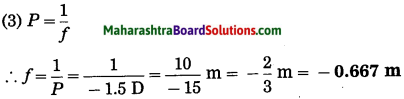
Maharashtra Board Class 10 Science Solutions Part 1 Chapter 7 Lenses 50
(Concave lens ∴ minus sign)
This is the focal length of the lens.

Question 76.
Surabhi from Std. X uses spectacles. The power of the lenses in her spectacles is 0.5 D. Answer the following questions from the given information: (March 2019)
(i) Identify the type of lenses used in her spectacles.
(ii) Identify the defect of vision Surabhi is suffering from.
(iii) Find the focal length of the lenses used in her spectacles.
Answer:
(i) Convex lenses are used in the spectacles used by Surabhi.
(ii) Surabhi is suffering from hypermetropia (farsightedness).
(iii) Focal length of the lenses used in her spectacles

Maharashtra Board Class 10 Science Solutions Part 1 Chapter 7 Lenses 51

Question 77.
My grandfather uses a bifocal lens in his spectacles. Explain why.
Answer:
In old age, people usually suffer from both myopia and hypermetropia. Therefore, they need spectacles having bifocal lenses.

The upper part of a bifocal lens is a concave lens to correct myopia. The lower part of a bifocal lens is a convex lens to correct hypermetropia.

Question 78.
State uses of concave lens.
Answer:

  1. Concave lenses are used for proper working of medical equipment, scanner, CD player – the instruments that employ laser rays.
  2. One or more concave lenses are used in a small safety device, fitted in the peep hole in a door, due to which we can see a large area outside the door.
  3. Concave lenses are used in spectacles to correct nearsightedness (myopia).
  4. A concave lens is used to spread light emitted by the small bulb in a torch over a wide area.
  5. A concave lens is used in front of the eyepiece or inside the eyepiece fitted in a camera, telescope and microscope – the instruments employing convex lenses.

Question 79.
State uses of a convex lens.
Answer:
Convex lenses are used in a simple microscope, compound microscope, refracting telescope, camera, projector, spectroscope, spectacles for correcting farsightedness (hypermetropia) and binoculars.

Maharashtra Board Class 10 Science Solutions Part 1 Chapter 7 Lenses

Question 80.
What is meant by the apparent size of an object? With a neat and labelled diagram, explain the relation between the apparent size of an object and the angle subtended by the object at the eye.
Answer:
An object appears small or big depending upon the size of its image formed on the retina of the eye. The size of an object as perceived by the eye is called the apparent size of the object. Consider two objects of the same size, one held near the eye and the other away from the eye as shown in the following figure (Fig. 7.34). The nearby object (PQ) appears larger than the distant object (P1Q1).
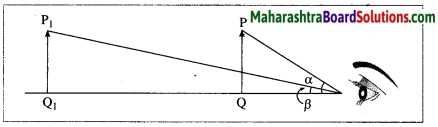
Maharashtra Board Class 10 Science Solutions Part 1 Chapter 7 Lenses 52
Also, the angle a subtended by the nearby object at the eye is larger than the angle β subtended by the distant object at the eye. This shows that the apparent size of an object depends upon the angle subtended by the object at the eye. The greater the angle subtended by the object at the eye, the greater is the apparent size of the object. Similarly, the smaller the angle subtended by the object at the eye, the smaller is the apparent size of the object.

Question 81.
With a neat labelled diagram, explain the working of a simple microscope. State uses of a simple microscope.
(OR)
What does a simple microscope consist of? What is the order of magnification obtained by a simple microscope? What is a simple microscope used for?
Answer:
A simple microscope consists of a convex lens of short focal length, usually fixed in a suitable frame with a handle or mounted on a stand.
Maharashtra Board Class 10 Science Solutions Part 1 Chapter 7 Lenses 53
The object is placed in front of the convex lens of short focal length such that the object distance is less than the focal length. The image is virtual and larger than the object. It is formed on the same side of the lens as the object.

A maximum magnification of about 20 can be obtained by a simple microscope. A simple microscope is used by watch repairers to observe small parts of a watch and by jewellers to examine ornaments. A simple microscope (also called a magnifying glass) is also used to read words in small print.

Question 82.
With a neat labelled diagram, explain the construction and working of a compound microscope.
Answer:
Construction of a compound microscope:
Maharashtra Board Class 10 Science Solutions Part 1 Chapter 7 Lenses 54
(1) A compound microscope consists of a metal tube fitted with two convex lenses at the two ends. These lenses are called the objective lens (the lens directed towards the object) and the eyepiece (the lens directed towards the eye). Both the lenses are small in size, but the cross section of the objective lens is less than that of the eyepiece. The objective lens has a short focal length. The focal length of the eyepiece is more than that of the objective lens.

(2) The metal tube is mounted on a stand. The principal axes of the objective lens and the eyepiece are along the same line. The distance between the object and the objective lens can be changed with a screw. It is possible to change the distance between the objective lens and the eyepiece.

Working :
(1) The object to be observed is illuminated and placed in front of the objective lens, slightly beyond the focal length of the objective lens. Its real, inverted and enlarged image is formed by the objective lens on the other side.

(2) This intermediate image lies within the focal length of the eyepiece. It serves as an object for the eyepiece. The eyepiece works as a simple microscope. The final image is virtual, highly enlarged and inverted with respect to the original object. It can be formed at the minimum distance of distinct vision from the eyepiece. The final image is observed by keeping the eye close to the eyepiece.

Maharashtra Board Class 10 Science Solutions Part 1 Chapter 7 Lenses

Question 83.
State two uses of a compound microscope.
Answer:
Uses of a compound microscope:

  1. It is used to observe blood corpuscles, plant and animals cells, microorganisms like bacteria, etc.
  2. It is used in a pathological laboratory to observe blood, urine, etc.
  3. It is a part of a travelling microscope used for measurement of very small distance.

Question 84.
What will happen if in a compound microscope, the objective lens is large in size and has a focal length?
Answer:
If the objective lens of a compound microscope is large in size, in addition to the light coming from an object, other unwanted light will be incident on the objective lens. Hence, the image will not be seen clearly. If the objective lens has a large focal length, the magnification produced by it will be less.

Question 85.
(a) In which type of microscope do you find the lens arrangement as shown in the following diagram? (Practice Activity Sheet – 1)
Maharashtra Board Class 10 Science Solutions Part 1 Chapter 7 Lenses 55
(b) Write in brief, the working of this microscope.
(c) Where is this microscope used?
Answer:
(a) Compound microscope.

(b)
An object appears small or big depending upon the size of its image formed on the retina of the eye. The size of an object as perceived by the eye is called the apparent size of the object. Consider two objects of the same size, one held near the eye and the other away from the eye as shown in the following figure (Fig. 7.34). The nearby object (PQ) appears larger than the distant object (P1Q1).
Maharashtra Board Class 10 Science Solutions Part 1 Chapter 7 Lenses 56
Also, the angle a subtended by the nearby object at the eye is larger than the angle β subtended by the distant object at the eye. This shows that the apparent size of an object depends upon the angle subtended by the object at the eye. The greater the angle subtended by the object at the eye, the greater is the apparent size of the object. Similarly, the smaller the angle subtended by the object at the eye, the smaller is the apparent size of the object.

(c) A simple microscope is used by watch repairers to observe small parts of a watch and by jewellers to
examine ornaments. A simple microscope (also called a magnifying glass) is also used to read words in small print.

Question 86.
(i) Which type of microscope has the arrangement of lenses shown in the following figure?
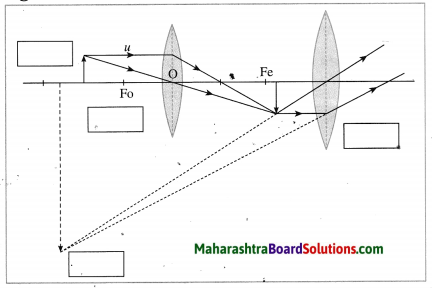
Maharashtra Board Class 10 Science Solutions Part 1 Chapter 7 Lenses 57
(ii) Label the figure correctly.
(iii) Write the working of this microscope.
(iv) Where is this microscope used?
(v) Suggest a way to increase the efficiency of this microscope. (Practice Activity Sheet – 2)
Answer:
(i) Compound microscope.

(ii)
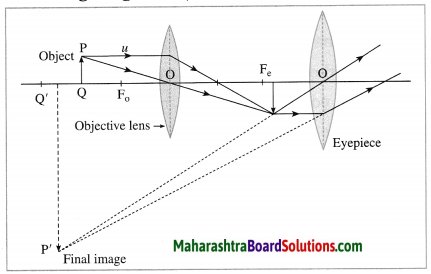
Maharashtra Board Class 10 Science Solutions Part 1 Chapter 7 Lenses 58

(iii) Working:
(1) The object to be observed is illuminated and placed in front of the objective lens, slightly beyond the focal length of the objective lens. Its real, inverted and enlarged image is formed by the objective lens on the other side.

(2) This intermediate image lies within the focal length of the eyepiece. It serves as an object for the eyepiece. The eyepiece works as a simple microscope. The final image is virtual, highly enlarged and inverted with respect to the original object. It can be formed at the minimum distance of distinct vision from the eyepiece. The final image is observed by keeping the eye close to the eyepiece.

(iv)

  1. It is used to observe blood corpuscles, plant and animals cells, microorganisms like bacteria. etc.
  2. It is used in a pathological laboratory to observe blood, urine, etc.
  3. It is a part of a travelling microscope used for measurement of very small distance.

(v) Lenses with appropriate focal lengths should be selected.

Question 87.
State the use of a telescope.
Answer:
A telescope is used to observe a distant object such as mountain, moon, planet, star in the magnified form.

Maharashtra Board Class 10 Science Solutions Part 1 Chapter 7 Lenses

Question 88.
Observe the following figure and answer the questions. (Practice Activity Sheet – 3)
(a) Which optical instrument shows arrangement of lenses as shown in the figure?
(b) Write in brief the working of this optical instrument.
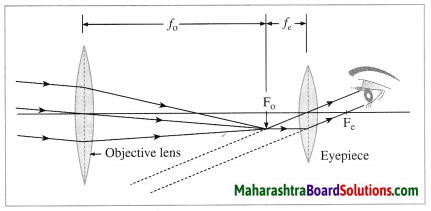
Maharashtra Board Class 10 Science Solutions Part 1 Chapter 7 Lenses 59
(c) How can we get different magnifications in this optical instrument?
(d) Draw the figure again and labelled it properly.
Answer:
(a) Refracting telescope.

(b) working: When the objective lens is pointed towards the distant object to be observed, the rays
of light from the distant object, which are almost parallel to each other. pass through the objective lens. The objective lens collects maximum amount of light as it is large in size. It forms a real, inverted and diminished image in the focal plane of the objective lens. Now, the position of the eyepiece is adjusted such that this image falls just within the focal length of the eyepiece and serves as the object for the eyepiece which works as a simple microscope.

The final image is highly magnified, virtual, on the same side as that of the object and inverted with respect to the original object. The final image can be observed by keeping the eye close to the eyepiece. If the image formed by the objective lens lies in the focal plane of the eyepiece, the final image is formed at infinity.

(c) We can get different magnifications by using the eyepiece with different focal lengths.

(d)
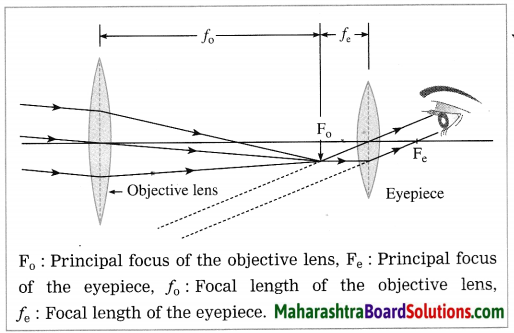
Maharashtra Board Class 10 Science Solutions Part 1 Chapter 7 Lenses 60

Question 89.
What is persistence of vision? Give one example of persistence of vision.
Answer:
Persistence of vision: We see an object when its image is formed on the retina. The image disappears when the object is removed from our sight. But this is not instantaneous and the image
remains imprinted on the retina for about \(\frac{1}{16}\) th of a second after the removal of the object.

The sensation on the retina persists for a while. This effect is known as the persistence of vision. It is due to persistence of vision that we continue to see the object in its position for about \(\frac{1}{16}\) th of a second after it is removed.
Example: When a burning stick of incense is moved fast in a circle, a circle of red light is seen.

Question 90.
Name two devices whose working is based on the phenomenon of persistence of vision.
(OR)
Name any two applications based on persistence of vision.
Answer:
The working of a television set and motion picture is based on the phenomenon of persistence of vision.
[Note: These are the examples of persistence of vision in daily life.

Question 91.
How is the phenomenon of persistence of vision used in motion pictures?
Answer:
In motion pictures, photographs of a moving object are taken at the rate of more than sixteen pictures per second. These photographs are projected on the screen at the same rate.
Each picture is slightly different from the other. As a result of persistence of vision, we get the impression of observing the object in continuous motion.

Question 92.
Name the two types of light sensitive cells present in the retina of the human eye. What are their functions?
Answer:
(1) The retina of the human eye contains a large number of light sensitive cells. These cells are of two shapes : (i) rods and (ii) cones.
(2) The rod-like cells respond to the intensity of light.
(3) The conical cells respond to various colours of light. They respond differently to red, green and blue colours. They do not respond to faint light.

Maharashtra Board Class 10 Science Solutions Part 1 Chapter 7 Lenses

Question 93.
When do you say that a person is colour blind?
Answer:
When a person is unable to distinguish between certain colours, he is said to be colour blind.
[Note: (i) Except for being colour-blind, their eyesight is normal, (ii) Rod-shaped cell ≡ rod-like cell, cone-shaped cell = Conical cell.]

Question 94.
Explain the perception of colour in the human eye.
(OR)
Explain in short perception of colour.
(OR)
Write a note on perception of colour.
Answer:
(1) In nature we firld objects of various colours. Perception of colour means to be able to respond to colour.
(2) We can distinguish between various colours due to perception of colour.
(3) The cone-shaped cells on the retina of the eye respond to the various colours when light is bright and communicate to the brain about the colours of the image formed on the retina. This gives us the proper idea about the colours of the object.
(4) If, in the retina of a person, the cone-shaped cells responding to certain specific colours are absent, the person is unable to distinguish between the colours. As a result, he lacks perception of colour.

Question 95.
What is colour-blindness?
Answer:
(1) The retina of the human eye contains a large number of light sensitive cells. These cells are of two shapes : (i) rods and (ii) cones.
(2) The cone-shaped cells respond to various colours of light when light is bright.
(3) Thus, the perception of colour is due to the presence of the cone-shaped cells in the retina.
(4) In the retina of some persons, cone-shaped cells responding to certain specific colours are absent. Hence, these persons are unable to distinguish between certain colours, i.e., they are colour-blind. This defect is known as colour¬blindness.

Question 96.
Why are some persons colour-blind? What is the cause of this defect?
Answer:
In the retina of some persons, cone-shaped cells responding to certain specific colours are absent. Hence, these persons are unable to distinguish between certain colours, i.e., they are colour-blind.

Question 97.
What are the difficulties faced by a colour-blind person?
Answer:
(1) A colour-blind person cannot distinguish between different colours. For example, he cannot distinguish between red and green colours. Also he cannot distinguish between blue and green colours. Red and green, both appear grey. Since a colour¬blind person cannot distinguish between red and green colours, it is difficult for him to cross a road. There is a possibility of an accident while crossing a road.

(2) A colour-blind person cannot distinguish between two objects of different colours, which are otherwise identical, e.g., clothes.

(3) A colour-blind person may have an inferiority complex and hence may find it difficult to mix with other persons.

Give scientific reasons:

Question 1.
A convex lens is known as a converging lens.
Answer:
When rays of light parallel to the principal axis of a convex lens pass through the lens, they converge to a point on the principal axis. Hence, a convex lens is known as a converging lens.

Maharashtra Board Class 10 Science Solutions Part 1 Chapter 7 Lenses

Question 2.
A concave lens is called a diverging lens.
Answer:
When rays of light parallel to the principal axis of a concave lens pass through the lens, they appear to diverge from a point on the principal axis. Hence, a concave lens is called a diverging lens.

Question 3.
In old age, a bifocal lens is necessary for some persons.
Answer:
(1) Some people, in old age, suffer from myopia (nearsightedness) as well as hypermetropia (farsightedness).
(2) Myopia is corrected using a concave lens of appropriate power. Hypermetropia is corrected using a convex lens of appropriate power. Therefore, they need a bifocal lens.

Question 4.
A person suffering from myopia (nearsightedness) uses spectacles of concave lenses.
Answer:
(1) A person suffering from myopia can see nearby objects clearly as the image of a nearby object is formed on the retina, but cannot see distant objects clearly as the image of a distant object is formed in front of the retina instead of on the retina.

(2) A concave lens diverges the rays of light passing through it. When spectacles of concave lenses of appropriate power are used, the parallel rays coming from a distant object are diverged to proper extent before they are incident on the eye lens. Therefore, after the converging action of the eye lens, the image of a distant object is formed on the retina of the eye and hence the distant object can be seen clearly.

Question 5.
A person suffering from hypermetropia (farsightedness) uses spectacles of convex lenses.
Answer:
(1) A person suffering from hypermetropia can see distant objects clearly as the image of a distant object is formed on the retina, but cannot see nearby objects clearly as the image of a nearby object would be formed behind the retina instead of on the retina.

(2) A convex lens converges the rays of light passing through it. When spectacles of convex lenses of appropriate power are used, the rays of light coming from a nearby object are converged to proper extent before they are incident on the eye lens. Therefore after the converging action of the j eye lens, the image of a nearby object is formed on j the retina of the eye and hence the nearby object | can be seen clearly.

Question 6.
You cannot enjoy watching a movie from a very short distance from the screen in a cinema hall.
Answer:
(1) The less the distance between the screen in a cinema hall and the person watching the movie, the more is the intensity of light falling on the eye.
(2) This results in great contraction of the pupil of the eye causing a strain. Hence, you cannot enjoy watching a movie from a very short distance from the screen in a cinema hall.

Maharashtra Board Class 10 Science Solutions Part 1 Chapter 7 Lenses

Question 7.
The rays of light travelling through the optical centre of a lens pass without changing their path.
Answer:
The portion of a lens near the optical centre is like a very thin slab of glass. Hence, the rays of light travelling through the optical centre of a lens pass without changing their path.

Question 8.
A convex lens converges the rays of light falling on it.
Answer:

  • A convex lens can be regarded as made of a very large number of portions of triangular prisms. The bases of these prisms are towards the central thicker portion of the lens.
  • A ray of light passing through a prism bends towards its base. Hence, a convex lens converges the rays falling on it.

Question 9.
A concave lens diverges the rays of light falling on it.
Answer:

  • A concave lens can be regarded as made of a very large number of portions of triangular prisms. The bases of these prisms are towards the edges of the less, i.e, away from the central thinner portion of the lens.
  • A ray of light passing through a prism bends towards its base. Hence, a concave lens diverges the rays of light falling on it.

Question 10.
When a burning stick of incense is moved fast in a circle, a circle of red light is seen.
Answer:
The impression of the image on the retina lasts for about \(\frac{1}{16}\) th of a second after the removal of the object. If a burning stick of incense is moved at a rate of more than sixteen revolutions per second, we see a circle of red light due to persistence of vision.

Question 11.
Colour-blind persons are unable to distinguish between different colours.
Answer:
(1) The cone-shaped cells in the retina of a person respond to colours. This makes the perception of colours possible.
(2) In the retina of colour-blind persons, cone-shaped cells responding to certain specific colours are absent. Hence, they are unable to distinguish between different colours.

Question 12.
It is risky to issue a driving license to a person suffering from colour-blindness.
Answer:
A colour-blind person cannot distinguish between different colours. If a driver is colour-blind, he will not be able to distinguish between the colours of the signal and the colours on different sign boards. This will lead to an accident. Hence, it is risky to issue a driving license to a person suffering from colour-blindness.

Distinguish the following:

Question 1.
Real image and Virtual image.
Answer:
Real image:

  1. A real image is formed when the light rays starting from an object meet after reflection or refraction.
  2. It can be projected on a screen.
  3. It is inverted with respect to the object.

Virtual image:

  1. A virtual image is formed when the light rays starting from an object (when extended backward) appear to meet after reflection or refraction.
  2. It cannot be projected on a screen.
  3. It is erect with respect to the object.

Question 2.
Simple microscope and Compound microscope.
Answer:
Simple microscope:

  1. In a simple microscope, only one convex lens is used.
  2. In this case, the object is placed within the focal length of the convex lens.
  3. Its magnifying power is much less than that of a compound microscope.
  4. It is used to observe minute parts of a watch, to read words in small print, etc.

Compound microscope:

  1. In a compound microscope, two convex lenses, objective and eyepiece, are used.
  2. In this case, the object is placed beyond the focal length of the objective lens.
  3. Its magnifying power is much greater than that of a simple microscope.
  4. It is used to observe blood corpuscles, plant and animal cells, etc.

Maharashtra Board Class 10 Science Solutions Part 1 Chapter 7 Lenses

Question 3.
Compound microscope and Astronomical refracting telescope.
Answer:
Compound microscope:

  1. In a compound microscope, the focal length and cross section of the objective lens are respectively smaller than the focal length and cross section of the eyepiece.
  2. In this case, to observe the object, the distance between the object and the objective lens is adjusted.
  3. It forms a magnified image of a small object.
  4. It is used to observe blood corpuscles, plant and animal cells, etc.

Astronomical refracting telescope:

  1. In an astronomical refracting telescope, the focal length and cross section of the objective lens are respectively greater than the focal length and cross section of the eyepiece.
  2. In this case, to observe the object, the distance between the objective lens and eyepiece is adjusted.
  3. It forms a near image of a distant object.
  4. It is used to observe sateulites, planets, stars, etc.

Question 4.
Simple microscope and Astronomical refracting telescope.
Answer:
Simple microscope:

  1. In a simple microscope, only one convex lens is used.
  2. In this case, the object is placed within the focal length of the convex lens.
  3. In this case, the image is erect.
  4. It is used to observe minute parts of a watch, to read words in small print, etc.

Astronomical refracting telescope:

  1. In an astronomical refracting telescope, two convex lenses, objective lens and eyepiece are used.
  2. In this case, the object is far away from the objective lens.
  3. In this case, the image is inverted.
  4. It is used to observe satellites, planets, stars, etc.

Read the following paragraph and answer the questions given below it:

Construction of a compound microscope:
(1) A compound microscope consists of a metal tube fitted with two convex lenses at the two ends. These lenses are called the objective lens (the lens directed towards the object) and the eyepiece (the lens directed towards the eye). Both the lenses are small in size, but the cross section of the objective lens is less than that of the eyepiece. The objective lens has a short focal length. The focal length of the eyepiece is more than that of the objective lens.(2) The metal tube is mounted on a stand. The principal axes of the objective lens and the eyepiece are along the same line. The distance between the object and the objective lens can be changed with a screw. It is possible to change the distance between the objective lens and the eyepiece.
Working:
(1) The object to be observed is illuminated and placed in front of the objective lens, slightly beyond the focal length of the objective lens. Its real, inverted and enlarged image is formed by the, objective lens on the other side.
(2) This intermediate image lies within the focal length of the eyepiece. It serves as an object for the eyepiece. The eyepiece works as a simple microscope. The final image is virtual, highly enlarged and inverted with respect to the original object. It can be formed at the minimum distance of distinct vision from the eyepiece. The final image is observed by keeping the eye close to the eyepiece.
Use: This microscope is used to observe blood cells, microorganisms, etc.

Question 1.
In a compound microscope, which lens has greater focal length?
Answer:
In a compound microscope, the eyepiece has greater focal length.

Question 2.
Where do you place the object to be observed with a compound microscope?
Answer:
In a compound microscope, the object to be observed is placed in front of the objective lens, slightly beyond the focus of the objective lens.

Question 3.
State which distance is adjusted to observe the object with a compound microscope.
Answer:
To observe the object with a compound microscope, the distance between the object and objective lens is adjusted.

Question 4.
State the nature of the final image in compound microscope relative to the object.
Answer:
In a compound microscope, the final image is highly enlarged, inverted and virtual relative to the object.

Question 5.
State the use of a compound microscope.
Answer:
A compound microscope is used to observe blood cells, microorganisms, etc.

Fill in the blanks for a convex lens:

Question 1.

f (m)0.2—————–0.1
P (D)—————2——————

Answer:
[P (D) = \(\frac{1}{f(\mathrm{m})}\)]

f (m)0.20.50.1
P (D)5210

Question 2.

h1 (cm)—————-510
h2 (cm)-30-20—————-
M-2—————–-0.5

Answer:
[M = \(\frac{h_{2}}{h_{1}}\)]

h1 (cm)15510
h2 (cm)-30-20-5
M-2-4-0.5

Maharashtra Board Class 10 Science Solutions Part 1 Chapter 7 Lenses

Solve the following numerical problems:

Problem 1.
An object Is kept at 60 cm in front of a convex lens. Its real image is formed at 20 cm from the lens. Find the focal length or the lens.
Solution:
Data: Convex lens, u = -60 cm,
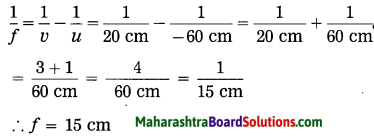
Maharashtra Board Class 10 Science Solutions Part 1 Chapter 7 Lenses 61
The focal length of the lens = 15 cm.

Problem 2.
The focal length of a convex lens is 20 cm. If an object of height 2 cm is placed at 30 cm from the lens, find (i) the position and nature of the Image (ii) the height of the image (iii) the magnification produced by the lens.
Solution:
Data: Convex lens, f = 20 cm,
u = -30 cm, h1 = 2 cm, v = ?, h2 = ?, M = ?
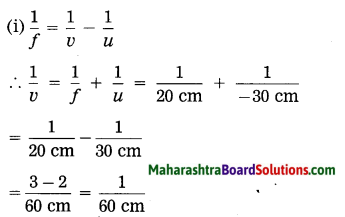
Maharashtra Board Class 10 Science Solutions Part 1 Chapter 7 Lenses 62
The image will be formed at 60 cm from the lens and on the other side of the lens with respect to the object. It is a real image.
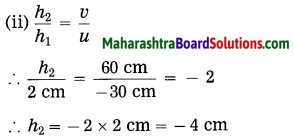
Maharashtra Board Class 10 Science Solutions Part 1 Chapter 7 Lenses 63
h2 is negative. This shows that the image is inverted.
The height of the image -4 cm.
(iii) M = \(\frac{h_{2}}{h_{1}}=\frac{-4 \mathrm{cm}}{2 \mathrm{cm}}\) = -2
M is negative, indicating that the image is inverted.
The magnification produced by the lens = -2.

Problem 3.
When a pm of height 3 cm is fixed at 10 cm from a convex lens, the height or the virtual image formed is 12 cm. Find the focal length of the lens.
Solution:
Data: Convex lens, h1 =3 cm,
h2 = 12 cm (virtual image), u = -10 cm, f = ?
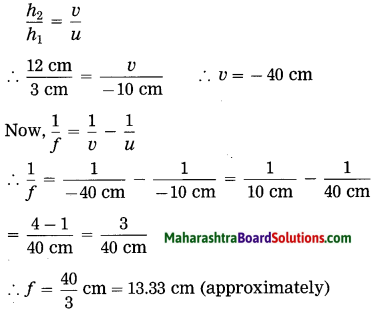
Maharashtra Board Class 10 Science Solutions Part 1 Chapter 7 Lenses 64
The focal length of the lens = 13.33 cm [approximately]

Maharashtra Board Class 10 Science Solutions Part 1 Chapter 7 Lenses

Problem 4.
At what distance from a convex lens of focal length 2.5 m should a boy stand so that his image is half his height?
Solution:
Data: Convex lens, f= 2.5 m,
M= –\(\frac{1}{2}\), u=?
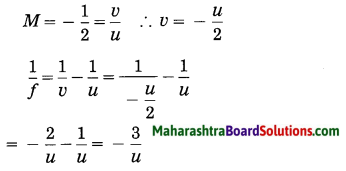
Maharashtra Board Class 10 Science Solutions Part 1 Chapter 7 Lenses 65
∴ u = -3f = -3 × 2.5 m = -7.5 m
This is the object distance.
The boy should stand at 7.5 m from the convex lens so that his image is half his height.

Problem 5.
A convex lens forms a real image or a pencil at a distance of 40 cm from the lens. The image formed is of the same size as the object. Find the focal length and power of the lens. At what distance is the pencil placed from the lens?
Solution:
Data: Convex lens, v = 40 cm,
M = -1, f = ?, h1 = ?, u = ?
M = = -1 = \(\frac{v}{u}\)
∴ u = -v = -40 cm (object distance)
The pencil is placed at 40 cm from the convex lens.
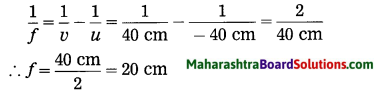
Maharashtra Board Class 10 Science Solutions Part 1 Chapter 7 Lenses 66
The focal length of the lens 20 cm.
Maharashtra Board Class 10 Science Solutions Part 1 Chapter 7 Lenses 67
The power of the lens = 5 D.

Problem 6.
A spherical lens is used to obtain an image on a screen. The size of the image is four times the size of the object. What is the type of lens and at what distance is the screen placed from the lens?
Solution:
Data: M = -4, type of lens? v = ?
As the image formed by the lens is obtained on a screen, it is a real image. The lens is, therefore, a convex 1ens.
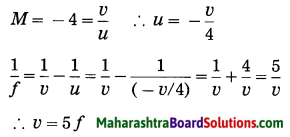
Maharashtra Board Class 10 Science Solutions Part 1 Chapter 7 Lenses 68
The distance of the screen from the lens = 5f.

Problem 7.
An object of height 5 cm Is held 20 cm away from a converging lens of focal length 10 cm. Find the position, nature and size of the image formed.
Solution:
Data: Converging lens (convex lens),
f = 10 cm, h1 = 5 cm, u = -20 cm, v = ?, h2 = ?
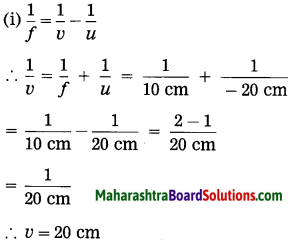
Maharashtra Board Class 10 Science Solutions Part 1 Chapter 7 Lenses 69
The image is real and inverted. it is formed at 20 cm from the lens and on the other side of the lens relative to the object.
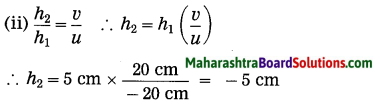
Maharashtra Board Class 10 Science Solutions Part 1 Chapter 7 Lenses 70
The height of the image, h2 = -5 cm
Thus, it is numerically the same as the height of the object.

Maharashtra Board Class 10 Science Solutions Part 1 Chapter 7 Lenses

Problem 8.
An object is placed at 10 cm from a convex lens of focal length 12 m. Find the position and nature of the image.
Solution:
Data: Convex lens, u = -10 cm,
f = 12 cm, v = ?
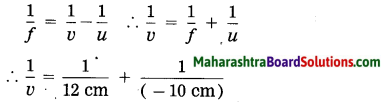
Maharashtra Board Class 10 Science Solutions Part 1 Chapter 7 Lenses 71
Maharashtra Board Class 10 Science Solutions Part 1 Chapter 7 Lenses 72
∴ v = -60 cm
It is negative.
The image is formed at 60 cm from the lens and on the same side of the lens relative to the object. It is virtual, erect, and enlarged.

Problem 9.
An object of height 4 cm is placed in front of a concave lens of focal length 40 cm. If the object distance is 60 cm, find the position and height of the image.
Solution:
Data: f = -40 cm (concave lens),
u = -60 cm, h1 = 4 cm, v = ?, h2 = ?
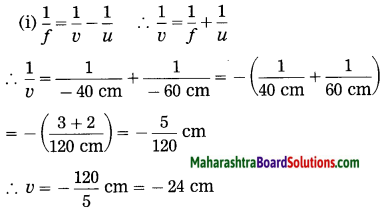
Maharashtra Board Class 10 Science Solutions Part 1 Chapter 7 Lenses 73
The image Is formed at 24 cm from the lens.
It is on the same side as the object.
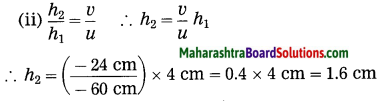
Maharashtra Board Class 10 Science Solutions Part 1 Chapter 7 Lenses 74
The height of the image is 1.6 cm.

Problem 10.
What is the power of a convex lens having focal length 0.5 m?
Solution:
Data: Convex lens, f= 0.5 m, P = ?
P = \(\frac{1}{f}=\frac{1}{0.5 \mathrm{m}}\) = 2D
The power of the lens = 2D.

Problem 11.
The power of a convex lens is 2.5 dioptres. Find its focal length.
(OR)
Calculate the focal length of a corrective lens having power +2.5 D.
Solution:
Data: Convex lens, P = +2.5 D, f = ?
P = \(\frac{1}{f}\)
∴ 2.5 D = \(\frac{1}{f}\)
∴ f = \(\frac{1}{2.5 \mathrm{D}}\) = 0.4 cm = 40 cm
The focal length of the lens = 40 cm.

Problem 12.
Two convex lenses of focal length 20 cm each are kept in contact with each other. Find the power of their combination.
Solution:
Data: f1 = 20 cm = 0.2 m,
f2 =20 cm = 0.2 m, P (combination) = ?

Maharashtra Board Class 10 Science Solutions Part 1 Chapter 7 Lenses 75
∴ Focal length of the combination or the lenses, f = 0.1 m.
P = \(\frac{1}{f}=\frac{1}{0.1 \mathrm{m}}\) = 10 D
The power of the combination of the lenses, P = 10 D.

Maharashtra Board Class 10 Science Solutions Part 1 Chapter 7 Lenses

Problem 13.
Two convex lenses of equal focal lengths are kept in contact with each other. If the power of their combination is 20 D, find the focal length of each convex lens.
Solution:
Data: Convex lens, P = 20 D, f1 = f2 = ?
The focal length (f) of the combination of the lenses is given by
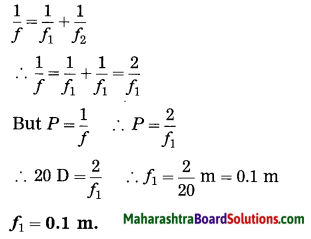
Maharashtra Board Class 10 Science Solutions Part 1 Chapter 7 Lenses 76
This gives the focal length or each convex lens.

Problem 14.
If a convex lens of focal length 10 cm and a concave lens of focal length 50 cm are kept in contact with each other, (i) what will be the focal length of the combination? (ii) what wiil be the power of the combination? (iii) what will be the behaviour of the combination (behaviour as a convex lens/concave lens)?
Solution:
Data: f1 = +10 cm = +0.1 m (convex lens),
f2 = -50 cm = -0.5 m (concave lens),
f (combination) = ?, P (combination) = ?
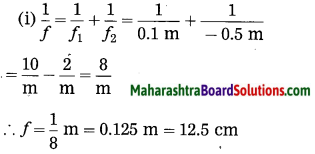
Maharashtra Board Class 10 Science Solutions Part 1 Chapter 7 Lenses 77
The focal length or the combination of the lenses = 0.125 m = 12.5 cm.
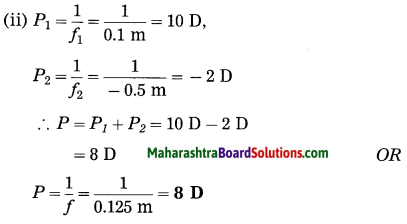
Maharashtra Board Class 10 Science Solutions Part 1 Chapter 7 Lenses 78
The power of the combination of the lenses 8.D.
(iii) The focal length of the combination of the lenses is positive. This shows that the combination will behave as a convex lens.

Numerical problems for practice:

Problem 1.
Find the focal length of a convex lens which produces a real image at 60 cm from the lens when an object is placed at 40 cm in front of the lens.
Answer:
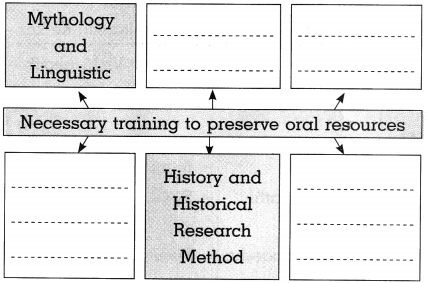
24 cm

Problem 2.
Find the focal length of a convex lens which produces a virtual image at 10 cm from the lens when an object is placed at 5 cm from the lens.
Answer:
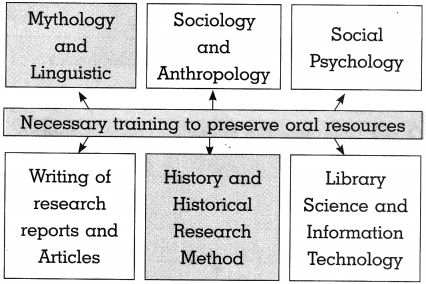
10 cm

Problem 3.
A real image is obtained at 30 cm from a convex lens of focal length 7.5 cm. Find the distance of the object from the lens.
Answer:
u = -10 cm

Maharashtra Board Class 10 Science Solutions Part 1 Chapter 7 Lenses

Problem 4.
An object is kept at 20 cm in front of a convex lens and its real image is formed at 60 cm from the lens. Find (1) the focal length of the lens (2) the height or the image if the height of the object is 6 cm.
Answer:
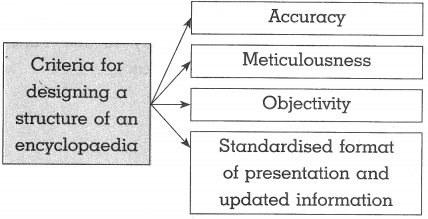
(1) 15 cm
(2) h2 = -18 cm]

Problem 5.
An object is kept at 10 cm in front of a convex lens. Its image is formed on the screen at 15 cm from the lens. Calculate (1) the focal length of the lens (2) the magnification produced by the lens.
Answer:
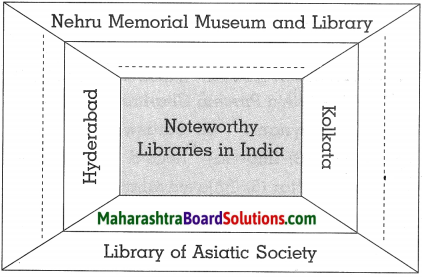
(1) 6 cm
(2)M = -1.5

Problem 6.
An object is kept at 60 cm in front of a convex lens of focal length 15 cm. Find the image distance and the nature of the image. Also find the magnification produced by the lens.
Answer:
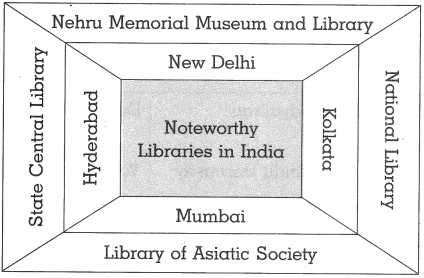
v = 20 cm. The image is real, inverted and smaller than the object. M = –\(\frac{1}{3}\)]

Problem 7.
An object of height 2 cm is kept at 30 cm from a convex lens. Its real image is formed at 60 cm from the lens. Find the focal length and power of the lens.
Answer:
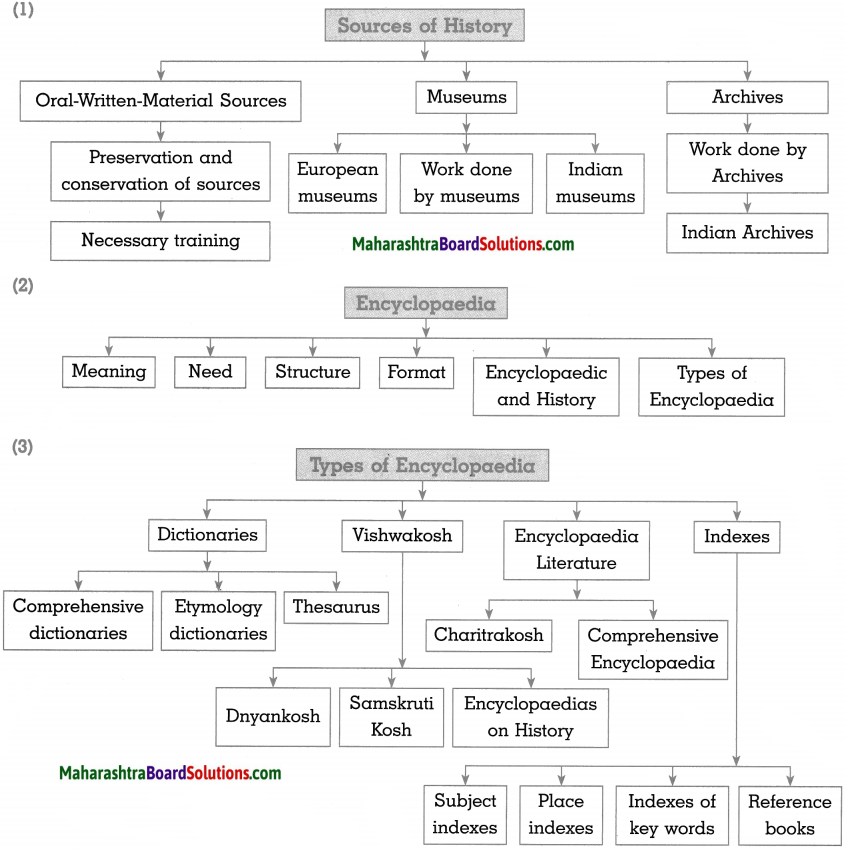
f = 20 cm, P = 5 D

Problem 8.
If the power of a lens is 4 dioptres, find its focal length.
Answer:
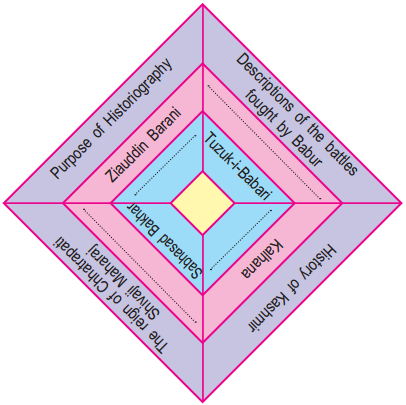
25 cm

Problem 9.
Find the power of a convex lens of focal length 40 cm.
Answer:

2.5 D

Problem 10.
Find the power of a convex lens of focal length 12.5 cm.
Answer:

8 D

Problem 11.
If for a lens, f = – 20 cm, what is the power of the lens?
Answer:
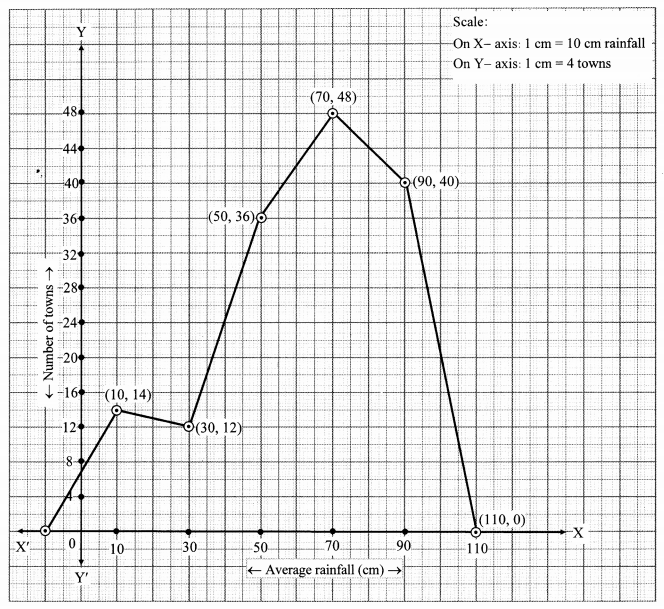
-5 D

Maharashtra Board Class 10 Science Solutions Part 1 Chapter 7 Lenses

Problem 12.
An object of height 4 cm is kept in front of a concave lens of focal length 20 cm. If the object distance is 30 cm, find the position and the height of the image.
Answer:
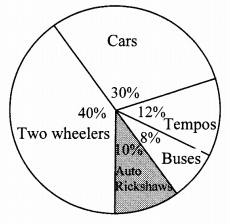
v = -12 cm, h2 = 1.6 cm

Problem 13.
If two convex lenses of focal lengths 10 cm and 5 cm are kept in contact with each other, what is their combined focal length?
Answer:
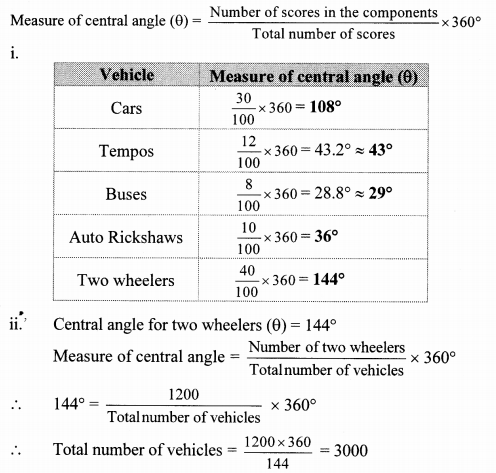
\(\frac{10}{3}\) cm [approximately 3.33 cm]

Problem 14.
If a convex lens of focal length 20 cm and a concave lens of focal length 30 cm are kept in contact with each other, (i) What will be the focal length of the combination? (ii) What will be the power of the combination? (iii) What will be the behaviour of the combination?
Answer:

(i) f = 60 cm
(ii) P = \(\frac{5}{3}\) D = 1.6667 D (approximately)
(iii) The combination will behave as a convex lens.

Maharashtra Board Class 10 Science Solutions Part 1 Chapter 7 Lenses

Problem 15.
A concave lens of focal length 12 cm and a convex lens of focal length 20 cm are kept in contact with each other, (i) Find the focal length of the combination, (ii) What will be the behaviour of the combination?
Answer:
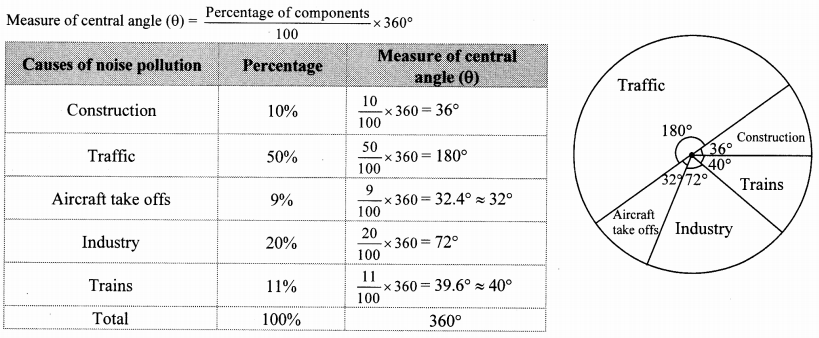
(i) f = -30 cm
(ii) The combination will behave as a concave lens.