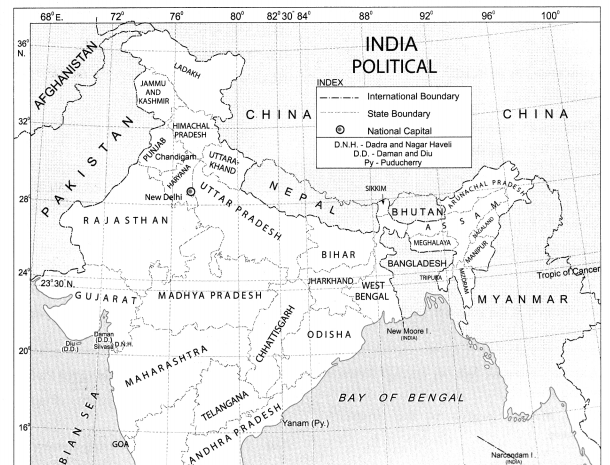
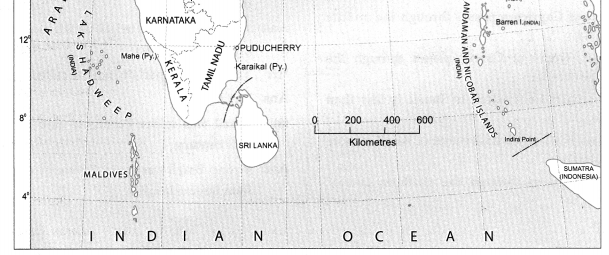
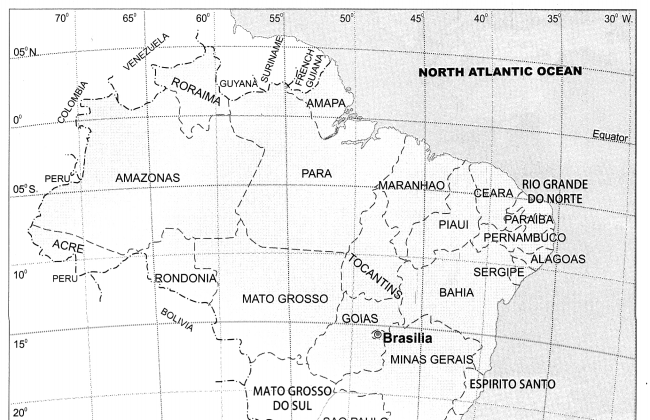
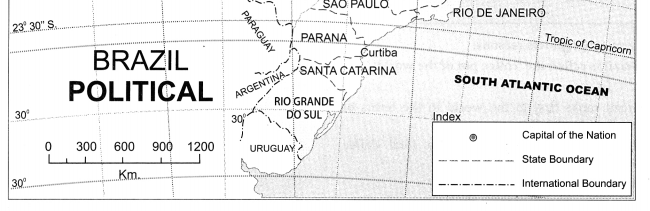
Maharashtra Board Class 10 Geography Solutions Chapter 5 Natural Vegetation and Wildlife

Balbharti Maharashtra State Board Class 10 Geography Solutions Chapter 5 Natural Vegetation and Wildlife Notes, Textbook Exercise Important Questions and Answers.

Maharashtra State Board Class 10 Geography Solutions Chapter 5 Natural Vegetation and Wildlife

Class 10 Geography Chapter 5 Natural Vegetation and Wildlife Textbook Questions and Answers

Question 1.
On the basis of the information given in the chapter, figures and maps, complete the table below:

S.NoType of forestCharacteristicsRegions in IndiaRegions in Brazil
1Tropical ForestsBroad-leaved evergreen trees.
2Semi arid thorny vegetation1.
2.
3SavannahScanty bushes and shrub like trees and rain resistant grass.
4Tropical
semi-deciduous
Mixed type vegetation.
5GrasslandsGrassland region like the Pampas of Argentina.

Answer:

S. No.Type of forestCharacteristicsRegions in IndiaRegions in Brazil
(1)Tropical ForestsBroad-leaved evergreen trees.Andaman and Nicobar Islands, the Western Ghats. Some parts of North East India.Amazon Basin, Guyana Highlands.
(2)Semi arid thorny vegetation(a)     Thorny and shrub type vegetation.
(b)   Leaves are small in size. Leaves are modified into thorns to minimise evaporation.
Gujarat, Rajasthan, Parts of Madhya Pradesh and Uttar Pradesh.North-Eastern part of Brazil.
(3)SavannahScanty bushes and shrub like trees and rain resistant grass.Brazilian Highland.
(4)Tropical

semi-deciduous

Mixed type vegetation.Central India and South India.Parana Basin and South Eastern part of Brazil.
(5)GrasslandsGrassland region like the Pampas of Argentina.Foothills of Shiwalik hills and Assam.Southern Brazil.

Maharashtra Board Class 10 Geography Solutions Chapter 5 Natural Vegetation and Wildlife

2. Identify the odd man out:

Question a.
Forest type of Brazil ______.
(a) Thorny bush type vegetation
(b) Evergreen forests
(c) The Himalayan Forests
(d) Deciduous forests
Answer:
(c) The Himalayan Forests

Question b.
With reference to India
(a) Mangrove forests
(b) Mediterranean forests
(c) Thorny bush-type vegetation
(d) Equatorial forests
Answer:
(b) Mediterranean forests

Question c.
With reference to Fauna of Brazil.
(a) Anaconda
(b) Tamairin
(c) Red Panda
(d) Lion
Answer:
(c) Red Panda

Question d.
With reference to flora in India.
(a Deodar
(b) Anjan
(c) Orchid
(d) Banyan
Answer:
(c) Orchid

Maharashtra Board Class 10 Geography Solutions Chapter 5 Natural Vegetation and Wildlife

3. Match the Column:

Column ‘A’Column ‘B’
Evergreen Forests(a) Sundari trees
Deciduous forests(b) Pine
Coastal forests(c) Pau Brasil
Himalayan forests(d) Khejari
Thorny and bush type vegetation(e) Teak
(f) Orchid

Answer:
1 – c
2 – e
3 – a
4 – b
5 – d

4. Answer in short:

Question a.
Differentiate between the forest types of Brazil and India.
Answer:

Forest type of BrazilForest type of India
1. The northern part of Brazil lies in the equatorial region. It receives ample sunshine and heavy rainfall. So dense evergreen forests are seen here.1. The location of India is far away from the Equator. Heavy rainfall occurs only in the Western Ghats and North Eastern hilly areas. So evergreen forests are seen in these regions.
2. The Highland region of Brazil receives low rainfall. So tropical grasslands are seen in this region.2. The Peninsula region of India receives rainfall between 1000 mm to 2000 mm, so they are covered by deciduous forests.
3. As there are no tall and long extending mountains in Brazil, Himalayan type forests are not found here.3. Owing to presence of Himalayas, Himalayan type forests are found in North and North-East of India that are classified on the basis of altitude.
4. Thorny shrubs are found to the North Eastern part of Brazilian Highlands which is also considered to be a Drought Quadrilateral.4. Thorny shrubs are found in India receiving less than 500 mm of rainfall. It is majorly found in Gujarat, Rajasthan and rain shadow regions of the Western Ghats.

Question b.
Correlate wildlife and natural vegetation in India and Brazil.
Answer:
(i) Depending upon favourable geographical conditions, we find a variety of natural vegetation in India and Brazil. Also depending upon the vegetation we find a variety of wildlife in different regions.

(ii) Grasslands of Brazil like the Savannah and the deciduous forest of India have a large number of herbivores and carnivores.

(iii) The dense evergreen forests of India in the west, north east India and the Amazon Basin of Brazil are a home to a large variety of birds, insects, reptiles along with the herbivores and the carnivores.

(iv) Coastal forests and swampy areas of Pantanal and Sunderbans have mangroves, a variety of birds, fishes and reptiles like crocodiles, alligators and the anacondas in Brazil.

(v) Vegetation provides food and shelter to wildlife but if vegetation is limited like in the Thar desert or the Caatinga it will also limit the variety of animals species.

Question c.
What environmental issues are faced by Brazil and India?
Answer:

  • Degradation of environment is happening in Brazil due to illegal smuggling of wild animals, slash and burn agriculture (roca), deforestation, pollution, etc.
  • Due to these problems, many endemic species are on the verge of extinction.
  • India too faces environmental issues such as poaching, pollution and the fast spreading deforestation.
  • Many species of wildlife are on the verge of extinction in India.

Question d.
What are the major causes of degradation of forest in Brazil and India?
Answer:
(i) Forests are being cut down as more area is required to expand the cities. Hence rapid urbanisation is one of the reasons for degradation of forest.

(ii) To ensure continuous food supply to meet the needs of the ever increasing population, more and more area needs to be brought under agriculture. For the expansion of agricultural land, forest areas are being cut down.

(iii) In both India and Brazil, forests are being cut down for firewood and for other domestic needs.

(iv) Slash and Burn agriculture which is also known as Roca in Brazil and Jhum in India is responsible for deforestation.

(v) Apart from all the above reasons, forest fire, pollution, overgrazing, etc. are also responsible for the degradation of forests.

Maharashtra Board Class 10 Geography Solutions Chapter 5 Natural Vegetation and Wildlife

Question e.
Why does the deciduous type vegetation occupy most of India?
Answer:

  • Vegetation in a region is affected by the climate and rainfall of the region.
  • In dia lies in the tropical zone and it has a monsoon type climate throughout the year.
  • Also, a major portion of India receives seasonal rainfall between 1000-2000 mm.
  • Deciduous forests thrive well in this condition and these forests shed their leaves during the hot and dry summer so that water is not lost due to evaporation.
  • Teak, bamboo, banyan, peepal, etc. are the trees found in deciduous forest of India.

5. Give geographical reasons:

Question a.
The northern part of Brazil is covered with dense forests.
Answer:

  • The northern part of Brazil lies in the equatorial region.
  • It receives ample sunlight and about 2000 mm of rainfall throughout the year.
  • In this region, the growth of vegetation is very rapid.
  • So, the northern part of Brazil is covered with dense and evergreen forests.

Question b.
Vegetation is scarce in the high altitude of the Himalayas.
Answer:

  • As the altitude increases, the temperature decreases.
  • The climate is very cold in the high altitudes. In Jammu and Kashmir and parts of Himalayas temperature drops to -40fiC.
  • Also this region is snow-covered for most part of the year.
  • Very few species of plants can survive in such extreme conditions. Only seasonally flowering trees are found at higher altitudes.
  • Hence, vegetation is scarce in the high altitude of the Himalayas.

Question c.
A wide variety of insect species is found in Brazil.
Answer:

  • Insects are mostly found in forests, grasslands and swampy lands.
  • Many insects eat leaves, grass and nectar from the plant.
  • The evergreen rainforests are seen in the northern parts of Brazil. The grasslands are found in the central parts and Paraguay-Parana river basin. Similarly, swampy lands are found in Pantanal region in Brazil. .
  • Therefore, a wide variety of insect’s species is found in Brazil.

Question d.
Wild life in India is decreasing day by day.
Answer:
(i) Wildlife in India is decreasing day by day because of rapidly occurring deforestation, poaching, pollution.

(ii) Expansion of cities to accommodate the growing population is leading to cutting down of the valuable forest which leads to the loss of the habitat of wildlife.

(iii) Also the problem of pollution has become severe due to urbanisation. Various types of pollution have threatened the lives of many of the species.

(iv) Poaching of wildlife species have also led to the loss of wildlife in India.

(v) Agricultural practices like shifting cultivation has also reduced the forest cover leading to loss of wildlife habitat.

Question e.
Like India, there is a need for conservation of forests in Brazil too.
Answer:
(i) Like India, Brazil is facing the problem of degradation of environment due to deforestation, pollution, slash and burn agriculture, illegal smuggling of wild animals, etc.

(ii) Trees are being cut down to obtain wood, leading to large scale deforestation in both countries.

(iii) Also the problem of pollution has become severe due to urbanisation. Various types of pollution have threatened the lives of many of the species.

(iv) Agricultural practices like slash and burn agriculture (roca) has reduced the forest cover in Brazil.

(v) Like India, the problem of illegal smuggling of animals has affected Brazil too.

(vi) Hence there is a need for conservation of forests in both Brazil and India.

Class 10 Geography Chapter 5 Natural Vegetation and Wildlife Intext Questions and Answers

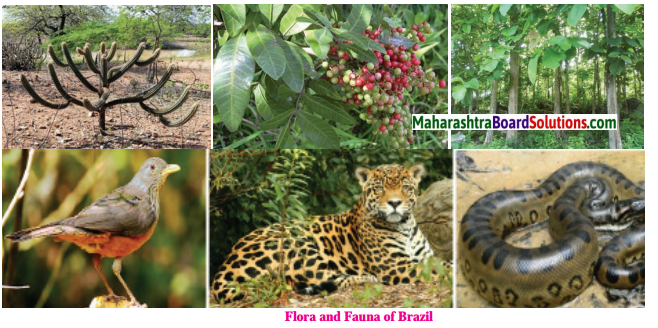
Observe the images given below and discuss on the basis of the following points and answer the following questions:
Maharashtra Board Class 10 Geography Solutions Chapter 5 Natural Vegetation and Wildlife 20
Question 1.
Can you tell the names of the plants/trees shown in the image?
Answer:
Coffee, cactus, rubber.

Question 2.
Where have you seen these plants before?
Answer:
Brazil.

Question 3.
Name the fauna shown in the image.
Answer:
Rufous bellied thrush, leopard, green anaconda.

Question 4.
Where have you seen them before?
Answer:
On the internet and in movies.

Maharashtra Board Class 10 Geography Solutions Chapter 5 Natural Vegetation and Wildlife

Question 5.
In which country do you find a greater diversity of vegetation? What is the reason behind it?
Answer:
Brazil has a greater diversity of vegetation because of the variation in climatic conditions.

Colours Of Both

Question 1.
In which country do equatorial forests occupy a greater area? What could be the reason behind it?
Answer:
Equatorial forests occupy a greater area in Brazil. This is because the Equator passes through northern part of Brazil. Hence, the climate is generally hot throughout the year. Moreover, this region receives heavy rainfall throughout the year.

Question 2.
Which type of forests found in India are not found in Brazil?
Answer:
Himalayan forests are found in India and not in Brazil.

Question 3.
Which type of forests found in Brazil are found in India too?
Answer:
Evergreen forests, deciduous forests, and thorny shrub type vegetation are found in both Brazil and India.

Question 4.
In which country a greater diversity of vegetation is found? What is the reason behind it?
Answer:
Brazil has a greater diversity of vegetation because of the equatorial climate, ample sunlight, heavy rainfall, and vast forest expanse.

Question 5.
Considering the climate and vegetation types, in which country will forest-based occupations flourish?
Answer:
Forest-based occupations will flourish more in Brazil.

Activity

Question 1.
Correlate geographical conditions and the flora and fauna there? (India)
Answer:
Depending upon favourable geographical conditions, we find a variety of flora and fauna in India.

(i) In the snow-capped regions of Himalayas where precipitation occurs in the form of snow, we find alpine vegetation. Animals like snow leopards and yaks are found who can sustain the extreme cold of the Himalayas.

(ii) The evergreen forest in the Western Ghats have hot and humid conditions with a temperature of 28°C and annual rainfall more than 2000mm. In such are as animals like lions, tigers, elephants, and a variety of birds are seen.

(iii) The coastal forest are home to many turtles, crocodiles, and gavials, etc. One-horned rhinoceroses are found in the swampy, marshy lands of Assam. Mangrove vegetation is found in the saline waters.

(iv) In areas where the climate is hot and dry and the rainfall is low, thorny scrub vegetation is found. Animals like wild ass and camels are common here.

(v) In the regions of medium rainfall. We find deciduous forest, wide variety of animals and birds.

Question 2.
Do you know some other animals too ?
Answer:
Four-horned antelope, black buck, Tibetan yak, giant squirrel (shekaru).

Use your Brain:

Question 1.
Find out in which parts of India agricultural practices like the ‘Roca’ is found? By what names are they called?
Answer:

Slash and Burn Farming in India
NameRegions
JhummingAssam, Meghalaya, Mizoram and Nagaland
PamlouManipur
DipaBastar (Chhattisgarh) and Andaman & Nicobar Islands
Bewar or DahiyaMadhya Pradesh
Podu or PendaAndhra Pradesh
Pama Dabi or Koman or BringaOdisha
KumaraWestern Ghats
Valre or WaltreSouth Eastern Rajasthan
KhiHimalayan belt
KuruwaJharkhand

Maharashtra Board Class 10 Geography Solutions Chapter 5 Natural Vegetation and Wildlife

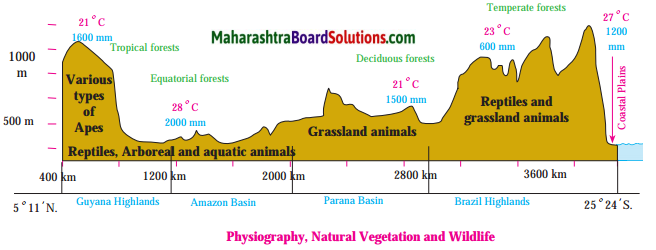
Answer the following questions on the basis of map given:
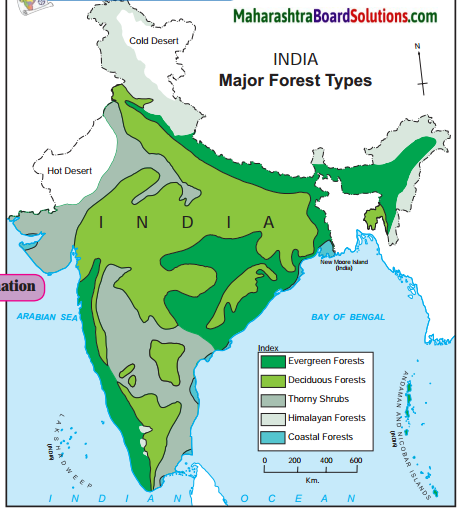
Maharashtra Board Class 10 Geography Solutions Chapter 5 Natural Vegetation and Wildlife 21
Question 1.
How many mm of rainfall does Tropical forests have?
Answer:
Tropical forests receives rainfall of 1600 mm.

Question 2.
How much rainfall does equatorial forests receive?
Answer:
Equatorial forests receive 2000 mm of rainfall.

Question 3.
Name the types of forests shown in figure.
Answer:
Tropical forests, Equatorial forests, Deciduous forests and Temperate forests are shown in the above figure.

Question 4.
Where are tropical and equatorial forests found in Brazil?
Answer:Tropical and equatorial forests are found in Guyana Highlands and Amazon basin respectively.

Question 5.
Where are deciduous forests and temperate forests found in Brazil?
Answer:
Deciduous forests and Temperate forests are found in Parana Basin and Brazilian Highlands respectively.

Question 6.
What kind of wildlife is seen in Brazilian Highlands?
Answer:
Reptiles and grassland animals are seen in Brazilian Highlands.

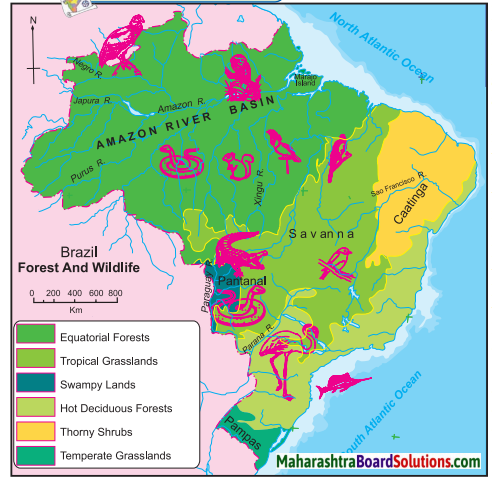
Maharashtra Board Class 10 Geography Solutions Chapter 5 Natural Vegetation and Wildlife 6

Question 1.
Which forests are found in western snow¬capped regions?
Answer:
Himalayan Forests are found in western snow-capped regions.

Question 2.
On which coast do you mainly find the coastal vegetation?
Answer:
The coastal vegetation is mainly found along the Eastern Coast.

Question 3.
Which type of forests occupy maximum area in India ? Why?
Answer:
Deciduous forests are found in the regions receiving rainfall between 1000 mm to 2000 mm Since most of India has rainfall in that range, deciduous forests dominate the Indian subcontinent.

Question 4.
Where do you find thorny and shrub vegetation in India and why?
Answer:
Semi arid areas of Gujarat, Rajasthan, Madhya Pradesh, Chhattisgarh, Uttar Pradesh Maharashtra, Karnataka, Andhra Pradesh, Tamil Nadu and Haryana are the places where thorny and shrub vegetation are found. The thorny forests are found in these regions as the rainfall is less than 500 mm.

Maharashtra Board Class 10 Geography Solutions Chapter 5 Natural Vegetation and Wildlife 7

Maharashtra Board Class 10 Geography Solutions Chapter 5 Natural Vegetation and Wildlife

Question 1.
Name the species shown on the map.
Answer:
Some of the major species shown on the map are condor, golden lion tamarin, anaconda, crocodile, sword fish, flamingoes, macaw, parrots, rufous bellied thrush.

Question 2.
In which regions are these animals found? Why are their habitats found in these forests?
Answer:

  • The dense equatorial forest region is home to golden lion tamarin, condor, anaconda, etc. This is because these forest lie near the Amazon River and receive rainfall throughout the year.
  • Swampy lands of Pantanal is home to anacondas and crocodiles because these conditions are favourable for their habitation.
  • Sword fish thrives near the South Atlantic Coast due to the extensive continental shelf.

Question 3.
Classify the forest regions in Brazil with reference to their extent.
Answer:

  • Equatorial forests are found in the northern part of Brazil and it covers an extensive area.
  • Tropical Grasslands (Savanna) is the next major forest type occupying central part of Brazil.
  • Hot deciduous forests occupy the southern Brazil whereas swampy lands of Pantanal occupy a small part of Brazil in the south west.
  • Thorny shrubs occupy the north western part of Brazil owing to low rainfall whereas Temperate Grasslands (Pampas) occupy south Brazil.

Mark the following on the map of India with the given information:
Question 1.

  1. Bengal Tiger
  2. Lion
  3. Great Indian Bustard
  4. Gangetic Dolphin
  5. Olive Ridley turtles
  6. Swamp deers
  7. One-horned rhinos
  8. Nilgiri Tahr goat
  9. Gharials

Answer:
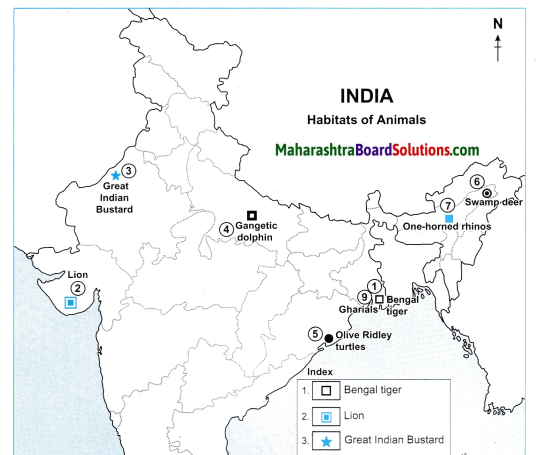
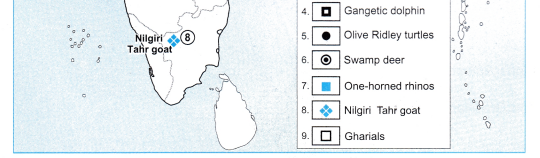
Maharashtra Board Class 10 Geography Solutions Chapter 5 Natural Vegetation and Wildlife 4
Maharashtra Board Class 10 Geography Solutions Chapter 5 Natural Vegetation and Wildlife 5

Class 10 Geography Chapter 5 Natural Vegetation and Wildlife Additional Important Questions and Answers

Choose the correct option and rewrite the statements:

Question 1.
In Brazil, _____ varies due to physiography.
(a) soil
(b) rainfall
(c) agriculture
(d) mineral availability
Answer:
(b) rainfall

Question 2.
In most parts of the _____ region, it rains throughout the year.
(a) temperate
(b) tropical
(c) grasslands
(d) equatorial
Answer:
(d) equatorial

Question 3.
As one moves away from the Equator, _______ decreases.
(a) altitude
(b) forest
(c) rainfall
(d) snowfall
Answer:
(c) rainfall

Maharashtra Board Class 10 Geography Solutions Chapter 5 Natural Vegetation and Wildlife

Question 4.
The _______ forests are found where there is rainfall throughout the year.
(a) tropical
(b) thorny
(c) evergreen
(d) temperate
Answer:
(c) evergreen

Question 5.
Brazil has the/a ______ number of vegetation species in the world.
(a) moderate
(b) largest
(c) low
(d) smallest
Answer:
(b) largest

Question 6.
The rainforests are rightly called the _______.
(a) lungs of the world’
(b) ’limbs of the world’
(c) ’heart of the world’
(d) ’veins of the world’
Answer:
(a) lungs of the world’

Question 7.
Highest biodiversity is found in _____ forests.
(a) thorny
(b) deciduous
(c) evergreen
(d) coastal
Answer:
(c) evergreen

Question 8.
In regions receiving rainfall between 1000 mm to 2000 mm in India, ______ forests are found.
(a) thorny
(b) evergreen
(c) deciduous
(d) tropical
Answer:
(c) deciduous

Question 9.
In regions receiving less than 500 mm of rainfall that experience dry summers for a long time in India, ______ and shrub like vegetation are found.
(a) equatorial
(b) evergreen
(c) grasslands
(d) thorny
Answer:
(d) thorny

Question 10.
In _____ areas, coastal type of vegetation is found.
(a) peninsular
(b) mountainous
(c) rocky
(d) swampy
Answer:
(d) swampy

Question 11.
Coastal type of vegetation is called ____ in India.
(a) Bangar
(b) Sunderbans
(c) Pantanal
(d) Terai
Answer:
(b) Sunderbans

Maharashtra Board Class 10 Geography Solutions Chapter 5 Natural Vegetation and Wildlife

Question 12.
The wood found in Sunderbans is _____ light and durable.
(a) dry
(b) fragile
(c) oily
(d) soft
Answer:
(c) oily

Question 13.
In areas located in the ____ altitude of Himalayas, seasonly flowering trees are found.
(a) highest
(b) lowest
(c) plains
(d) medium
Answer:
(a) highest

Question 14.
In regions with medium altitude of Himalayas, ______ trees are found.
(a) rubber
(b) evergreen
(c) rose wood
(d) coniferous
Answer:
(d) coniferous

Question 15.
At foothills of the Himalayas _____ forests are found.
(a) mixed
(b) teak –
(c) coniferous
(d) pine
Answer:
(a) mixed

Question 16.
The proportion of ________ trees is higher at the foothills of the Himalayas.
(a) sal
(b) deodar
(c) rosewood
(d) pine
Answer:
(a) sal

Question 17.
Teak is mainly found in the _______ type of forest.
(a) Coastal
(b) Thorny and bush
(c) Coniferous
(d) Deciduous
Answer:
(d) Deciduous

Question 18.
A greater diversity of wildlife is found in ________ than any other country in the
world.
(a) India
(b) Russia
(c) Australia
(d) Brazil
Answer:
(d) Brazil

Question 19.
In the swampy areas of Pantanal, _______ are found.
(a) cobras
(b) vipers
(c) huge anacondas
(d) Indian pythons
Answer:
(c) huge anacondas

Question 20.
Among fish varieties, ______ is found in seas of Brazil
(a) mackerel
(b) king fish
(c) sword fish
(d) pink dolphins
Answer:
(c) sword fish

Question 21.
In Brazilian rivers, pink dolphins and ______ are found.
(a) gold fish
(b) piranhas
(c) king fish
(d) mackrels
Answer:
(b) piranhas

Maharashtra Board Class 10 Geography Solutions Chapter 5 Natural Vegetation and Wildlife

Question 22.
One of the major bird species found in Brazil includes _______.
(a) ostrich
(b) flamingoes
(c) kiwi
(d) duck
Answer:
(b) flamingoes

Question 23.
Slash and bum agriculture is also called ______ in Brazil.
(a) kumri
(b) roka (roca)
(c) dry farming
(d) bewar
Answer:
(b) roka (roca)

Question 24.
Hot and humid forests are a home for _______
(a) tiger
(b) elephants
(c) dogs
(d) leopard
Answer:
(b) elephants

Question 25.
One horned rhinoceroses are found in swampy and marshy lands of ______.
(a) Assam
(b) Madhya Pradesh
(c) Telangana
(d) Tamil Nadu
Answer:
(a) Assam

Question 26.
Indian bisons, deers, monkeys are found in the _____ region.
(a) Himalayan
(b) Western Ghats
(c) Peninsular
(d) Deccan
Answer:
(c) Peninsular

Question 27.
The only country where both lions and tigers are found is ______.
(a) Brazil
(b) India
(c) Australia
(d) America
Answer:
(b) India

Question 28.
______ which are huge in size fly high in the Brazilian sky.
(a) Macaws
(b) Kingfishers
(c) Condors
(d) Pheasants
Answer:
(c) Condors

Match the Column:

Question 1.

Column ’A’Column ‘B’
1. Evergreen Forests(a) Major portion of Madhya Pradesh
2. Deciduous forests(b) Arunachal Pradesh
3. Thorny shrubs(c) Sundarbans
4. Himalayan forests(d) Western Ghats
5. Coastal forests(e) Gujarat
(f) Cold desert in Jammu and Kashmir
(g) Hot desert in Rajasthan

Answer:
1 – d
2 – a
3 – e
4 – b
5 – c

Question 2.

Column ’A’Column ‘B’
1. Equatorial forests(a) Caatinga
2. Grasslands(b) Pantanal
3. Swampy Lands(c) Pampas
4. Hot deciduous forests(d) Amazon river basin
5. Thorny shrubs(e) Escarpment
(f) Savanna
(g) Parana basin

Answer:
1 – d
2 – c
3 – b
4 – e
5 – a

Maharashtra Board Class 10 Geography Solutions Chapter 5 Natural Vegetation and Wildlife

Identify the odd man out:

Question 1.
With reference to Fauna in India.
(a) Anaconda
(b) Elephants
(c) Lion
(d) Tiger
Answer:
(a) Anaconda

Question 2.
With reference to Flora of Brazil.
(a) Pau Brazil
(b) Rubber
(c) Mahogany
(d) Deodar
Answer:
(d) Deodar

Question 3.
With reference to Himalayan Forests.
(a) Seasonal flowering plants
(b) Orchids
(c) Pine
(d) Mixed Forests
Answer:
(b) Orchids

Question 4.
With reference to birds found in Brazil.
(a) Condors
(b) Flamingoes
(c) Macaws
(d) Peacocks
Answer:
(d) Peacocks

Question 5.
With reference to birds found in India.
(a) Peacock
(b) Kingfisher
(c) Duck
(d) Condors.
Answer:
(d) Condors.

Question 6.
With reference to protection of wildlife, Government of India has setup.
(a) Museums
(b) Biosphere reserves
(c) National Parks
(d) Wildlife sanctuaries
Answer:
(a) Museums

Answer the following questions in one sentence:

Question 1.
Where does it rain throughout the year?
Answer:
It rains throughout the year, in most parts of the equatorial region.

Question 2.
As one moves away from the Equator, does the rainfall increase?
Answer:
No, the rainfall decreases as one moves away from the Equator.

Question 3.
Where are evergreen forests found?
Answer:
Evergreen forests are found in the area where it rains throughout the year.

Question 4.
What effect does rainfall have on vegetation?
Answer:
As the rainfall decreases, the density of the vegetation also decreases.

Question 5.
What kind of vegetation is found in places of less rainfall?
Answer:
Various types of grass, short shrubs and thorny vegetation is found in places of less rainfall.

Maharashtra Board Class 10 Geography Solutions Chapter 5 Natural Vegetation and Wildlife

Question 6.
Where are the largest number of vegetation species found in the world?
Answer:
Brazil has the largest number of vegetation species in the world.

Question 7.
What kind of trees are found in Brazil?
Answer:
Trees like Pau Brasil, rubber, mahogany, rosewood and a variety of orchids are found in Brazil.

Question 8.
Why are the evergreen forests called the ‘lungs of the world’?
Answer:
Evergreen forests are called the lungs of the world because they release large amount of oxygen in the environment which helps to reduce the carbon dioxide levels.

Question 9.
Describe the leaves of trees found in evergreen forests.
Answer:
The leaves of trees found in evergreen forests are broad and green.

Question 10.
What quality of wood is found in evergreen forests?
Answer:
The wood found in evergreen forests is hard, heavy and durable.

Question 11.
In which regions are deciduous forests found?
Answer:
Deciduous forests are found in the regions receiving an average amount of rainfall ranging between 1000mm to 2000mm in India.

Question 12.
Which trees are found in deciduous forests?
Answer:
Trees like teak, bamboo, banyan, peepal, etc. are found in deciduous forest.

Question 13.
Which regions experience dry summers for a long time in India?
Answer:
Regions that receive less than 500 mm of rainfall experience dry summers for a long time in India.

Question 14.
Which kind of vegetation is found in regions receiving less than 500 mm of rainfall?
Answer:
Thorny or shrub like vegetation is found in regions receiving less than 500 mm of rainfall.

Question 15.
How are the leaves of trees in the region where there is less than 500 mm of rainfall?
Answer:
The leaves of trees are small in the region where there is less than 500 mm of rainfall.

Question 16.
Where is coastal vegetation found?
Answer:
Coastal vegetation is found in swampy areas, estuaries and lagoons near coastal areas.

Question 17.
What is coastal vegetation called in India?
Answer:
Coastal vegetation is called mangroves or Sunderbans in India.

Question 18.
How is the wood of trees found in coastal vegetation?
Answer:
The wood of trees found in coastal vegetation is oily, light and durable.

Maharashtra Board Class 10 Geography Solutions Chapter 5 Natural Vegetation and Wildlife

Question 19.
How many types of forests are there in the Himalayas?
Answer:
There are three types of forests in the Himalayas based on their altitude.

Question 20.
Which kind of trees are found in regions of high altitude in the Himalayas?
Answer:
Seasonally flowering trees are found in regions of high altitude.

Question 21.
Which type of trees are found in regions with medium altitude in the Himalayas?
Answer:
In regions with medium altitude, coniferous trees like pine, deodar and fir are found.

Question 22.
Where are mixed forests found in India?
Answer:
Mixed forest are found at the foothills of the Himalayas.

Question 23.
Where is greater diversity in wildlife found in the world?
Answer:
A greater diversity in wildlife is found in Brazil than any other country in the world.

Question 24.
Which animal is found in the swampy areas of the Pantanal?
Answer:
Huge anacondas are found in the swampy areas of Pantanal.

Question 25.
Which are the other animals found in Brazil?
Answer:
Animals like guinea pigs, crocodiles, alligators, monkeys, pumas, leopards, etc. are found in Brazil.

Question 26.
Which is the main variety of fish found in the Brazilian sea?
Answer:
Sword fish is mainly found in the Brazilian sea.

Question 27.
Which varieties of fish are found in the rivers of Brazil?
Answer:
Piranhas are found in the rivers of Brazil.

Question 28.
What kind of birds are seen in the Brazilian sky?
Answer:
Condors, parrots, macaws, and flamingoes are found in the Brazilian skies.

Question 29.
Why is degradation of environment happening in Brazil?
Answer:
Degradation of environment is happening in Brazil due to illegal smuggling of wild animals, slash and bum agriculture (roka), deforestation, and pollution.

Question 30.
Where are elephants found in India?
Answer:
Elephants are found in hot and humid forests of India.

Question 31.
Where are one homed rhinoceroses found?
Answer:
One homed rhinoceroses are found in the swampy and marshy lands of Assam.

Question 32.
Which animals are found in the arid lands of India?
Answer:
Wild ass and camels are found in the arid lands of India.

Question 33.
Which animal is found in the snow capped regions of Himalayas?
Answer:
Snow leopards are found in the snow capped regions of the Himalayas.

Question 34.
Which animals are found in the peninsular region of India?
Answer:
Indian Bisons, deer, antelopes, and monkeys are found in the Peninsular region of India.

Question 35.
Which is the only country where both lions and tigers are found?
Answer:
India is the only country where both lions and tigers are found.

Question 36.
Where are turtles, crocodiles and gharials found in India?
Answer:
Turtles, crocodiles and gharials are found in rivers, estuaries, and coastal areas of India.

Maharashtra Board Class 10 Geography Solutions Chapter 5 Natural Vegetation and Wildlife

Question 37.
Which birds are found in the forests and wetlands of India?
Answer:
Birds like peacocks, Indian bustard, kingfishers, peasants, ducks, parakeet, cranes, and pigeons are found in the forests and wetlands of India.

Question 38.
What measures are taken by the Government of India for the protection of wildlife and forests of India?
Answer:
The Government of India has set up a number of national parks, wildlife sanctuaries, bird sanctuaries, and biosphere reserves for the protection of wildlife and forests in India.

Question 39.
Name some plants found in regions having less than 500 mm of rainfall in India.
Answer:
Catechu, acacia, khejri and a variety of cactus like aloevera and agave are found in regions having less than 500 mm of rainfall in India.

Name the following:

Question 1.
The region where it rains throughout the year.
Answer:
Equatorial region.

Question 2.
The forests which are found where it rains throughout the year.
Answer:
Evergreen forests.

Question 3.
Kind of vegetation found in places of less rainfall.
Answer:
Grass, short shrubs, thorny vegetation.

Question 4.
Country where the largest number of vegetation species in the world is located.
Answer:
Brazil.

Question 5.
The types of trees found in Brazil.
Answer:
Pau Brasil, rubber, mahogany, rosewood and variety of orchids.

Question 6.
Other name for rain forests.
Answer:
‘The lungs of the world.’

Question 7.
Trees found in deciduous forests.
Answer:
Teak, bamboo, banyan, peepal.

Question 8.
Type of vegetation found in regions having less than 500 mm of rainfall.
Answer:
Thorny and shrub-like.

Question 9.
Plants found in regions having less than 500 mm of rainfall.
Answer:
Catechu, acacia, khejri and varieties of cactus.

Question 10.
Kind of vegetation found in swampy areas.
Answer:
Coastal type.

Question 11.
Another name of coastal type of vegetation in India.
Answer:
Mangroves or sunderbans.

Maharashtra Board Class 10 Geography Solutions Chapter 5 Natural Vegetation and Wildlife

Question 12.
Kind of trees found in forests located on higher altitudes in the Himalayas.
Answer:
Seasonally flowering trees.

Question 13.
Kind of trees which have grown in forests located on medium altitudes in Himalayas. Coniferous trees like Pine, Deodar and Fir.
Answer:
Region where mixed forests are found in Himalayas.

Question 14.
Foothills of Himalayas.
Answer:
Animal found in the swampy areas of Pantanal.

Question 15.
Huge anacondas.
Answer:
Any two varieties of animals found in Brazil. Guinea pigs and crocodiles.

Question 16.
Kind of fishes found in seas of Brazil.
Answer:
Sword fish.

Question 17.
Fish varieties found in the rivers of Brazil.
Answer:
Pink dolphins and Piranhas.

Question 18.
Any two species of birds found in Brazil.
Answer:
Condors and macaws.

Question 19.
Causes for degradation of environment.
Answer:
Illegal smuggling of wild animals, roka, deforestation and pollution

Question 20.
Region where elephants are found in India.
Answer:
Hot and humid forests.

Question 21.
Animal which is found in the swampy and marshy lands of Assam.
Answer:
One horned rhinoceroses.

Question 22.
Animals which are found in arid lands of India.
Answer:
Wild ass and camels.

Question 23.
Animals which are found in the snowcapped mountain of Himalayas.
Answer:
Yaks and snow leopards.

Question 24.
Animals found in the Peninsular region of India.
Answer:
Indian bisons, deer, antelopes and monkeys.

Question 25.
Country where both lion and tigers are found.
Answer:
India.

Question 26.
Animals found in rivers, estuaries and coastal areas of India.
Answer:
Turtles, crocodiles and garials.

Question 27.
Measures taken by the Government of India to protect wildlife.
Answer:
Setting up of National parks, bird sanctuaries, wildlife sanctuaries and biosphere reserves.

Question 28.
National animal of India.
Answer:
Tiger.

Maharashtra Board Class 10 Geography Solutions Chapter 5 Natural Vegetation and Wildlife

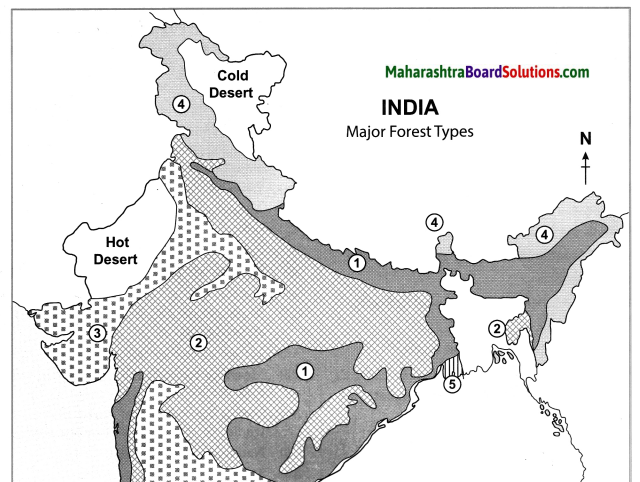
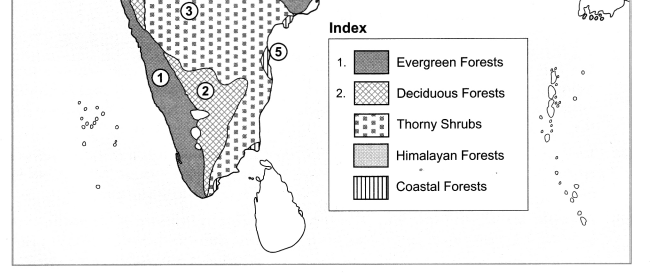
Mark the following on the map of India with the given information:

  1. Evergreen forests
  2. Deciduous forest
  3. Thorny shrubs
  4. Himalayan Forests
  5. Coastal Forests

Answer:
Maharashtra Board Class 10 Geography Solutions Chapter 5 Natural Vegetation and Wildlife 13
Maharashtra Board Class 10 Geography Solutions Chapter 5 Natural Vegetation and Wildlife 9

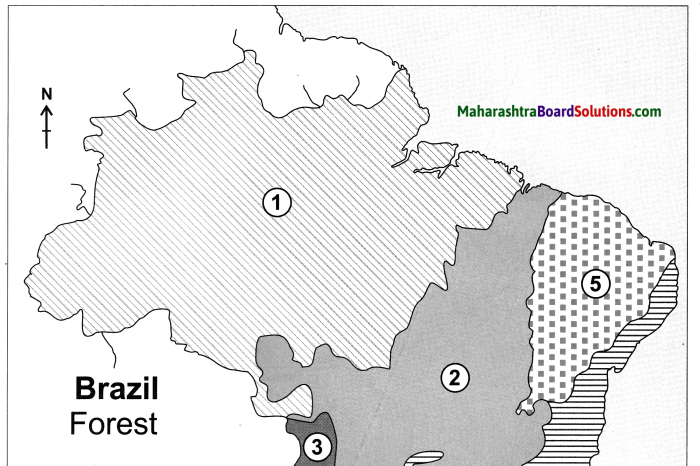
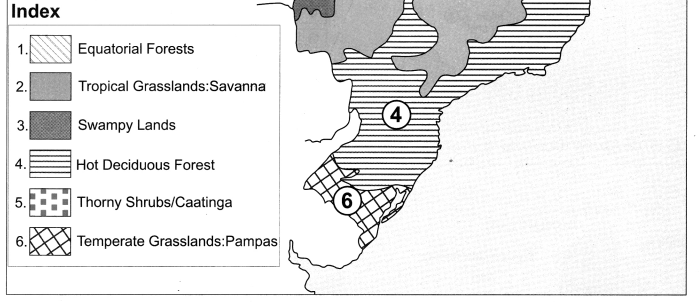
Mark the following on the map of Brazil with the given information:

  1. Equatorial forests
  2. Tropical grasslands
  3. Swampy lands
  4. Hot deciduous forest
  5. Caatinga
  6. Temperate grasslands

Answer:

Maharashtra Board Class 10 Geography Solutions Chapter 5 Natural Vegetation and Wildlife 12
Maharashtra Board Class 10 Geography Solutions Chapter 5 Natural Vegetation and Wildlife 11
Equatorial Forests Tropical Grasslands:Savanna Swampy Lands Hot Deciduous Forest Thorny Shrubs/Caatinga Temperate Grasslands:Pampas

Maharashtra Board Class 10 Geography Solutions Chapter 5 Natural Vegetation and Wildlife

Question 1.
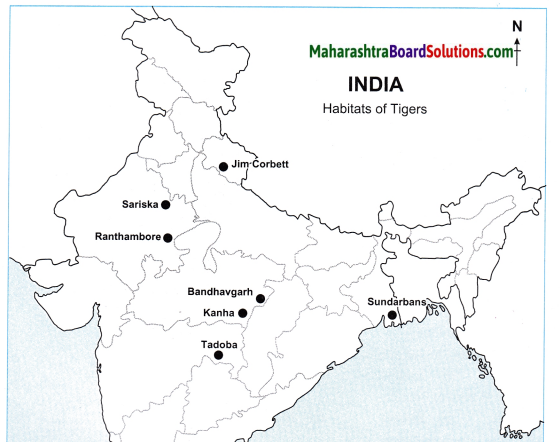
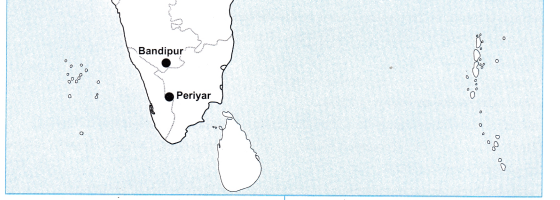
Show the habitats of tigers in India with their names on a map.
Answer:
Maharashtra Board Class 10 Geography Solutions Chapter 5 Natural Vegetation and Wildlife 14
Maharashtra Board Class 10 Geography Solutions Chapter 5 Natural Vegetation and Wildlife 15

Question 2.
Why is their habitat found in these regions?
Answer:
Tiger’s habitats are found in these regions because here there are various types of forest areas with different types of herbivorous animals.

Answer the Questions Briefly:

Question 1.
Thorny and shrub-like vegetation is found in regions where there is less or no rainfall.
Answer:

  • The regions where there is less or no rainfall have a hot and dry climate.
  • The soils in these regions are also rocky and dry.
  • Water evaporation in leaves is more since the surface area of exposure is more than that of thorns
  • Hence, thorny and shrub-like vegetation is found in regions where there is less or no rainfall to conserve water.

Question 2.
The evergreen rainforests in Brazil are rightly called the ‘Lungs of the world’.
Answer:

  • The northern Part of Brazil has dense evergreen forests. .
  • These forests release a large amount of oxygen in the environment.
  • This helps to reduce carbon dioxide levels.
  • Therefore, these rainforests are rightly called the Tungs of the world’.

Question 3.
The largest variety of flora is found in Brazil.
Answer:

  • The flora of any region depends upon the amount of rainfall and its physiography.
  • Brazil has equatorial forests in high rainfall areas, tropical grasslands and deciduous forests in moderate rainfall areas.
  • Western part of Brazil has swampy lands, whereas low rainfall regions have thorny shrubs.
  • Temperate grasslands are found in temperate regions.
  • Thus, the largest variety of flora is found in Brazil.

Question 4.
Suggest measures for the conservation of wildlife and forest in India?
Answer:
Measures for the conservation of wildlife and forest in India are as follows:

  • Restricting wildlife trading and hunting.
  • Declaring more national parks and sanctuaries.
  • Giving more importance to the protection of endangered animals.
  • Controlling felling of trees.
  • Implementing afforestation and social forestry programmes.

Maharashtra Board Class 10 Geography Solutions Chapter 5 Natural Vegetation and Wildlife

Write short notes on:

Question 1.
Brazilian Vegetation:
Answer:
(i) In Brazil, rainfall varies due to physiography. In most parts of the Equatorial region, it rains throughout the year.
(ii) As one moves away from the equator, the number of rainy days as well as amount of rainfall reduces.
(iii) This affects the life cycle of the vegetation too.
(iv) Evergreen forests are found in the areas where it rains throughout the year.
(v) In regions which receive rainfall only during certain seasons, the density of the vegetation reduces.
(vi) Instead of forests, various types of grass, short shrubs,,thorny vegetation, etc. are found.
(vii) Brazil has the largest number of vegetation species in the world.
(viii) This includes evergreen vegetation, semi-evergreen, arid, etc.
(ix) One finds trees like Pau Brasil, rubber, mahogany, rosewood and a variety of orchids.

Question 2.
wildlife of Brazil:
Answer:
(i) A greater diversity in wildlife is found in Brazil compared to any other country in the world.
(ii) In the swampy areas of the Pantanal, huge anacondas are found.
Animals, such as guinea pigs, crocodiles,
alligators, monkeys, pumas, leopards, etc. are found.
(iv) Among the fish varieties, mainly swordfish are found in the seas, while pink dolphins and piranhas are found in the rivers .
(v) Condors which are huge in size and fly high in the sky, various types of parrots, macaws, and flamingoes are the major birds found here.
(vi) Millions of insect varieties are also found here.

Question 3.
The wildlife of India:
Answer:
(i) India is also a mega-diverse country in terms of wildlife. There are many species of wildlife in Irdia.
(ii) Elephants are found in hot and humid forests. One-horned rhinoceroses are found in swampy and marshy lands of Assam.
(iii) Wild ass and camels are found in arid lands. Snow leopards and yaks are found in the snow-capped regions of the Himalayas.
(iv) Indian Bisons, deer, antelopes, and monkeys are found in the Peninsular region.
(v) India is the only country in the world where both tigers and lions are found.
(vi) Rivers, estuaries and coastal areas are homes to many turtles, crocodiles, and gavials (gharials).
(vii) The forests and wetlands are the shelters of variety of birds like peacocks, Indian bustard, kingfishers, pheasants, ducks, parakeets, cranes, and pigeons.

Maharashtra Board Class 10 Geography Solutions Chapter 2 Location and Extent

Balbharti Maharashtra State Board Class 10 Geography Solutions Chapter 2 Location and Extent Notes, Textbook Exercise Important Questions and Answers.

Maharashtra State Board Class 10 Geography Solutions Chapter 2 Location and Extent

Class 10 Geography Chapter 2 Location and Extent Textbook Questions and Answers

1. Are the sentences right or wrong. ? Rewrite the wrong ones

Question a.
Brazil is mainly located in the Southern Hemisphere.
Answer:
Right

Maharashtra Board Class 10 Geography Solutions Chapter 2 Location and Extent

Question b.
Tropic of Capricorn passes through the middle of India.
Answer:
Wrong. Tropic of Cancer passes through the middle of India.

Question c.
The longitudinal extent of Brazil is less than India.
Answer:
Wrong. The longitudinal extent of Brazil is more than India.

Question d.
Equator passes through the northern part of Brazil.
Answer:
Right

Question e.
Brazil has a coastline along the Pacific Ocean.
Answer:
Wrong. Brazil has a coastline along the Atlantic. Ocean.

Question f.
Pakistan is a neighbouring country to the south east of India.
Answer:
Wrong. Pakistan is neighbouring a country to the north west of India.

Question g.
The southern part of India is called Peninsula.
Answer:
Right.

2. Answer in brief:

Question a.
What problems did Brazil and India face after independence?
Answer:
(i) India was under the British rule for almost one- and-a-half centuries and it got its independence in the year 1947.
(ii) It faced several problems like three wars, famine situations in various parts and similar issues after independence.
(iii) Brazil gained its independence in 1822 after more than three centuries of Portuguese rule.
(iv) From 1930 to 1985, for more than a half century, it was under a populist military government and it faced global financial difficulties in the late 20th century.
Thus, both India and Brazil faced many problems post-independence.

Maharashtra Board Class 10 Geography Solutions Chapter 2 Location and Extent

Question b.
How are Brazil and India different from each other in terms of location?
Answer:
(i) India is located in the northern hemisphere of the earth whereas some part of Brazil lies in the northern hemisphere and most of it lies in the southern hemisphere.
(ii) India entirely lies in the eastern hemisphere whereas, Brazil lies in the western hemisphere.
(iii) India lies in the continent of Asia whereas Brazil lies in the continent of South America.
(iv) India lies in the southern part of the continent of Asia whereas Brazil lies in the northern part of South American continent.

Question c.
Describe the latitudinal and longitudinal extent of India and Brazil.
Answer:
(i) The extent of the mainland India is 8°4’N to 37°6’N latitudes and between 68°7’E to 97°25’E longitudes.
(ii) Indira Point is the southernmost tip of India.
(iii) It is located on 6°45’N parallel.
(iv) The extent of the mainland Brazil is 5°15’N to 33°45′ S latitudes and between to 34°47’W to 73°48’W longitude.

Select the correct option

Question a.
India’s southernmost point is known as __________.
(a) Lakshadweep
(b) Kanyakumari
(c) Indira Point
(d) Port Blair
Answer:
(c) Indira Point

Question b.
These two countries in South America do not share their border with Brazil?
(a) Chile – Ecuador
(b) Argentina – Bolivia
(c) Columbia – French Guiana
(d) Surinam – Uruguay
Answer:
(a) Chile – Ecuador

Question c.
Both the countries have _________ type of government.
Military
(b) Republic
Communist
(d) Presidential
Answer:
(b) Republic

Question d.
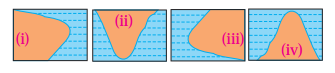
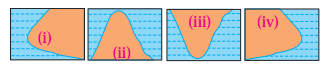
Which of the following shapes show the coastal part of Brazil correctly?
Maharashtra Board Class 10 Geography Solutions Chapter 2 Location and Extent 1
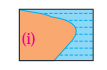
Answer:
Maharashtra Board Class 10 Geography Solutions Chapter 2 Location and Extent 2

Question e.
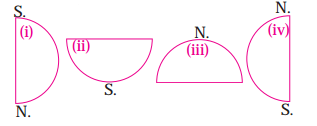
Which of the following shapes show the coastal part of India Correctly?
Maharashtra Board Class 10 Geography Solutions Chapter 2 Location and Extent 3
Answer:
Maharashtra Board Class 10 Geography Solutions Chapter 2 Location and Extent 4

Question f.
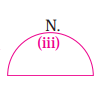
Considering hemisphere, which shape correctly represents the hemisphere in which India lies?
Maharashtra Board Class 10 Geography Solutions Chapter 2 Location and Extent 5
Answer:
Maharashtra Board Class 10 Geography Solutions Chapter 2 Location and Extent 6

Question g.
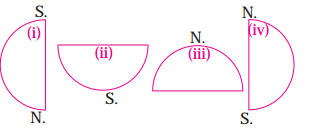
Considering the hemisphere, which correctly represents the hemisphere in which Brazil mainly lies?
Maharashtra Board Class 10 Geography Solutions Chapter 2 Location and Extent 7
Answer:
Maharashtra Board Class 10 Geography Solutions Chapter 2 Location and Extent 8

Class 10 Geography Chapter 2 Location and Extent Intext Questions and Answers

Colours of both
Answer the following questions with respect to the countries that you have studied.

Question 1.
Out of the countries that you have coloured, which country is larger in size?
Answer:
Brazil is larger in size.

Question 2.
Which country has a larger latitudinal extent?
Answer:
Brazil has a larger latitudinal extent.

Question 3.
How do the locations of Brazil and India differ in terms of their positions in their respective continents?
Answer:
Brazil lies in the northern part of the continent of South America, whereas India lies in the southern part of the continent of Asia.

Question 4.
How many states does each of the two countries have?
Answer:
Brazil has 26 states and one federal district. India has 28 states and 8 union territories.

Maharashtra Board Class 10 Geography Solutions Chapter 2 Location and Extent

Question 5.
Obtain information regarding the emblems of both the countries, i.e. India and Brazil.
Answer:
India:
The national emblem of India is an adaptation of the Lion capital of Ashoka at Sarnath. The emblem has three lions visible, the fourth being hidden from the view. The four lions symbolise power, courage, confidence and pride. At the bottom is a horse and a bull, and its centre is a wheel (Dharma Chakra). Forming an integral part of the emblem is the motto inscribed in Devanagari Script: Satyameva Jayate (Truth Alone Triumphs)

Brazil:
The national emblem of Brazil is coat of arms shows the Southern cross in a blue circle. The ring of 27 stars around it represents Brazil’s 26 states and the Federal District. The whole is placed on a star and surrounded by coffee (at the left) and tobacco (at the right), which are the important crops in Brazil. The blue ribbon contains the official name of Brazil (Republica Federativa Do Brazil – Federative Republic of Brazil) in the first line. In the second, the date of the federative republic’s establishment (November 15, 1889) is written.

Give it a try.

Question 1.
The imperial power which ruled Brazil also ruled a part of India. Find out when that part of India achieved independence?
Answer:
Answer: In India, Goa, Diu and Daman, Dadra and Nagar Haveli were under Portuguese rule. These regions got independence on 19th December 1961.

Match the column:

Question 1.

Column ‘A’Column ‘B’
(1)      Dance form of Brazil

(2)      Capital of India

(3)      Capital of Brazil

(4)      Coffee pot of world

(a)     Brazil

(b)     Samba

(c)     New Delhi

(d)     Brasilia

(e)     Bangladesh

(f)     Myanmar

Answer:
1 – b
2 – c
3 – d
4 – a

Question 2.

Column ‘A’Column ‘B’
(1) Country to the south of Brazil(a) China
(2) Sea to the west of India(b) Uruguay
(3) Second largest populated country(c) Arabian sea
(4) Coffee pot of the world Imperial power ruled Brazil(d) India
(e) Portuguese
(f) Japan

Answer:
1 – b
2 – c
3 – d
4 – e

Answer the following questions in one sentence:

Question 1.
Which is the second largest populated country in the world?
Answer:
India is the second-largest populated country in the world.

Question 2.
Which country is called the ‘coffee pot’ of the world’?
Answer:
Brazil is called the coffee pot of the world.

Question 3.
Which dance form is famous in Brazil?
Answer:
Samba is the famous dance form of Brazil.

Question 4.
Name the capital of India?
Answer:
The capital of India is New Delhi.

Question 5.
When did India gain Independence?
Answer:
India got independence on 15th August 1947.

Question 6.
When did Brazil gain independence?
Answer:
Brazil gained its independence on 7th September 1822.

Question 7.
Which countries are located to the north of Brazil?
Answer:
Venezuela, Guyana, Suriname and French Guiana are situated to the north of Brazil

Question 8.
Which countries are located to the west of Brazil?
Answer:
Colombia, Peru, Bolivia, Paraguay and Argentina are situated to the west of Brazil.

Question 9.
Which country is situated to the south of Brazil?
Answer:
Uruguay is situated to the south of Brazil.

Maharashtra Board Class 10 Geography Solutions Chapter 2 Location and Extent

Question 10.
Which ocean lies to the east of Brazil?
Answer:
The North and South Atlantic Ocean lies to the east of Brazil.

Question 11.
Which countries are situated to the east of India?
Answer:
Myanmar and Bangladesh are situated to the east of India.

Question 12.
Which countries are situated to the north of India?
Answer:
China, Bhutan and Nepal are situated to the north of India.

Question 13.
Which sea lies to the west of India?
Answer:
Arabian sea lies to the west of India.

Question 14.
Which countries lie to the south of India?
Answer:
Srilanka, Maldives and Indonesia lie to the south of India.

Question 15.
What is the location of the southernmost tip of India?
Answer:
The location of the southernmost tip of India (Indira Point) is 6°45′ N parallel.

Question 16.
According to the equator, in which hemisphere is Brazil located?
Answer:
Some part of Brazil lies in the northern hemisphere, while most of it lies in the southern hemisphere.

Question 17.
In which hemispheres is India located?
Answer:
India is located in the northern and eastern hemispheres.

Question 18.
What type of government does Brazil have today?
Answer:
Today, Brazil has Federal Presidential Republic type of government.

Question 19.
What type of government does India have today?
Answer:
Today, India has Federal Parliamentary Republic type of government.

Question 20.
Where does the name Brazil come from?
Answer:
The name Brazil comes from ‘Pau Brasil’, a local wooded tree.

Question 21.
Who established the early settlement in Brazil?
Answer:
The Portuguese settlers established the early settlement in Brazil.

Question 22.
Distinguish between: Location of India and Brazil
Answer:

IndiaBrazil
(i) India is located at 8°4’N to 37°6’N latitude and between 68°7’E to 97°25’E longitudes.(i) Brazil is located at 5°15’N to 33°45’S latitudes and between 34°47’W to 73°48’W.
(ii) It is located in the northern and eastern hemispheres.(ii) Some part of Brazil lies in the northern hemisphere, while most of it lies in the southern hemisphere. Brazil also lies in the western hemisphere.
(iii) India is located in the southern part of the Asian continent.(iii) Brazil is located in the northern part of South American continent.

Question 23.
Find the difference between the post-independence characteristics of India and Brazil.
Answer:

BrazilIndia
(i) Brazil gained its independence in 1822. From 1930 to 1985, for more than half a century, it was under a populist military government. Presently, Brazil has Federal Presidential Republic type of government(i) India got its independence in the year 1947. It has Federal Parliamentary Republic type of government.
(ii) The proportion of older people that is non – working population is high.


(ii) The proportion of youth, i.e. working population is high.


(iii )It has overcome global financial difficulties in the late 20th century(iii) It has faced several problems like three wars, famine situations in various parts and similar issues after independence.


(iv) Sex ratio and literacy rate is high in Brazil.


(iv) Sex ratio and literacy rate is low in India.


Maharashtra Board Class 10 Geography Solutions Chapter 2 Location and Extent

Observe the map and answer the following questions.

Question 1.
Identify the countries and water bodies around India and complete the following table.
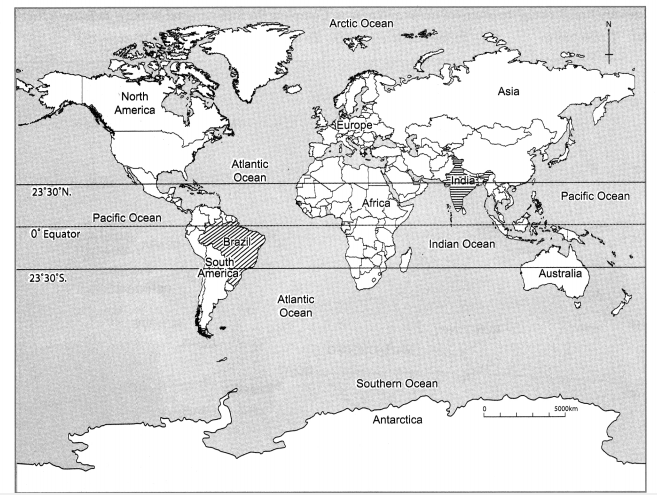
Maharashtra Board Class 10 Geography Solutions Chapter 2 Location and Extent 9
Maharashtra Board Class 10 Geography Solutions Chapter 2 Location and Extent 10
To the North
To the East
To the South
To the West
Answer:

No.DirectionsNeighbouring Countries/ Oceans
(1)NorthChina, Bhutan, Nepal
(2)SouthIndian Ocean, Sri Lanka, Maldives, Indonesia
(3)EastMyanmar, Bangladesh, Bay of Bengal
(4)WestArabian Sea, Pakistan, Afghanistan

Question 2.
Identify Brazil’s neighbouring countries and oceans. Complete the following table.
Maharashtra Board Class 10 Geography Solutions Chapter 2 Location and Extent 11
Maharashtra Board Class 10 Geography Solutions Chapter 2 Location and Extent 12
(a) To the North
(b) To the South
(c) To the East
(d) To the West
Answer:

No.DirectionsNeighbouring CountriesOceans
(1)NorthVenezuela, Guyana, Suriname, French GuianaNorth Atlantic Ocean
(2)SouthUruguaySouth Atlantic Ocean
(3)EastSouth Atlantic Ocean
(4)WestPeru, Bolivia, Paraguay, Colombia, Argentina

Question 3.
Show the following on an outline of the world map.
(a) Name all the continents and oceans of the world.
(b) Colour Brazil and India using different colours and name them.
(c) Draw equator on the map and write its value in degrees.
(d) Show the symbol for direction.
Answer:
Maharashtra Board Class 10 Geography Solutions Chapter 2 Location and Extent 13

Give geographical reasons:

Question 1.
Brazil is called the ‘coffee pot of the world’.
Answer:
(i) Brazil ranks first in the world in the terms of production of coffee.
(ii) It produces nearly 40% of the total coffee production in the world.
(iii) It is the largest exporter of coffee.
Therefore, Brazil is called the ‘coffee pot of the world’.

Maharashtra Board Class 10 Geography Solutions Chapter 2 Location and Extent

Question 2.
Brazil is known as the country having third longest land border.
Answer:
(i) Brazil has the world’s third longest land border, after China and Russia.
(ii) It shares its boundaries with all South American countries, except Chile and Ecuador, totalling 16,885 Kilometers.
(iii) Brazil has borders with 10 different countries, which are Argentina, Bolivia, Colombia, French Guiana, Guyana, Paraguay, Peru, Suriname, Uruguay and Venezuela.
(iv) Hence, Brazil is called the country having third longest land borders.

Question 3.
India is looked upon as a young country.
Answer:
(i) The proportion of youth in India’s population is high.
(ii) This forms a major part of the working population.
(iii) According to 2011 census the percentage of working population is more than 50 %.
(iv) Hence, India is looked upon as a young country.

Question 4.
India’s economic development has paced up. OR India is considered as a major global market.
Answer:
(i) Despite facing several problems after independence, today India is a major developing country of the world.
(ii) It is because of various reforms from time to time, that India’s economic development has paced up.
(iii) So, it is considered to be a global market.

Answer in brief:

Question 1.
What problems did Brazil and India face after independence?
Answer:
(i) India was under the British rule for almost one-and-a-half centuries and it got its independence in the year 1947.
(ii) It faced several problems like three wars, famine situations in various parts and similar issues after independence.
(iii) Brazil gained its independence in 1822 after more than three centuries of Portuguese rule.
(iv) From 1930 to 1985, for more than a half century, it was under a populist military government and it faced global financial difficulties in the late 20th century.
Thus, both India and Brazil faced many problems post-independence.

Question 2.
How are Brazil and India different from each other in terms of location?
Answer:
(i) India is located in the northern hemisphere of the earth whereas some part of Brazil lies in the northern hemisphere and most of it lies in the southern hemisphere.
(ii) India entirely lies in the eastern hemisphere whereas, Brazil lies in the western hemisphere.
(iii) India lies in the continent of Asia whereas Brazil lies in the continent of South America.
(iv) India lies in the southern part of the continent of Asia whereas Brazil lies in the northern part of South American continent.

Question 3.
Describe the latitudinal and longitudinal extent of India and Brazil.
Answer:
(i) The extent of the mainland India is 8°4’N to 37°6’N latitudes and between 68°7’E to 97°25’E longitudes.
(ii) Indira Point is the southernmost tip of India.
(iii) It is located on 6°45’N parallel.
(iv) The extent of the mainland Brazil is 5°15’N to 33°45′ S latitudes and between to 34°47’W to 73°48’W longitude.

Class 10 Geography Chapter 2 Location and Extent Additional Important Questions and Answers

Name the following:
Question 1.
The second-largest populated country in the world.
Answer:
India

Question 2.
The country is famous for its spices in the world.
Answer:
India

Question 3.
The country is known as the ‘coffee pot’ of the world.
Answer:
Brazil

Question 4.
The famous dance form of Brazil.
Answer:
Samba

Question 5.
Hemispheres in which India is located.
Answer:
Northern and eastern hemispheres.

Question 6.
A continent in which India is located.
Answer:
Asia

Question 7.
The latitudinal extent of India.
Answer:
8°4’N to 37°6’N

Question 8.
The longitudinal extent of India.
Answer:
68°7’E to 97°25’E

Question 8.
Foreign power which ruled Brazil for more than three centuries.
Answer:
Portuguese.

Question 9.
Independence day of Brazil.
Answer:
7th September 1822.

Question 10.
Type of Government in Brazil from 1930 to 1985.
Answer:
Populist Military Government.

Maharashtra Board Class 10 Geography Solutions Chapter 2 Location and Extent

Question 11.
The latitudinal extent of Brazil.
Answer:
5°15’N to 33°45’S.

Question 12.
The longitudinal extent of Brazil.
Answer:
34°47’W to 73°48’W

Choose the correct option and rewrite the statements:

Question 1.
The second largest populated country in the world is _________.
(a) China
(b) Brazil
(c) India
(d) Russia
Answer:
(c) India

Question 2.
Brazil is famous for ________ type of dance form.
(a) Salsa
(b) Samba
(c) Ballet
(d) Tango
Answer:
(b) Samba

Question 3.
The country known as the ‘coffee pot’ of the world is _______.
(a) Brazil
(b) India
(c) China
(d) Pakistan
Answer:
(a) Brazil

Question 4.
India is located in the ________ part of the Asian continent.
(a) southern
(b) northern
(c) northeastern
(d) western
Answer:
(a) southern

Question 5.
Brazil gained independence in _______.
(a) 1890
(b) 1980
(c) 1822
(d) 1820
Answer:
(c) 1822

Question 6.
Capital of Brazil is _______.
(a) Kabul
(b) Kaula Lumpur
(c) Brasilia
(d) Monaco
Answer:
(c) Brasilia

Question 7.
Capital of India is _____.
(a) Patna
(b) New Delhi
(c) Dispur
(d) Chandigarh
Answer:
(b) New Delhi

Question 8.
India was under ___ rule for almost one and a half-century.
(a) Portuguese
(b) African
(c) Russian
(d) British
Answer:
(d) British

Question 9.
For more than a half-century, Brazil was under a _____ government.
(a) Populist military
(b) Monarchy
(c) Constitutional government
(d) Dictatorial
(a) Populist military

Question 10.
Most part of the of mainland Brazil lies in the ______ hemisphere.
(a) northern
(b) southern
(c) eastern
(d) northwestern
Answer:
(b) southern

Question 11.
Brazil was ruled by ______ imperial power which also ruled a part of India.
(a) Portuguese
(b) British
(c) Indonesia
(d) Pakistan
Answer:
(a) Portuguese

Maharashtra Board Class 10 Science Solutions Part 2 Chapter 3 Life Processes in Living Organisms Part – 2

Balbharti Maharashtra State Board Class 10 Science Solutions Part 2 Chapter 3 Life Processes in Living Organisms Part – 2 Notes, Textbook Exercise Important Questions and Answers.

Maharashtra State Board Class 10 Science Solutions Part 2 Chapter 3 Life Processes in Living Organisms Part – 2

Question 1.
Complete the following chart.

Asexual reproductionSexual reproduction
1. Reproduction that occurs with the help of somatic cells is called asexual reproduction.1. __________________________________________
____________________________________________
2. __________________________________________
____________________________________________
2. Male and female parent are necessary for sexual reproduction.
3. This reproduction occurs with the help of mitosis only.3. __________________________________________
____________________________________________
4. __________________________________________
____________________________________________
4. New individual formed by this method is genetically different from parents.
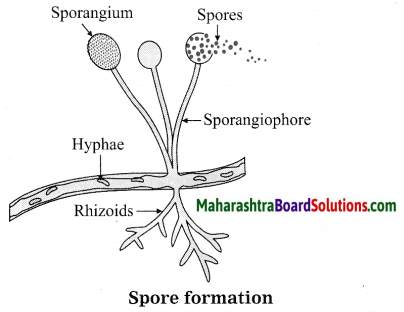
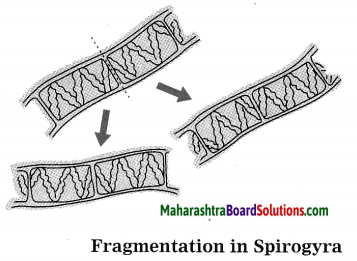
5. Asexual reproduction occurs in different individuals by various methods like binary fission, multiple fission, budding, fragmentation, regeneration, vegetative propagation, spore production, etc.5. __________________________________________
_____________________________________________
_____________________________________________
_____________________________________________

Answer:

Asexual reproductionSexual reproduction
1. Reproduction that occurs with the help of somatic cells is called asexual reproduction.1. Reproduction that occurs due to fertilization of gametes is called sexual reproduction.
2. For asexual reproduction only one parent is necessary.2. Male and female parents are necessary for sexual reproduction.
3. This reproduction occurs with the help of mitosis only.3. This reproduction occurs with the help of both mitosis and meiosis.
4. New individual formed by this method is genetically identical with parents.4. New individual formed by this method is genetically different from parents.
5. Asexual reproduction occurs in different individuals by various methods like binary fission, multiple fission, budding, fragmentation, regeneration, vegetative propagation, spore production, etc.5. Sexual reproduction occurs in two steps: First formation of haploid gametes by meiosis and then fertilization of these haploid gametes to form diploid zygote. There are no subtypes in the sexual reproduction.

Maharashtra Board Class 10 Science Solutions Part 2 Chapter 3 Life Processes in Living Organisms Part - 2

Question 2.
Fill in the blanks.
a. In humans, sperm production occurs in the organ …………
(a) prostate gland
(b) testis
(c) ovaries
(d) Cowper’s gland
Answer:
(b) testis

b. In humans, …………. chromosome is responsible for maleness.
(a) X
(b) Y
(c) Z
(d) O
Answer:
(b) Y

c. In male and female reproductive system of human, …………. gland is same.
Answer:
There is no similar gland in male and female reproductive system. There may be some homologies but there is no similarity.

d. Implantation of embryo occurs in …………
(a) ovaries
(b) fallopian duct
(c) uterus
(d) vagina
Answer:
(c) uterus

e. …………type of reproduction occurs without fusion of gametes.
(a) Asexual
(b) sexual
(c) Fertilization
(d) Gamete formation
Answer:
(a) Asexual

f. Body breaks up into several fragments and each fragment begins to live as a new individual.
This is ………. type of reproduction.
(a) regeneration
(b) fragmentation
(c) binary fission
(d) budding
Answer:
(b) fragmentation

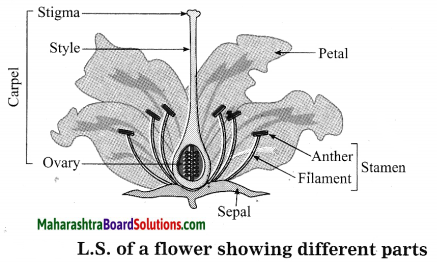
g. Pollen grains are formed by division in locules of anthers.
(a) meiosis
(b) mitosis
(c) amitosis
(d) binary
Answer:
(a) meiosis

Question 3.
Complete the paragraph with the help of words given in the bracket:
(Luteinizing hormone, endometrium of uterus, follicle stimulating hormone, estrogen, progesterone, corpus luteum)
Growth of follicles present in the ovary occurs under the effect of ………….. This follicle secretes estrogen. Ovarian follicle along with oocyte grows/regenerates under the effect of estrogen. Under the effect of ………….., fully grown up follicle bursts, ovulation occurs and …………….. is formed from remaining part of follicle. It secretes ……………. and ………. Under the effect of these hormones, glands of ……….. are activated and it becomes ready for implantation.
Answer:
Growth of follicles present in the ovary occurs under the effect of follicle stimulating hormone. This follicle secretes estrogen. Ovarian follicle along with oocyte grows/regenerates under the effect of estrogen. Under the effect of Luteinizing hormone, fully grown up follicle bursts, ovulation occurs and corpus luteum is formed from remaining part of follicle. It secretes estrogen and progesterone. Under the effect of these hormones, glands of endometrium of uterus are activated and it becomes ready for implantation.

Maharashtra Board Class 10 Science Solutions Part 2 Chapter 3 Life Processes in Living Organisms Part - 2

Question 4.
Answer the following questions short.
a. Explain with examples types of asexual reproduction in unicellular organism.
Answer:
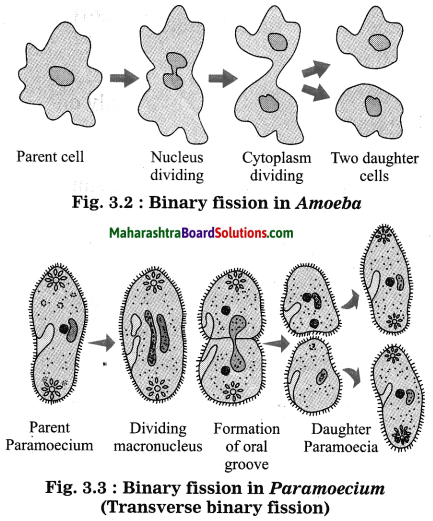
Maharashtra Board Class 10 Science Solutions Part 2 Chapter 2 Life Processes in Living Organisms Part - 2, 1
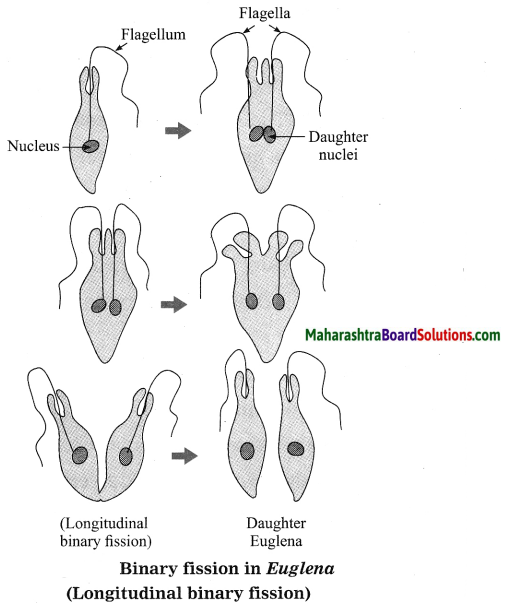
Maharashtra Board Class 10 Science Solutions Part 2 Chapter 2 Life Processes in Living Organisms Part - 2, 2
There are different methods of asexual reproduction in different unicellular animals.
(1) Binary fission: The process in which the parent cell divides to form two similar daughter cells
is binary fission. It takes place either by mitosis or amitosis. When there are favourable conditions and abundant food supply then the organisms undergo binary fission. Prokaryotes, Protists and eukaryotic 5 cell-organelle like mitochondria and chloroplasts perform binary fission.

Based on axis of fission there are three subtypes of binary fission.
(a) Simple binary fission: The plane of division is not definite, it can be in any direction due to lack of specific shape as in Amoeba.
(b) Transverse binary fission: The plane of J division is transverse, as in Paramoecium.
(c) Longitudinal binary fission: The plane of division is in length-wise direction as in Euglena.

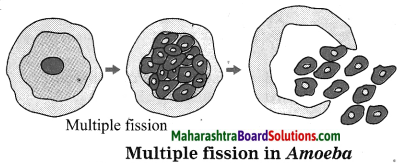
(2) Multiple fission:
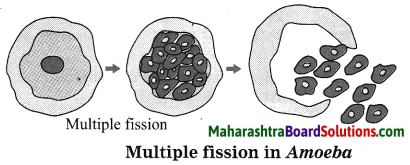
Maharashtra Board Class 10 Science Solutions Part 2 Chapter 2 Life Processes in Living Organisms Part - 2, 3
During unfavourable conditions when there is lack of food, multiple fission is shown by amoeba. Amoeba forms protective covering and becomes encysted. Inside the cyst, amoeba undergoes repeated nuclear division. This is followed by cytoplasmic divisions. Many amoebulae are formed which remain dormant inside the cyst. When favourable conditions reappear, they come out by breaking the cyst.

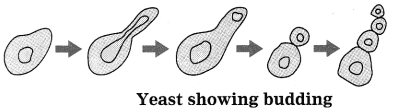
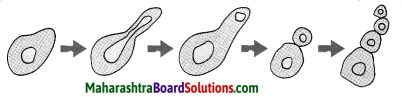
(3) Budding in yeast:
Maharashtra Board Class 10 Science Solutions Part 2 Chapter 2 Life Processes in Living Organisms Part - 2, 4
Yeast is unicellular fungus that performs budding. The parent cell produces two daughter nuclei by mitotic division. This results in a small bulgingbud on the surface of parent cell. One daughter nucleus enters the bud. It then grows and upon becoming big it separates from the parent cell to have independent life as new yeast cell.

b. Explain the concept of IVF.
Answer:
(1) IVF means In Vitro Fertilization (IVF)
(2) This is the technique in the modern medical field where childless couples can be blessed by their own child.
(3) IVF technique is used for childless couples who are faced with problems such as less sperm count, obstacles in oviduct, etc.
(4) The IVF technique is done by removing the oocyte from the mother and artificially fertilizing by the sperms collected from father. This fertilization is done in a test-tube. Thus it is also called test tube baby. The embryo formed is implanted in uterus of real mother or a surrogate mother at appropriate time.

c. Which precautions will you follow to maintain the reproductive health?
Answer:
About reproductive health one should have scientific and authentic information. The cleanliness of body is very essential but keeping the mind clean is also important to maintain good reproductive health. One should be careful about sexual relationships. These things should not be experimented in young age. Mistakes committed like these can change the sexual health forever. The cleanliness and hygiene during menstruation, the cleanliness of genitals and other private parts are the aspects of personal hygiene. When living in a society, one should always be away from cross-infections of venereal type.

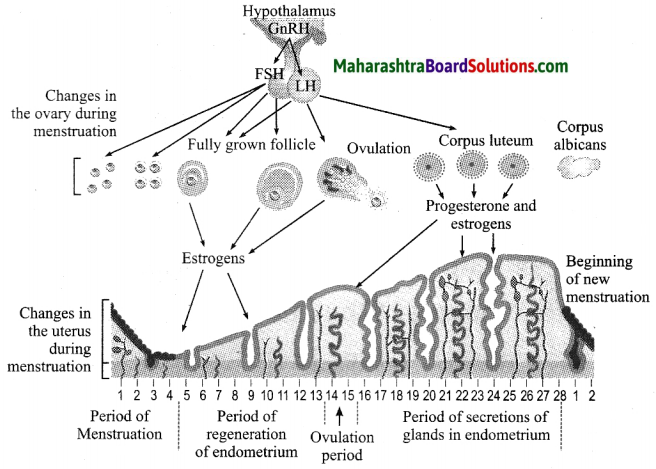
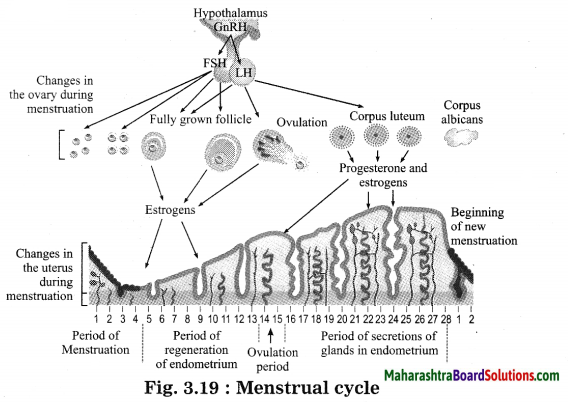
d. What is menstrual cycle? Describe it in brief.
Answer:

  • Menstrual cycle is the events of cyclic changes that takes place with the interval of 28 to 30 days in mature woman.
  • Hormones from pituitary, FSH (Follicle Stimulating Hormone) and LH (Luteinizing Hormone) and hormones from ovary, estrogen and progesterone control the menstrual cycle.
  • Due to influence of FSH, the ovarian follicle grows along with the oocyte that is present in it.
  • This growing follicle produces estrogen.
  • Under the influence of estrogen, the uterine inner layer called endometrium grows or regenerates. In the meantime the development of follicle is completed.
  • LH from pituitary stimulates the bursting of ovarian follicle and releases the mature oocyte out of the follicle and the ovarian wall. This process is called ovulation.
  • The empty ovarian follicle after the ovulation becomes corpus luteum. Corpus luteum produces hormone progesterone.
  • Under the influence of progesterone, the glands from uterine endometrium start secreting. The oocyte if fertilized is implanted over this endometrium.
  • If oocyte is not fertilized, the corpus luteum becomes a degenerate body called corpus albicans. The corpus albicans cannot secrete estrogen and progesterone.
  • Due to lack of these hormones, the endometrial layer of the uterus collapses. The tissue debris, along with unfertilized egg is given out through the vagina as menstrual flow. This results in bleeding for about 5 days.
  • If woman is not pregnant, then this menstrual cycle keeps on repeating with regularity.

Question 5.
In case of sexual reproduction, newborn show similarities about characters. Explain this statement with suitable examples.
Answer:
(1) Sexual reproduction occurs due to two different gametes. One male gamete is from father while the other female gamete is from mother.
(2) Both the gametes are produced by meiosis.
(3) When the gametes unite it is called process of fertilization which produces diploid zygote.
(4) Due to the chromosomes of parents, their DNA pass to the next generation through such fertilization. Therefore, the characters of newborn show similarities with parents.

Question 6.
Sketch the labelled diagrams.
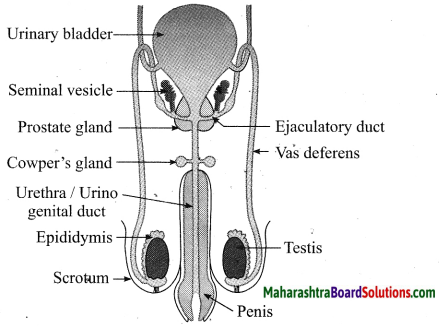
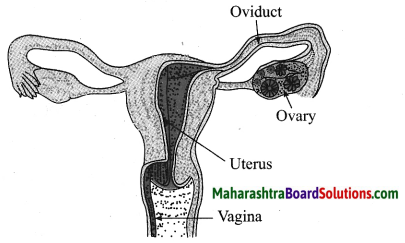
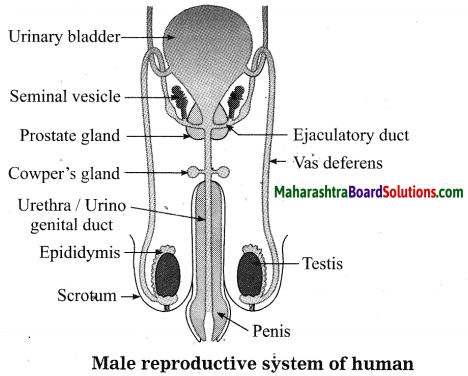
a. Human male reproductive system.
Answer:
Maharashtra Board Class 10 Science Solutions Part 2 Chapter 2 Life Processes in Living Organisms Part - 2, 5

b. Human female reproductive system.
Answer:
Maharashtra Board Class 10 Science Solutions Part 2 Chapter 2 Life Processes in Living Organisms Part - 2, 6

c. Flower with its reproductive organs.
Answer:
Maharashtra Board Class 10 Science Solutions Part 2 Chapter 2 Life Processes in Living Organisms Part - 2, 7

d. Menstrual cycle.
Answer:
Maharashtra Board Class 10 Science Solutions Part 2 Chapter 2 Life Processes in Living Organisms Part - 2, 8

Maharashtra Board Class 10 Science Solutions Part 2 Chapter 3 Life Processes in Living Organisms Part - 2

Question 7.
Give the names.
a. Hormones related with male reproductive system.
Answer:
Follicle stimulating hormone and ICSH or Luteinizing hormone secreted by pituitary gland, testosterone secreted by testis.

b. Hormones secreted by ovary of female reproductive system.
Answer:
Estrogen and progesterone.

c. Types of twins.
Answer:
Monozygotic twins, Siamese twins and Dizygotic twins.

d. Any two sexual diseases.
Answer:
Gonorrhea and Syphilis.

e. Methods of family planning.
Answer:
Copper T, condoms, oral contraceptive pills.

Question 8.
Gender of child is determined by the male? partner of couple. Explain with reasons whether this statement is true or false.
(OR)
“A couple shall have a male child or female child totally depends upon husband”. Prove truthfulness of this statement with scientific reason.
Answer:
Maharashtra Board Class 10 Science Solutions Part 2 Chapter 2 Life Processes in Living Organisms Part - 2, 9
Sex determination in Human being
(1) The statement Gender of child is determined by the male partner of couple is true.
(2) It is clearly seen from the diagram that there are two types of sperms produced by males. One sperm has a X chromosome while the other has a Y chromosome, apart from autosomes. The mother on the other hand has all X bearing oocytes. Thus the sperm that fertilizes the oocyte decides the sex of the child.
(3) If X bearing sperm fertilizes the oocyte, daughter is born and when Y bearing sperm fertilizes the oocyte, son is born.
(4) Thus father or male partner is responsible for the determination of the sex.

Question 9.
Explain asexual reproduction in plants.
Answer:
Maharashtra Board Class 10 Science Solutions Part 2 Chapter 2 Life Processes in Living Organisms Part - 2, 10

  • Vegetative propagation is the method of asexual reproduction in plants.
  • It takes place with the help of vegetative parts like root, stem, leaf and bud.
  • Potato, suran (Amorphophallus) and other tubes propagate with the help of ‘eyes’ which are buds. These eyes are present on the stem tubers.
  • In case of plants like sugarcane and grasses, buds present on nodes perform vegetative propagation.
  • Plants like Bryophyllum performs vegetative propagation with the help of buds present on leaf margin.

Maharashtra Board Class 10 Science Solutions Part 2 Chapter 3 Life Processes in Living Organisms Part - 2

Question 10.
Modern techniques like surrogate mother, sperm bank and IVF technique will help the human beings. Justify this statement.
OR
Despite various diagnostic tests, a couple could not have a child. In this situation, which remedies will you suggest? (July 2019)
Answer:
(1) Some couples want a child but they are not able to bear one due to various problems either in mother or in father. In such cases modern techniques such as IVF, surrogacy and sperm bank are useful in conceiving a child.

(2) These methods are as follows:
(i) Surrogacy: In woman if there is problem regarding the implantation of embryo in uterus, then help of another women is taken. This women is called surrogate mother.

Oocyte from real mother is taken out and fertilized with sperms collected from her husband. These gametes are fertilized outside in a test-tube and then the fertilized zygote is implanted in the surrogate mother.

(ii) In Vitro Fertilization (IVF) is done when there are problems like less sperm count or obstacles in oviduct. In IVF, fertilization is done in the test-tube. The embryo formed is implanted in uterus of woman for further growth.

(iii) Sperm bank: If man has problems with the sperm production, then the sperms are collected from the sperm bank. Sperm bank is the place where the donor’s donate the sperms and such sperms are kept stored. The donor’s identity is kept secret and he should also be physically and medically fit person.

Question 11.
Explain sexual reproduction in plants.
(OR)
Explain double fertilization in plants.
Answer:
Maharashtra Board Class 10 Science Solutions Part 2 Chapter 2 Life Processes in Living Organisms Part - 2, 11

  • Plants reproduce sexually with the help of flowers.
  • Androecium and gynoecium are male and female parts of the flowers respectively.
  • In the carpel, the ovule undergoes meiosis and forms embryo sac.
  • A haploid egg cell and two haploid polar nuclei are present in each embryo sac.
  • The pollen grains from the anther reach the stigma of flower by the process of pollination. They germinate here on the stigma.
  • As a result of germination, long pollen tube and two male gametes are formed.
  • The pollen tube travels through the style of flower and the male gametes present in the pollen tube are transferred till the embryo sac in ovary. Upon reaching there, tip of the pollen tube bursts releasing two male gametes in embryo sac.
  • One male gamete unites with the egg cell and forms zygote. While other male gamete unites with two polar nuclei forming the endosperm.
  • Because there are two nuclei participating in this process, therefore it is called double fertilization.
  • After fertilization ovule develops into seed and ovary forms a fruit. When the seed again gets favourable conditions, it can produce a new plant.

Activities: (Do it your self)

Question 1.
Collect the official data about present and a decade old population of various Asian countries and plot a graph of that data. With the help of it, draw your conclusions about demographic changes.

Question 2.
With the help of your teacher, compose and present a road show to increase the awareness about prenatal gender detection and gender bias.

Maharashtra Board Class 10 Science Solutions Part 2 Chapter 3 Life Processes in Living Organisms Part - 2

Can you recall? (Text Book Page No. 22)

Question 1.
Which are the important life processes in living organisms?
Answer:
The important life processes in living organisms are respiration, circulation, nutrition, excretion, sensation and response through nervous system.

Question 2.
Which life processes are essential for production of energy required by body?
Answer:
The oxidation of nutrients that are absorbed in body is done because of oxygen supplied to cells by respiratory and circulatory system. This helps in liberation of energy. Thus respiration, circulation and nutrition are the life processes that are essential for production of energy required by body.

Question 3.
Which are main types of cell division? What are the differences?
Answer:
The main types of cell division are mitosis and meiosis. In mitosis, the chromosome number remains the same. 2 daughter cells are obtained from one cell. In meiosis, the chromosome number is reduced to half. From one cell, four daughter cells are obtained.

Question 4.
What is the role of chromosomes in cell division?
Answer:
Due to chromosomes, the DNA from parental cells enter into daughter cells. The hereditary, characters are transmitted to next generation by cell division.

Can you recall? (Text Book Page No. 22)

Question 1.
What do we mean by maintenance of species?
Answer:
Maintenance of species means a species undertakes successful reproduction and produces individuals of its own kind. This keeps the species existing on the earth.

Question 2.
Whether the new organism is genetically exactly similar to earlier one that has produced it?
Answer:
No. The new organism produced from the old one is not genetically exactly similar to the parents. In meiotic cell division there is crossing over in the homologous chromosomes. This produces genetic recombination. Thus the new organism is different from the earlier one. However, if the reproduction is of asexual type, then the young one is exactly similar to the parents.

Maharashtra Board Class 10 Science Solutions Part 2 Chapter 3 Life Processes in Living Organisms Part - 2

Question 3.
Who determines whether the two organisms of a species will be exactly similar or not?
Answer:
The type of reproduction, whether it is asexual or sexual, the type of crossing over, the extent of genetic recombination, etc. determine the similarity among the parent organisms and their, offspring. Based on this genetic recombination the two organisms of a species do not show exact similarity. However, in case of monozygotic twins there is exact similarity. In asexual reproduction to there is similarity.

Question 4.
What is the relationship between the cell division and formation of new organism of same species by earlier existing organism?
Answer:
In the process of reproduction, there is division of chromosomes. Due to cell division, the gametes are formed. The union of gametes produce new offspring. In sexual reproduction, all these processes take place due to cell division. In asexual reproduction too there is cell division. Growth of new organism also occurs due to cell division.

Let’s Think: (Text Book Page No. 26)

Question 1.
What would have been happened if the male and female gametes had been diploid?
Answer:
Diploid (2n) gametes if united, they will form 4n, i.e. tetraploid variety. Such zygote will show severe abnormality. The chromosome number will not be maintained.

Question 2.
What would have been happened if any of the cells in nature had not been divided by meiosis?
Answer:
If meiosis does not happen the gametes produced will be diploid. This will create abnormality.

Can you recall? (Text Book Page No. 28)

Question 1.
Which different hormones control the functions of human reproductive system through chemical coordination?
Answer:
Pituitary gland secretes FSH and LH. LH is known as ICSH in males, as its function in the male body is different. From the gonads of male and female, hormones are secreted which are essential for male and female reproductive functions respectively. These hormones are testosterone secreted from testis in males and estrogen and progesterone secreted from the ovaries in females. Testosterone is essential for masculinity as well as for sperm production while female hormones are essential for changes in the female body leading to motherhood.

Question 2.
Which hormones are responsible for changes in human body occurring during onset of sexual maturity?
Answer:
Testosterone in male body and estrogen in female body are responsible for maturity onset changes in human body.

Maharashtra Board Class 10 Science Solutions Part 2 Chapter 3 Life Processes in Living Organisms Part - 2

Question 3.
Why has the Government of India enacted the law to fix the minimum age of marriage as 18 in girls and 21 in boys?
Answer:
The full growth of female body is not completed till the age of 18. Till 18 years of age the physical and emotional maturity is not attained. Therefore, she is not suitable for marriage, sexual relationship and pregnancy. Similarly, boy attains complete growth only the age of 21. Therefore, to keep individuals and their progeny safe and healthy the Government of India enacted the law to fix the minimum age of marriage as 18 in girls and 21 in boys.

Can you recall? (Text Book Page No. 31)

Question 1.
Which hormone is released from pituitary of mother once the foetal development is completed?
Answer:
The hormone oxytocin is released from the posterior pituitary of mother once the foetal development is completed.

Question 2.
Under the effect of that hormone, which organ of the female reproductive system starts to contract and thereby birth process (parturition) is facilitated?
Answer:
Due to oxytocin, uterus contracts involuntarily and the baby is expelled out. Thus initiation of birth process is possible due to contractions of uterus.

Use your brain power. (Text Book Page No. 24)

Question 1.
Does the parent cell exist after asexual reproduction-fission?
Answer:
In fission, the parent cell divides into two. This nucleus and cytoplasm, both are divided. Thus, parent cell does not exist any longer, it is converted into new cells.

Choose the correct alternative and write that alphabet against the sub-question number:

Question 1.
Pranav and Pritee are twins in your class. They belong to ……….. twins type.
(a) monozygotic
(b) dizyotic
(c) siamese
(d) none of the above
Answer:
(b) dizyotic

Question 2.
Longitudinal binary fission is seen in …………..
(a) Paramoecium
(b) Euglena
(c) Amoeba
(d) Spirogyra
Answer:
(b) Euglena

Question 3.
Yeast cell performs asexual reproduction by ……………..
(a) fragmentation
(b) budding
(c) binary fission
(d) regeneration
Answer:
(b) budding

Question 4.
Carrot and raddish undergoes …………. with the help of their roots.
(a) vegetative propagation
(b) fragmentation
(c) budding
(d) regeneration
Answer:
(a) vegetative propagation

Question 5.
Androecium and gynoecium are ……….. whorl of the flower.
(a) accessory
(b) essential
(c) external
(d) internal
Answer:
(b) essential

Question 6.
Flowers without stalk are called ……….. flowers.
(a) stalkless
(b) sessile
(c) incomplete
(d) complete
Answer:
(b) sessile

Question 7.
………….. on the inner surface of fallopian ducts (oviducts) push the egg towards uterus.
(a) Cilia
(b) Tentacles
(c) Flagella
(d) Fibres
Answer:
(a) Cilia

Question 8.
Pregnant mother supplies nourishment to her foetus through …………..
(a) breasts
(b) uterus
(c) placenta
(d) ovaries
Answer:
(c) placenta

Maharashtra Board Class 10 Science Solutions Part 2 Chapter 3 Life Processes in Living Organisms Part - 2

Question 9.
The length of a sperm is about …………. micrometers.
(a) 400
(b) 5
(c) 60
(d) 600 (July ’19)
Answer:
(c) 60

Question 10.
Vegetative propagation is performed with the help of ……….. in sweet potato.
(a) root
(b) stem
(c) leaf
(d) flower
Answer:
(a) root

Question 11.
Which of the following is not a unisexual flower?
(a) Coconut
(b) Papaya
(c) Gulmohar
(d) Maize
Answer:
(c) Gulmohar

Write whether the following statements are true or false, with the suitable reason:

Question 1.
Absence of genetic recombination is an advantage whereas fast process is drawback of asexual reproductive method.
Answer:
False. (Absence of genetic recombination is a drawback whereas fast process is advantage of asexual reproductive method.)

Question 2.
Prokaryotes show fission which occurs either by mitosis or amitosis.
Answer:
True. (Prokaryotes show fission by both the methods, i.e. mitosis and amitosis.)

Question 3.
During favourable conditions multiple fission is performed by amoeba.
Answer:
False. (During unfavourable conditions multiple fission is performed by amoeba.)

Question 4.
Any encysted Amoeba or any other protist is called ‘Cyst’.
Answer:
True. (Cyst is the tough capsule like structure which keeps the protists dormant inside it. This helps the organisms to tide over unfavourable conditions.)

Question 5.
If the body of Sycon breaks up accidentally into only large and few fragments, then only each fragment develops into new Sycon.
Answer:
False. (If the body of Sycon breaks up accidentally into many fragments, each fragment develops into new Sycon. Because the capacity to regenerate is very strong in poriferan Sycon, even a small piece of parent Sycon can give rise to entire new individual.)

Question 6.
Pollen tube reaches the zygote via style.
Answer:
False. (Pollen tube reaches the embryo sac via style. Later, double fertilization takes place and the zygote and endosperm are formed.)

Question 7.
There is glucose sugar in the semen.
Answer:
False. (There is fructose sugar in the semen. Glucose is not present in semen.)

Question 8.
Out of 2 – 4 million ova, approximately only 400 oocytes are released up to the age of menopause.
Answer:
True. (During the reproductive span of the woman, from menarche to menopause only one oocyte per one month is released in the span of 30 to 35 years.)

Question 9.
If the oocyte is fertilized, secretion of estrogen and progesterone stops completely.
Answer:
False. (If the oocyte is not fertilized, there is no need of corpus luteum which secretes progesterone. In absence of conception, the progesterone is not needed, thus corpus luteum degenerates and forms corpus albicans.)

Maharashtra Board Class 10 Science Solutions Part 2 Chapter 3 Life Processes in Living Organisms Part - 2

Question 10.
During menstruation there is need of rest along with special personal hygiene.
Answer:
True. (During phase of menstruation there is pain and bleeding in woman. Her body is also susceptible for infections. There is weakness and hence she needs rest along with special personal hygiene.)

Find the odd one out:

Question 1.
Circulation, Excretion, Sensation, Reproduction.
Answer:
Reproduction. (All others are processes necessary for survival of the individual.)

Question 2.
Budding in hydra, Regeneration, Binary fission, Fragmentation
Answer:
Binary fission. (All others are processes of asexual reproduction in multicellular organisms.)

Question 3.
Carrot, Radish, Potato, Sweet potato.
Answer:
Potato. (All others are edible roots.)

Question 4.
Vas eferens, vas deferens, prostate gland, epididymis.
Answer:
Prostate gland. (All others are duct systems in male reproductive system.)

Question 5.
Prostate gland, Bartholin’s gland, Cowper’s gland, Epididymis.
Answer:
Bartholin’s glands. (All others are parts of male reproductive system.)

Question 6.
Stigma, style, pollen, ovary.
Answer:
Pollen. (All others are parts of gynoecium.)

Identify the correlation between the first two words and suggest the suitable words in the fourth place:

Question 1.
Amoeba : Fission : : Hydra : ………….
Answer:
Amoeba : Fission : : Hydra : Budding

Question 2.
Transverse binary fission : Paramoecium : : Longitudinal binary fission : ………… (July ‘19)
Answer:
Transverse binary fission : Paramoecium : : Longitudinal binary fission : Euglena

Question 3.
Calyx : Sepals : : Corolla : ………….
Answer:
Calyx : Sepals : : Corolla : Petals

Question 4.
Accessory whorls : Calyx and corolla : : Essential whorls : ………..
Answer:
Accessory whorls : Calyx and corolla : : Essential whorls : Androecium and gynoeciuin

Question 5.
Bisexual flower : Hibiscus : : Unisexual flower : ………….
Answer:
Bisexual flower : Hibiscus : : Unisexual flower : Papaya

Question 6.
FSH : Development of qocyte : : LH : ………….
Answer:
FSH : Development of qocyte : : LH : Ovulation

Maharashtra Board Class 10 Science Solutions Part 2 Chapter 3 Life Processes in Living Organisms Part - 2

Define the following/Give meanings of the following:

Question 1.
Budding in yeast.
Answer:
Budding in yeast: Budding is the asexual reproductive process in which a! small bulge or bud appears on the surface of parent cell as seen in unicellular yeast.

Question 2.
Budding in hydra.
Answer:
Budding in hydra: Budding in hydra is asexual reproductive process in which an outgrowth is formed by repeated divisions of regenerative cells of body wall called bud.

Question 3.
Regeneration.
Answer:
Regeneration: Regeneration is the asexual reproduction in Planaria in which the body is broken up into two parts and resulting each part regenerates remaining part of the body.

Question 4.
Fragmentation.
Answer:
Fragmentation: Fragmentation is the asexual type of reproduction in which the body of parent organism breaks up into many fragments. Each fragment can start living independently.

Question 5.
Vegetative propagation.
Answer:
Vegetative propagation: Vegetative propagation is a type of asexual reproduction in plants that takes place with the help of vegetative parts like root, stem, leaf and bud.

Question 6.
Fertilization.
Answer:
Fertilization: The process by which two haploid gametes unite to form a diploid zygote is called fertilization.

Question 7.
Pedicel.
Answer:
Pedicel: The stalk of the flower which is for the support is called pedicel.

Question 8.
Pollination.
Answer:
Pollination: Transfer of pollen grains from anther to the stigma is called pollination.

Question 9.
Self-Pollination.
Answer:
Self-Pollination: Pollination involving only one flower or two flowers borne on same plant is called self-pollination.

Question 10.
Cross-Pollination.
Answer:
Cross-Pollination: Pollination involving two flowers borne on two plants of same species is cross-pollination.

Question 11.
Endosperm.
Answer:
Endosperm: Endosperm is the nourishing substance formed by the union of second male gamete with two polar nuclei at the time of fertilization in plants.

Question 12.
Embryo sac.
Answer:
Embryo sac: There are many ovules in the ovary, the structure formed in each of the ovule by meiosis is called embryo sac.

Question 13.
Menopause.
Answer:
Menopause: Stoppage of functioning of female reproductive system due to lack of synthesis of hormones due to advancing age is called menopause.

Question 14.
Placenta.
Answer:
Placenta: An organ developed in the uterus of the pregnant mother, through which the embryo is given nourishment is called placenta.

Maharashtra Board Class 10 Science Solutions Part 2 Chapter 3 Life Processes in Living Organisms Part - 2

Question 15.
Menstrual cycle.
Answer:
Menstrual cycle: The repetitive changes at the interval of every 28-30 days in female reproductive system that take place after puberty, form menstrual cycle.

Question 16.
Corpus luteum.
Answer:
Corpus luteum: Corpus luteum is the secondary structure that is formed from empty ovarian follicle after ovulation. This corpus luteum produces progesterone and thereby maintains pregnancy.

Question 17.
Corpus albicans.
Answer:
Corpus albicans: Corpus albicans is the degenerate body which is formed from corpus luteum, if the ovum is not fertilized.

Question 18.
Ovulation.
Answer:
Ovulation: Bursting of mature ovarian follicle under the influence of hormones to release the oocyte is called ovulation.

Question 19.
IVF.
Answer:
IVF: In Vitro Fertilization is the technique in which fertilization is brought about outside the female body but in the test-tube and the embryo is implanted in uterus of woman.

Question 20.
Sperm bank.
Answer:
Sperm bank: Sperm bank is the place where semen donated by the desired men is collected after their thorough physical and medical check-up and stored at sub-zero temperatures in sterile conditions.

Name the following/Give the names:

Question 1.
Different glands associated with male reproductive system.
Answer:
Seminal vesicles, Prostate gland, Cowper’s or bulbourethral glands.

Question 2.
Agents of pollination.
Answer:
Biotic: Insects, birds, few animals.
Abiotic: Water and wind.

Question 3.
Components of semen.
Answer:
Secretion of prostate gland seminal vesicles and Cowper’s glands along with sperms.

Question 4.
Two accessory whorls in flower.
Answer:
Calyx and corolla.

Maharashtra Board Class 10 Science Solutions Part 2 Chapter 3 Life Processes in Living Organisms Part - 2

Question 5.
Two essential whorls in flower.
Answer:
Androecium and gynoecium.

Question 6.
The modern techniques in reproduction.
Answer:
In Vitro Fertilization, Surrogate mother, Sperm bank.

Question 7.
Symptoms of gonorrhea.
Answer:
Painful and burning sensation during urination, oozing of pus through penis and vagina, inflammation of urinary tract, anus, throat, eyes, etc.

Question 8.
Symptoms of syphilis.
Answer:
Occurrence of chancre (patches) on various parts of body including genitals, rash, fever, inflammation of joints, alopecia, etc.

Write the functions of the following organs:

Question 1.
Sporangium.
Answer:
Storing the spores and releasing them by bursting.

Question 2.
Calyx.
Answer:
Protection of inner whorls of the flower.

Question 3.
Corolla.
Answer:
Attracting insects for pollination. Protecting inner whorls.

Question 4.
Androecium.
Answer:
Production of pollen grains, the male gametes of flower.

Question 5.
Gynoecium.
Answer:
Production of female gametes of flower. Participating in production of fruits.

Question 6.
Endosperm.
Answer:
Nourishment of the growing embryo.

Question 7.
Testis.
Answer:
Production of sperms and male hormone-testosterone.

Question 8.
Scrotum.
Answer:
Protection and temperature control of testis.

Question 9.
Seminal vesicles.
Answer:
Secretion of seminal fluid which forms major portion of semen. Nourishment of sperms.

Question 10.
Penis.
Answer:
Transferring of sperms to vagina at the time of intercourse. Release of urine at the time of urination.

Question 11.
Ovary.
Answer:
Production of oocytes and female hormones – estrogen and progesterone.

Question 12.
Uterus.
Answer:
Growth and development of foetus during pregnancy. Helping in parturition (childbirth) by contractions.

Question 13.
Fallopian tubes/ducts.
Answer:
Transporting the released oocyte after ovulation to the uterus. Providing space for fertilization of oocyte by sperm. Conception is possible only when sperm and oocyte meet in the fallopian tube.

Question 14.
Vagina.
Answer:
Passage for copulation/intercourse. Birth canal. Passage for menstrual flow.

Question 15.
Placenta.
Answer:
Supplying nourishment to the growing foetus.

Distinguish between:

Question 1.
Binary fission and Multiple fission.
Answer:
Binary fission:

  1. Two new individuals are formed from one old individual at one time.
  2. The division of nucleus and cytoplasm takes place initially.
  3. The axis of division can be transverse, longitudinal or any one axis as it is in simple binary fission.
  4. Formation of protective cyst does not take place.
  5. Binary fission can be done during favourable period.

Multiple fission:

  1. Many new individuals are formed from one old individual at one time.
  2. Only nucleus divides initially followed by division of cytoplasm.
  3. There is no exact axis for the fission.
  4. Protective covering is formed around dividing amoebulae which is called cyst.
  5. Multiple fission takes place only at the time of unfavourable period.

Question 2.
Human male and Human female reproduction system.
Answer:
Human male reproductive system:

  1. Testis are essential organs which are located outside the abdomen in the scrotal sacs.
  2. There is common urethra through which urine and semen, are passed out.
  3. Reproductive system of male continues to work even in old age.
  4. Sperms or male gametes are produced by meiosis in the testis.
  5. Sperms are produced in millions at one time.
  6. Three accessory glands are associated with the male reproductive system.
  7. Testis secrete testosterone which is essential male hormone.

Human female reproductive system:

  1. Ovaries are essential organs which are located along with all other organs inside the lower abdomen.
  2. Urethra and vagina are two separate openings that open to outside.
  3. Reproductive system works only till menopause.
  4. Oocytes or ova are produced by meiosis in the ovaries.
  5. Only single oocyte is produced per month.
  6. Only one gland is associated with female reproductive system.
  7. Ovaries produce estrogen and progesterone which are essential female hormones.

Maharashtra Board Class 10 Science Solutions Part 2 Chapter 3 Life Processes in Living Organisms Part - 2

Question 3.
Monozygotic twins and Dizygotic twins.
Answer:
Monozygotic twins:

  1. Two children developing from only one zygote are called monozygotic twins.
  2. Monozygotic twins develop from same oocyte.
  3. Gender of both the twins is same.
  4. The monozygotic twins are genetically exactly alike.

Dizygotic twins:

  1. Two children developing from two different zygotes are called dizygotic twins.
  2. Dizygotic twins develop from two different oocytes.
  3. Gender of both the twins can be same or can be different.
  4. The dizygotic twins are genetically not exactly alike.

Give scientific reasons:

Question 1.
Individual developed by sexual reproduction always carry recombined genes of both the parents.
Answer:

  • In sexual reproduction, the haploid male and female gametes are united to form diploid zygote.
  • The zygote thus carries chromosomes of both parents which are transferred via male and female gametes.
  • While producing gametes, there is meiosis in which genetic recombination takes place.
  • Therefore, the individual developed by sexual reproduction always carry recombined genes of both the parents.

Question 2.
Flower is the structural unit of sexual reproduction in plant.
Answer:

  • Flower produces male and female gametes.
  • For this purpose there are essential whorls of androecium and gynoecium.
  • The double fertilization also takes place in flower.
  • Therefore, flower is called the structural unit of sexual reproduction in plants.

Question 3.
Fertilization in plants is called double fertilization.
Answer:

  • After pollination the pollen grains drop on the sticky stigma of the flower.
  • They germinate here producing two male gametes and a long pollen tube.
  • The male gametes travel through the pollen tube till they reach the embryo sac.
  • Here the male gametes are released by bursting the pollen tube. One male gamete unites with the egg cell to form zygote while the second male gamete unites with two polar nuclei forming endosperm.
  • In this way because two nuclei participate in the fertilization process, therefore it is called double fertilization.

Question 4.
By the age of 45 – 50 women gets menopause.
Answer:

  • By the age of 45-50, the secretion of hormones which control the functioning of the reproductive system is reduced gradually and then it stops.
  • This causes end of menstrual cycle. This results into menopause.

Question 5.
Older mothers have greater chance of conceiving abnormal children.
Answer:

  • In older women the menopausal age approaches.
  • The oocytes, released from ovaries during this phase are not normal.
  • Their meiotic cell division is abnormal and thus oocyte becomes abnormal too.
  • If such abnormal oocytes are fertilized, the baby is born with many genetic problems, e.g. Down’s syndrome or Turner’s syndrome.

Question 6.
Indians should follow family planning for controlling the population.
Answer:

  • There is severe population explosion in India. It has almost reached to 121 crores.
  • This results into unemployment, decreasing per capita income and increasing loan, stress on natural resources, etc.
  • Only by controlling population, the quality of life can be restored.
  • Therefore, Indians should follow family planning for controlling the population.

Answer the following questions in short:

Question 1.
How does reproduction take place in fungus Mucor?
Answer:
Maharashtra Board Class 10 Science Solutions Part 2 Chapter 2 Life Processes in Living Organisms Part - 2, 12

  • Mucor reproduces asexually by spore formation.
  • It has filamentous body that possess sporangia.
  • When the spores are formed, the sporangia burst. The spores are released which settle down at suitable Places.
  • They germinate in moist and warm place forming a new fungal colony.

Question 2.
What is the type of asexual reproduction shown in the diagram below? (Board’s Model Activity Sheet)
Answer:
Maharashtra Board Class 10 Science Solutions Part 2 Chapter 2 Life Processes in Living Organisms Part - 2, 13
Type of asexual reproduction shown in the diagram above is fragmentation in Spirogyra.

Maharashtra Board Class 10 Science Solutions Part 2 Chapter 3 Life Processes in Living Organisms Part - 2

Question 3.
Describe the structure of a flower.
Maharashtra Board Class 10 Science Solutions Part 2 Chapter 2 Life Processes in Living Organisms Part - 2, 14
Answer:
(1) The structural unit of sexual reproduction in plants is flower. There are total four floral whorls. Of these, two are accessory floral whorls while two are essential floral whorls.
(2) Calyx and corolla are accessory whorls. They are protective in nature.
(3) Members of calyx are known as sepals. They are usually green in colour. They protect the inner whorls.
(4) The members of corolla are called petals. They can be of different colours.
(5) Androecium and gynoecium are essential whorls as they participate in sexual reproduction.
(6) The male whorl androecium is made up of stamens. Each stamen has a filament with anther located at the upper end. In the anther there are four locules. Inside the locules the meiosis takes place forming pollen grains. During suitable time, the pollen grains are released from anther lobes.
(7) Gynoecium is made up of carpels, either in separate form or are united. Each carpel is formed of ovary at the basal end hollow ‘style’ and the stigma at the tip of style. There are one or many ovules inside the ovary.
(8) In bisexual flowers both androecium and gynoecium are located in the same flower, e.g. Hibiscus.
(9) In unisexual flowers, androecium is present in male flowers and gynoecium is present in the female flowers, e.g. Papaya.

Question 4.
Describe the human male reproductive system.
Answer:
Maharashtra Board Class 10 Science Solutions Part 2 Chapter 2 Life Processes in Living Organisms Part - 2, 15
In human male reproductive system, the reproductive organs are as follows:

  • Testes, different types of duct systems and glands.
  • Testes are in pair. Each testis lies in the scrotum which lies outside to abdominal cavity.
  • Testes -consist of numerous seminiferous tubules. The germinal epithelium of seminiferous tubules form sperms by undergoing meiosis.
  • These sperm cells are immature.
  • They are pushed gradually through various duct systems till the penis.
  • This path is as follows:
    Rete testis → vas efferentia → epididymis → vasa deferentia → Ejaculatory duct → urethra
  • As the sperms are travelling, they gradually become mature. They are made capable to perform process of fertilization.
  • Seminal vesicles (in pairs), Single prostate gland and a pair of Cowper’s glands secrete their secretions. These secretions and the sperms together form semen.
  • This semen is deposited in the vagina with help of penis.

Question 5.
Describe the human female reproductive system.
Answer:
Maharashtra Board Class 10 Science Solutions Part 2 Chapter 2 Life Processes in Living Organisms Part - 2, 16

  • All the organs of the human female reproductive system are located inside the lower abdomen.
  • There are pair of ovaries, pair of fallopian ducts and a single median uterus.
  • The uterus opens out by vagina. In vaginal walls there are Bartholin’s glands.
  • The urethra in female body is separate and not a common passage as in male body.
  • The free end of fallopian duct is funnel-like having an opening in the centre. The oocyte released from the ovary due to ovulation is picked up by this funnel.
  • The other end of fallopian duct opens into uterus. There are cilia on inner surface of oviduct. With the help of the cilia the oocyte is pushed to the uterus through the fallopian duct.
  • The fertilization of oocyte can take place only in the middle’part of the fallopian duct.
  • The lower end of uterus opens into vagina. The contractions of uterus help in the process of parturition.
  • Vagina is the birth canal as well as copulatory passage. It is also a passage for menstrual flow.

Question 6.
What problems cause infertility in couple?
Answer:

  • In woman if there are problems like irregularity in menstrual cycle, difficulties in oocyte production or implantation in uterus, obstacles in the oviduct, etc.
  • In man if there are no sperms in the semen, slow movement of sperms, or anomalies in the sperms then he becomes sterile.
  • But now with the help of advanced medical techniques these problems can be overcome and a childless couple can be parents.

Question 7.
Answer the following questions: (July 2019)
(a) In our country, there seems to be lack of awareness regarding reproductive health. Why?
(b) Write the symptoms of disease gonorrhea.
(c) What precautions will you take to maintain reproductive health?
Answer:
(a) There is lack of awareness about reproductive health among majority of people of our country. This is due to social customs, traditions, illiteracy, social taboo and shyness.

(b) Symptoms of gonorrhea are as follows:

  1. Painful burning during urination.
  2. Oozing of pus through penis or vagina.
  3. Inflammation of urinary tract, anus, throat, eyes, etc.

(c) Precautions to maintain reproductive health are cleanliness and personal hygiene. Guarding against any sexual infections.

Question 8.
If a piece of bread is kept in a container in moist place for 2-3 days, (1) What will you see? (2) Write scientific name and a character of the organism you may observe.
Answer:
(1) If a piece of bread is kept in moist container we can see growth of fungus on it.
(2) Fungi belonging to species Mucor is seen. It has filamentous body and sporangia. Sporangia burst open to spread spores. It has saprophytic mode of nutrition as it devoid of chlorophyll.

Write short notes on:

Question 1.
Multiple fission.
Answer:
Maharashtra Board Class 10 Science Solutions Part 2 Chapter 2 Life Processes in Living Organisms Part - 2, 17
During unfavourable conditions when there is lack of food. multiple fission is shown by amoeba. Amoeba forms protective covering and becomes encysted. Inside the cyst, amoeba undergoes repeated nuclear division. This is followed by cytoplasmic divisions. Many amoebulae are formed which remain dormant inside the cyst. When favourable conditions reappear, they come out by breaking the cyst.

Question 2.
Regeneration.
Answer:
Maharashtra Board Class 10 Science Solutions Part 2 Chapter 2 Life Processes in Living Organisms Part - 2, 18
In developed animals like wall lizard the process of regeneration is used to restore the lost parts like tail or limbs. As the reproductive system is one of the fullfledged system in the body, the process of regeneration cannot be called type of reproduction.

But some primitive organisms such as Plarfaria use this method for procreation. Planaria breaks up its body into two parts. Each part has the ability to develop the lost part by process of regeneration. This forms two new Planaria.

Question 3.
Seed germination.
Answer:
Maharashtra Board Class 10 Science Solutions Part 2 Chapter 2 Life Processes in Living Organisms Part - 2, 19
Seed germination is the process in which the seed develops into a new plantlet. In the plants, after fertilization the ovule develops into seed and ovary turns into fruit. Seeds fallen on the ground due to bursting of the fruits start germinating. Only under favourable conditions in the soil, this germination takes place. The zygote present inside the seed uses food stored in endosperm of seed and hence develops further to produce a new plantlet.

Maharashtra Board Class 10 Science Solutions Part 2 Chapter 3 Life Processes in Living Organisms Part - 2

Question 4.
Budding in hydra.
Answer:
Maharashtra Board Class 10 Science Solutions Part 2 Chapter 2 Life Processes in Living Organisms Part - 2, 20
In multicellular organisms asexual reproduction by budding is shown by hydra. In fully grown Hydra, at specific part of its body there is development of bud.

This development is only during favourable period. The bud is an outgrowth developed due to repeated divisions of regenerative cells of body wall. It grows up gradually to form a small hydra. Parent hydra’s dermal layers and digestive cavity are in continuity with those of the budding hydra. It receives all the nutrition from parent hydra.When the budding hydra grows sufficiently, it detaches from parent hydra. Then it leads an independent life.

Question 5.
Fragmantation.
Answer:
Maharashtra Board Class 10 Science Solutions Part 2 Chapter 2 Life Processes in Living Organisms Part - 2, 21
Fragmentation is one of the type of asexual reproduction in multicellular organisms. During fragmentation, the body of parent organism breaks up into many fragments. All the resulting fragments start to develop as an independent new organism. In alga Spirogyra, and sponge like Sycon asexual reproduction takes place by fragmentation. Spirogyra grow up very fast and break up into many small fragments when there are favourable conditions. Each newly formed fragment lives independently as a new Spirogyra. Similarly the body of Sycon if accidentally broken into many fragments, develops into new Sycon from each old fragment.

Question 6.
Monozygotic twins.
Answer:
The twins developed from a single embryo are called monozygotic twins. If within 8 days of zygote formation i.e. in early embryonic development cells of that embryo divide into two groups. Each one develop as two separate embryos forming two monozygotic twins. Monozygotic twins are genetically exactly similar to each other. The gender of the twins is also same.

The Siamese twins develop from monozygotic twins, if the embryonic cells are divided into two groups 8 days after the zygote formation. These are conjoined twins where some parts of body are joined to each other. Also some organs are common in Siamese twins.

Read the paragraph and answer the questions given below:

Reproduction is the process by which the living species continues its existence. Lower organisms carry out asexual reproduction while higher plants and animals always show sexual reproduction. Plants reproduce asexually by methods such as fragmentation, vegetative propagation, budding, spore formation. For sexual reproduction they form gametes. In animal kingdom, budding, fission of different types and parthenogenesis are some of the methods that do not require both the sexes. Though regeneration also forms new individual, it is not considered to be a reproductive process because, basically it is a repair process. The ability to regenerate is lost in higher phyla. In human beings | it is restricted only to wound healing. Sexual reproduction is also undergoing lots of experimentation such as cloning which may make females capable of producing their own baby without intervention of any male.

Questions and Answers:

Question 1.
How do living species continue their existence?
Answer:
Through the process of reproduction, living species continue their existence.

Question 2.
Which are asexual methods of reproduction in kingdom Animalia?
Answer:
Fission, budding and parthenogenesis are the asexual methods of reproduction in Kingdom Animalia.

Question 3.
Why is regeneration not true method of reproduction?
Answer:
Regeneration is the repair process than a reproductive process. It is not done with the intention of producing offspring, but is for healing or repairing the lost part.

Question 4.
What are methods of reproduction in plants?
Answer:
Plants reproduce by asexual as well as sexual methods. Asexual reproduction is by fragmentation, vegetative propagation, budding, spore formation, while by formation of gametes, sexual reproduction is done.

Question 5.
What is the modern method of reproduction aimed at in higher organisms?
Answer:
Cloning is the modern method of reproduction by which production of young one can be aimed at.

Diagram-based Questions:

Question 1.
Observe the figure 3.18 and answer the questions below: (Board’s Model Activity Sheet)
Maharashtra Board Class 10 Science Solutions Part 2 Chapter 2 Life Processes in Living Organisms Part - 2, 22
(a) What does the figure 3.18 indicate?
Answer:
The figure indicates the menstrual cycle in human female.

(b) Which human organs are involved in this process?
Answer:
The ovary and uterus are primarily involved in this process. But the pituitary gland also controls this cycle.

(c) Which hormones take part in this process?
Answer:
Following hormones regulate this menstrual cycle.
Pituitary hormones: Follicle Stimulating Hormone (FSH) and Luteinizing Hormone (LH).
Ovarian hormones: Estrogen and progesterone.

(d) What is the periodicity for these changes?
Answer:
The menstrual cycle shows repetitive changes every 28 to 30 days.

(e) The body of woman undergoing this process is impure, she should remain away from other people. What is your opinion about this statement? Give justification for your opinion.
Answer:
A menstruating woman is not at all with impure body. It is a natural process in which the endometrium of the uterus is sloughed off and repaired.

She should get enough rest and nutrition during this period. It is painful period in which there is a possibility of infections. Therefore, she should take ! hygienic care and rest till the bleeding persists. But blind faith and superstition to keep her away from others should not be followed.

Maharashtra Board Class 10 Science Solutions Part 2 Chapter 3 Life Processes in Living Organisms Part - 2

Question 2.
Observe the diagram (Fig. 3.19) of menstrual cycle and answer the following questions:
Maharashtra Board Class 10 Science Solutions Part 2 Chapter 2 Life Processes in Living Organisms Part - 2, 23
(1) What is the period of menstruation?
Answer:
1 to 5 days is the period of menstruation.

(2) On which day does ovulation occur during menstrual cycle?
Answer:
Ovulation occurs on 14th or 15th day.

(3) During which period is corpus luteum active during menstrual cycle? Which hormones are secreted by corpus luteum ?
Answer:
Corpus luteum is active till the 28th day of menstrual cycle. During this time if there is no union of sperm and ovum, then corpus luteum degenerates. Corpus luteum secretes estrogen and progesterone.

(4) In menstrual cycle which reproductive organs undergo changes?
Answer:
Ovary and uterus undergo changes during menstrual cycle.

(5) Which period is said to be period of regeneration of endometrium?
Answer:
In menstrual cycle, days 5 to 14 are period of regeneration of endometrium.

(6) Which period is said to be period of secretions of glands in endometrium?
Answer:
Period of secretions of glands in endometrium is 15 to 28 days.

Question 3.
Observe the following picture and describe the type of reproduction shown in.
Maharashtra Board Class 10 Science Solutions Part 2 Chapter 2 Life Processes in Living Organisms Part - 2, 24
Answer:
In developed animals like wall lizard the process of regeneration is used to restore the lost parts like tail or limbs. As the reproductive system is one of the fullfledged system in the body. the process of regeneration cannot be called type of reproduction.

But some primitive organisms such as Planaria use this method for procreation. Planaria breaks up its body into two parts. Each part has the ability to develop the lost part by process of regeneration. This forms two new Planaria.

Question 4.
Answer the following questions: (March 2019)
(a) “Gender of child is determined by the male partner of couple.” Draw a diagram explaining the above statement.
Answer:
Maharashtra Board Class 10 Science Solutions Part 2 Chapter 2 Life Processes in Living Organisms Part - 2, 25

(b) Prepare a slogan for campaign against female foeticide.
Answer:

  • Save the girl child.
  • Daughters give lot of joy, it is not only the boy.

(c) In the following figure, explain how new fungal colonies of mucor are formed:
Maharashtra Board Class 10 Science Solutions Part 2 Chapter 2 Life Processes in Living Organisms Part - 2, 26
Answer:
Mucor is a fungus having filamentous body. The filaments bear sporangia. Mature sporangia burst and release spores. Spores germinate to form new hyphae upon getting favourable moist and warm place.

(d) Identify and state the type of reproduction represented in the above figure.
Ans. The spore formation is asexual type of reproduction seen in Mucor.

Question 5.
Write the type of asexual reproduction shown in the figure.
Maharashtra Board Class 10 Science Solutions Part 2 Chapter 2 Life Processes in Living Organisms Part - 2, 27
Answer:
The figure shows budding in yeast. Budding is the type of asexual reproduction.

Experiments:
(Try this: Text Book Pages 23 and 24)

(1) Observation of Paramoecia.
(2) Observation of yeast.
(3) Study of Hibiscus.
[For detailed information on practicals, refer to Vikas Science and Technology Experiment Book: Standard X]

Maharashtra Board Class 10 Science Solutions Part 2 Chapter 3 Life Processes in Living Organisms Part - 2

Projects:

Project 1.
Use of ICT. (Textbook page no. 27)
Make an video album of pollination and show it in the class.

Project 2.
Internet is my friend. (Textbook page no. 33)
You may have read that sometimes a woman may deliver more than two offspring at a time. Collect more information from internet about reasons for such incidences.

Project 3.
Get information. (Textbook page no. 34)
Visit a public health centre nearby your place and collect the information through an interview of health officer about meaning and various methods of family planning.

Maharashtra Board Class 10 Science Solutions Part 2 Chapter 7 Introduction to Microbiology

Balbharti Maharashtra State Board Class 10 Science Solutions Part 2 Chapter 7 Introduction to Microbiology Notes, Textbook Exercise Important Questions and Answers.

Maharashtra State Board Class 10 Science Solutions Part 2 Chapter 7 Introduction to Microbiology

Question 1.
Rewrite the following statements using correct of the options and explain the completed statements.
(gluconic acid, coagulation, amino acid, 4% acetic acid, clostridium, lactobacilli)

a. Process of ……. of milk proteins occurs due to lactic acid.
Answer:
Process of Coagulation of milk proteins occurs due to lactic acid.
Explanation: The lactobacilli are the bacteria carrying out fermentation of the milk. In this process, the lactose sugar in the milk is converted into lactic acid. This lactic acid causes coagulation of the proteins present in the milk.

b. Harmful bacteria like ………. in the intestine are destroyed due to probiotics.
Answer:
Harmful bacteria like Clostridium in the intestine are destroyed due to probiotics.
Explanation: In probiotics, there are lactobacilli which are useful. They control other bacteria present in the alimentary canal and also their metabolism. These bacteria thus stop the action of Clostridium which is a harmful bacteria.

c. Chemically, vinegar is …………
Answer:
Chemically, vinegar is 4% Acetic acid.
Explanation: Chemically vinegar is 4% acetic acid. It is a good preservative of the food and thus while using it as additive to the food, it is called vinegar.

d. Salts which can be used as supplement of calcium and iron are obtained from ……………. acid.
Answer:
Salts which can be used as supplement of calcium and iron are obtained from Gluconic acid.
Explanation: The microbe Aspergillus niger is used on the source material of glucose and corn steep liquor to produce amino acid called Gluconic acid. Gluconic acid is used for the production of minerals used as supplement for calcium and iron.

Maharashtra Board Class 10 Science Solutions Part 2 Chapter 7 Introduction to Microbiology

Question 2.
Match the pairs.

‘A’ group‘B’ group
(1) Xylitol(a) Pigment
(2) Citric acid(b) To impart sweetness
(3) Lycopene(c) Microbial restrictor
(4) Nycin(d) Protein binding emulsifier
(e) To impart acidity

[Note: In examination match the column question will ham 2 components in Column ‘A’ with 4 alternatives in Column ‘B’.]
Answer:
(1) Xylitol – To impart sweetness
(2) Citric acid – To impart acidity
(3) Lycopene – Pigment
(4) Nycin – Microbial restrictor.

Question 3.
Answer the following:
a. Which fuels can be obtained by microbial processes? Why is it necessary to increase the use of such fuels?
Answer:

  • Microbial anaerobic decomposition of urban agricultural and industrial waste forms the gaseous fuel in the form of methane gas.
  • Alcohol is another clean form of energy which is used in the form of ethanol. It is obtained by the fermentation of molasses by treating it with Saccharomyces-yeast.
  • By photoreduction of water with the help of bacteria, hydrogen gas is released in the process of bio-photolysis of water. This hydrogen gas is said to be the fuel of the future.
  • The conventional fuels are exhaustible. After few hundred years, they will be over completely. Moreover, these fossil fuels cause lot of air pollution due to emission of carbon dioxide. The fuels obtained by the microbial processes are not polluting. Therefore, it is necessary to increase the use of eco-friendly fuels.

b. How can the oil spills of rivers and oceans be cleaned?
Answer:

  • The oil spills in rivers or oceans are caused by crude oil or petroleum hydrocarbons.
  • This crude oil is highly toxic to the flora and fauna of the aquatic environment.
  • By using mechanical means the oil spill can be removed, but this is very difficult.
  • The biological way to remove this pollution is done by using culture of microbes like Pseudomonas spp. and Alcanovorax borkumensis.
  • They have the ability to destroy the pyridines and other chemicals present in the hydrocarbons.
  • These bacteria are called as hydrocarbono-clastic bacteria (HCB) which decompose the hydrocarbons and bring about the reaction of carbon with oxygen.
  • In the process CO2 and water are formed. In this way the oil spills are cleaned, by releasing HCB at the place of oil spills.

c. How can the soil polluted by acid rain be made fertile again?
Answer:

  • The soil polluted by the acid rain is made fertile again by using bacteria.
  • Acidophillium spp. and Acidobacillus ferroxidens are the bacteria which have the capacity to use sulphuric acid as their energy source.
  • Since this sulphuric acid present in the acid rain, can be controlled by these bacteria.
  • In this way, bacteria can control the soil pollution occurring due to acid rain, making the soil fertile again.

d. Explain the importance of bio pesticides in organic farming.
Answer:

  • By using bio pesticides, soil pollution is minimized. Otherwise by using chemical pesticides and fertilizers there is large scale soil pollution.
  • When chemical pesticides are used in agriculture, there is contamination of soil by fluoroacetamide – like chemicals.
  • These are harmful to other plants, animals as well as for-human beings. They may cause skin diseases in humans.
  • By using bacterial and fungal toxins the pests and pathogens can be destroyed. Such toxins are directly incorporated in the plant materials.
    E.g. Spinosad is a biopesticide produced as a by-product of fermentation.

e. What are the reasons for increasing the popularity of probiotic products?
Answer:

  • Probiotic substances are mostly milk products containing live bacteria. Such probiotics are very good for health.
  • The useful colonies of bacteria are produced in the alimentary canal of human beings due to the probiotics.
  • Probiotics decrease the population of harmful microbes like. Clostridium from our digestive tract.
  • The immunity is enhanced due to regular intake of probiotics in the diet.
  • The ill-effects of harmful substances formed during metabolic activities are reduced by the probiotics.
  • If someone takes the antibiotic treatment, then his or her useful intestinal bacterial flora becomes inactive or is eradicated. In such cases, probiotics restore the bacterial flora and make the person well again.

All these facts have made probiotics a popular choice for people.

f. How the bread and other products produced using baker’s yeast are nutritious?
Answer:

  • In order to make the bread the baker’s yeast – Saccharomyces cerevisiae is added to the flour for the fermentation process.
  • In commercial bakery, compressed yeast is used while in domestic settings dry, granular form of yeast is used.
  • The flour prepared by using commercial yeast contains various useful contents like carbohydrates, fats, proteins, various vitamins, and minerals.
  • The anaerobic fermentation also increases the nutritive content of the flour.
  • Due to this, bread and other products produced with the help of yeast become nutritive.

g. Which precautions are necessary for proper decomposition of domestic waste?
Answer:
The domestic waste should be properly segregated into biodegradable (wet waste) and non-biodegradable (dry waste). After segregation, these wastes should be stored separately into two different containers. The non-biodegradable substances should he either reused or sent for recycling. The biodegradable substances are decomposed naturally.

The decomposition process can be done at house-hold level too in a pot or a tank. This decomposition will yield a rich manure. The pot should be covered by a thin layer of soil and it should be kept in a dark but airy place.

The non-biodegradable things such as plastic articles, glass pieces, metal objects, unused 5 medicines, e-waste should never be thrown in wet wastes. The toxic substances and the insecticides if added to wet waste, will never allow the natural decomposition process. Therefore, only after taking proper precautions we can aim at proper decomposition of domestic wastes.

h. Why is it necessary to ban the use of plastic bags?
Answer:
Plastic is a non-biodegradable substance. It cannot be degraded back into its original constituents. It remains just like that for many hundreds of years. It causes solid waste pollution in any environment wherever it is thrown indiscriminately. If burnt, it releases very toxic gases. If dumped in landfills it obstructs the other decomposition processes.

If thrown in water bodies, it causes harm to aquatic life. Cattle graze on plastic unknowingly and are killed by it as it clogs inside their alimentary canal. The gutters and rain water drains get clogged due to plastic bags and this causes cities to submerge in water during heavy rains. Nowadays, the fishermen get more than half of plastic if they cast their net in the sea.

People use the plastic bags indiscriminately without any thought towards their environmental impact. There are better alternatives for plastic bags such as cloth bags which can be reused again and again. Therefore, it is absolutely necessary to ban the use of plastic bag.

Maharashtra Board Class 10 Science Solutions Part 2 Chapter 7 Introduction to Microbiology

Question 4.
Complete the following conceptual picture.
Maharashtra Board Class 10 Science Solutions Part 2 Chapter 7 Introduction to Microbiology 1
Answer:
Maharashtra Board Class 10 Science Solutions Part 2 Chapter 7 Introduction to Microbiology 2

Question 5.
Give scientific reasons.
a. Use of mutant strains has been increased in industrial microbiology.
Answer:

  • By using industrial microbiology, the commercial use of microbes is done.
  • In such experiments, various economic, social and environment related processes and products are included.
  • In this, fermentation processes are used to make bread, cheese, wines, enzymes, nutrients, etc.
  • Different types of antibiotics are also made by using processes of industrial microbiology.
  • In pollution control and solid waste management, the industrial microbiology becomes helpful.
  • In farming too biotechnology is used to produce BT crops.

b. Enzymes obtained by microbial process are mixed with detergents.
Answer:

  • When detergents are mixed with microbial enzymes, they start working more efficiently.
  • The cleaning process takes place at lesser temperatures.
  • Therefore, for better results, enzymes obtained by microbial process are mixed with detergents.

c. Microbial enzymes are used instead of chemical catalysts in chemical industry. (March 2019)
(OR)
Microbial enzymes are said to be eco-friendly.
Answer:

  • Microbial enzymes are active at low temperature, pH and pressure.
  • Due to this property, the energy is saved. The costlier erosion-proof instruments need not be used.
  • In enzymatic reactions, the unnecessary byproducts are not formed as the reactions are highly specific.
  • The expenses on purification of the product are minimized as no unnecessary products are formed.
  • The elimination and decomposition of waste material is avoided and enzymes can be reused again. Hence, microbial enzymes which are eco¬friendly are used in chemical industry.

Question 6.
Complete the following conceptual picture with respect to its uses. (Board’s Model Activity Sheet)
Maharashtra Board Class 10 Science Solutions Part 2 Chapter 7 Introduction to Microbiology 3
Answer:
Maharashtra Board Class 10 Science Solutions Part 2 Chapter 7 Introduction to Microbiology 4

Question 7.
Complete the following conceptual picture related to environmental management.
Maharashtra Board Class 10 Science Solutions Part 2 Chapter 7 Introduction to Microbiology 5
Answer:
Maharashtra Board Class 10 Science Solutions Part 2 Chapter 7 Introduction to Microbiology 6

Maharashtra Board Class 10 Science Solutions Part 2 Chapter 7 Introduction to Microbiology

Question 8.
Answer the following questions.
a. What is the role of microbes in compost production?
Answer:

  • Microbes can bring about natural decomposition of the organic compounds.
  • During the biodegradation, some bacteria andmfungi bring about such decomposition and release the inorganic constituents back into the nature.
  • Compost is formed in such a way by recycling process.

b. What are the benefits of mixing ethanol with petrol and diesel?
Answer:
When only diesel or petrol is used as fuel, there is increased air pollution. Morevoer, since these are non-renewable and exhaustible fuels, they will be finished in next some years. When petrol and diesel is mixed with ethanol, the proportion of CO2, CO, and hydrocarbons which are emitted in the atmosphere becomes lesser.

The particulate pollutants which otherwise are emitted through combustion of petrol and diesel are not formed when fuels are mixed with ethanol. By adding ethanol to the fuels, the cost of expensive petrol or diesel also becomes less. The ethanol burns more efficiently hence ethanol is mixed with petrol and diesel.

c. Which plants are cultivated to obtain the fuel?
Answer:

  • The ethanol is obtained from wheat, maize, beet, sugarcane and molasses of sugarcane.
  • For biodiesel, the soybean, rapeseed, jatropa, mahua, flaxseed, mustard, sunflower, palm, jute and some types of algae are cultivated.

d. Which fuels are obtained from biomass?
Answer:
From biomass, the biogas and biodiesel are mainly obtained. The biogas is obtained from dung of cattle. The fermentation of cattle dung gives rise to methane. From methane, methanol is obtained. Ethanol is obtained from molasses of sugarcane and some other crops. In some countries, special crops are cultivated for the biodiesel.

e. How does the bread become spongy?
Answer:

  • When the dough for bread is prepared, the baker’s yeast – Saccharomyces cerevisiae is added to it.
  • This yeast carries out anaerobic fermentation.
  • This results in formation of CO2 and ethanol.
  • The CO2 formed tries to escape out of the flour and thus the dough rise. When such dough is baked, it produces spongy bread.

Project: (Do it your self)

Project 1.
Find the ways to implement the zero garbage system at domestic level.

Project 2.
Which are the microbes that destroy the chemical pesticides in soil?

Project 3.
Collect more information about reasons for avoiding the use of chemical pesticides.

Maharashtra Board Class 10 Science Solutions Part 2 Chapter 7 Introduction to Microbiology

Can you recall? (Text Book Page No. 77)

Question 1.
Which different microbes are useful to us?
Answer:
Many microbes are useful to us, such as bacteria which are used for making curds from milk, yeast used to ferment the batter of bread, bacteria used for making other milk products, bacteria and fungi used for making antibiotics. The bacteria are even used for pollution control.

Question 2.
Which different products can he produced with the help of Microbes?
Answer:
Milk products, cheese, cocoa, pickles made from vegetables, wine and other beverages, bread, probiotic substances and cattle feed are produced with the help of microbes.

Use your brain power. (Text Book Page No. 79)

Question 1.
In the earlier class, you had prepared the solution of dry yeast for observation of yeast. Which substance is prepared by its use on commercial basis?
Answer:
The commercial production of bread and other bakery products need yeast. In wine and beer making also solution of yeast is required.

(Use your brain power. (Text Book Page No. 81)

Question 1.
Food materials like cold drinks, ice creams, cakes, juices are available in various colours and flavours. Whether these colours and flavours are really derived from fruits?
Answer:
The eatables can be made directly from fruits or essence of fruits. But most of the food products purchased from markets use these colours and flavours which are derived from synthetic chemicals.

Let’s Think: (Text Book Page No. 83)

Question .1
Why is it asked to segregate wet and dry waste in each home?
Answer:
The wet waste decomposes on its own as most of the matter therein is biodegradable. This waste can be converted into manure by composting. The dry waste can be picked up by the bhangarwala or kabadiwala. This waste can be reused or recycled. Therefore, if dry and wet wastes are kept separately, the solid waste management becomes much easier.

On the contrary if everything is dumped indiscriminately, it adds to the total volume of the solid wastes. This becomes unmanageable. Therefore, to reduce the problems of solid waste management, the dry and wet waste segregation must be done at every point source. This also could fetch wealth from waste.

Question 2.
What is done with the segregated waste?
Answer:
In big cities, there is a mechanism to pick up the solid waste every day or even twice a day at some places. The segregated garbage is taken by the municipal garbage trucks at the land filling sites. Here it is buried deep in the ground. The dry waste that can be reused or recycled, is sold to the recycling units.

Maharashtra Board Class 10 Science Solutions Part 2 Chapter 7 Introduction to Microbiology

Question 3.
Which is most appropriate method of disposal of dry waste?
Answer:
Reuse and recycle is the most appropriate method of disposal of dry waste.

Choose the correct alternative and write its alphabet against the sub-question number:

Question 1.
Enzyme ……….. obtained from fungi is used to produce vegetarian cheese.
(a) lipase
(b) protease
(c) amylase
(d) trypsin
Answer:
(b) protease

Question 2.
Milk is subjected to ………… at the beginning to destroy unwanted microbes.
(a) pasteurization
(b) fermentation
(c) coagulation
(d) decomposition
Answer:
(a) pasteurization

Question 3.
………….. like compounds are formed due to lactobacilli that gives characteristic taste to the yoghurt.
(a) Lactose
(b) Caesin
(c) Acetyldehyde
(d) All the above
Answer:
(c) Acetyldehyde

Question 4.
Methane can be obtained by …………. decomposition of urban agricultural and industrial waste.
(a) aerobic
(b) anaerobic
(c) microbial anaerobic
(d) chemical
Answer:
(c) microbial anaerobic

Question 5.
……….. gas is considered to be the fuel of future.
(a) Hydrogen
(b) Nitrogen
(c) Methane
(d) Butane
Answer:
(a) Hydrogen

Question 6.
………. are mixed with waste materials at land-filling sites for quicker decomposition.
(a) Microbes
(b) Bioreactors
(c) Fungi
(d) Worms
Answer:
(b) Bioreactors

Question 7.
…………. bacteria decompose the xenobiotic chemicals present in sewage.
(a) Hydrocarbonoclastic
(b) Decomposing
(c) E.coli
(d) Phenol oxidizing
Answer:
(d) Phenol oxidizing

Maharashtra Board Class 10 Science Solutions Part 2 Chapter 7 Introduction to Microbiology

Question 8.
Microbes are used for ………… of environment polluted due to sewage.
(a) protection
(b) conservation.
(c) bioremediaiion
(d) decomposition
Answer:
(c) bioremediaiion

Question 9.
……….. is a powerful antibiotic against tuberculosis.
(a) Streptomycin
(b) Tetracycline
(c) Rifamycin
(d) Bacitracin
Answer:
(c) Rifamycin

Question 10.
Bacteria are used to clear the oil spills are called ………….. bacteria.
(a) phenol oxidizing
(b) electrolytic
(c) hydrocarbonoclastic
(d) decomposing
Answer:
(c) hydrocarbonoclastic

Question 11.
………… convert these salts of uranium into insoluble salts.
(a) Saccharomyces
(b) Thiobacillus
(c) Acidobacillus
(d) Geobacter
Answer:
(d) Geobacter

Question 12.
………….., a byproduct of fermentation is a biopesticide.
(a) Fluoroacetamide
(b) Vanillin
(c) Aspertame
(d) Spinosad
Answer:
(d) Spinosad

Question 13.
…………. beverage is obtained by fermentation of apple juice. (July ’19)
(a) Cider
(b) Wine
(c) Coffee
(d) Cocoa
Answer:
(a) Cider

Question 14.
Vinegar is the chemically ………… acid. (Board’s Model Activity Sheet)
(a) Citric
(b) Gluconic
(c) Glutamic
(d) Acetic
Answer:
(d) Acetic

Question 15.
In which of the following industries microbial enzymes are not used?
(a) Glass industry
(b) Cheese industry
(c) Tanning industry
(d) Paper industry
Answer:
(a) Glass industry

Maharashtra Board Class 10 Science Solutions Part 2 Chapter 7 Introduction to Microbiology

Question 16.
Citric acid used in production of beverages, toffees, chocolates is obtained by fermentation of …….. by Aspergillus niger.
(a) grapes
(b) sugar molasses
(c) apple
(d) coffee nuts
Answer:
(b) sugar molasses

Match the pairs:

Question 1.

Column ‘A’Column ‘B’
(1) Vinegar(a) Polylactic acid
(2) Xanthan gum(b) Molasses
(c) Icecreams and puddings
(d) Acetic acid

Answer:
(1) Vinegar – Acetic acid
(2) Xanthan gum – Icecreams and puddings

Find the odd one out:

Question 1.
Lactobacillus acidophilus, Lactobacillus casei, Bifidobacterium bifidum, Streptococcus thermophilus
Answer:
Streptococcus thermophilus. (All others are bacteria producing probiotics.)

Question 2.
Lactobacillus lactis, Bifidobacterium bifidtim, Lactobacillus cremoris, Streptococcus thermophilus
Answer:
Bifidobacterium bifidum. (All others are bacteria used in cheese production.)

Question 3.
Dark chocolate, Miso soup, Wafers, Corn syrup
Answer:
Wafers. (All others are probiotic products.)

Question 4.
Vinegar, Soya sauce, Ketchup, Monosodium glutamate
Answer:
Ketchup. (All others are products prepared by microbial fermentation.)

Question 5.
Actinomycetes, Streptomyces, Nocardia, yeast
Answer:
Yeast. (All others have ability of decomposing rubber from garbage.)

Maharashtra Board Class 10 Science Solutions Part 2 Chapter 7 Introduction to Microbiology

Find the correlation:

Question 1.
Bread Baker’s yeast : : Soya sauce : ……….
Answer:
Bread Baker’s yeast : : Soya sauce : Aspergillus oryzae

Question 2.
Coffee : Caffea arabica : : Cocoa : …………
Answer:
Coffee : Coffea arabica : : Cocoa : Theobroma cacao

Question 3.
Oil slick : Alcanovorax : Rubber from garbage : …………
Answer:
Oil slick : Alcanovorax : Rubber from garbage : Actinomycetes

Question 4.
Conversion of metals into comounds : Thiobacilli : : Conversion of uranium salts …………
Answer:
Conversion of metals into comounds : Thiobacilli : : Conversion of uranium salts Geobacter.

Name the following:

Question 1.
Microbial enzymes.
Answer:
Oxidoreductases, transferases, hydrolases, lyases, isomerases, ligases.

Question 2.
Emulsifiers.
Answer:
Polysaccharides and glycolipids.

Question 3.
Microbe used in preparation of wine and cider.
Answer:
Saccharomyces cerevisiae.

Question 4.
Effective antibiotic against tuberculosis.
Answer:
Rifamycin.

Question 5.
Antibiotics.
Answer:
Penicillin, cephalosporins, monobactam, erythromycin, gentamycin, neomycin, streptomycin, tetracyclins, vancomycin.

Maharashtra Board Class 10 Science Solutions Part 2 Chapter 7 Introduction to Microbiology

Question 6.
Bacteria that use sulphuric acid as source of energy.
Answer:
Acidobacillus ferroxidens, Acidophillium spp.

Question 7.
Substance that makes biodegradable plastic.
Answer:
Polylactic acid.

Question 8.
Curd like food product made from sheep milk.
Answer:
Kefir.

Question 9.
Enzyme used to make vegetarian cheese.
Answer:
Protease.

Question 10.
Fungus used for making soya sauce.
Answer:
Aspergillus oryzae.

Complete the charts:

Question 1.

FruitMicrobe usedName of beverage
______________________________________________________Coffee
Theobroma cacaoCandida, Hansenula, Pichia, Saccharomyces___________________________
Grapes______________________________________________________
AppleSaccharomyces cerevisiae___________________________

Answer:

FruitMicrobe usedName of beverage
Caffea arabicaLactobacillus  brevisCoffee
Theobroma cacaoCandida, Hansenula, Pichia, SaccharomycesCocoa
GrapesSaccharomyces  cerevisiaeWine
AppleSaccharomyces cerevisiaeCider

Maharashtra Board Class 10 Science Solutions Part 2 Chapter 7 Introduction to Microbiology

Question 2.

SourceMicrobeAmino acidUse
Sugar and beet molasses, ammonia salt______________________________________Production of monosodium glutamate (Ajinomoto).
___________________Aspergillus niger___________________Drinks, toffees, chocolate production.
Glucose, corn steep liquor___________________Gluconic acid___________________
Molasses, corn steep liquorLactobacillus delbrueckii______________________________________
___________________Aspergillus itaconiusItaconic acid___________________

Answer:

SourceMicrobeAmino acidUse
Sugar and beet molasses, ammonia saltBrevibacterium, CorynobacteriumL-glutamic acidProduction of monosodium glutamate (Ajinomoto).
Sugar molasses, saltAspergillus nigerCitric acidDrinks, toffees, chocolate production.
Glucose, corn steep liquorAspergillus nigerGluconic acidProduction of minerals used as  supplement for calcium and iron. 
Molasses, corn steep liquorLactobacillus delbrueckiiLactic acidSource of nitrogen, production of vitamins.
Molasses, corn steep liquorAspergillus itaconiusItaconic acidPaper, textile, plastic industry, gum production

Question 3.

SourceMicrobeAmino acid
(1) Sugar molasses and salt___________________Citric acid
(2) ___________________Lactobacillus delbrueckii___________________
(3) Corn steep liquorAspergillus itaconius___________________

Answer:

SourceMicrobeAmino acid
(1) Sugar molasses and saltAspergillus nigerCitric acid
(2) Molasses, corn steep liquorLactobacillus delbrueckiiLactic acid
(3) Corn steep liquorAspergillus itaconiusItaconic acid

Maharashtra Board Class 10 Science Solutions Part 2 Chapter 7 Introduction to Microbiology

Answer the following questions:

Question 1.
Which microbes are used in the baking industries? (Board’s Model Activity Sheet)
Answer:
Yeast i.e. Saccharomyces cerevisiae is used in the baking industries.

Question 2.
There is an oil layer on the water surface of river in your area. What will you do? (March 2019)
Answer:
If there is an oil layer on the water surface, we shall use hydrocarbonoclastic bacteria like Pseudomonas to clean up the oil spill.

Question 3.
(a) How are microbes used in sewage management?
(b) How is the sludge produced in this process utilized? (Board’s Model Activity Sheet)
Answer:
(a)

  • In cities, the sewage is sent to processing plant and is treated with microbes.
  • Microbes that carry out decomposition, are mixed with sewage. Such microbes are able to destroy, pathogens as well as decompose any compounds.
  • Some microbes bring about bioremediation of environment, that are used for treating sewage pollution.
  • Upon decomposition of the carbon compounds present in sewage, microbes release methane and CO2.

(b) The sludge formed in this process, is used as fertilizer.

Question 4.
Answer the following questions:
(a) What is clean technology?
Answer:
Clean technology is the method to use microbes for controlling air, soil and water pollution. These microbes can degrade the manmade chemicals.

(b) Why is it essential to ban plastic bags?
Answer:
Plastic is a non-biodegradable substance. It cannot be degraded back into its original constituents. It remains just like that for many hundreds of years. It causes solid waste pollution in any environment wherever it is thrown indiscriminately. If burnt, it releases very toxic gases. If dumped in landfills it obstructs the other decomposition processes.

If thrown in water bodies, it causes harm to aquatic life. Cattle graze on plastic unknowingly and are killed by it as it clogs inside their alimentary canal. The gutters and rain water drains get clogged due to plastic bags and this causes cities to submerge in water during heavy rains. Nowadays, the fishermen get more than half of plastic if they cast their net in the sea.

People use the plastic bags indiscriminately without any thought towards their environmental impact. There are better alternatives for plastic bags such as cloth bags which can be reused again and again. Therefore, it is absolutely necessary to ban the use of plastic bag.

Write short notes on the following:

Question 1.
Production of Yoghurt.
Answer:

  • Yoghurt is one of the milk product produced from milk with the help of lactobacilli (inoculant).
  • In the industrial production of yoghurt, the milk is added with condensed milk powder. This increases the protein content of the milk. Then this milk is subjected to fermentation.
  • Milk is boiled and then it is cooled till it becomes lukewarm.
  • Then the bacterial strains of Streptococcus thermophiles and Lactobacillus delbrueckii are added to this lukewarm milk in 1:1 proportion.
  • The Streptococcus bacteria convert the milk into solution containing lactic acid. This makes the proteins to gel out. It makes the yoghurt dense.
  • The lactobacilli help in the formation of acetaldehyde like compounds giving a characteristic taste to the yoghurt.
  • For commercial reasons, various fruit juices are mixed with yoghurt to impart different flavours forming strawberry yoghurt, banana yoghurt, etc.
  • The pasteurization is carried out to increase the shelf life of yoghurt and improve its probiotic properties.

Maharashtra Board Class 10 Science Solutions Part 2 Chapter 7 Introduction to Microbiology

Question 2.
Production of cheese.
Answer:
Cheese is made from cow’s milk throughout the world. The steps in the process of cheese manufacture are as follows:

  • Chemical and microbiological testing of milk is done.
  • Three types of bacteria, viz. Lactobacillus lactis, Lactobacillus cremoris and Streptococcus thermophilus along with some colour is added to the milk.
  • It imparts sourness to the milk and it is converted into yoghurt like substance.
  • The water from this yoghurt, i.e. whey is not removed to make the yoghurt denser.
  • Enzyme, rennet or protease is added to the mixture to make it more denser.
  • Later cutting the solid yoghurt into pieces, washing, rubbing, salting, land mixing of essential microbes, pigments and flavours is done in suitable steps.
  • The pressed cheese is then cut in to pieces and stored for ripening.

Question 3.
Land-filling sites.
Answer:

  • In the land-filling sites the degradable wastes are transferred. Usually such sites are in urban areas.
  • The land-filling sites are away from the residential areas for the hygienic reasons. Here large pits arb dug in open spaces.
  • These pits are lined with plastic sheets. Therefore, the leaching of toxic and harmful materials is avoided to reduce the chance of soil pollution due to leachates.
  • Compressed waste is put in the pit and is covered with layers of soil, saw dust, leafy waste.
  • Specific biochemical substances are added for speedy decomposition.
  • Bioreactors which are mixtures of bacteria are mixed at some places.
  • Soil microbes and other top layers decompose the waste.
  • Soil slurry is used to seal the pits completely.
  • After a certain period, best quality compost is formed. Such land filling sites can be reused after removal of compost.

Complete the paragraph by choosing the appropriate words given in the brackets:

Question 1.
(Nocardia, Geobacter, Ideonella sakaiensis, Pseudomonas, Alcanovorax borkumensis, hydrocarbonoclastic, Acidophillium, streptomyces)
Bacteria like ………… spp. and ………. have the ability to destroy the pyridines and other chemicals. Hence, these bacteria are used to clear the oil spills. These are called ………. bacteria. It has been observed that species like Vibrio, …………… can decompose the PET. Similarly, species of fungi like ………… have ability of decomposing rubber from garbage. Sulphuric acid is source of energy for some species of bacteria like ………… Hence, these bacteria can control the soil pollution occurring due to acid rain. …………..convert the salts of uranium into insoluble salts.
Answer:
Bacteria like Pseudomonas spp. and Alcanovorax borkumensis have the ability to destroy the pyridines and other chemicals. Hence, these bacteria are used to clear the oil spills. These are called hydrocarbonoclastic bacteria. It has been observed that species like Vibrio, Ideonella sakaiensis can decompose the PET. Similarly, species of fungi like Nocardia have ability of decomposing rubber from garbage. Sulphuric acid is source of energy for some species of bacteria like Acidophillium. Hence, these bacteria can control the soil pollution occurring due to acid rain. Geobacter convert the salts of uranium into insoluble salts.

Read the paragraph and answer the questions given below:

Remediation is the process of removing dangerous or poisonous substances from the environment, or limiting the effect that they have on it. When any biological organism is used for remediation, it is called bioremediation. When plant species are used for the purpose of remediation, it is called phytoremediation. When any microbes are used then it is named as microbial remediation. The methods of such remediation have helped to clean the environment from toxic effluents, especially sewage and crude oil. Dr. Anand Chakraborty, a scientist of Indian origin, has worked on Pseudomonas aeruginosa which have reduced the crude oil films into carbon dioxide and water.

Questions and Answers:

Question 1.
What is the meaning of remediation?
Answer:
Remediation is the process by which dangerous or toxic substances are removed from the environment.

Question 2.
What is the difference between phytoremediation and microbial remediation?
Answer:
When any plant species are used for remediation process, then it is called phytoremediation, whereas when any microbe species used for remediation then it is called microbial remediation.

Question 3.
Which environmental pollutant is mainly removed through bioremediation processes?
Answer:
Toxicants released through sewage and crude oil are removed by bioremediation processes.

Question 4.
What is the role of Pseudomonas aeruginosa?
Answer:
Pseudomonas aeruginosa helps in bioremediation by acting on film of crude oil and reduces it to carbon dioxide and water.

Question 5.
Why Dr. Anand Chakraborty’s work phenomenal?
Answer:
Dr. Anand Chakraborty discovered that Pseudomonas aeruginosa bacteria can act on oil film which is toxic and reduce it to nontoxic products. This helps in controlling the oil pollution of marine waters which otherwise is very difficult to control.

Maharashtra Board Class 10 Science Solutions Part 2 Chapter 7 Introduction to Microbiology

Diagram based questions:

Question 1.
Observe the diagram and answer the following questions:
Maharashtra Board Class 10 Science Solutions Part 2 Chapter 7 Introduction to Microbiology 7
(a) Name the following method of solid waste management.
Answer:
The above diagram shows modern landfill site. This method is used for solid waste management.

(b) What type of waste is used in this method?
Answer:
In this method only degradable waste matter collected in cities can be used. Such solid waste can undergo biodegradation and hence can be managed in an eco-friendly way.

(c) What kind of useful substances can be obtained from such methods?
Answer:
From such decomposition, organic fertilizers and manure formed through composting are obtained. Methane gas is also obtained which is used as fuel.

Question 2.
Observe the Figure 7.1 and answer the following questions: (March 2019)
Maharashtra Board Class 10 Science Solutions Part 2 Chapter 7 Introduction to Microbiology 8
(a) Identify the process shown in the figure.
Answer:
The figure shows modern land fill site where microbial biodegradation process is carried out.

(b) Explain the process in short.
Answer:
Land-filling sites:

  • In the land-filling sites the degradable wastes are transferred. Usually such sites are in urban areas.
  • The land-filling sites are away from the residential areas for the hygienic reasons. Here large pits arb dug in open spaces.
  • These pits are lined with plastic sheets. Therefore, the leaching of toxic and harmful materials is avoided to reduce the chance of soil pollution due to leachates.
  • Compressed waste is put in the pit and is covered with layers of soil, saw dust, leafy waste.
  • Specific biochemical substances are added for speedy decomposition.
  • Bioreactors which are mixtures of bacteria are mixed at some places.
  • Soil microbes and other top layers decompose the waste.
  • Soil slurry is used to seal the pits completely.
  • After a certain period, best quality compost is formed. Such land filling sites can be reused after removal of compost.

Maharashtra Board Class 10 Science Solutions Part 2 Chapter 7 Introduction to Microbiology

Activity based questions:

Question 1.
Collect Information Search : (Textbook page no. 84)
(i) Which materials should not be present in garbage for its proper microbial decomposition?
Answer:
If there are non-biodegradable materials in the garbage, they will not decompose. The plastic, glass, metals etc. will not undergo microbial decomposition, therefore, such items should not be- there in the garbage. The toxic matter, hazardous chemicals and e-waste should also be removed. If such materials are present in the garbage, the microbes will be killed and the entire process of decomposition will be suffered.

(ii) How the sewage generated in your house or apartment is disposed off ?
Answer:
The sewage generated in our house is carried by the drainage pipes to municipal sewage treatment plants. Here, primary, secondary and tertiary treatment is done on the sewage. The safe water is then released into the ocean.

Question 2.
Observe: (Textbook page no. 83)
Observe the garbage vans of gram panchayat and municipality. Nowadays, there is facility of decreasing the volume of garbage by compaction in those vans. Explain the advantages of this activity.
Answer:
When the garbage is compressed, its volume is reduced. The trips of the vans that pick up the garbage can be reduced due to such measures. The land filling sites can also accommodate more garbage if it is compacted.

Question 3.
Observe the figure and answer the following:
Maharashtra Board Class 10 Science Solutions Part 2 Chapter 7 Introduction to Microbiology 9
(i) Lack of management of which factor is shown in the picture?
Answer:
The above picture shows the lack of management of sewage resulting in waste water being dumped carelessly.

(ii) How can that factor be managed with the help of microbes?
Answer:
Microbes which can destroy the pathogens of cholera, typhoid, etc. are mixed with sewage. They release methane and CO2 by decomposition of the carbon compounds present in sewage. Other microbes that decompose chemical compounds are also released. Phenol oxidizing bacteria decompose the xenobiotic chemicals present in sewage.

(iii) How are the oil spills in oceans cleared?
Answer:
Hydrocarbonoclastic bacteria like
Alcanivorax borkumensis and Pseudomonas are used to clear the oil spillage from ocean water. These bacteria decompose the hydrocarbons. They bring about the reaction of released carbon with oxygen to produced CO2 and water.

Maharashtra Board Class 10 Science Solutions Part 2 Chapter 7 Introduction to Microbiology

Projects: (Do it your self)

Project 1.
Search: (Textbook page no. 81)
Read the ingredients and their proportion printed on bottles of cold drinks and juices and wrappers of ice creams. Find out the natural and artificial ingredients.

Project 2.
Internet is My Friend: (Textbook page no. 85)
Collect pictures of various useful microbes. Display chart of their information in the classroom.

Project 3.
Observe the figure given on Textbook page no. 82. Discuss about bio-fuel?

Maharashtra Board Class 10 Science Solutions Part 2 Chapter 9 Social Health

Balbharti Maharashtra State Board Class 10 Science Solutions Part 2 Chapter 9 Social Health Notes, Textbook Exercise Important Questions and Answers.

Maharashtra State Board Class 10 Science Solutions Part 2 Chapter 9 Social Health

Question 1.
Fill in the blanks with appropriate word.
a. Laughter club is a remedy to drive away …………..
(a) stress
(b) addictions
(c) lethargy
(d) epidemics
Answer:
(a) stress

b. Alcohol consumption mainly affects …………. system.
(a) digestive
(b) respiratory
(c) nervous
(d) excretory
Answer:
(c) nervous

c. IT Act 2000 is to control the ……….
(a) housebreaking
(b) cybercrimes
(c) cheating
(d) pickpocketing
Answer:
(b) cybercrimes

Maharashtra Board Class 10 Science Solutions Part 2 Chapter 9 Social Health

Question 2.
Answer the following.
a. Which factors affect the social health?
Answer:
(1) In order to maintain the social health of any community there should be good amenities for the people. E.g. food, water, shelter, clothing, medicines and medical help, equal opportunities for education, cleanliness of the surroundings, transport facilities etc. should be properly provided.

(2) The social and political conditions of the surrounding should be such that there should not be any connections with world of criminals. The presence of such criminal ties can affect the social health to a great extent.

(3) The gardens, playgrounds, the empty plots for outdoor games, sports clubs, etc. are important criteria for overall development of the society. This results into personality development and make people happy and strong.

(4) Addictions, criminal tendencies, pervert behaviour and perverse thinking affects other people in the society and this reflects negatively on the social health.

(5) Having large number of friends and relatives, proper use of time when alone and when along the peer group, trust in others, respect and acceptance for others build stronger social health.

b. Which changes occur in persons continuously using the internet and mobile phones?
Answer:

  • When a person continuously remains in contact with mobile phones, many physical problems can arise.
  • Tiredness, headache, insomnia, forgetfulness, tinnitus, joint pains and problems in vision occur due to radiation emanating from the cell phones. For young children this is more disastrous as these radiations can penetrate through their bones.
  • By logging into the internet for a long time, persons become solitary. Such individuals are unable to establish harmonious relations with relatives and other people around.
  • They tend to become self-centred and selfish, They lose sensitivity towards others.
  • Such people never take any social responsibility and the social health is thus disturbed.

c. Which problems does the common man face due to incidences of cybercrime?
Answer:

  • The numbers of Aadhaar card, PAN card, credit or debit card are obtained by the cheaters. This is a cybercrime. The PIN number can be misused and the money can be withdrawn from the bank accounts. The looters withdraw cash from our accounts in this way.
  • People can be cheated during online shopping.
  • Fake account on Facebook is opened and false information is displayed on it. Through such accounts the girls are emotionally and financially exploited.
  • Electronic media are misused for sending derogatory and vulgar messages, obscene pictxfres and provocative statements.
  • Through the internet, hackers can send virus to crash someone’s computer or even mobile phones.
    In all such different ways, common people can be victimized by cybercrime.

d. Explain the importance of good communication with others.
Answer:

  • Nowadays, there is fierce competition, insecurity and criminal tendencies in the society.
  • This kind of atmosphere is increasing mental and emotional stress.
  • If the stress remains buried in the mind, persons are depressed or frustrated. This causes, mental disorders if not treated in time. Depression can lead to addictions. The suicidal thoughts hover in the mind. If at that phase we can open our heart by good communication, many problems can be solved.
  • Help from counsellors can be taken to relieve the stress.
  • By good communication with parents or family members harmonious relations can be re-established.

Question 3.
Solve the following crossword.
Maharashtra Board Class 10 Science Solutions Part 2 Chapter 9 Social Health 1a
1. Continuous consumption of alcoholic and tobacco materials.
Answer:
Addiction

2. This app may cause the cybercrimes
Answer:
Facebook

3. A remedy to resolve stress.
Answer:
Singing

4. Requirement for stress free life.
Answer:
Goodfood

5. Various factors affect ……….. health.
Answer:
Social

6. Art of preparing food items.
Answer:
Cooking.

Maharashtra Board Class 10 Science Solutions Part 2 Chapter 9 Social Health

Question 4.
What are the various ways to minimize mental stress?
Answer:
The ways of stress-bursting are as follows:
(1) Laughter club: People gather together and laugh collectively to reduce stress.

(2) Good communication: One should establish good communication with friends, siblings, cousins, teachers, parents or anybody in whom we can confide and express our feelings.

(3) Writing: By writing and noting the thoughts we feel relieved. We can confess and analyse about our mistakes through writing to reduce our stress.

(4) Hobbies: Collecting curios, photography, reading good literature, music, cooking, gardening, bird watching, keeping a pet, sculpturing, drawing, rangoli, dancing, etc. are such hobbies which are necessary for utilizing our spare time by creativity. Persuading hobby is the best way to be stress-free. Music in particular is said to change the negative thoughts, therefore, listening to music, learning the music and singing helps to fight stress. By admiring nature too, stress is relieved.

(5) Outdoor games and physical exercise: By participating in the sports, there are various benefits such as physical exercise, improving discipline, interaction with others and creating the tendency of unity, becoming more social and reduce stress.

Question 5.
Give three examples of each.
a. Hobbies to reduce stress.
Answer:

  1. To listen to music
  2. Bird watching and nature trails
  3. Reading good books.

b. Diseases endangering the social health.
Answer:

  1. AIDS
  2. Tuberculosis
  3. Leprosy.

c. Physical problems arising due to excessive use of mobile phones.
Answer:

  1. Headache
  2. Vision problems
  3. Joint pains.

d. Activities under the jurisdiction of cybercrime laws.
Answer:

  1. To do bank transactions by procuring PIN number of somebody.
  2. Misuse of written material of someone or illegal sale of the same.
  3. Hacking the information of government institutes and companies.

Maharashtra Board Class 10 Science Solutions Part 2 Chapter 9 Social Health

Question 6.
What will you do? Why?
a. You are spending more time in internet/mobile games, phone, etc.
Answer:
In life, the time once spent never returns back. We therefore must use our time for studies, exercise or outdoor games and some entertainment. In the free time, we must also help our parents in house hold work. But if we are spending hours together on surfing the net without any perfect aim or playing the computer or cell phone games it is total waste of time.

There are many inappropriate sites on the internet, which should not be watched. This causes stress. Continuous use of mobile phone and being hooked to the social media slowly becomes an addiction. If these bad habits are creeping in us, we must try to leave the habits by conscious change.

b. Child of your neighbour is addicted to tobacco chewing. (July 2019)
Answer:
The hazards of tobacco chewing will be explained to this child. Different photographs and videos showing the conditions of oral cancer will be shown to this child to persuade him, so that he can stay away from tobacco. This addiction has to be removed, so help of his parents will be taken. They will be told about the child’s habit and asked to help ? him free from his addiction.

c. Your sister has become incommunicative. She prefers to remain alone. (July 2019)
Answer:
The individual who prefers to be incommunicative has lots of thoughts in his/her mind. If this is the case with sister, she will be taken into confidence and the reason behind this lack of communication will be found out. Most often such persons have depression. So she will not be left alone. Her friends will be invited at home, so that she can converse with them. She should be motivated to mix with her favourite people. She should be encouraged to pursue her hobbies. She should be helped in selecting such work, If nothing changes her, then the help of counsellor should be taken.

d. You have to use free space around your home for good purpose.
Answer:
The free space around our home can be used to make a small garden. The garden-soil can be bought and spread in this free space. Small saplings can be planted here and nurtured for further growth. Nursery of saplings can also be started in this free space.

The space can also be used for outdoor games. The net for Badminton can be fixed and evening times can be spent in playing the game. Also care will be taken to keep the space clean and without any garbage.

e. Your Mend has developed the hobby of snapping selfies. (July 2019)
Answer:
The habit of continuously taking selfie is bad. It shows that the friend is constantly thinking of himself only. His self-centredness is to be removed by counselling him. The reason behind this behaviour should also be understood. He should be diverted and motivated to take some other tasks so that his habit can be lessened. Taking selfies is not a hobby. It is a bad habit if someone is repeatedly engaged in it.

f. Your brother studying in XII has developed the stress.
Answer:
The syllabus for class XII is vast. If the studies are not taken seriously from the beginning of the academic year, then the stress develops due to the fear of examination and result. Therefore, instead of being stressed, he should practise time management and study schedule. He should think of only one subject at a time. The atmosphere in the house should be maintained happy and tension-free. Everybody in the house should interact with him so that he gets a feeling that he is not alone. He should be convinced, “study is for you and you are not for study”.

Question 7.
What type of changes occur in a home having chronically ill old person? How will you help to maintain good atmosphere?
Answer:
If there is a chronically ill old person in the house, the entire atmosphere of the house changes. There is tension and grief in the house. Doctor’s visits to the house become routine. The ill person’s diet and medicines are strictly followed.

In such times, everybody in the family should contribute to the work of taking care of the patient. We can help in bringing medicines. We can sit beside the patient during night time. We should maintain pleasant atmosphere in the house. We should help the person who is burdened by the duties towards the sick patient by helping in whatever little ways that we can.

Project: (Do it your self)

Project 1.
Enlist various factors affecting the social health in your residential area. Decide the necessary changes to correct the situation and implement those changes.

Maharashtra Board Class 10 Science Solutions Part 2 Chapter 9 Social Health

Let’s Think: (Text Book Page No. 101)

Question 1.
Elders always instruct you to get out of the home to interact with relatives and others and play outdoor games but not to spend time continuously with television, phone and internet. Why the children of your age are instructed same in each home?
Answer:
When we interact with the relative, it becomes easier to mix with other strangers later. The personality moulds when we talk and interact with different people. We can exchange the thoughts. We learn to converse in a rightful way. When we go to playground and take part in outdoor games, we get health benefits. Sitting at home and spending productive time in just mobile or computer games, does not benefit in any way.

Most of the serials on the television are of no use for any kind of personality development, instead they push us in a virtual world. Except for few channels like National Geographic and Animal Kingdom, we do not get any knowledge by television viewing.

The elders in the house are experienced people. They understand ‘what is good’ and ‘what is to be avoided’. They are also genuinely concerned about bright future of the youngsters in the house. By giving instructions to the youngsters, they never get benefitted but it is our generation that gets proper guidance. These instructions should be followed for a perfect personality and bright future.

Think: (Text Book Page No. 103)

Question 1.
Whether the incidence shown in the following picture is rational? Express your opinion.
Maharashtra Board Class 10 Science Solutions Part 2 Chapter 9 Social Health 2
Answer:
In the picture is seen a woman asking the beggar to move away. The beggar looks dirty and sick. In one way, the picture looks proper as the beggar may be causing inconvenience to the people in that house. He is unhygienic and may spread the- infection. But from the humanitarian point of view, he may be needing help. He may be starving. He may be sick. In such a case, Jie should be given food and help.

However, if he is a drug addict the police should be called and person should be transferred immediately. From the picture, the exact condition of the man is not clearly understood and hence, the exact opinion about the rationality of the incidence cannot be made.

Observe: (Text Book Page No. 103)

Question 1.
Two caricatures presenting the situations of the year 1998 and 2017 about playing on playground are given below. Observe those caricatures. Express your opinion about arising of such different situations.
Maharashtra Board Class 10 Science Solutions Part 2 Chapter 9 Social Health 3
Answer:
In 1998, the technology was not so much advanced as it is today. In every house, there were no computers or laptops. Mobile phones were not popular then. The children used to play games which were outdoor and physical. They used to spend quality time on the playground. They always wanted to rush to the playground after their school hours. Therefore, mothers of that time had the task to get back their children from the playground.

By 2017, the situations and the social and technological change became enormous. The constant growth of the cities also experienced the rising construction. This too resulted in loss of playgrounds. After school time, children started spending their time in mobile and computer games. The parents also became financially well-off and started providing all the amenities to the children.

Due to the internet and the computer at home, the children got hooked to these electronic media. They started spending all the available time in virtual games, Facebook, what’s app and other social media. Thus mothers, of recent times had to force their children out of the house, at least for some time, so that they can play physical games.

Two caricatures presenting the situations of the year 1998 and 2017 about playing on playground show the tremendous social change that has undergone in our society.

Maharashtra Board Class 10 Science Solutions Part 2 Chapter 9 Social Health

Observe: (Text Book Page No. 104)

Question 1.
Observe the images below. Is it rational? Why?
Maharashtra Board Class 10 Science Solutions Part 2 Chapter 9 Social Health 4
Maharashtra Board Class 10 Science Solutions Part 2 Chapter 9 Social Health 5
Maharashtra Board Class 10 Science Solutions Part 2 Chapter 9 Social Health 6
Answer:
In the above three pictures three incidences are shown. In the first picture (Fig. 9.3), the boy who is taking his lunch is shown. He is busy with his mobile while having his food. In second picture (Fig. 9.4), a young man is taking selfie while standing in the busy road. He is not aware of the approaching car too. In the third picture (Fig. 9.5), some men are taking pictures of the accident that has recently happened. The person is injured and bleeding. But these men-are busy in photographing him.

All the three pictures are showing irrational and improper behaviour. We should respect the food while eating. We should eat in a disciplined way. Standing in the middle of the road and taking selfie is like inviting the mishap. Selfie taken in such circumstances usually results in an accident. In the last picture, the sensitivity and the humanity to save the victim is lacking. If the victim is immediately rushed to hospital, his life can be saved. Instead of helping the victim if people are engrossed in taking pictures, then it is absolutely wrong.

Choose the correct alternative and write its alphabet against the sub-question number:

Question 1.
Our ……… has been changed to some extent in the age of technology.
(a) lifestyle
(b) habit
(c) circumstance
(d) passion
Answer:
(a) lifestyle

Question 2.
………… influence is stronger in case of adolescents.
(a) Teacher’s
(b) Father’s
(c) Relative’s
(d) Peer group
Answer:
(d) Peer group

Question 3.
Tobacco containing substances has ……….. effect on mouth and lungs.
(a) acidic
(b) alkaline
(c) carcinogenic
(d) neutral
Answer:
(c) carcinogenic

Question 4.
Persons continuously using computers and the internet become …………..
(a) courageous
(b) timid
(c) solitary
(d) criminal
Answer:
(c) solitary

Maharashtra Board Class 10 Science Solutions Part 2 Chapter 9 Social Health

Question 5.
…………. has been newly launched in Police Department.
(a) Cybercrime unit
(b) Women protection unit
(c) Senior citizen care unit
(d) Forensic unit
Answer:
(a) Cybercrime unit

Question 6.
…………. helps to improve concentration in the studies.
(a) Eatables
(b) Meditation
(c) Hobbies
(d) Sports
Answer:
(b) Meditation

Question 7.
Hobbies like rearing pet animal helps to create a …………..
(a) positive mindset
(b) negative attitude
(c) wealth
(d) concentration
Answer:
(a) positive mindset

Find the odd one out:

Question 1.
Transport facilities, Social security, Counselling, Toilets.
Answer:
Counselling. (All others are factors affecting social health. Counselling is the positive measure for mental health.)

Question 2.
Aadhaar card, PAN card, Greeting card, Credit card.
Answer:
Greeting card. (All others are important cards of personal use.)

Question 3.
What’s app, Instagram, Facebook, Textbook.
Answer:
Textbook. (All others are social media.)

Question 4.
Tobacco, Laughter club, Alcoholism, Drug abuse.
Answer:
Laughter club. (All others are addictions.)

Find out the correlation:

Question 1.
Movement against tobacco : Tata trust : : Education of slum children : …………..
Answer:
Movement against tobacco : Tata trust : : Education of slum children : Salaam Mumbai Foundation

Question 2.
Addictive substances : Drugs : : Carcinogenic (Cancer causing) substances : ………..
Answer:
Addictive substances : Drugs : : Carcinogenic (Cancer causing) substances : Tobacco

Question 3.
Radiations from cell phones : Headache : : ………….. : Hindrance to the brain development.
Answer:
Radiations from cell phones : Headache : : Alcoholism : Hindrance to the brain development.

Maharashtra Board Class 10 Science Solutions Part 2 Chapter 9 Social Health

Select the two options in the ‘B’ group related to ‘A’ group:

Question 1.

‘A’ Group‘B’ Group
(1) Salaam Mumbai Foundation(a) Work against alcoholism
(b) Freedom from tobacco
(c) Laughter club
(d) Help to improve student’s lifestyle

Answer:
(1) Salaam Mumbai Foundation – (b) Freedom from tobacco (d) Help to improve student’s lifestyle.

Give scientific reasons:

Question 1.
Nowadays school going children suffer from mental stress.
Answer:

  • These days children stay in nuclear families. Due to need for earning and also due to her career choices, mother of the house is also away for long period of time.
  • The grandparents or other elders are not in the home. This makes the children alone in the house.
  • At school and during studies, there is fierce competition. The modern technology like internet or mobile phones are luring the children away from their regular exercises or outdoor games.
  • The wrong kind of peer pressure introduces addictive substances at the young age.
  • There is insecurity in the outside world for the young children.

These facts create emotional burden on the young minds and thus they suffer from mental stress.

Question 2.
Girls are facing the problem of stress due to such gender inequality.
Answer:

  • In most of the households there are many bindings on girls and excessive freedom for boys.
  • Boys do not participate in the domestic duties whereas girls have compulsion for the same.
  • In society too, girls have to face the problems like teasing and molestation.
  • This creates insecurity among the minds of girls.
  • The social change has made women independent and equal but still the male dominated society and the gender inequality persists causing more stress for young girls.

Question 3.
Consuming liquor is always bad.
Answer:

  • When the liquor is produced from alcohol wrong processes can be carried out which makes the liquor highly toxic.
  • It may cost the life too. Due to alcohol in the liquor, there is directly effect on the nervous system and especially on the brain.
  • Other vital organs such as liver and kidneys are harmed due to alcohol.
  • The lifespan of person decreases due to alcoholism.
  • In students, the brain functioning is affected and the ability to memorize and think rationally is lost. The learning process becomes slow.
  • Due to all these effects, there is social, mental and familial problems in the society. Therefore, consuming liquor is always bad.

Question 4.
We need to keep the PIN number of the debit card secret.
Answer:

  • Debit card is used to withdraw our money from the bank account.
  • During withdrawal, we have to use our PIN number.
  • If this PIN number is known to anybody, he or she can withdraw all our money and loot us.
  • Therefore, to prevent such financial loss, we have to keep the PIN number of the debit card secret.

Question 5.
Importance of outdoor games is unparalleled.
Answer:

  • Outdoor games give good physical exercise. These games give many physical benefits.
  • It improves personal discipline, interaction with fellow players and created sense of unity.
  • Through play by driving away the loneliness, mental stress and depression is reduced.
  • The person becomes more social.
  • Therefore, it is said that the importance of outdoor games is unparalleled.

Answer the following questions:

Question 1.
What is alcoholism? What are its effects?
Answer:

  • Alcoholism is the addiction to have alcohol in the form of different types of liquor. Liquor is produced from alcohol. Alcohol is in turn obtained by fermentation of different substances.
  • Consuming liquor becomes an addiction for a long-term. Due to alcohol, the efficiency of nervous system and especially the brain is affected.
  • Other vital organs such as kidneys and liver are adversely affected.
  • Lifespan of an alcoholic decreases due to constant drinking and malnourishment.
  • Especially in adolescent age if alcohol is consumed the brain functioning does not take place properly. The mental ability of memorization and learning becomes slow. There is lack of concentration in studies.
  • The alcoholic person lacks the rational thinking and hence faces with social, mental and familial problems along with physical illness.

Maharashtra Board Class 10 Science Solutions Part 2 Chapter 9 Social Health

Question 2.
How the excessive use of social media and technology is proving harmful?
Answer:
Excessive use of social media and modem technology is disturbing the social health. It is also affecting physical and mental health. Increase in cybercrime take place. People waste their time by watching useless and obscene material. Violence develops by watching few weird cartoon serials. Dependency on machine rises and persons lose self-reliance.

Question 3.
Explain the importance of exercise, yoga and meditation.
Answer:

  • Exercise, yoga and meditation are the ways to reduce mental and physical stress.
  • In yoga various asanas and pranayama are performed. It also includes good food and discipline of the body and mind.
  • Deep breathing, yogic sleep can help in the building up health.
  • Meditation helps in concentration and brings positivity to the mind. Especially, the students increase the concentration in the studies.

Write short notes on the following:

Question 1.
Cybercrimes.
Answer:

  • No personal information should be shared on the phone, especially the details of bank account, Aadhaar card, PAN card, credit card or debit card number, etc. Cheating persons by using this information is a greatest cybercrime.
  • If PIN of any debit or credit card is known to a stranger, he or she can make fraudulent transactions.
  • The PIN number and CVV number should be kept total secret. Otherwise, the bank transactions, are done using PIN without the knowledge of consumers.
  • In on-line purchases, many a times consumers are cheated. In this, the consumers are shown superior items on websites but actually the inferior ones are sold to them.
  • ‘Hacking of information’ is done by some programmers in which the confidential information about government, institutes and companies is obtained from internet with the help of computer programs.
  • Fake Facebook accounts are opened and false information is displayed there. This is for harassing girls or financially exploiting others.
  • In internet piracy, written literature, software, photos, videos, music, etc. of other persons are misused or illegally used.

Misuse of electronic media sending derogatory messages, spreading vulgar pictures and provocative statements is also a cybercrime. Very rapid exchange of information through media like email, Facebook and Whatsapp takes place these days. But we have to take care about leaking of our own important information.

However, when our personal information and phone numbers are automatically spread and reached to fraudulent people, then they commit malpractices which can hinder the function or shut of the cell phones or computers. All these are cybercrimes which are also indicative of mental health.

Question 2.
Addiction.
Answer:
(1) In adolescent age group, there is tremendous pressure of peers. This peer-group influence can be at times wrong, if the friends are not good. Instead of following advice of parents, the adolescent girls and boys tend to listen to the wrong advices of their friends.
(2) Due to lack of parental supervision, children in their early age start using tobacco, cigarette, gutkha, alcoholic drinks, drugs, etc. This may be due to peer-pressure.
(3) The children fall into the trap of addictions either due to peer-group pressure or due to false
symbol of high standard living. Sometimes they try to imitate their elders.
(4) The addictive substances are hazardous, and they cause long term effects. Some are temporarily intoxicating substances obtained from the plants. While some of the chemical ingredients in them can permanently damage the human nervous system, muscular system, heart, etc. Some tobacco like substances Eire carcinogenic in action especially on the mouth and lungs.

Complete the paragraph by choosing the appropriate words given in the bracket:

Question 1.
(lungs, heart, carcinogenic, nervous, intoxicating, hazardous, addictions, peer-group)
The children fall into the trap of …………. either due to ……….. pressure or due to false symbol of high standard living. Sometimes they try to imitate their elders. The addictive substances are ………….., and they cause long term effects. Some are temporarily ………… substances obtained from the plants. While some of the chemical ingredients in them can permanently damage the human ……… system, muscular system, …………, etc. Some tobacco like substances are ………. in action especially on the mouth and ………….
Answer:
The children fall into the trap of addictions either due to peer-group pressure or due to false symbol of high standard living. Sometimes they try to imitate their elders. The addictive substances are hazardous, and they cause long term effects. Some are temporarily intoxicating substances obtained from the plants. While some of the chemical ingredients in them can permanently damage the human nervous system, muscular system, heart, etc. Some tobacco like substances are Carcinogenic in action especiailly on the mouth and lungs.

Paragraph based questions:

1. Read the paragraph and answer the questions given below:
Social health involves your ability to form satisfying interpersonal relationships with others.
It also relates to your ability to adapt comfortably to different social situations and act appropriately in a variety of settings. Spouses, co-workers and acquaintances can all have healthy relationships with one another. Each of these relationships should include strong communication skills, empathy for others and a sense of accountability. In contrast, traits like being withdrawn, vindictive or selfish can have a negative impact on your social health. Overall, stress can be one of the most significant threats to a healthy relationship. Stress should be managed through proven techniques such as regular physical activity, deep breathing and positive self-talk.

Questions and Answers:

Question 1.
How can you be socially healthy?
Answer:
If one has ability to form satisfying interpersonal relationships with others, he or she can be socially healthy. In all social situations and settings there should be appropriate behaviour.

Question 2.
Which qualities are needed for having good social contacts?
Answer:
Strong communication skills, empathy for others and sense of accountability are the qualities needed for having good social contacts.

Question 3.
Which traits have negative impacts on social health?
Answer:
Being withdrawn, vindictive or selfish, and stressed out personality has negative impacts on the social health.

Maharashtra Board Class 10 Science Solutions Part 2 Chapter 9 Social Health

Question 4.
What are the stress management techniques?
Answer:
Regular physical activity, deep breathing and positive self-talk can be the simple stress management techniques.

Question 5.
What is the significant threat to social health of an adolescent in your opinion?
Answer:
General stress, addictions, wrong peer pressure, too much screen time, lack of parental care are threats to social health of an adolescent.

Activity based questions:

Question 1.
Fill in the boxes with the help of the given clue: (March ’19)
Continuous consumption of alcohol and tobacco material …………
Maharashtra Board Class 10 Science Solutions Part 2 Chapter 9 Social Health 7
Answer:
ADDICTION

Question 2.
Observe the pictures and answer the questions. (March’19)
(a) Playing games on mobile while eating is right or wrong. Justify.
Maharashtra Board Class 10 Science Solutions Part 2 Chapter 9 Social Health 8
Answer:
The boy taking his lunch is shown in the adjoining picture. He is busy with his mobile while having his food. His nutrition may affect due to such behavior.

(b) What do you conclude from the following picture?
Maharashtra Board Class 10 Science Solutions Part 2 Chapter 9 Social Health 9
Answer:
Cigarette contains carcinogenic nicotine. It should never be smoked. Similarly, always stay away from addictions such as drugs, alcohol, gutkha, etc. The pictures give message for control of addictions.

(c) Observe the following picture and state what can be the outcome?
Maharashtra Board Class 10 Science Solutions Part 2 Chapter 9 Social Health 10
Answer:
In picture, a young man is taking selfie while standing in the busy road. He is not aware of the approaching car too. This may cause an accident.

Question 3.
Complete the following:
Concept-diagram using factors harming the social health and based on it, answer the following questions :
(i) Tobacco products can be included in which of those factors?
(ii) How the tobacco products are harming the social health?
Answer:
(Answers are given in bold.)
Maharashtra Board Class 10 Science Solutions Part 2 Chapter 9 Social Health 11
(i) Tobacco products are included under addiction.
(ii) Tobacco is carcinogenic product. By its consumption personal and social health is affected on a large scale. Spitting tobacco anywhere is also common practice among tobacco chewers. This too affects public hygiene and cleanliness.

Question 4.
(9) Observe the following figure and answer the given questions: (Board’s Model Activity Sheet)
Maharashtra Board Class 10 Science Solutions Part 2 Chapter 9 Social Health 12
(a) What does this picture given in the textbook indicate?
(b) Explain any two causes for this problem.
(c) Describe any two measures to eradicate this problem.
Answer:
(a) Given picture indicates that person is suffering from mental problem. He is under sever depression and frustration. Person may be using the drugs.

(b) Causes of this problems are as under:

  1. Nuclear families and working parents.
  2. Poverty, divided family and unemployment. Addiction is major cause of this problem.

(c) Measures to eradicate this problem:

  • By good communication with parents or family members harmonious relation can be re-established.
  • Help from counsellors can be helpful to minimize the problem.

Maharashtra Board Class 10 Science Solutions Part 2 Chapter 9 Social Health

Question 5.
(i) Which mental illness is shown in the picture 9.5?
Maharashtra Board Class 10 Science Solutions Part 2 Chapter 9 Social Health 13
(ii) Which social message would you like to give through it.
Answer:
(i) The picture (figure 9.5) shows ‘insensitivity’, which is a type of human nature.
(ii)

  • Instead of shooting the accident the victim should be given first aid.
  • Call on 100 and 108 and seek immediate help from police and ambulance.
  • Disperse the crowd and try to save life of victim by giving CPR.

Question 6.
Write, which is an inappropriate action in the picture 9.5? (Board’s Model Activity Sheet)
Answer:
The picture shows lack of sensitivity and responsibility.

Question 7.
Observe the figure and answer the questions given below.
Maharashtra Board Class 10 Science Solutions Part 2 Chapter 9 Social Health 14
(a) What do these figures indicate?
(b) Which gadgets can be misused for these?
(c) Give two examples of such events.
(d) Name the act amended by Government of Maharashtra to control such events.
(e) What care should be taken by a person to avoid such events?
Answer:
(a) The above figures indicate different types of cybercrime.

(b) The gadgets that are usually used for cybercrime are internet connected computers, cell phones, ATM machines, debit and credit cards, etc. Also using aadhar and PAN cards of others.

(c) (1) Bank transactions are done without the knowledge of the account holder by stealing necessary numbers or pass codes. (2) By opening the fake accounts of social media and deceiving girls, harming them psychologically by teasing them. (3) Deceiving customers by showing superior options on the internet and providing inferior ones when bought. In online shopping many may be cheated in this way.

(d) IT Act-2000 is the act enacted since 17th Oct. 2000 and amended in 2008 that has been imposed by Government of Maharashtra to control cybercrimes.

(e) To prevent cybercrimes, one has to keep vigil over bank transactions. Never reveal any details on the phone. The ATM pin number and PAN or AADHAR details should not be revealed to anyone. While at ATM machines, the pin number should be covered. Always log out from the internet after the work is over.

Maharashtra Board Class 10 Science Solutions Part 2 Chapter 9 Social Health

Projects:

Project 1.
Observe and Discuss: Observe the chart given on textbook page 101. Discuss about the relationship of various factors shown therein with the social health. (Textbook page no. 101)

Project 2.
Try This! (Textbook page no. 101) Classify your classmates into following groups depending upon the observation for a week.
1. Highly interactive.
2. Occasionally interactive.
3. Non-interactive
Make a list of the friends of each of the above three group members and also mention the group to which you belong.

Project 3.
Compare: (Textbook page no. 103) Distribute the 24 hours of your daily routine as per various duties you have observed. Make two categories as time spent on your health and time spent on other responsibilities and compare both the categories.

Project 4.
Internet is my friend: Visit the website www.cyberswachhtakendra.gov.in

Maharashtra Board Class 10 Science Solutions Part 2 Chapter 2 Life Processes in Living Organisms Part – 1

Balbharti Maharashtra State Board Class 10 Science Solutions Part 2 Chapter 2 Life Processes in Living Organisms Part – 1 Notes, Textbook Exercise Important Questions and Answers.

Maharashtra State Board Class 10 Science Solutions Part 2 Chapter 2 Life Processes in Living Organisms Part – 1

Question 1.
Fill in the blanks and explain the statements.
a. After complete oxidation of a glucose molecules, ……….. number of ATP molecules are formed.
Answer:
After complete oxidation of a glucose molecules, 38 number of ATP molecules are formed.

b. At the end of glycolysis, ……………… molecules are obtained.
Answer:
At the end of glycolysis, pyruvate molecules are obtained.

c. Genetic recombination occurs in ………… phase of prophuse of meiosis-I.
Answer:
Genetic recombination occurs in pachytene phase of prophase of meiosis-I.

d. All chromosomes are arranged parallel to equatorial plane of cell in …………. phase of mitosis.
Answer:
All chromosomes are arranged parallel to equutorial plane of cell in metaphase phase of mitosis.

e. For formation of plasma membrane, phospholipid molecules are necessary.
Answer:
For formation of plasma membrane, …………… molecules are necessary.

f. Our muscle cells perform ……………… type of respiration during exercise.
Answer:
Our muscle cells perform anaerobic type of respiration during exercise.

Maharashtra Board Class 10 Science Solutions Part 2 Chapter 2 Life Processes in living organisms Part - 1

Question 2.
Write definitions.
a. Nutrition.
Answer:
Nutrition: The process of taking nutrients in the body and utilizing them by an organism is known as nutrition.

b. Nutrients.
Answer:
Nutrients: The substances like carbohydrates, proteins, lipids, vitamins, minerals etc. which are components of the food are called nutrients.

c. Proteins.
Answer:
Proteins: Protein is a macromolecule which is formed by many amino acids which are joined by peptide bonds.

d. Cellular respiration.
Answer:
Cellular respiration: Oxidation of glucose and other food components which takes place inside the cell in presence or absence of oxygen, is known as cellular respiration.

e. Aerobic respiration.
Answer:
Aerobic respiration: Cellular respiration taking place in presence of oxygen is known as aerobic respiration.

f. Glycolysis.
Answer:
Glycolysis: The process occurring in the cell where a molecule of glucose is oxidized in step by step process forming two molecules of each of pyruvic acid, ATP, NADH2 and water, is called glycolysis.

Question 3.
Distinguish between
a. Glycolysis and TCA cycle
Answer:
Glycolysis:

  • The process of glycolysis occurs in the cytoplasm of the cell.
  • In glycolysis, one molecule of glucose is oxidized step-by-step to produce two molecules each of pyruvic acid, ATP, NADH2 and water.
  • Glycolysis can take place in both aerobic and anaerobic respiration.
  • The first step in cellular respiration is glycolysis where glucose is converted into pyruvate.
  • Two molecules of pyruvate are obtained in glycolysis.
  • Two molecules of ATP are used up in glycolysis.
  • Four molecules of ATP are produced in glycolysis.
  • CO2 is not produced during glycolysis.

TCA cycle:

  • TCA cycle takes place in mitochondria.
    In TCA cycle, molecule of acetyl-co-A is completely oxidized and in the process CO2, H2O, NADH2, FADH2 and ATP is produced.
  • TCA cycle takes place only during aerobic respiration.
  • The second step in cellular respiration is TCA cycle.
  • Pyruvate is converted into CO2 and H2O during TCA cycle.
  • ATP molecules are not used up in TCA cycle.
  • Two molecules of ATP are produced in TCA cycle.
  • CO2 is produced in TCA cycle.

b. Mitosis and meiosis.
Answer:
Mitosis:

  • In mitosis the chromosome number does not change. Diploid cells remain diploid, without change.
  • One cell gives rise to two daughter cells in mitosis.
  • Karyokinesis of mitosis has four stages, viz. prophase, metaphase, anaphase and telophase.
  • Prophase of mitosis is not lengthy.
  • Genetic recombination does not happen in mitosis as there is no crossing over.
  • Mitosis is essential for growth and development.
  • Mitosis takes place both in somatic cells and germinal cells.

meiosis:

  • In meiosis, the chromosome number is reduced to half. The diploid cells become haploid.
  • One cell gives rise to four daughter cells in meiosis.
  • Meiosis has two major stages, viz. meiosis-I and meiosis-II. Each is further subdivided into prophase, metaphase, anaphase and telophase.
  • Prophase of meiosis-I is very lengthy.
  • Genetic recombination takes place in homologous chromosomes as there is crossing over during prophase-I.
  • Meiosis is essential for formation of gametes in sexual reproduction.
  • Meiosis takes place in only germinal cells. It does not take place in somatic cells.

c. Aerobic and anaerobic respiration.
Answer:
Aerobic respiration:

  • Oxygen is required for aerobic respiration.
  • Aerobic respiration takes place in nucleus as well as in cytoplasm.
  • At the end of aerobic respiration CO2 and H2O is formed.
  • Energy is produced in large amount in aerobic respiration.
  • Glucose is completely oxidized in aerobic respiration.
  • 38 molecules of ATP are formed during aerobic respiration.
  • Chemical reaction:
    C6H12O6 + 6O2 → 6H2O + 6 CO2 + 686 Kcal

Anaerobic respiration:

  • Oxygen is not required for anaerobic respiration.
  • Anaerobic respiration occurs only in the cytoplasm.
  • At the end of anaerobic respiration CO2 and C2H5OH are formed.
  • Energy is produced in lesser amount in anaerobic respiration.
  • Glucose is incompletely oxidized in anaerobic respiration.
  • 2 molecules of ATP are formed during anaerobic respiration.
  • Chemical reaction:
    C6H12O6 → 2 C2H5OH + 2 CO2 + 50 Kcal

Maharashtra Board Class 10 Science Solutions Part 2 Chapter 2 Life Processes in living organisms Part - 1

Question 4.
Give scientific reasons.
a. Oxygen is necessary for complete oxidation of glucose.
Answer:

  1. When glucose is completely oxidized in aerobic cellular respiration, it produces 38 molecules of ATP.
  2. In cellular respiration, three processes take place one after the other, these are glycolysis, Krebs cycle and electron transport chain reactions.
  3. In absence of oxygen only glycolysis can occur but further two reactions will not take place.
  4. If glycolysis occurs in absence of oxygen, it produces alcohol.
  5. By anaerobic glycolysis only two molecules of ATP are produced.
  6. This results in less energy supply to the body. Therefore, oxygen is necessary for complete oxidation of glucose.

b. Fibres are one of the important nutrients. (Board’s Model Activity Sheet)
Answer:

  1. Fibres are indigestible substance.
  2. They are thrown out along with other useless and undigested matter.
  3. This aids in egestion. Some fibres also help in digestion of other substances.
  4. Green leafy vegetables, fruits, cereals, etc. are considered as important in diet as they supply nutritious fibres.
  5. Thus, fibres are considered as one of the important nutrients.

c. Cell division is one of the important properties of cells and organisms.
Answer:

  1. Cell division is very essential for all the living organisms.
  2. The growth and development is possible only due to cell division.
  3. The emaciated body can be restored only through the cell division which adds new cells.
  4. Offspring is produced only through the cell division that take place in parents.
  5. In asexual reproduction, mitosis helps to give rise to new generation.
  6. In sexual reproduction, meiosis helps to form haploid gametes.
  7. All such functions show that cell division is one of the important properties of cells and organisms.

d. Sometimes, higher plants and animals too perform anaerobic respiration.
Answer:

  1. When there is deficiency of oxygen in the surrounding, the aerobic respiration is not possible.
  2. In such case, to survive, higher plants switch over to anaerobic respiration.
  3. In some animal tissues in case of oxygen deficiency cells perform anaerobic respiration.

e. Krebs cycle is also known as citric acid cycle.
Answer:

  1. Sir Hans Kreb proposed this cycle and hence it is called Krebs cycle.
  2. These are series of cyclic chain reactions which begins with acetyl-coenzyme-A molecules which act with molecules of oxaloacetic acid.
  3. The reactions are catalysed with the help of specific enzymes.
  4. The first molecule formed in this reaction is called citric acid. Therefore, Krebs cycle is also called citric acid cycle.

Maharashtra Board Class 10 Science Solutions Part 2 Chapter 2 Life Processes in living organisms Part - 1

Question 5.
Answer in detail.
a. Explain the glycolysis in detail.
Answer:

  • Carbohydrates are converted to glucose after the process of digestion is completed. The oxidation of glucose for releasing energy is called glycolysis which takes place in cytoplasm.
  • Glycolysis can occur in presence of oxygen or without oxygen too. The first type of glycolysis takes place in aerobic respiration and the second type is in anaerobic respiration.
  • In aerobic respiration, there is step-wise oxidation of glucose molecule forming two molecules each of pyruvic acid, ATP, NADH2 and water.
  • Later the pyruvic acid formed in this process is converted into molecules of Acetyl-Coenzyme-A along with two molecules of NADH2 and two molecules of CO2.
  • During anaerobic respiration along with glycolysis there is fermentation too. This is incomplete oxidation of glucose and thus it results in formation of lesser energy.
  • The process of glycolysis was discovered by Gustav Embden, Otto Meyerhof, and Jacob Parnas. Therefore, in their honour, glycolysis is also called as Embden-Meyerhof-Parnas pathway (EMP pathway). For the discovery they had performed experiments on muscles.

b. With the help of suitable diagrams, explain the mitosis in detail.
Answer:
(1) There are two stages of mitosis. These are
(a) Karyokinesis or nuclear division and
(b) Cytokinesis or cytoplasmic division. Karyokinesis takes place in further four phases, viz prophase, metaphase, anaphase and telophase.
Maharashtra Board Class 10 Science Solutions Part 2 Chapter 2 Life Processes in living organisms Part - 1, 1
Maharashtra Board Class 10 Science Solutions Part 2 Chapter 2 Life Processes in living organisms Part - 1, 2
Maharashtra Board Class 10 Science Solutions Part 2 Chapter 2 Life Processes in living organisms Part - 1, 3
(a) Karyokinesis:
(i) Prophase: During prophase, condensation of chromosomes starts. The thin and thread like chromosomes start thickening. They are seen with their pair of sister chromatids. In animal cells the centrioles are seen to duplicate and move to opposite poles of the cell. Nuclear membrane and nucleolus disappear.

(ii) Metaphase: Chromosomes complete their condensation and each one is seen with its sister chromatids. The chromosomes are seen in equatorial plane of the cell. The spindle fibres are formed from polar region, where centrioles are present, and they attach themselves to the centromere of each chromosome. Nuclear membrane now disappears completely.

(iii) Anaphase: The centromeres of the chromosomes now divide forming two daughter chromosomes. The spindle fibres pull apart the chromosomes from equatorial region to the opposite poles. Chromosomes moving to the poles appear like bunch of bananas. One set of chromosomes reach each pole by the end of the anaphase.

(iv) Telophase: Telophase is reverse of events that occurred in prophase. The thickened chromosomes decondense. They again assume the thin and thread like appearance. Nuclear membrane and nucleolus appear again. The spindle fibres are completely lost. The cell looks as if it has two nuclei in one cytoplasm.

(b) Cytokinesis: In animal cells a notch develops in the middle of the cell. This notch goes on deepening down and later the cytoplasm divides into two. In plant cells, cell plate formation takes place and then cytokinesis takes place.

c. With the help of suitable diagrams, explain the five stages of prophase-I of meiosis.
Answer:
Maharashtra Board Class 10 Science Solutions Part 2 Chapter 2 Life Processes in living organisms Part - 1, 4
Maharashtra Board Class 10 Science Solutions Part 2 Chapter 2 Life Processes in living organisms Part - 1, 5
Maharashtra Board Class 10 Science Solutions Part 2 Chapter 2 Life Processes in living organisms Part - 1, 6
Prophase-I: Prophase – I of meiosis is much longer phase of the meiosis.
It is subdivided into 5 substages, namely leptotene, zygotene, pachytene, diplotene, and diakinesis.
(1) Leptotene: Initially the chromosomes start condensation and they become compact during leptotene.

(2) Zygotene: In zygotene, homologous chromosomes start pairing. This pairing is called synapsis. The structure called synaptonemal complex develops to hold chromosomes in place during this pairing. Each chromosome’s chromatid arm divides and forms structure called bivalent or tetrad.

(3) Pachytene: During pachytene stage, crossing over of non-sister chromatids of homologous chromosomes takes place. Genetic recombination is produced due to such exchange. The homologous chromosomes still remain paired together at the sites of crossing over.

(4) Diplotene: During diplotene, synaptonemal complex dissolves and the homologous chromosomes of the bivalents separate except at the point of crossing over. Thus, it looks like X-shaped structures called the chiasmata.

(5) Diakinesis: The last phase of prophase is for termination of chiasmata. The spindle fibres originate, and the cross-over homologous chromosomes are now separated. The nucleQlus disappears, and the nuclear envelope breaks down.

d. How do all the life processes contribute to the growth and development of the body?
Answer:

  1. Different systems work in co-ordination with each other in the body of the living organisms. In human body the homoeostasis is very advanced.
  2. Digestive system, respiratory system, circulatory system, excretory system, nervous system and all the external and internal organs in the bodywork independently but in coordination with each other.
  3. The digested and absorbed nutrients of the food are transported to various cells with the help of circulatory system due to pumping of the heart. Simultaneously, the oxygen absorbed in the blood by lungs is also transported to each cell by RBCs.
  4. Mitochondria in every cell brings about oxidation of nutrients and produce energy required for all of these functions.
  5. The control is exercised by the nervous system on all these actions. This keeps the organism alive and helps in growth and development of the same.

e. Explain the Krebs cycle with reaction.
Answer:

  • Krebs cycle was proposed by Sir Hans Kreb. This cycle is named after him. It is also called tricarboxylic acid cycle or citric acid cycle.
  • The acetyl-coenzyme-A molecules enter the mitochondria located in the cytoplasm.
  • They participate in the chemical reactions taking place in Krebs cycle.
  • In the cyclic chemical reactions, acetyl- coenzyme-A is completely oxidised
  • It yields molecules of CO2, H2O, NADH2, FADH2 and ATP upon complete oxidation.

Maharashtra Board Class 10 Science Solutions Part 2 Chapter 2 Life Processes in living organisms Part - 1, 7

Maharashtra Board Class 10 Science Solutions Part 2 Chapter 2 Life Processes in living organisms Part - 1

Question 5.
How energy is formed from oxidation of carbohydrates, fats and proteins?
Correct the dagram below.
Maharashtra Board Class 10 Science Solutions Part 2 Chapter 2 Life Processes in living organisms Part - 1, 8
Answer:
(1) First of all the dietary carbohydrates are digested in the digestive system with the help of various enzymes and converted into glucose. Similarly, proteins are converted into amino acids and fats are broken down into fatty aid and glycerol (alcohol).

(2) Oxidation of carbohydrates takes place during cellular respiration. Glucose is oxidized by three steps during aerobic respiration, viz. glycolysis, tricarboxylic acid cycle or Krebs cycle and electron transfer chain.

(3) From one molecule of glucose two molecules of each pyruvic acid, ATP, NADH2 and water are formed during glycolysis. Pyruvic acid which is formed in this process is converted into Acetyl-Coenzyme-A along with release of two molecules each of NADH2 and CO2.

(4) In the next step, i.e. in TCA cycle, molecules of Acetyl-Co-A enter the mitochondria and a cyclic chain of reactions take place. Acetyl part of Acetyl- Co-A is completely oxidized through this cyclical process. The molecules CO2, H2O, NADH2, FADH2 are released in this process.

(5) In third step, i.e. in ETC reaction, NADH2 and FADH2 formed during first two steps are used for obtaining ATP molecules. 3 molecules of ATP are obtained from each NADH2 molecule and 2 molecules of ATP from each FADH2.

(6) Thus, one molecule of glucose upon complete oxidation in presence of oxygen yields 38 molecules of ATP. This is how from carbohydrates, energy is obtained.

(7) If carbohydrates are insufficient in diet, then proteins or lipids are used for energy production. Fatty acids derived from fats and amino acids derived from proteins are converted into Acetyl- Co-A. Acetyl-Co-A once again can yield energy through TCA cycle.

Corrected diagram:
Maharashtra Board Class 10 Science Solutions Part 2 Chapter 2 Life Processes in living organisms Part - 1, 9

Project:
With the help of information collected from internet, prepare the slides of various stages of mitosis and observe under the compound microscope.

Can you recall? (Text Book Page No. 12)

Question 1.
How are the food stuffs and their nutrient contents useful for body?
Answer:
The food stuffs are digested and converted into soluble nutrients. These nutrients are carried by blood to every cell of the body. The oxygen inhaled at the time of respiration is also carried to every cell. In the body cells, this oxygen carries out oxidation of nutrients and thus energy is produced. The energy helps the body to carry out all its functions. The nutrients help in the growth and development of the body.

Question 2.
What is the importance of balanced diet for body?
Answer:
Balanced diet has carbohydrates, proteins, fats, vitamins and minerals in the right proportion. Each nutrient carries a specific important function. In balanced diet all these nutrients are in right proportion. Since balanced diet is required for energy and nutrition, it is very important to maintain our health.

Maharashtra Board Class 10 Science Solutions Part 2 Chapter 2 Life Processes in living organisms Part - 1

Question 3.
Which different functions are performed by muscles in body?
Answer:
There are three 4ypes of muscles in our body. The voluntary muscles bring about all the movements according to our will. Involuntary muscles bring about all vital activities of the body. The visceral organs are under the control of involuntary muscles. The cardiac muscles control the movements of heart. Carbohydrates and proteins are stored in muscles.

Question 4.
What is the importance of digestive juices in digestive system?
Answer:
Digestive juice contains different enzymes. Enzymes act as catalysts and bring about the chemical reactions at faster pace. The digestive juices of stomach make pH of digestive tract acidic while that of intestinal juice make it alkaline.

Question 5.
Which system is in action for removal of waste materials produced in human body?
Answer:
Excretory system helps in the removal of nitrogenous waste materials produced in the human body.

Question 6.
What is the role of circulatory system in energy production?
Answer:
Due to circulatory system, glucose from digestive system and oxygen from respiratory system is transported to every cell. Red blood cells carry the oxygen as the blood is pumped by the heart. In every cell with the help of oxygen, glucose molecules yield the energy by the process of oxidation.

Question 7.
How are the various processes occurring in the human body controlled? In how many ways?
Answer:
The nervous system and the endocrine system brings about control by nervous and chemical coordination in the body. Due to such coordination different functions of the body are carried out in sequential and controlled manner.

Use your barain power:

Question 1.
Many players are seen consuming some food stuffs during breaks of the game. Why may be the players consuming these food stuffs? (Text Book Page No. 12)
Answer:

  1. Players require energy in greater amount.
  2. They perspire heavily at the time of game or sport which results in the loss of water and electrolytes from their body.
  3. This may affect their performance in sport. To prevent such unfavourable effect, they are given, juices or drinks.
  4. This helps them to restore the balance of water and electrolytes in their body. It also gives enhanced energy required for the performance.

Maharashtra Board Class 10 Science Solutions Part 2 Chapter 2 Life Processes in living organisms Part - 1

Question 2.
Many times, we experience dryness in mouth. (Text Book Page No. 17)
Answer:

  1. In our body there is 65-70% water. This proportion is always maintained.
  2. Sometimes we lose lots of water either through perspiration or due to unavailability of water for a long time. In such situations, we experience dryness in our mouth.
  3. Dryness is a natural feeling which creates urge in us to drink water, thereby the proportion of water in the body is brought back to its normal levels.

Question 3.
Oral rehydration solution (Salt-sugar- water) is frequently given to persons experiencing loose motions. (Text Book Page No. 17)
Answer:

  1. Loose motions cause lot of loss of water from the body.
  2. This may result in dehydration. This can be lethal if ignored.
  3. Especially in case of young children this is a very serious fatal problem.
  4. Thus, to bring back the normal proportion of water and electrolytes, oral rehydration solution or ORS is given to the patient who suffers from loose motions.

Question 4.
We sweat during summer and heavy exercise. (Text Book Page No. 17)
Answer:

  1. During summer, the environmental temperatures are high.
  2. This causes rise in our body temperature. Exercising also cause rise in the temperature. But since we can regulate our body temperature to a constant level, the sweat, glands g6t automatically stimulated.
  3. This induces perspiration.
  4. The sweat evaporates and causes fall in the body temperature. Thus, for regulation of body temperature, we sweat during summer or even after heavy exercise.

Question 5.
What do you mean by diploid (2n) cell? (Text Book Page No. 20)
Answer:

  • The cells in which chromosome number is double are known as diploid cells.
  • Male and female gametes unite together in the process of fertilization. Their chromosomes mix together in the zygote, therefore, the chromosome number is always diploid.
  • E.g. Diploid chromosome no. in human beings is 46. We hate 46 chromosomes in each of our body cells.

Question 6.
What do you mean by haploid (n) cell? (Text Book Page No. 20)
Answer:

  • The cells with only one set of chromosomes is known as haploid cell.
  • At the time of sexual reproduction, there is meiosis. In meiosis chromosome number of the parental germ cells are reduced to half. Therefore, gametes are haploid.
  • The haploid chromosome number (n) in human beings is 23.
  • Sperm and ovum both are haploid carrying 23 chromosomes each.

Question 7.
What do you mean by homologous chromosomes? (Text Book Page No. 20)
Answer:

  • Every species has definite number of chromosome pairs in their diploid cells.
  • In every pair, the two chromosomes are alike in shape, type and genes located over them.
  • Such chromosomes are called homologous chromosomes.
  • E.g. In human diploid cell, pair of chromosome no. 1 shows chromosome no. 1 from mother and chromosome no. 1 from father. These two chromosomes are homologous to each other.

Question 8.
Whether the gametes are diploid or haploid? Why? (Text Book Page No. 20)
Answer:
The cells that give rise to gametes are diploid (2n). But by meiosis they give rise to gametes which are haploid (n). Two haploid gametes undergo fertilization and the zygote formed becomes once again diploid (2n).

Question 9.
How are the haploid cells formed? (Text Book Page No. 20)
Answer:
Diploid cells undergo meiosis, which is a reduction division. In this way haploid cells are formed.

Maharashtra Board Class 10 Science Solutions Part 2 Chapter 2 Life Processes in living organisms Part - 1

Question 10.
What is the importance of haploid cells? (Text Book Page No. 20)
Answer:

  1. The gametes that take part in the sexual reproduction should be haploid.
  2. Otherwise the chromosome number will not be maintained at constancy. E.g. Parents have 2n = 46 chromosomes in their cells.
  3. If meiosis does not take place in them, the gametes formed will also contain 46 chromosomes.
  4. The resultant offspring will have 46 + 46 = 92 chromosomes.
  5. Such skewed number will produce large scale abnormalities.
  6. But due to meiosis, the gametes formed are haploid and thus the chromosome number is maintained constant for every species. Gametes are haploid cells, this is the most important fact.

Internet is my friend. (Text Book Page No. 17)

Collect information.
(a) What are symptoms of diseases like night blindness, rickets, beriberi, neuritis, pellagra, anaemia, scurvy?
Answer:

DiseaseSymptoms
Night blindness
  • Near sightedness, or blurred vision when looking at faraway objects
  • Cataracts, or clouding of the eye’s lens.
  • Inability to see in dark.
  • Sometimes blindness.
Rickets
  • Weak and soft bones
  • Stunted growth
  • In severe cases, skeletal deformities.
Beriberi
  • Decreased muscle function, particularly in the lower legs.
  • Tingling or loss of feeling in the feet and hands.
  • Pain
  • Mental confusion, difficulty in speaking
  • Vomiting
  • Involuntary eye movement, paralysis.
Neuritis
  • Numbness in hands and feet
  • Tingling sensation, sharp, jabbing, throbbing, freezing or burning pain.
  • Extreme sensitivity to touch.
  • Lack of coordination and falling.
Pellagra
  • Delusions or mental confusion.
  • Diarrhoea and nausea
  • Inflammed mucous membrane.
  • Scaly skin sores.
Anaemia
  • Fatigue and loss of energy
  • Unusually rapid heartbeat, particularly with exercise
  • Shortness of breath and headache, particularly with exercise
  • Difficulty in concentrating
  • Dizziness, Pale skin
  • Leg cramps, Insomnia
Scurvy
  • Anaemia, debility, exhaustion,
  • Spontaneous bleeding
  • Pain in the limbs, and especially the legs, swelling in some parts of the body
  • Ulceration of the gums and loss of teeth.

(b) What do you mean by coenzymes?
Answer:
Co-enzyme is a non-protein compound that is necessary for the functioning of an enzyme. It is bound to the enzyme as a catalyst. This increases the rate of reaction. Co-enzymes always act along the enzymes. They cannot work independently. But the same molecule of coenzyme can be used again and again.

Many co-enzymes are vitamins or derived from vitamins. When vitamin intake is too low, then an organism also lacks the co-enzymes that catalyse reactions. Water-soluble vitamins, which include all B complex vitamins and vitamin C, lead to the production of co-enzymes. Two of the most important and widespread vitamin-derived coenzymes are Nicotinamide Adenine Dinucleotide (NAD) and co-enzyme A.

(c) Find the full forms of FAD, FMN, NAD, NADP.
Answer:

FADFlavin Adenine Dinucleotide
FMNFlavin Mono Nucleotide
NADNicotinamide Adenine Dinucleotide
NADPNicotinamide Adenine Dinucleotide Phosphate

(d) How much quantity of each vitamin is required every day?
Answer:

VitaminDaily requirement
A700 and 900 μ grams
B Complex100 mg/day for adults.
C75 mg
D5 μg
E10 mg
K80 μg

Maharashtra Board Class 10 Science Solutions Part 2 Chapter 2 Life Processes in living organisms Part - 1

Choose the correct alternative and write its alphabet against the sub-question number:

Question 1.
The process of glycolysis occurs in ……….
(a) cytoplasm
(b) mitochondria
(c) nucleus
(d) cell membrane
Answer:
The process of glycolysis occurs in cytoplasm.

Question 2.
ATP is called ………. of the cell.
(a) energy currency
(b) combustion fuel
(c) storage of glucose
(d) protein depot
Answer:
ATP is called protein depot of the cell.

Question 3.
Excess of carbohydrates are stored in liver and muscles in the form of ………….
(a) sugar
(b) glucose
(c) glycogen
(d) protein
Answer:
Excess of carbohydrates are stored in liver and muscles in the form of glycogen.

Question 4.
Chemically vitamin B2 is ………….
(a) Riboflavin
(b) Nicotinamide
(c) Cyanacobalomine
(d) Pantothetic acid
Answer:
Chemically vitamin B2 is Riboflavin

Question 5.
Somatic and stem cells undergo type of ………… division. (March 2019)
(a) meiosis
(b) mitosis
(c) budding
(d) cloning
Answer:
Somatic and stem cells undergo type of mitosis division.

Question 6.
We get ……….. energy from carbohydrates.
(a) 9 kcal/gm
(b) 9 cal/gm
(c) 4 cal/gm
(d) 4 kcal/gm
Answer:
We get 4 cal/gm energy from carbohydrates.

Question 7.
Which of the following vitamins is necessary for synthesis of NADH2?
(a) Vitamin B2
(b) Vitamin B3
(c) Vitamin
(d) Vitamin K
Answer:
(b) Vitamin B3

Write whether the following statements are true or false:

Question 1.
Glucose is oxidized step by step in the cells during the process of respiration at the body level.
Answer:
False. (Glucose is oxidized step by step in the cells during the process of cellular respiration.)

Question 2.
In aerobic respiration, glucose is oxidized in three steps.
Answer:
True

Question 3.
Glycolysis is also called Embden-Meyerhof-Paarnas pathway.
Answer:
True

Question 4.
Molecules of pyruvic acid formed in this glycolysis are converted into molecules of acetyl-co-enzyme A.
Answer:
True

Question 5.
Excess of ATP molecules obtained from proteins are not stored in the body.
Answer:
False. (Excess of ammo acids obtained from proteins are not stored in the body.)

Question 6.
Proteins of animal origin are called ‘first class’ proteins.
Answer:
True

Maharashtra Board Class 10 Science Solutions Part 2 Chapter 2 Life Processes in living organisms Part - 1

Question 7.
The disease related with the deficient synthesis of insulin is heart disease.
Answer:
False. (The disease related with the deficient synthesis of insulin is diabetes.)

Match the columns:

ProteinPart of the body (July 2019)
(1) Haemoglobin(a) muscles
(2) Ossein(b) skin
(c) bones
(d) blood

Answer:
(1) Haemoglobin – blood
(2) Ossein – bones.

ProteinPart of the body
(1) Keratin(a) muscles
(2) Myosin(b) skin
(c) bones
(d) blood

Answer:
(1) Keratin – skin
(2) Myosin – muscles.

Maharashtra Board Class 10 Science Solutions Part 2 Chapter 2 Life Processes in living organisms Part - 1

Find the odd one out:

Question 1.
Progesterone, Estrogen, Testosterone, Insulin
Answer:
Insulin. (All the others are hormones produced with the help of fatty acids.)

Question 2.
Actin, Ossein, Myosin, Melanin
Answer:
Melanin. (All the others are proteins concerned with locomotion of the body.)

Question 3.
Lipids, Carbohydrates, Fatty acids, Proteins
Answer:
Fatty acids. (All the others are food constituents; fatty acid is soluble nutrient.)

Question 4.
Alcohol, Vinegar, Pyruvic acid, Lactic acid.
Answer:
Pyruvic acid. (All the others are chemical substances formed by the process of fermentation.)

Question 5.
Tricarboxylic acid cycle, Citric acid cycle, Krebs cycle, EMP pathway.
Answer:
EMP pathway. (All the other terms are synonymous to each other.)

Considering the relationship in the first pair, complete the second pair by using a word or group of words:

Question 1.
Process that occurs in the cytoplasm : Glycolysis :: Process that occurs in the mitochondria ………
Answer:
Krebs cycle

Question 2.
Skin : Keratin :: Blood : …………
Answer:
Haemoglobin

Question 3.
Energy obtained from protein : 4 kcal :: Energy obtained from fats / lipids : …………
Answer:
9 Kcal

Question 4.
Breakdown of glucose molecule : Glycolysis :: Formation of glucose from proteins : …………….
Answer:
Gluconeogenesis

Maharashtra Board Class 10 Science Solutions Part 2 Chapter 2 Life Processes in living organisms Part - 1

Question 5.
Condensation of chromosomes : Prophase :: Formation of spindle fibres : …………
Answer:
Metaphase

Question 6.
Division of nucleus : Karyokinesis :: Division of cytoplasm :: ………..
Answer:
Cytokinesis.

Write definitions:

Question 1.
Gluconeogenesis.
Answer:
Gluconeogenesis: Formation of glucose through non-carbohydrate sources such a protein is called gluconeogenesis.

Question 2.
Fermentation.
Answer:
Fermentation: Conversion of pyruvic acid produced in the process of glycolysis into other organic acids or alcohol with the help of some enzymes is called fermentation.

Name the following:

Question 1.
Products formed after complete oxidation of acetyl part present in the molecule of acetyl-coenzyme-A.
Answer:
Molecules of CO2, H2O, NADH2, FADH2 and ATP.

Question 2.
Place where electron transfer chain reaction take place.
Answer:
Mitochondria present in the cytoplasm of the cell.

Question 3.
Two co-enzymes involved in cellular respiration.
Answer:
NAD → Nicotinamide Adenine Dinucleotide and FAD Flavin Adenine Dinucleotide.

Question 4.
Scientist who discovered the TCA cycle.
Answer:
Sir Hans Krebs.

Maharashtra Board Class 10 Science Solutions Part 2 Chapter 2 Life Processes in living organisms Part - 1

Question 5.
Steps of anaerobic respiration.
Answer:
Glycolysis and fermentation.

Question 6.
Most abundantly found protein nature.
Answer:
An enzyme RUBISCO present in plant chloroplasts.

Give scientific reasons:

Question 1.
We feel exhausted after exercising.
Answer:

  • When we undertake constant exercises, there may be shortage of oxygen for the cells.
  • Therefore, our muscles and other tissues perform anaerobic respiration in such condition.
  • In this process, lactic acid is formed.
  • Molecules of ATP produced in oxidation of food are also much less.
  • Thus, there is less energy in the body and accumulation of lactic acid too. All this brings about a feeling of exhaustion.

Answer the following questions in detail:

Question 1.
Write the forms to which the following food materials are converted after digestion:
(a) Milk (b) Potato (c) Oil (d) Chapati.
Answer:
(a) Milk: Proteins (casein) are converted into amino acids. Lactose sugar is converted into glucose. Lipids are converted into fatty acids and glycerol.
(b) Potato: Carbohydrates (starch) are converted into glucose.
(c) Oil: Lipids are converted into fatty acids and glycerol.
(d) Chapati: Carbohydrates (starch) are converted into glucose.

Question 2.
On which two levels does respiration take place in living organisms?
Answer:

  1. In organism respiration takes place at two levels, viz. Body level and Cellular level.
  2. Respiration at body level: The exchange of respiratory gases such as oxygen and carbon dioxide between body and surrounding is called respiration at body level.
  3. Cellular respiration: Oxidation of nutrients inside the cell with or without oxygen is called cellular respiration.

Question 3.
Answer the following questions: (July 2019)
(a) Write main types of vitamins.
Answer:
A, B, C, D, E and K are main types of vitamins.

(b) Name water soluble vitamins.
Answer:
Water soluble vitamins are B and C.

(c) Name fat soluble vitamins.
Answer:
Fat soluble vitamins are A, D, E and K.

Question 4.
Answer the following questions:
(a) Why some living organisms have to perform anaerobic respiration?
Answer:
Some bacteria and lower organisms do not live in the presence of oxygen. In order to survive, they have to perform anaerobic respiration. Sometimes, muscle cells and erythrocytes also perform anaerobic respiration when there is lack of enough oxygen.

(b) Give two examples of such living organisms.
Answer:
Yeast and bacteria.

(c) What are the two steps of anaerobic respiration?
Answer:
Glycolysis and fermentation are the two steps of anaerobic respiration.

Question 5.
Which is the energy currency of the cell? Explain it in detail.
Answer:

  • ATP or Adenosine triphosphate is the ‘energy currency’ of the cell.
  • Chemical composition of ATP is as follows: it is a triphosphate molecule having adenosine ribonucleoside. The nitrogenous compound-adenine, pentose sugar-ribose and three phosphate groups are present in ATP.
  • In this energy-rich molecule the energy remains trapped in the bonds by which phosphate groups are attached to each other.
  • ATP molecules are stored in the cells. As per the need, energy is derived by breaking the phosphate bond of ATP.
  • During cellular respiration, the oxidation of glucose yields 38 molecules of ATP. Whenever required they are consumed to liberate energy.

Maharashtra Board Class 10 Science Solutions Part 2 Chapter 2 Life Processes in living organisms Part - 1

Question 6.
How is energy obtained during starvation or hunger?
Answer:

  • Due to starvation or hunger, there is less supply of nutrients and energy to the body. In such condition, the stored carbohydrates in the body also deplete.
  • In such condition, fats and proteins present in the body are utilized.
  • Fats or lipids are converted into fatty acids and proteins are broken down to amino acids.
  • Fatty acids and amino acids both are converted to acetyl-coenzyme-A.
  • Acetyl-coenzyme-A can undergo series of cyclic reactions and oxidised to liberate energy in the form of ATP molecules.

Question 7.
Why glycolysis is also called EMP pathway?
Answer:
Process of glycolysis was discovered by Gustav Embden, Otto Meyerhof, and Jacob Pamas along with their colleagues. They performed experiments on muscles to understand glycolysis. Hence, in their honour, glycolysis is also edited Embden-Meyerhof-Parnas pathway or EMP pathway.

Question 8.
How are proteins obtained? What are the components of the proteins?
Answer:

  • Protein, is a macromolecule which is formed by amino acids.
  • When digestion of protein takes place, it forms different amino acids. These amino acids are transported to each cell by blood circulation.
  • By protein synthesis, these amino acids are again used to make different kinds of proteins which our body needs.
  • Animal proteins are said to be ‘first class proteins’ as they contain good quality amino acids.
  • 4 Kcal/gm energy is obtained from the proteins.

Question 9.
Where and in which forms the amino acids formed after digestion of food are used in the body?
Answer:
(1) After digestion of proteins, amino acids are formed. These amino acids are used to synthesise proteins in different forms. e.g.

  • In blood-Haemoglobin and antibodies are formed.
  • In skin – Melanin and keratin are formed.
  • In bones – Ossein is formed.
  • In pancreas-Insulin and trypsin are synthesized.
  • Pituitary and all other glands produce hormones by utilising amino acids.
  • In muscles – Actin and myosin are formed.
  • In all the cells, plasma membrane is formed by proteins. All enzymes are also synthesised using the amino acids.

Maharashtra Board Class 10 Science Solutions Part 2 Chapter 2 Life Processes in living organisms Part - 1

Question 10.
What are fatty acids? What are the different uses of fatty acids ?
Answer:
(1) The fatty acids are components of the lipids. When lipids are digested, it forms fatty acids and alcohol (glycerol).
(2) There are certain chemical bonds between fatty acids and alcohol.
(3) Fatty acids are very essential for the health.
(4) After digestion, fatty acids are absorbed into the blood and transported to the cells.
(5) Different types of cells produce their own substances from these fatty acids.
E.g. (a) Plasma membrane is produced from phospholipids.
(b) Hormones like testosterone, progesterone, estrogen, aldosterone are produced from fatty acids.
(c) The axonal coverings around the neurons are also made from fatty acids.

Give explanations for the following statements:

Question 1.
After complete oxidation of a glucose molecules, 38 number of ATP molecules are formed.
Answer:
I. Glycolysis: No. of ATP molecules formed = 4
No. of ATP molecules used = 2
II. Krebs cycle : No. of ATP molecules formed = 2
III. ETC Reaction :
NADH2: 10 NAD2 x 3 ATP = 30 ATP
FADH2 : 2 FADH2 x 2 ATP = 4 ATP
Total ATP molecules produced = (4+2+34)
= 40 ATP
ATP molecules used = 2 ATP
Therefore, total ATP molecules = 38 ATP

Question 2.
At the end of glycolysis, pyruvate molecules are obtained.
Answer:
The process of glycolysis takes place m the cytoplasm of the cell. One molecule of glucose is gradually oxidized step by step forming two molecules of each pyruvic acid, ATP, NADH2 and water. Of these, pyruvate or pyruvic acid takes part in the further reactions.

Question 3.
Genetic recombination occurs in pachytene phase of prophase of meiosis-I.
Answer:
In prophase of meiosis I there are total 5 stages. Of these in pachytene the process of crossing over takes place between homologous chromosomes as chromosomes come near each other forming synapsis.

Question 4.
All chromosomes are arranged parallel to equatorial plane of cell in metaphase of mitosis.
Answer:
In mitosis, the metaphase is the stage when dividing chromosomes lie on the equatorial plane of the cell. They are later pulled by the spindle fibres to the opposite poles.

Question 5.
For formation of plasma membrane, phospholipid molecules are necessary.
Answer:
Upon the digestion of fats, fatty acids and glycerol are formed. The fatty acids can be converted into phospholipid which are essential molecules for development of plasma membrane.

Maharashtra Board Class 10 Science Solutions Part 2 Chapter 2 Life Processes in living organisms Part - 1

Question 6.
Our muscle cells perform anaerobic type of respiration during exercise.
Answer:
When the proportion of oxygen is less, then the cells switch over to anaerobic respiration. When we are exercising there is increased demand of oxygen for muscle cells. If this is not fulfilled, they perform anaerobic respiration during exercise.

Question 7.
Excess of carbohydrates are stored in liver and muscles in the form of glycogen.
Answer:
The carbohydrates which are not used to produce energy cannot be stored in the body in the form of glucose. This glucose is therefore converted into complex compound called glycogen. Glycogen is stored in muscles and liver.

Complete the paragraph by choosing the appropriate words given in the brackets:

Question 1.
(gamete, crossing over, haploid, Meiosis-II, meiosis-I, diploid)
……….. is just like mitosis. In this stage, the two haploid daughter cells formed in ……… undergo division by separation of recombined sister chromatids and four ……….. daughter cells are formed. Process of …………… production and spore formation occurs by meiosis. In this type of cell division, four haploid (n) daughter cells are formed from one ……….. cell. During this cell division, ………… occurs between, the homologous chromosomes.
Answer:
Meiosis-II is just like mitosis. In this stage, the two haploid daughter cells formed in meiosis-I undergo division by separation of recombined sister chromatids and four haploid daughter cells are formed. Process of gamete production and spore formation occurs by meiosis. In this type of cell division, four haploid (n) daughter cells are formed from one diploid cell. During this cell division, crossing over occurs between the homologous chromosomes.

Question 2.
(external, inhalation, alveolar, breathing, respiration, exhalation)
Release of energy from the assimilated food is called …………. Inhalation and exhalation is called …….. When ……….. is done, air enters the lungs. The oxygen from this air enters the blood while carbon dioxide from the blood exits from the blood. Through exhalation, CO2 is given out. This gaseous exchange occurs through ……….. membrane. This is called ………….. respiration. The RBCs carry oxygen to every cell.
Answer:
Release of energy from the assimilated food is called respiration. Inhalation and exhalation is called breathing. When inhalation is done, air enters the lungs. The oxygen from this air enters the blood while carbon dioxide from the blood exits from the blood. Through exhalation, CO2 is given out. This gaseous exchange occurs through alveolar membrane. This is called external respiration. The RBCs carry oxygen to every cell.

Read the paragraph and answer the questions given below:

1. Dietary fibre — found mainly in fruits, vegetables, whole grains and legumes — is probably best known for its ability to prevent or relieve constipation. But foods containing fibre can provide other health benefits as well, such as helping to maintain a healthy weight and lowering your risk of diabetes, heart disease and some types of cancer. Dietary fibre, also known as roughage or bulk, includes the parts of plant foods your body can’t digest or absorb. Unlike other food components, such as fats, proteins or carbohydrates — which your body breaks down and absorbs — fibre isn’t digested by your body. Instead, it passes relatively intact through your stomach, small intestine and colon and out of your body.

Questions and Answers :

Question 1.
Which food items provide rich fibre content?
Answer:
Fruits, vegetables, whole grains and legumes give rich amount of dietary fibre.

Question 2.
Enlist the advantages of fibres in diet.
Answer:
Fibres help to relieve constipation and help in maintaining a healthy weight and lowering risk of diabetes, heart disease and some types of cancer.

Question 3.
Are fibres digested in the body?
Answer:
No, fibres are not digested in the body but are passed on without any alteration.

Question 4.
Which is the path through which fibres pass in the digestive tract?
Answer:
Fibres pass through stomach, small intestine and colon.

Question 5.
What is a roughage?
Answer:
Roughage is the fibre content of the food which consists of plant matter which cannot be digested by the human enzymes, hence form undigested bulk matter in the faeces.

Maharashtra Board Class 10 Science Solutions Part 2 Chapter 2 Life Processes in living organisms Part - 1

2. The substances formed by specific chemical bond between fatty acids and alcohol are called lipids. Digestion of lipids consumed by us is nothing but their conversion into fatty acids and alcohol. Fatty acids are absorbed and distributed everywhere within the body. From those fatty acids, different cells produce various substances necessary to themselves. Ex. the molecules called phospholipids which are essential for producing plasma membrane are formed from fatty acids. Besides, fatty acids are used for producing hormones like progesterone, estrogen, testosterone, aldosterone, etc. and the covering around the axons of nerve cells. We get 9 Kcal of energy per gram of lipids. Excess of lipids are stored in adipose connective tissue in the body.

Questions and Answers:

Question 1.
Define lipids.
Answer:
Lipids are molecules formed of fatty acids and glycerol (alcohol) which have specific bonds between them.

Question 2.
What happens to fats that are eaten in excess?
Answer:
When excess of fats are eaten, they are stored in adipose connective tissue.

Question 3.
Which hormones regulating reproductive functions are produced from fatty acids?
Answer:
Progesterone, estrogen and testosterone are the reproductive hormones produced from fatty acids.

Question 4.
How is plasma membrane of the cells formed?
Answer:
The digested fats are absorbed in the form of fatty acids. These are converted back to phospholipids from which plasma membrane of cells is formed.

Question 5.
What happens to lipids when their digestion is completed? How much energy do they provide?
Answer:
After complete digestion of lipids they are converted to fatty acids and glycerol. 1 gm of lipid provides 9 kcal of energy.

Diagram based questions:

Question 1.
Draw a neat diagram of the structure of chromosome and label the parts:
(a) Centromere (b) p-arm (March 2019)
Answer:
Maharashtra Board Class 10 Science Solutions Part 2 Chapter 2 Life Processes in living organisms Part - 1, 10

Question 2.
Sketch and label the diagram to show ATP – the energy currency of the cell.
Answer:
Maharashtra Board Class 10 Science Solutions Part 2 Chapter 2 Life Processes in living organisms Part - 1, 11

Maharashtra Board Class 10 Science Solutions Part 2 Chapter 2 Life Processes in living organisms Part - 1

Question 3.
Mitochondria and Krebs cycle:
Answer:
Maharashtra Board Class 10 Science Solutions Part 2 Chapter 2 Life Processes in living organisms Part - 1, 12

(a) Which co-enzymes are shown in the diagram?
Answer:
The co-enzymes NADH2 and FADH2 are shown in the above diagram.

(b) Which chemical reaction takes place in the mitochondria? Which molecules are produced in this reaction?
Answer:
The chemical reaction that takes place in the mitochondria is called Electronic Transport Chain reaction. The molecules of H2O, carbon dioxide and energy in the form of ATP are produced in this reaction.

Question 4.
Observe the diagrams 2.8 and 2.9 given on the Textbook page no. 19 and answer the following questions.
Maharashtra Board Class 10 Science Solutions Part 2 Chapter 2 Life Processes in living organisms Part - 1, 13
Maharashtra Board Class 10 Science Solutions Part 2 Chapter 2 Life Processes in living organisms Part - 1, 14
(a) Which peculiarity do you observe in the figure of Metaphase-I of meiosis ?
Answer:
The chromosomes are seen lying on the equatorial plane in the metaphase-I of meiosis.

(b) What is the important difference between Telophase-I and Telophase-II of meiosis?
Answer:
In figure of Telophase-I the diploid chromosomes are seen in two daughter cells. In Telophase-II four daughter cells are seen with haploid chromosomes in them.

(c) Which figure shows phenomena of crossing over?
Answer:
The third figure of Prophase-I shows phenomena of crossing over.

Maharashtra Board Class 10 Science Solutions Part 2 Chapter 2 Life Processes in living organisms Part - 1

Question 5.
Label the diagram below? Which phase of cell division is seen in the above diagram?
Answer:
The above figure shows Telophase-II of Meiosis-II.
Maharashtra Board Class 10 Science Solutions Part 2 Chapter 2 Life Processes in living organisms Part - 1, 15

Question 6.
Observe and label the diagram: (Text Book Page No. 13)
Answer:
Maharashtra Board Class 10 Science Solutions Part 2 Chapter 2 Life Processes in living organisms Part - 1, 16

Activity based questions:

Question 1.
Complete the following chart and state which process of energy production it represents: (March 2019)
Maharashtra Board Class 10 Science Solutions Part 2 Chapter 2 Life Processes in living organisms Part - 1, 17
Answer:
The chart shows process of energy production through aerobic respiration of carbohydrates, proteins and fats.
(Answers to the blanks in chart are given in bold.)

Maharashtra Board Class 10 Science Solutions Part 2 Chapter 2 Life Processes in living organisms Part - 1

Project:

Project 1.
Use of ICT: (Text Book Page No. 20)
Collect videos and photographs of different life processes in living organisms. Prepare a presentation and present it on the occasion of science exhibition.

Project 2.
Books are my friend: (Text Book Page No. 20)
Read different Encyclopaedias of technical terms in biology and anatomy and other reference books.

Maharashtra Board Class 10 Geography Solutions Chapter 6 Population

Balbharti Maharashtra State Board Class 10 Geography Solutions Chapter 6 Population Notes, Textbook Exercise Important Questions and Answers.

Maharashtra State Board Class 10 Geography Solutions Chapter 6 Population

Class 10 Geography Chapter 6 Population Textbook Questions and Answers

1. Are the following sentences right or wrong? Correct the wrong ones.

Question a.
Literacy rate is higher in Brazil than India.
Answer:
Right.

Question b.
In Brazil, people prefer living in the south east as compared to the north east.
Answer:
Right.

Maharashtra Board Class 10 Geography Solutions Chapter 6 Population

Question c.
The life expectancy of Indians is decreasing.
Answer:
Wrong.

Question d.
The north-western part of India is densely populated.
Answer:
Wrong.

Question e.
The western part of Brazil is densely populated.
Answer:
Wrong

Maharashtra Board Class 10 Geography Solutions Chapter 6 Population

2. Answer the following questions as per the instructions:

Question a.
Arrange the following states of India in descending order of their population. Himachal Pradesh, Uttar Pradesh, Arunachal Pradesh, Madhya Pradesh, Andhra Pradesh.
Answer:
Descending order: Uttar Pradesh, Madhya Pradesh, Andhra Pradesh, Himachal Pradesh, Arunachal Pradesh.

Question b.
Arrange the states of Brazil in ascending order of their population: Amazonas, Rio de Janeiro,
Alagoas, Sao Paulo, Parana.
Answer:
States of Brazil: Alagoas, Amazonas, Parana, Rio de Janeiro, Sao Paulo.

Question c.
Classify the factors affecting the distribution of population into favourable and unfavourable.
Answer:

Favourable FactorsUnfavourable Factors
(1) Nearness to SeaLack of roads
(2) Temperate ClimateLack of Industries
(3) New cities and townsTropical moist forests
(4) MineralsSemi arid climate
(5) Cultivable land

Maharashtra Board Class 10 Geography Solutions Chapter 6 Population

3. Answer the following questions:

Question a.
Explain the similarities and differences between the population distribution in Brazil and India.
Answer:
(a) Similarities in population distribution in Brazil and India:

  • In Brazil as well as in India, population is very unevenly distributed.
  • Inaccessible dense forests and absence of facilities are the barriers to human settlements.
  • North, north west and north east of both the countries are the regions of low population.
  • Population is concentrated in flat fertile regions which have abundant water resources, transport facilities, mild climate and development of agriculture industries and trade in the plain region.
  • Coastal regions are densely populated in Brazil and in India.

(b) Differences between population distribution in Brazil and India.

  • The average density of population in India is 382 persons per sq.km, and that of Brazil is about 23 persons per sq.km.
  • Though the area of both the countries is occupied by vast river basins, the distribution of population is extremely opposite in both the river basins.
  • The Amazon River Basin is sparsely populated while the Ganga River Basin is densely populated.

Question b.
Giving examples, correlated to, climate and population distribution
Answer:
Climate and population distribution are closely interreleted. Temperature and rainfall, the two elements of climate greatly influence the population concentration.

(i) Dense population is found in regions with mild climate and moderate rainfall.
E.g. the coastal plains of Brazil, the northern plain as well as the coastal plains of India

(ii) Places with heavy rainfall, inaccessibility and dense forests have low population.
E.g. the interiors of the Amazon Basin in Brazil, north eastern states in India.

(iii) The snow covered regions due to extremely cold climatic conditions have less population.
E.g. the northernmost part of Jammu & Kashmir.

(iv) In certain regions, due to less rainfall and extreme climatic conditions population is sparse.
E.g. Thar desert of Rajasthan and the Drought Quadrilateral region of Brazil.

4. Give geographical reasons:

Question a.
Population is an important resource.
Answer:

  • The qualitative aspects of a population are important for a nation’s economic and social progress.
  • Natural resources of any country gets utilised properly because of the population.
  • Economic growth and development will be slow if population resource is not utilised properly.
  • Thus an optimum and quality population can bring about a country’s development.

Question b.
Brazil’s population density is very less.
Answer:

  • Brazil is the fifth largest country in the world with respect to area and has a population of about 19 crores (Census 2010).
  • It occupies 5.6% of world’s total land area and accounts for only 2.78% of the world’s total population.
  • Thus Brazil occupies more percent of world’s land and less percent of world’s total population. Therefore,
  • the density of population is very less in Brazil, i.e. around 23 persons per sq.km.

Question c.
India’s population density is high.
Answer:

  • India is the second most populous country in the world, with a population of about 121 crores (Census 2011).
  • India occupies only 2.41% of the land area of the world, but supports 17.5% of the world’s population.
  • Thus India has less percent of world’s land and supports high percent of world’s population.
  • Hence, India’s average population density is high i.e. 382 persons per sq. km.

Question d.
The density of population is sparse in the Amazon Basin.
Answer:

  • The interior part of the Amazon Basin has a very unfavourable hot and humid climate.
  • It receives heavy rainfall of nearly 2000 mm and has dense inaccessible forests.
  • Transportation, agricultute and industries are not well developed here.
  • All these factors are barriers to the development of human settlements.
  • So, the density of population is sparse in the Amazon Basin.

Question e.
Population density is high in the Ganga plains.
Answer:

  • Ganga plains are fertile low lying plains formed due to the deposition work of River Ganga and its tributaries.
  • Mild climate, moderate rainfall and fertile soil have led to the development of agriculture and industries.
  • This region also has a dense network of roadways and railways.
  • So, the population density is high in the Ganga Plains.

5. Observe the following diagram and answer the following questions:

Maharashtra Board Class 10 Geography Solutions Chapter 6 Population 1
Question 5A.
Compare and classify the population densities shown in the figure ‘a’ and ‘b’ representing 1 sq. km. of area.
Answer:
In the fig. (a) density of population is 7 persons per sq. km. The region is sparsely populated.
In the fig. (b), the density of population is 18 persons per sq. km. The region is densely populated.

Question 5B.
If in figure B one sign = 100, then what will be the sex ratio?
Answer:
One symbol = 100 persons
There are 10 female symbols.
Number of females = 100 x 10
= 1000
There are 8 male symbols
Number of males = 100 x 8
= 800

Males8001000
Females1000?

Number of females = \(\frac { 1000 X 1000 }{ 800 }\)
= 1250
Sex Ratio is 1250 females per 1000 males.

Question 6.
Comment upon the population density of fig (b).
(i) fig (b) shows the population density of India as per 2011.
(ii) The density of population is divided into four categories. They are:
(a) Less than 100 persons per sq.km. .
(b) 101-250 persons per sq.km.
(c) 251-500 persons per sq.km.
(d) more than 500 persons per sq.km.
Answer:

S.No.Population Density (per sq.km.)Name of the States / Union Territories
(1)less than 100Arunachal Pradesh, Mizoram, Jammu and Kashmir, Himachal Pradesh, Uttarakhand, Sikkim.
(2)101 to 250Meghalaya, Manipur, Nagaland, Rajasthan, Madhya Pradesh, Chattisgarh.
(3)251 to 500Gujarat, Maharashtra, Goa, Karnataka, Andhra Pradesh, Telangana, Odisha, Jharkhand, Assam, Tripura.
(4)more than 501West Bengal, Bihar, Punjab, Haryana, Uttar Pradesh,Kerala and Tamil Nadu, Delhi, Chandigarh, Puducherry, Diu, Daman, Dadra Nagar, Haveli, Andaman and Nicobar Islands.

Maharashtra Board Class 10 Geography Solutions Chapter 6 Population

Class 10 Geography Chapter 6 Population Intext Questions and Answers

Study the maps and answer the following questions

Maharashtra Board Class 10 Geography Solutions Chapter 6 Population 9
Question 1.
States with the highest population density.
Answer:
West Bengal, Bihar, Punjab, Haryana, Uttar Pradesh, Kerala and Tamil Nadu.

Question 2.
On the basis of maps given above, classify the distribution population in India in the following table.
Answer:

S.No.Population Density (per sq.km.)Name of the States / Union Territories
(1)less than 100Arunachal Pradesh, Mizoram, Jammu and Kashmir, Himachal Pradesh, Uttarakhand, Sikkim.
(2)101 to 250Meghalaya, Manipur, Nagaland, Rajasthan, Madhya Pradesh, Chattisgarh.
(3)251 to 500Gujarat, Maharashtra, Goa, Karnataka, Andhra Pradesh, Telangana, Odisha, Jharkhand, Assam, Tripura.
(4)more than 501West Bengal, Bihar, Punjab, Haryana, Uttar Pradesh, Kerala and Tamil Nadu, Delhi, Chandigarh, Puducherry, Diu, Daman, Dadra Nagar, Haveli, Andaman and Nicobar Islands.

Question 3.
States with lowest population density.
Answer:
Arunachal Pradesh, Sikkim, Jammu and Kashmir, Himachal Pradesh, Uttarakhand and Mizoram.

Question 4.
Correlate the climate and physiography of India with its population distribution and write a note on it.
Answer:
(i) Climate and population distribution are closely inter-related.

(ii) Temperature and rainfall are the two elements of climate which greatly influence the population distribution.

(iii) Dense population is found in regions with mild climate and moderate rainfall.
E.g. the northern plain as well as the coastal plains of India

(iv) Places with heavy rainfall, inaccessibility and dense forests have low population.
E.g. northeastern states in India.

(v) The snow-covered regions due to extremely cold climatic conditions have less population.
E.g. the northernmost part of Jammu and Kashmir.

(vi) In certain regions, due to less rainfall and extreme climatic conditions population is sparse.
E.g. Westernmost part of India in the Thar desert, Rajasthan.

Maharashtra Board Class 10 Geography Solutions Chapter 6 Population 8

Maharashtra Board Class 10 Geography Solutions Chapter 6 Population

Question 1.
In which area is population greatly concentrated?
Answer:
Population is greatly concentrated in the south eastern part of Brazil.

Question 2.
In which area is the distribution of population sparse?
Answer:
The Amazon Basin in the nothern part and the central and western parts of Brazil have sparse distribution of population.

Question 3.
Prepare a note on factors responsible for the uneven distribution of population based on the study of Brazil you have made so far.
Answer:
The distribution of population in Brazil is uneven:

  • There is sparse population in the Amazon Basin due to hot and humid climate, heavy rainfall, dense forests, inaccessibility.
  • The population is low in the swampy areas of Pantanal.
  • Low population is found in the central and western part of Brazil due to lack of minerals, low rainfall, hot and dry climatic conditions.
  • The distribution of population is moderate in Brazilian Highlands.
  • High population is found in the coastal regions and the southern part of Brazil. This is due to flat fertile land and abundant availability of minerals due to which agriculture, industries and trade have developed.

Question 4.
Identify the type of map showing distribution fig. (a) of textbook.
Answer:
The type of map showing distribution of population is a dot map.

Question 5.
On the basis of the map (b), classify the distribution of population in Brazil in the following table.:

S. No.Population DensityNames of the places
(1)Less than 50Acre, Amazonas, Roraima, Rondonia, Para, Amapa, Mata Grasso, Mato Grasso Do Sul, Goias, Tocantins, Maranhao, Piaui, Bahia, Minas Gerais, Rio Gande Do Sul
(2)51 -100Paraiba, Pamambuco, Parana, Santa Catarina, Sergipe, Rio Grande Do Norte, Ceara
(3)101 -150Alagoas
(4)151 – 300Sao Paulo
(5)More than 300Rio de Janerio, Brasilia

USE YOUR BRAIN POWER

Question 1.
Calculate the population density of the area shown in 1 sq.km, of square in ‘a’ and ‘b’ each
Maharashtra Board Class 10 Geography Solutions Chapter 6 Population 4
Answer:
(a) In fig. (a) there are 16 Maharashtra Board Class 10 Geography Solutions Chapter 6 Population 7
Each Maharashtra Board Class 10 Geography Solutions Chapter 6 Population 7 = 80 people
Total number of people = 16 x 80 = 1280
Fig. (a) has a population density of 1280 people per sq. km.

(b) In fig. (b) there are 23 Maharashtra Board Class 10 Geography Solutions Chapter 6 Population 7
Each Maharashtra Board Class 10 Geography Solutions Chapter 6 Population 7 = 80 people
Total number of people = 23 x 80 = 1840
Fig. (b) has a population density of 1840 people per sq. km.

Maharashtra Board Class 10 Geography Solutions Chapter 6 Population

GIVE IT A TRY

Question 1.
What could be the reasons of lower sex ratio in any region?
Answer:
With reference to both the countries, the characteristics of population are prominently notable.

  • The sex ratio of Brazil has been more than 1000 since decades.
  • Considering the sex ratio of Brazil, the number of women have considerably increaesed than men since 2001.
  • In India men outnumber women.
  • In India we see fluctuations in the sex ratio since few decades. There has been a slight increase in the sex ratio after 1991.

Maharashtra Board Class 10 Geography Solutions Chapter 6 Population 5

Question 2.
Write a similar conversation using the graph
Maharashtra Board Class 10 Geography Solutions Chapter 6 Population 10
Answer:
A: What do these graphs show?

B: These graphs show the literacy rate of India and Brazil.

A: What do you mean by literacy rate?

B: It means the total percentage of the population of an area at a particular time aged seven years or above ‘ who can read and write with understanding.

A: It means that, as on today’s date, the literacy rate of our country is 72.2%.

B: But, Brazil had an even higher literacy rate decades back in 1981, i.e. 74.6% and it has touched 92.6 as of today (2018), which is quite commendable.

A: Yes, definitely But, we have also seen a steady growth in the literacy rate of the country, especially, during the period between 1991 and 2011.

B: Still, though we are growing, we are way behind Brazil today with 72.2% because they have a much higher literacy percentage of 92.6.

A: What measures can be adopted to increase the literacy rate of our country?

B: We can make people aware of the need and importance of education, help in teaching them, introducing various literacy campaigns by making use of free calls, free sms services, etc.

Question 3.
Study the indices of density maps of both the countries. What difference do you find? What conclusions can you draw?
Maharashtra Board Class 10 Geography Solutions Chapter 6 Population 4
Answer:
(i) India’s density of population is proportionately catered while Brazil’s density of population is concentrated only on the eastern coast.
(ii) After studying the indices of the density maps of both the countries, we can conclude that India’s population density is much higher than that of Brazil.
(iii) The lowest value on the map of India indicates less than 100 whereas on the Brazil map it is less than 50.
(iv) Places in Brazil which are highest in density is grouped in the category of more than 300 people’ per sq. km. whereas in India it is more than 500 persons per sq. km.

Maharashtra Board Class 10 Geography Solutions Chapter 6 Population

Question 4.
Considering the above discussion, what should be done so that our manpower is utilized properly, sex ratio improves and population growth is controlled? Write two to three sentences on each.
Answer:
(i) Measures to utilise man power properly:

  • Good education, health and training facilities are the basic requirements to improve human resources.
  • The focus of education should not just be to chum out jobseekers but also to chum out job creators.
  • The young population should be encouraged to be entrepreneurs.

(ii) Measures to improve sex ratio:

  • Build an environment to save and protect the girl child.
  • Ban sex determination test.

(iii) Measures to control population growth:

  • Family planning measures to be encouraged through media.
  • Spread of education among illiterate masses, especially about the benefits of having a small family.
  • Child marriage should be strictly prohibited.

TRY THIS

Age and Sex Pyramid:
Maharashtra Board Class 10 Geography Solutions Chapter 6 Population 6

Question 1.
What is this figure called? What is it always known as?
Answer:
The figure is called the Age-Sex Pyramid. It is also known as Population Pyramid.

Question 2.
What does the graph depict?
Answer:
The graph depicts the percentage of male and female population of various age groups in Brazil & India for the year 2016.

Question 3.
In which country is the proportion of adults more?
Answer:
The proportion of adults is comparatively more in India.

Question 4.
‘This country’s population is getting slowly older’. Which country is being referred to? Why?
Answer:
‘This country’s population is getting slowly older – The country being referred to is Brazil. As compared to India, a larger percentage of Brazil’s population falls in the above 60 years age group. So it is said that Brazil’s population is getting slowly older.

Question 5.
In which country are the number of children comparatively more?
Answer:
The proportion of children is comparatively more in India.

Question 6.
While comparing the age-sex pyramids, which pyramid has a broader base?
Answer:
While comparing the age-sex pyramids, India’s pyramid has a broader base.

Maharashtra Board Class 10 Geography Solutions Chapter 6 Population

USE YOUR BRAIN POWER

Question 1.
Is there a relationship between increase in life expectancy and growth of population ? How?
Answer:
(i) Yes, there is a relationship between increase in life expectancy and growth of population.
(ii) Increased life expectancy means there are more people who live longer, which means healthier and better quality of life.
(iii) This kind of population generally prefers fewer children which leads to decreased birth rates.

Question 2.
If the proportion of dependent age groups increases in the composition of population, how will it affect the economy of a country?
Ans.
(i) If the proportion of dependent age groups increases in the composition of population, it will have an adverse effect on the economy of a country.
(ii) The reason is if the working population is less, the economic activities will reduce and will have a direct impact on the economic growth and development of that nation.
(iii) The production will decrease in comparison to consumption leading to inflation also the per capita income and GDP will decrease.
(iv) Export will reduce and imports will increase.
(v) The proportion of the working population will increase, slowing down the pace of development.

Class 10 Geography Chapter 6 Population Additional Important Questions and Answers

Choose the correct option and rewrite the statements:

Question 1.
The ______ aspects of a population are important for a nation’s economic and social progress.
(a) quantitative
(b) qualitative
(c) measurable
(d) calculable
Answer:
(b) qualitative

Question 2.
India is the ________ most populous country in the world.
(a) second
(b) fifth
(c) seventh
(d) sixth
Answer:
(a) second

Question 3.
Due to farming, industries and trade, the proportion of the population got in _____ a few places.
(a) distributed
(b) sparse
(c) concentrated
(d) equal
Answer:
(c) concentrated

Question 4.
In mountainous / hilly regions, dry desert areas and densely forested areas, population density is __________ because of inaccessibility, absence of facilities and tough life.
(a) high
(b) very high
(c) sparse
(d) moderate
Answer:
(c) sparse

Maharashtra Board Class 10 Geography Solutions Chapter 6 Population

Question 5.
Brazil is the _______ populated country in the continent of South America.
(a) second most
(b) third most
(c) fifth most
(d) most
Answer:
(d) most

Question 6.
With a population of around 19 crores, according to Census 2010, Brazil ranks _______ in the world.
(a) 3rd
(b) 5th
(c) 7th
(d) 9th
Answer:
(b) 5th

Question 7.
With respect to area, Brazil stands _______ in the world.
(a) 3rd
(b) 5th
(c) 7th
(d) 9th
Answer:
(b) 5th

Question 8.
A majority of Brazilians have concentrated within 300 kilometers of the ________.
(a) Guyana highlands
(b) Amazon river,
(c) Eastern coastal areas
(d) Pantanal wetlands
Answer:
(c) Eastern coastal areas

Question 9.
The interior of the Amazon basin is ____ populated.
(a) densely
(b) moderately
(c) highly
(d) very sparsely
Answer:
(d) very sparsely

Question 10.
The central and western parts of Brazil is ______ populated.
(a) densely
(b) sparsely
(c) moderately
(d) less
Answer:
(d) less

Question 11.
The density of population in the _______ of Brazil is moderate.
(a) Amazon Basin
(b) coastal lowlands
(c) highlands
(d) forested areas
Answer:
(c) highlands

Question 12.
In India, there has been a _______ in the sex ratio, after 1991.
(a) decrease
(b) slight increase
(c) consistency
(d) steep increase
Answer:
(b) slight increase

Question 13.
The proportion of _______ in India is more.
(a) middle-aged people
(b) old people
(c) children
(d) youth
Answer:
(d) youth

Question 14.
The rate of population growth is now ______ in India.
(a) increasing
(b) declining
(c) stable
(d) stagnant
Answer:
(b) declining

Maharashtra Board Class 10 Geography Solutions Chapter 6 Population

Question 15.
It is observed that Brazil’s population may not increase in the next ______ decades.
(a) two
(b) three
(c) four
(d) five
Answer:
(a) two

Question 16.
The eastern coastal areas of Brazil are also called the coastal ________.
(a) lowlands
(b) highlands
(c) ravines
(d) badlands
Answer:
(a) lowlands

Question 17.
In most of the developing countries life expectancy is still less, but with socio economic development it is ________.
(a) decreasing
(b) increasing
(c) gradually declining
(d) steeply increasing
Answer:
(b) increasing

Match the columns:

S.NoColumn ‘A’Column ‘B’
(1) Coastal lowlands(a) sparsely populated
(2)Amazon Basin interior(b) moderately populated
(3)Highlands(c) densely populated (within 300 kms. of the area)

Answer:
1 – c
2 – a
3 – b

Answer the following questions in one or two sentence.

Question 1.
According to Census 2011, what is India’s population and how much is its average population density?
Answer:
According to Census 2011 India’s population is around 121 crores, and its average population density is 382 persons per sq. km.

Question 2.
What percentage of the total land area of the world is occupied by India and Brazil?
Answer:
India occupies only 2.41% of the land area of the world, whereas Brazil occupies 5.6% of the world’s total land area.

Question 3.
What is the difference in the percentage of the world population supported by India and Brazil?
Answer:
India supports 17.5% of the world’s population, whereas Brazil supports 2.78% of the world’s total population. The difference is 14.72% (India has a large population than Brazil)

Question 4.
According to Census 2010, what is the total population of Brazil and what is its average population density?
Answer:
According to Census 2010, Brazil’s total population is around 19 crores and its average population density is 23 persons per sq. km.

Question 5.
What is sex ratio?
Answer:
Sex ratio means, the number of females per 1000 males in a region.

Question 6.
What is a population pyramid?
Answer:
A population pyramid, also called age-sex pyramid, is a graphical illustration that shows the age and sek/gender related aspects of various age groups in a population.

Maharashtra Board Class 10 Geography Solutions Chapter 6 Population

Question 7.
How is the population pyramid useful? OR State the uses of a population pyramid.
Answer:

  • The population pyramid is used to study the age and sex related aspects of a region’s population
  • We can know the number/percentage of various age groups of males and females in a country.
  • It also helps us to know the proportion of children, youth and old people in a country.

Question 8.
What is life expectancy?
Answer:
Life expectancy means the average number of years, a person born in a country is expected to live.

Question 9.
Which factors lead to an increase in average life expectancy?
Answer:
Improvement in medical facilities, progress in the medical field and access to nutritious food lead to an increase in average life expectancy.

Name the following:

Question 1.
Indian cities that are densely populated.
Answer:
Delhi, Kolkata, Mumbai, Pune, Bengaluru, Chennai.

Question 2.
Factors that play an important role in the distribution of population.
Answer:
Physiography and climate.

Question 3.
Factors due to which human settlements have been established for many centuries.
Answer:
Fertile land, plain land and availability of water.

Question 4.
Factors due to which population got concentrated in a few places, in India.
Answer:
Farming, industries and trade.

Question 5.
Areas which have sparse population density in India.
Answer:
Mountainous / hilly regions, dry desert areas, dense forest areas.

Question 6.
Factors due to which population density is sparse in a few areas.
Answer:
Inaccessibility, absence of facilities and tough life.

Question 7.
The most populated country in South American.
Answer:
Brazil.

Question 8.
Brazil’s rank in the world with regard to population as well as land area.
Answer:
Fifth.

Question 9.
The part of Brazil has the maximum concentration of population
Answer:
Eastern coastal areas or coastal lowlands.

Question 10.
The part of Brazil that is sparsely populated.
Answer:
Amazon River Basin.

Question 11.
The region of Brazil that is moderately populated.
Answer:
The Highlands.

Question 12.
The parts of Brazil that are less populated.
Answer:
Central, western and interior of Amazon basin.

Question 13.
Out of Brazil and India, the country where men outnumber women.
Answer:
India.

Question 14.
Increase in this factor is an indicator of development of that society.
Answer:
Life expectancy, Sex Ratio and Literacy Rate.

Question 15.
The development of this aspect of an economy leads to an increase in average life expectancy.
Answer:
Socio-economic development.

Maharashtra Board Class 10 Geography Solutions Chapter 6 Population

Are the following sentences right or wrong?

Question 1.
India is the fifth most populous country in the world.
Answer:
Wrong.

Question 2.
India’s average population density is 832 persons per sq. km. as per the 2011 Census.
Answer:
Wrong.

Question 3.
Brazil is the second-most populous country in the World.
Answer:
Wrong.

Question 4.
Brazil ranks fifth in the world with respect to area.
Answer:
Right.

Question 5.
The total population of Brazil is around 91 crores.
Answer:
Wrong.

Question 6.
In Brazil and India, population is evenly distributed.
Answer:
Wrong.

Question 7.
The central and western part of Brazil are less populated.
Answer:
Right.

Question 8.
The sex ratio of Brazil has been less than 1000 since centuries.
Answer:
Wrong.

Question 9.
It is observed that in Brazil, the rate of population growth is increasing.
Answer:
Wrong.

Fill the map with the given information:

Question 1.
On a map of India, show the following.

  1. Largest state areawise.
  2. Smallest state areawise.
  3. State with highest population.
  4. State with lowest population.
  5. State having highest density of population.
  6. State having lowest density of population.
  7. State having highest sex ratio.
  8. State having lowest sex ratio.
  9. State having highest literacy rate.
  10. State having lowest literacy rate.

Answer:
Maharashtra Board Class 10 Geography Solutions Chapter 6 Population 11

Maharashtra Board Class 10 Geography Solutions Chapter 6 Population

Question 2.
On a map of Brazil, show the following.

  1. Largest state areawise.
  2. Smallest state areawise.
  3. State with highest population.
  4. State with lowest population.
  5. State having highest density of population,
  6. State having lowest density of population.

Answer:
Maharashtra Board Class 10 Geography Solutions Chapter 6 Population 12
Maharashtra Board Class 10 Geography Solutions Chapter 6 Population 13

Give geographical reasons:

Question 1.
In India, population is very unevenly distributed.
Answer:
(i) In India, population is very unevenly distributed.
(ii) Physiography and climate play an important role in the distribution of population.
(iii) Due to fertile land, plain land and availability of water, human settlements have been established in some parts for many centuries.
(iv) Due to farming, industries and trade, the . proportion of the population has become concentrated in a few places.
(v) For example, the Northern Plains of the country, Delhi, Kolkata, Mumbai, Pune, Bengaluru, Chennai, etc.
(vi) On the contrary, in mountainous / hilly regions, dry desert areas, dense forest areas, density is sparse because of inaccessibility, absence of facilities and tough life.

Maharashtra Board Class 10 Geography Solutions Chapter 6 Population

Question 2.
The distribution of population is very uneven in Brazil.
Answer:
(i) The distribution of population is very uneven in Brazil. .
(ii) A majority of the Brazilians are concentrated within 300 kilometers of the eastern coastal areas also called the coastal lowlands because agriculture and industries are well developed here.
(iii) In the interior of the Amazon Basin population is very sparse due to.
(iv) Unfavourable climate, heavy rainfall,
inaccessibility and dense forests which are the barriers to development of human settlements here.
(v) The central and western part of Brazil is less moderate.

Question 3.
The average life expectancy in India is increasing.
Answer:
(i) Earlier the average life expectancy in India was low due to, lack of medical facilities which lead to high incidence of diseases and epidemics like chicken pox, malaria, cholera, etc.
(ii) Today with improvement in access to medical facilities and improvement in technology, diseases and epidemics are controlled.
(iii) Also today people in India have an improved standard of living, they eat nutritious food and there is awareness of good health.
All this has led to increase in average life expectancy in India.

Question 4.
In north-eastern India, sparse distribution of population is found.
Answer:
(i) North East India comprises of dense forests and uneven topography.
(ii) There exist unfavourable climatic conditions in this part.
(iii) There is less development of transport, communication and industries here.
So, in north-eastern India, sparse distribution of population is found.

Question 5.
In India, number of men outnumber women. Is this condition found in all the states of India?
Answer:
In India, men outnumber women, on an average. But in Kerala women outnumber men. Sex Ratio of Kerala is 1084 females per 1000 males (2011 Census).

Question 6.
Explain the reasons of low sex ratio in India.
Answer:
Some of the reasons for lower sex ratio in any region are:

  • Illiteracy: Narrow mindedness and lack of education leads to gender bias in the society.
  • Preference for a male child : There is preference of a boy child over a girl child. Nutrition to girls is ignored.
  • Poverty: Povertystruck families do not prefer a girl child as they consider female child a burden due to practices like dowry prevalent in the society.
  • Female foeticide and female infanticide: Female foeticide and female infanticide are on the rise due to the wrong use of modem technology.
  • Maternity deaths: Higher maternity deaths have lowered the sex ratio.

Question 7.
Explain – The growth rate of population in India is decreasing but population is increasing.
Answer:
(i) Growth rate of population is calculated on the basis of difference between birth rate and death rate.
(ii) Earlier the difference between birth rate and death rate was high, so the growth rate was high.
(iii) Today the growth rate is decreasing because the difference between birth rate and death rate is not as high as it was earlier.
So it is said that in India the growth rate of population is decreasing, but the population is increasing.

Question 8.
Explain the uneven distribution of population in India.
Answer:
(i) Dense population is found in regions with mild climate and moderate rainfall. E.g. the northern plain as well as the coastal plains of India
(ii) Places with heavy rainfall, inaccessibility and dense forests have low population. E.g. north eastern states in India.
(iii) The snow covered regions due to extremely cold climatic conditions have less population. E.g. the northernmost part of Jammu & Kashmir.
(iv) In certain regions, due to less rainfall and extreme climatic conditions population is sparse. E.g. westernmost part of India in the Thar desert, Rajasthan.
(v) Moderate population is found in the plateau regions of Narmada valley.

Maharashtra Board Class 10 Geography Solutions Chapter 6 Population

Try this

Population growth rate graphs :
Look at the graphs in Fig. indicating the population growth rate of Brazil and India and answer the following questions.
Maharashtra Board Class 10 Geography Solutions Chapter 6 Population 14
Question 1.
What is the common feature in both the graphs?
Answer:
Both the graphs are indicating a downward trend in population growth rate of Brazil and India.

Question 2.
What is India’s growth rate of population in 2011?
Answer:
India’s population growth rate in 2011 is 1.5%.

Question 3.
In which two decades has the population growth rate of India remained almost stable?
Answer:
The population growth rate of India has remained almost stable during the two decades 1971 to 1981 and 1981 to 1991.

Question 4.
From which time period has Brazil seen a sharp decline in the population growth rate?
Answer:
From 1980-1990, Brazil has seen a sharp decline in the population growth rate.

Question 5.
What is the main point of difference between the two graphs?
Answer:
(i) In the first decade between 1961-1971 the growth rate in India showed an upward trend whereas Brazil has a downward trend throughout.
(ii) Also the decline in Brazil is more sharp but India’s decline in the growth rate is marginal.

Question 6.
What is the interesting feature of Brazil’s growth rate of population?
Answer:
The interesting feature of Brazil’s population growth rate is that it is about to touch 0.0 and then will begin its negative growth rate i.e. the population will start decreasing.

Observe the figure carefully and answer the following questions given below.
Maharashtra Board Class 10 Geography Solutions Chapter 6 Population 15
Question 1.
What is the class interval of the data?
Answer:
The class interval of the data is 10 years.

Question 2.
In which decade was India’s life expectancy the highest?
Answer:
Highest life expectancy in India was in the decade of 1960-1970.

Maharashtra Board Class 10 Geography Solutions Chapter 6 Population

Question 3.
In which year has the difference in the life expectancy between Brazil and India been the maximum? By how much?
Answer:
In the year I960, the difference between the life expectancy of Brazil and India has been the maximum by 13 years. (54 – 51)

Question 4.
Has the difference in life expectancy been increasing or decreasing?
Answer:
During the past 36 years, i.e. from 1980 onwards, the difference between the life expectancy of Brazil and India has remained constant. It has been 7 to 8 years.

Question 5.
What is the similarity between both the graphs?
Answer:
Both India and Brazil have experienced an increase in the life expectancy. Both the graphs indicate an upward trend continuously.

Question 6.
Is the increase in life expectancy a positive or a negative indicator of an economy? Why?
Answer:
The increase in life expectancy is a positive indicator for any economy because longer the people’s average age, longer is their contribution towards the growth of an economy.

Based on the figure, observe carefully and answer the questions given below.
Maharashtra Board Class 10 Geography Solutions Chapter 6 Population 16
Question 1.
What do the graphs indicate?
Answer:
The graphs indicate the literacy rate of India and Brazil (in percentage).

Maharashtra Board Class 10 Geography Solutions Chapter 6 Population

Question 2.
What is this general conclusion that you can come to, after observing both the graphs?
Answer:
On observing both the graphs, we can conclude that Brazil is and has always been way ahead of India with regard to literacy rate.

Question 3.
Which country has higher literacy rate?
Answer:
Brazil has a higher literacy rate.

Question 4.
What was the literacy rate of Brazil in 2011?
Answer:
Brazil had a literacy rate of 91.4% in 2011.

Question 5.
What is the difference in the literacy rate of Brazil and India in 2016?
Answer:
Literacy rate of Brazil and India had a difference of 20.4% (92.6 – 72.2) in 2016.

Question 6.
What is the difference in the literacy rate of India between the years 2001 and 2011?
Answer:
The difference in the literacy rate of India is 8.3% (69.3 – 61) between the years 2001 and 2011.

Maharashtra Board Class 10 Science Solutions Part 1 Chapter 3 Chemical Reactions and Equations

Balbharti Maharashtra State Board Class 10 Science Solutions Part 1 Chapter 3 Chemical Reactions and Equations Notes, Textbook Exercise Important Questions and Answers.

Maharashtra State Board Class 10 Science Solutions Part 1 Chapter 3 Chemical Reactions and Equations

Question 1.
Choose the correct option from the bracket and explain the statement giving reasons :
(Oxidation, displacement, electrolysis, reduction, zinc, copper, double diplacement, decomposition)

a. To prevent rusting, a laver of ……… metal is applied on iron sheets.
Answer:
To prevent rusting, a layer of zinc metal is applied on iron sheets.
The rusting of iron is an oxidation process. Due to corrosion of an iron a deposit of reddish substance (Fe2O3.H2O) is formed on it. This substance is called rust. To prevent corrosion, a layer of zinc metal (galvanisation) is applied on iron sheets.

b. The conversion or ferrous sulphate to ferric sulphate is …….. reaction.
Answer:
The conversion of ferrous sulphate to ferric sulphate is an oxidation reaction.
When ferric ion is formed. from ferrous ion, the positive charge is increased by one unit. while this happens the rerrous ion loses one electron. A process in which a metal or its ion loses one or more electrons is called an oxidation.
2FeSO4 → Fe2(SO4)3
Fe2 + SO42- → 2Fe3+ + SO42-

Maharashtra Board Class 10 Science Solutions Part 1 Chapter 3 Chemical Reactions and Equations 1

c. When electric current is passed through acidulated water …….. of water takes place.
Answer:
when electric current is passed through acidulated water decomposition of water takes place. In this reaction. hydrogen and oxygen gas are formed.

This decomposition takes place with the help of an electric current, it is also called electrolytic decomposition.

Maharashtra Board Class 10 Science Solutions Part 1 Chapter 3 Chemical Reactions and Equations 2

d. Addition of an aqueous solution of ZnSO4 to an aqueous solution of BaCl2 is an example of ……… reaction.
Answer:
Addition of an aqueous solution of ZnSO4 to an aqueous solution or BaCl2 is an example or double displacement reaction.

Maharashtra Board Class 10 Science Solutions Part 1 Chapter 3 Chemical Reactions and Equations 3
Barium chloride reacts with zinc sulphate to form a white precipitate of barium sulphate. white precipitate is formed by exchange of ions Ba++ and SO4 between the reactants.

Question 2.
a. What is the reaction called when oxidation and reduction take place simultaneously? Explain with one example.
Answer:
The reaction which involves simultaneous oxidation and reduction is called an oxidation-reduction or redox reaction.
In a redox reaction, one reactant gets oxidised while the other gets reduced during a reaction.
Redox reaction = Reduction + Oxidation

In redox reaction, the reductant is oxidized by the oxidant and the oxidant is reduced by the
reductant.
Example:CuO(s) + H2(g) → Cu(s) + H2O
In this reaction, oxygen is removed from copper oxide therefore it is a reduction of CuO, while hydrogen accepts oxygen to form water that means oxidation of hydrogen takes place. Thus oxidation and reduction reactions occur simultaneously.

Other examples of redox reactions:
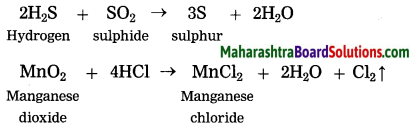
Maharashtra Board Class 10 Science Solutions Part 1 Chapter 3 Chemical Reactions and Equations 4

b. How can the rate of the chemical reaction, namely, decomposition of hydrogen peroxide be increased?
Answer:
At room temperature, the decomposition of hydrogen peroxide into water and oxygen takes place slowly. However, the same reaction occurs at a faster rate on adding manganese dioxide (MnO2),
powder in it.

c. Explain the term reactant product giving examples.
Answer:

  1. The substance which undergoes bond breaking while taking part in a chemical reaction is called reactant.
  2. The substance formed as a result of a chemical reaction by formation of new bonds is called product.
  3. Example: In a chemical reaction, the formation of carbon dioxide gas takes place by combustion of coal in air. In this reaction, coal (carbon) and oxygen (from air) are the reactants while carbon dioxide is the product.

d. Explain the types of reactions with reference to oxygen and hydrogen. Illustrate with examples.
Answer:
With reference to oxygen and hydrogen, there are two types of reaction

  1. Oxidation reaction
  2. Reduction reaction.

1. Oxidation reaction:
Examples:
(1) When carbon burns in air, it forms carbon dioxide. In this reaction carbon accepts oxygen, therefore, this is an oxidation reaction.
C(s) + O2(g) → CO2(g)

(2) When sodium reacts with ethyl alcohol, sodium ethoxide and hydrogen gas is formed. In this reaction, hydrogen is removed from ethyl alcohol, therefore this is an oxidation reaction.

Maharashtra Board Class 10 Science Solutions Part 1 Chapter 3 Chemical Reactions and Equations 5

(3) Acidified potassium dichromate (K2Cr2O7 / H2SO4) oxidises ethly alcohol to acetic acid.

Maharashtra Board Class 10 Science Solutions Part 1 Chapter 3 Chemical Reactions and Equations 6

2. Reduction reaction:
Examples:
(1) When hydrogen gas is passed over black copper oxide a reddish coloured layer of copper is
formed.
In this reaction an oxygen atom removed from CuO to form copper, hence, this is reduction.

Maharashtra Board Class 10 Science Solutions Part 1 Chapter 3 Chemical Reactions and Equations 7

(2) when hydrogen gas is passed over red hot coke, methane is obtained.
Here, hydrogen is added to coke (carbon). Hence, this is reduction.

Maharashtra Board Class 10 Science Solutions Part 1 Chapter 3 Chemical Reactions and Equations 8

e. Explain the similarity and difference in two events, namely adding NaOH to water and adding CaO to water.
Answer:
Similarity : Both NaOH and CaO, when dissolved separately in water, solid NaOH dissolves releasing heat, resulting in rise in temperature. This reaction is exothermic reaction. When solid CaO dissolves in water, Ca(OH)2 is formed, large amount of heat is evolved. This reaction is also exothermic reaction. Both reactions are combination reactions and single product is obtained.
NaOH(s) + H2O → NaOH(aq) + Heat
CaO(s) + H2O → Ca(OH)2(aq) + Heat
Difference:

  1. Aqueous solution of NaOH is considered as a strong alkali.
  2. Aqueous solution of Ca(OH)2 is considered as a weak alkali.

Maharashtra Board Class 10 Science Solutions Part 1 Chapter 3 Chemical Reactions and Equations

Question 3.
Explain the following terms with examples.
a. Endothermic reaction
Answer:
Endothermic reaction: The reaction in which heat is absorbed is called an endothermic
reaction.
when KNO3(s) dissolves in water, there is absorption of heat during the reaction and the temperature of the solution falls.
KNO2(s) + H2O(l) + Heat → KNO3(aq)

b. Combination reaction
Answer:
When two or more reactants combine in a reaction to form a single product, it is called a combination reaction.
Examples:
1. The ammonia gas reacts with hydrogen chloride gas to form the salt in gaseous state, immediately it condenses at room temperature and gets transformed into the solid state.

Maharashtra Board Class 10 Science Solutions Part 1 Chapter 3 Chemical Reactions and Equations 10

2. Magnesium burns in air to form white powder of magnesium oxide as a single product.
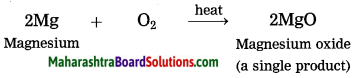
Maharashtra Board Class 10 Science Solutions Part 1 Chapter 3 Chemical Reactions and Equations 11

3. Iron reacts with sulphur to form iron sulphide.

Maharashtra Board Class 10 Science Solutions Part 1 Chapter 3 Chemical Reactions and Equations 12

c. Balanced equation
Answer:
In a chemical reaction, the number of atoms of the elements in the reactants is same as the number or atoms of those elements in the product, such an equation is called a balanced equation.
Example: AgNO3 + NaCl → AgCl + NaNO3
In the above reaction, the number of atoms of the elements in the reactants is same as the number of atoms of elements in the products.

d. Displacement reaction
Answer:
The reaction in which the place of the ion of a less reactive element in a compound is taken by another more reactive element by the formation of its own ions is called displacement reaction.

When zinc granules are added to the blue coloured copper sulphate solution, the zinc ions formed from zinc atoms take the place of Cu2+ ions in CuSO4, and copper atoms, formed from Cu2+ ions comes out i.e. the more reactive zinc displaces the less reactive Cu from copper sulphate.

Maharashtra Board Class 10 Science Solutions Part 1 Chapter 3 Chemical Reactions and Equations 9

4. Give scientific reason:
a. When the gas formed on heating lime stone is passed through freshly prepared lime water, the lime water turns milky.
Answer:
when lime stone is heated, calcium oxide and carbon dioxide are formed. This carbon dioxide gas is passed through freshly prepared lime water, insoluble calcium carbonate and water are formed. In this reaction, lime water turns milky.
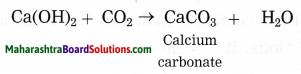
Maharashtra Board Class 10 Science Solutions Part 1 Chapter 3 Chemical Reactions and Equations 13

b. It takes time for pieces of Shahabud tile to disappear in HCl, but its powder disappears rapidly.
Answer:
The rate of a reaction depends upon the size of the particles of the reactants taking part in the reaction. The smaller the size of the reactants particles, the more is their total surface area and the faster is the rate of reaction.

In the reaction of dil. HCl with pieces of Shahabad tile, CO2 effervescence is formed amid the tile disappears slowly. On the other hand. CO2 effervescence forms at faster rate with Shahabad tile powder and it disappears rapidly.

c. While preparing dilute sulphuric acid from concentrated sulphuric acid in the laboratory, the concentrated sulphuric acid is added slowly to water with constant stirring.
Answer:
(1) The preparation of dilute sulphuric acid falls in the category of extreme exothermic process.

(2) During the preparation of dilute sulphuric acid. large amount of water is taken in a glass container which is surrounded by ice. Cool it for twenty minutes, Now small quantity of conc. H2SO4 is added slowly with stirring. Therefore, only a small amount of heat is liberated at a time. In this way dilute sulphuric acid is prepared.

(3) On the other hand, in the process of dilution or conc. sulphuric acid with water, very large amount of heat is liberated. As a result, water gets evaported instantaneously, if it is poured in to conc. H2SO4 which may cause an accident.

d. It is recommended to use air tight container for storing oil for long time.
Answer:

  1. If edible oil is allowed to stand for a long time, it undergoes air oxidation, it becomes rancid and its smell and taste changes.
  2. Rancidity in the rood stuff cooked in oil or ghee is prevented by using antioxidants. The process of oxidation reaction of food stuff can also be slowed down by storing it in air tight container.

Maharashtra Board Class 10 Science Solutions Part 1 Chapter 3 Chemical Reactions and Equations

Question 5.
Observe the following picture a write down the chemical reaction with explanation.
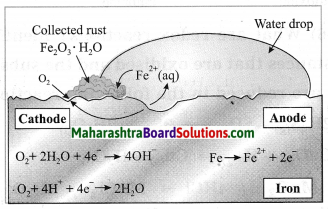
Maharashtra Board Class 10 Science Solutions Part 1 Chapter 3 Chemical Reactions and Equations 14
Answer:
The rusting of iron is an oxidation process. The rust on iron does not form by a simple reaction between oxygen and iron surface. The rust is formed by an electrochemical reaction. Fe oxidises to Fe2O3. H2O on one part of iron surface while oxygen gets reduced to H2O on another part or surface, Different regions on the surface of iron become anode and cathode.
(1) Fe is oxidised to Fe2+ in the anode region.
Fe(s) → Fe2+ (aq) + 2e
(2) O2 is reduced to form water in the cathode region.
O2(g) + 4H+ (aq) + 4e— → 2H2O(l)

When Fe2+ ions migrate from the anode region they react with water and futher get oxidised to form Fe3+ ions.
A reddish coloured hydrated oxide is formed from Fe3+ ions. It is called rust. It collects on the
surface.
2Fe3+ (aq) + 4H2O(l) → Fe2O3. H2O(s) + 6H+ (aq)
Because of various components in the atmosphere, oxidation of metals takes place, consequently resulting in their damage. This is called ‘corrosion’. Iron rusts and a reddish coloured layer is formed on it. This is corrosion of iron.

Question 6.
Identify from the following reactions the reactants that undergo oxidation and reduction.
a. Fe + S → FeS
Answer:
Fe + S → FeS
In this reaction, Iron (Fe) undergoes oxidation
and sulphur. (S) undergoes reduction.

b. 2Ag2O → 4Ag + O2
Answer:
2Ag2O → 4Ag + O2
In this reaction, reduction of Ag2O takes place.

c. 2Mg + O2 → 2MgO
Answer:
2Mg + O2 → 2MgO
In this reaction, oxidation of Mg takes place.

d. NiO + H2 → Ni + H2O
Answer:
NiO + H2 → Ni + H2O
In this reaction, reduction of NiO takes place and oxidation of H2 takes place.

Maharashtra Board Class 10 Science Solutions Part 1 Chapter 3 Chemical Reactions and Equations

Question 7.
Balance the following equation stepwise.
a. H2S2O7(l) + H2O(l) → H2SO4(l)
Answer:
Step 1: Rewrite the given equation as it is
H2S2O7(l) + H2O(l) → H2SO4(l)
Step 2: write the number or atoms of each element in the unbalanced equation on both sides of equations.

ElementNumber of atoms in reactant (left side)Number of atoms in products (right side)
H42
S21
O84

Step 3: To equalise the number of hydrogen atoms, sulphur atoms and oxygen atoms we use 2 as the coemficient or factor in the product.

ElementNumber of atoms in reactant (left side)Number of atoms in products (right side)
H42 × 2
S21 × 2
O84 × 2
Total1414

Now the equation becomes H2S2O7 + H2O → 2H2SO4
Now, count the atoms of each element on both sides of the equation. The number of atoms on both sides are equal. Hence, the balanced equation is
H2S2O7 + H2O → 2H2SO4
Now indicate the physical states of the reactants and products.
H2S2O7(l) + H2O(l) → 2H2SO4(l)

b. SO2(g) + H2S(aq) → S(s) + H2O(l)
Answer:
Step 1:
Rewrite the given equation as it is
SO2(g) + H2S(aq) → S(s) + H2O(l)

Step 2:
Write the number of atoms of each element in the unbalanced equation on both sides of equations.

ElementNumber of atoms in reactants (left side)Number of atoms in products (right side)
S21
O21
H22

The number of hydrogen atoms on both sides of the equation is same, therefore, equalise the number of sulphur atoms and oxygen atoms.

Step 3: To balance the number of sulphur atoms:

Number of atoms of sulphurIn reactantsIn products
S2OH2S(S)
Initially111
To balance111 × 2

To equalise the number of sulphur atoms, we use 2 as the factor in the product, now the equation becomes
SO2 + H2S → 2S + H2O

Step 4:
To equalise the number of oxygen atoms in the unbalanced equation.

Number of atoms of oxygenIn reactants (SO2)In products H2O
Initially21
To balance21 × 2

To equalise the number of sulphur atoms, we use 2 as the factor in the product i.e. H2O, now the unbalanced equation becomes
SO2 + H2S → 2S + 2H2O

Step 5:
To equalise the number of hydrogen atoms in unbalanced equation:

Number of atoms of hydrogenIn reactants (H2S)In products (H2O)
Initially24
To balance2 × 24

To equalise the number of hydrogen atoms we use 2 as the factor in the reactant i.e, H2S, now the unbalanced equation become
SO2 + 2H2S → 2S + 2H2O
Now, count the atoms of each element on both sides of the equation, there are less number of sulphur atoms in the product. Now equalise the sulphur atoms, the balanced equation becomes,
SO2 + 2H2S → 3S + 2H2O
Now indicate the physical states of reactants and products.
SO2(g) + 2H2S(aq) → 3S(s) + 2H2O(l)

c. Ag(s) + HCl(l) → AgCl ↓ + H2
Answer:
Step 1:
Rewrite the given equation as it is
Ag(s) + HCl(l) → AgCl ↓ + H2

Step 2:
write the number of atoms or each element in the unbalanced equation on both sides of equations.

ElementNumber of atoms in reactants (left side)Number of atoms in products (right side)
Ag11
H12
Cl11

The number of silver and chlorine atoms on both sides of the equation are same, therefore, equalise the number of hydrogen atoms.

Step 3:
To balance the number of hydrogen atoms.

Number of atoms of hydrogenIn reactants HClIn products H2
Initially12
To balance1 × 22

To equalise the number of hydrogen atoms, we use 2 as the factor in the product HCl, now the unbalanced equation become
Ag(s) + 2HCl → AgCl + H2

Step 4:
To balance the number of chlorine atoms:

Number of atoms of chlorineIn reactants (2HCl)In products (AgCl)
Initially21
To balance 22 ×1

To equalise the number of chlorine atoms, we use 2 as the factor in the product AgCl. now the unbalanced equation becomes
Ag + 2HCl → 2AgCl + H2
Now count the atoms of each element on both sides of the equation, there are less number of silver atoms in the reactant. Now equalise the silver atoms, the balanced equation becomes
2Ag + 2HCl → 2AgCl + H2
Now indicate the physical states of the reactunts and products
2Ag(s) + 2HCl(l) → 2AgCl ↓ + H2

d. H2SO4(aq) + NaOH(aq) → Na2SO4(aq) + H2O(l)
Answer:
Step 1:
Rewrite the given equation as it is
H2SO4(aq) + NaOH(aq) → Na2SO4(aq) + H2O(l)

Step 2:
write the number of atoms of each element in the unbalanced equation on both sides of the equation.

ElementNumber of atoms in reactantsNumber of atoms in products
Na12
S11
O55
H32

The number of oxygen atoms involved in different compounds on both sides (reactants and products) are equal. Therefore, balance the number of atoms of the second element, sodium.

Step 3:
To balance the number of sodium atoms:

Number of atoms of sodiumIn reactantsIn products
To begin with1 (in NaOH)2 (in Na2SO4)
To balance 1 × 22

To equalise the number of sodium atoms, we use 2 as the factor of NaOH in the reactants. Now, the partly balanced equation becomes as follows
H2SO4 + 2NaOH → Na2SO4 + H2O

Step 4:
Now, balance the number of hydrogen atoms:

Number of atoms of hydrogenIn reactantsIn products
To begin with(in H2SO4)
2 (in NaOH)
2 (in H2O)
To balance 42 × 2

To equalise the number of hydrogen atoms, we use 2 as the factor or H2O in the products. The equation then becomes
H2SO4 + 2NaOH → Na2SO4 + H2O
Now, count the atoms of each element on both sides of the equation. The number of atoms on both sides are equal. Hence, the balanced equation is
H2SO4 + 2NaOH → Na2SO4 + 2H2O
Now indicate the physical states of the reactants and the products.
H2SO4(aq) + 2NaOH(aq) → Na2SO4(aq) + 2H2O(l)

Question 8.
Identify the endothermic and exothermic reaction.
a. HCl + NaOH → NaCl + H2O + heat
Answer:
Exothermic reaction.

b. \(2 \mathrm{KClO}_{3}(\mathrm{s}) \stackrel{\Delta}{\longrightarrow} 2 \mathrm{KCl}(\mathrm{s})+3 \mathrm{O}_{2} \uparrow\)
Answer:
Exothermic reaction.

c. CaO + H2O → Ca(OH)2 + heat
Answer:
Exothermic reaction.

d. \(\mathrm{CaCO}_{3}(\mathrm{s}) \stackrel{\Delta}{\longrightarrow} \mathrm{CaO}(\mathrm{s})+\mathrm{CO}_{2} \uparrow\)
Answer:
Exothermic reaction.

Maharashtra Board Class 10 Science Solutions Part 1 Chapter 3 Chemical Reactions and Equations

Question 9.
Match the column in the following table:

ReactantsproductsType of chemical reaction
BaCl2(aq) + ZnSO4(aq)H2CO3(aq)Displacement
2 AgCl(s)FeSO4(aq) + Cu(s)Combination
CuSO4(aq) + Fe(s)BaSO4↓ + ZnCl2(aq)Decomposition
H2O(l) + CO2(g)2Ag(s) + Cl2(g)Double displacement

Answer:

ReactantsproductsType of chemical reaction
BaCl2(aq) + ZnSO4(aq)BaSO4↓ + ZnCl2(aq)Double displacement
2 AgCl(s)2Ag(s) + Cl2(g)Decomposition
CuSO4(aq) + Fe(s)FeSO4(aq) + Cu(s)Displacement
H2O(l) + CO2(g)H2CO3(aq)Combination

Project:
Do it your self:
1. Prepare aqueous solutions or various solid salts available in the laboratory. Observe what happens when aqueous solution of sodium hydroxide is added to these. Prepare a chart of double displacement reactions based on these observation.

2. Observe and note the physical and chemical changes experienced in various incidents in your day to day 1ife.

Can you recall? (Text Book Page No.16)

Question 1.
what are the types of molecules of elements and compounds?
Answer:
Elements are divided into three classes i.e. metals, nonmetals and metalloids. When two or more elements combine chemically in a fixed proportion by weight, a compound is formed. The properties of a compound are altogether different from those of the constitutional elements.

Question 2.
what is meant by valency of element?
Answer:
The number of electrons that an atom of an element gives away or takes up while forming an ionic bond, is called the valency or that element.

Question 3.
What is the requirement for writing molecular formulae of different compounds?
How are the molecular formulae of the compounds written?
Answer:
while writing the molecular formulae of different compounds, the symbol of the radicals and their valence should be known.
The number of the ions is written as subscript on the right of the symbol or the ion. By cross multiplication of valenceies chemical formula is obtained.

Find out (Text Book Page No. 44)
Question1.
How are the blackened silver utensils and patinated (greenish) brass utensils cleaned?
Answer:
The blackened silver utensils and patinated (greenish) brass utensils are cleaned using baking soda, vinegar and lemon mix.

Use your brain power! (Text Book Page No. 35)

Question 1.
write down the physical states of reactants and products in the reaction
SO2 + 2H2S → 3S + 2H2O
Answer:
Reactants : SO2(g), 2H2S(g)
Products : 3S(s), 2H2O(l).

Question 2.
write down the physical states of reactants and products in the reaction
2Ag + 2HCl → 2AgCl + H2
Answer:
Reactants: 2Ag(s), 2HCl(l)
Products: 2AgCl ↓, H2

Question 3.
Identify the reactants and products of the following equation.

Maharashtra Board Class 10 Science Solutions Part 1 Chapter 3 Chemical Reactions and Equations 15
Answer:
Reactants: vegetable oil, H2(g)
Product: Vanaspathi ghee

Use your brain power! (Text Book Page No. 42)

Question 1.
Which is the oxidant used for purification of drinking water?
Answer:
The chlorine based oxidants are used in the purification of drinking water.

Maharashtra Board Class 10 Science Solutions Part 1 Chapter 3 Chemical Reactions and Equations

Question 2.
Why is potassium permanganate used during cleaning water tanks?
Answer:
Potassium permanganate is an oxidising agent. It oxidises dissolved iron, manganese and hydrogen sulphide into solid particles that are filtered out of the water tank. It is used to control iron bacteria growth in tank.

Can you tell? (Text Book Page No. 43)

Question 1.
what is the type of this reaction, in which Vanaspathi ghee is formed from vegetable oil?
Answer:

Maharashtra Board Class 10 Science Solutions Part 1 Chapter 3 Chemical Reactions and Equations 16
In the preparation of vanaspathi ghee from vegetable oil hydrogen gas is used. This process is known as hydrogenation. This is reduction reaction.

Find out (Text Book page No. 33)

What are the other uses of silver nitrate in every day life?
Answer:
Silver nitrate is used in the voters-ink. It is used as reactant in the laboratory. Silver nitrate is used to prevent infection in wounds and skin burns.

Use your brain power! (Text Book Page No. 35)

Question 1.
N2(g) + H2(g) ⇌ NH3(g)
Answer:
Step 1:
Rewrite the given equation as it is
N2(g) + H2(g) ⇌ NH3(g)

Step 2:
Write the number of atoms of each element in the unbalanced equation on both sides of equations

ElementNumber of atoms in reactantsNumber of atoms in products
N21
H23

Step 3:
In the given equation. NH3 is a compound and it contains hydrogen element. On the left hand side there are two H atoms and on the right side 3H atoms. Equalise H atoms on both sides.

Hydrogen atomsIn reactantsIn products
Initially23
To balance3 × 22 × 3

To equalise the number of hydrogen atoms, we use 3 as the factor in the reactant and 2 as the factor in the products. Now the equation becomes
N2 + 3H2 → 2NH3
Now, count the atoms of each element on both sides of the equation. The number of atoms on both sides are equal. Hence, the balanced equation is
N2 + 3H2 → 2NH3
Now indicate the physical states of the reactants and products
N2(g) + 3H2(g) ⇌ 2NH3(g)

Question 2.
Calcium chloride + Sulphuric acid → Calcium sulphate + Hydrogen chloride.
Answer:
Step 1:
Write the chemical equation from the given word equation.
CaCl2 + H2SO4 → CaSO4 + HCl

Step 2:
Write the number of atoms of each element in the unbalanced on both sides of equation.

ElementNumber of atoms in reactantsNumber of atoms in products
Ca11
Cl21
H21
S11
O44

Step 3:
In the given equation H2SO4 is a compound and it contains hygrogen element. On the left hand side there are two hydrogen atoms and on the right side one hydrogen atom. Equalise H atoms on both sides.

Hydrogen atomsIn reactants (H2SO4)In products (HCl)
Initially21
To balance22  × 1

To equalise the number of hydrogen atoms we use 2 as the factor in the product so that the number of H atoms on both sides are equal. Therefore, the equation becomes
CaCl2 + H2SO4 → CaSO4 + 2 HCl
Now, count the atoms of each element on both sides of the equation. The number of atoms on both sides are equal hence, the balanced equation is
CaCl2 + H2SO4 → CaSO4 + 2 HCl
Now, indicate the physical state of the reactants and products.
CaCl2(s) + H2SO4(l) → CaSO4(s) + HCl(l)

Can you tell? (Text Book Page No. 39)

Take into account the time required for following processes. Classify them into two groups and give titles to the groups.
(1) Cooking gas starts burning on ignition.
(2) Iron article undergoes rusting.
(3) Erosion of rocks takes place to form soil.
(4) Alcohol is formed on mixing yeast in glucose solution under proper condition.
(5) Effervescence is formed on adding baking soda into a test tube containing dilute acid.
(6) A white precipitate is formed on adding dilute sulphuric acid to barium chloride solution.
Answer:
The above processes are classified into two groups (a) slow speed reactions (b) fast speed reactions.
Slow speed reactions: (2), (3) and (4).
Fast speed reactions: (1),(5) and (6).

Maharashtra Board Solutions

Use your brain power! (Text Book Page No. 43)

Question 1.
Some more examples of redox reaction are as follows. Identify the reductants and oxidants from them.
(1) 2H2S + SO2 → 3S↓ + 2H2O
(2) MnO2 + 4HCl → MnCl2 + 2H2O + Cl2
Answer:
Oxidants: SO2, MnO2
Reductants: H2S, HCl

Question 2.
If oxidation means losing electrons, what is meant by reduction.
Answer:
Reduction means gaining one or more electrons.

Question 3.
Write the reaction of formation of Fe2+ by reduction Fe3+ by making use of the symbol (e).
Answer:
Fe3+ + e → Fe2+ (reduction)

Think about it (Text Book Page No. 43)

Question 1.
The luster of the surface of the aluminium utensils in the house is lost after a few days. Why does this happen?
Answer:
The aluminium utensils when kept in the house for a few days, oxidation of aluminium takes place, a thin laver aluminium oxide (Al2O3) is deposited on the surface. Hence, aluminium utensils lose their lustre in a few days.

Question 3.
How many products are formed in each of the above reactions?
Answer:
A single product is formed in each of the above reaction.

Use your brain power! (Text Book Page No. 39)

Question 1.
What is the difference in the process of dissolution and a chemical reaction.
Answer:
In the process of dissolution, new substance is not necessarily formed. Whereas in a chemical reaction a new substance is definitely formed.

Question 2.
Does a new substance form when a solute dissolves in a solvent?
Answer:
It is not necessary that a new substance is always formed.

Fill in the blanks:

Question 1.
Organic waste is decomposed by micro-organism and as a result manure and……..are formed.
Answer:
Organic waste is decomposed by micro-organism and as a result manure and bio gas are formed.

Question 2.
……….is formed on mixing yeast in glucose solution under proper condition.
Answer:
Alcohol is formed on mixing yeast in glucose solution under proper condition.

Question 3.
The chemical reaction during which H2(g) is lost is termed as………
Answer:
The chemical reaction during which H2(g) s lost is termed as oxidation.

Question 4.
Corrosion can be prevented by using………
Answer:
Corrosion can be prevented by using antirust solution.

Question 5.
The chemical reactions in which heat is liberated are called………..reactions.
Answer:
The chemical reactions in which heat is liberated are called exothermic reactions.

Question 6.
The chemical formula of rust is………
Answer:
The chemical formula of rust is Fe2O3.H2O.

Question 7.
A reaction in which heat is absorbed is called………reaction.
Answer:
A reaction in which heat is absorbed is called endothermic reaction.

Question 8.
The process of rusting or iron is………process.
Answer:
The process of rusting of iron is oxidation process.

Question 9.
when oil and fats are oxidised or even allowed to stand in air for a long time, they become ……….
Answer:
when oil and fats are oxidised or even allowed to stand in air for a long time, they become rancid.

Question 10.
……… are used to prevent oxidation of food.
Answer:
Antioxidants are used to prevent oxidation of food.

Question 11.
Carbon dioxide is passed through water. The reaction is a………reaction.
Answer:
Carbon dioxide is passed through water. The reaction is a combination reaction.

Question 12.
Calcium carbonate is heated. The reaction is a………..reaction.
Answer:
Calcium carbonate is heated. The reaction is a decomposition reaction.

Question 13.
Zinc strip is dipped in a CuSO4 solution. The reaction is a……….reaction.
Answer:
Zinc strip is dipped in a CuSO4 solution. The reaction is a displacement reaction.

Question 14.
Silver nitrate solution is added to NaCl solution. The reaction is a……….reaction.
Answer:
Silver nitrate solution is added to NaCl solution. The reaction is a double displacement reaction.

Maharashtra Board Class 10 Science Solutions Part 1 Chapter 3 Chemical Reactions and Equations

Question 15.
The slow process of decay or destruction of a metal due to effect of air, moisture and acids on it is known as……….
Answer:
The slow process of decay or destruction of a metal due to effect of air, moisture and acids on it is known as corrosion.

Rewrite the following statements by selecting the correct options:

Question 1.
The reaction of iron nail with copper sulphate solution is………reaction. (March 2019)
(a) double displacement
(b) displacement
(c) combination
(d) decomposition
Answer:
(b) displacement

Question 2.
Reddish brown deposit formed on iron nails kept in a solution of copper sulphate is
(a) Cu2O
(b) Cu
(c) CuO
(d) CuS
Answer:
(b) Cu

Question 3.
The reaction CuSO4(aq) + Zn(s) → ZnSO4(aq) + Cu(s) is a……..reaction.
(a) displacement
(b) double displacement
(c) decomposition
(d) combination
Answer:
(a) displacement

Question 4.
………is a combination reaction.
(a) Cu + H2SO4 → CuSO4 + H2
(b) H2 + Cl2 → 2HCl
(c) \(2 \mathrm{HgO} \stackrel{\Delta}{\longrightarrow} 2 \mathrm{Hg}+\mathrm{O}_{2}\)
(d) \(\mathrm{CaCO}_{3} \stackrel{\Delta}{\longrightarrow} \mathrm{CaO}+\mathrm{CO}_{2}\)
Answer:
(b) H2 + Cl2 → 2HCl

Question 5.
………..a decomposition reaction.
(a) \(\mathrm{CaCO}_{3} \stackrel{\Delta}{\longrightarrow} \mathrm{CaO}+\mathrm{CO}_{2}\)
(b) H2O + CO2 → H2CO3
(c) CaS + 2HCl → CaCl2 + H2S
(d) 2H2 + O2 → 2H2O
Answer:
(a) \(\mathrm{CaCO}_{3} \stackrel{\Delta}{\longrightarrow} \mathrm{CaO}+\mathrm{CO}_{2}\)

Question 6.
In a chemical equation the……….are written on the left hand side.
(a) products
(b) reactants
(c) catalysts
(d) elements
Answer:
(b) reactants

Question 7.
The Δ sign written above the arrow indicates………..of the reaction.
(a) reactant
(b) product
(c) heat
(d) direction of the reaction
Answer:
(c) heat

Question 8.
The reaction KNO3(S) + H2O(l) + Heat → KNO3(aq) is a/an……….reaction.
(a) exothermic
(b) endothermic
(c) oxidation
(d) reduction
Answer:
(b) endothermic

Question 9.
The reaction NaOH(S) + H2O(l) → NaOH(aq) is a/an……..reaction.
(a) exothermic
(b) endothermic
(c) oxidation
(d) reduction
Answer:
(a) exothermic

Question 10.
A solution of Al2(SO4)3 in water is……….
(a) blue
(b) pink
(c) green
(d) colourless
Answer:
(d) colourless

Question 11.
Carbon dioxide………..
(a) turns lime water milky
(b) is odourless
(c) is colourless
(d) All the three (a), (b) and (c) are correct
Answer:
(d) All the three (a), (b) and (c) are correct

Question 12.
……….is the correct set up to pass CO2 through lime water.
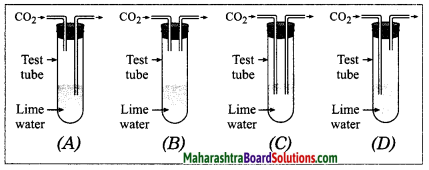
Maharashtra Board Class 10 Science Solutions Part 1 Chapter 3 Chemical Reactions and Equations 17
Answer:
Correct set up D.

Maharashtra Board Class 10 Science Solutions Part 1 Chapter 3 Chemical Reactions and Equations

Question 13.
when……..is passed through fresh lime water, it turns milky.
(a) H2
(b) CO
(c) CO2
(d) SO2
Answer:
(c) CO2

Question 14.
Magnesium reacts with con. HCl to form………..salt.
(a) copper chloride
(b) ferrous chloride
(c) calcium chloride
(d) magnesium chloride
Answer:
(d) magnesium chloride

Question 15.
Zinc reacts with hydrochloric acid. The reaction is a reaction.
(a) combination
(b) decomposition
(c) displacement
(d) double decomposition
Answer:
(c) displacement

Question 16.
In a double displacement reaction,………… (Practice Activity Sheet – 1)
(a) ions remain at rest
(b) ions get liberated
(c) ions are exchanged
(d) ions are not created
Answer:
(c) ions are exchanged

State whether the following statements are True or False:

Question 1.
Rusting of iron is a fast reaction.
Answer:
False. (Rusting of iron is a slow reaction.)

Question 2.
Milk is set into curd is a chemical change.
Answer:
True.

Question 3.
The reaction between salt and water is an example of exothermic reaction.
Answer:
False. (The reaction between salt and water is an example of endothermic reaction.)

Question 4.
The speed of a chemical reaction depends on the catalyst used in the chemical reaction.
Answer:
True.

Maharashtra Board Solutions

Question 5.
The simple form of representation of a chemical reaction in words is known as word reaction.
Answer:
True.

Question 6.
Nascent oxygen is always denoted by showing the symbol of oxygen.
Answer:
False. (Nascent oxygen is always denoted by showing symbol of oxygen [0] in square brackets.)

Question 7.
Antioxidants are used to prevent oxidation or food containing fats and oils.
Answer:
True.

Maharashtra Board Class 10 Science Solutions Part 1 Chapter 3 Chemical Reactions and Equations

Question 8.
When oils and fats are allowed to stand for a long time, they become rancid.
Answer:
True.

Question 9.
The chemical formula of rust is Fe3O4 .xH2O.
Answer:
False. (The chemical formula or rust is Fe2O3 .xH2O.)

Question 10.
Glucose combines with oxygen in our body and provides energy. The reaction is an endothermic reaction.
Answer:
False. (Glucose combines with oxygen in our body and provides energy. The reaction is an exothermic reaction.)

Question 11.
Chemical reactions in which reactants gain oxygen are reduction reactions.
Answer:
False. (Chemical reactions in which reactants gain oxygen are oxidation reactions.)

Question 12.
CuSO4(aq) + Znl(s) → ZnlSO4(aq) + Cu(s) is an example of decomposition reaction.
Answer:
False. (It is an example of displacement reaction.)

Question 13.
The chemical reactions in which heat is liberated are called endothermic reactions.
Answer:
False. (The chemical reactions in which heat is liberated are called exothermic reactions.)

Question 14.
The product or insoluble solid in chemical reaction is indicated by an arrow pointing upwards.
Answer:
False. (The product or insoluble solid in chemical reaction is indicated by an arrow ↑ pointing downwards.)

Question 15.
The rate of a reaction increases on increasing the temperature.
Answer:
True.

Question 16.
The digestion of food is a chemical decomposition process.
Answer:
True.

Question 17.
The reaction between sodium hydroxide and hydrochloric acid is a slow reaction.
Answer:
False (The reaction between sodium hydroxide and hydrochloric acid is a fast reaction.)

Question 18.
When calcium carbonate is heated, it decomposes into calcium oxide and oxygen gas.
Answer:
False (when calcium carbonate is heated. it decomposes into calcium oxide and carbon dioxide gas.

Question 19.
The rate of a chemical reaction changes in presence of catalyst.
Answer:
True.

Maharashtra Board Class 10 Science Solutions Part 1 Chapter 3 Chemical Reactions and Equations

Question 20.
Chlorines is an oxidant.
Answer:
True.

Taking into consideration the relationship in the first pair, complete the second pair. (OR) Complete the following:

Question 1.
2H2 + O2 → 2H2O Combination reaction :: 2HgO → 2Hg + O2 :……….
Answer:
Decomposition reaction

Question 2.
NH3 + HCl → NH4Cl : Combination reaction :: Fe + CuSO4 → FeSO4 + Cu :……..
Answer:
Displacement reaction

Question 3.
2C2H5OH + 2Na → 2C2H5ONa + H2 : Oxidation :: CuO + H2 → Cu + H2O :……….
Answer:
Reduction

Question 4.
CuCl2 + 2KI → CuI2 + 2KCl : Double displacement :: Zn + 2HCl → ZnCl2 + H2 :……….
Answer:
Displacement reaction

Question 5.

Maharashtra Board Class 10 Science Solutions Part 1 Chapter 3 Chemical Reactions and Equations 18
Answer:
Combination reaction

Question 6.
CuI2 : Brown :: AgCl :……….
Answer:
White.

Match the column in the following table:

Question 1.

ReactantsproductsType of chemical reaction
Fe + SNaCl + H2OOxidation
CuSO4 + Zn2CuONeutralization
2Cu + O2ZnSO4 + CuDisplacement
HCl + NaOHFeSCombination

Answer:

ReactantsproductsType of chemical reaction
Fe + SFeSCombination
CuSO4 + ZnZnSO4 + CuDisplacement
2Cu + O22CuOOxidation
HCl + NaOHNaCl + H2ONeutralization

Maharashtra Board Class 10 Science Solutions Part 1 Chapter 3 Chemical Reactions and Equations

Rewrite the second column so as to match the item from first column or Match the following:

Question 1.

Column IColumn II
1. Reduction(a) Type of a chemical reaction
2. Oxidation(b) Combination with hydrogen
3. Double displacement(c) Losing hydrogen
4. Displacement(d) Exchange of ions

Answer:
(1) Reduction – Combination with hydrogen
(2) Oxidation – Losing hydrogen
(3) Double displacement – Exchange of ions
(4) Displacement – Type of chemical reaction.

Question 2.

Column IColumn II
1. Oils and fats are allowed to stand in air for a long time(a) Slow  reaction
2. NaOH dissolves in water(b) Rancid
3. Zinc is added to CuSO4 solution(c) Exothermic reaction
4. Rusting of water(d) Colourless Solution

Answer:
(1) Oils and fats are allowed to stand in air for a long time – Rancid
(2) NaOH dissolves in water – Exothermic reaction
(3) Zinc is added to CuSO2 solution – Colourless solution
(4) Rusting of iron – Slow reaction.

Question 3.
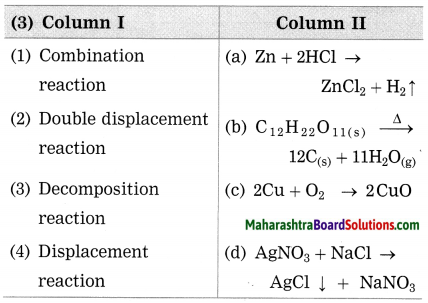
Maharashtra Board Class 10 Science Solutions Part 1 Chapter 3 Chemical Reactions and Equations 77
Answer:
(1) Combination reaction – 2Cu +O4 → 2CuO
(2) Double displacement reaction – AgNO3 + NaCl → AgCl ↓ + NaNO3
(3) Decomposition reaction – \(\mathrm{C}_{12} \mathrm{H}_{22} \mathrm{O}_{11(\mathrm{s})} \stackrel{\Delta}{\longrightarrow} 12 \mathrm{C}_{(\mathrm{s})}+11 \mathrm{H}_{2} \mathrm{O}_{(\mathrm{g})}\)
(4) Displacement reaction – Zn+ 2HCl → ZnCl2 + H2

Classify each of the following reactions as combination, decomposition, displacement or double displacement reactions:
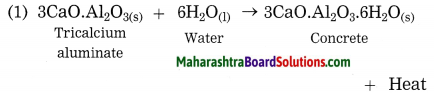
Maharashtra Board Class 10 Science Solutions Part 1 Chapter 3 Chemical Reactions and Equations 19
Answer:
Combination reaction

Maharashtra Board Class 10 Science Solutions Part 1 Chapter 3 Chemical Reactions and Equations 20
Answer:
Decomposition reaction

Maharashtra Board Class 10 Science Solutions Part 1 Chapter 3 Chemical Reactions and Equations 21
Answer:
Displacement reaction

Maharashtra Board Class 10 Science Solutions Part 1 Chapter 3 Chemical Reactions and Equations 22
Answer:
double displacement reaction

Maharashtra Board Class 10 Science Solutions Part 1 Chapter 3 Chemical Reactions and Equations 23
Answer:
Combination reaction

Maharashtra Board Class 10 Science Solutions Part 1 Chapter 3 Chemical Reactions and Equations 24
Answer:
double displacement reaction

Name the following:

Question 1.
The product formed in the thermal decomposition of sugar.
Answer:
Carbon is formed in the thermal decomposition of sugar.

Question 2.
The gas evolved when sorghum metal reacts with ethanol.
Answer:
Hydrogen (H2) gas is evolved when sodium metal reacts with ethanol.

Question 3.
The precipitate formed when barium sulphide reacts with zinc sulphate.
Answer:
When barium sulphide reacts with zinc sulphide, a precipitate of barium sulphate is formed.
\(\mathrm{BaS}+\mathrm{ZnSO}_{4} \longrightarrow \underset{\text { precipitate }}{\mathrm{BaSO}_{4}}+\mathrm{ZnS}\)

Question 4.
The reducing agent used for the reduction of copper oxide.
Answer:
Hydrogen is used for the reduction of copper oxide.

Maharashtra Board Class 10 Science Solutions Part 1 Chapter 3 Chemical Reactions and Equations

Question 5.
The catalyst used to accelerate the rate of decomposition of hydrogen peroxide.
Answer:
Manganese dioxide (MnO2) is used as a catalyst to accelerate the rate of decomposition of hydrogen peroxide.

Question 6.
which oxidising agent is used to oxidise ferrous sulphate.
Answer:
Potassium permanganate (KMnO4) is used as an oxidising agent to oxidise ferrous sulphate.

Question 7.
The product formed in the oxidation of ethyl alcohol.
Answer:
Acetic acid is formed in the oxidation of ethyl alcohol.

Answer the following questions in one sentence each:

Question 1.
what is meant by a chemical equation?
Answer:
The simple representation or a chemical reaction in a condensed form with the help of chemical formulae is called a chemical equation.

Question 2.
what is meant by a word equation?
Answer:
The simple form or representation or a chemical reaction in words is known as word equation.

Question 3.
what happens in a combination reaction?
Answer:
A single compound (product) is formed from two or more substances during a combination reaction.

Question 4.
what happens in a displacement reaction?
Answer:
In a displacement reaction. a more reactive element displaces another element, having less reactivity, from its compound.

Question 5.
what happens in a decomposition reaction?
Answer:
A single substance is broken down and two or more substances are formed during a decomposition reaction.

Question 6.
what happens in a double displacement reaction?
Answer:
A precipitate is formed by exchange of ions between the reactants during a double displacement reaction.

Question 7.
IdentIry the type of following reaction:
\(\mathrm{C}_{12} \mathrm{H}_{22} \mathrm{O}_{11} \stackrel{\Delta}{\longrightarrow} 12 \mathrm{C}+11 \mathrm{H}_{2} \mathrm{O}\) (Practice Activity Sheet – 2)
Answer:
The above reaction is a decomposition reaction.

Question 8.
what happens in an endothermic reaction?
Answer:
In an endothermic reaction, the reactants absorb heat to form products.

Question 9.
State the use of antioxidants in food containing fats and oils.
Answer:
Antioxidants are used to prevent oxidation of food containing fats and oils.

Question 10.
What are edible oils?
Answer:
Edible oils are compounds of alcohols and organic acids (carboxylic acids). The compounds formed are known as esters of carboxylic acids.

Question 11.
Is rancidity a phenomenon of oxidation or reduction?
Answer:
Rancidity is a phenomenon of oxidation.

Answer the following questions:

Question 1.
What do you understand by a physical change?
OR
Define physical change.
Answer:
The change in which only the physical state of a substance is changed; no new substance is formed. This change is temporary. During this change the composition of the substance does not change.

Question 2.
Explain giving two examples or physical change.
Answer:
(1) Conversion of ice into water is a physical change. On heating, ice melts into water. when the water is cooled, it freezes into ice. Thus, we get ice from water by a simple method and no new substance is formed. Hence, conversion of ice into water is a physical change.

(2) Magnetization of iron nail is a physical change. An iron nail magnetized by induction loses its magnetism as soon as it is detached from the magnet which induces magnetism in it. An iron nail magnetized by some other methods can also be demagnetized by simple means such as hammering or heating it. Thus, the magnetization of an iron nail can be easily reversed to get original nail. Hence, it is a physical change.
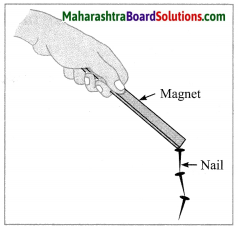
Maharashtra Board Class 10 Science Solutions Part 1 Chapter 3 Chemical Reactions and Equations 25

Question 3.
what do you understand by a chemical change?
OR
Define Chemical change.
Answer:
The change in which a substance or substances are converted into a new substance or substances, possessing properties altogether different from the original ones, is called a chemcial change. During this change, the original substance cannot be recovered by any simple means. This change is permanent.

Maharashtra Board Class 10 Science Solutions Part 1 Chapter 3 Chemical Reactions and Equations

Question 4.
Explain giving two examples of chemical change.
Answer:
(1) When carbon is burnt, carbon dioxide is formed. In this process carbon combines with oxygen, therefore carbon and oxygen are reactants, while curbon dioxide is a product. This change is permanent.
\(\mathrm{C}_{(\mathrm{s})}+\mathrm{O}_{2(\mathrm{g})} \stackrel{\text { Heat }}{\longrightarrow} \mathrm{CO}_{2(\mathrm{g})}\)

(2) When a magnesium wire is burnt in air, a white powder of magnesium oxide is formed. We cannot obtain magnesium from magnesium oxide by simple methods. Properties of magnesium oxide are altogether different from those of magnesium. A new substance MgO is formed in the reaction. Hence, this change is a chemical change.
\(\begin{array}{c}
2 \mathrm{Mg} \\
\text { Magnesium }
\end{array}+\mathrm{O}_{2} \stackrel{\Delta}{\longrightarrow} \begin{array}{c}
2 \mathrm{MgO} \\
\text { Magnesium oxide }
\end{array}\)
Maharashtra Board Class 10 Science Solutions Part 1 Chapter 3 Chemical Reactions and Equations 26

Question 5.
What is meant by a chemical reaction?
Answer:
A process in which some substances undergo bond breaking and are transformed into new substances by formation of new bonds is called a chemical reaction.

Question 6.
What is the importance of a chemical equation?
Answer:

  1. Reactants are converted into products.
  2. Mass is conserved.
  3. Atoms are conserved.
  4. The properties and compositions of the products of a chemical reaction are different from those of its reactants.
  5. Generally, energy is either absorbed or evolved.

Question 7.
What are the conventions used in writing a chemical equation?
Answer:
Conventions used in writing a chemical equation:
(1) The reactants are written on the left hand side (LHS), while the products are written on the right hand side (RHS).

(2) Whenever there are two or more reactants, a plus sign (+) is written between each two of them. Similarly, if there are two or more products, a plus sign is written between each two of them.

(3) Reactant side and product side are connected with an arrow (→) pointing from reactants to products. The arrow represents the direction of the reaction. Heat is to be given from outside to the reaction, it is indicated by the sign Δ written above the arrow.

(4) The conditions like temperature, pressure, catalyst, etc., are mentioned above the arrow (→) pointing towards the product side.

(5) The physical states of the reactants and products are also mentioned in a chemical equation. The notations g, l, s, and aq are written in brackets as a subscript along with the symbols / formulae of reactants and products. The symbols g, l, s, and aq stand for gaseous, 1iquid. solid and aqueous respectively.

If the product is gaseous, instead of (g) it can be indicated by an arrow ↑ pointing upwards. If the product formed is insoluble solid, then instead of (s) it can be indicated by an arrow ↓ pointing downwards.

(6) Special information or names of reactants/products are written below their formulae.

Write the balanced equations for the following reactions:

Question 1.
Ba(OH)2 + HBr → BaBr2 + H2O
Answer:
Step 1:
Rewrite the given equation as it is
Ba(OH)2 + HBr → BaBr2 + H2O

Step 2:
write the number of atoms of each element in the unbalanced equation on both sides of the equation.

ElementNumber of atoms in reactantsNumber of atoms in products
Ba11
Br12
O21
H32

Step 3:
To balance the number of oxygen atoms:

Number of atoms of oxygenIn reactantsIn products
To begin with2 [in Ba(OH)2]1 (in H2O)
To balance21 × 2

To equalise the number of oxygen atoms, we use 2 as the coefficient of H2O in the product.
Now, the partly balanced equation become as follows
Ba(OH)2 + HBr → BaBr2 + 2H2O

Step 4:
Now, balance the number of hydrogen atoms.
In the partly balanced equation:

Number of atoms of hydrogenIn reactantsIn products
To begin with2 [in Ba(OH)2]
1 (in HBr)
4 (in 2H2O)
To balance1 × 2 + 24

To equalise the number of hydrogen atoms, we use 2 as the coefficient of HBr in the reactants. Now, the equation becomes
Ba(OH)2 + 2HBr → BaBr2 + 2H2O
Now, count the atoms or each element on both sides of the equation. The number of atoms on both
sides are equal. Hence, the balanced equation is
Ba(OH)2 + 2HBr → BaBr2 +2H2O
Now indicate the physical states of the reactants and products.
Ba(OH)2(aq) + 2HBr(aq) → BaBr2(aq) +2H2O(l)

Question 2.
KCN + H2SO4 → K2SO4 + HCN
Answer:
Step 1:
Rewrite the given equation as it is
KCN + H2SO4 → K2SO4 + HCN

Step 2:
Write the number of atoms of each element or group in the unbalanced equation on both sides of the equation.

ElementNumber of atoms in reactantsNumber of atoms in products
K12
CN (group)11
O44
H21
S11

The number of oxygen atoms involved in different compounds on both sides (reactants and products) are equal. Therefore, balance the number of atoms of the second element, potassium.

Step 3:
To balance K atoms:

Number of atoms of PotassiumIn reactantsIn products
To begin with2 (KCN)2 (in K2SO4)
To balance1 × 22

To equalise the number of potassium atoms, we use 2 as the coefficient of KCN in the reactants.
Now, the partly balanced equation becomes
2KCN + H2SO4 → K2SO4 + 2HCN
Now, count the atoms of each element on both sides of the equation. The number of atoms on both sides are equal. Hence, the balanced equation is
2KCN + H2SO4 → KgSO4 + 2HCN
Now indicate the physical states of the reactants and the products.
2KCN(aq) + H2SO4(aq) → K2SO4(aq) + 2HCN(g)

Maharashtra Board Class 10 Science Solutions Part 1 Chapter 3 Chemical Reactions and Equations

Question 3.
CH4 + O2 → 4CO2 + H2O
Answer:
Step 1:
Rewrite the given equation as it is
CH4 + O2 → 4CO2 + H2O

Step 2:
Write the number of atoms of each element in the unbalanced equation on both sides of the equation.

ElementNumber of atoms in reactantsNumber of atoms in products
C11
O23
H42

Step 3:
To balance the number of oxygen atoms:

Number of atoms of oxygenIn reactantsIn products
To begin with2 (in O2)1 (in H2O)
2 (in CO2)
To balance2 × 21 × 2 + 2

To equalise the number of oxygen atoms, we use 2 as the coefficient of O2 in the reactants and 2 as the coefficient of H2O in the product.
Now, the partly balanced equation becomes
CH4 + 2O2 → CO2 + 2H2O
Now, count the atoms of each element on both sides of the equation. The number of atoms on both sides are equal. Hence, the balanced equation is,
CH4 + 2O2 → CO2 + 2H2O
Now, indicate the physical states of the reactants and the products.
CH4(g) + 2O2(g) → CO2(g) + 2H2O(l)

Answer the following questions:

Question 1.
what are the different types of chemical reaction?
Answer:
Types of chemical reaction

  1. Combination reaction
  2. Decomposition reaction
  3. Displacement reaction
  4. Double displacement reaction.

Question 2.
What is meant by a combination reaction?
OR
Define: combination reaction.
Answer:
When two or more reactants combine in a reaction to form a single product, it is called a combination reaction.

Question 3.
Give two examples of combination reaction.
Answer:
Examples of combination reaction :
(1) The ammonia gas reacts with hydrogen chloride gas to form the salt in gaseous state, immediately it condenses at room temperature and gets transformed into the solid state.

Maharashtra Board Class 10 Science Solutions Part 1 Chapter 3 Chemical Reactions and Equations 27

(2) Magnesium burns in air to form white powder of magnesium oxide as a single product.
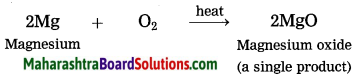
Maharashtra Board Class 10 Science Solutions Part 1 Chapter 3 Chemical Reactions and Equations 28

(3) Iron reacts with sulphur to form iron sulphide.

Maharashtra Board Class 10 Science Solutions Part 1 Chapter 3 Chemical Reactions and Equations 29

Question 4.
What Is meant by a decomposition reaction?
Answer:
The chemical reaction in which two or more products are formed from a single reactant is called decomposition reaction.

Maharashtra Board Class 10 Science Solutions Part 1 Chapter 3 Chemical Reactions and Equations

Question 5.
what is meant by a thermal decomposition?
Answer:
The reaction in which a compound is decomposed by heating it to a high temperature is called thermal decomposition.

Question 6.
What is meant by a electrolytic decomposition?
Answer:
The reaction in which a compound is decomposed by passing an electric current through its solution or molten mass is called an electrolytic decomposition.

Question 7.
Give two examples of thermal decomposition.
Answer:
(1) At high temperature, calcium carbonate decomposes into calcium oxide and carbon dioxide.

Maharashtra Board Class 10 Science Solutions Part 1 Chapter 3 Chemical Reactions and Equations 30

(2) At high temperature sugar decomposes into black mass of carbon and water vapour.

Maharashtra Board Class 10 Science Solutions Part 1 Chapter 3 Chemical Reactions and Equations 31

Question 8.
Give an example of electrolytic decomposition.
Answer:
When an electric current is passed through acidified water, it is electrolysed giving hydrogen
and oxygen.

Maharashtra Board Class 10 Science Solutions Part 1 Chapter 3 Chemical Reactions and Equations 32

Question 9.
Study the following reaction and answer the questions asked.

Maharashtra Board Class 10 Science Solutions Part 1 Chapter 3 Chemical Reactions and Equations 33
(a) State the type of reaction.
(b) Define this reaction. (Practice Activity Sheet – 1)
Answer:
(a) The type of reaction is electrolytic decomposition reaction.
(b) The reaction in which a compound is decomposed by passing an electric current through its solution or molten mass is called an electrolytic decomposition.

Question 10.
what is meant by a displacement reaction?
Answer:
The reaction in which the place of the ion of a less reactive element in a compound is taken by another more reactive element by formation of its own ions, is called displacement reaction.

Maharashtra Board Solutions

Question 11.
Give an example of displacement reaction.
Answer:
when zinc granules are added to the blue coloured copper sulphate solution, the zinc ions formed from zinc atoms take the place or Cu2+ ions in CuSO4, and copper atoms, formed from Cu2+ ions comes out i.e. the more reactive zinc displaces the less reactive Cu from copper sulphate.

Maharashtra Board Class 10 Science Solutions Part 1 Chapter 3 Chemical Reactions and Equations 34

Question 12.
Observe the reaction and answer the following questions.
CuSO4(aq) + Fe(s) → FeSO4(aq) + Cu(s)
(a) Identify and write the type of chemical reaction.
(b) write the definition of above reaction. (Practice Activity Sheet – 3)
Answer:
(a) When iron powder is added to the blue coloured copper sulphate solution, the iron ions formed from iron atoms take the place or Cu2+ ions in CuSO4, and copper atoms, formed from Cu2+ ions comes out i.e. the more reactive iron displaces the less reactive Cu from copper sulphate. Therefore this reaction is a displacement reaction.

(b) The reaction in which the place of the ion of a less reactive element in a compound is taken by another more reactive element by formation of its own ions, is called displacement reaction.

Question 13.
what is meant by a double displacement reaction?
Answer:
The reaction in which the ions in the reactants are exchanged to form a precipitate is called double displacement reaction.

Question 14.
Give two examples of double displacement reaction.
Answer:
(1) Solutions of sodium chloride and silver nitrate react with each other forming a precipitate of silver chloride and a solution of sodium nitrate.
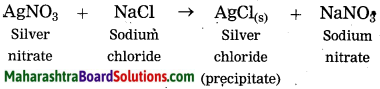
Maharashtra Board Class 10 Science Solutions Part 1 Chapter 3 Chemical Reactions and Equations 35
White precipitate of AgCl is formed by exchange of ions Ag+ and Cl between the reactants.

(2) Barium suiphide reacts with zinc sulphate to form zinc sulphide and a white precipitate of barium sulphate.

Maharashtra Board Class 10 Science Solutions Part 1 Chapter 3 Chemical Reactions and Equations 36
white precipitate is formed by exchange of ions Ba++ and SO4 between the reactants.

Question 15.
Write down what you understand from the following chemical reaction:
AgNO3(aq) + NaCl(aq) → AgCl ↓ + NaNO3(aq)
Answer:
(i) The above reaction is a double displacement reaction.
(ii) AgNO3 and NaCl are the reactants while AgCl and NaNO3 are the products.
(iii) The reactants and the product NaNO3 are in aqueous state. The product AgCl is formed in the form of precipitate.

Question 16.
Study the following chemical reaction and answer the questions given below:
AgNO3(aq) + NaCl(aq) → AgCl(s)↓ + NaNO3(aq)
(i) Identiry and write the type of chemical reaction.
(ii) write the definition of above type of chemical reaction.
(iii) Write the names of reactants and products of above reaction. (March 2019)
Answer:
(i) The type of chemical reaction: Double displacement reaction.
(ii) The reaction in which the ions in the reactants are exchanged to form a precipitate is called double displacement reaction.
(iii)

  1. The above reaction is a double displacement reaction.
  2. AgNO3 and NaCl are the reactants while AgCl and NaNO3 are the products.
  3. The reactants and the product NaNO3 are in aqueous state. The product AgCl is formed in the form of precipitate.

Question 17.
When sodium chromate solution is mixed with barium sulphate solution, a precipitate is formed.
(i) What is the colour of the precipitate formed?
(ii) Name the precipitate.
(iii) What is the type of chemical reaction?
Answer:
(i) The colour of the precipitate is yellow.
(ii) The yellow precipitate formed is barium chromate.
(iii) The type of chemical reaction is double displacement.

Question 18.
Explain the term Exothermic reaction.
Answer:
Exothermic reaction : The process in which heat is given out is called an exothermic reaction.
When NaOH(s) dissolves in water, there is evolution of heat leading to a rise in temperature.
NOH(s) + H3O(l) → NaOH(aq) + Heat

Maharashtra Board Class 10 Science Solutions Part 1 Chapter 3 Chemical Reactions and Equations

Question 19.
State whether the following reactions are exothermic or endothermic:
(i) 3CaO. Al2O3(s) + 6H2O(l) → 3CaO. Al2O3. 6H2O(s) + Heat
Answer:
Exothermic reaction

(ii) 2CaSO4. H2O + 3H2O → 2CaSO4. 2H2O + Heat
Answer:
Exothermic reaction

(iii) KNO3(aq) + H2O(l) + Heat → KNO3(aq)
Answer:
Endothermic reaction

(iv) NaOH(s) + H2O(l) → NaOH(aq) + Heat
Answer:
Exothermic reaction

(v) Transformation of ice into water.
Answer:
Endothermic reaction

(vi) Water turns into ice.
Answer:
Exothermic reaction

(vii) Cooking of food.
Answer:
Endothermic reaction

(viii) Burning candle.
Answer:
Exothermic reaction

Question 20.
What do you mean by slow speed reaction?
OR
Define: Slow speed reaction.
Answer:
The reaction which requires long time for completion i.e. occurs slowly is called slow speed reaction.

Question 21.
What do you mean by fast speed reaction?
OR
Define: Fast speed reaction.
Answer:
The reaction which is completed in short time i.e. occurs rapidly is called fast speed reaction.

Question 22.
Give two examples of slow speed reactions.
Answer:
(1) On heating potassium chlorate (KClO3) it decomposes slowly into potassium chloride and oxygen gas.

Maharashtra Board Class 10 Science Solutions Part 1 Chapter 3 Chemical Reactions and Equations 37
This reaction requires long time for completion, therefore it is slow speed reaction.

(2) Rusting of iron is a slow speed reaction. In this reaction iron reacts with oxygen from air to form iron oxide.

Maharashtra Board Class 10 Science Solutions Part 1 Chapter 3 Chemical Reactions and Equations 38

Question 23.
Give two examples of fast speed reactions.
Answer:
(1) The reaction between sodium hydroxide (NaOH) and hydrochloric acid (HCl) is a neutralization reaction and it is fast speed reaction.
NaOH2(aq) + HCl(aq) → NaCl(aq) + H2O(l)
This neutralizaton reaction is completed in short time, therefore it is fast speed reaction.

(2) Aqueous solution of sodium chloride reacts with silver nitrate solution to form white precipitate of silver chloride (NaCl) and sodium nitrate.
NaCl(aq) + AgNO3(aq) → NaNO3(aq) + AgCl ↓
This reaction is completed in short time, therefore it is fast reaction.

Question 24.
Write a short note on slow speed and fast speed reactions.
Answer:
Slow speed reaction:
The reaction which requires long time for completion i.e. occurs slowly is called slow speed reaction.
Examples:
(1) On heating potassium chlorate (KClO3) it decomposes slowly into potassium chloride and oxygen gas.

Maharashtra Board Class 10 Science Solutions Part 1 Chapter 3 Chemical Reactions and Equations 39
This reaction requires long time for completion, therefore it is slow speed reaction.

(2) Rusting of iron is a slow speed reaction. In this reaction iron reacts with oxygen from air to form iron oxide.

Maharashtra Board Class 10 Science Solutions Part 1 Chapter 3 Chemical Reactions and Equations 40
This reaction requires long time for completion.

Fast speed reaction:
The reaction which is completed in short time i.e., occurs rapidly is called fast speed reaction.
Examples:
(1) The reaction between sodium hydroxide (NaOH) and hydrochloric acid (HCl) is a neutralization reaction and it is fast speed reaction.
NaOH(aq) + HCl(aq) → NaCl(aq) + H2O(l)
This neutralizaton reaction is completed in short time, therefore it is fast speed reaction.

(2) Aqueous solution of sodium chloride reacts with silver nitrate solution to form white precipitate of silver chloride (NaCl) and sodium nitrate.

Maharashtra Board Class 10 Science Solutions Part 1 Chapter 3 Chemical Reactions and Equations 41
This reaction is completed in short time, therefore it is fast reaction.

Maharashtra Board Class 10 Science Solutions Part 1 Chapter 3 Chemical Reactions and Equations

Question 25.
State the factors which affect the speed (or rate) of a reaction.
Answer:
The factors which affect the rate of a reaction are

  1. Nature of the reactants.
  2. Size of the particles of the reactants.
  3. Concentration of the reactants.
  4. Temperature of the reaction.
  5. Catalyst.

Question 26.
How does the rate of reaction depend on the nature of the reactants? Illustrate with suitable example.
Answer:
(1) when the reactant combines with two or more other reactants then the rate of a chemical reaction depends on the nature of the reactants.

(2) Both Al and Zn reacts with dilute hydrochloric acid, H2 gas is liberated and water soluble salts of these metals are formed. However, aluminium metal reacts faster with dil. HCl as compared to zinc metal.

(3) Al is more reactive than Zn. Therefore, the rate of reaction of Al with hydrochloric acid is higher than that of Zn. Hence, the nature of the reactant affect the rate of a reaction.
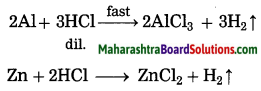
Maharashtra Board Class 10 Science Solutions Part 1 Chapter 3 Chemical Reactions and Equations 42

Question 27.
How does the rate of a reaction depend on the size of the particles of reactants?
Answer:
(1) In the reaction of dil. HCl and Shahabad tile, CO2 effervescence is formed slowly. On the other hand, C2 effervescence forms at faster speed with the powder of Shahabad tile.

(2) The above observation indicates that the rate of a reaction depends upon the size of the particles of the reactants taking part in the reaction. Smaller the size of the reactant particles taking part in a reaction faster will be the rate of reaètion.

Question 28.
How does the rate of a reaction depend upon the concentration of the reactants? Give suitable example.
Answer:
(1) A chemical reaction takes place due to collisions of the reactant molecules. Higher the concentrations of the reactants more will be the frequency of collisions and faster wifi be the rate of the reaction.

(2) In the reaction of dil. HCl and CaCO3, CaCO3 disappears slowly and CO2 also liberates slowly. On the other hand the reaction with concentrated HCl takes place rapidly and CaCO3 disappears fast.

(3) Concentrated acid reacts faster than dilute acid, that means the rate of a reaction is proportional to the concentration of reactants.

Slow reaction:
CaCO3 + dli.2HCl → CaCl2 + CO2 + H2O
Fast reaction:

Maharashtra Board Class 10 Science Solutions Part 1 Chapter 3 Chemical Reactions and Equations 43

Question 29.
How does the rate of a reaction depend upon the temperature of reactants? Give suitable example.
Answer:
(i) (1) When the temperature of the reactants is increased, the reactant molecules start moving with more velocity and their kinetic energy increases. As a result, the number collisions increases. Hence, the rate of chemical reaction increases.

(2) Lime stone on heating decomposes to give CO2, which turns 1ime water milky. On the other hand, the lime water does not turn milky before heating the lime stone: because of the zero rate of reaction. The above observation indicates that the rate of a reaction increases on increasing the temperature.

(ii) Solid CaCO3 does not decompose at room temperature when heated, it decomposes to give CaO and CO2 that means the rise in temperature increases the rate of reaction. CaCO3 room temperature No chemical reaction.

Maharashtra Board Class 10 Science Solutions Part 1 Chapter 3 Chemical Reactions and Equations 44

Question 30.
How does the rate if a reaction depend upon the catalyst? Give suitable example.
Answer:
(1) The substance in whose presence the rate of a chemical reaction changes, without causing any chemical change to it is called a catalyst.

(2) On heating potassium chlorate (KClO3) decomposes into potassium chloride and oxygen slowly.
\(2 \mathrm{KClO}_{3} \stackrel{\Delta}{\longrightarrow} 2 \mathrm{KCl}+3 \mathrm{O}_{2}\)
The rate of the above reaction neither increases by reducing the particle size nor by increasing the reaction temperature. However in the presence of manganese dioxide, KClO3 decomposes at a comparatively lower temperature and oxygen is produced more briskly. No chemical change takes place in MnO2 in this reaction. It acts as catalyst.

Maharashtra Board Solutions

Question 31.
State the Importance of rate in a chemical reaction.
Answer:

  1. The use of strong acid and strong base in a chemical reaction increases the rate of reaction.
  2. In a chemical reaction, if the smaller size of the reactant particles, the concentrated solution, high temperature and use of catalyst increases the rate of chemical reaction.
  3. The rate of chemical reaction is important with respect to environment.
  4. If the rate of chemimal reaction is fast it is profitable for the chemical factories.
  5. The ozone layer in the earth’s atmosphere protects the life of earth from the ultraviolet radiation of the sun. The process of depletion or maintenance of this layer depends upon the rate of production or destruction of ozone molecules.

Question 32.
Define Oxidation reaction.
Answer:
Oxidation: The chemical reaction in which a reactant combines with oxygen or loses hydrogen to form the product is called oxidation reaction.

Question 33.
Give examples of oxidation.
Answer:
(1) when carbon burns in air, it forms carbon dioxide. In this reaction carbon accepts oxygen, therefore, this is an oxidation reaction.
C(s) + O2(g) → CO2(g)

(2) when sodium reacts with ethyl alcohol, sodium ethoxide and hydrogen gas is formed. In this reaction, hydrogen is removed from ethyl alcohol, therefore this is an oxidation reaction.
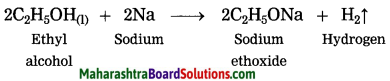
Maharashtra Board Class 10 Science Solutions Part 1 Chapter 3 Chemical Reactions and Equations 45
(3) Acidified potassium dichromate: (K2Cr2O7/H2SO4) oxidises ethly alcohol to acetic acid.

Maharashtra Board Class 10 Science Solutions Part 1 Chapter 3 Chemical Reactions and Equations 46

Question 34.
What do you mean by oxidant? Explain with suitable example.
Answer:
The chemical substances which bring about an oxidation reaction by making oxygen available are called oxidants or oxidizing agents.

  1. In the combustion of carbon, oxygen is an oxidant.
  2. In the oxidation of ethly alcohol, potassium dichromate is used as oxidant.

Maharashtra Board Solutions

Question 35.
Name the various oxidants. How nascent oxygen is liberated from these oxidants?
Answer:
K2Cr2O7/H2SO4, KMnO4/H2SO4 are the commonly used chemical oxidants. Hydrogen peroxide (H2O2) is used as a mild oxidant. Ozone (O3) is also a chemical oxidant. Nascent oxygen is generated by chemical oxidants and it is used for the oxidation reaction.
O3 → O2 + [O].
H2O2 → H2O + [O]
K2Cr2O7 + 4H2SO4 → K2SO4 + Cr2(SO4)3 + 4H2O + 3[O]
2KMnO4 + 3H2SO4 → K2SO4 + 2MnSO4 + 3H2O + 5[O]
Nascent oxygen is a state prior to the formation of the O2 molecule. It is the reactive form of oxygen and is represented by the symbol as [O]

Question 36.
Acidified potassium permanganate (KMnO4) is a chemical oxidant and explain, how acidified potassium permanganate oxidise ferrous sulphate (FeSO4). Accordingly write a new definition of oxidation and reduction.
Answer:
Acidified KMnO4 oxidises ferrous sulphate (FeSO4) to ferric sulphate Fe2(SO4)3 and in addition to above K2SO4 and MnSO4 by-products are formed.
2KMnO4 + 10 FeSO4 → 8H2SO4 → K2SO4 + 2MnSO4 + 5Fe2(SO4)3 + 8H2O
2FeSO4 → Fe2(SO4)3
Ionic reaction :
2Fe2 + 2SO42+ → 2Fe3+ + 3SO22-
Net Ionic equation Fe2+ → Fe3+ + e
When ferric ion is formed from ferrous ion the positive change is increased by one unit. While this happens the rerrous ion loses one electron.

When metal or its ion loses electron, it is called an oxidation and gain of electron is called reduction.
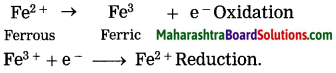
Maharashtra Board Class 10 Science Solutions Part 1 Chapter 3 Chemical Reactions and Equations 47

Question 37.
Define reduction reaction.
Answer:
The chemical reaction in which a reactant gains hydrogen and loses oxygen to form the product is called the reduction reaction.

Question 38.
Give two examples of reduction.
Answer:
(1) When hydrogen gas is passed over black copper oxide a reddish coloured layer of copper is formed.
In this reaction an oxygen atom removed from CuO to form copper, hence, this is reduction.

Maharashtra Board Class 10 Science Solutions Part 1 Chapter 3 Chemical Reactions and Equations 48

(2) When hydrogen gas is passed over red hot coke, methane is obtained.
Here, hydrogen is added to coke (carbon). Hence, this is reduction.

Maharashtra Board Class 10 Science Solutions Part 1 Chapter 3 Chemical Reactions and Equations 49

Question 39.
What do you mean by reductant? Explain with suitable example.
Answer:
The chemical substances which bring about reduction by making hydrogen available are called reductant. In the preparation of methane from carbon, hydrogen is a reductant.

Question 40.
What are redox reactions? Identify the substances that are oxidised and the substances that are reduced in the following reactions:
(1) 2H2S2(g) + SO2(g) → 3S(s) + 2H2O(l)
(2) CuO(s) + H2(g) → CU(s) + H2O(l)

Maharashtra Board Class 10 Science Solutions Part 1 Chapter 3 Chemical Reactions and Equations 50
Answer:
When oxidation and reduction take place simultaneously in a given chemical reaction, it is known as a redox reaction.
(1)
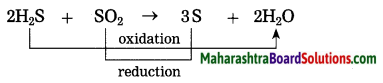
Maharashtra Board Class 10 Science Solutions Part 1 Chapter 3 Chemical Reactions and Equations 51
H2S is oxidised and SO2 is reduced.

(2)
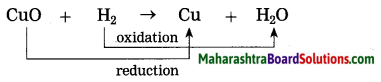
Maharashtra Board Class 10 Science Solutions Part 1 Chapter 3 Chemical Reactions and Equations 52
CuO is reduced and H2 is oxidised.

(3)
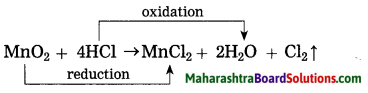
Maharashtra Board Class 10 Science Solutions Part 1 Chapter 3 Chemical Reactions and Equations 53
(1) Oxidation: H2S, H2O and HCl.
(2) Reduction: SO2, CuO and MnO2

Question 41.
Observe the following reaction and answer the questions given below:
BaSO4 + 4C → BaS + 4CO
(1) what type of reaction is it? Justify.
(2) Give one more example.
Answer:
(1) This is a redox reaction. In this reaction the reduction of BaSO4 and oxidation of carbon take place simultaneously.
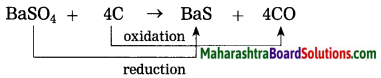
Maharashtra Board Class 10 Science Solutions Part 1 Chapter 3 Chemical Reactions and Equations 54

(2) Example
CuO+H2 → Cu + H2O
2H2S + SO2 → 3S + 2H2O

Question 42.
What is corrosion?
Answer:
The slow process of decay or oxidation of metals due to various components of atmosphere is known as corrosion.
Iron rusts and a reddish coloured layer is collected on it. This is corrosion of iron.

Maharashtra Board Class 10 Science Solutions Part 1 Chapter 3 Chemical Reactions and Equations

Question 43.
How does rusting of iron occur?
Answer:
Iron when exposed to moist air forms a reddish layer of hydrated ferric oxide.

Maharashtra Board Class 10 Science Solutions Part 1 Chapter 3 Chemical Reactions and Equations 55

Question 44.
How can corrosion be prevented?
Answer:

  1. Corrosion damages buildings, bridges, automobiles, ships, iron railings and other articles made of iron.
  2. It can be prevented by using an anti-rust solution, coating the surface by a paint, processes like galvanising and electroplating with other metals.

Question 45.
What is corrosion? Do gold ornaments corrode? Justify.
Answer:
The slow process of decay or oxidation or metal due to the effect of air, moisture and acids on
it is known as corrosion.
(1) Gold is a noble metal. There is no effect or moist air or action of acid on it at any temperature.
(2) Pure gold is a very soft metal. it breaks and gets bent easily. Hence, in gold ornaments, gold is alloyed with other metals 1ike copper or silver in appropriate proportion to make it hard and resistant to corrosion. Hence gold ornaments do not get corroded.

Question 46.
Complete the process of iron rusting by filling the blanks. Suggest a way to prohibit the process.
The iron rust is formed due to reaction. Different regions on iron surface become anode and cathode.
Reaction on anode region:
Fe(s) → Fe2+ (aq) + 2e
Reaction on cathode region:
O2(g) + 4H+ (aq) +………→ 2H2O(l)
when Fe2+ ions migrate from anode region they react with……..to fomm Fe3+ ions.
A reddish coloured hytirated oxide is formed from……….ions. It is called rust.
2Fe3+ (aq) + 4H2O(l) → +………+ 6H+ (aq)
A way to prevent rusting………..
(Practice Activity Sheer – 2)
Answer:
The iron rust is formed due to electrochemical reaction. Different regions on iron surface become unode and cathode.
Reaction on anode region:
Fe(s) → Fe2+ (aq) + 2e
Reaction on cathode region:
O2(g) + 4H+ (aq) + 4e → 2H2O(l)
when Fe2+ ions migrate from anode region they react with water to form Fe3+ ions.
A reddish coloured hydrated oxide is formed from Fe3+ ions. It is called rust.
2Fe3+ (aq) + 4H2O(l) → + Fe2O3. H2O(s) + 6H+(aq)
A way to prevent rusting by colouring with acrylic paints, Zn plating, galvanizing, anodizing, alloying, etc.

Question 17.
Deifne: Rancidity.
Answer:
When oil or fat or left over cooking oil for making food stuff undergoes oxidation ir stored for a long time and it is found to have foul odour called rancidity.

Distinguish between the following:

Question 1.
Combination reaction and Decomposition reaction.

Combination reactionDecomposition reaction
1. In a combination re­action, two or more reactants take part in the chemical reaction.1. In a decomposition reaction there is only one reactant in the chemical reaction.
1. In the combination reaction, only one product is formed.2. In a decomposition reaction, two or more products are formed.

Question 2.
Oxidation and reduction
Answer:

OxidationReduction
1. The chemical reaction in which reactants gain oxygen or lose hydrogen is called oxidation.1. The chemical reaction in which reactants gain hydrogen or lose oxygen is called reduction.
2. A reducing agent undergoes oxidation.2. An oxidising agent undergoes reduction.

Question 3.
Exothermic and Endothermic reaction.
Answer:

Exothermic reactionEndothermic reaction
1. The reaction in which heat is evolved is called an exothermic reaction.1. The reaction in which heat is absorbed is called an endothermic reaction.
2. The evolution of heat leads to a rise in the temperature of the solution.2. The absorption of heat leads to a fall in the temperature of the solution.

Give scientific reasons:

Question 1.
Grills of doors and windows are always painted before they are used.
Answer:

  • Grills of doors and windows are made from iron. Iron has a tendency to undergo corrosion.
  • Paint does not allow air or moisture to come in contact with iron surface.
    Therefore, to prevent rusting of iron. grills of doors and windows are always painted before they are used.

Maharashtra Board Class 10 Science Solutions Part 1 Chapter 3 Chemical Reactions and Equations

Question 2.
Physical states of reactants and products are mentioned while writing a chemical equation.
Answer:
(1) while writing a chemical equation, gaseous, 1iquid and solid states are symbolised as (g), (l) and (s) respectively.

(2) This is done to make it more informative and to emphasise that those reactions occur in that manner only under those conditions. Hence, physical states of reactants and products are mentioned while writing a chemical equation.

Question 3.
Iron articles rust readily whereas steel which is also mainly made of iron does not undergo corrosion.
Answer:
(1) Iron articles rust readily as iron reacts with oxygen and moisture of air to convert into its hydroxide and oxide (Fe2O3. x H2O), while steel is an alloy of iron, carbon and chromium.

(2) The properties of an alloy are different from the properties of its constituents. The added metals increase its resistance to corrosion. It is more durable and clean.

Question 4.
Concentrated hydrochloric acid reacts more vigorously with calcium carbonate than dilute hydrochloric acid.
Answer:

  1. The rate of a reaction increases with the concentration of the reactant.
  2. As concentrated hydrochloric acid contains more number of HCl molecules than those in an equal volume of dilute HCl, concentrated HCl reacts more vigorously with calcium carbonate.

Question 5.
Zinc powder reacts much faster with dil. H2SO4 than does granulated zinc of the Same mass.
Answer:
(1) In a reaction. the rate of the reaction depends upon the particle size of the solid reactant as the reaction takes place on the surface only. Smaller the particles are, the more will be their total surface area and faster will be the rate of the reaction.
(2) Hence, zinc powder reacts much faster with dil. H2SO4 than does granulated zinc.

Question 6.
When copper articles exposed to air for a long time, gets corroded.
Answer:
Copper oxidises to form black coloured laver of copper oxide. when copper oxide combines with carbon dioxide from air, copper loses its lustre due to formation of greenish layer of copper carbonate on its surface. Thus, copper articles exposed to air for a long time get corroded.

Maharashtra Board Class 10 Science Solutions Part 1 Chapter 3 Chemical Reactions and Equations

Question 7.
When silver vessels exposed to air turns blackish after sometime.
Answer:
On exposure to air, silver vessels turns blackish after sometime. This is because of the layer of silver sulphide (Ag2S) formed by the reaction or silver with hydrogen suphide in air.

Explain the following reactions giving their balanced chemical equations:

Question 1.
Calcium carbonate (Lime stone) is heated.
Answer:
When calcium carbonate (Lime stone) is heated at high temperature it decomposes to form quicklime and carbon dioxide gas.

Maharashtra Board Class 10 Science Solutions Part 1 Chapter 3 Chemical Reactions and Equations 56

Question 2.
Copper reacts with dil. nitric acid.
Answer:
When copper reacts with dil. nitric acid, nitric oxide gas is formed.

Maharashtra Board Class 10 Science Solutions Part 1 Chapter 3 Chemical Reactions and Equations 57

Question 3.
Copper reacts with conc. nitric acid.
Answer:
When copper reacts with conc. nitric acid, reddish coloured poisonous nitrogen dioxide gas is formed.

Maharashtra Board Class 10 Science Solutions Part 1 Chapter 3 Chemical Reactions and Equations 58

Question 4.
Ammonia gas reacts with hydrogen chloride gas.
Answer:
When ammonia gas reacts with hydrogen chloride gas, it forms the salt ammonium chloride in gaseous state, but immediately it got transformed into the solid state.

Maharashtra Board Class 10 Science Solutions Part 1 Chapter 3 Chemical Reactions and Equations 59

Question 5.
Magnesium strip is burnt in air.
Answer:
When magnesium strip is burnt in air, a white powder of magnesium oxide is formed.

Maharashtra Board Class 10 Science Solutions Part 1 Chapter 3 Chemical Reactions and Equations 60

Question 6.
Calcium oxide is mixed with water.
Answer:
When calcium oxide (slaked lime) is mixed with water, calcium hydroxide is formed with evolution of large amount of heat.
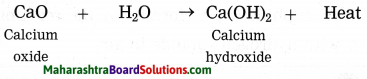
Maharashtra Board Class 10 Science Solutions Part 1 Chapter 3 Chemical Reactions and Equations 61

Maharashtra Board Class 10 Science Solutions Part 1 Chapter 3 Chemical Reactions and Equations

Question 7.
Sugar is heated.
Answer:
When sugar is heated, it decomposes to form carbon (black substance).

Maharashtra Board Class 10 Science Solutions Part 1 Chapter 3 Chemical Reactions and Equations 62

Question 8.
Electric current is passed through acidulated water.
Answer:
When an electric current is passed through acidulated water, it decomposes into hydrogen and
oxygen gas.

Maharashtra Board Class 10 Science Solutions Part 1 Chapter 3 Chemical Reactions and Equations 63

Question 9.
Zinc powder is added to copper sulphate solution.
Answer:
When zinc powder is added to copper sulphate solution, more reactive zinc displaces less reactive copper from copper sulphate solution. The colourless zinc sulphate is formed with evolution of heat.

Maharashtra Board Class 10 Science Solutions Part 1 Chapter 3 Chemical Reactions and Equations 64

Question 10.
Iron powder is added to copper sulphate solution.
Answer:
When iron powder is added to copper sulphate solution, more reactive iron displaces less reactive copper from copper sulphate. The colourless ferrous sulphate solution is formed with evolution of heat.

Maharashtra Board Class 10 Science Solutions Part 1 Chapter 3 Chemical Reactions and Equations 65

Question 11.
Lead is added to copper sulphate solution.
Answer:
When lead is added to copper sulphate solution, more reactive lead displaces less reactive copper from copper sulphate. The colourless lead sulphate solution is formed with evolution of heat.

Maharashtra Board Class 10 Science Solutions Part 1 Chapter 3 Chemical Reactions and Equations 66

Question 12.
Potassium chromate solution is added to barium sulphate solution.
Answer:
When potassium chromate solution is added to barium sulphate solution, yellow precipitate of barium chromate is formed.

Maharashtra Board Class 10 Science Solutions Part 1 Chapter 3 Chemical Reactions and Equations 67

Question 13.
Calcium chloride solution is added to sodium carbonate solution.
Answer:
When calcium chloride solution is added to sodium carbonate solution, white precipitate of calcium carbonate is formed.
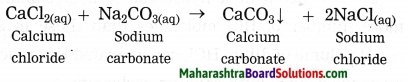
Maharashtra Board Class 10 Science Solutions Part 1 Chapter 3 Chemical Reactions and Equations 68

Question 14.
Sodium chloride solution is mixed with silver nitrate solution.
Answer:
When sodium chloride solution is mixed with silver nitrate solution, white precipitate or silver chloride is formed.
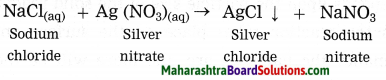
Maharashtra Board Class 10 Science Solutions Part 1 Chapter 3 Chemical Reactions and Equations 69

Question 15.
Dilute sulphuric acid is added to barium chloride solution.
Answer:
When dilute sulphuric acid is added to barium chloride solution, white precipitate of barium sulphate is rormed.

Maharashtra Board Class 10 Science Solutions Part 1 Chapter 3 Chemical Reactions and Equations 70

Question 16.
Calcium carbonate (Lime stone) is treated with dil. hydrochloric acid.
Answer:
When calcium carbonate (lime stone) is treated with dil. hydrochloric acid, carbon dioxide gas is formed.
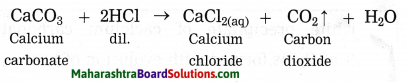
Maharashtra Board Class 10 Science Solutions Part 1 Chapter 3 Chemical Reactions and Equations 71

Maharashtra Board Class 10 Science Solutions Part 1 Chapter 3 Chemical Reactions and Equations

Question 17.
Aluminium is treated with dil. hydrochloric acid.
Answer:
When aluminium is treated with dilute hydrochloric acid, hydrogen gas is liberated.

Maharashtra Board Class 10 Science Solutions Part 1 Chapter 3 Chemical Reactions and Equations 72

Question 18.
Magnesium is treated with hydrochloric acid.
Answer:
When magnesium is treated with hydrochloric acid, hydrogen gas is liberated.

Maharashtra Board Class 10 Science Solutions Part 1 Chapter 3 Chemical Reactions and Equations 73

Question 19.
Hydrogen peroxide is decomposed in the presence of manganese dioxide (MnO2).
Answer:
When hvdrogen peroxide is decomposed in the presence of manganese dioxide (MnO2), water and oxygen are formed.
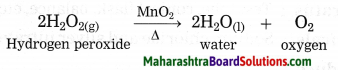
Maharashtra Board Class 10 Science Solutions Part 1 Chapter 3 Chemical Reactions and Equations 74

Question 20.
Ethyl alcohol is treated with acidified potassium dlchromate.
Answer:
When ethly alcohol is treated with acidified potassium dichromate, acetic acid is formed. This is oxidation reaction.
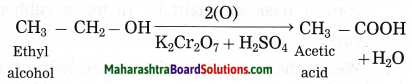
Maharashtra Board Class 10 Science Solutions Part 1 Chapter 3 Chemical Reactions and Equations 75

Question 21.
Hydrogen gas is passed over black copper oxide.
Answer:
When hydrogen gas is passed over black copper oxide, a reddish coloured layer of copper is formed.
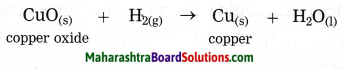
Maharashtra Board Class 10 Science Solutions Part 1 Chapter 3 Chemical Reactions and Equations 76

Maharashtra Board Class 10 History Solutions Chapter 7 Sports and History

Balbharti Maharashtra State Board Class 10 History Solutions Chapter 7 Sports and History Notes, Textbook Exercise Important Questions and Answers.

Maharashtra State Board Class 10 History Solutions Chapter 7 Sports and History

Question 1.
(A) Choose the correct option from the given options and complete the statement.
(1) The ancient event of Olympic competitions used to be held at ………………………… .
(a) Olympia, Greece
(b) Rome
(c) India
(d) China
Answer:
(a) Greece

Maharashtra Board Solutions

(2) The wooden dolls made in Maharashtra are known as ………………………… .
(a) Thaki
(b) Kalichandika
(c) Gangavati
(d) Champavati
Answer:
(a) Thaki

(B) Identify and write the wrong pair in the following set.
(1) Mallakhamb – Outdoor game based on physical skills
(2) Water polo – Water sport
(3) Skating – Adventurous ice sport
(4) Chess – Outdoor game
Answer:
(4) Chess – Outdoor game

Question 2.
Write notes :
(1) Toys and Festivals
Answer:

  • Toys and festivals are inter-related since ancient times.
  • Toys are used for decoration in different cultures and religions during festivals.
  • In some cultures toys are distributed as gifts. Santa Claus gifts children toys during Christmas.
  • As part of Diwali celebration in Maharashtra, model forts are made displaying images of Chhatrapati Shivaji Maharaj, his soldiers and animals which are toys.
  • Clay images of snakes and bullocks are- sold during festivals like Bail pola and Nagpanchami.

(2) Sports and movies
Answer:

  • The presence of sports was limited to a scene in the movies made earlier.
  • In recent times, biographical movies are made on sportspersons and on sports.
  • Movies like Lagaan and Dangal are made related to cricket and wrestling respectively.
  • Biographical movies are made on Mary Kom, and the Phogat sisters.
  • Movies are made on careers of famous sprinter Milkha Singh.
  • Bharat Ratna Sachin Tendulkar and Cricketer Mahendra Singh Dhoni.
  • Overall, movies and sports are related from the silent era till date.

Question 3.
Explain the following statements with reasons.
(1) Currently the structure of sports economy has been significantly affected.
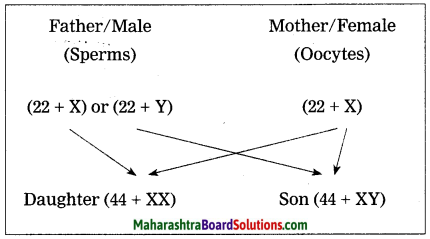
Answer:

  • The process of globalisation has influenced the field of sports in the 20th-21st century.
  • International matches of various sports like Cricket, Football, etc. are*telecast in every corner of the world.
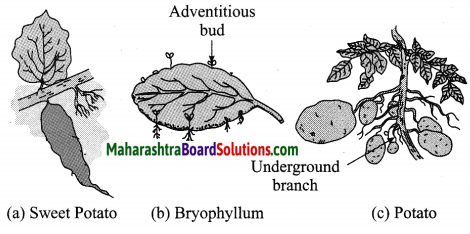
  • Fans watch these matches for entertainment,r and aspiring players to learn more.
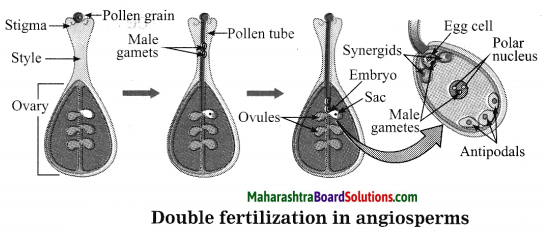
  • The citizens of the non-participating countries also watch these matches.
  • Retired players get a chance on television channels as commentators.
  • Matches garner a large audience, hence the commercial companies look at it as an opportunity to advertise and sell their products.
  • All these factors have led to change in the structure of sports economy.

Maharashtra Board Solutions

(2) Toys can tell us about cultural history.
Answer:
A tradition of making different type of toys for entertainment is going on since ancient time.

  • Toys give us an idea about the cultural and religious development of that period.
  • Clay models of forts and the images of Chhatrapati Shivaji Maharaj placed on fort gives us an idea about the structures of forts during that period.
  • An ivory doll found at Pompeii, an ancient city in Italy, sheds light on Indo-Roman trade and cultural relations.
  • The mention of games, toys and flying and dancing dolls in Kathasaritsagara give us an idea about cultural history of toys. In this way, we come to know about cultural history from toys.

Question 4.
Write detailed answers to the following questions.
(1) Write about the history of sports equipment and toys in ancient India.
Answer:

  1. The history of sports equipment and toys dates back to epic age. The ancient Indian literature and epics mention various games such as games of dice, wrestling, horse and chariot race.
  2. Sports are of two types ‘Indoor Games’ and ‘Outdoor Games’. Indoor games such as chess, card games, dice, carrom, kachkavadya or Indian ludo, Bhatukli were very popular. It can be noted that all of them required equipment to play.
  3. Cards to play card games, dice to play game of dice, a board and pieces to play chess, bunch of seeds or stones to play sagargote; (playing house) to play Bhatukli.
  4. Likewise, Outdoor games like marbles, lagori (seven stones), vitti-dandu, bhavare (tops) all require material like marbles, stones, tops, a small and large stick to play.
  5. A Sanskrit play by Shudraka is named as Mrichchhakatika. It means a clay cart. A clay cart was a toy used to play during Harappan period.
  6. Kathasaritsagara has very interesting descriptions of games and toys. There are descriptions of flying dolls. There is a mention that on pressing a key some dolls used to fly, some used to dance and some used to make sounds.

(2) Explain the close tie between sports and history.
Answer:
Sports and history are closely related with each other.

  1. It is a must for a sports writer to know the history of the game he chooses to write on.
  2. In order to write a review on any sport competition, the critic should have knowledge of competitions held in the past.
  3. A comparative study of the skills, techniques and strategies used in the past and developments or improvements in the present makes the review comprehensive.
  4. The writer has to resort to history while writing columns or articles on sports events like Olympics or Asiad or any national or international matches.
  5. While commentating on Akashvani and Doordarshan, an expert commentator needs to have good knowledge of the history of the game, previous records of illustrious and eminent players, statistical analysis and historical anecdotes related to the game and players.
  6. Coaches, special experts, selection committee should have information of the players, their strength and weakness and also history of the players in the opposing team. Even players should know history of their competitors.
    In short, it is essential to know the history of all the aspects related to sports.

(3) Explain the difference between indoor and outdoor games.
Answer:

Indoor gamesOutdoor games
1. Most of the indoor games are played by sitting at one place. They are played in a closed environment.1. Outdoor games are played on a field.
2. Indoor games require skills but physical exercise is negligible.2. Outdoor games need more physical exercise and skill.
3. As there is no exertion in indoor games, so it is not essential to develop stamina.3. Outdoor games require stamina and strength.
4. Indoor games do not involve adventure.
Maharashtra Board Solutions
4. Outdoor games involve adventures at times, e.g.. Auto racing
5. Indoor games includes Chess, Indian Ludo (Playing house) Bhatukli and many more.5. Outdoor games involve national and international games like Kabaddi, Kho-kho, Hockey, Cricket, etc.
6. With the exception of chess and carrom no competitions are held for rest of the Indoor games.6. National and international competitions are held of almost all outdoor games.

Project
(1) Collect information about your favorite sports and its players.
(2) Discuss the hardships the sportspersons have to face while training for the sport with the help of information gathered through movies and literature.

Question 5.
Complete the sentences by choosing the correct option:
(a) The activity which combines physical exercise and entertainment is ……………………….. .
(a) Show
(b) Attitude
(c) Sports
(d) Competition
Answer:
(c) Sports

(b) ……………………….. was looked upon as a game and entertainment by ancient people.
(a) Dancing
(b) Playing
(c) Singing
(d) Hunting
Answer:
(d) Hunting

(c) ……………………….. and its various tactics were devised by Balambhat Deodhar, the physical trainer of Peshwa Bajirao II.
(a) Kabaddi
(b) Atyapatya
(c) Khokho
(d) Mallakhamb
Answer:
(d) Mallakhamb.

(d) The Indian Government has honoured Sachin, Tendulkar with ……………………… for his illustrious achievements in the field of cricket.
(a) Padma Shri
(b) Khel Ratna
(c) Arjuna Award
(d) Bharat Ratna
Answer:
(d) Bharat Ratna

(e) ……………………… is the national game of India.
(a) Hockey
(b) Cricket
(c) Football
(d) Kabaddi
Answer:
(a) Hockey

Maharashtra Board Solutions

(f) The National Sports Day of India is celebrated on 29th August which is the birth date of …………………….. .
(a) Khashaba Jadhav
(b) Sachin Tendulkar
(c) Major Dhyan Chand
(d) Bal J. Pandit
Answer:
(c) Major Dhyan Chand

(g) Vishnubhat Godse in his book Maza Pravas wrote that sports and physical activity had great importance in the daily schedule of ………………………
(a) Tatya Tope
(b) Queen of Jhansi Lakshmibai
(c) Bahadur Shah Jaffar
(d) Nanasaheb Peshwa
Answer:
(b) Queen of Jhansi Lakshmibai

(g) Maruti Mane is known for …………………….. .
(a) Hockey
(b) Kabaddi
(c) Marathon
(d) Wrestling
Answer:
(d) Wrestling.

(h) …………………….. wrote the play Mrichchhakatika which means a clay cart.
(a) Harshvardhan
(b) Shudraka
(c) Bhavbhuti
(4) Kalidas
Answer:
(b) Shudraka

(i) The findings in the excavations of …………………….., an ancient city in Italy includes an ivory doll made by Indian craftsmen.
(a) Rome
(b) Athens
(c) Sparta
(d) Pompeii
Answer:
(d) Pompeii

(j) An interesting description of games and toys is found in ……………………. .
(a) Shakuntal
(b) Panchatantra
(c) Mrichchhakatika
(d) Kathasaritsagara
Answer:
(d) Kathasaritsagara

(k) Major Dhyan Chand was honoured in 1956 with …………………….. for his marvellous achievements in hockey.
(a) Padma Shri
(b) Padma Bhushan
(c) Padma Vibhushan
(d) Bharat Ratna
Answer:
(c) Padma Bhushan

Maharashtra Board Solutions

(l) …………………….. was the first Indian female boxer to win a bronze medal in the Olympics.
(a) P 7 Sindhu
(b) Mary Kom
(c) Geeta Phoghat
(d) Saina Nehwal
Answer:
(b) Mary Kom.

Question 6.
Identify the wrong pair in the following and write it:
(1)

(1) MallakhambOutdoor game based on physical skills
(2) Water PoloWater sport
(3) SkatingAdventure ice sports
(4) ChessOutdoor game

Answer:
Wrong pair: Chess – Outdoor game

(2)

(1) Mallakhamb trainerBalambhat Deodhar
(2) Wizard of HockeyMilkha Singh
(3) First Indian female boxerMary Kom
(4) First Indian female wrestlersPhogat sisters

Answer:
Wrong pair: Wizard of Hockey – Milkha Singh

Question 7.
Do as directed
(A) Complete the graphical description:
(1)
Maharashtra Board Class 10 History Solutions Chapter 7 Sports and History 1
Answer:
Maharashtra Board Class 10 History Solutions Chapter 7 Sports and History 2

Maharashtra Board Solutions

Maharashtra Board Class 10 History Solutions Chapter 7 Sports and History 3
Answer:
Maharashtra Board Class 10 History Solutions Chapter 7 Sports and History 4

Maharashtra Board Class 10 History Solutions Chapter 7 Sports and History 5
Answer:
Maharashtra Board Class 10 History Solutions Chapter 7 Sports and History 6

Maharashtra Board Class 10 History Solutions Chapter 7 Sports and History 7
Answer:
Maharashtra Board Class 10 History Solutions Chapter 7 Sports and History 8

Maharashtra Board Solutions

(B) Prepare a Tree-Diagram on typs of games:
Answer:
Maharashtra Board Class 10 History Solutions Chapter 7 Sports and History 9

Question 8.
Write short notes:

(a) Indigenous Games:
Answer:

  1. The games which have their origin in India and are an important part of Indian culture are indigenous games.
  2. They are of two types – ‘Indoor Games’ and ‘Outdoor Games’. Indoor Games are played within a closed environment and a number of them are played by sitting at one place. Chess, card games, dice, carrom, etc. are indigenous indoor games.
  3. An open space or preferably a playground is required to play outdoor games. Kabaddi, Atyapatya, Kho-kho etc. are indigenous outdoor games.
  4. The special feature of indigenous games is that they do not require high cost material and hence are less expensive. Phugadi, Zimma, Bhatukali are some of the indigenous games played by girls. In modern times, all national and international games are played by both girls and boys.

Question 9.
Explain the following statements with reasons:

(a) Major Dhyan Chand is called the Wizard of Hockey.
Answer:

  • Major Dhyan Chand was part of hockey teams as a player in 1928 and 1932 which won gold medal at Olympics.
  • He was also captain of the Indian Hockey team which won a Gold Medal at the Berlin Olympics in 1936.
  • He shot 25 goals against America and Japan in the 1932 Olympics.
  • He shot more than 400 goals in his entire career which include national and international matches. Owing to his brilliant achievement he is called the ‘Wizard of Hockey’.

(b) Globalisation has influenced sports.
Answer:

  1. No sport is limited to any one country. Television and other media channels telecast matches widening the reach of sports in all comejcs, of the world.
  2. International competition Asiad, Paralympics, Cricket Wc watched by people irrespective r
    part of the world.
  3. World Cup matches of cricket, hockey and football are held.
  4. No country has a monopoly on any sport which means that globalisation has influenced sports.

(c) A commentator should know the history of the game.
Answer:

  • The mere description of a live match is not enough for commentators.
  • A commentator should have good knowledge of the history of the game, previous records (who made or who broke) and eminent players in the past as well as events related to different competitions.
  • Along with the history and information of the playground, commentator should narrate records made by the players in different matches.
  • It will make his commentary interesting. Therefore, it is essential for the commentator to know the history of the game.

Maharashtra Board Solutions

Question 10.
Answer the following questions in 25-30 words:
(a) Explain the importance of sports.
Answer:
Sports has gained great importance for the following reasons:

  • Sports helps us to overcome our pains, worries and sufferings. We feel relaxed and refreshed by playing games.
  • Games which involve a lot of physical activity not only provide good exercise but also help in building a tenacious and strong body.
  • One. can develop courage; determination and sportsmanship playing games. A sense of cooperation and teamspirit develops when we participate in games which require collective participation.
  • Team games also help in developing a leadership! quality.

(b) Write about the history of sports.
Answer:

  • It is a natural instinct in human beings to play. From beginning of civilisation till date man has played different types of games for his entertainment.
  • Hunting was a way of obtaining food for the ancient people as well as considered a game.
  • Horse and chariot races, wrestling, game of dice (dyut) are mentioned in ancient Indian literary texts and epics.
  • Dolls, whistles, toy carts were discovered in the excavations at Harappa. So, it can be said that the history of sports is as old as the history of man.

(c) Write about the importance of sports in education field.
Answer:

  • Sports are an integral part „ of education. The making of a player begins at school level.
  • Many types of sports events are held at the international level. To make the players competent they are given opportunity to play at district, state and national level.
  • They are promoted and sponsored by the government and private sectors. Talented and ranking players get State scholarship or National scholarship.
  • Seats are reserved for them in colleges and Universities. It has been observed that the foundation of successful players is laid in school life.

(d) What do we need to know while making movies on sports?
Answer:
While making a movie on sports the makers should have complete information of the. sport as well as its history.

  1. Nowadays special research teams are appointed by production houses which do thorough research on the subject of the movie.
  2. In order to gather information on the sportsperson or the sport it is essential to study books, articles, columns written by eminent sports writers.
  3. If the movie is on a sportsperson, all interviews published in national and international magazines and newspapers should be read.
  4. Factors such as period, type of equipment used, sports wear, dressing style, social life needs to be studied.
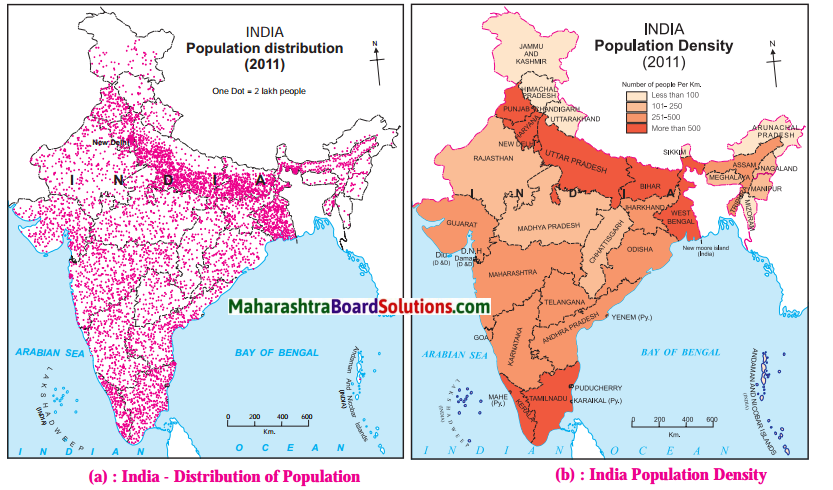
  5. General understanding of the people about the game, practises and famous sportspersons is required.
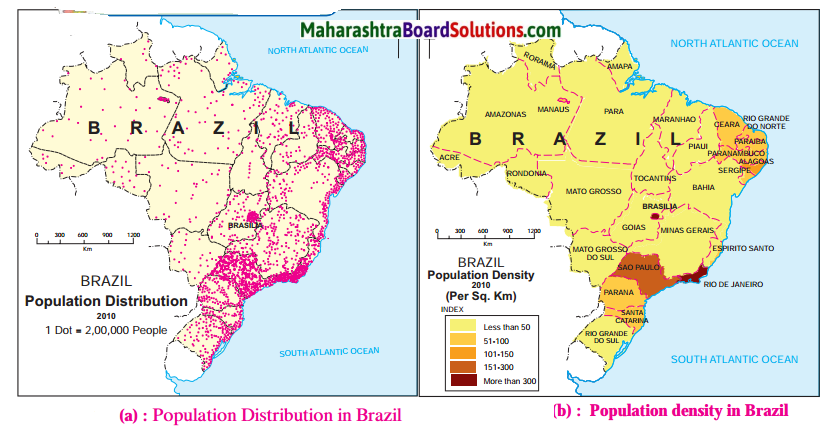
Question 11.
Read the following passage and answer the following questions:

Maharashtra Board Solutions

(a) Complete the Concept Map:
Maharashtra Board Class 10 History Solutions Chapter 7 Sports and History 10
Answer:
Maharashtra Board Class 10 History Solutions Chapter 7 Sports and History 11

(b) How are the experts in history helpful regarding international sports competition?
Answer:
Experts in history are helpful to write and critically analyse the game.

(c) How are professional opportunities available in field of sports?
Answer:
There are many professional opportunities available in the field of sports.

  • Writers are in demand who can write on sports and critics to write reviews are in demand.
  • Commentators are in demand on Television, radio and various other private channels. Experts and assistants are needed to provide information regularly.
  • Coaches train the players, playground staff to maintain the field, umpires, etc.
  • Cameramen, computer experts and team of assistants to have uninterrupted transmission. Trained and qualified referees are required to work at district, national and international levels.
  • Overall, a great number of job opportunities are available in the field of sports.

Question 12.
Write a detailed answer to the following:

(a) Write about the history of sports literature and toys in ancient India.
Answer:
A new enterprise is developing in publishing related to sports in India. There is extensive written work on various sports.

  • Many books related to sports and biographies are published. Encylopaedias are being written on sports.
  • An independent encyclopaedia is written on exercise. The History of Mallakhamb is recently published.
  • Sports magazines are published fortnightly and monthly.
  • Many newspapers have allotted a separate section or last pages for news related to sports.
  • ‘Shatkar’ was a sports magazine published some years ago. There is ample of literature available on sports.

(b) Trace the development of toys and their importance.
Answer:

  • Toys and games have been essentially part of entertainment from ancient times. Every I developing society has made toys for the 8 entertainment and education of their children.
  • Toys were found at archaeological sites at various places. The toys were made of clay, baked clay, terracotta and ivory.
  • Either a mould was used to make the toy or it was fashioned by hand.
  • Toys and the material used to make them were indicators of the development and advancement of civilisations.
  • An interesting description of flying dolls is found in Kathasaritsagara. The dolls used to fly, made some sound and some danced when a key was pressed.
  • Toys give us information about the period it was made, how they were made, religious and 8 cultural practices and technical know-how of the 8 people. ’

Question 13.
Observe the picture and write information about the event it is related to:
Maharashtra Board Class 10 History Solutions Chapter 7 Sports and History 12
Answer:

  1. This picture is the logo of the modern Olympic Games. The five interlocked rings represent the five continents of the world.
  2. The rings coloured blue, yellow, black, green and red on a white field are known as the ‘Olympic rings’. The symbol was originally designed in 1912 by Pierre de Coubertin.
  3. Olympic rings are the symbol of games which were first played in the ancient city of Olympia. They were held after every four years.
  4. The ancient Olympics had fewer events than the modern games and only Greek men were allowed to participate. Events such as Horse and Chariot race, Footrace, Wrestling, Boxing, Discus Throw, Pentathlon were held.
  5. The Greeks standardised rules of the sports were laid which was helpful to organise the games systematically.
  6. The modern Olympic games are also held every four years. It is a great honour for sportspersons to participate and win the Olympic medals.

Maharashtra Board Solutions

Memory Map
Maharashtra Board Class 10 History Solutions Chapter 7 Sports and History 13

Maharashtra Board Class 10 Political Science Solutions Chapter 2 The Electoral Process

Balbharti Maharashtra State Board Class 10 Political Science Solutions Chapter 2 The Electoral Process Notes, Textbook Exercise Important Questions and Answers.

Maharashtra State Board Class 10 Political Science Solutions Chapter 2 The Electoral Process

Question 1.
Choose the correct option from the given options and complete the sentences.
(1) The Election Commissioner is appointed by the …………………………. .
(a) President
(b) Prime Minister
(c) Speaker of Loksabha
(d) Vice President
Answer:
(a) President

Maharashtra Board Solutions

(2) …………………………. was appointed as the first Chief Election Commissioner of independent India.
(a) Dr. Rajendra Prasad
(b) T.N. Sheshan
(c) Sukumar Sen
(d) Neela Satyanarayan
Answer:
(c) Sukumar Sen

(3) Constituencies are created by …………………………. committee of the Election Commission.
(a) Selection
(b) Delimitation
(c) Voting
(d) Timetable
Answer:
(b) Delimitation

Question 2.
State whether the following statements are true or false. Give reasons for your answer.
(1) The Elections Commission lays down the code of conduct during elections.
Answer:
The above statement is True. Reasons:

  • It ensures free and fair elections.
  • Maipractices during the election come under control.
  • Due to the strict observance of the code of conduct in the last few’ elections, the common voters have become confident.

(2) Under special circumstances the Election Commission holds re-elections in a particular constituency for a second time.
Answer:
The above statement is True. Reasons :

  • Sometimes, the representative of Lok Sabha, Vidhan Sabha or the local self governmènt resigns from his/her constituençy.
  • In some cases, death of the representative occurs.
  • In such special situations, the Election Commission has to conduct an election for a second time. It is called By-elections.

Maharashtra Board Solutions

(3) The state government decides as to when and in how many stages the elections would be held in a particular State.
Answer:
The above statement is False. Reasons :

  • The entire process of conducting elections is entrusted upon and managed by the Election Commission.
  • If this responsibility is given to the state government it may adopt a biased approach.
  • Hence, the Constitution has formed the Election Commission an independent body to carry out the responsibility.

Therefore, it is decided by the Election Commission as to when and in how many stages it will conduct elections.

Question 3.
Explain the concept.
(1) Reorganising the constituencies
Answer:
(1) The Election Commission of India formed constituencies for Lok Sabha and Legislative Assembly.
(2) The Election Commission had decided upon the constituencies before the first election. As the years passed, there was a lot of migration of the people for business and other activities from the villages to cities.
(3) This changed the demography to large extent. Number of voters in some constituencies reduced while in some it increased to a very great extent. This disturbed the ratio of- seats allotted as compared to population in those constituencies.
(4) Hence, the need to readjust the constituencies arose. The Delimitation Commission of the election commission does the work of reorganising or restructuring of constituencies.

(2) Midterm Elections

Question 4.
Complete the following picture.
Maharashtra Board Class 10 Political Science Solutions Chapter 2 The Electoral Process 1
Answer:
Maharashtra Board Class 10 Political Science Solutions Chapter 2 The Electoral Process 2
Maharashtra Board Class 10 Political Science Solutions Chapter 2 The Electoral Process 3
Answer:
Maharashtra Board Class 10 Political Science Solutions Chapter 2 The Electoral Process 4

Maharashtra Board Solutions

Maharashtra Board Class 10 Political Science Solutions Chapter 2 The Electoral Process 5
Answer:
Maharashtra Board Class 10 Political Science Solutions Chapter 2 The Electoral Process 6

Maharashtra Board Class 10 Political Science Solutions Chapter 2 The Electoral Process 7
Answer:
Maharashtra Board Class 10 Political Science Solutions Chapter 2 The Electoral Process 8

Question 5.
Answer in brief.
(1) Explain the functions of the Election Commission.
Answer:
The functions of the Election Commissipn are:
(1) Prepare the voters’ list.
(2) Decide election timetable and decide the entire process of holding elections.
(3) Scrutinize the applications of the candidates.
(4) Conduct free and fair elections and do all the work related to it.
(5) Give recognition and also de-recognize political parties.
(6) Resolve all the disputes and complaints regarding elections.

Maharashtra Board Solutions

(2) Write some additional information about post of the Election Commissioner.
Answer:
(1) The Election Commission in India has one Chief Election Commissioner and two other Chief Commissioners.
(2) All the commissioners are appointed by the President.
(3) The Chief Election Commissioner of India is usually a member of the Indian Civil Service or. Indian Administrative Service.
(4) The responsibility of conducting free and fair elections to the Parliament and State Legislatures lies with the Election Commissioner.
(5) In order do safeguard the independence of the Election Commissioner, he cannot be easily removed from the post for any political reasons.

(3) Explain the meaning of Code of Conduct.
Answer:
(1) After the announcement of elections till the declaration of results, the Election Commission enforces the Code of Conduct.
(2) It explains the rules to be followed by the government, political parties candidates and voters before and during elections.
(3) Code of conduct is adopted to control malpractices during elections. It ensure free and fair ecections.

Project
Organise a mock poll in the school to understand the process of voting.
Answer:

Memory Map
Maharashtra Board Class 10 Political Science Solutions Chapter 2 The Electoral Process 10

Question 6.
Choose the correct option from the given options and complete the sentences:
(a) Article of Indian Constitution created the independent body of Election Commisšion.

(a) 351
(b) 370
(c) 324
(d) 301
Answer:
(c) 324

Maharashtra Board Solutions

(b) system exists in India.
(a) Single-party
(b) Two-party
(c) Multi-party
(d) No-party
Answer:
(c) Multi-party.

(c) The right to give recognition or de-recognize a political party lies with ……………….. .
(a) President
(b) Election Commission
(c) Parliament
(d) Vice-President
Answer:
(b) Election Commission

(d) There are constituencies of Lok Sabha at present.
(a) 288
(b) 350
(c) 500
(d) 543
Answer:
(d) 543

(e) from the present state of Himachal Pradesh was the first voter.
(a) Sukumar Sen
(b) Sham Sharan Negi
(c) Prem Kumar Ghumal
(d) P N. Chadda
Answer:
(b) Sham Sharan Negi

(f) Due to EVM, people can also vote easily.
(a) elder
(b) salaried
(c) Divyanga
(d) Transgender
Answer:
(c) Divyanga

Maharashtra Board Solutions

(g) The first elections in India were held in
(a) 1948-49
(b) 1949-50
(c) 1950-51
(d) 1951-52
Answer:
(d) 1951-52.

Question 7.
State whether following statements are True or False. Give reasons for your answer :
(a) There should be secrecy in Election process.
Answer:
The above statement is False. Reasons :

  • Election should be conducted in a free and fair environment.
  • If the elections are not held in free environment then there are chances of malpractices and corruption.
  • Then, it will be impossible to elect the honest and efficient candidates.

(b) The Election Commission has started awareness campaign for registration of voters.
Answer:
The above statement is True. Reasons :

  • The responsibility of preparing and updating electoral roll lies with the Election Commission.
  • The Election Commission starts an awareness campaign to create awareness among new eligible voters so that they register themselves in the voter’s list.
  • The Indian voter is not -much aware about the election process.
  • Special voter’s awareness campaign is run for voter’s registration.
  • For their awareness National Voter’s Day is celebrated every year.

(c) Every candidate who fills the nomination form can contest election.
Answer:
The above statement is False. Reasons :

  • Every candidate of a party or independent candidate has to be personally present to fill the nomination form.
  • It is necessary for him or her to give complete information in the nomination form as decided by the Election Commission.
  • The nomination forms are then scrutinized. If there are irregularities in a nomination paper and if the information is found to be false the nomination forms are rejected.

Therefore, it is not possible for every candidate who fills the nomination form to contest election.

Maharashtra Board Solutions

(d) Sometimes, the Election Commission has to conduct mid-term elections. OR Explain the concept : Mid-Term Elections.
Answer:
The above statement is True. Reasons :

  • If the elected government in power loses its majority before completing its term.
  • If no party gets complete majority, then two or more parties come together and form a coalition government.
  • Such coalition government collapses if any party withdraws the given support.
  • In such situations, the government is left with no option other than resigning.
  • If there is no alternative available to form government then the Parliament or Vidhan Sabha is dissolved before completing its term. In such a scenario, the Election Commission has to conduct mid-term elections.

Question 8.
Explain the following concepts :

(a) What is representation?
Answer:
Modern democracy is a representative democracy. In a democracy it is not possible to involve the entire population in the ecision-making process. This resulted in the starting of the practice of electing some people on behalf of entire population
as representatives who would run the government. The representatives who form the government are expected to be responsible to the people and give preference to the welfare of the people.

  • Direct and Indirect or representative democracy rire two types of democracy.
  • In modem nation-states; the population has increased to a great èxtent.
  • So it is impossible to involve all the people in decision-making process.
  • Thus, th practice of electing some people on behalf of entire population as representatives started.
  • The elected representatives form government and work for the welfare of the people.

(b) Election Commission :
Answer:
In India, the Election Commission is central to the process of elections. Art. 324 of the Indian Constitution has established this autonomous body which consists of one Chief Election Commissioner and two other commissioners.

  1. One of the most important features of a democratic nation is elections at regular intervals. Holding free and fair elections at regular intervals is essential for a democratic system.
  2. Under the Article 324 of the Constitution, Election Commission was formed in 1950. The President appoints one Chief Election Commissioner and two additional commissioners. It is an autonomous body.
  3. The rank and powers of all the three commissioners are the same. The declaration of dates of the elections to the announcement of the results the entire procedure is monitored by the Election Commission.
  4. The Election Commission does not have its own staff to carry out this procedure. So they carry out the work with help of government employees and teachers. Special provisions are made for all finances incurred by the Election Commission.

Maharashtra Board Solutions

Question 9.
Write short notes :
(a) Journey from Ballot box to EVM machine :
Answer:

  1. From the first election in 1951-52 till 1999, elections were held using ballot box. Twenty lakh ballot boxes were used in the first election. Voters used to cast his or her vote by stamping in front of the candidate’s name and put them in the metal boxes.
  2. Electronic Voting Machines (EVMs) were first used for 5 seats in Rajasthan, 5 seats in Madhya Pradesh and 6 seats in New Delhi 1998 in Legislative Assembly.
  3. EVM machines were used at all polling booths in the general elections held in 2004. It proved to be a very useful device.
  4. It has been improvised since its first use. Due to the use of EVMs the results are declared early and at a very fast rate.

(b) Recognition to Political Parties :
Answer:

  • India has a multi-party system with recognition accorded to national, state and regional level parties by the Election Commission.
  • Their recognition depends on the voting percentage received by them in the assembly elections and number of elected representatives of their party.
  • If any party does not fulfill these criteria, its recognition is cancelled.
  • The Election Commission allots appropriate symbols to parties and independent candidates. All political parties should have recognition of the Election Commission.

Question 10.
Complete the concept map :

(a) Prepare a flow chart on the process of election.
Answer:
Maharashtra Board Class 10 Political Science Solutions Chapter 2 The Electoral Process 9

Maharashtra Board Solutions

(b) Which two conditions among following is the violation of code of conduct?
(1) The candidate distributes items of household use. –
(2) Promises made to resolve the water problem if elected.
(3) To go from door to door to meet voters and request them to vote.
(4) To appeal on the basis of caste and religion to get support.
Answer:
(1) The candidate distributes items of household use.
(2) To appeal on the basis of caste and religion to get support.

Question 11.
Answer in brief :
(a) Why is it important to conduct elections?
Answer:
It is important to conduct elections because of the following reasons :

  • The existence and working of democracy depends on elections.
  • All political parties get a chance to rule.
  • Elections help to bring a change in power through peaceful meAnswer:
  • It not only changes government policies but also society.

(b) What are the conditions for voting?
Answer:
The following are the conditions for voting:

  • The person should be a citizen of India.
  • He should have completed 18 years of age.
  • His name should appear in voters’ list.
  • The person should have photo identity card issued by the Election Commission of India.

(c) What action is taken by the Election Commission if disputes arise regarding elections?
Answer:

  • If any disputes arise regarding the elections, the Election Commission is empowered to take final decisions.
  • The Election Commission conducts a thorough inquiry about the said dispute.
  • If there is evidence of any malpractices during elections, in any constituency, it declares the elections invalid and announces re-polls.
  • If any candidate breaks the code of conduct and contests elections, he/she is barred by the Election Commission from contesting elections.

(d) What challenges are faced by the Election Commission to conduct free and fair elections?
Answer:
The following challenges are faced by the Election Commission tcx conduct free and fair elections :

  • Managing the large geographical landscape and huge electoral population.
  • To stop misuse of money and muscle power during elections.
  • Barring candidates with criminal background from contesting elections.
  • Conducting elections successfully in politically criminalised environment.
  • Conducting elections in spite of increasing instances of violence and making them a success.

Maharashtra Board Solutions

(e) What are the advantages of EVM machines?
Answer:
The battery operated Electronic Voting Machine (EVM) has more advantages than the ballot box. They are as follows :

  • It saves tonnes of paper used to make ballot paper.
  • So, it conserves the environment as it stops the reckless cutting of trees required to make paper.
  • If the voter does not wish to cast his vote in favour of any candidate contesting, he can make use of NOTA (None Of The Above).
  • It makes counting of the votes much faster which enables the election officer to declare result in a short time.
  • It is helpful for disabled (Divyanga) people to cast vote.

(f) Explain the features of procedures of voting during the first Lok Sabha Election.
Answer:

  • It was a challenge to prepare voters’ list at the time of the first election. Illiteracy rate was very high in our country. Therefore, the procedure to vote and making the voter list was a challenge.
  • 20 lac steel boxes were made and election symbols of political parties were stuck on it.
  • Blank ballot papers were given to the voters and they were supposed to drop in the box having the election symbols of the party they decide to vote for.
  • Even the illiterate people could vote because of this system.

Question 12.
Give your opinion :
(a) When candidates have only the condition of age, why should they give other information to Election Commission? Answer:

  • While filling the form candidates should reveal information about his property assets and if there are any criminal charges against him.
  • When candidates have only the condition of age as eligibility, why should they give other information to election commission?
  • Why are the candidates required to give the information of their property to Election Commission?
  • Such candidates if elected can misuse power and amass wealth with corrupt practices.
  • With criminal background they can even threaten voters to vote for him.
  • His nomination could get cancelled based on the information.

(b) Why is it so?
(A) Some constituencies are reserved for scheduled castes and scheduled tribes.
Answer:

  • It is difficult for the people of scheduled castes and scheduled tribes to get representation as they are scattered in different parts.
  • Without a representative it is difficult to discuss their problems in Parliament.
  • Lack of representative will hinder their progress. Hence some constituencies are reserved for scheduled castes and scheduled tribes.
  • Some constituencies are kept reserved for Scheduled caste and Scheduled tribes.
  • Every political party has an election symbol.
  • At the time of voting and counting of votes, the official representatives of political parties remain present.
  • Recognised parties have equal opportunity to present their side before media such as television and radio.

Maharashtra Board Solutions

(B) Why every political party has an election symbol?
Answer:

  • After independence, the literacy rate was quite low in India.
  • It was not possible for the voters to read the name of the candidate and vote.
  • Therefore, the Election Commission gave symbols to political parties and independent candidates which helped the voters to identify and decide whom to vote for.

(C) At the time of voting and counting of votes, the official representatives of political parties remain present.
Answer:

  • There are incidences of duplicate voters who register in multiple constituencies.
  • There are cases of rigging of EVM or booth capturing.
  • Such incidences are brought to light by representatives who are present at polling centres.
  • During the counting process, if the EVM machine looks tampered, the representative can raise an objection.

(D) All recognised parties should get an equal opportunity to express their opinion on media such as television and radio.
Answer:

  • All political parties should get a fair chance to express their agenda.
  • Their ideas and philosophy should reach the people.
  • Television and radio are owned by the government.
  • Political parties have equal right on both.
  • Hence, all the recognised parties can express their opinion on Doordarshan and Radio.

(c) Think!
(A) How political parties suffer due to family monopoly in the party? OR What are the disadvantages of dynasty rule?
Answer:

  1. If only one family has domination on the political party because of dynasty rule then others are not given leadership opportunity.
  2. It is impossible to have all the members of the family efficient. An inefficient heir can cause damage to the party.
  3. The growth and expansion of party comes to a halt because of such heir. His faults seep into the party making it weak in the long term.
  4. The nature of such a party become dictatorial. Opposing views are suppressed and the internal democracy in the party vanishes.
  5. If the heir does not have progressive thoughts then the party becomes regressive and of obsolete ideology.
  6. How political parties suffer due to family monopoly in the party?
  7. What do you understand by the system of ‘one vote one value’?

(B) What do you understand by the system ‘One Vote One Value’?
Answer:

  • There is great importance in political and social equality in democracy.
  • According to this ideology, ‘One Vote One Value’ is very important.
  • In a democracy, each vote has the same value. The value of the vote of a Prime Minister and a common man is same.
  • Under military rule or dictatorship or during monarchy the value of a vote for privileged classes was more. There was no importance given to the vote of the common man.
  • ‘One Man One Vote’ indicates all the people in the country have same status. This is the gift of democracy.

Maharashtra Board Solutions

(d) Voting is our duty as well as responsibility to vote.
Answer:

  • It is enshrined in the fundamental principles of our Constitution to vote.
  • It is not only our duty but also responsibility.
  • Democracy exists because of elections. People should elect honest and efficient representatives through election.
  • If voters show no interest in voting then the government will ignore people’s welfare.
  • Hence I feel it is not only the duty of every citizen to vote but also his responsibility.
  • Government has to observe the code of conduct declared by the Election commission.

(e) What measures should be taken to increase the credibility of elections?
Answer:
To increase the credibility of elections the following measures should be taken :

  • 50% seats should be reserved for women candidates by every party.
  • Candidates with a criminal background should be permanently barred from contesting any elections.
  • The misuse of money should be stopped during elections. The government should incur the expenditure.
  • Candidates who resort to malpractices should be immediately booked. A strict inquiry and action should be taken against them by the court.
  • Laws and regulations should be followed strictly by the political parties before giving election tickets.
  • If the political parties do not co-operate with the above terms, the Election Commission should cancel their recognition.

Maharashtra Board Solutions

(f) Which rules would you include in Code of Conduct for voters?
Answer:
The following rules should be included in Code of Conduct for voters :

  • The voters who abstain from voting should be fined and government should suspend all the facilities given to them.
  • If it is proved that the voter has accepted money or any kind of gifts, he should be punished.
  • The action of voters should not instigate common people.
  • They should not involve in bogus voting.
  • They should not resort to illegal means for voting.
  • The candidate distributes items of household use.
  • Promise made to resolve the water problem if elected.
  • To go from door to door to meet voters and request them to vote.
  • To appeal on the basis of caste and religion to get support.