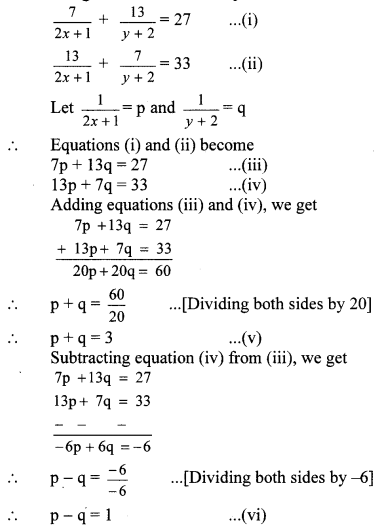
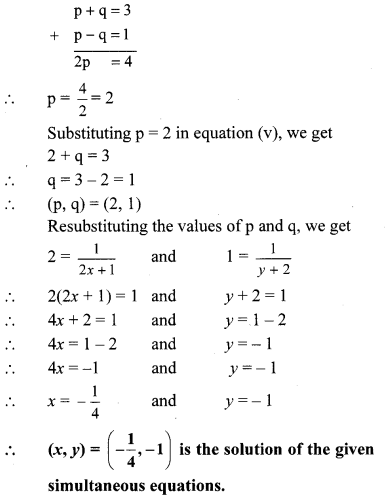
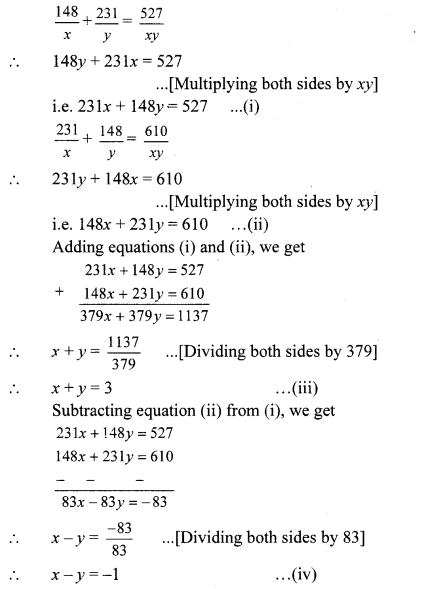
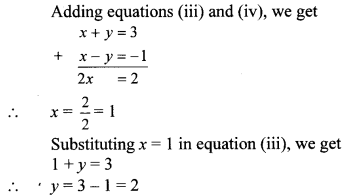
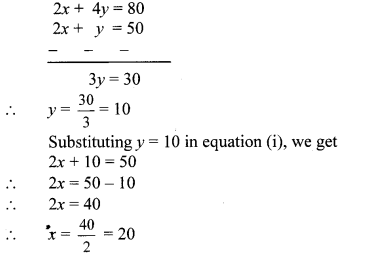
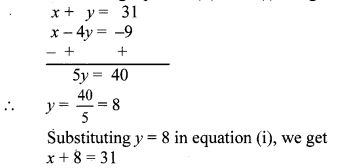
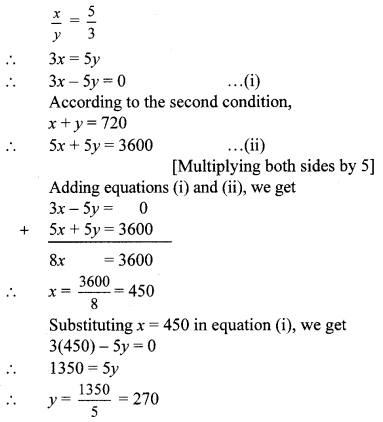
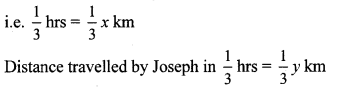
Maharashtra Board 10th Class Maths Part 1 Problem Set 2 Solutions Chapter 2 Quadratic Equations

Balbharti Maharashtra State Board Class 10 Maths Solutions covers the Problem Set 2 Algebra 10th Class Maths Part 1 Answers Solutions Chapter 2 Quadratic Equations.

Problem Set 2 Algebra 10th Std Maths Part 1 Answers Chapter 2 Quadratic Equations

Question 1.
Choose the correct answers for the following questions.

i. Which one is the quadratic equation?
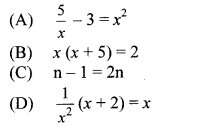
Maharashtra Board Class 10 Maths Solutions Chapter 2 Quadratic Equations Problem Set 2 1
Answer:
(B)

ii. Out of the following equations which one is not a quadratic equation?
(A) x2 + 4x = 11 + x2
(B) x = 4x
(C) 5x2 = 90
(D) 2x – x2 = x2 + 5
Answer:
(A)

iii. The roots of x2 + kx + k = 0 are real and equal, find k.
(A) 0
(B) 4
(C) 0 or 4
(D) 2
Answer:
(C)

iv. For √2 x2 – 5x + √2 = 0, find the value of the discriminant.
(A) -5
(B) 17
(C) √2
(D) 2 √2 – 5
Answer:
(B)

v. Which of the following quadratic equations has roots 3,5?
(A) x2 – 15x + 8 = 0
(B) x2 – 8x + 15 = 0
(C) x2 + 3x + 5 = 0
(D) x2 + 8x – 15 = 0
Answer:
(B)

vi. Out of the following equations, find the equation having the sum of its roots -5.
(A) 3x2 – 15x + 3 = 0
(B) x2 – 5x + 3 = 0
(C) x2 + 3x – 5 = 0
(D) 3x2 + 15x + 3 = 0
Answer:
(D)

vii. √5m2 – √5 m + √5 =0 which of the following statement is true for this given equation?
(A) Real and unequal roots
(B) Real and equal roots
(C) Roots are not real
(D) Three roots
Answer:
(C)

viii. One of the roots of equation x2 + mx – 5 = 0 is 2; find m.
(A) -2
(B) – \(\frac { 1 }{ 2 } \)
(C) \(\frac { 1 }{ 2 } \)
(D) 2
Answer:
(C)

Question 2.
Which of the following equations is quadratic
i. x2 + 2x + 11 = 0
ii. x2 – 2x + 5 = x2
iii. (x + 2)2 = 2x2
Solution:
i. The given equation is
x2 + 2x + 11 = 0
Here, x is the only variable and maximum index of the variable is 2.
a = 1, b = 2, c = 11 are real numbers and
a ≠ 0.
The given equation is a quadratic equation.

ii. The given equation is
x2 – 2x + 5 = x2
∴ x2 – x2 + 2x – 5 = 0
∴ 2x – 5 = 0
Here, x is the only variable and maximum index of the variable is not 2.
∴ The given equation is not a quadratic equation.

iii. The given equation is
(x + 2)2 = 2x2
∴ x2 + 4x + 4 = 2x2
∴ 2x2 – x2 – 4x – 4 = 0
∴ x2 – 4x – 4 = 0
Here, x is the only variable and maximum index of the variable is 2.
a = 1, b = -4, c = —4 are real numbers and
a ≠ 0.
∴ The given equation is a quadratic equation.

Question 3.
Find the value of discriminant for each of the following equations.
i. 2y2 – y + 2 = 0
ii. 5m2 – m = 0
iii. √5 x2 – x – √5 = 0
Solution:
i. 2y2 – y + 2 = 0
Comparing the above equation with
ay2 + by + c = 0, we get
a = 2, b = -1, c = 2
∴ b2 – 4ac = (-1)2 – 4 × 2 × 2
= 1 – 16
∴ b2 – 4ac = -15

ii. 5m2 – m = 0
∴ 5m2 – m + 0 = 0
Comparing the above equation with
am2 + bm + c = 0, we get
a = 5, b = -1, c = 0
∴ b2 – 4ac = (-1)2 – 4 × 5 × 0
= 1 – 0
∴ b2 – 4ac = 1

iii. √5x2 – x – √5 = 0
Comparing the above equation with
ax2 + bx + c = 0, we get
a = √5, b = -1, c = -√5
∴ b2 – 4ac = (-1)2 – 4 × √5 × √5
= 1 + 20
∴ b2 – 4ac = 21

Question 4.
One of the roots of quadratic equation 2x2 + kx – 2 = 0 is – 2, find k.
Solution:
-2 is one of the roots of the equation
2x2 + kx – 2 = 0.
∴ Putting x = – 2 in the given equation, we get
2(-2)2 + k(-2) -2 = 0
∴ 8 – 2k – 2 = 0
∴ 6 – 2k = 0
∴ 2k = 6
∴ k = \(\frac { 6 }{ 2 } \)
∴ k = 3

Question 5.
Two roots of quadratic equations are given; frame the equation.
i. 10 and -10
ii. 1 – 3√5 and 1 + 3√5
iii. 0 and 7
Solution:
i. Let α = 10 and β = -10
∴ α + β = 10 – 10 = 0
and α × p = 10 × -10 = -100
∴ The required quadratic equation is
x2 – (α + β)x + αβ = 0
∴ x2 – 0x + (-100) = 0
∴ x2 – 100 = 0

ii. Let α = 1 – 3 √5 and β = 1 + 3 √5
α + β = 1 – 3 √5 + 1 + 3 √5 = 2
and α × β = (1 – 3√5) (1 + 3 √5)
= (1)2 – (3√5)2
= 1 – 45
= -44
∴ The required quadratic equation is
x2 – (α + β)x + αβ = 0
∴ x2 – 2x – 44 = 0

iii. Let α = 0 and β = 7
∴ α + β = 0 + 7 = 7
and α × β = 0 × 7 = 0
∴ The required quadratic equation is
x2 – (α + β)x + αβ = 0
∴ x2 – 7x + 0 = 0
∴ x2 – 7x = 0

Question 6.
Determine the nature of roots for each of the quadratic equation.
i. 3x2 – 5x + 7 = 0
ii. √3 x2 + √2 x – 2 √3 = 0
iii. m2 – 2m + 1 = 0
Solution:
i. 3x2 – 5x + 7 = 0
Comparing the above equation with
ax2 + bx + c = 0, we get
a = 3, b = -5, c = 7
∴ ∆ = b2 – 4ac
= (-5)2 -4 × 3 × 7
= 25 – 84
∴ ∆ = -59
∴ ∆ < 0
∴ Roots of the given quadratic equation are not real.

ii. √3 x2 + √2 x – 2 √3 = 0
Comparing the above equation with
ax2 + bx + c = 0, we get
a = √3 , b = √2, c = -2√3
∴ ∆ = b2 – 4ac
= (√2)2 – 4 × √3 × (-2√3)
= 2 + 24
∴ ∆ = 26
∴ ∆ > 0
∴ Roots of the given quadratic equation are real and unequal.

iii. m2 – 2m + 1 = 0
Comparing the above equation with
am2 + bm + c = 0, we get
a = 1, b = -2, c = 1
∴ ∆ = b2 – 4ac
= (-2)2 – 4 × 1 × 1
= 4 – 4
∴ ∆ = 0
∴ Roots of the given quadratic equation are real and equal

Question 7.
Solve the following quadratic equations.
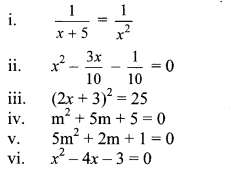
Maharashtra Board Class 10 Maths Solutions Chapter 2 Quadratic Equations Problem Set 2 2
Solution:
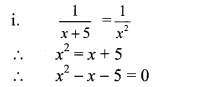
Maharashtra Board Class 10 Maths Solutions Chapter 2 Quadratic Equations Problem Set 2 3
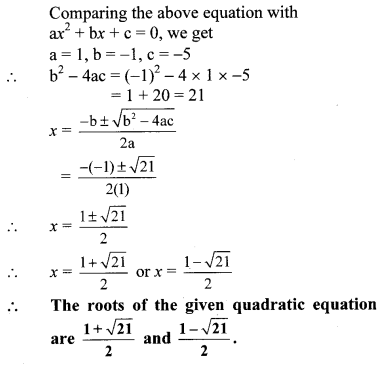
Maharashtra Board Class 10 Maths Solutions Chapter 2 Quadratic Equations Problem Set 2 4

ii. x2 – \(\frac { 3x }{ 10 } \) – \(\frac { 1 }{ 10 } \) = 0
∴ 10x2 – 3x – 1 = 0
…[Multiplying both sides by 10]
∴ 10x2 – 5x + 2x – 1 = 0
∴ 5x(2x – 1) + 1(2x – 1) = 0
∴ (2x – 1)(5x + 1) = 0
By using the property, if the product of two numbers is zero, then at least one of them is zero, we get
∴2x – 1 = 0 or 5x + 1 = 0
∴2x = 1 or 5x = -1
∴ x = –\(\frac { 1 }{ 2 } \) or x = \(\frac { -1 }{ 5 } \)
∴ The roots of the given quadratic equation are \(\frac { 1 }{ 2 } \) and \(\frac { -1 }{ 5 } \)

iii. (2x + 3)2 = 25
∴ (2x + 3)2 – 25 = 0
∴ (2x + 3)2 – (5)2 = 0
∴ (2x + 3 – 5) (2x + 3 + 5) = 0 ….. [∵ a2 – b2 = (a – b) (a + b)]
∴ (2x – 2) (2x + 8) = 0
By using the property, if the product of two numbers is zero, then at least one of them is zero, we get
∴ 2x – 2 = 0 or 2x + 8 = 0
∴ 2x = 2 or 2x = -8
∴ x = \(\frac { 2 }{ 2 } \) or x = \(\frac { -8 }{ 2 } \)
∴ x = 1 or x = -4
∴ The roots of the given quadratic equation are 1 and -4.

iv. m2 + 5m + 5 = 0
Comparing the above equation with
am2 + bm + c = 0, we get
a = 1, b = 5, c = 5
∴ b2 – 4ac = (5)2 – 4 × 1 × 5
= 25 – 20 = 5
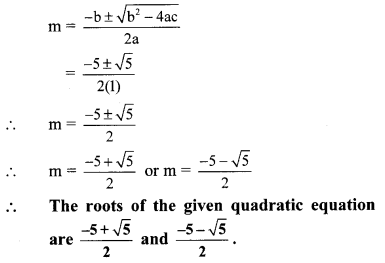
Maharashtra Board Class 10 Maths Solutions Chapter 2 Quadratic Equations Problem Set 2 5

v. 5m2 + 2m+1 = 0
Comparing the above equation with
am2 + bm + c = 0, we get
a = 5, b = 2, c = 1
∴ b2 – 4ac = (2)2 -4 × 5 × 1
= 4 – 20
= -16
∴ b2 – 4ac < 0
∴ Roots of the given quadratic equation are not real.

vi. x2 – 4x – 3 = 0
Comparing the above equation with
ax2 + bx + c = 0, we get
a = 1, b = -4, c = -3
∴ b2 – 4ac = (-4)2 – 4 × 1 × -3
= 16 + 12
= 28
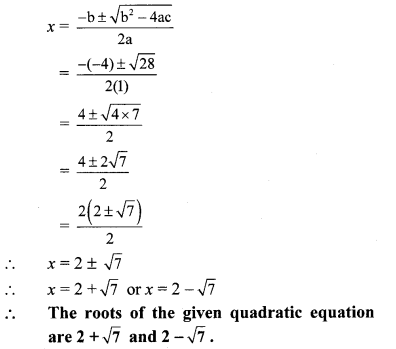
Maharashtra Board Class 10 Maths Solutions Chapter 2 Quadratic Equations Problem Set 2 6

Question 8.
Find m, if (m – 12) x2 + 2(m – 12) x + 2 = 0 has real and equal roots.
Solution:
(m – 12) x2 + 2(m – 12)x + 2 = 0
Comparing the above equation with
ax2 + bx + c = 0, we get
a = m – 12, b = 2(m – 12), c = 2
∴ ∆ = b2 – 4ac
= [2(m -12)]2 – 4 × (m – 12) × 2
= 4(m – 12)2 – 8(m – 12)
= 4(m – 12) (m – 12 – 2)
∴ ∆ = 4(m – 12) (m – 14)
Since, the roots are real and equal.
∴ ∆ = 0
∴ 4(m – 12) (m – 14) = 0 (m – 12) (m – 14) = 0
By using the property, if the product of two numbers is zero, then at least one of them is zero, we get
∴ m – 12 = 0 or m – 14 = 0
∴ m = 12 or m = 14
But ,if m = 12, then quadratic coefficient becomes zero.
∴ m ≠ 12
∴m = 14

Question 9.
The sum of two roots of a quadratic equation is 5 and sum of their cubes is 35, find the equation.
Solution:
Let α and β be the roots of the quadratic equation.
According to the given conditions,
α + β = 5 and α3 + β3 = 35
Now, (α + β)3 = α3 + 3α2β + 3αβ2 + β3
∴ (α + β)3 = α3 + β3 + 3αβ (α + β)
∴ (5)3 = 35 + 3αβ(5)
∴ 125 = 35 + 15αβ
∴ 125 – 35 = 15αβ
∴ 15αβ = 90
∴ αβ = \(\frac { 90 }{ 15 } \)
∴ αβ = 6
∴ The required quadratic equation is
x2 – (α + β)x + αβ = 0
∴ x2 – 5x + 6 = 0

Question 10.
Find quadratic equation such that its roots are square of sum of the roots and square of difference of the roots of equation
2x2 + 2(p + q)x + p2 + q2 = 0.
Solution:
The given quadratic equation is
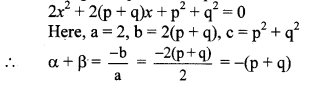
Maharashtra Board Class 10 Maths Solutions Chapter 2 Quadratic Equations Problem Set 2 7
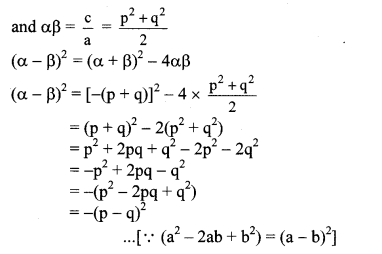
Maharashtra Board Class 10 Maths Solutions Chapter 2 Quadratic Equations Problem Set 2 8
According to the given condition,
Roots of the required quadratic equation are
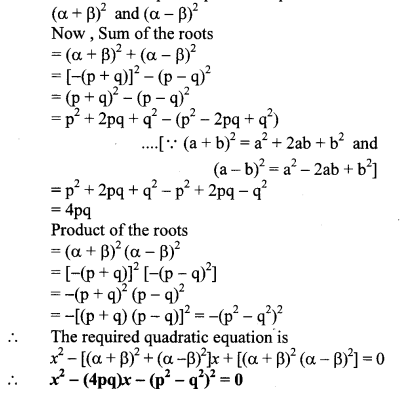
Maharashtra Board Class 10 Maths Solutions Chapter 2 Quadratic Equations Problem Set 2 9

Question 11.
Mukund possesses ₹ 50 more than what Sagar possesses. The product of the amount they have is 15,000. Find the amount each one has.
Solution:
Let the amount Sagar possesses be ₹ x.
∴ the amount Mukund possesses = ₹ (x + 50)
According to the given condition,
x(x +50)= 15000
∴ x2 + 50x – 15000 = 0
∴ x2 + 150x- 100x- 15000 = 0
∴ x(x + 150) – 100(x + 150) = 0
∴ (x + 150)(x – 100) = 0
By using the property, if the product of two numbers is zero, then at least one of them is zero, we get
∴ x + 150 = 0 or x – 100 = 0
∴ x = -150 or x = 100
But, amount cannot be negative.
∴ x= 100 and x + 50 = 100 + 50 = 150
∴ The amount possessed by Sagar and Mukund are ₹ 100 and ₹150 respectively.

Question 12.
The difference between squares of two numbers is 120. The square of smaller number is twice the greater number. Find the numbers.
Solution:
Let the numbers be x and y (x > y).
According to the given condition,
x2 – y2 = 120 …(i)
y2 = 2x …(ii)
Substituting y2 = 2x in equation (i), we get
x2 – 2x = 120
∴ x2 – 2x – 120 = 0
∴ x2 – 12x + 10x – 120 = 0
∴ x(x – 12) + 10(x – 12) = 0
∴ (x – 12)(x + 10) = 0
By using the property, if the product of two numbers is zero, then at least one of them is zero, we get
∴ x – 12 = 0 or x + 10 = 0
∴ x = 12 or x = -10
But x ≠ -10
as, y2 = 2x = 2(-10) = -20 …[Since, the square of number cannot be negative]
∴ x = 12
Smaller number = y2 =2x
∴ y2 = 2 × 12
∴ y2 = 24
∴ y = ± √24 …[Taking square root of both sides]
∴ The smaller number is √24 and greater number is 12 or the smaller number is – √24 and greater number is 12.

Question 13.
Ranjana wants to distribute 540 oranges among some students. If 30 students were more each would get 3 oranges less. Find the number of students.
Solution:
Let the number of students be x.
Total number of oranges = 540
∴ the number of oranges each student gets = \(\frac { 540 }{ x } \)
If there were 30 more students, the total number of students = (x + 30) and the total number of oranges each student gets
= (\(\frac { 540 }{ x+30 } \)
According to the given condition,
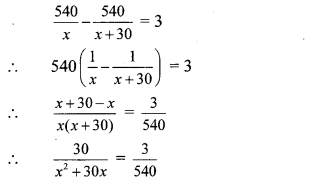
Maharashtra Board Class 10 Maths Solutions Chapter 2 Quadratic Equations Problem Set 2 10Maharashtra Board Class 10 Maths Solutions Chapter 2 Quadratic Equations Problem Set 2 11
∴ 30 × 540 = 3x2 + 90 x
∴ 3x2 + 90x= 16200
∴ x2 + 30x – 5400 = 0
…[Dividing both sides by 3]
∴ x2 + 90x – 60x – 5400 = 0
∴ x(x + 90) – 60(x + 90) = 0
∴ (x + 90) (x – 60) = 0
By using the property, if the product of two numbers is zero, then at least one of them is zero, we get
∴ x + 90 = 0 or x – 60 = 0
∴ x = – 90 or x = 60
But, number of students cannot be negative,
x = 60
∴ The total number of students is 60.

Question 14.
Mr. Dinesh owns an rectangular agricultural farm at village Talvel. The length of the farm is 10 metre more than twice the breadth. In order to harvest rain water, he dug a square shaped pond inside the farm. The side of pond is \(\frac { 1 }{ 3 } \) of the breadth of the farm. The
area of the farm is 20 times the area of the pond. Find the length and breadth of the farm and side of the pond.
Solution:
Let the breadth of the rectangular farm be x m.
∴ Length of rectangular farm = (2x + 10) m
Area of rectangular farm = Length × Breadth
= (2x + 10) × x
= (2x2+ 10x) sq. m
Now ,side of square shaped pond = \(\frac { x }{ 3 } \) m
∴ Area of square shaped pond = (side)2
= (\(\frac { x }{ 3 } \))2 m
= \(\frac { { x }^{ 2 } }{ 9 } \) m
According to the given condition,
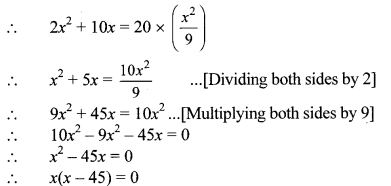
Area of rectangular farm = 20 × Area of pond
Maharashtra Board Class 10 Maths Solutions Chapter 2 Quadratic Equations Problem Set 2 11
By using the property, if the product of two numbers is zero, then at least one of them is zero, we get
∴ x = 0 or x – 45 = 0
x = 0 or x = 45
But, breadth of the rectangular farm cannot be zero,
∴ x = 45
Length of rectangular farm
= 2x + 10 = 2(45) + 10 = 100 m
Side of the pond = \(\frac { x }{ 3 } \) = \(\frac { 45 }{ 3 } \) = 15 m
∴ Length and breadth of the farm and the side of the pond are 100 m, 45 m and 15 m respectively.

Question 15.
A tank fills completely in 2 hours if both the taps are open. If only one of the taps is open at the given time, the smaller tap takes 3 hours more than the larger one to fill the tank. How much time does each tap take to fill the tank completely?
Solution:
Let the larger tap take x hours to fill the tank completely.
∴ Part of tank filled by the larger tap in 1 hour = \(\frac { 1 }{ x } \)
Also, the smaller tap takes (x + 3) hours to fill the tank completely.
∴ Part of tank filled by the smaller tap in 1 hour = \(\frac { 1 }{ x+3 } \)
∴Part of tank filled by both the taps in 1 hour
= (\(\frac { 1 }{ x } \) + \(\frac { 1 }{ x+3 } \))
But, the tank gets filled in 2 hours by both the taps.
∴ Part of tank filled by both the taps in 1 hour = \(\frac { 1 }{ 2 } \)
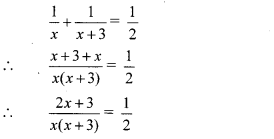
According to the given condition,
Maharashtra Board Class 10 Maths Solutions Chapter 2 Quadratic Equations Problem Set 2 12
∴ 2(2x + 3) = x(x + 3)
∴ 4x + 6 = x2 + 3x
∴ x2 + 3x – 4x – 6 = 0
∴ x2 – x – 6 = 0
∴ x2 – 3x + 2x – 6 = 0
∴ x(x – 3) + 2(x – 3) = 0
∴ (x – 3)(x + 2) = 0
By using the property, if the product of two numbers is zero, then at least one of them is zero, we get
∴ x – 3 = 0 or x + 2 = 0
∴ x = 3 or x = -2
But, time cannot be negative.
∴ x = 3 and x + 3 = 3 + 3 = 6
∴ The larger tap takes 3 hours and the smaller tap takes 6 hours to fill the tank completely.

Maharashtra Board 10th Class Maths Part 1 Practice Set 3.1 Solutions Chapter 3 Arithmetic Progression

Balbharti Maharashtra State Board Class 10 Maths Solutions covers the Practice Set 3.1 Algebra 10th Class Maths Part 1 Answers Solutions Chapter 3 Arithmetic Progression.

Practice Set 3.1 Algebra 10th Std Maths Part 1 Answers Chapter 3 Arithmetic Progression

Question 1.
Which of the following sequences are A.P.? If they are A.P. find the common difference.
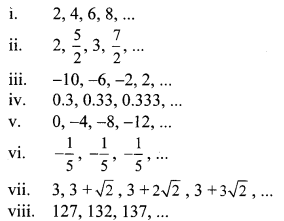
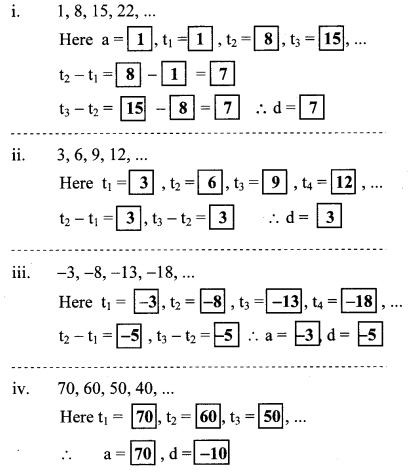
Maharashtra Board Class 10 Maths Solutions Chapter 3 Arithmetic Progression Practice Set 3.1 1
Solution:
i. The given sequence is 2, 4, 6, 8,…
Here, t1 = 2, t2 = 4, t3 = 6, t4 = 8
∴ t2 – t1 = 4 – 2 = 2
t3 – t2 = 6 – 4 = 2
t4 – t3 = 8 – 6 = 2
∴ t2 – t1 =  t3 – t2 = … = 2 = d = constant
The difference between two consecutive terms is constant.
∴ The given sequence is an A.P. and common difference (d) = 2.

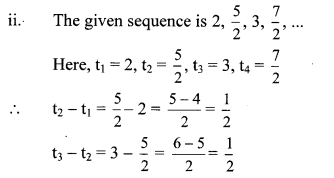
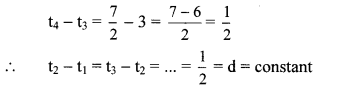
Maharashtra Board Class 10 Maths Solutions Chapter 3 Arithmetic Progression Practice Set 3.1 2
Maharashtra Board Class 10 Maths Solutions Chapter 3 Arithmetic Progression Practice Set 3.1 3
The difference between two consecutive terms is constant.
∴ The given sequence is an A.P. and common difference (d) = \(\frac { 1 }{ 2 } \).

iii. The given sequence is -10, -6, -2, 2,…
Here, t1 = -10, t2 = – 6, t3 = -2, t4 = 2
∴ t2 – t1 = -6 – (-10) = -6 + 10 = 4
t3 – t2 = -2 -(-6) = -2 + 6 = 4
t4 – t3 = 2 – (-2) = 2 + 2 = 4
∴ t2 – t1 = t3 – t2 = … = 4 = d = constant
The difference between two consecutive terms is constant.
∴ The given sequence is an A.P. and common difference (d) = 4.

iv. The given sequence is 0.3, 0.33, 0.333,…
Here, t1 = 0.3, t2 = 0.33, t3 = 0.333
∴ t2 -t1 = 0.33 – 0.3 = 0.03
t3 – t2 = 0.333 – 0.33 = 0.003
∴ t2 – t1 ≠ t3 – t2
The difference between two consecutive terms is not constant.
∴ The given sequence is not an A.P.

v. The given sequence is 0, -4, -8, -12,…
Here, t1 = 0, t2 = -4, t3 = -8, t4 = -12
∴ t2 – t1 = -4 – 0 = -4
t3 – t2 = -8 – (-4) = -8 + 4 = -4
t4 – t3 = -12 – (-8) = -12 + 8 = -4
∴ t2 – t1 = t3 – t2 = … = —4 = d = constant
The difference between two consecutive terms is constant.
∴ The given sequence is an A.P. and common difference (d) = -4.

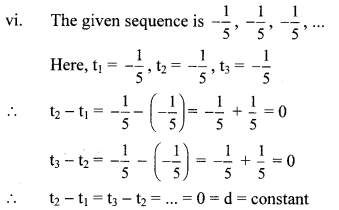
Maharashtra Board Class 10 Maths Solutions Chapter 3 Arithmetic Progression Practice Set 3.1 4
The difference between two consecutive terms is constant.
∴ The given sequence is an A.P. and common difference (d) = 0.

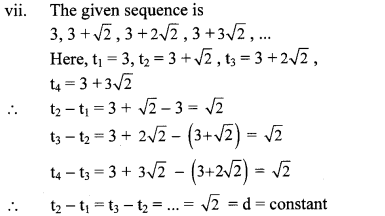
Maharashtra Board Class 10 Maths Solutions Chapter 3 Arithmetic Progression Practice Set 3.1 5
The difference between two consecutive terms is constant.
∴ The given sequence is an A.P. and common difference (d) = √2.

viii. The given sequence is 127, 132, 137,…
Here, t1 = 127, t2 = 132, t3 = 137
∴ t2 – t1 = 132 – 127 = 5
t3 – t2 = 137 – 132 = 5
∴ t2 – t1 = t3 – t2 = … = 5 = d = constant
The difference between two consecutive terms is constant.
∴ The given sequence is an A.P. and common difference (d) = 5.

Question 2.
Write an A.P. whose first term is a and common difference is d in each of the following.
i. a = 10, d = 5
ii. a = -3, d = 0
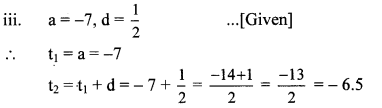
iii. a = -7, d = \(\frac { 1 }{ 2 } \)
iv. a = -1.25, d = 3
v. a = 6, d = -3
vi. a = -19, d = -4
Solution:
i. a = 10, d = 5 …[Given]
∴ t1 = a = 10
t2 = t1 + d = 10 + 5 = 15
t3 = t2 + d = 15 + 5 = 20
t4 = t3 + d = 20 + 5 = 25
∴ The required A.P. is 10,15, 20, 25,…

ii. a = -3, d = 0 …[Given]
∴ t1 = a = -3
t2 = t1 + d = -3 + 0 = -3
t3 = t2 + d = -3 + 0 = -3
t4 = t3 + d = -3 + 0 = -3
∴ The required A.P. is -3, -3, -3, -3,…

Maharashtra Board Class 10 Maths Solutions Chapter 3 Arithmetic Progression Practice Set 3.1 6
Maharashtra Board Class 10 Maths Solutions Chapter 3 Arithmetic Progression Practice Set 3.1 7
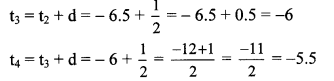
∴ The required A.P. is -7, – 6.5, – 6, – 5.5,

iv. a = -1.25, d = 3 …[Given]
t1 = a = -1.25
t2 = t1 + d = – 1.25 + 3 = 1.75
t3 = t2 + d = 1.75 + 3 = .4.75
t4 = t3 + d = 4.75 + 3 = 7.75
∴ The required A.P. is -1.25, 1.75, 4.75, 7.75,…

v. a = 6, d = -3 …[Given]
∴ t1 = a = 6
t2 = t1 + d = 6 – 3 = 3
t3 = t2 + d = 3 – 3 = 0
t4 = t3 + d = 0- 3 = -3
∴ The required A.P. is 6, 3, 0, -3,…

vi. a = -19, d = -4 …[Given]
t1 = a = -19
t2 = t1 + d = -19 – 4 = -23
t3 = t2 + d = -23 – 4 = -27
t4 = t3 + d = -27 – 4 = -31
∴ The required A.P. is -19, -23, -27, -31,…

Question 3.
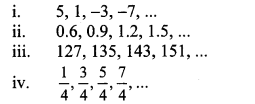
Find the first term and common difference for each of the A.P.
Maharashtra Board Class 10 Maths Solutions Chapter 3 Arithmetic Progression Practice Set 3.1 8
Solution:
i. The given A.P. is 5, 1,-3,-7,…
Here, t1 = 5, t2 = 1
∴ a = t1 = 5 and
d = t2 – t1 = 1 – 5 = -4
∴ first term (a) = 5,
common difference (d) = -4

ii. The given A.P. is 0.6, 0.9, 1.2, 1.5,…
Here, t1 = 0.6, t2 = 0.9
∴ a = t1 = 0.6 and
d = t2 – t1 = 0.9 – 0.6 = 0.3
∴ first term (a) = 0.6,
common difference (d) = 0.3

iii. The given A.P. is 127, 135, 143, 151,…
Here, t1 = 127, t2 = 135
∴ a = t1 = 127 and
d = t2 – t1 = 135 – 127 = 8
∴ first term (a) = 127,
common difference (d) = 8

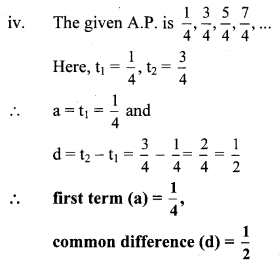
Maharashtra Board Class 10 Maths Solutions Chapter 3 Arithmetic Progression Practice Set 3.1 9

Question 1.
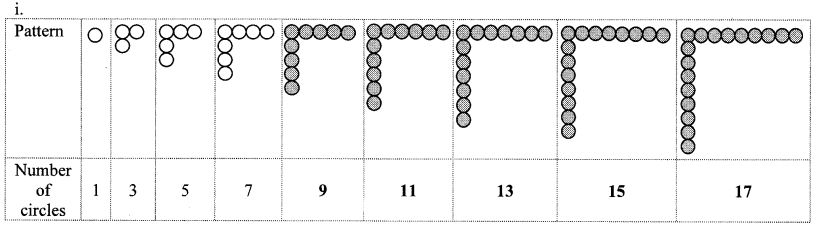
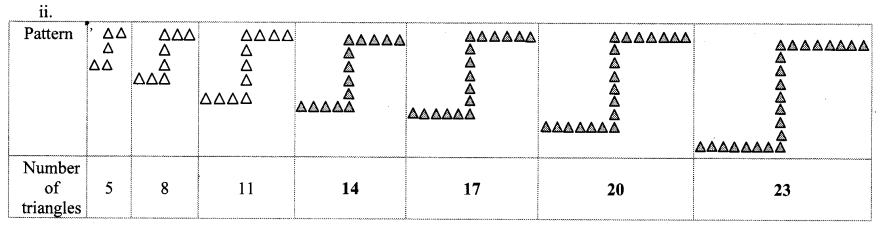
Complete the given pattern. Look at the pattern of the numbers. Try to find a rule to obtain the next number from its preceding number. Write the next numbers. (Textbook pg, no. 55 and 56)
Answer:
Maharashtra Board Class 10 Maths Solutions Chapter 3 Arithmetic Progression Practice Set 3.1 10
Every pattern is formed by adding a circle in horizontal and vertical rows to the preceding pattern.
∴ The sequence for the above pattern is 1,3, 5, 7, 9,11,13,15,17,….
Maharashtra Board Class 10 Maths Solutions Chapter 3 Arithmetic Progression Practice Set 3.1 11
Every pattern is formed by adding 2 triangles horizontally and 1 triangle vertically to the preceding pattern.
∴ The sequence for the above pattern is 5,8,11,14,17,20,23,…

Question 2.
Some sequences are given below. Show the positions of the terms by t1, t2, t3,…
Answer:
Maharashtra Board Class 10 Maths Solutions Chapter 3 Arithmetic Progression Practice Set 3.1 12

Question 3.
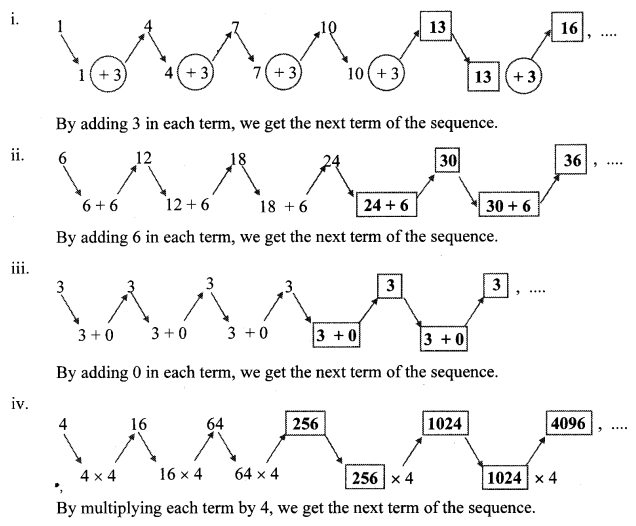
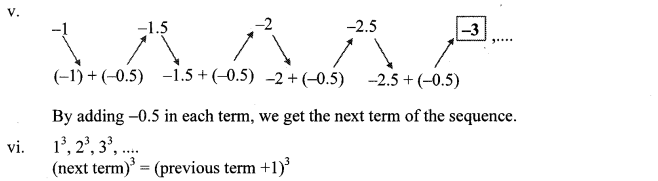
Some sequences are given below. Check whether there is any rule among the terms. Find the similarity between two sequences. To check the rule for the terms of the sequence look at the arrangements and fill the empty boxes suitably. (Textbook pg. no. 56 and 57)
i. .1,4,7,10,13,…
ii. 6,12,18,24,…
iii. 3,3,3,3,…
iv. 4, 16, 64,…
v. -1, -1.5, -2, -2.5,…
vi. 13, 23, 33, 43
Answer:
Maharashtra Board Class 10 Maths Solutions Chapter 3 Arithmetic Progression Practice Set 3.1 13
Maharashtra Board Class 10 Maths Solutions Chapter 3 Arithmetic Progression Practice Set 3.1 14
The similarity in the sequences i., ii., iii. and v. is that the next term is obtained by adding a particular fixed number to the previous term.

Note : A Geometric Progression is a sequence in which the ratio of any two consecutive terms is a constant,
Maharashtra Board Class 10 Maths Solutions Chapter 3 Arithmetic Progression Practice Set 3.1 15
Sequence iv. is a geometric progression.

Question 4.
Write one example of finite and infinite A.P. each. (Textbook pg. no. 59)
Answer:
Finite A.P.:
Even natural numbers from 4 to 50:
4, 6, 8, ………………. 50.
Infinite A. P.:
Positive multiples of 5:
5, 10, 15, ……………..

Maharashtra Board 10th Class Maths Part 1 Practice Set 2.5 Solutions Chapter 2 Quadratic Equations

Balbharti Maharashtra State Board Class 10 Maths Solutions covers the Practice Set 2.5 Algebra 10th Class Maths Part 1 Answers Solutions Chapter 2 Quadratic Equations.

Practice Set 2.5 Algebra 10th Std Maths Part 1 Answers Chapter 2 Quadratic Equations

Question 1.
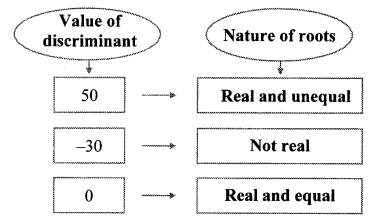
Fill in the gaps and complete.
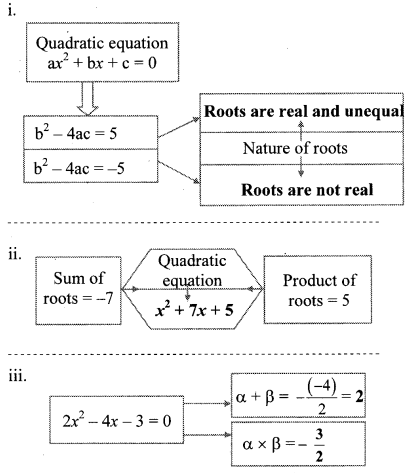
Maharashtra Board Class 10 Maths Solutions Chapter 2 Quadratic Equations Practice Set 2.5 1
Answer:
Maharashtra Board Class 10 Maths Solutions Chapter 2 Quadratic Equations Practice Set 2.5 2

Question 2.
Find the value of discriminant.
i. x2 + 7x – 1 = 0
ii. 2y2 – 5y + 10 = 0
iii. √2 x2 + 4x + 2√2 = 0
Solution:
i. x2 +7 x – 1 = 0
Comparing the above equation with
ax2 + bx + c = 0, we get
a = 1, b = 7, c = -1
∴ b2– 4ac = (7)2 – 4 × 1 × (-1)
= 49 + 4
∴ b2 – 4ac = 53

ii. 2y2 – 5y + 10 = 0
Comparing the above equation with
ay2 + by + c = 0, we get
a = 2, b = -5, c = 10
∴ b2 – 4ac = (-5)2 -4 × 2 × 10
= 25 – 80
∴ b2 – 4ac = -55

iii. √2 x2 + 4x + 2√2 = 0
Comparing the above equation with
ax + bx + c = 0, we get
a = √2,b = 4, c = 2√2
∴ b2 – 4ac = (4)2 – 4 × √2 × 2√2
= 16 – 16
∴ b2 – 4ac =0

Question 3.
Determine the nature of roots of the following quadratic equations.
i. x2 – 4x + 4 = 0
ii. 2y2 – 7y + 2 = 0
iii. m2 + 2m + 9 = 0
Solution:
i. x2 – 4x + 4= 0
Comparing the above equation with
ax2 + bx + c = 0, we get
a = 1,b = -4, c = 4
∴ ∆ = b2 – 4ac
= (- 4)2 – 4 × 1 × 4
= 16 – 16
∴ ∆ = 0
∴ Roots of the given quadratic equation are real and equal.

ii. 2y2 – 7y + 2 = 0
Comparing the above equation with
ay2 + by + c = 0, we get
a = 2, b = -7, c = 2
∴ ∆ = b2 – 4ac
= (- 7)2 – 4 × 2 × 2
= 49 – 16
∴ ∆ = 33
∴ ∆ > 0
∴ Roots of the given quadratic equation are real and unequal.

iii. m2 + 2m + 9 = 0
Comparing the above equation with
am2 + bm + c = 0, we get
a = 1,b = 2, c = 9
∴ ∆ = b2 – 4ac
= (2)2 – 4 × 1 × 9
= 4 – 36
∴ ∆ = -32
∴ ∆ < 0
∴ Roots of the given quadratic equation are not real.

Question 4.
Form the quadratic equation from the roots given below.
i. 0 and 4
ii. 3 and -10
iii. \(\frac { 1 }{ 2 } \) , \(\frac { 1 }{ 2 } \)
iv. 2 – √5, 2 + √5
Solution:
i. Let a = 0 and β = 4
∴ α + β = 0 + 4 = 4
and α × β = 0 × 4 = 0
∴ The required quadratic equation is
x2 – (α + β) x + αβ = 0
∴ x2 – 4x + 0 = 0
∴ x2 – 4x = 0

ii. Let α = 3 and β = -10
∴ α + β = 3 – 10 = -7
and α × β = 3 × -10 = -30
∴ The required quadratic equation is
x2 – (α + β)x + αβ = 0
∴ x2 – (-7) x + (-30) = 0

Maharashtra Board Class 10 Maths Solutions Chapter 2 Quadratic Equations Practice Set 2.5 3

Maharashtra Board Class 10 Maths Solutions Chapter 2 Quadratic Equations Practice Set 2.5 4
∴ The required quadratic equation is
x2 – (α + β)x + αβ = 0
∴ x2 – 4x – 1 = 0

Question 5.
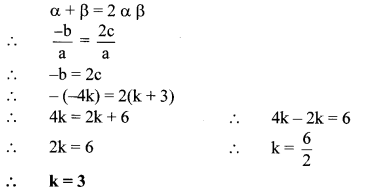
Sum of the roots of a quadratic equation is double their product. Find k if equation is x2 – 4kx + k + 3 = 0.
Solution:
x2 – 4kx + k + 3 = 0
Comparing the above equation with
ax2 + bx + c = 0, we get
a = 1, b = – 4k, c = k + 3
Let α and β be the roots of the given quadratic equation.
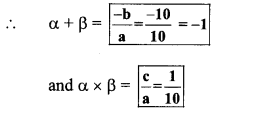
Then, α + β  = \(\frac { -b }{ a } \) and αβ = \(\frac { c }{ a } \)
According to the given condition,
Maharashtra Board Class 10 Maths Solutions Chapter 2 Quadratic Equations Practice Set 2.5 5

Question 6.
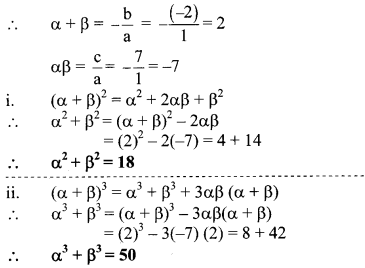
α, β are roots of y2 – 2y – 7 = 0 find,
i. α2 + β2
ii. α3 + β3
Solution:
y2 – 2y – 7 = 0
Comparing the above equation with
ay2 + by + c = 0, we get
a = 1, b = -2, c = -7
Maharashtra Board Class 10 Maths Solutions Chapter 2 Quadratic Equations Practice Set 2.5 6

Question 7.
The roots of each of the following quadratic equations are real and equal, find k.
i. 3y2 + ky + 12 = 0
ii. kx (x-2) + 6 = 0
Solution:
i. 3y2 + kg + 12 = 0
Comparing the above equation with
ay2 + by + c = 0, we get
a = 3, b = k, c = 12
∴ ∆ = b2 – 4ac
= (k)2 – 4 × 3 × 12
= k2 – 144 = k2 – (12)2
∴ ∆ = (k + 12) (k – 12) …[∵ a2 – b2 = (a + b) (a – b)]
Since, the roots are real and equal.
∴ ∆ = 0
∴ (k + 12) (k – 12) = 0
∴ k + 12 = 0 or k – 12 = 0
∴ k = -12 or k = 12

ii. kx (x – 2) + 6 = 0
∴ kx2 – 2kx + 6 = 0
Comparing the above equation with
ax2 + bx + c = 0, we get
a = k, b = -2k, c = 6
∴ ∆ = b2 – 4ac
= (-2k)2 – 4 × k × 6
= 4k2 – 24k
∴ ∆ = 4k (k – 6)
Since, the roots are real and equal.
∴ ∆ = 0
∴ 4k (k – 6) = 0
∴ k(k – 6) = 0
∴ k = 0 or k – 6 = 0
But, if k = 0 then quadratic coefficient becomes zero.
∴ k ≠ 0
∴ k = 6

Question 1.
Fill in the blanks. (Textbook pg. no. 44)
Solution:
Maharashtra Board Class 10 Maths Solutions Chapter 2 Quadratic Equations Practice Set 2.5 7

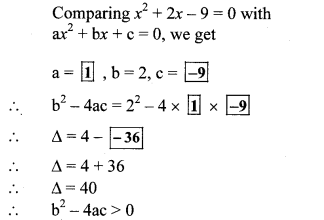
Question 2.
Determine nature of roots of the quadratic equation: x2 + 2x – 9 = 0 (Textbook pg. no. 45)
Solution:
Maharashtra Board Class 10 Maths Solutions Chapter 2 Quadratic Equations Practice Set 2.5 8
∴ The roots of the given equation are real and unequal.

Question 3.
Fill in the empty boxes properly. (Textbook pg. no. 46)
Solution:
10x2 + 10x + 1 = 0
Comparing the above equation with
ax2 + bx + c = 0, we get
a = 10, b = 10, c = 1
Maharashtra Board Class 10 Maths Solutions Chapter 2 Quadratic Equations Practice Set 2.5 9

Question 4.
Write the quadratic equation if addition of the roots is 10 and product of the roots is 9. (Textbook pg, no. 48)
Answer:
Maharashtra Board Class 10 Maths Solutions Chapter 2 Quadratic Equations Practice Set 2.5 10

Question 5.
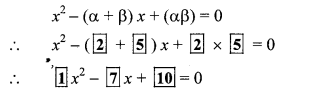
What will be the quadratic equation if α = 2, β = 5. (Textbook pg. no, 48)
Solution:
Maharashtra Board Class 10 Maths Solutions Chapter 2 Quadratic Equations Practice Set 2.5 11

Maharashtra Board 10th Class Maths Part 1 Practice Set 2.2 Solutions Chapter 2 Quadratic Equations

Balbharti Maharashtra State Board Class 10 Maths Solutions covers the Practice Set 2.2 Algebra 10th Class Maths Part 1 Answers Solutions Chapter 2 Quadratic Equations.

Practice Set 2.2 Algebra 10th Std Maths Part 1 Answers Chapter 2 Quadratic Equations

Question 1.
Solve the following quadratic equations by factorisation.
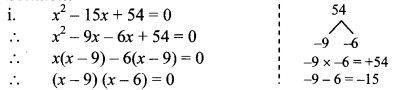
i. x2 – 15x + 54 = 0
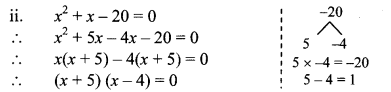
ii. x2 + x – 20 = 0
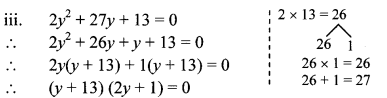
iii. 2y2 + 27y + 13 = 0
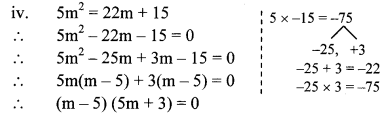
iv. 5m2 = 22m + 15
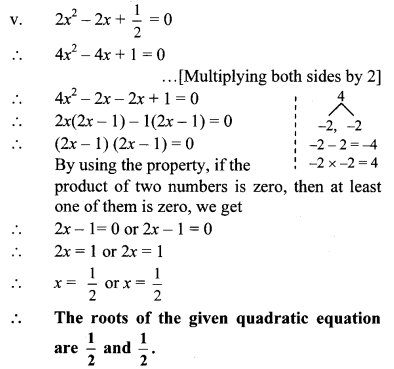
v. 2x2 – 2x + \(\frac { 1 }{ 2 } \) = 0
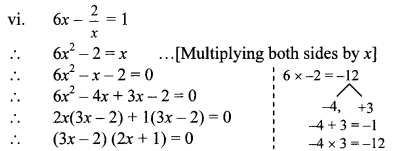
vi. 6x – \(\frac { 2 }{ x } \) = 1
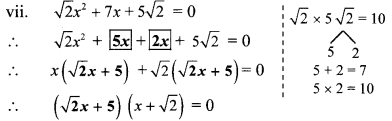
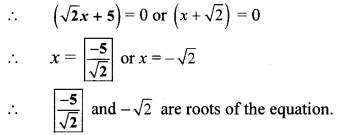
vii. √2x2 + 7x + 5√2 = 0 to solve this quadratic equation by factorisation complete the following activity
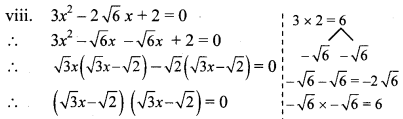
viii. 3x2 – 2√6x + 2 = 0
ix. 2m(m – 24) = 50
x. 252 = 9
xi. 7m2 = 21 m
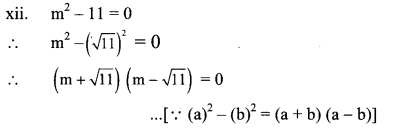
xii. m2 – 11 = 0
Solution:
Maharashtra Board Class 10 Maths Solutions Chapter 2 Quadratic Equations Practice Set 2.2 1
By using the property, if the product of two numbers is zero, then at least one of them is zero, we get
∴ x – 9 = 0 or x – 6 = 0
∴ x = 9 or x = 6
∴ The roots of the given quadratic equation are 9 and 6.

Maharashtra Board Class 10 Maths Solutions Chapter 2 Quadratic Equations Practice Set 2.2 2
By using the property, if the product of two numbers is zero, then at least one of them is zero, we get
∴ x + 5 = 0 or x – 4 = 0
∴ x = -5 or x = 4
∴ The roots of the given quadratic equation are -5 and 4.

Maharashtra Board Class 10 Maths Solutions Chapter 2 Quadratic Equations Practice Set 2.2 3
By using the property, if the product of two numbers is zero, then at least one of them is zero, we get
∴ y + 13 = 0 or 2y + 1 = 0
∴ y = – 13 or 2y = -1
∴ y = -13 or y = –\(\frac { 1 }{ 2 } \)
∴ The roots of the given quadratic equation are -13 and – \(\frac { 1 }{ 2 } \)

Maharashtra Board Class 10 Maths Solutions Chapter 2 Quadratic Equations Practice Set 2.2 4
By using the property, if the product of two numbers is zero, then at least one of them is zero, we get
∴ m – 5 = 0 or 5m + 3 = 0
∴ m = 5 or 5m = -3
∴ m = 5 or m = \(\frac { -3 }{ 5 } \)
∴ The roots of the given quadratic equation are 5 and – \(\frac { 3 }{ 5 } \)

Maharashtra Board Class 10 Maths Solutions Chapter 2 Quadratic Equations Practice Set 2.2 5

Maharashtra Board Class 10 Maths Solutions Chapter 2 Quadratic Equations Practice Set 2.2 6
By using the property, if the product of two numbers is zero, then at least one of them is zero, we get
∴ 3x – 2 = 0 or 2x + 1 = 0
∴ 3x = 2 or 2x = -1
∴ x = \(\frac { 2 }{ 3 } \) or 2x = -1
∴ The roots of the given quadratic equation are \(\frac { 2 }{ 3 } \) and \(\frac { -1 }{ 2 } \).

Maharashtra Board Class 10 Maths Solutions Chapter 2 Quadratic Equations Practice Set 2.2 7
By using the property, if the product of two numbers is zero, then at least one of them is zero, we get
Maharashtra Board Class 10 Maths Solutions Chapter 2 Quadratic Equations Practice Set 2.2 8

Maharashtra Board Class 10 Maths Solutions Chapter 2 Quadratic Equations Practice Set 2.2 9
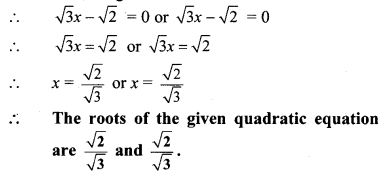
By using the property, if the product of two numbers is zero, then at least one of them is zero, we get
Maharashtra Board Class 10 Maths Solutions Chapter 2 Quadratic Equations Practice Set 2.2 10

ix. 2m (m – 24) = 50
∴ 2m2 – 48m = 50
∴ 2m2 – 48m – 50 = 0
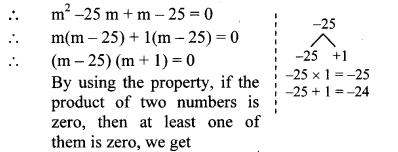
∴m2 – 24m – 25 = 0 …[Dividing both sides by 2]
Maharashtra Board Class 10 Maths Solutions Chapter 2 Quadratic Equations Practice Set 2.2 11
∴ m – 25 = 0 or m + 1 = 0
∴ m = 25 or m = -1
∴ The roots of thes given quadratic equation are 25 and -1.

x. 25m2 = 9
∴ 25m2 – 9 = 0
∴ (5m)2 – (3)2 = 0
∴ (5m + 3) (5m – 3) = 0
…. [∵a2 – b2 = (a + b) (a – b)]
By using the property, if the product of two numbers is zero, then at least one of them is zero, we get
∴ 5m + 3 = 0 or 5m – 3 = 0
∴ 5m = -3 or 5m = 3
∴ m = \(\frac { -3 }{ 5 } \) or m = \(\frac { 3 }{ 5 } \)
∴ The roots of the given quadratic equation are \(\frac { -3 }{ 5 } \) and \(\frac { 3 }{ 5 } \).

xi. 7m2 = 21m
∴ 7m2 – 21m = 0
∴ m2 – 3m = 0 …[Dividing both sides by 7]
∴ m(m – 3) = 0
By using the property, if the product of two numbers is zero, then at least one of them is zero, we get
∴ m = 0 or m – 3 = 0
∴ m = 0 or m = 3
∴ The roots of the given quadratic equation are 0 and 3.

Maharashtra Board Class 10 Maths Solutions Chapter 2 Quadratic Equations Practice Set 2.2 12
By using the property, if the product of two numbers is zero, then at least one of them is zero, we get
∴ m + √11 = 0 or m – √11 = 0
∴ m = -√11 or m = √11
∴ The roots of the given quadratic equation are – √11 and √11

Maharashtra Board 10th Class Maths Part 1 Practice Set 2.4 Solutions Chapter 2 Quadratic Equations

Balbharti Maharashtra State Board Class 10 Maths Solutions covers the Practice Set 2.4 Algebra 10th Class Maths Part 1 Answers Solutions Chapter 2 Quadratic Equations.

Practice Set 2.4 Algebra 10th Std Maths Part 1 Answers Chapter 2 Quadratic Equations

Question 1.
Compare the given quadratic equations to the general form and write values of a, b, c.
i. x2 – 7x + 5 = 0
ii. 2m2 = 5m – 5
iii. y2 = 7y
Solution:
i. x2 – 7x + 5 = 0
Comparing the above equation with
ax2 + bx + c = 0, we get
a = 1, b = -7, c = 5

ii. 2m2 = 5m – 5
∴ 2m2 – 5m + 5 = 0
Comparing the above equation with
am2 + bm + c = 0, we get
a = 2, b = -5, c = 5

iii. y2 = 7y
∴ y2 – 7y + 0 = 0
Comparing the above equation with
ay2 + by + c = 0, we get
a = 1, b = -7, c = 0

Question 2.
Solve using formula.
i. x2 + 6x + 5 = 0
ii. x2 – 3x – 2 = 0
iii. 3m2 + 2m – 7 = 0
iv. 5m2 – 4m – 2 = 0
v. y2 + \(\frac { 1 }{ 3 } \) y = 2
vi. 5x2 + 13x + 8 = 0
Solution:
i. x2 + 6x + 5 = 0
Comparing the above equation with
ax2 + bx + c = 0, we get
a = 1, b = 6, c = 5
∴ b2 – 4ac = (6)2 – 4 × 1 × 5
= 36 – 20 = 16
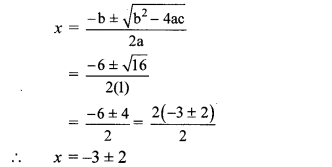
Maharashtra Board Class 10 Maths Solutions Chapter 2 Quadratic Equations Practice Set 2.4 1
∴ x = -3 + 2 or x = -3 -2
∴ x = -1 or x = -5
∴ The roots of the given quadratic equation are -1 and -5.

ii. x2 – 3x – 2 = 0
Comparing the above equation with
ax2 + bx + c = 0, we get
a = 1, b = -3, c = -2
∴ b2 – 4ac = (-3)2 – 4 × 1 × (-2)
= 9 + 8 = 17
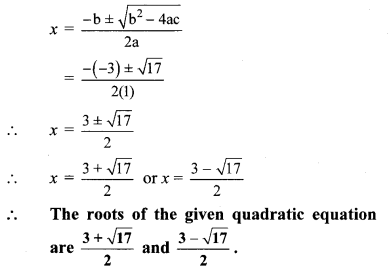
Maharashtra Board Class 10 Maths Solutions Chapter 2 Quadratic Equations Practice Set 2.4 2

iii. 3m2 + 2m – 7 = 0
Comparing the above equation with
am2 + bm + c = 0, we get
a = 3, b = 2, c = -7
∴ b2 – 4ac = (2)2 – 4 × 3 × ( -7)
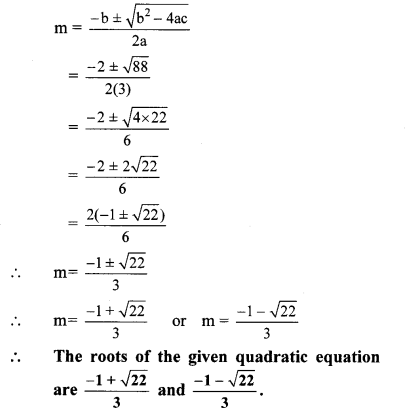
= 4 + 84 = 88
Maharashtra Board Class 10 Maths Solutions Chapter 2 Quadratic Equations Practice Set 2.4 3

iv. 5m2 – 4m – 2 = 0
Comparing the above equation with
am2 + bm + c = 0, we get
a = 5, b = -4, c = -2
∴ b2 – 4ac = (-4)2 – 4 × 5 × (-2)
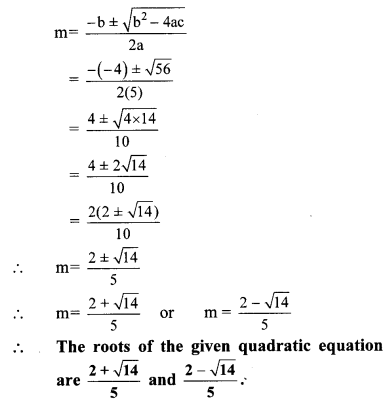
= 16 + 40 = 56
Maharashtra Board Class 10 Maths Solutions Chapter 2 Quadratic Equations Practice Set 2.4 4

v. y2 + \(\frac { 1 }{ 3 } \)y = 2
∴ 3y2 + y = 6 …(Multiplying both sides by 3]
∴ 3y2 + y – 6 = 0
Comparing the above equation with
ay2 + by + c = 0, we get
a = 3, b = 1, c = -6
∴ b2 – 4ac = (1)2 – 4 × 3 × (-6)
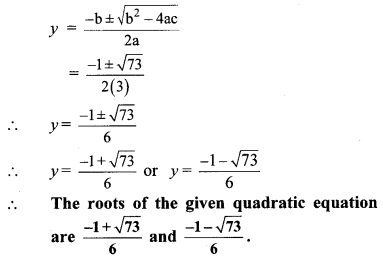
= 1 + 72 = 73
Maharashtra Board Class 10 Maths Solutions Chapter 2 Quadratic Equations Practice Set 2.4 5

vi. 5x2 + 13x + 8 = 0
Comparing the above equation with
ax2 + bx + c = 0, we get
a = 5, b = 13, c = 8
∴ b2 – 4ac = (13)2 – 4 × 5 × 8
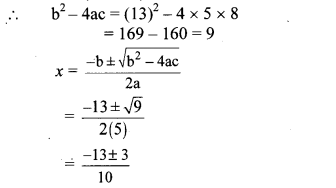
= 169 – 160 = 9
Maharashtra Board Class 10 Maths Solutions Chapter 2 Quadratic Equations Practice Set 2.4 6
Maharashtra Board Class 10 Maths Solutions Chapter 2 Quadratic Equations Practice Set 2.4 7
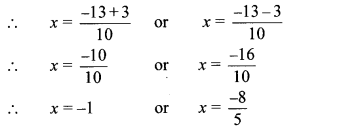
The roots of the given quadratic equation are -1 and \(\frac { -8 }{ 5 } \).

Question 3.
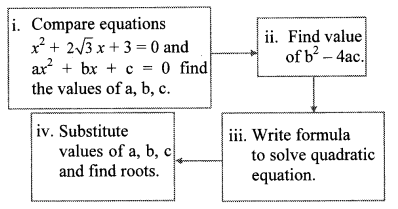
With the help of the flow chart given below solve the equation x2 + 2√3 x + 3 = 0 using the formula.
Maharashtra Board Class 10 Maths Solutions Chapter 2 Quadratic Equations Practice Set 2.4 8
Solution:
i. x2 + 2√3 x + 3 = 0
Comparing the above equation with
ax2 + bx + c = 0, we get
a = 1, b = 2√3 ,c = 3

ii. b2 – 4ac = (2√3)2 -4 × 1 × 3
= 12 – 12
= 0
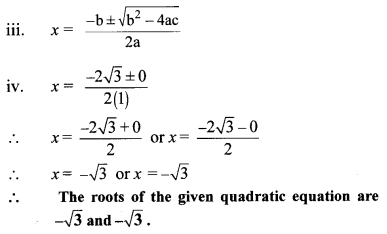
Maharashtra Board Class 10 Maths Solutions Chapter 2 Quadratic Equations Practice Set 2.4 9

Question 1.
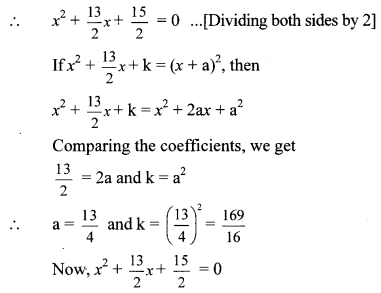
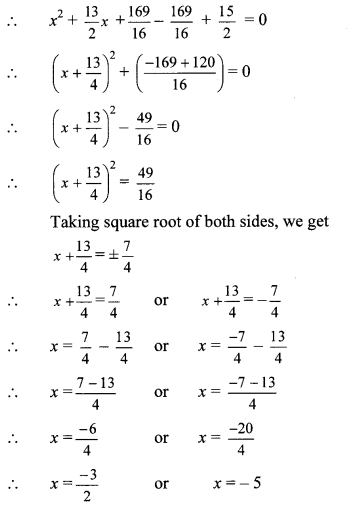
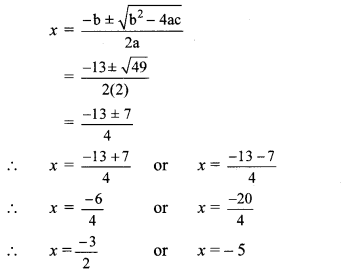
Solve the equation 2x2 + 13x + 15 = 0 by factorisation method, by completing the square method and by using the formula. Verify that you will get the same roots every time. (Textbook pg. no. 43)
Solution:
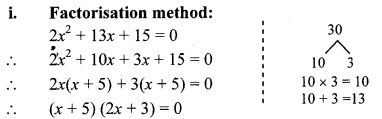
Maharashtra Board Class 10 Maths Solutions Chapter 2 Quadratic Equations Practice Set 2.4 10
By using the property, if the product of two numbers is zero, then at least zero, we get
∴ x + 5 = 0 or 2x + 3 = 0
∴ x + -5 = 0 or 2x = -3 = 0
∴ x + -5 = or x = \(\frac { -3 }{ 2 } \)
∴ The roots of the given quadratic equation are \(\frac { -3 }{ 2 } \) and -5.

ii. Completing the square method:
2x² + 13x + 15 = 0
Maharashtra Board Class 10 Maths Solutions Chapter 2 Quadratic Equations Practice Set 2.4 11
Maharashtra Board Class 10 Maths Solutions Chapter 2 Quadratic Equations Practice Set 2.4 12
∴ The roots of the given quadratic equation are \(\frac { -3 }{ 2 } \) and -5.

iii. Formula method:
2x2 + 13x + 15 = 0
Comparing the above equation with
ax2 + bx + c = 0, we get
a = 2, b = 13, c = 15
∴ b2 – 4ac = (13)2 – 4 × 2 × 15
= 169 – 120 = 49
Maharashtra Board Class 10 Maths Solutions Chapter 2 Quadratic Equations Practice Set 2.4 13
∴ The roots of the given quadratic equation are \(\frac { -3 }{ 2 } \) and -5.
∴ By all the above three methods, we get the same roots of the given quadratic equation.

Maharashtra Board 10th Class Maths Part 1 Practice Set 2.6 Solutions Chapter 2 Quadratic Equations

Balbharti Maharashtra State Board Class 10 Maths Solutions covers the Practice Set 2.6 Algebra 10th Class Maths Part 1 Answers Solutions Chapter 2 Quadratic Equations.

Practice Set 2.6 Algebra 10th Std Maths Part 1 Answers Chapter 2 Quadratic Equations

Question 1.
Product of Pragati’s age 2 years ago and years hence is 84. Find her present age.
Solution:
Let the present age of Pragati be x years.
∴ 2 years ago,
Age of Pragati = (x – 2) years
After 3 years,
Age of Pragati = (x + 3) years
According to the given condition,
(x – 2) (x + 3) = 84
∴ x(x + 3) – 2(x + 3) = 84
∴ x2 + 3x – 2x – 6 = 84
∴ x2 + x – 6 – 84 = 0
∴ x2 + x – 90 = 0
x2 + 10x – 9x – 90 = 0
∴ x(x + 10) – 9(x + 10) = 0
∴ (x + 10)(x – 9) = 0
By using the property, if the product of two numbers is zero, then at least one of them is zero, we get
∴ x + 10 = 0 or x – 9 = 0
∴ x = -10 or x = 9
But, age cannot be negative.
∴ x = 9
∴ Present age of Pragati is 9 years.

Question 2.
The sum of squares of two consecutive even natural numbers is 244; find the numbers.
Solution:
Let the first even natural number be x.
∴ the next consecutive even natural number will be (x + 2).
According to the given condition,
x2 + (x + 2)2 = 244
∴ x2 + x2 + 4x + 4 = 244
∴ 2x2 + 4x + 4 – 244 = 0
∴ 2x2 + 4x – 240 = 0
∴ x2 + 2x – 120 = 0 …[Dividing both sides by 2]
∴ x2 + 12x – 10x – 120 = 0
∴ x(x + 12) – 10 (x + 12) = 0
∴ (x + 12) (x – 10) = 0
By using the property, if the product of two numbers is zero, then at least one of them is zero, we get
∴ x + 12 = 0 or x – 10 = 0
∴ x = -12 or x = 10
But, natural number cannot be negative.
∴ x = 10 and x + 2 = 10 + 2 = 12
∴ The two consecutive even natural numbers are 10 and 12.

Question 3.
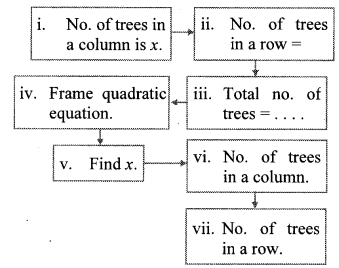
In the orange garden of Mr. Madhusudan there are 150 orange trees. The number of trees in each row is 5 more than that in each column. Find the number of trees in each row and each column with the help of following flow chart.
Maharashtra Board Class 10 Maths Solutions Chapter 2 Quadratic Equations Practice Set 2.6 1
Solution:
i. Number of trees in a column is x.
ii. Number of trees in a row = x + 5
iii. Total number of trees = x x (x + 5)
iv. According to the given condition,
x(x + 5) = 150
∴ x2 + 5x = 150
∴ x2 + 5x – 150 = 0
v. x2 + 15x – 10x – 150 = 0
∴ x(x+ 15) – 10(x + 15) = 0
∴ (x + 15)(x – 10) = 0
By using the property, if the product of two numbers is zero, then at least one of them is zero, we get
∴ x + 15 = 0 or x – 10 = 0
∴ x = -15 or x = 10
But, number of trees cannot be negative.
∴ x = 10
vi. Number of trees in a column is 10.
vii. Number of trees in a row = x + 5 = 10 + 5 = 15
∴ Number of trees in a row is 15.

Question 4.
Vivek is older than Kishor by 5 years. The Find their present ages is \(\frac { 1 }{ 6 } \) Find their Present ages
Solution:
Let the present age of Kishor be x.
∴ Present age of Vivek = (x + 5) years
According to the given condition,
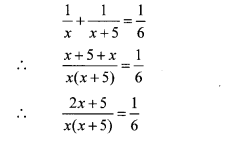
Maharashtra Board Class 10 Maths Solutions Chapter 2 Quadratic Equations Practice Set 2.6 2
∴ 6(2x + 5) = x(x + 5)
∴ 12x + 30 = x2 + 5x
∴ x2 + 5x – 12x – 30 = 0
∴ x2 – 7x – 30 = 0
∴ x2 – 10x + 3x – 30 = 0
∴ x(x – 10) + 3(x – 10) = 0
∴ (x – 10)(x + 3) = 0
By using the property, if the product of two numbers is zero, then at least one of them is zero, we get
∴ x – 10 = 0 or x + 3 = 0
∴ x = 10 or x = – 3
But, age cannot be negative.
∴ x = 10 andx + 5 = 10 + 5 = 15
∴ Present ages of Kishor and Vivek are 10 years and 15 years respectively.
Question 5.
Suyash scored 10 marks more in second test than that in the first. 5 times the score of the second test is the same as square of the score in the first test. Find his score in the first test.
Solution:
Let the score of Suyash in the first test be x.
∴ Score in the second test = x + 10 According to the given condition,
5(x + 10) = x2
∴ 5x + 50 = x2
∴ x2 – 5x – 50 = 0
∴ x2 – 10x + 5x – 50 = 0
∴ x(x – 10) + 5(x – 10) = 0
∴ (x – 10) (x + 5) = 0
By using the property, if the product of two numbers is zero, then at least one of them is zero, we get
∴ x – 10 = 0 or x + 5 = 0
∴ x = 10 or x = – 5
But, score cannot be negative.
∴ x = 10
∴ The score of Suyash in the first test is 10.

Question 6.
‘Mr. Kasam runs a small business of making earthen pots. He makes certain number of pots on daily basis. Production cost of each pot is ₹ 40 more than 10 times total number of pots, he makes in one day. If production cost of all pots per day is ₹ 600, find production cost of one pot and number of pots he makes per day.
Solution:
Let Mr. Kasam make x number of pots on daily basis.
Production cost of each pot = ₹ (10x + 40)
According to the given condition,
x(10x + 40) = 600
∴ 10x2 + 40x = 600
∴ 10x2 + 40x- 600 = 0
∴ x2 + 4x – 60 = 0 …[Dividing both sides by 10]
∴ x2 + 10x – 6x – 60 = 0
∴ x(x + 10) – 6(x + 10) = 0
∴ (x + 10) (x – 6) = 0
By using the property, if the product of two numbers is zero, then at least one of them is zero, we get
∴ x + 10 = 0 or x – 6 = 0
∴ x = – 10 or x = 6
But, number of pots cannot be negative.
∴ x = 6
∴ Production cost of each pot = 7(10 x + 40)
= ₹ [(10×6)+ 40]
= ₹(60 + 40) = ₹ 100
Production cost of one pot is ₹ 100 and the number of pots Mr. Kasam makes per day is 6.

Question 7.
Pratik takes 8 hours to travel 36 km downstream and return to the same spot. The speed of boat in still water is 12 km. per hour. Find the speed of water current.
Solution:
Let the speed of water current be x km/hr. Speed of boat is 12 km/hr. (x < 12)
In upstream, speed of the water current decreases the speed of the boat and it is the opposite in downstream.
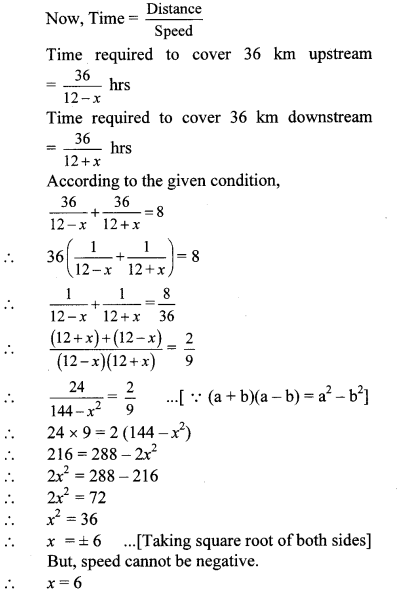
∴ speed of the boat in upstream = (12 – x) km/hr and speed of the boat in downstream = (12 + x) km/hr.
Maharashtra Board Class 10 Maths Solutions Chapter 2 Quadratic Equations Practice Set 2.6 3
∴ The speed of water current is 6 km/hr.

Question 8.
Pintu takes 6 days more than those of Nishu to complete certain work. If they work together they finish it in 4 days. How many days would it take to complete the work if they work alone.
Solution:
Let Nishu take x days to complete the work alone.
∴ Total work done by Nishu in 1 day = \(\frac { 1 }{ x } \)
Also, Pintu takes (x + 6) days to complete the work alone.
∴ Total work done by Pintu in 1 day = \(\frac { 1 }{ x+6 } \)
∴ Total work done by both in 1 day = (\(\frac { 1 }{ x } \) + \(\frac { 1 }{ x+6 } \))
But, both take 4 days to complete the work together.
∴ Total work done by both in 1 day = \(\frac { 1 }{ 4 } \)
According to the given condition,
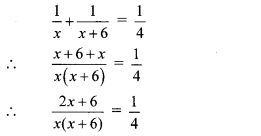
Maharashtra Board Class 10 Maths Solutions Chapter 2 Quadratic Equations Practice Set 2.6 4
∴ 4(2x + 6) = x(x + 6)
∴ 8x + 24 = x2 + 6x
∴ x2 + 6x – 8x – 24 = 0
∴ x2 – 2x – 24 = 0
∴ x2 – 6x + 4x – 24 = 0
∴ x(x – 6)+ 4(x – 6) = 0
∴ (x – 6) (x + 4) = 0
By using the property, if the product of two numbers is zero, then at least one of them is zero, we get
∴ x – 6 = 0 or x + 4 = 0
∴ x = 6 or x = -4
But, number of days cannot be negative,
∴ x = 6 and x + 6 = 6 + 6 = 12
∴ Number of days taken by Nishu and Pintu to complete the work alone is 6 days and 12 days respectively.
Question 9.
If 460 is divided by a natural number, quotient is 6 more than five times the divisor and remainder is 1. Find quotient and divisor.
Solution:
Let the natural number be x.
∴ Divisor = x, Quotient = 5x + 6
Also, Dividend = 460 and Remainder = 1
Dividend = Divisor × Quotient + Remainder
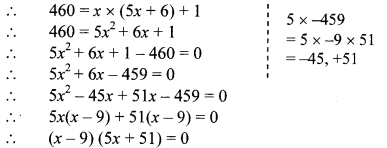
Maharashtra Board Class 10 Maths Solutions Chapter 2 Quadratic Equations Practice Set 2.6 5
By using the property, if the product of two numbers is zero, then at least one of them is zero, we get
∴ x – 9 = 0 or 5x + 51 = 0
∴ x = 9 or x = \(\frac { -51 }{ 5 } \)
But, natural number cannot be negative,
∴ x = 9
∴ Quotient = 5x + 6 = 5(9) + 6 = 45 + 6 = 51
∴ Quotient is 51 and Divisor is 9.

Question 10.
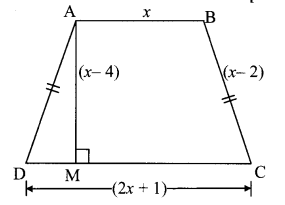
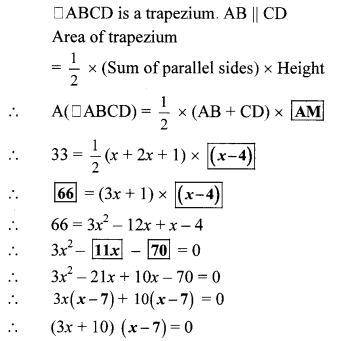
In the given fig. []ABCD is a trapezium, AB || CD and its area is 33 cm2. From the information given in the figure find the lengths of all sides of the []ABCD. Fill in the empty boxes to get the solution.
Maharashtra Board Class 10 Maths Solutions Chapter 2 Quadratic Equations Practice Set 2.6 6
Solution:
Maharashtra Board Class 10 Maths Solutions Chapter 2 Quadratic Equations Practice Set 2.6 7
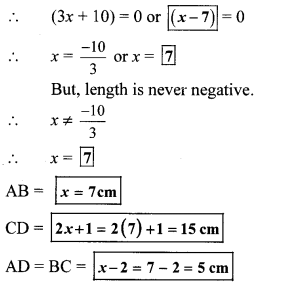
By using the property, if the product of two numbers is zero, then at least one of them is zero, we get
Maharashtra Board Class 10 Maths Solutions Chapter 2 Quadratic Equations Practice Set 2.6 8

Maharashtra Board 10th Class Maths Part 1 Practice Set 3.2 Solutions Chapter 3 Arithmetic Progression

Balbharti Maharashtra State Board Class 10 Maths Solutions covers the Practice Set 3.2 Algebra 10th Class Maths Part 1 Answers Solutions Chapter 3 Arithmetic Progression.

Practice Set 3.2 Algebra 10th Std Maths Part 1 Answers Chapter 3 Arithmetic Progression

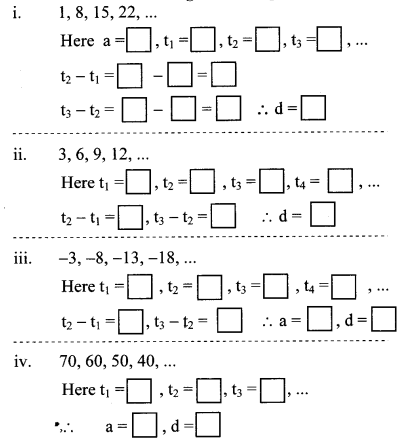
Question 1.
Write the correct number in the given boxes from the following A.P.
Maharashtra Board Class 10 Maths Solutions Chapter 3 Arithmetic Progression Practice Set 3.2 1
Solution:
Maharashtra Board Class 10 Maths Solutions Chapter 3 Arithmetic Progression Practice Set 3.2 2

Question 2.
Decide whether following sequence is an A.P., if so find the 20th term of the progression.
-12, -5, 2, 9,16, 23,30,…
Solution:
i. The given sequence is
-12, -5,2, 9, 16, 23,30,…
Here, t1 = -12, t2 = -5, t3 = 2, t4 = 9
∴ t2 – t1 – 5 – (-12) – 5 + 12 = 7
t3 – t2 = 2 – (-5) = 2 + 5 = 7
∴ t4 – t3 – 9 – 2 = 7
∴ t2 – t1 = t3 – t2 = … = 7 = d = constant
The difference between two consecutive terms is constant.
∴ The given sequence is an A.P.

ii. tn = a + (n – 1)d
∴ t20 = -12 + (20 – 1)7 …[∵a = -12, d = 7]
= -12 + 19 × 7
= -12 + 133
∴ t20 = 121
∴ 20th term of the given A.P. is 121.

Question 3.
Given Arithmetic Progression is 12, 16, 20, 24, … Find the 24th term of this progression.
Solution:
The given A.P. is 12, 16, 20, 24,…
Here, a = 12, d = 16 – 12 = 4 Since,
tn = a + (n – 1)d
∴ t24 = 12 + (24 – 1)4
= 12 + 23 × 4
= 12 + 92
∴ t24 = 104
∴ 24th term of the given A.P. is 104.

Question 4.
Find the 19th term of the following A.P. 7,13,19,25…..
Solution:
The given A.P. is 7, 13, 19, 25,…
Here, a = 7, d = 13 – 7 = 6
Since, tn = a + (n – 1)d
∴ t19 = 7 + (19 – 1)6
= 7 + 18 × 6
= 7 + 108
∴ t19 = 115
∴ 19th term of the given A.P. is 115.

Question 5.
Find the 27th term of the following A.P. 9,4,-1,-6,-11,…
Solution:
The given A.P. is 9, 4, -1, -6, -11,…
Here, a = 9, d = 4- 9 = -5
Since, tn = a + (n – 1)d
∴ t27 = 9 + (27 – 1)(-5)
= 9 + 26 × (-5)
= 9 – 130
∴ t27 = -121
∴ 27th term of the given A.P. is -121.

Question 6.
Find how many three digit natural numbers are divisible by 5.
Solution:
The three digit natural numbers divisible by
5 are 100, 105, 110, …,995
The above sequence is an A.P.
∴ a = 100, d = 105 – 100 = 5
Let the number of terms in the A.P. be n.
Then, tn = 995
Since, tn = a + (n – 1)d
∴ 995 = 100 +(n – 1)5
∴ 995 – 100 = (n – 1)5
∴ 895 = (n – 1)5
∴ n – 1 = \(\frac { 895 }{ 5 } \)
∴ n – 1 = 179
∴ n = 179 + 1 = 180
∴ There are 180 three digit natural numbers which are divisible by 5.

Question 7.
The 11th term and the 21st term of an A.P. are 16 and 29 respectively, then find the 41st term of that A.P.
Solution:
Bor an A.P., let a be the first term and d be the common difference,
t11 = 16, t21 = 29 …[Given]
tn = a + (n – 1)d
∴ t11, = a + (11 – 1)d
∴ 16 = a + 10d
i.e. a + 10d = 16 …(i)
Also, t21 = a + (21 – 1)d
∴ 29 = a + 20d
i.e. a + 20d = 29 …(ii)
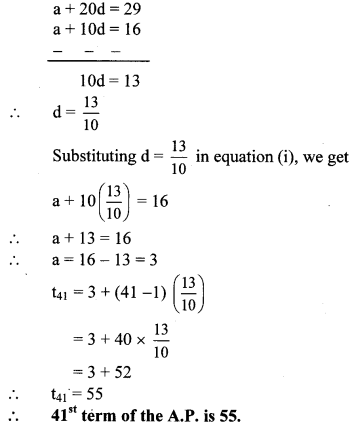
Subtracting equation (i) from (ii), we get a
Maharashtra Board Class 10 Maths Solutions Chapter 3 Arithmetic Progression Practice Set 3.2 3

Question 8.
8. 11, 8, 5, 2, … In this A.P. which term is number-151?
Solution:
The given A.P. is 11, 8, 5, 2,…
Here, a = 11, d = 8 – 11 = -3
Let the nth term of the given A.P. be -151.
Then, tn = – 151
Since, tn = a + (n – 1)d
∴ -151= 11 + (n – 1)(-3)
∴ -151 – 11 =(n – 1)(-3)
∴ -162 = (n – 1)(-3)
∴ n – 1 = \(\frac { -162 }{ -3 } \)
∴ n – 1 = 54
∴ n = 54 + 1 = 55
∴ 55th term of the given A.P. is -151.

Question 9.
In the natural numbers from 10 to 250, how many are divisible by 4?
Solution:
The natural numbers from 10 to 250 divisible
by 4 are 12, 16, 20, …,248
The above sequence is an A.P.
∴ a = 12, d = 16 – 12 = 4
Let the number of terms in the A.P. be n.
Then, tn = 248
Since, tn = a + (n – 1)d
∴ 248 = 12 + (n – 1)4
∴ 248 – 12 = (n – 1)4
∴ 236 = (n – 1)4
∴ n – 1 = \(\frac { 236 }{ 4 } \)
∴ n – 1 = 59
∴ n = 59 + 1 = 60
∴ There are 60 natural numbers from 10 to 250 which are divisible by 4.

Question 10.
In an A.P. 17th term is 7 more than its 10th term. Find the common difference.
Solution:
For an A.P., let a be the first term and d be the common difference.
According to the given condition,
t17 = t10 + 7
∴ a + (17 – 1)d = a + (10 – 1)d + 7 …[∵ tn = a + (n – 1)d]
∴ a + 16d = a + 9d + 7
∴ a + 16d – a – 9d = 7
∴ 7d = 7
∴ d = \(\frac { 7 }{ 7 } \) = 1
∴ The common difference is 1.

Question 1.
Kabir’s mother keeps a record of his height on each birthday. When he was one year old, his height was 70 cm, at 2 years he was 80 cm tall and 3 years he was 90 cm tall. His aunt Meera was studying in the 10th class. She said, “it seems like Kabir’s height grows in Arithmetic Progression”. Assuming this, she calculated how tall Kabir will be at the age of 15 years when he is in 10th! She was shocked to find it. You too assume that Kabir grows in A.P. and find out his height at the age of 15 years. (Textbook pg. no. 63)
Solution:
Height of Kabir when he was 1 year old = 70 cm Height of Kabir when he was 2 years old = 80 cm
Height of Kabir when he was 3 years old = 90 cm The heights of Kabir form an A.P.
Here, a = 70, d = 80 – 70 = 10
We have to find height of Kabir at the age of 15years i.e. t15.
Now, tn = a + (n – 1)d
∴ t15 = 70 + (15 – 1)10
= 70 + 14 × 10 = 70 + 140
∴ t15 = 210
∴ The height of Kabir at the age of 15 years will be 210 cm.

Question 2.
Is 5, 8, 11, 14, …. an A.P.? If so then what will be the 100th term? Check whether 92 is in this A.P.? Is number 61 in this A.P.? (Textbook pg. no, 62)
Solution:
i. The given sequence is
5, 8,11,14,…
Here, t1 = 5, t2 = 8, t3 = 11, t4 = 14
∴ t2 – t1 = 8 – 5 = 3
t3 – t2 = 11 – 8 = 3
t4 – t3 = 14 – 11 = 3
∴ t2 – t1 = t3 – t2 = t4 – t3 = 3 = d = constant
The difference between two consecutive terms is constant
∴ The given sequence is an A.P.

ii. tn = a + (n – 1)d
∴ t100 = 5 + (100 – 1)3 …[∵ a = 5, d = 3]
= 5 + 99 × 3
= 5 + 297
∴ t100 = 302
∴ 100th term of the given A.P. is 302.

iii. To check whether 92 is in given A.P., let tn = 92
∴ tn = a + (n – 1)d
∴ 92 = 5 + (n – 1)3
∴ 92 = 5 + 3n – 3
∴ 92 = 2 + 3n
∴ 90 = 3n
∴ n = \(\frac { 90 }{ 3 } \) = 30
∴ 92 is the 30th term of given A.P.

iv. To check whether 61 is in given A.P., let tn = 61
61 = 5 + (n – 1)3
∴ 61 = 5 + 3n – 3
∴ 61 = 2 + 3n
∴ 61 – 2 = 3n
∴ 59 = 3n
∴ n = \(\frac { 59 }{ 3 } \)
But, n is natural number 59
∴ n ≠ \(\frac { 59 }{ 3 } \)
∴ 61 is not in given A.P.

Maharashtra Board 10th Class Maths Part 1 Practice Set 2.1 Solutions Chapter 2 Quadratic Equations

Balbharti Maharashtra State Board Class 10 Maths Solutions covers the Practice Set 2.1 Algebra 10th Class Maths Part 1 Answers Solutions Chapter 2 Quadratic Equations.

Practice Set 2.1 Algebra 10th Std Maths Part 1 Answers Chapter 2 Quadratic Equations

Question 1.
Write any two quadratic equations.
Solution:
i. y2 – 7y + 12 = 0
ii. x2 – 8 = 0

Question 2.
Decide which of the following are quadratic
i. x2 – 7y + 2 = 0
ii. y2 = 5y – 10
iii. y2 + \(\frac { 1 }{ y } \) = 2
iv. x + \(\frac { 1 }{ x } \) = -2
v. (m + 2) (m – 5) = 03
vi. m3 + 3m2 – 2 = 3m3
Solution:
i. The given equation is x2 + 5x – 2 = 0
Here, x is the only variable and maximum index of the variable is 2.
a = 1, b = 5, c = -2 are real numbers and a ≠ 0.
∴ The given equation is a quadratic equation.

ii. The given equation is
y2 = 5y – 10
∴ y2 – 5y + 10 = 0
Here, y is the only variable and maximum index of the variable is 2.
a = 1, b = -5, c = 10 are real numbers and a ≠ 0.
∴ The given equation is a quadratic equation.

iii. The given equation is
y2 + \(\frac { 1 }{ y } \) = 2
∴ y3 + 1 = 2y …[Multiplying both sides by y]
∴ y3 – 2y + 1 = 0
Here, y is the only variable and maximum index of the variable is not 2.
∴ The given equation is not a quadratic equation.

iv. The given equation is
x + \(\frac { 1 }{ x } \) = -2
∴ x2 + 1 = -2x …[Multiplying both sides by x]
∴ x2 + 2x+ 1 = 0
Here, x is the only variable and maximum index of the variable is 2.
a = 1, b = 2, c = 1 are real numbers and a ≠ 0.
∴ The given equation is a quadratic equation.

v. The given equation is
(m + 2) (m – 5) = 0
∴ m(m – 5) + 2(m – 5) = 0
∴ m2 – 5m + 2m – 10 = 0
∴ m2 – 3m – 10 = 0
Here, m is the only variable and maximum index of the variable is 2.
a = 1, b = -3, c = -10 are real numbers and a ≠ 0.
∴ The given equation is a quadratic equation.

vi. The given equation is
m3 + 3m2 – 2 = 3m3
∴ 3m3 – m3 – 3m2 + 2 = 0
∴ 2m3 – 3m2 + 2 = 0
Here, m is the only variable and maximum
index of the variable is not 2.
∴ The given equation is not a quadratic equation.

Question 3.
Write the following equations in the form ax2 + bx + c = 0, then write the values of a, b, c for each equation.
i. 2y = 10 – y2
ii. (x – 1)2 = 2x + 3
iii. x2 + 5x = – (3 – x)
iv. 3m2 = 2m2 – 9
v. P (3 + 6p) = – 5
vi. x2 – 9 = 13
Solution:
i. 2y – 10 – y2
∴ y2 + 2y – 10 = 0
Comparing the above equation with
ay2 + by + c = 0, we get
a = 1, b = 2, c = -10

ii. (x – 1)2 = 2x + 3
∴ x2 – 2x + 12x + 3
x2 – 2x + 1 – 2x – 30
∴ x2 – 4x – 2 = 0
Comparing the above equation with
ax2 + bx + c = 0, we get
a = 1, b = -4, c = -2

iii. x2 + 5x = – (3 – x)
∴ x2 + 5x = -3 + x
∴ x2 + 5x – x + 3 = 0
∴ x2 + 4x + 3 = 0
Comparing the above equation with
ax2 + bx + c = 0, we get
a = 1, b = 4, c = 3

iv. 3m2 = 2m2 – 9
∴ 3m2 – 2m2 + 9 = 0
∴ m2 + 9 = 0
∴ m2 + 0m + 9 = 0
Comparing the above equation with
am2 + bm + c = 0, we get
a = 1, b = 0, c = 9

v. p (3 + 6p) = – 5
∴ 3p + 6p2 = -5
∴ 6p2 + 3p + 5 = 0
Comparing the above equation with
ap2 + bp + c = 0, we get
a = 6, b = 3, c = 5

vi. x2 – 9 = 13
∴ x2 – 9 – 13 = 0
∴ x2 – 22 = 0
∴ x2 + 0x – 22 = 0
Comparing the above equation with
ax2 + bx + c = 0, we get
a = 1, b = 0, c = -22

Question 4.
Determine whether the values given against each of the quadratic equation are the roots of the equation.
i. x2 + 4x – 5 = 0; x = 1,-1
ii. 2m2 – 5m = 0; m = 2, \(\frac { 5 }{ 2 } \)
Solution:
i. The given equation is
x2 + 4x – 5 = 0 …(i)
Putting x = 1 in L.H.S. of equation (i), we get
L.H.S. = (1)2 + 4(1) – 5 = 1 + 4 – 5 = 0
∴ L.H.S. = R.H.S.
∴ x = 1 is the root of the given quadratic equation.
Putting x = -1 in L.H.S. of equation (i), we get
L.H.S. = (-1)2 + 4(-1) – 5 = 1 – 4 – 5 = -8
∴ LH.S. ≠ R.H.S.
∴ x = -1 ¡s not the root of the given quadratic equation.

ii. The given equation is
2m2 – 5m = 0 …(i)
Putting m = 2 in L.H.S. of equation (i), we get
L.H.S. = 2(2)2 – 5(2) = 2(4) -10 = 8 – 10 = -2
∴ L.H.S. ≠ R.H.S.
∴ m = 2 is not the root of the given quadratic equation.
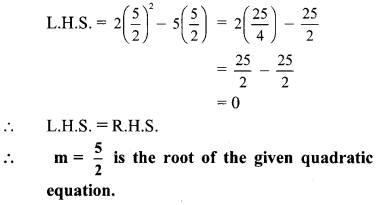
Putting m = \(\frac { 5 }{ 2 } \) in L.H.S. of equation (i), we get
Maharashtra Board Class 10 Maths Solutions Chapter 2 Quadratic Equations Practice Set 2.1 1

Question 5.
Find k if x = 3 is a root of equation kx2 – 10x + 3 = 0.
Solution:
x = 3 is the root of the equation kx2 – 10x + 3 = 0.
Putting x = 3 in the given equation, we get
k(3)2 – 10(3) + 3 = 0
∴ 9k – 30 +3 = 0
∴ 9k – 27 = 0
∴ 9k = 27
∴ k = \(\frac { 27 }{ 9 } \)
∴ k = 3

Question 6.
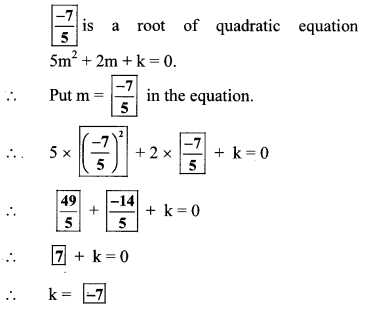
One of the roots of equation 5m2 + 2m + k = 0 is \(\frac { -7 }{ 5 } \) Complete the following activity to find the value of ‘k’.
Solution:
Maharashtra Board Class 10 Maths Solutions Chapter 2 Quadratic Equations Practice Set 2.1 2

Question 1.
x2 + 3x – 5, 3x2 – 5x, 5x2; Write the polynomials In the index form. Observe the coefficients and fill in the boxes. (Textbook p. no. 31)
Answer:
Index form of the given polynomials:
x2 + 3x – 5, 3x2 – 5x + 0, 5x2 + 0x + 0
i. Coefficients of x2 are [1], [3] and [5] respectively, and these coefficients are non zero.
ii. Coefficients of x are 3, [-5] and [0] respectively.
iii. Constant terms are [-5], [0] and [0] respectively.
Here, constant terms of second and third polynomial is zero.

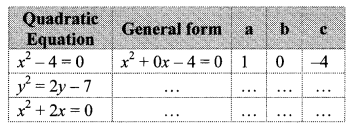
Question 2.
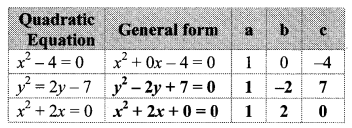
Complete the following table (Textbook p. no. 31)
Maharashtra Board Class 10 Maths Solutions Chapter 2 Quadratic Equations Practice Set 2.1 3
Answer:
Maharashtra Board Class 10 Maths Solutions Chapter 2 Quadratic Equations Practice Set 2.1 4

Question 3.
Decide which of the following are quadratic equations? (Textbook pg. no. 31)
i. 9y2 + 5 = 0
ii. m3 – 5m2 + 4 = 0
iii. (l + 2)(l – 5) = 0
Solution:
i. In the equation 9y2 + 5 = 0, [y] is the only variable and maximum index of the variable is [2].
∴ It [is] a quadratic equation.

ii. In the equation m3 – 5m2 + 4 = 0, [m] is the only variable and maximum index of the variable is not 2.
∴ It [is not] a quadratic equation.

iii. (l + 2)(l – 5) = 0
∴ l(l – 5) + 2(l – 5) = 0
∴ l2 – 5l + 2l – 10 = 0
∴ l2 – 3l – 10 = 0.
In this equation [l] is the only variable and maximum index of the variable is [2]
∴ it [is] a quadratic equation.

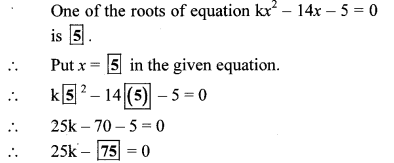
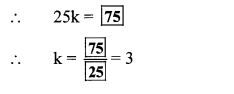
Question 4.
If x = 5 is a root of equation kx2 – 14x – 5 = 0, then find the value of k by completing the following activity. (Textbook pg, no. 33)
Solution:
Maharashtra Board Class 10 Maths Solutions Chapter 2 Quadratic Equations Practice Set 2.1 5
Maharashtra Board Class 10 Maths Solutions Chapter 2 Quadratic Equations Practice Set 2.1 6

Maharashtra Board 10th Class Maths Part 1 Practice Set 1.5 Solutions Chapter 1 Linear Equations in Two Variables

Balbharti Maharashtra State Board Class 10 Maths Solutions covers the Practice Set 1.5 Algebra 10th Class Maths Part 1 Answers Solutions Chapter 1 Linear Equations in Two Variables.

Practice Set 1.5 Algebra 10th Std Maths Part 1 Answers Chapter 1 Linear Equations in Two Variables

Question 1.
Two numbers differ by 3. The sum of twice the smaller number and thrice the greater number is 19. Find the numbers.
Solution:
Let the greater number be x and the smaller number be y.
According to the first condition, x – y = 3 …(i)
According to the second condition,
3x + 2y = 19 …(ii)
Multiplying equation (i) by 2, we get
2x – 2y = 6 …(iii)
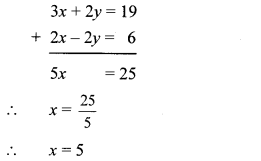
Adding equations (ii) and (iii), we get
Maharashtra Board Class 10 Maths Solutions Chapter 1 Linear Equations in Two Variables Practice Set Ex 1.5 1
Substituting x = 5 in equation (i), we get
5 – y = 3
∴ 5 – 3 = y
∴ y = 2
∴ The required numbers are 5 and 2.

Question 2.
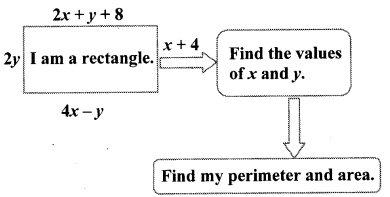
Complete the following.
Maharashtra Board Class 10 Maths Solutions Chapter 1 Linear Equations in Two Variables Practice Set Ex 1.5 2
Solution:
Opposite sides of a rectangle are equal.
∴ 2x + y + 8 = 4x – y
∴ 8 = 4x – 2x – y – y
∴ 2x – 2y = 8
∴ x – y = 4 …(i)[Dividingboth sides by 2]
Also, x + 4= 2y
∴ x – 2y = -4 …(ii)
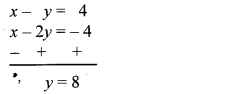
Subtracting equation (ii) from (i), we get
Maharashtra Board Class 10 Maths Solutions Chapter 1 Linear Equations in Two Variables Practice Set Ex 1.5 3
Substituting y = 8 in equation (i), we get
x – 8 = 4
∴ x = 4 + 8
∴ x = 12
Now, length of rectangle = 4x – y
= 4(12) – 8
= 48 – 8
∴ Length of rectangle = 40
Breadth of rectangle = 2y = 2(8) = 16
Perimeter of rectangle = 2(length + breadth)
= 2(40 + 16)
= 2(56)
∴ Perimeter of rectangle =112 units
Area of rectangle = length × breadth
= 40 × 16
∴ Area of rectangle = 640 sq. units
∴ x = 12 and y = 8, Perimeter of rectangle is 112 units and area of rectangle is 640 sq. units.

Question 3.
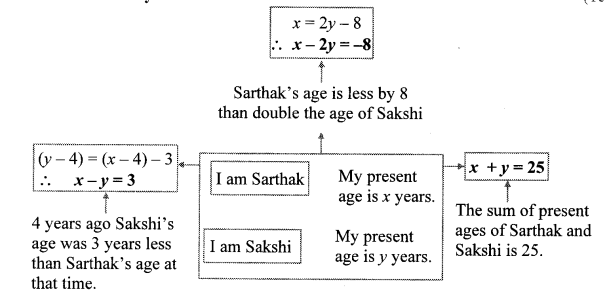
The sum of father’s age and twice the age of his son is 70. If we double the age of the father and add it to the age of his son the sum is 95. Find their present ages.
Solution:
Let the present ages of father and son be x years and y years respectively.
According to the first condition,
x + 2y = 70 …(i)
According to the second condition,
2x + y = 95 …(ii)
Multiplying equation (i) by 2, we get
2x + 4y = 140 …(iii)
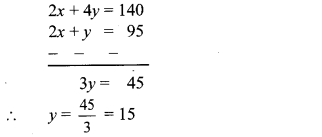
Subtracting equation (ii) from (iii), we get
Maharashtra Board Class 10 Maths Solutions Chapter 1 Linear Equations in Two Variables Practice Set Ex 1.5 4
Substituting y = 15 in equation (i), we get
x + 2(15) = 7O
⇒ x + 30 = 70
⇒ x = 70 – 30
∴ x = 40
∴ The present ages of father and son are 40 years and 15 years respectively.

Question 4.
The denominator of a fraction is 4 more than twice its numerator. Denominator becomes 12 times the numerator, if both the numerator and the denominator are reduced by 6. Find the fraction.
Solution:
Let the numerator of the fraction be x and the denominator be y.
∴ Fraction = \(\frac { x }{ y } \)
According to the first condition,
y = 2x + 4
∴ 2x – y = -4 …(i)
According to the second condition,
(y – 6)= 12(x – 6)
∴ y – 6 = 12x – 72
∴ 12x – y = 72 – 6
∴ 12x – y = 66 …(ii)
Subtracting equation (i) from (ii), we get
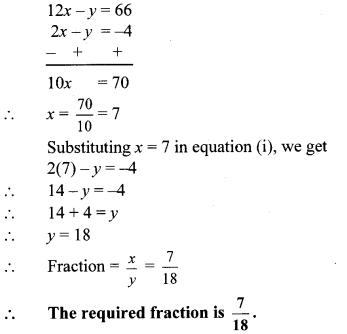
Maharashtra Board Class 10 Maths Solutions Chapter 1 Linear Equations in Two Variables Practice Set Ex 1.5 5

Question 5.
Two types of boxes A, B ,are to be placed in a truck having capacity of 10 tons. When 150 boxes of type A and 100 boxes of type B are loaded in the truck, it weights 10 tons. But when 260 boxes of type A are loaded in the truck, it can still accommodate 40 boxes of type B, so that it is fully loaded. Find the weight of each type of box.
Solution:
Let the weights of box of type A be x kg and that of box of type B be y kg.
1 ton = 1000 kg
∴ 10 tons = 10000 kg
According to the first condition,
150x + 100y = 10000
∴ 3x + 2y = 200 …(i) [Dividing both sides by 50]
According to the second condition,
260x + 40y = 10000
∴ 13x + 2y = 500 …(ii) [Dividing both sides by 20]
Subtracting equation (i) from (ii), we get
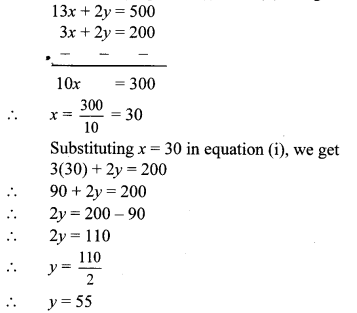
Maharashtra Board Class 10 Maths Solutions Chapter 1 Linear Equations in Two Variables Practice Set Ex 1.5 6
∴ The weights of box of type A is 30 kg and that of box of type B is 55 kg.

Question 6.
Out of 1900 km, Vishal travelled some distance by bus and some by aeroplane. Bus travels with average speed 60 km/hr and the average speed of aeroplane is 700 km/hr. It takes 5 hours to complete the journey. Find the distance Vishal travelled by bus.
Solution:
Let the distance Vishal travelled by bus be x km and by aeroplane be y km.
According to the first condition,
x + y = 1900 …(i)
\(\text { Time }=\frac{\text { Distance }}{\text { Speed }} \)
∴ Time required to cover x km by bus = \(\frac { x }{ 60 } \) hr
Time required to cover y km by aeroplane
= \(\frac { y }{ 700 } \) hr
According to the second condition,
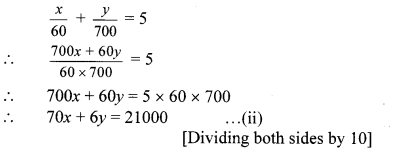
Maharashtra Board Class 10 Maths Solutions Chapter 1 Linear Equations in Two Variables Practice Set Ex 1.5 7
Multiplying equation (i) by 6, we get
6x + 6y= 11400 …(iii)
Subtracting equation (iii) from (ii), we get
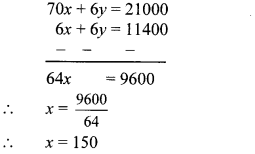
Maharashtra Board Class 10 Maths Solutions Chapter 1 Linear Equations in Two Variables Practice Set Ex 1.5 9
∴ The distance Vishal travelled by bus is 150 km.

Question 1.
There are some instructions given below. Frame the equations from the information and write them in the blank boxes shown by arrows. (Textbook pg. no. 20)
Answer:
Maharashtra Board Class 10 Maths Solutions Chapter 1 Linear Equations in Two Variables Practice Set Ex 1.5 10

Maharashtra Board 10th Class Maths Part 1 Problem Set 1 Solutions Chapter 1 Linear Equations in Two Variables

Balbharti Maharashtra State Board Class 10 Maths Solutions covers the Problem Set 1 Algebra 10th Class Maths Part 1 Answers Solutions Chapter 1 Linear Equations in Two Variables.

Problem Set 1 Algebra 10th Std Maths Part 1 Answers Chapter 1 Linear Equations in Two Variables

Choose correct alternative for each of the following questions.

Question 1.
To draw graph of 4x + 5y = 19, find y when x = 1.
(a) 4
(b) 3
(c) 2
(d) -3
Answer:
(b)

Question 2.
For simultaneous equations in variables x and y, Dx = 49, Dy = – 63, D = 7 then what is x?
(a) 7
(b) -7
(c) \(\frac { 1 }{ 7 } \)
(d) \(\frac { -1 }{ 7 } \)
Answer:
(a)

Question 3.
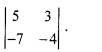
Find the value of
Maharashtra Board Class 10 Maths Solutions Chapter 1 Linear Equations in Two Variables Problem Set 1
(a) -1
(b) -41
(c) 41
(d) 1
Answer:
(d)

Question 4.
To solvex + y = 3; 3x – 2y – 4 = 0 by determinant method find D.
(a) 5
(b) 1
(c) -5
(d) -1
Answer:
(c)

Question 5.
ax + by = c and mx + n y = d and an ≠ bm then these simultaneous equations have-
(a) Only one common solution
(b) No solution
(c) Infinite number of solutions
(d) Only two solutions.
Answer:
(a)

Question 2.
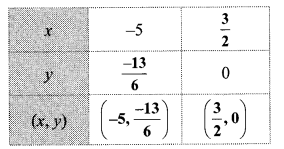
Complete the following table to draw the graph of 2x – 6y = 3.
Answer:
Maharashtra Board Class 10 Maths Solutions Chapter 1 Linear Equations in Two Variables Problem Set 2

Question 3.
Solve the following simultaneous equations graphically.
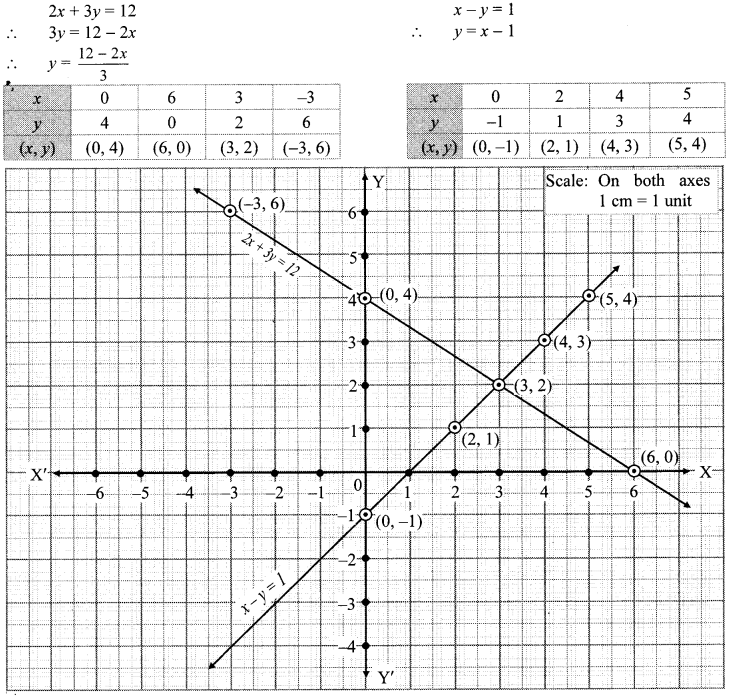
i. 2x + 3y = 12 ; x – y = 1
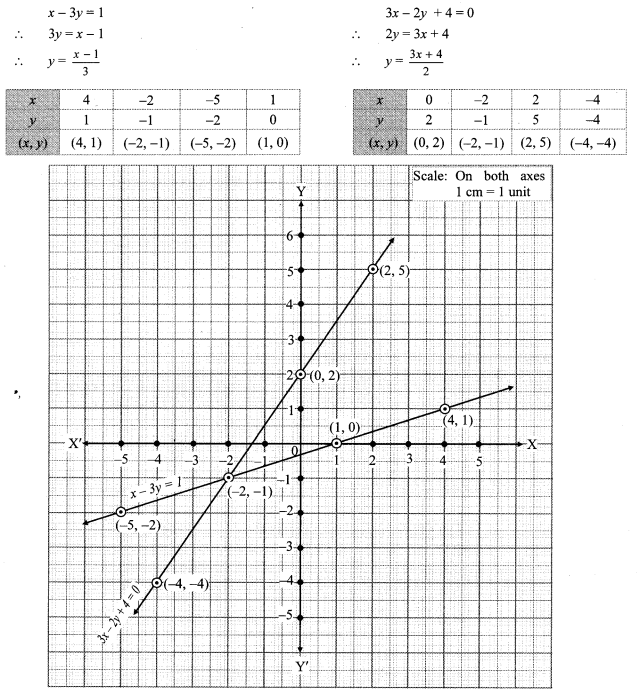
ii. x – 3y = 1 ; 3x – 2y + 4 = 0
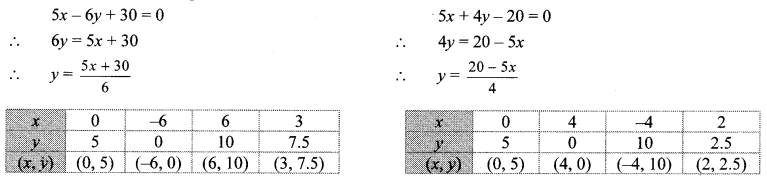
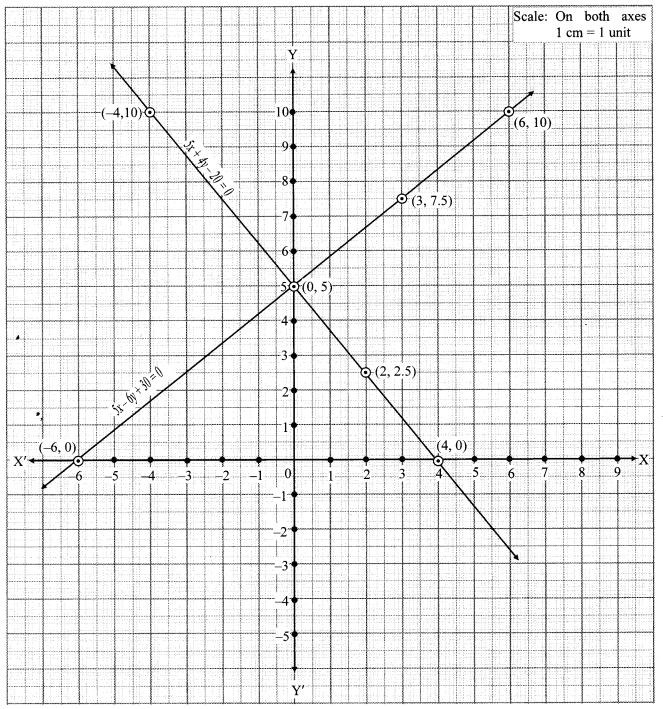
iii. 5x – 6y + 30 = 0; 5x + 4y – 20 = 0
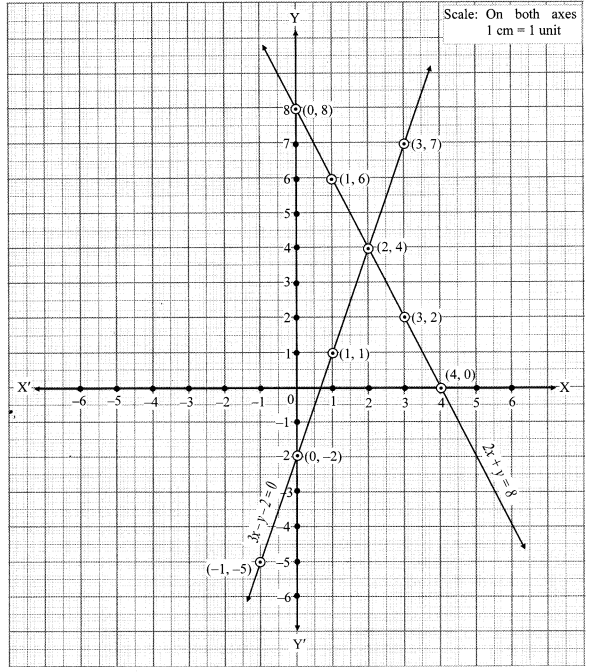
iv. 3x – y – 2 = 0 ; 2x + y = 8
v. 3x + y= 10 ; x – y = 2
Answer:
i. The given simultaneous equations are
Maharashtra Board Class 10 Maths Solutions Chapter 1 Linear Equations in Two Variables Problem Set 3
The two lines interest at point (3,2).
∴ x = 3 and y = 2 is the solution of the simultaneous equations 2x + 3y = 12 and x – y = 1.

ii. The given simultaneous equations are
Maharashtra Board Class 10 Maths Solutions Chapter 1 Linear Equations in Two Variables Problem Set 4
The two lines intersect at point (-2, -1).
∴ x = -2 and y = -1 is the solution of the simultaneous equations x – 3y = 1 and 3x – 2p + 4 = 0.

iii. The given simultaneous equations are
Maharashtra Board Class 10 Maths Solutions Chapter 1 Linear Equations in Two Variables Problem Set 5 Maharashtra Board Class 10 Maths Solutions Chapter 1 Linear Equations in Two Variables Problem Set 6
The two lines intersect at point (0, 5).
∴ x = 0 and y = 5 is the solution of the simultaneous equations 5x – 6y + 30 = 0 and 5x + 4y – 20 = 0.

iv. The given simultaneous equations are
Maharashtra Board Class 10 Maths Solutions Chapter 1 Linear Equations in Two Variables Problem Set 7
Maharashtra Board Class 10 Maths Solutions Chapter 1 Linear Equations in Two Variables Problem Set 8
The two lines intersect at point (2, 4).
∴ x = 2 and y = 4 is the solution of the simultaneous equations 3x – y – 2 = 0 and 2x + y = 8.

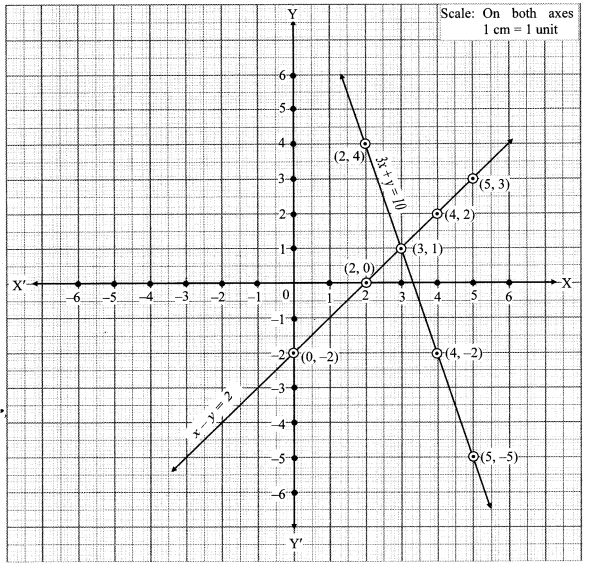
v. The given simultaneous equations are
Maharashtra Board Class 10 Maths Solutions Chapter 1 Linear Equations in Two Variables Problem Set 9 Maharashtra Board Class 10 Maths Solutions Chapter 1 Linear Equations in Two Variables Problem Set 10
The two lines intersect at point (3, 1).
∴ x = 3 and y = 1 is the solution of the simultaneous equations 3x + y = 10 and x – y = 2.

Question 4.
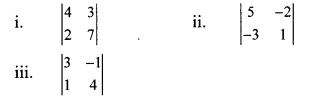
Find the values of each of the following determinants.
Maharashtra Board Class 10 Maths Solutions Chapter 1 Linear Equations in Two Variables Problem Set 11
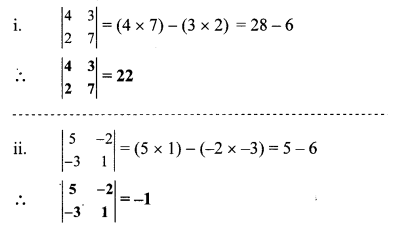
Solution:
Maharashtra Board Class 10 Maths Solutions Chapter 1 Linear Equations in Two Variables Problem Set 12
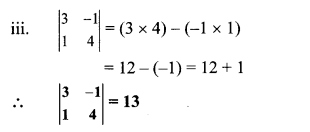
Maharashtra Board Class 10 Maths Solutions Chapter 1 Linear Equations in Two Variables Problem Set 13

Question 5.
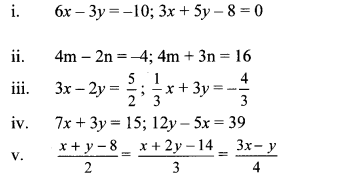
Solve the following equations by Cramer’s method.
Maharashtra Board Class 10 Maths Solutions Chapter 1 Linear Equations in Two Variables Problem Set 14
Solution:
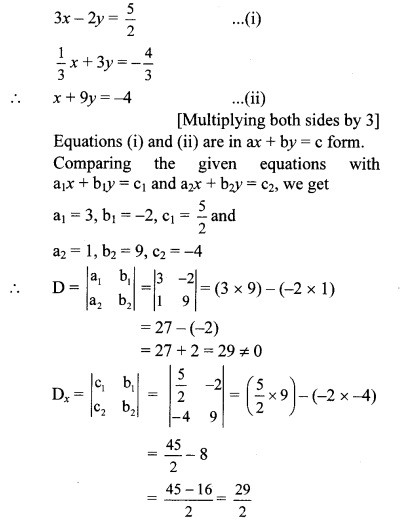
i. The given simultaneous equations are
6x – 3y = -10 …(i)
3x + 5y – 8 = 0
∴ 3x + 5y = 8 …(ii)
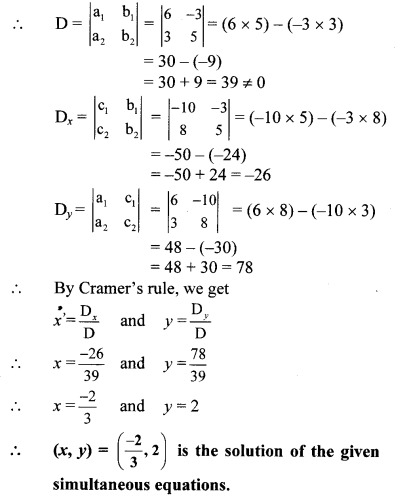
Equations (i) and (ii) are in ax + by = c form. Comparing the given equations with a1x + b1y = c1 and a2x + b2y = c2, we get
a1 = 6, b1 = -3, c1 = 10 and
a2 = 3, b2 = 5, c2 = 8
Maharashtra Board Class 10 Maths Solutions Chapter 1 Linear Equations in Two Variables Problem Set 15

ii. The given simultaneous equations are
4m – 2n = -4 …(i)
4m + 3n = 16 …(ii)
Equations (i) and (ii) are in am + bn = c form.
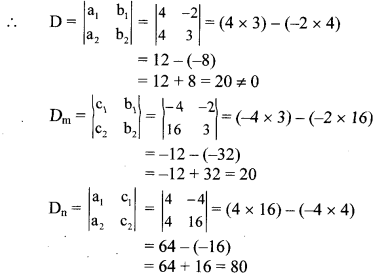
Comparing the given equations with a1m + b1n = c1 and a2m + b2n = c2, we get
a1 = 4, b1 = -2, c1 = -4 and
a2 = 4, b2 = 3, c2 = 16
Maharashtra Board Class 10 Maths Solutions Chapter 1 Linear Equations in Two Variables Problem Set 16
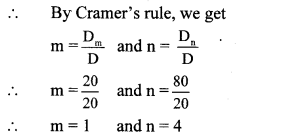
Maharashtra Board Class 10 Maths Solutions Chapter 1 Linear Equations in Two Variables Problem Set 17
∴ (m, n) = (1, 4) is the solution of the given simultaneous equations.

iii. The given simultaneous equations are
Maharashtra Board Class 10 Maths Solutions Chapter 1 Linear Equations in Two Variables Problem Set 18 Maharashtra Board Class 10 Maths Solutions Chapter 1 Linear Equations in Two Variables Problem Set 19

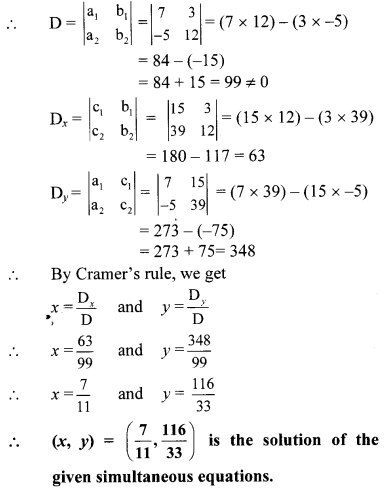
iv. The given simultaneous equations are
7x + 3y = 15 …(i)
12y – 5x = 39
i.e. -5x + 12y = 39 …(ii)
Equations (i) and (ii) are in ax + by = c form.
Comparing the given equations with
a1x + b1y = c1 and a2x + b2y = c2, we get
a1 = 7, b1 = 3, c1 = 15 and
a2 = -5, b2 = 12, c2 = 39
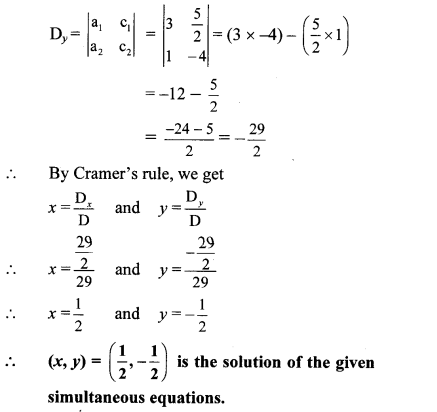
Maharashtra Board Class 10 Maths Solutions Chapter 1 Linear Equations in Two Variables Problem Set 20

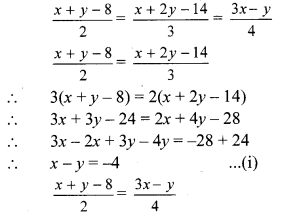
v. The given simultaneous equations are
Maharashtra Board Class 10 Maths Solutions Chapter 1 Linear Equations in Two Variables Problem Set 21
∴ 4(x + y – 8) = 2(3x – y)
∴ 4x + 4y – 32 = 6x – 2y
∴ 6x – 4x – 2y – 4y = -32
∴ 2x – 6y = -32
∴ x – 3y = -16 …(ii)[Dividing both sides by 2]
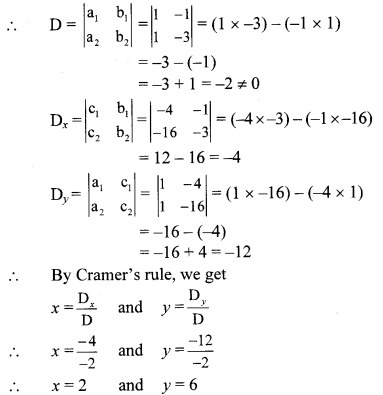
Equations (i) and (ii) are in ax + by = c form. Comparing the given equations with
a1x + b1y = c1 and a2x + b2y = c2, we get
a1 = 1, b1 = -1, c1 = -4 and
a2 = 1, b2 = -3, c2 = -16
Maharashtra Board Class 10 Maths Solutions Chapter 1 Linear Equations in Two Variables Problem Set 22
∴ (x, y) = (2, 6) is the solution of the given simultaneous equations.

Question 6.
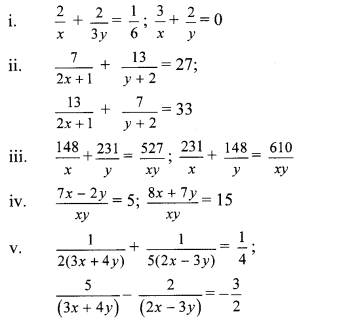
Solve the following simultaneous equations:
Maharashtra Board Class 10 Maths Solutions Chapter 1 Linear Equations in Two Variables Problem Set 23
Answer:
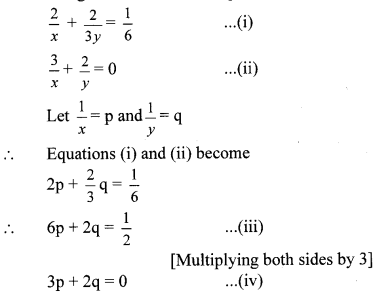
i. The given simultaneous equations are
Maharashtra Board Class 10 Maths Solutions Chapter 1 Linear Equations in Two Variables Problem Set 24
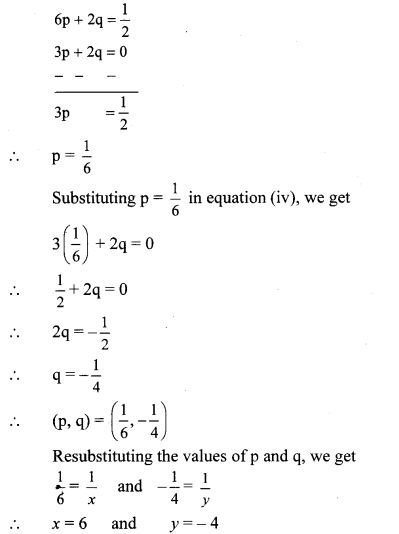
Subtracting equation (iv) from (iii), we get
Maharashtra Board Class 10 Maths Solutions Chapter 1 Linear Equations in Two Variables Problem Set 25
∴ (x, y) = (6, – 4) is the solution of the given simultaneous equations.

ii. The given simultaneous equations are
Maharashtra Board Class 10 Maths Solutions Chapter 1 Linear Equations in Two Variables Problem Set 26
Adding equations (v) and (vi), we get
Maharashtra Board Class 10 Maths Solutions Chapter 1 Linear Equations in Two Variables Problem Set 27

iii. The given simultaneous equations are
Maharashtra Board Class 10 Maths Solutions Chapter 1 Linear Equations in Two Variables Problem Set 28
Maharashtra Board Class 10 Maths Solutions Chapter 1 Linear Equations in Two Variables Problem Set 29
∴ (x, y) = (1, 2) is the solution of the given simultaneous equations.

iv. The given simultaneous equations are
Maharashtra Board Class 10 Maths Solutions Chapter 1 Linear Equations in Two Variables Problem Set 30
∴ Equations (i) and (ii) become 7q – 2p = 5 …(iii)
8q + 7p = 15 …(iv)
Multiplying equation (iii) by 7, we get
49q – 14p = 35 …(v)
Multiplying equation (iv) by 2, we get
16q + 14p = 30 …(vi)
Adding equations (v) and (vi), we get
Maharashtra Board Class 10 Maths Solutions Chapter 1 Linear Equations in Two Variables Problem Set 31
Substituting q = 1 in equation (iv), we get
8(1) + 7p = 15
∴ 8 + 7p = 15
∴ 7p = 15 – 8
∴ 7p = 7
∴ p = \(\frac { 7 }{ 7 } \) = 1
∴ (P, q) = (1,1)
Resubstituting the values of p and q, we get
1 = \(\frac { 1 }{ x } \) and 1 = \(\frac { 1 }{ y } \)
∴ x = 1 and y = 1
∴ (x, y) = (1, 1) is the solution of the given simultaneous equations.

v. The given simultaneous equations are
Maharashtra Board Class 10 Maths Solutions Chapter 1 Linear Equations in Two Variables Problem Set 32
Resubstituting the values of p and q, we get
Maharashtra Board Class 10 Maths Solutions Chapter 1 Linear Equations in Two Variables Problem Set 33
∴ 3x + 4y = 10 …(v)
and 2x – 3y = 1 …(vi)
Multiplying equation (v) by 3, we get
9x + 12y = 30 …(vii)
Multiplying equation (vi) by 4, we get
8x – 12y = 4 …(viii)
Adding equations (vii) and (viii), we get
Maharashtra Board Class 10 Maths Solutions Chapter 1 Linear Equations in Two Variables Problem Set 34
Substituting x = 2 in equation (v), we get
3(2) + 4y = 10
⇒ 6 + 4y = 10
⇒ 4y = 10 – 6
⇒ y = 4/4 = 1
∴ y = 1
∴ (x, y) = (2, 1) is the solution of the given simultaneous equations.

Question 7.
Solve the following word problems, i. A two digit number and the number with digits interchanged add up to 143. In the given number the digit in unit’s place is 3 more than the digit in the ten’s place. Find the original number.
Solution:
Let the digit in unit’s place be x
and that in the ten’s place be y.
Maharashtra Board Class 10 Maths Solutions Chapter 1 Linear Equations in Two Variables Problem Set 35

ii. Kantabai bought 1 \(\frac { 1 }{ 2 } \) kg tea and 5 kg sugar from a shop. She paid ₹ 50 as return fare for rickshaw. Total expense was ₹ 700. Then she realised that by ordering online the goods can be bought with free home delivery at the same price. So, next month she placed the order online for 2 kg tea and 7 kg sugar. She paid ₹ 880 for that. Find the rate of sugar and tea per kg.
Solution:
Let the rate of tea be ₹ x per kg and that of sugar be ₹ y per kg.
According to the first condition,
cost of 1 \(\frac { 1 }{ 2 } \) kg tea + cost of 5 kg sugar + fare for rickshaw = total expense
Maharashtra Board Class 10 Maths Solutions Chapter 1 Linear Equations in Two Variables Problem Set 36
According to the second condition,
cost of 2 kg tea + cost of 7 kg sugar = total expense
2x + 7y = 880 …(ii)
Multiplying equation (i) by 2, we get
6x + 20y = 2600 …(iii)
Multiplying equation (ii) by 3, we get
6x + 21y = 2640 …(iv)
Subtracting equation (iii) from (iv), we get
Maharashtra Board Class 10 Maths Solutions Chapter 1 Linear Equations in Two Variables Problem Set 37
∴ The rate of tea is ₹ 300 per kg and that of sugar is ₹ 40 per kg.

iii. To find number of notes that Anushka had, complete the following activity.
Maharashtra Board Class 10 Maths Solutions Chapter 1 Linear Equations in Two Variables Problem Set 38
Solution:
Anushka had x notes of ₹ 100 and y notes of ₹ 50.
According to the first condition,
100x + 50y = 2500
∴ 2x + y = 50 …(i) [Dividing both sides by 50]
According to the second condition,
100y + 50x = 2000
∴ 2y + x = 40 … [Dividing both sides by 50]
i.e. x + 2y = 40
∴ 2x + 4y = 80 …(ii) [Multiplying both sides by 2]
Subtracting equation (i) from (ii), we get
Maharashtra Board Class 10 Maths Solutions Chapter 1 Linear Equations in Two Variables Problem Set 39
∴ Anushka had 20 notes of ₹ 100 and 10 notes of ₹ 50.

iv. Sum of the present ages of Manish and Savita is 31, Manish’s age 3 years ago was 4 times the age of Savita. Find their present ages.
Solution:
Let the present ages of Manish and Savita be x years and y years respectively.
According to the first condition,
x + y = 31 …(i)
3 years ago,
Manish’s age = (x – 3) years
Savita’s age = (y – 3) years
According to the second condition,
(x – 3) = 4 (y – 3)
∴ x – 3 = 4y – 12
∴ x – 4y = -12 + 3
∴ x – 4y = -9 …(ii)
Subtracting equation (ii) from (i), we get
Maharashtra Board Class 10 Maths Solutions Chapter 1 Linear Equations in Two Variables Problem Set 40
∴ x = 31 – 8
∴ x = 23
The present ages of Manish and Savita are 23 years and 8 years respectively.

v. In a factory the ratio of salary of skilled and unskilled workers is 5 : 3. Total salary of one day of both of them is ₹ 720. Find daily wages of skilled and unskilled workers.
Solution:
Let the daily wages of skilled workers be ₹ x
that of unskilled workers be ₹ y.
According to the first condition,
Maharashtra Board Class 10 Maths Solutions Chapter 1 Linear Equations in Two Variables Problem Set 41
∴ The daily wages of skilled workers is ₹ 450 and that of unskilled workers is ₹ 270.

vi. Places A and B are 30 km apart and they are on a straight road. Hamid travels from A to B on bike. At the same time Joseph starts from B on bike, travels towards A. They meet each other after 20 minutes. If Joseph would have started from B at the same time but in the opposite direction (instead of towards A), Hamid would have caught him after 3 hours. Find the speed of Hamid and Joseph.
Solution:
Let the speeds of Hamid and Joseph be x km/hr andy km/hr respectively.
Distance travelled by Hamid in 20 minutes
Maharashtra Board Class 10 Maths Solutions Chapter 1 Linear Equations in Two Variables Problem Set 42
According to the first condition,
Maharashtra Board Class 10 Maths Solutions Chapter 1 Linear Equations in Two Variables Problem Set 43
∴ The speeds of Hamid and Joseph 50 km/hr and 40 km/hr respectively.