Maharashtra Board Class 9 Science Solutions Chapter 4 Measurement of Matter

Balbharti Maharashtra State Board Class 9 Science Solutions Chapter 4 Measurement of Matter Notes, Textbook Exercise Important Questions and Answers.

Maharashtra State Board Class 9 Science Solutions Chapter 4 Measurement of Matter

Class 9 Science Chapter 4 Measurement of Matter Textbook Questions and Answers

1. Give examples.

a. Positive radicals
Answer:
Na+– Sodium ion, K+ – Potassium ion

Maharashtra Board Class 9 Science Solutions Chapter 4 Measurement of Matter

b. Basic radicals
Answer:
Na+ – Sodium ion, K+ – Potassium ion, Ag+ – Silver ion

c. Composite radicals
Answer:
\(\mathrm{SO}_{4}^{2-}, \mathrm{NH}_{4}^{+}\)

d. Metals with variable valency
Answer:
(a) Iron (Ferrum)
(i) Fe2+ – Ferrous [Iron – II]
(ii) Fe3+ – Ferric [Iron – III]

(b) Copper (Cuprum)
(i) Cu+ – Cuprous [Copper -1]
(ii) Cu2+ – Cupric [Copper – II]

(c) Mercury (Hydragyrum)
(i) Hg+ – Mercurous [Mercury -1]
(ii) Hg2+ – Mercuric [Mercury – II]

e. Bivalent acidic radicals
Answer:
O2- – Oxide, S2- – Sulphide, \(\mathrm{CO}_{3}^{2-}\) – Carbonate

f. Trivalent basic radicals
Answer:
Al3+ – Aluminium, Cr3+ – Chromium, Fe3+ – Ferric.

2. Write symbols of the following elements and the radicals obtained from them, and indicate the charge on the radicals.
Mercury, potassium, nitrogen, copper, sulphur, carbon, chlorine, oxygen
Answer:
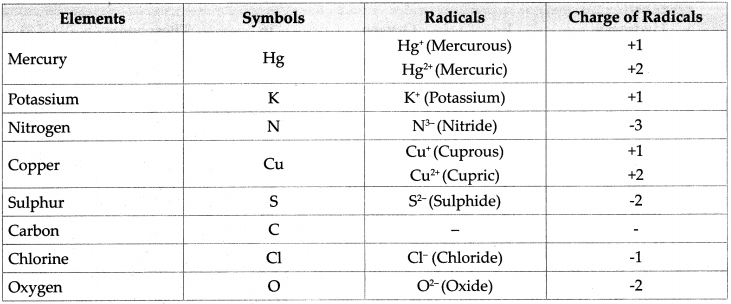
Maharashtra Board Class 9 Science Solutions Chapter 4 Measurement of Matter 24

Maharashtra Board Class 9 Science Solutions Chapter 4 Measurement of Matter

3. Write the steps in deducing the chemical formulae of the following compounds.
Sodium sulphate, potassium nitrate, ferric phosphate, calcium oxide, aluminium hydroxide
Answer:
In order to write the chemical formulae of compounds, it is necessary to know the symbols and valency of various radicals.

1. Sodium Sulphate:
Step – 1 : To write the symbols of the radicals (Basic radicals on the left and acidic radicals on the right)
\(\mathrm{Na} \quad \mathrm{SO}_{4}\)
Step – 2 : To write the valency below the respective radical.
Maharashtra Board Class 9 Science Solutions Chapter 4 Measurement of Matter 40
Step – 3: To cross-multiply as shown by arrows the number of radicals.
Maharashtra Board Class 9 Science Solutions Chapter 4 Measurement of Matter 41
Step – 4 : To write down the chemical formula of the compound.
Na2 SO4
(Sodium sulphate)

2. Potassium Nitrate:
Step -1 : To write the symbols of the radicals (Basic radicals on the left and acidic radicals on the right)
K NO3
Step – 2 : To write the valency below the respective radical.
\(\begin{array}{cc}
\mathrm{K} & \mathrm{NO}_{3} \\
1 & 1
\end{array}\)
Step – 3: To cross-multiply as shown by arrows the number of radicals.
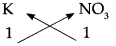
Maharashtra Board Class 9 Science Solutions Chapter 4 Measurement of Matter 42
Step – 4 : To write down the chemical formula of the compound.
KNO3
(Potassium nitrate)

3. Ferric phosphate:
Step -1 : To write the symbols of the radicals (Basic radicals on the left and acidic radicals on the right)
Fe PO4
Step – 2 : To write the valency below the respective radical.
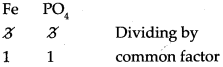
Maharashtra Board Class 9 Science Solutions Chapter 4 Measurement of Matter 43
Step – 3: To cross-multiply as shown by arrows the number of radicals.
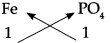
Maharashtra Board Class 9 Science Solutions Chapter 4 Measurement of Matter 44
Step – 4 : To write down the chemical formula of the compound.
FePO4
(Ferric phosphate)

Maharashtra Board Class 9 Science Solutions Chapter 4 Measurement of Matter

4. Calcium oxide:
Step – 1 : To write the symbols of the radicals (Basic radical on the left and acidic radicals on the right)
Ca O
Step – 2 : To write the valency below the respective radical.
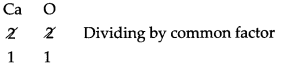
Maharashtra Board Class 9 Science Solutions Chapter 4 Measurement of Matter 60
Step – 3: To cross-multiply as shown by arrows the number of radicals.
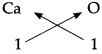
Maharashtra Board Class 9 Science Solutions Chapter 4 Measurement of Matter 45
Step – 4 : To write down the chemical formula of the compound.
CaO
(Calcium oxide)

5. Aluminium hydroxide:
Step – 1 : To write the symbols of the radical (Basic radical on the left and acidic radical on the right)
Al OH
Step – 2 : To write the valency below the respective radical.
Maharashtra Board Class 9 Science Solutions Chapter 4 Measurement of Matter 61
Step – 3: To cross-multiply as shown by arrows the number of radicals.
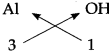
Maharashtra Board Class 9 Science Solutions Chapter 4 Measurement of Matter 46
Step – 4 : To write down the chemical formula of the compound.
Al(OH)3
(Aluminium hydroxide)

6. Calcium carbonate:
Step – 1 : To write the symbols of the radical (Basic radical on the left and acidic radicals on the right)
Ca CO3
Step – 2 : To write the valency below the respective radical.
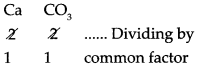
Maharashtra Board Class 9 Science Solutions Chapter 4 Measurement of Matter 47
Step – 3: To cross-multiply as shown by arrows the number of radicals.
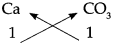
Maharashtra Board Class 9 Science Solutions Chapter 4 Measurement of Matter 48
Step – 4 : To write down the chemical formula of the compound.
CaCO3
(Calcium Carbonate)

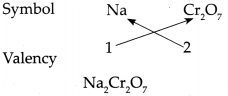
7. Sodium dichromate:
Step – 1 : To write the symbols of the radicals (Basic radical on the left and acidic radical on the right)
Na Cr2O7
Step – 2 : To write the valency below the respective radical.
\(\begin{array}{cc}
\mathrm{Na} & \mathrm{Cr}_{2} \mathrm{O}_{7} \\
1 & 2
\end{array}\)
Step – 3: To cross-multiply as shown by arrows the number of radicals.
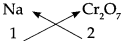
Maharashtra Board Class 9 Science Solutions Chapter 4 Measurement of Matter 49
Step – 4 : To write down the chemical formula of the compound.
Na2Cr2O7
(Sodium dichromate)

Maharashtra Board Class 9 Science Solutions Chapter 4 Measurement of Matter

4. Write answers to the following questions and explain your answers.

a. Explain how the element sodium is monovalent.

Answer:

  1. The number of protons or electrons (atomic number) in Sodium (Na) atom is 11. Therefore the electronic configuration of sodium atom is (2, 8,1).
  2. In chemical reaction, sodium atom has the capacity to give away le_ from its outermost orbit to form Na+ ion with stable electronic configuration (2, 8).
  3. As sodium atom gives away le- and a cation of sodium is formed, hence the valency of sodium is 1 and therefore, the element sodium is monovalent.

b. M is a bivalent metal. Write down the steps to find the chemical formulae of its compounds formed with the radicals, sulphate and phosphate.
Answer:
M is a bivalent metal. Following are the steps to find the chemical formulae of its compounds formed with the radicals, sulphate and phosphate:

(i) Compound of metal ‘M’ with radical sulphate
Step – 1: To write the symbols of the radicals (Basic radicals on the left and acidic radicals on the right)
M SO4
Step – 2: To write the valency below the respective radical.
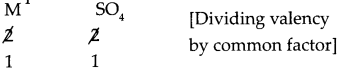
Maharashtra Board Class 9 Science Solutions Chapter 4 Measurement of Matter 21
Step – 3: To cross multiply as shown by arrows the number of radicals.
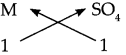
Maharashtra Board Class 9 Science Solutions Chapter 4 Measurement of Matter 21
Step – 4: To write down the chemical formula of the compound.
M SO4

(ii) Compound of metal ‘M’ with radical phosphate.
Step – 1: To write the symbols of the radicals (Basic radicals on the left and acidic radicals on the right)
M PO4
Step – 2: To write the valency below the respective radical.
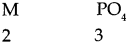
Maharashtra Board Class 9 Science Solutions Chapter 4 Measurement of Matter 23
Step – 3: To cross multiply as shown by arrows the number of radicals.
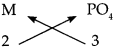
Maharashtra Board Class 9 Science Solutions Chapter 4 Measurement of Matter 51
Step – 4: To write down the chemical formula of the compound.
M3 (PO4)2

Maharashtra Board Class 9 Science Solutions Chapter 4 Measurement of Matter

c. Explain the need for a reference atom for atomic mass. Give some information about two reference atoms.
Answer:

  • The mass of an atom is concentrated in its nucleus and it is due to the protons (p) and neutrons (n) in it.
  • Since an atom is very very tiny, it was not possible to measure atomic mass accurately. Therefore, the concept of relative mass of an atom was formed.
  • To express relative mass of an atom, reference of atom is considered. The two reference atoms were as follows:

(a) Hydrogen (H) atom: The hydrogen atom is the lightest. The relative mass of a hydrogen atom is 1 which has only 1 proton in its nucleus. On this scale, the relative atomic mass of many elements comes out to be fractional. Therefore, carbon was selected as a reference atom.

(b) Carbon (C) atom: The carbon atom is selected as reference atom. In this scale, the relative mass of a carbon atom is accepted as 12.

  • The relative atomic mass of 1 hydrogen (H) atom compared to the carbon (C) atom becomes

d. What is meant by Unified Atomic Mass.
Answer:

  • During earlier time, relative mass of an atom was considered for measuring the mass of an atom directly. But since the founding of unified mass, relative mass is not accepted henceforth.
  • Unified atomic mass is the unit of atomic mass called as Dalton.
  • Its symbol is ‘u’. lu = 1.66053904 x 10⁻²⁷ kg.

e. Explain with examples what is meant by a ‘mole’ of a substance.
Answer:

  • A mole is that quantity of a substance whose mass in grams is equal in magnitude to the molecular mass of that substance in Daltons.
  • For example: Atomic mass of oxygen atom (O) is 16u. Thus, the molecular mass of oxygen molecule (O2) is 16 x 2 = 32u. Therefore, 32 g of oxygen is 1 mole of oxygen.

5. Write the names of the following compounds and deduce their molecular masses.
Na2SO4, K2CO3, CO2, MgCl2, NaOH, AlPO4, NaHCO3
Answer:
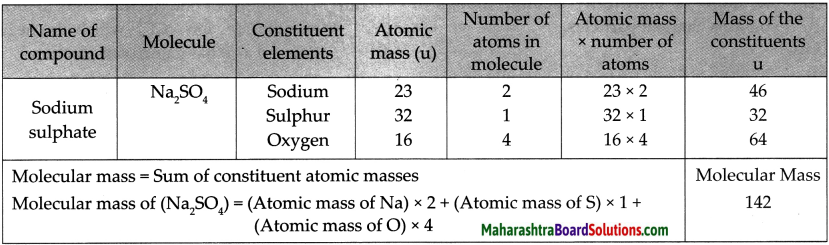
Maharashtra Board Class 9 Science Solutions Chapter 4 Measurement of Matter 5

Maharashtra Board Class 9 Science Solutions Chapter 4 Measurement of Matter

6. Two samples ‘m’ and ‘n’ of slaked lime were obtained from two different reactions. The details about their composition are as follows:
‘sample m’ mass : 7g
Mass of constituent oxygen : 2g
Mass of constituent calcium : 5g
‘sample n’ mass : 1.4g
Mass of constituent oxygen : 0.4g
Mass of constituent calcium : 1.0g

Which law of chemical combination does this prove? Explain.
Answer:
(i) The expected proportion by weight of the constituent elements of quick lime that is calcium oxide would be from its known molecular formula CaO. The atomic mass of Ca and O are 40 and 16 respectively. This means, the proportion by weight of the constituent elements Ca and O in the compound CaO is 40 :16 which is 5 : 2.

(ii) Now, for the given sample’m’ of CaO = 5 g
mass of given sample = 7 g
mass of constituent Ca in sample’m’ = 5 g
mass of constituent O in sample’m’ = 2 g

(iii) This means that 7 g of calcium oxide contairis 5 g of calcium (Ca) and 2 g of oxygen (O); apd the proportion by weight of calcium and oxygen in it is 5 : 2.

(iv) Now, for the given sample ‘n’ of CaO mass of given sample CaO = 1.4 g
Mass of constituent Ca in sample ‘n’ = 1.0 g
Mass of constituent O in sample ‘n’ = 0.4 g
This means that 1.4g of calcium oxide contains 1.0 g of calcium (Ca) and 0.4 g of oxygen (O); and the proportion by weight of calcium and oxygen in it is 5 : 2.

(v) Above samples’m’ and ‘n’ of calcium oxide (CaO) shows that the proportion by weight of the constituent elements in different samples of a compound is always constant that is the proportion by weight of calcium (Ca) and oxygen (O) in different samples of calcium oxide (CaO) is constant.

(vi) The experimental value of proportion by weight of the constituent elements matched with the expected proportion calculated by molecular mass. This proves and verifies the law of constant proportion.

The law states that ‘The proportion by weight of the constituent elements in the various samples of a compound is fixed’.

Maharashtra Board Class 9 Science Solutions Chapter 4 Measurement of Matter

7. Deduce the number of molecules of the following compounds in the given quantities.
32g oxygen, 90g water, 8.8g carbon dioxide, 7.1g chlorine.

Class 9 Science Chapter 4 Measurement Of Matter Notes Question 1.
32g oxygen
Answer:
Given : Mass of oxygen (O2) m = 32g
To find : Number of molecules in 32g of oxygen.
Solution : Atomic mass of oxygen (O) = 16
∴ Molecular mass of oxygen (O2) M = 16 x 2 = 32
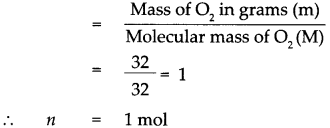
According to the formula, Number of moles in the given O2 (n)
Maharashtra Board Class 9 Science Solutions Chapter 4 Measurement of Matter 12
1 mol of O2 contains 6.022 x 10²³ molecules that is 32 g of 02 contains 6.022 * 1023 molecules of O2.
32g of oxygen contains 6.022 x 10²³ molecules of oxygen.

Class 9 Science Chapter 4 Measurement Of Matter Answers Question 2.
90g water
Answer:
Given : Mass of water (H2O) m = 90g.
To find : Number of molecules in 90g of water.
Solution : Molecular mass of (H2O) M = (Atomic mass of H) x 2 + (Atomic mass of O) x 1
∴ Molecular mass of (H2O) M = 1 x 2 +16
∴ Molecular mass of (H2O) M = 18
According to the formula,
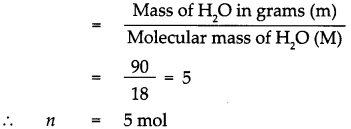
Number of moles in the given H2O (n)
Maharashtra Board Class 9 Science Solutions Chapter 4 Measurement of Matter 13
1 mol of H2O contains 6.022 x 10²³ molecules.
5 mol of H2O contains 5 x 6.022 x 1023 molecules. = 30.11 x 10²³ molecules, that is 90g of H2O contains 30.11 x 10²³ molecules of H20.
90g of water contains 30.11 x 10²³ molecules of water.

Maharashtra Board Class 9 Science Solutions Chapter 4 Measurement of Matter

4 Measurement Of Matter Exercise Question 3.
8.8g carbon dioxide
Answer:
Given : Mass of Carbon dioxide (CO2)m = 8.8g.
To find : Number of molecules in 8.8g of carbon dioxide.
Solution : Molecular mass of (CO2)M = (Atomic mass of C) x 1 + (Atomic mass of O) x 2
∴ Molecular mass of (CO2)M = 12 x 1 + 16 x 2 = 12 + 32
Molecular mass of (CO2)M = 44
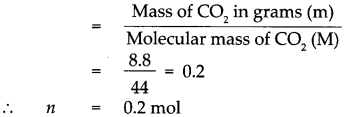
According to the formula, Number of moles in the given CO2 (n)
Maharashtra Board Class 9 Science Solutions Chapter 4 Measurement of Matter 14
∴ 1 mol of CO2 contains 6.022 x 10²³ molecules.
∴ 0.2 mol of CO2 contains 0.2 x 6.022 x 1023 molecules.
= 1.2044 x 10²³ molecules,
that is 8.8g of CO2 contains 1.2044 x 10²³ molecules of CO2.
8.8g of CO2 contains 1.2044 x 10²³ molecules of CO2.

Class 9 Science Solutions Maharashtra Board Question 4.
7.1g chlorine
Answer:
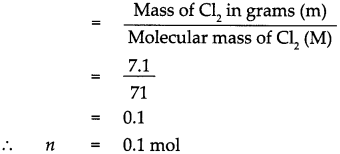
Given : Mass of Chlorine (Cl2)m = 7.1g.
To find : Number of molecules in 7.1g of chlorine.
Solution : Atomic mass of (Cl) = 35.5
∴ Molecular mass of chlorine (Cl2)M = 35.5 x 2 = 71
According to the formula, Number of moles in the given Cl2 (n)
Maharashtra Board Class 9 Science Solutions Chapter 4 Measurement of Matter 15
∴ 1 mol of Cl2 contains 6.022 x 10²³ molecules.
∴ 0.1 mol of Cl2 contains 0.1 x 6.022 x 1023 molecules.
= 0.6022 x 10²³ molecules,
that is 7.1g of Cl2 contains 0.6022 x 10²³ molecules of Cl2.
7.1g of Cl2 contains 0.6022 x 10²³ molecules of chlorine.

8. If 0.2 mol of the following substances are required how many grams of those substances should be taken? Sodium chloride, magnesium oxide, calcium carbonate
Answer:
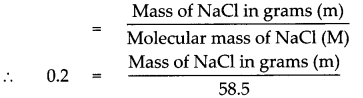
Given : Number of moles of sodium chloride (NaCl) n = 0.2 mol
To find : Mass in grams of 0.2 mol of NaCl
Solution:
Molecular mass of (NaCl)M = (Atomic mass of Na) x 1 + (Atomic mass of Cl) x 1
= 23 x 1 + 35.5 x 1
= 23 + 35.5
Molecular mass of (NaCl)M = 58.5
According to the formula,
Number of moles in the given NaCl (n)
Maharashtra Board Class 9 Science Solutions Chapter 4 Measurement of Matter 16
Mass of NaCl in grams (m) = 0.2 x 58.5
Mass of NaCl in grams (m) = 11.7 g
Mass of 0.2 mole of NaCl is 11.7g

Maharashtra Board Class 9 Science Solutions Chapter 4 Measurement of Matter

Class 9 Science Chapter 3 Current Electricity Intext Questions and Answers

Maharashtra State Board Class 9 Science Solutions Question 1.
What is the type of chemical bond in NaCl and MgCl2?
Answer:

  • The type of chemical bond in NaCl and MgCl2 is ionic bond.

9th Class Science Chapter 4 Measurement Of Matter Question 2.
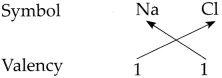
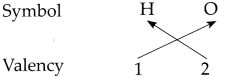
Determine the valencies of H, Cl, O and Na from the molecular formulae H2, HC1, H2O and NaCl.
Answer:
(i) In the molecular formula HCl
Maharashtra Board Class 9 Science Solutions Chapter 4 Measurement of Matter 3
∴ The valency of H is 1 and Cl is 1.

(ii) In the molecular formula H2O
Maharashtra Board Class 9 Science Solutions Chapter 4 Measurement of Matter 2
∴ The valency of H is 1 and O is 2.

(iii) In the molecular formula NaCl
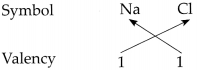
Maharashtra Board Class 9 Science Solutions Chapter 4 Measurement of Matter 50
∴ The valency of Na is 1 and Cl is 1.
∴ From all the above, the valencies of the given elements are as follows : H = 1, Cl = 1, O = 2 and Na = l.

Measurement Of Matter Class 9 Exercise Answers Question 3.
How is an element indicated in Chemistry?
Answer:
In chemistry an element is indicated by its symbol.

Question 4.
Write down the symbols of the elements you know.
Answer:
Symbols of some elements are

  • Hydrogen – H
  • Helium – He
  • Boron – B
  • Carbon – C
  • Aluminium – A1

Question 5.
Write down the symbols for the following elements.
Antimony, Iron, Gold, Silver, Mercury, Lead, Sodium
Answer:
The symbols of given elements are as follows:

  • Antimony – Sb
  • Iron – Fe
  • Gold – Au
  • Silver – Ag
  • Mercury – Hg
  • Lead – Pb
  • Sodium – Na

Maharashtra Board Class 9 Science Solutions Chapter 4 Measurement of Matter

Following are atomic masses of a few elements in Daltons and the molecular formulae of some compounds. Deduce the molecular masses of those compounds:

Atomic masses – H(l), 0(16), N(14), C(12), K(39), S(32) Ca(40), Na(23), Cl(35.5), Mg(24), Al(27)

Question 1.
Molecular formula – NaCl
Answer:
Molecular mass of NaCl (M)
= (Atomic mass of Na) x 1 + (Atomic mass of Cl) x 1
= (23 x 1) + (35.5 x 1)
= 23 + 35.5
= 58.5
∴ Molecular mass of NaCl (M) = 58.5

Question 2.
Molecular formula – MgCl2
Answer:
Molecular mass of MgCl2 (M)
= (Atomic mass of Mg) x 1 + (Atomic mass of Cl) x 2
= (24 x 1) + (35.5 x 2)
= 24 + 71
= 95
∴ Molecular mass of MgCl2 (M) = 95?

Question 3.
Molecular formula – KNO3
Answer:
Molecular mass of KNO3 (M)
= (Atomic mass of K) x 1 + (Atomic mass of N) x 1 + (Atomic mass of O) x 3
= (39 x 1) + (14 x 1) + (16 x 3)
= 39 + 14 + 48
= 101
Molecular mass of KNO3 (M) = 101

Question 4.
Molecular formula – H2O2
Answer:
Molecular mass of H2O2 (M)
= (Atomic mass of H) x 2 + (Atomic mass of O) x 2
= (1 x 2) + (16 x 2)
= 2 + 32
= 34
∴ Molecular mass of H2O2 (M) = 34.

Maharashtra Board Class 9 Science Solutions Chapter 4 Measurement of Matter

Question 5.
Molecular formula – A1C13
Answer:
Molecular mass of A1C13 (M)
= (Atomic mass of Al) x 1 + (Atomic mass of Cl) x 3
= (27 x 1) + (35.5 x 3)
= 27 + 106.5
= 133.5
∴ Molecular mass of A1C13 (M) = 133.5

Question 6.
Molecular formula – Ca(OH)2
Answer:
Molecular mass of Ca(OH)2 (M)
= (Atomic mass of Ca) x 1 + (Atomic mass of O + Atomic Mass of H) x 2
= (40 x 1) + (16 + 1) x 2
= 40 + (17 x 2)
= 40 + 34
= 74
∴ Molecular mass of Ca(OH)2 (M)
= 74

Question 7.
Molecular formula – MgO
Answer:
Molecular mass of MgO (M)
= (Atomic mass of Mg) x 1 + (Atomic mass of 0)xl
= (24 x 1) + (16 x 1)
= 24 + 16
= 40
Molecular mass of MgO (M) = 40

Maharashtra Board Class 9 Science Solutions Chapter 4 Measurement of Matter

Question 8.
Molecular formula – H2S04
Answer:
Molecular mass of H2S04 (M)
= (Atomic mass of H) x 2 + (Atomic mass of S) x 1 + (Atomic mass of O) x 4
= (1 x 2) + (32xl) + (16×4)
= 2 + 32 + 64
= 98
Molecular mass of H2S04 (M) = 98

Question 9.
Molecular formula – HN03
Answer:
Molecular mass of HN03 (M)
= (Atomic mass of H) x 1 + (Atomic mass of N) x 1 + (Atomic mass of O) x 3
= (lxl)+ (14xl)+ (16×3)
= 1 + 14 + 48
= 63
Molecular mass of HNOs (M) = 63

Question 10.
Molecular formula – NaOH
Answer:
Molecular mass of NaOH (M)
= (Atomic mass of Na) x 1 + (Atomic mass of O) x 1 + (Atomic mass of H) x 1
= (23 x 1) + (16 x 1) + (l x l)
= 23 + 16 + 1
= 40
Molecular mass of NaOH (M) = 40

Question 11.
How many molecules of water are there in 36 g water?
Answer:
Given : Mass of water (H2O) m = 36g
To find : Number of molecules in 36g of water
Solution :
Molecular mass of (H2O) M = (Atomic mass of H) x 2 + (Atomic mass of O) x 1 Molecular mass of (H2O) M
= (1 x 2) + 16 x 1
Molecular mass of (H2O) M = 18
According to the formula,
Number of moles in the given H2O (n)
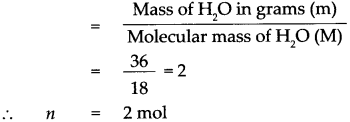
Maharashtra Board Class 9 Science Solutions Chapter 4 Measurement of Matter 19
1 mol of H2O contains 6.022 x 10²³ molecules.
∴ 2 mol of H2O contains 2 x 6.022 x 1023 molecules.
= 12.044 x 10²³ molecules, that is 36g of H2O contains 12.044 x 10²³ molecules of H2O.
36 g of water contains 12.044 x 10²³ molecules of water.

Maharashtra Board Class 9 Science Solutions Chapter 4 Measurement of Matter

Question 12.
How many molecules of H2S04 are there in a 49 g sample?
Answer:
Given : Mass of Sulphuric acid (H2SO4) m = 49g
To find : Number of molecules in 49g of H2SO4
Solution:
Molecular mass of (H2SO4) M = (Atomic mass of H) x 2 + (Atomic mass of S) x 1 + (Atomic mass of O) x 4
Molecular mass of (H2SO4)M = (1 x 2) + (32 x 1) + (16 x 4)
= 2 + 32 + 64
= 98.
According to the formula,
Number of moles in the given H2SO4 (n)
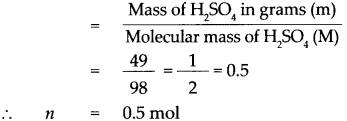
Maharashtra Board Class 9 Science Solutions Chapter 4 Measurement of Matter 20
∴ 1 mol of H2SO4 contains 6.022 x 10²³ molecules.
∴ 0.5 mol of H2SO4 contains 0.5 x 6.022 x 1023 molecules.
= 3.011 x 10²³ molecules,
that is 49g of H2SO4 contains 3.011 x 10²³ molecules of H2SO4.
49 g of Sulphuric acid contains 3.011 x 10²³ molecules of H2SO4.

Question 13.
Fill the following tables.
Answer:
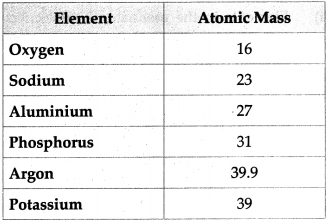
Maharashtra Board Class 9 Science Solutions Chapter 4 Measurement of Matter 25

Question 14.
Complete the following chart.
Answer:
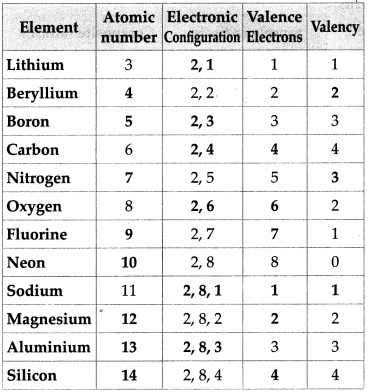
Maharashtra Board Class 9 Science Solutions Chapter 4 Measurement of Matter 27

Maharashtra Board Class 9 Science Solutions Chapter 4 Measurement of Matter

Question 15.
The relative atomic masses of some elements in the chart below are given. You have to find the relative atomic masses of the others.
Answer:
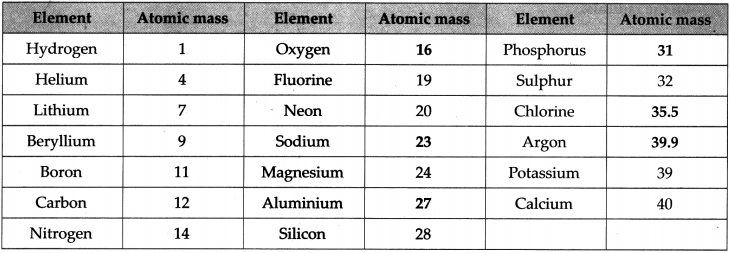
Maharashtra Board Class 9 Science Solutions Chapter 4 Measurement of Matter 28

Question 16.
Classify the following radicals into simple radicals and composite radicals: (Use your brain power;
\(\begin{array}{l}
\mathrm{Ag}^{+}, \mathrm{Mg}^{2+}, \mathrm{Cl}^{-}, \mathrm{SO}_{4}^{2-}, \mathrm{Fe}^{2+}, \mathrm{ClO}_{3}^{-}, \mathrm{NH}_{4}^{+}, \mathrm{Br}^{-} \\
\mathrm{NO}_{3}^{-}, \mathrm{Na}^{+}, \mathrm{Cu}^{+}
\end{array}\)
Answer:

Simple radicalsComposite radicals
Ag+\(\mathrm{SO}_{4}^{2-}\)
Mg2+\(\mathrm{ClO}_{3}^{-}\)
Cl\(\mathrm{NH}_{4}^{+}\)
Fe2+\(\mathrm{NO}_{3}^{-}\)
Br
Na+
Cu+

Question 17.
Which are the basic radicals and which are the acidic radicals among the following?
\(\begin{array}{l}
\mathrm{Ag}^{+}, \mathrm{Cu}^{2+}, \mathrm{Cl}^{+}, \mathrm{I}, \mathrm{SO}_{4}^{2-}, \mathrm{Fe}^{3+}, \mathrm{Ca}^{2+}, \mathrm{NO}_{3} ; \mathrm{S}^{2}, \mathrm{NH}_{4}^{+} \\
\mathrm{K}^{+}, \mathrm{MnO}_{4}, \mathrm{Na}^{+}
\end{array}\)
Answer:

Basic RadicalAcidic Radical
(i)Ag+(i) Cl
(ii) Cu2+(ii) I
(iii) Fe3+\(\text { (iii) } \mathrm{SO}_{4}^{2-}\)
(iv) Ca2+\(\text { (iv) } \mathrm{NO}_{3}^{-}\)
Wnh;\(\text { (v) } \mathrm{S}^{2-}\)
(vi) K+\(\text { (vi) } \mathrm{MnO}_{4}^{-}\)
(vii) Na+

Maharashtra Board Class 9 Science Solutions Chapter 4 Measurement of Matter

Give examples:

Question 1.
Make a list of elements in the monoatomic and in the diatomic molecular state. (Make a list and discuss;
Answer:

  • Elements in the monoatomic molecular state are: Helium (He), Neon (Ne), Argon (Ar), Sodium (Na), Copper (Cu),
  • Elements in the diatomic molecular state are:
    Oxygen (O2), Nitrogen (N2), Hydrogen (H2), Chlorine (Cl2), Fluorine (F2).

Problem-based questions

Answer the following questions:

Question 1.
Is it possible to weigh one molecule using a weighing balance?
Answer:
No, it is not possible to weigh one molecule using a weighing balance.

Question 2.
Will the number of molecules be the same in equal weights of different substances?
Answer:
No, the number of molecules will not be the same in equal weights of different substances.

Question 3.
If we want equal number of molecules of different substances, will it work to take equal weights of those substances.
Answer:
No, if we want equal number of molecules of different substances, it will not work to take equal weights of those substances.

Answer the following:

Question 1.
What is the Dalton’s atomic theory?
Answer:
Dalton’s Atomic theory-

  • All matter is made of atoms. Atoms are indivisible and indestructible.
  • All atoms of a given element are identical in mass and properties.
  • Compounds are formed by a combination of two or more different kinds of atoms.
  • A chemical reaction is a rearrangement of atoms.

Question 2.
How are compounds formed?
Answer:
Compounds are formed by a chemical combination of two or more different kinds of atoms.

Maharashtra Board Class 9 Science Solutions Chapter 4 Measurement of Matter

Question 3.
What are the molecular formulae of salt, slaked lime, water, lime, limestone?
Answer:
The molecular formulae for
Salt – Sodium chloride – NaCl
Slaked lime – Calcium hydroxide Ca(OH)2
Water – H2O
Lime – Calcium oxide – CaO
Lime stone – Calcium carbonate – CaCO3

Question 4.
From which experiments was it discovered that atoms have an internal structure? When?
Answer:

  • In 1911, Earnest Rutherford conducted a well known experiment called as ‘Gold foil experiment’.
  • From this experiment it was discovered that atoms have internal structure.

Question 5.
What are the two parts of an atom? What are they made up of?
Answer:
The two parts of atoms are nucleus and extra nuclear part. Nucleus is made up of positively charged protons and electrically neutral neutrons and the extra nuclear part is made up of negatively charged electrons revolving around the nucleus in different orbits.

Open-ended questions

Q.3. 2. Answer the following questions:

Question 1.
How will the compounds, MgCl2 and CaO be formed from their elements?
Answer:
(1) Magnesium Chloride (MgCl2)
Magnesium atom (Mg): Electronic configuration
\((2,8,2) \stackrel{-2 e^{-}}{\longrightarrow}\) Magnesium ion Mg2+ (2,8).
Chlorine atom (Cl). Electronic configuration \((2,8,7) \stackrel{+1 e^{-}}{\longrightarrow}\) Chloride ion Ch (2,8,8).
∴ Mg2+ + 2CT → MgCl2 (Magnesium Chloride)

  • A Magnesium atom gives away 2e and a cation of Magnesium (Mg2+) is formed, hence, the valency of magnesium is two.
  • Two chlorine atoms takes le each and forms two anions of chlorine (2Cl) (chloride), and thus, the valency of chlorine is one.
  • After the give and take of electrons is over, the electronic configuration of all the resulting ions has a complete octet.
  • Due to the attraction between the unit but opposite charges on all the ions, one chemical bond known as ionic bond is formed between Mg2+ and 2C1 each and the compound MgCl2 is formed.

(2) Calcium Oxide (CaO)
Calcium atom (Ca): Electronic configuration
\((2,8,8,2) \stackrel{-2 e^{-}}{\longrightarrow}\) Calcium ion Ca2+ (2,8,8).
Oxygen atom (O). Electronic configuration (2,6)
\(\stackrel{+2 e^{-}}{\longrightarrow}\) Oxygen ion O2- (2,8).
∴ Ca2+ + O2- → CaO

  • A calcium atom gives away 2er and a cation of calcium (Ca2+) is formed, hence, the valency of calcium is two.
  • An oxygen atom takes 2e and forms anions of oxygen (O2-) (oxide), and thus, the valency of oxygen is two.
  • After the give and take of electrons is over, the electronic configuration of both the resulting ions has a complete octet.
  • Due to the attraction between the unit but opposite charges on the two ions, one chemical bond known as ionic bond is formed between Ca2+ and O2- and the compound CaO is formed.

Maharashtra Board Class 9 Science Solutions Chapter 4 Measurement of Matter

Question 2.

  • Take 56 g calcium oxide in a large conical flask and put 18 g water in it.
  • Observe what happens.
  • Measure the mass of the substance formed.
  • What similarity do you find? Write your inference.

Answer:
(i) When 18 g of water is added to 56 g of calcium oxide, calcium oxide combines with water to form calcium hydroxide Ca(OH)2

(ii) The mass of calcium hydroxide formed is 74 g.?

(iii) In this activity the total mass of reactants, Calcium oxide + Water = 56 g +18 g = 74 g.
It is equal to the mass of the product formed. Ca(OH)2 = 74g.

This activity verifies the Law of Conservation of Matter, i.e., in a chemical reaction, the total weight of the reactants is same as the total weight of the products formed due to the chemical reactions.

Question 3.

  • Take a solution of calcium chloride in a conical flask and a solution of sodium sulphate in a test tube.
  • Tie a thread to the test tube and insert it in the conical flask.
  • Seal the conical flask with an airtight rubber cork.
  • Weigh the conical flask using a balance.
  • Now tilt the conical flask so that the solution in the test tube gets poured in the conical flask.
  • Now weigh the conical flask again.

Answer:

  • In this activity, a white precipitate of CaS04 in NaOl is seen in the conical flask after the reaction.
  • There is no change in the weight of the flask before and after the reaction.
  • This activity verifies the Law of Conservation of Matter i.e., in a chemical reaction, the total weight of the reactants is same as the total weight of the products formed due to the chemical reactions.

Question 4.
Using the chart of ions/radicals and the cross-multiplication method, write the chemical formulae of the following compounds : Calcium carbonate, Sodium bicarbonate, Silver chloride, Calcium hydroxide, Magnesium oxide, Ammonium phosphate, Cuprous bromide, Copper sulphate, Potassium nitrate, Sodium dichromate.
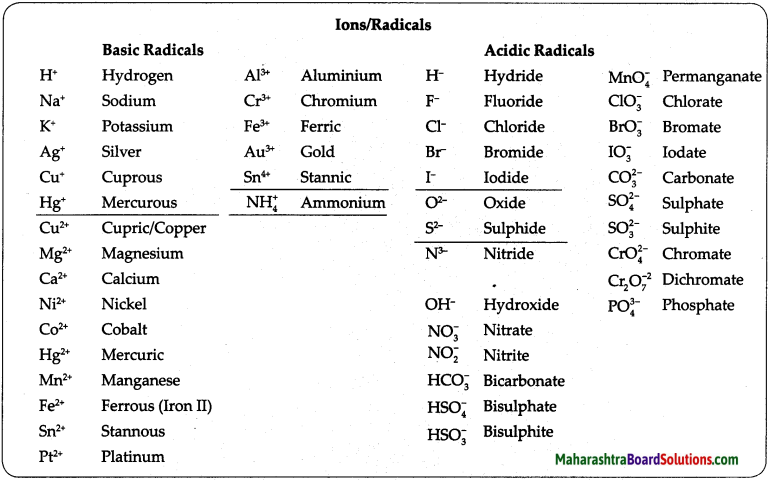
Maharashtra Board Class 9 Science Solutions Chapter 4 Measurement of Matter 39
Answer:
Calcium carbonate – CaCO3 Sodium bicarbonate – NaHCO3 Silver chloride – AgCl, Calcium hydroxide – Ca(OH)2, Magnesium oxide – MgO, Ammonium phosphate – (NH4)3PO4, Cuprous bromide – CuBr, Copper sulphate – CuSO4, Potassium nitrate – KNO3, Sodium dichromate – Na2Cr2O7.

Maharashtra Board Class 9 Science Solutions Chapter 4 Measurement of Matter

Class 9 Science Chapter 3 Current Electricity Additional Important Questions and Answers

(A) Select the correct option:

Question 1.
The proportion by weight of hydrogen and oxygen in water is ……………………….. .
(a) 8 : 1
(b) 2 : 1
(c) 1 : 2
(d) 1 : 8
Answer:
(d) 1: 8

Question 2.
The proportion by weight of carbon and oxygen in carbon dioxide is ……………………….. .
(a) 8 : 3
(b) 3 : 8
(c) 3 : 2
(d) 2 : 3
Answer:
(b) 3 : 8

Question 3.
A nucleus of an atom is made up of positively charged ………………………… and electrically neutral ……………………….. .
(a) protons; neutrons
(b) electrons; neutrons
(c) neutrons; protons
(d) neutrons; electrons
Answer:
(a) protons; neutrons

Question 4.
The size of an atom is determined by its ……………………….. .
Answer:
radius

Question 5.
Atomic radius is expressed in ……………………….. .
(a) milimetres
(b) centimetres
(c) nanometres
(d) picometres
Answer:
(c) nanomet res

Maharashtra Board Class 9 Science Solutions Chapter 4 Measurement of Matter

Question 6.
The atomic size depends on the number of ………………………… in the atom.
(a) protons
(b) nucleus
(c) neutrons
(d) electron orbits
Answer:
(d) electron orbits

Question 7.
The mass of an atom is concentrated in its ……………………….. .
(a) protons
(b) nucleus
(c) neutrons
(d) electrons
Answer:
(b) nucleus

Question 8.
The total number of protons and neutrons in the atomic nucleus is called the ……………………….. .
(a) atomic number
(b) electronic configuration
(c) atomic mass number
(d) valency
Answer:
(c) atomic mass number

Question 9.
A ………………………… is that quantity of a substance whose mass in grams is equal in magnitude to the molecular mass of that substance in Daltons.
(a) mole
(b) dalton
(c) dozen
(d) gross
Answer:
(a) Mole

Question 10.
Avogadro’s number is denoted by the symbol ……………………….. .
(a) NG
(b) Nv
(c) NA
(d) ND
Answer:
(c) NA

Maharashtra Board Class 9 Science Solutions Chapter 4 Measurement of Matter

Question 11.
A mole of any substance stands for ………………………… molecules.
(a) 60.22 x 10²³
(b) 6.022 x 10²²
(c) 6.022 x 10²³
(d) 60.22 x 10²²
Answer:
(a) 60.22 x 10²³

Question 12.
The capacity of an element to combine is called its ……………………….. .
(a) valency
(b) electronic configuration
(c) atomic number
(d) volence electrons
Answer:
(a) valency

Question 13.
Electronic configuration of sodium atom is ……………………….. .
(a) (2, 8, 3)
(b) (2, 8, 7)
(c) (2, 8, 2)
(d) (2, 8,1)
Answer:
(d) (2,8,1)

Question 14.
Electronic configuration of chlorine atom is ……………………….. .
(a) (2, 8, 3)
(b) (2, 8, 7)
(c) (2, 8, 2)
(d) (2, 8, 1)
Answer:
(b) (2, 8, 7)

Question 15.
Positively charged ions are called as ……………………….. .
(a) cations
(b) anions
(c) nucleous
(d) protons
Answer:
(a) cations

Question 16.
Negatively charged ions are called as ……………………….. .
(a) cations
(b) anions
(c) nucleus
(d) electrons
Answer:
(b) anions

Maharashtra Board Class 9 Science Solutions Chapter 4 Measurement of Matter

Question 17.
Iron (Fe) exhibits the variable valencies ……………………….. .
(a) 1 and 2
(b) 2 and 3
(c) 3 and 4
(d) 2 and 4
Answer:
(b) 2 and 3

Question 18.
Cationic radicals are called as ………………………… radicals.
(a) basic
(b) acidic
(c) neutral
(d) mixed
Answer:
(a) basic

Question 19.
Anionic radicals are called as ………………………… radicals.
(a) basic
(b) acidic
(c) neutral
(d) mixed
Answer:
(b) acidic

Question 20.
The unit Dalton is used to express …………………………
(a) atomic mass
(b) atomic radius
(c) atomic number
(d) mass number
Answer:
(a) atomic mass

Maharashtra Board Class 9 Science Solutions Chapter 4 Measurement of Matter

Question 21.
The valency of element with electronic configuration ………………………… is 2.
(a) (2,5)
(b) (2, 4)
(c) (2, 6)
(d) (2, 7)
Answer:
(c) (2, 6)

Question 22.
The symbol of Avogadro’s number is ……………………….. .
(a) ND
(b) N0
(c) NB
(d) NA
Answer:
(d) NA

Question 23.
………………………. is bicarbonate radical.
\((a) \mathrm{HCO}_{3}^{2-} (b) \mathrm{CO}_{3}^{-}
(c) \mathrm{HCO}_{3}^{-}
(d) \mathrm{CO}_{3}^{2-}\)
Answer:
\(\text { (c) } \mathrm{HCO}_{3}^{-}\)

Question 24.
Molecular formula of sodium sulphate is ……………………….. .
(a) Na(SO4)2
(b) Na2SO4
(c)Na2(SO4)2
(d)NaSO4
Answer:
(b) Na2SO4

Question 25.
………………………… is a composite radical.
(a) Fe3+
(b) Ca2+
(c) NH4+
(d) S2-
Answer:
(c) NH

Question 26.
A mole of any substance stands for ………………………… molecules.
(a) 6.022 x 10²³
(b) 6.022 x 10²²
(c) 60.22 x 10²³
(d) 60.22 x 10²²
Answer:
(a) 6.022 x 10²³

Maharashtra Board Class 9 Science Solutions Chapter 4 Measurement of Matter

Question 27.
The mass of an atom is concentrated in its ………………………… .
(a) nucleus
(b) electrons
(c) extranuclear part
(d) protons
Answer:
(a) nucleus

Question 28.
………………………… g of water make 1 mole of water.
(a) 32
(b) 33
(c) 16
(d) 18
Answer:
(d) 18

Complete the analogy:

(1) Electron : extra nuclear part:: Neutron ………………………… .
(2) Sodium: (2, 8, 1):: Chlorine:: ………………………… .
(3) K : basic radical :: Br : ………………………… .
(4) Cut: simple radical:: NH4+ : ………………………… .
(5) Sodium sulphate: Na2SO4:: Potassium Sulphate: ………………………… .
(6) Mercurous: Hg+:: Mercuric : ………………………… .
(7) Positively charged ion : cation:: Negatively charged ion : ………………………… .
(8) 12: 1 dozen :: 144 : ………………………… .
(9) Hydrogen : \(\odot\) :: Copper : ………………………… .
(10) Law of constant proportions : J. L. Proust::
Law of conservation of matter : ………………………… .
Answer:
(1) nucleus
(2) (2, 8, 7)
(3) acidic radical
(4) composite radical
(5) K2SO4
(6) Hg2+
(7) anion
(8) 1 gross
(9) ©
(10) Antoine Lavoisier.

Maharashtra Board Class 9 Science Solutions Chapter 4 Measurement of Matter

Match the columns:

Column A’Column ‘B’
ExampleAtomic radius (in metres)
(1) Water molecule
(2) Haemoglobin molecule
(3) Hydrogen atom
(a) 10-10
(b) 10-9
(c) 10-8

Answer:
(1-b),
(2- c),
(3 – a)

Column ‘A’Column ‘B’
ElementAtomic mass
(1) Neon(a) 35.5
(2) Silicon(b) 32
(3) Chlorine(c) 28
(4) Sulphur(d) 20

Answer:
(1 – d),
(2 – c),
(3 – a),
(4 – b)

Column ‘A’Column ‘B’
MoleculeMolecular mass in grams
(1) h2(a) 32 g
(2) H2O(b) 34 g
(3) O2(c) 2 g
(4) H2O2(d) 18 g

Answer:
(1 – c),
(2 – d),
(3 – a),
(4 – b)

Column ‘A’Column B’
RadicalsNames
(1) \(\mathrm{Cr}_{2} \mathrm{O}_{7}^{2-}\)(a) Carbonate
(2) \(\mathrm{ClO}_{3}^{-}\)(b) Chromate
(3) \(\mathrm{CO}_{3}^{2-}\)(c) Dichromate
(4) \(\mathrm{CrO}_{4}^{2-}\)(d) Chlorate

Answer:
(1 – c),
(2 – d),
(3 – a),
(4 – b)

Maharashtra Board Class 9 Science Solutions Chapter 4 Measurement of Matter

Answer the following in one sentence:

Question 1.
What are valence electrons?
Answer:
The electrons present in the outermost orbit of an atom are called valence electrons.

Question 2.
Give the formula to determine the number of moles of a substance.
Answer:
The formula to determine the number of moles of a substance is as given below.

Maharashtra Board Class 9 Science Solutions Chapter 4 Measurement of Matter 4

Question 3.
What are basic radicals? Give examples.
Answer:
The radicals which are formed by removal of electrons from the atoms of metals are called as basic radicals, e.g., Na+, Cu2+

Question 4.
What are acidic radicals? Give examples.
Answer:
The radicals which are formed by adding electrons to the atoms of non-metals are called as acidic radicals, e.g., CT, S2-

State whether the following statement is ‘True’ or ‘False’. Correct the false statement.

(1) Molecular state of oxygen is monoatomic.
(2) The capacity of an element to combine is called its valency.
(3) Anionic radicals are basic radicals.
(4) The magnitude of charge on any radical is its atomic number.
(5) In a chemical reaction, mass of original matter and mass of matter newly formed as a result of chemical change are equal.
(6) The proportion by weight of carbon and oxygen in carbon dioxide is 3 : 5.
(7) Relative mass of hydrogen is 1.
(8) The number of molecules in a given quantity of a substance is determined by its atomic mass.
(9) Avogadro’s number is 6.022 x 10²³
(10) Valency of sodium is 2.
Answer:
(1) False. Molecular state of oxygen is diatomic:
(2) True
(3) False. Anionic radicals are acidic radicals.
(4) False. Magnitude of charge on any radical is its valency.
(5) True
(6) False. The proportion by weight of carbon and oxygen in carbon dioxide is 3 : 8.
(7) True
(8) False. The number of molecules in a given quantity of a substance is determined by its molecular mass.
(9) True
(10) False. Valency of sodium is 1.

Maharashtra Board Class 9 Science Solutions Chapter 4 Measurement of Matter

Name the following:

Question 1.
Scientist who gave Law of Conservation of Matter.
Answer:
Antoine Lavoisier

Question 2.
Scientist who gave Law of Constant Proportion.
Answer:
J. L. Proust

Question 3.
What are protons and neutrons present in nucleus together called as?
Answer:
Nucleons

Question 4.
Unit used to express atomic radius.
Answer:
Nanometre

Question 5.
The number (p + n) in the atomic nucleus is called as?
Answer:
Atomic mass number

Question 6.
Name the unit of atomic mass.
Answer:
Dalton (u)

Question 7.
Write molecular formula of two ionic compounds containing chlorine.
Answer:
NaCl, MgCl2

Question 8.
Give two monoatomic radicals.
Answer:
Na+, Cl

Maharashtra Board Class 9 Science Solutions Chapter 4 Measurement of Matter

Question 9.
Give two examples of simple radicals.
Answer:
Ag+, O2-

Give scientific reasons:

Question 1.
An atom is electrically neutral though it contains charged particles.
Answer:

  • An atom is made up of a nucleus and an extranuclear part. Protons and neutrons are present in the nucleus.
  • The nucleus is positively charged. The extranuclear part is made up of negatively charged electrons.
  • Protons are positively charged, electrons are negatively charged and neutrons are without any charge.
  • The magnitude of their charges is the same when they are equal in number.
  • Hence, the negative charge on all the extra, nuclear electrons together balances the positive charge on the
  • nucleus.
  • Therefore, an atom is electrically neutral though it contains charged particles.

Question 2.
Neon is chemically inert element.
Answer:

  • Atomic number of neon is 10, so its electronic configuration is (2, 8). There are 8 electrons in its 2nd shell, fulfilling its capacity.
  • Thus, neon has a complete octet.
  • It has a stable orbit therefore, it does not indulge in chemical reactions. Hence, neon is a chemically inert element.

Question 3.
The valency of sodium (Na) is one.
Answer:

  • The electronic configuration of sodium (Na) is (2, 8,1). It has 1 electron in its 3rd orbit.
  • It tends to give up this electron so that it is left up with (2, 8), having 8 electrons in the second orbit, with a stable state.
  • The loss of one electron leads to the formation of sodium ion (Na+) which is positively charged as it has lost one electron.

Maharashtra Board Class 9 Science Solutions Chapter 4 Measurement of Matter

Question 4.
The valency of chlorine (Cl) is one.
Answer:

  • The electronic configuration of chlorine (Cl) is (2, 8, 7). It has 7 electrons in its 3rd orbit.
  • It tends to take one electron from another atom so that it has 8 electrons in the outermost orbit with electronic configuration (2,8,8) with stable state.
  • The gaining of one electron leads to formation of chloride ion (Cl) which is negatively charged as it has gained one electron.

Question 5.
The valency of Magnesium (Mg) is two.
Answer:

  • The electronic configuration of Magnesium (Mg) is (2,8,2), it has 2 electrons in its 3rd orbit.
  • It tends to give these ‘2’ electrons so that it is left up with (2, 8), having 8 electrons in the second orbit, with a stable state.
  • The loss of two electrons leads to the formation of Magnesium ion (Mg2+) which is double positively charged as it has lost two electrons.

Question 6.
Valency is always a whole number.
Answer:

  • The number of electrons that an atom of an element gives away, takes up or shares forming a bond is called the valency of that element.
  • These electrons are always in whole numbers and not in fractions.
  • Therefore, valency is always a whole number.

Question 7.
Atomic size of potassium is bigger than atomic size of sodium.
Answer:

  • The atomic size of an element depends on the number of electron orbits in the atom of that element.
  • The greater the number of orbits, the larger the size.
  • Atomic number of potassium (K) is 19. Hence, its electronic configuration is (2, 8, 8,1). While atomic number of sodium (Na) is 11. Hence its electronic configuration is (2, 8,1)
  • Number of orbits in potassium atom is 4, while that in sodium atom is 3.
  • Hence, atomic size of potassium is bigger than atomic size of sodium.

Maharashtra Board Class 9 Science Solutions Chapter 4 Measurement of Matter

Question 8.
The atomic size of sodium is bigger than atomic size of Magnesium.
Answer:

  • The atomic size of an element depends on the number of electron orbits in the atom of that element.
  • If 2 atoms have the same outermost orbit, then the atom having the larger number of electrons in the outermost orbit is smaller than the one having fewer electrons in the same outermost orbit.
  • Atomic number of sodium (Na) is 11. Hence, its electronic configuration is (2, 8, 1) while atomic number of magnesum (Mg) is 12 and hence its electronic configuration is (2, 8, 2).
  • As compared to sodium atom Magnesum atom has larger number of electrons n its electronic configuration.
  • Therefore, atomic size of sodium is bigger than atomic size of Magnesium.

Write the names of the following compounds and deduce their molecular masses:

Atomic masses : H(1), 0(16), N(14), C(12), K(39), S(32), Ca(40), Na(23), C1(35.5), Mg(24), A1(27), P(31)

Question 1.
Molecular mass of K2CO3
Answer:
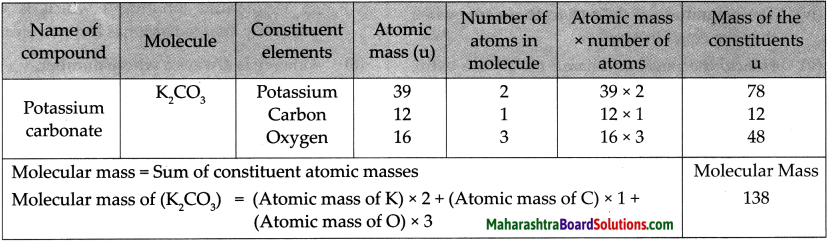
Maharashtra Board Class 9 Science Solutions Chapter 4 Measurement of Matter 6

Question 2.
Molecular mass of CO2
Answer:
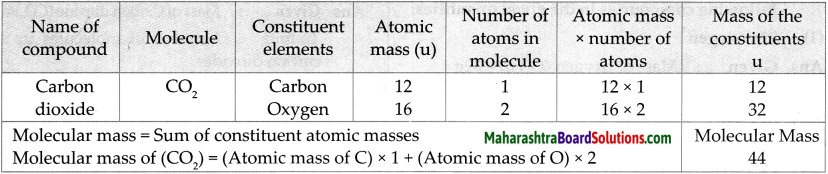
Maharashtra Board Class 9 Science Solutions Chapter 4 Measurement of Matter 7

Question 3.
Molecular mass of MgCl2
Answer:
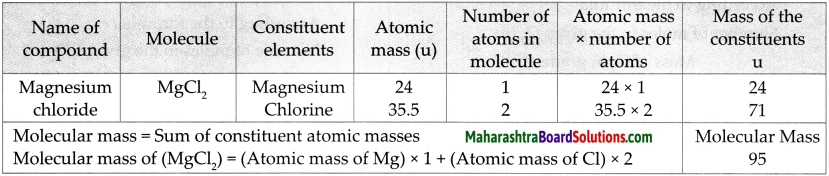
Maharashtra Board Class 9 Science Solutions Chapter 4 Measurement of Matter 8

Maharashtra Board Class 9 Science Solutions Chapter 4 Measurement of Matter

Question 4.
Molecular mass of NaOH
Answer:
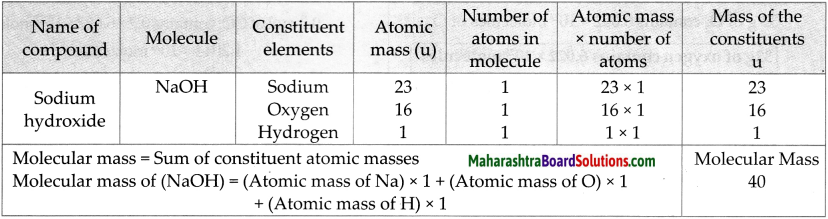
Maharashtra Board Class 9 Science Solutions Chapter 4 Measurement of Matter 8

Question 5.
Molecular mass of AIPO4
Answer:
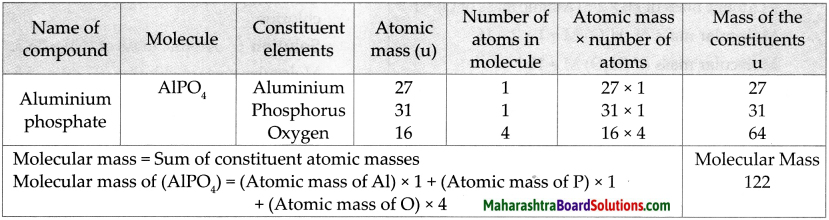
Maharashtra Board Class 9 Science Solutions Chapter 4 Measurement of Matter 10

Question 6.
Molecular mass of NaHCO3
Answer:
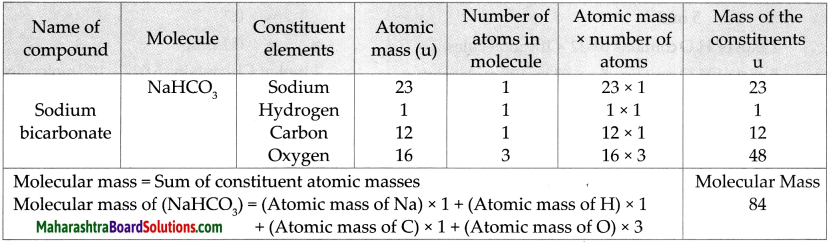
Maharashtra Board Class 9 Science Solutions Chapter 4 Measurement of Matter 11

Numerical.

Question 1.
Magnesium Oxide:
Answer:
Given : Number of moles of Magnesium oxide (MgO)n = 0.2 mol
To find : Mass in grams of 0.2 mol of MgO
Solution:
Molecular mass of (MgO)M
= (Atomic mass of Mg) x 1 + (Atomic mass of O) x 1
= 24 x 1 + 16 x 1
= 24 + 16
Molecular mass of (MgO)M = 40
According to the formula Number of moles in the given MgO (n)
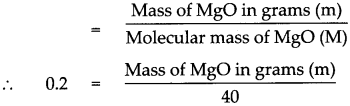
Maharashtra Board Class 9 Science Solutions Chapter 4 Measurement of Matter 17
Mass of MgO in grams (m) = 0.2 x 40
Mass of MgO in grams (m) = 8 g.
Mass of 0.2 mole of MgO is 8 g

Maharashtra Board Class 9 Science Solutions Chapter 4 Measurement of Matter

Question 2.
Calcium Carbonate:
Answer:
Given : Number of moles of Calcium carbonate (CaCO3) n = 0.2 mol
To find : Mass in grams of 0.2 mol of CaCO3
Solution:
Molecular mass of (CaCO3) M
= (Atomic mass of Ca) x 1 + (Atomic mass of C) x 1 + (Atomic mass of O) x 3
= (40 x l) + (12 x 1) +(16 x 3)
= 40+ 12+ 48
Molecular mass of (CaCO3) M = 100
According to the formula Number of moles in the given CaCO3 (n)
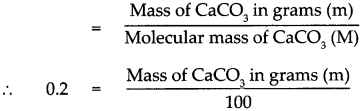
Maharashtra Board Class 9 Science Solutions Chapter 4 Measurement of Matter 18
∴ Mass of CaCO3 in grams (m) = 0.2 x 100
∴ Mass of CaCO3 in grams (m) = 20 g
Mass of 0.2 mole of CaCO3 is 20 g

State laws/Define the following:

Question 1.
Law of Conservation of Matter.
Answer:
In a chemical reaction, the total weight of the reactants is same as the total weight of the products formed due to chemical reaction.

Question 2.
Law of Constant Proportion.
Answer:
The proportion by weight of the constituent elements in the various samples of a compound is fixed.

Question 3.
Molecular Mass:
Answer:
The molecular mass of a substance is the sum of the atomic masses of all the atoms in a single molecule of that substance.

Question 4.
Mole
Answer:
A mole is that quantity of a substance whose mass in grams is equal in magnitude to the molecular mass of that substance in Daltons.

Maharashtra Board Class 9 Science Solutions Chapter 4 Measurement of Matter

Question 5.
Valency
Answer:
The capacity of an element to combine is called its valency.

Question 6.
Electronic definition of Valency
Answer:
The number of electrons that an atom of an element gives away or takes up while forming an ionic bond is called valency of that element.

Question 7.
Radicals
Answer:
The positively or negatively charged ions that take part independently in chemical reactions are called radicals.

Question 8.
Atomic size determination
Answer:
The size of an atom is determined by its radius. The atomic radius of an isolated atom is the distance between the nucleus of an atom and its outermost orbit.

Question 9.
Atomic mass number
Answer:
The number of protons and neutrons in the atomic nucleus is called the atomic mass number.

Question 10.
Unified mass
Answer:
Unified mass is the standard unit of atomic mass that quantifies mass on an atomic or molecular scale. Its symbol is ‘u’.
1 u = 1.66053904 x 10⁻²⁷ kg.

Question 11.
Molecular mass of a substance
Answer:
The molecular mass of a substance is the sum of the atomic masses of all the atoms in a single molecule of that substance. Like atomic mass, molecular mass is also expressed in the unit Dalton (u).

Answer the following questions:

Question 1.
What is variable valency?
Answer:

  • Under different conditions, the atoms of some elements give away or take up a different number of electrons.
  • In such cases, those elements exhibit more than one valency.
  • This property of elements is called variable valency.

Maharashtra Board Class 9 Science Solutions Chapter 4 Measurement of Matter

Complete the following table:

Question 1.
Write down the cations and anions obtained from the compounds in the following chart.
Answer:
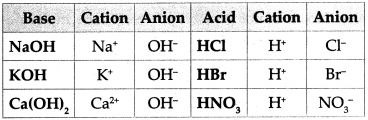
Maharashtra Board Class 9 Science Solutions Chapter 4 Measurement of Matter 26

Answer the following questions:

Question 1.
Using the chart of ions/radicals and the cross-multiplication method, write the chemical formulae of the following compounds:

(a) Calcium carbonate
Answer:
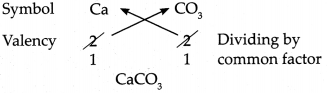
Maharashtra Board Class 9 Science Solutions Chapter 4 Measurement of Matter 29
∴ Chemical formula of Calcium carbonate is CaCO3

(b) Sodium bicarbonate
Answer:
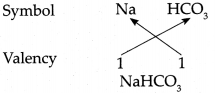
Maharashtra Board Class 9 Science Solutions Chapter 4 Measurement of Matter 30
∴ Chemical formula of Sodium bicarbonate is NaHCO3

(c) Silver chloride
Answer:
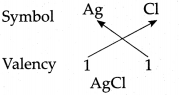
Maharashtra Board Class 9 Science Solutions Chapter 4 Measurement of Matter 31
∴ Chemical formula of Silver chloride is AgCl

Maharashtra Board Class 9 Science Solutions Chapter 4 Measurement of Matter

(d) Calcium hydroxide Answer: Symbol Ca OH
Answer:
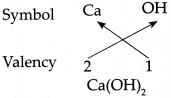
Maharashtra Board Class 9 Science Solutions Chapter 4 Measurement of Matter 52
∴ Chemical formula of Calcium hydroxide is Ca(OH)2

(e) Magnesium oxide
Answer:
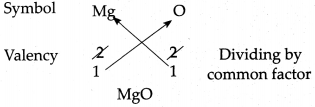
Maharashtra Board Class 9 Science Solutions Chapter 4 Measurement of Matter 53
∴ Chemical formula of Magnesium oxide is MgO

(f) Ammonium phosphate
Answer:
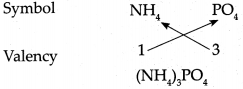
Maharashtra Board Class 9 Science Solutions Chapter 4 Measurement of Matter 54
∴ Chemical formula of Ammonium phosphate is (NH4)3PO4

(g) Cuprous bromide
Answer:
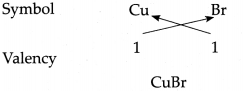
Maharashtra Board Class 9 Science Solutions Chapter 4 Measurement of Matter 55
∴ Chemical formula of Cuprous bromide is CuBr.

(h) Copper sulphate
Answer:
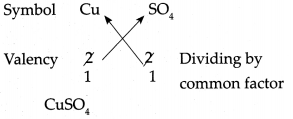
Maharashtra Board Class 9 Science Solutions Chapter 4 Measurement of Matter 57
∴ Chemical formula of Copper sulphate is CuSO4.

(i) Potassium nitrate
Answer:
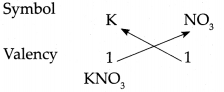
Maharashtra Board Class 9 Science Solutions Chapter 4 Measurement of Matter 58
∴ Chemical formula of Potassium nitrate is KNO3.

Maharashtra Board Class 9 Science Solutions Chapter 4 Measurement of Matter

(j) Sodium dichromate
Answer:
Maharashtra Board Class 9 Science Solutions Chapter 4 Measurement of Matter 59
∴ Chemical formula of Sodium dichromate is Na2Cr2O7.

Maharashtra Board Class 10 Marathi Aksharbharati Solutions Chapter 10 रंग साहित्याचे

Balbharti Maharashtra State Board Class 10 Marathi Solutions Aksharbharati Chapter 10 रंग साहित्याचे Notes, Textbook Exercise Important Questions and Answers.

Maharashtra State Board Class 10 Marathi Aksharbharati Solutions Chapter 10 रंग साहित्याचे

Marathi Aksharbharati Std 10 Digest Chapter 10 रंग साहित्याचे Textbook Questions and Answers

प्रश्न 1.
प्रस्तुत पाठात आलेल्या साहित्य प्रकारांची नावे लिहा.
Maharashtra Board Class 10 Marathi Aksharbharati Solutions Chapter 10 रंग साहित्याचे 17
उत्तर:
(i) कथा
(ii) कादंबरी
(iii) कविता
(iv) नाटक
(v) चरित्र
(vi) आत्मचरित्र
(vii) प्रवासवर्णन

प्रश्न 2.
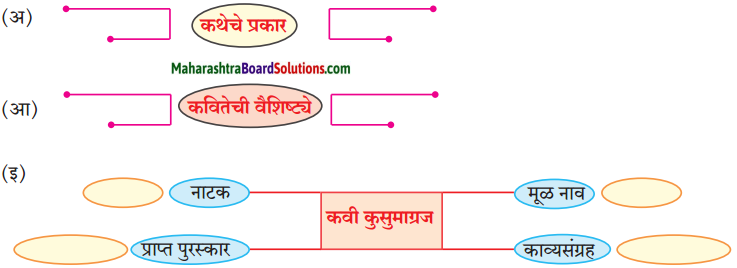
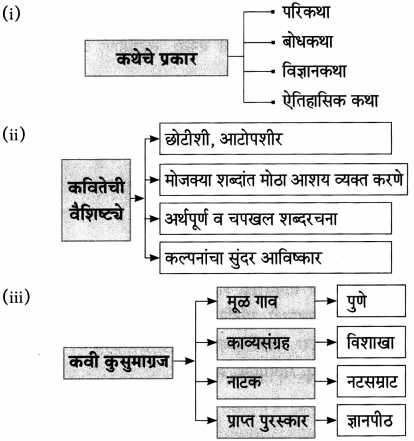
आकृतिबंध पूर्ण करा.
Maharashtra Board Class 10 Marathi Aksharbharati Solutions Chapter 10 रंग साहित्याचे 18
उत्तर:
Maharashtra Board Class 10 Marathi Aksharbharati Solutions Chapter 10 रंग साहित्याचे 14

Maharashtra Board Class 10 Marathi Aksharbharati Solutions Chapter 10 रंग साहित्याचे

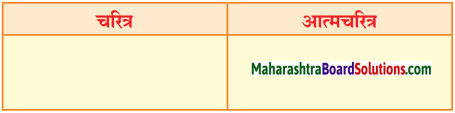
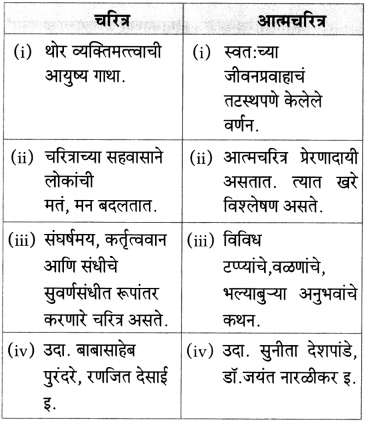
प्रश्न 3.
फरक स्पष्ट करा.
Maharashtra Board Class 10 Marathi Aksharbharati Solutions Chapter 10 रंग साहित्याचे 19
उत्तर:
Maharashtra Board Class 10 Marathi Aksharbharati Solutions Chapter 10 रंग साहित्याचे 15

प्रश्न 4.
खाली दिलेल्या अनेकवचनी नामांचे एकवचनी रूप लिहून त्यांचा वापर करून प्रत्येकी एक वाक्य तयार करा.
(i) रस्ते
(ii) वेळा
(iii) भिंती
(iv) विहिरी
(v) घड्याळे
(vi) माणसे
उत्तर:
(i) रस्ते – रस्ता – हा रस्ता रूंद व डांबरी आहे.
(ii) वेळा – वेळ – सकाळची वेळ अभ्यासासाठी चांगली असते.
(iii) भिंती – भिंत – चीनची भिंत खूप उंच व लांब आहे.
(iv) विहिरी – विहीर – गावाकडची विहीर पाण्याने भरली आहे.
(v) घड्याळे – घड्याळ – भिंतीवरचे घड्याळ सुशोभित दिसते.
(vi) माणसे – माणूस – कष्टाळू व इमानदार माणूस बक्षिसपात्र असतो.

Maharashtra Board Class 10 Marathi Aksharbharati Solutions Chapter 10 रंग साहित्याचे

प्रश्न 5.
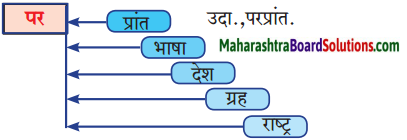
खालील शब्दांना ‘पर’ हा एकच शब्द जोडून नवीन अर्थपूर्ण शब्द तयार होतात. ते बनवा. मराठी भाषेतील अशा विपुल शब्दसंपत्तीचा अभ्यास करा. त्याप्रमाणे वेगवेगळे शब्द तयार करा.
Maharashtra Board Class 10 Marathi Aksharbharati Solutions Chapter 10 रंग साहित्याचे 20
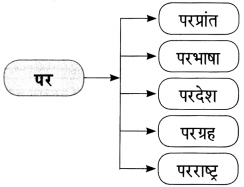
उत्तर:
Maharashtra Board Class 10 Marathi Aksharbharati Solutions Chapter 10 रंग साहित्याचे 16

प्रश्न 6.
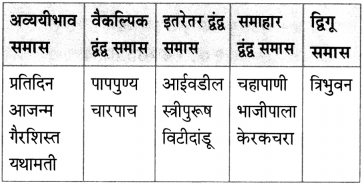
खालील सामासिक शब्दांचा समास ओळखून तक्ता पूर्ण करा.
यथामती, प्रतिदिन, आईवडील, चारपाच, त्रिभुवन, केरकचरा, भाजीपाला, चहापाणी, आजन्म, गैरशिस्त, विटीदांडू, पापपुण्य, स्त्रीपुरुष
Maharashtra Board Class 10 Marathi Aksharbharati Solutions Chapter 10 रंग साहित्याचे 21
उत्तर:
Maharashtra Board Class 10 Marathi Aksharbharati Solutions Chapter 10 रंग साहित्याचे 22

प्रश्न 7.
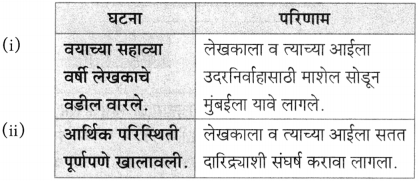
स्वमत.
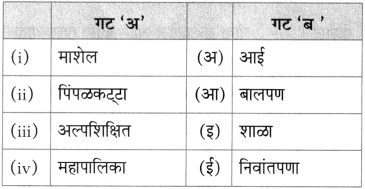
(अ) पुस्तकाशी मैत्री करण्याचे फायदे लिहा.
उत्तरः
पुस्तकांशी मैत्री म्हणजे निर्भेळ आनंदच. पुस्तके आपल्याशी बोलतात, त्यांचे विचार प्रगट करतात. ज्ञान देतात. चांगल्या कामासाठी प्रेरणा देतात. कठीण संकल्पना सोप्या करून सांगतात. चित्रांद्वारे, शब्दांतून मनमोकळ्या गप्पा मारतात. शब्दसंग्रह वाढवितात. प्रसंगी विविध स्थळांना भेटी दिल्याचा आनंद देतात. पुस्तके आपल्यावर कधीही रागावत नाहीत. रूसत नाहीत. भांडत नाहीत. काही अपेक्षा ठेवत नाहीत. म्हणून त्यांच्याशी मैत्री करून आपणही त्यांची काळजी घेणे तितकेच गरजेचे आहे.

Maharashtra Board Class 10 Marathi Aksharbharati Solutions Chapter 10 रंग साहित्याचे

(आ) तुम्हाला आवडलेल्या कोणत्याही एका साहित्यप्रकाराची वैशिष्ट्ये तुमच्या शब्दांत लिहा.
उत्तरः
मला आवडलेला साहित्यप्रकार म्हणजे कादंबरी. कादंबरी म्हणजे मोठी कथाच. विविध पात्रांनी, प्रसंगांनी नटलेली, सजलेली. कादंबरी जर खुमासदार असेल तर, ती हातातून सोडवत नाही. पुढे काय होणार याची उत्कंठा लागते. त्यातील पात्रांचा परिचय होतो व ती पात्रे आपल्याला आपल्यातीलच वाटू लागतात. कादंबरीत मन रममाण होते. सुखाच्या प्रसंगात भान हरपते. दु:खी प्रसंगाने अतिशय वाईटही वाटते, इतके तादात्म्य कादंबरीशी साधता येते. ‘ययाति’, ‘स्वामी’, या कादंबऱ्या माझ्या आवडत्या आहेत.

(इ) ‘उत्तम लेखक होण्यासाठी उत्तम वाचक होणे आवश्यक असते’, याबाबत तुमचे विचार स्पष्ट करा.
उत्तरः
‘वाचाल तर वाचाल’ या उक्तीप्रमाणे वाचनाने आपणांस अनेक लाभ होतात. वाचनाने शब्द संपत्ती वाढते. नवनवीन संकल्पना कळतात. विचार प्रगल्भ होतात, लेखक होण्यासाठी या सर्वांचा उपयोग होतो. समाजातील चालीरिती, संस्कृती, नवीन शोध, पर्यटन, शैक्षणिक स्तर यांची माहिती वाचनाने मिळते. विचारांची बैठक पक्की होते. काळाचे भान येते. नव्या जुन्या गोष्टी कळतात. उत्तम विचार समर्थ लेखणीद्वारे प्रगट होतात.

(ई) तुम्हाला आवडलेल्या पुस्तकाबाबत खालील मुद्द्यांचा विचार करून माहिती लिहा.
(१) पुस्तकाचे नाव
(२) लेखक
(३) साहित्यप्रकार
(४) वर्ण्य विषय
(५) मध्यवर्ती कल्पना
(६) पुस्तकातून मिळणारा संदेश
(७) मूल्य
(८) सामाजिक महत्त्व
(९) आवडण्याची कारणे
उत्तरः
मला ‘पांडुरंग सदाशिव साने’ लिखित ‘श्यामची आई’ हे पुस्तक आवडते. हा ‘कादंबरी’ साहित्यप्रकार असून प्रस्तुत कादंबरीत श्याम हे मुख्य पात्र आहे. बालपणी त्यावर झालेले संस्कार, आईने लावलेले वळण, घरची गरीबी पण संस्कारांची श्रीमंती अशा मिश्रणातून घडलेला श्याम म्हणजे स्वतः लेखक पांडुरंग सदाशिव साने, अर्थात साने गुरूजी. मोठेपणी स्वातंत्र्य लढ्यात सहभागी झाले.

गांधीवादाचा पुरस्कार केला. कारागृहात रोज रात्री आपल्या इतर कैदी मित्रांसोबत लहानपणीच्या सर्व आठवणींना उजाळा दिला. रोज एक कथा सांगण्याचा परिपाठ झाला व त्यातून ‘श्यामची आई’ पुस्तक साकारले. धारिष्ट्य, खरेपणा, स्वाभिमान, निखळप्रेम, सहिष्णूता या गोष्टींचा अंतर्भाव या कादंबरीत ओतप्रोत भरला आहे.

आजच्या तंत्रज्ञानाच्या युगात बुद्ध्यांक जरी वाढला तरी भावनांक कमी झाला आहे. ही कादंबरी वाचून समानता, आदरभाव, स्वाभिमान, सच्चेपणा या मुल्यांची सजवणूक समाजात होईल, आईविषयीचे नितांत प्रेम, आईचे ही खरे मार्गदर्शन अशा वात्सल्यतेची अपूर्व कहाणी ‘श्यामची आई’ मध्ये असल्याने ही कादंबरी आवडते.

Maharashtra Board Class 10 Marathi Aksharbharati Solutions Chapter 10 रंग साहित्याचे

Marathi Akshar Bharati Class 10 Textbook Solutions Chapter 10 रंग साहित्याचे Additional Important Questions and Answers

प्रश्न १. खालील उताऱ्याच्या आधारे दिलेल्या सूचनेनुसार कृती करा.

कृती १ : आकलन कृती

प्रश्न 1.
आकृतिबंध पूर्ण करा.
उत्तरः
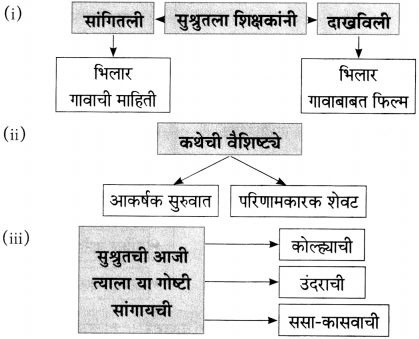
Maharashtra Board Class 10 Marathi Aksharbharati Solutions Chapter 10 रंग साहित्याचे 1

प्रश्न 2.
चौकटीत उत्तरे लिहा.
उत्तरः
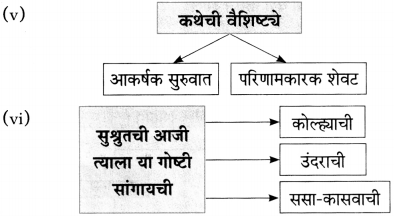
(i) सुश्रुतची सहल या गावी नेण्याचे ठरले – [भिलार]
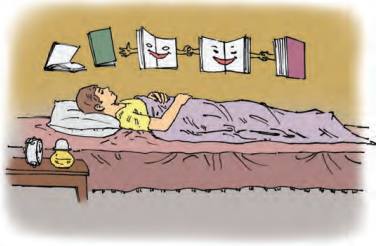
(ii) मुलामुलींचा वेश करून आले – [पुस्तके]
(ii) कथेचे दुसरे नाव – [गोष्ट]

Maharashtra Board Class 10 Marathi Aksharbharati Solutions Chapter 10 रंग साहित्याचे

प्रश्न 3.
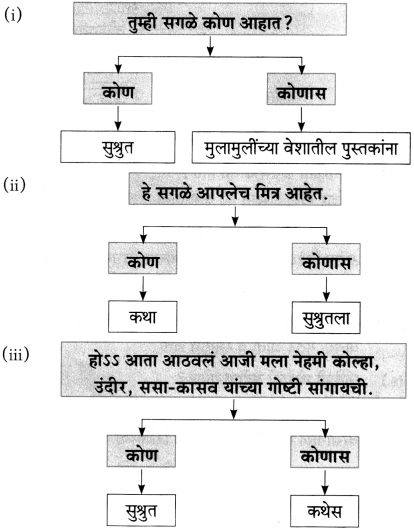
कोण कोणास म्हणाले?
उत्तरः
Maharashtra Board Class 10 Marathi Aksharbharati Solutions Chapter 10 रंग साहित्याचे 2

कृती २ : आकलन कृती

प्रश्न 1.
खालील शब्द उत्तर येईल असे प्रश्न तयार करा,
(i) हातात हात घालून
(ii) लहानपणापासूनच.
उत्तर:
(i) काही पुस्तके कशी नाचत होती?
(ii) कथेची ओळख सुश्रुतला केव्हापासून आहे?

प्रश्न 2.
सहसंबंध लिहा.
(i) सूचना : वर्ग : : सहल : ……………………………..
उत्तर:
भिलार

Maharashtra Board Class 10 Marathi Aksharbharati Solutions Chapter 10 रंग साहित्याचे

प्रश्न 3.
कंसातील योग्य शब्द वापरून रिकाम्या जागा भरा,
(i) सुश्रुतच्या वर्गाची …………………………….. गावाला सहल नेण्याचे ठरले. (किल्लारी, भिलार, पुणे, ठाणे)
(ii) काही पुस्तके मुला – मुलींचा वेश करून आणि हातात हात घालून …………………………….. गाणी गात आहेत. (नाचत, बागडत, आनंदाने, उत्साहाने)
उत्तर:
(i) भिलार
(ii) आनंदाने

प्रश्न 4.
खालील प्रश्नांची एका वाक्यात उत्तरे लिहा.

(i) सुश्रुतला कथा आपले दुसरे नाव काय सांगते?
उत्तर:
सुश्रुतला कथा आपले दुसरे नाव ‘गोष्ट’ असे सांगते.

(ii) सुश्रुतची आजी त्याला कोणत्या गोष्टी सांगायची?
उत्तर:
सुश्रुतची आजी त्याला कोल्हा, उंदीर, ससा-कासव यांच्या गोष्टी सांगायची.

(iii) अरे आम्ही सर्व तुला भेटायला आलो आहोत, असे सुश्रुतला कोण म्हणाले?
उत्तर:
अरे आम्ही सर्व तुला भेटायाला आलो आहोत, असे सुश्रुतला पुस्तकाच्या वेशातील मुले म्हणाली.

प्रश्न २. खालील उताऱ्याच्या आधारे दिलेल्या सूचनेनुसार कृती करा.

कृती १ : आकलन कृती

प्रश्न 1.
आकृतिबंध पूर्ण करा.
उत्तरः
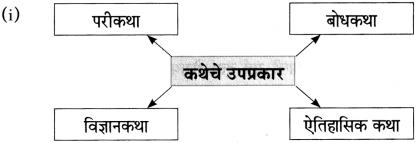
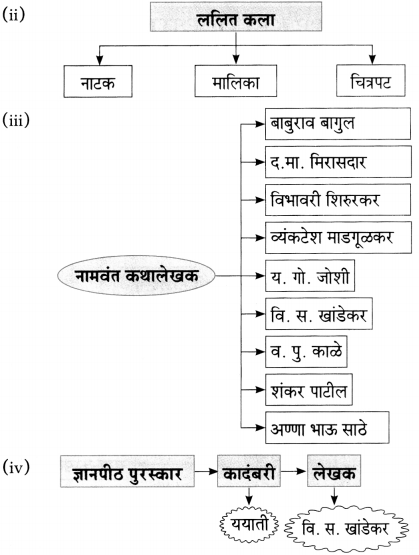
Maharashtra Board Class 10 Marathi Aksharbharati Solutions Chapter 10 रंग साहित्याचे 3
Maharashtra Board Class 10 Marathi Aksharbharati Solutions Chapter 10 रंग साहित्याचे 4
Maharashtra Board Class 10 Marathi Aksharbharati Solutions Chapter 10 रंग साहित्याचे 5

Maharashtra Board Class 10 Marathi Aksharbharati Solutions Chapter 10 रंग साहित्याचे

प्रश्न 2.
खालील प्रश्नांची उत्तरे एका वाक्यात लिहा.

(i) कलाकृती उत्तम केव्हा होते?
उत्तरः
दर्जेदार कथा असली की कलाकृती उत्तम होते.

(ii) कथेच्या यशाचे रहस्य काय?
उत्तर:
उत्तम निवेदनतंत्राचा वापर हे कथेच्या यशाचे रहस्य आहे.

(iii) कादंबरी वाचताना वाचक कशात रममाण होतो?
उत्तरः
कथानकात पुढे काय होईल याच्या विचारात कादंबरी वाचताना वाचक गुंतून जातो व रममाण होतो.

(iv) कथेची थोरली बहीण कोण?
उत्तर:
कथेची थोरली बहीण कादंबरी होय.

प्रश्न 3.
कंसातील योग्य शब्द वापरून रिकाम्या जागा भरा.
(i) …………………………… म्हणजे खरं तर मोठी कथाच; पण माझा आवाका कथेपेक्षा पार मोठा! (कथा, निबंध, कादंबरी, संवाद)
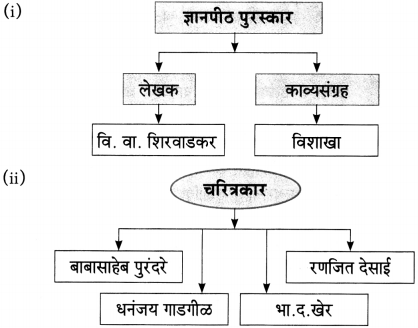
(ii) साहित्य क्षेत्रातील सर्वोच्च मानाचा …………………………… पुरस्कार वि. स. खांडेकर यांच्या ययाति या कादंबरीला मिळाला. (अर्जुन, ज्ञानपीठ, साहित्य)
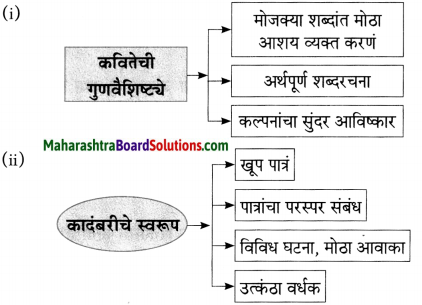
(iii) कवितेची शब्दरचना अर्थपूर्ण व …………………………… असते. (चपखल, लयबद्ध, वैशिष्ट्यपूर्ण, आशययुक्त)
(iv) उत्तम …………………………… तंत्रामुळे मी खुलत जाते, रंगत जाते किंबहुना उत्तम निवेदनतंत्राचा वापर हे माझ्या यशाचं रहस्य. (भाषण, कथन, निवेदन, अनुवादन)
उत्तर:
(i) कादंबरी
(ii) ज्ञानपीठ
(iii) चपखल
(iv) निवेदन

Maharashtra Board Class 10 Marathi Aksharbharati Solutions Chapter 10 रंग साहित्याचे

कृती २ : आकलन कृती

प्रश्न 1.
आकृतिबंध पूर्ण करा.
उत्तरः
Maharashtra Board Class 10 Marathi Aksharbharati Solutions Chapter 10 रंग साहित्याचे 6

प्रश्न 2.
सकारण लिहा.

(i) कवितांची व आपली फार पूर्वीपासून चांगलीच ओळख आहे.
उत्तर:
शालेय जीवनात पाठ्यपुस्तकातील सगळ्या कविता तालासुरांत म्हटल्या जातात.

(ii) मराठी माणसांचा ऊर अभिमानानं भरून आला.
उत्तरः
साहित्य क्षेत्रातील सर्वोच्च मानाचा ‘ज्ञानपीठ’ पुरस्कार वि. स. खांडेकर यांच्या ‘ययाति’ या कादंबरीला मिळाला.

प्रश्न 3.
चूक की बरोबर ते लिहा.

(i) ‘ही आवडते मज मनापासुनी शाळा’ आणि ‘श्रावणमासी हर्ष मानसी’ या सुश्रुतच्या नावडत्या कविता होत्या.
(ii) कादंबरी म्हणजे खरं तर मोठी कथाच.
उत्तर:
(i) चूक
(ii) बरोबर

कृती ३ : स्वमत

प्रश्न 1.
तुम्ही दूरदर्शनवर किंवा प्रत्यक्षात पाहिलेल्या काव्य संमेलनाविषयी तुमचे मत लिहा.
उत्तर:
होळीच्या निमित्ताने भरलेल्या काव्यसंमेलनास मला प्रत्यक्ष उपस्थित राहण्याचा योग आला. मोठ्या व्यासपीठावर अनेक कवी, कवयित्री विराजमान होते. प्रत्येक जण आपली कविता विशिष्ट हावभावांसहित, चालीत म्हणून दाखवीत होते. कवितांची रचना अर्थपूर्ण व चपखल होती. कल्पनांचा सुंदर आविष्कार होता. काही कविता सामाजिक होत्या तर काही कविता हास्यरसपूर्ण होत्या. श्रोते मनापासून कवितांना दाद देत होते. कवीच्या आवाजातील चढउतार, त्यांचे हावभाव कौतुकास्पद होते. काही कवितांमध्ये अनुप्रासामुळे गोडवा होता. उत्प्रेक्षा, उपमा, रूपक अलंकारांनी सजलेल्या या कविता मनाला मोहून गेल्या. काव्यसंमेलन कधी संपले ते कळले नाही. कविता गुणगुणतच आम्ही बाहेर पडलो.

Maharashtra Board Class 10 Marathi Aksharbharati Solutions Chapter 10 रंग साहित्याचे

प्रश्न ३. खालील उताऱ्याच्या आधारे दिलेल्या सूचनेनुसार कृती करा.

कृती १ : आकलन कृती

प्रश्न 1.
आकृतिबंध पूर्ण करा.
उत्तरः
Maharashtra Board Class 10 Marathi Aksharbharati Solutions Chapter 10 रंग साहित्याचे 7
Maharashtra Board Class 10 Marathi Aksharbharati Solutions Chapter 10 रंग साहित्याचे 8

प्रश्न 2.
खालील प्रश्नांची उत्तरे एका वाक्यात लिहा.

(i) सामान्य लोकांची मते कशी बदलतात?
उत्तर:
चरित्र वाचनाने सामान्य लोकांची मते बदलतात,

(ii) चरित्र कसे असते?
उत्तर:
चरित्र संघर्षमय, कर्तृत्ववान, संधीचे सुवर्णसंधीत रूपांतर करणारे असते.

(iii) चरित्र कसे जन्माला येते?
उत्तर:
एखादया थोर व्यक्तिमत्त्वाच्या आयुष्याची गाथा लिहिण्याची प्रेरणा लेखकाला मिळते व चरित्र जन्माला येते.

(iv) नाटककाराची कोणती अपेक्षा असते?
उत्तरः
नाटक वाचनीय आणि प्रेक्षणीय व्हावं अशी नाटककाराची अपेक्षा असते.

Maharashtra Board Class 10 Marathi Aksharbharati Solutions Chapter 10 रंग साहित्याचे

प्रश्न 3.
कंसातील योग्य शब्द वापरून रिकाम्या जागा भरा.
(i) …………………………. नाटकाचे लेखक वि. वा. शिरवाडकर म्हणजेच कवीवर्य कुसुमाग्रज. (‘नटसम्राट’, ‘विठ्ठल तो आला’, ‘गिधाड’, ‘कुलांगार’)
(ii) माझं रंगमंचावर सादरीकरण होणार याचे भान ठेवूनच …………………………. माझी मांडणी करतो. (कादंबरीकार, कथाकार, कविताकार, नाटककार)
उत्तर:
(i) ‘नटसम्राट’
(ii) नाटककार

कृती २ : आकलन कृती

प्रश्न 1.
कारणे शोधा.

(i) नाटक मराठी माणसाच्या हृदयात अढळ स्थान प्राप्त करते कारण . . .
उत्तरः
पात्ररचना, चुरचुरीत संवाद आणि नाट्यमय घटना प्रसंग यांमुळे नाटक मराठी माणसाच्या हृदयात अढळ स्थान प्राप्त करते.

(ii) २७ फेब्रुवारीला मराठी दिन साजरा करतात कारण . . .
उत्तर:
२७ फेब्रुवारी हा ‘ज्ञानपीठ’ पुरस्काराचे मानकरी कविवर्य कुसुमाग्रज म्हणजे वि.वा.शिरवाडकर यांचा जन्मदिन आहे. त्यांच्या साहित्य सेवेमुळेच त्यांचा जन्मदिवस मराठी दिन म्हणून साजरा करतात.

प्रश्न 2.
वर्गीकरण करा.
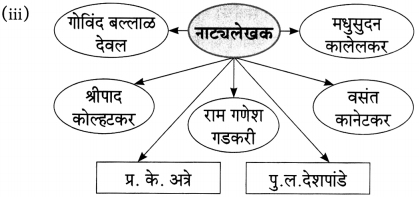
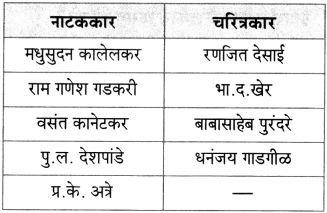
वसंत कानेटकर, रणजित देसाई, पु.ल. देशपांडे, धनंजय गाडगीळ, प्र.के. अत्रे, भा.द.खेर, राम गणेश गडकरी, मधुसुदन कालेलकर, बाबासाहेब पुरंदरे
उत्तरः
Maharashtra Board Class 10 Marathi Aksharbharati Solutions Chapter 10 रंग साहित्याचे 9

Maharashtra Board Class 10 Marathi Aksharbharati Solutions Chapter 10 रंग साहित्याचे

प्रश्न 3.
योग्य पर्याय निवडून विधान पूर्ण करा.
(i) संतकाव्यापासून पंतकाव्य, मध्ययुगीन काव्य, शाहिरी काव्य अशी वळणे घेत आधुनिक काळात मी …
(अ) मुक्त छंदाचे रूप धारण केले आहे.
(आ) करूण रसाचे रूप धारण केले आहे.
(इ) अभंग छंदाचे रूप धारण केले आहे.
(ई) मुक्त छंदाचे रूप स्वीकारले आहे
उत्तर:
संतकाव्यापासून पंतकाव्य, मध्ययुगीन काव्य, शाहिरी काव्य अशी वळणे घेत आधुनिक काळात मी मुक्त छंदाचे रूप धारण केले आहे.

प्रश्न 4.
चूक की बरोबर लिहा.
(i) ‘नटसम्राट’ नाटकाचे लेखक कुसुमाग्रज म्हणजेच वि. वा. शिरवाडकर.
(ii) थोरांची चरित्रे सामान्यांना धोका देतात.
उत्तर:
(i) बरोबर
(ii) चूक

कृती ३ : स्वमत

प्रश्न 1.
‘नाटक कलाकाराला घडवते’ याचे समर्थन करणारे विचार तुमच्या शब्दांत मांडा.
उत्तरः
साहित्यप्रकारातील ‘नाटक’ हा भाग म्हणजे विलक्षण आव्हानात्मक, नाट्यसंहिता लिहिण्यापासून ते थेट रंगमंचापर्यंतचा नाटकाचा प्रवास हा विविधांगी असतो. उत्कृष्ट लेखन, उत्कृष्ट दिग्दर्शन व उत्कृष्ट अभिनय यावर नाटकाचे यश अवलंबून असते, नाटकात काम करणारे कलाकार शब्दांना मूर्तरूप देतात. प्रेक्षकांच्या मनावर पकड करतात. संवादफेक, शब्दांचे उच्चार, आवाजातील चढ-उतार, नाटकाचा आशय व त्यातून समाजाला मिळणारा संदेश याची जबाबदारी कलाकारावर असते. कलाकार त्या भूमिकेत मनापासून शिरल्याखेरीज ती भूमिका प्रभावी होत नाही. नाटक कलाकाराच्या रोमारोमांत भिनलेले असते. म्हणून नाटक कलाकाराची सर्वांगीण प्रगती करते व त्याला घडवते.

प्रश्न ४. खालील उताऱ्याच्या आधारे दिलेल्या सूचनेनुसार कृती करा.

कृती १ : आकलन कृती

प्रश्न 1.
आकृतिबंध पूर्ण करा.
उत्तरः
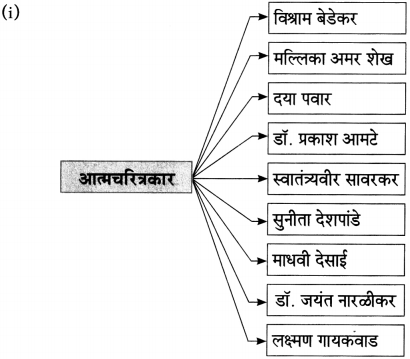
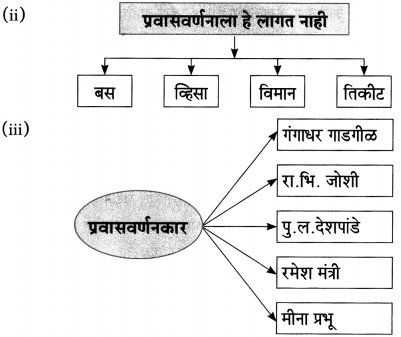
Maharashtra Board Class 10 Marathi Aksharbharati Solutions Chapter 10 रंग साहित्याचे 10
Maharashtra Board Class 10 Marathi Aksharbharati Solutions Chapter 10 रंग साहित्याचे 11

Maharashtra Board Class 10 Marathi Aksharbharati Solutions Chapter 10 रंग साहित्याचे

प्रश्न 2.
मी कोण ते लिहा.
उत्तरः
(i) एखादया व्यक्तिच्या आयुष्याचे वर्णन – [चरित्र]
(ii) स्वत:च्या जीवनप्रवासाचे तटस्थपणे केलेले वर्णन – [आत्मचरित्र]

प्रश्न 3.
खालील प्रश्नांची उत्तरे एका वाक्यात लिहा.

(i) आत्मचरित्रात तटस्थपणे कशाचे कथन आढळते?
उत्तरः
आत्मचरित्रात आयुष्यात आलेल्या विविध टप्प्यांचे, वळणांचे, भल्याबुऱ्या अनुभवांचे तटस्थपणे केलेले कथन आढळते.

(ii) घरी बसून दूरच्या गावी नेणारे कोण असते?
उत्तरः
घरी बसून दूरच्या गावी नेणारे प्रवासवर्णन असते.

(iii) प्रवासवर्णनात लेखकाचे कसब कोणते?
उत्तरः
माहिती रटाळ, कंटाळवाणी न होऊ देता रंजक पद्धतीने मनोवेधक भाषेत मांडणं हे लेखकाचं कसब असतं.

(iv) सर्व साहित्य मित्रांमुळे सुश्रुतला काय फायदा होणार आहे ?
उत्तरः
सर्व साहित्य मित्रांमुळे मनोरंजन होऊन ज्ञानही वाढेल व लेखनही सुधारेल.

कृती २: आकलन

प्रश्न 1.
आकृती पूर्ण करा.
उत्तरः
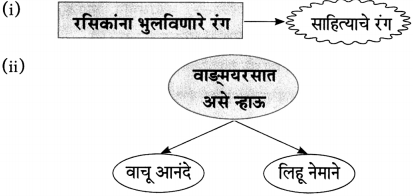
Maharashtra Board Class 10 Marathi Aksharbharati Solutions Chapter 10 रंग साहित्याचे 12

प्रश्न 2.
सकारण लिहा.
प्रवासवर्णन रंजक होते –
उत्तरः
लेखक त्या ठिकाणच्या माहितीबरोबर स्वत:चे अनुभव, भावना, निसर्गसौंदर्य, व्यक्तिविशेष यांची सुरेख मांडणी करतो.

प्रश्न 3.
योग्य पर्याय निवडा.
(i) सुश्रुतला साहित्य मित्रांशी मैत्री करायला आवडेल कारण . . .
(अ) ते सुश्रुतला बक्षिस देतील.
(ब) ते सुश्रुतला कधीच सोडून जाणार नाही.
(क) ते सप्तरंगी इंद्रधनुष्यासारखे आहेत.
(ड) ते सुश्रुतशी खेळतील.
उत्तरः
सुश्रुतला साहित्य मित्रांशी मैत्री करायला आवडेल कारण ते सुश्रुतला कधीच सोडून जाणार नाही.

Maharashtra Board Class 10 Marathi Aksharbharati Solutions Chapter 10 रंग साहित्याचे

(ii) मी प्रेक्षणीय ठिकाणांची माहिती वाचकांपर्यंत पोहोचवतो –
(अ) लेखक
(ब) कवी
(क) चित्रकार
(ड) प्रवासवर्णन
उत्तरः
मी प्रेक्षणीय ठिकाणांची माहिती वाचकांपर्यंत पोहोचवतो प्रवासवर्णन.

प्रश्न 4.
कंसातील योग्य शब्द वापरून रिकाम्या जागा भरा.
(i) …………………………….. रंग विविध हे, भुलविती साऱ्या रसिकजना. (विषयाचे, साहित्याचे, कथेचे, निबंधाचे)
(ii) धन्य आमुची …………………………….. मराठी, धन्य साहित्यसंपदा. (माय, मातृ, श्रेष्ठ, कनिष्ठ)
उत्तर:
(i) साहित्याचे
(ii) माय

कृती ३ : स्वमत

प्रश्न 1.
‘आत्मचरित्र म्हणजे लेखकाच्या जीवनाचा आरसा’ हे विधान स्पष्ट करा.
उत्तरः
आत्मचरित्र म्हणजे लेखकाने स्वत:च्या जीवनप्रवासाचे तटस्थपणे केलेले वर्णन. विविध वळणांचे, आयुष्यातील भल्या-बुऱ्या घटनांचे लेखक तटस्थपणे वर्णन करून शब्दात मांडतो. त्यात खोटेपणाला वाव नसतो. जे घडले ते जसेच्या तसे मांडण्याचा त्याचा प्रामाणिक प्रयत्न असतो.

जसा आरसा जे आहे तसेच दाखवतो तसेच आत्मचरित्र ही घडलेल्या घटना अतिरंजीत न करता जशाच्या तशा दाखवते. त्यात लेखकाचा संघर्ष असू शकतो, त्याचे कर्तृत्व, त्याचा मान-अपमान व त्याची गुणवैशिष्ट्ये आत्मचरित्रातून दिसतात. अनेक आत्मचरित्रे बोधप्रद असतात. त्यातून जिद्द, चिकाटी, सच्चेपणा हे गुण शिकता येतात. मी स्वातंत्र्यवीर सावरकर व गांधीजीचे चरित्र वाचले आहे. खरोखरच आत्मचरित्र म्हणजे लेखकाच्या जीवनाचा आरसा असतो हे तेव्हा उमगले.

स्वाध्याय कृती

(७) स्वमत

(i) पुस्तकाशी मैत्री करण्याचे फायदे.
उत्तरः
पुस्तकांशी मैत्री म्हणजे निर्भेळ आनंदच. पुस्तके आपल्याशी बोलतात, त्यांचे विचार प्रगट करतात. ज्ञान देतात. चांगल्या कामासाठी प्रेरणा देतात. कठीण संकल्पना सोप्या करून सांगतात. चित्रांद्वारे, शब्दांतून मनमोकळ्या गप्पा मारतात. शब्दसंग्रह वाढवितात. प्रसंगी विविध स्थळांना भेटी दिल्याचा आनंद देतात. पुस्तके आपल्यावर कधीही रागावत नाहीत. रूसत नाहीत. भांडत नाहीत. काही अपेक्षा ठेवत नाहीत. म्हणून त्यांच्याशी मैत्री करून आपणही त्यांची काळजी घेणे तितकेच गरजेचे आहे.

(ii) तुम्हांला आवडलेल्या कोणत्याही साहित्यप्रकाराची वैशिष्ट्ये तुमच्या शब्दात लिहा.
उत्तरः
मला आवडलेला साहित्यप्रकार म्हणजे कादंबरी. कादंबरी म्हणजे मोठी कथाच. विविध पात्रांनी, प्रसंगांनी नटलेली, सजलेली. कादंबरी जर खुमासदार असेल तर, ती हातातून सोडवत नाही. पुढे काय होणार याची उत्कंठा लागते. त्यातील पात्रांचा परिचय होतो व ती पात्रे आपल्याला आपल्यातीलच वाटू लागतात. कादंबरीत मन रममाण होते. सुखाच्या प्रसंगात भान हरपते. दु:खी प्रसंगाने अतिशय वाईटही वाटते, इतके तादात्म्य कादंबरीशी साधता येते. ‘ययाति’, ‘स्वामी’, या कादंबऱ्या माझ्या आवडत्या आहेत.

Maharashtra Board Class 10 Marathi Aksharbharati Solutions Chapter 10 रंग साहित्याचे

(iii) ‘उत्तम लेखक होण्यासाठी उत्तम वाचक होणे आवश्यक असते’ यावर तुमचे विचार स्पष्ट करा.
उत्तरः
‘वाचाल तर वाचाल’ या उक्तीप्रमाणे वाचनाने आपणांस अनेक लाभ होतात. वाचनाने शब्द संपत्ती वाढते. नवनवीन संकल्पना कळतात. विचार प्रगल्भ होतात, लेखक होण्यासाठी या सर्वांचा उपयोग होतो. समाजातील चालीरिती, संस्कृती, नवीन शोध, पर्यटन, शैक्षणिक स्तर यांची माहिती वाचनाने मिळते. विचारांची बैठक पक्की होते. काळाचे भान येते. नव्या जुन्या गोष्टी कळतात. उत्तम विचार समर्थ लेखणीद्वारे प्रगट होतात.

रंग साहित्याचे Summary in Marathi

रंग साहित्याचे पाठपरिचय‌
प्रत्येक‌ ‌भाषा‌ ‌विविध‌ ‌साहित्यप्रकारांनी‌ ‌नटलेली‌ ‌असते.‌ ‌असे‌ ‌साहित्यप्रकार‌ ‌मानवी‌ ‌रूप‌ ‌घेऊन‌ ‌या‌ ‌पाठातून‌ ‌स्वपरिचय‌ ‌करून‌ ‌देत‌ ‌आहेत,‌ ‌भाषासमृद्धीकरणासाठी‌ ‌साहित्यप्रकारांचा,‌ ‌त्यांच्यातील‌ ‌वैशिष्ट्यांचा‌ ‌उपयोग‌ ‌होतो.‌ ‌या‌ ‌साहित्यप्रकारांशी‌ ‌मैत्री‌ ‌केली,‌ ‌तर‌ ‌मनोरंजनाबरोबर‌ ‌आपले‌ ‌ज्ञानही‌ ‌वाढेल‌ ‌असा‌ ‌संदेशही‌ ‌पाठातून‌ ‌दिला‌ ‌आहे.‌ ‌नाट्यस्वरूपातील‌ ‌हा‌ ‌पाठ‌ ‌साहित्यातील‌ ‌विविध‌ ‌कलाकृतींचा‌ ‌परिचय‌ ‌करून‌ ‌देणारा‌ ‌आहे.‌‌

Maharashtra Board Class 10 Marathi Aksharbharati Solutions Chapter 10 रंग साहित्याचे 23

रंग साहित्याचे Summary in English

Every‌ ‌language‌ ‌is‌ ‌enhanced‌ ‌by‌ ‌a‌ ‌body‌ ‌of‌ ‌literature.‌ ‌When‌ ‌different‌ ‌types‌ ‌of‌ ‌literature‌ ‌take‌ ‌human‌ ‌form‌ ‌and‌ ‌introduce‌ ‌themselves,‌ ‌they‌ ‌add‌ ‌to‌ ‌the‌ ‌beauty‌ ‌of‌ ‌language.‌ ‌The‌ ‌various‌ ‌characteristics‌ ‌of‌ ‌literature‌ ‌help‌ ‌in‌ ‌this‌ ‌process.‌ ‌If‌ ‌we‌ ‌get‌ ‌acquainted‌ ‌with‌ ‌these‌ ‌literary‌ ‌types,‌ ‌we‌ ‌not‌ ‌only‌ ‌get‌ ‌entertained‌ ‌but‌ ‌also‌ ‌acquire‌ ‌a‌ ‌fair‌ ‌amount‌ ‌of‌ ‌knowledge.‌ ‌This‌ ‌message‌ ‌is‌ ‌conveyed‌ ‌through‌ ‌this‌ ‌lesson.‌ ‌This‌ ‌animated‌ ‌lesson‌ ‌introduces‌ ‌us‌ ‌to‌ ‌various‌ ‌types‌ ‌of‌ ‌literary‌ ‌divisions.‌‌

रंग साहित्याचे ‌शब्दार्थ‌

  • सहल‌ ‌–‌ ‌यात्रा‌‌ –‌ ‌(picnic)‌ ‌
  • वेश‌ ‌–‌ ‌पोशाख‌‌ –‌ ‌(costume)‌ ‌
  • सूचना‌ ‌–‌ ‌बातमी‌‌ –‌ ‌(notice)‌ ‌
  • ओळख‌ ‌–‌ ‌परिचय‌‌ – (introduction)‌ ‌
  • कथा –‌ ‌गोष्ट‌‌ – (story)‌ ‌
  • आकर्षक‌ ‌–‌ ‌लक्षवेधी‌‌ –‌ ‌(attractive)‌ ‌
  • परिणामकारक‌ ‌–‌ ‌प्रभावी‌ ‌–‌ ‌(effective)‌ ‌
  • शेवट‌‌ –‌ ‌समारोप‌‌ – (ending)‌ ‌
  • साहसकथा‌ ‌–‌ ‌शौर्यकथा‌‌ – (adventurous)‌ ‌
  • परीकथा‌ ‌–‌ ‌पऱ्यांच्या‌ ‌गोष्टी‌ ‌–‌ ‌(fairly‌ ‌tales)‌ ‌
  • बोधकथा‌ ‌–‌ ‌नीतीकथा‌‌ – (moral‌ ‌stories)‌ ‌
  • नाटक‌ ‌–‌ ‌नाटिका‌ ‌–‌ ‌(drama,‌ ‌play)‌ ‌
  • मालिका‌ ‌–‌ ‌संलग्नकथा‌ ‌–‌ ‌(episodes)‌ ‌
  • चित्रपट‌ ‌–‌ ‌सिनेमा‌‌ –‌ ‌(movies)‌ ‌
  • दर्जेदार‌ ‌–‌ ‌गुणवत्तापूर्ण‌ ‌–‌ ‌(qualitative)‌ ‌
  • उत्तम‌ ‌–‌ ‌सुरेख‌‌ –‌ ‌(excellent)‌ ‌
  • निवेदन‌ ‌–‌ ‌कथन‌‌ –‌ ‌(statement)‌ ‌
  • तंत्र –‌ ‌पद्धत‌ ‌–‌ ‌(technique)‌ ‌
  • यश‌ ‌–‌ ‌सफलता‌ ‌–‌ ‌(success)‌ ‌
  • रहस्य‌ ‌–‌ ‌गुपीत‌‌ – (mystery)‌ ‌
  • तृप्त‌ ‌–‌ ‌समाधान‌‌ –‌ ‌(satisfaction)‌ ‌
  • कादंबरी‌ ‌–‌ ‌अखंड‌ ‌मोठी‌ ‌कथा‌ ‌–‌ ‌(novel)‌ ‌
  • आवाका‌ ‌–‌ ‌पसारा‌ ‌–‌ ‌(volume)‌‌
  • पात्र‌ कलाकार‌ ‌–‌ ‌(characters)‌ ‌
  • ‌परस्पर‌ एकमेकांशी‌ ‌–‌ ‌(inter‌ ‌related)‌ ‌
  • ‌उत्कंठा‌‌ –‌ ‌उत्सुकता‌ ‌–‌ ‌(eagerness)‌
  • सर्वोच्च‌‌ –‌ ‌अत्यंत‌ ‌मोठा‌‌ –‌ ‌(highest)
  • पुरस्कार‌ ‌‌–‌‌ ‌बक्षिस‌‌ –‌ ‌(award)‌ ‌
  • आटोपशीर‌ ‌–‌ ‌नेमके‌‌ –‌ ‌(handily)‌‌
  • आशय‌‌ –‌ ‌हेतू‌‌ –‌ ‌‌(purpose)‌
  • वैशिष्ट्य‌‌ –‌ ‌विशिष्टता‌‌ –‌ ‌(peculiarity)‌ ‌
  • यमक‌‌ ‌–‌ एक‌ ‌शब्दालंकार‌ ‌–‌ ‌(homonym)‌ ‌
  • अनुप्रास‌ –‌ ‌एक‌ ‌शब्दालंकार‌ ‌–‌ ‌(alliteration)
  • ‌उपमा‌‌ –‌ ‌‌एक‌ ‌अर्थालंकार‌ ‌–‌ ‌(example)‌
  • रूपक‌‌ ‌–‌ ‌एक‌ ‌अर्थालंकार‌ ‌–‌ ‌(metaphor)‌ ‌
  • चपखल‌ ‌–‌ ‌तंतोतंत‌ ‌–‌ ‌(precise)‌ ‌
  • आविष्कार‌ ‌–‌ ‌प्रगटीकरण‌ ‌–‌ ‌(manifestation)‌ ‌
  • रूपांतर‌ ‌–‌ ‌परिवर्तन‌ ‌–‌ ‌(transfiguration)‌ ‌
  • निरीक्षण‌ ‌–‌ ‌बारकाईने‌ ‌पहाणे‌ ‌–‌ ‌(observation)‌ ‌
  • अर्थालंकार‌‌ –‌ ‌एक‌ ‌अलंकाराचा‌ ‌प्रकार‌‌ (figure‌ ‌of‌ ‌speech)‌ ‌
  • अर्थपूर्ण‌ ‌–‌ ‌उद्देशपूर्ण‌ ‌–‌ ‌(meaningful)‌ ‌
  • कल्पना‌ ‌–‌ ‌कल्पित‌‌ (imagination)‌
  • संवाद ‌–‌ ‌संभाषण‌ ‌–‌ ‌(dialogue)‌‌

Maharashtra Board Class 10 English Solutions Unit 3.4 The Will to Win

Balbharti Maharashtra State Board Class 10 English Solutions Unit 3.4 The Will to Win Notes, Textbook Exercise Important Questions and Answers.

Maharashtra State Board Class 10 English Kumarbharati Textbook Solutions Unit 3.4 The Will to Win

Maharashtra Board Class 10 English Solutions Unit 3.4 Warming Up Questions and Answers

The Will To Win Poem Appreciation Question 1.
Get into pairs, discuss and tick the most appropriate answer :
(a) You may have lost the match; but
(i) It is important that you start fighting with your opponent.
(ii) It is important to have the will to win.
(iii) It is important that you blame the organizers for the rough ground.
Answer:
(ii) It is important to have the will to win.

Maharashtra Board Solutions

(b) Success is always measured by :
(i) Ability to pounce upon at the opponent and fight with full force.
(ii) Match-fixing before the match begins.
(iii) Ability to bounce back after a fall.
Answer:
(c) The ability to bounce back after a fall.

(c) For attaining success; we need to :
(i) Sleep day in and day out and dream about success.
(ii) Scheme out things to make the opponent fall.
(iii) Work hard day and night for it.
Answer:
(c) Work hard day and night for it.

Appreciation Of Poem The Will To Win Question 2.
How can we achieve success in life? Complete the boxes by filling the essential qualities required for achieving success.
Maharashtra Board Class 10 English Solutions Unit 3.4 The Will to Win 3
Answer:
Maharashtra Board Class 10 English Solutions Unit 3.4 The Will to Win 1

Maharashtra Board Solutions

Appreciation Of The Poem The Will To Win Question 3.
Discuss and write 5 proverbs/quotations related to the importance of having a strong will-power.
(a) ………………………………..
(b) ………………………………..
(c) ………………………………..
(d) ………………………………..
(e) ………………………………..
Answer:
(a) Where there’s a will, there’s a way.
(b) If at first you don’t succeed, try, try again.
(c) The truest wisdom is a resolute determination. -Napoleon Bonaparte
(d) Nothing is impossible. -Napoleon Bonaparte
(e) Determination is the key to success.

The Will To Win Question 4.
Complete the following table.
Make a list of great personalities of present and past who have achieved success in different walks of life. You can take help of your school library or search on the internet.

PoliticsSocial workSportsMusic

Answer:

PoliticsSportsSocial WorkMusic
Abraham Lincoln
Franklin Roosevelt
George Washington
Winston Churchill
Woodrow Wilson
Sardar Vallabhbhai Patel
Michael Jordan
Allyson Felix
Shekhar Naik
Pele
H. Boniface Prabhu
Mahendra Singh Dhoni
Medha Patkar
Helen Keller
Emmeline Pankhurst
Florence Nightingale
Ravindra Jain
Cher (singer)
Beethoven
Mozart
Tansen

The Will to Win Class 10 English Workshop Questions and Answers Maharashtra Board

The Will To Win Appreciation Question 1.
(A) In order to achieve success the poet wants us to
(a) ………………………………..
(b) ………………………………..
(c) ………………………………..
Answer:
(a) go out and fight for it
(b) work day and night for it
(c) give up time, peace and sleep for ft.

(B) Write as many phrases as you can using ‘enough’ and use them in your sentences.
Example : good enough
Answer:
(1) hard enough : If you work hard enough, you will be rewarded.
(2) bold enough : He was not bold enough to realise his ambitions.
(3) fast enough : He was not fast enough to understand the joke at his expense.
(4) strong enough : The little bird was still not strong enough to fly away on its own.
(5) reasonable enough : The price seemed reasonable enough; yet I hesitated to buy It.

Maharashtra Board Solutions

(C) What does the word ‘Scheme’ mean here ? Choose the correct alternative from the following.
(a) Housing colony
(b) Goal in life
(c) Rhyme pattern
(d) Plan of action
Answer:
(d) plan of action

(D) Do you think the line ‘Give up your time and your peace and your sleep for it’ means that one should be ‘desperate’ or restless’ to achieve one’s goal. Explain your opinion, in your notebook.
Answer:
No. If you are ‘desperate’, you might take unnecessary risks to achieve your goal. If you are ‘restless’, you will have no peace of mind. What the poet means by losing ‘time’. ‘peace’ and sleep’ means spending many hours working hard to gain one’s objectives and to continually keep on thinking about it until it is achicvcd.

(E) Following lines are given to you. Find their appropriate meanings after discussing with your partner.
(a) To go out and fight for it.
(b) If you gladly sweat for, fret for and plan for it.
(c) Lose all your terror of opposition for it.
(d) With all your capacity, strength and sagacity.
Answer:
(a) to try one’s best and struggle hard in order to achieve something.
(d) making full use of all your capabilities, power and wisdom.
(c) sweat for it, fret for and plan for it and lose all your terror of the opposition for it
(d) to try one’s best and struggle hard in order to achieve something.

(F) Read the poem again and complete the web showing all those things that can turn one away from ones efforts towards a goal.
Maharashtra Board Class 10 English Solutions Unit 3.4 The Will to Win 4
Answer:
Maharashtra Board Class 10 English Solutions Unit 3.4 The Will to Win 5

Maharashtra Board Solutions

(G) Find the lines from the poem which mean-
(a) become crazy for the goal
(b) toil hard happily
(c) get rid of all fears
(d) make efforts continuously
(e) extremely poor condition
Answer:
(a) if you are mad enough for it
(b) gladly sweat
(c) work day and night
(d) If neither cold poverty, famish or gaunt,

Question 2.
The poet has mentioned some hurdles in the poem that keep us away from achieving our goal in our life. Discuss with your partner and make a list of all the hurdles mentioned in the poem.

  • sickness

Answer:

  • or sickness or pain

Appreciation Of The Will To Win Question 3.
The poem explicitly describes some strengths and weaknesses with the help of some words and phrases. The poet wants us to possess all the strengths and keep away from all the weaknesses. Make a list of all the words and phrases showing Strengths in table A and Weaknesses in table B. One is done for you.

A StrengthsB Weaknesses
Work day and nightSickness
Maharashtra Board Solutions

Answer:

A (Strengths)B (Weaknesses)
capacity, strength, sagacity
faith, hope, confidence
doggedness, grimness
the help given by God
cold poverty
famish
gaunt
sickness or pain of body and brain

A Will To Win Question 4.
Listen to the poem carefully and state whether the following statements are true or false. Correct the false statements.
(a) If you want a thing you should not give up your sleep.
(b) You should be afraid of your opposition.
(c) Cold or poverty cannot keep you away from achieving your goal.
(d) You can achieve your goal with the help of God.
(e) Life will not seem useless and worthless without achieving your goal.
Answer:
(a) False
(b) False
(c) True
(d) True
(e) False

The Will To Win Poem Question 5.
Form pairs and complete the web with suitable responses. Tell the class what all things the poet wants us to do to win.
Maharashtra Board Class 10 English Solutions Unit 3.4 The Will to Win 6
Answer:
Maharashtra Board Class 10 English Solutions Unit 3.4 The Will to Win 2

Maharashtra Board Solutions

The Will To Win Speech Question 6.
Match the phrases in table A with lines of the poem given in table B.

PhrasesLines
(1)    Toil hard

(2)    Get rid of all

(3)    Extremely poor condition

(4)    Need desperately

(a)     If you want a thing bad enough…

(b)    If neither cold or poverty, famished

(c)    To work day and night for it.

(d)    Lose all your terror of the opposition for it.

Answer:

‘A’ (Phrases)‘B,’ (Lines)
(1) Toil hard(b)    If neither cold or poverty, famished
(2) Get rid of all(c)    To work day and night for it.
(3) Extremely poor condition….(d)    Lose all your terror of the opposition for it.
(4) Need desperately(a)     If you want a thing bad enough

Will To Win Question 7.
Every stanza begins with word ‘if’. How does it add to the effectiveness of the poem?
Answer:
Without the word ‘if’, the poem would remain as a simple statement of rules for success. By beginning each stanza with the word ‘if’, first of all, the poet implies that every human being has the choice of wanting to be successful in life. This is a more effective way of expression. Also by using the word ‘if’, he puts forward the conditions that will determine success in any sphere.

Will To Win Poem Appreciation Question 8.
(A) In poetry, when words/ideas are arranged in an ascending order of importance, the figure of speech used is called ‘Climax’.
For example, Man should work for his family, his country, but most of all for God.
Pick out two examples of ‘Climax’ from the poem.
Answer:
(a) to go out and fight for it, work day and night for it, give up your time and your peace and your sleep for it
(b) … sweat for it, fret for and plan for it and lose all your terror of the opposition for it …

(B) When some words, in the line of the poem, express the same idea in different ways, the figure of speech used is ‘Tautology’.
For example, . . . happy and joyful.
. . . motionless and still.
Pick out two examples of ‘Tautology’ from the poem.
Answer:
… neither cold poverty, famish
The words ‘poverty’ and ‘famish’ imply almost the same human physical condition.

(C) Pick out one example of the following Figures of Speech.
(1) Antithesis : ………………………
(2) Alliteration : ………………………
(3) Repetition : ………………………
Answer:
(1) Work day and night for it.
(2) … of body and brain
(3) … or sickness or pain

Maharashtra Board Solutions

Will To Win Poem Question 9.
Work in group and prepare and present a speech on ‘How to Achieve Success.’
Answer:
How to Achieve Success
Friends,
I, Ajai Chitnis, do not hold with those who say, ‘Success is only for the privileged few!’ In my opinion, any and everyone can achieve success. All that is required is belief in one’s potential and a few rules of thumb in order to be a winner.

First of all you must have a goal. In order to reach that goal, you must have the necessary education and skills. For this you have to study or train. Then you have to look for opportunities. Life presents choices. You have to make the right choice. Having made the right choice, you must work hard to edge towards your goal. Only after much labour, sacrifice, determination and effort will you finally achieve success. This is my opinion on ‘How to achieve success’.

Thank you.

Question 10.
Read the poem again and write an appreciation of the poem ‘The Will to Win’ in a paragraph format.
Answer:
Point Format (for understanding)
The title of the poem : ‘The Will To Win’
The poet : Berton Braley
Rhyme scheme : No specific rhyme scheme, rhymes are used randomly
Figures of speech : Repetition, Climax, Tautology, Antithesis, etc.
The central ideatheme : What we should do and what we should avoid in order to achieve success.

Paragraph Format
Berton Braley has written this inspirational poem, ‘The Will To Win’.

The poem has no specific rhyme scheme, but rhymes are used randomly all throughout. The most common type is lines ending with the word ‘it’; e.g., ‘for it’, ‘of it’, ‘of it’; ‘without it’, ‘about it’; ‘beget it’, ‘get it’; ‘sweat for if, ‘fret for if and so on. Other examples are ‘capacity’, ‘sagacity’, ‘tenacity’: ‘pain’, ‘brain’.

The main figure of speech used is Repetition, as seen in the abundance of ‘for if phrases used throughout the poem. The other figures of speech are Climax, Tautology, Antithesis, etc.

The poet gives us a formula for sure success. He tells us what we should do and what we should avoid doing in order to achieve success.

It is an inspirational poem. It motivates one to set targets and achieve goals.

Question 11.
Project :
Make a list of Berton Braley’s collection of selected poems. You can take help of your teacher, library or search on internet. Recite Braley’s any one poem in front of the class.

Question 11.
State whether the following statements are True of False. Correct the false statements : 

(a) If you want a thing, you should not give up your sleep.
Corrected statement : If you want a thing, you should willingly give up your sleep.

(b) You should be afraid of your opposition.
Corrected statement : You should not fear the opposition.

(c) Life will not seem useless and worthless without achieving your goal.
Corrected statement : Life will seem utterly useless and worthless without achieving the goal.
Answer:
(a) False
(b) False
(c) False

Maharashtra Board Solutions

Question 12.
Find the appropriate meanings of the following lines :
(b) makes you quite mad enough
(c) lose all the terror of God or man for it
Answer:
(b) impels you to do crazy things like taking risks
(c) get rid of all your fears of God or man or opposition.

Question 13.
Match the phrases in table A with lines from the extract given in table :

‘A’ (Phrases)‘B,’ (Lines)
(1) Worry a lot about it(a) serious and determined….
(2) Keep you away from….(b) follow something in a determined way….
(3) Dogged and grim….(c) Prevent you from….
(4) Simply go after…(d) Fret for It …

Answer:

‘A’ (Phrases)‘B,’ (Lines)
(1) Worry a lot about it(d) Fret for It …
(2) Keep you away from….(c) Prevent you from….
(3) Dogged and grim….(a) serious and determined….
(4) Simply go after…(b) follow something in a determined way….

Question 14.
Give an example of each of the following from the extract :
(a) Tautology.
Answer:
Life seems useless and worthless without it. The words ‘useless’ and ‘worthless’ have almost the same meaning.

(b) get rid of all fears
Answer:
lose all your terror

Question 15.
State whether the following statements are True or False. Correct the false statements :
(a) Cold or poverty cannot keep you away from achieving your goal.
(b) You can achieve your goal with the help of God.
Answer:
(a) True
(b) True

Maharashtra Board Solutions

Question 16.
Find the lines from the extract which mean :
(a) make winning possible by using forceful action
Answer:
(a) besiege and beget it

Maharashtra Board Class 10 Marathi Aksharbharati Solutions Chapter 8.1 जाता अस्ताला

Balbharti Maharashtra State Board Class 10 Marathi Solutions Aksharbharati Chapter 8.1 जाता अस्ताला (स्थूलवाचन) Notes, Textbook Exercise Important Questions and Answers.

Maharashtra State Board Class 10 Marathi Aksharbharati Solutions Chapter 8.1 जाता अस्ताला (स्थूलवाचन)

Marathi Aksharbharati Std 10 Digest Chapter 8.1 जाता अस्ताला Textbook Questions and Answers

प्रश्न 1.
तुम्हांला समजलेली कवितेतील सूर्याची भूमिका स्पष्ट करा.
उत्तरः
सूर्य उदयाला येतो त्याबरोबर संपूर्ण धरा तेजोमय होते. चैतन्याने भरून जाते, संपूर्ण चराचराचे जीवनचक्र फिरू लागते. म्हणून अस्ताला जातांना सूर्याच्या मनात विचार येतो, मी अस्ताला गेल्यानंतर ही संपूर्ण धरा/पृथ्वी अंधारात बुडून जाईल. माझ्या प्रकाशाचा एक साधा कवडसाही उरणार नाही. मग या पृथ्वीवरील जीवांचं काय होईल? हा मिट्ट अंधार विश्वाच्या चैतन्याला संपवून तर टाकणार नाही ना? या विश्वाच्या चराचरात/अणुरेणूत सामावलेले जीवन, चैतन्य हा अंधार गिळून तर टाकणार नाही ना? एक अनामिक भीती त्याला छळू लागते. पृथ्वीला अंधारापासून कोणीतरी वाचवलं पाहिजे. विश्वाचे कोणीतरी भले करावे. मी अस्ताला गेल्यानंतर कोणीतरी माझे कार्य करावे या सुंदर विश्वाला प्रकाशमान करावे असे त्याला वाटते.

कवितेतली आशयावरून सूर्य हा जणू पृथ्वीचा जनक आहे, असे वाटते. एखादया पित्याला आपल्या कन्येच्या भल्याची, तिच्या चांगल्या जीवनाबद्दल चिंता असते तसाच सूर्य देखील धरेची काळजी घेणारा तिला जपणारा पिता आहे असे प्रतीत होते.

प्रश्न 2.
पणतीच्या उदाहरणातून कवितेत व्यक्त झालेला विचार स्पष्ट करा.
उत्तरः
पणती म्हणजे अदम्य विश्वासाचे आणि साहसाचे प्रतिक आहे. वास्तविक पाहता सूर्य म्हणजे प्रकाशाचा लखलखता स्रोत, अनंत पसरलेल्या विश्वाला उजळून टाकण्याचे सामर्थ्य असलेला; म्हणून त्याच्या विनवणीला उत्तर देण्याचे धाडस कोणी करत नाही; पण साधी मातीची पणती पुढे येते आणि नम्रपणाने म्हणते, “हे स्वामी, तेजोमय भास्करा, तुझ्याएवढा धगधगता प्रकाश माझ्याकडे नाही, पण जमेल तसा या पृथ्वीवरील अंधार दूर करण्याचा मी प्रयत्न करीन.” आपल्याकडे जे काही चांगलं आहे. ते आपण दुसऱ्याला देऊ शकतो.

Maharashtra Board Class 10 Marathi Aksharbharati Solutions Chapter 8.1 जाता अस्ताला

इतरांची मदत करू शकतो असा विचार करून प्रत्येकाने आपल्या जीवनात काहीतरी सकारात्मक कार्य करावे. पणतीच्या उदाहरणातून हाच विचार कवी रविंद्रनाथांनी व्यक्त केलेला आहे. पणतीच्या प्रकाशाने सगळा अंधार जरी दूर होणार नसला तरी दहा पावलांची वाट ती नक्कीच उजळू शकते, हा विश्वास पणतीच्या ठिकाणी दिसतो. म्हणजेच प्रत्येकाने आपली समता जाणून चांगले कार्य करावे. जे नाही त्याचा विचार न करता जे आपल्याजवळ आहे मग ते थोडं, थोडच का असेना त्याचाच उपयोग करून आपल्या जीवनात जास्तीत जास्त चांगले कार्य करण्याची प्रेरणा कवीने पणतीच्या प्रतिकातून व्यक्त केली आहे.

प्रश्न 3.
सूर्यास्ताच्या दर्शनाने मनात निर्माण होणाऱ्या भावभावना शब्दबद्ध करा,
उत्तर:
वेगवेगळ्या ठिकाणचा सूर्यास्त वेगवेगळे सौंदर्य, वेगळे भाव, वेगळे रंग निर्माण करत असतो. माणसाची मनोदशा जशी असेल तसे भावतरंग सूर्यास्ताच्या वेळी त्याच्या मनात निर्माण होत असतात.

वाळवंटाच्या ठिकाणचा सूर्यास्त. वाळूच्या विस्तीर्ण पसरलेल्या अथांग भूप्रदेशावर सोनेरी मऊसार किरणे पसरवत असतो. मन अगदी तृप्त करून तो अस्ताला जातो. तेथील वाळूचा सागर हळूहळू थंड होत जातो. शितल वाऱ्याच्या झुळका वाहू लागतात. मानव, पशू, पक्षी सुखावून जातात. वाळूचा थंड स्पर्श, वाऱ्याची थंड झुळूक यामुळे मानवी मन सुखावून जाते. त्या सुवर्णमयी वातावरणात नव्या संकल्पना, जुन्या संवेदना जाग्या होतात. कवी, लेखक, चित्रकार यांना नवीन कल्पना सुचतात.

समुद्राच्या ठिकाणी अस्ताला जाणाऱ्या सूर्यास्ताचे दर्शन मोठे विलोभनीय असते. हळू हळू सागराच्या कुशीत सामावणाऱ्या सूर्याला बघून वाटते की, हा सागरात मिसळून जातो. म्हणूनच चमकदार मोती निर्माण होतात. सुंदर रंगीत प्रवाळ आणि अनंत असे जीव निर्माण होतात. समुद्राच्या लाटांसोबत हेलकावे खात हा तेजोगोल जेव्हा सागरात सामावतो तेव्हा आपोआप त्या सृष्टीका पुढे आपण नतमस्तक होतो.

Maharashtra Board Class 10 Marathi Aksharbharati Solutions Chapter 8.1 जाता अस्ताला

प्रश्न 4.
कवितेतील सूर्य आणि पणती या प्रतीकांचा तुम्हाला समजलेला अर्थ सविस्तर लिहा.
उत्तर:
सूर्य म्हणजे पृथ्वीचा कर्ता तिच्यावरच जीवनचक्र चालवणारा, फुलवणारा, चराचराचा निर्माता, प्रचंड शक्तीचे प्रतिक. आपण निर्मिलेल्या या पृथ्वीवरच्या जीवनाचे आपल्या अनुपस्थितीत कोणीतरी रक्षण करावे यासाठी मनापासून, कळवळून साद घालणारा तो व्याकूळ जनक किंवा निर्माता आहे असे वाटते. एखादयाच्या भल्यासाठी, कल्याणासाठी जर विनवणी करायची असेल तर आपण कितीही शक्तीशाली व ताकदवान असू तरी आपल्याला विनम्रता धारण करावी लागते. सामर्थ्याचा अहंकार बाजूला ठेवून दयाभाव व करूणा हृदयात निर्माण करावी लागते.

सहृदयता ठेवून काही काम करू लागल्यावर काहीतरी चांगले, श्रेयस आपल्या हाती नक्कीच लागते हे सूर्याच्या प्रतिकातून दिसून येते. त्या उलट, पणती म्हणजे सूर्यासमोर प्रकाशाचा एक छोटाशा कवडसा. पण सूर्याच्या विनवणीला उत्तर देण्याचे धाडस ती करते. तिच्यातला आत्मविश्वास तिला बोलण्याची हिम्मत देतो. जर इच्छा प्रबळ असली आणि सकारात्मक दृष्टीकोन ठेवून कामाला सुरुवात केली तर काहीही अशक्य नाही हे पणतीच्या प्रतिकातून जाणवते. त्याचबरोबर अगदी छोट्या जीवातही जगाला काहीतरी देण्याची. जग सुंदर करण्याची क्षमता असते हे सुद्धा पणतीच्या प्रतिकातून जाणवते.

सूर्य आणि पणती यांच्यातील संवाद स्वत:च्या कल्पनेने लिहा.
Maharashtra Board Class 10 Marathi Aksharbharati Solutions Chapter 8 ऊर्जाशक्तीचा जागर 23
उत्तरः
सूर्य : पणती, तू खरचं खूप चांगली आहेस. तुझ्याजवळ माझ्याइतका झगझगीत प्रकाश नाही. तरी पण माझ्या अनुपस्थितीत पृथ्वीला प्रकाश देण्याचं काम स्विकारलयं याबद्दल खरचं तुझं खूप कौतुक वाटतं मला! Maharashtra Board Class 10 Marathi Aksharbharati Solutions Chapter 8.1 जाता अस्ताला

पणती : हे भास्करा, या पृथ्वीवरील जीवांसाठी, सृष्टीसाठी तू सतत कार्यरत असतोस. तू नसतास तर ही सृष्टी, तिचे अस्तित्व राहिलेच नसते. धरेसाठीची तुझी व्याकूळता मला समजू शकते म्हणूनच माझ्याजवळ जेवढा प्रकाश आहे त्याने मला जे काही करणे शक्य होईल तेवढं मी करण्याचा प्रयत्न करीन.

सूर्य : तू इतकी छोटी असूनही इतका मोठा विचार करतेस खरेच तुझे खूप आभार. पृथ्वीवरचा सगळ्यात प्रगत जीव म्हणजे मानव हा मात्र पृथ्वीच्या अस्तित्वाचा, पर्यावरणाचा अजिबात विचार करत नाही. विकासाच्या नावाखाली त्याने माझ्या सुंदर धरेचा नाश करायला सुरुवात केली आहे. तिला विदृप केले आहे. म्हणून मला खूप कळजी वाटते.

पणती : तुझी काळजी अगदीच योग्य आहे सूर्यदेवा. ‘विनाशकाले विपरीत बुद्धी’ अशाप्रकारे मानव वागतो आहे. आपल्या स्वार्थासाठी निसर्गाला तो अक्षरश: ओरबाडतो आहे.

सूर्य : हो ना! याच गोष्टीचा मला खूप त्रास होतो. रोज सकाळी जेव्हा पृथ्वीला उजळून टाकण्यासाठी मी येतो आणि तो पक्ष्यांचा किलबिलाट, खळाळून वाहणारे झरे, दया; डोंगर, शेते, वाळवंट, दलदली, वृक्ष, वन हे सारं जेव्हा मी बघतो, त्यावेळी मन हेलावतं हे सगळं खरंच एक दिवस नष्ट पावणार का?

पणती : हे रविराजा, इतकं चिंतीत होण्याची गरज नाही कारण आता मानवालाही या गोष्टीची जाणीव झाली आहे. तू निर्माण केलेलं हे पृथ्वीरत्न तो सांभाळण्यासाठी आता धडपडतो आहे. Maharashtra Board Class 10 Marathi Aksharbharati Solutions Chapter 8.1 जाता अस्ताला

सूर्य : खरचं किती आशावादी आहेस तू. मानव वेळीच जागरूक झाला आहे, हे ऐकून मला खूप बरं वाटलं. अशा आशावादी विचारांची, सहृदय माणसे जर एकत्र आली तर तो दिवस नक्कीच दूर नाही. ज्या दिवशी ही वसुंधरा पूर्वीसारखी सुजलाम् सुफलाम् व रमणीय होईल.

पणती : नक्कीच होईल, कारण आता बरीच माणसे आपापल्या परीने पर्यावरणाबद्दल काम करीत आहेत. पर्यावरणाची चळवळ सर्वत्र जोर धरत आहे. सकारात्मक विचारांची माणसे एकत्र येऊन काम करत आहेत.

सूर्य : अरे व्वा! असं होत असेल तर फारच उत्तम. जे सुंदर आहे ते सुंदरच कसे राहील यासाठी प्रत्येकाने प्रयत्न केला पाहिजे. शिवाय प्रत्येकाने ‘जगा आणि जगू क्या’, हा निसर्गाचा नियम पाळला, तर ज्याच्या त्याच्या क्रमाने जीवनक्रम सुरू राहील आणि मग ही सृष्टी निर्मळतेने भरून जाईल.

जाता अस्ताला Summary in Marathi

जाता अस्ताला पाठपरिचय‌‌

‘जाता‌ ‌अस्ताला’‌ ‌ही‌ ‌कविता‌ ‌’गुरूदेव‌ ‌रविंद्रनाथ‌ ‌टागोर’‌ ‌यांनी‌ ‌लिहिली‌ ‌आहे.‌ ‌मुळात‌ ‌बंगाली‌ ‌कवितेचे‌ ‌मराठीत‌ ‌स्वैर‌ ‌रूपांतर‌ ‌श्यामला‌ ‌कुलकर्णी‌ ‌यांनी‌ ‌केले‌ ‌आहे‌ ‌.‌ ‌या‌ ‌कवितेत‌ ‌टागोर‌ ‌यांनी‌ ‌सूर्य‌ ‌आणि‌ ‌पणतीच्या‌ ‌प्रतीकांद्वारे‌ ‌अगदी‌ ‌छोट्या‌ ‌जीवातही‌ ‌जगाला‌ ‌काहीतरी‌ ‌देण्याची,‌ ‌जग‌ ‌सुंदर‌ ‌करण्याची‌ ‌क्षमता‌ ‌असते‌ ‌हे‌ ‌सांगितले‌ ‌आहे.‌‌

जाता अस्ताला Summary in English

This‌ ‌is‌ ‌a‌ ‌translation‌ ‌of‌ ‌a‌ ‌poem‌ ‌(originally‌ ‌written‌ ‌by‌ ‌Rabindranath‌ ‌Tagore‌ ‌in‌ ‌Bengali)‌ ‌by‌ ‌Shyamala‌ ‌Kulkarni.‌ ‌The‌ ‌poem‌ ‌is‌ ‌a‌ ‌comparison‌ ‌between‌ ‌the‌ ‌sun‌ ‌and‌ ‌a‌ ‌small‌ ‌lamp‌ ‌both‌ ‌of‌ ‌which‌ ‌give‌ ‌light‌ ‌to‌ ‌the‌ ‌world.‌ ‌In‌ ‌this‌ ‌own‌ ‌way,‌ ‌the‌ ‌lamp‌ ‌is‌ ‌small‌ ‌yet‌ ‌spreads‌ ‌light‌ ‌to‌ ‌the‌ ‌world.‌ ‌Its‌ ‌is‌ ‌beautifully‌ ‌shown‌ ‌how‌ ‌small‌ ‌creatures‌ ‌or‌ ‌things‌ ‌have‌ ‌the‌ ‌capacity‌ ‌to‌ ‌make‌ ‌a‌ ‌world‌ ‌beautiful.‌‌

जाता अस्ताला भावार्थ‌ ‌

जाता‌ ‌अस्ताला‌ ‌सूर्याचे‌ ‌
डोळे‌ ‌पाणावले‌ ‌
जाईन‌ ‌मी‌ ‌जर‌ ‌या‌ ‌विश्वाचे‌ ‌
होईल‌ ‌कैसे‌ ‌भले‌ ‌

‌सूर्य‌ ‌आपल्या‌ ‌प्रखर‌ ‌उष्णतेने‌ ‌संपूर्ण‌ ‌पृथ्वी‌ ‌प्रकाशित‌ ‌करून‌ ‌टाकतो.‌ ‌सूर्योदयापासून‌ ‌ते‌ ‌सूर्यास्तापर्यंत‌ ‌न‌ ‌थकता‌ ‌न‌ ‌दमता‌ ‌तो‌ ‌आपले‌ ‌कार्य‌ ‌करत‌ ‌असतो.‌ ‌म्हणजेच‌ ‌संपूर्ण‌ ‌पृथ्वीला‌ ‌प्रकाशमय‌ ‌करण्याची‌ ‌जबाबदारी‌ ‌सूर्याने‌ ‌उचललेली‌ ‌आहे.‌ ‌या‌ ‌सूर्याला‌ ‌पृथ्वीवरील‌ ‌प्रत्येक‌ ‌गोष्टीची‌ ‌काळजी‌ ‌आहे.‌ ‌तो‌ ‌कुटुंबाचा‌ ‌प्रमुख‌ ‌या‌ ‌नात्याने‌ ‌चिंतातुर‌ ‌आहे.‌ ‌

‌आपण‌ ‌अस्ताला‌ ‌जाणार‌ ‌तेव्हा‌ ‌ही‌ ‌पृथ्वी‌ ‌अंधारमय‌ ‌होईल,‌ ‌ही‌ ‌भीती‌ ‌या‌ ‌सूर्याला‌ ‌वाटत‌ ‌आहे.‌ ‌याच‌ ‌भीतीने‌ ‌व‌ ‌पृथ्वीच्या‌ ‌काळजीपोटी‌ ‌सूर्याचे‌ ‌डोळे‌ ‌पाणावले‌ ‌आहेत.‌ ‌सूर्याला‌ ‌वाईट‌ ‌वाटत‌ ‌आहे.‌ ‌माझ्यानंतर‌ ‌या‌ ‌विश्वाचे‌ ‌काय‌ ‌होईल?‌ ‌ही‌ ‌चिंता‌ ‌या‌ ‌सूर्याला‌ ‌लागलेली‌ ‌आहे.‌ ‌अंधारामध्ये‌ ‌बुडून‌ ‌जाईल‌ ‌लगेच‌ ‌सारी‌ ‌धरा‌ ‌कुणी‌ ‌वाचवा‌ ‌या‌ ‌पृथ्वीला‌ ‌करा‌ ‌करा‌ ‌हो‌ ‌त्वरा‌‌ मावळतीला‌ ‌चाललेल्या‌ ‌सूर्याला‌ ‌आपल्यानंतर‌ ‌या‌ ‌पृथ्वीचे‌ ‌काय‌ ‌होईल‌ ‌ही‌ ‌चिंता‌ ‌लागली‌ ‌आहे.‌ ‌आपण‌ ‌अस्ताला‌ ‌गेल्यानंतर‌ ‌लगेचच‌ ‌संपूर्ण‌ ‌पृथ्वी‌ ‌अंधारामध्ये‌ ‌बुडून‌ ‌जाईल‌ ‌असे‌ ‌सूर्याला‌ ‌वाटते.‌ ‌पृथ्वीची‌ ‌काळजी‌ ‌करणारे‌ ‌कोणीतरी‌ ‌असायला‌ ‌हवे,‌ ‌तिला‌ ‌कोणीतरी‌ ‌वाचवायला‌ ‌हवे‌ ‌असे‌ ‌सूर्याला‌ ‌वाटते.‌ ‌त्यासाठी‌ ‌कोणीतरी‌ ‌पुढाकार‌ ‌घ्यावा,‌ ‌त्वरेने‌ ‌यावे‌ ‌असे‌ ‌सूर्याला‌ ‌वाटते.‌ ‌आपला‌ ‌कोणीतरी‌ ‌उत्तराधिकारी‌ ‌असावा,‌ ‌आपले‌ ‌कार्य‌ ‌कोणीतरी‌ ‌थोड्याफार‌ ‌प्रमाणात‌ ‌उचलावे‌ ‌अशी‌ ‌सूर्याची‌ ‌आंतरिक‌ ‌इच्छा‌ ‌आहे.‌‌

कुणी‌ ‌न‌ ‌उठती‌
‌ये‌ ‌ना‌ ‌पुढती‌
‌कुणास‌ ‌ना‌ ‌शाश्वती‌ ‌
इकडे‌ ‌तिकडे‌ ‌बघत‌ ‌हळूचि‌
‌पणती‌ ‌ये‌ ‌पुढती‌‌

सूर्याच्या‌ ‌प्रचंड‌ ‌तेजाला‌ ‌दुसरा‌ ‌पर्यायच‌ ‌नाही.‌ ‌त्याच्यासारखा‌ ‌तोच!‌ ‌त्याची‌ ‌जागा‌ ‌कोण‌ ‌चालवील?‌ ‌त्याच्यासारखे‌ ‌प्रचंड‌ ‌कार्य‌ ‌कोणालाही‌ ‌जमणार‌ ‌नाही.‌ ‌या‌ ‌पृथ्वीतलावरील‌ ‌कोणीही‌ ‌सूर्याची‌ ‌जागा‌ ‌घेऊ‌ ‌शकत‌ ‌नाही.‌ ‌त्यामुळे‌ ‌कोणीही‌ ‌पुढे‌ ‌यायला‌ ‌तयार‌ ‌नाही‌ ‌कारण‌ ‌पृथ्वीवरील‌ ‌अंधार‌ ‌दूर‌ ‌करण्याची‌ ‌कोणाकडेच‌ ‌ताकद‌ ‌नाही.‌‌

तेवढ्यात‌ ‌हळू‌ ‌हळू‌ ‌मनाचे‌ ‌धाडस‌ ‌करत,‌ ‌इकडे‌ ‌तिकडे‌ ‌बघत‌ ‌एक‌ ‌पणती‌ ‌पुढे‌ ‌येते.‌ ‌खरे‌ ‌तर‌ ‌पणतीचा‌ ‌केवढा‌ ‌तो‌ ‌प्रकाश,‌ ‌पण‌ ‌ती‌ ‌पुढाकर‌ ‌घेते.‌ ‌अंधारल्या‌ ‌रात्री‌ ‌पृथ्वीवर‌ ‌थोडाफार‌ ‌प्रकाश‌ ‌देण्याची‌ ‌जबाबदारी‌ ‌ती‌ ‌स्विकारते.‌ ‌ती‌ ‌तेवढे‌ ‌धाडस‌ ‌दाखवते.‌

‌विनम्र‌ ‌भावे‌ ‌लवून‌ ‌म्हणे‌ ‌ती‌ ‌
तेजोमय‌ ‌भास्करा‌ ‌
मम‌ ‌तेजाने‌ ‌जमेल‌ ‌तैसी‌
‌उजळून‌ ‌टाकीन‌ ‌धरा‌

‌सूर्यापुढे‌ ‌आकाराने‌ ‌अगदीच‌ ‌लहान‌ ‌असणारी‌ ‌पणती‌ ‌सूर्याचे‌ ‌प्रचंड‌ ‌तेज‌ ‌जाणते‌ ‌आहे.‌ ‌त्याचा‌ ‌तेजोमय‌ ‌प्रकाश‌ ‌तिला‌ ‌माहीत‌ ‌आहे.‌ ‌त्याच्यापुढे‌ ‌आपण‌ ‌क्षुल्लक‌ ‌आहोत‌ ‌हेही‌ ‌तिला‌ ‌माहीत‌ ‌आहे.‌ ‌तरीही‌ ‌ती‌ ‌धाडस‌ ‌करते‌ ‌आणि‌ ‌अतिशय‌ ‌विनम्रपणे‌ ‌सूर्यदेवाला‌ ‌नमस्कार‌ ‌करून‌ ‌म्हणते,‌ ‌”हे‌ ‌तेजोमय‌ ‌भास्करा,‌ ‌तुझ्याकडे‌ ‌प्रचंड‌ ‌तेज‌ ‌आहे.‌ ‌मी‌ ‌बापडी‌ ‌लहानशी.‌ ‌माझ्याकडेही‌ ‌प्रकाश‌ ‌आहे‌ ‌पण‌ ‌त्याची‌ ‌तुझ्याशी‌ ‌तुलना‌ ‌होऊच‌ ‌शकत‌ ‌नाही.‌ ‌मी‌ ‌माझ्याकडे‌ ‌असणाऱ्या‌ ‌थोड्याशा‌ ‌प्रकाशाने‌ ‌जेवढी‌ ‌जमेल‌ ‌तेवढी‌ ‌पृथ्वी‌ ‌उजळून‌ ‌टाकू‌ ‌शकते.‌ ‌माझा‌ ‌तेवढाच‌ ‌’खारीचा‌ ‌वाटा’.‌ ‌माझ्यामुळे‌ ‌खूप‌ ‌मोठी‌ ‌प्रखरता‌ ‌निर्माण‌ ‌होणार‌ ‌नाही,‌ ‌परंतु‌ ‌अंधाराला‌‌ छिद्र‌ ‌पाडण्याची‌ ‌ताकत‌ ‌माझ्यात‌ ‌आहे.‌ ‌तुझ्या‌ ‌जाण्याने‌ ‌तयार‌ ‌झालेला‌ ‌अंधार‌ ‌मी‌ ‌थोडाफार‌ ‌तरी‌ ‌भेदू‌ ‌शकते.‌ ‌पृथ्वी‌ ‌प्रकाशमय‌ ‌करण्याचे‌ ‌कार्य‌ ‌थोड्याफार‌ ‌प्रमाणात‌ ‌का‌ ‌होईना‌ ‌मी‌ ‌करू‌ ‌शकते”,‌ ‌तसे‌ ‌आश्वासन‌ ‌ती‌ ‌सूर्याला‌ ‌देते.‌ ‌

वच‌ ‌हे‌ ‌ऐकुनि‌ ‌त्या‌ ‌तेजाचे‌ ‌
डोळे‌ ‌ओलावले‌
‌तृप्त‌ ‌मनाने‌ ‌आणि‌ ‌रवि‌ ‌तो‌
‌झुकला‌ ‌अस्ताकडे‌‌

दैदिप्यमान‌ ‌असणाऱ्या‌ ‌सूर्यापुढे‌ ‌एवढीशी‌ ‌पणती‌ ‌बोलत‌ ‌होती. तिच्या‌ ‌बोलण्यात‌ ‌तेज‌ ‌होते.‌ ‌धाडस‌ ‌होते.‌ ‌आपण‌ ‌अस्ताला‌ ‌गेल्यानंतर‌ ‌आपले‌ ‌कार्य‌ ‌थोड्याफार‌ ‌प्रमाणात‌ ‌का‌ ‌होईना‌ ‌चालू‌ ‌राहील‌ ‌याची‌ ‌शाश्वती‌ ‌सूर्याला‌ ‌मिळाली.‌ ‌छोट्याशा‌ ‌पणतीचे‌ ‌हे‌ ‌धाडस‌ ‌पाहून‌ ‌सूर्याचे‌ ‌डोळे‌ ‌ओलावले,‌ ‌त्याच्या‌ ‌डोळ्यांत‌ ‌आनंदाश्रू‌ ‌आले.‌ ‌आपल्यानंतर‌ ‌या‌ ‌पृथ्वीची‌ ‌काळजी‌ ‌घेणारे‌ ‌कोणीतरी‌ ‌आहे,‌ ‌या‌ ‌विचाराने‌ ‌तो‌ ‌तृप्त‌ ‌झाला.‌ ‌पृथ्वीमातेची‌ ‌काळजी‌ ‌घेण्याची‌ ‌जबाबदारी‌ ‌पणतीने‌ ‌उचलली‌ ‌आहे,‌ ‌या‌ ‌मनाला‌ ‌आनंद‌ ‌देणाऱ्या‌ ‌विचारातच‌ ‌सूर्य‌ ‌अस्ताकडे‌ ‌झुकला.‌ ‌सूर्य‌ ‌मावळला‌ ‌पण‌ ‌त्याचे‌ ‌कार्य‌ ‌सुरू‌ ‌राहिले.‌ ‌त्याचे‌ ‌प्रकाश‌ ‌देण्याचे‌ ‌कार्य‌ ‌थोड्याफार‌ ‌प्रमाणात‌ ‌का‌ ‌होईना‌ ‌पण‌ ‌पणती‌ ‌करत‌ ‌राहिली.‌‌

जाता अस्ताला शब्दार्थ‌ ‌

  • जाईन‌ –‌ ‌जाणे‌
  • ‌कैसे‌ – ‌कसे‌‌
  • भले‌ –‌ ‌चांगले‌ ‌
  • धरा‌ –‌ ‌पृथ्वी‌‌ –‌ ‌(earth)‌ ‌
  • त्वरा‌ –‌ ‌घाई,‌ ‌लवकर‌ –‌ ‌(to‌ ‌be‌ ‌hurry)‌ ‌
  • शाश्वती‌ ‌–‌ ‌विश्वास,‌ ‌खात्री,‌ ‌भरवसा‌ –‌ ‌(surety)‌ ‌
  • पुढती‌ –‌ ‌समोर‌‌ –‌ ‌(in‌ ‌front‌ ‌of)‌ ‌
  • विनम्र‌ –‌ ‌नम,‌ ‌विनयशील‌ –‌ ‌(humble)‌ ‌
  • लवून‌ –‌ ‌वाकून,‌ ‌नम्र‌ ‌होऊन‌ –‌ ‌(to‌ ‌bend)‌‌
  • भाव‌ –‌ ‌भावना‌‌ –‌ ‌(emotions)‌ ‌
  • ‌भास्कर‌‌ –‌ ‌सूर्य‌ –‌ ‌(sun)‌ ‌
  • मम‌‌ –‌ ‌माझ्या,‌ ‌माझे –‌ ‌(mine)‌ ‌
  • तेजाने‌ –‌ ‌प्रकाशाने –‌ ‌(lustre)‌ ‌
  • ‌वच‌‌‌‌ –‌ ‌बोलणे‌‌ –‌ ‌(saying)‌ ‌
  • तृप्त‌‌ –‌ ‌समाधानी,‌ ‌संतोष‌ –‌ ‌(satisfied)‌ ‌
  • ‌झुकणे –‌ ‌कलणे‌‌ –‌ ‌(to‌ ‌incline)‌‌

Maharashtra Board Class 10 Marathi Aksharbharati Solutions Chapter 8 ऊर्जाशक्तीचा जागर

Balbharti Maharashtra State Board Class 10 Marathi Solutions Aksharbharati Chapter 8 ऊर्जाशक्तीचा जागर Notes, Textbook Exercise Important Questions and Answers.

Maharashtra State Board Class 10 Marathi Aksharbharati Solutions Chapter 8 ऊर्जाशक्तीचा जागर

Marathi Aksharbharati Std 10 Digest Chapter 8 ऊर्जाशक्तीचा जागर Textbook Questions and Answers

प्रश्न 1.
खालील तक्त्यात माहिती भरून तो पूर्ण करा.
Maharashtra Board Class 10 Marathi Aksharbharati Solutions Chapter 8 ऊर्जाशक्तीचा जागर 1
उत्तरः
Maharashtra Board Class 10 Marathi Aksharbharati Solutions Chapter 8 ऊर्जाशक्तीचा जागर 20

प्रश्न 2.
आकृती पूर्ण करा.
Maharashtra Board Class 10 Marathi Aksharbharati Solutions Chapter 8 ऊर्जाशक्तीचा जागर 2
उत्तरः
Maharashtra Board Class 10 Marathi Aksharbharati Solutions Chapter 8 ऊर्जाशक्तीचा जागर 22
Maharashtra Board Class 10 Marathi Aksharbharati Solutions Chapter 8 ऊर्जाशक्तीचा जागर 21

Maharashtra Board Class 10 Marathi Aksharbharati Solutions Chapter 8 ऊर्जाशक्तीचा जागर

प्रश्न 3.
कारणे लिहा.
(अ) लेखकाला शिक्षणाबद्दल आंतरिक ओढ निर्माण झाली, कारण ………………………….
उत्तरः
लेखकाला चाचणी परीक्षेची उत्तरपत्रिका घरूनच न्यावी लागे कारण लेखकाची शाळा गरीब होती. फक्त तीन पैसे किंमत असलेली उत्तरपत्रिका शाळा विदयार्थ्यांना देऊ शकत नव्हती.

(आ) लेखकाच्या आईला काँग्रेस हाऊसमध्ये काम मिळाले नाही, कारण ………………………….
उत्तरः
लेखकाच्या आईला काँग्रेस हाऊसमध्ये काम मिळाले नाही कारण तिथे फक्त तिसरी किंवा त्यापेक्षा अधिक शिकलेल्यांनाच काम दिलं जाई.

(इ) लेखकाला गिरगावातील नामांकित शाळांमध्ये प्रवेश मिळाला नाही, कारण ………………………….
उत्तर:
लेखकाला गिरगांवातील नामांकित शाळांमध्ये प्रवेश मिळाला नाही कारण प्रवेश फी ची व्यवस्था होईपर्यंत त्या शाळांमधले प्रवेश बंद झाले होते.

प्रश्न 4.
कंसातील शब्दाला योग्य विभक्ती प्रत्यय लावून रिकाम्या जागेत भरा.
(अ) आपण सगळ्यांनी …………………………. मदत केली पाहिजे. (आई)
उत्तर:
आपण सगळ्यांनी आईला मदत केली पाहिजे.

(आ) आमच्या बाईंनी प्रमुख …………………………. आभार मानले. (पाहुणे)
उत्तर:
आमच्या बाईंनी प्रमुख पाहुण्यांचे आभार मानले.

(इ) शिक्षण पूर्ण झाल्यावर मोहन सरकारी …………………………. रुजू झाला. (नोकरी)
उत्तर:
शिक्षण पूर्ण झाल्यावर मोहन सरकारी नोकरीत रुजू झाला.

Maharashtra Board Class 10 Marathi Aksharbharati Solutions Chapter 8 ऊर्जाशक्तीचा जागर

प्रश्न 5.
‘पुसटशा आठवणी माझ्या मनात अधूनमधून वाऱ्याच्या लहरीसारख्या येत असतात.’
प्रस्तुत वाक्यातील अलंकार
(१)
(१) उपमेय
(२) उपमान

प्रश्न 6.
स्वमत.
(अ) ‘भावे सरांचे शब्द हीच खरी माशेलकरांची ऊर्जा’, या विधानाचा तुम्हांला समजलेला अर्थ लिहा.
उत्तरः
भिंगाच्या साहाय्याने सूर्यकिरणांची शक्ती कागदावर एकत्र केल्यास कागद जळतो, हा प्रयोग दाखवून भावे सर लेखकाला म्हणाले ‘माशेलकर तुमची उर्जा एकत्र करा. काहीही जाळता येतं.’ – याचाच अर्थ असा की ज्या विषयाचा ध्यास घेतला आहे, त्यात पूर्णपणे स्वत:ला झोकून दया, कोणतीही गोष्ट तुम्ही मिळवू शकता. साध्य करू शकता. खरोखरच आयुष्याचं फार मोठं तत्त्वज्ञान लेखकाला भावे सरांच्या शिकवणुकीतून मिळालं. त्यांना एकाग्रतेचा मंत्र मिळाला आणि विज्ञान समजलं. भावे सरांच्या शब्दांतून त्यांना पुढे जाण्याची, प्रगती करण्याची जबरदस्त ऊर्जा मिळाली.

(आ) शालेय विद्यार्थ्याच्या भूमिकेतील डॉ. माशेलकर यांचे तुम्हांला जाणवलेले गुणविशेष सोदाहरण लिहा
उत्तरः
वयाच्या सहाव्या वर्षीच लेखकांचे वडील वारल्यामुळे त्यांना व त्यांच्या आईला गिरगावातल्या खेतवाडीतील देशमुख गल्लीमध्ये ‘मालती निवासा’ तील पहिल्या माळ्यावर छोट्याशा खोलीमध्ये रहावे लागले. तेव्हा त्यांची आर्थिक परिस्थिती पूर्णपणे खालावलेली असताना. दारिद्र्याशी संघर्ष करणारी अल्पशिक्षित आईबरोबर शिक्षणाची आस असलेल्या लेखकांना रहावे लागले. यावरून परिस्थितीशी मिळते जुळते घेत आलेल्या संकटांशी सामना करणे हा गुण त्यांच्यातून दिसून येतो. महापालिकेच्या खेतवाडीतील शाळेत वयाच्या बारा वर्षांपर्यंत शिक्षण घेत असताना त्यांना पायात चप्पलही घालायला मिळाली नाही. अशा परिस्थितीत ते शाळा शिकले. यावरून शिक्षणाविषयीची त्यांची चिकाटी, आस्था या गुणांचे दर्शन घडते.

शालेय शिक्षण पूर्ण केल्यावर हायस्कूलची प्रवेश फी एकवीस रुपये होती तेवढेही रुपये त्यावेळी त्यांच्याकडे नव्हते. प्रवेश फी नसल्याने आईच्या ओळखीच्या बाई (माऊली) मदतीला धावून आली पण तोपर्यंत प्रवेश प्रक्रिया बंद झाली होती. शेवटी कसाबसा युनियन हायस्कूल मध्ये प्रवेश मिळताच लेखकांचा पुढील प्रवास सुरु झाला. छोटाशा खोलीत पूरक वातावरण नसताना लेखकांनी आपले शिक्षण थांबवले नाही, तर अशाही वातावरणात त्यांच्या जिद्दीची दाद दयावीशी वाटते. ते पुढे मिळते जुळते घेत शिकतच राहिले.

त्याचवेळी लेखकांच्या हळव्या मनावर त्यांच्या शिक्षकांच्या शिकवण्याचा जो परिणाम झाला त्यामुळे त्याच्या अभ्यासाचा पाया पक्का झाला. शिक्षणाबददल त्यांना अजून ओढ वाटू लागली.

शिक्षणाशिवाय या जगात तरणोपाय नाही हे कळल्यामुळे त्यांच्या आईने त्यांना वाटेल त्या परिस्थितीत शिकवण्याचे ठरवले. कोरे, पाठकोरे, लिहून उरलेले कागद ती एकत्र जमवायची आणि त्यांच्या वह्या करायची. अखंड पेन्सिल न मिळाल्यामुळे जेमतेम हातात धरता येईल अशा पेन्सिलनेच लिहित गेले. एके दिवशी त्यांच्या शिक्षकांनी भिंगाच्या सहाय्यानं सूर्यकिरणांची शक्ती कागदावर एकत्र केल्यास कागद जळतो हे प्रयोगाने सिदध करून दाखवले व माशेलकरांना त्यांच्यातील उर्जाशक्तीचे रुप ओळखण्यास प्रवृत्त केले. त्यावरून त्यांना एकाग्रतेचा मंत्र मिळाला आणि दुसरीकडे विज्ञान समजलं.

या सर्व प्रसंगांतून लेखकाचा आत्मविश्वास वाढवून दिला. जगण्याचे भान मिळाले. आणि पुढे लेखक फार मोठे वैज्ञानिक संशोधक झाले.

Maharashtra Board Class 10 Marathi Aksharbharati Solutions Chapter 8 ऊर्जाशक्तीचा जागर

(इ) डॉ. माशेलकर यांची मातृभक्ती ज्या प्रसंगातून ठळकपणे जाणवते, ते प्रसंग पाठाधारे लिहा.

उत्तरः
स्वतःचे वडील वारल्यावर आई त्यांना घेऊन मुंबईस खेतवाडीतील देशमुख गल्लीत एका छोट्यासा पहिल्या माळ्यांवर राहिली तरीही लेखकांनी आईस कधी नाही म्हटले नाही. त्याही स्थितीत ते आईबरोबर राहिले.

हायस्कूलला शिकण्यास गेल्यावर एकवीस रूपये फी पुढील कॉलेजसाठी प्रवेश मिळवण्यासाठी नव्हती तरीही धीर न सोडता आजूबाजूच्या बिहाडांतील काही कामे करून तिने प्रवेश फीची व्यवस्था केली व प्रवेश घेतला. मात्र अशा वातावरणात लेखकांनी जिद्दीने अभ्यास केला.

उत्तरपत्रिकेची फी भरण्यासाठीचे फक्त तीन पैसे एवढेही पैसे त्यांच्याकडे नसल्याने मग आईने गिरगावातील अनेक कामे केली. प्रचंड कष्ट केले. पडेल ते काम केले. हे पाहून लेखकांच्या मनातील जिद्द अजून वाढली व ते अति जोमाने शिक्षण घेऊ लागले. इत्यादी उदाहरणांतून माशेलकरांची मातृभक्ती ठळकपणे दिसून येते.

(ई) ‘माझ्या जीवनातील शिक्षकाचे स्थान’, या विषयावर तुमचे विचार लिहा.
उत्तर:
प्रत्येकाच्या जीवनात आपल्या शिक्षकांचे स्थान फार महत्त्वपूर्ण असते. माझ्याही जीवनात शिक्षकांचे स्थान फार मोठे आहे. त्यांनी केलेल्या संस्कारांमुळे जीवनाला योग्य दिशा मिळाली, आत्मविश्वासाने पुढे जाण्याची शक्ती मिळाली. मी आज ज्या मोठ्या पदावर पोहोचलो आहे ते केवळ माझ्या शिक्षकांच्या मार्गदर्शनामुळेच, म्हणून माझ्या जीवनात माझ्या शिक्षकांचे स्थान फार मोठे आहे.

Marathi Akshar Bharati Class 10 Textbook Solutions Chapter 8 ऊर्जाशक्तीचा जागर Additional Important Questions and Answers

प्रश्न १. पुढील उताऱ्याच्या आधारे दिलेल्या सूचनेनुसार कृती करा.

कृती १: आकलन कृती

प्रश्न 1.
आकृतिबंध पूर्ण करा,
Maharashtra Board Class 10 Marathi Aksharbharati Solutions Chapter 8 ऊर्जाशक्तीचा जागर 3

Maharashtra Board Class 10 Marathi Aksharbharati Solutions Chapter 8 ऊर्जाशक्तीचा जागर

प्रश्न 2.
ओघ तक्ता पूर्ण करा.
Maharashtra Board Class 10 Marathi Aksharbharati Solutions Chapter 8 ऊर्जाशक्तीचा जागर 4

प्रश्न 3.
योग्य पर्याय शोधून रिकाम्या जागा भरा.

(i) ……………………….. हीच प्रत्येक मुलाची पहिली शिक्षक असते. (ताई, माई, आई, बाई)
उत्तर:
(i) आई

(ii) आमचे मूळ गाव ……………………….. गोव्यातील माशेल. (उत्तर, पूर्व, पश्चिम, दक्षिण)
उत्तर:
(ii) दक्षिण

(iii) मी आणि माझी आई ……………………….. येऊन पोहोचलो. (गोव्यात, अमरावतीत, मुंबईत, पुण्यात)
उत्तर:
(iii) मुंबईत

कृती २ : आकलन कृती

प्रश्न 1.
उत्तरे लिहा.

प्रश्न 2.
कोण ते लिहा.
(i) दारिद्र्याशी संषर्घ करणारी – लेखकाची आई
(ii) शाळेत कसा जाऊ? असे प्रश्नचिन्ह घेऊन वावरणारे – लेखक माशेलकर

प्रश्न 3.
घटना आणि परिणाम लिहा.
Maharashtra Board Class 10 Marathi Aksharbharati Solutions Chapter 8 ऊर्जाशक्तीचा जागर 5

Maharashtra Board Class 10 Marathi Aksharbharati Solutions Chapter 8 ऊर्जाशक्तीचा जागर

प्रश्न 4.
एका वाक्यात उत्तरे लिहा.

(i) लेखकाच्या गिरगावातल्या शाळेचे नाव काय होते?
उत्तरः
लेखकाच्या गिरगावातल्या शाळेचे नाव ‘युनियन हायस्कूल’ असे होते.

(ii) लेखक आपल्या आईचे व मामाचे ऋण का मानतात?
उत्तरः
युनियन हायस्कुल व त्यांच्यावर संस्कार करणाऱ्या शिक्षकांशी संपर्क यांच्यामुळे आला म्हणून लेखक आईचे व मामाचे ऋण मानतात.

(iii) लेखकाच्या बाबतीत त्यांचे सर्वस्व कोण होते?
उत्तर:
लेखकाच्या बाबतीत त्यांचे सर्वस्व आई होती.

(iv) उदहनिर्वाहासाठी लेखक आणि त्यांच्या आईला कुठे जावे लागले?
उत्तरः
उदरनिर्वाहासाठी लेखक आणि त्यांच्या आईला मुंबईला जावे लागले.

प्रश्न 5.
जोड्या जुळवा.
Maharashtra Board Class 10 Marathi Aksharbharati Solutions Chapter 8 ऊर्जाशक्तीचा जागर 6
उत्तर:
(i – आ),
(ii – ई),
(iii – अ),
(iv – इ)

प्रश्न 6.
उताऱ्यानुसार वाक्यांचा क्रम लावा.
(i) मी आणि माझी आई मुंबईत येऊन पोहोचलो.
(ii) माझे बालपण तिथेच गेले.
(iii) माझ्या वयाच्या सहाव्या वर्षी माझे वडील वारले.
(iv) आम्हांला उदरनिर्वाहासाठी आमचे माशेल हे गाव सोडावे लागले.
उत्तर:
(i) माझे बालपण तिथेच गेले.
(ii) माझ्या वयाच्या सहाव्या वर्षी माझे वडील वारले.
(iii) आम्हांला उदरनिर्वाहासाठी आमचे माशेल हे गाव सोडावे लागले.
(iv) मी आणि माझी आई मुंबईत येऊन पोहोचलो.

Maharashtra Board Class 10 Marathi Aksharbharati Solutions Chapter 8 ऊर्जाशक्तीचा जागर

प्रश्न 7.
आकृतिबंध पूर्ण करा.
Maharashtra Board Class 10 Marathi Aksharbharati Solutions Chapter 8 ऊर्जाशक्तीचा जागर 7

कृती ३ : स्वमत

प्रश्न 1.
लेखकाच्या बालपणीच्या काळाचं वर्णन तुमच्या शब्दांत लिहा.
उत्तरः
लेखकाचे बालपण गोव्यातील माशेल या गावी गेले. आई, वडील आणि त्यांचे मामाही याच गावात राहात होते. माशेलच्या मैदानावर खेळल्याच्या, तिथल्या पिंपळकट्ट्यावर बसून निवांतपणा अनुभवल्याच्या आठवणी त्यांना आठवतात. वयाच्या सहाव्या वर्षी त्यांचे वडील वारले. त्यामुळे पोट भरण्यासाठी त्यांना व त्यांच्या आईला माशेल सोडून मुंबईला यावे लागले.

प्रश्न 2.
आपल्या शालेय शिक्षणातील अडचणींचे वर्णन लेखकाने कसे केले आहे?
उत्तरः
वयाच्या ६व्या वर्षी लेखकाचे वडील वारले म्हणून त्यांच्या आईला व त्यांना माशेल सोडून मुंबईला यावे लागले. त्यांची आर्थिक परिस्थिती पूर्ण खालावलेली होती. शिक्षण घेण्यासाठी लेखक खूप उत्सुक होते. पण फी भरणे शक्य नसल्यामुळे आपण शाळेत जाऊ शकू की, नाही असे त्यांना वाटत असे.

प्रश्न 3.
माशेलहून मुंबईला आल्यावर लेखकाची व त्याच्या आईची स्थिती कशी होती ते थोडक्यात लिहा.
उत्तरः
वडिलांच्या निधनामुळे लेखक व त्यांची आई उदरनिर्वाहासाठी मुंबईला आले. त्यांची आर्थिक परिस्थिती पूर्णपणे खालावलेली होती. गिरगावातल्या खेतवाडीतील देशमुख गल्लीमध्ये मालती निवासातील पहिल्या माळ्यावर छोट्याशा खोलीत ते राहत होते. लेखकाच्या आईकडे उदरनिर्वाहाचे कोणतेच साधन नसल्यामुळे तिला व लेखकाला खूप गरिबीत दिवस काढावे लागले. शाळेची फी भरणेही त्यांच्या आईला शक्य नव्हते.

प्रश्न 4.
लेखकाची शाळा व शिक्षक यांच्याबद्दल माहिती तुमच्या शब्दात लिहा.
उत्तरः
लेखक सहा वर्षाचे असतानाच त्यांचे वडील वारले म्हणून त्यांच्या आईला व त्यांना मुंबईला यावे लागले. त्यांच्या मामांच्या प्रयत्नांनी व आईच्या कष्टाळूवृत्तीमुळे त्यांचे शिक्षण सुरू झाले. गिरगावातल्या युनियन हायस्कूलमध्ये त्यांना प्रवेश मिळाला. या शाळेतील सर्वच शिक्षक अत्यंत प्रेमळ व आपुलकीनं संस्कार करणारे होते आणि त्यांच्या मार्गदर्शनामुळे लेखकाच्या जीवनाला योग्य ती दिशा मिळाली.

प्रश्न २. पुढील उताऱ्याच्या आधारे दिलेल्या सूचनेनुसार कृती करा.

कृती १ : आकलन कृती

प्रश्न 1.
कारणे लिहा.

(i) माशेलहून लेखकाचे मामा मुंबईला आले कारण . . .
उत्तर:
माशेलहून लेखकाचे मामा मुंबईला आले कारण त्यांना लेखकाच्या शिक्षणाची सोय करायची होती.

Maharashtra Board Class 10 Marathi Aksharbharati Solutions Chapter 8 ऊर्जाशक्तीचा जागर

(ii) वयाच्या बाराव्या वर्षापर्यंत लेखकाला अनवाणीच राहावे लागले कारण . . .
उत्तरः
वयाच्या बाराव्या वर्षापर्यंत लेखकाला अनवाणीच राहावे लागले कारण लेखकाच्या आईची आर्थिक परिस्थिती अत्यंत खालावलेली होती त्यामुळे ती लेखकासाठी चप्पल खरेदी करू शकत नव्हती.

प्रश्न 2.
आकृतिबंध पूर्ण करा.
Maharashtra Board Class 10 Marathi Aksharbharati Solutions Chapter 8 ऊर्जाशक्तीचा जागर 8

प्रश्न 3.
एका वाक्यात उत्तरे लिहा.

(i) कोणामुळे लेखकाला खेतवाडीतील प्राथमिक शाळेत प्रवेश मिळू शकला?
उत्तर:
लेखकाच्या मामांमुळे त्यांना खेतवाडीतील प्राथमिक शाळेत प्रवेश मिळू शकला.

(ii) लेखकाच्या हायस्कूलची प्रवेश फी किती रुपये होती?
उत्तरः
लेखकाच्या हायस्कूलची प्रवेश फी एकवीस रुपये होती.

(iii) लेखकाच्या आईने कशाप्रकारे पैसे जमवण्यास सुरुवात केली?
उत्तरः
लेखकाच्या आईने आजूबाजूच्या बिहाडांतील काही कामे करून पैसे जमवण्यास सुरुवात केली.

Maharashtra Board Class 10 Marathi Aksharbharati Solutions Chapter 8 ऊर्जाशक्तीचा जागर

प्रश्न 4.
योग्य पर्याय निवडून रिकाम्या जागा भरा,
(i) माझ्याप्रमाणेच शाळेचीही परिस्थिती …………………………… होती. (चांगली, गुणवत्तापूर्वक, बेताचीच, हालाखीची)
(ii) पण तोपर्यंत …………………………… त्यावेळच्या नामांकित शाळांमधले प्रवेश बंद झाले होते. (गोरेगावातील, मुंबईतील, गिरगावातील, गोव्यातील)
(iii) अखेर …………………………… हायस्कूलमध्ये मला प्रवेश मिळाला. (युनिटी, युनियन, न्यू इंग्लिश)
उत्तर:
(i) बेताचीच
(ii) गिरगावातील
(iii) युनियन

कृती २ : आकलन कृती

प्रश्न 1.
आकृतिबंध पूर्ण करा.
Maharashtra Board Class 10 Marathi Aksharbharati Solutions Chapter 8 ऊर्जाशक्तीचा जागर 9

प्रश्न 2.
कोण ते लिहा.
(i) माशेलहून मुंबईला आलेले. – [लेखकाचे मामा]
(ii) यांना युनियन हायस्कूलमध्ये प्रवेश मिळाला – [लेखकाला]
(iii) मनानं श्रीमंत असलेले – [लेखकाचे शिक्षक]

प्रश्न 3.
उताऱ्यानुसार वाक्यांचा क्रम लावा.
(i) तिच्या परिचयातील एक माऊली मदतीला धावली.
(ii) माध्यमिक शिक्षणाचा पुढील टप्पा सुरू झाला.
(iii) माशेलहून मुंबईत आलेले माझे मामाही मदतीला आले.
(iv) वयाच्या बाराव्या वर्षापर्यंत मला अनवाणीच राहावं लागलं.
उत्तर:
(i) माशेलहून मुंबईत आलेले माझे मामाही मदतीला आले.
(ii) वयाच्या बाराव्या वर्षापर्यंत मला अनवाणीच राहावं लागलं.
(iii) तिच्या परिचयातील एक माऊली मदतीला धावली.
(iv) माध्यमिक शिक्षणाचा पुढील टप्पा सुरू झाला.

प्रश्न 4.
जोड्या जुळवा.
Maharashtra Board Class 10 Marathi Aksharbharati Solutions Chapter 8 ऊर्जाशक्तीचा जागर 10
उत्तर:
(i – इ),
(ii – ई),
(iii – आ),
(iv – अ)

Maharashtra Board Class 10 Marathi Aksharbharati Solutions Chapter 8 ऊर्जाशक्तीचा जागर

प्रश्न 5.
सहसंबंध लिहा.
(i) प्राथमिक : शाळा :: माध्यमिक : ……………………..
(ii) अपूरी : जागा :: पूरक : ……………………..
उत्तर:
(i) शिक्षण
(ii) वातावरण

प्रश्न 6.
आकृतिबंध पूर्ण करा.
Maharashtra Board Class 10 Marathi Aksharbharati Solutions Chapter 8 ऊर्जाशक्तीचा जागर 11

कृती ३ : स्वमत

प्रश्न 1.
‘पण त्याही परिस्थितीत मी जिद्दीने अभ्यास करत राहिलो’ हे विधान तुमच्या शब्दांत स्पष्ट करा.
उत्तरः
शालेय शिक्षण पूर्ण झाल्यानंतर हायस्कूल शिक्षणाच्या वेळी लेखकांसमोर अनेक अडचणी निर्माण झाल्या. अनवाणी शाळेत गेले. छोट्याशा खोलीतली जागा अपुरी पडत होती. अभ्यासाला पूरक वातावरण नव्हते. अनेक अडीअडचणी आणि अभाव सहन करून लेखक जिद्दीने अभ्यास करत राहिले आणि परीक्षेत चांगले यश मिळवले.

प्रश्न 2.
लेखकाच्या आईचे वर्णन उताऱ्याच्या आधारे तुमच्या शब्दांत लिहा.
उत्तरः
पतीच्या निधनामुळे आर्थिक परिस्थिती पूर्णपणे खालावलेल्या स्थितीत ती आपल्या मुलाला घेऊन मुंबईला आली. विपरीत परिस्थितीतही तिने धीर सोडला नाही. मिळेल ते, पडेल ते काम तिने केले. पण आपल्या मुलाच्या शिक्षणासाठी ती खंबीरपणे त्याच्या पाठी उभी राहिली. परिस्थितीला शरण न जाता धीराने वागणारी अत्यंत कष्टाळू अशी लेखकाची आई होती.

प्रश्न 3.
लेखकाला युनियन हायस्कूलमध्ये कशाप्रकारे प्रवेश मिळाला?
उत्तरः
लेखकाच्या हायस्कूल प्रवेशाच्या वेळी लेखकाच्या आईची आर्थिक परिस्थिती अत्यंत बिकट होती. पण लेखकाच्या आईने पडेल ते काम केले आणि एका सहृदय मातेने मदत केली. अशा प्रकारे २१ रुपये फी जमवली. तो पर्यंत सर्व चांगल्या शाळांमधले प्रवेश बंद झाले होते. म्हणून मग त्यांनी युनियन हायस्कूलमध्ये प्रवेश घेतला. याच युनियन हायस्कूलमधील शिक्षक, त्यांचे संस्कार, तेथील शिक्षण यामुळे जीवनातल्या अनेक प्रगतीच्या वाटा लेखकासमोर निर्माण झाल्या.

प्रश्न ३. पुढील उताऱ्याच्या आधारे दिलेल्या सूचनेनुसार कृती करा.

कृती १ : आकलन कृती

प्रश्न 1.
आकृतिबंध पुर्ण करा.

Maharashtra Board Class 10 Marathi Aksharbharati Solutions Chapter 8 ऊर्जाशक्तीचा जागर 12
Maharashtra Board Class 10 Marathi Aksharbharati Solutions Chapter 8 ऊर्जाशक्तीचा जागर 13

Maharashtra Board Class 10 Marathi Aksharbharati Solutions Chapter 8 ऊर्जाशक्तीचा जागर

प्रश्न 2.
रिकाम्या जागा भरा.
(i) ……………………….. एक आंतरिक ओढ वाटू लागली. (शिक्षणाबद्दल, खेळाबद्दल, कलेबद्दल, शाळेबद्दल)
(ii) त्यावेळी उत्तरपत्रिकेची किंमत फक्त ……………………….. पैसे असायची. (एक, दोन, तीन, चार)
(iii) अखंड ……………………….. मला मिळणं अवघड होतं. (पेन्सिल, पेन, वही, फळा)
उत्तर:
(i) शिक्षणाबद्दल
(ii) तीन
(iii) पेन्सिल

प्रश्न 3.
जोड्या जुळवा.
Maharashtra Board Class 10 Marathi Aksharbharati Solutions Chapter 8 ऊर्जाशक्तीचा जागर 14
उत्तर:
(i – ई),
(ii – इ),
(iii – आ),
(iv – अ)

कृती २ : आकलन कृती

प्रश्न 1.
आकृतिबंध पूर्ण करा.
Maharashtra Board Class 10 Marathi Aksharbharati Solutions Chapter 8 ऊर्जाशक्तीचा जागर 15

प्रश्न 2.
कारणे लिहा.

(i) जेमतेम हातात धरता येईल अशा पेन्सिलीन लेखकाला लिहावं लागे कारण . . . . .
उत्तर:
जेमतेम हातात धरता येईल अशा पेन्सिलीनं लेखकाला लिहावं लागे कारण अखंड पेन्सिल विकत घेण्याएवढे पैसे लेखकाच्या आईकडे नव्हते.

Maharashtra Board Class 10 Marathi Aksharbharati Solutions Chapter 8 ऊर्जाशक्तीचा जागर

प्रश्न 3.
एका वाक्यात उत्तरे लिहा.

(i) लेखकाची आई काँग्रेस हाऊसजवळ का गेली?
उत्तर:
तिथे काही काम मिळणार आहे, अशी बातमी कळाल्याने लेखकाची आई काँग्रेस हाऊसजवळ गेली.

(ii) लेखकाच्या आईने लेखकासाठी कशाप्रकारे वह्या बनवल्या?
उत्तर:
कोरे, पाठकोरे, लिहून उरलेले कागद एकत्र जमा करून लेखकाच्या आईने लेखकासाठी वह्या बनवल्या.

(iii) लेखकाच्या हायस्कूलमध्ये नेहमी कोणत्या दिवशी चाचणी परीक्षा घेण्यात येत असे?
उत्तरः
लेखकाच्या हायस्कूलमध्ये दर शनिवारी चाचणी परीक्षा घेण्यात येत असे.

(iv) काँग्रेस हाऊसजवळ काम न मिळाल्याने लेखकाच्या आईने काय ठरविले?
उत्तर:
काँग्रेस हाऊसजवळ काम न मिळाल्याने आपल्या मुलाला म्हणजेच लेखकाला खूप शिकवेन, असे त्यांच्या आईने ठरवले.

प्रश्न 4.
उताऱ्यानुसार घटनांचा क्रम लावा.

(i) तिनं ठरवलं, की मी माझ्या मुलाला खूप शिकवीन.
(ii) रांगेत उभी राहिली, तशीच ताटकळत.
(iii) ती नाराज झाली, घराकडं मागं फिरली.
(iv) काँग्रेस हाऊसजवळ काही काम मिळणार आहे, असं समजल्यानं एकदा ती तिकडं गेली.
उत्तर:
(i) काँग्रेस हाऊसजवळ काही काम मिळणार आहे, असं समजल्यानं एकदा ती तिकडं गेली.
(ii) रांगेत उभी राहिली, तशीच ताटकळत.
(iii) ती नाराज झाली, घराकडं मागं फिरली.
(iv) तिनं ठरवलं, की ‘मी माझ्या मुलाला खूप शिकवीन,

प्रश्न 5.
सहसंबंध लिहा.
(i) सेवाभावी : वृत्ती :: प्रचंड : …………………………….
(ii) अंगावर : काटा :: डोळ्यांत : …………………………….
उत्तर:
(i) कष्ट
(ii) पाणी

Maharashtra Board Class 10 Marathi Aksharbharati Solutions Chapter 8 ऊर्जाशक्तीचा जागर

कृती ३: स्वमत

प्रश्न 1.
युनियन हायस्कूलमधील शिक्षकांबद्दल लेखकाने सांगितलेल्या आठवणी तुमच्या शब्दांत लिहा.
उत्तरः
युनियन हायस्कूलमधले सगळे शिक्षक खूप प्रेमळ होते. त्यांची वृत्ती सेवाभावी होती. विदयार्थ्यांना शिकवताना ते स्वत:ला झोकून देत असत. लेखकाच्या शालेय जीवनात त्यांनी अगदी निरपेक्ष भावनेने मार्गदर्शन केले. यामुळे लेखकाच्या शालेय अभ्यासाचा पाया पक्का झाला असे नाही तर आयुष्याचा पाया देखील पक्का झाला. त्यामुळेच लेखकाच्या मनात शिक्षणाबद्दल आंतरिक ओढ निर्माण झाली.

प्रश्न 2.
लेखकाच्या आईला काँग्रेस हाऊसजवळ काम मिळाले नाही याचे वर्णन तुमच्या शब्दांत लिहा.
उत्तर:
लेखकाच्या शाळेत दर शनिवारी चाचणी परीक्षा असायची उत्तरपत्रिका घरून आणावी लागे. तिची किंमत तीन पैसे असायची पैशाची व्यवस्था करण्यासाठी ती काँग्रेस हाऊसजवळ काम मिळेल या आशेने खूप वेळ रांगेत ताटकळत उभी राहिली. त्यानंतर तिला कळले की, तिसरी किंवा त्यापेक्षा जास्त शिकलेल्यांनाच या ठिकाणी काम मिळतं. त्यामुळे तिची खूप निराशा झाली. तेव्हाच आपल्या मुलाला खूप शिकवायचं असा निश्चय तिने केला.

प्रश्न 3.
लेखकाच्या शिक्षणासाठी लेखकाच्या आईने कोणते कष्ट सोसले ते लिहा.
उत्तरः
लेखकासोबत ती अत्यंत छोट्याशा घरात राहिली. प्रचंड कष्ट केले. पडेल ते काम केले. व लेखकाच्या शिक्षणासाठी पैसे जमवले. कोरे,पाठकोरे कागद जमवून ती लेखकासाठी वह्या तयार करायची. छोट्या-छोट्या का होईना त्या पेन्सिली ती लेखकाला लिहायला यायची. कोणत्याही परिस्थितीत लेखकाच्या शिक्षणात खंड पडू नये यासाठी ती सतत प्रयत्नशील असायची.

प्रश्न 4.
आपल्या आईबद्दलच्या लेखकाच्या भावना तुमच्या शब्दांत लिहा.
उत्तरः
लेखक म्हणतात माझ्या आईच्या श्रमाला, कष्टाला तोड नाही. तिच्या श्रमाचं वर्णन करताना ते भावूक होऊन म्हणतात की, माझ्या आईचे श्रम आठवले की, माझ्या डोळ्यात अश्रू उभे राहतात. अशा या प्रचंड कष्ट करणाऱ्या आईचे लेखक सदैव ऋण मानतात. तिला ते आपली पहिली शिक्षक व सर्वस्व मानतात. प्रश्न ४. पुढील उताऱ्याच्या आधारे दिलेल्या सूचनेनुसार कृती करा,

कृती १ : आकलन कृती

प्रश्न 1.
पुढील कृती करा.

(i) ‘भौतिक शास्त्र’ असे उत्तर येईल असा प्रश्न तयार करा?
उत्तरः
भावे सर कोणता विषय शिकवत असतं?

(ii) विषयाची गोडी लावली, असे उत्तर येईल असा प्रश्न तयार करा.
उत्तर:
विज्ञान शिकवताना भावे सरांनी आणखी कोणती गोष्ट साधली?

Maharashtra Board Class 10 Marathi Aksharbharati Solutions Chapter 8 ऊर्जाशक्तीचा जागर

प्रश्न 2.
आकृतिबंध पूर्ण करा.
Maharashtra Board Class 10 Marathi Aksharbharati Solutions Chapter 8 ऊर्जाशक्तीचा जागर 16
Maharashtra Board Class 10 Marathi Aksharbharati Solutions Chapter 8 ऊर्जाशक्तीचा जागर 17

प्रश्न 3.
रिकाम्या जागा भरा.

(i) ……………………………. हा विषय शिकवताना त्यांनी केवळ शास्त्र शिकवलं नाही, तर त्या विषयाची गोडी लावली. (भूगोलातील, मराठीतील, इंग्रजीतील, विज्ञानातील)
(ii) भिंगाच्या साहाय्यानं ……………………………. शक्ती कागदावर एकत्र केल्यास कागद जळतो. (चंद्रकिरणांची, ऊर्जेची, सूर्यकिरणांची, विजेची)
(iii) माझी शाळा हे ‘माझे ……………………………. केंद्र’ डोळ्यांसमोर उभे राहते. (संस्कार, स्मरणीय, आवडते, संस्कारक्षम)
उत्तर:
(i) विज्ञानातील
(ii) सूर्यकिरणांची
(iii) संस्कार

प्रश्न 4.
जोड्या जुळवा.
Maharashtra Board Class 10 Marathi Aksharbharati Solutions Chapter 8 ऊर्जाशक्तीचा जागर 18
उत्तर:
(i – इ),
(ii – ई),
(iii – आ),
(iv – अ)

कृती २ : आकलनकृती

प्रश्न 1.
कोण ते लिहा.
(i) लेखकाला जीवनाचे तत्त्वज्ञान देणारे – [भावे सर]
(ii) पुन्हा मनोमनी शाळेत जाणारे – [लेखक]

प्रश्न 2.
आकृतिबंध पूर्ण करा,
Maharashtra Board Class 10 Marathi Aksharbharati Solutions Chapter 8 ऊर्जाशक्तीचा जागर 19

Maharashtra Board Class 10 Marathi Aksharbharati Solutions Chapter 8 ऊर्जाशक्तीचा जागर

प्रश्न 3.
एका वाक्यात उत्तरे लिहा.

(i) लेखकाला भावे सर कोणत्या हायस्कूलमध्ये भेटले?
उत्तर:
लेखकाला युनियन हायस्कूलमध्ये भावे सर भेटले.

(ii) लेखकाला कोणते क्षण आठवतात?
उत्तरः
प्रचंड दारिद्र्याशी सामना करतानाचे क्षण लेखकाला आठवतात.

(iii) भावे सरांनी कोणता प्रयोग करून दाखवला?
उत्तर:
भावे सरांनी भिंगाच्या साहाय्याने कागद जाळण्याचा प्रयोग करून दाखवला.

(iv) लेखकाला भावे सरांच्या शिकवणुकीतून काय गवसलं?
उत्तरः
लेखकाला भावे सरांच्या शिकवणुकीतून आयुष्याचं फार मोठं तत्त्वज्ञान गवसलं.

प्रश्न 4.
सहसंबंध लिहा.
(i) विषयाची : गोडी :: जगण्याचे : ……………………………..
(ii) एकाग्रतेचा : मंत्र :: संघर्षासाठी : ……………………………..
उत्तर:
(i) भान
(ii) आत्मविश्वास

कृती ३ : स्वमत

प्रश्न 1.
लेखकाने आपल्या शाळेतील शिक्षकांबद्दलच्या भावना कशाप्रकारे व्यक्त केल्या आहेत ते तुमच्या शब्दांत व्यक्त करा.
उत्तरः
लेखक म्हणतात की, माझ्या जीवनाच्या जडणघडणीत माझ्या शिक्षकांचा फार मोठा सहभाग आहे. भावे सरांकडून एकाग्रतेचा मंत्र आणि जीवनाचे तत्वज्ञान मिळाले. जोशी सर शिर्के सर, मालेगाववाला सर यांच्याकडून उत्तम मार्गदर्शन मिळाले. आयुष्याच्या उभारणीसाठी संस्कार आणि संघर्षासाठी सामना करण्याचं बळ मिळालं. जीवनात खंबीरपणे उभे राहण्याचा आत्मविश्वास त्यांच्या सगळ्या शिक्षकांकडून त्यांना मिळाला.

Maharashtra Board Class 10 Marathi Aksharbharati Solutions Chapter 8 ऊर्जाशक्तीचा जागर

प्रश्न 2.
लेखकाने संस्कार केंद्र कोणाला म्हटले आहे ? का?
उत्तरः
लेखकाने ‘संस्कार केंद्र’ त्यांची आई, शाळा आणि शिक्षक यांना म्हटले आहे. अत्यंत गरिबीच्या परिस्थितीतही मुलाच्या शिक्षणासाठी कष्ट करणारी आई. परिस्थितीपुढे शरण न जाता जिद्दीने पुढे जाण्याचा मार्ग तिने लेखकाला दाखवला आणि शिक्षकांनी दिलेल्या संस्कारातून, शिकवणुकीतून लेखकाला जीवन जगण्यासाठी आत्मविश्वास मिळाला. या सगळ्यामुळे लेखकाच्या जीवनाला योग्य दिशा मिळाली.

प्रश्न 3.
विदयार्थ्यांच्या व्यक्तिमत्त्वाच्या जडणघडणीत शाळा किती महत्त्वाची भूमिका बजावते यावर तुमचे विचार लिहा.
उत्तरः
विदयार्थी हा बालपणापासून शाळेत असतो त्याचा अधिकाधिक वेळ शाळेत जातो आणि त्या वयात तो जे शिकतो अनुभवतो ते त्याच्या मनावर कायमस्वरूपी परिणाम करते. शाळेतले शिक्षक, उपक्रम, शाळेतले वातावरण, या सगळ्यांचा परिणाम त्याच्यावर होत असतो. बालपणापासून ते किशोरवयापर्यंत अनेक गोष्टीतून तो शिकतो. म्हणून विदयार्थ्यांच्या व्यक्तिमत्वाच्या जडणघडणीत शाळेची फार महत्त्वाची भूमिका असते असे मला वाटते. स्वाध्याय कृती

प्रश्न 4.
कारणे लिहा.

(i) लेखकाला शिक्षणाबद्दल आंतरिक ओढ निर्माण झाली, कारण . . .
उत्तरः
लेखकाला शिक्षणाबद्दल आंतरिक ओढ निर्माण झाली, कारण युनियन हायस्कूलमधील शिक्षकांनी केलेले मार्गदर्शन व दिलेले शिक्षण

ऊर्जाशक्तीचा जागर Summary in Marathi

ऊर्जाशक्तीचा जागर पाठपरिचय‌‌

Maharashtra Board Class 10 Marathi Aksharbharati Solutions Chapter 8 ऊर्जाशक्तीचा जागर 24

‘उर्जाशक्तीचा‌ ‌जागर’‌ ‌हा‌ ‌पाठ‌ ‌’डॉ.‌ ‌रघुनाथ‌ ‌माशेलकर’‌ ‌यांनी‌ ‌लिहिला‌ ‌आहे.‌ ‌या‌ ‌पाठात‌ ‌त्यांनी‌ ‌आपल्या‌ ‌लहानपणीच्या‌ ‌आठवणी‌ ‌दिलेल्या‌ ‌आहेत.‌ ‌लहानपणीच‌ ‌पित्याचे‌ ‌छत्र‌ ‌हरपलेल्या‌ ‌माशेलकरांना‌ ‌त्यांच्या‌ ‌आईने‌ ‌अत्यंत‌ ‌प्रतिकूल‌ ‌परिस्थितीतून‌ ‌जिद्दीने‌ ‌शिक्षण‌ ‌घेण्यास‌ ‌प्रवृत्त‌ ‌कसे‌ ‌केले,‌ ‌त्याचे‌ ‌चित्रदर्शी‌ ‌वर्णन‌ ‌केले‌ ‌आहे.‌‌

ऊर्जाशक्तीचा जागर Summary in English

‘Urjashakticha‌ ‌Jagar’‌ ‌is‌ ‌written‌ ‌by‌ ‌Dr.‌ ‌Raghunath‌ ‌Mashelkar.‌ ‌He‌ ‌has‌ ‌written‌ ‌about‌ ‌his‌ ‌childhood‌ ‌memories.‌ ‌He‌ ‌lost‌ ‌his‌ ‌father‌ ‌at‌ ‌an‌ ‌early‌ ‌age.‌ ‌Thereafter,‌ ‌the‌ ‌manner‌ ‌in‌ ‌which‌ ‌his‌ ‌mother‌ ‌helped‌ ‌and‌ ‌inspired‌ ‌him‌ ‌to‌ ‌get‌ ‌an‌ ‌education,‌ ‌irrespective‌ ‌of‌ ‌all‌ ‌odds,‌ ‌has‌ ‌been‌ ‌beautifully‌ ‌explained.‌‌

ऊर्जाशक्तीचा जागर शब्दार्थ‌‌

  • मुलभूत‌ ‌– ‌पायाभूत‌ ‌– ‌(basic)‌ ‌
  • ‌बौद्धिक‌ ‌– ‌बुद्धिशी‌ ‌संबंधित‌ ‌– ‌(intellectual)‌‌
  • क्षमता‌ ‌– ‌सामर्थ्य‌ ‌– ‌(ability)‌ ‌
  • नियोजन‌ ‌– ‌योजना‌ ‌– ‌(planning)‌ ‌
  • शास्त्रज्ञ‌ ‌– ‌वैज्ञानिक‌ ‌– ‌(a‌ ‌scientist)‌ ‌
  • तंत्रज्ञान‌ ‌– ‌(technology)‌ ‌
  • धोरण‌ ‌उद्दिष्ट‌ ‌– ‌(aim)‌ ‌
  • महत्कार्य‌ ‌– ‌महान‌ ‌कार्य‌ ‌– ‌(great‌ ‌work)‌ ‌
  • कष्ट‌ ‌– ‌मेहनत‌ ‌– ‌(hard‌ ‌work)‌ ‌
  • शिस्त‌ ‌– ‌वळण‌ ‌– ‌(discipline)‌ ‌
  • नेतृत्वगुण‌ ‌–‌ (leadership‌ ‌quality)‌
  • संरक्षण‌ ‌– ‌(protection)‌
  • ‌हरपणे‌ ‌– ‌गमावणे‌ ‌– ‌(to‌ ‌lose)‌
  • ‌प्रतिकूल‌ ‌– ‌उलट,‌ ‌विरोधी‌ ‌– ‌(adverse)‌
  • ‌जिद्द‌ ‌– ‌आग्रह‌ ‌– ‌(ambition)‌ ‌
  • आपुलकी‌ ‌– ‌आपलेपणा‌ ‌– ‌(affection)‌‌
  • संस्कार‌ ‌– ‌चांगले‌ ‌गुण‌ ‌– ‌(values)‌
  • ‌ऋण‌ ‌– ‌उपकार‌ ‌– ‌(obligation)‌‌
  • संपर्क‌ ‌– ‌संबंध‌ ‌– ‌(contact)‌
  • ‌सर्वस्व‌ ‌– ‌सर्व‌ ‌काही‌ ‌– ‌(one’s‌ ‌all)‌ ‌
  • पिंपळकट्टा‌ ‌– ‌(raised‌ ‌platform‌ ‌of‌‌ stones‌ ‌around‌ ‌fig‌ ‌tree)‌ ‌
  • निवांतपणा‌ ‌– ‌शांतपणा‌ ‌– ‌(silence)‌
  • ‌पुसट‌ ‌– ‌अस्पष्ट‌ ‌– ‌(faint)‌
  • ‌लहर‌ ‌– ‌वाऱ्याची‌ ‌झुळूक‌ ‌– ‌(a‌ ‌breeze)‌‌
  • वारले‌‌‌ ‌– ‌मृत्यु‌ ‌पावले‌ ‌– ‌(die)‌ ‌
  • उदरनिर्वाह‌ ‌– ‌उपजीविका‌ ‌– ‌(livelihood)‌‌
  • ‌माडी‌ ‌– ‌(a‌ ‌lott)‌ ‌
  • आर्थिक‌ ‌परिस्थिती‌ ‌– ‌(financial‌ ‌condition)‌ ‌
  • खालावणे‌ ‌– ‌बिघडणे‌ ‌दारिद्रय‌ ‌– ‌गरिबी‌ ‌– ‌(poverty)‌
  • ‌संघर्ष‌ ‌– ‌झुंज‌ ‌– ‌(struggle)‌
  • ‌आसुसणे‌ ‌– ‌तीव्र‌ ‌इच्छा‌ ‌होणे‌ ‌– ‌(to‌ ‌lust)‌ ‌
  • अनवाणी‌ ‌– ‌पायात‌ ‌वहाणा‌ ‌व‌ ‌काहीही‌ ‌न‌ ‌घालता‌‌ – (‌footed)‌ ‌
  • नामांकित‌ ‌– ‌प्रख्यात‌ ‌– ‌(famous)‌ ‌
  • टप्पा‌ ‌– ‌मजल‌ ‌– ‌(a‌ ‌stage)‌ ‌
  • अपुरी‌ ‌– ‌पुरेशी‌ ‌नसलेली‌ ‌– ‌(insufficient)‌ ‌
  • पुरक‌ ‌– ‌योग्य‌ ‌– ‌(suitable)‌ ‌
  • सेवाभाव‌ ‌– ‌मदतीची‌ ‌वृत्ती‌ ‌– ‌(servitude)‌‌

Maharashtra Board Class 10 English Solutions Unit 2.4 The Pulley

Balbharti Maharashtra State Board Class 10 English Solutions Unit 2.4 The Pulley Notes, Textbook Exercise Important Questions and Answers.

Maharashtra State Board Class 10 English Kumarbharati Textbook Solutions Unit 2.4 The Pulley

Maharashtra Board Class 10 English Solutions Unit 2.4 Warming Up Questions and Answers

The Pulley Poem Questions And Answers Question 1.
Go through the following images and try to link them with our lives. For example, Storm – Hardships that we face in our life.
Maharashtra Board Class 10 English Solutions Unit 2.4 The Pulley 1
Answer:
For example : storms – hardships that we face in our lives
Owl – Wisdom
Rose – Life
Tree – Determination
Clouds – Sorrowful moments
Bouquet of flowers – Beauty
Waterfall – Strength
Mountains – Honour
Sunrise – Hope

Maharashtra Board Solutions

Pulley Or The Gift Of God Questions And Answers Question 2.
You may have often indulged in talking to yourself audibly.
For example,

  • “Oh, dear! Why didn’t I get up sooner?”
  • “Let me finish this quickly and then I’ll be free”.
  • “How silly of me! Why didn’t I think of it before?”

Such expressions are called Dramatic Monologues.
Imagine and write Monologues suitable in the following situations.

→ It’s your birthday next week.
…………………………………………………………….
Answer:
I wonder what presents I’ll get. I hope dad gets me the bicycle he promised

→ You have been waiting long at the city of bus-stop.
…………………………………………………………….
Answer:
Oh, bother Now I shall be late for school again.

→ Your final exam results are to be declared tomorrow.
…………………………………………………………….
Answer:
I wish it were tomorrow

→ Your mother has been chatting for very long on the telephone.
…………………………………………………………….
Answer:
This conversation could go on for ages When will I get a chance to call?

Question 3.
‘The Pulley’ is a mechanical device.
Try and write down places where it can be used, and for what purpose.
…………………………………………………………….
…………………………………………………………….
…………………………………………………………….
…………………………………………………………….
…………………………………………………………….
Answer:

– To draw water out of a well
– In elevators
– In exercise machines
– In theatres to open curtains
– To lift up heavy objects at construction sites

Maharashtra Board Solutions

The Pulley Class 10 English Workshop Questions and Answers Maharashtra Board

Pulley Poem Questions And Answers Question 1.
With the help of the clues, pick out words containing the letter ‘a’ from the poem and build a word-pyramid.
Maharashtra Board Class 10 English Solutions Unit 2.4 The Pulley 2
(a) an article
(b) a preposition
(c) past tense of ‘lie’
(d) maximum length of your open palm
(e) make much of
(f) loveliness
(g) in place of
(h) a collection of priceless valuables
(i) restlessness and discontent
Answer:
Maharashtra Board Class 10 English Solutions Unit 2.4 The Pulley 3
(a) an article
(b) a preposition
(c) the past tense of ‘lie’
(d) the maximum length of your open palm
(e) make much of
(f) loveliness
(g) in place of
(h) a collection of priceless articles
(i) restlessness and discontent

Maharashtra Board Solutions

The Pulley Poem Question 2.
Choose the correct alternative from the following.
(a) Herbert’s poem ‘The Pulley’ displays . . . . . . . . as the two main themes.
(i) Origin of Morality/Spirituality
(ii) Origin of species
(iii) Origin of the universe/galaxy
(iv) Origin of the earth/space
Answer:
(i) Origin of Morality/Spirituality

(b) The theme of the poem ‘The Pulley’ is (Find two correct statements from the given alternatives.)
(i) to focus on the mechanical operation of a pulley.
(ii) to teach a lesson to a creation (man) by the Creator (God)
(iii) to know the different gifts bestowed on man by God.
(iv) to remind man about his creator in his exhaustion.
(v) God pulled man towards Him by making him restless and weary.
Answer:
(iv) to remind man about his Creator in his exhaustion.

(c) In the poem, ‘The Pulley’ is considered ………………….
(i) a mechanical device.
(ii) a gift to mankind
(iii) an image to lift objects.
(iv) an image by which God compels people to become devout.
Answer:
(ii) a gift to mankind.

(d) . . . . . . . . is an example of Pun from the poem.
(i) Rest in the bottom lay.
(ii) So strength first made a way.
(iii) Having a glass of blessings . . . . . .
(iv) So both should losers be
Answer:
(i) Rest in the bottom lay.

(e) . . . . . . . . is an example of Paradox from the poem.
(i) And rest in Nature, not the God of Nature.
(ii) He would adore my gifts instead of me.
(iii) Let him be rich and weary.
(iv) When God at first made man.
Answer:
(iii) Let him be rich and weary.

Maharashtra Board Solutions

(f) . . . . . . is an example of Synecdoche from the poem.
(i) So both should losers be.
(ii) Then beauty flowed.
(iii) “Let us” said he “pour on him.”
(iv) May toss him to my breast.
Answer:
(iv) May toss him to my breast.

(g) . . . . . . is an example of Alliteration from the poem.
(i) made a way
(ii) bottom lay.
(iii) repining restlessness
(iv) keep the rest.
Answer:
(iii) repining restlessness

(h) . . . . . . is an example of Inversion from the poem.
(i) Contract into a span.
(ii) So both should losers be.
(iii) Bestow this jewel.
(iv) And rest in nature.
Answer:
(ii) So both should losers be.

(i) The rhyme scheme of the poem is . . . . . .
(i) a a b b c
(ii) a b c b c
(iii) a b c c b
(iv) a b a b a
Answer:
(iv) a b a b a

Pulley Poem Question 3.
Discuss and answer in your own words, and write in your notebook.
(a) The poet has used the word REST thrice in the poem. Write what the word implies in each of the three lines it occurs.
Answer:
. . . rest in nature – give importance to, enjoy the benefits of
. . . let him keep the rest – the remaining gifts (except the gift of ‘rest’)
. . . rest – contentment, satisfaction

(b) What does God want in return from man, for the gifts He has bestowed upon him?
Answer:
In return for the gifts He has bestowed on man, God wants him to lead a life of goodness and to keep on adoring the God who has been so generousto him.

Maharashtra Board Solutions

(c) Why did God withhold the gift of ‘Rest’ from man?
Answer:
‘Rest’ makes us feel satisfied and contented,When we have ‘rest’, we do not desire anything more. We might even stop remembering God, our Creator, or seeking His blessings. Hence, God withheld the gift of ‘Rest’ from man.

(d) Besides those given in the poem, what other gifts has God blessed mankind with above his other creations? Enlist them.
Answer:
Besides those given in the extract, God has bestowed on mankind the ability to use language as well as other cognitive abilities like reasoning, abstract thinking, etc. Above all, He has given human beings a marvellous brain, with which man has invented millions of things, right from the wheel to the computer.

(e) When does man generally turn to God? Give one example to support your response.
Answer:
Man , generally turns to God when he is troubled or is facing some difficulty. I remember a neighbour of mine who professed to be an atheist, but when there was a stock market crash, we were all surprised to see him at our temple with hands joined and eyes closed, praying to God.

Question 4.
(A) Discuss with your group and justify the title of the poem ‘The Pulley’ in your own words.
…………………………………………………………….
…………………………………………………………….
…………………………………………………………….
…………………………………………………………….
Answer:
The pulley works when pressure is exerted on either side of the rope passing through it. If one side comes down, the other goes up. Here, the poet expresses the idea that when weariness weighs down man on one end his spiritual aspects on the other end gets an uplift. According to the poet, God deliberately withheld bestowing ‘rest’ to man so that the very ‘restlessness’ wojild bring him nearer to Him. Thus, the title ‘The Pulley’ is appropriate.

(B) Pick out 3 lines that contain Monologues of God.
…………………………………………………………….
…………………………………………………………….
…………………………………………………………….
Answer:
(1) For if I should bestow this jewel also on my creature.
(2) He would adore my gifts instead of me.
(3) If goodness lead him not, yet weariness may toss him to my breast.

Question 5.
(A) Pick out two lines that contain the following figures of speech.
(a) Antithesis
1. …………………………..
2. …………………………..
Answer:
1. Antithesis: Let the world’s riches which dispersed lie.
2. Contract into a span.

(b) Alliteration
1. …………………………..
2. …………………………..
Answer:
1. And rest in the Nature, not the God of the Nature.
2. Repetition of ‘n’ sound.

Maharashtra Board Solutions

(c) Inversion
1. …………………………..
2. …………………………..
Answer:
1. Let us {said He)
2. Rest in the bottom lay.

(B) Explain the Figures of Speech in the following lines.
(a) Rest in the bottom lay-PUN because
……………………………………………………….
Answer:
It is a Pun because the word ‘rest’ has two meanings – ‘the last one remaining’ and ‘a quality that helps us stop doing something and relax’.

(b) Bestow this jewel also on my creature-METAPHOR because
……………………………………………………….
Answer:
Extended Metaphor: The simple meaning of the ‘pulley’ is extended to show an implicit comparison between the ‘gift’ of ‘rest’ that is not bestowed on man S by God, and by which he will be pulled towards God finally.

(c) And rest in nature, not the God of Nature-REPETITION because
……………………………………………………….
Answer:
Repetition: The word ‘Nature’ is repeated for emphasis.

Question 6.
Write Critical Appreciation of the poem in a paragraph format. (Refer to page no. 5)
Answer:
Point Format
(for understanding)

  • Title of the poem: ‘The Pulley’
  • The poet: George HerbertRhyme scheme: a-b-a-b-a
  • Figures of speech: Metaphor, Pun, Inversion, Paradox, etc.
  • The central idea theme the reason why man is continually restless

Paragraph Format
The title of the poem is ‘The Pulley’. The poet is George Herbert.

Each stanza of the poem has five lines. The rhyme scheme of the poem is a-b-a-b-a.

The chief figure of speech used in the poem is Metaphor. The ‘glass of blessings’ signifies the sum of all human qualities bestowed on man. The quality of ‘rest’ or ‘contentment’ is implicitly compared to a ‘jewel’. The other figures of speech are Pun, Inversion, Paradox, etc.

The central idea of the poem is the reason for man’s continual restlessness all his life. According to the poet, this is because God withheld the quality of ‘rest’ from man, so that man’s thoughts would ultimately turn towards God, his creator.

Question 7.
‘Pun’ can be defined as play on words based on their different meanings. Example ‘Writing with a broken pencil is pointless.’ In this poem there is an example of Pun. Find and make a sentence of your own. Share a joke with the class where the use of ‘Pun’ creates humour.
Answer:
(i) Rest in the bottom lay
(ii) So strength first made away.
(iii) Having a glass of blessings
(iv) So both should losers be.

Maharashtra Board Solutions

Question 8.
Write a paragraph on the points in each block given below to get a summary on each of the four stanzas of the poem.
Maharashtra Board Class 10 English Solutions Unit 2.4 The Pulley Poem Summary
Answer:
(1) The poel says dial at the lime when God fir.si 1 created man. He had a glass of blessings standing by. He thought dial He would be generous and shower on man all the gifts possible. God intended lhal all the treasures of die earth which lay scallcred should be eollecled and concentrated in die small space He had created – which was man.

(2) The first gift God gave man was strength. This was followed by beauty, then wisdom, honour and pleasure. When nearly all the gifts had been bestowed on man. God slopped awhile. He noticed that of all the treasures, only one gill remained at Ihe bottom of the glass, and that was rest.

(3) God said to Himself that if He bestowed this precious and valuable gift on His creation, man would love anil worship only the gifts of Nature, and would not love the God who-had created all the things in Nature. Thus both God and man would end up as losers.

Maharashtra Board Solutions

(4) So God let man retain all the other gifts, but at the same lime, He left man restless and continually anxious and dissatisfied, lie thought that in should be rich with the abundance of gifts, but he should always remain tired and restless. God reasoned that only then, at the end. if the quality of goodness did not lead man back to God. sheer fatigue (tiredness) would draw man back to God’s heart.

Question 9.
Choose the correct alternatives from the following:
(a) Herbert’s poem ‘The Pulley’ displays Origins and Morality/Spirituality as the two main themes.
(i) Origins and Morality/Spirituality
(ii) Origin of species
(iii) Origin of the universe galaxy
(iv) Origin of the earth space
Answer:
(i) Origins and Morality/Spirituality

(b) The first gift was strength.
(i) strength
(ii) beauty
(iii) wisdom
(iv) rest
Answer:
(i) strength

(c) The last gift left was rest.
(i) strength
(ii) beauty
(iii) wisdom
(iv) rest
Answer:
(iv) rest

(d) The gifts blessings lay in a glass.
(i) the world
(ii) a span
(iii) a glass
(iv) a pathway
Answer:
(iii) a glass

Maharashtra Board Solutions

Question 10.
What did God’s glass of blessings contain?
Answer:
God’s glass of blessings contained gifts such as strength, beauty, wisdom, honour, pleasure, other treasures and the gift of rest.

Question 11.
Write the rhyming words from the extract:
Answer:
man – can – spanby – lieway – stay – laypleasure – treasure.

Question 12.
Explain the figures of speech in the following lines:
a glass of blessings
Answer:
It is a Metaphor because the sum of attributes or qualities given to man are implicitly compared to a ‘glass of blessings’.

Question 13.
Explanation: The words are not in the correct prose order. The correct prose orders are:
Answer:
1. Let us (He said) …
2. Rest lay in the bottom.]

Question 14.
What would human beings do if God gifted them with ‘Rest’?

Answer:
If God had gifted human beings with ‘Rest’,’ they would never have cared to remember God since they would have nothing to long for or to feel restless about. This is because self-satisfaction and contentment wduld have made human beings feel: complete and pleased with themselves. They mightthus lose their spiritual and moral values.

Question 15.
Pick out two lines from the extract that contain the figure of speech ‘Inversion’.

Answer:
(a) For if I should (said He)
(b) So both should losers be.
(c) If goodness lead him not, yet weariness May toss him to my breast.

Maharashtra Board Solutions

Question 16.
Choose the correct alternative from the following: (The answers are given directly and underlined.)
(a) Let him be rich and weary’ is an example of I Paradox from the poem.
(i) And rest in Nature, not the God of Nature.
(ii) He would adore my gifts instead of me.
(iii) Let him be rich and weary.
(iv) When God first made man.
Answer:
(iii) Let him be rich and weary.

(b) ‘repining restlessness’ is an example of Alliteration from the poem.
(i) made a way
(ii) bottom lay
(iii) repining restlessness
(iv) keep the rest
Answer:
(iii) repining restlessness

Question 17.
Write the rhyming words from the lines.
Answer:
he – me – becreature – Nature; rest – breastrestlessness – weariness.

Maharashtra Board Solutions

Question 18.
Bestow this jewel also on my creature.
Answer:
Metaphor: The gift of rest is implicitly compared to a ‘jewel’.

Maharashtra Board Class 9 Science Solutions Chapter 8 Useful and Harmful Microbes

Balbharti Maharashtra State Board Class 9 Science Solutions Chapter 8 Useful and Harmful Microbes Notes, Textbook Exercise Important Questions and Answers.

Maharashtra State Board Class 9 Science Solutions Chapter 8 Useful and Harmful Microbes

Class 9 Science Chapter 8 Useful and Harmful Microbes Textbook Questions and Answers

1. Complete the statements using the proper option from those given below. Explain the statements. (mycotoxins, budding, rhizobium)

a. Yeast reproduces asexually by the …………………….. method.
Answer:
The yeast cells develop small round bodies on the parent cell. These are called buds. New daughter cells develop from these buds.

Maharashtra Board Class 9 Science Solutions Chapter 8 Useful and Harmful Microbes

b. Toxins of fungal origin are called …………………….. .
Answer:
Mycotoxins are poisonous chemicals released into the food by fungi. This makes the food poisonous.

c. Leguminous plants can produce more proteins due to …………………….. .
Answer:

  • (i) Nitrogenous compounds are required to produce proteins.
  • (ii) Rhizobia produce nitrogenous compounds by fixing atmospheric nitrogen and make it available for their host plants like leguminous plants.

2. Write the names of microbes found in the following food materials.
yogurt, bread, root nodules of leguminous plants, idli, dosa, spoiled potato curry.
Answer:

Food materialsMicrobes
YogurtLactobacilli
BreadYeast
Root nodules of leguminous plantsRhizobium
IdliYeast, bacteria
DosaYeast, bacteria
Spoiled potato curryClostridium

3. Identify the odd word out and say why it is the odd one?

a. Pneumonia, diphtheria, chicken pox, cholera.
Answer:
Chickenpox. It is caused by a virus, whereas others are caused by bacteria.

b. Lactobacilli, rhizobia, yeast, clostridia.
Answer:
Yeast. It is a fungus, whereas the rest are bacteria.

c. Root rot, rust (tambura), rubella, mozaic.
Answer:
Rubella. It is a disease of humans, whereas the rest are diseases of plants.

4. Give scientific reasons.

a. Foam accumulates on a the surface of ‘dal’ kept for a long time in summer.
Answer:

  • Dal is rich in proteins.
  • During summer, bacteria attack the dal and cause fermentation resulting in the production of carbon dioxide gas.
  • Therefore, foam accumulates on the surface of the ‘dal’ kept for long time in summer.

Maharashtra Board Class 9 Science Solutions Chapter 8 Useful and Harmful Microbes

b. Why are naphthalene balls kept with clothes to be put away.
Answer:

  • Naphthalene balls are balls of chemical pesticide and deodorant.
  • They help to kill or repel insects such as moths, cockroaches, mice etc.
  • Therefore, naphthalene balls are kept with clothes to be put away to prevent clothes from getting damaged.

5. Write down the modes of infection and the preventive measures against fungal diseases.
Answer:

  • Mode of infection: Contact with infected person or his/her belongings like clothes.
  • Preventive measure: Personal hygiene and avoid contact with infected person.

6. Match the pairs.

‘A’ group ‘B’ group
1. Rhizobium a. Food poisoning
2. Clostridium b. Nitrogen fixation
3. Penicillium c. Bakery products
4. Yeast d. Production of antibiotics
Answer:
(1 – b),
(2 – a),
(3 – d),
(4 – c)

7. Answer the following questions.

a. Which vaccines are given to infants? Why?
Answer:

  • Hepatitis A and B, DTP (Diphtheria, Tetanus, Pertussis.) Polio, MMR (Measles, Mumps, Rubella), Chicken pox, Influenza, Tetanus, BCG, Rotavirus, etc.
  • Vaccines consist of dead or weakend microbes. When these are swallowed or injected, the body produces antibodies to fight them.
  • These antibodies remain in the body and protect it from any future attack of the disease causing microbes.
  • Therefore, vaccines are given to infants for preventing diseases.

b. How is a vaccine produced?
Answer:

  • Vaccines are made using the disease causing bacteria or virus but in a form that will not harm the human beings.
  • Vaccine is made from dead or weakened microbes or their toxins.
  • Vaccine stimulates the immune system to produce antibodies which give life-long protection against the disease.
  • There are specific vaccines for specific diseases.

c. How do antibiotics cure disease?
Answer:
Antibiotics cure diseases by destroying or preventing the growth of harmful micro-organisms.

d. Are the antibiotics given to humans and animals the same? Why?
Answer:

  • Generally, antibiotics work against any harmful bacteria, whether it is attacking humans or animals.
  • But some of them are better suited to humans while some are better for animals. This is due to the adverse effects they show in different species. Maharashtra Board Class 9 Science Solutions Chapter 8 Useful and Harmful Microbes
  • Also, the dosages of antibiotics for humans and animals differ.

e. Why is it necessary to safely store the pathogens of a disease against which vaccines are to be produced?
Answer:

  • Pathogens are microbes which can cause diseases in us.
  • For the preparation of a vaccine, a particular pathogen is cultured and grown in a laboratory.
  • If these pathogens are not safely stored, they many get modified due to environmental factors, resulting in decrease in the efficiency of the vaccine.
  • Also, the live pathogens may escape and cause diseases in us.

8. Answer the following questions in brief.

a. What are ‘broad-spectrum antibiotics’?
b. What is fermentation?
Answer:

  • Yeast uses sugar for food.
  • Yeast grows and multiplies rapidly due to the carbon compounds in the sugar solution.
  • In the process of obtaining nutrition, yeast cells convert the carbohydrates in the food into alcohol and carbon dioxide.
  • Also, the bacteria Lactobacilli convert lactose, the sugar in milk into lactic acid.
  • This process is called fermentation.

c. Define ‘Antibiotic’.
Answer:

  • Carbon compounds obtained from some bacteria and fungi for destroying or preventing the growth of harmful micro -organisms are called antibiotics.
  • Antibiotics, a discovery of the 20th century, have brought a revolution in the field of medicine.
  • Antibiotics mainly act against bacteria. Some antibiotics can destroy protozoa.
  • Some antibiotics are useful against a wide variety of bacteria they are called broad-spectrum antibiotics. Examples – Ampicillin, amoxicillin, tetracycline, etc.
  • When the pathogen cannot be identified even though the symptoms of the disease are visible, broad-spectrum antibiotics are used. Maharashtra Board Class 9 Science Solutions Chapter 8 Useful and Harmful Microbes
  • Whenever a pathogenic micro-organism is definitely known, then narrow-spectrum antibiotics are used. Examples: Penicillin, gentamycin, erythromycin, etc.

Class 9 Science Chapter 8 Useful and Harmful Microbes Intext Questions and Answers

Can you recall?

Question 1.
What is meant by microbes? What are their characteristics?
Answer:
Microbes are tiny microscopic organisms which cannot be seen with the unaided eye.

Characteristics of Microbes.

  • They are the smallest organisms on earth.
  • They are composed of prokaryotic or eukaryotic cells.
  • They can be seen only with the help of a microscope.
  • They are found in any kind of environment ranging from coolest polar regions to hottest of deserts. Also found in soil, water and air.
  • Some of them are useful, whereas some of them are harmful micro-organisms.

Question 2.
How do you observe microbes?
Answer:
Microbes are observed using a microscope.

Answer the following.

Question 1.
Why are wineries located near Nashik in Maharashtra?
Answer:

  • Nashik in Maharashtra is the leading grape producer in the country as it has the soil suitable for the production of grapes. Maharashtra Board Class 9 Science Solutions Chapter 8 Useful and Harmful Microbes
  • Glucose and fructose, the sugars present in grape juice are fermented with the help of yeast to produce wines. Therefore, wineries are located near Nashik in Maharashtra.

Question 2.
Find out the uses of fungi to plants and animals?
Answer:

  • Fungi decompose the bodies of dead animals and convert them into simple carbon compounds. These substances easily mix with air, water and soil from where they are again absorbed by plants and enter the food chain.
  • Some fungi living in symbiotic association with plants help to absorb water and inorganic compounds like nitrate and phosphate.
  • Fungi are also used to derive antibiotics like penicillin which are useful to animals.
  • Ants grow fungi in their anthill and obtain food from it.
  • Some species of wasps and insects lay their eggs in the fungal bodies growing on trees, thus ensuring a food supply for their larvae.

Question 3.
What is the structure of lichen, a condiment? Where else is it used?
Answer:

  • Lichen is a symbiotic association between a fungus and an algae (Cyanobacterium).
  • Lichens are sensitive to environmental disturbances and are used in assessing air pollution in an area.
  • Lichens are also used in making dyes, perfumes and in traditional medicines.
  • A few lichen species are eaten by insects or animals such as reindeer.

Open-ended questions

Answer the following questions:

Class 9 Science Chapter 8 Useful And Harmful Microbes Exercise Question 1.
How is yoghurt made from milk? What exactly happens in this process?
Answer:

  • Milk contains sugar called lactose which is broken down with help of Lactobacilli.
  • Lactobacilli converts lactose into Lactic Acid. This process is called fermentation. As a result, the pH of milk decreases causing coagulation of milk proteins.
  • Thus, milk proteins are separated from other constituents of milk and milk changes to yoghurt.

Useful And Harmful Microbes Class 9 Exercise Question 2.
Sometimes, you may notice a black powder or white discs floating on the pickle or murabba, when a jar is opened after a long time. What exactly is this? Why are such food items not good to eat?
Answer:

  • A black powder or white disc floating on the pickle or murabba are fungi.
  • Different fungal species depend on host (pickle and murabba) for their growth and reproduction.
  • During this process, fungi secretes mycotoxins which are poisonous chemicals; which ultimately spoil the food. Consuming such food can cause food poisoning. Maharashtra Board Class 9 Science Solutions Chapter 8 Useful and Harmful Microbes
  • Therefore, such food items are not good to eat.

8 Useful And Harmful Microbes Class 9 Question 3.
How many different industries depend upon the Lactobacilli bacteria?
Answer:
Industries like milk products, cider, cocoa, pickles, pharmaceuticals depend on Lactobacilli bacteria.

Useful And Harmful Microbes Class 9 Question 4.
Which types of cottage industries and factories can be started in areas with abundant milk production?
Answer:
Cottage industries like the manufacture of milk products like ghee, cheese, paneer, curd, shrikhand, etc. and chocolate making can be started in areas with abundant milk production.

9th Class Science Chapter 8 Useful And Harmful Microbes Exercise Question 5.
Which changes do you notice in leather articles and gunny (jute) bags during the rainy season?
Answer:
In rainy season we can notice whitish-green cotton-like growth or black powder or white discs on leather articles and gunny (jute) bags during the rainy season as these articles are infected by fungus.

Class 9th Science Chapter 8 Useful And Harmful Microbes Exercise Question 6.
For how long afterwards can you use those articles?
Answer:
Those articles cannot be used for long as they wear out and do not last long.

Question 7.
Why do these articles not get spoilt during the summer or winter?
Answer:

  • Spores of fungi can germinate when there is sufficient moisture.
  • During summer or winter the weather is hot and dry and so fungus cannot grow in such weather.
  • Also microbes cannot survive extreme hot or cold temperatures of summer or winter. Therefore, these articles do not get spoilt during summer or winter.

Question 8.
Why do doctors advise you to take yoghurt or buttermilk if you have indigestion or abdominal discomfort?
Answer:

  • The Lactobacilli present in yoghurt or buttermilk help to restore the natural microbial flora in the intestine, thus helping in digestion and absorption of nutrients.
  • Also buttermilk helps to cool down the stomach and works as a laxative to ease the congestion during abdominal discomfort.

Question 9.
Sometimes, yoghurt becomes bitter and froths up. Why does this happen?
Answer:

  • Sometimes yoghurt becomes bitter due to excess fermentation by bacteria.
  • Excess amount of lactic acid is produced making the curd bitter.

Question 10.
Which different milk products are obtained at home by fermentation of the cream from the milk?
Answer:
Yoghurt, buttermilk, ghee, cheese, shrikhand, sour cream, etc.

Maharashtra Board Class 9 Science Solutions Chapter 8 Useful and Harmful Microbes

Question 11.
Recently, it has been made compulsory in India and some other countries to mix 10% ethanol with fuels like petrol and diesel. What is the reason for this?
Answer:

  • Ethanol is a smokeless and high quality fuel. So it helps to reduce pollution when mixed with petrol or diesel.
  • As petrol or diesel is a fossil fuel less consumption of it will lead to resourceful use of it and making the country self-efficient by moving towards sustainable fuel like ethanol.

Question 12.
Chapattis made from wheat only swell up but bread becomes spongy, soft and easy to digest. Why is it so?
Answer:

  • The chapatti dough has water, which on heating converts into steam and tries to escape.
  • While doing so, it lifts up the upper layer of the chapatti. Therefore, the chapatti swells up.
  • Bread is made by adding yeast to the flour.
  • In the process of obtaining nutrition, the yeast cells convert the carbohydrates into alcohol and carbon dioxide.
  • When this dough is baked, the carbon dioxide escapes out making the bread spongy, soft and easy to digest.

Question 13.
Salt is applied on the inner surface of pickle jars and the pickle is covered with oil. Why is this done?
Answer:

  • Salt acts as a preservative. It prevents the growth of bacteria by forcing the microbes to lose water by osmosis. Hence, salt is applied on the inner surface of pickle jars.
  • Pickle is covered with oil as oil acts as preservative. It seals off the air from the item that is being pickled and provides an environment in which microbes cannot grow.

Question 14.
Which preservatives are mixed with ready to eat foods to prevent them from spoiling?
Answer:
Common salt, sugar, sodium benzoate, citric acid, sodium meta-bi-sulfite etc. are some 1 of the preservatives mixed with ready-to-eat foods to prevent them from spoiling.

Question 15.
Which plant and animal diseases are caused by micro-organisms and what are the 1 measures to be taken against them? Answer:
Plant diseases:

  • Citrus canker is a bacterial disease that affects 1 trees of citrus fruits.
  • Rust of wheat is a fungal disease that affects wheat crops.
  • Yellow vein mosaic is a viral disease which affects vegetables like bhindi (okra).

Preventive Measures:

  • Seeds which are healthy and disease-free should be selected for sowing.
  • Infected plants should be removed.
  • Plants should be sprayed with fungicides and germicides to prevent diseases.

Maharashtra Board Class 9 Science Solutions Chapter 8 Useful and Harmful Microbes

Animal diseases:

  • Anthrax is a disease that affects cattle. It is caused by a bacterium.
  • Foot and mouth is a dangerous disease in cattle caused by a virus.
  • Rabies is a viral disease that affects animals.

Preventive Measures:

  • The place where animals are kept should be washed with germicides.
  • Animals should be dewormed regularly.
  • The animals should be treated with necessary antibiotics for infectious diseases.
  • They should be regularly vaccinated.
  • Take the animals to a veterinary hospital for proper treatment and vaccination.

Answer the following questions:

Question 1.
Bring ‘active dry yeast’ from the market. Mix a spoonful of yeast, two spoonfuls sugar with a sufficient quantity of lukewarm water in a bottle. Fix a colourless, transparent balloon on the mouth of that bottle.

What changes do you observe after 10 minutes? Mix limewater with the gas accumulated in the balloon. Collect that limewater in a beaker and observe it. What do you notice?
Maharashtra Board Class 9 Science Solutions Chapter 8 Useful and Harmful Microbes 3
Answer:

  • After 10 minutes, the balloon is filled with a gas and gets inflated.
  • Lime water turns milky thus proving that the gas accumulated is carbon dioxide.

Class 9 Science Chapter 8 Useful and Harmful Microbes Additional Important Questions and Answers

Select the correct option:

Question 1.
The rod-shaped bacteria found in milk or buttermilk are called ……………………. .
(a) Rhizobium
(b) Clostridium
(c) Lactobacilli
(d) Saccharomyces
Answer:
(c) Lactobacilli

Maharashtra Board Class 9 Science Solutions Chapter 8 Useful and Harmful Microbes

Question 2.
Yoghurt has a specific sour taste due to ……………………. .
(a) lactic acid
(b) citric acid
(c) acetic acid
(d) alcohol
Answer:
(a) lactic acid

Question 3.
Bacteria found in the root nodules of leguminous plants are ……………………. .
(a) clostridium
(b) streptococcus
(c) Lactobacilli
(d) Rhizobium
Answer:
(d) Rhizobium

Question 4.
A mutually beneficial relationship is called ……………………. .
(a) symbiosis
(b) parasitism
(c) autotropism
(d) none of these
Answer:
(a) symbiosis

Question 5.
Carbon compounds obtained from bacteria and fungi for destroying or preventing the growth of harmful micro-organisms are called ……………………. .
(a) probiotics
(b) antibiotics
(c) antibodies
(d) antigens
Answer:
(b) antibiotics

Maharashtra Board Class 9 Science Solutions Chapter 8 Useful and Harmful Microbes

Question 6.
Fungi release ……………………. into the food, making the food poisonous.
(a) cyanotoxins
(b) dinotoxins
(c) mycotoxins
(d) cytotoxins
Answer:
(c) mycotoxins

Question 7.
……………………. produce bottle-shaped endospores in adverse conditions.
(a) Lactobacilli
(b) Clostridium
(c) Yeast
(d) Rhizobium
Answer:
(b) Clostridium

Question 8.
……………………. conducted important research on the toxin responsible for gas gangrene and the antitoxin responsible for treating it.
(a) Ida Bengston
(b) Van Ermengem
(c) Louis Pasteur
(d) Alexander Fleming
Answer:
(a) Ida Bengston

Question 9.
……………………. is a smokeless and high quality fuel.
(a) Methanol
(b) Ethanol
(c) Petrol
(d) Diesel
Answer:
(b) Ethanol

Maharashtra Board Class 9 Science Solutions Chapter 8 Useful and Harmful Microbes

Question 10.
Antibiotics mainly act against ……………………. .
(a) bacteria
(b) viruses
(c) algae
(d) fungi
Answer:
(a) Bacteria

Question 11.
……………………. is a broad-spectrum antibiotic.
(a) Gentamycin
(b) Penicillin
(c) Amoxicillin
(d) Erythromycin
Answer:
(c) Amoxicillin

Question 12.
……………………. is a narrow-spectrum antibiotic.
(a) Ampicillin
(b) Amoxicillin
(c) Tetracyclin
(d) Penicillin
Answer:
(d) Penicillin

Question 13.
Antibiotic penicillin was discovered by ……………………. .
(a) Louis Pasteur
(b) Alexander Fleming
(c) Ida Bengston
(d) Van Ermengem
Answer:
(b) Alexander Fleming

Maharashtra Board Class 9 Science Solutions Chapter 8 Useful and Harmful Microbes

Question 14.
……………………. proved that the anaerobic bacterium Clostridium botulinum is responsible for food poisoning.
(a) Louis Pasteur
(b) Ida Bengston
(c) Alexander Fleming
(d) Van Ermengem
Answer:
(d) Van Ermengem

Question 15.
AIDS is caused by ……………………. .
(a) virus
(b) bacteria
(c) protozoa
(d) fungi
Answer:
(a) Virus

Question 16.
Dengue is caused by ……………………. .
(a) droplets spread in air
(b) contact with infected person
(c) mosquito bite
(d) contaminated water and food
Answer:
(c)mosquitobite

Question 17.
Pneumonia is caused by ……………………. .
(a) virus
(b) bacteria
(c) fungi
(d) protozoa
Answer:
(b) bacteria

Maharashtra Board Class 9 Science Solutions Chapter 8 Useful and Harmful Microbes

Question 18.
……………………. can be prevented by vaccination.
(a) Malaria
(b) AIDS
(c) Leprosy
(d) Chicken pox
Answer:
(d) Chicken pox

Question 19.
Malaria is caused by ……………………. .
(a) protozoa
(b) bacteria
(c) fungi
(d) virus
Answer:
(a) protozoa

Question 20.
Bird flu (H7N9) and swine flu (H1N1) are caused by ……………………. .
(a) bacteria
(b) protozoa
(c) fungi
(d) virus
Answer:
(d) virus

Question 21.
The Lactobacilli convert lactose, the sugar in the milk, into ……………………. .
(a) lactic acid
(b) acetic acid
(c) alcohol
(d) citric acid
Answer:
(a) lactic acid

Maharashtra Board Class 9 Science Solutions Chapter 8 Useful and Harmful Microbes

Question 22.
The ……………………. destroys harmful microbes present in the milk.
(a) high pH
(b) neutral pH
(c) low pH
(d) none of these
Answer:
(c) low pH

Question 23.
Lactobacilli kill the harmful bacteria like ……………………. present in the alimentary canal.
(a) Rhizobium
(b) Saccharomyces
(c) Clostridium
(d) Alcanivorax
Answer:
(c) Clostridium

Question 24.
During fermentation, yeast cells convert carbohydrates into ……………………. .
(a) glucose and fructose
(b) alcohol and carbon dioxide
(c) proteins and fats
(d) fatty acids and amino acids
Answer:
(b) alcohol and carbon dioxide

Question 25.
Molasses is fermented with the help of yeast called ……………………. .
(a) Yarrowia lipolytica
(b) Alcanivorax
(c) Rhizobia
(d) Saccharomyces
Answer:
(d) Saccharomyces

Question 26.
A yeast ……………………. is used to absorb the toxins released during the production of palm oil.
(a) Yarrowia lipolytica
(b) Alcanivorax
(c) Saccharomyces cerevisiae
(d) Penicillium
Answer:
(a) Yarrowia lipolytica

Maharashtra Board Class 9 Science Solutions Chapter 8 Useful and Harmful Microbes

Question 27.
The bacteria which spoil cooked food are ……………………. .
(a) Saccharomyces
(b) Lactobacilli
(c) Clostridium
(d) Rhizobium
Answer:
(c) Clostridium

Question 28.
……………………. can grow and reproduce only in living cells.
(a) Bacteria
(b) Viruses
(c) Fungi
(d) Protozoa
Answer:
(b) Viruses

Find the odd man out:

Question 1.
AIDS, Hepatitis, Leprosy, Dengue.
Answer:
Leprosy. It is caused by bacteria, whereas the rest are caused by viruses.

Question 2.
Cholera, Leprosy, Pneumonia, Influenza.
Answer:
Influenza. It is caused by a virus, whereas the rest are caused by bacteria.

Question 3.
Ampicillin, Amoxycillin, Penicillin, Tetracycline.
Answer:
Penicillin. It is a narrow-spectrum antibiotic, whereas others are broad-spectrum antibiotics.

Question 4.
Tetracycline, Penicillin, Gentamycin, Erythromycin.
Answer:
Tetracycline. It is a broad-spectrum antibiotic, whereas others are narrow-spectrum antibiotics.

Maharashtra Board Class 9 Science Solutions Chapter 8 Useful and Harmful Microbes

Complete the analogy:

Question 1.
(1) Dengue : Virus :: Malaria : …………………………. .
(2) Hepatitis : Virus :: Pneumonia : …………………………. .
(3) Cholera : Bacteria :: Swine flu : …………………………. .
(4) Swine flu : HJNJ : : Bird Flu : …………………………. .
(5) Measles : Virus :: Ringworm : …………………………. .
(6) Yoghurt: Lactobacilli : : Bread : …………………………. .
(7) Oil spills: Alcanivorax :: Absorption of arsenic : …………………………. .
(8) Rhizobium : Nitrogen fixation : : Clostridium : …………………………. .
Answer:
(1) Protozoa
(2) Bacteria
(3) Virus
(4) HyN9
(5) Fungi
(6) Yeast
(7) Saccharomyces cerevisiae
(8) Food poisoning.

Match the columns:

Question 1.

Column ‘A’Column ‘B’
(1) Leprosy(a) Virus
(2) Ringworm(b) Fungi
(3) Influenza(c) Protozoa
(4) Malaria(d) Bacteria

Answer:
(1 – d),
(2 – b),
(3 – a),
(4 – c)

State whether the following statements are true or false. Correct the false statements:

(1) Lactobacilli are aerobic bacteria.
(2) Lactobacilli converts lactose sugar into alcohol.
(3) Yoghurt has a specific sour taste due to acetic acid.
(4) The bacteria Clostridium are present in the root . nodules of leguminous plants.
(5) Yeast cell is a prokaryotic cell.
(6) The use of Rhizobium has helped to reduce the use of chemical fertilizers.
(7) Ethanol is a smokeless and high quality fuel.
(8) A yeast, Saccharomyces cerevisiae is used for absorbing toxins released during palm oil production.
(9) Gentamycin is a narrow-spectrum antibiotic.
(10) Antibiotics mainly act against bacteria. Maharashtra Board Class 9 Science Solutions Chapter 8 Useful and Harmful Microbes
(11) Oil spills in oceans are cleared with the help of Clostridium bacteria.
(12) Tetracycline is a narrow-spectrum antibiotic.
(13) Amoxicillin is a broad-spectrum antibiotic.
(14) Penicillin is a group of antibiotics obtained from a fungus Saccharomyces.
(15) Antibiotic Penicillin was discovered by Alexander Fleming.
(16) The bacteria Lactobacilli cause food-poisoning.
(17) Clostridium bacteria grow in aerobic conditions.
(18) AIDS is caused by a virus.
(19) Influenza is caused by a bacteria.
(20) Antibiotics useful to one person can be suggested to others also.
(21) Dengue is caused by a bacteria.
(22) Dandruff and ringworm are caused by fungi.
(23) Pneumonia is spread through droplets spread in air by infected person.
(24) Chicken pox spread due to contaminated food and water.
(25) Ida Bengston was honoured with the Typhoid Medal’ in 1947.
Answer:
(1) False. Lactobacilli are anaerobic bacteria.
(2) False. The Lactobacilli converts lactose sugar into lactic acid.
(3) False. Yogurt has a specific sour taste due to lactic acid.
(4) False. The bacteria Rhizobium are present in the root nodules of leguminous plants.
(5) False. Yeast cell is a eukaryotic cell.
(6) True. Maharashtra Board Class 9 Science Solutions Chapter 8 Useful and Harmful Microbes
(7) True.
(8) False. A yeast, Yarrowia lipolytic is used to absorb the toxins released during the production of palm oil.
(9) True.
(10) True.
(11) False. Oil spills in oceans are cleared with the help of Alcanivorax bacteria.
(12) False. Tetracycline is a broad-spectrum antibiotic.
(13) True.
(14) False. Penicillin is a group of antibiotics obtained from a fungus Penicillium.
(15) True.
(16) False. The bacteria Clostridium cause food? poisoning.
(17) False. Clostridium bacteria grow in anaerobic conditions.
(18) True.
(19) False. Influenza is caused by a virus.
(20) False. Antibiotics useful to one person cannot be suggested to others as different diseases require different antibiotics.
(21) False. Dengue is caused by a virus.
(22) True.
(23) True.
(24) False. Chicken pox spread due to contact with infected person.
(25) False. Ida Bengston was honoured with the ‘Typhus Medal’ in 1947.

Complete the statements using the proper option from those given below. Explain the statements: (mycotoxins, budding, Rhizobium, molasses, endospores, broad-spectrum, Lactobacilli)

Question 1.
Lactobacilli bacteria are used for making yoghurt.
Answer:
The lactobacilli convert lactose, the sugar in the milk, into lactic acid. As a result, the pH of milk decreases causing a coagulation of milk proteins. Milk changes into yogurt.

Maharashtra Board Class 9 Science Solutions Chapter 8 Useful and Harmful Microbes

Question 2.
The use of Rhizobium has helped to reduce the use of chemical fertilizers.
Answer:
Rhizobium bacteria are found in the root nodules of leguminous plants. They help to convert atmospheric nitrogen into nitrogen compounds and provide it to the plants. This helps to reduce the use of chemical fertilizers and their adverse effects.

Question 3.
Amoxicillin is a broad-spectrum antibiotic.
Answer:
This antibiotic is useful against a wide variety of bacteria. It is used against pathogens which cannot be identified during symptoms of a disease.

Question 4.
Ethanol is produced by the fermentation of molasses.
Answer:
Molasses is produced from sugarcane juice. It is rich in carbohydrates. When it is fermented with the help of the yeast called Saccharomyces, ethanol (C2H5OH) is produced.

Question 5.
Clostridium bacteria produce bottle-shaped endospores.
Answer:
These endospores help them to survive in adverse conditions.

Give scientific reasons:

Question 1.
Lactobacilli are used for making yoghurt from milk.
Answer:

  • Lactobacilli convert lactose, the sugar in the milk, into lactic acid. This process is called fermentation.
  • As a result, the pH of milk decreases causing coagulation of milk proteins.
  • Thus, milk proteins are separated from other constituents of milk and milk changes into yoghurt.
  • Yoghurt has a specific sour taste due to lactic acid. The low pH destroys harmful microbes present in the milk. Therefore, Lactobacilli are used for making yoghurt from milk.

Maharashtra Board Class 9 Science Solutions Chapter 8 Useful and Harmful Microbes

Question 2.
Antibiotics should be taken only when prescribed by a doctor.
Answer:

  • Antibiotics are a group of medicines used to kill disease-causing bacteria and certain protozoa.
  • The doctor selects and prescribes the antibiotic best suited for our disease.
  • If taken in extra dose, they can kill the useful bacteria present in our body.
  • If the course of antibiotics is not completed, the bacteria develop resistance to that antibiotic making it ineffective.
  • Therefore, antibiotics should be taken only when prescribed by a doctor.

Question 3.
Nowadays, seeds are coated with Rhizobial solution or powder before sowing.
Answer:

  • When seeds coated with Rhizobial solution or powder are sown, Rhizobia enter the plantlets.
  • This is called Rhizobial inoculation.
  • Rhizobia can produce nitrogenous compounds from atmospheric nitrogen.
  • This experiment has helped in the supply of nitrogen to cereal and other crops, besides leguminous crops.
  • Therefore, nowadays seeds are coated with Rhizobial solution or powder before sowing.

Question 4.
Antibiotics are not effective against common cold or influenza.
Answer:

  • Antibiotics are a group of medicines used to control inflections caused by bacteria.
  • Common cold or influenza is caused by a virus.
  • Antibiotics are not effective against viruses.
  • Therefore, antibiotics are not effective against common cold or influenza.

Question 5.
Cotton fabrics, gunny bags, leather items and wooden items do not last long.
Answer:

  • Microscopic spores of fungi are present in the air.
  • If there is sufficient moisture, spores germinate on cotton fabric, gunny bags, leather, wooden items etc.
  • The fungal hyphae (fibres of the fungus) penetrate deep into the material to obtain nutrition and to reproduce.
  • This causes the materials to wear and become weak.
  • As a result, cotton fabric, gunny bags, leather and wooden items do not last long.

Maharashtra Board Class 9 Science Solutions Chapter 8 Useful and Harmful Microbes

Question 6.
Food on which fungi has grown cannot be eaten.
Answer:

  • Various species of fungi grow on food items like pickles, murabba, jam, sauce, chutney etc.
  • They use the nutrients in these food items for growth and reproduction.
  • During this activity, fungi release mycotoxins, certain poisonous chemicals, into the food and thus food becomes poisonous.
  • Hence, the food on which fungi have grown cannot be eaten.

Write short notes:

Question 1.
Rhizobial inoculation.
Answer:

  • Nowadays, seeds are coated with rhizobial solution or powder before sowing.
  • After sowing, Rhizobia enter the plantlets.
  • This is called Rhizobial inoculation.
  • This experiment has helped in the supply of nitrogen to cereal and other crops, besides leguminous crops.

Question 2.
Bio-remediation.
Answer:

  • Bio-remediation is a technique that involves the use of organisms to break down environmental pollutants.
  • Generally, fungi like yeast and bacteria are used for bio-remediation.
  • A yeast, Yarrowia lipolytica is used to absorb the toxins released during the production of palm oil and the heavy metals and minerals released in some other industrial processes.
  • Saccharomyces cerevisiae is used for absorption of a pollutant, arsenic.
  • Oil spills in oceans are cleaned with the help of Alcanivorax bacteria.

Question 4.
Clostridium.
Answer:

  • Clostridium are the bacteria that spoil food.
  • Out of about 100 different species of this bacterium, some are free living in the soil whereas some live in the alimentary canals of humans and other animals.
  • These bacteria are rod-shaped and produce bottle-shaped endospores in adverse conditions.
  • One special characteristic of these bacteria is that they cannot withstand the normal oxygen level of the air because they grow in anaerobic conditions.

Write down the mode of infection and preventive measures for the following:

Question 1.
Write down the causative pathogen, mode of infection and preventive measures of AIDS.
Answer:

  • Causative Pathogen: Virus.
  • Mode of infection: Through blood and semen of infected person and milk of mother suffering from AIDS.
  • Preventive measure: Safe sexual contact, avoid resuse of needles and injections.

Maharashtra Board Class 9 Science Solutions Chapter 8 Useful and Harmful Microbes

Question 2.
Write down the modes of infection and preventive measures against Bird Flu (H7N9) and Swine Flu (HjN.,).
Answer:

  • Mode of infection: Contact with infected birds and animals.
  • Preventive measure: Personal hygiene, properly cooked meat.

Question 3.
Write down the modes of infection and preventive measures against Malaria and dengue.
Answer:

  • Mode of infection: Mosquito bite, unclean surroundings.
  • Preventive measure: Cleanliness of surroundings, preventing stagnation of water, controlling mosquitoes.

Question 4.
Write down the modes of infection and preventive measures against Pneumonia.
Answer:

  • Mode of infection: Droplets spread in air by infected person.
  • Preventive measure: Vaccination, avoiding contact with infected person.

Question 5.
Write down the modes of infection and preventive measures for leprosy.
Answer:

  • Mode of infection: Long term contact with infected person.
  • Preventive measure: Avoiding contact with infected persons and their belongings.

Question 5.
What are the modes of infection and preventive measures for Hepatitis?
Answer:

  • Mode of infection: Contaminated water and food.
  • Preventive measure: Use clean and filtered water, proper storage of food.

Question 6.
What are the modes of infection and preventive measures for Influenza.
Answer:

  • Mode of infection: Contact with infected person.
  • Preventive measure: Personal hygiene and avoiding contact with infected person.

Answer the following questions:

Question 1.
How is bread made?
Answer:

  • Bread is made using flour, yeast, salt and water. The yeast uses sugar as food.
  • In the process of obtaining nutrition, yeast cells convert the carbohydrates into alcohol and carbon dioxide. This process is called fermentation. Maharashtra Board Class 9 Science Solutions Chapter 8 Useful and Harmful Microbes
  • The bubbles of carbon dioxide given off cause the dough to rise.
  • This dough can be used to make bread.
  • When this dough is baked, more bubbles of carbon dioxide reformed due to heat. As the gas escapes, the bread rises and becomes soft and fluffy.

Question 2.
What is the advantage of Rhizobium to farmers?
Answer:

  • The use of Rhizobium has helped to reduce the use of chemical fertilizers and thereby their adverse effects.
  • It has also helped to reduce expenses on fertilizers and thus benefited the farmers.

Question 3.
How can we observe Lactobacilli in buttermilk?
Answer:

  • Smear a drop of fresh buttermilk on a glass slide.
  • Stain it with methylene blue and put a coverslip over it.
  • Observe the smear under the 10X objective of a compound microscope and then with the more powerful 60X objective.
  • The blue rod-shaped organisms moving about are Lactobacilli.

Question 4.
What is symbiosis? Give example.
Answer:

  • Symbiosis is a mutually beneficial relationship.
  • Example: Rhizobium living in root nodules of leguminous plants supply nitrates, nitrites and amino acids to that plant and in exchange get energy in the form of carbohydrates.

Complete the following table:

Question 1.
The spread and prevention of disease
Answer:
Maharashtra Board Class 9 Science Solutions Chapter 8 Useful and Harmful Microbes 1
Maharashtra Board Class 9 Science Solutions Chapter 8 Useful and Harmful Microbes 2

Maharashtra Board Class 9 Science Solutions Chapter 8 Useful and Harmful Microbes

Question 2.
Different species of Clostridium bacteria and the diseases caused by them.
Answer:

Species of ClostridiumDiseases
Clostridium tetaniTetanus
Clostridium perfringensFood poisoning
Clostridium botulinumBotulism (Paralysis of muscles)
Clostridium difficileColitis (Infection of the intestine)

Answer in detail:

Question 1.
How is alcohol produced?
Answer:

  • Alcohol is often produced along with sugar in sugar factories.
  • Molasses is produced from sugarcane juice. It is rich in carbohydrates.
  • Molasses is fermented with the help of the yeast Saccharomyces.
  • In this process, ethanol (C2H5OH) alcohol is produced as a primary product and ester and other alcohols are produced as secondary products.
  • Besides molasses, maize, barley and other grains are also used for industrial production of alcohol.
  • Glucose and fructose, the sugars present in grape juice are also fermented with the help of yeast to produce alcohol which is used to make wines.

Question 2.
Give the uses of Lactobacilli.
Answer:
Uses of Lactobacilli:

  • Various milk products like yoghurt, buttermilk, ghee, cheese, shrikhand, etc. can be obtained by fermentation of milk.
  • Lactobacilli fermentation is useful for large scale production of cider, cocoa, pickles of vegetables etc.
  • Lactobacilli and some other useful microbes taken together are used to treat abdominal discomfort.
  • Leavened fodder offered to domestic cattle like cows and buffaloes is fodder fermented with the help of lactobacilli.
  • The Lactobacilli fermentation process is used to make wine and some types of bread.

Question 3.
What is Penicillin? What is it used for?
Answer:

  • Penicillin is a group of antibiotics obtained from a fungus, penicillium.
  • It is used for controlling the infections caused by bacteria like Staphylococci, Clostridia, Streptococci, etc.
  • Medicines containing Penicillin are useful to treat certain bacterial infections of the ear, nose, throat and skin as well as diseases like Pneumonia and scarlet fever.

Maharashtra Board Class 9 Science Solutions Chapter 8 Useful and Harmful Microbes

Question 4.
How was the antibiotic penicillin discovered?
Answer:

  1. Alexander Fleming, a professor of microbiology at St. Mary’s Hospital had cultured varieties of bacteria and fungi in petri dishes in his laboratory.
  2. On 3rd September 1928, while observing Staphylococci cultures, he made an interesting observation in one petri dish.
  3. In that petri dish, fungal colonies had grown but the area around those colonies was clean and clear, i.e. the bacteria had actually been destroyed.
  4. After further studies, he confirmed that the fungus growing there was Penicillium and its secretion had destroyed the bacterial colonies.
  5. Thus, the first antibiotic – penicillin had been discovered accidentlly and this formed the basis to find cures for incurable diseases.

Question 5.
What are the precautions to be followed while taking antibiotics?
Answer:

  • Antibiotics should be taken only when prescribed by a doctor.
  • Don’t purchase any antibiotic from medical stores without a prescription from a doctor.
  • Don’t consume antibiotics on your own to treat common diseases like a throat infection, common cold or influenza.
  • Even if you feel well before completing of the prescribed course of the antibiotics, you must continue and complete it.
  • Don’t suggest to others the antibiotics which were useful to you.

Question 6.
How can we observe Rhizobium bacteria in the roots of leguminous plant?
Answer:

  • Take a plantlet of fenugreek, groundnut or any other bean and sterilize it with a 3 to 5% solution of hydrogen peroxide. Maharashtra Board Class 9 Science Solutions Chapter 8 Useful and Harmful Microbes
  • Afterwards, keep it in a 70% solution of ethyl alcohol for 4 to 5 minutes.
  • Clean the roots with sterile water and take thin sections of the root nodules.
  • Select a good section and place it an a solution of saffranin for 2 to 3 minutes.
  • Place the stained section on a glass slide, cover it with a coverslip and observe it under the compound microscope. The pinkish rod-shaped organisms are the Rhizobium bacteria.


Maharashtra Board Class 10 English Solutions Unit 1.6 The Alchemy of Nature

Balbharti Maharashtra State Board Class 10 English Solutions Unit 1.6 The Alchemy of Nature Notes, Textbook Exercise Important Questions and Answers.

Maharashtra State Board Class 10 English Kumarbharati Textbook Solutions Unit 1.6 The Alchemy of Nature

Maharashtra Board Class 10 English Solutions Unit 1.6 Warming Up Questions and Answers

Alchemy Of Nature Class 10 Question 1.
Rearrange the good qualities in each set, so that the first letter of each of the words should make a meaningful word. Join the sets and get a message.

Set 1: U nderstanding/A daptable/Tolerant/N eat/Encouraging Resourceful.
– The word is ……………………………………………………
Set 2: Selfless/Inspiring
– The word is ……………………………………………………
Set 3: Youthful/Modest
– The word is ……………………………………………………
Set 4: Affectionate/Compassionate/Empathetic/Earnest/Honest/Reliable/Trustworthy
– The word is ……………………………………………………
– The message is …………………………………………………… …………………………………………………… ……………………………………………………
Answer:
NATURE
IS
MY
TEACHER
The message Is: NATURE IS MY TEACHER.

Maharashtra Board Solutions

Alchemy Of Nature Class 10 Questions And Answers Question 2.
Various aspects of Nature have special features that make them differ from one another.
For example, Birds :- appearance, shape, colour, size, food habits, habitat, sound etc.
Write such special features of each of the following.
Land …………………………………………………… …………………………………………………… ……………………………………………………
Water …………………………………………………… …………………………………………………… ……………………………………………………
Trees …………………………………………………… …………………………………………………… ……………………………………………………
Animals …………………………………………………… …………………………………………………… ……………………………………………………
Insects …………………………………………………… …………………………………………………… ……………………………………………………
Answer:
Land: geographical features, soil colour, terrain, fertility, chemical composition, crops grown.

Water: width and length of various water bodies, chemical composition (sweet water, salt water), colours (according to sand beds), rocks, coral reefs, variety of sea creatures.

Trees: height and shape of leaves, changing (or unchanging) colour during seasons, fruits, flowers, medicinal products, types of soil, climate and habitat required for their existence.

AnImals: shapes, sizes, colours, different habitats, kinds: wild or domestic, place in the food chain.

Insects: shapes, sizes, colours, number of legs, different habitats, soundš, carriers of dIseases.

The Alchemy Of Nature Question Answer Question 3.
Make a list of living creatures in the alphabetical order. You can write more than one beginning with the same letter.
A …………………………………………………… B ……………………………………………………
C …………………………………………………… D ……………………………………………………
E …………………………………………………… F ……………………………………………………
G …………………………………………………… H ……………………………………………………
I …………………………………………………… J ……………………………………………………
K …………………………………………………… L ……………………………………………………
M …………………………………………………… N ……………………………………………………
O …………………………………………………… P ……………………………………………………
Q …………………………………………………… R ……………………………………………………
S …………………………………………………… T ……………………………………………………
U …………………………………………………… V ……………………………………………………
W …………………………………………………… Y ……………………………………………………
Z ……………………………………………………
Answer:
A -alligator, antelope, ant, etc., B ……………. Z.

Maharashtra Board Solutions

The Alchemy of Nature Class 10 English Workshop Questions and Answers Maharashtra Board

The Alchemy Of Nature Questions And Answers Question 1.
What things in nature teach us the following :
(a) Nothing is impossible to achieve ……………………………………………………
(b) Problems are not permanent ……………………………………………………
(c) Be humble and adjust ……………………………………………………
(d) Make the best use of time and opportunity ……………………………………………………
(e) Be persistent ……………………………………………………
(f) Many hands make work light ……………………………………………………
(g) Delicate structures are not a sign of weakness ……………………………………………………
Answer:
(a) Nothing is impossible to achieve: ants small bits of grass peeping from cracks In the concrete
(b) Problems are not permanent: trees that are bare in winter
(c) Be humble and adjust: water
(d) Make the best use of time and opportunity: flowers
(e) Be persistent: ants waler
(f) Many bands make light work: ants
(g) Delicate structures are not a sign of weakness: picr_webs

The Alchemy Of Nature English Workshop Question 2.
Read the questions from the lesson. What do they imply?
(a) Are you listening? …………………………………………………………………………………………………………
………………………………………………………………………………………………………………………………………………………………

(b) What if we too lived our lives, however short, to its fullest? ……………………………………………………
………………………………………………………………………………………………………………………………………………………………

(c) What if we too are consistent, organised, focused . . . ? ……………………………………………………
………………………………………………………………………………………………………………………………………………………………
Answer:
(a) It implies that one must listen.
(b) It Implies that we too should live our lives to… the fullest, however short they may be.
(c) It Implies that we too could do wonders If we were consistent, organised focussed

Question 3.
Go through the lesson again and complete the flow-chart that highlights the life of a ‘hibiscus’ flower.
Maharashtra Board Class 10 English Solutions Unit 1.6 The Alchemy of Nature
Answer:
Maharashtra Board Class 10 English Solutions Unit 1.6 The Alchemy of Nature 1

Maharashtra Board Solutions

Alchemy Of Nature Class 10 English Workshop Question 4.
Fill in the web.
Maharashtra Board Class 10 English Solutions Unit 1.6 The Alchemy of Nature
Answer:
Maharashtra Board Class 10 English Solutions Unit 1.6 The Alchemy of Nature 2

English Workshop 10th The Alchemy Of Nature Question 5.
The writer explains the contrasting features of ‘water’ and ‘rock’ in the lesson. Write all the features of both water and rock in the given table.

WaterRock
1.1.
2.2.
3.3.
4.4. Maharashtra Board Solutions

Answer:

WaterRock
1. gentle1. hard
2. persistent2. humble
3. persevering3. yielding
4. determined4. adaptable

Alchemy Of Nature Class 10 Solutions Question 6.
The writer has very positively described the different things in nature. Discuss with your partner the special features of each one of them. Add on the list.

Part of NatureSpecial featureValue learned
1. Rainbow…………………………………………
2. Caterpillar…………………………………………
3. ………………………………………………………………
4. ………………………………………………………………
5. ………………………………………………………………
6. ………………………………………………………………
7. ………………………………………………………………

Answer:

Part of natureSpecial featureValue learnt
1. rainbowcheerfulness; acceptance.
Maharashtra Board Solutions
Even when there are problems in the surroundings, we must be cheerful and spread colour and happiness.
2. caterpillarpatience; acceptance.There is a bright and beautiful future ahead.
3. hibiscus floweroptimism; cheerfulnessHowever short life may be, we must live it to the fullest.
4. rocksobedience to nature; adjustment; humilityObey the commands of nature; adjust to the situation; be humble
5. bits of grassoptimism; perseverance.However impossible things may look, there is an opening.
6. bare treeoptimism, faith; convictionHowever difficult things are in the present, it will not remain so forever. With conviction we should remind ourselves that this too will pass.
7. waterperseverance; determination; humility.(i) Even colossal problems can be surmounted if we persist.
(ii) Learn to adapt to others without any hint of ego.

Alchemy Of Nature Questions And Answers Question 7.
Think and answer in your own words.
(a) How should you deal with difficulties and problems?
Answer:
When coming across problems In lilt. I turn towards nature for inspiration. I try to understand how the different elements in nature deal with their difficulties and try to solve my own problems in the same way.

(b) ‘An oyster turns a grain of sand into a pearl.’ What can we learn from this example?
Answer:
We learn that there Is a mysterious power or magic In nature that can change things dramatically.

(c) How does nature succeed in its ‘Alchemy’? What can it turn a small person into?
Answer:
Nature succeeds in Its ‘Alchemy’ by changing things in a mysterious way. It can turn a small person Into anything he/she wishes one touches nature and becomes gold oneself.

(d) Which two aspects of nature teach us to accept change and adjust according to the situation?
Answer:
With gentle humility, water changes its form according to the dictates of the sun and the wind. The bare trees wait patiently during the winter months for the arrival of spring, when they get Wesh green leaves. These two aspccts of nature teach us to accept change and adjust according to the situation.

(e) Why does the writer begin by quoting the lines from William Blake’s poem (Auguries of Innocence)?
Answer:
These lines show that it we pause to relleci, there Is much beauty In nature and plenty that we cari learn from it. The write-up expands on the sanie idea, thus reflecting the philosophy of the quoted lines from William Blake.

Maharashtra Board Solutions

Question 8.
(A) Pick out from the lesson 10 examples of each.
Concrete Nouns (that you can touch or see)
For example, sand
(1) …………………………………………
(2) …………………………………………
(3) …………………………………………
(4) …………………………………………
(5) …………………………………………
(6) …………………………………………
(7) …………………………………………
(8) …………………………………………
(9) …………………………………………
(10) …………………………………………
Answer:
(1) bird,
(2) ant,
(3) oyster.
(4) pearl.
(5) caterpillar,
(6) butterfly
(7) flower,
(8) ocean,
(9) rock,
(10) water.

Abstract Nouns (that which you cannot touch or see)
For example, infinity
(1) …………………………………………
(2) …………………………………………
(3) …………………………………………
(4) …………………………………………
(5) …………………………………………
(6) …………………………………………
(7) …………………………………………
(8) …………………………………………
(9) …………………………………………
(10) …………………………………………
Answer:
(1) majesty.
(2) conviction.
(3) perseverance,
(4) passion
(5) infinity.
(6) Imagination,
(7) joy,
(8) significance,
(9) experience,
(10) difference.

Maharashtra Board Solutions

(B) Underline the verbs in the sentences below and say whether they are Transitive (needing an Object) or Intransitive (need not have an Object).
(1) One can witness and experience the beauty of Heaven.
(2) It leaves me in complete awe.
(3) Nature soothes and nurtures.
(4) It withers completely.
(5) The flower comes to life only for a day.
(6) A rainbow colours the entire sky.
(7) It smiles and dances.
Answer:
(1) One can witness and experience the beauty of Heaven. (T)
(2) It leaves mc In complete awe. (T)
(3) Nature soothes and nurtures. (I)
(4) It withers completely. (I)
(5) The flower comes to life one for a day. (I)
(6) A rainbow colours the entire sky. (T)
(7) It smiles and dances. (I)

Question 9.
(A) Compose about 8 to 10 sets of imaginary dialogues between a bird, a tree and its fruit regarding the effects of environmental changes. Write it in your notebook.
Answer:
Conversation between a bird, a tree and its fruit:
Conversation 1:
Bird: Hi there, tree! How are you doing?
Tree: Not too well. I can’t breathe. There’s too much of dust and smoke here.
Bird: What, here too? I’ve come here to escape just that!
Fruit: Wrong place, birdie. Look at me do I look healthy? I’m not growing. Too many insecticides have been sprayed on me.
Bird: Oh, oh. Maybe I should leave this place too.

Conversation 2:
Tree: Oh, no! Something is happening! My roots are getting loose!
Bird: That’s called erosion. Soil erosion.
Tree: What happens next?
Bird: The next time it rains heavily-boom! Down you will go! And away I will fly.
Tree: Can’t someone help me?
Fruit: What about me?

Maharashtra Board Solutions

(B) Prepare a Fact file of any of the following plants/trees, using the points given.
[coconut / neem / basil / cactus / apple]

  • Name of Plant/Tree …………………………………………
  • Scientific name …………………………………………
  • Region and climate …………………………………………
  • Features …………………………………………
  • Growth …………………………………………
  • Size, shape and colour …………………………………………
  • Uses …………………………………………
  • Any special feature …………………………………………

Answer:
Profile of the Coconut Tree and Fruit
(1) Names: English name – Coconut Sanskrit name – Narikela Hindi name – Nariyal.
(2) Scientific name: cocos nucifera belongs to the family ‘Palmae’ or the palm family (also known as Arecaceae).
(3) Region and Climate: Tropical and sub-tropical coastal regions, especially near sea beaches.
(4) Features:

  • Fruit: has a thick fibrous coir over the hard shell inside the kernel colourless liquid;
  • leaves: feather-shaped and split into lots of leaflets.

(5) Growth – Size and shape: Coconut trees can: grow from 15 to 30 metres in height in plantations. Coconut fruits are oval in shape. The trunk of the coconut tree is ringed with scars where old leaves have fallen. The top of the trunk is crowned with a rosette of leaves. The leaves can grow up to 7 feet long and can have 250 leaflets.
(6) Uses:

  • Coir and leaves: matting, thatching and weaving.
  • Hard outer shell about 10 to 15 inches in length used to make articles such as spoons, eating utensils, charcoal, etc.
  • Inside of the shell: lined with a white edible layer called the meat used for cooking, or extraction of oil which is used in making soaps or cosmetics also to make chemical, industrial and medicinal products contains coconut water which is very nutritious.
  • Husk and leaves: used as material to make a variety of products for furnishing and decorating,

(7) Any special feature: Known in India as ‘kalpavriksha’ or the ‘tree of heaven’ because of its many uses the term coconut is derived from the 16th century Portuguese and Spanish, meaning ‘grinning face’, from the three small holes on the coconut shell that resemble human facial features.

Maharashtra Board Solutions

Question 10.
‘Impossible’ itself says ‘I M possible’. Do you agree? Justify your answer by citing something that you have experienced or heard from someone.
Answer:
Yes, I agree. It is possible to do the most , difficult of things providing we have the will and conviction to do so. The example that comes to my mind as justification is that of Sudha Chandran, the j dancer. Though her leg was amputated below the knee, with great grit and determination she restarted dancing, and went on to become a famous dancer ! and actress. This shows that one can do things which seem to be impossible.

Question 11.
You have an environment protection week celebration in your school. You have invited an environmentalist. Your friend interviews him/her about how to save the environment. Frame suitable Interview Questions.
Answer:
Jai interviews Mr. Ali, an environmentalist:
Jai: Good morning, Sir. Welcome to our school. I would like to ask you a few questions for a write-up in our school magazine. My first question: What is your opinion about the concept of having am ‘environment protection week’ celebration?

Mr. Ali: I think it’s a wonderful idea, though I would not call it a ‘celebration’.

Jai: Why is that, sir?

Mr. Ali: Well, you have a celebration when you are happy about something. In our town, the protection of the environment is so poor that I, as an environmentalist, am not at all happy about it.

Jai: Can you give us some tips to protect the environment?

Mr. Ali: Certainly, my boy. First of all, we should grow more trees wherever possible. It should be made mandatory for every factory, office, residential building, etc. to plant trees before starting construction.

Jai: What about the menace of plastic, sir?

Mr. Ali: We cannot eliminate plastic completely however, the thickness of plastic bags and the methods of disposal should be made clear to all. Air, water and noise pollution must be dealt with too.

Jai: Please expand on that, sir.

Mr. Ali: Well, industrial and vehicular pollution must be controlled water bodies must be kept clean. Those who break rules must be penalized. Loudspeakers must be banned during the night hours. Oh, there are lots of things to be done, lots of things.

Jai: Thank you sir, for giving some of your precious time for this interview.

Question 12.
Write a News Report on the ‘Environment Day’ celebrated in your school.
Answer:
Environment Day Celebrations
Nagpur, June 7: ‘World Environment Day’ was celebrated in New Era School with great fanfare on June 5. The main purpose of the celebration was j to spread awareness about the need to protect the: environment and the ways to do it.

The day was flagged off by a tree plantation drive in the locality. Three hundred quick-growing trees, which do not need much water on a daily basis, were planted near the school wall and in the surrounding area. An eminent environmentalist, Mr. A.T. Ali, spoke on the ways to protect the environment. He also judged the ‘Posters and Photographs’ exhibition “and gave away prizes for the best entries. Environmentally- friendly articles, like disposable plates and cups made from bamboo and banana stem, bags made from leaf waste, etc. were on sale. Students gave power-point ) presentations on the threats to the environment. Last i but not least, was the spirited debate on the topic ‘Man: The worst enemy of the Environment’.

All in all, the day was a great success, and has certainly made a difference to the way we view our environment.

– Josh Matthew
New Era School.

Maharashtra Board Solutions

Question 13.
Just For Laughs! Enjoy!
Divide the class into two groups. On 12 to 15 slips of paper, Group A writes 12 to 15 conditional clauses beginning with ‘If’.
(For example, If I work very hard, ………………………………………………)
Group B writes 12 to 15 main clauses.)
(For example, I would/shall have a pizza.)
Now, one student from Group ‘A’ reads the first conditional clause (possibility) and one student from Group ‘B’ reads the first main clause. It forms crazy sentences, just for laughter and fun. ENJOY!

Question 14.
Pick out the statements that are false and write them correctly:
(1) On the beach. the author found rocks carved and sculpted by the wInd.
(2) The hibiscus flower smiles with the sun and dances with the wind.
(3) Rocks take the shape that (he water commands.
(4) Our problems are big and so are we.
Answer:
Statements (1) and (4) are false. The corrected statements are:
(1) On the beach, the author found rocks carved and sculpted by the water.
(4) Our problems are very big, and we are very small.

Question 15.
ExplaIn how the hibiscus flower makes the most of Its short life span.
Answer:
The hibiscus flower smiles with the sun and dances with the wind. The flower comes to life only for a day yet It makes the most of the day by living its short life in full splendour, with big, bright and tender blooms.

Question 16.
Complete the flowchart that highlights the life of a hibiscus flower:
Answer:
The life of a hibiscus flower

Question 17.
Guess the meaning of the ‘splendour’.
Answer:
Splendour – great beauty which attracts admiration and attention.

Maharashtra Board Solutions

Question 18.
Choose the correct ‘not only … but also …….’ form of the sentence:
Natures soothes and nurtures.
(a) Not only nature soothes but nurtures also.
(b) Nature soothes not only but also nurtures.
(c) Nature soothes but also nurtures not only.
(d) Nature not only soothes but also nurtures.
Answer:
(d) Nature not only soothes but also nurtures.

Question 19.
By evening It falls and becomes one with the earth again. (Rewrite using the ‘-tng form of the underlined word.)
Answer:
By evening it falls, becoming one with the earth agaIn.

Question 20.
Who Is stronger – water or rocks? Justify your answer.
Answer:
I think water is stronger. It wears down tue hard rock by its gentle patience, persistence and perseverance

Question 21.
State whether the ¿ilowlng statements are True or False: (The answers are given directly and underlined.)
Answer:
(i) The spider’s webs are delicate as well as weak. ‘ False
(Ii) The teamwork and perseverance of ants were Impressive. True

Question 22.
What teaches us that hard times do not last forever? How?
Answer:
The following things teach us that hard times do not last forever:
(i) bits of grass peeping through small cracks in a concrete pavement and
(ii) the green leaves on a tree In spring The grass had been nearly destroyed by the concrete but had come to life again. The tree had been bare all through the cold winter months, before regaining Its former green majesty.

Maharashtra Board Solutions

Question 23.
Choose the sentence In the Past Perfect Tense from the sentences given below:
(a) The ants had organised themselves around the fly.
(b) The ants organized themselves around the fly.
(c) The ants hat’e organized themselves around the Jly.
Answer:
(a) The ants had organised themselves around the fly.

Question 24.
A rainbow colours the entire sky. (Begin the sentence with The entire sky …‘)
Answer:
The entire sky is coloured by a rainbow.

Question 25.
However Impossible things may look, there Is always an opening. (Rewrite beginning with ‘Even if..’.)
Answer:
Even if things, look Impossible. there is always an openIng.

Question 26.
Spider webs are delicate, yet very strong. (Rewrite beginning with ‘Although ….)
Answer:
Although spider webs arc delicate, they are very strong.

Question 27.
(1) PIck out an Infinitive from the lesson and use It In your own sentence.
(2) Punctuate what If we too had lived our lives however short to its fullest
(3) Find out two hidden words from the given word: approaches
(4) Make a meaningful sentence by using the given phrase: set In
(5) Spot the error and rewrite the correct sentence: When I do. It leave me In complete awe.
(6) IdentIfy the type of sentence: However dimcult things are right now, it will not remain so forever.
(7) WrIte the following words In alphabetical order: perseverance, withers, majesty, ‘oysters.
(8) Pick ont the verb from the following that can form both the present and past participle by doubling the last letter, and write the forms: hit. admtt. turn, feed
Answer:
(1) I went to the beach because I wanted to see the ship.
(2) What if we too had lived our lives, however short, to Its fullest?
(3) approaches — approach, perch (cheap, peach, preach)
(4) Many people try to avoid being In Mumbal when the summer sets in.
(5) When I do, It leaves me In complete awe,
(6) Assertive sentence (negative)
(7) majesty, oysters, perseverance, withers
(8) admit — admitting, admitted

Maharashtra Board Solutions

Question 28.
Write 4 words related to things in nature.
Answer:
(1) (i) We must plant more trees to attract rain.
(ii) The new plant started production last year.
(2) We had gone to a rocky beach.
(3) We are soothed and nurtured by nature.
(4) Nature: sand, flower, tree, sun, ocean, rock. water, grass

Question 29.
(1) Use the following word as a verb and a noun in two separate sentences: touch
(2) Analyse the sentence: We saw small bits of grass peeping through the small cracks in a concrete pavement.
Answer:
(1) (i) “Can you touch the sky. Papa7 asked the little girl. (verb)
(ii) The old lady would wake UI) at the slightest touch. (noun)
(2) Simple Sentence.

Maharashtra Board Class 10 English Solutions Unit 4.4 The Height of the Ridiculous

Balbharti Maharashtra State Board Class 10 English Solutions Unit 4.4 The Height of the Ridiculous Notes, Textbook Exercise Important Questions and Answers.

Maharashtra State Board Class 10 English Kumarbharati Textbook Solutions Unit 4.4 The Height of the Ridiculous

Maharashtra Board Class 10 English Solutions Unit 4.4 Warming Up Questions and Answers

The Height Of The Ridiculous Appreciation Question 1.
The teacher writes incomplete sentences on the board. He/She asks the students to complete them in their notebooks.
(a) Today, I am happy because ……………………………… .
(b) Today after the class, I wish ……………………………… .
(c) Tomorrow, I feel that ……………………………… .
(d) I want to laugh because ……………………………… .
(e) Today, the class seems to be cheerful about ……………………………… .
Answer:
(a) my grandparents are coming for a holiday.
(b) to eat an ice cream.
(c) I will go for a movie.
(d) I am very happy.
(e) the forthcoming football match.
Maharashtra Board Solutions

The Height Of The Ridiculous Question 2.
The teacher writes an incomplete sentence and asks the students to complete it in a funny way.
Answer:
(1) Mother gave me cheese but the cat ate it.
(2) I went to the market and bought an elephant.

Appreciation Of Poem The Height Of Ridiculous Question 3.
Give the words related to:
Maharashtra Board Class 10 English Solutions Unit 4.4 The Height of the Ridiculous 1
Syllable
A syllable is a unit of spoken language made up of a single uninterrupted sound formed by a vowel and consonants. For example, single syllable : ant, two syllables – water, three syllables : Inferno.
Answer:
Maharashtra Board Class 10 English Solutions Unit 4.4 The Height of the Ridiculous 3

The Height Of The Ridiculous Theme Question 4.
Pick out the word from the given box and write it in the correct columns below.

jump, narrow, cable, live, queen, butter, tree, kitten, van, yellow, dale, happy, night, printer, star, sober, paper, cloud, pearl, within, bike, began, slender.

Here the focus is not on the spellings but the pronunciation of the words.

Words with one syllableWords with two syllables
Maharashtra Board Solutions

Answer:

Words with one syllableWords with two syllables
jump, live, queen, tree, van, dale, night, star, cloud, pearl, bikenarrow, cable, butter, kitten, yellow, happy, printer, sober, paper, within, began, slender

The Height Of The Ridiculous Notes Question 5.
Count the syllables and circle the appropriate number in the box.

Answer:
Maharashtra Board Class 10 English Solutions Unit 4.4 The Height of the Ridiculous 4

The Height Of The Ridiculous Question 6.
Write the names of any five of your friends and mention the number of syllables in each name.

NameNumber of syllables
Maharashtra Board Solutions

Answer:

NameNumber of syllables
Rohan2
Namrata3
Poonam2
Jai1
Nilima3

The Height of the Ridiculous Class 10 English Workshop Questions and Answers Maharashtra Board

The Height Of The Ridiculous Question 1.
Find out expressions from the poem that indicate funny moments.
For example, I laughed as I would die.
…………………………………………………………………………………………………………………………………………
…………………………………………………………………………………………………………………………………………
…………………………………………………………………………………………………………………………………………
…………………………………………………………………………………………………………………………………………
…………………………………………………………………………………………………………………………………………
Answer:
(1) was all upon the grin
(2) the grin grew broad
(3) and shot from ear to ear
(4) He read the third; a chuckling noise
(5) The fourth; he broke into a roar
(6) The fifth; his waistband split;
(7) The sixth; he burst five buttons off;
(8) And tumbled in a fit.

Appreciation Of The Poem The Height Of Ridiculous Question 2.
Order of sequence : Arrange the following reactions in their proper order, as per the poem.
(a) His waistband split
(b) The grin grew broad.
(c) Sleepless eye.
(d) Was all upon the grin.
(e) He broke into a roar.
(f) He burst five buttons off.
Answer:
(d) Was all upon the grin
(b) The grin grew bro^d
(e) He broke into a roar
(a) His waistband split
(f) He burst five buttons
(c) Sleepless eye

Maharashtra Board Solutions

Height Of Ridiculous Appreciation Question 3.
Form pairs and find out the various rhyming words in the poem and two of your own. Complete the following table.

Words Rhyming words from the poem Rhyming words more of your own
ear
within
man
split
way
him
die
mood

Answer:

WordsRhyming words from the poemRhyming words more of your own
WayPaySay, ray
HimLimbDim, rim
DieIFly, shy
MoodGoodFood, wood
EarHearfear, dear
WithinGrinsin, bin
ManCanfan, ran
SplitFitknit, lit

The Height Of Ridiculous Appreciation Question 4.
Match the lines with the Figures of Speech.

LinesFigures of Speech
1.   In wondrous merry mood
2.  They were so queer, so very queer.
3.  And saw him peep within
4.  The grin grew broad.
5.  And shot from ear to ear.
6.  He broke into a roar.
7.  Ten days and nights with sleepless eye
Tautology
Alliteration
Onomatopoeia
Repetition
Hyperbole
Repetition
Transferred Epithet

Answer:

LinesFigures of Speech
1. In wondrous, merry mood Tautology
2. They were so queer, so very queer Repetition
3.  And saw him peep withinRepetition
4. The grin grew broadAlliteration
5. And shot from ear to earHyperbole
6. He broke into a roar –Onomatopoeia
7. Ten days and nights with sleepless eyeTransferred Epithet

Appreciation Of The Poem The Height Of The Ridiculous Question 5.
Copy any two stanzas of the poem in the lines below. Using a coloured pen underline the stressed syllables in each line and put a stress-mark ( ) over each.
Answer:
I wrote some lines once on a time
In wondrous merry mood,
And thought, as usual, men would say
They were exceeding good.

Maharashtra Board Solutions

The Height Of The Ridiculous Question 6.
Complete the lines of the poem by choosing proper pairs of rhyming words and make it meaningful.
– We returned home late, one ………………………. ,
In the window, there glowed a ………………………. .
Burglars !! was our very first ………………………. ;
For defence, sticks ‘n stones we ………………………. .
”Let’s grab the loot and ………………………. ,”
was uttered soft, by ………………………..
The door we softly ……………………….,
And then we were truly ………………………..
Oops! Before, outside, we’d ……………………….,
The television had been left ………………………..
(run, shocked, gone, night, sought, on, someone, thought, light, unlocked)
Answer:
We returned home late, one night,
In the window there glowed a light.
Burglars! Was our very first thought,
For defence, sticks ‘n stones we sought.
“Let’s grab the loot and run.”
Was uttered soft, by someone.
The door we softly unlocked.
And then we were truly shocked.
Oops! Before outside we’d gone,
The television had been left on!

The Height Of Ridiculous Poem Appreciation Question 7.
Form goups in your class and together compose a short humorous poem. Use jokes, experiences, etc. and convert it to a poetic form. Write and decorate it on chart-paper and put it up in your class, in turns.

Appreciation Of The Height Of The Ridiculous Question 8.
Go through the poem and write an appreciation of the poem in a paragraph format.
Answer:
Point Format
(for understanding)
The title of the poem: ‘The Height of the Ridiculous’
The poet: Oliver Wendell Holmes
Rhyme scheme: abcb.
Figures of speech: Transferred Epithet, Hyperbole, Onomatopoeia, Tautology, Alliteration, etc.
Theme/Central idea: A funny poem to simply entertain the audience; written for Enjoyment.

Paragraph Format
The poem ‘The Height of the Ridiculous’ is written by Oliver Wendell Holmes.

The rhyme scheme of the poem is abcb. There are many figures of speech, like Hyperbole, Tautology, Onomatopoeia, Alliteration, etc. but the one that stands out is Transferred Epithet. In the line ‘Ten days and nights, with sleepless eye’, the adjective ‘sleepless’ should be for the man and not for the eye.

The poem is a humorous one written for enjoyment, with plenty of funny expressions. The main purpose of the poet is to simply entertain the reader.

Maharashtra Board Solutions

Appreciation Of Poem The Height Of The Ridiculous Question 9.
Project :
Reading a poem.
Arrange the poetry reading competition. Select the poem of your choice.

  • Read the poem silently.
  • Repeat the reading of the poem.
  • Focus on the pauses, stresses, intonation etc.
  • Pay attention to the proper pronunciations.

Poem Appreciation Of The Height Of Ridiculous Question 10.
Choose the correct alternatives: (The answers are given directly and underlined.)
(1) The poet was in a very …………….. mood when he wrote the lines.
(a) tired
(b) happy
(c) bored
(d) wondering
Answer:
(b) happy

(2) The poet was generally a ……………… man.
(a) humorous
(b) wonderful
(c) serious
(d) good
Answer:
(c) serious

Question 11.
Explain:
(a) the contrast between the poet and his servant.
Answer:
The poet was a thin and slender man while his servant was strong and muscular.

(b) the poet’s reaction when he read the lines.
Answer:
The poet laughed heartily when he read the lines. He laughed so hard he thought he would die.

Maharashtra Board Solutions

Question 12.
Find out the expression from the extract that indicates funny moments:
Answer:
‘I laughed as I would die’.

Question 13.
Match the lines with the figures of speech:
Lines – Figures of Speech
(a) A sober man am I – (c) Tautology
(b) To mind a slender man like me – (d) Inversion
Answer:
(a) A sober man am I – Inversion
(b) To mind a slender man like me – Alliteration

Question 14.
Complete the following:
(1) There was a grin on the servant’s face when …………………………
(2) The chuckling noise was heard when ……………………..
(3) When he read the fifth line ………………….
(4) The grin grew from ear to ear when the servant ………………….
Answer:
(1) he read the first line.
(2) the servant read the third line.
(3) his waistband split.
(4) read the second line.

Question 15.
Describe the outcome of this experience on the poet.
Answer:
After this experience, the poet has never dared to write any more funny poems.

Maharashtra Board Solutions

Question 16.
Which line suggests that the servant was totally out of control?
Answer:
The line ‘And tumbled into a fit’ suggests that the servant was totally out of control.

Maharashtra Board Class 9 Science Solutions Chapter 12 Study of Sound

Balbharti Maharashtra State Board Class 9 Science Solutions Chapter 12 Study of Sound Notes, Textbook Exercise Important Questions and Answers.

Maharashtra State Board Class 9 Science Solutions Chapter 12 Study of Sound

Class 9 Science Chapter 12 Study of Sound Textbook Questions and Answers

1. Fill in the blanks and explain.

a. Sound does not travel through ……………………….……….. .
b The velocity of sound in steel is ……………………….………… than the velocity of sand in water.
c. The incidence of ……………………….………… in daily life shows that the velocity of sound is less than the velocity of light.
d. To discover a sunken ship or objects deep inside the sea, ……………………….………… technology is used.

Maharashtra Board Class 9 Science Solutions Chapter 12 Study of Sound

2. Explain giving scientific reasons.

a. The roof of a movie theatre and a conference hall is curved.
Answer:

  • Sound waves get reflected from the walls and roof of a room multiple times. This causes a single sound to be heard not once but continuously. This is called reverberation.
  • Due to reverberation, some auditoriums or some particular seats in an auditorium have inferior sound reception. This can be compensated with curtains.
  • Ceilings of these halls are made curved so that sound after reflecting from the ceiling, reaches all parts of the hall and the quality of sound improves.

b. The intensity of reverberation is higher in a closed and empty house.
Answer:

  • Reverberation occurs due to multiple reflections of sound.
  • The furniture in the house acts as a sound-absorbing material.
  • So if the house is closed and empty, a reflection of sound will be maximum and hence, intensity of reverberation is higher.

c. We cannot hear the echo produced in a classroom.
Answer:

  • For distinct echoes, the minimum distance of the reflecting surface from the source of sound must be 17.2 m.
  • Benches in the classroom are sound absorbing materials which prevent echo of sound.
  • Because of these two reasons echo is not heard in a classroom.

3. Answer the following questions in your own words.

a. What is an echo? What factors are important to get a distinct echo?
Answer:

  • An echo is the repetition of the original sound because of reflection by some surface.
  • At 22°C, the velocity of sound in air is 344 m/s.
  • Our brain retains a sound for 0.1 seconds Thus, for us to be able to hear a distinct echo, the sound should take more than 0.1 seconds after starting from the source to get reflected and. come back to us.
  • We know that,
    Distance = speed x time
    = 344 m/s x 0.1 s
    = 34.4 m
  • Thus, to be able to hear a distinct echo, the reflecting surface should be at a minimum distance of half of the above, i.e. 17.2 m.
  • As the velocity of sound depends on the temperature of air, this distance depends on the temperature.

Maharashtra Board Class 9 Science Solutions Chapter 12 Study of Sound

b. Study the construction of the Golghumat at Vijapur and discuss the reasons for the multiple echoes produced there.
Answer:

  • Goighumat with a height of 51 metres and diameter of 37 metres with 3 metres thick walls is spread over approximately 1700 square metres.
  • This meets the conditions for echo i.e. : 17.2 metres minimum.
  • The dome of the golghumat is curved and hence, sound reflects multiple times before reaching the observer.
  • This is the reason for multiple echoes being produced.

c. What should be the dimensions and the shape of classrooms so that no echo can be produced there?
Answer:

  1. Dimensions: The distance between opposite walls in a classroom must be less than 17.2 m so that the reflected sound returns to the observer within 0.1 s.
  2. Shape: The classrooms should have curved ceilings and walls so that the reflected sound is directed towards the observer instantly within 0.1 s

4. Where and why are sound-absorbing materials used?
Answer:
The sound absorbing materials are used in :

  • School, cinema hall, concert hall, houses or places where quality of sound is important.
  • In the absence of sound absorbing material the sound will undergo multiple reflection causing reverberation of sound.

5. Solve the following examples.

a. The speed of sound in air at O °C is 332 m/s. If it increases at the rate of 0.6 m/s per degree, what will be the temperature when the velocity has increased to 344 m/s?
Answer:
Given:
Initial speed of sound at 0°C 332 m/s.
Final speed of sound -344 m/s.
Rate of increase per degree rise in temp. = 0.6m/s
To find:
Temperature when speed is 344m/s
Formulae:
Increase in temperature
Maharashtra Board Class 9 Science Solutions Chapter 12 Study of Sound 1
Temperature when the speed of sound is 344 m/sis 20°C

Maharashtra Board Class 9 Science Solutions Chapter 12 Study of Sound

b. Nita heard the sound of lightning after 4 seconds of seeing it. What was the distance of the lightning from her? (The velocity of sound in air is 340 m/s?)
Answer:
Given : Speed of sound (v) = 340 m/s
Time taken (f) = 4 sec
To find : Distance (s) = ?
Maharashtra Board Class 9 Science Solutions Chapter 12 Study of Sound 2
The lightning has struck at a distance of 1360 m from the observer.

c. Sunil is standing between two walls. The wall closest to him is at a distance of 360 m. If he shouts, he hears the first echo after 4 s and another after another 2 seconds.
1. What is the velocity of sound in air?
2. What is the distance between the two walls? (Ans: 330 m/s; 1650 m)
Answer:
Given:
Distance of the closer wall (S1) = 660 m
Time of echo from closer wall = 4 sec
∴ Time taken (t1) = 4/2 sec = 2 sec
Time of echo from distant wall = 6 sec
∴ Time taken (t2) = 6/2 sec = 3 sec
To find :
Velocity of sound in air (y) =?
Distance between two walls (S1 + S2) = ?
Maharashtra Board Class 9 Science Solutions Chapter 12 Study of Sound 3
The velocity of sound in air is 330 mIs and the distance between two walls is 1650 m.

Maharashtra Board Class 9 Science Solutions Chapter 12 Study of Sound

d. Hydrogen gas is filled in two identical bottles, A and B, at the same temperature. The mass of hydrogen in the two bottles is 12 gm and 48 gm respectively. In which bottle will sound travel faster? How may times as fast as the other? (Ans: In A; Twice)
Answer:
In A; Thrice

e. Helium gas is filled in two identical bottles A and B. The mass of the gas in the two bottles is 10 gm and 40 gm respectively. If the speed of sound is the same in both bottles, what conclusions will you draw? (Ans: Temperature of B is 4 times the temperature of A.)
Given:
Mass of Helium in bottle A = (mA) = 10gm
Mass of Helium in bottle B = (mB) = 40gm
Maharashtra Board Class 9 Science Solutions Chapter 12 Study of Sound 4
Maharashtra Board Class 9 Science Solutions Chapter 12 Study of Sound 5
The temperature of B is 4 times the temperature of A

Class 9 Science Chapter 12 Study of Sound Intext Questions and Answers

Study Of Sound Class 9 Notes Maharashtra Board Question 1.
How does the velocity of sound depend on its frequency?
Answer:
The velocity of sound is directly proportional to its frequency
ν = υ λ
when ν = velocity
υ = frequency
λ = wavelength

9th Class Science Chapter 12 Study Of Sound Exercise Question 2.
The molecular weight of oxygen gas (O2) is 32 while that of hydrogen gas (H2) is 2. Prove that under the same physical conditions, the velocity of sound in hydrogen is four times that in oxygen.
Answer:
Given:
Molecular wt of Oxygen (Mo) =32
Molecular wt of hydrogen (MH) = 2
To Find:
VH = 4 vo
Maharashtra Board Class 9 Science Solutions Chapter 12 Study of Sound 6
Maharashtra Board Class 9 Science Solutions Chapter 12 Study of Sound 7
Hence, proved that velocity of sound in hydrogen is four times that in oxygen.

Maharashtra Board Class 9 Science Solutions Chapter 12 Study of Sound

Answer the following:

Study Of Sound Class 9 Maharashtra Board  Question 1.
How will you reduce reverberation in public halls or buildings?
Answer:
(i) Reverberation in public halls or buildings will be reduced by using sound absorbing materials like curtains on wall, carpets on the floor.
(ii) By keeping the windows open, as sound will not get reflected.

12 Study Of Sound 9th Class Exercise  Question 2.
How is ultrasound used in medical science?
Answer:

  • Sonography: Sonography technology uses ultrasonic sound waves to generate images of internal organs of the human body.
  • Echocardiography: Echocardiography is a test that uses ultrasonic sound waves to produce live images of your heart.

9th Science Chapter 12 Study Of Sound Exercise Question 3.
To hear the echo distinctly, will the distance from the source of sound to the reflecting surface be same at all temperatures? Explain your answer.
Answer:

  • No,the distance from the source of sound to the reflecting surface will not be the same at all temperatures.
  • Velocity of sound is directly proportional to the square root of temperature.
  • One of the conditions of echo is that the time interval between the original and reflected sound should be more than 0.1 sec.
  • So if the temperature increases, the velocity of sound increases and the reflected sound reaches in less than 0.1 sec.
  • So for echo to be heard the distance between the observer and the reflecting surface has to increase.

9th Science Chapter 12 Study Of Sound Question 4.
When is the reflection of sound harmful?
Answer:

  • Reflected sound of high intensity called as noise is disturbing and harmful to the ears.
  • When sound reverberates i.e it undergoes multiple reflections, poor quality of sound is produced.

9th Class Science Chapter 12 Study Of Sound Question Answer Question 5.
What kind of waves are created when a stone is dropped in water ?
Answer:

  • When a stone is dropped in water, the particles of water oscillate up and down.
  • These oscillations are perpendicular to the direction of propagation of the wave, such waves are called transverse waves.

Maharashtra Board Class 9 Science Solutions Chapter 12 Study of Sound

Answer the following question:

12 Study Of Sound 9th Class Question 1.
Observe the graph/ diagram and discuss your observation.
Answer:
Maharashtra Board Class 9 Science Solutions Chapter 12 Study of Sound 19

  1. Fig. A shows changes in density. The region where particles are crowded is called compression and where they are far apart are rarefaction.
  2. Fig. B show change in pressure. The lines represent layers of air. The regions when lines are crowded are high pressure regions while when they are far apart are of low pressure.
  3. Fig. C shows changes in density or pressure. The crest represents high pressure region while trough represents low pressure region.

Answer the following question:

Study Of Sound Class 9 Question Answer Question 1.
How are the frequencies of notes sa, re, ga, ma, pa, dha, ni related to each other?
Answer:
The frequencies of notes sa, re, ga, ma, pa, dha, ni are related in the ratio.
Maharashtra Board Class 9 Science Solutions Chapter 12 Study of Sound 20
i.e if first Sa is 240Hz then the next Sa will be 240 x 2 = 480Hz

Maharashtra Board Class 9 Science Solutions Chapter 12 Study of Sound

Class 9 Science Chapter 12 Study Of Sound Exercise Question 2.
What is the main difference between the frequencies of the voice of a man and that of a woman?
Answer:

  • Voice of a woman is high pitch i.e shorter wavelength and higher frequency
  • Voice of man is low pitch i.e larger wavelength and smaller frequency.

Question 3.
Try this;
Maharashtra Board Class 9 Science Solutions Chapter 12 Study of Sound 21

(a) In the above activity, what will happen if you lift one of the tubes to some height?
Answer:
If one of the tubes is lifted, angle of incidence will not be equal to angle of reflection, hence, the sound will not be clearly audible.

(b) Measure the angle of incidence 01 and the angle of reflection 02. Try to see if they are related in any way.
Answer:
Angle of incidence is same as the angle of reflection.

Class 9 Science Chapter 12 Study of Sound Additional Important Questions and Answers

Can you recall?

12.Study Of Sound Question 1.
How is the direction of the oscillation of the particles of the medium related to the direction of propagation if the sound wave?
Answer:

  • Sound travels as a longitudinal wave.
  • In a longitudinal wave, the particle of the medium oscillate parallel to the direction of propagation of the wave.

Choose and write the correct option:

Class 9 Science Chapter 12 Study Of Sound Question 1.
The unit of frequency is ……………………………… .
(a) Hertz
(b) m/s2
(c) Decibels
(d) m/s
Answer:
(a) Hertz

Study Of Sound Class 9 Exercise Question 2.
The normal hearing range for humans is ……………………………… .
(a) 0 Hz to 20 Hz
(b) greater than 20,000 Hz
(c) 20 Hz to 20,000 Hz
(d) none of these
Answer:
(c) 20 Hz to 20,000 Hz

Maharashtra Board Class 9 Science Solutions Chapter 12 Study of Sound

Class 9th Science Chapter 12 Study Of Sound Question Answer  Question 3.
Sound will not travel through ……………………………… .
(a) Vacuum
(b) Liquid
(c) Solid
(d) Gases
Answer:
(a) vacuum

Class 9 Science Chapter 12 Study Of Sound Question Answer Question 4.
SI unit of ………………………………. is Hertz (Hz).
(a) Wavelength
(b) Frequency
(c) Speed of wave
(d) Velocity
Answer:
(b) frequency

Reflection Of Sound Class 9 Question 5.
The velocity of sound is inversely proportional to the ……………………………… .
(a) Pressure
(b) Square root of temperature
(c) Square root of density
(d) Humidity
Answer:
(c) square root of density

Question 6.
Sound waves with frequency greater than 20 kHz are called ……………………………… .
(a) Infrasound
(b) Ultrasound
(c) Sonic
(d) Damped sound
Answer:
(b) ultrasound

Maharashtra Board Class 9 Science Solutions Chapter 12 Study of Sound

Question 7.
The loudness of a sound depends upon ……………………………… .
(a) Amplitude
(b) Speed
(c) Density
(d) Wavelength
Answer:
(a) Amplitude

Question 8.
……………………………… are used in sonography.
(a) High frequency ultrasound
(b) Stationary waves
(c) High frequency infrasound
(d) High frequency micro waves
Answer:
(a) High frequency ultrasound

Question 9.
The ……………………………… receives the vibrations coming from the membrane and converts them into electrical signals which are sent to the brain through the nerve.
(a) Cochlea
(b) Tympanic cavity
(c) Stapes
(d) Pinna
Answer:
(a) Cochlea

Find the odd one out:

Question 1.
Bats, rats, cats, dolphins
Answer:
Cats: cannot produce ultrasonic sound.

Maharashtra Board Class 9 Science Solutions Chapter 12 Study of Sound

Question 2.
Clothes, paper, curtains, mirror
Answer:
Mirror: is a good reflector of sound, while others are poor reflectors.

Question 3.
Submarines, icebergs, internal organ, sunken ships.
Answer:
Internal organ: sonography is used , while for others sonar system is used.

Question 4.
Temperature, density, molecular weight, pressure
Answer:
Pressure: for a fixed temperature, the speed of sound does not depend on the pressure of the gas, all other factors affect speed of sound.

Answer in one sentence:

Question 1.
How can one produce sound?
Answer:
Vibration set up in an object produces sound (or) sound is produced when an object is disturbed and starts vibrating.

Question 2.
What is velocity of sound wave ?
Answer:
The distance covered by a point on the wave in unit time is the velocity of the sound wave.

Question 3.
What is the minimum distance of the reflecting surface to hear an echo ?
Answer:
To be able to hear a distinct echo, the reflecting surface should be at a minimum distance of 17.2 m.

Maharashtra Board Class 9 Science Solutions Chapter 12 Study of Sound

Match the columns:

Question 1.

Column ‘A’Column B’Column C
(1) Transverse wave(a) Particles oscillate parallel to direction of propagation(i) Wave produced in a slinky
(2) Longitudinal wave(b) Particles oscillate perpendicular to direction of propagation(ii) Frequency less than 20 Hz
(3) Ultrasound(c) Echo formation is heard under particular conditions(iii) Wave produced in string
(4) Infrasound(d) High frequency waves(iv) Frequency between 20 Hz to 20000 Hz
(5) Audible frequency(e) Low frequency waves(v) Frequency greater than 20000 Hz

Answer:
(1-b- iii),
(2a- i),
(3 – d – v),
(4 – e – ii),
(5 -c- iv)

Question 2.

Column A’Column ‘B’Column C
(1) Amplitude(a) T(i) Pitch of sound
(2) Frequency(b) A(ii) Loudness of sound
(3) Wavelength(c) υ(iii) Reciprocal of frequency
(4) Time period(d) λ(iv) v/υ

Answer:
(1 -b – ii),
(2 -c – i),
(3-d – iv),
(4 – a – iii)

Maharashtra Board Class 9 Science Solutions Chapter 12 Study of Sound

Name the following:

Question 1.
A form of energy which produces sensation of hearing in our ears.
Answer:
Sound energy

Question 2.
Repetitions of sound due to reflection .
Answer:
Echo

Question 3.
The audible range of sound for human being.
Answer:
20 Hz to 20,000 Hz

Question 4.
A method to obtain images of internal organs of the human body.
Answer:
Sonography

Question 5.
The matter or substance through which sound gets transmitted.
Answer:
Solid, liquid, gases

Question 6.
Three major parts of the ear.
Answer:
External ear, the middle ear and the inner ear.

Question 7.
Any two examples in which infrasound is produced.
Answer:
Pendulum, earthquake.

Maharashtra Board Class 9 Science Solutions Chapter 12 Study of Sound

Question 8.
Name the living beings that can produce ultrasound.
Answer:
Bats, dolphins, mice.

Give scientific reasons:

Question 1.
Bats can navigate in dark.
Answer:

  • The ultrasonic sound produced by bats, gets reflected on hitting an obstacle.
  • This reflected sound is received by their ears and they can locate the obstacle and estimate its distance even in the dark.
  • Hence, bats can navigate in dark.

Question 2.
A SONAR system is installed in a ship.
Answer:

  • A SONAR system determines the depth of the sea.
  • It locates underwater hills, valleys, icebergs, submarines and sunken ships. It also locates the positions of other ships or submarines.
  • Hence a SONAR system is installed in a ship.

Question 3.
Sound travels faster in iron than in air.
Answer:

  • Sound requires a material medium for its propagation and travels in the form of a longitudinal wave.
  • The denser the medium, faster is the propagation of sound.
  • Hence, sound travels faster in iron than in air.

Maharashtra Board Class 9 Science Solutions Chapter 12 Study of Sound

Solve the following:

Type – A

Formula:
\(\text { (i) Velocity }=\frac{\text { distance }}{\text { time }}\)

Question 1.
Ultrasonic waves are transmitted downwards into the sea with the help of a SONAR. The reflected sound is received after 4 s. What is the depth of the sea at that place? (Velocity of sound in seawater = 1550 m/s)
Answer:
Given:
Time to hear echo = 4 sec
Time taken by sound waves to reach the bottom 4 of sea (t) = 4/2 sec = 2 sec
Velocity of sound in sea water (v) = 1550 m/s
To find:
Depth of sea(s) = ?
Maharashtra Board Class 9 Science Solutions Chapter 12 Study of Sound 8
The depth of the sea at that place is 3100 m.

Question 2.
A person standing near a hill fires a gun and hears the echo after 1 second. If speed of sound in air is 340 m/s. Find the distance between the hill and the person.
Answer:
Given:
Time to hear echo = 1 sec 1
Time taken (t) = 1/2 sec
Velocity of sound (v) = 340 m/s
To find:
Distance (s) = ?
Maharashtra Board Class 9 Science Solutions Chapter 12 Study of Sound 9
Distance between the person and hill is 170 m.

Maharashtra Board Class 9 Science Solutions Chapter 12 Study of Sound

Numerical For Practice

Question 3.
If you hear the thunder 20 seconds after you see the flash of lightning, how far from you has the lightning occurred? (Speed of sound in air = 340 m/s)
Answer:
6800m

Question 4.
Aboy observes smoke from a cannon 3 seconds before he hears the bang. If the cannon is 1020 m from the observer, find the velocity of sound.
Answer:
340 rn/s

Question 5.
A soldier standing between the two buildings fires a gun. He heard the echo of the sounds from the first building after 2 seconds and echo from the second building after 3 seconds. Find the distance between two buildings. (Speed of sound in air = 340 m/s)
Answer:
850m

Type – B

\(Formula:
(i) Velocity = Frequency \times Wavelength
(ii) Velocity =\frac{\text { distance }}{\text { time }}\)

Question 1.
Sound waves of wavelength 1 cm have a velocity of 340 mIs in air. What is their frequency? Can this sound be heard by the human ear?
Answer:
Given:
wave length (λ) = 1cm = 1/100
Velocity of sound (v) = 340 m/s
To fInd :
frequency (u) = ?
Formulae:
ν = υ λ
Solution:
Maharashtra Board Class 9 Science Solutions Chapter 12 Study of Sound 10
The frequency of the sound waves is 34000 Hz. The frequency is higher than 20000 Hz and therefore, this sound cannot be heard by the human ear.

Maharashtra Board Class 9 Science Solutions Chapter 12 Study of Sound

Question 2.
How long will it take for a sound wave of 25 cm wavelength and 1.5 kHz frequency, to travel a distance of 1.5 km?
Answer:
Given:
frequency (u) = 1.5 kHz = 1500 Hz
Maharashtra Board Class 9 Science Solutions Chapter 12 Study of Sound 11
\(\begin{array}{l}
=\frac{1500}{375} \\
=4 \mathrm{sec}
\end{array}\)
The sound wave takes 4 sec to travel the distance of 1.5 km.

Question 3.
Calculate distance travelled by a sound wave having frequency 1000 Hz and wavelength 0.25 m, if it travels for 5 seconds in a certain medium.
Answer:
Given:
frequency (u) = 1000 Hz
wavelength (λ) = 0.25 m
time (t) = 5 seconds
To find :
Distance (d) =?
Formulae:
ν = υ λ
Solution:
Maharashtra Board Class 9 Science Solutions Chapter 12 Study of Sound 12
The distance travelled by the sound wave is 1250 m.

Maharashtra Board Class 9 Science Solutions Chapter 12 Study of Sound

Question 4.
The audible range of sound is 20 Hz to 20000 Hz. At 22°C in air speed of sound is 344 mIs. Express the range of sound in terms of wavelength by calculating the respective values.
Answer:
Given:
frequency (u1) 20 Hz
frequency ( u2) = 20,000 Hz
velocity (v) = 344 rn/s
To find :
Wavelengths λ1 and λ2 = ?
Formulae:
ν = υ λ
Solution:
Maharashtra Board Class 9 Science Solutions Chapter 12 Study of Sound 13
Maharashtra Board Class 9 Science Solutions Chapter 12 Study of Sound 14
Audible range of wavelength of sound is from 17.2 x 10⁻³ m to 17.2 m.

Numerical For Practice

Question 5.
A sound wave has frequency 320 Hz and wavelength 0.25 m. How much distance will it travel in 10 second?
Answer:
The distance travelled is 800 m.

Type – C

Maharashtra Board Class 9 Science Solutions Chapter 12 Study of Sound 15

Question 1.
Hydrogen gas is filled in two identical bottles, A and B, at the same temperature. The mass of hydrogen in the two bottles is 12 gm and 48 gin respectively. In which bottle will sound travel faster? How many timés as fast as the other?
Answer:
Given:
Mass of hydrogen in bottle A (mA) = 12gm
Mass of hydrogen in bottle B(mB) = 48gm
To find:
In which bottle sound travels faster.
Formulae:
Maharashtra Board Class 9 Science Solutions Chapter 12 Study of Sound 16
Maharashtra Board Class 9 Science Solutions Chapter 12 Study of Sound 17
Since both bottles are identical hence, the volume is the same, i.e. v
Dividing (j) and (ii),
Maharashtra Board Class 9 Science Solutions Chapter 12 Study of Sound 18

(i) Vivacity of sound will be more in bottle A.
(ii) Velocity of sound in bottle A (VA) is twice of that in bottle B (vB)

Maharashtra Board Class 9 Science Solutions Chapter 12 Study of Sound

Numerical For Practice

Question 2.
Argon gas is filled in two identical bottles X and Y. The mass of the gas in the two bottles is 5 gm and 25gm respectively. If the speed of sound is the same in both bottles, what conclusions will you draw?
Answer:
(Temperature of Y is 5 times the temperature of X.)

Type – D

Numerical For Practice

Question 1.
Velocity of sound in air at 0°C is 332nVs. It increases by 0.6ni/s for each °Celsius rise in temperature. At what temperature of ait the velocity will be 359m1s?
Answer:
45°C

Question 2.
Velocity of sound In air at 0°C is 332m/s It increases by 0.6mIs for each degree Celsius rise In temperature. What will be the velocity of sound at 60°C?
Answer:
368 rn/s

Define the following:

Question 1.
Wave length (λ)
Answer:
The distance between two consecutive compressions (or crests) or two consecutive rarefactions (or troughs) is called the wavelength.

Question 2.
Amplitude (A)
Answer:
The maximum value of pressure or density is called amplitude.

Question 3.
Frequency (υ)
Answer:
The frequency of a sound wave is defined as the number of complete oscillations of density (or pressure of the medium) per second.

Maharashtra Board Class 9 Science Solutions Chapter 12 Study of Sound

Question 4.
Time Period (T)
Answer:
The time taken for one complete oscillation of pressure or density at a point in the medium is called the time period.

Question 5.
Echo
Answer:
An echo is the repetition of the original sound because of reflection by some surface.

Question 6.
Transverse waves
Answer:
Oscillations of the particles of the medium vibrate at right angles to the direction of propagation of the wave are called transverse waves.

Question 7.
longitudinal waves
Answer:
The particles of the medium oscillate about their central or mean position in a direction parallel to the propagation of wave is called as longitudinal waves.

Question 8.
Velocity of wave
Answer:
The distance covered by a point on the wave (for example the point of highest density or lowest density) in unit time is the velocity of the sound wave.’

Distinguish between:

Question 1.
Infrasound and Ultrasound
Answer:

InfrasoundUltrasound
(i)Longitudinal waves whose are below 20 Hz are called Infrasound waves. frequencies Infrasonic or(i)Longitudinal waves whose frequencies lie- above 20,000 Hz are called Ultrasonic or ultrasound waves.
(ii)Whales, elephants produce sound in the infrasound range.(ii)Bats produce (30 kHz to 50 kHz) frequency and dolphins produce ultrasound (100 kHz).

Maharashtra Board Class 9 Science Solutions Chapter 12 Study of Sound

Question 2.
Transverse waves and Longitudinal waves
Answer:

Transverse wavesLongitudinal waves
(i) Particles of the medium vibrate at right angles to the direction of propagation of the wave.
(ii) They produce crests and troughs.
(iii) For transverse waves, a wavelength is made up of one crest and one trough.
(i) Particles of the medium vibrate parallel to the direction of propagation of the wave.
(ii) They produce compression and rarefaction.
(iii) For longitudinal waves, a wavelength is made up of one compression and one rarefaction.

Question 3.
Consider two cases
(A) whistle of train (B) roar of a lion

(I) In which case the sound is high pitch?
Answer:
Whistle of a train is high pitch as compared to roar of a lion, as the frequency is higher.

(II) What is the real cause of sound production? Explain with examples.
Answer:

  • Vibrations in the object are responsible to produce a sound.
  • Vibration is a rapid to and fro motion of an object.
  • Sometimes the vibrations may be strong enough to be seen by eyes, e.g. string vibrations in string instruments, vibration on mobile phone, blowing air in the cap of your pen by holding it near the lips.

(III) Three sounds 5 Hz, 500 Hz and 50,000 Hz are produced by different sources.
(a) Which sound will be heard by humans?
(b) Which sounds may be produced by bats?
(c) Which sounds may be produced by elephants?
Answer:
(a) 500 Hz – Humans can hear sounds in the range of 20 Hz-20,000 Hz
(b) 50,000 Hz – Bats produce ultrasonic sounds above 20,000 Hz
(c) 5 Hz – Elephants can produce infrasonic sounds below 20 Hz

Maharashtra Board Class 9 Science Solutions Chapter 12 Study of Sound

Question 6.
Suppose you and your friend are on the moon. Will you be able to hear any sound
Answer:
Sound waves need a material medium for their propagation. Since there is no atmosphere on the moon, we cannot hear any sound on the moon.

Answer in detail:

Question 1.
What are the factors on which velocity of sound in gaseous medium depend?
Answer:
The velocity of sound in a gaseous medium depends on the physical conditions i.e. the temperature, density of the gas and its molecular weight.

  1. Temperature (T): The velocity of sound is directly proportional to the square root of the temperature of the medium. This means that increasing the temperature four times doubles the velocity.
    \(\text { v } \alpha \sqrt{\mathrm{T}}\)
  2. Density(p): The velocity of sound is inversely proportional to the square root of density. Thus, increasing the density four times, reduces the velocity to half its value.
    \(\mathrm{v} \alpha \frac{1}{\sqrt{\rho}}\)
  3. Molecular weight (M): The velocity sound is inversely proportional to the square root of molecular weight of the gas. Thus, increasing the molecular weight four times, reduces the velocity to haff its value.
    \(\mathrm{v} \alpha \frac{1}{\sqrt{\mathrm{M}}}\)

Question 2.
What are the uses of ultrasonic sound?
Answer:
Uses of ultrasonic sound are as follows:

  • For communication between ships at sea.
  • To join plastic surfaces together.
  • To sterilize liquids like milk by killing the bacteria in it so that the milk keeps for a longer duration.
  • Echocardiography which studies heartbeats, is based on ultrasonic waves (Sonography technology).
  • To obtain images of internal organs in a human body.
  •  In industry to clean intricate parts of machines where hands cannot reach.
  • To locate the cracks and faults in metal blocks.

Maharashtra Board Class 9 Science Solutions Chapter 12 Study of Sound

Question 3.
Explain with the help of a neat labelled diagram the working of human ear.
Answer:
Maharashtra Board Class 9 Science Solutions Chapter 12 Study of Sound 22

  • The ear is an important organ of the human body.
  • When sound waves fall on the eardrum, it vibrates and these vibrations are converted into electrical signals which travel to the brain through nerves.
  • The ear can be divided into three parts:
    (a) Outer ear
    (b) Middle ear
    (c) Inner ear.

(a) Outer ear or Pinna
The outer ear collects the sound waves and passes them through a tube to a cavity in the middle ear. Its peculiar funnel like shape helps to collect and pass sounds into the middle ear.

(b) Middle ear
There’ is a thin membrane in the cavity of the middle ear called the eardrum. When a compression in a sound wave reaches the eardrum, the pressure outside it increases and it gets pushed inwards. The opposite happens when a rarefaction reaches there. The pressure outside decreases and the membrane gets pulled outwards. Thus, sound waves cause vibrations of the membrane.

(c) Inner ear
The auditory nerve connects the inner ear to the brain. The inner ear has a structure resembling the shell of a snail. It is called the cochlea. The cochlea receives the vibrations coming from the membrane and converts them into electrical signals which are sent to the brain through the nerve. The brain analyses these signals.

Maharashtra Board Class 9 Science Solutions Chapter 12 Study of Sound

Question 4.
Write a short note on SONAR
Answer:
Maharashtra Board Class 9 Science Solutions Chapter 12 Study of Sound 23
(i) SONAR is the short form for Sound Navigation and Ranging. It is used to determine the direction, distance and speed of an underwater object with the help of ultrasonic sound waves. SONAR has a transmitter and a receiver, which are fitted on ships or boats.

(ii) The transmitter produces and transmits ultrasonic sound waves. These waves travel through water, strike underwater objects and get reflected by them. The reflected waves are received by the receiver on the ship.

(iii) The receiver converts the ultrasonic sound into electrical signals and these signals are properly interpreted. The time difference between transmission and reception is noted. This time and the velocity of sound in water give the distance from the ship, of the object which reflects the waves.

(iv) SONAR is used to determine the depth of the sea. SONAR is also used to search underwater hills, valleys, submarines, icebergs, sunken ships etc.

Question 5.
Write a short note on Sonography. How is it misused?
Answer:

  • Sonography technology uses ultrasonic sound waves to generate images of internal organs of the human body.
  • This is useful in finding out the cause of swelling, infection, pain, condition of the heart, the state of the heart after a heart attack as well as the growth of foetus inside the womb of a pregnant woman.
  • This technique makes use of a probe and a gel.
  • The gel is used to make proper contact between the skin and the probe so that the full capacity of the ultrasound can be utilized. Maharashtra Board Class 9 Science Solutions Chapter 12 Study of Sound
  • High-frequency ultrasound is transmitted inside the body with the help of the probe.
  • The sound reflected from the internal organ is again collected by the probe and fed to a computer which generates the images of the internal organ.
  • As this method is painless, it is increasingly used in medical practice for correct diagnosis.
  • This technique is used by many people to find out gender of an unborn baby and this often leads to the incidence of female foeticide.