Maharashtra Board Class 10 Marathi Aksharbharati Solutions Chapter 7 फूटप्रिन्टस

Balbharti Maharashtra State Board Class 10 Marathi Solutions Aksharbharati Chapter 7 फूटप्रिन्टस Notes, Textbook Exercise Important Questions and Answers.

Maharashtra State Board Class 10 Marathi Aksharbharati Solutions Chapter 7 फूटप्रिन्टस

Marathi Aksharbharati Std 10 Digest Chapter 7 फूटप्रिन्टस Textbook Questions and Answers

प्रश्न 1.
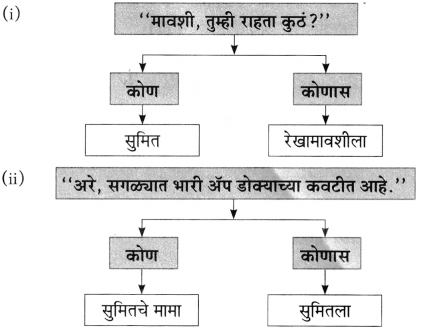
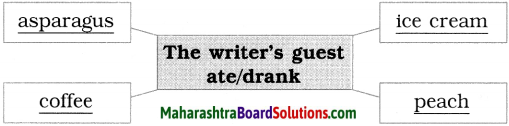
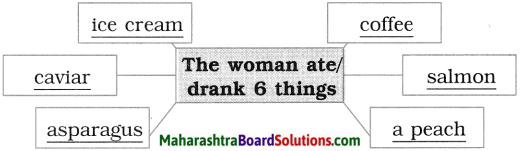
आकृती पूर्ण करा.
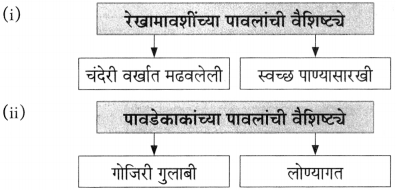
Maharashtra Board Class 10 Marathi Aksharbharati Solutions Chapter 7 फूटप्रिन्टस 35

प्रश्न 2.
कारणे लिहा.
(अ) स्नेहल त्रासली, कारण ………………………….
(आ) पावडेकाकांचा चेहरा पडला, कारण ………………………….
(इ) रेखामावशीची पावलं अधिक सुंदर आहेत, कारण. ………………………….
(ई) अभिषेकचे बाबा म्हणतात, पब्लिक ट्रान्सपोर्ट इज अ मस्ट, कारण ………………………….
उत्तरः
(अ) स्नेहल रेखामावशींना सॉरी म्हणाली कारण स्नेहल रेखामावशींना त्यांच्या मळकट पायांबद्दल बोलली होती.
(आ) पावडेकाकांचा चेहरा एकदम पडला कारण पावडे काकांची काळीकुट्ट पावले मोबाईल स्क्रिनवर उमटली होती.
(इ) रेखामावशीची पावलं अधिक सुंदर आहेत कारण रेखामावशीच्या रोजच्या जीवनात कार्बन उत्सर्जनाला वावच नाही.
(ई) सुमित म्हणतो, पब्लिक ट्रान्सपोर्ट इज मस्ट, कारण आपल्या पायांना चिकटलेला कार्बन प्रमाणात ठेवणे गरजेचे आहे.

प्रश्न 3.
उत्तर लिहा.
(अ) स्नेहलने केलेला निश्चय
(आ) अभिषेकने केलेला निश्चय
उत्तरः
(अ) स्नेहलने निश्चय केला की ती आजपासून बसनंच ये-जा करणार.
(आ) अभिषेकने निश्चय केला की तो कॉलेजला जाण्यासाठी सायकलचा उपयोग करणार.

Maharashtra Board Class 10 Marathi Aksharbharati Solutions Chapter 7 फूटप्रिन्टस

प्रश्न 4.
पाठातील पात्रांची स्वभाव वैशिष्ट्ये लिहून तक्ता पूर्ण करा.
उत्तरः
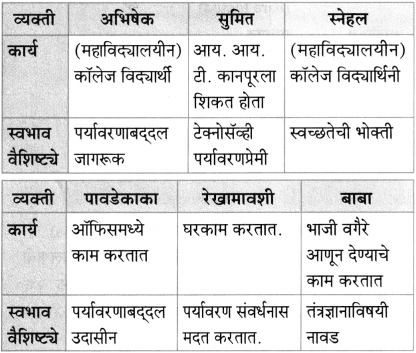
Maharashtra Board Class 10 Marathi Aksharbharati Solutions Chapter 7 फूटप्रिन्टस 36

प्रश्न 5.
खालील वाक्यांतील अलंकार ओळखा.
(अ) रेखामावशीचे पाय झऱ्याच्या स्फटिक स्वच्छ पाण्यासारखे.
(आ) पायपुसणीच्या आकाराचा एक निळा चौकोन उमटला, अगदी आभाळाच्या निरभ्र तुकड्यासारखा.

प्रश्न 5.
खालील शब्दांचे प्रचलित मराठीत अर्थ लिहा.
(अ) व्हर्चुअल रिअलिटी
(आ) टेक्नोसॅव्ही
उत्तरः
(अ) वास्तव सत्य
(आ) तंत्रस्नेही

प्रश्न 6.
खालील वाक्यातील विरामचिन्हे शोधून त्यांची नावे लिहा.
“मावशी, तुम्ही राहता कुठं?” विरामचिन्हे
उत्तरः
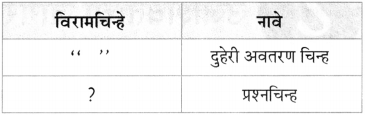
Maharashtra Board Class 10 Marathi Aksharbharati Solutions Chapter 7 फूटप्रिन्टस 37

Maharashtra Board Class 10 Marathi Aksharbharati Solutions Chapter 7 फूटप्रिन्टस

प्रश्न 7.
खालील शब्दांच्या जाती ओळखून लिहा.
(१) स्नेहल
(२) तिचे
(९) खालील तक्ता पूर्ण करा.
(३) चंदेरी
(४) करणे

प्रश्न 8.
स्वमत.
(अ) ‘आपल्या पायांचे वातावरणावर उमटलेले ठसे, आपल्याला सहजतेने पुसता येत नाहीत’, या विधानाचा तुम्हांला कळलेला अर्थ स्पष्ट करा.
उत्तरः
वातावरणात ग्लोबल वॉर्मिंगचे प्रमाण वाढताना दिसत आहे. मानवाने विज्ञानाच्या जोरावर अनेक नवनवीन तंत्रज्ञान विकसित केले आहे. मानवनिर्मित घटकांचा वापर करत असताना निसर्गाची हानी होत आहे. प्रत्येकजण दळणवळणासाठी वैयक्तिक वाहनांचा वापर करताना दिसतो. या वाहनांमुळे वातावरणात खूप मोठ्या प्रमाणात कार्बन मिसळत असतो. वृक्षतोड करून मोठमोठ्या इमारती उभारल्या जातात. झाडे नष्ट झाल्याने वातावरणातील ऑक्सिजनचे प्रमाण कमी होत आहे. त्यामुळे वातावरण प्रदूषित होत आहे. म्हणून लेखक रेखामावशीचे उदाहरण देतात, रेखामावशीच्या पायाला लागलेली धूळ त्यामुळे फरशीवर उमटणारे ठसे सहज पुसता येतील; पण आपण वातावरण दररोज कळत नकळत प्रदूषण करत असतो. त्याचे उमटलेले ठसे म्हणजेच ‘आपल्या पायांचे वातावरणात उमटलेले ठसे, मात्र आपल्याला सहजतेने पुसता येणार नाहीत’, असे लेखकाला या ठिकाणी सूचित करायचे आहे.

(आ) ‘तापानं फणफणलीय आपली धरती’ ही स्थिती बदलण्यासाठी उपाय सुचवा.
उत्तर:
पर्यावरण प्रदूषणात वाढ होईल अशीच आपली जीवनशैली असते. सार्वजनिक वाहनांचा वापर न करणे, एकाच माणसासाठी खाजगी वाहनाचा वापर थोड्या-थोड्या अंतरासाठी बाईकमोटारगाड्यांचा वापर यातून सदैव कार्बनचे उत्सर्जन आपण करत असतो. त्यामुळे जागतिक तापमान वाढीस मदत होते. शक्यतो आपण सार्वजनिक वाहनांचा उपयोग केला पाहिजे. थोड्या-थोड्या अंतरासाठी सायकलीचा किंवा पायी चालण्याचा पर्याय निवडला पाहिजे. म्हणजे कमीत-कमी पेट्रोलचा वापर केला पाहिजे. झाडे लावली पाहिजेत, हिरवळी वाढवल्या पाहिजेत, जेणे करून वातावरणातलां कार्बन डायोंक्साईड कमी होऊन हवा शुद्ध राहण्यास मदत होईल.

Maharashtra Board Class 10 Marathi Aksharbharati Solutions Chapter 7 फूटप्रिन्टस

उपक्रम:

(अ) आठवड्यातून एक दिवस सायकलचा किंवा सार्वजनिक वाहनाचा वापर करा.
(आ) ‘ग्लोबल वॉर्मिंगचे दुष्परिणाम’, या विषयावर शिक्षकांच्या मदतीने चर्चा करा.

भाषाभ्यास
वाक्य म्हणजे काय, हे आपण अभ्यासले आहे. वाक्यांचे विविध प्रकार आहेत. त्यांतील काही वाक्यप्रकारांची माहिती आपण करून घेणार आहोत.
(१) विधानार्थी वाक्य
(३) उद्गारार्थी वाक्य ही वाक्ये वाचा. ही वाक्ये वाचा.
(अ) माझे घर दवाखान्याजवळ आहे.
(अ) अरेरे ! फार वाईट झाले.
(आ) तो रोज व्यायाम करत नाही.
(आ) शाबास ! चांगले काम केलेस. या प्रकारच्या वाक्यांत केवळ विधान केलेले असते. या प्रकारच्या वाक्यांत भावनेचा उद्गार काढलेला असतो.

(२) प्रश्नार्थी वाक्य ही वाक्ये वाचा.
(४) आज्ञार्थी वाक्य
(अ) तुला लाडू आवडतो का? ही वाक्ये वाचा.
(आ) तुम्ही सकाळी केव्हा उठता?
(अ) मुलांनो, रांगेत चला. या प्रकारच्या वाक्यांत प्रश्न विचारलेला असतो.
(आ) उत्तम आरोग्यासाठी व्यायाम करा. या प्रकारच्या वाक्यांत आज्ञा किंवा आदेश असतो.

वर दिलेल्या चारही प्रकारांतील वाक्यांचे नमुने तयार करा.

Marathi Akshar Bharati Class 10 Textbook Solutions Chapter 7 फूटप्रिन्टस Additional Important Questions and Answers

प्रश्न १. खालील उताऱ्याच्या आधारे दिलेल्या सूचनेनुसार कृती करा.

कृती १ : आकलन कृती

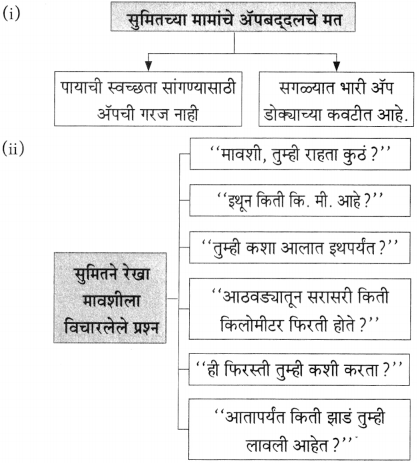
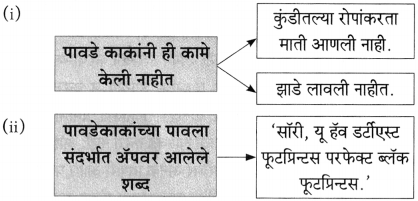
प्रश्न 1.
कृती पूर्ण करा.
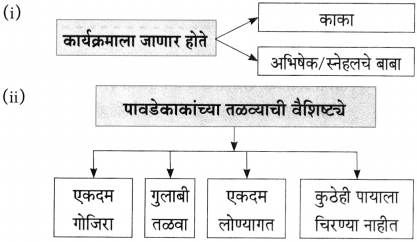
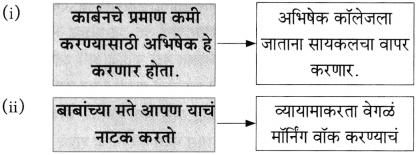
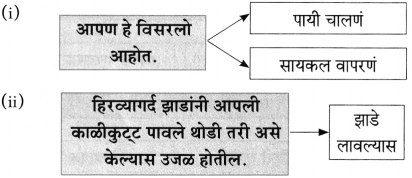
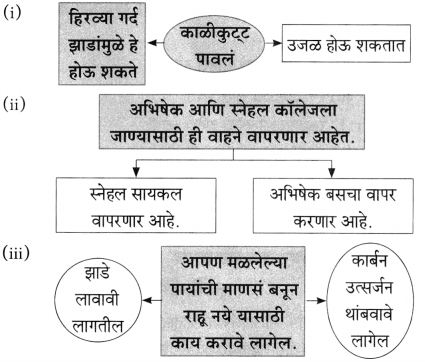
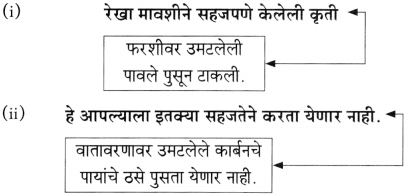
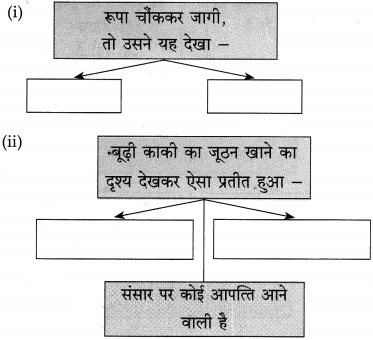
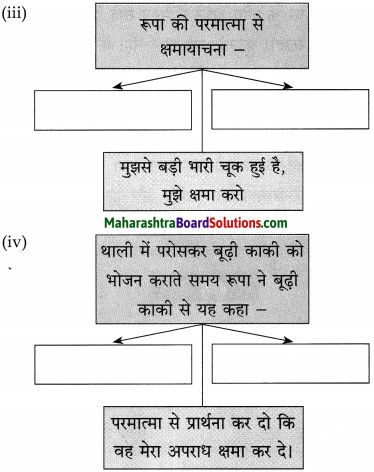
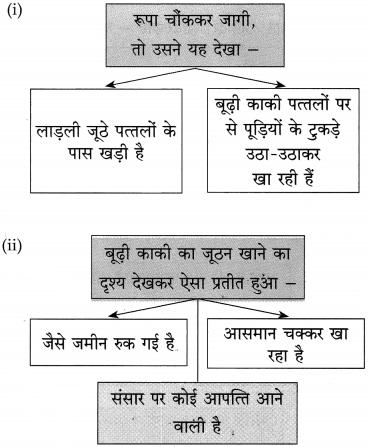
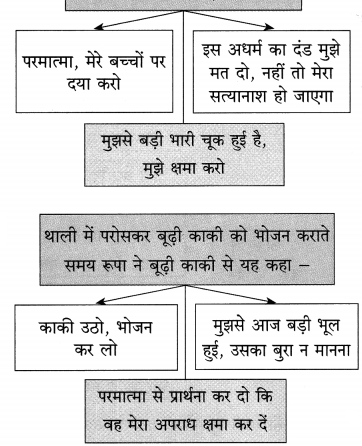
Maharashtra Board Class 10 Marathi Aksharbharati Solutions Chapter 7 फूटप्रिन्टस 1
Maharashtra Board Class 10 Marathi Aksharbharati Solutions Chapter 7 फूटप्रिन्टस 2
Maharashtra Board Class 10 Marathi Aksharbharati Solutions Chapter 7 फूटप्रिन्टस 3

Maharashtra Board Class 10 Marathi Aksharbharati Solutions Chapter 7 फूटप्रिन्टस

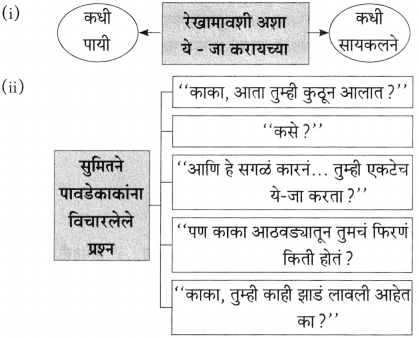
प्रश्न 2.
आकृतीबंध पूर्ण करा.
Maharashtra Board Class 10 Marathi Aksharbharati Solutions Chapter 7 फूटप्रिन्टस 4

प्रश्न 3.
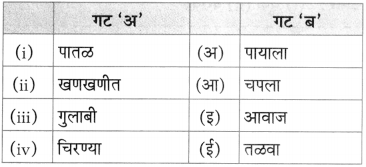
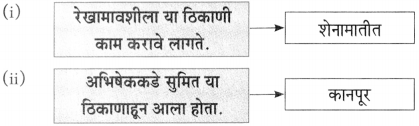
सहसंबंध जोडा.
Maharashtra Board Class 10 Marathi Aksharbharati Solutions Chapter 7 फूटप्रिन्टस 5

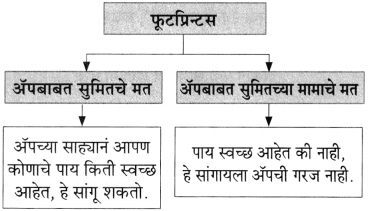
प्रश्न 4.
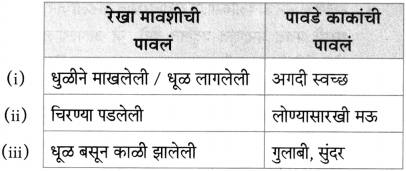
तुलना करा.
Maharashtra Board Class 10 Marathi Aksharbharati Solutions Chapter 7 फूटप्रिन्टस 6

Maharashtra Board Class 10 Marathi Aksharbharati Solutions Chapter 7 फूटप्रिन्टस

प्रश्न 5.
कंसातील योग्य शब्द वापरून रिकाम्या जागा भरा.
(i) ……………………………………. दार उघडलं आणि कामवाल्या रेखामावशी आत आल्या. (सुमितनं, अभिषेकनं, स्नेहलनं, पावडेकाकांनी)
(ii) सुमित ……………………………………. कानपूरला शिकत होता. (आय.टी.आय, आय.पी.एस., आय.आय.टी, एम.पी.एस. सी.)
(iii) ……………………………………. खणखणीत आवाजानं सुमितही जागा झाला आणि हॉलमध्ये आला. (रेखामावशीच्या, पावडेकाकांच्या, अभिषेकच्या, स्नेहलच्या)
उत्तर:
(i) अभिषेकनं
(ii) आय. आय. टी.
(iii) रेखामावशीच्या

कृती २ : आकलन कृती

प्रश्न 1.
कारणे लिहा.

(i) सुमित हॉलमध्ये आला कारण …………………………….
उत्तरः
सुमित हॉलमध्ये आला कारण रेखा मावशीच्या खणखणीत आवाजाने त्याला जाग आली होती.

प्रश्न 2.
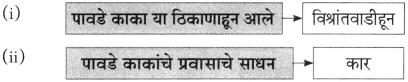
कृती पूर्ण करा.
Maharashtra Board Class 10 Marathi Aksharbharati Solutions Chapter 7 फूटप्रिन्टस 7

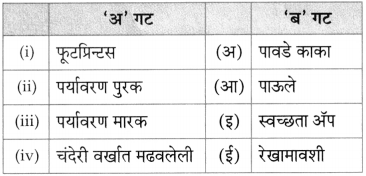
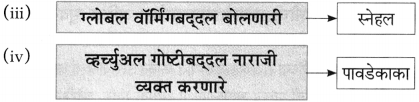
प्रश्न 3.
जोड्या जुळवा.
Maharashtra Board Class 10 Marathi Aksharbharati Solutions Chapter 7 फूटप्रिन्टस 8
उत्तर:
(i-आ),
(ii – इ),
(iii – ई),
(iv – अ)

Maharashtra Board Class 10 Marathi Aksharbharati Solutions Chapter 7 फूटप्रिन्टस

प्रश्न 4.
खालील प्रश्नांची उत्तरे एका वाक्यात लिहा.

(i) किचनमधील सिंकमध्ये वाट पाहणाऱ्या भांड्यांकडे आपला मोर्चा कोणी वळवला?
उत्तर:
किचनमधील सिंकमध्ये वाट पाहणाऱ्या भांड्याकडे आपला मोर्चा रेखामावशीने वळवला.

(ii) अभिषेक सुमितच्या लॅपटॉपवर काय पाहत होता?
उत्तर:
अभिषेक सुमितच्या लॅपटॉपवर सुमितने केलेले नवे प्रोजेक्ट पाहत होता.

(iii) अभिषेक हॉलमध्ये आला तेव्हा रेखामावशी कोणते काम करत होत्या?
उत्तर:
अभिषेक हॉलमध्ये आला तेव्हा रेखामावशी फरशी पुसत होत्या.

प्रश्न 5.
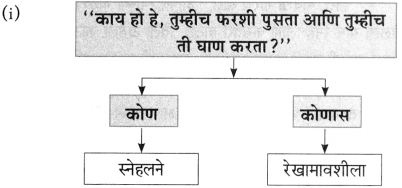
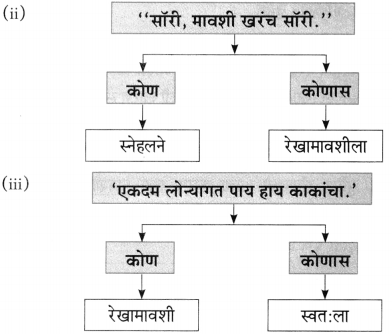
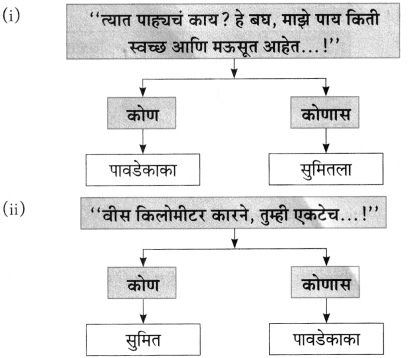
कोण कोणास म्हणाले ते लिहा.
Maharashtra Board Class 10 Marathi Aksharbharati Solutions Chapter 7 फूटप्रिन्टस 9
Maharashtra Board Class 10 Marathi Aksharbharati Solutions Chapter 7 फूटप्रिन्टस 10

Maharashtra Board Class 10 Marathi Aksharbharati Solutions Chapter 7 फूटप्रिन्टस

प्रश्न 6.
चूक की बरोबर लिहा.
(i) सुमितचे बाबा तयार होऊन हॉलमध्ये आले.
(ii) रेखामावशी बिचाऱ्या वरमल्या होत्या.
उत्तर:
(i) चूक
(ii) बरोबर

कृती ३ : स्वमत

प्रश्न 1.
रेखामावशींच्या पावलांचे वर्णन तुमचा शब्दांत लिहा.
उत्तरः
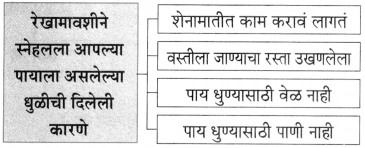
रेखामावशींची पावलं धुळीनी माखलेली होती. कारण तिला शेणात-मातीत काम करावं लागात असे. उखणलेल्या रस्त्याने तिला चालत जावे लागे. तिच्या पायातील चप्पल अगदी पातळ झाली होती म्हणून तिच्या पायाला खुप चिरण्या पडल्या होत्या. पाय धुवायला वेळ आणि पाणीही नव्हतं व तिचे पाय धूळ बसून काळे पडले होते.

प्रश्न 2.
पावडेकाकांच्या पायाच्या वर्णनावरून त्यांची जीवनशैली कशी असावी असे तुम्हांस वाटते?
उत्तरः
पावडेकाकांची पावले सुंदर गुलाबी व लोण्यासारखी होती.

यावरून असे दिसते की, ते कधीही पायी चालत नसतील. नेहमी वाहनांचा उपयोग करत असतील. धूळ मातीशी त्यांचा फारसा संबंध येत नसावा, ते अत्यंत चांगल्या प्रतीचे बूट, चप्पल वापरत असतील. पायांच्या स्वच्छतेची काळजी घेत असतील,

प्रश्न 3.
स्वच्छतेबद्दलची तुमची संकल्पना लिहा / किंवा तुमचे विचार लिहा.
उत्तरः
वरवर दिसणारी स्वच्छता ही खरी स्वच्छता नव्हे. पांढरपेशी स्वच्छता ही वातावरण प्रदुषित करण्यास हातभारच लावते. पब्लिक ट्रान्सपोर्टने जाण्याऐवजी आपण कारचा वापर करतो. आणि कार्बन डायऑक्साईड वातावरणात सोडला जातो. त्यामुळे धरणी प्रचंड प्रमाणात प्रदूषित होते. जे आपल्याला उघड्या डोळ्यांनी दिसत नाही. सायकल वापरणं आपण विसरून गेलो आहोत. अगदी कोपऱ्यावरून भाजी आणायची असली तरी आपण बाईकला किक मारतो. आपली पावले स्वच्छ, आपले कपडे स्वच्छ, महागडी कार ही खरी स्वच्छता नाही. धरणी प्रदूषणमुक्त करणे ही खरी स्वच्छता. यासाठी प्रत्येकाने हातभार लावला पाहिजे. झाडे लावली पाहिजेत. धरतीच्या स्वच्छतेची काळजी घेणे यातच खरी स्वच्छता आहे.

Maharashtra Board Class 10 Marathi Aksharbharati Solutions Chapter 7 फूटप्रिन्टस

प्रश्न २. पुढील उताऱ्याच्या आधारे दिलेल्या सूचनेनुसार कृती करा.

कृती १ : आकलन कृती

प्रश्न 1.
कृती पूर्ण करा.
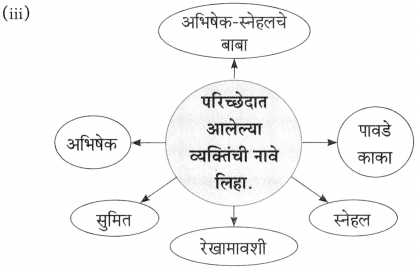
Maharashtra Board Class 10 Marathi Aksharbharati Solutions Chapter 7 फूटप्रिन्टस 11
Maharashtra Board Class 10 Marathi Aksharbharati Solutions Chapter 7 फूटप्रिन्टस 12

प्रश्न 2.
आकृतिबंध पूर्ण करा.
Maharashtra Board Class 10 Marathi Aksharbharati Solutions Chapter 7 फूटप्रिन्टस 13

प्रश्न 3.
कोण ते लिहा.
(i) टेक्नॉलॉजीबद्दल मळमळ व्यक्त करणारे – सुमितचे मामा
(ii) रेखामावशीला सायकल देणारा – रेखा मावशीचा मुलगा

प्रश्न 4.
एका वाक्यात उत्तरे लिहा.

(i) सुमितच्या अॅपचे नाव काय ?
उत्तरः
सुमितने तयार केलेल्या अॅपचे नाव “फूटप्रिन्टस’ आहे.

(ii) रेखामावशी कोठे राहत होती?
उत्तरः
रेखामावशी “टेकडीपल्याड’ राहत होती.

(iii) सुमितच्या मामाच्या मते सगळ्यात भारी ॲप कोठे आहे?
उत्तरः
सुमितच्या मामाच्या मते सगळ्यात भारी ॲप डोक्याच्या कवटीत आहे.

Maharashtra Board Class 10 Marathi Aksharbharati Solutions Chapter 7 फूटप्रिन्टस

प्रश्न 5.
उताऱ्यानुसार वाक्यांचा क्रम लावा.
(i) “गेल्या मयन्यापतूर चालतच येत हुते; पन आता माज्या लेकानं एक सायकल दिलीया मला”.
(ii) “त्या टेकडी पल्याड”, मावशी म्हणाल्या.
(iii) स्नेहलचा चेहरा पडला.
(iv) मामा, मी एक अॅप तयार केलं आहे.
उत्तर:
(i) मामा, मी एक अॅप तयार केलं आहे.
(ii) स्नेहलचा चेहरा पडला.
(iii) “त्या टेकडी पल्याड’, मावशी म्हणाल्या.
(iv) “गेल्या मयन्यापतूर चालतच येत हुते; पन आता माज्या लेकानं एक सायकल दिलीया मला’.

प्रश्न 6.
कंसातील योग्य शब्द वापरून रिकाम्या जागा भरा
(i) मामा, गंमत तर बघ तू माझ्या अॅपची ……………………………. त्याचं नाव आहे (फूटप्रिन्टस, ॲपप्रिन्टस, लेगप्रिन्टस, फिंगरप्रिन्टस)
(i) सुमितनं आपल्या ……………………………. मोबाईलमधलं अॅप उघडलं आणि रेखा मावशींना काही प्रश्न विचारायला सुरुवात केली. (सॅमसंग, नोकिया, एंड्रॉईड, एल.जी.)
उत्तर:
(i) फूटप्रिन्टस
(ii) एंड्रॉईड

कृती २ : आकलन कृती

प्रश्न 1.
योग्य पर्याय निवडून लिहा.
(i) सुमितनं आपला स्मार्टफोन काढला …………………………….
(अ) त्याला फोन करायचा होता,
(आ) मामांना फोन दाखवायचा होता.
(इ) सुमितला मामांना “फूटप्रिन्टस” अप दाखवायचे होते.
(ई) मामांना फोटो दाखवायचा होता.
उत्तरः
सुमितनं आपला स्मार्टफोन काढला सुमितला मामांना “फूटप्रिन्टस” अप दाखवायचे होते.

(ii) सुमितने रेखामावशींना प्रश्न विचारायला सुरुवात केली.
(अ) अपमध्ये माहिती भरायची होती.
(आ) त्याला मावशींबद्दल जाणून घ्यायचे होते.
(इ) स्नेहलने माहिती भरायला सांगितली होती.
(ई) सुमितला अर्ज भरायचा होता.
उत्तरः
सुमितने रेखामावशींना प्रश्न विचारायला सुरुवात केली अप मध्ये माहिती भरायची होती.

Maharashtra Board Class 10 Marathi Aksharbharati Solutions Chapter 7 फूटप्रिन्टस

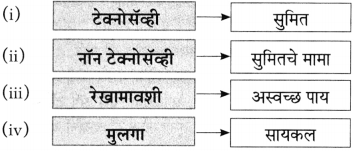
प्रश्न 2.
सहसंबंध लावा,
(i) टेक्नोसॅव्ही – अस्वच्छ पाय
(ii) नॉन टेक्नोसॅव्ही – सुमित
(iii) रेखामावशी – सायकल
(iv) मुलगा – सुमितचे मामा
उत्तरः
Maharashtra Board Class 10 Marathi Aksharbharati Solutions Chapter 7 फूटप्रिन्टस 39

प्रश्न 3.
कृती पूर्ण करा.
Maharashtra Board Class 10 Marathi Aksharbharati Solutions Chapter 7 फूटप्रिन्टस 14

प्रश्न 4.
आकृतीबंध पूर्ण करा,
Maharashtra Board Class 10 Marathi Aksharbharati Solutions Chapter 7 फूटप्रिन्टस 15

Maharashtra Board Class 10 Marathi Aksharbharati Solutions Chapter 7 फूटप्रिन्टस

प्रश्न 5.
चूक की बरोबर लिहा.
(i) मामा, गंमत तर बघ तू माझ्या अॅपची….त्याचं नाव आहे फूटप्रिन्टस.
(ii) “सुरुवात करूया अभिषेक पासून”
उत्तर:
(i) बरोबर
(ii) चूक

प्रश्न 6.
कोण कोणास म्हणाले?
Maharashtra Board Class 10 Marathi Aksharbharati Solutions Chapter 7 फूटप्रिन्टस 16

कृती ३ : स्वमत

प्रश्न 1.
बाबांनी अनाठायी टेक्नॉलॉजीबद्दल आपली मळमळ व्यक्त केली. या वाक्याबद्दल आपले मत स्पष्ट करा.
उत्तरः
स्वच्छता अॅपबद्दल सुमितने त्याच्या मामांना म्हणजे अभिषेकच्या बाबांना माहिती सांगितली. आजकालचे टेक्नोसॅव्ही लोक काहीही करतात. स्वच्छतेसारखी गोष्ट जाणून घेण्यासाठी अॅपची काय गरज आहे, असे त्यांना वाटते. कारण ते तंत्रज्ञानाबद्दल अधिक जाणत नसावेत. आजचे विज्ञान, तंत्रज्ञान याबद्दल मागच्या पिढीतील लोकं थोडं कमी जाणतात तंत्रज्ञानाच्या साहाय्याने आपण काय-काय करू शकतो, यांची त्यांना माहिती नाही. विशेष बाब म्हणजे काही मंडळींना तंत्रज्ञानाची फक्त नकारात्मक बाजूच माहीत आहे. म्हणून कदाचित अभिषेकच्या बाबांनी तंत्रज्ञानाबद्दल असे नकारात्मक उद्गार काढले असावेत.

प्रश्न 2.
सुमितने तयार केलेल्या अॅपचे वर्णन तुमच्या शब्दांत लिहा.
उत्तरः
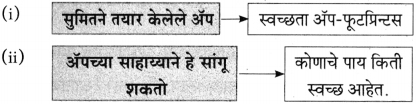
सुमितने एक स्वच्छता अॅप तयार केलं होतं. त्या अॅपचं नाव ‘फूटप्रिन्टस’ होते. या अॅपच्या सहाय्याने पाय किती स्वच्छ आहेत हे कळू शकणार होते. ज्या माणसाच्या पायाबद्दल जाणून घ्यायचे असेल त्याची माहिती (अॅपनुसार) भरायची व त्याद्वारे संबंधित व्यक्तीच्या पायाच्या स्वच्छतेबद्दल आपल्याला माहिती मिळत असे. माहिती भरल्यानंतर मोबाईलमध्ये एक निळा चौकोन उमटत असे व त्याखाली माहितीच्या आधारे पायांच्या स्वच्छतेबद्दल निष्कर्ष येत असे.

Maharashtra Board Class 10 Marathi Aksharbharati Solutions Chapter 7 फूटप्रिन्टस

प्रश्न 3.
सुमित तंत्रस्नेही (टेक्नॉसॅव्ही) आहे हे परिच्छेदावरून लिहा.
उत्तरः
सुमितने स्मार्टफोनचा वापर करून एक स्वच्छता अॅप तयार केलं होतं. त्या अॅपमध्ये विचारलेली माहिती भरली की संबंधित व्यक्तीच्या पायाची स्वच्छता कशी आहे हे सिद्ध होत असे. अत्यंत साधे सर्वांना सहज वापरता येईल असे हे अॅप सुमितने तयार केले होते. यावरून दिसून येते की तो तंत्रस्नेही (टेक्नोसॅव्ही) आहे.

प्रश्न ३. पुढील उताऱ्याच्या आधारे दिलेल्या सूचनेनुसार कृती करा,

कृती १ : आकलन कृती

प्रश्न 1.
आकृतिबंध पूर्ण करा.
Maharashtra Board Class 10 Marathi Aksharbharati Solutions Chapter 7 फूटप्रिन्टस 17

प्रश्न 2.
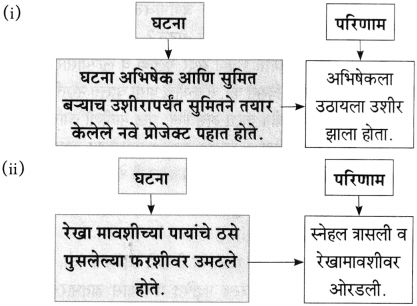
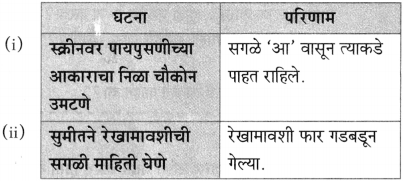
घटना व परिणाम लिहा.
Maharashtra Board Class 10 Marathi Aksharbharati Solutions Chapter 7 फूटप्रिन्टस 18

Maharashtra Board Class 10 Marathi Aksharbharati Solutions Chapter 7 फूटप्रिन्टस

प्रश्न 3.
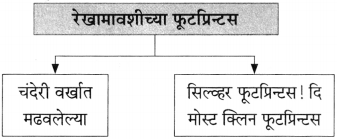
आकृतिबंध पूर्ण करा.
Maharashtra Board Class 10 Marathi Aksharbharati Solutions Chapter 7 फूटप्रिन्टस 19

प्रश्न 4.
एका वाक्यात उत्तरे लिहा.

(i) मोबाईल स्क्रीनवर काय उमटले?
उत्तर:
मोबईलच्या स्क्रीनवर पायपुसणीच्या आकाराचा एक निळा चौकोन उमटला.

(ii) सुमितने रेखामावशींची सगळी माहिती का घेतली?
उत्तर:
रेखामावशींची पावलं किती स्वच्छ आहेत हे जाणून घेण्यासाठी मोबाईलवर तो ती माहिती भरणार होता.

(iii) पावडेकाकांचे ऑफिस त्यांच्या घरापासून किती किलोमीटर आहे?
उत्तरः
पावडेकाकांचे ऑफिस त्यांच्या घरापासून १६ किलोमीटर आहे.

(iv) पावडेकाका चिडून सुमितला काय म्हणाले?
उत्तरः
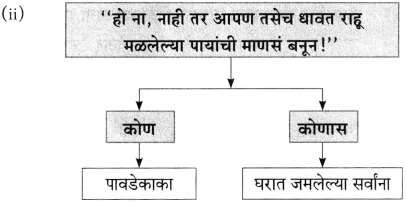
पावडेकाका चिडून सुमितला म्हणाले, “हो, नाही तर काय बसला लटकत जाऊ म्हणतोस?”

Maharashtra Board Class 10 Marathi Aksharbharati Solutions Chapter 7 फूटप्रिन्टस

प्रश्न 5.
(i) कंसातील योग्य शब्द वापरून रिकाम्या जागा भरा, ……………………………. पावडेकाकांचा डेटा ॲपमध्ये भरायला सुरू केला. (अभिषेकनं, स्नेहानं, सुमितनं, राकेशन)
(ii) ……………………………. तर फार गडबडून गेल्या (स्नेहा, रेखामावशी, पावडेकाकू, नेहा)
उत्तर:
(i) सुमितनं
(ii) रेखामावशी

कृती २ : आकलन कृती

प्रश्न 1.
कृती पूर्ण करा.
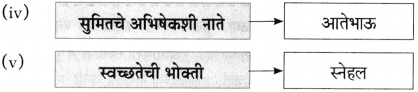
Maharashtra Board Class 10 Marathi Aksharbharati Solutions Chapter 7 फूटप्रिन्टस 20

प्रश्न 2.
चौकटी पूर्ण करा.
Maharashtra Board Class 10 Marathi Aksharbharati Solutions Chapter 7 फूटप्रिन्टस 21

प्रश्न 3.
एका वाक्यात उत्तरे लिहा.

(i) सुमितने पावडेकाकांना कोणती शंका विचारली?
उत्तरः
“वीस किलोमीटर कारने-तुम्ही एकट्यानेच प्रवास केला?” ही शंका सुमितने पावडेकाकांना विचारली.

Maharashtra Board Class 10 Marathi Aksharbharati Solutions Chapter 7 फूटप्रिन्टस

(ii) पावडेकाका रोज किती किलोमीटर कारने प्रवास करत?
उत्तर:
पावडेकाका रोजचे पस्तीस-चाळीस किलोमीटर कारने प्रवास करत.

(iii) स्क्रीनवर उमटलेला पायपुसणीच्या आकाराचा निळा चौकोन कोणासारखा होता?
उत्तरः
स्क्रीनवर उमटलेला पायपुसणीच्या आकाराचा निळा चौकोन अगदी आभाळाच्या निरभ्र तुकड्यासारखा होता.

प्रश्न 4.
चूक की बरोबर लिहा.
(i) पावडेकाकांचे ऑफिस त्यांच्या घरापासून २० किलोमीटर आहे.
(ii) रेखामावशीचे पाय चंदेरी आहेत.
उत्तर:
(i) चूक
(ii) बरोबर

प्रश्न 5.
योग्य जोड्या जुळवा.
Maharashtra Board Class 10 Marathi Aksharbharati Solutions Chapter 7 फूटप्रिन्टस 22
उत्तर:
(i – इ),
(ii – ई),
(iii – अ),
(iv – आ)

प्रश्न 6.
योग्य पर्याय निवडून विधाने पूर्ण करा.
(i) इवल्याशा झोपडीपुढंही त्यांनी …………………………….
(अ) तीन झाडं लावली होती.
(आ) दोन झाडं लावली होती.
(इ) चार कुंड्या लावल्या होत्या.
(ई) सहा रोपे लावली होती.
उत्तरः
इवल्याशा झोपडीपुढंही त्यांनी दोन झाडं लावली होती.

Maharashtra Board Class 10 Marathi Aksharbharati Solutions Chapter 7 फूटप्रिन्टस

(ii) ……………………………. किलोमीटर तर नक्कीच होतात.
(अ) पस्तीस – पन्नास
(आ) पन्नास – साठ
(इ) पस्तीस – चाळीस
(ई) चाळीस – पस्तीस
उत्तर:
पस्तीस – चाळीस किलोमीटर तर नक्कीच होतात.

प्रश्न 7.
कोण कोणास म्हणाले?
Maharashtra Board Class 10 Marathi Aksharbharati Solutions Chapter 7 फूटप्रिन्टस 23

कृती ३ : स्वमत

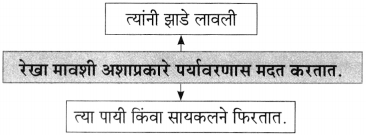
प्रश्न 1.
रेखामावशी पर्यावरणास कशी मदत करत होती ते तुमच्या शब्दांत लिहा.
उत्तर:
रेखामावशी कोणत्याही धूर सोडणाऱ्या वाहनाने ये-जा करत नसत. शक्यतो त्या पायीच ये-जा करायच्या. कधीकधी सायकल वापरायच्या म्हणजे हवेत कार्बन डायऑक्साईड मिसळण्याची जी प्रक्रिया होते, त्यात त्यांचा अजिबात सहभाग नव्हता. त्यांनी त्यांच्या झोपडीपुढे दोन झाडं लावली होती. त्यातलं एक पर्यावरणास पूरक लिंबोणीचं होतं. ही झाडे लावून त्यांनी पर्यावरणाला मदतच केली होती.

Maharashtra Board Class 10 Marathi Aksharbharati Solutions Chapter 7 फूटप्रिन्टस

प्रश्न 2.
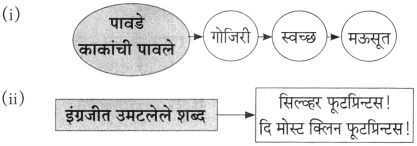
मोबाईल स्क्रीनवर उमटलेल्या चित्राचे वर्णन करा.
उत्तर:
सुमितने मोबाईलचे बटन दाबताच स्क्रीनवर पायपुसणीच्या आकाराचा निळा चौकोन उमटला. त्या निळ्या तुकड्याच्या मधोमध दोन पावलं उमटली. एकदम चंदेरी वर्खात मढलेली आणि खाली इंग्रजीत शब्द उमटले, ‘सिल्व्हर फूटप्रिन्टस! दि मोस्ट क्लिन फूटप्रिन्टस’.

प्रश्न 3.
पर्यावरणाच्या मदतीसाठी तुम्ही काय प्रयत्न कराल ते उदाहणांसह लिहा.
उत्तरः
पर्यावरणाची समस्या दिवसेंदिवस गंभीर होत चालली आहे. त्यासाठी प्रत्येकाने हातभार लावणे गरजेचे आहे. सार्वजनिक वाहनांचा वापर करणे, झाडे लावणे, प्लॅस्टीकचा वापर टाळणे, पाण्याचा योग्य वापर करणे, वीज बचतीच्या सवयी लावून घेणे. त्यामुळे आपण पर्यावरण रक्षणास थोडाफार तरी हातभार लावू शकतो असे मला वाटते.

प्रश्न 4.
पावडेकाका पर्यावरणास मारक अशी कोणती कृती करतात ते तुमच्या शब्दांत लिहा.
उत्तरः
पावडेकाका सदैव कारने प्रवास करतात. त्यामुळे ते हवेत जास्त कार्बन डायऑक्साईड सोडण्याची कृती करतात, त्यामुळे हवेचे प्रदूषण होते. एवढेच नव्हे तर रोजचा पस्तीस ते चाळीस किलोमीटरचा प्रवास ते एकट्याने करतात. पावडे काकांसारखी अशी अनेक माणसे आहेत की ती एक-एकटी प्रवास करून इंधन, ध्वनी, वायू, जमीन यांची हानी करत असतात. पावडे काकांची एकंदरीत जीवनशैली बघितली तर ते सदैव पर्यावरणास मारक अशीच कृती करतात असे दिसून येते.

प्रश्न ४. पुढील उताऱ्याच्या आधारे दिलेल्या सूचनेनुसार कृती करा.
कृती १ : आकलन कृती

प्रश्न 1.
कृती करा.
Maharashtra Board Class 10 Marathi Aksharbharati Solutions Chapter 7 फूटप्रिन्टस 24

Maharashtra Board Class 10 Marathi Aksharbharati Solutions Chapter 7 फूटप्रिन्टस

प्रश्न 2.
कारणे लिहा.

(i) आपल्या पायाला चिकटलेला हा कार्बन आपाल्याला धुवायला हवा कारण …
उत्तर:
आपल्या पायाला चिकटलेला हा कार्बन आपल्याला धुवायला हवा कारण ग्लोबल वॉर्मिंगमुळे आपली पृथ्वी तापाने फणफणते आहे.

प्रश्न 3.
कोण ते लिहा.
Maharashtra Board Class 10 Marathi Aksharbharati Solutions Chapter 7 फूटप्रिन्टस 25
Maharashtra Board Class 10 Marathi Aksharbharati Solutions Chapter 7 फूटप्रिन्टस 26

प्रश्न 4.
चौकटी पूर्ण करा.
Maharashtra Board Class 10 Marathi Aksharbharati Solutions Chapter 7 फूटप्रिन्टस 27

प्रश्न 5.
कंसातील योग्य शब्द वापरून रिकाम्या जागा भरा.
(i) पुन्हा निळा तुकडा चमकला आणि काही क्षणातच त्या निळ्या तुकड्यावर पावडेकाकांची ……………………………. उमटली. (बोटे, पावलं, ठसे, अंगठी)
(ii) किती प्रचंड ……………………………. चिकटलेला असतो, आपल्या पायांना! ग्लोबल वॉर्मिगला हातभार लावतो आपण. (कार्बन, नायट्रोजन, ऑक्सिजन, गॅस)
उत्तर:
(i) पावलं
(ii) कार्बन

कृती २ : आकलन कृती

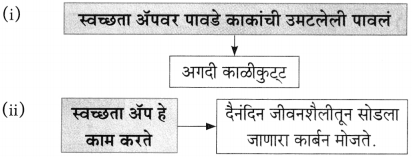
प्रश्न 1.
कारणे लिहा.

(i) स्वच्छता अपवर रेखामावशींची पावलं स्वच्छ उमटली कारण …………………………… .
उत्तरः
स्वच्छता अपवर रेखामावशींची पाऊले स्वच्छ उमटली कारण रेखामावशीच्या दैनंदिन जीवन शैलीतून कार्बन वातावरणात सोडत नाही.

(ii) स्वच्छता अपवर पावडेकाकांची काळीकुट्ट पावलं उमटली कारण …………………………… .
उत्तर:
स्वच्छता अपवर पावडेकाकांची काळीकुट्ट पावलं उमटली कारण पावडेकाका त्यांच्या जीवनशैलीतून दररोज एक लीटर पेट्रोलच्या दुपटीहून अधिक कार्बन डायऑक्साइड वातावरणात सोडतात.

Maharashtra Board Class 10 Marathi Aksharbharati Solutions Chapter 7 फूटप्रिन्टस

प्रश्न 2.
एका वाक्यात उत्तरे लिहा.

(i) स्नेहल गहिवरून काय म्हणाली?
उत्तरः
आपण ग्लोबल वॉर्मिंगला हातभार लावतो म्हणून पृथ्वी तापानं फणफणलीय, असे स्नेहल गहिवरून म्हणाली.

(ii) पावडेकाकांना कोणती गोष्ट पटली नाही?
उत्तर:
आपली सुंदर स्वच्छ पावले स्वच्छता अपवर काळीकुट्ट उमटली ही गोष्ट पावडेकाकांना पटली नाही.

(iii) पावलांचा काळा रंग कशावरून ठरतो?
उत्तरः
पावलांचा काळा रंग कार्बन सोडण्याच्या प्रमाणावरून ठरतो.

(iv) रेखामावशीची पावलं आपल्यापेक्षा अधिक सुंदर, चंदेरी का आहेत?
उत्तरः
रेखामावशींच्या रोजच्या जगण्यात कार्बन उत्सर्जनाला वावच नाही, म्हणून त्यांची पावलं आपल्यापेक्षा अधिक सुंदर, चंदेरी आहेत.

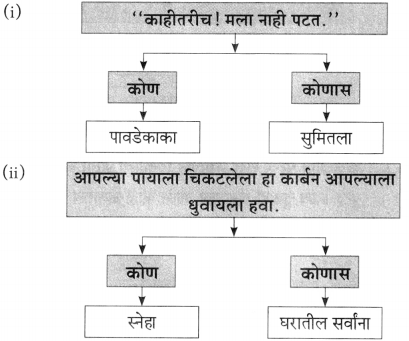
प्रश्न 3.
कोण कोणास म्हणाले?
Maharashtra Board Class 10 Marathi Aksharbharati Solutions Chapter 7 फूटप्रिन्टस 28

Maharashtra Board Class 10 Marathi Aksharbharati Solutions Chapter 7 फूटप्रिन्टस

प्रश्न 4.
योग्य पर्याय निवडून विधान पूर्ण करा,
(i) हे अॅप आपल्या जीवनशैलीतून उमटणाऱ्या आपल्या …………………………….
(अ) कार्बन प्रिन्टस रेखाटतं.
(आ) झेरॉक्स प्रिन्टस रेखाटतं.
(इ) नकली प्रिन्टस रेखाटतं.
(ई) कलर प्रिन्टस रेखाटतं.
उत्तरः
हे अप आपल्या जीवनशैलीतून उमटणाऱ्या आपल्या कार्बन प्रिन्टस रेखाटतं.

कृती ३ : स्वमत

प्रश्न 1.
पावडेकाकांनी सुमितवर राग का व्यक्त केला तुमच्या शब्दांत लिहा.
उत्तरः
सुमितने तयार केलेल्या स्वच्छता अॅपवर सुमितने पावडेकाकांची सगळी माहिती भरली आणि मोबाईलच्या स्क्रीनवर पावडेकाकांची काळीकुट्ट पावले उमटली आणि खाली शब्द आले, ‘यू हॅव डर्टीएस्ट फूटप्रिन्टस’ पावडेकाकांचे प्रत्यक्षात पाय अत्यंत स्वच्छ आणि सुंदर होते. मग त्यांचे पाय असे काळेकुट्ट कसे असू शकतात म्हणून ते रागावले.

प्रश्न 2.
ग्लोबल वॉर्मिंगला आपण प्रत्यक्ष किंवा अप्रत्यक्ष कशाप्रकारे हातभार लावतो हे तुमच्या अनुभवातून लिहा.
उत्तरः
आपण प्रत्यक्ष आणि अप्रत्यक्ष अशा अनेक गोष्टी करतो, की त्यामुळे आपण ग्लोबल वॉर्मिंगला हातभार लावतो. आपण थोड्याथोड्या अंतरावर जाण्यासाठी कार्बन उर्सजन करणाऱ्या वाहनांचा वापर करतो. सार्वजनिक वाहनांचा उपयोग न करता एकेका व्यक्तीसाठी एकेक वाहन वापरतो. जितक्या प्रमाणात आपण वृक्षतोड करतो, तेवढी वृक्षांची लागवड करत नाही. ओझोन आणि ऑक्सिजन यांना विरल करणारे अनेक विषारी आणि घातक वायू आपण आपल्या जीवनशैलीतून वातावरणात सोडत असतो.

Maharashtra Board Class 10 Marathi Aksharbharati Solutions Chapter 7 फूटप्रिन्टस

प्रश्न 3.
धरती तापानं फणफणलीय हे विधान स्पष्ट करा.
उत्तरः
स्नेहलच्या मते, आपण आपल्या जीवनशैलीतून अवधं वातावरण घाण करतो. प्रदूषित करतो. प्रचंड प्रमाणात कार्बन वातावरणात सोडतो. त्यामुळे पृथ्वीचे तापमान दिवसेंदिवस वाढते आहे. या सगळ्यांचा परिणाम ऋतु हवामान, पाऊस या सगळ्यांवर झाला आहे. धरतीवरील बर्फाचे कडे वितळू लागले आहेत. संपूर्ण चराचराला याचे परिणाम भोगावे लागत आहेत.

प्रश्न 4.
सुमितने कोणते शास्त्रीय सत्य पावडेकाकांना सांगितले?
उत्तरः
सुमितने पावडेकाकांना सांगितले, एक लीटर पेट्रोल जळते म्हणजेच त्याच्या दुपटीहून अधिक कार्बन डायॉक्साईड वातावरणात सोडला जातो. तुमच्या कार्बन सोडण्याच्या प्रमाणावरून तुमच्या पावलांचा रंग ठरतो. म्हणून प्रत्यक्षात सुंदर दिसणारी पावडेकाकांची पाऊले मात्र खऱ्या अर्थाने काळीकुट्ट आहेत.

प्रश्न ५. पुढील उताऱ्याच्या आधारे दिलेल्या सुचनेनुसार कृती करा.

कृती १ : आकलन कृती

प्रश्न 1.
कृती करा.
Maharashtra Board Class 10 Marathi Aksharbharati Solutions Chapter 7 फूटप्रिन्टस 29

प्रश्न 2.
योग्य पर्याय निवडून लिहा.
(i) स्नेहल कॉलेजला जाताना बसने ये-जा करणार आहे कारण…
(अ) तिला बसच्या गर्दी पासून वाचायचे होते.
(आ) सायकलने ये-जा केल्याने तिचा व्यायाम होणार होता.
(इ) तिला कार्बन उर्ल्सजनाचे प्रमाण कमी करून पर्यावरणाला हातभार लावायचा होता.
(ई) तिला पैसे वाचावायचे आहेत.
उत्तरः
स्नेहल कॉलेजला जाताना बसने ये-जा करणार आहे कारण तिला कार्बन उर्सजनाचे प्रमाण कमी करून पर्यावरणाला हातभार लावायचा होता.

Maharashtra Board Class 10 Marathi Aksharbharati Solutions Chapter 7 फूटप्रिन्टस

(ii) सगळ्यांनी पब्लिक ट्रान्सपोर्टचा वापर करावा कारण …………………………….
(अ) त्यामुळे रहदारीची समस्या कमी होईल
(आ) प्रवासाचा खर्च वाचेल.
(इ) अनेकांनी एकाच वाहनाचा उपयोग केल्यामुळे वाहनांची संख्या कमी होवून कार्बन उत्सर्जनाचे प्रमाणही कमी होईल,
(ई) प्रदुषण वाढेल.
उत्तरः
सगळ्यांनी पब्लिक ट्रान्सपोर्टचा वापर करावा कारण अनेकांनी एकाच वाहनाचा उपयोग केल्यामुळे वाहनांची संख्या कमी होऊन कार्बन उत्सर्जनाचे प्रमाणही कमी होईल.

प्रश्न 3.
एका वाक्यात उत्तरे लिहा.
(i) अभिषेकला कशी पावले हवी होती?
उत्तर:
अभिषेकला रेखामावशीसारखी चंदेरी पावले हवी होती.

(ii) कोणती गोष्ट आपल्याला कमीपणाची वाटते?
उत्तर:
बसने प्रवास करणे ही गोष्ट आपल्याला कमीपणाची वाटते.

प्रश्न 4.
कृती पूर्ण करा.
Maharashtra Board Class 10 Marathi Aksharbharati Solutions Chapter 7 फूटप्रिन्टस 30

Maharashtra Board Class 10 Marathi Aksharbharati Solutions Chapter 7 फूटप्रिन्टस

प्रश्न 5.
कंसातील योग्य शब्द वापरून रिकाम्या जागा भरा.
(i) ……………………………….. सगळ्याचं बोलणं लक्ष देऊन ऐकत होत्या. (रेखामावशी, स्नेहल, पावडेकाकू, अमिषाकाकू)
(ii) त्या निळ्याशार तुकड्यावर ……………………………….. उमटल्याचा त्यांना भास झाला. (तारे, चांदणं, ढग, मेघ)
उत्तर:
(i) रेखामावशी
(ii) चांदणं

कृती २ : आकलन कृती

प्रश्न 1.
कृती पूर्ण करा.
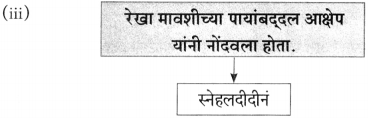
Maharashtra Board Class 10 Marathi Aksharbharati Solutions Chapter 7 फूटप्रिन्टस 31
प्रश्न 2.
उत्तरे लिहा.
Maharashtra Board Class 10 Marathi Aksharbharati Solutions Chapter 7 फूटप्रिन्टस 32

Maharashtra Board Class 10 Marathi Aksharbharati Solutions Chapter 7 फूटप्रिन्टस

प्रश्न 3.
चूक की बरोबर लिहा.
(i) रेखामावशी सगळ्यांचं बोलणं लक्ष देऊन ऐकत होत्या.
(ii) सुमित भरभरून बोलत होता.
उत्तर:
(i) बरोबर
(ii) बरोबर

प्रश्न 4.
कोण कोणास म्हणाले ते लिहा.
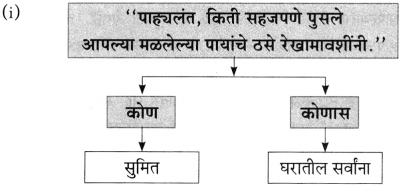
Maharashtra Board Class 10 Marathi Aksharbharati Solutions Chapter 7 फूटप्रिन्टस 33
Maharashtra Board Class 10 Marathi Aksharbharati Solutions Chapter 7 फूटप्रिन्टस 34

प्रश्न 5.
योग्य पर्याय निवडून विधान पूर्ण करा. मी ठरवलंय, मी कॉलेजला जाताना सायकल वापरणार, मला माझे पाय….
(अ) अभिषेकसारखे सोनेरी हवेत.
(आ) स्नेहलसारखे सुंदर हवेत.
(इ) रेखामावशींसारखे चंदेरी हवेत.
(ई) पावडेकाकूसारखे चंदेरी हवेत.
उत्तरः
मी ठरवलंय, मी कॉलेजला जाताना सायकल वापरणार, मला माझे पाय रेखामावशींसारखे चंदेरी हवेत.

Maharashtra Board Class 10 Marathi Aksharbharati Solutions Chapter 7 फूटप्रिन्टस

कृती ३ : स्वमत

प्रश्न 1.
उताऱ्यातील प्रत्येकाने पर्यावरणपूरक वागण्याचा कशाप्रकारे निश्चय केला?
उत्तरः
अभिषेक कॉलेजला जाण्यासाठी सायकल वापरणार होता. तर स्नेहल बसने ये-जा करणार होती. थोड्या-थोड्या अंतरासाठी बाईक न वापरता पायीच चालत गेले पाहिजे असे अभिषेकच्या बाबांनी ठरवले. आपली ही कार्बनची पावलं पुसून टाकण्यासाठी वृक्ष लागवड करायला हवी, असे मत सुमितने व्यक्त केले. अशाप्रकारे सर्वांनी पर्यावरणास मदत करण्याची शपथ घेतली.

प्रश्न 2.
हिरव्यागर्द झाडांनी आपली काळीकुट्ट पावलं थोडी तरी उजळ होतील हे विधान तुमच्या शब्दांत स्पष्ट करा.
उत्तरः
आपण आपल्या दैनंदिन जीवनशैलीतून जास्तीत जास्त कार्बन वातावरणात सोडतो. त्याचा प्रचंड परिणाम पर्यावरणावर होतो. हवेत मिसळलेल्या कार्बनचे प्रमाण कमी करण्यासाठी व ऑक्सिजनचे प्रमाण वाढवण्यासाठी जास्तीत जास्त प्रयत्न केले पाहिजेत, त्यातला सर्वात ठोस आणि परिणामकारक उपाय म्हणजे जास्तीत जास्त झाडे लावणे व त्यांचे संवर्धन करणे. त्यामुळे ऑक्सिजनच्या प्रमाणात वाढ होईल. त्यासाठी सर्वांनीच जाणीवपूर्वक प्रयत्न केले पाहिजे.

प्रश्न 3.
कार्बन डायऑक्साईडचे हवेतले प्रमाण कमी करण्यासाठी तुम्ही काय उपाय करू शकता? तुमचे मत लिहा.
उत्तरः
हवेत सोडला जाणारा कार्बन आणि निसर्गात निर्माण होणारा ऑक्सिजन यांच्या प्रमाणात प्रचंड असमतोल आपण प्रदुषणाच्या माध्यमातून अनुभवतो. निर्माण होणारे औद्योगीकरण, झाडांची प्रचंड कत्तल, कारखान्यातून निघणारा धूर यांमुळे ऑक्सिजनच्या प्रमाणात घट होते आहे.

या सगळ्याचा विचार करता, विकास करताना पर्यावरणाचा नाश होणार नाही ही बाब लक्षात घेतली पाहिजे. जेवढी झाडे कापली आहेत, तेवढी वाढवली पाहिजेत. लोकसंख्येवर नियंत्रण आणले पाहिजे, प्रत्येकाने आपल्या जीवनशैलीचा अभ्यास करून ती पर्यावरण पुरक कशी होईल याचा विचार केला पाहिजे, तरच ओं क्सिजनचे प्रमाण वाढून हवेतील कार्बनचे प्रमाण कमी होऊ शकते.

Maharashtra Board Class 10 Marathi Aksharbharati Solutions Chapter 7 फूटप्रिन्टस

स्वाध्याय कृती

प्रश्न 1.
कारणे लिहा.

(i) स्नेहल त्रासली कारण …………………………….
उत्तर:
स्नेहल त्रासली कारण रेखामावशींच्या पायाचे काळे मळकट ठसे पुसलेल्या फरशीवर उमटले होते.

(ii) पावडेकाकांचा चेहरा पडला कारण …………………………….
उत्तर:
पावडेकाकांचा चेहरा पडला कारण मोबाईल स्क्रीनवर पावडे काकांची काळीकुट्ट पावलं उमटली होती.

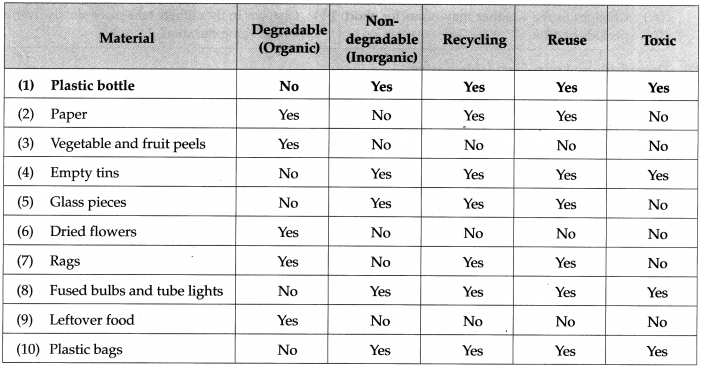
(७) खालील तख्ता पूर्ण करा
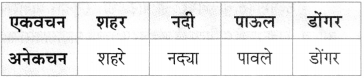
Maharashtra Board Class 10 Marathi Aksharbharati Solutions Chapter 7 फूटप्रिन्टस 38

फूटप्रिन्टस Summary in Marathi

फूटप्रिन्टस पाठपरिचय‌‌

तरूणांना‌ ‌मार्गदर्शन‌ ‌करणाऱ्या‌ ‌छात्रप्रबोधन‌ ‌एप्रिल‌ ‌२०१७‌ ‌च्या‌ ‌अंकातून‌ ‌प्रस्तुत‌ ‌पाठ‌ ‌घेतला‌ ‌आहे.‌ ‌ग्लोबल‌ ‌वॉर्मिंगमधून‌ ‌आपल्या‌ ‌धरणीमातेला‌ ‌वाचवण्यासाठी‌ ‌वृक्षसंवर्धनाबरोबरच,‌ ‌वैयक्तिक‌ ‌वाहनांचा‌ ‌उपयोग‌ ‌करण्यापेक्षा‌ ‌प्रवासी‌ ‌वाहन‌ ‌सुविधांचा‌ ‌अधिकाधिक‌ ‌वापर‌ ‌करावा,‌ ‌त्यासाठी‌ ‌आपली‌ ‌जीवनशैली‌ ‌बदलावी‌ ‌असा‌ ‌संदेश‌ ‌’फूटप्रिन्टस’‌ ‌या‌ ‌पाठातून‌ ‌लेखक‌ ‌’डॉ.‌ ‌प्रदिप‌ ‌आवटे’‌ ‌यांनी‌ ‌दिला‌ ‌आहे.‌‌

फूटप्रिन्टस Summary in English

To‌ ‌save‌ ‌the‌ ‌earth‌ ‌from‌ ‌global‌ ‌warming,‌ ‌besides‌ ‌planting‌ ‌trees,‌ ‌we‌ ‌must‌ ‌use‌ ‌public‌ ‌transportation‌ ‌rather‌ ‌than‌ ‌private‌ ‌vehicles,‌ ‌which‌ ‌will‌ ‌also‌ ‌help‌ ‌to‌ ‌reduce‌ ‌the‌ ‌pollution.‌ ‌To‌ ‌realize‌ ‌this,‌ ‌our‌ ‌routine‌ ‌lives‌ ‌must‌ ‌undergo‌ ‌changes‌ ‌and‌ ‌adjustments‌ ‌whenever‌ ‌necessary.‌ ‌This‌ ‌is‌ ‌the‌ ‌message‌ ‌of‌ ‌this‌ ‌lesson‌ ‌by‌ ‌Dr.‌ ‌Pradeep‌ ‌Awate.‌ ‌Minimising‌ ‌the‌ ‌use‌ ‌of‌ ‌electronic‌ ‌gadgets‌ ‌and‌ ‌machinery‌ ‌will‌ ‌help‌ ‌us‌ ‌connect‌ ‌with‌ ‌nature‌ ‌and‌ ‌there‌ ‌will‌ ‌also‌ ‌be‌ ‌additional‌ ‌greenery‌ ‌in‌ ‌the‌ ‌world‌ ‌around‌ ‌us.‌‌

फूटप्रिन्टस शब्दार्थ‌

  • ‌समदी‌ ‌-‌ ‌सगळी‌ ‌-‌ ‌(entire)‌
  • ‌बक्कल‌ ‌-‌ ‌पुष्कळ‌ ‌-‌ ‌(abundant,‌ ‌plenty)‌ ‌
  • उखणणे‌ ‌‌-‌ ‌खडबडीत‌ ‌होणे‌ ‌-‌ ‌(become‌ ‌rough)‌
  • ‌गोजिरा‌ ‌-‌ ‌सुंदर‌ ‌-‌ ‌(beautiful)‌ ‌
  • चिरण्या‌ ‌-‌ ‌तडा,‌ ‌भेगा‌ ‌-‌ ‌(cracks)‌‌
  • लोन्यागत‌ ‌-‌ ‌लोण्यासारखा‌ ‌-‌ ‌(like‌ ‌butter)‌
  • ‌निरभ्र‌ ‌-‌ ‌ढग‌ ‌नसलेल्या,‌ ‌स्वच्छ‌ ‌-‌ ‌(cloudless)‌ ‌
  • चंदेरी‌ ‌-‌ ‌चांदीसारखा‌ ‌-‌ ‌(like‌ ‌silver‌ ‌of‌ ‌silver‌ ‌colour)‌
  • ‌ठसे‌ ‌-‌ ‌छाप‌‌ -‌ ‌(an‌ ‌impression)‌ ‌
  • स्फटिक‌ ‌-‌ ‌पारदर्शक‌ ‌-‌ ‌(crystal)
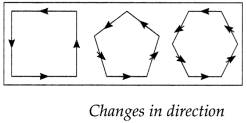
Maharashtra Board Class 9 Geography Solutions Chapter 1 Distributional Maps

Balbharti Maharashtra State Board Class 9 Geography Solutions Chapter 1 Distributional Maps Notes, Textbook Exercise Important Questions and Answers.

Maharashtra State Board Class 9 Geography Solutions Chapter 1 Distributional Maps

Class 9 Geography Chapter 1 Distributional Maps Textbook Questions and Answers

1. Give reasons why the following sentences are right or wrong:

Geography Class 9 Chapter 1 Distributional Maps Question 1.
The main aim of distributional maps is to show location.
Answer:
Wrong The main aim of distributional maps is to show the distribution of variables like temperature, rainfall, population, etc.

  • Distribution maps are type of thematic maps.
  • These maps are prepared with special themes like the distribution of various variables in a particular region.
  • They make use of different methods to show the distribution of variables like temperature, rainfall, population, etc.

Thus, the main aim of distributional maps is to show the distribution of variables in a particular region.

Maharashtra Board Class 9 Geography Solutions Chapter 1 Distributional Maps

Distributional Maps Class 9 Question 2.
In choropleth maps, only one value is assigned to the sub-administrative unit.
Answer:
Right

  1. In choropleth maps, the data regarding various geographical variables is shown by shading or using tints of various colours.
  2. After gathering the data for a selected variable, five to seven classes are made considering the smallest and the largest values.
  3. Each class is assigned a tint of the same colour or black-and-white patterns.
  4. A particular value shown by a predecided tint of colour can represent only a particular region or group of region.

Thus, in choropleth maps, only one value is assigned to sub administrative unit.

Distributional Maps Questions And Answers Question 3.
In choropleth maps, colours/tints do not change according to the values of the variables.
Answer:
Wrong.
In choropleth maps, colours/tints change according to the values of variables.

  • In choropleth maps, the smallest and the largest values are taken into consideration and after that 5-7 classes are made.
  • Each class is assigned a unique tint of the same colour or black and white pattern.
  • In other words, each class is used to show the distribution of a particular variable in sub- administrative unit.

Distributional Map Question 4.
Choropleth maps are used to show altitudes.
Answer:
Wrong.
Isopleth maps and not the choropleth maps are used to show altitude.

  • When the distribution of a variable is continuous like the altitude, the isopleth method map is used.
  • Isopleth maps use lines joining the locations having equal values and hence are useful to show the change in altitude in the region.
  • When the distribution of a variable is discontinuous, the choropleth method map is used to show its distribution, eg. distribution of population, domestic animals, etc.

Question 5.
Isopleth maps are used to show population distribution.
Answer:
Wrong.
Dot method maps or choropleth method maps are used to show population distribution

  • Distribution of a population is discontinuous.
  • Isopleth method maps are used to show the distribution of variables which are continuous. For eg. altitude, temperature etc.
  • Thus, isopleth method maps are not used to show population distribution.

Maharashtra Board Class 9 Geography Solutions Chapter 1 Distributional Maps

Question 6.
In dot method, every dot should have an appropriate scale.
Answer:
Right.
The size of the dot is decided as per the value of a variable that is freely scattered across the region.

Question 7.
Isopleth maps are not made using isolines.
Answer:
Wrong.
Isopleth maps are made using isolines.

  • Isolines are lines joining places of same values of a given variable in a map.
  • Since, isopleth maps are also prepared in the same method, we can say that they are made using isolines.

Question 8.
Distribution of various geographical elements can be shown using dot method.
Answer:
Wrong.
Distribution of various geographical elements cannot be shown using dot method.

  • Distribution of geographical elements which are freely scattered across a region can be shown using a dot method.
  • Distribution of variables like population, minerals, cattles etc., are freely scattered hence can be shown on a dot method map.
  • Whereas the distribution of variables like rainfall, altitude, temperature etc. which are continuous, cannot be shown using a dot method map.

2. Answer in brief.

Question 1.
Explain the use and types of distributional maps.
Answer:
(a) Use of distributional maps: The distributional maps are useful for explaining the patterns of distribution of a particular geographical variable.
(b) The types of distributional maps : The following are the types of distributional maps.

  1. Dot Method: The distributional map based on statistical data, made by this method, make use of dots of a pre-decided size to show the distribution of a particular variable, e.g. Dot method map is used to show the population of a region, distribution of cattle etc.
  2. Choropleth Method: The distributional map made by this method makes use of shades or tints of various colours, to show the distribution of a particular variable, e.g. Choropleth method map is used to show population density, types of forest cover, uses of land. Maharashtra Board Class 9 Geography Solutions Chapter 1 Distributional Maps
  3. Isopleth Method: The distributional map made by this method makes use of lines joining locations or places having same or equal values of a particular variable, e.g. Isopleth method map is used to show altitude, temperature, rainfall.

Question 2.
Differentiate between choropleth and isopleths methods.
Answer:

Choropleth MethodIsopleth Method
(1) In Choropleth method maps, the distribution of various variables are shown by shading or using tints of the same colour.(1) In Isopleth method maps, the distribution of various variables are shown with the help of isolines.
(2) When the distribution of a variable is not continuous, the choropleth method is used.(2) When the distribution of a variable is continuous, the isopleth method is used.
(3) Choropleth method is used to show population density, cattle distribution etc.(3) Isopleth method are used to show altitude, temperature, rainfall of a region etc.

Question 3.
Explain with reasons the method which is best suited to show the distribution of population in a region.
Answer:

  • The dot method of making a distributional map is best suited to show the distribution of the population in a region.
  • The dots used in this method, are given a particular value which is determined by selecting a proper scale considering the spread of the values of the variables in the given region.
  • This method is best suited to show the distribution of the variables which are freely scattered as in the case of population distribution.

3. Which method will you use for the following information?

Question 1.
Talukawise wheat production in the district
Answer:
Dot method

Question 2.
Distribution of the altitude of the land in the district.
Answer:
Isopleth method

Maharashtra Board Class 9 Geography Solutions Chapter 1 Distributional Maps

Question 3.
Distribution of domestic animals in the State
Answer:
Dot method

Question 4.
The distribution of population density in India
Answer:
Choropleth method

Question 5.
Temperature distribution in Maharashtra State.
Answer:
Isopleth method

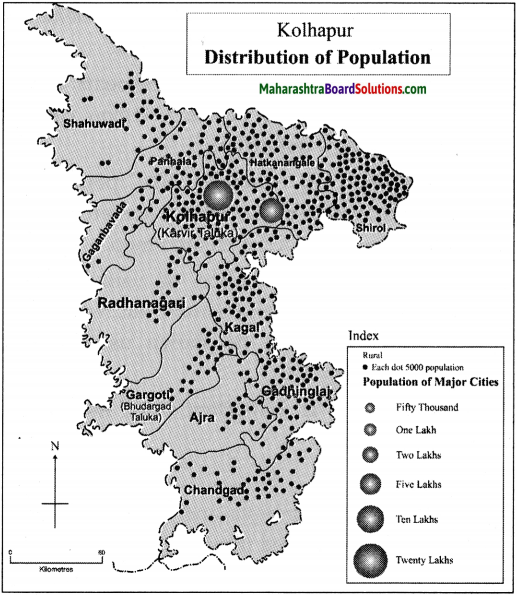
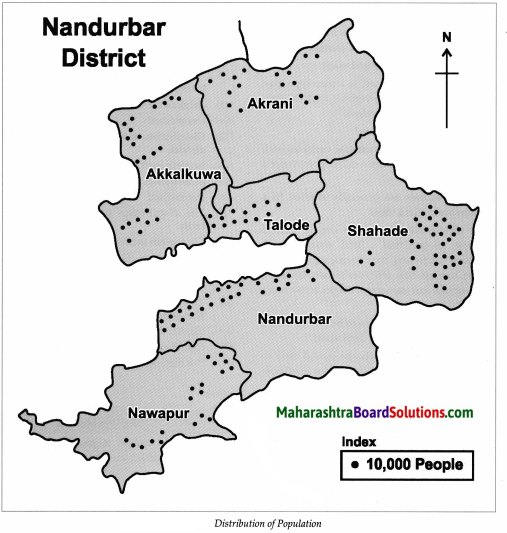
4. Study the population distribution map of Kolhapur district and answer the following questions:

Question 1.
Which method has been used to show the distribution of population in the district?
Answer:
The dot method has been used to show the distribution of population in the district.

Question 2.
Explain the direction wise distribution of the population from dense to sparse.
Answer:
The distribution of the population is dense in the Eastern part of the district, whereas the western part of the district has low density of population.

Question 3.
What is the population shown by the largest circle? Which place is that?
Answer:
The population shown by the largest circle is nearly 20 lakhs. That place is Kolhapur city (Karvir Taluka)

Question 4.
Which Taluka has the least population?
Answer:
Gaganbavada Taluka has the least population.

Maharashtra Board Class 9 Geography Solutions Chapter 1 Distributional Maps

Class 9 Geography Chapter 1 Distributional Maps Intext Questions and Answers

Make friends with maps!
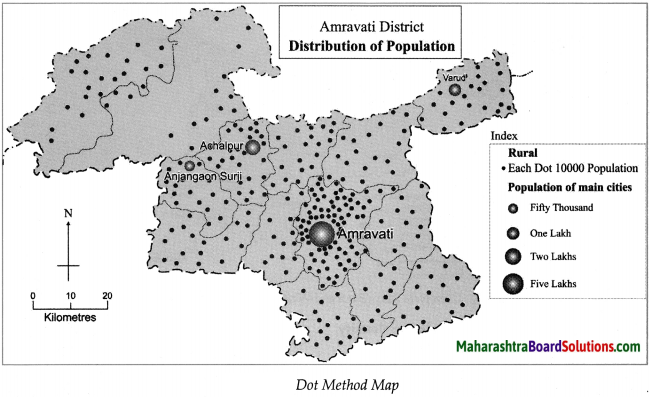
Read the map given below and answer the Questions:
Maharashtra Board Class 9 Geography Solutions Chapter 1 Distributional Maps 2

Question 1.
What is the population of the Amravati town?
Answer:
The population of the Amravati town is nearly 5 lakhs.

Question 2.
Name the place having population of 1 lakh on the map.
Answer:
Achalpur has a population of 1 lakh

Question 3.
Which part of the map shows sparse distribution of population?
Answer:
The northwestern part of the map shows sparse distribution of population

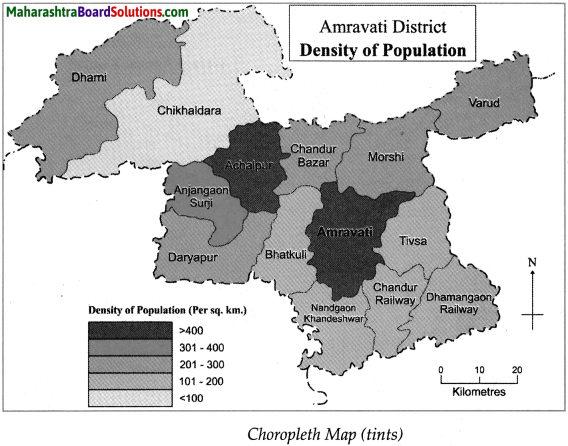
Read the map given below and answer the Questions:
Maharashtra Board Class 9 Geography Solutions Chapter 1 Distributional Maps 3

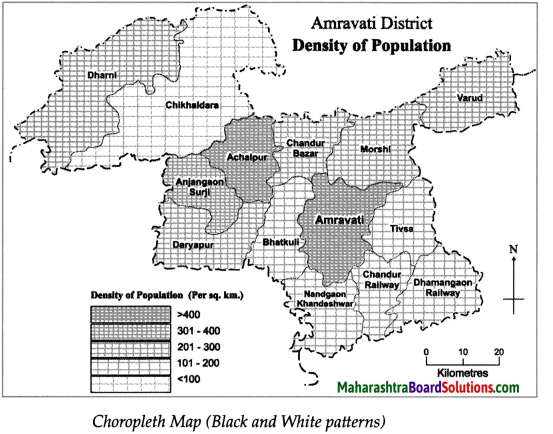
Maharashtra Board Class 9 Geography Solutions Chapter 1 Distributional Maps

Maharashtra Board Class 9 Geography Solutions Chapter 1 Distributional Maps 4

Question 1.
Name the talukas having population density between 301 and 400 persons per sq km.
Answer:
Anjangao Surji has population density between 301 and 400 persons per sq km

Question 2.
What is the density of the Amravati taluka?
Answer:
Amravati taluka has the population density of more than 400 persons per sq km

Question 3.
Name the talukas having population density less than 300 persons per sq km.
Answer:
Dharini, Chikaldhara, Daryapur, Chandur Bazar, Morshi, Varud, Tivsa, Dhamangaon Railway, Nandgaon Khandeshwar and Bhatkuli have population density less than 300 persons per sq km.

Question 4.
Which taluka has a population density of less than 100 persons per sq km?
Answer:
Chikaldhara has population density of less than 100 persons per sq km.

Maharashtra Board Class 9 Geography Solutions Chapter 1 Distributional Maps

Question 5.
Which Talukas have a population density of more than 400 persons per sq km?
Answer:
Amravati and Achalpur have the population density of more than 400 persons per sq km.

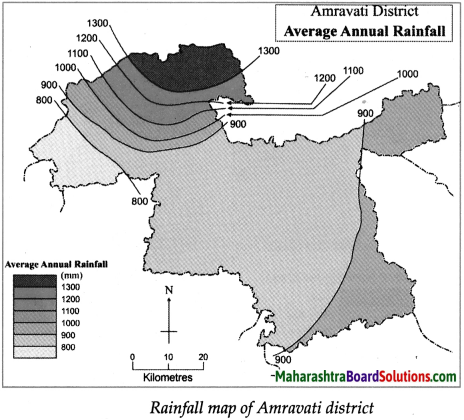
Read the map given below and answer the Questions:

Maharashtra Board Class 9 Geography Solutions Chapter 1 Distributional Maps 5

Question 1.
In which part of the district is the rainfall more?
Answer:
Rainfall is more in the Northern part of the district.

Question 2.
In which direction is the rainfall decreasing?
Answer:
Rainfall is decreasing towards the west

Question 3.
What is the lowest value of the rainfall in the district?
Answer:
The lowest value of the rainfall in the district is less than 800 mm.

Question 4.
What is the highest value of the rainfall in the district?
Answer:
The highest value of the rainfall in the district is more than 1300 mm.

Maharashtra Board Class 9 Geography Solutions Chapter 1 Distributional Maps

Question 5.
What is the amount of rainfall in the central part of the district?
Answer:
The amount of rainfall in the central part of the district is 900 mm.

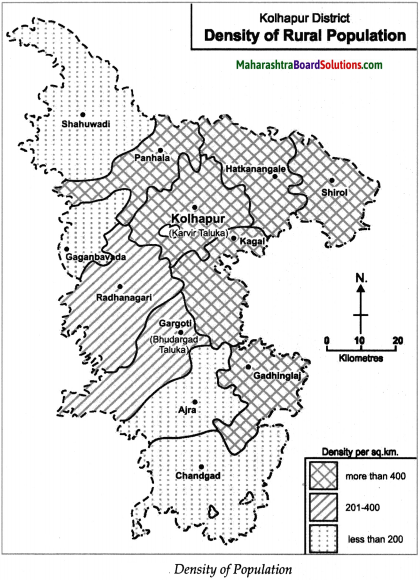
Read the map given below and answer the Questions:

Maharashtra Board Class 9 Geography Solutions Chapter 1 Distributional Maps 6

Question 1.
In which direction is the density of population decreasing?
Answer:
The density of population is decreasing towards the North and South direction.

Question 2.
Name the talukas with a population density less than 200.
Answer:
Shahuwadi, Gaganbavada, Ajra and Chandgad have a population density of less than 200.

Question 3.
Name the talukas having population density between 200 and 400.
Answer:
Radhanagri and Gargoti have population density between 200 and 400.

Question 4.
Name the talukas with a population density more than 400.
Answer:
Kolhapur, Panhala, Hatkanangale, Shirol, Gadhinglaj and Kagal have population density more than 400.

Question 5.
In which direction are the talukas having a higher density of population located in the district?
Answer:
The Eastern part of Kolhapur has a higher density of population.

Maharashtra Board Class 9 Geography Solutions Chapter 1 Distributional Maps

Question 6
Which method has been used in the making of this map?
Answer:
Choropleth method is used in making this map.

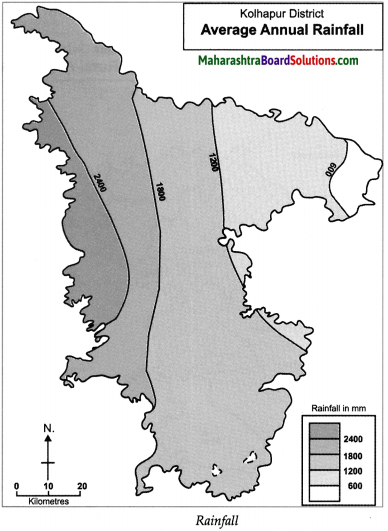
Read the map given below and answer the Questions:

Maharashtra Board Class 9 Geography Solutions Chapter 1 Distributional Maps 7

Question 1.
In which direction is the rainfall more in the district?
Answer:
The rainfall is more in the Western part of the district.

Question 2.
In which direction is the rainfall decreasing?
Answer:
The rainfall is decreasing towards the East.

Question 3.
Which class shows low rainfall category in the district?
Answer:
O to 600 mm class shows low rainfall category in the district.

Question 4.
Which class shows high rainfall category in the district?
Answer:
More than 2400 (2400 to 3000 mm) class shows high rainfall category in the district.

Maharashtra Board Class 9 Geography Solutions Chapter 1 Distributional Maps

Question 5.
Which method has been used in making this map?
Answer:
The Isopleth method has been used in making this map

Study the population distribution map of Kolhapur district and answer the following questions:

Maharashtra Board Class 9 Geography Solutions Chapter 1 Distributional Maps 8

Question 1.
A field visit is an important study method in Geography.
Answer:
Right.

  • Geographical concepts and elements can be directly experienced through field-visits.
  • Field-visits are extremely useful for understanding the correlation between human beings and the environment.

Class 9 Geography Chapter 1 Distributional Maps Additional Important Questions and Answers

Complete the statements choosing the correct option:

Question 1.
The main aim of distributional maps is to show the location of the place and of variables.
(a) population
(b) statistics
(c) consumption
(d) distribution
Answer:
(d) distribution

Question 2.
Distributional maps are of types.
(a) two
(b) three
(c) four
(d) five
Answer:
(b) three

Maharashtra Board Class 9 Geography Solutions Chapter 1 Distributional Maps

Question 3.
To draw distributional maps, we need data.
(a) statistical
(b) population
(c) colourful
(d) distance
Answer:
(a) statistical

Question 4.
The distribution of population is shown by method.
(a) dot
(b) choropleth
(c) isopleth
(d) isolines
Answer:
(a) dot

Question 5.
In maps, the data regarding various geographical variables are shown by shading or tints of various colours.
(a) dot
(b) choropleth,
(c) isopleth
(d) thematic
Answer:
(b) choropleth

Question 6.
When the distribution of a variable is discontinuous the map is used.
(a) isopleth
(b) physical
(c) choropleth
(d) dot
Answer:
(c) choropleth

Maharashtra Board Class 9 Geography Solutions Chapter 1 Distributional Maps

Question 7.
In method, lines showing equal values are used.
(a) choropleth
(b) isopleth
(c) dot
(d) planar
Answer:
(b) isopleth

Question 8.
When the distribution of a variable is the isopleth method is used.
(a) continuous
(b) discontinuous
(c) sparse
(d) disjoint
Answer:
(a) continuous

Question 9.
While showing population distribution, urban population is shown by
(a) circles
(b) dots
(c) squares
(d) lines
Answer:
(a) circles

Question 10.
is an important study method in Geography.
(a) Maps
(b) Field visit
(c) Picnic
(d) farm visit
Answer:
(b) Field visit

Match the column.

Question 1.

Group AGroup B
(1) Dot method(a) distribution of temperature
(2) Choropleth method(b) distribution of cotton crop
(3) Isopleth method(c) density of population

Answer:
(1 – b),
(2 – c),
(3 – a)

Question 2.

Group AGroup A
(1) Dot method
(2) Choropleth method
(3) Isopleth method
(a) variables are freely scattered
(b) distribution of the variable is continuous
(c) distribution of the variable is shown in sub administrative unit

Answer:
(1 – a),
(2 – c),
(3 – b)

Answer in one sentence:

Question 1.
What are distributional maps?
Answer:
Maps that show the distribution of various geographical variables are called ‘distributional maps’.

Question 2.
What are thematic maps?
Ans,
Maps that are prepared with special themes are called ‘thematic maps’.

Question 3.
What is a dot-method map?
Answer:
A dot method map is a map type, that shows the distribution of a variable using dot symbols.

Question 4.
What is a choropleth method map?
Answer:
A choropleth method map is a map type, in which the distribution of a variable is shown by shades or tint of various colours.

Question 5.
When do we use the isopleth method for showing the distribution of a variable on a map?
Answer:
We use the isopleth method for showing the distribution of a variable on a map, when the distribution of the variable is continuous.

Maharashtra Board Class 9 Geography Solutions Chapter 1 Distributional Maps

Question 6.
What is an isopleth method map?
Answer:
An isopleth method map, is a map type, that shows distribution of a variable with the help of lines showing equal values.

Question 7.
What is point related data?
Answer:
The statistical data of particular variables with respect to various places is called ‘point-related data’.

Question 8.
Which elements are generally studied in a geographical field visit?
Answer:
The various elements which can be studied during geographical field visits include physical landforms, river banks, dams, coastal areas, tourism sites, offices or museums related to geographical elements, villages, forest areas etc.

Question 9.
Mention the list of things to be carried while going on a geographical field visit?
Answer:
The various things which one should carry to a geographical field visit include notebook, specimen Questionnaire, pen pencil, scale, tape, compass, bag for collecting samples, maps, camera, etc.

Question 10.
What is field report?
Answer:
The report written on the basis of the information obtained from a field visit is known as field report.

Which method will you use for the following information:

Question 1.
The distribution of rainfall in the district of Nandurbar.
Answer:
Isopleth Method

Maharashtra Board Class 9 Geography Solutions Chapter 1 Distributional Maps

Question 2.
Cotton crop distribution in Maharashtra.
Answer:
Dot method

Question 3.
Draw a map using the Dot Method:
Answer:
Maharashtra Board Class 9 Geography Solutions Chapter 1 Distributional Maps 1

Explain:

Question 1.
Choropleth method
Answer:

  1. In the choropleth method various geographical variables are shown by shades or tints of various colours.
  2. While making choropleth maps, the data used for different variables is obtained through various processes such as measurement, surveying and so on.
  3. In this method, only one value is given to one sub – administrative unit in a region
  4. The smallest and the largest values of the given data of the variables are taken into consideration and after that 5-7 classes are made. Maharashtra Board Class 9 Geography Solutions Chapter 1 Distributional Maps
  5. Each class is assigned a tint of the same colour or black-and-white patterns. The shades or the patterns become darker with the increasing values of the given variable.

Question 2.
Preparations for field visit
Answer:

  • Before going for a field-visit, decide the place and the purpose of the visit.
  • The elements which will be observed in field visit should be decided.
  • For a field visit, you should carry a notebook, specimen Questionnaire
  • , pen, pencil, scale, tape, compass, a bag for collecting samples, maps, camera and any other item needed.

Question 3.
Selection of the study area
Answer:

  1. Geographical field-visit is organised for study of various elements, for example physical 1 landforms, river banks, dams, coastal areas, tourism sites, offices or museums related to ! geographical elements, villages or forest areas.
  2. Elements should be selected after studying : the local conditions and necessary permission letters should be obtained.

Question 4.
Report writing
Answer:

  1. A field-report should be written on the basis of information obtained after the visit is complete.
  2. Students should add photographs wherever necessary.
  3. The following points should be used to make a field report:
    • Introduction
    • Location map and Route Map
    • Physiography1
    • Climate
    • Population
    • Environmental problems and measures
    • Land utilisation
    • Conclusions Maharashtra Board Class 9 Geography Solutions Chapter 1 Distributional Maps

Maharashtra Board Class 9 Science Solutions Chapter 1 Laws of Motion

Balbharti Maharashtra State Board Class 9 Science Solutions Chapter 1 Laws of Motion Notes, Textbook Exercise Important Questions and Answers.

Maharashtra State Board Class 9 Science Solutions Chapter 1 Laws of Motion

Class 9 Science Chapter 1 Laws of Motion Textbook Questions and Answers

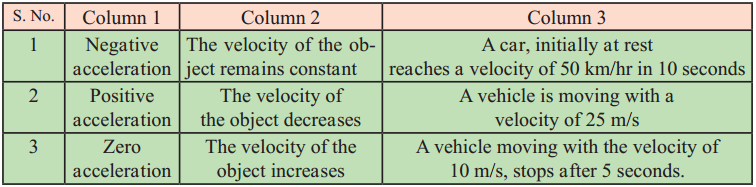
1. Match the first column with appropriate entries in the second and third columns and remake the table.
Maharashtra Board Class 9 Science Solutions Chapter 1 Laws of Motion 1

2. Clarify the differences

A. Distance and displacement
Answer:

DistanceDisplacement
(i) Distance is the length of the actual path travelled by an object.
(ii) It is a scalar quantity.
(iii) It is either equal to or greater than displacement.
(iv) Distance travelled is always positive.
(i) Displacement is the minimum distance between the starting and finishing points.
(ii) It is a vector quantity.
(iii) It is either equal to or less than distance.
(iv) Displacement may be positive or negative or zero.

Maharashtra Board Class 9 Science Solutions Chapter 1 Laws of Motion

B. Uniform and non-uniform motion.
Answer:

Uniform motionNon-uniform motion
(i) If an object covers equal distances in equal intervals of time it is said to be in uniform motion.
(ii) Distance – time graph for uniform motion is a straight line.
(iii) In uniform motion, acceleration is zero.
(i) If an object moves unequal distances in equal intervals of time, its motion is said to be non­uniform.
(ii) Distance – time graph for non-uniform motion is not a straight line.
(iii) In non-uniform motion acceleration is non-zero.

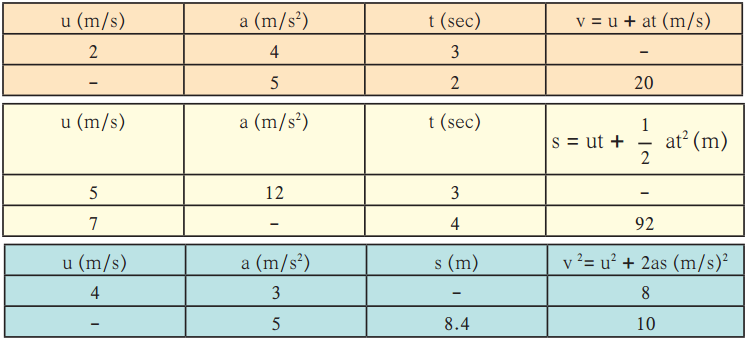
3. Complete the following table.
Maharashtra Board Class 9 Science Solutions Chapter 1 Laws of Motion 2

4. Complete the sentences and explain them.

a. The minimum distance between the start and finish points of the motion of an object is called the ……….. of the object.
b. Deceleration is ………………………. acceleration
c. When an object is in uniform circular motion, its ………………………. changes at every point.
d. During collision ………………………. remains constant.
e. The working of a rocket depends on Newton’s ………………………. law of motion.

5. Give scientific reasons.

a. When an object falls freely to the ground, its acceleration is uniform.
Answer:

  • When the body falls freely to the ground, there are equal changes in velocity of the body in equal intervals of time.
  • Thus the acceleration of the body is constant, and it possesses uniform acceleration.

b. Even though the magnitudes of action force and reaction force are equal and their directions are opposite, their effects do not get cancelled.
Answer:

  • Action and reaction forces act on different bodies.
  • They don’t act on the same body, hence they cannot cancel each other’s effect.
  • Hence, even though the magnitudes of action force and reaction force are equal, they do not cancel each other.

c. It is easier to stop a tennis ball as compared to a cricket ball, when both are traveling with the same velocity.
Answer:

  • Momentum of an object depends on its mass as well as its velocity.
  • Cricket ball is heavier than a tennis ball. Although they are thrown with the same velocity, cricket ball has more momentum than a tennis ball.
  • The force required to stop a cricket ball is more than a tennis ball.
  • Hence it is easier to stop a tennis ball than a cricket ball moving with same velocity.

Maharashtra Board Class 9 Science Solutions Chapter 1 Laws of Motion

d. The velocity of an object at rest is considered to be uniform.
Answer:

  • When a body is at rest there is no change in velocity.
  • A body with constant velocity is said to be in uniform motion.
  • Hence, the state of rest is an example of uniform motion.

6. Take 5 examples from your surroundings and give an explanation based on Newton’s laws of motion.

7. Solve the following examples.

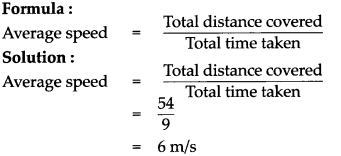
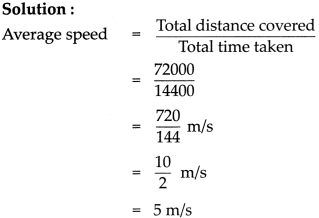
a) An object moves 18 m in the first 3 s, 22 m in the next 3 s and 14 m in the last 3 s. What is its average speed? (Ans: 6 m/s)
Answer:
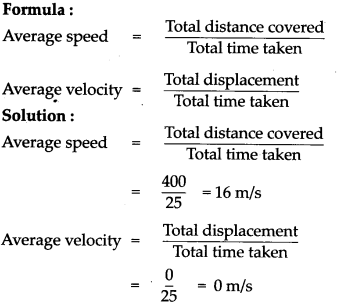
Given:
Total distance (d) = 18 + 22 + 14 = 54 m
Total time taken (t) = 3 + 3 + 3 = 9 sec
To find:
Average speed = ?
Maharashtra Board Class 9 Science Solutions Chapter 1 Laws of Motion 3

The object moves with an average speed of 6 m/s.

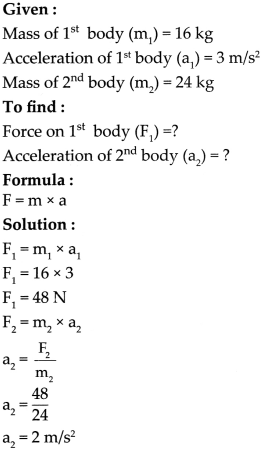
b) An object of mass 16 kg is moving with an acceleration of 3 m/s2. Calculate the applied force. If the same force is applied on an object of mass 24 kg, how much will be the acceleration? (Ans: 48 N, 2 m/s2)
Answer:
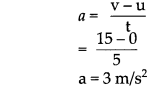
Maharashtra Board Class 9 Science Solutions Chapter 1 Laws of Motion 4

The force acting on the 1 body is 48 N and the acceleration of the 2” body is 2 m/s2

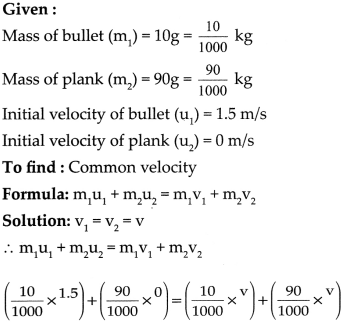
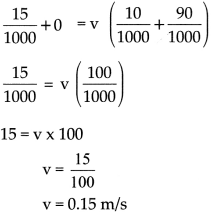
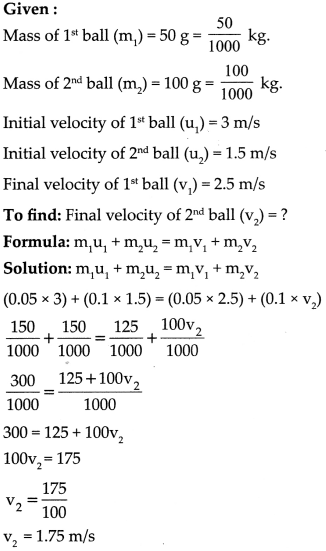
c) A bullet having a mass of 10 g and moving with a speed of 1.5 m/s, penetrates a thick wooden plank of mass 90 g. The plank was initially at rest. The bullet gets embedded in the plank and both move together. Determine their velocity. (Ans: 0.15 m/s)
Answer:
Maharashtra Board Class 9 Science Solutions Chapter 1 Laws of Motion 5
Maharashtra Board Class 9 Science Solutions Chapter 1 Laws of Motion 6
The plank embedded with the bullet moves with a velocity of 0.15 m/s.

Maharashtra Board Class 9 Science Solutions Chapter 1 Laws of Motion

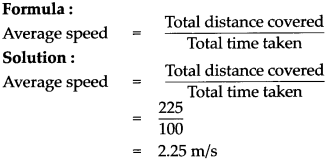
d) A person swims 100 m in the first 40 s, 80 m in the next 40 s and 45 m in the last 20 s. What is the average speed? (Ans: 2.25 m/s2)

Answer:
Given:
Total distance (d) = 100 + 80 + 45 = 225 m
Total time taken (t) = 40 + 40 + 20 = 100 sec
To find:
Average speed =?
Maharashtra Board Class 9 Science Solutions Chapter 1 Laws of Motion 7
The person swims with an average speed of 2.25 m/s.

Class 9 Science Chapter 1 Laws of Motion Intext Questions and Answers

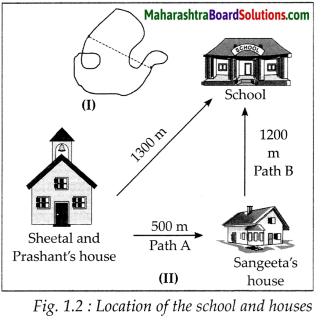
(i) Who will take less time to reach the school and why?
Answer:
Prashant will take less time as the path followed by him is the shortest.
Maharashtra Board Class 9 Science Solutions Chapter 1 Laws of Motion 8

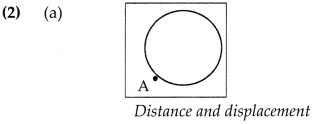
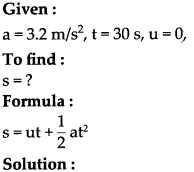
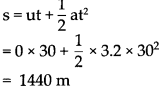
(a) Every morning, Swaralee walks round the edge of a circular field having a radius of 100 m. As shown in figure (a), if she starts from the point A and takes one round, how much distance has she walked and what is her displacement?
Answer:
Radius (r) = 100 m
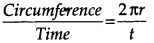
Distance covered = Circumference of the circle
= 2 nr
= 2 x 3.14 x 100
= 628 m
Displacement = 0 m (Shortest distance between initial and final position is zero)

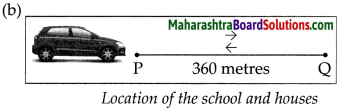
(b) If a car, starting from point P, goes to point Q (see figure 1.9) and then returns to point P, how much distance has it travelled and what is its displacement?
Maharashtra Board Class 9 Science Solutions Chapter 1 Laws of Motion 9
Answer:
Distance covered = PQ + QP
= 360 + 360
= 720 m
Displacement = 0 m (The shortest distance between initial and final position is zero)

Class 9 Science Chapter 1 Laws of Motion Additional Important Questions and Answers

(A) Choose and write the correct option:

Laws Of Motion Class 9 Questions And Answers Maharashtra Board Question 1.
The displacement that occurs in unit time is called …………….. .
(a) displacement
(b) distance
(c) velocity
(d) acceleration
Answer:
(c) velocity

Maharashtra Board Class 9 Science Solutions Chapter 1 Laws of Motion

Laws Of Motion Class 9 Maharashtra Board Exercise Answers  Question 2
The unit of velocity in the SI system is …………….. .
(a) cm/s
(b) rn/s2
(c) um/s2
(d) rn/s
Answer:
(d) m/s

Laws Of Motion Class 9 Maharashtra Board  Question 3.
v2 = u2 + 2as is the relation between and …………….. .
(a) speed and velocity
(b) distance and acceleration
(c) displacement and velocity
(d) speed and distance
Answer:
(c) displacement and velocity

Class 9 Science Notes Chapter 1 Laws Of Motion Question 4.
…………….. is the relation between displacement and time.
(a) v = u + at
(b) v2 = u2 + 2as
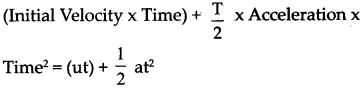
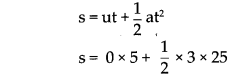
(c) s = ut + 1/2 at2
(d) v = u + 2as
Answer:
(c) s = ut + 1/2 at2

Class 9 Science Chapter 1 Laws Of Motion Question Answer Question 5.
The force necessary to cause an acceleration of 1 m/s2 in an object of mass 1 kg is called …………….. .
(a) 1 dyne
(b) 1 m/s
(c) 1 Newton
(d) 1 cm/s
Answer:
(c) 1 Newton.

9th Science Chapter 1 Laws Of Motion Question 6.
Even if the displacement of an object is zero, the actual distance traversed by it …………….. .
(a) may not be zero.
(b) will be zero
(c) will be constant
(d) will be infinity
Answer:
(a) may not be zero

Question 7.
If the velocity changes by equal amounts in equal time intervals, the object is said to be in …………….. .
(a) uniform acceleration
(b) uniform velocity
(c) non-uniform acceleration
(d) non-uniform motion
Answer:
(a) uniform acceleration

Question 8.
If an object is moving with a uniform velocity …………….. .
(a) its speed remains the same, but direction of motion changes
(b) its speed changes but direction of motion is same
(c) its speed and direction both change
(d) its speed and direction both remain the same
Answer:
(d) its speed and direction both remain the same

Question 9.
is an example of positive acceleration.
(a) A stone is thrown vertically upwards
(b) A stone falls freely towards the earth
(c) Brakes are applied by the truck driver
(d) The train arriving at the station
Answer:
(b) a stone falls freely towards the earth

Maharashtra Board Class 9 Science Solutions Chapter 1 Laws of Motion

Question 10.
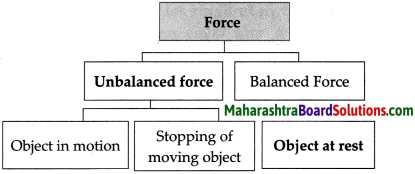
An object continues to remain at rest or in a state of uniform motion along a straight line unless an …………….. acts on it.
(a) internal imbalanced force
(b) external unbalanced force
(c) internal balanced force
(d) external balanced force
Answer:
(b) external unbalanced force

Question 11.
The …………….. is proportional to the applied force and it occurs in the direction of the force.
(a) change of momentum
(b) rate of change of velocity
(c) change of velocity
(d) rate of change of momentum
Answer:
(d) rate of change of momentum

Question 12.
…………….. is a relative concept.
(a) Motion
(b) Direction
(c) Power
(d) Acceleration
Answer:
(a) Motion

Question 13.
A body is said to be in motion if it changes its …………….. with respect to its surroundings.
(a) position
(b) direction
(c) speed
(d) force
Answer:
(a) position

Question 14.
A body is said to be at …………….. if it does not change its position with respect to its surroundings.
(a) Motion
(b) Rest
(c) Gravity
(d) Force
Answer:
(b) Rest

Question 15.
…………….. is the length of the actual path travelled by an object in motion while going from one point to another.
(a) Distance
(b) Displacement
(c) Speed
(d) Velocity
Answer:
(a) Distance

Question 16.
The distance covered by a body in unit time is called its …………….. .
(a) velocity
(b) speed
(c) displacement
(d) rest
Answer:
(b) speed

Maharashtra Board Class 9 Science Solutions Chapter 1 Laws of Motion

Question 17.
S.I. unit of speed is …………….. and in C.G.S unit it is …………….. .
(a) m/s and cm/s
(b) km/s and cm/s
(c) m/s and mm/s
(d) m/s and nm/s
Answer:
(a) m/s , cm/s

Question 18.
The distance travelled in a particular direction by an object in unit time is called its …………….. .
(a) velocity
(b) speed
(c) displacement
(d) rest
Answer:
(a) velocity

Question 19.
Units of speed and velocity are the
(a) Same
(b) Different
(c) Greater than each other
(d) Unequal
Answer:
(a) same

Question 20.
…………….. . is related to distance, while …………….. is related to displacement.
(a) Gravity and magnetism
(b) Speed and force
(c) Speed and velocity
(d) Motion and rest
Answer:
(c) Speed, velocity

Question 21.
If an object covers equal distances in equal time intervals, it is said to be moving with …………….. speed.
(a) Uniform
(b) Non uniform
(c) Changing
(d) Random
Answer:
(a) uniform

Question 22.
If an object covers unequal distances in equal time Intervals, it is said to be moving with speed.
(a) Uniform
(b) Non uniform
(c) Changing
(d) Random
Answer:
(b) non uniform

Maharashtra Board Class 9 Science Solutions Chapter 1 Laws of Motion

Question 23.
The rate of change of velocity is called
(a) Speed
(b) Acceleration
(c) Velocity
(d) Rest
Answer:
(b) acceleration

Question 24.
Speed of light in dry air is …………….. m/s.
(a) 3 x 10⁷
(b) 3 x 10⁸
(c) 3 x 10⁹
(d) 3 x 10³
Answer:
(b) 3 x 10⁸

Question 25.
When velocity of a body increases, its acceleration is …………….. .
(a) Negative
(b) Zero
(c) Positive
(d) Equal
Answer:
(c) positive

Question 26.
When velocity of a body decreases, its acceleration is …………….. .
(a) Negative
(b) Zero
(c) Positive
(d) Equal
Answer:
(a) negative

Question 27.
Negative acceleration is also called or
(a) Deceleration or retardation
(b) Deceleration or acceleration
(c) acceleration or retardation
(d) Zero
Answer:
(a) deceleration or retardation

Question 28.
In case of motion, object travels equal …………….. in equal intervals of time.
(a) Uniform, distance
(b) Non-Uniform, distance
(c) Uniform, displacement
(d) Uniform, displacement
Answer:
(a) uniform, distances

Maharashtra Board Class 9 Science Solutions Chapter 1 Laws of Motion

Question 29.
Motion of an object was studied by …………….. .
(a) Sir Albert Einstein
(b) Sir Thomas Edison
(c) Sir Isaac Newton
(d) Sir Ravindranath Tagore
Answer:
(c) Sir Issac Newton

Question 30.
When an object moves in a circular path with uniform speed, its motion is …………….. motion.
(a) Non uniform circular
(b) Random circular
(c) Uniform circular
(d) Uniform linear
Answer:
(c) uniform circular

Question 31.
When a coin moves along a circular path, the direction of its motion at every point is …………….. .
(a) Circular
(b) Concave
(c) Tangential
(d) Convex
Answer:
(c) tangential

Question 32.
For all uniformly accelerated motions, the velocity-time graph is a …………….. .
(a) Curved line
(b) Straight line
(c) Negative line
(d) Positive line
Answer:
(b) straight line

Question 33.
In the distance-time graph, the slope of the straight line indicates …………….. .
(a) Acceleration
(b) Velocity
(c) Speed
(d) Rest
Answer:
(b) velocity

Question 34.
The first equation of motion gives relation between …………….. and time.
(a) Acceleration
(b) Velocity
(c) Speed
(d) Rest
Answer:
(b) velocity

Maharashtra Board Class 9 Science Solutions Chapter 1 Laws of Motion

Question 35.
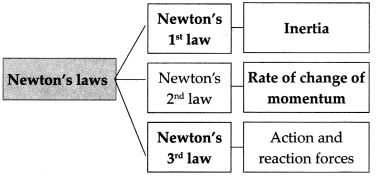
Newton’s first law explains the phenomenon of
(a) Rest
(b) Inertia
(c) Speed
(d) Velocity
Answer:
(b) inertia

Question 36.
…………….. cause a change in the state of an object at rest or in uniform motion.
(a) Balanced forces
(b) Zero forces
(c) Unbalanced forces
(d) None of them
Answer:
(c) Unbalanced forces

Question 37.
To describe an object’s momentum, we must specify its …………….. and …………….. .
(a) Mass and displacement
(b) Mass and direction
(c) Mass and velocity
(d) Mass and acceleration
Answer:
(c) mass and velocity

Question 38.
…………….. is the product of mass and velocity of an object.
(a) Speed
(b) Acceleration
(c) Momentum
(d) Force
Answer:
(c) Momentum

Question 39.
The rate of change of momentum is proportional to the applied …………….. .
(a) Balanced force
(b) Unbalanced force
(c) Mass
(d) Velocity
Answer:
(b) unbalanced force

Question 40.
S.I. unit of momentum is
(a) kg cm/s
(b) kg m/s
(c) gm/s
(d) m/s
Answer:
(b) kg m/s

Maharashtra Board Class 9 Science Solutions Chapter 1 Laws of Motion

Question 41.
…………….. is always conserved in a collision.
(a) Force
(b) Power
(c) Speed
(d) Total momentum
Answer:
(d) Total momentum

Question 42.
When a bullet is fired from the gun, the gun moves in backward direction. This motion is called as …………….. .
(a) Momentum
(b) Velocity
(c) Acceleration
(d) Recoil
Answer:
(d) Recoil

Question 43.
In CGS system, the unit of force is …………….. .
(а) Newton
(b) Watt
(c) Horse power
(d) Dyne
Answer:
(d) Dyne.

 (B) 1. Find the odd man out:

Question 1.
Displacement, Force, Momentum, Mass
Answer:
Mass

Question 2.
Speed, Power, Energy, Acceleration
Answer:
Acceleration

Question 3.
Newton’s 1st law, Newton’s 2nd law, Newton’s 3rd law, Kepler’s laws of motion
Answer:
Newton’s 3rd law

(B) 2. Find out the correlation

Question 1.
Speed zero: Body at rest :: Negative acceleration : Retardation
Answer:
Retardation

Maharashtra Board Class 9 Science Solutions Chapter 1 Laws of Motion

Question 2.
Displacement : Vector quantity :: Distance : Scalar quantity
Answer:
Vector quantity

Question 3.
When body comes to rest at the end of the motion : Final velocity is zero :: When body is at rest at the starting of motion : Initial velocity is zero
Answer:
Initial velocity is zero

Question 4.
Uniform circular motion: Displacement is zero :: Uniform velocity : Acceleration is zero
Answer:
Displacement is zero

Question 5.
Inertia : Newton’s 1st law :: Rate of change of momentum : Newton’s 2nd law
Answer:
Newton’s 2nd law

Question 6.
Balanced force : Body at rest :: Force equation : Mass x acceleration
Answer:
Body at rest

(B) 3. Distinguish between:

Question 1.
Positive acceleration and Negative acceleration
Answer:

Positive accelerationNegative acceleration
(i) When the velocity of a body increases, acceleration is said to be positive acceleration.(i) When the velocity of a body decreases, acceleration is said to be negative acceleration.

Question 2.
Scalar quantity and Vector quantity
Answer:

Scalar quantityVector quantity
(i) Scalar quantities are physical quantities having magnitude only.(i) Vector quantities are physical quantities having both magnitude and direction.

Maharashtra Board Class 9 Science Solutions Chapter 1 Laws of Motion

Question 3.
Balanced force and Unbalanced force
Answer:

Balanced forceUnbalanced force
(i) Balanced force keeps the body at rest.(i) Balanced force keeps the body at rest.

(B) 4. State whether the following statements are true or false:

Question 1.
The velocity of a body is given by the distance covered by it in unit time in a given direction.
Answer:
True

Question 2.
Displacement is a scalar quantity.
Answer:
False

Question 3.
Uniform acceleration means that the body is moving with a uniform velocity.
Answer:
False

Question 4.
The direction of acceleration can be opposite to that of velocity.
Answer:
True

Question 5.
Work is a vector quantity.
Answer:
False

Question 6.
Displacement is always greater than distance.
Answer:
False

Maharashtra Board Class 9 Science Solutions Chapter 1 Laws of Motion

Question 7.
The distance and displacement are equal only if, motion is along a straight path.
Answer:
True

Question 8.
If an object experiences acceleration, a force is acting on it.
Answer:
True

Question 9.
A train pulling out from a station is in uniform motion.
Answer:
False

Question 10.
If a bus in motion is suddenly stopped, the passengers fall backwards.
Answer:
False

Question 11.
If a single force is acting on an object, it will always accelerate.
Answer:
True

Question 12.
In circular motion, direction of motion is tangential.
Answer:
True

Question 13.
The inertia of a body is measured in terms of its mass.
Answer:
True

(B) 5. Name the following:

Question 1.
The scientist who summarized motion in a set of equations of motion.
Answer:
Isaac Newton

Question 2.
Motion of an object along a circular path with uniform speed.
Answer:
Uniform circular motion

Maharashtra Board Class 9 Science Solutions Chapter 1 Laws of Motion

Question 3.
What is the backward motion of the gun called?
Answer:
Recoil

Question 4.
The motion in which the object covers equal distance in equal intervals of time.
Answer:
Uniform motion

Question 5.
S. I. unit of acceleration.
Answer:
m/s2

Question 6.
CGS unit of momentum
Answer:
g cm/s

(B) 6. Answer the following in one sentence:

Question 1.
When is acceleration said to be positive?
Answer:
When the velocity of a body increases, acceleration is said to be positive acceleration.

Question 2.
What is negative acceleration?
Answer:
When the velocity of a body decreases, acceleration is said to be negative acceleration.

Question 3.
What is the direction of velocity of an object performing uniform circular motion?
Answer:
The direction of velocity is along the tangential direction to its position.

Question 4.
Give the mathematical expression used to determine velocity of an object moving with uniform circular motion.
Answer:
is the expression used to determine velocity of a body moving with uniform circular motion.

Question 5.
What kind of force keeps the body at rest?
Answer:
Balanced force keeps the body at rest.

Maharashtra Board Class 9 Science Solutions Chapter 1 Laws of Motion

Question 6.
Which law of motion gives the measure of force?
Answer:
Newton’s second law of motion gives the measure of force.

Question 7.
What are vectors and scalars?
Answer:
Scalars are physical quantities having magnitude only whereas, vectors are physical quantities having both magnitude and direction.

Question 8.
Which of the quantities distance, speed, velocity, time and displacement are scalars and which are vectors?
Answer:
Distance, speed and time are scalars displacement and velocity are vectors.

Give formula:

Question 1.
Force =
Answer:
Mass x Acceleration = ma

Question 2.
Final velocity (v) =
Answer:
Initial Velocity + (Acceleration x Time) = u + at

Question 3.
Displacement (s) =
Answer:
Maharashtra Board Class 9 Science Solutions Chapter 1 Laws of Motion 10

Question 4.
Final velocity2 (v2) =
Answer:
Initial Velocity2 + 2 x Acceleration x Displacement = u2 + 2as

Question 5.
velocity of an object moving with uniform circular motion =
Answer:
Maharashtra Board Class 9 Science Solutions Chapter 1 Laws of Motion 11

Give scientific reasons:

Question 5.
Motion is relative.
Answer:

  • The motion of an object depends on the observer, hence a body may appear moving for one person and at the same time at rest for another one.
  • Hence, motion is relative.

Maharashtra Board Class 9 Science Solutions Chapter 1 Laws of Motion

Question 6.
Newton’s first law of motion is called as law of inertia.
OR
Heavier objects offer more inertia.
Answer:

  • Inertia is related to the mass of the object.
  • As mass is the quantity of matter in a body, we need to exert more force to push a heavier body.
  • Hence heavier objects offer more inertia.
  • As the same property is described by Newton’s first law of motion, it is called as Law of Inertia.

Question 7.
The launching of a rocket is based on Newton’s third law of motion.
Answer:

  • Newton’s third law of motion states that ‘Every action force has an equal and opposite reaction force which acts simultaneously.’
  • When the fuel in a rocket is ignited, it bums as a result of chemical reaction.
  • The exhaust gases escape with a great force in the backward direction.
  • It exerts an equal and opposite reaction force on the rocket, due to which the rocket moves in the forward direction.
  • Thus, the principle of launching of rocket is based on Newton’s third law of motion.

Solve the following numerical:

Question 1.
An athlete is running on a circular track. He runs a distance of 400 m in 25 s before returning to his original position. What is his average speed and velocity?
Answer:
Given:
Total distance travelled = 400 m
Total displacement = 0, as he returns to his original position.
Total time = 25 seconds.
To find:
Average speed = ?
Average velocity = ?
Maharashtra Board Class 9 Science Solutions Chapter 1 Laws of Motion 12
The athlete runs at an average speed of 16 m/s and velocity 0 m/s.

Maharashtra Board Class 9 Science Solutions Chapter 1 Laws of Motion

Question 2.
An aeroplane taxies on the runway for 30 s with an acceleration of 3.2 m/s2 before taking off. How much distance would it have covered on the runway?
Answer:
Maharashtra Board Class 9 Science Solutions Chapter 1 Laws of Motion 13
Maharashtra Board Class 9 Science Solutions Chapter 1 Laws of Motion 14
The distance covered on the runway is 1440 m.

Question 3.
A kangaroo can jump 2.5 m vertically. What must be the initial velocity of the kangaroo?
Answer:
Given:
a = 9.8 m/s2, s = 2.5 m, v = 0,
To find:
u = ?
Formula:
v2 = u2 + 2as
Solution:
v2 = u2 + 2as
02 = u2 + 2 x (-9.8) (2.5) : (Negative sign is used as the acceleration is in the direction opposite to that of velocity.)
0= u2 – 49 u2
= 49 u
= 7 m/s

The initial velocity of the kangaroo must be 7 m/s.

Question 4.
A motorboat starts from rest and moves with uniform acceleration, if it attains the velocity of 15 m/s in 5s, calculate the acceleration and the distance travelled in that time.
Answer:
Given:
Initial velocity, u = 0
Final velocity, v = 15 m/s time, t = 5 s.
To find:
Acceleration (a) = ?
Distance (s) = ?
Solution:
From the first equation of motion
Maharashtra Board Class 9 Science Solutions Chapter 1 Laws of Motion 15
From the second equation of motion, the distance covered will be
Maharashtra Board Class 9 Science Solutions Chapter 1 Laws of Motion 16
Maharashtra Board Class 9 Science Solutions Chapter 1 Laws of Motion 17

The acceleration is 3 m/s2 and distance travelled is 37.5 m.

Maharashtra Board Class 9 Science Solutions Chapter 1 Laws of Motion

Question 5.
The mass of a cannon is 500 kg and it recoils with a speed of 0.25 m/s. What is the momentum of the cannon?
Answer:
Given:
mass of the cannon = 50 kg
recoil speed = 0.25 m/s
To find:
Momentum = ?
Formula:
Momentum = m x v
Solution:
Momentum = m x v
= 500 x 0.25
= 125 kg m/s

The momentum of cannon is 125 kg m/s

Answer the following in short:

Question 1.
Explain the three different ways to change the velocity.
Answer:
As velocity is related to speed and direction, it can be changed by :

  • Changing the speed while keeping the direction constant.
  • Changing direction while keeping speed constant.
  • Changing both speed as well as direction of motion.

Question 2.
Explain what is positive, negative and zero acceleration.
Answer:

  • Positive Acceleration: When the velocity of an object increases, the acceleration is positive. In this case, the acceleration is in the direction of velocity.
  • Negative Acceleration: When the velocity of an object decreases with time, it has negative acceleration. Negative acceleration is also called deceleration. Its direction is opposite to the direction of velocity.
  • Zero Acceleration: If the velocity of the object does not change with time, it has zero acceleration.

Question 3.
What inference do we draw from the velocity-time graph for a uniformly accelerated motion?
Answer:

  • From velocity-time graph we can infer whether velocity changes by equal amounts in equal intervals of time or not.
  • Thus, for all uniformly accelerated motion, the velocity – time graph is a straight line and slope of the line gives the acceleration.
  • For non-uniformly accelerated motion, velocity-time graph can have any shape according to variation in velocity with respect to time.

Maharashtra Board Class 9 Science Solutions Chapter 1 Laws of Motion

Question 4.
State the three equations of motion and give the relationship explained by them.
Answer:

  • v = u + at: This is the relation between velocity and time.
  • s = ut + 1/2 at2 : This is the relation between displacement and time
  • v2 = u2 + 2as : This is the relation between displacement and velocity.

Question 5.
What are the implications of Newton’s Third Law of motion?
Answer:

  • Action and reaction are terms that express force.
  • These forces act in pairs. One force cannot exist by itself.
  • Action and reaction forces act simultaneously.
  • Action and reaction forces act on different objects. They do not act on the same object and hence cannot cancel each other’s effect.

Question 6.
Explain recoil and recoil velocity. Derive its expression.
Answer:

  • Let us consider the example of a bullet fired from a gun. When a bullet of mass nij is fired from a gun of mass m2, its velocity becomes v2, and its momentum becomes m^. Before firing the bullet, both the gun and the bullet are at rest. Hence, total initial momentum is zero.
  • According to Newton’s third law of motion, the total final momentum also has to be zero. Thus, the forward-moving bullet causes the gun to move backward after firing.
  • This backward motion of the gun is called its recoil. The velocity of recoil, v2 is such that,
    Maharashtra Board Class 9 Science Solutions Chapter 1 Laws of Motion 19

Complete the flow chart:

(1) Types of force and their effects
Answer:
Maharashtra Board Class 9 Science Solutions Chapter 1 Laws of Motion 20

(2) Newton’s laws
Answer:
Maharashtra Board Class 9 Science Solutions Chapter 1 Laws of Motion 21

Distinguish between:

Question 1.
Speed and velocity.
Answer:

SpeedVelocity
(i) Speed is the distance covered by a body in unit time.
(ii) It is a scalar quantity.
(iii) Speed is equal to or greater than velocity.
(iv) Speed = distance/time
(v) It is always positive or zero but never negative.
(i) The displacement that occurs in unit time is called velocity.
(ii) It is a vector quantity.
(iii) Velocity is equal to or less than speed.
(iv) Velocity = displacement/time
(v) It may be positive, Zero or negative.

Maharashtra Board Class 9 Science Solutions Chapter 1 Laws of Motion

Question 2.
Balanced force and unbalanced force.
Answer:

Balanced forceUnbalanced force
(i) Two equal forces applied on a body in the opposite direction.
(ii) This force does not change the state of rest or the state of uniform motion
(i) Two unequal forces applied on a body.
(ii) This force can change the state of rest or the state of uniform motion of a body in a straight line.

Give examples:

Question 1.
Scalar quantities
Answer:
Time, Volume, Speed, Mass, Temperature, Distance, Entropy, Energy, and Work

Question 2.
Vector quantities
Answer:
Acceleration, Velocity, Momentum, Force, and Weight

Answer the following questions:

Observe the figure and answer the questions:

Maharashtra Board Class 9 Science Solutions Chapter 1 Laws of Motion 22

(a) Measure the distance between points A and B in different ways as shown in figure (I).
Answer:
Distances measured may be of different lengths depending on the path taken.

(b) Now measure the distance along the dotted line. Which distance is correct according to you and why?
Answer:
Dotted line shows the shortest way of reaching from A to B.

Maharashtra Board Class 9 Science Solutions Chapter 1 Laws of Motion

(c) Observe the following figures. If you increase the number of sides of the polygon and make it infinite, how many times will you have to change the direction? What will be the shape of the path?
Maharashtra Board Class 9 Science Solutions Chapter 1 Laws of Motion 23
Answer:
If we increase the number of sides of the polygon and make it infinite, then we will have to change the direction an infinite number of times. The shape of the path thus obtained will be a circle.

Observe the figure and answer the questions

Maharashtra Board Class 9 Science Solutions Chapter 1 Laws of Motion 24

Question 1.
What will be the effect on the velocity of the motorcycle if its speed increases or decreases, but its direction remains unchanged?
Answer:
If the speed is increased the velocity of the motorcycle will increase and if the speed is decreased the velocity of the motorcycle will decrease

Question 2.
In case of a turning on the road, will the velocity and speed be same?
Answer:
As speed is scalar quantity while velocity is vector quantity so by turning velocity will change while speed remains same

Question 3.
If, on a turning, we change the direction as well as the speed of the motorcycle, what will be the effect on its velocity?
Answer:
Its velocity will change because velocity depends on speed as well as direction and here both speed and direction are changed.

Maharashtra Board Class 9 Science Solutions Chapter 1 Laws of Motion

Numerical:

Question 1.
A person travels a distance of 72 km in 4 hours. Calculate average speed in m/s.
Answer:
Given :
Total distance (d)
= 72 km
= 72×1000
= 72000 m

Total time taken (t)
= 4 hours
= 4 x 3600 (v lhr = 3600 sec)
= 14400 s

To find:
Average speed = ?
Maharashtra Board Class 9 Science Solutions Chapter 1 Laws of Motion 25
Maharashtra Board Class 9 Science Solutions Chapter 1 Laws of Motion 26
The person travels with average speed of 5 m/s

Question 2.
balls have masses of 50 gm and 100 gm and they are moving along the same line in the same direction with velocities of 3 m/s and 1.5 m/s respectively. They collide with each other and after the collision, the first ball moves with a velocity of 2.5 m/s. Calculate the velocity of the other ball after collision.
Answer:
Maharashtra Board Class 9 Science Solutions Chapter 1 Laws of Motion 27
Final velocity of second ball after collision is 1.75 m/s.

Maharashtra Board Class 9 Science Solutions Chapter 1 Laws of Motion

Write laws and explain write implications:

Question 1.
Newton’s third law of motion
Answer:
‘Every action force has an equal and opposite reaction force which acts simultaneously’.

  • Action and reaction are terms that express force.
  • These forces act in pairs. One force cannot exist by itself.
  • Action and reaction forces act simultaneously.
  • Action and reaction forces act on different objects. They do not act on the same object and hence cannot cancel each other’s effect.

Question 2.
Explain Newton’s second law of motion and derive the formula.
Answer:
Newton’s second law explains about change in momentum. It states that The rate of change of momentum is proportional to the applied force and the change of momentum occurs in the direction of the force.

Suppose an object of mass ‘m’ has an initial velocity ‘u. When a force ‘F’ is applied in direction of its velocity for time ‘t’, its velocity becomes ‘y’. Then, the total initial momentum of the body = ‘mu’. Its final momentum after time t = ‘mv’.

So, the rate of change of momentum
Maharashtra Board Class 9 Science Solutions Chapter 1 Laws of Motion 28

Hence by Newtons second la of motion, 4he rate of change of momentum is proportional to the applied force.
∴ ma ∝ F
∴ F ∝ ma
∴ F ∝ kma (k = Constant of proportionaLity and value is 1).
∴ F = ma

Maharashtra Board Class 9 Science Solutions Chapter 1 Laws of Motion

Question 3.
State the law of conservation of momentum and derive the formula.
Answer:

Let mass of object A and B be m1 and m1 respectively
Let their initial velocity be u1 and u2 Let their final velocity be v1 and v2

We know,
P = mv
Let their initial momentum be m1u1 and m2 u2
Let their final momentum be m1v1 and m2v2

Total initial momentum = (m1u1 + m2u2)
Total final momentum = (m1v1 + m2v2)

If F2 is the force that acts on object B,
Maharashtra Board Class 9 Science Solutions Chapter 1 Laws of Motion 29

i.e. The magnitude of total of total final momentum = the magnitude of total initial momentum

Complete the paragraph:

Question 1.
Moving Objects
Answer:
‘Distance’ is the length of the actual path travelled by an object in motion while going from one point to another, whereas displacement is the minimum distance between the starting and finishing points. The displacement that occurs in unit time is called velocity. The units of speed and velocity are the same. In the SI system, the unit is m/s while in the CGS system; it is cm/s. Speed is related to distance while velocity is related to the displacement. If the motion is along a straight line, the values of speed and velocity are the same, otherwise they can be different. The first scientist to measure speed as the distance /time was Galileo. The speed of sound in dry air is 343.2 m/s while the speed of light is about 3 x 10⁸ m/s. The speed of revolution of the earth around the sun is about 29770 m/s.

Question 2.
Types of motion
Answer:
If an object covers unequal distances in equal time intervals, it is said to be moving with non-uniform speed. For example the motion of a vehicle being driven through heavy traffic. If an object covers equal distances in equal time intervals, it is said to be moving with uniform speed. The rate of change of velocity is called acceleration. If the velocity changes by equal amounts in equal time intervals, the object is said to be in uniform acceleration. If the velocity changes by unequal amounts in equal time intervals, the object are said to be non-uniform acceleration. The speed of the tip is constant, but the direction of its displacement and therefore, its velocity is constantly changing. As the tip is moving along a circular path, its motion is called uniform circular motion.

Maharashtra Board Class 9 Science Solutions Chapter 1 Laws of Motion

Question 3.
Newton’s laws and conservation of momentum
Answer:
An object continues to remain at rest or in a state of uniform motion along a straight line unless an external unbalanced force acts on it. The rate of change of momentum is proportional to the applied force and the change of momentum occurs in the direction of the force. Momentum has magnitude as well as direction. Its direction is the same as that of velocity. In SI system, the unit of momentum is kg m/s, while in CGS system, it is g cm/s. If an unbalanced force applied on an object causes a change in the velocity of the object, then it also causes a change in its momentum.

The force necessary to cause a change in the momentum of an object depends upon the rate of change of momentum. Every action force has an equal and opposite reaction force which acts simultaneously. As the mass of the gun is much higher than the mass of the bullet, the velocity of the gun is much smaller than the velocity of the bullet. The magnitude of the momentum of the bullet and that of the gun are equal and their directions are opposite. Thus, the total momentum is constant. Total momentum is also constant during the launch of a rocket.

Answer the following in detail:

Question 1.
What is speed? State its units and types. Explain instantaneous speed and average speed.
Answer:

The speed of a body is the distance travelled in unit time. The units of speed in CGS system is cm/s and in SI system is m/s.
There are two types of speed :

    • Uniform speed : When a body covers equal distance in equal intervals of time throughout its motion, it is said to have uniform speed.
    • Non-uniform or variable speed: When a body covers unequal distance in equal intervals of time it is said to have non-uniform speed.

The speed of the body at any instant is called instantaneous speed. Average speed is the ratio of total distance covered to total time taken.

Question 2.
What is velocity? State its units and types.
Answer:

The velocity of a body is the distance travelled by a body in a particular direction in unit time. Thus, rate of change of displacement is called velocity.

v = s/t
where: s = displacement; t = time taken; v = velocity
(MKS unit: m/s CGS unit: cm/s)
There are two types of velocities :

    • Uniform velocity: If there is equal displacement taking place in equal intervals of time, it is uniform velocity.
    • Non-uniform velocity or variable velocity: If there is unequal displacement in equal intervals of time, it is non-uniform velocity.

Maharashtra Board Class 9 Science Solutions Chapter 1 Laws of Motion

Question 3.
What is acceleration? State its units and types.
Answer:
(i) Acceleration is a rate of change in velocity. It is a vector quantity, \(a=\frac{v-u}{t}\)
where : v = final velocity; u = initial velocity;
a = acceleration
Units of acceleration in SI system is m/s2 and CGS system is cm/s2.

(ii) Types of acceleration: .
(a) Uniform acceleration : If the change in velocity is equal in equal intervals of time, the acceleration is uniform acceleration.
(b) Non-uniform acceleration : If the change in velocity is unequal in equal intervals of time, the acceleration is a non-uniform acceleration.

(iii) Kinds of acceleration:
Positive acceleration : When the velocity of an object goes on increasing, it is said to have Positive acceleration.
Negative acceleration : When the velocity of an object goes on decreasing, it is said to have negative acceleration or retardation or deceleration.
Zero acceleration : If the velocity of the object does not change with time, it has zero acceleration.

Question 4.
Explain Newton’s second law of motion and derive the formula.
Answer:
Newton’s second law explains about change in momentum. It states that ‘The rate of change of momentum is proportional to the applied force and the change of momentum occurs in the direction of the force.’

Suppose an object of mass’m’ has an initial velocity ‘u’. When a force ‘F’ is applied in the direction of its velocity for time’t’, its velocity becomes ‘v’. Then, the total initial momentum of the body = ‘mu’. Its final momentum after time t = ‘mv’.

So, the rate of change of momentum
Maharashtra Board Class 9 Science Solutions Chapter 1 Laws of Motion 30

Hence by Newton’s second law of motion, the rate of change of momentum is proportional to the applied force.
∴ ma ∝ F
∴ F ∝ ma
∴ F = kma (k = Constant of proportionality and value is 1).
∴ F = ma

Maharashtra Board Class 9 Science Solutions Chapter 1 Laws of Motion

Question 5.
State the law of conservation of momentum and derive the formula.
Answer:
(i) Let mass of objects A and B be and m2 respectively
Let their initial velocity be m1 and u2
Let their final velocity be V1 and v2

(ii) We know,
P = mv
Let their initial momentum be m1u1 and m2u2
Let their final momentum be m1v1 and m2v2

(iii) Total initial momentum = (m1u1 + m2u2)
Total final momentum = (m1v1 + m2v2)

(iv) If F2 is the force that acts on object B,
Maharashtra Board Class 9 Science Solutions Chapter 1 Laws of Motion 31
i.e. The magnitude of total final momentum = the magnitude of total initial momentum.

Question 6.
Obtain the equations of motion by graphical method:

(a) Equation for velocity-time relation.
Answer:
Velocity-time graph: shows the change in velocity with time of a uniformly accelerated object. The object starts from the point D in the graph with velocity v. Its velocity keeps increasing and after time t it reaches the point B on the graph.

The initial velocity of the object = u = OD
Maharashtra Board Class 9 Science Solutions Chapter 1 Laws of Motion 32

Maharashtra Board Class 9 Science Solutions Chapter 1 Laws of Motion

(b) Equation for displacement-time relation.
Answer:
Suppose that an object is in uniform acceleration ‘a’ and it has covered the distance ‘s’ within time’t’. From the graph the distance covered by the object during time’t’ is given by the area of quadrangle DOEB.
Maharashtra Board Class 9 Science Solutions Chapter 1 Laws of Motion 33

(c) Equation for displacement-velocity relation.
Answer:
We can determine the distance covered by the object in time t from the area of the quadrangle DOEB. DOEB is a trapezium. So we can use the formula for its area.
Maharashtra Board Class 9 Science Solutions Chapter 1 Laws of Motion 34
This is Newton’s third equation of motion.

Read the paragraph and answer the questions:

1. Paragraph

(a) When a bat strikes a ball, the ball exerts an equal and opposite force on the bat. The force : acting on the ball projects it with high velocity, Due to the large mass of bat compared to ball, reaction force on the bat slows down the bat’s motion.
(b) When a bullet is fired from a gun, the gun exerts a force on the bullet in the forward direction. This is the action force. The bullet also exerts an equal force on the gun in the backward direction. This is the reaction force. Due to the large mass of the gun, it j moves only a little distance backward. This backward movement of the gun is called the recoil of the gun.
(c) In a rocket, burning fuel creates a push on the front of the rocket pushing it forward. This creates an equal and opposite push on the exhaust gas backwards.

Maharashtra Board Class 9 Science Solutions Chapter 1 Laws of Motion

(i) Which of Newton’s law examples are given here?
Answer:
Newton’s 3rd law is stated by the above example

(ii) When a rifle is fired it is pushed back this movement is called what?
Answer:
Movement of rifle getting pushed back after firing is called recoil.

(iii) What does the ball acquire after it gets velocity?
Answer:
The ball acquires momentum after it gets velocity.

(iv) State newton’s 1st law of motion
Answer:
An object continues to remain at rest or in a state of uniform motion along a straight line unless an external unbalanced force acts on it.

(v) Which force is required to produce motion in an object?
Answer:
Unbalanced force is required to produce motion in an object.

2. Paragraph 2
constant velocity. If that velocity is zero, then the object remains at rest. If an external force is applied, the velocity will change because of the force. The second law explains how the velocity of an object changes when it is subjected to an external force. The law defines a force to be equal to changes in momentum (mass times velocity) per change in time. Newton also developed the calculus of mathematics, and the “changes” “expressed in j the second law are most accurately defined in differential forms. (Calculus can also be used to determine the velocity and location variations experienced by an object subjected to an external force.) For an object with a constant mass the second law states that the force F is the product of an objects mass and its acceleration a:
F = m * a
For an external applied force the change in velocity depends on the mass of the object.

A force will cause in velocity; and likewise, a change in velocity will generate a force. The equation works both ways.
The third law states that for every action (force) in nature there is an equal and opposite reaction. In other words, if object A exerts a force on object B, then object B also exerts an equal force on object: A. Notice that the forces are exerted on different objects. The third law can be used to explain the generation of lift by a wing and the production of thrust by a jet engine

(i) A chalk kept on the table remains in the position of rest until moved by the teacher. Which law of motion is followed in this situation?
Answer:
Newton’s 1st law is followed in this situation e

(ii) What will happen to momentum if the mass and acceleration both are doubled?
Answer:
If the mass and acceleration both are doubled then the momentum will be increased four times

(iii) What will happen to momentum if the mass and acceleration both are halved?
Answer:
If the mass and acceleration both are doubled then the momentum will be decreased one four times

(iv) A moving stone filled truck collides with a moving car coming from opposite direction. Why is it observed that only the car is pushed backward?
Answer:
A stone filled truck as more mass than a car hence it has more momentum thus it is observed that only the car is pushed backward

Maharashtra Board Class 9 Science Solutions Chapter 1 Laws of Motion

(v) What will happen to the force if the jet engines do not produce enough thrust to push the aeroplane in mid-air?
Answer:
If the jet engines do not produce enough thrust to push the aeroplane in mid-air the force of aeroplane and resistance of air will become balanced thus putting the aeroplane at rest which will result in a crash.

Maharashtra Board Class 10 English Solutions Unit 4.2 The Luncheon

Balbharti Maharashtra State Board Class 10 English Solutions Unit 4.2 The Luncheon Notes, Textbook Exercise Important Questions and Answers.

Maharashtra State Board Class 10 English Kumarbharati Textbook Solutions Unit 4.2 The Luncheon

Maharashtra Board Class 10 English Solutions Unit 4.2 Warming Up Questions and Answers

The Luncheon Questions And Answers Class 10 Question 1.
Talk with your partner and discuss the following questions:
(a) Have you ever been invited to lunch, at any hotel, by your friend?
(b) What was the occasion?
(c) Did you enjoy the lunch? Why?
Answer:
(a) Have you ever been invited for a lunch to any hotel by your friend? (You can think of the name of the hotel, what you ate there, what you saw there, etc.)
(b) What was the occasion? (Was it for a birthday, a celebration of some sort, a get-together, etc.)
(c) Did you enjoy the lunch? Why? (Was the food good/bad, was the service good/ bad, was the place clean/unclean/noisy, etc.)

Maharashtra Board Solutions

The Luncheon Questions And Answers Question 2.
Discuss in pairs:
People with foibles are often not conscious of them. Do you agree or disagree? Why?
Answer:
I agree with this. My grandmother has a foible that we all know about, but she is not conscious of it. When the house is untidy, she gets irritated. She will tuck in the edge of her sari and walk about the house, muttering to herself. She is not even aware of this peculiar behavior.

The Luncheon English Workshop Question 3.
As you know, every country has its own currency. Find out the currency of at least 6 countries along with their current exchange rate in India, with the help of the internet. One is done for you.
For example, Switzerland: franc; 1 franc = 66.73 INR

CountryCurrencyExchange Rate in Indian Currency
Maharashtra Board Solutions

Answer:

CountryCurrencyExchange Rate in Indian Currency
1. Switzerlandfranc1 franc = 66.73 INR
2. United States of AmericaDollar1 dollar = 72.04 rupees
3. AfghanistanAfghani1 Afghani= 0.9532 rupees
4. JapanYen1 Yen =0.6422 rupees
5. IndonesiaRupiah1 Rupiah= 0.005 rupees
6. MalaysiaMalaysian ringgit1 Malaysian ringgit= 17.412 rupees

The Luncheon Class 10 English Workshop Questions and Answers Maharashtra Board

1. Choose the correct option from the bracket and fill in the blanks given below.
(addressed, luncheon, generously, unwise, insist)
(a) The chief guest …………………… the students.
(b) The crow was …………………… to sing.
(c) I invited my relatives to ……………………
(d) Parents always …………………… on children to be allrounders.
(e) The king decided to donate his wealth among his subjects ……………………
Answer:
(a) addressed
(b) unwise
(c) luncheon
(d) insist
(e) generously

Question 2.
Go through the story again and find out various instances which create humour in ‘The Luncheon’. Complete the table by picking up various humorous instances and the particular line from the story. One is done for you.

Humorous InstanceLine from the story
The woman is a voracious eater‘‘Follow my example, and never eat more than one thing for luncheon.’’

Answer:

Humorous instanceLine from the passage
1. The author ordered a single mutton chop.(i) “I see you’re in the habit of eating a heavy luncheon.”

(ii) “Why don’t you follow my example and eat just one thing?”

2. The woman wanted to eat asparagus.
Maharashtra Board Solutions
(i) “I couldn’t possibly eat anything more unless they had some of those giant asparagus. I should be sorry to leave Paris without eating some of them.”
(ii) “I’m not in the least hungry, but if you insist, I don’t mind having some asparagus.”
3. The writer was afraid that he would not have enough money to pay the bill.I would put my hand in my pocket and with a dramatic cry. start-up and say that it had been picked.

Question 3.
Who said these words/sentences? Under what circumstances?

Words/SentencesWho said?Under what circumstances?
1. I never eat anything for luncheon.
2. It’s many years since we first met.
3. Are you still hungry?
4. I don’t believe in overloading my stomach.
5.  I’ll eat nothing for dinner tonight.

Answer:

Words/Sentences Who said? Under what circumstances?
1. I never eat anything for luncheon.GuestWhen the writer was startled on seeing the prices on the menu.
2. It’s many years since we first met.The GuestWhen she met the writer at a play and called him over during the interval to talk to him.
3. Are you still hungry?AuthorWhen the guest said that one should get up from a meal feeling that one could eat a little more, and she had already eaten quite a lot.
4. I don’t believe in overloading my stomach.GuestWhen the writer ordered a mutton chop for himself.
5.  I’ll eat nothing for dinner tonight.AuthorWhen the luncheon was over and they were leaving the hotel, he knew that he had the whole month before him and he did not have any money for food. That was when he said the words.

Question 4.
Answer in your own words.
(a) Although the author was not a vindictive man, he was very happy to see her weigh twenty one stone and had finally had his revenge. What makes him say this? Explain.
Answer:
Twenty years earlier, the writer was earning barely enough money to make both ends meet. The lady wanted him to give her a luncheon at Foyot’s, an expensive restaurant. The writer thought that he could stand her a modest luncheon. The lady reassured him by saying that ‘she never ate anything for luncheon’. However, she ended by eating about six different items, some of which were very expensive yet she insisted till the end that she never ate more than one thing for luncheon and advised him against ‘filling his stomach with a lot of meat’ when all he had eaten was one small mutton chop – the cheapest item on the menu. The writer was finally left with a whole month before him and no money in his pocket. He could not forget this incident, and when he met her twenty years later, she had become very fat and weighed twenty-one stone. This made the writer feel that though he was not a vindictive man, he had got his revenge.

Maharashtra Board Solutions

(b) There are quite a few places where the author uses the expressions ‘My heart sank, panic seized’ etc. What was the reason for this ? Explain.
Answer:
The writer was living in a tiny apartment in Paris and earning barely enough money to make both ends meet. The lady wanted him to give her a little luncheon at Foyot’s, an expensive restaurant. When they met, she ordered some of the most expensive dishes available. The writer was terribly worried about whether he had enough money to pay the bill. Hence, he has used the expressions ‘my heart sank’, ‘panic seized me’, etc.

(c) What are the instances which create humour in “The Luncheon”?
Answer:
The instances in the story that create humour are:
(i) when the writer sees the woman at Foyot’s.
(ii) when she orders dish after dish, after first saying that she eats nothing for luncheon, and then stretching the irony she insists that she ate only one thing for luncheon,
(iii) when she tells the writer, who is eating only a mutton chop – the cheapest item on the menu – that he should not overload his stomach,
(iv) when she says that the writer has insisted on her eating asparagus,
(v) when the writer imagines what he would do while paying the bill,
(vi) when the writer says that he would not eat anything for dinner that night,
(vii) when the writer tells us the woman’s weight, when he sees her aghin after twenty years.

(d) Describe the use of irony and humour in “The Luncheon”.
Answer:
In this story, the writer uses humour and irony to depict the character of the woman. The narrator takes the woman to an expensive restaurant called Foyot’s. He is startled when he sees the high prices on the menu, but relieved when his guest tells him, “I never eat anything for luncheon,” and “I never eat more than one thing.” After stating this, ironically, the woman eats some of the most expensive things available, like salmon and caviar, while the poor author only eats a mutton chop. Looking at it, she takes him to task for eating a ‘heavy’ luncheon, and tells him that he should follow her example and never eat more than one thing for luncheon. She said that she would eat the asparagus because the writer ‘insists’, when it was she who had asked for them. In the end, when she repeats once again that he should follow her example and never eat more than one thing for luncheon, the writer retorts that he would do better than that— he would not eat anything for dinner that night!

Question 5.
Pick out the words and phrases in the story that indicate that the author was not financially well off. One is done for you.

Wordsnot afford
Phrasesbeyond my means

Answer:

Wordsnot affordmodest, cheapest, borrow, mean.
Phrasesbeyond my means
Maharashtra Board Solutions
earning barely enough money, manage well enough, prices were a great deal higher, horribly expensive, ten francs short, what they cost, inadequate tip, not a penny in my pocket, eat nothing for dinner.

Question 6.
After reading the story, put the following events into correct order:
(a) She gave me her last kind advice how to improve my eating habits.
(b) I met her in the theatre after many years and I could hardly recognize her.
(c) Twenty years ago, I lived in Paris and earned just enough money to get by.
(d) I was really scared what could happen when I would pay the bill.
(e) “I never eat anything for luncheon.”
(f) I ordered a mutton chop for myself.
(g) She had read a book of mine.
(h) She ordered asparagus.
(i) She suggested him to invite her to a famous and expensive restaurant.
(j) I didn’t have dinner for the rest of the month.
Answer:
(c) Twenty years ago, I lived in Paris and earned just enough money to get by.
(b) I met her in the theatre after many years and I could hardly recognize her.
(g) She had read a book of mine.
(i) I invited her to a famous and expensive restaurant.
(e) “I never eat anything for luncheon.”
(f) I ordered a mutton chop for myself.
(h) She ordered asparagus.
(d) I was really scared what could happen when I would pay the bill.
(a) She gave me her last kind advice on how to improve my eating habits.
(j) I didn’t have dinner for the rest of the month.

Question 7.
The irony is the expression of meaning through the use of language signifying the opposite. Describe the use of irony in ‘The Luncheon’. Pick the sentences from the story that are examples of irony. Fill in the table ‘A’ the general direct meaning while in table ‘B’ its hidden meaning or the opposite meaning intended by the speaker. One is done for you.

SentenceDirect meaningHidden meaning
If I cut out coffee for the next two days,to stop drinking coffeeto stop spending money in order to save money for some purpose.

Answer:

SentenceDirect MeaningIrony (Hidden meaning)
(1) I never eat more than one thing.I am careful and do not eat much; I eat only one thing.She goes on to eat six expensive items during the luncheon.
(2) I don’t believe in overloading my stomach.I do not eat much, but in limited quantities.She has a hearty and expensive meal.
(3) If you insist, I don’t mind ‘ having some asparagus.I am eating asparagus because you are forcing me to.The writer had certainly not insisted; she had asked for it.
(4) I’m not in the least hungry.I am not at all hungry and cannot eat anything.She thrusts the asparagus down her throat in large mouthfuls.
(5) One thing I thoroughly believe in—one should get up from a meal feeling one could eat a little more.One should always leave space in the stomach for more food.She has had a hearty meal and was probably very full.
(6) I have a cup of coffee in the morning and then dinner, but I never eat more than one thing for luncheon. I’ve just had a snack.I am a very light eater; I hardly eat anything during the day.She has had six different items for luncheon.
(7) You’ve filled your stomach with a lot of meat.You have eaten a lot.The writer had just one little miserable mutton chop.
(8) I’ll eat nothing for dinner tonight.I won’t have anything for dinner tonight.The writer had no money left.
Maharashtra Board Solutions

Question 8.
Fill in the blank a word or a phrase given in the brackets in their appropriate forms. (startle, catch sight of, overload, water, pass)
1. “I never …………………… my stomach”, she said.
2. I was …………………… when the menu was brought.
3. The author …………………… the guest at the play.
4. I had seen asparagus in the shops, my mouth often …………………… at the sight of them.
5. The author’s guest was …………………… through Paris.
Answer:
1. overload
2. startled
3. caught sight of
4. watering
5. passing

Question 9.
Use appropriate articles.
1. I have just had …………………… snack.
2. I have …………………… cup of coffee in the morning.
3. I want just …………………… ice cream and coffee.
4. Author and his guest gave …………………… order and then waited for asparagus to be cooked.
Answer:
a
a
an
The

Question 10.
Classify the following words in the given table appropriately. (modest, luncheon, generously, rank, restaurant, appearance, large, expensive, watch, coffee, brought, afford, practical, apartment, moment, brightly, started, thoroughly)

NounVerbAdjectiveAdverb

Answer:

NounVerbAdjectiveAdverb
luncheon, restaurant, appearance, watch, coffee, apartment, momentbrought, afford, started, sankmodest, large, expensive, practical,generously, brightly, thoroughly

Question 11.
Study the different uses of ‘could’. Identify what it indicates.
(a) Lack of rain could cause draught. (possibility/condition)
(b) Abhi could perform well in his school days. (suggestion/past ability)
(c) Instead of playing computer games you could play real games with friends. (past ability/suggestion)
(d) Could I use your computer for surfing net? (possibility/request)
(e) We could go on an excursion, if we didn’t have exam. (suggestion/condition)
Answer:
(1) could – possibility
(2) could – past ability
(3) could – suggestion
(4) could – request
(5) could – condition

Maharashtra Board Solutions

Question 12.
Fill in the gaps with appropriate Prepositions to make the passage meaningful.
I waited …………………… the airport …………………… Atlanta. My old school-mate was going to arrive …………………… New Airlines …………………… Mumbai, …………………… 21st March …………………… the year 2018. We had not met …………………… 40 years …………………… 1978. She was going to stay …………………… a week …………………… me …………………… Atlanta …………………… 21st …………………… 27th March, 2018.

My joy knew no bounds, when I saw her …………………… 40 years. …………………… home, I introduced her …………………… my family. Then I took her …………………… a big mall …………………… shopping. It was just …………………… my house. We went …………………… the street and climbed …………………… using the elevator, …………………… the staircase.

Answer:
I waited at the airport in Atlanta. My old school-mate was going to arrive by New Airlines from Mumbai, on the 21st of March in the year 2018. We had not met for 40 years, since 1978. She was going to stay for a week with me in Atlanta, from the 21st to 27lh of March, 2018.

My joy knew no bounds when I saw her after 40 years. At home, I introduced her to my family. Then I took her to a big mall for shopping. It was just near my house. We went across the street and climbed up using the elevator near the staircase.

Question 13.
On the occasion of Diwali, write a letter to your friend to invite him/her to celebrate the festival in an innovative way. Use the following hints. time and place special dish is prepared – other friends have also invited post-lunch fun programs, innovative activity
Answer:
Manju Mhatre
8-B, Tulsi Angan
Garodia Nagar
Ghatkopar
Mumbai – 400 077
21st October, 2020

Dear Diya,
Hi there! How are you? You seem to have forgotten me completely afteroining college! Well, I haven’t, and I am writing this letter for a special reason.

This is an invitation for lunch at my place on 4 November on the occasion of Diwali. This will be a sort of house-warming too-you can see from the address above that I have shifted to a new place.

I have also called our other badminton friends—Divya, Rajni, Shubha and Kirti. My Mom has promised to I prepare traditional Diwali dishes, which I am sure ! you will enjoy. And after that—well, that’s going to be i a surprise! But I am sure all of us will enjoy this too.

So do come. Come at about 12.30. Be prepared to be here till 5. Bye.

Your friend,
Manju

Question 14.
Further reading:
(a) “The Phantom Luncheon” by Saki.
(b) “The Ant and the Grasshopper” by William Somerset Maugham.

Maharashtra Board Solutions

Form 4 groups of the class. Every group will visit the school’s library or use the internet to read both the creations of Saki and W. S. Maugham. After reading them, every group will summarise both the creations and later read out in the class.

Question 15.
Choose the correct options from the bracket and fill in the blanks: (younger, eighty, twenty, interval)
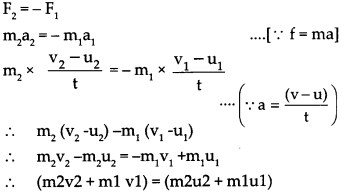
(1) 1 went over during the interval and sat down beside her.
(2) None of us are getting any younger.
(3) It was twenty years ago.
(4) I had eighty francs to last me the rest of the month.
Answer:
(1) interval
(2) younger
(3) twenty
(4) eighty

Question 16.
Complete the following:
(1) The profession of the narrator: a writer.
(2) The lady was free on the following Thursday.
(3) At the time when the writer met the lady, he was living in a tiny apartment in Paris.
(4) The lady wanted to meet the narrator to have a chat with him.
Answer:
(1) a writer
(2) on the following Thursday
(3) tiny apartment in Paris
(4) have a chat with him

Question 17.
Where and when did they decide to have luncheon?
Answer:
They decided to have a little luncheon at Foyot’s restaurant on the following Thursday.

Question 18.
Choose the correct options from the brackets and fill in the blanks: (pass, caught sight of, overload, modest, addressed, luncheon, interval)
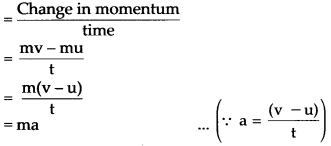
(1) The film was so boring that we went home during the interval.
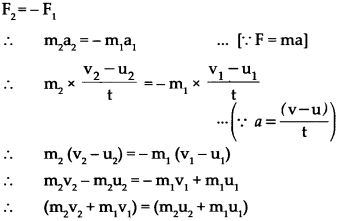
(2) Though it was a modest apartment, it was extremely clean.
Answer:
(1) interval
(2) modest

Question 19.
Find out the ‘Synonyms’ from the passage for the words:
(1) A set of rooms:
(2) Acknowledged:
(3) Handle:
(4) Directed a remark:
Answer:
(1) Apartment
(2) Recognized
(3) Manage
(4) Addressed

Question 20.
Rewrite the following sentence using the antonym of the underlined word: We’re none of us getting any younger.
Answer:
We’re all of us getting older.

Question 21.
Rewrite the following sentence using ‘except’: The only free moment she had was on the following Thursday.
Answer:
She had no free moment except on the following Thursday.

Question 22.
I hardly think about it. (Begin the sentence with ‘How …!)
Answer:
How little I think about it!

Maharashtra Board Solutions

Question 23.
She had read a book of mine. (Begin the sentence with ‘Hadn’t …?)
Answer:
Hadn’t she read a book of mine?

Question 24.
If you were in the place of the narrator, how would you have reacted in the given situation?
Answer:
If I were in the place of the narrator, I would have bluntly told the lady that I was a struggling writer and could not afford to give her a luncheon at Foyot’s. I would have suggested some cheaper restaurant that I could afford. I would not try to show off, or spend more than I can afford,ust to impress someone.

Question 25.
They decided to have luncheon at Foyot’s restaurant at half-past twelve on a Thursday.
Answer:
Foyot’s restaurant at half-past twelve on a Thursday.

Question 26.
The writer ‘was startled when the menu was brought because ………………
Answer:
The prices were a great deal higher than what he had thought.

Question 27.
What do you think the woman reassured the narrator about?
Answer:
The woman realized that the narrator was startled when he saw the prices on the menu. So she indirectly reassured him that he would not have to spend much, for she never ate anything for luncheon.

Question 28.
‘I never eat anything for luncheon’. Explain the irony in this line.
Answer:
The irony is that after informing the author that she never ate anything for luncheon, the lady immediately wanted salmon and caviar, some of the most expensive items available.

Question 29.
From the sentences given below pick out the sentence that indicates that the lady was doing exactly the opposite of what she was saying.
(1) ‘I think you’re unwise to eat meat.”
(2) ‘‘I don’t believe in overloading my stomach.”
Answer:
“I don’t believe in overloading my stomach.”

Question 30.
Choose the correct options from the brackets and fill in the blanks: (pass, startled, overload, imposing, afford, generously, reassured, unwise)
(1) I was …………… when I saw that I remembered all that I had revised.
(2) The monument was really very ………………… .
(3) You cannot ………… to waste time with friends during exams. (Board’s Model Activity Sheet)
Answer:
(1) reassured
(2) imposing
(3) afford

Question 31.
Change the voice of the following sentences:
(1) She reassured me.
(2) I ordered it for my guest.
Answer:
(1) I was reassured by her.
(2) It was ordered for my guest, (by me)

Maharashtra Board Solutions

Question 32.
“You’re unwise to eat meat,” she said. (Rewrite in indirect speech)
Answer:
She told him that he was unwise to eat meat.

Question 33.
Are you careful in your eating habits?
Answer:
My mother sees that I eat healthily, and I like I fruits and salads. However, when I am with friends and we go out, I eatunk food. I know it is important to eat healthy food and I take good care to do so.

Question 34.
Name the food items mentioned in the passage
Answer:
The food items mentioned in the passage are:
(1) caviar,
(2) mutton chops,
(3) salmon,
(4) asparagus

Question 35.
Explain what the use of the word ‘sank’ suggests about the narrator’s feelings.:
Answer:
The use of the word ‘sank’ suggests that the narrator was getting unhappy and worried about his guest’s desire to eat expensive food.

Question 36.
From the sentences given below, pick out the sentence that indicates that the lady was doing the exact opposite of what she was saying: (Board’s Model Activity Sheet)
(1) “I see that you’re in the habit of eating a heavy luncheon.”
(2) “Why don’t you follow my example andust: eat one thing.”
Answer:
“Why don’t you follow my example andust eat one thing.”

Question 37.
Choose the correct options from the brackets and fill in the blanks: (pass, quite seriously, water, gaily, insist, mortifying, dramatic)
(1) The ……………… turn of events shocked all of us.
(2) It was ……………. to apologise to the bully.
(3) My mother waved ………………… to me as she went for the hike.
(4) The author’s guest took him ………………. to task.
Answer:
(1) dramatic
(2) mortifying
(3) gaily
(4) quite seriously

Question 38.
Fill in the blanks with the words from the brackets: (Board’s Model Activity Sheet) (task, menu, wondered)
(1) The ……………… to rescue the flood victims was very difficult.
(2) I was thinking about buying a new vehicle and …………………. if we had the money.
(3) The restaurant …………………. seemed to be tempting.
Answer:
(1) task
(2) wondered
(3) menu

Maharashtra Board Solutions

Question 39.
She ate the caviar and she ate the salmon. (Begin the sentence with not only … but also and rewrite the sentence.)
Answer:
Not only did she eat the caviar but she also ate the salmon.

Question 40.
Rewrite the following sentence as an affirmative sentence: I couldn’t possibly eat anything more unless they had some of those giant asparagus.
Answer:
I could possibly eat something more only if they had some of those giant asparagus.

Question 41.
Which food do you prefer to eat-home food or restaurant food. Why?
Answer:
My mother cooks very tasty food and hence I prefer to eat home food. It is also always fresh. Restaurant food is generally oily, spicy and often prepared under unhygienic conditions. All this is unhealthy. I believe that health is wealthhence I prefer home food.

Question 42.
Complete the web: (The answers are given directly and underlined.)
Answer:
Maharashtra Board Class 10 English Solutions Unit 4.2 The Luncheon 1

Question 43.
‘Thera a terrible thing happened.’ Describe the narrator’s emotions at this point in the story. Why does he mot express this emotion?
Answer:
At this point in the story, the writer had given up ail hopes that he could pay the bill. He was resigned to his fate. He had mentally decided on different methods to save his reputation. He does not express this emotion because the lady had already eaten a lot of expensive food: the damage was already done. Besides, he did not want to look mean in her eyes.

Question 44.
Match the columns:

‘A’‘B’
(1) head(a) peaches
(2) terrible(b) mouthfuls
(3) huge(c) waiter
(4) large(d) thing

Answer:

‘A’‘B’
(1) head(c) waiter
(2) terrible(d) thing
(3) huge(a) peaches
(4) large(b) mouthfuls

Maharashtra Board Solutions

Question 45.
Complete the table:

PositiveComparativeSuperlative

Answer:

PositiveComparativeSuperlative
(1) hungryhungrierhungriest
(2) terriblemore terriblemost terrible

Question 46.
Rewrite the following in reported speech: “Are you still hungry?” I asked faintly.
Answer:
I asked her faintly whether she was still hungry.

Question 47.
Pick out the modal auxiliaries from the following sentence and write what they indicate: “One should always get up from a meal feeling one could eat a little more.”
Answer:
Should – indicates advice. Could – indicates ability.

Question 48.
‘I was past caring now’. Explain why, in your view, the narrator feels this way.
Answer:
The writer had been worried from the beginning that he would not be able to pay the bill. To add to that, his guest had ordered some of the most expensive items on the menu. He had now given up all hopes of being able to pay the bill. Hence, he says that he was past caring now.

Question 49.
Write if the following statements are True or False:
(1) The writer thought that the lady was mean.
(2) The writer’s tip was rather inadequate.
(3) The lady was now like a stone.
(4) The writer planned to have a heavy dinner.
Answer:
False
True
False
False

Question 50.
Complete the reasons:
(a) The writer planned to ‘eat nothing’ for dinner that night because….
Answer:
The writer had no money left after paying for the luncheon. He also wanted to make his luncheon guest aware of how much she had made him spend. Hence, he said that he planned to ‘eat nothing’ for dinner that night.

(b) The lady thought that the writer was mean because
Answer:
The writer had only three francs left to tip the waiter. His guest did not know this, and seeing this inadequate sum, thought he was mean.

Question 51.
Complete the table by picking the various humorous instances and the particular lines from the passage.

Humorous instanceLine from the passage
Maharashtra Board Solutions

Answer:

Humorous instanceLine from the passage
1. The woman is a voracious eater.“Follow my example, and never eat more than one thing for luncheon.” *
2. The writer had no money for dinner.“I’ll do better than that,” I retorted, “I’ll eat nothing for dinner tonight.”
3. The woman had become very fat.Today she weighs twenty- one stone.

Question 52.
Fill in the blanks with one word from the passage for the following: (The answers are given directly and underlined.)
(1) Something that is not enough: ………………….
(2) A man who is revengeful: ………………….
(3) A person who fills his or her writings with humour: ………………….
(4) A person who is stingy and does not like to spend money: ………………….
Answer:
(1) inadequate.
(2) a vindictive man.
(3) a humorist.
(4) a mean person.

Question 53.
Pick out the verbs from the following sentences and write their tense:
(1) I’ have just had a snack and I shall enjoy a peach.
(2) The bill came and when 1 paid it I found that I had only enough for a quite inadequate tip.
Answer:
(1) have had – present perfect tenseshall enjoy – simple future tense.
(2) came, paid, found, had – simple past tense.

Question 54.
Do you think that the lady never ‘ate more than one thing for luncheon’ on a regular basis?
Answer:
No, I’m sure she ate a large luncheon every day, but fooled herself into thinking that she was eating only one thing. She seems to be a foolish and thick-skinned woman who believes whatever is convenient to her.

Maharashtra Board Solutions

Question 55.
(1) Pick out an infinitive from the lesson and use it in your own sentence.
(2) Punctuate: humorist she cried gailyumping into a cab youre quite a humorist
(3) Find out five hidden words from the given word: satisfaction
(4) Use the following phrase in your own sentence: the only free moment
(5) Spot the errors and rewrite the correct sentence: She have read a book of mine and have written to me about it.
(6) Identify the type of sentence: How time does fly!
(7) Write the correct verb + present/past participles from the following:
(1) attract
(2) write
(3) pass
(4) bear
(5) eat
(6) meet
(8) Arrange the following in alphabetical order: table, tumbler, tablespoon, teaspoon
Answer:
(1) to eat: I was hungry, and I knew it was time to eat.
(2) “Humorist!” she cried gaily,umping into a cab. “You’re quite a humorist!”
(3) satisfaction: fiction, fission, faint, stint, satin
(4) the only free moment: The Principal was so busy that the only free moment she had was during lunch.
(5) She had read a book of mine and had written to me about it.
(6) Exclamatory sentence
(7) (1) attract-atractting
(2) write-written
(3) pass-passing
(4) bear-bearring
(5) eat-eatten
(6) meet-meeted
(8) table, tablespoon, teaspoon, tumbler

Question 56.
Use the following word and its homograph in two separate sentences : mine
Answer:
(i) I knew that the book was mine,
(ii) Three people entered the coal mine to inspect it.

Question 57.
‘I’m not in the least hungry,” my guest sighed, “but if you insist, I don’t mind having some asparagus.” (Rewrite in reported speech.)
Answer:
My guest told me with a sigh that she was not in the least hungry, but that if I insisted, she wouldn’t mind having some asparagus.

Question 58.
Word Register: Complete the web showing the things that the woman ate or drank throughout the luncheon.
Maharashtra Board Class 10 English Solutions Unit 4.2 The Luncheon 2
Answer:
Maharashtra Board Class 10 English Solutions Unit 4.2 The Luncheon 3

Question 59.
Why don’t you follow my example? (Change the voice beginning Why ….)
Answer:
Why isn’t my example followed (by you)?

Maharashtra Board Solutions

Question 60.
Use the following word as a verb and a noun in two separate sentences: mind
(2) I chose the cheapest dish on the menu. (Rewrite in the positive and comparative forms.)
Answer:
(1)

  • “Mind your language, young man,” said the shopkeeper angrily, (verb)
  • I knew that I had to keep all the instructions in my mind, (noun)

(2) I chose the dish that was cheaper than all the other dishes on the menu, (comparative)
No other dish on the menu was as cheap as the one I chose, (positive)

Maharashtra Board Class 9 Science Solutions Chapter 9 Environmental Management

Balbharti Maharashtra State Board Class 9 Science Solutions Chapter 9 Environmental Management Notes, Textbook Exercise Important Questions and Answers.

Maharashtra State Board Class 9 Science Solutions Chapter 9 Environmental Management

Class 9 Science Chapter 9 Environmental Management Textbook Questions and Answers

1. Match the items in column ‘A’ with the proper ones in coloum ‘B’ and explain their impact on the environment.

Column ‘A’ Column ‘B’
1. Harmful waste – a. Glass, rubber, carry bags, etc.
2. Domestic waste – b. Chemicals, pigments, ash, etc.
3. Biomedical waste – c. Radioactive material
4. Industrial waste – d. Left over food, vegetables, peelings of fruits.
5. Urban waste – e. Bandages, cotton, needles, etc.
Answer:
(1 – c),
(2 – d),
(3 – e),
(4 – b),
(5 – a)

Maharashtra Board Class 9 Science Solutions Chapter 9 Environmental Management

2. Complete the statements using the given options and justify those statements. (Geographic favourability, climate, weather, observatory)

a. Of the abiotic factors that affect biodiversity by far the most important is ……………… .
Answer:
Climate.
Climate influences our basic needs like food, clothing and shelter as well as our occupations. Various factors of climate like temperature, atmospheric pressure, sunlight, rainfall, humidity etc. will decide which kind of plants and animals can survive there.

b. A description of the climatic conditions of short duration in a particular area is ……………… .
Answer:
Weather.
Atmospheric conditions at a specific time at a particular place are referred to as weather. Weather is related to a specific location and specific time whereas climate is related to a longer duration and larger area.

c. Irrespective of the progress of human beings, we have to think about ……………… .
Answer:
Geographical favourability.
Geographical favourability includes location, availability of water, availability of natural resources and climate of a region. This has a great impact on the progress of human beings. Countries that have more favourable factors will progress more.

d. Establishments where various climatic factors are recorded are called ……………… .
Answer:
Observatories
Most countries in the world have established meteorology departments for recording climatic factors. These departments have observatories which are equipped with modern instruments and technology.

3. Answer the following questions.

a. How is first aid provided to victims of disasters who are injured?
Answer:
(i) Bleeding: If the victim is injured and bleeding through the wound, the wound should be covered with an antiseptic pad and pressure applied on it for 5 minutes with either thumb or palm.

Fracture and impact on vertebrae: If any bone is fractured, it is essential that the fractured part be immobilized. It can be done with the help of any available wooden rods / batons / rulers. If there is an impact on the back or vertebral column; the patient should be kept immobile on a firm stretcher.

Bums: If victims have bum injuries, it is beneficial to hold the injured part under clean and cold flowing water for at least 10 minutes. How is Solid Waste classified? OR What are the sources of Solid Waste?

Domestic waste: Waste food, paper, plastic paper, plastic bags, vegetable waste, fruit skins, glass and sheet metal articles, etc. Maharashtra Board Class 9 Science Solutions Chapter 9 Environmental Management

Industrial waste: Chemicals, pigments, sludge, ash, metals, etc.

Hazardous waste: Chemicals generated in various industries, radioactive materials, explosives, infectious materials, etc. Farm/Garden waste: Leaves, flowers, branches of trees, crop residues like straw, animal urine and dung, pesticides, remains of various chemicals and fertilizers, etc.

Electronic waste: Non-functional TV sets, cell phones, music systems, computers and their parts, etc.

Biomedical waste: Bandages, dressings, gloves, needles, saline bottles, medicines, medicine bottles, test tubes, body parts, blood, etc. from clinics, hospitals, blood banks and laboratories. Urban waste: Waste generated through household industries and large commercial and industrial establishments, carry bags, glass, metal pieces and rods, threads, rubber, paper, cans from shops, vegetable and meat markets, construction waste, etc.

(viii) Radioactive waste: Radioactive materials like Strontium-10, Cerium-141, Barium-140 and heavy water, etc. generated from atomic energy plants, uranium mines, atomic research centres, nuclear weapons testing sites, etc.
(ix) Mining waste: Remains of heavy metals like lead, arsenic, cadmium, etc. from mines.

b. State the scientific and eco-friendly methods of waste management.
Answer:
Following are the scientific and eco-friendly methods of waste management:

  • Waste separation: In this method, dry and wet wastes are separated, stored and later collected for proper use.
  • Composting: Decomposition of degradable kitchen waste in small pits in the backyard, garden or terrace is called composting. Good quality manure can be produced by composting leftover food, peels of fruits, vegetables etc.
  • Vermicomposting: Converting solid waste into manure or compost with the help of earthworms is called vermicomposting.
  • Vermicompost manure is highly nutritious and can be used for agricultural purposes and garden plants.
  • Secured landfill: Solid waste is disposed off in secured landfills.
  • The site for secured landfill is selected minimum 2 km away from water bodies and human habitation.
  • Care is taken to see that the site does not fall in sensitive zone.
  • The landfills are layered with clay and plastic and then the garbage is spread and left to decompose naturally.
  • Pyrolysis: In this method, the waste is heated to a high temperature to obtain gas and electricity.
  • Semi-combustible waste is burnt in pyrolysis. It is suitable for municipal solid waste management.
  • Incineration: Biomedical waste is burnt in incinerators to kill the pathogens. Disinfection and sterilization is also done while treating the biomedical waste.

Maharashtra Board Class 9 Science Solutions Chapter 9 Environmental Management

c. Explain with suitable examples, the relationship between weather forecasting and disaster management.
Answer:

  1. Depending upon the factors such as storms, clouds, rainfall, etc., weather forecasts are made. It is useful in aviation, shipping, fishing, industries as well as during natural calamities like dust storms, sand storms, heavy rainfall, tsunami etc where proper predictions are made with well equipped satellites and highclass technology.
  2. Observatories at several locations are doing excellent work in the analysis of the information received from these satellites.
  3. This data can be used in prevention of losses and danger, improving tolerance, providing relief from disaster, minimising the intensity and extent of harm as well as preparation to face the disaster.

d. Why is e-waste harmful? Express your opinion about this.
Answer:

  • e-waste is electronic waste which includes non-functional TV Sets, cell phones, music systems, computers and their parts, etc.
  • E-waste contains heavy metals like lead, beryllium, mercury and cadmium.
  • These metals accumulate in the soil for long periods and thus affect the biodiversity of the soil.
  • Many a times e-waste like battery etc. contain acids which make the soil acidic.
  • e-waste can cause ground water pollution, which also affects living organisms when they drink this polluted water.
  • Thus, e-waste affects human health and soil microorganisms directly or indirectly.

e. How will you register individual your participation in solid waste management?
Answer:
We can register our individual participation in solid waste management in the following ways:

  • Following the 3R mantra: Reduce (reducing the waste), reuse (reuse of waste) and recycle (recycling of waste).
  • Throwing plastic wrappers of chocolates, ice-creams, biscuits, etc. into dust bins. Avoid littering.
  • Avoiding the use of plastic bags and instead using cloth bags or bags prepared from old sarees, bed-sheets, curtains, etc.
  • Using both sides of a paper for writing. Reusing greeting cards and gift papers.
  • Avoiding use of tissue paper and preferring to use one’s own handkerchief.
  • Using rechargeable batteries instead of lead batteries.
  • Implementing various programmes of solid waste management and educating, encouraging the family and society in this regard. Maharashtra Board Class 9 Science Solutions Chapter 9 Environmental Management
  • Avoiding ‘use and throw’ type of articles like pens, canned cold drinks and tetra-packs etc.

4. Write notes.
Meteorology, Climatic factors, Monsoon model, Industrial waste, Plastic waste, Principles of first aid.

5. Give examples of the importance of climate in the living world with explanations, in your own words.
Answer:

  1. Daily weather as also long term climatic conditions influence human lifestyle directly or indirectly.
  2. Land, water bodies, plants and animals collectively form the natural environment on earth. This environment is responsible for the development of organisms.
  3. The climate of a particular region helps to determine the diet, clothing, housing, occupations and lifestyle of the people of that region. For example, the characteristic lifestyle of Kashmiri and Rajasthani people.
  4. Salinity of marine water, formation of oceanic currents, water cycle, etc. are all related to various weather and climatic factors.
  5. Various climatic factors bring about the weathering of rocks in the earth’s crust.
  6. Climate plays a very important role in the formation and enrichment of soil.
  7. Microbes in the soil play an important role in formation of organic materials. This process depends upon various climatic factors.

6. Explain with suitable examples, the care to be taken when using the methods of transporting patients.
Answer:

  • Cradle Method: This method is used for children and under-weight victims.
  • Carrying piggy back: This method is used for carrying patients who are unconscious.
  • Human crutch method: If one of the legs is injured, the victim should be supported with minimum load on the other leg. Maharashtra Board Class 9 Science Solutions Chapter 9 Environmental Management
  • Pulling or lifting method: This method is used for carrying an unconscious patient, through a short distance.
  • Carrying on four-hand chair: This method is used when support is needed for the part below the waist.
  • Carrying on two-hand chair: This method is useful for those patients who cannot use their hands but can hold their body upright.
  • Stretcher: In an emergency, if a conventional stretcher is not available, then a temporary stretcher can be made using bamboo, blanket, etc.

7. Explain the differences.

a. Weather and climate
Answer:

WeatherClimate
(i)Atmospheric conditions at a specific time at a particular place are referred to as weather.(i)The climate of a particular region is the average of daily readings of various weather-related parameters recorded for several years.
(ii)Weather can change continuously.(ii)Climate remains constant in a region for a long duration.
(iii)Weather is related to a specific location and specific time.(iii)Climate is related to a longer duration and larger area.
(iv)Changes in the weather may occur for short periods of time.(iv)Changes in the climate take place slowly over a much long duration.

b. Degradable and non-degradable waste
Answer:

Degradable WasteNon-degradable Waste
(i)This type of waste is easily degraded by microbes.(i)This type of waste is not easily degraded by microbes because it takes a very long period of time and the use of various techniques.
(ii)It includes kitchen waste (spoiled food, fruits, vegetables), ash, soil, dung, parts of the plants etc.(ii)It includes plastic, metal and other similar materials.
(iii)It is also called wet solid waste or wet garbage.(iii)It is also called dry solid waste or dry garbage.
(iv)If it is carefully decomposed, we can obtain compost and fuel of good quality from it.(iv)It can be recycled.

Maharashtra Board Class 9 Science Solutions Chapter 9 Environmental Management

Class 9 Science Chapter 9 Environmental Management Intext Questions and Answers

Can you recall?

Environmental Management Class 9 Question 1.
Which natural calamities have you experienced? How did they affect the conditions in your surroundings?
Answer:
In July 2005, heavy rains caused flooding in many parts of Maharashtra including large areas of Mumbai.

They effects were as follows.

  • Many people lost life.
  • There was water clogging in most parts causing severe damage to private property and public property.
  • Hospitals were submerged causing severe inconvenience to patients.
  • The city incurred huge financial loss.

Environmental Management Class 9 Exercise  Question 2.
How will you make a plan to be safe from calamities or to minimize the damage?
Answer:

  1. As a responsible citizen we can contribute by educating the people about all the precautions to be taken when such a calamity occurs.
  2. We can also contribute by minimizing the occurrence of natural calamity like flood by taking measure to reduce land pollution, proper disposing waste material and recycling them.
  3. We can plan to be safe by keeping the following things handy-torch, first-aid kit, ample food supply and water storage, emergency numbers list and extra pair of clothes.

Thus by taking appropriate measures, we can be safe from calamities

Maharashtra Board Class 9 Science Solutions Chapter 9 Environmental Management

Class 9 Science Chapter 9 Environmental Management  Question 3.
How does the atmosphere affect our daily life?
Answer:
The atmosphere affect our daily life in following ways

  • If protects us from harmfull radiations of sun.
  • Atmosphere helps to sustain life on earth by providing oxygen for human beings and animal to breathe and carbon dioxide to plants.
  • It helps in keeping us warm due to green house effect.

Environmental Management Class 9 Answers Question 4.
Forecasts about which weather related factors are given during the news bulletins on Doordarshan and Akashvani?
Answer:
Forecasts about different weather related factors such as cloud cover, rain, snowfall, wind speed and temperature are given during the news bulletins on Doordarshan and Akashvani.

9 Environmental Management Exercises  Question 5.
What is meant by pollution?
Answer:
Contamination of natural environment that can harmfully affect the ecosystem is called as pollution.

9th Class Science Chapter 9 Environmental Management Exercise Question 6.
What is meant by solid waste?
Answer:
The waste materials generated through the various daily human activities are called solid waste.

Maharashtra Board Class 9 Science Solutions Question 7.
What are the different things included in solid waste?
Answer:
Domestic waste, industrial waste, hazardous waste, electronic waste, biomedical waste, urban waste, radioactive waste and mining waste are the different things included in solid waste.

Maharashtra Board Class 9 Science Solutions Chapter 9 Environmental Management

Question 8.
Why is it necessary to recycle non-degradable waste?
Answer:
(i) non-degradable waste cannot be easily degraded because it takes a very long period of time and the use of various techniques.
(ii) Therefore, non-degradable waste should be recycled so that it does not accumulate and cause hazards to the environment.

Question 9.
Which materials are included in solid dry waste?
Answer:
Solid dry waste includes paper, plastic, metals, glass, cardboard, thermocol etc.

Answer the following

Question 1.
In which different ways do our surroundings get polluted?
Answer:

  • Air pollution is caused due to emissions from industries, vehicles, burning of fossil fuels, construction, mining and agriculture.
  • Water pollution is caused by domestic sewage and industrial waste water released into the water bodies.
  • Soil pollution is caused due to industrial wastes, domestic waste, chemical fertilizers, biomedical waste and pesticides.
  • Noise pollution is caused by machines, vehicular traffic, loudspeakers and household appliances.

Question 2.
Which factors are affected favourably or unfavourably by climate? What must we do to minimize the effect?
Answer:

  • Climate plays a very important role in our day to day life.
  • It influences our basic needs like food, clothing and shelter as well as our occupations.
  • Climate is especially important for an agrarian country like India. Also climatic factors like direction and speed of the winds, temperature, atmospheric pressure etc. are also considered during construction work.
  • The science of meteorology helps in predicting climatic conditions by satellites in different ways such as prediction of rainfall, air pollution, dust storms, hot and cold waves tsunamic etc.
  • so that all the citizens are well-equipped beforehand and can take preventive measures.

Maharashtra Board Class 9 Science Solutions Chapter 9 Environmental Management

Question 3.
Into which two categories can the waste materials in the lists above be classified?
Answer:
The waste materials can be classified as biodegradable waste and non-biodegradable waste.

Answer the following:

Question 1.
Make a list of various waste materials and articles in your area and prepare a chart as follows:
Answer:
Maharashtra Board Class 9 Science Solutions Chapter 9 Environmental Management 6

Question 1.
Nowadays, an electronic device – the cell phone – is very popular. From a mobile shop near your house, find out how they dispose off old and broken down cell phones.
Answer:
Old and broken down cell phones are sold to scrap dealers, who sell to a bigger dealer where reusable parts are taken out and useless parts are sent for recycling.

Question 2.
What are the different types of casualties that are seen to occur in different types of disasters?
Answer:

  • Death.
  • Injuries.
  • Loss of limbs or body parts.
  • Burns.
  • Diseases.
  • Fractures.
  • Bleeding.
  • People becoming unconscious.

Maharashtra Board Class 9 Science Solutions Chapter 9 Environmental Management

Question 3.
Which waste management processes are used in your village/town / city?
Answer:
i. The Municipal Corporation or Municipality collects the various kinds of wastes like dry waste, solid waste, biomedical waste in different coloured containers and transports them to areas where they are treated and disposed off.

ii. Industrial waste is mostly recycled and biomedical waste is treated by the scientific methods mentioned below.

a. Solid waste is disposed off in secured land fills. The site for secured landfill is selected 2 km away from water bodies and away from human habitation. Care is taken to see that the site does not fall in sensitive zone. The landfills are layered with clay and plastic and then the garbage is spread and left.
b. Pyrolysis is done for semi combustible material. Semi combustible materials are heated to high temperature by gas arid electricity.
c. The municipality can also set up biogas plants where the solid waste is converted to biogas by anaerobic fermentation. The biogas can be used to generate power and also a good manure which can be used for agriculture.
(d) Biomedical waste is burnt in incinerators to kill the pathogens. Disinfection and sterilization is also done while treating biomedical waste by the Municipal Corporation.

These are some of the waste management processes used in village/town/city.

Answer the following questions:

Question 1.
Observe the garbage collected in the dustbin of your classroom and make a list of the various materials in it.
Discuss with your teacher, how these materials can be properly disposed off. Can we do the same with the garbage generated in our house? Think about it.
Maharashtra Board Class 9 Science Solutions Chapter 9 Environmental Management 1
Answer:
(i) Garbage collected in classroom dustbin:

  • Waste paper and paper bits.
  • Pencil shavings
  • Wrappers of chocolates, biscuits etc.
  • Left over food from tiffins and fruit peels.
  • Empty ball pen refills.

Maharashtra Board Class 9 Science Solutions Chapter 9 Environmental Management

(ii) Out of these left over food from tiffins and fruit peels and pencil shaving can be used to make compost manure in school garden. The remaining waste can be sold to scrap dealers and sent for recycling.
(iii) Yes, we can do the same with the garbage generated in the house.

Question 2.
What is the main difference between what we see in the two pictures alongside (A and B).
Maharashtra Board Class 9 Science Solutions Chapter 9 Environmental Management 2
Answer:

  • We see that in picture A there is lot of garbage spread around making the place very dirty, whereas in picture B, there is no garbage and the place is absolutely neat and clean.

Question 3.
What should we do to permanently maintain the condition seen in picture B?
Answer:
To permanently maintain the condition seen in picture B, we should follow the 3R mantra (Reduce, Reuse, Recycle). Also, we must avoid littering, throwing plastic bags, wrappers of chocolates, ice-creams, biscuits etc.

Class 9 Science Chapter 9 Environmental Management Additional Important Questions and Answers

Choose and write the correct option

Question 1.
is a long term predominant condition of the atmosphere.
(a) Climate
(b) Weather
(c) Pressure
(d) Biosphere
Answer:
(a) Climate

Maharashtra Board Class 9 Science Solutions Chapter 9 Environmental Management

Question 2.
Various climatic factors like are considered during construction of runways, seaports, huge bridges and skyscrapers, etc.
(a) Direction and speed of wind
(b) Temperature
(c) Atmospheric pressure
(d) All of these
Answer:
(d) All of these

Question 3.
The was established by the United Nations Organization on 23rd March 1950.
(a) World Health Organization
(b) National Oceanographic and Atmospheric Administration
(c) World Meteorological Organization
(d) Indian Institute of Tropical Meteorology
Answer:
(c) World Meteorological Organization

Question 4.
is/are related to various weather and climatic factors.
(a) Salinity of marine water
(b) Formation of ocean currents
(c) Water cycle
(d) All of these
Answer:
(d) All of these

Question 5.
is the founder of IMD.
(a) Dr. Vasantrao Govarikar
(b) H.F. Blanford
(c) Sir Gilbert Walker
(d) Dr. Radhakrishnan Nair
Answer:
(b) H. F. Blanford

Question 6.
The monsoon model based upon 16 worldwide parameters was developed by the initiative of
(a) Dr. Vasantrao Govarikar
(b) H.F. Blanford
(c) Sir Gilbert Walker
(d) Virghese Kurien
Answer:
(a) Dr. Vasantrao Govarikar

Maharashtra Board Class 9 Science Solutions Chapter 9 Environmental Management

Question 7.
In , forecasts are made taking into account the estimates of current weather related events and ongoing physical activity.
(a) Statistical model
(b) Holistic model
(c) Mathematical model
(d) All of these
Answer:
(c) Mathematical model

Question 8.
In , predictions are based upon those parameters used in other models which have the greatest effect on the monsoon.
(a) Holistic model
(b) Mathematical model
(c) Statistical model
(d) Scientific model
Answer:
(a) Holistic model

Question 9.
Radioactive materials, explosives and infectious materials are classified as waste.
(a) Industrial waste
(b) Biomedical waste
(c) Urban waste
(d) Hazardous waste
Answer:
(d) Hazardous waste

Maharashtra Board Class 9 Science Solutions Chapter 9 Environmental Management

Question10.
are radioactive waste.
(a) Remains of heavy metals like arsenic, cadmium etc.
(b) Strontium-10, Cerium-141, Barium -140
(c) Waste from blood banks and laboratories
(d) All of these
Answer:
(b) Strontium-10, Cerium-141, Barium-140

Question 11.
Waste food, paper, plastic, vegetable and fruit waste etc. are classified as waste.
(a) Industrial waste
(b) Farm waste
(c) Domestic waste
(d) Urban waste
Answer:
(c) Domestic waste

Question 12.
is the 3 R mantra.
(a) Refuse, Research, Recycle
(b) Reduce, Reuse, Recycle
(c) Reduce, Reuse, Refuse
(d) Rethink, Recycle, Reuse
Answer:
(b) Reduce, Reuse, Recycle

Question 13.
is the largest producer of electricity from solid waste.
(a) India
(b) America
(c) Japan
(d) China
Answer:
(b) America

Maharashtra Board Class 9 Science Solutions Chapter 9 Environmental Management

Question 14.
Chemicals, pigments, sludge, ash, metals, etc. are classified as waste.
(a) Domestic waste
(b) Industrial waste
(c) Urban waste
(d) Hazardous waste
Answer:
(b) Industrial waste

Question 15.
Period of natural degradation for banana peels is
(a) 1 month
(b) 1-2 weeks
(c) 3-4 weeks
(d) 2 months
Answer:
(c) 3-4 weeks

Question 16.
Period of natural degradation for cloth bags is
(a) 2-3 weeks
(b) 1 month
(c) 5 months
(d) 1 year
Answer:
(b) 1 month

Maharashtra Board Class 9 Science Solutions Chapter 9 Environmental Management

Question 17.
Period of natural degradation for wood is
(a) 1 month
(b) 5 months
(c) 10-15 years
(c) 40-50 years
Answer:
(c) 10-15 years

Question 18.
Period of natural degradation for certain plastic bags is
(a) 50-100 years
(b) infinite duration
(c) 10 lakh years
(d) 1000 years

(c) 10 lakh years

Question 19.
Period of natural degradation for thermocol or Styrofoam cup is
(a) 10 lakh years
(b) infinite duration
(c) 200-250 years
(d) 1 year
Answer:
(b) infinite duration

Maharashtra Board Class 9 Science Solutions Chapter 9 Environmental Management

Question 20.
If any bone is fractured, it is essential that the fractured part be
(a) mobilized
(b) immobilized
(c) pulled
(d) massaged
Answer:
(b) immobilized

Question 21.
For transporting children and under-weight victims, method is used.
(a) carrying piggy back
(b) human crutch method
(c) cradle method
(d) stretcher
Answer:
(c) cradle method

Question 22.
method is useful to carry patients who are unconscious.
(a) Cradle Method
(b) Carrying piggy back
(c) Human crutch
(d) Carrying on four-hand chair
Answer:
(b) Carrying piggy back

Maharashtra Board Class 9 Science Solutions Chapter 9 Environmental Management

Question 23.
method is used for carrying an unconscious patient through a short distance.
(a) Carrying piggy back
(b) Cradle method
(c) Carrying on two-hand chair
(d) Pulling or lifting method
Answer:
(d) Pulling or lifting method

Question 24.
method is useful to carry patients who cannot use their hands but can hold their body upright.
(a) Carrying on four-hand chair
(b) Carrying on two-hand chair
(c) Carrying piggy back
(d) Cradle method
Answer:
(b) Carrying on two-hand chair

v 25.
method is used to carry patients when support is needed for the part below the waist.
(a) Carrying on four-hand chair
(b) Carrying on two-hand chair
(c) Stretcher
(d) Pulling or lifting method
Answer:
(a) Carrying on four-hand chair

Question 26.
For injuries like sprains, twisting and contusion, should be applied on the injured part.
(a) turmeric powder
(b) antiseptic pad
(c) ice-pack
(d) pressure
Answer:
(c) ice-pack

Maharashtra Board Class 9 Science Solutions Chapter 9 Environmental Management

Find the odd man out:

Question 1.
Waste food, paper, plastic, bandages.
Answer:
Bandages: It is a biomedical waste whereas the others are domestic waste.

Question 2.
Pesticides, fertilizers, crop residue, sludge.
Answer:
Sludge: It is an industrial waste whereas the others are farm waste.

Question 3.
Strontium -10, Cerium – 141, Barium – 140, Cadmium.
Answer:
Cadmium: It is a mining waste whereas the others are radioactive waste.

Question 4.
Banana peels, cloth bag, food waste, plastic bag.
Answer:
Plastic bag: It is a non-biodegradable waste whereas the others are degradable wastes.

Maharashtra Board Class 9 Science Solutions Chapter 9 Environmental Management

Question 5.
Fruits, ash, metals, vegetables.
Answer:
Metal: It is a non-biodegradable waste whereas the others are degradable wastes.

Complete the analogy:

(1) Specific duration and specific time: Weather : : Longer duration and longer time :
(2) Mumbai: 5000 tons solid waste :: Pune:
(3) Kitchen waste, parts of plants : Wet solid waste :: Plastic, metals :
(4) Largest producer of electricity from solid waste : America : : Production of useful materials from banana peelings :
(5) Cloth bags : 1 month : : Rags :
(6) Tin cans : 50-100 years : : Aluminium cans :
(7) Wood : 10-15 years :: Styrofoam :
Answer:
(1) Climate
(2) 1700 tons solid waste
(3) Dry solid waste
(4) Japan
(5) 5 months
(6) 200-250 years
(7) Infinite duration

Match the columns:

Question 1.

Column ‘A’Column ‘B’
(1) Mining waste(a) Leaves, flowers, crop residue.
(2) Electronic waste(b) Remains of heavy metals like lead, arsenic, cadmium.
(3) Farm waste(c) Strontium-10,
Cerium-141,
Barium-140
(4) Radioactive waste(d) Cell phones, TV sets, Computers

Answer:
(1 – b),
(2 – d),
(3 – a),
(4 – c)

Maharashtra Board Class 9 Science Solutions Chapter 9 Environmental Management

Question 2.

Column ‘A’Column ‘B’
(1) Banana peels(a) 10 lakh years.
(2) Plastic bags(b) 200-250 years.
(3) Leather shoes(c) 3-4 weeks
(4) Aluminium cans(d) 40-50 years

Answer:
(1 – c),
(2 – a),
(3 – d),
(4 -b)

Question 3.

Column ‘A’Column ‘B’
(1) Thermocol
(2) Tin cans
(3) Woollen socks
(4) Wood
(a) 1 year.
(b) Infinite duration.
(c) 10-15 years
(d) 50-100 years

Answer:
(1 – b),
(2 – d),
(3 – a),
(4 – c)

State whether the following statements are true or false. Correct the false statements:

Question 1.
Climate is a long term predominant condition of the atmosphere.
Answer:
True.

Maharashtra Board Class 9 Science Solutions Chapter 9 Environmental Management

Question 2.
Climate changes continuously.
Answer:
False. Climate does not change continuously. It remains constant in a region for a long duration.

Question 3.
If present climatic conditions are analysed with reference to the past climatic conditions, we can predict climatic changes of the future.
Answer:
True.

Question 4.
Forecasting is difficult for places where climatic changes are slow and of a limited nature.
Answer:
False. Forecasting is easy for places where climatic changes are slow and of a limited nature.

Question 5.
Climate plays a very important role in the formation and enrichment of soil.
Answer:
True.

Question 6.
Prediction maps are prepared once in 24 hours.
Answer:
False. Prediction maps are prepared twice in every 24 hours.

Question 7.
The first prediction of monsoon in India was made by Dr. Vasantrao Govariakar.
Answer:
False. The first prediction of monsoon in India was made my H.F. Blanford.

Maharashtra Board Class 9 Science Solutions Chapter 9 Environmental Management

Question 8.
H.F. Blanford used the rainfall in Kerala as the parameter for prediction of monsoon in India.
Answer:
False. H.F. Blanford used the snowfall in Himalayas as a parameter for prediction of monsoon in India.

Question 9.
In Holistic model, predictions are made taking into account estimates of current weather-related events and ongoing physical interactions between them.
Answer:
False. In Holistic model, predictions are based upon those parameters used in other models which have the greatest effect on monsoon.

Question 10.
Any meteorological model depends upon the inter-relationships between parameters used in that model and the results expected from it.
Answer:
True.

Question 11.
Remains of heavy metals like lead, arsenic, cadmium, etc. from mines are industrial waste.
Answer:
False. Remains of heavy metals like lead, arsenic, cadmium etc. from mines are mining waste.

Question 12.
Use of ‘use and throw’ type of articles like pens, canned cold drinks, tetra packs should be encouraged in waste management.
Answer:
False. Use of ‘use and throw’ type of articles like pens, canned cold drinks, tetra packs should be strictly avoided in waste management.

Maharashtra Board Class 9 Science Solutions Chapter 9 Environmental Management

Question 13.
We should use tissue paper instead of one’s own handkerchief for effective waste management.
Answer:
False. We should use one’s own handkerchief instead of tissue paper for effective waste management.

Question 14.
Certain plastic bags take 1 month to degrade.
Answer:
False. Certain plastic bags take 10 lakh years to degrade.

Question 15.
Banana peels can degrade in 3-4 weeks.
Answer:
True.

Question 16.
If the victim has burn injuries, it is beneficial to cover the burnt part with blanket.
Answer:
False. If the victim has burn injuries, it is beneficial to hold the injured part under clean and cold flowing water for at least 10 minutes.

Question 17.
CPR helps to bring the circulation to normal.
Answer:
True.

Question 18.
If breathing has stopped, the head should be held in backward sloping position.
Answer:
False. If breathing has stopped, the victim should be given artificial ventilation by mouth to mouth resuscitation.

Question 19.
Japan is the largest producer of electricity from solid waste.
Answer:
False. America is the largest producer of electricity from solid waste.

Maharashtra Board Class 9 Science Solutions Chapter 9 Environmental Management

Question 20.
China has developed the projects of production of threads, paper and other useful materials from banana peels.
Answer:
False. Japan has developed the projects of production of threads, paper and other useful materials from banana peels.

Define the following:

Question 1.
Weather
Answer:
Atmospheric conditions at a specific time at a particular place are referred to as weather.

Question 2.
Climate
Answer:
The climate of a particular region is the average of daily readings of various weather-related parameters recorded for several years.

Question 3.
Meteorology
Answer:
The science that studies the inter-relationships between the various components of air, natural cycles, geological movements of earth and climate is called meteorology.

Question 4.
Solid waste
Answer:
Waste materials generated through daily human activities are called solid waste.

Maharashtra Board Class 9 Science Solutions Chapter 9 Environmental Management

Question 5.
Urban waste
Answer:
Waste generated through household industries and large commercial and industrial establishments is called Urban waste.

Answer the following:

Question 1.
What is the necessity of solid waste management?
Answer:
Necessity of solid waste management:

  • For preventing environmental pollution and to keep the surroundings clean.
  • For energy as well as fertilizer production and through that to generate work and employment opportunities.
  • To reduce the strain on natural resources through treatment of solid waste.
  • To improve the health and quality of life and to maintain environmental balance.

Question 2.
What are the harmful effects of solid waste?
Answer:
Harmful effects of solid waste:

  • Effect on biodiversity.
  • Releases bad odour.
  • Produces toxic gases.
  • Leads to degradation of natural beauty.
  • Leads to pollution of air, water and soil.
  • Spreads diseases.

Maharashtra Board Class 9 Science Solutions Chapter 9 Environmental Management

Question 3.
What first-aid should be given for injuries like sprains, twisting and contusion?
Answer:
For injuries like sprains, twisting and contusion, the ‘RICE’ remedy should be applied:

  • Rest: Allow the victim to sit in a relaxed position.
  • Ice: Apply an ice-pack to the injured part.
  • Compression: After the ice-pack treatment, the injured part should be massaged gently.
  • Elevate: The injured part should be kept in a raised/elevated position.

Question 4.
Why do meteorological models need to be changed continually?
Answer:

  1. Any meteorological model depends upon the inter-relationship between parameters used in that model and the results expected from it.
  2. However, as these inter-relationships with reference to the ocean and atmosphere are never constant, meteorological models need to be changed continually.

Question 5.
What is urban waste? What does it include?
Answer:

  1. Waste generated through household industries and large commercial and industrial establishments is called urban waste.
  2. It includes carry bags, glass, metal pieces and rods, threads, rubber, paper, cans from shops, waste from vegetable and meat markets, construction waste etc.

Question 6.
What does biomedical waste include?
Answer:
biomedical waste includes bandages, dressings, gloves, needles, saline bottle, medicines, medicine bottles, test tubes, body parts, blood etc. from clinics, hospitals, blood banks and laboratories.

Write short notes on:

Question 1.
Meteorology
Answer:

  • The science that studies the inter-relationship between the various components of air, natural cycles, geological movements of the earth and climate is called meteorology.
  • Meteorology includes the study of storms, clouds, rainfall, thunder, lightning etc.
  • Depending upon the study of such factors, weather forecasts are made.
  • They are useful to common people, farmers, fisheries, aviation services, water transport and various other organizations. Maharashtra Board Class 9 Science Solutions Chapter 9 Environmental Management

Question 2.
Climatic factors
Answer:

  • The climate of a particular region is the average of daily readings of various weather-related parameters recorded for several years.
  • Climatic factors include direction and speed of wind, temperature, atmospheric pressure, clouds, rainfall, humidity, visibility etc.
  • These factors influence our basic needs like food, clothing, shelter as well as our occupations.
  • Various climatic factors bring about the weathering of rocks in the earth’s crust.
  • Microbes in the soil play an important role in formation of organic materials. This process also depends upon various climatic factors.

Question 3.
Monsoon model
Answer:

  1. The tradition of forecasting the monsoon season in India is older than 100 years.
  2. After the famine of 1877, H.F. Blanford, the founder of IMD had made such a prediction for the first time taking the snowfall in the Himalayas as a parameter for this prediction.
  3. In the decade of the 1930’s, the then director of IMD, Sir Gilbert Walker had underlined the relationship between various worldwide climatic factors and the Indian monsoon and based on available observations and previous recordings related to this relationship, he put forth a hypothesis regarding the nature of the monsoon.
  4. With the initiative of Dr. Vasantrao Govarikar in the decade of the 1990’s, a monsoon model based upon 16 worldwide climatic parameters was developed. This model was in use from 1990 to 2002.
  5. Presently, new models are being developed at IITM. Work is in progress at two levels, namely designing new models and developing new technology.
  6. The main focus is on the development of the radar system and satellite technology.

Maharashtra Board Class 9 Science Solutions Chapter 9 Environmental Management

Question 4.
Plastic waste
Answer:

  • Plastic waste is the accumulation of plastic products in the environment that adversely affects environment, humans and animals.
  • Plastic waste is excessively generated as plastic is inexpensive and durable.
  • Plastic is slow to degrade. It takes around 10 lakh years for certain plastic bags to degrade. .
  • Plastic waste affects land and water.
  • It also affects the health of animals, cattle unknowingly ingest these plastic bags leading to stomach cancer in them.
  • Plastic also releases toxic chemicals which are carcinogenic to humAnswer:
  • To avoid plastic waste, cloth bags should be used instead of plastic bags. Plastic articles should be recycled.

Question 5.
Industrial waste
Answer:

  • Industrial waste is the waste produced by industrial processes or activities.
  • There is a huge variety of industries producing different types of materials and articles. All of these use raw materials and give out a lot of waste.
  • There are hundreds of mines which extract copper, silver, gold, iron, coal etc. Huge quantities of waste are produced while processing them.
  • Cement industries give out solid, liquid and gaseous wastes.
  • While refining crude oil, a lot of poisonous gaseous and liquid wastes are produced.
  • Construction units produce huge quantities of waste stones, pebbles, broken bricks, wood waste etc. Mostly they are dumped in landfills.
  • It also includes chemicals, pigments, sludge, ash, metal, etc. given out from mining, textile, construction, chemical industries.

Question 6.
Principles of first aid
Answer:
Life and Resuscitation – ‘ABC’ is the Basic Principle of first aid which is provided to the victims of disaster.

  1. Airway: If the victim has difficulty in breathing, the head should be held in a backward sloping position or the chin should be raised so that the respiratory passage remains open.
  2. Breathing: If breathing has stopped, the victim should be given artificial ventilation by mouth to mouth resuscitation.
  3. Circulation: If the victim is unconscious, then after giving mouth to mouth respiration twice,

Maharashtra Board Class 9 Science Solutions Chapter 9 Environmental Management

Question 7.
Statistical Model
Answer:

  • In this model, current climatic observations in a region are compared with earlier parameters such as oceanic temperature, atmospheric” pressure and the nature of the monsoon rainfall for several years.
  • This data is comparatively analysed by statistical methods and predictions are made about the monsoon in the present conditions.

Question 9.
Holistic Model
Answer:

  • In this model, predictions are based upon those parameters used in other models which have the greatest effect on the monsoon.
  • Nowadays, predictions declared by IMD are the collective outcome of various model. This is called a holistic model.

Complete the following concept chart:

Question 1.
Weather-related climatic factors
Answer:
Maharashtra Board Class 9 Science Solutions Chapter 9 Environmental Management 3

Question 2.
Harmful effects of solid waste
Answer:
Maharashtra Board Class 9 Science Solutions Chapter 9 Environmental Management 4

Question 3.
Scientific and eco-friendly waste Management
Answer:
Maharashtra Board Class 9 Science Solutions Chapter 9 Environmental Management 5

Answer in detail:

Question 1.
What are the principles of solid waste management?
Answer:
Principles of solid waste management:

  • Reuse: After use, materials should be reused for some other proper purposes.
  • Refuse: Refusal to use articles made from non- degradable articles like plastic and thermocol.
  • Recycle: Production of useful articles by recycling solid wastes. For example, paper and glass can be recycled.
  • Rethink: Rethinking our habits, activities and their consequences in connection with the use of various articles of daily use. Maharashtra Board Class 9 Science Solutions Chapter 9 Environmental Management
  • Reduce: Restricting the use of resources to avoid their wastage.
  • Old materials should be reused. One thing should be shared by many, use and throw type of objects should be avoided.
  • Research: Conducting research related to reuse of materials that are temporarily out of use.
  • Regulation and Public awareness: Following the laws and rules related to waste management and motivating others to do the same.

Question 2.
What is disaster management? What actions does it include?
Answer:
Disaster management is action implemented through proper planning, organized activity and co-ordination.

It includes the following:

  • Prevention of loss and danger.
  • Improving tolerance.
  • Providing relief from disaster, minimising the intensity and extent of harm.
  • Preparation to face the disaster.
  • Immediate action in the disaster situation.
  • Assessment of damages and intensity of the disaster.
  • Arranging for rescue work and help.
  • Rehabilitation and rebuilding.

Question 3.
Write a short note on : Indian Meteorological Department
Answer:

  • The Indian Meteorological Department was founded by the British in 1875 at Shimla.
  • Its head office is at Pune and its Regional offices are at Mumbai, Kolkata, Chennai, Nagpur and Delhi.
  • Maps are prepared every day which indicate the daily predictions about the weather.
  • Such maps are prepared and published twice in every 24 hours.
  • In this institute, research goes on continuously on various aspects like instruments for climatic readings, predictions made about climate using radar, predictions about climate related to seismology, predictions regarding rainfall by satellites, air pollution etc. Maharashtra Board Class 9 Science Solutions Chapter 9 Environmental Management
  • The Indian Meteorological Department provides information regarding weather and climatic conditions to other departments like aviation, shipping, agriculture, irrigation, marine oil exploration and production etc.
  • Predictions regarding calamities like dust storms, sand storms, heavy rainfall, hot and cold waves, tsunami, etc. are communicated to various departments, all types of mass communication media and all citizens.
  • India has launched several satellites equipped with highclass technology.
  • Observatories at several locations are doing excellent work in the analysis of the information received from these satellites.


Maharashtra Board Class 10 English Solutions Unit 4.5 The Old Man and The Sea Book Review

Balbharti Maharashtra State Board Class 10 English Solutions Unit 4.5 The Old Man and The Sea Book Review Notes, Textbook Exercise Important Questions and Answers.

Maharashtra State Board Class 10 English Kumarbharati Textbook Solutions Unit 4.5 The Old Man and The Sea Book Review

Maharashtra Board Class 10 English Solutions Unit 4.5 Warming Up Questions and Answers

The Old Man And The Sea Book Review Class 10 Question 1.
Pair up with your partner and answer the following questions :
(a) Which animal would you relate yourself to and why?
Answer:
I would relate to a cat. This is because like a cat, I am lazy. I am also reserved and do not show my emotions easily. I choose my friends carefully and am not friendly with anybody and everybody.

Maharashtra Board Solutions

(b) Do you have a hero or a role model to look up to? Who is he/she?
Answer:
Yes, my role model is my grandmother. Though she has led a very difficult life because she was poor, she is always optimistic and sees the best in people. She is always cheerful and ready to learn new things. She has learnt how to use the computer and surfs the internet regularly. She is even learning a new language with the help of the computer! She is health-conscious and does yoga regularly. I wish to be like her.

(c) Do you have a passion you would fight for? Why?
Answer:
Yes, my passion is planting trees. Afforestation is the answer to. many of the ills plaguing our country, like water shortage and soil erosion. Planting forests will stop this. When I grow up. I plan to fight for a green cover for our planet.

(d) What is meant by a review?
Answer:
A ‘review’ is a critical evaluation of something – a book, a film, a play, etc.

(e) Have you ever read any book review? If yes, which one? If no, make it a point to read one.
Answer:
Yes, I have read a book review. It was of a Harry Potter book. I read it in a newspaper and it gave me an idea of what to expect in the book, without knowing the details.

The Old Man And The Sea Section 1 Answers Question 2.
Make a list of famous novels of Ernest Hemingway. Two are given to you.
(1) A Farewell to Arms
(2) For Whom the Bell Tolls.
(3) ………………………………………
(4) ………………………………………
(5) ………………………………………
(6) ………………………………………
(7) ………………………………………
Answer:
(1) A Farewell to Arms.
(2) For Whom the Bells Toll.
(3) The Sun also Rises.
(4) The Garden of Eden.
(5) Islands in the Stream.
(6) To Have and Have Not.
(7) The Torrents of Spring.

Maharashtra Board Solutions

The Old Man And The Sea Question Answers Question 3.
Ernest Miller Hemingway was a famous American novelist, short story writer and journalist. Make a list of other famous American novelists. Complete the web filling the boxes with the names of famous American novelists.
Maharashtra Board Class 10 English Solutions Unit 4.5 The Old Man and The Sea Book Review 1
Answer:
Maharashtra Board Class 10 English Solutions Unit 4.5 The Old Man and The Sea Book Review 2

The Old Man and The Sea Book Review Class 10 English Workshop Questions and Answers Maharashtra Board

The Old Man And The Sea Book Report Question 1.
Read the passage and name the following.
(a) Young and devoted apprentice
(b) The place where Hemingway had experience of fishing
(c) That which Hemingway was injured by, during First World War
(d) Language of the novel
(e) In his first reading, the review writer was left
Answer:
(a) Manolin
(b) Cuban waters
(c) shrapnel
(d) simple and pithy
(e) unimpressed

Maharashtra Board Solutions

The Old Man And The Sea Book Review Question 2.
Correct the following sentences using facts from the review.
(a) Manolin’s parents insisted on his working with the same old fisherman.
(b) This novel is pure fiction.
(c) Hemingway’s style of writing does not unfold the hidden meaning.
(d) The relationship between the old man and Manolin is coarse.
Answer:
(a) Manolin’s parents insisted on his working with another fisherman.
(b) This novel is based on real events and draws heavily from incidents in Hemingway’s own life.
(c) Hemingway’s style of writing is such that a reader can read his work again and again and find new layers of meaning every time.
(d) The relationship between the old man and Manolin is heart-warming.

The Old Man And The Sea Questions And Answers Question 3.
Compare the points that you would use for a book review with those of the review of a play and write in your notebook.
Answer:

Book ReviewReview of a playReview of a film
(1) Story Line(1) Story Line, Theme and Climax(1) Story Line
(2) Social/Historical Context(2) Actors/Actresses and their Presentations(2) Acting
(3) Writing Style(3) Use of lights, music and special effects(3) Direction
(4) My Thoughts.(4) Use of Sets, Costumes and Make-up
(5) My Thoughts and rating.
Maharashtra Board Solutions
(4) Editing
(5) Cinematography
(6) Music and sound effects
(7) Special effects
(8) My thoughts and rating

The Old Man And The Sea Review Question 4.
The line – ‘I first read this novel years ago, when I did not understand it at all and was left unimpressed.’ tells us about the book reviewer’s opinion about the book. Complete the following sentences using the expressions.
(1) In my opinion, every hard working person achieves success in life.
(2) I strongly feel that ……………………………………………………….
(3) I wish I could ……………………………………………………….
(4) As far as I know you ……………………………………………………….
(5) I think ……………………………………………………….
Answer:
(1) every hardworking person achieves success in life.
(2) there should be a complete ban on tobacco.
(3) go to the moon.
(4) have never taken part in a debate.
(5) they know what they are doing.

Old Man And The Sea Book Review Question 5.
The review describes the struggle between the old man with the marlin and sharks, Ernest Hemingway’s struggle against defeat or death and noble struggle against destruction. Find all the words from the text that are related to the word ‘brave’ or ‘courage’.

  • strength
  • ……………………………………….
  • ……………………………………….
  • ……………………………………….
  • ……………………………………….

Answer:

  • strength,
  • formidable.
  • strong,
  • determination,
  • endurance,
  • triumph,
  • struggle.

Maharashtra Board Solutions

The Old Man And The Sea Answers Question 6.
The review mentions struggles of both the writer, Ernest Hemingway and the old man. Fill the incidents of struggle of Hemingway in table A and those of the old man in table B.

Table ATable B
Ernest HemingwayOld man

Answer:

Table ATable B
Ernest HemingwayOld man
(1) injured by shrapnel during the First World War(1) has a run of terrible bad luck
(2) faces the destruction caused by the two World Wars(2) unable to catch fish for 84 days
(3) his apprentice, Manolin leaves him
(4) the marlin he hooks is too strong for him
(5) battles with sharks
(6) very near death

Question 7.
Read the text again. You will find that the text contains many phrases. Match the phrases in ‘A’ and their meanings in ‘B’. After matching their meanings, make sentences of your own

‘A’ Phrases‘B’ Meanings
1. run of terrible bad lucka. triggered a feeling or memory
2. draws heavily onb. without being affected by a particular factor
3. struck a chordc. endure in difficult circumstances
4. in spite ofd. a period of time when bad things happen
5. holding one. makes use of

Answer:

‘A’ Phrases‘B’ Meanings
1. run of terrible bad luckd. a period of time when bad things happen
2. draws heavily one. makes use of
3. struck a chorda. triggered a feeling or memory
4. in spite ofb. without being affected by a particular factor
5. holding onc. endure in difficult circumstances

Maharashtra Board Solutions

Question 8.
(A) Rewrite as directed, without change of meaning, in your notebook.
(1) Hemingway’s novel is based on real events. (Convert the underlined adjective to an Adjectival Clause)
(2) He hooks a marlin but the marlin is too strong for him. (Rewrite beginning with ‘Although’)
(3) The reader can read his work again and again and find new layers of menaing. (Begin the sentence with ‘On reading’)
(4) As the novel progresses, the old man and the marlin are inseparably linked. (Rewrite using ‘progress’ as a Noun)
(5) Being strong, the marlin starts pulling the boat. (Rewrite inserting ‘and’ as a Co-ordinator)
(6) When I first read this novel, I was unimpressed. (Rewrite using ‘but’ as a Co-ordinator)
Answer:
(1) Hemingway’s novel is based on events which are real.
(2) Although he hooks a marlin, the marlin is, too strong for him.
(3) On reading his work again and again, the reader can find new layers of meaning.
(4) In the course of the progress of the novel, the old man and the marlin are inseparably linked.
(5) The marlin is strong and starts pulling the boat.
(6) I had read this novel before but I was unimpressed at that time.

(B) Write the ‘root-word’ after dropping the prefix or suffix or both.
(1) unable ……………………………………….
(2) heavily ……………………………………….
(3) determination ……………………………………….
(4) endurance ……………………………………….
(5) unimpressed ……………………………………….
(6) relationship ……………………………………….
(7) inseparably ……………………………………….
(8) empathetic ……………………………………….
(9) beautiful ……………………………………….
(10) simplicity ……………………………………….
Answer:
(1) unable – able
(2) heavily – heavy
(3) determination – determine
(4) endurance – endure
(5) unimpressed – impress
(6) relationship – relate
(7) inseparably – separate
(8) empathetic – empathy
(9) beautiful – beauty
(10) simplicity – simple

Maharashtra Board Solutions

Question 9.
Write a book review on any book of your choice with the help of the following points.

  • Story line
  • Social/Historical content
  • Writing style
  • My thought

Answer:

Pride and Prejudice: Book review.

Story Line:
‘Pride and Prejudice’ is a romantic novel written by Jane Austen and first published in 1813. The book follows the life of Elizabeth Bennet, a headstrong, intelligent woman. It takes place in the early 1800s and is about the emotional development of the main character.

Elizabeth has four sisters and no brother. According to the succession rights, none of the girls can inherit the property, and Mrs. Bennet (Elizabeth’s mother) thinks that good marriages are the only way for them to lead a good life. Her main ambition in life is to see that her daughters marry wealthy men. However, the novel emphasizes that one should marry for love and not only for money. Mr. Bennet tolerates his wife’s behaviour and is dryly sarcastic when she is silly. There are villainous characters like George Wickham and comic ones like Mr. Collins.

Social/Historical Context:
In Pride and Prejudice, the Bennets are members of the educated upper middle class. At that time, a man’s income was always reported as a ‘number of pounds per year’. Mr Bingley has ‘four or five thousand a year’ while Darcy’s income is a very impressive 10,000 a yepr. Thus, Darcy is considered to possess a fortune, and hence a very eligible bachelor.

The formal manners of behaviour are obvious in the custom of paying visits and leaving calling cards, the necessity of giving formal introductions, etc. Marriage was considered to be the only acceptable role for any woman, and getting married was high on the list of priorities. The clothes and customs all reflect the time. The French revolution was in progress during the time of the writing of this novel. Though it is difficult to relate to such customs and such priorities today, the novel still holds our interest.

Writing Style:
Jane Austen has portrayed her characters well, and given good character sketches of all, whether it is the silly, materialistic Mrs. Bennet as the mother or Elizabeth as the strong-willed daughter. Jane Austen’s writing is sharp, with plenty of sarcasm and irony. Many times it is a bit too detailed; but that was the style of writing at that time. She wrote about ordinary people and their ordinary lives in an exceptional way. She recognized the flaws in society, especially as far as marriage is concerned. The opening words of her novel, ’It is a truth universally acknowledged, that a single man in possession of a good fortune, must be in want of a wife.’, are unforgettable and are still quoted.

Maharashtra Board Solutions

My Thoughts:
When I first read it, it was out of compulsion; it was a part of our school activity, and I disliked it. I was too small to appreciate the undertones. I found too many unnecessary details. However, when I read it a few years later, I had already read many other books based in that time period. Hence, I could appreciate their customs, their dresses and their way of talking. I had alsu seen a film based on it. and things became clearer. I plan to read it again and see if I can find new meaning in it now.

Question 10.
You know the essential points required for a book review. Now form pairs and find essential points required for a play review and film review. You can take help of your teacher, library or the internet.

Book ReviewPlay ReviewFilm Review

Answer:

Book ReviewPlay ReviewFilm Review
(1) Story Line
(2) Social/Historical Context
(3) Writing Style
(4) My Thoughts.
(1) Story Line, Theme and Climax
(2) Actors/Actresses and their Presentations
(3) Use of lights, music and special effects
(4)    Use of Sets, Costumes and Make-up
(5)    My Thoughts and rating.
(1) Story Line
(2) Acting
(3) Direction
(4) Editing
(5) Cinematography
(6) Music and sound effects
(7) Special effects
(8) My thoughts and rating

Question 11.
Project
Classroom Library :
Ask all your classmates to donate a book each to the class. In this way everyone will have a book of his/her own to read. Read the book in a week or two. After reading it, exchange your book with your classmate. Keep exchanging and reading books for the whole year. Every fortnight give the book review of the book that you have read recently in the form of a presentation.

Question 12.
Complete the following:
(1) Hemingway had experience of …………………..
(2) He worked for ………………….. during the First World War.
(3) ‘The Old Man and The Sea’ was published in …………………….
Answer:
(1) fishing in the Cuban waters.
(2) The Red Cross
(3) 1952

Maharashtra Board Solutions

Question 13.
Describe the general mood of the people when the novel was published.
Answer:
When the novel was published, people were trying to recover from the mass destruction caused by the two World Wars.

Question 14.
Sentences:

(1) The young actor had a …………………… at the beginning of his career.
(2) This painter …………………… the old masterpieces.
(3) The girl’s sad story immediately …………………… with the news reporter.
(4) Lata Mangeshkar’s songs …………………… for a long time.
Answer:
(1) run of terrible bad luck
(2) draws heavily on
(3) struck a chord
(4) will live on

Question 15.
Find the synonyms (one word) for the following from the passage:
(i) The ability to do something difficult for a long time: ……………
(ii) Formed or worked: ……………
Answer:
(i) endurance
(ii) wrought

Question 16.
The old man is, at the end of the novel, very near death, but we know that the story of his suffering and loss will live on in the memories of the people of his village. (Rewrite the sentence using ‘Though’)
Answer:
Though the old man is, at the end of the novel, very near death, we know that the story of his suffering and loss will live on in the memories of the people of his village.

Question 17.
During the First World War, Hemingway was injured by shrapnel. (Begin the sentence with ‘Shrapnel….’)
Answer:
Shrapnel injured Hemingway during the First World War.

Question 18.
Do you like to read books? If so, what type? If not, why?
Answer:
I do like to read books. I like to read mystery novels. I find them very thrilling and interesting. I am a big fan of Agatha Christie and Arthur Conan Doyle. I have read nearly the whole Sherlock Holmes series of short stories.

Question 19.
(a) After recent reading the reviewer was left: ……………………
(b) It fights for its life desperately: ……………………
Answer:
(a) moved and impressed
(b) the marlin

Maharashtra Board Solutions

Question 20.
Hemingway practises an extreme economy in his use of words’. What does this mean?
Answer:
It means he uses very few words to express his thoughts and ideas.

Question 21.
What are the ideals that the old man and the marlin both stand for?
Answer:
The old man and the marlin both stand for the same ideals, that is, a noble struggle against destruction.

Question 22.
Complete the following web:
Answers:
Maharashtra Board Class 10 English Solutions Unit 4.5 The Old Man and The Sea Book Review 3

Question 23.
Sentences:
(1) Hussain was ill; in spite of this, he stood first in the test.
(2) I could see the new rider holding on to the reins desperately.
(3) The little boy looked longingly at the puppy again and again.
(4) The symbol of a white dove stands for peace.
Answer:
(1) in spite of
(2) holding on
(3) again and again
(4) stands for

Question 24.
Find the synonyms for the following from the passage:
(i) Brief: …………………..
(ii) Likely to make someone believe something that is not true: ………………….
Answer:
(i) pithy
(ii) deceptive

Question 25.
Write four to five sentences about your favorite writer.
Answer:
My favorite writer is Arthur Conan Doyle, the creator of Sherlock Holmes. Every story written by Doyle is different and holds my interest right till the end. The stories are so gripping that one cannot put the book down easily. I borrow the books from the library to read during the vacation.

Maharashtra Board Solutions

Question 26.
(1) Write down two compound words from the passage.
(2) Pick out an infinitive from the lesson and use it in your own sentence.
(3) Find out five hidden words from the given word t endurance
(4) Use the following phrase in your own sentence: even after his death
(5) Spot the error/errors and rewrite the correct sentence: The novel was publishing in 1952
(6) Identify the type of sentence: I first read this novel years ago, when I did not understand it at all.
(7) Hemingway always talks about the need to struggle. (Replace the infinitive with a gerund.)
(8) From the following verbs, pick out the verb which forms its present and past participle by doubling the last letter: run, write, swim, fan.
(9) Complete the word chain with verbs of your own. write, e………., r………., r………., t……… .
Answer:
(1) fisherman, baseball
(2) to catch: The fielder tried to catch the ball.
(3) endurance: endure, dance, under, crane, creed.
(4) even after his death: People remembered the great leader with love and respect even after his death.
(5) The novel was published in 1952
(6) Assertive (negative)
(7) Hemingway always talks about the need for struggling.
(8) fan – fanning, fanned.
(9) write, enter, remember, report, think.

Question 27.
(1) Use the following word and its homophone in two separate sentences: sail
(2) He worked for the Red Cross. (Rewrite using the past progressive tense of the verb.)
(3) A reader can read his work again and again. (Change the voice beginning ‘His work ….)
Answer:
(1) (i) The sail of the huge boat fluttered in the breeze,
(ii) The old woman loves shopping wherever there is a sale.
(2) He was working for the Red Cross.
(3) His work can be read again and again (by a reader).

Maharashtra Board Solutions

Question 28.
(1) Use the given two words in one meaningful sentence: formidable, beautiful.
(2) Recently, I read this book again and was extremely moved. (Rewrite as a complex sentence.)
Answer:
(1) It was a formidable job to make the dilapidated old house beautiful again.
(2) I was extremely moved when I recently read the book again.

Maharashtra Board Class 9 Geography Solutions Chapter 2 Endogenetic Movements

Balbharti Maharashtra State Board Class 9 Geography Solutions Chapter 2 Endogenetic Movements Notes, Textbook Exercise Important Questions and Answers.

Maharashtra State Board Class 9 Geography Solutions Chapter 2 Endogenetic Movements

Class 9 Geography Chapter 2 Endogenetic Movements Textbook Questions and Answers

1. Tick in front of the correct option ✓

(a) On which of the following are slow movements in the earth’s interior dependent?
Landforms [ ]
Velocity [ ]
Direction [ ]
Answer:
Velocity

Maharashtra Board Class 9 Geography Solutions Chapter 2 Endogenetic Movements

(b) When waves divert from each other, what do they create
Compression [ ]
Tension [ ]
Mountain [ ]
Answer:
Tension

(c) For the formation of a rift valley, which of the following processes should occur in the earth’s crust?
Compression [ ]
Tension [ ]
Weathering [ ]
Answer:
Tension

(d) Which of these is a fold mountain?
The Satpudas [ ]
The Himalayas [ ]
The Western Ghats [ ]
Answer:
The Himalayas

(e) The formation of extensive plateaus is a result of which type of movements?
Mountain-building [ ]
Continent-building [ ]
Horizontal [ ]
Answer:
Continent-building

2. Give geographical reasons.

(a) Buildings collapsed at the foothills of the Himalayas because of an earthquake. Before collapsing they were moving forward and backward.
Answer:

  • The seismic waves can be divided into primary, secondary and surface waves.
  • The primary waves are the first ones to reach the surface of the earth after the energy is emitted in the Earth’s interior.
  • Subjected to a ‘P’ wave, particles in the rock move in the direction of waves to and fro and therefore, these waves are also called forward-backward waves. Maharashtra Board Class 9 Geography Solutions Chapter 2 Endogenetic Movements
  • Thus, during an earthquake, the buildings at the foothills of the Himalayas moved forward and backward as they were first subjected to “P” waves.

(b) There is a difference in the formation of the Meghalaya Plateau and the Deccan Plateau.
Answer:

  1. The Meghalaya plateau is formed due to slow movements (orogenic movements) whereas the Deccan Plateau is formed due to sudden movements (fissure volcano).
  2. During the formation of the Meghalaya plateau, a part of the Earth’s crust in between two parallel faults was lifted forming a plateau whereas, the Deccan plateau was formed due to molten material coming out with the eruption spreading on both sides of the fissure.
  3. Thus, there is a difference in the formation of the Meghalaya plateau and the Deccan plateau.

(c) Most of the volcanoes are found on the plate boundaries.
Answer:

  • The plate boundaries are directly related to the areas of volcanoes.
  • Most of the volcanoes are located on the plate boundaries.
  • The part of the plate boundary which slides under the crust, results in the loss of material. Such boundaries are called plate consuming boundaries.
  • In areas where new material (magma) is coming up onto the Earth’s crust, they are called plate creating boundaries.
  • Both the processes result in earthquakes and volcanoes. Thus, most of the volcanoes are formed in the plate boundaries.

(d) The Barren Island is becoming conical in shape.
Answer:

  • Barren island which was considered a dormant volcano has become active since February 2017.
  • Mainly dust, smoke and mud are coming out of this eruption along with some lava.
  • During eruption, the lava is spread around the mouth of this vent, when it comes out.
  • As a result, a cone-shaped mountain starts forming. Maharashtra Board Class 9 Geography Solutions Chapter 2 Endogenetic Movements

Therefore Barren Island is becoming conical in shape.

(e) Volcanic eruptions can cause earthquakes.
Answer:

  • Generally, the movements in the Earth’s interior occur in the upper layer of the mantle
  • Tremendous energy is released by radioactive materials present here.
  • This leads to a sudden movement in form of volcanic eruptions where hot solid, liquid and gaseous materials are forcefully thrown out from the mantle of the Earth, onto the surface of the Earth.
  • This causes a lot of instability within the crust of the Earth which would also lead to the release of pressure in the form of seismic waves or tremors causing earthquakes.

3. Identify and name the internal movement.

(a) Tsunamis are generated in coastal areas.
Answer:
Sudden Movement

(b) The Himalayas are an example of fold mountains.
Answer:
Slow movement – Mountain Building Movements.

(c) Molten magma is thrown out of the earth’s mantle.
Answer:
Sudden Movement

(d) Rift valley is formed because of faulting.
Answer:
The slow movement – Upward – Downward Movement.

4. Arrange the following statements in chronological order in which an earthquake occurs.

(a) The earth’s surface vibrates
Answer:
The plates suddenly move.

(b) The plates suddenly move.
Answer:
Due to the movements in the mantle compression goes on increasing.

(c) Due to the movements in the mantle, compression goes on increasing.
Answer:
Along the weak point (faultlines) rocks break apart.

(d) Along the weak points ( faultlines) rocks break apart.
Answer:
Stored energy is released in the form of seismic waves.

Maharashtra Board Class 9 Geography Solutions Chapter 2 Endogenetic Movements

(e) Stored energy is released in the form of seismic waves.
Answer:
The earth’s surface vibrates.

5. Distinguish between

(a) Block Mountain and Fold Mountain
Answer:

Block MountainFold Mountain
(i) When a part of the earth’s crust between two parallel faults is lifted a block mountain is formed.(i) Because of the energy waves and pressure working towards each other, the layers of the soft rocks form folds leading to the formation of fold mountains.
(ii) Block mountains are formed due to tension.(ii) Fold mountains are formed due to compression.
(iii) e.g. The Black forest mountains of Europe and the Meghalaya Plateau of India.(iii) e.g. The Himalayas, the Aravalis, the Rockies, the Andes, the Alps

(b) Primary and Secondary Seismic Waves
Answer:

Primary Seismic WavesSecondary Seismic waves
(i) Primary waves are the first one to reach the surface of the earth after the energy is emitted in the Earth’s interior.(i) The waves which reach the Earth’s surface after the primary waves are called secondary waves.
(ii) Primary waves can travel through solid, liquid and gaseous medium.(ii) Secondary waves can travel only through only solid medium.
(iii) While travelling through liquid medium, primary waves change their direction.(iii) Secondary waves get absorbed as they enter the liquid medium.
(iv) The waves move to and fro in the direction of energy transfer.(iv) These waves move up and down in the direction of energy transfer.

(c) Earthquakes and volcanoes
Answer:

EarthquakesVolcanoes
(i) Earthquake is the movement of the Earth’s crust.A volcano is an opening in the Earth’s crust from which hot solid, liquid and gaseous materials are thrown out from the mantle of.
(ii) Nothing is ejected out during an earthquake.During a volcanic eruption, ash, water vapor, various types of poisonous and inflammable gases, hot molten magma etc. is ejected from the earth’s interior.

6. Answer in brief
(a) Give reasons why an earthquake occurs.
Answer:

  • When the movements occur in the interior of the Earth, tremendous tension is created in the Earth’s crust.
  • When the tension goes beyond limits, the energy is released in the form of waves.
  • This results in the trembling of the earth’s surface, i.e. an earthquake occurs.

Maharashtra Board Class 9 Geography Solutions Chapter 2 Endogenetic Movements

Following are the reasons for the occurrence of an earthquake:

  • Moving of the plates
  • Colliding of the plates
  • Plates sliding one below the other
  • Forming of fractures in rock layers, due to tension in the interior of the Earth.
  • Occurring of volcanic eruption

(b) Which type of movements have led to the formation of the major fold mountains in the world?
Answer:

  • Fold mountains are formed due to mountain-building (erogenic) movements.
  • Energy is transferred from the interior of the Earth. Because of these energy waves and pressure working towards each other and in horizontal direction, the layers of the soft rocks form folds.
  • If the pressure is very high, large scale folds are formed and their complexity increases.
  • As a result, the surface of the Earth gets uplifted and fold mountains are formed.
  • The Himalayas, the Aravalis, the Rockies, the Andes, the Alps are the major fold mountains of the world.

(c) How is the magnitude of the earthquake-related to the collapse of houses
Answer:

  • Through a seismogram, a graph showing movement of seismic waves (seismograph) can be generated.
  • After studying this graph, the magnitude of the earthquake is known.
  • The magnitude of the earthquake is measured with the help of a richter scale.
  • It is because of the primary waves that the buildings on the Earth’s surface move back and forth.
  • The buildings on the Earth’s surface move up and down because of the secondary waves. These are more destructive than the T’ waves leading to collapse of buildings.

(d) What are the effects of earthquakes on the earth’s surface and human life?
Answer:
Following are the effects of earthquakes:

  • Cracks/fractures develop on the ground.
  • These causes landslides which leads to sliding of rocks.
  • Sometimes the groundwater changes its course. For example, wells may get water, or may dry up.
  • Some areas get uplifted while some may subside.
  • Tsunamis are generated in oceans These waves can cause great loss of life and property in the coastal areas.
  • In snow-covered areas, avalanches may occur.
  • Buildings collapse and loss of life and property occurs.
  • Transportation routes get disrupted.
  • The communication system collapses.

(e) Explain the types of seismic waves.
Answer:
When the intension is released at the focus, the released energy travels in all directions. This energy comes towards the Earth’s surface in the form of waves. The seismic waves can be divided into primary, secondary and surface waves.
(i) Primary or ‘P’ waves:

  • These waves are first to reach the surface of the Earth, after the energy is emitted in the Earth’s interior. They travel at a very fast speed from the focus of the earthquake in radial direction.
  • The waves moves to and fro, therefore these waves are called forward-backward waves.
  • These waves can travel through all the three states – liquid, solid and gaseous.
  • While travelling through liquid medium, their direction gets changed. It is because of the primary waves that the buildings on the Earth’s surface move back and forth.

Maharashtra Board Class 9 Geography Solutions Chapter 2 Endogenetic Movements

(ii) Secondary or ‘S’ waves :

  • The waves which reach the Earth’s surface after I the primary waves are called secondary waves. :
  • These waves also scatter in all directions from the focus of the earthquake.
  • Their velocity is less than ’P’ waves.
  • The particles lying in the way of these waves j move up and down in the direction of energy transfer.
  • These waves can travel only through the solid medium and they get absorbed as they enter the liquid medium.
  • The buildings on the Earth’s surface move up and down because of these waves. These are more destructive than ‘P waves.

(iii) Surface or ‘L’ waves :

  • These waves are generated after the main ’P’ and ‘S’ waves reach the epicenter.
  • They travel in the direction of the circumference of the Earth, along the crust and are highly destructive.

(f) Explain the types of volcanoes on the basis of the periodicity of eruption with examples.
Answer:
According to the periodicity of the volcanic eruptions, three types of volcanoes can be identified.
(i) Active Volcanoes –

  • If the volcanic eruptions are regular even in the present times, then such volcanoes are called active volcanoes.
  • E.g., Mt Fujiyama in Japan and Mt. Stromboli in the Mediterranean Sea.

(ii) Dormant Volcanoes –

  • When a volcano has not erupted since long, but may become active suddenly is called a dormant volcano.
  • E.g., Mt. Vesuvius in Italy, Mt. Katmai in Alaska and Barren Island, India.

(iii) Extinct volcanoes –

  • Those volcanoes which have not erupted in the past since long and are not likely to erupt in the future are called extinct volcanoes.
  • E.g., Mr. Kilimanjaro in Tanzania.

7. Show the epicenter, focus and the primary, secondary and surface waves of an earthquake with the help of a neat labeled diagram.
Answer:
Maharashtra Board Class 9 Geography Solutions Chapter 2 Endogenetic Movements 2

8. Show the following on a given outline map of the world.

(a) Mt. Kilimanjaro
(b) Mid-Atlantic Earthquake zone
(c) Mt. Fuji
(d) Krakatoa
(e) Mt. Vesuvius
Answer:
Maharashtra Board Class 9 Geography Solutions Chapter 2 Endogenetic Movements 1

Class 9 Geography Chapter 2 Endogenetic Movements Intext Questions and Answers

Can you tell?
Read the following news. Observe the photograph and answer the questions.
Maharashtra Board Class 9 Geography Solutions Chapter 2 Endogenetic Movements 3

Question 1.
What caused large-scale casualties?
Answer:
Calamity of earthquake led to large scale casualties.

Maharashtra Board Class 9 Geography Solutions Chapter 2 Endogenetic Movements

Question 2.
What was the magnitude of the earthquake?
Answer:
The magnitude of the earthquake was 7.9 Richter scale.

Question 3.
Which country was the most affected because of this earthquake?
Answer:
Nepal was most affected because of this earthquake.

Question 4.
Where was the epicentre of the earthquake?
Answer:
Lamjung in Nepal was the epicentre of the earthquake.

Question 5.
Which are the other affected areas?
Answer:
Bihar, West Bengal and Uttar Pradesh in India as well as China, Bhutan, Pakistan and Bangladesh were affected by earthquake.

Question 6.
At what depth was the focus located?
Answer:
The focus of the earthquake was located at the depth of 11 km.

Question 7.
What kind of damage is seen because of the earthquake?
Answer:
Nearly 1500 people were killed and over 1000 people were injured in the disaster.

Question 8.
According to you, what could be the reason behind the earthquake?
Answer:
The sudden release of energy from the interior of the earth leads to earthquakes.

Question 9.
Have you ever experienced a similar earthquake? Discuss.
Answer:
Answers may vary.

Class 9 Geography Chapter 2 Endogenetic Movements Additional Important Questions and Answers

Complete the statements choosing the correct option from the bracket:

Question 1.
Richter scale is a unit of measuring the magnitude of a/an
(a) volcano
(b) creation of plate
(c) earthquake
(d) earth movement
Answer:
(c) earthquake

Maharashtra Board Class 9 Geography Solutions Chapter 2 Endogenetic Movements

Question 2.
There are in all major plates on the Earth.
(a) five
(b) seven
(c) nine
(d) four
Answer:
(b) seven

Question 3.
Large scale and sudden release of energy in the interior of the Earth gives rise to Earth movements.
(a) slow
(b) sudden
(c) internal
(d) external
Answer:
(b) sudden

Question 4.
Earthquakes occur due to the movement of
(a) plates
(b) earth
(c) oceans
(d) land
Answer:
(a) plates

Question 5.
Earthquake is measured with the help of an instrument called a
(a) seismogram
(b) thermometer
(c) barometer
(d) hygrometer
Answer:
(a) seismogram

Question 6.
If lava is released through a vent, it is called a vent volcano.
(a) fissure
(b) central
(c) upper
(d) below
Answer:
(b) central

Question 7.
Kilimanjaro is a volcano.
(a) central type
(b) fissure type
(c) extinct type
(d) dormant type
Answer:
(a) central type

Maharashtra Board Class 9 Geography Solutions Chapter 2 Endogenetic Movements

Question 8.
A tremendous amount of energy is given out by the radioactive elements in the
(a) crust
(b) core
(c) mantle
(d) sial
Answer:
(c) mantle

Question 9.
The movements that give rise to mountains are called movements.
(a) epiorogenic
(b) orogenic
(c) slow
(d) sudden
Answer:
(b) orogenic

Question 10.
When a portion of the crust between two parallel faults2 is raised up, it is called a mountain.
(a) block
(b) fold
(c) residual
(d) ancient
Answer:
(a) block

Question 11.
The area between two adjoining faults subsides, such area of subsidence is called
(a) rift valley
(b) block mountain
(c) fold mountain
(d) faulting
Answer:
(a) rift valley

Question 12.
Black Forest Mountain in Europe is a mountain.
(a) fold
(b) residual
(c) block
(d) ancient
Answer:
(c) block

Question 13.
The movements that give rise to continents are
(a) orogenic
(c) fold
(b) epeirogenic
(d) fault
Answer:
(b) epeirogenic

Maharashtra Board Class 9 Geography Solutions Chapter 2 Endogenetic Movements

(Endogenetic Movements Class 9 Geography Chapter 2 )Tick in front of the correct option.

Question 1.
Which of these is a block mountain?
(a) Black forest mountain
(b) Alps
(c) Andes
Answer:
(a) Black forest mountain

Question 2.
Which type of volcano has eruptions regularly even during present times?
(a) Dormant
(b) Extinct
(c) Active
Answer:
(c) Active

Give one word for each of the following:

Question 1.
A volcano, where lava reaches the surface through a vent or a pipe.
Answer:
Central Vent Volcano

Question 2.
An instrument, which is used for recording earthquakes.
Answer:
Seismogram

Question 3.
The surface position immediately above the origin of an earthquake.
Answer:
Epicenter

Question 4.
An example of a volcanic plateau.
Answer:
Deccan Plateau.

Question 5.
An example of Conical volcanic mountains.
Answer:
Mt. Kilimanjaro

Maharashtra Board Class 9 Geography Solutions Chapter 2 Endogenetic Movements

(Class 9 Geography Chapter 2 Endogenetic Movements Questions And Answers ) Answer in one sentence each.

Question 1.
What are Endogenetic processes?
Answer:
Endogenetic processes are processes that originate internally in the Earth’s surface. E.g. earthquakes, volcanoes, continent building, mountain building etc.

Question 2.
What is a Richter scale?
Answer:
It is a scale for expressing the magnitude of an earthquake.

Question 3.
What is a Focus or Hypocentre?
Answer:
The point below the Earth’s surface where energy is released during an earthquake is called the focus of the earthquake.

Question 4.
What are Primary Waves?
Answer:
The earthquake waves that reach the surface of the Earth first, immediately after the energy is released in the interior of the Earth, are called Primary waves.

Question 5.
What are Secondary Waves?
Answer:
The earthquake waves reporting at the surface after the primary waves are called the secondary waves.

Question 6.
What are Surface Waves?
Answer:
Primary and secondary waves affect the surface on reaching it. As a result a new set of waves gets generated at the surface. These waves are called surface waves.

Question 7.
What are Plates?
Answer:
The parts of varying sizes of the Earth’s crust floating on the upper portion of the mantle are called plates.

Question 8.
What do you mean by an Epicentre?
Answer:
The point located on the surface of the Earth nearest to the focus is called the epicenter of the earthquake.

Question 9.
Explain Orogenic Movements
Answer:
The slow movements in the interior of the Earth that give rise to mountains are called orogenic movements (mountain building movements).

Maharashtra Board Class 9 Geography Solutions Chapter 2 Endogenetic Movements

Question 10.
What is Folding1?
Answer:
As energy moves through the interior of the Earth, soft rocks are subjected to pressure leading to creation of folds called folding.

Question 11.
Define Fault.
Answer:
The fracture line created in a rock due to the energy waves moving away from each other is called a fault.

Question 12.
What is a Block Mountain?
Answer:
A raised portion of the crust between two parallel faults is called a block mountain.

Question 13.
What is a Rift valley?
Answer:
The area of subsidence between two adjoining faults is called a rift valley.

Question 14.
Explain Epeirogenic Movements.
Answer:
The Earth’s slow movements that give rise to continents and extensive plateaus are called epeirogenic movements.

Question 15.
Explain the process of Volcanic Eruption.
Answer:
A process in which hot solid, liquid and gaseous materials are thrown out from the mantle of the earth onto the surface of the earth, is called volcanic eruption.

Identify and name the internal movements.

Question 1.
Dust, smoke and mud with some lava coming out of Barren Island.
Answer:
Sudden Movement

Maharashtra Board Class 9 Geography Solutions Chapter 2 Endogenetic Movements

Distinguish between:

Question 1.
Seismic Focus and Epicentre
Answer:

Seismic FocusEpicenter
(i) The point below the surface where energy is released during an earthquake is called the seismic focus of the earthquake.(i) The place on the surface which is directly above the focus and closest to it is called the epicenter.
(ii) From the seismic focus, an energy wave radiates in all directions.(ii) Seismic waves reach the epicenter first and foremost and so its intensity is the maximum at this point.

Question 2.
Central Type Volcano and Fissure Type Volcano
Answer:

Central Type VolcanoFissure Type Volcano
(i)Lava is released through a pipe-like vent, hence it is called central type volcano.(i)Lava is released through a number of fissures or cracks, hence it is called fissure type volcano.
(ii)The ejected material gets settled near the mouth of the central vent, giving rise to conical hills.(ii)The ejected material spreads on either side of the fissures and forms volcanic plateaus.
(iii)e.g. Mt. Fujiyama of Japan, Mt. Kilimanjaro in Tanzania.(iii)e.g. the Deccan plateau of India

Question 3.
Orogenic Movements and Epeirogenic Movements
Answer:

Orogenic MovementsEpeirogemic Movements
(i) The movements that give rise to mountains are called Orogenic Movements.(i) The movements that give rise to continents are called Epeirogenic Movements.
(ii) They lead to the formation of Fold mountains, Block mountains and Rift valleys.(ii) They lead to the formation of continents and extensive plateaus.

Question 4.
Slow Internal Movements and Sudden Internal Movements
Answer:

Slow Internal MovementsSudden Internal Movements
(i) The movements in the interior of the earth that are caused by continuous and slow release of energy are called slow internal movements(i) The movements in the interior of the earth that are caused by the sudden release of energy on a large scale are called sudden internal movements.
(ii) Slow internal movements give rise to mountains and continents.(ii) Sudden internal movements lead to earthquakes and volcanic eruptions.

Make friends with Maps!
Maharashtra Board Class 9 Geography Solutions Chapter 2 Endogenetic Movements 4
Answer the following questions:

Question 1.
Examine the plate boundaries in the given map and write the names of the plates.
Answer:
North American Plate, South American Plate, Indo-Australian Plate, African Plate, Eurasian Plate, Pacific Plate, Antarctic Plate, Arabian Plate, Nazca Plate, Cocos Plate, Caribbean Plate, Scotia Plate, Arabian Plate and Somali Plate.

Maharashtra Board Class 9 Geography Solutions Chapter 2 Endogenetic Movements

Question 2.
On which side of the continents of North and South America are the earthquake-prone zones located? Which mountains are located there?
Answer:
The earthquake-prone zone is located on the western side of North and South America. Rockies and Andes mountain ranges are located there.

Question 3.
In which mountainous zone in Asia does the earthquake-prone zone lie?
Answer:
The Himalayan mountainous zone of Asia is an earthquake-prone zone.

Question 4.
In which region are the volcanoes concentrated in Africa? What could be the reason?
Answer:
Volcanoes are concentrated in the eastern part of Africa along the Rift Valley region as this region is located on plate boundaries.

Question 5.
Correlate earthquake regions, distribution of volcanoes and plate boundaries.
Answer:
Plate boundaries are directly related to areas of earthquakes and volcanoes. Most of the volcanoes are located on the plate boundaries. Similarly, the earthquake zones are also seen in the border areas.

Give geographical reasons:

Question 1.
The secondary earthquake waves are very destructive.
Answer:

  • Due to secondary earthquake waves, the grains in the rocks move up and down, that is, perpendicular to the direction of the movement of the waves.
  • Therefore, secondary waves are very destructive.

Answer in brief:

Question 1.
Explain the types of volcanoes on the basis of their type of eruption, with examples.
Answer:
On the basis of the type of eruption, volcanoes can be divided into two types.
(i) Central-type or conical volcano:

  • During eruption, the molten magma comes out through a pipe-like vent from inside the Earth’s surface. The lava spreads around the mouth of this vent, when it comes out.
  •  Asa result, cone-shaped mountains start forming and conical volcanic mountains are formed.
  • Mt. Fujiyama in Japan and Mt. Kilimanjaro in Tanzania are examples of central-type volcanoes and conical mountains.

Maharashtra Board Class 9 Geography Solutions Chapter 2 Endogenetic Movements

(ii) Fissure-type volcano:

  • During eruption, when the magma comes out not from a single vent, but from many cracks (fissures), it is called fissure-type volcanic eruption.
  • The molten material coming out with the eruption spreads on both the sides of the fissure. ;
  • As a result, volcanic plateaus are formed.
  • The Deccan Plateau of India has also been formed due to such a type of volcanic eruption.

Question 2.
Describe the changes that take place on the surface of the Earth, due to the movements taking place in the interior of the Earth.
Answer:
The changes taking place on the surface of the Earth, due to the internal movements of the Earth are as follows:

  1. The soft rocks are subjected to pressure due to the energy released in the interior of the Earth. This leads to the development of folds.
  2. If the pressure is very high, large scale folds are formed, and their complexity increases. As a result, the surface of the Earth gets uplifted and fold mountains are formed.
  3. When the energy waves move away from each other, tension in the rock is developed. In hard rocks, the tension leads to faulting, when a portion between two parallel faults is raised up, block mountains are created.
  4. Sometimes, when the portion between two parallel faults subsides, a rift valley is created.
  5. Sometimes, an extensive portion is raised to form a continent or an extensive plateau.

Question 3.
How are continents and extensive plateaus formed?
Answer:

  • The epeirogenic movements are responsible for the formation of continents.
  • Slow movements occur towards the centre or from the Earth’s centre towards the Earth’s crust.
  • Because of these movements, a vast part of the Earth’s crust is uplifted or gets subsided.
  • When the part of the Earth’s crust is uplifted above the sea mean level, continents are formed.
  • Therefore, these movements are called continent-building movements.
  • Extensive plateaus can also be formed because of such movements.

Question 4.
What are the effects of volcanoes?
Answer:
The following are the effects of volcanoes:

  • Loss of life and property.
  • Sometimes tsunamis get generated due to volcanic eruptions occurring below ocean floors.
  • Dust, smoke, ash, gases, water vapour, etc. remain in the atmosphere for a long time.
  • This may create an imbalance in the environment.
  • Land may become fertile due to volcanic ash.
  • Many minerals are found near the earth’s surface because of lava.
  • New land is formed due to volcanic eruption or at times, an island may even disappear.
  • Lakes are formed at the mouth of the craters of dead volcanoes when rainwater accumulates in them.

Maharashtra Board Class 9 Geography Solutions Chapter 2 Endogenetic Movements

Question 5.
Explain the process of the formation of Block mountains.
Answer:

  • Because of internal movements, horizontal waves moving away from each other are formed.
  • This causes tension on the layers of rocks leading to the formation of fractures in the rocks called as faults.
  • Similarly, waves coming towards each other in hard rocks also form faults due to compression.
  • When a part of the earth’s crust in between two parallel faults is lifted, it looks like a block. Such a landform is called as a Block mountain.
    Maharashtra Board Class 9 Geography Solutions Chapter 2 Endogenetic Movements 5

Question 6.
Explain the process of formation of Rift valley.
Answer:

  • When horizontal movements on the earth’s surface act in opposite direction, it causes tension on the rocks in the earth’s crust.
  • When tension increases, fractures develop in the rocks leading to the formation of faults.
  • Consequently, rocks on both the ends slide and the continuity in the layers of rocks is not found.
  • Sometimes, two fractures develop side-by-side in the earth’s crust and land in between the two fractures subsides. This subsided deep part is called the rift valley.
    Maharashtra Board Class 9 Geography Solutions Chapter 2 Endogenetic Movements 6

Maharashtra Board Class 9 Geography Solutions Chapter 2 Endogenetic Movements

Maharashtra Board Class 10 History Solutions Chapter 1 Historiography Development in the West

Balbharti Maharashtra State Board Class 10 History Solutions Chapter 1 Historiography Development in the West Notes, Textbook Exercise Important Questions and Answers.

Maharashtra State Board Class 10 History Solutions Chapter 1 Historiography Development in the West

History Class 10 Chapter 1 Historiography Development In The West

Question 1.
(A) Choose the correct option from the given options and complete the statement.
(1) It may be said that …….. was the founder of modern historiography.
(a) Voltaire
(b) Rene Descartes
(c) Leopold Ranke
(d) Karl Marx
Answer:
(a) Voltaire

Maharashtra Board Solutions

(2) ………… wrote the book entitled ‘Archaeology of Knowledge’.
(a) Karl Marx
(b) Michel Foucault
(c) Lucien Febvre
(d) Voltaire
Answer:
(b) Michel Foucault

(B) Identify and write the wrong pair in the following set.
(1) Georg Wilhelm Friedrich Hegel – ‘Reason in History’
(2) Leopold von Ranké – ‘The theory and Practice of History’
(3) Herodotus – ‘The Histories’
(4) Karl Marx – ‘Discourse on the Method’
Answer:
(1) Right pair: Georg Wilhelm Friedrich Hegel – ‘Reason in History’
(2) Right pair: Leopold von Ranké – ‘The theory and Practice of History’
(3) Right pair: Herodotus – ‘The Histories’
(4) Wrong pair: Karl Marx – Discourse on the Method.

Question 2.
Explain the following concepts.
(1) Dialectics
Answer:

  • In order to understand the true nature of an event, one needs to know its opposite for e.g. True — False, Good — Bad, etc.
  • A German philosopher, Georg Wilhelm Friedrich Hegel had put forward this method of analysis of history.
  • A theory called ‘Thesis’ is proposed at the beginning. It is followed by another theory called Antithesis’ which is, contrary to ‘Thesis’.
  • After a thorough logical discussion of both new thesis is proposed having gist of both (Thesis and Antithesis).
  • This process of orriving at a new thesis is called Synthesis.
  • This method of analysis of history which is based on opposites is known as ‘Dialectics’.

(2) Annales School
Answer:

  • At the dawn of the twentieth century, the writing ¿f history got a new direction.
  • Along with political events, kings, great leaders, the study of climate, local people, agriculture, trade, technology, means of communication, social divisions and their collective psychology of a group was also considered important in the study of history.
  • This new school of thought is known as Annales School. Annales School was started by French historians.

Question 3.
Explain the following with its reason.
(1) Historical research was driven to focus in depth on various aspects of women’s life.
Answer:

  • Initially, there was a lot of dominance of male perspective on historical writing. Simone de Beauvoir, a French scholar, insisted on inclusion of women perspective in historiography.
  • She emphasised on the inclusion of women in the process of writing history.
  • She insisted on rethinking of the male dominated perspective of history.
  • Because of her efforts historical research was driven to focus in depth on various aspects of women’s lives their employment, their role in trade unions, institution working for their cause, and their family life.

Maharashtra Board Solutions

(2) Foucault called his method, ‘the archaeology of knowledge’.
Answer:

  • According to Michel Foucault, the prevailing method of arranging historical events in a chronological order was not right.
  • He threw light on the fact that archaeology does not strive to reach the ultimate historical truth.
  • It attempts to explain various transitions in the past.
  • Foucault gave more importance for explaining the transitions in history. Hence, his method is called ‘the archaeology of knowledge’.

Question 4.
Complete the concept chart.
Maharashtra Board Class 10 History Solutions Chapter 1 Working of the Constitution 12
Answer:
Maharashtra Board Class 10 History Solutions Chapter 1 Working of the Constitution 7

Question 5.
Answer the following in detail.
(1) Explain Karl Marx’s ‘Class Theory’.

Answer:
In the latter part of nineteenth century, German thinker, Karl Marx put forward ‘Class Theory’ in his book ‘Das Kapital’.

According to him:

  1. History i not about abstract ideas but living people. The fullillment of basic needs of people depends on the nature of prevalent means of production and the ownership.
  2. All the different strata of the society do not get equal access to these means of production which causes the division of the society into classes. It rešults into class struggle.
  3. The class which owns means of production $ economically exploits the rest of the classes. Human history, according to him, is the history of class struggle.

(2) What are the four characteristics of modern historiography?
Answer:
The following are the four characteristics of modern historiography:

  1. Its method is based on scientific principles and begins with formation of relevant questions.
  2. These questions are anthropocentric i.e. they are about ancient human societies and their deeds in that period of time. No interrelation between the divine and human needs is suggested.
  3. Answers to these questions are supported by reliable evidence and they are presented in a logical order.
  4. History presents a graph of man’s progress with the help of his deeds in the past.

(3) What is feminist historiography?
Answer:

  • Feminist historiography means writing history with women perspective. There was a lot of dominance of male perspective on historical writing.
  • Simone de Beauvoir, a French scholar, insisted on rethinking on the male dominated perspective and including the women’s perspective in historiography.
  • The idea of feminist historiography was accepted.
  • Because of her efforts various aspects of women’s lives like their employment, their role in trade unions and their family life became part of historiography.

(4) Explain Leopold von Ranké’s perspective of history?
Answer:
Leopold’s view on ways to write history throws light on his perspective of history:

  1. He spoke about the critical method of historical research. He gave importance to information gathered through original documents.
  2. He also stated that all types of original documents related to the historical event should be examined in detail and with great care.
  3. He believed that with this method it was possible to reach the historical truth. He was critical of imagination in narration of history.

Maharashtra Board Solutions

Historiography : Development In The West Questions And Answers Pdf Project
Obtain detailed information on your favourite subject and write its history. For example :
– History of Pen
– History of Printing technology
– History of Computers
Answer:

Memory Map
Maharashtra Board Class 10 History Solutions Chapter 1 Working of the Constitution 4
Maharashtra Board Class 10 History Solutions Chapter 1 Working of the Constitution 5

Question 6.
Choose the correct option from the given options and complete the sentences:

(a) A scholar who writes critical historical narratives is known as ………………………… .
(a) an archaeologist
(b) a historian
(c) a social scientist
(d) a language expert
Answer:
(b) a historian

(b) The earliest inscription in the world is displayed at Louvre museum in ………………………… .
(a) England
(b) France
(c) Germany
(d) Portugal
Answer:
(b) France

(c) The tradition of recording historical events can be traced back to ………………………… civilization in Mesopotamia.
(a) Sumer
(b) Egyptian
(c) Arab
(d) Mohenjodaro
Answer:
(a) Sumer

(d) The tradition of modern historiography has its roots in the writings of ………………….. historiAnswer:
(a) Roman
(b) Greek
(c) German
(d) French
Answer:
(b) Greek

Maharashtra Board Solutions

(e) ………………….., a Greek historian of the fifth century B.C.E., had used the term ‘History’ for the first time for his book entitled, ‘The Histories’.
(a) Leopold Ranke
(b) Georg Hegel
(c) Michel Foucault
(d) Herodotus
Answer:
(d) Herodotus

(f) In 1737 C.E., the ………………….. university in Germany had an independent department for history.
(a) Oxford
(b) Cambridge
(c) Gottingen
(d) Stanford
Answer:
(c) Gottingen

(g) Historiography of the nineteenth century was greatly influenced by the thoughts of …………………..
(a) Karl Marx
(b) Voltaire
(c) Georg Hegel
(d) Leopold von Ranke
Answer:
(d) Leopold von Ranke

(h) A new school of historiography arose in France known as ………………….. school.
(a) Translation
(b) Annales
(c) Nationalism
(d) Communist
Answer:
(b) Annales

(i) The method of analysis which is based on opposites is known as …………………. .
(a) Numismatics
(b) Arithmetic
(c) Polynomial
(d) Dialectics
Answer:
(d) Dialectics

(j) ………………….. considered subjects like psychological disorders, science of medicine, prison administration for historical analysis.
(a) Michel Foucault
(b) Leopold Ranke
(c) Karl Marx
(d) Voltaire
Answer:
(a) Michel Foucault

(k) After 1990, ………………….. were considered as an independent social class.
(a) labourers
(b) women
(c) men
(d) farmers
Answer:
(b) women

Maharashtra Board Solutions

(l) According to ………………….., historical realities should be presented in a logical manner.
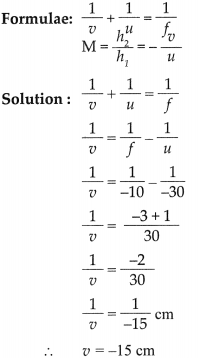
(a) Georg Hegel
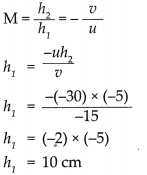
(b) Voltaire
(c) Simone de Beauvoir
(d) Herodotus
Answer:
(a) Georg Hegel

(m) According to ………………….., one should never accept anything as the truth till all the doubts are solved.
(a) Rene Descartes
(b) Karl Marx
(c) Voltaire
(d) Herodotus
Answer:
(a) Rene Descartes.

Question 7.
Identify the wrong pair in the following and write it:
(1)

ThinkerBook
(1) Georg Wilhelm Friedrich Hegel(a) Reason in History
(2) Leopold von Ranke(b) The Theory and Practice of History
(3) Herodotus(c) The Histories
(4) Karl Marx(d) Discourse on the Method

Answer:
Wrong pair: Karl Marx – Discourse on the Method.

(2)

HistorianCountry
(1) HerodotusGreece
(2) Simone de BeauvoirGermany
(3) Michel FoucaultFrance
(4) Rene DescartesFrance

Answer:
Wrong pair: Simone de Beauvoir Germany.

(3)

Thoughts/OpinionHistorian
(1) All aspects of human life is important in the historiographyVoltaire
(2) He criticized imaginative narration.Leopold von Ranke
(3) History is not about abstract ideas but about living people.Rene Descartes
(4) Emphasized the rethinking of the male-dominated perspective of history.Simone de Beauvoir

Answer:
Wrong pair: History is not about abstract ideas but about living people – René Descartes.

Maharashtra Board Solutions

Question 8.
Complete the concept chart

Maharashtra Board Class 10 History Solutions Chapter 1 Working of the Constitution 8
Answer:
Maharashtra Board Class 10 History Solutions Chapter 1 Working of the Constitution 9

Maharashtra Board Class 10 History Solutions Chapter 1 Working of the Constitution 10
Answer:
Maharashtra Board Class 10 History Solutions Chapter 1 Working of the Constitution 11

Question 9.
Prepare a flow chart on the given topic:
Stages of historiography
Answer:
Maharashtra Board Class 10 History Solutions Chapter 1 Working of the Constitution 12

Question 10.
Write short notes:

(1) Georg Wilhelm Friedrich Hegel:
Answer:

  • Georg Hegel was a German philosopher.
  • He was of the view that the historical realities should be presented in a logical manner. According to him, Timelme was indicative of progress.
  • He believed that presentation of history is bound to change as time passes because new evidence surfaces.
  • His philosophy convinced many scholars that historical methods were not of lesser quality, though they differed from the scientific method.
  • His lectures and articles are published in a book called ‘Encyclopaedia of Philosophical Sciences’.
  • His book ‘Reason in History’ is well known. He devised a method of analysis based on opposites known as Dialectics’.

Maharashtra Board Solutions

(2) Karl Marx:
Answer:

  1. Karl Marx was a German thinker in the nineteenth century. He wrote the world famous treatise Das Kapital’. According to him, history was not about abstract ideas but about living people.
  2. He believed that human relationships are shaped by the fundamental needs of people and the ownership of prevalent ineczns of production to meet those needs.
  3. He stated that unequal accessibility to the means of production creates à division in socièty leading to class struggle. His theory of class struggle is considered significant all over the world.
  4. According to Marx, human history is the history of class struggle because the class which owns the means of production economically exploits the rest of the classes.

(3) Michel Foucault:
Answer:

  • Michel Foucault was a twentieth century historian from France.
  • He wrote the book ‘Archaeology of Knowledge’.
  • In this book, he insisted that the prevailing practice of arranging historical events in a chronological order is not right.
  • He gave importance to explaining the transitions that took place in history.
  • He acknowledged the role of subjects such as science of medicine, psychological disorders, prison.
  • Administration in historical analysis. This was not acknowledged by earlier historiAnswer:

(4) Leopold von Ranke:
Answer:

  1. Leopold von Ranke, a German philosopher, laid emphasis on utmost importance of information gathered through original documents.
  2. In order to reach historical truth, it was necessary to examine all documents related to historical event. He critcised the imaginative narration of history.
  3. Collection of his articles are published in two books, entitled ‘The Theory and Practice of History’ and ‘The Secret of World History’.
  4. Ranke had great influence on historiography of nineteenth century.

Question 11.
Give reasons:
(a) In historical research, it may not be possible to use the method of experiments and observation.
Answer:

  1. In physical and natural sciences, experiment and observation method is used to establish laws that remain true irrespective of the time and space.
  2. These laws can be tested and proved again and again.
  3. In historical research, the events had already taken place in the past and we were not present in the historical time and space.
  4. Moreover, these events cannot be recreated in the present time and space. Hence, experiment and observation method may not be used in historical research.

(b) Historiography in the 18th century gave importance to objectivity in history.
Answer:

  • A remarkable progress was achieved in the fields of Philosophy and Science till the eighteenth century in Europe.
  • It was believed that by applying scientific methods it was possible to study social and historical truths.
  • In the later period, history and historiography witnessed a lot of philosophical discussion.
  • This eliminated the imaginative and divine context in history and gave importance to objectivity.

Maharashtra Board Solutions

Question 12.
Answer the following in 25-30 words:
(a) What is Historiography?
Answer:

  1. The writing of critical historical narrative is called Historiography. A person who writes it is known as ‘Historian’. The following steps are helpful in writing historical narrative:
  2. Information related to history is collected and analyzed.
  3. The various sources are critically examined to understand the references regarding time and space in the given information as well as the conceptual framework used.
  4. After examining the references of historical information, relevant questions related to these historical references are framed and hypotheseis are formulated.
  5. In short, writing of critical historical narrative by following this method is known as historiography.

(b) What did Rene Descartes insist upon?
Answer:
French Philosopher Rene Descartes insisted on the following in writing historiography:

  1. ‘Never to accept anything as true till all grounds of doubt are excluded’.
  2. Hence, the reliability of a source like historical documents should be verified by critically examining them while writing history.

(c) Why is Voltaire said to be the founder of modern historiography?
Answer:
Voltaire, a french scholar, opined that it was important to consider the following aspects while writing history:

  1. objective truth and chronology of events;
  2. prevalent social traditions, agriculture, trade and economic system. It was because of his view that all aspects of human life was considered for history writing. Therefore, he is said to be the founder of modern historiography.

(d) What are the objectives of writing history?
Answer:
History is researched and written down with following objectives:

  • To analyse the events in the past.
  • To verify information about the historical events and their interconnections.
  • To study in detail and remove imaginative element and bring forth the truth.
  • To put the past events in chronological order.

(e) What progress was achieved in historiography in the eighteenth century?
Answer:
The following progress was achieved in historiography in the eighteenth century:

  • Scientific methods were applied to study social and historical truths.
  • Philosophical discourses revolving around divine phenomena were given less importance.
  • Philosophical discussions focused more on the objectivity in history and historiography.
  • Since the universities got an independent department of history, they became centres of historical studies.

Question 13.
Head the given passage carefully and answer the questions given below:
(a) Who is called a Historian?
Answer:
A scholar who writes critical historical narratives is called a Historian.

(b) Complete the concept chart.
Factors which determined historian’s
Maharashtra Board Class 10 History Solutions Chapter 1 Working of the Constitution 1
Answer:
Factors which determined historian’s
Maharashtra Board Class 10 History Solutions Chapter 1 Working of the Constitution 2

(c) How did the people in ancient societies preserve the events in the past?
Answer:
The ancient people preserved the events in the past so that they can pass them to the next generation. They used various means to do this:

  • Narrating the stories of valour of ancestors to the next generation.
  • Stories of their life preserved through cave paintings.
  • Adopting story telling technique.
  • Singing songs and ballads to impress events upon the minds of the new generation.

Maharashtra Board Solutions

Question 14.
Answer the following questions in detail:
(a) Which experts do we need in order to prove the reliability of historical documents?
Answer:
The following experts are required to prove the reliability of historical documents:

  • Language expert who can decipher the language and meaning of the document or the script on the inscription.
  • One who can recognise the type of paper used and the period in which it was used.
  • One who can understand the lettering style and the writing style of the author.
  • Expert who has knowledge of different seals, i.e. stamps of authority used by the rulers.
  • Historian who can interpret and do a comparative study of the references given in the document.

(b) Write Hegel’s view on history.
Answer:

  • Georg Wilhelm Friedrich Hegel was a German philosopher.
  • He was of the view that the historical realities should be presented in a logical manner.
  • He believed that presentation of history is bound to change as time passes because new evidence surfaces.
  • He proposed a method of analysis based on opposites known as ‘Dialectics’.
  • Hegel’s philosophy convinced many scholars that historical methods were not of lesser quality, though they differed from scientific methods.
  • His lectures and articles are published in a book called ‘Encyclopaedia of Philosophical Sciences’. His book ‘Reason in History’ is well known.

Question 15.
Observe the inscription in the picture and write information it:
Maharashtra Board Class 10 History Solutions Chapter 1 Working of the Constitution 13
Answer:

  1. A fragment of the earliest inscription is shown in the above picture. It dates back to 4500 BCE.
  2. It is displayed at the Louvre museum in France.
  3. The inscriptions have names of Sumerian kings and stories of battles fought by them.
  4. It shows a forward marching file of soldiers holding shields and spears. The General is in the front.
    Brain Teaser
    Hints:
    Down:

    • He used the word ‘History’ for the first time
    • He wrote the book ‘Discourse on the Method’
    • Presented Theory of ‘Dialectics’
    • He called his method ‘Archaeology of Knowledge’

Maharashtra Board Solutions

Across:

  • founder of modern historiography
  • Criticised imaginative narration of history. Articles published in ‘The Secret of World History’
  • Her writings helped in establishing the fundamentals of feminism
  • He wrote ‘Das Kapital’
    Maharashtra Board Class 10 History Solutions Chapter 1 Working of the Constitution 14

Maharashtra Board Class 9 Science Solutions Chapter 11 Reflection of Light

Balbharti Maharashtra State Board Class 9 Science Solutions Chapter 11 Reflection of Light Notes, Textbook Exercise Important Questions and Answers.

Maharashtra State Board Class 9 Science Solutions Chapter 5 Acids, Bases and Salts

Class 9 Science Chapter 11 Reflection of Light Textbook Questions and Answers

1. Answer the following questions.

a. Explain the difference between a plane mirror, a concave mirror and a convex mirror with respect to the type and size of the images produced.
Answer:

Plane mirrorConcave mirrorConvex mirror
Type of imageVirtual and ErectVirtual (erect) as well as Real (inverted)Virtual and Erect
Size of imageSame sizeDiminished, Same size and magnifiedDiminished

b. Describe the positions of the source of light with respect to a concave mirror in
1. Torch light
2. Projector lamp
3. Floodlight
Answer:
(a) Torch light: The source of light is placed at the focus.
(b) Projector lamp : The source of light is placed at the centre of curvature.
(c) Flood light : The source of light is placed just beyond the centre of curvature.

Maharashtra Board Class 9 Science Solutions Chapter 11 Reflection of Light

c. Why are concave mirrors used in solar devices?
Answer:

  • Solar devices like solar cooker or solar water heater use solar energy to cook food or heat water.
  • When sun rays fall on the concave mirror, they converge and come together in the focal plane.
  • Due to convergence, the intensity of sun rays increases and the food or water is heated faster. Hence, concave mirrors are used in solar- devices.

d. Why are the mirrors fitted on the outside of cars convex?
Answer:

  • A convex mirror is used as rear view mirror because they form erect, virtual, and diminished images.
  • This, allows the driver to view a large area in a small mirror.

e. Why does obtaining the image of the sun on a paper with the help of a concave mirror burn the paper?
Answer:

  • When sunrays fall on the concave mirror, they converge and come together in the focal plane.
  • Due to convergence, the intensity of sunrays increases.
  • Hence, image of the sun on a paper with the help of concave mirror bums the paper.

f. If a spherical mirror breaks, what type of mirrors are the individual pieces?
Answer:

  • When a spherical mirror breaks into smaller pieces, the radius of curvature and focal length does not change.
  • Hence, it will continue to behave like a spherical mirror only.

Maharashtra Board Class 9 Science Solutions Chapter 11 Reflection of Light

2. What sign conventions are used for reflection from a spherical mirror?
Answer:
According to the Cartesian sign convention, the pole of the mirror is taken as the origin. The principal axis is taken as the X-axis of the frame of reference. The sign conventions are as follows.

  1. The object is always kept on the left of the mirror. All distances parallel to the principal axis are measured from the pole of the mirror.
  2. All distances measured towards the right of the pole are taken to be positive, while those measured towards the left are taken to be negative.
  3. The distance measured vertically upwards from the principal axis are taken to be positive.
  4. The distance measured vertically downwards from the principal axis are taken to be negative.
  5. The focal length of a concave mirror is negative while that of a convex mirror is positive.

3. Draw ray diagrams for the cases of images obtained in concave mirrors as described in the table on page 122.
Maharashtra Board Class 9 Science Solutions Chapter 11 Reflection of Light 1
Answer:
(a) A ray diagram for object at infinity for a concave mirror.
Maharashtra Board Class 9 Science Solutions Chapter 11 Reflection of Light 3

Image positionNature of image
At focusReal, inverted and point image

(b) A ray diagram for object beyond centre of curvature for a concave mirror.
Maharashtra Board Class 9 Science Solutions Chapter 11 Reflection of Light 4
An object beyond centre of curvature for a concave mirror

Image positionNature of image
Between the centre of curvature and focus.Real, inverted and diminished.

Maharashtra Board Class 9 Science Solutions Chapter 11 Reflection of Light

(c) A ray diagram for object at the centre of curvature for a concave mirror.
Maharashtra Board Class 9 Science Solutions Chapter 11 Reflection of Light 5
Object at centre of Curva fu re be a concave mirror.

Image positionNature of image
At the centre of curvature.Real, inverted and same size

(d) A ray diagram for object between F and C for a concave mirror.
Maharashtra Board Class 9 Science Solutions Chapter 11 Reflection of Light 6
Object between F & C for a concave mirror

Image positionNature of image
Beyond the centre of curvature.Real, inverted and magnified.

(e) A ray diagram for obj ect at focus for a concave mirror.
Maharashtra Board Class 9 Science Solutions Chapter 11 Reflection of Light 7
Object at focus for a concave mirror.

Image positionNature of image
At infinity.Real, inverted and highly magnified.

(f) A ray diagram for object between pole and focus for a concave mirror.
Maharashtra Board Class 9 Science Solutions Chapter 11 Reflection of Light 8

Image positionNature of image
Behind the mirror.Virtual, erect and magnified.

Maharashtra Board Class 9 Science Solutions Chapter 11 Reflection of Light

4. Which type of mirrors are used in the following?
Periscope, floodlights, shaving mirror, kaleidoscope, street lights, headlamps of a car.

Answer:

ObjectsType of Mirror
PeriscopePlane mirror
FloodlightsConcave mirror
Shaving mirrorConcave mirror
KaleidoscopePlane mirror
Street lightsConvex mirror
Head lamps of carConcave mirror

5. Solve the following examples

a. An object of height 7 cm is kept at a distance of 25 cm in front of a concave mirror. The focal length of the mirror is 15 cm. At what distance from the mirror should a screen be kept so as to get a clear image? What will be the size and nature of the image?
Solution:
Given: Object size (h1) = 7 cm
Object distance (u) = -25 cm
Focal length (f) = -15cm
To find: Image distance (u) = ?
Image size (h2) = ?
Maharashtra Board Class 9 Science Solutions Chapter 11 Reflection of Light 9
The screen should be kept 373 cm in front of the mirror. The image is real.
Maharashtra Board Class 9 Science Solutions Chapter 11 Reflection of Light 10
The height of the image is 10.5 cm, it is an inverted and enlarged image.

Maharashtra Board Class 9 Science Solutions Chapter 11 Reflection of Light

b. A convex mirror has a focal length of 18 cm. The image of an object kept in front of the mirror is half the height of the object. What is the distance of the object from the mirror?
Solution:
Given: Image size (h2) = 1/2 h1
Focal length (f) = 18 cm
To find: Object distance (u) ?
Maharashtra Board Class 9 Science Solutions Chapter 11 Reflection of Light 11
The object is placed in front of the convex mirror at a distance of 18 cm.

c. A 10 cm long stick is kept in front of a concave mirror having focal length of 10 cm in such a way that the end of the stick closest to the pole is at a distance of 20 cm. What will be the length of the image?
Solution:
Given: Object size (h1) = 10 cm
Object distance (u) = -20 cm
Focal length (f) = -10 cm
Maharashtra Board Class 9 Science Solutions Chapter 11 Reflection of Light 12
The height of the image is 10 cm and it is a real and inverted image.

Maharashtra Board Class 9 Science Solutions Chapter 11 Reflection of Light

6. Three mirrors are created from a single sphere. Which of the following:
pole, centre of curvature, radius of curvature, principal axis – will be common to them and which will not be common?
Answer:
Maharashtra Board Class 9 Science Solutions Chapter 11 Reflection of Light 30

  • Centre of curvature and Radius of curvature will be common for all three pieces.
  • Pole and Principal axis will not be common.

Class 9 Science Chapter 11 Reflection of Light Intext Questions and Answers

Class 9 Science Chapter 11 Reflection Of Light Question 1.
What is light
Answer:
Light is a form of electromagnetic radiation that produces the sensation of vision.

9th Class Science Chapter 11 Reflection Of Light Exercise Question 2.
What is a mirror?
Answer:
A mirror is a reflecting surface which reflects light and creates clear images.

9th Class Science Chapter 11 Reflection Of Light Exercise Answer Question 3.
Principal Focus of Concave and Convex Mirror.
Answer:

Principal Focus of the Concave MirrorPrincipal Focus of the Convex Mirror
(i) Incident rays which are parallel to the principal axis of a concave mirror, after reflection from the mirror, meet at a particular point in front of the mirror on the principal axis. This point (F) is called the principal focus of the concave mirror.
(ii) It is formed in front of the mirror.
(iii) Focus of concave mirror is real.
(i) Incident rays parallel to the principal axis, after reflection, appear to come from a particular point behind the mirror lying along the principal axis. This point is called the principal focus of the convex mirror.
(ii) It is formed behind the mirror.
(iii) Focus of convex mirror is virtual.

9th Class Science Chapter 11 Reflection Of Light Notes Question 4.
If we hold a page of a book in front of a mirror, we see laterally inverted letters in the mirror. Why does it happen?
Answer:

  • When we hold a page of a book in front of the mirror, the image of the words appear laterally inverted.
  • The image of every point of the word is formed behind the mirror at the same distance from the mirror
  • Because of this the left and right side of the image is interchanged.
  • Hence, if we hold a page of a book in front of a mirror, we see laterally inverted letters in the mirror.

Maharashtra Board Class 9 Science Solutions Chapter 11 Reflection of Light

11 Reflection Of Light Exercise Question 5.
Which letters of the English alphabet form images that look the same as the original letters?
Answer:
A, H, I, M, O, T, U, V, W, X, Y

9th Science Chapter 11 Reflection Of Light Exercise Question 6.
When a person stands in front of a plane mirror, how is the image formed? What is the nature of the image?
Answer:

  • The image of a person is formed from every point of the source, thereby forming an extended image of the whole source.
  • The image formed would be virtual, upright and left-right reversed.

Answer the following questions:

Reflection Of Light Class 9 Questions And Answers Question 1.
Place two plane mirrors at an angle of 90a to each other. Place a small object between them. Images will be formed in both mirrors. How many images do you see? Now change the angle between the mirrors as given in the following table and count the number of images each time. How is this number related to the measure of the angle?
Answer:
The Relation between the angle between the mirrors and the number of images formed is given by
\(n=\frac{360^{\circ}}{\mathrm{A}}-1\)
n = number of images,
A = angle between the mirrors

AngleNumber of images
120°2
90s3
60®5
45®7
30®11

Maharashtra Board Class 9 Science Solutions Chapter 11 Reflection of Light 13

Class 9 Science Chapter 11 Reflection of Light Additional Important Questions and Answers

Can you recall?

9th Class Science Chapter 11 Reflection Of Light Question 1.
What is meant by reflection of light and what are the types of reflection?
Answer:
The bouncing back of light when it hits an opaque surface is called reflection of light. The two types of reflection are regular and irregular reflection.

Maharashtra Board Class 9 Science Solutions Chapter 11 Reflection of Light

Reflection Of Light Class 9 Exercise Answers Question 2.
What are the laws of reflection.
Answer:

  • The incident ray, reflected ray and normal all lie in the same plane at the point of incidence.
  • The angle of incidence is equal to the angle of reflection.
  • The incident ray and the reflected ray lie on opposite sides of the normal.

Choose and the correct option:

Class 9th Science Chapter 11 Reflection Of Light Question Answer Question 1.
If the reflected rays do not actually meet, such an image is called as image.
(a) real
(b) virtual
(c) magnified
(d) inverted
Answer:
(b) virtual

Class 9 Science Chapter 11 Reflection Of Light Exercise Solutions Question 2.
In a plane mirror, the perpendicular distance of the image from the mirror is equal to
(a) the perpendicular distance of the source from the object.
(b) the perpendicular distance of the source from the mirror.
(c) the parallel distance of the source from the object.
(d) the parallel distance of the source from the mirror.
Answer:
(b) the perpendicular distance of the source from the mirror

Reflection Of Light Class 9 Notes Pdf Maharashtra Board Question 3.
The image formed in a convex mirror is always
(a) virtual, smaller and behind the mirror
(b) virtual, smaller and in front of the mirror
(c) real, smaller and behind the mirror
(d) real, smaller and in front of the mirror
Answer:
(a) virtual, smaller and behind the mirror

Reflection Of Light Class 9 Solutions Question 4.
images can be displayed on a screen.
(a) Virtual
(b) Real
(c) Virtual and erect
(d) Virtual and inverted
Answer:
(b) Real

Maharashtra Board Class 9 Science Solutions Chapter 11 Reflection of Light

9th Class Science Chapter 11 Reflection Of Light Exercise Pdf Question 5.
A concave mirror is also called as a mirror.
(a) converging
(b) diverging
(c) plane
(d) outward curved
Answer:
(a) converging

9th Science Chapter 11 Reflection Of Light Question 6.
The centre of the mirror surface is called its
(a) pole
(b) centre of curvature
(c) principal axis
(d) focus
Answer:
(a) pole

Class 9 Science Chapter 11 Question Answer Reflection Of Light Question 7.
According to the new sign convention, the of the mirror is taken as origin.
(a) focus
(b) pole
(c) optical centre
(d) centre of curvature
Answer:
(b) pole

Class 9 Science Chapter 11 Reflection Of Light Exercise Question 8.
A convex mirror is also called as a mirror.
(a) converging
(b) plane
(c) diverging
(d) inward curved
Answer:
(c) diverging

Maharashtra Board Class 9 Science Solutions Chapter 11 Reflection of Light

Reflection Of Light Class 9 Maharashtra Board Question 9.
In order to see the full image of a person standing in front of a mirror, the minimum height of the mirror must be
(a) same height as that of the person
(b) double the height of the person
(c) half the height of the person
(d) quarter the height of the person
Answer:
(c) half the height of the person

Reflection Of Light Exercise 9th Class Question 10.
If the inner surface of the spherical mirror is reflecting, then it is a mirror, and if the outer surface is reflecting then it is mirror.
(a) convex, concave
(b) convex, plane
(c) concave, plane
(d) concave, convex
Answer:
(d) concave, convex

9th Std Science Chapter 11 Reflection Of Light Question 11.
The image formed by a concave mirror is
(a) always virtual and erect
(b) always virtual and inverted
(c) virtual if the object is placed between the pole and the focus
(d) virtual if the object is beyond the focus
Answer:
(c) virtual if the object is placed between the pole and the focus

Maharashtra Board Class 9 Science Solutions Chapter 11 Reflection of Light

Question 12.
No matter how far you stand from a spherical mirror, your image appears erect. The mirror may be
(a) plane
(b) concave
(c) convex
(d) either plane or convex
Answer:
(d) either plane or convex

Question 13.
In case of a concave mirror, an erect image is
(a) real and enlarged
(b) real and diminished
(c) virtual and diminished
(d) virtual and enlarged
Answer:
(d) virtual and enlarged

Question 14.
A rear view mirror of a car is
(a) plane mirror
(b) concave mirror
(c) convex mirror
(d) cylindrical mirror
Answer:
(c) convex mirror

Maharashtra Board Class 9 Science Solutions Chapter 11 Reflection of Light

Question 15.
An image of an object placed at infinite distance from a concave mirror is formed at
(a) the focus of the mirror
(b) behind the mirror
(c) centre of curvature
(d) infinity
Answer:
(a) the focus of the mirror

Question 16.
A ray of light parallel to principal axis after reflection from concave mirror passes through
(a) centre of curvature
(b) focus
(c) pole
(d) optical centre
Answer:
(b) focus

Question 17.
The image made by a plane mirror is a image.
(a) real
(b) virtual
(c) inverted
(d) diminished
Answer:
(b) virtual

Maharashtra Board Class 9 Science Solutions Chapter 11 Reflection of Light

Question 18.
The size of the image of an object placed at the focus of a concave mirror is
(a) erect
(b) very large
(c) same size
(d) diminished
Answer:
(b) very large

Question 19.
For virtual images, the height is while for real images, it is
(a) positive, positive
(b) negative, positive
(c) negative, negative
(d) positive, negative
Answer:
(d) positive, negative

Find the odd man out:

Question 1.
Torches, flood lights, head lamps of vehicles, rear view mirror.
Answer:
Rear view mirror – In rear view mirrors, convex . mirror is used. Concave mirrors are used in the rest.

Question 2.
Side mirrors of cars, parking mirrors, flood lights, mirror fitted in shops.
Answer:
Flood lights – In flood lights concave mirror is used. Convex mirrors are used in the rest.

Question 3.
Virtual and enlarged, virtual and diminished, real and inverted, real and magnified
Answer:
Virtual and diminished type of image is not formed by a concave mirror. All the other types of images are formed by a concave mirror.

Maharashtra Board Class 9 Science Solutions Chapter 11 Reflection of Light

Question 4.
Image is laterally inverted, image is of same size, image is at same distance, image is diminished.
Answer:
Image is diminished is not a characteristic of image formed in a plane mirror. Rest of them are characteristics of plane mirror.

Answer the following in one sentence:

Question 1.
What kind of mirror will a doctor use to concentrate on teeth, eyes, ears etc.?
Answer:
The doctor will use a concave mirror to concentrate on teeth, eyes, ears etc.

Question 2.
What do the nature, position and size of the image depend on?
Answer:
The nature, position and size of the image depend upon the distance of the object from the reflecting surface.

Question 3.
Give the expression for mirror formula.
Answer:
\(\frac{1}{v}+\frac{1}{u}=\frac{1}{f}\)

Question 4.
State any four uses of concave mirror.
Answer:
Concave mirrors are used in torches, headlights, shaving mirrors, dentists’ mirrors, solar devices etc.

Maharashtra Board Class 9 Science Solutions Chapter 11 Reflection of Light

Question 5.
What are the two types of spherical mirror?
Answer:
Convex mirror and concave mirror are the two types of spherical mirror.

Match the columns:

Question 1.

Column ‘A’Column ‘B’
(1) Plane mirror(a) Rear view mirror
(2) Concave mirror(b) At laughing gallery
(3) Convex mirror(c) At a hair dresser
(4) Irregular

curved mirror

(d) At a dentist

Answer:
(1 – c),
(2 – d),
(3 – a),
(4 – b)

Question 2.

Column ‘A’Column ‘B’
(1) Plane mirror(a) Virtual and diminished image
(2) Concave mirror(b) Virtual and same size image
(3) Convex mirror(c) Real and inverted image

Answer:
(1 – b),
(2 – c),
(3 – a)

Maharashtra Board Class 9 Science Solutions Chapter 11 Reflection of Light

State whether the following statements are true or false. Correct the false statements:

(1) If the mirrors are kept at right angle to each other, then the number of images formed will be 4.
(2) A convex mirror is used in flood lights.
(3) A concave mirror always forms a magnified image.
(4) Images formed by convex mirrors are always virtual.
(5) The distance between the focus and the pole is called the radius of curvature.
(6) Reflection from a spherical mirror obeys laws of reflection.
(7) The reflecting surface of a concave mirror is curved.
(8) Distances measured in the direction of the incident light are taken as positive.
(9) If the image is erect, the height of the image is negative.
(10) A real image can be displayed on a screen.
(11) A concave mirror always forms a real and inverted image.
(12) Doctors use diverging beam of light to study teeth, ears and eyes.
Answer:
(1) False. if the mirrors are kept at right angle to each other then the number of images formed will be 3.
(2) False. a concave mirror is used in flood lights.
(3) False. a concave mirror can sometimes form a diminished image as well.
(4) True
(5) False. the distance between the focus and the pole is called the focal length.
(6) True
(7) True
(8) True
(9) False. if the image is erect, the height of the image is positive.
(10) True
(11) False. a concave mirror can also form a virtual and erect image.
(12) False. doctors use a converging beam of light to study teeth, ears and eyes.

Maharashtra Board Class 9 Science Solutions Chapter 11 Reflection of Light

Give scientific reasons:

Question 1.
A concave mirror is called a converging mirror.
Answer:

  • When rays of light parallel to the principal axis are incident on concave mirror, they converge.
  • After convergence, they meet at one point on the principal axis, hence concave mirror is called converging mirror.

Question 2.
Concave mirrors are used in torches and in car headlights.
Answer:

  1. Concave mirrors are used in torches and car headlights because when a source of light is placed at the focus of a concave mirror, a parallel beam of light rays is obtained.
  2. This helps us to see things upto a considerable distance in the darkness.

Question 3.
A dentist uses a concave mirror while examining teeth.
Answer:

  • A concave mirror produces an erect, virtual and magnified image of an object placed between its pole and focus.
  • A dentist uses this principle to get a clear and distinct image of teeth, hence, a dentist uses a concave mirror.

Solve the following numerlcals.

Tips for solving numerical:

  • Object distance (u) is always -ve
  • If Image distance (u) is +ve then image is behind the mirror and virtual. if u is -ve then image is in front of the mirror and real.
  • Object height (h1) is always +ve since it is erect.
  • Image height (h2) can be +ve for virtual and -ve for real.

Type – A

Maharashtra Board Class 9 Science Solutions Chapter 11 Reflection of Light 14

Question 1.
A bird is sitting in front of two plane mirrors inclined at an angle of 600 to each other. How many images does the bird see in the mirror?
Solution:
Given : Angle between mirror A = 600
To find: Number of images formed n = ?
Maharashtra Board Class 9 Science Solutions Chapter 11 Reflection of Light 15
The brrd sees 5 images in the mirror.

Maharashtra Board Class 9 Science Solutions Chapter 11 Reflection of Light

Question 2.
A coin is kept in front of two plane mirrors inclined to each other. If 3 images of the coin are seen then what is the angle A between the mirrors?
Solution:
Given: no. of images formed n =3
To find: Angle between mirror A =?
Maharashtra Board Class 9 Science Solutions Chapter 11 Reflection of Light 16
Maharashtra Board Class 9 Science Solutions Chapter 11 Reflection of Light 17
The mirrors are inclined atan angle of 900 to each other.

Question 3.
An image is formed 5 cm behind a convex mirror of focal length 10 cm. At what distance is the object placed from the mirror?
Solution:
Given: Image distance (u) = 5 cm
Focal length (f) = 10 an
To find: Object distance (u) = ?
Maharashtra Board Class 9 Science Solutions Chapter 11 Reflection of Light 18
The object is placed at a distance of 10 cm in front of the mirror.

Maharashtra Board Class 9 Science Solutions Chapter 11 Reflection of Light

Question 4.
An object placed 20 cm in front of a convex mirror is found to have an image 15cm behind the mirror. Find the focal length of the mirror.
Solution:
Given: Object distance (u) = -20 cm
Image distance (u) = 15 cm
To find: focal length (f) = ?
Maharashtra Board Class 9 Science Solutions Chapter 11 Reflection of Light 19
Maharashtra Board Class 9 Science Solutions Chapter 11 Reflection of Light 20
The focal length of the convex mirror is 60 cm.

Numerical For Practice

Question 5.
An object is placed at a distance of 36 cm from a concave mirror of focal length 12 cm. Find the image distance.
Answer:
-18 cm

Question 6.
An arrow is placed at a distance of 25 cm from a diverging mirror of focal length 20 cm. Find the image distance.
Answer:
11.1 cm

Type – B

Maharashtra Board Class 9 Science Solutions Chapter 11 Reflection of Light 21

Question 1.
An object 4cm in height is placed at a distance of 36 cm from a concave mirror. The image is formed 18 cm in the front of the mirror. Find the height of the image.
Solution:
Given: Object height (h1) = 4 cm
Image distance (u) = -18 cm
Object distance (u) = -36 cm
To find: Height of image (h2) = ?
Maharashtra Board Class 9 Science Solutions Chapter 11 Reflection of Light 22
The height of the image is 2 cm and it is inverted.

Maharashtra Board Class 9 Science Solutions Chapter 11 Reflection of Light

Question 2.
An object 2 cm high is placed at a distance of 16cm from a concave mirror which produces a real image 3 cm high. Find the image distance.
Solution:
Given: Object height (h1) = 2 cm
Object distance (u) = -16 cm
Image height (h2) = -3 cm
To find: Image distance (u) = ?
Maharashtra Board Class 9 Science Solutions Chapter 11 Reflection of Light 23
The image is formed at a distance of 24 cm in front of the mirror.

Numericals For Practice

Question 3.
An object 10cm in height is placed at a distance of 36 cm from a concave mirror. 1f the image is formed at a distance of 18 cm in front of the mirror, find the height of the image.
Answer:
-5cm

Question 4.
A converging mirror forms a real image of height 4 cm of an object of height 1 cm placed 20 cm away from the mirror. Find the image distance.
Answer:
-80cm

Type – C

Maharashtra Board Class 9 Science Solutions Chapter 11 Reflection of Light 24

Question 1.
Rajashree wants to get an inverted image of height 5 cm of an object kept at a distance of 30 cm from a concave mirror. The focal length of the mirror is 10 cm. At what distance from the mirror should she place the screen? What will be the type of the image, and what is the height of the object?
Solution:
Given:
Focal length = f = -10 cm,
Object distance = u = -30 cm
Height of the image = h2 = 7 cm
To find: Height of the object = h1 = ?
Image distance = u =?
Maharashtra Board Class 9 Science Solutions Chapter 11 Reflection of Light 25
Rajashree has to place the screen 15 cm to the left of the mirror.
Magnification formula
Maharashtra Board Class 9 Science Solutions Chapter 11 Reflection of Light 26
The height of the object is 10 cm. Thus, the image will be real and diminished.

Maharashtra Board Class 9 Science Solutions Chapter 11 Reflection of Light

Question 2.
A 10 cm long stick is kept horizontally in front of the concave mirror having focal length of 10 cm in such a way that the end of the stick closest to the pole is at a distance of 20 cm. What will be the length of the image?

Solution:
The stick is kept parallel to the Principal axis. Distance between A and P is 20 cm. Say u1 = 20 cm.
Hence, the other end of the stick is at distance, u2 = (u1 + 10) = 30 cm from pole of the mirror.
Maharashtra Board Class 9 Science Solutions Chapter 11 Reflection of Light 27
Using mirror formula for concave mirror,
Solution:
Maharashtra Board Class 9 Science Solutions Chapter 11 Reflection of Light 28
Here, negative signs indicate that images are formed on the left of the mirror.
Maharashtra Board Class 9 Science Solutions Chapter 11 Reflection of Light 29

The length of the image formed ?s given by, u = u2 – u1 = 15 – (-20) = 5cm.
The length of the image is 5 cm.

Maharashtra Board Class 9 Science Solutions Chapter 11 Reflection of Light

Numerical For Practice

Question 3.
An object 2 cm in height is placed at a distance of 16 cm from a concave mirror. If the focal length of the mirror is 9.6 cm., find the image distance, nature and size of the image.
Answer:
u = -24 an, h2 = -3 cm; real, inverted and enlarged.

Question 4.
An arrow of 2.5cm height is placed at a distance of 25 cm from a diverging mirror of focal length 20 cm. Find the nature, position and size of the image formed.
Answer:
v = 11.1cm, h1 = 1.1cm; virtual and in dimirrished form.

Define the following:

Question 1.
Centre of curvature of mirror (C)
Ans.
The centre of the sphere of which the mirror is a parte is called the centre of curvature of the mirror.

Question 2.
The radius of curvature (R)
Answer:
The radius of the sphere of which the mirror is a part, is called the radius of curvature of the mirror.

Question 3.
Pole (P)
Answer:
The centre of the mirror surface is called its pole.

Question 4.
The principal axis of a mirror
Answer:
The straight line passing through the pole and centre of curvature of the mirror is called its principal axis.

Question 5.
The focus of a concave mirror (F)
Answer:
Incident rays which are parallel to the principal axis of a concave mirror, after reflection from the mirror, meet at a particular point in front of the mirror on the principal axis. This point (F) is called the principal focus of the concave mirror.

Question 6.
Focus of a convex mirror (F)
Answer:
Incident rays parallel to the principal axis, after reflection, appear to come from a particular point behind the mirror lying along the principal axis. This point is called the principal focus of the convex mirror.

Maharashtra Board Class 9 Science Solutions Chapter 11 Reflection of Light

Question 7.
Focal length of a mirror (f)
Answer:
The distance (f) between the pole and the principal focus of the mirror is called the focal length. This distance is half of the radius of curvature of the mirror. \(f=\frac{R}{2}\)

Answer the following in short:

Question 1.
What are the rules for drawing ray diagrams for the formation of image by spherical mirror?
Answer:
The rules are as follows :

  • If an incident ray is parallel to the principal axis, then the reflected ray passes through the principal focus.
  • If an incident ray passes through the principal focus of the mirror, the reflected ray is parallel to the principal axis.
  • If an incident ray passes through the centre of curvature of the mirror, the reflected ray traces the same path back.

Distinguish between:

Question 1.
Convex mirror and Concave mirror
Answer:

Convex mirrorConcave mirror
(i) In a convex mirror, the reflecting surface is on the outer side.
(ii) It is called a diverging mirror.
(iii) The focus of a convex mirror is virtual.
(iv) It can form only a virtual image.
(v) It can form only a diminished image.
(i) In a concave mirror, the reflecting surface is on the inner side.
(ii) It is called a converging mirror.
(iii) The focus of a concave mirror is real.
(iv) It can form a real as well as a virtual image.
(v) It can form an enlarged, diminished as well as the same size image.

Question 2.
Real image and Virtual image
Answer:

Real imageVirtual image
(i) A real image is formed only when the reflected rays actually meet at a point.
(ii) Real images can be obtained on a screen.
(iii) All real images are inverted.
(i) A virtual image is formed only when the reflected rays appear to meet at a point.
(ii) Virtual images cannot be obtained on a screen.
(iii) All virtual images are erect.

Answer the following questions:

Question 1.
If we keep the mirrors parallel to each other, how many images will we see ?
Answer:
When two mirrors are kept parallel to each other infinite images are formed, this is because light gets reflected infinite times.

Answer in detail:

Question 1.
What sign conventions are used for reflection from a spherical mirror?
Answer:
Maharashtra Board Class 9 Science Solutions Chapter 11 Reflection of Light 2
According to the Cartesian sign convention, the pole of the mirror is taken as the origin. The principal axis is taken as the X-axis of the frame of reference. The sign conventions are as follows.

  • The object is always kept on the left of the mirror. All distances parallel to the principal axis are measured from the pole of the mirror. Maharashtra Board Class 9 Science Solutions Chapter 11 Reflection of Light
  • All distances measured towards the right of the pole are taken to be positive, while those measured towards the left are taken to be negative.
  • Distance measured vertically upwards from the principal axis are taken to be positive.
  • Distance measured vertically downwards from the principal axis are taken to be negative.
  • The focal length of a concave mirror is negative while that of a convex mirror is positive.

Question 2.
Draw ray diagrams for the image obtained in convex mirrors.
Answer:
Maharashtra Board Class 9 Science Solutions Chapter 11 Reflection of Light 31

Image positionNature of image
Behind the mirror.(A) Virtual,
(B) Erect
(C) Diminished

Question 3.
In order to see the full image of a person standing in front of a mirror, the minimum height of the mirror must be half the height of the person. Explain.
Answer:
Maharashtra Board Class 9 Science Solutions Chapter 11 Reflection of Light 32

Proof:

  1. In the figure, the point at the top of the head, the eyes and a point at the feet of a person are indicated by H, E and F respectively.
  2. R and S are midpoints of HE and EF respectively.
  3. The mirror PQ is at a height of NQ from the ground and is perpendicular to it. PQ is the minimum height of the mirror in order to obtain the full image of the person.

For this, RP and QS must be perpendicular to the mirror.

Minimum height of the mirror
PQ = RS
= RE + ES
\(=\frac{\mathrm{HE}}{2}+\frac{\mathrm{EF}}{2}=\frac{\mathrm{HF}}{2}\)
= Half of the person’s height.

Maharashtra Board Class 9 Science Solutions Chapter 11 Reflection of Light

Question 4.
Determine the sign of magnification in each of the 6 cases in the table and verify that they are same using formulae
\(\mathbf{M}=\frac{h_{2}}{h_{1}}\) and \(\mathbf{M}=\frac{-v}{u}\)
Answer:
Maharashtra Board Class 9 Science Solutions Chapter 11 Reflection of Light 33

Question 5.
Explain the images formed by concave mirrors with respect to position of the image and object and also the Nature and size of image
Answer:
Maharashtra Board Class 9 Science Solutions Chapter 11 Reflection of Light 34

Maharashtra Board Class 10 Hindi Solutions Chapter 10 बूढ़ी काकी

Balbharti Maharashtra State Board Class 10 Hindi Solutions Chapter 10 बूढ़ी काकी Notes, Textbook Exercise Important Questions, and Answers.

Maharashtra State Board Class 10 Hindi Chapter 10 बूढ़ी काकी

Hindi Lokbharti 10th Std Digest Chapter 10 बूढ़ी काकी Textbook Questions and Answers

कृति

(कृतिपत्रिका के प्रश्न 3 (अ) के लिए

* सूचना के अनुसार कृतियाँ कीजिए :

प्रश्न 1.

 स्वभाव के आधार पर पात्र का नाम
१. क्रोधी ………………….
२. लालची ………………….
३. शरारती ………………….
४. स्नेहिल ………………….

उत्तर:

 स्वभाव के आधार पर पात्र का नाम
१. क्रोधीरूपा
२. लालचीबुद्धिराम
३. शरारतीदोनों लड़के
४. स्नेहिललाड़ली

प्रश्न 2.
कृति पूर्ण कीजिए:
Maharashtra Board Class 10 Hindi Solutions Chapter 10 बूढ़ी काकी 1
उत्तर:
Maharashtra Board Class 10 Hindi Solutions Chapter 10 बूढ़ी काकी 17

Maharashtra Board Class 10 Hindi Solutions Chapter 10 बूढ़ी काकी

प्रश्न 3.
बुद्धिराम का काकी के प्रति दुर्व्यवहार दर्शाने वाली चार बातें :
१) ………………….
४) ………………….
२) ………………….
४) ………………….
उत्तर :
(i) बूढ़ी काकी की संपत्ति अपने नाम लिखाते समय किए गए लंबे-चौड़े वादों को बुद्धिराम द्वारा न निभाना।
(i) बूढ़ी काकी को भरपेट भोजन न देना।
(iii) भोजन कर रहे मेहमानों के बीच रेंगती हुई बूढ़ी काकी के पहुँच जाने पर बुद्धिराम द्वारा निर्दयतापूर्वक पकड़कर उनकी कोठरी में ले जाकर पटक देना।
(iv) बूढ़ी काकी के व्यवहार से रुष्ट होने के कारण तिलक उत्सव में सभी मेहमानों और घरवालों के भोजन कर लेने के बाद भी बुद्धिराम द्वारा उन्हें खाने के लिए न पूछना।

प्रश्न 4.
कारण लिखिए :
a. बूढ़ी काकी ने भतीजे के नाम सारी संपत्ति लिख दी _____________________
b. लाड़ली ने पूड़ियाँ छिपाकर रखीं _____________________
c. बुद्धिराम ने काकी को अँधेरी कोठरी में धम से पटक दिया _____________________
d. अंग्रेजी पढ़े नवयुवक उदासीन थे _____________________
उत्तर:
a. बूढ़ी काकी के परिवार में अब एक भतीजे के सिवाय और कोई नहीं था, इसलिए उन्होंने भतीजे के नाम सारी संपत्ति लिख दी।
b. बुद्धिराम और रूपा दोनों ने ही बूढ़ी काकी को उनकी निर्लज्जता के लिए दंड देने का निश्चय कर लिया था। इसलिए बूढ़ी काकी को किसी ने नहीं पूछा।
c. बूढ़ी काकी रेंगती हुई भोजन कर रहे मेहमान मंडली के बीच पहुँच गई थी। इससे कई लोग चौंककर उठ खड़े हुए थे। बुद्धिराम को इससे गुस्सा आया और उसने काकी को वहाँ से उठाकर कोठरी में ले जाकर धम से पटक दिया।
d. अंग्रेजी पढ़े नवयुवक उदासीन थे, क्योंकि वे गँवार मंडली में बोलना अथवा सम्मिलित होना अपनी प्रतिष्ठा के प्रतिकूल समझते थे।

Maharashtra Board Class 10 Hindi Solutions Chapter 10 बूढ़ी काकी

प्रश्न 5.
सूचना के अनुसार शब्द में परिवर्तन कीजिए :
Maharashtra Board Class 10 Hindi Solutions Chapter 10 बूढ़ी काकी 2
उत्तर :
Maharashtra Board Class 10 Hindi Solutions Chapter 10 बूढ़ी काकी 30

अभिव्यक्ति

‘बुजुर्ग आदर-सम्मान के पात्र होते हैं, दया के नहीं इस सुवचन पर अपने विचार लिखिए।
उत्तर :
हमें यह बात याद रखनी चाहिए कि आज जो व्यक्ति बुजुर्ग है वह हमेशा बूढ़ा और असहाय नहीं था। वह भी पहले युवा था। उसने अपने परिवार का पालन-पोषण और उसकी देखरेख की थी। उसने तरह-तरह की समस्याओं का सामना किया था और उन्हें अपने तरीके से हल किया था। उसे जीवन जीने का अनुभव है। लेकिन वृद्ध हो जाने पर किसी-किसी परिवार में बुजुर्गों को किनारे कर दिया जाता है। उनकी सलाह या सुझाव को कोई महत्त्व नहीं दिया जाता। इस तरह के व्यवहार से बुजुर्गों को अपने सम्मान पर ठेस लगती महसूस होती है।

किसी-किसी परिवार में तो बुजुर्गों के खाने-पीने की भी किसी को चिंता नहीं रहती। घर के लोग अपने में मगन रहते हैं और बुजुर्गों का कोई ख्याल नहीं रखता। बुजुर्गों को खाने-पीने के लिए उनका मुँह ताकना पड़ता है। हमें यह बात नहीं भूलनी चाहिए कि हम इन बुजुर्गों की संतान हैं। उनको पर्याप्त सम्मान देना और उनकी हर प्रकार से देखरेख करना हमारा फर्ज है। बुजुर्गों की प्रसन्नता और उनके आशीर्वाद से ही परिवार फूलता-फलता और खुशहाल रहता है। इसलिए बुजुर्गों को हमें सदा आदर-सम्मान देना चाहिए और उनकी देखरेख करनी चाहिए।

भाषा बिंदु

प्रश्न 1.
निम्नलिखित क्रियाओं के प्रथम तथा द्वितीय प्रेरणार्थक रूप लिखिए :

मूल क्रिया प्रथम प्रेरणार्थक रूप द्वितीय प्रेरणार्थक रूप
भूलना ………………………. ……………………….
पीसना ………………………. ……………………….
माँगना ………………………. ……………………….
तोड़ना ………………………. ……………………….
बेचना ………………………. ……………………….
कहना ………………………. ……………………….
नहाना ………………………. ……………………….
खेलना ………………………. ……………………….
खाना ………………………. ……………………….
फैलना ………………………. ……………………….
बैठना ………………………. ……………………….
लिखना ………………………. ……………………….
जुटना ………………………. ……………………….
दौड़ना ………………………. ……………………….
देखना ………………………. ……………………….
जीना ………………………. ……………………….

उत्तर :
Maharashtra Board Class 10 Hindi Solutions Chapter 10 बूढ़ी काकी 31

Maharashtra Board Class 10 Hindi Solutions Chapter 10 बूढ़ी काकी

प्रश्न 2.
पठित पाठों से किन्हीं दस मूल क्रियाओं का चयन करके उनके प्रथम तथा द्वितीय प्रेरणार्थक रूप निम्न तालिका में लिखिए :

मूल क्रिया प्रथम प्रेरणार्थक रूप द्वितीय प्रेरणार्थक रूप
………………………. ………………………. ……………………….
………………………. ………………………. ……………………….
………………………. ………………………. ……………………….
………………………. ………………………. ……………………….
………………………. ………………………. ……………………….
………………………. ………………………. ……………………….
………………………. ………………………. ……………………….
………………………. ………………………. ……………………….
………………………. ………………………. ……………………….
………………………. ………………………. ……………………….
………………………. ………………………. ……………………….
………………………. ………………………. ……………………….
………………………. ………………………. ……………………….
………………………. ………………………. ……………………….
………………………. ………………………. ……………………….
………………………. ………………………. ……………………….

उत्तर :
Maharashtra Board Class 10 Hindi Solutions Chapter 10 बूढ़ी काकी 32
Maharashtra Board Class 10 Hindi Solutions Chapter 10 बूढ़ी काकी 33

Maharashtra Board Class 10 Hindi Solutions Chapter 10 बूढ़ी काकी

उपयोजित लेखन

मेरा प्रिय वैज्ञानिक’ विषय पर निबंध लेखन कीजिए।
उत्तर :
यों तो दुनिया में एक-से-एक बड़े वैज्ञानिक हैं, पर मेरे प्रिय वैज्ञानिक तो सर जगदीशचंद्र बोस ही हैं। सर जगदीशचंद्र बोस की बात ही निराली है। उन्होंने यह सिद्ध करके बता दिया कि पेड़-पौधे भी हमारी तरह साँस लेते हैं और उन्हें पानी और भोजन की आवश्यकता होती है। उनमें भी जान होती है। यदि पेड़-पौधों को सताया या कष्ट दिया जाए, तो वे बीमार हो जाते हैं और उनकी प्रकृति के विरुद्ध उन्हें भोजन दिया जाए अथवा जहरीला रसायन दिया जाए, तो वे मर जाते हैं। वैसे पेड़-पौधों के संपर्क में रहने वाले प्रत्येक व्यक्ति को मालूम होता है कि पेड़-पौधों को नुकसान पहुँचाने या विषैले पदार्थों के संपर्क में आने से वे क्षतिग्रस्त या मृत हो सकते हैं, पर इस बात को सिद्ध किया था सर जगदीशचंद्र बोस ने।

अपने शोध को सिद्ध करने के लिए उन्होंने खुद चुंबकीय क्रेश्कोग्राफ नामक यंत्र तैयार किया। उन्होंने इस यंत्र की सहायता से सब के सामने अपने प्रयोग से यह सिद्ध कर दिया कि पेड़-पौधों में जीवन होता है और प्राणियों की तरह उनमें भी विभिन्न क्रियाएँ होती हैं। इस प्रकार के सूक्ष्म रहस्य का उद्घाटन करने वाले वे पहले वैज्ञानिक थे। वे सच्चे अर्थों में एक महान वैज्ञानिक थे। ऐसे महान वैज्ञानिक पर हमें गर्व है।

Hindi Lokbharti 10th Textbook Solutions Chapter 10 बूढ़ी काकी Additional Important Questions and Answers

गद्यांश क्र.1
प्रश्न. निम्नलिखित पठित गद्यांश पढ़कर दी गई सूचनाओं के अनुसार कृतियाँ कीजिए :

कृति 1 : (आकलन)

प्रश्न 1.
आकृति पूर्ण कीजिए :
Maharashtra Board Class 10 Hindi Solutions Chapter 10 बूढ़ी काकी 3
Maharashtra Board Class 10 Hindi Solutions Chapter 10 बूढ़ी काकी 4
उत्तर:
Maharashtra Board Class 10 Hindi Solutions Chapter 10 बूढ़ी काकी 6
Maharashtra Board Class 10 Hindi Solutions Chapter 10 बूढ़ी काकी 7

Maharashtra Board Class 10 Hindi Solutions Chapter 10 बूढ़ी काकी

प्रश्न 2.
उत्तर लिखिए :
(i) बूढ़ी काकी का शारीरिक स्वास्थ्य –
(ii) बूढ़ी काकी के परिवार में अब बचा एकमात्र सदस्य –
(iii) बुद्धिराम ने इस तरह लिखाई बूढ़ी काकी की संपत्ति –
(iv) बूढ़ी काकी के रोने का ढंग –
उत्तर:
(i) बूढ़ी काकी के नेत्र, हाथ, पैर आदि सभी अंग जवाब दे चुके थे।
(ii) उनका भतीजा बुद्धिराम।
(iii) खूब लंबे-चौड़े वादे करके।
(iv) बूढ़ी काकी गला-फाड़कर रोती थीं।

प्रश्न 3.
आकृति में दिए गए रिक्त स्थानों में उत्तर लिखकर आकृति पूर्ण कीजिए :
Maharashtra Board Class 10 Hindi Solutions Chapter 10 बूढ़ी काकी 5
उत्तर:
Maharashtra Board Class 10 Hindi Solutions Chapter 10 बूढ़ी काकी 8

कृति 2 : (स्वमत अभिव्यक्ति)

प्रश्न.
बुढ़ापा बहुधा बचपन का पुनरागमन होता है’ इस विषय पर अपने विचार 25 से 30 शब्दों में व्यक्त कीजिए।
उत्तर :
कहते हैं, बुढ़ापा बचपन का ही एक रूप है। वृद्धावस्था : में मनुष्य की हरकतें बच्चों जैसी हो जाती हैं। इस अवस्था में मनुष्य के अंग-प्रत्यंग कमजोर हो जाते हैं और उन्हें बच्चों की तरह दूसरों का सहारा लेना पड़ता है। दिमाग कमजोर हो जाता है। दाँत गिर जाते हैं और मनुष्य का मुँह बच्चों की तरह पोपला हो जाता है। इतना ही नहीं, बच्चों की तरह ही वृद्धों को भी मान-अपमान की परवाह नहीं होती। जिस तरह लोग बच्चों की बातों पर ध्यान नहीं देते, उसी तरह वृद्धों की बातों पर भी कोई ध्यान नहीं देता। उनकी इच्छा-अनिच्छा का भी कोई महत्त्व नहीं होता। इस तरह वृद्धावस्था और बचपन की अधिकांश बातों में समानता होती है। इसलिए कहा जा सकता है कि बुढ़ापा बहुधा बचपन का पुनरागमन होता है।

गद्यांश क्र.2
प्रश्न. निम्नलिखित पठित गद्यांश पढ़कर दी गई सूचनाओं के अनुसार कृतियाँ कीजिए :

कृति 1 : (आकलन)

प्रश्न 1.
संजाल पूर्ण कीजिए :
Maharashtra Board Class 10 Hindi Solutions Chapter 10 बूढ़ी काकी 9
उत्तर:
Maharashtra Board Class 10 Hindi Solutions Chapter 10 बूढ़ी काकी 11
Maharashtra Board Class 10 Hindi Solutions Chapter 10 बूढ़ी काकी 12

Maharashtra Board Class 10 Hindi Solutions Chapter 10 बूढ़ी काकी

प्रश्न 2.
आकृति पूर्ण कीजिए :
Maharashtra Board Class 10 Hindi Solutions Chapter 10 बूढ़ी काकी 10
उत्तर:
Maharashtra Board Class 10 Hindi Solutions Chapter 10 बूढ़ी काकी 13

प्रश्न 3.
कारण लिखिए :
(i) उत्सव के दिन बूढ़ी काकी को अपनी स्थिति पर रोना आया, पर वे रो नहीं सकीं।
उत्तर:
(i) उत्सव के दिन बूढ़ी काकी को अपनी स्थिति पर रोना आया, पर वे रो नहीं सकीं, क्योंकि उन्हें रूपा का डर था।

प्रश्न 4.
त्तर लिखिए :
मुखराम के तिलक उत्सव की तैयारियाँ :
उत्तर:
मुखराम के तिलक उत्सव की तैयारियाँ :
(i) पूड़ियाँ-कचौड़ियाँ निकल रही थीं।
(ii) एक बड़े हंडे में मसालेदार तरकारी पक रही थी।

कृति 2 : (स्वमत अभिव्यक्ति)

प्रश्न.
‘बुढ़ापा तृष्णा रोग का अंतिम समय है’ इस विषय पर अपने विचार 25 से 30 शब्दों में लिखिए।
उत्तर :
मनुष्य के जीवन की चार अवस्थाएँ होती हैं – बचपन, किशोरावस्था, युवावस्था और बुढ़ापा। अपने जीवन में मनुष्य की तरह-तरह की कामनाएँ होती हैं और उनकी पूर्ति करने का वह भरसक प्रयास करता है। बचपन से लेकर युवावस्था तक मनुष्य को अपनी कामनाओं की जल्द से जल्द पूरी होने की उतनी चिंता नहीं रहती, जितनी बुढ़ापे में। वृद्धावस्था में मनुष्य के जीवन के गिने-चुने वर्ष ही बचे होते हैं। इसलिए उसका प्रयास यह होता है कि अपने बचे-खुचे दिनों में वह अपनी सारी कामनाएं पूरी कर ले। ऐसे में उसे किसी भी तरह अपने उद्देश्य को पूरा कर लेना उचित जान पड़ता है। उसके लिए उसे बुरे-भले, मान-अपमान की परवाह नहीं होती। उसका लक्ष्य येनकेन प्रकारेण अपनी इच्छा पूरी करना होता है। इस प्रकार बुढ़ापा तृष्णा रोग का अंतिम समय है।

गद्यांश क्र.3
प्रश्न. निम्नलिखित पठित गद्यांश पढ़कर दी गई सूचनाओं के अनुसार कृतियाँ कीजिए:

कृति 1 : (आकलन)

प्रश्न 1.
उत्तर लिखिए :
Maharashtra Board Class 10 Hindi Solutions Chapter 10 बूढ़ी काकी 15
उत्तर :
Maharashtra Board Class 10 Hindi Solutions Chapter 10 बूढ़ी काकी 18
Maharashtra Board Class 10 Hindi Solutions Chapter 10 बूढ़ी काकी 19

Maharashtra Board Class 10 Hindi Solutions Chapter 10 बूढ़ी काकी

प्रश्न 2.
आकृति पूर्ण कीजिए :
Maharashtra Board Class 10 Hindi Solutions Chapter 10 बूढ़ी काकी 16
उत्तर :
Maharashtra Board Class 10 Hindi Solutions Chapter 10 बूढ़ी काकी 20

कृति 2 : (स्वमत अभिव्यक्ति)

प्रश्न.
‘लड़कों का बूढों से स्वाभाविक विवेष होता ही है’ इस विषय पर अपने विचार 25 से 30 शब्दों में लिखिए।
उत्तर :
लड़कों और बूढ़ों के बीच पीढ़ियों का अंतर होता है। लड़कों और बूढ़ों में हर बात को लेकर अंतर होना स्वाभाविक है। अधिकांश बूढ़ों की आदत होती है कि वे हर बात को अपने ढंग से सोचते हैं। वे उसमें अपने जमाने की विचारधारा थोपने की कोशिश करते हैं। इसका कारण यह है कि किसी चीज के बारे में उनकी एक धारणा बनी होती हैं। हर बात को वे अपने पैमाने पर कसने की कोशिश करते हैं। जब कि नई पीढ़ी के लड़कों की सोच अलग ढंग की होती हैं। उन्हें पुराने दकियानूसी विचार पसंद नहीं आते। इसलिए बात-बात पर दोनों के विचारों में टकराव होता है। इस तरह लड़कों और बूढ़ों में स्वाभाविक विद्वेष होता है।

गद्यांश क्र. 4
प्रश्न. निम्नलिखित पठित गद्यांश पढ़कर दी गई । सूचनाओं के अनुसार कृतियाँ कीजिए :

कृति 1 : (आकलन)

प्रश्न 1.
संजाल पूर्ण कीजिए :
Maharashtra Board Class 10 Hindi Solutions Chapter 10 बूढ़ी काकी 21
उत्तर:
Maharashtra Board Class 10 Hindi Solutions Chapter 10 बूढ़ी काकी 23

Maharashtra Board Class 10 Hindi Solutions Chapter 10 बूढ़ी काकी

प्रश्न 2.
उत्तर लिखिए :
Maharashtra Board Class 10 Hindi Solutions Chapter 10 बूढ़ी काकी 22
उत्तर:
Maharashtra Board Class 10 Hindi Solutions Chapter 10 बूढ़ी काकी 24

प्रश्न 3.
कारण लिखिए :
(i) घरवालों ने भोजन किया, परंतु बूढ़ी काकी को किसी ने नहीं पूछा –
(ii) रात के ग्यारह बज गए थे। लाड़ली की आँखों में नींद न थी –
उत्तर:
(i) लाड़ली उन पूड़ियों को बूढ़ी काकी के पास ले जाना चाहती थी, ताकि वे उन्हें खा सके।
(ii) बूढ़ी काकी को पूड़ियाँ खिलाने की खुशी लाड़ली को सोने न देती थी।

गद्यांश क्र.5
प्रश्न. निम्नलिखित पठित गद्यांश पढ़कर दी गई सूचनाओं के अनुसार कृतियाँ कीजिए :

कृति 1 : (आकलन)

प्रश्न 1.
आकृति पूर्ण कीजिए :
Maharashtra Board Class 10 Hindi Solutions Chapter 10 बूढ़ी काकी 25
Maharashtra Board Class 10 Hindi Solutions Chapter 10 बूढ़ी काकी 26
उत्तर :
Maharashtra Board Class 10 Hindi Solutions Chapter 10 बूढ़ी काकी 27
Maharashtra Board Class 10 Hindi Solutions Chapter 10 बूढ़ी काकी 28

Maharashtra Board Class 10 Hindi Solutions Chapter 10 बूढ़ी काकी

प्रश्न 2.
कारण लिखिए :
(i) रूपा का हृदय सन्न हो गया –
(ii) रूपा बैठी स्वर्गीय दृश्य का आनंद लेने में निमग्न थी –
उत्तर:
(i) रूपा का हृदय सन्न हो गया, क्योंकि उसने देखा कि बूढ़ी काकी पत्तलों पर से पूड़ियों के टुकड़े उठा-उठाकर खा रही हैं।
(ii) रूपा बैठी स्वर्गीय दृश्य का आनंद लेने में निमग्न थी, क्योंकि बूढ़ी काकी भोले बच्चों की तरह सब कुछ भूलकर बैठी हुई खाना खा रही थीं और उनके एक-एक रोएँ से सच्ची सदिच्छाएँ निकल रही थीं।

प्रश्न 3.
रिश्ता पहचानिए :
(i) बूढ़ी काकी, रूपा की लगती हैं –
(ii) रूपा, बूढ़ी काकी की लगती हैं –
उत्तर:
(i) बूढ़ी काकी, रूपा की लगती हैं – चचेरी सास।
(ii) रूपा, बूढ़ी काकी की लगती है – बहू।

कृति 2 : (स्वमत अभिव्यक्ति)

प्रश्न.
शादी-ब्याह अथवा पारिवारिक समारोहों में प्रीतिभोज में अनाप-शनाप खर्च करना कितना उचित’ विषय पर अपने विचार 25 से 30 शब्दों में लिखिए।
उत्तर :
हमारे देश में शादी-ब्याह तथा छोटे-मोटे पारिवारिक समारोहों में प्रीतिभोज में लोगों को खिलाने-पिलाने की पुरानी परंपरा चली आ रही है। समर्थ व्यक्तियों को इस तरह का खर्च करना ज्यादा नहीं अखरता, पर आर्थिक दृष्टि से कमजोर लोगों के लिए इस तरह के ३ खर्च का भार उठाना मुश्किल होता है। पर सामाजिक बंधनों तथा अपने ३ नाम के लिए ऐसे समारोह आयोजित करना आज एक फैशन हो गया । हैं। यह फैशन दिनोदिन बढ़ता ही जा रहा है। कुछ लोग तो अपनी प्रतिष्ठा बढ़ाने के लिए कर्ज लेकर लोगों को बुलाकर खिलाते-पिलाते ३ हैं। बाद में यह कर्ज चुकाना उनके लिए समस्या बन जाता है और उन्हें अपनी जायदाद बक बेचनी पड़ जाती है। लोगों को इस तरह के उत्सवों में अनावश्यक रूप से पैसे उड़ाने से बाज आना चाहिए। इस तरह के उत्सवों-समारोहों में अनाप-शनाप खर्च करना अपने ऊपर एक तरह का आर्थिक बोझ लादना है, जिससे कोई लाभ नहीं होता।

उपक्रम/कृति/परियोजना

श्रवणीय
बड़ों से कोई ऐसी कहानी सुनिए जिसके आखिरी हिस्से में कठिन परिस्थितियों से जीतने का संदेश मिल रहा हो।

संभाषणीय
वृद्धाश्रम’ के बारे में जानकारी इकट्ठा करके चर्चा कीजिए।

लेखनीय
‘भारतीय कुटुंब व्यवस्था’ पर भाषण के मुद्दे लिखिए।
उत्तर:
भारतीय कुटुंब व्यवस्था के मुद्दे :

  • कुटुंब किसे कहते हैं?
  • प्राचीन भारतीय कुटुंब।
  • आधुनिक कुटुंब।
  • कुटुंब व्यवस्था में बदलाव के कारण।
  • कुटुंब व्यवस्था के आधार।
  • कुटुंब बनने-टूटने के कारण।
  • कुटुंब की आवश्यकता।
  • संयुक्त कुटुंब एवं एकल कुटुंब से लाभ-हानि।
  • वसुधैव कुटुंबकम्।

Maharashtra Board Class 10 Hindi Solutions Chapter 10 बूढ़ी काकी

पठनीय
‘चलती-फिरती पाठशाला’ उपक्रम के बारे में जानकारी इकट्ठी करके पढ़िए और सुनाइए।

बूढ़ी काकी Summary in Hindi

विषय – प्रवेश : ‘बूढ़ी काकी’ कथा उन दयनीय व्यक्तियों की व्यथा है, जिन्हें परिस्थितिवश मजबूरी में अपनी पूरी संपत्ति किसी अन्य व्यक्ति को सौंपनी पड़ती है और खुद उसकी दया पर जीना पड़ता है। बूढ़ी काकी अपने पति और जवान बेटों की मृत्यु के पश्चात अपने एकमात्र भतीजे बुद्धिराम के वादों पर विश्वास करके अपनी सारी संपत्ति उसके नाम लिख देती हैं। लेकिन थोड़े दिनों के बाद ही ऐसी स्थिति हो जाती है कि उसे पेट भर भोजन मिलना भी मुश्किल हो जाता है। एक बार तो बूढ़ी काकी के जीवन में ऐसी घटना घटती है, जिसके बारे में जानकर दिल दहल उठता है।

बुद्धिराम के बेटे के तिलक समारोह में सभी मेहमान और घर के सभी लोग भोजन कर सोने चले जाते हैं, पर बूढ़ी काकी को खाने के लिए कोई नहीं पूछता। भूख से व्याकुल बूढ़ी काकी रात के अंधेरे में कूड़े में फेंकी गई पत्तलों पर छूटे जूठन को बीन–बीनकर खाकर अपना पेट भरती हैं। बुद्धिराम की पत्नी रूपा यह दृश्य देखती है, तो उसकी रूह काँप उठती है और वह इस अधर्म के लिए ईश्वर से क्षमा करने की प्रार्थना करती है और बूढ़ी काकी को परोसकर भरपेट भोजन कराती है और उससे अपनी भूल के लिए बुरा न मानने के लिए कहती है।

बूढ़ी काकी मुहावरे – अर्थ

  • सब्जबाग दिखाना – बड़े–बड़े झूठे वादे करना।
  • गला फाड़ना – शोर करना, चिल्लाना।
  • लाले पड़ना – किसी चीज के लिए तरसना।
  • उबल पड़ना – क्रोधित होना।
  • पानी उतर जाना – बेइज्जत होना।
  • होंठ चाटना – कोई स्वादिष्ट पदार्थ अधिक खाने की इच्छा रखना।
  • कलेजे में हूक सी उठना – मन में दुख होना।
  • कलेजा पसीजना – दया आना।
  • हृदय सन्न रह जाना – घोर आश्चर्य में डूब जाना।
  • छाती पर सवार होना – सामने अड़े रहना।
  • दम घुटना – हवा की कमी के कारण या गर्मी की अधिकता से साँस रुकना।