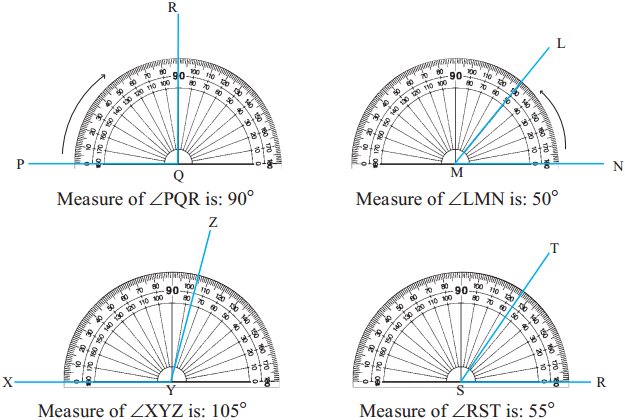
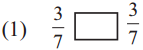
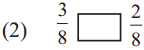
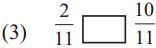
Maharashtra Board Class 5 Maths Solutions Chapter 6 Angles Problem Set 27

Balbharti Maharashtra Board Class 5 Maths Solutions Chapter 6 Angles Problem Set 27 Textbook Exercise Important Questions and Answers.

Maharashtra State Board Class 5 Maths Solutions Chapter 6 Angles Problem Set 27

Question 1.
Give two examples of parallel lines you can see in your environment.
Answer:
(i) Bars on the window.
(ii) Horizontal lines in the notebook are the examples of parallel lines.

Maharashtra Board Class 5 Maths Solutions Chapter 6 Angles Problem Set 27

Question 2.
Give two examples of perpendicular lines you can see in your environment.
Answer:
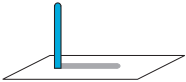
(i) The angles formed by a pole and its shadow on the ground.
(ii) The adjacent sides of a notebook.

Question 3.
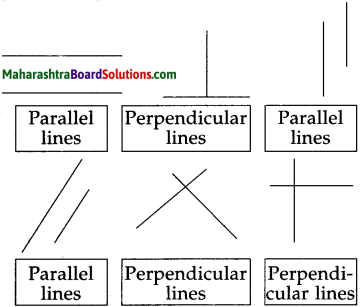
Look at the pictures given below. Decide whether the lines given in each picture are parallel or perpendicular to each other and write the answer in the box.
Maharashtra Board Class 5 Maths Solutions Chapter 5 Fractions Problem Set 25 18
Answer:
Maharashtra Board Class 5 Maths Solutions Chapter 5 Fractions Problem Set 25 1

Angles Problem Set 27 Additional Important Questions and Answers

Question 1.
Give some examples of perpendicular lines from capital letters of the English alphabet.
Answer:
Maharashtra Board Class 5 Maths Solutions Chapter 5 Fractions Problem Set 25 2

Maharashtra Board Class 5 Maths Solutions Chapter 6 Angles Problem Set 27

Question 2.
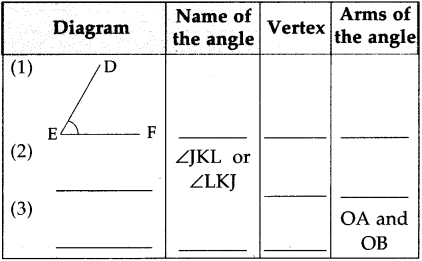
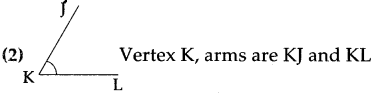
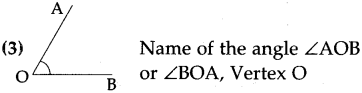
Complete the following:
Maharashtra Board Class 5 Maths Solutions Chapter 5 Fractions Problem Set 25 3
Answer:
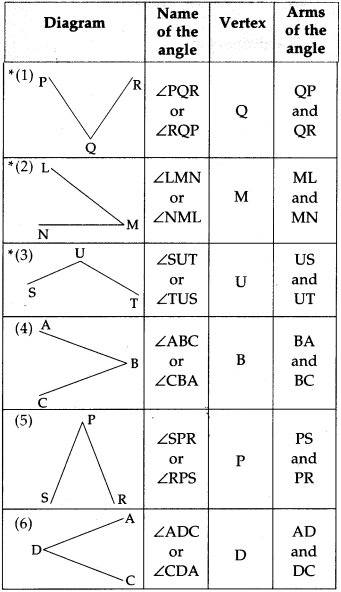
(1) ZDEF or ZFED, Vertex E, arms are ED
Maharashtra Board Class 5 Maths Solutions Chapter 5 Fractions Problem Set 25 16
Maharashtra Board Class 5 Maths Solutions Chapter 5 Fractions Problem Set 25 17

Question 3.
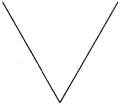
Which of the following figures show angle?
Maharashtra Board Class 5 Maths Solutions Chapter 5 Fractions Problem Set 25 4
Answer:
Figure 3

Maharashtra Board Class 5 Maths Solutions Chapter 6 Angles Problem Set 27

Question 4.
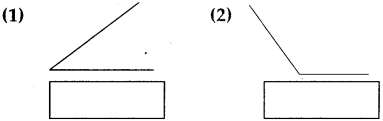
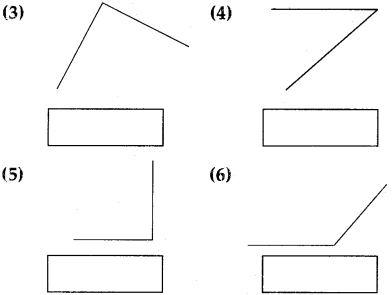
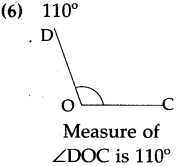
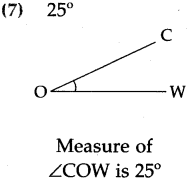
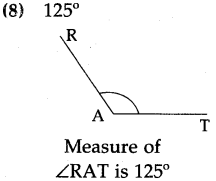
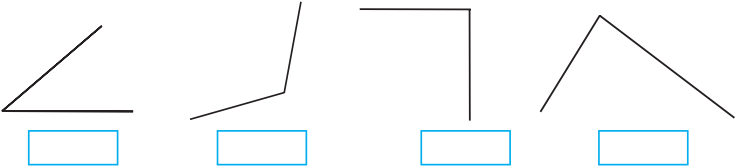
(A) Measure the angles given below and write the measure in the given boxes:
Maharashtra Board Class 5 Maths Solutions Chapter 5 Fractions Problem Set 25 5
Maharashtra Board Class 5 Maths Solutions Chapter 5 Fractions Problem Set 25 6
Answer:
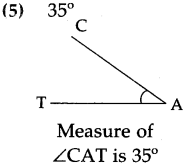
(1) 30°
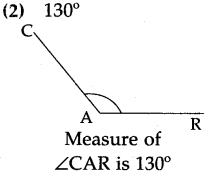
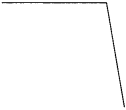
(2) 135°
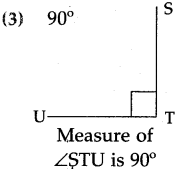
(3) 90°
(4) 50°
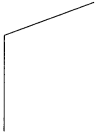
(5) 90°
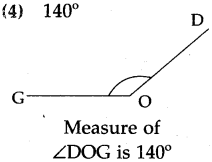
(6) 150°

Maharashtra Board Class 5 Maths Solutions Chapter 6 Angles Problem Set 27

B) Classify the above figures according to types of the angles.
Answer:
Acute angles: (1) and (4),
Right angles: (3) and (5),
Obtuse angles: (2) and (6)

Question 5.
Draw and name the following angles with the help of a protractor:
Maharashtra Board Class 5 Maths Solutions Chapter 5 Fractions Problem Set 25 7
Maharashtra Board Class 5 Maths Solutions Chapter 5 Fractions Problem Set 25 8
Maharashtra Board Class 5 Maths Solutions Chapter 5 Fractions Problem Set 25 9
Maharashtra Board Class 5 Maths Solutions Chapter 5 Fractions Problem Set 25 10
Maharashtra Board Class 5 Maths Solutions Chapter 5 Fractions Problem Set 25 11
Maharashtra Board Class 5 Maths Solutions Chapter 5 Fractions Problem Set 25 12
Maharashtra Board Class 5 Maths Solutions Chapter 5 Fractions Problem Set 25 13
Maharashtra Board Class 5 Maths Solutions Chapter 5 Fractions Problem Set 25 14
Answer:
Students to draw angles.

Maharashtra Board Class 5 Maths Solutions Chapter 6 Angles Problem Set 27

Question 6.
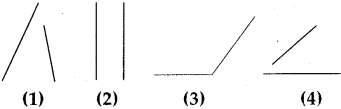
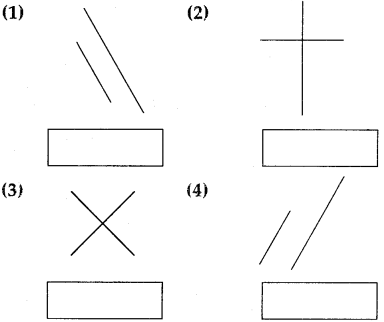
Look at the pictures given below. Decide whether the lines given in each picture are parallel or perpendicular to each other and write the answer in the box:
Maharashtra Board Class 5 Maths Solutions Chapter 5 Fractions Problem Set 25 15
Answer:
(1) Parallel lines
(2) Perpendicular lines
(3) Perpendicular lines
(4) Parallel lines

Maharashtra Board Class 5 Maths Solutions Chapter 6 Angles Problem Set 27

Question 7.
Say, true or false of the following:
(1) Parallel lines do not intersect each other.
(2) Pole and its shadow on the ground makes a cute angle.
(3) Angle between two parallel lines is 90°.
(4) Angle between two intersecting lines may or may not be 90°.
Answer:
(1) True
(2) False
(3) False
(4) True

Maharashtra Board Class 5 Maths Solutions Chapter 8 Multiples and Factors Problem Set 32

Balbharti Maharashtra Board Class 5 Maths Solutions Chapter 8 Multiples and Factors Problem Set 32 Textbook Exercise Important Questions and Answers.

Maharashtra State Board Class 5 Maths Solutions Chapter 8 Multiples and Factors Problem Set 32

Write the factors of the following numbers.

(1) 8
Answer:
8 is exactly divisible by 1, 2, 4, 8.
So, 1, 2, 4, 8 are factors of 8.

Maharashtra Board Class 5 Maths Solutions Chapter 8 Multiples and Factors Problem Set 32

(2) 5
Answer:
5 is exactly divisible by 1, 5.
So, 1, 5 are factors of 5.

(3) 14
Answer:
14 is exactly divisible by 1, 2, 7, 14.
So, 1, 2, 7, 14 are the factors 14.

(4) 10
Answer:
10 is exactly divisible by 1, 2, 5, 10.
So, 1, 2, 5, 10 are the factors of 10.

(5) 7
Answer:
7 is exactly divisible by 1, 7.
So, 1, 7 are factors of 7.

Maharashtra Board Class 5 Maths Solutions Chapter 8 Multiples and Factors Problem Set 32

(6) 22
Answer:
22 is exactly divisible by 1, 2, 11, 22.
So, 1, 2, 11, 22 are the factors of 22.

(7) 25
Answer:
25 is exactly divisible by 1, 5, 25.
So, 1, 5, 25 are the factors of 25.

(8) 32
Answer:
32 is exactly divisible by 1, 2, 4, 8,16, 32.
So, 1, 2, 4, 8, 16, 32 are the factors of 32.

(9) 33
Answer:
33 is exactly divisible by 1, 3, 11, 33.
So, 1, 3, 11, 33 are the factors of 33.

Maharashtra Board Class 5 Maths Solutions Chapter 8 Multiples and Factors Problem Set 32

Multiples

Dada : You know what a divisor and a dividend is. Do you know what a multiple is?

Anju : I don’t know what a multiple is, but I think it must be related to multiplication.

Dada : Right ! Let me give you an example. You can solve 20 ÷ 5, can’t you?

Anju : Yes. When we divide the dividend 20 by the divisor 5, the quotient is 4 and the remainder is 0.

Dada : When the division of a dividend leaves no remainder, the dividend is said to be a multiple of the divisor. In such a case, the dividend is the product of the divisor and the quotient. Here, 20 is a multiple of 5, but 21 is not.

Now tell me, can we divide 84 chalksticks into groups of six?

Suraj : Let me divide by 6. 84 can be divided exactly by 6 and the quotient is 14. Thus, we can make 14 groups of 6. So, 84 is the multiple of 6 and 6 is a factor of 84.

Dada : If the number of chalksticks is 6, 12, 18, 36 or 84, then we can make exact groups of 6 with none left over. It means that 6, 12, 18, 36 and 84 are multiples of 6, or that they are exactly divisible by 6. To see whether the number of chalksticks is a multiple of 6, divide that number by 6. If the remainder is 0, the number is a multiple of 6.

Each number in the 3 times table is exactly divisible by 3 or is a multiple of 3. Similarly, the numbers in the 7 times table are multiples of 7. Numbers in the 9 times table are multiples of 9.

We use this idea all the time. Let me ask you a few questions so as to make it clear. I have a 200 ml measure. Will I be able to measure out 1 litre of milk with it?

Maharashtra Board Class 5 Maths Solutions Chapter 8 Multiples and Factors Problem Set 32

Suraj : I litre is 1000 ml. 1000 = 200 × 5, which means that 1000 is a multiple of 200. So we can measure out 1 litre of milk with the 200 millilitre measure. 5 measures of 200 ml make 1 litre.

Dada : Can we measure out one and a half litres of milk with the 200 ml measure?

Anju : One and a half litres is 1500 ml. 1500 is not divisible by 200. So, it is not a multiple of 200. So the 200 ml measure cannot be used to measure out one and a half litres of milk.

Dada : I have 400 grams of chana. I have to make pouches of 60 grams each. Is that possible, if I don’t want any left overs?

Anju : No. 400 is not a multiple of 60.

Dada : How much more chana will I need to make those pouches of 60 grams each?

Anju : We will have to find the multiple of 60 that comes directly after 400. 60 × 6 = 360, 60 × 7 = 420. So, we need 20 grams more of chana.

Tests for divisibility

Study the 2 times table and see which numbers appear in the units place. Similarly, divide 52, 74, 80, 96 and 98 by 2 to see if they are exactly divisible by 2. What rule do we get for determining whether a number is a multiple of 2?

Now study the 5 and 10 times tables.

Maharashtra Board Class 5 Maths Solutions Chapter 8 Multiples and Factors Problem Set 32

See what rules you get for finding multiples of 5 and 10, that is, numbers divisible by 5 and 10.

Test for divisibility by 2 : If there is 0, 2, 4, 6 or 8 in the units place, the number is a multiple of 2, or is exactly divisible by 2.

Test for divisibility by 5 : Any number with 5 or 0 in the units place is a multiple of 5 or, is divisible by 5.

Test for divisibility by 10 : Any number that has 0 in the units place is a multiple of 10.

Multiples and Factors Problem Set 32 Additional Important Questions and Answers

Question 1.
Write the factors of the following numbers.

(1) 45
Answer:
45 is exactly divisible by 1, 3, 5, 9,15, 45.
So, 1, 3, 5, 9, 15, 45 are the factors of 45.

(2) 48
Answer:
48 is exactly divisible by 1, 2, 3, 4, 6, 8,12,16, 24, 48.
So, 1, 2, 3, 4, 6, 8,12,16, 24, 48 are the factors of 48.

Maharashtra Board Class 5 Maths Solutions Chapter 8 Multiples and Factors Problem Set 32

(3) 60
Answer:
60 is exactly divisible by 1, 2, 3, 4, 5, 6,10,12, 15, 20, 30, 60
So, 1, 2, 3, 4, 5, 6,10, 12, 15, 20, 30, 60 are the factors of 60.

Question 2.
Is 8 a factor of 60?
Answer:
No, since 60 is not exactly divisible by 8.

Maharashtra Board Class 5 Maths Solutions Chapter 6 Angles Problem Set 26

Balbharti Maharashtra Board Class 5 Maths Solutions Chapter 6 Angles Problem Set 26 Textbook Exercise Important Questions and Answers.

Maharashtra State Board Class 5 Maths Solutions Chapter 6 Angles Problem Set 26

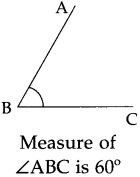
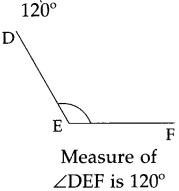
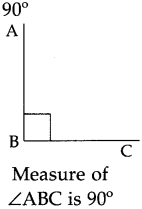
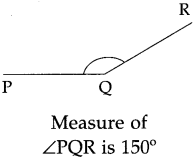
Question 1.
Draw and name the following angles with the help of a protractor.

(1) 60°
Answer:
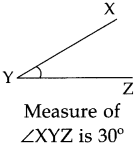
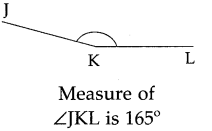
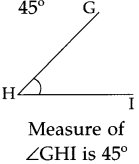
Maharashtra Board Class 5 Maths Solutions Chapter 6 Angles Problem Set 26 1

Maharashtra Board Class 5 Maths Solutions Chapter 6 Angles Problem Set 26

(2) 120°
Answer:
Maharashtra Board Class 5 Maths Solutions Chapter 6 Angles Problem Set 26 2

(3) 90°
Answer:
Maharashtra Board Class 5 Maths Solutions Chapter 6 Angles Problem Set 26 3

(4) 150°
Answer:
Maharashtra Board Class 5 Maths Solutions Chapter 6 Angles Problem Set 26 4

(5) 30°
Answer:
Maharashtra Board Class 5 Maths Solutions Chapter 6 Angles Problem Set 26 5

Maharashtra Board Class 5 Maths Solutions Chapter 6 Angles Problem Set 26

(6) 165°
Answer:
Maharashtra Board Class 5 Maths Solutions Chapter 6 Angles Problem Set 26 6

(7) 45°
Answer:
Maharashtra Board Class 5 Maths Solutions Chapter 6 Angles Problem Set 26 7

Types of angles

Maharashtra Board Class 5 Maths Solutions Chapter 6 Angles Problem Set 26 11
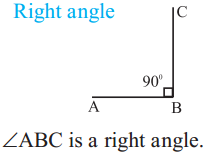
∠ABC is a right angle.
Angles of measure 90° are called right angles.

Maharashtra Board Class 5 Maths Solutions Chapter 6 Angles Problem Set 26 12
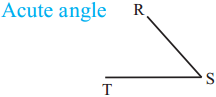
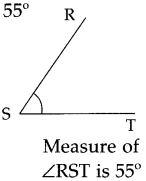
∠RST measures less than 90°, that is, less than a right angle.
An angle which measures less than a right angle is called an acute angle.
∠RST is an acute angle.

Maharashtra Board Class 5 Maths Solutions Chapter 6 Angles Problem Set 26

Maharashtra Board Class 5 Maths Solutions Chapter 6 Angles Problem Set 26 13
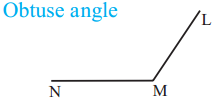
∠LMN measures more than 90°, that is, more than a right angle.
An angle which measures more than a right angle is called an obtuse angle.
∠LMN is an obtuse angle.

Activity :

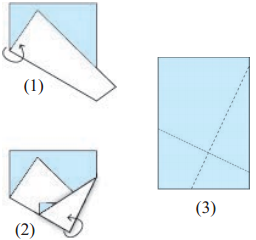
Making a right angle by folding
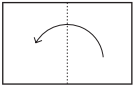
(1) Fold a sheet of paper roughly in half.
(2) Make another fold in the paper at any point on the first fold, as shown in the picture.
(3) Now unfold the paper. You will find two lines. The angle between those two lines will be a right angle.

With the help of a protractor, verify that the measure of this angle is 90°.
Maharashtra Board Class 5 Maths Solutions Chapter 6 Angles Problem Set 26 14

Parallel and perpendicular lines
Parallel lines

Maharashtra Board Class 5 Maths Solutions Chapter 6 Angles Problem Set 26

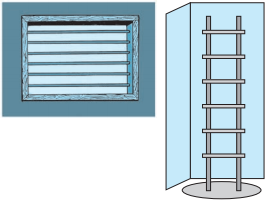
The bars on the window in the picture are parallel to each other.
The steps on the ladder in the picture are parallel to each other.
The vertical legs of the ladder are parallel to each other.
Maharashtra Board Class 5 Maths Solutions Chapter 6 Angles Problem Set 26 15

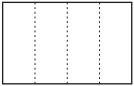
1. Take a rectangular piece of paper.
Maharashtra Board Class 5 Maths Solutions Chapter 6 Angles Problem Set 26 16
2. Fold it in such a way that one edge falls exactly on the opposite edge.
Maharashtra Board Class 5 Maths Solutions Chapter 6 Angles Problem Set 26 17
3. Make another fold in the same way.
Maharashtra Board Class 5 Maths Solutions Chapter 6 Angles Problem Set 26 18
4. Unfold the paper and trace the lines made by the folds, with a pencil.
Maharashtra Board Class 5 Maths Solutions Chapter 6 Angles Problem Set 26 19
___________ The lines traced with the pencil are parallel to each other.
______________________ The lines shown alongside are not of equal length, yet they are parallel to each other.

Parallel lines do not intersect, that is, they do not cut each other, no matter how far they are extended on either side.

Take a ruler as shown in the picture.
Maharashtra Board Class 5 Maths Solutions Chapter 6 Angles Problem Set 26 20
Using a pencil, draw lines along both sides of the ruler. Put the ruler aside. The two lines are parallel to each other.
In this way, we can use several rectangular objects to draw parallel lines.

Maharashtra Board Class 5 Maths Solutions Chapter 6 Angles Problem Set 26

Perpendicular lines

We have seen many objects standing straight on the ground. These objects form a right angle with their shadows.

For example, the angle formed by a pole and its shadow on the ground is 90° or a right angle. Similarly, adjacent sides of wooden planks or books also form angles of 90°.
Maharashtra Board Class 5 Maths Solutions Chapter 6 Angles Problem Set 26 21

When two lines form an angle of 90° with each other, they are said to be perpendicular to each other. To show that two lines are perpendicular, a symbol as shown the figure is drawn between them.
Maharashtra Board Class 5 Maths Solutions Chapter 6 Angles Problem Set 26 22

Measure the angle between any two adjacent sides of your notebook. Since it is a right angle, the two sides are perpendicular to each other.
Maharashtra Board Class 5 Maths Solutions Chapter 6 Angles Problem Set 26 23

Look at this picture of a page of a notebook.
Maharashtra Board Class 5 Maths Solutions Chapter 6 Angles Problem Set 26 24

The horizontal lines on the paper are parallel to each other. However, the vertical margin line on the side forms a right angle with the horizontal lines, therefore, it is perpendicular to the horizontal lines.

Maharashtra Board Class 5 Maths Solutions Chapter 6 Angles Problem Set 26

Angles Problem Set 26 Additional Important Questions and Answers

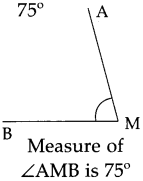
(1) 80°
Answer:
Maharashtra Board Class 5 Maths Solutions Chapter 6 Angles Problem Set 26 8

(2) 55°
Answer:
Maharashtra Board Class 5 Maths Solutions Chapter 6 Angles Problem Set 26 9

(3) 55°
Answer:
Maharashtra Board Class 5 Maths Solutions Chapter 6 Angles Problem Set 26 10

Maharashtra Board Class 5 Maths Solutions Chapter 5 Fractions Problem Set 23

Balbharti Maharashtra Board Class 5 Maths Solutions Chapter 5 Fractions Problem Set 23 Textbook Exercise Important Questions and Answers.

Maharashtra State Board Class 5 Maths Solutions Chapter 5 Fractions Problem Set 23

Question 1.
What is \(\frac{1}{3}\) of each of the collections given below?

(1) 15 pencils
(2) 21 balloons
(3) 9 children
(4) 18 books
Answer:
(1) 15 pencils → \(\frac{1}{3}\) of 15 = 5, 15 ÷ 3 = 5 pencils.
(2) 21 baloons → \(\frac{1}{3}\) of 21 = 7,21 ÷ 3 = 7 baloons.
(3) 9 children → \(\frac{1}{3}\) of 9 = 3, 9 ÷ 3 = 3 chi1dren.
(4) 18 books → \(\frac{1}{3}\) of 18 = 6, 18 ÷ 3 = 6 books.

Maharashtra Board Class 5 Maths Solutions Chapter 5 Fractions Problem Set 23

Question 2.
What is \(\frac{1}{5}\) of each of the following?
(1) 20 rupees
(2) 30 km
(3) 15 litres
(4) 25 cm
Answer:
(1) 20 rupees → \(\frac{1}{5}\) of 20 = 4, 20 ÷ 5 = 4 rupees.
(2) 30 km → \(\frac{1}{5}\) of 30 = 6, 30 ÷ 5 = 6km.
(3) 15 litres → \(\frac{1}{5}\) of 15 = 3, 15 ÷ 5 = 3 litres.
(4) 25 cm → \(\frac{1}{5}\) of 25 = 5, 25 ÷ 5 = 5cm.

Question 3.
Find the part of each of the following numbers equal to the given fraction.

(1) \(\frac{2}{3}\) of 30
Solution:
\(\frac{2}{3}\) x 30 So, we take \(\frac{1}{3}\) of 30, twice
\(\frac{1}{3}\) x 30 = 10, twice of 10 is 2 x 10 = 20
It means that \(\frac{2}{3}\) x 30 = 20

(2) \(\frac{7}{11}\) of 22
Solution:
\(\frac{7}{11}\) x 22 So, we take of 22, 7 times
\(\frac{1}{11}\) x 22 = 2, seven times of 2 is 2 x 7 = 14

Maharashtra Board Class 5 Maths Solutions Chapter 5 Fractions Problem Set 23

(3) \(\frac{3}{8}\) of 64
Solution:
\(\frac{3}{8}\) x 64 So, we take \(\frac{1}{8}\) of 64, thrice
\(\frac{1}{8}\) x 64 = 8, 3 times 8 is 3 x 8 = 24

(4) \(\frac{5}{13}\) of 65
Solution:
\(\frac{5}{13}\) x 65 So, we take \(\frac{1}{13}\) of 65, 5 times
\(\frac{1}{13}\) x 65 = 55 times of 5 is 5 x 5 = 25

Mixed fractions

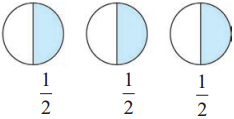
Maharashtra Board Class 5 Maths Solutions Chapter 5 Fractions Problem Set 23 1
Half of each of the three circles is coloured. That is, 3 parts, each equal to \(\frac{1}{2}\) of the circle, are coloured.

The coloured part is \(\frac{1}{2}\) + \(\frac{1}{2}\) + \(\frac{1}{2}\), that is, \(\frac{3}{2}\) or 1 + \(\frac{1}{2}\).

1 + \(\frac{1}{2}\) is written as 1 \(\frac{1}{2}\). 1 \(\frac{1}{2}\) is read as ‘one and one upon two’.

In the fraction 1 \(\frac{1}{2}\), 1 is the integer part and \(\frac{1}{2}\) is the fraction part. Hence, such fractions are called mixed fractions or mixed numbers. 2 \(\frac{1}{4}\), 3 \(\frac{2}{5}\), 7 \(\frac{4}{9}\) are all mixed fractions.

Maharashtra Board Class 5 Maths Solutions Chapter 5 Fractions Problem Set 23

Fractions in which the numerator is greater than the denominator are called improper fractions.

\(\frac{3}{2}\), \(\frac{5}{3}\) are improper fractions. We can convert improper fractions into mixed fractions.

For example, Maharashtra Board Class 5 Maths Solutions Chapter 5 Fractions Problem Set 23 2

Activities
1. Colour the Hats.
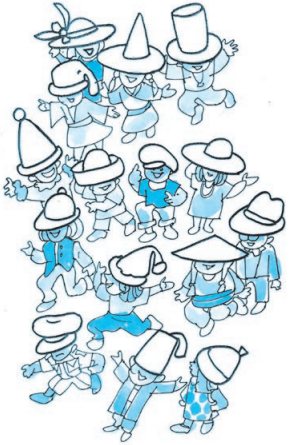
Maharashtra Board Class 5 Maths Solutions Chapter 5 Fractions Problem Set 23 3
In the picture alongside :
Colour \(\frac{1}{3}\) of the hats red.
Colour \(\frac{3}{5}\) of the hats blue.
How many hats have you coloured red?
How many hats have you coloured blue?
How many are still not coloured?

Maharashtra Board Class 5 Maths Solutions Chapter 5 Fractions Problem Set 23

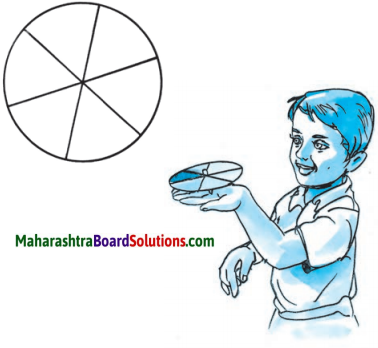
2. Make a Magic Spinner.
Maharashtra Board Class 5 Maths Solutions Chapter 5 Fractions Problem Set 23 4
Take a white cardboard disc. As shown in the figure, divide it into six equal parts.

Colour the parts red, orange, yellow, green, blue and violet.

Make a small hole at the centre of the disc and fix a pointed stick in the hole.

Your magic spinner is ready.

What fraction of the disc is each of the coloured parts?
Give the disc a strong tug to make it turn fast. What colour does it appear to be now?

The Clever Poet

Maharashtra Board Class 5 Maths Solutions Chapter 5 Fractions Problem Set 23 5

Maharashtra Board Class 5 Maths Solutions Chapter 5 Fractions Problem Set 23

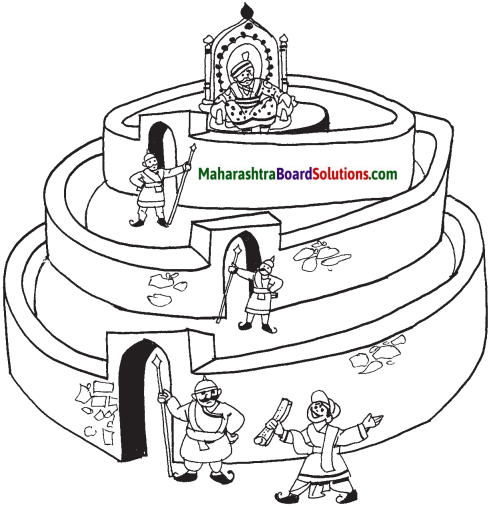
There was a king who had a great love for literature. A certain poet knew that if the king read a good poem it made him very happy. Then the king would give the poet an award. Once, the poet composed a good poem. He thought if he showed it to the king, he would win a prize. So, he went to the king’s palace. But, it was not easy to meet the king. You had to pass a number of gates and guards. The first guard asked the poet why he wanted to meet the king. So, the poet told him the reason. Seeing the chance of getting a share of the award, the guard demanded, ‘You must

give me \(\frac{1}{10}\) of your prize. Only then will I let you go in.’ The poet could do nothing but agree. The second guard stopped him and said, ‘I will let you go in only if you promise me \(\frac{2}{5}\) of your prize.’ The third guard, too, was a greedy man. He said, ‘I will not let you go, unless you promise me \(\frac{1}{4}\) of your prize.’ The king’s palace was just a little distance away. Now, the poet told the guard, ‘Why only \(\frac{1}{4}\), I shall give you half the prize!’ The guard was pleased and let him in.

The king liked the poem. He asked the poet, ‘What is the prize you want?’ ‘I shall be happy if Your Majesty awards me 100 lashes of the whip.’ The king was surprised. ‘Are you out of your mind!’ he exclaimed. ‘I have never met anyone so crazy as to ask for a whipping !’

‘Your Majesty, if you wish to know the reason, the three palace guards must be called here.’ When the guards came, the poet explained, ‘Your Majesty, all of them have a share in the 100 lashes that you have awarded to me. Each of them has fixed his own share of the prize I get. The first guard

Maharashtra Board Class 5 Maths Solutions Chapter 5 Fractions Problem Set 23

must get \(\frac{1}{10}\) of the award, that is, [ ] lashes. The second must get \(\frac{2}{5}\), which is [ ], and the third must get half the award, that is, [ ] lashes !’ The king could now see how greedy the guards were and how clever the poet was. He saw to it that each guard got the punishment he deserved. He gave the poet a prize for his poem. He also gave him an extra 100 gold coins for exposing the greed of the guards.

What was the clever idea of the poet which the king appreciated so much?

Fractions Problem Set 23 Additional Important Questions and Answers

Question 1.
What is \(\frac{1}{3}\) of each of the collections given below?

(1) 24 marbles →
(2) 6 erasers →
Answer:
(1) 24 marbles → \(\frac{1}{3}\) of 24 = 8, 24 ÷ 3 = 8 marbles.
(1) 6 erasers → \(\frac{1}{3}\) of 6 = 2, 6 ÷ 3 = 2 erasers.

Question 2.
What is \(\frac{1}{5}\) of each of the following?

(1) 35 gm →
(2) 40m →
Answer:
(1) 35 gm → \(\frac{1}{5}\) of 35 = 7, 35 ÷ 5 = 7 gm.
(2) 40m → \(\frac{1}{5}\) of 40 = 8, 40 ÷ 5 = 8m.

Maharashtra Board Class 5 Maths Solutions Chapter 5 Fractions Problem Set 23

Question 3.
Find the part of each of the following numbers equal to the given fraction:

(1) \(\frac{7}{9}\) of 45
Solution:
\(\frac{7}{9}\) x 45 So, we take \(\frac{1}{9}\) of 45, 7 times
\(\frac{1}{9}\) x 45 = 5, 7 times of 5 is 7 x 5 = 35

(2) \(\frac{3}{7}\) of 28
Solution:
\(\frac{3}{7}\) x 28 So, we take \(\frac{1}{7}\) of 28, thrice
\(\frac{1}{7}\) x 28 = 4, 3 times of 4 is 4 x 3 = 12

Question 4.
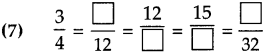
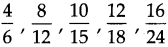
Find the proper number in the box:
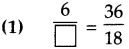
Maharashtra Board Class 5 Maths Solutions Chapter 5 Fractions Problem Set 23 6
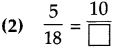
Maharashtra Board Class 5 Maths Solutions Chapter 5 Fractions Problem Set 23 7
Maharashtra Board Class 5 Maths Solutions Chapter 5 Fractions Problem Set 23 8
Maharashtra Board Class 5 Maths Solutions Chapter 5 Fractions Problem Set 23 9
Maharashtra Board Class 5 Maths Solutions Chapter 5 Fractions Problem Set 23 10
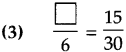
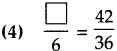
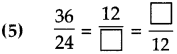
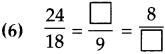
Maharashtra Board Class 5 Maths Solutions Chapter 5 Fractions Problem Set 23 11
Maharashtra Board Class 5 Maths Solutions Chapter 5 Fractions Problem Set 23 12
Maharashtra Board Class 5 Maths Solutions Chapter 5 Fractions Problem Set 23 13
Answer:
(1) 3
(2) 36
(3) 3
(4) 7
(5) 8, 18
(6) 12, 6
(7) 9, 16, 20, 24
(8) 15, 20, 35, 36, 55

Maharashtra Board Class 5 Maths Solutions Chapter 5 Fractions Problem Set 23

Question 5.
Find an equivalent fraction with denominator 3, for each of the following fractions.
Maharashtra Board Class 5 Maths Solutions Chapter 5 Fractions Problem Set 23 14
Answer:
Maharashtra Board Class 5 Maths Solutions Chapter 5 Fractions Problem Set 23 21

Question 6.
Find an equivalent fraction with numerator 30 for each of the following fractions.
Maharashtra Board Class 5 Maths Solutions Chapter 5 Fractions Problem Set 23 15
Answer:
Maharashtra Board Class 5 Maths Solutions Chapter 5 Fractions Problem Set 23 22

Question 7.
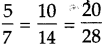
Find two equivalent fractions for each of the following fraction.
\(\text { (1) } \frac{5}{7}\)
\(\text { (2) } \frac{8}{9}\)
\(\text { (3) } \frac{7}{13}\)
Answer:
(1) Maharashtra Board Class 5 Maths Solutions Chapter 5 Fractions Problem Set 23 23
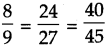
(2) Maharashtra Board Class 5 Maths Solutions Chapter 5 Fractions Problem Set 23 24
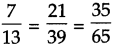
(3) Maharashtra Board Class 5 Maths Solutions Chapter 5 Fractions Problem Set 23 25

Maharashtra Board Class 5 Maths Solutions Chapter 5 Fractions Problem Set 23

Question 8.
Match the columns (A) and (B) for having equivalent fractions:

(A)(B)
(1)\(\frac{3}{4}\)(a) \(\frac{15}{27}\)
(2)\(\frac{5}{9}\)(b) \(\frac{2}{3}\)
(3)\(\frac{7}{11}\)(c) \(\frac{27}{36}\)
(4)\(\frac{8}{12}\)(d) \(\frac{28}{44}\)

Answer:
(1) ↔ (c)
(2) ↔ (a)
(3) ↔ (d)
(4) ↔ (b)

Question 9.
Convert the given fractions into like fractions:
\(\text { (1) } \frac{1}{10}, \frac{2}{3}\)
\(\text { (2) } \frac{3}{7}, \frac{4}{5}\)
\(\text { (3) } \frac{1}{3}, \frac{3}{5}\)
\(\text { (3) } \frac{1}{4}, \frac{2}{5}\)
Answer:
\(\text { (1) } \frac{3}{30}, \frac{20}{30}\)
\(\text { (2) } \frac{15}{35}, \frac{28}{35}\)
\(\text { (3) } \frac{5}{15}, \frac{9}{15}\)
\(\text { (3) } \frac{5}{20}, \frac{8}{20}\)

Maharashtra Board Class 5 Maths Solutions Chapter 5 Fractions Problem Set 23

Question 10.
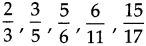
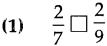
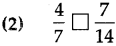
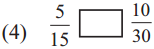
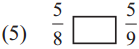
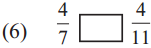
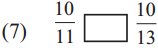
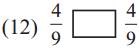
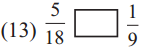
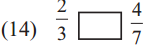
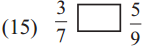
Write the proper symbol from <, > or = in the box:
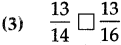
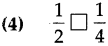
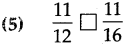
Maharashtra Board Class 5 Maths Solutions Chapter 5 Fractions Problem Set 23 16
Maharashtra Board Class 5 Maths Solutions Chapter 5 Fractions Problem Set 23 17
Maharashtra Board Class 5 Maths Solutions Chapter 5 Fractions Problem Set 23 18
Maharashtra Board Class 5 Maths Solutions Chapter 5 Fractions Problem Set 23 19
Maharashtra Board Class 5 Maths Solutions Chapter 5 Fractions Problem Set 23 20
Answer:
(1) >
(2) >
(3) >
(4) >
(5) >

Question 11.
Add the following:
\(\text { (1) } \frac{1}{6}+\frac{2}{6}\)
\(\text { (2) } \frac{1}{4}+\frac{3}{4}\)
\(\text { (3) } \frac{5}{13}+\frac{2}{13}+\frac{3}{13}\)
\(\text { (4) } \frac{2}{9}+\frac{3}{7}\)
\(\text { (5) } \frac{3}{11}+\frac{2}{3}\)
\(\text { (6) } \frac{1}{10}+\frac{4}{5}\)
Answer:
\(\text { (1) } \frac{3}{6}\)
\(\text { (2) } \frac{4}{4}\)
\(\text { (3) } \frac{10}{13}\)
\(\text { (4) } \frac{41}{63}\)
\(\text { (5) } \frac{31}{33}\)
\(\text { (6) } \frac{9}{10}\)

Maharashtra Board Class 5 Maths Solutions Chapter 5 Fractions Problem Set 23

Question 12.
Subtract the following:
\(\text { (1) } \frac{5}{6}-\frac{1}{6}\)
\(\text { (2) } \frac{3}{5}-\frac{2}{5}\)
\(\text { (3) } \frac{7}{16}-\frac{3}{16}-\frac{1}{16}\)
\(\text { (4) } \frac{5}{6}-\frac{7}{12}\)
\(\text { (5) } \frac{13}{16}-\frac{5}{8}\)
\(\text { (6) } \frac{4}{9}-\frac{3}{10}\)
Answer:
\(\text { (1) } \frac{4}{6}\)
\(\text { (2) } \frac{1}{5}\)
\(\text { (3) } \frac{3}{16}\)
\(\text { (4) } \frac{3}{12}\)
\(\text { (5) } \frac{3}{13}\)
\(\text { (6) } \frac{13}{90}\)

Question 13.
What is \(\frac{1}{4}\) of each of the collections given below:
(1) 20 marbles
(2) 12 pens
(3) 24 notebooks
(4) 8 ladoos
Answer:
(1) 5 marbles
(2) 3 pens
(3) 6 notebooks
(4) 2 ladoos

Maharashtra Board Class 5 Maths Solutions Chapter 5 Fractions Problem Set 23

Question 14.
What is \(\frac{1}{6}\) of each of the following:
(1) 18 bananas
(2) 12 gms
(3) 30 metres
(4) 24 ₹
Answer:
(1) 3 bananas
(2) 2 gms
(3) 5 metres
(4) 4 ₹

Question 15.
Find the part of each of the following numbers equal to the given fraction.
(1) \(\frac{2}{5}\) of 25
(2) \(\frac{3}{7}\) of 21
(3) \(\frac{4}{9}\) of 36
(4) \(\frac{4}{17}\) of 34
Answer:
(1) 10
(2) 9
(3) 16
(4) 8

Maharashtra Board Class 5 Maths Solutions Chapter 5 Fractions Problem Set 23

Question 16.
Printed price of. the book was 80. Vikram purchased the book by paying of the printed price of the book. How much he paid for the book?
Answer:
64 ₹

Maharashtra Board Class 5 Maths Solutions Chapter 5 Fractions Problem Set 22

Balbharti Maharashtra Board Class 5 Maths Solutions Chapter 5 Fractions Problem Set 22 Textbook Exercise Important Questions and Answers.

Maharashtra State Board Class 5 Maths Solutions Chapter 5 Fractions Problem Set 22

Question 1.
Add the following:

\(\text { (1) } \frac{1}{8}+\frac{3}{4}\)
Solution:
The smallest common multiple of 4 and 8 is 8. So making 8 is the common denominator of the given fractions.
Maharashtra Board Class 5 Maths Solutions Chapter 5 Fractions Problem Set 21 6
Answer:
\(\frac{7}{8}\)

Maharashtra Board Class 5 Maths Solutions Chapter 5 Fractions Problem Set 22

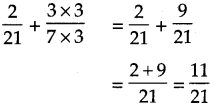
\(\text { (2) } \frac{2}{21}+\frac{3}{7}\)
Solution:
21 is the multiple of 7. So making 21 as denominator of both the fractions.
Maharashtra Board Class 5 Maths Solutions Chapter 5 Fractions Problem Set 21 7
Answer:
\(\frac{11}{21}\)

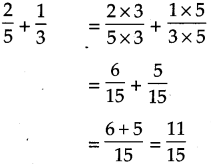
\(\text { (3) } \frac{2}{5}+\frac{1}{3}\)
Solution:
Least common multiple of 5 and 3 is 15. So making common denominator of both the fractions 15.
Maharashtra Board Class 5 Maths Solutions Chapter 5 Fractions Problem Set 21 8
Answer:
\(\frac{11}{15}\)

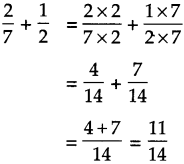
\(\text { (4) } \frac{2}{7}+\frac{1}{2}\)
Solution:
Smallest common multiple of 2 and 7 is 14. So, making denominator of both the fractions 14.
Maharashtra Board Class 5 Maths Solutions Chapter 5 Fractions Problem Set 21 9
Answer:
\(\frac{11}{14}\)

Maharashtra Board Class 5 Maths Solutions Chapter 5 Fractions Problem Set 22

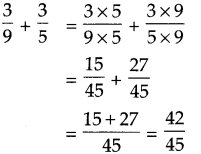
\(\text { (5) } \frac{3}{9}+\frac{3}{5}\)
Solution:
Smallest common multiple of 9 and 5 is 45.
Maharashtra Board Class 5 Maths Solutions Chapter 5 Fractions Problem Set 21 10
Answer:
\(\frac{42}{45}\)

Question 2.
Subtract the following:

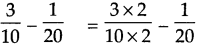
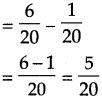
\(\text { (1) } \frac{3}{10}-\frac{1}{20}\)
Solution:
20 is the multiples of 10. So,
Maharashtra Board Class 5 Maths Solutions Chapter 5 Fractions Problem Set 21 13
Maharashtra Board Class 5 Maths Solutions Chapter 5 Fractions Problem Set 21 14
Answer:
\(\frac{5}{20}\)

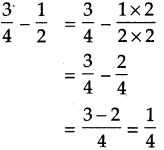
\(\text { (2) } \frac{3}{4}-\frac{1}{2}\)
Solution:
4 is the multiple of 2. So,
Maharashtra Board Class 5 Maths Solutions Chapter 5 Fractions Problem Set 21 15
Answer:
\(\frac{1}{4}\)

Maharashtra Board Class 5 Maths Solutions Chapter 5 Fractions Problem Set 22

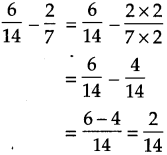
\(\text { (3) } \frac{6}{14}-\frac{2}{7}\)
Solution:
14 is the multiples of 7. So,
Maharashtra Board Class 5 Maths Solutions Chapter 5 Fractions Problem Set 21 16
Answer:
\(\frac{2}{14}\)

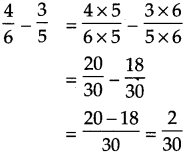
\(\text { (4) } \frac{4}{6}-\frac{3}{5}\)
Solution:
Smallest common multiple of 6 and 5 is 30. So,
Maharashtra Board Class 5 Maths Solutions Chapter 5 Fractions Problem Set 21 17
Answer:
\(\frac{2}{30}\)

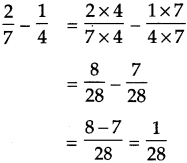
\(\text { (5) } \frac{2}{7}-\frac{1}{4}\)
Solution:
Smallest common multiple of 7 and 4 is 28.
Maharashtra Board Class 5 Maths Solutions Chapter 5 Fractions Problem Set 21 18
Answer:
\(\frac{1}{28}\)

Maharashtra Board Class 5 Maths Solutions Chapter 5 Fractions Problem Set 22

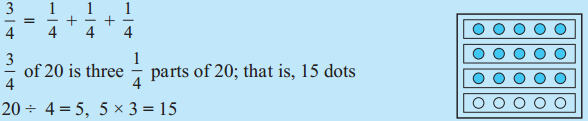
A fraction of a collection and a multiple of a fraction

\(\frac{1}{4}\) of a collection of 20 dots – \(\frac{1}{2}\) of a collection of 20 dots
Maharashtra Board Class 5 Maths Solutions Chapter 5 Fractions Problem Set 21 1

\(\frac{3}{4}\) of a collection of 20 dots
Maharashtra Board Class 5 Maths Solutions Chapter 5 Fractions Problem Set 21 2

Twice 5 is 10 – \(\frac{1}{2}\) times 10
Maharashtra Board Class 5 Maths Solutions Chapter 5 Fractions Problem Set 21 3

Thrice 5 – \(\frac{1}{3}\) times 15
Maharashtra Board Class 5 Maths Solutions Chapter 5 Fractions Problem Set 21 4

Maharashtra Board Class 5 Maths Solutions Chapter 5 Fractions Problem Set 22

\(\frac{1}{3}\) times 15
Maharashtra Board Class 5 Maths Solutions Chapter 5 Fractions Problem Set 21 5

Meena has 5 rupees. Tina has twice as many rupees. That is, Tina has 5 × 2 = 10 rupees. Meena has half as many rupees as Tina, that is, \(\frac{1}{2}\) of 10, or, 5 rupees.
Ramu has to travel a distance of 20 km. If he has travelled \(\frac{4}{5}\) of the distance by car, how many kilometres did he travel by car?
\(\frac{4}{5}\) of 20 km is 20 × \(\frac{4}{5}\). So, we take \(\frac{1}{5}\) of 20, 4 times.
\(\frac{1}{5}\) of 20 = 4. 4 times 4 is 4 × 4 = 16.
It means that 20 × \(\frac{4}{5}\) = 16.
Ramu travelled a distance of 16 kilometres by car.

Addition and Subtraction Problem Set 13 Additional Important Questions and Answers

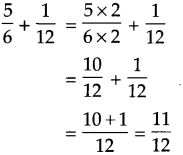
\(\text { (1) } \frac{5}{6}+\frac{1}{12}\)
Solution:
12 is the multiple of 6
Maharashtra Board Class 5 Maths Solutions Chapter 5 Fractions Problem Set 21 11
Answer:
\(\frac{11}{12}\)

Maharashtra Board Class 5 Maths Solutions Chapter 5 Fractions Problem Set 22

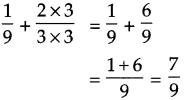
\(\text { (2) } \frac{1}{9}+\frac{2}{3}\)
Solution:
Here 9 is the multiples of 3. So, making like fractions of denominator 9, we get
Maharashtra Board Class 5 Maths Solutions Chapter 5 Fractions Problem Set 21 12
Answer:
\(\frac{7}{9}\)

Subtract the following:

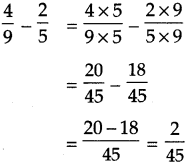
\(\text { (1) } \frac{4}{9}-\frac{2}{5}\)
Solution:
Common multiple of 9 and 5 is 45
Maharashtra Board Class 5 Maths Solutions Chapter 5 Fractions Problem Set 21 19
Answer:
\(\frac{2}{45}\)

Maharashtra Board Class 5 Maths Solutions Chapter 5 Fractions Problem Set 22

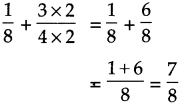
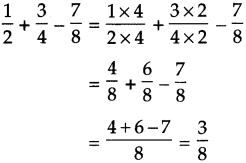
\(\text { (2) } \frac{1}{2}+\frac{3}{4}-\frac{7}{8}\)

Maharashtra Board Class 5 Maths Solutions Chapter 5 Fractions Problem Set 21 20.
Answer:
\(\frac{3}{8}\)

Maharashtra Board Class 5 Maths Solutions Chapter 6 Angles Problem Set 25

Balbharti Maharashtra Board Class 5 Maths Solutions Chapter 6 Angles Problem Set 25 Textbook Exercise Important Questions and Answers.

Maharashtra State Board Class 5 Maths Solutions Chapter 6 Angles Problem Set 25

Measure the angles given below and write the measure in the given boxes.
Maharashtra Board Class 5 Maths Solutions Chapter 6 Angles Problem Set 25 1
Answer:
(1) 40°
(2) 120°
(3) 90°
(4) 85°

Maharashtra Board Class 5 Maths Solutions Chapter 6 Angles Problem Set 25

Drawing an angle of the given measure
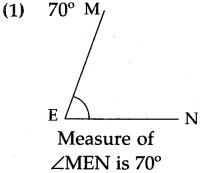
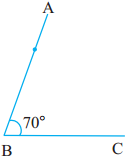
Example Draw ∠ABC of measure 70°.
B is the vertex of∠ABC and BA and BC are its arms.

1. First draw arm BC with a ruler.
Maharashtra Board Class 5 Maths Solutions Chapter 6 Angles Problem Set 25 2

2. Since B is the vertex, we must draw a 70° angle at that point.
Maharashtra Board Class 5 Maths Solutions Chapter 6 Angles Problem Set 25 3

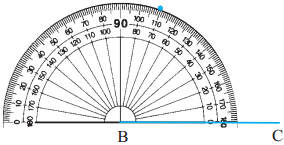
Put the centre of the protractor on B. Place the protractor so that the baseline lies on arm BC. Count the divisions starting from the 0 near point C. Mark a point with your pencil at the division that shows 70°. Lift the protractor.

Draw a line from vertex B through the point marking the 70° angle. Name the other end of the line A.
Maharashtra Board Class 5 Maths Solutions Chapter 6 Angles Problem Set 25 4

∠ABC is an angle of measure 700.
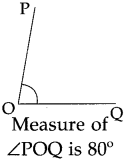
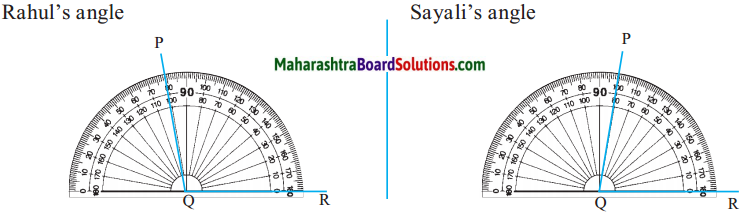
Rahul and Sayali drew ∠PQR of measure 800 as shown below.
Maharashtra Board Class 5 Maths Solutions Chapter 6 Angles Problem Set 25 5

Maharashtra Board Class 5 Maths Solutions Chapter 6 Angles Problem Set 25

Teacher : Have Rahul and Sayali drawn the angles correctly?
Shalaka : Sir, Rahul’s angle is wrong. Sayali’s angle is correct.
Teacher : Why is Rahul’s angle wrong?
Rahul : I counted 10, 20, 30…from the left and drew the angle at 80.
Teacher : Rahul measured the angle from the left. Under the baseline on the left of Q, there is nothing. The arm of the angle is on the right of Q. Therefore, the point should have been marked 80° counting from the right side, that is, on the side on which point R lies.

Angles Problem Set 25 Additional Important Questions and Answers

Maharashtra Board Class 5 Maths Solutions Chapter 6 Angles Problem Set 25 6
Answer:
60°

Maharashtra Board Class 5 Maths Solutions Chapter 6 Angles Problem Set 25 7
Answer:
110°

Maharashtra Board Class 5 Maths Solutions Chapter 6 Angles Problem Set 25 8
Answer:
100°

Maharashtra Board Class 5 Maths Solutions Chapter 6 Angles Problem Set 25

Maharashtra Board Class 5 Maths Solutions Chapter 6 Angles Problem Set 25 9
Answer:
90°

Maharashtra Board Class 5 Maths Solutions Chapter 6 Angles Problem Set 24

Balbharti Maharashtra Board Class 5 Maths Solutions Chapter 6 Angles Problem Set 24 Textbook Exercise Important Questions and Answers.

Maharashtra State Board Class 5 Maths Solutions Chapter 6 Angles Problem Set 24

Complete the following table.
Maharashtra Board Class 5 Maths Solutions Chapter 6 Angles Problem Set 24 1
Answer:
Maharashtra Board Class 5 Maths Solutions Chapter 6 Angles Problem Set 24 9

The protractor
Maharashtra Board Class 5 Maths Solutions Chapter 6 Angles Problem Set 24 2
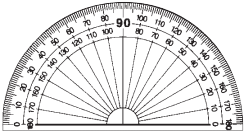
A protractor is used to measure an angle and also to draw an angle according to a given measure.

The picture opposite shows a protractor.

A protractor is semi-circular in shape.

The semi-circular edge of a protractor is divided into 180 equal parts. Each part is ‘one degree’. ‘One degree’ is written as ‘1°’.

The divisions on a protractor, i.e., the degrees can be marked in two ways. The divisions 0, 10, 20, 30,…180 are marked anticlockwise or from right to left; the divisions 0, 10, 20, 30,…180 are also marked clockwise, or serially from left to right.

The centre of the circle of which the protractor is a half part, is called the centre of the protractor. A diameter of that circle is the baseline or line of reference of the protractor.

Measuring angles
Maharashtra Board Class 5 Maths Solutions Chapter 6 Angles Problem Set 24 3
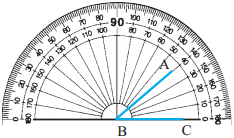
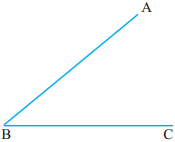
Observe how to measure ∠ABC given alongside, using a protractor.

1. First, put the centre of the protractor on the vertex B of the angle. Place the baseline of the protractor exactly on arm BC. The arms of the angle do not reach the divisions on the protractor.
Maharashtra Board Class 5 Maths Solutions Chapter 6 Angles Problem Set 24 4

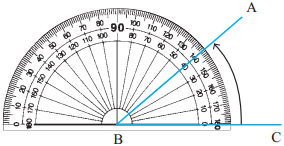
2. At such times, set the protractor aside and extend the arms of the angle. Extending the arms of the angle does not change the measure of the angle.
Maharashtra Board Class 5 Maths Solutions Chapter 6 Angles Problem Set 24 5

3. The angle is measured starting from the zero on that side of the vertex on which the arm of the angle lies. Here, the arm BC is on the right of the vertex B. Therefore, count the divisions starting from the 0 on the right. See which mark falls on arm BA. Read the number on that mark. This number is the measure of the angle.
Maharashtra Board Class 5 Maths Solutions Chapter 6 Angles Problem Set 24 6

The measure of∠ABC is 40°.

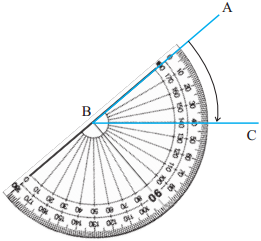
We can measure the same ∠ABC by positioning the protractor differently.
Maharashtra Board Class 5 Maths Solutions Chapter 6 Angles Problem Set 24 7

1. First put the centre point of the protractor on vertex B of the angle. Align the baseline of the protractor with arm BA.
2. Find the 0 mark on the side of BA. Count the marks starting from the 0 on the side of point A. See which mark falls on arm BC. Read the number at that point.

Observe that here, too, the measure of ∠ABC is 40°.

See how the angles given below have been measured with the help of a protractor.
Maharashtra Board Class 5 Maths Solutions Chapter 6 Angles Problem Set 24 8

Chapter 6 Angles Problem Set 24 Additional Important Questions and Answers

Question 1.
Observing the adjacent figure, answer the following questions. Write the name of (1) all angles (2) Vertex of the angles (3) aims of the angles.
Solution:
(1) ZXOY, ZYOZ, ¿XOZ
(2) Vertex of the angles is ‘O’
(3) arms of Z)OY are OX and UY
arms of ZYOZ are UY and OZ
arms of ZXOZ are OX and OZ

Maharashtra Board Class 5 Maths Solutions Chapter 5 Fractions Problem Set 20

Balbharti Maharashtra Board Class 5 Maths Solutions Chapter 5 Fractions Problem Set 20 Textbook Exercise Important Questions and Answers.

Maharashtra State Board Class 5 Maths Solutions Chapter 5 Fractions Problem Set 20

Question 1.
Add the following
\(\text { (1) } \frac{1}{5}+\frac{3}{5}\)
Answer:
\(\frac{1}{5}+\frac{3}{5}=\frac{1+3}{5}=\frac{4}{5}\)

Maharashtra Board Class 5 Maths Solutions Chapter 5 Fractions Problem Set 20

\(\text { (2) } \frac{2}{7}+\frac{4}{7}\)
Answer:
\(\frac{2}{7}+\frac{4}{7}=\frac{2+4}{7}=\frac{6}{7}\)

\(\text { (3) } \frac{7}{12}+\frac{2}{12}\)
Answer:
\(\frac{7}{12}+\frac{2}{12}=\frac{7+2}{12}=\frac{9}{12}\)

\(\text { (4) } \frac{2}{9}+\frac{7}{9}\)
Answer:
\(\frac{2}{9}+\frac{7}{9}=\frac{2+7}{9}=\frac{9}{9}=1\)

\(\text { (5) } \frac{3}{15}+\frac{4}{15}\)
Answer:
\(\frac{3}{15}+\frac{4}{15}=\frac{3+4}{15}=\frac{7}{15}\)

\(\text { (6) } \frac{2}{7}+\frac{1}{7}+\frac{3}{7}\)
Answer:
\(\frac{2}{7}+\frac{1}{7}+\frac{3}{7}=\frac{2+1+3}{7}=\frac{6}{7}\)

\(\text { (7) } \frac{2}{10}+\frac{4}{10}+\frac{3}{10}\)
Answer:
\(\frac{2}{10}+\frac{4}{10}+\frac{3}{10}=\frac{2+4+3}{10}=\frac{9}{10}\)

Maharashtra Board Class 5 Maths Solutions Chapter 5 Fractions Problem Set 20

\(\text { (8) } \frac{4}{9}+\frac{1}{9}\)
Answer:
\(\frac{4}{9}+\frac{1}{9}=\frac{4+1}{9}=\frac{5}{9}\)

\(\text { (9) } \frac{5}{8}+\frac{3}{8}\)
Answer:
\(\frac{5}{8}+\frac{3}{8}=\frac{5+3}{8}=\frac{8}{8}=1\)

Question 2.
Mother gave \(\frac{3}{8}\) of one guava to Meena and \(\frac{2}{8}\) of the guava to Geeta. What part of the guava did she give them altogether?
Solution:
\(\frac{3}{8}+\frac{2}{8}=\frac{3+2}{8}=\frac{5}{8}\) given altogether
Answer:
\(\frac{5}{8}\) part of guava given altogether

Question 3.
The girls of Std V cleaned \(\frac{3}{4}\) of a field while the boys cleaned \(\frac{1}{4}\). What part of the field was cleaned altogether?
Solution:
Girls cleaned + Boys cleaned
\(\frac{3}{4}+\frac{1}{4}=\frac{3+1}{4}=\frac{4}{4}=1\)
Answer:
Full whole field cleaned altogether.

Maharashtra Board Class 5 Maths Solutions Chapter 5 Fractions Problem Set 20

Subtraction of like fractions

A figure is divided into 5 equal parts and 4 of them are colored. That is, \(\frac{4}{5}\) part of the figure is coloured.

Now, we remove the colour from one of the coloured parts. That is, we subtract \(\frac{1}{5}\) from \(\frac{4}{5}\). The remaining coloured part is \(\frac{3}{5}\). Therefore, \(\frac{4}{5}\) – \(\frac{1}{5}\) = \(\frac{4-1}{5}\) = \(\frac{3}{5}\).

When subtracting a fraction from another like fraction, we write the difference between the numerators in the numerator and the common denominator in the denominator.

Example (1) Subtract : \(\frac{7}{13}\) – \(\frac{5}{13}\)

These two fractions have a common denominator. So, we shall subtract the second numerator from the first and write the denominator as it is.
\(\frac{7}{13}-\frac{5}{13}=\frac{7-5}{13}=\frac{2}{13}\)

Example (2) If Raju got \(\frac{5}{12}\) part of a sugarcane and Sanju got \(\frac{3}{12}\) part, how much was the extra part that Raju got?

To find out the difference, we must subtract.
\(\frac{5}{12}-\frac{3}{12}=\frac{5-3}{12}=\frac{2}{12}\). Thus, Raju got \(\frac{2}{12}\) extra.

Maharashtra Board Class 5 Maths Solutions Chapter 5 Fractions Problem Set 20

Addition and Subtraction Problem Set 13 Additional Important Questions and Answers

\(\text { (1) } \frac{3}{6}+\frac{2}{6}+\frac{1}{6}\)
Answer:
\(\frac{3}{6}+\frac{2}{6}+\frac{1}{6}=\frac{3+2+1}{6}=\frac{6}{6}=1\)

\(\text { (2) } \frac{4}{10}+\frac{1}{10}+\frac{3}{10}+\frac{2}{10}\)
Answer:
\(\frac{4}{10}+\frac{1}{10}+\frac{3}{10}+\frac{2}{10}=\frac{4+1+3+2}{10}=\frac{10}{10}=1\)

\(\text { (3) } \frac{1}{2}+\frac{1}{2}\)
Answer:
\(\frac{1}{2}+\frac{1}{2}=\frac{1+1}{2}=\frac{2}{2}=1\)

Maharashtra Board Class 5 Maths Solutions Chapter 5 Fractions Problem Set 20

Solve the following word problems:

Question 1.
of journey travelled by A and of journey travelled by B. What part of the journey travelled by both field was cleaned altogether?
Solution:
Travelled by A + Travelled by B
\(\frac{3}{5}+\frac{2}{5}=\frac{3+2}{5}=\frac{5}{5}=1\)
Answer:
Full (whole) journey travelled by both.

Maharashtra Board Class 5 Maths Solutions Chapter 5 Fractions Problem Set 19

Balbharti Maharashtra Board Class 5 Maths Solutions Chapter 5 Fractions Problem Set 19 Textbook Exercise Important Questions and Answers.

Maharashtra State Board Class 5 Maths Solutions Chapter 5 Fractions Problem Set 19

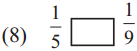
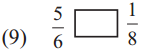
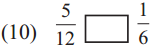
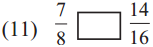
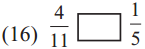
Write the proper symbol from < , > , or = in the box.

Maharashtra Board Class 5 Maths Solutions Chapter 5 Fractions Problem Set 19 1
Answer:
=

Maharashtra Board Class 5 Maths Solutions Chapter 5 Fractions Problem Set 19

Maharashtra Board Class 5 Maths Solutions Chapter 5 Fractions Problem Set 19 2
Answer:
>

Maharashtra Board Class 5 Maths Solutions Chapter 5 Fractions Problem Set 19 3
Answer:
<

Maharashtra Board Class 5 Maths Solutions Chapter 5 Fractions Problem Set 19 4
Answer:
=

Maharashtra Board Class 5 Maths Solutions Chapter 5 Fractions Problem Set 19 5
Answer:
>

Maharashtra Board Class 5 Maths Solutions Chapter 5 Fractions Problem Set 19 6
Answer:
>

Maharashtra Board Class 5 Maths Solutions Chapter 5 Fractions Problem Set 19

Maharashtra Board Class 5 Maths Solutions Chapter 5 Fractions Problem Set 19 7
Answer:
>

Maharashtra Board Class 5 Maths Solutions Chapter 5 Fractions Problem Set 19 8
Answer:
>

Maharashtra Board Class 5 Maths Solutions Chapter 5 Fractions Problem Set 19 9
Answer:
>

Maharashtra Board Class 5 Maths Solutions Chapter 5 Fractions Problem Set 19 10
Answer:
>

Maharashtra Board Class 5 Maths Solutions Chapter 5 Fractions Problem Set 19 11
Answer:
=

Maharashtra Board Class 5 Maths Solutions Chapter 5 Fractions Problem Set 19

Maharashtra Board Class 5 Maths Solutions Chapter 5 Fractions Problem Set 19 12
Answer:
=

Maharashtra Board Class 5 Maths Solutions Chapter 5 Fractions Problem Set 19 13
Answer:
>

Maharashtra Board Class 5 Maths Solutions Chapter 5 Fractions Problem Set 19 14
Answer:
>

Maharashtra Board Class 5 Maths Solutions Chapter 5 Fractions Problem Set 19 15
Answer:
<

Maharashtra Board Class 5 Maths Solutions Chapter 5 Fractions Problem Set 19 16
Answer:
>

Addition of like fractions
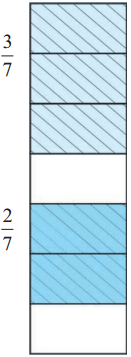
Example (1) 3/7 + 2/7 = ?
Let us divide a strip into 7 equal parts. We shall colour 3 parts with one colour and 2 parts with another.
The part with one colour is 3/7, and that with the other colour is 2/7.
The total coloured part is shown by the fraction 5/7.
It means that, \(\frac{3}{7}+\frac{2}{7}=\frac{3+2}{7}=\frac{5}{7}\)
Maharashtra Board Class 5 Maths Solutions Chapter 5 Fractions Problem Set 19 17

Maharashtra Board Class 5 Maths Solutions Chapter 5 Fractions Problem Set 19

Example (2) Add : \(\frac{3}{8}+\frac{2}{8}+\frac{1}{8}\)
The total coloured part is \(\frac{3}{8}+\frac{2}{8}+\frac{1}{8}=\frac{3+2+1}{8}=\frac{6}{8}\)
Maharashtra Board Class 5 Maths Solutions Chapter 5 Fractions Problem Set 19 18

When adding like fractions, we add the numerators of the two fractions and write the denominator as it is.
Example (3) Add : 2/6 + 4/6 \(\frac{2}{6}+\frac{4}{6}=\frac{2+4}{6}=\frac{6}{6}\)
However, we know that 6/6 means that all 6 of the 6 equal parts are taken. That is, 1 whole figure is taken. Therefore, 6/6 = 1.

Note that:
If the numerator and denominator of a fraction are equal, the fraction is equal to one.
That is why, \(\frac{7}{7}=1 ; \frac{10}{10}=1 ; \frac{2}{5}+\frac{3}{5}=\frac{2+3}{5}=\frac{5}{5}=1\)
Remember that, if we do not divide a figure into parts, but keep it whole, it can also be written as 1.
This tells us that \(1=\frac{1}{1}=\frac{2}{2}=\frac{3}{3}\) and so on.
You also know that if the numerator and denominator of a fraction have a common divisor, then the fraction obtained by dividing them by that divisor is equivalent to the given fraction.
\(\frac{5}{5}=\frac{5 \div 5}{5 \div 5}=\frac{1}{1}=1\)

Maharashtra Board Class 5 Maths Solutions Chapter 5 Fractions Problem Set 19

Fractions Problem Set 19 Additional Important Questions and Answers

Question 1.
Maharashtra Board Class 5 Maths Solutions Chapter 5 Fractions Problem Set 19 19
Answer:
>

Question 2.
Maharashtra Board Class 5 Maths Solutions Chapter 5 Fractions Problem Set 19 20
Answer:
=

Maharashtra Board Class 5 Maths Solutions Chapter 5 Fractions Problem Set 18

Balbharti Maharashtra Board Class 5 Maths Solutions Chapter 5 Fractions Problem Set 18 Textbook Exercise Important Questions and Answers.

Maharashtra State Board Class 5 Maths Solutions Chapter 5 Fractions Problem Set 18

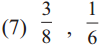
Convert the given fractions into like fractions.
Maharashtra Board Class 5 Maths Solutions Chapter 5 Fractions Problem Set 18 7
Solution :
8 is the multiple of 4 So, make 8, the common denominator \(\frac{3}{4}=\frac{3 \times 2}{4 \times 2}=\frac{6}{8}\).Thus 6/8 and 5/8are the required like fractions.

Maharashtra Board Class 5 Maths Solutions Chapter 3 Addition and Subtraction Problem Set 13

Maharashtra Board Class 5 Maths Solutions Chapter 5 Fractions Problem Set 18 8
Solution :
The number 35 is a multiple of both 5 and 7 So, making 35 as the common denominater \(\frac{3}{5}=\frac{3 \times 7}{5 \times 7}=\frac{21}{35}, \frac{3}{7}=\frac{3 \times 5}{7 \times 5}=\frac{15}{35}\) Therefore, 21/35 and 15/35 are required like fractions.

Maharashtra Board Class 5 Maths Solutions Chapter 5 Fractions Problem Set 18 9
Solution :
Here 10 is the multiples of 5. So make 10 as the common denominator \(\frac{4}{5}=\frac{4 \times 2}{5 \times 2}=\frac{8}{10}\). Thus 8/10 and 3/10 are required like fractions.

Maharashtra Board Class 5 Maths Solutions Chapter 5 Fractions Problem Set 18 10
Solution :
Least common multiple of 9 and 6 is 18. So, make, 18 as the common denominator. \(\frac{2}{9}=\frac{2 \times 2}{9 \times 2}=\frac{4}{18}, \frac{1}{6}=\frac{1 \times 3}{6 \times 3}=\frac{3}{18}\). Thus, 4/18 and 3/18 are the required like fractions.

Maharashtra Board Class 5 Maths Solutions Chapter 5 Fractions Problem Set 18 11
Solution :
Least common multiple of 4 and 3 is 12 So, make 12 as common denominator \(\frac{1}{4}=\frac{1 \times 3}{4 \times 3}=\frac{3}{12}, \frac{2}{3}=\frac{2 \times 4}{3 \times 4}=\frac{8}{12}\). so, \(\frac{3}{12}, \frac{8}{12}\) are required like fractions.

Maharashtra Board Class 5 Maths Solutions Chapter 3 Addition and Subtraction Problem Set 13

Maharashtra Board Class 5 Maths Solutions Chapter 5 Fractions Problem Set 18 12
Solution :
Least common multiple of 6 and 5 is 30 So, make 30 as common denominator \(\frac{5}{6}=\frac{5 \times 5}{6 \times 5}=\frac{25}{30}, \frac{4}{5}=\frac{4 \times 6}{5 \times 6}=\frac{24}{30}\) So, \(\frac{25}{30}, \frac{24}{30}\) are required like fractions.

Maharashtra Board Class 5 Maths Solutions Chapter 5 Fractions Problem Set 18 13
Solution :
Least common multiple of 8 and 6 is 24 So, make 24 as common denominator \(\frac{3}{8}=\frac{3 \times 3}{8 \times 3}=\frac{9}{24}, \frac{1}{6}=\frac{1 \times 4}{6 \times 4}=\frac{4}{24}\) So, \(\frac{9}{24}, \frac{4}{24}\) are required like fractions.

Maharashtra Board Class 5 Maths Solutions Chapter 5 Fractions Problem Set 18 14
Solution :
Least common multiple of 6 and 9 is 18 So, make 18 as common denominator \(\frac{1}{6}=\frac{1 \times 3}{6 \times 3}=\frac{3}{18}, \frac{4}{9}=\frac{4 \times 2}{9 \times 2}=\frac{8}{18}\) So, 3/18 and 8/18 are the required like fractions.

Maharashtra Board Class 5 Maths Solutions Chapter 3 Addition and Subtraction Problem Set 13

Comparing like fractions
Example (1) A strip was divided into 5 equal parts. It means that each part is 1/5 . The coloured part is \(\frac{3}{5}=\frac{1}{5}+\frac{1}{5}+\frac{1}{5}\).
Maharashtra Board Class 5 Maths Solutions Chapter 5 Fractions Problem Set 18 2

The white part is \(\frac{2}{5}=\frac{1}{5}+\frac{1}{5}\). The coloured part is bigger than the white part. This tells us that 3/5 is greater than 2/5. This is written as 3/5 > 2/5.

Example (2) This strip is divided into 8 equal parts. 3 of the parts have one colour and 4 have another colour. Here, 3/8 < 8/4.
Maharashtra Board Class 5 Maths Solutions Chapter 5 Fractions Problem Set 18 3

In like fractions, the fraction with the greater numerator is the greater fraction.

Comparing fractions with equal numerators
You have learnt that the value of fractions with numerator 1 decreases as the denominator increases.

Even if the numerator is not 1, the same rule applies so long as all the fractions have a common numerator. For example, look at the figures below. All the strips in the figure are alike.
2 of the 3 equal parts of the strip Maharashtra Board Class 5 Maths Solutions Chapter 5 Fractions Problem Set 18 4
2 of the 4 equal parts of the strip Maharashtra Board Class 5 Maths Solutions Chapter 5 Fractions Problem Set 18 5
2 of the 5 equal parts of the strip Maharashtra Board Class 5 Maths Solutions Chapter 5 Fractions Problem Set 18 6
The figure shows that 2/3 > 2/4 > 5/2.

Maharashtra Board Class 5 Maths Solutions Chapter 3 Addition and Subtraction Problem Set 13

Of two fractions with equal numerators, the fraction with the greater denominator is the smaller fraction.

Comparing unlike fractions
Teacher : Suppose we have to compare the unlike fractions 3/5 and 4/7. Let us take an example to see how this is done. These two boys are standing on two blocks. How do we decide who is taller?

Sonu : But the height of the blocks is not the same. If both blocks are of the same height, it is easy to tell who is taller.

Nandu : Now that they are on blocks of equal height, we see that the boy on the right is taller.

Teacher : The height of the boys can be compared when they stand at the same height. Similarly, if fractions have the same denominators, their numerators decide which fraction is bigger.

Nandu : Got it! Let’s obtain the same denominators for both fractions.

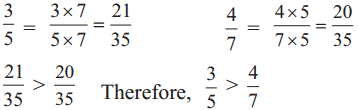
Sonu : 5 × 7 can be divided by both 5 and 7. So, 35 can be the common denominator.
Maharashtra Board Class 5 Maths Solutions Chapter 5 Fractions Problem Set 18 1

To compare unlike fractions, we convert them into their equivalent fractions so that their denominators are the same.

Maharashtra Board Class 5 Maths Solutions Chapter 3 Addition and Subtraction Problem Set 13

Fractions Problem Set 18 Additional Important Questions and Answers

Question 1.
\(\frac{5}{9}, \frac{17}{36}\)
Solution :
36 is the multiple of 9 So, make 36 the common denominator \(\frac{5}{9}=\frac{5 \times 4}{9 \times 4}=\frac{20}{36}\), Thus 20/36 and 17/36 are the required like fractions.

Question 2.
\(\frac{5}{6}, \frac{7}{9}\)
Solution:
Least common multiple of 6 and 9 is 18 So, make 18 as the common denominator \(\frac{5}{6}=\frac{5 \times 3}{6 \times 3}=\frac{15}{18}, \quad \frac{7}{9}=\frac{7 \times 2}{9 \times 2}=\frac{14}{18}\) So, 15/18 and 14/18 are the required like fractions.

Maharashtra Board Class 5 Maths Solutions Chapter 3 Addition and Subtraction Problem Set 13

Question 3.
\(\frac{7}{11}, \frac{3}{5}\)
Solution:
Least common multiple of 11 and 5 is 55 So, make 55 as the common denominator. \(\frac{7}{11}=\frac{7 \times 5}{11 \times 5}=\frac{35}{55}, \frac{3}{5}=\frac{3 \times 11}{5 \times 11}=\frac{33}{55}\). Thus 35/55 and 33/55 are required like fractions.