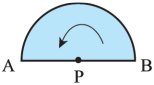
Maharashtra Board Class 5 Maths Solutions Chapter 8 Multiples and Factors Problem Set 35

Balbharti Maharashtra Board Class 5 Maths Solutions Chapter 8 Multiples and Factors Problem Set 35 Textbook Exercise Important Questions and Answers.

Maharashtra State Board Class 5 Maths Solutions Chapter 8 Multiples and Factors Problem Set 35

Determine whether the pairs of numbers given below are co-prime numbers.
(1) 22, 24
Answer:
Common factors of 22 and 24 are 1 and 2. (Not only 1 common factor) So, 22, 24 are not co-prime numbers.

(2) 14, 21
Answer:
Common factors of 14 and 21 are 1 and 7. So, this pair is not co-prime numbers.

(3) 10, 33
Answer:
Common factors of 10 and 33 is only 1. So, 10 and 33 are co-prime numbers.

(4) 11, 30
Answer:
Common factors of 11 and 30 is only 1. So, 11 and 30 are co-prime numbers.

(5) 5, 7
Answer:
Common factor of 5 and 7 is only 1. So, 5 and 7 are co-prime numbers.

(6) 15, 16
Answer:
Common factors of 15 and 16 is only 1. So, 15 and 16 are co-prime numbers.

(7) 50, 52
Answer:
Common factors of 50 and 52 are 1 and 2. So, 50 and 52 are not co-prime numbers.

(8) 17, 18
Answer:
Common factors of 17 and 18 is only 1. So, 17 and 18 are co-prime numbers.

Activity 1 :

  • Write numbers from 1 to 60.
  • Draw a blue circle around multiples of 2.
  • Draw a red circle around multiples of 4.
  • Do all numbers with a blue circle also have a red circle around them?
  • Do all the numbers with a red circle have a blue circle around them?
  • Are all multiples of 2 also multiples of 4?
  • Are all multiples of 4 also multiples of 2?

Activity 2 :

  • Write numbers from 1 to 60.
  • Draw a triangle around multiples of 2.
  • Draw a circle around multiples of 3.
  • Now find numbers divisible by 6. Can you find a property that they share?

Eratosthenes’ method of finding prime numbers
Eratosthenes was a mathematician who lived in Greece about 250 BC. He discovered a method to find prime numbers. It is called Eratosthenes’ Sieve. Let us see how to find prime numbers between 1 and 100 with this method.
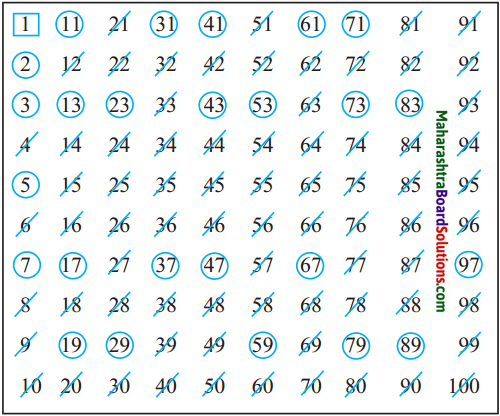
Maharashtra Board Class 5 Maths Solutions Chapter 8 Multiples and Factors Problem Set 35 1

  • 1 is neither a prime nor a composite number. Put a square [ ] around it
  • 2 is a prime number, so put a circle around it.
  • Next, strike out all the multiples of 2. This tells us that of these 100 numbers more than half of numbers are not prime numbers.
  • The first number after 2 not yet struck off is 3. So, 3 is a prime number.
  • Draw a circle around 3. Strike out all the multiples of 3.
  • The next number after 3 not struck off yet is 5. So, 5 is a prime number.
  • Draw a circle around 5. Put a line through all the multiples of 5.
  • The next number after 5 without a line through it is 7. So, 7 is a prime number.
  • Draw a circle around 7. Put a line through all the multiples of 7.

In this way, every number between 1 and 100 will have either a circle or a line through it. The circled numbers are prime numbers. The numbers with a line through them are composite numbers.

One more method to find prime numbers
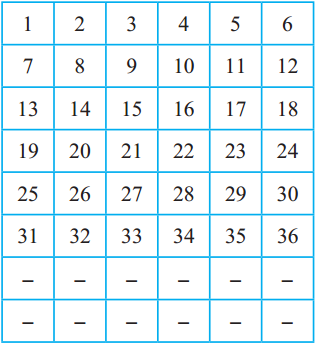
Maharashtra Board Class 5 Maths Solutions Chapter 8 Multiples and Factors Problem Set 35 2

See how numbers from 1 to 36 have been arranged in six columns in the table alongside.

Continue in the same way and write numbers up to 102 in these six columns.

You will see that, in the columns for 2, 3, 4, and 6, all the numbers are composite numbers except for the prime numbers 2 and 3. This means that all the remaining prime numbers will be in the columns for 1 and 5. Now isn’t it easier to find them? So, go ahead, find the prime numbers!

Something more

  • Prime numbers with a difference of two are called twin prime numbers. Some twin prime number pairs are 3 and 5, 5 and 7, 29 and 31 and 71 and 73. 5347421 and 5347423 are also a pair of twin prime numbers.
  • There are eight pairs of twin prime numbers between 1 and 100. Find them.
  • Euclid the mathematician lived in Greece about 300 BC. He proved that if prime numbers, 2, 3, 5, 7, ……., are written in serial order, the list will never end, meaning that the number of prime numbers is infinite.

Multiples and Factors Problem Set 35 Additional Important Questions and Answers

Determine whether the pairs of numbers given below are co-prime numbers.

(1) (12,18)
Answer:
Common factors of 12 and 18 are 1, 2, 3, 6. Hence 12 and 18 are not co-prime numbers.

(2) (26, 39)
Answer:
Common factors of 26 and 39 are 1 and 13. Hence, 26 and 39 are not co-prime numbers.

(3) (23, 29)
Answer:
Common factor of 23 and 29 is only 1. Hence, 23 and 29 are co-prime numbers.

(4) (28, 32)
Answer:
Common factors of 28 and 32 are 1, 2, 4 (not only 1). Hence, 28, 32 are not co-prime numbers.

Maharashtra Board Class 5 Maths Solutions Chapter 8 Multiples and Factors Problem Set 34

Balbharti Maharashtra Board Class 5 Maths Solutions Chapter 8 Multiples and Factors Problem Set 34 Textbook Exercise Important Questions and Answers.

Maharashtra State Board Class 5 Maths Solutions Chapter 8 Multiples and Factors Problem Set 34

Question 1.
Write all the prime numbers between 1 and 20.
Answer:
2, 3, 5, 7, 11, 13, 17, 19.

Question 2.
Write all the composite numbers between 21 and 50.
Answer:
Composite numbers between 21 and 50 are 22, 24, 25, 26, 27, 28, 30, 32, 33, 34, 35, 36, 38, 39, 40, 42, 44, 45, 46, 48, 49.

Question 3.
Circle the prime numbers in the list given below. 22, 37, 43, 48, 53, 60, 91, 57, 59, 77, 79, 97, 100
Answer:
Maharashtra Board Class 5 Maths Solutions Chapter 8 Multiples and Factors Problem Set 34 1

Question 4.
Which of the prime numbers are even numbers?
Answer:
Only even prime number is 2. (the Rest of the even numbers are composites.)

Co-prime numbers

Dada : Tell me all the factors of 12 and 18.

Anju : I’ll tell the factors of 12: 1, 2, 3, 4, 6, 12.

Manju : I’ll give the factors of 18: 1, 2, 3, 6, 9, 18.

Dada : Now find the common factors of 12 and 18.

Anju : Common factors ?

Dada : 1, 2, 3 and 6 are in both groups, which means that they are common factors. Now tell me the factors of 10 and 21.

Sanju : Factors of 10 : 1, 2, 5, 10.

Manju : Factors of 21: 1, 3, 7, 21.

Dada : Which of the factors in these two groups are common?

Sanju : 1 is the only common factor.

Dada : Numbers which have only 1 as a common factor are called co-prime numbers, so 10 and 21 are co-prime numbers. The common factors of 12 and 18 are 1, 2, 3 and 6; which means that the common factors are more than one. Therefore, 12 and 18 are not co-prime numbers. Now tell me whether 8 and 10 are co-prime numbers.
Manju : The factors of 8 are 1, 2, 4 and 8 and the factors of 10 are 1, 2, 5 and 10. These numbers have two factors, 1 and 2, in common, so 8 and 10 are not co-prime numbers.
Multiples and Factors Problem Set 32 Additional Important Questions and Answers

Question 1.
21 to 50
Answer:
23, 29, 31, 37, 41, 43, 47

Question 2.
Which of the number is neither prime nor composite?
Answer:
1

Question 13.
Between nearest which two prime numbers the prime number 43 lies?
Answer:
43 lies between prime numbers 41 and 47.

Question 14.
Which of the prime numbers are odd numbers?
Answer:
All prime numbers are odd except 2.

Maharashtra Board Class 5 Maths Solutions Chapter 9 Decimal Fractions Problem Set 39

Balbharti Maharashtra Board Class 5 Maths Solutions Chapter 9 Decimal Fractions Problem Set 39 Textbook Exercise Important Questions and Answers.

Maharashtra State Board Class 5 Maths Solutions Chapter 9 Decimal Fractions Problem Set 39

Question 1.
Write how many rupees and how many paise.

(1) ₹ 58.43
Answer:
58 rupees 43 paise.

Maharashtra Board Class 5 Maths Solutions Chapter 9 Decimal Fractions Problem Set 39

(2) ₹ 9.30
Answer:
9 rupees 30 paise.

(3) ₹ 2.30
Answer:
2 rupees 30 paise.

(4) ₹ 2.3
Answer:
2 rupees 30 paise.

Question 2.
Write how many rupees in decimal form.

(1) 6 rupees 25 paise
Answer:
₹ 6.25

(2) 15 rupees 70 paise
Answer:
₹ 15.70

Maharashtra Board Class 5 Maths Solutions Chapter 9 Decimal Fractions Problem Set 39

(3) 8 rupees 5 paise
Answer:
₹ 8:05

(4) 22 rupees 4 paise
Answer:
₹ 22.04

(5) 720 paise
Answer:
₹ 7.20

Question 3.
Write how many metres and how many centimetres.

(1) 58.75 m
Answer:
58 m 75 cm

(2) 9.30 m
Answer:
9 m 30 cm

Maharashtra Board Class 5 Maths Solutions Chapter 9 Decimal Fractions Problem Set 39

(3) 0.30 m
Answer:
30 cm

(4) 0.3 m
Answer:
30 cm

(5) 1.62 m
Answer:
1 m 62 cm

(6) 91.4 m
Answer:
91 cm 40 cm

(7) 7.02 m
Answer:
7 m 2 cm

Maharashtra Board Class 5 Maths Solutions Chapter 9 Decimal Fractions Problem Set 39

(8) 0.09 m
Answer:
9 cm

Question 4.
Write how many metres in decimal form.

(1) 1 m 50 cm
Answer:
1.5 m

(2) 50 m 40 cm
Answer:
50.40 m

(3) 50 m 4 cm
Answer:
50.04 m

(4) 734 cm
Answer:
7.34 m

Maharashtra Board Class 5 Maths Solutions Chapter 9 Decimal Fractions Problem Set 39

(5) 10 cm
Answer:
0.1 m

(6) 2 cm
Answer:
0.02 m

Question 5.
Write how many centimetres and how many millimetres.

(1) 6.9 cm
Answer:
6 cm 9 mm

(2) 20.4 cm
Answer:
20 cm 4 mm

(3) 0.8 cm
Answer:
8 mm

Maharashtra Board Class 5 Maths Solutions Chapter 9 Decimal Fractions Problem Set 39

(4) 0.5 cm
Answer:
5 mm

Question 6.
Write how many centimetres in decimal form.
(1) 7 cm 1 mm
Answer:
7.1 cm

(2) 16 mm
Answer:
1.6 cm

(3) 144 mm
Answer:
14.4 cm

Maharashtra Board Class 5 Maths Solutions Chapter 9 Decimal Fractions Problem Set 39

(4) 8 mm
Answer:
0.8 cm

Writing half, quarter, three-quarters and one and a quarter in decimal form

‘Half’ is usually written as \(\frac{1}{2}\). To convert this fraction into decimal form, the denominator of \(\frac{1}{2}\) must be converted into an equivalent fraction with denominator 10.

\(\frac{1}{2}=\frac{1 \times 5}{2 \times 5}=\frac{5}{10}\) so the decimal form of \(\frac{1}{2}\) will be \(\frac{5}{10}\) or 0.5 Just as \(\frac{1}{2}=\frac{1 \times 5}{2 \times 5}=\frac{5}{10}\) = 0.5, note that \(\frac{1}{2}=\frac{1 \times 50}{2 \times 50}=\frac{50}{100}\) = 0.50

Therefore, ‘half’ is written as ‘0.5’ or 0.50’. ‘Quarter’ and ‘three quarters’ are written in fractions as \(\frac{1}{4}\) and \(\frac{3}{4}\) respectively. Let us convert them into decimal fractions. 10 is not divisible by 4. Therefore, the denominators of \(\frac{1}{4}\) and \(\frac{3}{4}\) cannot be made into fractions with multiples of 10. However, 4 × 25 = 100, so the denominator can be 100.

Maharashtra Board Class 5 Maths Solutions Chapter 9 Decimal Fractions Problem Set 39

A quarter \(=\frac{1}{4}=\frac{1 \times 25}{4 \times 25}=\frac{25}{100}=0.25\)
and Three quarters \(=\frac{3}{4}=\frac{3 \times 25}{4 \times 25}=\frac{75}{100}=0.75\)
One and a quarter = 1 \(\frac{1}{4}\) = 1.25
One and a half = 1 \(\frac{1}{2}\) = 1.50 = 1.5
One and three quarters = 1 \(\frac{3}{4}\) = 1.75
Seventeen and a half = 17 \(\frac{1}{2}\) = 17.50 = 17.5

Decimal Fractions Problem Set 37 Additional Important Questions and Answers

Question 1.
Write how many rupees and how many paise.

(1) ₹ 147.5
Answer:
1 hundred and 47 rupees 50 paise.

(2) ₹ 40.4
Answer:
40 rupees and 40 paise.

Question 2.
Write how many rupees in decimal form.

(1) 105 paise
Answer:
₹ 1.05

Maharashtra Board Class 5 Maths Solutions Chapter 9 Decimal Fractions Problem Set 39

(2) 6 rupees 6 paise
Answer:
₹ 6.06

(3) 20 rupees 20 paise
Answer:
₹ 20.2

Question 3.
Write how many metres and how many centimetres.

(1) 1.1m =
Answer:
1 m 10 cm

(2) 120 cm =
Answer:
1 m 20 cm

Maharashtra Board Class 5 Maths Solutions Chapter 9 Decimal Fractions Problem Set 39

(3) 24.8 m =
Answer:
24 m 80 cm

(4) 0.5 m =
Answer:
50 cm

Question 4.
Write how many metres in decimal form.

(1) 110 cm =
Answer:
1.1m

Maharashtra Board Class 5 Maths Solutions Chapter 9 Decimal Fractions Problem Set 39

(2) 60 cm =
Answer:
0.6 m

Question 5.
Write how many centimetres and how many millimetres.

(1) 0.1 cm =
Answer:
1 mm

(2) 10.5 cm =
Answer:
10 cm 5 mm

Maharashtra Board Class 5 Maths Solutions Chapter 9 Decimal Fractions Problem Set 39

Question 6.
Write how form. many centimetres in decimal
(1) 1 mm =
Answer:
0.1 cm

(2) 100 mm =
Answer:
10.0 cm

Maharashtra Board Class 5 Maths Solutions Chapter 8 Multiples and Factors Problem Set 33

Balbharti Maharashtra Board Class 5 Maths Solutions Chapter 8 Multiples and Factors Problem Set 33 Textbook Exercise Important Questions and Answers.

Maharashtra State Board Class 5 Maths Solutions Chapter 8 Multiples and Factors Problem Set 33

Question 1.
(1) Write five three-digit numbers that are multiples of 2.
Answer:
100, 102, 104, 106, 108.

Maharashtra Board Class 5 Maths Solutions Chapter 8 Multiples and Factors Problem Set 33

(2) Write five three-digit numbers that are multiples of 5.
Answer:
100, 105, 110, 115, 120.

(3) Write five three-digit numbers that are multiples of 10.
Answer:
100, 110, 120, 130, 140.

Question 2.
Write 5 numbers that are multiples of 2 as well as of 3.
Answer:
2 as well as of 3 means 2 and 3 that is multiples of 6.
They are 6, 12, 18, 24, 30.

Question 3.
A ribbon is 3 metres long. Can we cut it into 50 cm pieces and have nothing left over? Write the reason why or why not.
Answer:
3 metres = 300 cm.
We can cut it into 50 cm pieces.
Since 300 is exactly divisible 50.
That is 300 is multiples of 50.
300 ÷ 50 = 6
We will get 6 pieces, nothing is left over.

Maharashtra Board Class 5 Maths Solutions Chapter 8 Multiples and Factors Problem Set 33

Question 4.
A ribbon is 3 metres long. I need 8 pieces of ribbon each 40 cm long. How many centimetres shorter is the ribbon than the length I need?
Answer:
1 piece of 40 cm, so for 8 pieces ribbon needed is 40 x 8 = 320 cm.
But ribbon is 3 metre = 300 cm long.
So ribbon is shorter by 320 – 300 = 20 cm.

Question 5.
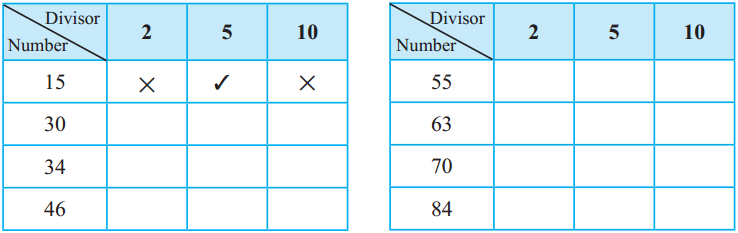
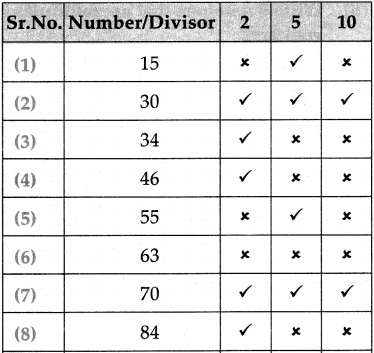
If the number given in the table is divisible by the given divisor, put ✓ in the box. If it is not divisible by the divisor, put ✗ in the box.
Maharashtra Board Class 5 Maths Solutions Chapter 8 Multiples and Factors Problem Set 33 1
Answer:
Maharashtra Board Class 5 Maths Solutions Chapter 8 Multiples and Factors Problem Set 33 3

Maharashtra Board Class 5 Maths Solutions Chapter 8 Multiples and Factors Problem Set 33

Prime and composite numbers

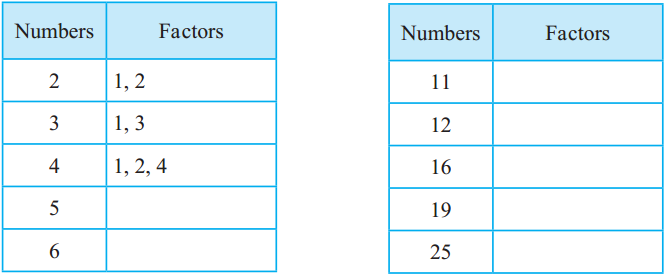
Some numbers are given in the tables below. Write all of their factors.
Maharashtra Board Class 5 Maths Solutions Chapter 8 Multiples and Factors Problem Set 33 2

Dada : What do you notice on studying the table?

Ajay : The number 1 is a factor of every number. Some numbers have only 1 and the number itself as factors. For example, the only factors of 3 are 1 and 3. Similarly, the factors of 2 are only 1 and 2 and the factors of 19 are only 1 and 19. Some numbers have more than two factors.

Dada : Numbers like 2, 3, 19 which have only two factors are called prime numbers.
A number which has only two factors, 1 and the number itself, is called a prime number.

Ajay : What do we call numbers like 4, 6 and 16 which have more than two factors?

Dada : Numbers like 4, 6 and 16 are called composite numbers.

A number which has more than two factors is called a composite number.

Dada : Think carefully and tell me whether 1 is a prime or composite number.

Ajay : The number 1 has only one factor, 1 itself, so I can’t answer your question.

Dada : You’re right. 1 is considered neither a prime number nor a composite number.

1 is a number which is neither prime nor composite.

Maharashtra Board Class 5 Maths Solutions Chapter 8 Multiples and Factors Problem Set 33

Multiples and Factors Problem Set 33 Additional Important Questions and Answers

Question 1.
Write five three-digit numbers that are multiples of 3.
Answer:
102, 105, 108, 111, 114.

Question 2.
Write five two-digit numbers that are multiples of 7.
Answer:
14, 21, 28, 35, 42

Question 3.
Write five three-digit numbers that are multiples of 4.
Answer:
112, 116, 120, 124, 128.

Question 4.
Write 5 numbers that are multiples of 3 as well as 5.
Answer:
3 as well as 5 means 3 and 5. i.e. multiples of 15.
They are 15, 30, 45, 60, 75.

Maharashtra Board Class 5 Maths Solutions Chapter 8 Multiples and Factors Problem Set 33

Question 5.
A string is 4 metres long. Can we cut it into 50 cm pieces and have nothing left over?
Answer:
4 metres = 400 cm.
We can cut it into 50 cm pieces.
Since 400 is exactly divisible by 50.
That is 400 is multiple of 50 400 + 50 = 8
We will get 8 pieces. Nothing is left over.

Question 6.
A paper Is 2 metres long. I need 8 pieces of paper each 30 cm long. How many centimetres shorter is the paper than the length I need?
Answer:
A piece of 30 cm, so for 8 pieces paper needed is 30 x 8 = 240 cm.
But paper is 2 metre = 2 x 100 = 200 cm long.
So paper is shorter by 240 – 200 = 40 cm

Maharashtra Board Class 5 Maths Solutions Chapter 8 Multiples and Factors Problem Set 33

Question 7.
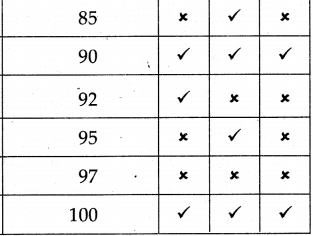
If the number given in the table is divisible by the given divisor, put P in the box. If it is not divisible by the divisor, put in the box.
Answer:
Maharashtra Board Class 5 Maths Solutions Chapter 8 Multiples and Factors Problem Set 33 4
Maharashtra Board Class 5 Maths Solutions Chapter 8 Multiples and Factors Problem Set 33 5

Maharashtra Board Class 5 Maths Solutions Chapter 9 Decimal Fractions Problem Set 38

Balbharti Maharashtra Board Class 5 Maths Solutions Chapter 9 Decimal Fractions Problem Set 38 Textbook Exercise Important Questions and Answers.

Maharashtra State Board Class 5 Maths Solutions Chapter 9 Decimal Fractions Problem Set 38

Read the decimal fraction and write down the place value of each digit.

(1) 6.13
Answer:
Six point one three.
Here 6 is in the units place. Hence, its place value is 6 x 1 = 6
1 is in tenths place. Hence, its place value is
\(1 \times \frac{1}{10}=0.1\)
3 is in the hundredths place. Its place value is 3 x \(\frac{1}{100}\) = 0.03 100

Maharashtra Board Class 5 Maths Solutions Chapter 9 Decimal Fractions Problem Set 38

(2) 48.84
Answer:
Fourty eight point eight four
Place value of 4 is 4 x 10 = 40 and of 8, it is 8 x 1 = 8
Place value of 8 is 8 x \(\frac{1}{10}=\frac{8}{10}\) = 0.8 and
Place value of 4 is 4 x \(\frac{1}{100}=\frac{4}{100}\) = 0.04

(3) 72.05
Answer:
Seventy two point zero five
Place value of 7 is 7 x 10 = 70 and of 2 is, it is 2 x 1 = 2
Place value of 5 is 5 x \(\frac{1}{100}=\frac{5}{100}\) = 0.05

(4) 3.4
Answer:
Three point four.
Place value of 3 is 3 x 1 = 3
Place value of 4 is 4 x \(\frac{1}{10}\) = 0.4

Maharashtra Board Class 5 Maths Solutions Chapter 9 Decimal Fractions Problem Set 38

(5) 0.59
Answer:
Zero point five nine.
Place value of 5 is 5 x \(\frac{1}{10}=\frac{5}{10}\) = 0.5 and
Place value of 9 is 9 x \(\frac{1}{100}=\frac{9}{100}\) = 0.09

Use of decimal fractions

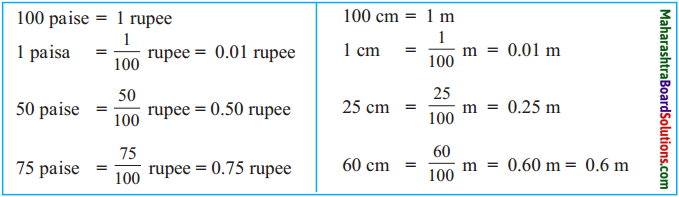
Sir : Now we will see how 24.50 equals 24 rupees and 50 paise. How many rupees is one paisa?
Sumit : 100 paise make one rupee, therefore, 1 paisa is one-hundredth of a rupee or 0.01 rupee.
Sir : And 50 paise are?
Sumit : 50 hundredths of a rupee, or 0.50 rupees, so 24.50 rupees is 24 rupees and 50 paise.
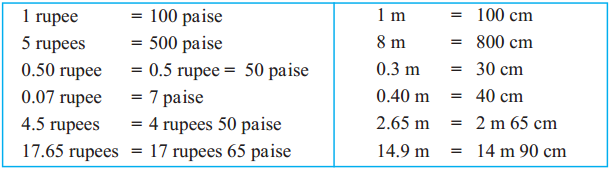
Sir : When a large unit of a certain quantity is divided into 10 or 100 parts to make smaller units, it is more convenient to write them in decimal form. As we just saw, 100 paise = 1 rupee. Similarly, 100 cm = 1 metre, so 75 cm = 0.75 m. 10 mm = 1 cm, so 1 mm = 0.1cm. 3 mm are 0.3 cm. 6.3 cm are 6 cm and 3 mm.

Now study the following table.

Maharashtra Board Class 5 Maths Solutions Chapter 9 Decimal Fractions Problem Set 38 1 Maharashtra Board Class 5 Maths Solutions Chapter 9 Decimal Fractions Problem Set 38 2

Decimal Fractions Problem Set 38 Additional Important Questions and Answers

(1) 12.34
Answer:
Twelve point three four.
Place value of 1 is 1 x 10 = 10
Place value of 2 is 2 x 1 = 2
Place value of 3 is 3 x \(\frac{1}{10}\) = 0.3
Place value of 4 is 4 x \(\frac{1}{100}\) = 0.04

Maharashtra Board Class 5 Maths Solutions Chapter 9 Decimal Fractions Problem Set 38

(2) 369,58
Answer:
Three hundred sixty nine point five eight. Place value of 3, which is in the hundreds place is 3 x 100 = 300
Place value of 6, which is in the tens place is 6 x 10 = 60
Place value of 9, which is in the units place is 9 x 1 = 9
Place value of 5, which is in the tenths place is 5 x \(\frac{1}{10}\) = 0.5
Place value of 8, which is in the hundredths place is 8 x \(\frac{1}{100}\) = 0.08

(3) 5.5
Answer:
Five point five.
Place value of 5, which is in the units place is 5 x 1 = 5
Place value of 5, which is in the tenths place is 5 x \(\frac{1}{10}\) = 0.5

Maharashtra Board Class 5 Maths Solutions Chapter 9 Decimal Fractions Problem Set 37

Balbharti Maharashtra Board Class 5 Maths Solutions Chapter 9 Decimal Fractions Problem Set 37 Textbook Exercise Important Questions and Answers.

Maharashtra State Board Class 5 Maths Solutions Chapter 9 Decimal Fractions Problem Set 37

Write the following mixed fractions in decimal form and read them aloud.

\(\text { (1) } 9 \frac{1}{10}\)
Answer:
9.1, Nine point one.

Maharashtra Board Class 5 Maths Solutions Chapter 9 Decimal Fractions Problem Set 37

\(\text { (2) } 9 \frac{1}{100}\)
Answer:
9.01, Nine point zero one.

\(\text { (3) } 4 \frac{53}{100}\)
Answer:
4.53, Four point five three.

\(\text { (4) } \frac{78}{100}\)
Answer:
0.78, Zero point seven eight.

\(\text { (5) } \frac{5}{100}\)
Answer:
0.05, Zero point zero five.

\(\text { (6) } \frac{5}{10}\)
Answer:
0.5, Zero point five.

Maharashtra Board Class 5 Maths Solutions Chapter 9 Decimal Fractions Problem Set 37

\(\text { (7) } \frac{2}{10}\)
Answer:
0.2, Zero point two.

\(\text { (8) } \frac{20}{100}\)
Answer:
0.20, Zero point two zero.

Place value of the digits in decimal fractions

We can determine the place value of the digits in decimal fractions in the same way that we determine the place values of digits in whole numbers.
Example (1)
In 73.82, the place value of 7 is 7 × 10 = 70, and of 3, it is 3 × 1 = 3.
Similarly, the place value of 8 is 8 × \(\frac{1}{10}=\frac{8}{10}\) = 0.8 and the place value of 2 is 2 × \(\frac{1}{100}=\frac{2}{100}\) = 0.02

Example (2)
Place values of the digits in 210.86.

Maharashtra Board Class 5 Maths Solutions Chapter 9 Decimal Fractions Problem Set 37 1

Maharashtra Board Class 5 Maths Solutions Chapter 9 Decimal Fractions Problem Set 37

Decimal Fractions Problem Set 37 Additional Important Questions and Answers

\(\text { (1) } 3 \frac{3}{100}\)
Answer:
3.03, Three point zero three.

\(\text { (2) } 3 \frac{33}{100}\)
Answer:
3.33, Three point three three.

\(\text { (3) } 30 \frac{41}{100}\)
Answer:
30.41, Thirty point four one.

\(\text { (4) } 11 \frac{11}{100}\)
Answer:
11.11, Eleven point one one.

Maharashtra Board Class 5 Maths Solutions Chapter 9 Decimal Fractions Problem Set 37

Q.3. Write the following numbers using the decimal point:
(1) Sixty-eight point seven six .
Answer:
68.76

(2) Nine point five zero one
Answer:
9.501

(3) Eighty-four point zero three.
Answer:
84.03

(4) Eighty-four point zero zero seven.
Answer:
84.007

Maharashtra Board Class 5 Maths Solutions Chapter 9 Decimal Fractions Problem Set 37

(5) Two hundred ftinety-eight point zero seven.
Answer:
298.07

Maharashtra Board Class 5 Maths Solutions Chapter 7 Circles Problem Set 30

Balbharti Maharashtra Board Class 5 Maths Solutions Chapter 7 Circles Problem Set 30 Textbook Exercise Important Questions and Answers.
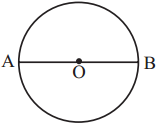
Maharashtra State Board Class 5 Maths Solutions Chapter 7 Circles Problem Set 30

Question 1.
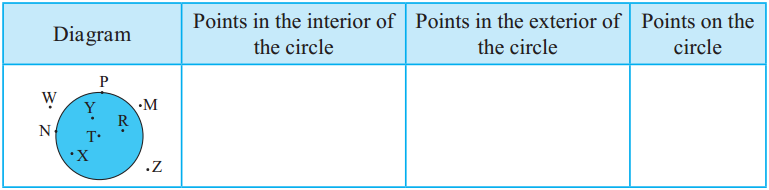
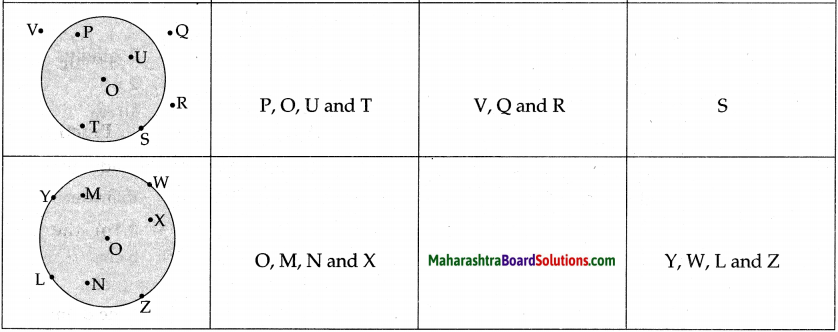
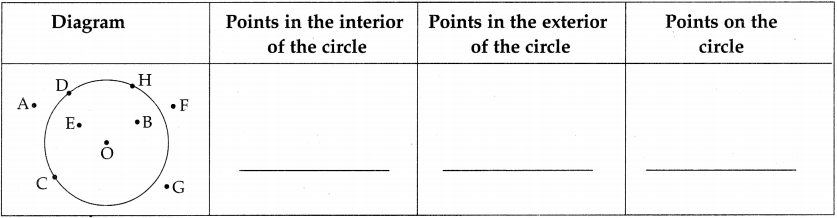
In the table below, write the names of the points in the interior and exterior of the circle and those on the circle.
Maharashtra Board Class 5 Maths Solutions Chapter 7 Circles Problem Set 29 6
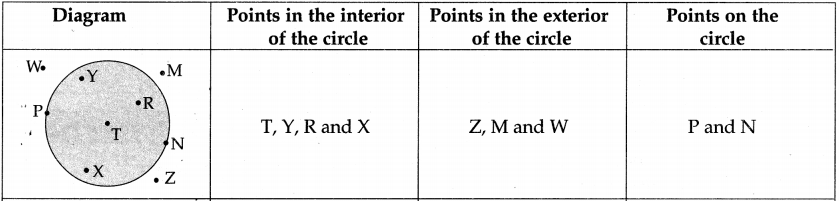
Answer:
Maharashtra Board Class 5 Maths Solutions Chapter 7 Circles Problem Set 29 11

Maharashtra Board Class 5 Maths Solutions Chapter 7 Circles Problem Set 30

The circumference of a circle

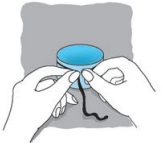
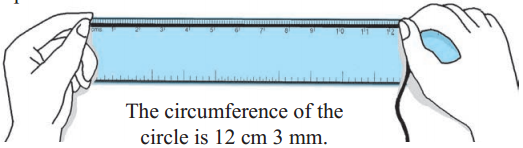
Take a bowl with a circular edge.

Maharashtra Board Class 5 Maths Solutions Chapter 7 Circles Problem Set 29 7

Wind a string once around the bowl and make a full circle around it.
Unwind this circle and straighten it out as shown.
Measure the straightened part with a ruler. The length of that part is the circumference of the circle or of the bowl.

Maharashtra Board Class 5 Maths Solutions Chapter 7 Circles Problem Set 29 8

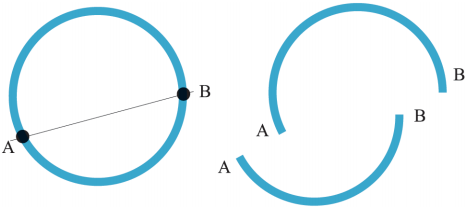
An arc of a circle
Shown alongside is a plastic bangle. If the bangle breaks at points A and B, it will split into two parts as shown in the picture.

Maharashtra Board Class 5 Maths Solutions Chapter 7 Circles Problem Set 29 9

Each of these parts is an arc of a circle.

Maharashtra Board Class 5 Maths Solutions Chapter 7 Circles Problem Set 30

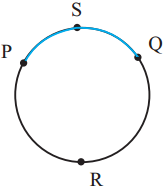
On the given circle, there are two points P and Q. These two points have divided the circle into two parts. Each of these parts is an arc of the circle.

Maharashtra Board Class 5 Maths Solutions Chapter 7 Circles Problem Set 29 10

This means that P and Q have created two arcs. P and Q are the end points of both arcs.

From the name ‘arc PQ’, we cannot say which of the two arcs we are speaking of. So, an additional point is taken on each arc. This point is used to give each arc a three-letter name. In the figure, there are two arcs, arc PSQ and arc PRQ.

Circles Problem Set 30 Additional Important Questions and Answers

Question 1.
In the table below, write the names of the points in the interior and exterior of the circle and those on the circle.
Answer:

Maharashtra Board Class 5 Maths Solutions Chapter 7 Circles Problem Set 29 4

Maharashtra Board Class 5 Maths Solutions Chapter 7 Circles Problem Set 30

Question 2.
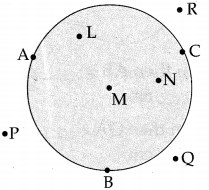
Draw a circle and take points A, B, C on the circle. L, M, N in the interior of the circle, P, Q, R in the exterior of the circle.
Answer:
Maharashtra Board Class 5 Maths Solutions Chapter 7 Circles Problem Set 29 5

Maharashtra Board Class 5 Maths Solutions Chapter 7 Circles Problem Set 31

Balbharti Maharashtra Board Class 5 Maths Solutions Chapter 7 Circles Problem Set 31 Textbook Exercise Important Questions and Answers.
Maharashtra State Board Class 5 Maths Solutions Chapter 7 Circles Problem Set 31

Question 1.
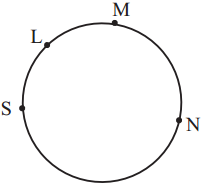
In the figure given alongside, points S, L, M, and N are on the circle. Answer the questions with the help of the diagram.
Maharashtra Board Class 5 Maths Solutions Chapter 7 Circles Problem Set 31 1

Maharashtra Board Class 5 Maths Solutions Chapter 7 Circles Problem Set 31

(1) Write the names of the arcs with end-points S and M.
Answer:
Arcs with the end-points S and M are, arc SLM and arc SNM.

(2) Write the names of the arcs with the end-points L and N.
Answer:
Arcs with the end-points L and N are, arc LMN and arc LSN.

Question 2.
Write the names of arcs that points A, B, C, and D in the given circle give rise to.
Answer:
Arcs with end-points A and C are, arc ABC and arc ADC.
Arcs with end-points B and D are, arc BAD and arc BCD.

Question 3.
Give the names of the arcs that are made by points P, Q, R, S, and T in the figure.
Answer:
Taking end-points : P and R, arc PQR, arc PTR.
Taking end-points: Q and S, arc QRS, arc QTS
Taking end-points : R and T, arc RST, arc RPT
Taking end-points : S and P, arc STP, arc SRP
Taking end-points: Q and T, arc QPT, arc QST

Maharashtra Board Class 5 Maths Solutions Chapter 7 Circles Problem Set 31

Question 4.
Measure and note down the circumference of different circular objects. (It is convenient to use a measuring tape for this purpose.)
Chapter 7 Circles Problem Set 31 Additional Important Questions and Answers

Question 1.
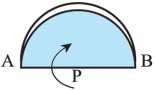
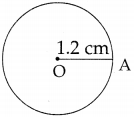
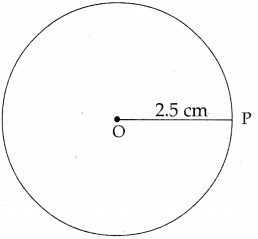
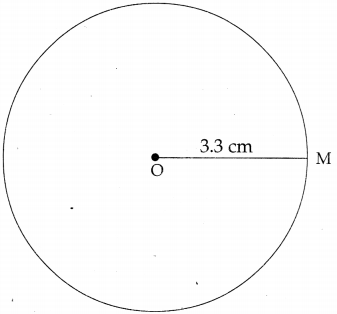
Draw circles with the radii given below:
(1) 1.2 cm
Answer:
Maharashtra Board Class 5 Maths Solutions Chapter 7 Circles Problem Set 31 2

(2) 2.5 cm
Answer:
Maharashtra Board Class 5 Maths Solutions Chapter 7 Circles Problem Set 31 3

Maharashtra Board Class 5 Maths Solutions Chapter 7 Circles Problem Set 31

(3) 3.3 cm
Answer:
Maharashtra Board Class 5 Maths Solutions Chapter 7 Circles Problem Set 31 4

Question 2.
Write true or false for the following statements:
(1) Longest chord is a diameter.
(2) Centre is not lying on the diameter.
(3) All chords are of equal length.
(4) All chords passes through the centre.
Answer:
(1) True
(2) False
(3) False
(4) False

Maharashtra Board Class 5 Maths Solutions Chapter 7 Circles Problem Set 31

Question 3.
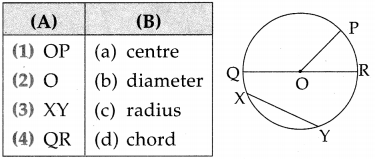
Match the cplumns (A) and (B):
Maharashtra Board Class 5 Maths Solutions Chapter 7 Circles Problem Set 31 7
Answer:
(1) ↔ (c),
(2) ↔ (a),
(3) ↔ (d),
(4) ↔ (b)

Question 4.
Complete the following table by filling in the blanks:
Maharashtra Board Class 5 Maths Solutions Chapter 7 Circles Problem Set 31 8
Answer:
(1) 6 cm
(2) 10 cm
(3) 34 cm
(4) 9 cm

Maharashtra Board Class 5 Maths Solutions Chapter 7 Circles Problem Set 31

Question 5.
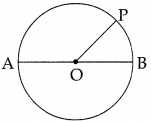
From the following figure, fill in the blanks:
Maharashtra Board Class 5 Maths Solutions Chapter 7 Circles Problem Set 31 9
(1) If OP = 4cm then AB = _________ cm, OA = _________ cm, OB = _________ cm.
(2) If AB = 10 cm then OA = _________ cm, OB = _________ cm, OP = _________ cm.
Answer:
(1) AB = 8 cm, OA = 4 cm, OB = 4 cm
(2) OA = 5 cm, OB = 5 cm, OP = 5 cm

Question 6.
In the table below, write the names of the points in the interior and exterior of the circle and those on the circle.
Maharashtra Board Class 5 Maths Solutions Chapter 7 Circles Problem Set 31 10
Answer:
Points in the exterior of the circle are A, F and G.
Points in the interior of the circle are O, E and B, and Points on the circle are C, D and H.

Maharashtra Board Class 5 Maths Solutions Chapter 7 Circles Problem Set 31

Question 7.
Radius of a circle with centre P is 4 cm. Fill in the blanks.
(1) The, point A is at a distance of 5 cm from the centre P. Flence the point A lies in the ________ of the circle.
(2) Point B is at a distance of 4 cm. from the centre P. Hence the point B lies ________ circle.
(3) Point C lies at a distance 3 cm from the centre P. Hence it lies in the ________ of the circle.
Answer:
(1) Exterior
(2) on the circle
(3) interior

Question 8.
Solve the following:
(1) What is the length of the diameter of a circle of radius 6 cm?
(2) What is the length of the radius of a circle of diameter 14 cm?
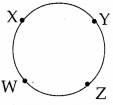
(3) Give the names of the arcs that are made by points X, Y, Z and W in this picture.
Maharashtra Board Class 5 Maths Solutions Chapter 7 Circles Problem Set 31 11
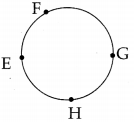
(4) Give the names of the arc that are made by points E, F, G and H, taking end points E and G.
Maharashtra Board Class 5 Maths Solutions Chapter 7 Circles Problem Set 31 12 Maharashtra Board Class 5 Maths Solutions Chapter 7 Circles Problem Set 31
(5) If the diameter of a circle is 7 cm. what is the length of the circumference? (Use measure tap)
Answer:
(1) 12 cm
(2) 7 cm
(3) Having end-points X and Z, arc XYZ and arc XWZ
Having end-points Y and W, arc YZW and arc YXW
(4) By end-points E and G, arc EFG and arc EHG
(5) 22 cm

Maharashtra Board Class 5 Maths Solutions Chapter 7 Circles Problem Set 29

Balbharti Maharashtra Board Class 5 Maths Solutions Chapter 7 Circles Problem Set 29 Textbook Exercise Important Questions and Answers.

Maharashtra State Board Class 5 Maths Solutions Chapter 7 Circles Problem Set 29

Question 1.
If the radius of a circle is 5 cm, what will its diameter be?
Solution :
Diameter
= 2 x radius
= 2 x 5 = 10 cm

Maharashtra Board Class 5 Maths Solutions Chapter 7 Circles Problem Set 29

Question 2.
If the diameter of a circle is 6 cm, what will its radius be?
Solution :
Radius
= diameter ÷ 2
= 6 ÷ 2
= 3 cm

Question 3.
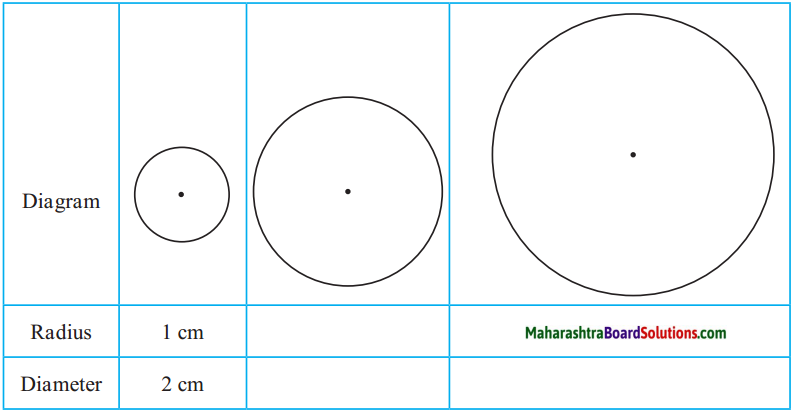
Complete the following table by filling in the blanks.
Maharashtra Board Class 5 Maths Solutions Chapter 7 Circles Problem Set 29 1
Answer:
Maharashtra Board Class 5 Maths Solutions Chapter 7 Circles Problem Set 29 3

Maharashtra Board Class 5 Maths Solutions Chapter 7 Circles Problem Set 29

The interior and the exterior of a circle

We play ‘Land and Sea’ inside a circle on the playground. In this game, the children inside the circle are in the ‘sea’, while the children outside the circle are on ‘land’.

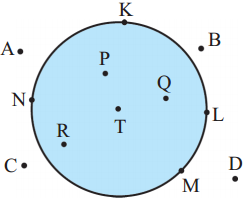
In the picture alongside, K, L, M and N are points on a circle with centre T.
Maharashtra Board Class 5 Maths Solutions Chapter 7 Circles Problem Set 29 2

The coloured area inside the circle in the picture is the interior of the circle. P, Q, R and T are points in the interior of the circle.

A, B, C and D are points in the exterior of the circle.

Circles Problem Set 29 Additional Important Questions and Answers

Question 1.
If the radius of a circle is 3.5 cm, what will its diameter be?
Solution :
Diameter
= 2 x radius
= 2 x 3.5
= 7 cm

Maharashtra Board Class 5 Maths Solutions Chapter 7 Circles Problem Set 29

Question 2.
If the diameter of a circle is 5 cm, what will its radius be?
Solution :
Radius
= Diameter ÷ 2
= 5 ÷ 2
= 2.5 cm

Maharashtra Board Class 5 Maths Solutions Chapter 7 Circles Problem Set 28

Balbharti Maharashtra Board Class 5 Maths Solutions Chapter 7 Circles Problem Set 28 Textbook Exercise Important Questions and Answers.

Maharashtra State Board Class 5 Maths Solutions Chapter 7 Circles Problem Set 28

Question 1.
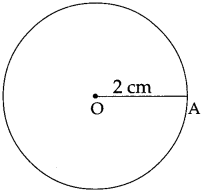
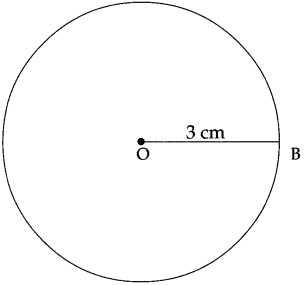
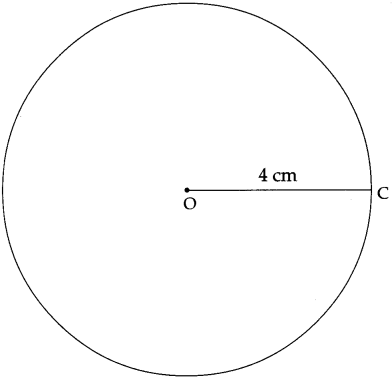
Draw circles with the radii given below.

(1) 2 cm
Answer:
Maharashtra Board Class 5 Maths Solutions Chapter 7 Circles Problem Set 28 7

Maharashtra Board Class 5 Maths Solutions Chapter 7 Circles Problem Set 28

(2) 4 cm
Answer:
Maharashtra Board Class 5 Maths Solutions Chapter 7 Circles Problem Set 28 8
(3) 3 cm
Answer:
Maharashtra Board Class 5 Maths Solutions Chapter 7 Circles Problem Set 28 9

Maharashtra Board Class 5 Maths Solutions Chapter 7 Circles Problem Set 28

Question 2.
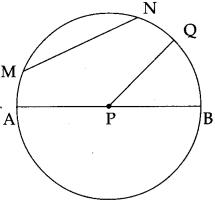
Draw a circle of any radius. Show one diameter, one radius and one chord on that circle.
Answer:
In a circle, P is the centre.
AB is a diameter.
PQ is a radius
MN is a chord
Maharashtra Board Class 5 Maths Solutions Chapter 7 Circles Problem Set 28 12

Relationship between radius and diameter
Study the circle given alongside. Think over the following questions.
Maharashtra Board Class 5 Maths Solutions Chapter 7 Circles Problem Set 28 1

  • Which are the radii in the circle?
  • How many radii make up diameter AB?
  • If the length of one radius is 3 cm, what is the length of the diameter?
  • How long is the diameter as compared to the radius?

Maharashtra Board Class 5 Maths Solutions Chapter 7 Circles Problem Set 28

The diameter of a circle is twice the length of its radius.

  • If another diameter CD is drawn on the same circle, will its length be the same as that of AB?

All the diameters of a circle are of the same length.

Test 1 :
Measure the diameters and radii of the circles given below with a ruler and verify the relationship between their lengths.
Maharashtra Board Class 5 Maths Solutions Chapter 7 Circles Problem Set 28 2

Test 2 :
1. Draw a circle on a piece of paper and cut it out.
Maharashtra Board Class 5 Maths Solutions Chapter 7 Circles Problem Set 28 3

Maharashtra Board Class 5 Maths Solutions Chapter 7 Circles Problem Set 28

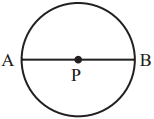
2. Name the centre of the circle P.
Maharashtra Board Class 5 Maths Solutions Chapter 7 Circles Problem Set 28 4
3. Draw the diameter of the circle and name it AB. Note that PA and PB are radii of the circle.
Maharashtra Board Class 5 Maths Solutions Chapter 7 Circles Problem Set 28 5
4. Fold the circular paper along AB as shown in the picture.
Maharashtra Board Class 5 Maths Solutions Chapter 7 Circles Problem Set 28 6
Fold the paper at P in such a way that point B will fall on point A. Radius PB falls exactly on radius PA. In other words, they coincide.

From this, we can see that every radius of a circle is half the length of its diameter.

Circles Problem Set 28 Additional Important Questions and Answers

Question 1.
Draw circles with the radii given below:

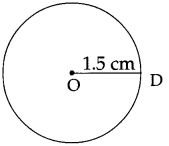
(1) 1.5 cm
Answer:
Maharashtra Board Class 5 Maths Solutions Chapter 7 Circles Problem Set 28 10

Maharashtra Board Class 5 Maths Solutions Chapter 7 Circles Problem Set 28

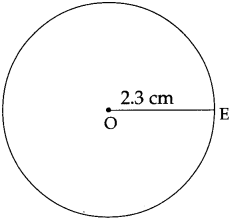
(2) 2.3 cm
Answer:
Maharashtra Board Class 5 Maths Solutions Chapter 7 Circles Problem Set 28 11

Question 2.
Which one of the following statement is true:

(1) All chords are diameters.
(2) All diameters are chords.
Answer:
Statement (2) is true.