Maharashtra Board 10th Class Maths Part 2 Practice Set 2.2 Solutions Chapter 2 Pythagoras Theorem

Balbharti Maharashtra State Board Class 10 Maths Solutions covers the Practice Set 2.2 Geometry 10th Class Maths Part 2 Answers Solutions Chapter 2 Pythagoras Theorem.

Practice Set 2.2 Geometry 10th Std Maths Part 2 Answers Chapter 2 Pythagoras Theorem

Question 1.
In ∆PQR, point S is the midpoint of side QR. If PQ = 11, PR = 17, PS = 13, find QR.
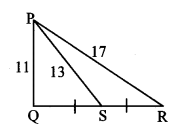
Maharashtra Board Class 10 Maths Solutions Chapter 2 Pythagoras Theorem Practice Set 2.2 1
Solution:
In ∆PQR, point S is the midpoint of side QR. [Given]
∴ seg PS is the median.
∴ PQ2 + PR2 = 2 PS2 + 2 SR2 [Apollonius theorem]
∴ 112 + 172 = 2 (13)2 + 2 SR2
∴ 121 + 289 = 2 (169)+ 2 SR2
∴ 410 = 338+ 2 SR2
∴ 2 SR2 = 410 – 338
∴ 2 SR2 = 72
∴ SR2 = \(\frac { 72 }{ 2 } \) = 36
∴ SR = \(\sqrt{36}\) [Taking square root of both sides]
= 6 units Now, QR = 2 SR [S is the midpoint of QR]
= 2 × 6
∴ QR = 12 units

Question 2.
In ∆ABC, AB = 10, AC = 7, BC = 9, then find the length of the median drawn from point C to side AB.
Solution:
Let CD be the median drawn from the vertex C to side AB.
BD = \(\frac { 1 }{ 2 } \) AB [D is the midpoint of AB]
= \(\frac { 1 }{ 2 } \) × 10 = 5 units
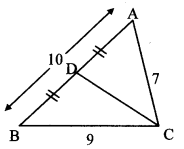
Maharashtra Board Class 10 Maths Solutions Chapter 2 Pythagoras Theorem Practice Set 2.2 2
In ∆ABC, seg CD is the median. [Given]
∴ AC2 + BC2 = 2 CD2 + 2 BD2 [Apollonius theorem]
∴ 72 + 92 = 2 CD2 + 2 (5)2
∴ 49 + 81 = 2 CD2 + 2 (25)
∴ 130 = 2 CD2 + 50
∴ 2 CD2 = 130 – 50
∴ 2 CD2 = 80
∴ CD2 = \(\frac { 80 }{ 2 } \) = 40
∴ CD = \(\sqrt { 40 }\) [Taking square root of both sides]
= 2 \(\sqrt { 10 }\) units
∴ The length of the median drawn from point C to side AB is 2 \(\sqrt { 10 }\) units.

Question 3.
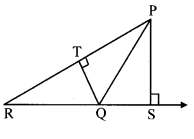
In the adjoining figure, seg PS is the median of APQR and PT ⊥ QR. Prove that,
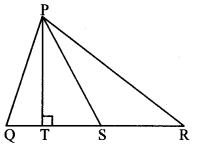
Maharashtra Board Class 10 Maths Solutions Chapter 2 Pythagoras Theorem Practice Set 2.2 3
i. PR2 = PS2 + QR × ST + (\(\frac { QR }{ 2 } \))2
ii. PQ2 = PS2 – QR × ST + (\(\frac { QR }{ 2 } \))2
Solution:
i. QS = SR = \(\frac { 1 }{ 2 } \) QR (i) [S is the midpoint of side QR]
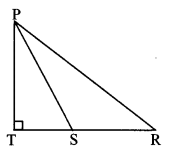
Maharashtra Board Class 10 Maths Solutions Chapter 2 Pythagoras Theorem Practice Set 2.2 4
∴ In ∆PSR, ∠PSR is an obtuse angle [Given]
and PT ⊥ SR [Given, Q-S-R]
∴ PR2 = SR2 +PS2 + 2 SR × ST (ii) [Application of Pythagoras theorem]
∴ PR2 = (\(\frac { 1 }{ 2 } \) QR)2 + PS2 + 2 (\(\frac { 1 }{ 2 } \) QR) × ST [From (i) and (ii)]
∴ PR2 = (\(\frac { QR }{ 2 } \))2 + PS2 + QR × ST
∴ PR2 = PS2 + QR × ST + (\(\frac { QR }{ 2 } \))2

ii. In.∆PQS, ∠PSQ is an acute angle and [Given]
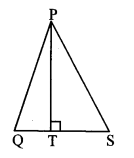
Maharashtra Board Class 10 Maths Solutions Chapter 2 Pythagoras Theorem Practice Set 2.2 5
PT ⊥QS [Given, Q-S-R]
∴ PQ2 = QS2 + PS2 – 2 QS × ST (iii) [Application of Pythagoras theorem]
∴ PR2 = (\(\frac { 1 }{ 2 } \) QR)2 + PS2 – 2 (\(\frac { 1 }{ 2 } \) QR) × ST [From (i) and (iii)]
∴ PR2 = (\(\frac { QR }{ 2 } \))2 + PS2 – QR × ST
∴ PR2 = PS2 – QR × ST + (\(\frac { QR }{ 2 } \))2

Question 4.
In ∆ABC, point M is the midpoint of side BC. If AB2 + AC2 = 290 cm, AM = 8 cm, find BC.
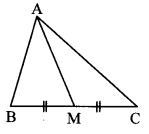
Maharashtra Board Class 10 Maths Solutions Chapter 2 Pythagoras Theorem Practice Set 2.2 6
Solution:
In ∆ABC, point M is the midpoint of side BC. [Given]
∴ seg AM is the median.
∴ AB2 + AC2 = 2 AM2 + 2 MC2 [Apollonius theorem]
∴ 290 = 2 (8)2 + 2 MC2
∴ 145 = 64 + MC2 [Dividing both sides by 2]
∴ MC2 = 145 – 64
∴ MC2 = 81
∴ MC = \(\sqrt{81}\) [Taking square root of both sides]
MC = 9 cm
Now, BC = 2 MC [M is the midpoint of BC]
= 2 × 9
∴ BC = 18 cm

Question 5.
In the adjoining figure, point T is in the interior of rectangle PQRS. Prove that, TS2 + TQ2 = TP2 + TR2. (As shown in the figure, draw seg AB || side SR and A – T – B)
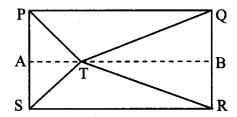
Maharashtra Board Class 10 Maths Solutions Chapter 2 Pythagoras Theorem Practice Set 2.2
Given: ꠸PQRS is a rectangle.
Point T is in the interior of ꠸PQRS.
To prove: TS2 + TQ2 = TP2 + TR2
Construction: Draw seg AB || side SR such that A – T – B.
Solution:
Proof:
꠸PQRS is a rectangle. [Given]
∴ PS = QR (i) [Opposite sides of a rectangle]
In ꠸ASRB,
∠S = ∠R = 90° (ii) [Angles of rectangle PQRS]
side AB || side SR [Construction]
Also ∠A = ∠S = 90° [Interior angle theorem, from (ii)]
∠B = ∠R = 90°
∴ ∠A = ∠B = ∠S = ∠R = 90° (iii)
∴ ꠸ASRB is a rectangle.
∴ AS = BR (iv) [Opposite sides of a rectanglel
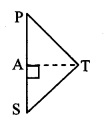
Maharashtra Board Class 10 Maths Solutions Chapter 2 Pythagoras Theorem Practice Set 2.2
In ∆PTS, ∠PST is an acute angle
and seg AT ⊥ side PS [From (iii)]
∴ TP2 = PS2 + TS2 – 2 PS.AS (v) [Application of Pythagoras theorem]
In ∆TQR., ∠TRQ is an acute angle
and seg BT ⊥ side QR [From (iii)]
∴ TQ2 = RQ2 + TR2 – 2 RQ.BR (vi) [Application of pythagoras theorem]
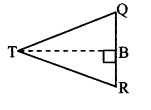
Maharashtra Board Class 10 Maths Solutions Chapter 2 Pythagoras Theorem Practice Set 2.2
TP2 – TQ2 = PS2 + TS2 – 2PS.AS
-RQ2 – TR2 + 2RQ.BR [Subtracting (vi) from (v)]
∴ TP2 – TQ2 = TS2 – TR2 + PS2
– RQ2 -2 PS.AS +2 RQ.BR
∴ TP2 – TQ2 = TS2 – TR2 + PS2
– PS2 – 2 PS.BR + 2PS.BR [From (i) and (iv)]
∴ TP2 – TQ2 = TS2 – TR2
∴ TS2 + TQ2 = TP2 + TR2

Question 1.
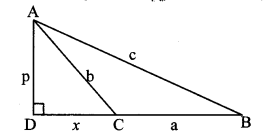
In ∆ABC, ∠C is an acute angle, seg AD Iseg BC. Prove that: AB2 = BC2 + A2 – 2 BC × DC. (Textbook pg. no. 44)
Given: ∠C is an acute angle, seg AD ⊥ seg BC.
To prove: AB2 = BC2 + AC2 – 2BC × DC
Solution:
Proof:
∴ LetAB = c, AC = b, AD = p,
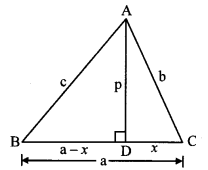
Maharashtra Board Class 10 Maths Solutions Chapter 2 Pythagoras Theorem Practice Set 2.2 9
∴ BC = a, DC = x
BD + DC = BC [B – D – C]
∴ BD = BC – DC
∴ BD = a – x
In ∆ABD, ∠D = 90° [Given]
AB2 = BD2 + AD2 [Pythagoras theorem]
∴ c2 = (a – x)2 + [P2] (i)
∴ c2 = a2 – 2ax + x2 + [P2]
In ∆ADC, ∠D = 90° [Given]
AC2 = AD2 + CD2 [Pythagoras theorem]
∴ b2 = p2 + [X2]
∴ p2 = b2 – [X2] (ii)
∴ c2 = a2 – 2ax + x2 + b2 – x2 [Substituting (ii) in (i)]
∴ c2 = a2 + b2 – 2ax
∴ AB2 = BC2 + AC2 – 2 BC × DC

Question 2.
In ∆ABC, ∠ACB is an obtuse angle, seg AD ⊥ seg BC. Prove that: AB2 = BC2 + AC2 + 2 BC × CD. (Textbook pg. no. 40 and 4.1)
Given: ∠ACB is an obtuse angle, seg AD ⊥ seg BC.
To prove: AB2 = BC2 + AC2 + 2BC × CD
Solution:
Proof:
Maharashtra Board Class 10 Maths Solutions Chapter 2 Pythagoras Theorem Practice Set 2.2 10
Let AD = p, AC = b, AB = c,
BC = a, DC = x
BD = BC + DC [B – C – D]
∴ BD = a + x
In ∆ADB, ∠D = 90° [Given]
AB2 = BD2 + AD2 [Pythagoras theorem]
∴ c2 = (a + x)2 + p2 (i)
∴ c2 = a2 + 2ax + x2 + p2
Also, in ∆ADC, ∠D = 90° [Given]
AC2 = CD2 + AD2 [Pythagoras theorem]
∴ b2 = x2 + p2
∴ p2 = b2 – x2 (ii)
∴ c2 = a2 + 2ax + x2 + b2 – x2 [Substituting (ii) in (i)]
∴ c2 = a2 + b2 + 2ax
∴ AB2 = BC2 + AC2 + 2 BC × CD

Question 3.
In ∆ABC, if M is the midpoint of side BC and seg AM ⊥seg BC, then prove that
AB2 + AC2 = 2 AM2 + 2 BM2. (Textbook pg, no. 41)
Given: In ∆ABC, M is the midpoint of side BC and seg AM ⊥ seg BC.
To prove: AB2 + AC2 = 2 AM2 + 2 BM2
Solution:
Proof:
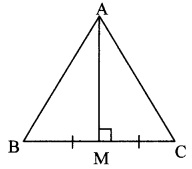
Maharashtra Board Class 10 Maths Solutions Chapter 2 Pythagoras Theorem Practice Set 2.2
In ∆AMB, ∠M = 90° [segAM ⊥ segBC]
∴ AB2 = AM2 + BM2 (i) [Pythagoras theorem]
Also, in ∆AMC, ∠M = 90° [seg AM ⊥ seg BC]
∴ AC2 = AM2 + MC2 (ii) [Pythagoras theorem]
∴ AB2 + AC2 = AM2 + BM2 + AM2 + MC2 [Adding (i) and (ii)]
∴ AB2 + AC2 = 2 AM2 + BM2 + BM2 [∵ BM = MC (M is the midpoint of BC)]
∴ AB2 + AC2 = 2 AM2 + 2 BM2
Maharashtra Board 10th Class Maths Part 2 Practice Set 2.1 Solutions Chapter 2 Pythagoras Theorem

Balbharti Maharashtra State Board Class 10 Maths Solutions covers the Practice Set 2.1 Geometry 10th Class Maths Part 2 Answers Solutions Chapter 2 Pythagoras Theorem.

Practice Set 2.1 Geometry 10th Std Maths Part 2 Answers Chapter 2 Pythagoras Theorem

Question 1.
Identify, with reason, which of the following are Pythagorean triplets.
i. (3,5,4)
ii. (4,9,12)
iii. (5,12,13)
iv. (24,70,74)
v. (10,24,27)
vi. (11,60,61)
Solution:
i. Here, 52 = 25
32 + 42 = 9 + 16 = 25
∴ 52 = 32 + 42
The square of the largest number is equal to the sum of the squares of the other two numbers.
∴ (3,5,4) is a Pythagorean triplet.

ii. Here, 122 = 144
42 + 92= 16 + 81 =97
∴ 122 ≠ 42 + 92
The square of the largest number is not equal to the sum of the squares of the other two numbers.
∴ (4,9,12) is not a Pythagorean triplet.

iii. Here, 132 = 169
52 + 122 = 25 + 144 = 169
∴ 132 = 52 + 122
The square of the largest number is equal to the sum of the squares of the other two numbers.
∴ (5,12,13) is a Pythagorean triplet.

iv. Here, 742 = 5476
242 + 702 = 576 + 4900 = 5476
∴ 742 = 242 + 702
The square of the largest number is equal to the sum of the squares of the other two numbers.
∴ (24, 70,74) is a Pythagorean triplet.

v. Here, 272 = 729
102 + 242 = 100 + 576 = 676
∴ 272 ≠ 102 + 242
The square of the largest number is not equal to the sum of the squares of the other two numbers.
∴ (10,24,27) is not a Pythagorean triplet.

vi. Here, 612 = 3721
112 + 602 = 121 + 3600 = 3721
∴ 612 = 112 + 602
The square of the largest number is equal to the sum of the squares of the other two numbers.
∴ (11,60,61) is a Pythagorean triplet.

Question 2.
In the adjoining figure, ∠MNP = 90°, seg NQ ⊥ seg MP,MQ = 9, QP = 4, find NQ.
Maharashtra Board Class 10 Maths Solutions Chapter 1 Similarity Problem Set 1 25
Solution:
In ∆MNP, ∠MNP = 90° and [Given]
seg NQ ⊥ seg MP
NQ2 = MQ × QP [Theorem of geometric mean]
∴ NQ = \(\sqrt { MQ\times QP }\) [Taking square root of both sides]
= \(\sqrt { 9\times 4 } \)
= 3 × 2
∴NQ = 6 units

Question 3.
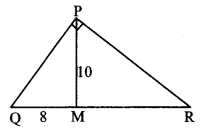
In the adjoining figure, ∠QPR = 90°, seg PM ⊥ seg QR and Q – M – R, PM = 10, QM = 8, find QR.
Maharashtra Board Class 10 Maths Solutions Chapter 2 Pythagoras Theorem Practice Set 2.1 2
Solution:
In ∆PQR, ∠QPR = 90° and [Given]
seg PM ⊥ seg QR
∴ PM2 = OM × MR [Theorem of geometric mean]
∴ 102 = 8 × MR
∴ MR = \(\frac { 100 }{ 8 } \)
= 12.5
Now, QR = QM + MR [Q – M – R]
= 8 + 12.5
∴ QR = 20.5 units

Question 4.
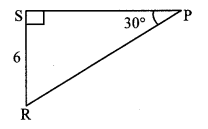
See adjoining figure. Find RP and PS using the information given in ∆PSR.
Maharashtra Board Class 10 Maths Solutions Chapter 2 Pythagoras Theorem Practice Set 2.1 3
Solution:
In ∆PSR, ∠S = 90°, ∠P = 30° [Given]
∴ ∠R = 60° [Remaining angle of a triangle]
∴ ∆PSR is a 30° – 60° – 90° triangle.
RS = \(\frac { 1 }{ 2 } \) RP [Side opposite to 30°]
∴6 = \(\frac { 1 }{ 2 } \) RP
∴ RP = 6 × 2 = 12 units
Also, PS = \(\frac{\sqrt{3}}{2}\) RP [Side opposite to 60°]
= \(\frac{\sqrt{3}}{2}\) × 12
= \(6 \sqrt{3}\) units
∴ RP = 12 units, PS = 6 \(\sqrt { 3 }\) units

Question 5.
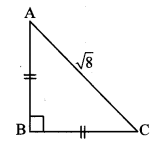
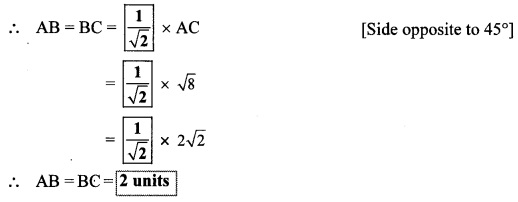
For finding AB and BC with the help of information given in the adjoining figure, complete the following activity.
Maharashtra Board Class 10 Maths Solutions Chapter 2 Pythagoras Theorem Practice Set 2.1 4
Solution:
AB = BC [Given]
∴ ∠BAC = ∠BCA [Isosceles triangle theorem]
Let ∠BAC = ∠BCA = x (i)
In ∆ABC, ∠A + ∠B + ∠C = 180° [Sum of the measures of the angles of a triangle is 180°]
∴ x + 90° + x = 180° [From (i)]
∴ 2x = 90°
∴ x = \(\frac { 90° }{ 2 } \) [From (i)]
∴ x = 45°
Maharashtra Board Class 10 Maths Solutions Chapter 2 Pythagoras Theorem Practice Set 2.1

Question 6.
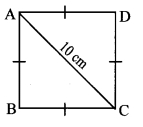
Find the side and perimeter of a square whose diagonal is 10 cm.
Maharashtra Board Class 10 Maths Solutions Chapter 2 Pythagoras Theorem Practice Set 2.1
Solution:
Let ꠸ABCD be the given square.
l(diagonal AC) = 10 cm
Let the side of the square be ‘x’ cm.
In ∆ABC,
∠B = 90° [Angle of a square]
∴ AC2 = AB2 + BC2 [Pythagoras theorem]
∴ 102 = x2 + x2
∴ 100 = 2x2
∴ x2 = \(\frac { 100 }{ 2 } \)
∴x2 = 50
∴ x = \(\sqrt { 50 }\) [Taking square root of both sides]
= \(=\sqrt{25 \times 2}=5 \sqrt{2}\)
∴side of square is 5\(\sqrt { 2 }\) cm.
= 4 × 5 \(\sqrt { 2 }\)
∴ Perimeter of square = 20 \(\sqrt { 2 }\) cm

Question 7.
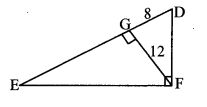
In the adjoining figure, ∠DFE = 90°, FG ⊥ ED. If GD = 8, FG = 12, find
i. EG
ii. FD, and
iii. EF
Maharashtra Board Class 10 Maths Solutions Chapter 2 Pythagoras Theorem Practice Set 2.1 6
Solution:
i. In ∆DEF, ∠DFE = 90° and FG ⊥ ED [Given]
∴ FG2 = GD × EG [Theorem of geometric mean]
∴ 122 = 8 × EG .
∴ EG = \(\frac { 144 }{ 8 } \)
∴ EG = 18 units

ii. In ∆FGD, ∠FGD = 90° [Given]
∴ FD2 = FG2 + GD2 [Pythagoras theorem]
= 122 + 82 = 144 + 64
= 208
∴ FD = \(\sqrt { 208 }\) [Taking square root of both sides]
∴ FD = 4 \(\sqrt { 13 }\) units

iii. In ∆EGF, ∠EGF = 90° [Given]
∴ EF2 = EG2 + FG2 [Pythagoras theorem]
= 182 + 122 = 324 + 144
= 468
∴ EF = \(\sqrt { 468 }\) [Taking square root of both sides]
∴ EF = 6 \(\sqrt { 13 }\) units

Question 8.
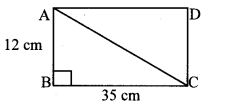
Find the diagonal of a rectangle whose length is 35 cm and breadth is 12 cm.
Maharashtra Board Class 10 Maths Solutions Chapter 2 Pythagoras Theorem Practice Set 2.1 7
Solution:
Let ꠸ABCD be the given rectangle.
AB = 12 cm, BC 35 cm
In ∆ABC, ∠B = 90° [Angle of a rectangle]
∴ AC2 = AB2 + BC2 [Pythagoras theorem]
= 122 + 352
= 144 + 1225
= 1369
∴ AC = \(\sqrt { 1369 }\) [Taking square root of both sides]
= 37 cm
∴ The diagonal of the rectangle is 37 cm.

Question 9.
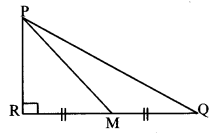
In the adjoining figure, M is the midpoint of QR. ∠PRQ = 90°.
Prove that, PQ2 = 4 PM2 – 3 PR2.
Maharashtra Board Class 10 Maths Solutions Chapter 2 Pythagoras Theorem Practice Set 2.1 8

Solution:
Proof:
In ∆PQR, ∠PRQ = 90° [Given]
PQ2 = PR2 + QR2 (i) [Pythagoras theorem]
RM = \(\frac { 1 }{ 2 } \) QR [M is the midpoint of QR]
∴ 2RM = QR (ii)
∴ PQ2 = PR2 + (2RM)2 [From (i) and (ii)]
∴ PQ2 = PR2 + 4RM2 (iii)
Now, in ∆PRM, ∠PRM = 90° [Given]
∴ PM2 = PR2 + RM2 [Pythagoras theorem]
∴ RM2 = PM2 – PR2 (iv)
∴ PQ2 = PR2 + 4 (PM2 – PR2) [From (iii) and (iv)]
∴ PQ2 = PR2 + 4 PM2 – 4 PR2
∴ PQ2 = 4 PM2 – 3 PR2

Question 10.
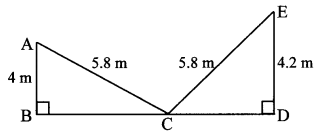
Walls of two buildings on either side of a street are parallel to each other. A ladder 5.8 m long is placed on the street such that its top just reaches the window of a building at the height of 4 m. On turning the ladder over to the other side of the street, its top touches the window of the other building at a height 4.2 m. Find the width of the street.
Solution:
Let AC and CE represent the ladder of length 5.8 m, and A and E represent windows of the buildings on the opposite sides of the street. BD is the width of the street.
Maharashtra Board Class 10 Maths Solutions Chapter 2 Pythagoras Theorem Practice Set 2.1 9
AB = 4 m and ED = 4.2 m
In ∆ABC, ∠B = 90° [Given]
AC2 = AB2 + BC2 [Pythagoras theorem]
∴ 5.82 = 42 + BC2
∴ 5.82 – 42 = BC2
∴ (5.8 – 4) (5.8 + 4) = BC2
∴ 1.8 × 9.8 = BC2
Maharashtra Board Class 10 Maths Solutions Chapter 2 Pythagoras Theorem Practice Set 2.1

CE2 = CD2 + DE2 [Pythagoras theorem]
∴ 5.82 = CD2 + 4.22
∴ 5.82 – 4.22 = CD2
∴ (5.8 – 4.2) (5.8 + 4.2) = CD2
∴ 1.6 × 10 = CD2
∴ CD2 = 16
∴ CD = 4m (ii) [Taking square root of both sides]
Now, BD = BC + CD [B – C – D]
= 4.2 + 4 [From (i) and (ii)]
= 8.2 m
∴ The width of the street is 8.2 metres.

Question 1.
Verify that (3,4,5), (5,12,13), (8,15,17), (24,25,7) are Pythagorean triplets. (Textbook pg. no. 30)
Solution:
i. Here, 52 = 25
32 + 42 = 9 + 16 = 25
∴ 52 = 32 + 42
The square of the largest number is equal to the sum of the squares of the other two numbers.
∴ 3,4,5 is a Pythagorean triplet.

ii. Here, 132 = 169
52 + 122 = 25 + 144 = 169
∴ 132 = 52 + 122
The square of the largest number is equal to the sum of the squares of the other two numbers.
∴ 5,12,13 is a Pythagorean triplet.

iii. Here, 172 = 289
82 + 152 = 64 + 225 = 289
∴ 172 = 82 + 152
The square of the largest number is equal to the sum of the squares of the other two numbers.
∴ 8,15,17 is a Pythagorean triplet.

iv. Here, 252 = 625
72 + 242 = 49 + 576 = 625
∴ 252 = 72 + 242
The square of the largest number is equal to the sum of the squares of the other two numbers.
∴ 24,25, 7 is a Pythagorean triplet.

Question 2.
Assign different values to a and b and obtain 5 Pythagorean triplets. (Textbook pg. no. 31)
Solution:
i. Let a = 2, b = 1
a2 + b2 = 22 + 12 = 4 + 1 = 5
a2 – b2 = 22 – 12 = 4 – 1 = 3
2ab = 2 × 2 × 1 = 4
∴ (5, 3, 4) is a Pythagorean triplet.

ii. Let a = 4,b = 3
a2 + b2 = 42 + 32 = 16 + 9 = 25
a2 – b2 = 42 – 32 = 16 – 9 = 7
2ab = 2 × 4 × 3 = 24
∴ (25, 7, 24) is a Pythagorean triplet.

iii. Let a = 5, b = 2
a2 + b2 = 52 + 22 = 25 + 4 = 29
a2 – b2 = 52 – 22 = 25 – 4 = 21
2ab = 2 × 5 × 2 = 20
∴ (29, 21, 20) is a Pythagorean triplet.

iv. Let a = 4,b = 1
a2 + b2 = 42 + 12 = 16 + 1 = 17
a2 – b2 = 42 – 12 = 16 – 1 = 15
2ab = 2 × 4 × 1 = 8
∴ (17, 15, 8) is a Pythagorean triplet.

v. Let a = 9, b = 7
a2 + b2 = 92 + 72 = 81 + 49 = 130
a2 – b2 = 92 – 72 = 81 – 49 = 32
2ab = 2 × 9 × 7 = 126
∴ (130,32,126) is a Pythagorean triplet.

Note: Numbers in Pythagorean triplet can be written in any order.

Maharashtra Board 10th Class Maths Part 2 Problem Set 1 Solutions Chapter 1 Similarity

Balbharti Maharashtra State Board Class 10 Maths Solutions covers the Problem Set 1 Geometry 10th Class Maths Part 2 Answers Solutions Chapter 6 Statistics.

Problem Set 1 Geometry 10th Std Maths Part 2 Answers Chapter 1 Similarity

Question 1.
Select the appropriate alternative.
i. In ∆ABC and ∆PQR, in a one to one correspondence \(\frac { AB }{ QR } \) = \(\frac { BC }{ PR } \) = \(\frac { CA }{ PQ } \), then
Maharashtra Board Class 10 Maths Solutions Chapter 1 Similarity Problem Set 1 1
(A) ∆PQR – ∆ABC
(B) ∆PQR – ∆CAB
(C) ∆CBA – ∆PQR
(D) ∆BCA – ∆PQR
Answer:
(B)

ii. If in ∆DEF and ∆PQR, ∠D ≅ ∠Q, ∠R ≅ ∠E, then which of the following statements is false?
Maharashtra Board Class 10 Maths Solutions Chapter 1 Similarity Problem Set 1 2
(A) \(\frac { EF }{ PR } \) = \(\frac { DF }{ PQ } \)
(B) \(\frac { DE }{ PQ } \) = \(\frac { EF }{ RP } \)
(C) \(\frac { DE }{ QR } \) = \(\frac { DF }{ PQ } \)
(D) \(\frac { EF }{ RP } \) = \(\frac { DE }{ QR } \)
Answer:
∆DEF ~ ∆QRP … [AA test of similarity]
∴ \(\frac { DE }{ QR } \) = \(\frac { EF }{ RP } \) = \(\frac { DF }{ PQ } \) …[Corresponding sides of similar triangles]
(B)

iii. In ∆ABC and ∆DEF, ∠B = ∠E, ∠F = ∠C and AB = 3 DE, then which of the statements regarding the two triangles is true?
Maharashtra Board Class 10 Maths Solutions Chapter 1 Similarity Problem Set 1 3
(A) The triangles are not congruent and not similar.
(B) The triangles are similar but not congruent.
(C) The triangles are congruent and similar.
(D) None of the statements above is true.
Answer:
(B)

iv. ∆ABC and ∆DEF are equilateral triangles, A(∆ABC) : A(∆DEF) = 1 : 2. If AB = 4, then what is length of DE?
Maharashtra Board Class 10 Maths Solutions Chapter 1 Similarity Problem Set 1 4
(A) 2√2
(B) 4
(C) 8
(D) 4√2
Answer:
Refer Q. 6 Practice Set 1.4
(D)

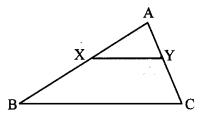
v. In the adjoining figure, seg XY || seg BC, then which of the following statements is true?
Maharashtra Board Class 10 Maths Solutions Chapter 1 Similarity Problem Set 1 5
(A) \(\frac { AB }{ AC } \) = \(\frac { AX }{ AY } \)
(B) \(\frac { AX }{ XB } \) = \(\frac { AY }{ AC } \)
(C) \(\frac { AX }{ YC } \) = \(\frac { AY }{ XB } \)
(D) \(\frac { AB }{ YC } \) = \(\frac { AC }{ XB } \)
Answer:
∆ABC ~ ∆AXY … [AA test of similarity]
∴ \(\frac { AB }{ AX } \) = \(\frac { AC }{ AY } \) …[Corresponding sides of similar triangles]
∴ \(\frac { AB }{ AC } \) = \(\frac { AX }{ AY } \) …[Altemendo]
(A)

Question 2.
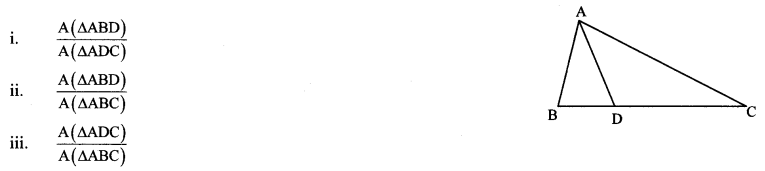
In ∆ABC, B-D-C and BD = 7, BC = 20, then find following ratios.
Maharashtra Board Class 10 Maths Solutions Chapter 1 Similarity Problem Set 1 6
Solution:
Maharashtra Board Class 10 Maths Solutions Chapter 1 Similarity Problem Set 1 7
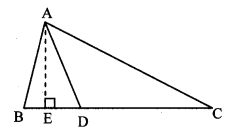
Draw AE ⊥ BC, B – E – C.
BC = BD + DC [B – D – C]
∴ 20 = 7 + DC
∴ DC = 20 – 7 = 13

i. ∆ABD and ∆ADC have same height AE.
\(\frac{\mathrm{A}(\Delta \mathrm{ABD})}{\mathrm{A}(\Delta \mathrm{ADC})}=\frac{\mathrm{BD}}{\mathrm{DC}}\) [Triangles having equal height]
∴ \(\frac{A(\Delta A B D)}{A(\Delta A D C)}=\frac{7}{13}\)

ii. ∆ABD and ∆ABC have same height AE.
\(\frac{\mathrm{A}(\Delta \mathrm{ABD})}{\mathrm{A}(\Delta \mathrm{ABC})}=\frac{\mathrm{BD}}{\mathrm{BC}}\) [Triangles having equal height]
∴ \(\frac{A(\Delta A B D)}{A(\Delta A B C)}=\frac{7}{20}\)

iii. ∆ADC and ∆ABC have same height AE.
\(\frac{A(\Delta A D C)}{A(\Delta A B C)}=\frac{D C}{B C}\) [Triangles having equal height]
∴ \(\frac{A(\Delta A D C)}{A(\Delta A B C)}=\frac{13}{20}\)

Question 3.
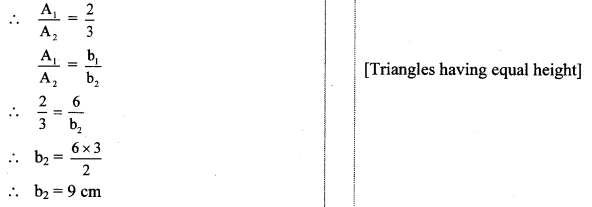
Ratio of areas of two triangles with equal heights is 2 : 3. If base of the smaller triangle is 6 cm, then what is the corresponding base of the bigger triangle?
Solution:
Let A1 and A2 be the areas of two triangles. Let b1 and b2 be their corresponding bases.
A1 : A2 = 2 : 3
Maharashtra Board Class 10 Maths Solutions Chapter 1 Similarity Problem Set 1 8

∴ The corresponding base of the bigger triangle is 9 cm.

Question 4.
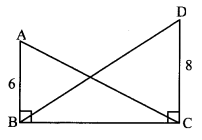
In the adjoining figure, ∠ABC = ∠DCB = 90°, AB = 6, DC = 8, then \(\frac{\mathbf{A}(\Delta \mathbf{A} \mathbf{B} \mathbf{C})}{\mathbf{A}(\mathbf{\Delta D C B})}=?\)
Maharashtra Board Class 10 Maths Solutions Chapter 1 Similarity Problem Set 1 9
Solution:
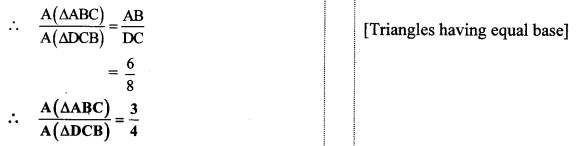
∆ABC and ∆DCB have same base BC.
Maharashtra Board Class 10 Maths Solutions Chapter 1 Similarity Problem Set 1 10

Question 5.
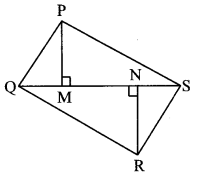
In the adjoining figure, PM = 10 cm, A(∆PQS) = 100 sq. cm,
A(∆QRS) = 110 sq. cm, then find NR.
Maharashtra Board Class 10 Maths Solutions Chapter 1 Similarity Problem Set 1 11
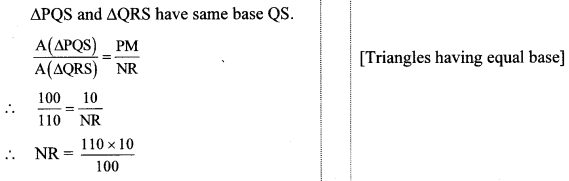
Solution:
Maharashtra Board Class 10 Maths Solutions Chapter 1 Similarity Problem Set 1 12
∴ NR = 11 cm

Question 6.
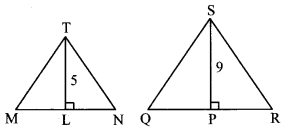
∆MNT ~ ∆QRS. Length of altitude drawn from point T is 5 and length of altitude drawn from point S is 9. Find the ratio \(\frac{A(\Delta M N T)}{A(\Delta Q R S)}\)
Maharashtra Board Class 10 Maths Solutions Chapter 1 Similarity Problem Set 1 13
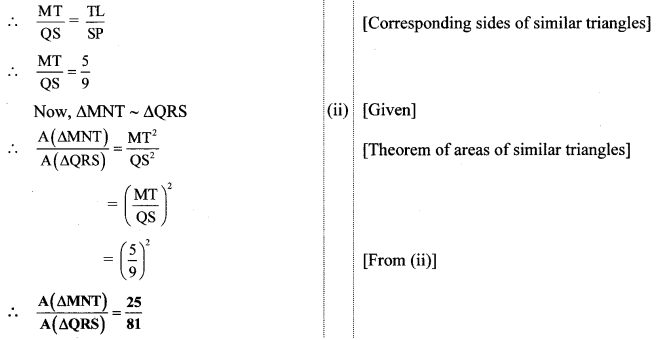
Solution:
∆MNT- ∆QRS [Given]
∴ ∠M ≅ ∠Q (i) [Corresponding angles of similar triangles]
In ∆MLT and ∆QPS,
∠M ≅ ∠Q [From (i)]
∠MLT ≅ ∠QPS [Each angle is of measure 90°]
∴ ∆MLT ~ ∆QPS [AA test of similarity]
Maharashtra Board Class 10 Maths Solutions Chapter 1 Similarity Problem Set 1 14

Question 7.
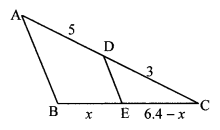
In the adjoining figure, A – D – C and B – E – C. seg DE || side AB. If AD = 5, DC = 3, BC = 6.4, then find BE.
Maharashtra Board Class 10 Maths Solutions Chapter 1 Similarity Problem Set 1 15
Solution:
In ∆ABC,
seg DE || side AB [Given]
∴ \(\frac { DC }{ AD } \) = \(\frac { EC }{ BE } \) [Basic proportionality theorem]
∴ \(\frac { 3 }{ 4 } \) = \(\frac { 6.4-x }{ x } \)
∴ 3x = 5 (6.4 – x)
∴ 3x = 32 – 5x
∴ 8x = 32
∴ x = \(\frac { 32 }{ 8 } \) =4
∴ BE = 4 units

Question 8.
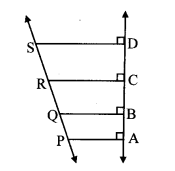
In the adjoining figure, seg PA, seg QB, seg RC and seg SD are perpendicular to line AD. AB = 60, BC = 70, CD = 80, PS = 280, then find PQ, QR and RS.
Maharashtra Board Class 10 Maths Solutions Chapter 1 Similarity Problem Set 1 16
Solution:
seg PA, seg QB, seg RC and seg SD are perpendicular to line AD. [Given]
∴ seg PA || seg QB || seg RC || seg SD (i) [Lines perpendicular to the same line are parallel to each other]
Let the value of PQ be x and that of QR be y.
PS = PQ + QS [P – Q – S]
∴ 280 – x + QS
∴ QS = 280 – x (ii)
Now, seg PA || seg QB || seg SD [From (i)]
∴ \(\frac { AB }{ BD } \) = \(\frac { PQ }{ QS } \) [Property of three parallel lines and their transversals]
∴\(\frac { AB }{ BC+CD } \) = \(\frac { PQ }{ QS } \) [B – C – D]
∴ \(\frac { 60 }{ 70+80 } \) = \(\frac { x }{ 280-x } \)
∴ \(\frac { 60 }{ 150 } \) = \(\frac { x }{ 280-x } \)
∴ \(\frac { 2 }{ 5 } \) = \(\frac { x }{ 280-x } \)
∴ 5x = 2 (280 – x)
∴ 5x = 560 – 2x
∴ 7x = 560
∴ x = \(\frac { 560 }{ 7 } \) = 80
∴ PQ = 80 units
QS = 280 – x [From (ii)]
= 280 – 80
= 200 units
But, QS = QR + RS [Q – R – S]
∴ 200 = y + RS
∴ RS = 200 – y (ii)
Now, seg QB || seg RC || seg SD [From (i)]
∴\(\frac { BC }{ CD } \) = \(\frac { QR }{ RS } \) [Property of three parallel lines and their transversals]
∴ \(\frac { 70 }{ 80 } \) = \(\frac { y }{ 200-y } \)
∴ \(\frac { 7 }{ 8 } \) = \(\frac { y }{ 200-y } \)
∴ 8y = 7(200 – y)
∴ 8y = 1400 – 7y
∴ 15y = 1400
∴ y = \(\frac { 1400 }{ 15 } \) = \(\frac { 280 }{ 3 } \)
∴ QR = \(\frac { 280 }{ 3 } \) units
RS = 200 – 7 [From (iii)]
= 200 – \(\frac { 280 }{ 3 } \)
= \(\frac{200 \times 3-280}{3}\)
= \(\frac { 600-280 }{ 3 } \)
∴ RS = \(\frac { 320 }{ 3 } \) units

Question 9.
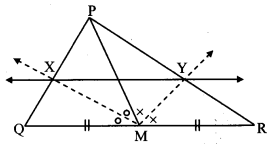
In ∆PQR, seg PM is a median. Angle bisectors of ∠PMQ and ∠PMR intersect side PQ and side PR in points X and Y respectively. Prove that XY || QR
Complete the proof by filling in the boxes.
Maharashtra Board Class 10 Maths Solutions Chapter 1 Similarity Problem Set 1 17
Solution:
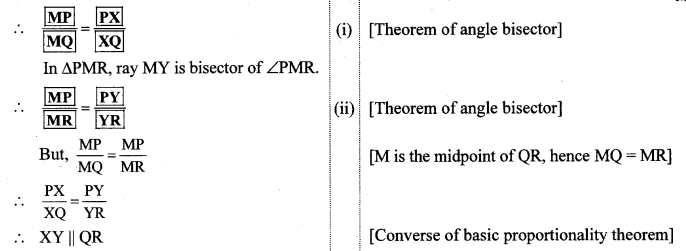
Proof:
In ∆PMQ, ray MX is bisector of ∠PMQ.
Maharashtra Board Class 10 Maths Solutions Chapter 1 Similarity Problem Set 1 18

Question 10.
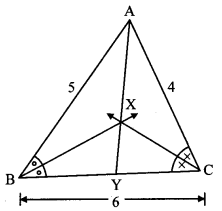
In the adjoining figure, bisectors of ∠B and ∠C of ∆ABC intersect each other in point X. Line AX intersects side BC in point Y.
AB = 5, AC = 4, BC = 6, then find \(\frac { AX }{ XY } \).
Maharashtra Board Class 10 Maths Solutions Chapter 1 Similarity Problem Set 1 19
Solution:
Let the value of BY be x.
BC = BY + YC [B – Y – C]
∴ 6 = x + YC
∴ YC = 6 – x
in ∆BAY, ray BX bisects ∠B. [Given]
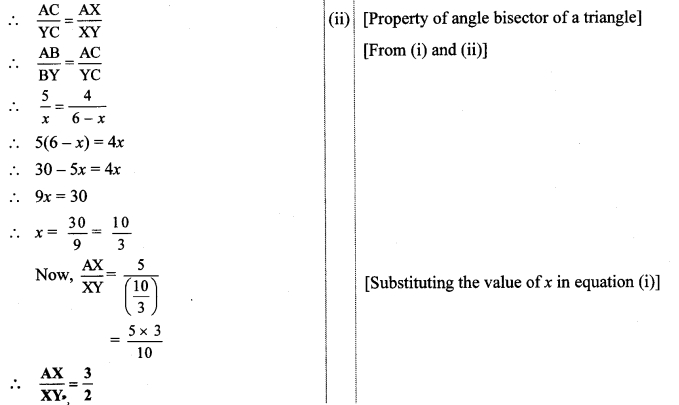
∴ \(\frac { AB }{ BY } \) = \(\frac { AX }{ XY } \) (i) [Property of angle bisector of a triangle]
Also, in ∆CAY, ray CX bisects ∠C. [Given]
Maharashtra Board Class 10 Maths Solutions Chapter 1 Similarity Problem Set 1 20

Question 11.
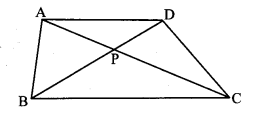
In ꠸ABCD, seg AD || seg BC. Diagonal AC and diagonal BD intersect each other in point P. Then show that \(\frac { AP }{ PD } \) = \(\frac { PC }{ BP } \)
Maharashtra Board Class 10 Maths Solutions Chapter 1 Similarity Problem Set 1 21
Solution:
proof:
seg AD || seg BC and BD is their transversal. [Given]
∴ ∠DBC ≅ ∠BDA [Alternate angles]
∴ ∠PBC ≅ ∠PDA (i) [D – P – B]
In ∆PBC and ∆PDA,
∠PBC ≅ ∠PDA [From (i)]
∠BPC ≅ ∠DPA [Vertically opposite angles]
∴ ∆PBC ~ ∆PDA [AA test of similarity]
∴ \(\frac { BP }{ PD } \) = \(\frac { PC }{ AP } \) [Corresponding sides of similar triangles]
∴ \(\frac { AP }{ PD } \) = \(\frac { PC }{ BP } \) [By altemendo]

Question 12.
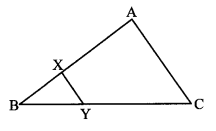
In the adjoining figure, XY || seg AC. If 2 AX = 3 BX and XY = 9, complete the activity to find the value of AC.
Maharashtra Board Class 10 Maths Solutions Chapter 1 Similarity Problem Set 1 22
Solution:
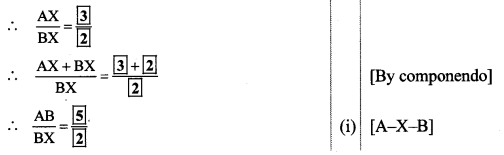
2 AX = 3 BX [Given]
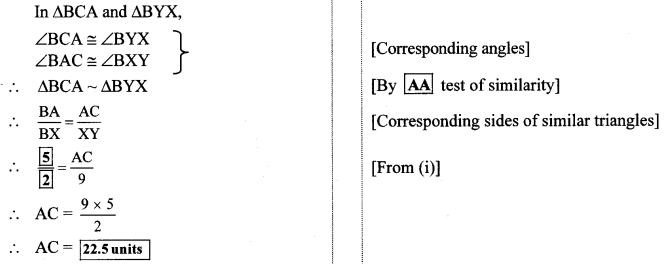
Maharashtra Board Class 10 Maths Solutions Chapter 1 Similarity Problem Set 1 23 Maharashtra Board Class 10 Maths Solutions Chapter 1 Similarity Problem Set 1 24

Question 13.
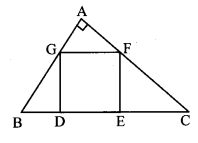
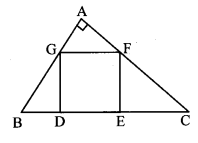
In the adjoining figure, the vertices of square DEFG are on the sides of ∆ABC. If ∠A = 90°, then prove that DE2 = BD × EC.
(Hint: Show that ∆GBD is similar to ∆ CFE. Use GD = FE = DE.)
Maharashtra Board Class 10 Maths Solutions Chapter 1 Similarity Problem Set 1 25
Solution:
proof:
꠸DEFG is a square.
∴ DE = EF = GF = GD (i) [Sides of a square]
∠GDE = ∠DEF = 90° [Angles of a square]
∴ seg GD ⊥ side BC, seg FE ⊥ side BC (ii)
In ∆BAC and ∆BDG,
∠BAC ≅ ∠BDG [From (ii), each angle is of measure 90°]
∠ABC ≅ ∠DBG [Common angle]
∴ ∆BAC – ∆BDG (iii) [AA test of similarity]
In ∆BAC and ∆FEC,
∠BAC ≅ ∠FEC [From (ii), each angle is measure 90°]
∠ACB ≅ ∠ECF [Common angle]
∴ ∆BAC – ∆FEC (iv) [AA test of similarity]
∴ ∆BDG – ∆FEC [From (iii) and (iv)]
∴ \(\frac { BD }{ EF } \) = \(\frac { GD }{ EC } \) (v) [Corresponding sides of similar triangles]
∴ \(\frac { BD }{ DE } \) = \(\frac { DE }{ EC } \) [From (i) and (v)]
∴ DE2 = BD × EC

Maharashtra Board 8th Class Maths Practice Set 13.2 Solutions Chapter 13 Congruence of Triangles

Balbharti Maharashtra State Board Class 8 Maths Solutions covers the Practice Set 13.2 8th Std Maths Answers Solutions Chapter 13 Congruence of Triangles.

Practice Set 13.2 8th Std Maths Answers Chapter 13 Congruence of Triangles

Congruence of Triangles Class 8th Practice Set 13.2 Question 1.
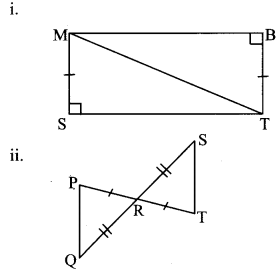
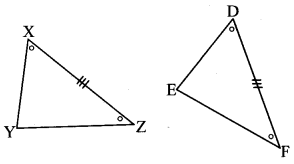
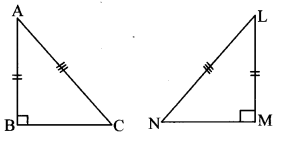
In each pair of triangles given below, parts shown by identical marks are congruent. State the test and the one-to-one correspondence of vertices by which triangles in each pair are congruent. Also state the remaining congruent parts.
Maharashtra Board Class 8 Maths Solutions Chapter 13 Congruence of Triangles Practice Set 13.2 1
Maharashtra Board Class 8 Maths Solutions Chapter 13 Congruence of Triangles Practice Set 13.2 2
Solution:
i. In ∆MST and ∆TBM,
∴ side MS ≅ side TB … [Given]
m∠MST = m∠TBM = 90° … [Given]
hypotenuse MT ≅ hypotenuse MT
…[Common side]
∴ ∆MST ≅ ∆TBM …[by hypotenuse-side test]
∴ side ST ≅ side BM …[Corresponding sides of congruent triangles]
∠SMT ≅ ∠BTM …[Corresponding sides of congruent triangles]
∠STM ≅ ∠BMT …[Corresponding sides of congruent triangles]

ii. In ∆PRQ and ∆TRS,
side PR ≅ side TR … [Given]
∠PRQ ≅ ∠TRS …[Vertically opposite angles]
side RQ ≅ side RS … [Given]
∴ ∆PRQ ≅ ∆TRS …[by SAS test]
∴ side PQ ≅ side TS …[Corresponding sides of congruent triangles]
∠RPQ ≅ ∠RTS …[Corresponding sides of congruent triangles]
∠PQR ≅ ∠TSR …[Corresponding sides of congruent triangles]

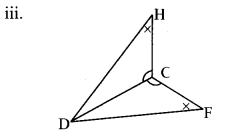
iii. In ∆DCH and ∆DCF,
∠DCH ≅ ∠DCF …[Given]
∠DHC ≅ ∠DFC …[Given]
side DC ≅ side DC …[Common side]
∴ ∆DCH ≅ ∆DCF …[by AAS test]
∴ side HC ≅ side FC …[Corresponding sides of congruent triangles]
side DH ≅ side DF…[Corresponding sides of congruent triangles]
∠HDC ≅ ∠FDC ….[Corresponding sides of congruent triangles]

Congruence of Triangles Practice Set 13.2 Question 2.
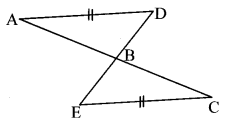
In the given figure, seg AD ≅ seg EC. Which additional information is needed to show that ∆ABD and ∆EBC will be congruent by AAS test?
Maharashtra Board Class 8 Maths Solutions Chapter 13 Congruence of Triangles Practice Set 13.2 3
Solution:
In ∆ABD and ∆CBE,
∴ seg AD ≅ seg CE …[Given]
∠ABD ≅ ∠CBE …[Vertically opposite angles]
∴ The necessary condition for the two triangles to be congruent by AAS test is
∠ADB ≅ ∠CEB, or
∠DAB ≅ ∠ECB

Maharashtra Board Class 8 Maths Chapter 13 Congruence of Triangles Practice Set 13.2 Intext Questions and Activities

Practice Set 13.2 Class 8 Question 1.
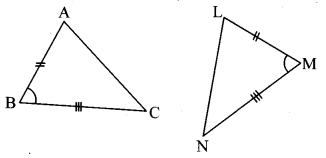
Draw ∆ABC and ∆LMN such that two pairs of their sides and the angles included by them are congruent.
Draw ∆ABC and ∆LMN, l(AB) = l(LM), l(BC) = l(MN), m∠ABC = m∠LMN.
Copy ∆ABC on a tracing paper. Place the paper on ∆LMN in such a way that point A coincides with point L, side AB overlaps side LM. What do you notice?(Textbook pg. no. 83)
Maharashtra Board Class 8 Maths Solutions Chapter 13 Congruence of Triangles Practice Set 13.2 4
Solution:
We notice that ∆ABC ≅ ∆LMN.

Congruence of Triangles Class 8 Solutions Question 2.
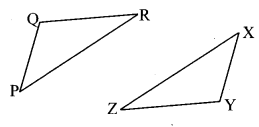
Draw ∆PQR and ∆XYZ such that l(PQ) = l(X Y), l(Q R) = l(YZ), l(RP) = l(ZX). Copy ∆PQR on a tracing paper. Place it on ∆XYZ observing the correspondence P ↔ X, Q ↔ Y, R ↔ Z. What do you notice? (Textbook pg. no. 84)
Maharashtra Board Class 8 Maths Solutions Chapter 13 Congruence of Triangles Practice Set 13.2 5
Solution:
We notice that ∆PQR ≅ ∆XYZ.

Congruence of Triangles Class 8 Question 3.
Draw ∆XYZ and ∆DEF such that, l(XZ) = l(DF), ∠X ≅ ∠D and ∠Z ≅ ∠F.
Copy ∆XYZ on a tracing paper and place it over ∆DEF. What do you notice?(Textbook pg. no. 84)
Maharashtra Board Class 8 Maths Solutions Chapter 13 Congruence of Triangles Practice Set 13.2 6
Solution:
We notice that ∆XYZ ≅ ∆DEF in the correspondence X ↔ D, Y ↔ E, Z ↔ F.

Question 4.
Draw two right angled triangles such that a side and the hypotenuse of one is congruent with the corresponding parts of the other. Copy one triangle on tracing paper and place it over the other. What do you notice? (Textbook pg. no. 84)
Maharashtra Board Class 8 Maths Solutions Chapter 13 Congruence of Triangles Practice Set 13.2 7
Solution:
We notice that the two triangles are congruent.
(Students should draw figures and verify the answers.)

Maharashtra Board 10th Class Maths Part 2 Practice Set 1.2 Solutions Chapter 1 Similarity

Balbharti Maharashtra State Board Class 10 Maths Solutions covers the Practice Set 1.2 Geometry 10th Class Maths Part 2 Answers Solutions Chapter 1 Similarity.

Practice Set 1.2 Geometry10th Std Maths Part 2 Answers Chapter 1 Similarity

Question 1.
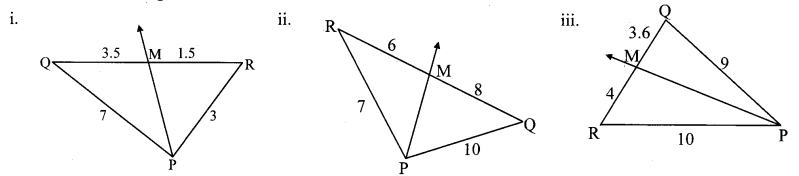
Given below are some triangles and lengths of line segments. Identify in which figures, ray PM is the bisector of ∠QPR.
Maharashtra Board Class 10 Maths Solutions Chapter 1 Similarity Practice Set 1.2 1
Solution:
In ∆ PQR,
\(\frac { PQ }{ PR } \) = \(\frac { 7 }{ 3 } \) (i)
\(\frac { QM }{ RM } \) = \(\frac { 3.5 }{ 1.5 } \) = \(\frac { 35 }{ 15 } \) = \(\frac { 7 }{ 3 } \) (ii)
∴ \(\frac { PQ }{ PR } \) = \(\frac { QM }{ RM } \) [From (i) and (ii)]
∴ Ray PM is the bisector of ∠QPR. [Converse of angle bisector theorem]

ii. In ∆PQR,
\(\frac { PQ }{ PR } \) = \(\frac { 10 }{ 7 } \) (i)
\(\frac { QM }{ RM } \) = \(\frac { 8 }{ 6 } \) = \(\frac { 4 }{ 3 } \) (ii)
∴ \(\frac { PQ }{ PR } \) ≠ \(\frac { QM }{ RM } \) [From (i) and (ii)]
∴ Ray PM is not the bisector of ∠QPR

iii. In ∆PQR,
\(\frac { PQ }{ PR } \) = \(\frac { 9 }{ 10 } \) (i)
\(\frac { QM }{ RM } \) = \(\frac { 3.6 }{ 4 } \) = \(\frac { 36 }{ 40 } \) = \(\frac { 9 }{ 10 } \) (ii)
∴ \(\frac { PQ }{ PR } \) = \(\frac { QM }{ RM } \) [From (i) and (ii)]
∴ Ray PM is the bisector of ∠QPR [Converse of angle bisector theorem]

Question 2.
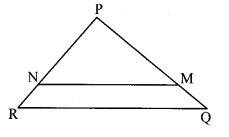
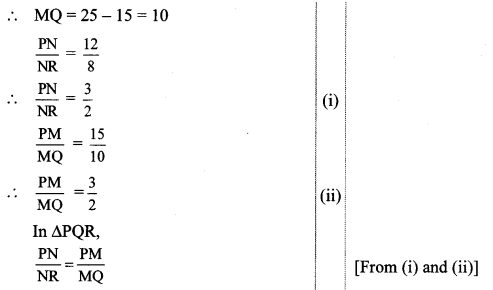
In ∆PQR PM = 15, PQ = 25, PR = 20, NR = 8. State whether line NM is parallel to side RQ. Give reason.
Maharashtra Board Class 10 Maths Solutions Chapter 1 Similarity Practice Set 1.2 2
Solution:
PN + NR = PR [P – N – R]
∴ PN + 8 = 20
∴ PN = 20 – 8 = 12
Also, PM + MQ = PQ [P – M – Q]
∴ 15 + MQ = 25
Maharashtra Board Class 10 Maths Solutions Chapter 1 Similarity Practice Set 1.2 3
∴ line NM || side RQ [Converse of basic proportionality theorem]

Question 3.
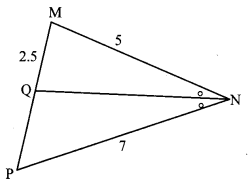
In ∆MNP, NQ is a bisector of ∠N. If MN = 5, PN = 7, MQ = 2.5, then find QP.
Maharashtra Board Class 10 Maths Solutions Chapter 1 Similarity Practice Set 1.2 4
Solution:
In ∆MNP, NQ is the bisector of ∠N. [Given]
∴\(\frac { PN }{ MN } \) = \(\frac { QP }{ MQ } \) [Property of angle bisector of a triangle]
∴\(\frac { 7 }{ 5 } \) = \(\frac { QP }{ 2.5 } \)
∴ QP = \(\frac { 7\times 2.5 }{ 5 } \)
∴ QP = 3.5 units

Question 4.
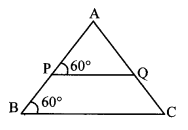
Measures of some angles in the figure are given. Prove that \(\frac { AP }{ PB } \) = \(\frac { AQ }{ QC } \)
Maharashtra Board Class 10 Maths Solutions Chapter 1 Similarity Practice Set 1.2 5
Solution:
Proof
∠APQ = ∠ABC = 60° [Given]
∴ ∠APQ ≅ ∠ABC
∴ side PQ || side BC (i) [Corresponding angles test]
In ∆ABC,
sidePQ || sideBC [From (i)]
∴\(\frac { AP }{ PB } \) = \(\frac { AQ }{ QC } \) [Basic proportionality theorem]

Question 5.
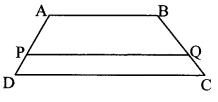
In trapezium ABCD, side AB || side PQ || side DC, AP = 15, PD = 12, QC = 14, find BQ.
Maharashtra Board Class 10 Maths Solutions Chapter 1 Similarity Practice Set 1.2 6
Solution:
side AB || side PQ || side DC [Given]
∴\(\frac { AP }{ PD } \) = \(\frac { BQ }{ QC } \) [Property of three parallel lines and their transversals]
∴\(\frac { 15 }{ 12 } \) = \(\frac { BQ }{ 14 } \)
∴ BQ = \(\frac { 15\times 14 }{ 12 } \)
∴ BQ = 17.5 units

Question 6.
Find QP using given information in the figure.
Maharashtra Board Class 10 Maths Solutions Chapter 1 Similarity Practice Set 1.2 7
Solution:
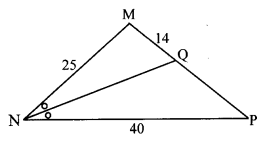
In ∆MNP, seg NQ bisects ∠N. [Given]
∴\(\frac { PN }{ MN } \) = \(\frac { QP }{ MQ } \) [Property of angle bisector of a triangle]
∴\(\frac { 40 }{ 25 } \) = \(\frac { QP }{ 14 } \)
∴ QP = \(\frac { 40\times 14 }{ 25 } \)
∴ QP = 22.4 units

Question 7.
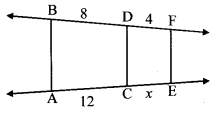
In the adjoining figure, if AB || CD || FE, then find x and AE.
Maharashtra Board Class 10 Maths Solutions Chapter 1 Similarity Practice Set 1.2 8
Solution:
line AB || line CD || line FE [Given]
∴\(\frac { BD }{ DF } \) = \(\frac { AC }{ CE } \) [Property of three parallel lines and their transversals]
∴\(\frac { 8 }{ 4 } \) = \(\frac { 12 }{ X } \)
∴ X = \(\frac { 12\times 4 }{ 8 } \)
∴ X = 6 units
Now, AE AC + CE [A – C – E]
= 12 + x
= 12 + 6
= 18 units
∴ x = 6 units and AE = 18 units

Question 8.
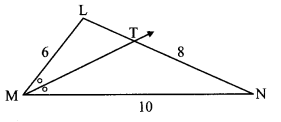
In ∆LMN, ray MT bisects ∠LMN. If LM = 6, MN = 10, TN = 8, then find LT.
Maharashtra Board Class 10 Maths Solutions Chapter 1 Similarity Practice Set 1.2 9
Solution:
In ∆LMN, ray MT bisects ∠LMN. [Given]
∴\(\frac { LM }{ MN } \) = \(\frac { LT }{ TN } \) [Property of angle bisector of a triangle]
∴\(\frac { 6 }{ 10 } \) = \(\frac { LT }{ 8 } \)
∴ LT = \(\frac { 6\times 8 }{ 10 } \)
∴ LT = 4.8 units

Question 9.
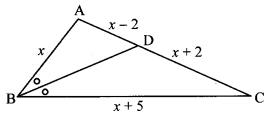
In ∆ABC,seg BD bisects ∠ABC. If AB = x,BC x+ 5, AD = x – 2, DC = x + 2, then find the value of x.
Maharashtra Board Class 10 Maths Solutions Chapter 1 Similarity Practice Set 1.2 10
Solution:
In ∆ABC, seg BD bisects ∠ABC. [Given]
∴\(\frac { AB }{ BC } \) = \(\frac { AD }{ CD } \) [Property of angle bisector of a triangle]
∴\(\frac { x }{ x+5 } \) = \(\frac { x-2 }{ x+2 } \)
∴ x(x + 2) = (x – 2)(x + 5)
∴ x2 + 2x = x2 + 5x – 2x – 10
∴ 2x = 3x – 10
∴ 10 = 3x – 2x
∴ x = 10

Question 10.
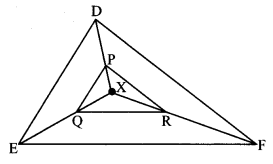
In the adjoining figure, X is any point in the interior of triangle. Point X is joined to vertices of triangle. Seg PQ || seg DE, seg QR || seg EF. Fill in the blanks to prove that, seg PR || seg DF.
Maharashtra Board Class 10 Maths Solutions Chapter 1 Similarity Practice Set 1.2 11
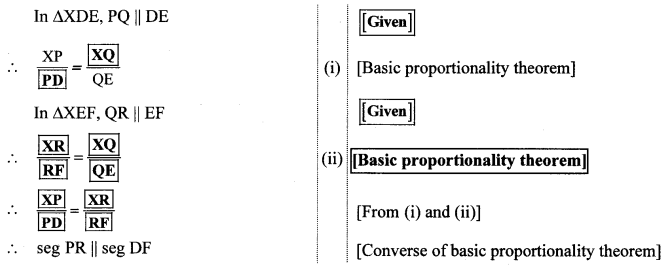
Solution:
Maharashtra Board Class 10 Maths Solutions Chapter 1 Similarity Practice Set 1.2 12

Question 11.
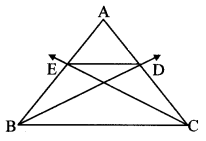
In ∆ABC, ray BD bisects ∠ABC and ray CE bisects ∠ACB. If seg AB = seg AC, then prove that ED || BC.
Maharashtra Board Class 10 Maths Solutions Chapter 1 Similarity Practice Set 1.2 13
Solution:
In ∆ABC, ray BD bisects ∠ABC. [Given]
∴\(\frac { AB }{ BC } \) = \(\frac { AE }{ EB } \) (i) [Property of angle bisector of a triangle]
Also, in ∆ABC, ray CE bisects ∠ACB. [Given]
∴\(\frac { AC }{ BC } \) = \(\frac { AE }{ EB } \) (ii) [Property of angle bisector of a triangle]
But, seg AB = seg AC (iii) [Given]
∴\(\frac { AB }{ BC } \) = \(\frac { AE }{ EB } \) (iv) [From (ii) and (iii)]
∴\(\frac { AD }{ DC } \) = \(\frac { AE }{ EB } \) [From (i) and (iv)]
∴ ED || BC [Converse of basic proportionality theorem]

Question 1.
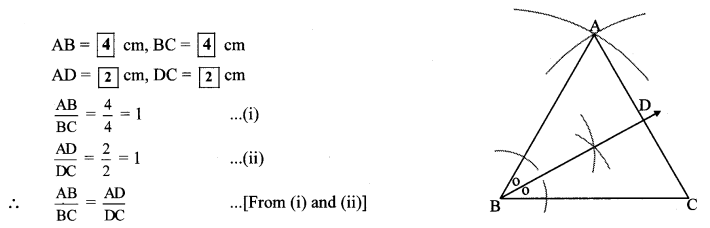
i. Draw a ∆ABC.
ii. Bisect ∠B and name the point of intersection of AC and the angle bisector as D.
iii. Measure the sides.
Maharashtra Board Class 10 Maths Solutions Chapter 1 Similarity Practice Set 1.2 14
iv. Find ratios \(\frac { AB }{ BC } \) and \(\frac { AD }{ DC } \)
v. You will find that both the ratios are almost equal.
vi. Bisect remaining angles of the triangle and find the ratios as above. Verify that the ratios are equal. (Textbook pg. no. 8)
Solution:
Maharashtra Board Class 10 Maths Solutions Chapter 1 Similarity Practice Set 1.2 15
Note: Students should bisect the remaining angles and verify that the ratios are equal.

Question 2.
Write another proof of the above theorem (property of an angle bisector of a triangle). Use the following properties and write the proof.
i. The areas of two triangles of equal height are proportional to their bases.
ii. Every point on the bisector of an angle is equidistant from the sides of the angle. (Textbook pg. no. 9)
Maharashtra Board Class 10 Maths Solutions Chapter 1 Similarity Practice Set 1.2 16
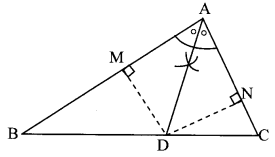
Given: In ∆CAB, ray AD bisects ∠A.
To prove: \(\frac { AB }{ AC } \) = \(\frac { BD }{ DC } \)
Construction: Draw seg DM ⊥ seg AB A – M – B and seg DN ⊥ seg AC, A – N – C.
Solution:
Proof:
In ∆ABC,
Point D is on angle bisector of ∠A. [Given]
∴DM = DN [Every point on the bisector of an angle is equidistant from the sides of the angle]
\(\frac{A(\Delta A B D)}{A(\Delta A C D)}=\frac{A B \times D M}{A C \times D N}\) [Ratio of areas of two triangles is equal to the ratio of the product of their bases and corresponding heights]
∴ \(\frac{A(\Delta A B D)}{A(\Delta A C D)}=\frac{A B}{A C}\) (ii) [From (i)]
Also, ∆ABD and ∆ACD have equal height.
∴ \(\frac{\mathrm{A}(\Delta \mathrm{ABD})}{\mathrm{A}(\Delta \mathrm{ACD})}=\frac{\mathrm{BD}}{\mathrm{CD}}\) (iii) [Triangles having equal height]
∴\(\frac{\mathrm{AB}}{\mathrm{AC}}=\frac{\mathrm{BD}}{\mathrm{DC}}\) [From (ii) and (iii)]

Question 3.
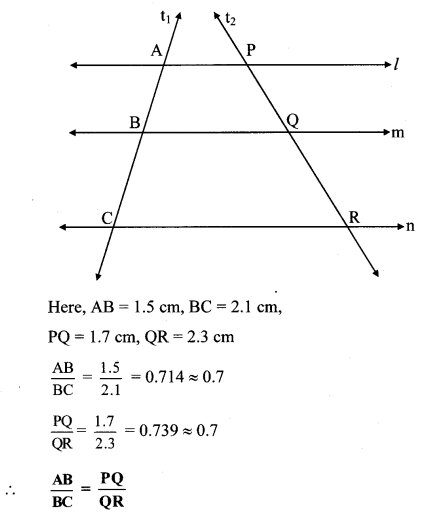
i. Draw three parallel lines.
ii. Label them as l, m, n.
iii. Draw transversals t1 and t2.
iv. AB and BC are intercepts on transversal t1.
v. PQ and QR are intercepts on transversal t2.
vi. Find ratios \(\frac { AB }{ BC } \) and \(\frac { PQ }{ QR } \). You will find that they are almost equal. Verify that they are equal.(Textbook pg, no. 10)
Solution:
Maharashtra Board Class 10 Maths Solutions Chapter 1 Similarity Practice Set 1.2 17
(Students should draw figures similar to the ones given and verify the properties.)

Question 4.
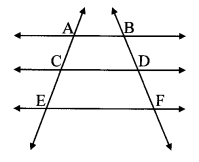
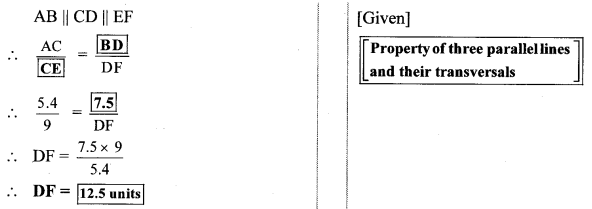
In the adjoining figure, AB || CD || EF. If AC = 5.4, CE = 9, BD = 7.5, then find DF.(Textbook pg, no. 12)
Maharashtra Board Class 10 Maths Solutions Chapter 1 Similarity Practice Set 1.2 18
Solution:
Maharashtra Board Class 10 Maths Solutions Chapter 1 Similarity Practice Set 1.2 19

Question 5.
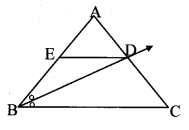
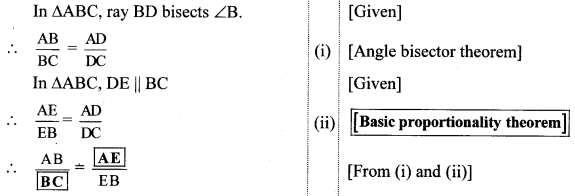
In ∆ABC, ray BD bisects ∠ABC. A – D – C, side DE || side BC, A – E – B, then prove that \(\frac { AB }{ BC } \) = \(\frac { AE }{ EB } \) (Textbook pg, no. 13)
Maharashtra Board Class 10 Maths Solutions Chapter 1 Similarity Practice Set 1.2 20
Solution:
Maharashtra Board Class 10 Maths Solutions Chapter 1 Similarity Practice Set 1.2 21

Maharashtra Board 10th Class Maths Part 2 Practice Set 1.1 Solutions Chapter 1 Similarity

Balbharti Maharashtra State Board Class 10 Maths Solutions covers the Practice Set 1.1 Geometry 10th Class Maths Part 2 Answers Solutions Chapter 1 Similarity.

Practice Set 1.1 Geometry 10th Std Maths Part 2 Answers Chapter 1 Similarity

Question 1.
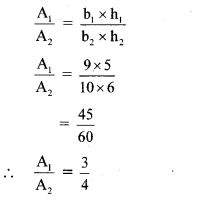
Base of a triangle is 9 and height is 5. Base of another triangle is 10 and height is 6. Find the ratio of areas of these triangles.
Solution:
Let the base, height and area of the first triangle be b1, h1, and A1 respectively.
Let the base, height and area of the second triangle be b2, h2 and A2 respectively.
Maharashtra Board Class 10 Maths Solutions Chapter 1 Similarity Practice Set 1.1 1

[Since Ratio of areas of two triangles is equal to the ratio of the product of their bases and corresponding heights]
∴ The ratio of areas of the triangles is 3:4.

Question 2.
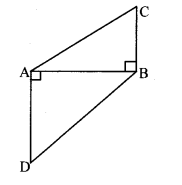
In the adjoining figure, BC ± AB, AD _L AB, BC = 4, AD = 8, then find \(\frac{A(\Delta A B C)}{A(\Delta A D B)}\)
Maharashtra Board Class 10 Maths Solutions Chapter 1 Similarity Practice Set 1.1 2
Solution:
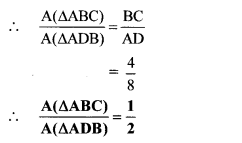
∆ABC and ∆ADB have same base AB.
Maharashtra Board Class 10 Maths Solutions Chapter 1 Similarity Practice Set 1.1 3
[Since Triangles having equal base]

Question 3.
In the adjoining figure, seg PS ± seg RQ, seg QT ± seg PR. If RQ = 6, PS = 6 and PR = 12, then find QT.
Maharashtra Board Class 10 Maths Solutions Chapter 1 Similarity Practice Set 1.1 4
Solution:
In ∆PQR, PR is the base and QT is the corresponding height.
Also, RQ is the base and PS is the corresponding height.
\(\frac{A(\Delta P Q R)}{A(\Delta P Q R)}=\frac{P R \times Q T}{R Q \times P S}\) [Ratio of areas of two triangles is equal to the ratio of the product of their bases and corresponding heights]
∴ \(\frac{1}{1}=\frac{P R \times Q T}{R Q \times P S}\)
∴ PR × QT = RQ × PS
∴ 12 × QT = 6 × 6
∴ QT = \(\frac { 36 }{ 12 } \)
∴ QT = 3 units

Question 4.
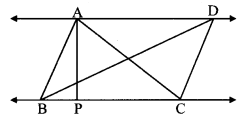
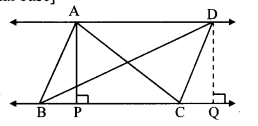
In the adjoining figure, AP ⊥ BC, AD || BC, then find A(∆ABC) : A(∆BCD).
Maharashtra Board Class 10 Maths Solutions Chapter 1 Similarity Practice Set 1.1 5
Solution:
Draw DQ ⊥ BC, B-C-Q.

Maharashtra Board Class 10 Maths Solutions Chapter 1 Similarity Practice Set 1.1 6
AD || BC [Given]
∴ AP = DQ   (i)  [Perpendicular distance between two parallel lines is the same]
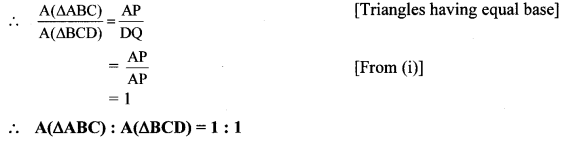
∆ABC and ∆BCD have same base BC.
Maharashtra Board Class 10 Maths Solutions Chapter 1 Similarity Practice Set 1.1 7

Question 5.
In the adjoining figure, PQ ⊥ BC, AD ⊥ BC, then find following ratios.
Maharashtra Board Class 10 Maths Solutions Chapter 1 Similarity Practice Set 1.1 8
Solution:
i. ∆PQB and tPBC have same height PQ.
Maharashtra Board Class 10 Maths Solutions Chapter 1 Similarity Practice Set 1.1 9
ii. ∆PBC and ∆ABC have same base BC.
Maharashtra Board Class 10 Maths Solutions Chapter 1 Similarity Practice Set 1.1 10
iii. ∆ABC and ∆ADC have same height AD.
Maharashtra Board Class 10 Maths Solutions Chapter 1 Similarity Practice Set 1.1 11

Question 1.
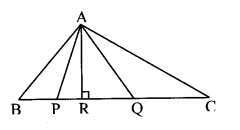
Find \(\frac{A(\Delta A B C)}{A(\Delta A P Q)}\)
Maharashtra Board Class 10 Maths Solutions Chapter 1 Similarity Practice Set 1.1 12
Solution:
In ∆ABC, BC is the base and AR is the height.
In ∆APQ, PQ is the base and AR is the height.
Maharashtra Board Class 10 Maths Solutions Chapter 1 Similarity Practice Set 1.1 13

Maharashtra Board 10th Class Maths Part 1 Practice Set 6.6 Solutions Chapter 6 Statistics

Balbharti Maharashtra State Board Class 10 Maths Solutions covers the Practice Set 6.6 Algebra 10th Class Maths Part 1 Answers Solutions Chapter 6 Statistics.

Practice Set 6.6 Algebra 10th Std Maths Part 1 Answers Chapter 6 Statistics

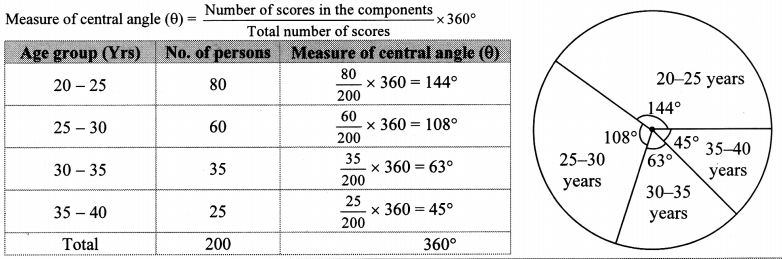
Question 1.
The age group and number of persons, who donated blood in a blood donation camp is given below.
Draw a pie diagram from it.
Maharashtra Board Class 10 Maths Solutions Chapter 6 Statistics Practice Set 6.6 1
Solution:
Total number of persons = 80 + 60 + 35 + 25 = 200
Maharashtra Board Class 10 Maths Solutions Chapter 6 Statistics Practice Set 6.6 2

Question 2.
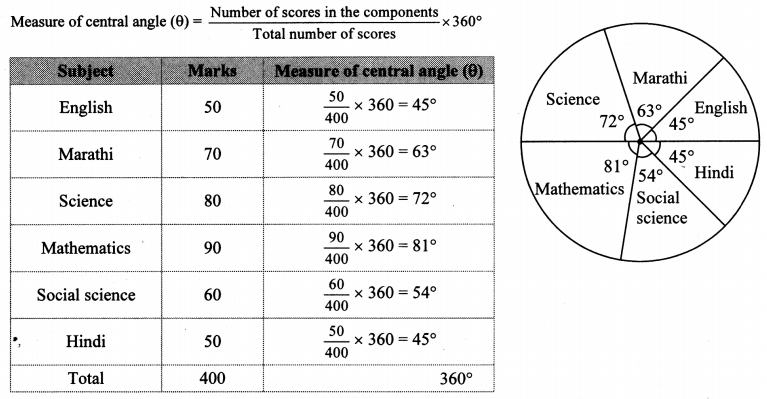
The marks obtained by a student in different subjects are shown. Draw a pie diagram showing the information.
Maharashtra Board Class 10 Maths Solutions Chapter 6 Statistics Practice Set 6.6 3
Solution:
Total marks obtained = 50 + 70 + 80 + 90 + 60 + 50 = 400
Maharashtra Board Class 10 Maths Solutions Chapter 6 Statistics Practice Set 6.6 4

Question 3.
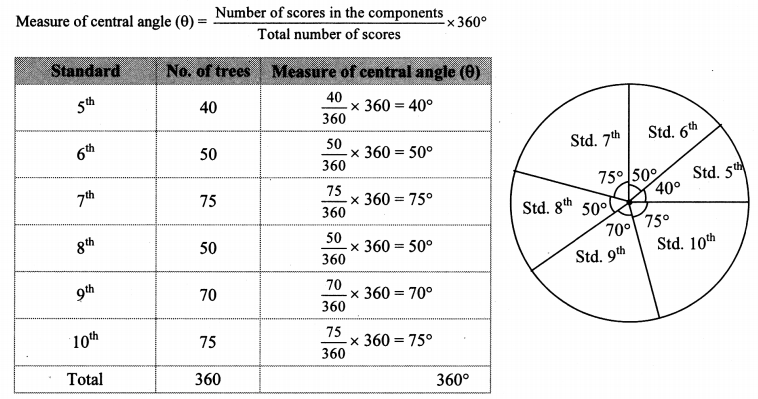
In a tree plantation programme, the number of trees planted by students of different classes is given in the following table. Draw a pie diagram showing the information.
Maharashtra Board Class 10 Maths Solutions Chapter 6 Statistics Practice Set 6.6 5
Solution:
Total number of trees planted = 40 + 50 + 75 + 50 + 70 + 75 = 360
Maharashtra Board Class 10 Maths Solutions Chapter 6 Statistics Practice Set 6.6 6

Question 4.
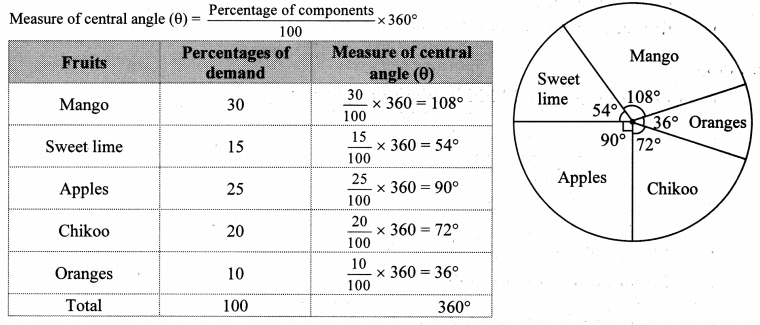
The following table shows the percentages of demands for different fruits registered with a fruit vendor. Show the information by a pie diagram.
Maharashtra Board Class 10 Maths Solutions Chapter 6 Statistics Practice Set 6.6 7
Solution:
Total percentage = 30 + 15 + 25 + 20 + 10 = 100%
Maharashtra Board Class 10 Maths Solutions Chapter 6 Statistics Practice Set 6.6 8

Question 5.
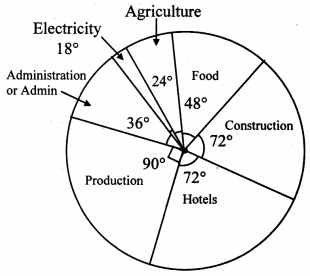
The pie diagram in the given figure shows the proportions of different workers in a town. Answer the following questions with its help.
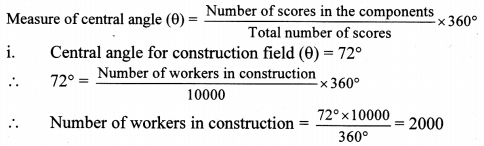
i. If the total workers is 10,000, how many of them are in the field of construction?
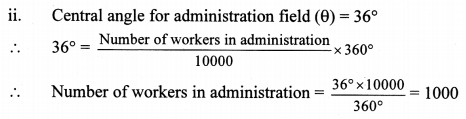
ii. How many workers are working in the administration?
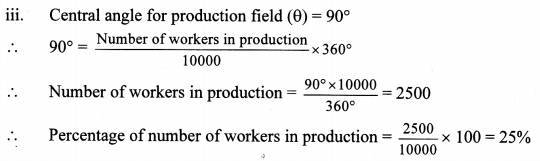
iii. What is the percentage of workers in production?
Maharashtra Board Class 10 Maths Solutions Chapter 6 Statistics Practice Set 6.6 9
Solution:
Maharashtra Board Class 10 Maths Solutions Chapter 6 Statistics Practice Set 6.6 10
∴ There are 2000 workers working in the field of construction.

Maharashtra Board Class 10 Maths Solutions Chapter 6 Statistics Practice Set 6.6 11
∴ There are 1000 workers working in the administration.

Maharashtra Board Class 10 Maths Solutions Chapter 6 Statistics Practice Set 6.6 12
∴ 25% of workers are working in the production field.

Question 6.
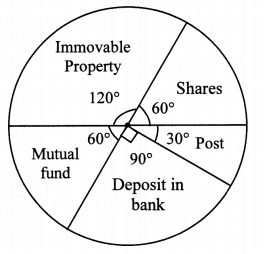
The annual investments of a family are shown in the given pie diagram. Answer the following questions based on it.
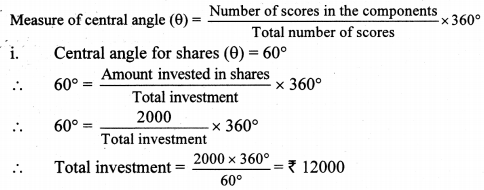
i. If the investment in shares is ? 2000, find the total investment.
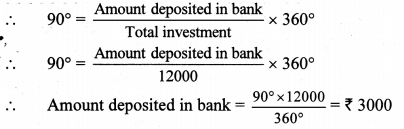
ii. How much amount is deposited in bank?
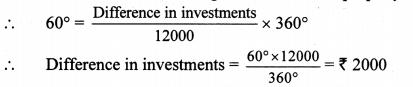
iii. How much more money is invested in immovable property than in mutual fund?
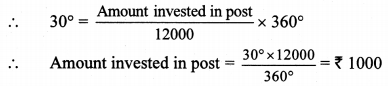
iv. How much amount is invested in post?
Maharashtra Board Class 10 Maths Solutions Chapter 6 Statistics Practice Set 6.6 13
Solution:
Maharashtra Board Class 10 Maths Solutions Chapter 6 Statistics Practice Set 6.6 14
The total investment is ₹ 12000.

ii. Central angle for deposit in bank (θ) = 90°
Maharashtra Board Class 10 Maths Solutions Chapter 6 Statistics Practice Set 6.6 15
∴ The amount deposited in bank is ₹ 3000.

iii. Difference in central angle for immovable property and mutual fund (θ) = 120° – 60° = 60°
Maharashtra Board Class 10 Maths Solutions Chapter 6 Statistics Practice Set 6.6 16
∴ ₹ 2000 more is invested in immovable property than in mutual fund.

iv. Central angle for post (θ) = 30°
Maharashtra Board Class 10 Maths Solutions Chapter 6 Statistics Practice Set 6.6 17
∴ The amount invested in post is ₹ 1000.

Maharashtra Board 10th Class Maths Part 1 Practice Set 6.5 Solutions Chapter 6 Statistics

Balbharti Maharashtra State Board Class 10 Maths Solutions covers the Practice Set 6.5 Algebra 10th Class Maths Part 1 Answers Solutions Chapter 6 Statistics.

Practice Set 6.5 Algebra 10th Std Maths Part 1 Answers Chapter 6 Statistics

Question 1.
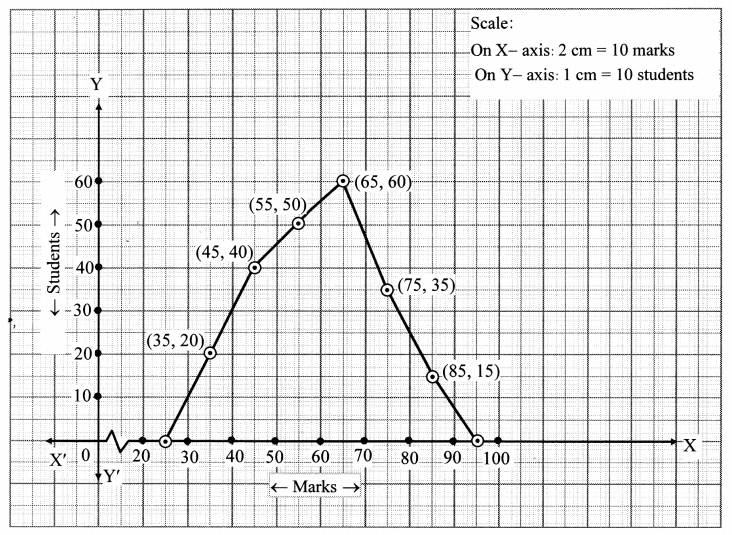
Observe the following frequency polygon and write the answers of the questions below it.
i. Which class has the maximum number of students?
ii. Write the classes having zero frequency.
iii. What is the class mark of the class, having frequency of 50 students?
iv. Write the lower and upper class limits of the class whose class mark is 85.
v. How many students are in the class 80 – 90?
Maharashtra Board Class 10 Maths Solutions Chapter 6 Statistics Practice Set 6.5 1
Solution:
i. The class 60 – 70 has the maximum number of students.
ii. The classes 20 – 30 and 90 – 100 have frequency zero.
iii. The class mark of the class having 50 students is 55.
iv. The lower and upper class limits of the class having class mark 85 are 80 and 90 respectively.
v. There are 15 students in the class 80 – 90.

Question 2.
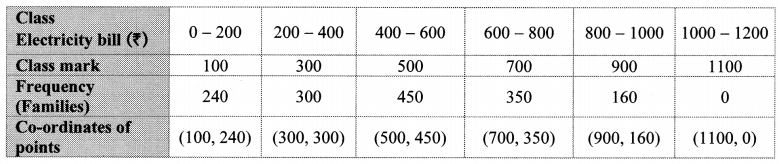
Show the following data by a frequency polygon.
Maharashtra Board Class 10 Maths Solutions Chapter 6 Statistics Practice Set 6.5 2
Solution:
Maharashtra Board Class 10 Maths Solutions Chapter 6 Statistics Practice Set 6.5 3
Maharashtra Board Class 10 Maths Solutions Chapter 6 Statistics Practice Set 6.5 4

Question 3.
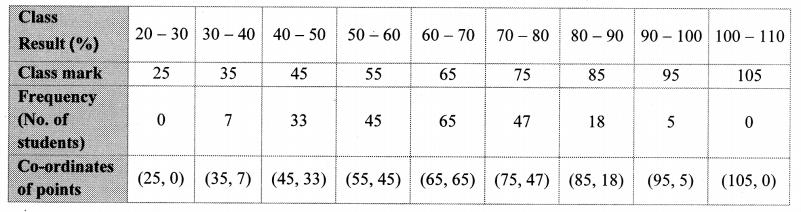
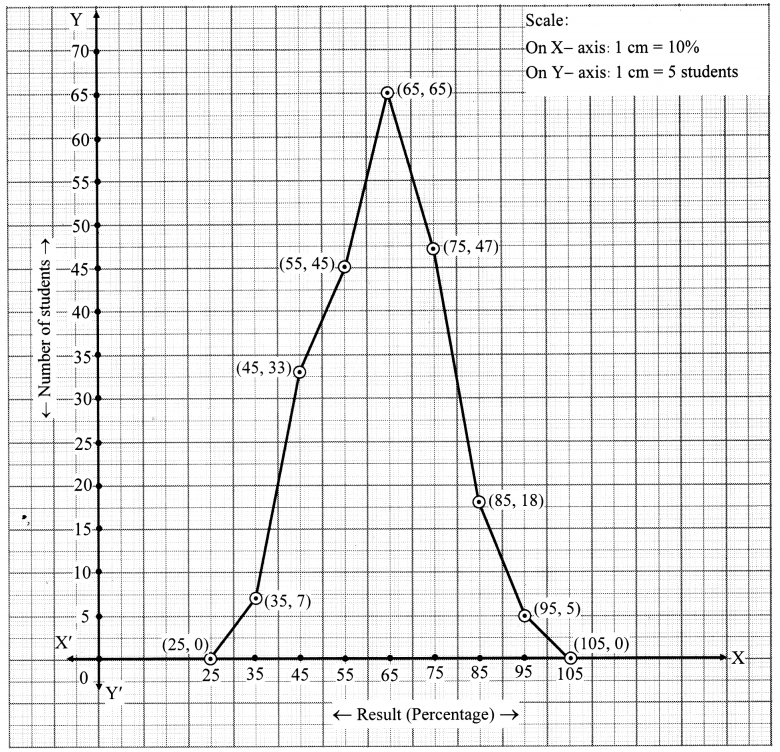
The following table shows the classification of percentages of marks of students and the number of students. Draw a frequency polygon from the table.
Maharashtra Board Class 10 Maths Solutions Chapter 6 Statistics Practice Set 6.5 5
Solution:
Maharashtra Board Class 10 Maths Solutions Chapter 6 Statistics Practice Set 6.5 6 Maharashtra Board Class 10 Maths Solutions Chapter 6 Statistics Practice Set 6.5 7

Maharashtra Board 10th Class Maths Part 1 Practice Set 6.4 Solutions Chapter 6 Statistics

Balbharti Maharashtra State Board Class 10 Maths Solutions covers the Practice Set 6.4 Algebra 10th Class Maths Part 1 Answers Solutions Chapter 6 Statistics.

Practice Set 6.4 Algebra 10th Std Maths Part 1 Answers Chapter 6 Statistics

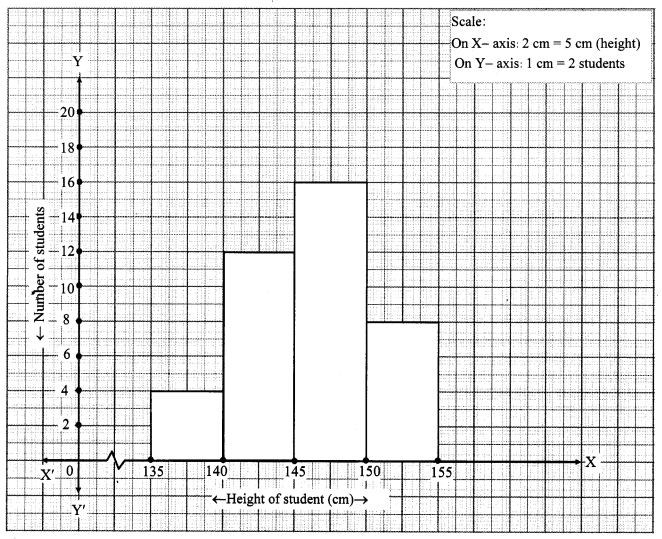
Question 1.
Draw a histogram of the following data.
Maharashtra Board Class 10 Maths Solutions Chapter 6 Statistics Practice Set 6.4 1
Solution:
Maharashtra Board Class 10 Maths Solutions Chapter 6 Statistics Practice Set 6.4 2

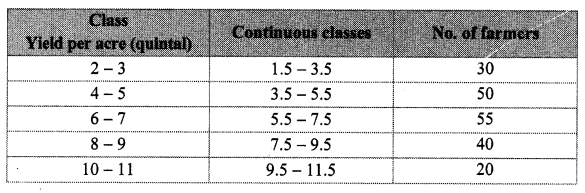
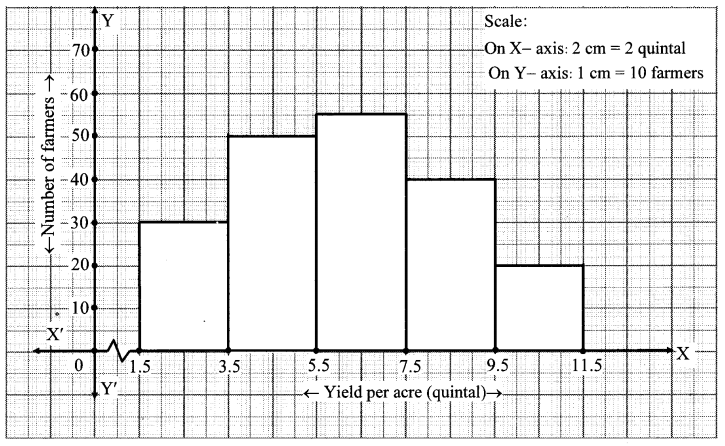
Question 2.
The table below shows the yield of jowar per acre. Show the data by histogram.
Maharashtra Board Class 10 Maths Solutions Chapter 6 Statistics Practice Set 6.4 3
Solution:
Maharashtra Board Class 10 Maths Solutions Chapter 6 Statistics Practice Set 6.4 4 Maharashtra Board Class 10 Maths Solutions Chapter 6 Statistics Practice Set 6.4 5

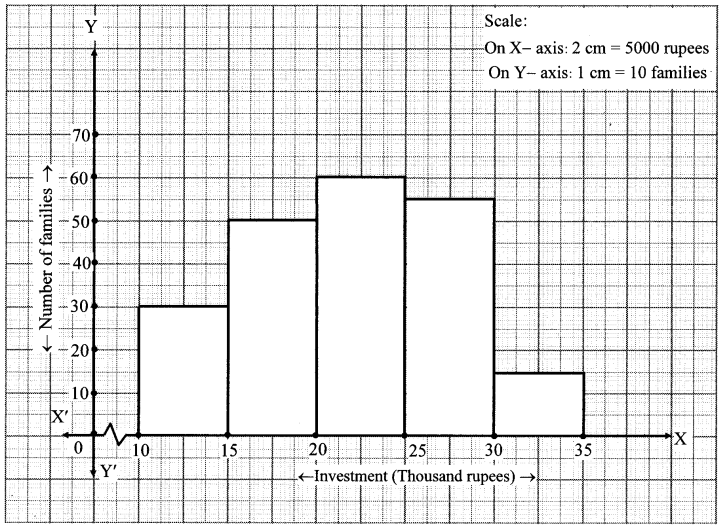
Question 3.
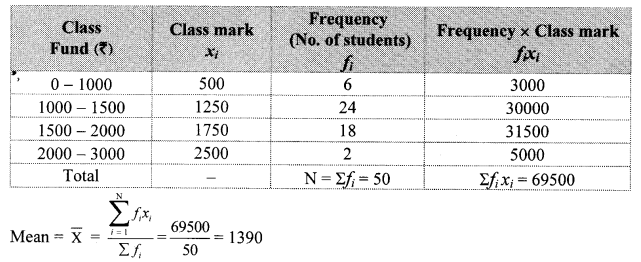
In the following table, the investment made by 210 families is shown. Present it in the form of a histogram.
Maharashtra Board Class 10 Maths Solutions Chapter 6 Statistics Practice Set 6.4 6
Solution:
Maharashtra Board Class 10 Maths Solutions Chapter 6 Statistics Practice Set 6.4 7

Question 4.
Time allotted for the preparation of an examination by some students is shown in the table. Draw a histogram to show the information.
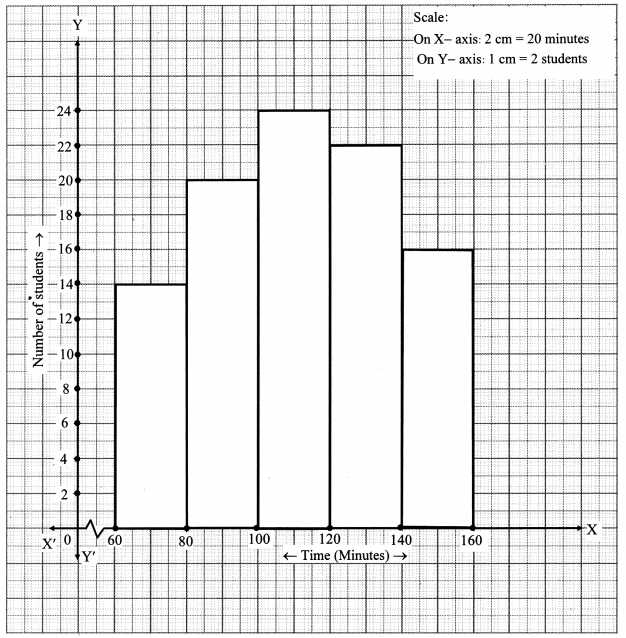
Maharashtra Board Class 10 Maths Solutions Chapter 6 Statistics Practice Set 6.4 8
Solution:
Maharashtra Board Class 10 Maths Solutions Chapter 6 Statistics Practice Set 6.4 9

Maharashtra Board 10th Class Maths Part 1 Practice Set 6.3 Solutions Chapter 6 Statistics

Balbharti Maharashtra State Board Class 10 Maths Solutions covers the Practice Set 6.3 Algebra 10th Class Maths Part 1 Answers Solutions Chapter 6 Statistics.

Practice Set 6.3 Algebra 10th Std Maths Part 1 Answers Chapter 6 Statistics

Question 1.
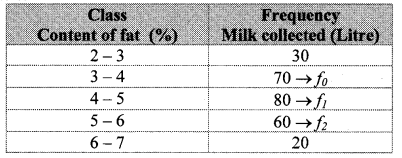
The following table shows the information regarding the milk collected from farmers on a milk collection centre and the content of fat in the milk, measured by a lactometer. Find the mode of fat content.
Maharashtra Board Class 10 Maths Solutions Chapter 6 Statistics Practice Set 6.3 1
Solution:
Maharashtra Board Class 10 Maths Solutions Chapter 6 Statistics Practice Set 6.3 2
Here, the maximum frequency is 80.
∴ The modal class is 4 – 5.
L = lower class limit of the modal class = 4
h = class interval of the modal class = 1
f1 = frequency of the modal class = 80
f0 = frequency of the class preceding the modal class = 70
f2 = frequency of the class succeeding the modal class = 60
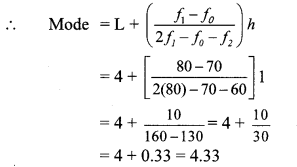
Maharashtra Board Class 10 Maths Solutions Chapter 6 Statistics Practice Set 6.3 3
∴ The mode of the fat content is 4.33%.

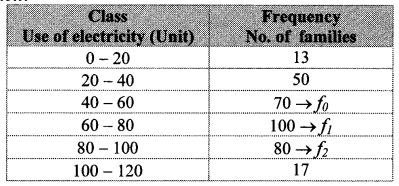
Question 2.
Electricity used by some families is shown in the following table. Find the mode of use of electricity.
Maharashtra Board Class 10 Maths Solutions Chapter 6 Statistics Practice Set 6.1 20
Solution:
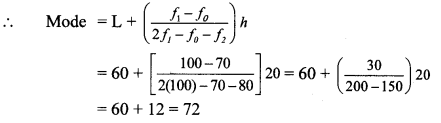
Maharashtra Board Class 10 Maths Solutions Chapter 6 Statistics Practice Set 6.3 5
Here, the maximum frequency is 100.
∴ The modal class is 60 – 80.
L = lower class limit of the modal class = 60
h = class interval of the modal class = 20
f1 = frequency of the modal class = 100
f0 = frequency of the class preceding the modal class = 70
f2 = frequency of the class succeeding the modal class = 80
Maharashtra Board Class 10 Maths Solutions Chapter 6 Statistics Practice Set 6.3 6
∴ The mode of use of electricity is 72 units.

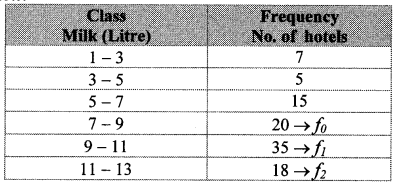
Question 3.
Grouped frequency distribution of supply of milk to hotels and the number of hotels is given in the following table. Find the mode of the supply of milk.
Maharashtra Board Class 10 Maths Solutions Chapter 6 Statistics Practice Set 6.3 7
Solution:
Maharashtra Board Class 10 Maths Solutions Chapter 6 Statistics Practice Set 6.3 8
Here, the maximum frequency is 35.
∴ The modal class is 9 – 11.
L = lower class limit of the modal class = 9
h = class interval of the modal class = 2
f1 = frequency of the modal class = 35
f0 = frequency of the class preceding the modal class = 20
f2 = frequency of the class succeeding the modal class = 18
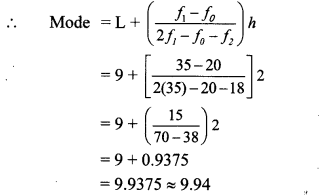
Maharashtra Board Class 10 Maths Solutions Chapter 6 Statistics Practice Set 6.3 9
∴ The mode of the supply of milk is 9.94 litres (approx.).

Question 4.
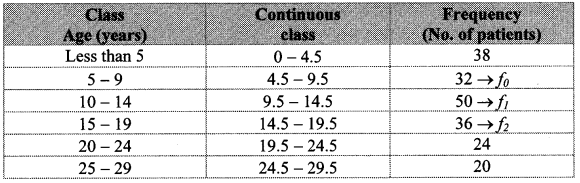
The following frequency distribution table gives the ages of 200 patients treated in a hospital in a week. Find the mode of ages of the patients.
Maharashtra Board Class 10 Maths Solutions Chapter 6 Statistics Practice Set 6.3 10
Solution:
Maharashtra Board Class 10 Maths Solutions Chapter 6 Statistics Practice Set 6.3 11
Here, the maximum frequency is 50.
The modal class is 9.5 – 14.5.
L = lower class limit of the modal class = 9.5
h = class interval of the modal class = 5
f1 = frequency of the modal class = 50
f0 = frequency of the class preceding the modal class = 32
f2 = frequency of the class succeeding the modal class = 36
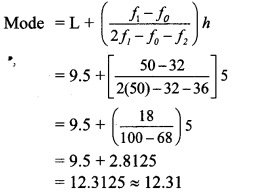
Maharashtra Board Class 10 Maths Solutions Chapter 6 Statistics Practice Set 6.3 12
∴ The mode of the ages of the patients is 12.31 years (approx.).