Maharashtra Board 8th Class Maths Practice Set 12.1 Solutions Chapter 12 Equations in One Variable

Balbharti Maharashtra State Board Class 8 Maths Solutions covers the Practice Set 12.1 8th Std Maths Answers Solutions Chapter 12 Equations in One Variable.

Practice Set 12.1 8th Std Maths Answers Chapter 12 Equations in One Variable

Equation in One Variable Practice Set 12.1 Question 1. Each equation is followed by the values of the variable. Decide whether these values are the solutions of that equation.
i. x – 4 = 3, x = – 1, 7, – 7
ii. 9m = 81, m = 3, 9, -3
iii. 2a + 4 = 0, a = 2, – 2, 1
iv. 3 – y = 4, y = – 1, 1, 2
Solution:
i. x – 4 = 3 ….(i)
Substituting x = – 1 in L.H.S. of equation (i),
L.H.S. = (-1) – 4
= – 5
R.H.S. = 3
∴ L.H.S. ≠ R.H.S.
∴ x = – 1 is not the solution of the given equation.

Substituting x = 7 in L.H.S. of equation (i),
L.H.S. = (7) – 4
= 3
R.H.S. = 3
∴ L.H.S. = R.H.S.
∴ x = 7 is the solution of the given equation.

Substituting x = – 7 in L.H.S. of equation (i),
L.H.S. = (- 7) – 4
= -11
R.H.S. = 3
∴ L.H.S. ≠ R.H.S.
∴ x = – 7 is not the solution of the given equation.

ii. 9m = 81 …(i)
Substituting m = 3 in L.H.S. of equation (i),
L.H.S. = 9 × (3)
= 27
R.H.S. = 81
∴L.H.S. ≠ R.H.S.
∴m = 3 is not the solution of the given equation.

Substituting m = 9 in L.H.S. of equation (i),
L.H.S. = 9 × (9)
= 81
R.H.S. = 81
∴L.H.S. = R.H.S.
∴m = 9 is the solution of the given equation.

Substituting m = – 3 in L.H.S. of equation (i),
L.H.S. = 9 × (- 3)
= -27
R.H.S. = 81
∴L.H.S. ≠ R.H.S.
∴m = – 3 is not the solution of the given equation.

iii. 2a + 4 = 0 …..(i)
Substituting a = 2 in L.H.S. of equation (i),
L.H.S. = 2 (2) + 4
= 4 + 4
= 8
R.H.S. = 0
∴L.H.S. ≠ R.H.S.
∴a = 2 is not the solution of the given equation.

Substituting a = – 2 in L.H.S. of equation (i),
L.H.S. = 2 (-2)+ 4
= -4 + 4
= 0
R.H.S. = 0
∴L.H.S. = R.H.S.
∴a = – 2 is the solution of the given equation.

Substituting a = 1 in L.H.S. of equation (i),
L.H.S. = 2(1)+ 4
= 2 + 4
= 6
R.H.S. = 0
∴ L.H.S. ≠ R.H.S.
∴a = 1 is not the solution of the given equation.

iv. 3 – y = 4 …(i)
Substituting y = -1 in L.H.S. of equation (i),
L.H.S. = 3 – (- 1)
= 3 + 1
= 4
R.H.S. = 4
∴L.H.S. = R.H.S.
∴y = – 1 is the solution of the given equation.

Substituting y = 1 in L.H.S. of equation (i),
L.H.S. = 3-(1)
= 2
R.H.S. = 4
∴L.H.S. ≠ R.H.S.
∴y = 1 is not the solution of the given equation.

Substituting y = 2 in L.H.S. of equation (i),
L.H.S. = 3-(2)
= 1
R.H.S. = 4
∴L.H.S. ≠ R.H.S.
∴y = 2 is not the solution of the given equation.

Practice Set 12.1 Question 2.
Solve the following equations:
i. 17p – 2 = 49
ii. 2m + 7 = 9
iii. 3x + 12 = 2x – 4
iv. 5 (x – 3) = 3 (x + 2)
v. \(\frac { 9x }{ 8 }+1=10\)
vi. \(\frac{y}{7}+\frac{y-4}{3}=2\)
vii. 13x – 5 = \(\frac { 3 }{ 2 }\)
viii. 3 (y + 8) = 10 (y – 4) + 8
ix. \(\frac{x-9}{x-5}=\frac{5}{7}\)
x. \(\frac{y-4}{3}+3 y=4\)
xi. \(\frac{b+(b+1)+(b+2)}{4}=21\)
Solution:
i. 17p – 2 = 49
∴ 17p – 2 + 2 = 49 + 2
…[Adding 2 on both the sides]
∴ 17p = 51
∴ \(\frac{17 p}{17}=\frac{51}{17}\) …[Dividing both the sides by 17]
p = 3

ii. 2m + 7 = 9
∴ 2m + 7 – 7 = 9 – 7
…[Subtracting 7 from both the sides]
∴ 2m = 2
∴ \(\frac{2 m}{2}=\frac{2}{2}\) [Dividing both the sides by 2]
∴ m = 1

iii. 3x + 12 = 2x – 4
∴ 3x + 12 – 12 = 2x – 4 – 12
…[Subtracting 12 from both the sides]
∴ 3x = 2x – 16
∴ 3x – 2x = 2x – 16 – 2x
…[Subtracting 2x from both the sides]
∴ x = – 16

iv. 5 (x – 3) = 3 (x + 2)
∴ 5x – 15 = 3x + 6
∴ 5x – 15 + 15 = 3x + 6 + 15
…[Adding 15 on both the sides]
∴ 5x = 3x + 21
∴ 5x – 3x = 3x + 21 – 3x
…[Subtracting 3x from both the sides]
∴ 2x = 21
∴ \(\frac{2 x}{2}=\frac{21}{2}\) …[Dividing both the sides by 2]
∴ \(x=\frac{21}{2}\)

v. \(\frac { 9x }{ 8 }+1=10\)
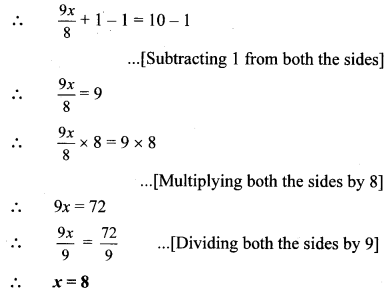
Maharashtra Board Class 8 Maths Solutions Chapter 12 Equations in One Variable Practice Set 12.1 1

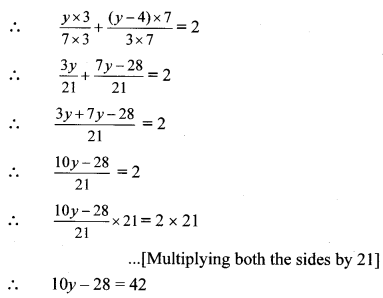
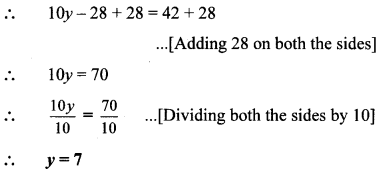
vi. \(\frac{y}{7}+\frac{y-4}{3}=2\)
Maharashtra Board Class 8 Maths Solutions Chapter 12 Equations in One Variable Practice Set 12.1 2
Maharashtra Board Class 8 Maths Solutions Chapter 12 Equations in One Variable Practice Set 12.1 3

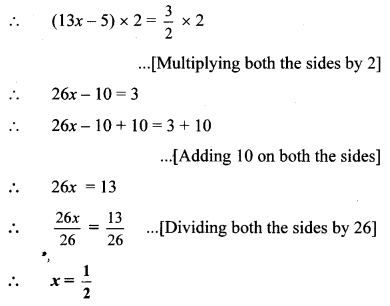
vii. 13x – 5 = \(\frac { 3 }{ 2 }\)
Maharashtra Board Class 8 Maths Solutions Chapter 12 Equations in One Variable Practice Set 12.1 4

viii. 3 (y + 8) = 10 (y – 4) + 8
∴ 3y + 24 = 10y – 40 + 8
∴ 3y + 24 = 10y – 32
∴ 3y + 24 – 24 = 10y – 32 – 24
…[Subtracting 24 from both the sides]
∴ 3y = 10y – 56
∴ 3y – 10y = 10y – 56
…[Subtracting 10y from both the sides]
∴ – 7y = – 56
∴ \(\frac{-7 y}{-7}=\frac{-56}{-7}\)…[Dividing both the sides by – 7]
∴ y = 8

ix. \(\frac{x-9}{x-5}=\frac{5}{7}\)
∴\(\frac{x-9}{x-5} \times 7(x-5)=\frac{5}{7} \times 7(x-5)\)
…[Multiplying both the sides by 7 (x – 5)]
∴7 (x – 9) = 5 (x – 5)
∴7x – 63 = 5x – 25
∴7x – 63 + 63 = 5x – 25 + 63
…[Adding 63 on both the sides]
∴7x = 5x + 38
∴7x – 5x = 5x + 38 – 5x
…[Subtracting 5x from both the sides]
∴ 2x = 38
∴\(\frac{2 x}{2}=\frac{38}{2}\) …[Dividing both the sides by 2]
∴x = 19

x. \(\frac{y-4}{3}+3 y=4\)
∴\(\frac{y-4}{3} \times 3+3 y \times 3=4 \times 3\)
…[Multiplying both the sides by 3]
∴y – 4 + 9y = 12
∴10y – 4 = 12
∴10y – 4 + 4=12 + 4
…[Adding 4 on both the sides]
∴10y = 16
∴\(\frac{10 y}{10}=\frac{16}{10}\)…[Dividing both the sides by 10]
∴y = \(\frac { 8 }{ 5 }\)

xi. \(\frac{b+(b+1)+(b+2)}{4}=21\)
∴\(\frac{b+(b+1)+(b+2)}{4} \times 4=21 \times 4\)
…[Multiplying both the sides by 4]
∴b + b + 1 + b + 2 = 84
∴3b + 3 = 84
∴3b + 3 – 3 = 84 – 3
…[ Subtracting 3 from both the sides]
∴3b = 81
∴\(\frac{3 b}{3}=\frac{81}{3}[/latex …[Dividing both the sides by 3]
∴b = 27

Maharashtra Board Class 8 Maths Chapter 12 Equations in One Variable Practice Set 12.1 Intext Questions and Activities

Std 8 Maths Practice Set 12.1 Question 1.
Fill in the boxes to solve the following equations. (Textbook pg. no. 75)
i. x + 4 = 9
∴x + 4 – __ = 9 – __
… [Subtracting 4 from both the sides]
∴ x = __

ii. x – 2 = 7
∴x – 2 + __ = 7 + __
… [Adding 2 on both the sides]
∴x = __

iii. [latex]\frac { x }{ 3 }=4\)
∴\(\frac { x }{ 3 }\) × __ = 4 ×__
∴x = __

iv. 4x = 24
∴ __ = __
∴x = __
Solution:
i. x + 4 = 9
∴x + 4 – 4 = 9 – 4
… [Subtracting 4 from both the sides]
∴ x = 5

ii. x – 2 = 7
∴x – 2 + 2 = 7 + 2
… [Adding 2 on both the sides]
∴x = 9

iii. \(\frac { x }{ 3 }=4\)
∴\(\frac { x }{ 3 }\) × 3 = 4 × 3
… [Multiplying both the sides by 3]
∴x = 12

iv. 4x = 24
∴ \(\frac{4 x}{[4]}=\frac{24}{[4]}\)
… [Dividing both the sides by 4]
∴x = 6
Maharashtra Board 8th Class Maths Practice Set 11.3 Solutions Chapter 11 Statistics

Balbharti Maharashtra State Board Class 8 Maths Solutions covers the Practice Set 11.3 8th Std Maths Answers Solutions Chapter 11 Statistics.

Practice Set 11.3 8th Std Maths Answers Chapter 11 Statistics

Exercise 11.3 Class 8 Question 1.
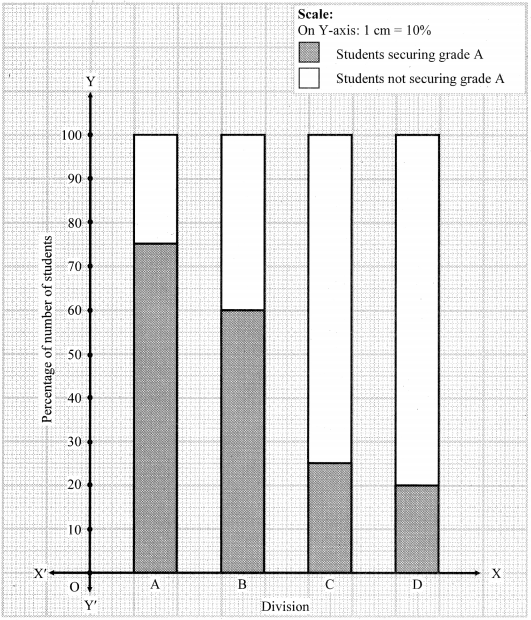
Show the following information by a percentage bar graph.

Division of standard 8ABCD
Number of students securing grade A45331015
Total number of students60554075

Solution:

Division of standard 8ABCD
Number of students securing grade A45331015
Total number of students60554075
Percentage of students securing grade A75%60%25%20%
Percentage of students not securing grade A25%40%75%80%

Maharashtra Board Class 8 Maths Solutions Chapter 11 Statistics Practice Set 11.3 1

Statistics for Class 8 Question 2.
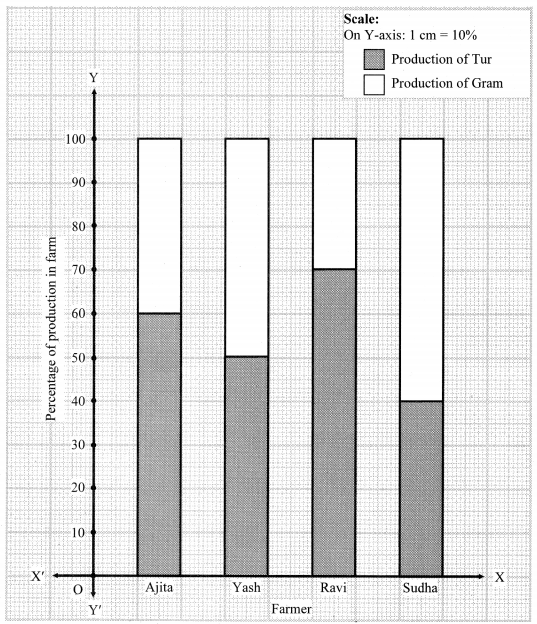
Observe the following graph and answer the questions.
Maharashtra Board Class 8 Maths Solutions Chapter 11 Statistics Practice Set 11.3 2

  1. State the type of the bar graph.
  2. How much percent is the Tur production to total production in Ajita’s farm?
  3. Compare the production of Gram in the farms of Yash and Ravi and state whose percentage of production is more and by how much?
  4. Whose percentage production of Tur is the least?
  5. State production percentages of Tur and Gram in Sudha’s farm.

Solution:

  1. The given graph is a percentage bar graph.
  2. Percent of tur production to the total production in Ajita’s farm is 60%.
  3. Production of Gram in the farm of Yash = 50%
    Production of Gram in the farm of Ravi = 30%
    ∴ Difference in the production = 50% – 30% =20%
    ∴ Yash’s production of Gram is more and by 20%.
  4. Sudha’s percentage production of Tur is the least.
  5. Production percentages of Tur and Gram in Sudha’s farm are 40% and 60% respectively.

8th Standard Statistics Question 3.
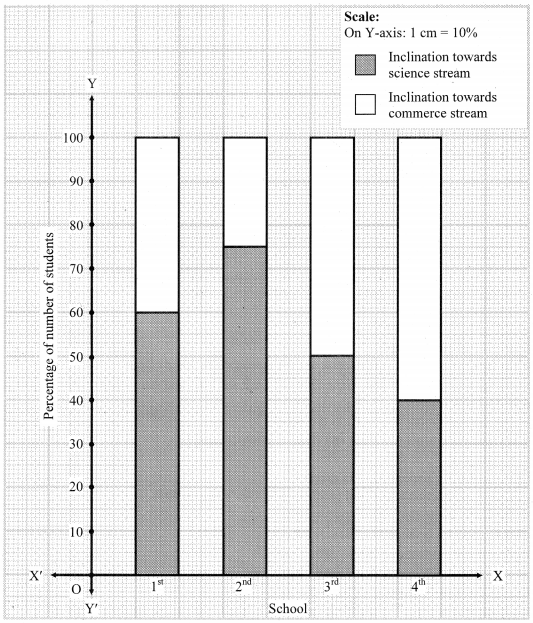
The following data is collected in a survey of some students of 10th standard from some schools. Draw the percentage bar graph of the data.

School1st2nd3rd4th
Inclination towards science stream90602516
Inclination towards commerce stream60202524

Solution:

School1st2nd3rd4th
Inclination towards science stream90602516
Inclination towards commerce stream60202524
Total number of students150805040
Percentage of students having inclination towards science stream60%75%50%40%
Percentage of students having inclination towards commerce stream40%25%50%60%

Maharashtra Board Class 8 Maths Solutions Chapter 11 Statistics Practice Set 11.3 3

Maharashtra Board Class 8 Maths Chapter 11 Statistics Practice Set 11.3 Intext Questions and Activities

Statistics 8th Class Question 1.
Compare and discuss a percentage bar diagram and a subdivided bar diagram. Use it to learn the graphs in the subjects like Science, Geography. (Textbook pg, no. 74)
Solution:
[Students should attempt the above activity on their own.]

Maharashtra Board 8th Class Maths Practice Set 1.1 Solutions Chapter 1 Rational and Irrational Numbers

Balbharti Maharashtra State Board Class 8 Maths Solutions covers the Practice Set 1.1 8th Std Maths Answers Solutions Chapter 1 Rational and Irrational Numbers.

Practice Set 1.1 8th Std Maths Answers Chapter 1 Rational and Irrational Numbers

Question 1.
Show the following numbers on a number line. Draw a separate number line for each example.
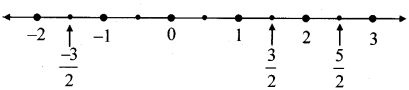
i. \(\frac{3}{2}, \frac{5}{2},-\frac{3}{2}\)
ii. \(\frac{7}{5}, \frac{-2}{5}, \frac{-4}{5}\)
iii. \(\frac{-5}{8}, \frac{11}{8}\)
iv. \(\frac{13}{10}, \frac{-17}{10}\)
Solution:
i. \(\frac{3}{2}, \frac{5}{2},-\frac{3}{2}\)
Maharashtra Board Class 8 Maths Solutions Chapter 1 Rational and Irrational Numbers Practice Set 1.1 1
Here, the denominator of each fraction is 2.
∴ Each unit will be divided into 2 equal parts.

ii. \(\frac{7}{5}, \frac{-2}{5}, \frac{-4}{5}\)
Maharashtra Board Class 8 Maths Solutions Chapter 1 Rational and Irrational Numbers Practice Set 1.1 2
Here, the denominator of each fraction is 5.
∴ Each unit will be divided into 5 equal parts.

iii. \(\frac{-5}{8}, \frac{11}{8}\)
Maharashtra Board Class 8 Maths Solutions Chapter 1 Rational and Irrational Numbers Practice Set 1.1 3
Here, the denominator of each fraction is 8.
∴ Each unit will be divided into 8 equal parts.

iv. \(\frac{13}{10}, \frac{-17}{10}\)
Maharashtra Board Class 8 Maths Solutions Chapter 1 Rational and Irrational Numbers Practice Set 1.1 4
Here, the denominator of each fraction is 10.
∴ Each unit will be divided into 10 equal parts.

Question 2.
Observe the number line and answer the questions.
Maharashtra Board Class 8 Maths Solutions Chapter 1 Rational and Irrational Numbers Practice Set 1.1 5
i. Which number is indicated by point B?
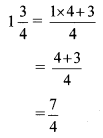
ii. Which point indicates the number \(1\frac { 3 }{ 4 }\) ?
iii. State whether the statement, ‘the point D denotes the number \(\frac { 5 }{ 2 }\) is true or false.
Solution:
Here, each emit is divided into 4 equal parts.
i. Point B is marked on the 10th equal part on the left side of O.
∴ The number indicated by point B is \(\frac { -10 }{ 4 }\).

ii.
Maharashtra Board Class 8 Maths Solutions Chapter 1 Rational and Irrational Numbers Practice Set 1.1 6
Point C is marked on the 7th equal part on the right side of O.
∴ The number \(1\frac { 3 }{ 4 }\) is indicated by point C.

iii. True
Point D is marked on the 10th equal part on the right side of O.
∴ D denotes the number \(\frac{10}{4}=\frac{5 \times 2}{2 \times 2}=\frac{5}{2}\)

Maharashtra Board 10th Class Maths Part 1 Problem Set 4B Solutions Chapter 4 Financial Planning

Balbharti Maharashtra State Board Class 10 Maths Solutions covers the Problem Set 4B Algebra 10th Class Maths Part 1 Answers Solutions Chapter 4 Financial Planning.

Problem Set 4B Algebra 10th Std Maths Part 1 Answers Chapter 4 Financial Planning

Financial Planning Class 10 Problem Set 4b
Question 1.
Write the correct alternative for the following questions.

i. If the Face Value of a share is ₹ 100 and Market value is ₹ 75, then which of the following statement is correct?
(A) The share is at premium of ₹ 175
(B) The share is at discount of ₹ 25
(C) The share is at premium of ₹ 25
(D) The share is at discount of ₹ 75
Answer:
(B)

ii. What is the amount of dividend received per share of face value ₹ 10 if dividend declared is 50%.
(A) ₹ 50
(B) ₹ 5
(C) ₹ 500
(D) ₹ 100
Answer:
Dividend = 10 × \(\frac { 50 }{ 100 } \) = ₹ 5
(B)

iii. The NAV of a unit in mutual fund scheme is ₹ 10.65, then find the amount required to buy 500 such units.
(A) 5325
(B) 5235
(C) 532500
(D) 53250
Answer:
(A)

iv. Rate of GST on brokerage is _______
(A) 5%
(B) 12%
(C) 18%
(D) 28%
Answer:
(C)

v. To find the cost of one share at the time of buying the amount of Brokerage and GST is to be ______ MV of share.
(A) added to
(B) subtracted from
(C) Multiplied with
(D) divided by
Answer:
(A)

Problem Set 4b Algebra Class 10 Question 2. Find the purchase price of a share of FV ₹ 100 if it is at premium of ₹ 30. The brokerage rate is 0.3%.
Solution:
Here, Face Value of share = ₹ 100,
premium = ₹ 30, brokerage = 0.3%
MV = FV + Premium
= 100 + 30
= ₹ 130
Brokerage = 0.3% of MV
= \(\frac { 0.3 }{ 100 } \) × 130 = ₹ 0.39
Purchase price of a share = MV + Brokerage
= 130 + 0.39
= ₹ 130.39
Purchase price of a share is ₹ 130.39.

Question 3.
Prashant bought 50 shares of FV ₹ 100, having MV ₹ 180. Company gave 40% dividend on the shares. Find the rate of return on investment.
Solution:
Here, Number of shares = 50, FV = ₹ 100,
MV = ₹ 180, rate of dividend = 40%
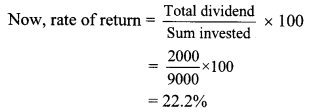
∴ Sum invested = Number of shares × MV
= 50 × 180
= ₹ 9000
Dividend per share = 40% of FV
= \(\frac { 40 }{ 100 } \) × 100
Dividend = ₹ 40
∴ Total dividend on 50 shares = 50 × 40
= ₹ 2000
Maharashtra Board Class 10 Maths Solutions Chapter 4 Financial Planning Problem Set 4B 1
∴ Rate of return on investment is 22.2%.

Question 4.
Find the amount received when 300 shares of FV ₹ 100, were sold at a discount of ₹ 30.
Solution:
Here, FV = ₹ 100, number of shares = 300,
discount = ₹ 30
MV of 1 share = FV – Discount
= 100 – 30 = ₹ 70
∴ MV of 300 shares = 300 × 70
= ₹ 21,000
∴ Amount received is ₹ 21,000.

Question 5.
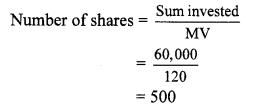
Find the number of shares received when ₹ 60,000 was invested in the shares of FV ₹ 100 and MV ₹ 120.
Solution:
Here, FV = ₹ 100, MV = ₹ 120,
Sum invested = ₹ 60,000
Maharashtra Board Class 10 Maths Solutions Chapter 4 Financial Planning Problem Set 4B 2
∴ Number of shares received were 500.

Question 6.
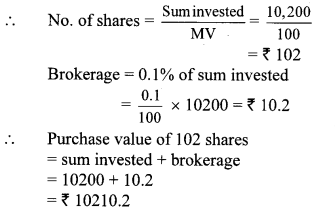
Smt. Mita Agrawal invested ₹ 10,200 when MV of the share is ₹ 100. She sold 60 shares when the MV was ₹ 125 and sold remaining shares when the MV was ₹ 90. She paid 0.1% brokerage for each trading. Find whether she made profit or loss? and how much?
Solution:
For purchasing shares:
Here, sum invested = ₹ 10,200, MV = ₹ 100
Maharashtra Board Class 10 Maths Solutions Chapter 4 Financial Planning Problem Set 4B 3
For selling shares:
60 shares sold at MV of ₹ 125.
∴ MV of 60 shares = 125 × 60
= ₹ 7500
Brokerage = \(\frac { 0.1 }{ 100 } \) × 7500 = ₹ 7.5
∴ Sale value of 60 shares = 7500 – 7.5 = ₹ 7492.5
Now, remaining shares = 102 – 60 = 42
But 42 shares sold at MV of ₹ 90.
∴ MV of 42 shares = 42 × 90 = ₹ 3780
∴ Brokerage = \(\frac { 0.1 }{ 100 } \) × 3780 = ₹ 3.78
∴ Sale value of 42 shares = 3780 – 3.78 = ₹ 3776.22
Total sale value = 7492.5 + 3776.22 = ₹ 11268.72
Since, Purchase value < Sale value
∴ Profit is gained.
∴ Profit = Sale value – Purchase value
= 11268.72 – 10210.2
= ₹ 1058.52
∴ Smt. Mita Agrawal gained a profit of ₹ 1058.52.

Question 7. Market value of shares and dividend declared by the two companies is given below.
Face value is same and it is 7 100 for both the shares. Investment in which company is more profitable?
i. Company A – ₹ 132,12%
ii Company B – ₹ 144,16%
Solution:
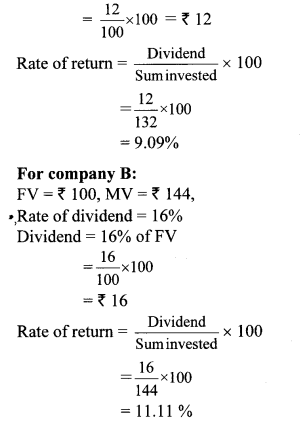
For company A:
FV = ₹ 100, MV = ₹ 132,
Rate of dividend = 12%
Dividend = 12% of FV
Maharashtra Board Class 10 Maths Solutions Chapter 4 Financial Planning Problem Set 4B 4
∴ Rate of return of company B is more.
∴ Investment in company B is more profitable.

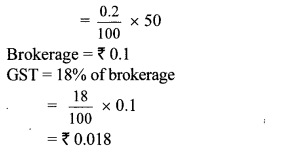
Question 8. Shri. Aditya Sanghavi invested ₹ 50,118 in shares of FV ₹ 100, when the market value is ₹ 50. Rate of brokerage is 0.2% and Rate of GST on brokerage is 18%, then How many shares were purchased for ₹ 50,118?
Solution:
Here, FV = ₹ 100, MV = ₹ 50
Purchase value of shares = ₹ 50118,
Rate of brokerage = 0.2%, Rate of GST = 18%
Brokerage = 0.2% of MV
Maharashtra Board Class 10 Maths Solutions Chapter 4 Financial Planning Problem Set 4B 5
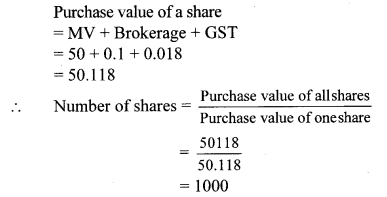
Maharashtra Board Class 10 Maths Solutions Chapter 4 Financial Planning Problem Set 4B 6
∴ 1000 shares were purchased for ₹ 50,118.

Question 9. Shri. Batliwala sold shares of ₹ 30,350 and purchased shares of ₹ 69,650 in a day. He paid brokerage at the rate of 0.1% on sale and purchase. 18% GST was charged on brokerage. Find his total expenditure on brokerage and tax.
Solution:
Total amount = sale value + Purchase value
= 30350 + 69650
= ₹ 1,00,000
Rate of Brokerage = 0.1 %
Brokerage = 0.1 % of 1,00,000
= \(\frac { 0.1 }{ 100 } \) × 1,00,000
= ₹ 100
Rate of GST = 18%
∴ GST = 18 % of brokerage
= \(\frac { 18 }{ 100 } \) × 100
∴ GST = ₹ 18
Total expenditure on brokerage and tax
= 100 + 18 = ₹ 118
∴ Total expenditure on brokerage and tax is ₹ 118.

Alternate Method:
Brokerage = 0.1 %, GST = 18%
At the time of selling shares:
Total sale amount of shares = ₹ 30,350
Brokerage = 0.1% of 30,350
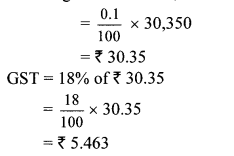
Maharashtra Board Class 10 Maths Solutions Chapter 4 Financial Planning Problem Set 4B 7
For purchasing shares:
Total purchase amount of shares = ₹ 69,650
Brokerage = 0.1% of 69,650
= \(\frac { 0.1 }{ 100 } \) × 69650
= ₹ 69.65
GST = 18% of 69.65
= \(\frac { 18 }{ 100 } \) × 69.65
= ₹ 12.537
∴ Total expenditure on brokerage and tax = Brokerage and tax on selling + Brokerage and tax on purchasing
= (30.35 + 5.463) + (69.65 + 12.537)
= ₹ 118
∴ Total expenditure on brokerage and tax is ₹ 118.

Question 10. Sint. Aruna Thakkar purchased 100 shares of FV 100 when the MV is ₹ 1200. She paid brokerage at the rate of 0.3% and 18% GST on brokerage. Find the following –
i. Net amount paid for 100 shares.
ii. Brokerage paid on sum invested.
iii. GST paid on brokerage.
iv. Total amount paid for 100 shares.
Solution:
Here, FV = ₹ 100,
Number of shares = 100, MV = ₹ 1200
Brokerage = 0.3%, GST = 18%
i. Sum invested = Number of shares × MV
= 100 × 1200 = ₹ 1,20,000
∴ Net amount paid for 100 shares is ₹ 1,20,000.

ii. Brokerage = 0.3% of sum invested
= \(\frac { 0.3 }{ 100 } \) × 1,20,000 = ₹ 360
∴ Brokerage paid on sum invested is ₹ 360.

iii. GST = 18% of brokerage
= \(\frac { 18 }{ 100 } \) × 360 = ₹ 64.80
∴ GST paid on brokerage is ₹ 64.80.

iv. Total amount paid for 100 shares
= Sum invested + Brokerage + GST
= 1,20,000 + 360 + 64.80
= ₹ 1,20,424.80
∴ Total amount paid for 100 shares is ₹ 1,20,424.80.

Question 11. Smt. Anagha Doshi purchased 22 shares of FV ₹ 100 for Market Value of ₹ 660. Find the sum invested. After taking 20% dividend, she sold all the shares when market value was ₹ 650. She paid 0.1% brokerage for each trading done. Find the percent of profit or loss in the share trading. (Write your answer to the nearest integer)
Solution:
For purchasing shares:
Here, FV = ₹ 100, MV = ₹ 660, Number of shares = 22, rate of brokerage = 0.1%
Sum invested = MV × Number of shares
= 660 × 22
= ₹ 14,520
Brokerage = 0.1 % of sum invested
= \(\frac { 0.1 }{ 100 } \) × 14520 = ₹ 14.52
∴ Amount invested for 22 shares
= Sum invested + Brokerage
= 14520 + 14.52
= ₹ 14534.52
For dividend:
Rate of dividend = 20%
∴ Dividend per share = 20 % of FV
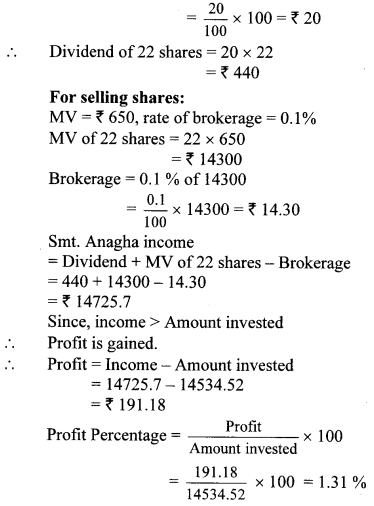
Maharashtra Board Class 10 Maths Solutions Chapter 4 Financial Planning Problem Set 4B 8
∴ Percentage of profit in the share trading is 1 % (nearest integer).

Alternate Method:
For purchasing share:
Here, FV = ₹ 100, MV = ₹ 660, Number of shares = 22, rate of brokerage = 0.1%
Sum invested = MV × Number of shares
= 660 × 22
= ₹ 14,520
Brokerage = 0.1 % of MV
= \(\frac { 0.1 }{ 100 } \) × 660 = ₹ 0.66
Amount invested for 1 share = 660 + 0.66
= ₹ 660.66
For dividend:
Rate of dividend = 20%
Dividend = 20% of FV = \(\frac { 20 }{ 100 } \) × 100 = ₹ 20
For selling share:
MV = ₹ 650, rate of brokerage = 0.1%
Brokerage = 0.1 % of MV
= \(\frac { 0.1 }{ 100 } \) × 650 = ₹ 0.65 100
Amount received after selling 1 share
= 650 – 0.65 = 649.35
∴ Amount received including divided
= selling price of 1 share + dividend per share
= 649.35 + 20
= ₹ 669.35
Since, income > Amount invested
∴ Profit is gained.
∴ profit = 669.35 – 660.66 = ₹ 8.69
Profit Percentage = \(\frac { 8.69 }{ 660.66 } \) × 100= 1.31%
∴ Percentage of profit in the share trading is 1 % (nearest integer).

Maharashtra Board 8th Class Maths Miscellaneous Exercise 2 Solutions

Balbharti Maharashtra State Board Class 8 Maths Solutions covers the Miscellaneous Exercise 2 8th Std Maths Answers Solutions.

Miscellaneous Exercise 2 8th Std Maths Answers

Question 1.
Questions and their alternative answers are given. Choose the correct alternative answer.
i. Find the circumference of a circle whose area is 1386 cm²? [Chapter 15]
(A) 132 cm²
(B) 132 cm
(C) 42 cm
(D) 21 cm²
Solution:
(B) 132 cm

Hint:
i. Area of the circle = πr²
1386 = \(\frac { 22 }{ 7 }\) x r²
r² = 1386 x \(\frac { 7 }{ 22 }\)
= 63 x 7
= 441
r = √441 … [Taking square root of both sides]
= 21 cm
Circumference of the circle = 2πr
= 2 x \(\frac { 22 }{ 7 }\) x 21
= 132 cm

ii. The side of a cube is 4 m. If it is doubled, how many times will be the volume of the new cube, as compared with the original cube? [Chapter 16]
(A) Two times
(B) Three times
(C) Four times
(D) Eight times
Solution:
(D) Eight times

Hint:
ii. Original volume = (4)³ = 64 cu.m
New side = 8 m
∴ New volume = (8)² = 512 cu.m
Now, \(\frac{\text { new volume }}{\text { original volume }}=\frac{512}{64}\) = 8
original volume 64
∴ volume of new cube will increase 8 times as compared to the volume of original cube.

Question 2.
Pranalee was practicing for a 100 m running race. She ran 100 m distance 20 times. The time required, in seconds, for each attempt was as follows. [Chapter 11]
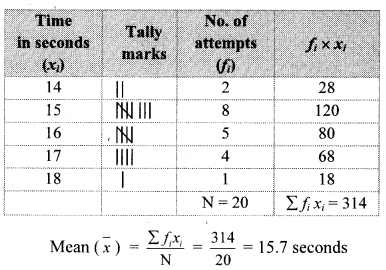
18, 17, 17, 16,15, 16, 15, 14,16, 15, 15, 17, 15, 16,15, 17, 16, 15, 14,15
Find the mean of the time taken for running.
Solution:
Maharashtra Board Class 8 Maths Solutions Miscellaneous Exercise 2 1
∴ The mean of the time taken for running 100 m race is 15.7 seconds.

Question 3.
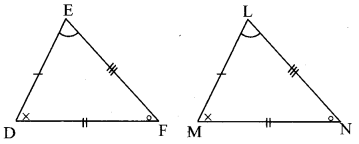
∆DEF and ∆LMN are congruent in the correspondence EDF ↔ LMN. Write the pairs of congruent sides and congruent angles in the correspondence. [Chapter 13]
Solution:
Maharashtra Board Class 8 Maths Solutions Miscellaneous Exercise 2 2
∆EDF ≅ ∆LMN
∴side ED ≅ side LM
side DF ≅ side MN
side EF ≅ side LN
∠E ≅∠L
∠D ≅∠M
∠F ≅∠N

Question 4.
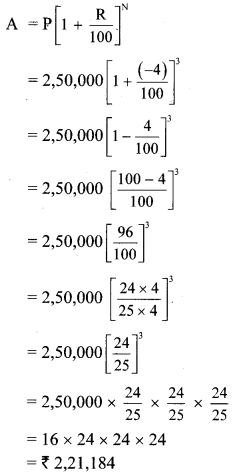
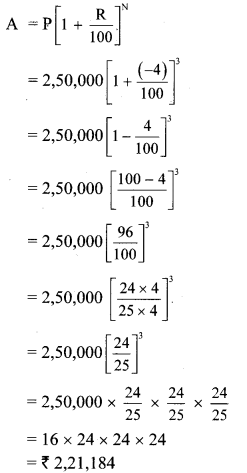
The cost of a machine is Rs 2,50,000. It depreciates at the rate of 4% per annum. Find the cost of the machine after three years. [Chapter 14]
Solution:
Here, P = Cost of the machine = Rs 2,50,000
R = Rate of depreciation = 4%
N = 3 Years
A = Depreciated price of the machine
Maharashtra Board Class 8 Maths Solutions Miscellaneous Exercise 2 3
∴The cost of the machine after three years will be Rs 2,21,184.

Question 5.
In ☐ABCD, side AB || side DC, seg AE ⊥ seg DC. If l(AB) = 9 cm, l(AE) = 10 cm, A(☐ABCD) = 115 cm² , find l(DC). [Chapter 15]
Solution:
Given, side AB || side DC.
∴ ☐ABCD is a trapezium.
Maharashtra Board Class 8 Maths Solutions Miscellaneous Exercise 2 4
Given, l(AB) = 9 cm, l(AE) = 10 cm,
A(☐ABCD) = 115 cm²
Area of a trapezium
= \(\frac { 1 }{ 2 }\) x sum of lengths of parallel sides x height
∴ A(☐ABCD) = \(\frac { 1 }{ 2 }\) x [l(AB) + l(DC) x l(AE)]
∴ 115 = \(\frac { 1 }{ 2 }\) x [9 + l(DC)] x 10
∴ \(\frac { 115 \times 2 }{ 10 }\) = 9 + l(DC)
∴ 23 = 9 + l(DC)
∴ l(DC) = 23 – 9
∴ l(DC) = 14cm

Question 6.
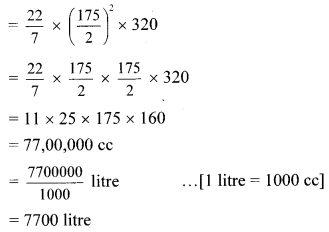
The diameter and height of a cylindrical tank is 1.75 m and 3.2 m respectively. How much is the capacity of tank in litre?
[π = \(\frac { 22 }{ 7 }\)] [Chapter 16]
Solution:
Given: For cylindrical tank:
diameter (d) = 1.75 m, height (h) = 3.2 m
To Find: Capacity of tank in litre
diameter (d) = 1.75 m
= 1.75 x 100
….[∵ 1 m = 100cm]
= 175 cm
∴ radius (r) = \(=\frac{\mathrm{d}}{2}=\frac{175}{2}\) cm
h = 3.2 cm
= 3.2 x 100
= 320 cm
Capacity of tank = Volume of the cylindrical tank
= πr²h
Maharashtra Board Class 8 Maths Solutions Miscellaneous Exercise 2 5
∴ The capacity of the tank is 7700 litre.

Question 7.
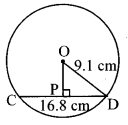
The length of a chord of a circle is 16.8 cm, radius is 9.1 cm. Find its distance from the centre. [Chapter 17]
Solution:
Maharashtra Board Class 8 Maths Solutions Miscellaneous Exercise 2 6
Let CD be the chord of the Circle with centre O.
Draw seg OP ⊥ chord CD
∴l(PD) = \(\frac { 1 }{ 2 }\) l(CD)
…[Perpendicular drawn from the centre of a circle to its chord bisects the chord]
∴l(PD) = \(\frac { 1 }{ 2 }\) x 16.8 …[l(CD) = 16.8cm]
∴l(PD) = 8.4 cm …(i)
∴In ∆OPD, m∠OPD = 90°
∴[l(OD)]² = [l(OP)]² + [l(PD)]² …..[Pythagoras theorem]
∴(9.1)² = [l(OP)]² + (8.4)² … [From (i) and l(OD) = 9.1 cm]
∴(9.1)² – (8.4)² = [l(OP)]²
∴(9.1 + 8.4) (9.1 – 8.4) = [l(OP)]²
…[∵ a² – b² = (a + b) (a – b)]
∴17.5 x (0.7) = [l(OP)]²
∴12.25 = [l(OP)]²
i.e., [l(OP)]² = 12.25
∴l(OP) = √12.25
…[Taking square root of both sides]
∴l(OP) = 3.5 cm
∴The distance of the chord from the centre is 3.5 cm.

Question 8.
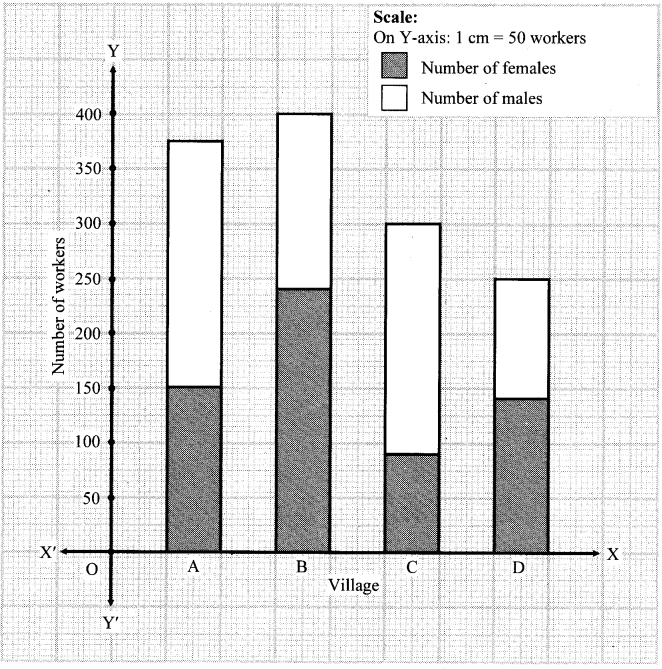
The following tables shows the number of male and female workers, under employment guarantee scheme, in villages A, B, C and D.

VillagesABCD
No. of females15024090140
No. of males225160210110

i. Show the information by a sub-divided bar-diagram.
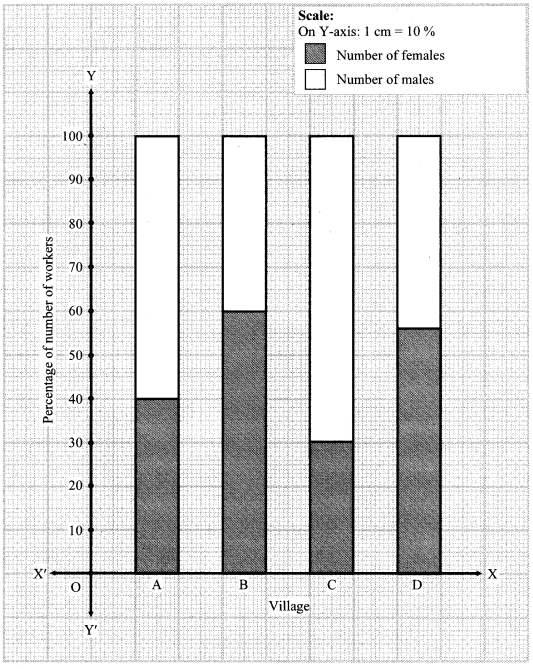
ii. Show the information by a percentage bar diagram. [Chapter 11]
Solution:
i.

VillagesABCD
No. of females15024090140
No. of males225160210110
Total375400300250

Maharashtra Board Class 8 Maths Solutions Miscellaneous Exercise 2 7

ii.

VillagesABCD
No. of females15024090140
No. of males225160210110
Total375400300250
Percentage of females40%60%30%56%
Percentage of males60%40%70%44%

Maharashtra Board Class 8 Maths Solutions Miscellaneous Exercise 2 8

Question 9.
Solve the following equations.
i. 17 (x + 4) + 8 (x + 6) = 11 (x + 5) + 15 (x + 3)
ii. \(\frac{3 y}{2}+\frac{y+4}{4}=5-\frac{y-2}{4}\)
iii. 5(1 – 2x) = 9(1 -x)
[Chapter 12]
Solution:
i. 17 (x + 4) + 8 (x + 6) = 11 (x + 5) + 15 (x + 3)
∴ 17x + 68 + 8x + 48 = 11x + 55 + 15x + 45
∴ 17x + 8x + 68 + 48 = 11x + 15x + 55 + 45
∴ 25x + 116 = 26x + 100
∴ 25x + 116 – 116 = 26x + 100 – 116
… [Subtracting 116 from both the sides]
∴ 25x = 26x – 16
∴ 25x – 26x = 26x – 16 – 26x
… [Subtracting 26x from both the sides]
∴ -x = -16
∴ \(\frac{-x}{-1}=\frac{-16}{-1}\)
∴ x = 16

ii. \(\frac{3 y}{2}+\frac{y+4}{4}=5-\frac{y-2}{4}\)
∴ \(\frac{3 y \times 2}{2 \times 2}+\frac{y+4}{4}=5-\frac{y-2}{4}\)
∴ \(\frac{6 y}{4}+\frac{y+4}{4}=5-\frac{y-2}{4}\)
∴ \(\frac{6 y}{4} \times 4+\frac{y+4}{4} \times 4=5 \times 4-\frac{y-2}{4} \times 4\)
……[Multiplying both the sides by 4]
∴ 6y + y + 4 = 20 – (y – 2)
∴ 7y + 4 = 20 – y + 2
∴ 7y + 4 = 22 – y
∴ 7y + 4 – 4 = 22 – y – 4
…..[Subtracting 4 from both the sides]
∴ 7y = 18 – y
∴ 7y + y = 18 – y + y
…[Adding y on both the sides]
∴ 8y = 18
∴ \(\frac{8 y}{8}=\frac{18}{8}\) … [Dividing both the sides by 8]
∴ \(y=\frac { 9 }{ 4 }\)

iii. 5(1 – 2x) = 9(1 – x)
∴ 5 – 10x = 9 – 9x
∴ 5 – 10x – 5 = 9 – 9x – 5
….[Subtracting 5 from both the sides]
∴ -10x = 4 – 9x
∴ -10x + 9x = 4 – 9x + 9x
… [Adding 9x on both the sides]
∴ -x = 4
∴ -x x (- 1) = 4 x (- 1)
… [Multiplying both the sides by – 1]
∴ x = – 4

Question 10.
Complete the activity according to the given steps.
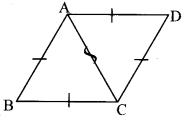
i. Draw rhombus ABCD. Draw diagonal AC.
ii. Show the congruent parts in the figure by identical marks.
iii. State by which, test and in which correspondence ∆ADC and ∆ABC are congruent.
iv. Give reason to show ∠DCA ≅ ∠BCA, and ∠DAC ≅ ∠BAC
v. State which property of a rhombus is revealed from the above steps. [Chapter 13]
Solution:
a.
Maharashtra Board Class 8 Maths Solutions Miscellaneous Exercise 2 9
b. In ∆ADC and ∆ABC,
side AD ≅ side AB …..[Sides of a rhombus]
side DC ≅ side BC …..[Sides of a rhombus]
side AC ≅ side AC … [Common side]
∆ADC ≅ ∆ABC … [By SSS test]
∠DCA ≅ ∠BCA …[Corresponding angles of congruent triangles]
∠DAC ≅ ∠BAC …[Corresponding angles of congruent triangles]
From the above steps, property of rhombus revealed is ‘diagonal of a rhombus bisect the opposite angles’.

Question 11.
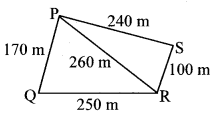
The shape of a farm is a quadrilateral. Measurements taken of the farm, by naming its corners as P, Q, R, S in order are as follows. l(PQ) = 170 m,
l(QR) = 250 m, l(RS) = 100 m, l(PS) = 240 m, l(PR) = 260 m.
Find the area of the field in hectare (1 hectare = 10,000 sq.m). [Chapter 15]
Solution:
Maharashtra Board Class 8 Maths Solutions Miscellaneous Exercise 2 10
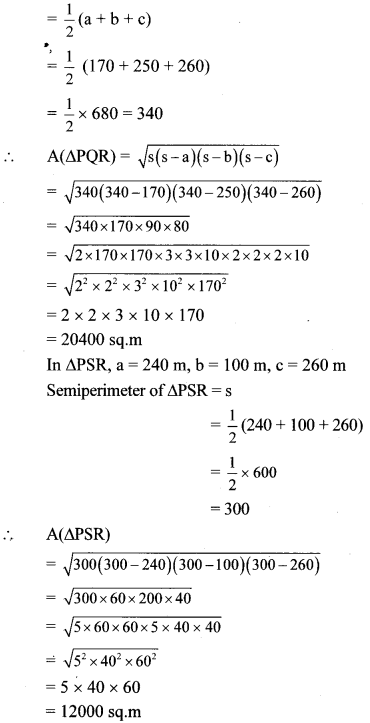
Area of the field = A(∆PQR) + A(∆PSR)
In ∆PQR, a = 170 m, b = 250 m, c = 260 m
Semiperimeter of ∆PQR = s
Maharashtra Board Class 8 Maths Solutions Miscellaneous Exercise 2 11
Area of the field = A(∆PQR) + A(∆PSR)
= 20400 + 12000
= 32400 sq.m
= \(\frac { 32400 }{ 10000 }\)
…[1 hectare = 10,000 sq.m]
= 3.24 hectares
∴ The area of the field is 3.24 hectares.

Question 12.
In a library, 50% of total number of books is of Marathi. The books of English are \(\frac { 1 }{ 3 }\) of Marathi books. The books on Mathematics are 25% of the English books. The remaining 560 books are of other subjects. What is the total number of books in the library? [Chapter 12]
Solution:
Let the total number of books in the library be x
50% of total number of books is of Marathi.
Number of Marathi books = 50% of x
= \(\frac { 50 }{ 100 }x\)
= \(\frac { x }{ 2 }\)
The books of English are \(\frac { 1 }{ 3 }\) of Marathi books.
Number of books of English = \(\frac{1}{3} \times \frac{x}{2}\)
= \(\frac { x }{ 6 }\)
The books on Mathematics are 25% of the English books.
Number of books of Mathematics
= 25% of \(\frac { x }{ 6 }\)
= \(\frac{25}{100} \times \frac{x}{6}\)
= \(\frac { x }{ 24 }\)
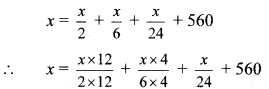
Since, there are 560 books of other subjects, the total number of books in the library are
Maharashtra Board Class 8 Maths Solutions Miscellaneous Exercise 2 12
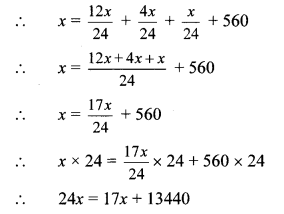
Maharashtra Board Class 8 Maths Solutions Miscellaneous Exercise 2 13
∴ 24x – 17x = 17x + 13440 – 17x
∴ 7x = 13440
∴ \(\frac{7 x}{7}=\frac{13440}{7}\)
∴ x = 1920
∴ The total number of books in the library are 1920.

Question 13.
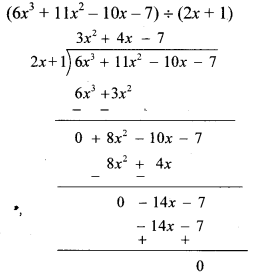
Divide the polynomial (6x³ + 11x² – 10x – 7) by the binomial (2x + 1). Write the quotient and the remainder. [Chapter 10]
Solution:
Maharashtra Board Class 8 Maths Solutions Miscellaneous Exercise 2 14
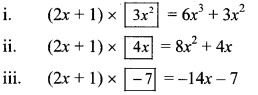
∴ Quotient = 3x² + 4x – 7,
remainder = 0
Explanation:
Maharashtra Board Class 8 Maths Solutions Miscellaneous Exercise 2 15

Maharashtra Board Class 8 Maths Solutions

Maharashtra Board 9th Class Maths Part 1 Problem Set 7 Solutions Chapter 7 Statistics

Balbharti Maharashtra State Board Class 9 Maths Solutions covers the Problem Set 7 Algebra 9th Class Maths Part 1 Answers Solutions Chapter 7 Statistics.

Problem Set 7 Algebra 9th Std Maths Part 1 Answers Chapter 7 Statistics

Question 1.
Write the correct alternative answer for each of the following questions.

i. Which of the following data is not primary ?
(A) By visiting a certain class, gathering information about attendance of students.
(B) By actual visit to homes, to find number of family members.
(C) To get information regarding plantation of soyabean done by each farmer from the village Talathi.
(D) Review the cleanliness status of canals by actually visiting them.
Answer:
(C) To get information regarding plantation of soyabean done by each farmer from the village Talathi.

ii. What is the upper class limit for the class 25 – 35?
(A) 25
(B) 35
(C) 60
(D) 30
Answer:
(B) 35

iii. What is the class-mark of class 25 – 35?
(A) 25
(B) 35
(C) 60
(D) 30
Answer:
(D) 30

iv. If the classes are 0 – 10, 10 – 20, 20 – 30, …, then in which class should the observation 10 be included?
(A) 0 – 10
(B) 10 – 20
(C) 0 – 10 and 10-20 in these 2 classes
(D) 20 – 30
Answer:
(B) 10 – 20

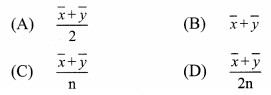
v. If \(\overline { x }\) is the mean of x1, x2, ……. , xn and \(\overline { y }\) is the mean of y1, y2, ….. yn and \(\overline { z }\) is the mean of x1,x2, …… , xn , y1, y2, …. yn , then z = ?
Maharashtra Board Class 9 Maths Solutions Chapter 7 Statistics Problem Set 7 1
Answer:
x1, x2, x3, ……. , xn
∴ \(\overline{x}=\frac{\sum x}{\mathrm{n}}\)
∴ n\(\overline{x}\) = ∑x
Similarly, n\(\overline{y}\) = ∑y
Now,
Maharashtra Board Class 9 Maths Solutions Chapter 7 Statistics Problem Set 7 2
\(\text { (A) } \frac{\overline{x}+\overline{y}}{2}\)

vi. The mean of five numbers is 50, out of which mean of 4 numbers is 46, find the 5th number.
(A) 4
(B) 20
(C) 434
(D) 66
Answer:
5th number = Sum of five numbers – Sum of four numbers
= (5 x 50) – (4 x 46)
= 250 – 184
= 66
(D) 66

vii. Mean of 100 observations is 40. The 9th observation is 30. If this is replaced by 70 keeping all other observations same, find the new mean.
(A) 40.6
(B) 40.4
(C) 40.3
(D) 40.7
Answer:
New mean = \(\frac { 4000-30+70 }{ 100 }\)
= 40.4
(B) 40.4

viii. What is the mode of 19, 19, 15, 20, 25, 15, 20, 15?
(A) 15
(B) 20
(C) 19
(D) 25
Answer:
(A) 15

ix. What is the median of 7, 10, 7, 5, 9, 10 ?
(A) 7
(B) 9
(C) 8
(D) 10
Answer:
(C) 8

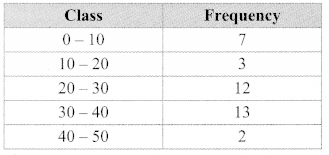
x. From following table, what is the cumulative frequency of less than type for the class 30 – 40?
Maharashtra Board Class 9 Maths Solutions Chapter 7 Statistics Problem Set 7 3
(A) 13
(B) 15
(C) 35
(D) 22
Answer:
Cumulative frequency of less than type for the class 30 – 40 = 7 + 3 + 12 + 13 = 35
(C) 35

Question 2.
The mean salary of 20 workers is ₹10,250. If the salary of office superintendent is added, the mean will increase by ₹ 750. Find the salary of the office superintendent.
Solution:
\( \text { Mean }=\frac{\text { The sum of all observations }}{\text { Total number of observations }}\)
∴ The sum of all observations = Mean x Total number of observations
The mean salary of 20 workers is ₹ 10,250.
∴ Sum of the salaries of 20 workers
= 20 x 10,250
= ₹ 2,05,000 …(i)
If the superintendent’s salary is added, then mean increases by 750
new mean = 10, 250 + 750 = 11,000
Total number of people after adding superintendent = 20 + 1 = 21
∴ Sum of the salaries including the superintendent’s salary = 21 x 11,000 = ₹ 2,31,000 …(ii)
∴ Superintendent salary = sum of the salaries including superintendent’s salary – sum of salaries of 20 workers
= 2, 31,00 – 2,05,000 …[From (i) and (ii)]
= 26,000
∴ The salary of the office superintendent is ₹ 26,000.

Question 3.
The mean of nine numbers is 77. If one more number is added to it, then the mean increases by 5. Find the number added in the data.
Solution:
∴ \( \text { Mean }=\frac{\text { The sum of all observations }}{\text { Total number of observations }}\)
∴ The sum of all observations = Mean x Total number of observations mean of nine numbers is 77
∴ sum of 9 numbers = 11 x 9 = 693 …(i)
If one more number is added, then mean increases by 5
mean of 10 numbers = 77 + 5 = 82
∴ sum of the 10 numbers = 82 x 10 = 820 …(ii)
∴ Number added = sum of the 10 numbers – sum of the 9 numbers = 820 – 693 … [From (i) and (ii)]
= 127
∴ The number added in the data is 127.

Question 4.
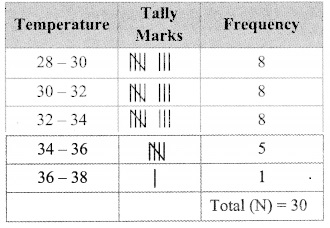
The monthly maximum temperature of a city is given in degree Celsius in the following data. By taking suitable classes, prepare the grouped frequency distribution table
29.2, 29.0, 28.1, 28.5, 32.9, 29.2, 34.2, 36.8, 32.0, 31.0, 30.5, 30.0, 33, 32.5, 35.5, 34.0, 32.9, 31.5, 30.3, 31.4, 30.3, 34.7, 35.0, 32.5, 33.5.29.0. 29.5.29.9.33.2.30.2
From the table, answer the following questions.
i. For how many days the maximum temperature was less than 34°C?
ii. For how many days the maximum temperature was 34°C or more than 34°C?
Solution:
Maharashtra Board Class 9 Maths Solutions Chapter 7 Statistics Problem Set 7 4
i. Number of days for which the maximum temperature was less than 34°C
= 8 + 8 + 8 = 24
ii. Number of days for which the maximum temperature was 34°C or more than 34°C
= 5 + 1 = 6
Question 5.
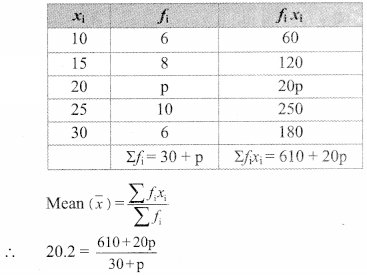
If the mean of the following data is 20.2, then find the value of p.
Maharashtra Board Class 9 Maths Solutions Chapter 7 Statistics Problem Set 7 5
Solution:
Maharashtra Board Class 9 Maths Solutions Chapter 7 Statistics Problem Set 7 6
∴ 20.2 (30 + p) = 610 + 20p
∴ 606 + 20.2p = 610 + 20p
∴ 20.2p – 20p = 610 – 606
∴ 0.2p = 4
∴ p = \(\frac { 4 }{ 0.2 }\) = \(\frac { 40 }{ 2 }\) = 20
∴ p = 20

Question 6.
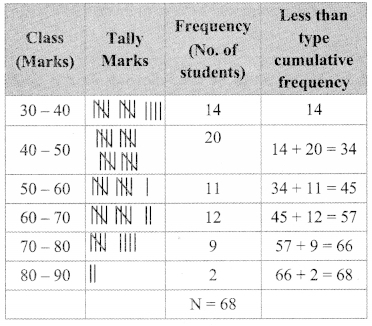
There are 68 students of 9th standard from Model Highschool, Nandpur. They have scored following marks out of 80, in written exam of mathematics.
70, 50, 60, 66, 45, 46, 38, 30, 40, 47, 56, 68,
80, 79, 39, 43, 57, 61, 51, 32, 42, 43, 75, 43,
36, 37, 61, 71, 32, 40, 45, 32, 36, 42, 43, 55,
56, 62, 66, 72, 73, 78, 36, 46, 47, 52, 68, 78,
80, 49, 59, 69, 65, 35, 46, 56, 57, 60, 36, 37,
45, 42, 70, 37,45, 66, 56, 47
By taking classes 30 – 40, 40 – 50, …. prepare the less than type cumulative frequency table. Using the table, answer the following questions:

i. How many students have scored marks less than 80?
ii. How many students have scored marks less than 40?
iii. How many students have scored marks less than 60?
Solution:
Class
Maharashtra Board Class 9 Maths Solutions Chapter 7 Statistics Problem Set 7 7
i. 66 students have scored marks less than 80.
ii. 14 students have scored marks less than 40.
iii. 45 students have scored marks less than 60.

Question 7.
By using data in example (6), and taking classes 30 – 40, 40 – 50,… prepare equal to or more than type cumulative frequency table and answer the following questions based on it.
i. How many students have scored marks 70 or more than 70?
ii. How many students have scored marks 30 or more than 30?
Solution:
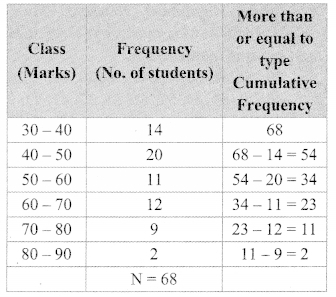
Maharashtra Board Class 9 Maths Solutions Chapter 7 Statistics Problem Set 7 8
i. 11 students have scored marks 70 or more than 70.
ii. 68 students have scored marks 30 or more than 30.

Question 8.
There are 10 observations arranged in ascending order as given below.
45, 47, 50, 52, JC, JC + 2, 60, 62, 63, 74. The median of these observations is 53.
Find the value of JC. Also find the mean and the mode of the data.
Solution:
i. Given data in ascending order:
45,47, 50, 52, x, JC+2, 60, 62, 63, 74.
∴ Number of observations (n) = 10 (i.e., even)
∴ Median is the average of middle two observations
Here, the 5th and 6th numbers are in the middle position.
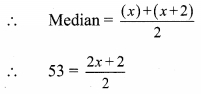
Maharashtra Board Class 9 Maths Solutions Chapter 7 Statistics Problem Set 7 9
∴ 106 = 2x + 2
∴ 106 – 2 = 2x
∴ 104 = 2x
∴ x = 52
∴ The given data becomes:
45, 47, 50, 52, 52, 54, 60, 62, 63, 74.

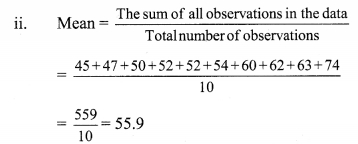
Maharashtra Board Class 9 Maths Solutions Chapter 7 Statistics Problem Set 7 10
∴ The mean of the given data is 55.9.

iii. Given data in ascending order:
45, 47, 50, 52, 52, 54, 60, 62, 63, 74.
∴ The observation repeated maximum number of times = 52
∴ The mode of the given data is 52.

Maharashtra Board Class 9 Maths Chapter 7 Statistics Problem Set 7 Intext Questions and Activities

Question 1.
To show following information diagrammatically, which type of bar- diagram is suitable?
i. Literacy percentage of four villages.
ii. The expenses of a family on various items.
iii. The numbers of girls and boys in each of five divisions.
iv. The number of people visiting a science exhibition on each of three days.
v. The maximum and minimum temperature of your town during the months from January to June.
vi. While driving a two-wheeler, number of people wearing helmets and not wearing helmet in 100 families.
(Textbook pg. no. 112)
Solution:
i. Percentage bar diagram
ii. Sub-divided bar diagram
iii. Sub-divided bar diagram
iv. Sub-divided bar diagram
v. Sub-divided bar diagram
vi. Sub-divided bar diagram

Question 2.
You gather information for several reasons. Take a few examples and discuss whether the data is primary or secondary.
(Textbook pg. no, 113)
[Students should attempt the above activity on their own.]

Maharashtra Board 9th Class Maths Part 1 Practice Set 7.5 Solutions Chapter 7 Statistics

Balbharti Maharashtra State Board Class 9 Maths Solutions covers the Practice Set 7.5 Algebra 9th Class Maths Part 1 Answers Solutions Chapter 7 Statistics.

Practice Set 7.5 Algebra 9th Std Maths Part 1 Answers Chapter 7 Statistics

Question 1.
Yield of soyabean per acre in quintal in Mukund’s field for 7 years was 10, 7, 5,3, 9, 6, 9. Find the mean of yield per acre.
Solution:
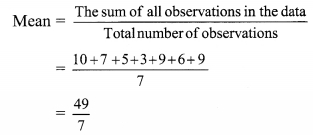
Maharashtra Board Class 9 Maths Solutions Chapter 7 Statistics Practice Set 7.5 1
Mean = 7
The mean of yield per acre is 7 quintals.

Question 2.
Find the median of the observations, 59, 75, 68, 70, 74, 75, 80.
Solution:
Given data in ascending order:
59, 68, 70, 74, 75, 75, 80
∴ Number of observations(n) = 7 (i.e., odd)
∴ Median is the middle most observation
Here, 4th number is at the middle position, which is = 74
∴ The median of the given data is 74.

Question 3.
The marks (out of 100) obtained by 7 students in Mathematics examination are given below. Find the mode for these marks.
99, 100, 95, 100, 100, 60, 90
Solution:
Given data in ascending order:
60, 90, 95, 99, 100, 100, 100
Here, the observation repeated maximum number of times = 100
∴ The mode of the given data is 100.

Question 4.
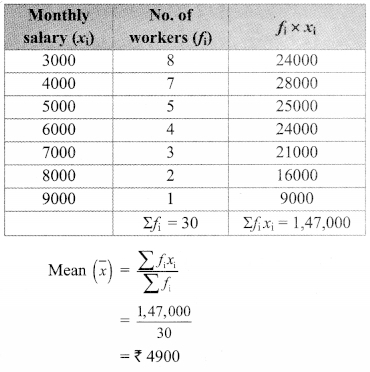
The monthly salaries in rupees of 30 workers in a factory are given below.
5000, 7000, 3000, 4000, 4000, 3000, 3000,
3000, 8000, 4000, 4000, 9000, 3000, 5000,
5000, 4000, 4000, 3000, 5000, 5000, 6000,
8000, 3000, 3000, 6000, 7000, 7000, 6000,
6000, 4000
From the above data find the mean of monthly salary.
Solution:
Maharashtra Board Class 9 Maths Solutions Chapter 7 Statistics Practice Set 7.5 2
∴ The mean of monthly salary is ₹ 4900.

Question 5.
In a basket there are 10 tomatoes. The weight of each of these tomatoes in grams is as follows:
60, 70, 90, 95, 50, 65, 70, 80, 85, 95.
Find the median of the weights of tomatoes.
Solution:
Given data in ascending order:
50, 60, 65, 70, 70, 80 85, 90, 95, 95
∴ Number of observations (n) = 10 (i.e., even)
∴ Median is the average of middle two observations
Here, 5th and 6th numbers are in the middle position
∴ Median = \(\frac { 70+80 }{ 2 }\)
∴ Median = \(\frac { 150 }{ 2 }\)
∴ The median of the weights of tomatoes is 75 grams.

Question 6.
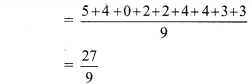
A hockey player has scored following number of goals in 9 matches: 5, 4, 0, 2, 2, 4, 4, 3,3.
Find the mean, median and mode of the data.
Solution:
i. Given data: 5, 4, 0, 2, 2, 4, 4, 3, 3.
Total number of observations = 9
Maharashtra Board Class 9 Maths Solutions Chapter 7 Statistics Practice Set 7.5 3
Maharashtra Board Class 9 Maths Solutions Chapter 7 Statistics Practice Set 7.5 4
∴ The mean of the given data is 3.

ii. Given data in ascending order:
0,2, 2, 3, 3, 4, 4, 4,5
∴ Number of observations(n) = 9 (i.e., odd)
∴ Median is the middle most observation
Here, the 5th number is at the middle position, which is 3.
∴ The median of the given data is 3.

iii. Given data in ascending order:
0,2, 2, 3, 3, 4, 4, 4,5
Here, the observation repeated maximum number of times = 4
∴ The mode of the given data is 4.

Question 7.
The calculated mean of 50 observations was 80. It was later discovered that observation 19 was recorded by mistake as 91. What Was the correct mean?
Solution:
Here, mean = 80, number of observations = 50
\( \text { Mean }=\frac{\text { The sum of all observations }}{\text { Total number of observations }}\)
∴ The sum of all observations = Mean x Total number of observations
∴ The sum of 50 observations = 80 x 50
= 4000
One of the observation was 19. However, by mistake it was recorded as 91.
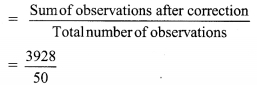
Sum of observations after correction = sum of 50 observation + correct observation – incorrect observation
= 4000 + 19 – 91
= 3928
∴ Corrected mean
Maharashtra Board Class 9 Maths Solutions Chapter 7 Statistics Practice Set 7.5 5
= 78.56
∴ The corrected mean is 78.56.

Question 8.
Following 10 observations are arranged in ascending order as follows. 2, 3 , 5 , 9, x + 1, x + 3, 14, 16, 19, 20. If the median of the data is 11, find the value of x.
Solution:
Given data in ascending order :
2, 3, 5, 9, x + 1, x + 3, 14, 16, 19, 20.
∴ Number if observations (n) = 10 (i.e., even)
∴ Median is the average of middle two observations
Here, the 5th and 6th numbers are in the middle position.
∴ \( \text { Median }=\frac{(x+1)+(x+3)}{2}\)
∴ 11 = \(\frac { 2x+4 }{ 2 }\)
∴ 22 = 2x + 4
∴ 22 – 4 = 2x
∴ 18 = 2x
∴ x = 9

Question 9.
The mean of 35 observations is 20, out of which mean of first 18 observations is 15 and mean of last 18 observations is 25. Find the 18th observation.
Solution:
\( \text { Mean }=\frac{\text { The sum of all observations }}{\text { Total number of observations }}\)
∴ The sum of all observations
= Mean x Total number of observations
The mean of 35 observations is 20
∴ Sum of 35 observations = 20 x 35 = 700 ,..(i)
The mean of first 18 observations is 15
Sum of first 18 observations =15 x 18
= 270 …(ii)
The mean of last 18 observations is 25 Sum of last 18 observations = 25 x 18
= 450 …(iii)
∴ 18th observation = (Sum of first 18 observations + Sum of last 18 observations) – (Sum of 35 observations)
= (270 + 450) – (700) … [From (i), (ii) and (iii)]
= 720 – 700 = 20
The 18th observation is 20.

Question 10.
The mean of 5 observations is 50. One of the observations was removed from the data, hence the mean became 45. Find the observation which was removed.
Solution:
\( \text { Mean }=\frac{\text { The sum of all observations }}{\text { Total number of observations }}\)
∴ The sum of all observations = Mean x Total number of observations
The mean of 5 observations is 50
Sum of 5 observations = 50 x 5 = 250 …(i)
One observation was removed and mean of remaining data is 45.
Total number of observations after removing one observation = 5 – 1 = 4
Now, mean of 4 observations is 45.
∴ Sum of 4 observations = 45 x 4 = 180 …(ii)
∴ Observation which was removed
= Sum of 5 observations – Sum of 4 observations = 250 – 180 … [From (i) and (ii)]
= 70
∴ The observation which was removed is 70.

Question 11.
There are 40 students in a class, out of them 15 are boys. The mean of marks obtained by boys is 33 and that for girls is 35. Find out the mean of all students in the class.
Solution:
Total number of students = 40
Number of boys =15
∴ Number of girls = 40 – 15 = 25
The mean of marks obtained by 15 boys is 33
Here, sum of the marks obtained by boys
= 33 x 15
= 495 …(i)
The mean of marks obtained by 25 girls is 35 Sum of the marks obtained by girls = 35 x 25
= 875 …(ii)
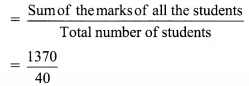
Sum of the marks obtained by boys and girls = 495 + 875 … [From (i) and (ii)]
= 1370
∴ Mean of all the students
Maharashtra Board Class 9 Maths Solutions Chapter 7 Statistics Practice Set 7.5 6
= 34.25
∴ The mean of all the students in the class is 34.25.

Question 12.
The weights of 10 students (in kg) are given below:
40, 35, 42, 43, 37, 35, 37, 37, 42, 37. Find the mode of the data.
Solution:
Given data in ascending order:
35, 35, 37, 37, 37, 37, 40, 42, 42, 43
∴ The observation repeated maximum number of times = 37
∴ Mode of the given data is 37 kg

Question 13.
In the following table, the information is given about the number of families and the siblings in the families less than 14 years of age. Find the mode of the data.
Maharashtra Board Class 9 Maths Solutions Chapter 7 Statistics Practice Set 7.5 7
Solution:
Here, the maximum frequency is 25.
Since, Mode = observations having maximum frequency
∴ The mode of the given data is 2.

Question 14.
Find the mode of the following data.
Maharashtra Board Class 9 Maths Solutions Chapter 7 Statistics Practice Set 7.5 8
Solution:
Here, the maximum frequency is 9.
Since, Mode = observations having maximum frequency
But, this is the frequency of two observations.
∴ Mode = 35 and 37

Maharashtra Board Class 9 Maths Chapter 7 Statistics Practice Set 7.5 Intext Questions and Activities

Question 1.
The first unit test of 40 marks was conducted for a class of 35 students. The marks obtained by the students were as follows. Find the mean of the marks.
40, 35, 30, 25, 23, 20, 14, 15, 16, 20, 17, 37, 37, 20, 36, 16, 30, 25, 25, 36, 37, 39, 39, 40, 15, 16, 17, 30, 16, 39, 40, 35, 37, 23, 16.
(Textbook pg, no. 123)
Solution:
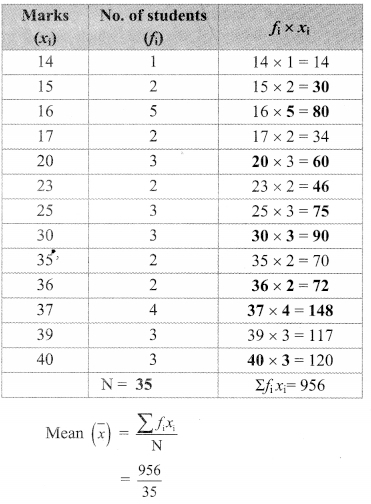
Here, we can add all observations, but it will be a tedious job. It is easy to make frequency distribution table to calculate mean.
Maharashtra Board Class 9 Maths Solutions Chapter 7 Statistics Practice Set 7.5 9
= 27.31 marks (approximately)
∴ The mean of the mark is 27.31.

Maharashtra Board 10th Class Maths Part 1 Problem Set 3 Solutions Chapter 3 Arithmetic Progression

Balbharti Maharashtra State Board Class 10 Maths Solutions covers the Problem Set 3 Algebra 10th Class Maths Part 1 Answers Solutions Chapter 3 Arithmetic Progression.

Problem Set 3 Algebra 10th Std Maths Part 1 Answers Chapter 3 Arithmetic Progression

Question 1.
Choose the correct alternative answer for each of the following sub questions.

i. The sequence – 10,- 6,- 2, 2, …
(A) is an A.P. Reason d = – 16
(B) is an A.P. Reason d = 4
(C) is an A.P. Reason d = – 4
(D) is not an A.P.
Answer:
(B)

ii. First four terms of an A.P. are …, whose first term is -2 and common difference is -2.
(A) -2, 0, 2, 4
(B) -2, 4,- 8, 16
(C) -2, -4, -6, -8
(D) -2,-4, -8, -16
Answer:
(C)

iii. What is the sum of the first 30 natural numbers?
(A) 464
(B) 465
(C) 462
(D) 461
Answer:
(B)

iv. For an given A.P. t7 = 4, d = – 4, then a = ………
(A) 6
(B) 7
(C) 20
(D) 28
Answer:
(D)

v. For an given A.P. a = 3.5, d = 0, n = 101, then tn = ….
(A) 0
(B) 3.5
(c) 103.5
(D) 104.5
Answer:
(B)

vi. In an A.P. first two terms are – 3, 4, then 21st term is ….
(A) -143
(B) 143
(C) 137
(D) 17
Answer:
(C)

vii. If for any A.P. d = 5, then t18 – t13 = ….
(A) 5
(B) 20
(C) 25
(D) 30
Answer:
(C)

viii. Sum of first five multiples of 3 is …
(A) 45
(B) 55
(C) 15
(D) 75
Answer:
(A)

ix. 15, 10, 5, … In this A.P. sum of first 10 terms is…
(A) -75
(B) -125
(C) 75
(D) 125
Answer:
(A)

x. In an A.P. 1st term is 1 and the last term is 20. The sum of all terms is 399, then n = ….
(A) 42
(B) 38
(C) 21
(D) 19
Answer:
(B)

Hints:
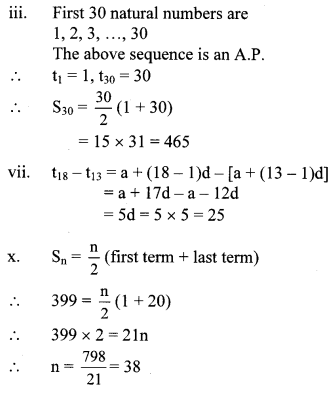
Maharashtra Board Class 10 Maths Solutions Chapter 3 Arithmetic Progression Problem Set 3 1

Question 2.
Find the fourth term from the end in an
A.P.: -11, -8, -5, …, 49.
Solution:
The given A.P. is
-11,-8,-5, ……. 49
Reversing the A.P., we get 49, …, -5, -8, -11
Here, a = 49, d = -11 -(-8) = -11 + 8 = -3
Since, tn = a + (n – 1)d
∴ t4 = 49 + (4 – 1)(-3)
= 49 + (3) (-3)
= 49 – 9
= 40
∴ Fourth term from the end in the given A.P. is 40.
[Note: If an AY. is reversed, then the resulting sequence is also an A.P.]

Question 3.
In an A.P. the 10th term is 46, sum of the 5th and 7th term is 52. Find the A.P.
Solution:
For an A.P., let a be the first term and d be the common difference.
t10 = 46, t5 + t7 = 52 …[Given]
Since, tn = a + (n – 1)d
∴ t10 = a + (10 – 1)d
∴ 46 = a + 9d
i. e. a + 9d = 46 …(i)
Also, t5 + t7 = 52
∴ a + (5 – 1)d + a + (7 – 1)d = 52
∴ a + 4d + a + 6d = 52
∴ 2a + 10d = 52
∴ 2 (a + 5d) = 52
∴ a + 5d = \(\frac { 52 }{ 2 } \)
∴ a + 5d = 26 …(ii)
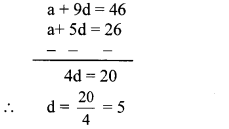
Subtracting equation (ii) from (i), we get
Maharashtra Board Class 10 Maths Solutions Chapter 3 Arithmetic Progression Problem Set 3 2
Substituting d = 5 in equation (ii), we get
a + 5(5) = 26
∴ a + 25 = 26
∴ a = 26 – 25 = 1
t1 = a = 1
t2 = t1 + d = 1 + 5 = 6

t3 = t2 + d = 6 + 5 = 11
t4 = t3 + d = 11 + 5 = 16
The required A.P. is 1,6,11,16,….

Question 4.
The A.P. in which 4th term is -15 and 9th term is -30. Find the sum of the first 10 numbers.
Solution:
t4 = -15, t9 = – 30 …[Given]
Since, tn = a + (n – 1)d
∴ t4 = a + (4 – 1)d
∴ – 15 = a + 3d
i. e. a + 3d = -15 …(i)
Also, t9 = a + (9 – 1)d
∴ -30 = a + 8d
i.e. a + 8d = -30 …(ii)
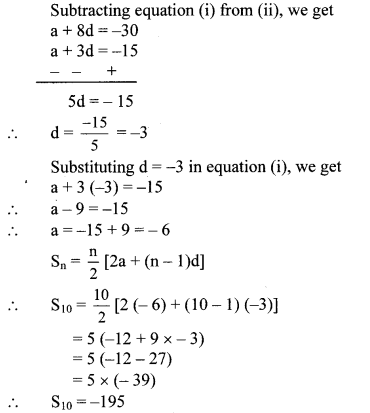
Maharashtra Board Class 10 Maths Solutions Chapter 3 Arithmetic Progression Problem Set 3 3
∴ The sum of the first 10 numbers is -195.

Question 5.
Two given A.P.’s are 9, 7, 5, … and 24, 21, 18, … If nth term of both the .progressions are equal then find the value of n and n,h term.
Solution:
The first A.P. is 9, 7, 5,…
Here, a = 9, d = 7- 9 = -2
∴nth term = a + (n – 1)d
= 9 + (n – 1) (-2)
= 9 – 2n + 2
= 11 – 2n
The second A.P. is 24, 21, 18, …
Here, a = 24, d = 21 – 24 = – 3
∴ nth term = a + (n – 1)d
= 24 + (n – 1) (-3)
= 24 – 3n + 3
= 27 – 3n
Since, the nth terms of the two A.P.’s are equal.
∴ 11 – 2n = 27 – 3n
∴ 3n – 2n = 27 – 11
∴ n = 16
∴ t16 = 9 + (16 – 1) (-2)
= 9 + 15 × (-2)
= 9 – 30
∴ t16 = -21
∴ The values of n and nth term are 16 and -21 respectively.

Question 6.
If sum of 3rd and 8th terms of an A.P. is 7 and sum of 7th and 14th terms is -3, then find the 10th term.
Solution:
for an A.P., let a be the first term and d be the common difference.
According to the first condition,
t3 + tg = 7
∴ a + (3 – 1) d + a + (8 – 1)d = 7 …[∵ tn = a + (n – 1)d]
∴ a + 2d + a + 7d = 7
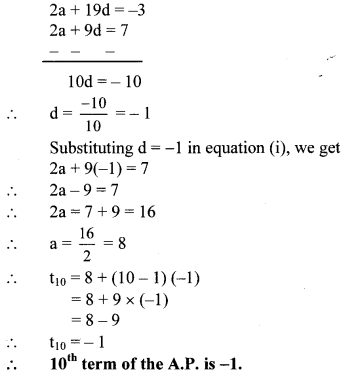
∴ 2a + 9d = 7 …(i)
According to the second condition,
t7 + t14 = -3
∴ a + (7 – 1)d + a + (14 – 1 )d = -3
∴ a + 6d + a + 13d = -3
∴ 2a + 19 d = – 3 …(ii)
Subtracting equation (i) from (ii), we get
Maharashtra Board Class 10 Maths Solutions Chapter 3 Arithmetic Progression Problem Set 3 4

Question 7.
In an A.P. the first term is -5 and last term is 45. If sum of all numbers in the A.P. is 120, then how many terms are there? What is the common difference?
Solution:
Let the number of terms in the A.P. be n and the common difference be d.
Then, a = -5, tn = 45, Sn = 120
Since, tn = a + (n – 1)d
∴ 45 = -5 + (n – 1)d
∴ 45 + 5 = (n – 1)d
∴ (n – 1)d = 50 …(i)
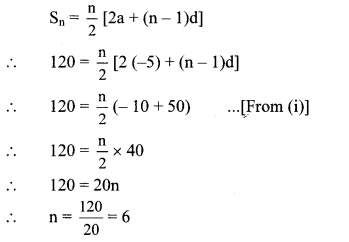
Maharashtra Board Class 10 Maths Solutions Chapter 3 Arithmetic Progression Problem Set 3 5
Substituting n = 6 in equation (i), we get
(6 – 1)d = 50
∴ 5d = 50
∴ d = \(\frac { 50 }{ 5 } \) = 10
∴ There are 6 terms in the A.P. and the common difference is 10.

Alternate Method:
Let the number of terms in the A.P. be n.
Then, t1 = a = -5, tn = 45, Sn = 120
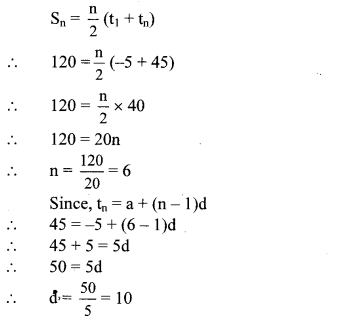
Maharashtra Board Class 10 Maths Solutions Chapter 3 Arithmetic Progression Problem Set 3 6
∴ There are 6 terms in the A.P. and the common difference is 10.

Question 8.
Sum of 1 to n natural numbers is 36, then find the value of n.
Solution:
The natural numbers from 1 to n are
1,2, 3, ……, n.
The above sequence is an A.P.
∴ a = 1, d = 2 – 1 = 1
Sn = 36 …[Given]
Now, Sn = \(\frac { n }{ 2 } \) [2a + (n – 1)d]
∴ 36 = \(\frac { n }{ 2 } \) [2(1) + (n – 1)(1)]
∴ 36 = \(\frac { n }{ 2 } \) (2 + n – 1)
∴ 36 × 2 = n (n + 1)
∴ 72 = n (n + 1)
∴ 72 = n2 + n
∴ n2 + n – 72 = 0
∴ n2 + 9n – 8n – 72 = 0
∴ n(n + 9) – 8 (n + 9) = 0
∴ (n + 9) (n – 8) = 0
∴ n + 9 = 0 or n – 8 = 0
∴ n = -9 or n = 8
But, n cannot be negative.
∴ n = 8
∴ The value of n is 8.

Question 9.
Divide 207 in three parts, such that all parts are in A.P. and product of two smaller parts will be 4623.
Solution:
Let the three parts of 207 that are in A.P. be
a – d, a, a + d
According to the first condition,
(a – d) + a + (a + d) = 207
∴ 3a = 207
∴ a = \(\frac { 207 }{ 3 } \)
∴ a = 69 …(i)
According to the second condition,
(a – d) × a = 4623
∴ (69 – d) × 69 = 4623 …[From (i)]
∴ 69 – d = \(\frac { 4623 }{ 69 } \)
∴ d = 69 – 67
∴ d = 2
∴ a – d = 69 – 2 = 67
a = 69
a + d = 69 + 2 = 71
∴ The three parts of 207 that are in A.P. are 67, 69 and 71.

Question 10.
There are 37 terms in an A.P., the sum of three terms placed exactly at the middle is 225 and the sum of last three terms is 429. Write the A.P.
Solution:
Since, there are 37 terms in the A.P.
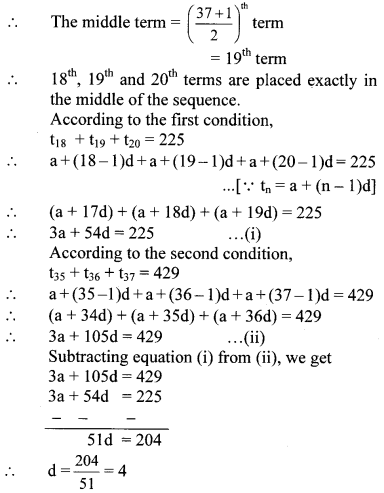
Maharashtra Board Class 10 Maths Solutions Chapter 3 Arithmetic Progression Problem Set 3 7
Substituting d = 4 in equation (i), we get
3a + 54(4) = 225
∴ 3a + 216 = 225
∴ 3a = 225 – 216
∴ 3a = 9
∴ a = \(\frac { 9 }{ 3 } \) = 3
∴The required A. P. is
a, a + d, a + 2d, a + 3d, …., a + (n – 1)d
i.e. 3, 3 + 4,3 + 2 × 4, 3 + 3 × 4,…, 3 + (37 – 1)4
i.e. 3, 7,11,15, …,147

Question 11.
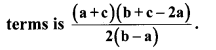
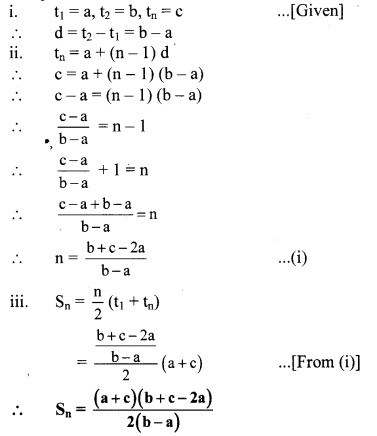
If first term of an A.P. is a, second term is b and last term is c, then show that sum of all
Maharashtra Board Class 10 Maths Solutions Chapter 3 Arithmetic Progression Problem Set 3 8
Solution:
Maharashtra Board Class 10 Maths Solutions Chapter 3 Arithmetic Progression Problem Set 3 9

Question 12.
If the sum of first p terms of an A.P. is equal to the sum of first q terms then show that the sum of its first (p + q) terms is zero, (p ≠ q)
Solution:
For an A.P., let a be the first term and d be the common difference.
The sum of first n terms of an A.P. is given by
Sn = [2a + (n – 1)d]
According to the given condition,
Sp = Sq
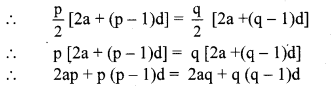
Maharashtra Board Class 10 Maths Solutions Chapter 3 Arithmetic Progression Problem Set 3 10
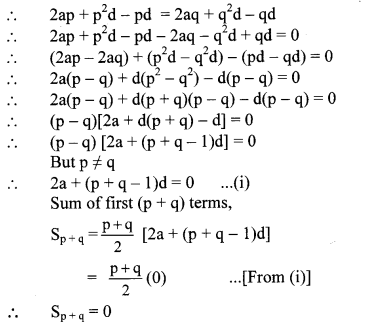
Maharashtra Board Class 10 Maths Solutions Chapter 3 Arithmetic Progression Problem Set 3 11
∴ The sum of the first (p + q) terms is zero

Question 13.
If m times the mth term of an A.P. is equal to n times nth term, then show that the (m + n)th term of the A.P. is zero.
Solution:
According to the given condition,
mtm = ntn
∴ m[a + (m – 1)d] = n[a + (n – 1)d]
∴ ma + md(m – 1) = na + nd(n- 1)
∴ ma + m2d – md = na + n2d – nd
∴ ma + m2d – md – na – n2d + nd = 0
∴ (ma – na) + (m2d – n2d) – (md – nd) = 0
∴ a(m – n) + d(m2 – n2) – d(m – n) = 0
∴ a(m – n) + d(m + n) (m – n) – d(m – n) = 0
∴ (m – n)[a + (m + n – 1) d] = 0
∴ [a+ (m + n – 1)d] = 0 …[Dividing both sides by (m – n)]
∴ t(m+n) = 0
∴ The (m + n)th term of the A.P. is zero.

Question 14.
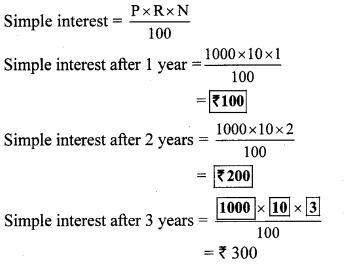
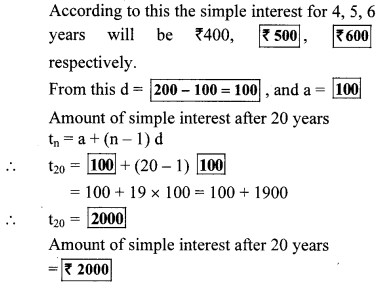
₹ 1000 is invested at 10 percent simple interest. Check at the end of every year if the total interest amount is in A.P. If this is an A.P. then find interest amount after 20 years. For this complete the following activity.
Solution:
Maharashtra Board Class 10 Maths Solutions Chapter 3 Arithmetic Progression Problem Set 3 12
Maharashtra Board Class 10 Maths Solutions Chapter 3 Arithmetic Progression Problem Set 3 13

Maharashtra Board 9th Class Maths Part 1 Practice Set 7.4 Solutions Chapter 7 Statistics

Balbharti Maharashtra State Board Class 9 Maths Solutions covers the Practice Set 7.4 Algebra 9th Class Maths Part 1 Answers Solutions Chapter 7 Statistics.

Practice Set 7.4 Algebra 9th Std Maths Part 1 Answers Chapter 7 Statistics

Question 1.
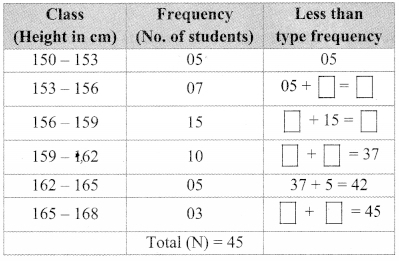
Complete the following cumulative frequency table:
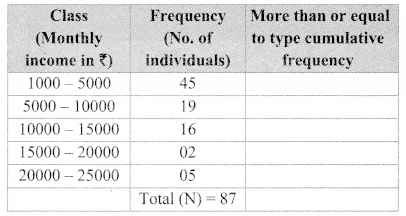
Maharashtra Board Class 9 Maths Solutions Chapter 7 Statistics Practice Set 7.4 1
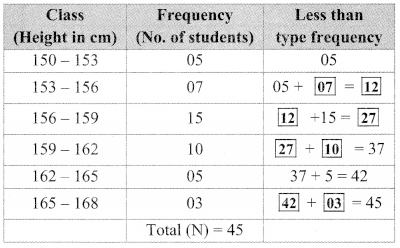
Solution:
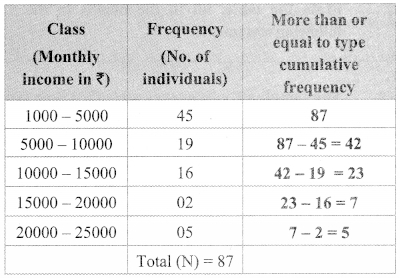
Maharashtra Board Class 9 Maths Solutions Chapter 7 Statistics Practice Set 7.4 2

Question 2.
Complete the following Cumulative Frequency Table:
Maharashtra Board Class 9 Maths Solutions Chapter 7 Statistics Practice Set 7.4 3
Solution:
Maharashtra Board Class 9 Maths Solutions Chapter 7 Statistics Practice Set 7.4 4

Question 3.
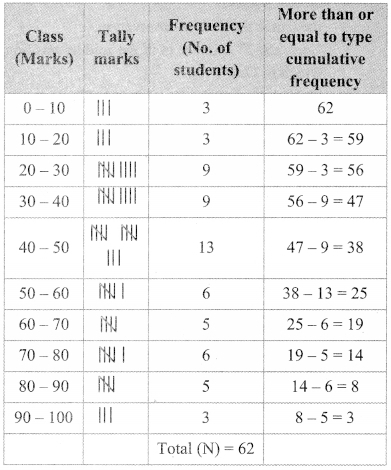
The data is given for 62 students in a certain class regarding their mathematics marks out of 100. Take the classes 0 – 10, 10 – 20,… and prepare frequency distribution
table and cumulative frequency table more than or equal to type.
55. 60, 81, 90, 45, 65, 45, 52, 30, 85, 20, 10,
75, 95, 09, 20, 25, 39, 45, 50, 78, 70, 46, 64,
42. 58. 31, 82, 27, 11, 78, 97, 07, 22, 27, 36,
35, 40, 75, 80, 47, 69, 48, 59, 32, 83, 23, 17,
77, 45, 05, 23, 37, 38, 35, 25, 46, 57, 68, 45.
47,49
From the prcparcd table, answer the following questions :
i. How many students obtained marks 40 or above 40?
ii. How many students obtained marks 90 or above 90?
iii. How many students obtained marks 60 or above 60?
iv. What is the cumulative frequency of equal to or more than type of the class 0 – 10?
Solution:
Maharashtra Board Class 9 Maths Solutions Chapter 7 Statistics Practice Set 7.4 5
i. 38 students obtained marks 40 or above 40.
ii. 3 students obtained marks 90 or above 90.
iii. 19 students obtained marks 60 or above 60.
iv. Cumulative frequency of equal to or more than type of the class 0 – 10 is 62.

Question 4.
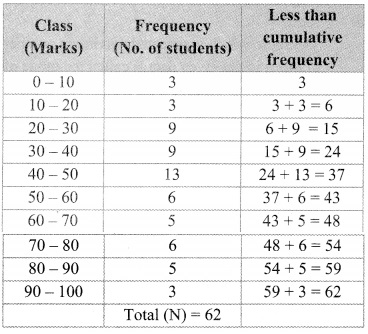
Using the data In example (3) above, prepare less than type cumulative frequency table and answer the following questions.
i. How many students obtained less than 40 marks?
ii. How many students obtained less than 10 marks?
iii. How many students obtained less than 60 marks?
iv. Find the cumulative frequency of the class 50 – 60.
Solution:
Maharashtra Board Class 9 Maths Solutions Chapter 7 Statistics Practice Set 7.4 6
i. 24 students obtained less than 40 marks.
ii. 3 students obtained less than 10 marks.
iii. 43 students obtained less than 60 marks.
iv. Cumulative frequency of the class 50 – 60 is 43.

Maharashtra Board Class 9 Maths Chapter 7 Statistics Practice Set 7.4 Intext Questions and Activities

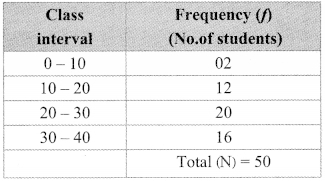
Question 1.
The following information is regarding marks in mathematics, obtained out of 40, scored by 50 students of 9th std. ¡n the first unit test. (Textbook pg. no. 120)
Maharashtra Board Class 9 Maths Solutions Chapter 7 Statistics Practice Set 7.4 7
From the table, fill in the blanks in the following statements.
i. For class interval 10 – 20 the lower class limit is _____ and upper class limit is _____
ii. How many students obtained marks less than 10? 2
iii. How many students obtained marks less than 20? 2 + ____ = 14
iv. How many students obtained marks less than 30? ______ + _____ = 34
v. How many students obtained marks less than 40? ______ + ______ =50
Solution:
i. 10, 20
iii. 12
iv. 14 + 20
v. 34 + 16

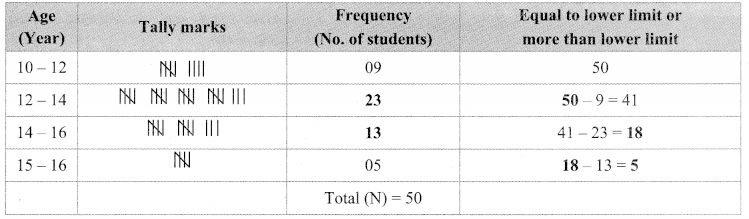
Question 2.
A sports club has organised a table-tennis tournaments. The following table gives the distribution of players ages. Find the cumulative frequencies equal to or more than the lower class limit and complete the table (Textbook pg. no. 121)
Solution:
Equal to lower limit or more than lower limit type of cumulative table.
Maharashtra Board Class 9 Maths Solutions Chapter 7 Statistics Practice Set 7.4 8

Maharashtra Board 9th Class Maths Part 1 Practice Set 7.3 Solutions Chapter 7 Statistics

Balbharti Maharashtra State Board Class 9 Maths Solutions covers the Practice Set 7.3 Algebra 9th Class Maths Part 1 Answers Solutions Chapter 7 Statistics.

Practice Set 7.3 Algebra 9th Std Maths Part 1 Answers Chapter 7 Statistics

Question 1.
For class interval 20 – 25 write the lower class limit and the upper class limit.
Answer:
Lower class limit = 20
Upper class limit = 25

Question 2.
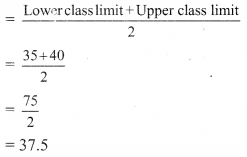
Find the class-mark of the class 35-40.
Solution:
Class-mark
Maharashtra Board Class 9 Maths Solutions Chapter 7 Statistics Practice Set 7.3 1
∴ Class-mark of the class 35 – 40 is 37.5

Question 3.
If class-mark is 10 and class width is 6, then find the class.
Solution:
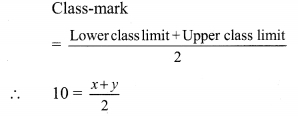
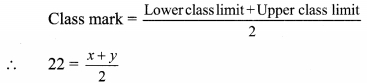
Let the upper class limit be x and the lower class limit be y.
Class mark = 10 …[Given]
Class-mark
Maharashtra Board Class 9 Maths Solutions Chapter 7 Statistics Practice Set 7.3 2
∴ x + y = 20 …(i)
Class width = 6 … [Given]
Class width = Upper class limit – Lower class limit
∴ x – y = 6 …(ii)
Adding equations (i) and (ii),
x + y = 20
x – y = 6
2x = 26
∴ x = 13
Substituting x = 13 in equation (i),
13 + y = 20
∴ y = 20 – 13
∴ y = 7
∴ The required class is 7 – 13.

Question 4.
Complete the following table.
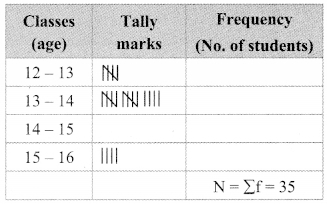
Maharashtra Board Class 9 Maths Solutions Chapter 7 Statistics Practice Set 7.3 3
Solution:
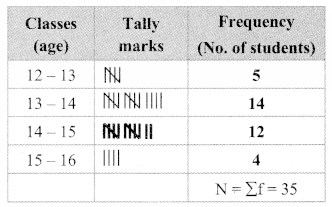
Let frequency of the class 14 – 15 be x then, from table,
5 + 14 + x + 4 = 35
∴ 23 + x = 35
∴ x = 35 – 23
∴ x = 12
Maharashtra Board Class 9 Maths Solutions Chapter 7 Statistics Practice Set 7.3 4

Question 5.
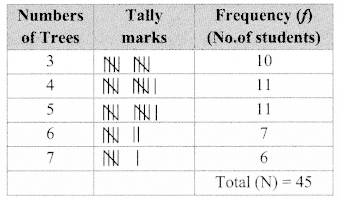
In a ‘tree plantation’ project of a certain school there are 45 students of ‘Harit Sena.’ The record of trees planted by each student is given below:
3, 5, 7, 6, 4, 3, 5, 4, 3, 5, 4, 7, 5, 3, 6, 6, 5, 3, 4, 5, 7, 3, 5, 6, 4, 4, 3, 5, 6, 6, 4, 3, 5 ,7, 3, 4, 5, 7, 6, 4, 3, 5, 4, 4, 7.
Prepare a frequency distribution table of the data.
Solution:
Maharashtra Board Class 9 Maths Solutions Chapter 7 Statistics Practice Set 7.3 5

Question 6.
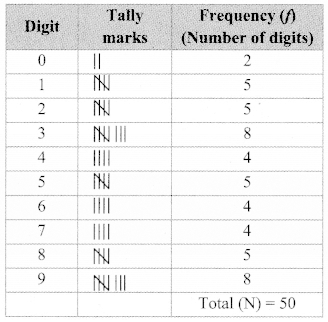
The value of n upto 50 decimal places is given below:
3.14159265358979323846264338327950288419716939937510
From this information prepare an ungrouped frequency distribution table of digits appearing after the decimal point.
Solution:
Maharashtra Board Class 9 Maths Solutions Chapter 7 Statistics Practice Set 7.3 6

Question 7.
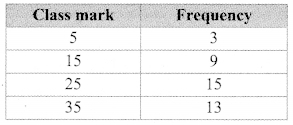
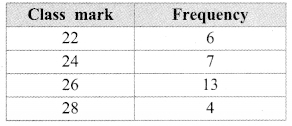
In the tables given below, class-mark and frequencies is given. Construct the frequency tables taking inclusive and exclusive classes.
i.
Maharashtra Board Class 9 Maths Solutions Chapter 7 Statistics Practice Set 7.3 7
ii.
Maharashtra Board Class 9 Maths Solutions Chapter 7 Statistics Practice Set 7.3 8
Solution:
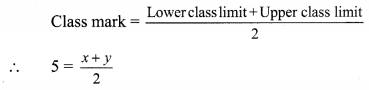
i. Let the Lower class limit and upper class limit of the class mark 5 be x and y respectively.
Maharashtra Board Class 9 Maths Solutions Chapter 7 Statistics Practice Set 7.3 9
∴x + y = 10
Here, class width = 15 – 5 = 10
But, Class width = Upper class limit – Lower class limit
∴ y – x = 10
∴ -x + y = 10 …(ii)
Adding equations (i) and (ii),
x+ y = 10
-x + y = 10
∴ 2y = 20
∴ y = 10
Substituting y = 10 in equation (i),
∴ x + 10 = 10
∴ x = 0
∴ class with class-mark 5 is 0 – 10
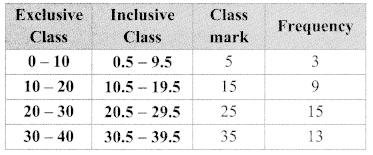
Similarly, we can find the remaining classes.
∴ frequency table taking inclusive and exclusive classes.
Maharashtra Board Class 9 Maths Solutions Chapter 7 Statistics Practice Set 7.3 10

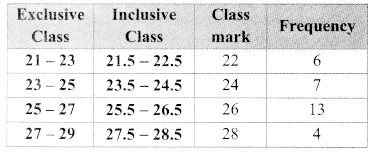
ii. Let the lower class limit and upper class limit of the class mark 22 be x andy respectively.
Maharashtra Board Class 9 Maths Solutions Chapter 7 Statistics Practice Set 7.3 11
∴ x + y = 44 …(i)
Here, class width = 24 – 22 = 2
But, Class width = Upper class limit – Lower class limit
∴ y – x = 2
∴ -x + y = 2 …. (ii)
Adding equations (i) and (ii),
x + y = 44
– x + y= 2
2y = 46
∴ y = 23
Substituting y = 23 in equation (i),
∴ x + 23 = 44
∴ x = 21
∴ class with class-mark 22 is 21 – 23
Similarly, we can find the remaining classes
∴ frequency table taking inclusive and exclusive classes.
Maharashtra Board Class 9 Maths Solutions Chapter 7 Statistics Practice Set 7.3 12

Question 8.
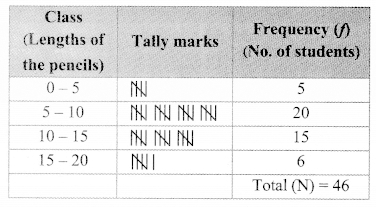
In a school, 46 students of 9th standard, were told to measure the lengths of the pencils in their compass-boxes in Centimetres. The data collected was as follows:
16, 15, 7, 4.5, 8.5, 5.5, 5, 6.5, 6, 10, 12, 13,
4.5, 4.9, 16, 11, 9.2, 7.3, 11.4, 12.7, 13.9, 16,
5.5, 9.9, 8.4, 11.4, 13.1, 15, 4.8, 10, 7.5, 8.5,
6.5, 7.2, 4.5, 5.7, 16, 5.7, 6.9, 8.9, 9.2, 10.2, 12.3, 13.7, 14.5, 10
By taking exclusive classes 0-5, 5-10, 10-15,…. prepare a grouped frequency distribution table.
Solution:
Maharashtra Board Class 9 Maths Solutions Chapter 7 Statistics Practice Set 7.3 13

Question 9.
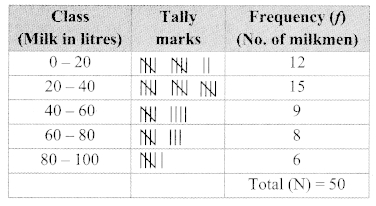
In a village, the milk was collected from 50 milkmen at a collection center in litres as given below:
27, 75, 5, 99, 70, 12, 15, 20, 30, 35, 45, 80, 77,
90, 92, 72, 4, 33, 22, 15, 20, 28, 29, 14, 16, 20,
72, 81, 85, 10, 16, 9, 25, 23, 26, 46, 55, 56, 66,
67, 51, 57, 44, 43, 6, 65, 42, 36, 7, 35
By taking suitable classes, prepare grouped frequency distribution table.
Solution:
Maharashtra Board Class 9 Maths Solutions Chapter 7 Statistics Practice Set 7.3 14

Question 10.
38 people donated to an organisation working for differently abled persons. The amount in rupees were as follows:
101, 500, 401, 201, 301, 160, 210, 125, 175,
190, 450, 151, 101, 351, 251, 451, 151, 260,
360, 410, 150, 125, 161, 195, 351, 170, 225,
260, 290, 310, 360, 425, 420, 100, 105, 170, 250, 100
i. By taking classes 100 – 149, 150 – 199, 200 – 249… prepare grouped frequency distribution table.
ii. From the table, find the number of people who donated ₹350 or more.
Solution:
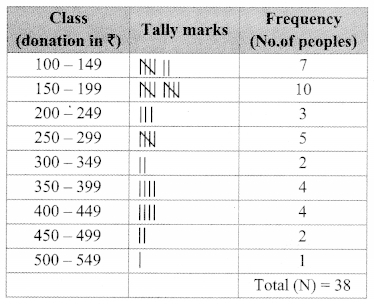
i.
Maharashtra Board Class 9 Maths Solutions Chapter 7 Statistics Practice Set 7.3 15
ii. Number of people who donated ₹ 350 or more = 4 + 4 + 2 + 1 = 11

Maharashtra Board Class 9 Maths Chapter 7 Statistics Practice Set 7.3 Intext Questions and Activities

Question 1.
The record of marks out of 20 in Mathematics in the first unit test is as follows:
20,6, 14, 10, 13, 15, 12, 14, 17. 17, 18, 1119,
9, 16. 18, 14, 7, 17, 20, 8, 15, 16, 10, 15, 12.
18, 17, 12, 11, 11, 10, 16, 14, 16, 18, 10, 7, 17,
14, 20, 17, 13, 15, 18, 20, 12, 12, 15, 10
Answer the following questions, from the above information.
a. How many students scored 15 marks?
b. How many students scored more than 15 marks?
c. How many students scored less than 15 marks?
d. What is the lowest score of the group?
e. What is the highest score of the group? (Textbook pg. no. 114)
Solution:
a. 5 students scored 15 marks.
b. 20 students scored more than 15 marks.
c. 25 students scored less than 15 marks.
d. 6 is the lowest score of the group.
e. 20 is the highest score of the group.

Question 2.
For the above Question prepare Frequency Distribution Table. (Textbook pg. no. 115)
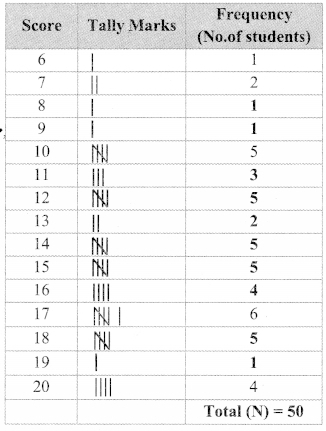
Solution:
Maharashtra Board Class 9 Maths Solutions Chapter 7 Statistics Practice Set 7.3 16