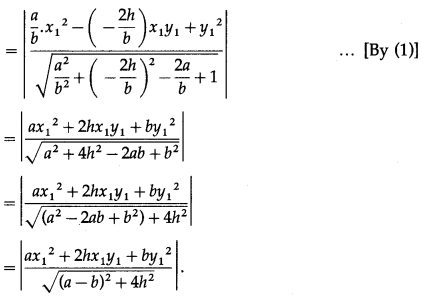
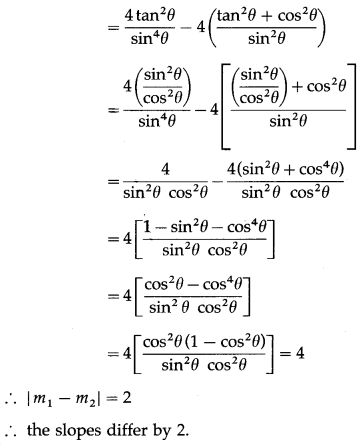
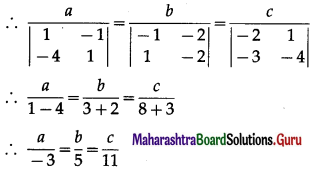
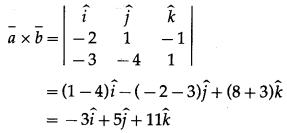
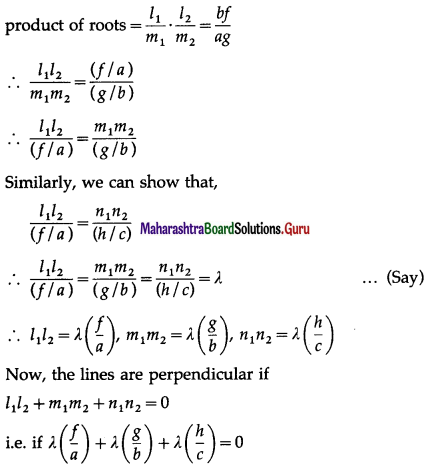
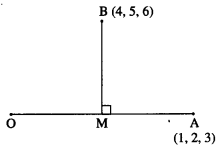
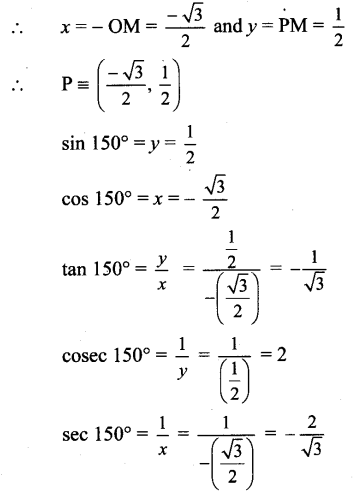
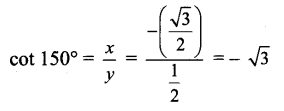
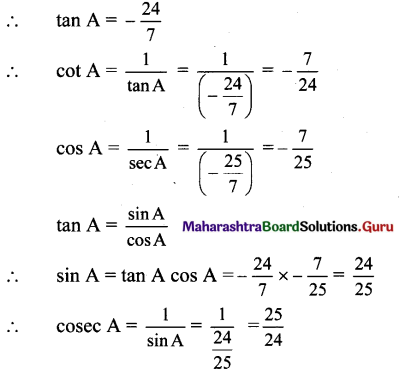
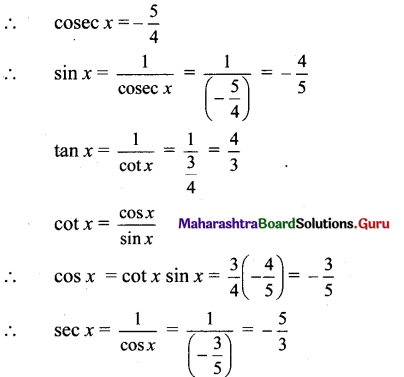
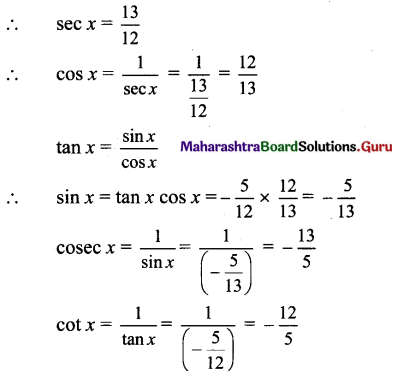
Maharashtra Board 11th Maths Solutions Chapter 2 Trigonometry – I Miscellaneous Exercise 2

Balbharti Maharashtra State Board Class 11 Maths Solutions Pdf Chapter 2 Trigonometry – I Miscellaneous Exercise 2 Questions and Answers.

Maharashtra State Board 11th Maths Solutions Chapter 2 Trigonometry – I Miscellaneous Exercise 2

I. Select the correct option from the given alternatives.

Question 1.
The value of the expression
cos1°. cos2°. cos3° … cos 179° =
(A) -1
(B) 0
(C) \(\frac{1}{\sqrt{2}}\)
(D) 1
Answer:
(B) 0

Explanation:
cos 1° cos 2° cos 3° … cos 179°
= cos 1° cos 2° cos 3° … cos 90°… cos 179°
= 0 …[∵ cos 90° = 0]

Maharashtra Board 11th Maths Solutions Chapter 2 Trigonometry - I Miscellaneous Exercise 2

Question 2.
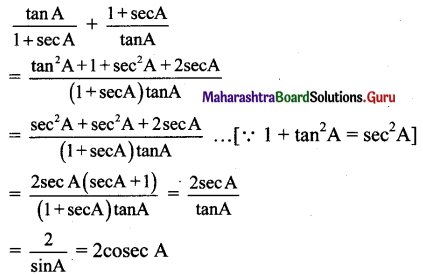
\(\frac{\tan \mathrm{A}}{1+\sec \mathrm{A}}+\frac{1+\sec \mathrm{A}}{\tan \mathrm{A}}\) is equal to
(A) 2cosec A
(B) 2 sec A
(C) 2 sin A
(D) 2 cos A
Answer:
(A) 2cosec A

Explanation:
Maharashtra Board 11th Maths Solutions Chapter 2 Trigonometry - I Miscellaneous Exercise 2 1

Question 3.
If α is a root of 25cos2 θ + 5cos θ – 12 = 0, \(\frac{\pi}{2}\) < α < π, then sin 2α is equal to
(A) \(-\frac{24}{25}\)
(B) \(-\frac{13}{18}\)
(C) \(\frac{13}{18}\)
(D) \(\frac{24}{25}\)
Answer:
(A) \(-\frac{24}{25}\)

Explanation:

25 cos2 θ + 5 cos θ – 12 = 0
∴ (5cos θ + 4) (5 cos θ – 3) = 0
∴ cos θ = \(-\frac{4}{5}\) or cos θ = \(\frac{3}{5}\)
Since \(\frac{\pi}{2}\) < α < π,
cos α < 0
∴ cos α = \(-\frac{4}{5}\)
sin2 α = 1 – cos2 α = 1 – \(\frac{16}{25}=\frac{9}{25}\)
∴ sin α = \(\pm \frac{3}{5}\)
Since \(\frac{\pi}{2}\) < α < π sin α > 0
∴ sin α = 3/5
sin 2 α = 2 sin α cos α
= \(2\left(\frac{3}{5}\right)\left(\frac{-4}{5}\right)=-\frac{24}{25}\)

Question 4.
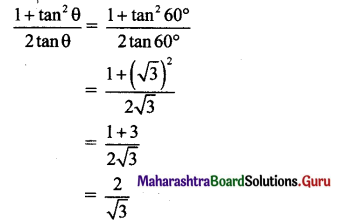
If θ = 60°, then \(\frac{1+\tan ^{2} \theta}{2 \tan \theta}\) is equal to
(A) \(\frac{\sqrt{3}}{2}\)
(B) \(\frac{2}{\sqrt{3}}\)
(C) \(\frac{1}{\sqrt{3}}\)
(D) \(\sqrt{3}\)
Answer:
(B) \(\frac{2}{\sqrt{3}}\)

Explanation:
Maharashtra Board 11th Maths Solutions Chapter 2 Trigonometry - I Miscellaneous Exercise 2 2

Question 5.
If sec θ = m and tan θ = n, then \(\frac{1}{m}\left\{(m+n)+\frac{1}{(m+n)}\right\}\) is equal to
(A) 2
(B) mn
(C) 2m
(D) 2n
Answer:
(A) 2
Explanation:
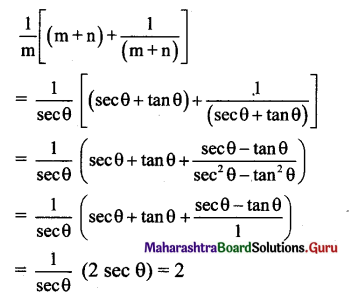
Maharashtra Board 11th Maths Solutions Chapter 2 Trigonometry - I Miscellaneous Exercise 2 3

Question 6.
If cosec θ + cot θ = \(\frac{5}{2}\), then the value of tan θ is
(A) \(\frac{14}{25}\)
(B) \(\frac{20}{21}\)
(C) \(\frac{21}{20}\)
(D) \(\frac{15}{16}\)
Answer:
(B) \(\frac{20}{21}\)

Explanation:
cosec θ + cot θ = \(\frac{5}{2}\) …………….(i)
cosec2 θ – cot2 θ = 1
∴ (cosec θ + cot θ) (cosec θ – cot θ) = 1
∴ \(\frac{5}{2}\) (cosec θ – cot θ) = 1
∴ cosec θ – cot θ = \(\frac{2}{5}\) …(ii)
Subtracting (ii) from (i), we get
2 cot θ = \(\frac{5}{2}-\frac{2}{5}=\frac{21}{10}\)
∴ cot θ = \(\frac{21}{20}\)
∴ tan θ = \(\frac{20}{21}\)

Maharashtra Board 11th Maths Solutions Chapter 2 Trigonometry - I Miscellaneous Exercise 2

Question 7.
\(1-\frac{\sin ^{2} \theta}{1+\cos \theta}+\frac{1+\cos \theta}{\sin \theta}-\frac{\sin \theta}{1-\cos \theta}\) equals
(A) 0
(B) 1
(C) sin θ
(D) cos θ
Answer:
(D) cos θ

Explanation:
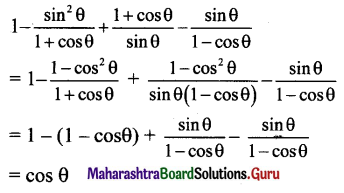
Maharashtra Board 11th Maths Solutions Chapter 2 Trigonometry - I Miscellaneous Exercise 2 4

Question 8.
If cosec θ – cot θ = q, then the value of cot θ is
(A) \(\frac{2 q}{1+q^{2}}\)
(B) \(\frac{2 q}{1-q^{2}}\)
(C) \(\frac{1-\mathrm{q}^{2}}{2 \mathrm{q}}\)
(D) \(\frac{1+q^{2}}{2 q}\)
Answer:
(C) \(\frac{1-\mathrm{q}^{2}}{2 \mathrm{q}}\)

Explanation:

cosec θ – cot θ = q ……(i)
cosec2 θ – cot2 θ = 1
∴ (cosec θ + cot θ) (cosec θ – cot θ) = 1
∴ (cosec θ + cot θ)q = 1
∴ cosec θ + cot θ = 1/q …….(ii)
Subtracting (i) from (ii), we get
2cot θ = \(\frac{1}{\mathrm{q}}-\mathrm{q}\)
∴ cot θ = \(\frac{1-q^{2}}{2 q}\)

Question 9.
The cotangent of the angles \(\frac{\pi}{3}, \frac{\pi}{4}\) and \(\frac{\pi}{6}\) are in
(A) A.P.
(B) G.P.
(C) H.P.
(D) Not in progression
Answer:
(B) G.P.

Explanation:
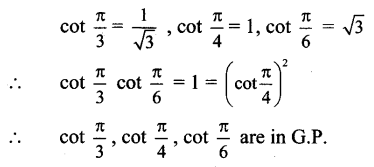
Maharashtra Board 11th Maths Solutions Chapter 2 Trigonometry - I Miscellaneous Exercise 2 5

Question 10.
The value of tan 1°.tan 2° tan 3° equal to
(A) -1
(B) 1
(C) \(\frac{\pi}{2}\)
(D) 2
Answer:
(B) 1

Explanation:

tan1° tan2° tan3° … tan89°
= (tan 1° tan 89°) (tan 2° tan 88°)
…(tan 44° tan 46°) tan 45°
= (tan 1 ° cot 1 °) (tan 2° cot 2°)
…(tan 44° cot 44°) . tan 45°
…tan(∵ 90° – θ) = cot θ]
= 1 x 1 x 1 x … x 1 x tan 45° =1

II. Answer the following:

Question 1.
Find the trigonometric functions of:
90°, 120°, 225°, 240°, 270°, 315°, -120°, -150°, -180°, -210°, -300°, -330°
Solution:
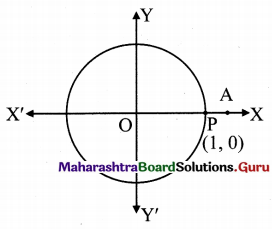
Angle of measure 90° :
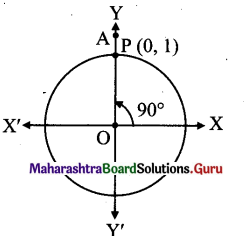
Let m∠XOA = 90°
Its terminal arm (ray OA)
intersects the standard, unit circle at P(0, 1).
Maharashtra Board 11th Maths Solutions Chapter 2 Trigonometry - I Miscellaneous Exercise 2 6
∴ x = 0 and y = 1
sin 90° = y = 1
cos 90° = x = 0
tan 90° = \(\frac{y}{x}=\frac{1}{0}\), which is not defined
cosec 90° = \(\frac{1}{y}=\frac{1}{1}\) = 1
sec 90° = \(\frac{1}{x}=\frac{1}{0}\), which is not defined
cot 90° = \(\frac{x}{y}=\frac{0}{1}\) = 0

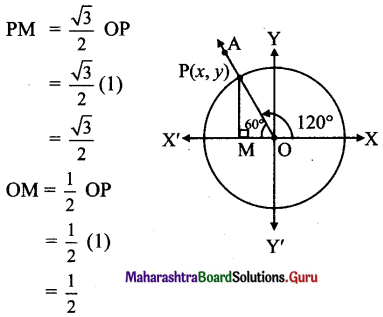
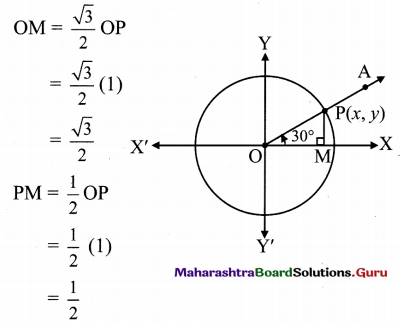
Angle of measure 120° :
Let m∠XOA =120°
Its terminal arm (ray OA) intersects the standard unit circle at P(x, y).
Draw seg PM perpendicular to the X-axis.
∴ ΔOMP is a 30° – 60° – 90° triangle.
OP = 1
Maharashtra Board 11th Maths Solutions Chapter 2 Trigonometry - I Miscellaneous Exercise 2 7
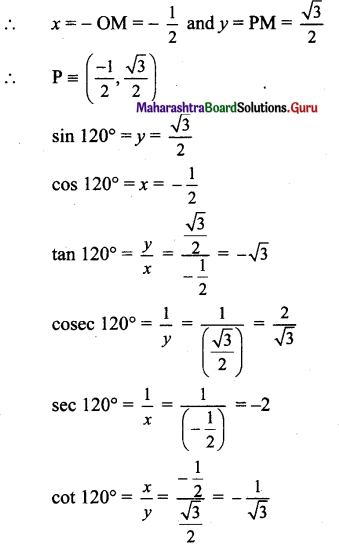
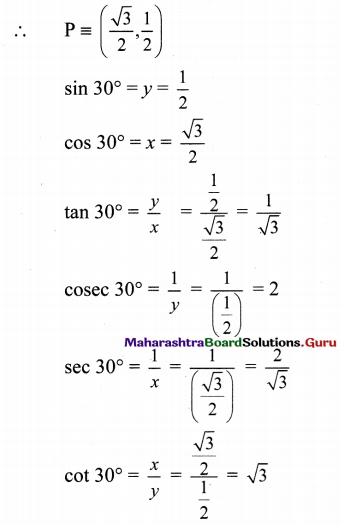
Since point P lies in the 2nd quadrant, x < 0, y > 0
Maharashtra Board 11th Maths Solutions Chapter 2 Trigonometry - I Miscellaneous Exercise 2 8

[Note: Answer given in the textbook of tan 120° is \(\frac{-1}{\sqrt{3}}\) and cot 120° is \(-\sqrt{3}\). However, as per our \(-\sqrt{3}\) calculation the answer of tan 120° is \(-\sqrt{3}\) and cot 120° is \(-\frac{1}{\sqrt{3}}\)

Maharashtra Board 11th Maths Solutions Chapter 2 Trigonometry - I Miscellaneous Exercise 2

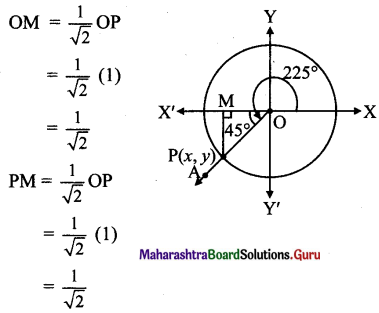
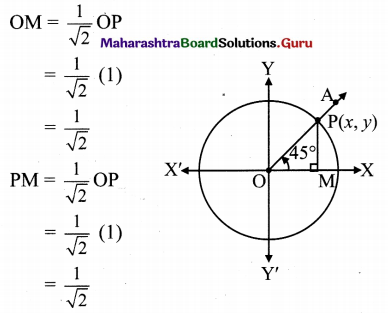
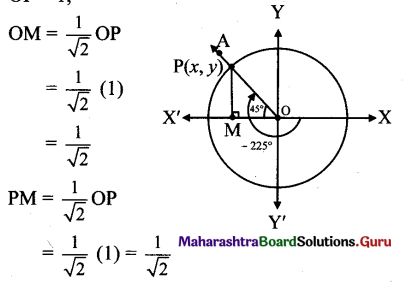
Angle of measure 225° :
Let m∠XOA = 225°
Its terminal arm (ray OA) intersects the standard unit circle at P(x, y).
Draw seg PM perpendicular to the X-axis.
ΔOMP is a 45° – 45° – 90° triangle.
OP = 1
Maharashtra Board 11th Maths Solutions Chapter 2 Trigonometry - I Miscellaneous Exercise 2 9
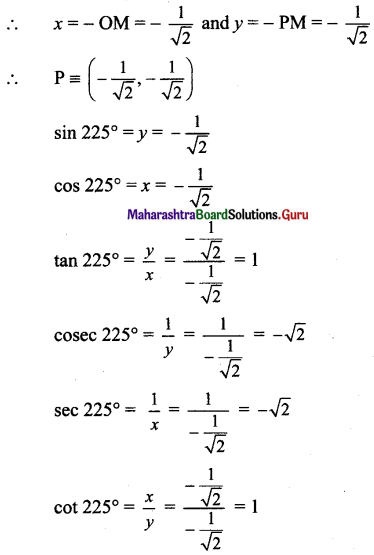
Since point P lies in the 3rd quadrant, x < 0, y < 0
Maharashtra Board 11th Maths Solutions Chapter 2 Trigonometry - I Miscellaneous Exercise 2 10

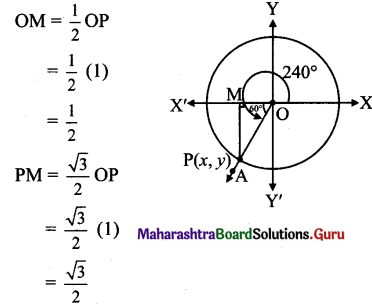
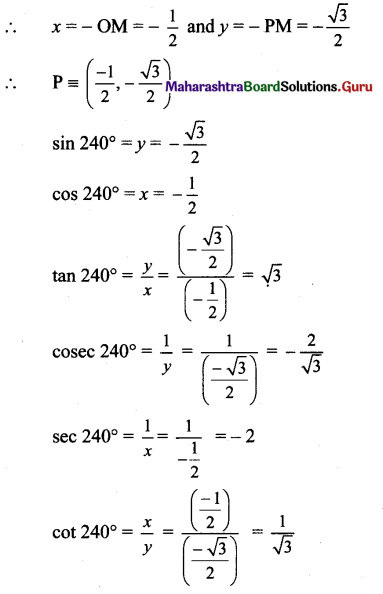
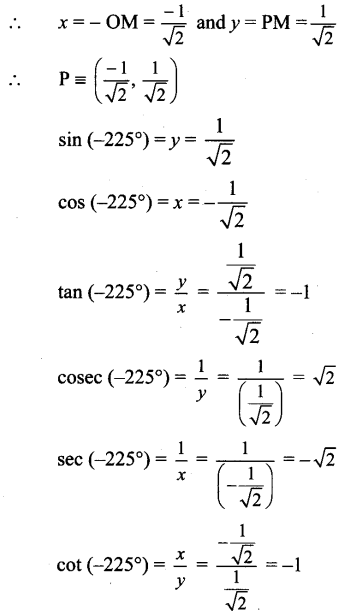
Angle of measure 240° :
Let m∠XOA = 240°
Its terminal arm (ray OA) intersects the standard unit circle at P(x, y).
Draw seg PM perpendicular to the X-axis.
ΔOMP is a 30° – 60° – 90° triangle.
OP = 1
Maharashtra Board 11th Maths Solutions Chapter 2 Trigonometry - I Miscellaneous Exercise 2 11
Since point P lies in the 3rd quadrant, x < 0, y < 0
Maharashtra Board 11th Maths Solutions Chapter 2 Trigonometry - I Miscellaneous Exercise 2 12

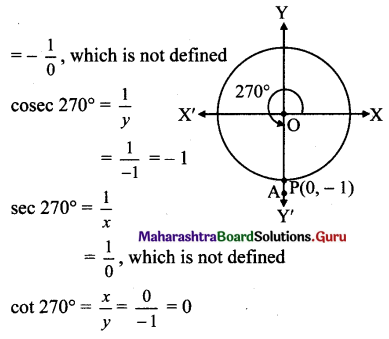
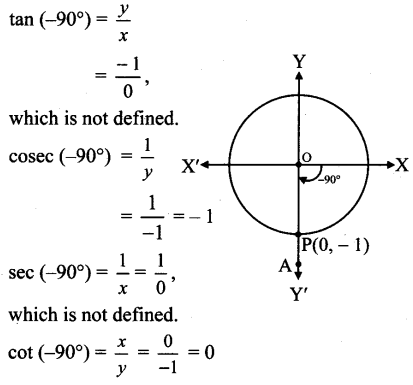
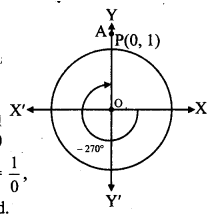
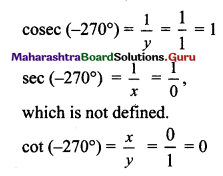
Angle of measure 270° :
Let m∠XOA = 270°
Its terminal arm (ray OA) intersects the standard unit circle at P(0, – 1).
x = 0 andy = – 1
sin 270° = y = -1
cos 270° = x = 0
tan 270° = \(\frac{y}{x}\)
Maharashtra Board 11th Maths Solutions Chapter 2 Trigonometry - I Miscellaneous Exercise 2 13

Maharashtra Board 11th Maths Solutions Chapter 2 Trigonometry - I Miscellaneous Exercise 2

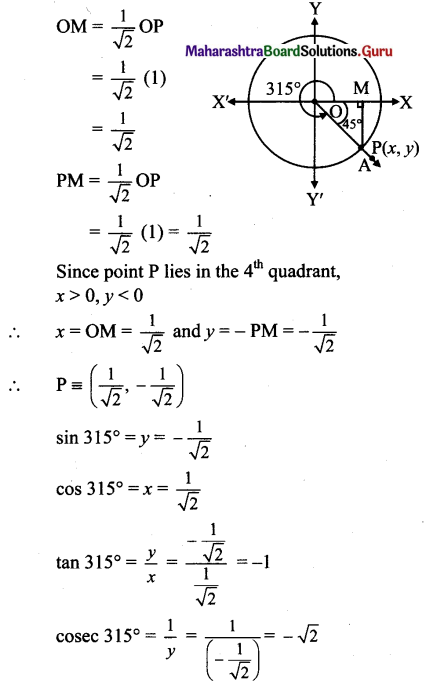
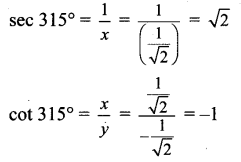
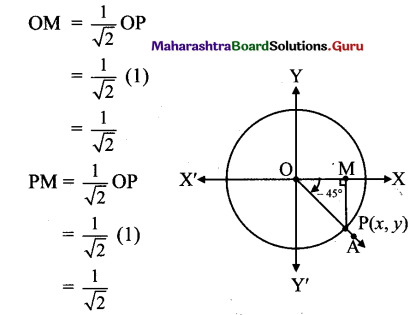
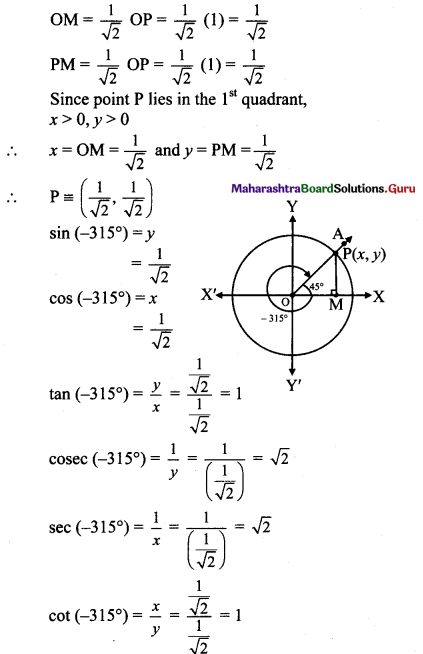
Angle of measure 315° :
Let m∠XOA = 315°
Its terminal arm (ray OA) intersects the standard unit circle at P(x, y).
Draw seg PM perpendicular to the X-axis.
∴ ΔOMP is a 45° – 45° – 90° triangle.
OP = 1
Maharashtra Board 11th Maths Solutions Chapter 2 Trigonometry - I Miscellaneous Exercise 2 14
Maharashtra Board 11th Maths Solutions Chapter 2 Trigonometry - I Miscellaneous Exercise 2 15
[Note: Answer given in the textbook of cot 315° is 1. However, as per our calculation it is -1.]

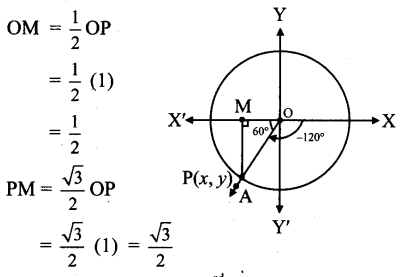
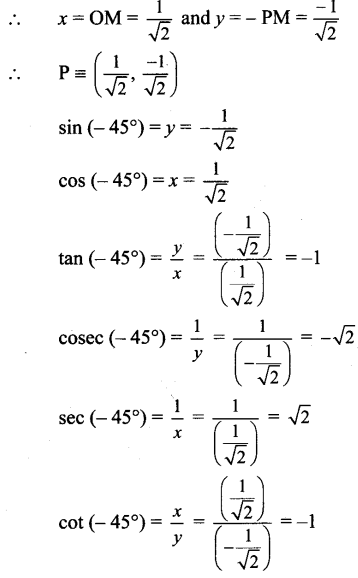
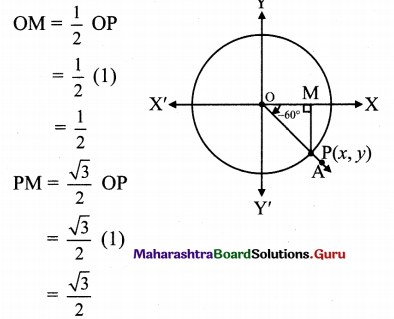
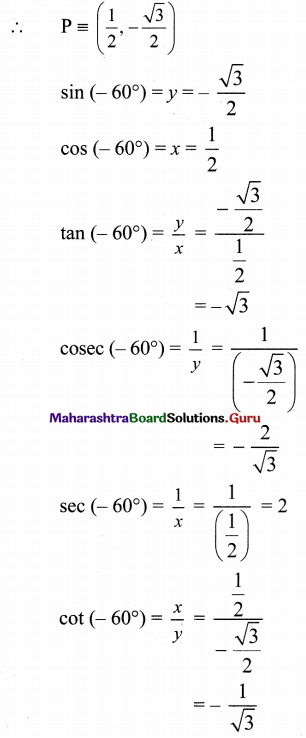
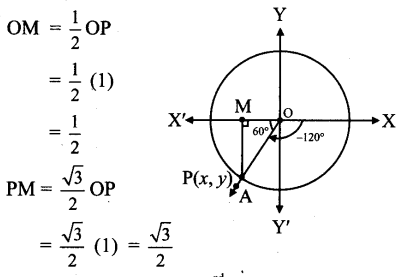
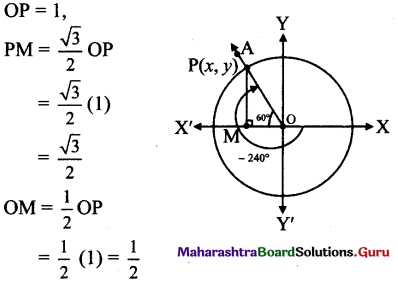
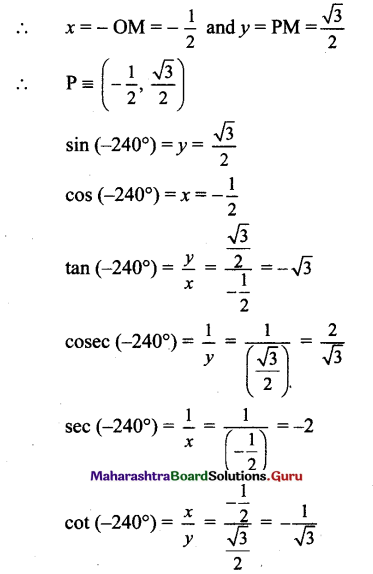
Angle of measure (-120°):
Let m∠XOA = – 120°
Its terminal arm (ray OA) intersects the standard unit circle at P(x, y).
Draw seg PM perpendicular to the X-axis.
∴ ΔOMP is a 30° – 60° – 90° triangle.
OP = 1,
Maharashtra Board 11th Maths Solutions Chapter 2 Trigonometry - I Miscellaneous Exercise 2 38
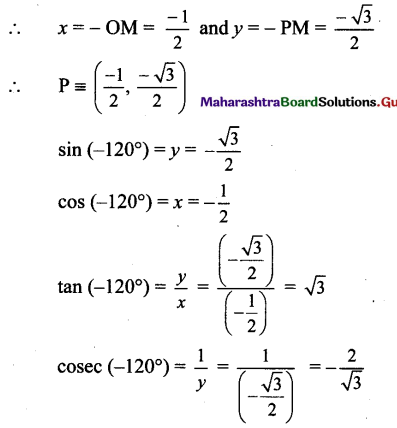
Since point P lies in the 3rd quadrant, x < 0, y < 0
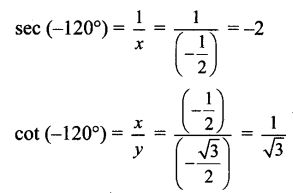
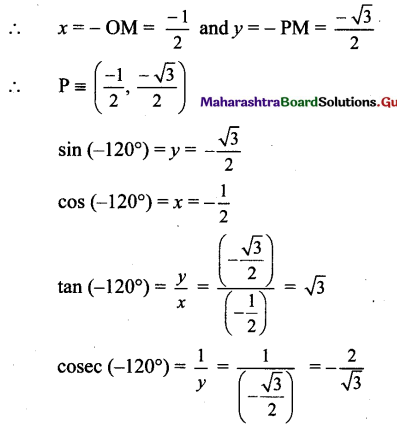
Maharashtra Board 11th Maths Solutions Chapter 2 Trigonometry - I Miscellaneous Exercise 2 39
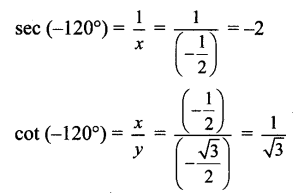
Maharashtra Board 11th Maths Solutions Chapter 2 Trigonometry - I Miscellaneous Exercise 2 40

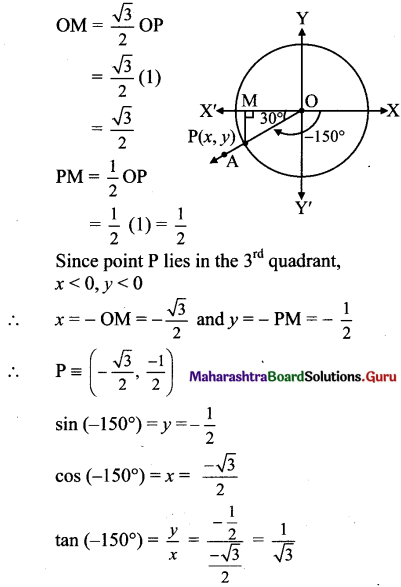
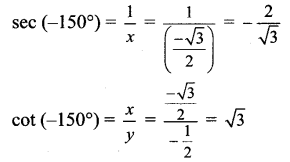
Angle of measure (-150°) :
Let m∠XOA = – 150°
Its terminal arm (ray OA) intersects the standard unit circle at P(x, y).
Draw seg PM perpendicular to the X-axis.
∴ ΔOMP is a 30° – 60° – 90° triangle.
OP = 1
Maharashtra Board 11th Maths Solutions Chapter 2 Trigonometry - I Miscellaneous Exercise 2 16
Maharashtra Board 11th Maths Solutions Chapter 2 Trigonometry - I Miscellaneous Exercise 2 17

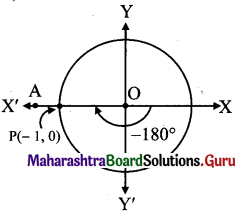
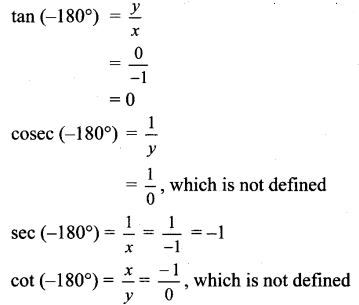
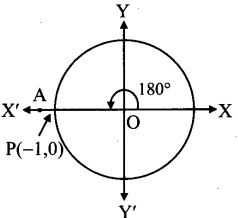
Angle of measure (-180°):
Let m∠XOA = – 180°
Its terminal arm (ray OA) intersects the standard unit circle at P(- 1, 0).
∴ x = – 1 andy = 0
sin (-180°) = y = 0
cos (-180°) = x
= -1
Maharashtra Board 11th Maths Solutions Chapter 2 Trigonometry - I Miscellaneous Exercise 2 18
Maharashtra Board 11th Maths Solutions Chapter 2 Trigonometry - I Miscellaneous Exercise 2 19

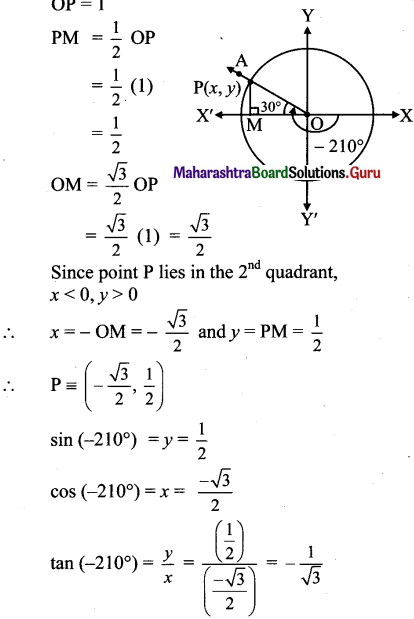
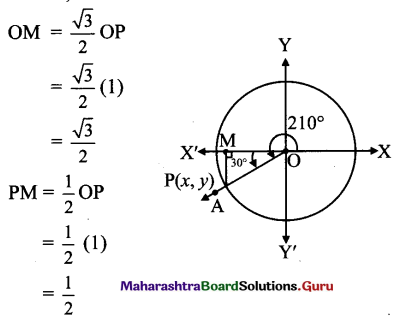
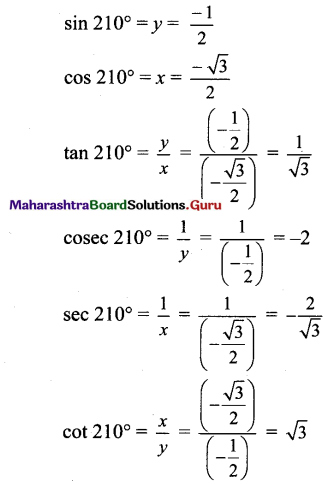
Angle of measure (- 210°):
Let m∠XOA = -210°
Its terminal arm (ray OA) intersects the standard unit circle at P(x, y).
Draw seg PM perpendicular to the X-axis.
∴ ΔOMP is a 30° – 60° – 90° triangle.
OP = 1
Maharashtra Board 11th Maths Solutions Chapter 2 Trigonometry - I Miscellaneous Exercise 2 20
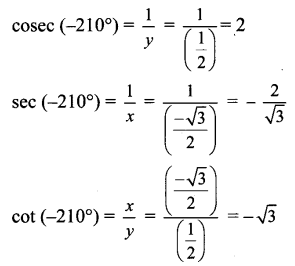
Maharashtra Board 11th Maths Solutions Chapter 2 Trigonometry - I Miscellaneous Exercise 2 21

Maharashtra Board 11th Maths Solutions Chapter 2 Trigonometry - I Miscellaneous Exercise 2

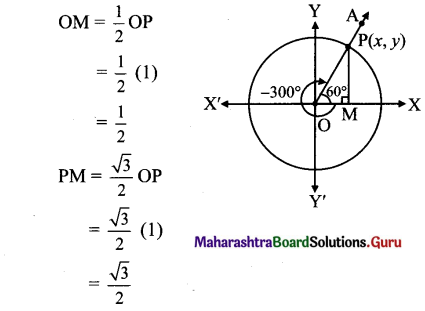
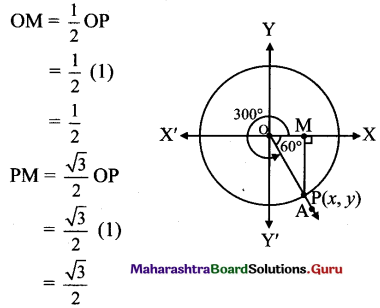
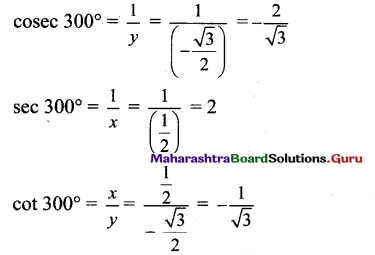
Angle of measure (- 300°):
Let m∠XOA = – 300° Its terminal arm (ray OA) intersects the standard unit circle at P(x, y).
Draw seg PM perpendicular to the X-axis.
ΔOMP is a 30° – 60° – 90° triangle.
OP = 1
Maharashtra Board 11th Maths Solutions Chapter 2 Trigonometry - I Miscellaneous Exercise 2 22
Since point P lies in the 1st quadrant, x>0,y>0
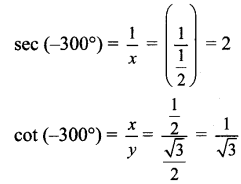
x = OM = \(\frac{1}{2}\) and
y = PM = \(\frac{\sqrt{3}}{2}\)
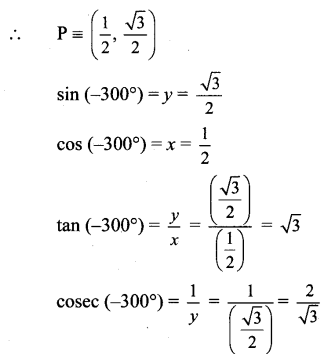
Maharashtra Board 11th Maths Solutions Chapter 2 Trigonometry - I Miscellaneous Exercise 2 24
Maharashtra Board 11th Maths Solutions Chapter 2 Trigonometry - I Miscellaneous Exercise 2 23

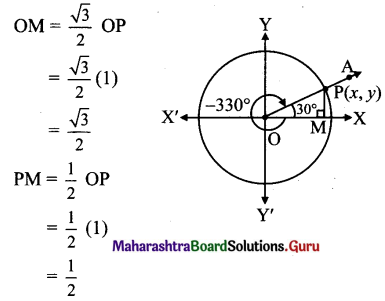
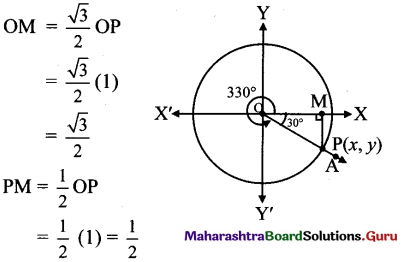
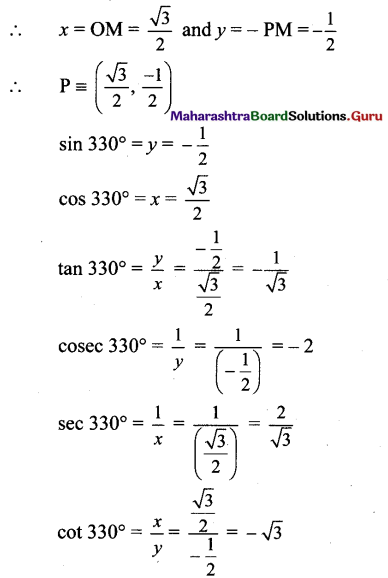
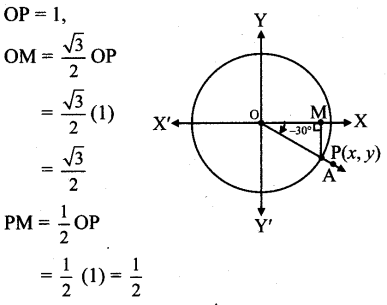
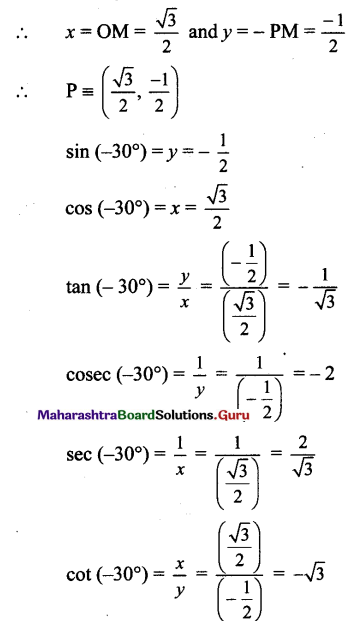
Angle of measure (- 330°):
Let m∠XOA = – 330°
Its terminal arm (ray OA) intersects the standard unit circle at P(x, y).
Draw seg PM perpendicular to the X-axis.
∴ ΔOMP is a 30° – 60° – 90° triangle.
OP= 1
Maharashtra Board 11th Maths Solutions Chapter 2 Trigonometry - I Miscellaneous Exercise 2 25
Since point P lies in the 1st quadrant, x > 0, y > 0
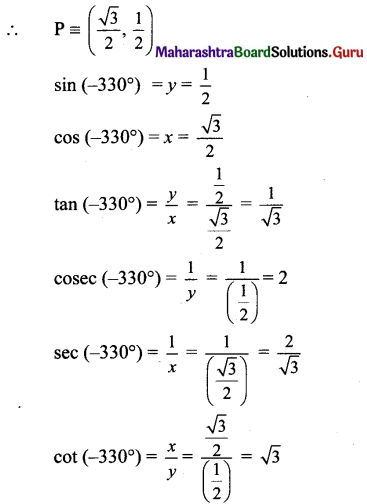
∴ x = OM = \(\frac{\sqrt{3}}{2}\) and y = PM = \(\frac{1}{2}\)
Maharashtra Board 11th Maths Solutions Chapter 2 Trigonometry - I Miscellaneous Exercise 2 26

Question 2.
State the signs of:
i. cosec 520°
ii. cot 1899°
iii. sin 986°
Solution:
i. 520° =360° + 160°
∴ 520° and 160° are co-terminal angles.
Since 90° < 160° < 180°,
160° lies in the 2nd quadrant.
∴ 520° lies in the 2nd quadrant,
∴ cosec 520° is positive.

ii. 1899° = 5 x 360° + 99°
∴ 1899° and 99° are co-terminal angles.
Since 90° < 99° < 180°,
99° lies in the 2nd quadrant.
∴ 1899° lies in the 2nd quadrant.
∴ cot 1899° is negative.

iii. 986° = 2x 360° + 266°
∴ 986° and 266° are co-terminal angles.
Since 180° < 266° < 270°,
266° lies in the 3rd quadrant.
∴ 986° lies in the 3rd quadrant.
∴ sin 986° is negative.

Maharashtra Board 11th Maths Solutions Chapter 2 Trigonometry - I Miscellaneous Exercise 2

Question 3.
State the quadrant in which 6 lies if
i. tan θ < 0 and sec θ > 0
ii. sin θ < 0 and cos θ < 0
iii. sin θ > 0 and tan θ < 0
Solution:
i. tan θ < 0 tan θ is negative in 2nd and 4th quadrants, sec θ > 0
sec θ is positive in 1st and 4th quadrants.
∴ θ lies in the 4th quadrant.

ii. sin θ < 0
sin θ is negative in 3rd and 4th quadrants, cos θ < 0
cos θ is negative in 2nd and 3rd quadrants.
.’. θ lies in the 3rd quadrant.

iii. sin θ > 0
sin θ is positive in 1st and 2nd quadrants, tan θ < 0
tan θ is negative in 2nd and 4th quadrants.
∴ θ lies in the 2nd quadrant.

Question 4.
Which is greater?
sin (1856°) or sin (2006°)
Solution:
1856° = 5 x 360° + 56°
∴ 1856° and 56° are co-terminal angles.
Since 0° < 56° < 90°, 56° lies in the 1st quadrant.
∴ 1856° lies in the 1st quadrant,
∴ sin 1856° >0 …(i)
2006° = 5 x 360° + 206°
∴ 2006° and 206° are co-terminal angles.
Since 180° < 206° < 270°,
206° lies in the 3rd quadrant.
∴ 2006° lies in the 3rd quadrant,
∴ sin 2006° <0 …(ii)
From (i) and (ii),
sin 1856° is greater.

Question 5.
Which of the following is positive?
sin(-310°) or sin(310°)
Solution:
Since 270° <310° <360°,
310° lies in the 4th quadrant.
∴ sin (310°) < 0
-310° = -360°+ 50°
∴ 50° and – 310° are co-terminal angles.
Since 0° < 50° < 90°, 50° lies in the 1st quadrant.
∴ – 310° lies in the 1st quadrant.
∴ sin (- 310°) > 0
∴ sin (- 310°) is positive.

Question 6.
Show that 1 – 2sin θ cos θ ≥ 0 for all θ ∈ R.
Solution:
1 – 2 sin θ cos θ
= sin2 θ + cos2 θ – 2sin θ cos θ
= (sin θ – cos θ)2 ≥ 0 for all θ ∈ R

Question 7.
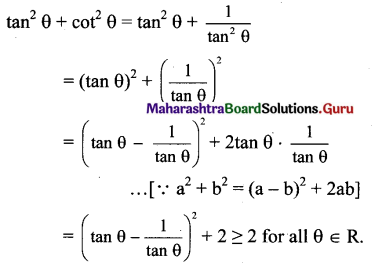
Show that tan2 θ + cot2 θ ≥ 2 for all θ ∈ R.
Solution:
Maharashtra Board 11th Maths Solutions Chapter 2 Trigonometry - I Miscellaneous Exercise 2 27

Question 8.
If sin θ = \(\frac{x^{2}-y^{2}}{x^{2}+y^{2}}\), then find the values of cos θ, tan θ in terms of x and y.
Solution:
Given, sin θ = \(\frac{x^{2}-y^{2}}{x^{2}+y^{2}}\)
we know that
cos2θ = 1 – sin2 θ
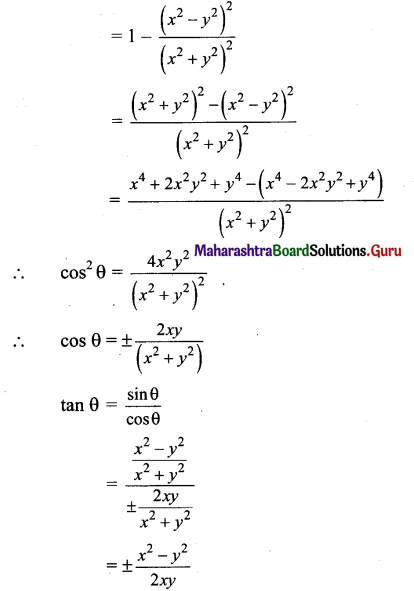
Maharashtra Board 11th Maths Solutions Chapter 2 Trigonometry - I Miscellaneous Exercise 2 28

[Note: Answer given in the textbook of cos θ = \(\frac{2 x y}{x^{2}+y^{2}}\) and tan θ = \(. However, as per our calculation the answer of cos θ = ± [latex]\frac{2 x y}{x^{2}+y^{2}}\) and tan θ = ± \(\frac{x^{2}-y^{2}}{2 x y}\). ]

Maharashtra Board 11th Maths Solutions Chapter 2 Trigonometry - I Miscellaneous Exercise 2

Question 9.
If sec θ = \(\sqrt{2}\) and \(\frac{3 \pi}{2}\) < θ < 2π, then evaluate \(\frac{1+\tan \theta+{cosec} \theta}{1+\cot \theta-{cosec} \theta}\)
Solution:
Given sec θ = \(\sqrt{2}\)
We know that,
tan2 θ = sec2 θ – 1
= (\(\sqrt{2}\)) – 1
= 2 – 1 = 1
∴ tan θ = ±1
Since \(\frac{3 \pi}{2}\) < θ < 2π
θ lies in the 4th quadrant.
∴ tan θ < 0
∴ tan θ = -1
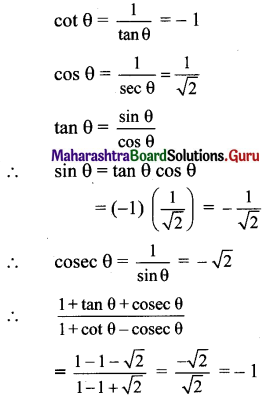
Maharashtra Board 11th Maths Solutions Chapter 2 Trigonometry - I Miscellaneous Exercise 2 29

Question 10.
Prove the following:

i. sin2A cos2 B + cos2A sin2B + cos2A cos2B + sin2A sin2B = 1
Solution:
L.H.S. = sin2A cos2 B + cos2A sin2B + cos2A cos2B + sin2A sin2B
= sin2A (cos2 B + sin2 B) + cos2 A (sin2 B + cos2 B)
= sin2A(1) + cos2A(1)
= 1 = R.H.S.

ii. \(\frac{(1+\cot \theta+\tan \theta)(\sin \theta-\cos \theta)}{\sec ^{3} \theta-{cosec}^{3} \theta}=\sin ^{2} \theta \cos ^{2} \theta\)
Solution:
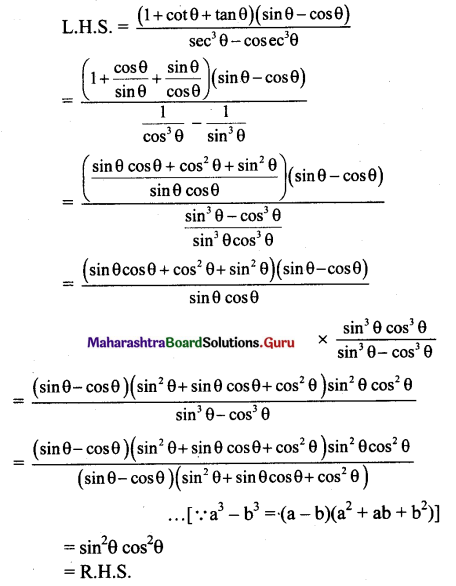
Maharashtra Board 11th Maths Solutions Chapter 2 Trigonometry - I Miscellaneous Exercise 2 30

iii. L.H.S. = \(\left(\tan \theta+\frac{1}{\cos \theta}\right)^{2}+\left(\tan \theta-\frac{1}{\cos \theta}\right)^{2}=2\left(\frac{1+\sin ^{2} \theta}{1-\sin ^{2} \theta}\right)\)
Solution:
L.H.S. = \(\left(\tan \theta+\frac{1}{\cos \theta}\right)^{2}+\left(\tan \theta-\frac{1}{\cos \theta}\right)^{2}\)
= (tanθ + secθ)2 + (tanθ – secθ)2
= tan2 θ + 2 tan θ sec θ + sec2 θ
+ tan2 θ – 2 tan θ sec θ +.sec2 θ
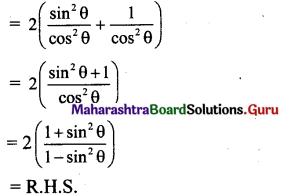
= 2(tan2 θ + sec2 θ)

iv. 2.sec2 θ – sec4 θ – 2.cosec2 θ + cosec4 θ = cot4 θ – tan4 θ
Solution:
LHS.
= 2.sec2 θ – sec4 θ – 2.cosec2 θ + cosec4 θ =  = 2 sec2 θ – (sec2 θ)2 – 2cosec2 θ + (cosec2 θ)2
= 2(1+ tan2 θ) – (1+ tan2 θ)2 – 2(1+ cot2 θ)
+ (1+ cot2 θ)2
= 2 + 2tan2 θ – (1 + 2tan2 θ + tan4 θ)
– 2 – 2cot2 θ + 1 + 2cot2 θ + cot4 θ
= 2 + 2.tan2 θ – 1 – 2 tan2 θ – tan4 θ – 2
– 2 cot2 θ + 1 + 2 cot2 θ + cot4 θ
= cot4 θ – tan4 θ = R.H.S.

v. sin4 θ + cos4 θ = sin4 θ + cos4 θ
Solution:
L.H.S. = sin4 θ + cos4 θ
= (sin2 θ)2 + (cos2 θ)2 = (sin2 θ + cos2 θ)2 – 2sin2 θ cos2 θ
… [ v a2 + b2 = (a + b)2 – 2ab]
= 1 – 2sin2 θ cos2 θ
= R.H.S.

vi. 2(sin6 θ + cos6 θ) – 3(sin4 θ + cos4 θ) + 1 = 0
L.H.S =
2(sin6 θ + cos6 θ) – 3(sin4 θ + cos4 θ) + 1=0
= sin6 θ + cos6 θ
= (sin2 θ)3 + (cos2 θ)3 = (sin2 θ + cos2 θ)3
– 3 sin2 θ cos2 θ (sin2 0 + cos2 0)
…[••• a3 + b3 = (a + b)3 – 3ab(a + b)]
= (1)3 – 3 sin2 θ cos2 θ(1)
= 1-3 sin2 θ cos2 θ sin4 θ + cos4 θ
= (sin2 θ)2 + (cos2 θ)2 = (sin2 θ + cos2 θ)2 – 2 sin2 θ cos2 θ
…[Y a2 + b2 = (a + b)2 – 2ab]
= 1-2 sin2 θ cos2 θ
L.H.S.= 2(sin6 θ + cos6 θ) – 3(sin4 θ + cos4 θ) + 1
= 2(1-3 sin2 θ cos2 θ) -3(1 – 2 sin2 θ cos2 θ) + 1
= 2-6 sin2 θ cos2 θ – 3 + 6 sin2 θ cos2 θ + 1 = c
= R.H.S.

vii. cos4 θ – sin4 θ + 1 = 2cos2θ
L.H.S. = cos4 θ – sin4 θ + 1
= (cos2 θ)2 – (sin2 θ)2 + 1 = (cos2θ + sin2θ) c(os2 θ – sin2θ) +1
= (1) (cos2θ – sin2θ) + 1 = cos2 θ + (1 – sin2θ)
= cos2 θ + cos2θ = 2cos2θ = R.H.S.

viii. sin4θ + 2sin2θ cos2θ = 1 – cos4θ
L.H.S. = sin4θ + 2sin2θ cos2θ = sin2θ(sin2θ + 2cos2θ)
= (sin2θ) (sin2θ + cos2θ + cos2θ) = (1 – cos2θ) (1 + cos2θ)
= 1 – cos4θ = R.H.S.

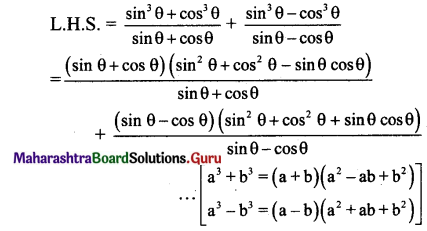
ix. \(\frac{\sin ^{3} \theta+\cos ^{3} \theta}{\sin \theta+\cos \theta}+\frac{\sin ^{3} \theta-\cos ^{3} \theta}{\sin \theta-\cos \theta}=2\)
Solution:
Maharashtra Board 11th Maths Solutions Chapter 2 Trigonometry - I Miscellaneous Exercise 2 31
= (sin2 θ + cos2 θ – sin θ cos θ) + (sin2 θ + cos2 θ + sinθ cosθ)
= 2 (sin2 θ + cos2 θ)
= 2(1)
= 2 = R.H.S.

Maharashtra Board 11th Maths Solutions Chapter 2 Trigonometry - I Miscellaneous Exercise 2

x. tan2 θ – sin2 θ = sin4 θ sec2 θ
Solution:
L.H.S. = tan2 θ – sin2 θ
= \(\frac{\sin ^{2} \theta}{\cos ^{2} \theta}\) – sin2θ
= sin2 θ (\(\frac{1}{\cos ^{2} \theta}-1 \))
= \(\frac{\sin ^{2} \theta\left(1-\cos ^{2} \theta\right)}{\cos ^{2} \theta}\)
= (sin2 θ) (sin2 θ)sec2 θ
= sin4 θ sec2 θ
= R.H.S

xi. (sinθ + cosecθ)2 + (cos θ + see θ)2 = tan2 θ + cot2 θ + 7
Solution:
L.H.S. = (sinθ + cosecθ)2 + (cos θ + see θ)2
= sin 2 θ + cosec2 θ + 2sinθ cosec θ
+ cos2 θ + sec2 θ + 2sec0 cos0
= (sin2 θ + cos2 θ) + cosec2 θ + 2 + sec2 θ + 2
= 1 + (1 + cot2 θ) + 2 + (1 + tan2 θ) + 2 = tan2 θ + cot2 θ + 7
= R.H.S.

xii. sin8θ – cos8θ = (sin2 θ – cos2 θ) (1 – 2sin2 θ cos2 θ)
Solution:
L.H.S. = sin8θ – cos8θ
= (sin4θ)2 – (cos4θ)2
= (sin4θ – cos4θ) (sin4θ + cos4θ)
= [(sin2 θ)2 – (cos2 θ)2 ]
. [(sin2 θ)2 + (cos2 θ)2 ]
= (sin2 θ + cos2 θ) (sin2 θ – cos2 θ). [(sin2 θ + cos2 θ)2 – 2sin2 θ.cos2 θ] …[Y a2 + b2 = (a + b)2 – 2ab]
= (1) (sin2 θ – cos2 θ) (12 – 2sin2 θ cos2 θ)
= (sin2 θ – cos2 θ) (1 – 2sin2 θ cos2 θ)
= R.H.S.

xiii. sin6A + cos6A = 1 – 3 sin2A + 3sin4A
Soluiton:
L.H.S. = sin6A + cos6A
= (sin2 A)3 + (cos2 A)3
= (sin2 A + cos2 A)3
– 3sin2A cos2A(sin2 A + cos2 A)
…[ a3 + b3 = (a + b)3 – 3ab(a + b)]
= 13 – 3sin2A cos2A (1)
= 1 – 3sin2A cos2A
= 1 – 3 sin2A (1 – sin2A)
= 1 – 3 sin2A + 3sin4A
= R.H.S.

xiv. (1 + tanA tanB)2 + (tanA – tanB)2 = sec 2A sec2B
Solution:
L.H.S. = (1 + tanA tanB)2 + (tanA – tanB)2
= 1 + 2tanA tanB + tan2A tan2 + tan2 A- 2tanA tanB + tan2B
= 1 + tan2A + tan2 B + tan2A tan2B
= 1(1+ tan2A) + tan2 B(1 + tan2A)
= (1 + tan2A) (1 + tan2B)
= sec2A sec2B = R.H.S.

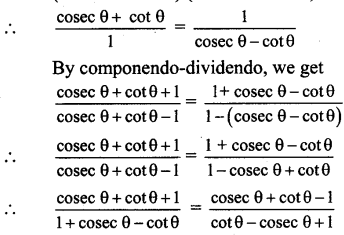
xv. \(\frac{1+\cot \theta+{cosec} \theta}{1-\cot \theta+{cosec} \theta}=\frac{{cosec} \theta+\cot \theta-1}{\cot \theta-{cosec} \theta+1}\)
Solution:
We know that cosec2θ – cot2 θ = 1
∴ (cosec θ – cot θ) (cosec θ + cot θ) = 1
Maharashtra Board 11th Maths Solutions Chapter 2 Trigonometry - I Miscellaneous Exercise 2 32

Maharashtra Board 11th Maths Solutions Chapter 2 Trigonometry - I Miscellaneous Exercise 2

xvi. \(\frac{\tan \theta+\sec \theta-1}{\tan \theta+\sec \theta+1}=\frac{\tan \theta}{\sec \theta+1}\)
Solution:
We know that
tan2θ = sec2 θ – 1
∴ tan θ. tanθ = (sec θ + 1)(sec θ – 1)
Maharashtra Board 11th Maths Solutions Chapter 2 Trigonometry - I Miscellaneous Exercise 2 33

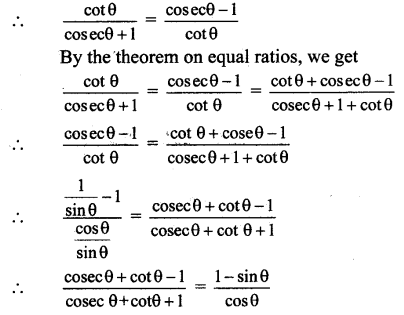
xvii. \(\frac{{cosec} \theta+\cot \theta-1}{{cosec} \theta+\cot \theta+1}=\frac{1-\sin \theta}{\cos \theta}\)
Solution:
We know that,
cot2 θ = cosec2 θ – 1
∴ cot θ . cot θ = (cosec θ + 1)(cosec θ – 1)
Maharashtra Board 11th Maths Solutions Chapter 2 Trigonometry - I Miscellaneous Exercise 2 34

Alternate Method:
Maharashtra Board 11th Maths Solutions Chapter 2 Trigonometry - I Miscellaneous Exercise 2 35

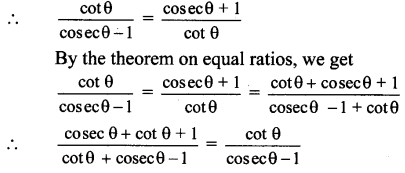
xviii. \(\frac{{cosec} \theta+\cot \theta+1}{\cot \theta+{cosec} \theta-1}=\frac{\cot \theta}{{cosec} \theta-1}\)
solution:
We know that,
cot2 θ = cosec2 θ – 1
∴ cot θ.cot θ = (cosec θ + 1) (cosec θ – 1)

Maharashtra Board 11th Maths Solutions Chapter 2 Trigonometry - I Miscellaneous Exercise 2 37

Maharashtra Board 12th Maths Solutions Chapter 5 Vectors Ex 5.3

Balbharti 12th Maharashtra State Board Maths Solutions Book Pdf Chapter 5 Vectors Ex 5.3 Questions and Answers.

Maharashtra State Board 12th Maths Solutions Chapter 5 Vectors Ex 5.3

Question 1.
Find two unit vectors each of which is perpendicular to both
\(\bar{u}\) and \(\bar{v}\), where \(\bar{u}\) = \(2 \hat{i}+\hat{j}-2 \hat{k}\), \(\bar{v}\) = \(\hat{i}+2 \hat{j}-2 \hat{k}\)
Solution:
Let \(\bar{u}\) = \(2 \hat{i}+\hat{j}-2 \hat{k}\)
\(\bar{v}\) = \(\hat{i}+2 \hat{j}-2 \hat{k}\)
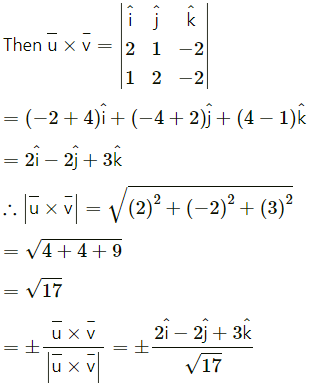
Maharashtra Board 12th Maths Solutions Chapter 5 Vectors Ex 5.3 1
Maharashtra Board 12th Maths Solutions Chapter 5 Vectors Ex 5.3 2

Question 2.
If \(\bar{a}\) and \(\bar{b}\) are two vectors perpendicular to each other, prove that (\(\bar{a}\) + \(\bar{b}\))2 = (\(\bar{a}\) – \(\bar{b}\))2
Solution:
\(\bar{a}\) and \(\bar{b}\) are perpendicular to each other.
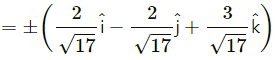
Maharashtra Board 12th Maths Solutions Chapter 5 Vectors Ex 5.3 3
∴ LHS = RHS
Hence, (\(\bar{a}\) + \(\bar{b}\))2 = (\(\bar{a}\) – \(\bar{b}\))2.

Maharashtra Board 12th Maths Solutions Chapter 1 Mathematical Logic Ex 1.1

Question 3.
Find the values of c so that for all real x the vectors \(x c \hat{i}-6 \hat{j}+3 \hat{k}\) and \(x \hat{i}+2 \hat{j}+2 c x \hat{k}\) make an obtuse angle.
Solution:
Let \(\bar{a}\) = \(x c \hat{i}-6 \hat{j}+3 \hat{k}\) and \(\bar{b}\) = \(x \hat{i}+2 \hat{j}+2 c x \hat{k}\)
Consider \(\bar{a}\)∙\(\bar{b}\) = \((x c \hat{i}-6 \hat{j}+3 \hat{k}) \cdot(x \hat{i}+2 \hat{j}+2 c x \hat{k})\)
= (xc)(x) + (-6)(2) + (3)(2cx)
= cx2 – 12 + 6cx
= cx2 + 6cx – 12
If the angle between \(\bar{a}\) and \(\bar{b}\) is obtuse, \(\bar{a}\)∙\(\bar{b}\) < 0.
∴ cx2 + 6cx – 12 < 0
∴ cx2 + 6cx < 12
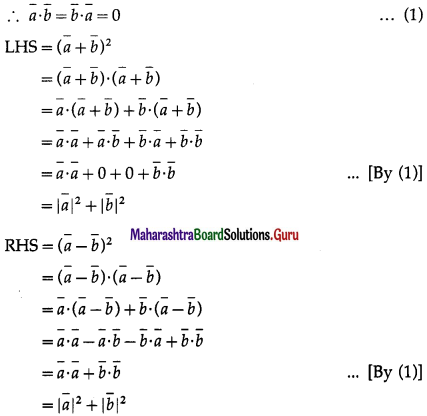
Maharashtra Board 12th Maths Solutions Chapter 5 Vectors Ex 5.3 4
∴ c < 0.
Hence, the angle between a and b is obtuse if c < 0.

Question 4.
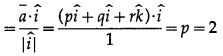
Show that the sum of the length of projections of \(\hat{p} \hat{i}+q \hat{j}+r \hat{k}\) on the coordinate axes, where p = 2, q = 3 and r = 4, is 9.
Solution:
Let \(\bar{a}\) = \(\hat{p} \hat{i}+q \hat{j}+r \hat{k}\)
Projection of \(\bar{a}\) on X-axis
Maharashtra Board 12th Maths Solutions Chapter 5 Vectors Ex 5.3 5
Similarly, projections of \(\bar{a}\) on Y- and Z-axes are 3 and 4 respectively.
∴ sum of these projections = 2 + 3 + 4 = 9.

Maharashtra Board 12th Maths Solutions Chapter 1 Mathematical Logic Ex 1.1

Question 5.
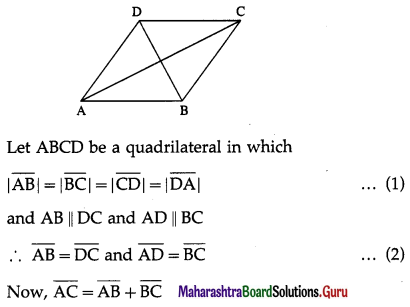
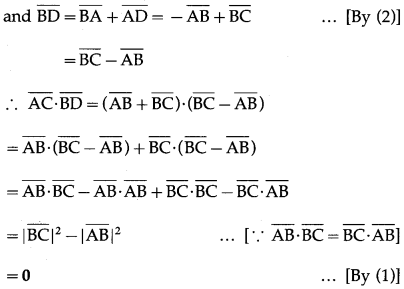
Suppose that all sides of a quadrilateral are equal in length and opposite sides are parallel. Use vector methods to show that the diagonals are perpendicular.
Solution:
Maharashtra Board 12th Maths Solutions Chapter 5 Vectors Ex 5.3 6
Maharashtra Board 12th Maths Solutions Chapter 5 Vectors Ex 5.3 7
∵ \(\overline{\mathrm{AC}}\), \(\overline{\mathrm{BD}}\) are non-zero vectors
∴ \(\overline{\mathrm{AC}}\) is perpendicular to \(\overline{\mathrm{BD}}\)
Hence, the diagonals are perpendicular.

Question 6.
Determine whether \(\bar{a}\) and \(\bar{b}\) are orthogonal, parallel or neither.
(i) \(\bar{a}\) = \(-9 \hat{i}+6 \hat{j}+15 \hat{k}\), \(\bar{b}\) = \(6 \hat{i}-4 \hat{j}-10 \hat{k}\)
Solution:
\(\bar{a}\) = \(-9 \hat{i}+6 \hat{j}+15 \hat{k}\) = -3\((3 \hat{i}-2 \hat{j}-5 \hat{k})\)
= \(-\frac{3}{2}(6 \hat{i}-4 \widehat{j}-19 \hat{k})\)
∴ \(\bar{a}\) = \(-\frac{3}{2} \bar{b}\)
i.e. \(\bar{a}\) is a non-zero scalar multiple of \(\bar{b}\)
Hence, \(\bar{a}\) is parallel to \(\bar{b}\).

Maharashtra Board 12th Maths Solutions Chapter 1 Mathematical Logic Ex 1.1

(ii) \(\bar{a}\) = \(2 \hat{i}+3 \hat{j}-\hat{k}\), \(\bar{b}\) = \(5 \hat{i}-2 \hat{j}+4 \hat{k}\)
Solution:
\(\bar{a} \cdot \bar{b}\) = \((2 \hat{i}+3 \hat{j}-\hat{k}) \cdot(5 \hat{i}-2 \hat{j}+4 \hat{k})\)
= (2)(5) + (3)(-2) + (-1)(4)
= 10 – 6 – 4 = 0
Since, \(\bar{a}\), \(\bar{b}\) are non-zero vectors and \(\bar{a} \cdot \bar{b}\) = 0, \(\bar{a}\) is orthogonal to \(\bar{b}\).

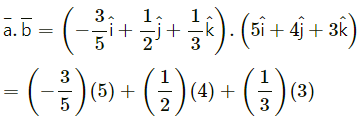
(iii) \(\bar{a}\) = \(-\frac{3}{5} \hat{i}+\frac{1}{2} \hat{j}+\frac{1}{3} \hat{k}\), \(\bar{b}\) = \(5 \hat{i}+4 \hat{j}+3 \hat{k}\).
Solution:
Maharashtra Board 12th Maths Solutions Chapter 5 Vectors Ex 5.3 8
= -3 + 2 + 1
= 0
Since, \(\bar{a}\), \(\bar{b}\) are non-zero vectors and \(\bar{a} \cdot \bar{b}\) = 0
\(\bar{a}\) is orthogonal to \(\bar{b}\).

(iv) \(\bar{a}\) = \(4 \hat{i}-\hat{j}+6 \hat{k}\), \(\bar{a}\) = \(5 \hat{i}-2 \hat{j}+4 \hat{k}\)
Solution:
\(\bar{a} \cdot \bar{b}\) = \((4 \hat{i}-\hat{j}+6 \hat{k}) \cdot(5 \hat{i}-2 \hat{j}+4 \hat{k})\)
= (4)(5) + (-1)(-2) + (6)(4)
= 20 + 2 + 24
= 46 ≠ 0
∴ \(\bar{a}\) is not orthogonal to \(\bar{b}\).
It is clear that \(\bar{a}\) is not a scalar multiple of \(\bar{b}\).
∴ \(\bar{a}\) is not parallel to \(\bar{b}\).
Hence, \(\bar{a}\) is neither parallel nor orthogonal to \(\bar{b}\).

Maharashtra Board 12th Maths Solutions Chapter 1 Mathematical Logic Ex 1.1

Question 7.
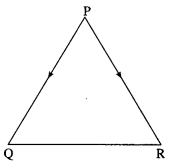
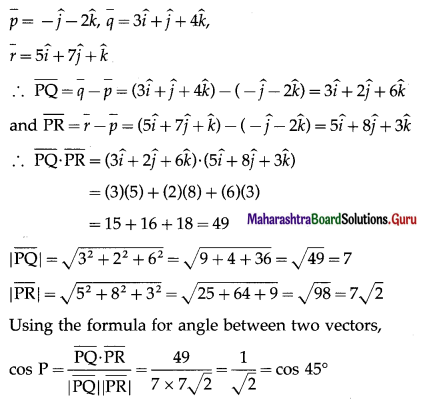
Find the angle P of the triangle whose vertices are P(0, -1, -2), Q(3, 1, 4) and R(5, 7, 1).
Solution:
The position vectors \(\bar{p}\), \(\bar{q}\) and \(\bar{r}\) of the points P(0, -1, -2), Q(3, 1, 4) and R(5, 7, 1) are
Maharashtra Board 12th Maths Solutions Chapter 5 Vectors Ex 5.3 9
Maharashtra Board 12th Maths Solutions Chapter 5 Vectors Ex 5.3 10
∴ P = 45°

Question 8.
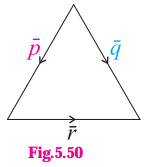
If\(\hat{p}\), \(\hat{q}\), and \(\hat{r}\) are unit vectors, find
Maharashtra Board 12th Maths Solutions Chapter 5 Vectors Ex 5.3 11
(i) \(\hat{p} \cdot \hat{q}\)
Solution:
Maharashtra Board 12th Maths Solutions Chapter 5 Vectors Ex 5.3 12
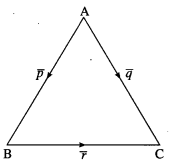
Let the triangle be denoted by ABC,
where \(\overline{\mathrm{AB}}\) = \(\bar{p}\), \(\overline{\mathrm{AC}}\) = \(\bar{q}\) and \(\overline{\mathrm{BC}}\) = \(\bar{r}\)
∵ \(\bar{p}\), \(\bar{r}\), \(\bar{r}\) are unit vectors.
∴ l(AB) = l(BC) = l(CA) = 1
∴ the triangle is equilateral
∴ ∠A = ∠B = ∠C = 60°
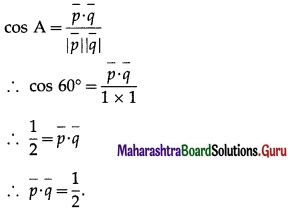
(i) Using the formula for angle between two vectors,
Maharashtra Board 12th Maths Solutions Chapter 5 Vectors Ex 5.3 13

(ii) \(\hat{p} \cdot \hat{r}\)
Solution:
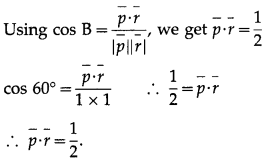
Maharashtra Board 12th Maths Solutions Chapter 5 Vectors Ex 5.3 14

Maharashtra Board 12th Maths Solutions Chapter 1 Mathematical Logic Ex 1.1

Question 9.
Prove by vector method that the angle subtended on semicircle is a right angle.
Solution:
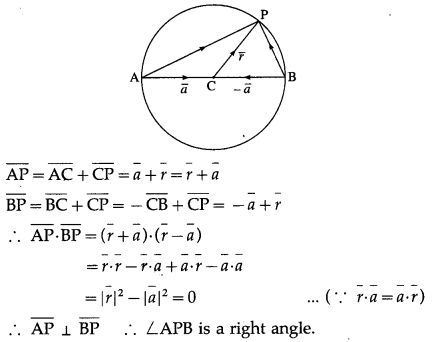
Let seg AB be a diameter of a circle with centre C and P be any point on the circle other than A and B. Then ∠APB is an angle subtended on a semicircle.
Let \(\overline{\mathrm{AC}}\) = \(\overline{\mathrm{CB}}\) = \(\bar{a}\) and \(\overline{\mathrm{CP}}\) = \(\bar{r}\).
Then|\(\bar{a}\)| = |\(\bar{r}\)| …(1)
Maharashtra Board 12th Maths Solutions Chapter 5 Vectors Ex 5.3 15
Hence, the angle subtended on a semicircle is the right angle.

Question 10.
If a vector has direction angles 45ºand 60º find the third direction angle.
Solution:
Let α = 45°, β = 60°
We have to find γ.
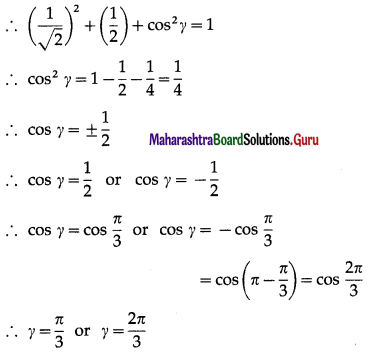
∴ cos2α + cos2β + cos2γ = 1
∴ cos245° + cos260° + cos2γ = 1
Maharashtra Board 12th Maths Solutions Chapter 5 Vectors Ex 5.3 16
Hence, the third direction angle is \(\frac{\pi}{3}\) or \(\frac{2 \pi}{3}\).

Maharashtra Board 12th Maths Solutions Chapter 1 Mathematical Logic Ex 1.1

Question 11.
If a line makes angles 90º, 135º, 45º with the X, Y and Z axes respectively, then find its direction cosines.
Solution:
Let l, m, n be the direction cosines of the line.
Then l = cos α, m = cos β, n = cos γ
Here, α = 90°, β = 135° and γ = 45°
∴ l = cos 90° = 0
m = cos 135° = cos (180° – 45°) = -cos 45° = \(-\frac{1}{\sqrt{2}}\) and n = cos 45° = \(\frac{1}{\sqrt{2}}\)
∴ the direction cosines of the line are 0, \(-\frac{1}{\sqrt{2}}, \frac{1}{\sqrt{2}}\).

Question 12.
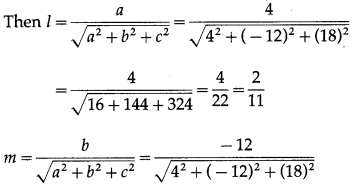
If a line has the direction ratios, 4, -12, 18 then find its direction cosines.
Solution:
The direction ratios of the line are a = 4, b = -12, c = 18.
Let l, m, n be the direction cosines of the line.
Maharashtra Board 12th Maths Solutions Chapter 5 Vectors Ex 5.3 17
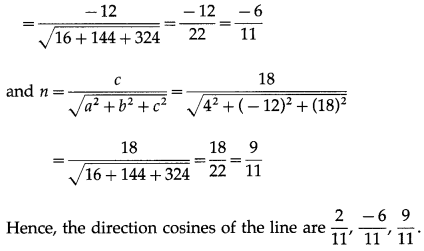
Maharashtra Board 12th Maths Solutions Chapter 5 Vectors Ex 5.3 18

Maharashtra Board 12th Maths Solutions Chapter 1 Mathematical Logic Ex 1.1

Question 13.
The direction ratios of \(\overline{A B}\) are -2, 2, 1. If A = (4, 1, 5) and l(AB) = 6 units, find B.
Solution:
The direction ratio of \(\overline{A B}\) are -2, 2, 1.
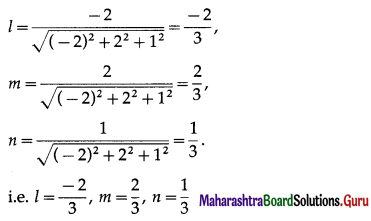
∴ the direction cosines of \(\overline{A B}\) are
Maharashtra Board 12th Maths Solutions Chapter 5 Vectors Ex 5.3 19
The coordinates of the points which are at a distance of d units from the point (x1, y1, z1) are given by (x1 ± ld, y1 ± md, z1 ± nd)
Here x1 = 4, y1 = 1, z1 = 5, d = 6, l = \(-\frac{2}{3}\), m = \(\frac{2}{3}\), n = \(\frac{1}{3}\)
∴ the coordinates of the requited points are
(4 ± \(\left(-\frac{2}{3}\right)\)6, 1 ± \(\frac{2}{3}\)(6), 5 ± \(\frac{1}{3}\)(6))
i.e. (4 – 4, 1 + 4, 5 + 2) and (4 + 4, 1 – 4, 5 – 2)
i.e. (0, 5, 7) and (8, -3, 3).

Question 14.
Find the angle between the lines whose direction cosines l, m, n satisfy the equations 5l + m + 3n = 0 and 5mn – 2nl + 6lm = 0.
Solution:
Given, 5l + m + 3n = 0 …(1)
and 5mn – 2nl + 6lm = 0 …(2)
From (1), m = -(51 + 3n)
Putting the value of m in equation (2), we get,
-5(5l + 3n)n – 2nl – 6l(5l + 3n) = 0
∴ -25ln – 15n2 – 2nl – 30l2 – 18ln = 0
∴ – 30l2 – 45ln – 15n2 = 0
∴ 2l2 + 3ln + n2 = 0
∴ 2l2 + 2ln + ln + n2 = 0
∴ 2l(l + n) + n(l + n) = 0
∴ (l + n)(2l + n) = 0
∴ l + n = 0 or 2l + n = 0
l = -n or n = -2l
Now, m = -(5l + 3n), therefore, if l = -n,
m = -(-5n + 3n) = 2n
∴ -l = \(\frac{m}{2}\) = n
∴ \(\frac{l}{-1}=\frac{m}{2}=\frac{n}{1}\)
∴ the direction ratios of the first line are
a1 = -1, b1 = 2, c1 = 1
If n = -2l, m = -(5l – 6l) – l
∴ l = m = \(\frac{n}{-2}\)
∴ \(\frac{l}{1}=\frac{m}{1}=\frac{n}{-2}\)
∴ the direction ratios of the second line are
a2 = -1, b2 = 1, c2 = -2
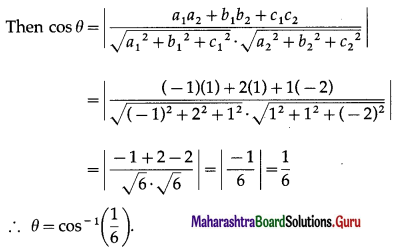
Let θ be the angle between the lines.
Maharashtra Board 12th Maths Solutions Chapter 5 Vectors Ex 5.3 20

Maharashtra Board 12th Maths Solutions Chapter 5 Vectors Ex 5.5

Balbharti 12th Maharashtra State Board Maths Solutions Book Pdf Chapter 5 Vectors Ex 5.5 Questions and Answers.

Maharashtra State Board 12th Maths Solutions Chapter 5 Vectors Ex 5.5

Question 1.
Find \(\bar{a}\)∙(\(\bar{b}\) × \(\bar{c}\)), if \(\bar{a}\) = \(3 \hat{i}-\hat{j}+4 \hat{k}\), \(\bar{b}\) = \(2 \hat{i}+3 \hat{j}-\hat{k}\) and \(\bar{c}\) = \(-5 \hat{i}+2 \hat{j}+3 \hat{k}\)
Solution:
\(\bar{a}\)∙(\(\bar{b}\) × \(\bar{c}\)) = \(\left|\begin{array}{rrr}
3 & -1 & 4 \\
2 & 3 & -1 \\
-5 & 2 & 3
\end{array}\right|\)
= 3(9 + 2) + 1 (6 – 5) + 4(4 + 15)
= 33 + 1 + 76
= 110.

Question 2.
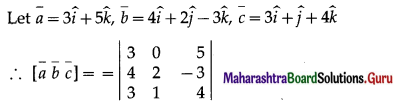
If the vectors \(3 \hat{i}+5 \hat{k}, 4 \hat{i}+2 \hat{j}-3 \hat{k}\) and \(3 \hat{i}+\hat{j}+4 \hat{k}\) are to co-terminus edges of the parallelo piped, then find the volume of the parallelopiped.
Solution:
Maharashtra Board 12th Maths Solutions Chapter 5 Vectors Ex 5.5 1
= 3(8 + 3) – 0(16 + 9) + 5(4 – 6)
= 33 – 0 – 10 = 23
∴ volume of the parallelopiped = \([\bar{a} \bar{b} \bar{c}]\)
= 23 cubic units.

Maharashtra Board 12th Maths Solutions Chapter 1 Mathematical Logic Ex 1.1

Question 3.
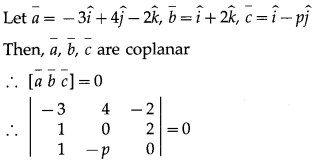
If the vectors \(-3 \hat{i}+4 \hat{j}-2 \hat{k}, \hat{i}+2 \hat{k}\) and\(\hat{i}-p \hat{j}\) are coplanar, then find the value of p.
Solution:
Maharashtra Board 12th Maths Solutions Chapter 5 Vectors Ex 5.5 2
∴ -3(0 + 2p) – 4(0 – 2) – 2(-p – 0) = 0
∴ -6p + 8 + 2p = 0
∴ -4p = -8
P = 2.

Question 4.
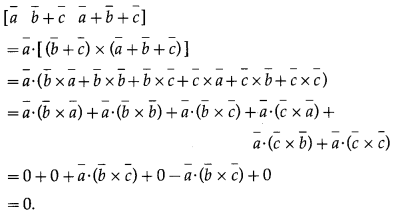
Prove that :
(i) [latex]\bar{a} \bar{b}+\bar{c} \bar{a}+\bar{b}+\bar{c}[/latex] = 0
Solution:
Maharashtra Board 12th Maths Solutions Chapter 5 Vectors Ex 5.5 3

Maharashtra Board 12th Maths Solutions Chapter 1 Mathematical Logic Ex 1.1

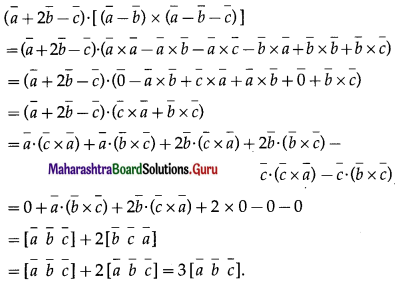
(ii) (\(\bar{a}\) – \(2 \bar{b}\) – \(\bar{c}\))∙[(\(\bar{a}\) – \(\bar{b}\)) × \(\bar{a}\) – \(\bar{b}\) – \(\bar{c}\)] = 3[\(\bar{a}\) – \(\bar{b}\) – \(\bar{c}\)]
Question is modified.
(\(\bar{a}\) – \(2 \bar{b}\) – \(\bar{c}\)) [(\(\bar{a}\) – \(\bar{b}\)) × \(\bar{a}\) – \(\bar{b}\) – \(\bar{c}\)] = 3[\(\bar{a}\) \(\bar{b}\) \(\bar{c}\)]
Solution:
Maharashtra Board 12th Maths Solutions Chapter 5 Vectors Ex 5.5 4

Question 5.
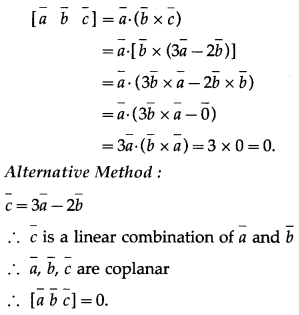
If \(\bar{c}\) =3\(\bar{a}\) – 2\(\bar{b}\) prove that [\(\bar{a}\) \(\bar{b}\) \(\bar{c}\)] = 0
Solution:
We use the results :\(\bar{b}\) × \(\bar{b}\) = 0 and if in a scalar triple product, two vectors are equal, then the scalar triple product is zero.
Maharashtra Board 12th Maths Solutions Chapter 5 Vectors Ex 5.5 5

Maharashtra Board 12th Maths Solutions Chapter 1 Mathematical Logic Ex 1.1

Question 6.
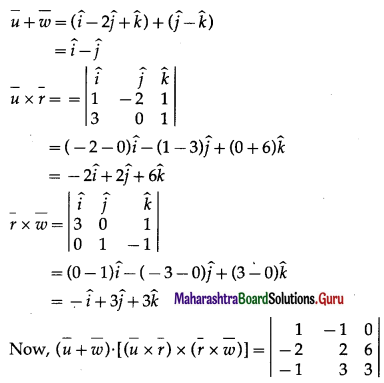
If u = \(\hat{\mathbf{i}}-2 \hat{\mathbf{j}}+\hat{k}\), \(\bar{v}\) = \(3 \hat{\mathbf{i}}+\hat{k}\) and \(\bar{w}\) = \(\hat{\mathrm{j}}-\hat{\mathrm{k}}\) are given vectors, then find
(i) [\(\bar{u}\) + \(\bar{w}\)]∙[(\(\bar{w}\) × \(\bar{r}\)) × (\(\bar{r}\) × \(\bar{w}\))]
Question is modified.
If \(\bar{u}\) = \(\hat{\mathbf{i}}-2 \hat{\mathbf{j}}+\hat{k}\), \(\bar{r}\) = \(3 \hat{\mathbf{i}}+\hat{k}\) and \(\bar{w}\) = \(\hat{\mathrm{j}}-\hat{\mathrm{k}}\) are given vectors, then find [\(\bar{u}\) + \(\bar{w}\)]∙[(\(\bar{u}\) × \(\bar{r}\)) × (\(\bar{r}\) × \(\bar{w}\))]
Solution:
Maharashtra Board 12th Maths Solutions Chapter 5 Vectors Ex 5.5 6
= 1(6 – 18) + 1 (-6 + 6) + 0
= -12 + 0 + 0 = -12.

Question 7.
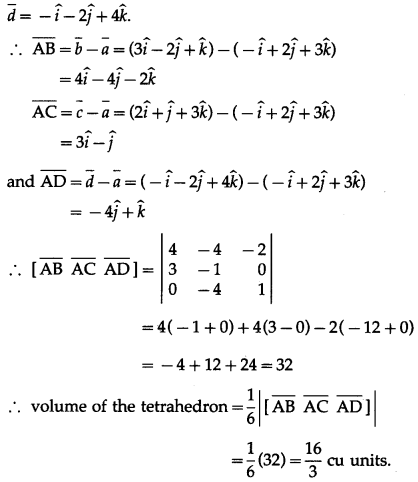
Find the volume of a tetrahedron whose vertices are A( -1, 2, 3) B(3, -2, 1), C (2, 1, 3) and D(-1, -2, 4).
Solution:
The position vectors \(\bar{a}\), \(\bar{b}\), \(\bar{c}\) and \(\bar{d }\) of the points A, B, C and D w.r.t. the origin are \(\bar{a}\) = \(-\hat{i}+2 \hat{j}+3 \hat{k}\), \(\bar{b}\) = \(3 \hat{i}-2 \hat{j}+\hat{k}\), \(\bar{c}\) = \(2 \hat{i}+\hat{j}+3 \hat{k}\) and
Maharashtra Board 12th Maths Solutions Chapter 5 Vectors Ex 5.5 7

Maharashtra Board 12th Maths Solutions Chapter 1 Mathematical Logic Ex 1.1

Question 8.
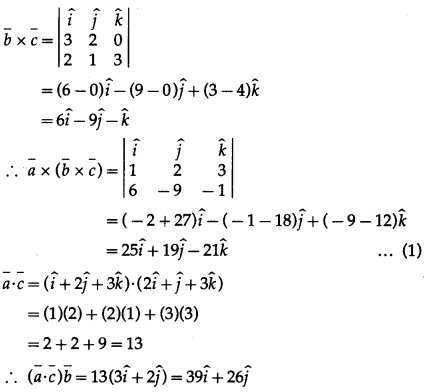
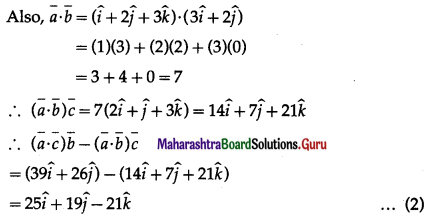
If \(\bar{a}\) = \(\hat{i}+2 \hat{j}+3\), \(\bar{b}\) = \(3 \hat{i}+2 \hat{j}\) and \(\bar{c}\) = ,\(2 \hat{i}+\hat{j}+3\) then verify that \(\bar{a}\) × (\(\bar{b}\) × \(\bar{c}\)) = (\(\bar{a}\) ⋅ \(\bar{c}\))\(\bar{b}\) – (\(\bar{a}\) ⋅ \(\bar{b}\))\(\bar{c}\)
Solution:
Maharashtra Board 12th Maths Solutions Chapter 5 Vectors Ex 5.5 8
Maharashtra Board 12th Maths Solutions Chapter 5 Vectors Ex 5.5 9
From (1) and (2), we get
\(\bar{a}\) × (\(\bar{b}\) × \(\bar{c}\)) = (\(\bar{a}\) ⋅ \(\bar{c}\))\(\bar{b}\) – (\(\bar{a}\) ⋅ \(\bar{b}\))\(\bar{c}\)

Question 9.
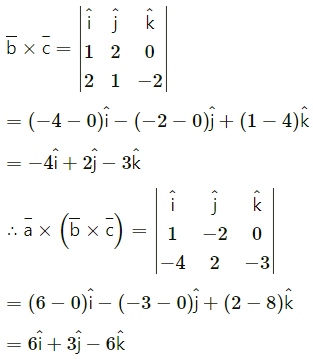
If, \(\bar{a}\) = \(\hat{i}-2 \hat{j}\), \(\bar{b}\) = \(\hat{i}+2 \hat{j}\) and \(\bar{c}\) =\(2 \hat{i}+\hat{j}-2\) then find
(i) \(\bar{a}\) × (\(\bar{b}\) × \(\bar{c}\))
Solution:
Maharashtra Board 12th Maths Solutions Chapter 5 Vectors Ex 5.5 10

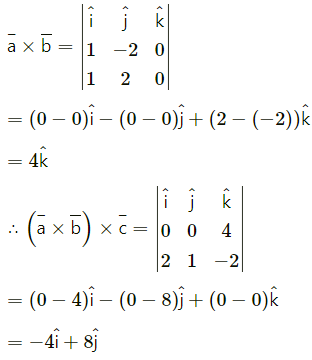
(ii) (\(\bar{a}\) × \(\bar{b}\)) × \(\bar{c}\) Are the results same? Justify.
Solution:
Maharashtra Board 12th Maths Solutions Chapter 5 Vectors Ex 5.5 11
\(\bar{a}\) × (\(\bar{b}\) × \(\bar{c}\)) ≠ (\(\bar{a}\) × \(\bar{b}\)) × \(\bar{c}\)

Maharashtra Board 12th Maths Solutions Chapter 1 Mathematical Logic Ex 1.1

Question 10.
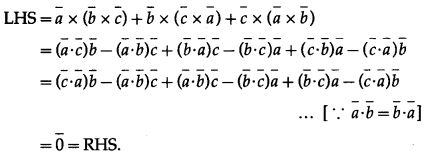
Show that \(\bar{a}\) × (\(\bar{b}\) × \(\bar{c}\)) + \(\bar{b}\) × (\(\bar{c}\) × \(\bar{a}\)) + \(\bar{c}\) × (\(\bar{a}\) × \(\bar{b}\)) = 0
Solution:
Maharashtra Board 12th Maths Solutions Chapter 5 Vectors Ex 5.5 12

Maharashtra Board 12th Maths Solutions Chapter 5 Vectors Ex 5.2

Balbharti 12th Maharashtra State Board Maths Solutions Book Pdf Chapter 5 Vectors Ex 5.2 Questions and Answers.

Maharashtra State Board 12th Maths Solutions Chapter 5 Vectors Ex 5.2

Question 1.
Find the position vector of point R which divides the line joining the points P and Q whose position vectors are \(2 \hat{i}-\hat{j}+3 \hat{k}\) and \(-5 \hat{i}+2 \hat{j}-5 \hat{k}\) in the ratio 3 : 2
(i) internally
Solution:
It is given that the points P and Q have position vectors \(\bar{p}\) = \(2 \hat{i}-\hat{j}+3 \hat{k}\) and \(\bar{p}\) = \(-5 \hat{i}+2 \hat{j}-5 \hat{k}\) respectively.
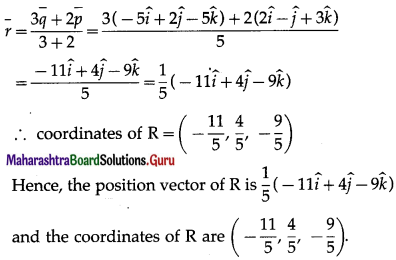
(i) If R(\(\bar{r}\)) divides the line segment PQ internally in the ratio 3 : 2, by section formula for internal division,
Maharashtra Board 12th Maths Solutions Chapter 5 Vectors Ex 5.2 1

(ii) externally.
Solution:
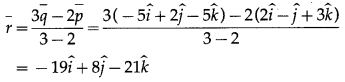
If R(\(\bar{r}\)) divides the line segment joining P and Q externally in the ratio 3 : 2, by section formula for external division,
Maharashtra Board 12th Maths Solutions Chapter 5 Vectors Ex 5.2 2
∴ coordinates of R = (-19, 8, -21).
Hence, the position vector of R is \(-19 \hat{i}+8 \hat{j}-21 \hat{k}\) and coordinates of R are (-19, 8, -21).

Maharashtra Board 12th Maths Solutions Chapter 1 Mathematical Logic Ex 1.1

Question 2.
Find the position vector of midpoint M joining the points L (7, -6, 12) and N (5, 4, -2).
Solution:
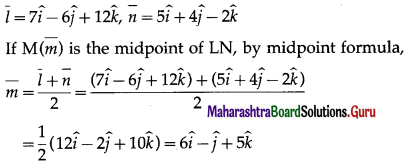
The position vectors \(\bar{l}\) and \(\bar{n}\) of the points L(7, -6, 12) and N (5, 4, -2) are given by
Maharashtra Board 12th Maths Solutions Chapter 5 Vectors Ex 5.2 3
∴ coordinates of M = (6, -1, 5).
Hence, position vector of M is \(6 \hat{i}-\hat{j}+5 \hat{k}\) and the coordinates of M are (6, -1, 5).

Question 3.
If the points A(3, 0, p), B (-1, q, 3) and C(-3, 3, 0) are collinear, then find
(i) The ratio in which the point C divides the line segment AB.
Solution:
Let \(\bar{a}\), \(\bar{b}\) and \(\bar{c}\) be the position vectors of A, B and C respectively.
Then \(\bar{a}\) = \(3 \hat{i}+0 \cdot \hat{j}+p \hat{k}\), \(\bar{b}\) = \(-\hat{i}+q \hat{j}+3 \hat{k}\) and \(\bar{c}\) = \(-3 \hat{i}+3 \hat{j}+0 \hat{k}\).
As the points A, B, C are collinear, suppose the point C divides line segment AB in the ratio λ : 1.
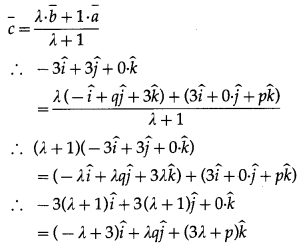
∴ by the section formula,
Maharashtra Board 12th Maths Solutions Chapter 5 Vectors Ex 5.2 4
By equality of vectors, we have,
-3(λ + 1) = -λ + 3 … (1)
3(λ + 1 ) = λ q … (2)
0 = 3λ + p … (3)
From equation (1), -3λ – 3 = -λ + 3
∴ -2λ = 6 ∴ λ = -3
∴ C divides segment AB externally in the ratio 3 : 1.

Maharashtra Board 12th Maths Solutions Chapter 1 Mathematical Logic Ex 1.1

(ii) The values of p and q.
Solution:
Putting λ = -3 in equation (2), we get
3(-3 + 1) = -3q
∴ -6 = -3q ∴ q = 2
Also, putting λ = -3 in equation (3), we get
0 = -9 + p ∴ p = 9
Hence p = 9 and q = 2.

Question 4.
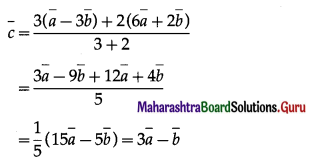
The position vector of points A and B are 6\(\bar{a}\) + 2\(\bar{b}\) and \(\bar{a}\) – 3\(\bar{b}\). If the point C divides AB in the ratio 3 : 2 then show that the position vector of C is 3\(\bar{a}\) – \(\bar{b}\).
Solution:
Let \(\bar{c}\) be the position vector of C.
Since C divides AB in the ratio 3 : 2,
Maharashtra Board 12th Maths Solutions Chapter 5 Vectors Ex 5.2 5
Hence, the position vector of C is 3\(\bar{a}\) – \(\bar{b}\).

Maharashtra Board 12th Maths Solutions Chapter 1 Mathematical Logic Ex 1.1

Question 5.
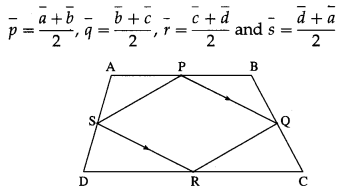
Prove that the line segments joining mid-point of adjacent sides of a quadrilateral form a parallelogram.
Solution:
Let ABCD be a quadrilateral and P, Q, R, S be the midpoints of the sides AB, BC, CD and DA respectively.
Let \(\bar{a}\), \(\bar{b}\), \(\bar{c}\), \(\bar{d}\), \(\bar{p}\), \(\bar{q}\), \(\bar{r}\) and s be the position vectors of the points A, B, C, D, P, Q, R and S respectively.
Since P, Q, R and S are the midpoints of the sides AB, BC, CD and DA respectively,
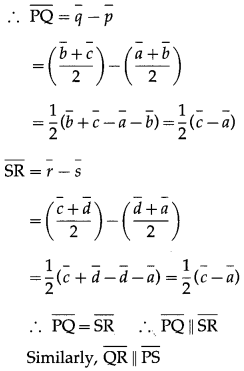
Maharashtra Board 12th Maths Solutions Chapter 5 Vectors Ex 5.2 6
Maharashtra Board 12th Maths Solutions Chapter 5 Vectors Ex 5.2 7
∴ □PQRS is a parallelogram.

Question 6.
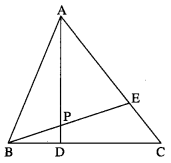
D and E divide sides BC and CA of a triangle ABC in the ratio 2 : 3 respectively. Find the position vector of the point of intersection of AD and BE and the ratio in which this point divides AD and BE.
Solution:
Maharashtra Board 12th Maths Solutions Chapter 5 Vectors Ex 5.2 19
Let AD and BE intersect at P.
Let A, B, C, D, E, P have position vectos \(\bar{a}\), \(\bar{b}\), \(\bar{c}\), \(\bar{d}\), \(\bar{e}\), \(\bar{p}\) respectively.
D and E divide segments BC and CA internally in the ratio 2 : 3.
By the section formula for internal division,
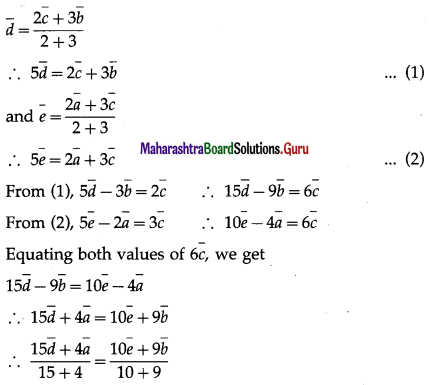
Maharashtra Board 12th Maths Solutions Chapter 5 Vectors Ex 5.2 9
LHS is the position vector of the point which divides segment AD internally in the ratio 15 : 4.
RHS is the position vector of the point which divides segment BE internally in the ratio 10 : 9.
But P is the point of intersection of AD and BE.
∴ P divides AD internally in the ratio 15 : 4 and P divides BE internally in the ratio 10 : 9.
Hence, the position vector of the point of interaction of
AD and BE is \(\bar{p}\) = \(\frac{15 \bar{d}+4 \bar{a}}{19}=\frac{10 \bar{e}+9 \bar{b}}{19}\) and it divides AD internally in the ratio 15 : 4 and BE internally in the ratio 10 : 9.

Maharashtra Board 12th Maths Solutions Chapter 1 Mathematical Logic Ex 1.1

Question 7.
Prove that a quadrilateral is a parallelogram if and only if its diagonals bisect each other.
Solution:
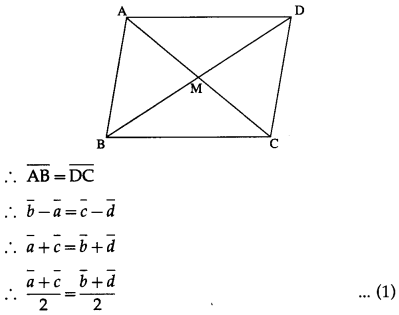
Let \(\bar{a}\), \(\bar{b}\), \(\bar{c}\) and \(\bar{d}\) be respectively the position vectors of the vertices A, B, C and D of the parallelogram ABCD. Then AB = DC and side AB || side DC.
Maharashtra Board 12th Maths Solutions Chapter 5 Vectors Ex 5.2 10
The position vectors of the midpoints of the diagonals AC and BD are (\(\bar{a}\) + \(\bar{c}\))/2 and (\(\bar{b}\) + \(\bar{d}\))/2. By (1), they are equal.
∴ the midpoints of the diagonals AC and BD are the same.
This shows that the diagonals AC and BD bisect each other.

(ii) Conversely, suppose that the diagonals AC and BD
of □ ABCD bisect each other,
i. e. they have the same midpoint.
∴ the position vectors of these midpoints are equal.
∴ \(\frac{\bar{a}+\bar{c}}{2}=\frac{\bar{b}+\bar{d}}{2}\) ∴ \(\bar{a}+\bar{c}=\bar{b}+\bar{d}\)
∴ \(\bar{b}\) – \(\bar{a}\) = \(\bar{c}\) – \(\bar{d}\) ∴ \(\overline{\mathrm{AB}}\) = \(\overline{\mathrm{DC}}\)
∴ \(\overline{\mathrm{AB}}\) ||\(\overline{\mathrm{DC}}\) and \(|\overline{\mathrm{AB}}|\) = \(|\overline{\mathrm{DC}}|\)
∴ side AB || side DC and AB = DC.
∴ □ ABCD is a parallelogram.

Maharashtra Board 12th Maths Solutions Chapter 1 Mathematical Logic Ex 1.1

Question 8.
Prove that the median of a trapezium is parallel to the parallel sides of the trapezium and its length is half the sum of parallel sides.
Solution:
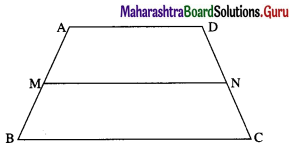
Let \(\bar{a}\), \(\bar{b}\), \(\bar{c}\) and \(\bar{d}\) be respectively the position vectors of the vertices A, B, C and D of the trapezium ABCD, with side AD || side BC.
Then the vectors \(\overline{\mathrm{AD}}\) and \(\overline{\mathrm{BC}}\) are parallel.
∴ there exists a scalar k,
such that \(\overline{\mathrm{AD}}\) = k∙\(\overline{\mathrm{BC}}\)
∴ \(\overline{\mathrm{AD}}\) + \(\overline{\mathrm{BC}}\) = k∙\(\overline{\mathrm{BC}}\) + \(\overline{\mathrm{BC}}\)
= (k + 1)BC …(1)
Maharashtra Board 12th Maths Solutions Chapter 5 Vectors Ex 5.2 11
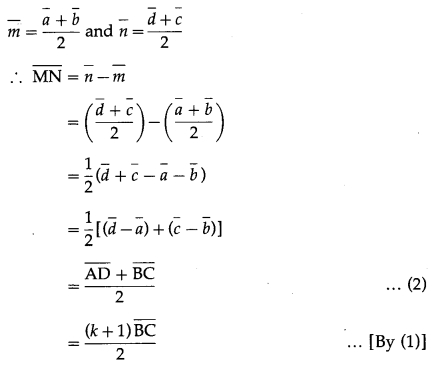
Let \(\bar{m}\) and \(\bar{n}\) be the position vectors of the midpoints M and N of the non-parallel sides AB and DC respectively.
Then seg MN is the median of the trapezium.
By the midpoint formula,
Maharashtra Board 12th Maths Solutions Chapter 5 Vectors Ex 5.2 12
Thus \(\overline{\mathrm{MN}}\) is a scalar multiple of \(\overline{\mathrm{BC}}\)
∴ \(\overline{\mathrm{MN}}\) and \(\overline{\mathrm{BC}}\) are parallel vectors
∴ \(\overline{\mathrm{MN}}\) || \(\overline{\mathrm{BC}}\) where \(\overline{\mathrm{BC}}\) || \(\overline{\mathrm{AD}}\)
∴ the median MN is parallel to the parallel sides AD and BC of the trapezium.
Now \(\overline{\mathrm{AD}}\) and \(\overline{\mathrm{BC}}\) are collinear
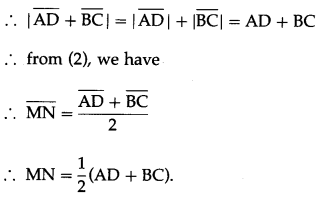
Maharashtra Board 12th Maths Solutions Chapter 5 Vectors Ex 5.2 13

Question 9.
If two of the vertices of the triangle are A(3, 1, 4) and B(-4, 5, -3) and the centroid of a triangle is G(-1, 2, 1), then find the coordinates of the third vertex C of the triangle.
Solution:
Let \(\bar{a}\), \(\bar{b}\), \(\bar{c}\) and \(\bar{g}\) be the position vectors of A, B, C and G respectively.
Then \(\bar{a}\) = \(3 \hat{i}+\hat{j}+4 \hat{k}\), \(\bar{b}\) = \(-4 \hat{i}+5 \hat{j}-3 \hat{k}\) and \(\bar{g}\) = \(-\hat{i}+2 \hat{j}+\hat{k}\).
Since G is the centroid of the ∆ABC, by the centroid formula,
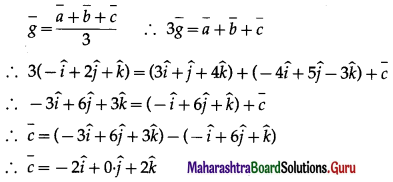
Maharashtra Board 12th Maths Solutions Chapter 5 Vectors Ex 5.2 14
∴ the coordinates of third vertex C are (-2, 0, 2).

Maharashtra Board 12th Maths Solutions Chapter 1 Mathematical Logic Ex 1.1

Question 10.
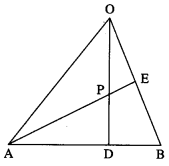
In∆OAB, E is the mid-point of OB and D is the point on AB such that AD : DB = 2 : 1.
If OD and AE intersect at P, then determine the ratio OP : PD using vector methods.
Solution:
Maharashtra Board 12th Maths Solutions Chapter 5 Vectors Ex 5.2 15
Let A, B, D, E, P have position vectors \(\bar{a}\), \(\bar{b}\), \(\bar{d}\), \(\bar{e}\), \(\bar{p}\) respectively w.r.t. O.
∵ AD : DB = 2 : 1.
∴ D divides AB internally in the ratio 2 : 1.
Using section formula for internal division, we get
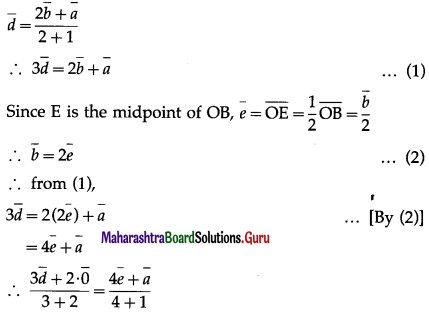
Maharashtra Board 12th Maths Solutions Chapter 5 Vectors Ex 5.2 16
LHS is the position vector of the point which divides OD internally in the ratio 3 : 2.
RHS is the position vector of the point which divides AE internally in the ratio 4 : 1.
But OD and AE intersect at P
∴ P divides OD internally in the ratio 3 : 2.
Hence, OP : PD = 3 : 2.

Question 11.
If the centroid of a tetrahedron OABC is (1, 2, -1) where A = (a, 2, 3), B = (1, b, 2), C = (2, 1, c) respectively, find the distance of P (a, b, c) from the origin.
Solution:
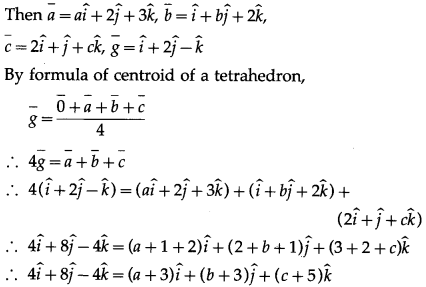
Let G = (1, 2, -1) be the centroid of the tetrahedron OABC.
Let \(\bar{a}\), \(\bar{b}\), \(\bar{c}\), \(\bar{g}\) be the position vectors of the points A, B, C, G respectively w.r.t. O.
Maharashtra Board 12th Maths Solutions Chapter 5 Vectors Ex 5.2 17
By equality of vectors
a + 3 = 4, b + 3 = 8, c + 5= -4
∴ a = 1, b = 5, c = -9
∴ P = (a, b, c) = (1, 5, -9)
Distance of P from origion = \(\sqrt{1^{2}+5^{2}+(-9)^{2}}\)
= \(\sqrt{1+25+81}\)
= \(\sqrt{107}\)

Maharashtra Board 12th Maths Solutions Chapter 1 Mathematical Logic Ex 1.1

Question 12.
Find the centroid of tetrahedron with vertices K(5, -7, 0), L(1, 5, 3), M(4, -6, 3), N(6, -4, 2) ?
Solution:
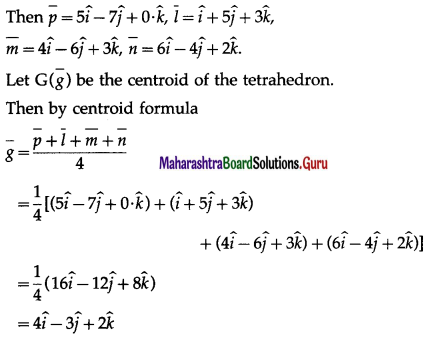
Let \(\bar{p}\), \(\bar{l}\), \(\bar{m}\), \(\bar{n}\) be the position vectors of the points K, L, M, N respectively w.r.t. the origin O.
Maharashtra Board 12th Maths Solutions Chapter 5 Vectors Ex 5.2 18
Hence, the centroid of the tetrahedron is G = (4, -3, 2).

Maharashtra Board 11th Maths Solutions Chapter 2 Trigonometry – I Ex 2.2

Balbharti Maharashtra State Board Class 11 Maths Solutions Pdf Chapter 2 Trigonometry – I Ex 2.2 Questions and Answers.

Maharashtra State Board 11th Maths Solutions Chapter 2 Trigonometry – I Ex 2.2

Question 1.
If 2sin A = 1 = \(\sqrt{2}\) cos B and \(\frac{\pi}{2}\) < A < π, \(\frac{3 \pi}{2}\)
Solution:
Given, 2sin A = 1
∴ sin A = 1/2
we know that,
cos2 A = 1 – sin2 A = 1 – \(\left(\frac{1}{2}\right)^{2}=1-\frac{1}{4}=\frac{3}{4}\)
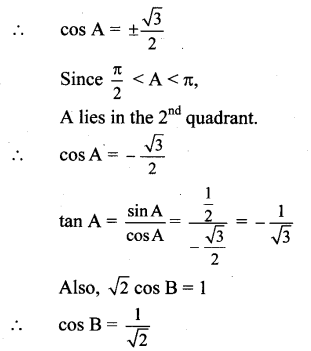
∴ cos A = \(\pm \frac{\sqrt{3}}{2}\)
Since \(\frac{\pi}{2}\) < A < π
A lies in the 2nd quadrant.
Maharashtra Board 11th Maths Solutions Chapter 2 Trigonometry - I Ex 2.2 1
We know that,
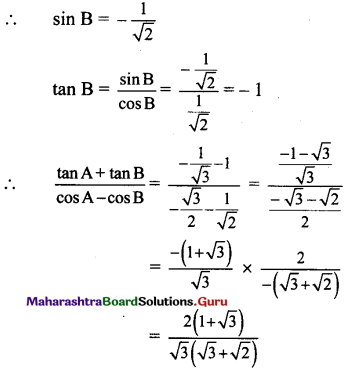
Sin2 B = 1 – cos2 B = 1 – \(\left(\frac{1}{\sqrt{2}}\right)^{2}\)\(\frac{1}{2}=\frac{1}{2}\)
∴ sin B = \(\pm \frac{1}{\sqrt{2}}\)
Since \(\frac{3 \pi}{2}\) < B < 2π
B lies in the 4th quadrant,
Maharashtra Board 11th Maths Solutions Chapter 2 Trigonometry - I Ex 2.2 2

Maharashtra Board 11th Maths Solutions Chapter 2 Trigonometry - I Ex 2.2

Question 2.
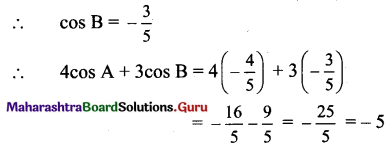
If \(\) and A, B are angles in the second quadran, then prove that 4cosA + 3 cos B = -5
Solution:
Given, \(\frac{\sin \mathrm{A}}{3}=\frac{\sin \mathrm{B}}{4}=\frac{1}{5}\)
∴ sin A = \(\frac{3}{5}\) and sin B = \(\frac{4}{5}\)
We know that,
cos2 A = 1 – sin2 = 1 – \(\left(\frac{3}{5}\right)^{2}\) = 1 – \(\frac{9}{25}=\frac{16}{25}\)
∴ Cos A = ± \([{4}{5}\)
Since A lies in the second quadrant,
cos A < 0
∴ Cos A = –\(\frac{4}{5}\)
Sin B = 4/5
We know that,
cos2B = 1 – sin2B = 1 – \(\left(\frac{4}{5}\right)^{2}=1-\frac{16}{25}=\frac{9}{25}\)
∴ Cos B = ±\(\frac{4}{5}\)
Since B lies in the second quadrant, cos B < 0
Maharashtra Board 11th Maths Solutions Chapter 2 Trigonometry - I Ex 2.2 3

Question 3.
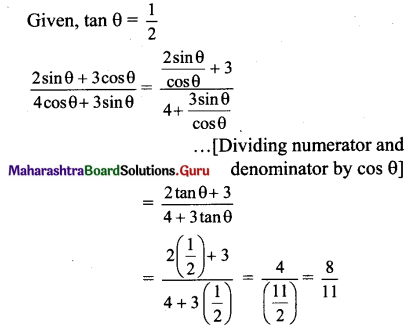
If tan θ = \(\frac{1}{2}\), evaluate \(\frac{2 \sin \theta+3 \cos \theta}{4 \cos \theta+3 \sin \theta}\)
Solution:
Maharashtra Board 11th Maths Solutions Chapter 2 Trigonometry - I Ex 2.2 4

Question 4.
Eliminate 0 from the following:
i. x = 3sec θ, y = 4tan θ
ii. x = 6cosec θ,y = 8cot θ
iii. x = 4cos θ – 5sin θ, y = 4sin θ + 5cos θ
iv. x = 5 + 6 cosec θ,y = 3 + 8 cot θ
v. x = 3 – 4tan θ,3y = 5 + 3sec θ
Solution:
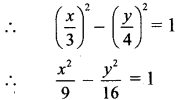
i. x = 3sec θ, y = 4tan θ
∴ sec θ = \(\frac{x}{3}\) and tan θ= \(\frac{y}{4}\)
We know that,
sec2θ – tan2θ = 1
Maharashtra Board 11th Maths Solutions Chapter 2 Trigonometry - I Ex 2.2 5
∴ 16x2 – 9y2 = 144

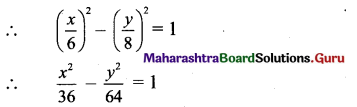
ii. x = 6cosec θ and y = 8cot θ
.’. cosec θ = \(\) and cot θ = \(\)
We know that,
cosec2 θ – cot2 θ =
Maharashtra Board 11th Maths Solutions Chapter 2 Trigonometry - I Ex 2.2 6
16x2 – 9y2 = 576

Maharashtra Board 11th Maths Solutions Chapter 2 Trigonometry - I Ex 2.2

iii. x = 4cos θ – 5 sin θ … (i)
y = 4sin θ + 5cos θ .. .(ii)
Squaring (i) and (ii) and adding, we get
x2 + y2 = (4cos θ – 5sin θ)2 + (4sin θ + 5cos θ)2
= 16cos2θ – 40 sinθ cosθ + 25 sin2θ + 16 sin2 θ + 40sin θ cos θ + 25 cos2 θ
= 16(sin2 θ + cos2 θ) + 25(sin2 θ + cos2 θ)
= 16(1) + 25(1)
= 41

iv. x = 5 + 6cosec θ andy = 3 + 8cot θ
∴ x – 5 = 6cosec θ and y – 3 = 8cot θ
∴ cosec θ = \(\frac{x-5}{6}\) and cot θ = \(\frac{y-3}{8}\)
We know that,
cosec2 θ – cot2 θ = 1
∴ \(\left(\frac{x-5}{6}\right)^{2}-\left(\frac{y-3}{8}\right)^{2}\) = 1

v. 2x = 3 – 4tan θ and 3y = 5 + 3sec θ
∴ 2x – 3 = -4tan θ and 3y – 5 = 3sec θ
∴ tan θ = \(\frac{3-2 x}{4}\) and sec θ = \(\frac{3 y-5}{3}\)θ
We know that, sec2 θ – tan2 θ = 1
∴ \(\left(\frac{3 y-5}{3}\right)^{2}-\left(\frac{3-2 x}{4}\right)^{2}\) = 1
∴ \(\left(\frac{3 y-5}{3}\right)^{2}-\left(\frac{2 x-3}{4}\right)^{2}\) = 1

Question 5.
If 2sin2 θ + 3sin θ = 0, find the permissible values of cosθ.
Solution:
2sin2 θ + 3sin θ = 0
∴ sin θ (2sin θ + 3) = 0
∴ sin θ = 0 or sin θ = \(\frac{-3}{2}\)
Since – 1 ≤ sin θ ≤ 1,
sin θ = 0
\(\sqrt{1-\cos ^{2} \theta}\) = 0 …[ ∵ sin2 θ = 1- cos2 θ]
∴ 1 – cos2 θ = 0
∴ cos2 θ = 1
∴ cos θ = ±1 …[∵ – 1 ≤ cos θ ≤ 1]

Question 6.
If 2cos2 θ – 11 cos θ + 5 = 0, then find the possible values of cos θ.
Solution:
2cos2θ – 11 cos θ + 5 = 0
∴ 2cos2 θ – 10 cos θ – cos θ + 5 = 0
∴ 2cos θ(cos θ – 5) – 1 (cos θ – 5) = 0
∴ (cos θ – 5) (2cos θ – 1) = 0
cos θ – 5 = 0 or 2cos θ – 1 = 0
∴ cos θ = 5 or cos θ = 1/2
Since, -1 ≤ cos θ ≤ 1
∴ cos θ = 1/2

Question 7.
Find the acute angle θ such 2cos2 θ = 3sin θ.
Solution:
2cos20 = 3sin θ
∴ 2(1 – sin2 θ) = 3sin θ
∴ 2 – 2sin2 θ = 3sin θ
∴ 2sin2 θ + 3sin 9-2 = θ
∴ 2sin2 θ + 4sin θ – sin θ – 2 = θ
∴ 2sin θ(sin θ + 2) -1 (sin θ + 2) = θ
∴ (sin θ + 2) (2sin θ – 1) = 0
∴ sin θ + 2 = 0 or 2sin θ – 1 = 0
∴ sin θ = -2 or sin θ = 1/2
Since, -1 ≤ sin θ ≤ 1
∴ Sin θ = 1/2
∴ θ = 30° …[ ∵ sin 30 = 1/2]

Maharashtra Board 11th Maths Solutions Chapter 2 Trigonometry - I Ex 2.2

Question 8.
Find the acute angle 0 such that 5tan2 0 + 3 = 9sec 0.
Solution:
5tan2 θ + 3 = 9sec θ
∴ 5(sec2 θ – 1) + 3 = 9sec θ
∴ 5sec2 θ – 5 + 3 = 9sec θ
∴ 5sec2 θ – 9sec θ – 2 = 0
∴ 5sec2 θ – 10 sec θ + sec θ – 2 = 0
∴ 5sec θ(sec θ – 2) + 1(sec θ – 2) = 0
∴ (sec θ – 2) (5sec θ + 1) = 0
∴ sec θ – 2 = 0 or 5sec θ + 1 = 0
∴ sec θ = 2 or sec θ = -1/5
Since sec θ ≥ 1 or sec θ ≤ -1,
sec θ = 2
∴ θ = 60° … [ ∵ sec 60° = 2]

Question 9.
Find sin θ such that 3cos θ + 4sin θ = 4.
Solution:
3cos θ + 4sin θ = 4
∴ 3cos θ = 4(1 – sin θ)
Squaring both the sides, we get .
9cos2θ = 16(1 – sin θ)2
∴ 9(1 – sin2 θ) = 16(1 + sin2 θ – 2sin θ)
∴ 9 – 9sin2 θ = 16 + 16sin2 θ – 32sin θ
∴ 25sin2 θ – 32sin θ + 7 = 0
∴ 25sin2 θ – 25sin θ – 7sin θ + 7 = 0
25sin θ (sin θ – 1) – 7 (sin θ – 1) = 0
∴ (sin θ – 1) (25sin θ – 7) = 0
∴ sin θ – 1 = 0 or 25 sin θ – 7 = 0
∴ sin θ = 1 or sin θ = \(\frac{7}{25}\)
Since, -1 ≤ sin θ ≤ 1
∴ sin θ = 1 or \(\frac{7}{25}\)
[Note: Answer given in the textbook is 1. However, as per our calculation it is 1 or \(\frac{7}{25}\).]

Question 10.
If cosec θ + cot θ = 5, then evaluate sec θ.
Solution:
cosec θ + cot θ = 5
∴ \(\frac{1}{\sin \theta}+\frac{\cos \theta}{\sin \theta}=5\)
∴ \(\frac{1+\cos \theta}{\sin \theta}=5\)
∴ 1 + cos θ = 5.sin θ
Squaring both the sides, we get
1 + 2 cos θ + cos2 θ = 25 sin2 θ
∴ cos2 θ + 2 cos θ + 1 = 25 (1 – cos2 θ)
∴ cos2 θ + 2 cos θ + 1 = 25 – 25 cos2 θ
∴ 26 cos2 θ + 2 cos θ – 24 = 0
∴ 26 cos2 θ + 26 cos θ – 24 cos θ – 24 = 0
∴ 26 cos θ (cos θ + 1) – 24 (cos θ + 1) = 0
∴ (cos θ + 1) (26 cos θ – 24) = 0
∴ cos θ + 1 = θ or 26 cos θ – 24 = 0
∴ cos θ = -1 or cos θ = \(\frac{24}{26}=\frac{12}{13}\)
When cos θ = -1, sin θ = 0
∴ cot θ and cosec x are not defined,
∴ cos θ ≠ -1
∴ cos θ = \(\frac{12}{13}\)
∴ sec θ = \(\frac{1}{\cos \theta}=\frac{13}{12}\)
[Note: Answer given in the textbook is -1 or \(\frac{13}{12}\).
However, as per our calculation it is only \(\frac{13}{12}\).]

Question 11.
If cot θ = \(\frac{3}{4}\) and π < θ < \(\frac{3 \pi}{2}\), then find the value of 4 cosec θ + 5 cos θ.
Solution:
We know that,
cosec2θ = 1 + cot2 θ = \(\left(\frac{3}{4}\right)^{2}\) = 1 + \(\frac{9}{16}\)
∴ cosec2 θ = \(\frac{25}{16}\)
∴ cosec θ = \(\pm \frac{5}{4}\)
Since π < θ < \(\frac{3 \pi}{2}\)
θ lies in the third quadrant.
∴ cosec θ < 0
∴ cosec θ = –\(\frac{5}{4}\)
cot θ = \(\frac{3}{4}\)
tan θ = \(\frac{1}{\cot \theta}=\frac{4}{3}\)
We know that,
sec2 θ = 1 + tan2 θ = 1 + \(\left(\frac{4}{3}\right)^{2}\)
= 1 + \(\frac{16}{9}=\frac{25}{9}\)
∴ sec θ = ±\(\frac{5}{3}\)
Since θ lies in the third quadrant,
sec θ < 0
∴ sec θ = –\(\frac{5}{3}\)
cos θ = \(\frac{1}{\sec \theta}=\frac{-3}{5}\)
∴ 4cosec θ + 5cos θ
= \(4\left(-\frac{5}{4}\right)+5\left(-\frac{3}{5}\right)\)
= -5 – 3 = -8
[Note: The question has been modified.]

Maharashtra Board 11th Maths Solutions Chapter 2 Trigonometry - I Ex 2.2

Question 12.
Find the Cartesian co-ordinates of points whose polar co-ordinates are:
i. (3, 90°) ii. (1, 180°)
Solution:
i. (r, θ) = (3, 90°)
Using x = r cos θ and y = r sin θ, where (x, y) are the required cartesian co-ordinates, we get
x = 3cos 90° and y = 3sin 90°
∴ x = 3(0) = 0 and y = 3(1) = 3
∴ the required cartesian co-ordinates are (0, 3).

ii. (r, θ) = (1, 180°)
Using x = r cos θ and y = r sin θ, where (x, y) are the required cartesian co-ordinates, we get
x = 1(cos 180°) and y = 1(sin 180°)
∴ x = -1 and y = 0
∴ the required cartesian co-ordinates are (-1, 0).

Question 13.
Find the polar co-ordinates of points whose Cartesian co-ordinates are:
1. (5, 5) ii. (1, \(\sqrt{3}\))
ii. (-1, -1) iv. (-\(\sqrt{3}\), 1)
Solution:
i. (x, y) = (5, 5)
∴ r = \(\sqrt{x^{2}+y^{2}}\) = \(\sqrt{25+25}\)
\(=\sqrt{50}=5 \sqrt{2}\)
tan θ = \(\frac{y}{x}=\frac{5}{5}\) = 1
Since the given point lies in the 1st quadrant,
θ = 45° …[∵ tan 45° = 1]
∴ the required polar co-ordinates are (\(5 \sqrt{2}\), 45°).

ii. (x, y) = ( 1, \(\sqrt{3}\))
∴ r = \(\sqrt{x^{2}+y^{2}}=\sqrt{1+3}=\sqrt{4}=2\)
tan θ = \(\frac{y}{x}=\frac{\sqrt{3}}{1}=\sqrt{3}\)
Since the given point lies in the 1st quadrant,
θ = 60° …[∵ tan 60° = \(\sqrt{3}\)]
∴ the required polar co-ordinates are (2, 60°).

iii. (x, y) = (-1, -1)
∴ r = \(\sqrt{x^{2}+y^{2}}=\sqrt{1+1}=\sqrt{2}\)
tan θ = \(\frac{y}{x}=\frac{-1}{-1}=1\)
∴ tan θ = tan \(\frac{\pi}{4}\)
Since the given point lies in the 3rd quadrant,
tan θ = tan \(\left(\pi+\frac{\pi}{4}\right)\) …[∵ tan (n + x) = tanx]
∴ tan θ = tan \(\left(\frac{5 \pi}{4}\right)\)
∴ θ = \(\frac{5 \pi}{4}\) = 225°
∴ the required polar co-ordinates are (\(\sqrt{2}\), 225°).

iv. (x, y) = (-\(\sqrt{3}\) , 1)
∴ r = \(\sqrt{x^{2}+y^{2}}=\sqrt{3+1}=\sqrt{4}=2\)
tan θ = \(\frac{y}{x}=\frac{1}{-\sqrt{3}}\) = -tan \(\frac{\pi}{6}\)
Since the given point lies in the 2nd quadrant,
tan θ = tan \(\left(\pi-\frac{\pi}{6}\right)\) …[∵ tan (π – x) = – tanx]
∴ tan θ = tan \(\left(\frac{5 \pi}{6}\right)\)
∴ θ = \(\frac{5 \pi}{6}\) = 150°
∴ the required polar co-ordinates are (2, 150°)

Question 14.
Find the values of:
i. sin\(\frac{19 \pi^{e}}{3}\)
ii. cos 1140°
iii. cot \(\frac{25 \pi^{e}}{3}\)
Solution:
i. We know that sine function is periodic with period 2π.
sin \(\frac{19 \pi}{3}\) = sin \(\left(6 \pi+\frac{\pi}{3}\right)\) = sin \(\frac{\pi}{3}=\frac{\sqrt{3}}{2}\)

ii. We know that cosine function is periodic with period 2π.
cos 1140° = cos (3 × 360° + 60°)
= cos 60° = \(\frac {1}{2}\)

iii. We know that cotangent function is periodic with period π.
cot \(\frac{25 \pi}{3}\) = cot \(\left(8 \pi+\frac{\pi}{3}\right)\) = cot \(\frac{\pi}{3}\) = \(\frac{1}{\sqrt{3}}\)
dhana work.txt
Displaying dhana work.txt.

Maharashtra Board 12th Maths Solutions Chapter 5 Vectors Ex 5.1

Balbharti 12th Maharashtra State Board Maths Solutions Book Pdf Chapter 5 Vectors Ex 5.1 Questions and Answers.

Maharashtra State Board 12th Maths Solutions Chapter 5 Vectors Ex 5.1

Question 1.
The vector \(\bar{a}\) is directed due north and \(|\bar{a}|\) = 24. The vector \(\bar{b}\) is directed due west and \(|\bar{b}|\) = 7. Find \(|\bar{a}+\bar{b}|\).
Solution:
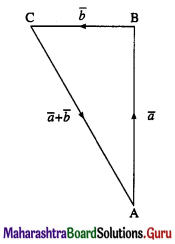
Maharashtra Board 12th Maths Solutions Chapter 5 Vectors Ex 5.1 1
Let \(\overline{\mathrm{AB}}\) = \(\bar{a}\), \(\overline{\mathrm{BC}}\) = \(\bar{b}\)
Then \(\overline{\mathrm{AC}}\) = \(\overline{\mathrm{AB}}\) + \(\overline{\mathrm{BC}}\) = a + b
Given : \(|\bar{a}|\) = \(|\overline{\mathrm{AB}}|\) = l(AB) = 24 and
\(|\bar{b}|\) = \(|\overline{\mathrm{BC}}|\) = l(BC) = 7
∴ ∠ABC = 90°
∴ [l(AC)]2 = [l(AB)]2 + [l(BC)]2
= (24)2 + (7)2 = 625
∴ l(AC) = 25 ∴ \(|\overline{\mathrm{AC}}|\) = 25
∴ \(|\bar{a}+\bar{b}|\) = \(|\overline{\mathrm{AC}}|\) = 25.

Question 2.
In the triangle PQR, \(\overline{\mathrm{PQ}}\) = 2\(\bar{a}\) and \(\overline{\mathrm{QR}}\) = 2\(\bar{b}\). The mid-point of PR is M. Find following vectors in terms of \(\bar{a}\) and \(\bar{b}\).
(i) \(\overline{\mathrm{PR}}\)
Solution:
Maharashtra Board 12th Maths Solutions Chapter 5 Vectors Ex 5.1 2
Given : \(\overline{\mathrm{PQ}}\) = 2\(\bar{a}\), \(\overline{\mathrm{QR}}\) = 2\(\bar{b}\)
(i) \(\overline{\mathrm{PR}}\) = \(\overline{\mathrm{PQ}}\) + \(\overline{\mathrm{QR}}\)
= 2\(\bar{a}\) + 2\(\bar{a}\).

Maharashtra Board 12th Maths Solutions Chapter 1 Mathematical Logic Ex 1.1

(ii) \(\overline{\mathrm{PM}}\)
Solution:
∵ M is the midpoint of PR
∴ \(\overline{\mathrm{PM}}\) = \(\frac{1}{2} \overline{\mathrm{PR}}\) = \(\frac{1}{2}\)[2\(\bar{a}\) + 2\(\bar{b}\)]
= \(\bar{a}\) + \(\bar{b}\).

(iii) \(\overline{\mathrm{QM}}\)
Solution:
\(\overline{\mathrm{RM}}\) = \(\frac{1}{2}(\overline{\mathrm{RP}})\) = \(-\frac{1}{2} \overline{\mathrm{PR}}\) = \(-\frac{1}{2}\)(2\(\bar{a}\) + 2\(\bar{b}\))
= –\(\bar{a}\) – \(\bar{b}\)
∴ \(\overline{\mathrm{QM}}\) = \(\overline{\mathrm{QR}}\) + \(\overline{\mathrm{RM}}\)
= 2\(\bar{b}\) – \(\bar{a}\) – \(\bar{b}\)
= \(\bar{b}\) – \(\bar{a}\).

Question 3.
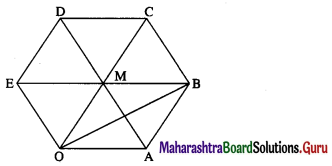
OABCDE is a regular hexagon. The points A and B have position vectors \(\bar{a}\) and \(\bar{b}\) respectively, referred to the origin O. Find, in terms of \(\bar{a}\) and \(\bar{b}\) the position vectors of C, D and E.
Solution:
Maharashtra Board 12th Maths Solutions Chapter 5 Vectors Ex 5.1 3
Given : \(\overline{\mathrm{OA}}\) = \(\bar{a}\), \(\overline{\mathrm{OB}}\) = \(\bar{a}\) Let AD, BE, OC meet at M.
Then M bisects AD, BE, OC.
\(\overline{\mathrm{AB}}\) = \(\overline{\mathrm{AO}}\) + \(\overline{\mathrm{OB}}\) = –\(\overline{\mathrm{OA}}\) + \(\overline{\mathrm{OB}}\) = –\(\bar{a}\) + \(\bar{b}\) = \(\bar{b}\) – \(\bar{a}\)
∵ OABM is a parallelogram
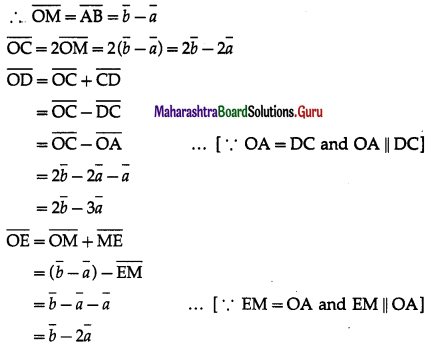
Maharashtra Board 12th Maths Solutions Chapter 5 Vectors Ex 5.1 4
Hence, the position vectors of C, D and E are 2\(\bar{b}\) – 2\(\bar{a}\), 2\(\bar{b}\) – 3\(\bar{a}\) and \(\bar{b}\) – 2\(\bar{a}\) respectively.

Maharashtra Board 12th Maths Solutions Chapter 1 Mathematical Logic Ex 1.1

Question 4.
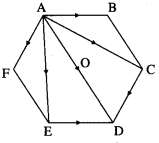
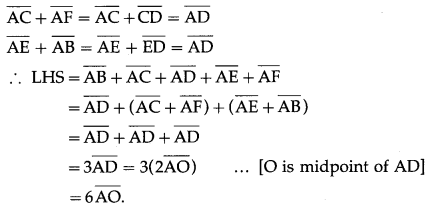
If ABCDEF is a regular hexagon, show that \(\overline{\mathrm{AB}}\) + \(\overline{\mathrm{AC}}\) + \(\overline{\mathrm{AD}}\) + \(\overline{\mathrm{AE}}\) + \(\overline{\mathrm{AF}}\) = 6\(\overline{\mathrm{AO}}\), where O is the center of the hexagon.
Solution:
Maharashtra Board 12th Maths Solutions Chapter 5 Vectors Ex 5.1 5
ABCDEF is a regular hexagon.
∴ \(\overline{\mathrm{AB}}\) = \(\overline{\mathrm{ED}}\) and \(\overline{\mathrm{AF}}\) = \(\overline{\mathrm{CD}}\)
∴ by the triangle law of addition of vectors,
Maharashtra Board 12th Maths Solutions Chapter 5 Vectors Ex 5.1 6

Question 5.
Check whether the vectors \(2 \hat{i}+2 \hat{j}+3 \hat{k}\), + \(-3 \hat{i}+3 \hat{j}+2 \hat{k}\), + \(3 \hat{i}+4 \hat{k}\) form a triangle or not.
Solution:
Let, if possible, the three vectors form a triangle ABC
with \(\overline{A B}\) = \(2 \hat{i}+2 \hat{j}+3 \hat{k}\), \(\overline{B C}\) = \(3 \hat{i}+3 \hat{j}+2 \hat{k}\), \(\overline{A C}\) = \(3 \hat{i}+4 \hat{k}\)
Now, \(\overline{A B}\) + \(\overline{B C}\)
= \((2 \hat{i}+2 \hat{j}+3 \hat{k})\) + \((-3 \hat{i}+3 \hat{j}+2 \hat{k})\)
= \(-\hat{i}+5 \hat{j}+5 \hat{k} \neq 3 \hat{i}+4 \hat{k}\) = \(\overline{\mathrm{AC}}\)
Hence, the three vectors do not form a triangle.

Maharashtra Board 12th Maths Solutions Chapter 1 Mathematical Logic Ex 1.1

Question 6.
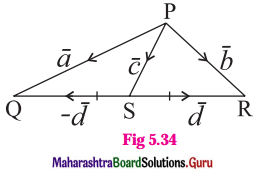
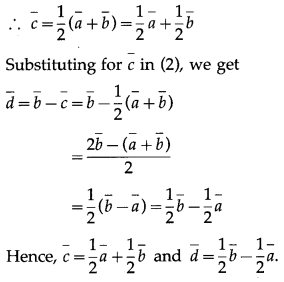
In the figure 5.34 express \(\bar{c}\) and \(\bar{d}\) in terms of \(\bar{a}\) and \(\bar{b}\). Find a vector in the direction of \(\bar{a}\) = \(\hat{i}-2 \hat{j}\) that has magnitude 7 units.
Maharashtra Board 12th Maths Solutions Chapter 5 Vectors Ex 5.1 7
Solution:
\(\overline{\mathrm{PQ}}\) = \(\overline{\mathrm{PS}}\) + \(\overline{\mathrm{SQ}}\)
∴ \(\bar{a}\) = \(\bar{c}\) – \(\bar{d}\) … (1)
\(\overline{\mathrm{PR}}\) = \(\overline{\mathrm{PS}}\) + \(\overline{\mathrm{SR}}\)
∴ \(\bar{b}\) = \(\bar{c}\) + \(\bar{d}\) … (2)
Adding equations (1) and (2), we get
\(\bar{a}\) + \(\bar{b}\) = (\(\bar{c}\) – \(\bar{d}\)) + (\(\bar{c}\) + \(\bar{d}\)) = 2\(\bar{c}\)
Maharashtra Board 12th Maths Solutions Chapter 5 Vectors Ex 5.1 8

Question 7.
Find the distance from (4, -2, 6) to each of the following :
(a) The XY-plane
Solution:
Let the point A be (4, -2, 6).
Then,
The distance of A from XY-plane = |z| = 6

(b) The YZ-plane
Solution:
The distance of A from YZ-plane = |x| = 4

Maharashtra Board 12th Maths Solutions Chapter 1 Mathematical Logic Ex 1.1

(c) The XZ-plane
Solution:
The distance of A from ZX-plane = |y| = 2

(d) The X-axis
Solution:
The distance of A from X-axis
= \(\sqrt{y^{2}+z^{2}}\) = \(\sqrt{(-2)^{2}+6^{2}}\) = \(\sqrt{40}\) = \(2 \sqrt{10}\)

(e) The Y-axis
Solution:
The distance of A from Y-axis
= \(\sqrt{z^{2}+x^{2}}\) = \(\sqrt{6^{2}+4^{2}}\) = \(\sqrt{52}\) = \(2 \sqrt{13}\)

(f) The Z-axis
Solution:
The distance of A from Z-axis
= \(\sqrt{x^{2}+y^{2}}\) = \(\sqrt{4^{2}+(-2)^{2}}\) = \(\sqrt{20}\) = \(2 \sqrt{5}\)

Maharashtra Board 12th Maths Solutions Chapter 1 Mathematical Logic Ex 1.1

Question 8.
Find the coordinates of the point which is located :
(a) Three units behind the YZ-plane, four units to the right of the XZ-plane and five units above the XY-plane.
Solution:
Let the coordinates of the point be (x, y, z).
Since the point is located 3 units behind the YZ- j plane, 4 units to the right of XZ-plane and 5 units , above the XY-plane,
x = -3, y = 4 and z = 5
Hence, coordinates of the required point are (-3, 4, 5)

(b) In the YZ-plane, one unit to the right of the XZ-plane and six units above the XY-plane.
Solution:
Let the coordinates of the point be (x, y, z).
Since the point is located in the YZ plane, x = 0. Also, the point is one unit to the right of XZ-plane and six units above the XY-plane.
∴ y = 1, z = 6.
Hence, coordinates of the required point are (0, 1, 6).

Question 9.
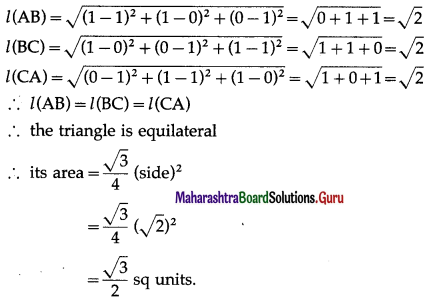
Find the area of the triangle with vertices (1, 1, 0), (1, 0, 1) and (0, 1, 1).
Solution:
Let A = (1, 1, 0), B = (1, 0, 1), C = (0, 1, 1)
Maharashtra Board 12th Maths Solutions Chapter 5 Vectors Ex 5.1 9

Maharashtra Board 12th Maths Solutions Chapter 1 Mathematical Logic Ex 1.1

Question 10.
If \(\overline{\mathrm{AB}}\) = \(2 \hat{i}-4 \hat{j}+7 \hat{k}\) and initial point A ≡ (1, 5, ,0). Find the terminal point B.
Solution:
Let \(\bar{a}\) and \(\bar{b}\) be the position vectors of A and B.
Given : A = (1, 5, 0) .’. \(\bar{a}\) = \(\hat{i}+5 \hat{j}\)
Now, \(\overline{\mathrm{AB}}\) = \(2 \hat{i}-4 \hat{j}+7 \hat{k}\)
∴ \(\bar{b}\) – \(\bar{a}\) = \(2 \hat{i}-4 \hat{j}+7 \hat{k}\)
∴ \(\bar{b}\) = \((2 \hat{i}-4 \hat{j}+7 \hat{k})\) + \(\bar{a}\)
= \((2 \hat{i}-4 \hat{j}+7 \hat{k})\) + \((\hat{i}+5 \hat{j})\)
= \(3 \hat{i}+\hat{j}+7 \hat{k}\)
Hence, the terminal point B = (3, 1, 7).

Question 11.
Show that the following points are collinear :
(i) A (3, 2, -4), B (9, 8, -10), C (-2, -3, 1).
Solution:
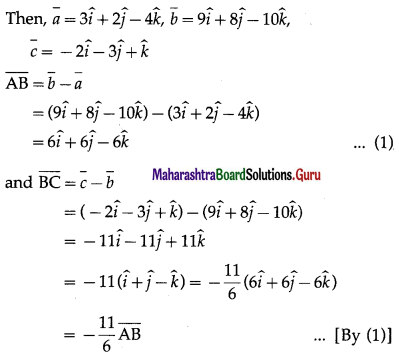
Let \(\bar{a}\), \(\bar{b}\), \(\bar{c}\) be the position vectors of the points.
A = (3, 2, -4), B = (9, 8, -10) and C = (-2, -3, 1) respectively.
Maharashtra Board 12th Maths Solutions Chapter 5 Vectors Ex 5.1 10
∴ \(\overline{\mathrm{BC}}\) is a non-zero scalar multiple of \(\overline{\mathrm{AB}}\)
∴ they are parallel to each other.
But they have the point B in common.
∴ \(\overline{\mathrm{BC}}\) and \(\overline{\mathrm{AB}}\) are collinear vectors.
Hence, the points A, B and C are collinear.

(ii) P (4, 5, 2), Q (3, 2, 4), R (5, 8, 0).
Solution:
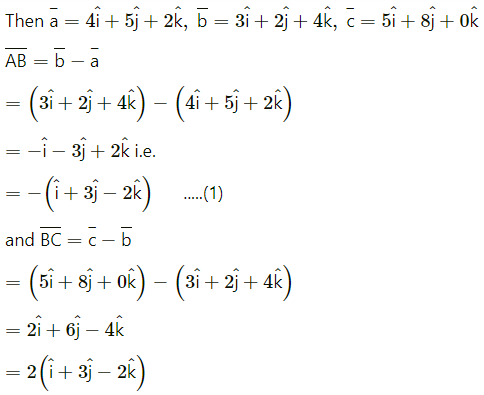
Let \(\bar{a}\), \(\bar{b}\), \(\bar{c}\) be the position vectors of the points.
P = (4, 5, 2), Q = (3, 2, 4), R = (5, 8, 0) respectively.
Maharashtra Board 12th Maths Solutions Chapter 5 Vectors Ex 5.1 11
= 2.\(\overline{\mathrm{AB}}\) …[By (1)]
∴ \(\overline{\mathrm{BC}}\) is a non-zero scalar multiple of \(\overline{\mathrm{AB}}\)
∴ they are parallel to each other.
But they have the point B in common.
∴ \(\overline{\mathrm{BC}}\) and \(\overline{\mathrm{AB}}\) are collinear vectors.
Hence, the points A, B and C are collinear.

Maharashtra Board 12th Maths Solutions Chapter 1 Mathematical Logic Ex 1.1

Question 12.
If the vectors \(2 \hat{i}-q \hat{j}+3 \hat{k}\) and \(4 \hat{i}-5 \hat{j}+6 \hat{k}\) are collinear, then find the value of q.
Solution:
The vectors \(2 \hat{i}-q \hat{j}+3 \hat{k}\) and \(4 \hat{i}-5 \hat{j}+6 \hat{k}\) are collinear
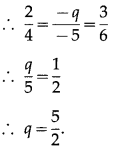
∴ the coefficients of \(\hat{i}, \hat{j}, \hat{k}\) are proportional
Maharashtra Board 12th Maths Solutions Chapter 5 Vectors Ex 5.1 12

Question 13.
Are the four points A(1, -1, 1), B(-1, 1, 1), C(1, 1, 1) and D(2, -3, 4) coplanar? Justify your answer.
Solution:
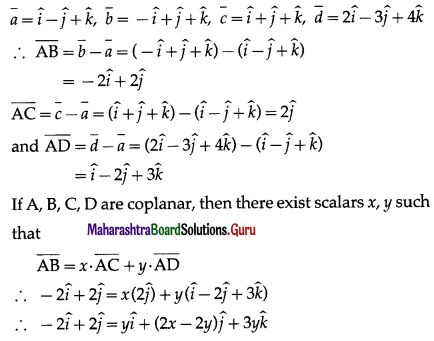
The position vectors \(\bar{a}\), \(\bar{b}\), \(\bar{c}\), \(\bar{d}\) of the points A, B, C, D are
Maharashtra Board 12th Maths Solutions Chapter 5 Vectors Ex 5.1 13
By equality of vectors,
y = -2 ….(1)
2x – 2y = 2 … (2)
3y = 0 … (3)
From (1), y = -2
From (3), y = 0 This is not possible.
Hence, the points A, B, C, D are not coplanar.

Maharashtra Board 12th Maths Solutions Chapter 1 Mathematical Logic Ex 1.1

Question 14.
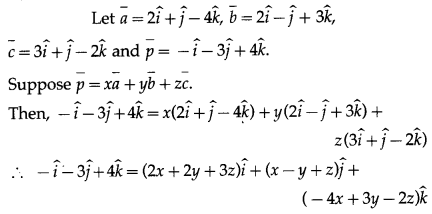
Express \(-\hat{i}-3 \hat{j}+4 \hat{k}\) as linear combination of the vectors \(2 \hat{i}+\hat{j}-4 \hat{k}\), \(2 \hat{i}-\hat{j}+3 \hat{k}\) and \(3 \hat{i}+\hat{j}-2 \hat{k}\).
Solution:
Maharashtra Board 12th Maths Solutions Chapter 5 Vectors Ex 5.1 14
By equality of vectors,
2x + 2y + 3 = -1
x – y + z = -3
-4x + 3y – 2z = 4
We have to solve these equations by using Cramer’s Rule
D = \(\left|\begin{array}{rrr}
2 & 2 & 3 \\
1 & -1 & 1 \\
-4 & 3 & -2
\end{array}\right|\)
= 2(2 – 3) – 2(-2 + 4) + 3(3 – 4)
= -2 – 4 – 3 = -9 ≠ 0
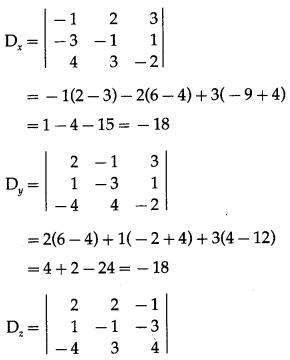
Maharashtra Board 12th Maths Solutions Chapter 5 Vectors Ex 5.1 15
= 2(-4 + 9) – 2(4 – 12) – 1(3 – 4)
= 10 + 16 + 1 = 27
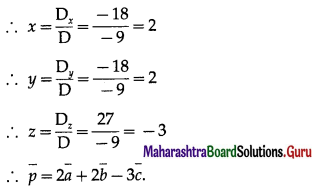
Maharashtra Board 12th Maths Solutions Chapter 5 Vectors Ex 5.1 16

Maharashtra Board 12th Maths Solutions Chapter 5 Vectors Ex 5.4

Balbharti 12th Maharashtra State Board Maths Solutions Book Pdf Chapter 5 Vectors Ex 5.4 Questions and Answers.

Maharashtra State Board 12th Maths Solutions Chapter 5 Vectors Ex 5.4

Question 1.
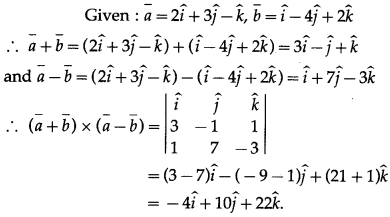
If \(\bar{a}\) = \(2 \hat{i}+3 \hat{j}-\hat{k}\), \(\bar{b}\) = \(\hat{i}-4 \hat{j}+2 \hat{k}\) find (\(\bar{a}\) + \(\bar{b}\)) × (\(\bar{a}\) – \(\bar{b}\))
Solution:
Maharashtra Board 12th Maths Solutions Chapter 5 Vectors Ex 5.4 1

Question 2.
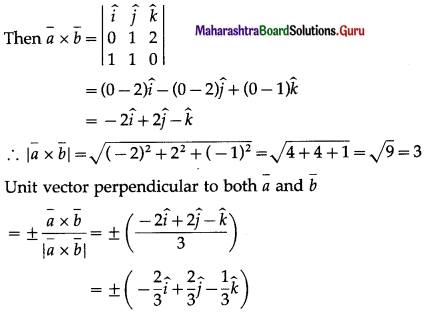
Find a unit vector perpendicular to the vectors \(\hat{j}+2 \hat{k}\) and \(\hat{i}+\hat{j}\).
Solution:
Let \(\bar{a}\) = \(\hat{j}+2 \hat{k}\), \(\bar{b}\) = \(\hat{i}+\hat{j}\)
Maharashtra Board 12th Maths Solutions Chapter 5 Vectors Ex 5.4 2

Question 3.
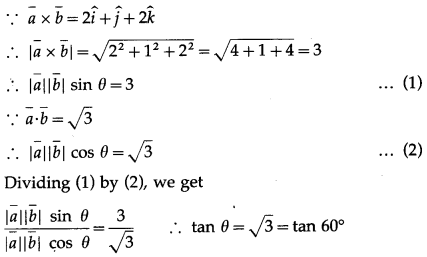
If \(\bar{a} \cdot \bar{b}\) = \(\sqrt {3}\) and \(\bar{a} \times \bar{b}\) = \(2 \hat{i}+\hat{j}+2 \hat{k}\), find the angle between \(\bar{a}\) and \(\bar{b}\).
Solution:
Let θ be the angle between \(\bar{a}\) and \(\bar{b}\)
Maharashtra Board 12th Maths Solutions Chapter 5 Vectors Ex 5.4 3
∴ θ = 60°.

Maharashtra Board 12th Maths Solutions Chapter 1 Mathematical Logic Ex 1.1

Question 4.
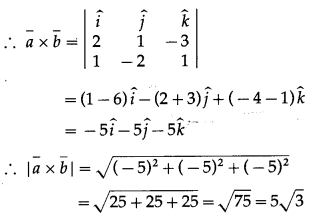
If \(\bar{a}\) = \(2 \hat{i}+\hat{j}-3 \hat{k}\) and \(\bar{b}\) = \(\hat{i}-2 \hat{j}+\hat{k}\), find a vector of magnitude 5 perpendicular to both \(\bar{a}\) and \(\bar{b}\).
Solution:
Given : \(\bar{a}\) = \(2 \hat{i}+\hat{j}-3 \hat{k}\) and \(\bar{b}\) = \(\hat{i}-2 \hat{j}+\hat{k}\)
Maharashtra Board 12th Maths Solutions Chapter 5 Vectors Ex 5.4 4
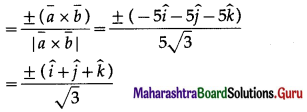
∴ unit vectors perpendicular to both the vectors \(\bar{a}\) and \(\bar{b}\).
Maharashtra Board 12th Maths Solutions Chapter 5 Vectors Ex 5.4 5
∴ required vectors of magnitude 5 units
= ±\(\frac{5}{\sqrt{3}}(\hat{i}+\hat{j}+\hat{k})\)

Question 5.
Find
(i) \(\bar{u}\)∙\(\bar{v}\) if \(|\bar{u}|\) = 2, \(|\vec{v}|\) = 5, \(|\bar{u} \times \bar{v}|\) = 8
Solution:
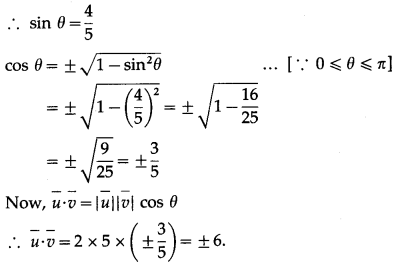
Let θ be the angle between \(\bar{u}\) and \(\bar{v}\).
Then \(|\bar{u} \times \bar{v}|\) = 8 gives
\(|\bar{u}||\bar{v}|\) sin θ = 8
∴ 2 × 5 × sin θ = 8
Maharashtra Board 12th Maths Solutions Chapter 5 Vectors Ex 5.4 6

(ii) \(|\bar{u} \times \bar{v}|\) if \(|\bar{u}|\) = 10, \(|\vec{v}|\) = 2, \(\bar{u} \cdot \bar{v}\) = 12
Solution:
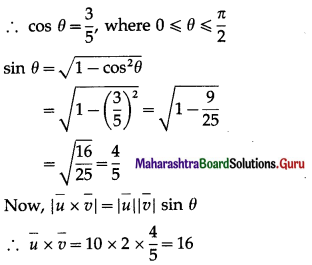
Let θ be the angle between \(\bar{u}\) and \(\bar{v}\).
Then \(\bar{u} \cdot \bar{v}\) = 12 gives
\(|\bar{u} \| \bar{v}|\)cos θ = 12
∴ 10 × 2 × cos θ = 12
Maharashtra Board 12th Maths Solutions Chapter 5 Vectors Ex 5.4 7

Maharashtra Board 12th Maths Solutions Chapter 1 Mathematical Logic Ex 1.1

Question 6.
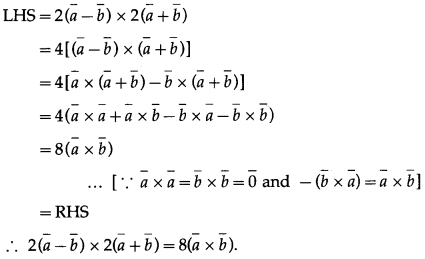
Prove that 2(\(\bar{a}\) – \(\bar{b}\)) × 2(\(\bar{a}\) + \(\bar{b}\)) = 8(\(\bar{a}\) × \(\bar{b}\))
Solution:
Maharashtra Board 12th Maths Solutions Chapter 5 Vectors Ex 5.4 8

Question 7.
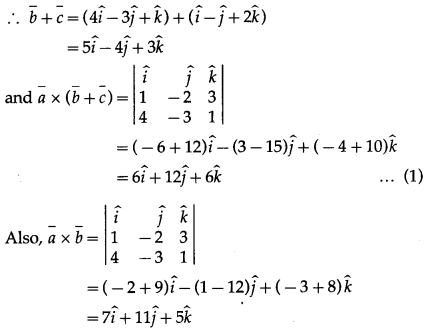
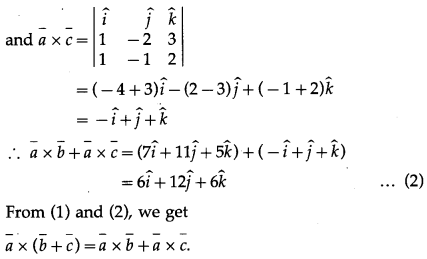
If \(\bar{a}\) = \(\hat{i}-2 \hat{j}+3 \hat{k}\), \(\bar{b}\) = \(4 \hat{i}-3 \hat{j}+\hat{k}\), and \(\bar{c}\) = \(\hat{i}-\hat{j}+2 \hat{k}\), verify that \(\bar{a}\) × (\(\bar{b}\) + \(\bar{c}\)) = \(\bar{a}\) × \(\bar{b}\) + \(\bar{a}\) × \(\bar{c}\)
Solution:
Given : \(\bar{a}\) = \(\hat{i}-2 \hat{j}+3 \hat{k}\), \(\bar{b}\) = \(4 \hat{i}-3 \hat{j}+\hat{k}\), \(\bar{c}\) = \(\hat{i}-\hat{j}+2 \hat{k}\)
Maharashtra Board 12th Maths Solutions Chapter 5 Vectors Ex 5.4 9
Maharashtra Board 12th Maths Solutions Chapter 5 Vectors Ex 5.4 10

Question 8.
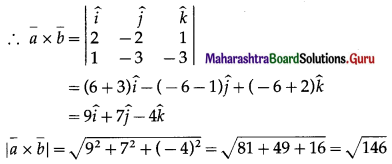
Find the area of the parallelogram whose adjacent sides are the vectors \(\bar{a}\) = \(2 \hat{i}-2 \hat{j}+\hat{k}\) and \(\bar{b}\) = \(\hat{i}-3 \hat{j}-3 \hat{k}\).
Solution:
Given : \(\bar{a}\) = \(2 \hat{i}-2 \hat{j}+\hat{k}\), \(\bar{b}\) = \(\hat{i}-3 \hat{j}-3 \hat{k}\)
Maharashtra Board 12th Maths Solutions Chapter 5 Vectors Ex 5.4 11
Area of the parallelogram whose adjacent sides are \(\bar{a}\) and \(\bar{b}\) is \(|\bar{a} \times \bar{b}|\) =\(\sqrt {146}\) sq units.

Maharashtra Board 12th Maths Solutions Chapter 1 Mathematical Logic Ex 1.1

Question 9.
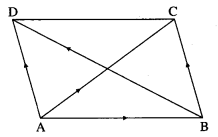
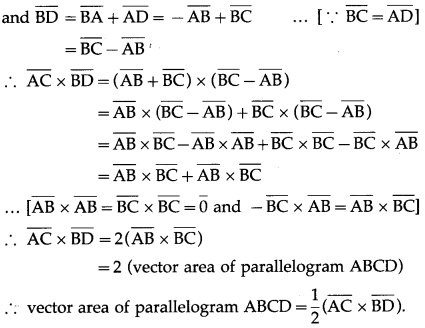
Show that vector area of a quadrilateral ABCD is \(\frac{1}{2}\) (\(\overline{A C}\) × \(\overline{B D}\)), where AC and BD are its diagonals.
Solution:
Let ABCD be a parallelogram.
Then \(\overline{\mathrm{AC}}\) = \(\overline{\mathrm{AB}}\) + \(\overline{\mathrm{BC}}\)
Maharashtra Board 12th Maths Solutions Chapter 5 Vectors Ex 5.4 12
Maharashtra Board 12th Maths Solutions Chapter 5 Vectors Ex 5.4 13

Question 10.
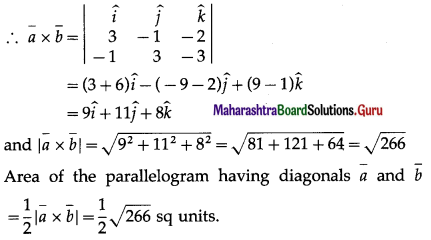
Find the area of parallelogram whose diagonals are determined by the vectors \(\bar{a}\) = \(3 i-\hat{j}-2 \hat{k}\), and \(\bar{b}\) = \(-\hat{i}+3 \hat{j}-3 \hat{k}\)
Solution:
Given: \(\bar{a}\) = \(3 i-\hat{j}-2 \hat{k}\), \(\bar{b}\) = \(-\hat{i}+3 \hat{j}-3 \hat{k}\)
Maharashtra Board 12th Maths Solutions Chapter 5 Vectors Ex 5.4 14

Question 11.
If \(\bar{a}\), \(\bar{b}\), \(\bar{c}\) and \(\bar{d}\) are four distinct vectors such that \(\bar{a} \times \bar{b}=\bar{c} \times \bar{d}\) and \(\bar{a} \times \bar{c}=\bar{b} \times \bar{d}\), prove that \(\bar{a}\) – \(\bar{d}\) is parallel to \(\bar{b}\) – \(\bar{c}\).
Solution:
\(\bar{a}\), \(\bar{b}\), \(\bar{c}\) and \(\bar{d}\) are four distinct vectors
Maharashtra Board 12th Maths Solutions Chapter 5 Vectors Ex 5.4 15

Maharashtra Board 12th Maths Solutions Chapter 1 Mathematical Logic Ex 1.1

Question 12.
If \(\bar{a}\) = \(\hat{i}+\hat{j}+\hat{k}\) and, \(\bar{c}\) = \(\hat{j}-\hat{k}\), find a vector \(\bar{b}\) satisfying \(\bar{a}\) × \(\bar{b}\) = \(\bar{c}\) and \(\bar{a} \cdot \bar{b}\) = 3
Solution:
Given \(\bar{a}\) = \(\hat{i}+\hat{j}+\hat{k}\), \(\bar{c}\) = \(\hat{j}-\hat{k}\)
Maharashtra Board 12th Maths Solutions Chapter 5 Vectors Ex 5.4 16
By equality of vectors,
z – y = 0 ….(2)
x – z = 1 ……(3)
y – x = -1 ……(4)
From (2), y = z.
From (3), x = 1 + z
Substituting these values of x and y in (1), we get
1 + z + z + z = 3 ∴ z = \(\frac{2}{3}\)
∴ y = z = \(\frac{2}{3}\)
∴ x = 1 + z =1 + \(\frac{2}{3}=\frac{5}{3}\)
Maharashtra Board 12th Maths Solutions Chapter 5 Vectors Ex 5.4 17

Question 13.
Find \(\bar{a}\), if \(\bar{a} \times \hat{i}+2 \bar{a}-5 \hat{j}=\overline{0}\).
Solution:
Maharashtra Board 12th Maths Solutions Chapter 5 Vectors Ex 5.4 18
By equality of vectors
2x = 0 i.e. x = 0
2y + z – 5 = 0 … (1)
2z – y = 0 … (2)
From (2), y = 2z
Substituting y = 2z in (1), we get
4z + z = 5 ∴ z = 1
∴ y = 2z = 2(1) = 2
∴ x = 0, y = 2, z = 1
∴ \(\bar{a}=2 \hat{j}+\hat{k}\)

Question 14.
If \(|\bar{a} \cdot \bar{b}|\) = \(|\bar{a} \times \bar{b}|\) and \(\bar{a} \cdot \bar{b}\) < 0, then find the angle between \(\bar{a}\) and \(\bar{b}\)
Solution:
Let θ be the angle between \(\bar{a}\) and \(\bar{b}\).
Then \(|\bar{a} \cdot \bar{b}|\) = \(|\bar{a} \times \bar{b}|\) gives
Maharashtra Board 12th Maths Solutions Chapter 5 Vectors Ex 5.4 19
Hence, the angle between \(\bar{a}\) and \(\bar{b}\) is \(\frac{3 \pi}{4}\).

Maharashtra Board 12th Maths Solutions Chapter 1 Mathematical Logic Ex 1.1

Question 15.
Prove by vector method that sin (α + β) = sinα∙cosβ+cosα∙sinβ.
Solution:
Maharashtra Board 12th Maths Solutions Chapter 5 Vectors Ex 5.4 20
Let ∠XOP and ∠XOQ be in standard position and m∠XOP = -α, m∠XOQ = β.
Take a point A on ray OP and a point B on ray OQ such that
OA = OB = 1.
Since cos (-α) = cos α
and sin (-α) = -sin α,
A is (cos (-α), sin (-α)),
i.e. (cos α, – sin α)
B is (cos β, sin β)
Maharashtra Board 12th Maths Solutions Chapter 5 Vectors Ex 5.4 21
The angle between \(\overline{\mathrm{OA}}\) and \(\overline{\mathrm{OB}}\) is α + β.
Also \(\overline{\mathrm{OA}}\), \(\overline{\mathrm{OB}}\) lie in the XY-plane.
∴ the unit vector perpendicular to \(\overline{\mathrm{OA}}\) and \(\overline{\mathrm{OB}}\) is \(\bar{k}\).
∴ \(\overline{\mathrm{OA}}\) × \(\overline{\mathrm{OB}}\) = [OA∙OB sin (α + β)]\(\bar{k}\)
= sin(α + β)∙\(\bar{k}\) …(2)
∴ from (1) and (2),
sin (α + β) = sin α cos β + cos α sin β.

Question 16.
Find the direction ratios of a vector perpendicular to the two lines whose direction ratios are
(i) -2, 1, -1 and -3, -4, 1
Solution:
Let a, b, c be the direction ratios of the vector which is perpendicular to the two lines whose direction ratios are -2, 1, -1 and -3, -4, 1
∴ -2a + b – c = 0 and -3a – 4b + c = 0
Maharashtra Board 12th Maths Solutions Chapter 5 Vectors Ex 5.4 22
∴ the required direction ratios are -3, 5, 11
Alternative Method:
Let \(\bar{a}\) and \(\bar{b}\) be the vectors along the lines whose direction ratios are -2, 1, -1 and -3, -4, 1 respectively.
Then \(\bar{a}\) = \(-2 \hat{i}+\hat{j}-\hat{k}\) and \(\bar{b}\) = \(-3 \hat{i}-4 \hat{j}+\hat{k}\)
The vector perpendicular to both \(\bar{a}\) and \(\bar{b}\) is given by
Maharashtra Board 12th Maths Solutions Chapter 5 Vectors Ex 5.4 23
Hence, the required direction ratios are -3, 5, 11.

(ii) 1, 3, 2 and -1, 1, 2
Solution:

Maharashtra Board 12th Maths Solutions Chapter 1 Mathematical Logic Ex 1.1

Question 17.
Prove that two vectors whose direction cosines are given by relations al + bm + cn = 0 and fmn + gnl + hlm = 0 are perpendicular if \(\frac{f}{a}+\frac{g}{b}+\frac{h}{c}\) = 0
Solution:
Given, al + bm + cn = 0 …(1)
and fmn + gnl + hlm = 0 …..(2)
From (1), n = \(-\left(\frac{a l+b m}{c}\right)\) …..(3)
Substituting this value of n in equation (2), we get
(fm + gl)∙[latex]-\left(\frac{a l+b m}{c}\right)[/latex] + hlm = 0
∴ -(aflm + bfm2 + agl2 + bglm) + chlm = 0
∴ agl2 + (af + bg – ch)lm + bfm2 = 0 … (4)
Note that both l and m cannot be zero, because if l = m = 0, then from (3), we get
n = 0, which is not possible as l2 + m2 + n2 = 1.
Let us take m # 0.
Dividing equation (4) by m2, we get
ag\(\left(\frac{l}{m}\right)^{2}\) + (af + bg – ch)\(\left(\frac{l}{m}\right)\) + bf = 0 … (5)
This is quadratic equation in \(\left(\frac{l}{m}\right)\).
If l1, m1, n1 and l2, m2, n2 are the direction cosines of the two lines given by the equation (1) and (2), then \(\frac{l_{1}}{m_{1}}\) and \(\frac{l_{2}}{m_{2}}\) are the roots of the equation (5).
From the quadratic equation (5), we get
Maharashtra Board 12th Maths Solutions Chapter 5 Vectors Ex 5.4 24
i.e. if \(\frac{f}{a}+\frac{g}{b}+\frac{h}{c}\) = 0.

Maharashtra Board 12th Maths Solutions Chapter 1 Mathematical Logic Ex 1.1

Question 18.
If A(1, 2, 3) and B(4, 5, 6) are two points, then find the foot of the perpendicular from the point B to the line joining the origin and point A.
Solution:
Maharashtra Board 12th Maths Solutions Chapter 5 Vectors Ex 5.4 25
Let M be the foot of the perpendicular drawn from B to the line joining O and A.
Let M = (x, y, z)
OM has direction ratios x – 0, y – 0, z – 0 = x, y, z
OA has direction ratios 1 – 0, 2 – 0, 3 – 0 = 1, 2, 3
But O, M, A are collinear.
∴ \(\frac{x}{1}=\frac{y}{2}=\frac{z}{3}\) = k …(Let)
∴ x = k, y = 2k, z = 3k
∴ M = (k, 2k, 3k)
∵ BM has direction ratios
k – 4, 2k – 5, 3k – 6
BM is perpendicular to OA
∴ (l)(k – 4) + 2(2k – 5) + 3(3k – 6)
∴ = k – 4 + 4k – 10 + 9k – 18 = 0
∴ 14k = 32
∴ k = \(\frac{16}{7}\)
∴ M = (k, 2k, 3k) = (\(\frac{16}{7}, \frac{32}{7}, \frac{48}{7}\))

Maharashtra Board 12th Maths Solutions Chapter 7 Linear Programming Ex 7.4

Balbharti 12th Maharashtra State Board Maths Solutions Book Pdf Chapter 7 Linear Programming Ex 7.4 Questions and Answers.

Maharashtra State Board 12th Maths Solutions Chapter 7 Linear Programming Ex 7.4

Question 1.
Maximize : z = 11x + 8y subject to x ≤ 4, y ≤ 6,
x + y ≤ 6, x ≥ 0, y ≥ 0.
Solution:
First we draw the lines AB, CD and ED whose equations are x = 4, y = 6 and x + y = 6 respectively.
Maharashtra Board 12th Maths Solutions Chapter 7 Linear Programming Ex 7.4 1
Maharashtra Board 12th Maths Solutions Chapter 7 Linear Programming Ex 7.4 2
The feasible region is shaded portion OAPDO in the graph.
The vertices of the feasible region are O (0, 0), A (4, 0), P and D (0, 6)
P is point of intersection of lines x + y = 6 and x = 4.
Substituting x = 4 in x + y = 6, we get
4 + y = 6 ∴ y = 2 ∴ P is (4, 2).
∴ the corner points of feasible region are O (0, 0), A (4, 0), P(4, 2) and D(0 ,6).
The values of the objective function z = 11x + 8y at these vertices are
z (O) = 11(0) + 8(0) = 0 + 0 = 0
z(a) = 11(4) + 8(0) = 44 + 0 = 44
z (P) = 11(4) + 8(2) = 44 + 16 = 60
z (D) = 11(0) + 8(2) = 0 + 16 = 16
∴ z has maximum value 60, when x = 4 and y = 2.

Question 2.
Maximize : z = 4x + 6y subject to 3x + 2y ≤ 12,
x + y ≥ 4, x, y ≥ 0.
Solution:
First we draw the lines AB and AC whose equations are 3x + 2y = 12 and x + y = 4 respectively.
Maharashtra Board 12th Maths Solutions Chapter 7 Linear Programming Ex 7.4 3
Maharashtra Board 12th Maths Solutions Chapter 7 Linear Programming Ex 7.4 4
The feasible region is the ∆ABC which is shaded in the graph.
The vertices of the feasible region (i.e. corner points) are A (4, 0), B (0, 6) and C (0, 4).
The values of the objective function z = 4x + 6y at these vertices are
z(a) = 4(4) + 6(0) = 16 + 0 = 16
z(B) = 4(0)+ 6(6) = 0 + 36 = 36
z(C) = 4(0) + 6(4) = 0 + 24 = 24
∴ has maximum value 36, when x = 0, y = 6.

Maharashtra Board 12th Maths Solutions Chapter 1 Mathematical Logic Ex 1.1

Question 3.
Maximize : z = 7x + 11y subject to 3x + 5y ≤ 26
5x + 3y ≤ 30, x ≥ 0, y ≥ 0.
Solution:
First we draw the lines AB and CD whose equations are 3x + 5y = 26 and 5x + 3y = 30 respectively.
Maharashtra Board 12th Maths Solutions Chapter 7 Linear Programming Ex 7.4 5
Maharashtra Board 12th Maths Solutions Chapter 7 Linear Programming Ex 7.4 6
The feasible region is OCPBO which is shaded in the graph.
The vertices of the feasible region are O (0, 0), C (6, 0), p and B(0, \(\frac{26}{5}\))
The vertex P is the point of intersection of the lines
3x + 5y = 26 … (1)
and 5x + 3y = 30 … (2)
Multiplying equation (1) by 3 and equation (2) by 5, we get
9x + 15y = 78
and 25x + 15y = 150
On subtracting, we get
16x = 72 ∴ x = \(\frac{72}{16}=\frac{9}{2}\) = 4.5
Substituting x = 4.5 in equation (2), we get
5(4.5) + 3y = 30
22.5 + 3y = 30
∴ 3y = 7.5 ∴ y = 2.5
∴ P is (4.5, 2.5)
The values of the objective function z = 7x + 11y at these corner points are
z (O) = 7(0) + 11(0) = 0 + 0 = 0
z (C) = 7(6) + 11(0) = 42 + 0 = 42
z (P) = 7(4.5) + 11 (2.5) = 31.5 + 27.5 = 59.0 = 59
z(B) = 7(0) + 11\(\left(\frac{26}{5}\right)=\frac{286}{5}\) = 57.2
∴ z has maximum value 59, when x = 4.5 and y = 2.5.

Question 4.
Maximize : z = 10x + 25y subject to 0 ≤ x ≤ 3,
0 ≤ y ≤ 3, x + y ≤ 5 also find maximum value of z.
Solution:
First we draw the lines AB, CD and EF whose equations are x = 3, y = 3 and x + y = 5 respectively.
Maharashtra Board 12th Maths Solutions Chapter 7 Linear Programming Ex 7.4 7
Maharashtra Board 12th Maths Solutions Chapter 7 Linear Programming Ex 7.4 8
The feasible region is OAPQDO which is shaded in the i graph.
The vertices of the feasible region are O (0, 0), A (3, 0), P, Q and D(0, 3).
t P is the point of intersection of the lines x + y = 5 and x = 3.
Substituting x = 3 in x + y = 5, we get
3 + y = 5 ∴ y = 2
∴ P is (3, 2)
Q is the point of intersection of the lines x + y = 5 and y = 3
Substituting y = 3 in x + y = 5, we get
x + 3 = 5 ∴ x = 2
∴ Q is (2, 3)
The values of the objective function z = 10x + 25y at these vertices are
z(O) = 10(0) + 25(0) = 0 + 0 = 0
z(a) = 10(3) + 25(0) = 30 + 0 = 30
z(P) = 10(3) + 25(2) = 30 + 50 = 80
z(Q) = 10(2) + 25(3) = 20 + 75 = 95
z(D) = 10(0)+ 25(3) = 0 + 75 = 75
∴ z has maximum value 95, when x = 2 and y = 3.

Maharashtra Board 12th Maths Solutions Chapter 1 Mathematical Logic Ex 1.1

Question 5.
Maximize : z = 3x + 5y subject to x + 4y ≤ 24, 3x + y ≤ 21,
x + y ≤ 9, x ≥ 0, y ≥ 0 also find maximum value of z.
Solution:
First we draw the lines AB, CD and EF whose equations are x + 4y = 24, 3x + y = 21 and x + y = 9 respectively.
Maharashtra Board 12th Maths Solutions Chapter 7 Linear Programming Ex 7.4 9
Maharashtra Board 12th Maths Solutions Chapter 7 Linear Programming Ex 7.4 10
The feasible region is OCPQBO which is shaded in the graph.
The vertices of the feasible region are O (0, 0), C (7, 0), P, Q and B (0, 6).
P is the point of intersection of the lines
3x + y = 21 … (1)
and x + y = 9 … (2)
On subtracting, we get 2x = 12 ∴ x = 6
Substituting x = 6 in equation (2), we get
6 + y = 9 ∴ y = 3
∴ P = (6, 3)
Q is the point of intersection of the lines
x + 4y = 24 … (3)
and x + y = 9 … (2)
On subtracting, we get
3y = 15 ∴ y = 5
Substituting y = 5 in equation (2), we get
x + 5= 9 ∴ x = 4
∴ Q = (4, 5)
∴ the corner points of the feasible region are 0(0,0), C(7, 0), P (6, 3), Q (4, 5) and B (0, 6).
The values of the objective function 2 = 3x + 5y at these corner points are
z(O) = 3(0)+ 5(0) = 0 + 0 = 0
z(C) = 3(7) + 5(0) = 21 + 0 = 21
z(P) = 3(6) + 5(3) = 18 + 15 = 33
z(Q) = 3(4) + 5(5) = 12 + 25 = 37
z(B) = 3(0)+ 5(6) = 0 + 30 = 30
∴ z has maximum value 37, when x = 4 and y = 5.

Question 6.
Minimize : z = 7x + y subject to 5x + y ≥ 5, x + y ≥ 3,
x ≥ 0, y ≥ 0.
Solution:
First we draw the lines AB and CD whose equations are 5x + y = 5 and x + y = 3 respectively.
Maharashtra Board 12th Maths Solutions Chapter 7 Linear Programming Ex 7.4 11
Maharashtra Board 12th Maths Solutions Chapter 7 Linear Programming Ex 7.4 12
The feasible region is XCPBY which is shaded in the graph.
The vertices of the feasible region are C (3, 0), P and B (0, 5).
P is the point of the intersection of the lines
5x + y = 5
and x + y = 3
On subtracting, we get
4x = 2 ∴ x = \(\frac{1}{2}\)
Substituting x = \(\frac{1}{2}\) in x + y = 3, we get
\(\frac{1}{2}\) + y = 3
∴ y = \(\frac{5}{2}\) ∴ P = \(\left(\frac{1}{2}, \frac{5}{2}\right)\)
The values of the objective function z = 7x + y at these vertices are
z(C) = 7(3) + 0 = 21
z(B) = 7(0) + 5 = 5
∴ z has minimum value 5, when x = 0 and y = 5.

Maharashtra Board 12th Maths Solutions Chapter 1 Mathematical Logic Ex 1.1

Question 7.
Minimize : z = 8x + 10y subject to 2x + y ≥ 7, 2x + 3y ≥ 15,
y ≥ 2, x ≥ 0, y ≥ 0.
Solution:
First we draw the lines AB, CD and EF whose equations are 2x + y = 7, 2x + 3y = 15 and y = 2 respectively.
Maharashtra Board 12th Maths Solutions Chapter 7 Linear Programming Ex 7.4 13
Maharashtra Board 12th Maths Solutions Chapter 7 Linear Programming Ex 7.4 14
The feasible region is EPQBY which is shaded in the graph. The vertices of the feasible region are P, Q and B(0,7). P is the point of intersection of the lines 2x + 3y = 15 and y = 2.
Substituting y – 2 in 2x + 3y = 15, we get 2x + 3(2) = 15
∴ 2x = 9 ∴ x = 4.5 ∴ P = (4.5, 2)
Q is the point of intersection of the lines
2x + 3y = 15 … (1)
and 2x + y = 7 … (2)
On subtracting, we get
2y = 8 ∴ y = 4
∴ from (2), 2x + 4 = 7
∴ 2x = 3 ∴ x = 1.5
∴ Q = (1.5, 4)
The values of the objective function z = 8x + 10y at these vertices are
z(P) = 8(4.5) + 10(2) = 36 + 20 = 56
z(Q) = 8(1.5) + 10(4) = 12 + 40 = 52
z(B) = 8(0) +10(7) = 70
∴ z has minimum value 52, when x = 1.5 and y = 4

Question 8.
Minimize : z = 6x + 21y subject to x + 2y ≥ 3, x + 4y ≥ 4,
3x + y ≥ 3, x ≥ 0, y ≥ 0.
Solution:
First we draw the lines AB, CD and EF whose equations are x + 2y = 3, x + 4y = 4 and 3x + y = 3 respectively.
Maharashtra Board 12th Maths Solutions Chapter 7 Linear Programming Ex 7.4 15
Maharashtra Board 12th Maths Solutions Chapter 7 Linear Programming Ex 7.4 16
The feasible region is XCPQFY which is shaded in the graph.
The vertices of the feasible region are C (4, 0), P, Q and F(0, 3).
P is the point of intersection of the lines x + 4y = 4 and x + 2y = 3
On subtracting, we get
2y = 1 ∴ y = \(\frac{1}{2}\)
Substituting y = \(\frac{1}{2}\) in x + 2y = 3, we get
x + 2\(\left(\frac{1}{2}\right)\) = 3
∴ x = 2
∴ P = (2, \(\frac{1}{2}\))
Q is the point of intersection of the lines
x + 2y = 3 … (1)
and 3x + y = 3 ….(2)
Multiplying equation (1) by 3, we get 3x + 6y = 9
Subtracting equation (2) from this equation, we get
5y = 6
∴ y = \(\frac{6}{5}\)
∴ from (1), x + 2\(\left(\frac{6}{5}\right)\) = 3
∴ x = 3 – \(\frac{12}{5}=\frac{3}{5}\)
Q ≡ \(\left(\frac{3}{5}, \frac{6}{5}\right)\)
The values of the objective function z = 6x + 21y at these vertices are
z(C) = 6(4) + 21(0) = 24
z(P) = 6(2) + 21\(\left(\frac{1}{2}\right)\)
= 12 + 10.5 = 22.5
z(Q)= 6\(\left(\frac{3}{5}\right)\) + 21\(\left(\frac{6}{5}\right)\)
= \(\frac{18}{5}+\frac{126}{5}=\frac{144}{5}\) = 28.8
2 (F) = 6(0) + 21(3) = 63
∴ z has minimum value 22.5, when x = 2 and y = \(\frac{1}{2}\).

Maharashtra Board 12th Maths Solutions Chapter 4 Pair of Straight Lines Miscellaneous Exercise 4

Balbharti 12th Maharashtra State Board Maths Solutions Book Pdf Chapter 4 Pair of Straight Lines Miscellaneous Exercise 4 Questions and Answers.

Maharashtra State Board 12th Maths Solutions Chapter 4 Pair of Straight Lines Miscellaneous Exercise 4

I : Choose correct alternatives.
Question 1.
If the equation 4x2 + hxy + y2 = 0 represents two coincident lines, then h = _________.
(A) ± 2
(B) ± 3
(C) ± 4
(D) ± 5
Solution:
(C) ± 4

Question 2.
If the lines represented by kx2 – 3xy + 6y2 = 0 are perpendicular to each other then _________.
(A) k = 6
(B) k = -6
(C) k = 3
(D) k = -3
Solution:
(B) k = -6

Question 3.
Auxiliary equation of 2x2 + 3xy – 9y2 = 0 is _________.
(A) 2m2 + 3m – 9 = 0
(B) 9m2 – 3m – 2 = 0
(C) 2m2 – 3m + 9 = 0
(D) -9m2 – 3m + 2 = 0
Solution:
(B) 9m2 – 3m – 2 = 0

Question 4.
The difference between the slopes of the lines represented by 3x2 – 4xy + y2 = 0 is _________.
(A) 2
(B) 1
(C) 3
(D) 4
Solution:
(A) 2

Maharashtra Board 12th Maths Solutions Chapter 1 Mathematical Logic Ex 1.1

Question 5.
If the two lines ax2 +2hxy+ by2 = 0 make angles α and β with X-axis, then tan (α + β) = _____.
(A) \(\frac{h}{a+b}\)
(B) \(\frac{h}{a-b}\)
(C) \(\frac{2 h}{a+b}\)
(D) \(\frac{2 h}{a-b}\)
Solution:
(D) \(\frac{2 h}{a-b}\)
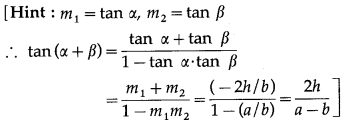
Maharashtra Board 12th Maths Solutions Chapter 4 Pair of Straight Lines Miscellaneous Exercise 4 1

Question 6.
If the slope of one of the two lines \(\frac{x^{2}}{a}+\frac{2 x y}{h}+\frac{y^{2}}{b}\) = 0 is twice that of the other, then ab:h2 = ___.
(A) 1 : 2
(B) 2 : 1
(C) 8 : 9
(D) 9 : 8
Solution:
(D) 9 : 8
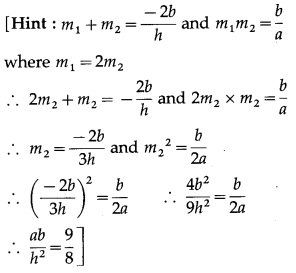
Maharashtra Board 12th Maths Solutions Chapter 4 Pair of Straight Lines Miscellaneous Exercise 4 2

Question 7.
The joint equation of the lines through the origin and perpendicular to the pair of lines 3x2 + 4xy – 5y2 = 0 is _________.
(A) 5x2 + 4xy – 3y2 = 0
(B) 3x2 + 4xy – 5y2 = 0
(C) 3x2 – 4xy + 5y2 = 0
(D) 5x2 + 4xy + 3y2 = 0
Solution:
(A) 5x2 + 4xy – 3y2 = 0

Question 8.
If acute angle between lines ax2 + 2hxy + by2 = 0 is, \(\frac{\pi}{4}\) then 4h2 = _________.
(A) a2 + 4ab + b2
(B) a2 + 6ab + b2
(C) (a + 2b)(a + 3b)
(D) (a – 2b)(2a + b)
Solution:
(B) a2 + 6ab + b2

Maharashtra Board 12th Maths Solutions Chapter 1 Mathematical Logic Ex 1.1

Question 9.
If the equation 3x2 – 8xy + qy2 + 2x + 14y + p = 1 represents a pair of perpendicular lines then
the values of p and q are respectively _________.
(A) -3 and -7
(B) -7 and -3
(C) 3 and 7
(D) -7 and 3
Solution:
(B) -7 and -3

Question 10.
The area of triangle formed by the lines x2 + 4xy + y2 = 0 and x – y – 4 = 0 is _________.
(A) \(\frac{4}{\sqrt{3}}\) Sq. units
(B) \(\frac{8}{\sqrt{3}}\) Sq. units
(C) \(\frac{16}{\sqrt{3}}\) Sq. units
(D)\(\frac{15}{\sqrt{3}}\) Sq. units
Solution:
(B) \(\frac{8}{\sqrt{3}}\) Sq. units
[Hint : Area = \(\frac{p^{2}}{\sqrt{3}}\), where p is the length of perpendicular from the origin to x – y – 4 = 0]

Question 11.
The combined equation of the co-ordinate axes is _________.
(A) x + y = 0
(B) x y = k
(C) xy = 0
(D) x – y = k
Solution:
(C) xy = 0

Maharashtra Board 12th Maths Solutions Chapter 1 Mathematical Logic Ex 1.1

Question 12.
If h2 = ab, then slope of lines ax2 + 2hxy + by2 = 0 are in the ratio _________.
(A) 1 : 2
(B) 2 : 1
(C) 2 : 3
(D) 1 : 1
Solution:
(D) 1 : 1
[Hint: If h2 = ab, then lines are coincident. Therefore slopes of the lines are equal.]

Question 13.
If slope of one of the lines ax2 + 2hxy + by2 = 0 is 5 times the slope of the other, then 5h2 = _________.
(A) ab
(B) 2 ab
(C) 7 ab
(D) 9 ab
Solution:
(D) 9 ab

Question 14.
If distance between lines (x – 2y)2 + k(x – 2y) = 0 is 3 units, then k =
(A) ± 3
(B) ± 5\(\sqrt {5}\)
(C) 0
(D) ± 3\(\sqrt {5}\)
Solution:
(D) ± 3\(\sqrt {5}\)
[Hint: (x – 2y)2 + k(x – 2y) = 0
∴ (x – 2y)(x – 2y + k) = 0
∴ equations of the lines are x – 2y = 0 and x – 2y + k = 0 which are parallel to each other.
∴ \(\left|\frac{k-0}{\sqrt{1+4}}\right|\) = 3
∴ k = ± 3\(\sqrt {5}\)

Maharashtra Board 12th Maths Solutions Chapter 1 Mathematical Logic Ex 1.1

II. Solve the following.
Question 1.
Find the joint equation of lines:
(i) x – y = 0 and x + y = 0
Solution:
The joint equation of the lines x – y = 0 and
x + y = 0 is
(x – y)(x + y) = 0
∴ x2 – y2 = 0.

(ii) x + y – 3 = 0 and 2x + y – 1 = 0
Solution:
The joint equation of the lines x + y – 3 = 0 and 2x + y – 1 = 0 is
(x + y – 3)(2x + y – 1) = 0
∴ 2x2 + xy – x + 2xy + y2 – y – 6x – 3y + 3 = 0
∴ 2x2 + 3xy + y2 – 7x – 4y + 3 = 0.

(iii) Passing through the origin and having slopes 2 and 3.
Solution:
We know that the equation of the line passing through the origin and having slope m is y = mx. Equations of the lines passing through the origin and having slopes 2 and 3 are y = 2x and y = 3x respectively.
i.e. their equations are
2x – y = 0 and 3x – y = 0 respectively.
∴ their joint equation is (2x – y)(3x – y) = 0
∴ 6x2 – 2xy – 3xy + y2 = 0
∴ 6x2 – 5xy + y2 = 0.

(iv) Passing through the origin and having inclinations 60° and 120°.
Solution:
Slope of the line having inclination θ is tan θ .
Inclinations of the given lines are 60° and 120°
∴ their slopes are m1 = tan60° = \(\sqrt {3}\) and
m2 = tan 120° = tan (180° – 60°)
= -tan 60° = –\(\sqrt {3}\)
Since the lines pass through the origin, their equa-tions are
y = \(\sqrt {3}\)x and y= –\(\sqrt {3}\)x
i.e., \(\sqrt {3}\)x – y = 0 and \(\sqrt {3}\)x + y = 0
∴ the joint equation of these lines is
(\(\sqrt {3}\)x – y)(\(\sqrt {3}\)x + y) = 0
∴ 3x2 – y2 = 0.

Maharashtra Board 12th Maths Solutions Chapter 1 Mathematical Logic Ex 1.1

(v) Passing through (1, 2) amd parallel to the co-ordinate axes.
Solution:
Equations of the coordinate axes are x = 0 and y = 0
∴ the equations of the lines passing through (1, 2) and parallel to the coordinate axes are x = 1 and y =1
i.e. x – 1 = 0 and y – 2 0
∴ their combined equation is
(x – 1)(y – 2) = 0
∴ x(y – 2) – 1(y – 2) = 0
∴ xy – 2x – y + 2 = 0

(vi) Passing through (3, 2) and parallel to the line x = 2 and y = 3.
Solution:
Equations of the lines passing through (3, 2) and parallel to the lines x = 2 and y = 3 are x = 3 and y = 2.
i.e. x – 3 = 0 and y – 2 = 0
∴ their joint equation is
(x – 3)(y – 2) = 0
∴ xy – 2x – 3y + 6 = 0.

(vii) Passing through (-1, 2) and perpendicular to the lines x + 2y + 3 = 0 and 3x – 4y – 5 = 0.
Solution:
Let L1 and L2 be the lines passing through the origin and perpendicular to the lines x + 2y + 3 = 0 and 3x – 4y – 5 = 0 respectively.
Slopes of the lines x + 2y + 3 = 0 and 3x – 4y – 5 = 0 are \(-\frac{1}{2}\) and \(-\frac{3}{-4}=\frac{3}{4}\) respectively.
∴ slopes of the lines L1and L2 are 2 and \(\frac{-4}{3}\) respectively.
Since the lines L1 and L2 pass through the point (-1, 2), their equations are
∴ (y – y1) = m(x – x1)
∴ (y – 2) = 2(x + 1)
⇒ y – 1 = 2x + 2
⇒ 2x – y + 4 = 0 and
∴ (y – 2) = \(\left(\frac{-4}{3}\right)\)(x + 1)
⇒ 3y – 6 = (-4)(x + 1)
⇒ 3y – 6 = -4x + 4
⇒ 4x + 3y – 6 + 4 = 0
⇒ 4x + 3y – 2 = 0
their combined equation is
∴ (2x – y + 4)(4x + 3y – 2) = 0
∴ 8x2 + 6xy – 4x – 4xy – 3y2 + 2y + 16x + 12y – 8 = 0
∴ 8x2 + 2xy + 12x – 3y2 + 14y – 8 = 0

Maharashtra Board 12th Maths Solutions Chapter 1 Mathematical Logic Ex 1.1

(viii) Passing through the origin and having slopes 1 + \(\sqrt {3}\) and 1 – \(\sqrt {3}\)
Solution:
Let l1 and l2 be the two lines. Slopes of l1 is 1 + \(\sqrt {3}\) and that of l2 is 1 – \(\sqrt {3}\)
Therefore the equation of a line (l1) passing through the origin and having slope is
y = (1 + \(\sqrt {3}\))x
∴ (1 + \(\sqrt {3}\))x – y = 0 ..(1)
Similarly, the equation of the line (l2) passing through the origin and having slope is
y = (1 – \(\sqrt {3}\))x
∴ (1 – \(\sqrt {3}\))x – y = 0 …(2)
From (1) and (2) the required combined equation is
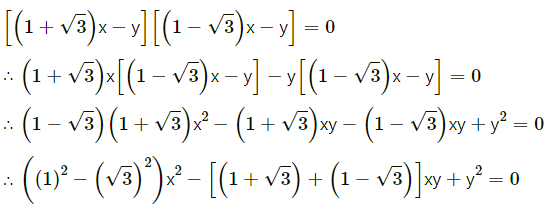
Maharashtra Board 12th Maths Solutions Chapter 4 Pair of Straight Lines Miscellaneous Exercise 4 4
∴ (1 – 3)x2 – 2xy + y2 = 0
∴ -2x2 – 2xy + y2 = 0
∴ 2x2 + 2xy – y2 = 0
This is the required combined equation.

(ix) Which are at a distance of 9 units from the Y – axis.
Solution:
Equations of the lines, which are parallel to the Y-axis and at a distance of 9 units from it, are x = 9 and x = -9
i.e. x – 9 = 0 and x + 9 = 0
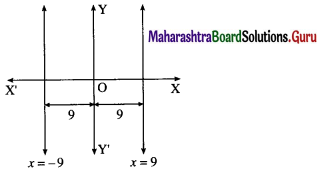
Maharashtra Board 12th Maths Solutions Chapter 4 Pair of Straight Lines Miscellaneous Exercise 4 3
∴ their combined equation is
(x – 9)(x + 9) = 0
∴ x2 – 81 = 0.

(x) Passing through the point (3, 2), one of which is parallel to the line x – 2y = 2 and other is perpendicular to the line y = 3.
Solution:
Let L1 be the line passes through (3, 2) and parallel to the line x – 2y = 2 whose slope is \(\frac{-1}{-2}=\frac{1}{2}\)
∴ slope of the line L1 is \(\frac{1}{2}\).
∴ equation of the line L1 is
y – 2 = \(\frac{1}{2}\)(x – 3)
∴ 2y – 4 = x – 3 ∴ x – 2y + 1 = 0
Let L2 be the line passes through (3, 2) and perpendicular to the line y = 3.
∴ equation of the line L2 is of the form x = a.
Since L2 passes through (3, 2), 3 = a
∴ equation of the line L2 is x = 3, i.e. x – 3 = 0
Hence, the equations of the required lines are
x – 2y + 1 = 0 and x – 3 = 0
∴ their joint equation is
(x – 2y + 1)(x – 3) = 0
∴ x2 – 2xy + x – 3x + 6y – 3 = 0
∴ x2 – 2xy – 2x + 6y – 3 = 0.

(xi) Passing through the origin and perpendicular to the lines x + 2y = 19 and 3x + y = 18.
Solution:
Let L1 and L2 be the lines passing through the origin and perpendicular to the lines x + 2y = 19 and 3x + y = 18 respectively.
Slopes of the lines x + 2y = 19 and 3x + y = 18 are \(-\frac{1}{2}\) and \(-\frac{3}{1}\) = -3 respectively.
Since the lines L1 and L2 pass through the origin, their equations are
y = 2x and y = \(\frac{1}{3}\)x
i.e. 2x – y = 0 and x – 3y = 0
∴ their combined equation is
(2x – y)(x – 3y) = 0
∴ 2x2 – 6xy – xy + 3y2 = 0
∴ 2x2 – 7xy + 3y2 = 0.

Maharashtra Board 12th Maths Solutions Chapter 1 Mathematical Logic Ex 1.1

Question 2.
Show that each of the following equation represents a pair of lines.
(i) x2 + 2xy – y2 = 0
Solution:
Comparing the equation x2 + 2xy – y2 = 0 with ax2 + 2hxy + by2 = 0, we get,
a = 1, 2h = 2, i.e. h = 1 and b = -1
∴ h2 – ab = (1)2 – 1(-1) = 1 + 1=2 > 0
Since the equation x2 + 2xy – y2 = 0 is a homogeneous equation of second degree and h2 – ab > 0, the given equation represents a pair of lines which are real and distinct.

(ii) 4x2 + 4xy + y2 = 0
Solution:
Comparing the equation 4x2 + 4xy + y2 = 0 with ax2 + 2hxy + by2 = 0, we get,
a = 4, 2h = 4, i.e. h = 2 and b = 1
∴ h2 – ab = (2)2 – 4(1) = 4 – 4 = 0
Since the equation 4x2 + 4xy + y2 = 0 is a homogeneous equation of second degree and h2 – ab = 0, the given equation represents a pair of lines which are real and coincident.

(iii) x2 – y2 = 0
Solution:
Comparing the equation x2 – y2 = 0 with ax2 + 2hxy + by2 = 0, we get,
a = 1, 2h = 0, i.e. h = 0 and b = -1
∴ h2 – ab = (0)2 – 1(-1) = 0 + 1 = 1 > 0
Since the equation x2 – y2 = 0 is a homogeneous equation of second degree and h2 – ab > 0, the given equation represents a pair of lines which are real and distinct.

Maharashtra Board 12th Maths Solutions Chapter 1 Mathematical Logic Ex 1.1

(iv) x2 + 7xy – 2y2 = 0
Solution:
Comparing the equation x2 + 7xy – 2y2 = 0
a = 1, 2h = 7 i.e., h = \(\frac{7}{2}\) and b = -2
∴ h2 – ab = \(\left(\frac{7}{2}\right)^{2}\) – 1(-2)
= \(\frac{49}{4}\) + 2
= \(\frac{57}{4}\) i.e. 14.25 = 14 > 0
Since the equation x2 + 7xy – 2y2 = 0 is a homogeneous equation of second degree and h2 – ab > 0, the given equation represents a pair of lines which are real and distinct.

(v) x2 – 2\(\sqrt {3}\) xy – y2 = 0
Solution:
Comparing the equation x2 – 2\(\sqrt {3}\) xy – y2 = 0 with ax2 + 2hxy + by2 = 0, we get,
a = 1, 2h= -2\(\sqrt {3}\), i.e. h = –\(\sqrt {3}\) and b = 1
∴ h2 – ab = (-\(\sqrt {3}\))2 – 1(1) = 3 – 1 = 2 > 0
Since the equation x2 – 2\(\sqrt {3}\)xy – y2 = 0 is a homo¬geneous equation of second degree and h2 – ab > 0, the given equation represents a pair of lines which are real and distinct.

Maharashtra Board 12th Maths Solutions Chapter 1 Mathematical Logic Ex 1.1

Question 3.
Find the separate equations of lines represented by the following equations:
(i) 6x2 – 5xy – 6y2 = 0
Solution:
6x2 – 5xy – 6y2 = 0
∴ 6x2 – 9xy + 4xy – 6y2 = 0
∴ 3x(2x – 3y) + 2y(2x – 3y) = 0
∴ (2x – 3y)(3x + 2y) = 0
∴ the separate equations of the lines are
2x – 3y = 0 and 3x + 2y = 0.

(ii) x2 – 4y2 = 0
Solution:
x2 – 4y2 = 0
∴ x2 – (2y)2 = 0
∴(x – 2y)(x + 2y) = 0
∴ the separate equations of the lines are
x – 2y = 0 and x + 2y = 0.

(iii) 3x2 – y2 = 0
Solution:
3x2 – y2 = 0
∴ (\(\sqrt {3}\) x)2 – y2 = 0
∴ (\(\sqrt {3}\)x – y)(\(\sqrt {3}\)x + y) = 0
∴ the separate equations of the lines are
\(\sqrt {3}\)x – y = 0 and \(\sqrt {3}\)x + y = 0.

Maharashtra Board 12th Maths Solutions Chapter 1 Mathematical Logic Ex 1.1

(iv) 2x2 + 2xy – y2 = 0
Solution:
2x2 + 2xy – y2 = 0
∴ The auxiliary equation is -m2 + 2m + 2 = 0
∴ m2 – 2m – 2 = 0
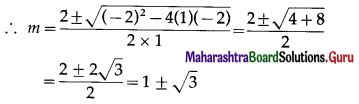
Maharashtra Board 12th Maths Solutions Chapter 4 Pair of Straight Lines Miscellaneous Exercise 4 5
m1 = 1 + \(\sqrt {3}\) and m2 = 1 – \(\sqrt {3}\) are the slopes of the lines.
∴ their separate equations are
y = m1x and y = m2x
i.e. y = (1 + \(\sqrt {3}\))x and y = (1 – \(\sqrt {3}\))x
i.e. (\(\sqrt {3}\) + 1)x – y = 0 and (\(\sqrt {3}\) – 1)x + y = 0.

Question 4.
Find the joint equation of the pair of lines through the origin and perpendicular to the lines
given by :
(i) x2 + 4xy – 5y2 = 0
Solution:
Comparing the equation x2 + 4xy – 5y2 = 0 with ax2 + 2hxy + by2 = 0, we get,
a = 1, 2h = 4, b= -5
Let m1 and m2 be the slopes of the lines represented by x2 + 4xy – 5y2 = 0.
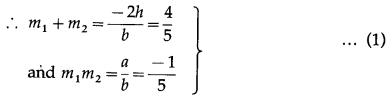
Maharashtra Board 12th Maths Solutions Chapter 4 Pair of Straight Lines Miscellaneous Exercise 4 6
Now, required lines are perpendicular to these lines
∴ their slopes are \(\frac{-1}{m_{1}}\) and \(-\frac{1}{m_{2}}\)
Since these lines are passing through the origin, their separate equations are
y = \(\frac{-1}{m_{1}}\)x and y = \(\frac{-1}{m_{2}}\)x
i.e. m1y = -x and m2y = -x
i.e. x + m1y = 0 and x + m2y = 0
∴ their combined equation is
(x + m1x + m2y) = 0
∴ x2 + (m1 + m2)xy + m1m2y2 = 0
∴ x2 + \(\frac{4}{5}\)xy – \(\frac{1}{5}\)y2 = 0 …[By (1)]
∴ 5x2 + 4xy – y2 = 0

Maharashtra Board 12th Maths Solutions Chapter 1 Mathematical Logic Ex 1.1

(ii) 2x2 – 3xy – 9y2 = 0
Solution:
Comparing the equation 2x2 – 3xy – 9y2 = 0 with ax2 + 2hxy + by2 = 0, we get,
a = 2, 2h = -3, b = -9
Let m1 and m2 be the slopes of the lines represented by 2x2 – 3xy – 9y2 = 0
∴ m1 + m2 =\(\frac{-2 h}{b}=-\frac{3}{9}\) and m1m2 = \(\frac{a}{b}=-\frac{2}{9}\) …(1)
Now, required lines are perpendicular to these lines
∴ their slopes are \(\frac{-1}{m_{1}}\) and \(-\frac{1}{m_{2}}\)
Since these lines are passing through the origin, their separate equations are
y = \(\frac{-1}{m_{1}}\)x and y = \(\frac{-1}{m_{2}}\)x
i.e. m1y = -x and m2y = -x
i.e. x + m1y = 0 and x + m2y = 0
∴ their combined equation is
(x + m1y)(x + m2y) = 0
∴ x2 + (m1 + m2)xy + m1m2y2 = 0
∴ x2 + \(\left(-\frac{3}{9}\right)\)xy + \(\left(-\frac{2}{9}\right)\)y2 = 0 …[By (1)]
∴ 9x2 – 3xy – 2y2 = 0

(iii) x2 + xy – y2 = 0
Solution:
Comparing the equation x2+ xy – y2 = 0 with ax2 + 2hxy + by2 = 0, we get,
a = 1, 2h = 1, b = -1
Let m1 and m2 be the slopes of the lines represented by x2 + xy – y2 = 0
∴ m1 + m2 = \(\frac{-2 h}{b}=\frac{-1}{-1}\) and m1m2 = \(\frac{\mathrm{a}}{\mathrm{b}}=\frac{1}{-1}\) = -1 ..(1)
Now, required lines are perpendicular to these lines
∴ their slopes are \(\frac{-1}{m_{1}}\) and \(\frac{-1}{m_{2}}\)
Since these lines are passing through the origin, their separate equations are
y = \(\frac{-1}{m_{1}}\)x and y = \(\frac{-1}{m_{2}}\)x
i.e. m1y = -x and m2y = -x
i.e. x + m1y = 0 and x + m2y = 0
∴ their combined equation is
(x + m1y)(x + m2y) = 0
∴ x2 + (m1 + m2) + m1m2y2 = 0
∴ x2 + 1xy + (-1)y2 = 0 …[By (1)]
∴ x2 + xy – y2 = 0

Maharashtra Board 12th Maths Solutions Chapter 1 Mathematical Logic Ex 1.1

Question 5.
Find k if
(i) The sum of the slopes of the lines given by 3x2 + kxy – y2 = 0 is zero.
Solution:
Comparing the equation 3x2 + kxy – y2 = 0 with ax2 + 2hxy + by2 = 0, we get,
a = 3, 2h = k, b = -1
Let m1 and m2 be the slopes of the lines represented by 3x2 + kxy – y2 = 0.
∴ m1 + m2 = \(\frac{-2 h}{b}=\frac{-k}{-1}\) = k
Now, m1 + m2 = 0 … (Given)
∴ k = 0.

(ii) The sum of slopes of the lines given by 2x2 + kxy – 3y2 = 0 is equal to their product.
Question is modified.
The sum of slopes of the lines given by x2 + kxy – 3y2 = 0 is equal to their product.
Solution:
Comparing the equation x2 + kxy – 3y2 = 0, with ax2 + 2hxy + by2 = 0, we get,
a = 1, 2h = k, b = -3
Let m1 and m2 be the slopes of the lines represented by x2 + kxy – 3y2 = 0.
∴ m1 + m2 = \(-\frac{2 h}{b}=\frac{-k}{-3}=\frac{k}{3}\)
and m1m2 = \(\frac{a}{b}=\frac{1}{-3}=\frac{-1}{3}\)
Now, m1 + m2 = m1m2 … (Given)
∴ \(\frac{k}{3}=\frac{-1}{3}\)
∴ k = -1.

(iii) The slope of one of the lines given by 3x2 – 4xy + ky2 = 0 is 1.
Solution:
The auxiliary equation of the lines given by 3x2 – 4xy + ky2 = 0 is km2 – 4m + 3 = 0.
Given, slope of one of the lines is 1.
∴ m = 1 is the root of the auxiliary equation km2 – 4m + 3 = 0.
∴ k(1)2 – 4(1) + 3 = 0
∴ k – 4 + 3 = 0
∴ k = 1.

Maharashtra Board 12th Maths Solutions Chapter 1 Mathematical Logic Ex 1.1

(iv) One of the lines given by 3x2 – kxy + 5y2 = 0 is perpendicular to the 5x + 3y = 0.
Solution:
The auxiliary equation of the lines represented by 3x2 – kxy + 5y2 = 0 is 5m2 – km + 3 = 0.
Now, one line is perpendicular to the line 5x + 3y = 0, whose slope is \(-\frac{5}{3}\).
∴ slope of that line = m = \(\frac{3}{5}\)
∴ m = \(\frac{3}{5}\) is the root of the auxiliary equation 5
5m2 – km + 3 = 0.
∴ 5\(\left(\frac{3}{5}\right)^{2}\) – k\(\left(\frac{3}{5}\right)\) + 3 = 0
∴ \(\frac{9}{5}-\frac{3 k}{5}\) + 3 = 0
∴ 9 – 3k + 15 = 0
∴ 3k = 24
∴ k = 8.

(v) The slope of one of the lines given by 3x2 + 4xy + ky2 = 0 is three times the other.
Solution:
3x2 + 4xy + ky2 = 0
∴ divide by x2
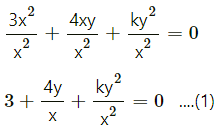
Maharashtra Board 12th Maths Solutions Chapter 4 Pair of Straight Lines Miscellaneous Exercise 4 7
∴ y = mx
∴ \(\frac{\mathrm{y}}{\mathrm{x}}\) = m
put \(\frac{\mathrm{y}}{\mathrm{x}}\) = m in equation (1)
Comparing the equation km2 + 4m + 3 = 0 with ax2 + 2hxy+ by2 = 0, we get,
a = k, 2h = 4, b = 3
m1 = 3m2 ..(given condition)
m1 + m2 = \(\frac{-2 h}{k}=-\frac{4}{k}\)
m1m2 = \(\frac{a}{b}=\frac{3}{k}\)
m1 + m2 = \(-\frac{4}{\mathrm{k}}\)
4m2 = \(-\frac{4}{\mathrm{k}}\) …(m1 = 3m2)
m2 = \(-\frac{1}{\mathrm{k}}\)
m1m2 = \(\frac{3}{k}\)
\(3 \mathrm{~m}_{2}^{2}=\frac{3}{\mathrm{k}}\) …(m1 = 3m2)
\(3\left(-\frac{1}{\mathrm{k}}\right)^{2}=\frac{3}{\mathrm{k}}\) …(m2 = \(-\frac{1}{k}\))
\(\frac{1}{k^{2}}=\frac{1}{k}\)
k2 = k
k = 1 or k = 0

Maharashtra Board 12th Maths Solutions Chapter 1 Mathematical Logic Ex 1.1

(vi) The slopes of lines given by kx2 + 5xy + y2 = 0 differ by 1.
Solution:
Comparing the equation kx2 + 5xy +y2 = 0 with ax2 + 2hxy + by2
a = k, 2h = 5 i.e. h = \(\frac{5}{2}\)
m1 + m2 = \(\frac{-2 h}{b}=-\frac{5}{1}\) = -5
and m1m2 = \(\frac{a}{b}=\frac{k}{1}\) = k
the slope of the line differ by (m1 – m2) = 1 …(1)
∴ (m1 – m2)2 = (m1 + m2)2 – 4m1m2
(m1 – m2)2 = (-5)2 – 4(k)
(m1 – m2)2 = 25 – 4k
1 = 25 – 4k ..[By (1)]
4k = 24
k = 6

(vii) One of the lines given by 6x2 + kxy + y2 = 0 is 2x + y = 0.
Solution:
The auxiliary equation of the lines represented by 6x2 + kxy + y2 = 0 is
m2 + km + 6 = 0.
Since one of the line is 2x + y = 0 whose slope is m = -2.
∴ m = -2 is the root of the auxiliary equation m2 + km + 6 = 0.
∴ (-2)2 + k(-2) + 6 = 0
∴ 4 – 2k + 6 = 0
∴ 2k = 10 ∴ k = 5

Maharashtra Board 12th Maths Solutions Chapter 1 Mathematical Logic Ex 1.1

Question 6.
Find the joint equation of the pair of lines which bisect angle between the lines given by x2 + 3xy + 2y2 = 0
Solution:
x2 + 3xy + 2y2 = 0
∴ x2 + 2xy + xy + 2y2 = 0
∴ x(x + 2y) + y(x + 2y) = 0
∴ (x + 2y)(x + y) = 0
∴ separate equations of the lines represented by x2 + 3xy + 2y2 = 0 are x + 2y = 0 and x + y = 0.
Let P (x, y) be any point on one of the angle bisector. Since the points on the angle bisectors are equidistant from both the lines,
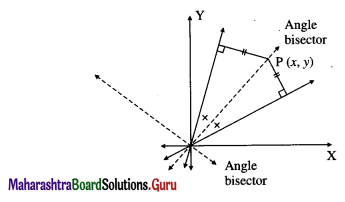
Maharashtra Board 12th Maths Solutions Chapter 4 Pair of Straight Lines Miscellaneous Exercise 4 8
the distance of P (x, y) from the line x + 2y = 0
= the distance of P(x, y) from the line x + y = 0
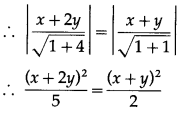
Maharashtra Board 12th Maths Solutions Chapter 4 Pair of Straight Lines Miscellaneous Exercise 4 9
∴ 2(x + 2y)2 = 5(x + y)2
∴ 2(x2 + 4xy + 4y2) = 5(x2 + 2xy + y2)
∴ 2x2 + 8xy + 8y2 = 5x2 + 10xy + 5y2
∴ 3x2 + 2xy – 3y2 = 0.
This is the required joint equation of the lines which bisect the angles between the lines represented by x2 + 3xy + 2y2 = 0.

Question 7.
Find the joint equation of the pair of lies through the origin and making equilateral triangle with the line x = 3.
Solution:
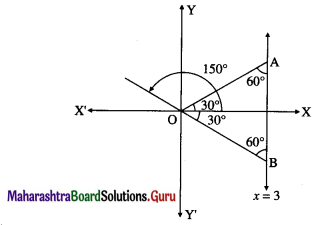
Maharashtra Board 12th Maths Solutions Chapter 4 Pair of Straight Lines Miscellaneous Exercise 4 10
Let OA and OB be the lines through the origin making an angle of 60° with the line x = 3.
∴ OA and OB make an angle of 30° and 150° with the positive direction of X-axis
∴ slope of OA = tan 30° = 1/\(\sqrt {3}\)
∴ equation of the line OA is y = \(\frac{1}{\sqrt{3}}\)x
∴ \(\sqrt {3}\)y = x ∴ x – \(\sqrt {3}\)y = 0
Slope of OB = tan 150° = tan (180° – 30°)
= – tan 30°= -1/\(\sqrt {3}\)
∴ equation of the line OB is y = \(\frac{-1}{\sqrt{3}}\)x
∴ \(\sqrt {3}\)y = -x ∴ x + \(\sqrt {3}\)y = 0
∴ required combined equation of the lines is
(x – \(\sqrt {3}\)y) (x + \(\sqrt {3}\)y) = 0
i.e. x2 – 3y2 = 0.

Question 8.
Show that the lines x2 – 4xy + y2 = 0 and x + y = 10 contain the sides of an equilateral triangle. Find the area of the triangle.
Solution:
We find the joint equation of the pair of lines OA and OB through origin, each making an angle of 60° with x + y = 10 whose slope is -1.
Let OA (or OB) has slope m.
∴ its equation is y = mx … (1)
Also, tan 60° = \(\left|\frac{m-(-1)}{1+m(-1)}\right|\)
∴ \(\sqrt {3}\) = \(\left|\frac{m+1}{1-m}\right|\)
Squaring both sides, we get,
3 = \(\frac{(m+1)^{2}}{(1-m)^{2}}\)
∴ 3(1 – 2m + m2) = m2 + 2m + 1
∴ 3 – 6m + 3m2 = m2 + 2m + 1
∴ 2m2 – 8m + 2 = 0
∴ m2 – 4m + 1 = 0
∴ \(\left(\frac{y}{x}\right)^{2}\) – 4\(\left(\frac{y}{x}\right)\) + 1 = 0 …[By (1)]
∴ y2 – 4xy + x2 = 0
∴ x2 – 4xy + y\left(\frac{y}{x}\right) = 0 is the joint equation of the two lines through the origin each making an angle of 60° with x + y = 10
∴ x2 – 4xy + y2 = 0 and x + y = 10 form a triangle OAB which is equilateral.
Let seg OM ⊥r line AB whose question is x + y = 10
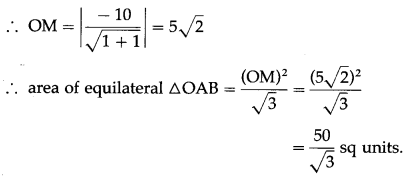
Maharashtra Board 12th Maths Solutions Chapter 4 Pair of Straight Lines Miscellaneous Exercise 4 11

Maharashtra Board 12th Maths Solutions Chapter 1 Mathematical Logic Ex 1.1

Question 9.
If the slope of one of the lines represented by ax2 + 2hxy + by2 = 0 is three times the other then prove that 3h2 = 4ab.
Solution:
Let m1 and m2 be the slopes of the lines represented by ax2 + 2hxy + by2 = 0.
∴ m1 + m2 = \(-\frac{2 h}{b}\) and m1m2 = \(\frac{a}{b}\)
We are given that m2 = 3m1
∴ m1 + 3m1 = \(-\frac{2 h}{b}\) 4m1 = \(-\frac{2 h}{b}\)
∴ m1 = \(-\frac{h}{2 b}\) …(1)
Also, m1(3m1) = \(\frac{a}{b}\) ∴ 3m12 = \(\frac{a}{b}\)
∴ 3\(\left(-\frac{h}{2 b}\right)^{2}\) = \(\frac{a}{b}\) ….[By (1)]
∴ \(\frac{3 h^{2}}{4 b^{2}}=\frac{a}{b}\)
∴ 3h2 = 4ab, as b ≠0.

Question 10.
Find the combined equation of the bisectors of the angles between the lines represented by 5x2 + 6xy – y2 = 0.
Solution:
Comparing the equation 5x2 + 6xy – y2 = 0 with ax2 + 2hxy + by2 = 0, we get,
a = 5, 2h = 6, b = -1
Let m1 and m2 be the slopes of the lines represented by 5x2 + 6xy – y2 = 0.
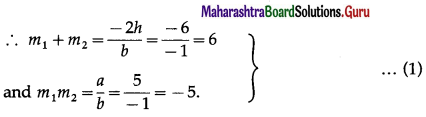
Maharashtra Board 12th Maths Solutions Chapter 4 Pair of Straight Lines Miscellaneous Exercise 4 12
The separate equations of the lines are
y = m1x and y = m2x, where m1 ≠ m2
i.e. m1x – y = 0 and m1x – y = 0.
Let P (x, y) be any point on one of the bisector of the angles between the lines.
∴ the distance of P from the line m1x – y = 0 is equal to the distance of P from the line m2x – y = 0.
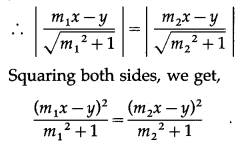
Maharashtra Board 12th Maths Solutions Chapter 4 Pair of Straight Lines Miscellaneous Exercise 4 13
∴ (m22 + 1)(m1x – y)2 = (m12 + 1)(m2x – y)2
∴ (m22 + 1)(m12x2 – 2m1xy + y2) = (m12 + 1)(m22x2 – 2m2xy + y2)
∴ m12m22x2 – 2m1m12y2xy + m22y2 + m12x2 – 2m12xy + y2
= m12m22x2 – 2m12m2xy + m12y2 + m22x2 – 2m2xy + y2
∴ (m12 – m22)x2 + 2m1m2(m1 – m2)xy – 2(m1 – m2)xy – (m12 – m22)y2 = 0
Dividing throughout by m1 – m2 (≠0), we get,
(m1 + m2)x2 + 2m1m2xy – 2xy – (m1 + m2)y2 = 0
∴ 6x2 – 10xy – 2xy – 6y2 = 0 …[By (1)]
∴ 6x2 – 12xy – 6y2 = 0
∴ x2 – 2xy – y2 = 0
This is the joint equation of the bisectors of the angles between the lines represented by 5x2 + 6xy – y2 = 0.

Maharashtra Board 12th Maths Solutions Chapter 1 Mathematical Logic Ex 1.1

Question 11.
Find a, if the sum of the slopes of the lines represented by ax2 + 8xy + 5y2 = 0 is twice their product.
Solution :
Comparing the equation ax2 + 8xy + 5y2 = 0 with ax2 + 2hxy + by2 = 0,
we get, a = a, 2h = 8, b = 5
Let m1 and m2 be the slopes of the lines represented by ax2 + 8xy + 5y2 = 0.
∴ m1 + m2 = \(\frac{-2 h}{b}=-\frac{8}{5}\)
and m1m2 = \(\frac{a}{b}=\frac{a}{5}\)
Now, (m1 + m2) = 2(m1m2)
\(-\frac{8}{5}\) = \(2\left(\frac{a}{5}\right)\)
a = -4

Question 12.
If the line 4x – 5y = 0 coincides with one of the lines given by ax2 + 2hxy + by2 = 0, then show that 25a + 40h +16b = 0.
Solution :
The auxiliary equation of the lines represented by ax2 + 2hxy + by2 = 0 is bm2 + 2hm + a = 0
Given that 4x – 5y = 0 is one of the lines represented by ax2 + 2hxy + by2 = 0.
The slope of the line 4x – 5y = 0 is \(\frac{-4}{-5}=\frac{4}{5}\)
∴ m = \(\frac{4}{5}\) is a root of the auxiliary equation bm2 + 2hm + a = 0.
∴ b\(\left(\frac{4}{5}\right)^{2}\) + 2h\(\left(\frac{4}{5}\right)\) + a = 0
∴ \(\frac{16 b}{25}+\frac{8 h}{5}\) + a = 0
∴ 16b + 40h + 25a = 0 i.e.
∴ 25a + 40h + 16b = 0

Maharashtra Board 12th Maths Solutions Chapter 1 Mathematical Logic Ex 1.1

Question 13.
Show that the following equations represent a pair of lines. Find the acute angle between them :
(i) 9x2 – 6xy + y2 + 18x – 6y + 8 = 0
Solution:
Comparing this equation with
ax2 + 2hxy + by2 + 2gx + 2fy + c = 0, we get,
a = 9, h = -3, b = 1, g = 9, f = -3 and c = 8.
∴ D = \(\left|\begin{array}{lll}
a & h & g \\
h & b & f \\
g & f & c
\end{array}\right|=\left|\begin{array}{rrr}
9 & -3 & 9 \\
-3 & 1 & -3 \\
9 & -3 & 8
\end{array}\right|\)
= 9(8 – 9) + 3(-24 + 27) + 9(9 – 9)
= 9(-1) + 3(3) + 9(0)
= -9 + 9 + 0 = 0
and h2 – ab = (-3)2 – 9(1) = 9 – 9 = 0
∴ the given equation represents a pair of lines.
Let θ be the acute angle between the lines.
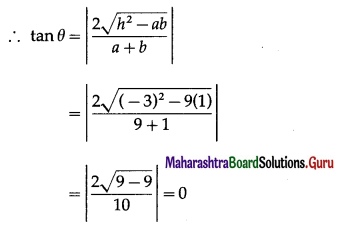
Maharashtra Board 12th Maths Solutions Chapter 4 Pair of Straight Lines Miscellaneous Exercise 4 14
∴ tan θ = tan0°
∴ θ = 0°.

(ii) 2x2 + xy – y2 + x + 4y – 3 = 0
Solution:
Comparing this equation with
ax2 + 2hxy + by2 + 2gx + 2fy+ c = 0, we get,
a = 2, h = \(\frac{1}{2}\), b = -1, g = \(\frac{1}{2}\), f = 2 and c = -3
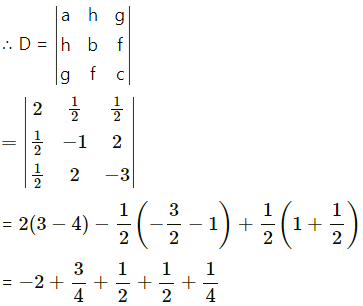
Maharashtra Board 12th Maths Solutions Chapter 4 Pair of Straight Lines Miscellaneous Exercise 4 15
= -2 + 1 + 1
= -2 + 2= 0
∴ the given equation represents a pair of lines.
Let θ be the acute angle between the lines.
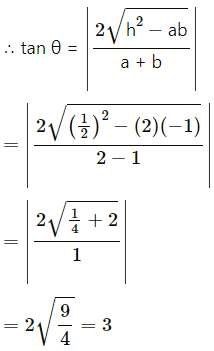
Maharashtra Board 12th Maths Solutions Chapter 4 Pair of Straight Lines Miscellaneous Exercise 4 16
∴ tan θ = tan 3
∴ θ = tan-1(3)

(iii) (x – 3)2 + (x – 3)(y – 4) – 2(y – 4)2 = 0.
Solution :
Put x – 3 = X and y – 4 = Y in the given equation, we get,
X2 + XY – 2Y2 = 0
Comparing this equation with ax2 + 2hxy + by2 = 0, we get,
a = 1, h = \(\frac{1}{2}\), b = -2
This is the homogeneous equation of second degreeand h2 – ab = \(\left(\frac{1}{2}\right)^{2}\) – 1(-2)
= \(\frac{1}{4}\) + 2 = \(\frac{9}{4}\) > 0
Hence, it represents a pair of lines passing through the new origin (3, 4).
Let θ be the acute angle between the lines.
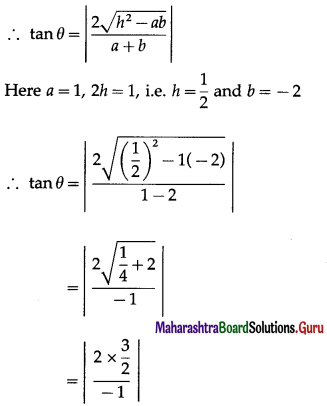
Maharashtra Board 12th Maths Solutions Chapter 4 Pair of Straight Lines Miscellaneous Exercise 4 17
∴ tanθ = 3 ∴ θ = tan-1(3)

Maharashtra Board 12th Maths Solutions Chapter 1 Mathematical Logic Ex 1.1

Question 14.
Find the combined equation of pair of lines through the origin each of which makes angle of 60° with the Y-axis.
Solution:
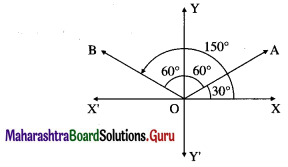
Maharashtra Board 12th Maths Solutions Chapter 4 Pair of Straight Lines Miscellaneous Exercise 4 18
Let OA and OB be the lines through the origin making an angle of 60° with the Y-axis.
Then OA and OB make an angle of 30° and 150° with the positive direction of X-axis.
∴ slope of OA = tan 30° = \(\frac{1}{\sqrt{3}}\)
∴ equation of the line OA is
y = \(\frac{1}{\sqrt{3}}\) = x, i.e. x – \(\sqrt {3}\)y = 0
Slope of OB = tan 150° = tan (180° – 30°)
= tan 30° = \(-\frac{1}{\sqrt{3}}\)
∴ equation of the line OB is
y = \(-\frac{1}{\sqrt{3}}\)x, i.e. x + \(\sqrt {3}\) y = 0
∴ required combined equation is
(x – \(\sqrt {3}\)y)(x + \(\sqrt {3}\)y) = 0
i.e. x2 – 3y2 = 0.

Question 15.
If lines representedby ax2 + 2hxy + by2 = 0 make angles of equal measures with the co-ordinate
axes then show that a = ± b.
OR
Show that, one of the lines represented by ax2 + 2hxy + by2 = 0 will make an angle of the same measure with the X-axis as the other makes with the Y-axis, if a = ± b.
Solution:
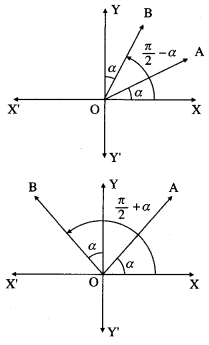
Maharashtra Board 12th Maths Solutions Chapter 4 Pair of Straight Lines Miscellaneous Exercise 4 19
Let OA and OB be the two lines through the origin represented by ax2 + 2hxy + by2 = 0.
Since these lines make angles of equal measure with the coordinate axes, they make angles ∝ and \(\frac{\pi}{2}\) – ∝ with the positive direction of X-axis or ∝ and \(\frac{\pi}{2}\) + ∝ with thepositive direction of X-axis.
∴ slope of the line OA = m1 = tan ∝
and slope of the line OB = m2
= tan(\(\frac{\pi}{2}\) – ∝) or tan(\(\frac{\pi}{2}\) + ∝)
i.e. m2 = cot ∝ or m2 = -cot ∝
∴ m1m2 – tan ∝ x cot ∝ = 1
OR m1m2 = tan ∝ (-cot ∝) = -1
i.e. m1m2 = ± 1
But m1m2 = \(\frac{a}{b}\)
∴ \(\frac{a}{b}\)= ±1 ∴ a = ±b
This is the required condition.

Maharashtra Board 12th Maths Solutions Chapter 1 Mathematical Logic Ex 1.1

Question 16.
Show that the combined equation of a pair of lines through the origin and each making an angle of ∝ with the line x + y = 0 is x2 + 2(sec 2∝) xy + y2 = 0.
Solution:
Let OA and OB be the required lines.
Let OA (or OB) has slope m.
∴ its equation is y = mx … (1)
It makes an angle ∝ with x + y = 0 whose slope is -1. m +1
∴ tan ∝ = \(\left|\frac{m+1}{1+m(-1)}\right|\)
Squaring both sides, we get,
tan2∝ = \(\frac{(m+1)^{2}}{(1-m)^{2}}\)
∴ tan2∝(1 – 2m + m2) = m2 + 2m + 1
∴ tan2∝ – 2m tan2∝ + m2tan2∝ = m2 + 2m + 1
∴ (tan2∝ – 1)m2 – 2(1 + tan2∝)m + (tan2∝ – 1) = 0
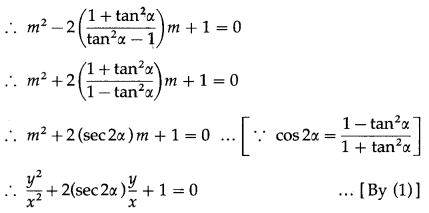
Maharashtra Board 12th Maths Solutions Chapter 4 Pair of Straight Lines Miscellaneous Exercise 4 20
∴ y2 + 2xysec2∝ + x2 = 0
∴ x2 + 2(sec2∝)xy + y2 = 0 is the required equation.

Question 17.
Show that the line 3x + 4y+ 5 = 0 and the lines (3x + 4y)2 – 3(4x – 3y)2 =0 form an equilateral triangle.
Solution:
The slope of the line 3x + 4y + 5 = 0 is \(\frac{-3}{4}\)
Let m be the slope of one of the line making an angle of 60° with the line 3x + 4y + 5 = 0. The angle between the lines having slope m and m1 is 60°.
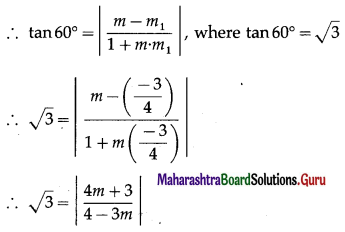
Maharashtra Board 12th Maths Solutions Chapter 4 Pair of Straight Lines Miscellaneous Exercise 4 21
On squaring both sides, we get,
3 = \(\frac{(4 m+3)^{2}}{(4-3 m)^{2}}\)
∴ 3 (4 – 3m)2 = (4m + 3)2
∴ 3(16 – 24m + 9m2) = 16m2 + 24m + 9
∴ 48 – 72m + 27m2 = 16m2 + 24m + 9
∴ 11m2 – 96m + 39 = 0
This is the auxiliary equation of the two lines and their joint equation is obtained by putting m = \(\frac{y}{x}\).
∴ the combined equation of the two lines is
11\(\left(\frac{y}{x}\right)^{2}\) – 96\(\left(\frac{y}{x}\right)\) + 39 = 0
∴ \(\frac{11 y^{2}}{x^{2}}-\frac{96 y}{x}\) + 39 = 0
∴ 11y2 – 96xy + 39x2 = 0
∴ 39x2 – 96xy + 11y2 = 0.
∴ 39x2 – 96xy + 11y2 = 0 is the joint equation of the two lines through the origin each making an angle of 60° with the line 3x + 4y + 5 = 0.
The equation 39x2 – 96xy + 11y2 = 0 can be written as :
-39x2 + 96xy – 11y2 = 0
i.e., (9x2 – 48x2) + (24xy + 72xy) + (16y2 – 27y2) = 0
i.e. (9x2 + 24xy + 16y2) – (48x2 – 72xy + 27y2) = 0
i.e. (9x2 + 24xy + 16y2) – 3(16x2 – 24xy + 9y2) = 0
i.e. (3x + 4y)2 – 3(4x – 3y)2 = 0
Hence, the line 3x + 4y + 5 = 0 and the lines
(3x + 4y)2 – 3(4x – 3y)2 form the sides of an equilateral triangle.

Maharashtra Board 12th Maths Solutions Chapter 1 Mathematical Logic Ex 1.1

Question 18.
Show that lines x2 – 4xy + y2 = 0 and x + y = \(\sqrt {6}\) form an equilateral triangle. Find its area and perimeter.
Solution:
x2 – 4xy + y2 = 0 and x + y = \(\sqrt {6}\) form a triangle OAB which is equilateral.
Let OM be the perpendicular from the origin O to AB whose equation is x + y = \(\sqrt {6}\)
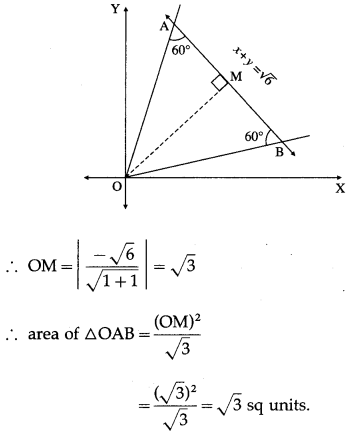
Maharashtra Board 12th Maths Solutions Chapter 4 Pair of Straight Lines Miscellaneous Exercise 4 22
In right angled triangle OAM,
sin 60° = \(\frac{\mathrm{OM}}{\mathrm{OA}}\) ∴ \(\frac{\sqrt{3}}{2}\) = \(\frac{\sqrt{3}}{\mathrm{OA}}\)
∴ OA = 2
∴ length of the each side of the equilateral triangle OAB = 2 units.
∴ perimeter of ∆ OAB = 3 × length of each side
= 3 × 2 = 6 units.

Question 19.
If the slope of one of the lines given by ax2 + 2hxy + by2 = 0 is square of the other then show that a2b + ab2 + 8h3 = 6abh.
Solution:
Let m be the slope of one of the lines given by ax2 + 2hxy + by2 = 0.
Then the other line has slope m2
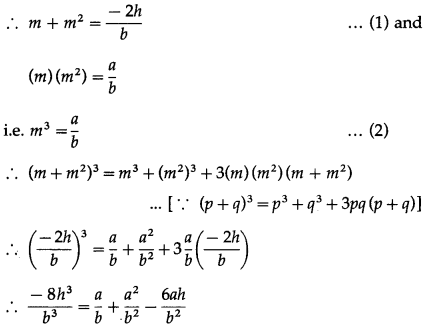
Maharashtra Board 12th Maths Solutions Chapter 4 Pair of Straight Lines Miscellaneous Exercise 4 23
Multiplying by b3, we get,
-8h3 = ab2 + a2b – 6abh
∴ a2b + ab2 + 8h3 = 6abh
This is the required condition.

Question 20.
Prove that the product of lengths of perpendiculars drawn from P (x1, y1) to the lines repersented by ax2 + 2hxy + by2 = 0 is \(\left|\frac{a x_{1}^{2}+2 h x_{1} y_{1}+b y_{1}^{2}}{\sqrt{(a-b)^{2}+4 h^{2}}}\right|\)
Solution:
Let m1 and m2 be the slopes of the lines represented by ax2 + 2hxy + by2 = 0.
∴ m1 + m2 = \(-\frac{2 h}{b}\) and m1m2 = \(\frac{a}{b}\) …(1)
The separate equations of the lines represented by
ax2 + 2hxy + by2 = 0 are
y = m1x and y = m2x
i.e. m1x – y = 0 and m2x – y = 0
Length of perpendicular from P(x1, 1) on
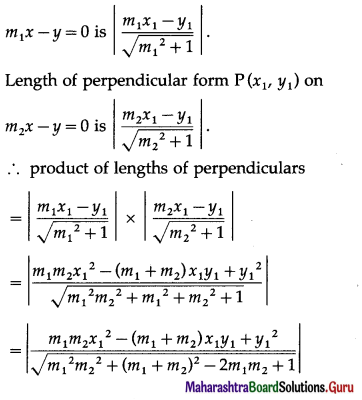
Maharashtra Board 12th Maths Solutions Chapter 4 Pair of Straight Lines Miscellaneous Exercise 4 24
Maharashtra Board 12th Maths Solutions Chapter 4 Pair of Straight Lines Miscellaneous Exercise 4 25

Maharashtra Board 12th Maths Solutions Chapter 1 Mathematical Logic Ex 1.1

Question 21.
Show that the difference between the slopes of lines given by (tan2θ + cos2θ )x2 – 2xytanθ + (sin2θ )y2 = 0 is two.
Solution:
Comparing the equation (tan2θ + cos2θ)x2 – 2xy tan θ + (sin2θ) y2 = 0 with ax2 + 2hxy + by2 = 0, we get,
a = tan2θ + cos2θ, 2h = -2 tan θ and b = sin2θ
Let m1 and m2 be the slopes of the lines represented by the given equation.
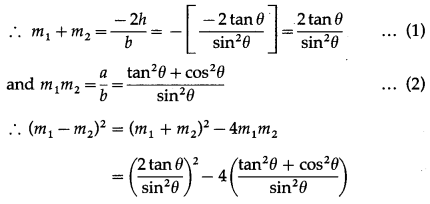
Maharashtra Board 12th Maths Solutions Chapter 4 Pair of Straight Lines Miscellaneous Exercise 4 26
Maharashtra Board 12th Maths Solutions Chapter 4 Pair of Straight Lines Miscellaneous Exercise 4 27

Question 22.
Find the condition that the equation ay2 + bxy + ex + dy = 0 may represent a pair of lines.
Solution:
Comparing the equation
ay2 + bxy + ex + dy = 0 with
Ax2 + 2Hxy + By2 + 2Gx + 2Fy + C = 0, we get,
A = 0, H = \(\frac{b}{2}\), B = a,G = \(\frac{e}{2}\), F = \(\frac{d}{2}\), C = 0
The given equation represents a pair of lines,
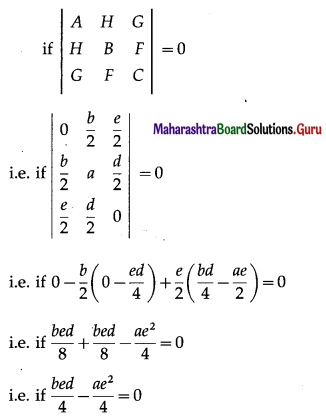
Maharashtra Board 12th Maths Solutions Chapter 4 Pair of Straight Lines Miscellaneous Exercise 4 28
i.e. if bed – ae2 = 0
i.e. if e(bd – ae) = 0
i.e. e = 0 or bd – ae = 0
i.e. e = 0 or bd = ae
This is the required condition.

Question 23.
If the lines given by ax2 + 2hxy + by2 = 0 form an equilateral triangle with the line lx + my = 1 then show that (3a + b)(a + 3b) = 4h2.
Solution:
Since the lines ax2 + 2hxy + by2 = 0 form an equilateral triangle with the line lx + my = 1, the angle between the lines ax2 + 2hxy + by2 = 0 is 60°.
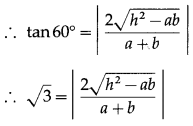
Maharashtra Board 12th Maths Solutions Chapter 4 Pair of Straight Lines Miscellaneous Exercise 4 29
∴ 3(a + b)2 = 4(h2 – ab)
∴ 3(a2 + 2ab + b2) = 4h2 – 4ab
∴ 3a2 + 6ab + 3b2 + 4ab = 4h2
∴ 3a2 + 10ab + 3b2 = 4h2
∴ 3a2 + 9ab + ab + 3b2 = 4h2
∴ 3a(a + 3b) + b(a + 3b) = 4h2
∴ (3a + b)(a + 3b) = 4h2
This is the required condition.

Maharashtra Board 12th Maths Solutions Chapter 1 Mathematical Logic Ex 1.1

Question 24.
If line x + 2 = 0 coincides with one of the lines represented by the equation x2 + 2xy + 4y + k = 0 then show that k = -4.
Solution:
One of the lines represented by
x2 + 2xy + 4y + k = 0 … (1)
is x + 2 = 0.
Let the other line represented by (1) be ax + by + c = 0.
∴ their combined equation is (x + 2)(ax + by + c) = 0
∴ ax2 + bxy + cx + 2ax + 2by + 2c = 0
∴ ax2 + bxy + (2a + c)x + 2by + 2c — 0 … (2)
As the equations (1) and (2) are the combined equations of the same two lines, they are identical.
∴ by comparing their corresponding coefficients, we get,
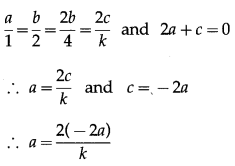
Maharashtra Board 12th Maths Solutions Chapter 4 Pair of Straight Lines Miscellaneous Exercise 4 30
∴ 1 = \(\frac{-4}{k}\)
∴ k = -4.

Question 25.
Prove that the combined equation of the pair of lines passing through the origin and perpendicular to the lines represented by ax2 + 2hxy + by2 = 0 is bx2 – 2hxy + ay2 = 0
Solution:
Let m1 and m2 be the slopes of the lines represented by ax2 + 2hxy + by2 = 0.
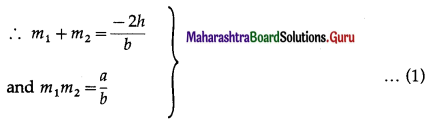
Maharashtra Board 12th Maths Solutions Chapter 4 Pair of Straight Lines Miscellaneous Exercise 4 31
Now, required lines are perpendicular to these lines.
∴ their slopes are and \(-\frac{1}{m_{1}}\) and \(-\frac{1}{m_{2}}\)
Since these lines are passing through the origin, their separate equations are
y = \(-\frac{1}{m_{1}}\)x and y = \(-\frac{1}{m_{2}}\)x
i.e. m1y= -x and m2y = -x
i.e. x + m1y = 0 and x + m2y = 0
∴ their combined equation is
(x + m1y)(x + m2y) = 0
∴ x2 + (m1 + m2)xy + m1m2y2 = 0
∴ x2\(\frac{-2 h}{b}\)x + \(\frac{a}{b}\)y2 = 0
∴ bx2 – 2hxy + ay2 = 0.

Maharashtra Board 12th Maths Solutions Chapter 1 Mathematical Logic Ex 1.1

Question 26.
If equation ax2 – y2 + 2y + c = 1 represents a pair of perpendicular lines then find a and c.
Solution:
The given equation represents a pair of lines perpendicular to each other.
∴ coefficient of x2 + coefficient of y2 = 0
∴ a – 1 = 0 ∴ a = 1
With this value of a, the given equation is
x2 – y2 + 2y + c – 1 = 0
Comparing this equation with
Ax2 + 2Hxy + By2 + 2Gx + 2Fy + C = 0, we get,
A = 1, H = 0, B = -1, G = 0, F = 1, C = c – 1
Since the given equation represents a pair of lines,
D = \(\left|\begin{array}{ccc}
A & H & G \\
H & B & F \\
G & F & C
\end{array}\right|\) = 0
∴ \(\left|\begin{array}{rrr}
1 & 0 & 0 \\
0 & -1 & 1 \\
0 & 1 & c-1
\end{array}\right|\) = 0
∴ 1(-c + 1 – 1) – 0 + 0 = 0
∴ -c = 0
∴ c = 0.
Hence, a = 1, c = 0.

Maharashtra Board 11th Maths Solutions Chapter 2 Trigonometry – I Ex 2.1

Balbharti Maharashtra State Board Class 11 Maths Solutions Pdf Chapter 2 Trigonometry – I Ex 2.1 Questions and Answers.
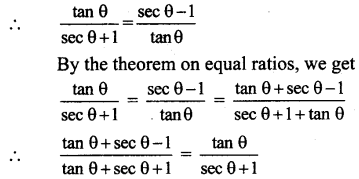
Maharashtra State Board 11th Maths Solutions Chapter 2 Trigonometry – I Ex 2.1

Question 1.
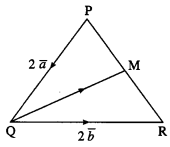
Find the trigonometric functions of 0°, 30°, 45°, 60°, 150°, 180°, 210°, 300°, 330°, – 30°, – 45°, – 60°, – 90°, – 120°, – 225°, – 240°, – 270°, – 315°
Solution:
Angle of measure 0°:
Maharashtra Board 11th Maths Solutions Chapter 2 Trigonometry - I Ex 2.1 1-1
Let m∠XOA = 0° = 0c
Its terminal arm (ray OA) intersects the standard
unit circle in P(1, 0).
Hence,x = 1 and y = 0
sin 0° = y = 0,
cos 0° = x = 1,
tan 0° = \(\frac{y}{x}=\frac{0}{1}\) = 0
cot 0° = \(\frac{x}{y}=\frac{1}{0}\) which is not defined
sec 0° = \(\frac{1}{x}=\frac{1}{1}\) = 1
cot 0° = \(\frac{1}{y}=\frac{1}{0}\) which is not defined,

Angle of measure 30°:
Let m∠XOA = 30°
Its terminal arm (ray OA) intersects the standard unit circle at P(x, y)
Draw seg PM perpendicular to the X-axis.
∴ ΔOMP is a 30° – 60° – 90° triangle.
OP= 1
Maharashtra Board 11th Maths Solutions Chapter 2 Trigonometry - I Ex 2.1 1
Since point P lies in 1st quadrant, x > 0, y > 0
∴ x = OM = \(\frac{\sqrt{3}}{2}\) and y = PM = \(\frac{1}{2}\)
Maharashtra Board 11th Maths Solutions Chapter 2 Trigonometry - I Ex 2.1 2

Angle of measure 45°:
Let m∠XOA = 45°
Its terminal arm (ray OA) intersects the standard unit circle at P(x, y).
Draw seg PM perpendicular to the X-axis.
∴ ΔOMP is a 45° – 45° – 90° triangle.
OP = 1,
Maharashtra Board 11th Maths Solutions Chapter 2 Trigonometry - I Ex 2.1 3
Since point P lies in the 1st quadrant, x > 0, y > 0
∴ x = OM = \(\frac{1}{\sqrt{2}}\) and
y = PM = \(\frac{1}{\sqrt{2}}\)
∴ P = (\(\frac{1}{\sqrt{2}}\), \(\frac{1}{\sqrt{2}}\))
Maharashtra Board 11th Maths Solutions Chapter 2 Trigonometry - I Ex 2.1 4

Maharashtra Board 11th Maths Solutions Chapter 2 Trigonometry - I Ex 2.1

Angle of measure 60°:
Let m∠XOA = 60°
Its terminal arm (ray OA) intersects the standard unit circle at P(x, y).
Draw seg PM perpendicular to the X-axis.
∴ ΔOMP is a 30° – 60° – 90° triangle.
OP= 1,
Maharashtra Board 11th Maths Solutions Chapter 2 Trigonometry - I Ex 2.1 5
Maharashtra Board 11th Maths Solutions Chapter 2 Trigonometry - I Ex 2.1 6

Angle of measure 150°:
Let m∠XOA = 150°
Its terminal arm (ray OA) intersects the standard unit circle at P(x, y).
Draw seg PM perpendicular to the X-axis.
∴ ΔOMP is a 30° – 60° – 90° triangle.
OP= 1,

Maharashtra Board 11th Maths Solutions Chapter 2 Trigonometry - I Ex 2.1 7
Since point P lies in the 2nd quadrant, x < 0, y > 0
Maharashtra Board 11th Maths Solutions Chapter 2 Trigonometry - I Ex 2.1 8
Maharashtra Board 11th Maths Solutions Chapter 2 Trigonometry - I Ex 2.1 9

Angle of measure 180°:
Let m∠XOA = 180°
Its terminal arm (ray OA) intersects the standard unit circle at P(-1, 0).
∴ x = – 1 and y = 0
sin 180° =y = 0
cos 180° = x = -1
Maharashtra Board 11th Maths Solutions Chapter 2 Trigonometry - I Ex 2.1 10
tan 180° = \(\frac{y}{x}\)
= \(\frac{0}{-1}\) = 0
Cosec 180° = \(\frac{1}{y}\)
= \(\frac{1}{0}\)
which is not defined.
sec 180°= \(\frac{1}{x}=\frac{1}{-1}\) = -1
cot 180° = \(\frac{x}{y}=\frac{-1}{0}\) , which is not defined.

Angle of measure 210°:
Let m∠XOA = 210°
Its terminal arm (ray OA) intersects the standard unit circle at P(x, y).
Draw seg PM perpendicular to the X-axis.
∴ ΔOMP is a 30° – 60° – 90° triangle.
OP= 1,
Maharashtra Board 11th Maths Solutions Chapter 2 Trigonometry - I Ex 2.1 11
Since point P lies in the 3rd quadrant, x < 0,y < 0
∴ x = -OM = \(\frac{-\sqrt{3}}{2}\) and y = -PM = \(\frac{-1}{2}\)
∴ P ≡( \(\frac{-\sqrt{3}}{2}, \frac{-1}{2}\) )
Maharashtra Board 11th Maths Solutions Chapter 2 Trigonometry - I Ex 2.1 12
Angle of measure 300°:
Let m∠XOA = 300°
Its terminal arm (ray OA) intersects the standard unit circle at P(x, y).
Draw seg PM perpendicular to the X-axis.
∴ ΔOMP is a 30° – 60° – 90° triangle.
OP = 1,
Maharashtra Board 11th Maths Solutions Chapter 2 Trigonometry - I Ex 2.1 13
Since point P lies in the 1st quadrant, x > 0,y > 0
x = OM = \(\frac{1}{2}\) = and y = -PM = \(\frac{-\sqrt{3}}{2}\)
sin 300° = y = \(\frac{-\sqrt{3}}{2}\)
cos 300° = x = \(\frac{1}{2}\)
tan 300° = \(\frac{y}{x}=\frac{-\frac{\sqrt{3}}{2}}{\frac{1}{2}}=-\sqrt{3}\)
Maharashtra Board 11th Maths Solutions Chapter 2 Trigonometry - I Ex 2.1 14

Angle of measure 330°:
Let m∠XOA = 330°
Its terminal arm (ray OA) intersects the standard unit circle at P(x, y).
Draw seg PM perpendicular to the X-axis.
∴ ΔOMP is a 30° – 60° – 90° triangle.
OP= 1,
Maharashtra Board 11th Maths Solutions Chapter 2 Trigonometry - I Ex 2.1 15
Since point P lies in the 4th quadrant, x > 0, y < 0
Maharashtra Board 11th Maths Solutions Chapter 2 Trigonometry - I Ex 2.1 16
Angle of measure 30°
Let m∠XOA = -30°
Its terminal arm (ray OA) intersects the standard unit circle at P(x,y).
Draw seg PM perpendicular to the X-axis.
∴ ΔOMP is a 30° – 60 — 90° triangle.
op = 1,
Maharashtra Board 11th Maths Solutions Chapter 2 Trigonometry - I Ex 2.1 18
Since point P lies in the 4th quadrant x > 0, y < 0
Maharashtra Board 11th Maths Solutions Chapter 2 Trigonometry - I Ex 2.1 17
Angle of measure 45°:
Let m∠XOA = 45°
Its terminal arm (ray OA) intersects the standard unit circle at P(x, y).
Draw seg PM perpendicular to the X-axis.
∴ ΔOMP is a 45° – 45° – 90° triangle.
OP = 1,
Maharashtra Board 11th Maths Solutions Chapter 2 Trigonometry - I Ex 2.1 19
Since point P lies in the 4th quadrant x > 0, y < 0
Maharashtra Board 11th Maths Solutions Chapter 2 Trigonometry - I Ex 2.1 20
[Note : Answer given in the textbook of sin (45°) = – 1/2. However, as per our calculation it is \(-\frac{1}{\sqrt{2}}\) ]

Angle of measure (-60°):
Let m∠XOA = -60°
Its terminal arm (ray OA) intersects the standard
unit circle at P(x, y).
Draw seg PM perpendicular to the X-axis.
ΔOMP is a 30° – 60° – 90° triangle.
OP = 1,
Maharashtra Board 11th Maths Solutions Chapter 2 Trigonometry - I Ex 2.1 1-2
Since point P lies in the 4’ quadrant,
x > 0, y < 0
x = OM =\(\frac{1}{2}\) and y = -PM = \(-\frac{\sqrt{3}}{2}\)
Maharashtra Board 11th Maths Solutions Chapter 2 Trigonometry - I Ex 2.1 1-3

Angle of measure (-90°):
Let m∠XOA = -90°
It terminal arm (ray OA) intersects the standard unit circle at P(0, -1)
∴ x = 0 and y = -1
sin (-90°) = y = -1
cos (-90°) = s = 0
Maharashtra Board 11th Maths Solutions Chapter 2 Trigonometry - I Ex 2.1 21

Maharashtra Board 11th Maths Solutions Chapter 2 Trigonometry - I Ex 2.1

Angle of measure (-120°):
Let m∠XOA = – 120°
Its terminal arm (ray OA) intersects the standard unit circle at P(x, y).
Draw seg PM perpendicular to the X-axis.
∴ ΔOMP is a 30° – 60° – 90° triangle.
OP = 1,
Maharashtra Board 11th Maths Solutions Chapter 2 Trigonometry - I Ex 2.1 22
Since point P lies in the 3rd quadrant, x < 0, y < 0
Maharashtra Board 11th Maths Solutions Chapter 2 Trigonometry - I Ex 2.1 23
Maharashtra Board 11th Maths Solutions Chapter 2 Trigonometry - I Ex 2.1 24

Angle of measure (- 225°):
Let m∠XOA = – 225°
Its terminal arm (ray OA) intersects the standard unit circle at P(x, y).
Draw seg PM perpendicular to the X-axis.
ΔOMP is a 45° – 45° – 90° triangle.
OP = 1,
Maharashtra Board 11th Maths Solutions Chapter 2 Trigonometry - I Ex 2.1 25
Since point P lies in the 2nd quadrant, x < 0, y > 0
Maharashtra Board 11th Maths Solutions Chapter 2 Trigonometry - I Ex 2.1 26

Angle of measure 2400):
Let m∠XOA = 240°
Its terminal arm (ray OA) intersects the standard
unit circle at P(x, y).
Draw seg PM perpendicular to the X-axis.
∴ ΔOMP is a 30°  – 60° –  900 triangle.
Maharashtra Board 11th Maths Solutions Chapter 2 Trigonometry - I Ex 2.1 27
Since point P lies in the 2nd quadrant, x<0, y>0
Maharashtra Board 11th Maths Solutions Chapter 2 Trigonometry - I Ex 2.1 28

Angle of measure (- 270°):
Let m∠XOA = – 270°
Its terminal arm (ray OA)
intersects the standard unit,
circle at P(0, 1).
∴ x = 0 and y = 1
sin (- 270°) = y = 1
cos (- 270°) = x = 0
tan(-270°)= \(\frac{y}{x}=\frac{1}{0}\)
which is not defined.
Maharashtra Board 11th Maths Solutions Chapter 2 Trigonometry - I Ex 2.1 29
Maharashtra Board 11th Maths Solutions Chapter 2 Trigonometry - I Ex 2.1 30

Angle of measure ( 315°):
Let m∠XOA 315°
Its terminal arm (ray OA) intersects the standard unit circle at P(x,y).
Draw seg PM perpendicular to the X-axis.
ΔOMP is a 45° – 45° – 90° triangle.
OP = 1,
Maharashtra Board 11th Maths Solutions Chapter 2 Trigonometry - I Ex 2.1 31

Question 2.
State the signs of:
i. tan 380°
ii. cot 230°
iii 468°
Solution:
1. 380° = 360° + 20°
∴ 380° and 20° are co-terminal angles.
Since 0° < 20° <90°0,
20° lies in the l quadrant.
∴ 380° lies in the 1st quadrant,
∴ tan 380° is positive.

ii. Since, 180° <230° <270°
∴ 230° lies in the 3rd quadrant.
∴ cot 230° is positive.

iii. 468° = 360°+108°
∴ 468° and 108° are co-terminal angles.
Since 90° < 108° < 180°,
108° lies in the 2nd quadrant.
∴ 468° lies in the 2nd quadrant.
∴ sec 468° is negative.

Question 3.
State the signs of cos 4c and cos 4°. Which of these two functions is greater?
Solution:
Since 0° < 4° < 90°, 4° lies in the first quadrant. ∴ cos4° >0 …(i)
Since 1c = 57° nearly,
180° < 4c < 270°
∴ 4c lies in the third quadrant.
∴ cos 4c < 0 ………(ii)
From (i) and (ii),
cos 4° is greater.

Question 4.
State the quadrant in which 6 lies if
i. sin θ < 0 and tan θ > 0
ii. cos θ < 0 and tan θ > 0
Solution:
i. sin θ < 0 sin θ is negative in 3rd and 4th quadrants, tan 0 > 0
tan θ is positive in 1st and 3rd quadrants.
∴ θ lies in the 3rd quadrant.

ii. cos θ < 0 cos θ is negative in 2nd and 3rd quadrants, tan 0 > 0
tan θ is positive in 1st and 3rd quadrants.
∴ θ lies in the 3rd quadrant.

Maharashtra Board 11th Maths Solutions Chapter 2 Trigonometry - I Ex 2.1

Question 5.
Evaluate each of the following:
i. sin 30° + cos 45° + tan 180°
ii. cosec 45° + cot 45° + tan 0°
iii. sin 30° x cos 45° x lies tan 360°
Solution:
i. We know that,
sin30° = 1/2, cos 45° = \(\frac{1}{\sqrt{2}}\) =, tan 180° = 0
sin30° + cos 45° +tan 180°
= \(\frac{1}{2}+\frac{1}{\sqrt{2}}+0=\frac{\sqrt{2}+1}{2}\)

ii. We know that,
cosec 45° = \(\sqrt{2}\) , cot 45° = 1, tan 0° = 0
cosec 45° + cot 45° + tan 0°
= \(\sqrt{2}\) + 1 + 0 = \(\sqrt{2}\) + 1

iii. We know that,
sin 30° = \(\frac{1}{2}\), cos 45° = \(\frac{1}{\sqrt{2}}\) =, tan 360° = 0
sin 30° x cos 45° x tan 360°
= \(\left(\frac{1}{2}\right)\left(\frac{1}{\sqrt{2}}\right)\) = 0

Question 6.
Find all trigonometric functions of angle in standard position whose terminal arm passes through point (3, – 4).
Solution:
Let θ be the measure of the angle in standard position whose terminal arm passes through P(3, -4).
∴ x = 3 and y = -4
r = OP
Maharashtra Board 11th Maths Solutions Chapter 2 Trigonometry - I Ex 2.1 32

Question 7.
If cos θ = \(\frac{12}{13}, 0<\theta<\frac{\pi}{2}\) find the value of \(\frac{\sin ^{2} \theta-\cos ^{2} \theta}{2 \sin \theta \cos \theta}, \frac{1}{\tan ^{2} \theta}\)
Solution:
cos θ = \(\frac{12}{13}\)
We know that,
sin2 θ = 1 – cos2θ
Maharashtra Board 11th Maths Solutions Chapter 2 Trigonometry - I Ex 2.1 33
∴ sin θ = ± \(\frac{5}{13}\)
Since 0 < θ < \(\frac{\pi}{2}\) , θ lies in the 1st quadrant, ∴ sin θ > 0
Maharashtra Board 11th Maths Solutions Chapter 2 Trigonometry - I Ex 2.1 34

Maharashtra Board 11th Maths Solutions Chapter 2 Trigonometry - I Ex 2.1

Question 8.
Using tables evaluate the following:
i. 4 cot 45° – sec2 60° + sin 30°
ii.\(\cos ^{2} 0+\cos ^{2} \frac{\pi}{6}+\cos ^{2} \frac{\pi}{3}+\cos ^{2} \frac{\pi}{2}\)
Solution:
i. We know that,
cot 45° = 1, sec 60° = 2, sin 30° = 1/2
4 cot 45° – sec2 60° + sin 30°
= 4(1) – (2)2 + \(\frac{1}{2}\)
= 4 – 4 + \(\frac{1}{2}=\frac{1}{2}\)

ii. We know that,
Maharashtra Board 11th Maths Solutions Chapter 2 Trigonometry - I Ex 2.1 35
Maharashtra Board 11th Maths Solutions Chapter 2 Trigonometry - I Ex 2.1 36

Question 9.
Find the other trigonometric functions if
i. cot θ = \(-\frac{3}{5}\), and 180 < θ < 270
ii. Sec A = \(-\frac{25}{7}\) and A lies in the second quadrant.
iii cot x = \(\frac{3}{4}\), x lies in the third quadrant.
iv. tan x = \(\frac{-5}{12}\) x lies in the fourth quadrant.
Solution:
i. cot θ = \(-\frac{3}{5}\)
we know that,
sin2θ = 1 – cos2θ
= 1 – \(\left(-\frac{3}{5}\right)^{2}\)
= 1 – \(\frac{9}{25}=\frac{16}{25}\)
∴ sin θ = ± \(\frac{4}{5}\)
Since 180° < 0 < 270°,
θ lies in the 3rd quadrant.
∴ sin θ < 0
Maharashtra Board 11th Maths Solutions Chapter 2 Trigonometry - I Ex 2.1 37
Since A lies in the 2nd quadrant,
tan A < 0
Maharashtra Board 11th Maths Solutions Chapter 2 Trigonometry - I Ex 2.1 38

iii. Given, cot x = \(\frac{3}{4}\)
We know that,
cosec2 x = 1 + cot2 x
= 1 + \(\left(\frac{3}{4}\right)^{2}=1+\frac{9}{16}=\frac{25}{16}\)
∴ cosec x = ± \(\frac{5}{4}\)
Since x lies in the 3rd quadrant, cosec x < 0
Maharashtra Board 11th Maths Solutions Chapter 2 Trigonometry - I Ex 2.1 39

iv. Given, tan x = \(-\frac{5}{12}\)
sec2 x = 1 + tan2
= 1 + \(\left(-\frac{5}{12}\right)^{2}\)
= 1 + \(\frac{25}{144}=\frac{169}{144}\)
∴ sec x = ± \(\frac{13}{12}\)
Since x lies in the 4th quadrant,
sec x > 0
Maharashtra Board 11th Maths Solutions Chapter 2 Trigonometry - I Ex 2.1 40