Maharashtra Board Class 12 Economics Solutions Chapter 6 Index Numbers

Balbharti Maharashtra State Board Class 12 Economics Solutions Chapter 6 Index Numbers Textbook Exercise Questions and Answers.

Maharashtra State Board Class 12 Economics Solutions Chapter 6 Index Numbers

1. Choose the correct option:

Question 1.
Statements that are incorrect in relation to index numbers.
a) Index number is a geographical tool.
b) Index numbers measure changes in the air pressure.
c) Index numbers measure relative changes in an economic variable.
d) Index numbers are specialized averages.
Options :
1) c and d
2) a and b
3) b and c
4) a and d
Answer:
2) a and b

Maharashtra Board Class 12 Economics Solutions Chapter 6 Index Numbers

Question 2.
Statements that highlight the significance of index numbers.
a) Index numbers are useful for making future predictions.
b) Index numbers help in the measurement of inflation.
c) Index numbers help to frame suitable policies.
d) Index numbers can be misused.
Options :
1) b, c and d
2) a, c and d
3) a, b and d
4) a, b and c
Answer:
4) a, b and c

Question 3.
Statements that apply to weighted index
numbers.
a) Every commodity is given equal importance.
b) It assigns suitable ‘weights’ to various commodities.
c) In most of the cases, quantities are used as weights.
d) Laaspeyre’s and Paasche’s method is used in the calculation of weighted index numbers.
Options :
1) b, c and d
2) a, c and d
3) a, b and d
4)a, b, c and d
Answer:
1) b, c and d

Question 4.
Statements related to limitations of index numbers.
a) Index numbers are not completely reliable.
b) There may be a bias in the data collected.
c) Every formula has sorne kind of defect.
d) Index numbers ignore changes in the qualities of products.
Options :
1) a, c and d
2) a, b, c and d
3) a, b and d
4) b, c and d
Answer:
2) a, b, c and d

Question 5.
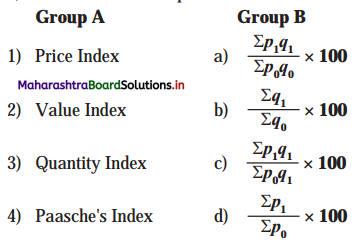
Choose the correct pair:
Maharashtra Board Class 12 Economics Solutions Chapter 6 Index Numbers 1
Options :
1) 1-d, 2-c, 3-a, 4-b
2) 1-d, 2-a, 3-b, 4-c
3) 1-b, 2-c, 3-d, 4-a
4) 1-c, 2-d, 3-a, 4-b
Answer:
2) 1-d, 2-a, 3-b, 4-c

2. Complete the Correlation:

1) Price Index: Inflation :: ………………. : Agricultural production
2) ……………….: Base year prices :: P1 : Current year prices
3) Laaspeyre’s index : ………………. :: Paasches index : Current year quantities
4) ……………….: Single variable :: Composite index: Group of variables
Answers:

  1. Quantity Index
  2. P0
  3. Base year quantity
  4. Univariate Index

3. Solve the following:

Question 1.
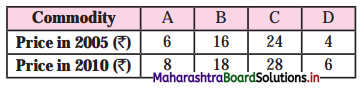
Calculate Price Index number from the given data:
Maharashtra Board Class 12 Economics Solutions Chapter 6 Index Numbers 2
Answer:

CommodityBase Year price 2005 (P0)

Current Year price 2006
(P1)

A68
B1618
C2428
D46
TotalΣp0 = 50Σp1 = 60

Steps:
Add the price of base year (p0)
Add the price of current year (p1)
P01 = \(\frac{\Sigma p_{1}}{\Sigma p_{0}}\) x 100
= \(\frac{60}{50}\) x 100
= 120
Hence P01 = 120

Maharashtra Board Class 12 Economics Solutions Chapter 6 Index Numbers

Question 2.
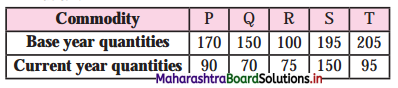
Calculate Quantity Index number from the given data:
Maharashtra Board Class 12 Economics Solutions Chapter 6 Index Numbers 3
Answer:

CommodityBase Year Qty.(q0)

Current Year Qty. (p1)

P17090
Q15070
R10075
S195150
T20595
TotalΣp0 = 820Σp1 = 480

Steps : Add quantities of base year (q0).
Add quantities of current year (q ).
Q01 = \(\frac{\Sigma q_{1}}{\Sigma q_{0}}\) x 100
= \(\frac{480}{820}\) x 100
= 58.53
Hence, Q01 = 58.53
As quantity in the current year has fallen Q01 is less than loo.

Question 3.
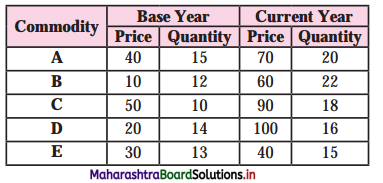
Calculate Value Index number from the given data:
Maharashtra Board Class 12 Economics Solutions Chapter 6 Index Numbers 4
Answer:
Steps:
(1) Formula used for Value Index Number
= V01 = Zpq x 100
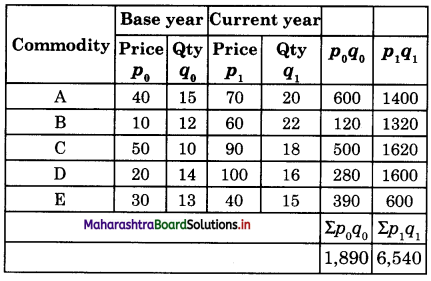
(2) We find product of prices and their respective quantities of the different commodities for the base year to derive p0q0, then take the sum total of the products to derive Zp0q0.
(3) Similarly, find the product of prices and their respective quantities for the current year to derive p1q1, then take the sum total of the products to derive p1q1.
Maharashtra Board Class 12 Economics Solutions Chapter 6 Index Numbers 5
Value Index Number = \(\frac{\Sigma p_{1} q_{1}}{\Sigma p_{0} q_{0}}\) x 100
= \(\frac{6,540}{1,890}\) x 100
= 346.03
Value Index Number = 346.03

Question 4.
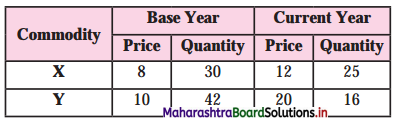
Calculate Laaspeyre’s and Paasche’s index from the given dala:
Maharashtra Board Class 12 Economics Solutions Chapter 6 Index Numbers 6
Answer:
I’m 7
Price Index P01 = \(\frac{\Sigma p_{1}}{\Sigma p_{0}}\) x 100
= \(\frac{42}{40}\) x 100
= 105
Hence, P01 = 105

4. Distinguish between:

Question 1.
Simple Index Numbers and Weighted Index Numbers.
Answer:

Simple Index NumberWeighted Index Number
(a) Simple index number is a simple average of index number of individual goods.(a) Weighted index number is a weighted average of products after assigning suitable weights to individual goods.
(b) It is easy to calculate.(b) It is difficult to calculate.
(c) All commodities are given equal importance.(c) All commodities are given different levels of importance.
(d) It gives rough estimates of price change(d) It gives an accurate estimate of price change.
(e) It is less used in practice.(e) It is mostly used in practice.

Question 2.
Price Index and Quantity Index.
Answer:

Price Index NumberQuantity Index Number
(a) Price index number measures the changes in price over a period of time.(a) Quantity index number measures the changes in quantity over a period of time.
(b) It can be used for measuring the changes in prices as well as other purpose e.g. in fixing wages, interest rates, tax rates, etc.(b) It can be used only for measuring the changes in the quantities e.g. of items like exports, imports, etc.
(c) It is a very popular concept and can be easily calculated and understood.(c) It is not so popular as it cannot be easily calculated.

Maharashtra Board Class 12 Economics Solutions Chapter 6 Index Numbers

Question 3.
Laaspeyre’s Index and Paasche’s Index.
Answer:

Laspeyre’s Index Number

Paasche’s Index Number
(a) Laspeyre uses base year quantity (Q0) as weights to calculate index numbers.(a) Paasche uses current year quantity (Qt) as weights to calculate index number.
(b) He gave this formula P01 = \( \frac{\Sigma p_{1} q_{0}}{\Sigma p_{0} q_{0}} \) [where P01 = Price index number

p0 = Price of the base year
p1 = Price of the current year
q0 = Quantities of the base year]

(b) He gave this formula = P01 = \( \frac{\Sigma p_{1} q_{1}}{\Sigma p_{0} q_{1}} \) [where P01 = Price index number

p0 = Price of the base year
p1 = Price of the current year
q0 = Quantities of the base year]

(c) He is a German Economist who gave the method of calculating Index Number in the year 1871.      .(c) He is a German Statistician who devised the method of calculating Index Number in the year 1874.

5. State with reasons whether you agree or disagree with the following statements:

Question 1.
Index numbers measure changes in the price level only.
Answer:
No, I do not agree with this statement.

  • Index numbers are statistical devices which are used to measure changes in some quantities which cannot be measured directly.
  • It shows the changes in the variables like price, quantity of output, exports, standard of living, cost of living, stock markets, etc.
  • Index numbers are like economic barometers, measuring changes in variables over time with respect to a chosen base year.
  • Hence, it is not right to say Index Numbers measures changes in price only.

Question 2.
Index numbers are free from limitations.
Answer:
No, I do not agree with this statement.
Although index numbers are very useful in business and industry, they suffer from following limitation:

  • Bias in the data: If the data is not collected properly, we may not get proper index numbers.
  • Based on samples : If the samples are not collected properly, there may be error in index number calculations.
  • Misuse of index number : We compare the index numbers with the base year, but if a businessman chooses a base year in which profits are high and show that his profits are falling now.
  • Changes in the economy : In long run habits, tastes, etc of people may change, so it is difficult to include all such changes in index number.
    Hence, it is not right to say that index numbers are free from limitations.

Question 3.
Index numbers can be constructed without the base year.
Answer:
No, I do not agree with this statement.
Index numbers can be constructed without the base year because :

  • Index Numbers are the tools for measuring J the changes in the magnitude of a variable or a group of variables over time with respect to a chosen year.
  • Prices of some goods may increase and of other may decrease during the two periods. Index numbers solves this problem by taking the average change.
  • For example, to know cost of living of people in general in India, Government chooses a base year 2010 which is taken as 100. Then  cost of living is calculated in 2019 which may be 140.
  • This difference of 40(140-100) shows that cost of living in India has increased by 40% ( since 2010.
    Hence, Index Numbers cannot be constructed – without the base year.

Maharashtra Board Class 12 Economics Solutions Chapter 6 Index Numbers

6. Answer the following:

Question 1.
Explain the features of index numbers.
Answer:
Features of Index Numbers :

  • Index numbers are a specialised form of averages.
  • They are expressed in percentage form without using a percentage sign.
  • The year for which index number is being prepared is the current year.
  • The year from which index number is being prepared is called the base year which is ? always taken as 100.
  • They are used in measuring the changes ( in magnitudes which cannot be measured directly.
  • The formula used for Price Index Number = \(\frac { Total price of the current year }{ Total price of the base year }\) x 100
  • They are considered as barometer of economic activity.
  • Index number which is calculated from a single variable is called “univariate index” and which is constructed from a group of variables is called a “composite index”.

Question 2.
Explain the significance of index numbers in economics
Answer:
Index numbers are significant tools of economic analysis in the following ways:

(1) Help in formulating Policies : Index numbers help the government and business organisations in framing their suitable economic policies for agriculture and industrial sector, wage and dearness allowance policies, etc.

(2) Help in the study of Trends and Tendencies : Index numbers study the relative changes in the level of phenomenon of different periods of time, so they can be used to predict future events. The economists can study the general trends of changes in price levels, agricultural and industrial production, export, imports, etc.

(3) Economic Barometer : Just as barometer is used to measure atmospheric pressure, index numbers measure the level of economic and business behaviour. They are very important for an economist, businessman, planners, policy makers, etc.

(4) Helps in Measurement of Inflation :
It helps the government to take measures against inflation by giving additional D.A. to the employees on the basis of Dearness Index.

(5) Help to adjust National Income : By comparing current year’s national product prices with the base year’s prices, the Domestic Product (GDP) produced. Hence, this shows changes in real national income.

(6) To present Financial Data in Real Income : Index numbers are used to adjust price change, wage change, etc. Thus deflating helps to present the financial data at constant prices.
(Note: Deflating means to make adjustments in the original data)

(7) Helps in determining Depreciation
Cost: The price index helps in determining the depreciation cost of durable goods. At the time of inflation, it is useful to know the original cost of the commodities.

Maharashtra Board Class 12 Economics Solutions Chapter 6 Index Numbers

7. Answer in detail:

Question 1.
Explain the steps involved in the construction of index numbers.
Answer:
Steps involved in the construction of j index numbers are as follows :
1. Purpose of an Index Number : Before constructing an index number, one must know the purpose for which the index number is constructed. E.g. for the whole c sale price or retail price or for agricultural – output, etc.

2. Selection of a Base Year : It is important to select a base year against which comparisons are made. So base year or reference year should be
(i) a recent year and not a distant past.
(ii) it should be normal and free from natural calamities, war, etc.

3. Selection of Commodities: When the cost c of living index number of the middle class jj families is to be constructed, the items that are used by middle class families in everyday life should be included and items like big cars, AC’s, etc. should not be included.

4. Selection of Prices : Prices differ from city to city and even from shop to shop in the same city. Hence, we should take a few standard shops from where middle class families buy goods and take the average of the prices of goods sold by them. Otherwise index number
constructed may be misleading.

5. Selection of suitable Average : An ; index number is a special kind of average, Generally arithmetic mean is commonly ? used for construction of index number as it is simple to calculate.

6. Selection of Formula : Number of formulae can be used for construction, of index numbers. Economists have to decide which formula to use for the construction of a particular index number.

7. Assigning proper Weights : Weights refer to the relative importance of different items in the construction of an index number. ( Weights may either be quantity weights (q) or value weights (p). All weights may not be equally important. Therefore, by s assigning specific weights better result can be obtained.

Index Questions

Find out (Textbook Page 58) :

(a) List of crops included in the Index of Agricultural Production in India.
Answer:
Food grains : Rice, Wheat, Jowar, Bajra, Maize, Ragi, Barley and Small Millets. Gram, Tur and other pulses.
Fibres: Cotton, Jute, Mesta and Sannhemp.
Non-food grains : Oilseeds Groundnut, Sesame, Rapeseed and Mustard, Linseed, Castorseed, Safflower, Nigerseed, Soyabean, Sunflower, Coconut and Cottonseed.
Plantation crops: Tea, Coffee and Rubber.
Condiments and Spices : Pepper, Ginger, Garlic, Chillies, Turmeric, Arecanut, Coriander and Cardamom.
Fruits and Vegetables : Potato, Onion, Banana, Cashewnut, Tapioca and Sweet Potato.
Other Crops : Sugarcane, Tobacco and Guarseed.

(b) List of products included in the Index j of Industrial Production in India.
Answer:
Index of Industrial Production in ; India includes – Consumer Durable goods, Consumer non-durable goods, manufacturing goods, mining, electricity, infrastructure or construction goods, etc.

Find out (Textbook Page 59) :

Newspaper headlines related to the following types of index numbers :
(a) Price Index
(b) Agricultural Productivity Index
(c) Index of Industrial Production
(d) Equity Share Price Index
Answer:
[Students should do this activity by themselves.]

Maharashtra Board Class 12 Economics Solutions Chapter 5 Forms of Market

Balbharti Maharashtra State Board Class 12 Economics Solutions Chapter 5 Forms of Market Textbook Exercise Questions and Answers.

Maharashtra State Board Class 12 Economics Solutions Chapter 5 Forms of Market

1. Choose the correct option:

Question 1.
In economic sense, market includes following activities
a) The place where goods are sold and purchased.
b) An arrangement through which buyers and sellers come in close contact with each other directly or indirectly.
c) A shop where goods are sold.
d) All of the above.
Options :
1) a and b
2) b and c
3) a, b and c
4) only b
Answer:
4) only b

Maharashtra Board Class 12 Economics Solutions Chapter 4 Supply Analysis

Question 2.
Classification of markets on the basis of place
a) Local market, National market, International market
b) Very short period market, Local market, National market.
c) Short period market, National market, International market.
d) Local market, National market, Short period market.
Options :
1) a, b and c
2) b. c and d
3) only a
4) a and d
Answers:
3) only a

Question 3.
Homogeneous product is a feature of this market.
a) Monopoly
b) Monopolistic competition
c) Perfect competition
d) Oligopoly
Options:
1) c and d
2) a, b and c
3) a, c and d
4) only c
Answer:
4) only c

Question 4.
Under Perfect competition, sellers are
a) Price makers
b) Price takers
c) Price discriminators
d) None of these
Oplions:
1) a, b and c
2) only b
3) only c
4) a and c
Answers:
2) only b

2. Give economic terms:

1) The market where there are few sellers.
2) The point where demand and supply curve intersect.
3) The cost incurred by the firm to promote sales.
4) Number of firms producing identical product.
5) Charging different prices to different consumers for the same product or services.
Answers:

  1. Oligopoly
  2. Equilibrium point
  3. Selling cost
  4. Homogeneous
  5. Discriminating monopoly

Maharashtra Board Class 12 Economics Solutions Chapter 4 Supply Analysis

3. Complete the Correlation:

1) Perfect competition : Free entry and exit :: ……………. : Barriers to entry.
2) Price taker …………….:: Price maker:: Monopoly.
3) Single price : Perfect competition :: Discriminated prices : …………….
Answers:

  1. Monopoly
  2. Perfect competition
  3. Monopoly

4. Find the odd word out:

1) Selling cost : Free gifts, Advertisement hoardings. Window displays. Patents.
2) Market sructure on the basis of competition : Monopoly. Oligopoly. Very Short Period market. Perfect competition.
3) Features of monopoly : Price maker, Entry barriers, Many sellers. Lack of substitutes.
4) Legal monopoly : Patent. OPEC. Copyright. Trade mark.
Answers:

  1. Free gift
  2. Very short period
  3. Many sellers
  4. OPEC

5. Answer the following:

Question 1.
Explain the features of Oligopoly.
Answer:
The term Oligopoly is derived from the Greek words ‘Oligo’ which means few and ‘Poly’ which means sellers. Hence, following are its features –

1. Many buyers and few sellers : There are many buyers and a few sellers or firms (may be five or six) who dominate the market and have major control over the price of a product.

2. Interdependence : Since the number of firms are less, any change in price, output, product etc. by one firm will affect the rival firms and will force them to change their price, output, etc. E.g. In case of Coke and Pepsi in soft drink market.

3. Selling cost or advertising : Each firm in order to sell more of its product takes aggressive steps to advertise or through free samples. This helps them to capture larger sales.

4. Barrier to entry : The firm can easily exit from the industry whenever it wants, but to enter a new industry it has certain entry barriers like government license, patent right, etc.

5. Uncertainty : There is a great uncertainty in this market if the rival firms join hands and may try to fight each other.

6. Lack of Uniformity : The firms may produce either homogeneous or differentiated products. Eg. In automobile industry, Maruti, Indica are examples of differentiated product but cooking gas of Bharat Petroleum and Hindustan Petroleum are examples of homogeneous product or pure oligopoly.

Maharashtra Board Class 12 Economics Solutions Chapter 4 Supply Analysis

Question 2.
Explain the types of Monopoly.
Answer:
There are different types of monopoly as analysed below:

(1) Natural Monopoly : A natural monopoly arises when a particular type of natural resource is located in a particular region like petrol or crude oil in Gulf countries. Also natural advantages such as good location, business reputation, age – old establishment s etc., confer natural monopoly. Similarly, many professional skills, natural talents give monopoly power. E.g. A singer or actor has monopoly of his skill, talent.

(2) Legal Monopoly : Legal monopolies are those monopolies which are recognised by law. Legal protection granted by the Government in the form of trade mark, copy rights, license etc., give monopoly power to j the firms. Here the potential competitors are j not allowed to copy the product registered under the given brand names, patents or trade marks according to the law.

(3) Joint Monopoly or Voluntary Monopoly : This monopoly arises through mutual agreement and business combinations like the formation of cartels, syndicate, trust etc. For e.g. Oil producing nations have come together and formed a Cartel OPEC Organisation of Petroleum Exporting Countries.

(4) Simple Monopoly : A simple monopoly firm charges a uniform price for its product to all the buyers.

(5) Discriminating Monopoly : A discriminating monopoly firm charges different prices for the same product to ) different buyers. E.g. a doctor, a teacher, a lawyer, etc., charges different fees from the people. The practice of charging different j prices from different buyers is called “Price discrimination.”

(6) Private Monopoly : When an individual or a private firm enjoys the monopoly of manufacturing and supplying a particular product, it is called private monopoly. The main aim of private monopolist is profit maximisation.

(7) Public Monopoly : When a field of production is solely owned, controlled and operated by the government, it is regarded as public monopoly. Eg. Public utility service like Railways, Electricity, Water Supply etc. Since these monopolies are service motivated and welfare oriented they are also called welfare monopolies.

6. Observe the table and answer the questions:

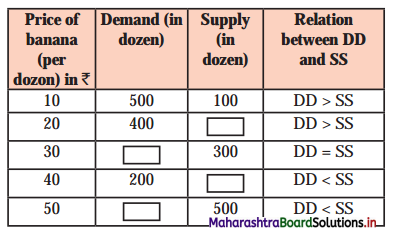
Maharashtra Board Class 12 Economics Solutions Chapter 5 Forms of Market 1

Question 1.
Fill in the blanks in the above schedule.
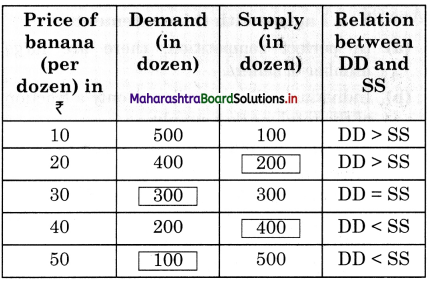
Answer:
Maharashtra Board Class 12 Economics Solutions Chapter 5 Forms of Market 2

Maharashtra Board Class 12 Economics Solutions Chapter 4 Supply Analysis

Question 2.
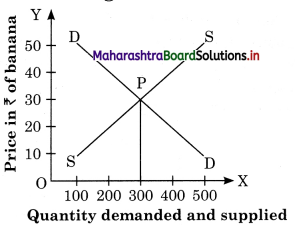
Derive the equilibrium price from the above schedule with the help of a suitable diagram.
Maharashtra Board Class 12 Economics Solutions Chapter 5 Forms of Market 3
Answer:
In the diagram, equilibrium price is ₹ 30/- because at this point dd curve insects SS curve at point ‘P’. At this point DD is 300 doz of bananas and sellers are ready to sell 300 doz at price ₹ 3.

7. Answer in detail:

Question 1.
Explain the meaning of Monopolistic competition with its features.
Answer:
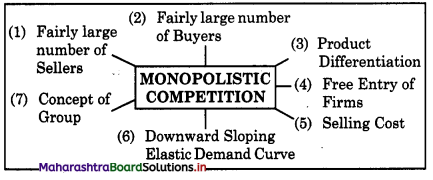
Maharashtra Board Class 12 Economics Solutions Chapter 5 Forms of Market 4
(1) Fairly large number of Sellers : There are large number of sellers selling closely related, but not identical products. There is tough competition among sellers. An individual seller supply is just a small part) of the total supply, so he has limited degree l of control over market supply and price. Each firm (seller) can formulate its own price and output policy independently.

(2) Fairly large number of Buyers: There are large numbers of buyers in a monopolistic competition market. Each buyer enjoys his preference over a particular brand and chooses to buy a specific brand of product. Hence, the buying is by choice and not by chance.

(3) Product Differentiation : The most distinguishing feature of monopolistic competition is that the product produced by different firms are not identical, they are slightly different from each other but they are close substitutes. The product differentiation can be done in different ways like may be in the form of brand names say Raymonds. It can be differentiated in terms of colour, size, design, etc., say soap, mobiles etc., or through sales technique. For e.g. cars, two wheelers, air conditioners, etc.

(4) Free Entry of Firms: A firm is free to enter the market as there are no entry barriers. Similarly there are no restrictions if the firm wants to quit the market. Freedom of entry leads to occurrence of only normal profit in the long run.

(5) Selling Cost : One of the special features of monopolistic competition is the selling cost. Selling costs are those costs, which are incurred by firms to create more and more demand for its products through advertisement, salesmanship, free samples, exhibitions, etc.

(6) Downward Sloping Elastic Demand Curve : The demand curve faced by each firm is downward sloping and comparatively more elastic. It implies that an individual firm can sell more only by reducing the price.
Maharashtra Board Class 12 Economics Solutions Chapter 5 Forms of Market 5

(7) Concept of Group : Under monopolistic competition, Prof. E. H. Chamberlin introduced the concept of group in place of Marshallian concept of industry. Industry means a number of firms producing identical products. A group means a number of firms producing differentiated product, which are close substitutes.

Maharashtra Board Class 12 Economics Solutions Chapter 4 Supply Analysis

Question 2.
Explain the meaning of Perfect competition with its features.
Answer:
Maharashtra Board Class 12 Economics Solutions Chapter 5 Forms of Market 6
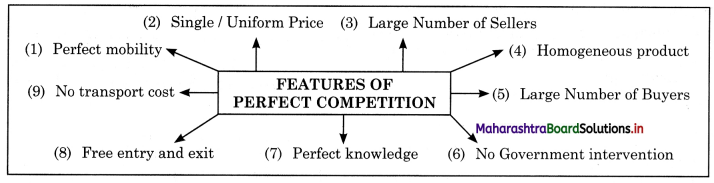
(1) Perfect Mobility of Factors of Production : Factors of production that is land, labour, capital are perfectly free to move from one firm to another or from one industry to another from one region to another or from one occupation to another. This ensures freedom of entry and exit for individuals and firms.

(2) Single / Uniform Price : There exists a single price for homogeneous product in the entire market at a given point of time. The price is determined by forces of demand and supply.

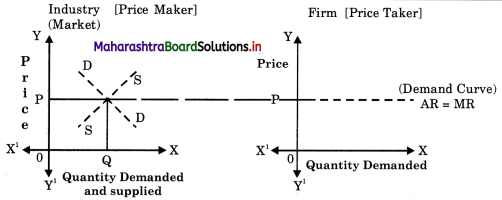
(3) Large Numbers of ellers : There are many sellers in this market. The number of sellers (firms) are so large that a single seller cannot influence the market price nor the total output in the market (Industry). The contribution of one seller is insignificant and microscopic. The price in the market is determined by the forces of market demand and market supply. Hence, a firm or seller is a ‘price taker’ and not a ‘price maker.’
Maharashtra Board Class 12 Economics Solutions Chapter 5 Forms of Market 7
Maharashtra Board Class 12 Economics Solutions Chapter 5 Forms of Market 8
(4) Homogeneous Product : The products produced by all the firms in the industry are identical and are perfect substitute to each other. The products are identical in shape, size, colour, etc. and hence uniform price rules the market for the product.

(5) Large Number of Buyers : There are large number of buyers in the market. One individual buyer’s demand is only a small fraction of total market demand so he is not in a position to influence the price. He is a price taker.

(6) No Government Intervention : It is assumed that the government does not interfere with the working of market economy. There are no tariffs, subsidies, licensing policy or other government interventions. This non – intervention of government is necessary to permit free entry of firms and automatic adjustment of demand and supply. In short, laissez faire policy prevails under perfect

(7) Perfect Knowledge : There is perfect knowledge on the part of buyers and sellers regarding the market conditions especially regarding market price. As a result no buyer will pay a higher price than the market price and no seller will charge a lower price than the market price. So a single price would prevail for a commodity in the entire market.

(8) Free Entry and Free Exit : There is freedom for new firms or sellers to enter the industry or market. There are no legal, j economic or any other type of restrictions or; barriers for new firms to enter the industry or an existing firms to quit the industry, Entry of new firm usually takes place j when existing firms enjoy abnormal profit. Similarly, existing firms quit the industry when they face losses.

Maharashtra Board Class 12 Economics Solutions Chapter 4 Supply Analysis

(9) No Transport Cost: It is assumed that all firms are close to the market and hence there  is no transport cost. If the transport cost are added to the price of product then the homogeneous commodity will have different prices depending upon the distance from the place of supply to the market.

Question 1.
Do you know? (Textbook Page 50)
What is monopsony?
Answer:
Monopsony is opposite of monopoly market but it is rarely found in reality.
In monopsony, there are large number of sellers but buyer is only one. So buyer has complete control over the price in the market. He can bargain with the sellers and fix the price at his terms.

Find out (Textbook Page 50)

What are the types of monopoly of the following products or services and give reason.
(1) Tea in Assam, (2) Atomic energy, (3) Logo of a commercial bank
Answer:

Product / ServiceTypes of MonopolyReason due to
Tea in AssamNatural Monopolysuitable climatic conditions and hilly regions of Assam.
Atomic energyPublic MonopolyAtomic energy is owned and controlled by the government.
Logo of a Commercial BankPublic MonopolyCommercial Banks are owned and controlled by the government.

Maharashtra Board Class 12 Economics Solutions Chapter 4 Supply Analysis

Find out (Textbook Page 51)

Find the close substitutes for the following products:
Answer:

ProductsSubstitutes
(a)Gemini OilSaffola Oil
(b)Colgate ToothpasteMeswak Toothpaste
(c)Red Label TeaGirnar Tea
(d)Bru CafeNescafe
(e)Activa Two-wheelerAviator – Two-wheeler

Maharashtra Board Class 12 Economics Solutions Chapter 5 Forms of Market 9

Maharashtra Board Class 12 Economics Solutions Chapter 4 Supply Analysis

Balbharti Maharashtra State Board Class 12 Economics Solutions Chapter 3B Elasticity of Demand Textbook Exercise Questions and Answers.

Maharashtra State Board Class 12 Economics Solutions Chapter 4 Supply Analysis

1. Complete the following statements:

Question 1.
When supply curve is upward sloping, it’s slope is ……………….
a) positive
b) negative
c) first positive then negative
d) zero
Answer:
a) positive

Question 2.
An upward movement along the same supply curve shows ………………..
a) contraction of supply
b) decrease in supply
c) expansion of supply
d) increase in supply
Answer:
c) expansion of supply

Maharashtra Board Class 12 Economics Solutions Chapter 4 Supply Analysis

Question 3.
A rightward shift in supply curve shows ………………..
a) contraction of supply
b) decrease in supply
c) expansion of supply
d) increase in supply
Answer:
d) increase in supply

Question 4.
Other factors remaining constant, when less quantity is supplied only due to a fall in price, it shows ………………..
a) contraction of supply
b) decrease in supply
c) expansion of supply
d) increase in supply
Answer:
a) contraction of supply

Question 5.
Net addition made to the total revenue by selling an extra unit of a commodity is ………………..
a) total Revenue
b) marginal Revenue
c) average Revenue
d) marginal Cost
Answer:
b) marginal Revenue

2. Complete the Correlation:

1) Expansion of supply: Price rises:: Contraction of supply: ………………….
2) Total revenue : …………………. :: Average revenue :TR/TQ
3) Total cost : TFC + TVC :: Average cost : ………………….
4) Demand curve : …………………. :: Supply curve : Upward
5) …………………. : Change in supply :: Other factors constant: Variation of supply
Answers:
(1) Price falls
(2) PxQ
(3) TC ÷ TQ
(4) Downward
(5) Other factor changes

3. Give economic terms:

1) Cost incurred on fIxed factor.
2) Cost incurred per unit of output.
3) Net addition made to total cost of production.
4) Revenue per unit of output sold.
Answers:
(1) Fixed Cost
(2) Average Cost
(3) Marginal Cost
(4) Average Revenue

Maharashtra Board Class 12 Economics Solutions Chapter 4 Supply Analysis

4. Distinguish between:

Question 1.
Stock and Supply.
Answer:

StockSupply
(a) Stock refers to the total quantity of commodity available with producer for sale.(a)Supply is that part of stock which the seller is willing to offer for sale at a given price.
(b) It is outcome of production. If production increases, stock will also increase.(b) It is outcome of stock. Stock is the basis of supply.
(c) It is a fund or reservoir and a static concept (inelastic).(c) It is a flow concept. It changes according to change in price (elastic).
(d) It can exceed supply.(d) It cannot exceed stock.

Question 2.
Expansion of Supply and Increase in Supply.
Answer:
Expansion / Extension of Supply

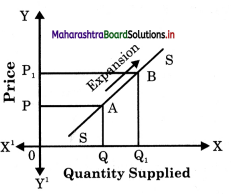
  1. When the supply of a commodity rises only due to the rise in the price of the commodity, then it is said to be extension in supply.
  2. Extension of supply is a case of variation in supply.
  3. Rise in price is the only factor due to which supply expands / extends.
  4. When there is extension in supply, there is an upward movement on the same supply curve.
    Maharashtra Board Class 12 Economics Solutions Chapter 4 Supply Analysis 1

Increase in Supply :

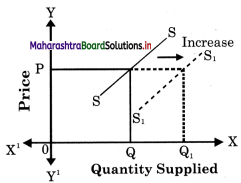
  1. The supply is said to increase if at the same price more is supplied.
  2. Increase in supply is a case of changes in supply.
  3. Supply increases due to
    (1) fall in cost of production
    (2) improvement in transport facility
    (3) introduction of modern technology
    (4) government subsidies
    (5) more imports etc.
  4. When there is an increase in supply, the supply curve shifts to the right of original supply curve.

Maharashtra Board Class 12 Economics Solutions Chapter 4 Supply Analysis 2

Question 3.
Contraction of Supply and Decrease in Supply.
Answer:
Contraction of Supply

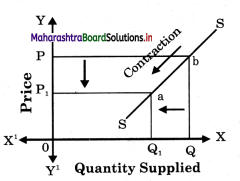
  1. Contraction of supply occurs when quantity supplied of a commodity falls due to a fall in price alone.
  2. It is a case of variation in supply.
  3. Supply contracts due to fall in price alone.
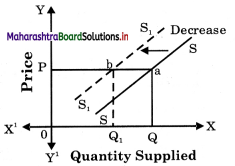
  4. When there is a downward n curve.

Maharashtra Board Class 12 Economics Solutions Chapter 4 Supply Analysis 3
Decrease in Supply

  1. Decrease in supply occurs when less quantity is supplied at the same price.
  2. It is a case of changes in supply.
  3. Supply decreases due to –
    (1) increase in cost of production
    (2) transport strike
    (3) outdated technique
    (4) heavy taxes imposed by government.
    (5) more exports etc.
  4. When there is curve shifts to curve.
    Maharashtra Board Class 12 Economics Solutions Chapter 4 Supply Analysis 4

Maharashtra Board Class 12 Economics Solutions Chapter 4 Supply Analysis

Question 4.
Average Revenue and Average Cost.
Answer:

Average Revenue (AR)Average Cost (AC)
(a) Average revenue refers to average income earned per unit of a sold commodity.(a)Average cost refers per unit of cost of production of a commodity produced.
(b) It is calculated by dividing total revenue (TR) earned by number of unit sold.(b) It is calculated by dividing total cost (TC)by number of units of that commodity produced.
(c) Symbolically it in expressed as \( [latex]\frac { Total Revenue }{ Total Quantity sold }\) [/latex](c) Symbolically it is expressed as \(\frac { Total Cost }{ Total Quantity produced }\)
E.g. If TR from sale of 10 units of a commodity is Rs. 1000 then, AP =  1000/10 = Rs. 100E.g. If TC of 100 units a commodity is Rs. 1000 then, AC =  \(\frac { 1000 }{ 100 }\) = Rs. 10

5. Observe the following table and answer the questions.

A) Supply schedule of chocolates

Price in Rs.Quantity supplied in units
10200
15………
20300
25350
30……..
35……..
40……..

Question 1.
Complete the above supply schedule.
Answer:

Price in Rs.Quantity supplied in units
10200
15250
20300
25350
30400
35450
40500

Question 2.
Draw a diagram for the above supply schedule.
Answer:
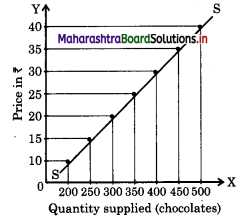
Maharashtra Board Class 12 Economics Solutions Chapter 4 Supply Analysis 6

Maharashtra Board Class 12 Economics Solutions Chapter 4 Supply Analysis

Question 3.
State the relationship between price and quantity supplied.
Answer:
This diagram shows the direct relationship / between price and quantity supplied of) chocolates. When its price is ? 10, 200 units ( are supplied and as price rises to 15, 20, 25 ? …. and so on, quantity supplied also rises to )
When the schedule is plotted on the graph we 250, 300, 350 and so on. This is the law of supply of an individual firm.

B) Observe the market supply schedule of potatoes and answer the following questions.

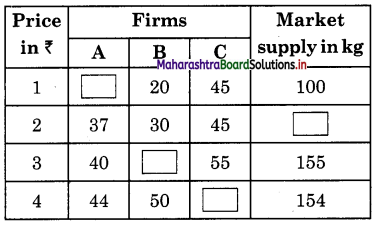
Maharashtra Board Class 12 Economics Solutions Chapter 4 Supply Analysis 7

Question 1.
Complete the quantity of potato supplied by the firms to the market in the above table.
Answer:
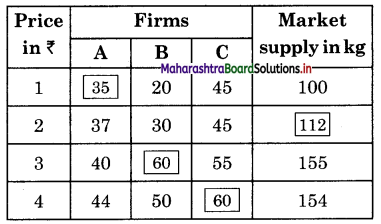
Maharashtra Board Class 12 Economics Solutions Chapter 4 Supply Analysis 8

Question 2.
Draw the market supply curve from the schedule and explain it.
Answer:
Maharashtra Board Class 12 Economics Solutions Chapter 4 Supply Analysis 9
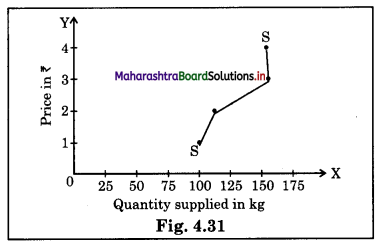
When the schedule is plotted on the graph we get a market supply curve ‘SS’ which is upward sloping. This curve shows that as price rises from ₹ 1 to ₹ 2, supply rises from 1oo to 112 kg, but when price rises from ₹ 2 to ₹ 3, supply rises to a greater extent from 112 kg to 155 kg in the market. When price rises to ₹ 4 Supply falls from 155 kg to 154 kg. This may be because of perishable or seasonal good that supply could not Jj be increased and supply falls. This show backward bending supply curve, showing partly an exception to the supply curve.

6. Answer the following questions:

Question 1.
Explain the concept of total cost and total revenue.
Answer:
Total Cost (TC): It is the total expenditure incurred by a fir m on the factors of production required for the production of goods and services. Total cost is the sum of Total Fixed Cost (TFC) and Total Variable Cost (TVC). Total Fixed Cost is the cost incurred on fixed factors of production like land, factory, building, capital, etc. These factors cannot be changed in the short period. They remain constant. Total Variable Cost is the cost incurred on variable factors such as raw – materials, labour, etc. These factors can be varied or changed according to the change in output level. So the variable cost varies. Total Cost = Total Fixed Cost + Total Variable Cost
i.e., TC = TFC + TVC
TC increases as the level of output increases.

Total Revenue :
(Income) refers to total receipts of the firm from its sales of commodity. It is obtained by multiplying the price per unit of the  commodity with the total number of units!; of commodity sold to the consumers. Thus, Total Revenue = Price per unit Total  Number of units of commodity sold.
Example : If the firm sells lo units of a commodity at ₹ 100 per unit then total revenuewifibe TR = 100 x 10. TR= ₹ 1000

Maharashtra Board Class 12 Economics Solutions Chapter 4 Supply Analysis

Question 2.
Explain determinants of supply.
Answer:

  1. Cost of Production : Changes in the price of factors of production like rent, wages, interest affects the cost of production. When cost of production increases, supply decreases.
  2. Price of Other Goods : The supply of a given commodity depends on the price of other commodity. E.g. if the price of wheat rises and that of rice remains the constant, then the producer will think of producing J more of wheat. This will affect the supply of rice.
  3. price of the Commodity : Price is an important factor influencing the supply. More is supplied at a higher price and less at a lower price. So price and supply are 5 directly related.
  4. Climatic Conditions : The supply of j commodity is also influenced by the forces
  5. Government Policy : Government policies like taxation, subsidies, industrial policies etc., may encourage or discourage production and supply. A tax on the commodity will raise the cost of production and reduce the supply while a subsidy on the other hand will provide an incentive to increase production and supply.
  6. Exports and Imports : When the
    government resort to imports, supply expands, at the same time heavy exports would reduce the supply in the domestic market.
  7. Nature of Market : In a competitive market, the supply would be more but in a monopoly market the seller may create artificial scarcity to raise the price.
  8. Future Expectation : If future trends indicate a rise in price, the supply decreases at present. On the other hand if the sellers expect the future price to fall, supply would increase in the current period.
  9. Technique of Production : Improvement in the technique of production will lead to increase in supply. Application of advanced technology enables the producer to produce goods on large scale at a lower cost and lesser price.
  10. Infrastructure Facility : If means of transport and communication are well developed, the extent of market would be wide. i.e. supply will increase.
  11. Natural and Man-made Calamities : Natural calamities like earthquake, cyclone, flood etc., will affect the supply in the market. Even man-made calamities like a bomb-blast, affects supply. Even a strike call can affect supply in the market.

7. Answer in detail :

Question 1.
State and explain law of supply with exceptions.
Answer:
Law of Supply :
(A) Introduction : The law of supply was introduced by Dr. Alfred Marshall in his book “Principles of Economics” published in 1890. The law establishes a functional relationship between the price of a commodity and quantity supplied of that commodity. It explains the general tendency of the sellers in offering more goods for sale at a higher price than at a lower price.

(B) Statement of the Law : According to Prof. Alfred Marshall “Other things remaining constant, the higher the price of the commodity, greater is the quantity supplied and lower the price of the commodity, smaller is the quantity supplied.”In other words, quantity supplied of a commodity varies directly with price i.e., with a fall in price supply contract and with a rise in price supply expands.
S = f (P) [S = Supply, P = Price, f = Function of]
The law can be better understood with the help of a market supply schedule and market supply curve.

(C) Market Supply Schedule : Market supply schedule is a tabular representation of various quantities of a commodity offered for sale by all the sellers in the market at different prices during a given period of time. The schedule is a hypothetical one except one price rest are imaginary prices.

The above schedule clearly shows that sellers in general want to sell more at high prices and less at low price. E.g., at a low price of Rs.10 per unit the seller supplies only 100 units per day and at high price of Rs. 50 the supply rises to 500 units of ‘X’ per day.

Maharashtra Board Class 12 Economics Solutions Chapter 4 Supply Analysis

(D) Market Supply Curve : It is graphical representation of the above market supply schedule. Price is measured on ‘Y’ axis and quantity supplied on ‘X’ axis and above schedule is plotted. We derive a supply curve SS.

Market Supply Schedule

Price of ‘X’ per unit (in ?)Total Market Supply per day (in units)
10100
20200
30300
40400
50500

There are some exceptions to the law of s supply. Following are such cases when supply may fall with the rises in price or rise with the fall in price.

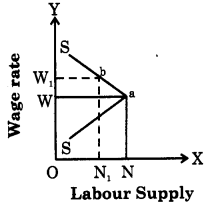
(1) Labour supply : Supply of labour in the ) terms of hours of work is an important exception pointed out by economists. Generally when wages rise, workers work more, but after a certain point if wages continue to rise, supply of labour falls i.e. workers wish to earn more by work in for less hours and supply curve of labour would bend backwards as shown below :
Maharashtra Board Class 12 Economics Solutions Chapter 4 Supply Analysis 10
In this figure as wage rate rises up to 0W, ;i supply of labor also rises up to ON, but when wage rate rises to 0W., labour supply falls from ON to 0Nr Hence an exception.

(2) Saving : In case of savings generally it is observed that as the rate of interest rises, savings also rises but some people want to have a fixed regular income by way of interest. They may save less at a higher rate of interest and save more at a lower rate of interest. For example : suppose a person is interested in earning a fixed income of ₹ 800 p.a. then he saves ₹ 10,000/- at 8% rate of interest but when rate of interest increases to 10%, he will save only ₹ 8,000/-.

(3) Future Expectations: If the seller expects a fall in price in future, then he will supply more today even at a low price. But if he expects the prices to rise further in future he will withhold the supply today to supply more in future at a high price.

(4) Need for Cash : When the sellers are in urgent need of liquid cash, then even at a lower price they will offer more goods for sale.

(5) Rare Goods : In case of rare collections such as rare painting, old coins, antique, the law is not applicable as the supply remains fixed. The supply curve is a vertical straight line parallel to Y axis.

(6) Agricultural Goods: Supply of agricultural product is influenced by natural factors like climatic conditions, rainfall etc., which cannot be controlled by man. So in bad weather condition, even at a higher price the supply of agricultural commodities will not increase.

Maharashtra Board Class 12 Economics Solutions Chapter 4 Supply Analysis

Intext Questions

Question 1.
“Concept of supply is a micro concept but concept of aggregate supply is a macro concept”. Explain. (Textbook Page No. 43)
Answer:
Micro economics studies about economic behavior of units like households, firm market and particular commodities. Whereas macro economics deals with the broad economic concepts like total demand, total supply, national income, etc.
Supply refers to supply of an individual seller and aggregate supply refers to total supply of a commodity.
Hence, supply is a microscopic concept and aggregate supply is macro concept.

Question 2.
What do you mean by aggregate supply? (Textbook Page No. 43)
Answer:
Aggregate supply refers to the minimum amount of sales proceeds which the entrepreneurs expect to receive from the sale of output at a given level of employment.

Find out (Textbook Page No. 43)

If a firm produces 600 units of a commodity in a day and incurs a total cost of ₹ 30,000. Calculate the Average Cost.
Answer:
Average cost refers to the cost of production per unit cost of a commodity. It is calculated by dividing total cost by total quantity of a commodity. Hence,
AC = \(\frac{\mathrm{TC}}{\mathrm{TQ}}=\frac{30,000}{600}\) = ₹ 50 per unit

Maharashtra Board Class 12 Economics Solutions Chapter 4 Supply Analysis

Find out (Textbook Page No. 43)

If a firm sells 400 units of a commodity at ₹ 10 unit. Calculate the TR and AR.
Answer:
TR = Price X Quantity
= 10 x 400
= 4,000
AR = \(\frac{\mathrm{TR}}{\mathrm{TQ}}\)
= \(\frac{4,000}{400}\)
= ₹ 10

Maharashtra Board Class 12 English Yuvakbharati Solutions Chapter 1.3 The Cop and the Anthem

Balbharti Yuvakbharati English 12th Digest Chapter 1.3 The Cop and the Anthem Notes, Textbook Exercise Important Questions and Answers.

Maharashtra State Board Class 12 English Yuvakbharati Solutions Chapter 1.3 The Cop and the Anthem

12th English Digest Chapter 1.3 The Cop and the Anthem Textbook Questions and Answers

Question 1.
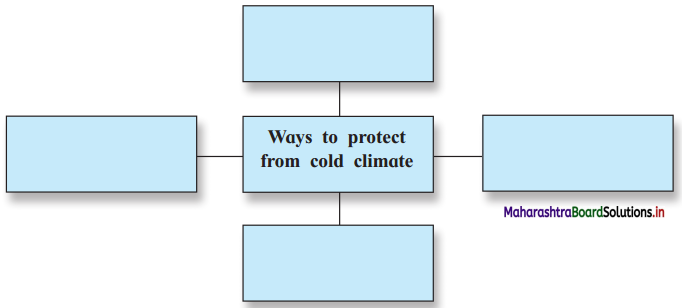
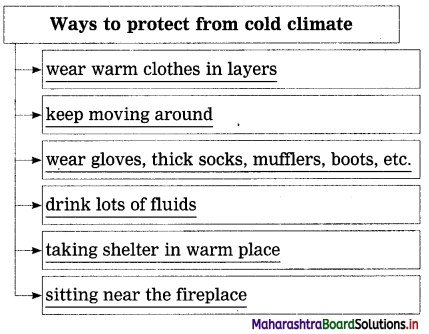
Suppose you have gone to a place where the winter season is very severe. Discuss with your partner the ways in which you would protect yourself in the cold climate. (The answer is given and underlined.)
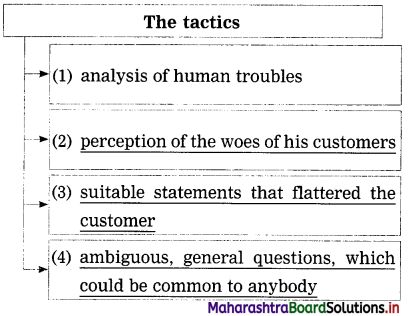
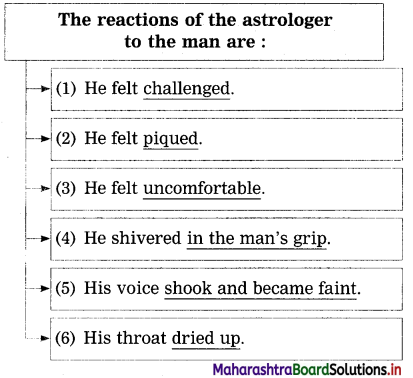
Maharashtra Board Class 12 English Yuvakbharati Solutions Chapter 1.3 The Cop and the Anthem 1
Answer:
Maharashtra Board Class 12 English Yuvakbharati Solutions Chapter 1.3 The Cop and the Anthem 2

Maharashtra Board Solutions

Question 2.
When you see a cop approaching, you feel either ‘relieved’ or ‘scared’. Discuss with your partner and write down the situations when you feel ‘relieved’ or ‘scared’.
Answer:
Relieved:
(a) You are walking alone in a dark street.
(b) There is a fight taking place near you.
(c) A group of rough-looking people are coming towards you on a lonely road.
Scared:
(a) You are riding a bike without a valid driving licence.
(b) You have broken a traffic signal.
(c) You have been involved in a fight.

Question 3.
Discuss some of the motivating things that can change a person’s life :
Answer:
(a) Listening to an inspiring speech
(b) Reading motivating books and biographies of great people
(c) Reading epics and religious books
(d) Observing successful/happy people or watching biopics of their lives.

(A1)

Question (i)
Discuss with your partner and find out the different ways in which Soapy tried ; to get arrested. The first one is given.
Answer:
(a) Tried to enter a luxurious cafe.
(b) Threw a stone and broke a shop window.
(c) Ate heartily at a restaurant and then said he had no money.
(d) Shouted and howled and raved and danced on the sidewalk.
(e) Stole an umbrella.

Question (ii)
Describe the atmosphere when Soapy reached near the Church.
Answer:
(a) A soft light glowed through the violet-stained window.
(b) Sweet music drifted out of the quaint, old church.
(c) There was a full, radiant moon, and few vehicles and pedestrians.
(d) Sparrows twittered sleepily in the eaves.

Maharashtra Board Solutions

(A2)

Question (i)
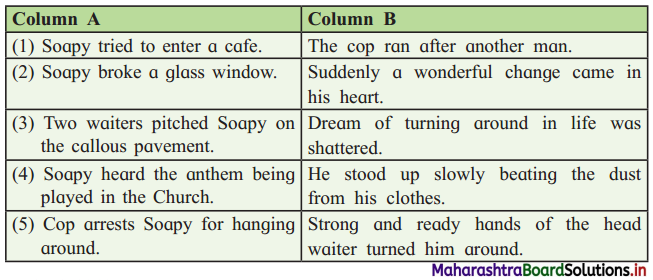
Read the story and match the incidents given in Column A with the consequences given in Column B.
Maharashtra Board Class 12 English Yuvakbharati Solutions Chapter 1.3 The Cop and the Anthem 3
Answer:

  1. Soapy tried to enter a cafe – Strong and ready hands of the head waiter turned him around.
  2. Soapy broke a glass window – The cop ran after another man.
  3. Two waiters pitched Soapy on the callous pavement – He stood up slowly beating the i dust from his clothes.
  4. Soapy heard the anthem being played in the Church – Suddenly a wonderful change came in his heart.
  5. Cop arrests Soapy for hanging around. – Dream of turning around in life was shattered.

Question (ii)
Give reasons and complete the following: (The answers are given directly and underlined.)
Answer:
(a) Soapy had confidence in himself because he was shaven, his coat was trim and he had a neat, black bow. The portion of him that showed above the table looked respectable and would raise no doubt in the waiter’s mind.
(b) The head waiter of the luxurious cafe did not allow Soapy to enter because he saw Soapy’s tattered trousers and old, worn out shoes, and knew that Soapy would not have money to pay for a meal.
(c) The cop did not arrest Soapy for breaking the glass window because Soapy was standing calmly and talking to him. The policeman felt that men who smash glass windows do not remain to chat with the police.
(d) The cop did not arrest Soapy for shouting and dancing because it was the time of celebrations for the local college boys. They were generally noisy but harmless, and he had been told by his superiors to let them be.

(iii) Pick out the lines from the text which show that:

Question (a)
Soapy wants to enter the cafe for two reasons.
Answer:
1. A roasted mallard duck, thought Soapy, would be about the thing with a bottle of wine and then some cheese, a cup of coffee and a cigar.
2. The meat would leave him filled and happy for the journey to his winter island.

Maharashtra Board Solutions

Question (b)
Soapy was afraid that he won’t be able to enter the prison.
Answer:
It seemed that his route to the coveted island was not to be an easy one. Some other way of entering the limbo must be devised.

Question (c)
Soapy was not caught by the cop for throwing stones at the glass.
Answer:
1. The policeman refused to accept Soapy even as a clue.
2. The policeman saw a man half-way down the block running to catch a car. With drawn club he joined in the pursuit.

Question (d)
Soapy actually did not want the umbrella.
Answer:
He hurled the umbrella angrily into the excavation.

Question (e)
Listening to the anthem, Soapy remembered his good old days.
Answer:
He had known it well in the days when his life contained such things as mothers and roses and ambitions and friends and immaculate thoughts and collars.

Question (iv)
‘He would make a man of himself again’ – The word ‘man’ in the sentence means ……………….. .
Answer:
‘He would make a man of himself again’ – The word ‘man’ in the sentence means a responsible and worthy human being.

Maharashtra Board Solutions

Question (v)
Soapy’s earlier life was much different from his present life. Complete the table to show this contrast. One is done for you.
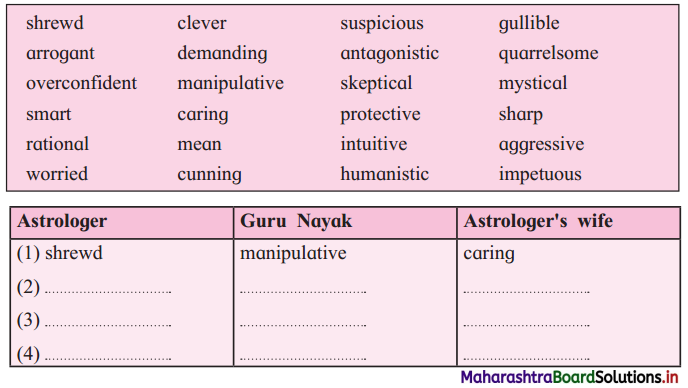
Maharashtra Board Class 12 English Yuvakbharati Solutions Chapter 1.3 The Cop and the Anthem 4
Answer:

Earlier lifePresent life
(a) contained friends and roses(a) unworthy desires
(b) eager ambitions(b) dead hopes, degraded days
(c) clean thoughts and clothes(c) wrecked faculties and base motives

Question (vi)
After listening to the sweet and solemn organ notes, Soapy decides to:
Answer:
1. pull himself out of the mire, conquer the evil that had enslaved him and make a man of himself again
2. resurrect his old eager ambitions and pursue them without faltering
3. go into the roaring downtown district and find work

Question (vii)
Write an incident in which you did something wrong and repented for it later. Give reasons.
Answer:
A lady who stayed in my building used to shout at me for playing noisily under her window. One day, she shouted at me as usual from her window and went inside. I suddenly got angry and threw a stone at her window. The stone hit the glass which broke. I heard a loud shout of pain and ran away. I later came to know that she had been badly injured by the shattered glass. I repented for what I had done. Though I did not tell her that I was the culprit, I was very good to her after that.

Maharashtra Board Solutions

(A3)

Question (i)
O’Henry has used different words to indicate prison where Soapy wants to reach. Make a list of those words from the extract.
Answer:
the island

Question (ii)
Find out the words used for the ‘degraded state of Soapy’.
Answer:

  1. the pit into which he had tumbled
  2. the degraded days
  3. unworthy desires
  4. dead hopes
  5. wrecked faculties
  6. base motives
  7. mire
  8. evil that had enslaved him.

Question (iii)
The specific meaning of word ‘anthem’ in the content of the story is:
Answer:
Anthem – a rousing or uplifting song.

(A4)

Question (i)
Convert the following sentences into the negative without changing their meanings:
(a) The policeman refused to accept Soapy even as a clue.
(b) Soapy drifted along, twice unsuccessful.
(c) Soapy stopped his unavailing racket.
(d) The island seemed very far away.
(e) The island seemed an unattainable Arcadia.
Answer:
(a) The policeman did not accept Soapy even as a clue.
(b) Soapy drifted along, twice not successful.
(c) Soapy stopped his racket which was not successful.
(d) The island seemed not at all near.
(e) The island seemed an Arcadia which was not attainable.

Maharashtra Board Solutions

Question (ii)
Convert the following sentences into the affirmative without changing their meanings :
(a) Men who smash windows do not remain to chat with the police.
(b) On the opposite side of the street was a restaurant of no great pretensions.
(c) Why don’t you call a cop?
(d) Noisy; but no harm.
(e) They seemed to regard him as a King who could do no wrong.
Answer:
(a) Men who smash windows refrain from remaining to chat with the police.
(b) On the opposite side of the street was a very ordinary restaurant.
(c) Please call a cop.
(d) Noisy; but harmless.
(e) They seemed to regard him as a King who was always right.

(A5)

Question (i)
‘Forgiveness is often better than punishment’. Write two paragraphs – one for and another against this notion.
Answer:
1. To err is human, to forgive is divine.

We all make mistakes. Nobody is perfect. That is why we are human. However, mistakes should be forgiven if there is sufficient repentance. Forgiveness will make the guilty person feel ashamed of his conduct and he will not repeat it. It is easy to punish but very difficult to forgive someone. It needs a big heart and a lot of kindness. If we punish the guilty person we will only make him more defiant. If punishing someone could have solved the problem, criminals who have been jailed would never have repeated the crime. But this is not found to be so. Just as God forgives us our mistakes, we should forgive others their mistakes too.

2. Punishment is the only answer

Forgiveness may work in certain cases, but there are hardened criminals who will not respond to forgiveness. They will only be stopped by punishment. If a person has murdered another in cold blood, will he improve by forgiveness? Never. He has to be punished severely so that he does not repeat it and society feels safe.

People only fear punishment. It can be easily seen at traffic signals – if there is no policeman to punish you, most people will break the signal. Then there will be chaos. If there is no punishment and no prisons, people will do whatever they want – rob, kill, etc. – and go off freely. No, in a society where it is not possible to expect everyone to have high values, punishment for misdeeds is the only solution.

Maharashtra Board Solutions

Question (ii)
You are the class representative and you have been asked by the Principal to conduct an interview of a cop. Frame 8-10 questions with the help of the following points, give introduction and conclusion.

  • reasons for joining the department
  • special trainings
  • developing the skill to identify and locate criminals
  • dealing with criminals
  • achievements and awards

Answer:
Good morning, Mr. Pawar. Congratulations on your excellent work in finding the bank robbers. May I ask you a few questions about your life? Thank you.

  1. When did you join the police department?
  2. Which examinations did you have to clear for the post?
  3. What were your reasons for joining the department?
  4. Did you have to go through any special training sessions?
  5. What type of criminals do you come across most in this area-thieves, killers, molesters,
    etc?
  6. How do you identify or locate criminals?
  7. Once you catch the culprit-say a thief-how do you deal with him?
  8. Can you tell me something about your achievements and awards?
  9. How can you motivate others to join the force?
  10. Any message to college students?

Thank you, Sir, for sparing the time for this interview. It will be published in our school magazine. Good day.

(A6)

Question (i)
Make a list of jobs which would give you an opportunity to help the society or serve the country. Also mention the different ways in which they can be beneficial to the people and also the country,

Maharashtra Board Solutions

Question (ii)
Go to your school/college library and read some other stories by O’Henry like, ‘The Gift of the Magi’, ‘The Last Leaf and ‘After Twenty years’. Write the stories in short in your notebook.

Yuvakbharati English 12th Digest Chapter 1.3 The Cop and the Anthem Additional Important Questions and Answers

Read the extract and complete the activities given below:

Global Understanding:

Question 1.
Name the following:
Answer:

  1. This is where Soapy stopped at a luxurious cafe
  2. This had been a gift to Soapy: a neat, black bow
  3. This is what Soapy wanted to eat: a roasted mallard duck, some cheese a bottle of wine, a cup of coffee
  4. This is what Soapy wanted to drink: Soapy’s tattered
  5. This is what the head waiter noticed:trousers and old shoes
  6. This is where Soapy was left by the head: on the sidewalk

Question 1.
Write if the following sentences are True or False. Correct the False sentences:
1. Soapy broke the glass of the shop window.
2. Nobody heard the breaking of the window.
3. The policeman chased Soapy.
4. Soapy did not run away from the place.
5. The restaurant Soapy entered was an ordinary one.
6. The policeman ate beefsteak, flapjacks, doughnuts and pie.
Answer:
True sentences:
1. Soapy broke the glass of the shop window.
4. Soapy did not run away from the place.
5. The restaurant Soapy entered was an ordinary one.

False sentences:
2. Nobody heard the breaking of the window.
3. The policeman chased Soapy.
6. The policeman ate beefsteak, flapjacks, doughnuts and pie.

Corrected sentences:
1. A policeman as well as some people heard the breaking of the window.
2. The policeman chased a man running to catch a car.
3. Soapy ate beefsteak, flapjacks, doughnuts and pie.

Maharashtra Board Solutions

Question 2.
Complete the table:
(The answers is given directly and underlined.)
Answer:

The Wordsmo saidTo whom
1. Noisy, but no harmA policemanA citizen
2. I took it.SoapyThe umbrella man
3. You know how these mistakes occur.The umbrella manSoapy
4. Of course it’s mine!SoapyThe umbrella man
5. We’ve instructions to let them be.A policemanA citizen
6. I hope you’ll excuse me.The umbrella manSoapy

Question 3.
Rearrange the following sentences according to their occurrence in the extract:

  1. Soapy decided to go into the downtown district and find work.
  2. A policeman caught Soapy’s arm.
  3. Soapy saw a quaint old church.
  4. Soapy’s ears caught sweet music.

Answer:

  1. Soapy saw a quaint old church.
  2. Soapy’s ears caught sweet music.
  3. Soapy decided to go into the downtown district and find work.
  4. A policeman caught Soapy’s arm.

Question 4.
Complete the following:
(The answers are given directly and underlined.)
Answer:

  1. A soft light glowed through one violet-stained window.
  2. Soapy came to a standstill on an unusually quiet corner.
  3. Soapy stood without moving near the iron fence listening to the anthem that the organist played.
  4. Soapy planned to resurrect his old eager ambitions.

Maharashtra Board Solutions

Answer the following in a few words each:

Question 1.
Who was lighting a cigar?
Answer:
A well-dressed man

Question 2.
Who twirled his club?
Answer:
A policeman

Question 3.
Who grabbed the umbrella?
Answer:
Soapy

Question 4.
Whom did the policeman help?
Answer:
A tall blonde

Complex Factual:

Question 1.
Give reasons and complete the following:
(The answers are given directly and underlined.)
Answer:
Soapy was disgusted with the policeman because he refused to accept that Soapy had broken the window, and he rushed off to chase another man.

Maharashtra Board Solutions

Question 2.
Complete the web:
(The answers are given directly and underlined.)
Answer:
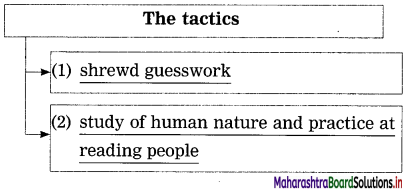
Maharashtra Board Class 12 English Yuvakbharati Solutions Chapter 1.3 The Cop and the Anthem 5

Question 3.
Describe Soapy’s behaviour on the sidewalk.
Answer:
On the sidewalk Soapy began to yell drunken meaningless things at the top of his harsh voice. He danced, howled, spoke wildly and made a big disturbance.

Question 4.
Describe the wonderful change in Soapy’s soul.
Answer:
After listening to the anthem, Soapy remembers his earlier life, and is horrified to realize that he has indeed become a degraded person. He decides to pull himself out of the pit into which he has fallen and make a man of himself again. He determines to bring back to his life his old eager ambitions and pursue them. He makes up his mind to take up a job.

Question 5.
Describe the end of the story in your own words.
Answer:
Initially Soapy had felt that he would like to pass the winter months in prison, and he makes several efforts to get himself arrested. The notes of anthem transform him from within and he decides to give up his evil ways and become a man again. He resolves to work hard. At that very moment, ironically, a policeman arrests him for loitering and he is sent to prison for three months. Soapy faces the irony of fate as the moment he realizes that real freedom lies in a virtuous life, he is taken into confinement.

Maharashtra Board Solutions

Question 6.
Complete the following:
Soapy was angry because ………..
Answer:
Soapy was angry because when he wanted to fall into the clutches of the policemen. In order to be arrested, they seemed to regard him as a king who could do nothing wrong.

Inference/Interpretation/Analysis:

Question 1.
Complete the following:
(The answers are given directly and underlined.)
Answer:
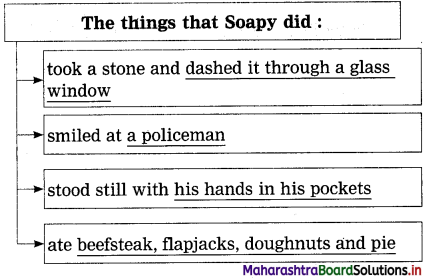
Soapy took a stone because he wanted to break the glass of the shop window. This would result in a policeman arresting him for this act, and he would be imprisoned for the winter, which was exactly what he wanted.

Discuss the hidden meaning in the expressions/sentences.

Question 1.
It catered to large appetites and modest purses.
Answer:
The restaurant prepared food for ordinary workers who had large appetites but very little money.

Question 2.
He told the waiter the fact that the minutest coin and himself were total strangers.
Answer:
He told the waiter that he did not have any money.

Maharashtra Board Solutions

Question 3.
A voice like butter cakes and an eye like the cherry in the Manhattan cocktail.
Answer:
A very smooth voice and a hard, stony eye (a tough person).

Question 4.
Discuss the meaning in the context:
He caught at the immediate straw of ‘disorderly conduct’.
Answer:
Soapy wanted to be arrested by a policeman and imprisoned. However, his efforts towards this end had been unsuccessful, and he was worried that he would continue to be unsuccessful. When he suddenly came upon a policeman lounging in front of a theatre, an idea struck him. He felt that if he shouted and screamed and made a lot of noise, he would be arrested for behaving in a dangerous and disturbing way in public, and would be imprisoned, which was what he wanted.

Question 5.
Complete the following:
(The answer is given directly and underlined.)
Answer:
Soapy was angry because even after he had stolen a man’s umbrella, the man did not report him to the police, but instead apologized and said that perhaps he (the umbrella man) had made a mistake.

Question 6.
The umbrella man did not call a policeman. Give reasons for this.
Answer:
The umbrella man had himself probably stolen the umbrella from somewhere. When Soapy picked up the umbrella, the man first thought that he could get it back. But when Soapy spoke about calling a policeman, the man thought that the umbrella was actually Soapy’s, and Soapy would hand him over to the police. Hence, he apologized quickly and walked away without calling a policeman.

Maharashtra Board Solutions

Personal Response:

Question 1.
Give your opinion about Soapy’s desire to enter prison.
Answer:
I find it very strange that a person can actually want to enter prison, whatever be the reason. At least, from what I know of prisons, they are terrible places, and one has a very difficult time there. However, Soapy has obviously been to prison before, and probably enjoys the free food and protection from the winter that he gets there.

Question 2.
Have you ever bought/eaten something and then found that you did not have enough money to pay for it? Describe your feeling at that time.
Answer:
Yes, it happened to me once. I went to a mall and bought a jacket for myself. I had been looking at a lot of jackets and I got confused with the prices. Finally, when the cashier was making the bill, I found that the jacket I had chosen was very expensive and I did not have enough money to pay for it. I was very embarrassed to tell the cashier this, but I had to. He gave me an angry look.

Question 3.
Have you ever stolen/wanted to steal anything? Narrate in brief.
Answer:
Yes, when I was about 12 years old, I stole my friend’s remote-controlled toy car, which his uncle had sent him from abroad. It was a beautiful car. However, when I was playing with it at home my mother saw me, and she made me return the car. I later felt very ashamed of myself, but fortunately my friend forgave me.

Language Study.

Question 1.
If only he could reach a table in the restaurant unsuspected, success would be his.
(Rewrite using ‘unless’.)
Answer:
Unless he could reach a table in the restaurant unsuspected, success would not be his.

Maharashtra Board Solutions

Question 2.
One dollar for the cigar would be enough.
(Add a question tag.)
Answer:
One dollar for the cigar would be enough, wouldn’t it?

Question 3.
Some other way of entering the limbo must be devised.
(Use an infinitive in place of a gerund.)
Answer:
Some other way to enter the limbo must be devised.

Question 4.
He had set his silk umbrella by the door on entering. (Rewrite using the verb form of the underlined word.)
Answer:
He had set his silk umbrella by the door when he entered.

Question 5.
At length Soapy reached one of the avenues to the east. (Rewrite using another adverb phrase with the same meaning as the underlined phrase.)
Answer:
After a long time Soapy reached one of the avenues to the east.

Question 6.
On an unusually quiet corner, Soapy came to a standstill. (Rewrite using ‘that’.)
Answer:
Soapy came to a standstill on a corner that was unusually quiet.

Maharashtra Board Solutions

Vocabulary:

Question 1.
Guess the meaning of the following in the context:
1. winter island
2. eye fell upon
Answer:
1. winter island – prison.
2. eye fell upon – saw or noticed.

Question 2.
O’Henry has used different words to indicate prison, where Soapy wants to reach. Make a list of those words from the extract.
Answer:

  1. winter island
  2. coveted island
  3. limbo

Question 3.
Make sentences using the following words/expressions :
1. eye fell upon
2. strolled
Answer:
1. My eye fell upon the clock, and I sat up with shock.
2. Seema strolled along the beach, enjoying the breeze.

Question 4.
Guess the meaning of:

  1. napery
  2. betook
  3. brass buttons

Answer:

  1. napery – table linen.
  2. betook – to cause oneself to go.
  3. brass buttons – the police.

Maharashtra Board Solutions

Question 5.
O’Henry has used different words to indicate prison where Soapy wants to reach. Make a list of those words from the extract:
Answer:
the island

Question 6.
Fill in the blanks with the correct nouns from the extract:

  1. friendly
  2. electric
  3. large
  4. callous

Answer:

  1. friendly voice
  2. electric lights
  3. large appetites
  4. callous pavement

Question 7.
O’Henry has used different words to indicate prison where Soapy wants to reach. Make a list of those words from the extract.
Answer:
the island, Arcadia

Maharashtra Board Solutions

Question 8.
Pick out four verbs in the simple past tense from the extract.
Answer:
danced, howled, raved, disturbed

Question 9.
Match the words in Column A with the meanings in Column B :
Answer:

  1. disconsolate – very unhappy
  2. sauntered – walked in a relaxed manner
  3. raved – spoke wildly
  4. rendered – made

Non-Textual Grammar

Do as directed:

Question 1.
Shivani found a small box and dropped her bangles inside.
(Rewrite the sentence, beginning ‘Finding …)
Answer:
Finding a small box, Shivani dropped her bangles inside.

Maharashtra Board Solutions

Question 2.
Sunlight from the window made her black hair appear brown. (Rewrite using ‘that’.)
Answer:
Sunlight that came from the window made her black hair appear brown.

Question 3.
On the day the school closed for the summer, no student was more delighted than Rithik.
(Change the degree.)
Answer:
1. On the day the school closed for the summer, Rithik was the most delighted student. – Superlative degree
2. On the day the school closed for the summer, Rithik was more delighted than any other student. – Comparative degree

Spot the error in the following sentences and rewrite them correctly:

Question 1.
There is room for much boxes in this cupboard.
Answer:
There is room for many boxes in this cupboard.

Maharashtra Board Solutions

Question 2.
If I requires help for him in public places, I was not embarrassed to seek it from people around.
Answer:
If I required help for him in public places, I was not embarrassed to seek it from people around.

Maharashtra Board Class 12 Economics Solutions Chapter 3B Elasticity of Demand

Balbharti Maharashtra State Board Class 12 Economics Solutions Chapter 4 Supply Analysis Textbook Exercise Questions and Answers.

Maharashtra State Board Class 12 Economics Solutions Chapter 3B Elasticity of Demand

1. Complete the following statements:

Question 1.
Price elasticity of demand on a linear demand curve at the X axis is ……………
a) zero
b) one
c) infinity
d) less than one
Answer:
a) zero

Maharashtra Board Class 12 Economics Solutions Chapter 3B Elasticity of Demand

Question 2.
Price elasticity of demand on a linear demand curve at the Y-axis is equal to
a) zero
b) one
c) infinity
d) greater than one
Answer:
c) infinity

Question 3.
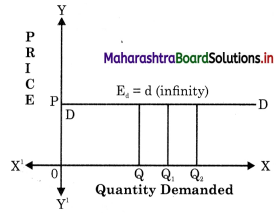
Demand curve is parallel to X axis, in case of …………..
a) perfectly elastic demand
b) perfectly inelastic demand
c) relatively elastic demand
d) relatively inelastic demand
Answer:
a) perfectly elastic demand

Question 4.
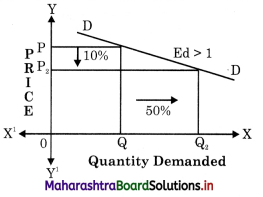
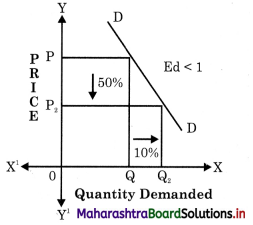
When percentage change in quantity demanded is more than the percentage change in price, the demand curve is ………………..
a) flatter
b) steeper
c) rectangular
d) horizontal
Answer:
a) flatter

Question 5.
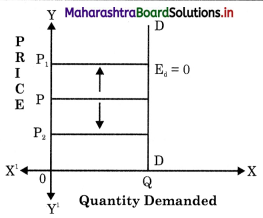
Ed = 0 in case of ………………
a) luxuries
b) normal goods
c) necessities
d) comforts
Answer:
c) necessities

2. Give et onomic terms:

Question 1.
Degree of responsiveness of quantity demanded o change in income only.
Answer:
Income elasticity

Question 2.
Degree of responsiveness of a change in quantity demanded of one commodity due to change in the price of another commodity.
Answer:
Cross elasticity

Maharashtra Board Class 12 Economics Solutions Chapter 3B Elasticity of Demand

Question 3.
Degree of responsiveness of a change of quantity demanded of a good to a change in its price.
Answer:
Elasticity of demand

Question 4.
Elasticity resulting from infinite change in quantity demanded.
Answer:
Perfectly elastic demand

Question 5.
Elasticity resulting from a proportionate change in quantity demanded due to a proportionate change in price.
Answer:
Price elasticity

3. Complete the correlation:

1) Perfectly elastic demand: Ed = ∞ :: ……………. : Ed = 0
2) Rectangular hyperbola : ………………. : Steeper demand curve : Relatively inelastic demand.
3) Straight line demand curve : Linear demand curve:: …………….. non linear demand curve.
4) Pen and ink : …………….. :: Tea or Coffee: Substitutes.
5) Ratio method : Ed = \(\frac{\% \Delta \mathbf{Q}}{\% \Delta \mathrm{P}}\) :: …………… : Ed = \(\frac{\text { Lower segment }}{\text { Upper segment }}\)
Answer:

  1. Perfectly inelastic demand
  2. Unitary elastic demand
  3. Unitary elastic (convex to origin)
  4. Complementary goods
  5. Point or Geometric method

4. Assertion and Reasoning type questions:

Question 1.
Assertion (A) : Elasticity of demand explains that one variable is influenced by another variable.
Reasoning (R) : The concept of elasticity of demand indicates the effect of price and changes in other factors on demand.
Options: 1) (A) is True, but (R) is False
2) (A) is False, but (R) is True
3) Both (A) and (R) are True and (R) is the correct explanation of (A)
4) Both (A) and (R) are True and (R) is not the correct explanation of (A)
Answer:
3) Both (A) and (R) are True and (R) is the correct explanation of (A)

Maharashtra Board Class 12 Economics Solutions Chapter 3B Elasticity of Demand

Question 2.
Assertion (A) : A change in quantity demanded of one commodity due to a change in the price of other commodity is cross elasticity.
Reasoning (R) : Changes in consumers income leads to a change in the quantity demanded.
Options:
1) (A) is True, but (R) is False
2) (A) is False, but (R) is True
3) Both (A) and (R) are True and (R) is the correct explanation of (A)
4) Both (A) and (R) are True and (R) is not the correct explanation of (A)
Answer:
4) Both (A) and (R) are True and (R) is not the correct explanation of (A)

Question 3.
Assertion (A) : Degree of price elasticity is less than one in case of relatively inelastic demand.
Reasoning (R): Change in demand is less then the change in price.
Options: 1) (A) is True, but (R) is False
2) (A) is False, but (R) is True
3) Both (A) and (R) are True and (R) is the correct explanation of (A)
4) Both (A) and (R) are True and (R) is not the correct explanation of (A)
Answer:
3) Both (A) and (R) are True and (R) is the correct explanation of (A)

5. Distinguish between:

Question 1.
Relatively elastic demand and Relatively inelastic demand.
Answer:
Relatively Elastic Demand

  1. When percentage change in quantity demanded is greater than the percentage change in price then demand is said to be Relatively Elastic demand.
  2. The numerical co-efficient is greater than one (e > 1).
  3. Demand curve slopes flatter.
  4. Maharashtra Board Class 12 Economics Solutions Chapter 3B Elasticity of Demand 3
  5. Example : luxury goods like LCD, TV, Car etc.

Relatively inelastic demand.

  1. When percentage change in quantity demanded is less than percentage change in price then demand is said to be Relatively Inelastic demand.
  2. The numerical co-efficient is less than one (e < 1).
  3. Demand curve slopes steeper.
  4. Maharashtra Board Class 12 Economics Solutions Chapter 3B Elasticity of Demand 4
  5. Example : foodgrains.

Maharashtra Board Class 12 Economics Solutions Chapter 3B Elasticity of Demand

Question 2.
Perfectly elastic demand and Perfectly inelastic demand.
Answer:
Perfectly elastic demand :

  1. When a small change in price brings an infinite change in quantity demanded, then demand is said to be Perfectly Elastic demand.
  2. The numerical value of Perfectly Elastic demand is infinite i.e. e = ∞
  3. The demand curve is horizontal straight line parallel to X-axis.
  4. Such a demand is a myth or theoretical.
  5. Maharashtra Board Class 12 Economics Solutions Chapter 3B Elasticity of Demand 1

Perfectly inelastic demand.

  1. When a change in price does not bring any change in quantity demanded, then demand
    is said to be Perfectly Inelastic demand.
  2. The numerical value of Perfectly Inelastic demand is zero i.e. e = 0.
  3. The demand curve is a vertical straight line parallel to Y—axis.
  4. Such demand is found in case of life saving drugs, salt, etc.
  5. Maharashtra Board Class 12 Economics Solutions Chapter 3B Elasticity of Demand 2

6. Answer the following questions:

Question 1.
Explain the factors influencing elasticity of demand.
Answer:
The concept of Price Elasticity was developed i by great neo-classical economist Dr. Alfred \ Marshall in the year 1890.
According to Dr. Alfred Marshall, “The elasticity or responsiveness of demand in a market is great or small, according to the amount demanded which increases much or little for a given fall in price, and diminishes much or little for a given rise in price. ”
Elasticity of demand in fact refers to the £ degree of responsiveness of the quantity demanded of a commodity to change in the variable on which demand depends.

Question 2.
Explain the total outlay method of measuring elasticity of demand?
Answer:
Total Outlay Method : This method was introduced by Dr. Alfred Marshall. The limitation of this method is that in this method unlike ratio method, the exact numerical value of the elasticity of demand cannot be determined. According, to this method, the elasticity of demand is measured on the basis of expenditure incurred by consumer when the price of a commodity changes.

Total outlay or total expenditure can be calculated by multiplying the price with the quantity demanded (Price x Quantity demand = Total Expenditure). Depending upon the kind of change in total outlay, whether it increases, or decreases, or remain constant with the change in price we will be able to decide the type of elasticity. This can be explained with the following example:-
Maharashtra Board Class 12 Economics Solutions Chapter 3B Elasticity of Demand 11

  1. If the total outlay remains the same with a rise or fall in price then the demand is said to be unitary (e = 1) elastic.
  2. If the total outlay decreases with a rise in price and increases with a fall in price, the elasticity of demand is greater than one or Relatively Elastic e > 1.
  3. If the total outlay increases with a rise in price and decreases with a fall in price, then elasticity is less than one or relatively inelastic, e < 1.

Maharashtra Board Class 12 Economics Solutions Chapter 3B Elasticity of Demand 12

Maharashtra Board Class 12 Economics Solutions Chapter 3B Elasticity of Demand

Question 3.
Explain importance of elasticity of demand.
Answer:
Maharashtra Board Class 12 Economics Solutions Chapter 3B Elasticity of Demand 10

  • Nature of Commodity : By nature, commodities are classified as necessaries, comforts and luxuries. Normally demand for j necessaries like food grains are relatively inelastic and for comforts and luxuries like diamond, perfumes, etc is relatively elastic.
  • Availability of Substitutes : The larger the number of substitutes available for a commodity, the greater would be the elasticity. Demand for products like soap, soft drinks, detergents, tooth paste, etc. have many substitute so demand is elastic, ‘j However, salt, garlic, onions have no substitute so demand is inelastic.
  • Durability of the Commodity : The demand for durable goods like T.V., car, fridge, etc is relatively inelastic in the short run and elastic in the long run. Whereas the demand for perishable goods is relatively inelastic.
  • Uses of Commodity : Single use commodities have less elastic demand and multi-use goods like coal, electricity, sugar, etc. have relatively elastic demand.
  • Range of Price : The demand for commodities which are highly priced and will have a inelastic demand like AC, car, etc. Even very low priced goods have inelastic demand.
  • Consumer’s Income : Generally if income is very high, the demand for over allcommodities tends to be relatively inelastic. The demand pattern of the rich people is rarely affected even when there is significant price change.
  • Influence of Habits and Customs : When a person is habituated to consume a certain commodity, the demand will be inelastic for that commodity. E.g. demand for cigarettes to a chain smoker is inelastic.
  • Time Period : The demand for goods is less elastic in the short period and more elastic in the long period. This is because (1) in the long period consumer are better informed about their price (2) habits of consumer’s change in the long run (3) durable goods get worn out in the long period.
  • Proportion of Income Spend : If consumer spends a very small proportion of his income on a commodity, the demand for it will be relatively inelastic & vice-versa. For e.g. demand for salt, newspaper, pins are inelastic.
  • Urgency and Postponement : If the demand for a commodity is urgent then demand for it will be inelastic. E.g. demand for medicine for a patient. Whereas, if the demand for a commodity can be postponed it will have elastic demand.
  • Complementary Goods : Complementary goods are those goods which are demanded jointly such as car and petrol, mobile and sim cards, etc. Demand for petrol will be inelastic as car cannot run without petrol.

7. Observe the following figure and answer the questions:

Question 1.
Identify and define the degrees of elasticity of demand from the following demand curves.
Maharashtra Board Class 12 Economics Solutions Chapter 3B Elasticity of Demand 5
Answer:
Maharashtra Board Class 12 Economics Solutions Chapter 3B Elasticity of Demand 6
Concept: Perfectly Inelastic demand (Ed = 0) Explanation : When change in price has no effect on the quantity demanded of that commodity, then it is called as perfectly inelastic demand. Demand curve ‘DD’ is a vertical straight line parallel to ‘Y’ – axis.

Maharashtra Board Class 12 Economics Solutions Chapter 3B Elasticity of Demand
Maharashtra Board Class 12 Economics Solutions Chapter 3B Elasticity of Demand 7
Concept: Perfectly Elastic demand (Ed = ∞) (infinity)
Explanation: When a change in price leads to infinite change in quantity demanded of a commodity then it is called as perfectly) (d) elastic demand.
Demand curve is horizontal straight line ( parallel to ‘X’ – axis.
Maharashtra Board Class 12 Economics Solutions Chapter 3B Elasticity of Demand 8
Concept: Ed = 1 Unitary elastic demand Explanation : When proportionate or percentage change in quantity demanded is exactly equal to proportionate or percentage change in price, then it is called as Unitary Elastic demand. Demand curve is called as rectangular hyperbola.

Maharashtra Board Class 12 Economics Solutions Chapter 3B Elasticity of Demand 9
Concept: Relatively Elastic Demand (Ed > 1)
Explanation : When proportionate or percentage change in quantity demanded is more than proportionate change it its price, then it is called as Relatively Elastic Demand. Demand curve is called as flatter curve.

Question 2.
In the following diagram AE is the linear demand curve of a commodity. On the basis of the given diagram state whether the following statements are True or False. Give reasons to your answer.
Maharashtra Board Class 12 Economics Solutions Chapter 3B Elasticity of Demand 13
1) Demand at point ‘C’ is relatively elastic demand.
2) Demand at point ‘B’ is unitaiy elastic demand.
3) Demand at point ‘D’ is perfectly inelastic demand.
4) Demand at point ‘A’ is perfectly elastic demand.
Answer:

  1. Demand at point ‘C’ is relatively elastic demand.
  2. False, it is relatively inelastic demand.
  3. False, it is relatively elastic demand.
  4. False, it is unitary elastic demand.
  5. True, it is perfectly elastic Ed = ∞

Maharashtra Board Class 12 Economics Solutions Chapter 3A Demand Analysis

Balbharti Maharashtra State Board Class 12 Economics Solutions Chapter 3A Demand Analysis Textbook Exercise Questions and Answers.

Maharashtra State Board Class 12 Economics Solutions Chapter 3A Demand Analysis

1. Complete the following statements:

Question 1.
The relationship between demand for a goods and price of its substitute is ……………
(a) direct
(b) inverse
(c) no effect
(d) can be direct and inverse
Answer:
(a) direct

Question 2.
The relationship between income and demand for inferior goods is …………….
(a) direct
(b) inverse
(c) no effect
(d) can be direct and inverse
Answer:
(b) inverse

Maharashtra Board Class 12 Economics Solutions Chapter 3A Demand Analysis

Question 3.
Symbolically, the functional relationship between Demand and Price can be expressed as …………….
(a) D = f(Px)
(b) Dx = f (P2)
(c) D = f(y)
(d) D = f(T)
Answer:
(a) D = f(Px)

Question 4.
When less units are demanded at high price it shows ……………..
(a) increase in demand
(b) expansion of demand
(c) decrease in demand
(d) contraction in demand
Answer:
(d) contraction in demand

2. Give economic terms

1. A situation where more quantity is demand at lower price…………….
2. Graphical representation of demand schedule……………….
3. A commodity which can be put to several uses……………….
4. More quantity is demanded due to changes in the factors determining demand other than price…………..
5. A desire which is backed by willingness to purchase and ability to pay……………
Answers:
(1) Expansion or Extension of Demand
(2) Demand Curve
(3) Composite Demand
(4) Increase in Demand
(5) Demand

3. Distinguish between:

Question 1.
Desire and Demand
Answer:

DesireDemand
1. Desire is a mere wish for something. For example desire for a chartered plane.1. Demand refers to desire backed by ability and willingness to pay for a particular commodity.
2. Desire has no limits.2. Demand is limited by ability to pay and willingness to pay.
3. Desire is not related or dependent on price.3. Demand is inversely related to price.
4. Desire is wider in scope as it includes demand.4. Demand is narrow in scope as it is a part of desire.
5. Example : Desire of a beggar to own a car.5. Example: Demand for a BMW Car by business man who has ability and willingness to pay.

Question 2.
Expansion of demand and Contraction of demand
Answer:

Expansion of demandContraction of demand
1. Expansion of demand refers to a rise in demand only due to a fall in price.1. Contraction of demand refers to a fall in the demand due to a rise in price.
2. Expansion of demand takes place solely due to falling in price. All other factors affecting demand remain constant.2. Contraction of demand takes place solely due to a rise in price. All other factors affecting demand remain constant.
3. Expansion of demand is shown by a downward movement on the same demand curve.3. Contraction of demand is shown by an upward movement on the same demand curve.

Question 3.
Increase in demand and Decrease in demand
Answer:

Increase in DemandDecrease in Demand
(a) Increase in demand refers to a rise in demand due to changes in other factors, price remaining constant.(a) Decrease in demand refers to fall in demand due to changes in other factors, price remaining constant.
(b) Increase in demand occurs when more is purchased at the same price.(b) Decrease in demand occurs when less is purchased at the same price.

Maharashtra Board Class 12 Economics Solutions Chapter 3A Demand Analysis

4. State with reasons whether you agree or disagree with the following statements:

Question 1.
Demand curve slopes downward from left to right.
Answer:
Yes, I agree with this statement.

Reasons justifying downwards sloping demand curve are as follows:

  • The law of DiminishingMarginal Utility: Marginal utility goes on diminishing when there is increase in the stock of commodity and consumer tends to buy more when price falls and vice-versa.
  • Income Effects : Whenever there is a fall in price of a commodity, purchasing power of a consumer gets increased, which enables him to buy more of that commodity.
  • Substitution Effect : When price of commodity rises consumer tends to buy more of cheaper substitute goods and less of the commodity whose price has increased.
  • Multi-purpose Uses : When a commodity can be used for satisfying multiple needs, its demand will rise with a fall in its price and vice-versa.
  • New Consumers : When there is fall in price of a commodity, a new consumer class buy the commodity as they can afford it. Thus total demand for commodity increases with fall in price.

Question 2.
Price is the only determinant of demand.
OR
Price is the only factor that affects demand for a commodity
Answer:
No, I do not agree with the given statement. This is because there are various factors that determine demand other than price.

Reason:
The following are a few determinants:
Income of the consumer – Change in the income of the consumer also affects the market demand for goods. The effect of the change in income on the market demand depends on the type of the good.

Type of Good – The market demand for normal goods shares a positive relationship with the consumer’s income. The market demand for inferior goods (such as coarse cereals) has a negative relationship with the consumer’s income.

The market demand for Giffen goods also has a negative relationship with the income.
Consumer’s tastes and preferences – Consumers’ tastes and preferences highly influence the demand for goods. Other things being constant, if all consumers prefer a commodity over another, then the market demand for that commodity increases and vice versa.

Population size – The market demand for a commodity is also affected by the population size. Other things being equal, an increase in the population size increases the market demand for a commodity and vice-versa. This is because with the change in population size, the number of consumers in the market changes.

Question 3.
When price of Giffen goods fall, the demand for it increases.
Answer:
I Disagree with the statement.
Reason:
When price of Giffen goods falls, the demand for its decreases.
Inferior goods or low-quality goods are those goods whose demand does not rise even if their price falls. At times, demand decreases when the price of such commodities fall. Sir Robert Giffen observed this behaviour in England in relation to bread declined, people did not buy more because of an increase in their real income or purchasing power. They preferred to buy superior-good like meat. This is known as Giffen’s paradox.

Maharashtra Board Class 12 Economics Solutions Chapter 3A Demand Analysis

5. Observe the following table and answer the following questions:

Question 1.
Maharashtra Board Class 12 Economics Solutions Chapter 3A Demand Analysis 1
a) Complete the market demand schedule.
Answer:
Maharashtra Board Class 12 Economics Solutions Chapter 3A Demand Analysis 2

b) Draw market demand carve based on above market demand schedule.
Answer:
Maharashtra Board Class 12 Economics Solutions Chapter 3A Demand Analysis 3

Question 2.
Observe the given diagram and answer the following questions:
Maharashtra Board Class 12 Economics Solutions Chapter 3A Demand Analysis 4
1) Rightward shift in demand curve …………….
2) Leftward shift in demand curve …………….
3) Price remains …………….
4) Increase and decrease in demand comes under …………….
Answer:

  1. Increase in demand (D1D1).
  2. Decrease in demand (D2D2).
  3. Constant.
  4. Change in demand.

Question 3.
Explain the diagrams:
Maharashtra Board Class 12 Economics Solutions Chapter 3A Demand Analysis 5
1) Diagram A represents ……………. in demand
Answer:
Expansion or Extension.

2) In diagram A movement of demand curve is in ………………… direction
Answer:
Downward.

Maharashtra Board Class 12 Economics Solutions Chapter 3A Demand Analysis 6
1) Diagram B represents …………………… in demand
Answer:
Constraction.

Maharashtra Board Class 12 Economics Solutions Chapter 3A Demand Analysis

2) In diagram B movement of demand curve is in …………………… direction
Answer:
Upward.

Maharashtra Board Class 12 Economics Solutions Chapter 3A Demand Analysis

6. Answer in detail :

Question 1.
State and explain the law of demand with exceptions.
Answer:
(A) Introduction : The law of demand is one of the important law of consumption which explain the functional relationship between price and quantity demanded of a commodity. Prof. Alfred Marshall in his book ‘Principle of Economics’ which was published in 1890, has explained the consumer’s behaviour as follows:

(B) Statement of the Law : According to Prof. Alfred Marshall, “Other things being equal, higher the price of a commodity, smaller is the quantity demanded and lower the price of a commodity, larger is the quantity demanded.
In other words, other things remaining constant, demand varies inversely with price. Marshall’s law of demand describes the functional relationship between demand and price. It can be presented as:
Dx = f(Px)
where D = Demand for Commodity
x = Commodity
f = function
Px = Price of a commodity
(C) Assumption :

  • Prices of Substitute goods remain constant : The price of substitute goods should remain unchanged, as change in the price will affect the demand for the commodity.
  • Prices of Complementary goods s remains constant : A change in the price j of one good will affect the demand for other,  thus the prices of complementary goods  should remain unchanged.
  • No Expectation about future changes jj in prices: The consumers do not expect any \ significance rise or fall in the future prices.
  • No change in Taxation Policy : The level of direct and indirect tax imposed by the government on the income and goods should remain constant.
  • Constant Level of Income : Consumer’s income must remain unchanged because if income increases, consumer may buy more even at a higher price not following the law of demand.
  • No Change in Tastes, Habits, Preference, Fashions, etc. : If the taste changes then the consumers preference will also change which will affect the demand. When commodities are out of fashion, then demand will be low even at a lower price.

(D) Explanation of the law of Demand :
The law of demand is explained with the help of the following demand schedule and diagram:
Demand Schedule

Price of Commodity ‘X’ (in Rs.)

Quantity Demanded of Commodity ‘X’ (in kgs)

501
402
303
204
105

From the above demand schedule we observe that at higher price of ₹ 50 per kg, quantity demanded is 1 kg. When price fall from ₹ 50 to ₹ 40, quantity demanded rises from 1 kg to 2 kg. Similarly, at price ₹ 30 quantity demanded is 3kg and when price falls from ₹ 20 to ₹ 10 quantity demanded rises from 4 kg to 5 kg. This shows an inverse relationship between price and demand.
Maharashtra Board Class 12 Economics Solutions Chapter 3A Demand Analysis 7
In the above diagram X-axis represent quantity demanded and Y-axis represent the price of the commodity. The demand curve DD slopes downwards from left to right ] showing an inverse relationship between price and demand. It has a negative slope.

Maharashtra Board Class 12 Economics Solutions Chapter 3A Demand Analysis

(E) Exceptions to the Law of Demand :
No, I do not agree with this statement.
There are some important cases in which the demand for the commodity is greater when price rises and smaller when price falls. Such cases are called exceptions to the law of Demand. In such case, demand curve slopes upwards from left to right and it has a positive slope.

  • Prestige Goods : Rich people buy more expensive goods like gold, diamonds, etc., even when there prices are high to maintain their status.
  • Giffen Paradox : Demand for low quality goods and inferior goods decrease even if there prices falls.
    According to Sir Robert Giffen when price of bread declined, people did not buy more because of increase in their real income and they prefer to buy superior goods like meat.
  • Speculation : People are tend to buy more commodities if they expect prices to rise further. E.g. prices of oil, sugar, etc., are expected to rise before Diwali, so people buy more of these commodities even at higher price.
  • Habitual goods : Due to habit of
    consumption, certain goods like tea is purchased in required quantities even at higher price.
  •  Ignorance : Sometimes people completely ignore the price of commodity and buy more of that commodity ignoring higher price.
  • Price Illusion: Consumer feels that good at higher price are of better quality, therefore demand for such goods are higher even at rise in their prices.

Maharashtra Board Class 12 Economics Solutions Chapter 3A Demand Analysis 8

Question 2.
Explain in detail the determinants of demand.
Answer:
Meaning of Demand : Demand refers to a desire or want for goods. Desire is the willingness to have some commodity which is backed by willingness and ability to pay.
Definition : According to Benham, “The demand for anything at a given price is the amount of it, which will be bought per unit of time at that price.

Features of Demand :

  1. Demand is a relative concept.
  2. Demand is essentially expressed with reference to time and price. ?

Determinants of Demand :

  1. Price of Complementary Goods : Demand changes with changes in price of complementary goods like car and petrol, etc.
  2. Advertisement : Effective advertisement and sales promotion will lead to greater demand of product. E.g. cosmetics, toothbrush, etc.
  3. Price : Demand for a commodity is mainly influenced by its price. Normally at a higher price the demand is less and at a lower price it is more. Thus, demand varies inversely with price of a commodity.
  4. Taste, Habits and Fashions : Habits influence market demand. If people habituated to the consumption of certain goods they will not give up such habits easily. E.g. demand for liquor, cigarettes, etc. Sometimes fashion change attitude and preference of people which in turn changes market demand.
  5. Income: Income determines the purchasing power. Rise in income will lead to a rise in demand of a commodity and fall in income will lead to a fall in demand of a commodity.
  6. Other Factors : (a) Climatic condition, (b) Changes in technology, (c) Government policy, (d) Customs and traditions, etc.
  7. Nature of Product: Under necessary and unavailable circumstances the demand of a commodity will continue to be same irrespective of the corresponding price. E.g. medicine to control blood-pressure.
  8. Level of Taxation : There would be increase in price of goods and services due to high rates of taxes which results in a decrease in demand and vice-versa.
  9. Expectation about the Future Prices : If the consumer expect a rise in price in the near future they will demand more at present price. Similarly, when they expect price to fall, then they will buy less at present prices.
  10. Price of Substitute Goods : Demand for cheaper substitute goods will rise when there is fall in price of such goods. E.g. when sugar price rises, then the demand for jaggery will rise.
  11. Size of Population: Demand for commodity depends upon size and composition of population like age structure, gender ratio which influence demand for certain goods. E.g. larger the child population, more will be the demand for toys, chocolates, etc.

Intext Questions

Activity : (Textbook Page no. 17)

Identify the concepts :

(i) A poor person wants to have a car.
Answer:
Desire : because he does not have ability and capacity to pay the price for a car.

(ii) A rich person bought a car.
Answer:
Demand : because a rich person has a desire as well as capacity to pay a car.

Maharashtra Board Class 12 Economics Solutions Chapter 3A Demand Analysis

Activity : (Textbook Page no. 19)

Prepare a monthly demand schedule of your family for various commodities. For example, vegetables, fruits, medicines, etc.
Answer:
[Students should do this activity by themselves]

Activity : (Textbook Page no. 19)

Complete the following hypothetical demand schedule.
Maharashtra Board Class 12 Economics Solutions Chapter 3A Demand Analysis 9
Answer:
Maharashtra Board Class 12 Economics Solutions Chapter 3A Demand Analysis 10

Activity : (Textbook Page no. 20)

Complete the table.
Maharashtra Board Class 12 Economics Solutions Chapter 3A Demand Analysis 11
Maharashtra Board Class 12 Economics Solutions Chapter 3A Demand Analysis 12
Answer:
Maharashtra Board Class 12 Economics Solutions Chapter 3A Demand Analysis 13

Maharashtra Board Class 12 Economics Solutions Chapter 3A Demand Analysis

Activity : (Textbook Page no. 22)

Draw a demand curve from the following demand schedule :
Maharashtra Board Class 12 Economics Solutions Chapter 3A Demand Analysis 14
Answer:
Maharashtra Board Class 12 Economics Solutions Chapter 3A Demand Analysis 15

Activity : (Textbook Page no. 23)

Find out : Examples of the given exceptions to the law of demand.

(1) Prestigious Goods
Answer:
Car, Gold, Diamond, etc.

(2) Habitual Goods
Answer:
Cigarette, Tea, Drugs, Chocolates, etc.

(3) Branded Goods
Answer:
Godrej Lockers, Levis Jeans, Sony T.V, etc.

Maharashtra Board Class 12 Economics Solutions Chapter 2 Utility Analysis

Balbharti Maharashtra State Board Class 12 Economics Solutions Chapter 2 Utility Analysis Textbook Exercise Questions and Answers.

Maharashtra State Board Class 12 Economics Solutions Chapter 2 Utility Analysis

1. Complete the following statements by choosing the correct alternatives.

Question 1.
In the law of diminishing marginal utility, Alfred Marshall assumes that marginal utility of money …………..
(a) increases
(b) remains constant
(c) decreases
(d) rises and then falls
Answer:
(b) remains constant

Maharashtra Board Class 12 Economics Solutions Chapter 2 Utility Analysis

Question 2.
As per the law of diminishing marginal utility, measurement of utility is assumed to be ……………
(a) ordinal
(b) cardinal
(c) both ordinal and cardinal
(d) none of the above
Answer:
(b) cardinal

Question 3.
MU of the commodity becomes negative when TU of a commodity is ………….
(a) rising
(b) constant
(c) falling
(d) zero
Answer:
(c) falling

Question 4.
Point of satiety means ……………….
(a) TU is rising and MU is falling
(b) TU is falling and MU is negative
(c) TU is maximum and MU is zero
(d) MU is falling and TU is rising
Answer:
(c) TU is maximum and MU is zero

Maharashtra Board Class 12 Economics Solutions Chapter 2 Utility Analysis

Question 5.
When MU is falling, TU is ………………
(a) rising
(b) falling
(c) not changing
(d) maximum
Answer:
(a) rising

2. Choose the correct option:

Question 1.

Group ‘A’Group ‘B’
1. Time utility(a)Transportation
2. Place utility(b)Blood bank
3. Service utility(c)Mobile phone
4. Knowledge utility(d)Doctor
(e)Music

Options :
(1) 1 – d, 2 – b, 3 – a, 4 – c.
(2) 1 – b, 2 – a, 3 – d, 4 – c.
(3) 1 – a, 2 – b, 3 – e, 4 – d.
(4) 1 – b, 2 – c, 3 – d, 4 – e.
Answer:
(2) 1 – b, 2 – a, 3 – d, 4 – c.

Question 2.
Statments Indicating consumer equilibrium:
a) MU is greater than price
b) MU is equal to price
c) MU is less than price
d) Price is less than one
Options:
I) a and b
II) a, b,c and d
Ill) a,b and c
IV) only b
Answer:
IV) only b

3. Identify and explain the concept from the given illustrations.

Question 1.
Salma purchased sweater for her father in winter season.
Answer:
Concept: Time utility.
Explanation : When utility of a commodity increases during a particular season it is called time utility.
Utility of sweater increases in winter season.

Question 2.
Nilesh purchased ornaments for his sister.
Answer:
Concept: Possession utility.
Explanation : When the ownership of a product changes from seller to buyer, it is called possession utility.
In the given example, ornaments are purchased by Nilesh for his sister. Ownership of a product changed, so it is an example of possession utility.

Maharashtra Board Class 12 Economics Solutions Chapter 2 Utility Analysis

Question 3.
Kavita consumed five units of oranges one after the other.
Answer:
Concept: Successive consumption.
Explanation : To experience the law of DMU, there should be consumption of units of commodity, without time gap. It is called successive consumption.
The given example explains that five oranges are consumed by Kavita one after another without interval of time.

Question 4.
Bhushan refused to eat fifth chapati after eating four chapatis.
Answer:
Concept: Disutility.
Explanation : When the want is fully satisfied, a consumer realises full satisfaction i.e. point of satiety.
But, beyond this point, he experiences negative utility. So, he refuses to consume any more unit of commodity.
If consumption continues, it results into disutility.

Question 5.
Lalita satisfied her want of writing on essay by using pen and notebook.
Answer:
Concept: Utility.
Explanation : Utility is want satisfying capacity of a commodity.

The given example explains that, Lalita’s want of writing an essay can be satisfied with the help of pen and note-book.

4. Observe the given table and answer the questions:

Units of Com. ‘X’TU UnitsMU Units
166
2115
3154
4150
514-1

1) Draw total utility curve and marginal utility curve.
2) a) When total utility is maximum marginal utility is …………….
b) When total utility falls, marginal utility becomes ……………
Answers:
1.
Maharashtra Board Class 12 Economics Solutions Chapter 2 Utility Analysis 1
2. Zero
3. Negative

5. Answer in detail:

Question 1.
State and explain the law of diminishing margmal utility with exceptions.
OR
State and explain the law of DMU? Explain its assumptions.
Answer:
Law of Diminishing Marginal Utility :
(A) Introduction:
The law of diminishing M.U. explains economic behaviour of a rational consumer.
The law was first proposed by Prof. Gossen and further explained in detail by Prof. Alfred Marshall in his book “Principles of J economics” published in 1890.
The law of DMU is universal in nature. It ) indicates common consumer’s behaviour that Marginal Utility diminishes with reduction in the intensity of want.

Maharashtra Board Class 12 Economics Solutions Chapter 2 Utility Analysis

(B) Statement of the Law :
According to Prof. Alfred Marshall, “Other things remaining constant, the additional benefit which a person derives from a given increase in his stock of a thing, diminishes with every increase in the stock that he already has”.
In simple words, law of DMU can be stated as follows :
“Other things being the same, MU goes on ) diminishing with every successive unit of a j commodity consumed.”

Thus, the law of DMU explains that, the more of a thing you have, the less you want to have more of it.
In short, as consumption of identical units of commodity increases, MU diminishes.

(C) Assumptions of the law of DMU :
Assumptions are those conditions which are necessary for the validity of the law. They are as follows :

  • Cardinal Measurement: The law assumes that utility can be measured cardinally i.e. in numbers. So, it is possible to express and compare the utility derived from each unit of commodity consumed.
  • Homogeneity : It is assumed that all the units of commodity consumed are homogeneous or same. They are identical in case of size, shape, taste, colour, flavor, etc.
  • Rationality : A consumer is assumed to be rational. His behaviour is normal from economic’s point of view. It means, he tries to get maximum satisfaction.
  • Continuity : All units of commodity are consumed successively, one after another, without time interval.
  • Reasonability : The law assumes that, all the units of commodity consumed are reasonable in size. The unit of measurement is neither too big nor too small e.g. a cup of tea, glass of water, etc.
  • Divisibility : A commodity is assumed to be divisible. So it is possible to divide the units of commodity in a proper size.
  • Constancy : It is assumed that related factors like income, taste and preference, habits, choice of a consumer remain constant. MU of money is also assumed to be constant.
  • Single want: A given commodity is used to satisfy a single want of a person. So that it is possible to experience full satisfaction from a single want.
  • Schedule and Diagram :
    The law can be explained with the help of following schedule and diagram :
Units of CommodityMarginal Utility (M.U)
110
28
36
44
52
60
7-2

The above given schedule shows that MU goes on diminishing with an increases in units of commodity consumed.
Graphical Presentation :
Maharashtra Board Class 12 Economics Solutions Chapter 2 Utility Analysis 2

In the above given diagram, X-axis indicates units of commodity and Y-axis measures marginal utility.
Various points are plotted on the graph which indicates MU derived from each unit } of commodity consumed.
When all these point are joined, we get MU curve. It slopes downward from left to right. It shows that MU diminishes as consumption of a commodity increases.
The shaded portion of the diagram shows negative utility. It is because, beyond a certain level, further consumption of a commodity results into disutility.

(E) Exceptions to the law of Diminishing M.U.
Exceptions are those cases for which the law is not applicable. They are as follows :

  1. Hobbies
  2. Miser
  3. Addictions
  4. Power
  5. Money
  6. Reading

They are explained as under :
(1) Hobbies : The law of DMU is not applicable in case of collection of stamps, coins, rare paintings, etc. It is because, when its stock increases, M.U. may increases because it gives more and more satisfaction.
However, it violates the assumptions like homogeneity and continuity.

(2) Miser : For a miser, every additional rupee gives him more and more pleasure.
So, when the stock of money increases, MU of money tends to rise.
However, the behavior of a miser is irrational. It violates the assumption of rationality.
Maharashtra Board Class 12 Economics Solutions Chapter 2 Utility Analysis

(3) Addictions : It is said that, the level of intoxication increases for drunkard with every additional consumption of liquor. It may increase MU for him.
This condition is similar to most of the addictions.
Here again, the assumptions like rationality and continuity are violated.

(4) Power: It is an exception to the law of DMU because, when a person acquires power, his craze for power increases MU from power. As a person gets power, he desires to have more and more of it.
But, it violates the rationality, assumption.

(5) Money : Money is used as a medium of exchange. It helps to buy goods to satisfy human want. So MU of money increases with an increase in its stock.
MU of money never becomes zero. The law holds true to money too. MU of money declines slowly as its stock increases. So MU of money is more for poor than rich people.

(6) Reading : When a person reads more and more, he gets deeper and deeper knowledge so MU of reading tends to increase. Similarly the law does not hold true in case of music, dance, etc.
However, assumptions like continuity, homogeneity, etc. are violated.
The law of DMU is universal in nature. These cases are not real exceptions as they violate some assumptions.
So, it is said that, there are no real exceptions to the law of DMU.

Intect Questions

Try this (Textbook Page 8)

Make a list of 10 commodities which satisfy your wants.
Answer:
Book, pen, mobile, foot-wear, watch, umbrella, bag, dress, bed sheet, soap.

Try this (Textbook Page 8)

Make a list of 10 commodities which ( satisfy the wants of particular individuals performing specific activities. For example, A chalk has utility for a teacher.
Answer:

  • A stethoscope has utility for a doctor.
  • A net has utility for a fisherman.
  • A thermometer has utility for a nurse.
  • A cow has utility for a farmer.
  • Cooking gas has utility for a housewife.
  • A scissor has utility for a barber.
  • Wood has utility for a carpenter.
  • Needle has utility for a tailor.
  • Mud has utility for a potter.
  • A pen has utility for a writer.

Try this (Textbook Page 10) :

Following are the various types of utility and their respective examples. Arrange the information in the form of pairs:
Answer:
Types of utility : Time utility, possession utility, service utility and place utility.
Examples :

  • A dentist giving dental treatment to a patient.
  • A mountaineer using oxygen cylinder at a high altitude.
  • A farmer selling rice stored in the warehouse at the end of the season.
  • A retail trader purchasing 100 chairs from the wholesale trader.
ExampleType of Utility
(a) A dentist giving dental treatment to a patient.Service utility
(b) A mountaineer using oxygen cylinder at a high altitude.Place utility
(c) A farmer selling rice stored in the warehouse at the end of the seasonTime utility
(d) A retail trader purchasing 100 chairs from the wholesale trader.Possession utility

Maharashtra Board Class 12 Economics Solutions Chapter 2 Utility Analysis

Try this (Textbook Page 11)

Complete the following chart :
Answer:
Total Utility :

(a) Total Utility is the sum total of the individual utilities derived from the consumption of all units of good.
(b) Total Utility increases at a diminishing rate.
(c) At a point of satiety, Total Utility is maximum.
(d) Total Utility declines if consumption continues.
(e) Total Utility determines value-in-use of a commodity.
(f) Total Utility is always positive.
Maharashtra Board Class 12 Economics Solutions Chapter 2 Utility Analysis 3

Marginal Utility :
(a) Marginal Utility is the addition made to the Total Utility from every additional unit consumed.
(b) Marginal Utility goes an diminishing.
(c) At a point of satiety, Marginal Utility = 0
(d) Marginal Utility becomes negative if consumption continues.
(e) Marginal Utility determines value-in­exchange of a commodity.
(f) Marginal Utility can be positive, zero or negative.
Maharashtra Board Class 12 Economics Solutions Chapter 2 Utility Analysis 4

Maharashtra Board Class 12 Economics Solutions Chapter 2 Utility Analysis

Try this (Textbook Page 14) :

Write an informative note on the paradox of values along with examples.
Answer:
The paradox of values –
The concept of value paradox is introduced by Adam Smith.
The term value has two meanings
(i) Value in use
(ii) Value in exchange
Some goods have greater value in use but the smaller value in exchange e.g. water.
However, some goods have smaller value in use but a greater value in exchange e.g. diamond.
So, the paradox of value is also called a water-diamond dilemma.
Greater value in use denotes high total utility whereas, greater value in exchange shows high marginal utility.
Thus, the concept paradox of value is very useful to understand the concepts of utility i.e., Total Utility & Marginal Utility.

Maharashtra Board Class 12 English Yuvakbharati Solutions Chapter 1.2 On Saying “Please”

Balbharti Yuvakbharati English 12th Digest Chapter 1.2 On Saying “Please” Notes, Textbook Exercise Important Questions and Answers.

Maharashtra State Board Class 12 English Yuvakbharati Solutions Chapter 1.2 On Saying “Please”

12th English Digest Chapter 1.2 On Saying “Please” Textbook Questions and Answers

Question 1.
List the words of courtesy that we use in our daily life. Discuss them with your partner and explain the purpose of using each.

Maharashtra Board Class 12 English Yuvakbharati Solutions Chapter 1.2 On Saying “Please” 1
Answer:
Maharashtra Board Class 12 English Yuvakbharati Solutions Chapter 1.2 On Saying “Please” 2

Question 2.
Listed below are a few character traits of people. Some are positive traits, while others are not. Tick [✓] the ones you feel are desirable.
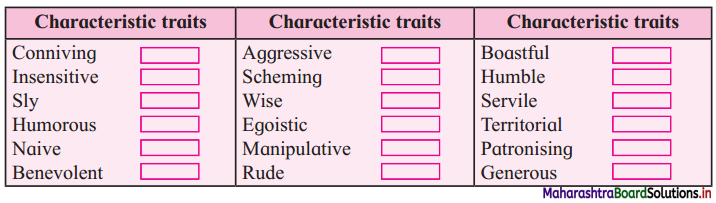
Maharashtra Board Class 12 English Yuvakbharati Solutions Chapter 1.2 On Saying “Please” 3
Answer:
Maharashtra Board Class 12 English Yuvakbharati Solutions Chapter 1.2 On Saying “Please” 4

Question 3.
Etiquette and manners are very important for a person to live in the society. Read the following and put them in proper columns:

  1. To receive phone calls while you are in a lecture or class.
  2. To knock before you enter your Principal’s office.
  3. To thank the person who offers you tea or coffee.
  4. To be polite and courteous to others.
  5. To leave the classroom without the teacher’s permission.
  6. To occupy the seats reserved for ladies or physically challenged or elderly people on a bus or a train.

Answer:

AppropriateInappropriate
1. To knock before you enter your Principal’s office.1. To receive phone calls while you are in a lecture or class.
2. To thank the person who offers you tea or coffee.2. To leave the classroom without the teacher’s permission.
3. To be polite and courteous to others.3. To occupy the seats reserved for ladies or physically challenged or elderly people on a bus or a train.

(A1)

Question (i)
Form groups and explain the following words with examples:
Answer:
1. Humility: being free from pride and arrogance – greatest example our former President Dr. A.P.J. Abdul Kalam – remember that ‘pride comes before a fall’ – always realize that there are people better than you are – Socrates said ‘One thing only I know, and that is that I know nothing. ’
2. Self-esteem: self-respect; confidence in one’s own worth or abilities – accept oneself as one is – everyone is different and unique – highly positive quality – leads to achievements, success, healthy relationships – can be developed with a little effort.
3. Gratitude: thankfulness for something that you have got – ready to show appreciation for something – towards the Almighty, towards those who have helped you – strengthens relationships with others – creates positivity.
4. Courtesy: means good manners and polite behavior – means being kind and compassionate towards others – should be real, not artificial – creates good impression – one will be liked by all – human quality not present in animals.
5. Generosity: kindness; big-heartedness – the act of being kind, selfless and giving towards others – very positive trait – influences others – when one is generous, one feels good – many religions consider this a great virtue – encourage charity.
6. Sympathy: feelings of pity and sorrow for someone else’s misfortune – leads to stronger relationships – offering condolences when someone dies – helps us to bond with others-makes the other person’s distress less – beautiful emotion – should be developed.
7. Empathy: the ability to understand and share the feelings of another – putting yourself in the shoes of the other person – different from kindness or pity – listen when people talk – see things from the other person’s point of view – makes one a very humane person.

Question (ii)
Have a Group Discussion on the topic ‘The need of soft skills at the workplace’. Use the following points:
Answer:
(a) Written and verbal communication (writing notes, letters, memos, reports, instructions, speeches, presentations, etc.)
(b) Ways of interacting with others (showing courtesy, sympathy, cooperation, empathy, strictness, gratitude, humility, team work, etc.)
(c) Creative abilities (preparing reports, presentations, letters, etc.)
(d) Emotional intelligence (showing understanding, compassion, empathy, team work, motivation, self-awareness, etc.)

(A2)

Question (i)
Read the text and state whether the following statements are True or False. Correct the False statements.
(a) Bitter problems in day-to-day life can be solved by sweet words.
(b) Great wars could have been avoided by a little courtesy.
(c) Observance of etiquette in a normal situation is important but more important is their observance when the situation is adverse.
(d) Words like ‘please’ and ‘thank you’ help us in making our passage through life uneasy.
(e) The law permits anybody to use violence, if another person is discourteous.
Answer:
True statements:
(a) Bitter problems in day-to-day life can be solved by sweet words.
(b) Great wars could have been avoided by a little courtesy.
(c) Observance of etiquette in a normal situation is important but more important is their observance when the situation is adverse.

False statements:
(d) Words like ‘please’ and ‘thank you’ help us in making our passage through life uneasy.
(e) The law permits anybody to use violence, if ; another person is discourteous.

Corrected statements :
(d) Words like ‘please’ and ‘thank you’ help us in making our passage through life easy.
(e) The law does not permit anybody to use violence, if another person is discourteous.

Question (ii)
Select the most appropriate sentences which suggest the theme of the essay.
(a) The essay tells us about courtesy, civility, morality, responsibility and control.
(b) The essay explores the difficulties that can be incurred by an individual when dealing with the public.
(c) One can keep one’s peace of mind without having to lower themselves to the level of the perceived offender.
(d) People with low self-esteem are generally difficult to work with and they look down upon others to get a feeling of superiority.
Answer:
(a) The essay tells us about courtesy, civility, morality, responsibility and control.
(c) One can keep one’s peace of mind without having to lower themselves to the level of the
perceived offender.

(iii)

Question (a)
Find the reasons for the liftman’s uncivilized behaviour.
Answer:
Reasons for the liftman’s uncivilized behaviour when the passenger was rude and ill-mannered towards him:

  1. he was acutely hurt by the slur cast by the passenger on his social status
  2. the passenger’s discourtesy was a wound to his self-respect
  3. he felt insulted by the passenger’s discourtesy.

Question (b)
List the people and their behaviour that made the passenger rude and ill- mannered.
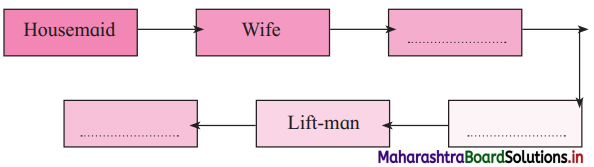
Maharashtra Board Class 12 English Yuvakbharati Solutions Chapter 1.2 On Saying “Please” 5
Answer:
The people who made the passenger rude and ill-mannered:
[housemaid] → [cook] → [employer’s wife] → [employer] → [passenger] → [lift-man]

Question (iv)
Good manners are required in our daily life for making our social contacts more cooperative and friendly. Illustrate the behaviour of the polite conductor with different people in various situations.
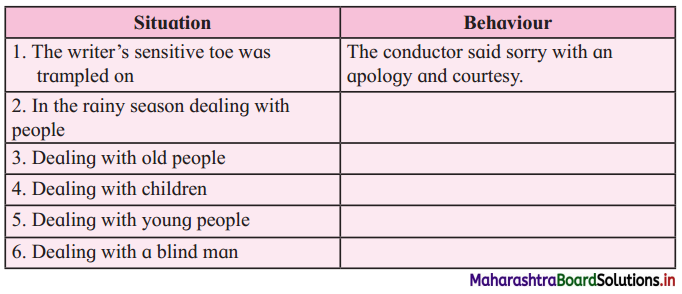
Maharashtra Board Class 12 English Yuvakbharati Solutions Chapter 1.2 On Saying “Please” 6
Answer:

SituationBehaviour
1. The writer’s sensitive toe was trampled onThe conductor said sorry with an apology and courtesy.
2. In the rainy season dealing with peopleHe would run up the stairs to give someone the tip that there was “room inside”.
3. Dealing with old peopleHe was as considerate as a son.
4. Dealing with childrenHe was as solicitous as a father.
5. Dealing with young peopleHe always indulged in some merry jest with them.
6. Dealing with a blind manHe set him down safely on the pavement and then took him wherever he wanted to go, after telling the driver to wait for a while.

Question (v)
Discuss and Write the impact of good temper and kindliness on society in the light of the good-mannered conductor.
Answer:
The conductor was always cheerful and kind-hearted to everyone in the bus. This spread to his passengers and they too became cheerful and good-humored. They would naturally pass on this feeling after getting off the bus. Thus, in society, if people are good-tempered, cheerful and kind, it will spread to others and they too will start behaving in a similar manner. This will lead to a happy and compassionate society.

Question (vi)
‘A modest calling can be made dignified by good temper and kindly feeling’. Explain the statement with examples.
Answer:
This means that whatever career or job one has, however simple or modest, it can be made more dignified by behaving in a good- tempered and cheerful manner and with kindliness towards the people one comes in contact with. For example, even a simple job like that of a security guard at a mall can be made pleasant and dignified if the guard smiles and says ‘Thank you’ or ‘Good morning’ every time he/she checks a person.

A sweeper’s job can also be made more dignified if he/she just nods and smiles at passers-by or helps them if they are in need.

Question (vii)
The service of the police is necessary for the implementation of law in our society. Do you think you require this service for a good social environment? Discuss and write.
Answer:
No, we cannot have the police monitoring us for social and moral offences. For example, one cannot be punished if one refuses to smile at an acquaintance or say Thank you’. One cannot be punished if one doesn’t hold the door open for the person who is following.

These are good manners, or courtesy, and they have to be taught right from childhood, and they will change in different cultures and different circumstances. Whether a person follows them or not depends on the individual. However, if these little courtesies are followed, life will become much simpler and more pleasant for everyone.

(A3)

Question (a)
Find out the words in Column B which collocate with the words in Column A:
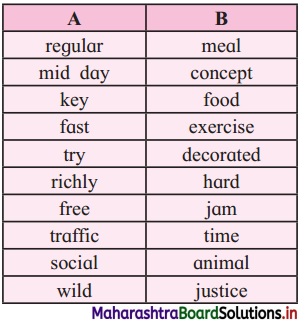
Maharashtra Board Class 12 English Yuvakbharati Solutions Chapter 1.2 On Saying “Please” 7
Answer:

ABAnswer
regularmealregular exercise
mid dayconceptmid-day meal
keyfoodkey concept
fastexercisefast food
trydecoratedtry hard
richlyhardrichly decorated
freejamfree time
traffictimetraffic jam
socialanimalsocial justice
wildjusticewild animal

Question (b)
Learning collocations is essential for making your English sound fluent and natural. Make the following collocations and use them in your own sentences.
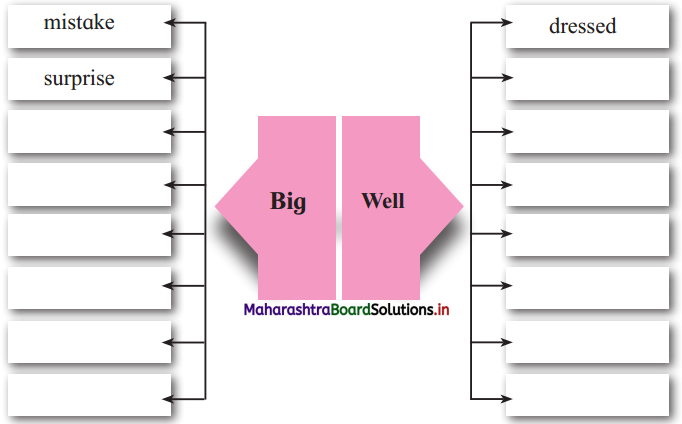
Maharashtra Board Class 12 English Yuvakbharati Solutions Chapter 1.2 On Saying “Please” 8
Sentences:
(1) BIG:

  1. It was a big mistake to hold a party on a rainy day.
  2. “Did you get a big surprise when you saw me?” asked the little girl to her mother.
  3. There was a big welcome waiting for the winning team.
  4. The hungry beggar prayed that he would get a big meal at the rich man’s home.
  5. Writing the difficult exam was no big deal for the intelligent boy.
  6. Rohan realized that it would be a big challenge for him to win the match.
  7. The discovery of a new element was big news in the scientific community.
  8. Losing the beauty contest was a big shock for the arrogant girl.

(2) WELL :

  1. The well-dressed man jumped over the puddle carefully.
  2. The advice the teacher gave Rita was well-meant, but Rita did not like it.
  3. The cook was happy to see the well-stocked cupboard.
  4. Little Naina was well-pleased with her birthday gift.

Question (ii)
Sometimes while using a word in a sentence, we have to change its word class. we can make several more words from the root word.
we can make several new words from the root word.
I asked Sumit to ……………. my pencil for me. (sharp).
I asked Sumit to sharpen my pencil for me.

Question 1.
Now read the following sentences and use the words given in the brackets. Change the word class and rewrite the sentences.
(a) Leena was eating a very …………. apple and obviously enjoying it. (crunch)
(b) This picture looks …………… (colour)
(c) I’m afraid that your behaviour is just not ……………. (accept)
(d) I like my elder brother. He is very ……………. (help)
Answer:
(a) Leena was eating a very crunchy apple and obviously enjoying it.
(b) This picture looks colourful.
(c) I’m afraid that your behaviour is just not acceptable.
(d) I like my elder brother. He is very helpful.

Complete the following table. Put a cross if a word class does not exist.
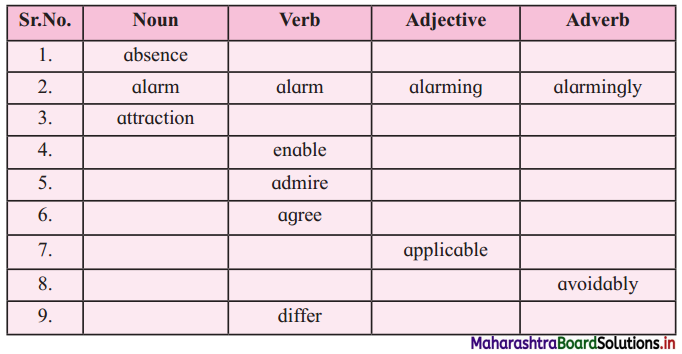
Maharashtra Board Class 12 English Yuvakbharati Solutions Chapter 1.2 On Saying “Please” 9

Question (iii)
Write appropriate expressions and words you have to use while facing an interview :
Answer:
(a) May I come in?
(b) May I have a seat?
(c) Thank you.
(d) I’m sorry, but I did not catch what you said.
(5) Please let me know

Question (b)
You are writing a letter of complaint. List the proper expressions that you would like to write.
Answer:

  1. I disagree.
  2. I’m sorry to say that….
  3. I would like to suggest….
  4. This was not expected from a company like yours.
  5. Please replace the defective piece as soon as possible.

Question (iv)
Distinguish between a legal offence and a moral offence on the basis of the extract.
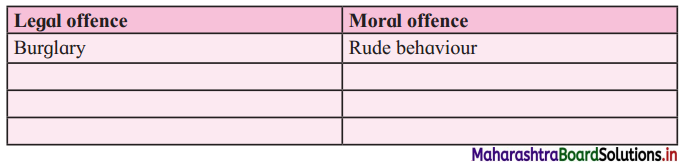
Maharashtra Board Class 12 English Yuvakbharati Solutions Chapter 1.2 On Saying “Please” 10
Answer:

Legal offenceMoral offence
BurglaryRude behaviour
AssaultDiscourtesy
BatteryHaughtiness
Laceration of one’s feelings

Question (v)
Find out the meaning of the phrase ‘give and take’ and use it in your own sentence.
Answer:
give-and-take – Meaning: exchange of ideas Sentence – The TV stars engaged in an interesting give-and-take which was enjoyed by the audience.

Question (vi)
Complete the table with polite expressions that we must use in our day-to-day life:
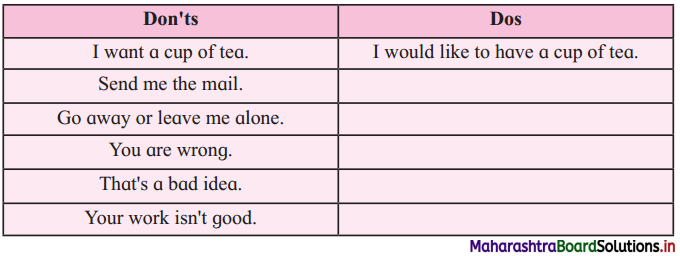
Maharashtra Board Class 12 English Yuvakbharati Solutions Chapter 1.2 On Saying “Please” 11
Answer:

Don’tsDos
I want a cup of tea.I would like to have a cup of tea.
Send me the mail.Please send me the mail.
Go away or leave me alone.Please let me be by myself.
You are wrong.Are you sure you’re right?
That’s a bad idea.That is not a very good idea, is it?
Your work isn’t good.Your work can do with some improvement

(A4)

Question (i)
Edit the given paragraph using a/ an/the wherever necessary:
Rakesh is a/an ideal son who remains devoted to his father as he grows professionally to become a/the famous doctor. As his father grows old, he takes care to spend time with his father, bringing him tea in a/the morning and taking him out for a/the walk in an/the evening.
Answer:
Rakesh is an ideal son who remains devoted to his father as he grows professionally to become a famous doctor. As his father grows old, he takes care to spend time with his father, bringing him tea in the morning and taking him out for a walk in the evening.

Question (ii)
Spot the errors in each of the following sentences and correct the incorrect ones:

Question (a)
Radha brought pens and distributed them between her five children.
Answer:
Radha bought pens and distributed them among her five children.

Question (b)
Jayshree and Sujata sat besides each other in complete silence.
Answer:
Jayshree and Sujata sat beside each other in complete silence.

Question (c)
His best friend Vijay was blind within one eye.
Answer:
His best friend Vijay was blind in one eye.

Question (d)
One could dare to encroach on his rights.
Answer:
One could not dare to encroach on his rights.

Question (e)
She was taken with surprise when she saw the famous Taj Mahal.
Answer:
She was taken by surprise when she saw the famous Taj Mahal.

Question (f)
It is not possible to exchange the goods once the sale has been completed.
Answer:
It is not possible to exchange goods once the sale has been completed, (‘the’ is deleted.)

Question (g)
Dr. Sengupta has been trying to master the craft for the last five years.
Answer:
No error in this sentence.

Question (h)
The top-ranking candidates will be appointed in senior jobs in banks.
Answer:
The top-ranking candidates will be appointed | to senior jobs in banks.

Question (i)
She knows very well what is expected from her but she is unable to perform.
Answer:
She knows very well what is expected of her but she is unable to perform.

Question (j)
They will put on a note in this regard for your consideration.
Answer:
They will put up a note in this regard for your consideration.

Question (iii)
Read the following.
Santosh purchased a computer. He read the operating manual and followed the instructions.
(a) He linked the monitor, keyboard and printer.
(b) He plugged in the main cable.
(c) He switched on the monitor at the back.
(d) When the light appeared on the screen, he placed the Day Disk in Drive A.
(e) He pushed in the disk until the button clicked out.
(It took about 30 seconds for the computer to load the program.)
(f) He pressed the Drive button and the disk shot out.
(g) He replaced the Day Disk with the Document Disk.
(h) He pressed function key 7.
Convert these sentences into passive voice by filling in the blanks.

Firstly the monitor, keyboard and printer were linked up. Then the main cable was plugged in. The monitor was switched on at the back. When the light appeared on the screen, the Day Disk was placed in Drive A. The disk was pushed in until the button clicked out. It took the computer 30 seconds to load the program. The drive button was pressed and the disk shot out. The Day Disk was replaced with the Document Disk. Finally, the function key 7 was pressed. The word processor was then ready to use.

(A5)

Question (i)
Write a speech on ‘Courtesy is the light of life’ with the help of the following points.
(a) People have a good impression of you.
(b) You will be acknowledged and appreciated by all.
(c) You will he happier and contented with life.
Answer:
Courtesy is the light of life
Dear friends,

Good morning. You may be surprised with the topic I have chosen for this speech, for today the word ‘Courtesy’ seems to be an old-fashioned word for us. But it is really the light of life. I, Shivam Goswami, would like to say a few words on why I think so.

First of all, what does courtesy mean? It means good manners and polite behaviour. It means being kind and compassionate towards someone. When you are courteous, people have a good impression of you; but that is not the reason for being courteous. Politeness should be real, and not artificial.

A courteous person will be appreciated by all. People will like to spend time with him/her and find pleasure in the person’s company. Someone may ask ‘What is courteous behaviour’? Saying simple words like ‘Please’, ‘Thank you’, ‘Excuse me’ and ‘Sorry’ is courteous behaviour. Helping a person who has fallen is courteous behaviour. Holding the lift door open for someone is courteous behaviour.

When a person is courteous, people are automatically courteous in return. This leads to a more polite and happier society. As I conclude, I would like to ask all of you to do something for a week: Be courteous. Then you will see the returns and realize the truth of what I am saying. Thank you for listening to me so patiently. Bye.

Question (ii)
‘Manners maketh man’ – Expand the idea in your own words with proper examples.
Answer:
Manners maketh man

‘Manners maketh Man’ : so goes a famous saying. In the world of today, people are judged by their manners and conduct. Manners distinguish us from animals, and make us human. A person who is courteous and considerate towards others is said to possess good manners. Such a person is respectful to his superiors, courteous to his equals and sympathetic towards his subordinates. He always shows concern for the well-being and comfort of others. He uses words like ‘Please’, ‘Thank you’ and ‘Sorry’ while talking to others; he helps senior citizens and those in need.

Everyone likes a person who speaks and behaves politely and treats others respectfully. Good manners cost practically nothing but can buy everything. They win us friends and help us influence people. They make the world a happier place to live in by reducing friction and avoiding tension.

When we meet a person for the first time, it is the person’s courtesy which impresses us deeply. Good manners are generally taught by parents at home, and by teachers in school. Manners that are learnt during childhood generally remain with us throughout our lives. They become a part of our personality. Hence, it is desirable that good manners are instilled in children when they are very young, so that they grow up to become courteous, considerate adults.

(A6)

Question (i)
Read A. G. Gardiner’s essay “The Open Window’ and compare its theme with the essay ‘On Saying “Please.”

Question (ii)
‘Nothing clears up my spirits like a fine day’ – Keats. Collect information of the poet Keats and write it in your notebook.

(A7)

Question (i)
Soft skills are required in all walks of life including careers and industries. They are increasingly becoming the essential skills of today’s workforce. Soft skills are an integral part of finding, attracting and retaining clients also. Highly developed presentation skills, networking abilities, and etiquette awareness can help you win new clients and gain more work. The following are considered the most important soft skills.
image

Question (ii)
Following are some of the institutions where you will get the courses related to soft skills.
(a) Indian Institute of Management, Ahmedabad, Gujarat
(b) Indian School of Business Management, Hyderabad
(c) XLRI – Xavier School of Management, Jamshedpur
(d) Indian Institute of Foreign Trade, New Delhi
Jobs available at –

  • Customer service centre
  • Management schools
  • Hotel industry, etc.

Yuvakbharati English 12th Digest Chapter 1.2 On Saying “Please” Additional Important Questions and Answers

Read the extract and complete the activities given below.:

Global Understanding:

Question 1.
Read the following sentences and find out True and False sentences. Correct the false sentences:
1. The liftman invited the passenger into the lift.
2. If you knock down a burglar, the law will acquit you.
3. There is no legislation against bad manners.
4. The complainant had to pay a fine.
Answer:
True sentences:
2. If you knock down a burglar, the law will acquit you.
3. There is no legislation against bad manners.

False sentences:
1. The liftman invited the passenger into the lift.
4. The complainant had to pay a fine,

Corrected sentences:
1. The liftman threw the passenger out of the lift.
4. The liftman had to pay a fine.

Question 2.
Explain the penalty, if any, that one has to pay if one is rude or boorish.
Answer:
There is no penalty to pay if one is rude or boorish except the penalty of being called a ill-mannered person.

Question 3.
The behaviour of the people who made the passenger rude and ill-mannered:
Answer:
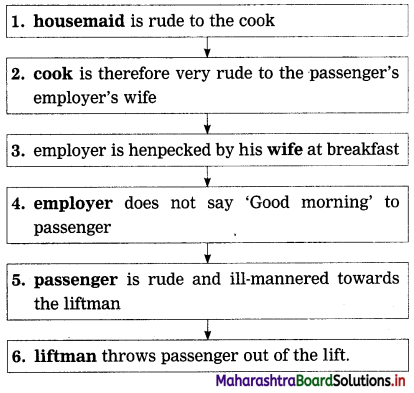
Maharashtra Board Class 12 English Yuvakbharati Solutions Chapter 1.2 On Saying “Please” 12

Question 4.
Complete the following:
(The answers are given directly and underlined.)
Answer:

  1. The first requirement of civility is that we should acknowledge a service.
  2. The Underground Railway Company insists that their employees are civil.
  3. The words which make life smooth are ‘please’ and ‘thank you’.
  4. The job of a bus conductor is very difficult and sometimes painful.

Question 5.
Tick mark the correct words:
(The answers are marked directly.)
Answer:

  1. The author finally found/did not find the money for the ticket.
  2. The author thought he had left home with/ without any money.
  3. The conductor gave/did not give the author a ticket.
  4. The author was pleased/displeased with the conductor.

Question 6.
Complete the web by choosing the correct words from the brackets that describe the conductor: (mean cheerful considerate grumpy patient solicitous impatient polite irritable good-tempered haughty good-natured kind)
Answer:
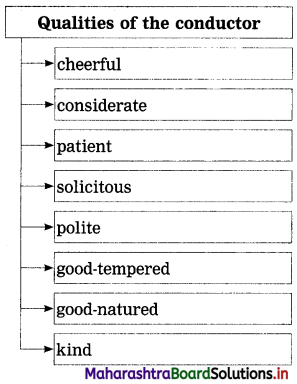
Maharashtra Board Class 12 English Yuvakbharati Solutions Chapter 1.2 On Saying “Please” 13

Question 7.
Complete the following :
(The answers are given directly and underlined.)
Answer:

  1. A modest career can he made dignified by good temper and kindly feeling.
  2. The law can only protect us against material) attack.
  3. The narrator says he does not want to apologise for praising an unknown bus conductor.
  4. A man who is polite may lose material advantage but he always has the spiritual victory.

Complex Factual:

Question 1.
Explain what the liftman wanted the passenger to do, and what happened afterwards.
Answer:
The passenger, on entering the lift, said ‘Top’. The liftman wanted him to say ‘Top please’. The passenger refused to do so. The liftman, instead of taking him to the top floor, threw him out of the lift.

Question 2.
Explain the sentence: The pain of a kick on the shins soon passes away but the pain of a wound to our self-respect or our vanity may poison a whole day.
Answer:
This means that if we are physically attacked i and injured, the pain of the wounds will soon heal and be forgotten. But if our self-respect or pride is hurt, it may poison our lives and behaviour for a much longer time.

Question 3.
It is not possible for the law to become the guardian of our private manners. Explain.
Answer:
The area of moral offences is quite vast and no laws or commandments can cover this area. In addition, social civilities, speech and manners are of so many types and the interpretation of these (whether they are good or bad) is so different that no court could administer a law which governed them. Hence, it is not possible for the law to become the guardian of our private manners.

Question 4.
Mention a couple of ways to keep the machine of life oiled and running sweetly.
Answer:
We can keep the machine of life oiled and running sweetly by using courteous words like ‘Please’ and ‘Thank you’ to acknowledge a service.

Question 5.
Complete the following:
(The answer is given directly and underlined.)
Answer:
The public owes much to the Underground Railway Company because they insist on a certain standard of civility in their employees, and take care that the standard is observed.

Question 6.
Complete the table:
Answer:

The wordsWho said!To whomWhen
1. “I haven’t a copper on me.”The narratorThe conductorWhen the conductor and the narrator found that he had left home without any money in his pocket.
2. “Oh, you’ll see me some day alright.”The conductorThe narratorWhen the narrator address) he could send the borrowed asked where (to which money.
3. “Where shall I send the fare?”The narratorThe conductorWhen the narrator wanted to repay the ticket money to the conductor.
4. “Where do you want to go?”The conductorThe narratorWhen the narrator explained that he did not have any money on him, and the conductor

Question 7.
Write the narrator’s opinion about how the liftman should have dealt with the passenger’s uncivility. Give reasons for the same.
Answer:
In the opinion of the writer, the liftman, instead of throwing the passenger out of the lift, should have treated him with elaborate politeness. He would have then had the victory not only over the rude passenger, but also over himself, and that was the spiritual victory that was more important. His revenge would then have been more subtle and effective.

Inference/Interpretation/Analysis :

Question 1.
Name the ‘unpleasant specimen’ mentioned in the extract and describe his behaviour.
Answer:
The ‘unpleasant specimen’ mentioned in the extract is the type of bus conductor who regards his passengers as natural enemies whose chief purpose on the bus is to cheat him, and who can only be kept honest by using a loud voice and an aggressive manner.

Question 2.
Describe the stale old trick, according to the conductor.
Answer:
Pretending that you have forgotten your purse at home, and hence do not have the fare for the ticket is a stale old trick, according to the conductor. (The conductor does not say this the narrator only imagines that he may do so.)

Question 3.
Describe the reactions of the bus conductor.
Answer:
No, the conductor did not think that the narrator was dishonest. He cheerfully accepted what the narrator said without doubting him and offered him a free ticket.

Question 4.
Describe the experience which made the narrator comfortable in the bus.
Answer:
The conductor had trampled on the narrator’s sensitive toe, causing him pain and agony. However, the conductor had then explained matters and apologized so profusely that the narrator forgot his pain and anger. After this experience, the narrator always observed his constant good nature and cheerful behaviour with pleasure and felt comfortable in his presence.

Question 5.
Describe the narrator’s justification of his praise of the conductor.
Answer:
The narrator says that if the famous poet Wordsworth could gain wisdom from a poor leech-gatherer, he sees no reason why ordinary people should not take lessons on conduct from a bus conductor, who shows how a modest job can be made more dignified by behaving in a good-tempered and cheerful manner and with kindliness towards the people one comes in contact with.

Personal Response:

Question 1.
Describe a person you have come across who is always polite and helpful. What do you think about him/her?
Answer:
The security guard of our building is always polite and helpful. He will help senior citizens get in and out of their cars or into the lift; he will help any person who has heavy bags. He also replies politely to any question asked by anyone. We all like him very much and often share our chocolates and biscuits with him. We also give him books, stationery and toys for his little child.

Question 2.
Describe a pleasant/unpleasant experience you have had with a bus conductor.
Answer:
This is an experience I had when I was new to Mumbai. I got into a bus and asked the conductor for a ticket to Dadar. The conductor shook his head and told me that I had got into the bus going in the wrong direction. He patiently explained that I would have to get off at the next stop, cross the road, and catch a bus having the same number but going in the opposite direction. He even pointed out the bus stop to me. Though I felt a bit embarrassed, I thanked him for his kindness.

Question 3.
Give your opinion about the conductor’s behaviour.
Answer:
The conductor was really a good and kind human being who saw the best in everyone and believed everyone. He was ready to pay the fare for the narrator’s ticket himself, even though he was not sure whether it would be returned. It is difficult to find such generous and helpful people in the world today, and it leaves a very pleasant feeling in the heart when you do.

Language Study:

Question 1.
The law does not compel me to say ‘Please’.
(Rewrite as an interrogative sentence.)
Answer:
Does the law compel me to say ‘Please’?

Question 2.
It was a question of ‘Please’.
(Add a question tag.)
Answer:
It was a question of ‘Please’, wasn’t it?

Question 3.
It will permit me to retaliate with reasonable violence.
(Pick out the finite and non-finite verbs.)
Answer:
will permit – finite verb;
to retaliate – non-finite verb (infinitive)

Question 4.
The pain of a wound to our self-respect may poison a whole day.
(Pick out the auxiliary and state its function.)
Answer:
may – possibility

Question 5.
For there are few things more catching than bad temper.
(Write the part of speech of the underlined word.)
Answer:
Gerund

Question 6.
Bad manners probably do more to poison the stream of general life than all the crimes in the calendar. (Rewrite in the present perfect tense.)
Answer:
Bad manners have done probably more to poison the stream of general life than all the crimes in the calendar.

Question 7.
There is a social practice much older and much more sacred than any law which enjoins us to be civil.
(Rewrite using ‘not only … but also… ’)
Answer:
There is a social practice not only much older but also much more sacred than any law which enjoins us to be civil.

Question 8.
Most people will have a certain sympathy with him. (Rewrite using the verb form of the underlined word.)
Answer:
Most people will sympathize with him.

Question 9.
Here and there you will meet an unpleasant specimen who regards the passengers as his natural enemies. (Replace the verb in the future tense with a modal auxiliary showing possibility.)
Answer:
Here and there you might meet an unpleasant specimen who regards the passengers as his natural enemies.

Question 10.
I had left home without any money in my pocket. (Pick out the verb and state the tense.)
Answer:
had left-past perfect tense.

Question 11.
I know that stale old trick.
(Rewrite beginning ‘That stale old trick ’.)
Answer:
That stale old trick is known to me.

Question 12.
I said it was very kind of him.
(Identify the clauses.)
Answer:
I said – main clause
it was very kind of him – subordinate noun clause

Question 13.
I began to observe him whenever I boarded his bus. (Pick out the subordinate clause and state the type.)
Answer:
subordinate clause – whenever I boarded his bus; adverb clause of time.

Question 14.
He seemed to have an inexhaustible fund of patience and a gift for making his passengers comfortable. (Rewrite using ‘as well as…’)
Answer:
He seemed to have an inexhaustible fund of patience as well as a gift for making his passengers comfortable.

Question 15.
In lightening their spirits he lightened his own task. (Rewrite using the verb form of the underlined word.)
Answer:
When he lightened their spirits he lightened his own task.

Question 16.
A very modest calling may be dignified by good temper and kindly feeling. (Rewrite as an interrogative sentence.)
Answer:
Can’t a very modest calling be dignified by good temper and kindly feeling?

Question 17.
“I never give the wall to a scoundrel,” said a man who met Chesterfield one day in the street. “I always do,” said Chesterfield, stepping with a bow into the road. (Rewrite using reported speech.)
Answer:
A man who met Chesterfield one day in the street said that he never gave the wall to a scoundrel. Chesterfield, stepping with a bow into the road, replied that he always did.

Question 18.
The polite man may lose the material advantage, but he always has the spiritual victory. (Rewrite beginning ‘Though’)
Answer:
Though the polite man may lose the material advantage, he always has the spiritual victory.

Vocabulary:

Find out the meanings of the following phrases and use them in your own sentences.

Question 1.
knock someone down –
Answer:
Meaning: to hit someone forcefully so that he/she falls down
Sentence: The young boy was so angry with the bully that he knocked him down.

Question 2.
to comply with :
Answer:
Meaning: to obey.
Sentence: We must comply with the laws of the country we live in.

Question 3.
Find out 2 words with prefixes and 2 with suffixes from the extract and write them down.
Answer:
1. Words with prefixes : discourtesy, uncivil.
2. Words with suffixes : instruction, reasonable.

Question 4.
Complete the following:
Answer:

  1. A liftman is a person who is employed to operate a lift.
  2. An assailant is a person who attacks another person.
  3. A complainant is a person who makes a formal complaint in a law court.
  4. A burglar is a person who illegally enters houses and steals things.

Question 5.
Write the meanings of the following words :

  1. redress
  2. henpecked
  3. black eye.

Answer:

  1. redress – to set right to remedy.
  2. henpecked – being controlled by and frightened of one’s wife.
  3. black eye – an area of skin around the eye that has gone dark because it has been hit.

Question 6.
Use the phrase ‘a black eye’ in your own sentence.
Answer:
When I saw my friend with a black eye, I knew that he had been in a fight with someone.

Question 7.
Find out 2 words with suffixes and 2 compound words from the extract and write them down.
Answer:
1. words with suffixes: vanity, really.
2. Compound words: breakfast, housemaid.

Question 8.
Write the meaning of the following words:

  1. endorse
  2. verdict
  3. resentment
  4. calling

Answer:

  1. endorse – express support
  2. verdict – judgement
  3. resentment – anger
  4. calling – vocation or profession.

Question 9.
Find out 2 words with suffixes from the extract and write them down.
Answer:
Words with suffixes : sympathy, requirement.

Question 10.
Find out two words with prefixes and two with suffixes from the extract and write them down.
Answer:
1. Words with prefixes: unfriendliness, inconvenience
2. Words with suffixes: existence, discovery

Question 11.
Pick out four adverbs of manner from the extract.
Answer:
coldly, cheerfully, luckily, easily.

Question 12.
Write the meanings of the followings words:

  1. countenance
  2. treading
  3. assured (someone)
  4. benediction
  5. uncouth

Answer:

  1. countenance – face.’
  2. treading – walking on.
  3. assured (someone) – made something certain to someone.
  4. benediction – a blessing.
  5. uncouth – impolite, unrefined.

Question 13.
Find out 2 words with prefixes and 2 with suffixes from the extract and write them down.
Answer:
1. words with prefixes: inexhaustible, unusually
2. words with suffixes: investment, cheerful

Question 14.
Write the meaning of ‘moral affront’.
Answer:
moral affront: a deliberate offence or insult to one’s dignity or self-respect.

Question 15.
Find out the meaning of the following phrase and use it in your own
sentence: lower than the angels
Answer:
lower than the angels – Meaning : less than perfect
Sentence: The unexpected behaviour of the religious men was somewhat lower than the angels.

Question 16.
Write four words with suffixes from the extract and write them down.
Answer:
agreement, politeness, institution, sweeten.
Note: Students can find more words on their own.

Vocabulary:

A Collocation is a combination of words in a language that often go together. They habitually occur together and hence convey some meaning by association, e.g. early morning, hot dinner, fast train.

Non-Textual Grammar:

Do as directed:

Question 1.
Hearing the sound of music from a side street, Mona had an idea.
(Rewrite as a compound sentence.)
Answer:
Mona heard the sound of music from a side-street and had an idea.

Question 2.
Siddharth could not ask his father for a cricket bat.
(Rewrite using the antonym of ‘able’.)
Answer:
Siddharth was unable to ask his father for a cricket bat.

Question 3.
“I will try,” the lady smiled.
(Rewrite in indirect speech.)
Answer:
The lady smiled and said that she would try.

Spot the error in the following sentences and rewrite them correctly:

Question 1.
I picked some of the lovely, tasty fruits and had eaten my fill of them.
Answer:
I had picked some of the lovely, tasty fruits and had eaten my fill of them.

Question 2.
I miss my friends a lots.
Answer:
I miss my friends a lot.

Maharashtra Board Class 12 English Yuvakbharati Solutions Chapter 1.1 An Astrologer’s Day

Balbharti Yuvakbharati English 12th Digest Chapter 1.1 An Astrologer’s Day Notes, Textbook Exercise Important Questions and Answers.

Maharashtra State Board Class 12 English Yuvakbharati Solutions Chapter 1.1 An Astrologer’s Day

12th English Digest Chapter 1.1 An Astrologer’s Day Textbook Questions and Answers

Question 1.
Discuss with your partner and complete the table:
Maharashtra Board Class 12 English Yuvakbharati Solutions Chapter 1.1 An Astrologer's Day 1
Answer:

Your StrengthsWhy do you feel so?Your Dream career
painting and drawingcan visualise, expresscommercial artist, cartoonist
…………………….………………………………………………….
………………………………………………………………………
…………………..………………………. ………………………..

Maharashtra Board Solutions

Question 2.
The scene in a local market of a village/ town/city is very attractive. People with different occupations sell their wares. Discuss with your partner the variety of activities at the local market.
Answer:

  1. selling flowers, selling grocery
  2. selling garments and cloth
  3. selling imitation jewellery and accessories
  4. selling snacks and fast food
  5. selling steel and earthenwares

Question 3.
In a village/town/city it is quite a common sight to see an astrologer sitting by the roadside with his professional equipment. Discuss with your partner and list the requirements for his trade.
Answer:

  1. parrot, cards, etc.
  2. turban, beard, dhoti
  3. dried leaves with writing on them
  4. cloth with mystic signs to spread his cards
  5. bead necklace, coins, shells, punchang, etc.

Question 4.
There are certain unreasonable beliefs among people living in our society. Certain common events are linked with superstitions. List such events, discuss the superstitions linked with them and the means of their eradication.
Answer:
Events and superstitions linked with them:

  1. A cat crossing your path (something bad will happen)
  2. Walking under a ladder (something unfortunate will happen)
  3. Wearing black clothes for an auspicious function (will bring bad luck to the hosts)
  4. Spilling salt (unlucky for the person)
  5. A black crow cawing outside your window (you will be having guests)

Means of eradication: The only means of eradication is through education. Scientific attitude must be developed in society. Religious heads must counsel and guide their followers. The elders in families must also get rid of old beliefs.

A1.

(i) Given below are some descriptions. Discuss them with your partner and find out one word for each of them.

Question (a)
The scientific study of the universe and the objects in it, including stars, planets, nebulae and galaxies:
Answer:
Astronomy

Maharashtra Board Solutions

Question (b)
The study of the movements of the planets, Sun, Moon, and Stars in the belief that these movements can have an influence on people’s lives:
Answer:
Astrology

Question (c)
A prediction of what will happen in the future:
Answer:
Prophecy

Question (d)
Scientific discipline that studies mental states and processes and behaviour in humans and other animals:
Answer:
Psychology

Question (ii)
In the story we are told that the Town Hall Park was a remarkable place in many ways for an astrologer to build his business. List the exceptional qualities of the place from this extract.
Answer:
The exceptional qualities of the place were:

  1. A surging crowd
  2. A variety of trades and occupations, like medicine sellers, sellers of stolen hardware and junk
  3. magicians
  4. auctioneers of cheap cloth
  5. a vociferous vendor of fried groundnuts.

Question (iii)
The astrologer never opened his mouth till the other had spoken for at least ten minutes. Discuss the reasons behind his act.
Answer:
(a) He was good at reading people.
(b) He obtained a lot of information about their lives from their talk.
(c) He could analyse their character and understand their problems.
(d) He could easily frame his statements to their satisfaction.

Maharashtra Board Solutions

A2.

Question (i)
The tactics used by the astrologer to earn his wages are:
Maharashtra Board Class 12 English Yuvakbharati Solutions Chapter 1.1 An Astrologer's Day 2Maharashtra Board Class 12 English Yuvakbharati Solutions Chapter 1.1 An Astrologer's Day 2
Answer:
Maharashtra Board Class 12 English Yuvakbharati Solutions Chapter 1.1 An Astrologer's Day 3

Question (ii)
An astrologer’s appearance helps to create an impression on his clients. Complete the following:
(The answer is given directly and underlined.)
Answer:

  1. The turban on his head
  2. The sacred ash and vermilion on his forehead
  3. dark whiskers covering the face
  4. a sparkle in his eye accompanied by an abnormal gleam

1. Read the following sentences and choose the correct one:

Question (a)
The astrologer says that if Nayak does not leave his village again, he would –
(1) return the money
(2) face danger
(3) go back home and stop looking for the man who tried to kill him
(4) not find the killer.
Answer:
(2) face danger

Question (b)
According to the narrator, the astrologer’s success in his profession is primarily due to –
(1) luck
(2) the bargains he drives
(3) his appearance
(4) his understanding of people.
Answer:
(4) his understanding of people

Maharashtra Board Solutions

Question (c)
The story suggests that the astrologer’s comments and observations pleased people by –
(1) promising them success and good fortune
(2) proving, as time passes, to have been true
(3) flattering them or supporting their own views
(4) helping them to learn to solve their own problems.
Answer:
(3) flattering them or supporting their own views

Question (d)
Guru Nayak the astrologer because he wants to –
(1) understand the past
(2) find out who the astrologer is
(3) make some money through a bet
(4) get the answer to a specific question.
Answer:
(4) get the answer to a specific question.

Question (e)
Guru Nayak is looking for the man who tried to kill him –
(1) to take revenge
(2) to get an apology
(3) to demand an explanation
(4) to prove that the man was unsuccessful.
Answer:
(1) to take revenge

Question (f)
The astrologer’s remarks make Guru Nayak feel all of the following except –
(1) relieved
(2) suspicious
(3) impressed
(4) disappointed.
Answer:
(2) suspicious

Maharashtra Board Solutions

Question (g)
Reactions of the astrologer’s wife to his news suggest that she –
(1) was unaware of his past
(2) has been worried about his safety
(3) has known him since he was young
(4) is concerned about her future with him.
Answer:
(1) was unaware of his past

Question (iv)
Read the following sentences and find out the True and False sentences. Correct the False sentences:
(a) The astrologer gave a correct prediction to the client about his past that he was stabbed, thrown into a well and left for dead
(b) When the astrologer came to know that the man whom he killed is alive he felt that he was relieved of his guilt.
(c) The astrologer tried to back out of the deal and talked about the client’s past.
(d) The astrologer rescued himself from Guru Nayak’s revenge.
(e) The moral of the story is that we must be responsible about what we have done and should not run away from our mistakes.
Answer:
(a) True.
(b) True: When the astrologer came to know that the man whom he killed is alive he felt that he was relieved of his guilt.
(c) False
Corrected sentence. The astrologer struck a bargain with the client and then talked about the client’s past.
(d) True.
(e) False: The moral of the story is that we must be responsible about what we have done and should not run away from our mistakes.
Corrected sentence: The moral is that we should never believe in superstitions.

Maharashtra Board Solutions

Question (v)
The astrologer had changed his appearance and his persona when he arrived in the city. Give specific reasons for this.
Answer:
The astrologer thought that he had killed a man after a quarrel. He was afraid that he would be arrested and jailed for this crime. Hence, to avoid detection he changed his appearance and his persona when he arrived in the city.

Question (vi)
‘The darkness load that was inside the astrologer has disappeared’. Through this sentence, explain the significance of the title ‘An Astrologer’s Day’.
OR
(vii) The astrologer feels relieved that Guru is not dead as it relieves a great burden from him. Critically justify the statement and explain it.
Answer:
The astrologer thought that he had killed a man after a quarrel. Hence he had run away from his village, changed his appearance and his persona when he arrived in the city, and become an astrologer. However, he still felt guilty for what he had done. When he came to know that the man he thought he had killed was actually alive, the dark load inside him disappeared, and it made his day, i.e. he felt relieved and happy. This is the significance of the title ‘An Astrologer’s Day’.

Question (viii)
The astrologer wins/gets the sympathy/ criticism of the reader in the end. Express your opinion with the support of the main story.
Answer:
I think I sympathize with the astrologer. He did not try to intentionally kill Guru Nayak; it had happened in the heat of the moment. Of course, he should not have tried to run away but should have accepted responsibility for his crime. However, he is genuinely sorry for what had happened.

His words ‘a great load is gone from me today. I thought I had the blood of a man on my hands all these years’ indicates this. Hence, I sympathize with him and am happy that he can now live in peace.

Maharashtra Board Solutions

Question (ix)
Suggest some steps to eradicate superstitions and other ill practices from our society.
Answer:
To eradicate superstitions and other ill practices from our society the first and most important step is education. Schools and colleges must help their students to develop a scientific attitude and think logically and rationally.

Secondly, as people in India tend to listen to their religious heads, all religious heads should send out clear messages to their followers about the eradication of superstitions. And lastly, the older generation should change their opinions and ideas and get rid of silly superstitious beliefs.

Question (x)
In the story, the astrologer has great listening power. Listening helps in developing good relations with people. Express your opinion.
Answer:
Yes, listening helps in developing good relations with people. When we listen, we indicate to the speaker that we care about him/her and are interested in his/her problems/joys. We show that we are ready to help him/her if necessary. We share his/ her ideas. We also realize how we can deal with people successfully by listening to their views.

(A3)

Question (i)
In the story, the astrologer, Guru Nayak and astrologer’s wife reveal their qualities through words and actions. Pick out from the box the words that describe them and write in the appropriate columns:
Maharashtra Board Class 12 English Yuvakbharati Solutions Chapter 1.1 An Astrologer's Day 4
Answer:

AstrologerGuru NayakAstrologer’s wife
shrewdmanipulativecaring
clevergulliblesuspicious
smartquarrelsomeprotective
sharparrogantworried
intuitiveaggressivehumanistic
mysticaldemandingrational
cunningantagonistic
meansceptical
over­impetuous
confident

Maharashtra Board Solutions

Question 1.
Match the suffixes with the words and make words:
Maharashtra Board Class 12 English Yuvakbharati Solutions Chapter 1.1 An Astrologer's Day 5
Answer:

WordSuffixNoun
auctionableauctioneer
enchantmentenchantmentenchantment
knowmentknowledge
prepareurepreparation
proceedtionprocedure
appear (this word is not in the lesson)mentappearance
remarkureremarkable

Question (iii)
‘An Astrologer’s Day’ has ironic elements where the astrologer pretends to have ‘supernatural knowledge’ that coincidently turns out to be the truth. Find out an example of irony from the extract and write it down:
Find out the examples of irony from the extract and write them down.
Answer:
His eyes sparkled with a sharp abnormal gleam which was really an outcome of a continual searching look for customers, but which his simple clients took to be a prophetic light and felt comforted.
1. He knew no more of what was going to happen to others than he knew what was going to happen to himself the next minute.
2. He was as much a stranger to the stars as were his innocent customers.
3. He said things which pleased and astonished everyone : that was more a matter of study, practice, and shrewd guesswork.

Maharashtra Board Solutions

Question (iv)
Find the examples of code-mixing from the extract and write them down.
Answer:
1. ‘cowrie shells’
2. turban

Question (v)
There are some phrases where the word ‘crown’ is used with different shades of meaning. Use the following phrases to complete the sentences meaningfully. One is done for you.
Crowning achievement, to crown the effect, crown of thorns, crowning glory, to crown it all
Answer:
e.g. To crown the effect, he wound a saffron- coloured turban around his head.
(a) The works of Shakespeare are the crowning glory of English drama.
(b) Amitabh has given us awesome movies throughout five decades. But his crowning achievement is his performance in the movie ‘Black’.
(c) In her pursuit of success, Radha has distanced herself from her family. Her fame has become a real crown of thorns.
(d) They threw a wonderful party for me with costumes, games and to crown it all my favourite kind of ice cream.
(e) Medical science has great inventions, but organ transplantation is definitely a crowning achievement for human beings.

(A4)

Question (i)
Use the word given in the brackets and rewrite the sentence:
(a) The power of his eyes was considerably enhanced. (enhancement)
(b) He had a working analysis of mankind’s troubles, (worked)
(c) He knew what was going to happen to himself the next minute. (happening)
(d) If you find my answers satisfactory, will you give me five rupees? (satisfaction)
(e) He shook his head regretfully. (regret)
(f) It was a bewildering crisscross of light rays, (bewildered)
(g) “I should have been dead if some passer-by had not chanced to peep into the well,” exclaimed the other, overwhelmed by enthusiasm. (enthusiastically)
(h) You tried to kill him. (killing)
(i) I will prepare some nice stuff for her. (preparation)
(j) The other groaned on hearing it. (heard)
Answer:
(a) There was considerable enhancement in the power of his eyes.
(b) He had worked out an analysis of mankind’s troubles.
(c) He knew what could be happening to himself the next minute.
(d) If my answers give you satisfaction, will you give me five rupees?
(e) He shook his head with regret.
(f) He was bewildered by the crisscross of light rays.
(g) “I should have been dead if some passer-by had not chanced to peep into the well,” exclaimed the other enthusiastically.
(h) You tried killing him.
(i) I will make a preparation of some nice stuff for her.
(j) The other groaned when he heard it.

Maharashtra Board Solutions

(A5)

Question (i)
Prepare a speech on Science and Superstitions.
Answer:
Science and Superstitions
Respected teacher and my dear friends,

I wish you all a very good morning. Today we are celebrating Science day in our school, and on this occasion I, Rohan Kamte, would like to say a few words about Science and Superstitions.

Science and Superstitions are two opposite ends of a pole. Those who have the scientific attitude and believe in science cannot possibly believe in superstitions. After all, what exactly are superstitions? They are only some tales made up by people for some reason or the other. Let me give you an example. Many years ago, in a house in a village, they were having an auspicious function. A lot of food was being cooked.

A cat and her kitten were moving about here and there in the kitchen. Afraid that the cat would be trampled upon or may fall into one of the open fires, the mistress of the house ordered the servant to put the cat and its kitten under a basket, and to do so every time there was a function in the house. This became a ‘superstition’ and in some houses, people actually brought a cat into the house and put it under a basket whenever they had a function!

This is what superstitions are all about. The superstition of bad luck if you walk under a ladder too has its reasons. The ladder could fold up and injure a person walking beneath it, or something could fall on the person’s head.

So friends, I request you: In this age of Science, do not believe in silly superstitions. Keep your minds open. Be rational and logical. Analyse things. Believe something only if it has the backing of Science. Thank you.

(ii) Read the following proverbs. Share you views and expand the ideas.

Question (a)
Actions speak louder than words.
Answer:
Actions speak louder than words

Today a lot of importance is being given to the way we speak and what we speak. But we have to remember that ultimately it is not words but actions that are important. Mahatma Gandhi, the Father of our Nation, did not give any grand speeches. However, by his actions he saw that India gained her freedom. Our soldiers do not give long lectures on patriotism they merely act to defend the country. What would have happened if they had only spoken but not acted?

This very well-known proverb is very apt when it comes to parent-child interaction. It has been seen that children observe the actions of their parents and imitate them not their words. In the animal kingdom too, the actions of the parent are of paramount importance. During elections, politicians make loud speeches but later on do not work. It is because of this behaviour that they lose the trust of the people. Thus, we must act with responsibility, always remembering that people observe our actions and are not swayed by our words.

Maharashtra Board Solutions

Question (b)
The face is the index of the mind.
Answer:
[Points: facial expressions and eyes indicate one’s thoughts – this is. non-verbal communication – that is why we smile when happy and frown when sad – however, smart people can hide their feelings so that face does not show them – so one has to be careful while reading faces]

Question (c)
Speech is silver and silence is golden.
Answer:
[Points: we speak – we give others information or reveal our thoughts – others speak, we get information – sometimes we speak hastily and hurt others – create problems – remain silent and think – can find solutions – many leaders speak hastily – create international problems – better to be silent and let one’s actions speak]

Question (d)
Argument is the worst kind of communication.
Answer:
[Points: arguments – people get angry – angry words and raised voices – hurt people – confusion – relationships spoilt – instead talk softly and allow others to talk – accept that others can think in a different way – ‘a man convinced against his will is of the same opinion still’]

Question (e)
Attitudes are the real figures of speech.
Answer:
[Points: quote by Edwin H Friedman – in communication, more than the verbal message, the non-verbal message important – your attitude and behaviour have more impact than your words – for example, if you say ‘sorry’ in a harsh tone without any apology on your face – the word has no meaning – hence body language and attitude are very important)

Question (f)
The wise man has long ears and a short tongue
Answer:
[Points: better to listen than to speak – wise people listen more and speak only when they have something important to say – speech is silver and silerwe is golden – in any situation it is better to remain silent and evaluate situation – empty vessels make the most noise]

Maharashtra Board Solutions

(A6)

Question (i)
Bill Naughton has written a collection of wonderful stories which you can read in his book ‘The Goal Keeper’s Revenge and Other Stories’. Read all the stories and discuss their themes with your partner.

Question (ii)
Read R.K. Narayan’s humorous collections of short stories and novels. Here are some titles you can read.
(a) ‘Under The Banyan Tree’
(b) ‘The Doctor’s Word’
(c) ‘LawleyRoad’
(d) ‘A Horse and Two Goats’
(e) ‘Gateman’s Gift’

(A7)

Question 1.
Surf the internet and find out the career opportunities in Astronomy.

Yuvakbharati English 12th Digest Chapter 1.1 An Astrologer’s Day Additional Important Questions and Answers

Read the extract and complete the activities given below:

Global Understanding:

Question 1.
List the fancy names the vendor of fried groundnuts gave his wares.
Answer:
The fancy names the vendor of fried groundnuts gave his wares are:

  1. ‘Bombay Ice Cream’
  2. ‘Delhi Almond’
  3. ‘Raja’s Delicacy’, etc.

Question 2.
Complete the following:
(The answer is given directly and underlined.)
Answer:
If the astrologer had stayed in the village, he would have carried on the work of his forefathers-namely, tilling the land, living, marrying and growing old in his cornfield and ancestral home.

Maharashtra Board Solutions

Question 3.
The Town Hall Park was a remarkable place in many ways for an astrologer to build his business. List the exceptional qualities of the place from the extract.
Answer:
The exceptional qualities of the place were:

  1. lack of municipal lighting
  2. flare from the groundnut heap
  3. hissing gaslights, some with naked flares, and cycle lamps
  4. bewildering criss-cross of light rays and moving shadows

Question 4.
Complete the following:
(The answers are given directly and underlined.)
The signal for the astrologer to leave was when the nuts vendor blew out his flare and rose to go home.
The astrologer spoke only when his client had spoken for at least ten minutes.

Question 5.
Rearrange the following sentences in the order of their occurrence in the extract:

  1. “I will speak to you tomorrow.”
  2. “Oh, stop that,” the other said.
  3. “There is a woman ”
  4. “Or will you give me eight annas?”

Answer:

  1. “Oh, stop that,” the other said.
  2. “Or will you give me eight annas?”
  3. “I will speak to you tomorrow.”
  4. “There is a woman ………..”

Complex Factual:

Question 1.
Complete the following:
(The answer is given directly and underlined.) The tactics used by the astrologer to earn his wages are:
Answer:
Maharashtra Board Class 12 English Yuvakbharati Solutions Chapter 1.1 An Astrologer's Day 6

Question 2.
Describe how the astrologer had left the village.
Answer:
The astrologer had left the village without any previous thought or plan. He had left home without telling anyone. He did not rest till he left behind his village a couple of miles.

Maharashtra Board Solutions

Question 3.
The astrologer could understand the problem in five minutes. Give reasons from the extract.
Answer:
The astrologer had a working analysis of mankind’s troubles like marriage, money and the tangle of human ties. Long practice had sharpened the way he perceived things, and thus he could understand the problem in five minutes.

Question 4.
Complete the following :
(The answer is given directly and underlined.)
Answer:
Maharashtra Board Class 12 English Yuvakbharati Solutions Chapter 1.1 An Astrologer's Day 7

Question 5.
Complete the web:
(The answers are given directly and underlined.)
Answer:
Maharashtra Board Class 12 English Yuvakbharati Solutions Chapter 1.1 An Astrologer's Day 8

Question 6.
Complete the following with what had happened to Guru Nayak’s enemy, according to the astrologer. According to the astrologer ………….. .
Answer:
According to the astrologer, Guru Nayak’s enemy had died. He had been crushed by a lorry.

Maharashtra Board Solutions

Question 7.
Describe the load on the astrologer’s mind.
Answer:
The astrologer thought that he had killed a man after a quarrel. He felt intensely guilty about this, and had run away from his village. This feeling of guilt was the load on his mind.

Question 8.
Was the astrologer’s wife happy with his day’s earnings? What did she plan to do with it?
Answer:
Yes, the astrologer’s wife was overjoyed with his day’s earnings. She planned to buy some jaggery and coconut and make some sweets for their daughter.

Inference/Interpretation/Analysis:

Question 1.
The presence of the groundnut vendor is beneficial to the astrologer. Justify.
Answer:
The vendor of fried groundnuts gave his wares fancy names like ‘Bombay Ice Cream’, ‘Delhi Almond’, ‘Raja’s Delicacy’ and so on. People were amused and attracted by this and flocked to him to buy groundnuts. As the astrologer was seated right next to him, the groundnut vendor’s customers dallied near the astrologer and were probably tempted to consult him.

Question 2.
Pick out the lines that tell you that the astrologer did not have any real knowledge of astrology.
Answer:

  1. He had not in the least intended to be an astrologer when he began life.
  2. He knew no more of what was going to happen to others than he knew what was going to happen to himself the next minute.
  3. He was as much a stranger to the stars as were his innocent customers.
  4. It was a bewildering crisscross of light rays and moving shadows. This suited the astrologer very well.

Question 3.
The astrologer could tell the person/client about his life. Describe the method he used.
Answer:
The astrologer would listen to his client talk for about ten minutes. He would thus get all the information about his life from him, and then cleverly pose questions which made it appear that he actually knew about the person’s life.

Maharashtra Board Solutions

Question 4.
‘Our friend felt piqued.’ Name the friend and give reasons for him feeling ‘piqued’.
Answer:
‘Our friend’ is the astrologer. He felt piqued because the man cut short his words rudely and told him to tell him something worthwhile. The astrologer was used to people listening eagerly and respectfully to whatever he had to say, and the behaviour of the man showed that he did not value the usual smooth talk. That is why the astrologer felt piqued.

Question 5.
Complete the following:
(The answers are given directly and underlined.)
Answer:
1. The man was left for dead because he had been pushed into a well in a field. Nobody normally looked into the well, and he would have died had there not been a passer-by who chanced to peep into the well.
2. The man looked gratified because his enemy had met his death by being crushed under a lorry. Guru Nayak felt that the man deserved such a terrible fate for what he had done to him.

Personal Response:

Question 1.
Do you like to hear predictions about your future? Give reasons.
Answer:
No, I do not like to hear predictions about my future. I do not believe that any person can foretell what is going to happen in someone’s life. Astrology is just a way of making money from gullible people. I believe that one must work hard and be a good human being if one wants to be successful in life.

Question 2.
Do you think that astrology is an art and can be studied? Discuss.
Answer:
Yes, astrology is an art. There are various methods of predicting the future, like palm-reading, reading the pulse, reading the horoscope, etc. These methods can be studied, or the knowledge can be inherited from one’s ancestors. However, the astrologer must have intuition and talent for this art.

Maharashtra Board Solutions

Question 3.
Explain with examples your reactions when someone challenges you.
Answer:
If the challenge is worthwhile, I take it up. For example, my friend Rohan challenged me to a bicycle race to the top of a nearby hill. I took it up as it was interesting, and I knew I could do it.

However, when my friend Soham challenged me to jump from the first floor of our building, I refused the challenge, as I knew it was dangerous and I was likely to break some bones. Though Soham scoffed at me, and said that he had already done it, I did not let his ridicule bother me.

Language Study:

Question 1.
The power of his eyes was considerably enhanced by their position.
(Rewrite beginning ‘The position …………’)
Answer:
The position of his eyes considerably enhanced their power.

Question 2.
This colour scheme never failed.
(Rewrite as an affirmative sentence.)
Answer:
This colour scheme was always successful.

Maharashtra Board Solutions

Question 3.
He had left his village without any previous thought or plan. (Rewrite using neither … nor …’)
Answer:
He had left his village with neither any previous thought nor plan.

Question 4.
One or two had hissing gaslights. (Identify the part of speech of the underlined word.)
Answer:
hissing – adjective (present participle used as an adjective)

Question 5.
He never opened his mouth till the other had spoken for at least ten minutes.
(Rewrite using ‘only’.)
Answer:
He opened his mouth only after the other had spoken for at least ten minutes.

Question 6.
He looked up and saw a man standing before him. (Rewrite as a simple sentence.)
Answer:
Looking up, he saw a man standing before him.

Question 7.
If I prove you are bluffing, you must return that anna to me with interest. (Pick out the clauses and state their type.)
Answer:
you must return that anna to me with interest-main clause
If I prove you are bluffing-adverb clause of condition

Question 8.
“Tell me something worthwhile.” (Identify the type of sentence.)
Answer:
Imperative sentence.

Maharashtra Board Solutions

Question 9.
Never travel southward again, and you will live to be a hundred. (Rewrite using ‘only if)
Answer:
You will live to be a hundred only if you never travel southward again.

Question 10.
He flung the coins at her and said “Count them. One man gave all that.” (Rewrite in reported speech.)
Answer:
He flung the coins at her and instructed her to count them. He added that one man had given all of it.

Question 11.
I will prepare some nice stuff for her. (Rewrite using the past perfect tense of the verb.)
Answer:
I had prepared some nice stuff for her.

Vocabulary:

Question 1.
Match the suffixes with the words and make words:
Answer:

WordSuffixNoun
innocentableinnocence
reasonledgereasonable

Question 2.
Pick out two words from the extract that indicate sound.
Answer:
crackled, hissing

Question 3.
Guess the meaning of ‘pies’
Answer:
pies – is the plural form of pie which is a former bronze coin of India, the 12th part of an anna.

Maharashtra Board Solutions

Question 4.
Find an example of code mixing from the extract and write it down.
Answer:
pies

Question 5.
Find out the examples of irony from the extract and write them down.
Answer:
1. When he told the person before him, gazing at his palm, “In many ways you are not getting the fullest results for your efforts,” nine out of ten were disposed to agree with him.
2. “Most of your troubles are due to your nature. How can you be otherwise with Saturn where he is? You have an impetuous nature and a rough exterior.” This endeared him to their hearts immediately, for even the mildest of us loves to think that he has a forbidding exterior.

Question 6.
Guess the meaning of the words:

  1. tilting
  2. bluffing
  3. glimpse

Answer:

  1. tilting – to move into a sloping position.
  2. bluffing – deceiving, lying
  3. glimpse – to see someone or something for a very short time

Question 7.
Find examples of code mixing from the extract and write them down.
Answer:

  1. anna
  2. rupee
  3. cheroot
  4. jutka

Question 8.
Guess the meaning of the words:

  1. passer-by
  2. peep
  3. overwhelmed
  4. groaned

Answer:

  1. passer-by – a person who happens to be going past something or someone, especially on foot.
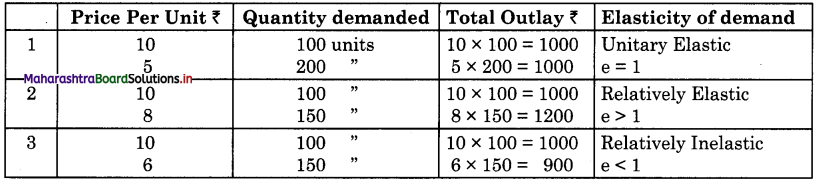
  2. peep – to peer into something cautiously
  3. overwhelmed – overcome
  4. groaned – made a low sound of distress.

Maharashtra Board Solutions

Question 9.
Find examples of code mixing from the extract and write them down.
Answer:
1. annas
2. pyol

Question 10.
Find from the extract the antonyms of the following words:

  1. light
  2. noise
  3. few
  4. dead

Answer:

  1. light × darkness
  2. noise × silence
  3. few × many
  4. dead × alive

Non-Textual Grammar:

1. Do as directed:

Question 1.
A stone struck the man on the head.
(Rewrite using the passive voice.)
Answer:
The man was struck on the head by a stone.

Maharashtra Board Solutions

Question 2.
You will not recover. Refrain from smoking.
(Rewrite using ‘unless’.)
Answer:
You will not recover unless you refrain from smoking.

Question 3.
He is certainly taller than his brother.
(Rewrite in the positive degree.)
Answer:
His brother is certainly not as tall as he is.

Spot the error in the following sentences:

Question 1.
His mouth watered when he saw a bouquet of grapes.
Answer:
His mouth watered when he saw a bunch of grapes.

Maharashtra Board Solutions

Question 2.
They left their luggages at the railway station.
Answer:
They left their luggage at the railway station.

Maharashtra Board Class 12 Economics Solutions Chapter 1 Introduction to Micro and Macro Economics

Balbharti Maharashtra State Board Class 12 Economics Solutions Chapter 1 Introduction to Micro and Macro Economics Textbook Exercise Questions and Answers.

Maharashtra State Board Class 12 Economics Solutions Chapter 1 Introduction to Micro and Macro Economics

1. Choose the correct option:

Question 1.
The branch of economics that deals with the allocation of resources.
a) Microeconomics
b) Macroeconomics
c) Econometrics
d) None of these
Options:
1) a, b and c
2) a and b
3) only a
4) None of these
Answer:
3) only a

Maharashtra Board Class 12 Economics Solutions Chapter 1 Introduction to Micro and Macro Economics

Question 2.
Concepts studied under Micro economics.
a) National income
b) General price level
c) Factor pricing
d) Product pricing
Options :
1) b and c
2) b, c and d
3) a, b and c
4) c and d
Answer:
4) c and d

Question 3.
Method adopted in micro economic analysis.
a) Lumping method
b)Aggregative method
c) Slicing method
d) Inclusive method
Options :
1) a, c and d
2) a. b and d
3) only c
4) only a
Answer:
3) only c

Question 4.
Concepts studied under Macro economics.
a) Whole economy
b) Economic development
c) Aggregate supply
d) Product pricing
Options:
1) a, b and c
2) b, c and d
3) only d
4) a, b, c and d
Answer:
1) a, b and c

Maharashtra Board Class 12 Economics Solutions Chapter 1 Introduction to Micro and Macro Economics

2. Complete the correlation:

1) Micro economics : Slicing method : : Macro economics: ……………. 1
2) Micro economics: Tree : : Macro economics: …………….. 2
3) Macro economic theory : Income and employment:: Micro economics : ……………. 4
4) Makros : Macro economics:: Mikros : ……………… 3
5) General equilibrium : Macro economics :: …………….. : Micro economics 5
Answers:

  1. Lumping method
  2. Forest
  3. Price theory
  4. Micro economics
  5. partial equilibrium

3. Identify and explain the concepts from the given illustrations:

Question 1.
Gauri collected the information about the income of a particular firm.
Answer:
Concept: Micro economics / Slicing method.
Explanation : Micro economics refers to the study of small unit from whole economy. Micro economics uses slicing method to split the whole economy into small individual units.
Gauri has used slicing method from micro economics to collect information about the income of a particular firm from various firms.

Question 2.
Ramesh decided to take all decisions related to production, such as what and how to produce?
Answer:
Concept: Free market economy.
Explanation : A free market economy is that economy where the economic decisions regarding production of goods are taken at individual level.

Eg. What to produce? How much to produce? How to produce? etc. decisions are taken by producers.
With the help of free market economy Ramesh has taken decision related to production such as What to produce? and How to produce?

Question 3.
Shabana paid wages to workers in her factory and interest on her bank loan.
Answer:
Concept : Factor Pricing.
Explanation : Theory of factor pricing refers to determining the factor rewards for land, labour, capital and entrepreneur in the form of rent, wages, interest and profit respectively.

Shabana is an entrepreneur who has paid wages to its worker in a factory for production of goods and also paid interest on her bank loan in form of rewards to the factors of production.

Maharashtra Board Class 12 Economics Solutions Chapter 1 Introduction to Micro and Macro Economics

4. Answer the following:

Question 1.
Explain the features of Micro economics.
OR
Explain the characteristics or nature of micro economics.
Answer:
Features of Micro Economics :

  • Based on certain ssumption : Micro economics is based on ‘ceteris paribus’ assumption i.e., other things remaining constant like full employment, laissez faire policy, perfect competition, pure capitalism, etc.
  • Study of Individual units : Micro economics deals with the study of behaviour of small individual units of the economy such as individual units of the economy such as individual consumer, individual firm, individual industries, individual prices, etc.
  • Slicing Method : It divides or slices the economy into small units and studies each unit in detail e.g. study of a particular household demand in detail.
  • Analysis of Market Structures : Micro economics analyses different market structures such as perfect competition, monopoly, monopolistic competition, oligopoly, etc.
  • Use of Marginalism Principle : The term ‘marginal’ means change brought in total by an additional unit. Marginal analysis helps to study a variable through the changes by which producers and consumers take economic decisions using this principle.
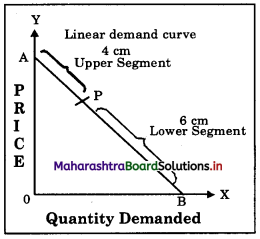
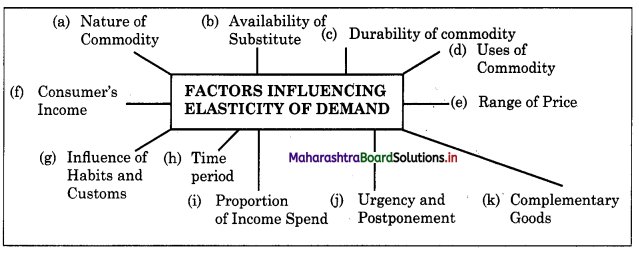
  • Price Theory : Micro economics is known as price theory because it determines the prices of goods and services as well as prices of factors of production.
  • Limited Scope : The study of micro economics is limited to individual economic unit only. It does not deal with macro problems like unemployment, inflation, deflation, poverty, unemployment, population, etc.
  • Partial I quilibrium : Micro economics analysis deals with partial equilibrium which analyses equilibrium position of an individual economic unit i.e. individual consumer, individual firm, etc.

Question 2.
Explain the importance of Macro economics.
Answer:
Importance of Macro Economics :

  • Functioning of an Economy : It gives an idea of functioning of an economic system and help us to understand the behavioural pattern of aggregate variables.
  • Economic fluctuations : It helps to analyse the causes of fluctuation in income, output and employment.
  • National Income : It helps to study about National Income and makes possible to formulate correct economic policies.
  • Economic Development : It helps us to understand the problems of the developing countries such as poverty, difference in the standards of living, etc., and suggest important steps to achieve economic development.
  • Performance of an Economy : It helps us to analyse the performance of an economy where National Income estimates are used to measure the same.
  • Study of Macro-economic Variables :
    Study of macro economic variables are important to understand the working of the economy.
  • Level of Employment : Macro economics helps to analyse the general level of employment and output in an economy.

Maharashtra Board Class 12 Economics Solutions Chapter 1 Introduction to Micro and Macro Economics

Question 3.
Explain the scope of Macro economics.
OR
“Scope of Macro Economics is wide.” Explain.
OR
Macro Economics is comprehensive in nature.
OR
Explain the subject matter of macro economics.
Answer:
Scope of Macro Economics:
The given chart helps us to understand the scope of macro economics.
Maharashtra Board Class 12 Economics Solutions Chapter 1 Introduction to Micro and Macro Economics 1
1. Theory of Income and Employment : It explains which factors determine the level of National Income and employment and what j causes fluctuations in the level of income, output and employment.
To understand how the level of employment is determined, we have to study the consumption function. It includes theory of business cycles.

2. Theory of General Price Level and Inflation: Macro economics analyses shows how the general price level is determined and the causes for fluctuations in it. This study is important for understanding the  problems created by inflation and deflation.

3. Theory of Economic Growth and Development : Macro economics studies the causes of under development and poverty in poor countries and suggests strategies for accelerating growth and development in the country.

4.  Macro theory of Distribution : Macro theory of distribution deals with the relative share of rent, wages, interest and profit in j the total national income of various classes.

5. State with reasons whether you agree or disagree with the following statements:

Question 1.
The scope of micro economics is unlimited.
Answer:
No, I do not agree with this statement.

  • Micro economics deals with small or individual units.
  • Micro economics is the study of particular firm, particular household, individual prices, wages, incomes, individual industries, particular commodities.
  • Micro economics deals with small part of National economy. It does not deal with whole economy like National income, Aggregate demand, Aggregate supply, poverty, inflation, etc.
  • Hence, the scope of micro economics is limited.

Question 2.
Macro economics deals with the study of individual behaviour.
OR
Macro economics studies small units.
Answer:
No, I do not agree with this statement.
OR
Macro Economics is the study of I aggregate.
OR
Macro economics is concerned with macro economic variables.
Yes, I agree with this statement.

  • Macro Economics studies the behaviour ofthe economy as a whole and not individual behaviour.
  • It studies about larger economic units or aggregate economic variables like aggregate demand, aggregate supply, total investment, total savings, total employment, etc.
  • It studies the general price level and macro theory of distribution.
  • Whereas Micro Economics deals with individual behaviour of the people in the economy. It studies about individual demand, market demand, individual income, price of particular commodity etc.
  • According to Prof. Kenneth E. Boulding “Macro Economics deals not with individual; quantities as such, but with aggregates of these quantities, not with individual income but with National Income, not with individual prices but with general price level, not with individual output but with National Output.

Maharashtra Board Class 12 Economics Solutions Chapter 1 Introduction to Micro and Macro Economics

Question 3.
Macro economics is different from micro economics.
OR
Macro economics is wider than Micro economics.
OR
There is difference between micro economics and macro economics.
Answer:
Yes, I agree with this statement.

  • Micro economics is a study of a particular unit of an economy. On the other hand macro economics is the study of entire economy.
  • Micro economics studies individual demand, individual supply, individual income, price determination of particular product, etc. On the other hand macro economics studies aggregate demand, aggregate supply, national income, etc.
  • Micro economics follows partial equilibrium analysis and macro economics follows general equilibrium analysis.
  • Micro economics uses slicing method for study of small unit and macro economics uses lumping method for study of large unit.
  • Therefore, macro economics is different from micro economics.

Question 4.
Micro economics uses slicing method.
Answer:
Yes, I agree with this statement.

  • Micro economics deals with small or individual units.
  • Micro economics divides or slices the economy into small units and studies each unit in detail.
  • It is concerned with microscopic study of these units.
  • It is the study of particular firm, particular household, individual prices, wages, incomes, etc.
  • Hence, micro economics uses slicing method.

Question 5.
Micro economics is known as Income theory.
Answer:
No, I do not agree with this statement.
OR Micro economics is also known as price theory.
Yes, I agree with this statement.

  • Micro Economics is known as ‘Price Theory’.
  • The scope of micro economics includes the study of product pricing and factor pricing.
  • The theory of product pricing explains how the price of food grains, vegetables, clothes, etc., are determined.
  • They are determined by the interaction of market demand and supply forces.
  • The theory of factor pricing explains the distribution of factor income such as rent on land, wages to labourers, interest on capital and profit to entrepreneurs.
  • The factor prices are also determined by the demand and supply forces.
  • Therefore, Micro Economics is also known as ‘Price Theory’.

Maharashtra Board Class 12 Economics Solutions Chapter 1 Introduction to Micro and Macro Economics

6. Answer in detail :

Question 1.
Explain the importance of Micro economics.
Answer:
Introduction : Micro economics is the Js branch of economics that studies the behaviour of individuals.
It includes individual prices, wages, income, individual industries, particular commodities, particular household, etc.
(1) Definition :
(a) According to Maurice Dobb – “Micro economics is in fact a microscopic study of l the economy.
(b) According to Prof. A. P. Lerner – “Micro economics consists of looking at the economy ? through a microscope as it were to see how the millions of cell in the body of economy – the individuals or households as consumers and individuals or firms as producers play their part in the working of the whole economics organism.

(2) Meaning:
Micro economics deals with small individual economics units such as an individual ( consumer, individual producer, the price of a particular commodity or factor etc.

(3) Importance :
(a) Price Determination : Micro economics j explains how the prices of different products < and various factprs of production are determined.

(b) Free Market Economy : A free market economy is that economy where the economic decisions are taken at individual levels without intervention by the government. Decisions are regarding production of goods such as What to produce? How much to produce? How to produce? etc.

(c) Foreign Trade : Micro economics also explains gains from foreign trade, effects of tarrifs, factors affecting exchange rate, etc.

(d) Economic Model Building : Micro
economics helps in understanding various complex economic situations with the help of economic models.

(e) Business Decision : Micro economics theories are helpful to businessman for taking important business decision related to determination of cost of production and prices of goods, maximization of output & profit, etc.

(f) Useful to Government : It is useful in formulating and evaluating economic policies including pricing and distribution policies that promote economic welfare. It is useful in determining tax policy, public, expenditure policy, etc.

(g) Basis of Welfare Economics : It explains how optimum use of resources can be made to increase the welfare of the society. It also studies how taxes affect social welfare.

Question 2.
Explain the concept of Macro economics and its features.
Answer:
Introduction : Macro economics is the branch of economics that studies the behaviour and performance of an economy as a whole. It includes inflation, unemployment, working of the monetary system, business cycles, economic policies, etc.

(1) Definition:
(a) J. L. Hansen : “Macro economics is that branch of economics which considers the relationship between large aggregates such as the volume of employment, total amount of savings, investment, national income, etc”.
(b) Prof. Carl Shapiro : “Macro economics deals with the functioning of the economy as a whole. ”

(2) Meaning:
Macro economics is the study of aggregates national income, total employment, total consumption, inflation, total saving, etc.

(3) Features:
(a) Study of Aggregate : Macro economics deals with the study of entire economy. It studies the overall condition in the economy, such as National Income, National Output, Total Employment, General Price levels, etc.

(b) General Price Level : Macro economic studies the determination and changes in general price level which is the average of all prices of goods and services currently being produced in the economy.

(c) policy Oriented : Macro economics is a policy oriented science which is useful in formulating economic policies to promote economic growth, to control inflation and depression, to generate employment, etc.

(d) Lumping Method : Lumping method is the study of the whole economy rather than in part. It considers aggregates like National Income, Total consumption, etc. instead of personal income, PCC, etc.

(e) General Equilibrium Analysis : Macro Economics analysis is based on general equilibrium which deals with the economic system as a whole and studies the inter relationships between the various macro variables in an economy. General equilibrium deals with the behaviour of demand, supply and prices in the whole economy.

(f) Income Theory : Macro economics studies the concept of National Income and its causes of fluctuations that lead to business cycles i.e. inflation and deflation.

(g) Growth Models : Macro economics studies various factors that contribute to economic growth and development. These growth models are used for studying economic development.

(h) Interdependence : There is an element of interdependence among the macro economic variables such as income, output, employment, investment, price level, etc.

Intext Questions

Try this (Textbook Page 6)

Visit the vegetable market in the nearest area and try to get information about income and expenditure items of a particular seller.
Answer:
[Note : Students should do this activity by themselves.]