Maharashtra Board Class 12 History Important Questions Chapter 3 India and European Colonialism

Balbharti Maharashtra State Board Class 12 History Important Questions Chapter 3 India and European Colonialism Important Questions and Answers.

Maharashtra State Board 12th History Important Questions Chapter 3 India and European Colonialism

1A. Choose the correct alternative and rewrite the statement.

Question 1.
The ____________ established the East India Company in December 1600.
(a) British
(b) French
(c) Dutch
(d) Portuguese
Answer:
(a) British

Question 2.
The Cartaz was a ____________ which the Indian rulers had to get from the Portuguese.
(a) passbook
(b) license
(c) diary
(d) notebook
Answer:
(b) license

Maharashtra Board Class 12 History Important Questions Chapter 3 India and European Colonialism

Question 3.
The main building of the British factory carried the ____________
(a) Union Jack
(b) American flag
(c) Indian flag
(d) Dutch flag
Answer:
(a) Union Jack

Question 4.
The fort named at Chennai was ‘Fort ____________’.
(a) St. Peter
(b) St. George
(c) St. Francis
(d) St. Xavier
Answer:
(b) St. George

Question 5.
____________was appointed as the Governor of Bombay.
(a) Abraham Shipman
(b) George Oxenden
(c) Jean Baptiste Colbert
(d) Charles II
Answer:
(a) Abraham Shipman

Question 6.
The Dutch established their first colony at ____________
(a) Surat
(b) Machilipatnam
(c) Bombay
(d) Chandranagar
Answer:
(b) Machilipatnam

Question 7.
The wars fought between the British and the French are known as ‘___________’.
(a) Bombay wars
(b) Madras wars
(c) Carnatic wars
(d) Calcutta wars
Answer:
(c) Carnatic Wars

Maharashtra Board Class 12 History Important Questions Chapter 3 India and European Colonialism

Question 8.
The Dutch established their first factory at ____________
(a) Pondicherry
(b) Pulicat
(c) Port Nova
(d) Petapuli
Answer:
(d) Petapuli

1B. Find the incorrect pair from group ‘B’ and write the corrected one.

Question 1.

Group ‘A’Group ‘B’
(a) Vasco da GamaSeafarer
(b) Abraham ShipmanGovernor of Bombay
(c) George OxendenGovernor of Surat
(d) Jean Baptiste ColbertItalian finance minister

Answer:
Jean Baptiste Colbert – French finance minister

2A. Write the names of historical places/persons/events.

Question 1.
License which the Indian rulers had to get from the Portuguese-
Answer:
Cartaz

Question 2.
Indian king who built his own navy-
Answer:
Chhatrapati Shivaji Maharaj

Question 3.
The company was established by the British in 1600-
Answer:
The East India company

Question 4.
The staff of factories was called-
Answer:
Factors

Question 5.
Flag of the British-
Answer:
Union Jack

Maharashtra Board Class 12 History Important Questions Chapter 3 India and European Colonialism

Question 6.
Commander-in-chief of Mumbai-
Answer:
George Oxenden

Question 7.
The company formed by several Dutch companies-
Answer:
United East India

Question 8.
Port city mentioned in ‘Periplus’ of Erythrean sea-
Answer:
Machilipatnam (Mosalia)

Question 9.
Mughal emperor who granted permission to the French to open a factory in Surat-
Answer:
Aurangzeb

Question 10.
The main center of French operations-
Answer:
Pondicherry (Puducherry)

2B. Choose the correct reason from those given below and complete the sentence.

Question 1.
The Indian rulers had to get Cartaz (license) from the Portuguese ____________
(a) for sailing on the Indian Ocean
(b) for carrying on a trade
(c) for enjoyment
(d) for conducting naval exercises
Answer:
(a) for sailing on the Indian Ocean

Maharashtra Board Class 12 History Important Questions Chapter 3 India and European Colonialism

Question 2.
The British built factories in India because ____________
(a) they wanted to store machines
(b) they wanted to store goods bought at low prices
(c) they wanted to employ Indians in these factories
(d) they wanted to accommodate the staff at these factories
Answer:
(b) they wanted to store goods bought at low prices

Question 3.
Charles II leased Mumbai to the East India Company because ____________
(a) the East India company wanted Mumbai
(b) Mumbai was too far away to administer
(c) the expenditure for its maintenance exceeded the income earned from it
(d) the East India Company was a rich company
Answer:
(c) the expenditure for its maintenance exceeded the income earned from it

Question 4.
A British mint was established in Mumbai because ____________
(a) Mumbai was an ideal place for setting up a mint
(b) the British could keep an eye on the mint
(c) the British had competition from other European powers
(d) this encouraged merchants and artisans to come and settle down in Mumbai
Answer:
(d) this encouraged merchants and artisans to come and settle down in Mumbai

3. Complete the following concept map.

Question 1.

Office HoldersOffice Holders
Vice-rei and Capitaon-i-Jaral…………………………
……………………………Archbishop
Chancellor…………………………
……………………………Captain

Answer:

Office HoldersOffice Holders
Vice-rei and Capitaon-i-JaralViceroy and General of the army
ArcebispoArchbishop
ChancellorJudge
CapitaonCaptain

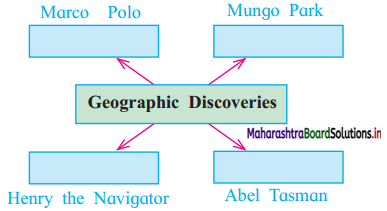
Question 2.
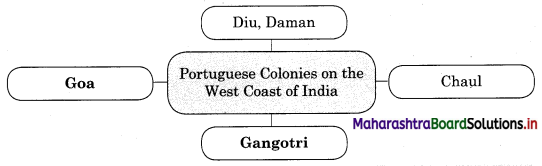
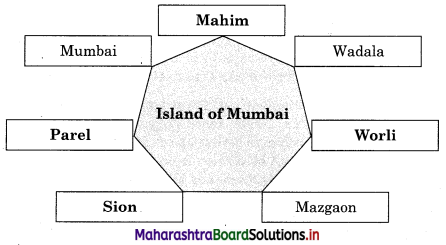
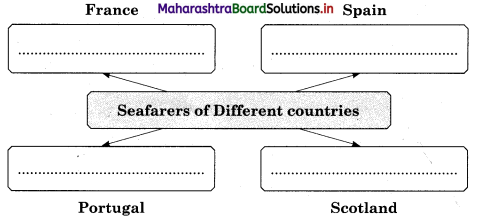
Maharashtra Board Class 12 History Important Questions Chapter 3 India and European Colonialism 3
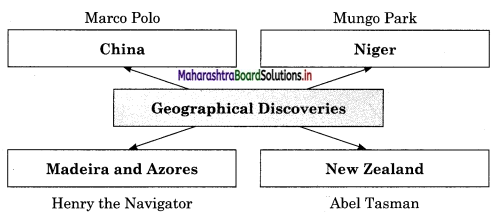
Answer:
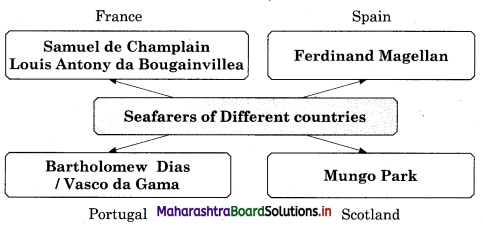
Maharashtra Board Class 12 History Important Questions Chapter 3 India and European Colonialism 3.1

4A. Write short notes.

Question 1.
Cartaz
Answer:
The Cartaz was a license issued by the Portuguese to the Indian rulers for sailing on the Indian Ocean when they established firm control on the Indian Ocean. It usually carried details like the name of the vessel (ship), the name of the captain of the ship, port of departure and arrival, the list of weaponry on the ship loaded for the purpose of self-defense, etc.

Maharashtra Board Class 12 History Important Questions Chapter 3 India and European Colonialism

Question 2.
Portuguese Trade
Answer:
The king of Calicut wrote to the King of Portugal in a letter sent with Vasco da Gama “Our state is rich in spices like cloves, ginger, black pepper, and precious stones. We expect you to pay us in gold, silver, corals in exchange for our spices and precious stones”. Vasco da Gama sold the commodities in Portugal, which he carried from India. He could earn a huge amount of money in that trade which was sixty times more than the money he spent for his return journey to Portugal.

Question 3.
Factory
Answer:
The British established factories in India. For this, they used to acquire large plots of land. These plots were used to build warehouses, residential quarters, and offices. The main building of the factory carried the ‘Union Jack’. The staff of these factories was called ‘Factors’. The meals provided to the staff included bread, meat, rice, Khichadi of pulses and rice, pickles, etc. The company had created beautiful gardens for the benefit of the staff at Surat, Karwar, Machilipatnam, Petapuli, Chennai, and Mumbai.

Question 4.
Machilipatnam
Answer:
The Dutch established their first colony at Machilipatnam. This port city came into existence in the 3rd century B.C.E. It is also mentioned in ‘Periplus’ of the Erythrean Sea as ‘Mosalia’.

4B. Explain the following statements with reasons.

Question 1.
The British built ‘Factories’ in India.
Answer:
The British used to acquire large plots of land for their factories. These plots were used to build warehouses, residential quarters, and offices. The British needed a permanent place to store the goods at low prices. It was required of them to stay in India for a period of 9 to 13 months to carry out trading transactions. Hence they decided to build ‘Factories’ or ‘emporiums’ in India. The staff of these factories was called ‘factors’.

Maharashtra Board Class 12 History Important Questions Chapter 3 India and European Colonialism

Question 2.
The ‘Carnatic Wars’ were fought between the British and the French.
Answer:
Pondicherry which was the main center of French operations was ruled by the Nawab of Karnataka. The members of the Nawab family were fighting amongst themselves for the throne. The British and the French started intervening in the matter which resulted in three battles between the British and the French from 1744 to 1763 C.E. known as the ‘Carnatic Wars’.

5. State your opinion.

Question 1.
Charles II leased Mumbai to the East India Company.
Answer:
Charles II had received the islands of Mumbai as a gift from the King of Portugal on his engagement to Princess Braganza of Portugal. He found it difficult to maintain the islands as the expenditure incurred on its maintenance exceeded the income earned from it. So, he leased it to the East India Company.

Question 2.
In 1602, several Dutch companies got together to form ‘United East India’.
Answer:
The Dutch government issued a license to the company to conduct trading with the eastern countries. The same license permitted them to appoint staff, establish factories, build forts, engage in battles against the eastern countries, and also sign treaties with them. Accordingly, the company appointed a Governor-General to take care of Indian affairs.

Maharashtra Board Class 12 History Important Questions Chapter 3 India and European Colonialism

6. Answer the following questions in detail.

Question 1.
What rights were ‘the French East India Company’ given by the French King Louis XIV?
Answer:
The French East India Company was established in 1664 by Jean Baptiste Colbert. The company was given the authority to trade with eastern countries to maintain army and navy and also exemption from taxes. The company was also given the authority to enter war or treaty with the eastern rulers. In 1666, the company sent a contingent to the court of Mughal Emperor Aurangzeb and obtained permission to establish a factory in Surat.

Maharashtra Board Class 12 History Solutions Chapter 3 India and European Colonialism

Balbharti Maharashtra State Board Class 12 History Solutions Chapter 3 India and European Colonialism Textbook Exercise Questions and Answers.

Maharashtra State Board Class 12 History Solutions Chapter 3 India and European Colonialism

1A. Choose the correct alternative and rewrite the statement.

Question 1.
Vasco da Gama was a seafarer from ___________
(a) Poland
(b) England
(c) France
(d) Portugal
Answer:
(d) Portugal

Maharashtra Board Class 12 History Solutions Chapter 3 India and European Colonialism

Question 2.
The license was given by England to the East India Company to trade with eastern countries by ___________
(a) Sir George Oxenden
(b) Princess Braganza
(c) Queen Elizabeth
(d) Homer
Answer:
(c) Queen Elizabeth

1B. Find the incorrect pair from group ‘B’ and write the corrected one.

Question 1.

Group ‘A’Group ‘B’
(a) ArcebispoChief Executive Officer
(b) ChancellorJudge
(c) Vedor da FazendaIn charge of Company’s Possessions
(d) CapitaonCaptain

Answer:
(a) Arcebispo – Archbishop

2. Complete the concept map.

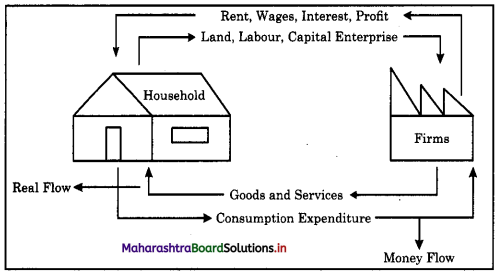
Question 1.
Maharashtra Board Class 12 History Solutions Chapter 3 India and European Colonialism 2
Answer:
Maharashtra Board Class 12 History Solutions Chapter 3 India and European Colonialism 2.1

3. Explain the following statements with reasons.

Question 1.
The Indian rulers had to obtain Cartaz.
Answer:
Cartaz: The Cartaz was a license issued by the Portuguese to the Indian rulers for sailing on the Indian Ocean when they established firm control of the Indian Ocean. It usually carried details like the name of the vessel (ship), the name of the captain of the ship, port of departure and arrival, the list of weaponry on the ship loaded for the purpose of self-defense, etc.

Maharashtra Board Class 12 History Solutions Chapter 3 India and European Colonialism

Question 2.
Indian rulers found it difficult to fight the Portuguese.
Answer:
The Portuguese established a strong navy. They used to launch sudden attacks on their enemy’s territory from the sea and wreck it completely. The Indian rulers could not match the Portuguese in their war tactics. Later when they established their firm control on the Indian Ocean it became necessary for the Indians to get a license from them for sailing on the Indian Ocean.

4. Answer the following questions in detail.

Question 1.
Which are the places where the Portuguese established their colonies?
Answer:
By 1608, the Portuguese had established their colonies on the western coast of India at Diu, Daman, Chaul, Goa (including Sashti and Bardish), Honnavar, Gangoli, Basrur, Mangalore, Kannur, Kodungallur, Kochi, and Kollam. Similarly, on the eastern coast, they had trader colonies at Nagapattinam, Mylapore or Sao Tome/San Thom, and Hugli in Bengal. This stretch of the Portuguese empire had its capital at Goa.

Question 2.
What were the rights given to United East India Company by the Dutch government?
Answer:
The Dutch government issued a license to the company to conduct trading with the eastern countries. The same license permitted them to appoint staff, establish factories, build forts, engage in battles against the eastern countries, and also sign treaties with them. Accordingly, the company appointed a Governor-General to take care of Indian affairs.

Class 12 History Chapter 3 India and European Colonialism Intext Questions and Answers

Try to do this (Textbook Page No. 19)

Collect information of the church in Kerala, named after Vasco da Gama, with the help of the internet.
Answer:
St. Francis Church:

  • Built-in 1503 as one of the oldest European churches in India.
  • Originally known as St. Bartholomew.
  • Constructed of wood and stone.
  • First Portuguese church in India.
  • Founded by Pedro Alvarez De Cabral.
  • Built-in Persian architecture style.
  • The Portuguese built a fort and within the fort, they built a church.
  • History has it that Vasco da Gama died during his third visit to India and was buried here in 1524.
  • After 14 years his body was moved to Lisbon.

Try to do this (Textbook Page No. 21)

Make a list of the ship-building facilities in pre-independence and post-independence India and collect information about the development of the shipbuilding industry.
Answer:
Students can use the following points as references.

  • India’s maritime history began during the 3rd millennium B.C.E.
  • When Indus valley had trade contact with Mesopotamia.
  • Strabo mentions Rome and Greece had maritime trade relations with India.
  • The Portuguese were the first Europeans to reach India by sea and traded in spices etc. followed by the Dutch.
  • The shipbuilding activities of Chhatrapati Shivaji Maharaj are particularly noteworthy. Chhatrapati Shivaji Maharaj built a strong naval force.
  • In the modern period, the British East India Company shipped substantial quantities of spices.
  • Ship Building was a well-established craft.
  • Some of the well-known shipyards in India today are Sembmarine Kakinada Ltd (SKL) India, Goa Shipyard Limited (GSL) India, Western India Shipyard Ltd.

Maharashtra Board Class 12 History Solutions Chapter 3 India and European Colonialism

Try to do this (Textbook Page No. 21)

The currency of various countries is known by specific names. Prepare a list of countries and their currencies.
Answer:

CountryCurrency
1. AfghanistanAfghan Afghani (AFN)
2. ArgentinaArgentine peso (ARS)
3. AustraliaAustralian dollar (AUS)
4. BahrainBahraini dinar (BHD)
5. ChinaChinese yuan (CNY)
6. DenmarkDanish krone (DKK)
7. EgyptEgyptian pound (EGP)
8. GermanyEuro (EUR)
9. IndiaIndian rupee (INR)
10. JapanJapanese yen (JPY)
11. United States of AmericaUS dollar (USD)
12. United KingdomPound sterling (GBP)

Project (Textbook Page No. 23)

Compile the names of Governors of British East India Company from 1600 to 1857. C.E.
Answer:
The Regulating Act of 1773 created the office with the title of Governor-General of Presidency of Fort William or Governor-General of Bengal. He was appointed by the Court of Directors of the East India Company.

Governor-GeneralYears Active
1. Warren Hastings1772 – 1785
2. Sir John Macpherson1785 – 1786
3. Lord Cornwallis1786 – 1793
4. Sir John Shore1793 – 1798
5. Lord Wellesley1798 – 1805
6. Sir George Barlow1805 – 1807
7. Lord Minto I1807 – 1815
8. Lord Hastings1813 – 1823
9. Lord Amherst1823 – 1828
10. Lord William Bentinck1828 – 1835
11. Sir Charles Metcalfe1835 – 1836
12. Lord Auckland1836 – 1842
13. Lord Dalhousie1848 – 1856
14. Lord Canning1856 – 1862
15. Lord Lawrence1864 – 1869
16. Lord Mayo1869 – 1872
17. Lord Lytton1876 – 1880
18 .Lord Ripon1880 – 1884
19. Lord Dufferin1884 – 1888
20. Lord Lansdowne1888 – 1894
21. Lord Curzon1894 – 1905
22. Lord Minto1905 – 1910
23. Lord Hardinge1910 – 1916
24. Lord Chelmsford1916 – 1921
25. Lord Reading1921 – 1926
26. Lord Irwin1926 – 1931
27. Lord Willingdon1931 – 1936
28. Lord Linlithgow1936 – 1944
29. Lord Wavell1944 – 1947
30. Lord MountbattenMarch 1947 – August 1947


Maharashtra Board Class 12 History Important Questions Chapter 2 European Colonialism

Balbharti Maharashtra State Board Class 12 History Important Questions Chapter 2 European Colonialism Important Questions and Answers.

Maharashtra State Board 12th History Important Questions Chapter 2 European Colonialism

1A. Choose the correct alternative and rewrite the statement.

Question 1.
__________ was a result of Industrial Revolution.
(a) Communism
(b) Colonialism
(c) Capitalism
(d) Imperialism
Answer:
(b) Colonialism

Question 2.
The King of __________ was the supreme authority.
(a) England
(b) Portugal
(c) Russia
(d) Spain
Answer:
(d) Spain

Maharashtra Board Class 12 History Important Questions Chapter 2 European Colonialism

Question 3.
In 1496, __________ was granted permission to establish colonies on American land.
(a) John Abbot
(b) George Washington
(c) Thomas Jefferson
(d) Ferdinand Magellan
Answer:
(a) John Abbot

Question 4.
The Boston Tea Party took place in the year __________
(a) 1771
(b) 1772
(c) 1773
(d) 1774
Answer:
(c) 1773

Question 5.
__________ was earlier known as ‘Brahmadesh’ (Burma).
(a) Cambodia
(b) Vietnam
(c) Thailand
(d) Myanmar
Answer:
(d) Myanmar

Question 6.
The __________ war was fought in the year 1885 C.E.
(a) Third Anglo-Burmese war
(b) Second Anglo-Burmese war
(c) First Anglo Burmese war
(d) Anglo-Nepalese war
Answer:
(a) Third Anglo-Burmese war

Maharashtra Board Class 12 History Important Questions Chapter 2 European Colonialism

Question 7.
The British imprisoned __________ after his defeat.
(a) George Washington
(b) King Thibaw
(c) Thomas Jefferson
(d) John
Answer:
(b) King Thibaw

Question 8.
__________ is the capital of Tibet.
(a) Leh
(b) Ladakh
(c) Lhasa
(d) Laos
Answer:
(c) Lhasa

1B. Find the incorrect pair from group ‘B’ and write the corrected one.

Question 1.

Group ‘A’Group ‘B’
(a) The Boston Tea Party1770
(b) Declaration of Independence1774
(c) The Stamp Act1765
(d) American Independence1780

Answer:
The Boston Tea Party – 1773

Question 2.

Group ‘A’Group ‘B’
(a) Queen of EnglandQueen Elizabeth I
(b) King of MyanmarKing Thibaw
(c) King of BelgiumLouis XVI
(d) Chancellor of GermanyBismarck

Answer:
King of Belgium – Leopold II

2A. Write the names of historical places/persons/events.

Question 1.
The people of Asia and Africa were economically exploited by the-
Answer:
Europeans

Question 2.
In 1607 the British built a colony on the banks of the river ‘James’-
Answer:
Jamestown

Maharashtra Board Class 12 History Important Questions Chapter 2 European Colonialism

Question 3.
The country which was earlier known as ‘Brahmadesh’-
Answer:
Myanmar

Question 4.
Governor-General of India who declared war against Myanmar-
Answer:
Lord Amherst

Question 5.
The American revolt of independence is also known as-
Answer:
American Revolution

Question 6.
The book written by Lokmanya Tilak in Mandalay jail-
Answer:
Geetarahasva

Question 7.
Venue of the geographical conference in 1876-
Answer:
Brussels

Maharashtra Board Class 12 History Important Questions Chapter 2 European Colonialism

Question 8.
The Chancellor of Germany who established the first German colony in West Africa in 1883-
Answer:
Bismarck

2B. Choose the correct reason from those given below and complete the sentence.

Question 1.
The American colonies declared boycott on British goods because __________
(a) restrictions were imposed on them and autonomy
(b) British goods were of poor quality
(c) heavy taxes were levied on British goods
(d) American goods were of superior quality
Answer:
(a) restrictions were imposed on them and autonomy.

Question 2.
The British imprisoned King Thibaw because __________
(a) he was an outlaw
(b) he refused to obey the British
(c) he was a cruel king
(d) the British wanted to ensure that he would not be able to rise against the British or have any contact with his subjects
Answer:
(d) the British wanted to ensure that he would not be able to rise against the British or have any contact with his subjects.

Question 3.
The British wanted to bring Bhutan under their control because __________
(a) Bhutan was a beautiful country
(b) Bhutan was a rich kingdom
(c) Bhutan helped to open the trade route from Bengal to Tibet for the British
(d) Bhutan was militarily weak
Answer:
(c) Bhutan helped to open the trade route from Bengal to Tibet for the British.

Maharashtra Board Class 12 History Important Questions Chapter 2 European Colonialism

Question 4.
Sudan was important for England because __________
(a) the Nile, the lifeline of Egypt originates in Sudan
(b) Sudan was rich in minerals
(c) Sudan had a strong army
(d) England had an ulterior motive
Answer:
(a) the Nile, the lifeline of Egypt originates in Sudan.

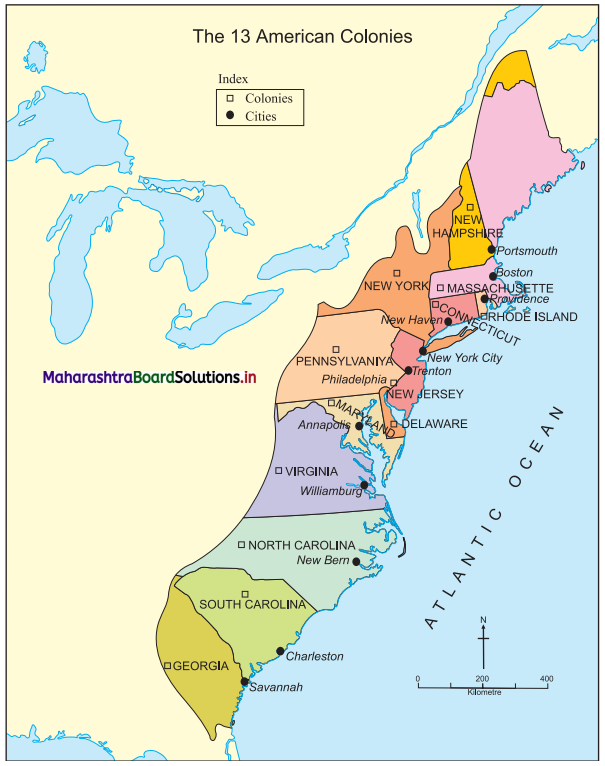
3A. Observe the map on textbook page 12 and answer the questions based on it.

Maharashtra Board Class 12 History Important Questions Chapter 2 European Colonialism 3A

Question 1.
Write the names of the thirteen colonies.
Answer:
New Hampshire, New York, Massachusetts, Connecticut, Rhode Island, Pennsylvania, New Jersey, Delaware, Maryland, Virginia, North Carolina, South Carolina, and Georgia.

Question 2.
Name some of the cities in the colonies.
Answer:
Portsmouth, Boston, New York City, Trenton, etc.

Question 3.
What is the name of the ocean that lies to the east of the colonies?
Answer:
The Atlantic Ocean lies to the east of the colonies.

3B. Complete the following concept map.

Question 1.

Important EventsDates
The Stamp Act……………………..
………………………..1773
Declaration of Independence………………………
……………………….1780

Answer:

Important EventsDates
The Stamp Act1765
The Boston Tea Party1773
Declaration of Independence1774
American Independence1780

Question 2.
Maharashtra Board Class 12 History Important Questions Chapter 2 European Colonialism 3B Q2
Answer:
Maharashtra Board Class 12 History Important Questions Chapter 2 European Colonialism 3B Q2.1

Question 3.
Maharashtra Board Class 12 History Important Questions Chapter 2 European Colonialism 3B Q3
Answer:
Maharashtra Board Class 12 History Important Questions Chapter 2 European Colonialism 3B Q3.1

4A. Write short notes.

Question 1.
The Stamp Act (1765).
Answer:

  • The Stamp Act was passed in the year 1765. This act made it obligatory to purchase special stamps for important documents.
  • British colonies in America like Virginia, Massachusetts put up resistance against the Stamp Act and also other restrictions on the colonies.

Maharashtra Board Class 12 History Important Questions Chapter 2 European Colonialism

Question 2.
The Boston Tea Party (1773).
Answer:

  • The British Parliament had granted a monopoly to the East India Company to import and sell tea to the colonies.
  • People in the colonies were demanded the removal of restrictions imposed on them and autonomy. The British Government refused to yield to the demands of the colonies and in retaliation America decided to boycott British goods.
  • In 1773, as an act of resistance, the local residents of Boston dumped the boxes of tea in the sea belonging to the East India Company. This event is known as the ‘Boston Tea Party.’

Question 3.
‘Declaration of Independence (1774).
Answer:
Thirteen colonies in America came together and declared independence from Great Britain. On 4th July in the meeting known as the ‘Second Continental Congress,’ a document is known as the ‘Declaration of Independence was adopted. This document was drafted by Thomas Jefferson. The crucial part of this document announced that the 13 American colonies were independent sovereign states. The key point of this document is the statement about three basic human rights namely ‘Life, Liberty, and Pursuit of Happiness. It was stated that these three are the natural rights of all humans which nobody can be deprived of.

4B. Explain the following statements with reasons.

Question 1.
Sudan was important for England.
Answer:
Sudan was a vassal state of England. Sudan was important for England because the Nile which was the lifeline of Egypt originates in Sudan. England without paying heed to local opposition established its supremacy over Sudan. To facilitate the moving of the British army in Sudan, the British began to build a railway track from Uganda to Sudan.

5. State your opinion.

Question 1.
The Boston Tea party took place in 1773.
Answer:

  • The British Parliament had granted a monopoly to the East India Company to import and sell tea to the colonies.
  • People in the colonies were demanded the removal of restrictions imposed on them and autonomy. The British Government refused to yield to the demands of the colonies and in retaliation America decided to boycott British goods.
  • In 1773, as an act of resistance, the local residents of Boston dumped the boxes of tea in the sea belonging to the East India Company. This event is known as the ‘Boston Tea Party.’

Question 2.
‘Declaration of Independence was adopted.
Answer:
Thirteen colonies in America came together and declared independence from Great Britain. On 4th July in the meeting known as the ‘Second Continental Congress’ a document known as ‘Declaration of Independence was adopted. This document was drafted by Thomas Jefferson. The crucial part of this document announced that the 13 American colonies were independent sovereign states. The key point of this document is the statement about three basic human rights namely ‘Life, Liberty, and Pursuit of Happiness. It was stated that these three are the natural rights of all humans which nobody can be deprived of.

Maharashtra Board Class 12 History Important Questions Chapter 2 European Colonialism

Question 3.
The British imprisoned King Thibaw of Myanmar.
Answer:
King Thibaw of Myanmar tried to strike a pact with Italy and Germany. These reasons were enough for the British to feel alarmed. They declared war against King Thibaw when he levied a fine on the Bombay-Burma Trading Corporation, a British company. This led to a war being declared against Burma. King Thibaw surrendered and was imprisoned by the British to ensure that he would not be able to rise against the British or have any contact with his subjects.

Question 4.
The First Anglo-Burmese War was fought.
Answer:
Burma was rich in natural wealth and was also a potential market. The royal dynasty had successfully consolidated the country under their rule. It conquered Manipur in 1813 and in 1822 they attacked Assam. The British were alarmed by these attacks. Hence, Lord Amherst, the Governor-General of India declared war against Myanmar. The war continued for two years. This was the First Anglo-Burmese War. The British navy conquered the port of Rangoon (Yangon) in this war. This war ended with a treaty between the British and the Burmese king.

6. Answer the following questions in detail.

Question 1.
Write a note on England’s role in Australia.
Answer:

  • England first colonised Australia in the 18th century when the first colony of prisoners was deported from England.
  • Later in the 19th century, other regions in Australia were colonised.
  • The British also established their colonies in the island of Tasmania and New Zealand.
  • In the year 1900, the island of Tasmania and the Republic of Australia was created as an integral nation of the British Empire.
  • A bicameral parliament was established and a Governor-General was appointed in Australia by the British king as the viceregal representative.
  • Only European immigrants were allowed to enter Australia.

Question 2.
Explain Britain’s interest in conquering Tibet.
Answer:

  • Tibet was under the influence of the Dalai Lama.
  • The British wanted to gain control over Tibet by arresting Russian advances and increase their own trade.
  • The British military had reached Lhasa, the capital of Tibet.
  • In 1907 as per the treaty between England and Russia, China’s political rule in Tibet was acknowledged.
  • It gave leeway to China to claim Tibet as an integral part of China.

Maharashtra Board Class 12 History Important Questions Chapter 2 European Colonialism

Question 3.
Discuss the consequences of Colonialism.
Answer:
The people in Asia and Africa were economically exploited by the Europeans. People in the colonies lost their independence. Their economic exploitation pushed them into poverty. A new awareness emerged in the political, social, economic, and educational fields. Common people became conscious of democratic systems and their inherent modern values like liberty, equality, and fraternity. People were introduced to principles like administration based on a fundamental legal system, judicial system, availability of education to all.

7. Answer the following question with the help of the given points.

Question 1.
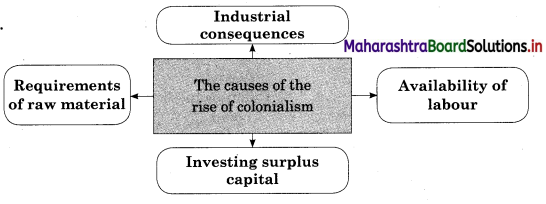
Explain the causes for the rise of Colonialism.
(a) Industrial Consequences
(b) Requirements of Raw Material
(c) Sources of Minerals
(d) Feeling of Racial Superiority
Answer:
(a) Industrial Consequences:
Colonialism was a result of the industrial revolution. Production increased enormously because of the new machines. However, the rate of local consumption was much less compared to the surplus rate of production. Hence, the immediate need of the Europeans was to find new markets for selling their products. It was also necessary that these markets be dependable and easy to dominate.

(b) Requirements of Raw Material:
The desire to create a monopoly in the market and the need to procure raw material at cheaper rates were two major factors that made European nations compete with one another for clear Supremacy.

(c) Sources of Minerals:
The countries in Asia and Africa were rich in minerals like gold, diamonds, silver, coal, etc. This attracted the European nations to Asia and Africa.

(d) Feeling of Racial Superiority:
The Europeans felt it was their responsibility to civilise the people of Asia and Africa. This led to the conversion of Asian and African people to Christianity. It also helped the growth of colonialism.

Question 2.
Write a note on the events that led to the American Revolution.
(a) The Stamp Act of 1765
(b) The Boston Tea Party of 1773
(c) Declaration of Independence in 1774
(d) War at Saratoga
Answer:
(a) The Stamp Act (1765):

  • The Stamp Act was passed in the year 1765. This act made it obligatory to purchase special stamps for important documents.
  • British colonies in America like Virginia, Massachusetts put up resistance against the Stamp Act and also other restrictions on the colonies.

Maharashtra Board Class 12 History Important Questions Chapter 2 European Colonialism

(b) The Boston Tea Party (1773):

  • The British Parliament had granted a monopoly to the East India Company to import and sell tea to the colonies.
  • People in the colonies were demanded the removal of restrictions imposed on them and autonomy. The British Government refused to yield to the demands of the colonies and in retaliation America decided to boycott British goods.
  • In 1773, as an act of resistance, the local residents of Boston dumped the boxes of tea in the sea belonging to the East India Company. This event is known as the ‘Boston Tea Party.’

(c) ‘Declaration of Independence (1774):
Thirteen colonies in America came together and declared independence from Great Britain. On 4th July in the meeting known as the ‘Second Continental Congress,’ a document is known as ‘Declaration of Independence was adopted. This document was drafted by Thomas Jefferson. The crucial part of this document announced that the 13 American colonies were independent sovereign states. The key point of this document is the statement about three basic human rights namely ‘Life, Liberty, and Pursuit of Happiness. It was stated that these three are the natural rights of all humans which nobody can be deprived of.

(d) American War of Independence:
The colonies got into several battles with the British army even after gaining independence. The colonies finally at Saratoga got a decisive victory over the British army. This victory proved to be a turning point for the colonies as the French agreed to support them in their conflict against the British. Eventually, Spain also joined the conflicts in their struggle for independence.

Maharashtra Board Class 12 History Important Questions Chapter 2 European Colonialism

On 7th October 1780, George Washington defeated the British army. On 19th October, British General Lord Cornwallis surrendered and America became independent. The American revolt for independence is also known as the ‘American Revolution’. America proved to the world that the subjects have a right to fight their rulers who deny them their natural rights.

Maharashtra Board Class 12 History Solutions Chapter 1 Renaissance in Europe and Development of Science

Balbharti Maharashtra State Board Class 12 History Solutions Chapter 1 Renaissance in Europe and Development of Science Textbook Exercise Questions and Answers.

Maharashtra State Board Class 12 History Solutions Chapter 1 Renaissance in Europe and Development of Science

1A. Choose the correct alternative and rewrite the statement.

Question 1.
In 1440 ________ started the printing press.
(a) James Watt
(b) Gutenberg
(c) Aristotle
(d) Homer
Answer:
(b) Gutenberg

Question 2.
In 1609 _______ made a modified telescope.
(a) John Kay
(b) Copernicus
(c) Galileo
(d) Kepler
Answer:
(c) Galileo

Maharashtra Board Class 12 History Solutions Chapter 1 Renaissance in Europe and Development of Science

Question 3.
_________ was the first explorer to circumnavigate the African continent.
(a) Henry the Navigator
(b) Marco Polo
(c) Bartholomew Dias
(d) Columbus
Answer:
(c) Bartholomew Dias

B. Find the incorrect pair from group ‘B’ and write the corrected one.

Question 1.

Group ‘A’Group ‘B’
(a) John KayFlying shuttle
(b) Samuel CromptonCotton gin
(c) Edmund CartwrightPower loom
(d) James WattSteam engine

Answer:
Samuel Crompton – Spinning Mule

2. Write the names of historical places/persons/events.

Question 1.
Father of the empirical science —
Answer:
Galileo

Question 2.
Scientists who told the world that the centre of our planetary system is the ‘Sun’ and not the ‘Earth’ —
Answer:
Nicolaus Copernicus

Question 3.
The treatise was written by Varahmihir —
Answer:
Brihatsamhita

Maharashtra Board Class 12 History Solutions Chapter 1 Renaissance in Europe and Development of Science

3. Complete the following concept map.

Question 1.
Maharashtra Board Class 12 History Solutions Chapter 1 Renaissance in Europe and Development of Science Q3
Answer:
Maharashtra Board Class 12 History Solutions Chapter 1 Renaissance in Europe and Development of Science Q3.1

4. Write short notes.

Question 1.
European Crusades.
Answer:

  1. The two cities of Jerusalem and Bethlehem considered holy by the Jews, Christians, and Muslims were under Islamic rule in the 11th century.
  2. Christians of Europe wanted to regain hold over these cities and fought several wars known as ‘Crusaders’.
  3. The common people in Europe were highly inspired to be part of such religious wars.
  4. When the Pope announced that the sins of those who took part in such wars would be forgiven and would immediately go to Heaven, there was spontaneous participation by the common people in the crusaders.
  5. Besides social and political circumstances, the Roman emperors were also trying to bring Syria and Asia Minor under their control.
  6. Moreover, the rich merchants in Genova and Venice in Italy were looking for Central Asian markets to establish their trade.
  7. The first crusade started in 1096 C.E.
  8. A second call for the crusade was given by Pope Eugenius III who sought help from the French King Louis VII and the German King Conrad III.
  9. The crusaders were ultimately defeated by the Turks and in 1187 C.E. Saladin, the Sultan of Egypt defeated the crusaders by conquering Jerusalem.
  10. However, the crusaders failed for several reasons such as the attitude of the Pope and the European rulers common people losing faith, the rift between the Pope and the European kings, etc.

Maharashtra Board Class 12 History Solutions Chapter 1 Renaissance in Europe and Development of Science

Question 2.
Metallurgy in Europe.
Answer:

  1. England had a number of iron mines.
  2. Therefore, it was necessary to advance the technique of smelting iron to acquire purified iron from it.
  3. The fuel for iron furnaces was replaced from wood to coal.
  4. Special machines were made to keep the furnaces at a set temperature and to maintain their aeration.
  5. In 1865, the process of producing steel from molten iron was invented and the nature of the iron industry underwent a major transformation.
  6. At about the same time, a method was adopted to pour the molten metal into casts for making iron bars (e.g. rails).

5. Explain the following statements with reasons.

Question 1.
The European Renaissance is supposed to have reached its zenith in the 15th-16th centuries.
Answer:

  1. The European Renaissance began in the 14th century C.E.
  2. It reached its zenith in the 15th and 16th centuries.
  3. These three centuries laid the foundations of a culture based on rationalism and science.
  4. This age gave a new direction to human intellect genius and way of life.
  5. People started writing poetry, drama, and fiction.
  6. Novel experiments were conducted in the field of science.
  7. In the pre-renaissance period, the thought about the existence of the universe revolved around ‘God’.
  8. In short, in this period new inventions, machinery, art, drama, literature, and geographical discoveries have taken place.

Question 2.
The ‘Industrial Revolution first began in England.
Answer:
‘Industrial Revolution’ indicates the transition from manual production to mechanized production.

  1. In England, the atmosphere was suitable for the industrial revolution.
  2. Large amounts of iron ore and coal were available.
  3. The humid climate of England was suitable for producing yarn.
  4. These conditions proved to be favourable for the textile industry in England.
  5. England had also established a large number of colonies by then so England could obtain raw material at cheap rates from these colonies.
  6. England could also export the processed goods and sell it in their colonies with large profit margins using their navy.
  7. The availability of cheap labour made it possible for them to maintain an optimum level of costs.
  8. These factors prepared the ground for the industrial revolution in England thus giving a boost to its economy. Because of the above reasons Industrial revolution first began in England.

Maharashtra Board Class 12 History Solutions Chapter 1 Renaissance in Europe and Development of Science

6. State your opinion.

Question 1.
The European natural scientists of the 17th century laid the foundations of modern science.
Answer:
The scientists of the 17th century emphasized the following things:

  • To prove that scientific principles established by empirical experiments are true despite time and space.
  • To convert the emergent scientific rules into scientific formulae.
  • To create new scientific parlance and so on.
    These efforts helped the progress of science.

Question 2.
The economy based on surplus production supported economic nationalism and also imperialism.
Answer:

  • Economic nationalism began the vicious circle of continuously capturing new marketplaces, searching for sources of a cheap supply of raw material, maintaining an unbroken chain supply of raw material), to attract more and more investors, to safeguard their investments. This resulted in limitless exploitation of the colonies.
  • Extreme nationalism, industrialization, concepts of racial superiority, aggressive colonial policies further supported the growth of imperialism.
  • The result was the immense expanse of the empires like England, France, Belgium, Germany, etc.

7. Answer the following questions in detail.

Question 1.
Explain the causes and effects of European crusades.
Answer:
Causes of European crusades:

  • The two cities of Jerusalem and Bethlehem considered holy by the Jews, Christians, and Muslims were under Islamic rule in the 11th century.
  • Christians of Europe wanted to regain hold over these cities and fought several wars known as ‘Crusaders’.
  • The common people in Europe were highly inspired to be part of such religious wars.
  • When the Pope announced that the sins of those who took part in such wars would be forgiven and would immediately go to Heaven, there was spontaneous participation by the common people in the crusaders.
  • Besides social and political circumstances, the Roman emperors were also trying to bring Syria and Asia Minor under their control.
  • Moreover, the rich merchants in Genova and Venice in Italy were looking for Central Asian markets to establish their trade.
  • The first crusade started in 1096 C.E.
  • A second call for the crusade was given by Pope Eugenius III who sought help from the French King Louis VII and the German King Conrad III.
  • The crusaders were ultimately defeated by the Turks and in 1187 C.E. Saladin, the Sultan of Egypt defeated the crusaders by conquering Jerusalem.
  • However, the crusaders failed for several reasons such as the attitude of the Pope and the European rulers common people losing faith, the rift between the Pope and the European kings, etc.

The crusades had far-reaching effects:

  • According to some historians, the crusades led to the end of feudalism in Europe.
  • The faith in the Pope began to decline.
  • The contact with the regions in Central Asia led to the increased trade and new venues were opened for cities in Italy and Germany.
  • It led to the rise of a new class of traders.
  • European warfare went through many changes for e.g. they acquired expertise in building forts, managing the forts as military outposts, building bridges, etc.
  • The European kings levied new taxes which were added to the royal treasury.
  • The Europeans were introduced to newer types of plants, fruits, perfumes, etc.
  • The Europeans came in contact with the Arabs and adopted many Arabic words in Alchemy, Music, and Commerce.

Question 2.
Give detailed information on the development of science and scientific inventions during the renaissance period.
Answer:
The scientists of the 17th century emphasized the following things:

  • To prove that scientific principles established by empirical experiments are true despite time and space.
  • To convert the emergent scientific rules into scientific formulae.
  • To create new scientific parlance and so on.
  • These efforts helped the progress of science.
  • The compass, the barometer, telescope, and the thermometer were invented during this period.
  • Microscopes were invented to observe various types of micro-organisms.
  • Robert Boyle, an alchemist discovered that that the absolute pressure and the volume of a gas are inversely proportional.
  • The research in physics was more focused on heat and sound.
  • In zoology, a methodology known as ‘Taxonomy’ was developed to classify animals.
  • Benjamin Franklin’s research was on lightning and electricity. He coined many technical terms which are used in science even today.

Class 12 History Chapter 1 Renaissance in Europe and Development of Science Intext Questions and Answers

Try to do this. (Textbook Page No. 3)

Collect information about how the early European universities worked.
Answer:

  • Early European universities were the University of Bologna in 1088 or the University of Paris (1150-1170).
  • the University of Bologna is considered the ‘mother of universities’.
  • European universities concentrated on science and research
  • Original Medieval universities arose from the Roman Catholic Church schools
  • Purposes included training of professionals, scientific investigation, and teaching critical thinking and research.
  • During Renaissance, the humanist ideas were slowly accepted
  • Universities began preparing the student for a civilized life
  • The curriculum included liberal arts such as Trivium (grammar, rhetoric, logic) and Quadrivium (arithmetic, geometry, astronomy, music)

Find it out. (Textbook Page No. 8)

Make a list of the European countries where the Industrial Revolution spread in its first stage.
Answer:
The industrial revolution first began in Britain in the late 1770s and first spread to Belgium followed by France and the German states and in North America.

Maharashtra Board Class 12 History Solutions Chapter 1 Renaissance in Europe and Development of Science

Project (Textbook Page No. 9)

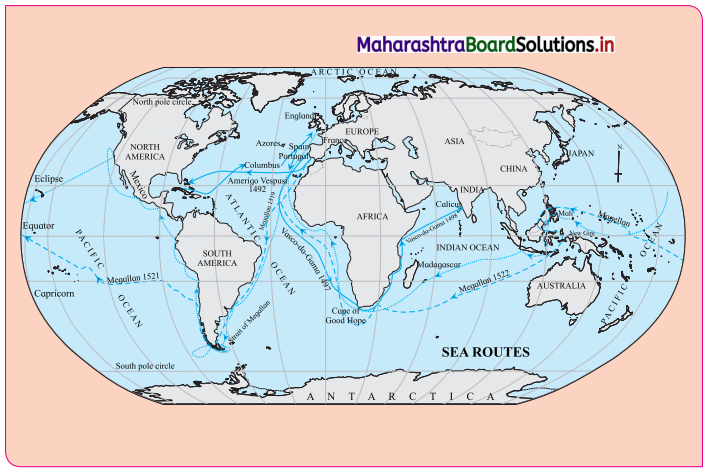
Collect detailed information about the voyages of Bartholomew Dias and Vasco-da- Gama and read it aloud in the class.
Answer:
(A) Bartholomew Dias:

  • Bartholomew Dias was a Portuguese explorer.
  • He was the first European to sail around the southern tip of Africa which the Portuguese would name as the ‘Cape of Good Hope.
  • Dias and his crew departed from Lisbon, Portugal in August 1487 with three ships.
  • Dias’s expedition sailed along the African coast following the route of Diogo Cao who had earlier sailed along the African coast in the 1480s.
  • Near the southern tip of Africa Dias’s 3 ships sailed into a dangerous storm that pushed them away from the African coast. They sailed around the tip of Africa in January 1488 without seeing the land.
  • After 30 days without seeing land, he entered what he named Aguada de Sao Bras (Bay of Saint Blaise) in February 1488.
  • Dias wanted to continue to India but he was forced to turn back when his crew refused to go further and the rest of the officers favored going back home.
  • It was on his return journey that he actually discovered the Cape of Good Hope in May 1488.
  • Dias returned to Lisbon in December 1488 after an absence of 16 months and 17 days.

(B) Vasco da Gama:

  • Vasco da Gama was a Portuguese explorer and the first European to reach India by sea.
  • His initial voyage to India was the first to link Europe and Asia by an ocean route, connecting the Atlantic and Indian Oceans and therefore the West and the Orient.
  • This discovery is considered to be a milestone in world history.
  • Vasco da Gama’s discovery of the sea route to India opened the way for an age of imperialism in Asia.
  • Vasco da Gama landed in Calicut, India on May 20, 1498.
  • This boosted the economy of the Portuguese Empire.
  • Vasco da Gama led the two of the India Armadas, the first and the fourth.
  • In 1524, Vasco da Gama was appointed as Governor of India, with the title of Viceroy, and was ennobled as Count of Vidigueria in 1519.

Maharashtra Board Class 12 English Yuvakbharati Solutions Chapter 1.4 Big Data-Big Insights

Balbharti Yuvakbharati English 12th Digest Chapter 1.4 Big Data-Big Insights Notes, Textbook Exercise Important Questions and Answers.

Maharashtra State Board Class 12 English Yuvakbharati Solutions Chapter 1.4 Big Data-Big Insights

12th English Digest Chapter 1.4 Big Data-Big Insights Textbook Questions and Answers

Question 1.
Give business suggestions to the respective industry/company for the following situations. You have received data that –
Answer:
(a) Many passengers prefer morning flights between 7 am and 9 am from Mumbai to Delhi.
Suggestion: Increase the number of flights between 7 am and 9 am.

(b) Many students are opting for UPSC/ MPSC Exams.
Suggestion: Increase the number of examination centres as well as job opportunities.

(c) Many people go for morning walk to Kamla Nehru Park.
Suggestion: Open the gates of the Park earlier and close them only at noon. Also, clean the Park the previous night before closing or very early in the morning. Keep security guards in the mornings to maintain discipline.

(d) Many people buy clothes from miracle.com an online shopping site.
Suggestion: Increase the variety and brands in clothes. Give discounts and incentives to new and regular customers. Start various schemes.

(e) The viewership on television is more between 8 pm and 10 pm.
Suggestion: Telecast serials with the highest TRPs and socially important ads (like eye donation, polio drops, etc.) at this time.

Maharashtra Board Solutions

Question 2.
People get information from various sources: Can you name a few?
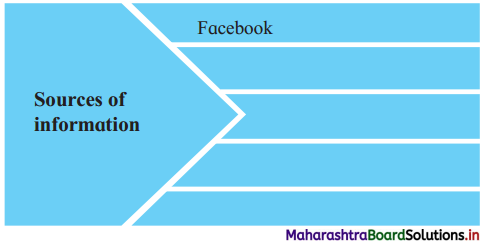
Maharashtra Board Class 12 English Yuvakbharati Solutions Chapter 1.4 Big Data-Big Insights 1
Answer:
Sources of Information:

  1. Facebook
  2. Internet
  3. WhatsApp
  4. Dictionary
  5. Encyclopedia

(A1)

Question 1.
YouTube has many videos on various things. Listen to the uses and health benefits of ‘Lemon’ and share them with your friends.

(A2)

(i) Make pointwise notes from the lesson regarding the uses of Big Data in the following application. Do not write complete sentences.

Question (a)
‘Location Tracking’.
Answer:

  1. Used by Google Maps and GPS to identify and track location of a place.
  2. Geographic positioning, radio frequency identification sensors data about traffic conditions on particular route.
  3. Can plan route according to travel time, transportation of the goods.
  4. Companies reduce risks in transport improves speed, reliability in delivery.

Maharashtra Board Solutions

Question (b)
Health Care Industry.
Answer:
Uses of Big Data:
Various apps, smartwatches, gadgets, etc. collect data about various functions of our body.

  1. Data analyzed and feedback provided.
  2. Doctors can have a better diagnosis of any ailment effects of any drug.
  3. Past data of patients maintained suggestions, solutions for their problems given.
  4. Helps in monitoring the outbreaks of epidemics, diseases.

Question (c)
Education Industry.
Answer:

  1. Get information about the study patterns of students – can now prepare customized and dynamic learning programmes according to need of individual students.
  2. Every student’s comprehension level is different – course material designed to cater to different requirements of the students. One-size-fits-all pitfall avoided.
  3. Students’ choices, difficulties, results, etc. are available.
  4. Strengths and weaknesses gauged -guidance while choosing career.

Question (ii)
When you are asked for personal details on social media, mention precautions that you will take.
Answer:
When I am asked for personal details on social media, I first try to find out who wants them and why. I never reveal credit/ debit card pin numbers, even if it is a bank asking me. I never give my mobile/adhaar card numbers either. I also keep my social media accounts private and visible only to friends. Only after checking and re-checking do I give any details, for I know that there are many cases of exploitation going on.

Question (iii)
Do you think all the data we receive is used for positive things? If ‘No’, make a list of the negative things which can be done with the help of Big Data.
Answer:
Negative things which can be done with the help of Big Data:

  1. Loss of privacy-Big Data has all information about us.
  2. Misuse of personal information
  3. Leaking of information-this leads to thefts, blackmail, cheating, and so on.
  4. Data may fall into wrong hands, and a person may be harassed.
  5. Unsolicited calls and emails based on your internet history.

Maharashtra Board Solutions

(A3)

Question 1.
Guess the meaning of the following idioms and phrases and use them in sentences of your own. One is done for you.
One-size-fits-all – suitable for or used in all circumstances
The wrist watches have adjustable belts, so one – size – fits – all.

Question (a)
‘Once in a blue moon’:
Answer:
Meaning: very rarely.
Sentence: Our English teacher is very strict and smiles only once in a blue moon.

Question (b)
‘One man army’ :
Answer:
Meaning: A ‘one-man army’ is someone who can do, or thinks he can do, everything by himself and without assistance.

(A4)

Do as directed.

Question (a)
Advertisers are one of the biggest players in Big Data.
1. Begin the sentence with ‘Very few ……………’
2. Use ‘bigger than’ and rewrite the sentence.
Answer:
1. Very few players in Big data are as big as advertisers.
2. Very few players in Big Data are bigger than advertisers.

Maharashtra Board Solutions

Question (b)
No other diagnosis is as good as the diagnosis done with the help of Big Data.
1. Use ‘best’ and rewrite the sentence.
2. Use ‘better than’ and rewrite the sentence.
Answer:
1. The diagnosis done with the help of Big data is the best diagnosis.
2. No other diagnosis is better than the diagnosis done with the help of Big Data.

Question (c)
These internet giants provide the greatest data about people.
1. Begin the sentence with ‘No other ……………’
2. Use ‘greater than’ and rewrite the sentence.
Answer:
1. No other networking services provide greater data about people than these internet giants.
2. No other networking services provide greater data about people than these internet giants. OR These internet giants provide greater data about people than any other networking services.

Question (ii)
Read the sentence from the text.
New insights have enabled the banks and finance companies to come up with suitable plans.
Answer:
New insights have enabled either the banks or the finance companies to come up with suitable plans.

Question (a)
New insights have enabled the banks and finance companies to come up with suitable plans. (Rewrite using ‘either … or’.)
Answer:
New insights have enabled either the banks or the finance companies to come up with suitable plans.

Maharashtra Board Solutions

Question (b)
Whatever activity we do online is recorded, monitored and analysed. (Rewrite using ‘either … or’.)
Answer:
Whatever activity we do online is either recorded, monitored or analysed.

Question (c)
Weather sensors and satellites help us to understand the weather and help in weather forecasting. (Rewrite using ‘either … or’.)
Answer:
Weather sensors and satellites help us to either understand the weather or help in weather forecasting.

(A5)

Question (i)
Interview the students of your class regarding the career they would like to pursue and the reason for selecting that particular career. Collect the data and analyse the information you have collected. Answer:
(Sample questions)
Hi, Rohan. I would like to ask you a few questions regarding the career you would like to pursue and the reason for selecting that particular career. Are you ready? Thanks.

  1. Which are your favourite subjects?
  2. Have you decided on the career you would like to pursue?
  3. Why have you selected that particular career?
  4. What are the exams you have to pass or the qualifications you must have to pursue this career?
  5. What type of work does it involve?
  6. What are the job opportunities?
  7. Will you have chances of business travel?
  8. Is the salary structure good?
  9. Is your family happy with your choice?
  10. Is this your final choice, or are you still in the process of deciding?

Thanks, Rohan. I have learnt a lot from this interview today. Bye.

Maharashtra Board Solutions

Question (ii)
To listen well is as powerful a means of influence as to talk well and is essential to all true conversations.
Form a group and have a group discussion on the topics:
(a) Social Media – Curse or Boon (If used carefully and judiciously, a boon if misused, or people become addicts, then a curse)
(b) Women Empowerment and Equality (very important today-gender equality a must-the hand that rocks the cradle rules the world-however, women must not take advantage of this change-must be judicious in the use of the powers given)
(c) Climate Change (one of the biggest problems of today-must be taken very seriously-must change lifestyles-reduce consumption- recycle-carbon footprint)

(A6)

Question 1.
Find out job opportunities in the following areas and the skills required for them.
(a) Clinical Data Management
(b) Network Operations
(c) Data Processing
(d) Data Operations and Research
(e) Data Entry Operation

Yuvakbharati English 12th Digest Chapter 1.4 Big Data-Big Insights Additional Important Questions and Answers

Global Understanding:

Question 1.
Complete the web:
(The answers are given directly and underlined.)
Answer:
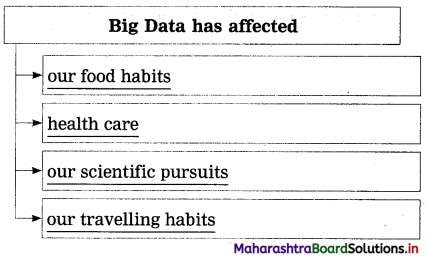
Maharashtra Board Class 12 English Yuvakbharati Solutions Chapter 1.4 Big Data-Big Insights 2

Maharashtra Board Solutions

Question 2.
Complete the following:
Answer:

  1. Big Data analytics is used to give insights that were previously incomprehensible.
  2. Big Data is so massive that it challenges the current computing technologies.
  3. It’s not the amount of data that is important but what the [organizations do with the data is what matters.
  4. Big Data analytics is the complex process of examining large and varied data sets or Big Data to uncover information.

Question 3.
Complete the web:
(The answers are given directly and underlined.)
Answer:
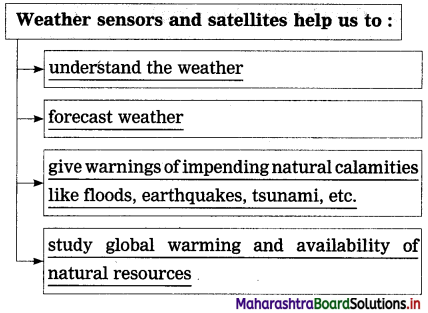
Maharashtra Board Class 12 English Yuvakbharati Solutions Chapter 1.4 Big Data-Big Insights 3

Question 4.
Complete the following:
(The answers are given directly and underlined.)
Answer:
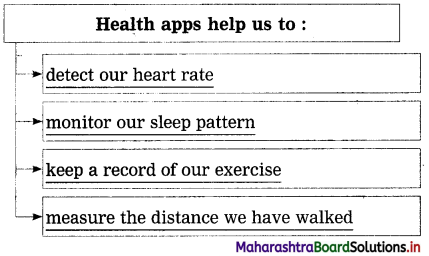
Maharashtra Board Class 12 English Yuvakbharati Solutions Chapter 1.4 Big Data-Big Insights 4

Question 5.
Write whether you agree or disagree with the following statements:

  1. Today, the majority of equity trading takes place via data algorithms.
  2. Big Data analytics cannot help in studying the investment patterns of people.
  3. Big Data is useful in High-Frequency Trading.
  4. Big Data cannot predict possible spikes on servers.

Answer:

  1. Agree
  2. Disagree
  3. Agree
  4. Disagree

Maharashtra Board Solutions

Question 6.
Describe the ways used to create a huge database in sports.
Answer:
A huge data has been created over a period of time from the recording of matches, training sessions and workouts.

Question 7.
The database collected can help a sportsperson. Explain how.
Answer:
The data enables a sportsperson to study his own performance as well as that of the other players worldwide. It also helps in improving individual as well as team performance.

Question 8.
State the use of video analytics.
Answer:
Video analytics help one to see each and every performance minutely.

Question 9.
Name the Internet Giants mentioned in the extract.
Answer:
Facebook, Google, Twitter.

Question 10.
Pick out the False sentences, if any, and correct them:
1. Every student’s level of understanding is the same.
2.Big Data has brought about a big negative change in the education industry.
3. Designing the course material to cater to different requirements of the students is a good idea.
4. Big Data has provided a solution to the ‘one-size-fits-all’ pitfall.
Answer:
False sentences:
1. Every student’s level of understanding is the same.
2. Big Data has brought about a big negative change in the education industry.
Corrected sentences:
1. Every student’s level of understanding is different.
2. Big data has brought about a big positive change in the education industry.

Maharashtra Board Solutions

Complex Factual:

Question 1.
Complete the following describing the sources of the collection of data:
(The answers are given directly and underlined.)
Answer:
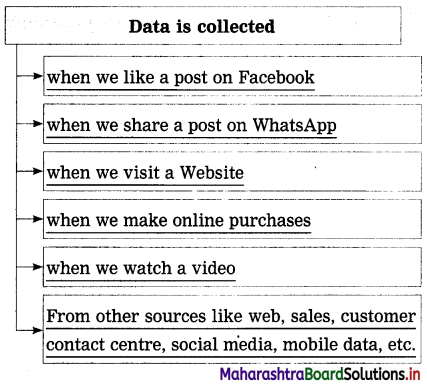
Maharashtra Board Class 12 English Yuvakbharati Solutions Chapter 1.4 Big Data-Big Insights 5

Question 2.
Mention the ways to reduce risk in transport.
Answer:
Big Data has been useful in identifying and tracking the exact location of a place. GPS and Google Maps make use of Big Data. With geographic positioning and radio frequency identification sensors we get the up-to-date data about traffic, congestion on a particular route, information if the route is closed or if it is a one-way route, understanding accident prone areas, etc. Thus, we can plan our own route according to the travel time and the transportation of goods.

If we have ordered something online we can track the location of our goods in transit, we can also track the condition of the goods. All this has immensely helped the logistics companies to reduce risks in transport, improve speed and reliability in delivery.

Maharashtra Board Solutions

Question 3.
Complete the following:
(The answers are given directly and underlined.)
Answer:

  1. Big Data helps to predict and prevent cybercrimes, card fraud detection, archival of audit trails, etc.
  2. Banks can predict future attempts of frauds by analyzing the past data of their customers and the data on previous brute force attacks.
  3. SEC is using Big Data to monitor financial markets for possible illegal trades and suspicious activities.
  4. Big Data algorithms are used to make trading decisions.

Question 4.
List the ways in which sensors help a person.
Answer:
Sensors help a person:

  1. to understand the game from close quarters
  2. to understand field conditions
  3. to understand the weather conditions
  4. to understand individual performances

Inference/Interpretation/ Analysis:

Question 1.
Discuss and write how Big data is increasing in volume, variation, velocity, veracity and value.
Answer:
When we like a post on Facebook or share a post on WhatsApp, visit any website, make online purchases, or watch videos, the variety of activity we do online is recorded, monitored and analysed. So a huge amount of data is collected. Data is also collected swiftly from different sources, for example web, sales, customer contact centre, social media, mobile data and so on.

Big Data analytics is used to give insights that were previously incomprehensible. As more and more people use the Internet, social media, make online purchases, use mobile phones, and are generally more active online, Big data is increasing in volume, variation, velocity, veracity and value in leaps and bounds.

Maharashtra Board Solutions

Question 2.
Do you think Big Data has improved the quality of life? Give reasons for your answer.
Answer:
Big Data has certainly improved the quality of life. Through various apps, we can maintain our body weight and exercise levels, and remain healthy. Our heart rate, sleep patterns, etc. can be monitored and any changes can be immediately reported to the doctor, who can then prescribe the correct treatment as soon as possible.

Age-related diseases like diabetes and arteriosclerosis can be treated at the early stages. Thus, we can lead healthier and more active lives. Big Data is also being used to. predict and monitor epidemics, thus ensuring that they affect as few people as possible.

Question 3.
Write some ways of the condition of the goods.
Answer:
When we order something online, we are given a tracking number. By logging into the website of the company and entering this tracking number in the given slot, we can find out the location and condition of the goods.

Question 4.
Can we understand the economy of the country by the data on Banking and Finance? Explain.
Answer:
Yes, we can. With the Big Data analytics the study of investment patterns of the people can be done. We can analyse the bank deposits made, the loans taken and the equity trading.

We can find out the business across borders. We can find out how many industries have come up, and what the industrial economy is. From all this information, we understand the economy of the country.

Maharashtra Board Solutions

Question 5.
Explain, giving an example, the technique used by Netflix and YouTube to increase viewership.
Answer:
Netflix and YouTube know through Big Data just what a person has viewed and his/her behaviour online. Based on this information, the person will be shown different recommendations. For example, if a person has viewed a couple of horror films from start to end, Netflix will know that the viewer is interested in horror films.

Accordingly, Netflix will recommend a few more horror films. The viewer is pleased with this easy access to his/her favourite genre, and continues to be a customer, thus increasing Netflix revenue.

Question 6.
Discuss a solution provided by Big Data.
Answer:
Through Big Data we have information about the study patterns of students, and we can now prepare customized and dynamic learning programmes according to the need of an individual student.

Personal Response:

Question 1.
Industries can be benefited from data. Explain with an example.
Answer:
Industries can benefit from the huge amount of data available. For example, in the tourism industry, through Big Data travel agencies and hotels can identify the times when there are more crowds and hence more demand for a certain tourist spot.

They can accordingly make arrangements for more flights, trains, buses, tours, labour, essential items, etc. Hotels can use big data to compile and analyse information about their main competitors so that they are aware of what other hotels or businesses are offering customers.

Question 2.
Do you have any app on your phone that monitors your health? Describe it in brief.
Answer:
Yes, I have an app that helps me to measure the calories I have eaten and I can thus plan my meals. It also records my weight and tells me whether it has gone up or down. There is a very clear graph too which gives me complete information of the ups and downs in my weight. I have managed to lose a few kilos with the help of this app and feel much healthier now.

Question 3.
Do you use GPS and Google Maps? If so, where and when?
Answer:
I drive a two-wheeler. If I have to go to a new shop/hotel or some other place, I find out the route through GPS and follow this route. I used Google Maps when I went to Goa with my family and wanted to calculate distances and use the best routes.

Maharashtra Board Solutions

Question 4.
Do you spend a lot of time on Facebook, Netflix, etc.? Do you think it is addictive?
Answer:
Yes, I do spend a lot of time on Facebook. I have a large number of friends, and hence the news feed is quite a lot. I like to know what my friends are doing, where they have gone, etc. It is addictive, and since I have Facebook on my mobile phone too, I can check it at any time. This is what most of my friends do too. I know it is not good, and I am trying to control screen time. I do not subscribe to Netflix.

Question 5.
Do you think Big Data will help to bring improvements in students? Give reasons for your answer.
Answer:
Yes, Big Data will certainly help to bring improvements in students. Students can learn topics/subj ects. according to their abilities and capacity. They can choose their careers after knowing their strengths and weaknesses, their mental make-up and abilities. Thus, there will be fewer drop-outs, and students will be happy in the careers they have chosen..

Language Study:

Question 1.
Whatever activity we do online is recorded, monitored and analysed. (Rewrite using ‘as well as’….)
Answer:
Whatever activity we do online is recorded, monitored, as well as analysed.

Maharashtra Board Solutions

Question 2.
The massive data available with us can really work wonders. (Rewrite using the noun form of the underlined word.)
Answer:
The availability of massive data with us can really work wonders.

Question 3.
Big Data analytics is the complex process of examining large and varied data sets or Big Data to uncover information. (Frame a wh-question to get the underlined part as the answer.)
Answer:
What is Big Data analytics?

Question 4.
Big Data helps in monitoring the outbreaks of epidemics and diseases. (Rewrite using ‘as well as …’)
Answer:
Big Data helps in monitoring the outbreaks of epidemics as well as diseases.

Question 5.
Big Data helps in monitoring the outbreaks of epidemics and diseases. (Rewrite using ‘either …or’.)
Answer:
Big Data helps in monitoring the outbreaks of either epidemics or diseases.

Maharashtra Board Solutions

Question 6.
Big Data has been useful in identifying and tracking the exact location of a place. (Rewrite using ‘as well as’.)
Answer:
Big Data has been useful in identifying as well as tracking the exact location of a place.

Question 7.
Big Data has been useful in identifying and tracking the exact location of a place. (Rewrite using ‘either … or’.)
Answer:
Big Data has been useful in either identifying or tracking the exact location of a place.

Question 8.
Weather sensors and satellites help us to understand the weather and help in weather forecasting. (Rewrite using ‘as well as’.)
Answer:
Weather sensors and satellites help us to understand the weather as well as help in weather forecasting.

Question 9.
Huge amount of data is continuously being I received from them. (Change the voice.)
Answer:
We continuously receive a huge amount of data from them.

Maharashtra Board Solutions

Question 10.
Big Data has enabled smooth functioning of these agencies and institutions. (Rewrite as an interrogative question.)
Answer:
Hasn’t Big Data enabled smooth functioning of these agencies and institutions?

Question 11.
Here, Big Data algorithms are used to make trading decisions. (Rewrite using a gerund in place of the underlined word.)
Answer:
Here, Big Data algorithms are used for making trading decisions.

Question 12.
Every student’s comprehension level is different. (Add a question tag.)
Answer:
Every student’s comprehension level is different, isn’t it?

Question 13.
This will also help in guiding the student regarding the best career for him. (Rewrite using the noun form of the underlined word.)
Answer:
This will also help in providing guidance to the student regarding the best career for him.

Maharashtra Board Solutions

Question 14.
This would, in general, enhance progress of all students. (Rewrite beginning ‘Progress….)
Answer:
Progress of all students, would in general, be enhanced.

Vocabulary:

Question 1.
From the extract, find the antonyms of the following words :

  1. understandable
  2. tiny
  3. sales
  4. simple

Answer:

  1. understandable × incomprehensible
  2. tiny × massive (huge)
  3. sales × purchase
  4. simple × complex

Question 2.
From the words given below, write down the ones that have been formed using prefixes:
industries, increasing, incomprehensible, unknown, examining, uncover, information, innumerable, important
Answer:
incomprehensible, unknown, uncover, innumerable

Maharashtra Board Solutions

Question 3.
Find the meanings of:
1. petabytes
2. exabytes
Answer:
1. petabytes – units of information equal to one thousand million 1000 tetrabytes.
2. exabytes – units of information equal to one quintillion 1000 petabytes

Question 4.
Pick out 4 words ending in ‘ing’ from the extract.
Answer:
identifying, tracking, positioning, understanding

Question 5.
Pick out 4 nouns ending in ‘tion’ from the extract.
Answer:
location, identification, congestion, information

Maharashtra Board Solutions

Question 6.
Complete the following, giving the meanings.
(The answers are given directly and underlined.)
Answer:
e.g. new insights: insights that are new.

  1. health-conscious people: people who are conscious of their health.
  2. smartwatches: watches that are smart.
  3. heart rate: the rate at which heart beats.
  4. blood pressure: the pressure of the blood.
  5. necessary precautions: precautions that are necessary.
  6. unnecessary guesswork: guesswork that is unnecessary.

Question 7.
Find adjectives from the extract having the following suffixes :
(-able, -ible, -ial, -ious, -al)
Answer:

  1. -able – suitable;
  2. -ible – possible;
  3. -ial – financial, social;
  4. -ious – suspicious, previous;
  5. -al-natural.

Question 8.
Match the words in Column A with the words in Column B to make collocations found in the extract:
Answer:

ABAnswer
newcrimesnew insights
cybersecondscyber crimes
futureinsightsfuture attempts
splitattemptssplit seconds

Maharashtra Board Solutions

Question 9.
Give the adjective forms of the following words:

  1. giant
  2. interest
  3. create
  4. behaviour

Answer:

  1. giant – gigantic
  2. interest – interesting
  3. create – creative
  4. behaviour – behavioural

Question 10.
Match the words in Box A with the meanings in Box B:
Answer:

  1. revenue – earnings
  2. gigantic – huge
  3. enables – allows
  4. embedded – implanted

Question 11.
Make sentences of your own using the following expressions/words :

  1. leaps and bounds
  2. enhance
  3. to make optimum use of

Answer:

  1. leaps and bounds: Suman’s progress in studies increased by leaps and bounds after her health improved.
  2. enhance: We can enhance our looks by having a pleasant expression on our faces.
  3. to make optimum use of: Saurav decided to make optimum use of the Diwali vacation to catch up with his studies.

Maharashtra Board Solutions

Oral Work:

Question 1.
Do you think people click consciously on Facebook? Discuss.
Answer:
[Points: in general, most people just press ‘like’ button on friends’ posts, many times not even reading the post-sometimes some only repeat the comment above theirs-some forwards and videos are not even seen-with so many posts and information many times there is no time to read everything]

Non-Textual Grammar

Do as directed:

Question 1.
Her family and their well-being were her highest priority. (Rewrite as an interrogative sentence.)
Answer:
Weren’t her family and their well-being her highest priority?

Maharashtra Board Solutions

Question 2.
The shadows were lengthening when Smita arrived at the college. (Identify the clauses.)
Answer:
The shadows were lengthening – Main Clause
when Smita arrived at the college – Subordinate Adverb Clause of Time

Question 3.
He had to find the books and read them before the day ended.
(Rewrite using ‘not only…but also’.)
Answer:
He had not only to find the books but also read them before the day ended.

Spot the error in the following sentences and rewrite them correctly:

Question 1.
I was either scared of people’s curious looks nor their awkward questions.
Answer:
I was neither scared of people’s curious looks nor their awkward questions.

Maharashtra Board Solutions

Question 2.
He was unable to participate due to a health problems.
Answer:
He was unable to participate due to a health problem.

Maharashtra Board Class 12 Economics Solutions Chapter 7 National Income

Balbharti Maharashtra State Board Class 12 Economics Solutions Chapter 7 National Income Textbook Exercise Questions and Answers.

Maharashtra State Board Class 12 Economics Solutions Chapter 7 National Income

1. Complete the following statements:

Question 1.
While estimating national income, we include only value of final goods and services in order to
a) make computation easier
b) avoid double counting
c) maximize national welfare of the people
d) evaluate the total economic performance of a nation
Answer:
b) avoid double counting

Question 2.
NDP is obtained by
a) deducting depreciation from GNP
b) deducting depreciation from GDP
c) including depreciation in GDP
d) including depreciation in GNP
Answer:
b) deducting depreciation from GDP

Maharashtra Board Class 12 Economics Solutions Chapter 7 National Income

Question 3.
In India, national income is estimated using
a) output method
b) income method
c) expenditure method
d) combination of output and income method
Answer:
d) combination of output and income method

2. Complete the Correlation:

1) ……………… :C+I+G+(X-M)::GNP:C+I+G + (X-M) + (R-P).
2) Output method : ……………… :: Income method : Factor cost method
3) Theoretical difficulty : Transfer payments :: ……………… : Valuation of Inventories
Answer:

  1. GDP
  2. Product / Inventory method
  3. Practical difficulty

3. Identify the incorrect pair:

a) National Income Committee — 1949
b) Financial year 1’ April to 31st March
c) Income method — National Income = Rent + Wages + Interest + Profit + Mixed income + Net Income from abroad
d) Expenditure method – National Income = Rent + Wages + Interest + Profit
Options:
1) a 2) b 3) c 4) d
Answer:
d) Expenditure method — National Income = Rent + Wages + Interest + Profit

4. Identify and Explain the following concepts:

Question 1.
Vrinda receives monthly pension of Rs.5,000/- from the State Government.
Answer:
Concept: Transfer payment.
Explanation : Pension is a part of money income earned by an employee during his service period with the entrepreneur.
Such income is paid by Government to an employee after his retiement so as to make employee survive during his retirement period.
Thus, transfer income is not included in National Income. It is just an government expenditure.

Question 2.
Viru kept aside 1oo kgs. out of 500 kgs. of wheat produced in his farm for his family.
Answer:
Concept: Production for self-consumption. Explanation : In above case, Viru’s total production is 500 kgs but he keep aside 100 kgs for his self consumption.
This 100 kg will not be shown by him as his income and hence it will not be included in national income accounting.
Such output kept for self consumption is called as theoretical difficulty in measurement of national income.

Question 3.
Sheetal purchased wheat flour for her bakery from the flour mill.
Answer:
Concept: Intermediate goods.
Explanation : In the above case, wheat flour is not the final product.
Wheat flour will be used by Sheetal to produce cake or pastry or biscuits which will be final product for her.
So, in above case wheat flour is considered j! (8) as intermediate goods. Intermediate goods are excluded while calculating NI by Final ( Ans. Goods approach method and included while calculating by Value Added approach method.

Question 4.
Shobha collected data regarding the money value of all final goods and services produced in the country for the financial year 2018-2019.
Answer:
Concept: National Income.
Explanation : National Income estimate ( measures the column of commodities and ) services turned out during a given period, counted without duplication.
NI is the macro concept. It is flow concept.

Maharashtra Board Class 12 Economics Solutions Chapter 7 National Income

Question 5.
Rajendra has a total stock of 500 gel pens in his shop which includes 200 gel pens produced in the previous financial year.
Answer:
Concept: Flow Concept
Explanation : National Income accounting considers the production of goods and services in a current year. The production of previous year is ignored.
Thus, out of total inventory, of Mr Rajendra, only 300 pens will be taken into consideration while calculating NI for the current year.

5. Answer the following

Question 1.
Explain the two sector model of circular flow of national income.
OR
Explain the circular flow of National Income.
Answer:
The two sector economy consists of household J and business firm. The income is circulated between household and business firm. It is explained with the help of following diagram.
Maharashtra Board Class 12 Economics Solutions Chapter 7 National Income 1
In every economy there is household sector on one hand and business firm on the other hand.

(A) Household is the basic consuming unit. It) centres around a family. Its main function j is to consume goods and services. Business firm is the basic producing unit. Its main function is to produce goods and services with the aim of maximising profits. When s the household supplies factor services (land, ^ labour, capital, enterprise to business firms, business firms supply goods and services to the household. This is known as Real Flow.

(B) In a money economy when the household supplies factor services, there is a flow of income from the business firm to the j household in form of rent, wages, interest and profit. This income comes from the firms to the household sector. The household ; sector uses this income to satisfy the wants. Therefore, there is a flow of consumption expenditure from the household to the business firms. The flow of factor payments from business sector to household sector and corresponding flow of consumption expenditure from household sector to business firms. This is known as Money Flow. Both the money flow and real flow should balance for the smooth functioning of the economy. If the money flow is greater j than real flow there would be inflation and if the money flow is less than the real flow there would be deflation.

Maharashtra Board Class 12 Economics Solutions Chapter 7 National Income

(C) In the above diagram, the inner circle represents the Real flow and the outer circle represents the Money flow. There is circular and continuous flow of money income as production is a continuous activity due to never ending human wants. The circular J flow shows interdependence in the economy.

Question 2
Explain the importance of national income.
Answer:
National income data is very useful for various purposes. It is as follow :

  • For the Economy : National income data are very important for macro economic analysis and performance of the economy.
  • National Policies : National income gives the industrial policy, agricultural policy, export promotion policy etc.
  • Economic Planning : The data of national income is very important tools for long term and short term economic planning e.g. planning for aggregate saving, investment, output, etc.
  • Economic Research: The data of national income is very useful to the research students to study in detail how income is produced, how it is distributed, how much is spent, saved or taxed.
  • Comparison of Standard of Living :
    Because of national income, it is possible to do comparison between the standard of living of the people of different countries and home country.
  • Distribution of Income : The data of national income is very important to understand the disparities in the income of different sections of the society and to make the policies to reduce the disparities in income.
  • Speed of Economic Growth : Because of national income, it is possible to know the trends or speed of the economic growth of our country in relation to previous years.

Question 3.
Explain the features of national income.
Answer:
(1) Flow Concept : National Income is the flow of goods and services produced in the economy during a year. The flow of goods takes place when there is production activity in the economy. It generates flow of income in the form of rent, wages, interest and profit.

(2) Avoid Double Counting: While estimating National Income we include only the value of final goods and services and not the value of intermediate goods or raw materials to avoid double counting.

(3) National Income is the net aggregate value : National Income includes net value of goods and services produced. It does not include depreciation cost. Depreciation is wear and tear of capital goods due to their continuous use in production.

(4) Transfer Income : Transfer Income in J the form of old age pension, lottery prize, scholarship, etc. are not to be included as they are received without contributing anything to the current national income.

(5) National Income is money valuation of goods: National Income is always expressed ( in money terms. Only those goods and services which are exchanged for money are included. Unpaid services like the service of housewife should not be included.

(6) National Income is calculated for one year : National Income is always expressed with reference to time period i.e. generally one financial year from 1st April to 31st March of every year.

(7) Net Income from Abroad: While estimating National Income net Income from abroad i.e. difference between exports and imports (X – M) as well as net income from foreign investment should be included (R – P).

(8) Macro Economic Concepts : National Income is a macro economic concepts as it is the aggregate income of the country. It includes the value of goods and services produced in the different sectors of the economy. National Income data present the (1) There are many theoretical difficulties picture of the performance of the economy in the measurement of National Income, during a given period of time.

(9) National Income is calculated at current and constant price: National Income when calculated at the prevailing market price it is called National Income at current price and when it is calculated at the base year price, it is called National Income at constant price

Maharashtra Board Class 12 Economics Solutions Chapter 7 National Income

Question 4.
Explain the concept of Green GNP.
Answer:
The Green GNP is the measurement of the national income adjusted for degradation of environment.
E.g. The National Income for a current year is 8,000 units and the degradation of environment is 500 units, so Green GNP is ( 8000 – 500 = 7500 units.
The green GNP considers the environmental degradation or resource depletion.
It is defined as, “Green GNP is an indicator of sustainable use of natural environment and equitable distribution of benefits of development.”

The features of Green GNP are :

  1. Sustainable economic development means economic development without creating pollution or environmental degradation.
  2. The benefits of sustainable economic development should be equally distributed. In the long period of time it helps to promote economic welfare.
    Green GNP = (Net fall in stock of natural capital + Pollution load)

6. State with reasons, whether you agree or disagree with the following statements:

Question 1.
There are many theoretical difficulties in the measurement of national income.
Answer:
Yes, I agree with this statement.
National income is a very broad concept and it is difficult to precisely define what exactly should be included and not to be included.

  • Transfer payment: If it included in national income then there will be overestimation of NI. E.g. pension, gifts, unemployment allowances, etc. are excluded.
  • Unpaid services : The value of unpaid services are not included in national income as they are not paid for. E.g. services of housewife.
  • Illegal income : The income from illegal activities are not included in NI. E.g. black marketing, smuggling.
  • Production kept for self-consumption :
    It is not accounted for in the national income as such product does not enter the

Question 2.
Under output method, value added approach is used to avoid double counting.
Answer:
Yes, I agree with this statement.

  • The value added approach is the difference between the value of final output and input at each stage of production.
  • In this approach, the value added at each stage of production is considered.
  • E.g.
    Maharashtra Board Class 12 Economics Solutions Chapter 7 National Income 2
  • In the above example, value of groundnut with shell is ₹ 50, after removing shells value of groundnut is ₹ 80, after crushing groundnut value oil ₹ 120 and when oil is packed its value ₹ 150.
  • So, the value added raw groundnut (₹ 50), groundnut (₹ 30), oil (₹ 40), packed oil (₹ 30), total value ₹ 150 is included in national income.

7. Answer in detall:

Question 1.
Explain the practical difficulties involved in the measurement of national income.
Answer:
National Income means money value of) goods and services produced in the country in a year.
AccordingtoNationallncome Committee:
“A national income estimate measures the volume of goods and services turned out during a period without duplication.” National income is a very broad concept and it is difficult to precisely define what exactly should be included and not to be included. So, there are many practical difficulties in the measurement of NI.

Practical Difficulties or Statistical Difficulties :

  • Problem of double counting: In case of certain goods it is difficult to distinguish properly between final goods and intermediate goods. That’s why problem of double counting arises e.g. flour is final goods for housewife, but it is intermediate goods for the bakery.
  • Existence of non-monetised sector : In India large non-monetised sector exists in rural area specially in agriculture. In agriculture many places goods and services are exchanged with goods that’s why it is difficult to count in national income.
  • Inadequate and unreliable data : Because of illiteracy it is difficult to get adequate and reliable data from unorganised sector, small enterprises, agriculture, etc.
  • Depreciation : Its difficult to measure exact value of depreciation. There are no uniform common accepted standard rates of depreciation applicable to the various capital assets.
  • Capital gain or loss : Due to capital gain there is over estimation and due to capital loss there is under estimation of national income.
  • Illiteracy and ignorance : Majority of small producer in developing counties are illiterate and ignorant and are not able to keep accounts of their productive activities.
  • Lack of systematic, occupational classification: There is lack of systematic occupational classification, which makes the calculation of national income difficult. Especially in rural areas where many villagers work on farms for some time and also take some other job during off season.
  • Untrained and incompetent staff: Due to untrained and incompetent staff, accurate and timely, information cannot be obtained.

Importance of National Income (NI) :
For the economy : National income data are particularly important for macro economic analysis and performance of the economy.

Question 2.
Explain the income method and expenditure method of measuring national income.
OR
Explain any two methods of measuring National Income.
Answer:
National Income is macro economic concept. National Income means money value of goods and services produced in the country in a year. There are three methods to measure national income.
(1) The Output Method,
(2) The Income Method,
(3) The Expenditure Method.

(A) The Income Method : This method is also known as factor cost method. According to this method national income is the sum of income received by all factors of production in a year. So national income is the income received by all the citizens of the country in a year. In income method national income studied from the distribution side. According to income method national income or GNP is
NI = R + W + I + P + MI + (X – M)

  • Rent (R) : Rent and Royalty is usually treated as the payment for the land, building, machines that are rented.
  • Wages (W) : It includes wages and salaries earned by labour as well as it includes commission, bonus, social security payments, fringe benefits, etc.
  • Interest (I) : Interest is the payment for using the services of capital. It includes interest paid by banks, insurance companies etc.
  • Profit (P) : It includes the profit of private and public sector companies.
  • Mixed Income (MI) : It is the income which is earned by self-employed. They earn income through various sources like wages for effort put, rent on own property, interest on own capital, etc.
  • Net Exports (X – M) : It is the difference between export and imports.

Precautions :

  • Transfer payment : It should not be included in national income. E.g. pension, gifts, unemployment allowances, lottery prize, etc.
  • Unpaid services : It should not be included in national income. E.g. services of housewife, teacher teaching her own child, etc.
  • Second hand goods : The income from sale of second hand goods should not be included.
  • Financial asset : The income from sale of shares and bonds should not be included in national income.
  • Tax revenue : The revenue of government through taxes should not be included in national income.
  • Undistributed profits of companies, income from government property and profits from public enterprise should be included.
  • Imputed value of production kept for self consumption and rental value of owner occupied houses should be included in national income.

Maharashtra Board Class 12 Economics Solutions Chapter 7 National Income

(B) Expenditure Method :
This method also known as outlay method. NI = C + I + G + (X – M) + (R – P)
National Income can also be calculated by adding up the expenditure incurred on purchase of final goods and services. We can get National Income by summing up all consumption expenditure, investment expenditure made by all individuals, firms as well as the government of a country during a year.

  • Consumption Expenditure (C) : It includes all expenditure incurred on goods and services by households during the year. It includes expenditure mostly on durable and non-durable goods, which are consumed by the consumers. E.g. food, medical care, clothing, car, computer and services, etc.
  • Investment Expenditure (I) : It refers to the investment made by private businessman on capital goods like machinery, plants, factories, warehouses, etc.
  • Government Expenditure on goods and services (G) : Government expenditure refers to expenditure on consumption and investment –
    • Consumption expenditure : It refers to expenditure incurred on various administrative services like law and order, defence education, generation and distribution of electricity.
    • Investment expenditure : It refers to expenditure incurred by government on construction of roads, railways, dams, canals, etc.
  • Net Exports (X – M): It refers to difference between exports and imports of the country. If the exports are more than imports then net exports will be positive, it is called Trade Surplus and if imports are greater than exports, the net exports will be negative, it is called as Trade Deficit.
  • Net Receipts (R-P) : It is the difference between expenditure incurred by foreigners in the country (R) and expenditure incurred abroad by Nationals (P). Net Receipts can also be Positive or Negative.
    Net National Expenditure = NNE = C + I + G + (X – M) + (R – P) – Depreciation. NNPFC or NI = C + I + G + (X -M) + (R -P) “Depreciation “ Indirect Tax + Subsidies.

Precautions :
The following precautions should be taken while estimating National Income.

  • To avoid double-counting take the expenditure incurred only on final goods and services.
  • Government expenditure on transfer payments to be excluded like unemployment allowances, old age pension, etc.
  • Expenditure on second-hand goods like furniture, house, land, and financial assets { like shares, bonds, etc. should be excluded.
  • Exclude expenditure incurred on the purchase of financial assets such as shares, bonds, etc.
  • Deduct indirect tax and add subsidies. Out of these methods, output method and income method are extensively used. The expenditure method is rarely used because of its practical difficulties.
  • In India, the Central Statistical Organisation (CSO) adopts a combination of output method and income method to estimate N.I. of India.

Maharashtra Board Class 12 Economics Solutions Chapter 9 Money Market and Capital Market in India

Balbharti Maharashtra State Board Class 12 Economics Solutions Chapter 9 Money Market and Capital Market in India Textbook Exercise Questions and Answers.

Maharashtra State Board Class 12 Economics Solutions Chapter 9 Money Market and Capital Market in India

1. Complete the following statements:

Question 1.
Development financial institutions were established to …………………
a) provide short term funds.
b) develop industry, agriculture and other key sectors.
c) regulate the money market.
d) regulate the capital market.
Answer:
b) develop industry, agriculture and other key sectors.

Maharashtra Board Class 12 Economics Solutions Chapter 9 Money Market and Capital Market in India

Question 2.
Money market faces shortage of funds due to
a) inadequate savings.
b) growing demand for cash.
c) presence of unorganized sector.
d) financial mismanagement.
Answer:
a) inadequate savings.

Question 3.
Individual investors have lost confidence in the
capital market due to
a) lack of financial instruments.
b) high transaction costs.
c) low returns.
d) financial scams.
Answer:
d) financial scams.

Question 4.
Commercial banks act as intermediaries in the financial system to
a) make profits
b) accelerate the country’s economic growth.
c) mobilise the savings and allocating them to various sectors of the economy.
d) control the credit.
Answer:
c) mobilise the savings and allocating them to various sectors of the economy.

2. Complete the correlation:

1) Money market : Short term funds :: …………….. : Long term funds
2) …………….. : Central Bank:: SBI : Commercial Bank
3) Co-operative banks : Organized sector :: Indigenous bankers : ……………..
4) Primary market : …………….. :: Secondary market : Old issues
Answers:

  1. Capital market
  2. RBI
  3. Unorganised sector
  4. New issue

Maharashtra Board Class 12 Economics Solutions Chapter 9 Money Market and Capital Market in India

3. Find the odd word:

Question 1.
Types of Bank Accounts:
Answer:
Saving A/c, D-mat A/c, Recurring A/c, Current A/c.

Question 2.
Unregulated Financial Intermediates:
Answer:
Mutual fund, Nidhi, Chit fund, Loan Companies.

Question 3.
Financial Assets:
Answer:
Bonds, Land, Government Securities,
Derivatives.

Question 4.
Quantitative Tools:
Answer:
Bank Rate, Open Market Operation, Foreign Exchange Rate, Variable Reserve Ratio.

4. Assertion and Reasoning:

Question 1.
Assertion (A) : Money market economizes use of cash
Reasoning (R) : Money market deals with financial instruments that are close substitutes of money
Options: 1) (A) is True, but (R) is False
2) (A) is False, but (R) is True
3) Both (A) and (R) are True and (R) is the correct explanation of (A)
4) Both (A) and (R) are True and (R) is not the correct explanation of (A)
Answer:
3) Both (A) and (R) are True and (R) is the correct explanation of (A)

Maharashtra Board Class 12 Economics Solutions Chapter 9 Money Market and Capital Market in India

Question 2.
Assertion (A) : Regional stock exchanges have witnessed a sharp decline in the volume of trade.
Reasoning (R) : Investors prefer to trade in securities listed in premier stock exchanges like BSE, NSE etc.
Options:
1) (A) is True, but (R) is False
2) (A) is False, but (R) is True
3) Both (A) and (R) are True and (R) is the correct explanation of (A)
4) Both (A) and (R) are True and (R) is not the correct explanation of (A)
Answer:
3) Both (A) and (R) are True and (R) is the correct explanation of (A)

Question 3.
Assertion (A) : The unorganized sector of the money market lacks transparency.
Reasoning (R) : Activities of the unorganized sector are largely confined to rural areas.
Options:
1) (A) is True, but (R) is False
2) (A) is False, but (R) is True
3) Both (A) and (R) are True and (R) is the correct explanation of (A)
4) Both (A) and (R) are True and (R) is not the correct explanation of (A)
Answer:
4) Both (A) and (R) are True and (R) is not the correct explanation of (A)

Question 4.
Assertion (A) : Foreign exchange management and control is undertaken by commercial banks.
Reasoning (R) : RBI has to maintain the official rate of exchange of rupee and ensure its stability.
Options:
1) (A) is True, but (R) is False
2) (A) is False, but (R) is True
3) Both (A) and (R) are True and (R) is the correct explanation of (A)
4) Both (A) and (R) are True and (R) is not the correct explanation of (A)
Answer:
3) Both (A) and (R) are True and (R) is the correct explanation of (A)

Maharashtra Board Class 12 Economics Solutions Chapter 9 Money Market and Capital Market in India

5. Identify and explain the concepts from the given illustrations:

Question 1.
Raghu’s father regularly invests his money in stocks and bonds.
Answer:
Concept: Financial Market
Explanation : Financial Market refers to a market where financial assets such as bonds, stocks, derivatives, government securities foreign currency, etc. are sold and purchased.

Question 2.
Sara makes a monthly contribution to a fund jointly created by her friends. The collected fund is then given to a chosen member through lucky draw.
Answer:
Concept: Chit fund
Explanation : Under chit fund, members make regular contribution to the fund, bids or draws are made on the basis of a criteria mutually agreed upon by members.

Question 3.
Tina deposited a lurnpsurn amount of 50,000 in the bank for a period of one year.
Answer:
Concept: Fixed deposit
Explanation : Fixed deposit refers to a lumpsum amount deposited by a customer for a specified period of time. Compared to all other deposits, fixed deposits carry a high rate of interest.

Question 4.
ABC bank provides d-mat facility, safe deposit lockers, internet banking facilities to its customers.
Answer:
Concept: Ancillary function of Commercial Bank
Explanation : Ancillary services are those services of commercial banks which are provided beside the primary services of bank. Ancillary services are transfer of j funds collection of money, making periodical payments on behalf of the customer, merchant banking, foreign exchange, safe deposits lockers, D-mat facility, internet banking.

Maharashtra Board Class 12 Economics Solutions Chapter 9 Money Market and Capital Market in India

6. Distinguish between:

Question 1.
Money market and Capital market.
Answer:

Money MarketCapital Market
(a) Money market is a market for lending and borrowing of short term funds. It is a market for “near money”.(a) Capital market is a market for long-term funds both equity and debt, raised within and outside the country.
(b) Money market is divided into 2 structure  Organised sector of money market Unorganised sector of money market(b) Capital market is divided into 4 parts.
Government securities

  1. Industrial securities market
  2. Development financial institutions
  3. Financial Intermediaries.

Question 2.
Demand deposit and Time deposit.
Answer:

Demand DepositsTime Deposits
(a) Deposits that are withdrawable on demand are known as demand deposits.(a) Deposits that are repayable after a certain period of time are known as time deposits.
(b) Example :
1. Current Account
2. Saving Account
(b) Example :
1. Recurring Deposits
2. Fixed Deposits

Question 3.
Organized sector and Unorganized sector of money market.
Answer:

Organized SectorUnorganized Sector
(a) The organized sector of the money market is within the direct purview of RBI regulation.(a) This market is unorganized because its activities are not systematically co-ordinated by the RBI.
(b) It consist of Reserve Bank of India. Commercial Bank, Co-operative Bank, Regulated Financial Intermediaries, etc.(b) The unorganized Indian Money market is largely made up of indigenous bankers, money lenders and unregulated non-bank financial intermediaries.

7. Answer the following:

Question 1.
Explain the problems faced by the money market in India.
Answer:
Following are the problems of money market in India:
(a) Shortages of Funds : Generally, there is shortage of funds in Indian Money Market on account of various factors like inadequate banking facilities, low savings, lack of banking habits, existence of parallel economy,- etc. have also been responsible for the paucity of funds in the money market.

(b) Existence of Unorganised Money Market : This is one of the major defects of Indian Money Market. It does distinguish between short term and long term finance, and also between the purposes of finance. Since it is outside the control and supervision of RBI. It limits the RBI’s control over money market.

(c) Delays in technological up-gradation: Use of advanced technology is a pre requisite for the development and smooth functioning of financial markets. Delays in up-gradation of technology hampers the working of the money market.

(d) Absence of Well Organized Banking Sector : Branch expansion was very slow before bank nationalization in 1969. Even now the banks are largely concentrated in large towns and small cities. There is lack of movement of funds. Indian banking system is not yet a well organized sector.

(e) No Uniformity in the rates of interest:
There exists too many rates of interest in the Indian Money Market such as the borrowing rate of government, deposits and lending rates of co-operatives and commercial banks, lending rates of financial institutions, etc. This is due to lack of mobility of funds from one section of the money market to another.

(f) Seasonal fluctuations : The seasonal stringency of money and high rate of interest during the busy season (November to June) is striking feature of Indian Money market. There are wide fluctuation in the interest rates from one season to another. Money Market add money into the money market during the busy season and withdraw funds during the slack seasons.

Maharashtra Board Class 12 Economics Solutions Chapter 9 Money Market and Capital Market in India

Question 2.
Explain the functions of commercial bank.
Answer:
(A) Meaning A bank is a dealer in credit. Any institution that accepts deposits from public who have more cash than it needs immediately and gives loans to those who are need is called as a bank. Commercial bank performs all these functions for earning profit. Commercial banks play an important role in mobilizing savings and allocating ) them to various sectors of the economy. It includes both scheduled commercial banks l and non scheduled commercial banks.

(B) Definition of Commercial Bank :
Banking Regulation Act 1949 “”Banking means the accepting for the purpose of lending or investment of deposits of money from public repayable on demand or otherwise and withdrawable by cheque, demand draft, order or otherwise.
The above definition clearly indicates the essential function of a bank is mainly dealing in money and credit.

(C) Functions of a Commercial Bank :
Commercial Bank performs a variety of functions to satisfy the needs of the various S sectors of the economy.

The functions of Commercial Banks are as follows:

(I) Accepting Deposits:
The most significant and traditional function of commercial bank is accepting ? deposits from public. A commercial bank acts as the custodian of public deposits. This l function is very important because it helps in the mobilisation of funds from households to businessman for production purposes, Commercial banks act as intermediary by accepting deposits and paying interest on them and giving loans and charging interest) from borrowers at a high rate. The difference j between the two is the profit of the bank. Commercial bank accepts the following types of deposits :

(A) Demand Deposits
(B) Time Deposits

(A) Demand Deposits : The deposits which ; are withdrawable on demand, are known as demand deposits. They are of two types (1) Current Account Deposits (2) Saving) Account Deposits

(1) Current Account Deposits : Current j account deposits are usually held by businessmen, industrial enterprises, public bodies for business transactions. Money deposited in current account can be withdrawn in part or full at any time and any number of times by the depositors without any prior notice. Overdraft facilities and agency service are provided by the bank to the current account holders. Very low or no interest is paid on these accounts as the banks cannot utilise these short term deposits. Banks may charge certain amount of service charges on account holders.

(2) Saving Account Deposits : Saving account deposits are opened by salaried class or people with fixed income for holding their short term savings. Money deposited in these accounts retain high degree of liquidity. At the same time it earns nominal interest. It is a kind of demand deposits which is generally kept by people for sake of safety.

(B) Time Deposits : These are deposits, which are repayable after a certain period of time. They are of two types – (1) Recurring Deposits (2) Fixed Deposits

(1) Recurring Deposits : These are deposits under which people deposit a fixed amount at regular interval for specified period of time. These deposits encourage savings and carry high rate of interest.
(2) Fixed Deposits : Fixed deposits are time deposits or term deposits, which attract fund for a specific period. It is a time bound deposit as the amount deposited cannot be withdrawn before the maturity of the period. However, loans can be taken from the bank against the security of this deposit, within that period. These deposits earn a higher rate of interest.

(II) Advancing / Granting Loans :
The second major function of a commercial bank is to make loans and advances out of the money, which comes to it from the public by way of deposits. Direct loans and advances are given to all types of persons particularly to businessmen and investors against personal security, gold, silver and other assets. The profit earning capacity of commercial banks depends on this function of lending. Generally banks grant loans and advances to the borrowers in the following forms :
(1) Loans (2) Cash Credit (3) Overdraft facility (4) Discounting of bills.

(III) Ancillary Functions :
Commercial Banks also provide variety of ancillary services like – transfer of funds, j collection of money, making periodical ( payments on behalf of the customer, merchant banking, foreign exchange, safe deposit lockers, D-mat facility, internet banking, mobile banking, ATM facility, purchase and sale of securities, etc.

(IV) Credit Creation :
It is an important function of commercial banks. Commercial banks are the creators  of credit.
Commercial Bank collects deposits from public which is called as primary deposits. After deducting required reserves, bank lends money to the borrower which is called j as secondary deposits or derivative deposits. This procedure is followed by entire banking [ system in a country leading to creation of credit.
Thus, every loan creates deposits and every deposits creates loans.

Maharashtra Board Class 12 Economics Solutions Chapter 9 Money Market and Capital Market in India

Question 3.
Explain the role of capital market in India.
Answer:
Role of Capital Market:

  1. Mobilizes long term savings : Capital market helps to mobilize long term savings from various section of the population through the sale of securities.
  2. Provides equity capital : Capital market provides equity capital or share capital to entrepreneurs which will be used by entrepreneurs to purchase business assets and also to fund the business operations.
  3. Operational efficiency : Capital market helps to achieve operational efficiency by lowering the transaction costs, simplifying transaction procedures, lowering settlement timings in purchase and sale of stocks.
  4. Quick valuation : Capital market helps to determine a fair and quick value of both equity (shares) and debt (bonds, debentures) instruments.
  5. Integration : Capital market brings integration among real and financial sectors, equity and debt instruments, government and private sector, domestic and external funds, etc.

Question 4.
Explain the problems of capital market in India.
Answer:
Following are the problems of capital market in India :

  • Scams : It is observed that different types of financial scams in the stock exchange have affected the confidence of individual investors in the securities market. Scams involve manipulation of larger amount of money, which results in public distrust and loss of confidence among the individual investors.
  • Inadequate debt instruments : There is less trading in debt securities due to narrow investor base, high cost of issue, lack of accessibility to small and medium enterprises.
  • Lack of informational efficiency : Indian stock markets lacks informational efficiency as compared to advanced countries.
  • Decline in volume of trade : There is sharp decline in the volume of trade in regional stock exchanges. This is due to investors preferring trading in securities listed in premier stock exchanges like BSE and NSE.

8. Answer in detail:

Question 1.
Explain the role of money market in India.
Answer:
(A) Meaning:
Money market is a market for lending and borrowing short term funds.
It is a market for near money.
It deals in short term instruments like trade bills, government securities, promissory notes, etc.

Money market centres are located at Mumbai, Delhi and Kolkata. Money market consists of organised as well as unorganised j sector.

Role of Money Market in India :

(a) Portfolio Management : Money market deals with different types of financial instruments which are designed to suit the risk and return preferences of the investors. This enables the investors to hold a portfolio of different financial assets which in turn, j helps in minimizing risk and maximizing returns.

(b) Implementation of monetary policy :
Various monetary policies are implemented by the Central Bank, with an aim to manage the quantity of money, to meet the requirements of different sectors of the economy and to increase the pace of economic growth. Money market ensures successful implementation of these monetary policies. It also guides the central bank in developing an appropriate interest policy.

(c) Growth of Commerce, Industry and Trade : Money market facilitates discounting bills of exchange to local and international traders who are in urgent need of short-term funds. It also provides working capital for agriculture and small scale industries.

(d) Financial requirements of the Government : Money market helps the Government to fulfil its short term financial requirements on the basis of Treasury Bills.

Economizes the use of cash : Money market deals with various financial instruments that are close substitutes of money and not actual money. Thus, it economizes the use of cash.

Equilibrating mechanism : Money
market helps to establish equilibrium between the demand for and supply of short term funds by allocating rationally the available resources and thus mobilizing the savings of public into fruitful investment channels.

Liquidity Management : Money Market, through the monetary authorities facilitates better management of liquidity and money in the economy. This, in turn, leads to economic stability and development of the country.

Short-term requirements of borrowers :
Money market provides short-term financial needs of the borrowers at reasonable prices.

Question 2.
Explain the functions of RBI.
Answer:
(A) Introduction: Central Bank is the apex or the supreme monetary banking authority and occupies an important position in the monetary and banking structure of the country.
The guiding principle of a Central Bank is to act only in public interest and for the welfare of the country without regards to profit as primary consideration.
In India, The Reserve Bank of India is the Central Bank. It was established as shareholder’s bank on 1st April, 1935. It was nationalized on 1st January, 1949.

(B) Definitions :
(1) According to M. H. de Kock –
“A Central Bank is one which constitutes the apex of the monetary and banking structure of the country. ”

“(2) According to Prof. W. A. Shaw –
“Central Bank is a bank which controls credit.”

(C) Functions of Central Bank :
(1) Issue of Currency Notes : The Central i Bank has been authorised to print and issue ; currency notes. The RBI enjoys the monopoly of note issue of all denominations except one rupee note. The one rupee note and coins are issued by the Ministry of Finance of the government of India but their distribution is undertaken by RBI.

(2) Banker to the Government: The Central Bank acts as (A) a banker, (B) advisor, and (C) agent to the government. It performs all these functions which commercial banks do for their customers.
As a banker to the government, central bank transacts the business of Central and State governments. It accepts money and makes payments on behalf of these governments.
As an advisor, central bank advises the government on various economic issues and policies.
As an agent, central bank acts as a representative of central bank and attends l the international meetings of IMF and World Bank.
In short, it is a friend, philosopher and guide to the government.

(3) Bankers’ Bank : It supervises, co-ordinates j and controls the operations and activities of the commercial banks. As their bank it undertakes the following functions:
(a) acts as custodian of cash reserve.
(b) acts a lender of the last resort.
(c) provides clearing house function.

(4) Controller of Credit or Money Supply : Central Bank regulates the volume of credit and money supply in the country. The main objective behind this is to maintain price and ; economic stability in the country.
There are various methods which Central Bank uses to control the supply of credit in : the economy. They are –

  • Quantitative Measures control the quantity or volume of credit created by the commercial banks. They are bank rate, open market operation and cash reserve ratio.
  • Qualitative Measures or Selective Measures deal with the purpose and direction of credit. They are – varying margin requirements, regulation of credit, moral suasion and direct action.

(5) Custodian of Foreign Exchange Reserve of the Country: The Central Bank is also a custodian of country’s gold and major foreign currencies like US dollar, Euro the British Pound, etc. obtained by government from international trade.
The central bank also maintains international liquidity.

(6) Developmental and Promotional Functions : In developing countries like India, a very important function of Central Bank is to promote economic development.

  • To promote banking habits among the poor people.
  • To provide agriculture finance through NABARD and to promote rural and agricultural development.
  • To provide industrial finance through IDBI, SFC and IFCI and boost the growth of industrial sector.
  • To provide export – import finance through EXIM bank.
  • To encourage small savings through Unit Trust of India.

(7) Data Collection and Publicity : The Central Bank also collects and publishes information relating to agriculture, industrial and financial sectors of the economy, exports and imports, banking, trends in money and capital market, etc.
Its main publications include – Report on Currency and Finance, RBI Bulletin, RBI Journals and various research papers.

Intext Questions

Try this (Textbook Page 81)

Identify the type of finance into – Personal finance, Corporate finance or Public finance.
Answer:

Personal FinanceCorporate FinancePublic Finance
Building a retirement corpus.Raising share capital through sale of equity shares.Collection of tax revenue.
Clearing home loan through EMI (Equated Monthly Instalment)Managing working capital needs.Expenditure on social infrastructure such as health and education.

Find out (Textbook Page 83)

Find out names of the Central Banks of the following countries.

(1) USA
(2) Canada
(3) Russia
(4) Germany
(5) China
(6) UK (United Kingdom)
(7) Sweden
(8) France
(9) Japan
(10) Australia
Answer:
(1) USA : Federal Reserve System ;
(2) Canada : Bank of Canada
(3) Russia : Central Bank of Russia
(4) Germany : Deutsche Bundes bank
(5) China : People’s Bank of China
(6) UK (United Kingdom) : Bank of England
(7) Sweden : Sveriges Riksbank
(8) France : Banque de France
(9) Japan : Bank of Japan
(10) Australia : Reserve Bank of Australia

Try this (Textbook Page 85)

Pair the logos given with their respective banks as given in the bracket below :
(State Bank of India, HSBC Bank, Union Bank of India, Axis Bank, Standard Chartered Bank, HDFC Bank)
Answer:
Maharashtra Board Class 12 Economics Solutions Chapter 9 Money Market and Capital Market in India 1
Maharashtra Board Class 12 Economics Solutions Chapter 9 Money Market and Capital Market in India 2

Try this (Textbook Page 85)

Collect information of Co-operative banks in your region at different levels.
Answer:
[Students should do this activity by themselves]

Find out (Textbook Page 90):

List the regional stock exchanges in India.
Answer:

  • Regional Stock Exchanges in India :
  • Bombay Stock Exchange (BSE)
  • National Stock Exchange (NSE)
  • Calcutta Stock Exchange (CSE) Metropolitan Stock Exchange (MSE)
  • India International Exchange (India INX)
  • NSE IFSC Ltd.

Maharashtra Board Class 12 History Solutions Chapter 2 European Colonialism

Balbharti Maharashtra State Board Class 12 History Solutions Chapter 2 European Colonialism Textbook Exercise Questions and Answers.

Maharashtra State Board Class 12 History Solutions Chapter 2 European Colonialism

1A. Choose the correct alternative and rewrite the statement.

Question 1.
‘Declaration of Independence was drafted by __________
(a) George Washington
(b) Thomas Jefferson
(c) Lord Amherst
(d) Lord Cornwallis
Answer:
(b) Thomas Jefferson

Maharashtra Board Class 12 History Solutions Chapter 2 European Colonialism

Question 2.
The second Anglo-Burmese war was fought during the times of __________
(a) Lord Amherst
(b) Lord Dufferin
(c) Lord Dalhousie
(d) Ashley Eden
Answer:
(c) Lord Dalhousie

1B. Find the incorrect pair from group ‘B’ and write the corrected one.

Question 1.

Group ‘A’Group ‘B’
1. TogolandGerman colony
2. EgyptBritish colony
3. Orange Free StateDutch colony
4. Ivory CoastPortuguese colony

Answer:
Ivory Coast – French colony

2A. Write the names of historical places/persons/events.

Question 1.
The region from Florida to California on the southern coast of America was under the control of-
Answer:
Spain

Question 2.
The sea voyages for exploration were encouraged in the reign of-
Answer:
Queen Elizabeth I

2B. Choose the correct reason from those given below and complete the sentence.

Question 1.
The British wanted to gain control over Myanmar because __________
(a) they wanted to expand their empire
(b) it was very important to control the natural resources and the market in Myanmar
(c) they wanted to be at the forefront of the colonial competition amongst the European nations
(d) they wanted to teach a lesson to King Thibaw of Myanmar
Answer:
(b) it was very important to control the natural resources and the market in Myanmar

Maharashtra Board Class 12 History Solutions Chapter 2 European Colonialism

3. Complete the following concept map.

Question 1.
Maharashtra Board Class 12 History Solutions Chapter 2 European Colonialism Q3
Answer:
Maharashtra Board Class 12 History Solutions Chapter 2 European Colonialism Q3.1

4. Write short notes.

Question 1.
Nature of Colonialism.
Answer:

  • Colonialism is the act of a developed nation occupying the land of a less developed, distant nation and establishing its rule on the occupied country. Europeans travelled all over the world with various intentions such as the urge for adventures, to earn a name, to discover unknown lands, to search for gold mines, etc.
  • The Europeans established colonies wherever they went and in doing so there was a competition to gain economic, social, and political supremacy among the nations. Extreme nationalism, feeling of racial superiority, industrialization, aggressive approach, etc., are the factors that led to the growth of colonialism.
  • Thus, Europeans went to America, Australia, and New Zealand. The Europeans also colonised Asia. However, the climate of Asia did not favour them. Favourable or unfavourable, Europeans disposed of the indigenous people in their own lands.
  • The Europeans saw these colonies as potential marketplaces to sell their surplus goods which were accumulated as a result of mass production. The Europeans also needed additional sources that would provide ample raw material.
  • In the latter half of the 19th century, England built a flourishing trade as a result of the industrial revolution.

Maharashtra Board Class 12 History Solutions Chapter 2 European Colonialism

Question 2.
American War of Independence.
Answer:
The colonies got into several battles with the British army even after gaining independence. The colonies finally at Saratoga got a decisive victory over the British army. This victory proved to be a turning point for the colonies as the French agreed to support them in their conflict against the British. Eventually, Spain also joined the conflicts in their struggle for independence.

On 7th October 1780, George Washington defeated the British army. On 19th October, British General Lord Cornwallis surrendered and America became independent. The American revolt for independence is also known as the ‘American Revolution’. America proved to the world that the subjects have a right to fight their rulers who deny them their natural rights.

5. Explain the following statements with reasons.

Question 1.
The industrial revolution gave momentum to colonialism.
Answer:
Colonialism was a result of the industrial revolution. Production increased enormously because of the new machines. However, the rate of local consumption was much less compared to the surplus rate of production. Hence, the immediate need of the Europeans was to find new markets for selling their products. It was also necessary that these markets be dependable and easy to dominate.

Question 2.
European nations established colonies in America.
Answer:
The stronger European nations dominated the weaker countries by establishing colonies there and pushed them to subjection. The lands of the original inhabitants in America were seized by the Europeans and were also massacred. The original inhabitants were forced into slavery. The Europeans discovered gold mines and the Spanish colonizers brought African slaves to work in sugarcane and tobacco fields. Farming and mining earned them enormous wealth. Essential raw materials were exported to Spain and the finished goods used to be imported for sale in the local markets for the colonies. The trade of gold and silver also earned huge profits for the king. Witnessing Spain’s prosperity England, Holland and France also began to establish colonies in America.

Class 12 History Chapter 2 European Colonialism Intext Questions and Answers

Try to do this. (Textbook Page No. 11)

Locate the following regions under British domination on the map: Gibraltar, Malta in the Mediterranean Sea; British Guyana, British Honduras, British West Indies, Bermuda and Falkland islands in the Western Hemisphere; Aden, Sri Lanka, Myanmar, Hongkong, India; also, the countries in Africa.
Answer:
Maharashtra Board Class 12 History Solutions Chapter 2 European Colonialism Intext Q1

Project (Textbook Page No. 18)

Question 1.
Collect information about the biodiversity and sources of minerals in the African continent.
Answer:
1. Meaning of Biodiversity:
Biodiversity consists of two words ‘Biological’ and ‘Diversity’. It refers to all the variety of life that can be found on earth (plants, animals, fungi, and microorganisms) as well as to the communities that they form and the habitats in which they live.

Maharashtra Board Class 12 History Solutions Chapter 2 European Colonialism

2. Biodiversity in Africa:

  • Rich in biodiversity.
  • Africa supports the earth’s largest assemblages of large mammals which roam freely in many countries.
  • Africa is home to a rich and diverse animal, plant, and marine biodiversity that provide critical ecosystem services.

3. Minerals in Africa:
Africa is rich in mineral reserves and ranks first or second in quantity of world reserves of bauxite, cobalt, industrial diamond, phosphorite, platinum, etc.

Maharashtra Board Class 12 Economics Solutions Chapter 8 Public Finance in India

Balbharti Maharashtra State Board Class 12 Economics Solutions Chapter 8 Public Finance in India Textbook Exercise Questions and Answers.

Maharashtra State Board Class 12 Economics Solutions Chapter 8 Public Finance in India

1. Choose the correct option

Question 1.
Optional functions of Government:
a) Protection from external attack
b) Provision of education and health services
c) Provision of social security measures
d) Collection of tax
Options:
1) b and c
2) a, b and c
3) b, c and d
4) All of the above
Answer:
1) b and c

Maharashtra Board Class 12 Economics Solutions Chapter 8 Public Finance in India

Question 2.
Obligatory functions of the Government:
a) Provision of employment
b) Maintaining internal law and order
c) Welfare measures
d) Exporting goods and services
Options:
1) c and d
2) a and b
3) only b
4) a, c and d
Answer:
3) only b

Question 3.
Public finance is one of those subjects which are on the borderline between economics and politics’ ……………. is the view of
a) Adam Smith
b) Alfred Marshall
e) Prof. Hugh Dalton
d) Prof. Findlay Shirras
Options:
1) only a
2) only b
3) only c
4) only d
Answer:
3) only c

Question 4.
Non-tax sources of revenue:
a) Direct and Indirect Tax
b) Direct Tax and Fees
c) Fees
d) Special Levy
Options:
1) b and c
2) a and c
3) a, b, c andd
4) c and d
Answer:
4) c and d

Question 5.
Trends shown by Public expenditure of any Government shows following trend.
a) Constant
b) Increasing
c) Decreasing
d) Fluctuating
Options:
1) only a
2) only b
3) only c
4) only d
Answer:
2) only b

Maharashtra Board Class 12 Economics Solutions Chapter 8 Public Finance in India

Question 6.
Identify the right group of pairs from the given options.
I) Direct tax – a) Non-tax revenue
ii) Indirect tax – b) Inflation
iii) Fees and Fines – c) GST
iv) Surplus budget – d) Personal income tax
Options:
a) i-d ii-c iii-b iv-a
b) i-c li-d ill-a iv-b
c) i-d li-c ill-a iv-b
d) i-a li-b iii-c iv-d
Answer:
c) i-d li-c ill-a iv-b

2. Distingwish between following concepts:

Question 1.
Public finance and Private finance.
Answer:

Public FinancePrivate Finance
(a) Public finance refers to income and expenditure of public authorities.(a) Private finance refers to income and expenditure of individual and private sector organisations.
(b) The objective of public finance is to offer maximum social advantage.(b) The objective of private finance is to fulfil private interest.
(c) Credit availability is more to increase public finance.(c) Credit availability is limited to increase private finance.
(d) The supply of public finance is more elastic.(d) The supply of private finance is less elastic.
(e) In case of public finance, government first determines the volume and different ways of it’s expenditure.(e) In case of private finance, an individual considers income first and then determines the volume of expenditure.

Question 2.
Internal debt and External debt.
Answer:

Internal DebtExternal Debt
(a) It refers to borrowings of the government to raise fund within the economy.(a) It refers to borrowings of the government to raise fund outside the economy.
(b) In case of internal debt, domestic currency is used.(b) In case of external debt, foreign currency is used.
(c) It is less complex to manage internal debt.(c) It is more complex to manage external debt.
(d)  E.g. borrowings from RBI, nationalized banks and business organisations within a country.(d) E.g. borrowings from foreign government and international organisation like IMF, World Bank, etc.

Maharashtra Board Class 12 Economics Solutions Chapter 8 Public Finance in India

Question 3.
Developmental expenditure and Non developmental expenditure.
Answer:

Developmental ExpenditureNon-developmental Expenditure
(a) The government expenditure which gives productive impact is called developmental expenditure.(a) The government expenditure which does not yield any direct productive impact, is called non-developmental expenditure.
(b) Developmental expenditure results in the generation of employment, an increase in production, etc.(b) Non-developmental expenditure does not help to increase employment or production level.
(c) Expenditure on     education, industrial

developmental expenditure.

(c) Administration cost, war expenses, etc. are examples of non-developmental expenditure.
(d) They are productive in nature.(d) They are unproductive in nature.

Question 4.
Special assessment and Special levy.
Answer:

Special AssessmentSpecial Levy
(a) The charges paid by the citizens for getting certain special facilities by authorities are called special assessment.(a) Special Levy are the charges levied on those commodities, whose consumption is harmful to human health.
(b) The objective behind taking special assessment is to provide extra special facilities to people.(b) The objective behind charging special levy is to discourage the consumption of harmful commodities.
(c) Special assessment is taken from residents of a particular area.(c) Special levy is taken from consumers of particular commodities.
(d) E.g. Special assessment is paid for the provision of special facilities like roads, water supply, etc.(d) Special levy is paid for using commodities like wine, opium and other intoxicants, etc.

Question 5.
Direct Tax and Indirect tax.
Answer:

Direct TaxIndirect Tax
(a) It refers to that tax which is paid by a person on whom it is legally imposed.(a) It refers to that tax which is imposed on one person but paid by the other.
(b) A direct tax is paid by a person on whom it is legally imposed. It cannot be transferred.(b) Indirect tax is imposed on one person but paid by the other.
(e) In case of public finance, government first determines the volume and different ways of it’s expenditure.(e) In case of private finance, an individual considers income first and then determines the volume of expenditure.

3. State with reasons whether you agree or disagree with the following statement:

Question 1.
Obligatory function is the only function of the Govenment.
Answer:
No, I do not agree with this statement.
It is essential to perform obligatory functions for the government like protection from external attack, maintaining law and order, defence and civil administration, etc.
But modern government also perform some optional functions also. They are necessary for social and economic development of the country such as provision of education and health services, provision of social security like pensions and other welfare measures.
So, government has to perform obligatory as well as optional functions.

Maharashtra Board Class 12 Economics Solutions Chapter 8 Public Finance in India

Question 2.
Fines and penalties are a major source of revenue for the Government.
Answer:
No, I do not agree with this statement.
Public revenue is the aggregate income, with the government, comes through various sources.
These sources are classified as tax-revenue and non-tax revenue.
Tax revenue is a compulsory contribution from people to government without getting any special benefits to tax-payers.
So, tax revenue is the major source of revenue for the government.
However, fines and penalties are sources of non-tax revenue.
The government imposes fines and penalties { only on those who violate the laws of a country. So, the income from this source is ) very small.

Question 3.
The goods and services tax (GST) has replaced almost all indirect taxes in India.
Answer:
Yes, I agree with this statement.
The Goods and Service Tax (GST) came into effect in India on 1st July, 2017.
GST is an indirect tax used in India, on the supply of goods and services.
GST simplified the tax system in a country.
GST is different from an excise or sales tax imposed on the manufacture or sale of ; a product. GST is a tax levied on supply of goods and services.
GST replaced almost all indirect taxes like central excise duty, service tax, entry tax, entertainment tax, etc.
Because, GST is a comprehensive tax base with nationwide coverage of goods and ; services.

Question 4.
Democratic Governments do not lead to increase in public expenditure.
Answer:
No, I do not agree with this statement. i Public expenditure is that expenditure which is incurred by the public authority (i.e., central, state and local government). Public expenditure is required for protection of the citizens, for satisfying their collective needs and for promoting economic and social welfare of the people.
In a democratic state, government has to ( perform the obligatory functions like, defence and civil administration, maintaining internal law and order, etc.
Government also performs optional functions like provision of education and health services, provision of social security, etc.
To perform all these functions more efficiently, democratic government leads to increase in public expenditure.

Maharashtra Board Class 12 Economics Solutions Chapter 8 Public Finance in India

Question 5.
Public finance is more elastic than private finance.
Answer:
Yes, I agree with this statement.
Public finance refers to the income and expenditure of public authorities, whereas, private finance is the income and expenditure of individuals and private sector organisations.

The main objective of public finance is to offer maximum social advantage, while the main motive of private finance is to fulfil private interest.

Public finance is more elastic compare to private finance because credit provision is much more in the market to increase public finance but, credit availability is limited to increase private finance.
It is also possible to the government to adjust revenue and expenditure with one another in case of public finance.

4. Read the given passage and answer the questions:

‘The conventional notion of social security is that the government would make periodic payments to look after people in their old age, ill-health. disability and poverty. This idea should itself change from writing a cheque for the beneficiary to institutional arrangements to care for beneficiaries. including by enabling them to look after themselves. to a large extent.

The write-a-cheque model of social security is a legacy from the rich world at the optimal phase of its demographic transition, when the working population was numerals enough and earning enough to generate the taxes to pay for the care of those not working. This model is ill-suited for less, well- off India with growing life expectancy. increasing urbanization and resultant migration. Social security
under urbanization will be different from social security in a static society.

Question 1.
State the conventional notion of social security.
Answer:
The conventional notion of social security is that the government would make periodic payments to look after people in their old age, ill-health, disability and poverty.

Question 2.
What kind of conceptual change is suggested in the given paragraph.
Answer:
The given paragraph suggests that, the idea should change from writing a cheque for the beneficiary to institutional arrangement to care for beneficiaries.
It will enable them to look after themselves to a large extent.

Question 3.
What is a legacy of social security from the rich world?
Answer:
The write-a-cheque model of social security i is a legacy from the rich world.

Maharashtra Board Class 12 Economics Solutions Chapter 8 Public Finance in India

Question 4.
Which features of India make the traditional model of social security ill-suited for the
economy?
Answer:
Growing life expectancy, increasing urbanization and resultant migration are the features of India that make the traditional model of social security ill suited for the economy.

5. Answer the following:

Question 1.
State the types and importance of Government budget.
Answer:
(B) Importance of Budget:
Budget is important in number of ways.

(1) Tax rates presented in the budget indicates disposable income of the tax payer. It also determines the development of business and individuals.
(2) Government expenditure is also a part of budget. This public expenditure on defence, administration, infrastructure, education, health care, etc. affects the lives of the citizens and overall economy.
(3) Government uses budget as a medium for implementing economy policies in the country.
(4) Budgetary actions of the government affect production size and distribution of income, utilization of human and material resources of the country.
Thus, implementing suitable budgetary policy is very important for overall development of the economy.

Question 2.
Explain the principles of taxation.
Answer:
Principles of taxation are also called canons of taxation. There are four principles (canons) of taxation, propounded by Adam Smith
(1) Canon of Equity or Equality
(2) Canon of Certainty
(3) Canon of Convenience
(4) Canon of Economy

They are explained as follows :

1. Canon of Equity or Equality : According to Adam Smith, every person should pay taxes to the government in proportion to his ability to pay.
Canon of equity or equality means rich people should pay more tax as compared to poor.

2. Canon of Certainty : Adam Smith suggested that the tax payer should know in advance that, how much tax he has to pay, at what time and in what form he has to pay tax to the government.

3. Canon of Convenience : According to this principle, every tax should be levied in such a manner and at such a time that, it becomes convenient to the tax payer to make payment.

Maharashtra Board Class 12 Economics Solutions Chapter 8 Public Finance in India

4. Canon of Economy : This principle suggests that the cost of tax collection should be the minimum. If tax is collected economically, then such a tax is considered to be a good tax.
Every citizen of a country has to pay tax, imposed upon him as it is compulsory contribution to the government.
Tax is a major source of revenue to the government.
Therefore, public authority (Government) must consider all the principles (canons) of taxation in the preparation and implementation of tax system.

Question 3.
Explain non-tax sources of revenue of the Government.
Answer:
Non-tax revenue refers to the revenue received by the government from various ? sources other than taxes.
The sources of non-tax revenue are as follows:

Fees : It refers to charges paid, in return for certain specific services rendered by the government. E.g. fees paid for registration of house, car, education fees, etc.

Prices of Public Goods and Services : Various types of goods and services are produced, supplied and sold by modern government to the citizens. It; is added to public revenue when people s purchase them and pay their prices.

Special Assessment : It is special kind of tax, which is levied by local government on the residents of a particular area. In exchange of it, government provides some special facilities to them.

Fines and Penalties : It is imposed by government on those who violate the laws of the country.
E.g. a traffic police charges fine and collects money if someone violates traffic rule. The objective behind collection of fines and penalties is not to earn money but to discourage the people from violating the laws framed by the government It is small source of income.

Gifts, Grants and Donations : The government receives gifts from its citizens and others. It is included in public revenue. The government may also get grants from foreign government and institutions for general and specific purposes.
Foreign aid is also an important form of public revenue for developing country like India. However, this source of revenue is uncertain in nature.

Special Levies : It refers to the charges levied by government on those commodities, whose consumption is harmful to human health.
Special levies are paid for using commodities like wine, opium and other intoxicants. Special levy is imposed, not to earn income, but to discourage the people from using harmful products.

Borrowings: Government borrows to raise fund because government expenditure generally exceeds government revenue, in a welfare state.

When government borrows from foreign government or international organisations, it is known as external debt. It is more popular source of public revenue for investment in development of projects. Thus, public revenue in form of non-tax sources play very important role in socio¬economic development of a country. Explain the classification of public expenditure.

6. Answer in detail :

Question 1.
Explain various reasons for the growth of public
expenditure.
Answer:
Public expense is the expense incurred by the government (central, state and) local government). It is necessary for the protection of the citizens, for satisfying collective needs of the society and for ? promoting economy.and social welfare of a S country.

Public expense is necessary to perform various functions of the government Public ; expense consists of revenue and capital expenses as well as developmental and non-developmental expenses.

1. High Growth of Population : In a developing country like India, population is rising rapidly. Therefore, government has to incur greater expense to fulfil the needs of growing population.

(2) Growing Urbanisation : Due to expansion of urban sector, government expense increases. Government has to make the provision of water supply, roads, energy, schools and colleges, public transport, hospitals, welfare centres, sanitation, drainage system, etc.
It leads to growth in public expense.

(3) Public Health Care : Public health is a top most priority of modern welfare state. Government undertakes public vaccination programme, maintenance of dispensaries, maternity care and child welfare centres, etc
.
(4) Democracy : There is a democracy in India. A democratic form of government is very expensive due to regular elections and other public works.
It leads to growth in public expense.

(5) An increase in Defence Expense : Government has to incur defence expense to protect the country from external attacks as well as to maintain law and order in a country. Hence, an increase in defence expense leads to growth of public expense.

(6) Disaster Management : Many natural calamities like earthquakes, flood, cyclones, Covid-19 and man-made problems like social unrest, economic instability, etc. occur frequently. In such cases, government has to spend for disaster management which increases public expense.

(7) Infrastructure Development : It is necessary to make provision of economic infrastructure like energy, transport, communication and social infrastructure like education, health, etc. for rapid economic development of a country.
Thus, development of infrastructure facilities results into growth of public expense.

(8) Inflation : Due to inflation, prices of goods and services tend to rise. When government buys goods and services from the market for development of a country, government has to pay higher cost which raises public expense.

(9) Industrial Development : An increase in production depends upon industrial development. It leads to an increase in level of employment and overall economy growth. So, government implements various schemes and programmes for industrial development.
It results into growth of public expense.

(10) Increase in Government Activities : The modern government performs various obligatory and optional functions for social and economic development of a country. It requires huge fund to spend on education, public health, public recreation, social welfare schemes, etc.

Many other functions like maintenance of roads, lighting, public streets, construction of public houses, protecting life and property, public vaccination, garbage collection and ; disposal, prevention and control of epidemics etc. lead to growth of public expenses.

Government also spends on provision of pure water supply, removal of slums, checking ) food adulteration, etc.
All these factors are responsible for the j growth of public expense.

Maharashtra Board Class 12 Economics Solutions Chapter 8 Public Finance in India

Intext Questions

Find out (Textbook Page 70) :

More examples of obligatory and optional functions of the government.
Answer:

Obligatory Functions of Govt.Optional Functions of Govt.
(a) Supply and maintenance of water works.(a) Construction of public parks and gardens.
(b) Extinguishing fires and protecting life and property when fire occurs.(b) Town planning
(c) Prevention and control of epidemics (e.g. Corona)(c) Housing for low income group
(d) Garbage collection and disposal(d) Construction and maintenance of rest- houses
(e) Public vaccination(e) Organising cultural events, sports etc.

Find out (Textbook Page 73) :

Reasons for growth in public expenditure other than given in the text-book.
Answer:

  1. Rise in per capita income.
  2. Rural development.
  3. Provision of transport and communication.
  4. Reducing inequalities.
  5. Expenditure on social services (like food, housing, education etc.)
  6. Effects of war.
  7. Pressure of social progress.

Maharashtra Board Class 12 Economics Solutions Chapter 8 Public Finance in India

Find out (Textbook Page 73) :

Important Social Welfare Schemes in India.
Answer:

Name of the SchemeDate of LaunchMain Objective
1. Atal Pension YojanaMay 2015A contribution based program for poor people to receive pension.
2. Deen Dayal Upadhyaya Grameen Kaushalya YojanaSept. 2014Providing gainful employment to rural Youth, through training.
3. Pradhan Mantri Gramin Awaas YojanaJune 2015Providing financial assistance to rural poor for their houses.
4. Integrated Child Development ServicesOct. 1975To tackle malnutrition and health problems in children below 6 years.
5. Midday Meal SchemeAug. 1995Lunch (free of cost) to school children on all working days.
6. Suraksha Bima YojanaMay 2015Accidental insurance with a premium of Rs. 12/- per year.
7.Rashtriya Krishi Vikas YojanaAug. 2007Provision for development of agriculture and its allied sector


Maharashtra Board Class 12 History Important Questions Chapter 1 Renaissance in Europe and Development of Science

Balbharti Maharashtra State Board Class 12 History Important Questions Chapter 1 Renaissance in Europe and Development of Science Important Questions and Answers.

Maharashtra State Board 12th History Important Questions Chapter 1 Renaissance in Europe and Development of Science

1A. Choose the correct alternative and rewrite the statement.

Question 1.
__________ means ‘Rebirth’.
(a) Reformation
(b) Renaissance
(c) Revival
(d) Rejuvenation
Answer:
(b) Renaissance

Question 2.
The first crusade began in the year __________
(a) 1096
(b) 1097
(c) 1098
(d) 1099
Answer:
(a) 1096

Maharashtra Board Class 12 History Important Questions Chapter 1 Renaissance in Europe and Development of Science

Question 3.
__________ is said to have mentioned the sunspots (Tamas Kilakas) in his treatise ‘Brihatsamhita’.
(a) Ibn Batuta
(b) Varahamihir
(c) Alberuni
(d) Arya Bhatt
Answer:
(b) Varahamihir

Question 4.
Edmund Cartwright invented the __________
(a) telescope
(b) printing press
(c) steam engine
(d) power loom
Answer:
(d) power loom

Question 5.
__________ invented the steam engine.
(a) James Watt
(b) Thomas Bell
(c) Robert Fulton
(d) George Stephenson
Answer:
(a) James Watt

Question 6.
__________ landed at the port of Calicut in 1498.
(a) Ferdinand Magellan
(b) Vasco da Gama
(c) Capt. James Cook
(d) Mungo Park
Answer:
(b) Vasco da Gama

Maharashtra Board Class 12 History Important Questions Chapter 1 Renaissance in Europe and Development of Science

Question 7.
__________ is considered to be the father of ‘Hydraulics’.
(a) Ibn Batuta
(b) Amir Khushrow
(c) Alberuni
(d) Abul Fazl
Answer:
(c) Alberuni

1B. Find the incorrect pair from group ‘B’ and write the corrected one.

Question 1.

Group ‘A’Group ‘B’
(a) GalileoTelephone
(b) Thomas BellCylinder for printing
(c) Robert FultonSteamboat
(d) George StephensonSteam engine for transport

Answer:
Galileo – Telescope

Question 2.

Group ‘A’Group ‘B’
(a) Marco PoloIndia
(b) Amerigo VespucciVenezuela
(c) Samuel de ChamplainQuebec
(d) Mungo ParkWestern Africa expedition

Answer:
Marco Polo – China

2A. Write the names of historical places/persons/events.

Question 1.
Two cities considered holy by Jews, Christians, and Muslims
Answer:
Jerusalem and Bethlehem

Question 2.
Sultan of Egypt who defeated the crusaders by conquering Jerusalem
Answer:
Sultan Saladin

Maharashtra Board Class 12 History Important Questions Chapter 1 Renaissance in Europe and Development of Science

Question 3.
The highest authority of the Catholic Church
Answer:
The Pope

Question 4.
The first printing press was started by
Answer:
Johannes Gutenberg

Question 5.
Author of the epics ‘Iliad’ and ‘Odyssey’
Answer:
Homer

Question 6.
The King who gave trading permission to Vasco da Gama
Answer:
Zamorin

Question 7.
The book written by Louis Antony da Bougainvillea
Answer:
Voyages Around the World

Question 8.
The methodology used in Zoology to classify animals is called
Answer:
Taxonomy

2B. Choose the correct reason from those given below and complete the sentence.

Question 1.
The ‘Medieval’ Period is called ‘Renaissance’ because __________
(a) it saw advances in various fields of life
(b) people wanted change
(c) the rulers imposed restrictions on their thinking
(d) people were tired of fighting wars
Answer:
(a) it saw advances in various fields of life

Maharashtra Board Class 12 History Important Questions Chapter 1 Renaissance in Europe and Development of Science

Question 2.
The ‘Crusades’ was a failure because __________
(a) the Pope and the rulers initiated the wars for their own vested interests
(b) common people losing faith
(c) there was a rift between the Pope and the European rulers
(d) of all of the above reasons
Answer:
(d) of all of the above reasons

Question 3.
The European colonies in the African continent increased because __________
(a) Europeans wanted to settle in Africa
(b) it was rich in diamonds, gold, and copper
(c) the cold climate of Europe made them migrate to Africa
(d) Human labour was very expensive in Europe
Answer:
(b) it was rich in diamonds, gold, and copper

Question 4.
Industrial revolution took place in England because __________
(a) the atmosphere was suitable for the industrial revolution in England
(b) the other nations were weak to compete with England
(c) mechanized production did not take place in the other nations
(d) England wanted to prove her superiority
Answer:
(a) the atmosphere was suitable for the industrial revolution in England

3A. Observe the map on textbook page 05 and answer the questions based on it.

Maharashtra Board Class 12 History Important Questions Chapter 1 Renaissance in Europe and Development of Science 3A

Question 1. Name the ocean that lies in the northern hemisphere.
Answer:
The Arctic

Question 2.
Name the ocean that lies in the southern hemisphere.
Answer:
The Antarctic

Maharashtra Board Class 12 History Important Questions Chapter 1 Renaissance in Europe and Development of Science

Question 3.
Who circumnavigated the earth?
Answer:
Ferdinand Magellan

Question 4.
In which continent lies the Cape of Good Hope?
Answer:
Africa

Question 5.
Where did Vasco da Gama land in India in 1498?
Answer:
Calicut (Kozhikode)

Question 6.
After whom is ‘America’ named?
Answer:
Amerigo Vespucci

3B. Complete the following concept map.

Question 1.

InventorsInventions
Galileo…………………………….
……………………….Power Loom
James Watt……………………………
……………………….Spinning Mule

Answer:

InventorsInventions
GalileoTelescope
Edmund CartwrightPower Loom
James WattSteam Engine
Samuel CromptonSpinning Mule

Question 2.
Maharashtra Board Class 12 History Important Questions Chapter 1 Renaissance in Europe and Development of Science 3B Q2
Answer:
Maharashtra Board Class 12 History Important Questions Chapter 1 Renaissance in Europe and Development of Science 3B Q2.1

4. Write Short Notes.

Question 1.
Inventions and Discoveries during the Renaissance period.
Answer:

  • In 1543 C.E., Nicolaus Copernicus told the world that the centre of our planetary system is the ‘Sun’ and not the ‘Earth’.
  • In 1609, Galileo prepared a sophisticated telescope that supported the theories propounded by Copernicus and Kepler.
  • This facilitated research in physical sciences.
  • Inventions of gunpowder and printing brought about changes in the techniques of warfare and dissemination of knowledge.
  • In the world of printing, the first printing press was started by Johannes Gutenberg in 1440 and the first printing press started in Italy in 1451.

Maharashtra Board Class 12 History Important Questions Chapter 1 Renaissance in Europe and Development of Science

Question 2.
Roman Church.
Answer:

  1. In the pre-renaissance period, the Roman church not only controlled the religious life of the people but also the individual life.
  2. It exploited the common people in the following ways-
    • By issuing mandates for payments of fees.
    • Put restrictions on free-thinking and its circulation.
    • Anyone who dared to interpret Bible was sentenced to death.
  3. The humanist philosophy was instrumental in making a ground for resistance against the powerful church.

Question 3.
Ibn Batuta.
Answer:

  • He was a sailor and a famous medieval traveler.
  • Ibn Batuta visited several countries like India, Maldives, Sumatra, China, Spain, Sardinia, East, and West Africa.

Question 4.
Alberuni.
Answer:

  • accompanied Sultan Mahmud of Ghazni during his visit to India.
  • tried to estimate the diameter of the earth.
  • determined the latitudes and longitudes accurately.
  • prepared a map of the earth indicating its round shape.
  • considered as the father of ‘Hydraulics’.

5. Explain the following statements with reasons.

Question 1.
The rise of ‘Economic Nationalism’ was an outcome of the industrial revolution.
Answer:

  • Arresting the growth of rival nations along with pursuing the growth of one’s own nation became important.
  • Putting economic restrictions on rival nations by devising ways.
  • For e.g. Prohibiting the import-export transactions of other countries, levying heavy toll duties on their goods, establishing colonies mainly in Asia and Africa, and fighting with the natives were part of the economic nationalism.
  • Thus, economic nationalism led to imperialism.

Question 2.
The number of European colonies in the African continent increased.
Answer:

  • The continent was rich in diamonds, gold, and copper.
  • It was also rich in fertile land, timber, and forests.
  • Later the Portuguese captured them and sold them as slaves.
  • Cheap human labour was the need of the Europeans.
  • This increased the demand for African slaves and helped them to expand the slave trade.

Maharashtra Board Class 12 History Important Questions Chapter 1 Renaissance in Europe and Development of Science

Question 3.
Galileo is known as the ‘Father of Empirical Sciences’.
Answer:

  • Galileo established the rational method of empirical observation and forming a theory based on those observations.
  • He proved that the speed of objects of different weights falling down is equal by carrying out actual demonstrations from the heights of the tower of Pisa in Italy.
  • He triggered a revolution with his modified telescope which benefited the seafarers to a large extent.
  • With his telescope, he discovered four major satellites of the planet Jupiter.
  • He proved that there are mountains and valleys on the moon and the light emitted from it are actually the rays of the sun.
  • He also calculated that the sun takes 27 days to complete one cycle around itself.
  • He was also the first scientist to observe spots on the sun.
  • Hence, Galileo is known as the ‘Father of Empirical Sciences’.

6. State your opinion.

Question 1.
Scientific inventions in various fields.
Answer:

  • The compass, the barometer, telescope, and the thermometer were invented during this period.
  • Microscopes were invented to observe various types of micro-organisms.
  • Robert Boyle, an alchemist discovered that that the absolute pressure and the volume of a gas are inversely proportional.
  • The research in physics was more focused on heat and sound.
  • In zoology, a methodology known as ‘Taxonomy’ was developed to classify animals.
  • Benjamin Franklin’s research was on lightning and electricity. He coined many technical terms which are used in science even today.

Question 2.
Galileo is known as the ‘Father of Empirical Sciences’.
Answer:

  • Galileo established the rational method of empirical observation and forming a theory based on those observations.
  • He proved that the speed of objects of different weights falling down is equal by carrying out actual demonstrations from the heights of the tower of Pisa in Italy.
  • He triggered a revolution with his modified telescope which benefited the seafarers to a large extent.
  • With his telescope, he discovered four major satellites of the planet Jupiter.
  • He proved that there are mountains and valleys on the moon and the light emitted from it are actually the rays of the sun.
  • He also calculated that the sun takes 27 days to complete one cycle around itself.
  • He was also the first scientist to observe spots on the sun.
  • Hence, Galileo is known as the ‘Father of Empirical Sciences’.

Maharashtra Board Class 12 History Important Questions Chapter 1 Renaissance in Europe and Development of Science

Question 3.
In the pre-renaissance period, the Roman Church controlled both the religious as well as the individual life of the people.
Answer:

  1. In the pre-renaissance period, the Roman church not only controlled the religious life of the people but also the individual life.
  2. It exploited the common people in the following ways-
    • By issuing mandates for payments of fees.
    • Put restrictions on free-thinking and its circulation.
    • Anyone who dared to interpret Bible was sentenced to death.
  3. The humanist philosophy was instrumental in making a ground for resistance against the powerful church.

7. Answer the following questions in detail.

Question 1.
Write a detailed note on the industrial revolution in England.
Answer:
‘Industrial Revolution’ indicates the transition from manual production to mechanized production.

  • In England, the atmosphere was suitable for the industrial revolution.
  • Large amounts of iron ore and coal were available.
  • The humid climate of England was suitable for producing yarn.
  • These conditions proved to be favourable for the textile industry in England.
  • England had also established a large number of colonies by then so England could obtain raw material at cheap rates from these colonies.
  • England could also export the processed goods and sell them in their colonies with large profit margins using their navy.
  • The availability of cheap labour made it possible for them to maintain an optimum level of costs.
  • These factors prepared the ground for the industrial revolution in England thus giving a boost to its economy.
  • Because of the above reasons Industrial revolution first began in England.

8. Answer the following questions with the help of given points.

Question 1.
Discuss the scientific inventions that took place in the following fields.
(a) Textile Industry
(b) Metallurgy
Answer:
(a) Textile industry:

  • In the year 1738, John Kay made and patented the ‘flying shuttle’ which increased the speed of weaving.
  • The ‘spinning jenny’, a spinning frame with multiple spindles were made by James Hargreaves in England. It reduced the amount of labour and time of production.
  • In the year 1769, Richard Arkwright made a more advanced spinning frame. It could produce yarns much faster.
  • Samuel Crompton invented the ‘spinning mule’ in 1779 C. E..This machine increased the speed of producing cloth two hundred times.
  • In 1785, Edmund Cartwright invented the power loom.
  • In 1793, a machine called the ‘cotton gin’ was introduced. This machine separated cotton seeds from cotton fibres at a greater speed.

(b) Metallurgy:

  • England had a number of iron mines.
  • Therefore, it was necessary to advance the technique of smelting iron to acquire purified iron from it.
  • The fuel for iron furnaces was replaced from wood to coal.
  • Special machines were made to keep the furnaces at a set temperature and to maintain their aeration.
  • In 1865, the process of producing steel from molten iron was invented and the nature of the iron industry underwent a major transformation.
  • At about the same time, a method was adopted to pour the molten metal into casts for making iron bars (e.g. rails).

Maharashtra Board Class 12 History Important Questions Chapter 1 Renaissance in Europe and Development of Science

Question 2.
Give an account of the geographical discoveries made by the following explorers
(a) Marco Polo
(b) Henry the Navigator
(c) Bartholomew Dias
(d) Christopher Columbus
Answer:
(a) Marco Polo: An Italian traveller who introduced China and other Asian countries to Europe. He stayed at the royal court of Kublai Khan where he studied Mongolian and Chinese languages.

(b) Henry the Navigator: He was the prince of Portugal in the 15th century. He encouraged people to carry out expeditions which resulted in the discovery of ‘Madeira’ and ‘Azores’, two archipelagos near Africa. These are the autonomous regions of Portugal. The Portuguese transported the African people to Portugal and sold them as slaves. The Portuguese also brought African gold with them.

(c) Bartholomew Dias: Dias began his expeditions on the orders of the king of Portugal, John II. He reached the southern tip of Africa which he named the Cape of Storms. Later on, the name was changed to ‘Cape of Good Hope. He was the first to circumnavigate the African continent.

(d) Christopher Columbus: The eastern sea route was closed to the Europeans and it became necessary to search for an alternative trade route to reach Asia. With the help of King Ferdinand and Queen Isabel of Spain, Christopher Columbus, an Italian explorer set sail in search of India. He, however, reached the islands near America instead of India.