Maharashtra Board 8th Class Maths Miscellaneous Exercise 2 Solutions

Balbharti Maharashtra State Board Class 8 Maths Solutions covers the Miscellaneous Exercise 2 8th Std Maths Answers Solutions.

Miscellaneous Exercise 2 8th Std Maths Answers

Question 1.
Questions and their alternative answers are given. Choose the correct alternative answer.
i. Find the circumference of a circle whose area is 1386 cm²? [Chapter 15]
(A) 132 cm²
(B) 132 cm
(C) 42 cm
(D) 21 cm²
Solution:
(B) 132 cm

Hint:
i. Area of the circle = πr²
1386 = \(\frac { 22 }{ 7 }\) x r²
r² = 1386 x \(\frac { 7 }{ 22 }\)
= 63 x 7
= 441
r = √441 … [Taking square root of both sides]
= 21 cm
Circumference of the circle = 2πr
= 2 x \(\frac { 22 }{ 7 }\) x 21
= 132 cm

ii. The side of a cube is 4 m. If it is doubled, how many times will be the volume of the new cube, as compared with the original cube? [Chapter 16]
(A) Two times
(B) Three times
(C) Four times
(D) Eight times
Solution:
(D) Eight times

Hint:
ii. Original volume = (4)³ = 64 cu.m
New side = 8 m
∴ New volume = (8)² = 512 cu.m
Now, \(\frac{\text { new volume }}{\text { original volume }}=\frac{512}{64}\) = 8
original volume 64
∴ volume of new cube will increase 8 times as compared to the volume of original cube.

Question 2.
Pranalee was practicing for a 100 m running race. She ran 100 m distance 20 times. The time required, in seconds, for each attempt was as follows. [Chapter 11]
18, 17, 17, 16,15, 16, 15, 14,16, 15, 15, 17, 15, 16,15, 17, 16, 15, 14,15
Find the mean of the time taken for running.
Solution:
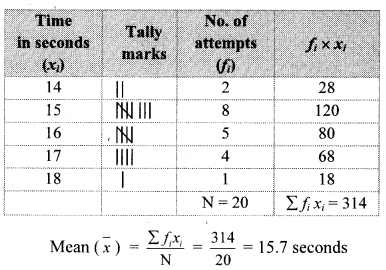
Maharashtra Board Class 8 Maths Solutions Miscellaneous Exercise 2 1
∴ The mean of the time taken for running 100 m race is 15.7 seconds.

Question 3.
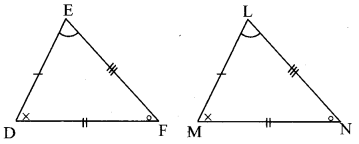
∆DEF and ∆LMN are congruent in the correspondence EDF ↔ LMN. Write the pairs of congruent sides and congruent angles in the correspondence. [Chapter 13]
Solution:
Maharashtra Board Class 8 Maths Solutions Miscellaneous Exercise 2 2
∆EDF ≅ ∆LMN
∴side ED ≅ side LM
side DF ≅ side MN
side EF ≅ side LN
∠E ≅∠L
∠D ≅∠M
∠F ≅∠N

Question 4.
The cost of a machine is Rs 2,50,000. It depreciates at the rate of 4% per annum. Find the cost of the machine after three years. [Chapter 14]
Solution:
Here, P = Cost of the machine = Rs 2,50,000
R = Rate of depreciation = 4%
N = 3 Years
A = Depreciated price of the machine
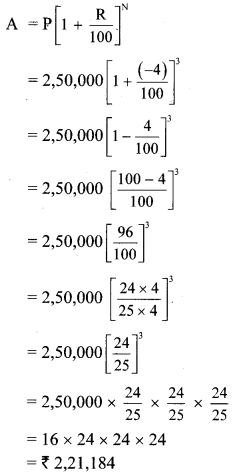
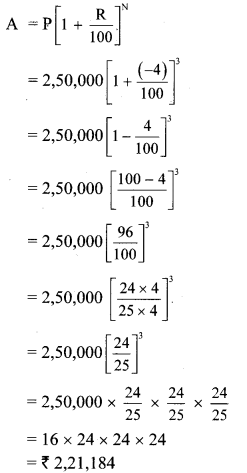
Maharashtra Board Class 8 Maths Solutions Miscellaneous Exercise 2 3
∴The cost of the machine after three years will be Rs 2,21,184.

Question 5.
In ☐ABCD, side AB || side DC, seg AE ⊥ seg DC. If l(AB) = 9 cm, l(AE) = 10 cm, A(☐ABCD) = 115 cm² , find l(DC). [Chapter 15]
Solution:
Given, side AB || side DC.
∴ ☐ABCD is a trapezium.
Maharashtra Board Class 8 Maths Solutions Miscellaneous Exercise 2 4
Given, l(AB) = 9 cm, l(AE) = 10 cm,
A(☐ABCD) = 115 cm²
Area of a trapezium
= \(\frac { 1 }{ 2 }\) x sum of lengths of parallel sides x height
∴ A(☐ABCD) = \(\frac { 1 }{ 2 }\) x [l(AB) + l(DC) x l(AE)]
∴ 115 = \(\frac { 1 }{ 2 }\) x [9 + l(DC)] x 10
∴ \(\frac { 115 \times 2 }{ 10 }\) = 9 + l(DC)
∴ 23 = 9 + l(DC)
∴ l(DC) = 23 – 9
∴ l(DC) = 14cm

Question 6.
The diameter and height of a cylindrical tank is 1.75 m and 3.2 m respectively. How much is the capacity of tank in litre?
[π = \(\frac { 22 }{ 7 }\)] [Chapter 16]
Solution:
Given: For cylindrical tank:
diameter (d) = 1.75 m, height (h) = 3.2 m
To Find: Capacity of tank in litre
diameter (d) = 1.75 m
= 1.75 x 100
….[∵ 1 m = 100cm]
= 175 cm
∴ radius (r) = \(=\frac{\mathrm{d}}{2}=\frac{175}{2}\) cm
h = 3.2 cm
= 3.2 x 100
= 320 cm
Capacity of tank = Volume of the cylindrical tank
= πr²h
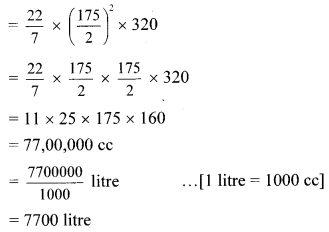
Maharashtra Board Class 8 Maths Solutions Miscellaneous Exercise 2 5
∴ The capacity of the tank is 7700 litre.

Question 7.
The length of a chord of a circle is 16.8 cm, radius is 9.1 cm. Find its distance from the centre. [Chapter 17]
Solution:
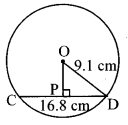
Maharashtra Board Class 8 Maths Solutions Miscellaneous Exercise 2 6
Let CD be the chord of the Circle with centre O.
Draw seg OP ⊥ chord CD
∴l(PD) = \(\frac { 1 }{ 2 }\) l(CD)
…[Perpendicular drawn from the centre of a circle to its chord bisects the chord]
∴l(PD) = \(\frac { 1 }{ 2 }\) x 16.8 …[l(CD) = 16.8cm]
∴l(PD) = 8.4 cm …(i)
∴In ∆OPD, m∠OPD = 90°
∴[l(OD)]² = [l(OP)]² + [l(PD)]² …..[Pythagoras theorem]
∴(9.1)² = [l(OP)]² + (8.4)² … [From (i) and l(OD) = 9.1 cm]
∴(9.1)² – (8.4)² = [l(OP)]²
∴(9.1 + 8.4) (9.1 – 8.4) = [l(OP)]²
…[∵ a² – b² = (a + b) (a – b)]
∴17.5 x (0.7) = [l(OP)]²
∴12.25 = [l(OP)]²
i.e., [l(OP)]² = 12.25
∴l(OP) = √12.25
…[Taking square root of both sides]
∴l(OP) = 3.5 cm
∴The distance of the chord from the centre is 3.5 cm.

Question 8.
The following tables shows the number of male and female workers, under employment guarantee scheme, in villages A, B, C and D.

VillagesABCD
No. of females15024090140
No. of males225160210110

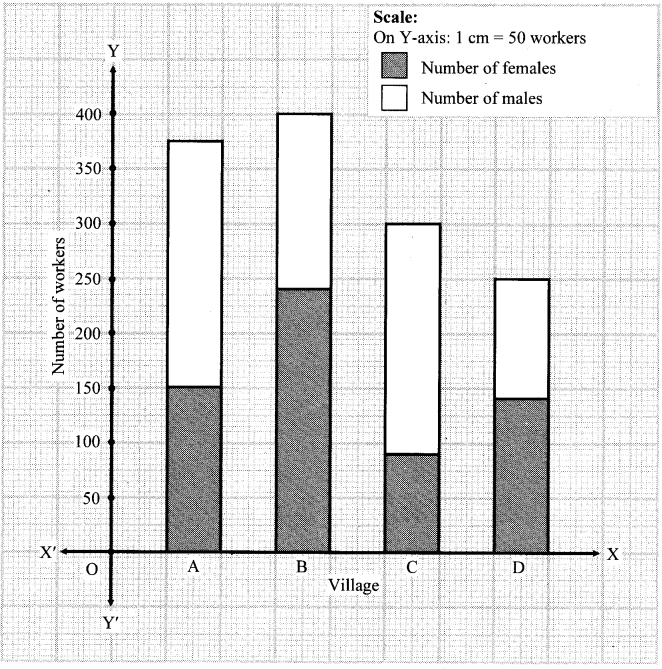
i. Show the information by a sub-divided bar-diagram.
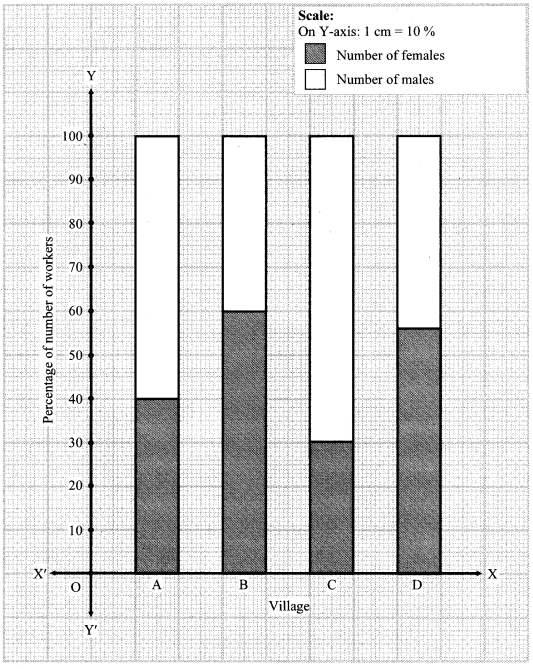
ii. Show the information by a percentage bar diagram. [Chapter 11]
Solution:
i.

VillagesABCD
No. of females15024090140
No. of males225160210110
Total375400300250

Maharashtra Board Class 8 Maths Solutions Miscellaneous Exercise 2 7

ii.

VillagesABCD
No. of females15024090140
No. of males225160210110
Total375400300250
Percentage of females40%60%30%56%
Percentage of males60%40%70%44%

Maharashtra Board Class 8 Maths Solutions Miscellaneous Exercise 2 8

Question 9.
Solve the following equations.
i. 17 (x + 4) + 8 (x + 6) = 11 (x + 5) + 15 (x + 3)
ii. \(\frac{3 y}{2}+\frac{y+4}{4}=5-\frac{y-2}{4}\)
iii. 5(1 – 2x) = 9(1 -x)
[Chapter 12]
Solution:
i. 17 (x + 4) + 8 (x + 6) = 11 (x + 5) + 15 (x + 3)
∴ 17x + 68 + 8x + 48 = 11x + 55 + 15x + 45
∴ 17x + 8x + 68 + 48 = 11x + 15x + 55 + 45
∴ 25x + 116 = 26x + 100
∴ 25x + 116 – 116 = 26x + 100 – 116
… [Subtracting 116 from both the sides]
∴ 25x = 26x – 16
∴ 25x – 26x = 26x – 16 – 26x
… [Subtracting 26x from both the sides]
∴ -x = -16
∴ \(\frac{-x}{-1}=\frac{-16}{-1}\)
∴ x = 16

ii. \(\frac{3 y}{2}+\frac{y+4}{4}=5-\frac{y-2}{4}\)
∴ \(\frac{3 y \times 2}{2 \times 2}+\frac{y+4}{4}=5-\frac{y-2}{4}\)
∴ \(\frac{6 y}{4}+\frac{y+4}{4}=5-\frac{y-2}{4}\)
∴ \(\frac{6 y}{4} \times 4+\frac{y+4}{4} \times 4=5 \times 4-\frac{y-2}{4} \times 4\)
……[Multiplying both the sides by 4]
∴ 6y + y + 4 = 20 – (y – 2)
∴ 7y + 4 = 20 – y + 2
∴ 7y + 4 = 22 – y
∴ 7y + 4 – 4 = 22 – y – 4
…..[Subtracting 4 from both the sides]
∴ 7y = 18 – y
∴ 7y + y = 18 – y + y
…[Adding y on both the sides]
∴ 8y = 18
∴ \(\frac{8 y}{8}=\frac{18}{8}\) … [Dividing both the sides by 8]
∴ \(y=\frac { 9 }{ 4 }\)

iii. 5(1 – 2x) = 9(1 – x)
∴ 5 – 10x = 9 – 9x
∴ 5 – 10x – 5 = 9 – 9x – 5
….[Subtracting 5 from both the sides]
∴ -10x = 4 – 9x
∴ -10x + 9x = 4 – 9x + 9x
… [Adding 9x on both the sides]
∴ -x = 4
∴ -x x (- 1) = 4 x (- 1)
… [Multiplying both the sides by – 1]
∴ x = – 4

Question 10.
Complete the activity according to the given steps.
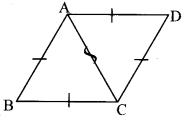
i. Draw rhombus ABCD. Draw diagonal AC.
ii. Show the congruent parts in the figure by identical marks.
iii. State by which, test and in which correspondence ∆ADC and ∆ABC are congruent.
iv. Give reason to show ∠DCA ≅ ∠BCA, and ∠DAC ≅ ∠BAC
v. State which property of a rhombus is revealed from the above steps. [Chapter 13]
Solution:
a.
Maharashtra Board Class 8 Maths Solutions Miscellaneous Exercise 2 9
b. In ∆ADC and ∆ABC,
side AD ≅ side AB …..[Sides of a rhombus]
side DC ≅ side BC …..[Sides of a rhombus]
side AC ≅ side AC … [Common side]
∆ADC ≅ ∆ABC … [By SSS test]
∠DCA ≅ ∠BCA …[Corresponding angles of congruent triangles]
∠DAC ≅ ∠BAC …[Corresponding angles of congruent triangles]
From the above steps, property of rhombus revealed is ‘diagonal of a rhombus bisect the opposite angles’.

Question 11.
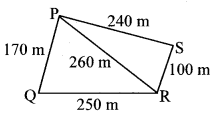
The shape of a farm is a quadrilateral. Measurements taken of the farm, by naming its corners as P, Q, R, S in order are as follows. l(PQ) = 170 m,
l(QR) = 250 m, l(RS) = 100 m, l(PS) = 240 m, l(PR) = 260 m.
Find the area of the field in hectare (1 hectare = 10,000 sq.m). [Chapter 15]
Solution:
Maharashtra Board Class 8 Maths Solutions Miscellaneous Exercise 2 10
Area of the field = A(∆PQR) + A(∆PSR)
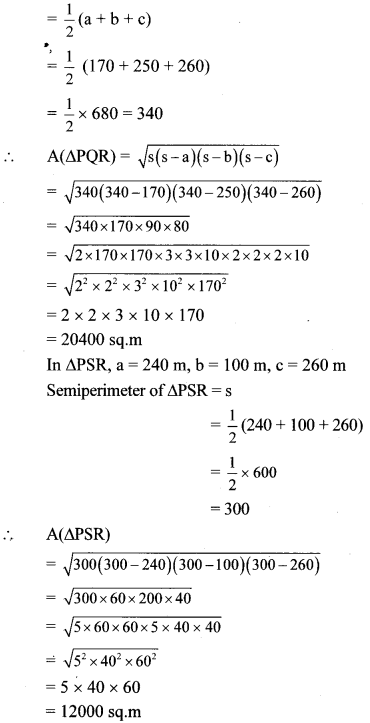
In ∆PQR, a = 170 m, b = 250 m, c = 260 m
Semiperimeter of ∆PQR = s
Maharashtra Board Class 8 Maths Solutions Miscellaneous Exercise 2 11
Area of the field = A(∆PQR) + A(∆PSR)
= 20400 + 12000
= 32400 sq.m
= \(\frac { 32400 }{ 10000 }\)
…[1 hectare = 10,000 sq.m]
= 3.24 hectares
∴ The area of the field is 3.24 hectares.

Question 12.
In a library, 50% of total number of books is of Marathi. The books of English are \(\frac { 1 }{ 3 }\) of Marathi books. The books on Mathematics are 25% of the English books. The remaining 560 books are of other subjects. What is the total number of books in the library? [Chapter 12]
Solution:
Let the total number of books in the library be x
50% of total number of books is of Marathi.
Number of Marathi books = 50% of x
= \(\frac { 50 }{ 100 }x\)
= \(\frac { x }{ 2 }\)
The books of English are \(\frac { 1 }{ 3 }\) of Marathi books.
Number of books of English = \(\frac{1}{3} \times \frac{x}{2}\)
= \(\frac { x }{ 6 }\)
The books on Mathematics are 25% of the English books.
Number of books of Mathematics
= 25% of \(\frac { x }{ 6 }\)
= \(\frac{25}{100} \times \frac{x}{6}\)
= \(\frac { x }{ 24 }\)
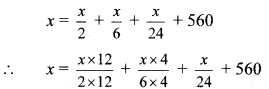
Since, there are 560 books of other subjects, the total number of books in the library are
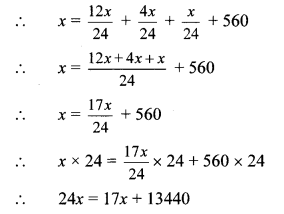
Maharashtra Board Class 8 Maths Solutions Miscellaneous Exercise 2 12
Maharashtra Board Class 8 Maths Solutions Miscellaneous Exercise 2 13
∴ 24x – 17x = 17x + 13440 – 17x
∴ 7x = 13440
∴ \(\frac{7 x}{7}=\frac{13440}{7}\)
∴ x = 1920
∴ The total number of books in the library are 1920.

Question 13.
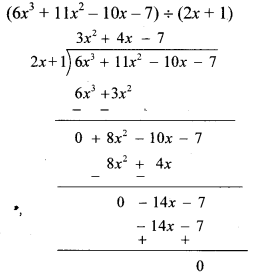
Divide the polynomial (6x³ + 11x² – 10x – 7) by the binomial (2x + 1). Write the quotient and the remainder. [Chapter 10]
Solution:
Maharashtra Board Class 8 Maths Solutions Miscellaneous Exercise 2 14
∴ Quotient = 3x² + 4x – 7,
remainder = 0
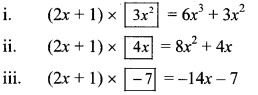
Explanation:
Maharashtra Board Class 8 Maths Solutions Miscellaneous Exercise 2 15

Maharashtra Board Class 8 Maths Solutions

Maharashtra Board 8th Class Maths Practice Set 8.2 Solutions Chapter 8 Quadrilateral: Constructions and Types

Balbharti Maharashtra State Board Class 8 Maths Solutions covers the Practice Set 8.2 8th Std Maths Answers Solutions Chapter 8 Quadrilateral: Constructions and Types.

Practice Set 8.2 8th Std Maths Answers Chapter 8 Quadrilateral: Constructions and Types

Question 1.
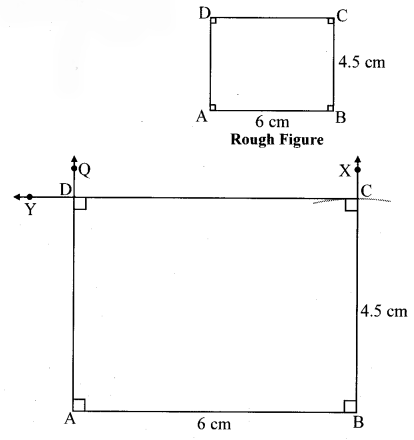
Draw a rectangle ABCD such that l(AB) = 6.0 cm and l(BC) = 4.5 cm.
Solution:
Maharashtra Board Class 8 Maths Solutions Chapter 8 Quadrilateral Constructions and Types Practice Set 8.2 1

Question 2.
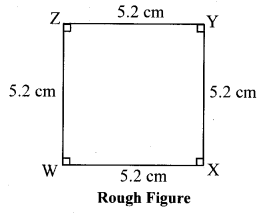
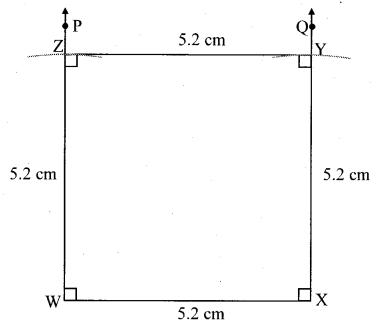
Draw a square WXYZ with side 5.2 cm.
Solution:
Maharashtra Board Class 8 Maths Solutions Chapter 8 Quadrilateral Constructions and Types Practice Set 8.2 2
Maharashtra Board Class 8 Maths Solutions Chapter 8 Quadrilateral Constructions and Types Practice Set 8.2 3

Question 3.
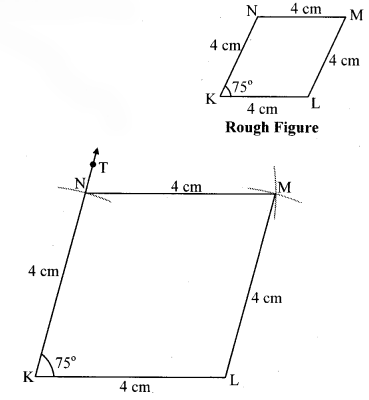
Draw a rhombus KLMN such that its side is 4 cm and m∠K = 75°.
Solution:
Maharashtra Board Class 8 Maths Solutions Chapter 8 Quadrilateral Constructions and Types Practice Set 8.2 4

Question 4.
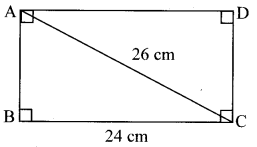
If diagonal of a rectangle is 26 cm and one side is 24 cm, find the other side.
Solution:
Maharashtra Board Class 8 Maths Solutions Chapter 8 Quadrilateral Constructions and Types Practice Set 8.2 5
Let ₹ABCD be the rectangle.
l(BC) = 24cm, l(AC) = 26cm
In ∆ABC,
m∠ABC = 90° …[Angle of a rectangle]
∴[l(AC)]² = [l(AB)]2 + [l(BC)]²
…[Pythagoras theorem]
∴ (26 )² = [l(AB)]² + (24)²
∴(26)² – (24)² = [l(AB)]²
∴(26 + 24) (26 – 24) = [l(AB)]²
…[∵ a² – b² = (a + b)(a – b)]
∴50 x 2 = [l(AB)]²
∴100 = [l(AB)]²
i.e. [l(AB)]² = 100
∴l(AB) = √100
…[Taking square root of both sides]
∴l(AB) =10 cm
∴The length of the other side is 10 cm.

Question 5.
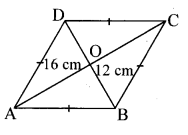
Lengths of diagonals of a rhombus ABCD are 16 cm and 12 cm. Find the side and perimeter of the rhombus.
Solution:
In rhombus ABCD,
Maharashtra Board Class 8 Maths Solutions Chapter 8 Quadrilateral Constructions and Types Practice Set 8.2 6
l(AC) = 16 cm and l(BD) = 12 cm.
Let the diagonals of rhombus ABCD intersect at point O.
l(AO) = \(\frac { 1 }{ 2 }\) l(AC)
…[Diagonals of a rhombus bisect each other]
∴l(AO) = \(\frac { 1 }{ 2 }\) × 16
∴l(AO) = 8 cm
Also, l(DO) = \(\frac { 1 }{ 2 }\) l(BD)
…[Diagonals of a rhombus bisect each other]
∴l(DO) = \(\frac { 1 }{ 2 }\) × 12
∴l(DO) = 6 cm
In ∆DOA,
m∠DOA = 90°
..[Diagonals of a rhombus are perpendicular to each other]
[l(AD)]² = [l(AO)]² + [l(DO)]²
…[Pythagoras theorem]
Maharashtra Board Class 8 Maths Solutions Chapter 8 Quadrilateral Constructions and Types Practice Set 8.2 7
= (8)² + (6)²
= 64 + 36
∴[l(AD)]² = 100
∴l(AD) = √100
… [Taking square root of both sides]
∴l(AD) = 10 cm
∴l(AB) = l(BC) = l(CD) = l(AD) = 10 cm
…[Sides of a rhombus are congruent]
Perimeter of rhombus ABCD
= l(AB) + l(BC) + l(CD) + l(AD)
= 10+10+10+10
= 40 cm
∴The side and perimeter of the rhombus are 10 cm and 40 cm respectively.

Question 6.
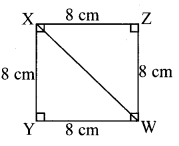
Find the length of diagonal of a square with side 8 cm.
Solution:
Let ₹XYWZ be the square of side 8cm.
Maharashtra Board Class 8 Maths Solutions Chapter 8 Quadrilateral Constructions and Types Practice Set 8.2 8
seg XW is a diagonal.
In ∆ XYW,
m∠XYW = 90°
… [Angle of a square]
∴ [l(XW)]² = [l(XY)]² + [l(YW)]²
…[Pythagoras theorem]
= (8)² + (8)²
= 64 + 64
∴ [l(XW)]² = 128
∴ l(XW) = √128
…[Taking square root of both sides]
= √64 × 2
= 8 √2 cm
∴ The length of the diagonal of the square is 8 √2 cm.

Question 7.
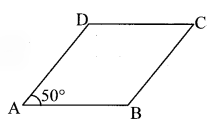
Measure of one angle of a rhombus is 50°, find the measures of remaining three angles.
Solution:
Let ₹ABCD be the rhombus.
Maharashtra Board Class 8 Maths Solutions Chapter 8 Quadrilateral Constructions and Types Practice Set 8.2 9
m∠A = 50°
m∠C = m∠A
….[Opposite angles of a rhombus are congruent]
∴ m∠C = 50°
Also, m∠D = m∠B …(i)
….[Opposite angles of a rhombus are congruent]
In ₹ABCD,
m∠A + m∠B + m∠C + m∠D = 360°
….[Sum of the measures of the angles of a quadrilateral is 360°]
∴ 50° + m∠B + 50° + m∠D = 360°
∴ m∠B + m∠D + 100° = 360°
∴ m∠B + m∠D = 360° – 100°
∴ m∠B + m∠B = 260° …[From (i)]
∴ 2m∠B = 260°
∴ m∠B = \(\frac { 260 }{ 2 }\)
∴ m∠B = 130°
∴ m∠D = m∠B = 130° …[From (i)]
∴ The measures of the remaining angles of the rhombus are 130°, 50° and 130°.

Maharashtra Board Class 8 Maths Chapter 8 Quadrilateral: Constructions and Types Practice Set 8.2 Intext Questions and Activities

Question 1.
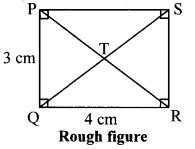
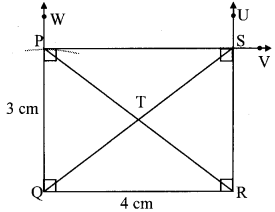
Construct a rectangle PQRS by taking two convenient adjacent sides. Name the point of intersection of diagonals as T. Using divider and ruler, measure the following lengths.
i. lengths of opposite sides, seg QR and seg PS.
ii. lengths of seg PQ and seg SR.
iii. lengths of diagonals PR and QS.
iv. lengths of seg PT and seg TR, which are parts of the diagonal PR.
v. lengths of seg QT and seg TS, which are parts of the diagonal QS.
Observe the measures. Discuss about the measures obtained by your classmates. (Textbook pg. no. 44)
Solution:
Draw a rectangle PQRS such that, l(PQ) = 3 cm and l(QR) = 4 cm.
Maharashtra Board Class 8 Maths Solutions Chapter 8 Quadrilateral Constructions and Types Practice Set 8.2 10
Steps of construction:
i. As shown in the rough figure, draw seg QR of length 4 cm.
ii. Placing the centre of the protractor at point Q, draw ray QW making an angle of 90° with seg QR.
iii. By taking a distance of 3 cm on the compass and placing it at point Q, draw an arc on ray QW. Name the point as P.
iv. Draw ray PV and ray RU making an angle of 90° with seg PQ and seg QR respectively.
v. Name the point of intersection of ray PV and ray RU as S.
₹PQRS is the required rectangle.
Maharashtra Board Class 8 Maths Solutions Chapter 8 Quadrilateral Constructions and Types Practice Set 8.2 11
From the figure,
i. l(QR) = l(PS) = 4 cm
ii. l(PQ) = l(SR) = 3 cm
iii. l(PR) = l(QS) = 5 cm
iv. l(PT) = l(TR) = 2.5 cm
v. l(QT) = l(TS) = 2.5 cm

From the above measures, we can say that for any rectangle,
i. Opposite sides are congruent.
ii. Diagonals are congruent.
iii. Diagonals bisect each other.

Question 2.
Draw a square by taking convenient length of side. Name the point of intersection of its diagonals as E. Using the apparatus in a compass box, measure the following lengths.
i. lengths of diagonal AC and diagonal BD.
ii. lengths of two parts of each diagonal made by point E.
iii. all the angles made at the point E.
iv. parts of each angle of the square made by each diagonal, (e.g. ∠ADB and ∠CDB).
Observe the measures. Also observe the measures obtained by your classmates and discuss about them. (Textbook pg. no. 44)
Solution:
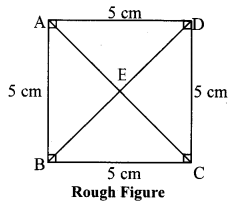
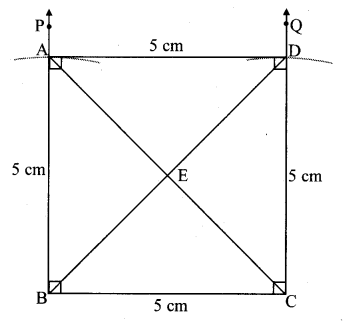
Draw a square ABCD such that its side is 5cm
Maharashtra Board Class 8 Maths Solutions Chapter 8 Quadrilateral Constructions and Types Practice Set 8.2 12
Steps of construction:
i. As shown in the rough figure, draw seg BC of length 5 cm.
ii. Placing the centre of the protractor at point B, draw ray BP making an angle of 90° with seg BC.
iii. By taking a distance of 5 cm on the compass and placing it at point B, draw an arc on ray BP. Name the point as A.
iv. Placing the centre of the protractor at point C, draw ray CQ making an angle of 90° with seg BC.
v. By taking a distance of 5 cm on the compass and placing it at point C, draw an arc on ray CQ. Name the point as D.
vi. Draw seg AD.
₹ABCD is the required square.
Maharashtra Board Class 8 Maths Solutions Chapter 8 Quadrilateral Constructions and Types Practice Set 8.2 13
From the figure,
i. l(AC) = l(BD) ≅ 7cm
ii. l(AE) = l(EC) ≅ 3.5cm,
l(BE) = l(ED) ≅ 3.5cm
iii. m∠AED = m∠BEC = m∠CED = m∠BEA = 90°
iv. Angles made by diagonal AC:
m∠BAC = m∠DAC = 45°
m∠BCA = m∠DCA = 45°
Angles made by diagonal BD:
m∠ABD = m∠CBD = 45°
m∠ADB = m∠CDB = 45°

From the above measures, we can say that for any square,
i. Diagonals are congruent.
ii. Diagonals bisect each other.
iii. Diagonals are perpendicular to each other.
iv. Diagonals bisect the opposite angles.

Question 3.
Draw a rhombus EFGH by taking convenient length of side and convenient measure of an angle.
Draw its diagonals and name their point of Intersection as M.
i. Measure the opposite angles of the quadrilateral and angles at the point M.
ii. Measure the two parts of every angle made by the diagonal.
iii. Measure the lengths of both diagonals. Measure the two parts of diagonals made by point M.
Observe the measures. Also observe the measures obtained by your classmates and discuss about them. (Textbook pg. no. 45)
Solution:
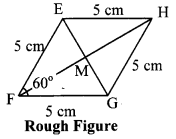
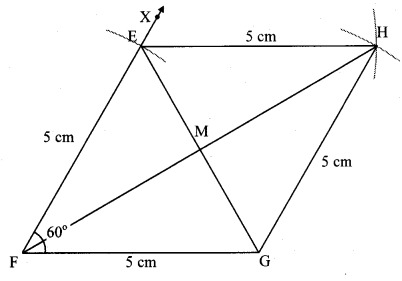
Draw a rhombus EFGH such that its side is 5 cm and m∠F = 60°.
Maharashtra Board Class 8 Maths Solutions Chapter 8 Quadrilateral Constructions and Types Practice Set 8.2 14
Steps of construction:
i. As shown in the rough figure, draw seg FG of length 5 cm.
ii. Placing the centre of the protractor at point F, draw ray FX making an angle 60° with seg FG.
iii. By taking a distance of 5 cm on the compass and placing it at point F, draw an arc on ray FX. Name the point as E.
iv. By taking a distance of 5 cm on the compass and placing it at point E and point G, draw arcs. Name the point of intersection of arcs as H. ₹EFGH is the required rhombus.
Maharashtra Board Class 8 Maths Solutions Chapter 8 Quadrilateral Constructions and Types Practice Set 8.2 15
From the figure,
i. Opposite angles:
m∠EFG = m∠GHE = 60°,
m∠FEH = m∠HGF = 120°
Angles at the point M:
m∠EMF = m∠FMG = m∠GMH = m∠HME = 90°

ii. Angles made by diagonal FH:
m∠EFH = m∠GFH = 30° m∠EHF = m∠GHF = 30°
Angles made by diagonal EG:
m∠FEG = m∠HEG = 60° m∠FGE = m∠HGE = 60°

iii. l(FH) ≈ 8.6 cm
l(EG) = 5 cm
l(FM) = l(HM) ≈ 4.3 cm
l(EM) = l(GM) ≈ 2.5 cm

From the above measures, we can say that for any rhombus,
i. Opposite angles are congruent.
ii. Diagonals bisect the opposite angles.
iii. Diagonals bisect each other and they are perpendicular to each other.

Maharashtra Board 8th Class Maths Miscellaneous Exercise 1 Solutions

Balbharti Maharashtra State Board Class 8 Maths Solutions covers the Miscellaneous Exercise 1 8th Std Maths Answers Solutions.

Miscellaneous Exercise 1 8th Std Maths Answers

Question 1.
Choose the correct alternative answer for each of the following questions.
i. In ₹PQRS, m∠P = m∠R = 108°, m∠Q = m∠S = 72°. State which pair of sides of those given below is parallel. [Chapter 8]
(A) side PQ and side QR
(B) side PQ and side SR
(C) side SR and side SP
(D) side PS and side PQ
Solution:
(B) side PQ and side SR

Hint:
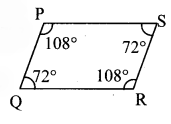
Maharashtra Board Class 8 Maths Solutions Miscellaneous Exercise 1 1
In ₹PQRS,
m∠P + m∠S = 108°+ 72
= 180°
Since, interior angles are supplementary.
∴ side PQ || side SR

ii. Read the following statements and choose the correct alternative from those given below them. [Chapter 8]
a. Diagonals of a rectangle are perpendicular bisectors of each other.
b. Diagonals of a rhombus are perpendicular bisectors of each other.
c. Diagonals of a parallelogram are perpendicular bisectors of each other.
d. Diagonals of a kite bisect each other.
(A) Statements (b) and (c) are true
(B) Only statement (b) is true
(C) Statements (b) and (d) are true
(D) Statements (a), (c) and (d) are true.
Solution:
(B) Only statement (b) is true

iii. If 19³ = 6859, find \(\sqrt[3]{0.006859}\). [Chapter 3]
(A) 1.9
(B) 19
(C) 0.019
(D) 0.19
Solution:
(D) 0.19

Hint:
\(\sqrt[3]{0.006859}\)
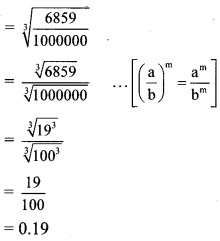
Maharashtra Board Class 8 Maths Solutions Miscellaneous Exercise 1 2

Question 2.
Find the cube roots of the following numbers. [Chapter 3]
i. 5832
ii. 4096
Solution:
i. 5832 = 2 × 2 × 2 × 3 × 3 × 3 × 3 × 3 × 3
= (2 × 3 × 3) × (2 × 3 × 3) × (2 × 3 × 3)
= (2 × 3 × 3)³
= (18)³
\(\sqrt[3]{5832}=18\)
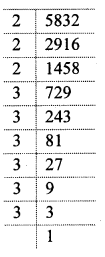
Maharashtra Board Class 8 Maths Solutions Miscellaneous Exercise 1 3

ii. 4096 = (4 × 4) × (4 × 4) × (4 × 4)
= (4 × 4)
= 16³
\( \sqrt[3]{4096}=16\)
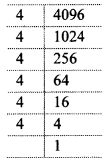
Maharashtra Board Class 8 Maths Solutions Miscellaneous Exercise 1 4

Question 3.
m∝n,n = 15 when m = 25. Hence
i. Find m when n = 87,
ii. Find n when m = 155. [Chapter 7]
Solution:
Given that, m ∝ n
∴ m = kn …(i)
where, k is the constant of variation.
When m = 25, n = 15
∴ Substituting, m = 25 and n = 15 in (i), we get
m = kn
∴ 25 = k × 15
∴ k = \(\frac { 25 }{ 15 }\)
∴ k = \(\frac { 5 }{ 3 }\)
Substituting k = \(\frac { 5 }{ 3 }\) in (i), we get
m = kn
∴ m = \(\frac { 5 }{ 3 }n\) …(ii)

i. When n = 87, m = ?
Substituting n = 87 in (ii), we get
m = \(\frac { 5 }{ 3 }n\)
m = \(\frac { 5 }{ 3 }\) × 87
m = 5 × 29
m = 145

ii. When m = 155, n = ?
∴ Substituting m = 155 in (ii), we get
m = \(\frac { 5 }{ 3 }n\)
∴ 155 = \(\frac { 5 }{ 3 }n\)
∴ \(\frac{155 \times 3}{5}=n\)
∴ n = 31 × 3
∴ n = 93

Question 4.
y varies inversely with x. If y = 30 when x = 12, find [Chapter 7]
i. y when x = 15,
ii. x when y = 18.
Solution:
Given that,
\(y \propto \frac{1}{x}\)
∴ \(y=k \times \frac{1}{x}\)
where, k is the constant of variation.
∴ y × x = k …(i)
When x = 12, y = 30
∴ Substituting, x = 12 and y = 30 in (i), we get
y × x = k
∴ 30 × 12 = k
∴ k = 360
Substituting, k = 360 in (i), we get
y × x = k
∴ y × x = 360 ….(ii)

i. When x = 15,y = ?
∴ Substituting x = 15 in (ii), we get
y × x = 360
∴ y × 15 = 360
∴ y = \(\frac { 360 }{ 15 }\)
∴ y = 24

ii. When y = 18, x = ?
∴ Substituting y = 18 in (ii), we get
y × x = 360
∴18 × x = 360
∴ x = \(\frac { 360 }{ 18 }\)
∴ x = 20

Question 5.
Draw a line l. Draw a line parallel to line l at a distance of 3.5 cm. [Chapter 2]
Solution:
Steps of construction:

  1. Draw a line l and take any two points M and N on the line.
  2. Draw perpendiculars to line l at points M and N.
  3. On the perpendicular lines take points S and T at a distance 3.5 cm from points M and N respectively.
  4. Draw a line through points S and T. Name the line as n.
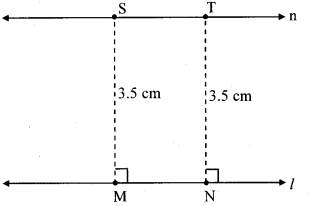
Maharashtra Board Class 8 Maths Solutions Miscellaneous Exercise 1 5
Line n is parallel to line l at a distance of 3.5 cm from it.

Question 6.
Fill in the blanks in the following statement.
The number \((256)^{\frac{5}{7}}\) is __ of __ power of __. [Chapter 3]
Solution:
The number \((256)^{\frac{5}{7}}\) is 7th root of 5th power of 256.

Question 7.
Expand.
i. (5x – 7) (5x – 9)
ii. (2x – 3y)³
iii. \(\left(a+\frac{1}{2}\right)^{3}\) [Chapter 5]
Solution:
i. (5x – 7) (5x – 9)
= (5x)² + (-7 -9) 5x + (-7) × (-9).
…[∵ (x + a) (x + b) = x² + (a + b)x + ab]
= 25x² + (-16) × 5x + 63
= 25x² – 80x + 63

ii. Here, a = 2x and b = 3y
(2x – 3y)³
= (2x)³ – 3 (2x)² (3y) + 3 (2x) (3y)² – (3y)³
…[∵ (a – b)³ = a³ – 3a²b + 3ab² – b³]
= 8x³ – 3 (4x²) (3y) + 3 (2x) (9y²) – 27y³
= 8x³ – 36x²y + 54xy² – 27p³

iii. Here, A= a and B = \(\frac { 1 }{ 2 }\)
\(\left(a+\frac{1}{2}\right)^{3}=(a)^{3}+3(a)^{2}\left(\frac{1}{2}\right)+3(a)\left(\frac{1}{2}\right)^{2}+\left(\frac{1}{2}\right)^{3}\)
…[(A + B)³ = A³ + 3A²B + 3AB² + B³]
\(=\mathbf{a}^{3}+\frac{3 \mathbf{a}^{2}}{2}+\frac{3 \mathbf{a}}{4}+\frac{1}{8}\)

Question 8.
Draw an obtuse angled triangle. Draw all of its medians and show their point of concurrence. [Chapter 4]
Solution:
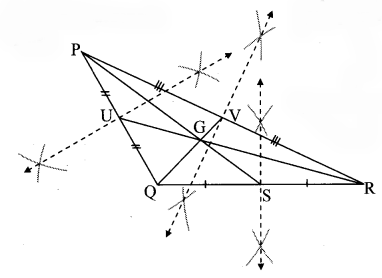
Maharashtra Board Class 8 Maths Solutions Miscellaneous Exercise 1 6
The point of concurrence of the medians PS, RU and QV is G.

Question 9.
Draw ∆ABC such that l(BC) = 5.5 cm, m∠ABC = 90°, l(AB) = 4 cm. Show the orthocentre of the triangle. [Chapter 4]
Solution:
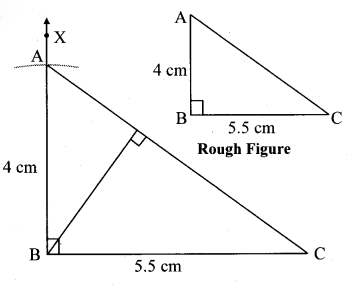
Maharashtra Board Class 8 Maths Solutions Miscellaneous Exercise 1 7
Here, point B is the orthocentre of ∆ABC.

Question 10.
Identify the variation and solve.
It takes 5 hours to travel from one town to the other if speed of the bus is 48 km/hr. If the speed of the bus is reduced by 8 km/hr, how much time will it take for the same travel? [Chapter 7]
Solution:
Let, v represent the speed of the bus and t represent the time required to travel from one town to the other.
The speed of the bus varies inversely with the time required to travel from one town to the other.
∴ \(\mathbf{v} \propto \frac{1}{\mathbf{t}}\)
∴ \(\mathbf{v}=\mathbf{k} \times \frac{1}{\mathbf{t}}\)
where, k is the constant of variation.
∴ v × t = k …(i)
It takes 5 hours to travel from one town to the other if speed of the bus is 48 km/hr.
i.e., when v = 48, t = 5
∴ Substituting v = 48 and t = 5 in (i), we get
v × t = k
∴ 48 × 5 = k
∴ k = 240
Substituting k = 240 in (i), we get
v × t = k
∴ v × t = 240 …(ii)
Since, the speed of the bus is reduced by 8 km/hr,
∴ Speed of the bus in second case (v)
= 48 – 8 = 40 km/hr
∴ When v = 40, t = ?
∴ Substituting v = 40 in (ii), we get
v × t = 240
∴ 40 × t = 240
∴ \(t=\frac { 240 }{ 40 }\)
∴ t = 6
∴ The problem is of inverse variation and the bus would take 6 hours to travel the distance if its speed is reduced by 8 km/hr.

Question 11.
Seg AD and seg BE are medians of ∆ABC and point G is the centroid. If l(AG) = 5 cm, find l(GD). If l(GE) = 2 cm, find l(BE). [Chapter 4]
Solution:
The centroid of a triangle divides each median in the ratio 2:1.
i. Point G is the centroid and seg AD is the median.
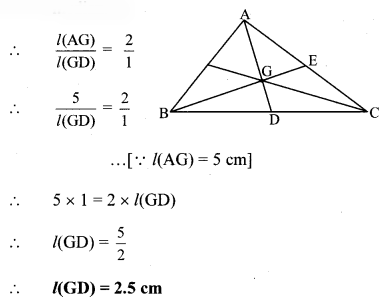
Maharashtra Board Class 8 Maths Solutions Miscellaneous Exercise 1 8

ii. Point G is the centroid and seg BE is the median.
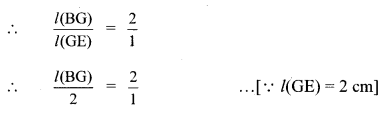
Maharashtra Board Class 8 Maths Solutions Miscellaneous Exercise 1 9
∴ l(BG) × 1 = 2 × 2
∴ l(BG) = 4 cm
Now, l(BE) = l(BG) + l(GE)
∴ l(BE) = 4 + 2
∴ l(BE) = 6 cm

Question 12.
Convert the following rational numbers into decimal form. [Chapter 1]
i. \(\frac { 8 }{ 13 }\)
ii. \(\frac { 11 }{ 7 }\)
iii. \(\frac { 5 }{ 16 }\)
iv. \(\frac { 7 }{ 9 }\)
Solution:
i. \(\frac { 8 }{ 13 }\)
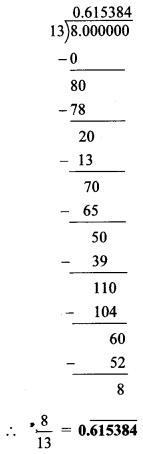
Maharashtra Board Class 8 Maths Solutions Miscellaneous Exercise 1 10

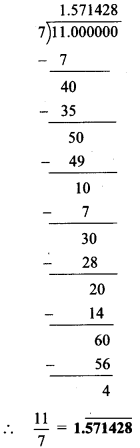
ii. \(\frac { 11 }{ 7 }\)
Maharashtra Board Class 8 Maths Solutions Miscellaneous Exercise 1 11

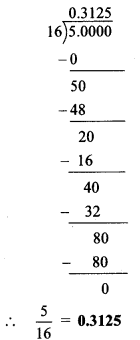
iii. \(\frac { 5 }{ 16 }\)
Maharashtra Board Class 8 Maths Solutions Miscellaneous Exercise 1 12

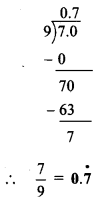
iv. \(\frac { 7 }{ 9 }\)
Maharashtra Board Class 8 Maths Solutions Miscellaneous Exercise 1 13

Question 13.
Factorize.
i. 2y² – 11y + 5
ii. x² – 2x – 80
iii. 3x² – 4x + 1
Solution:
i. 2y² – 11y + 5
= 2y² – 10y – y + 5
= 2y(y – 5) – 1(y – 5)
= (y – 5)(2y – 1)
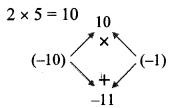
Maharashtra Board Class 8 Maths Solutions Miscellaneous Exercise 1 14

ii. x² – 2x – 80
= x² – 10x + 8x – 80
= x (x – 10) + 8 (x – 10)
= (x – 10)(x + 8)
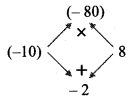
Maharashtra Board Class 8 Maths Solutions Miscellaneous Exercise 1 15

iii. 3x² – 4x + 1
= 3x² – 3x – x + 1
= 3x(x – 1) – 1(x – 1)
= (x – 1) (3x – 1)
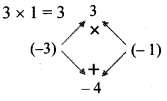
Maharashtra Board Class 8 Maths Solutions Miscellaneous Exercise 1 16

Question 14.
The marked price of a T.V. set is Rs 50,000. The shopkeeper sold it at 15% discount. Find the price of it for the customer. [Chapter 9]
Solution:
Here, marked price = Rs 50,000,
discount = 15%
Let the discount percent be x
∴x = 15%
i. Discount
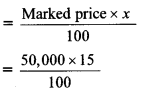
Maharashtra Board Class 8 Maths Solutions Miscellaneous Exercise 1 17
= 500 × 15
= Rs 7,500

ii. Selling price = Marked price – Discount
= 50,000 – 7,500
= Rs 42,500
∴The price of the T.V. set for the customer is Rs 42,500.

Question 15.
Rajabhau sold his flat to Vasantrao for Rs 88,00,000 through an agent. The agent charged 2 % commission for both of them. Find how much commission the agent got. [Chapter 9]
Solution:
Here, selling price of the flat = Rs 88,00,000
Rate of commission = 2%
Commission = 2% of selling price
= \(\frac { 2 }{ 100 }\) × 88,00,000
= 2 × 88,000
= Rs 1,76,000
∴ Total commission = Commission from Rajabhau + Commission from Vasantrao
= Rs 1,76,000 + Rs 1,76,000
= Rs 3,52,000
∴ The agent got a commission of Rs 3,52,000.

Question 16.
Draw a parallelogram ABCD such that l(DC) = 5.5 cm, m∠D = 45°, l(AD) = 4 cm. [Chapter 8]
Solution:
Opposite sides of a parallelogram are congruent.
∴ l(AD) = l(BC) = 4 cm and
l(DC) = l(AB) = 5.5 cm
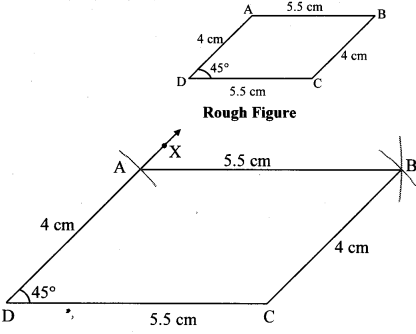
Maharashtra Board Class 8 Maths Solutions Miscellaneous Exercise 1 18

Question 17.
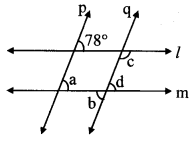
In the figure, line l || line m and line p || line q. Find the measures of ∠a, ∠b, ∠c and ∠d. [Chapter 2]
Maharashtra Board Class 8 Maths Solutions Miscellaneous Exercise 1 19
Solution:
i. line l|| line m and line p is a transversal.
∴m∠a = 78° …(i) [Corresponding angles]

ii. line p || line q and line m is a transversal.
∴m∠d = m∠a …[Corresponding angles]
∴m∠d = 78° …(ii)[From (i)]

iii. m∠b = m∠d …[Vertically opposite angles]
∴m∠b = 78° …[From (ii)]

iv. line l|| line m and line q is a transversal.
∴m∠c + m∠d = 180° …[Interior angles]
∴m∠c + 78° = 180° … [From (ii)]
∴m∠c =180° – 78°
∴m∠c = 102°
∴m∠a = 78°, m∠b = 78°, m∠c = 102°, m∠d = 78°

Maharashtra Board Class 8 Maths Solutions

Maharashtra Board 8th Class Maths Practice Set 17.1 Solutions Chapter 17 Factorisation of Algebraic Expressions

Balbharti Maharashtra State Board Class 8 Maths Solutions covers the Practice Set 17.1 8th Std Maths Answers Solutions Chapter 17 Circle: Chord and Arc.

Practice Set 17.1 8th Std Maths Answers Chapter 17 Circle: Chord and Arc

Question 1.
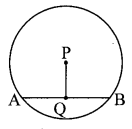
In a circle with centre P, chord AB is drawn of length 13 cm, seg PQ ⊥ chord AB, then find l(QB)
Maharashtra Board Class 8 Maths Solutions Chapter 17 Circle Chord and Arc Practice Set 17.1 1
Solution:
seg PQ ⊥ chord AB … [Given]
∴l(QB) = \(\frac { 1 }{ 2 }\) l(AB)… [Perpendicular drawn from the centre of a circle to its chord bisects the chord]
∴l(QB) = \(\frac { 1 }{ 2 }\) x 13 …[∵ l(AB) = 13 cm]
∴l(QB) = 6.5 cm

Question 2.
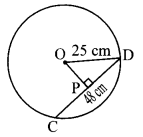
Radius of a circle with centre O is 25 cm. Find the distance of a chord from the centre if length of the chord is 48 cm.
Maharashtra Board Class 8 Maths Solutions Chapter 17 Circle Chord and Arc Practice Set 17.1 2
Solution:
seg OP ⊥ chord CD … [Given]
∴l(PD) = \(\frac { 1 }{ 2 }\) l(CD) … [Perpendicular drawn from the centre of a circle to its chord bisects the chord]
∴l(PD) = \(\frac { 1 }{ 2 }\) x 48 …[∵ l(CD) = 48 cm]
∴l(PD) = 24 cm …(i)
In ∆OPD, m∠OPD = 90°
∴[l(OD)]² = [l(OP)]² + [l(PD)]² … [Pythagoras theorem]
∴(25)² = [l(OP)]² + (24)² … [From (i) and l(OD) = 25 cm]
∴(25)² – (24)² = [l(OP)]²
∴(25 + 24) (25 – 24) = [l(OP)]² …[∵ a² – b² = (a + b) (a – b)]
∴49 x 1 = [l(OP)]²
∴[l(OP)]² = 49
∴l(OP) = √49 …[Taking square root of both sides]
∴l(OP) = 7 cm
∴The distance of the chord from the centre of the circle is 7 cm.

Question 3.
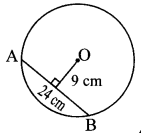
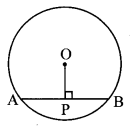
O is centre of the circle. Find the length of radius, if the chord of length 24 cm is at a distance of 9 cm from the centre of the
Maharashtra Board Class 8 Maths Solutions Chapter 17 Circle Chord and Arc Practice Set 17.1 3
Solution:
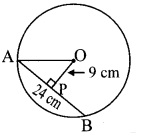
Let seg OP ⊥ chord AB
∴ l(AP) = \(\frac { 1 }{ 2 }\) l(AB) … [Perpendicular drawn from the centre of a circle to its chord bisects the chord]
Maharashtra Board Class 8 Maths Solutions Chapter 17 Circle Chord and Arc Practice Set 17.1 4
∴l(AP) = \(\frac { 1 }{ 2 }\) x 24 …[∵ l(AB) = 24 cm]
∴l(AP) = 12 cm …(i)
In ∆OPA, m∠OPA = 90°
∴[l(AO)]² = [l(OP)]² + [l(AP)]² … [Pythagoras theorem]
∴[l(AO)]² = (9)² + (12)² … [From (i) and l(OP) = 9 cm]
= 81 + 144
∴[l(AO)]² = 225
∴l(AO) = √225 …[Taking square root of both sides]
∴l(AO) = 15 cm
∴The length of radius of the circle is 15 cm.

Question 4.
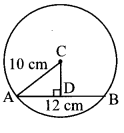
C is the centre of the circle whose radius is 10 cm. Find the distance of the chord from the centre if the length of the chord is 12 cm.
Solution:
Let seg AB be the chord of the circle with centre C.
Draw seg CD ⊥ chord AB.
Maharashtra Board Class 8 Maths Solutions Chapter 17 Circle Chord and Arc Practice Set 17.1 5
∴l(AD) = \(\frac { 1 }{ 2 }\) l(AB) …[Perpendicular drawn from the centre of a circle to its chord bisects the chord]
= \(\frac { 1 }{ 2 }\) x 12 …[∵ l(AB) = 12 cm]
∴l(AD) = 6 cm …(i)
∴In ∆ACD, m∠ADC = 90°
∴[l(AC)]² = [l(AD)]² + [l(CD)]² … [Pythagoras theorem]
∴(10)² = (6)² + [l(CD)]² … [From (i) and l(AC) = 10 cm]
∴(10)² – (6)² = [l(CD)]²
∴100 – 36 = [l(CD)]²
∴64 = [l(CD)]²
i. e. [l(CD)]² = 64
∴l(CD) = √64 …[Taking square root of both sides]
∴l(CD) = 8 cm
∴The distance of the chord from the centre of the circle is 8 cm.

Maharashtra Board Class 8 Maths Chapter 17 Circle: Chord and Arc Practice Set 17.1 Intext Questions and Activities

Question 1.
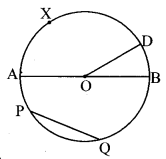
In the given figure, O is the centre of the circle. With reference to the figure fill in the blanks. (Textbook pg. No. 114)
Maharashtra Board Class 8 Maths Solutions Chapter 17 Circle Chord and Arc Practice Set 17.1 6
Solution:

  1. Seg OD is radius of the circle.
  2. Seg AB is diameter of the circle.
  3. Seg PQ is chord of the circle.
  4. ∠DOB is the central angle.
  5. Minor arc : arc AXD, arc BD, arc AP, arc PQ, arc BQ, etc.
  6. Major arc : arc PAB, arc PDQ, arc PDB, arc ADQ, etc.
  7. Semicircular arc : arc ADB, arc AQB.
  8. m (arc DB) = m∠DOB
  9. m (arc DAB) = 360° – m∠DOB

Question 2.
Draw chord AB of a circle with centre O. Draw perpendicular OP to chord AB. Measure seg AP and seg PB. What do you observe. (Textbook pg. no. 114)
Solution:
l(AP) = l(PB) = 0.9 cm
∴the perpendicular drawn from the centre of the circle to its chord bisects the chord.
Maharashtra Board Class 8 Maths Solutions Chapter 17 Circle Chord and Arc Practice Set 17.1 7

Question 3.
Draw five circles with different radii. Draw a chord and perpendicular from the centre to each chord in each circle. Verify with a divider that the two parts of the chords are equal. (Textbook pg. no. 114)
Solution:
[Students should attempt the above activities on their own.]

Question 4.
Draw five circles of different radii on a paper. Draw a chord in each circle. Find the midpoint of each chord. Join the centre of the circle and midpoint of the chord as shown in the figure. Name the chord as AB and midpoint of the chord as P. Check with set-square or protractor that ∠APO or ∠BPO are right angles.
Check whether the same result is observed for the chord of each circle. (Textbook pg, no. 115)
Solution:
[Students should attempt the above activities on their own.]

Maharashtra Board Class 8 Maths Solutions Chapter 14 Compound Interest Practice Set 14.2

Balbharti Maharashtra State Board Class 8 Maths Solutions covers the Practice Set 14.2 8th Std Maths Answers Solutions Chapter 14 Compound Interest.

Practice Set 14.2 8th Std Maths Answers Chapter 14 Compound Interest

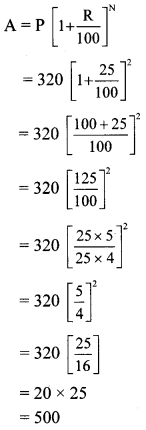
Compound Interest class 8 practice set 14.2 Question 1. On the construction work of a flyover bridge there were 320 workers initially. The number of workers were increased by 25% every year. Find the number of workers after 2 years.
Solution:
Here, P = Initial number of workers = 320
R = Increase in the number of workers per year = 25%
N = 2 years
A = Number of workers after 2 years
Maharashtra Board Class 8 Maths Solutions Chapter 14 Compound Interest Practice Set 14.2 1
∴ The number of workers after 2 years would be 500.

Question 2.
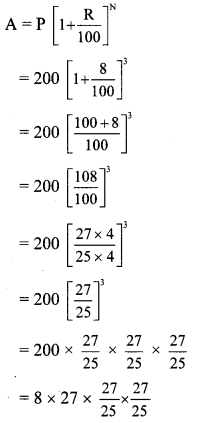
A shepherd has 200 sheep with him. Find the number of sheeps with him after 3 years if the increase in number of sheeps is 8% every year.
Solution:
Here, P = Present number of sheeps = 200
R = Increase in number of sheeps per year = 8%
N = 3 years
A = Number of sheeps after 3 years
Maharashtra Board Class 8 Maths Solutions Chapter 14 Compound Interest Practice Set 14.2 2
= \(\frac{0.32}{25} \times 27 \times 27 \times 27\)
= 0.0128 × 27 × 27 × 27
= 251.9424
= 252
∴ The number of sheeps with the shepherd after 2 years would be 252 (approx).

8th Class Math Practice Set 14.2 Question 3.
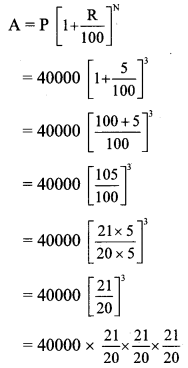
In a forest there are 40,000 trees. Find the expected number of trees after 3 years if the objective is to increase the number at the rate 5% per year.
Solution:
Here, P = Present number of trees in the forest = 40,000
R = Increase in the number of trees per year = 5%
N = 3 years
A = Number of trees after 3 years
Maharashtra Board Class 8 Maths Solutions Chapter 14 Compound Interest Practice Set 14.2 3
= 5 × 21 × 21 × 21
= 5 × 9261
= 46,305
∴ The expected number of trees in the forest after 3 years is 46,305.

Std 8 Maths Practice Set 14.2 Question 4.
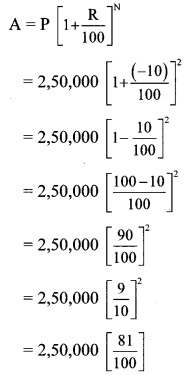
The cost price of a machine is Rs 2,50,000. If the rate of depreciation is 10% per year, find the depreciation in price of the machine after two years.
Solution:
Here, P = Cost price of machine = Rs 2,50,000
R = Rate of depreciation per year = 10%
N = 2 years
A = Depreciated price of the machine after 2 years
Maharashtra Board Class 8 Maths Solutions Chapter 14 Compound Interest Practice Set 14.2 4
= 2,500 × 81
= Rs 2,02,500
Depreciation in price = Cost price (P) – Depreciated price (A)
= 2,50,000 – 2,02,500
= Rs 47,500
∴ The depreciation in price of the machine after 2 years would be Rs 47,500.

Question 5.
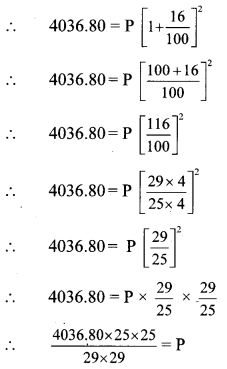
Find the compound interest if the amount of a certain principal after two years is Rs 4036.80 at the rate of 16 p.c.p.a.
Solution:
Here, A = Rs 4036.80, R = 16 p.c.p.a. and N = 2 years
i. \(\mathbf{A}=\mathbf{P}\left[1+\frac{\mathbf{R}}{100}\right]^{N}\)
Maharashtra Board Class 8 Maths Solutions Chapter 14 Compound Interest Practice Set 14.2 5

ii. Interest = Amount (A) – Principal (P)
= 4036.80 – 3000
= Rs 1036.80
∴ The compound interest after 2 years would be Rs 1036.80.

Question 6.
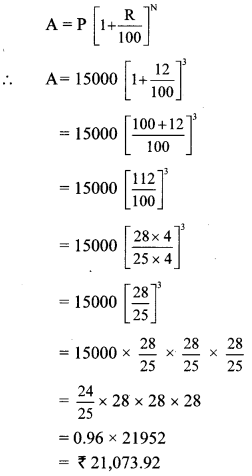
A loan of Rs 15,000 was taken on compound interest. If the rate of compound interest is 12 p.c.p.a. find the amount to settle the loan after 3 years.
Solution:
Here, P = Rs 15,000, R = 12 p.c.p.a, and
N = 3 years
Maharashtra Board Class 8 Maths Solutions Chapter 14 Compound Interest Practice Set 14.2 6
∴ The amount required to settle the loan after 3 years is Rs 21,073.92.

Practice Set 14.2 Class 8 Question 7.
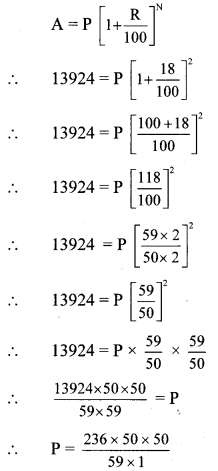
A principal amounts to Rs 13,924 in 2 years by compound interest at 18 p.c.p.a. Find the principal.
Solution:
Here, A = Rs 13,924, R = 18 p.c.p.a., and N = 2 years
Maharashtra Board Class 8 Maths Solutions Chapter 14 Compound Interest Practice Set 14.2 7
∴ P = 4 x 50 x 50
∴ P = Rs 10,000
∴ The principal is Rs 10,000.

Question 8.
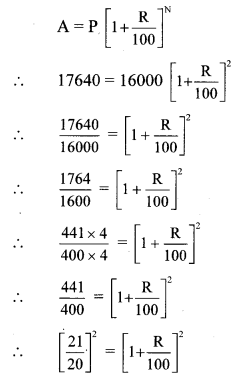
The population of a suburb is 16,000. Find the rate of increase in the population if the population after two years is 17,640.
Solution:
Here, P = Population of a suburb = 16,000
N = 2 years
A = Increase in the population after 2 years = 17,640
R = Rate of increase in population
Maharashtra Board Class 8 Maths Solutions Chapter 14 Compound Interest Practice Set 14.2 8
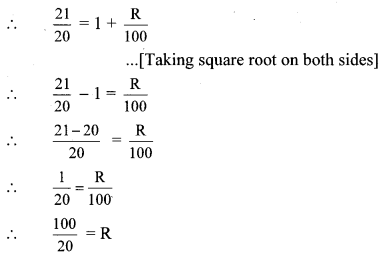
Maharashtra Board Class 8 Maths Solutions Chapter 14 Compound Interest Practice Set 14.2 9
∴5 = R
i.e., R = 5%
∴The rate of increase in the population is 5 p.c.p.a.

Compound Interest Practice Set 14.2 Question 9.
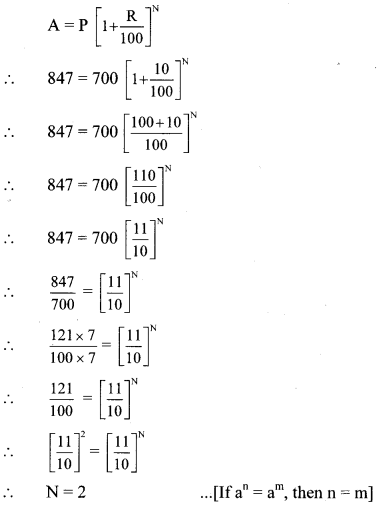
In how many years Rs 700 will amount to Rs 847 at a compound interest rate of 10 p.c.p.a.
Solution:
Here, P = Rs 700, R = 10 p.c.p.a., A = Rs 847
Maharashtra Board Class 8 Maths Solutions Chapter 14 Compound Interest Practice Set 14.2 10
∴Rs 700 will amount to Rs 847 in 2 years.

Practice Set 14.2 Question 10.
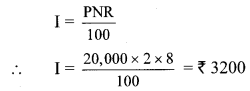
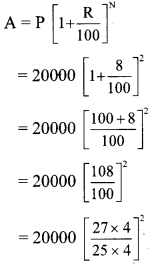
Find the difference between simple interest and compound interest on Rs 20,000 in 2 years at 8 p.c.p.a.
Solution:
Here, P = Rs 20,000, R = 8 p.c.p.a.,
N = 2 years
i. Simple interest (I)
Maharashtra Board Class 8 Maths Solutions Chapter 14 Compound Interest Practice Set 14.2 11
Simple interest (I) = Rs 3200

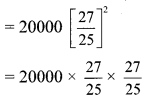
ii. Compound Interest (I):
Maharashtra Board Class 8 Maths Solutions Chapter 14 Compound Interest Practice Set 14.2 12
Maharashtra Board Class 8 Maths Solutions Chapter 14 Compound Interest Practice Set 14.2 13
= 32 × 27 × 27
= Rs 23,328
Compound interest (I)
= Amount (A) – Principal (P)
= 23,328 – 20,000
= Rs 3328 ,..(ii)

iii. Difference
= Compound interest – Simple interest
= 3328 – 3200 … [Form (i) and (ii)]
= Rs 128
∴ The difference between compound interest and simple interest is Rs 128.
[Note: The question is modified as per the answer given in the textbook.]

Maharashtra Board Class 8 Maths Chapter 14 Compound Interest Practice Set 14.2 Intext Questions and Activities

8th Standard Maths Practice Set 14.2 Question 1.
Visit the bank nearer to your house and get the information regarding the different schemes and rates of interests. Make a chart and display in your class. (Textbook pg. no. 90)
Solution:
(Students should attempt this activity at their own.)

Maharashtra Board 8th Class Maths Practice Set 13.1 Solutions Chapter 13 Congruence of Triangles

Balbharti Maharashtra State Board Class 8 Maths Solutions covers the Practice Set 13.1 8th Std Maths Answers Solutions Chapter 13 Congruence of Triangles.

Practice Set 13.1 8th Std Maths Answers Chapter 13 Congruence of Triangles

Congruence of Triangles Practice Set 13.1 Question 1.
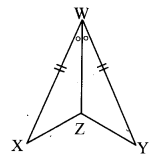
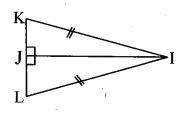
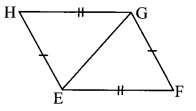
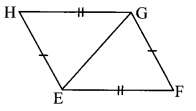
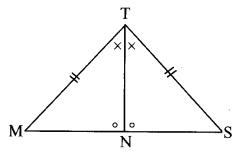
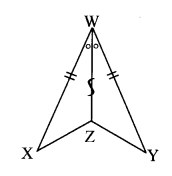
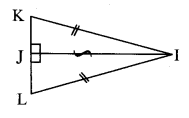
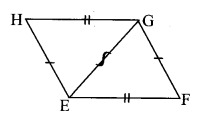
In each pair of triangles in the following figures, parts bearing identical marks are congruent. State the test and correspondence of vertices by which triangles in each pair are congruent.
i.
Maharashtra Board Class 8 Maths Solutions Chapter 13 Congruence of Triangles Practice Set 13.1 1
ii.
Maharashtra Board Class 8 Maths Solutions Chapter 13 Congruence of Triangles Practice Set 13.1 2
iii.
Maharashtra Board Class 8 Maths Solutions Chapter 13 Congruence of Triangles Practice Set 13.1 3
iv.
Maharashtra Board Class 8 Maths Solutions Chapter 13 Congruence of Triangles Practice Set 13.1 4
v.
Maharashtra Board Class 8 Maths Solutions Chapter 13 Congruence of Triangles Practice Set 13.1 5
Solution:
i.
Maharashtra Board Class 8 Maths Solutions Chapter 13 Congruence of Triangles Practice Set 13.1 6
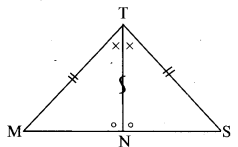
The two triangles are congruent by SAS test in the correspondence XWZ ↔ YWZ.

ii.
Maharashtra Board Class 8 Maths Solutions Chapter 13 Congruence of Triangles Practice Set 13.1 7
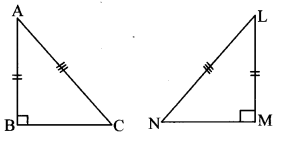
The two triangles are congruent by hypotenuse-side test in the correspondence KJI ↔ LJI.

iii.
Maharashtra Board Class 8 Maths Solutions Chapter 13 Congruence of Triangles Practice Set 13.1 8
The two triangles are congruent by SSS test in the correspondence HEG ↔ FGE.

iv.
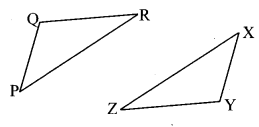
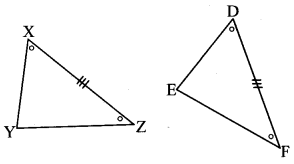
The two triangles are congruent by ASA test is the correspondence SMA ↔ OPT.

v.
Maharashtra Board Class 8 Maths Solutions Chapter 13 Congruence of Triangles Practice Set 13.1 9
The two triangles are congruent by ASA test or SAS test or SAA test in the correspondence MTN ↔ STN.

Maharashtra Board Class 8 Maths Chapter 13 Congruence of Triangles Practice Set 13.1 Intext Questions and Activities

Practice Set 13.1 Question 1.
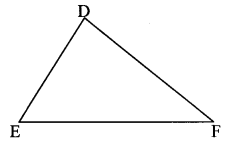
Write answers to the following questions referring to the given figure.
Maharashtra Board Class 8 Maths Solutions Chapter 13 Congruence of Triangles Practice Set 13.1 10

  1. Which is the angle opposite to the side DE?
  2. Which is the side opposite to ∠E?
  3. Which angle is included by side DE and side DF?
  4. Which side is included by ∠E and ∠F?
  5. State the angles adjacent to side DE. (Textbook pg, no. 81)

Solution:

  1. ∠DFE i.e. ∠F is the angle opposite to side DE.
  2. Side DF is the side opposite to ∠E.
  3. ∠EDF i.e. ∠D is included by side DE and side DF.
  4. Side EF is included by ∠E and ∠F.
  5. ∠DEF and ∠EDF i.e. ∠E and ∠D are adjacent to side DE.

Congruence of Triangles Class 8th Practice Set 13.1 Question 2.
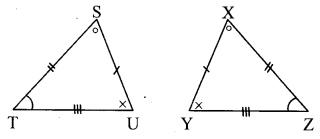
In the given figure, parts of triangles indicated by identical marks are congruent.
a. Identify the one-to-one correspondence of vertices in which the two triangles are congruent and write the congruence.
b. State with reason, whether the statement, ∆XYZ ≅ ∆STU is right or wrong. (Textbook pg. no. 82)
Maharashtra Board Class 8 Maths Solutions Chapter 13 Congruence of Triangles Practice Set 13.1 11
Solution:
a. From the figure,
S ↔ X, T ↔ Z, U ↔ Y i.e.,
STU ↔ XZY, or SUT ↔ XYZ, or
TUS ↔ ZYX, or TSU ↔ ZXY, or
UTS ↔ YZX, or UST ↔ YXZ

∴ ∆STU ≅ ∆XZY, or ∆SUT ≅ ∆XYZ, or
∆TUS ≅ ∆ZYX, or ∆TSU ≅ ∆ZXY, or
∆UTS ≅ ∆YZX, or ∆UST ≅ ∆YXZ

b. If ∆XYZ ≅ ∆STU, then
∠Y ≅ ∠T, ∠Z ≅ ∠U,
seg XY ≅ seg ST, seg XZ ≅ seg SU
∴ But, all the above statements are wrong. The statement AXYZ ≅ ASTU is wrong.

Maharashtra Board 8th Class Maths Practice Set 1.4 Solutions Chapter 1 Rational and Irrational Numbers

Balbharti Maharashtra State Board Class 8 Maths Solutions covers the Practice Set 1.4 8th Std Maths Answers Solutions Chapter 1 Rational and Irrational Numbers.

Practice Set 1.4 8th Std Maths Answers Chapter 1 Rational and Irrational Numbers

Question 1.
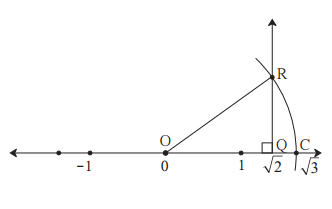
The number √2 is shown on a number line. Steps are given to show √3 on the number line using √2. Fill in the boxes properly and complete the activity.
Maharashtra Board Class 8 Maths Solutions Chapter 1 Rational and Irrational Numbers Practice Set 1.4 1
The point Q on the number line shows the number ……….
A line perpendicular to the number line is drawn through the point Q. Point R is at unit distance from Q on the line.
Right angled ∆OQR is obtained by drawing seg OR.
l(OQ) = √2, l(QR) = 1
∴By Pythagoras theorem,
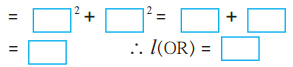
[l(OR)]² = [l(OQ)]² + [l(QR)]²
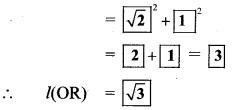
Maharashtra Board Class 8 Maths Solutions Chapter 1 Rational and Irrational Numbers Practice Set 1.4 2
Draw an arc with centre O and radius OR. Mark the point of intersection of the line and the arc as C. The point C shows the number √3
Solution:
The point Q on the number line shows the number √2
A line perpendicular to the number line is drawn through the point Q. Point R is at unit distance from Q on the line.
Right angled ∆OQR is obtained by drawing seg OR.
l(OQ) = √2, l(QR) = 1
∴By Pythagoras theorem,
[l(OR)]² = [l(OQ)]² + [l(QR)]²
Maharashtra Board Class 8 Maths Solutions Chapter 1 Rational and Irrational Numbers Practice Set 1.4 3
.. .[Taking square root of both sides]
Draw an arc with centre O and radius OR. Mark the point of intersection of the line and the arc as C. The point C shows the number √3.

Question 2.
Show the number √5 on the number line.
Solution:
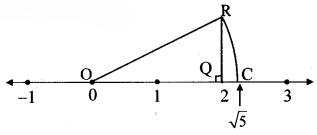
Draw a number line and take a point Q at 2
such that l(OQ) = 2 units.
Draw a line QR perpendicular to the number line through the point Q such that l(QR) = 1 unit.
Draw seg OR.
∆OQR formed is a right angled triangle.
By Pythagoras theorem,
[l(OR)]² = [l(OQ)]² + [l(QR)]²
= 2² + 1²
= 4 + 1
= 5
∴l(OR) = √5 units
…[Taking square root of both sides]
Draw an arc with centre O and radius OR. Mark the point of intersection of the number line and arc as C. The point C shows the number √5.
Maharashtra Board Class 8 Maths Solutions Chapter 1 Rational and Irrational Numbers Practice Set 1.4 4

Question 3.
Show the number √7 on the number line.
Solution:
Draw a number line and take a point Q at 2 such that l(OQ) = 2 units.
Draw a line QR perpendicular to the number line through the point Q such that l(QR) = 1 unit.
Draw seg OR.
∆OQR formed is a right angled triangle.
By Pythagoras theorem,
[l(OR)]² = [l(OQ)]² + [l(QR)]²
= 2² + 1²
= 4 + 1
= 5
∴ l(OR) = √5 units
… [Taking square root of both sides]
Draw an arc with centre O and radius OR.
Mark the point of intersection of the number line and arc as C. The point C shows the number √5.
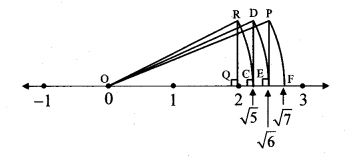
Similarly, draw a line CD perpendicular to the number line through the point C such that l(CD) = 1 unit.
By Pythagoras theorem,
l(OD) = √6 units
The point E shows the number √6 .
Similarly, draw a line EP perpendicular to the number line through the point E such that l(EP) = 1 unit.
By Pythagoras theorem,
l(OP) = √7 units
The point F shows the number √7.
Maharashtra Board Class 8 Maths Solutions Chapter 1 Rational and Irrational Numbers Practice Set 1.4 5

Maharashtra Board 8th Class Maths Practice Set 13.2 Solutions Chapter 13 Congruence of Triangles

Balbharti Maharashtra State Board Class 8 Maths Solutions covers the Practice Set 13.2 8th Std Maths Answers Solutions Chapter 13 Congruence of Triangles.

Practice Set 13.2 8th Std Maths Answers Chapter 13 Congruence of Triangles

Congruence of Triangles Class 8th Practice Set 13.2 Question 1.
In each pair of triangles given below, parts shown by identical marks are congruent. State the test and the one-to-one correspondence of vertices by which triangles in each pair are congruent. Also state the remaining congruent parts.
Maharashtra Board Class 8 Maths Solutions Chapter 13 Congruence of Triangles Practice Set 13.2 1
Maharashtra Board Class 8 Maths Solutions Chapter 13 Congruence of Triangles Practice Set 13.2 2
Solution:
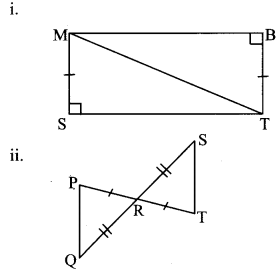
i. In ∆MST and ∆TBM,
∴ side MS ≅ side TB … [Given]
m∠MST = m∠TBM = 90° … [Given]
hypotenuse MT ≅ hypotenuse MT
…[Common side]
∴ ∆MST ≅ ∆TBM …[by hypotenuse-side test]
∴ side ST ≅ side BM …[Corresponding sides of congruent triangles]
∠SMT ≅ ∠BTM …[Corresponding sides of congruent triangles]
∠STM ≅ ∠BMT …[Corresponding sides of congruent triangles]

ii. In ∆PRQ and ∆TRS,
side PR ≅ side TR … [Given]
∠PRQ ≅ ∠TRS …[Vertically opposite angles]
side RQ ≅ side RS … [Given]
∴ ∆PRQ ≅ ∆TRS …[by SAS test]
∴ side PQ ≅ side TS …[Corresponding sides of congruent triangles]
∠RPQ ≅ ∠RTS …[Corresponding sides of congruent triangles]
∠PQR ≅ ∠TSR …[Corresponding sides of congruent triangles]

iii. In ∆DCH and ∆DCF,
∠DCH ≅ ∠DCF …[Given]
∠DHC ≅ ∠DFC …[Given]
side DC ≅ side DC …[Common side]
∴ ∆DCH ≅ ∆DCF …[by AAS test]
∴ side HC ≅ side FC …[Corresponding sides of congruent triangles]
side DH ≅ side DF…[Corresponding sides of congruent triangles]
∠HDC ≅ ∠FDC ….[Corresponding sides of congruent triangles]

Congruence of Triangles Practice Set 13.2 Question 2.
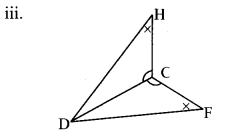
In the given figure, seg AD ≅ seg EC. Which additional information is needed to show that ∆ABD and ∆EBC will be congruent by AAS test?
Maharashtra Board Class 8 Maths Solutions Chapter 13 Congruence of Triangles Practice Set 13.2 3
Solution:
In ∆ABD and ∆CBE,
∴ seg AD ≅ seg CE …[Given]
∠ABD ≅ ∠CBE …[Vertically opposite angles]
∴ The necessary condition for the two triangles to be congruent by AAS test is
∠ADB ≅ ∠CEB, or
∠DAB ≅ ∠ECB

Maharashtra Board Class 8 Maths Chapter 13 Congruence of Triangles Practice Set 13.2 Intext Questions and Activities

Practice Set 13.2 Class 8 Question 1.
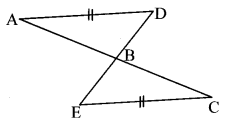
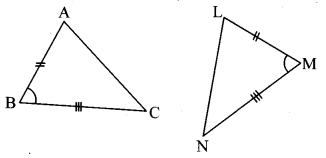
Draw ∆ABC and ∆LMN such that two pairs of their sides and the angles included by them are congruent.
Draw ∆ABC and ∆LMN, l(AB) = l(LM), l(BC) = l(MN), m∠ABC = m∠LMN.
Copy ∆ABC on a tracing paper. Place the paper on ∆LMN in such a way that point A coincides with point L, side AB overlaps side LM. What do you notice?(Textbook pg. no. 83)
Maharashtra Board Class 8 Maths Solutions Chapter 13 Congruence of Triangles Practice Set 13.2 4
Solution:
We notice that ∆ABC ≅ ∆LMN.

Congruence of Triangles Class 8 Solutions Question 2.
Draw ∆PQR and ∆XYZ such that l(PQ) = l(X Y), l(Q R) = l(YZ), l(RP) = l(ZX). Copy ∆PQR on a tracing paper. Place it on ∆XYZ observing the correspondence P ↔ X, Q ↔ Y, R ↔ Z. What do you notice? (Textbook pg. no. 84)
Maharashtra Board Class 8 Maths Solutions Chapter 13 Congruence of Triangles Practice Set 13.2 5
Solution:
We notice that ∆PQR ≅ ∆XYZ.

Congruence of Triangles Class 8 Question 3.
Draw ∆XYZ and ∆DEF such that, l(XZ) = l(DF), ∠X ≅ ∠D and ∠Z ≅ ∠F.
Copy ∆XYZ on a tracing paper and place it over ∆DEF. What do you notice?(Textbook pg. no. 84)
Maharashtra Board Class 8 Maths Solutions Chapter 13 Congruence of Triangles Practice Set 13.2 6
Solution:
We notice that ∆XYZ ≅ ∆DEF in the correspondence X ↔ D, Y ↔ E, Z ↔ F.

Question 4.
Draw two right angled triangles such that a side and the hypotenuse of one is congruent with the corresponding parts of the other. Copy one triangle on tracing paper and place it over the other. What do you notice? (Textbook pg. no. 84)
Maharashtra Board Class 8 Maths Solutions Chapter 13 Congruence of Triangles Practice Set 13.2 7
Solution:
We notice that the two triangles are congruent.
(Students should draw figures and verify the answers.)

Maharashtra Board Class 8 Geography Solutions Chapter 9 Map Scale

Balbharti Maharashtra State Board Class 8 Geography Solutions Chapter 9 Map Scale Notes, Textbook Exercise Important Questions and Answers.

Maharashtra State Board Class 8 Geography Solutions Chapter 9 Map Scale

Class 8 Geography Chapter 9 Map Scale Textbook Questions and Answers

1. 

Map Scale Std 8 Question a.
Classify maps showing the following areas into small scale or large scale:
(1) Building (2) School (3) Country of India (4) Church (5) Mall (6) World map (7) Garden (8) Dispensary (9) Maharashtra state (10) The north sky at night.
Answer:
The classification of maps showing the given areas is as follows:
(A) Small scale maps:

  1. Country of India
  2. World map
  3. Maharashtra state
  4. The north sky at night.

(B) Large scale maps :

  1. Building
  2. School
  3. Church
  4. Mall
  5. Garden!
  6. Dispensary.

Maharashtra Board Class 8 Geography Solutions Chapter 9 Map Scale

Map Scale Class 8 Geography Question b.
There are two maps with respective scales of 1cm = 100 m and 1cm = 100 km. Give well reasoned answer as to which of them would be a large scale map and which a small scale map. Recognize the types of maps.
Answer:
A. Out of the two maps with respective scales of 1 cm = 100 m and 1 cm = 100 km, a map with respective scale of 1 cm = 100 m would be a large scale map.
B. Reasons :

  1. 1 metre is equal to 100 centimetres and 100 metre is equal to 10000 centimetres.
  2. Thus, the value of the given verbal scale (1cm = 100 m) is 1 : 10000 in numerical terms (scale).
  3. A map having a numerical scale of 1 : 10,000 or less than it is called large scale map. Therefore, 1cm = 100 m would be a large scale map.

C. Types of maps :

  1. Maps of villages, church, agricultural fields, etc. are the large scale maps.
  2. Maps of state, country, continent, world, etc. are the small scale maps.

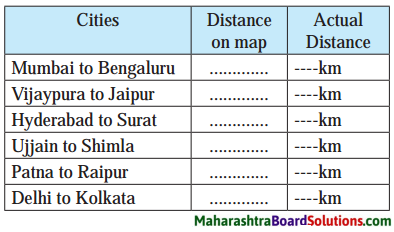
2. Using a map of India from the atlas measure straight Line distance between the following cities and complete the table below.

Question a.
Maharashtra Board Class 8 Geography Solutions Chapter 9 Map Scale 1
Answer:

CitiesDistance on a mapActual distance
1. Mumbai to Bangaluru0.98 cm980 km
2. Vijaypura to Jaipur2 cm2000 km
3. Hyderabad to Surat0.9 cm900 km
4. Ujjain to Shimla1.14 cm1140 km
5. Patna to Raipur0.75 cm750 km
6. Delhi to Kolkata1 cm1000 km

Maharashtra Board Class 8 Geography Solutions Chapter 9 Map Scale

3. 

Map Scale Std 8 Questions And Answers Question a.
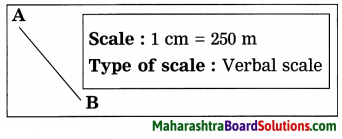
The distance between two points A and B on the ground is 500 m. Show this distance on paper by a line of 2 cm. Express the map scale by any one method and mention it.
Answer:
Maharashtra Board Class 8 Geography Solutions Chapter 9 Map Scale 2

Question b.
Convert verbal scale of 1cm = 53 km to a numerical scale.
Answer:

  1. 1 kilometre is equal to 100000 centimetres. Therefore, 53 kilometres is equal to 5300000 centimetres.
  2. Therefore, the verbal scale of 1 cm = 53 km can be converted to a numerical scale as – 1 : 5300000.

Maharashtra Board Class 8 Geography Solutions Chapter 9 Map Scale

Class 8 Geography Chapter 9 Map Scale Question c.
Convert numerical scale of 1 : 10000000 to a verbal scale in the metric system.
Answer:

  1. 100000 centimetres is equal to 1 kilometre. Thus, 10000000 centimetres is equal to 100 kilometres.
  2. Therefore, numerical scale of 1 : 10000000 to a verbal scale in the metric system can be converted as 1 cm = 100 km.

4. Help them, using road and railway maps of the state of Maharashtra. Use the scale given in the maps.

Std 8 Geography Chapter 9 Map Scale Question a.
Ajay wants to arrange a family trip. Beed-Aurangabad-Dhule-Nasik Mumbal-Pune-Solapur-Beed. He wants to visit tourist places along this route. The cost of the vehicle is Rs 12/- per km. What would be the approximate cost of travel?

Map Scale Questions And Answers Question b.
Saloni has been asked to organize a trip by her teacher. She has selected Nagpur Chandrapur-Nanded-Washim-Akola Malkapur. What would be the total coverage in kilometers?

Geography Class 8 Chapter 9 Question c.
Vishawasrao is transporting goods in a vehicle from Alibag (district Raigad) to Naldurg (district – Osmanabad). How many km. will he be covering aproximately for a to and fro travel?

Projects:

Map Scale Questions Question a.
Measure the length and breadth of your school. Prepare a sketch according to scale. Show different parts of your school on the sketch.

Maharashtra State Board Class 8 Geography Solutions Question b.
With the help of google maps find the distance between your village and your neighbouring village. Represent all the three methods of map scale on paper.

Class 8 Geography Chapter 9 Map Scale Additional Important Questions and Answers

Mark ✓ the box next to the right alternative:
(Note: The answers are given directly.)

Question a.
Which of the following factor’s map will be a large scale map?
(a) Temple [ ]
(b) State [ ]
(c) Nation [ ]
(d) Continent [ ]
Answer:
(a) Temple [✓]

Maharashtra Board Class 8 Geography Solutions Chapter 9 Map Scale

Question b.
Which of the following scale indicates small scale map?
(a) 1 : 100 [ ]
(b) 1 : 1000 [ ]
(c) 1 : 10000 [ ]
(d) 1 : 100000 [ ]
Answer:
(d) 1 : 100000 [✓]

Answer the following questions in one sentence each:

Question a.
What is verbal scale?
Answer:
A scale in which distances are expressed with the use of words indicating measurement is called verbal scale.

Question b.
What is numerical scale?
Answer:
A scale in which distances are expressed as ratio is called numerical scale.

Question c.
What is linear scale?
Answer:
A scale in which distances are expressed by drawing graphical scale is called linear scale.

Maharashtra Board Class 8 Geography Solutions Chapter 9 Map Scale

Question d.
What is large scale map?
Answer:
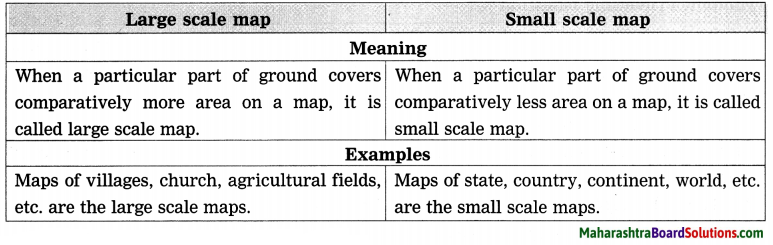
A map in which a particular part of ground covers comparatively more area is called large scale map.

Question e.
What is small scale map?
Answer:
A map in which a particular part of ground covers comparatively less area is called small scale map.

Write short notes on:

Question a.
Verbal scale.
Answer:
1. A scale in which distances are expressed with the use of words indicating measurement is called verbal scale.
2. For example, 1cm = 100 km.

3. In verbal scale, the word indicating measurement on the left hand side indicates the distance between any two points on a s map. On the other hand, the word indicating 1 measurement on the right hand side! indicates the ground distance between those two points.

4. When the map is reduced or enlarged by taking its photo copy, the verbal scale on the original map does not change.

Question b.
Numerical scale.
Answer:

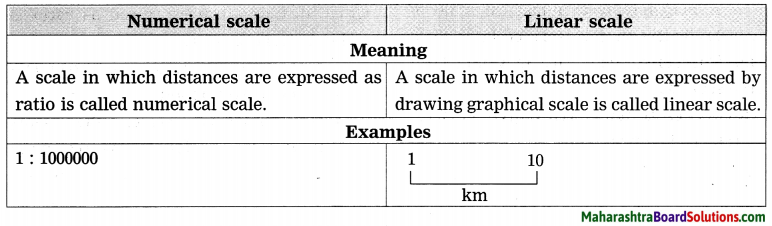
  1. Numerical scale: A scale in which distances are expressed as ratio is called numerical scale.
  2. For example, 1:10000. It is also known as representative fraction.
  3. In numerical scale, the same measuring unit is used for the figures on the left hand side and right hand side. However, no words are used to indicate this measuring unit.
  4. In numerical scale, number 1 on the left hand side indicates the distance between any two points on a map. On the other hand, the number 10000 on the right hand side indicates the ground distance between those two points.
  5. When the map is reduced or enlarged by taking its photo copy, the numerical scale on the original map does not change.

Maharashtra Board Class 8 Geography Solutions Chapter 9 Map Scale

Question c.
Linear scale.
Answer:

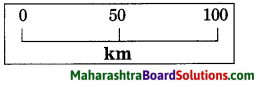
  1. A scale in which distances are expressed by drawing graphical scale is called linear scale.
  2. For example,
    Maharashtra Board Class 8 Geography Solutions Chapter 9 Map Scale 3
  3. Compass or blade of grass is used if the ruler is not available for the measurement.
  4. A thread is used for measuring the curved distances between two points shown in a map.
  5. When the map is reduced or enlarged by taking its photo copy, the linear scale drawn on the original map changes as per the changing size of the map.

Highlight differences /Distinguish between the following:

Question a.
Large scale map and Small scale map.
Answer:
Maharashtra Board Class 8 Geography Solutions Chapter 9 Map Scale 4

Maharashtra Board Class 8 Geography Solutions Chapter 9 Map Scale

Question b.
Numerical scale and Linear scale.
Answer:
Maharashtra Board Class 8 Geography Solutions Chapter 9 Map Scale 5

Study the following map /figure/graph and answer the following questions:

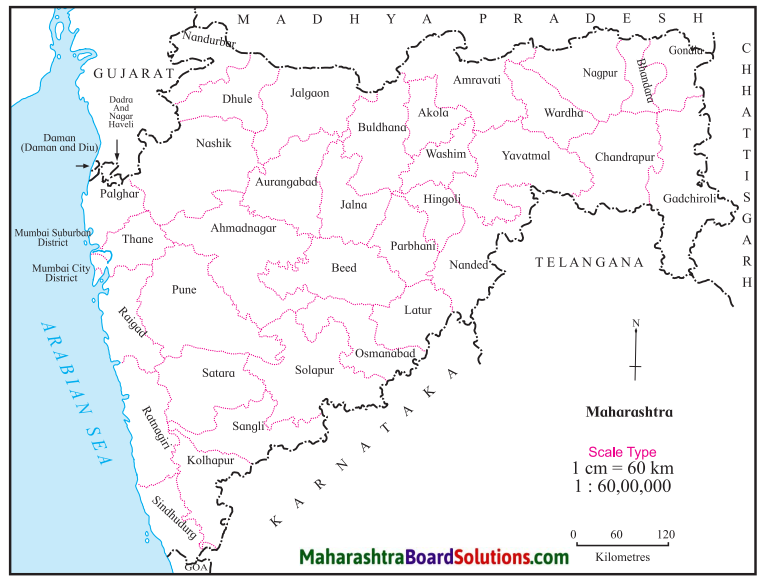
Maharashtra Board Class 8 Geography Solutions Chapter 9 Map Scale 6

Study the Figure and answer the following questions:

Question a.
How much is the ground distance between Mumbai and Gondia?
Answer:
The ground distance between Mumbai and Gondia is approximately 810 kilometres.

Maharashtra Board Class 8 Geography Solutions Chapter 9 Map Scale

Question b.
How much is the distance between Satara and Sangli on a map?
Answer:
The distance between Satara and Sangli on a map is approximately 1.5 centimetres.

Thought-Provoking Question:

Think about it. 

Question a.
What is the need to use map scale? Think about it and write a paragraph.
Answer:

  1. If the map scale is not mentioned in a map, it will become difficult to know the ground (actual) distance between any two points shown in a map.
  2. Map scale is important element of a map. It facilitates map reading.
  3. If the map scale is mentioned in a map, it will become very easy to understand the ground (actual) distance between any two points shown in a map.

Open-Ended Question:

Question a.
Which of the following scale will you prefer to use: (a) Verbal scale (b) Numerical scale (c) Linear scale?
Answer:

  1. Different measuring units are used in different countries of the world. Due to linguistic differences, particular verbal scale or linear scale may not be used with ease in all the countries.
  2. Numerical scale is a global scale. It can be used universally. Therefore, we will prefer numerical scale.

Maharashtra Board Class 8 English Solutions Chapter 3.4 Leisure

Balbharti Maharashtra State Board Class 8 English Solutions Chapter 3.4 Leisure Notes, Textbook Exercise Important Questions, and Answers.

Maharashtra State Board Class 8 English Solutions Chapter 3.4 Leisure

Class 8 English Chapter 3.4 Leisure Textbook Questions and Answers

Leisure Poem 8th Std Warming Up:

1. Discuss in groups and share with one another:

Leisure Poem Questions And Answers Class 8 Question 1.
The daily routine of your mother and father on working days
Answer:
(Points: what time they get up – what time they leave for work – what time they return home – have lunch – dinner – bedtime, etc.)

3.4 Leisure Questions And Answe Question 2.
How your family relaxes on weekends
Answer:
(Points: rest at home – visit relatives – shopping – malls – movies – gardens – catch up on housework, etc.)

Maharashtra Board Class 8 English Solutions Chapter 3.4 Leisure

Std 8 English Poem Leisure Question 3.
When you go for a picnic, what and how do you enjoy it?
Answer:
(Points: go to the beach/mall /garden/movies etc. – relax and enjoy by yourself – sing songs – go in big groups – go as a family – go to restaurants for food, etc.)

Leisure Question Answers Class 8 Question 4.
Do you spend time admiring and thinking over the beauties of nature? Elaborate on your response.
Answer:
(Points: no beautiful nature around/ gardens nearby – like enjoying natural beauties – prefer city life – like animals and birds – visit zoos and parks. etc.)

2. When a poet I writer attempts (o describe something in words, so that it appeals to our five senses (sight, smell, hearing, touch, taste) he/she has used a des ice called Imager.
For example a host of golden daffodils’.
to a chasm, deep and vast and wide’.
Go through other poems in your textbook or other books and find outlines that contain Imagery. Write them does n along with the name of the poem and line/stanza number.
Answer:
Students can attempt this activity on their own.

3. Prepare un Acrostic from the word ‘Leisure’. The words should be related to what one likes to do in free time:

  1. L ………..
  2. E ………….
  3. I …………
  4. S ………..
  5. U ………..
  6. Reading stories
  7. E …………

Answer:

  1. Laze around
  2. Enjoy movies
  3. Initiate games
  4. Sleep
  5. Undertake to clean house
  6. Read stories
  7. Exercise

Maharashtra Board Class 8 English Solutions Chapter 3.4 Leisure

1. Say Where:

Question a.
………… do the cows and sheep stand? …………..
Answer:
Beneath the branches of trees.

Question b.
………… do squirrels store their food? ………….
Answer:
In the grass.

Question c.
………….. do stars shine in the daytime …………..
Answer:
In the streams.

Question d.
………….. does Beauty’s smile begin? ……………….
Answer:
In her eyes.

2. Think and answer in your own words:

Question a.
What could have inspired the poet to compose this poem? Do you think it relates to our present-day life? Defend your choice.
Answer:
The poet must have seen the busy lives of people around him, who are always in a hurry and have no leisure to look at the beauty around. Yes, it certainly relates to our present life, which keeps getting busier and busier. Today, with the Internet, the mobile phone, the computer, and social networking sites, our lives are getting more I and more artificial and further from nature than ever before.

Maharashtra Board Class 8 English Solutions Chapter 3.4 Leisure

Question b.
Which line proves that in our busy lives we do not even have a fraction of a second to enjoy nature’s beauty?
Answer:
The lines are :
No time to see, when woods we pass
Where squirrels hide their nuts in the grass?
No time to see, in broad daylight,
Are streams full of stars, like skies at night?
No time to turn at Beauty’s glance,
And watch her feet, how they can dance?
No time to wait till her mouth can
Enrich that smile her eyes began.

Question c.
‘Beauty’ in stanza 5 to 6 can refer to a beautiful maiden as well as nature itself. Explain when and how nature ‘dances’ and also ‘smiles’.
Answer:
Nature dances during spring and: summer, when the leaves of trees and the flowers sway in the breeze. Nature smiles at the beginning of spring when the plants begin to once again bloom slowly.

Question d.
Why does the poet call our life ‘poor’?
Answer:
The poet calls our life ‘poor’ because we are always anxious and under stress. We are completely cut off from nature and cannot relax and enjoy its beauty. He feels that this type of life is a ‘poor’ life.

Maharashtra Board Class 8 English Solutions Chapter 3.4 Leisure

3. You have learned that when u human attribute is given to anything that is not a human being or it is spoken of as a person, the Figure of Speech used is culled as ‘Personification’:

Question a.
Pick out two examples of Personification from the poem
Answer:
(i) ‘No time to turn at Beauty’s glance, I And watch her feet, how they can; dance?’ Nature has been given the human qualities of ‘glancing’ and ‘dancing’.
(ii) ‘No time to wait till her mouth can Enrich the smile her eyes began.’ Nature has been given the human quality of ‘smiling’.

Question b.
Pick out from the poem, two examples of each of the following Figures of Speech:

3.4 Leisure Question 1.
Alliteration
Answer:
(i) We have no time to stand and stare.’ Repetition of the sound of the letter ‘s’.
(ii) ‘Streams full of stars, like skies at; night.’ Repetition of the sound of the letter ‘s’.

8th Standard English Poem Leisure Notes Question 2.
Simile
Answer:
(i) ‘And stare as long as sheep or cows.’ Here, a direct comparison has been made between sheep and cows.
(ii) ‘Streams full of stars, like skies at night.’ Here, a direct comparison has been made to the night skies.

Leisure Poem 8th Std Question 3.
Metaphor
Answer:
(i) ‘No time to turn at Beauty’s; glance.’ Here nature has been implicitly compared to a beautiful woman.
(ii) ‘Enrich the smile her eyes began.’ Here the blooming of flowers has been implicitly compared to a woman smiling.

Maharashtra Board Class 8 English Solutions Chapter 3.4 Leisure

Question c.
The poet opens his poem with a question. Is the question asked to receive some answer? No. It is a question used to emphasize and stress the fact that modern man has no time to enrich his life from nature. Such a device used by poets falls under the Figure of Speech called ‘Interrogation
or ‘Rhetorical Question’. Refer to the poem ‘The Pilgrim’ and find examples of Interrogation.
Answer:
‘What is this life, if full of care,
We have no time to stand and stare?’
Here the poet asks a question to emphasize and stress the fact that modern man has no time to appreciate nature.
(Note: The lines in stanzas 2,3,4,5 and 6 are also examples of Interrogation.)

4. Say where the images from mature given in the poem exist:

Air/Land/Water

Question a.
beneath the thoughts …………..
Answer:
Land

Question b.
squirrel hide nuts in grass …………
Answer:
Land

Maharashtra Board Class 8 English Solutions Chapter 3.4 Leisure

Question c.
streams in day time ………..
Answer:
Water

Question d.
stars/ skies at night …………
Answer:
Air

5. Make a paraphrase of the poem ‘Leisure’ in your own simple words. Write down in your notebook.
Answer:
In this poem, the poet, W.H. Davies, questions the type of life we are leading if we have no time to appreciate the beauties of nature. He says that we have no time to stand beneath the trees and stare as sheep and cows do. When we are walking through the woods we have no time to watch where the squirrels hide their food in the grass. We have no time to look at streams that sparkle and a twinkle in broad daylight and appear to be full of stars like the skies at night.

We have no time to watch when a beautiful young girl dances, or wait for her lips to complete the smile which started in her eyes. (We can also say that ‘Beauty’ is nature, and we have no time to see trees swaying In the breeze or flowers blooming slowly.)
In the concluding lines, the poet repeats that our life is a poor life if it is full of cares and worries with no time to appreciate and enjoy the beauty of nature.

Class 8 English Chapter 3.4 Leisure Additional Important Questions and Answers

Complex Factual Activities:

Class 8 English Leisure Question 1.
What does the poet want us to stare at and gain from it?
Answer:
The poet wants us to spare some time from our busy schedules to look at the beauty of nature and enjoy it.

Maharashtra Board Class 8 English Solutions Chapter 3.4 Leisure

Leisure Class 8 Question 2.
Enlist the beautiful things in nature that we overlook.
Answer:
We overlook:

  1. squirrels hiding their food in the grass
  2. twinkling and sparkling streams
  3. a beautiful girl smile and dance/trees swaying in the breeze and flowers blooming slowly.

8th Standard English Poem Leisure Question 3.
Analysis/ Appreciation Of The Poem
Answer:

  1. Poem and poet: ‘Leisure’ by William Henry Davies.
  2. Theme: The poet regrets that ours is a poor life if it is full of cares and worries and we have no time to appreciate and enjoy the beauty of nature.
  3. Tone: Serious and analytical; reflective poem.
  4. Structure and stanzas: The stanzas are of two lines each; seven couplets with lines of equal length.
  5. Rhyme and Rhythm: The rhyme scheme is aa, bb, cc, and so on, with the ending words of each couplet rhyming.
  6. Language and Imagery: The language is simple; the poem has many figures of speech and is full of imagery when the poet describes the beauty of nature.
  7. Figures of Speech: Alliteration, Personification, Simile, Metaphor, Repetition, Interrogation.