Maharashtra Board Class 7 Science Solutions Chapter 2 Plants: Structure and Function

Balbharti Maharashtra State Board Class 7 Science Solutions Chapter 2 Plants: Structure and Function Notes, Textbook Exercise Important Questions and Answers.

Maharashtra State Board Class 7 Science Solutions Chapter 2 Plants: Structure and Function

Class 7 Science Chapter 2 Plants: Structure and Function Textbook Questions and Answers

1. Give examples of 3 plants that have:

Question a.
Spiny fruits
Answer:
Jack fruit, Pineapple, Lychee (litchi), Datura

Question b.
Spiny stem
Answer:
Cactus, Wild rose, Catclaw acacia, Silk, Cotton

Question c.
Red flowers
Answer:
Rose, Dahlia, Hibiscus, Tulips,

Maharashtra Board Class 7 Science Solutions Chapter 2 Plants: Structure and Function

Question d.
Yellow flowers
Answer:
Marigold, Daffodil, Sunflower, Daisy

Question e.
Leaves which close at night
Answer:
Mimosa plant, Tallwood, Prayer plant, Gulmohar

Question f.
Single seeded fruits
Answer:
Mango, Lychee, Jamun

Question g.
Many seeded fruits
Answer:
Custard apple, Papaya, Watermelon.

2. Observe any one flower and its various parts and describe it in your own words.

Question a.
Answer:
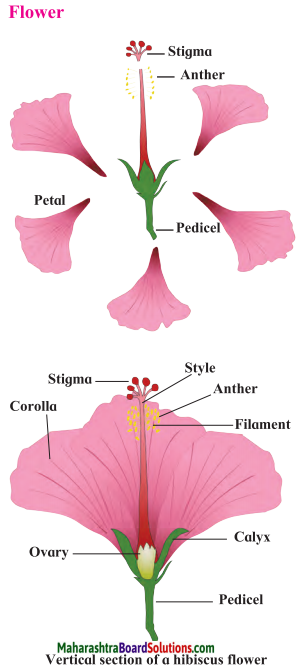
Maharashtra Board Class 7 Science Solutions Chapter 2 Plants Structure and Function 1

A flower has following parts:
1. Pedicel: (a) Flower may have a long or a short stalk called pedicel, (b) One end of the pedicel is attached to the stem, (c) The other end of the pedicel is expanded and swollen. It is called the receptacle, (d) Petals and other parts of the flower are supported on the receptacle.
2. Calyx: In the bud condition, the petals are covered by leaf like parts called sepals which are green in colour. They form the calyx.
3. Corolla: This is made up of colourful parts called petals.
4. Androecium: (a) This is the male reproductive part of the flower, (b) It consists of stamens, (c) Each stamen is made up of anther and filament.
5. Gynoecium: (a) This is the female reproductive part of the flower, (b) This is made up of carpels, (c) A carpel consists of stigma, style and ovary.

Maharashtra Board Class 7 Science Solutions Chapter 2 Plants: Structure and Function

3. What are the similarities and differences between?

Question a.
Jowar and Moong
Differences:

JowarMoong
i. It has fibrous root.i. It has tap root.
ii. It is a monocotyledonous seed.ii. It is a dicotyledonous seed.
iii. It is a rabi crop.iii. It is a kharif crop

Similarities:
Jowar and Moong both are angiosperms.

Maharashtra Board Class 7 Science Solutions Chapter 2 Plants: Structure and Function

Question b.
Onion and Coriander
Differences:

OnionCoriander
i. It is a biennial plant.i. It is an annual plant.
ii. It has monocoty­ledonous seed.ii. It has dicotyledonous seeds.
iii. It has fibrous root.iii. It has tap root but later on changes to fibrous root system.

Similarities:

  1. Both are used in cooking.
  2. Both are edible.
  3. Both belongs to kingdom plantae.

Question c.
Leaves of banana and Leaves of mango
Answer:

Leaves of bananaLeaves of mango
i. It has parallel venation.i. It has reticulate venation.
ii.  It is very large in size.ii. It is small in size.
iii. It is a monocotyledonous plant.iii. It is a dicotyledonous plant.

Maharashtra Board Class 7 Science Solutions Chapter 2 Plants: Structure and Function

Question d.
Coconut tree and Jowar stalk plant
Answer:
Differences:

Coconut treeJowar stalk plant
i. It is tall and has a thick stemi. It is small and has a thin stem.
ii. It has strong root system.ii. It has weak root system.
iii. Each and every part of tree is useful.iii. Only seeds are useful.

Similarities:

  1. Both are from same kingdom plantae.
  2. Both are autotrophic.
  3. Both are monocotyledonous plants.

4. Explain the following images in your own words.

Question a.
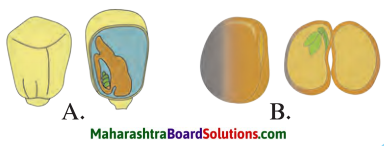
Maharashtra Board Class 7 Science Solutions Chapter 2 Plants Structure and Function 2
Answer:

  1. Diagram A is of maize seed. It is a monocotyledonous seed and does not divide into two equal parts. The plant has fibrous root system.
  2. Diagram B is of bean seed. It is a dicotyledonous seed and it divides into two equal parts. The plant has tap root system.

Maharashtra Board Class 7 Science Solutions Chapter 2 Plants: Structure and Function

5. Describe the functions of various parts of a plant.

Question a.
Describe the functions of various parts of a plant.
Answer:
The functions of various parts of a plant are as below.
1. Root: (a) Fixation: It anchors the plant body to the soil, so helps in fixation, (b) Absorption: It absorbs water and nutrients from the soil, so helps in absorption, (c) Conduction: The root translocates water and mineral salts into the stem. (d) Storage: A certain amount of food is stored in the root which is utilized as it grows.
(e) Preventing soil erosion: It helps to bind the soil particles and prevent them from being blown away by wind or water.
2. Stem: (a) It supports and holds leaves, flower and fruits, (b) The stem conducts the water and minerals from roots to leaves and fruits, (c) It stores the food.
3. Leaves: (a) It synthesizes food for the plant, (b) Stomata, the tiny openings in the leaf help in gaseous exchange and are responsible for the process of transpiration.
4. Flower: It helps in pollination.
5. Fruit: (a) It protects the seed, (b) It helps in seed dispersal.
6. Seed: A new plant develops from it.

6. Certain properties are mentioned below. Find a leaf corresponding to each property and describe those plants.

Question a.
Certain properties are mentioned below. Find a leaf corresponding to each property and describe those plants.
leaves with smooth surface, leaves with rough surface, fleshy leaf, spines on leaf.
Answer:

  1. Leaves with smooth surface: e.g. Banana leaf. It is large in size. It is closely rolled up one over the other. Together they look like a trunk but they form only an apparent trunk. It has parallel venation.
  2. Leaves with rough surface: e.g. Hibiscus leaf. It has reticulate venation. Leaf margin is toothed.
  3. Fleshy leaf: e.g. Jade plant, water hyacinth. It has fleshy, glossy and smooth leaves. They are coloured jade green and having a slightly red tinge towards the edge of leaves when exposed to higher level of light.
  4. Spines on leaf: e.g. Opuntia, Ci/cas, kevda. Opuntia is a desert plant. Leaf is thick, fleshy and having spines on it.

Maharashtra Board Class 7 Science Solutions Chapter 2 Plants: Structure and Function

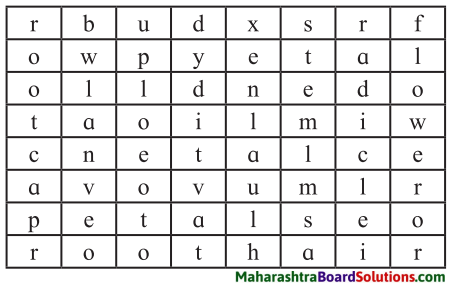
7. Find the plant parts.

Question a.
Maharashtra Board Class 7 Science Solutions Chapter 2 Plants Structure and Function 3
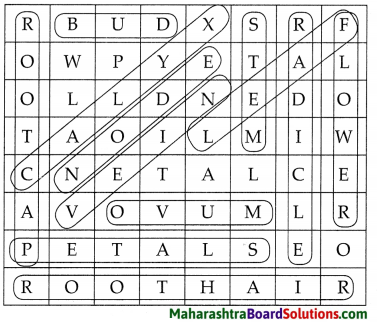
Answer:
Maharashtra Board Class 7 Science Solutions Chapter 2 Plants Structure and Function 4
ROOT, ROOT CAP, ROOT HAIR, BUD, PETALS, STEM, RADICLE, FLOWER, LEAF, VEIN, CALYX, NODE, OVUM.

Class 7 Science Chapter 2 Plants Structure And Function Question Answer Activity:

Sketch various types of leaves in Paintbrush on the computer and save the sketches in a folder of your own name.

Class 7 Science Chapter 2 Plants: Structure and Function Important Questions and Answers

Plants Structure And Function Exercise Fill in the blanks:

Plants Structure And Function Class 7 Questions And Answers Question 1.
The part that grows from inside the seed towards the soil is called the …………….. .
Answer:
radicle

Maharashtra Board Class 7 Science Solutions Chapter 2 Plants: Structure and Function

Plants Structure And Function Class 7 Question 2.
The part that grows above the soil from the seed is called the …………….. .
Answer:
plumule

Plants Structure And Function Question And Answer Question 3.
The part of the plant growing below the soil from radicle for support is called …………….. .
Answer:
root

Plants Structure And Function Class 7 Exercise Question 4.
The …………….. protects the root-tip from injuries.
Answer:
root cap

Plants Structure And Function Exercise Question 5.
Roots bearing hair like processes near the root tips are called …………….. .
Answer:
root hairs

Class 7 Science Chapter 2 Plants Structure And Function Question Answer Question 6.
Thread-like or fibre like roots arising from the stem are called ……………. .
fibrous roots

Question 7.
The stem grows above the soil from the …………….. of the sprouting seed.
Answer:
plumule

Question 8.
Leaves come out at the …………….. .
Answer:
nodes

Maharashtra Board Class 7 Science Solutions Chapter 2 Plants: Structure and Function

Question 9.
The part of the stem between two nodes is called …………….. .
Answer:
inter node

Question 10.
The tip or the apical end of the stem is called a …………….. .
Answer:
bud

Question 11.
The broad, spread out part of the leaf is called the …………….. or …………….. .
Answer:
leaf blade, lamina

Question 12.
The tip of the leaf is called the …………….. .
Answer:
leaf apex

Question 13.
Leaves of some plants have a stalk called a …………….. .
Answer:
petiole

Question 14.
The portion of the leaf attached to the stem is called the …………….. .
Answer:
leaf base

Question 15.
Small leaf like structures near the leaf base is called …………….. .
Answer:
stipides

Maharashtra Board Class 7 Science Solutions Chapter 2 Plants: Structure and Function

Question 16.
Flowers may have a long or a short stalk called …………….. .
Answer:
pedicel

Question 17.
One end of the pedicel is attached to the …………….. .
Answer:
stem

Question 18.
…………….. is a male reproductive organ of the flower.
Answer:
Androecium

Question 19.
…………….. is a female reproductive organ of the
Answer:
gynoecium

Question 20.
Androecium consists of …………….. .
Answer:
stamens

Question 21.
Gynoecium consists of …………….. .
Answer:
carpels

Question 22.
Seeds which get divided into two equal parts are called …………….. seeds.
Answer:
dicotyledonous

Maharashtra Board Class 7 Science Solutions Chapter 2 Plants: Structure and Function

Question 23.
Seeds which do not divide into two equal parts are …………….. called seeds.
Answer:
monocotyledonous

Question 24.
Petals and other parts of the flower are supported on the …………….. .
Answer:
receptacle

Question 25.
Sepals are …………….. in colour.
Answer:
green.

Match the columns:

Question  1.

Column ‘A’Column ‘B’
1. Peepala. carpels
2. Maizeb. stamen
3. Androeciumc. parallel venation
4. Gynoeciumd. reticulate venation

Answer:

Column ‘A’Column ‘B’
1. Peepald. reticulate venation
2. Maizec. parallel venation
3. Androeciumb. stamen
4. Gynoeciuma. carpels

Maharashtra Board Class 7 Science Solutions Chapter 2 Plants: Structure and Function

Question 2.

Column ‘A’Column B’
1. Tap rootsa. stem
2. Fibrous rootsb. root
3. Radiclec. monocotyledonous plants
4. Plumuled. dicotyledonous plants

Answer:

Column ‘A’Column B’
1. Tap rootsd. dicotyledonous plants
2. Fibrous rootsc. monocotyledonous plants
3. Radicleb. root
4. Plumulea. stem

Maharashtra Board Class 7 Science Solutions Chapter 2 Plants: Structure and Function

Question 3.

Column A’Column B’
1. Leaf-tipa. petiole
2. Edge of leaf bladeb. leaf margin
3. Portion of leaf attached to stemc. lamina
4. Stalk of leafd. leaf apex
e. leaf base

Answer:

Column A’Column B’
1. Leaf-tip d. leaf apex
2. Edge of leaf bladeb. leaf margin
3. Portion of leaf attached to steme. leaf base
4. Stalk of leafa. petiole

Maharashtra Board Class 7 Science Solutions Chapter 2 Plants: Structure and Function

Say whether True or False Correct and rewrite the false statements:

Question 1.
Stem grows from radicle.
Answer:
False. Stem grows from the Plumule

Question 2.
Leaf margins may be entire, dentate or lobed.
Answer:
True

Question 3.
The leaf blade of leaves in some plants is divided into many small parts called leaflets.
Answer:
True

Question 4.
Maize plant has reticulate venation.
Answer:
False. Maize plant has parallel venation

Question 5.
A carpel consists of stigma, style and ovary.
Answer:
True.

Maharashtra Board Class 7 Science Solutions Chapter 2 Plants: Structure and Function

Question 6.
A stamen is made up of nodes and internodes.
Answer:
False. A stamen is made up of anther filament

Question 7.
The ovary develops into a fruit.
Answer:
True

Question 8.
Fertilized ovules form the seeds.
Answer:
True

Question 9.
A mango fruit contains many seeds.
Answer:
False. A mango fruit contains only one seed

Question 10.
A fruit like cashew have seed outside the fruit.
Answer:
True.

Question 11.
Leaves of some plants do not have a petiole.
Answer:
True

Maharashtra Board Class 7 Science Solutions Chapter 2 Plants: Structure and Function

Question 12.
The peepal leaf has parallel venation.
Answer:
False. It has reticulate venation.

Find the odd one out:

Question 1.
Pea, Moong, maize, groundnut
Answer:
Maize – Its seed is monocotyledonous, while others have dicotyledonous seeds.

Question 2.
Cashew, apple, mango, chikoo
Answer:
Cashew – Its seed is outside the fruit, others have internal seeds.

Question 3.
Stigma, anther, style, ovary
Answer:
Anther – It is a part of androecium, while others are a part of gynoecium.

Maharashtra Board Class 7 Science Solutions Chapter 2 Plants: Structure and Function

Question 4.
Petiole, vein, calyx, apex
Answer:
Calyx – It is a part of flower, whereas others are parts of leaf.

Question 5.
Aerial, stilt, runner, lobed
Answer:
Lobed – It is a type of leaf margin, while others are types of modified roots.

Answer the following in one or two sentences:

Question 1.
Which types of roots do the fenugreek, spinach and onion plants have?
Answer:

  1. Fenugreek and spinach have tap roots with a few secondary roots whereas onion has fibrous root.
  2. Fenugreek roots also have some nodules which contain nitrogen fixing bacteria.

Question 2.
What are called prop roots?
Answer:
Roots emerging from the trunk and branches of a banyan tree grow towards the soil. These roots are called prop roots.

Maharashtra Board Class 7 Science Solutions Chapter 2 Plants: Structure and Function

Question 3.
What is called reticulate venation?
Answer:

  1. A leaf is divided into two equal parts by a single mid-vein which lies along the midline of the leaf blade.
  2. Secondary veins arise from the mid-vein. They are branched and form a network or reticulum. Such a type of venation is called reticulate venation.

Question 4.
What is called parallel venation?
Answer:
In a leaf all the veins are parallel, running from the leaf base to the leaf apex. Such a venation is called parallel venation.

Question 5.
What is pollination?
Answer:
After maturity, anthers burst and the pollen grains which are released fall on the stigma. This process is called pollination.

Question 6.
Why are the underground parts of plants like radish, carrot, beet and sweet potato thick, fleshy and swollen? Which parts of the plant are they?
Answer:
The underground parts of plants like radish, carrot, beet and sweet potato are thick, fleshy and swollen because they store food in the form of starch. These are the root part of the plant.

Maharashtra Board Class 7 Science Solutions Chapter 2 Plants: Structure and Function

Distinguish between:

Question 1.
Tap roots and fibrous roots.
Answer:

Tap rootsFibrous roots
1. Roots of some plants produce secondary roots that grow obliquely and spread far and wide in the soil. This type of root is called a tap root.1. Thread like or fibre roots arising from the stem are called fibrous roots.
2. It is found in dicotyledonous plant.2.  It is found in monocotyle-donous plant.

Question 2.
Dicotyledonous seeds and monocotyledonous seeds.
Answer:

Dicotyledonous seedsMonocotyledonous seeds
1. Seeds which get divided into two equal parts are called dicotyledonous seeds.1. Seeds which do not divide into two equal parts are called monocotyledonous seeds.
2. Dicotyledonous seeded plants have tap root system.2. Monocotyledonous seeded plants have fibrous root system.

Maharashtra Board Class 7 Science Solutions Chapter 2 Plants: Structure and Function

Draw neat and labelled diagram for the following:

Question 1.
Tap root
Answer:
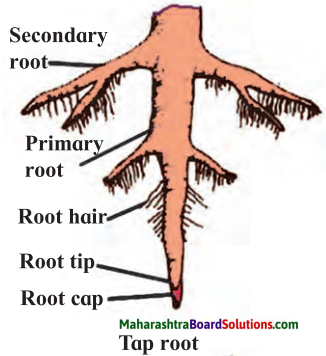
Maharashtra Board Class 7 Science Solutions Chapter 2 Plants Structure and Function 5

Question 2.
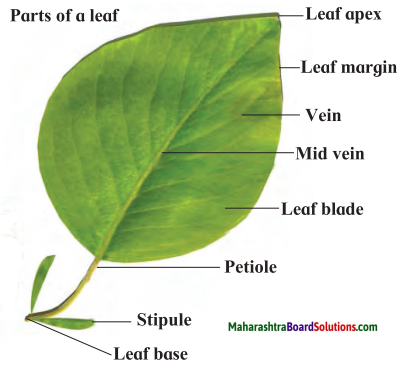
Parts of a leaf.
Answer:
Maharashtra Board Class 7 Science Solutions Chapter 2 Plants Structure and Function 6

Question 3.
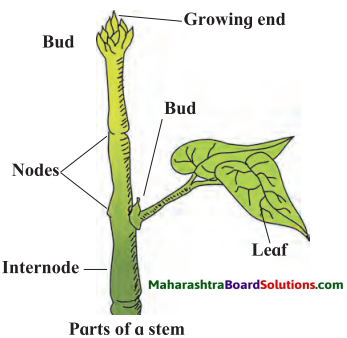
Parts of stem
Answer:
Maharashtra Board Class 7 Science Solutions Chapter 2 Plants Structure and Function 7

Maharashtra Board Class 7 Science Solutions Chapter 2 Plants: Structure and Function

Do as directed:

Question 1.
Certain properties are mentioned below. Find a leaf corresponding to each property and describe those plants.
Answer:

  1. Leaves with smooth surface: e.g. Banana leaf. It is large in size. It is closely rolled up one over the other. Together they look like a trunk but they form only an apparent trunk. It has parallel venation.
  2. Leaves with rough surface: e.g. Hibiscus leaf. It has reticulate venation. Leaf margin is toothed.
  3. Fleshy leaf: e.g. Jade plant, water hyacinth. It has fleshy, glossy and smooth leaves. They are coloured jade green and having a slightly red tinge towards the edge of leaves when exposed to higher level of light.
  4. Spines on leaf: e.g. Opuntia, Cycas, kevda. Opuntia is a desert plant. Leaf is thick, fleshy and having spines on it.

Use your brainpower!

Answer the following questions:

Question 1.
What would have happened if plants like tamarind, banyan and mango had fibrous roots?
Answer:
If plants like banyan, mango, tamarind had fibrous roots they would get uprooted and fall even with a little strong wind as the roots would not be able to support and anchor the trees firmly.

Question 2.
What will happen if the root-tip is injured?
Answer:

  1. Root cap helps the root to grow downward It protects the sensitive part of the root and eases the movement of the root through the soil.
  2. Injury of the root tip causes the root to grow randomly and it also may lead to injury of the sensitive part of the root.

Maharashtra Board Class 7 Science Solutions Chapter 2 Plants: Structure and Function

Question 3.
Which types of roots do the fenugreek, spinach and onion plants have?
Answer:

  1. Fenugreek and spinach have tap roots with a few secondary roots whereas onion has fibrous root.
  2. Fenugreek roots also have some nodules which contain nitrogen-fixing bacteria.

Question 4.
Of what use to a plant are the insects flitting about around its flowers?
Answer:

  1. The insects try to suck the nectar from the flowers and in that process the pollen grains stick to their legs.
  2. When they sit on another flower the pollen grain stick to the stigma and the pollination takes place. Thus, these insects help in the pollination.

Observe the figure and answer the questions given.

1.
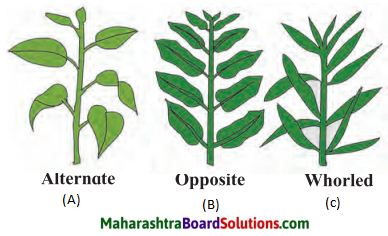
Maharashtra Board Class 7 Science Solutions Chapter 2 Plants Structure and Function 8

Question a.
What is shown in the picture?
Answer:
The picture shows the arrangement of leaves on the stem.

Maharashtra Board Class 7 Science Solutions Chapter 2 Plants: Structure and Function

Question b.
What arrangement is shown in (A), (B), and (C)?
Answer:
(A) Alternate (B) Opposite (C) Whorled

2.
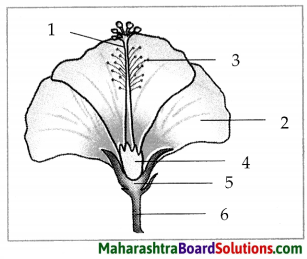
Maharashtra Board Class 7 Science Solutions Chapter 2 Plants Structure and Function 9

Question a.
Lable parts 1 to 6.
Answer:

  1. Gynoecium or carpel
  2. Corolla
  3. Androecium (Stamen)
  4. Ovary
  5. Corolla
  6. Pedicel

Question b.
Name the female reproductive part.
Answer:
Gynoecium

Maharashtra Board Class 7 Science Solutions Chapter 2 Plants: Structure and Function

Question c.
Name the colourful part of the flower.
Answer:
Corolla

Question d.
Which part develops into fruit?
Answer:
Ovary

Question e.
Which pa pollination?
Answer:
The transfer of pollen grains from the anther to the stigma of flower is called pollination.
Maharashtra Board Class 7 Science Solutions Chapter 4 Nutrition in Living Organisms

Balbharti Maharashtra State Board Class 7 Science Solutions Chapter 4 Nutrition in Living Organisms Notes, Textbook Exercise Important Questions and Answers.

Maharashtra State Board Class 7 Science Solutions Chapter 4 Nutrition in Living Organisms

Class 7 Science Chapter 4 Nutrition in Living Organisms Textbook Questions and Answers

1. Classify according to food-type.
Tiger, cow, vulture, bacteria, deer, goat, human, fungus, lion, sparrow, buffalo, frog, cockroach, tick.
Answer:

  • Carnivores: tiger, Lion
  • Herbivores: cow, deer, goat, buffalo
  • Scavengers: vulture
  • Decomposers: fungus, bacteria
  • Granivores: sparrow
  • Insectivores: frog Parasitic: tick
  • Omnivores: human, cockroach

Maharashtra Board Class 7 Science Solutions Chapter 4 Nutrition in Living Organisms

2. Nutrition In Living Organisms Class 7 Exercise Match the pairs.

Class 7 Science Chapter 4 Nutrition In Living Organisms Question Answer Question 1.

Column ‘A’Column ‘B’
1. Parasitic planta. Mushroom
2. Parasitic plantb. Lichen
3. Saprophytic plantc. Drosera
4. Symbiotic plantd. Cuscuta

Answer:

Column ‘A’Column ‘B’
1. Parasitic plantd. Cuscuta
2. Parasitic plantc. Drosera
3. Saprophytic planta. Mushroom
4. Symbiotic plantb. Lichen

3. Answer the following questions in your words. 

Question a.
Why do living organisms need nutrition?
Answer:
Living organisms need nutrition due to the following: (a) To supply the energy required for doing work, (b) For growth and development of the body, (c) To replace the damaged cells and repair tissues, (d) To fight diseases.

Maharashtra Board Class 7 Science Solutions Chapter 4 Nutrition in Living Organisms

Question b.
Explain the process of production of food in plants.
Answer:
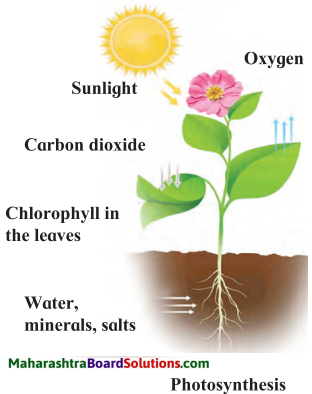
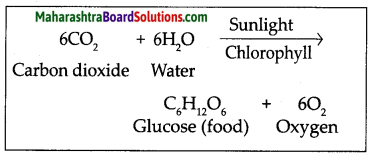
1. Green plants can produce their own food. With the help of sunlight and chlorophyll, plants make their own food in their leaves, using water and nutrients from the soil and carbon dioxide from the air.

2. This process is called as photosynthesis. In this process plants give out oxygen and take in carbon dioxide.

Maharashtra Board Class 7 Science Solutions Chapter 4 Nutrition in Living Organisms 1

Question c.
What is meant by parasitic plants? Name their different types with examples of each.
Answer:
The plants that grow on the body of other plants to obtain food are called as parasitic plants.

There are two types of parasitic plants:

  • Holoparasites: e.g. Rafflesiaceae
  • Hemiparasites: e.g. Loranthaceae

Maharashtra Board Class 7 Science Solutions Chapter 4 Nutrition in Living Organisms

Question d.
Explain the various steps of nutrition in animals.
Answer:
Steps of nutrition in animals are as follows:

  1. Ingestion: Food is taken into the body.
  2. Digestion: Conversion of food into simple soluble forms.
  3. Absorption: Transfer of soluble food to the blood.
  4. Assimilation: Utilization of absorbed food by cells and tissues for energy production, growth and repair.
  5. Egestion: Removal of waste products and undigested food from body.

Question e.
Name some unicellular organisms in which all life processes take place within their unicellular body.
Answer:
Unicellular organisms like amoeba, euglena, paramoecium in which all life processes take place within their unicellular body.

4. Give reasons.

Question a.

Insectivorous plants are attractively coloured.
Answer:

  1. Insectivorous plants generally grow in soil or water deficient in nitrogen compounds.
  2. The plant body of the Drosera burmanii has a flower like appearance. It grows close to the ground. Even its leaves are attractively pink or red in colour with hairs at the margin.
  3. Droplets of a sticky substances found on tips of the hairs attract insects.
  4. These plants consume insects to fulfill their need for nitrogen. To attract the insects these plants are attractively coloured.

Maharashtra Board Class 7 Science Solutions Chapter 4 Nutrition in Living Organisms

Question b.
Butterflies have a long tube-like proboscis.
Answer:
Holozoic mode of nutrition means the feeding of solid and liquid food by animals. Butterflies live on nectar from flowers. Therefore to suck the nectar from flowers, they have a long tube-like structure called proboscis.

5. Prepare and complete the flowchart according to type of nutrition.

Question a.
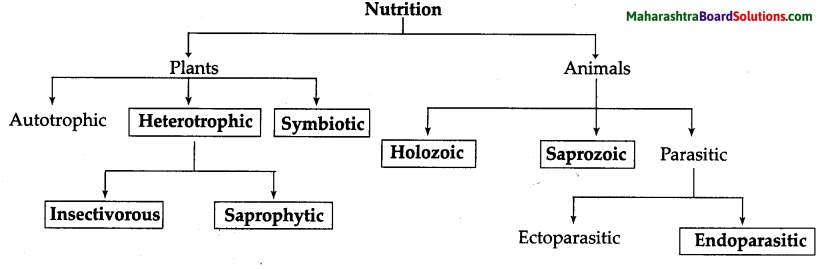
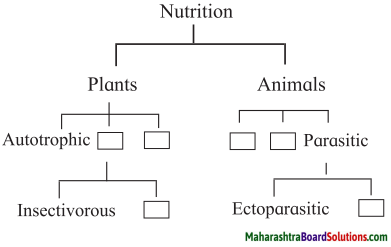
Prepare and complete the flowchart according to type of nutrition.
Maharashtra Board Class 7 Science Solutions Chapter 4 Nutrition in Living Organisms 2
Answer:
Maharashtra Board Class 7 Science Solutions Chapter 4 Nutrition in Living Organisms 3

6. Think and answer.

Question a.
We prepare a variety of foodstuffs and dishes at home. Are we then autotrophic organisms?
Answer:

  1. We prepare a variety of foodstuffs and dishes at home but we are not autotrophic organisms.
  2. In autotrophic organisms they have chlorophyll in their body and food is prepared here with help of sunlight, water and CO2 for the organisms.
  3. But the food which we prepare at home is not generated in our body.

Maharashtra Board Class 7 Science Solutions Chapter 4 Nutrition in Living Organisms

Question b.
Which organisms are greater in number – autotrophs or heterotrophs? Why?
Answer:

  1. Autotrophs have chlorophyll in the cell and here the organic food is prepared using sunlight, water and CO2.
  2. They do not depend on any other organism for survival.
  3. But the heterotrophs depend on autotrophs and other organisms for survival. Hence autotrophs are more in number than heterotrophs.

Question c.
The number of heterotrophs found in desert regions is smaller. However, they are found in greater numbers in the sea. Why is this so?
Answer:

  1. In desert region due to scarcity of water and excess heat, very few cactus are found as autotrophs compared to sea. As autotrophs are less, number of heterotrophs dependent on autotrophs are smaller.
  2. Whereas in sea due to greater numbers of autotrophs, greater number of heterotrophs are found.

Question d.
What damage or harm do ectoparasitic and endoparasitic animals cause?
Answer:

  1. Ectoparasitic animals suck the blood of the animal on which it remains and endoparasitic animals get readymade food from the body of animal in which it remain.
  2. This way both the parasites make the animal weak by sucking their blood or by eating prepared food from them.

Maharashtra Board Class 7 Science Solutions Chapter 4 Nutrition in Living Organisms

Question e.
Why is plant food not produced in any other parts of the plant except the green ones?
Answer:
Plant food is not produced in any other parts of the plant except the green ones because only green part contains chlorophyll and chlorophyll is very necessary for the production of food.

Class 7 Science Chapter 4 Nutrition In Living Organisms Project:

Question 1.
Many heterotrophic organisms live on one and the same plant. Observe one such plant in your neighborhood and find out about the heterotrophs that depend upon it for their food. Observe and make flotes about other organisms that use these heterotrophs as their food.

Question 2.
Prepare a Power point presentation on the topic ‘Nutrition in Living Organisms’.

Class 7 Science Chapter 4 Nutrition in Living Organisms Important Questions and Answers

Nutrition In Living Organisms Class 7 Exercise Fill in the blanks.

Nutrition In Living Organisms Class 7 Exercise Question 1.
Leaves have microscopic openings called ……………. .
Answer:
Stomata

Class 7 Science Chapter 4 Nutrition In Living Organisms Question 2.
In the process of photosynthesis plants take in ……………. and ……………. gas is given out.
Answer:
Carbondioxide, oxygen

Question 3.
The ……………. transports minerals and water from roots to all aerial parts of the plant.
Answer:
xylem

Maharashtra Board Class 7 Science Solutions Chapter 4 Nutrition in Living Organisms

Question 4.
The ……………. transports the food from the leaves to other parts of the plant.
Answer:
phloem

Question 5.
Plants produce ……………. by the process of photosynthesis.
Answer:
Carbohydrates

Question 6.
……………. are made from carbon, hydrogen, oxygen.
Answer:
Carbohydrates

Question 7.
……………. are made from carbon, hydrogen and oxygen and nitrogen.
Answer:
proteins

Question 8.
……………. plants contain rhizobium micro-organisms.
Answer:
leguminous

Maharashtra Board Class 7 Science Solutions Chapter 4 Nutrition in Living Organisms

Question 9.
Micro-organisms like ……………. are present in soil.
Answer:
azotobacter

Question 10.
Lichen is of a symbiosis between ……………. and ……………. .
Answer:
algae, fungi

Question 11.
The scientist ……………. identified Drosera plant in Sri Lanka in 1737.
Answer:
Johannes Burman

Question 12.
Fungi like mushroom and yeast are ……………. .
Answer:
saprophytes

Question 13.
Removal of waste products and undigested food from the body is called …………….
Answer:
Egestion

Maharashtra Board Class 7 Science Solutions Chapter 4 Nutrition in Living Organisms

Question 14.
Amoeba moves with the help of ……………. .
Answer:
pseudopodia

Question 15.
Butterflies suck food with a tube like ……………. .
Answer:
proboscis

Question 16.
The ……………. or ……………. is an ant eating animal found in India.
Answer:
bobcat, udmanjar

Question 17.
Seed eating animals are called ……………. .
Answer:
granivores

Question 18.
Fruit eating animals are called ……………. .
Answer:
frugivores

Question 19.
Animals that obtain their food from both plants and animals are called ……………. .
Answer:
Omnivores

Maharashtra Board Class 7 Science Solutions Chapter 4 Nutrition in Living Organisms

Question 20.
Roundworms are known as ……………. .
Answer:
endoparasites

Class 7 Science Chapter 4 Nutrition In Living Organisms Match the column:

Question 1.

Column ‘A’Column ‘B’
1. Endoparasitea. Vulture
2. Ectoparasiteb. Human
3. Seed eating animalsc. Tapeworm
4. Fruit eating animalsd. Bed bug
5. Scavengere. granivores
6. Omnivoref. frugivores

Answer:

Column ‘A’Column ‘B’
1. Endoparasitec. Tapeworm
2. Ectoparasited. Bed bug
3. Seed eating animalse. granivores
4. Fruit eating animalsf. frugivores
5. Scavengera. Vulture
6. Omnivoreb. Human

Maharashtra Board Class 7 Science Solutions Chapter 4 Nutrition in Living Organisms

Say whether true or false, correct and rewrite the false statements.

Question 1.
Bed bug is an example of endoparasitic nutrition.
Answer:
False, Bed bug is an example of ectoparasitic nutrition

Question 2.
Spider shows saprozoic nutrition.
Answer:
True

Question 3.
The anteater is found in India.
Answer:
False. The anteater is found in Central and South America

Question 4.
Yellowing of leaves occur due to deficiency of iron.
Answer:
True

Question 5.
Mushroom is used in making bread.
Answer:
False. Yeast is used in making bread

Maharashtra Board Class 7 Science Solutions Chapter 4 Nutrition in Living Organisms

Question 6.
Cuscuta is completely a parasitic plant.
Answer:
True

Question 7.
The nitrogen dioxide dissolves in rainwater and is converted into nitric acid.
Answer:
True

Question 8.
Micro-organism Rhizobium is found in soil.
Answer:
False. Micro-organism Azotobacter is found in soil.

Question 9.
Fixation of nitrogen occurs by biological and atmospheric methods.
Answer:
True

Question 10.
The chloroplasts present in the leaves contain chlorophyll.
Answer:
True

Maharashtra Board Class 7 Science Solutions Chapter 4 Nutrition in Living Organisms

Question 11.
Decomposers obtain their food from living organisms.
Answer:
False, They obtain their food by decomposing the dead bodies of organisms or other materials

Question 12.
Carbondixode is given out during the process of photosynthesis.
Answer:
False, Oxygen is given out during the process of photosynthesis

Question 13.
Phloem transports the food from leaves to other parts of the plant.
Answer:
True

Question 14.
Carbohydrates are made up of carbon, hydrogen oxygen and nitrogen.
Answer:
False, Protein are made up of carbon, hydrogen, Oxygen and nitrogen.

Maharashtra Board Class 7 Science Solutions Chapter 3 Properties of Natural Resources

Give scientific reasons.

Question 1.
Micro-organisms like Rhizobium are useful.
Answer:

  1. Rhizobium micro-organisms are useful because plants cannot take gaseous nitrogen from air.
  2. These micro-organisms absorb atmospheric nitrogen and convert it into its nitrate, a compound which is useful for plant.

Question 2.
Lichen is an example of a symbiotic nutrition.
Answer:
Lichen is a symbiosis between algae and fungi in which fungi provides water, minerals, as well as shelter to algae and in return the algae Master Key General Science (Std. 7), provide food to the fungi. So Lichen, is an example of symbiotic nutrition.

Question 3.
Drosera burmanii is an insectivorous plant.
Answer:
Drosera burmanii grows in a soil which has nitrogen deficiency. It feeds upon insects to obtain nitrogen, so it is an insectivorous plant.

Maharashtra Board Class 7 Science Solutions Chapter 4 Nutrition in Living Organisms

Question 4.
Human is an omnivore.
Answer:
Humans obtain their food from both, plants and animals so human is an omnivore.

Question 5.
Tapeworm is an endoparasite.
Answer:
Tapeworm lives inside the body of other animals and obtain its food. So tapeworm is an endoparasite.

Question 6.
Decomposers are important for the ecosystem
Answer:
Decomposers feed on dead and decaying matter and therefore indirectly clean the ecosystem. If decomposers were not there then nutrients would not be able to return back and get recycled. Therefore decomposers are very important for the ecosystem.

Maharashtra Board Class 7 Science Solutions Chapter 4 Nutrition in Living Organisms

Question 7.
Cuscuta is a total parasite while Loranthus is a partial parasite.
Answer:
Cuscuta is a nongreen yellow thread-like plant completely dependent on the host plant, loranthus is a partial parasitic because it can prepare its own food and it only takes water and minerals from the host plant.

Answer the following in your own words:

Question 1.

Classify the types of nutrients.
Answer:
There are two types of nutrients.

  1. Nutrients like carbohydrates, proteins and fats are required in large quantity. These are macro-nutrients.
  2. Minerals and vitamins are required in very small quantity. They are called micro-nutrients.

Question 2.
Explain the types of nutrition.
Answer:
There are two types of nutrition.

  1. Some organisms can produce their own food and thus nourish themselves. This is called autotrophic nutrition.
  2. Some organisms depend on other organisms, plants and animals for their food. This is called heterotrophic nutrition.

Maharashtra Board Class 7 Science Solutions Chapter 4 Nutrition in Living Organisms

Question 3.
Write differences between xylem and phloem.
Answer:

xylemPhloem
1.  The xylem transports minerals and water from the root to all aerial parts of the plant.1. The phloem transports the food (glucose) from the leaves to other parts of the plant where it is either consumed or stored.

Question 4.
What is chemosynthesis? Which plants produce their food by chemosynthesis?
Answer:

  1. Chemosynthesis is the biological conversion of one or more carbon-containing molecules and nutrients into organic matter.
  2. It uses the oxidation of inorganic compounds or methane as a source of energy rather than sunlight.
  3. Sulphur bacteria and nitrosomonas produce their food by chemosynthesis.

Question 5.
Name the micro-organisms which help in biological fixation of nitrogen. How?
Answer:
Two different types of micro-organisms can bring about biological nitrogen fixation.

  1. Root-nodules of leguminous plants contain the micro-organism rhizobium. These micro-organisms absorb atmospheric nitrogen and convert if into its nitrate, a compound.
  2. Micro-organisms like azotobacter are’present in soil. They also convert atmospheric nitrogen into nitrates.

Maharashtra Board Class 7 Science Solutions Chapter 4 Nutrition in Living Organisms

Question 6.
What is symbiotic nutrition? Give one example of it.
Answer:

  1. Two or more than two different types of plant live together to fulfill their needs of nutrition, protection, support etc. with each other’s help. This type of nutrition is called symbiotic nutrition.
  2. e.g. Lichen is an example of symbiosis between algae and fungi.

Question 7.
Write about Drosera burmanii.
Answer:

  1. It is art insectivorous plant.
  2. The scientist Johannes Burman identified this plant in Sri Lanka in 1737. Hence, the plant is named after him.
  3. It grows close to the ground.
  4. Its leaves are attractively pink or red in colour with hairs at the margin.
  5. Droplets of a sticky substance found at the tips of the hairs attract insects.
  6. It grows in a place where deficiency of nitrogen in the soil. To get nitrogen for its growth, it eats insects.

Question 8.
What are called saprophytic plants? Give Examples.
Answer:
Plants which obtain the food from dead and decaying bodies of other organisms are called saprophytic plants e.g. Yeast and mushrooms.

Maharashtra Board Class 7 Science Solutions Chapter 4 Nutrition in Living Organisms

Question 9.
Classify the animals according to the type of food they eat.
microbes, vulture, monkey, tiger, lion, goat, cow, buffalo, crow, hyena, human, chimpanzee
Answer:

  • Herbivores: goat, cow, buffalo.
  • Carnivores: tiger, lion
  • Omnivores: monkey, human, chimpanzee
  • Scavengers: vulture, crow, hyena
  • Decomposers: microbes

Explain the terms:

  1. Herbivores: Animals that depend on plants only for their food are called Herbivores.
  2. Carnivores: Animals that depend on other animals for their food are called Carnivores.
  3. Granivores: Animals that eat grains (seed) are called Granivores.
  4. Frugivores: Animals that eat fruits are called frugivores.
  5. Omnivores: Animals that obtain their food from both plants and animals are called omnivores.
  6. Scavengers: Animals that obtain their food from dead bodies of animals are called Scavengers.
  7. Decomposers: Microbes which obtain their food by decomposing the dead bodies of organisms or other materials are called decomposers.
  8. Ectoparasitic nutrition: Some animals live on the body surface of other animals and obtain their food by sucking their blood. This is called ectoparasitic nutrition.
  9. Endoparasitic nutrition: Some animals live inside the body of other animals and obtain their food. This is called endoparasitic nutrition.
  10. Symbiotic nutrition: In some cases, two or more than two different types of plants live together to fulfill their needs of nutrition, protection, support etc. with each other’s help. This type of nutrition is called symbiotic nutrition.

Write the role of different nutrients like nitrogen, phosphorus, potassium,magnesium, Iron, manganese and zinc and effects of their deficiency on plants.

Question 1.
Write the role of different nutrients like nitrogen, phosphorus, potassium, magnesium, Iron, manganese and zinc and effects of their deficiency on plants.
Answer:
Role of nutrients and effects of their deficiency on plants:

NutrientsFunctionEffects of deficiency
NitrogenImportant components of proteins, chlorophyll and cytoplasm.Retarded/stunted growth, yellowing of leaves.
PhosphorusConversion of light energy into chemical energy.Early leaf-fail, late flowering, slow growth of roots.
PotassiumNecessary for metabolic activities.Weak stem, wilting of leaves, failure to produce carbohydrates.
MagnesiumProduction of chlorophyllSlow/retarded growth, yellowing of leaves.
IronProduction of chlorophyllYellowing of leaves
ManganeseProduction of main plant hormonesRetarded growth, spotted leaves
ZincProduction of hormones and their intermediatesRetarded growth, yellowing of leaves

Maharashtra Board Class 7 Science Solutions Chapter 4 Nutrition in Living Organisms

Can you tell?

Answer the following question: 

Question 1.
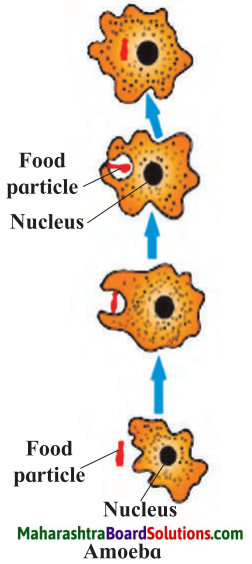
How does ingestion occur in unicellular animals like amoeba?
Answer:
Maharashtra Board Class 7 Science Solutions Chapter 4 Nutrition in Living Organisms 4

  1. Amoeba does not have organs like hands and mouth.
  2. It is a unicellular animal. It can take in food through any part of the surface of its unicellular body.
  3. It surrounds the food particle from all sides to take it into the cell.
  4. After that it digests the food with the help of different enzymes.
  5. Undigested food is left behind as the amoeba moves further with the help of pseudopodia.
  6. In unicellular animals like amoeba, euglena, paramoecium,. etc. all the steps of nutrition occur within their unicellular body.

Maharashtra Board Class 7 Science Solutions Chapter 4 Nutrition in Living Organisms

Question 2.
How do plants produce their own food?
Answer:
Green plants produce their own food with the help of sunlight, chlorophyll, water, nutrients from soil and carbon dioxide from the air. This process is called as photosynthesis

Maharashtra Board Class 7 Science Solutions Chapter 4 Nutrition in Living Organisms 5

Use your brain power!

Answer the following questions:

Question 1.
Write the uses of yeast and mushrooms.
Answer:
Yeast is used in fermentation processes and making bread.
Mushrooms are a rich source of vitamins and iron.

Question 2.i
Which part of the loranthus plant carries out photosynthesis?
Answer:
Leaves of the loranthus plant carries out photosynthesis.

Maharashtra Board Class 7 Science Solutions Chapter 4 Nutrition in Living Organisms

Question 2.ii
From where do they obtain minerals and water?
Answer:
They obtain water and minerals from the xylem and phloem of the other host plant.

Question 2.iii
Why is loranthus known as a partially parasitic plant?
Answer:
Loranthus is known as partially parasitic plant because it does photosynthesis with the help of leaves but only for water and minerals it depends on other plants.

Question 3.
Why does the pitcher plant feed on insects even though it produces food by photosynthesis?
Answer:
Pitcher plants grow in a place where soil has deficiency of nitrogen compounds so to fulfill the need of nitrogen they feed on insects.

Observe the diagram and answer the following questions.

Maharashtra Board Class 7 Science Solutions Chapter 4 Nutrition in Living Organisms 6

Question a.
Name the process shown in the picture.
Answer:
The process shown is photosynthesis.

Maharashtra Board Class 7 Science Solutions Chapter 4 Nutrition in Living Organisms

Question b.
Which type of plants use the above process for their nutrition?
Answer:
Autotrophic plants (green plants) use the above process for their nutrition.

Question c.
What is the pigment in the leaf that helps in the above process?
Answer:
Chlorophyll

Question d.
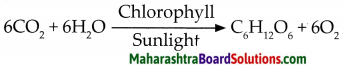
Give the chemical equation of the above process?
Answer:
Maharashtra Board Class 7 Science Solutions Chapter 4 Nutrition in Living Organisms 7

Question e.
What is the importance of this process to living things?
Answer:
Photosynthesis helps the plants to prepare their own food and also store it in their plant bodies. Animals depend upon this stored food for their nutrition.
During photosynthesis, oxygen is given out which is important for all living organisms for respiration.

Observe the diagram and answer the following questions.

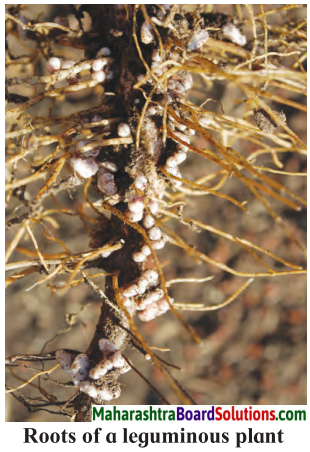
Maharashtra Board Class 7 Science Solutions Chapter 4 Nutrition in Living Organisms 8

Question a.
What is shown in the picture?
Answer:
Roots of leguminous plants having root nodules.

Maharashtra Board Class 7 Science Solutions Chapter 4 Nutrition in Living Organisms

Question b.
What is the importance of these types of plants?
Answer:
These types of plants help to provide nitrogen to the soil.

Question c.
What is the process called?
Answer:
Biological Nitrogen fixation

Question d.
Explain the process.
Answer:
Root nodules of leguminous plants contain Rhizobium micro-organisms. These micro¬organisms convert atmospheric nitrogen into nitrates. Thus the soil becomes rich in nitrogen.

Maharashtra State Board Class 7 Geography Solutions

Maharashtra State Board Class 7 Geography Solutions

Maharashtra State Board 7th Std Geography Textbook Solutions

Maharashtra State Board Class 7 Textbook Solutions

Maharashtra State Board Class 7 English Balbharati Answers Solutions

Maharashtra State Board Class 7 English Balbharati Solutions

Maharashtra State Board 7th Std English Balbharati Textbook Solutions

English Balbharati Std 7 Digest Answers Unit 1

English Solution Class 7 Maharashtra Board Unit 2

English Balbharati Std 7 Digest Pdf Download Maharashtra Board Solutions Unit 3

7th Standard English Workbook Answers Maharashtra Board Unit 4

Maharashtra State Board Class 7 Textbook Solutions

Maharashtra State Board Class 7 Science Solutions

Maharashtra State Board Class 7 Science Solutions

Maharashtra State Board 7th Std General Science Textbook Solutions

Maharashtra State Board Class 7 Textbook Solutions

Maharashtra State Board Class 7 Hindi Sulabhbharati Solutions

Maharashtra State Board Class 7 Hindi Sulabhbharati Solutions

Maharashtra State Board 7th Std Hindi Sulabhbharati Textbook Solutions

Hindi Sulabhbharti Class 7 Solutions पहली इकाई

Hindi Sulabhbharati 7th Standard Digest Guide दूसरी इकाई

Maharashtra State Board Class 7 Textbook Solutions

Maharashtra State Board Class 7 History Solutions

Maharashtra State Board Class 7 History Solutions

Maharashtra State Board 7th Std History Textbook Solutions

Maharashtra State Board Class 7 Textbook Solutions

Maharashtra State Board Class 7 Marathi Sulabhbharati Solutions

Maharashtra State Board Class 7 Marathi Sulabhbharati Solutions

Maharashtra State Board 7th Std Marathi Sulabhbharati Textbook Solutions

Marathi Sulabhbharati Class 7 Solutions

Maharashtra State Board Class 7 Textbook Solutions

Maharashtra State Board Class 7 Textbook Solutions Answers Guide

Maharashtra State Board Class 7 Textbook Solutions Answers Guide

Maharashtra State Board 7th Std Textbook Solutions Answers Guide

Maharashtra State Board Textbook Solutions