Maharashtra Board Class 7 Geography Solutions Chapter 10 Human Settlements

Balbharti Maharashtra State Board Class 7 Geography Solutions Chapter 10 Human Settlements Notes, Textbook Exercise Important Questions and Answers.

Maharashtra State Board Class 7 Geography Solutions Chapter 10 Human Settlements

Class 7 Geography Chapter 10 Human Settlements Textbook Questions and Answers

1. Answer in short:

Human Settlements Std 7 Question 1.
Explain the various types of human settlements.
Answer:
(a) Scattered settlements:

  • In scattered settlements, houses are few and far from each other.
  • They are found in the areas of high relief, dense forests, grasslands, hot deserts and extensive agricultural lands.

(b) Nucleated settlements:

  • These settlements are close to water sources like brooks, rivulets, rivers, lakes, reservoirs, etc.
  • Fertile plains, transport hubs, mining centres and commercial centres often lead to the development of this type of settlement.

(c) Linear settlements:

  • Linear settlements are seen along roads, railways, rivers sea coasts and in foothill regions.
  • They are narrow in shape and spread along a straight line.

Maharashtra Board Class 7 Geography Solutions Chapter 10 Human Settlements

Human Settlements Std 7 Chapter 10 Question 2.
Difference between nucleated and scattered settlements.
Answer:

Nucleated SettlementsScattered Settlements
(i) Houses are close together.
(ii) These settlements are close to water sources. They are self dependent due to fertile plains, transport hubs, mining centres, defense, health, education and social factors.
(iii) People from different castes, religions, races and ideologies live together in these settlements and hence they have a better social life.
(i) Houses are far away from each other.
(ii) They depend on centrally located villages for their day to day requirements. Facilities and services in these settlements are not adequate.
(iii) These settlements have limited population, so they do not have much social life.

7th Maharashtra Board Geography Solutions Question 3.
Explain in natural factors affecting the location of human settlements
Answer:
(a) The natural factors like physiography, land / soils, climate, water supply, river banks, etc. affect the location of human settlements.

(b) Low population & few houses are found in regions of high relief forests, grasslands, hot deserts, etc. whereas high population & nucleated settlements are found in region of fertile plains.

(c) Regions having adequate supply of water has high population & nucleated settlements. Water is essential for occupation of agriculture. Hence early civilizations developed near sources of water like rivers, lakes, reservoirs etc.

(d) In region of extreme climate scattered settlements are found due to difficult living condition whereas in region of favourable climate, nucleated or linear settlements are found.

Human Settlement Class 10 Question 4.
Explain how human settlements have evolved.
Answer:

  • Human settlements have evolved in accordance with the natural conditions.
  • Using the resources from his surroundings, man constructed houses and started living in them.
  • Rural settlement is the first step towards a stable life in human history.
  • Urban settlements have evolved through the expansion and growth of rural settlements.
  • There are large scale correlations between rural and urban settlements
  • Modernization, science and technology lead to transformation in both types of settlements.

Class 7 Geography Chapter 10 Question 5.
Difference between a hamlet & a village
Answer:

HamletVillage
Size of population is small in a hamlet(i)Size of population is comparatively large in a village.
Most of people living in a hamlet are engaged a particular occupation which is dependent on locally available natural resource.(ii)People in a village are engaged in different occupations like agriculture, fishery, etc.
A hamlet is scattered settlement(iii)A village is majorly a nucleated settlement.

2. Identify the types of human settlements from the follwing statements:

Chapter 10 Human Settlements Notes Question 1.
Their money and time is saved by living on the farm.
Answer:
Scattered settlements.

Chapter 10 Human Settlements Question 2.
There is a lot of social life in this settlement.
Answer:
Nucleated settlements.

Human Settlement Class 7 Question 3.
Shops are located on both the sides of the road.
Answer:
Linear settlements.

Maharashtra Board Class 7 Geography Solutions Chapter 10 Human Settlements

Class 7th Geography Chapter 10 Question 4.
This settlement is found at the foothills of mountains or along the coast.
Answer:
Linear settlements.

Maharashtra State Board Class 7 Geography Solutions Question 5.
Each house is located away from the other.
Answer:
Scattered settlement.

Grade 7 Geography Textbook Answers Question 6.
This settlement is good from security point of view.
Answer:
Nucleated settlements.

Question 7.
Having houses away from each other is good for health.
Answer:
Scattered settlements.

Question 8.
The houses are too close to each other.
Answer:
Nucleated settlement.

3. Study the diagram and identify the types of settlements:
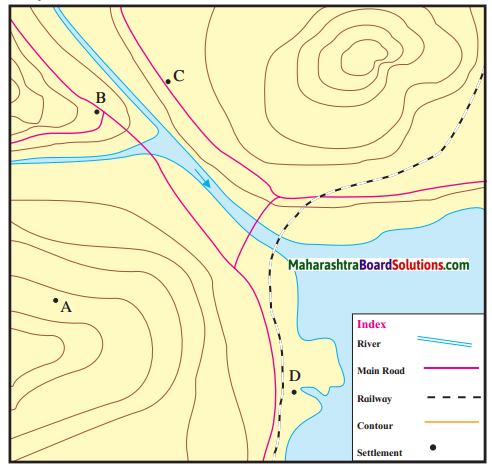
Maharashtra Board Class 7 Geography Solutions Chapter 10 Human Settlements 1
Question 1.
Settlement ‘A’ has 5-6 houses and the place does not have other facilities.
Answer:
Scattered settlement.

Question 2.
‘B’ has a high school, a big market and a small theatre.
Answer:
Nucleated settlement.

Question 3.
‘C’ has houses, farmers, many shops and small industries.
Answer:
Linear settlement.

Question 4.
‘D’ has a natural harbour. Many industries have been established here.
Answer:
Linear settlement.

Question 5.
‘C’ is a settlement that has developed along the road side. Give two reasons of its location here.
Answer:
The reasons for settlement ‘C’ developing along the roadside are:

  • It has direct & easy access to the main road which helps in easy movement of people & agricultural & industrial goods as houses, farms & small industries are found here.
  • It is located at the foothill close to the main river.

Maharashtra Board Class 7 Geography Solutions Chapter 10 Human Settlements

ICT Activity :

With the help of the internet, find the image of your village/city. On that basis, write about the type and characteristics of your settlement.

Class 7 Geography Chapter 10 Human Settlements InText Questions and Answers

Try this

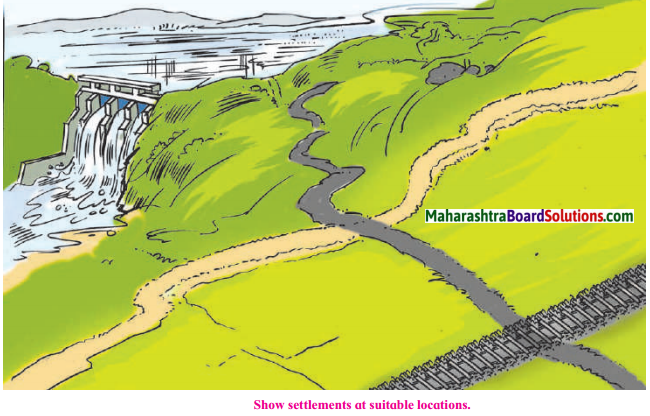
Look at the following picture. Find suitable location for human settlement and show them in picture:
Maharashtra Board Class 7 Geography Solutions Chapter 10 Human Settlements 2

Question 1.
Why were the settlements shown at specific places? Why should they be located there? Why can’t they be located in other places?
Answer:
(i) Settlement A is located at a place which has direct access to main road as well as railway line which will help in easy movement of passenger as well as goods transport.
(ii) Settlement ‘B’ is located on plain land. Its location near a water body will be beneficial for agricultural purpose.
(iii) A large portion of the area shown in the picture is a region of uneven topography which is not favourable for human settlement

Can you tell?

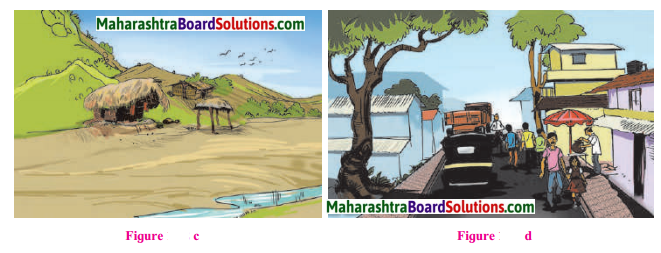
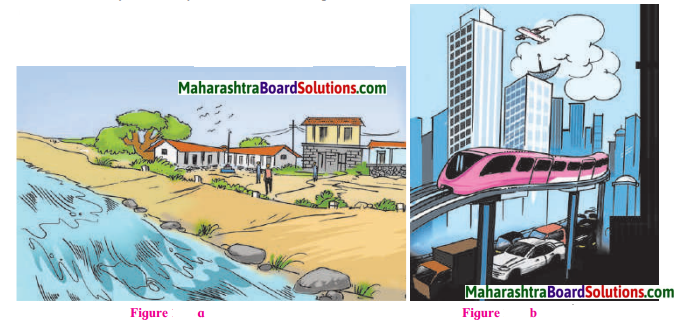
Observe the pictures given in figures (a, b, c, d). Think and answer the following questions:
Maharashtra Board Class 7 Geography Solutions Chapter 10 Human Settlements 9

Maharashtra Board Class 7 Geography Solutions Chapter 10 Human Settlements 4

Maharashtra Board Class 7 Geography Solutions Chapter 10 Human Settlements

Question 1.
What all can you see in the picture?
Answer:
(a) Rural: settlement small houses made of mud are seen with river flowing and farmland.
(b) City: Monorail, sky scrapers and lot of traffic with vehicles moving.
(c) Tribal hamlet: with sparse1 population.
(d) Town: Vehicles moving, vendors, shops and small houses.

Question 2.
What are the familiar features?
Answer:
All pictures show some type of human settlements.

Question 3.
Which picture shows sparse settlements?
Answer:
Tribal Hamlet shows sparse population.

Question 4.
Which picture shows agriculture?
Answer:
Rural settlement shows agriculture.

Question 5.
Which picture shows dense settlements?
Answer:
City shows dense settlement.

Question 6.
Which picture shows high rise building?
Answer:
City shows high rise building.

Question 7.
From the following, assign a suitable names for each of the pictures: Rural settlement, Tribal hamlet, Town, City.
Answer:
(a) Rural settlements
(b) City
(c) Tribal Hamlet
(d) Town.

Question 8.
Arrange the picture according to the level of development in the settlements?
Answer:
Tribal Hamlets, Rural Settlements, Towns, Cities.

Maharashtra Board Class 7 Geography Solutions Chapter 10 Human Settlements

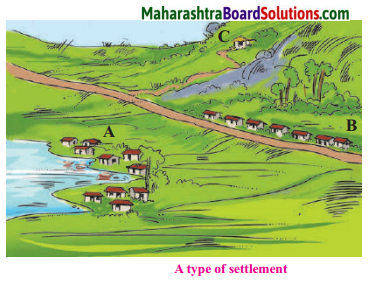
Observe the Fig. and discuss the following questions:
Maharashtra Board Class 7 Geography Solutions Chapter 10 Human Settlements 5

Question 1.
What is the difference between the human settlement at ‘A’ and ‘B’ ?
Answer:
A is Nucleated settlement & ’B’ is a Linear settlement

Question 2.
What is the difference between the settlement at B’ and C ?
Answer:
B is Linear settlement & ‘C’ is a type of tribal hamlet.

Question 3.
Where do you find less than 2 houses?
Answer:
‘C’ is tribal hamlet having less than 2 houses.

Question 4.
In what type of settlement do you live?
Answer:
I stay in ‘A’ type of settlement. (Students may answer as per their settlement type)

Think about it: 

Question 1.
Think about the possible processes that take place during the growth and development of settlements. Make a list of such processes.
Answer:
(i) Human settlements rise in places with favourable geographic conditions – such a availability of water, conducive climate, fertile land, etc.

(ii) In such settlements the occupations are majorly based on natural resources. These are called rural settlements.

(iii) With the passage of time, other associated occupations in these settlements grow & people of surrounding areas migrate & settle there, this leading to increase in the population of such settlements.

(iv) The proportion of people engaged in primary occupation declines & the importance of secondary & tertiary occupations increases
leading to transformation of rural settlements into urban settlements.

(v) Over a period of time when the population & the necessary amenities increase on a large scale, the urban areas grow into metropolitan cities.

Give it a try: 

Question 1.
Name the metropolitan cities of India.
Answer:
Mumbai, Chennai, Delhi, Kolkata, Hyderabad, Bangalore, Pune, Ahmedabad, etc. are some of the metropolitian cities of India.

Question 2.
Identify the type of settlement where you live.
Answer:
Students are expected to answer this questions on their own.

Maharashtra Board Class 7 Geography Solutions Chapter 10 Human Settlements

Question 3.
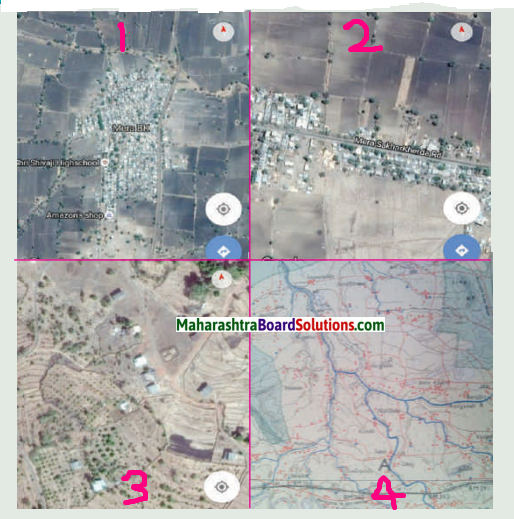
Observe the photographs given below. Identify the type of settlements shown here and write about them.
Maharashtra Board Class 7 Geography Solutions Chapter 10 Human Settlements 7
Answer:
Fig. 1 is Urban settlement: Houses, schools shops are close to each other. Densely populated.
Fig. 2 is Linear settlement: Houses are built along the Mera Sakharkevda road in three to four rows.
Fig. 3 is a Scattered settlements: Houses are far from each other, sparse population, very little transport.
In Fig. 4 Linear settlements can be seen along the roads whereas scattered settlements also seen

Make friends with maps:

Observe Fig. and answer the following questions:
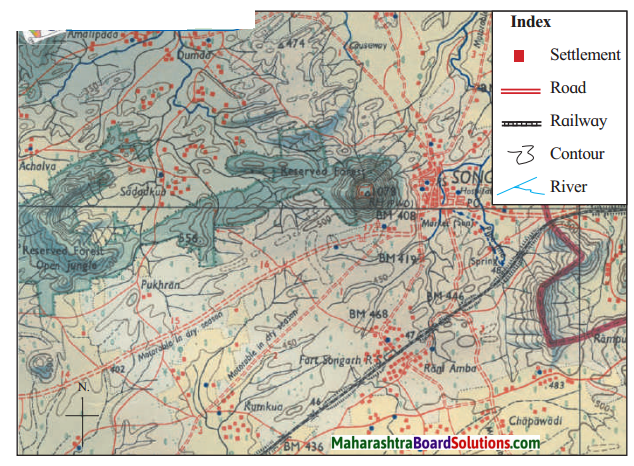
Maharashtra Board Class 7 Geography Solutions Chapter 10 Human Settlements 6

Question 1.
Name some of the settlements shown in the map.
Answer:
Amalipada, Achalva, Sadadkua, Dumda, Pukhram, Rani Amba, Kumkua, Chapawadi, are some settlements shown in the map.

Question 2.
Which of the settlements in the map are in a scattered form?
Answer:
Pukhran, Achalva, Chapawadi and Sadadkua have scattered settlements.

Question 3.
How are the houses in the settlements along the roads arranged?
Answer:
Houses are arranged in a line on both sides of the roads. They are linear settlement.

Maharashtra Board Class 7 Geography Solutions Chapter 10 Human Settlements

Question 4.
In which settlements are the houses close together? What could be the reason behind this density?
Answer:
The houses in Sangarh are close together.
Reasons:

  • Proximity to river
  • Amenities like water pipeline, hospital, post office
  • Easy access to transport routes like roads & railways which helps in easy movement of passengers & goods.

Question 5.
Can you now classify the settlements on the basis of these pattern?
Answer:

  • Dunda, Sodadkua, Pukhran, etc. have scattered settlements
  • Rani Amba is a linear settlement
  • Songarh is a nucleated settlement.

Class 7 Geography Chapter 10 Human Settlements Additional Important Questions and Answers

Fill in the blanks:

Question 1.
Human settlements flourished at places with favorable ________ conditions.
Answer:
geographic

Question 2.
In the early settlements, the occupation of the people were dependent on the locally available ________ resources.
Answer:
natural

Question 3.
People along the sea coast are engaged in _______.
Answer:
fishing

Question 4.
Settlements have provided man with _______.
Answer:
stability

Question 5.
In ______ settlements, houses are few and far from each other.
Answer:
scattered²

Question 6.
Increase in the population of rural settlements is the beginning of _________.
Answer:
urbanization

Question 7.
____ settlements are seen along roads, railways, rivers, sea coasts and foot hill regions, etc.
Answer:
Linear

Question 8.
In the deserts of Rajasthan we find _______ settlements.
Answer:
nucleated

Question 9.
_______ is the first step towards a stable life in human history.
Answer:
Rural settlement

Maharashtra Board Class 7 Geography Solutions Chapter 10 Human Settlements

Question 10.
Life in urban settlement is more _____.
Answer:
dynamic

Question 11.
_______ settlements have limited population as in small hamlets.
Answer:
Scattered

Complete the following sentence:

Question 1.
Human settlement flourished at places with favourable geographical conditions such as ______.
Answer:
availability of water, a conducive climate, fertile land, etc.

Question 2.
When rural area converts into urban area, the importance of secondary and tertiary occupations increases and _______.
Answer:
the proportion of people engaged in primary occupations decline

Question 3.
If the population and the necessary amenities increase on a large scale ______.
Answer:
the urban areas grow into metropolitan cities.

Question 4.
Patterns of human settlements evolve in _______.
Answer:
accordance with the natural conditions

Question 5.
Increase in population of rural settlements is ______.
Answer:
is the beginning of urbanization

Question 6.
The day to day food requirement of the urban population is _______.
Answer:
fulfilled by rural settlements

Question 7.
In the deserts of Rajasthan we find _______.
Answer:
nucleated settlements near assured sources of water

Question 8.
Linear settlements are seen along _______.
Answer:
roads, railways, rivers, sea coasts and in foothill regions

Question 9.
There are large scale correlations _______.
Answer:
between rural and urban settlements

Question 10.
Urban settlements have evolved through _______.
Answer:
the expansion² and growth of rural settlements

Maharashtra Board Class 7 Geography Solutions Chapter 10 Human Settlements

Match the column:

Question 1.

Column ‘A’Column ‘B’
(1) Limited population(a) Linear settlements
(2) Tribal people(b) Nucleated settlements
(3) Have better social life(c) Scattered settlements
(4) On National or State highways(d) Hamlets

Answer:
1 – c
2 – d
3 – b
4 – a

Identify the types of human settlements from the following statements:

Question 1.
These settlements are closer to nature, they are free from pollution.
Answer:
Scattered settlements.

Question 2.
Settlements found along the coastal tracts, major rivers and national or state highways.
Answer:
Linear settlements.

Question 3.
These settlements are found in fertile plains, transport hubs and mining centres, commercial centres.
Answer:
Nucleated settlements.

Question 4.
These settlements have limited population and inadequate facilities.
Answer:
Scattered settlements.

Answer in one or two sentences:

Question 1.
Where do human settlements flourish?
Answer:
Human settlements flourish at places with favourable geographic conditions – such as availability of water, a conducive climate, fertile land, etc.

Question 2.
What did forest dwellers or tribal people use for their livelihood?
Answer:
Forest dwellers or tribal people used forest produce for their livelihood.

Question 3.
Where do the farmer & his family live?
Answer:
They live in a house built in or near the fields.

Question 4.
Which settlements are called rural settlements?
Answer:
The settlements where the original occupation of the majority of the people are based on natural resources are called rural settlements.

Maharashtra Board Class 7 Geography Solutions Chapter 10 Human Settlements

Question 5.
Wnen do the urban areas grow into metropolitan cities?
Answer:
When the population and the necessary amenities increase on a large scale, the urban areas grow into metropolitan cities.

Question 6.
Where do we find scattered settlements?
Answer:
Scattered settlements are found in the areas of high relief, dense forests, grasslands, hot deserts and extensive agricultural lands.

Question 7.
Where do we find nucleated settlements?
Answer:
Nucleated settlements are generally close to water sources like brooks, rivulets, rivers, lakes reservoirs, etc.

Question 8.
Where do we see Linear settlements?
Answer:
Linear settlements are seen along roads, railways, rivers, sea coasts, in foothill regions, etc.

Question 9.
What makes a city a metropolis?
Answer:
A metropolis is a large city or urban area, which is a significant economic, political and cultural center for a country or region and an important hub for regional or international connections, commerce and communications.

Answer in one or two sentences:

Question 1.
Where do human settlements flourish?
Answer:
Human settlements flourish at places with favourable geographic conditions – such as availability of water, a conducive climate, fertile land, etc.

Question 2.
What did forest dwellers or tribal people use for their livelihood?
Answer:
Forest dwellers or tribal people used forest produce for their livelihood.

Question 3.
Where do the farmer & his family live?
Answer:
They live in a house built in or near the fields.

Question 4.
Which settlements are called rural settlements?
Answer:
The settlements where the original occupation of the majority of the people are based on natural resources are called rural settlements.

Question 5.
When do the urban areas grow into metropolitan cities?
Answer:
When the population and the necessary amenities increase on a large scale, the urban areas grow into metropolitan cities.

Question 6.
Where do we find scattered settlements?
Answer:
Scattered settlements are found in the areas of high relief, dense forests, grasslands, hot deserts and extensive agricultural lands.

Maharashtra Board Class 7 Geography Solutions Chapter 10 Human Settlements

Question 7.
Where do we find nucleated settlements?
Answer:
Nucleated settlements are generally close to water sources like brooks, rivulets, rivers, lakes reservoirs, etc.

Question 8.
Where do we see Linear settlements?
Answer:
Linear settlements are seen along roads, railways, rivers, sea coasts, in foothill regions, etc.

Question 9.
What makes a city a metropolis?
Answer:
A metropolis is a large city or urban area, which is a significant economic, political and cultural center for a country or region and an important hub for regional or international connections, commerce and communications.

Answer in short:

Question 1.
Distinguish between Scattered Settlements & Linear Settlements.
Answer:

Scattered SettlementsLinear Settlements
(i) In scattered settlements houses are far away from each other.
(ii) There settlements have limited population as in small hamlets.
(iii) These settlements are found in the areas of high relief, dense forest, grasslands, hot deserts and extensive agricultural land
(i) In Linear settlements houses are spread along a straight line.
(ii) These settlements have comparatively more population.
(iii) These settlements grow along the coastal tracts, major rivers, national or state highways, railways in the foothill regions, etc.

Question 2.
Describe Linear Settlements.
Answer:

  • Linear settlements are seen along roads, railways, rivers, sea coast and in foothill regions, etc.
  • Houses in these settlements are along a straight line, in a row.
  • As the settlement grows in the course of time, multiple lines emerge.
  • Besides houses, some shops can also be seen.
  • Such settlements are found along the coastal tracts, major rivers and national of state highways in our country.

Question 3.
What leads to transformation of rural settlement into urban settlement?
Answer:
(i) The settlements where the original occupations of the majority of the people are based on natural resources are called rural settlements. Agriculture, fishery, etc. are some of these occupation

(ii) With the passage of time other associated occupations also develop gradually in these rural settlement.

(iii) As a result people from surrounding areas migrate & settle there leading to an increase in rural population.

(iv) Houses are built & different facilities are developed for the growing population.

(v) Importance of secondary & tertiary occupations increases & the proportion of primary occupations declines.

This process leads to the transformation of rural settlement into urban settlements

Maharashtra Board Class 7 Geography Solutions Chapter 10 Human Settlements

Question 4.
Describe man’s future plans in terms of settlements.
Answer:

  • Man started using resources from the surroundings.
  • Man constructed houses and started living in them.
  • They have even built sky-scrapers.
  • In future, man is thinking of constructing colonies on other planets and their satellites too.
Maharashtra Board Class 7 English Solutions Chapter 4.3 The Red-Headed League

Balbharti Maharashtra State Board Class 7 English Solutions Chapter 4.3 The Red-Headed League Notes, Textbook Exercise Important Questions and Answers.

Maharashtra State Board Class 7 English Solutions Chapter 4.3 The Red-Headed League

Class 7 English Chapter 4.3 The Red-Headed League Textbook Questions and Answers

Part-I

1. Find and write the descriptions of different people given in this story.

Red Headed League Questions And Answers Question 1.
Find and write the descriptions of different people given in this story.
Answer:
Character Sketch:
a. Sherlock Holmes: A private detective and the story’s protagonist. His keen observations and ability to reason allowing him to solve puzzles that astonish everyone. Sometimes quiet and contemplative, other times bursting with energy, he uses methods that can confuse and frustrate others. He is somewhat a mystery, rarely letting his thoughts known until he has already solved the crime.

b. Dr. John Watson: Sherlock Holmes’ partner and the story’s narrator. Good natured, brave and down-to-earth, Watson is Sherlock Holmes’ sidekick, even though he rarely helps Holmes actually solve any mysteries and Watson often mirrors the reader’s own confusion.

c. Jabez Wilson: A London pawn-broker, Jabez Wilson is an average man whose only remarkable feature is his lock of fiery red hair. His slow and trusting nature prevented him from seeing anything suspicious about either Vincent Spaulding or the preposterous Red-headed League.

d. John Clay / Vincent Spaulding: A notorious criminal working at Jabez Wilson’s pawnshop under the name of Vincent Spaulding. He is evil and haughty. John Clay catches the attention of Sherlock Holmes in spite of his clever plot.

e. Duncan Ross: John Clay’s partner-in-crime. Duncan’s red hair prompts John Clay to devise the Red-headed League to lure Wilson out of his pawnshop for four hours everyday.

Maharashtra Board Class 7 English Solutions Chapter 4.3 The Red-Headed League

2. Present Mr. Wilson’s story as it would be shown in a comic strip.

The Red-Headed League Questions And Answers  Question 1.
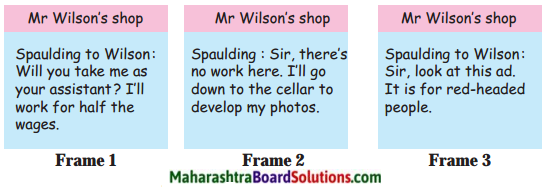
Write what picture you will show in each frame along with the dialogues. Write the dialogue with the help of the story. Examples:
Maharashtra Board Class 7 English Solutions Chapter 4.3 The Red-Headed League 1
Answer:
Frame 1.
Mr. Wilson’s shop:
Spaulding to Wilson: Sir, why don’t you try for this job?

Frame 2.
Mr. Wilson’s shop:
Spaulding to Wilson : It is to help the red-heads.

Frame 3.
Mr. Wilson’s shop
Spaulding to Wilson: They are paying handsomely. It will be an additional income for you.

Frame 4.
Mr. Wilson’s shop:
Spaulding to Wilson: Sir, I will go along with you. Let’s give it a try.

Maharashtra Board Class 7 English Solutions Chapter 4.3 The Red-Headed League

Frame 5.
At Fleet Street:
Wilson to Spaulding: Just see! It is crowded with red-headed people. I don’t stand a chance.

Frame 6.
At Fleet Street:
Spaulding to Wilson: Sir, don’t be disheartened.

Frame 7.
At Fleet Street:
Spaulding to Wilson: Sir, stay by my side. I’ll push you into the office.

Frame 8.
At the office:
Wilson to Spaulding: At last, we are in the office, but there is no one except one man.

Frame 9.
At the office:
Spaulding to Wilson: Sir, you don’t worry. Just answer his questions confidently.

Frame 10.
Mr. Duncan Ross to Wilson:
I’m pleased with your confidence. I’m glad to announce that you have got the job.

Frame 11.
At Fleet Street:
Wilson to Ross: Thank you so much, Sir. I’m highly obliged.

Maharashtra Board Class 7 English Solutions Chapter 4.3 The Red-Headed League

Frame 12.
At the office:
Wilson to Ross: Sir, what am I supposed to do? How much will I be paid?

Frame 13.
At Fleet Street:
Ross to Wilson: You will have to copy the encylopedia Britannica. You will be paid four pounds a week. And: your timings will be from 10 am to 2 pm.

Frame 14.
At the office:
Wilson to Ross: Wonderful Sir, when do I start?

Frame 15.
At the office:
Ross to Wilson: Mr. Wilson, you begin from tomorrow.

Frame 16.
At the office:
Wilson to Ross: Sir, I will put my heart and soul into my job.
Ross to Wilson: You will have to begin with one letter A and go alphabetically.
Wilson to Ross: Ok, Sir.

Maharashtra Board Class 7 English Solutions Chapter 4.3 The Red-Headed League

Frame 17.
At Wilson’s shop:
Spaulding to Wilson: How is your job going?
Wilson to Spaulding: Well I am enjoying it. Mr. Ross is visiting the office every day. He is very much particular about my timings.

Frame 18.
At the office:
Ross to Wilson: How are you finding your work? This is your salary.
Wilson to Ross: Thank you, Sir.

Frame 19.
At Wilson’s office:
Spaulding to Wilson: How are you Sir and how is your job going?
Wilson to Spaulding: It’s been 8 weeks and 1 am really enjoying. Now Mr. Ross has stopped coming to the office.

Frame 20.
At Wilson’s shop:
Spaulding to Wilson: Good morning. What happened today? You did not go out?
Wilson to Spaulding: The office of the League is shut and locked. There is a note nailed on the door saying the League is dissolved.

Frame 21.
At Wilson’s shop:
Wilson to Spaulding: Do you know anything about the League?

Frame 22.
At Wilson’s shop:
Spaulding to Wilson: 1 am unaware about what happened.

Maharashtra Board Class 7 English Solutions Chapter 4.3 The Red-Headed League

Frame 23.
Wilson to himself:
I should find out more about the League. This is a mystery and I want to know why they played this prank upon me.

Frame 24.
Wilson to himself:
Sherlock Holmes will be the best person to solve this mystery. I will go to him.

3. Form groups of five. Discuss how you can complete the rest of the story without referring to Part II of the story.

The Red Headed League Questions And Answers  Question 1.
Form groups of five. Discuss how you can complete the rest of the story without referring to Part II of the story.
Answer:
Mr. Holmes and Watson try to think out why the League shut so abruptly. Holmes feels he should meet Wilson at home to ask some questions that were bothering him. When he reached Wilson’s house, he notices someone leaving the house. Mr. Holmes enquires about that person and understands that he was Wilson’s assistant. Mr. Holmes feels that he has seen the assistants face before.

Later, he checks on records and finds out that the assistant is none but a notorious criminal clay who was absconding. Mr. Holmes already had a sketch of Mr. Ross. On enquiring he came to know that Ross and Spaulding were very close. Mr. Holmes goes to Mr. Ross’ house and threatens him. Mr. Ross spills the beans, that he and Spaulding were going to rob Mr. Wilson the very next day. Mr. Holmes informs the police and both Spaulding and Ross are caught and put behind bars.

Maharashtra Board Class 7 English Solutions Chapter 4.3 The Red-Headed League

4. Language Study.

Modal auxiliary: You have read about main verbs and auxiliary verbs in Sid VI. You know that auxiliary verbs are helping verbs. Modal auxiliary verbs or modal verbs are also helping verbs. They are used with main verbs to show changes/modifications in the meaning of the main verb. They show possibility, ability, permission, intention, etc.
The modal auxiliaries are:

  1. can, may, shall, will
  2. could, might, should, would
  3. must, ought to, used to, need, dare ………

Remember the following:

  1. We do not use ‘to’ before a modal.
  2. We do not add ‘-ed’ or ‘-Ing’ to a modal.
  3. We can form questions and negative sentences using modals without using the auxiliaries be, have, or do.

Examples:

  1. They can swim.
  2. May I come In?
  3. We shall sing.
  4. Can he swim?
  5. You may go.
  6. She ought to play.
  7. He cannot swim.
  8. You must go.
  9. They might come.

Frame simple sentences – statements, questions, requests. orders, permissions, etc. using the modals listed above.
Answer:

  1. Take an umbrella. It may rain today.
  2. You should not leave objects lying on the floor.
  3. Drivers must stop when the traffic light is red.
  4. Can you speak French?
  5. I could not solve the problem.
  6. May I ask you a question?
  7. You may take a holiday today.
  8. You should see a doctor.
  9. I could run fast when I was young.
  10. Can I go out?
  11. You need not buy any vegetables.
  12. Students shall not enter this room.
  13. What should I do to get rid of this pain?

The Red Headed League Question Answer Part – II

1. Put the following events in proper order.

The Red-Headed League 7th Standard Question Answer  Question 1.
Holmes and others go to the bank.
Answer:
The bank received a lot of gold from the Bank of France.

Maharashtra Board Class 7 English Solutions Chapter 4.3 The Red-Headed League

Questions Answers Of Red Headed League Question 2.
Clay digs a tunnel.
Answer:
Clay digs a tunnel.

The Red Headed League Std 7  Question 3.
Ross closes the office of the ‘Red-headed League’.
Answer:
Ross closes the office of the ‘Red-headed League’.

The Red-Headed League 7th Standard Question 4.
Holmes catches the criminal Clay.
Answer:
Holmes visits the area around Mr. Wilson’s shop.

Std 7 English The Red Headed League  Question 5.
Clay and Ross enter the cellar to steal the gold.
Answer:
Holmes and others go to the bank.

The Red Headed League Questions And Answers  Question 6.
The bank received a lot of gold from the Bank of France.
Answer:
Clay and Ross enter the cellar to steal the gold.

Maharashtra Board Class 7 English Solutions Chapter 4.3 The Red-Headed League

The Red Headed League Question And Answer  Question 7.
Holmes visits the area around Mr. Wilson’s shop.
Answer:
Holmes catches the criminal Clay.

2. From the passage, find adverbs that end with ‘-ly’.

Question a.
From the passage, find adverbs that end with ‘-ly’. Find the adjective in each of the adverb
Answer:


AdverbAdjective
franklyfrank
silentlySilent
carefullycareful
finallyfinal
suddenlysudden
beautifullybeautiful

3. Discuss the following elements of a detective or mystery story.

Question a.
Discuss the following elements of a detective or mystery story.

  1. a mystery
  2. strange happenings
  3. a smart detective who investigates the happenings
  4. a crime/possibility of a crime
  5. preventing the crime and catching the criminal.
  6. characteristics of the victim
  7. characteristics of the criminal
  8. characteristics of the detective

Use the elements to prepare outlines of detective stories using your imagination. Write a story using any one of the outlines.
Answer:
Outline:

  1. Disappearance of the ‘Will’.
  2. Death of the head of the family.
  3. Wife and two sons left behind.
  4. ‘Will’ to be read before family members.
  5. The elder brother in charge of the ‘Will’.
  6. He makes excuses of misplacing the ‘Will’ and shows the photocopy of the ‘Will’.
  7. The family lawyer insists on the original ‘Will’.
  8. The elder brother keeps insisting on having lost the ‘Will’.
  9. Mr. Karamchand, a clever and intelligent detective called.
  10. The detective makes the necessary enquiries.
  11. The elder brother, a gambler, a revelation.
  12. The detective catches the elder brother in his own act.
  13. The elder brother owns up.
  14. The lawyer with the help of the detective prevents a big crime from being executed.

Maharashtra Board Class 7 English Solutions Chapter 4.3 The Red-Headed League

Caught in his own act:

The disappearance of the ‘Will’ was a mystery in the Patwardhan family. The disappearance of the ‘Will’ came to light when it had to be read by the family members after the death of senior Mr. Patwardhan. Mr. Patwardhan had left behind a lot of property and wealth. Mr. Patwardhan had left behind his wife and two sons. When the family lawyer enquired about the ‘Will’, Mrs Patwardhan said that she had given it to her elder son who had said that he would keep it safely. The younger son was unaware of the ‘Will’ made by his father.

When the lawyer of the family asked him if he had read his father’s ‘Will’, he realised what they were saying and asked his mother to show the ‘Will’, she said that it was with her elder son. When the elder son was asked about the ‘Will’, he started making excuses by saying he had misplaced the ‘Will’ and could not find it. The family lawyer insisted that the ‘Will’ be shown to the younger son.

The elder son brought a photocopy of the ‘Will’. The younger son and the family lawyer demanded the original ‘Will’. The elder son kept on making excuses and also said that the original ‘Will’ was lost. There was something in this situation which was a mystery. This is when the younger son hires a smart and intelligent detective, Mr. Karamchand. Mr. Karamchand makes a lot of enquiries and comes to know that the elder son was in the habit of gambling and was in a lot of debts.

Mr. Karamchand also came to know that the elder son was a very sweet talker and could twist and turn situations to his advantage. On the other hand, the younger brother was quite a simpleton who was happy with what he had, making it easier for the elder brother to manipulate him.

Their mother being quite old, had bouts of memory loss. This was another good reason for the elder son to do as he pleased. Mr. Karamchand, very cleverly got the truth out from the elder son. Mr. Karamchand informed the family lawyer, who in turn, demanded the original copy of the ‘Will’ from the elder son.

The lawyer also told him that it was a crime not to show the ‘Will’ to the family members. The elder brother showed the ‘Will’ to the younger brother. The younger brother read the ‘Will’ and handed it to the family lawyer without suspecting anything. The family lawyer went through the ‘Will’ and found out that the ‘Will’ had been tampered with. The dates and certain words were changed for the benefit of the elder brother.

After a lot of interrogation, the elder brother accepted the crime committed by him. The family lawyer rectified the changes made and now the younger brother got his share of property and wealth.

4. Use the following outline to develop a story as a group activity. Then write the story individually.

Question a.
Family returns home late at night ……………. hear conversation between thieves from inside the locked house ……………. family gets ready to counter …………….. attack …………… father opens the …………… door ……………. all enter ………….. no one is seen ……………… but T.V. is on detective serial midway.
Answer:
A Family Drama:
After attending the reception cum dinner of their close friend’s daughter, at the famous five star hotel ‘The Oberoi’, Mr. Pai and his family were returning home discussing the evening. Mr. and Mrs Pai along with their two children Suhani and Soham had attended the function. It was quite late at night, and to add to it, it began to rain making the surroundings dark and scary.

Mr. Pai drove the car cautiously and reached their colony safely. Mr. Pai parked the car while the others waited for him at the entrance of their building. It was still raining and the watchman was nowhere in sight. The common light in the building was not on. The way leading to their house was in darkness. Somehow they gropped their way to the second floor, where they lived. As they reached their house, Mr. Pai felt that he heard footsteps and whispering coming from inside their house. He asked his wife to listen carefully and she too agreed that there was whispering. The conversation indicated robbers searching for valuables. There was no light in their house.

Mr. Pai was an army officer. He asked his family members to stand behind him and he opened the main door very slowly. He could hear conversation and movements too. He slowly went towards the bedroom from where the conversation was coming. The door was closed.

He took out his revolver and pushed the door open quickly only to understand that the conversation was from the T.V. serial ‘Crime Patrol’. He then remembered that he had been watching T.V. before leaving home and had forgotten to switch it off. The other family members who had followed him gave a huge sigh of relief.

Maharashtra Board Class 7 English Solutions Chapter 4.3 The Red-Headed League

5. Language Study.

Synonyms, antonyms, homonyms: Synonyms are the words from the same language that have the same or more or less the same meaning.
Examples:

  1. good – nice – pretty
  2. shut – closed – sealed
  3. intelligent – bright

Antonyms are words from the same language that have opposite meanings.
Examples :

  1. strong – weak
  2. right – wrong
  3. hard – soft
  4. up – down

Homonyms are words that are spelt and pronounced in the same way but
have different meaning.
Examples

  1. round adjective. – round noun.
  2. walk noun. – walk verb.

Maharashtra Board Class 7 English Solutions Chapter 4.3 The Red-Headed League

Start a collection of synonyms, antonyms and homonyms. Collect at least 50 each. Keep adding to your selection.
Answer:
Examples of Synonyms:

  1. advice – help – guidance – aid
  2. argument – dispute – squabble
  3. aromatic – fragrant
  4. backbone – spine
  5. choosy – picky
  6. constant – fixed
  7. defective – faulty
  8. enormous – huge – immense
  9. famous – popular – renowned
  10. fantastic – great – brilliant

Examples of Antonyms:

  1. predator × prey
  2. employer × employee
  3. former × latter
  4. exhale × inhale
  5. natural × artificial

Examples of homonyms:

  1. bark (n) – bark (y)
  2. bow (n) – bow (y)
  3. clear (adj) – clear (y)
  4. current (adj) – current (n)
  5. fair (adj) – fair (n)

Class 7 English Chapter 4.3 The Red-Headed League Additional Important Questions and Answers

Answer the following questions:

The Red-Headed League Questions And Answers Pdf  Question 1.
Who was well suited for the job?
Answer:
Mr. Wilson was well suited for the job.

Maharashtra Board Class 7 English Solutions Chapter 4.3 The Red-Headed League

The Red Headed League Answers  Question 2.
What would you suggest/advice Mr. Wilson to do in the given situation?
Answer:
The best thing to do when you know a crime is being committed or you are being cheated is to go to the lawful authority. I would suggest/ advice Mr. Wilson to go to the police and file a complaint against the people who had cheated him. It is better to do so rather than taking matters into your own hands and make the situation worse.

The Red-Headed League Book Back Answers Question 3.
What did Holmes want to see? Why?
Answer:
Holmes wanted to see the knees of Mr. Spaulding’s trousers. It was to see if thery were dirty.

The Red Headed League Class 7  Question 4.
Guess where Mr. Merryweather took the others.
Answer:
Mr. Merryweather led the others through an iron gate, down a narrow passage, that led through a dark, passage into a huge cellar, full of big boxes.

The Red Headed League 7th Standard Question 5.
How did Mr. Merryweather come to know about the crime?
Answer:
Mr. Merryweather got a hint of the crime from Mr. Sherlock Holmes.

The Red Headed League Class 8 Question Answer Question 6.
Why did Mr. Holmes think the criminals would act that night?
Answer:
Mr. Holmes had a strong feeling that the criminals would act that night because it was a Friday and the banks and offices would be closed for the weekend making the work of the criminals easier.

Maharashtra Board Class 7 English Solutions Chapter 4.3 The Red-Headed League

Question 7.
How did the criminals enter the cellar?
Answer:
The criminals had made a square gash on the wall which separated Mr. Wilson’s house and the bank’s cellar. They removed a broad stone which left a square hole enabling the criminals to enter into the cellar.

Question 8.
Who were the two criminals?
Answer:
The two criminals were none other than Mr. Vincent Spaulding alias Clay and Mr. Duncan Ross.

Question 9.
Why did Holmes become suspicious?
Answer:
Mr. Holmes became suspicious when he heard that Mr. Spaulding, Mr. Wilson’s assistant worked for only half the wages.

Question 10.
How did Holmes find out that the assistant was a criminal?
Answer:
Mr. Holmes used Mr. Wilson’s description of his assistant, made further enquiries and found out that Mr. Spaulding was none other than Clay, a criminal.

Maharashtra Board Class 7 English Solutions Chapter 4.3 The Red-Headed League

Question 11.
How did Mr. Holmes guess that Mr. Spaulding was digging a tunnel?
Answer:
Mr. Holmes suspected that Mr. Spaulding was digging a tunnel because when Mr. Spaulding Clay. answered the doorbell, the knees of his trousers were wrinkled and stained and this confirmed his suspicion.

Reading Skills, Vocabulary and Grammar

Question 1.
Simple Factual Questions:
Match the columns.

Columns ‘A’Columns ‘B’
Mr. HopkinsRepresentative of the Red-headed league
Mr. WilsonAmerican Millionaire
Vincent SpauldingPawnbroker
Mr. Duncan RossAssistant to Wilson

Answer:

Columns ‘A’Columns ‘B’
Mr. HopkinsAmerican Millionaire
Mr. WilsonPawnbroker
Vincent SpauldingAssistant to Wilson
Mr. Duncan RossRepresentative of the Red-headed league

Complex Factual Questions:

Question 1.
Why did Wilson like his assistant Spaulding?
Answer:
Wilson liked his assistant Spaulding as he was smart, efficient and worked for only half the normal wages.

Maharashtra Board Class 7 English Solutions Chapter 4.3 The Red-Headed League

Question 2.
Why was Fleet Street full of red-headed people?
Answer:
There was an advertisement in the newspaper calling red-headed people in person to apply for a job at the office of the league. As the office was on Fleet Street, it was full of red-headed people.

Question 3.
What did Mr. Wilson think looking at the crowd?
Answer:
Seeing the crowd of red-headed people on the street, Mr. Wilson lost all hope of getting the job. Hence he wanted to go back.

Question 4.
What happened when Mr. Duncan Ross saw Mr. Wilson?
Answer:
Mr. Duncan was very pleased to see Mr. Wilson and announced immediately that he was well situated for the job. He sent back all the other candidates.

Maharashtra Board Class 7 English Solutions Chapter 4.3 The Red-Headed League

Question 5.
Why did Mr. Wilson accept the job?
Answer:
Mr. Wilson accepted the job because the pay was not only very good but also Spaulding assured Mr. Wilson that he would look after Mr. Wilson’s business in his absence.

Vocabulary.

Question 1.
Make 4 words of minimum 4 letters from the given words.
1. advertisement
2. representative
Answer:
1. adverse, verse, meant, said
2. present, pretest, native, resent

Question 2.
Give nouns form.

  1. smart
  2. efficient
  3. develop
  4. sat
  5. announce
  6. explain.

Answer:

  1. smartness
  2. efficiency
  3. development
  4. seat
  5. announcement
  6. explanation

Maharashtra Board Class 7 English Solutions Chapter 4.3 The Red-Headed League

Grammar.

Question 1.
There was nothing in the office but a couple of chairs and a table. Remove negative.
Answer:
There were only a couple of chairs and a table in the office.

Personal Response:

Question 1.
Who do you think is smarter – Mr. Wilson or his assistant?
Answer:
I think Mr. Wilson’s assistant, Spaulding was smarter. It was he who showed the advertisement to Mr. Wilson and urged and encouraged him to apply for the job. Seeing the large number of people trying to get the job, Mr. Wilson wanted to go back but spaulding pushed through the crowed and took him inside the office and saw to it that he got the job.

Question 2.
Would you like to do such a job?
Answer:
I would not like to do such a meaningless mundane and uninteresting job. Jobs should be interesting, challenging and provide scope for further learning and application of different skills which is totally absent in the job taken up by Mr. Wilson.

Maharashtra Board Class 7 English Solutions Chapter 4.3 The Red-Headed League

Question 3.
Why would anyone want to copy an encyclopedia?
Answer:
No one in their right sense would copy an encyclopedia/ However, for reference in some study, students as well as teachers could copy down specific matter they need. In the same very, someone who is challenging some matter given or want to upgrade it can copy relevant portion of an encyclopedia.

Question 4.
What would we do today, if we needed copies of text from a big book?
Answer:
Today, one would just take a photocopy xerox. of the required material.

Question 5.
What is the difference between a dictionary and an encyclopedia?
Answer:
An encyclopedia is a set of books with a collection of information about various topics and subjects while a dictionary contains meanings of different words. Both are arranged in alphabetical order.

Maharashtra Board Class 7 English Solutions Chapter 4.3 The Red-Headed League

Question 6.
Suggest a few words that may appear under ‘A’ after ‘Archery’ in an encyclopedia.
Answer:
Words that may appear under ‘A’ after ‘Archery’ in an encyclopedia could be as follows: architect, aromatics, asparagus, assassinator, astrobiologist, astrophysical, etc.

Simple Factual Questions.

Question 1.
Complete the following.

  1. And then suddenly the whole ……………
  2. The rooms had been rented ……………
  3. Holmes found Mr. Wilson’s story ……………
  4. Small, stout, with ……………

Answer:

  1. business came to an end.
  2. under a false name
  3. very unusual
  4. no hair on his face

Complex Factual Questions.

Question 1.
Why was Mr. Wilson shocked?
Answer:
Mr. Wilson has been working for eight weeks and as usual when he reached the office at ten o’ clock, he found the door shut and locked. He found a little note nailed on, it which said that the Red-headed league was dissolved. This shocked him.

Maharashtra Board Class 7 English Solutions Chapter 4.3 The Red-Headed League

Question 2.
What did Mr. Wilson do next?
Answer:
Mr. Wilson enquired at the nearly offices, but no one knew anything about the league.

Question 3.
Why did Mr. Wilson go to Mr. Holmes?
Answer:
Mr. Wilson felt cheated when he suddenly lost his job with a good pay. He was curious to find out about the league and why they played a prank upon him. He had also heard about the ability of Mr. Holmes to solve mysteries.

Question 4.
How did Mr. Wilson describe his assistant?
Answer:
Mr. Wilson described his assistant as small, stout, with no hair an his face and had a white splash of acid on his forehead.

Question 5.
What kind of a man was Mr. Wilson?
Answer:
Mr. Wilson was a simpleton. He could be easily taken for a ride. He was hardworking and diligent.

Vocabulary.

Question 1.
Give one word for the following.

  1. sincerely and tirelessly
  2. A playful trick that causes no harm
  3. Something which cannot be explained
  4. happening quickly and unexpectedly
  5. Solidly built

Answer:

  1. diligently
  2. prank
  3. mystery
  4. suddenly
  5. stout

Maharashtra Board Class 7 English Solutions Chapter 4.3 The Red-Headed League

Question 2.
Frame a sentence of your own with ‘diligently’.
Answer:
We must always work diligently.

Grammar.

Question 1.
On Saturday I got my salary. (Identify the subject and predicate)
Answer:
Subject-I
Predicate – got my salary on Saturday

Question 2.
I had written Abbots, Archery etc. (Begin with ‘Abbots…’)
Answer:
Abbots, Archery etc. had been written by me.

Maharashtra Board Class 7 English Solutions Chapter 4.3 The Red-Headed League

Question 3.
He did not come at all. Add a question tag.
Answer:
He did not come at all, did he?

Question 4.
Mr. Wilson wrote diligently for four hours. (Identify the part of speech of the underlined words)
Answer:
diligently – adverb
four – adjective

Question 5.
He locked the door of the office. (End with ‘……. the office’)
Answer:
Didn’t he lock the door of the office?

Personal Response.

Question 1.
What would you advice Mr. Wilson to do in the given situation?
Answer:
I feel Mr. Wilson made the right decision to take the help of Mr. Holmes about whom he had heard a lot.

Maharashtra Board Class 7 English Solutions Chapter 4.3 The Red-Headed League

Simple Factual Questions.

Question 1.
Complete the following.

  1. Mr. Holmes asked ……………
  2. The offices and banks will be ……………
  3. We followed him down a ……………
  4. We are in the cellar of the city branch of ……………

Answer:

  1. the way to the Strand
  2. closed for the weekend
  3. narrow passage
  4. one of the main banks of London

Complex Factual Questions.

Question 1.
Tell the name of the young man who opened the door to Mr. Holmes.
Answer:
The young man who opened the door to Mr. Holmes was his assistant Mr. Vincent Spaulding.

Maharashtra Board Class 7 English Solutions Chapter 4.3 The Red-Headed League

Question 2.
What announcement did Mr. Holmes make?
Answer:
Mr. Holmes announced that they were going to hunt one of the smartest criminals in London.

Vocabulary.

Question 1.
Provide suitable adjective to the nouns given below.

  1. weekend
  2. banker
  3. road
  4. passage

Answer:

  1. long weekend
  2. successful banker
  3. busy road
  4. interesting passage

Grammar.

Question 1.
We went to the square were Mr. Wilson had his shop. (Change into future tense.)
Answer:
We will go to the square where Mr. Wilson has his shop.

Maharashtra Board Class 7 English Solutions Chapter 4.3 The Red-Headed League

Question 2.
We followed him down a narrow passage. (Rewrite the sentence beginning…. He was followed….)
Answer:
He was followed by us down a narrow passage.

Personal Response.

Question 1.
Why did the criminals take interest in the cellar?
Answer:
Mr. Merryweather’s banks had borrowed a huge quantity of gold from the Bank of France and the boxes in the cellar were full of gold. Hence the criminals were interested in the cellar.

Complex Factual Questions.

Question 1.
Was Clay successful in using his revolver? Why?
Answer:
No, Clay was not successful in using his revolver because Mr. Holmes at once hit him on his wrist and the revolver fell on the floor.

Maharashtra Board Class 7 English Solutions Chapter 4.3 The Red-Headed League

Question 2.
Who came out of the square hole?
Answer:
Mr. Spaulding and Mr. Ross came out of the square hole.

Grammar.

Question 1.
A boyish face emerged. (Pick out the adjective)
Answer:
boyish

Question 2.
He had a companion with him. (Add a question tag)
Answer:
He had a companion with him, didn’t he?

Personal Response.

Question 1.
Who tried to get away? Do you think he was able to escape? Why?
Answer:
Mr. Duncan Ross tried to get away. But, he was not successful in escaping because there were three men waiting for him at the other end.

Maharashtra Board Class 7 English Solutions Chapter 4.3 The Red-Headed League

Simple Factual Questions.

Question 1.
Say if the statements are true or false.

  1. Dr. Watson foiled one of the cunning attempts at bank robbery.
  2. Using the tunnel they entered the bank.
  3. The assistant working for half the wages made Mr. Holmes suspicious.

Answer:

  1. False. It was’t Dr. Watson, if was Holmes,
  2. False
  3. True

Complex Factual Questions.

Question 1.
Why did Mr. Merryweather thank Mr. Holmes?
Answer:
Mr. Merryweather thanked Mr. Holmes as he had foiled one of the most cunning attempts at banks robbery.

Maharashtra Board Class 7 English Solutions Chapter 4.3 The Red-Headed League

Question 2.
What was strange about the advertisement?
Answer:
The advertisement and the peculiar job was purly to get Mr. Wilson away from his shop for some hours every day.

Question 3.
Why did clay and his companion dig the underground tunnel?
Answer:
Clay and his companion dug the underground tunnel to enter the bank and steal the gold without breaking open the doors of the bank.

Question 4.
What confirmed Mr. Holmes’ suspicion?
Answer:
When clay answered the bell, the knees of his trousers were wrinkled and stained, this confirmed his suspicion that he was digging.

Maharashtra Board Class 7 English Solutions Chapter 4.3 The Red-Headed League

Question 5.
“You reasoned it out beautifully!” Express it differently.
Answer:
You solved the puzzle very logically.
or
You connected the dots beautifully.

Vocabulary.

Question 1.
Averbs forms of.

  1. thank
  2. grateful
  3. obvious
  4. suspicious
  5. admiration

Answer:

  1. thankfully
  2. gratefully
  3. obviously
  4. suspiciously
  5. admirably

Grammar.

Question 1.
Pick four adjectives from the passage.
Answer:
cunning, cleaver, suspicious, beautifully

Personal Response.

Question 1.
Explain the trick of the ‘Red-headed League’. How was it related to Mr. Wilson’s hair?
Answer:
The ‘Red-headed League’ was a clever idea of Mr. Spaulding and Mr. Ross, to keep away Mr. Wilson from his own home for some time during the day so that they could dig a tunnel from Mr. Wilson’s house to the bank in the hope of stealing the gold from the bank without breaking open the doors of the bank. The ‘Red-headed League’ was no way connected to Mr. Wilson’s hair. It was just a way to get Mr. Wilson to apply for the job.

Maharashtra Board Class 7 English Solutions Chapter 4.3 The Red-Headed League

Language Study.

Question 1.
Complete the exercise by filling in with the right modals.

  1. You …………… be late again, (mustn’t / needn’t)
  2. You …………… do it now; you can finish it later. (mustn’t / needn’t)
  3. I think you ……………….. see a doctor, (should / can)
  4. …………… you help me? (May / Will)
  5. Students ……………… arrive to class on time, (can / must)
  6. I ……………. eat or I’ll faint, (ought to / would)

Answer:

  1. mustn’t
  2. needn’t
  3. should
  4. Will
  5. must
  6. ought to

Question 2.

  1. The ……………. (fare/fair) in the village was breathtaking. Fill in with the correct homophone.
  2. Mohan won a ……………. (meddle / medal) in the swimming competition. Fill in with the correct homophone.
  3. When it …………….(rains/reins), it pours. Fill with the correct word.
  4. We were early but they were ……………. (Fill in with the antonym of the underlined word)
  5. I (heard / herd) that the assistant worked for half the wages. (Cross out the wrong word)
  6. They planned to steal the gold. (Frame a ‘Wh’ question so as to get the underlined words as the answer)

Answer:

  1. fair
  2. medal
  3. rains
  4. late
  5. herd

Formative Assessment.

Question 1.
What do you have to do when you are told to ‘apply in person’ ?
Answer:

  1. i. Before applying for a job in person, it’s necessary to check out who is hiring.
  2. ii. Take time to research the employers before applying for jobs in person.
  3. iii. You have to know what you need to take when you go there.
  4. iv. The information youll need to complete a job application.
  5. v. How to prepare for, on the spot interview.
  6. vi. These points will guide you to provide all the information you need to apply in person, make a good impression and successfully get hired.

Question 2.
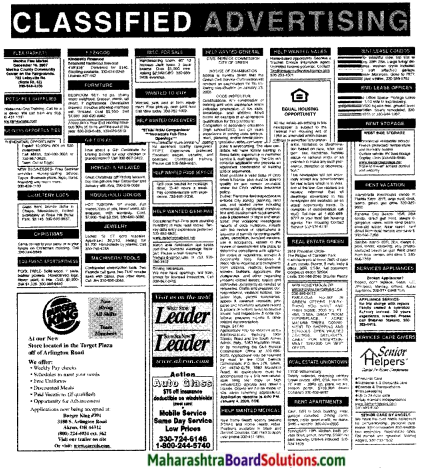
Find samples of ‘classified ads’ from an English newspaper. Where will the advertisement given here be seen in the classifieds?
Answer:
Samples of classified ads from The Times of India:
Maharashtra Board Class 7 English Solutions Chapter 4.3 The Red-Headed League 2
The advertisement given in the story will be seen in ‘Situations Vacant’ or ‘Part Time Jobs’.

Question 3.
Find out how photographs were developed in those days.
Answer:
Louis Daguerre was the inventor of the first practical process of photography.
Steps followed:

  1. Fix the image on a sheet of silver plate.
  2. Polish silver plate and coat it in iodine.
  3. Put plate in camera and expose it for a few minutes.
  4. Once image is painted by light, the plate is put into a solution of silver chloride.
  5. This process will create an image that would last a long time and will not get exposed to light.
  6. Students should find out more methods of photography.

The Red-Headed League Summary in English

This story is filled with mystery and suspense which keeps the reader wanting to know more. It is about a pawn-broker named Mr. Wilson, who goes to Sherlock Holmes and Watson and tells them about a strange business with a red-haired man. He tells them how his assistant encouraged him to apply for the job which he got. He worked for eight weeks. Suddenly the office closed without any notice. Holmes’ detective mind finds something fishy about the happenings as narrated by Mr. Wilson. The story ends with Mr. Wilson’s assistant Mr. Spaulding being a criminal, and he along with his friend Mr. Ross had planned to rob gold from a bank, through an underground tunnel dug out from Wilson’s house to the bank. However, Sherlock Holmes foiled their plan and put them behind bars.

Introduction:

The lesson The Red-Headed League’ is one of the 56 Sherlock Holmes’ short stories written by Sir Arthur Conan Doyle. It involves mystery and suspense.

Maharashtra Board Class 7 English Solutions Chapter 4.3 The Red-Headed League

Glossary:

  1. fiery (adj) – glowing
  2. pawn-broker (n) – a person who lends money on interest against things of value
  3. efficient (adj) – able to work well and produce good results
  4. assured (v) – guaranteed
  5. diligently (adv) – carefully, sincerely
  6. bade (v) – to tell
  7. dissolved (v) – disbanded (here) it means the organization was closed down.
  8. league (n) – an association or a formal group of people.
  9. prank (n)- playful trick that causes no harm.
  10. foiled (v) – laid waste, prevented
  11. splash (n) – sound made by something hitting the surface of some liquid.
  12. Strand (n) – a famous place in London
  13. cellar (n) – a room used for storage under a building
  14. take the criminals by surprise (phr) – catch then when they least expect it.
  15. object (v) – purpose, reason
  16. stopped all the holes (phr) – closed all the routes by which criminal may escape/run away
  17. seized by the collar (phr) – hold by the neck
  18. Frank (adj) – honest and outspoken
  19. gash (n) – a long deep cut
  20. attempt (v) – to endeavour to do, to try

Maharashtra Board Class 7 History Solutions Chapter 8 An Ideal Ruler

Balbharti Maharashtra State Board Class 7 History Solutions Chapter 8 An Ideal Ruler Notes, Textbook Exercise Important Questions and Answers.

Maharashtra State Board Class 7 History Solutions Chapter 8 An Ideal Ruler

Class 7 History Chapter 8 An Ideal Ruler Textbook Questions and Answers

1. Find it from the chapter:

Std 7 History Chapter 8 An Ideal Ruler Question 1.
Grave dangers in the life of Shivaji Maharaj.
Answer:

  • The meeting with Afzalkhan.
  • The siege of Panhala.
  • The attack on Shaistakhan.
  • The escape from Agra.

Maharashtra Board Class 7 History Solutions Chapter 8 An Ideal Ruler

Class 7 History Chapter 8 An Ideal Ruler Question 2.
They risked their life at the time when the Maharaj escaped from Agra.
Answer:
(a) Hiroji Farjand
(b) Madari Meheter

An Ideal Ruler Std 7 Questions And Answers Question 3.
What warning did Shivaji Maharaj issue to the Deshmukh of Rohida Valley?
Answer:
Maharaj warned the Deshmukh of the Rohida Valley not to fail in his duty to the ryot.

An Ideal Ruler Std 7 Question Answer Question 4.
What inspiration can future generations draw ‘ from the life of Shivaji Maharaj?
Answer:
The future generation will continue to draw inspiration from the work of Shivaji Maharaj, who laid the foundation of Swaraj and turning ,
it into Surajya, as an ideal and a source of inspiration.

2. Write about it in your own words:

8. An Ideal Ruler Question 1.
the Deshmukh to avoid any loss of the ryot?
Answer:

  • Maharaj warned the Deshmukh of the Rohida Valley not to fail in his duty to the Ryot.
  • He told him to visit every village and shift people to a safe place down the ghats.
  • He strictly told him not to delay even for a moment.

Maharashtra Board Class 7 History Solutions Chapter 8 An Ideal Ruler

An Ideal Ruler Std 7 Question 2.
How do we know that his religious policy was that of tolerance?
Answer:
(i) The Maharaj had to struggle against the Islamic rulers such the Adilshahi, the Mughals and the Siddis. But he considered the Muslims in Swaraj as his own people.

(ii) While meeting Afzalkhan, Siddi Ibrahim was a servant in his army.

(iii) Siddi Hilal was a soldier in the army.

(iv) Daulatkhan was an important officer in his navy.

(v) During the campaign, the soldiers were instructed not to harm a mosque. If they came in possession of a copy of the Holy Quran, they should hand over the same with due respect to a Muslim.

An Ideal Ruler Question Answer Question 3.
Explain Shivaji Maharaj’s policy regarding the army.
Answer:

  • There was strict discipline in the army.
  • The soldiers were paid salaries regularly.
  • They were paid cash and not jagirs.
  • There was a strict order to the army that the valuable collected from the enemy territories were to be deposited with the government.
  • Soldiers were honoured for their bravery.
  • Maintenance of the families of soldiers who died in battles were looked after.
  • He took care of the wounded soldiers and the enemy soldiers who had surrendered.

3. Give one word for:

8.An Ideal Ruler Question 1.
An important officer in the navy of Swaraj.
Answer:
Daulatkhan

An Ideal Ruler Question 2.
A Tamil poet who composed a poem on Shivaji Maharaj.
Answer:
Subramanyam Bharati

Maharashtra Board Class 7 History Solutions Chapter 8 An Ideal Ruler

An Ideal Ruler Std 7 Chapter 8 Question 3.
Created an independent kingdom in Bundelkhand.
Answer:
Chhatrasal

8 An Ideal Ruler Std 7 Question 4.
He composed Powadas on the greatness of Shivaji Maharaj.
Answer:
Mahatma Jyotirao Phule

Activities:

  1. Tell how you help your friend in his need.
  2. List the places named after famous personalities.

Class 7 History Chapter 8 An Ideal Ruler InText Questions and Answers

Can you tell?

Question 1.
How is the waste in your area managed?
Answer:
(i) Recycling: The waste materials such as old newspaper pieces of glass, bottles, empty tins are sold and later are used by recycling it.

(ii) Many NGOs are working for waste management. They are helping the rag pickers to collect the recycling waste from the door steps, rather than collecting from the soil in the bad and dirty condition.
Creating Awareness for waste management.

  • Use cloth bags instead of plastic.
  • Bye food that has less packaging.
  • Reduce paper usage.
  • Separating the dry and the wet waste in separate bins.

Question 2.
State the name of the machinery that looks after waste management.
Answer:
BMC: Brihanmumbai Municipal Corporation.

Maharashtra Board Class 7 History Solutions Chapter 8 An Ideal Ruler

Think about it:

Question 1.
Why is it necessary to grow trees?
Answer:

  • Trees are very important on this planet.
  • They give us oxygen, store carbon.
  • They stabilise the soil and gives life.
  • They absorb carbon dioxide and harmful gases such as sulphur dioxide, carbon monoxide from air.
  • They provide habitat and food for birds and other animals.
  • They provide us the materials for tools and shelter

Class 7 History Chapter 8 An Ideal Ruler Additional Important Questions and Answers

Complete the sentence by choosing the appropriate word from the options given below:

Question 1.
______ was an important officer in the navy of the Swaraj. (Daulatkhan, Siddi Hilal, Tanaji Malusare)
Answer:
Daulatkhan

Question 2.
The Maharaj inspired _______ to create an independent kingdom in Bundelkhand. (Chhatrasal, Jim Mahal, Daulatkhan)
Answer:
Chhatrasal

Question 3.
_______ was a Sardar in the army of the Maharaj. (Siddi Ibrahim, Siddi Hilal, Daulatkhan)
Answer:
Siddi Hilal

Question 4.
______ has written a book about the greatness of Maharaj. (Pandit fawaharlal Nehru, Kahfikhan, Lala Lajpatrai)
Answer:
Lala Lajpatrai

Question 5.
__________ sacrificed his life while conquering Sinhagad. (Hiroji Farjand, Jiva Mahal, Tanaji Malusare)
Answer:
Tanaji Malusare

Maharashtra Board Class 7 History Solutions Chapter 8 An Ideal Ruler

Question 6.
________ crossed the sledge of Panhalagad in disguise of Shivaji Maharaj. (kind, cash, gold)
Answer:
Shiva Kashid

Question 7.
Maharaj made arrangements to pay the salaries of soldiers in _______ (Shiva Kashid, Tanaji Malusare, Kanhoji)
Answer:
cash

Question 8.
_______ described in his powadas the greatness of Shivaji Maharaj. (Lokmanya Tilak, Mahatma jyotirao Phule, Lola Lajpatrai)
Answer:
Mahatma Jyotirao Phule

Give one word for:

Question 1.
Built sea forts and created a navy.
Answer:
Sindhudurg

Question 2.
Written long poem on Maharaj.
Answer:
Vishwakavi Rabindranath Tagore.

Answer in one or two sentences each:

Question 1.
Which powers ruled over Maharashtra before the foundation of Swaraj?
Answer:
Adilshahi, the Portuguese and Mughal powers ruled over Maharashtra.

Question 2.
Which four major dangers did Shivaji Maharaj face?
Answer:
(a) Meeting with Afzalkhan
(b) Siege of Panhala
(c) Attack on Shaistakhan
(d) Escape from Agra

Maharashtra Board Class 7 History Solutions Chapter 8 An Ideal Ruler

Question 3.
What had Pandit Jawaharlal Nehru said about Shivaji Maharaj?
Answer:
“The Maharaj did not belong to Maharashtra alone, he belonged to the whole Indian nation”, was said by Pandit Jawaharlal Nehru.

Question 4.
What shows that Shivaji Maharaj was a great environmentalist?
Answer:
(a) The garbage in his fort was burnt in an allotted space.
(b) Even vegetables had to be grown on its ash. These lines show that Shivaji Maharaj was a great environmentalist.

Question 5.
Mention few qualities of Shivaji Maharaj.
Answer:
Shivaji Maharaj had innumerable qualities like leadership, management, foresight, political diplomacy, military administration, loyalty towards truth and justice, etc.

Question 6.
Which actions of Shivaji Maharaj prove that he was a pioneer of a new era?
Answer:
Maharaj established Swaraj while fighting against many enemies. This action itself proves that he was a pioneer of a new era.

Question 7.
What did Shivaji Maharaj aim to establish?
Answer:
Shivaji Maharaj aimed at establishing and maintaining an independent and sovereign existence, that did not accept the dominance of any power.

Question 8.
What was deeply installed in Shivaji Maharaj’s mind?
Answer:
The teachings of his parents towards the establishmnet of Swaraj and ethics were deeply instilled in his mind.

Question 9.
How did Tagore see Shivaji Maharaj’s efforts of founding Swaraj?
Answer:
Tagore saw his efforts on founding Swaraj as efforts for realizing a noble cause.

Find it from the chapter:

Question 1.
What advice did Shivaji Maharaj give theageing Kanhoji when he fell ill?
Answer:
When the ageing Kanhoji fell ill, Maharaj told him not to neglect his medicines or treatment on any account.

Write about the following in your own words:

Question 1.
What inspiration can you draw from Shivaji Maharaj’s life?
Answer:
(i) Future generation will continue to look upon the work of Shivaji Maharaj of founding the Swaraj and turning it into Surajya as an ideal and a source of inspiration.

(ii) Shivaji Maharaj was a great National Hero.

(iii) All Indian languages have works that talk about him as an ideal ruler and a source of inspiration.

Maharashtra Board Class 7 History Solutions Chapter 8 An Ideal Ruler

Question 2.
Organisational skills of the Maharaj.
Answer:
The organisational skills of the Maharaj were unparallel and for this he had his royal associates.

  • Jiva Mahala killed Sayyid Banda during the meeting with Afzalkhan.
  • Bajiprabhu Deshpande blocked the advances of the enemy on the way to Vishalgad.
  • Murarbaji Deshpande defended the fort of Purandar.
  • Tanaji Malusare sacrificed his life while conquering Sinhagad.

Maharashtra Board Class 7 Science Solutions Chapter 6 Measurement of Physical Quantities

Balbharti Maharashtra State Board Class 7 Science Solutions Chapter 6 Measurement of Physical Quantities Notes, Textbook Exercise Important Questions and Answers.

Maharashtra State Board Class 7 Science Solutions Chapter 6 Measurement of Physical Quantities

Class 7 Science Chapter 6 Measurement of Physical Quantities Textbook Questions and Answers

1. Write answers to the following questions in your own words:

Question a.
Why is the weight of the same object different on different planets?
Answer:
The weight of the same object is different on different planets because weight depends on the gravitational force of the planet and gravitational force on every planet is different so the weight also differs from planet to planet.

Maharashtra Board Class 7 Science Solutions Chapter 6 Measurement of Physical Quantities

Question b.
What precautions will you take to make accurate measurements in day-to-day affairs?
Answer:
Following precautions will be taken to make accurate measurements in day to day affairs:

  1. The balance should carry the stamp of standardisation by the department of weights and measures.
  2. Balance should be stable and the pointer of the balance should be upright.
  3. The underside of the pan should not be tampered with any other weight or layers of other metal.
  4. The weight should be made of metal.

Question c.
What is the difference between mass and weight?
Answer:

MassWeight
1. The amount of matter present in a substance is called mass.1. The gravitational force that acts on this mass is called its weight.
2. It is a scalar quantity.2. It is a vector quantity.
3. Mass remains same everywhere on the earth.3. Weight changes from place to place on the ‘        earth.

Maharashtra Board Class 7 Science Solutions Chapter 6 Measurement of Physical Quantities

2. Who is my companion? 

Class 7 Science Chapter 6 Measurement Of Physical Quantities Exercise Question 1.

Column ‘A’Column ‘B’
1. Velocitya. Litre
2. Areab. Kilogram
3. Volumec. metre/second
4. Massd. kilogram/cubic metre
5. Densitye. square metre

Answer:

Column ‘A’Column ‘B’
1. Velocityc. metre/second
2. Areae. square metre
3. Volumea. Litre
4. Massb. Kilogram
5. Densityd. kilogram/cubic metre

3. Explain giving examples. 

Question a.
Scalar quantity:
Answer:
A quantity that can be completely expressed by its magnitude alone is called a scalar quantity, e.g. length, breadth, area, mass, temperature, density, time, work. In all these examples a value with a unit is used to express quantities. Thus, we say that the length of a tunnel is 2 km.

Maharashtra Board Class 7 Science Solutions Chapter 6 Measurement of Physical Quantities

Question b.
Vector quantity:
Answer:
The quantity that is expressed completely only.’ v when magnitude and direction are both given is called a vector quantity. Displacement, velocity are vector quantities e.g. a displacement of 20 km towards north, the aeroplane flying at a velocity of 500 km/hr towards Mumbai.

4. Explain, giving examples, the errors that occur while making measurements.

Question a.
Explain, giving examples, the errors that occur while making measurements.
Answer:
Major causes of errors in measurement are:

  1. Not using the appropriate device.
  2. Not using the device properly.

Example: While buying things at grocery shops and the vegetable market remember to look out for the following:

  • The balance should carry the stamp of standardisation by the department of weights and measures.
  • Balance should be stable. The pointer of the balance should be upright.
  • No changes should be done on the underside of the pan of the balance.
  • Weight should be made up of metals and it has to be standardized.

5. Give reasons:

Question a.
It is not proper to measure quantities by using body parts as units.
Answer:
It is not proper to measure quantities by using body parts as units because length of the body parts changes from person to person, so accurate measurement can not be found with the body parts as units.

Question b.
It is necessary to get the weights and measures standardized at regular intervals.
Answer:
It is necessary to get the weights and measures standardized at regular intervals because of that accurate weight and measurement can be taken. Errors will be avoided.

Maharashtra Board Class 7 Science Solutions Chapter 6 Measurement of Physical Quantities

6. Explain the need for accurate measurement and the devices to be used for that.

Question a.
Explain the need for accurate measurement and the devices to be used for that.
Answer:

  1. Measurement of substances that are precious or of great importance and used in very small quantities is done meticulously and accurately.
  2. Due to advancements in technology, devices that measure very small magnitudes of quantities like distance, mass, time and temperature are available now.
  3. e.g. distance and time in connection with very important sports competitions, mass of gold, body temperature etc.
  4. Devices to be used for this are thermometer, digital balance (Analytical balance) etc.

Project:

Class 7 Science Chapter 6 Measurement Of Physical Quantities Question 1.
Collect information about various physical quantities used in day-to-day life and the devices used for their measurement.

Class 7 Science Chapter 6 Measurement of Physical Quantities Important Questions and Answers

Fill in the blanks:

Std 7 Science Chapter 6 Measurement Of Physical Quantities Question 1.
The amount of matter present in a substance is called ………………. .
Answer:
mass

Measurement Of Physical Quantities Class 7 Exercise Question 2.
…………. is the qualitative measure of the inertia of an object.
Answer:
mass

Maharashtra Board Class 7 Science Solutions Chapter 6 Measurement of Physical Quantities

6. Measurement Of Physical Quantities Question 3.
The larger the mass, the ……………. is the inertia.
Answer:
greater

6.Measurement Of Physical Quantities Question 4.
Mass is a …………… quantity.
Answer:
scalar

Physical Quantities And Measurement Class 7 Question 5.
…………… does not change from place to place anywhere in the world.
Answer:
mass

Measurement Of Physical Quantities Class 7 Question 6.
The gravitational force that acts on a mass is called its ……………. .
Answer:
weight

6 Measurement Of Physical Quantities Question 7.
Wright is a …………… quantity.
Answer:
vector

Question 8.
System International (SI) is also called ………….. .
Answer:
metric system

Maharashtra Board Class 7 Science Solutions Chapter 6 Measurement of Physical Quantities

Question 9.
In Egypt in ancient times, the distance from a man’s elbow to the tip of his middle finger was called a ………… .
Answer:
cubit

Question 10.
Gold was weighed in a unit called …………… .
Answer:
gun

Who is my companion?

Question 1.

Column ‘A’Column ‘B’
1. Golda. Hour glass
2. Timeb. Vector
3. Distancec. Gunj
4. Weightd. Cubit

Answer

Column ‘A’Column ‘B’
1. Goldc. Gunj
2. Timea. Hour glass
3. Distanced. Cubit
4. Weightb. Vector

Maharashtra Board Class 7 Science Solutions Chapter 6 Measurement of Physical Quantities

Say whether true or false. Correct and rewrite the false statements:

Question 1.
The standards of the six fundamental units are kept in the National Physical Laboratory at New Delhi.
Answer:
True

Question 2.
Matter has a natural tendency to resist a change in its state, which is called inertia.
Answer:
True

Question 3.
Weight and mass are both equal quantities.
Answer:
False. Weight and mass are both different quantities

Question 4.
Work is a vector quantity.
Answer:
False. Work is a scalar quantity

Maharashtra Board Class 7 Science Solutions Chapter 6 Measurement of Physical Quantities

Question 5.
Velocity is a scalar quantity.
Answer:
False. Velocity is a vector quantity

Question 6.
Unit of time in both the systems is second.
Answer:
True

Question 7.
Unit of mass in C.G.S. system is kilogram
Answer:
False. Unit of mass in C.G.S. system is gram

Question 8.
Symbol of unit of second is sec.
Answer:
False. Symbol of unit of second is ‘s’

Question 9.
1 cubic foot means 28.317 ml
Answer:
False. 1 cubic foot means 28.317 litres.

Maharashtra Board Class 7 Science Solutions Chapter 6 Measurement of Physical Quantities

Question 10.
Vector quantity requires magnitude only.
Answer:
False. Vector quantity required magnitude and direction both.

Give scientific reasons:

Question 1.
Weight of our body on the moon is less than that on the earth.
Answer:

  1. Gravitational power of moon is less than the earth.
  2. Weight depends on the gravitational power of that place.
  3. Since the gravitational power of the moon is less than that of the earth, the weight on moon is less than that on the earth.

Question 2.
Mass is a scalar quantity
Answer:
Mass is a scalar quantity because it can be completely expressed by its magnitude alone, so it is scalar quantity.

Maharashtra Board Class 7 Science Solutions Chapter 6 Measurement of Physical Quantities

Question 3.
Weight is a vector quantity.
Answer:
Weight can be expressed completely only when magnitude and direction are both given so weight is a vector quantity.

Distinguish between the following:

Question 1.
Scalar quantity and Vector quantity
Answer:

Scalar quantityVector quantity
1. A quantity that can be completely expressed by its magnitude alone is called a scalar quantity.1. The quantity that is expressed completely only when magnitude and direction are both given is called a vector quantity.
2. e.g. mass, length, area, breadth, density, time, work etc.2. e.g. velocity displacement

Maharashtra Board Class 7 Science Solutions Chapter 6 Measurement of Physical Quantities

Question 2.
M.K.S. system and C.G.S. system
Answer:

M.K.S. systemC.G.S. system
1. In this system distance is measured in metres, mass in kilograms and time in seconds.1. In this system distance is measured in centimetres, mass in grams and time in seconds.
2. e.g. Unit of velocity is m/sec, Unit of area is square metre.2. e.g. Unit of velocity is cm/sec, Unit of area is square centimetre.

Define the following:

  1. Mass: The amount of matter present in a substance is called mass.
  2. Inertia: Matter has a natural tendency to resist a change in its state, which is called Inertia.
  3. Weight: The gravitational force that acts on the mass is called its weight.
  4. Physical Quantities: The quantities in day to day life which can be measured are called physical quantities.
  5. Standardization: The process of checking things against a standard measure from time to time is called standardization.

Write answers to the following questions in your own words.

Question 1.
What is an atomic clock?
Answer:
An extremely accurate type of clock which is regulated by the vibrations of an atomic or molecular system such as caesium atom or ammonia is called atomic clock. It is used to maintain standard times of countries accurately.

Answer the following questions:

Question 1.
Why would the weight of an object be; maximum at the poles and minimum at the equator?
Answer:

  1. The gravitational force that acts on the mass is called the weight.
  2. The earth is not exactly spherical, it flattens at the poles.
  3. As the distance increases the gravitational force decreases.
  4. Therefore due to reduced distance at the poles compared to the equator, the weight is maximum at the poles than equator.

Maharashtra Board Class 7 Science Solutions Chapter 6 Measurement of Physical Quantities

Question 2.
Why is the weight of an object at a high altitude less than its weight at the sea-level?
Answer:

  1. The gravitational force that acts on the mass is called the weight.
  2. The gravitational force is always inversely proportional to the distance.
  3. So as the distance increases between the earth and the object, the gravitational force decreases.
  4. The gravitational force by which the earth attracts an object towards its centre is called weight.
  5. The weight at the sea-level is higher than at higher altitude, as the object is at a greater distance at higher altitudes compared to sea-level.

Maharashtra Board Class 7 History Solutions Chapter 7 The Administration of the Swaraj

Balbharti Maharashtra State Board Class 7 History Solutions Chapter 7 The Administration of the Swaraj Notes, Textbook Exercise Important Questions and Answers.

Maharashtra State Board Class 7 History Solutions Chapter 7 The Administration of the Swaraj

Class 7 History Chapter 7 The Administration of the Swaraj Textbook Questions and Answers

1. Can you tell ?

Class 7 History Chapter 7 The Administration Of The Swaraj Question 1.
A Council with eight departments –
Answer:
Ashtapradhan Mandal

The Administration Of The Swaraj Std 7 Question Answer Question 2.
Bahirj Naik was the Head of this department –
Answer:
Intelligence department.

Maharashtra Board Class 7 History Solutions Chapter 7 The Administration of the Swaraj

The Administration Of The Swaraj Std 7 Question 3.
The sea fort built by Maharaj near Malvan –
Answer:
Sindhudurga

7 The Administration Of The Swaraj Question Answer Question 4.
He looked after the war materials on the fort –
Answer:
The Karkhanis.

2. Write about it in your own words:

The Administration Of The Swaraj Question 1.
Shivaji Maharaj’s Policy regarding agriculture.
Answer:

  • Agriculture was the backbone of the village/ rural economy
  • Shivaji Maharaj paid attention to the welfare of the peasants.
  • The officers were warned not to collect more revenue than the fixed amount.
  • Peasants were encouraged to bring more land under cultivation.
  • Special concession was granted if: There was famine, floods or if any army of the enemy had devasted the area.
  • Bullocks, ploughs and good seeds were provided to the peasants.

Maharashtra Board Class 7 History Solutions Chapter 7 The Administration of the Swaraj

Question 2.
Shivaji Maharaj – a ruler concerned about the welfare of his subjects.
Answer:
(i) Shivaji Maharaj had an excellent agricultural policy like fixed revenue. He paid attention to the welfare of the peasants.

(ii) Concessions to the farmers who had crop failure due to floods, famine, etc.

(iii) He provided bullocks, ploughs and good seeds to the farmers.

(iv) He increased trade so that kingdom could prosper.

(v) He protected industries, e.g. The salt industry in the Konkan.

(vi) Salt imported from the Portuguese territory would then cost more so he protected the salt industry in Konkan. Hence the above stories reveal that Shivaji Maharaj was concerned about the welfare of his subjects.

3. Give reasons:

Question 1.
Shivaji Maharaj appointed a Council of Eight Ministers.
Answer:

  • Shivaji Maharaj divided the administration in to eight different departments.
  • For the convenience of the administration, Shivaji Maharaj appointed a Council of Eight Ministers called ‘Ashtapradhan Mandal’.

Question 2.
Shivaji Maharaj raised a navy.
Answer:

  • The enemies on the west coast of India created obstacles in the work of expansion of the Swaraj.
  • It was necessary to curb their activities and to protect the west coast.
  • Shivaji Maharaj also realized that the one who has a navy, controls the sea. Hence, Shivaji Maharaj raised a navy.

Maharashtra Board Class 7 History Solutions Chapter 7 The Administration of the Swaraj

4. Complete the chart:

Question 1.
Maharashtra Board Class 7 History Solutions Chapter 7 The Administration of the Swaraj 1
Answer:
Maharashtra Board Class 7 History Solutions Chapter 7 The Administration of the Swaraj 2

Activities:

  1. Interview a person in your neighbourhood who has served in the armed forces.
  2. Visit a market in your town. List the items prepared/grown in the neighbourhood and those that come from outside.

Class 7 History Chapter 7 The Administration of the Swaraj Additional Important Questions and Answers

Complete the sentence by choosing the appropriate words from the options given below:

Question 1.
Shivaji Maharaj entrusted the responsibility of organizing the land revenue system to _____ .(Bahuji Naik, Netaji Palkar, Annaji Datto)
Answer:
Annaji Datto

Question 2.
_________ was the highest officer in the cavalry. (Sarnobat, Havaldar, Naik)
Answer:
Sarnobat

Question 3.
One of the excellent sea forts was ________ (Sindhudurga, Padmadurga, Rajgad)
Answer:
Sindhudurga

Question 4.
______ looked after the storage of food grains and maintenance of war material on the fort. (Killedar, Karkhanis, Sabnis)
Answer:
Karkhanis

Maharashtra Board Class 7 History Solutions Chapter 7 The Administration of the Swaraj

Question 5.
______ was the backbone of rural economy. (Navy, Agriculture, Army)
Answer:
Agriculture

Question 6.
Shivaji Maharaj appointed a _______ Council of Ministers. (four, eight, seven)
Answer:
Eight

Question 7.
Shivaji Maharaj knew the importance of __________ (trade, agriculture, industries)
Answer:
agriculture

Name the following:

Question 1.
He is the chief of the infantry.
Answer:
Sarnobat

Question 2.
Officers of infantry.
Answer:
(a) Havaldar
(b) Jumledar

Question 3.
Two type of cavalrymen.
Answer:
(a) Shiledars
(b) Bargirs

Question 4.
Number of forts in Swaraj.
Answer:
300 Forts

Maharashtra Board Class 7 History Solutions Chapter 7 The Administration of the Swaraj

Question 5.
Number of ships of various kind in Navy.
Answer:
400 ships

Answer the following questions in one or two sentences:

Question 1.
Which officers were there on the forts?
Answer:
There was a Killedar, Sabnis and a Karkhanis on every fort.

Question 2.
Which were the hill forts built by Shivaji Maharaj?
Answer:
(i) Pratapgad
(ii) Pavangad
(iii) Rajgad

Question 3.
Name the battleships in the Navy of Shivaji Maharaj.
Answer:
(i) Gurab
(ii) Galbat
(iii) Pal

Question 4.
What were the two types of cavalrymen?
Answer:
(i) The Shiledar with his own horse and weapons
(ii) The Bargirs who were provided with a horse and weapons by the state.

Question 5.
Who were the Chief Naval Commanders?
Answer:
Maynak Bhandari and Daulatkhan were the Chief Naval Commanders.

Maharashtra Board Class 7 History Solutions Chapter 7 The Administration of the Swaraj

Question 6.
Name the enemies on the west coast, who created obstacles in the expansion of Swaraj.
Answer:

  • The Portuguese of Goa
  • The Siddi of Janjira
  • The British factors of Surat
  • The Rajapur.

Question 7.
What constituted the ‘Ashtapradhan Mandal’?
Answer:
Shivaji Maharaj appointed a council of eight ministers handling the affairs of eight different departments. These eight heads of department constituted the Ashtapradhan Mandal.

Question 8.
How did Shivaji Maharaj appoint the council of ministers?
Answer:
Shivaji Maharaj appointed the council on the basis of their merits and achievements, and they were paid handsome salaries.

Question 9.
How did Shivaji Maharaj describe the merchants?
Answer:
Shivaji Maharaj described the merchants as “Merchants are the ornaments of the kingdom and the glory of the king”.

Question 10.
Name some of the famous sarnobats (officers) of the cavalry.
Answer:

  • Netaji Palkar
  • Prataprao
  • Gujar
  • Hambirrao Mohite.

Maharashtra Board Class 7 History Solutions Chapter 7 The Administration of the Swaraj

Give reasons:

Question 1.
Shivaji Maharaj encouraged trade.
Answer:

  • Shivaji knew that a kingdom does not prosper if the trade does not increase.
  • Necessary goods could be brought in the kingdom.
  • Goods were available in plenty.
  • Prosperity of trade increased the wealth.

Question 2.
Shivaji Maharaj protected the salt industry in Konkan.
Answer:

  • At that time, traders imported salt from the Portuguese territory and sold in Swaraj.
  • They paid heavy duty on the salt.
  • That affected the local trade in Konkan areas. Hence Shivaji Maharaj protected the salt Industry in Konkan.

Question 3.
Forts were of great importance.
Answer:

  • Possession of a fort made it possible to keep an eye on the surrounding area.
  • In case of a foreign invasion, it was possible to protect the people by taking shelter in the fort.
  • It was possible to stock the fort with food grains, war materials, ammunition and military garrison.
  • Hence forts were of great importance.

Maharashtra Board Class 7 History Solutions Chapter 7 The Administration of the Swaraj

Write about the following in your own words:

Question 1.
Bahirji Naik
Answer:

  • Bahirji Naik was the head of the intelligence department.
  • He was extremely skilled in his job.
  • He collected accurate and detailed information about the subject.

Question 2.
Ashtapradhan Mandal of Shivaji Maharaj.
Answer:

Name of the MinisterDesignationWork
1. Moro Trimbak PinglePradhanRun the administration and make arrangement for the conquered territories.
2. Ramchandra Nilkanth MuzumdarAmatyaKeeping the accounts of the state.
3. Annaji DattoSachivTo prepare royal edicts.
4. Dattaji Trimbak WaknisMantriCorrespondence
5. Hambirrao MohiteSenapatiOrganisation of the Army and protecting the kingdom.
6. Ramchandra Trimbak DabirSumantForeign relation.
7. Niraji RawajiNyayadhishDispense justice.
8. Moreshwar PanditraoPanditraoLook after religious matters.

Lets Learn:

Obtain information about the Armed Forces of India

Question 1.
State the names of the three Armed forces.
Answer:

  • The Indian Army
  • The Indian Navy
  • The Indian Air force

Question 2.
What is the designation of the head of each forces?
Answer:

  • The Indian Army – General
  • The Indian Navy – Admiral
  • The Indian Air force – Air Chief Marshal

Maharashtra Board Class 7 History Solutions Chapter 7 The Administration of the Swaraj

Question 3.
Who is the head of all the three forces?
Answer:
The President of India is the head of all the three forces.

Maharashtra Board Class 7 History Solutions Chapter 3 Religious Synthesis

Balbharti Maharashtra State Board Class 7 History Solutions Chapter 3 Religious Synthesis Notes, Textbook Exercise Important Questions and Answers.

Maharashtra State Board Class 7 History Solutions Chapter 3 Religious Synthesis

Class 7 History Chapter 3 Religious Synthesis Textbook Questions and Answers

1. Write the related word:

Religious Synthesis Class 7 Questions And Answers  Question 1.
Shri Basaveshwar : Karnataka
Meerabai : ……………………. .
Answer:
Mewad

Religious Synthesis Class 7  Question 2.
Ramananda : North India
Chaitanya Maha Prabhu : …………… .
Answer:
Bengal

Maharashtra Board Class 7 History Solutions Chapter 3 Religious Synthesis

Question 3.
Shri Chakradhar : ………………. .
Shankaradeva : ………………… .
Answer:
(a) Mahanubhav Panth
(b) Bhakti Movement

2. Make a chart to show the people and works related to

Bhakti movement
Mahanubhav Panth
Sikhism
Answer:

S.nomovementsPeopleContribution
(1)Bhakti Movement(a)Ramanuja and other Acharyas(a)Strengthened the base of Bhakti movement in South India.
(b)Sant Ramanand(b)Strengthened Bhakti movement in North India.
(c)Sant Kabir(c)He did not believe in rituals. For him truth
was God. Preached equality and wanted to bring about Hindu and Muslim unity. He criticised orthodox people in strong terms.
(d)Chaitanya Mahaprabhu(d)Underlined the importance of Krishnabhakti. Due to his teachings people joined the Bhakti movement transcending the boundaries of caste and creed.
(e)Shankaradeva(e)Spread Bhakti movement in Assam.
(f)Narsi Mehta(f)Vajshnawa Sant from Gujarat, he gave the message of equality.
(g)Sant Mirabai(g)Stressed on the importance of devotion to Krishna and gave the message of devotion, tolerance and humanity.
(h)Sant Rohidas(h)Gave the message of equality and humanity.
(i)Basaveshwar(i)Spread the lingayat stream of thought. He opposed caste system and emphasised on dignity of labour.
(j)Pamp, Purandardasa and others.(j)Composed devotional verses in Kannada.
(2)Mahanubhav Panth(a)Chakradhar Swami(a)Preached devotion to Krishna
Supported equality
Preached in Marathi leading to the development of the Marathi language.
(3)Sikhism(a)Guru Nanak(a)(1)  The founder of Sikhism and the first Guru of Sikhs. He attempted to bring about religious synthesis and aimed to achieve Hindu-Muslim unity.
(2) Emphasized on equality and chaste behaviour.
(3) Guru Gobind Singh was the tenth Guru of the Sikhs.

3. Write about it in your own words.

Question 1.
Sant Kabir became a renowned sant in the Bhakti movement.
Answer:

  • Sant Kabir opposed rituals. He did not attach any importance to places of pilgrimage, Vratas or idol worship.
  • He believed that truth was God.
  • He believed in equality opposed differences based on caste, creed, sect and religion.
  • He advocated Hindu and Muslim unity and strongly criticised the extremely orthodox people belonging to both Hindu and Muslim religion.
  • The impact of Sant Basaveshwar’s work on society.
  • Shri Basaveshwar from Karnataka spread the lingayat stream of thought. He preached in Kannada, the language of the people.
  • He opposed caste system and stressed on the value of Dignity of Labour.
  • Encouraged by his teachings, men and women belonging to all castes began to participate in the religious discussions.
  • His followers composed their work in Marathi also.
  • His work had a great impact on the society.

Maharashtra Board Class 7 History Solutions Chapter 3 Religious Synthesis

4. Complete the following names.

Question 1.
G _ _ _ G _ _ _ _ _ _ _ _ _ _
Answer:
Guru Gobind Singh

Question 2.
S _ _ _ _ S _
Answer:
Surdasa

Question 3.
G _ _ _ N _ _ _ _
Answer:
Guru Nanak

Question 4.
M _ _ m _ _ _ _ _ _ m _
Answer:
Manmath Swami

Question 5.
M _ _ _ _ _ _ _ i
Answer:
Mirabai

Question 6.
R _ _ _ n _ n _
Answer:
Ramanand

Question 7.
K _ _ i _
Answer:
Kabir

Question 8.
P _ _ p
Answer:
Pamp

Activity

Obtain a devotional song in the tradition of Sufi music and present it in a cultural programme.

Maharashtra Board Class 7 History Solutions Chapter 3 Religious Synthesis

Class 7 History Chapter 3 Religious Synthesis Additional Important Questions and Answers

Complete the sentence by choosing the appropriate words from the options given below:

Question 1.
The Bhakti movement used the common people’s language instead of _____ (Hindi, Prakrit, Sanskrit)
Answer:
Sanskrit

Question 2.
It is believed that the Bhakti movement originated in ________. (South India, North India, North-East)
Answer:
South India

Question 3.
The _______ were devotees of Shiva. (Alawars, Naynars, Mahanubhav Panth Sect)
Answer:
Naynars

Question 4.
The Alawars were devotees of _______ .(Krishna, Shiva, Vishnu)
Answer:
Vishnu

Question 5.
In _______ , Chaitanya Mahaprabhu underlined the importance of Krishnabhakti. (Bengal, Assam, Gujarat)
Answer:
Bengal

Question 6.
Narsi Mehta was renowned Vaishnawa Sant in _________ (Maharashtra, Gujarat, Rajasthan)
Answer:
Gujarat

Question 7.
Belonging to the royal family of Mewad, Sant Mirabai stressed on the importance devotion to ______ (Vishnu, Krishna, Shiva)
Answer:
Krishna

Maharashtra Board Class 7 History Solutions Chapter 3 Religious Synthesis

Question 8.
In _______, Basaveshwar spread the lingayat stream of thought. (Karnataka, Punjab, Maharashtra)
Answer:
Karnataka

Question 9.
In the ,______ Chakradhar Swami founded the ‘Mahanubhav Panth’ in Maharashtra. (thirteenth century, fifteenth century, seventeenth century)
Answer:
thirteenth century

Question 10.
______ was the founder of Sikhism and the first Guru of the Sikhs. (Guru Tegh Bahadur, Guru Gobind Singh, Guru Nanak)
Answer:
Guru Nanak

Question 11.
The _______ saints believed that God is full of love and the only way to reach him is through devotion. (Sufi, Sikhism, Bhakti)
Answer:
Sufi

Question 12.
_______ music has made valuable contribution to Indian Music. (Carnatic, Classical, Sufi)
Answer:
Carnatic

Match the following:

Question 1.

Column ‘A’Column ‘B’
(1) Surdasa(a) Verses of Krishnabhakti
(2) Sant Raskhan(b) Ramcharita Manasa
(3) Sant Tulsidas(c) Paramarahasya
(4) Manmath Swami(d) Sursagar

Answer:
1 – d
2 – a
3 – b
4 – c

Maharashtra Board Class 7 History Solutions Chapter 3 Religious Synthesis

Write the related word:

Question 1.
Shri Basaveshwar: Karnataka
Sant Narsi Mehta: ________.
Answer:
Gujarat

Question 2.
Guru Nanak: The First Guru
Guru Gobind Singh: ______.
Answer:
Tenth Guru

Name the following:

Question 1.
Practices which’were greatly emphasized in Indian religious life initially.
Answer:
(a) Rituals
(b) Brahmadnyan

Question 2.
The path of devotion which facilitated religious synthesis.
Answer:
Bhakti Marg

Question 3.
The two Bhakti movements which emerged in South India.
Answer:
(a) The Naynar Bhakti Movement
(b) The Alawar Bhakti Movement

Question 4.
Values preached by the Bhakti Movement.
Answer:
(a) Love of God
(b) Humanity
(c) Compassion
(d) Mercy

Question 5.
He and other Acharyas strengthened the base of the Bhakti movement in South India.
Answer:
Ramanuja

Question 6.
One who strengthened the Bhakti movement in North India.
Answer:
Sant Ramanand

Maharashtra Board Class 7 History Solutions Chapter 3 Religious Synthesis

Question 7.
Well-known Sant in the Bhakti movement who did not attach any importance to places of pilgrimage, Vratas or idol worship.
Answer:
Sant Kabir

Question 8.
In Bengal due to his teachings, people joined the Bhakti movement by transcending the boundaries of caste and creed.
Answer:
Chaitanya Mahaprabhu

Question 9.
He spread the Bhakti movement in Assam.
Answer:
Shankaradeva

Question 10.
Renowned Vaishnawa Sant in Gujarat who is known as the first poet of the Gujarati language.
Answer:
Narsi Mehta

Question 11.
From the Royal family of Mewad, her devotional verses give the message of devotion, tolerance and humanity.
Answer:
SantMirabai

Question 12.
In Karnataka he spread the lingayat stream of thought.
Answer:
Shri Basaveshwar

Question 13.
Shri Basaveshwar conveyed his teachings in Kannada through this medium.
Answer:
Vachana literature

Question 14.
Any two Great Sants of Karnataka
Answer:
(a) Pamp
(b) Purandardasa

Question 15.
In the thirteenth century he founded the ‘Mahanubhav Panth’ in Maharashtra.
Answer:
Chakradhar Swami

Question 16.
The Guru of Chakradhar Swami.
Answer:
Shri Govind Prabhu

Question 17.
The founder of Sikhism and the first Guru of Sikhs.
Answer:
Guru Nanak

Maharashtra Board Class 7 History Solutions Chapter 3 Religious Synthesis

Question 18.
The followers of Guru Nanak.
Answer:
Sikhs

Question 19.
The Holy Book of the Sikhs.
Answer:
Guru Granth Sahib also known as ‘Aadigrantha’.

Question 20.
Tenth Guru of the Sikhs.
Answer:
Guru Gobind Singh

Question 21.
The sect in Islam which believes that God is full of love and the only way to reach him is through love and devotion.
Answer:
Sufi Sect

Question 22.
Two great Sufi Saints.
Answer:
(a) Khwaja Moinuddin Chisfi
(b) Shaikh Nijamuddin Avaliya

Answer in one sentence:

Question 1.
What is the important characteristic of the Indian society?
Answer:
Diversity in language and religion is an important characteristic of the Indian society.

Question 2.
Write about the efforts which have a significant place in bringing about religious synthesis in social life.
Answer:
Among the other efforts, the Bhakti movement, Sikhism and the Sufi Sect have a significant place in bringing about religious synthesis.

Question 3.
What did the different streams of thought that arose in different parts of India emphasise upon?
Answer:
The different streams of thought that arose in different parts of India emphasised upon harmony between different sects and religions along with devotion to God.

Maharashtra Board Class 7 History Solutions Chapter 3 Religious Synthesis

Question 4.
How did the Bhakti movement help in the development of regional languages?
Answer:
The Bhakti movement used the common people’s language instead of Sanskrit and this helped in the development of regional languages.

Question 5.
What did Ramanuja and other Acharyas tell the people?
Answer:
Ramanuja and other Acharyas told the people that God is for all and that God does not discriminate.

Question 6.
What was the impact of the teachings of Chaitanya Mahaprabhu from Bengal?
Answer:
Due to the teachings of Chaitanya Mahaprabhu, people joined the Bhakti movement transcending the boundaries of caste and creed.

Question 7.
Which value did Shri Basaveshwar stress on and what is his well-known saying?
Answer:
Basaveshwar stressed on the value of Dignity of Labour and his well-known saying is ‘Kayakave Kailas’ which means ‘Work is Kailas’ (Work is worship).

Question 8.
Who founded the ‘Mahanubhav Panth’ in Maharashtra? When?
Answer:
Chakradhar Swami founded the ‘Mahanubhav Panth’ in Maharashtra in the thirteenth century.

Question 9.
How did Chakradhar Swami contribute to the development of the Marathi language?
Answer:
Chakradhar Swami preferred to preach in Marathi instead of Sanskrit and this led to the development of the Marathi language.

Maharashtra Board Class 7 History Solutions Chapter 3 Religious Synthesis

Question 10.
What did the teachings of Guru Nanak aim at?
Answer:
The teachings of Guru Nanak aimed at achieving Hindu-Muslim unity.

Question 11.
What does ‘Aadigrantha’ the Holy Book of the Sikhs include?
Answer:
The ‘Aadigrantha’ the Holy Book of the Sikhs includes compositions by Guru Nanak, Sant Namdeo, Sant Kabir and other sants.

Question 12.
What does the Sikhs regard as their Guru? Why?
Answer:
After Guru Gobind Singh, Sikhs regard ‘Guru Granth Sahib’ as their Guru as per the orders of Guru Gobind Singh.

Question 13.
What did the Sufi saints believe in?
Answer:
The Sufi saints believed that God is full of love and the only way to reach him is through love and devotion.

Question 14.
What are the main teachings of the Sufi > Saints?
Answer:
The main teachings of the Sufi Saints are love for all living beings, meditation and simple living.

Question 15.
What did the teachings of the Sufi Saints lead to?
Answer:
The teachings of Sufi Saints led to unity in the Hindu and Muslim communities.

Write about it in your own words:

Question 1.
Guru Nanak’s thoughts on religious equality.
Answer:

  • Guru Nanak was the founder of Sikhism and the first Guru of Sikhs. He worked towards religious synthesis.
  • Having visited the holy places of both Hindus and Muslims, he realised that the feeling of devotion is common in all religion.
  • He emphasised on equality and chaste behaviour and aimed to achieve Hindu- Muslim unity through his teachings.

Question 2.
The Sufi sect.
Answer:

  • The Sufi sect is an Islamic sect which believes that God is full of love and can be reached only through love and devotion.
  • Their main teachings are love for all living beings, meditation and simple living.
  • The teachings of Sufi Saints led to unity in the Hindu and Muslim communities.
  • Sufi music has made valuable contribution to Indian music.

Maharashtra Board Class 7 History Solutions Chapter 3 Religious Synthesis

Complete the following diagram:

Question 1.
Maharashtra Board Class 7 History Solutions Chapter 3 Religious Synthesis 2
Answer:
Maharashtra Board Class 7 History Solutions Chapter 3 Religious Synthesis 1

Maharashtra Board Class 7 History Solutions Chapter 4 Maharashtra before the Times of Shivaji Maharaj

Balbharti Maharashtra State Board Class 7 History Solutions Chapter 4 Maharashtra before the Times of Shivaji Maharaj Notes, Textbook Exercise Important Questions and Answers.

Maharashtra State Board Class 7 History Solutions Chapter 4 Maharashtra before the Times of Shivaji Maharaj

Class 7 History Chapter 4 Maharashtra before the Times of Shivaji Maharaj Textbook Questions and Answers

1. Complete the following chart:

Question 1.

Village (Mauja)KasbaPargana
What it means………………….………….
Officers……………..……………..……………..
Example………..…………..…………….

Answer:

Village (Mauja)KasbaPargana
What it meansA small villageA big villageGroup of Villages
OfficersPatil KulkarniThe Shete
The Mahajan
The Deshmukh
TheDeshpande
ExampleBavdhanWai Kasba of Wai ParganaThe Pune Paragana

2. Write the meaning:

Maharashtra Before The Time Of Shivaji Maharaj Question Answer Question 1.
Budruk
Answer:
(i) ‘Badruk’ is a suffix added to the name of the village, which indicated that the village was independent.
(ii) The original town was called Budruk.
(iii) Example: Vadgaon Budruk.

Maharashtra Before Shivaji Question 2.
Baluta
Answer:
(i) A share of the agricultural produce paid by peasants to the artisans for their services to the villagers.
(ii) This share was known as Baluta.

Maharashtra Board Class 7 History Solutions Chapter 4 Maharashtra before the Times of Shivaji Maharaj

Maharashtra Before The Times Of Shivaji Maharaj Question 3.
Vatan
Answer:
Vatan is an Arabic word. In Maharashtra it is used to refer to hereditary land to which the holder does not have to pay revenue.

3. Find out and write:

Maharashtra Before Shivaji Maharaj Question 1.
People from Africa who had settled along the Konkan coastline –
Answer:
Siddi

Maharashtra Before Shivaji Question Answer Question 2.
The author of ‘Amrutanubhav’ –
Answer:
Sant Dnyaneshwar

Maharashtra Before Shivaji, Question And Answer Question 3.
The place where Sant Tukaram belonged to –
Answer:
Dehu near Pune

Question 4.
He composed Bharuds –
Answer:
Sant Eknath

Question 5.
He explained the importance of physical fitness
Answer:
Sant Ramdas

Question 6.
Women Sants –
Answer:
Sant Soyrabai, Sant Nirmalabai, Sant Muktabai, Sant Janabai

Maharashtra Board Class 7 History Solutions Chapter 4 Maharashtra before the Times of Shivaji Maharaj

4. Write about these personalities and their work in your own words:

Question 1.
Sant Namdeo
Answer:

  • Sant Namdeo was a great saint of the Varkari movement.
  • He awakened the sense of equality in men and women belonging to all castes through the medium of his excellent Keertan.
  • His abhanga compositions are well-known.
  • He travelled to Punjab and propagated his thoughts.
  • His compositions are included in the ‘Guru Grant Sahib’ of the Sikhs.
  • He propagated the message of Bhagwat religion (from village to village) in all quarters.

Question 2.
Sant Dnyaneshwar
Answer:

  • Sant Dnyaneshwar wrote the ‘Bhavartha- deepika’ or ‘Dnyaneshwari’.
  • He also composed Amrutanubhav.
  • He showed a simple way of worship and conduct which the common people could follow easily.
  • His ‘Pasayadaan in Dnyaneshwari uplifts the mind.

Question 3.
Sant Eknath
Answer:

  • His compositions include abhanga, gavalana, bharud, etc.
  • He had stated the Bhagvat Dharma in detail in a simple manner.
  • His abhangas show the warmth of devotion.
  • He presented people’s life in Bhavarth Ramayana.
  • He believed that the Marathi language was inferior to no other language.

Question 4.
Sant Tukaram
Answer:

  • Sant Tukaram belonged to Dehu near Pune.
  • His compositions or abhangas are very pleasing and lucid, reaching the greatest poetic heights.
  • His ‘Gatha’ is a precious treasure of the Marathi language.
  • He freed many poor families from the bonds of loan.
  • He criticized the prevalent hypocrisy and superstitions in the society.

Maharashtra Board Class 7 History Solutions Chapter 4 Maharashtra before the Times of Shivaji Maharaj

5. Why were droughts a great calamity for the people?
Answer:
The droughts were a great calamity for the people because:

  • The prices of food grain had risen.
  • There was a severe scarcity of food grains.
  • Entire families were destroyed.
  • There was no fodder for cattle.
  • Water became scarce.
  • Cattle and farm animals died.
  • Agriculture was completely ruined.
  • All financial transactions came to a standstill.

Activities

  1. Plan how you will help a Varkari Dindi.
  2. Dress up as Sants and present their compositions.

Class 7 History Chapter 4 Maharashtra before the Times of Shivaji Maharaj Additional Important Questions and Answers

Complete the sentence by choosing the appropriate word from the options given below:

Question 1.
______ was made up of many villages. (Mauja, Kasba, Pargana)
Answer:
Pargana

Question 2.
The chief of the village was the ______ (Patil, Kulkarni, Mahajan)
Answer:
Patil

Question 3.
The ______ was the chief of Patils in Pargana. (Deshpande, Deshmukh, Kulkarni)
Answer:
Deshmukh

Question 4.
The compositions of _______ are included in the ‘Guru Granth Sahib’ of Sikhs. (Sant Namdeo, Sant Eknath, Sant Tukaram)
Answer:
Sant Namdeo

Question 5.
__________ was the main occupation of people. (Fishing, Pottery, Agriculture)
Answer:
Agriculture

Maharashtra Board Class 7 History Solutions Chapter 4 Maharashtra before the Times of Shivaji Maharaj

Question 6.
Pune was a big Pargana consisting of ______ villages. (64,290,40)
Answer:
290

Question 7.
‘Amrutanubhav’ was composed by _______ . (Sant Eknath, Sant Namdeo, Sant Dnyaneshwar)
Answer:
Sant Dnyaneshwar

Question 8.
A great famine occured in Maharashtra in ________ CE. (1630,1635,1648)
Answer:
1630

Question 9.
The Mahajan maintained the accounts of the _______. (Kasba, Peth, Mauja)
Answer:
Peth

Question 10.
________ is a precious treasure of the Marathilanguage. (Gatha, Abhanga, Keertans)
Answer:
Gatha

Question 11.
The headquarters of a pargana was called _______. (Peth, Kasba, Mauja)
Answer:
Kasba

Question 12.
Sant Dnyaneshwar’s _______ in Dnyaneshwari uplifts the mind. (Pasayadaan, Gaulana, Gatha)
Answer:
Pasayadaan

Question 13.
________ was at the centre of the Sant movement. (Pandharpur, Dehu, Peth)
Answer:
Pandharpur

Question 14.
________ criticized the hypocrisy and superstition in the society in very strong terms. (Sant Tukaram, Sant Dnyaneshwar, Sant Eknath)
Answer:
Sant Tukaram

Question 15.
______officers were the link between the people and the government. (Mahajan, Watandar, Kasba)
Answer:
Watandar

Question 16.
A ______ was a big village and the headquarters of the Pargana. (Kasba, Mauja, Peth)
Answer:
Kasba

Question 17.
Chakan Pargana had _______ villages and Shirwal had only ______ villages.
(64, 40, 290)
Answer:
64, 40

Maharashtra Board Class 7 History Solutions Chapter 4 Maharashtra before the Times of Shivaji Maharaj

Question 18.
Sant _______ composed abhanga, gavalana, bharud, etc. (Eknath, Namdeo, Dnyaneshwar)
Answer:
Eknath

Match the following:

Question 1.

Column ‘A’Column ‘B’
(1) The Deshmukh

(2) The Deshpande

(3) The Kulkarni

(4) The Patil

(a)   Maintained peace in the village.

(b)     Maintained record of the revenue.

(c)   Chief of the Kulkarnis.

(d)  Chief of the Patils.

Answer:
1 – d
2 – c
3 – b
4 – a

Question 2.

Column ‘A’Column ‘B’
(1) Mauja(a) A big village
(2) Kasba(b) A small village
(3) Pargana(c) A market
(4) Peth(d) Many villages together

Answer:
1 – b
2 – a
3 – d
4 – c

Question 3.

Column ‘A’Column ‘B’
(1) Sant Namdeo(a) He composed the ‘Amrutanubhav’.
(2) Sant Dnyaneshwar(b) He built a memorial to Sant Chokhamela at Pandharpur.
(3) Sant Eknath(c) His Gatha is a precious treasure of Marathi language.
(4) Sant Tukaram(d) He believed that the Marathi language was inferior to no other language.

Answer:
1 – b
2 – a
3 – d
4 – c

Maharashtra Board Class 7 History Solutions Chapter 4 Maharashtra before the Times of Shivaji Maharaj

Find out and write:

Question 1.
The headquarters of a Pargana –
Answer:
Kasha

Question 2.
Watandars of the Peth –
Answer:
The Shete and the Mahajan

Question 3.
A peth established in the name of Shivaji Maharaj –
Answer:
Shivapur

Question 4.
He was from Jamb in Marathwada –
Answer:
Ramdas Swami

Explain the meanings of:

Question 1.
Abhanga
Answer:
Abhanga is a form of devotional poetry sung in praise of the Hindu God.

Question 2.
Dnyaneshwari
Answer:
Dnyaneshwari is the first book to describe the translation of Bhagavad Gita from Sanskrit to Marathi.

Question 3.
Kasba
Answer:
A Kasba was like a big village. It was usually the headquarters of a Pargana. For e.g. Wai kasba of Wai parganas were the headquarter of those Parganas.

Question 4.
Watandar Officers
Answer:
Watandar officers were the link between the people and the government.

Answer the following question in one sentence:

Question 1.
What work did Sant Dnyaneshwar compose?
Answer:
Sant Dnyaneshwar composed Bhavartha-deepika or Dnyaneshwari and Amrutanubhav.

Question 2.
How were the compositions or abhangas of Sant Tukaram?
Answer:
The compositions or abhangas of Sant Tukaram were very pleasing and lucid thereby reaching the greatest poetic heights.

Question 3.
Who were the disciples of Sant Tukaram?
Answer:
Sant Tukaram’s disciples were of different castes and creeds.

Maharashtra Board Class 7 History Solutions Chapter 4 Maharashtra before the Times of Shivaji Maharaj

Question 4.
Name a few associates of Sant Tukaram.
Answer:
The associates of Sant Tukaram included Navji Mali, Gavnarshet Wani, Shivba Kasar, Santaji Jagnade, Mahadajipant Kulkami and Bahinabai Siurkar.

Question 5.
What was the duty of the Patil in the village?
Answer:
The duty of the Patil was to settle any disputes and maintain peace.

Question 6.
What was Baluta?
Answer:
The peasants gave a share of their agricultural produce to the artisans for their services to the village community. This share was known as Baluta.

Question 7.
Who were the Deshmukhs and Deshpandes?
Answer:
The Deshmukhs and the Deshpandes were the Watandar officers of the Pargana. The Deshmukh was the chief of Patils and the Deshpande was the chief of Kulkamis in the Pargana.

Question 8.
Who were called ‘Topikar’?
Answer:
The Portuguese, the British, the French and the Dutch who had come from Europe were facing intense rivalry during the period. There was stiff competition amongst them to capture the market for trade. These different people from Europe on the basis of their customary headgear were called ‘Topikar’.

Question 9.
Which European powers had a stiff competition amongst them to capture the markets for trade in Maharashtra?
Answer:
The Portuguese, Dutch, British and the French had a stiff competition amongst them to capture the markets for trade in Maharashtra.

Question 10.
Which social evils greatly influenced society in the times before Shivaji Maharaj?
Answer:
Blind beliefs and rituals greatly influenced society in the times before Shivaji Maharaj.

Answer the following in brief:

Question 1.
Who were the Watandars and how did they misuse their power?
Answer:
(i) Watandars were the officers. They were the link between the people and the government.
(ii) At the time of invasion from the enemy or drought, they represented the grievance to the government.
(iii) Sometimes, watandars collected more money from the people and did not send it to the government in time.
(iv) So, the people suffered harassment.

Question 2.
Contribution of the Sants:
Answer:
(i) Sants gave the message of equality and taught humanity.
(ii) They preached that people should live together in harmony, unity and love.
(iii) They created self confidence, amongst the people of Maharashtra.
(iv) They taught the true meaning of religion.
(v) They showed the path of devotion by living amongst the people and sharing their joys and sorrow.

Let’s Discuss:

Collect more information about the Pandharpur Vari and discuss the following topic.
Question 1.
In which month do the Varkaris go on the vari?
Answer:
On Ashadhi Ekadashi, that is in the month of July.

Maharashtra Board Class 7 History Solutions Chapter 4 Maharashtra before the Times of Shivaji Maharaj

Question 2.
How is the vari planned?
Answer:
(i) The whole group is divided into sub group called as Dindi.
(ii) Each Dindi has 100 to 500 members.
(iii) The Palkhi is at the centre of the vari and the Dindi are ahead.
(iv) The time table of vari route is published in advance and followed.
(v) All the details are given before, the locations, breaks including lunch, rest, night stay location etc.
(vi) Every dindi has one truck or vehicle to carry luggage and food material.
(vii) The tents are set up and food is prepared before the dindi arrives at the location.
(viii) The dindi’s even decides the sequences of the Abhang to be sung.
(ix) The Doctors also devote 21 days in the Vari and take care of the members health.
In this way the Vari is well planned in advance.

Question 3.
Plan how you will help a Varkari Dindi
Answer:
(i) Arranging drinking water on the route for the Varkaris.
(ii) I will make a list of the things which needs to be arranged and then make the necessary arrangements accordingly.

Question 4.
A few lines said by the Sants have been given in Marathi in this chapter. Try to find their meaning by taking the help of your teacher, parents, internet, books, etc.
Answer:
(i) Translation: Dance to the time of Keertans. Light the lamps of knowledge in the world.
Meaning: Sant Namdeo asks to spread knowledge in the world through Keertans.

(ii) Translation: Sanskrit language is made by God Then is Prakrit made by thieves?
Meaning: The scriptures were in Sanskrit and only priests could read scriptures in Pre-Shivaji’s times. Sant Eknath said that all languages were languages of God.

(iii) Translation: The one who calls the tormented and unhappy people as their own, Only he is a true saint. There is God only there.
Meaning: Sant Tukaram says that a true saint calls the weak and tormented people as their own. And God resides only at such places.

(iv) Translation: Gather wealth by ideal actions, spend it seriously
Meaning: Sant Tukaram says that a person should not earn by wrong methods and should not spend wealth carelessly.

(v) Translation: Tukaram says only he is a saint who shares sorrows of the world.
Meaning: Sant Tukaram says that only a person who reduces the sorrow from this world is a true saint.

(vi) Translation: Onions, raddish, vegetables, There resides my God.
Meaning: Sant Sawata says in these lines that God resides in all things in life including farm work.

(vii) Translation: Gather all the Marathas, Propagate Maharashtra religion.
Meaning: Ramdas Swami asks the Maratha people to be united and spread their culture.

Maharashtra Board Class 7 English Solutions Chapter 3.4 The Brook

Balbharti Maharashtra State Board Class 7 English Solutions Chapter 3.4 The Brook Notes, Textbook Exercise Important Questions and Answers.

Maharashtra State Board Class 7 English Solutions Chapter 3.4 The Brook

Class 7 English Chapter 3.4 The Brook Textbook Questions and Answers

1. Read the poem aloud with proper pace and rhythm.

2. Find the meaning of the following words.

  1. ridges: Long narrow hill to or range (mountain bridges.
  2. brimming: full of the margin/over followed. Full of water up to the to pledge.
  3. eddying: spiral movement of water.
  4. babble: meaningless talking/sound made when ones talk loudly
  5. fallow: wasteland/left land
  6. trout: A big freshwater fish
  7. netted: Form of a net.

Maharashtra Board Class 7 English Solutions Chapter 3.4 The Brook

3. Answer the following.

The Brook Question Answers Class 7 Question 1.
Who is the speaker in this poem?
Answer:
The brook is the speaker in this poem.

The Brook Poem Class 7 Question 2.
Which lines are repeated in the poem? What do they mean?
Answer:
The lines ‘For men may come and men may go, But I go on forever’ are repeated. They mean that nature is immortal whereas we are mortal. Men are born and will die but nature is eternal.

3.4 The Brook Question 3.
Where does the brook join the river?
Answer:
The brook joins the river near Philip’s farm.

The Brook Poem Class 7 Solutions Question 4.
Mention the various places that the brook flows past.
Answer:
The brook flows past the dwellings of coot and hern, the ferns, a town, villages, valleys, hills, ridges, several bridges and Philip’s farm.

Maharashtra Board Class 7 English Solutions Chapter 3.4 The Brook

English Brook Class 7 Solutions Question 5.
Often the brook speaks of itself as if it is human. For example, ‘I bicker down a valley’. Find two other examples of the human activities of the brook.
Answer:
1. I slip, I slide, I gloom, I glance.
2. I murmur under moon and stars.

4. Spot and write any three alliterative phrases or sentences from the poem.

The Brook Poem Std 7 Question Answer Question 1.
Spot and write any three alliterative phrases or sentences from the poem. (Alliterative phrases/sentences are those in which the same sound is repeated.)
Answer:
1. I slip, I slide, I gloom, I glance.
Sound of ‘s’ and ‘g’ is repeated.
2. I bubble into eddying bays.
I babble on the pebble.
Sound of ‘b’ is repeated.
3. By many a field and fallow.
Sound of ’f’ is repeated.

Maharashtra Board Class 7 English Solutions Chapter 3.4 The Brook

5. List the prepositions you find in this poem.

The Brook Poem Question And Answers Class 7 Question 5.
List the prepositions you find in this poem.
Answer:
from, among, to, in, with, etc.

6. List the phrases which have the expression ‘many a…’.

Maharashtra Board Class 7 English Solutions Question 6.
List the phrases which have the expression ‘many a…’.
Answer:
many a curve, many a fairy foreland, many a silvery water break.

7. The poet uses words to create pictures or ‘images’ in the reader’s mind.

3.4 The Brook Question Answer Question 7.
The poet uses words to create pictures or ‘images’ in the reader’s mind. For example, ‘And sparkle out among the fern’. Write down other lines that create images or pictures in your mind. (Any 3)
Answer:

  1. By twenty thorpes, a little town An half a hundred bridges.
  2. By thirty hills I hurry down, or slip between the ridges.
  3. I make the netted sunbeam dance Against my sandy shallows.

Maharashtra Board Class 7 English Solutions Chapter 3.4 The Brook

8. Write a short autobiography of a brook.

The Brook Class 7 Question 8.
Write a short autobiography of a brook. (20 to 30 lines)
Answer:

Autobiography of a Brook

I took origin among the mountains and glaciers in the lap of a slopy snowy terrain as a bubbly ever youthful brook. Many others joined me making me look bigger. I express my happiness by dancing and jumping as I flow down the valley. I am ever so glad to help birds and animals to quench their thirst. The trees in the valley are so grateful to me that they honour me by showering flowers upon me.

As I reach the plains, I slow down. My calm within and outside, inspires many great poets to offer their literary best. I am obstructed by many boulders, but I do not stop. I find my way by flowing around them. By the time I meet the big river, many small rivulets have formed from me. But now, their number is decreasing,.

I hear that the rains are often scanty. If this goes on, I might not exist at all in the future. I have served mankind for as long as I know. I plead with you all to plant more trees and preserve and protect nature for our mutual well being. Help us to survive and continue to serve you.

9. Which other things in nature can say.

The Brook Poem Std 7 Question 9.
Which other things in nature can say – ‘For men may come and men may go, But I go on forever.’?
Answer:
The sun, stars, clouds, moon, wind, space are things in nature that can say the given lines.

Maharashtra Board Class 7 English Solutions Chapter 3.4 The Brook

10. Use the internet, your school library or other sources for the following activities.

The Brook Poem Question And Answers Question 10.
Use the internet, your school library or other sources for the following activities.
1. Try to find other nature poem.
Answer:
Maharashtra Board Class 7 English Solutions Chapter 3.4 The Brook 1

Class 7 English Chapter 3.4 The Brook Additional Important Questions and Answers

Answer in one sentence.

Question 1.
What does the chattering sound of the brook seem like?
Answer:
The chattering sound of the brook seems like musical sounds.

Question 2.
Why does the bank fret?
Answer:
The bank frets because the brook changes its shape quite often by curving.

Maharashtra Board Class 7 English Solutions Chapter 3.4 The Brook

Question 3.
The brook mentions exact numbers of hills, villages and bridges. What does it mean?
Answer:
The brook mentions exact numbers to maintain the rhythm of the poem. It actually means that it flows past several hills, villages and bridges.

Question 4.
What do we learn from the brook?
Answer:
The brook teaches us to be cheerful and enjoy what we do. It also teaches us that we should never stop when we come across obstacles. With grit and patience, we should overcome these obstacles and achieve our goals.

Reading Skills, Vocabulary and Grammar.

Simple Factual Questions.

Question 1.
What do the following do?
Answer:

  • blossom – sail
  • swallow – skim
  • sunbeam – dance

Complex Factual Questions.

Question 1.
Name the marine beings mentioned in the poem?
Answer:
The poet mentions fishes such as trout and grayling and also the swallow bird.

Maharashtra Board Class 7 English Solutions Chapter 3.4 The Brook

Question 2.
Which words of movement does this part of the extract mention?
Answer:
The extract mentions many words of movement such as travel, go, slip, slide, flow sail, loiter.

Poetic device.

Question 1.
Pick out an example of Antithesis.
Answer:
I wind about, and in and out.

Question 2.
State the rhyme scheme used in the second last stanza.
Answer:
Rhyme scheme – abab.

Question 3.
What according to you is the tone/mood of the poem? Why?
Answer:
The mood/tone of the poem is cheerful as it traces the journey of a happy brook right from its origin to its mouth. There is a hint of music in lines that helps us visualize the flow of the brook.

State and explain the figures of speech.

Question 1.
I come from haunts of coot and hem.
Answer:
Alliteration – the sound of ’h’ is repeated in ’haunts’ and ’hern’ in a pleasant manner.

Maharashtra Board Class 7 English Solutions Chapter 3.4 The Brook

Question 2.
I make a sudden sally.
Answer:
Alliteration – the sound of ’s’ is repeated in ’sudden’ and ’sally’ for a better poetic effect.

Question 3.
To bicker down a valley.
Answer:
Personification – the brook has been given the human quality of ’bickering’.

Question 4.
By thirty hills I hurry down.
Answer:
Inversion: the prose order has been changed. The correct word order is ’I hurry down by thirty hills’.
Alliteration: the sound of ‘h’ repeated in hills and hurry for poetic effect.

Question 5.
By twenty thorpes, a little town An half a hundred bridges.
Answer:
Hyperbole – the statement is exaggerated for a poetic effect.

Question 6.
Till last by Philip’s farm I flow
Answer:
Alliteration – the sound of ’f is repeated in ’farm’ and ’flow’ for a better poetic effect and also the word Philip as it has an ’f sound.

Maharashtra Board Class 7 English Solutions Chapter 3.4 The Brook

Question 7.
I chatter over stony ways
Answer:
Personification – the brook has been given the human quality of ’chattering’.

Question 8.
With many a curve my banks I fret
Answer:
Inversion – the word order has been changed. The correct word order is T fret my banks with many a curve’.

Question 9.
With willow-weed and mallow
Answer:
Alliteration – the sound of ‘w’ is repeated in the world ‘with’, ‘willow’ and ‘weed’.

Question 10.
I chatter, chatter as I flow
Answer:
Repetition – the word ‘chatter’ is repeated for a poetic effect.

Question 11.
I wind about and in and out
Answer:
Antithesis – two opposite words ‘in’ and ‘out’ are used in the same line for a better poetic effect.

Maharashtra Board Class 7 English Solutions Chapter 3.4 The Brook

Question 12.
And here and there a lusty trout
Answer:
Antithesis – two words of opposite meaning ‘here’ and ‘there’ are used in the same line for poetic effect.

Question 13.
And here and there a foamy flake
Answer:
Alliteration – the sound of ‘f is repeated in ‘foamy’ and ‘flake’ for a better poetic effect.

Question 14.
For men may come and men may go
Answer:
1. Antithesis: two words it opposite meaning ‘come’ and ‘go’ are used in the same line for a better poetic effect.
2. Repetition: the word ‘men’ is repeated for a better poetic effect.

Question 15.
I make the netted sunbeam dance
Answer:
Personification – sunbeam is given the human quality of ‘dancing’.

Maharashtra Board Class 7 English Solutions Chapter 3.4 The Brook

Question 16.
I linger by my shingly bars;
I loiter round my cresses
Answer:
Personification – the brook is given the human quality of ‘lingering’ and ‘loitering’.

The Brook Summary in English

The narrator of the poem, The Brook, takes us along its course. It narrates that it begins from the places often visited by birds. It makes noise while coming down the valley. The sunlight makes the brook’s water sparkle as it flows among the ferns and through several villages. Finally it passes by Philip’s farm and joins the overflowing river. It creates a lot of bubbles and noise while swirling around an obstacle.

The brook says that it makes a lot of turns and etches out a path full of curves. Passing by many ups and downs, the brook carries blossoms on its way. A lot of fishes accompany it. Moving through different curves, the brook clashes and creates silvery water break. At the base of the brook, there are golden coloured stones. The reflection of the sunlight on the moving waters of the brook makes it seems as if the sun beams are dancing. At night under the moon and the stars, it murmurs through thorny bushes. Avoiding the obstacles, it finally flows into the river.

Introduction:

The poem ‘The Brook’ by Lord Tennyson or Alfred Lord Tennyson traces the journey of a brook from its origin to its mouth. Though very simple, the poem conveys a very deep message in a very subtle manner. The refrain in the poem ‘But I go on forever’ tells us that nature is eternal whereas we are emphemeral or short lived. We may come and go but nature stays forever.

Maharashtra Board Class 7 English Solutions Chapter 3.4 The Brook

Glossary:

  1. haunt (n) – a place that one visits often, where one spends a lot of time
  2. coot and hem (n) – water birds
  3. sally (n) – a quick journey like an entrance to fairy land
  4. bicker (v) – run noisily
  5. ridges (n) – a long, narrow mountain range
  6. thorpes (n) – old English word for a village
  7. brimming (adj) – be full to the point of overflowing
  8. sharpes and trebles (n) – musical sounds
  9. eddying (adj) – move in a circular motion.
  10. babble (v) – to make murmuring sound of on the bottom. water flowing over stones
  11. fret (v) – wear out, gnaw
  12. fallow (n) – uncultivated land
  13. fairy foreland (n) – a scenic place that looks
  14. willow-weed (n) – a type of plant
  15. mallow (n) – a plant with purple flowers
  16. lusty (adj) – healthy and strong
  17. front (n) – a freshwater fish
  18. flake (n)- small, flat piece of something
  19. water break (n) – a place in a brook where the surface of the water is broken by irregularities on the bottom.
  20. grayling – a freshwater fish with a long fin.
  21. gravel (n) – pounded stones
  22. skimming swallows (n) – swallows that touch the brook lightly and quickly as they or stones. fly over it.
  23. shallows – an area of the brook where the water is not very deep.
  24. brambly (adj) – full of prickly shrubs.
  25. wildernesses (n) – an uncultivated region
  26. shingly (adj) – full of small, rounded pebbles
  27. bars (n) – barrier, obstacle
  28. cresses (n) – small plants
  29. trout (n) – freshwater fish of salmon family

Maharashtra Board Class 7 Geography Solutions Chapter 8 How Seasons Occur Part 2

Balbharti Maharashtra State Board Class 7 Geography Solutions Part 1 Chapter Chapter 8 How Seasons Occur Part 2 Notes, Textbook Exercise Important Questions and Answers.

Maharashtra State Board Class 7 Geography Solutions Chapter 8 How Seasons Occur Part 2

Class 7 Geography Chapter 8 How Seasons Occur Part 2 Textbook Questions and Answers

1. Complete the statements using correct options:

How Seasons Occur Part 2 Class 7 Question 1.
The apparent movement of the sun means that ________.
(a) the sun revolves around the earth in a year.
(b) it appears that the sun moves to the north or south in a year.
(c) the earth keeps on changing its position.
Answer:
(b) it appears that the sun moves to the north or south in a year.

Maharashtra Board Class 7 Geography Solutions Chapter 8 How Seasons Occur Part 2

How Seasons Occur Part 2 Question 2.
If the axis of the earth were not tilted ________.
(a) the earth would not have rotated around , itself.
(b) the earth would have revolved around the sun with greater velocity.
(c) different parallels on the earth would have experienced the same climate throughout the year.
Answer:
(c) different parallels on the earth would have experienced the same climate throughout the year.

How Seasons Occur – Part 2 Class 7 Questions And Answers Question 3.
21sl June and 22nd December are solstice days, that is ________.
(a) the sun starts its southward journey from Tropic of Cancer on 21st June and Northward journey from Tropic of Capricon on 22nd December.
(b) the Dakshinayan of the sun takes place between 21st June and 22nd December.
(c) the Uttarayan of the earth takes place between 22nd December and 21st June.
Answer:
(a) the sun starts its southward journey from Tropic of Cancer on 21st June and Northward journey from Tropic of Capricon on 22nd December.

How Seasons Occur – Part 2 Class 7 Answers Question 4.
The revolution of the earth around the Sun and the tilt of the axis of the earth together are responsible for the ______.
(a) summer, rainy season, retreat of monsoon, winter.
(b) summer, winter and spring.
(c) summer and winter.
Answer:
(c) summer and winter.

2. Answer the following questions:

How Seasons Occur – Part 2 Questions And Answers Question 1.
What leads to the occurrence of seasons?
Answer:
(i) Seasons occur due to the revolution of the earth.
(ii) Seasons also occur due to the tilt of the earth’s axis of rotation.

Maharashtra Board Class 7 Geography Solutions Chapter 8 How Seasons Occur Part 2

Class 7 Geography Chapter 8 How Seasons Occur Part 2 Question 2.
What is the duration of the day on equinox?
Answer:
(i) The circle of illumination divides all the parallels from the north pole to the south pole equally.
(ii) Everywhere on the earth, the night time and day time are of equal duration. This condition is called equinox.
(iii) Thus, the duration of the day will be twelve hours on equinox.

How Seasons Occur – Part 1 Class 7 Questions And Answers Question 3.
Why is the effect of the seasons not experienced in the equatorial region?
Answer:
(i) Seasons have been decided on the basis of the duration of sunlight, equinoxes & solstices
(i) The equatorial region receives perpendicular sunray almost throughout the year.
(ii) Hence the climate of that region does not change at all in the year.
(iii) Hence the effect of the seasons is not experienced in the equatorial region.

How Seasons Occur – Part 1 Questions And Answers Question 4.
Why is the sun visible for more than 24 hours during Dakshinayan in the region between the Antarctic Circle and the South Pole?
Answer:
(i) Sunrays are never perpendicular on any of the parallels between Tropic of Cancer & the North pole or between Tropic of Capricorn & the South pole.
(ii) In the period from 23rd September to 21st March (Dakshinayan) the region between Antarctic circle and the south faces the sun. The whole of Antarctic Circle falls within the zone of illumination.
(iii) So the sun is visible in the sky for more than 24 hours.

Geography Class 7 How Seasons Occur – Part 2 Question 5.
Why are penguins not found at the North Pole?
Answer:
(i) The living world on the earth is affected by the cycle of seasons.
(ii) Penguins are native to south pole. Penguins have adapted to the natural conditions prevailing in the Antarctic regions of the south pole.
(iii) Besides predators like polar bears roam within the Arctic Circle. Hence penguins are found at the South pole & not at the North pole.

3. Rewrite the following statements after correcting them:

Question 1.
The earth’s velocity varies according to the period of revolution.
Answer:
The earth’s velocity varies due to the rotation of the earth.

Question 2.
If we observe from the northern hemisphere we see the apparent movement of the sun.
Answer:
We see the apparent movement of the sun from both the northern & southern hemispheres.

Question 3.
The dates of equinox change every year.
Answer:
The dates of equinox does not change every year. They vary by a day or so.

Question 4.
North Canada experiences summer from September to March.
Answer:
North Canada experience winter from September to March.

Maharashtra Board Class 7 Geography Solutions Chapter 8 How Seasons Occur Part 2

Question 5.
When it is summer in South Africa, Australia has winter.
Answer:
When it is summer in South Africa, Australia has summer.

Question 6.
Duration of daytime is less on the vernal and autumnal equinoxes.
Answer:
On the vernal (spring) equinox and autumnal equinox, day and night time are of the same duration.

4. Spot the error in the diagram given below:
Maharashtra Board Class 7 Geography Solutions Chapter 8 How Seasons Occur Part 2 1
Answer:
Spring Equinox – 21st March
Summer Solstice – 21st June
Winter Solstice – 22nd December

5. Draw a diagram showing the cycle of seasons in the southern hemisphere.
Answer:
Maharashtra Board Class 7 Geography Solutions Chapter 8 How Seasons Occur Part 2 6

ICT Question :

Question 1.
Using the internet sites or a calendar, find and note the duration of the day for specific dates between 22nd March and 23rd September. Calculate the duration of the nights too. Using this information draw a compound bar graph.
Question 2.
Draw a diagram of aphelion and perihelion positions of the earth on the computer.

Activity:

Using the internet, collect pictorial information of any four migratory birds/animals.

Class 7 Geography Chapter 8 How Seasons Occur Part 2 InText Questions and Answers

Can you tell:

Figure shows the position of the earth with its tilted axis on 21st June and 22nd December. It also shows its illuminated and dark positions. Observe the figure and answer the following.
Maharashtra Board Class 7 Geography Solutions Chapter 8 How Seasons Occur Part 2 2
Question 1.
In fig ‘A which pole is receiving sunlight?
Answer:
North Pole is receiving sunlight in Fig ‘A’

Question 2.
In fig ‘B’ which pole is not receiving sunlight?
Answer:
North Pole is not receiving sunlight in Fig. ‘B’

Question 3.
Which hemisphere has the longest daytime on 21st June?
Answer:
Northern hemisphere has the longest daytime on 21st June.

Question 4.
Which hemisphere will have the longest night on 22nd December?
Answer:
Northern hemisphere will have the largest night in 22nd December.

Maharashtra Board Class 7 Geography Solutions Chapter 8 How Seasons Occur Part 2

Question 5.
On which date will the Tropic of Cancer receive perpendicular sunrays?
Answer:
The Tropic of Cancer will receive perpendicular sunrays on 21st June.

Question 6.
Considering the position of the north pole, which season will prevail in the northern hemisphere from 22nd March to 23rd September?
Answer:
Summer season will prevail in the northern hemisphere from 22nd March to 23rd September.

Question 7.
The cricket matches in Australia are generally in summer, when does Australia have summer?
Answer:
Summer season prevails in Australia from 23rd September to 21st March.

Question 8.
In which period is the ‘midnight sun’ observable in Norway? Which season will there be at that time?
Answer:
Midnight sun is observable in Norway from 21st March to 23rd September. It will be summer in Norway that time.

Question 9.
At what time will the midnight sun be visible at the “Bharati Research Station” of India at Antarctica? What will be the season there at that time?
Answer:
The midnight sun will be visible at Bharati Research Station of India at Antarctica from 23rd September to 21st March. It will be summer season there.

Use your brain power:

Question 1.
The summer capital of Jammu & Kashmir is Srinagar while the winter capital is Jammu. What could be the reason?
Answer:
(i) Jammu is located in the southern part of the state of Jammu & Kashmir whereas Srinagar is located to its north.

(ii) Also Jammu is located at an altitude of 350m whereas Srinagar is located at an altitude of approximately 1500m.

(iii) So Jammu has higher temperature in summer as compared to Srinagar. As Srinagar has pleasant climate in summer, it acts as summer capital of the state.

(iv) As winters are not very cold in Jammu & it is early accessible, it acts as a winter capital of the state.

Question 2.
While India & England are located in the same hemisphere why are the cricket matches in these two countries arranged in different months?
Answer:
(i) As India is a tropical country summers temperature are very high. England on the other hand falls in the temperate zone which has mild summers. Hence, England is suitable for cricket matches in summer.

(ii) As England lies in the temperate zone it her very cold winters. India on the other hand has mild winters as it is a tropical country. Thus India is suitable for cricket matches in winters. Hence, although India & England are located in the same hemisphere, due to latitudinal differences, the cricket matches in these two countries are arranged in different months.

Question 3.
On 21st March and 23rd September, daytime and night time are same all over the earth. But why do some parts experience summer and some winter on the these days?
Answer:
(i) If the earth’s axis were not tilted, the same climatic conditions would have prevailed on each of the different parallels throughout the year.

(ii) The seasons would not have occurred. It is due to the tilt of the earth’s axis that some parts of the earth experience summer and some winter on these days.

Question 4.
Mention any two countries in the world where one needs woollen clothing in the month of May. Also mention their latitudinal positions.
Answer:
South Africa is on 23°S latitude.
Iceland is on 65°N latitude.

Question 5.
On equinox days, the two poles experience either sunrise or sunset. On which pole will it be sunrise on 21st March?
Answer:
Sunrise will be experienced on the North pole.

Think about it:

Question 1.
In which direction will the location of sunrise and sunset appear to move after 22nd of December?
Answer:
On 22nd December the sun reaches the southernmost position as seen from the earth. The sun seems to stand still at the Tropic of Capricon and then reverses its direction. The sun appears to move northwards after 22nd December.

Maharashtra Board Class 7 Geography Solutions Chapter 8 How Seasons Occur Part 2

Observe Fig of textbook page 47 carefully & answer:
Maharashtra Board Class 7 Geography Solutions Chapter 8 How Seasons Occur Part 2 5

Question 2.
positioned relative to the sun on the dates given in the figure?
Answer:
(i) The northern hemisphere is tilted towards the sun in the period between 21st March is 23rd September. Hence, northern hemisphere experiences summer season.

(ii) It is tilted away from the sun in the period between 23rd September to 21st March. Hence, northern hemisphere experiences winter season.

Question 3.
Which season will you experience in the northern hemisphere around 22nd December?
Answer:
We will experience Winter season in the northern hemisphere around 22nd December.

Question 4.
What would be the season in the northern hemisphere around 21st June?
Answer:
It will be Summer season in the northern hemisphere around 21st June.

Question 5.
If it is winter in the northern hemisphere which season will it be in opposite hemisphere?
Answer:
If it is winter in the northern hemisphere, the southern hemisphere will experience summer season.

Maharashtra Board Class 7 Geography Solutions Chapter 8 How Seasons Occur Part 2

Question 6.
At any given point of time why are the season in the northern and southern hemisphere different?
Answer:
(i) Regardless of the time of the year, the northern and southern hemisphere experience opposite seasons.

(ii) In the period from 21st March to 23rd September the northern hemisphere is exposed to more direct sunlight because this hemisphere faces the sun.

(iii) In the period from 23rd September to 21st March the southern hemisphere is exposed to more direct sunlight.

(iv) It is the tilt of the Earth that causes the difference in the seasons.

Question 7.
What effects do the seasons have on the biodiversity in India? Write briefly about it:
Answer:
(i) The living world on the earth is affected by the cycle of seasons.

(ii) Change in seasons cause immense biodiversity loss, affecting both individual species and their ecosystem that support economic growth and human well being.

(iii) Greater frequency and severity of heat waves and extreme weather is a threat to the survival of mankind and animals too.

(iv) Floral and animal activity variation depends on seasonal temperature variation with different species flowering at specific times before or after monsoon seasons.

(v) Any change in rainfall pattern poses a threat to agriculture.

Give it a try:

Question 1.
Regarding daytime & the cycle of season, what conditions would have prevailed at the following place, if the earth’s axis were not tilled? (Canada, Tasmania, Nigeria, West Indies, Peru, Borneo)
Answer:

  • Effect on day & night time: If the earth’s axis were not titled the duration of day time & night time would have been equal throughout the year.
  • Effect on seasons: There would be no seasonal change on the earth.
  • Canada and Tasmania would experience winter throughout the year as they are located near the poles.
  • West Indies, Peru, Nigeria, Borneo would experience summer throughout the year as they are located near the equator.

Can you tell:

Discuss the activity you have been carrying out since June (Refer ch. 1) make use of the observation tables for the months of June, September & December.

Question 1.
In which month the duration of the day was around 12 hours?
Answer:
The duration of the day was around 12 hours in the month of September.

Question 2.
What could be the reason behind it?
Answer:
The duration of day is 12 hours in the month of September because both the hemispheres of the earth are at equal distance from the sun & the equator receives perpendicular rays of the sun.

Question 3.
Bring out the differences between the duration of daytime in the months of June, September & December.
Answer:
The duration of day is around 13 hours in the month of June. It decreases to around 12 hours in the month of September. It is around 11 hours in the month of December.

Maharashtra Board Class 7 Geography Solutions Chapter 8 How Seasons Occur Part 2

Question 4.
What could be the reason for the change in the shadow of the stick?
Answer:
There is a change in the shadow of the stick because there is a change in position of the sunrise & sunset.

Question 5.
What did you observe about the position of the sun at the horizon at the time of sunrise & sunset?
Answer:
(i) After 21st June the position of the sun at the horizon at the time of sunrise & sunset shifted southwards.
(ii) After 22nd December the position of the sun at the horizon at the time of sunrise & sunset shifted north wards.

Question 6.
Which of the following factors could be related with the change in the position of the shadow of the stick & the difference in the duration of daytime?
(i) Rotation of the earth
(ii) Distance between the earth & the sun
(iii) Revolution of the earth.
(iv) The axis of the earth.
Answer:
(i) Revolution of the earth
(ii) The axis of the earth.

Class 7 Geography Chapter 8 How Seasons Occur Part 2 Additional Important Questions and Answers

Fill in the blanks:

Question 1.
The position of the sun at sunrise, appears to change on the ______ everyday.
Answer:
horizon

Question 2.
_______ occurs only with reference to the northern and the southern hemispheres.
Answer:
Seasons

Question 3.
The path of the revolution of the earth around the sun is ______.
Answer:
elliptical

Question 4.
As the earth revolves around the sun, its perpendicular rays fall on the _____ twice a year.
Answer:
equator

Question 5.
In the northern hemisphere prevails from 21st March to 21st June, while ______ prevails from 23rd September to 22nd December.
Answer:
spring, autumn

Question 6.
________ is the longest day and has the shortest night in the northern hemisphere.
Answer:
21st June

Question 7.
_____ marks the longest day and the shortest night in the southern hemisphere.
Answer:
22nd December

Question 8.
On the _____ the duration of day and night is the same throughout the year.
Answer:
equator

Question 9.
The occurrence of seasons one after the other leads to the ______.
Answer:
cycle of seasons

Question 10.
Agricultural seasons also depend on the local ________ conditions.
Answer:
climatic

Maharashtra Board Class 7 Geography Solutions Chapter 8 How Seasons Occur Part 2

Question 11.
Continuous, occurrence of rain in a specific period gives rise to additional _______ besides summer and winter.
Answer:
season

Question 12.
On _____ and ______ day time and night time are same all over the earth.
Answer:
21st March, 23rd September

Question 13.
The period in which the position of the rising sun keeps moving towards the south is called _______.
Answer:
Dakshinayan

Question 14.
The period in which the position of the rising sun keeps moving towards the north is called _______.
Answer:
Uttarayan

Question 15.
In the northern hemisphere 23rd September is called ____ equinox.
Answer:
Autumnal

Complete the following sentence:

Question 1.
The movement of the sun towards the north or south in a year is called ________.
Answer:
the apparent movement of the sun

Question 2.
Seasons occur only with reference to _______.
Answer:
the northern and the southern hemisphere

Question 3.
The diurnal apparent movement of the sun is related to _______.
Answer:
the rotation of the earth

Question 4.
The annual apparent movement of the sun is related to ______.
Answer:
the revolution of the earth and the tilt of earth’s axis

Question 5.
In the first week of July, the earth is at _______.
Answer:
the farthest point from the sun.

Question 6.
The circle of illumination1 divides ______.
Answer:
all the parallels from the north pole to the south pole equally.

Question 7.
In the northern hemisphere, spring prevails ______.
Answer:
from 21st March to 21st June.

Question 8.
In the northern hemisphere, autumn prevails ______.
Answer:
from 23rd September to 22nd December.

Question 9.
Only on 21st June and 22nd December, the sun rays become _____.
Answer:
perpendicular on the Tropic of Cancer and Tropic of Capricon respectively

Maharashtra Board Class 7 Geography Solutions Chapter 8 How Seasons Occur Part 2

Question 10.
Seasons have been decided on the basis of _________.
Answer:
the duration of sunlight, equinoxes and solstices

Question 11.
The living world on the earth is affected by ________.
Answer:
the cycle of seasons.

Question 12.
Continuous occurrence of rain in a specific period gives rise to _____.
Answer:
an additional season besides summer and winter.

Complete the statements using the correct options:

Question 1.
In the course of one year, Arctic tern has to travel in search of food.
(a) around 50,000 km.
(b) around 70,000 km.
(c) around 90,000 km.
Answer:
(b) around 70,000 km.

Question 2.
Due to severe winter and lack of food, Siberian cranes from the cold northern regions visit India travelling around
(a) 8 to 10 thousand kilometers.
(b) 10 to 12 thousand kilometers.
(c) 12 to 14 thousand kilometers.
Answer:
(a) 8 to 10 thousand kilometers.

Question 3.
The two Poles experience either sunrise or sunset on
(a) Solstice days.
(b) Equinox days.
(c) Dakshinayan.
Answer:
(b) Equinox days.

Question 4.
The diurnal apparent movement of the sun is related to
(a) the revolution of the earth.
(b) rotation of the earth.
(c) tilt of the earth’s axis.
Answer:
(b) rotation of the earth

Maharashtra Board Class 7 Geography Solutions Chapter 8 How Seasons Occur Part 2

Answer in one sentence:

Question 1.
What is the apparent movement of the sun?
Answer:
The movement of the sun towards the north or south in a year is called the apparent movement of the sun.

Question 2.
What is Equinox?
Answer:
On 21st March and 23rd September, the north pole and the south pole are at the same distance from the earth due to which the daytime & night time are of equal duration every where on earth. This is called Equinox.

Question 3.
How have seasons been decided?
Answer:
Seasons have been decided on the basis of the duration of sunlight, equinoxes and solstices.

Question 4.
Name the four seasons of Europe and North America.
Answer:
The four seasons in Europe and North America are summer, autumn, winter and spring.

Question 5.
Which living creatures are found in the Antarctic region?
Answer:
Birds like penguins, fish like seal and animals like walruses are found in the Antarctic region.

Question 6.
Which animals are found in the polar region of the northern hemisphere?
Answer:
In the polar region of the northern hemisphere animals like reindeer, polar bears, Arctic foxes, etc are found.

Question 7.
What are the factors that influence the seasons?
Answer:
The changes in the atmosphere, vapour in the air, the wind and the precipitation influence the seasons.

Question 8.
What do you mean by Dakshinayan?
Answer:
The period in which (from 21st June to 22nd December) the position of the rising sun keeps on moving towards the south is called as Dakshinayan.

Question 9.
What is Uttarayan?
Answer:
The period in which (from 22nd December to 21st June) the position of the rising sun keeps on moving towards the north is called as Uttarayan.

Answer the following questions:

Question 1.
What is called perihelion position of the earth?
Answer:

  • As the earth moves in an ellipse, its distance from the sun does not remain the same.
  •  It is at its minimum distance in the first week of January.
  • This is called the perihelion position of the earth.

Maharashtra Board Class 7 Geography Solutions Chapter 8 How Seasons Occur Part 2

Question 2.
What is called aphelion position of the earth.
Answer:

  • In the first week of July, the earth is at the farthest point from the sun.
  • This is called the aphelion position.

Question 3.
What is called circle of illumination?
Answer:

  • The illuminated and dark portions of all the parallels including the equator is called circle of illumination.
  • It divides all the parallels from the north pole to the south pole equally.

Question 4.
What are Solstice days?
Answer:

  • Solstice days are the days when the earth’s tilt towards the sun is at its maximum.
  • On 21st June the northern hemisphere is tilted towards the sun and the Tropic of Cancer starts receiving perpendicular rays of the sun.
  • On 22nd December the Southern hemisphere is tilted towards the sun & the Tropic of Capricorn starts receiving perpendicular rays of the sun.
  • These two days are called solstice days.

Question 5.
Draw the diagram showing the Aphelion and perihelion position:
Answer:
Maharashtra Board Class 7 Geography Solutions Chapter 8 How Seasons Occur Part 2 3

Maharashtra State Board Class 7 Geography Solutions

Maharashtra Board Class 7 History Solutions Chapter 9 The Maratha War of Independence

Balbharti Maharashtra State Board Class 7 History Solutions Chapter 9 The Maratha War of Independence Notes, Textbook Exercise Important Questions and Answers.

Maharashtra State Board Class 7 History Solutions Chapter 9 The Maratha War of Independence

Class 7 History Chapter 9 The Maratha War of Independence Textbook Questions and Answers

1. Choose the correct option:

The Maratha War Of Independence Class 7 Question 1.
Aurangzeb was annoyed by his bravery.
(a) Shahajada Akbar
(b) Chhatrapati Shivaji Maharaj
(c) Chhatrapati Rajaram Maharaj
Answer:
(b) Chhatrapati Shivaji Maharaj

Maharashtra Board Class 7 History Solutions Chapter 9 The Maratha War of Independence

The Maratha War Of Independence Question Answer Question 2.
These decamped with the golden pinnacle from the Emperor’s tent.
(a) Santaji and Dhanaji
(b) Santaji Ghorpade and Vithoji Chavan
(c) Khando Ballal and Rupaji Bhosale
Answer:
(b) Santaji Ghorpade and Vithoji Chavan

Std 7 History Chapter 9 The Maratha War Of Independence Question 3.
He fought very bravely in the Goa battle.
(a) Yesaji Kank
(b) Nemaji Shinde
(c) Pralhad Niraji
Answer:
(a) Yesaji Kank

2. Find in the text in the lesson and write answers:

Class 7 History Chapter 9 The Maratha War Of Independence Question 1.
Why did Sambhaji Maharaj return halfway from the Janjira campaign? ‘
Answer:
(a) Sambhaji Maharaj started a campaign against the Siddi of Janjira in 1682 CE.
(b) The Marathas laid siege to Siddi’s Dandarajpuri and battered the fort of Janjira with the artillery.
(c) But on the other hand, the Mughal army invaded Swaraj. Hence Sambhaji Maharaj returned halfway from the Janjira campaign to protect/defend his kingdom.

Maharashtra Board Class 7 History Solutions Chapter 9 The Maratha War of Independence

9 The Maratha War Of Independence Question 2.
Why did Sambhaji Maharaj decide to teach a lesson to the Portuguese?
Answer:
The Portuguese of Goa joined hands with the Emperor against Sambhaji Maharaj so ) the Maharaj decided to teach a lesson to the Portuguese.

The Maratha War Of Independence Question 3.
While going to Jinji, Rajaram Maharaj left the responsibility of protecting Swaraj to whom?
Answer:
While going to Jinji, Rajaram Maharaj had assigned the duty to protect Swaraj to Ramchandrapant, Amatya, Shankaraji, Narayan Sachiv, Santaji Ghorpade and Dhanaji Jadhav.

9 The Maratha War Of Independence Class 7 Question 4.
Devdatta has described Maharani Tarabai’s Valour in which words?
Answer:
Devdatta has described Maharani Tarabai’s valour in his Marathi poem:

Maharashtra Board Class 7 History Solutions Chapter 9 The Maratha War of Independence 3

3. Give reasons:

Question 1.
Aurangzeb turned his aim towards Adilshahi and Qutubshahi Kingdom.
Answer:
(a) Aurangzeb was not able to succeed his campaign against the Marathas.
(b) Therefore he suspended the campaign and turned his aim towards Adilshahi and Kutubshahi states.

Question 2.
After the death of Sambhaji Maharaj, the Marathas intensified their war with the Mughals.
Answer:
(a) Sambhaji Maharaj was brutally put to death by Aurangzeb.
(b) The Marathas took inspiration from his sacrifice and intensified their fight against the Mughals.

Question 3.
It was decided that the Raigad fort should be fought under the leadership of Maharani Yesubai.
Answer:
(a) Zulfikarkhan put Raigad under siege.
(b) Rajaram Maharaj and his wife Maharani Tarabai, Sambhaji Maharaj’s wife, Maharani Yesubai and his son Shahu were in Raigad.
(c) It was very risky for all members of the royal family to stay at one place.
(d) It was decided that Rajaram should escape from Raigad and the fight to defend Raigad would continue under the leadership of Maharani Yesubai.

Activity:

Show Goa, Bijapur, Golconda, Jinji, Ahmadabad and Ahmednagar on a map of India.

Class 7 History Chapter 9 The Maratha War of Independence Additional Important Questions and Answers

Choose the correct option:

Question 1.
Akbar sought shelter with –
(a) Sambhaji Maharaj
(b) Mukarrab Khan
(c) Rajaram Maharaj
Answer:
Sambhaji Maharaj

Maharashtra Board Class 7 History Solutions Chapter 9 The Maratha War of Independence

Question 2.
Aurangzeb died in 1707 at –
(a) Kolhapur
(b) Janjira
(c) Ahmadnagar
Answer:
Ahmadnagar

Arrange the events chronologically:

  • Aurangzeb died at Ahmadnagar.
  • Sambhaji Maharaj was put to death.
  • Rajaram Maharaj escaped from Raigad fort.
  • Aurangzeb descended to the South.
  • Maharani Yesubai and Shahu put under arrest.

Answer:

  • Aurangzeb descended to the South.
  • Sambhaji Maharaj was put to death.
  • Rajaram Maharaj escaped from Raigad fort.
  • Maharani Yesubai and Shahu put under arrest.
  • Aurangzeb died at Ahmadnagar.

Write the meaning of:

Question 1.
Artillery
Answer:
The army unit that uses big guns with big barrels.

Question 2.
Killedar / Kiledar
Answer:
In charge of the fort.

Question 3.
Guerilla tactics
Answer:
The use of surprise raids hit and run by the army and repetitive attacks on the enemy.

Find from the text and write the answers:

Question 1.
Who took away the golden pinnacle from the Emperor’s own tent?
Answer:
(a) Santaji Ghorpade
(b) Vithoji Chavan

Maharashtra Board Class 7 History Solutions Chapter 9 The Maratha War of Independence

Question 2.
Name the faithful Sardars of Raj aram Maharaj who joined him in the Jinji campaign.
Answer:
(a) Pralhad Niraji
(b) Khando Ballal
(c) Rupaji Bhosale.

Question 3.
What was Tarabai’s warfare method called?
Answer:
Tarabai’s warfare method was called ‘Safe deposit locker system’.

Question 4.
How did Aurangzeb entice many Maratha Sardars on his side?
Answer:
Aurangzeb enticed many Maratha Sardars on his side by giving them watans and jagirs.

Question 5.
Why was it decided that Rajaram Maharaj should escape from Raigad and go to Jinji?
Answer:
(a) The Jinji fort was far off in the south and was invincible.
(b) It was not an easy task for the Mughals to capture this fort.
Hence Rajaram escaped from Raigad and went to Jinji.

Question 6.
How does Khafikhan describe Maharani Tarabai?
Answer:
Khafikhan described Maharani Tarabai in the following words “She is intelligent and wise. She became very famous for her management of army and administration even during the rule of her husband”.

Question 7.
When was the sign of the tilting of the balance to the other end seen?
Answer:
It was when trusted Sardars like Krishnaji Sawant, Khanderao Dabhada, Dhanaji Jadhav and Nemaji Shinde started the battles on various fronts against the Mughals outside Maharashtra which gave a sign of the tilting of the balance to the other end.

Maharashtra Board Class 7 History Solutions Chapter 9 The Maratha War of Independence

Find out and write:

Question 1.
They were in the forefront to invade Mughal territories.
Answer:
Santaji and Dhanaji

Question 2.
He died in March 1700.
Answer:
Rajaram Maharaj

Question 3.
He rebelled against his father and sought shelter with Sambhaji Maharaj.
Answer:
Prince Akbar

Question 4.
The Incharge of the Kolhapur province.
Answer:
Mukarrabkhan

Question 5.
The Great Maratha soldier of whom the Mughal soldiers were scared of.
Answer:
Dhanaji

Question 6.
The Historian Riyasatkar G.S. Sardesai described Rajaram Maharaj as.
Answer:
‘Sthirbuddhi’ (Level Headed)

Maharashtra Board Class 7 History Solutions Chapter 9 The Maratha War of Independence

Give reasons:

Question 1.
Sambhaji Maharaj had to abandon the Janjira campaign and turn back.
Answer:

  • Sambhaji Maharaj started a campaign against Siddi in 1682 CE.
  • His army laid a siege to Dandarajpuri fort and battered the fort of Janjira with the artillery.
  • But at the same time, the Mughal army invaded Swaraj.
  • Sambhaji Maharaj had to abandon the Janjira campaign and turn back.

Question 2.
Noted historian Riyasatkar G.S. Sardesai has described Rajaram Maharaj by using the adjective ‘Sthirbuddhi’. (Level Headed)
Answer:

  • Rajaram Maharaj was thoughtful and kind- hearted.
  • He brought together all the capable people in the Maratha empire.
  • He united them and thus created a new enthusiasm amongst them.
  • After the death of Sambhaji Maharaj, he fought against Aurangzeb for 11 years with great courage and tenacity.
  • Rajaram Maharaj’s greatest achievement is that he protected Swaraj in those extremely difficult times.

Question 3.
The Eighteenth century is known as the Maratha Century.
Answer:

  • After the death of Aurangzeb, not only did the Marathas filled the vacuum in the political arena, but also lead the political affairs.
  • They ruled over Delhi’s throne and almost all parts of Hindustan and also protected it.
  • Due to sequence of events, the 18th century is known as the ‘Maratha Century’.

Maharashtra Board Class 7 History Solutions Chapter 9 The Maratha War of Independence

Complete the following flow chart:

The lineage of the Bhosale family.
Maharashtra Board Class 7 History Solutions Chapter 9 The Maratha War of Independence 2
Answer:
Maharashtra Board Class 7 History Solutions Chapter 9 The Maratha War of Independence 1