Maharashtra Board Practice Set 34 Class 7 Maths Solutions Chapter 8 Algebraic Expressions and Operations on them

Balbharti Maharashtra State Board Class 7 Maths Solutions covers the 7th Std Maths Practice Set 34 Answers Solutions Chapter 8 Algebraic Expressions and Operations on them.

Algebraic Expressions and Operations on them Class 7 Practice Set 34 Answers Solutions Chapter 8

Question 1.
Subtract the second expression from the first.
i. (4xy – 9z); (3xy – 16z)
ii. (5x + 4y + 7z); (x + 2y + 3z)
iii. (14x² + 8xy + 3y²); (26x² – 8xy – 17y²)
iv. (6x² + 7xy + 16y²); (16x² – 17xy)
v. (4x + 16z); (19y – 14z + 16x)
Solution:
i. (4xy – 9z) – (3xy – 16z)
= 4xy – 9z – 3xy + 16z
= (4xy – 3xy) + (16z – 9z)
= xy + 7z

ii. (5x + 4y + 7z) – (x + 2y + 3z)
= 5x + 4y + 7z – x – 2y – 3z
= (5x – x) + (4y – 2y) + (7z – 3z)
= 4x + 2y + 4z

iii. (14x² + 8xy + 3y²) – (26x² – 8xy – 17y²)
= 14x² + 8xy + 3y² – 26x² + 8xy + 17y²
= (14x² – 26x²) + (8xy + 8xy) + (3y² + 17y²)
= -12x² + 16xy + 20y²

iv. (6x² + 7xy + 16y²) – (16x² – 17xy)
= 6x² + 7xy + 16y² – 16x² + 17xy
= (6x² – 16x²) + (7xy + 17xy) + 16y²
= -10x² + 24xy + 16y²

v. (4x + 16z) – (19y— 14z + 16x)
= 4x + 16z – 19y + 14z – 16x
= (4x – 16x) – 19y + (16z + 14z)
= -12x – 19y + 30z

Maharashtra Board Practice Set 32 Class 7 Maths Solutions Chapter 8 Algebraic Expressions and Operations on them

Balbharti Maharashtra State Board Class 7 Maths Solutions covers the 7th Std Maths Practice Set 32  Answers Solutions Chapter 8 Algebraic Expressions and Operations on them.

Algebraic Expressions and Operations on them Class 7 Practice Set 32 Answers Solutions Chapter 8

Question 1.
Classify the following algebraic expressions as monomials, binomials, trinomials or polynomials.
i. 7x
ii. 5y – 7z
iii. 3x³ – 5x² – 11
iv. 1 – 8a – 7a² – 7a³
v. 5m – 3
vi. a
vii. 4
viii. 3y² – 7y + 5
Solution:
i. Monomial
ii. Binomial
iii. Trinomial
iv. Polynomial
v. Binomial
vi. Monomial
vii. Monomial
viii. Trinomial

Maharashtra Board Practice Set 33 Class 7 Maths Solutions Chapter 8 Algebraic Expressions and Operations on them

Balbharti Maharashtra State Board Class 7 Maths Solutions covers the 7th Std Maths Practice Set 33 Answers Solutions Chapter 8 Algebraic Expressions and Operations on them.

Algebraic Expressions and Operations on them Class 7 Practice Set 33 Answers Solutions Chapter 8

Question 1.
Add:
i. 9p + 16q; 13p + 2q
ii. 2a + 6b + 8c; 16a + 13c + 18b
iii. 13x² – 12y²; 6x² – 8y²
iv. 17a²b² + 16c; 28c – 28a²b²
v. 3y² – 10y + 16; 2y – 7
vi. – 3y² + 10y – 16; 7y² + 8
Solution:
i. (9p + 16q) + (13p + 2q)
= (9p + 13p) + (16q + 2q)
= 22p + 18q

ii. (2a + 6b + 8c) + (16a + 13c + 18b)
= (2a + 16a) + (6b + 18b) + (8c + 13c)
= 18a + 24b + 21c

iii. (13x² – 12y²) + (6x² – 8y²)
= (13x² + 6x²) + [(-12y²) + (-8y²)]
= 19x² + (-20y²)
= 19x² – 20y²

iv. (17a²b² + 16c) + (28c – 28a²b²)
= [17a²b² + (-28a²b²)] + (16c + 28c)
= -11a²b² + 44c

v. (3y² – 10y + 16) + (2y – 7)
= 3y² + (-10y + 2y) + (16 – 7)
= 3y² – 8y + 9

vi. (-3y² + 10y – 16) + (7y² + 8)
= (-3y² + 7y²) + (10y) + (-16 + 8)
= 4y² + 10y – 8

Maharashtra Board Class 7 Maths Chapter 8 Algebraic Expressions and Operations on them Practice Set 33 Intext Questions and Activities

Question 1.
Answer the following questions. (Textbook pg. no. 57)

  1. 3x + 4y = How many?
  2. 3 guavas + 4 mangoes = 7 guavas.
  3. 7m – 2n = 5m.

Solution:

  1. 3x and 4y are unlike terms. Hence, they cannot be added, further to get a single term.
  2. No. Guava and mango are different fruits. Hence, 3 guavas + 4 mangoes & 7 guavas.
  3. No. 7m and 2n are unlike terms. Hence, 7m – 2n ≠ 5m.

Maharashtra Board Class 7 History Solutions Chapter 10 The Expansion of the Maratha Power

Balbharti Maharashtra State Board Class 7 History Solutions Chapter 10 The Expansion of the Maratha Power Notes, Textbook Exercise Important Questions and Answers.

Maharashtra State Board Class 7 History Solutions Chapter 10 The Expansion of the Maratha Power

Class 7 History Chapter 10 The Expansion of the Maratha Power Textbook Questions and Answers

1. Write the meaning:

The Expansion Of The Maratha Power Question Answer  Question 1.
Chauthai.
Answer:
One fourth part of the revenue

The Expansion Of The Maratha Power Question 2.
Sardeshmukhi.
Answer:
One tenth part of the revenue

Maharashtra Board Class 7 History Solutions Chapter 10 The Expansion of the Maratha Power

2. Write the answer in one word:

Class 7 History Chapter 10 The Expansion Of The Maratha Power Question 1.
Balaji was from this town in Konkan.
Answer:
Shrivardhan

The Expansion Of The Maratha Power Class 7 Question 2.
He ruled Bundelkhand.
Answer:
King Chhatrasal

10 The Expansion Of The Maratha Power Question 3.
Bajirao died at this place.
Answer:
Raverkhedi

The Expansion Of The Maratha Power Answer Question 4.
He defeated the Portuguese.
Answer:
Chimajiappa

3. Write about them in your own words:

10. The Expansion Of The Maratha Power Question 1.
KanhojiAngre
Answer:

  • Kanhoji Angre was the chief of the Maratha Navy.
  • He choose Maharani Tarabai’s side.
  • He attacked areas which belong to Shahu Maharaj.
  • Shahu Maharaj appointed Balaji as Peshwa.
  • Balaji was sent against Kanhoji.
  • Balaji diplomatically turned Kanhoji towards Shahu Maharaj’s side.

Maharashtra Board Class 7 History Solutions Chapter 10 The Expansion of the Maratha Power

Question 2.
The Battle of Palkhed
Answer:

  • Mughal Emperor Farukhsear appointed Nijam-ul-Mulk as the Subhedar of Deccan.
  • The Emperor gave Marathas the right to collect chauthai, Sardeshmukhi from the Mughals.
  • The Nizam was against it.
  • Bajirao decided to attack the Nizam and he defeated Nizam at Palkhed near Aurangabad.

Question 3.
Balaji Vishwanath:
Answer:

  • Balaji Vishwanath was a prominent Maratha Sardar.
  • He hailed from Shrivardhan, a town in Konkan.
  • He was industrious and experienced.
  • He convinced many Sardars to join hands with Shahu Maharaj.
  • Kanhoji Angre, the chief of the Maratha Navy was against Shahu Maharaj and sided with Maharani Tarabai.
  • He was sent against Kanhoji.
  • Balaji avoided the war and diplomatically turned Kanhoji towards Shahu Maharaj’s side.

Question 4.
Bajirao I
Answer:
(i) After the death of Balaji Vishwanath, Shahu Maharaj made Bajirao I Peshwa in CE1720.

(ii) He expanded the Maratha Empire during his tenure of 20 years.

(iii) Nizam, the Subhedar of Deccan did not allow the Marathas the right to collect chauthai and sardeshmukhi.

(iv) Bajirao attacked Nizam and defeated him at Palkhed near Aurangabad.

(v) Under the leadership of his brother Chimajiappa. Bajirao sent Malharrao Holkar,: Ranoji Shinde and Udaji Pawar to strengthen the position of the Marathas in Malwa.

(vi) Mughal Subhedar Mohammad Khan Bangush attacked on Bundelkhand. The king of Bundelkhand, Chhatrasal requested Bajirao to help him.

(vii) Bajirao defeated Bangush. The King Chhatrasal honoured Bajirao on large scale.

Maharashtra Board Class 7 History Solutions Chapter 10 The Expansion of the Maratha Power

4. Give reasons:

Question 1.
Two separate Maratha States were formed.
Answer:
(i) There was a battle between Shahu Maharaj and Maharani Tarabai for the throne/gadi.

(ii) Shahu Maharaj won the battle and captured Satara.

(iii) He got himself crowned and Satara became the capital of the Maratha kingdom.

(iv) In 1710, Maharani Tarabai declared her minor son Shivaji II as Chhatrapati at Panhalgad. Since then, a separate state of Kolhapur apart from Satara state came into existence in the Maratha Empire.

Question 2.
Azamshah released Chattrapati Shahu Maharaj from his custody.
Answer:
(i) Azamshah thought that if he released Shahu Maharaj from his custody, then there will be a fight between Maharani Tarabai and Shahu Maharaj for the throne of Chhatrapati.

(ii) The Maratha power will become weak and therefore Azamshah released Chhatrapati Shahu Maharaj from his custody.

Question 3.
Delhi Darbar needed the help of the Marathas.
Answer:
(i) The Mughal Empire was threatened by the north-west Irani and Afgani attacks.

(ii) Local kings like Pathans, Rajputs, Jats and Rohilas also posed a threat for them.

(iii) The internal competition and tussle in die court also weakened the Mughal powers. Hence, Delhi Darbar needed the help Marathas.

Activity:

Get a biography of Maharani Tarabai and present an inspiring event in her life.

Maharashtra Board Class 7 History Solutions Chapter 10 The Expansion of the Maratha Power

Class 7 History Chapter 10 The Expansion of the Maratha Power Additional Important Questions and Answers

Complete the sentence by choosing the appropriate word from the options given below:

Question 1.
Chhatrapati Shahu Maharaj had got himself crowned at _______.(Pune, Satara, Malwa)
Answer:
Satara

Question 2.
At the time of Aurangzeb’s death, Shahajada _______ was in the south. (Azamshah, Aurangzeb, Farukhsear)
Answer:
Azamshah

Question 3.
Maharani Tarabai declared her minor son as Chhatrapati _______ at Panhala. (Shivaji II, Savai, Madhavrao)
Answer:
Shivaji II

Question 4.
_______ became the Subhedar of the Deccan. (Nijam-ul-Mulk, Farukhsear, Madhavrao)
Answer:
Nijam-ul-Mulk

Question 5.
Bajirao sent his brother ________ to subdue the Portuguese. (Chimajiappa, Malharrao Holkar, Ranoji Shinde)
Answer:
Chimajiappa

Question 6.
Bajirao defeated _________ of Bundelkhand. (Bangush, Nadir Shah, Farukhsear)
Answer:
Bangush

Question 7.
When Kanhoji Angre attacked Shahu Maharaj, he sent ______ against Kanhoji Angre. (Balaji Vishwanath, Bajirao, Shahu Maharaj)
Answer:
Balaji Vishwanath

Maharashtra Board Class 7 History Solutions Chapter 10 The Expansion of the Maratha Power

Question 8.
After the death of Balaji Vishwanath, Shahu Maharaj made ________ as the Peshwa. (Chimajiappa, Bajirao I, Udaji Pawar)
Answer:
Bajirao I

Question 9.
Iran’s Emperor ___________ attack on India. (Nadirshah, Abdulla (Hassan), Hussein Ali)
Answer:
Nadirshah

Question 10.
After the death of Aurangzeb ________ and ______ dominated the Mughal Court.(Abdulla (Hasan), Hussein Ali, Nijam-Ul-Mulk)
Answer:
Abdulla (Hasan) and Hussein Ali

Question 11.
After the death of Emperor Aurangzeb the fight for __________ started between his sons. (Delhi’s throne, Chauthai-Sardeshmukhi, Subhedar of Deccan)
Answer:
Delhi’s throne

Question 12.
Prince Shahu was in the custody of _________ (Maharani Tarabai, Azamshah, Bahadur Shah)
Answer:
Azamshah

Question 13.
_______ became the capital of Maratha kingdom. (Satara, Kolhapur, Pune)
Answer:
Satara

Question 14.
__________was the chief of the Maratha Navy. (Balaji, Vishwanath, Kanhoji Angre, Bajirao I)
Answer:
Kanhoji Angre

Question 15.
Bajirao took his last breath at _______ (Raverkhedi, Bhopal, Palkhed)
Answer:
Raverkhedi

Question 16.
________ established the Maratha domination in North India by his bravery.
(Chimajiappa, Bajirao, King Chhatrasal)
Answer:
Bajirao

Match the following:

Question 1.

Column ‘A’Column ‘B’
(1) Shahu Maharaj

(2)Shivaji II

(3) Nijam-ul-Mulk

(4) Nadir Shah

(a)  Iran’s Emperor

(b)  Satara

(c) Panhalgad

(d)  Subhedar of Deccan

Answer:
1 – b
2 – c
3 – a
4 – d

Maharashtra Board Class 7 History Solutions Chapter 10 The Expansion of the Maratha Power

Question 2.

Column ‘A’Column ‘B’
(1) King Chhatrasal

(2)The Battle of Bhopal

(3) Chauthai

(4) Sardeshmukhi

(a)     One fourth part of the income

(b)     Bundelkhand

(c)     Bajirao

(d)     One tenth part of the income.

Answer:
1 – b
2 – d
3 – a
4 – c

Explain the meanings of:

Question 1.
Subhedar.
Answer:
Historical rank in the army

Question 2.
Sanad.
Answer:
Authority

Write the answer in one word:

Question 1.
These places were under Portuguese rule.
Answer:
Vasai and Thane

Question 2.
The Emperor of Iran who invaded India.
Answer:
Nadir Shah

Question 3.
He was the chief of the Maratha Navy.
Answer:
KanhojiAngre

Question 4.
He was a great warrior.
Answer:
Bajirao

Maharashtra Board Class 7 History Solutions Chapter 10 The Expansion of the Maratha Power

Question 5.
He was the first Peshwa.
Answer:
Balaji Vishwanath

Question 6.
The second Peshwa.
Answer:
Bajirao

Question 7.
Aurangzeb’s son.
Answer:
Shahajada Azamshah

Question 8.
Tarabai proclaimed her younger son as.
Answer:
Chhatrapati Shivaji II

Answer the following in one sentences:

Question 1.
Who was in the custody of Azamshah?
Answer:
Prince Shahu was in the custody of Azamshah.

Question 2.
What was the new political policy of Marathas?
Answer:
The new political policy of the Marathas was to protect and expand their own Empire instead of fighting with Mughal powers.

Question 3.
What had weakened the Mughal powers?
Answer:
The threat from local kings, internal competition and tussle in the court weakened the Mughal powers.

Question 4.
Who was Kanhoji Angre?
Answer:
Kanhoji Angre was the Chief of the Maratha Navy.

Question 5.
With whose help did Balaji receive the authority to recover Chauthai and Sardeshmukhi?
Answer:
With the help of Sayyid brothers, Abdulla (Hassan) and Hussein Ali, Balaji received the authority to recover Chauthai and Sardeshmukhi.

Question 6.
Whom did Bajirao send to Malwa to strengthen the position of the Marathas?
Answer:
Bajirao sent Malharrao Holkar, Ranoji Shinde and Udaji Pawar under the leadership of his x brother Chimajiappa to Malwa to strengthen the position of Marathas.

Maharashtra Board Class 7 History Solutions Chapter 10 The Expansion of the Maratha Power

Question 7.
Whose help did King Chhatrasal seek to protect his kingdom Bundelkhand.
Answer:
The King Chhatrasal requested Bajirao to protect his kingdom Bundelkhand.

Question 8.
Which parts from Konkan coastal area were under Portuguese rule?
Answer:
Vasai and Thane from Konkan coastal area were under Portuguese rule.

Question 9.
Whom did Bajirao send to defeat Portuguese? ‘
Answer:
Bajirao sent his brother Chimajiappa to defeat the Portuguese.

Question 10.
What rights did Balaji get from the Mughal Emperor?
Answer:
Balaji got from the Mughal Emperor the sanads to collect Chauthai and Sardeshmukhi

Question 11.
Why did Chhatrasal ask Balaji for help?
Answer:
Mohammad Khan Bangush, the Mughal Subhedar of Allahabad attacked Bundelkhand and defeated Chhatrasal. So, Chhatrasal asked Balaji for help.

Question 12.
Where did Bajirao defeat the Nizam?
Answer:
Bajirao defeated the Nizam at Palkhed near Aurangabad.

Question 13.
What were the great qualities of Bajirao?
Answer:
Bajirao was a great warrior, a powerful ruler who established the Maratha dominance in North.

Maharashtra Board Class 7 History Solutions Chapter 10 The Expansion of the Maratha Power

Write notes on the following:

Question 1.
The Battle of Bhopal
Answer:

  • The emperor became restless due to Bajirao’s attack.
  • He called the Nizam to protect Delhi.
  • The Nizam attacked Bajirao with his large army.
  • Bajirao defeated him at Bhopal.
  • The Nizam agreed to secure the sanad of Malwa subhedari to Marathas from the Badshah.

Give explanations for the following:

Question 1.
Portuguese.
Answer:

  • Vasai and Thane from Konkan coastal area were under Portuguese rule.
  • Portuguese rulers used to exploit people.

Question 2.
King Chhatrasal requested Bajirao for help.
Answer:

  • King Chhatrasal established his own kingdom in Bundelkhand.
  • Mughal Subhedar Mohammad Khari Bangush attacked Bundelkhand and defeated king Chhatrasal.
  • Hence, King Chhatrasal requested Bajirao for help.

Question 3.
Shahu Maharaj knew the integrities of the Mughals.
Answer:

  • The early part of Shahu Maharaj’s life was spent in Mughal camps.
  • He has seen Mughal politics from close quarters.
  • He was aware of the strong and weak points of the Mughal empire very well.
  • He also knew some influential people in Mughal Darbar.
  • All these factors helped him in the changing circumstances to decide the new direction for Maratha politics.

Answer the following in short:

Question 1.
How did Balaji Vishwanath turned Kanhoji towards the side of Shahu Maharaj?
Answer:

  • Kanhoji Angre was the chief of the Maratha Navy.
  • He chose Maharani Tarabai’s side.
  • He attacked areas which belonged to Shahu Maharaj.
  • Shahu Maharaj sent Balaji Vishwanath against Kanhoji.
  • Balaji avoided the war and won Kanhoji towards the side of Shahu Maharaj.

Maharashtra Board Class 7 History Solutions Chapter 10 The Expansion of the Maratha Power

Question 2.
Why did Bajirao decide to attack Delhi?
Answer:

  • The Marathas established their supremacy in Malwa and Bundelkhand.
  • Bajirao demanded Malwa Subhedari from the Badshah (Emperor).
  • The Emperor rejected his demand Hence Bajirao decided to attack Delhi.

Maharashtra Board Class 7 English Solutions Chapter 2.1 From a Railway Carriage

Balbharti Maharashtra State Board Class 7 English Solutions Chapter 2.1 From a Railway Carriage Notes, Textbook Exercise Important Questions and Answers.

Maharashtra State Board Class 7 English Solutions Chapter 2.1 From a Railway Carriage

Class 7 English Chapter 2.1 From a Railway Carriage Textbook Questions and Answers

1. Read the poem aloud with proper rhythm. What does the rhythm remind you of?

From A Railway Carriage Exercises Class 7 Question 1.
Read the poem aloud with proper rhythm. What does the rhythm remind you of?

2. Find pairs of rhyming words from the poem.

From A Railway Carriage Questions And Answers For Class 7 Question 1.
Find pairs of rhyming words from the poem.
Answer:
witches – ditches, battle – cattle, plain – rain – again, eye – by, scrambles – brambles, gazes – daisies, road – load, river – ever.

Maharashtra Board Class 7 English Solutions Chapter 2.1 From a Railway Carriage

3. Write the following: 

2.1 From A Railway Carriage Question Answer Question 1.
The sights seen through a railway carriage mentioned in the first stanza.
Answer:
The sights seen through a railway carriage mentioned in the first stanza are bridges, houses, hedges, ditches, horses and cattle in the meadows.

2.1 From A Railway Carriage Question 2.
The sights mentioned in the second stanza.
Answer:
The sights seen in the second stanza are hills, plains and painted stations.

From A Railway Carriage Poem Question 3.
The sights mentioned in the third stanza.
Answer:
The sights mentioned in the third stanza are a child clambering and scrambling to gather brambles, a tramp gazing at the train in wonder and green creepers for stringing the daisies.

Maharashtra Board Class 7 English Solutions Chapter 2.1 From a Railway Carriage

4. Think and answer:

From A Railway Carriage Questions And Answers For Class 7 Question 1.
Why are the sights said to ‘fly’?
Answer:
The sights are said to ‘fly’ because the poet is sitting in a fast-moving train and all the beautiful scenes he gets to see as glimpses just rush past him and disappear because of the speed of the train.

From A Railway Carriage Question Answer Question 2.
Does the last line make you happy or sad? Why?
Answer:
The last line ‘and gone forever’ makes me feel sad because all the pleasure and happiness got from enjoying the beauty of nature comes to an end and disappears forever as the railway carriage speeds ahead.

Maharashtra Board Class 7 English Solutions Chapter 2.1 From a Railway Carriage

5. List the lines that begin with ‘Here’ or ‘And here’.
Also list the sentences or phrases that begin with ‘And there’.
These phrases and sentences tell us about things that appear one after the other as the carriage moves. Can we tell which ones are closer to the train and which ones are at a distance? How?

From A Railway Carriage Questions And Answers Question 1.
List the lines that begin with ‘Here’ or ‘And there’.
Also list the sentences or phrases that begin with ‘And there’.
Answer:
The lines that begin with ‘Here’ or ‘And here’. ‘Here’ is an adverb which suggests ‘closeness’ of an object.

  1. Here is a child.
  2. Here is a tramp.
  3. Here is a cart.
  4. Here is a mill.

The above phrases show closeness to the train. ‘There’ is an adverb which suggests ‘distance’ of an object.

  • And there is the green.
  • And there is a river.

The above phrases show distance from the train.

Maharashtra Board Class 7 English Solutions Chapter 2.1 From a Railway Carriage

6. Read the following:

From A Railway Carriage Exercises Question 1.
Read the following:
Charging along like troops in a battle
Fly as thick as driving rain
Using your imagination, write one or two comparisons each with:
i. like…, ii. as… as
Answer:
i. like…

  1. This house looks like a castle.
  2. Her cheeks are red like a rose.
  3. He runs like a horse.
  4. The child chattered like a magpie.

ii. as… as

  1. He is as smart as a fox.
  2. He is as big as an elephant.
  3. He is as funny as a monkey.
  4. Our soldiers are as brave as lions.

Maharashtra Board Class 7 English Solutions Chapter 2.1 From a Railway Carriage

7. Write about the sights you may see from a bus or an aeroplane.
You may write it in the form of a short poem.

From A Railway Carriage Question And Answer Question 1.
Write the sights you may see from a bus or an aeroplane.
Answer:
The Red Bus
I’m out sightseeing in the red bus
With people around making a lot of fuss
I know I’m going to see wonderful sights
That’ll soar me to the heights
The greenery
The scenery
Oh! The wonderful luxury
Of travelling in the red, red bus.

Class 7 English Chapter 2.1 From a Railway Carriage Additional Important Questions and Answers

Answer the following questions.

From A Railway Carriage Questions And Answers For Class 7 Question 1.
What is the speed of the railway carriage compared to?
Answer:
The speed of the railway carriage is compared to the speed of fairies and witches.

From A Railway Carriage Poem In English Question 2.
Why is the child clambering and scrambling?
Answer:
The child is clambering and scrambling to collect brambles.

From A Railway Carriage Question 3.
What does the rhythm of the poem remind you of?
Answer:
The rhythm of the poem reminds me of the rhythm of the train.

Maharashtra Board Class 7 English Solutions Chapter 2.1 From a Railway Carriage

From A Railway Carriage Exercises Class 7 Question 4.
Have you travelled during a rainy day? What was your experience?
Answer:
Yes, I have travelled during the rainy season. Travelling on a rainy day is an awesome experience. You actually come in contact with nature’s beauty. The smell of the wet earth, the greenery, the colourful flowers, the waterfalls, etc. We get to see nature at its best.

Reading Skills and Poetic Device

Read the following extract and do the activities.

From A Railway Carriage Answers Class 7 Simple Factual Questions:

Question 1.
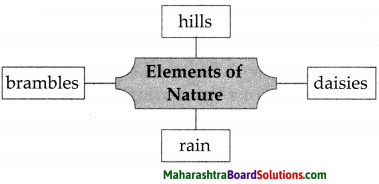
Complete the web diagram with words from the extract.
Answer:
Maharashtra Board Class 7 English Solutions Chapter 2.1 From a Railway Carriage 1

Question
What flies as thick as driving rain?
(Choose the right alternative)
i. Bridges and houses.
ii. Hill and plain.
iii. Hedges and ditches.
Answer:
ii. Hill and plain.

Complex Factual Questions:

Question 1.
How do the sights of the hills and plains move?
Answer:
The sights of the hills and plains move as thick as driving rain.

Maharashtra Board Class 7 English Solutions Chapter 2.1 From a Railway Carriage

Question 2.
What does the poet see the child doing?
Answer:
The poet sees the child clambering and scrambling and gathering brambles all by himself.

Question 3.
To what is the charging train compared?
Answer:
The charging train is compared to troops in a battle.

Poetic Device:

Question 1.
Pick out two pairs of rhyming words from the 1st stanza.
Answer:
witches – ditches, battle – cattle.

Maharashtra Board Class 7 English Solutions Chapter 2.1 From a Railway Carriage

Question 2.
Name the figure of speech for the following line.
“Faster than fairies, faster than witches”
Answer:

  • Repetition: The word ‘faster’ is repeated for poetic effect, or
  • Antithesis: The opposite words ‘fairies’ and ‘witches’ are used in the same line for better poetic effect.

Question 3.
Pick out a word from the extract which means ‘a woman having evil magical powers’.
Answer:
Witch.

From a Railway Carriage Summary in English

‘From a Railway Carriage’ written by R. L. Stevenson describes the scenes he sees through the window of a fast moving train. He is so amazed at the speed of the train and tries to grasp every glimpse he sees because they are out of sight the very next moment. The train moves with such great speed that everything he sees seems to be moving.

Introduction:

‘From a Railway Carriage’ written by Robert Louis Stevenson is a poem in which he shares his experience of a railway journey with us.

Maharashtra Board Class 7 English Solutions Chapter 2.1 From a Railway Carriage

Glossary:

  1. fairy (n) – a small imaginary being of the human form that has magical powers, especially good ones
  2. witch (n) – a woman thought to have magical powers especially evil ones
  3. hedge (n) – a fence or boundary formed by closely growing bushes or shrubs
  4. ditch (n) – a narrow channel dug at the side of a road or field, to hold or carry away water
  5. meadow (n) – a piece of grassland, especially one used for hay
  6. clamber (v) – climb or move in an awkward and laborious way, using both hands and feet
  7. scramble (v) – make one’s way quickly over rough ground by using one’s hands as well as feet
  8. tramp (n) – a person who travels from one place to another on foot in search of work, a homeless person
  9. lumping (v) – carry a heavy load somewhere with difficulty
  10. glimpse (n) – quick look, (v) – to catch sight of briefly
  11. bramble (v) – any rough, wild tangled prickly shrub, specifically the blackberry bush
  12. carriage (n) – a passenger train
  13. cart (n) – a horse-drawn vehicle with four wheels, used for transportation
  14. cattle (n) – domesticated animals like cow and bull
  15. gaze (v) – to look at something for a long time
  16. mill (n) – a building with a machine to grind grain into flour
  17. plain (n) – flat land having trees and grass
  18. sights (n)- things that one sees
  19. stringing (v) – with strings
  20. troop (n) – a group of soldiers
  21. meadow (n) – a field with grass and often wildflowers in it.
  22. daisy (n) – a small flower with white petals and a yellow centre, which often grows in the grass.

Maharashtra Board Class 7 History Solutions Chapter 1 Sources of History

Balbharti Maharashtra State Board Class 7 History Solutions Chapter 1 Sources of History Notes, Textbook Exercise Important Questions and Answers.

Maharashtra State Board Class 7 History Solutions Chapter 1 Sources of History

Class 7 History Chapter 1 Sources of History Textbook Questions and Answers

1. Complete the names of the following sources of history:

Class 7 History Chapter 1 Sources Of History Questions And Answers Question 1.
l _ _ _ _ d
Answer:
legend

Sources Of History Class 7 Question 2.
t _ _ _ _ h
Answer:
tarikh

Maharashtra Board Class 7 History Solutions Chapter 1 Sources of History

Class 9 History Chapter 1 Sources Of History Questions And Answers Question 3.
b _ _ _ _ r
Answer:
bakhar

Sources Of History Class 7 Question Answer Question 4.
p _ _ _ _a
Answer:
Powada

Maharashtra Board Class 7 History Solutions Question 5.
i _ _ _ _ i _ _ i _ n
Answer:
inscription

Class 7 History Chapter 1 Questions And Answers Question 6.
m _ _ u _ _ _ t
Answer:
monument

2. Let’s write:

Maharashtra State Board Class 7 History Solutions  Question 1.
What do monuments include?
Answer:
Monuments include samadhis, graves and veergalas and buildings.

Class 8 History Chapter 1 Sources Of History Questions And Answers Question 2.
What is a Tarikh?
Answer:
Tarikh or Tavarikh means the sequence of events.

Sources Of History Question And Answer  Question 3.
What qualities of the author are important in the writing of history?
Answer:
The author’s integrity, impartiality and neutrality are very important in writing history.

3. Find the odd man out:

Bakhar Is A Source Of History  Question 1.
Material sources, written sources, unwritten sources, oral sources.
Answer:
unwritten sources

Chapter 1 Class 7 History Question 2.
Monuments, coins, cave sculptures, stories.
Answer:
stories

Maharashtra Board Class 7 History Solutions Chapter 1 Sources of History

Class 7 History Chapter Question 3.
Bhurjapatra, temples, treatises, paintings.
Answer:
temples

Question 4.
Owis, tarikhs, folk tales, myths.
Answer:
tarikhs

4. Explain the following concepts:

Question 1.
Material sources
Answer:
Those authentic material evidences or proofs of the ancient period which support our study of historical events are called material sources of history, e.g. memorials, buildings, cave sculptures, inscription, coins, copper, plates, forts, etc.

Question 2.
Written sources
Answer:
Those authentic evidences or proof of the ancient period which are in written form are called written sources of history, e.g. Documents of proceedings in Courts of kings, genealogies, Shakavali, correspondence, dispatches, treatises, biographies, travelogues, chronicles, Tavarikh, etc.

Question 3.
Oral sources
Answer:
We understand various aspects of folk life through folk literature traditionally passed from generation to generation and they are known as oral sources of history, e.g. Myths, Folk songs, Gatha, Shlokas, Abhangas, Powadas Proverbs, Legends, etc.

5. Is it necessary to evaluate sources of history ? Give your opinion.
Answer:
(i) Yes, it is necessary to evaluate the sources of history.
(ii) Just because a source is old does not mean it is reliable or true. We should examine their authenticity and see which sources are genuine and which are fake.
(iii) We must evaluate its quality with the help of different methods and through critical analysis.
(iv) It is necessary to determine the integrity, impartiality and neutrality of the authors by knowing their personal interests, the period during which they lived and political pressures on them.

6. Write why in your words:

Question 1.
A stone inscription is considered to be an authentic source of history.
Answer:
A stone inscription, i.e. a carving on the stone is a very authentic source of history as it throws light on different features of the ancient time like the language of communication which existed, script used and the social, political and economic life of a period, etc.

Maharashtra Board Class 7 History Solutions Chapter 1 Sources of History

Question 2.
Oral sources reveal various aspects of people’s lives.
Answer:
(i) Various aspects of folk life through folk literature passed on to us by our ancestors.
(ii) They are pearls of wisdom and they hold a wealth of knowledge about the past.
(iii) It throws light on the rich cultural life of the past and different art forms which were practised in those times.

Activity:

Visit any museum that is nearby. Gather information about the sources of history from the period that you are studying and record it in your activity book.

Class 7 History Chapter 1 Sources of History InText Questions and Answers

Formative Evaluation

Can you tell?

Question 1.
How do coins narrate history?
Answer:
(i) The coins made by different rulers using metals like gold, silver, copper are important sources of history.
(ii) From these coins we learn about the rulers, the period they ruled in, governance, religious ideas, personal details and use of language in that period.
(iii) Similarly, we also learn about the financial transactions and economic conditions, the advancement in metallurgy prevailing at that time.
(iv) From the images of Ram-Sita on the coins of Emperor Akbar or Shiva Parvati on the coins of Hyder Ali we see religious co-ordination of those days.

Speak your thoughts:

Question 1.
Suggest measures for preserving sources of history.
Answer:
(i) Written documents can be digitized and at the same time the original source should be preserved.
(ii) Controlling moisture by storing artefacts in an encasement which is oxygen free can help in their preservation.
(iii) Museums and other institutions must put in place steps and measures to preserve material sources of history in a scientific manner.
(iv) Handling, storage and display of artefacts must be done with care.
(v) Artefacts and other sources must be kept locked and continuous monitoring must be ensured to avoid any loss.
If any artefacts show signs of deterioration, conservationist must be called in for restoration of the same.

Class 7 History Chapter 1 Sources of History Additional Important Questions and Answers

Complete the sentence by choosing the appropriate words from the options given below:

Question 1.
The period from the ninth century CE till the end of the eighteenth century is considered to be the _____ period of Indian history. (Ancient, Medieval, Modern)
Answer:
Medieval

Maharashtra Board Class 7 History Solutions Chapter 1 Sources of History

Question 2.
History gives us a chronological, scientific and systematic account of ______ events. (past, present, future)
Answer:
past

Question 3.
Historical sources should be used judiciously and only after a ______. (thorough reading, indepth study, critical analysis)
Answer:
critical analysis

Question 4.
Veergala is a ________. (fort, monument, palace)
Answer:
monument

Question 5.
The Peshwas used the _______ language on their coins. (Arabic or Persian, Hindi or Sanskrit, Pali)
Answer:
Arabic or Persian

Question 6.
Travellers of other countries who came to India have written ______ or accounts of their travels, (biography, autobiography, travelogues)
Answer:
travelogues

Question 7.
Tavarikh or Tarikh means the ______. (information about past, sequence of events, dates)
Answer:
sequence of events

Question 8.
The author’s ______ is very important in writing history. (viexvpoint, perspective, impartiality and neu trality)
Answer:
impartiality and neutrality

Question 9.
An, _____ is a carving on a stone, or a wall. (metal plate, inscription, edict)
Answer:
inscription

Question 10.
______ is a type of chronicle that originated in Maharashtra. (Bakhar, Myths, Travelogues)
Answer:
Bakhar

Find the odd man out:

Question 1.
Genealogies, Travelogue, Chronicles, Inscription.
Answer:
Inscription

Question 2.
Churches, Temples, Mosques, Myths
Answer:
Myths

Maharashtra Board Class 7 History Solutions Chapter 1 Sources of History

Name the following:

Question 1.
The subject which gives us a chronological, scientific and systematic account of past events.
Answer:
History.

Question 2.
Any two metals used by different rulers in the past to make coins.
Answer:
Gold, Silver

Question 3.
One place in Tanjavur where inscriptions are found.
Answer:
Brihadishwara temple premises.

Question 4.
Two things inscribed on copper plates.
Answer:
(a) Royal edicts
(b) Verdicts

Question 5.
Any two scripts used in the Medieval period.
Answer:
(a) Devanagari
(b) Arabic

Question 6.
Written accounts of the travels by the travellers from other countries.
Answer:
Travelogues.

Question 7.
Any two travellers who visited India in the Medieval period.
Answer:
(a) A1 Biruni
(b) Ibn Batuta

Maharashtra Board Class 7 History Solutions Chapter 1 Sources of History

Question 8.
Sanskrit biography of Shivaji Maharaj was composed by this poet.
Answer:
Paramanand.

Question 9.
A source of history which means the sequence of events.
Answer:
Tavarikh or Tarikh.

Question 10.
Two people who compiled Tavarikh.
Answer:
(a) A1 Biruni
(b) Ziauddin Barani.

Question 11.
A type of chronicle that originated in Maharashtra.
Answer:
Bakhar.

Question 12.
Any two chronicles written in Marathi.
Answer:
(a) Mahikavatichi Bakhar
(b) Sabhasad Bakhar

Question 13.
Any two contemporary western historians.
Answer:
(a) Robert Arm
(b) Grant Duff

Question 14.
Any two oral sources of history.
Answer:
(a) Owis
(b) Folk songs

Answer in one sentence:

Question 1.
What information does history give us?
Answer:
History gives us a chronological and systematic account of past events.

Question 2.
What must history be based on?
Answer:
History must be based on authentic evidence or proofs which are known as sources of history.

Question 3.
What are the different sources of history?
Answer:
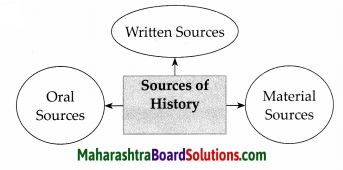
Material sources, written sources and oral sources are the three different sources of history.

Maharashtra Board Class 7 History Solutions Chapter 1 Sources of History

Question 4.
How should we use different sources of history?
Answer:
We have to use the different sources of history judiciously and only after critical analysis.

Question 5.
What do we learn when we look at forts and monuments built in the past?
Answer:
When we look at the forts and monuments we come to know about the development of architecture, the economic conditions, the quality of art, style of the building construction and people’s standard of living in that particular period.

Question 6.
Why is an inscription considered to be a very important and reliable source of history?
Answer:
An inscription is considered to be a very important and reliable source of history because it helps us to understand features like the language, script, social life of a period etc.

Question 7.
What are known as copper plates?
Answer:
Inscriptions carved on sheets of copper are known as ‘copper plates’.

Question 8.
How do we understand various aspects of folk life?
Answer:
We understand various aspects of folk life through folk literature traditionally passed from generation to generation.

Explain the following terms:

Question 1.
History
Answer:
History is a chronological, scientific and systematic account of past events.

Question 2.
An inscription
Answer:
An inscription is a carving on a stone or a wall.

Question 3.
Tavarikh or Tarikh
Answer:
Tavarikh or Tarikh means the sequence of events.

Maharashtra Board Class 7 History Solutions Chapter 1 Sources of History

Question 4.
Bakhar
Answer:
Bakhar is a type of chronicle that originated in Maharashtra.

Question 5.
Chronicles
Answer:
Chronicles are written sources of history which help in understanding aspects like the contemporary political happenings, linguistic transaction, cultural life, social conditions, etc.

Classify the following into Material sources, Written sources and Oral sources of history:

Question 1.
Ornaments, Fort, Owis, Myths, Utensils, Folk songs, Weapons, Travelogue, Well, Biographies, Clothing, Powada, Copper plate, Folk tales, Coins, Shloka, Temples, Books
Answer:

Written SourcesMaterial SourcesOral Sources
Books, Travelogue, Copper plate, Coins, TemplesOrnaments, Forts, Utensils, Weapons, Well, ClothingOwis, Myths, Folk songs, Hearsays, Powada, Folk tales, Shloka

Complete the following diagrams:

Question 1.

Maharashtra Board Class 7 History Solutions Chapter 1 Sources of History 2
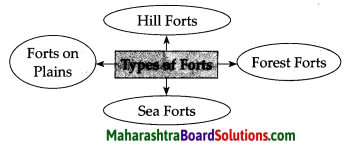
Answer:

Maharashtra Board Class 7 History Solutions Chapter 1 Sources of History 1

Question 2.

Maharashtra Board Class 7 History Solutions Chapter 1 Sources of History 4
Answer:

Maharashtra Board Class 7 History Solutions Chapter 1 Sources of History 3

Maharashtra Board Class 7 History Solutions Chapter 1 Sources of History

Question 3.

Maharashtra Board Class 7 History Solutions Chapter 1 Sources of History 6
Answer:

Maharashtra Board Class 7 History Solutions Chapter 1 Sources of History 5

Maharashtra Board Class 7 History Solutions Chapter 6 Conflict with the Mughals

Balbharti Maharashtra State Board Class 7 History Solutions Chapter 6 Conflict with the Mughals Notes, Textbook Exercise Important Questions and Answers.

Maharashtra State Board Class 7 History Solutions Chapter 6 Conflict with the Mughals

Class 7 History Chapter 6 Conflict with the Mughals Textbook Questions and Answers

1. Arrange in chornological order:

Conflict With The Mughals Std 7 Answers Question 1.
(i) Southern campaign of Shivaji Maharaj
(ii) Raid on Lai Mahal
(iii) Escape from Agra
(iv) Coronation
(v) Treaty of Purandar
(vi) Shaistakhan’s invasion
Answer:
(i) Shaistakhan’s invasion
(ii) Raid on Lai Mahal
(iii) Treaty of Purandar
(iv) Escape from Agra
(v) Coronation
(vi) Southern campaign of Shivaji Maharaj

2. Find the names from the chapter:

Conflict With The Mughals Std 7 Question Answer Question 1.
A dictionary containing Sanskrit alternatives.
Answer: Rajya – vyavahara – kosha

Maharashtra Board Class 7 History Solutions Chapter 6 Conflict with the Mughals

Conflict With The Mughals Std 7 Question 2.
He won Trimbakgad.
Answer:
Moropant Pingale

Class 7 History Chapter Question 3.
This Sardar was defeated at Vani-Dindori.
Answer:
Sardar Daudkhan

Conflict With The Mughals Questions And Answers Question 4.
A place where the British, Dutch and French had their factories.
Answer:
Surat

3. Write about these in your own words:

Conflict With Mughals Question 1.
Shivaji Maharaj’s preparation for the > coronation.
Answer:
(i) The famous learned Pandit Gagabhatt was invited to conduct the coronation of Shivaji Maharaj.

(ii) Invitations were sent to learned Brahmans of all parts of India.

(iii) Shivaji visited the famous temples in Maharashtra and distributed clothes and other things among the Brahmans.

(iv) A gold plated steel/stool was prepared with precious ornaments was brought for Shivaji Maharaj.

(v) Holy water from seven sacred rivers Yamuna, Indus, Ganga, Godavari, Kaveri and Krishna was brought and kept in a gold vessel.

(vi) A special royal umbrella of cloth with gold fringes and pearls was prepared.

(vii) Special scarlet robes for Shivaji Maharaj was prepared.

Maharashtra Board Class 7 History Solutions Chapter 6 Conflict with the Mughals

Question 2.
The Coronation of Shivaji Maharaj.
Answer:
(i) Shivaji Maharaj felt that it was necessary to entitle himself as a king.

(ii) A formal coronation ceremony was organized.

(iii) Many learned Brahmans from all parts of India came. Even Ambassadors from all over India came to witness the ceremony.

(iv) On 6th June, 1674, Shivaji got up early in the morning, worshipped the gods and took blessing from the priests.

(v) He was dressed up in a special scarlet robe and precious ornaments

(vi) The Brahmans chanted Mantras and blessed Shivaji.

(vii) Gagabhatt held the royal umbrella over the Maharaj’s head, and poured the holy water from seven rivers.

(viii) Special coins were minted-a gold coin called Hon and a copper coin called Shivrai.

(ix) A dictionary showing Sanskrit meaning for Persian words was prepared. It is called Rajya- vyavahara-kosha.

Question 3.
Escape from Agra.
Answer:
(i) Shivaji Maharaj pretended to be ill.

(ii) He complained of severe pain in the stomach. Doctors were called. They started treating the patient, Shivaji.

(iii) He started sending out huge baskets of sweets to Sadhus and Maulavis for his quick recovery. In the beginning, the guard outside would examine the baskets.

(iv) In the course of time, they got tired of this daily routine and stopped it.

(v) One evening, Shivaji made Hiroji sleep in his bed and asked Madari to manage his feat.

(vi) Then Shivaji Maharaj and Sambhaji Raje hid themselves in two of the many baskets that were going out.

(vii) The baskets were supposed to contain sweets and allowed to pass unchecked.

(viii) At a place previously fixed, Shivaji Maharaj and Sambhaji Raje got out of the baskets and adroitly escaped from Agra and reached Maharashtra safely after a few days.

Question 4.
Shivaji Maharaj’s Campaign of the South.
Answer:
(i) After the coronation ceremony, Shivaji went to the South at Golconda.
(ii) He made friendship with Qutubshah.
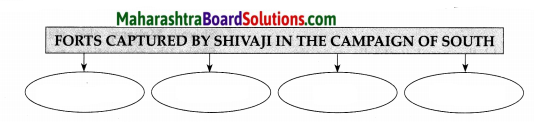
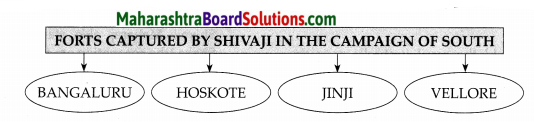
(iii) He captured the forts like Bangalore, Hoskote, Jinji, Vellore, etc. and some territories of Adilshah.
(iv) He appointed Raghunath Narayan Hanamante the chief officer to look after these territories.

Maharashtra Board Class 7 History Solutions Chapter 6 Conflict with the Mughals

4. Give reasons:

Question 1.
Shivaji Maharaj entered into the ‘Treaty of Purandar’.
Answer:
(i) Aurangzeb sent a powerful Sardar, Jaisingh to defeat Shivaji Maharaj.
(ii) He started a naval campaign against Maharaj.
(iii) Jaisingh and Dilerkhan siege the fort of Purandar.
(iv) The Mughals siege the Fort of Purandar.
(v) Murarbaji Deshpande fought with courage but died a hero’s death.

Question 2.
Shivaji Maharaj took an aggressive stand against the Mughals.
Answer:
(i) The Treaty of Purandar meant a great loss of wealth and humiliation for the Marathas.
(ii) Shivaji Maharaj wanted to recapture the forts and territories given to the Mughals as per the Purandar treaty.
(iii) In order to earn the reputation, Shivaji Maharaj took an aggressive stand against the Mughals.

Activities:

How do you prepare for the special programmes on Independence Day/ Republic Day ? Make a list with help of your teacher.
Visit a historical place in your neighbourhood and write a report on your visit.

Class 7 History Chapter 6 Conflict with the Mughals InText Questions and Answers

Do you remember?

Question 1.
Which Indian king started a new calendar?
Answer:
King Vikramaditya started the Vikrama Sam vat Era after defeating the Shakas in 57-58 BC and Shivaji Maharaj also started Rajyabhisheka Shaka (the coronation era in 1674).

Gather information:

Question 1.
Find out how Shivaji Maharaj escaped from his house arrest at Agra.
Answer:
(i) In 1666, Aurangzeb invited Shivaji to Agra, along with his nine-year-old son Sambhaji and a few of his trusted people.

(ii) Aurangzeb’s plan was to send Shivaji to Kandahar, now in Afghanistan, to consolidate the Mughal empire’s north-western frontier.

(iii) However, in the court, on 12th May 1666, Aurangzeb made Shivaji stand behind military commanders of his court.

(iv) Shivaji took offence and stormed out of court, and was promptly placed under house arrest under the watch of Faulad Khan, Kotwal of Agra.

(v) Shivaji pretended severe illness and requested to send most of his group back to the Deccan and conveyed his wish to distribute some sweets to the poor as offerings for getting well.

(vi) Thereafter, on his request, he was allowed to send daily shipments of sweets and gifts to saints, fakirs, and temples in Agra as offerings for his health.

(vii) The Kotwal was requested that the boxes of sweets should be touched by Maharaj himself as a custom and hence all the boxes were strictly checked.

(viii) According to the Mughal documents, after several days and weeks of sending out boxes containing sweets, Shivaji, disguised as labourer carrying sweet basket escaped on 17 August 1666.

(ix) Sambhaji, being a child had no restrictions and was sent out of the prison camp before Shivaji escaped.

(x) After escaping Shivaji and his son fled to the Deccan disguised as sadhus.

Maharashtra Board Class 7 History Solutions Chapter 6 Conflict with the Mughals

Class 7 History Chapter 6 Conflict with the Mughals Additional Important Questions and Answers

Complete the sentence by choosing the appropriate words from the options given below:

Question 1.
The Killedar of the fort of Chakan was ____ (Vyankoji, Firangoji Narsala, Murarbaji Deshpande)
Answer:
Firangoji Narsala

Question 2.
Shaistakhan set up his camp at Lalmahal in ________ (Pune, Satara, Agra)
Answer:
Pune

Question 3.
The treaty of ______ was signed between Jaisingh and Shivaji. (Pune, Bengal, Purandar)
Answer:
Purandar

Question 4.
Shivaji helped Jaisingh against _______ (Adilshah, Aurangzeb, Qutubshah)
Answer:
Adilshah

Question 5.
The Mughals captured the fort of _________ (Jinji, Chakan, Raigad)
Answer:
Chakan

Question 6.
In the raid, ________ lost his fingers (Shaistakhan, Jaisingh, Afzalkhan)
Answer:
Shaistakhan

Maharashtra Board Class 7 History Solutions Chapter 6 Conflict with the Mughals

Question 7.
_______ was the Subhedar of Surat. (Dilerkhan, Inayat Khan, Shaistakhan)
Answer:
Inayat Khan

Question 8.
______died a heroic death, while defending the Purandar fort. (Firangoji Narsala, Raghunath Narayan, Murarbaji Deshpande)
Answer:
Murarbaji

Question 9.
Shivaji Maharaj passed away at Fort ______ on 3rd April, 1680. (Purandar, Chakan, Raigad)
Answer:
Raigad

Question 10.
______, a learned Pandit crowned Shivaji Maharaj on his first coronation. (Pandit Gagabhatt, Nischalpuri Gosavi, Firangoji Narsala)
Answer:
Gagabhatt

Question 11.
Shivaji Maharaj had his second coronation performed under the guidance of ______. (Krishnaji Anant Sabhasad, Nischalpuri Gosavi, Pandit Gagabhatt)
Answer:
Nischalpuri Gosavi

Match the columns:

Question 1.

Column ‘A’Column ‘B’
(1) Treaty of Purandar

(2) Shivaji’s coronation

(3) Karnataka campaign

(4) Shivaji raided Lai Mahal

(a) April 1663

(b)  October 1677

(c) June, 1674

(d)  June 1651

Answer:
1 – d
2 – c
3 – b
4 – a

Question 2.

Column ‘A’Column ‘B’
(1) Mann(a) A monument
(2) Hon(b) Unit of measurement
(3) Shivrai(c) a gold coin
(4) Samadhi(d) a copper coin

Answer:
1 – b
2 – c
3 – d
4 – a

Maharashtra Board Class 7 History Solutions Chapter 6 Conflict with the Mughals

Arrange in chronological order:

Question 1.
(i) Shivaji Maharaj’s campaign to the South
(ii) The treaty of Purandar
(iii) Shivaji Maharaj’s death in Raigad
(iv) Shivaji Maharaj’s coronation
Answer:
(i) The treaty of Purandar
(ii) Shivaji Maharaj’s coronation
(iii) Shivaji Maharaj’s campaign to the South
(iv) Shivaji Maharaj’s death in Raigad

Find the names from the chapter:

Question 1.
A learned Pandit who crowned Shivaji Maharaj at Raigad.
Answer:
Gagabhatt

Question 2.
This treaty was signed between Jaisingh and Shivaji Maharaj.
Answer:
The Treaty of Purandar

Question 3.
It was a rich city. Shivaji Maharaj raided it and obtained plenty of wealth.
Answer:
Surat

Question 4.
He took shelter in the southern part of Jinji.
Answer:
Chhatrapati Rajaram Maharaj.

Question 5.
It is a world famous library.
Answer:
The Saraswati Mahal

Maharashtra Board Class 7 History Solutions Chapter 6 Conflict with the Mughals

Answer in one or two sentences:

Question 1.
Whom did Aurangzeb send to curb Shivaji Maharaj?
Answer:
Aurangzeb sent Jaisingh, an experienced and powerful Rajput Sardar against Shivaji Maharaj.

Question 2.
What were the terms of the ‘Treaty of Purandar’?
Answer:
According to the terms of the treaty, Shivaji Maharaj gave twenty-three of his forts along with adjoining territories yielding an annual revenue of four lakh hons. He also assured the Mughals, of help against Adilshah.

Question 3.
How did Aurangzeb treat Shivaji Maharaj at his Darbar in Agra?
Answer:
Aurangzeb did not treat Shivaji Maharaj with due honour at his court and gave vent to his anger.

Question 4.
When and where was Shivaji Maharaj coronated? Who crowned him?
Answer:
On 6th June, 1674, Gagabhatt a learned Pandit crowned Shivaji Maharaj at Raigad.

Question 5.
What was inscribed on the special coins minted on the occasion of the coronation?
Answer:
Shri Raja Shiva Chhatrapati was inscribed on . the special coins minted on the occasion of the coronation.

Question 6.
Which dictionary was prepared on the special occasion of coronation?
Answer:
A dictionary showing Sanskrit alternatives for Persian words was prepared. It is called ‘Rajya- vyavahara-kosha’.

Question 7.
What did Sabhasad, a chronicler, write about Shivaji Maharaj?
Answer:
Sabhasad wrote “It was no mean achievement for a Maratha King to become such a great Chhatrapati”.

Maharashtra Board Class 7 History Solutions Chapter 6 Conflict with the Mughals

Question 8.
What was the objective of Jaisingh’s invasion?
Answer:
The objective of Jaisingh’s invasion was to curb the increasing activities of Shivaji Maharaj and then to turn to Adilshahi.

Question 9.
Under whose guidance was the second coronation performed?
Answer:
Shivaji Maharaj’s second coronation was performed under the guidance of Nischalpuri Gosavi.

Question 10.
What was encouraged by rulers of Tanjavur?
Answer:
Rulers of Tanjavur encouraged art and learning.
The Saraswati Mahal Library in Tanjavur is world famous.

Give reasons:

Question 1.
Shaistakhan suffered great humiliation.
Answer:
(i) Shaistakhan invaded Pune and set up his camp at Lai Mahal in Pune, where Shivaji Maharaj lived in his childhood.
(ii) His forces looted the people.
(iii) Shivaji Maharaj decided to raid Lai Mahal.
(iv) On the night of 5th April, 1663, along with his band of soldiers, Shivaji Maharaj raided Lai Mahal.
(v) In this raid, Shaistakhan lost his fingers hence suffered great humiliation.

Question 2.
Shivaji Maharaj decided to attack/raid Surat.
Answer:
(i) Shivaji Maharaj wanted to teach the Mughals a lesson as Shaistakhan had ravaged large territories of the Swaraj.
(ii) Surat was a big trade centre and a port under Mughal control.
(iii) The British, Dutch and French laid their factories in Surat.
(iv) Maximum revenue was being generated by this city for the emperor.
(v) It was a rich city.
(vi) Maharaj marched to Surat.
(vii) The Subhedar of Surat could not put up any resistance.
(viii) Maharaj obtained plenty of wealth from Surat without bothering the common people.
(ix) This campaign was a stunning blow to Emperor Aurangzeb’s prestige.
(x) This campaign of Surat was completely successful.

Maharashtra Board Class 7 History Solutions Chapter 6 Conflict with the Mughals

Question 3.
Shivaji Maharaj raided Lai MahaL
Answer:
(i) Shaistakhan had set up his camp at Lai Mahal ,in Pune where Shivaji Maharaj had lived in his childhood.
(ii) Shaistakhan’s army looted the people in the Pune region for two years.
(iii) This had an adverse effect on the morale of people.
(iv) Therefore Shivaji Maharaj raided Lai Mahal.

Complete the following:

Question 1.
Maharashtra Board Class 7 History Solutions Chapter 6 Conflict with the Mughals 1
Answer:
Maharashtra Board Class 7 History Solutions Chapter 6 Conflict with the Mughals 3

Question 2.
Maharashtra Board Class 7 History Solutions Chapter 6 Conflict with the Mughals 2
Answer:
Maharashtra Board Class 7 History Solutions Chapter 6 Conflict with the Mughals 4

Maharashtra Board Class 7 English Solutions Chapter 3.1 Tartary

Balbharti Maharashtra State Board Class 7 English Solutions Chapter 3.1 Tartary Notes, Textbook Exercise Important Questions and Answers.

Maharashtra State Board Class 7 English Solutions Chapter 3.1 Tartary

Class 7 English Chapter 3.1 Tartary Textbook Questions and Answers

1. Find the words that mean the following, from the first stanza.

3.1 Tartary Question And Answer Question 1.
Gold hammered into a flat, thin shape : ………………..
Answer:
beaten gold

Maharashtra Board Class 7 English Solutions Chapter 3.1 Tartary

Tartary Poem Std 7 Question Answer Question 2.
Show off proudly : ………………..
Answer:
flaunt

Tartary Poem 7th Standard Question 3.
Tilt, move at an angle : ………………..
Answer:
slant

3.1 Tartary Answer Question 4.
Across, especially in a slanting direction : ………………..
Answer:
athwart

2. Find the names of the exotic musical instruments and animals mentioned in the poem.

Tartary Poem Std 7 Questions And Answers Question 1.
Find the names of the exotic musical instruments and animals mentioned in the poem.
Answer:
Exotic musical instruments mentioned in the poem are harp, flute and mandoline. Animals mentioned are fishes, zebras, tigers and peacock.

Maharashtra Board Class 7 English Solutions Chapter 3.1 Tartary

3. In the last stanza, there are three-four letter words that refer to a beautiful valley.

3.1 Tartary Question 1.
In the last stanza, there are three-four letter words that refer to a beautiful valley. They are:
1. ………………
2. ………………
3. ………………
Answer:
1. dale,
2. vale,
3. glen.

4. From the poem, find three lines that use comparisons.

Tartary Poem Questions And Answers Question 1.
From the poem, find three lines that use comparisons.
1. …………….
2. …………….
3. …………….
Answer:
1. Her trembling lake like foamless seas.
2. Yellow as honey, red as wine.
3. And, clustered thick as seeds.

Maharashtra Board Class 7 English Solutions Chapter 3.1 Tartary

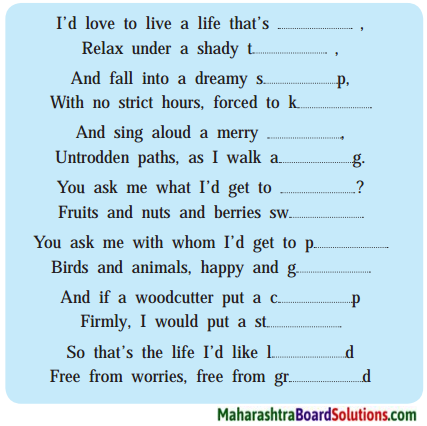
5. Colour, sound and images from nature add to the beauty of a poem.

Tartary Poem Std 7 Question 1.
Colour, sound and images from nature add to the beauty of a poem: ‘Tartary’ is a perfect example of the above. Pick out lines that contain:
1. colour,
2. sound,
3. images of native:
Answer:
1. Colour:

  • her rivers silver pale!
  • In every purple vale!
  • And in the evening lamp would shine. Yellow as honey red as wine
  • I’d wear a robe of beads & gold

2. Sound:

  • Trumpeters everyday. To every meal would summon me.
  • While harp and flute and mandoline made music sweet and gay

3. Images from the nature:

  • Her flashing stars, her scented breeze.
  • Her river silver pale!
  • And in my pools great fishes slant.
  • Her bird-delighting citron trees.
  • Glen, thicket, wood and dale.

Maharashtra Board Class 7 English Solutions Chapter 3.1 Tartary

6. Complete the following phrases with the help of the poem.

Tartary Question And Answers Question 1.
Complete the following phrases with the help of the poem.

  1. ……………. music
  2. ……………. rivers
  3. ……………. breeze
  4. ……………. lake
  5. ……………. citron-trees

Answer:

  1. sweet and gay music
  2. silver-pale river
  3. scented breeze
  4. trembling lake
  5. bird-delighting citron-trees

7. Write about the daily routine of the ‘Lord of Tartary’ in 8-10 lines.

7th Std English Poem Tartary Question 1.
Write about the daily routine of the ‘Lord of Tartary’ in 8-10 lines.
Answer:
The Lord of Tartary would get up very early in the morning. He would wear a dress of green, white and gold beads. These beads would be placed very close to each other just like seeds. And before the waning of the morning star he would wear his robe, take his sword, and then go out in the valley in his carriage drawn by seven zebras. At meal time, be summoned by trumpeters. In the evening, he would enjoy the shining lamps and sweet music played by musicians. At night he would enjoy the flashing stars and the scented breeze by the lakeside lined with citron-trees.

Maharashtra Board Class 7 English Solutions Chapter 3.1 Tartary

8. Using your imagination write about a beautiful region – its landforms, water bodies, flora and fauna, night sky, people etc.

Question 1.
Using your imagination write about a beautiful region – its landforms, water bodies, flora and fauna, night sky, people etc.
Answer:
My mind races to a beautiful mountain range full of huge tall trees with winding creepers. A few monkeys could be seen jumping from the branches across trees as if engaged in a game. The crisp chirping of birds could be heard. The setting sun cast a reddish-yellow glow on the horizon and I could see the gurgling stream flowing down the slopes of the mountain as if to reach a destination.

Through the winding paths, one could see villages with loads of household goods trekking up the way to their homes nestled in the slopes of the mountain. As the night grew, the dim lights from the modest homes seemed to complete with the bright shining stars, far away in the sky. The occasional cool breeze, faithfully carried the fragrance of the trees, leaves and the blooms with if it was a blissful feeling – away from the din and noise of the crowded city life.

9. Language Study.

Question 1.
Consonance: Consonance is repetition of one or more consonant sounds especially at the end of words. Consonance is usually pleasant lo the ear.
Examples:

  • Piller-patter, pitter-patter
  • Rivers silver-pale
  • The lint was sent with the tent.
  • All’s well that ends well.

Find at least two examples of consonance from poems that you study in this book.
Answer:
e.g.
1. pitter-patter
2. gold and green
Give Similar examples.

Class 7 English Chapter 3.1 Tartary Additional Important Questions and Answers

Match the Columns.

Question 1.

Columns ‘A’Columns ‘B’
1. Zebrasa. delight the birds
2. Lakesb. summon the Lord to every meal
3. Citron treesc. draw carriage
4. Trumpetersd. flaunt their feathers
5. Peacockse. tremble like a sea
6. Tigersf. beat gold
g. haunt the forests

Answer:

Columns ‘A’Columns ‘B’
1. Zebrasc. draw carriage
2. Lakese. tremble like a sea
3. Citron treesa. delight the birds
4. Trumpetersb. summon the Lord to every meal
5. Peacocksd. flaunt their feathers
6. Tigersg. haunt the forests

Maharashtra Board Class 7 English Solutions Chapter 3.1 Tartary

Reading Skills and Poetic Device.

Question 1.
Complete the sentences.

  1. My bed should be
  2. And in my forests
  3. Yellow as honey,

Answer:

  1. of ivory
  2. tigers haunt
  3. red as wine

Complex Factual Questions.

Question 1.
How does the poet begin the poem?
Answer:
The poet begins the poem on the assumption that if he were the Lord of Tartary and wants all things beautiful for himself like a little child “myself and me alone.”

Maharashtra Board Class 7 English Solutions Chapter 3.1 Tartary

Question 2.
The poet expresses his desire for certain things specifically. According what do you what do the following signify?

  1. Ivory
  2. peacocks
  3. tigers
  4. shining lamps
  5. harp and flute

Answer:

  1. luxury
  2. beauty and majesty
  3. strength / power
  4. decor aesthetics brightness beauty
  5. ear for music.

Question 3.
Who will summon the Lord to every meal?
Answer:
The trumpeters will summon the Lord to every meal.

Poetic Device.

State and explain the figures of speech in the given lines.

Question 1.
of beaten gold my throne
Answer:
Inversion: The word order has been changed. The correct word order is ‘my throne of beaten gold’.

Maharashtra Board Class 7 English Solutions Chapter 3.1 Tartary

Question 2.
And in my court should peacocks flaunt.
Answer:
Inversion: The word order has been changed. The correct word order is ‘And in my court peacock should flaunt’.

Question 3.
Yellow as honey, red as wine.
Answer:
Simile – Lamp’s yellow shine is directly compared to honey and its red shine is compared to wine.

Question 4.
White harp and flute and mandolin
Answer:
Repetition – The word ‘and is repeated for poetic effect.

Maharashtra Board Class 7 English Solutions Chapter 3.1 Tartary

Question 5.
Made music sweet and gay.
Answer:
Alliteration – The sound of’m’ in words made and music is used to add beauty to the poem.

Simple Factual Questions.

Complete the sentences.
1. The lake of Tartary trembles like
2. The purple dale has
Answer:
1. foamless seas
2. bird-delighting citron trees

Complex Factual Questions.

Question 1.
How does the poet want his robe to be?
Answer:
The poet wants his robe to be made of white, golden and green coloured beads placed quite close to one another.

Maharashtra Board Class 7 English Solutions Chapter 3.1 Tartary

Question 2.
What does he want to do before the morning star is out of sight?
Answer:
Before the morning star is out of sight, the poet wants to wear his robe and ride through the dark open spaces in the forests. He hopes to travel in his car drawn by seven zebras.

Question 3.
How does the poet portray the natural beauty of Tartary.
Answer:
The poet imagines a variety of fruits, silver pale rivers, valleys of dense forests and bushes, flashing stars, scented breeze, shining stars in the sky and citron trees habited by delightful birds in his Kingdom of Tartary.

Poetic Device.

Question 1.
And clustered thick as seeds
Answer:
Simile – There is a direct comparison between the beads in the robe to a cluster of seeds to add to the poetic effect.

Maharashtra Board Class 7 English Solutions Chapter 3.1 Tartary

Question 2.
And zebras seven should draw my car
Answer:
Inversion – The prose order is changed for poetic effect.

Question 3.
Glen, thicket, wood, and dale
Answer:
Tautology – The words ‘glen’ and ‘dale’ which mean the same are used in the same line for a better poetic effect.

Question 4.
Her trembling lake like foamless sea.
Answer:
Simile: The lake is directly compared to a sea for a better poetic effect.
Personification: Inanimate object ‘lake’ is given the human quality of trembling for a better poetic effect.
Alliteration: The sound of T is repeated in words ‘lake’ and ‘like’ for a better poetic effect.

Question 5.
Her rivers silver-pale!
Answer:
Exclamation – A strong emotion is expressed for a better poetic effect.

Question 6.
And ere should wane the morning star.
Answer:
Inversion – The word order has been changed. The correct word order is ‘and ere the morning- star should wane’.

Maharashtra Board Class 7 English Solutions Chapter 3.1 Tartary

Question 7.
Pick out two pairs of rhyming words from the poem.
Answer:

  1. pale-dale
  2. beads-seeds

Tartary Summary in English

The poet says that if he were the Lord of the imaginary kingdom called ‘Tartary’, he would be the sole ruler of this great land. He would sleep on bed made of ivory, sit on a throne made of gold. All types of birds and animals would visit his court. The peacocks would proudly show off its beautiful form and the well-built tigers would take a walk in the forests. The fishes would tilt and swim with their fins shining in the pools.

Further ahead, the poet says that as the Lord of Tartary, he would be treated royally. With trumpeters calling him for every meal, shining lamps displaying yellow and red colours. Musicians would entertain him by playing exotic musical instruments such as harp, flute and mandoline.

He wishes to wear a robe of beads of white gold & green. Before the morning stars wane, he would wear his robe and with a sword in his hand, go around the valley in a carriage drawn by seven zebras.
As the lord of Tartary, he would own all the juicy fruits the silver-pale rivers, hills full of bushes and trees. In the night, he would enjoy the beauty of the shining stars and the sweet fragrance of the breeze. The purple valley with citron-trees that delight the birds would add to the beauty of Tartary.

Introduction:

The poet Walter de la Mare paints a vivid picture of an imaginary kingdom, ‘Tartary’ and takes us on a journey as the Lord of the mighty kingdom.

Maharashtra Board Class 7 English Solutions Chapter 3.1 Tartary

Glossary:

  1. Tartary – an imaginary land
  2. ivory (n) – tusk teeth of an elephant which is hard and creamy white in colour
  3. beaten gold (adj) – gold hammered into flat thin shape
  4. throne (n) – chair for a king or queen metal strings
  5. flaunt (v) – show off proudly
  6. haunt (v) – come frequently
  7. slant (v) – tilt, at an angle which is not straight (here) move at an angle.
  8. athwart (prep) – across, from side to side in a slanting direction
  9. summon (v) – call
  10. bray (v) – make a loud harsh cry
  11. harp (n) – a musical instrument with strings
  12. mandoline (n) – a musical instrument with metal strings
  13. gay (adj) – happy, light-hearted
  14. robe (n) – a loose garment reaching the ankles
  15. clustered (v)- similar things grouped together and placed closely
  16. ere (prep) – before (in time) – old usage
  17. wane (v) – disappear
  18. don (v) – put on clothing
  19. scimitar (n) – short sword with a curved blade
  20. glades (n) – open spaces in a forest
  21. glen (n) – a narrow valley
  22. thicket (n) – dense group of bushes or trees
  23. dale (n) – a valley
  24. flashing (v) – shine with bright, irregular light
  25. vale (n) – a valley

Maharashtra Board Class 7 Geography Solutions Chapter 6 Natural Regions

Balbharti Maharashtra State Board Class 7 Geography Solutions Chapter 6 Natural Regions Notes, Textbook Exercise Important Questions and Answers.

Maharashtra State Board Class 7 Geography Solutions Chapter 6 Natural Regions

Class 7 Geography Chapter 6 Natural Regions Textbook Questions and Answers

1. Read the following statements carefully. Correct the wrong ones and write them down:

Natural Regions Class 7 Geography Question 1.
Due to its mild and warm climate, people from the West European region are not energetic.
Answer:
False – Due to its mild and warm climate people from the West European region are industrious and energetic.

Std 7 Geography Chapter 6 Natural Regions Question 2.
The prairie region is called the wheat basket of the world.
Answer:
True.

Maharashtra Board Class 7 Geography Solutions Chapter 6 Natural Regions

Natural Regions Class 7 Questions And Answers Question 3.
The trees in the Mediterranean region have oily leaves and the bark is quite thick. There is a high rate of transpiration.
Answer:
False – The trees in the hot desert region have oily leaves and the bark is quite thick. There is high rate of transpiration.

Natural Regions Class 7 Question 4.
The camel is an important animal of the hot desert region as it can survive without water and is useful for transport.
Answer:
True.

Class 7 Geography Chapter 6 Natural Regions Question 5.
Carnivorous animals like tigers and lions are found in large numbers in the equatorial regions.
Answer:
False – Carnivorous animals like tigers and lions are found in large numbers in the grassland region (Sudan).

2. Give geographical reasons:

6 Natural Regions Question 1.
People in monsoon region are mainly engaged in agriculture.
Answer:
(i) The monsoon region is located in tropical & subtropical belt between 10° & 30°N & parallels which receives almost perpendicular rays of the sun for most part of the year.

(ii) The summers temperature are hot with between 27° & 32°C & the winters are mild with temperatures between 15° to 24°C.

(iii) This region receives rainfall during specific season from the south west monsoon winds and the rainfall varies between 250 to 2500 mm.

(iv) Thus as the climatic conditions are such that they favour growth of variety of crops.

(v) Thus, people in the monsoon region are engaged in agriculture.

Natural Regions Std 7 Question 2.
Trees in equatorial forests grow tall.
Answer:
(i) The equatorial forest are found in regions between 50°N & 50°S of the equator. This region receives perpendicular rays of the sun throughout the year.

(ii) The climate of the equatorial region is hot & it receives rainfall throughout the year. Annual rainfall in this region is between 2500 & 3000 mm.

(iii) Hence, dense evergreen forests are found here. Due to dense vegetation sunlight does not reach the ground & the trees compete for sunlight.

(iv) Thus, trees in equatorial forests grow tall.

Maharashtra Board Class 7 Geography Solutions Chapter 6 Natural Regions

Question 3.
Vegetation is short-lived in the Tundra region.
Answer:
(i) Tundra region is located between 65°N to 90°N parallels due to which the climate here is very cold.
(ii) The mean summer temperatures is between 20°C to 30°C.
(iii) Very cold climate of winter does not support growth of vegetation but short grass, small shrubs, flowers, lichen, moss etc. grow during short summer period here
(iv) Thus, vegetation is short-lived in the Tundra region.

3. Answer the following questions:

Question 1.
What is the latitudinal extent of the Taiga . region?
Answer:
Taiga region extends from 55° to 65° N latitudes from Alaska to the Atlantic coast & in parts of Eurasia.

Question 2.
Name any three herbivorous animals from the Sudan region. What has nature endowed them with for self-protection?
Answer:

  • Sudan region has zebras, elephant and giraffe.
  • Nature has gifted them with speedy legs.
  • The skin of the animals here have colourful spots or stripes/bands.

Question 3.
What are the characteristics of the Monsoon region?
Answer:
The characteristics of the Monsoon region are as follows:

  • The summer temperature is between 27° and 32°C & the winter temperature is 15° to 24°C.
  • Rainfall varies between 250 to 2500 mm. This region gets rain in specific seasons from the SW Monsoon.
  • Rainfall here is highly variable and distribution is quite uneven.
  • Semi-evergreen and deciduous forests are found in this region. Vegetation depends on the distribution of rainfall.
  • Agriculture is the main occupation of the people here.
  • Large number of small hamlets are found. There is considerable difference in the diet & costumes of the people in the monsoon region.
  • Population here is mostly engaged in primary occupation

4. Show the following items on an outline map of the world. Prepare the index:

  • Colorado Desert
  • British Columbia
  • Downs Grassland
  • Inhabited part of Greenland
  • Mediterranean Sea
  • Congo basin
  • Llanos and Campos

Maharashtra Board Class 7 Geography Solutions Chapter 6 Natural Regions 3
Answer:
Maharashtra Board Class 7 Geography Solutions Chapter 6 Natural Regions 2

Activity:

Using the Internet, check the information given in this lesson. Collect pictures of the flora and fauna and the human life of the various natural regions. Make a collage by pasting these pictures on the world map.

Class 7 Geography Chapter 6 Natural Regions InText Questions and Answers

Can you tell:

Observe the picture given on Pg. no. 30 of Geography textbook and answer the following question given below.
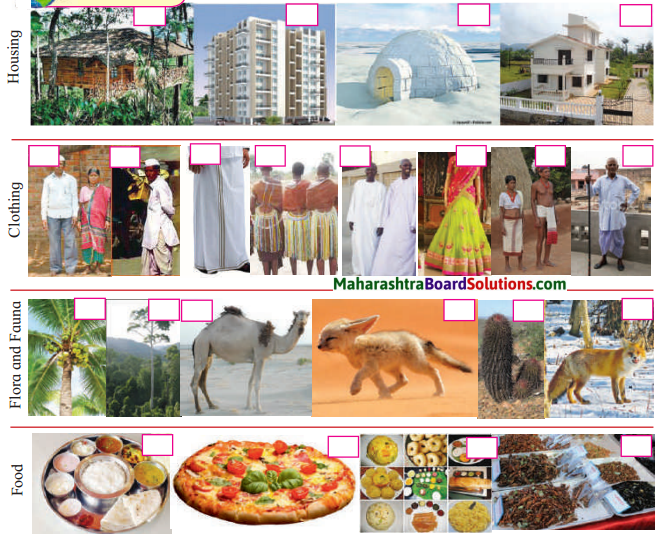
Maharashtra Board Class 7 Geography Solutions Chapter 6 Natural Regions 5

Maharashtra Board Class 7 Geography Solutions Chapter 6 Natural Regions

Page no: 31
Maharashtra Board Class 7 Geography Solutions Chapter 6 Natural Regions 6
Question 1.
Why are the house types shown in the pictures not seen in our surrounding?
Answer:
All the house types shown in the pictures are not seen in our surroundings because house types differ from place to place. They are built taking into consideration rainfall, temperature and raw material available for building houses.

Question 2.
Which are the regions where such types of houses are found?
Answer:
In cities, we find buildings and bungalows built of concrete material. An igloo is found in the Tundra or Taiga region. Huts are found in grassland or forested areas.

Question 3.
Would you like to stay in a house built of ice? Why don’t we build such houses?
Answer:
Yes, I would like to stay in an ice house. We can’t build it here because the temperature is high which will melt the ice and we don’t have snowfall in Maharashtra.

Question 4.
What brings about difference in people’s clothing?
Answer:
There is difference in people’s clothing because firstly it depends upon the climate of the place. Secondly it depends upon the culture & tradition as well as the raw material available or textile industries that are set up a particular region.

Question 5.
Where do you think Khubz, insects and ants also form a part of the diet of the people?
Answer:
Human beings eat whatever is edible & does not harm their digestive system.
Previously Khubz, insects & ants were consumed mainly by tribal people or people living in underdeveloped countries, but today it is consumed by people for protein, or for tradition or even as exploratory cuisine.

Question 6.
Can the animals from polar region like polar bears and penguins be kept in the tropical zoos?
Answer:
No, polar bear and penguins survive only in colder regions. They cannot bear the tropical heat and may die. Therefore, they are not kept in tropical zoos.

Maharashtra Board Class 7 Geography Solutions Chapter 6 Natural Regions

Question 7.
Are all the plants shown in the pictures found in our surroundings? If not, where do you think they can be found?
Answer:
TB pg 30 – The tree shown in 1 st picture is found in the coastal area. The tree in the 2nd picture is found in the equatorial region. The plant in the 3rd picture is found in the hot desert region.
TB pg 31 – The tree in the 1st picture is found in grassland regions.
The tree in 2nd picture is found in the monsoon region
The tree in the 3rd picture is found in the Taiga region.

Think about it:

Question 1.
Why are animals like lions not found in Equatorial forests?
Answer:
(i) Equatorial regions have hot & humid climate & it rains throughout the year. So, dense multilayered evergreen forests are found here.

(ii) As the sunlight does not reach the ground the trees compete to get sunlight & hence trees grow very tall.

(iii) Mainly animals which can survive in swampy & marshy environment of forests are arboreal animals found in equatorial forests.
Hence animals like lions are not found in equatorial forests.

Question 2.
Why are the hot deserts mainly located along the western side of the continents?
Answer:
The planetary winds shed their moisture in the eastern parts of the continents and become dry by the time they reach the western margins. Therefore, hot deserts are mainly located along the western side of the continents.

Question 3.
Why are people in the hot deserts engaged mostly in animal rearing?
Answer:
Hot deserts have very scanty rains and high temperature which does not favour agriculture, therefore people in the hot deserts are mostly engaged in animal rearing.

Question 4.
Why do people in hot deserts live a nomadic life?
Answer:
People in hot deserts rear animals for a living. Therefore they move from place to place in search of water and fodder for their animals.

Question 5.
Why are carnivorous animals found in the grasslands?
Answer:
In the grassland region there are a large number of herbivorous animals. Therefore carnivorous animals are found in large numbers.

Make friends with maps!

Observe the map and answer the following questions
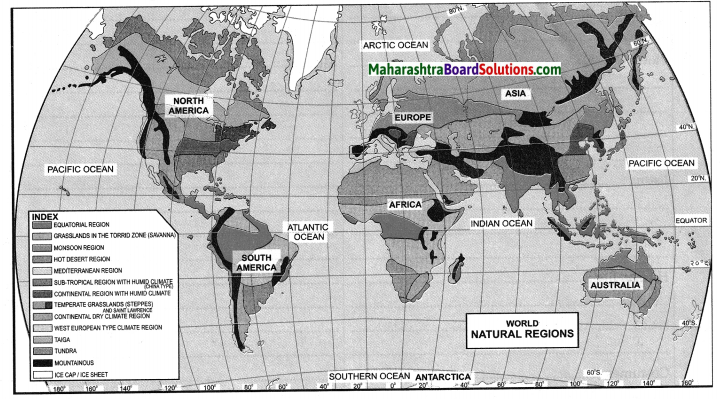
Maharashtra Board Class 7 Geography Solutions Chapter 6 Natural Regions 4

Question 1.
Which natural regions are found in India?
Answer:
Monsoon region is the natural region found in India.

Question 2.
Which continent comprises a major portion of the hot desert type of region?
Answer:
Continent of Africa comprises a major portion of hot desert type region.

Maharashtra Board Class 7 Geography Solutions Chapter 6 Natural Regions

Question 3.
Which continent has the highest diversity in terms of natural regions?
Answer:
Continent of Asia has the highest diversity in terms of natural region.

Question 4.
Why are there fewer natural regions in the southern hemisphere than those in the northern hemisphere?
Answer:
Because the land in the southern hemisphere is less and have only in two temperature zones.

Question 5.
Which natural region occupies the largest area in the world.
Answer:
Taiga region occupies the largest area in the world.

Question 6.
Where else do we find conditions similar to the continent of Antarctica?
Answer:
Greenland has conditions similar to continent of Antarctica.

Question 7.
Throughout which natural regions does the Prime Meridian pass?
Answer:
The Prime Meridian passes through Hot deserts, Mediterranean type of climate, Taiga, West European type region.

Observe the table of natural region on Pg. 33 of textbook, then answer the following questions:
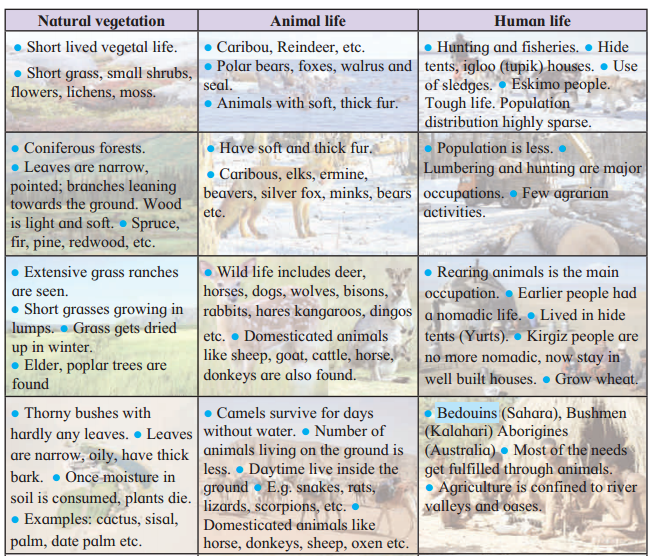
Maharashtra Board Class 7 Geography Solutions Chapter 6 Natural Regions 9
Maharashtra Board Class 7 Geography Solutions Chapter 6 Natural Regions 10

Question 1.
Which natural region consists of short-lived vegetation?
Answer:
Tundra region consists of short-lived vegetation.

Question 2.
In which natural region will you find the kraals?
Answer:
We will find the kraals in Sudan type grassland region.

Maharashtra Board Class 7 Geography Solutions Chapter 6 Natural Regions

Question 3.
Which region has winter rains?
Answer:
The Mediterranean region has winter rains.

Question 4.
In which natural regions are gorillas and chimpanzees found?
Answer:
Gorillas and Chimpanzees are found in the Equatorial region.

Question 5.
In which natural region is the land surface in the forests devoid of vegetation?
Answer:
Hot deserts region is devoid of vegetation.

Question 6. Which regions favour dairy farming?
Answer:
Grassland (Prairie and Steppes) favour dairy farming.

Question 7.
Which region is favourable for fruit production?
Answer:
Mediterranean region is favourable for fruit production.

Class 7 Geography Chapter 6 Natural Regions Additional Important Questions and Answers

Fill in the blanks choosing the correct option from the bracket:

Question 1.
The ______ people live in the Steppes grassland and they live a nomadic life. (Zulu, Pygmies, Kirgiz)
Answer:
Zulu

Question 2.
Monsoon region gets rains from the ____ winds. (NE monsoon, SW monsoon, SE monsoon)
Answer:
SW monsoon

Question 3.
_____ cause cyclonic rain in the West European region. (Westerlies, Easterlies, Polar)
Answer:
Westerlies

Question 4.
Sailors and explorers are mainly found in the ______ region. (Mediterranean, Monsoon, West European)
Answer:
Mediterranean

Maharashtra Board Class 7 Geography Solutions Chapter 6 Natural Regions

Question 5.
The _______ type of forest is found in the Equatorial region.(Coniferous, Evergreen, Deciduous)
Answer:
Evergreen

Question 6.
The ________ region receives rainfall in winter. (Mediterranean, Equatorial, Taiga)
Answer:
Mediterranean

Question 7.
Seat of Greek and Roman civilization is found in the ______ region. (Taiga, Hot desert, Mediterranean)
Answer:
Mediterranean

Question 8.
In Monsoon region, ______ is the main occupation of the people. (agriculture, animal husbandary, secondary)
Answer:
agriculture

Match the pair correctly:

Question 1.

RegionLatitudinal extent
(1) Tundra region(a) 5° to 20° N and S
(2) Taiga region(b) 20° to 30° N and S
(3) Grassland (Steppes and Prairies(c) 30° to 55° N and S
(4) Hot Desert(d) 55° to 65° N and S
(5) Grassland (Sudan type)(e) 65° to 90° N and S

Answer:
1 – e
2 – d
3 – c
4 – b
5 – a

Do the following tasks:
Question 1.
Write the important occupation of the region in the following table:

Answer:
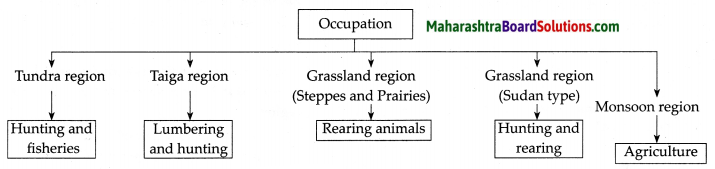
Maharashtra Board Class 7 Geography Solutions Chapter 6 Natural Regions 8

Question 2.
Find the location of the following regions from the world map and write down in the table given below:
Answer:

RegionsLocation
(1) Tundra region(a) Greenland, N. Canada, N. Europe, North Asia.
(2) Taiga region(b) Alaska to the Atlantic coast, Parts of Eurasia.
(3) Grasslands (Steppes and Prairies)(c) Steppes (Eurasia), Velds (South Africa), Pampas (S. America), Prairies (N. America), Down (Australia), etc.
(4) Hot Desert region(d) In the western parts of continents, Sahara (N. Africa), Colorado (N.America), Atacama (S.America), Kalahari (S. Africa), Thar (Asia), etc.
(5) Grasslands (Sudan type)(e) Savanna (Africa), Queensland (Australia), the Parkland (Africa), Llanos and Campos (S.America) and other grasslands.
(6) Equatorial region(f) Malaysia, Indonesia, Singapore, Guinea, Cango basin, Amazon basin.
(7) Monsoon region(g) Indian subcontinent, Philippines, West Indies, N. Australia, E. Africa, E. America etc.
(8) Mediterranean region(h) Portugal, Spain, Algeria, Turkey, California, Central Chile, SW and NE Australia, etc.
(9) West European region(i) Norway, Denmark, Ireland, British Colombia, South Chile, New Zealand, etc.

Who am I. (Type of region):

Question 1.
I am found in Indonesia and Guinea
Answer:
Equatorial Region

Maharashtra Board Class 7 Geography Solutions Chapter 6 Natural Regions

Question 2.
I am found as Llanos and Campos
Answer:
Grasslands (Sudan type)

Question 3.
I am found in the Colorado and the Atacama
Answer:
Hot Desert region

Question 4.
I am found in South America and North America
Answer:
Grassland (steppes and prairies)

Question 5.
I am found from the Alaska to the Atlantic coast
Answer:
Taiga region

Question 6.
I am found in Greenland and North Canada
Answer:
Tundra region

Question 7.
I am found in California.
Answer:
Mediterranean region.

Name the following:

Question 1.
Any two animals of Tundra region
Answer: Reindeer, Polar bears.

Question 2.
Any 2 types of trees of the Taiga region.
Answer:
Spruce, Pine.

Question 3.
A tribe found in the Steppes and Prairies grassland who are no more nomadic.
Answer:
Kirghiz

Question 4.
Any two tribes found in Sudan type grassland region.
Answer:
Zulu, Hausa

Question 5.
Any three hot deserts
Answer:
Sahara (N. Africa), Thar (Asia), Colorado (N. America)

Answer in one sentence:

Question 1.
What is the mean winter temperature in the Tundra region?
Answer:
The mean winter temperature in the tundra region is approximately -20° to -30°C.

Question 2.
How are the summers and winters in Sudan region?
Answer:
In the Sudan region, summers are hot and humid where as winters are warm and dry.

Question 3.
What are the annual rainfall in the Equatorial region?
Answer:
The annual rainfall in the equatorial region is between 2500 and 3000 mm.

Question 4.
Which animal is commonly found in the hot deserts? Why?
Answer:
Camels are commonly found in the hot deserts. as they can survive for days without water.

Maharashtra Board Class 7 Geography Solutions Chapter 6 Natural Regions

Question 5.
What are the characteristics of plants in the hot desert region?
Answer:
Their vegetation is in the form of thorny bushes with hardly any leaves; also the leaves are narrow, oily & the plants have a thick bark.

Question 6.
What type of forest are found in the Taiga region?
Answer:
Mainly coniferous forests are found in the Taiga region.

Give Geographical reasons for:

Question  1.
In hot desert region, animals like camels survive for days without water.
Answer:
(i) In Hot desert region mean summer temperature is 30° to 45°C.
(ii) The heat is tremendous & the rainfall is very low.
(iii) Camels have adapted themselves to such extreme conditions. When there is food & water a camel can eat & drink large amounts & store it as fat in the hump. Hence in hot desert region, animals like camels survive for days without water.

Question 2.
The Mediterranean region is known for its rainfall in winters.
Answer:
(i) The Mediterranean region lies between 30°and 40° parallels in both the hemispheres on the western side of continents.
(ii) Therefore, the Mediterranean region comes under the influence of westerlies.
(iii) Hence, it receives rainfall in winter.

Question 3.
Taiga region, lumbering is the main occupation.
Answer:
(i) The Taiga region has a cool climate. The summer temperature ranges between 15° to 20°C & the winter temperature falls below 0°C.
(ii) Hence, mainly coniferous forests are found here.
(iii) The wood of the trees here is light & soft.
(iv) Hence, lumbering is the main occupation in the Taiga region.

Question 4.
As one travels from the equator to the poles the spectrum of biodiversity narrows down.
Answer:
(i) In Equatorial region the occupation is based on forest produce, for eg. gathering of gum, rubber, etc.

(ii) Whereas towards the poles, the availability of natural resources adversely affects the human occupations.

(iii) The availability of sunlight and water keep on changing from equator to the polar region therefore as one travels from the equator to the poles, the spectrum of biodiversity narrows down.

Question 5.
There are variations in the biodiversity in different parts of the world.
Answer:
(i) Difference in landforms, climate and soil greatly influence the flora, fauna and human life.
(ii) Therefore it give rise to variations in the biodiversity in different parts of the world.

Question 6.
Equatorial region has a number of diseases.
Answer:
Equatorial region has a number of diseases because of the hot and humid climate which ,decomposes and causes vegetal litter.

Maharashtra Board Class 7 Geography Solutions Chapter 6 Natural Regions

Answer the following questions in short:

Question 1.
Describe coniferous trees in the Taiga region.
Answer:

  • Coniferous trees have light and soft wood
  • Leaves are narrow and pointed.
  • Branches are leaning towards the ground.

Question 2.
Describe the vegetation in the Mediterranean region.
Answer:

  • Grass is found in low rainfall regions whereas coniferous forests are found in mountainous region.
  • Trees have thick barks and thick, small and oily leaves.

Question 3.
What types of forests are found in the Monsoon region?
Answer:
In the Monsoon region, semi-evergreen and deciduous forest are found.

Answer the following questions in detail:

Question 1.
What are the characteristics of the West European Region?
Answer:
The characteristics of the West European Region are as follows

  • Mean Summer temperature is around 20°C, mean winter temperature is around 5°C.
  • Mean rainfall is between 500 and 2500 mm.
  • The rainfall is mostly in the form of cyclones associated with westerlies.
  • It rains throughout the year.
  • Climate is mild.
  • Green grass is seen all the year round.
  • Trees shed their leaves in winter.
  • Coniferous trees and short-grasses grow here.

Question 2.
What are the characteristics of the Mediterranean region?
Answer:
The characteristics of the Mediterranean region are as follows :

  • Dry summers and rainfall in winter and mean summer temperature from 21 °C to 27°C.
  • Winter temperature between 10°C and 14°C.
  • Mean annual rainfall is 500 to 1000 mm.
  • It rains in winter.
  • Thick small oily leaves.

Arrange the name of the region given in the semicircular globe depending on the parallels they lie:

Question 1.
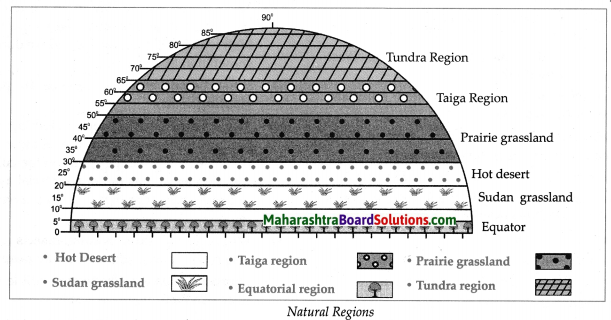
Maharashtra Board Class 7 Geography Solutions Chapter 6 Natural Regions 7
Answer:

  • Tundra region – Between 65° to 90° parallels.
  • Taiga region – Between 55° and 65°N parallels.
  • Prairie grassland – Between 30° and 55° N and S parallels.
  • Hot Desert region – Between 20° and 30° N and S parallels.
  • Sudan grassland – Between 5° to 20° N & S parallels.
  • Equatorial region – Between 5° N to 20° S of the equator.

Maharashtra Board Class 7 English Solutions Chapter 4.1 Under the Greenwood Tree

Balbharti Maharashtra State Board Class 7 English Solutions Chapter 4.1 Under the Greenwood Tree Notes, Textbook Exercise Important Questions and Answers.

Maharashtra State Board Class 7 English Solutions Chapter 4.1 Under the Greenwood Tree

Class 7 English Chapter 4.1 Under the Greenwood Tree Textbook Questions and Answers

1. From the poem, find the old word used for each of the following.

Question a.
towards, here, does
Answer:
hither, hither, doth

Maharashtra Board Class 7 English Solutions Chapter 4.1 Under the Greenwood Tree

2. Write in your own words.

Question a.
Who does the poet invite to join him?
Answer:
The poet invites all those people who love nature and are ready to shun their ambitions and appreciate life in nature, to join him.

Question b.
How should that person sing?
Answer:
That person should sing happily just like a free bird.

Question c.
What message does the poem convey?
Answer:
The message conveyed through this poem is that if one wants to live a peaceful life without tensions, enemies and problems, he should spend his life in nature, wherein he would be happy and relaxed. He should forget all his desires and rejoice in the glory of nature like a free bird.

3. Pick out the lines that mean.

Question a.
Sing in such a manner
Answer:
turn his merry note

Maharashtra Board Class 7 English Solutions Chapter 4.1 Under the Greenwood Tree

Question b.
One who wishes to join me
Answer:
who loves to lie with me

Question c.
Who gives up his desire for wealth, power, fame, etc.
Answer:
who doth ambition shun

Question d.
Life in the forest is free from ill-wishers.
Answer:
here shall he see no enemy

Maharashtra Board Class 7 English Solutions Chapter 4.1 Under the Greenwood Tree

Question e.
Happy to eat whatever he can get.
Answer:
seeking the food he eats, and pleased with what he gets

4. Find from the Internet and write down.

Question a.
In which century did William Shakespeare write his famous plays ?
Answer:
William Shakespeare wrote his plays in the late sixteenth and early seventeenth century.

Question b.
From which play is this song extracted ?
Answer:
This song is extracted from William Shakespeare’s comedy play ‘As You Like It’.

Maharashtra Board Class 7 English Solutions Chapter 4.1 Under the Greenwood Tree

Question c.
Which character from the play sings this song?
Answer:
The song is sung by ‘Amiens’, a loyal courtier of Duke Senior.

5. Be a poet. Try to complete the following poem with words that rhyme with each other.

Question a.
Maharashtra Board Class 7 English Solutions Chapter 4.1 Under the Greenwood Tree
Answer:
I’d love to live a life that’s free,
Relax under a shady tree,
And fall into a dreamy sleep,
With no strict hours, forced to keep And sing aloud a merry song,
Untrodden paths, as I walk along.
You ask me what I’d get to eat?
Fruits and nuts and berries sweet You ask me with whom I’d get to play Birds and animals, happy and gay And if a woodcutter put a chop Firmly, I would put a stop So that’s the life I’d like too to lead Free from worries, free from greed

Class 7 English Chapter 4.1 Under the Greenwood Tree Additional Important Questions and Answers

Reading Skills and Poetic Device.

Simple Factual Questions:

Under The Greenwood Tree Poem Questions Answers  Question 1.
State whether the following statement true or false.
1. The only enemy in the forest would be the winter and rough weather.
2. People who do not persue their ambition would be happy to live in nature.
Answer:
1. True
2. True.

Maharashtra Board Class 7 English Solutions Chapter 4.1 Under the Greenwood Tree

Poetic Device.

Under The Greenwood Tree Poem Question Answers Class 7 Question 1.
Pick out the rhyming words from the poem.
Answer:

  1. tree – me
  2. note – throat
  3. see – enemy
  4. hither – weather

Under The Greenwood Tree Question Answers Question 2.
Give the rhyme scheme for the 1st four lines.
Answer:
Tire rhyme scheme for the 1st four lines is aabb.

Under The Greenwood Tree Poem Question Answers Question 3.
Come hither, come hither. (Name the figure of speech of the above line)
Answer:
Tire figure of speech is Repetition. The words ‘come hither’ has been repeated for better poetic effect.

Do as directed.

4.1 Under The Greenwood Tree Question 1.
Give the rhyme scheme for the last four lines.
Answer:
The rhyme scheme for the last four lines is abba.

Maharashtra Board Class 7 English Solutions Chapter 4.1 Under the Greenwood Tree

Under The Greenwood Tree Question Answer Question 2.
Who doth ambition shun. (Name the figure of speech)
Answer:
Inversion – The words are not in proper order for better poetic effect. The proper order is ‘Who doth shun ambition’.

Under The Greenwood Tree Poem Question 3.
Here shall he see No enemy. (Figure of speech)
Answer:
Inversion – The words are not in proper order. The proper order is ‘Here he shall see no enemy’.

Under the Greenwood Tree Summary in English

Through the poem Shakespeare invites people to join him in enjoying the merry singing of the birds in the trees. There are no enemies there to be disturbed about except the vagaries of extreme cold and rough weather. They can be happy eating what they get enjoying the sunshine and giving up lofty ambitions.

Introduction:

This poem has been taken from William Shakespeare’s play ‘As you like it.’ Amiens, a courtier sings the song ‘under the Greenwood Tree’ in the play.

Maharashtra Board Class 7 English Solutions Chapter 4.1 Under the Greenwood Tree

Glossary:

  1. greenwood (n) – forest filled with trees full of green leaves
  2. merry (adj) – jolly and full of high spirits
  3. note (n) – a musical sound; a tone (musical)
  4. hither (adv) – come here; over here
  5. ambition (n) – desire to achieve something
  6. shun (v) – to avoid
  7. seeking (v) – searching; looking for
  8. pleased (adj) – happy; content