Maharashtra Board 11th OCM Important Questions Chapter 5 Forms of Business Organisation – II

Balbharti Maharashtra State Board 11th OCM Important Questions Chapter 5 Forms of Business Organisation – II Important Questions and Answers.

Maharashtra State Board 11th Commerce OCM Important Questions Chapter 5 Forms of Business Organisation – II

Select the correct option and rewrite the sentence

Question 1.
Multinational corporations have a network of subsidiaries in ………………
(a) several countries
(b) home countries
(c) state only
Answer:
(a) several countries

Question 2.
A multinational corporation operates in ………………..
(a) only one country
(b) developed countries
(c) all over the world
Answer:
(c) all over the world.

Maharashtra Board 11th OCM Important Questions Chapter 5 Forms of Business Organisation – II

Question 3.
A multinational corporation is also known as ……………….
(a) global corporation
(b) regional corporation
(c) national corporation
Answer:
(a) global corporation

Question 4.
Government company is registered under …………………
(a) Special legislation
(b) Companies Act, 2013
(c) Banking Act 1949
Answer:
(b) Companies Act, 2013

Question 5.
Private sector enterprise is owned, managed and controlled by the …………………
(a) Individuals
(b) Government
(c) Board of directors
Answer:
(a) Individuals

Question 6.
Public sector enterprise is owned, managed and controlled by …………………
(a) individuals
(b) Government
(c) Board of Directors
Answer:
(b) Government

Question 7.
Private Enterprises invest their funds in …………………
(a) areas of social benefit
(b) areas where return is maximum
(c) any area
Answer:
(b) areas where return is maximum

Question 8.
Atleast ………………… of the capital of Government company is held by the Government.
(a) 51%
(b) 71%
(c) 50%
Answer:
(a) 51%

Question 9.
Public enterprises are financed by …………………
(a) Government
(b) private businessmen
(c) political leaders
Answer:
(a) Government

Question 10.
The nature and power of a statutory corporation is defined in …………………
(a) Indian Companies Act, 2013
(b) Special Statute
(c) Prospectus
Answer:
(b) Special Statute

Question 11.
……………….. is formed by a Special Act of Parliament.
(a) Private Enterprise
(b) Government Company
(c) Statutory Corporation
Answer:
(c) Statutory Corporation

Question 12.
Public enterprises are generally not runned on …………………
(a) service motive
(b) commercial lines
(c) profit motive
Answer:
(c) profit motive

Question 13.
………………… is an example of Public Corporation.
(a) Post and Telegraph
(b) LIC
(c) BHEL
Answer:
(b) LIC

Question 14.
………………… is an example of departmental undertaking.
(a) LIC
(b) Reliance
(c) Post and Telegraph
Answer:
(c) Post and Telegraph

Maharashtra Board 11th OCM Important Questions Chapter 5 Forms of Business Organisation – II

Question 15.
………………… is the oldest form of Public Sector Organisation.
(a) MNC
(b) Government Company
(c) Departmental Undertaking
Answer:
(c) Departmental Undertaking

Question 16.
Departmental organisations are accountable to ………………… for all their actions.
(a) Government
(b) Ministry
(c) Public
Answer:
(b) Ministry

Question 17.
The technological gap between the developed and developing countries is bridged by the …………………
(a) MNC
(b) Government Company
(c) Private enterprises
Answer:
(a) MNC

Match the pairs

Question 1.

Part APart B
(a) Departmental Organisation(1) Private sector
(b) Statutory Company(2) Operates globally
(c) Multinational Corporation(3) Profit oriented
(d) Public sector Organisation(4) Objective based agreement
(e) Government Company(5) Service oriented
(6) Established by passing a special act
(7) 51% paid up capital by Government
(8) Sole trading
(9) Owned by government
(10) Temporary partnership

Answer:

Part APart B
(a) Departmental Organisation(9) Owned by government
(b) Statutory Company(6) Established by passing a special act
(c) Multinational Corporation(2) Operates globally
(d) Public sector Organisation(5) Service oriented
(e) Government Company(7) 51% paid up capital by Government

Question 2.

Part APart B
(a) Railways(1) Statutory Corporation
(b) Government Company(2) Decentralisation of control
(c) Multinational Company(3) Not answerable to the Legislature
(d) Unit Trust of India(4) National Thermal Power Corporation (NTPC)
(e) Statutory Corporation(5) Departmental organisation
(6) Centralised control of their branches
(7) Answerable to the Legislature
(8) Bajaj Electricals Pvt. Ltd.
(9) Owned by private individuals

Answer:

Part APart B
(a) Railways(5) Departmental organisation
(b) Government Company(4) National Thermal Power Corporation (NTPC)
(c) Multinational Company(6) Centralised control of their branches
(d) Unit Trust of India(1) Statutory Corporation
(e) Statutory Corporation(7) Answerable to the Legislature

Give one word / phrase / term

Question 1.
A company which is incorporated in one country and has business units in several countries.
Answer:
Multinational Corporation

Question 2.
A company where 51% of paid up capital is held by the Central or State government.
Answer:
Government company

Question 3.
Autonomous corporate body created by Special Act of Parliament.
Answer:
Statutory Corporation.

State True or False

Question 1.
Public enterprises are owned, managed and controlled by public.
Answer:
False

Question 2.
Multinational companies have branches throughout the world.
Answer:
True

Maharashtra Board 11th OCM Important Questions Chapter 5 Forms of Business Organisation – II

Question 3.
Public enterprises have public accountability.
Answer:
True

Question 14.
Departmental organisations have right to borrow funds from outside.
Answer:
False

Question 5.
The main aim of private sector is to render services to the public.
Answer:
False

Question 6.
Government Company is registered under special legislation.
Answer:
False

Question 7.
Statutory Corporations need not follow the Companies Act, 2013.
Answer:
True

Question 8.
Government Companies enjoy legal status.
Answer:
True

Question 9.
Government interference is more in public sector enterprises.
Answer:
True

Question 10.
Multinational Companies help the host companies.
Answer:
True

Find the odd word out

Question 1.
National Thermal Power Corporations, Bharat Heavy Electricals Limited, Hindustan Machine Tools, LIC.
Answer:
LIC

Question 2.
Bata India, RBI, Infosys, Tata Motors.
Answer:
RBI

Question 3.
Sole Trading Concern, Joint Hindu Family Firm, Statutory Corporation, Joint Stock Company.
Answer:
Statutory Corporation

Question 4.
Unit Trust of India, Shipping Corporation of India, Indian Space Research Organisation, Yes Bank.
Answer:
Yes Bank

Question 5.
Samsung, IBM, Amazon, Patanjali.
Answer:
Patanjali

Question 6.
National Tiger conservation Authority, Securities and Exchange Board of India, State Bank of India, Indian Post and Telegraphs.
Answer:
SBI

Question 7.
Flipkart, Google, HP, Canara Bank.
Answer:
Canara Bank

Question 8.
Oriental Bank, Vijaya Bank, Andhra Bank, HDFC Bank.
Answer:
HDFC Bank

Maharashtra Board 11th OCM Important Questions Chapter 5 Forms of Business Organisation – II

Question 9.
MTNL, BSNL, Vodofone, Air India.
Answer:
Air India

Question 10.
Air India, Indian Airlines, Spicejet.
Answer:
Spicejet

Question 11.
Tata, Reliance, Airtel, BSNL.
Answer:
BSNL

Question 12.
Coca Cola India, Hindustan Unilever, IBM, SAIL.
Answer:
SAIL

Question 13.
Railways, Post and Telegraph, Defence, RBI.
Answer:
RBI.

Complete the sentences

Question 1.
The main aim of private sector enterprises is to earn …………………
Answer:
profit

Question 2.
The main aim of public sector enterprises is to render …………………
Answer:
service

Question 3.
A government company may be a private limited company or a …………………
Answer:
public limited company

Question 4.
A company formed by passing a special act in the parliament or legislature is ………………… company.
Answer:
statutory

Question 5.
MNCs have the need of ………………… capital.
Answer:
huge

Question 6.
Profit maximization is the ultimate goal of ………………… sector.
Answer:
private

Question 7.
Departmental organisations are accountable to ………………… for all their actions.
Answer:
ministry (Parliament)

Question 8.
Departmental undertakings are a source of revenue to ………………… treasury.
Answer:
Government

Maharashtra Board 11th OCM Important Questions Chapter 5 Forms of Business Organisation – II

Question 9.
Reserve Bank of India is an example of …………………
Answer:
Statutory Corporation

Question 10.
A company which is incorporated in one country and has business units in several countries is called …………………
Answer:
Multinational-Corporation

Question 11.
Post and Telegraph is an example of …………………
Answer:
Departmental Undertaking.

Select the correct option

Question 1.
(Multinational Corporation, Private Sector Organisations, Departmental Organisations, Statutory Corporation, Government Company)

Part APart B
(1) 51% paid up capital held by Central Government…………………
(2) ………………..Autonomous Corporate Body
(3) Owned by Private individuals…………………
(4) ………………..Operates Globally
(5) ……………….Controlled by Concerned Ministry

Answer:

Part APart B
(1) 51% paid up capital held by Central GovernmentGovernment Company
(2) Statutory CorporationAutonomous Corporate Body
(3) Owned by Private individualsPrivate Sector Organisation
(4) Multinational CorporationOperates Globally
(5) Departmental OrganisationsControlled by Concerned Ministry

Question 2.
(Statutory Corporation, Government Company, Multinational Corporation, Departmental Organisation)

Part APart B
(1) BATA India………………….
(2) ………………….Post Office, Railways, etc.
(3) Reserve Bank of India…………………
(4) ………………….BHEL

Answer:

Part APart B
(1) BATA IndiaMultinational Corporation
(2) Departmental OrganisationPost Office, Railways, etc.
(3) Reserve Bank of IndiaStatutory Corporation
(4) Government CompanyBHEL

Correct the underlined word and rewrite the following sentences

Question 1.
Multinational Corporation is relatively free from Red tapism.
Answer:
Statutory Corporation is relatively free from Red tapism.

Question 2.
Infosvs is an example of Government Company.
Answer:
HMT is an example of Government Company.

Maharashtra Board 11th OCM Important Questions Chapter 5 Forms of Business Organisation – II

Question 3.
Private Sector aims at providing services to customers.
Answer:
Private Sector aims at profit maximisation.

Question 4.
Private sector is owned by Government.
Answer:
Private sector is owned by individuals.

Question 5.
Defence Industry is an example of Statutory Corporation.
Answer:
Reserve Bank of India is an example of Statutory Corporation.

Question 6.
Departmental Organisation is financed by shareholders.
Answer:
Departmental Organisation is financed by annual budget.

Question 7.
Departmental Organisation has separate Legal entity.
Answer:
Government Company has separate Legal entity.

Question 8.
MNC operates at national level.
Answer:
MNC operates at global level.

Justify the following statements

Question 1.
Departmental organisations do not have right to borrow funds from outside.
Ans:

  1. Department organisations is financed by annual appropriation from the treasury and its revenue also goes into Treasury.
  2. This enterprise cannot borrow money from the public as enterprise is financed by the government and hence the government controls its affairs. Hence, answerable for its performance to the Parliament.
  3. Government consent is required to borrow from public, if need arises.
  4. Thus, Departmental organisations have no right to borrow funds from outside.

Question 2.
Statutory Corporations need not follow the Companies Act, 2013.
Ans:

  1. Statutory corporation is formed or created by passing a Special Act in Parliament or State legislature.
  2. The Act or Special Statute which is passed in the Parliament defines it powers, objectives, aims, duties, functions, rules and regulations governing its employees and its relationship with the Government department.
  3. Statutory Corporation prepare its own budgets and recruits employees on the terms and conditions determined by its Board of Directors.
  4. As Statutory Corporation is regulated as per the provisions made in Special Act of Parliament or State Legislature, it need not follow the provisions and directives given as per the Indian Companies Act, 2013. They need not have a Memorandum of Association or Articles as they have to strictly follow the Special statute.
  5. Thus, Statutory corporation need not follow the Companies Act.

Question 3.
Government Companies enjoy legal status.
Answer:

  1. Government Company is one in which not less than 51% of the share capital is held by the Central Government or State Government or part by Centre and part by State.
  2. Government Companies are registered under Indian Companies Act, 2013 and its working is as per the Act and hence has distinct legal entity apart from the government,
  3. Being a company registered under 2013 Act, it has all features like common seal, limited liability, stability, etc. It can enter into contracts and acquire property in its own name.
  4. Thus, Government Company enjoys legal status or management is in the hands of Board of Directors and ownership is with Government.

Maharashtra Board 11th OCM Important Questions Chapter 5 Forms of Business Organisation – II

Question 4.
Government interference is more in public sector enterprises.
Answer:

  1. Public enterprises are accountable to the public and Government as the money is financed by the annual budget.
  2. Public sector is welfare oriented and not profit oriented as public sector carries out work which is essential in the larger interest of public like making roads, bridges, flyovers, etc.
  3. Various Parliamentary committees are set up to scrutinise the working of public enterprises and the reports are tabled before the Parliament.
  4. The PSE’s do not enjoy financial autonomy, operational or administrative autonomy.
  5. Thus, more government interference in public sector enterprises.

Question 5.
Multinational Companies help the host companies.
Answer:

  1. MNC’s offer growth opportunities for domestic firms. They help domestic producers to enter the global markets through their international network of production and marketing.
  2. MNC’s provide ready markets for raw materials or semi-finished goods produced by the local producers in the host countries.
  3. The entry of MNC’s in the domestic market tends to break the monopoly of the selected few domestic companies. Due to this consumers in the host countries are benefited.
  4. MNC’s help host countries by providing new sophisticated technology.
  5. Thus, due to their global presence and superior marketing skills, MNC’s are in a position to help the host companies.

Maharashtra Board 11th OCM Important Questions Chapter 4 Forms of Business Organisation – I

Balbharti Maharashtra State Board 11th OCM Important Questions Chapter 4 Forms of Business Organisation – I Important Questions and Answers.

Maharashtra State Board 11th Commerce OCM Important Questions Chapter 4 Forms of Business Organisation – I

Select the Correct option and rewrite the sentence

Question 1.
A sole trading concern is a ………………. form of organization.
(a) private sector
(b) public sector
(c) none of these
Answer:
(a) private sector

Question 2.
A sole trading concern has ………………. liability.
(a) limited
(b) unlimited
(c) restricted
Answer:
(b) unlimited

Maharashtra Board 11th OCM Important Questions Chapter 4 Forms of Business Organisation – I

Question 3.
Indian Partnership Act was passed in the year ………………..
(a) 1923
(b) 1956
(c) 1932
Answer:
(c) 1932

Question 4.
Minimum number of persons to start a public limited company is ……………..
(a) 2
(b) 7
(c) 10
Answer:
(b) 7

Question 5.
The minimum number of directors in a private company is ……………….
(a) 3
(b) 2
(c) 5
Answer:
(b) 2

Question 6.
Business organisation which is controlled by Hindu Succession Act is known as …………….
(a) Joint Stock Company
(b) Partnership Firm
(c) Joint Hindu Family Firm
Answer:
(c) Joint Hindu Family Firm

Question 7.
Limited managerial skill is the ……………… of Joint Hindu family business.
(a) feature
(b) limitation
(c) advantage
Answer:
(b) limitation

Question 8.
The Karta in Joint Hindu Family business has ……………… liability.
(a) unlimited
(b) limited
(c) joint
Answer:
(a) unlimited

Question 9.
The maximum number of partners for a firm carrying on banking business is ………………..
(a) Ten
(b) Twenty
(c) Seven
Answer:
(a) Ten

Question 10.
In partnership firm the liability of partners is …………….
(a) limited
(b) unlimited
(c) none of above
Answer:
(b) unlimited

Question 11.
In a partnership firm every partner is the principal as well as the ……………….
(a) agent
(b) karta
(c) partner
Answer:
(a) agent

Question 12.
In a co-operative society the principle followed is ………………
(a) one share one vote
(b) one man one vote
(c) no vote
Answer:
(b) one man one vote

Question 13.
From the point of continuity ………………… business organisation is the most suitable.
(a) company
(b) partnership
(c) sole proprietorship
Answer:
(a) company

Question 14.
A sole trading concern is ……………….. form of business organisation.
(a) latest
(b) oldest
(c) recent
Answer:
(b) oldest

Question 15.
Members of a partnership firm are individually known as ………………..
(a) partner
(b) agent
(c) co-parcener
Answer:
(a) partner

Question 16.
Joint Hindu Family business exists in …………….. only.
(a) India
(b) England
(c) all the countries
Answer:
(a) India

Question 17.
The Karta is ………………. liable for business debts.
(a) not
(b) jointly
(c) personally
Answer:
(c) personally

Question 18.
Management of a Co-operative Society is ………………….
(a) personal
(b) joint
(c) democratic
Answer:
(c) democratic

Question 19.
Rules for working of a Co-operative Society are called …………………
(a) Bye-laws
(b) Articles of Association
(c) Memorandum
Answer:
(a) Bye-laws

Question 20.
The nature …………………. of organisation is service oriented.
(a) Sole Trader
(b) Joint Stock Company
(c) Co-operative Society
Answer:
(c) Co-operative Society

Match the pairs

Question 1.

Group AGroup B
(a) Registration of a Company(1) International Market
(b) Sole Trading Concern(2) Minimum no. of members is 10
(c) Co-operative society(3) Voluntary
(d) Joint Hindu Family Firm(4) Partners
(e) Active partners(5) Local market
(6) Co-parceners
(7) Compulsory
(8) Minimum no. of member is 5
(9) Who lends his name
(10) Takes active part in business

Answer:

Group AGroup B
(a) Registration of a Company(7) Compulsory
(b) Sole Trading Concern(5) Local market
(c) Co-operative society(2) Minimum no. of members is 10
(d) Joint Hindu Family Firm(6) Co-parceners
(e) Active partners(10) Takes active part in business

Question 2.

Group AGroup B
(a) Indian Companies Act(1) 1912
(b) Indian Co-operative Society’s Act(2) Joint Hindu Family Firm
(c) The Hindu Succession Act(3) Sole Trading Concern
(d) Indian Partnership Act(4) 1907
(e) No Separate Act(5) 1923
(6) 1947
(7) 2013
(8) 1956
(9) 1932
(10) 1958

Answer:

Group AGroup B
(a) Indian Companies Act(7) 2013
(b) Indian Co-operative Society’s Act(1) 1912
(c) The Hindu Succession Act(8) 1956
(d) Indian Partnership Act(9) 1932
(e) No Separate Act(3) Sole Trading Concern

Give one word/phrase/term.

Question 1.
Persons who enter into partnership business.
Answer:
Partners

Question 2.
The rules and regulations laid down by the managing committee of a co-operative society.
Answer:
Bye-laws

Maharashtra Board 11th OCM Important Questions Chapter 4 Forms of Business Organisation – I

Question 3.
The commercial organization which ensures maximum secrecy.
Answer:
Sole trading concern

Question 4.
Kind of partnership formed under the Indian Partnership Act.
Answer:
General Partnership

Question 5.
Another name for a sleeping partner.
Answer:
Dormant partner

Question 6.
Name the kind of company in which there is non-transferability of shares.
Answer:
Private Limited Company

Question 7.
The business organization which has minimum ten members.
Answer:
Co-operative organization

Question 8.
The type of commercial organization established for providing services to its members.
Answer:
Co-operative organization

Question 9.
The rules and regulations laid down by the managing committee of a co-operative organization.
Answer:
Bye-laws

Question 10.
An artificial person created by law.
Answer:
Joint Stock Company

Question 11.
The seniormost family member of Joint Hindu Family Firm.
Answer:
Karta

Question 12.
The members of the Joint Hindu Family firm.
Answer:
Co-parceners

Question 13.
A partner in partnership firm who takes active participation in day to day work.
Answer:
Active partner

Question 14.
A business organization with a single owner.
Answer:
Sole Trading Concern

Question 15.
A partnership agreement in writing.
Answer:
Partnership Deed

Question 16.
The members of the Joint Hindu Family Firm.
Answer:
Co-parceners

Question 17.
The principle of the co-operative societies.
Answer:
Each of all, all for each

Question 18.
An organization which enjoys a separate legal existence.
Answer:
Joint Stock Company

Question 19.
A symbol of a company’s incorporate existence substitutes for its signature.
Answer:
Common seal

Question 20.
A company which need not obtain Trading Certificate.
Answer:
Private Limited Company

Question 21.
A company which can start business after obtaining Certificate of Incorporation.
Answer:
Private Limited Company.

State True or False

Question 1.
The members of the Joint Hindu Family Firm are called partners.
Answer:
False

Question 2.
The principle of one member one vote is followed in a Joint Stock Company.
Answer:
False

Question 3.
A public limited company can start business after getting the Certificate of Incorporation.
Answer:
False

Question 4.
There is no limit for membership in Joint Hindu Family Business.
Answer:
True

Question 5.
The liability of a Karta in a Joint Hindu Family Firm is limited.
Answer:
False

Question 6.
The maximum number of members in Joint Hindu Family is 20.
Answer:
False

Question 7.
Company form of organization has developed before industrial revolution.
Answer:
False

Question 8.
Shareholders can manage the business.
Answer:
False

Question 9.
The ownership and management are not separate in Joint Stock Company.
Answer:
False

Maharashtra Board 11th OCM Important Questions Chapter 4 Forms of Business Organisation – I

Question 10.
The main purpose of a co-operative organization is to earn profit.
Answer:
False

Find the odd one

Question 1.
Sole Trading Concern, Partnership Firm, Joint Stock Company, Co-operative Society.
Answer:
Co-operative Society

Question 2.
Sleeping partner, Quasi partner, Co-parcener, Sub-partner.
Answer:
Co-parcener

Question 3.
Partnership at will, Partnership for a particular period, Limited Liability Partnership, Partnership for a particular venture.
Answer:
Limited Liability Partnership

Question 4.
Nominal partner, Active partner, Dormant partner, Minor as a partner.
Answer:
Minor as a partner

Question 5.
Grocery shop, Beauty parlour, Gift shop, Reliance Ltd.
Answer:
Reliance Ltd.

Question 6.
Hindustan Petroleum, Amul India, Mahindra & Mahindra, Renault India.
Answer:
Amul India

Question 7.
Karta, Partnership Deed, Co-parceners, Hindu Law.
Answer:
Partnership Deed

Question 8.
One Share One Vote, Service motive, Common seal, Perpetual succession.
Answer:
Service motive

Question 9.
One man show, Sole trader, Co-parceners, Single ownership.
Answer:
Co-parceners

Question 10.
Joint management, Principal agent relationship, Separate legal entity, Joint ownership.
Answer:
Separate legal entity

Question 11.
Partnership at will, Partnership for particular period, Partnership for particular venture, Limited Liability Partnership.
Answer:
Limited Liability Partnership

Question 12.
Mitakshara, Shareholders, Dayabhaga, Karta.
Answer:
Shareholder

Question 13.
One Member One Vote, Open membership, Prospectus, Service motive.
Answer:
Prospectus

Complete the sentences

Question 1.
The address of registered office of a company is mentioned in the …………………
Answer:
Memorandum of Association

Question 2.
A Sole Trading concern is best suitable for ……………………
Answer:
self employment

Question 3.
A Joint Stock company enjoys continuous and ………………… life.
Answer:
stable.

Complete the following table

Question 1.
(Consumer co-operatives, Partnership for a fixed period, Sole trading concern, Karta, Secret partner.)

Group AGroup B
(i) Apana Bazar…………………
(ii) …………………takes utmost care of business in a Joint Hindu Family Firm
(iii) Partnership formed for 6 months…………………
(iv) …………………is not known to third parties in a partnership.
(v) No sharing of profits and risks is a feature of…………………

Answer:

Group AGroup B
(i) Apana BazarConsumer Co-operatives
(ii) Kartatakes utmost care of business in a Joint Hindu Family Firm
(iii) Partnership formed for 6 monthsPartnership for a fixed period
(iv) Secret partneris not known to third parties in a partnership.
(v) No sharing of profits and risks is a feature ofSole Trading Concern

Maharashtra Board 11th OCM Important Questions Chapter 4 Forms of Business Organisation – I

Question 2.
(Sole trading concern, Joint Hindu Family Business, Minimum 2 directors, Partnership Firm, Co-operative Societies.)

Group AGroup B
(i) Private Company…………………
(ii) …………………Beauty parlour
(iii) Principal-Agent relationship…………………
(iv) Tax Concession…………………
(v)  …………………Partition of business

Answer:

Group AGroup B
(i) Private CompanyMinimum 2 directors
(ii)  Sole Trading ConcernBeauty parlour
(iii) Principal-Agent relationshipPartnership Firm
(iv) Tax ConcessionCo-operative Societies
(v)  Joint Hindu Family BusinessPartition of business

Question 3.
(Partnership Firm, Sole Trading Concern, Partnership firm, Co-operative Societies, Private company.)

Group AGroup B
(i) …………………Minimum 7 members
(ii) …………………Minimum paid up capital Rs 1,00,000
(iii) Owned and controlled by one person…………………
(iv) Registration Compulsory in Maharashtra…………………
(v)  …………………Democratic Management

Answer:

Group AGroup B
(i) Public CompanyMinimum 7 members
(ii) Private CompanyMinimum paid up capital Rs 1,00,000
(iii) Owned and controlled by one personSole Trading Concern
(iv) Registration Compulsory in MaharashtraPartnership firm
(v)  Co-operative societiesDemocratic Management

Answer in one sentences

Question 1.
What is the meaning of unlimited liability?
Answer:
Unlimited liability means if a businessman becomes insolvent and if his business assets are insufficient to pay off his business liabilities, he will have to use his private property in order to pay off his business debts.

Question 2.
Who has unlimited liability in the Joint Hindu Family Firm?
Answer:
The Karta has unlimited liability in the Joint Hindu Family Firm.

Question 3.
Who are the Board of Directors of a Company?
Answer:
Elected representatives of the shareholders are called the Board of Directors.

Question 4.
What are the members of the Joint Hindu Family called?
Answer:
The members of the Joint Hindu Family are called as Co-parceners.

Question 5.
What are Co-operating farming societies?
Answer:
Co-operative farming societies are the voluntary associations of small farmers who come together to obtain the benefits of large scale farming.

Question 6.
What are marketing co-operatives?
Answer:
Marketing co-operatives are the voluntary associations of independent producers who are willing to sell their products output at a remunerative prices.

Question 7.
What are credit co-operatives?
Answer:
Credit co-operatives are the co-operative societies which are formed by the poor people to provide financial help and to develop the habit of savings among the members.

Maharashtra Board 11th OCM Important Questions Chapter 4 Forms of Business Organisation – I

Question 8.
What is partnership deed?
Answer:
Partnership deed is an agreement in writing which includes terms and conditions of partnership firm.

Question 9.
Who is dormant partner?
Answer:
A dormant partner is a partner in a partnership firm who contribute capital, shares profit and contributes to the losses of the firm, but does not take active participation in the working of the firm.

Correct the underlined word and rewrite the following sentences.

Question 1.
The partnership business has less capital as compared to Sole Trading concern.
Answer:
The partnership business has more capital as compared to Sole Trading concern.

Question 2.
Joint Hindu Family Business exists outside India.
Answer:
Joint Hindu Family Business exists only in India.

Question 3.
The liability of the co-parceners is unlimited in a Joint Hindu Family firm.
Answer:
The liability of the co-parceners is limited in a Joint Hindu Family firm.

Question 4.
Co-operative society is a compulsory association of individuals to provide services to its members.
Answer:
Co-operative society is a voluntary association of individuals to provide services to its members.

Question 5.
Formation of a Joint Stock company is easy.
Answer:
Formation of a Joint Stock company is complicated.

Question 6.
There is more scope for expansion in a Co-operative society.
Answer:
There is less scope for expansion in a Co-operative society.

Question 7.
In a Public company, there are minimum 2 fTwol Director’s.
Answer:
In a Public company, there are minimum 3 (Three) Director’s.

Question 8.
The registration of a Sole Trading concern is compulsory.
Answer:
The registration of a sole trading concern is not compulsory.

Explain the following terms/concepts

Question 1.
Active Partner.
Answer:

  1. A partner who takes active participation in day-to-day working of the firm, is called as active partner.
  2. He is also called as ordinary/general/ actual/ working partner.
  3. He acts as a manager, organizer, advisor and controller of the firm.

Question 2.
Dormant Partner
Answer:

  1. A partner who does not take active participation in day-to-day working of the firm, is called as dormant partner or sleeping partner.
  2. He contributes to the capital of the firm and also shares profit or loss of the business firm.
  3. He is liable for the debts of the firm.
  4. He cannot find the business firm or third party by his acts.

Question 3.
Unlimited Liability
Answer:

  1. It means that there is no distinction made between personal property and business property of a person. It further means that if business assets are not sufficient to pay off liabilities of a business than personal property of a person holding business will be attached to business property.
  2. Sole trader in case of sole trading concern, partners in case of partnership firm, Karta in case of Joint Hindu Family Business, has unlimited liabilities.

Question 4.
Principal – Agent Relationship
Answer:

  1. This term is related to partnership firm of organizations.
  2. In partnership firm all partners are the joint owners of the business and all takes part in the management of the business.
  3. Hence, every partner acts in dual role in partnership firm i.e.
    (a) When within the firm they act as ‘Principal’ and
    (b) When they deal with outsiders they act as an ‘Agent’.

Question 5.
Producer’s Co-operatives
Answer:

  1. They are voluntary associations of small producers and artisans, who come together to face the competition and increase the productions.
  2. Producers Co-operatives are of 2 types – (a) Industrial Service Co-operatives and (b) Manufacturing Co-operatives.
  3. Such co-operatives sells the output of members in the market and then profits are distributed among the members.
  4. They provide raw materials, implements tools, technical guidance to members on easy terms.

Question 6.
Housing Co-operatives
Answer:

  1. Housing Co-operatives are owned by the residents.
  2. Such societies purchases the land, develops it, constructs houses, etc. and allot them to members.
  3. They arrange loans from Government and Non-Government sources.

Maharashtra Board 11th OCM Important Questions Chapter 4 Forms of Business Organisation – I

Question 7.
Common Seal
Answer:

  1. A company being an artificial person cannot sign on its own.
  2. So, the law requires, every company to have its seal, bearing its name on it.
  3. Common seal is a symbol of company’s incorporate existence. It is like a signature of the company.
  4. It has to be affixed on all the important documents of the company.
  5. It has to be witnessed by a Company Secretary and minimum 2 directors.

Study the following case/situation and express your opinion

1. Mr. Jumbo a Chartered Accountant by profession and Mrs. Timbo, an Architect by profession running a firm namely ‘Buildsheet’ in Nagpur.

Question 1.
Identify business in above example.
Answer:
Partnership firm

Question 2.
Comment on it?
Answer:
It is a voluntary association of two persons with a common objective in mind.

Question 3.
Which two professions are mentioned here?
Answer:
A Chartered Accountant and an Architect.

2. Ram and Rahim have formed a Joint Stock company to produce and sell toys with a paid up capital of Rs 2,00,000.

Question 1.
Name the type of company.
Answer:
Private Limited Company.

Question 2.
List two features of the company.
Answer:
(a) Minimum 2 members are required to form a private company.
(b) Minimum paid up capital required is Rs 1,00,000.

3. Rahul is the only owner of his restaurant. All the assets belongs to him.

Question 1.
Name the type of business organisation.
Answer:
Sole Trading Concern.

Question 2.
State two features.
Answer:
(a) Single ownership
(b) No separate entity

4. Ajit Brothers is a firm formed for the specific purpose of constructing a bridge.

Question 1.
Name this type of business.
Answer:
Partnership for a particular venture or particular partnership.

Question 2.
When does this business dissolve?
Answer:
This business will dissolve on the completion of the venture i.e. after completing the bridge.

5. Employees Union of Hindustan Mills start a retail shop to provide cloth at reasonable price to its members.

Question 1.
Identify the form of business organisation.
Answer:
The type of organisation is Co-operative society.

Question 2.
State two features of the organisation.
Answer:
(a) Voluntary membership
(b) Service motive

6. Teachers of different colleges in Mumbai form an association to buy land and construct flats for them.

Question 1.
Name the form of business organisation.
Answer:
Co-operative Society

Question 2.
Is the association of members voluntary or compulsory.
Answer:
The association is voluntary, as it is one of the features of the Co-operative Society.

7. Mr. Shyam is a shareholder of Coal India Limited. He is in need of money. He transfers his shares to another person.

Question 1.
Name the kind of company.
Answer:
Public Limited Company

Question 2.
Can he transfer his shares.
Answer:
Yes, he can transfer his shares to anyone as it is one of the main features of a Public Limited Company.

8. If the business is a sole trading concern with a capital of Rs 25,000, but the debts are amounting to Rs 50,000.

Question 1.
Is the entrepreneur liable to pay his creditors.
Answer:
Yes, he has to pay to his creditors.

Question 2.
Give reasons.
Answer:
A sole trading concern has unlimited liability therefore, he has to pay his creditors by selling off his private property.

9. Amul – the taste of India started 65 years ago in 1946 in Anand.

Question 1.
Name the type of business organisation.
Answer:
Co-operative Society

Question 2.
What was the mission for starting AMUL.
Answer:
AMUL was started with a mission to stop the exploitation of farmers by middlemen.

Distinguish between the following

Question 1.
Joint Hindu Family Firm and Sole Trading Concern.
Answer:

Joint Hindu FamilySole Trading Concern
MeaningIn Joint Hindu Family Firm, the Joint Hindu Family conducts business according to Hindu Laws.Sole Trading Concern is owned and controlled by one person.
FormationJoint Hindu Family Firm comes into existence by operation of Hindu Law.Sole Trading Concern can be formed easily. It is started as soon as the owner decides.
Number of MembersMembership of the firm depends upon the birth and death in the family. There is no limit on membership.Sole Trading Concern is owned by a single person.
Sharing of Profits/LossesThe profits and losses shared between Karta and Co-parceners.The sole trader alone enjoys all the profits of business. He alone bears the losses of business.
LiabilityKarta has unlimited liability. The liability of Co-parceners is limited.The sole trader has unlimited liability.
ActJoint Hindu Family Firm follows the Hindu Succession Act, 1956.There is no special legislation governing the sole trading concern.
StabilityComparatively more stability because if Karta dies, the next seniormost family member can take over the business.There is no stability as life of the organization depends upon the survival of the sole trader.
CapitalMore finance is available with the firm. Therefore, there is more capital.Sole trader has limited funds. Therefore, the concern has limited capital.
OwnershipAssets and property of business is jointly owned by family members.Assets and properties of business are owned by the sole trader.
Efforts and RewardsThere is no direct relation between efforts and rewards.There is a direct relation between efforts and rewards.

Question 2.
Partnership Firm and Joint Stock Company.
Answer:

Partnership FirmJoint Stock Company
MeaningPartnership firm is controlled by two or more persons called as partners.Joint Stock Company is an incorporated voluntary association created by law, having an independent legal status, owned by shareholders and managed by Directors.
ActPartnership firm is governed by Indian Partnership Act, 1932.Joint Stock Companies are governed by Indian Companies Act, 2013.
MembershipMinimum two partners and Maximum 50 partners.Private company-
Minimum – 2
Maximum – 200Public company-
Minimum – 7
Maximum – No limit
LiabilityThe liability of partners is unlimited, joint and several.The liability of shareholders is limited. Up to the unpaid amount of shares held by them.
Ownership & ManagementPartners are owners and managers of the firm.Joint Stock Company is owned by shareholders of the company and managed by Board of Directors.
FormationThe formation is simple and less costly. Only an oral or written agreement is needed between partners.Formation of a Joint Stock Company is. difficult, costly and time-consuming.
StabilityA partnership firm does not enjoy a stable life. Life of the firm is affected by death, insolvency or lunacy of even one partner.Joint Stock Company has a long and stable life. It has perpetual succession. Life of the company is not affected by death, insolvency or lunacy of any member or Director.
RegistrationRegistration of a partnership firm is optional. It is compulsory in the State of Maharashtra.Registration of a Joint Stock Company is compulsory.
Legal StatusA partnership firm has no legal status that is distinct from its members.A Joint Stock Company has a separate legal status.
Transfer of SharesA partner can transfer his share only with the consent of other partners.Shares of a public company are freely transferable.
Authority of MembersA partner has implied authority. He is an agent of the firm.A shareholder has no implied authority.
Winding upA partnership firm can be easily dissolved. There are not much legal formalities for winding up the firm.A Joint Stock Company can be dissolved only by the court. A proper procedure has to be followed for dissolving the company.

Question 3.
Sole Trading Concern and Joint Stock Company.
Answer:

Sole Trading ConcernJoint Stock Company
MeaningSole proprietorship is owned, managed and controlled by one person.Joint Stock Company is an incorporated association created by law, having an independent legal status, owned by shareholders and managed by board of directors.
FormationSole trading concern can be formed easily. It is started as soon as the owner decides.Formation of a Joint Stock Company is difficult, costly and time-consuming. There are many legal formalities needed to form a joint stock company.
LiabilityThe sole trader has unlimited liability.Shareholders have limited liability. It depends upon unpaid value of shares.
Numbers of MemberSole trading concern is owned by a single person.The minimum number of persons needed to start a private company is two and maximum is fifty. Minimum number of public company is seven and maximum is unlimited.
RegistrationSole trading concern need not be registered.Joint Stock Company has to be compulsorily registered.
ActThere is no Act for a Sole Trading Concern.Companies have to follow Indian Companies Act, 2013.
Legal StatusA Sole Trading Concern does not have a legal status.Joint Stock Company has a legal status.
SecrecyIt is possible to have maximum business secrecy in a Sole Trading Concern.Business Secrecy cannot be maintained’. Books of accounts have to be kept open for inspection to shareholders.
CapitalAs there is only one owner, less capital is available for business.Capital is collected from shareholders in the form of shares. Huge capital can be collected for business.
StabilityA Sole Trading Concern does not have a stable life. Life of the sole trader and his concern are one and the same.The company enjoys a long stable life.

Answer in brief

Question 1.
State any four merits of Sole Trading Concern.
Answer:
1. Easy Formation : A sole trading concern can be easily formed. Not much legal formalities are needed to start a sole trading concern. A person who is competent to enter into contract can start a sole trading concern.

2. Prompt Decision Making: A sole trader can take all decisions by himself. There is no external interference. As he can take quick decisions, prompt actions is also possible. This Organisation is suitable for business where quick decisions have to be taken. Ex. Share Trading.

3. Flexibility : The sole trader can make changes in business easily. He can expand or curtail business activity, whenever needed. He is the only person to take decisions in business. There is a lot of flexibility in sole trading concern.

4. Minimum Government Regulations : Sole trading concern need not follow any Special Act. There are not much legal formalities needed for forming and closing a sole trading concern. Only the general law of the country has to be followed. It states that a person doing sole trading business:

  • must be a major (above 18 years)
  • must be of sound mind
  • must not be disqualified by any law to do business.

Maharashtra Board 11th OCM Important Questions Chapter 4 Forms of Business Organisation – I

Question 2.
Explain any four demerits of Sole Trading Concern.
Answer:
1. Limited Capital : The sole trader is the only owner of business. He alone contributes capital for business. Capital is in the form of savings and borrowings from friends and relatives. In his individual capacity he cannot raise loans from banks to a large extent. The growth and expansion of business is affected because of limited capital. This is disadvantage to business.

2. Limited Managerial Ability : There is only one person to manage business. Inspite of his knowledge, the sole trader is not able to manage business efficiently. The sole trader may not be an expert in all fields like finance, advertising, management etc. Therefore, management ability is limited.

3. Unlimited Liability : The liability of the sole trader is unlimited. There is no difference between personal property and business property of sole trader. But unlimited liability prevents further expansion. He does not take risk in business. He is overcautious in taking decision which affects progress of business.

4. No Stability : A sole trading concern does not have a continuous existence. It does not have a stable life. Life of the organisation depends upon the life of the sole trader. In case the sole trader dies, becomes insolvent or insane the business has to be closed down.

Question 3.
What are the features of Joint Hindu Family Business ? (Any 4)
Answer:
1. Formation : Joint Hindu Family Business is created by operation of Hindu Law. There is no agreement between members. Each member becomes the co-parcener in the family business by birth.

2. Membership : Joint Hindu Family business has two types of partners.
(a) Karta : The seniormost male member of the family.
(b) Co-parceners (Copartners) : Other family members.
There is no limit on maximum number of members. In the state of Maharashtra, even girls born in the family become co-parceners of the firm. The number of members keep on changing depending on birth and death in the family.

3. Joint Ownership : The property of the firm is jointly owned by three generations of the family. Karta is the custodian of the joint property. All family members own the assets of business.

4. Sharing of Profits / Losses : Ratio of sharing of profits or losses of Karta and co-parceners is not given in the Hindu Act. The ratio of profit sharing keeps on changing depending on birth and death in the family.

Question 4.
Give any four demerits of Joint Hindu Family Business.
Answer:
(i) Limited Resources : Business is done by the joint family. So capital brought in by the family is limited. The capacity to raise funds is also limited as liability of co-parceners is limited. This affects growth and expansion of business.

(ii) Limited Managerial Ability : The management of business is totally taken care of by Karta. So the entire business depends upon the ability of the Karta. He does not even consult co-parceners for decision making. The Karta may not be an expert in all areas of business. Due to inadequate funds it is not possible to hire experts. Therefore, Joint Hindu Family Firm faces the disadvantage of limited managerial ability.

(iii) Unlimited Liability : The liability of Karta is unlimited. His decision making process becomes very slow. He is too cautious and unwilling to take risk in business. As there is no difference between personal property and business property of Karta he is afraid to take bold decisions. This affects the progress of business.

(iv) Limited Expansion : Even if Karta takes a lot of interest in business, the firm has the disadvantage of limited growth. Two reasons i.e., limited capital and limited managerial ability results in limited growth of business.

Question 5.
State any four merits of partnership firm.
Answer:
(i) Easy Formation : It is easy to form a partnership firm. Only an agreement is needed to start the firm. The agreement between partners may be an oral or written one. A written agreement is always preferred to avoid disputes in future. Not many legal formalities are needed for forming or closing business. Even the procedure for registration is simple.

(ii) Large Capital: Many partners come together to start a firm. Partners have joint responsibility to collect capital for the firm. As number of persons are more than sole trading concern, large capital can be collected. If business has to be expanded more capital has to be collected.

(iii) Business Secrecy : More secrecy can be maintained in business. Books of accounts need not be published. There is no legal requirement to publish annual report. Information is not leaked out to competitors, which is an advantage to the firm. If partners want they can keep secrets to themselves.

(iv) Rational Decisions : Decisions are taken collectively by partners. Two heads are always better than one.. Partners discuss can take decisions, which are always balanced. Partners have unlimited liability therefore they are careful in taking decisions.

Justify the following statements

Question 1.
There is no limit for membership in Joint Hindu Family Business.
Answer:

  1. Joint Hindu Family Firm is jointly owned by all family members.
  2. When a Hindu Joint Family does business and passes it on from one generation to another it is called a Joint Hindu Family business.
  3. There are two types of members in Joint Hindu Family Firm – Karta and Co-parceners.
  4. The membership of Joint Hindu Family Firm is unlimited.
  5. Membership is not limited because it depends upon the death and birth in the family. All the persons born in the family become a member of the family by birth.
  6. A person becomes a member even by adoption into the family.
  7. Thus, there is no maximum limit for membership in a Joint Hindu Family Business.

Question 2.
The membership of a co-operative society is voluntary.
Answer:

  1. Co-operative society is a voluntary association of persons formed for the purpose of promoting the interest of its members.
  2. There is open membership i.e., membership is open to all. No difference is made on language, religion, caste etc. A person becomes a member by purchasing shares of the organization.
  3. There is complete freedom about becoming or not becoming the member of the organization.
  4. A person can join on his own free will. There is no compulsion for becoming a member.
  5. He can leave the organization by giving due notice as and when he desires.
  6. The opportunity of becoming a member is given to all which means co-operative organization is a voluntary organization.
  7. Thus, the membership of a co-operative society is voluntary.

Question 3.
In partnership, the liability of every partner of the firm is unlimited.
Answer:

  1. Partnership is an association of persons competent to enter into contracts. The aim is to carry lawful business.
  2. All partnerships in India follow the Indian Partnership Act of 1932.
  3. Accordingly the liability of every partner is unlimited.
  4. Partners have joint and several liability. It means each partner is individually liable and jointly liable for the debts of the firm.
  5. There is no difference between personal property and business property of the partners. In case business assets are not sufficient to pay debts, the personal property of each and every partner can be used.
  6. If one partner is declared insolvent, his liability has to be borne by solvent partners.
  7. Thus, in partnership, the liability of every partner of the firm is unlimited.

Maharashtra Board 11th OCM Important Questions Chapter 4 Forms of Business Organisation – I

Question 4.
The owner of the sole proprietorship is the sole decision maker of his business.
Answer:

  1. A sole trader does business alone.
  2. He invests his own capital, skill and intelligence in the management of business.
  3. A sole trader is the only manager of business. So he is the sole decision maker of his business.
  4. He is not answerable to anyone and need not consult anyone for doing business.
  5. There is no external interference.
  6. Therefore, he can take quick decisions and prompt actions and take advantage of profit – oriented situations. Thus, sole trader is the only decision maker and therefore has complete control on business.

Question 5.
Sole Trading Concern is easiest to form.
Answer:

  1. Sole trading concern is owned by only one person.
  2. A very Simple process is needed to start a sole trading concern.
  3. There is no complicated legal formalities to start a sole trading concern, as in the case of joint stock company.
  4. A licence from appropriate authority is needed.
  5. Only the general law of the country has to be followed for starting business.
  6. A person must be of sound mind, a major and must not be disqualified by any law to do business.
  7. Thus, sole trading concern is the easiest form of organization to be started.

Maharashtra Board 11th OCM Important Questions Chapter 3 Small Scale Industry and Business

Balbharti Maharashtra State Board 11th OCM Important Questions Chapter 3 Small Scale Industry and Business Important Questions and Answers.

Maharashtra State Board 11th Commerce OCM Important Questions Chapter 3 Small Scale Industry and Business

Select the Correct option and rewrite the sentence.

Question 1.
Small Scale Industries play an important role in ……………. countries.
(a) developed
(b) developing
(c) advanced
Answer:
(b) developing

Question 2.
Traditionally a small scale industries are those using power with less than ……………… employees.
(a) 20
(b) 30
(c) 50
Answer:
(c) 50

Maharashtra Board 11th OCM Important Questions Chapter 3 Small Scale Industry and Business

Question 3.
……………….. is second largest industry which creates huge employment.
(a) SSI
(b) Reliance Ltd.
(c) Indian Railways
Answer:
(a) SSI

Question 4.
……………….. of people from rural to urban is reduced by small scale industries.
(a) Immigrations
(b) Migrations
(c) Re-migrations
Answer:
(b) Migrations

Question 5.
Small Scale Industries are ……………….. in operation.
(a) rigid
(b) flexible
(c) static
Answer:
(b) flexible

Question 6.
Small Scale Industries uses ……………….. technology.
(a) outdated
(b) advanced
(c) future
Answer:
(a) outdated

Question 7.
………………. resources are used by SSI.
(a) Foreign
(b) City
(c) Domestic
Answer:
(c) Domestic

Match the pairs

Question 1.

Group AGroup B
(a) Small Manufacturing Sector(1) Investment more than Rs 2 crores but does not exceed Rs 5 crores
(b) Modern Small Scale Industries(2) SSI
(c) Large Employment(3) Capital problem
(d) High absenteeism(4) Investment does not exceed Rs 25 lakhs
(e) Medium Services Sector(5) Electric Appliances
(6) Labour problem
(7) Investment does not exceed Rs 10 lakhs
(8) Sericulture
(9) L&T

Answer:

Group AGroup B
(a) Small Manufacturing Sector(4) Investment does not exceed Rs 25 lakhs
(b) Modern Small Scale Industries(5) Electric Appliances
(c) Large Employment(2) SSI
(d) High absenteeism(6) Labour problem
(e) Medium Services Sector(1) Investment more than Rs 2 crores but does not exceed Rs 5 crores

Give one word/phrase/term

Question 1.
Tiruppur a city located in state of Tamil Nadu is famous for which export.
Answer:
Textile export

Question 2.
Industries which requires low gestation period.
Answer:
Small Scale Industries

Maharashtra Board 11th OCM Important Questions Chapter 3 Small Scale Industry and Business

Question 3.
Part of rural industry based on agricultural products.
Answer:
Agro based industries

Question 4.
Moving of people from one place to another in search of job.
Answer:
Migration

Question 5.
Regular interruption of electricity.
Answer:
Load shedding

Question 6.
Life blood of the enterprise.
Answer:
Finance

Question 7.
Assessment of a project.
Answer:
Project Appraisal

Question 8.
Procedure of recruitment, training and placement.
Answer:
Staffing.

State True or False

Question 1.
Small Scale Industries increases import of raw materials from foreign countries.
Answer:
False

Question 2.
Tiruppur contribute to export textiles and earn valuable foreign exchange for India.
Answer:
True

Question 3.
Japan became major economic power because of many small entrepreneurs after second world war.
Answer:
True

Question 4.
Nearly 60% of the industrial exports are contributed by SSI.
Answer:
False

Maharashtra Board 11th OCM Important Questions Chapter 3 Small Scale Industry and Business

Question 5.
Small Scale Industries lead to inequalities of income, wealth and power.
Answer:
False

Question 6.
Small Scale Industries are more flexible.
Answer:
True

Find the odd one

Question 1.
Manufacturing Sector, Services Sector, Construction Sector
Answer:
Construction Sector

Question 2.
Does not exceed ?10 lakhs, Does not exceed Rs 25 lakhs, Does not exceed Rs 2 crores.
Answer:
Does not exceed Rs 25 lakhs

Question 3.
Job opportunities, Regional Balance, Increases Migration
Answer:
Increases Migration

Question 4.
Labour Problem, Marketing problem, Problem of transport, Domestic problem
Answer:
Domestic problem

Question 5.
Selection of product, Selection of place, Selection of House
Answer:
Selection of House.

Complete the sentences

Question 1.
Problem of is reduced or minimized by SSI.
Answer:
migration

Question 2.
Gestation period is low for industries.
Answer:
Small Scale

Question 3.
means the assessment of a project.
Answer:
Project appraisal

Question 4.
SSI provides raw material, semi finished goods to
Answer:
Large Scale

Maharashtra Board 11th OCM Important Questions Chapter 3 Small Scale Industry and Business

Question 5.
place from Tamil Nadu export textiles.
Answer:
Tiruppur

Question 6.
method of production is used by SSI.
Answer:
Old and outdated.

Select the correct option

(Modern Small Scale Industries, Challenges before Small Scale Industries, Traditional Small Scale Industries, Importance of Small Scale Industries)

Group AGroup B
(1) Hand loom, Handicraft, Coir, Sericulture——————-
(2) —————–Bicycles parts, sewing machines, Blades, Razor, Electric Appliances, Spare parts
(3) Job opportunities, Regional balance, Reduce migration, Maximum use of Natural Resources——————-
(4) ————–Load-shedding, voltage fluctuation.

Answer:

Group AGroup B
(1) Hand loom, Handicraft, Coir, SericultureTraditional Small Scale Industries
(2) Modern Small Scale IndustriesBicycles parts, sewing machines, Blades, Razor, Electric Appliances, Spare parts
(3) Job opportunities, Regional balance, Reduce migration, Maximum use of Natural ResourcesImportance of Small Scale Industries
(4) Challenges before Small Scale IndustriesLoad-shedding, voltage fluctuation.

Answer in one sentences

Question 1.
What are the challenges before Small Scale industries?
Answer:
Old and outdated technology, finance, marketing, load shedding, voltage fluctuation, sickness, etc. are the challenges before Small Scale Industries.

Question 2.
What are the sectors of business classification as per SSI?
Answer:
There are two sectors of business as per SSI i.e.

  1. Manufacturing sector
  2. Services sector.

Question 3.
What is the classification of Small Scale Industries?
Answer:
Small Scale Industries are classified into two i.e. Traditional Small Scale Industries and Modern Small Scale Industries.

Maharashtra Board 11th OCM Important Questions Chapter 3 Small Scale Industry and Business

Correct the underlined word and rewrite the following sentences.

Question 1.
SSI is first largest industry which creates huge employment.
Answer:
SSI is second largest industry which creates huge employment.

Question 2.
Migration of people from rural to urban can be increase due to SSI.
Answer:
Migration of people from rural to urban can be reduced due to SSI.

Question 3.
Many Small Scale Industries provide finished goods to large scale industries.
Answer:
Many Small Scale Industries provide semi finished goods to large scale industries.

Question 4.
India is facing labour scarcity problem.
Answer:
India is facing labour problem.

Question 5.
Nearly 60% of industrial exports are contributed by SSI.
Answer:
Nearly 40% of industrial exports are contributed by SSI.

Study the following case/situation and express your opinion.

1. Mr. Rahim is keenly interested in starting Small Scale business. But he is worried about the challenges before Small Scale business. Guide him about the solutions to face these challenges.

Question 1.
Guidelines to start a small scale business:
Answer:
1. Method of Production : It is said that small scale industries use old methods of production Mr. Rahim can improve the method of production by using new technology. He can purchase the new technology at affordable rate and give training to the workers so that they can improve the skills and in turn increase the production.

2. Finance : Rahim can get information about various schemes given by government to raise finance. He can also compare the rate of interest of various financial institutes and take loan at a lower rate of interest.

3. Raw Material : Rahim can start business in area near by to the availability of raw material so that he can save the cost of transportation of raw material. If the cost of raw material decreases he will not have to compromise on the quantity and quality of raw material.

4. Labour Problem : Rahim can give training to the workers so that they can increase the productivity. Skilled workers can work more efficiently. Rahim should also provide with job security so that workers do not leave the job and experienced workers can increase productivity.

5. Marketing Problem : Rahim should have thorough study of need of the customer in the market. He should have all market updates so that he can make changes according to the requirement of customers. He can do market survey with use of latest technology i.e. Internet and WhatsApp. He can make use of these technology for advertising of his product also.

Maharashtra Board 11th OCM Important Questions Chapter 3 Small Scale Industry and Business

6. Transportation : As stated in point no. (c) Rahim can start business in area nearby to the availability of raw material so that he can save the cost of transportation of raw material. He can also keep the cost of the product less and then add the cost of transportation afterwards so that cost of his product will look less.

7. Sickness : Rahim will have to take care of the credit system which he is going to follow. It is advisable that he sells the goods on cash basis and not on credit basis. If he gives it on credit he should be good at follow up. While purchasing raw material he can take it on credit basis so that he gets adequate working capital to use. If he gets sufficient working capital he can produce goods on time and the industry will not become sick.

8. Globalisation : Rahim is to be aware about the various competitive products and other similar products which are there in the market. He will have to be updated with the latest things and latest prices and make changes in his small unit regularly as and when required.

Maharashtra Board Class 11 Secretarial Practice Important Questions Chapter 12 Correspondence with Statutory Authorities

Balbharti Maharashtra State Board Class 11 Secretarial Practice Important Questions Chapter 12 Correspondence with Statutory Authorities Important Questions and Answers.

Maharashtra State Board 11th Secretarial Practice Important Questions Chapter 12 Correspondence with Statutory Authorities

1A. Write a word or a term or a phrase that can substitute each of the following statements.

Question 1.
Headquarters of Ministry of Corporate Affairs.
Answer:
New Delhi

Question 2.
The number of Regional Directors.
Answer:
Seven

Question 3.
Total number of Registrar of Companies.
Answer:
Twenty-two

Maharashtra Board Class 11 Secretarial Practice Important Questions Chapter 12 Correspondence with Statutory Authorities

Question 4.
The number of ROC’s – cum Official liquidator.
Answer:
Nine

Question 5.
Officer appointed by High Court to look into the matter of winding up of a company.
Answer:
Official Liquidator

Question 6.
Principal Bench of NCLT.
Answer:
New Delhi

1B. State whether the following statements are True or False.

Question 1.
MCA operates with the help of 10 Regional Directors.
Answer:
False

Question 2.
NCLT works through 25 benches.
Answer:
False

Maharashtra Board Class 11 Secretarial Practice Important Questions Chapter 12 Correspondence with Statutory Authorities

Question 3.
MCA supervises the working of professional bodies like ICAI, and ICSI.
Answer:
True

1C. Complete the sentences.

Question 1.
To issue an order for seizure of books and papers, ROC has to seek _____________
Answer:
Special Court

Question 2.
MCA is concerned with administration of _____________
Answer:
The Companies Act, 2013

Question 3.
MCA supervises professional body like _____________
Answer:
Institute of Secretaries of India (ICSI)

Question 4.
The headquarter of MCA is at _____________
Answer:
New Delhi

Question 5.
An organization who act as a middleman between capital provider and capital seekers is called as _____________
Answer:
Market Intermediaries

Maharashtra Board Class 11 Secretarial Practice Important Questions Chapter 12 Correspondence with Statutory Authorities

Question 6.
Informing about difficulty in uploading e-form means _____________
Answer:
Raising a ticket

1D. Select the correct option from the bracket.

Question 1.

Group ‘A’Group ‘B’
(1) Public Deposits……………………….
(2) ………………………The agent between capital provider and seeker

(Market Intermediaries, 36 Months)
Answer:

Group ‘A’Group ‘B’
(1) Public Deposits36 Months
(2) Market IntermediariesAgents between capital provider and seller

1E. Answer in one sentence.

Question 1.
Name the authority who supervises the working of ROC and the Official Liquidator.
Answer:
The authority who supervises the working of ROC’s and the Official Liquidator is Regional Director (RD).

Question 2.
Who can extend the period of helding the Annual General Meeting?
Answer:
Registrar of Company can extend the period of helding the Annual General Meeting.

Maharashtra Board Class 11 Secretarial Practice Important Questions Chapter 12 Correspondence with Statutory Authorities

Question 3.
Where can an appeal be made against the order of NCLAT?
Answer:
An appeal against the order of NCLAT can be made to Supreme Court within 60 days of receipt of the order of NCLAT.

Question 4.
What do you mean by Market Intermediaries?
Answer:
People or organizations who act as a middleman between the capital provider and capital seeker are called as Market Intermediaries. E.g. Stock Brokers, bankers, underwriters, etc.

1F. Correct the underlined word and rewrite the following sentences.

Question 1.
An appeal can be made against the order issued by NCLAT within 90 days.
Answer:
An appeal can be made against the order issued by NCLAT within 60 days.

Question 2.
An appeal against the order issued by NCLAT can be made to High Court.
Answer:
An appeal against the order issued by NCLAT can be made to Supreme Court.

Question 3.
MCA conducts its operations through 11 Regional Directors.
Answer:
MCA conducts its operations through 7 Regional Directors.

Maharashtra Board Class 11 Secretarial Practice Important Questions Chapter 12 Correspondence with Statutory Authorities

2. Answer in brief.

Question 1.
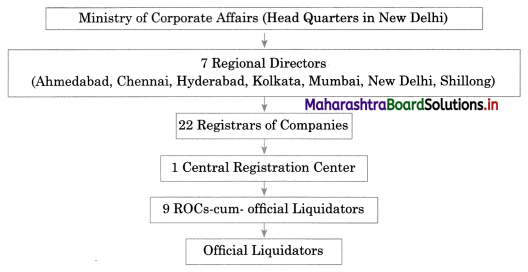
Give a flow chart to explain the organizational setup to administer the Companies Act, 2013.
Answer:
Organizational set up to administer the Companies Act, 2013.
Maharashtra Board Class 11 Secretarial Practice Important Questions Chapter 12 Correspondence with Statutory Authorities 2 Q1

3. Justify the following statements.

Question 1.
Explain the reasons for not holding Annual General Meeting by a company on time.
Answer:
Reasons for not holding Annual General Meeting on time:

  • Directors traveling abroad, so cannot attend Annual General Meeting.
  • Employees Strike in a company.
  • A raid by Income Tax Department.
  • Annual Financial statement not approved or not audited or incomplete audit or loss of financial data due to natural calamity.

Maharashtra Board Class 11 Secretarial Practice Important Questions Chapter 12 Correspondence with Statutory Authorities

Question 2.
Under what circumstances, Secretary has to correspond with Statutory authorities.
Answer:
Under the following circumstances, Secretary has to correspond with a few of the Statutory authorities:

  • To correspond with ROC for seeking extension of time for holding Annual General Meeting.
  • To correspond with MCA for ‘Ticket Raising’ or other service-related technical complaints.
  • To correspond with SEBI in reply to the complaint by the investor.
  • To correspond with NCLT seeking extension of time to repay Public deposits.

Maharashtra Board Class 11 Secretarial Practice Important Questions Chapter 11 Correspondence with Banks

Balbharti Maharashtra State Board Class 11 Secretarial Practice Important Questions Chapter 11 Correspondence with Banks Important Questions and Answers.

Maharashtra State Board 11th Secretarial Practice Important Questions Chapter 11 Correspondence with Banks

1A. Select the correct answer from the options given below and rewrite the statements.

Question 1.
Negotiable Instrument which can be discounted with the bank _____________
(a) Cheque
(b) Bills of Exchange
(c) Bank Draft
Answer:
(b) Bills of Exchange

Question 2.
Bank overdraft is a _____________ term facility provided by bank.
(a) medium
(b) short
(c) long
Answer:
(b) short

Question 3.
A loan for a period of more than 5 years is called as _____________ loans.
(a) short term
(b) long term
(c) medium-term
Answer:
(b) long term

Maharashtra Board Class 11 Secretarial Practice Important Questions Chapter 11 Correspondence with Banks

Question 4.
Purchase and sale of securities is _____________ function of Bank.
(a) primary
(b) utility
(c) agency
Answer:
(c) agency

1B. Match the pairs.

Question 1.

Group ‘A’Group ‘B’
(a) Current Account(1) Time Deposits
(b) Financial Arrangement(2) ATM, Credit Card and Debit Card
(c) Agency Function(3) Demand Deposits
(d) Utility Function(4) Collection of Dividend and Interest
(e) Cash Credit(5) Bank Overdraft
(f) Bill of Exchange(6) Advance against the stock of raw material
(g) Letter of Credit(7) Non-negotiable instrument
(8) Bank Draft
(9) Negotiable Instrument
(10) International trade transaction

Answer:

Group ‘A’Group ‘B’
(a) Current Account(3) Demand Deposits
(b) Financial Arrangement(5) Bank Overdraft
(c) Agency Function(4) Collection of Dividend and Interest
(d) Utility Function(2) ATM, Credit Card, and Debit Card
(e) Cash Credit(6) Advance against the stock of raw material
(f) Bill of Exchange(9) Negotiable Instrument
(g) Letter of Credit(10) International trade transaction

1C. Write a word or a term or a phrase that can substitute each of the following statements.

Question 1.
Deposits generating saving habits among the people.
Answer:
Saving Deposits

Question 2.
Deposits are not repayable on demand.
Answer:
Time Deposits

Question 3.
Deposits repayable on demand.
Answer:
Demand Deposits

Question 4.
The loan was provided for a period of less than one year.
Answer:
Short Term Loan

Maharashtra Board Class 11 Secretarial Practice Important Questions Chapter 11 Correspondence with Banks

Question 5.
The loan is provided for a period between 1 to 5 years.
Answer:
Medium-Term Loan

Question 6.
The loan was provided for a period of more than 5 years.
Answer:
Long Term Loan

1D. State whether the following statements are True or False

Question 1.
Letter of credit is issued by banks for domestic trade transactions.
Answer:
False

Question 2.
Bill of Exchange is a negotiable instrument.
Answer:
True

Maharashtra Board Class 11 Secretarial Practice Important Questions Chapter 11 Correspondence with Banks

Question 3.
The bank acts as a trustee, attorney, and executor of the will.
Answer:
True

Question 4.
RTGS is an agency function of the Bank.
Answer:
False

Question 5.
The bank plays the role of Depository Participant (DP).
Answer:
True

1E. Find the odd one.

Question 1.
Loan, Deposit, Cash credit, Overdraft facility.
Answer:
Deposit

Question 2.
Cheque, Withdrawal slip, Pay in slip.
Answer:
Pay in slip

Question 3.
Travellers Cheque, Safe Deposit Vault, NEFT, Transfer of Money.
Answer:
Transfer of Money

Maharashtra Board Class 11 Secretarial Practice Important Questions Chapter 11 Correspondence with Banks

Question 4.
Collection of Dividend, Collection of cheque, Buying, and Selling of Securities, Payment of Electricity Bill.
Answer:
Buying and Selling of Securities

1F. Complete the sentences.

Question 1.
The appointment of bankers of a company is made by the _____________
Answer:
Board of Directors

Question 2.
Banker is a dealer in _____________
Answer:
Money

Question 3.
Bank account in which money is deposited at regular interval is a _____________
Answer:
Recurring Deposit Account

Maharashtra Board Class 11 Secretarial Practice Important Questions Chapter 11 Correspondence with Banks

Question 4.
The instrument which can be discounted with the bank is a _____________
Answer:
Bills of Exchange

Question 5.
Businessman, Companies etc, usually open a _____________ account with a bank.
Answer:
Current

Question 6.
There is no restriction on the withdrawals from _____________ account.
Answer:
Current

Question 7.
Interest is not paid on the _____________ account.
Answer:
Current

Question 8.
_____________ account is suitable for salaried people.
Answer:
Saving

Question 9.
Stop payment letter is sent, when the cheque is _____________
Answer:
lost/misplaced

Maharashtra Board Class 11 Secretarial Practice Important Questions Chapter 11 Correspondence with Banks

Question 10.
Withdrawals are not permitted from the _____________ accounts.
Answer:
Fixed Deposits

Question 11.
The facility given by the bank to draw more money than the actual balance in the credit is called _____________
Answer:
Overdraft facility

Question 12.
A deposit which is kept for a fixed period in a bank is a _____________
Answer:
Fixed Deposit

Question 13.
A type of bank account which is generally opened by a businessman for his business transactions is a _____________
Answer:
Current account

Maharashtra Board Class 11 Secretarial Practice Important Questions Chapter 11 Correspondence with Banks

Question 14.
A type of account in which the interest is paid at higher rate is a _____________
Answer:
Fixed Deposit Account

1G. Select the correct option from the bracket.

Question 1.

Group ‘A’Group ‘B’
(1) Loans not more than one year……………………….
(2) ……………………..Cash Credit
(3) Collection of cheques………………………..
(4) ……………………..Letter of Credit

(Interest charged on, actual amount withdrawn, Agency function, Utility function, Short Term loans)
Answer:

Group ‘A’Group ‘B’
(1) Loans not more than one yearShort Term loans
(2) Interest charged on actual amount withdrawnCash Credit
(3) Collection of chequesAgency function
(4) Utility functionLetter of Credit

1H. Answer in one sentence.

Question 1.
What is a demand deposit?
Answer:
Deposits that are repayable on demand are called demand deposits. There are 2 types of demand deposits i.e Saving Deposits and Current Deposits.

Question 2.
What is a time deposit?
Answer:
Deposits that are repayable after a specific period of time are called time deposits. There are 2 types of time deposits i.e. Fixed Deposits and Recurring Deposits.

Question 3.
What do you mean by loan?
Answer:
Any amount granted or lent for a specific period of time against personal security, gold or silver, or other movable or immovable assets is called a loan.

Maharashtra Board Class 11 Secretarial Practice Important Questions Chapter 11 Correspondence with Banks

Question 4.
What is the Bill of Exchange?
Answer:
It is a written unconditional order by the seller to the buyer, to pay a certain sum of money on a future fixed date for payment of goods or services received.

1I. Correct the underlined word and rewrite the following sentences.

Question 1.
Short-term loans are of more than 5 years.
Answer:
Long-term loans are of more than 5 years.

Question 2.
Bills of Exchange are the non-negotiable instrument.
Answer:
Bills of exchange is a negotiable instrument.

Question 3.
The collection of cheques and bills is a utility function of the bank.
Answer:
The collection of cheques and bills is the agency function of the bank.

Question 4.
The rate of interest is high for saving deposits.
Answer:
The rate of interest is high for fixed deposits.

Maharashtra Board Class 11 Secretarial Practice Important Questions Chapter 11 Correspondence with Banks

Question 5.
Deposits that are repayable after the specific period is Demand Deposit.
Answer:
Deposits that are repayable after the specific period are Time Deposits.

2. Answer in brief.

Question 1.
Explain the types of term loans.
Answer:
A loan granted for a specific time period against personal security, gold or silver, and movable and immovable assets is called a term loan.
Types of term loans:

  • Short-term loan: A loan repayable within 1 year is called a short-term loan. It is generally taken by businessmen to meet their working capital requirements.
  • Medium-term loan: A loan repayable within 2 years to 5 years period is called a medium-term loan.
  • Long-term loan: A loan repayable after 5 years is called a long-term loan. It is taken by businessmen for the growth and development of the business.

Question 2.
Explain the types of Advances.
Answer:
Advance is a credit facility provided by the bank to its customers. Advances are for a shorter period than loans.
Type of Advances:

  • Overdraft: It is an arrangement in which a customer i.e. Current A/c holder, is allowed to overdrew money in excess of the credit balance in his account. It is allowed against collateral securities like – shares, F.D.R., Government securities, etc.
  • Cash credit: In this mode of advance, a separate bank account called ‘Cash Credit Account is opened in the name of the borrower. He can withdraw from this account as and when required. It is allowed against security like – stock of raw materials, finished goods, etc.
  • Discounting of Bills: Discounting of bills means encashing the Bills of Exchange before its due date with the banker. The bank charges a certain amount of interest for this service which is called a discounting rate.

3. Justify the following statements.

Question 1.
In cash credit, the customer’s account is credited by a bank with the sanctioned amount.
Answer:
Cash credit is another kind of credit facility given by the bank to its customers including businessmen, companies, etc.

  • A separate bank account known as a “Cash Credit Account” is required to be opened in the name of the borrower.
  • The bank credits the account as per the sanctioned cash limit from which the customer can utilize funds whenever required for cash credit.
  • Generally, the security of tangible assets like goods, finished stock is required to be kept.
  • The interest is charged only on the actual amount utilized by the customer.
  • Cash credit arrangement is for a longer period as compared to overdraft.
  • This system of lending is prevalent in India only.
  • Thus, in cash credit, the customer’s account is credited by a bank with the sanctioned amount.

Maharashtra Board Class 11 Secretarial Practice Important Questions Chapter 11 Correspondence with Banks

Question 2.
Bank correspondence should be brief and to the point.
Answer:

  • The bank is a financial institution.
  • A company secretary has to conduct bank correspondence as per the instruction of the Board.
  • Bank correspondence needs careful and cautious drafting.
  • The company secretary has to use his knowledge, skill, and experience while conducting bank correspondence,
  • The company secretary has to conduct bank correspondence promptly and accurately.
  • Mistakes and delays in bank correspondence may bring financial loss to the company.
  • Bank correspondence should be always brief, compact, and precise.
  • Unnecessary or irrelevant information should be avoided in bank correspondence.
  • Thus, bank correspondence should be brief and to the point.

Question 3.
No interest is paid by the bank on the current account.
Answer:

  • The Current account is normally opened by businessmen, firms, or companies.
  • A current account is a running account and in practice it never becomes time-barred.
  • This account is opened with a minimum deposit.
  • There is no limit on the amount or number of withdrawals.
  • Interest is not payable on this account.
  • Overdraft facility is given only to current depositors after following the prescribed bank procedure.
  • Hence, interest is paid only in the case of recurring, fixed, and saving accounts and not in the case of the current account.
  • Thus, no interest is paid by the bank on the current account.

Maharashtra Board Class 11 Secretarial Practice Important Questions Chapter 10 Correspondence with Directors

Balbharti Maharashtra State Board Class 11 Secretarial Practice Important Questions Chapter 10 Correspondence with Directors Important Questions and Answers.

Maharashtra State Board 11th Secretarial Practice Important Questions Chapter 10 Correspondence with Directors

1A. Select the correct answer from the options given below and rewrite the statements.

Question 1.
Secretary is ____________ to Directors.
(a) owner
(b) servant
(c) member
Answer:
(b) servant

Question 2.
Directors are the ____________
(a) owners
(b) representative of shareholders
(c) creditors of the company
Answer:
(b) representative of shareholders

Maharashtra Board Class 11 Secretarial Practice Important Questions Chapter 10 Correspondence with Directors

Question 3.
The provision regarding qualification shares of a director is contained in the ____________
(a) Articles of Association
(b) Memorandum of Association
(c) Prospectus
Answer:
(a) Articles of Association

1B. Write a word or a term or a phrase that can substitute each of the following statements.

Question 1.
A person is elected by the shareholders of a company.
Answer:
Director

Question 2.
Maximum information in minimum words.
Answer:
Brevity

1C. Complete the sentences.

Question 1.
The Directors are ____________ of shareholders.
Answer:
representative

Question 2.
The Directors are responsible for making ____________
Answer:
decision, plans and policies

Maharashtra Board Class 11 Secretarial Practice Important Questions Chapter 10 Correspondence with Directors

Question 3.
The report prepared by the directors at the end of every Financial Year is called ____________
Answer:
Directors report

Question 4.
The gap between two consecutive Board meetings should not be more than ____________
Answer:
120 days

1D. Select the correct option from the bracket.

Question 1.

Group ‘A’Group ‘B’
(1) ………………………The link between members and the directors
(2) Brevity……………………………..

(Secretary, Concise and compact information)
Answer:

Group ‘A’Group ‘B’
(1) SecretaryThe link between members and the directors
(2) BrevityConcise and compact information

1E. Correct the underlined word and rewrite the following sentences.

Question 1.
Brevity means not using harsh words while writing a letter.
Answer:
Politeness means not using harsh words while writing a letter.

Question 2.
The First Board meeting should be held with 60 days from the date of its incorporation.
Answer:
The First Board meeting should be held with 30 days from the date of its incorporation.

Maharashtra Board Class 11 Secretarial Practice Important Questions Chapter 10 Correspondence with Directors

Question 3.
Accuracy means avoiding unnecessary details and irrelevant information in a letter.
Answer:
Brevity means avoiding unnecessary details and irrelevant information in a letter.

Maharashtra Board Class 11 Secretarial Practice Important Questions Chapter 9 Business Communication Skills of a Secretary

Balbharti Maharashtra State Board Class 11 Secretarial Practice Important Questions Chapter 9 Business Communication Skills of a Secretary Important Questions and Answers.

Maharashtra State Board 11th Secretarial Practice Important Questions Chapter 9 Business Communication Skills of a Secretary

1A. Select the correct answer from the options given below and rewrite the statements.

Question 1.
Lay out of a letter means ____________
(a) physical appearance
(b) arrangement of its parts
(c) body
Answer:
(b) arrangement of its parts

Question 2.
Written communication is called ____________
(a) compliments
(b) consideration
(c) correspondence
Answer:
(c) correspondence

Maharashtra Board Class 11 Secretarial Practice Important Questions Chapter 9 Business Communication Skills of a Secretary

Question 3.
Communication that takes place internally between various departments of an organization ____________
(a) external communication
(b) internal communication
(c) verbal communication
Answer:
(b) internal communication

Question 4.
Communication that takes place between business organization and outsiders like bank, suppliers, creditors, etc ____________
(a) internal communication
(b) external communication
(c) verbal communication
Answer:
(b) external communication

Question 5.
Communication conveying message in spoken form is called ____________
(a) Non-verbal communication
(b) Verbal communication
(c) Internal communication
Answer:
(b) Verbal communication

Question 6.
Facial expression is a form of ____________ communication.
(a) Verbal communication
(b) Non-verbal communication
(c) Internal communication
Answer:
(b) Non-verbal communication

Question 7.
Information or ideas in written form is ____________
(a) oral communication
(b) written communication
(c) body language
Answer:
(b) written communication

Maharashtra Board Class 11 Secretarial Practice Important Questions Chapter 9 Business Communication Skills of a Secretary

Question 8.
A website for publishing informal online articles is called ____________
(a) blog
(b) cellular phone
(c) video conferencing
Answer:
(a) blog

Question 9.
Two-way personalised webscam based communication is called as ____________
(a) website
(b) blog
(c) video conferencing
Answer:
(c) video conferencing

Question 10.
____________ is a skill of being able to understand the feelings of another person.
(a) Empathy
(b) Sympathy
(c) Body language
Answer:
(a) Empathy

Question 11.
A ____________ introduces the firm.
(a) inside
(b) address, heading
(c) reference number
Answer:
(b) address, heading

Question 12.
Language of business letter should be ____________
(a) simple
(b) hard
(c) flowery
Answer:
(a) simple

1B. Match the pairs.

Question 1.

Group ‘A’Group ‘B’
(a) Correspondence(1) Greeting to the recipient of the letter
(b) Salutation(2) Message not included in the body of the letter
(c) Postscript(3) Non-verbal communication
(d) Hand gestures(4) Introduction of the sender
(e) Conciseness(5) Written communication
(6) Inside address
(7) Brief matter
(8) Other documents attached
(9) Verbal communication
(10) Heading

Answer:

Group ‘A’Group ‘B’
(a) Correspondence(5) Written communication
(b) Salutation(1) Greeting to the recipient of the letter
(c) Postscript(2) Message not included in the body of the letter
(d) Hand gestures(3) Non-verbal communication
(e) Conciseness(7) Brief matter

1C. Write a word or a term or a phrase that can substitute each of the following statements.

Question 1.
Branch of general communication concerned with business activities.
Answer:
Business communication

Question 2.
Communication that takes place internally between departments.
Answer:
Internal communication

Maharashtra Board Class 11 Secretarial Practice Important Questions Chapter 9 Business Communication Skills of a Secretary

Question 3.
Communication that takes place between organization and outsider.
Answer:
External communication

Question 4.
An electronic mail sending messages using electronic devices through the internet.
Answer:
E-mail

Question 5.
A website for publishing informal articles.
Answer:
Blog

Question 6.
Online interactive groups using advanced mobile and web-based technologies.
Answer:
Social media network

Question 7.
The gesture of a dancer.
Answer:
Non-verbal communication

Question 8.
Skill to understand and share the feelings of another person.
Answer:
Empathy

Question 9.
The name and address of the letter writer.
Answer:
Heading

Question 10.
A matter wrote after completing the letter.
Answer:
Postscript

Question 11.
Copies were sent along with the letter.
Answer:
Enclosure

Maharashtra Board Class 11 Secretarial Practice Important Questions Chapter 9 Business Communication Skills of a Secretary

Question 12.
The final part of the letter.
Answer:
Signature

1D. State whether the following statements are True or False.

Question 1.
A report is a systematic presentation of facts, figures, and conclusions about a topic.
Answer:
True

Question 2.
A notice is a written summary of transactions conducted at the meeting.
Answer:
False

Question 3.
Minutes give precise information regarding an important event that is about to take place.
Answer:
False

Question 4.
Letterhead includes the name and address of the sender.
Answer:
True

Question 5.
A letter written in a logical sequence is coherence.
Answer:
True

Question 6.
“You’ attitude means writing the word you many times in a letter.
Answer:
False

Maharashtra Board Class 11 Secretarial Practice Important Questions Chapter 9 Business Communication Skills of a Secretary

Question 7.
Harsh and rude words should be avoided in a letter.
Answer:
True

Question 8.
Minimum words should be used in a letter.
Answer:
True

Question 9.
The additional information written after the letter is completed is Postscript.
Answer:
True

Question 10.
The letter sent to other people at the same time is ‘Carbon Copy Notation’.
Answer:
True

Question 11.
Salutation includes documents, cheques, etc. attached with the letter.
Answer:
False

Question 12.
A complimentary close is written below the body of the letter in a polite manner.
Answer:
True

1E. Find the odd one.

Question 1.
Twitter, Youtube, Facebook, Written communication
Answer:
Written communication

Question 2.
E-mail, website, blog, completeness
Answer:
Completeness

Question 3.
Notice, Reports, Minutes, Non-verbal communication
Answer:
Non-verbal communication

Maharashtra Board Class 11 Secretarial Practice Important Questions Chapter 9 Business Communication Skills of a Secretary

Question 4.
Coherence, Consideration, Cheerfulness, Margin
Answer:
Margin

1F. Complete the sentences.

Question 1.
The process of communication conveying a message in spoken form is called as ____________
Answer:
verbal communication

Question 2.
Communication which is neither written or spoken is known as ____________
Answer:
Non-verbal communication

Question 3.
The participants are able to see and hear each other and also display visual data models etc. under ____________
Answer:
video conferencing

Question 4.
Communication that involves hearing and understanding what a person says to you is ____________
Answer:
active listening

Question 5.
Proper arrangement of various parts of the letter is called as ____________
Answer:
layout

Maharashtra Board Class 11 Secretarial Practice Important Questions Chapter 9 Business Communication Skills of a Secretary

Question 6.
The number written on the left-hand side below the heading to give a quick reference to the matter concerned is called ____________
Answer:
Reference Number

Question 7.
The reader gets the idea of the matter of the letter without reading the letter completely by reading ____________
Answer:
Subject

1G. Select the correct option from the bracket.

Question 1.

Group ‘A’Group ‘B’
(1) Written summary……………………….
(2) Spirit of hopeness………………………..
(3) Logical sequence……………………….
(4) ……………………….Your’s faithfully

(Coherence, Minutes, Cheerfulness, Complimentary close)
Answer:

Group ‘A’Group ‘B’
(1) Written summaryMinutes
(2) Spirit of hopenessCheerfulness
(3) Logical sequenceCoherence
(4) Your’s faithfullyYour’s faithfully

1H. Answer in one sentence.

Question 1.
Name the Electronic device in which mails can be sent.
Answer:
Mails can be through E-mail (Internet).

Question 2.
Name the device that provides a short message service.
Answer:
Mobile/Cellular phone provides short message service.

Question 3.
What is the final part of the letter called?
Answer:
The final part of the letter is called ‘Signature’.

1I. Correct the underlined word and rewrite the following sentences.

Question 1.
Written communication includes body language, facial expression, etc.
Answer:
Non Verbal communication includes body language, facial expression, etc.

Question 2.
Internal communication takes place between business organizations and outsiders.
Answer:
External communication takes place between business organizations and outsiders.

Question 3.
Coherence is also called the use of ‘You attitude’.
Answer:
Consideration is also called the use of ‘You attitude’.

Maharashtra Board Class 11 Secretarial Practice Important Questions Chapter 9 Business Communication Skills of a Secretary

Question 4.
A written summary of a business transacted at the meeting is called Notice.
Answer:
A written summary of a business transacted at the meeting is called Minutes.

Question 5.
Oral Communication is a permanent record.
Answer:
Written Communication is a permanent record.

Question 6.
The skill of understanding the feelings of another person is called Sympathy.
Answer:
The skill of understanding the feelings of another person is called Empathy.

Question 7.
A letter without clarity is invalid.
Answer:
A letter without a signature is invalid.

2. Explain the following terms/concepts.

Question 1.
Non-Verbal Communication
Answer:

  • Communication that does not involve written or spoken words is called non-verbal communication.
  • It takes place by using body language, facial expression, eye contact, silence, symbols, signs, gestures, etc.

Question 2.
Notice
Answer:

  • It is an intimation by the company to the concerned persons or members or directors about the day, date, time, place, and business to a transacted at the meeting.
  • It is to be sent to all the concerned persons through registered post.
  • It should also include the agenda which is going to be discussed at the meeting.

3. Answer in brief.

Question 1.
Explain any four modes of Electronic devices.
Answer:
Modes of electronic device:
(a) E-mail:
It means sending messages through the internet. An E-mail has made businesses come closer to their customers. It also saves time for writing letters, posting a letter, etc.

(b) Websites:
It is a set of interconnected web pages which are located on a single web. It contains the information provided by the owner of the website. It can be accessed through the internet or through a private local area network. Each website has a unique internet address called “Uniform Resource Locator”(URL).

Maharashtra Board Class 11 Secretarial Practice Important Questions Chapter 9 Business Communication Skills of a Secretary

(c) Social media network:
It is a very popular online interactive group created by using mobile and web-based technologies. It helps the business organization to interact with the consumers and communicate about their products and services.

(d) Video-conferencing:
It can be done through computers by providing a video link between two or more people. The participants can see and hear each other while communicating and can also display visual data also.

4. Justify the following statements.

Question 1.
The letterhead introduces the firm.
Answer:

  • The letterhead (or the head address) consists of the name of the company sending out the letter, its registered address, its emblem or logo, telephone number, fax number, telegraphic address, telex number, website, and e-mail address, and same times a brief line describing the nature of business of the company.
  • The letterhead is usually printed at the top center of the page.
  • When the addressee of the letter receives the letter, his attention first goes to the letterhead.
  • On seeing the letterhead, he knows about the sender’s firm.
  • The layout of the letterhead, it’s printing, and its style help to create an image of the company.
  • An attractive letterhead creates a good impression.
  • The letterhead speaks a lot of the sender’s organization.
  • Thus, the letterhead introduces the firm.

Question 2.
Postscript should not be used in business letters.
Answer:

  • Postscript means ‘written afterward’. It is like a footnote added to the letter.
  • It means additional matter not written in the main body of the letter but added after completing the letter.
  • It is necessary if some information is received late and is required to be conveyed along with the original letter.
  • To have a postscript in the letter is not a good practice and hence should be avoided.
  • It indicates the possible carelessness of the writer.
  • It should be used only for communicating an urgent message.
  • Thus, postscript should not be used in business letters.

Question 3.
Courtesy is one of the requisites of a good business letter.
Answer:

  • Every business letter must be courteously worded.
  • The language used should be polite, pleasing, and convincing.
  • Courtesy and polite tone are possible by using terms like ‘please’, ‘thank you, ‘very kind of you’ etc.
  • It is specifically necessary for letters sent to the employees.
  • It includes polite manners, kindness, and consideration for others.
  • A courteous letter builds goodwill for the organization.
  • Lack of courtesy may prove to be costly and troublesome to a business unit.
  • A business letter and serves as a ‘silent salesman’ or ‘silent ambassador’ only when it is courteous in meaning and language.
  • Courtesy facilitates the expansion of business activities.
  • Thus, courtesy is one of the requisites of a good business letter.

Maharashtra Board Class 11 Secretarial Practice Important Questions Chapter 9 Business Communication Skills of a Secretary

Question 4.
A business letter is a silent salesman.
Answer:

  • In modern times, the scale of the business has increased to such an extent that direct and personal dealing with the customers is difficult except in case of retail trade.
  • Correspondence is, thus, necessary to widen the boundaries of markets and expand the scale of business.
  • Effectively drafted and neatly typed letters play the role of a salesman in creating and expanding the market for goods and services.
  • When letters are courteous it creates a good impression.
  • Letters convince the prospects of the novelty, specialty, and utility of the products and induce them to place orders.
  • Thus, a business letter is a silent salesman.

Question 5.
A letter without a date is incomplete.
Answer:

  • The date is an important part of a business letter.
  • The date includes the day, month, and year on which the letter is sent to the addressee.
  • The reference of data is useful for the fulfillment of business transactions on a particular date.
  • A letter with a date can serve as evidence in a court of law.
  • The date on the letter facilitates quick reference to old letters and filing of letters in chronological order.
  • A letter without a date is incomplete and legally invalid. It is like a body without ahead.
  • Thus, a letter without a date is incomplete.

Question 6.
The margin on all sides is a waste of paper.
Answer:

  • In order to make a letter appear systematic and attractive, it is better to maintain margins on both sides of the letter.
  • Proper margin makes the letter attractive.
  • Proper margin must be kept on the left-hand side and right-hand side.
  • Proper space must be left at the bottom of the letter.
  • Thus, the margin on all sides is a waste of paper.

Maharashtra Board Class 11 Secretarial Practice Important Questions Chapter 9 Business Communication Skills of a Secretary

Question 7.
The signature provides legal value to the letter.
Answer:

  • It usually consists of the name of the writer, his official designation, if any, and the department he is concerned with.
  • It is placed directly below the complimentary close.
  • The signature must be handwritten in ink and placed two or three line spaces below the complimentary close.
  • Business letters, today, carry the typed name and also the designation of the signatory below the signature.
  • This helps the reader to identify the person by his name and his official position in the company.
  • A letter without a date is invalid, likewise, a letter without a signature is also invalid.
  • The unsigned letter has no significance.
  • Thus, a signature provides legal value to the letter.

5. Answer the following questions.

Question 1.
Explain the physical appearance of a letter.
Answer:
‘Physical appearance’ simply means ‘The look’ of the letter. How it should appear or present itself to the receiver of the letter, what impression should it create? All these depend on the ‘Look’ or ‘Outer appearance’ of the letter. Therefore to make the letter look attractive, attention should be given to the following points.

(a) Paper:
A paper of superior quality should be used. The high cost of such paper is a sort of investment and not an expenditure. A paper of good quality always creates a good impression. Proper colour of the paper must be selected (generally white colour). A quality paper is useful to keep records for long period.

(b) Typing:
The typed letters are more attractive and legible than handwritten letters. However, the typing must be neat, accurate, and clean. Spelling must be checked for its correctness. Electronic typewriters or computers with printers must be used.

(c) Margin:
The proper margin on both sides gives the letter a presentable appearance. The size of the margin depends upon the size of the paper. It is also necessary to leave space at the bottom of the letter.

(d) Spacing:
Proper and enough space between the lines should be left. Spacing should be uniform. Proper spacing between the paragraphs increases the attractiveness of letter writing.

(e) Letterhead:
The design of the letterhead should be simple but attractive and impressive. It should include all necessary details like address, telephone number, E-mail, Fax No. etc. The letterhead has advertising value. It introduces the sender to the receiver of the letter.

Maharashtra Board Class 11 Secretarial Practice Important Questions Chapter 9 Business Communication Skills of a Secretary

(f) Folding:
Though the folding of a letter is a simple matter but not an unimportant one. Folds should be minimum. The number of folds depends on the size of paper used for writing a letter and the size of the envelope used for sending it.

(g) Envelope:
The envelope used for sending a letter should be of the proper size, color, and quality. A right-sized envelope should be used. In simple words, the envelope should neither be too small nor too big. If a window envelope is used, to save time and labour then the letter must be folded in such a way that the inside address shall appear exactly on the window (of the envelope).
It Must Be Noted That – “There Are No Exact Rules for Physical Appearance of A Business Letter. It Depends on Circumstances.”

Maharashtra Board Class 11 Secretarial Practice Important Questions Chapter 8 Company Meetings – II

Balbharti Maharashtra State Board Class 11 Secretarial Practice Important Questions Chapter 8 Company Meetings – II Important Questions and Answers.

Maharashtra State Board 11th Secretarial Practice Important Questions Chapter 8 Company Meetings – II

1A. Select the correct answer from the options given below and rewrite the statements.

Question 1.
Annual General Meeting is held _________ in a year.
(a) once
(b) twice
(c) thrice
Answer:
(a) once

Question 2.
Annual General Meeting is convened by _________
(a) Creditors
(b) Board of Directors
(c) Committee
Answer:
(b) Board of Directors

Maharashtra Board Class 11 Secretarial Practice Important Questions Chapter 8 Company Meetings – II

Question 3.
First Annual General Meeting shall be held within _________ months of the closing of the financial year.
(a) 6
(b) 9
(c) 15
Answer:
(b) 9

Question 4.
The quorum for the Annual General Meeting of a public company with 10,000 shareholders is _________ members.
(a) 5
(b) 30
(c) 15
Answer:
(b) 30

Question 5.
First Board Meeting is held within _________ days of the date of its incorporation.
(a) 30
(b) 15
(c) 45
Answer:
(a) 30

Question 6.
The Gap between two Board Meetings should not be more than _________ days.
(a) 30
(b) 60
(c) 120
Answer:
(c) 120

Question 7.
With the help of technology _________ meeting is held for Board of Directors.
(a) Visual
(b) Virtual
(c) Audio
Answer:
(b) Virtual

Maharashtra Board Class 11 Secretarial Practice Important Questions Chapter 8 Company Meetings – II

Question 8.
The Secretary has to get the signatures of the members present at the meeting in _________ ‘Attendance Book’.
(a) Directors
(b) Members
(c) Creditors
Answer:
(b) Members

1B. Match the pairs.

Question 1.

Group ‘A’Group ‘B’
(a) Directors(1) 21 days
(b) Annual General Meeting(2) Statutory Report
(c) Auditor(3) Preference shareholders
(d) Notice – Board Meeting(4) Extra-Ordinary General Meeting
(e) Class Meeting(5) General Meeting
(6) 7 days
(7) Annual Report
(8) Debenture holders
(9) Annual General Meeting
(10) Committee Meeting

Answer:

Group ‘A’Group ‘B’
(a) Directors(10) Committee Meeting
(b) Annual General Meeting(7) Annual Report
(c) Auditor(9) Annual General Meeting
(d) Notice – Board Meeting(6) 7 days
(e) Class Meeting(3) Preference shareholders

1C. Write a word or a term or a phrase that can substitute each of the following statements.

Question 1.
A meeting in which Directors are elected.
Answer:
Annual General Meeting

Question 2.
A meeting of Shareholders is held after the financial year is over.
Answer:
Annual General Meeting

Question 3.
A meeting of the Board of Directors was held with the help of technology.
Answer:
Virtual Meeting

Question 4.
The quorum for Annual General Meeting of a public company with 4000 shareholders.
Answer:
15 Members

Question 5.
The Gap between two Annual General Meetings should not be more than.
Answer:
15 months

Maharashtra Board Class 11 Secretarial Practice Important Questions Chapter 8 Company Meetings – II

Question 6.
The quorum for Board Meetings.
Answer:
1/3rd rd or 2 directors (whichever is higher)

Question 7.
The Gap between the two Board Meetings should not be more than.
Answer:
120 days

1D. State whether the following statements are True or False.

Question 1.
30 clear days’ notice should be given in case of the Annual General meeting.
Answer:
False

Question 2.
Shareholders can appoint a proxy to attend and vote at the meeting on their behalf.
Answer:
True

Question 3.
Board Meetings are called once a year.
Answer:
False

Question 4.
Debenture holders are the owners of the company.
Answer:
False

Question 5.
Directors have to perform duties related to Annual General Meeting.
Answer:
False

Question 6.
Quorum is just before the commencement of the meeting.
Answer:
True

Maharashtra Board Class 11 Secretarial Practice Important Questions Chapter 8 Company Meetings – II

Question 7.
Secretary takes down the notes of the proceedings of the meeting.
Answer:
True

1E. Find the odd one.

Question 1.
Shareholders Meeting, Directors Meeting, Committee Meeting.
Answer:
Shareholders meeting

Question 2.
Board Meeting, Committee Meeting, Class Meeting.
Answer:
Class Meeting

Question 3.
AGM, EOGM, Committee Meeting.
Answer:
Committee Meeting

Question 4.
General Meeting, Class Meeting, Creditors Meeting.
Answer:
Creditors Meeting

Question 5.
Debenture holders Meeting, Creditors Meeting, Class Meeting.
Answer:
Class Meeting

1F. Complete the sentences.

Question 1.
Auditor is appointed in _________
Answer:
Annual General Meeting

Maharashtra Board Class 11 Secretarial Practice Important Questions Chapter 8 Company Meetings – II

Question 2.
An Extra-Ordinary General Meeting is held _________
Answer:
under special circumstances

Question 3.
Minutes of the meeting is the duty of _________
Answer:
Secretary

Question 4.
Directors are appointed in _________
Answer:
Annual General Meeting

Question 5.
Minutes of the meeting has to be drafted by the secretary in _________
Answer:
15 days

Question 6.
Auditor is appointed for a period of _________
Answer:
1 year

1G. Select the correct option from the bracket.

Question 1.

Group ‘A’Group ‘B’
(1) ……………………..Annual General Meeting
(2) Proxy……………………….
(3) …………………….Annual Report
(4) Minutes……………………….
(5) ……………………Notes of the proceedings of a meeting
(6) Notice of Board Meeting……………………….

(Shareholder, 15 days, Secretary, 7 days, Auditor, Annual General Meeting)
Answer:

Group ‘A’Group ‘B’
(1) AuditorAnnual General Meeting
(2) ProxyShareholder
(3) Annual General MeetingAnnual Report
(4) Minutes15 days
(5) SecretaryNotes of the proceedings of a meeting
(6) Notice of Board Meeting7 days

1H. Correct the underlined word and rewrite the following sentences.

Question 1.
In a Partnership Firm, there is the separation of ownership and management.
Answer:
In a Joint Stock Company, there is the separation of ownership and management.

Question 2.
The interval between 2 Annual General Meetings should be no more than 12 months.
Answer:
The interval between 2 Annual General Meetings should be no more than 15 months.

Question 3.
Annual General Meeting is called to transact “special business.”
Answer:
Extra Ordinary General Meeting is called to transact “special business.”

Maharashtra Board Class 11 Secretarial Practice Important Questions Chapter 8 Company Meetings – II

Question 4.
Meetings of debenture holders, depositors, etc. are called Shareholders Meeting.
Answer:
Meetings of debenture holders, depositors, etc. are called Creditor’s Meeting.

2. Explain the following terms/concepts.

Question 1.
Class Meeting
Answer:
A Meeting of a particular class of shareholders, held to make changes in their rights and duties, is called a class meeting. It is held to get their consent for the changes affecting their interest.

Question 2.
Annual General Meeting (AGM)
Answer:
Meeting of equity shareholders which are held once every year is called AGM. It is held to review and discuss the progress made by the company during the financial year. It is held to take decisions like:

  • to adopt Annual a/c, Director’s Report, and Auditor’s Report
  • to declare dividend
  • to elect directors
  • to appoint auditors and fix their remuneration.

Question 3.
Extra Ordinary General Meeting
Answer:
A meeting held to discuss and decide special or urgent matters like alteration in MOA or AOA, removal of directors or auditor before expiry of his term, voluntary winding up of company, etc is called an extraordinary general meeting. Such meetings can be called by the Board of Directors or by BOD on the requisition of members or by Requisitionist themselves or by National Company Law Tribunal (NCLT) or Government.

Maharashtra Board Class 11 Secretarial Practice Important Questions Chapter 8 Company Meetings – II

Question 4.
Director’s Meeting
Answer:
The meeting which is held to discuss the policy matters of the company is called as Director’s meeting. Such meetings are classified into Board meetings and Committee meetings. The First Board meeting is to be called within 30 days from the date of incorporation.

3. Answer in brief.

Question 1.
State any four legal provisions relating to Extra-Ordinary General Meeting.
Answer:
Legal Provisions relating to Extra-Ordinary General Meeting:
(i) Time for holding a meeting:
Extra-Ordinary General Meeting is between two Annual General Meetings under special circumstances. It can be held at any time as per the requirements of the company.

(ii) Authority to Convene:

  • The Board of Directors has the right to call an Extra-Ordinary General Meeting by sending a proper notice to the shareholders.
  • Extra-Ordinary General Meeting can be called by the members holding at least 1/10th of the paid-up capital or 1/10th of voting power in the company. Board must call Extra-Ordinary General Meeting within 45 days of receiving the requisition from the members.
  • If the Board fails to call such a meeting then the requisitionists themselves call this meeting within 3 months from the date of deposit of the requisition. The company shall pay all the expenses incurred for holding Extra-ordinary General Meeting.
  • National Company Law Tribunal (NCLT) can order such meetings on its own or at the request of a director or any members having voting rights.

(iii) Notice:
The notice must be given to all those who are entitled to receive it, at least 21 clear days in advance of the meeting. It is sent to the members at their registered address by post or through electronic mode like Email, etc.

(iv) Quorum:
According to the Companies Act, 2013, the quorum for Extra-Ordinary General Meeting of a public company is as follows:

No. of ShareholdersQuorum
Upto 10005 Members
1000 – 500015 Members
More than 500030 Members

For a private company minimum of two members should be present in person.

Maharashtra Board Class 11 Secretarial Practice Important Questions Chapter 8 Company Meetings – II

4. Answer the following questions.

Question 1.
Explain the functions of a secretary related to the Extra-Ordinary General Meeting.
Answer:
Functions (duties) of a secretary related to Extra Ordinary General Meeting:
Duties Before the Meeting:

  • Board Meeting: The secretary has to convene a board meeting in consultation with the Chairman. The board has to decide the day, date, time, and place of the meeting.
  • Notice: The secretary drafts the notice, agenda, and other required documents. He gets it approved by the chairman. Then he sends 21 clear days’ notice and other documents to the members before the meeting.
  • Public Notice: He has to publish notice of the extraordinary general meetings in leading newspapers for the information of the general public.
  • Arrangement: The secretary has to make arrangements such as booking the hall, refreshments, documents, etc.

Duties During the Meeting:

  • Quorum: The secretary checks the quorum at the beginning of the meeting and informs the same of the chairman.
  • Attendance: The secretary has to get signatures of members present at the meeting in ‘Members Attendance Book’.
  • Reading Notice: The secretary reads out the notice and agenda of the meeting as per the direction of the chairman.
  • Assist Chairman: The secretary assists the chairman by providing necessary information, records, document, etc.
  • Notes of Proceedings: The secretary should take down the notes of the proceedings of the meeting. He has to draft the minutes on the basis of these notes.
  • Poll: The secretary has to make necessary arrangements for taking poll if it is demanded.

Maharashtra Board Class 11 Secretarial Practice Important Questions Chapter 8 Company Meetings – II

Duties After the Meeting:

  • Drafting Minutes: The secretary drafts the minutes of the meeting on the basis of the notes taken down during the proceedings of the meeting.
  • Implementation of Decisions: The secretary instructs the concerned department for implementing the decisions taken at the meeting.
  • Filing Resolutions: The secretary has to file the certified copy of resolutions passed at the meeting to the Registrar of Companies.

Maharashtra Board Class 11 Secretarial Practice Important Questions Chapter 7 Company Meetings – I

Balbharti Maharashtra State Board Class 11 Secretarial Practice Important Questions Chapter 7 Company Meetings – I Important Questions and Answers.

Maharashtra State Board 11th Secretarial Practice Important Questions Chapter 7 Company Meetings – I

1A. Select the correct answer from the options given below and rewrite the statements.

Question 1.
The business to be transacted at the meeting is called _____________
(a) Agenda
(b) Minutes
(c) Notice
Answer:
(a) Agenda

Question 2.
A proxy form must be deposited in the registered office of the company at least _____________ hours before the meeting.
(a) 48
(b) 24
(c) 12
Answer:
(a) 48

Question 3.
A copy of the special resolution must be filed with the registrar within _____________ days of the passing resolution.
(a) 30
(b) 60
(c) 90
Answer:
(a) 30

Question 4.
Quorum for a private company is _____________ members.
(a) 15
(b) 5
(c) 2
Answer:
(c) 2

Question 5.
Point of order can be raised by _____________
(a) Chairman
(b) Secretary
(c) Member
Answer:
(c) Member

Question 6.
One share one vote’ is a voting method following under _____________
(a) voting by show of hands
(b) voting by ballot
(c) voting by-poll
Answer:
(c) voting by-poll

Question 7.
A motion which is changed due to an amendment is called _____________ motion.
(a) Formal
(b) Substantive
(c) Closure
Answer:
(b) Substantive

1B. Match the pairs.

Question 1.

Group ‘A’Group ‘B’
(a) Agenda(1) Alteration in the original motion
(b) Amendment(2) Extra vote for chairman
(c) Point of Order(3) Rejected a motion
(d) Casting Vote(4) Objection raised by a member in the meeting
(e) Resolution(5) List of items to be transacted at the meeting
(6) Alteration in a Resolution
(7) Suggestion given by the member in the meeting
(8) Accepted Motion
(9) Only important items to be discussed at the meeting
(10) Extra vote for Directors

Answer:

Group ‘A’Group ‘B’
(a) Agenda(5) List of items to be transacted at the meeting
(b) Amendment(1) Alteration in the original motion
(c) Point of Order(4) Objection raised by a member in the meeting
(d) Casting Vote(2) Extra vote for chairman
(e) Resolution(8) Accepted Motion

1C. Write a word or a term or a phrase that can substitute each of the following statements.

Question 1.
A list of items to be transacted at the meeting.
Answer:
Agenda

Question 2.
The minimum number of members to be present for a valid meeting.
Answer:
Quorum

Question 3.
The person who presides over the meeting.
Answer:
Chairman

Question 4.
A proposal is put before the meeting for discussion and decision.
Answer:
Motion

Question 5.
A motion finally passed at the meeting.
Answer:
Resolution

Question 6.
An alteration was proposed to the original motion.
Answer:
Amendment

Question 7.
A motion which brings to the notice of the Chairman the irregularities at the meeting.
Answer:
Point of Order

Question 8.
A person appointed by a member to attend and vote at the meeting.
Answer:
Proxy

Question 9.
An extra vote for the Chairman in case of tie-in votes.
Answer:
Casting vote

1D. State whether the following statements are True or False.

Question 1.
A proxy can vote under the poll method.
Answer:
True

Question 2.
Notice of the meeting must be given 14 days in advance.
Answer:
False

Question 3.
An agenda is sent along with the notice.
Answer:
True

Question 4.
Secretary has to sign the minutes book.
Answer:
False

Question 5.
Motion is a final decision of the meeting.
Answer:
False

Question 6.
Alteration can be done only by adding some new words.
Answer:
False

Question 7.
Point of Order is an objection raised by a member.
Answer:
True

Question 8.
Chairman can exercise casting votes in case of tie-in votes.
Answer:
True

Question 9.
A proxy cannot speak at the meeting.
Answer:
True

Question 10.
Secrecy can be maintained under voting by the show of hands method.
Answer:
False

Question 11.
A proxy need not be a member of the company.
Answer:
True

1E. Find the odd one.

Question 1.
Ordinary, Resolution, Special Resolution, Formal Motion.
Answer:
Formal Motion

Question 2.
Voting by voice, Voting by Ballot, Casting vote.
Answer:
Casting vote

Question 3.
Formal Motion, Substantive Motion, Resolution.
Answer:
Resolution

Question 4.
Voting by Poll, Voting by show of hands, Virtual voting.
Answer:
Virtual voting

Question 5.
Bare Statement Agenda, Draft Minutes Agenda, Minutes.
Answer:
Minutes

1F. Complete the sentences.

Question 1.
A person who presides over the meeting is known as _____________
Answer:
Chairman

Question 2.
Agenda is sent along with _____________
Answer:
Notice

Question 3.
Quorum for a private company is _____________
Answer:
2 members

Question 4.
A person responsible for proper conduct and to maintain order in the meeting is _____________
Answer:
Chairman

Question 5.
A motion which is changed due to amendment is called _____________
Answer:
Substantive motion

Question 6.
A resolution passed by simple majority is called _____________
Answer:
Ordinary Resolution

Question 7.
A special resolution, within 30 days of its passing must be filed with _____________
Answer:
Registrar of Companies

Question 8.
A representative of a member in a meeting is called _____________
Answer:
Proxy

1G. Select the correct option from the bracket.

Question 1.

Group ‘A’Group ‘B’
(1) Voting by voice……………………..
(2) …………………21 clear days
(3) Up to 1000 shareholders ……………………
(4) ……………………..15 days
(5) More than 5000 shareholders…………………….
(6) ……………………Writing
(7) Voting by Poll…………………….
(8) ……………………Objection
(9) Resolution by circulation……………………
(10) …………………Chairman

(Casting vote, Point of order, Directors, Motion, Secret method, Quorum is 5 members, Notice, Yes or No, Quorum is 30 members, Minutes)
Answer:

Group ‘A’Group ‘B’
(1) Voting by voiceYes or No
(2) Notice21 clear days
(3) Up to 1000 shareholdersQuorum is 5 members
(4) Minutes15 days
(5) More than 5000 shareholdersQuorum is 30 members
(6) MotionWriting
(7) Voting by-pollSecret method
(8) Point of orderObjection
(9) Resolution by circulationDirectors
(10) Casting voteChairman

1H. Answer in one sentence.

Question 1.
What is a quorum?
Answer:
Quorum is the minimum number of members required to be present for a valid meeting.

Question 2.
What is a proxy?
Answer:
A proxy is a person, who can attend and vote at the meeting on behalf of an absent member.

Question 3.
What is motion?
Answer:
A motion is a proposal put before the meeting for discussion and decision.

Question 4.
What is Resolution?
Answer:
A motion accepted in a meeting is called Resolution.

1I. Correct the underlined word and rewrite the following sentences.

Question 1.
The minimum number of members required to be present at a meeting’s called proxy.
Answer:
The minimum number of members required to be present at a meeting’s called Quorum.

Question 2.
Director draft s the minutes of a meeting.
Answer:
Secretary draft s the minutes of a meeting.

Question 3.
Voting by show of hands is a capitalistic method.
Answer:
Voting by show of hands is a democratic method.

Question 4.
The ordinary resolution requires a 75% majority of votes.
Answer:
A special resolution requires a 75% majority of votes.

Question 5.
Agenda is a record of business transacted at the meeting.
Answer:
Minutes is a record of business transacted at the meeting.

Question 6.
A notice period of general meeting needs 7 clear days.
Answer:
A notice period of general meeting needs 21 clear days.

1J. Arrange in proper order.

Question 1.
(a) Chairman
(b) Agenda
(c) Amendment
Answer:
(a) Agenda
(b) Chairman
(c) Amendment

Question 2.
(a) Point of order
(b) Quorum
(c) Motion
Answer:
(a) Quorum
(b) Motion
(c) Point of order

2. Distinguish between the following.

Question 1.
Motion and Amendment
Answer:

BasisMotionAmendment
1. MeaningMotion is a written proposal placed before the meeting for decision and discussion.An amendment is an alteration or modification proposed to the original motion.
2. PurposeThe main purpose of the motion is to discuss and to make proper decisions.The main purpose of an amendment is to revise or modify the main motion.
3. Right to speakEvery member can speak only once either in favour or against the motion.Only those members who have not spoken on the original motion can speak on an amendment.
4. EffectWhen a motion is accepted by the majority in the meeting, it becomes a resolution.When an amendment is approved by the majority, it becomes a part of the resolution.
5. MoverMover of the motion can speak twice on his own motions.Mover of the amendment can speak only once on his own amendment.

Question 2.
Ordinary Resolution and Special Resolution
Answer:

BasisOrdinary ResolutionSpecial Resolution
1. MeaningThe resolution which is passed by a simple majority of votes is called Ordinary resolution.The resolution which is passed by 3/4th majority of votes is called a Special resolution.
2. MajorityIt requires more than 50% of the majority.It requires at least a 75% majority of votes.
3. FilingIt is not filed with the Registrar of companies.It is filed with the Registrar of companies within 30 days of passing the resolution.
4. Business transactedIt is necessary for routine and ordinary business.It is necessary for special business.
5. ExamplesAppointment of auditors, declaration of dividend, the election of directors, etc.Change in the name of the company, alteration in object clause, reduction in spare capital, etc.

3. Answer in brief.

Question 1.
State the importance of the Agenda.
Answer:
Agenda is a list of items to be discussed or things to be done or the business to be transacted at the meeting. It is sent along with the notice. A secretary prepares the agenda in consultation with the Chairman.
Importance of Agenda:

  • Members come to know about the matter to be discussed at the meeting.
  • Members can come well prepared for the meeting, as the agenda is sent along with notice (21 clear days) before the meeting.
  • The agenda helps the chairman to conduct the meeting efficiently.
  • Items can be discussed as per the order mentioned in the agenda.
  • All items are discussed at the meeting. Routine matters are discussed first, followed by special matters.

Question 2.
State the provisions regarding Quorum.
Answer:
Quorum is the minimum number of members required to be present for transacting a valid business. Without a quorum, the proceeding of the meeting becomes invalid. The quorum should be present throughout the meeting i.e. from beginning till the end of the meeting. Secretary must check the quorum before the commencement of the meeting.

Provision relating to Quorum (Companies Act, 2013)
(i) Quorum for General Meeting:

In the case of a Public Company: Quorum depends on a number of shareholders.

No. of shareholdersQuorum
Up to 10005 members
1000 – 500015 members
More than 500030 members

In the case of a Private Company: Two members personally present shall be the quorum for the meeting.

(ii) Quorum for Board Meeting:
According to the provision in the Companies Act, a quorum for the board meeting is l/3rd of its total directors or two directors whichever is higher. Any fraction should be rounded to one.

4. Justify the following statements.

Question 1.
Resolution cannot be amended
Answer:
(i) When a motion is accepted in a meeting it becomes a resolution.
(ii) When a motion is under discussion it can be amended.
(iii) Resolution is a final decision, it cannot be changed.
(iv) Motion is passed in the meeting after a required discussion on a particular matter.
(v) A resolution cannot be amended as it is a final decision taken in the meeting.
Thus, the resolution cannot be amended.

Question 2.
Quorum is required throughout the meeting.
Answer:

  • a minimum number of members required for a valid meeting is a quorum.
  • Members present in the beginning should be present during the entire period of the meeting.
  • If the quorum is not present, the meeting stands adjourned for the next week same day, same time, and same place.
  • In the absence of a quorum, if any meeting is conducted it is considered an invalid meeting.
  • If any resolution is passed in the absence of a quorum, then such resolution is considered an invalid and illegal resolution.
  • Thus, a quorum is required throughout the meeting.

Question 3.
The chairman has the right of casting vote.
Answer:

  • A casting vote is a special type of vote given only by the Chairman of the meeting.
  • It is an additional vote given to the Chairman in case of equality of votes in favour and against a motion.
  • The chairman can use his vote only in the case of a tie.
  • This means when the votes cast for and against the resolution are equal.
  • It is a decisive vote as the final decision depends on the manner in which it is used by the Chairman.
  • The purpose of the casting vote is to have some definite decision on the matter for discussion before the meeting.
  • As per the provision in the Articles of Association, this vote can be exercised only by the chairman of the meeting.
  • Hence, the chairman has the right of casting vote.
  • Thus, the chairman has the right of casting vote.

Question 4.
Minutes of a meeting, once approved cannot be changed.
Answer:

  • Minutes are the factual and official records of the proceedings of the meeting in the form of decisions and resolutions.
  • Minutes are the legal evidence of the proceedings conducted in a meeting.
  • They cannot be changed once they are finalized and confirmed by the Chairman.
  • If any rectification is to be done and is necessary, it is carried out by passing a resolution in the next meeting and recording the same in the minute’s book.
  • Thus, the minutes of a meeting, once approved cannot be changed.

Question 5.
The agenda is useful to the chairman of the meeting.
Answer:

  • Agenda means a list of items to be done at the meeting.
  • It is a programme of the meeting.
  • It is prepared by the secretary in consultation with the chairman.
  • It is a guideline to the chairman of the meeting.
  • It enables the chairman to conduct the business of the meeting in an orderly manner.
  • Routine matters which can be discussed and decided in fewer times are arranged first in the serial order, after that special business or time-consuming matters.
  • This makes it easy for the chairman to go through it and discuss the matters.
  • Thus, the agenda is useful to the chairman of the meeting.

5. Answer the following questions.

Question 1.
Explain the kind of motion.
Answer:
A motion is a proposal put before the meeting for discussion and decision. A person who proposes a motion is called a proposer or a mover of a motion.
Kinds of Motion:

  • Formal Motion
  • Substantive Motion

(i) Formal Motion:
Formal motions are moved for the purpose of preventing or delaying or speeding up discussion on a motion.
Types of Formal Motion:
(a) Closure Motion:
This motion is moved when sufficient time is spent on the discussion of a particular motion. Any member can propose that ‘The question be now put’ to vote. This is a closure motion. The main object of this motion is to avoid waste of time and to arrive at a quick decision. If this motion is put to vote and if the majority approves, no further discussion is permitted.

(b) Previous Question Motion:
The main purpose of this motion is to prevent discussion on the main motion. When a member feels that it is unwise to consider the main motion, they may move the previous question. The wording of this motion is ‘The question be not now put’. If it is carried, the discussion on the main motion is dropped. If the previous question is lost, the original motion is put to vote.

(c) Next Business Motion:
The purpose of the motion is similar to the previous question motion. The wording of the motion is ‘The meeting to proceed to next business. Such a motion is moved when a member feels that the main motion under discussion is of little importance and other items of importance remain to be transacted. If it is carried, the original motion is dropped at once and the meeting proceeds to the next business.

(d) Adjournment of Debate Motion:
The main aim of this motion is to postpone the debate. The wordings of this motion are ‘The debate on the subject is adjourned’. The mover of the motion feels that some extra information is needed for further discussion and the discussion should be delayed for some time. If this motion is carried, the debate will be adjourned. If it is lost, the debate continues.

(e) Adjournment of Meeting:
The main aim of this motion is to postpone the meeting for a particular period or indefinite period. The wording of this motion is ‘The meeting be now adjourned’. If it is carried the meeting is postponed to a future date. If it is lost, the meeting continues.

(ii) Substantive Motion:
A motion that is changed due to an amendment is called a substantive motion. When an amendment is passed, it is incorporated in the original motion and the substantive motion is put to vote. If it is passed, it becomes a resolution.

Question 2.
Explain the essentials of notice of a meeting.
Answer:
Notice is an advance intimation given by the company informing the day, date, time, and place of meeting and business to be transacted at the meeting. It is given in writing to all those who are entitled to receive it.
(i) Essentials of the notice of a meeting:

  • Nature and type of meeting.
  • The exact day, date, time, and place of the meeting.
  • The agenda of the meeting.
  • A statement of a member entitled to attend the meeting and appoint a proxy.
  • Any intention to pass a special resolution must be mentioned in the notice.
  • Statutory note and explanation, if any special business is to be transacted.

(ii) Proper authority to send notice:
The Board of Directors is the proper authority to send the notice. Under exceptional circumstances, members of the National Company Law Tribunal or Central Government may send a notice for the meeting.

(iii) Proper authority to receive notice:

  • All shareholders in case of the shareholders meeting.
  • Auditors, in case of Annual General Meeting.
  • The legal representative of the deceased or insolvent person.
  • First name in Register of members, in case of joint holders.
  • All directors in case of Board Meeting and General Meeting.

(iv) Period of Notice:
In the case of a general meeting, notice must be sent 21 clear days before the actual meeting (day of sending and day of meeting are excluded). In the case of a Board meeting, 7 days’ notice is required.

(v) Modes of serving notice:

  • It can be sent either personally or by ordinary post at the registered address of the member in India.
  • If no registered address in India, then it can be sent to the address, given by the members.
  • It can be sent by registered post if requested by the member. Charges for the same are to be paid in advance.
  • It is to be advertised in all leading newspapers, (English and regional language) where the registered office is situated.
  • It can also be sent through electronic mode i.e. email.

(vi) A statement to be sent along with notice:
In case any special business is to be transacted in the general meeting, an explanatory statement to that effect is to be annexed to the notice.

(vii) Omission to give notice:
If notice is not served to one or more members deliberately, the meeting stands invalid.

Maharashtra Board Class 11 Secretarial Practice Important Questions Chapter 6 Directors and Key Managerial Personnel of a Company

Balbharti Maharashtra State Board Class 11 Secretarial Practice Important Questions Chapter 6 Directors and Key Managerial Personnel of a Company Important Questions and Answers.

Maharashtra State Board 11th Secretarial Practice Important Questions Chapter 6 Directors and Key Managerial Personnel of a Company

1A. Select the correct answer from the options given below and rewrite the statements.

Question 1.
DIN means __________
(a) Director Identification Number
(b) Secretary Identification Number
(c) Doctor Identification Number
Answer:
(a) Director Identification Number

Question 2.
Private company requires __________ Directors.
(a) 3
(b) 2
(c) 1
Answer:
(b) 2

Maharashtra Board Class 11 Secretarial Practice Important Questions Chapter 6 Directors and Key Managerial Personnel of a Company

Question 3.
COO means __________
(a) Chief Operating Officer
(b) Chief Financial Officer
(c) Chief Organization Officer
Answer:
(a) Chief Operating Officer

Question 4.
CS means __________
(a) Company Secretary
(b) Company Standard
(c) Chief Store Manager
Answer:
(a) Company Secretary

1B. Match the pairs.

Question 1.

Group ‘A’Group ‘B’
(a) DIN(1) Whole-time Director
(b) Executive Director(2) Chief Executive Officer
(c) Key Managerial Personnel(3) Alternate Director
(d) Company Secretary(4) Director Identification Number
(e) Chief Financial Officer(5) Member of ICWA
(6) Officer responsible for Company’s finance
(7) Member of ICSI
(8) Officer responsible for Company’s Management

Answer:

Group ‘A’Group ‘B’
(a) DIN(4) Director Identification Number
(b) Executive Director(1) Whole-time Director
(c) Key Managerial Personnel(2) Chief Executive Officer
(d) Company Secretary(7) Member of ICSI
(e) Chief Financial Officer(6) Officer responsible for Company’s finance

1C. Write a word or a term or a phrase that can substitute each of the following statements.

Question 1.
DIN means.
Answer:
Director Identification Number

Question 2.
This is an audit that checks the compliance of the company.
Answer:
Secretarial Audit

Question 3.
It aims to achieve and integrate corporate practices to all companies.
Answer:
Secretarial Standard

Maharashtra Board Class 11 Secretarial Practice Important Questions Chapter 6 Directors and Key Managerial Personnel of a Company

Question 4.
As a principal officer of the company.
Answer:
Secretary

Question 5.
A Director who is in Whole Time Employment of the company.
Answer:
Whole Time Director

Question 6.
A first secretary appointed by the promoter.
Answer:
Pro-tem Secretary

Question 7.
Written proceeding of the meeting.
Answer:
Minutes

Question 8.
A person holding shares of nominal value ₹ 20,000.
Answer:
Small shareholders

Question 9.
Shares are required to be bought by the directors.
Answer:
Qualification shares

Question 10.
The person nominated on the Board by a dominant shareholder.
Answer:
Nominee Director

Maharashtra Board Class 11 Secretarial Practice Important Questions Chapter 6 Directors and Key Managerial Personnel of a Company

Question 11.
The director is in full-time employment with the company.
Answer:
Executive Director or Whole Time Director

Question 12.
Director designated as ‘Outside Director’.
Answer:
Nonexecutive Director

Question 13.
Fees paid to Directors for attending a Board meeting
Answer:
Sitting fees

1D. State whether the following statements are True or False.

Question 1.
A Directors include whole-time employment of company is called WTD.
Answer:
True

Question 2.
DIN is required for Directorship.
Answer:
True

Question 3.
Secretarial audit checks the compliance of the company.
Answer:
True

Maharashtra Board Class 11 Secretarial Practice Important Questions Chapter 6 Directors and Key Managerial Personnel of a Company

Question 4.
Secretary is not the principal officer of the company.
Answer:
False

Question 5.
Not providing guidance to the Board of Directors of the company is a general duty of the secretary.
Answer:
False

1E. Find the odd one.

Question 1.
Directors as Agents, as managing partners, As a company secretary.
Answer:
As a company secretary

Question 2.
First Directors, Casual vacancy, Audit.
Answer:
Audit

Question 3.
Chief Executive Officer, Chief Financial Officer, Promoter.
Answer:
Promoter

1F. Complete the sentences.

Question 1.
Statutory duties of secretary is to make all meetings __________
Answer:
minutes

Maharashtra Board Class 11 Secretarial Practice Important Questions Chapter 6 Directors and Key Managerial Personnel of a Company

Question 2.
There is no prohibition on having more than one in a company __________
Answer:
Managing Director

Question 3.
CFO is __________
Answer:
Chief Financial Officer

Question 4.
WTD means __________
Answer:
Whole Time Director

Question 5.
KMP is __________
Answer:
Key Managerial Personnel

1G. Select the correct option from the bracket.

Question 1.

Group ‘A’Group ‘B’
(1) Managing Director…………………………..
(2) …………………….ICSI passed
(3) Manager…………………………..
(4) Secretarial AuditChecks the Legislations

(Substantial powers, Fulltime employee, Secretary, Checks the legislations)
Answer:

Group ‘A’Group ‘B’
(1) Managing DirectorSubstantial powers
(2) SecretaryICSI passed
(3) ManagerFull-time employee
(4) Secretarial AuditChecks the Legislations

Question 2.

Group ‘A’Group ‘B’
(1) First Director……………………….
(2) …………………….Key Managerial Personnel
(3) Pro-tem Secretary……………………….
(4) Secretarial Standards……………………….

(First Secretary, Appointed by the Promoter, Formulated by ICSI, Whole Time Director)
Answer:

Group ‘A’Group ‘B’
(1) First DirectorAppointed by the Promoter
(2) Whole Time DirectorKey Managerial Personnel
(3) Pro-tem SecretaryFirst Secretary
(4) Secretarial StandardsFormulated by ICSI

1H. Answer in one sentence.

Question 1.
What do you mean by Nominee Director?
Answer:
The person nominated on the board by a major/dominant shareholder is known as the nominee director.

Maharashtra Board Class 11 Secretarial Practice Important Questions Chapter 6 Directors and Key Managerial Personnel of a Company

Question 2.
What do you mean by Independent Director?
Answer:
Independent Director is a director other than managing director, whole-time director, or a nominee director.

Question 3.
Which Companies have to appoint a Woman Director?
Answer:
Every listed company and the public company has a paid-up share capital of Rs. 100 crores or more and whose turnover is Rs. 300 crores or more, have to appoint a Woman Director.

Question 4.
What do you mean by Alternate Director?
Answer:
It means a director who is nominated by the board to act in the place of a director in his absence.

Question 5.
Who is in full-time employment with the company?
Answer:
The executive director (WTD) is in full-time employment with the company.

Question 6.
What do you mean by Qualification shares?
Answer:
Qualification shares are those shares that are to be bought by the intending director, so as to become a director of a company.

1I. Correct the underlined word and rewrite the following sentences.

Question 1.
RIN is the unique identification number of the director.
Answer:
DIN is the unique identification number of the director.

Question 2.
Whole-time Director is not involved in the day-to-day management of the company.
Answer:
Non-Executive Director is not involved in the day-to-day management of the company.

Maharashtra Board Class 11 Secretarial Practice Important Questions Chapter 6 Directors and Key Managerial Personnel of a Company

Question 3.
A company having paid-up share capital of ₹ 10 crores or more has to appoint a Woman Director.
Answer:
A company having paid-up share capital of ₹ 100 crores or more has to appoint a Woman Director.

Question 4.
Big Shareholder’s Directors is not a mandatory appointment.
Answer:
Small Shareholder’s Directors is not a mandatory appointment.

Question 5.
Directors are regarded as an employee of the company.
Answer:
Directors are regarded as an elected representatives of shareholders of the company.

Question 6.
A small shareholder is a person holding shares of a maximum of ₹ 50,000.
Answer:
A small shareholder is a person holding shares of a maximum of ₹ 20,000.

Question 7.
The manager needs to be the director of the company.
Answer:
The managing director needs to be the director of the company.

2. Explain the following Terms/Concepts.

Question 1.
Pro-tem Secretary
Answer:
The first secretary appointed by the promoters of the company is termed as Pro-tem Secretary. He may or may not be appointed as a regular secretary by the Board.

Question 2.
Sitting Fees
Answer:
Fees paid to the director for attending Board or Committee meeting is called as Sitting fees. It may extend up to Rs. one lakh also.

3. Answer in brief.

Question 1.
State the importance of DIN.
Answer:
Importance of DIN:

  • It helps the investors to take accurate and appropriate decisions, as through DIN they get to know the composition of top management of the company.
  • It helps to handle the problems arising due to the company creating fraud after raising capital from the investors.
  • It helps to detect and handle offenses committed by a particular Director.

Maharashtra Board Class 11 Secretarial Practice Important Questions Chapter 6 Directors and Key Managerial Personnel of a Company

Question 2.
What are the general duties of a Company Secretary?
Answer:
General duties depend on the size and nature of the business.
Some of the general duties are as follows:

  • To provide guidance to the Board and Director with respect to their duties, responsibilities, and powers.
  • To represent before different regulators and authorities and discharge different duties under the Act.
  • To assist the Board in the conduct of the affairs of the company.
  • To assist and advise the Board in ensuring good corporate governance.
  • To perform all the duties that may be assigned by the Board from time to time.

Question 3.
State the rights of a Company Secretary.
Answer:
Rights of a Company Secretary: Rights are given to the Secretary by the Companies Act, Board of Directors, and the Shareholders.
The rights of the Company Secretary are given below:

  • Right to control and supervise the working of his department.
  • Right to be indemnified by the company if any loss is suffered by Secretary while performing or discharging his duties.
  • Right to sign a document requiring authentication.
  • Right to get remuneration as an employee of the company.

Maharashtra Board Class 11 Secretarial Practice Important Questions Chapter 6 Directors and Key Managerial Personnel of a Company

Question 4.
State the importance of Secretarial Audit?
Answer:
Importance of Secretarial Audit:

  • It provides a mechanism that monitors the compliance requirements.
  • It detects errors and mistakes in compliance with companies’ rules and regulations mechanism.
  • It prevents the company from the risk and losses due to non-compliance.
  • It builds the confidence of regulators, management, and stakeholders.
  • Investors feel relaxed that the company is following a disciplined approach towards management.