Maharashtra Board Class 7 Science Solutions Chapter 8 Static Electricity

Balbharti Maharashtra State Board Class 7 Science Solutions Chapter 8 Static Electricity Notes, Textbook Exercise Important Questions and Answers.

Maharashtra State Board Class 7 Science Solutions Chapter 8 Static Electricity

Class 7 Science Chapter 8 Static Electricity Textbook Questions and Answers

1. Choose the correct option and fill in the blanks.
(always repulsion, always attraction, displacement of negative charge, displacement of positive charge, atom, molecule, steel, copper, plastic, inflated balloon, charged object, gold)

Question a.
There is ………….. between like charges.
Answer:
always repulsion

Question b.
…………. is responsible for generation of electric charge in an object.
Answer:
displacement of negative charge

Maharashtra Board Class 7 Science Solutions Chapter 8 Static Electricity

Question c.
A lightning conductor is made of a ……………… strip.
Answer:
copper

Question d.
……………… does not get electrically charged easily by rubbing.
Answer:
Steel

Question e.
There is …………………. when opposite electric charges come near each other.
Answer:
always attraction

Question f.
A ……………… canbe detected with an electroscope.
Answer:
charged object

Maharashtra Board Class 7 Science Solutions Chapter 8 Static Electricity

2. Explain why it is not safe to go out with an umbrella when there is heavy raine lightning or thunder.

Question a.
Explain why it is not safe to go out with an umbrella when there is heavy raine lightning or thunder.
Answer:
Large amount of charges get built up in the clouds in rainy and stormy weather.

  1. Sometimes these charges are transferred to the earth in the form of a bolt of lightning.
  2. Wire of umbrella is made up of metal and cloth is made up of synthetic material.
  3. If lightning strikes, then umbrella catches it and there are chances of fire and it would be dangerous.
  4. So it is not safe to go out with an umbrella when there is heavy rain.

3. Answer in your own words.

Question a.
How will you protect yourself from lightning?
Answer:

  1. To protect from the lightning, we have to put lightning conductor on high rise buildings,
  2. we should not stand under a tree in rainy and stormy weather.
  3. We should not go out with an umbrella in heavy rain, lightning or thunder.

Question b.
How are charges generated?
Answer:

  1. Friction causes a charge to develop, because on rubbing, some negative particles are transferred from one substance to the other and the later develops a negative charge.
  2. The substance from which particles are removed lose negative charge and hence, it develops a positive charge.

Maharashtra Board Class 7 Science Solutions Chapter 8 Static Electricity

Question c.
In the lightning conductor, what provision is made for spreading the electricity into the ground?
Answer:

  1. The lightning conductor, consists of a long i copper strip with one end forked. This end is ‘ at the highest part of the building.
  2. The other end of the strip is connected to a plate of cast iron.
  3. A pit is dug in the ground, coal and salt are filled into the pit and the iron plate is placed upright in the pit.
  4. There is also a provision for pouring water into it.
  5. This helps to spread the electric charge quickly into the ground.

Question d.
Why do farmers stick an iron staff into the ground while working in the field in rainy conditions?
Answer:

  1. Large amount of charges get built up in the clouds in rainy and stormy weather.
  2. Sometimes these charges are transferred to the earth in the form of a bolt of lightning.
  3. Due to iron staff, the charges will be conducted to the earth through iron metal and spread quickly into the ground.
  4. This way farmers are saved from lighting strike.

Question e.
Why is lightning not seen every day during the rainy season?
Answer:

  1. When air and clouds rub against each other in the sky the upper part of some clouds becomes positively charged and the lower side become negatively charged.
  2. When this negative charge at the bottom of the cloud becomes much larger than the charge on the ground, it starts flowing towards the ground in stages, but this doesn’t happen every day. So lightning is not seen every day during the rainy season.

4. What are the characteristics of a static electric charge?

Question a.
What are the characteristics of a static electric charge?
Answer:
Following are the characteristics of a static electric charge.

  1. The electric charge generated by friction is called frictional electricity. This charge is produced only at the place of friction, hence it is called static electricity.
  2. It remains on the object for a short duration.
  3. The charges of static electricity are absorbed in moist air.
  4. An electrically charged object attracts another object which has no electric charge.
  5. Like charges repel each other.
  6. Unlike charges attract each other.
  7. Repulsion is the sure test of the existence of a static charge.

Maharashtra Board Class 7 Science Solutions Chapter 8 Static Electricity

5. What is the damage caused by lightning? How will you ereate awareness to prevent it?

Question a.
What is the damage caused by lightning? How will you ereate awareness to prevent it?
Answer:
Due to lightning great damage can occur.

  1. It may cause fire.
  2. Person on whom lightning strikes may die also.
  3. It causes more temperature than sun.

Awareness to prevent it:

  1. Guide the people to install lightning conductor on tall buildings.
  2. Do not stand on open ground, below a tree, or on a high location during the thunder storms.
  3. Do not use plugged in electrical appliances.
  4. Do not stand near an electric pole, telephone pole or a tower.
  5. Stay in pucca house made of brick and cement.
  6. Stand on only wood, a plastic sheet or sack of jute.

Maharashtra Board Class 7 Science Solutions Chapter 8 Static Electricity

Project:

Question a.
Make an electroscope yourself by using a thin aluminium foil and check which substances become electrically charged.

Class 7 Science Chapter 8 Static Electricity Important Questions and Answers

1. Choose the correct option and fill in the blanks.
(always repulsion, always attraction, displacement of negative charge, displacement of positive charge, atom, molecule, steel, copper, plastic, inflated balloon, charged object, gold)

Question 1.
named the electric charges as positive charge and negative charge.
Answer:
Benjamin Franklin

Question 2.
Each atom contains a stationary charge and moving charges.
Answer:
positive, negative

Question 3.
Each atom is electrically
Answer:
neutral

Maharashtra Board Class 7 Science Solutions Chapter 8 Static Electricity

Question 4.
Amber is called in the Greek language.
Answer:
electron

Question 5.
The charges of electricity are absorbed in moist air.
Answer:
static

Question 6.
Electrically charged objects uncharged objects.
Answer:
attract

Question 7.
is used as a test for identifying an electrically charged object.
Answer:
Repulsion

Question 8.
The property of amber to attract things was named electricity by in 1646 AD.
Answer:
Thomas Brown

Maharashtra Board Class 7 Science Solutions Chapter 8 Static Electricity

Question 9.
The electric charge generated by stays only as long as the charged object is near to it.
Answer:
induction

Question 10.
A simple device is used to detect the electric charge on an object.
Answer:
gold leaf electroscope

Question 11.
Lightning is a form of
Answer:
electric charge

Question 12.
The gas protects us from the harmful ultra violet rays coming from the sun.
Answer:
ozone

Question 13.
The is a device used for protection from a lightning strike.
Answer:
lightning conductor

Maharashtra Board Class 7 Science Solutions Chapter 8 Static Electricity

Question 14.
Due to the energy of the lightning, the oxygen in the air is converted into
Answer:
ozone

2. Match the columns:

Question a.

Column ‘A’Column ‘B’
1. Like chargesa. gold leaf electroscope
2. Unlike chargesb. lightning conductor
3. Copper stripc. attraction
4. Gold leaves.d. repulsion

Answer:

Column ‘A’Column ‘B’
1. Like chargesd. repulsion
2. Unlike chargesc. attraction
3. Copper stripb. lightning conductor
4. Gold leaves.a. gold leaf electroscope

Say whether true or false, correct and rewrite the false statement:

Question 1.
Charges cannot be transferred from one body to another.
Answer:
False. Charges can be transferred from one body to another

Maharashtra Board Class 7 Science Solutions Chapter 8 Static Electricity

Question 2.
The word ‘electricity.’ came from the word ‘Elektron’.
Answer:
True

Question 3.
When an inflated balloon is rubbed on silk, it develops a charge.
Answer:
True

Question 4.
An ebonite rod rubbed on woollen cloth develops a positive charge.
Answer:
False. An ebonite rod rubbed on woollen cloth develops a negative charge

Question 5.
A glass rod rubbed on woollen cloth develops a negative charge.
Answer:
False. A glass rod rubbed on woollen cloth develops a positive charge

Maharashtra Board Class 7 Science Solutions Chapter 8 Static Electricity

Question 6.
If the leaves of the electroscope spread only a little, the charge on them is less.
Answer:
True

Question 7.
An atom may have either a positive or a negative charge.
Answer:
False. An atom does not have any charge

Question 8.
When two substances are rubbed on each other, like charges are developed on each.
Answer:
False. When two substances are rubbed on each other unlike charges are developed on each

Question 9.
High rise buildings have lightning conductors.
Answer:
True

Maharashtra Board Class 7 Science Solutions Chapter 8 Static Electricity

Question 10.
It is dangerous to stand under a tree in rainy and stormy weather.
Answer:
True

Give scientific reasons:

Question 1.
Ordinarily, an atom does not have any charge.
Answer:

  1. Every atom contains smaller particles with either positive or negative charge.
  2. As the number of positively and negatively charged particles in an atom is equal, they neutralize each other.
  3. As a result the atom has no charge.

Question 2.
Charge cannot be developed on a copper rod.
Answer:
Charge cannot be developed on a copper rod because only certain pairs of substances give rise to electric charge, on rubbing.

Maharashtra Board Class 7 Science Solutions Chapter 8 Static Electricity

Question 3.
High rise buildings have lightning conductors.
Answer:

  1. High rise buildings are prone to lightning strikes during the monsoon.
  2. When lightning strikes, a tremendous electric charge is transferred to the earth, which may damage the tall buildings.
  3. To prevent this, high rise buildings have a forked metal rod, called a lightning conductor fitted on the top of the building.
  4. The lower end of this rod is buried inside the earth.
  5. If lightening strikes, the electric charge passes through this conductor and goes in to the earth. In this way the building is saved from damage.

Question 4.
It is dangerous to stand under a tree in rainy and stormy weather.
Answer:

  1. Large amount of charges get built up in the clouds in rainy and storming weather.
  2. Sometimes these charges are transferred to the earth in the form of a bolt of lightning.
  3. Generally lightning strikes tall buildings and trees. If lightning strikes a tree then either the tree may fall or it may catch fire.
  4. In both cases this would be dangerous for anyone standing under the tree, hence it is dangerous to stand under a tree in rainy and stormy weather.

Maharashtra Board Class 7 Science Solutions Chapter 8 Static Electricity

Question 5.
Repulsion is a test used for identifying an electrically charged object.
Answer:

  1. When a charged object is brought near a neutral object, it gets attracted when two oppositely charged objects are brought close, they get attracted. Therefore, attraction is not a test.
  2. But when two like charges are brought close only then repulsion takes place.
  3. Therefore, repulsion is the sure test for identifying an electrically charged object.

Question 6.
Mustard seeds when shaken vigorously in a glass bottle stick to the sides of the bottle.
Answer:
When seeds are shaken they get electrically charged and therefore they stick to the neutral walls of the glass.

Answer the following:

Question 1.
Why is the charge developed due to friction called static electric charge?
Answer:
The charge developed due to friction is called 1 static electric charge because the charge remains still on the object.

Question 2.
Why does the charge developed by induction disappear quickly?
Answer:
The charge developed by induction disappears quickly because it is very weak.

Maharashtra Board Class 7 Science Solutions Chapter 8 Static Electricity

Question 3.
Why do the leaves of a gold leaf electroscope fly apart when a charged body touches its disc?
Answer:
The leaves of a gold leaf electroscope fly apart when a charged body touches its disc because like charges develop on both the leaves and hence they repel each other.

Draw a neat labelled diagram of Gold leaf electroscope and describe it.

Answer:
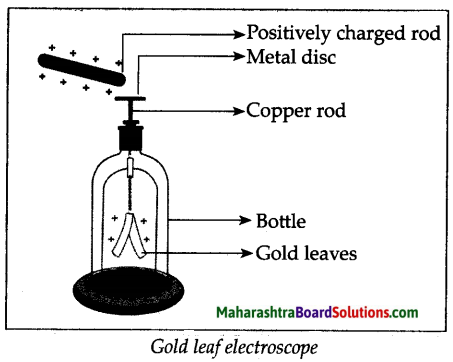
Maharashtra Board Class 7 Science Solutions Chapter 8 Static Electricity 1

  1. This is a simple device to detect the electric charge on object.
  2. It consists of a copper rod which has a metal disc at the upper end and two thin gold leaves at the other.
  3. The rod is placed in a bottle so that the disc is above the bottle.
  4. When an uncharged object is taken near the disc, the leaves remain closed.
  5. When a charged object is taken near the disc, both the leaves are charged by the same electric charge, and repel each other.
  6. When we touch the disc with our hand, the leaves collapse because the charge in the leaves goes into the earth through our body, and the leaves get discharged.

Use your brainpower:

Question 1.
Do all the objects get charged by rubbing?
Answer:
No. Only certain pairs of substances get charged on rubbing.

Maharashtra Board Class 7 Science Solutions Chapter 8 Static Electricity

Question 2.
Why does a charged balloon stick to a wall?
Answer:
A charged balloon stick to a wall because there is always attraction between a charged object and an uncharged object.

Question 3.
Can we use leaves of some other metal instead of gold, in the electroscope? Which properties must that metal have?
Answer:
We can use other metals than gold in gold leaf electroscope.

  1. Only thing is that metal should be malleable and good conductor of electricity.
  2. But the best is gold only because we can make extremely thin leaves of gold so even very small charge also can be detected.

Question 4.
What kind of damage is caused by a lightning strike?
Answer:
Due to lightning strike, great damage can occur. It may cause forest fire and burn down things. Person on whom lightning strikes may die. It causes more temperature than sun.

Question 5.
What measures will you take to prevent the damage caused by lightning?
Answer:
Following measures can be taken to prevent the damage caused by lightning:

  1. Always put lightning conductor on tall buildings.
  2. Do not stand on open ground, below a tree or near the electric or telephone pole during rain/ thunder storms.
  3. Do not lean on wired fences.
  4. Do not use plugged in electrical appliances.
  5. Do not swim during thunder storms.
  6. Stay in a pucca house with lightning conductor fitted on it.

Maharashtra Board Class 7 Science Solutions Chapter 8 Static Electricity

Question 6.
Why is the upper end of the lighting conductor pointed?
Answer:

  1. The pointed end makes it possible to increase the electric field near the point. The electric field set up at pointed end is high.
  2. If the discharge of cloud occurs it would be easily passed through the lightening conductor to the ground and damage to the building is averted.

Question 7.
Why is coal and salt added to the pit in the ground?
Answer:
Coal and salt is filled in the pit and also there is a provision for pouring water into it. This helps to spread electric charge quickly into ground and prevent damage.

Observe the given diagram and answer the questions given.
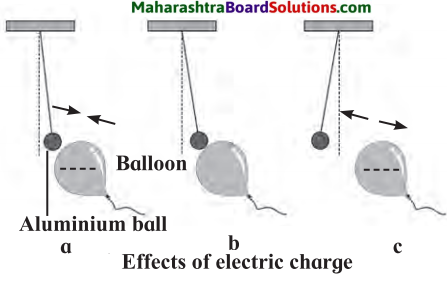
Maharashtra Board Class 7 Science Solutions Chapter 8 Static Electricity 2

Question a.
Name the phenomenon happening in the diagram and define it
Answer:
Phenomenon happening is static electricity.
When certain objects are rubbed against each other, they produce an electric charge on their surface at the place of friction. This is due to electrons which remain for a short time. This is called static electricity.

Maharashtra Board Class 7 Science Solutions Chapter 8 Static Electricity

Question b.
What do you observe in “b” and “c” part of the diagram?
Answer:
In ‘b’, we observe attraction between the charged balloon and the uncharged aluminium ball. In ‘c’, we observe that the charge has been transferred to the aluminium ball and due to the same (like) charge, repulsion is observed.
Maharashtra Board Class 6 Science Solutions Chapter 10 Force and Types of Force

Balbharti Maharashtra State Board Class 6 Science Solutions Chapter 10 Force and Types of Force Notes, Textbook Exercise Important Questions and Answers.

Maharashtra State Board Class 6 Science Solutions Chapter 10 Force and Types of Force

Class 6 Science Chapter 10 Force and Types of Force Textbook Questions and Answers

1. Choose the term and fill in the blanks:

Question a.
……….. has to be applied to change the ……….. of a ……….. object.
(moving, direction, force)
Answer:
force, direction, moving

Maharashtra Board Class 6 Science Solutions Chapter 10 Force and Types of Force

Question b.
When an elephant drags a wooden log over the land, the forces that are applied on the log are …………., ………. and …………. .
(muscular force, mechanical force, gravitational force, frictional force)
Answer:
muscular force, gravitationalforce, frictionalforce.

Question c.
A ball was set rolling on a large table. If its …….. has to be changed, a ……….. will have to be applied on it.
(force, motion, gravitation)
Answer:
motion, force

Question d.
The force of friction always acts ……….. the motion.
(along, against)
Answer:
against

Maharashtra Board Class 6 Science Solutions Chapter 10 Force and Types of Force

2. Match the following:

Question a.

Column ‘A’Column ‘B’
1. An ox pulling a carta. Magnetic force
2. Lifting heavy iron object with a craneb. Electrostatic force
3. Weighing with a spring balancec. Muscular force
4. Applying brakes to a bicycle.d. Gravitational force
5. Picking up pieces of paper with a plastic scale.e. Frictional force

Answer:

Column ‘A’Column ‘B’
1. An ox pulling a cartc. Muscular force
2. Lifting heavy iron object with a cranea. Magnetic force
3. Weighing with a spring balanced. Gravitational force
4. Applying brakes to a bicycle.e. Frictional force
5. Picking up pieces of paper with a plastic scale.b. Electrostatic force

Maharashtra Board Class 6 Science Solutions Chapter 10 Force and Types of Force

3. One or more forces are acting in the following examples. Name them.

Question a.
An object falling from a tall building …………. .
Answer:
Gravitational force

Question b.
An aeroplane flying in the sky. …………. .
Answer:
Mechanical force

Question c.
Sqeezing sugarcane juice with a squeezer. …………. .
Answer:
Muscular or mechanical force

Maharashtra Board Class 6 Science Solutions Chapter 10 Force and Types of Force

Question d.
Winnowing foodgrain …………. .
Answer:
Muscular force, gravitational force

4. Explain in your own words giving one example each.
Muscular force, gravitational force, mechanical force, electrostatic force, the force of friction and magnetic force.

Question a.
Muscular force:
Answer:
The force applied with the help of muscles is called muscular force.
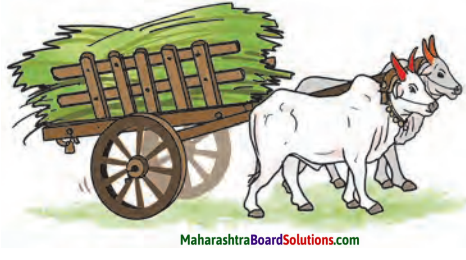
e.g. When a bullock pulls the load of a cart with sugarcane, he uses the force of his muscles that is muscular force.

Question b.
Gravitational force:
Answer:
The force applied by the earth to pull the objects towards itself is called gravitational force.
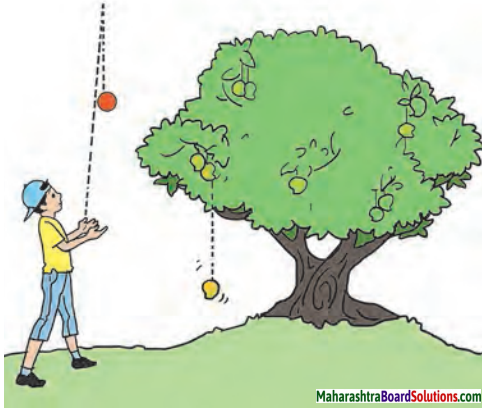
e.g. When a fruit falls from a tree, it is the gravitational force of the earth that pulls the fruit.

Maharashtra Board Class 6 Science Solutions Chapter 10 Force and Types of Force

Question c.
Mechanical force:
Answer:
The force applied by means of a machine is called mechanical force. Some machines run by muscular force while some use electricity or fuel.
e.g.Washing machine, electric pump uses electricity to work.

Question d.
Electrostatic force:
Answer:
Static electricity is produced on materials like rubber, plastic and ebonite due to friction. The force exerted by such electrically charged materials is called electrostatic force, e.g. When a plastic comb is rubbed against the dry hair, comb develops electrostatic charge.

Question e.
The force of friction:
Answer:
When two surfaces rub against each other, a force of friction is produced. This force always acts against direction of motion, e.g. A ball rolling over a flat surface stops at certain distance due to friction between the ball and the surface.

Question f.
Magnetic force:
Answer:
The force exerted by a magnet is called magnetic force.
e.g. In a pin holder, the magnet attracts the pins.

Maharashtra Board Class 6 Science Solutions Chapter 10 Force and Types of Force

5. Why?

Question a
Machines are oiled from time to time.
Answer:
To reduce the friction between the parts of machines, they are oiled. This will help efficient working of machines.

Question b.
An object thrown upwards comes down after reaching a point.
Answer:
An object is pulled by the gravitational force of the earth. Hence an object thrown upwards comes down after reaching at certain point.

Question c.
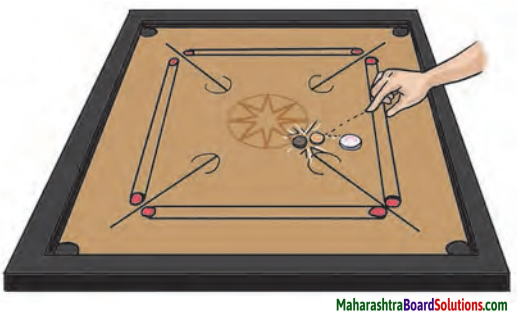
Powder is sprinkled on a carrom board.
Answer:
When powder is sprinkled on a carrom board, friction between the coin and the board decreases so that the coin can be pocketed easily.

Maharashtra Board Class 6 Science Solutions Chapter 10 Force and Types of Force

Question d.
The ramp at a railway station has a rough surface.
Answer:
The rough surface of the ramp increases the friction between feet and the surface. This helps us to walk on the ramp without skidding or falling.

6. In what way are we different? 

Question a.
Muscular force and Mechanical force
Answer:

Muscular forceMechanical force
1. The force applied with the help of muscles is called muscular force.
e.g. A boy kicking a football.
1. The force applied by means of machine is called mechanical force.
e.g. An electric pump works on electricity.
2. It is created by our muscles.2. It is created by electricity or fuel or muscular force

Maharashtra Board Class 6 Science Solutions Chapter 10 Force and Types of Force

Question b.
A force of friction and Gravitational force
Answer:

Force of frictionGravitational force
1. When two surfaces rub against each other, the force of friction comes into force.1. The force applied by the earth to pull an object towards itself, is called a gravitational force.
2. It comes to act between two surfaces.2. It exists between two objects or an object and the earth.

7. Write answers to the following questions in your own words. 

Question a.
What are the things that can be done by applying force?
Answer:
By applying force:

  1. we can set an object in motion.
  2. we can stop a moving object.
  3. we can change the speed or direction or both of a moving object.
  4. we can change the shape of an object.

Question b.
What is meant by weight?
Answer:

  1. The gravitational force acting on an object is called its weight.
  2. Greater force must be applied to lift a greater weight.

Maharashtra Board Class 6 Science Solutions Chapter 10 Force and Types of Force

Question c.
Which machines run on muscular force?
Answer:
The machines that run on muscular force are:

  1. Bicycle
  2. Hand cart
  3. Boat
  4. Cycle rickshaw
  5. Stretching of a spring
  6. Ball pen
  7. Vegetable chopper
  8. Sharpener
  9. Pulley
  10. Fruit peeler

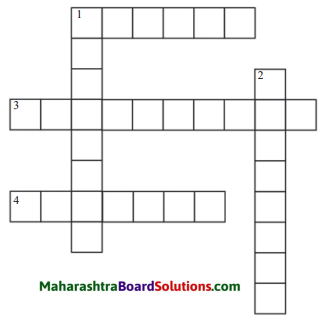
8. Solve the following crossword puzzle.

Question a.
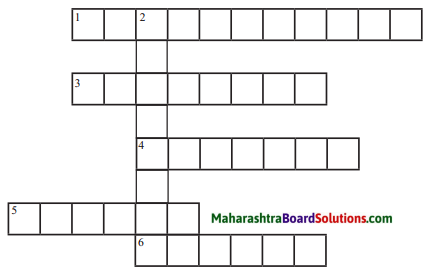
Solve the following crossword puzzle.

Maharashtra Board Class 6 Science Solutions Chapter 10 Force and Types of Force 1
Down:
1. ………. force is applied to push a scooter that has failed.
2. ………. force can be used to pick up scattered pins.

Across:
3. A ………. pulls iron nails towards itself.
4. ……….. force is used when farm is ploughed with a tractor.
5. It is due to the force of ………… that raindrops fall to the ground.
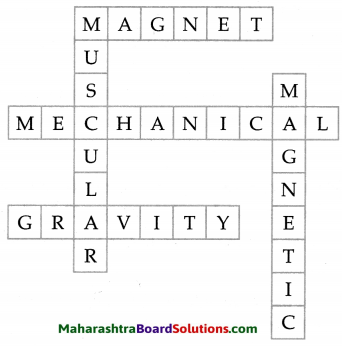
Answer:
Maharashtra Board Class 6 Science Solutions Chapter 10 Force and Types of Force 2

Activity:

Question 1.

Collect more information about the various forces that are used in our day-to-day life.

Question 2.
Make a list of such actions where many forces are applied simultaneously.

Class 6 Science Chapter 10 Force and Types of Force Important Questions and Answers

Choose the term and fill in the blanks:

Question 1.
When powder is sprinkled on a carrom board, friction ……….. .
(increases, decreases)
Answer:
decreases

Maharashtra Board Class 6 Science Solutions Chapter 10 Force and Types of Force

Question 2.
Electrostatic force is due to …………. .
(gravitation, friction)
Answer:
friction

Question 3.
Fruits fall on the ground due to ………… force.
(mechanical, gravitational)
Answer:
gravitational

Question 4.
Friction between two rough surfaces is …………. than between two smooth surfaces.
(greater, lesser)
Answer:
greater

Question 5.
The sound created by a stone dropped in a bucket of water from 100 cm height is ………… than that dropped from 20 cm height.
(milder, louder)
Answer:
louder

Maharashtra Board Class 6 Science Solutions Chapter 10 Force and Types of Force

Question 6.
A scooter has stopped in the middle of the road as the petrol tank has become empty. So Raju has to use …………. force to take it to petrol pump.
(mechanical, muscular)
Answer:
muscular

One or more forces are acting in the following examples. Name them.

Question 1.
Srikant is playing basketball
Answer:
Muscular force

Question 2.
Raju rubs a peacock feather between pages of his notebook
Answer:
Electrostatic force

Maharashtra Board Class 6 Science Solutions Chapter 10 Force and Types of Force

Question 3.
When you rub the palm of your hands, you feel the heat on the palms
Answer:
Frictional force

Question 4.
A blacksmith uses a hammer to beat the hot piece of iron
Answer:
Muscular force

Question 5.
A cricketer hits the ball, but it stops just before the boundary line
Answer:
Frictional force

Question 6.
We can walk on the road without falling down.
Answer:
Frictional force

Maharashtra Board Class 6 Science Solutions Chapter 10 Force and Types of Force

Give scientific reasons:

Question 1.
Magnet is used to lift heavy iron bar.
Answer:
A magnet attracts the iron bar. As a result it is easier to lift the heavy iron bar using magnetic force.

Question 2.
An inflated balloon when rubbed against a silk cloth, pulls the hair on our skin.
Answer:
When an inflated balloon is rubbed against a silk cloth, it develops electrostatic force due to friction. This force pulls the hair on our skin.

Question 3.
We are likely to slip when we walk on a oily or wet floor.
Answer:
Wet or oily floor reduces the friction between our feet and surface. Hence we are likely to slip on wet or oily floor.

Distinguish between:

Question 1.
Force of friction and Electrostatic force
Answer:

Force of frictionElectrostatic force
1. It exists between any two surfaces in contact.1. It develops where certain objects are rubbed  against certain material.
2. No electric charge is developed, sometimes heat is developed.
e.g. A brake is applied on a bicycle.
2. Electric charge is developed.
e.g. Thermocol rubbed against silk cloth.

Maharashtra Board Class 6 Science Solutions Chapter 10 Force and Types of Force

Answer the following:

Question 1.
Why do planets revolve round the sun in definite orbits?
Answer:

  1. The gravitational force operates between the sun and the planets in the solar system.
  2. Hence, they revolve round the sun in definite orbits.

Question 2.
Which forces are acting upon an aeroplane taking off into the sky?
Answer:
Aeroplane uses mechanical force, Pilot exerts muscular force. Frictional force between aeroplane and air, gravitational force due to weight of an aeroplane.

Question 3.
What happens to the iron nail when the magnet is taken away from it?
Answer:

  1. As we take the magnet away from the iron nail, it does not attract the iron nail as magnetic force decreases.
  2. Magnet is unable to exert force if the nail is not placed in the range of the magnetic field.

Maharashtra Board Class 6 Science Solutions Chapter 10 Force and Types of Force

Question 4.
When brakes are applied while riding a bicycle, it stops after running a distance. Why?
Answer:

  1. When brakes are applied while riding a bicycle, frictional force comes to act between the tyres of the bicycle and the surface.
  2. This force opposes the tendency of the bicycle to stop.
  3. Hence, the bicycle has to overcome this force before it stops.

Can you tell?

Question 1.
What happens when you hold the two ends of a spring and pull them apart?
Answer:
Its shape changes due to the force exerted by pull.

Question 2.
What happens when a blacksmith hammers a red hot piece of iron?
Answer:
Shape of iron piece changes.

Observe and discuss:

Observe the figures given and name the force needed for the motion.

Question 1.
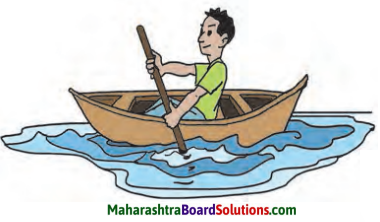
Boat with boatman.
Maharashtra Board Class 6 Science Solutions Chapter 10 Force and Types of Force 4
Answer:
Muscular force

Maharashtra Board Class 6 Science Solutions Chapter 10 Force and Types of Force

Question 2.
Bullock cart.
Maharashtra Board Class 6 Science Solutions Chapter 10 Force and Types of Force 5
Answer:
Muscular force

Question 3.
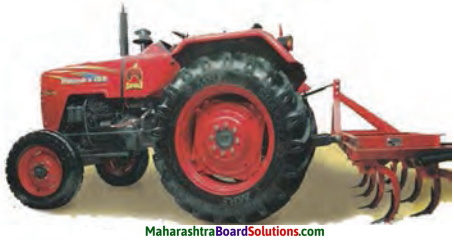
A tractor.
Maharashtra Board Class 6 Science Solutions Chapter 10 Force and Types of Force 6
Answer:
Mechanical force

Question 4.
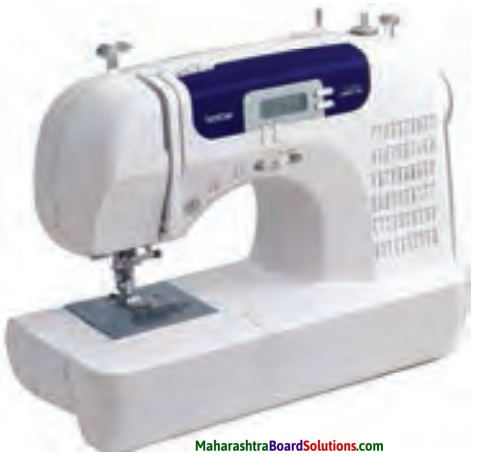
Sewing machine.
Maharashtra Board Class 6 Science Solutions Chapter 10 Force and Types of Force 7
Answer:
Mechanical force

Maharashtra Board Class 6 Science Solutions Chapter 10 Force and Types of Force

Question 5.
Fruit falling from tree.
Maharashtra Board Class 6 Science Solutions Chapter 10 Force and Types of Force 8
Answer:
Gravitational force

Question 6.
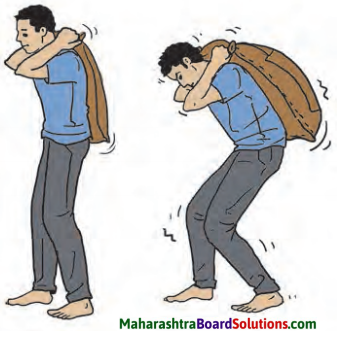
A man carrying heavy sac.
Maharashtra Board Class 6 Science Solutions Chapter 10 Force and Types of Force 3
Answer:
Gravitational force

Question 7.
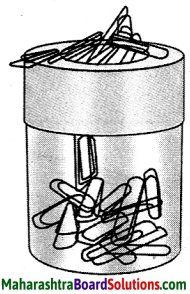
A pin holder.
Maharashtra Board Class 6 Science Solutions Chapter 10 Force and Types of Force 9
Answer:
Magnetic force

Question 8.
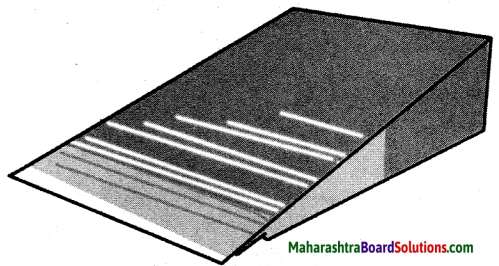
A ramp.
Maharashtra Board Class 6 Science Solutions Chapter 10 Force and Types of Force 10
Answer:
Gravitational force

Maharashtra Board Class 6 Science Solutions Chapter 10 Force and Types of Force

Question 9.
Carrom board.
Maharashtra Board Class 6 Science Solutions Chapter 10 Force and Types of Force 11
Answer:
Frictional force

Question 10.
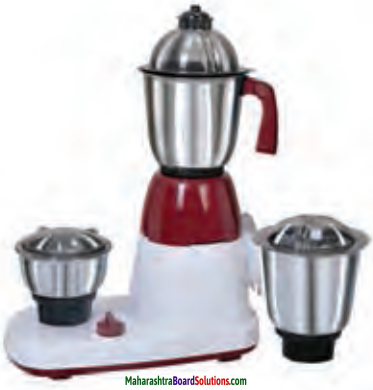
Mixer grinder.
Maharashtra Board Class 6 Science Solutions Chapter 10 Force and Types of Force 12
Answer:
Mechanical force

Maharashtra Board Class 10 Marathi Kumarbharti Solutions Chapter 2 बोलतो मराठी…

Balbharti Maharashtra State Board Class 10 Marathi Solutions Kumarbharti Chapter 2 बोलतो मराठी… Notes, Textbook Exercise Important Questions and Answers.

Maharashtra State Board Class 10 Marathi Kumarbharti Chapter 2 बोलतो मराठी…

Marathi Kumarbharti Std 10 Digest Chapter 2 बोलतो मराठी… Textbook Questions and Answers

प्रश्न, पुढील उताश वाचा आणि दिलेल्या सूचनांनुसार ती करा:

कृती १: (आकलन)

प्रश्न 1.
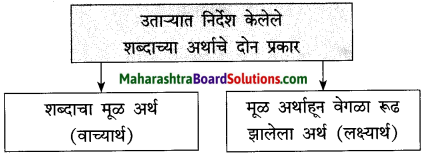
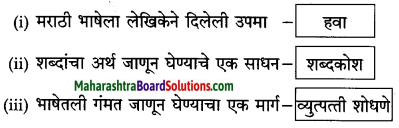
आकृत्या पूर्ण करा :
(i)
Maharashtra Board Class 10 Marathi Solutions Chapter 2 बोलतो मराठी… 1
उत्तर :
Maharashtra Board Class 10 Marathi Solutions Chapter 2 बोलतो मराठी… 2

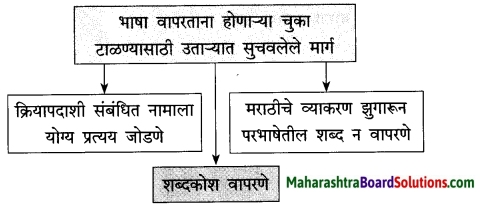
(ii)
Maharashtra Board Class 10 Marathi Solutions Chapter 2 बोलतो मराठी… 3
उत्तर :
Maharashtra Board Class 10 Marathi Solutions Chapter 2 बोलतो मराठी… 4

(iii)
Maharashtra Board Class 10 Marathi Solutions Chapter 2 बोलतो मराठी… 5
उत्तर :
Maharashtra Board Class 10 Marathi Solutions Chapter 2 बोलतो मराठी… 6

Maharashtra Board Class 10 Marathi Solutions Chapter 2 बोलतो मराठी…

प्रश्न 2.
विनोद करणाऱ्या नव्याने पुढील वाक्याचा लावलेला अर्थ लिय :
तुम्हांला मी उत्तप्या बनवू का?
उत्तर :
मी तुमचे उत्तायामप्ये गपांतर वर का?

प्रश्न 3.
क्यों वो वाक्यातून विपरीत अर्य व्यक्त होतो. त्यामागील कारण तिहा.
उत्तर :
मराठी शब्दाचा व अर्थ बाजूला साशन त्या शब्दाला असलेला परभाषेतला अर्थ घेऊन वाक्ये तयार केली जातात, त्यामुळे विपरीत अर्थ व्यसा होतो.

उतारा क्र.१ : (पाठापुस्तक पृष्ठ क्र. २)

परवा वर्तमानपत्रात एक विनोद आता सेना.
बायको : “तुम्हांला, मी उत्तप्पा बनयू का?”
नवा : “नको. मी माणूसब टीक आहे. आली मोठी जादूगार !”

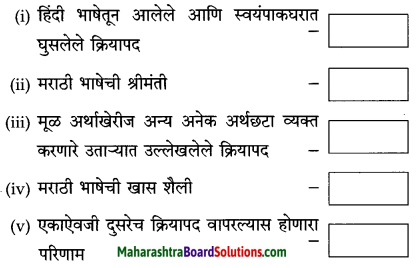
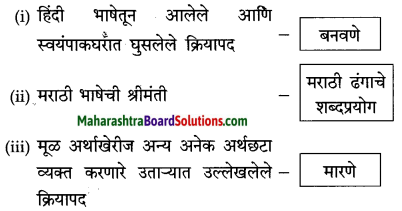
आता इथे विनोद निमांग झाला आहे. कारण ‘बनवणे हे क्रियापद निशे शोभणारे नाही. ते हल्ली हिंदी भाषेतून आपल्या स्वयंपाकपरा नको शार्क पुसतं आहे. मराठीत पोळया लारपे, भानी कोहगीत टाकणे, कडी करपे, पान संपणे, कुकर लायगे अशा वेगवेगळ्या क्रियांसाठी वेगवेगळे शब्दप्रयोग आहेत; पण हल्ती सगळे पदार्थ करत ‘बनवते’ जातात. मादीन ‘बनये’ म्हणजे ‘फायगे’ असा अर्थ खरं तर स्व आहे, त्यामुळे माणसायं माझ्ट आणि पुन्हा माकडाचा माणूस बनवणारा जादूगार, विनोद करणाऱ्या नवऱ्याला आठवला, तर आश्चर्य नाही.

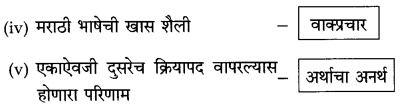
मराठी रंगाचे शब्दप्रयोग ही आपल्या भाषेची श्रीमंती आहे. माठीत मारणे हे एक क्रियापद घेतले, ता ते किती वेगवेगळ्या प्रकारे वापरले जाते. हे लक्षात घेण्याजोगी आहे. जसे, गप्पा मारणे, उड्या मारगे, पापा मारणे, दिनकी मारणे, शिट्टी मारणे, पाकीट मारणे, वेवणावर ताव मारणे, (पोहताना) हातपाय मारणे. माझ्या मारपे इत्यादी, ‘मारणे’ भणजे मार देणे’ हा अचं यात कोठेही आलेला नाही. हीच तर भाषेची गंमत असते.

सन्दप्रयोगाप्रमाणे भावना हीदेखील भाषेनी खास शैली असते. ‘यस्ता खाणे ‘मचे वास्ता हा साक्षापदार्थ नाही. हे माहीत आहे ना? तसेच कंतम्नान घालणे’ समाचार युदाणाविषयीच्या यातायामप्ये असतो. कंठस्नान पाणगे महावे गयाखातून ‘अंघोळ थालगे’, असा शब्दशः अ. नाही, ‘घांदयाला यांदा सावणे’ (सहकार्य करणे) आणि ‘खांदा देणे’ (प्रेताला खांदा देणे) यांतला फरकही लक्षात घ्यायला कदा, एकाऐवजी दुसरे क्रियापद वापरले, तर अर्थाचा अर्थ होईल. अशी अनेक उदाहरणे देता येतील. त्यासाठी शब्दकोश वापरम्पाची सकप कापला की, ‘अक्कलवान’ म्हणजे शार; पण ‘अकलेचा कांदा’ म्हणजे ‘अतिशहाणा’ हे माहीत नसेल, तर कोण आपले खो कौतुक करतोय की फिरकी घेतोय, हेच आपल्याला कळणार नाही.

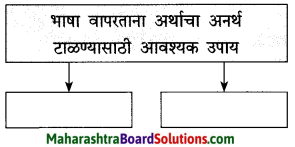
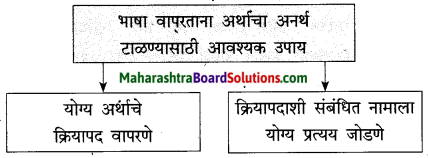
क्रियापद बापाताना त्यापूर्वी नामाला कोमता प्रत्यप लावायचा असतो, हे नीट माहीत नाले तरीदेखील अर्थाचा गोंधळ होतो. उदा., अंगाला लावणे आणि अंगावर घेणे, शिला हसगे (तिची नेष्टा करणे या अर्थी) आणि तिच्याशी हसणे (सहजपणे हमाणे) गांन प्रत्यय महत्त्वाचा आहे. हल्ली सार्वजनिक समारंभांमध्ये आगि वाहिन्यांवर प्रत्ययांची जागा अनेकदा कुकलेली असते. उदा., “तुझी मदत करणे’ याऐवजी ‘तुला मदत करणे’ हवे. “न्यांचे पन्यवाद’ पाऐवजी त्यांना पन्यवाद” असे म्हणायला हवे.

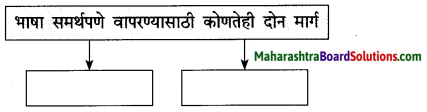
पायेमध्ये अनेक शब्द सतत पेत असतात, कारण तो नदीसारखी प्रणाली असते. आपणही संगणकासंबंधी अनेक नवे इंग्रजी शब्द मातत्याने आत्मसात केले आहेत. मराठीने आजवर संस्कृत, फारसी, अरबी, कन्नड़, इंग्रजी अशा अनेक भाषांमपले शब्द आपले मानले आहेत. ‘टेबल’ हा शब्द आता आपल्याला पाका वाटत नाही; पण गरज असताना इतर भाषांमपले शब्द आणि नेही जैं केली’ म्हणण्यातून काय नवीन अर्थ करतो? लाऐवजी ‘मी अभ्यास केला’ मम चोय नाही का?

नोंद : प्रस्तुत पुस्तकातील स पहिष्णा कृति-स्वाध्याय आहे. लामुळे या पाठातील स्वाध्यायात संपूर्ण वारा दिलेला आहे. यापुढे | मात्र प्रत्येक पाठातील स्वाध्यापांत संपूर्ण मारा न देता सान्याचे सुरवातीचे काही शब्द व शेवटचे काही शब्द दिलेले आहेत. विद्याभ्यांनी पाठयपुस्तकातून पूर्ण उतारा वाचावा.

मीक्षेत १३० ते १५० शब्दांचा उतारा दिला जाईल. इये विवाथ्यांच्या सोयीसाठी थोडा मोठा सारा दिलेला आहे. कारण त्यामुळे अधिक कृती देता येणे शक्य झाले आहे.

Maharashtra Board Class 10 Marathi Solutions Chapter 2 बोलतो मराठी…

कृती २ : (आवलन)

प्रश्न 1.
उताऱ्याच्या आधाने पुढील चोवटी पूर्ण करा :
Maharashtra Board Class 10 Marathi Solutions Chapter 2 बोलतो मराठी… 7
उत्तर :
Maharashtra Board Class 10 Marathi Solutions Chapter 2 बोलतो मराठी… 8
Maharashtra Board Class 10 Marathi Solutions Chapter 2 बोलतो मराठी… 9

प्रश्न 2.
हल्ली आढळून पेणाऱ्या आपल्या लोकांच्या दोन चुकीच्या भाषिक सक्यो सांगा.
उत्तर :

  • वेगवेगळ्या कृतांसाठी वेगवेगळे शब्द वापरात असताना, स्या कोंसाठी केवळ एकच शब्द बोलला जातो.
  • गरज नसताना अन्य भाषांतील शब्दांचा वापर केला जातो.

कृती ३ : (व्याकरण)

प्रश्न 1.
वेगवेगळ्या अर्थछटा व्यक्त करण्यासाठी चापाले नागारे तुम्हांला माहीत असलेले क्रियापद सोदाहरण लिहा. (फमा ४ अर्थछटा)
उत्तर :

  • महापालिकेने एकान दिवसात तीनशे बेकायदेशीर यांपकामे पाडलि.
  • छपरावर वाळत घातलेले पापड कानळ्यांनी खालि पाडले.
  • चक्कीवरून दळण आणताना गोपू पीच पाहत पाहतच घरी आला.
  • विरोधी पक्षाच्या उमेदवाराने मंत्र्याला प्रचंड बहुमानाने पाडले.

प्रश्न 2.
‘वाटणे’ हे क्रियापद नापल नेगवेगळ्या अर्थाची दोन वाक्ये तपार कता.
उत्तर :

  • मी केलेल्या त्या नुकीनी मला साल वाटली. (बाटणे : भावना जापत्य)
  • पास झाल्याबद्दल रश्मीचे पेढे वारले. (वाटणे : देण्याची कृती)

Maharashtra Board Class 10 Marathi Solutions Chapter 2 बोलतो मराठी…

कृती ४ : (स्वयत/ अभिव्यक्ती)

प्रश्न 1.
भाषा सतत बदलत असले, याची कारणमीमांसा दया.
उत्तर :
एखाच्या परिस्तात राहणाव्या लोगांचा एक समाज बनतो. त्यांची पापा एकच असते. विख्यातले शब्द, वाश्य पढवण्याचे नियम हे ती भाषा बोलणाऱ्या सगळयांना ठाऊक असतात. मात्र, प्रत्येक पिढीमध्ये त्या त्या ठिकागाच्या भाषेमध्ये यूक्ष्मपणे बदला सेन जसजसा लोकांचा विकास होतो, तसतशी त्यांची भाषामुपा विकसित होत जाते. आधुनिक काळात अनेक गमार एकमेकांच्या अबळ नांदतात. एकमेकांत मिसळतात. या मेगवेगळ्या समाजांचा प्रभाव एकमेकांच्या भाषेवर पडतो. प्रांक भाषा अशी बदलत राहते. म्हणून कोणतीही भाषा कपीही स्थिर नलो. तीन सातवाने बदल होत राहतो. काळ बदलतो, तशी लोकांची जगण्याची रीन बदलते.

त्यामुळे भाषेतले शब्द बदलतात. जुने शब्द लोप पावतात, जवान शब्दांची भर पडते. अन्य भाषांमपीत शब्द-संकल्पना स्थानिक भाषेत सामावले जातात, स्थानिक भाषेतील शब्द-संकल्पना अन्य भाषांमध्ये शिरतात. अशा प्रकारे प्रत्येक भाषा प्रत्येक क्षणी बदलत असते.

प्रश्न 2.
स्वत:च्या भाषेवर प्रभुत्व मिळवणे म्हणजे स्वा:च्या भाषेचा सन्मान करणे होय’, हे विधान समजावून सांगा.
उत्तर :
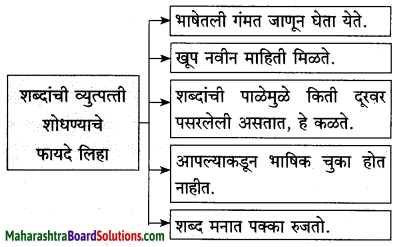
स्वत:च्या भाषेवा सन्मान आपण कसा करणार? सर्वात प्रथम म्हणजे मी माझी स्वाःची भाषा उत्तम रितीने आत्यपान कौन. माझे सन विचार, भावना माझ्या भाषेत कसोशीने व्यक्त करम्पाना प्रयत्न कनीन, माझी भाषा उत्तम येण्यासाठी मी माझ्या भाषेतील वर्तमानपत्रे, नियतकालिके पांचे नियमित वाचन करीन. माझ्या पायेतीत अनमोलन साहित्याचा आस्वाद घेत रडीन, भाषा चांगल्या रितीने आत्मपान करण्यासाठी शब्दकोश, व्युत्पत्ती कोश यांसारख्या पोशांचा वेळोवेळी मनापासून उपयोग करीत. यामुळे माझे माझ्या भाषेवरील प्रमुख वाडेल. अशा प्रकारे स्वत:च्या भाषेवरीत प्रभुत्व बाहरणे म्हणजे त्या भाषेचा सन्मान करणे होय.

Marathi Kumarbharti Class 10 Textbook Solutions Chapter 2 बोलतो मराठी… Additional Important Questions and Answers

प्रश्न. पुढील उतारा वाचा आणि दिलेल्या मूचनांनुसार कृती करा :

कृती १ : (आकलन)

प्रश्न 1.
आकृत्या पूर्ण करा:
Maharashtra Board Class 10 Marathi Solutions Chapter 2 बोलतो मराठी… 10
उत्तर :
Maharashtra Board Class 10 Marathi Solutions Chapter 2 बोलतो मराठी… 11

प्रश्न 2.
Maharashtra Board Class 10 Marathi Solutions Chapter 2 बोलतो मराठी… 12
उत्तर :
Maharashtra Board Class 10 Marathi Solutions Chapter 2 बोलतो मराठी… 13

Maharashtra Board Class 10 Marathi Solutions Chapter 2 बोलतो मराठी…

प्रश्न 3.
पाठाच्या आधारे पुढील चौकी पूर्ण करा :
Maharashtra Board Class 10 Marathi Solutions Chapter 2 बोलतो मराठी… 14
उत्तर :
Maharashtra Board Class 10 Marathi Solutions Chapter 2 बोलतो मराठी… 15

कृती २ : (आकलन)

प्रश्न 1.
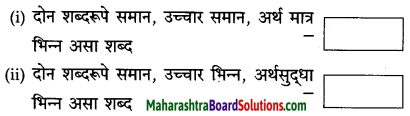
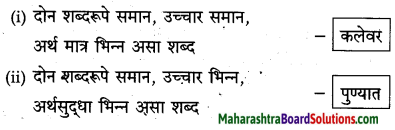
कंसातील योग्य शब्द योजून रिकाम्या चौकटी भरा :
(कलेवर, सूतकताई, पुण्यात, मोरांबा)
Maharashtra Board Class 10 Marathi Solutions Chapter 2 बोलतो मराठी… 16
उत्तर :
Maharashtra Board Class 10 Marathi Solutions Chapter 2 बोलतो मराठी… 17

प्रश्न 2.
लेखिकांच्या मते, भाषेवरील प्रेमासाठी पुढील कृती केल्या पाहिजेत :
(i) …….. (ii) ……… (iii) ………. (iv) ……….
उत्तर :
(i) भाषेतली शक्तिस्थळे जाणून घेतली पाहिजेत.
(ii) भाषेचा योग्य सन्मान राखायला हवा.
(iii) भाषेशी जिव्हाळ्याचे नाते राखायला हवे.
(iv) भाषेचे ज्ञानही मिळवायला हवे.

कृती ३ : (व्याकरण)

प्रश्न 1.
‘सम + आरंभ = समारंभ’ या प्रकारातील संधीची आणखी दोन उदाहरणे लिहा.
उत्तर :
(i) अन् + आदर = अनादर
(ii) सत् + आचार = सदाचार

प्रश्न 2.
‘शब्दरूपे’ या प्रकारच्या समासाची दोन उदाहरणे विग्रहासह लिहा.
उत्तर :
(i) शालागृह : शाळेचे गृह, षष्ठी तत्पुरुष.
(ii) विद्यार्थिदशा : विदयार्थ्याची दशा, षष्ठी तत्पुरुष.

Maharashtra Board Class 10 Marathi Solutions Chapter 2 बोलतो मराठी…

कृती ४ : (स्वमत / अभिव्यक्ती)

प्रश्न 1.
लेखिकांनी मराठी भाषेचा केलेला सन्मान तुमच्या शब्दांत लिहा.
उत्तर :
लेखिकांनी मराठी भाषेला श्रीमंत म्हटले आहे. होय, माझी मराठी श्रीमंत आहे. मला या गोष्टीचा प्रचंड अभिमान वाटतो.

माझ्या भाषेकडे बारकाईने पाहा. विविध ढंगांचे शब्दप्रयोग ही माझ्या भाषेची खासियत आहे. अनेकदा एकच शब्द अनेकानेक अर्थछटा प्रकट करतो. ‘चालणे’ हे साधे क्रियापद बघा. प्रत्यक्ष पायांनी चालणे या अर्थाशिवाय आणखी अनेक अर्थछटा ‘चालणे’ या क्रियापदादवारे व्यक्त करता येतात. उदाहरणार्थ, लुट्लट्र चालणे, लबाडी चालणे, नोटा-नाणी चालणे, एखादे तत्त्व चालणे, एखादया रितीनुसार चालणे, घड्याळ चालणे वगैरे वगैरे. अशी किती वाक्ये सांगू? वाक्प्रचार हा माझ्या भाषेचा खास गोडवा आहे. माझ्या भाषेने अनेक भाषांमधील शब्द स्वत:च्या हृदयात सामावून घेतले आहेत. म्हणून माझी भाषा अधिकाधिक श्रीमंत होत चालली आहे.

प्रश्न 2.
मराठी भाषेबद्दलच्या तुमच्या भावना स्पष्ट करा.
उत्तर :
आपण सर्वजण सतत एकमेकांना काहीतरी सांगण्याचा प्रयत्न करतो. म्हणजे आपले मनच आपण इतरांसमोर प्रकट करीत असतो. याचा अर्थ, कोणतीही भाषा म्हणजे ती बोलणाऱ्या माणसांचे मन असते.

आपले समृद्ध जीवन आपल्या भाषेत व्यक्त होते तेव्हा ती भाषा समृद्ध होते. पण हे असे केव्हा होईल? तर जेव्हा माझे मन मी पूर्णांशाने, अगदी बारीक-सारीक तपशिलांसह माझ्या भाषेत व्यक्त करू शकेन तेव्हाच. अशा प्रकारे मन व्यक्त करण्याचे सामर्थ्य माझ्या भाषेत नक्कीच आहे. माझ्या भाषेत खास मराठी वळणाचे शब्दप्रयोग आहेत. वाक्प्रचार ही तर माझ्या मराठीची खासियत आहे. अनेकदा एकच शब्द अनेक अर्थछटा सहज प्रकट करू शकतो. माझ्या भाषेत अनेक भाषांमधील शब्द सामावले गेले आहेत. त्यामुळे मी माझे सर्व भाव खुलवून मांडू शकतो. सूक्ष्मपणे मांडू शकतो. इतकी श्रीमंत भाषा ही माझी भाषा आहे, हे माझे भाग्यच आहे.

प्रश्न 3.
‘तुम्ही शहाणे आहात,’ या वाक्यातील ‘शहाणे’ या शब्दाच्या अर्थछटा लिहा.
उत्तर :
‘तुम्ही शहाणे आहात,’ असे अनेकदा म्हटले जाते. त्या वेळी ऐकणाऱ्याच्या समजूतदारपणावर, त्याच्या विवेकावर बोलणाऱ्याचा विश्वास असतो. आई आपल्या मुलांना हे उद्गार ऐकवते, तेव्हा तिच्या मनात आपल्या मुलांबद्दल अशीच खात्री असते.

मात्र प्रत्येक वेळेला ‘तुम्ही शहाणे आहात,’ या वाक्याचा असा सरळ, प्रांजळ व निष्कपट अर्थ असतोच, असे नाही. काही व्यक्ती मुळातच लबाड असतात. चूक लपवण्यासाठी बुद्धीचा दुरुपयोग करतात. कधी कधी तर काही माणसांना खरोखरच साधी, सोपी गोष्टही कळत नाही. कितीही समजावून सांगितले, तरी त्यांना ते समजतच नाही. मग त्यांना ‘तुम्ही शहाणे आहात,’ असे ऐकवावे लागते. येथे ‘शहाणे’ हा शब्द वापरलेला असला तरी आपण मनातल्या मनात ‘तुम्ही मूर्ख आहात,’ असेच म्हणत असतो.

Maharashtra Board Class 10 Marathi Solutions Chapter 2 बोलतो मराठी…

प्रश्न 4.
गरज नसताना इतर भाषांमधील शब्द वापरून बोलू नये,’ या लेखिकेच्या मताबाबत तुमचे मत सोदाहरण लिहा.
उत्तर :
परभाषेतून आपल्या भाषेत अनेक नवीन शब्द आले आहेत, ते केव्हाच मराठी झाले आहेत. ते मराठी शब्द नाहीत, अशी कोणाला शंकाही येणार नाही.

मात्र काही वेळा परभाषेतील शब्द अकारण वापरले जातात. आणि तेसुद्धा आपल्या भाषेत त्यासाठी अत्यंत सार्थ, समर्पक शब्द असताना! अलीकडे “ती पिवळीवाली दया,” “तो पांढरावाला पट्टा दाखवा’ अशी वाक्ये सर्रास ऐकू येतात. वास्तविक पाहता ‘पिवळी बॅग’ आणि ‘पिवळीवाली बॅग’ यांत कोणता फरक आहे? ‘पिवळी बॅग’ या शब्दप्रयोगातून आधीपासूनच योग्य अर्थ व्यक्त होत असताना ‘पिवळीवाली’ हा नवीन शब्दप्रयोग का करावा? मराठीत आपण असे बोलतच नाही. मराठीत ‘वाला’ हा प्रत्यय फक्त नामाला जोडला जातो. “पिवळी’ हे विशेषण आहे. मराठीत विशेषणाला किंवा सर्वनामाला ‘वाला’ हा प्रत्यय जोडण्याची प्रथाच नाही. शिवाय त्या नवीन शब्दप्रयोगाने अर्थामध्ये कोणतीही भर पडत नाही. म्हणून गरज नसताना परभाषेतील शब्द वापरून बोलू नये, हे लेखिकांचे मत योग्यच आहे.

व्याकरण व भाषाभ्यास

कृतिपत्रिकेतील प्रश्न ४ (अ) आणि (आ) यांसाठी…

अ. व्याकरण घटकांवर आधारित कृती:

समास

समासात कमीत कमी दोन शब्द असतात. हे दोन शब्द एकत्र करून जो जोडशब्द तयार होतो, त्यास सामासिक शब्द म्हणतात. या सामासिक शब्दाची फोड करून दाखवणाऱ्या पद्धतीला विग्रह म्हणतात.
उदा., शब्द + शब्द = सामासिक शब्द – विग्रह
(१) प्रति + दिन = प्रतिदिन – प्रत्येक दिवशी
(२) विदया + आलय = विदयालय – विदयेचे आलय (घर) .
(३) राम + लक्ष्मण = रामलक्ष्मण – राम आणि लक्ष्मण
(४) नील + कंठ = नीलकंठ – निळा आहे ज्याचा कंठ तो (शंकर)

समासाचे प्रकार :
1. समासातील शब्दांना ‘पद’ म्हणतात.
पहिला शब्द → पहिले पद.
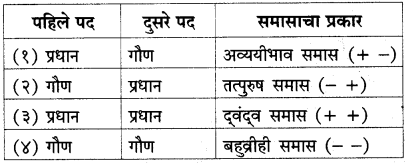
दुसरा शब्द → दुसरे पद. समासातील कोणते पद महत्त्वाचे किंवा प्रधान आणि कमी महत्त्वाचे किंवा गौण आहे, यावरून समासाचे चार प्रकार पडतात. [प्रधान पद +/गौण पद -]

समासाचे चार मुख्य प्रकार होतात :
Maharashtra Board Class 10 Marathi Solutions Chapter 2 बोलतो मराठी… 18
[या इयत्तेत आपल्याला अव्ययीभाव, तत्पुरुष (विभक्ती व द्विगू) आणि द्वंद्व हे समास शिकायचे आहेत.]

(१) अव्ययीभाव समास :

  • ज्या समासातील पहिले पद प्रधान असते व सामासिक – शब्द क्रियाविशेषण अव्ययाचे कार्य करतो, त्यास अव्ययीभाव समास म्हणतात.

उदा., आजन्म, दररोज, बिनचूक, यथाशक्ती, बेशिस्त, दारोदार, प्रतिदिन इत्यादी.

(२) तत्पुरुष समास :
(१) विभक्ती तत्पुरुष :
ज्या समासातील दुसरे पद प्रधान असून, ज्या सामासिक शब्दांमधील विभक्ती प्रत्यय गाळलेले असतात, त्यास विभक्ती तत्पुरुष समास म्हणतात.
उदा., तोंडपाठ (तोंडाने पाठ), क्रीडांगण (क्रीडेसाठी अंगण), विदयालय (विदयेचे आलय), घरकाम (घरातील काम) इत्यादी.

(२) द्विगू समास :
ज्या समासातील दुसरे पद प्रधान असून, पहिले पद संख्याविशेषण असते, त्यास द्विगू समास म्हणतात. उदा., त्रिभुवन, चौकोन, पंचपाळे, दशदिशा, नवरात्र इत्यादी.

(३) वंद्व समास :
ज्या समासातील दोन्ही पदे प्रधान असतात, त्यास द्वंद्व समास म्हणतात.
उदा., आईवडील, खरेखोटे, केरकचरा इत्यादी.
द्वंद्व समासाचे प्रकार :
(१) इतरेतर द्वंद्व : ज्या सामासिक शब्दाचा विग्रह करताना ‘आणि’, ‘व’ या उभयान्वयी अव्ययांचा उपयोग करतात, त्यास इतरेतर द्वंद्व समास म्हणतात. उदा., आईवडील (आई आणि वडील); रामलक्ष्मण (राम आणि लक्ष्मण)

(२) वैकल्पिक वंद्व : ज्या सामासिक शब्दाचा विग्रह करताना ‘किंवा’, ‘अथवा’ या उभयान्वयी अव्ययांचा वापर केला जातो, त्यास वैकल्पिक वंद्व समास म्हणतात. (यात बहुधा परस्परविरोधी पदे असतात.) उदा., खरेखोटे (खरे किंवा खोटे), सुखदुःख (सुख किंवा दुःख) इत्यादी.

(३) समाहार वंद्व : ज्या सामासिक शब्दात अनेक गोष्टींचा समावेश असतो व ज्याचा विग्रह करताना ‘वगैरे, इतर’ या शब्दांचा वापर केला जातो, त्यास समाहार दवंदव समास म्हणतात. उदा., गप्पागोष्टी (गप्पा, गोष्टी वगैरे), मीठभाकर (मीठ, भाकर व इतर पदार्थ) इत्यादी.

Maharashtra Board Class 10 Marathi Solutions Chapter 2 बोलतो मराठी…

१. समास :
पुढील सामासिक शब्दांचा विग्रह करा :
प्रश्न 1.
आजन्म
उत्तर:
आजन्म – जन्मापासून

प्रश्न 2.
मोरपीस
उत्तर :
मोरपीस – मोराचे पीस

प्रश्न 3.
त्रिभुवन
उत्तर :
त्रिभुवन – तीन भुवनांचा समूह

प्रश्न 4.
खरेखोटे
उत्तर :
खरेखोटे – खरे किंवा खोटे

प्रश्न 5.
विटीदांडू .
उत्तर :
विटीदांडू – विटी आणि दांडू

प्रश्न 6.
गुरेवासरे.
उत्तर :
गुरेवासरे – गुरे, वासरे वगैरे.

Maharashtra Board Class 10 Marathi Solutions Chapter 2 बोलतो मराठी…

२. शब्दसिद्धी :

प्रश्न 1.
‘अति’ हा उपसर्ग लागलेले चार उपसर्गघटित शब्द लिहा.
उत्तर :

  • अतिशहाणा
  • अतिसुंदर
  • अतिआनंद (अत्यानंद)
  • अतिआवश्यक (अत्यावश्यक).

प्रश्न 2.
‘वान’ हा प्रत्यय लागलेले चार प्रत्ययघटित शब्द लिहा.
उत्तर :

  • गुणवान
  • धनवान
  • गाडीवान
  • अक्कलवान.

प्रश्न 3.
सामान्यरूप :
पुढील शब्दांतील सामान्यरूपे ओळखा :
(i) भाषेची
उत्तर :
भाषे

(ii) घरात (मार्च ‘१९)
उत्तर :
घरा

(iii) विनोदाने
उत्तर :
विनोदा

(iv) महोत्सवाला
उत्तर :
महोत्सवा

(v) जिभेला (मार्च ‘१९).
उत्तर :
जिभे.

Maharashtra Board Class 10 Marathi Solutions Chapter 2 बोलतो मराठी…

प्रश्न 4.
वाक्प्रचार :
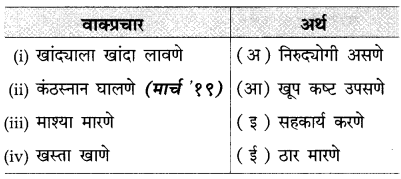
वाक्प्रचार व अर्थ यांच्या जोड्या लावा :
Maharashtra Board Class 10 Marathi Solutions Chapter 2 बोलतो मराठी… 19
उत्तर :
(i) खांदयाला खांदा लावणे – सहकार्य करणे.
(ii) कंठस्नान घालणे – ठार मारणे.
(iii) माश्या मारणे – निरुदयोगी असणे.
(iv) खस्ता खाणे – खूप कष्ट उपसणे.

आ. भाषिक घटकांवर आधारित कृती

१. शब्दसंपत्ती :

प्रश्न 1.
समानार्थी शब्द लिहा :
(i) कंठ
उत्तर :
कंठ = गळा

(ii) मयूर
उत्तर :
मयूर = मोर

(iii) नदी
उत्तर :
नदी = सरिता

(iv) पाऊस.
उत्तर :
पाऊस = पर्जन्य.

प्रश्न 2.
Maharashtra Board Class 10 Marathi Solutions Chapter 2 बोलतो मराठी… 20
उत्तर :
Maharashtra Board Class 10 Marathi Solutions Chapter 2 बोलतो मराठी… 21

प्रश्न 3.
पुढे दिलेल्या अनेकवचनी नामांचे एकवचनी रूप लिहून त्यांचा वापर करून प्रत्येकी एक वाक्य तयार करा :
(i) रस्ते
उत्तर :
रस्ते – रस्ता.
वाक्य : डोंगरावरचा रस्ता वळणदार आहे.

(ii) वेळा
उत्तर :
वेळा – वेळ.
वाक्य : परीक्षेची वेळ जवळ आली.

(iii) भिंती
उत्तर :
भिंती – भिंत.
वाक्य : रंग लावलेली भिंत छान दिसते.

(iv) विहिरी
उत्तर :
विहिरी – विहीर.
वाक्य : आमची विहीर खूप खोल आहे.

(v) घड्याळे
उत्तर :
घड्याळे – घड्याळ.
वाक्य : बाबांनी मला नवीन घड्याळ आणले.

(vi) माणसे.
उत्तर :
माणसे – माणूस.
वाक्य : पावसात एकही माणूस घराबाहेर पडला नाही.

Maharashtra Board Class 10 Marathi Solutions Chapter 2 बोलतो मराठी…

प्रश्न 4.
गटात न बसणारा शब्द ओळखून चौकट पूर्ण करा :
(i) ऐट, डौल, रूबाब, चैन.
उत्तर :
चैन

(ii) कपाळ, हस्त, ललाट, भाल.
उत्तर :
हस्त

(iii) विनोद, नवल, आश्चर्य, विस्मय.
उत्तर :
विनोद

(iv) संपत्ती, संपदा, कांता, दौलत.
उत्तर :
कांता

(v) प्रख्यात, प्रज्ञा, नामांकित, प्रसिद्ध.
उत्तर :
प्रज्ञा

प्रश्न 5.
पुढील शब्दसमूहाबद्दल एक शब्द लिहा :
(i) पसरवलेली खोटी बातमी
उत्तर :
अफवा

(ii) ज्याला मरण नाही असा
उत्तर :
अमर

(iii) समाजाची सेवा करणारा
उत्तर :
समाजसेवक

(iv) संपादन करणारा
उत्तर :
संपादक

प्रश्न 6.
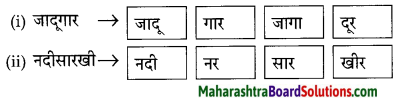
पुढील शब्दांतील अक्षरांपासून चार अर्थपूर्ण शब्द लिहा :
Maharashtra Board Class 10 Marathi Solutions Chapter 2 बोलतो मराठी… 22
उत्तर :
Maharashtra Board Class 10 Marathi Solutions Chapter 2 बोलतो मराठी… 23

प्रश्न 7.
लेखननियम :
अचूक शब्द ओळखा :
(i) भाशातज्ञ/भाषातज्ञ/भाषातज्ज्ञ/भाशातज्ज्ञ.
उत्तर :
भाषातज्ज्ञ

(ii) साहित्यिक/साहीत्यिक/साहित्यीक/साहीत्यीक. उत्तरे :
उत्तर :
साहित्यिक.

Maharashtra Board Class 10 Marathi Solutions Chapter 2 बोलतो मराठी…

प्रश्न 8.
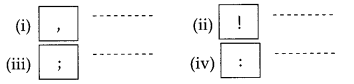
विरामचिन्हे :
पुढील विरामचिन्हे ओळखा :
Maharashtra Board Class 10 Marathi Solutions Chapter 2 बोलतो मराठी… 24
उत्तर :
Maharashtra Board Class 10 Marathi Solutions Chapter 2 बोलतो मराठी… 25

प्रश्न 9.
पारिभाषिक शब्द :
पुढील इंग्रजी पारिभाषिक शब्दांना मराठी प्रतिशब्द लिहा :
(i) Event
उत्तर :
घटना

(ii) Drama
उत्तर :
नाटक

(iii) Yard
उत्तर :
आवार

(iv) Mobile
उत्तर :
भ्रमणध्वनी

Maharashtra Board Class 10 Marathi Solutions Chapter 2 बोलतो मराठी…

प्रश्न 10.
अकारविल्हे/भाषिक खेळ :
पुढील शब्द अकारविल्हेनुसार लिहा :
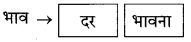
(i) भाषा → मराठी → क्रियापद → भाव.
उत्तर :
क्रियापद → भाव → भाषा → मराठी.

(ii) गणित → भूगोल → भाषा → इतिहास (मार्च ‘१९).
उत्तर :
इतिहास → गणित → भाषा → भूगोल.

बोलतो मराठी… शब्दार्थ

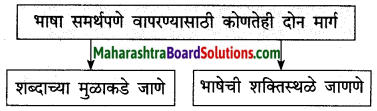
  • व्युत्पत्ती – शब्दाचे मूळ शोधण्याचे शास्त्र.

बोलतो मराठी… वाक्प्रचार व त्यांचे अर्थ

  • पाकीट मारणे : पैशाचे पाकीट शिताफीने चोरणे.
  • ताव मारणे : भरपूर खाणे.
  • माश्या मारणे : रिकामटेकडेपणाने वेळ घालवणे.
  • खस्ता खाणे : खूप कष्ट करणे.
  • कंठस्नान घालणे : गळा कापून ठार मारणे.
  • खांदयाला खांदा लावणे : सहकार्य करणे.
  • खांदा देणे : प्रेत वाहून नेण्यात सहभागी होणे.
  • अकलेचा कांदा असणे : अतिशहाणा असणे.
  • एखाद्याला हसणे : एखादयाची थट्टा करण्याच्या हेतूने हसणे.

Maharashtra Board Class 7 English Solutions Chapter 4.2 Unke Munke Timpetoo

Balbharti Maharashtra State Board Class 7 English Solutions Chapter 4.2 Unke Munke Timpetoo Notes, Textbook Exercise Important Questions and Answers.

Maharashtra State Board Class 7 English Solutions Chapter 4.2 Unke Munke Timpetoo

Class 7 English Chapter 4.2 Unke Munke Timpetoo Textbook Questions and Answers

1. Make adjectives from the following.

Question a.
harm
Answer:
harmful / harmless

Maharashtra Board Class 7 English Solutions Chapter 4.2 Unke Munke Timpetoo

Question b.
fear
Answer:
fearless/fearful/fearsome

Question c.
question
Answer:
questionable

Question d.
continue
Answer:
continuous

Question e.
thought
Answer:
thoughtful/ thoughtless

Question f.
courage
Answer:
courageous

Maharashtra Board Class 7 English Solutions Chapter 4.2 Unke Munke Timpetoo

Question g.
believe
Answer:
believable

Question h.
wish
Answer:
wishful

2. Choose the correct alternative.

Question a.
Rohan desperately wished for ………….. .
i. a pair of shoes
ii. a warm pullover
iii. a good friend
iv. a table-tennis set
Answer:
iv. a table-tennis set

Maharashtra Board Class 7 English Solutions Chapter 4.2 Unke Munke Timpetoo

Question b.
Rohan and Muk entered the garden at midnight ……………. .
i. to frighten Mrs. Groover
ii. to chant around the banyan tree
iii. to steal some fruits
iv. to look for a table-tennis set
Answer:
ii. to chant around the banyan tree

Question c.
Rohan had finished ……………… rounds of the tree before Mrs. Groover discovered him.
i. seventeen
ii. six
iii. eleven
iv. twelve
Answer:
iii. eleven

Question d.
The table-tennis set was gifted by
i. Mrs. Groover
ii. Rohan’s parents
iii. Muk
iv. Timpetoo
Answer:
i. Mrs. Groover

Maharashtra Board Class 7 English Solutions Chapter 4.2 Unke Munke Timpetoo

Question e.
The Principal turned out to be a very …………… lady.
i. poor and simple
ii. proud and rich
iii. kind and understanding
iv. sad and lonely
Answer:
kind and understanding

3. The story has a very heart-warming and touching end. Now try to change the end of the story to make it sound.

Question 1.
(i) very funny
(ii) full of horror and mystery.
Answer:
Mrs. Groover continued to look at me with a strange look in her eyes which frightened me. I asked her whether she believed in ‘Unke, Munke, Timpetoo’. She suddenly gave out a shriek and started moving towards me with hands outstretched. I was so scared that my feet did not move nor any words came out from my mouth. She had a savage look on her face. I felt that there was something more to Mrs. Groover, no wonder she was staying alone with an evil looking dog. Somehow. I managed to run away from Mrs. Groover. The next day I came to know that Mrs. Groover never stayed in that house.

Mrs. Groover continued to look at me with a strange look in her eyes. It looked as if she was judging me. I asked her, whether she believed in ‘Unke, Munke, Timpetoo’. She said, she did but she was trying to control her laughter. I wondered what had happened to her. She laughed till tears started rolling down her cheeks. She then took me into her house and played some music as I sat listening. The singer used the same chant ‘Unke Munke Timpetoo’. Hearing the chart, I too started laughing and both of us had a hearty laugh and we started humming the song along with the words ‘Unke Munke Timpetoo’, which actually meant nothing.

4. ‘Unke, Munke, Timpetoo.

I wish, my wish is coming true.’
Try to compose two other funny magical chants that have rhyming lines.

Maharashtra Board Class 7 English Solutions Chapter 4.2 Unke Munke Timpetoo

5. Language study.

Question a.
Prefix and suffix : A letter or group of letters added to the front of a word to change Its meaning and make a new word is called a prefix.
Examples:

  1. un + tie → untie
  2. non + stop → non-stop
  3. dis + like → dislike
  4. super + man → superman
  5. inter + national → international

Answer:
Prefix (before the root word)
e.g.

  1. un + tie = untie
  2. non + stop = nonstop
  3. dis + like = dislike
  4. super + man = superman
  5. inter + national = international

Question b.
Find at least 5 words with prefixes and identify the prefix in each word. A letter or group of letters added at the end of a word to make another word is called a suffix.
Examples:

  1. teach + er → teacher
  2. act + or → actor
  3. child + hood → childhood
  4. friend + ship →b friendship
  5. king + dom → kIngdom
  6. use + ful → useful
  7. frequent + ly → frequently
  8. act + ion → action
  9. star + ry → starry

Answer:
Suffix (after the root word)
e.g.

  1. teach + er = teacher
  2. act + or = actor
  3. child + hood = childhood
  4. friend + ship = friendship
  5. king + dom = kingdom
  6. use + ful = useful
  7. frequent + ly = frequently
  8. act + ion = action
  9. star + ry = starry

Maharashtra Board Class 7 English Solutions Chapter 4.2 Unke Munke Timpetoo

Question c.
Find 5 examples of words with the following suffixes from the lessons you have studied so far, or from other sources:

  1. -ship
  2. -less
  3. -ness
  4. -ly
  5. -ful
  6. -able

Answer:
suffixes:

  1. hard + ship = hardship
  2. home + less = homeless
  3. happy + ly = happily
  4. clever + ness = cleverness
  5. soft + ly = softly
  6. reason + able = reasonable

Class 7 English Chapter 4.2 Unke Munke Timpetoo Additional Important Questions and Answers

1. Answer the following questions.

Question 1.
Find the sentences in which the author and his friend claim that they do not believe in magic. What do their actions show?
Answer:
The sentences which claim that the author and his friends do not believe in magic are:

  1. I don’t say I believe in it but my cousin said it works.
  2. And there is no harm in trying.
  3. Why seventeen times and why at midnight?
  4. I thought it was all nonsense.

Their actions show, that though they say that they do not believe in the chanting and magic, yet they decided to try it out, convincing themselves that it did not matter just to try.

Maharashtra Board Class 7 English Solutions Chapter 4.2 Unke Munke Timpetoo

Question 2.
(i) If you hear about something that fulfils your wishes, would you try it?
(ii) Do you think that the author is brave?
Answer:
(i) Yes, If I hear about something that fulfils my wishes, I would surely try it while trying to convince myself that there is no harm in trying.
(ii) Yes, I think the author is brave because he dared to go out at midnight to chant around the banyan tree to get his wish fulfilled knowing very well that the banyan tree belonged to his Ex-Principal who was very strict.

Question 3.
How do we know that Muk was frightened?
Answer:
We know that Muk was frightened because as soon as he heard Mrs. Groover’s voice saying that she would let her ferocious dog loose on them, he started climbing up the tree.

Question 4.
What opinion do you form of Mrs. Groover from the way she treats the boys?
Answer:
According to me, Mrs. Groover is an able administrator and disciplinarian outside but from the inside, she seems to be a kind-hearted, sensitive and understanding person. She did not jump to conclusions. She patiently listened to the boys and allowed Rohan to complete the seventeen rounds around the banyan tree to fulfill his wish.

Maharashtra Board Class 7 English Solutions Chapter 4.2 Unke Munke Timpetoo

Question 5.
Did the author really rejoice over his shoes and pullover?
Answer:
No, the author did not really rejoice over his shoes and pullover. He pretended to be happy so as not to hurt the feelings of his parents.

Reading Skills, Vocabulary and Grammar.

Simple Factual Questions:
Question 1.
Complete the following sentences.

  1. Mrs. Groover’s garden had …………… .
  2. Rinkoo Lai of class X was …………… .
  3. “Come on, let us go and wish for my …………… .
  4. There was a banyan tree, its aerial roots swaying in the …………… .

Answer:

  1. a banyan tree
  2. a bully
  3. table tennis set
  4. gentle breeze of the night.

Complex Factual Questions.

Question 1.
Who was Muk?
Answer:
Muk was Rohan’s best firend.

Maharashtra Board Class 7 English Solutions Chapter 4.2 Unke Munke Timpetoo

Question 2.
Who was Mrs. Groover?
Answer:
Mrs. Groover was the Ex-Principal of the school Rohan studies in.

Question 3.
Where was the banyan tree located?
Answer:
The banyan tree was located in Mrs. Groover’s garden which was in Rohan’s neighborhood.

Question 4.
How did Rohan and Muk enter Mrs. Groover’s house?
Answer:
Roshan and Muk entered Mrs. Groover’s house by climbing the wall and jumping down.

Vocabulary.

Question 1.
Pick out a compound word from the extract.
Answer:
neighborhood

Maharashtra Board Class 7 English Solutions Chapter 4.2 Unke Munke Timpetoo

Question 2.
Pick out two words so as to get its opposite after adding a prefix. Write both words.
Answer:

  1. true × untrue
  2. done × undone
  3. harm × unharm

Question 3.
Give noun forms of:

  1. mocking
  2. true
  3. suppose
  4. enter
  5. silent

Answer:

  1. mockery
  2. Truth
  3. Supposition
  4. entry/ entrance
  5. silence

Question 4.
Pick out four adverbs from the passage.
Answer:

  1. thoughtfully
  2. badly
  3. along
  4. carefully

Maharashtra Board Class 7 English Solutions Chapter 4.2 Unke Munke Timpetoo

Question 5.
Express differently – ten minutes to twelve
Answer:
Eleven fifty.

Grammar.

Question 1.
I could not think of anything else. (Add a question tag)
Answer:
I could not think of anything else, could I?

Question 2.
One look from her piercing, pale, green eyes was enough to silence bullies. (Pick out the adjectives)
Answer:
one, piercing, pale, green.

Personal Response:

Question 1.
Do you believe in magic? Why?
Answer:
No, I do not believe in magic. I do not believe in magic because it is not proven by science.

Maharashtra Board Class 7 English Solutions Chapter 4.2 Unke Munke Timpetoo

Read the following passage and do the activities.

Simple Factual Questions:

Question 1.
Say whether true or false.

  1. A ferocious dog ran after Rohan and Muk.
  2. Mrs. Groover allowed Rohan to finish his rounds.
  3. Mrs. Groover bend down to unleash, the dog.
  4. Muk bodly faced the situation when the dog barked.

Answer:

  1. False
  2. True
  3. True
  4. False.

Question 2.
List the qualities of Mrs. Groover

Mrs. Groovers qualities
(i) …………………(ii) …………………(iii) …………………(iv) …………………

Answer:

  1. able administrator
  2. empathetic
  3. compassionate
  4. loving and caring

Complex Factual Questions.

Question 1.
Why did Mrs. Groover threaten to unleash the dog?
Answer:
The barking of the dog awakened Mrs. Groover at night and in the darkness. She did not know who was there in the garden. Hence she asked who was there or else threatened to unleash the dog.

Maharashtra Board Class 7 English Solutions Chapter 4.2 Unke Munke Timpetoo

Question 2.
What was Rohan’s fear?
Answer:
Rohan’s fear was that Mrs. Groover might not believe him.

Vocabulary.

Give one word for the following.

  1. Stop continuous progress
  2. Say something indistinctly and quietly
  3. feel or show great joy
  4. set free

Answer:

  1. interrupt
  2. mumble
  3. rejoice
  4. unleash

Grammar.

Question 1.
State the tense in the following sentences.

  1. I told her everything
  2. I will explain if you let me.
  3. I had never received such a big parcel.

Answer:

  1. simple past tense
  2. Simple future tense
  3. Past perfect.

Maharashtra Board Class 7 English Solutions Chapter 4.2 Unke Munke Timpetoo

Question 2.
Form nouns.

  1. ferocious
  2. believe
  3. open
  4. softly

Answer:

  1. ferocity
  2. belief
  3. opening
  4. softness

Personal Response.

Question 1.
“and while leaving, would you mind using the front gate?” why do you think Mrs. Groover said that?
Answer:
Mrs. Groover being compassionate, understood the young boy’s heart. She knew that they had jumped into her compound. At midnight, as she wanted them to be safe, she was actually suggesting that they use the front gate.

Question 2.
“I swore that I would never return.” who said this and why.
Answer:
This was said by Rohan out of fear and frustration having gone through an unexpected turn of event in the middle of the night.

Maharashtra Board Class 7 English Solutions Chapter 4.2 Unke Munke Timpetoo

Question 3.
What is referred to as the ‘great moment’?
Answer:
To a little boy, opening gifts that he receives is a great moment. As it was Rohan’s birthday, he refers to unwrapping of the gifts he received.
Question 4.
Who had send the big parcel?
Answer:
The big parcel was from Unke, Munke, Timpetoo.

Read the following passage and do the activities.

Simple Factual Questions:

Question 1.
A few qualities have been listed below. Write suitable qualities under their names.

  1. disciplinarian
  2. friendly
  3. committed
  4. supportive
  5. good runner
  6. caring
  7. loving
  8. compassionate
  9. eager
  10. gratitude
  11. nervous

Answer:

Mrs. GrooverRohanMuk
disciplinariangood runnerfriendly
caringeagercommitted
compassionategratitudesupportive
nervousloving

Maharashtra Board Class 7 English Solutions Chapter 4.2 Unke Munke Timpetoo

Question 2.
Complete the following.

  1. I removed the colorful gift wrapping and found
  2. I wondered if Mrs. Groover was responsible
  3. She smiled and she looked so different,

Answer:

  1. a table tennis set
  2. for the surprise
  3. almost human

Complex Factual Questions.

Question 1.
Why did Rohan whisper “wow!”?
Answer:
Rohan whispered ‘wow!” because when he opened the colourful gift wrapping, he found a table tennis set which he was greatly longing for. Also he was too thriled or and surprised to . say anything else.

Vocabulary.

Question 1.
Form Noun

  1. remove
  2. wonder
  3. perfect
  4. quickly

Answer:

  1. removal
  2. wonderment
  3. perfection
  4. quickness

Maharashtra Board Class 7 English Solutions Chapter 4.2 Unke Munke Timpetoo

Question 2.
Give adverbs form of:

  1. imagine
  2. increase
  3. open
  4. scare

Answer:

  1. imaginatively
  2. increasingly
  3. openly
  4. scarily

Grammar.

Question 1.
Muk and I went to see Mrs. Groover quite often. Not only because she made the best tea and cookies. We went because we liked her. (Rewrite using not only… but also)
Answer:
Muk and I went to see Mrs. Groover quite often not only because she made the best tea and cookies but also because we liked her.

Maharashtra Board Class 7 English Solutions Chapter 4.2 Unke Munke Timpetoo

Question 2.
I removed the strings impatiently. (Pick out the adverb from the given sentence)
Answer:
impatiently

Personal Response.

Question 1.
Do you think Mrs. Groover was responsible for the surprise? Why?
Answer:
Little Rohan longed to get a table tennies set as gift for his birthday and decided to run around a banyan tree in Mrs. Groover’s garden chanting “Unke Munke Timpetoo” seventeen times at 12 midnight. Understanding the child’s mind and seeing him take so much trouble, she decided to make him happy by gifting a fabulous table tennis set, through not brand new.

Question 2.
Why did Rohan and Muk visit Mrs. Groover often?
Answer:
After the initial nervousness and hesitation, Rohan found out that Mrs. Groover also believed in Unke, Munke, Timpetoo. They saw the soft human side of their Ex. Principal and started loving her. She too welcomed them with good tea and cookies. Hence they visited her often.

Maharashtra Board Class 7 English Solutions Chapter 4.2 Unke Munke Timpetoo

Question 3.
Did the surprise gift really come from Unke, Munke, Timpetoo? In your opinion, who must have sent the gift?
Answer:
No, the surprise gift did not come from Unke, Munke, Timpetoo. I am sure the surprise gift was sent by Mrs. Groover.

Question 4.
What is ‘Unke, Munke, Timpetoo’ – a charm or an act of friendliness?
Answer:
‘Unke, Munke, Timpetoo’ is an act of friendliness. We must remember that an act of friendliness is an act of godliness. It keeps alive the humanity in us which is very necessary to make this world a happy one.

Language Study.

Question 1.
Affixes: An affix is a letter or series of letters added to the root (main) word that can change its meaning. Affixes can take the form of a prefix or a suffix.
Answer:
(a) Examples of prefixes:

  • trans + port = transport
  • tri + angle = triangle
  • uni + lateral = unilateral
  • anti + biotic = antibiotic
  • en + courage = encourage
  • fore + head = forehead
  • dis + appear = disappear
  • extra + ordinary = extraordinary
  • mid + way = midway
  • hyper + active = hyperactive
  • micro + scope = microscope
  • post + pone = postpone
  • ex + President = ex-President
  • thermo + meter = thermometer
  • super + star = superstar

(b) Some more suffixes:

  • fashion + able = fashionable
  • play + ful = playful
  • slow + ly = slowly
  • meaning + less = meaningless
  • close + ness = closeness
  • mad + ly = madly
  • effort + less = effortless
  • colour + less = colourless
  • sad + ness = sadness
  • owner + ship = ownership
  • love + able = lovable
  • beauty + ful = beautiful
  • workman + ship = workmanship
  • port + able = portable
  • help + ful = helpful
  • month + ly = monthly
  • quick + ly = quickly

(Add more to this list…)

Maharashtra Board Class 7 English Solutions Chapter 4.2 Unke Munke Timpetoo

Do as directed:

Question 1.
Why seventeen times and why at midnight? (Identify the kind of sentence)
Answer:
Interrogative sentence

Question 2.
Don’t ask me. (Add a question tag)
Answer:
Don’t ask me, will you?

Question 3.
Forget it. (Add a question tag)
Answer:
Forget it, won’t you? / will you?

Question 4.
The aerial roots were swaying in the breeze. (Separate the Subject and Predicate)
Answer:
Subject – The aerial roots
Predicate – were swaying in the breeze.

Maharashtra Board Class 7 English Solutions Chapter 4.2 Unke Munke Timpetoo

Question 5.
Muk was climbing the tree. (Identify whether theverbisTransitiveor Intransitive)
Answer:
was climbing – Transitive verb.

Question 6.
Add one of these prefixes to the words below: (un-, re-, dis-)

  1. Mother will ………….. (wrap) the gift.
  2. My dad had to ………….. (connect) the light.
  3. Jane had to ………….. (do) her homework.
  4. Mohan ………….. (likes) eating leafy vegetables.
  5. The knot on the rope is hard to ………….. (tie).

Answer:

  1. unwrap
  2. disconnect
  3. redo
  4. dislikes
  5. untie

Question 7.
Write a single word with the prefix ‘un-‘ or ‘dis-‘ to complete each sentence.

  1. My brother always ………….. (does not agree) with me.
  2. The answer to your question is ………….. (not known).
  3. My mother told me not to be ………….. (not honest).
  4. I thought I had seen him but he seems to have ………….. (not appear).
  5. I was ………….. (not happy) at being scolded.
Answer:

  1. disagrees
  2. unknown
  3. dishonest
  4. disappeared
  5. unhappy

Question 8.
Put the words in the brackets in the appropriate form. (Use a prefix or a suffix)

  1. He is acting in a very ………….. way. (child)
  2. She looked ………….. She started to cry. (happy)
  3. The team that he supported was able to win the ………….. (champion)
  4. There were only a ………….. of people at the match, (hand)
  5. I think you should ………….. your decision. (consider)
  6. He wants to be a ………….. when he grows up. (politics)

Answer:

  1. childish
  2. unhappy
  3. championship
  4. handful
  5. reconsider
  6. politician

Maharashtra Board Class 7 English Solutions Chapter 4.2 Unke Munke Timpetoo

Question 9.
Make adjectives from the following:

  1. nonsense
  2. secret
  3. knowledge
  4. poet
  5. city
  6. village
  7. humanity

Answer:

  1. nonsensical
  2. secretive
  3. knowledgeable
  4. poetical
  5. urban
  6. rural
  7. humane

Unke Munke Timpetoo Summary in English

This story ‘Unke Munke Timpetoo’ revolves round a young boy Rohan, whose birthday. Rohan’s birthday was soon approaching. He wished to have a table tennis set, which he knew his parents would not be able to afford. He tells his wish to his best friend Muk, who tells him that if he really wished for the set, then he would have to go seventeen times around a banyan tree, at midnight chanting ‘Unke Munke Timpetoo’. At first he was scared but decides to try his luck around the only banyan tree which belonged to his Ex-Principal Mrs. Groover.
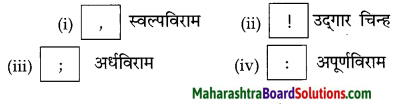
A day before his birthday he, along with his friend goes to the banyan tree. Rohan nearly completes his round when Mrs. Groover comes out and Rohan explains to her what he was doing and why. The next day along with his birthday gifts, he gets the gift he wished for. Only it was not brand new. He did not mind it at all. He wonders who could have sent him the table tennis set. He decides to ask Mrs. Groover but does not have the courage. He then asked if she believed in the chant ‘Unke Munke Timpetoo’ to which she said yes. Rohan, Muk and Mrs. Groover became the best of friends.

Introduction:

This story ‘Unke Munke Timpetoo’ is written by Sigrun Srivastava. She is an Indian author of German origin. She has written over 25 books for children of all ages.

Maharashtra Board Class 7 English Solutions Chapter 4.2 Unke Munke Timpetoo

Glossary

  1. fantastic (adj) – fanciful, extraordinary
  2. bully (n) – a person who is cruel to others especially those who are weaker or have less power
  3. aerial (adj) – positioned high up in the air
  4. ferocious (adj) – fierce
  5. fabulous (adj) – marvelous, wonderful
  6. vanish (v) – to become invisible, disappear
  7. stutter (v) – to stammer

Maharashtra Board Class 7 Science Solutions Chapter 15 Materials We Use

Balbharti Maharashtra State Board Class 7 Science Solutions Chapter 15 Materials We Use Notes, Textbook Exercise Important Questions and Answers.

Maharashtra State Board Class 7 Science Solutions Chapter 15 Materials We Use

Class 7 Science Chapter 15 Materials We Use Textbook Questions and Answers

1. Fill appropriate terms in the blanks:
(white cement, soap, detergent, wearing of bones, tooth decay, hard, soft, portiand, fatty acid)

Question a.
The substance that helps water to remove dirt from the surface of material is called …………… .
Answer:
soap

Question b.
Fluoride is used in toothpaste to prevent …………… .
Answer:
tooth decay

Maharashtra Board Class 7 Science Solutions Chapter 15 Materials We Use

Question c.
Soap is a salt of …………… and sodium hydroxide.
Answer:
fatty acid

Question d.
Synthetic detergents can be used in …………… water as well.
Answer:
hard

Question e.
For construction purposes …………… Cement is the most commonly used cement.
Answer:
white cement

2. Write answers to the following questions. 

Question a.
How does the use of a detergent help to clean soiled clothes?
Answer:

  1. A molecule of a detergent holds on to a water molecule at one end and an oil molecule at the other.
  2. As a result the molecules of oil mix with the water.
  3. This is how detergent acts on our soiled clothes. So detergent removes any oil or dirt sticking on to our clothes.
  4. Due to the property of holding on to both oil and water, soap water spreads easily on many types of surfaces.
  5. This property of spreading on a surface is called surface activity.
  6. Detergents are surface active.
  7. One effect of surface activity is lather formation.

Maharashtra Board Class 7 Science Solutions Chapter 15 Materials We Use

Question b.
How will you check with the help of soap powder whether water is hard?
Answer:

  1. In the hard water, (of a well or a tube-well), soap does not give lather but forms a scum.
  2. As a result, soap loses its cleansing property. So with help of soap we will come to know that it is a hard water.

Question c.
What are the important ingredients of a tooth paste and what is the function of each?
Answer:

  1. The important ingredients of a toothpaste are calcium carbonate and calcium hydrogen phosphate.
  2. They remove the dirt on teeth. These ingredients also polish the teeth.
  3. A certain proportion of fluoride in the tooth paste helps prevent tooth decay.
  4. It is essential for the enamel covering of teeth.

Maharashtra Board Class 7 Science Solutions Chapter 15 Materials We Use

Question d.
What are the ingredients of cement?
Answer:

  1. Cement is a dry, greenish grey powder with fine particles.
  2. It is made from silica (sand), alumina (aluminium oxide), lime, iron oxide and magnesia (magnesium oxide).

Question e.
What will happen if cement is not used in making concrete?
Answer:

  1. In making concrete strong, the ingredients cement, water, sand and gravel should usually be mixed in the ratio of 1 : 2 : 3 : 0.5 to achieve maximum strength.
  2. If enough cement is not used then the concrete will eventually fall apart, as cement is used as a binding agent.

Question f.
Make a list of detergents, that you use. Answer: There are two types of detergents that we use, (a) Natural (b) Man-made detergents.

  1. Natural detergents are soap nut (ritha) soap pod (shikekai).
  2. Man-made detergents are soap, hard soaps, soft soaps.
  3. Synthetic detergents have taken the place of soap.
    • Detergents are commonly available as powders or concentrated solution.
    • Detergents are for laundry, washing clothes and cleaning dishes.
  4. Alkaline detergents used for hard surface cleaning.

Maharashtra Board Class 7 Science Solutions Chapter 15 Materials We Use

Question g.
What should be expected from a detergent for delicate garments?
Answer:

  1. Detergents should not be strong, they may spoil the texture, colour of delicate garments.
  2. Now a days many detergents are available especially for woollen, delicate clothes.
  3. They should not contain bleach, phosphorous which will harm delicate clothes.

Question h.
What is meant by surface activity? Name three chemicals responsible for the surface activity of various detergents.
Answer:

  1. Due to the property of holding on to both oil and water, soap water spreads easily on many types of surfaces.
  2. The property of a substance of spreading on a surface is called surface activity and the substance is called surfactant.
  3. Detergents are surface active.
  4. They increase the spreading and wetting ability of water by reducing its surface tension.
  5. Chemicals responsible for the surface activity of various detergents is phenol, Aprotinin.

Maharashtra Board Class 7 Science Solutions Chapter 15 Materials We Use

3. What are the similarities and differences between:

Question a.
Natural detergents and Man-made detergents
Answer:

Natural detergentsMan-made detergents
1. Soap nut (ritha) and soap pod (shikekai) are the natural detergents.1. Soap is man-made detergent soft soap and hard soap.
2. Natural detergents do not have harmful effect on human skin or on silk or woollen clothes.2. Soap has effect on skin and cloth because it has chemicals in it.
3. Soap nut, soap pod contain a chemical saponin.3. Soap has acid in it, soap is sodium and potassium salt of fatty acids.
4. It is naturally available.4. It is man made using chemicals and oil.

Maharashtra Board Class 7 Science Solutions Chapter 15 Materials We Use

Question b.
Soap and Synthetic detergents
Answer:

SoapSynthetic detergents
1. Soap is man-made detergent, it is in use since ancient times.1. Synthetic detergent have taken the place of soap.
2. Soap loses its cleansing property in hard water it does not give lather.2. Synthetic detergent can be used in hard water also.
3. Soap was prepared by using animal fat and wood ash.3. Synthetic detergent are obtained by subjecting fats, kerosene to various chemical processes.
4. Variety of soaps are available, soft soap for bathing, hard soap for washing, cleaning.4. Variety of synthetic detergents are available – Ariel, Surf Excel, etc.

Question c.
Bath soap and Soap for washing clothes
Answer:

Bath soapSoap for washing clothes
1. Soft soap is used for bathing.1. Hard soap is used for washing clothes.
2. Soft soap is potassium salt is fatty acids.2. Hard soap is sodium salt of fatty acid.
3. Soft soap dissolves more easily readily in water.3. Hard soap do not dissolve easily in water.
4. Now a days many perfumes, moisturizes are mixed to make it more attractive and useful.4. In this type of soap now a days germicides, anti foaming agents are mixed to make it more useful.

Maharashtra Board Class 7 Science Solutions Chapter 15 Materials We Use

Question d.
Modern cement and Ancient cement
Answer:

Modem cementAncient cement
1. Cement manufactured from 60% lime, silica 25% and alumina 5%. the rest is iron oxide and gypsum.1. Romans used to make aqueous cement by mixing volcanic ash in moistened lime. It was very durable.
2. It is the most commonly used cement for Construction work.2. It is Roman cement volcanic ash prevent cracks from spreading.
3. It is called Portland Cement.3. It is called Aqueous Cement.

4. Explain why –

Question a.
Soap cannot be used in hard water.
Answer:

  1. In the hard water of a well or a tube well, soap does not give lather but forms a scum.
  2. As a result soap loses its cleansing property. So soap cannot be used in hard water.

Maharashtra Board Class 7 Science Solutions Chapter 15 Materials We Use

Question b.
Oil does not mix in water. However, oil and water become homogenous if a sufficient quantity of detergent is added.
Answer:

  1. A molecule of a detergent holds on to a water molecule at one end and an oil molecule at the other.
  2. As a result the molecules of oil mix with the water, and we will see that the water and oil have become homogenous and the colour of the mixture appears milky.

Question c.
Synthetic detergents are superior to soap.
Answer:

  1. Soap is a man-made detergent which has been in use since ancient times.
  2. It was prepared by using animal fat and wood ash. In hard water, soap does not give lather, it loses its cleansing property.
  3. So we can not use soap in hard water. Now synthetic detergents have taken the place of soap.
  4. They can be used in hard water as well
  5. Synthetic detergents have many more advanced properties like they are added with perfumes, conditioner for fabric, etc.

Maharashtra Board Class 7 Science Solutions Chapter 15 Materials We Use

Question d.
Often coloured spots are formed on clothes during washing.
Answer:

  1. Curry stains stick fast to the criss-crossing threads of the material of our clothes.
  2. Curry contains turmeric a natural indicator which turns red in a basic solution.
  3. Soaps are sodium salts of fatty acids and are basic in nature.
  4. While washing the clothes, turmeric reacts with soap solution and turns red forming red spots on the clothes.
  5. But the spots disappear after washing the clothes with plenty of water.

Question e.
Tobacco masheri should not be used for cleaning teeth.
Answer:

  1. Masheri is the smokeless form of tobacco. It is tobacco, containing teeth cleaning powder
  2. It contains tobacco leaves.
  3. Tobacco contains toxic and Carcinogenic chemicals which can cause cancer, oral cancer, mouth and throat cancer, gum disease, tooth decay.
  4. Its use can cause abnormal delivery in pregnant women.

Maharashtra Board Class 7 Science Solutions Chapter 15 Materials We Use

Project:

Question 1.
Visit a cement factory. See how cement is prepared and discuss the process.

Question 2.
Write a conversation based on cement houses, mud-houses and wattle-and-daub houses.

Class 7 Science Chapter 15 Materials We Use Important Questions and Answers

Fill in the blanks:

Question 1.
The principal ingredients of a toothpaste are ………………. and ………………. which remove the dirt on the teeth.
Answer:
Calcium carbonate, calcium hydrogen phosphate

Question 2.
………………. in the toothpaste helps prevent tooth decay.
Answer:
Fluoride

Maharashtra Board Class 7 Science Solutions Chapter 15 Materials We Use

Question 3.
The property of a substance of spreading on a surface is called ………………. .
Answer:
surface activity

Question 4.
………………. and ………………. are the natural detergent in common use.
Answer:
Soap nut, Soap pod

Question 5.
Soap nut and soap pod contain a chemical named ………………. .
Answer:
Saponin

Question 6.
………………. is a man-made detergent.
Answer:
Soap

Question 7.
………………. is used for washing clothes.
Answer:
Hard soap

Question 8.
………………. is used for bathing.
Answer:
Soft soap

Maharashtra Board Class 7 Science Solutions Chapter 15 Materials We Use

Question 9.
Hard soap is ………………. salt of fatty acids.
Answer:
Sodium

Question 10.
Soft soap is ………………. salt of fatty acids.
Answer:
Potassium

Name the following:

Question 1.
A substance which is spread on a given surface and used for cleaning.
Answer:
Surfactant

Question 2.
A chemical contained in soap nut and pod.
Answer:
Saponin

Question 3.
An element which helps prevent tooth decay which is used in toothpastes.
Answer:
Fluoride

Maharashtra Board Class 7 Science Solutions Chapter 15 Materials We Use

Question 4.
The latin word which means detergent.
Answer:
Detergere

Question 5.
A cement used for construction purpose.
Answer:
Portland cement

Question 6.
A mixture of cement, water, sand and gravel.
Answer:
Concrete

Question 7.
A natural detergent.
Answer:
Soap nut

Maharashtra Board Class 7 Science Solutions Chapter 15 Materials We Use

Choose the correct option:

Question 1.
Which one of these material grows on an animal
(cotton, rubber, wood, wool)
Answer:
Wool

Question 2.
Which of these is man-made?
(oranges, apples, plastic bags, tomatoes)
Answer:
Plastic bags

Question 3.
The statue is made from marble, marble is a ………….. material.
(weak, elastic, man-made, natural)
Answer:
Natural

Maharashtra Board Class 7 Science Solutions Chapter 15 Materials We Use

Question 4.
Toy Duck is made from plastic. Plastic is a ………….. material.
(natural, man-made, raw, precious)
Answer:
Man-made

Question 5.
Which of these materials is natural?
(Nylon, Rock, Plastic, Polythene)
Answer:
Rock

Question 6.
Which one of these is a natural material?
(Lemonade, Cola, Water, Ice cream)
Answer:
Water

Question 7.
The toy plane made from wood. Wood is a ………….. material.
(man-made, natural, weak)
Answer:
Natural

Maharashtra Board Class 7 Science Solutions Chapter 15 Materials We Use

Question 8.
Which one of these materials is natural?
(Nylon, cotton, polythene, polyesters)
Answer:
Cotton

Match the following:

Question 1.

Column ’A’Column ’B’
1. Fluoridea. Man-made detergent
2. Soap nutb. Sodium salt of fatty acid
3. Soapc. Man-made material
4. Cottond. Prevents tooth decay
5. Nylone. Potassium salt of fatty acid.
6. Hard soapf. Natural detergent
7. Calcium carbonateg. Natural material
8. Soft soaph. Main ingredients of toothpaste

Answer:

Column ’A’Column ’B’
1. Fluorided. Prevents tooth decay
2. Soap nutf. Natural detergent
3. Soapa. Man-made detergent
4. Cottong. Natural material
5. Nylonc. Man-made material
6. Hard soapb. Sodium salt of fatty acid
7. Calcium carbonateh. Main ingredients of toothpaste
8. Soft soape. Potassium salt of fatty acid.

Maharashtra Board Class 7 Science Solutions Chapter 15 Materials We Use

Find out:

Answer the following questions:

Question 1.
What is the source of the fluoride in a tooth paste or tooth powder?
Answer:
A naturally occurring mineral found in tooth paste and drinking water. Sodium Fluoride (NaF) is the source of fluoride in toothpaste.

Question 2.
Note down all the information given on a tooth powder/toothpaste container or carton and discuss.
Answer:
1. The carton shows the name of the company and name of toothpaste and its contains all the ingredients present in toothpaste.

2. Licence No. of company, Regd. Trade Mark of Colgate Palmolive Co-manufactured by Colgate-Palmolive (India) Ltd. Licenced user of Trade Mark made in India. Tooth paste contains 1000 ppm max of available fluoride when packed.

Maharashtra Board Class 7 Science Solutions Chapter 15 Materials We Use 2

3. Ingredients: Calcium carbonate, sorbitol, sodium lauryl sulphate, silica, sodium silicate flavour, sodium monoflouro phosphate, sodium bicarbonate, benzyl alcohol.

4. Direction for use: Brush thoroughly atleast twice a day.
5. Children under 6 years of age should have adult supervision and use only appropriate amount.

Maharashtra Board Class 7 Science Solutions Chapter 15 Materials We Use

Question 3.
Now a days why are the roads made of concrete?
Answer:

  1. Concrete is prepared by mixing cement, limestone, sand, gravel, and water. It is solid, more durable and strong.
  2. There is no erosion for many years and roads are smoother. So the roads are made of concrete.

Question 4.
What causes the hardness of water?
Answer:

  1. Hardness is a measure of amount of dissolved salts in water.
  2. It is caused by dissolved salts like carbonates, chlorides mostly of calcium and magnesium
  3. Presence of these makes washing of clothes by soap difficult.
  4. Hard water is water that has high mineral content.
  5. Hard water is formed when water percolates through deposits of limestone and chalk.

Can you tell?

Answer the following questions:

Question 1.
Which substances were used earlier for cleaning teeth?
Answer:
In olden times neem twigs, coal powder ash, tooth powder, salt, pomegranate rind, were used for cleaning teeth.

Maharashtra Board Class 7 Science Solutions Chapter 15 Materials We Use

Question 2.
What do we use today to clean our teeth?
Answer:
Now a days we use variety of toothpastes and tooth powders to clean our teeth.

Question 3.
What do we use for cleansing our body?
Answer:
Soap, many liquid body wash are also used to clean our body.

Question 4.
What are the materials used for construction?
Answer:
Metals, wood, stone, cement, concrete, timber, bricks, metal sheet, soil, Earth, marble, aluminium, iron, steel, bamboo, glass, plastic.
Concrete: is a wet mixture of sand, gravel, cement, and water used to create building foundations, footpaths or roads.

Question 5.
Which of the houses seen in the pictures here have a strong structure? Why?
Maharashtra Board Class 7 Science Solutions Chapter 15 Materials We Use 1.1
Answer:
The houses made from stone, bricks, and cement and concrete have a strong structure.

Write short notes on or Explain:

Question 1.
Natural detergent
Answer:

  1. It is naturally available soap nut (ritha) and soap pod (shikekai) are the natural detergents in common use.
  2. They contain a chemical named saponin.
  3. Soap nut and soap pod do not have any harmful effect on human skin or on silk, woollen threads, and cloth.

Maharashtra Board Class 7 Science Solutions Chapter 15 Materials We Use

Question 2.
Man-made detergents
Answer:

  1. Detergent which is made by processing naturally available material, soap is a man-made detergent which has been in use since ancient times.
  2. In those days soap was prepared by using animal fat and wood ash.
  3. Therefore two types of soap (a) Hard Soap is used for washing clothes. It is a sodium salt of fatty acids, (b) Softsoap is used for bathing. It is a potassium salt of fatty acids.
  4. It does not cause irritation of the skin.
  5. But we can’t use soap in hard water because soap does not give lather but forms a scum. So, soap loses its cleansing property so now synthetic detergent have taken the place of soap.
  6. Synthetic detergents are obtained by subjecting these raw materials (fats and kerosene) to a variety of chemical processes. These can be used in hard water as well.

Question 3.
Soap
Answer:
Two types of soap are:
1. Hard soap is used for washing clothes. It is a sodium salt of fatty acids.
2. (a) Softsoap is used for bathing. It is a potassium salt of fatty acids, (b) It does not cause irritation of the skin, (c) But we can’t use soap in hard water because soap does not give lather but forms a scum, (d) So, soap loses its cleansing property so now synthetic detergents have taken place of soap, (e) Synthetic detergents are obtained by subjecting these raw materials (fats and kerosene) to a variety of chemical processes, (f) These can be used in hard water as well.

Question 4.
Concrete
Answer:

  1. Concrete is prepared by mixing cement, water, sand and gravel.
  2. For making a strong and leak proof slab certain substances are mixed in concrete.
  3. Now a days, roads are made of concrete because they are very durable, strong and smooth.

Maharashtra Board Class 7 Science Solutions Chapter 15 Materials We Use

Question 5.
Surface activity
Answer:

  1. Soap molecule has the property of holding on to both oil and water soap water spreads easily on many types of surfaces.
  2. The property of a substance of spreading on a surface is called surface activity and the substance is said to be a surfactant.
  3. Detergents are surface-active. One effect of surface activity is lather formation.

Question 6.
Explain the method of preparation of soap.
Answer:
Material required for preparation soap are 15 g sodium hydroxide, 60 ml coconut oil, 15 g salt, perfume, a glass rod, beaker, tripod, wire gauze, burner, water mould etc.
Procedure:

  1. Take 60 ml of coconut oil in a beaker.
  2. Dissolve 15 g sodium hydroxide in 50 ml water. Mix the sodium hydroxide solution in the oil slowly, while stirring with a glass rod.
  3. Heat the mixture, and boil it for 10 – 12 minutes, stirring it all the while.
  4. Take care that the mixture does not boil over while heating.
  5. Dissolve 15 g salt in 200 ml water, pour this solution into the above mixture and stir.
  6. The soap formed by the chemical reaction now floats on the water. After some time, it becomes thick.
  7. Now separate the thick soap and add the perfume to it, shape the bar of soap using the mould.
  8. In this process, fat and alkali combine to form salts of fatty acids.
  9. Chemically, soap is a sodium or potassium salt 4 of fatty acids.

Maharashtra Board Class 7 English Solutions Chapter 1.2 Odd One In

Balbharti Maharashtra State Board Class 7 English Solutions Chapter 1.2 Odd One In Notes, Textbook Exercise Important Questions and Answers.

Maharashtra State Board Class 7 English Solutions Chapter 1.2 Odd One In

Class 7 English Chapter 1.2 Odd One In Textbook Questions and Answers

1. Read aloud the conversations in the story turn by turn.

Question 1.
Read aloud the conversations in the story turn by turn.

Maharashtra Board Class 7 English Solutions Chapter 1.2 Odd One In

2. Write about Malti and Rima using the following points:

Question 1.
Write about Malti and Rima using the following points:
Maharashtra Board Class 7 English Solutions Chapter 1.2 Odd One In 1
Use details from the story and your own imagination when you write the above descriptions.
Answer:

PointsRima
AppearanceSimple, oily hair, long skirtStylish.
StudiesStudious, intelligent, scored well in studies. She was good at Maths.She was also good in studies.
SingingShe had a melodious and well-trained voice. She wins the first prize in the Inter­house singing competition.She was also good at singing and wins the first prize in her own category in the Inter­house singing competition.
Attitude Towards OthersHelpful and respectful. Ready to learn from others and improve.Rude, arrogant, unkind behaviour. She didn’t like to be corrected.
Weak PointsHer English was poor.She was weak in Hindi. She was jealous of others and thought others to be inferior to her.

Maharashtra Board Class 7 English Solutions Chapter 1.2 Odd One In

3. Imagine you are Malti. Write any one event in the story from Malti’s point of view.

Question 1.
Imagine you are Malti. Write any one event in the story from Malti’s point of view.
Answer:
Yesterday, I was absent from school. I decided to ask Rima and other classmates about the lessons taught by teachers. As soon as I uttered “I wanted to aks you about English assignment”, Rima and her friends burst out laughing. At first I didn’t understand why they were laughing. Then Rima started mocking at me, repeating the word ‘aks’.

Other girls giggled and looked at me with contempt. I felt very bad but I requested Rima to teach me English as she was good in English and its pronunciation. But she told me rudely that as I belong to the countryside, I am incapable of speaking proper English. There was a lump in my throat as I could not bear this humiliation. I wanted to retort but I couldn’t find the right words. I burst into tears and decided to run away from there.

4. How do you behave with your classmates? Write about your attitude and behaviour in the appropriate column:
(Some actions: Ask others for help, Refuse help, Judge others by their appearance, Judge others by their accent)

Question 1.
How do you behave with your classmates? Write about your attitude and behaviour in the appropriate column:
(Some actions: Ask others for help, Refuse help, Judge others by their appearance, Judge others by their accent)
Maharashtra Board Class 7 English Solutions Chapter 1.2 Odd One In 2
Answer:

AlwaysSometimesNever
I help others.I am sometimes grumpy towards my friends.I am never judgemental.
I share my tiffin with my friends.I enquire about the health of a sick classmate.I never use harsh words.
I always respect others.I sometimes visit NGO’s to volunteer.I never misbehave in class.

Note: Students do the exercise based on their own individual behaviour.

Maharashtra Board Class 7 English Solutions Chapter 1.2 Odd One In

5. Talk about: (a) your strengths (b) your weaknesses (c) the changes that you would like lo see in yourself (3 each).

Question a.
Your strengths:
Answer:
My biggest strength is my willingness to learn and improve myself. I am very polite and humble. I am also a good listener due to which I make friends very easily.

Question b.
Your weaknesses:
Answer:
I am lazy when it comes to doing homework.
I have a phobia of speaking in front of a large group. This has developed into stage fright. I also can’t stop eating once I start. This makes me fall sick very often.

Maharashtra Board Class 7 English Solutions Chapter 1.2 Odd One In

Question c.
The changes that you would like to see in yourself:
Answer:
I would like to get rid of my laziness. I want to start cultivating the habit of reading to improve my language. I would like to participate confidently in competitions. And lastly I want to control my diet for a healthy living.

6. Discuss: Is it necessary to develop a good accent? Why? What efforts can you take to improve your pronunciation? With your teacher’s help, find out how to use online dictionaries for the purpose.

Question 1.
Discuss: Is it necessary to develop a good accent? Why? What efforts can you take to improve your pronunciation? With your teacher’s help, find out how to use online dictionaries for the purpose.
Answer:
Yes, it is extremely necessary to develop a good accent because it aids in communication. A proper accent is important to understand and be understood. I can refer a dictionary that provides pronunciation key. I can also listen to news channels such as BBC that helps us to speak English the way the natives do. Besides, no matter what the language, avoiding the influence of mother tongue can help improve pronunciation.

7. list all the adverbs that end with ‘-ly’ from the passage.

Question 1.
list all the adverbs that end with ‘-ly’ from the passage.
Answer:

  1. quietly
  2. rudely
  3. cattily
  4. uncharitably
  5. sadly
  6. snidely
  7. abundantly
  8. readily
  9. cheerfully
  10. mercilessly
  11. particularly
  12. roundly
  13. badly
  14. stubbornly

Maharashtra Board Class 7 English Solutions Chapter 1.2 Odd One In

8. Language Study:

Question 1.
Types of nouns: You know that a noun is a word used as the name of a person, place or thing. The names given to particular persons, places, animals etc. are proper nouns and the rest are common nouns. For example, ‘Ria’ is a proper noun, because it is the name of a particular person. But, ‘girl’ Is a common noun, as It is not the name of a particular person. ‘Ahmednagar’ Is a proper noun, because it is the name of a particular place. ‘Town’ Is a common noun, because it is not the name of a particular place.
Answer:
Maharashtra Board Class 7 English Solutions Chapter 1.2 Odd One In 3

Write at least 5 common nouns and 5 proper nouns each. Proper nouns are always written with a capital letter at the beginning. Can you think of proper nouns that include two or more words? How are they written? Find at least ten such nouns.
Examples: Seva Hospital, The Times of India.

Class 7 English Chapter 1.2 Odd One In Additional Important Questions and Answers

Answer the following questions.

Question 1.
Complete the web.
Answer:
i.
Maharashtra Board Class 7 English Solutions Chapter 1.2 Odd One In 4

ii.
Maharashtra Board Class 7 English Solutions Chapter 1.2 Odd One In 5

Question 2.
How did Rima and her friends try to offend Malti?
Answer:
Rima and her friends tried to. offend Malti by asking her about the oil on her hair and her long skirt.

Maharashtra Board Class 7 English Solutions Chapter 1.2 Odd One In

Question 3.
Guess what Malti was about to say when the teacher entered?
Answer:
When the teacher entered, Malti was about to probably justify why she wore long skirt or oiled her hair.

Question 4.
What did Rima and her gang decide to do during the Inter-house singing competition? Did they succeed? Why?
Answer:
Rima and her gang decided to jeer when Malti sang but they did not succeed as there was such absolute silence that they did’not dare to do so. They were sure to get caught if they did

Question 5.
Why did Rima feel no joy even though she came first in her category?
Answer:
(Rima had thought that Malti must be a miserable singer and would lose in the singing competition but Malti won the first prize. Rima felt no joy even though she came first in her category as she was proved wrong and may be she even felt jealous of Malti.

Maharashtra Board Class 7 English Solutions Chapter 1.2 Odd One In

Question 6.
Why did Rima walk off in a huff?
Answer:
Rima’s friends told her that she was rude to Malti. This shocked Rima as her own friends had turned against her. So, she walked off in a huff.

Question 7.
What would you have done if you would have been in Malti’s place?
Answer:
If I would have been in Malti’s place, I would have done exactly what Malti did. I would have let my work and performance speak for myself. I would have also tried to befriend Rima by helping her or praising her for her strengths.

Question 8.
Write a character sketch of Rima.
Answer:
Rima was a school-going girl who had her own clique of stylish girls. She was quick to judge people by their outward appearance. She was a bit of a snob who didn’t hesitate to comment on Malti’s oily hair. She had an envious nature as she wasn’t happy about Malti winning the first prize although she herself had also won the first prize in her own category. She thought herself to be far more superior as she was city-bred and could speak good English. She was too proud to accept her mistake when her friends pointed it out to her.

Maharashtra Board Class 7 English Solutions Chapter 1.2 Odd One In

Question 9.
Discuss the meaning in the context of the story.
Answer:

  1. befriended (v) – became friends
  2. snob (n) – criticizing people coming from lower social class or are less education
  3. forte (n) – something one is good at
  4. belied (v) – failed to give a true impression or to tell lie
  5. smart (adj) – intelligent, clever
  6. confident (adj) – feeling or showing confidence in oneself or one’s abilities or qualities or being sure about ones abilities.
  7. insufferable (adj) – intolerable

Reading Skills, Vocabulary and Grammar

Read the following passage and do the activities.

Simple Factual Questions:

Question 1.
Fill in the blanks:
i. “Any new girls in your class?” enquired her father …………. .
ii. “She can’t speak …………. English.
Answer:
i. Mr. Sen
ii. much

Maharashtra Board Class 7 English Solutions Chapter 1.2 Odd One In

Question 2.
Say whether true or false and correct in case the statement is false.
Rima can’t speak much English.
Answer:
False. Malti can’t speak much English.

Complex Factual Questions:

Question 1.
How did Rima describe Malti to her father?
Answer:
Rima described to her father that Malti was a funny girl from a state at the other end of the country who could not speak much English. She also added that Malti came with oily hair and a bindi and spoke with a strange accent.

Question 2.
Do Rima and her parents share the same attitude?
Answer:
No, Rima and her parents do not share the same’attitude. The parents confront Rima with reality. We know that because Rima’s parents defend and praise Malti when Rima criticizes her.

Maharashtra Board Class 7 English Solutions Chapter 1.2 Odd One In

Vocabulary:

Question 1.
Guess the meanings of the following words in the context of the story
Answer:

  • settling in (v) – to arrange oneself comfortably in
  • sniffed (v) – drew in air audibly to show dislike
  • mimicked (v) – imitated the voice and behaviour
  • grimaced (v) – made a twisted expression on face to express disgust.

Grammar:

Question 1.
Write at least 4 Proper nouns from the above passage.
Answer:

  1. Rima
  2. Mr. Sen
  3. Malti
  4. English

Maharashtra Board Class 7 English Solutions Chapter 1.2 Odd One In

Question 2.
Write at least 4 Common nouns from the above passage.
Answer:

  1. mother
  2. day
  3. girls
  4. school

Personal Response:

Question 1.
Have you ever been a victim of bullying in your class? How did you tackle it?
Answer:
Yes, I have been a victim of bullying in my class due by a handful of bullies in the class. They used to call me ‘teacher’s pet’ and tease me. Initially I was annoyed. But with the help of my parents and teachers I began to help one of the weaker students who used to bully me. In the first semester his grade were raised and he became fan and strong supporter. Eventually the others also realized their mistakes and accepted me as a friend and took my help to improve.

Maharashtra Board Class 7 English Solutions Chapter 1.2 Odd One In

Question 2.
How did Rima decide whether or not Malti was smart? What is your opinion?
Answer:
Rima decided Malti’s smartness by the way she dressed and spoke English. I do not think that we should judge someone’s smartness by their outward appearance. Besides, even if someone does not speak good English, it cap always be learnt and improved upon, and the person may be very good at some other language.

Question 3.
Do Rima and her parents share the same attitude? How do we know that?
Answer:
No, Rima and her parents do not share the same opinion. We know this from the conversation between Rima and her parents. The mother feels that Malti is a clever girl for she raised her hand to answer all questions in the class. When Rima said that Malti’s English is bad and she isn’t clever, her father pointed out to Rima that the same goes with her Hindi.

Read the following passage and do the activities.

Simple Factual Questions:

Question 1.
Complete the web with the names of Rina Clique friends.
Answer:
Maharashtra Board Class 7 English Solutions Chapter 1.2 Odd One In 6

Complex Factual Questions:

Question 1.
Why was Rima sad and depressed at lunch time?
Answer:
Rima was sad and depressed at lunch time because she knew she had behaved badly with Malti but didn’t want to accept it. Besides her own friends had gone against her.

Maharashtra Board Class 7 English Solutions Chapter 1.2 Odd One In

Question 2.
Which lines from the passage tell us that Malti was a very humble person?
Answer:
“I know my English is weak. Yours is good. Please, will you help me to improve it?” These lines tell us that Malti was very humble.

Vocabulary:

Question 1.
Give the antonyms of:
1. proud
2. mercilessly
Answer:
1. humble
2. mercifully, compassionately

Maharashtra Board Class 7 English Solutions Chapter 1.2 Odd One In

Grammar:

Question 1.
Her own friends had turned against her.
(Separate the subject and predicate)
Answer:
Her own friends – subject
had turned against her – predicate.

Question 2.
Rima was shocked. (Transform into a question)
Answer:
Wasn’t Rima shocked?

Personal Response:

Question 1.
Is it necessary to accept one’s mistake? Why?
Answer:
Yes, it is very necessary for one to accept his mistake, because only when we accept our mistake will we make an attempt to improve ourselves. Besides, one must understand that we are all humans and are bound to make mistakes. What is important is to learn from the mistakes and not repeat them.

Language study:

Do as directed.

Question 1.
Write at least 5 common nouns and 5 proper nouns each.
Answer:

  • Common nouns: parents, friends, table, participants, child, etc.
  • Proper nouns: Rima, Malti, Saturday, English; Clare, etc.

Maharashtra Board Class 7 English Solutions Chapter 1.2 Odd One In

Question 2.
Can you think of proper nouns that include two or more words? How are they written? Find at least ten such nouns.
Answer:
Proper nouns with two or more words have each word beginning with a capital letter except prepositions and articles.
(a) St. Peter’s Church (b) Marks & Spencer (c) The Retreat Resort (d) United Kingdom (e) Bank of Baroda (f) Big Bazaar (g) The United States of America (h) United Colours of Benetton (i) The Great Escape Water Park (j) Phoenix Market City Mall.

Question 3.
Match the meanings.

Column ‘A’Column ‘B’
1. fortea. to arrange oneself comfortably in a new place
2. beliedb. to transfer
3. befriendedc. to express contempt
4. settling ind. fail to give a true impression of something
5. sniffede. intolerable
6. insufferablef. become a friend when in need of help
g. something one is good at

Answer:

Column ‘A’Column ‘B’
1. forteg. something one is good at
2. beliedd. fail to give a true impression of something
3. befriendedf. become a friend when in need of help
4. settling ina. to arrange oneself comfortably in a new place
5. sniffedc. to express contempt
6. insufferablee. intolerable

Maharashtra Board Class 7 English Solutions Chapter 1.2 Odd One In

Question 4.
Add a suffix to any 4 words from the lesson to make their noun forms.
Answer:

  • improve – improvement
  • quiet – quietness
  • clear – clearance
  • bright – brightness

Question 5.
Make sentences using phrases/idioms.
Answer:
Question i.
To help oneself
Answer:
She placed the bowl of dessert on the table and askeci the guests to help themselves.

Question ii.
To dote on someone
Answer:
My best friend’s mother dotes on her and buys her expensive clothes.

Maharashtra Board Class 7 English Solutions Chapter 1.2 Odd One In

Question iii.
To be on the verge of something
Answer:
The differences between the two countries increased so much that they were on the verge of having a war.

Question iv.
To burst into tears
Answer:
When she saw her lost child after seven days, she burst into tears.

Question v.
To walk away in a huff
Answer:
When Hera’s friends started teasing her for her new hairstyle, she walked away in a huff.

Question 6.
Discuss the difference in the meaning of the following words:
Answer:

  1. Smart – a clean, tidy, well-dressed person having quick-witted intelligence.
  2. confident – a person who believes in oneself or one abilities and qualities.
  3. snob – person who believes that his/her taste in a particular area is superior to those of other people.

Maharashtra Board Class 7 English Solutions Chapter 1.2 Odd One In

Do as directed:

Question 1.
The teachers had liked the respectful, intelligent girl from the beginning.
(Pick out the adjectives and state their kind)
Answer:
respectful, intelligent – Adjectives of quality.

Question 2.
Malti sang beautifully.
(Pick out the verb and state whether it is transitive or intransitive)
Answer:
sang – Intransitive.

Question 3.
No one was surprised when Malti won the first prize.
(Pick out the conjunction)
Answer:
when – conjunction.

Maharashtra Board Class 7 English Solutions Chapter 1.2 Odd One In

Question 4.
We put Rima into a good school to make her smart and confident.
(Pick out the preposition)
Answer:
into, to – preposition.

Question 5.
Malti answered ………………. .
(Fill in adverb of your choice to complete the sentence)
Answer:
softly, politely

Question 6.
She can’t speak much English.
(Add a question tag)
Answer:
She can’t speak much English, can she?

Question 7.
Malti looked offended but did not reply. (Replace the underlined conjunction with another conjunction without changing the meaning)
Answer:
Malti looked offended still yet did not reply.

Maharashtra Board Class 7 English Solutions Chapter 1.2 Odd One In

Question 8.
Malti felt bad about their ………………….. .
(Fill in the blank with an abstract noun of your choice)
Answer:
Malti felt bad about their poverty.

Question 9.
This one does not seem smart at all.
(Change the number)
Answer:
These ones do not seem smart at all.

Question 10.
Rima did come first in her category.
(Pick out the adjective)
Answer:
first – adjective

Maharashtra Board Class 7 English Solutions Chapter 1.2 Odd One In

Writing Skills:

Question 1.
Can you imagine what happened next in this story of Rima and Malti? Complete the story on your own.
The time gone by …………….
Answer:
Rima knew that she had behaved very badly. She was too proud to admit it – even to herself. Next day, after a sleepless night, Rima dragged herself to school. When she reached, her friends were already chatting with Malti. This upset her even more. Within a week or so, all her friends had befriended Malti and were all praises about her. But Rima thought otherwise.

She took it to be a wicked plan of Malti to isolate her from her friends. Rima who had always been a topper started losing confidence. This affected her performance in exams. She soon lost the affection of her teachers who thought she needed to change her rude behaviour. Rima’s health suffered and she fell sick very often. After a week’s absence from school, when she resumed, none of her friends asked her about her health.

When she asked for notes that she had missed, no one lent her the books. Rima approached the teacher and requested her to give her a week’s time to complete all the books. She also asked if she could get someone’s book to complete her notes.

The teacher send that Malti had already made notes for Rima with her permission. Rima completed all her books with Malti’s help. She was touched by this kind of gesture. She realised her mistake and apologized to Malti who embraced her. Both Rima and Malti became best of friends. Rima had learnt that beauty is skin deep.

Odd One In Summary in English

Introduction:

The lesson ‘Odd One In’ is an excerpt from the book of the same name by Tithi Tavora. Set against the backdrop of challenges encountered by a newcomer in school. The story highlights the importance of inner beauty as compared to outward appearance.

Paraphrase:

The story revolves around Rima, a city bred brat, who is quick to judge the newcomer, Malti, a countryside girl. Rima and her friends look down upon Malti for her simple looks and dressing sense. However, Malti proves her mettle to them over a period of time. Rima learns a lesson not to judge anyone by their outward appearance and be respectful to one and all. But does she really learn the lesson? Well, read the story to find more….

Maharashtra Board Class 7 English Solutions Chapter 1.2 Odd One In

Glossary:

  1. shrugged (v) – raised the shoulders slightly and briefly as a sign that one does not care or know about something.
  2. grimaced (v) – made a twisted expression on the face to express disgust or pain or something hurting youth.
  3. mimicked (v) – imitatedl the voice and behaviour
  4. chorused (v) – said the same thing together
  5. giggled (v) – laughed in a silly way
  6. cattily (adv) – in a mean way
  7. recounted (v) – narrated
  8. uncharitably (adv) – in an unkind way
  9. atrocious (adj) – bad
  10. countered (v) – opposed
  11. snidely (adv) – rudely and critically
  12. abundantly (adv) – extremely
  13. nimble (adj) – quick
  14. clique (n) – a group of people who do not readily allow others to join
  15. exaggerated (v) – altered; to make something larger than it is.
  16. accent (n) – pronunciation
  17. countrified (adj) – unsophisticated, simple
  18. retort (v) – to reply in a short angry or witty manner
  19. jeer (v) – make rude remarks a in a loud voice
  20. horrid (adj) – horrible
  21. roundly (adv) – completely
  22. subdued (adj) – quiet and depressed

Maharashtra Board Class 6 Science Solutions Chapter 15 Fun with Magnets

Balbharti Maharashtra State Board Class 6 Science Solutions Chapter 15 Fun with Magnets Notes, Textbook Exercise Important Questions and Answers.

Maharashtra State Board Class 6 Science Solutions Chapter 15 Fun with Magnets

Class 6 Science Chapter 15 Fun with Magnets Textbook Questions and Answers 

1. How will you do this?

Question a.
Determine whether a material is magnetic or non-magnetic.
Answer:

  1. To determine whether the material is magnetic or non-magnetic, a magnet is moved over it.
  2. If the material sticks to the magnet, it is called magnetic material.
  3. If the material does not stick to the magnet, it is non-magnetic.

Maharashtra Board Class 6 Science Solutions Chapter 15 Fun with Magnets

Question b.
Explain that a magnet has a certain magnetic field.
Answer:

  1. The space around a magnet in which the magnetic force is active is called the magnetic field.
  2. Place a white paper on a drawing board and place a bar magnet in the middle of the paper.
  3. Spread the iron filings on the sheet and gently tap the sheet.
  4. The iron filings arrange around the magnet in definite curved lines forming a symmetric pattern.
  5. The lines are closer to each other near the poles and less crowded in the middle region around the magnet.
  6. Beyond a particular region, the iron filings, will not get attracted.
  7. The region where iron filings are attracted is the magnetic field of the magnets.

Maharashtra Board Class 6 Science Solutions Chapter 15 Fun with Magnets 1

Question c.
Find the north pole of a magnet.
Answer:

  1. Take a bar magnet. Tie a thread to the centre of a bar magnet and hang it from a stand.
  2. Note the direction in which the magnet settles and turn it around again.
  3. Allow it to settle and note the direction.
  4. The end of the magnet that points to the north is called the north pole, while the end that points to the south is called the south pole.
  5. The north pole is indicated by ‘N’ and the south pole by ‘S’.

Maharashtra Board Class 6 Science Solutions Chapter 15 Fun with Magnets 2

2. Which magnet will you use?

Question a.
Iron is to be separated from a trash.
Answer:

  1. Sharp and heavy iron scrap material is attached to a big disc.
  2. The disc is a magnet and all scrap is attracted to it.
  3. It is not possible to create, store such a big size magnet. Therefore magnetism is induced in the disc with the help of electricity.

An electromagnet is used which is attached to a crane for loading and unloading, transporting scrap and loose iron material from a trash.

Maharashtra Board Class 6 Science Solutions Chapter 15 Fun with Magnets

Question b.
You are lost in a forest.
Answer:

  1. If we are lost in a forest, we should take help of a mariner’s compass which will help us to find the directions while travelling through unknown regions.
  2. If mariner’s compass is not available, a bar magnet when suspended in the centre will rest in north-south direction.

Question c.
A window shutter opens and shuts continuously in the wind.
Answer:
A bar magnet can be attached to the window pane so that the window will be closed tight during strong winds also.

3. Fill in the blanks with appropriate word.

Question a.
If a bar magnet is hung by a thread tied at its centre, its north pole becomes steady in the direction of the …………… pole of the earth. (south, north, east, west)
Answer:
North

Question b.
If a bar magnet is cut into equal pieces by cutting it at right angles to its axis at two pieces …………… bar magnets are formed, and a total of …………… poles are formed. (6,3,2)
Answer:
3, 6

Maharashtra Board Class 6 Science Solutions Chapter 15 Fun with Magnets

Question c.
There is a repulsion between the …………… poles of a magnet and attraction between its ……………. poles. (opposite, like.)
Answer:
like, opposite

Question d.
When magnetic material is taken close to a magnet, the material acquires …………… . (permanent magnetism, induced magnetism, temporary, magnet keeper)
Answer:
induced magnetism

Question e.
If a magnet attracts a piece of metal, that piece must be made of ………… .(any other metal but iron, magnetic material or iron, non-magnetic material, electromagnets)
Answer:
magnetic material or iron

Question f.
A magnet remains steady in a ………….. direction. (east-west, north-south,)
Answer:
north-south

4. Write the answers in your words.

Question a.
How is an electromagnet made?
Answer:
1. To make an electromagnet we need the following apparatus; An iron nail of 10 cm length, 1 metre long insulated copper wire, a battery cell, pins.
2. Wind the copper wire around the nail as shown in the figure. Connect the free ends of the wire to the two terminals of a cell through a plug key.
3. Close the key to complete the circuit.
4. Bring small pins near the tip of the nail and observe.
5. When the circuit is completed, the iron pins are attracted by the nail and hence, they stick to the nail.

Maharashtra Board Class 6 Science Solutions Chapter 15 Fun with Magnets 3
6. When the circuit is broken, the pins fall off.
7. A magnet is prepared by passing an electric current through an insulated wire wound around the iron nail. This is an electromagnet.
8. When the current is allowed to pass, the nail becomes a magnet and attracts pin / pins stick to it.
9. When the current is put off the nail does not behave as a magnet and therefore, pins fall off.
10. The magnetism is temporary in the case of an electromagnet.

Maharashtra Board Class 6 Science Solutions Chapter 15 Fun with Magnets

Question b.
Write the properties of a magnet.
Answer:
Magnet possess following properties/ characteristics.

  1. Magnet always settles in the north-south direction.
  2. The magnetic force is concentrated at the two ends or poles of a magnet.
  3. If a magnet is divided into two parts, two independent magnets are formed. It means that the two poles of a magnet cannot be separated from each other.
  4. A magnetic material acquires magnetism when placed near a magnet. This magnetism is called induced magnetism.
  5. There is repulsion between like poles of a magnet, while there is attraction between the opposite poles.

Question c.
What are the practical uses of a magnet?
Answer:

  1. Magnets are materials to which objects made from iron, nickel, cobalt are attracted. But man explored magnets and its properties and made his life comfortable.
  2. Permanent Magnets: are used in caps of pin holders, doors of fridges, doors of cupboards etc.
  3. Temporary magnets: Electromagnets are used in electric bells, circuit of various machines, ATM card swipe machines, MRI- Magnetic Resonance Image, loudspeakers, electric cranes, microphones, Mariner’s compasses, etc.

Activity

Question 1.
Collect information regarding how the various magnets used in our day-to-day tasks are produced.

Question 2.
Collect information about the magnetism of the earth.

Class 6 Science Chapter 15 Fun with Magnets Important Questions and Answers

Fill in the blanks.

Question 1.
Iron objects ………….. to a magnet.
Answer:
stick

Maharashtra Board Class 6 Science Solutions Chapter 15 Fun with Magnets

Question 2.
A magnet is used in ………….. and ………….. .
Answer:
gadgets and machines

Question 3.
The materials that stick to a magnet are called ………….. materials.
Answer:
magnetic

Question 4.
Materials that do not stick to a magnet are called ………….. materials.
Answer:
non-magnetic

Question 5.
When a magnet attracts an object, that object is ………….. due to the magnetic force.
Answer:
displaced

Question 6.
Magnetism is a form of ………….. .
Answer:
energy

Maharashtra Board Class 6 Science Solutions Chapter 15 Fun with Magnets

Question 7.
A magnet always settles in the ………….. direction.
Answer:
north-south

Question 8.
The north pole is indicated by’ …………… and the south pole by ‘……………’.
Answer:
‘N’-‘S’

Question 9.
The end of the magnet that points to the north is called the ………….. .
Answer:
Northpole

Question 10.
The end of the magnet that points to the south is called the ………….. .
Answer:
South pole

Maharashtra Board Class 6 Science Solutions Chapter 15 Fun with Magnets

Question 11.
The magnetic force is concentrated at the two ends or ………….. of a magnet.
Answer:
poles

Question 12.
If a magnet is divided into two parts, two ………….. magnets are formed.
Answer:
independent

Question 13.
It means that the two poles of a magnet cannot be ………….. from each other.
Answer:
separated

Question 14.
A magnetic material acquires magnetism when placed near a
Answer:
magnet

Question 15.
Iron filling stick to the iron bar when the ………….. is near it.
Answer:
magnet

Maharashtra Board Class 6 Science Solutions Chapter 15 Fun with Magnets

Question 16.
There is ………….. between like poles of a magnet.
Answer:
repulsion

Question 17.
There is ………….. between the opposite poles of a magnet.
Answer:
attraction

Question 18.
Magnetic objects ………….. magnetism.
Answer:
induce

Question 19.
Material ………….. is a mixture of aluminium, nickel and cobalt.
Answer:
Alnico

Maharashtra Board Class 6 Science Solutions Chapter 15 Fun with Magnets

Question 20.
………….. magnets are made from a mixture of nickel, cobalt and iron.
Answer:
Permanent

Question 21.
The bar of soft or pure iron which protects a magnet is called ………….. .
Answer:
magnet keeper

Question 22.
Magnetism gets ………….. when a magnet is heated, thrown, knocked about or broken into pieces.
Answer:
destroyed

Question 23.
Electromagnetic energy is used in our ………….. life.
Answer:
day-to-day

Question 24.
The metals iron, cobalt, nickel are ………….. materials.
Answer:
magnetic

Maharashtra Board Class 6 Science Solutions Chapter 15 Fun with Magnets

Question 25.
………….. is a natural magnet.
Answer:
Magnetite

Match the columns.

Question a.

Column ‘A’Column ‘B’
1. Iron, nickel, cobalt(a) Electromagnet
2. Door bell magnet(b) Permanent magnet
3. Nickel, cobalt, aluminium(c) Magnetic metal
4. Cupboard magnet(d) Mariner’s compass
5. Lodestone(e) Alnico

Answer:

Column ‘A’Column ‘B’
1. Iron, nickel, cobalt(c) Magnetic metal
2. Door bell magnet(a) Electromagnet
3. Nickel, cobalt, aluminium(e) Alnico
4. Cupboard magnet(b) Permanent magnet
5. Lodestone(d) Mariner’s compass

State whether true or false. If false, correct the statement.

Question 1.
Material alnico is a mixture of aluminium, nickel and iron.
Answer:
False: Material alnico is a mixture ofaluminium, nickel and cobal.

Maharashtra Board Class 6 Science Solutions Chapter 15 Fun with Magnets

Question 2.
Magnetism of electromagnet is permanent.
Answer:
False: Magnetism of electromagnet is temporary.

Question 3.
The bar of soft or pure iron protects the magnet.
Answer:
True

Question 4.
Like poles attract each other and unlike poles repel each other.
Answer:
False: Like poles repel each other and unlike poles attract each other.

Question 5.
The magnetic force is concentrated at the centre of the magnet.
Answer:
False: The magnetic force is concentrated at the poles of the magnet

Maharashtra Board Class 6 Science Solutions Chapter 15 Fun with Magnets

Question 6.
Magnetism is a kind of energy.
Answer:
True

Question 7.
Mariner’s compass is used for finding directions while travelling.
Answer:
True

Question 8.
Cobalt is a magnetic material.
Answer:
True

Question 9.
The north pole is indicated by ‘S’ and the south pole is indicated by ‘N’.
Answer:
False: The north pole is indicated by Wand the south pole is indicated by ‘S’.

Maharashtra Board Class 6 Science Solutions Chapter 15 Fun with Magnets

Question 10.
Electromagnetism is used in many places in our day-to-day life.
Answer:
True

Answer the following questions in one sentence.

Question 1.
What is a magnet?
Answer:
The material to which objects made from iron, nickel, cobalt get attracted is called as magnet.

Question 2.
What is magnetism?
Answer:
The property of a material to which objects made from iron, nickel, cobalt get attracted is called as magnetism.

Question 3.
What are magnetic materials?
Answer:
Materials that stick to a magnet are called magnetic materials, e.g. cobalt, nickel, iron.

Question 4.
What are non-magnetic materials?
Answer:
Materials that do not stick to a magnet are called non-magnetic material, e.g. plastic, rubber, glass etc.

Maharashtra Board Class 6 Science Solutions Chapter 15 Fun with Magnets

Question 5.
What are lodestones?
Answer:
Lodestones are leading stones which are used for finding the directions while travelling through unknown regions.

Question 6.
How is magnetism a kind of energy?
Answer:
Work is done by magnetic force. Thus, magnetism is a kind of energy.

Question 7.
What is an electromagnet?
Answer:
When magnetism is produced in the iron due to the electric current, it is called an electromagnet.

Question 8.
How are permanent magnets made?
Answer:
Permanent magnets are made from a mixture of nickel, cobalt and iron.

Question 9.
List the instruments where electromagnets are used.
Answer:
Electromagnets are used in doorbells, cranes, loudspeakers, voltameters, TVs, antennas, radios etc.

Maharashtra Board Class 6 Science Solutions Chapter 15 Fun with Magnets

Question 10.
How is magnetism destroyed?
Answer:
When magnets are heated, thrown, knocked about or broken into pieces, magnetism gets destroyed.

Question 11.
What is a magnet keeper?
Answer:
A magnet keeper is a bar of soft or pure iron which protects a magnet. It is a piece of soft iron placed in the box in which a magnet is kept.

Question 12.
Magnets exist in variety of shapes.
Answer:
Today, magnets are used in many machines, gadgets and devices. They are all man-made. Hence, they can have a variety of shapes depending upon their use.

Answer the following briefly.

Question 1.
What are leading stones?
Answer:

  1. It was known quite long ago to the people in China and Europe that a piece of magnetite, hung freely always settled in the north-south direction.
  2. These rocks then came to be used for finding the directions while travelling through unknown regions.
  3. That is why they are called leading stones or Lodestones.

Maharashtra Board Class 6 Science Solutions Chapter 15 Fun with Magnets

Question 2.
What has led to the invention of the Mariner’s compass?
Answer:
Leading stones have led to the invention of the mariner’s compass.

Question 3.
List the different shapes of magnets.
Answer:

  1. Magnets have a variety of shapes depending on their uses.
  2. They are bar magnets, disc magnets, horseshoe magnets, ring shaped magnets, cylindrical magnets, and small button magnets.

Question 4.
What are permanent magnets?
Answer:

  1. Magnets which do not lose their magnetism easily are called permanent magnets or Magnets which are made up of magnetic substances are permanent magnets.
  2. e.g. Magnets fixed in a pin holder, magnets of a door of a cupboard are permanent magnets.
  3. Permanent magnets are made from a mixture of
    • Nickel, cobalt, iron
    • Aluminium, nickel, cobalt – alnico

Give scientific reasons.

Question 1.
Why is it important to place a magnet keeper in a box along with magnets?
Answer:
Magnetism gets destroyed when a magnet is heated, thrown, knocked about or broken into pieces. A magnet keeper which is a bar of soft or pure iron protects a magnet.

Maharashtra Board Class 6 Science Solutions Chapter 15 Fun with Magnets

Question 2.
Cranes with magnets are used.
Answer:
When a magnet attracts an object, that object is displaced due to the magnetic force. In factories, ports, garbage depots, large objects are lifted and shifted from place to place using cames. Hence cranes are fitted with magnets.

Can you tell?

Question 1.
Pins in a pin holder do not fall? While we are shutting the door of a fridge, we find that it closes automatically from certain distance and does not open unless pulled again.
Answer:
Magnet is fitted in the cap of a pin holder and in the door of a fridge. Iron objects stick to the magnet.

Question 2.
Take a magnet from the laboratory and bring it near various objects in your use. Which of them stick to the magnet? What material is each of them made of? Observe these things carefully. Classify the objects into two groups: those which stick to the magnet, those which do not.
Comb, table, cupboard – iron, spoon, scissors, pen, pencil, eraser, books, mobile, laptops, glass bangles, hair pin, cupboard handle, chair, steel lunch box, magnetic stickers, toys, gold ring.
Answer:

Stick to the magnetDoesn’t stick to the magnet
Iron cupboard, spoon, scissors, hairpin, steel lunch box, magnetic stickersComb, table, pen, pencil, eraser, books, glass bangles, chair, mobile, laptops, cupboard handle, toys, gold ring

Maharashtra Board Class 6 Science Solutions Chapter 15 Fun with Magnets

Question 3.
Take a mixture of sand, pieces of paper, sawdust, iron filings and pins in a saucer and pass a magnet around the mixture. What do you see?
Answer:
When magnet is moved over a mixture of sand, pieces of paper, sawdust, iron filings and pins, pins and iron filings will cling to the magnet. Sand, sawdust and pieces of paper will remain behind.

Question 4.
How is a Mariner’s Compass used?
Answer:

  1. A Mariner’s Compass is a magnetic needle used in navigation to show direction by deflections.
  2. It is a direction-finding instrument used in navigation.
  3. It is placed on the maps, grounds, decks as it will point to the magnetic north pole.
  4. It has two or more magnets permanently attached to a compass card which moves freely on a pivot.
  5. The needle fixed on the compass bowl indicates the ship’s heading position.

Question 5.
Find out where the magnet given are used?
Answer:

MagnetsUses
Horseshoe magnetused in electric bell
Circular magnetused in loudspeaker.
Magnetic needleused in Mariner’s Compass.
Disc magnetsused in toys
Bar magnetsused in cupboard doors
Button magnetsupporting side rails or blockouts
Square magnetIndustries
Arc magnetElectric motors and generators.
Cylindrical magnetused in medicine, used in treatment of scoliosis patients.

Maharashtra Board Class 6 Science Solutions Chapter 15 Fun with Magnets

Question 6.
Identify the different types of magnets as shown in the picture below.
Answer:
a. Circular magnet
b. Cylindrical magnet
c. Horseshoe magnet
d. Bar magnet

Maharashtra Board Class 6 Science Solutions Chapter 15 Fun with Magnets 4

Maharashtra Board Class 7 English Solutions Chapter 2.2 The Souvenir

Balbharti Maharashtra State Board Class 7 English Solutions Chapter 2.2 The Souvenir Notes, Textbook Exercise Important Questions and Answers.

Maharashtra State Board Class 7 English Solutions Chapter 2.2 The Souvenir

Class 7 English Chapter 2.2 The Souvenir Textbook Questions and Answers

1. Guess the meaning of the following words:
exorbitantly, precautions, unauthorised, repeatedly, enthusiastically
Write the smaller and related words that you see within these words.

Question 1.
Guess the meaning of the following words. Write the smaller and related words that you see within these words.
Answer:
(i) exorbitantly (adv) – excessively, smaller words – orbit, bit, ant.
related words – exorbitant.

(ii) precaution (n) – to take care beforehand.
smaller words – caution, cat, rat, pet, ear, action, reaction.
related word – caution

(iii) unauthorised (adj) – having no authority.
smaller word – author, ant, rise, his, this, north, said
related words – authorise, authorised.

(iv) repeatedly (adv) – done several times; again and again.
smaller words – repeat, pet, eat, ate, pat, rat, tape, trade
related words – repeat, repeated.

(v) enthusiastically (adv) – done in an excited and motivated manner.
smaller words – enthusiastic, thus, ally, silly, thin, ten
related words – enthusiast, enthusiastic, enthusiastical.
Collective nouns also have singular and plural forms.

Examples:

class – classes, herd – herds, team – teams.

Some more examples-

  • arrm armies council – councils
  • school – schools group – groups
  • society – societies cabinet – cabinets
  • department – departments, etc

Collective Nouns (examples)

  1. an army ol ants
  2. a flight of birds
  3. a school of hsh
  4. a shoal ol hsh
  5. a choir ot singers
  6. a band of musicians
  7. a crew of sailors
  8. a troupe of artists/dancers
  9. an audience of listeners
  10. a litter of puppies/kittens
  11. a galaxy of stars
  12. a group of islands
  13. a forest of trees
  14. an album of stamps/autographs/photographs

2. Use the details given in the story and your imagination and prepare a timetable for the trip to the moon.

Question 1.
Use the details given in the story and your imagination and prepare a timetable for the trip to the moon.

Maharashtra Board Class 7 English Solutions Chapter 2.2 The Souvenir

3. Say whether the following statements are right or wrong.

Question a.
Sayali was travelling in space for the first time.
Answer:
Wrong.

Question b.
Many changes had occurred on the earth in the hundred years before Sayali’s trip to the moon.
Answer:
Correct

Question c.
There were no old cities left on the earth.
Answer:
Correct

Maharashtra Board Class 7 English Solutions Chapter 2.2 The Souvenir

Question d.
Sayali’s mother did not want her to go on the trip.
Answer:
Correct

Question e.
There were no human settlements on the moon.
Answer:
Correct

Question f.
Sayali made a hasty purchase.
Answer:
Wrong

Question g.
Sayali did not understand the mistake she had made.
Answer:
Correct

Maharashtra Board Class 7 English Solutions Chapter 2.2 The Souvenir

4. Imagine you are Sayali. Write your diary for eveiy day of your trip to the moon, and for the day you gave the earrings to your mother.

Question 1.
Imagine you are Sayali. Write your diary for eveiy day of your trip to the moon, and for the day you gave the earrings to your mother.
Answer:

Monday
28th May, 2018
11.30 pm

Dear Diary,
After spending the day on walking the soil of the moon, it feels joyous and I am pleases to have such a trip.
The weather there is cold, so every time I go there. I carry some warm clothes with me.
Today I bought an earning for my mother. When I gave it to her she was very happy and thrilled to see them. She even said ‘Sayali’, ‘I am proud of you’.
She said that it was the most beautiful gift. She has ever got. The earnings was also very beautiful. Well t was a peaceful day for me.

Good night

5. Discuss: In the story, human settlements are mentioned but not cities or villages. Why is it so?

6. Gather more information about the following from your Science textbook, the internet and other sources.
Gravitational force
View of the sky when you are on the moon.
Chandrayaan mission of India.

Maharashtra Board Class 7 English Solutions Chapter 2.2 The Souvenir

7. You want to start human settlement somewhere else other than the earth, in the universe. Will you select a star or a planet? Why? What features supporting life will you look for? Try to find answers to such questions and make a presentalion using scientific information and your imagination.

8. Language Study: Common nouns – 2: Some nouns stand for a number of persons
or things taken together. They are called collective nouns.
Examples: class (a class of sixty students), a herd of cattle, a flock of sheep,
a team of players, a list of names.
Collective nouns also have singular and plural forms.
Examples: class-classes, herd-herds, team-teams
Make a collection of collective nouns.

Class 7 English Chapter 2.2 The Souvenir Additional Important Questions and Answers

Answer the following questions.

Question 1.
In what time periods is the story taking place? given to the children?
Answer:
The story is taking place in 2069, somewhere closer to the 22nd century.

Question 2.
Where does Sayali live?
Answer:
Sayali lives on the earth.

Question 3.
What were the two important instructions
Answer:
The two important instructions were:
1. To be extremely careful while roaming outside the human settlements on the moon because a gravitational force equivalent to that of the earth had been artificially maintained in the human settlements but outside the settlements the gravitational force of the moon was at work.

2. To buy articles only from the shops which were inside the dome shaped settlements because there the articles would be genuine and not to buy anything from the unauthorised shops outside the settlement.

Maharashtra Board Class 7 English Solutions Chapter 2.2 The Souvenir

Question 4.
Imagine you are landing on the moon. What would be your feelings?
Answer:
For me the moon always looked like a huge cotton ball. Now that I have got a chance to go on the moon and as I am getting closer, I can see the moon has a lot of craters. I am so excited to be landing on the moon and anxious too as to what it would be like when I step on the moon. I am looking forward to walking on the moon; I have heard that we do not actually walk but bounce on the moon because of its lack of gravitational force. I am waiting to walk on the moon and experience the feel of flying while walking.

Question 5.
Was Sayali making a mistake when she bought earrings?
Answer:
Yes, Sayali was making a mistake when she bought the earrings.

Question 6.
What instructions had she ignored?
Answer:
She had been instructed to buy articles only from the shops which were inside the dome shaped settlements which were genuine and not to buy anything from the unauthorised shops outside the settlement. She ignored these instructions and purchased from outside the settlement.

Maharashtra Board Class 7 English Solutions Chapter 2.2 The Souvenir

Question 7.
Why had the earrings become so heavy on the earth?
Answer:
Sayali purchased the earrings from outside the human settlement where the moon’s gravitational force was at work. The gravitational force of the moon made the earrings light on the moon, but it became very heavy on the earth because of the earth’s gravitational force.

Question 8.
Which was the longest trip during mummy’s childhood?
Answer:
During mummy’s childhood the longest trip meant going to Europe.

Question 9.
What did the dome shaped settlements on the moon resemble?
Answer:
The dome shaped settlements on the moon resembled the igloos of the Eskimos.

Question 10.
Where were the children escorted to, on the moon?
Answer:
The children were escorted through an airtight tunnel to the settlement at the Neil Armstrong base on the moon.

Maharashtra Board Class 7 English Solutions Chapter 2.2 The Souvenir

Question 11.
Quote the first words uttered by a human on the moon. Who uttered them and when?
Answer:
The first words uttered by a human on the moon was, ‘One small step, for a man, one giant leap for mankind’.
These words were uttered by Neil Armstrong who was the first man to put his foot on the moon.

Question 12.
Say whether the following statements are right or wrong.

  1. Sayali was travelling in space for the first time.
  2. Many changes had occurred on the earth in the hundred years before Sayali’s trip to the moon.
  3. There were no old cities left on the earth.
  4. Sayali’s mother did not want her to go on the trip.
  5. There were no human settlements on the moon.
  6. Sayali made a hasty purchase.
  7. Sayali did not understand the mistake she had made.

Answer:

  1. Right
  2. Right
  3. Wrong
  4. Wrong
  5. Wrong
  6. Right
  7. Wrong.

Question 13.
Discuss: In the story, human settlements are mentioned but not cities or villages. Why is it so?
Answer:
There are no cities or villages on the moon but just human settlements because according to me people have just started settling on the moon, making it their home.

I Reading Skills, Vocabulary and Grammar

Read the following passage and do the activities.

Simple Factual Questions:

Question 1.
State whether the statements true or false.
1. The three days of the trip were going to be part of the daytime on the moon.
2. The stars are seen rarely and very brightly on the earth.
Answer:
1. False
2. False.

Maharashtra Board Class 7 English Solutions Chapter 2.2 The Souvenir

Question 2.
Choose the correct answer.
In the moon sky the earth looked times bigger than the moon in the earth sky.
(a) Seventy
(b) Thirteen
(c) Seventeen
Answer:
(b) Thirteen

Complex Factual Questions:

Question 1.
What did the beautiful enchanting view make Sayali and her friends feel?
Answer:
The beautiful enchanting view made Sayali and her friends feel ecstatic.

Question 2.
What was special about the sky watch on the moon?
Answer:
The speciality about the sky watch was that the stars shone dazzling bright against the dark background of the moon sky because there is no atmosphere on the moon.

Question 3.
What does it tell you about the conditions on the earth at that time?
Answer:
The conditions on the earth at that time was usually foggy and the stars were seen rarely and only very faintly.

Vocabulary:

Question 1.
Pick out a word from the extract which means – ‘not clear’.
Answer:
Foggy

Maharashtra Board Class 7 English Solutions Chapter 2.2 The Souvenir

Question 2.
Find the odd man out:
Moon, stars, earth, bright
Answer:
Bright – the rest are nouns.

Grammar:

Question 1.
Pick out the adjective.
They fell asleep feeling happy, excited and comfortable at the same time.
Answer:
Asleep, happy, excited, comfortable.

Question 2.
The most attractive view was that of the disc of the earth! (State the kind of sentence)
Answer:
Exclamatory.

Question 3.
Pick out two compound words from the extract.
Answer:
background, comfortable, daylight, night-time.

Maharashtra Board Class 7 English Solutions Chapter 2.2 The Souvenir

Question 4.
It was seventy times brighter. (Adda question tag)
Answer:
It was seventy times brighter, wasn’t it?

Personal Response:

Question 1.
How does the moon look to you from the earth?
Answer:
To me the moon looks like a round shiny ball of cotton. Sometimes, I feel that the moon looks like a pizza layered with cheese. I love to look at the full moon and dream of being there someday.

Read the following passage and do the activities.

Simple Factual Questions:

Question 1.
Fill in the blanks:
1. The second day’s attraction was a ………. on the moon!
2. ………… and her friends had travelled far and wide and had done a lot of sight-seeing.
Answer:
1. circus
2. Sayali

Maharashtra Board Class 7 English Solutions Chapter 2.2 The Souvenir

Question 2.
State whether the following statements are true or false.
1. One unique feature of the circus was the seating arrangement.
2. The guide had assigned them the task of writing stories about the circus.
Answer:
1. True
2. False

Complex Factual Questions:

Question 1.
Where did the teacher take the students on the second day?
Answer:
The teacher took the students to the circus on the moon on the second day.

Question 2.
What was the unique feature of the circus?
Answer:
The unique feature of the circus was the seating arrangement.

Question 3.
What were the special attractions of the circus?
Answer:
The special attractions of the circus were high jumps and long jumps.

Maharashtra Board Class 7 English Solutions Chapter 2.2 The Souvenir

Question 4.
What could be the reason behind the unique seating arrangement?
Answer:
The unique seating arrangement with the spectators sitting inside the tent and the circus going on outside could be because the gravitational force in the tents was artificially maintained according to the earth’s gravitational force which helped the spectators to remain in one place without bouncing around and watching the circus which was taking place outside the tent where the gravitational force of the moon was at work. This helped the performers perform unique stunts as well.

Vocabulary:

Question 1.
Identify the plurals of the following words.

  1. friend
  2. metre
  3. feature
  4. tent
  5. teacher.

Answer:

  1. friends
  2. metres
  3. features
  4. tents
  5. teachers.

Question 2.
Pick out compound words from the passage.
Answer:
outside, self-study, sight-seeing.

Grammar:

Question 1.
One gymnast jumped twenty seven metres high! (Add a question tag)
Answer:
One gymnast jumped twenty seven metres high, didn’t he?

Maharashtra Board Class 7 English Solutions Chapter 2.2 The Souvenir

Question 2.
It was expected that the students should spend some time for self-study.
(Frame a ‘Wh’ question so as to get the underlined
words as the answer.)
Answer:
What was expected from they students?

Personal Response:

Question 1.
What would be the overall effects of having no atmosphere?
Answer:
Atmosphere is a protective layer of gases that envelopes the earth. It consists of a number of gases including nitrogen, oxygen and many more.
Life depends on the atmosphere.

  • If there was no atmosphere the intense light and harmful radiation of the sun would harm life.
  • Every creature depending on oxygen from the smallest ant to the biggest whales would perish. There
  • would be no oceans because in the absence of atmosphere, oceans would just evaporate due to the scorching heat of the sun.
  • No water for living because there would be no water-cycle.
  • The temperature would be so high that everything would get burnt.
  • Atmosphere protects asteroid strikes on the earth.
  • To sum it up, without atmosphere there would be no life.

Maharashtra Board Class 7 English Solutions Chapter 2.2 The Souvenir

Answer the following.

Question 1.
Collective noun: Collective noun is the name given to a number of persons, animals or things taken as a whole, (one single collective unit)
Examples:

  1. Persons – staff, team, crowd, jury, committee, gang, crew, choir, class
  2. Animals- flock, herd, shoal, swarm, pride, pack, brood
  3. Things – bunch, pile, stack, flight, pile collection, bouquet, library

Make a collection of collective nouns.

  • an army of soldiers
  • a fleet of ships
  • a brood of chickens
  • a collection of pictures/stamps
  • a flight of steps
  • a pride of lions
  • apackof wolves
  • a litter of puppies/kittens
  • a bunch of keys/flowers
  • a gang/band of thieves

Question 2.
Punctuate the following sentences.

  1. a Jam packed three day’s programme awaited the children on the moon
  2. be careful when you walk dear children don’t run or sprint you will fall
  3. she exclaimed hello dear how am i going to wear such heavy earrings
  4. everyone was looking forward to this visit to the historical monument it was the oldest place in the history of man on the moon

Answer:

  1. A jam-packed three day’s programme awaited the children on the moon.
  2. “Be careful when you walk, dear children; don’t run, or sprint, you will fall!”
  3. She exclaimed, “Hello dear, how am I going to wear such heavy earrings?”
  4. Everyone was looking forward to this visit to the historical monument – it was the oldest place in the history of man on the moon.

Maharashtra Board Class 7 English Solutions Chapter 2.2 The Souvenir

Question 3.
Find out the collective words for the following:
1. A …….. of shoes.
2. A ………. of mountains.
3. A ………… of ships.
4. A ………….. of flowers.
5. A ……….. of lies.
6. A ………… of wild animals.
Answer:
pair, range, fleet, bouquet, pack, zoo

Question 4.
Identify the plurals of the following.

  1. company
  2. firm
  3. family
  4. crowd
  5. gang

Answer:

  1. companies
  2. firms
  3. families
  4. crowds
  5. gangs

Do as directed.

Question 1.
Remembering the incident made her laugh even now. (Frame a ‘Wh’ question so as to get the underlined words as the answer)
Answer:
What made her laugh even now?

Maharashtra Board Class 7 English Solutions Chapter 2.2 The Souvenir

Question 2.
She had read the description. (Change the voice)
Answer:
The description had been read by her.

Question 3.
The clouds had disappeared, the stars were shining bright. (Use ‘not only … but also’)
Answer:
Not only had the clouds disappeared but also the stars were also shining bright.

Question 4.
Sayali immediately realized her mistake. (Identify the part of speech for the underlined word)
Answer:
immediately – adverb.

Question 5.
Her mother picked up the earrings. (Change the voice)
Answer:
The earrings were picked up by her mother.

Question 6.
Give me those red earrings. (Kind of sentence)
Answer:
Imperative sentence.

Maharashtra Board Class 7 English Solutions Chapter 2.2 The Souvenir

Question 7.
High jumps and long jumps were the special attractions. (Use ‘not only … but also’)
Answer:
Not only high jumps but also long jumps were the special attractions.

Question 8.
A hundred years ago Neil Armstrong had landed at this place. (Frame a question – begin with ’When …’)
Answer:
When had Neil Armstrong landed at this place?

Question 9.
Give me those red earrings. (Add a question tag)
Answer:
Give me those red earrings, will you/won’t you?

Question 10.
Use a prefix to get the opposite of:
Answer:

  • experience × inexperience
  • contented × discontented
  • appeared × disappeared
  • visible × invisible
  • comfortable × uncomfortable
  • happy × unhappy
  • paid × unpaid
  • spent × unspent

Maharashtra Board Class 7 English Solutions Chapter 2.2 The Souvenir

Writing Skills

Diary Writing

Question 1.
Write your diary everyday describing your trip to the moon, and also about the day you gifted the earrings to your mother.
Answer:
11th June, 2019
Sunday
We landed safely on the moon. It was a wonderful experience. In the space shuttle I was excited as well as anxious. When we alighted from the space shuttle on the moon, it was a feeling which cannot be expressed in words. On the first day we were taken to the Neil Armstrong base. We were instructed about the things we could and could not do.

We were told about the differences in the gravitational force on the moon and in the human settlement on the moon. We were a part of the night time on the moon. The stars shone brightly like diamonds. We also saw the earth from the moon. The earth looked thirteen times bigger than the moon and seventy times brighter. The view was so enchanting that we were ecstatic.
12th June, 2019
Monday

We woke up early and got ready for our second day’s attraction. We saw a circus show on the moon! The unique feature of the circus was the seating arrangement. We were made to sit inside the tent and the circus was going on outside the tent. High jumps and long jumps were the main attraction. We also visited various settlements and jotted down important points which would help us in writing an essay on our trip to the moon. My friends and I travelled a lot and did a lot of sight-seeing.
13th June, 2019
Tuesday

Being excited, we were ready before the others. Our teacher took us to that place of historical importance where Neil Armstrong had landed in Apollo II on 20th July, 1969, the space flight that helped the 1st two humans walk on the moon. It was Neil Armstrong who was the first human being to put his foot on the moon. We got to see the first footprint of Neil Armstrong which has been preserved on the moon land. The first words uttered by a human on the moon is also carved at the base of Neil Armstrong’s statue.

We were made to wear space suits for the first time as we were going to roam on the moon experiencing its gravitational force. My friends purchased souvenirs for their families and friends because the next day we were to start our return journey. How these three days have flown by! I am carrying back memories to last a life time.
15th June, 2019
Thursday

I was so excited on the moon that I had not thought of any of my family members, not even mummy! How could I forget her! I remembered mummy just before leaving for the earth, I felt very guilty. In my haste to please my mother, I forgot the instructions given by our escorts and purchased a beautiful pair of red earrings from a shopkeeper outside the settlement. After returning to the earth, the first thing I did was to show mummy the earrings I had brought for her. Mummy picked up the earrings to admire it and found them very heavy. It was then that I realised the blunder I had done. Now those earrings are kept as souvenirs from the moon in our show case.

Maharashtra Board Class 7 English Solutions Chapter 2.2 The Souvenir

Formative Assessment:

Question 1.
Prepare a timetable for a trip to the moon. Use your imagination.
Answer:

  • Plan ahead before making the trip.
  • Research your destination and know what to expect.
  • Get the necessary passport/documents.
  • Check and get immunization if necessary.
  • Keep updated with the current happenings on the moon.
  • Learn and understand what should be done/ not done on the moon.
  • Have a communication plan with family and friends at home.
  • Pack wisely. The lighter the better. Take things you like to wear and plan on wearing it several times.
  • Have a good attitude. Keep your mind open.
  • Don’t complain.
  • Be an observer not a judge. Enjoy your trip.

The Souvenir Summary in English

Introduction:

‘The Souvenir’ written by Lakshman Londhe is a story in the form of a science fiction.

Paraphrase:

‘The Souvenir’ is a story which is a science fiction. A science fiction deals with world that differs from our own as a result of new scientific discoveries, new technologies or different social systems. It is sometimes hard to distinguish science fiction from fantasy. Through this story the writer has tried to tell us the changes which would have taken place by 2069 because of new technologies.

Maharashtra Board Class 7 English Solutions Chapter 2.2 The Souvenir

Glossary:

  1. souvenir (n) – a thing that is kept as a reminder of a person, place or event
  2. awe (n) – amazement
  3. abate (v) – subside, to reduce
  4. azure (n) – clear blue colour
  5. unauthorized (v) – not legal unauthorised (adj) – having no authority
  6. enthusiastically (adv) – happily
  7. repeatedly (adv) – again and again
  8. exorbitantly (adv) – excessively
  9. shuttle (n) – a form of transport that travels between two places
  10. panorama (n) – an unbroken view of an entire surrounding area, a very wide view, usually a 360° view
  11. succession (n) – following in sequence
  12. escorted (v) – carefully accompanied
  13. genuine (adj) – real
  14. ecstatic (adj) – extremely happy
  15. unique (adj) – unusual
  16. sprint (v) – a short race at top speed
  17. jam-packed (adj) – extremely crowded
  18. out of the world – extraordinary; not found on the earth
  19. far and wide – across a large area
  20. precaution (n) – care taken before hand
  21. captured (v)- recorded
  22. receptionist (n) – a person who greets and deals with visitors
  23. outset (v) – start
  24. dazzling (adj) – extremely bright
  25. foggy (adj) – unclear
  26. uttered (v) – said

Maharashtra Board Class 6 Science Solutions Chapter 9 Motion and Types of Motion

Balbharti Maharashtra State Board Class 6 Science Solutions Chapter 9 Motion and Types of Motion Notes, Textbook Exercise Important Questions and Answers.

Maharashtra State Board Class 6 Science Solutions Chapter 9 Motion and Types of Motion

Class 6 Science Chapter 9 Motion and Types of Motion Textbook Questions and Answers

1. Identify the types of motion.

Question a.
Movement of the earth around the sun: …………… .
Answer:
periodic, drcular

Maharashtra Board Class 6 Science Solutions Chapter 9 Motion and Types of Motion

Question b.
Movement of ceiling fan: …………… .
Answer:
circular

Question c.
A rocket launched from the ground: ……….. .
Answer:
linear

Question d.
A fish swimming in water: ……… .
Answer:
random

Question e.
The plucked string of a sitar:………….. .
Answer:
oscillatory motion

Maharashtra Board Class 6 Science Solutions Chapter 9 Motion and Types of Motion

2. Fill in the blanks.
(linear, non-linear, uniform linear, non-uniform linear, uniform circular, random, circular, non-uniform circular)

Question a.
If a ball is released from the terrace of a building, it comes down in ………… motion. On the other hand, it reaches the ground in ………… motion if it is thrown with a force away from the terrace in a direction parallel to the terrace.
Answer:
uniform linear, non-uniform linear

Question b.
The motion of an aeroplane on the runway before take off is …………. .
Answer:
linear

Question c.
The kite looking for its prey flies with …………. motion in the sky.
Answer:
circular

Maharashtra Board Class 6 Science Solutions Chapter 9 Motion and Types of Motion

Question d.
Children sitting in a rotating giant wheel have ………. motion, while those sitting in a merry-go-round have a ………. motion.
Answer:
uniform circular, non-uniform circular

3. How are we different?.

Question a.
Oscillatory motion and Linear motion.
Answer:

Oscillatory motionLinear motion
1. In oscillatory motion, body swings back and forth.
e.g. Motion of a swing, motion of pendulum of a clock.
1. In linear motion, an object shows displacement in a straight line, e.g. A train in motion, motion of marching soldiers.

Question b.
Linear motion and Random motion
Answer:

Linear motionRandom motion
1. Motion in a straight line is called linear motion.
e.g. Motion of a train
1. The motion that changes its direction and speed continuously is called random motion, e.g. Motion of a bird.

Maharashtra Board Class 6 Science Solutions Chapter 9 Motion and Types of Motion

Question c.
Random motion and Oscillatory motion
Answer:

Random motionOscillatory motion
1 The motion that changes its direction and speed continuously is called random motion, e.g. Motion of a butterfly1. The motion of a body that is swinging back and forth is called oscillatory motion, e.g. Pendulum of a clock, the wing of a bird.

4. Explain in your own words, giving one example each.

Question a.
Linear motion
Answer:
An object that shows displacement along a straight line is called linear motion, e.g. A vehicle moving on a road.

Maharashtra Board Class 6 Science Solutions Chapter 9 Motion and Types of Motion

Question b.
Oscillatory motion
Answer:
The motion of a body swinging back and forth is called oscillatory motion, e.g. Motion of a pendulum of a clock.

Question c.
Circular motion
Answer:
The motion of an object along a circular path is called circular motion, e.g. Motion of a ceiling fan.

Question d.
Random motion
Answer:
The motion that changes its direction and speed continuously is called random motion, e.g. Motion of a butterfly.

Question e.
Periodic motion
Answer:
The repetitive motion in which the moving object passes through a certain point again and again after a fixed period is called as periodic motion, e.g. The minute hand of a clock.

Maharashtra Board Class 6 Science Solutions Chapter 9 Motion and Types of Motion

5. Answer the following questions in your own words. 

Question a.
Which types of motion are seen in birds flying in the sky?
Answer:

  1. The birds flying in the sky exhibit random motion.
  2. The wings of the birds show oscillatory motion.

Question b.
Write in detail about your experience of various types of motion while riding a bicycle on a road.
Answer:

  1. The cycle itself shows linear motion.
  2. The wheels of the cycle show circular motion.
  3. The cycle chain shows periodic motion, if the speed is uniform.
  4. The handle bar shows random motion.

Maharashtra Board Class 6 Science Solutions Chapter 9 Motion and Types of Motion

6. Complete the puzzle using words for types of motion: 

Question a.
Complete the puzzle using the words for types of motion.
1. A spring is stretched and one end is released.
2. A minute hand.
3. A see-saw.
4-5.  Children in a march past.
6. A stone rolling down a hillside.
Maharashtra Board Class 6 Science Solutions Chapter 9 Motion and Types of Motion 1
Answer:

  1. Oscillatory
  2. Circular
  3. Periodic
  4. Uniform
  5. Linear
  6. Random

Activity:

Question 1.
Make a list of various moving objects in the environment, and discuss the types of motion seen in them.

Class 6 Science Chapter 9 Motion and Types of Motion Important Questions and Answers

Identify the types of motion.

Question 1.
The movement of a see-saw.
Answer:
oscillatory motion

Question 2.
The motion of a moving ant.
Answer:
random

Maharashtra Board Class 6 Science Solutions Chapter 9 Motion and Types of Motion

Question 3.
The marching army soldiers.
Answer:
linear

Question 4.
A train approaching a station.
Answer:
non-uniform linear

Question 5.
A meteor falling from the sky.
Answer:
linear

Fill in the blanks with suitable words from those given in the bracket:
(linear, non-linear, uniform linear, non-uniform linear, uniform circular, random, circular, non-uniform circular)

Question 1.
The motion that changes its speed and direction continuously is called ………. .
Answer:
random

Maharashtra Board Class 6 Science Solutions Chapter 9 Motion and Types of Motion

Choose the correct alternative:

Question 1.
A baby is crawling. The motion is said to be …………….. .
(a) linear
(b) periodic
(c) circular
(d) random
Answer:
(d) random

Question 2.
The children are having a 50m running race. The motion exhibited is ………….. motion.
(a) linear
(b) periodic
(c) random
(d) circular
Answer:
(a) linear

Maharashtra Board Class 6 Science Solutions Chapter 9 Motion and Types of Motion

Question 3.
The motions of the hands of a clock are ………….. and …………. .
(a) periodic, linear
(b) periodic, circular
(c) non-linear, non-uniform
(d) circular, non-uniform
Answer:
(b) periodic, circular

Question 4.
The motion of a pendulum of a clock is ……………. .
(a) linear
(b) oscillatory
(c) circular
(d) random
Answer:
(b) oscillatory

Question 5.
The motion of a butterfly from one flower to another flower is an example of …………… motion.
(a) circular
(b) periodic
(c) linear
(d) random
Answer:
(d) random

Maharashtra Board Class 6 Science Solutions Chapter 9 Motion and Types of Motion

Question 6.
The distance traversed by an object in a unit time is called ……….. of that object.
(a) length
(b) motion
(c) speed
(d) displacement
Answer:
(c) speed

Explain it in your own words, giving one example of each.

Question 1.
Uniform linear motion
Answer:
When the distance traversed by an object along a straight line in unit time is the same, the motion is called as uniform linear motion, e.g. Motion of soldiers on parade.

Question 2.
Non-uniform linear motion
Answer:
When the distance traversed by an object along a straight line in unit time keeps on changing, the motion is called non-uniform linear motion.
e.g. A girl coming down a slide.

Maharashtra Board Class 6 Science Solutions Chapter 9 Motion and Types of Motion

Question 3.
Non-linear motion
Answer:
The motion of an object that does not move in a straight line is called non-linear motion.
e.g. Motion of a swing,

Question 4.
Speed
Answer:
The distance traversed by an object in unit time is called the speed of that object.
e.g. A boy riding on a bicycle covers a distance of 15 kilometres in 3 hours.
Hence Speed = \(\frac{15}{3}\) = 5 kilometres/hour

Answer the following:

Question 1.
In which muscial instruments can you see oscillatory motion?
Answer:
Vibrating diaphragm of tabla, drum, dhol and strings of sitar, guitar show oscillatory motions.

Maharashtra Board Class 6 Science Solutions Chapter 9 Motion and Types of Motion

Question 2.
With reference to types of motion, complete the table below.
Maharashtra Board Class 6 Science Solutions Chapter 9 Motion and Types of Motion 2
Answer:

  1. Non-linear
  2. Uniform
  3. Oscillatory
  4. Periodic
  5. Random.

Read the following stories and answer the questions.

Rita and Geetha are friends travelling from Mumbai to Pune. Seetha had come to the station to see her friends off. After 15 minutes train starts moving. Rita and Geetha feel that Seetha and the vendors on platform are moving backwards. Whereas, Seetha feels that Rita and Geetha are moving forward. Rita feels Geetha is not in motion and Geetha also feels Rita is not in motion. Can you say why?

Question a.
Are Rita and Geetha in motion?
Answer:
Rita and Geetha are not in motion as far as each other are concerned, as no displacement takes place. Both are in a train. For Seetha, both of them are in motion.

Maharashtra Board Class 6 Science Solutions Chapter 9 Motion and Types of Motion

Question b.
Are the vendors and Seetha in motion?
Answer:
No, the vendors and Seetha are not in motion. But Rita and Geetha feel as if they are moving backwards.

Question c.
What can you conclude from this passage?
Answer:
An object which is in motion for one person may not be in motion for another. This shows that motion is relative.

Observe and discuss:

Question 1.
Observe the figure and classify the type of motion.
Maharashtra Board Class 6 Science Solutions Chapter 9 Motion and Types of Motion 3
Maharashtra Board Class 6 Science Solutions Chapter 9 Motion and Types of Motion 4
Answer:

  1. Circular motion
  2. Linear motion
  3. Circular motion
  4. Linear motion
  5. Oscillatory motion
  6. Oscillatory motion
  7. Circular motion
  8. Circular motion
  9. Bird – Random; Wings – Oscillatory motion
  10. Circular motion
  11. Linear, circular

Maharashtra Board Class 6 Science Solutions Chapter 9 Motion and Types of Motion

Can you tell?

Question 1.
While chasing a butterfly in a garden, do you run along a definite path or in the same direction all the time?
Answer:
No, we move in random motion.

Maharashtra Board Class 7 English Solutions Chapter 4.5 Seeing Eyes Helping Hands

Balbharti Maharashtra State Board Class 7 English Solutions Chapter 4.5 Seeing Eyes Helping Hands Notes, Textbook Exercise Important Questions and Answers.

Maharashtra State Board Class 7 English Solutions Chapter 4.5 Seeing Eyes Helping Hands

Class 7 English Chapter 4.5 Seeing Eyes Helping Hands Textbook Questions and Answers

1. Study the following format of an informal letter carefully.

Using the format, (a) Write an informal letter to your friend who has gone to another town for a month. (b) Write a personal letter of thank to an elder person.
Maharashtra Board Class 7 English Solutions Chapter 4.5 Seeing Eyes Helping Hands
Answer:
a. Mogra Villa,
B -116,
Linking Road,
Mumbai – 54.
20th June, 2019.

Dear granny,

How are you? I hope you are taking care of your health. I am sure grandpa too is doing good.

Thank you for the wonderful present you have sent me on my birthday! It was really overwhelming to be remembered and I felt so specially when I received my favourite ‘Harry Potter’ book series.

I enjoyed reading the first book and I am sharing it with my friends too. I am sure to improve my reading skills after reading these books. I will remember you everytime I look at the books or read them.

Thank you granny, I really appreciate your thought and love. Hoping to see you soon. Bye and take care.

Give my love to grandpa.
Your loving granddaughter,
XYZ

Maharashtra Board Class 7 English Solutions Chapter 4.5 Seeing Eyes Helping Hands

b. 73, Minar Road,
Bandra (West),
Mumbai – 50.
21st June, 2019.

Dear Rohini,

How are you? I am sure you are doing good. How is the weather in Pune? You told me that you had to go to Pune for a month because you were selected for the women’s cricket coaching.

I know you have never been to Pune before. Are you excited? Where are you staying? How is the coaching going on? I wish I too was selected. We could have had fun together. How are the other girls who have come for the same? I know that they have come from different places from Maharashtra. Have you made any new friends? I know your nature will be liked by all and you are going to do your best. I am already missing you. Counting the days and waiting for the month to come to an end quickly.

I know you are busy with your new opportunities. Wish you all the luck. Take care and remain healthy.

Your loving friend,
XYZ

2. Form a group of four to six. As a group activity, write a conversation In which a person/a group of persons thanks, someone.

Question 1.
Form a group of four to six. As a group activity, write a conversation In which a person/a group of persons thanks someone.
Answer:

  • Mona: Wow! What a pleasant surprise!
  • Tina: Mona, I have come to thank you for picking up my child from school.
  • Mona: You didn’t need to do that. Anyway I was picking up my child too.
  • Tina: I was unable to pick her on time. Knowing I could rely on You made me breathe a huge sigh of relief.
  • Mona: You could have called me. Why did you take the trouble of coming home all the way?
  • Tina: No It was not a trouble for me. I wanted to thank you personally. I do appreciate your willingness to help. Thank you once again for the timely help at such a short notice.
  • Mona: Thank you for appreciating. You can count on me anytime. I know you have a very busy schedule. Don’t worry, 111 always be there when you need me.
  • Tina: I won’t make it a habit but thank you once again for being such a wonderful person.
  • Mona: It will be my pleasure to be of any help possible and thank you for the kind words

Maharashtra Board Class 7 English Solutions Chapter 4.5 Seeing Eyes Helping Hands

Class 7 English Chapter 4.5 Seeing Eyes Helping Hands Additional Important Questions and Answers

Formal letter (A letter of thanks).

Question 1.
Write a letter of thanks to the owner of a shop.
Answer:
Mogra Villa,
B -116,
Linking Road,
Mumbai – 54.
3rd July, 2017.

To,
Mr. Singh,
Shop No. – 25 Vile Parle (E),
Mumbai – 57.
Mr Singh,

I would like to convey my thanks to you and your team of salesmen. They have done a wonderful job.

My mother who is quite elderly and has difficulty in hearing, had visited your store. She was overwhelmed by the helpful treatment. She praised your team and you too, who have made them so. If everyone could be as pleasant and helpful, our world would be a better and much happier place.

I thank you from the bottom of my heart and please convey my appreciation and thanks to your team as well.

With warm regards.
Thanking you,
Yours sincerely,
XYZ

Seeing Eyes Helping Hands Summary in English

This chapter teaches us how to write a letter whether informal or formal. An informal letter is written in a friendly manner to your family, friends and near and dear ones. A formal letter is a professional way of communicating for official purpose. It can be in the way of appreciation, complaint or application.
A letter of thanks can be formal or informal.

Introduction:

This chapter ‘Seeing Eyes Helping Hands’ introduces us to a couple of writing skills in the form of letter writing and dialogue writing.