Maharashtra Board 8th Class Maths Practice Set 7.2 Solutions Chapter 7 Variation

Balbharti Maharashtra State Board Class 8 Maths Solutions covers the Practice Set 7.2 8th Std Maths Answers Solutions Chapter 7 Variation.

Practice Set 7.2 8th Std Maths Answers Chapter 7 Variation

Question 1.
The information about number of workers and number of days to complete a work is given in the following table. Complete the table.

Number of workers3020__10__
Days691236

Solution:
Let, n represent the number of workers and d represent the number of days required to complete a work.
Since, number of workers and number of days to complete a work are in inverse poportion.
∴ \(\mathbf{n} \propto \frac{1}{\mathrm{d}}\)
∴ \(\mathrm{n}=\mathrm{k} \times \frac{1}{\mathrm{d}}\)
where k is the constant of variation.
∴ n × d = k …(i)

i. When n = 30, d = 6
∴ Substituting n = 30 and d = 6 in (i), we get
n × d = k
∴ 30 × 6 = k
∴ k = 180
Substituting k = 180 in (i), we get
∴ n × d = k
∴ n × d = 180 …(ii)
This is the equation of variation

ii. When d = 12, n = 7
∴ Substituting d = 12 in (ii), we get
n × d = 180
∴ n × 12 = 180
∴ n = \(\frac { 180 }{ 12 }\)
∴ n = 15

iii. When n = 10, d = ?
∴ Substituting n = 10 in (ii), we get
n × d = 180
10 × d = 180
∴ d = \(\frac { 180 }{ 10 }\)
∴ d = 18

iv. When d = 36, n = ?
∴ Substituting d = 36 in (ii), we get
n × d = 180
∴ n × 36 = 180
∴ n = \(\frac { 180 }{ 36 }\)
∴ n = 5

Number of workers302015105
Days69121836

Question 2.
Find constant of variation and write equation of variation for every example given below:
i. \(p \propto \frac{1}{q}\) ; if p = 15 then q = 4.
ii. \(z \propto \frac{1}{w}\) ; when z = 2.5 then w = 24.
iii. \(s \propto \frac{1}{t^{2}}\) ; if s = 4 then t = 5.
iv. \(x \propto \frac{1}{\sqrt{y}}\) ; if x = 15 then y = 9.
Solution:
i. \(p \propto \frac{1}{q}\) …[Given]
∴ p = k × \(\frac { 1 }{ q }\)
where, k is the constant of variation.
∴ p × q = k …(i)
When p = 15, q = 4
∴ Substituting p = 15 and q = 4 in (i), we get
p × q = k
∴ 15 × 4 = k
∴ k = 60
Substituting k = 60 in (i), we get
p × q = k
∴ p × q = 60
This is the equation of variation.
∴ The constant of variation is 60 and the equation of variation is pq = 60.

ii. \(z \propto \frac{1}{w}\) …[Given]
∴ z = k × \(\frac { 1 }{ w }\)
where, k is the constant of variation,
∴ z × w = k …(i)
When z = 2.5, w = 24
∴ Substituting z = 2.5 and w = 24 in (i), we get
z × w = k
∴ 2.5 × 24 = k
∴ k = 60
Substituting k = 60 in (i), we get
z × w = k
∴ z × w = 60
This is the equation of variation.
∴ The constant of variation is 60 and the equation of variation is zw = 60.

iii. \(s \propto \frac{1}{t^{2}}\) …[Given]
∴ \(s=k \times \frac{1}{t^{2}}\)
where, k is the constant of variation,
∴ s × t² = k …(i)
When s = 4, t = 5
∴ Substituting, s = 4 and t = 5 in (i), we get
s × t² = k
∴ 4 × (5)² = k
∴ k = 4 × 25
∴ k = 100
Substituting k = 100 in (i), we get
s × t² = k
∴ s × t² = 100
This is the equation of variation.
∴ The constant of variation is 100 and the equation of variation is st² = 100.

iv. \(x \propto \frac{1}{\sqrt{y}}\) …[Given]
∴ \(x=\mathrm{k} \times \frac{1}{\sqrt{y}}\)
where, k is the constant of variation,
∴ x × √y = k …(i)
When x = 15, y = 9
∴ Substituting x = 15 and y = 9 in (i), we get
x × √y = k
∴ 15 × √9 = k
∴ k = 15 × 3
∴ k = 45
Substituting k = 45 in (i), we get
x × √y = k
∴ x × √y = 45 .
This is the equation of variation.
∴ The constant of variation is k = 45 and the equation of variation is x√y = 45.

Question 3.
The boxes are to be filled with apples in a heap. If 24 apples are put in a box then 27 boxes are needed. If 36 apples are filled in a box how many boxes will be needed?
Solution:
Let x represent the number of apples in each box and y represent the total number of boxes required.
The number of apples in each box are varying inversely with the total number of boxes.
∴ \(x \infty \frac{1}{y}\)
∴ \(x=k \times \frac{1}{y}\)
where, k is the constant of variation,
∴ x × y = k …(i)
If 24 apples are put in a box then 27 boxes are needed.
i.e., when x = 24, y = 27
∴ Substituting x = 24 and y = 27 in (i), we get
x × y = k
∴ 24 × 27 = k
∴ k = 648
Substituting k = 648 in (i), we get
x × y = k
∴ x × y = 648 …(ii)
This is the equation of variation.
Now, we have to find number of boxes needed
when, 36 apples are filled in each box.
i.e., when x = 36,y = ?
∴ Substituting x = 36 in (ii), we get
x × y = 648
∴ 36 × y = 648
∴ y = \(\frac { 648 }{ 36 }\)
∴ y = 18
∴ If 36 apples are filled in a box then 18 boxes are required.

Question 4.
Write the following statements using symbol of variation.

  1. The wavelength of sound (l) and its frequency (f) are in inverse variation.
  2. The intensity (I) of light varies inversely with the square of the distance (d) of a screen from the lamp.

Solution:

  1. \(l \propto \frac{1}{\mathrm{f}}\)
  2. \(\mathrm{I} \propto \frac{1}{\mathrm{d}^{2}}\)

Question 5.
\(x \propto \frac{1}{\sqrt{y}}\) and when x = 40 then y = 16. If x = 10, find y.
Solution:
\(x \propto \frac{1}{\sqrt{y}}\)
∴ \(x=\mathrm{k} \times \frac{1}{\sqrt{y}}\)
where, k is the constant of variation.
∴ x × √y = k …(i)
When x = 40, y = 16
∴ Substituting x = 40 andy = 16 in (i), we get
x × √y = k
∴ 40 × √16 = k
∴ k = 40 × 4
∴ k = 160
Substituting k = 160 in (i), we get
x × √y = k
∴ x × √y = 160 …(ii)
This is the equation of variation.
When x = 10,y = ?
∴ Substituting, x = 10 in (ii), we get
x × √y = 160
∴ 10 × √y = 160
∴ √y = \(\frac { 160 }{ 10 }\)
∴ √y = 16
∴ y = 256 … [Squaring both sides]

Question 6.
x varies inversely as y, when x = 15 then y = 10, if x = 20, then y = ?
Solution:
Given that,
\(x \propto \frac{1}{\sqrt{y}}\)
∴ \(x=\mathrm{k} \times \frac{1}{\sqrt{y}}\)
where, k is the constant of variation.
∴ x × y = k …(i)
When x = 15, y = 10
∴ Substituting, x = 15 and y = 10 in (i), we get
x × y = k
∴ 15 × 10 = k
∴ k = 150
Substituting, k = 150 in (i), we get
x × y = k
∴ x × y = 150 …(ii)
This is the equation of variation.
When x = 20, y = ?
∴ substituting x = 20 in (ii), we get
x × y = 150
∴ 20 × y = 150
∴ y = \(\frac { 150 }{ 20 }\)
∴ y = 7.5

Maharashtra Board 8th Class Maths Practice Set 7.1 Solutions Chapter 7 Variation

Balbharti Maharashtra State Board Class 8 Maths Solutions covers the Practice Set 7.1 8th Std Maths Answers Solutions Chapter 7 Variation.

Practice Set 7.1 8th Std Maths Answers Chapter 7 Variation

Question 1.
Write the following statements using the symbol of variation.

  1. Circumference (c) of a circle is directly proportional to its radius (r).
  2. Consumption of petrol (l) in a car and distance traveled by that car (d) are in direct variation.

Solution:

  1. c ∝ r
  2. l ∝ d

Question 2.
Complete the following table considering that the cost of apples and their number are in direct variation.

Number of apples (x)14__12__
Cost of apples (y)83256__160

Solution:
The cost of apples (y) and their number (x) are in direct variation.
∴y ∝ x
∴y = kx …(i)
where k is the constant of variation

i. When, x = 1, y = 8
∴ Substituting, x = 1 and y = 8 in (i), we get y = kx
∴ 8 = k × 1
∴ k = 8
Substituting k = 8 in (i), we get
y = kx
∴ y = 8x …(ii)
This the equation of variation

ii. When,y = 56, x = ?
∴ Substituting y = 56 in (ii), we get
y = 8x
∴ 56 = 8x
∴ x = \(\frac { 56 }{ 8 }\)
∴ x = 7

iii. When, x = 12, y = ?
∴ Substituting x = 12 in (ii), we get
y = 8x
∴ y = 8 × 12
∴ y = 96

iv. When, y = 160, x = ?
∴ Substituting y = 160 in (ii), we get
y = 8x
∴ 160 = 8x
∴ x = \(\frac { 160 }{ 8 }\)
∴ x = 20

Number of apples (x)1471220
Cost of apples (y)8325696160

Question 3.
If m ∝ n and when m = 154, n = 7. Find the value of m, when n = 14.
Solution:
Given that,
m ∝ n
∴ m = kn …(i)
where k is constant of variation.
When m = 154, n = 7
∴ Substituting m = 154 and n = 7 in (i), we get
m = kn
∴ 154 = k × 7
∴ \(k=\frac { 154 }{ 7 }\)
∴ k = 22
Substituting k = 22 in (i), we get
m = kn
∴ m = 22n …(ii)
This is the equation of variation.
When n = 14, m = ?
∴ Substituting n = 14 in (ii), we get
m = 22n
∴ m = 22 × 14
∴ m = 308

Question 4.
If n varies directly as m, complete the following table.

m356.5__1.25
n1220__28__

Solution:
Given, n varies directly as m
∴ n ∝ m
∴ n = km …(i)
where, k is the constant of variation

i. When m = 3, n = 12
∴ Substituting m = 3 and n = 12 in (i), we get
n = km
∴ 12 = k × 3
∴ \(k=\frac { 12 }{ 3 }\)
∴ k = 4
Substituting, k = 4 in (i), we get
n = km
∴ n = 4m …(ii)
This is the equation of variation.

ii. When m = 6.5, n = ?
∴ Substituting, m = 6.5 in (ii), we get
n = 4m
∴ n = 4 × 6.5
∴ n = 26

iii. When n = 28, m = ?
∴ Substituting, n = 28 in (ii), we get
n = 4m
∴ 28 = 4m
∴ 28 = 4m
∴ \(m=\frac { 28 }{ 4 }\)
∴ m = 7

iv. When m = 1.25, n = ?
∴ Substituting m = 1.25 in (ii), we get
n = 4m
∴ n = 4 × 1.25
∴ n = 5

m356.571.25
n122026285

Question 5.
y varies directly as square root of x. When x = 16, y = 24. Find the constant of variation and equation of variation.
Solution:
Given, y varies directly as square root of x.
∴ y ∝ √4x
∴ y = k √x …(i)
where, k is the constant of variation.
When x = 16 ,y = 24.
∴ Substituting, x = 16 and y = 24 in (i), we get
y = k√x
∴24 = k√16
∴24 = 4k
∴ \(k=\frac { 24 }{ 4 }\)
∴ k = 6
Substituting k = 6 in (i), we get
y = k√x
∴ y = 6√x
This is the equation of variation
∴ The constant of variation is 6 and the equation of variation is y = 6√x .

Question 6.
The total remuneration paid to laborers, employed to harvest soybean is in direct variation with the number of laborers. If remuneration of 4 laborers is Rs 1000, find the remuneration of 17 laborers.
Solution:
Let, m represent total remuneration paid to laborers and n represent number of laborers employed to harvest soybean.
Since, the total remuneration paid to laborers, is in direct variation with the number of laborers.
∴ m ∝ n
∴ m = kn …(i)
where, k = constant of variation
Remuneration of 4 laborers is Rs 1000.
i. e., when n = 4, m = Rs 1000
∴ Substituting, n = 4 and m = 1000 in (i), we get m = kn
∴ 1000 = k × 4
∴ \(k=\frac { 1000 }{ 4 }\)
∴ k = 250
Substituting, k = 250 in (i), we get
m = kn
∴ m = 250 n …(ii)
This is the equation of variation
Now, we have to find remuneration of 17 laborers.
i. e., when n = 17, m = ?
∴ Substituting n = 17 in (ii), we get
m = 250 n
∴ m = 250 × 17
∴ m = 4250
∴ The remuneration of 17 laborers is Rs 4250.

Maharashtra Board Class 8 Maths Chapter 7 Variation Practice Set 7.1 Intext Questions and Activities

Question 1.
If the rate of notebooks is Rs 240 per dozen, what is the cost of 3 notebooks?
Also find the cost of 9 notebooks, 24 notebooks and 50 notebooks and complete the following table. (Textbook pg. no. 35)

Number of notebooks (x)123924501
Cost (In Rupees) (y)240________20

Solution:
As the number of notebooks increases their cost also increases.
∴ Number of notebooks and cost of notebooks are in direct proportion.

i.
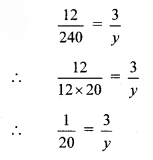
Maharashtra Board Class 8 Maths Solutions Chapter 7 Variation Practice Set 7.1 1
∴ y = 3 × 20
∴ y = 60

ii.
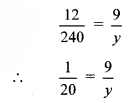
Maharashtra Board Class 8 Maths Solutions Chapter 7 Variation Practice Set 7.1 2
∴ y = 9 × 20
∴ y = 180

iii.
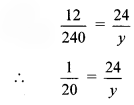
Maharashtra Board Class 8 Maths Solutions Chapter 7 Variation Practice Set 7.1 3
∴ y = 24 × 20
∴ y = 480

iv.
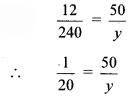
Maharashtra Board Class 8 Maths Solutions Chapter 7 Variation Practice Set 7.1 4
∴ y = 50 × 20
∴ y = 1000

Number of notebooks (x)123924501
Cost (In Rupees) (y)24060180480100020

Maharashtra Board 8th Class Maths Practice Set 6.4 Solutions Chapter 6 Factorisation of Algebraic Expressions

Balbharti Maharashtra State Board Class 8 Maths Solutions covers the Practice Set 6.4 8th Std Maths Answers Solutions Chapter 6 Factorisation of Algebraic Expressions.

Practice Set 6.4 8th Std Maths Answers Chapter 6 Factorisation of Algebraic Expressions

Question 1.
Simplify:
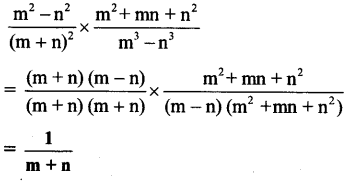
i. \(\frac{m^{2}-n^{2}}{(m+n)^{2}} \times \frac{m^{2}+m n+n^{2}}{m^{3}-n^{3}}\)
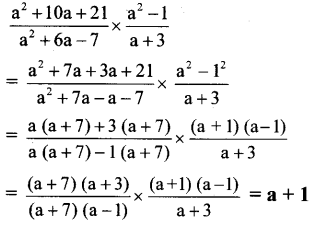
ii. \(\frac{a^{2}+10 a+21}{a^{2}+6 a-7} \times \frac{a^{2}-1}{a+3}\)
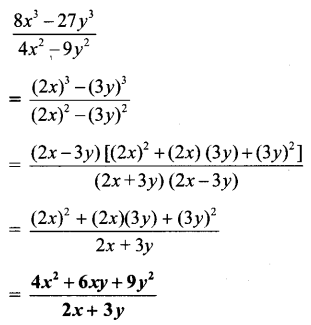
iii. \(\frac{8 x^{3}-27 y^{3}}{4 x^{2}-9 y^{2}}\)
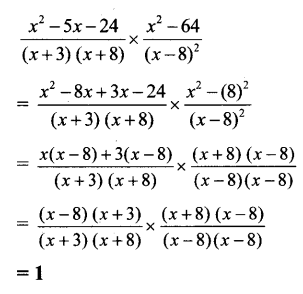
iv. \(\frac{x^{2}-5 x-24}{(x+3)(x+8)} \times \frac{x^{2}-64}{(x-8)^{2}}\)
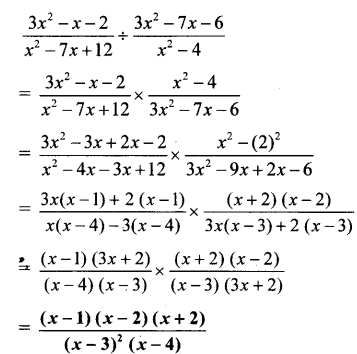
v. \(\frac{3 x^{2}-x-2}{x^{2}-7 x+12} \div \frac{3 x^{2}-7 x-6}{x^{2}-4}\)
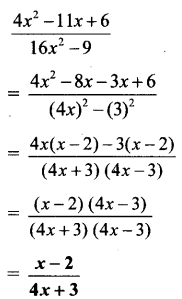
vi. \(\frac{4 x^{2}-11 x+6}{16 x^{2}-9}\)
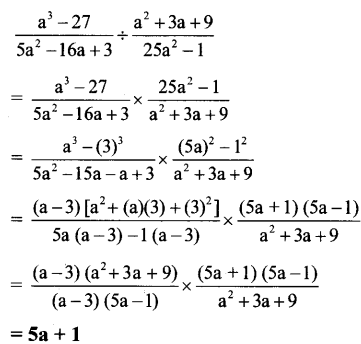
vii. \(\frac{a^{3}-27}{5 a^{2}-16 a+3} \div \frac{a^{2}+3 a+9}{25 a^{2}-1}\)
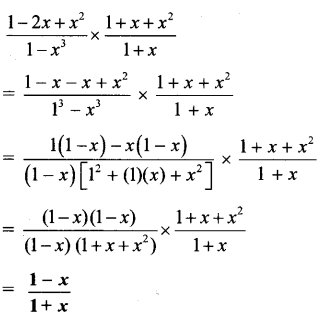
viii. \(\frac{1-2 x+x^{2}}{1-x^{3}} \times \frac{1+x+x^{2}}{1+x}\)
Solution:
i. \(\frac{m^{2}-n^{2}}{(m+n)^{2}} \times \frac{m^{2}+m n+n^{2}}{m^{3}-n^{3}}\)
Maharashtra Board Class 8 Maths Solutions Chapter 6 Factorisation of Algebraic Expressions Practice Set 6.4 1

ii. \(\frac{a^{2}+10 a+21}{a^{2}+6 a-7} \times \frac{a^{2}-1}{a+3}\)
Maharashtra Board Class 8 Maths Solutions Chapter 6 Factorisation of Algebraic Expressions Practice Set 6.4 2

iii. \(\frac{8 x^{3}-27 y^{3}}{4 x^{2}-9 y^{2}}\)
Maharashtra Board Class 8 Maths Solutions Chapter 6 Factorisation of Algebraic Expressions Practice Set 6.4 3

iv. \(\frac{x^{2}-5 x-24}{(x+3)(x+8)} \times \frac{x^{2}-64}{(x-8)^{2}}\)
Maharashtra Board Class 8 Maths Solutions Chapter 6 Factorisation of Algebraic Expressions Practice Set 6.4 4

v. \(\frac{3 x^{2}-x-2}{x^{2}-7 x+12} \div \frac{3 x^{2}-7 x-6}{x^{2}-4}\)
Maharashtra Board Class 8 Maths Solutions Chapter 6 Factorisation of Algebraic Expressions Practice Set 6.4 5

vi. \(\frac{4 x^{2}-11 x+6}{16 x^{2}-9}\)
Maharashtra Board Class 8 Maths Solutions Chapter 6 Factorisation of Algebraic Expressions Practice Set 6.4 6

vii. \(\frac{a^{3}-27}{5 a^{2}-16 a+3} \div \frac{a^{2}+3 a+9}{25 a^{2}-1}\)
Maharashtra Board Class 8 Maths Solutions Chapter 6 Factorisation of Algebraic Expressions Practice Set 6.4 7

viii. \(\frac{1-2 x+x^{2}}{1-x^{3}} \times \frac{1+x+x^{2}}{1+x}\)
Maharashtra Board Class 8 Maths Solutions Chapter 6 Factorisation of Algebraic Expressions Practice Set 6.4 8

Maharashtra Board 8th Class Maths Practice Set 6.3 Solutions Chapter 6 Factorisation of Algebraic Expressions

Balbharti Maharashtra State Board Class 8 Maths Solutions covers the Practice Set 6.3 8th Std Maths Answers Solutions Chapter 6 Factorisation of Algebraic Expressions.

Practice Set 6.3 8th Std Maths Answers Chapter 6 Factorisation of Algebraic Expressions

Question 1.
Factorize
i. y³ – 27
ii. x³ – 64y³
iii. 27m³ – 216n³
iv. 125y³ – 1
v. \(8 p^{3}-\frac{27}{p^{3}}\)
vi. 343a³ – 512b³
vii. 64x³ – 729y³
viii. \(16 a^{3}-\frac{128}{b^{3}}\)
Solution:
i. y³ – 27
= y³ – (3)³
Here, a = y and b = 3
∴ y³ – 27 = (y – 3)[y² + y(3) + (3)2]
…[∵ a³ – b³ = (a – b) (a² + ab + b²)]
= (y – 3)(y² + 3y + 9)

ii. x³ – 64y³
= x³ – (4y)³
Here, a = x and b = 4y
∴ x³ – 64y³ = (x – 4y)[x² + x(4y) + (4y)²]
…[∵ a³ – b³ = (a – b)(a² + ab + b²)]
= (x – 4y)(x² + 4xy + 16y²)

iii. 27m³ – 216n³
= 27 (m³ – 8n³)
… [Taking out the common factor 27]
= 27 [m³ – (2n)³]
Here, a = m and b = 2n
∴ 27m³ – 216n³
= 27 {(m – 2n) [m² + m(2n) + (2n)²]}
….[∵ a³ – b³ = (a – b) (a² + ab + b²)]
= 27 (m – 2n)(m² + 2mn + 4n²)

iv. 125y³ – 1
= (5y)³ – 1³
Here, a = 5y and b = 1
∴ 125y³ – 1 = (5y – 1) [(5y)² + (5y)(1) + (1)²]
…[∵ a³ – b³ = (a – b)(a² + ab + b²)]
= (5y – 1) (25y² + 5y + 1)

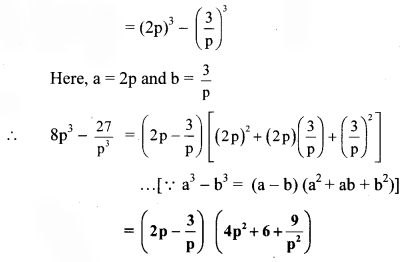
v. \(8 p^{3}-\frac{27}{p^{3}}\)
Maharashtra Board Class 8 Maths Solutions Chapter 6 Factorisation of Algebraic Expressions Practice Set 6.3 1

vi. 343a³ – 512b³
= (7a)³ – (8b)³
Here, A = 7a and B = 8b
∴ 343a³ – 512b³
= (7a – 8b) [(7a)² + (7a)(8b) + (8b)²]
…[∵ A³ – B³ = (A – B)(A² + AB + B²)]
= (7a – 8b) (49a² + 56ab + 64b²)

vii. 64x³ – 729y³
= (4x)³ – (9y)³
Here, a = 4x and b = 9y
∴ 64x³ – 729y³
= (4x – 9y) [(4x)² + (4x) (9y) + (9y)²]
…[∵ a³ – b³ = (a – b)(a² + ab + b²)]
= (4x – 9y) (16x² + 36xy + 81y²)

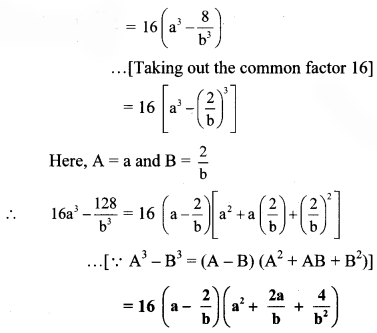
viii. \(16 a^{3}-\frac{128}{b^{3}}\)
Maharashtra Board Class 8 Maths Solutions Chapter 6 Factorisation of Algebraic Expressions Practice Set 6.3 2

Question 2.
Simplify:
i. (x + y)³ – (x – y)³
ii. (3a + 5b)³ – (3a – 5b)³
iii. (a + b)³ – a³ – b³
iv. p³ – (p + 1)³
v. (3xy – 2ab)³ – (3xy + 2ab)³
Solution:
i. (x + y)³ – (x – y)³
Here, a = x + y and b = x – y
(x + y)³ – (x – y)³
= [(x + y) – (x – y)] [(x + y)² + (x + y) (x – y) + (x – y)]
…[a³ – b³ = (a – b)(a² + ab + b²)]
= (x + y – x + y) [(x² + 2xy + y²) + (x² – y²) + (x² – 2xy + y²)]
= 2y(x² + x² + x² + 2xy – 2xy + y² – y² + y²)
= 2y (3x² + y²)
= 6x²y + 2y³

ii. (3a + 5b)³ – (3a – 5b)³
Here, A = 3a + 5b and B = 3a – 5b
= [(3a + 5b) – (3a – 5b)] [(3a + 5b)² + (3a + 5b) (3a – 5b) + (3a – 5b)²]
…[∵ A³ – B³ = (A – B)(A² + AB + B²)]
= (3a + 5b – 3a + 5b) [(9a² + 30ab + 25b²) + (9a² – 25b²) + (9a² – 30ab + 25b²)]
= 10b (9a² + 9a² + 9a² + 30ab – 30ab + 25b² – 25b² + 25b²)
= 10b (27a² + 25b²)
= 270a²b + 250b³

iii. (a + b)³ – a³ – b³
= a³ + 3a²b + 3ab² + b³ – a³ – b³
= 3a²b + 3ab²

iv. p³ – (p + 1)³
= p³ – (p³ + 3p² + 3p + 1) …[∵ (a + b)³ = a³ + 3a²b + 3ab² + b³]
= p³ – p³ – 3p² – 3p – 1
= – 3p² – 3p – 1

v. (3xy – 2ab)³ – (3xy + 2ab)³
Here, A = 3xy – 2ab and B = 3xy + 2ab
∴ (3xy – 2ab)³ – (3xy + 2ab)³
= [(3xy – 2ab) – (3xy + 2ab)] [(3xy – 2ab)² + (3xy – 2ab) (3xy + 2ab) + (3xy + 2ab)²]
…[∵ A³ – B³ = (A – B) (A² + AB + B²)]
= (3xy – 2ab – 3xy – 2ab) [(9x²y² – 12xyab + 4a²b²) + (9x²y² – 4a²b²) + (9x²y² + 12xyab + 4a²b²)]
= (- 4ab) (9x²y² + 9x²y² + 9x²y² – 12xyab + 12xyab + 4a²b² – 4a²b² + 4a²b²)
= (- 4ab) (27 xy² + 4a²b²)
= -108x²y²ab – 16a³b³

Maharashtra Board 8th Class Maths Practice Set 6.2 Solutions Chapter 6 Factorisation of Algebraic Expressions

Balbharti Maharashtra State Board Class 8 Maths Solutions covers the Practice Set 6.2 8th Std Maths Answers Solutions Chapter 6 Factorisation of Algebraic Expressions.

Practice Set 6.2 8th Std Maths Answers Chapter 6 Factorisation of Algebraic Expressions

Question 1.
Factorise:
i. x³ + 64y³
ii. 125p³ + q³
iii. 125k³ + 27m³
iv. 2l³ + 432m³
v. 24a³ + 81b³
vi. \(y^{3}+\frac{1}{8 y^{3}}\)
vii. \(\mathrm{a}^{3}+\frac{8}{\mathrm{a}^{3}}\)
viii. \(1+\frac{\mathrm{q}^{3}}{125}\)
Solution:
i. x³ + 64y³
= x³ + (4y)³
Here, a = x and b = 4y
∴ x³ + 64y³ = (x + 4y) [x² – x(4y) + (4y)²]
….[∵ a³ + b³ = (a + b)(a² – ab + b²)]
= (x + 4y)(x² – 4xy + 16y²)

ii. 125p³ + q³
= (5p)³ + q³
Here, a = 5p and b = q
∴ 125p³ + q³ = (5p + q)[(5p)² – (5p)(q) + q²]
…[∵ a³ + b³ = (a + b)(a² – ab + b²)]
= (5p + q)(25p² – 5pq + q²)

iii. 125k³ + 27m³
= (5k)³ + (3m)³
Here, a = 5k and b = 3m
∴ 125k³ + 27m³
= (5k + 3m) [(5k)² – (5k)(3m) + (3m)²]
…[∵ a³ + b³ = (a + b)(a² – ab + b²)]
= (5k + 3m)(25k² – 15km + 9m²)

iv. 2l³ + 432m³
= 2 (l³ + 216m³)
… [Taking out the common factor 2]
= 2[l³ + (6m)³]
Here, a = l and b = 6m
2l³ + 432m³ = 2 {(l + 6m)[l² – l(6m) + (6m)²]}
…[∵ a³ + b³ = (a + b)(a² – ab + b²)]
= 2(l + 6m)(l² – 6lm + 36m²)

v. 24a³ + 81b³
…[Taking out the common factor 3]
= 3 [(2a)³ + (3b)³]
Here, A = 2a and B = 3b
∴ 24a³ + 81b³
= 3 {(2a + 3b) [(2a)² – (2a)(3b) + (3b)²]}
…[∵ A³ + B³ = (A + B) (A² – AB + B²)]
= 3(2a + 3b)(4a² – 6ab + 9b²)

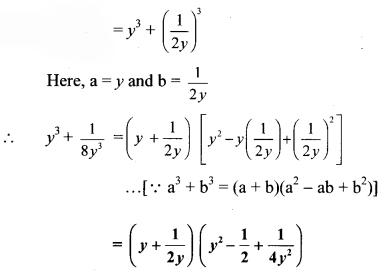
vi. \(y^{3}+\frac{1}{8 y^{3}}\)
Maharashtra Board Class 8 Maths Solutions Chapter 6 Factorisation of Algebraic Expressions Practice Set 6.2 1

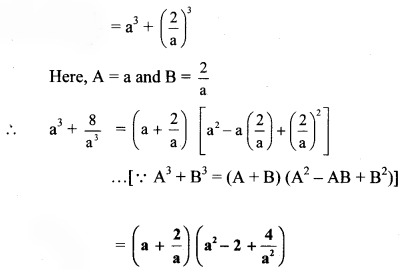
vii. \(\mathrm{a}^{3}+\frac{8}{\mathrm{a}^{3}}\)
Maharashtra Board Class 8 Maths Solutions Chapter 6 Factorisation of Algebraic Expressions Practice Set 6.2 2

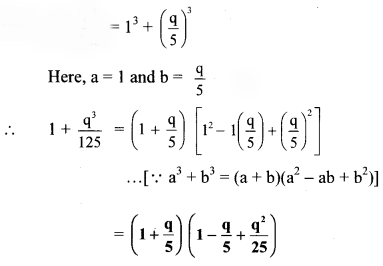
viii. \(1+\frac{\mathrm{q}^{3}}{125}\)
Maharashtra Board Class 8 Maths Solutions Chapter 6 Factorisation of Algebraic Expressions Practice Set 6.2 3

Maharashtra Board 8th Class Maths Practice Set 6.1 Solutions Chapter 6 Factorisation of Algebraic Expressions

Balbharti Maharashtra State Board Class 8 Maths Solutions covers the Practice Set 6.1 8th Std Maths Answers Solutions Chapter 6 Factorisation of Algebraic Expressions.

Practice Set 6.1 8th Std Maths Answers Chapter 6 Factorisation of Algebraic Expressions

Question 1.
Factorize:
i. x² + 9x + 18
ii. x² – 10x + 9
iii. y² + 24y + 144
iv. 5y² + 5y – 10
v. p² – 2p – 35
vi. p² – 7p – 44
vii. m² – 23m + 120
viii. m² – 25m + 100
ix. 3x² + 14x + 15
x. 2x² + x – 45
xi. 20x² – 26x + 8
xii. 44x² – x – 3
Solution:
i. x² + 9x + 18
= x² + 6x + 3x + 18
= x (x + 6) + 3(x + 6)
= (x + 6) (x + 3)
Maharashtra Board Class 8 Maths Solutions Chapter 6 Factorisation of Algebraic Expressions Practice Set 6.1 1

ii. x² – 10x + 9
= x² – 9x – x + 9
= x (x – 9) – 1(x – 9)
= (x – 9)(x – 1)
Maharashtra Board Class 8 Maths Solutions Chapter 6 Factorisation of Algebraic Expressions Practice Set 6.1 2

iii. y² + 24y + 144
= y² + 12y + 12y + 144
= y(y + 12) + 12(y + 12)
= (y + 12)(y + 12)
Maharashtra Board Class 8 Maths Solutions Chapter 6 Factorisation of Algebraic Expressions Practice Set 6.1 3

iv. 5y² + 5y – 10
= 5(y² + y – 2)
… [Taking out the common factor 5]
= 5(y² + 2y – y – 2)
= 5[y(y + 2) – 1(y + 2)]
= 5 (p + 2)(y- 1)
Maharashtra Board Class 8 Maths Solutions Chapter 6 Factorisation of Algebraic Expressions Practice Set 6.1 4

v. p² – 2p – 35
= p² – 7p + 5p – 35
= p(p – 7) + 5(p – 7)
= (p – 7)(p + 5)
Maharashtra Board Class 8 Maths Solutions Chapter 6 Factorisation of Algebraic Expressions Practice Set 6.1 5

vi. p² – 7p – 44
= p² – 11p + 4p – 44
= p(p – 11) + 4(p – 11)
= (p – 11)(p + 4)
Maharashtra Board Class 8 Maths Solutions Chapter 6 Factorisation of Algebraic Expressions Practice Set 6.1 6

vii. m² – 23m + 120
= m² – 15m – 8m + 120
= m (m – 15) – 8 (m – 15)
= (m – 15) (m – 8)
Maharashtra Board Class 8 Maths Solutions Chapter 6 Factorisation of Algebraic Expressions Practice Set 6.1 7

viii. m² – 25m + 100
= m² – 20m – 5m + 100
= m(m – 20) – 5(m – 20)
= (m – 20) (m – 5)
Maharashtra Board Class 8 Maths Solutions Chapter 6 Factorisation of Algebraic Expressions Practice Set 6.1 8

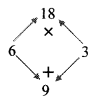
ix. 3x² + 14x + 15 3 × 15 = 45
= 3x² + 9x + 5x + 15
= 3x(x + 3) + 5(x + 3)
= (x + 3) (3x + 5)
Maharashtra Board Class 8 Maths Solutions Chapter 6 Factorisation of Algebraic Expressions Practice Set 6.1 9

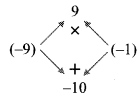
x. 2x² + x – 45 2 × (- 45) = -90
= 2x² + 10x – 9x – 45
= 2x(x + 5) – 9 (x + 5)
= (x + 5) (2x – 9)
Maharashtra Board Class 8 Maths Solutions Chapter 6 Factorisation of Algebraic Expressions Practice Set 6.1 10

xi. 20x² – 26x + 8
= 2(10x² – 13x + 4) 10 × 4 = 40
… [Taking out the common factor 2]
= 2(10x² – 8x – 5x + 4)
= 2[2x(5x – 4) – 1(5x – 4)]
= 2 (5x – 4) (2x – 1)
Maharashtra Board Class 8 Maths Solutions Chapter 6 Factorisation of Algebraic Expressions Practice Set 6.1 11

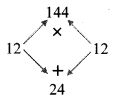
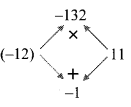
xii. 44x² – x – 3 44 × (-3) = -132
= 44x² – 12x + 11x – 3
= 4x(11x – 3) + 1(11x – 3)
= (11x – 3) (4x + 1)
Maharashtra Board Class 8 Maths Solutions Chapter 6 Factorisation of Algebraic Expressions Practice Set 6.1 12

Maharashtra Board 8th Class Maths Practice Set 5.3 Solutions Chapter 5 Expansion Formulae

Balbharti Maharashtra State Board Class 8 Maths Solutions covers the Practice Set 5.3 8th Std Maths Answers Solutions Chapter 5 Expansion Formulae.

Practice Set 5.3 8th Std Maths Answers Chapter 5 Expansion Formulae

Question 1.
Expand:
i. (2m – 5)³
ii. (4 – p)³
iii. (7x – 9y)³
iv. (58)³
v. (198)³
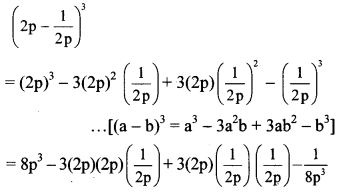
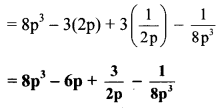
vi. \(\left(2 p-\frac{1}{2 p}\right)^{3}\)
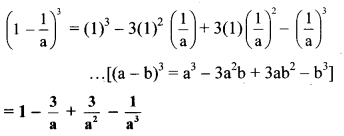
vii. \(\left(1-\frac{1}{a}\right)^{3}\)
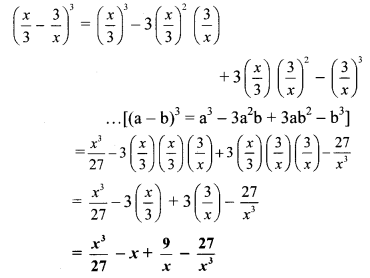
viii. \(\left(\frac{x}{3}-\frac{3}{x}\right)^{3}\)
Solution:
i. Here, a = 2m and b = 5
(2m – 5)³
= (2m)³ – 3(2m)² (5) + 3(2m) (5)² – (5)³
… [(a – b)³ = a³ – 3a²b + 3ab² – b³]
= 8m³ – 3(4m²)(5) + 3(2m)(25) – 125
= 8m³ – 60m² + 150m – 125

ii. Here, a = 4 and b = p
(4 – p)³ = (4)³ – 3(4)²(p) + 3(4)(p)² – (p)³
… [(a – b)³ = a³ – 3a²b + 3ab² – b³]
= 64 – 3(16)(p) + 3(4)(p²) – p³
= 64 – 48p + 12p² – p³

iii. Here, a = 7x and b = 9y
(7x – 9y)³
= (7x)³ – 3(7x)² (9y) + 3 (7x)(9y)² – (9y)³
…[(a – b)³ = a³ – 3a²b + 3ab² – b³]
= 343x³ – 3(49x²)(9y) + 3(7x)(81y²) – 729y³
= 343x³ – 1323x²y + 1701xy² – 729y³

iv. (58)³ = (60 – 2)³
Here, a = 60 and b = 2
(58)³ = (60)³ – 3(60)²(2) + 3(60)(2)² – (2)³
… [(a – b)³ = a³ – 3a²b + 3ab² – b³]
= 216000 – 3(3600)(2) + 3(60)(4) – 8
= 216000 – 21600 + 720 – 8
=195112

v. (198)³ = (200 – 2)³
Here, a = 200 and b = 2
(198)³ = (200)³ – 3(200)²(2) + 3(200)(2)² – (2)³
… [(a – b)³ = a³ – 3a²b + 3ab² – b³]
= 8000000 – 3(40000)(2) + 3(200)(4) – 8
= 8000000 – 240000 + 2400 – 8
= 7762392

vi. Here, a = 2p and b = \(\frac { 1 }{ 2p }\)
Maharashtra Board Class 8 Maths Solutions Chapter 5 Expansion Formulae Practice Set 5.3 1
Maharashtra Board Class 8 Maths Solutions Chapter 5 Expansion Formulae Practice Set 5.3 2

vii. Here, A = 1 and B = \(\frac { 1 }{ a }\)
Maharashtra Board Class 8 Maths Solutions Chapter 5 Expansion Formulae Practice Set 5.3 3

viii. Here, a = \(\frac { x }{ 3 }\) and b = \(\frac { 3 }{ x }\)
Maharashtra Board Class 8 Maths Solutions Chapter 5 Expansion Formulae Practice Set 5.3 4

Question 2.
Simplify:
i. (2a + b)³ – (2a – b)³
ii. (3r – 2k)³ + (3r + 2k)³
iii. (4a – 3)³ – (4a + 3)³
iv. (5x – 7y)³ + (5x + 7y)³
Solution:
i. (2a + b)³ – (2a – b)³
= [(2a)³ + 3(2a)²(b) + 3 (2a)(b)² + (b)³] – [(2a)³ – 3(2a)²(b) + 3 (2a)(b)² – (b)³]
… [(a + b)³ = a³ + 3a²b + 3ab² + b³, (a – b)³ = a³ – 3a²b + 3ab² – b³]
= (8a³ + 12a²b + 6ab² + b³) – (8a³ – 12a²b + 6ab² – b³)
= 8a³ + 12a²b + 6ab² + b³ – 8a³ + 12a²b – 6ab² + b³
= 8a³ – 8a³ + 12a²b + 12a²b + 6ab² – 6ab² + b³ + b³
= 24a²b + 2b³

ii. (3r – 2k)³ + (3r + 2k)³
= [(3r)³ – 3(3r)²(2k) + 3(3r)(2k)² – (2k)³] + [(3r)³ + 3(3r)²(2k) + 3(3r)(2k)² + (2k)³]
… [(a – b)³ = a³ – 3a²b + 3ab² – b³, (a + b)³ = a³ + 3a²b + 3ab² + b³]
= (27r³ – 54r²k + 36rk² – 8k³) + (27r³ + 54r²k + 36rk² + 8k³)
= 27r³ – 54r²k + 36rk² – 8k³ + 27r³ + 54r²k + 36rk² + 8k³
= 27r³ + 27r³ – 54r²k + 54r²k + 36rk² + 36rk² – 8k³ + 8k³
= 54r³ + 72rk²

iii. (4a – 3)³ – (4a + 3)³
= [(4a)³ – 3(4a)² (3) + 3(4a)(3)² – (3)³] – [(4a)³ + 3(4a)²(3) + 3(4a)(3)² + (3)³]
… [(a – b)³ = a³ – 3a²b + 3ab² – b³, (a + b)³ = a³ + 3a²b + 3ab² + b³]
= (64a³ – 144a² + 108a – 27) – (64a³ + 144a² + 108a + 27)
= 64a³ – 144a² + 108a – 27 – 64a³ -144a² – 108a – 27
= 64a³ – 64a³ – 144a² – 144a² + 108a – 108a – 27 – 27
= -288a² – 54

iv. (5x – 7y)³ + (5x + 7y)³
= [(5x)³ – 3(5x)²(7y) + 3(5x)(7y)² – (7y)³] + [(5x)³ + 3(5x)² (7y) + 3(5x) (7y)² +(7y)³]
… [(a – b)³ = a³ – 3a²b + 3ab² – b³, (a + b)³ = a³ + 3a²b + 3ab² + b³]
= (125x³ – 525x²y + 735xy² – 343y³) + (125x³ + 525x²y + 735xy² + 343y³)
= 125x³ – 525x²y + 735xy² – 343y³ + 125x³ + 525x²y + 735xy² + 343y³
= 125x³ + 125x³ – 525x²y + 525x²y + 735xy² + 735xy² – 343y³ + 343y³
= 250x³ + 1470xy²

Maharashtra Board Class 8 Maths Chapter 5 Expansion Formulae Practice Set 5.3 Intext Questions and Activities

Question 1.
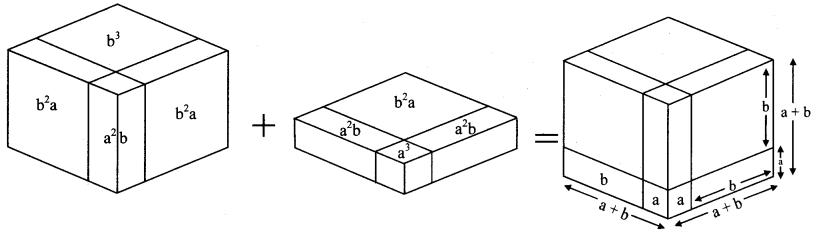
Make two cubes of side a and of side b each. Make six parallelopipeds; three of them measuring a × a × b and the remaining three measuring b × b × a. Arrange all these solid figures properly and make a cube of side (a + b). (Textbook pg. no. 25)
Solution:
(a + b)³ = a³ + 3a²b + 3ab² + b³
= a × a × a + 3 × a × a × b + 3 × a × b × b + b × b × b
Maharashtra Board Class 8 Maths Solutions Chapter 5 Expansion Formulae Practice Set 5.3 5

Maharashtra Board 8th Class Maths Practice Set 5.1 Solutions Chapter 5 Expansion Formulae

Balbharti Maharashtra State Board Class 8 Maths Solutions covers the Practice Set 5.1 8th Std Maths Answers Solutions Chapter 5 Expansion Formulae.

Practice Set 5.1 8th Std Maths Answers Chapter 5 Expansion Formulae

Question 1.
Expand :
i. (a + 2)(a – 1)
ii. (m – 4)(m + 6)
iii. (p + 8) (p – 3)
iv. (13 + x)(13 – x)
v. (3x + 4y) (3x + 5y)
vi. (9x – 5t) (9x + 3t)
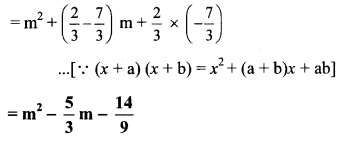
vii. \(\left(m+\frac{2}{3}\right)\left(m-\frac{7}{3}\right)\)
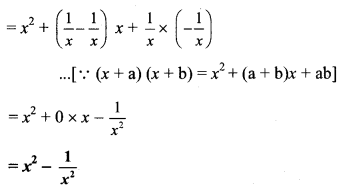
viii. \(\left(x+\frac{1}{x}\right)\left(x-\frac{1}{x}\right)\)
ix. \(\left(\frac{1}{y}+4\right)\left(\frac{1}{y}-9\right)\)
Solution:
i. (a + 2)(a – 1)
= a² + (2 – 1) a + 2 × (-1)
..[∵ (x + A) (x + B) = x² + (A + B)x + AB]
= a² + a – 2

ii. (m – 4)(m + 6)
= m² + (- 4 + 6) m + (-4) × 6
…[∵ (x + a) (x + b) = x² + (a + b)x + ab]
= m² + 2m – 24

iii. (p + 8) (p – 3)
= p² + (8 – 3) p + 8 x (-3)
…[∵ (x + a) (x + b) = x² + (a + b)x + ab]
= p² + 5p – 24

iv. (13 + x) (13 – x)
= (13)² + (x – x) 13 + x × (-x)
…[∵ (x + a) (x + b) = x² + (a + b)x + ab]
= 169 + 0 × 13 – x²
= 169 – x²

v. (3x + 4y) (3x + 5y)
= (3x)² + (4y + 5y) 3x + 4y × 5y
…[∵ (x + a) (x + b) = x² + (a + b)x + ab]
= 9x² + 9y × 3x + 20y²
= 9x² + 27xy + 20y²

vi. (9x – 5t) (9x + 3t)
= (9x)² + [(-5t) + 3t] 9x + (-5t) × 3t
…[∵ (x + a) (x + b) = x² + (a + b)x + ab]
= 81x² + (-2t) × 9x – 15t²
= 81x² – 18xt – 15t²

vii. \(\left(m+\frac{2}{3}\right)\left(m-\frac{7}{3}\right)\)
Maharashtra Board Class 8 Maths Solutions Chapter 5 Expansion Formulae Practice Set 5.1 1

viii. \(\left(x+\frac{1}{x}\right)\left(x-\frac{1}{x}\right)\)
Maharashtra Board Class 8 Maths Solutions Chapter 5 Expansion Formulae Practice Set 5.1 2

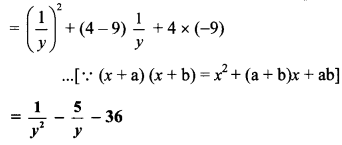
ix. \(\left(\frac{1}{y}+4\right)\left(\frac{1}{y}-9\right)\)
Maharashtra Board Class 8 Maths Solutions Chapter 5 Expansion Formulae Practice Set 5.1 3

Maharashtra Board Class 8 Maths Chapter 5 Expansion Formulae Practice Set 5.1 Intext Questions and Activities

Question 1.
Use the above formulae to fill proper terms in the following boxes. (Textbook pg. no. 23)

  1. (x + 2y)² = x² + ___ + 4y²
  2. (2x – 5y)² = __ – 20xy + __
  3. (101)² = (100 + 1)² = ___+ ___ + 1² = ___
  4. (98)² = (100 – 2)² = 10000 – ___ + ___ = ___
  5. (5m + 3n) (5m – 3n) = ___ – ___ = ___ – ___

Solution:

  1. (x + 2y)² = x² + 4xy + 4y²
  2. (2x – 5y)² = 4x² – 20xy + 25y²
  3. (101)² = (100 + 1)² = 10000 + 200 + 1² = 10201
  4. (98)² = (100 – 2)² = 10000 – 400 + 4 = 9604
  5. (5m + 3n) (5m – 3n) = (5m)² – (3n)² = 25m² – 9n²

Question 2.
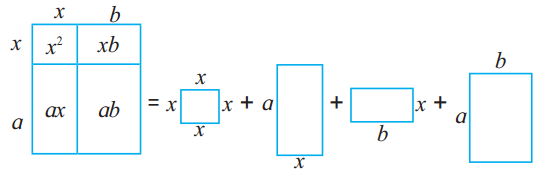
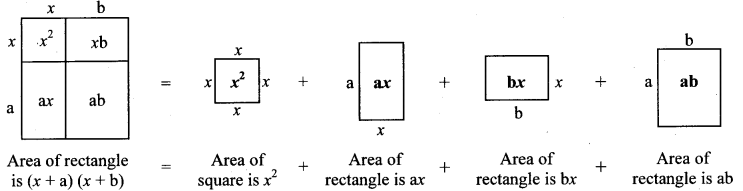
Expand (x + a) (x + b) using formulae for areas of a square and a rectangle. (Textbook pg. no. 23)
Maharashtra Board Class 8 Maths Solutions Chapter 5 Expansion Formulae Practice Set 5.1 4
(x + a) (x + b) = x² + ax + bx + ab
(x + a) (x + b) = x² + (a + b) x + ab
Solution:
Maharashtra Board Class 8 Maths Solutions Chapter 5 Expansion Formulae Practice Set 5.1 5
∴ (x + a) (x + b) = x² + ax + bx + ab
∴ (x + a) (x + b) = x² + (a + b) x + ab

Maharashtra Board 8th Class Maths Practice Set 5.2 Solutions Chapter 5 Expansion Formulae

Balbharti Maharashtra State Board Class 8 Maths Solutions covers the Practice Set 5.2 8th Std Maths Answers Solutions Chapter 5 Expansion Formulae.

Practice Set 5.2 8th Std Maths Answers Chapter 5 Expansion Formulae

Question 1.
Expand:
i. (k + 4)³
ii. (7x + 8y)³
iii. (7x + m)³
iv. (52)³
v. (101)³
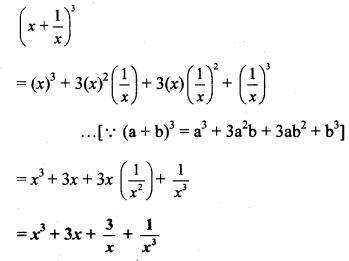
vi. \(\left(x+\frac{1}{x}\right)^{3}\)
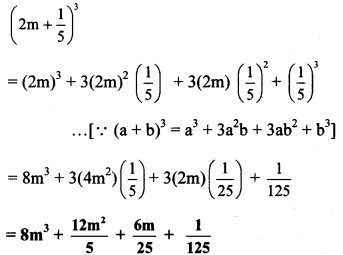
vii. \(\left(2 m+\frac{1}{5}\right)^{3}\)
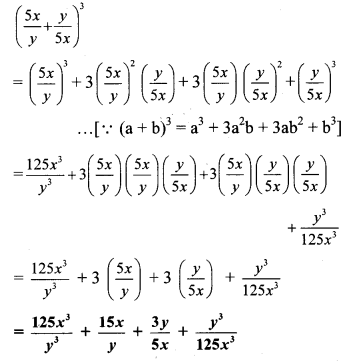
viii. \(\left(\frac{5 x}{y}+\frac{y}{5 x}\right)^{3}\)
Solution:
i. Here, a = k and b = 4
(k + 4)³ = (k)³ + 3(k)² (4) + 3(k)(4)² + (4)³
…[∵ (a + b)³ = a³ + 3a²b + 3ab² + b³]
= k³ + 12k² + 3(k)(16) + 64
= k³ + 12k² + 48k + 64

ii. Here, a = 7x and b = 8y
(7x + 8y)³
= (7x)³ + 3(7x)² (8y) + 3(7x) (8y)² + (8y)³
…[∵ (a + b)³ = a³ + 3a²b + 3ab² + b³]
= 343x³ + 3(49x²)(8y) + 3(7x)(64y²) + 512y³
= 343x³ + 1176x²y + 1344xy² + 512y³

iii. Here, a = 7 and b = m
(7 + m)³ = (7)³ + 3(7)²(m) + 3(7)(m)² + (m)³
…[∵ (a + b)³ = a³ + 3a²b + 3ab² + b³]
= 343 + 3(49)(m) + 3(7)(m²) + m³
= 343 + 147m + 21m² + m³

iv. (52)³ = (50 + 3)³
Here, a = 50 and b = 2
(52)³ = (50)³ + 3(50)² (2) + 3(50)(2)² + (2)³
…[∵ (a + b)³ = a³ + 3a²b + 3ab² + b³]
= 125000 + 3(2500)(2) + 3(50)(4) + 8
= 125000 + 15000 + 600 + 8
=140608

v. (101)³ = (100 + 1)³
Here, a = 100 and b = 1
(101)³
= (100)³ + 3(100)²(1) + 3(100)(1)² + (1)³
…[∵ (a + b)³ = a³ + 3a²b + 3ab² + b³]
= 1000000 + 3(10000) + 3(100) (1) + 1
= 1000000 + 30000 + 300 + 1
= 1030301

vi. Here, a = x and b = \(\frac { 1 }{ x }\)
Maharashtra Board Class 8 Maths Solutions Chapter 5 Expansion Formulae Practice Set 5.2 1

vii. Here, a = 2m and b = \(\frac { 1 }{ 5 }\)
Maharashtra Board Class 8 Maths Solutions Chapter 5 Expansion Formulae Practice Set 5.2 2

viii. Here, a = \(\frac { 5x }{ y }\) and b = \(\frac { y }{ 5x }\)
Maharashtra Board Class 8 Maths Solutions Chapter 5 Expansion Formulae Practice Set 5.2 3

Maharashtra Board 8th Class Maths Practice Set 4.1 Solutions Chapter 4 Altitudes and Medians of a Triangle

Balbharti Maharashtra State Board Class 8 Maths Solutions covers the Practice Set 4.1 8th Std Maths Answers Solutions Chapter 4 Altitudes and Medians of a Triangle.

Practice Set 4.1 8th Std Maths Answers Chapter 4 Altitudes and Medians of a Triangle

Question 1.
In ∆LMN, ___ is an altitude and __ is a median, (write the names of appropriate segments.)
Maharashtra Board Class 8 Maths Solutions Chapter 4 Altitudes and Medians of a Triangle Practice Set 4.1 1
Solution:
In ∆LMN, seg LX is an altitude and seg LY is a median.

Question 2.
Draw an acute angled ∆PQR. Draw all of its altitudes. Name the point of concurrence as ‘O’.
Solution:
Maharashtra Board Class 8 Maths Solutions Chapter 4 Altitudes and Medians of a Triangle Practice Set 4.1 2

Question 3.
Draw an obtuse angled ∆STV. Draw its medians and show the centroid.
Solution:
Maharashtra Board Class 8 Maths Solutions Chapter 4 Altitudes and Medians of a Triangle Practice Set 4.1 3

Question 4.
Draw an obtuse angled ∆LMN. Draw its altitudes and denote the ortho centre by ‘O’.
Solution:
Maharashtra Board Class 8 Maths Solutions Chapter 4 Altitudes and Medians of a Triangle Practice Set 4.1 4

Question 5.
Draw a right angled ∆XYZ. Draw its medians and show their point of concurrence by G.
Solution:
Maharashtra Board Class 8 Maths Solutions Chapter 4 Altitudes and Medians of a Triangle Practice Set 4.1 5

Question 6.
Draw an isosceles triangle. Draw all of its medians and altitudes. Write your observation about their points of concurrence.
Solution:
Maharashtra Board Class 8 Maths Solutions Chapter 4 Altitudes and Medians of a Triangle Practice Set 4.1 6
The point of concurrence of medians i.e. G and that of altitudes i.e. O lie on the same line PS which is the perpendicular bisector of seg QR.

Question 7.
Fill in the blanks.
Point G is the centroid of ∆ABC.
i. If l(RG) = 2.5, then l(GC) = ___
ii. If l(BG) = 6, then l(BQ) = ____
iii. If l(AP) = 6, then l(AG) = ___ and l(GP) = ___.
Maharashtra Board Class 8 Maths Solutions Chapter 4 Altitudes and Medians of a Triangle Practice Set 4.1 7
Solution:
The centroid of a triangle divides each median in the ratio 2:1.
i. Point G is the centroid and seg CR is the median.
∴ \(\frac{l(\mathrm{GC})}{l(\mathrm{RG})}=\frac{2}{1}\)
∴ \(\frac{l(\mathrm{GC})}{2.5}=\frac{2}{1}\) ……[∵ l(RG) = 2.5]
∴ l(GC) × 1 = 2 × 2.5
∴ l(GC) = 5

ii. Point G is the centroid and seg BQ is the median.
∴ \(\frac{l(\mathrm{BG})}{l(\mathrm{GQ})}=\frac{2}{1}\)
∴ \(\frac{6}{l(\mathrm{GQ})}=\frac{2}{1}\) …..[∵ l(BG) = 6]
∴ 6 × 1 = 2 × l(GQ)
∴ \(\frac { 6 }{ 2 }\) = l(GQ)
∴ 3 = l(GQ)
i.e. l(GQ) = 3
Now, l (BQ) = l(BG) + l(GQ)
∴ l(BQ) = 6 + 3
∴ l(BQ) = 9

iii. Point G is the centroid and seg AP is the median.
∴ \(\frac{l(\mathrm{AG})}{l(\mathrm{GP})}=\frac{2}{1}\)
∴ l(AG) = 2 l(GP) …..(i)
Now, l(AP) = l(AG) + l(GP) … (ii)
∴ l(AP) = 2l(GP) + l(GP) … [From (i)]
∴ l(AP) = 3l(GP)
∴ 6 = 3l(GP) ..[∵ l(AP) = 6]
∴ \(\frac { 6 }{ 3 }\) = l(GP)
∴ 2 = l(GP)
i.e. l(GP) = 2
l(AP) = l(AG) + l(GP) …[from (ii)]
∴ 6 = l(AG) + 2
∴ l(AG) = 6 – 2
∴ l(AG) = 4

Maharashtra Board Class 8 Maths Chapter 4 Altitudes and Medians of a Triangle Practice Set 4.1 Intext Questions and Activities

Question 1.
Draw a line. Take a point outside the line. Draw a perpendicular from the point to the line with the help of a set-square (Textbook pg. no, 19)
Solution:
Step 1: Draw a line l and a point P lying outside it.
Maharashtra Board Class 8 Maths Solutions Chapter 4 Altitudes and Medians of a Triangle Practice Set 4.1 8
Step 2: By placing a set-square on line l, draw a perpendicular to the line from point P.
Maharashtra Board Class 8 Maths Solutions Chapter 4 Altitudes and Medians of a Triangle Practice Set 4.1 9

Question 2.
Draw an acute angled ∆ABC and all its altitudes. Observe the location of the orthocentre. (Textbook pg. no. 20)
Solution:
Maharashtra Board Class 8 Maths Solutions Chapter 4 Altitudes and Medians of a Triangle Practice Set 4.1 10
Point O is the orthocentre.
Orthocentre lies in the interior of ∆ABC.

Question 3.
Draw a right angled triangle and draw all its altitudes. Write the point of concurrence. (Textbook: pg, no. 20)
Solution:
Maharashtra Board Class 8 Maths Solutions Chapter 4 Altitudes and Medians of a Triangle Practice Set 4.1 11
Point Q is the orthocentre.
The point of concurrence of altitudes PQ, QR and QS is Q.

Question 4.
i. Draw an obtuse angled triangle and all its altitudes.
ii. Do they intersect each other?
Draw the lines containing the altitudes. Observe that these lines are concurrent. (Textbook pg. no. 20)
Solution:
i.
Maharashtra Board Class 8 Maths Solutions Chapter 4 Altitudes and Medians of a Triangle Practice Set 4.1 12
Point O is the orthocentre.

ii. Yes, all the altitudes intersect at point O in the exterior of ∆PQR.

Question 5.
Draw three different triangles; a right angled triangle, an obtuse angled triangle and an acute angled triangle. Draw the medians of the triangles. Note that the centroid of each of them is in the interior of the triangle. (Textbook pg. no. 21)
Solution:
i. Right angled triangle:
Maharashtra Board Class 8 Maths Solutions Chapter 4 Altitudes and Medians of a Triangle Practice Set 4.1 13
ii. Obtuse angled triangle:
Maharashtra Board Class 8 Maths Solutions Chapter 4 Altitudes and Medians of a Triangle Practice Set 4.1 14
iii. Acute angled triangle:
Maharashtra Board Class 8 Maths Solutions Chapter 4 Altitudes and Medians of a Triangle Practice Set 4.1 15

Question 6.
Draw a sufficiently large ∆ABC.
Draw medians; seg AR, seg BQ and seg CP of ∆ABC.
Name the point of concurrence as G.
Measure the lengths of segments from the figure and fill in the boxes in the following table.

l(AG) =l(GR) =l(AG): l(GR) =
l(BG) =l(GQ) =l(BG): l(GQ) =
l(CG) =l(GP) =l(CG): l(GP) =

Observe that all of these ratios are nearly 2 : 1 (Textbook pg. no. 21)
Solution:
Maharashtra Board Class 8 Maths Solutions Chapter 4 Altitudes and Medians of a Triangle Practice Set 4.1 16

l(AG) = 2.9l(GR) = 1.4l(AG): l(GR) = \(\frac{2.8}{1.4}=\frac{2}{1}\)
l(BG) = 2.4l(GQ) = 1.2l(BG): l(GQ) = \(\frac{2.4}{1.2}=\frac{2}{1}\)
l(CG) = 2.8l(GP) = 1.4l(CG): l(GP) = \(\frac{2.8}{1.4}=\frac{2}{1}\)

Question 7.
As shown in the given figure, a student drew ∆ABC using five parallel lines of a notebook. Then he found the centroid G of the triangle. How will you decide whether the location of G he found, is correct. (Textbook pg. no. 21)
Maharashtra Board Class 8 Maths Solutions Chapter 4 Altitudes and Medians of a Triangle Practice Set 4.1 17
Solution:
Draw seg AP ⊥ seg PE and seg EQ ⊥ seg QC.
Maharashtra Board Class 8 Maths Solutions Chapter 4 Altitudes and Medians of a Triangle Practice Set 4.1 18
Side AP || side EQ and AC is their transversal.
∴ ∠PAE ≅ ∠QEC …(i) [Corresponding angles]
In ∆ APE and ∆ EQC,
∠PAE ≅ ∠QEC …[From (i)]
∠APE ≅ ∠EQC
… [Each angle is of measure 90°]
side PE ≅ side QC
…. [Perpendicular distance between parallel lines]
∴ ∆ APE ≅ ∆ EQC … [By AAS test]
∴ AE = EC
… [Corresponding sides of congruent triangles]
∴ E is the midpoint of AC.
∴ seg BE is the median.
Similarly, seg CF is the median.
Since, the medians of a triangle are concurrent.
∴ G is the centroid of ∆ABC.

Question 8.
Draw an equilateral triangle. Find its circumcentre (C), incentre (I), centroid (G) and orthocentre (O). Write your observation. (Textbook pg. no. 22)
Solution:
Maharashtra Board Class 8 Maths Solutions Chapter 4 Altitudes and Medians of a Triangle Practice Set 4.1 19
From the figure, circumcentre (C), incentre (I), centroid (G) and orthocentre (O) of an equilateral triangle are the same.

Question 9.
Draw an isosceles triangle. Locate its centroid, orthocentre, circumcentre and incentre. Verify that they are collinear. (Textbook pg. no. 22)
Solution:
Maharashtra Board Class 8 Maths Solutions Chapter 4 Altitudes and Medians of a Triangle Practice Set 4.1 20
From the figure, centroid (G), orthocentre (O), circumcentre (C) and incentre (I) of an isosceles triangle lie on the same line AD.
∴ they are collinear.