Maharashtra Board Class 8 Geography Solutions Chapter 8 Industries

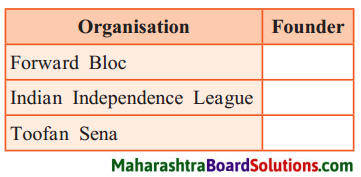
Balbharti Maharashtra State Board Class 8 Geography Solutions Chapter 8 Industries Notes, Textbook Exercise Important Questions and Answers.

Maharashtra State Board Class 8 Geography Solutions Chapter 8 Industries

Class 8 Geography Chapter 8 Industries Textbook Questions and Answers

1. Mark ✓ in the box next to the right alternative:
(Note: The answers are given directly.)

Question A.
Which factors among those mentioned below does not directly impact industrial development?
(i) Water [ ]
(ii) Electricity [ ]
(iii) Labour [ ]
(iv) Air [ ]
Answer:
(iv) Air [✓]

Maharashtra Board Class 8 Geography Solutions Chapter 8 Industries

Question B.
Which of the following is a small industry?
(i) Machine parts industry [ ]
(ii) Book binding industry [ ]
(iii) Silk industry [ ]
(iv) Sugar industry [ ]
Answer:
(ii) Book binding industry [✓]

Question C.
Which of the following cities is not an IT centre?
(i) Old Delhi [ ]
(ii) New Delhi [ ]
(iii) Noida [ ]
(iv) Bangaluru [ ]
Answer:
(i) Old Delhi [✓]

Question D.
An amount of 2% of the profits have to be utilized for which purpose by industries?
(i) Income tax [ ]
(ii) Corporate social responsibility [ ]
(iii) Goods and service tax [ ]
(iv) Sales tax [ ]
Answer:
(ii) Corporate social responsibility [✓]

2. State whether the following statements are true or false. Correct the incorrect Statements.

Question a.
Small and medium industries of a country are harmful to heavy industries.
Answer:
Incorrect.
Correct sentence: Small and medium industries of a country are supportive to heavy industries.

Question b.
The level of industrialization is an indicator of the economic development of a country.
Answer:
Correct.

Maharashtra Board Class 8 Geography Solutions Chapter 8 Industries

Question c.
The aim of the industrial development corporations is to decentralize industrialization.
Answer:
Correct.

Question d.
Corporate social responsibility is compulsory for every industries.
Answer:
Incorrect.
Correct sentence: Corporate social responsibility is not compulsory for every industries.

3. Answer the following questions in three to four lines.

Question a.
What are the facilities provided by the government to industrial estates?
Answer:
The following are the facilities provided by the government to industrial estates:

  1. Government gives concessional rates to the estates for electricity, water and taxes.
  2. Estates are also provided piece of land at concessional rates by the government.

Question b.
Write in your words how industrial development impacts national development.
Answer:

  1. Industrial development generates employment opportunities.
  2. Due to increased employment level, people get jobs and per capita income increases. This further increases the standard of living of people.
  3. Industrial development increases the value of the Gross National Product.
  4. Industrial development increases the production of various goods. By exporting the surplus goods, country can earn foreign exchange. In this way, industrial development positively impacts national development.

Maharashtra Board Class 8 Geography Solutions Chapter 8 Industries

Question c.
Give your opinion in short on the usefulness of corporate social responsibility.
Answer:
1. Corporate social responsibility is responsibility shown by the industrialists by working for the betterment of the society and for conserving environment.

2. Industries making annual profit of more than 5 crores are expected to spend 2% of their profits on some of the following acts:

  • Providing educational or health facilities
  • Establishing centres for mentally or physically challenged, widows, other needy people
  • Developing a particular village or region
  • Establishing environmental development centres, etc.

3. Corporate social responsibility increases the welfare of people and so proves beneficial to the society.

Question d.
Mention three features of small industries.
Answer:
Three features of small industries ! are as follows:

  1. Small industries require comparatively less amount of inputs like capital, machinery and manpower.
  2. Small industries require comparatively less premise for its day-to-day operations.
  3. Generally, the goods produced in small industries have local/regional markets.

4. Write detailed answers to the following questions.

Question a.
Explain the factors affecting industrial development.
Answer:
The factors affecting industrial development are as follows:
1. Scientific and technological advancement, quantity and quality of labour, speedy transportation facilities, ready markets, availability of raw materials, government policies, political stability, etc. are factors that influence the industrial development of a nation.

2. For example, dense forest areas, mountainous areas, desert regions have extreme physiographical features. Transport facilities are found to be limited in such regions. Therefore, industrial development is found to be limited in such regions.

3. For example, agriculture is developed on a large scale in the fertile plains and the regions of moderate rainfall. Agriculture provides raw materials to many industries. Therefore, industrial development is found to be high in such regions.

Maharashtra Board Class 8 Geography Solutions Chapter 8 Industries

Question b.
State the advantages of the Maharashtra Industrial Development Corporation.
Answer:
The advantages of the Maharashtra Industrial Development Corporation are as follows:

  1. The state government of Maharashtra established Maharashtra Industrial Development Corporation (MIDC) on 1st August, 1962.
  2. Through MIDC, government has set  up industries in all districts of Maharashtra. MIDC supports the industrial growth and decentralization of industries.
  3. Government gives concessional rates to the estates/industries for electricity, water and taxes. Estates/industries are also provided piece of land at concessional rates by the government.
  4. MIDC has been playing an important role in generating employment opportunities in all the 36 districts of Maharashtra.
  5. MIDC has been playing an important indirect role in increasing the per capita income and standards of living of people in Maharashtra.

Question c.
Explain the importance of I.T. industry.
Answer:
1. Information technology industry includes various components like searching for technical information, obtaining information, analyzing information, compiling information, graphic presentation of information and providing information.

2. Information technology industry provides various types of information through internet on computers, mobiles and other devices. This industry provides information at comparatively less cost, time and efforts.

3. The obtained information can be used for personal, economic, social, cultural, etc. development. India has made rapid progress in this industry.

Question d.
Considering India’s population, the development of industries is a good solution to the problem of unemployment. Explain.
Answer:
1. According to Census, 2011, the population of India was nearly 121 crores.

2. In India, majority of people are engaged in agriculture. In India, agriculture is seasonal in nature. Therefore, the unemployment rate is found to be high in India. Therefore, it is essential to develop industries in India.

3. By developing small industries, unemployed people will get employment opportunities. Small industries will help in providing jobs to less skilled, less educated people.

4. By developing medium and large industries in rural areas, the process of urbanisation can be boosted in villages. It will also restrict migration of people from villages to towns and cities. The employment level in a nation can be raised by developing industries. Thus, considering India’s population, the development of industries is a good solution to the problem of unemployment.

5. Prepare a flow chart for the following statements:

Question a.
The journey of clothes we use from the farm to ourselves.
Answer:
Maharashtra Board Class 8 Geography Solutions Chapter 8 Industries 1

Question b.
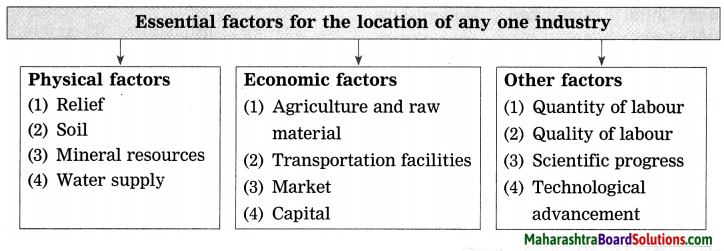
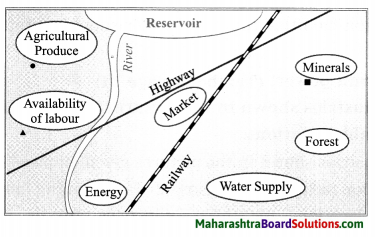
Essential factors for the location of any one industry.
Answer:
Maharashtra Board Class 8 Geography Solutions Chapter 8 Industries 2

6. Highlight the differences.

Question a.
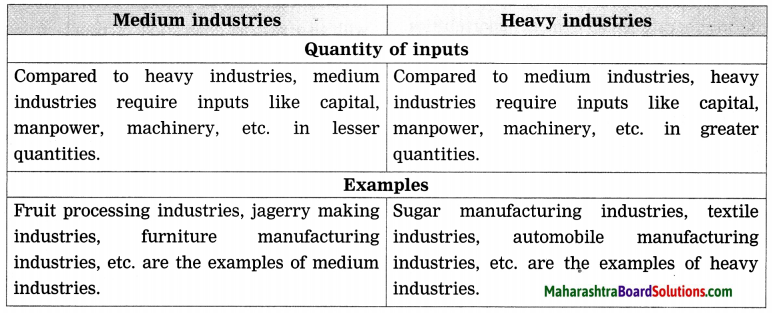
Medium industries and heavy industries.
Answer:
Maharashtra Board Class 8 Geography Solutions Chapter 8 Industries 3

Maharashtra Board Class 8 Geography Solutions Chapter 8 Industries

Question b.
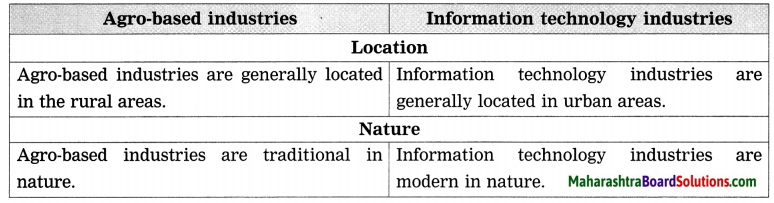
Agro-based industries and Information technology industries.
Answer:
Maharashtra Board Class 8 Geography Solutions Chapter 8 Industries 4

Maharashtra Board Class 8 Geography Solutions Chapter 8 Industries

Projects:

Collect information about any one project undertaken in your village/city under the Corporate Social Responsibility and present it in the class.

Class 8 Geography Chapter 8 Industries Additional Important Questions and Answers

Mark ✓ in the box next to the right alternative:

Question A.
Which of the following is a medium industry?
(i) Sugar industry [ ]
(ii) Textile industry [ ]
(iii) Cement industry [ ]
(iv) Food processing industry [ ]
Answer:
(iv) Food processing industry [✓]

Examine the following statements and correct the incorrect ones:

Question a.
Localization of sugar industry is found near Jamshedpur.
Answer:
Incorrect.
Correct sentence: Localization of iron and steel industry is found near Jamshedpur.

Question b.
India is predominantly manufacturing country.
Answer:
Incorrect.
Correct sentence: India is predominant¬ly agrarian country. ,

Maharashtra Board Class 8 Geography Solutions Chapter 8 Industries

Question c.
Poverty decreases the speed of industrial growth.
Answer:
Correct.

Answer the following questions in one sentence each:

Question a.
What is manufacturing?
Answer:
The process of converting raw materials into finished goods is called manufacturing. ‘

Question b.
What is called factory?
Answer:
A place where raw materials are converted into finished goods is called a factory.

Answer the following questions in brief:

Question a.
Mention three features of large industries.
Answer:
Three features of large industries ; are as follows:

  1. Large industries require huge amount of inputs like capital, machinery and manpower.
  2. Large industries require huge premise for its day-to-day operations.
  3. The goods produced in large industries have wide markets.

Answer the following questions in detail:

Question a.
Give information about agro-based industries in India.
Answer:
1. India is predominantly agrarian country. Agriculture is the main occupation of majority of people in India.

2. In India, food crops, cash crops, fruits, flowers, vegetables, etc. are cultivated on a large scale. The agricultural produce provides raw material to many industries in India. For example, sugar cane is raw material for sugar industry. Thus many industries in India are agro-based industries. RIES 83

3. The industries processing agricultural products like fruit processing industries, food processing industries, dairy industries, etc. have also flourished in India.

5. Agro based industries play an important role in rural economy by generating employment opportunities in rural areas.

Highlight differences/Distinguish between the following:

Question a.
Small industries and Medium industries.
Answer:
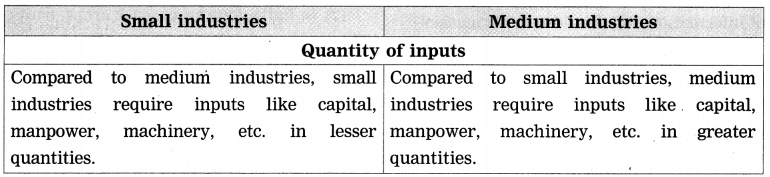
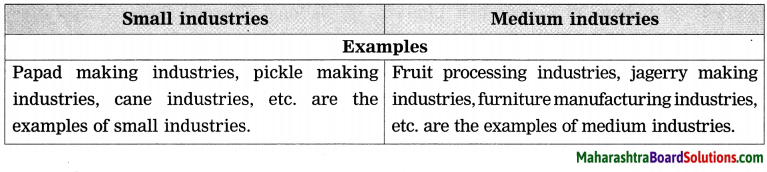
Maharashtra Board Class 8 Geography Solutions Chapter 8 Industries 5 Maharashtra Board Class 8 Geography Solutions Chapter 8 Industries 6

Study the following map/figure/graph and answer the following questions:

Can you tell? 

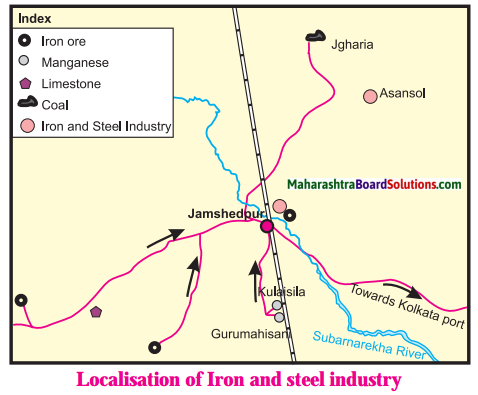
Maharashtra Board Class 8 Geography Solutions Chapter 8 Industries 7

Study the Figure and answer the following questions :

Question a.
Name the industry at Jamshedpur.
Answer:
The name of the industry at Jamshedpur is Iron and steel industry.

Question b.
Which raw material is required for this industry?
Answer:
Raw material required for this industry is iron, manganese, limestone, coal, etc.

Maharashtra Board Class 8 Geography Solutions Chapter 8 Industries

Question c.
From which areas is this raw material obtained?
Answer:
This raw material is obtained from the areas of Jamshedpur, Kulaisila, Gurumahisani, Jgharia, etc.

Question d.
Why is coal used in this industry?
Answer:
Coal is used in this industry as fuel to heat iron to a certain temperature.

Question e.
State with reasons if it would be feasible to set up an iron and steel industry in your district.
Answer:
It would not be feasible to set up an iron and steel industry in our district as there are no reserves of iron ore, manganese, limestone, etc. found in our district.
(Note : Students, here it is assumed that you stay in Thane district. Write answer to j the above question as per the district in which you live.)

Give it a try.

Maharashtra Board Class 8 Geography Solutions Chapter 8 Industries 8

Observe the picture and answer the following questions:

Question a.
In what context is this logo?
Answer:
This logo is about ‘Make in India’ programme.

Question b.
What will be the benefit of this programme?
Answer:
This programme will boost the production of various industries located all over India.

Maharashtra Board Class 8 Geography Solutions Chapter 8 Industries

Question c.
What is correlation between this programme and employment?
Answer:
This programme will generate employment opportunities on a large scale.

Question d.
Which are the Navratna industries in India?
Answer:
The Navratna industries in India are as follows :

  1. Gas Authority of India
  2. Bharat Heavy Electricals Limited
  3. Coal India Limited
  4. Indian Oil Corporation Limite
  5. National Thermal Power Corporation
  6. Oil and Natural Gas Corporation, etc.

Question e.
Why do you think they have been accorded this status of Navratna?
Answer:
Navratna industries have been accorded the status of Navratna to function effectively to fulfill various needs of public.

Show the following details on the outline map of India with index:

Give it a try. (Textbook page 58)

Question a.
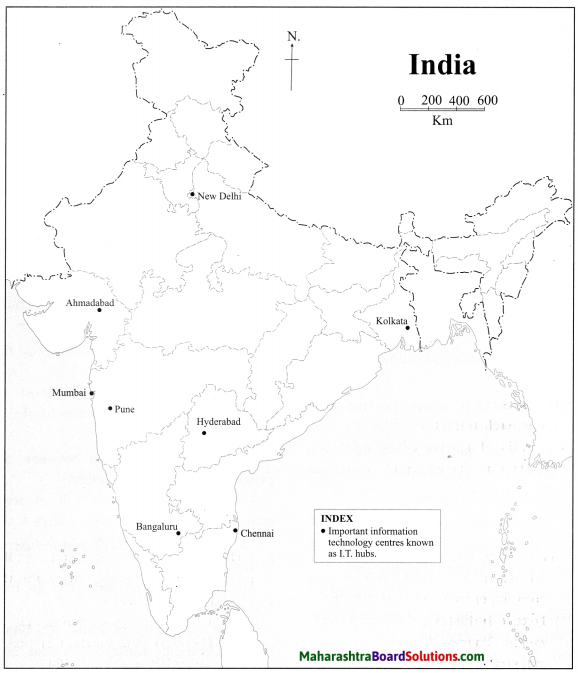
Important information technology centres are called IT hubs. Find out with the help of the internet in which cities such hubs have developed and mark them on an outline map of India.
Answer:
Important information technology centres known as IT hubs:

  1. Bangaluru
  2. Hyderabad
  3. Chennai
  4. Mumba
  5. New Delhi
  6. Pune
  7. Kolkata
  8. Ahmadabad.

Maharashtra Board Class 8 Geography Solutions Chapter 8 Industries 13

Thought-Provoking Questions:

Let’s recall.

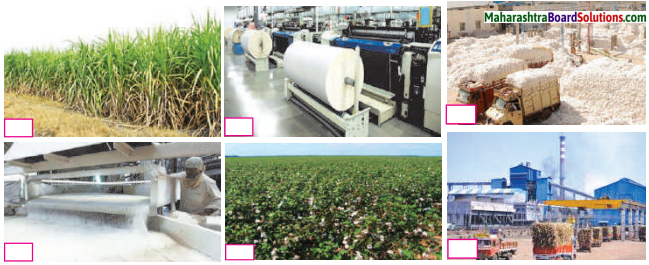
1. In Figure, the sequence of two industrial processes has been given. Arrange the pictures in proper sequence and write the sequential number in the boxes given below and answer the following questions:

Maharashtra Board Class 8 Geography Solutions Chapter 8 Industries 9

Questions:

Question a.
Name the two industries.
Answer:
The two industries are:

  1. Sugar industry
  2. Textile industry.

Maharashtra Board Class 8 Geography Solutions Chapter 8 Industries

Question b.
Name the raw material and the finished product of both these industries.
Answer:
The raw material and finished product in sugar industry are sugarcane and sugar respectively. Similarly the raw material and finished product in textile industry are cotton and cloth.

Question c.
How is the raw material converted into the finished product?
Answer:
The raw material is converted into the finished product by processing the raw material at various level.

Question d.
Why is it necessary to convert the raw material into finished goods?
Answer:
The raw material in its original form, cannot satisfy human wants directly. Therefore it is necessary to convert the raw material into finished goods.

2. Study the following figure showing the factors affecting the location of an industry. Taking into account the factors shown in the figure, note in different colours the favourable factors required for (1) Iron and steel (2) Textiles and (3) Sugar industry and answer the following questions:

Maharashtra Board Class 8 Geography Solutions Chapter 8 Industries 10

Questions:

Question a.
For each industry, prepare a list of necessary factors.
Answer:
A list of necessary factors for each industry:

  1. Iron and steel industry: Iron ore, manganese, coal, water, etc.
  2. Textile industry: Cotton, transportation services, water, electricity, etc.
  3. Sugar industry: Sugar cane, water, electricity, etc.

Maharashtra Board Class 8 Geography Solutions Chapter 8 Industries

Question b.
For each industry give an explanation for the location suggested by you.
Answer:
1. Iron and steel industry: The raw material of iron and steel industry is bulky in nature. The transportation of this raw material is not feasible. Therefore, the location of iron and steel industry is suggested near mineral field.

2. Textile industry: The raw material of textile industry is cotton. Cotton is light in weight. Therefore, it can be transported easily. Therefore, the location of textile industry is suggested near highway and at a place where labours are available.

3. Sugar industry: The raw material of sugar industry is sugar cane. This raw material is comparatively less durable. Therefore, its transport at a distant location is difficult. Therefore, the location of sugar industry is suggested near the cultivation area.

Question c.
In a similar manner for which other industries can you decide a suitable location?
Answer:
In a similar manner, a suitable location can be decided for the industries like fruit processing industry, cement industry, etc.

Give it a try. 

Study the factors given below and state which industries could develop in these regions:

Question a.
Excellent transport facilities, skilled labours, uninterrupted supply of electricity,
Answer:
Textile industries, vehicle manufacturing industries, fertilizer manufacturing industries, etc. could develop in the regions of excellent transport facilities, skilled labours, uninterrupted supply of electricity.

Question b.
Limestone deposits, cheap labour, uninterrupted supply of water and electricity, increasing urbanisation,
Answer:
Mining industries could develop in the regions of limestone deposits, cheap labour, uninterrupted supply of water and electricity, increasing urbanisation.

Maharashtra Board Class 8 Geography Solutions Chapter 8 Industries

Question c.
Fruit orchards, labour, excellent transportation facilities, unlimited water supply, uninterrupted electricity and ready market.
Answer:
Fruit processing industries could develop in the regions of fruit orchards, labour, excellent transportation facilities, unlimited water supply, uninterrupted electricity and ready market.

Use your brainpower! 

Maharashtra Board Class 8 Geography Solutions Chapter 8 Industries 15

Question a.
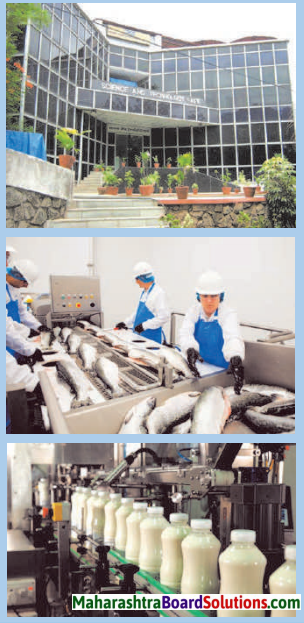
Identify the industries shown in the pictures given on page 54 of the textbook and state their suitable locations.
Answer:
A. The industries shown in the pictures given on page 54 of the textbook are as follows:

  1. Information technology industry
  2. Fish canning industry
  3. Milk industry.

B. The suitable locations for these industries are as follows:

  1. Information technology industry: A place connected with transportation facilities
  2. Fish canning industry: A place near coastal region
  3. Milk industry: A place near the cattle rearing is practised.

Think about it. 

Maharashtra Board Class 8 Geography Solutions Chapter 8 Industries 14

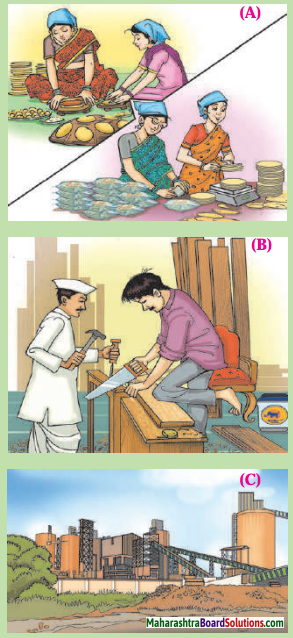
Examine pictures (A), (B) and (C) given on page 54 of the textbook and answer the following questions:

Question a.
Name the industry shown in picture (A).
Answer:
The name of the industry shown in picture (A) is Papad making industry.

Maharashtra Board Class 8 Geography Solutions Chapter 8 Industries

Question b.
What is the difference between the industries shown in pictures (A) and (B)?
Answer:
(A) Industry requires comparatively less amount of capital, manpower, machinery and space. On the other hand, (B) industry requires comparatively more amount of capital, manpower, machinery and space.

Question c.
What is distinctive about the industry in picture (C)?
Answer:
The industry in picture (C) requires capital, manpower, machinery and space on a very large scale.

Question d.
Identify the industry shown in each picture.
Answer:
The industries shown are as follows:

  1. Industry shown in picture (A) is Small industry
  2. Industry shown in picture (B) is Medium industry
  3. Industry shown in picture (C) is Large industry

Question d.
Name some more similar industries.
Answer:

  1. Small industries: Cane products and handicraft industry, earthen pot making industry, etc.
  2. Medium industry: Fruit processing industry, jaggery making industry, etc.
  3. Large industry: Sugar manufacturing industry, fertilizer manufacturing industry, Automobile manufacturing industry, etc.

Give it a try. 

Question a.
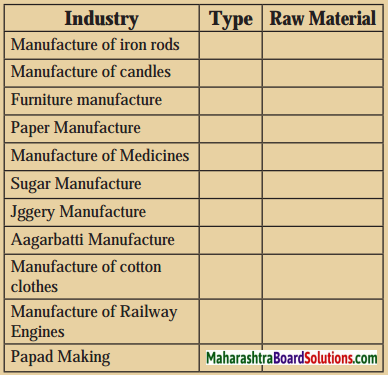
Complete the following list with reference to industries:
(Note: The answer is given directly.)
Maharashtra Board Class 8 Geography Solutions Chapter 8 Industries 11
Answer:

IndustryTypeRaw material
1. Manufacture of iron rodsLarge industryIron, water, electricity, etc.
2. Manufacture of candleSmall industryWax, water, mould, etc.
3. Furniture manufactureMedium industryWood, saw, polish, etc.
4. Paper manufactureMedium industryPulp, water, colour, etc.
5. Manufacture of medicinesLarge industryMedicinal chemicals, water, etc.
6. Sugar manufactureLarge industrySugar cane, water, electricity, etc.
7. Jaggery manufactureMedium industrySugar cane, water, etc.
8. Agarbatti manufacturingSmall industryBamboo sticks, incense powder, etc.
9. Manufacture of cotton clothLarge industryCotton, water, colour, etc.
10. Manufacture of railway enginesLarge industryIron, steel, glass, etc.
11. Papad makingSmall industryPulse tour, salt, water, etc.

Can you tell? 

Maharashtra Board Class 8 Geography Solutions Chapter 8 Industries 12

Question a.
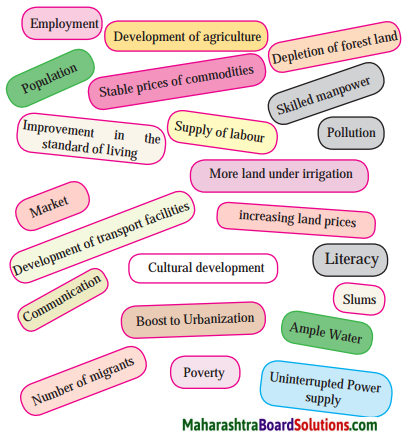
Study the factors given in Figure 8.7 given on page 56 of the textbook and classify them as per their advantages and disadvantages in relation to industry:
Answer:
1. Advantages in relation to industry: Employment, Development of agriculture, Population, Stable prices of commodities, Skilled manpower, Improvement in the standard of living, Supply of labour, the Market, More land under irrigation, Development of transport facilities, Communication, Cultural development, Literacy, Boost to urbanization, Ample water, Uninterrupted power supply.

2. Disadvantages in relation to industry: Depletion of forest land, Pollution, Increasing land prices, Slums, Number of migrants, poverty.

Think about it.

Question a.
Talk about the interrelationship between human resource and industry.
Answer:

  1. The optimum level and high quality of human resource increases the industrial growth.
  2. Shortage and low quality of human resource decreases the industrial growth.

Use your brainpower!

Question a.
Which type of industries can stem the flow of people towards urban areas?
Answer:
Large industries can stem the flow of people towards urban areas.

Maharashtra Board Class 8 Geography Solutions Chapter 8 Industries

Question b.
Where is it necessary to establish these industries?
Answer:
It is necessary to establish these industries in rural areas.

Think about it. 

Question
If you become an industrialist, which of the following would you do?:

  1. Only make profits
  2. Start a second industry from the earlier one as a supplementary industry
  3. Will spend some amount for the society after the deduction of tax
  4. Provide help for the creation of new industrialist.

Answer:
If become industrialist, will do the following:

  1. Start a second industry from the earlier one as a supplementary industry
  2. Will spend some amount for the society after the deduction of tax
  3. Provide help for the creation of new industrialist.

Open-Ended Question:

Use your brainpower! 

Question 1.
Which industries could be profitably set up in your surrounding area/locality?
Answer:
As fruits like mangoes, jackfruits, cashew nuts are largely grown, the fruit processing industries could be profitably set up in our surrounding area/locality.
(Note: Students here it is assumed that you live in Sindhudurg district of Maharashtra.
Write answer to the above question as per the district in which you live.)


Maharashtra Board Class 8 Civics Solutions Chapter 6 Bureaucracy

Balbharti Maharashtra State Board Class 8 Civics Solutions Chapter 6 Bureaucracy Notes, Textbook Exercise Important Questions and Answers.

Maharashtra State Board Class 8 Civics Solutions Chapter 6 Bureaucracy

Class 8 Civics Chapter 6 Bureaucracy Textbook Questions and Answers

1. Identify if the following statements are correct or wrong and rewrite the wrong statements in their correct form:

Question 1.
In a Parliamentary democracy, representatives elected by the people and ministers bear the administrative responsibility.
Answer:
Correct.

Question 2.
Union Public Service Commission (UPSC) recruits candidates for civil services in Maharashtra.
Answer:
Wrong – Maharashtra Public Service Commission recruits candidates for civil services in Maharashtra.

Maharashtra Board Class 8 Civics Solutions Chapter 6 Bureaucracy

2. Explain the following statements with reasons:

Question 1.
Reservation policy is followed even in Civil Services.
Answer:

  1. A part of the society comprising of Scheduled Castes, Scheduled Tribes, Women, Other Backward Castes and specially-abled is termed as the weaker section of the society.
  2. It was essential to empower these weaker sections.
  3. They were left out of civil services due to social inequality.
  4. In order to establish social justice and provide opportunities to weaker sections of the society, reservation policy is followed even in civil services.

Question 2.
It is necessary for civil servants to be politically neutral.
Answer:

  1. In Parliamentary democracy, in India, a new government comes in power after every five years. But the bureaucracy is permanent, i.e. they remain same.
  2. Bureaucracy is expected to implement the policies and decisions of the earlier government with same efficiency and commitment.
  3. Civil servants are expected to keep away from taking a political stand and remain neutral while discharging their duties.
  4.  If civil servants work according to their political views it will lead to chaos. Hence, they should be politically neutral.

3. Answer the following questions in 25 to 30 words:

Question 1.
Explain the role of the ministers and civil servants in the efficient administration of the department.
Answer:

  1. The efficiency of a particular department depends upon the inter-relationship between the Minister and his Secretary and Deputy secretary.
  2. The decisions taken by the Ministers are based on the necessary information provided by the bureaucracy.
  3. The bureaucracy, i.e. civil servants have complete information about the financial provisions for a particular scheme or plan and also about the history of successes and failures of policies.
  4. Hence, if the Ministers develop mutual trust and transparency with the civil servants, it will help in the efficient administration of the department.

Maharashtra Board Class 8 Civics Solutions Chapter 6 Bureaucracy

Question 2.
Explain how the bureaucracy provides stability to the political system.
Answer:

  1. Bureaucracy does the work of implementing decisions taken by the ministers.
  2. Several important reforms introduced during the post-independent period have been effectively implemented by the bureaucracy.
  3. It consistently provides services like water supply, public cleanliness, transport, electricity, etc. to the people and brings stability in their day-to-day life.
  4. It acts as an instrument of social transformation and democratisation. In this way, it gives stability to the political system.

4. Complete the concept picture.

Question 1.
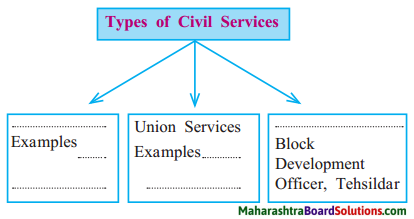
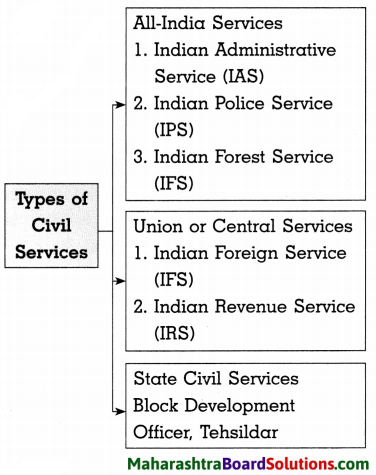
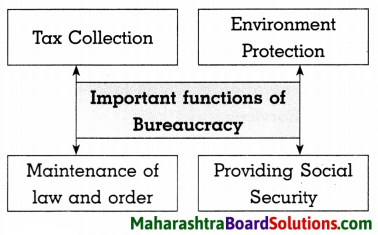
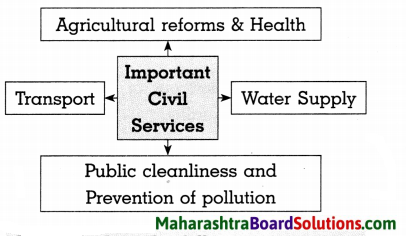
Maharashtra Board Class 8 Civics Solutions Chapter 6 Bureaucracy 1
Answer:
Maharashtra Board Class 8 Civics Solutions Chapter 6 Bureaucracy 2

5. Discuss characteristics of bureaucracy.

Question 1.
Bureaucracy:
Answer:

  1. It is the administrative system that works under the Union Executive.
  2. As this administrative system includes civil servants i.e. bureaucrats, it is called Bureaucracy.
  3. It has the responsibility of actual implementation of government’s policies.
  4. Though the ministers control the bureaucracy, they are dependent on the bureaucracy for information and efficient functioning.

Maharashtra Board Class 8 Civics Solutions Chapter 6 Bureaucracy

Question 2.
Armed Forces and Civil Services:
Answer:

  1. Defending the country from external aggression and internal threats and ensuring security of the country is carried out by the Armed Forces.
  2. Services provided to the citizens for making their daily lives comfortable and enabling them to develop themselves and the society are called Civil Services.
  3. The administrative system developed to provide services to citizens are called Civil Services.
  4. The armed forces help the civil services for internal security.

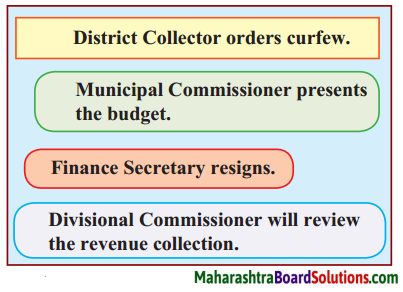
Meaning of the Headlines given In the box:

Maharashtra Board Class 8 Civics Solutions Chapter 6 Bureaucracy 7

  1. In the box, a few posts like District Collector, Municipal Commissioner, flnance Secretary, and Divisional Commissioner are mentioned.
  2. They are civil servants in the government’s administrative system, working for the welfare of the people.

Project:

Question 1.
Prepare a questionnaire and interview a civil servant in your locality

Class 8 Civics Chapter 6 Bureaucracy Additional Important Questions and Answers

Choose the correct options and complete the statements:

Question 1.
…………….. is permanent in nature.
(a) Election Commission
(b) Bureaucracy
(c) President
(d) Prime Ministers
Answer:
(b) Bureaucracy

Maharashtra Board Class 8 Civics Solutions Chapter 6 Bureaucracy

Question 2.
The bureaucracy is politically ……………….. .
(a) positive
(b) negative
(c) biased
(d) neutral
Answer:
(d) neutral

Question 3.
The Parliament holds the ……….. responsible for malpractices.
(a) bureaucracy
(b) Prime Minister
(c) minister
(d) President
Answer:
(c) minister

Question 4.
The ………….. has established autonomous institutions like the Public Service Commissions for selecting efficient civil servants.
(a) Constitution
(b) Council of Ministers
(c) Parliament
(d) President
Answer:
(a) Constitution

Question 5.
The ‘Indian Foreign Service’ is included under ……………
(a) All India Services
(b) Union or Central Services
(c) State Civil Services
(d) Armed Forces
Answer:
(b) Union or Central Services

Identify if the following statements are correct or wrong and rewrite the wrong statements in their correct form:

Question 1.
Bureaucracy is an important instrument of social transformation.
Answer:
Correct.

Maharashtra Board Class 8 Civics Solutions Chapter 6 Bureaucracy

Question 2.
Civil servants are not aware of the history of successes and failures of policies.
Answer:
Wrong – Civil servants are aware of the history of successes and failures of policies.

Question 3.
Civil servants are never publicly criticised.
Answer:
Correct.

Complete the following concept maps:

Question 1.
Maharashtra Board Class 8 Civics Solutions Chapter 6 Bureaucracy 3
Answer:
Maharashtra Board Class 8 Civics Solutions Chapter 6 Bureaucracy 4

Question 2.
Maharashtra Board Class 8 Civics Solutions Chapter 6 Bureaucracy 5
Answer:
Maharashtra Board Class 8 Civics Solutions Chapter 6 Bureaucracy 6

Explain the following statements with reasons:

Question 1.
Coordination between the Civil Servants and Ministers help in efficient functioning of the government.
Answer:

  1. In Parliamentary democracy, the Executive is responsible for the efficient governance of the country.
  2. The decisions relating to the concerned department are made by the minister-in-charge, but necessary information to make such decisions is given by the civil servants.
  3. The ministers are dependent on the civil servants for many reasons.

Hence, coordination and mutual trust between the civil servants and ministers help in efficient functioning of the government.

Maharashtra Board Class 8 Civics Solutions Chapter 6 Bureaucracy

Question 2.
The Bureaucracy is not held directly responsible for any success or failure of policy.
Answer:

  1. It is the Minister who is responsible for the efficient and smooth functioning of his department.
  2. Though providing necessary information and giving advice is the function of the bureaucracy, it is not accountable for any inefficiency.
  3. The Parliament holds the Minister responsible for inefficiency and malpractices.
  4. In such case, the Minister bears the responsibility and protects the bureaucracy.

Thus, the anonymity of bureaucracy is preserved, which means they are not held directly responsible for any success or failure of policy. ‘

Question 3.
Bureaucracy is considered as an important instrument of social transformation.
Answer:

  1. Many laws are enacted by the government for empowerment of women, protection of children and marginalised sections of the society.
  2. Social change is brought through the implementation of such policies.
  3. These laws are successfully implemented by the bureaucracy.

Hence, Bureaucracy is considered as an important instrument of social transformation.

Answer the following questions in 25 to 30 words:

Question 1.
Explain the characteristics of Bureaucracy.
Answer:

  1. Bureaucracy is the administrative system which actually implements the government’s policies.
  2. Though the government changes, bureaucracy remains constant. Thus, it is permanent in nature.
  3. It has to remain politically neutral and discharge its duties.
  4. Its anonymity is maintained, i.e. it is not held directly responsible for any success or failure of policies and it is never publicly criticized.

Thus, the structure of Bureaucracy in India is extensive and complex.

Maharashtra Board Class 8 Civics Solutions Chapter 6 Bureaucracy

Question 2.
Explain the significance of Indian bureaucracy.
Answer:

  1. The Indian bureaucracy implements the policies made by the government for the welfare of the people effectively.
  2. It provides several essential services to the people consistently and brings stability in their day to day life.
  3. It provides stability to the political system.
  4. It acts as an important instrument of social transformation and democratization of society.

Question 3.
Explain the role of bureaucracy in the democratisation of society.
Answer:

  1. Equality and social justice are important values of democracy.
  2. Bureaucracy has helped in bringing marginalised sections of society into the mainstream by implementing the reservation policy effectively.
  3. Their participation has been increased in the process of decision¬making.
  4. Democratisation of society not only requires progressive laws and policies but also effective participation of bureaucracy in implementing it.

Thus, bureaucracy plays an important role in the democratisation of society.

Maharashtra Board Class 8 Civics Solutions Chapter 6 Bureaucracy

Question 4.
Why have autonomous institutions like Public Service Commissions been established?
Answer:
The Constitution of India has established autonomous institutions like Public Service Commissions for following reasons:

  1. To select civil servants.
  2. To conduct competitive exams for selecting candidates on the criteria of merit and efficiency.
  3. To decide other aspect to like the nature of the exam, syllabus, eligibility, etc.
  4. To select efficient and deserving candidates through interviews and recommend them to the government for appointment.

Open-Ended Question:

Question 1.
Express your views on ‘ideal bureaucracy’.
Answer:
Bureaucracy includes civil servants and all the employees working in various government offices. In India, bureaucracy is criticised most of the times and is seldom praised.
According to me, an ideal bureaucracy should function as follows:

  1. The bureaucracy should advise and force the ministers to adopt policies of public welfare.
  2. It should give full cooperation to the ministers for implementing policies effectively.
  3. It should adopt the principle of equality and an unbiased approach while implementing the policies so that maximum people are benefitted.
  4. It should make the people aware of different beneficial policies.
  5. It should strictly keep away from ill- practices like corruption, unnecessary delay, cheating and frauds, etc.
  6. It should aim at establishing social justice by extending maximum benefits to weaker sections.
  7. It should function as an effective medium for development of the country, social transformation and democratisation of society.

Maharashtra Board Class 8 Civics Solutions Chapter 6 Bureaucracy

(B) Oral Examination:

Answer the following questions orally:

Question 1.
Who is the Chief Civil Servant of your district?

Question 2.
Name any two schemes/plans implemented by the government officers for your village/city.

Question 3.
How do armed forces help the civil servants?

Question 4.
Who is the Chief Civil Servant of a taluka/tehsil?

Formative Evaluation:

Oral Work:

1. Interview:
Prepare a questionnaire and interview a civil servant in your locality.

2. Group discussion:
Conduct a group discussion in your class on the topic ‘Role of bureaucracy in the development of city/village.’

Maharashtra Board Class 8 Civics Solutions Chapter 6 Bureaucracy

Project:

Question 1.
Collect information about the working of bureaucracy at taluka/tehsil level.

Maharashtra Board Class 8 History Solutions Chapter 10 Armed Revolutionary Movement

Balbharti Maharashtra State Board Class 8 History Solutions Chapter 10 Armed Revolutionary Movement Notes, Textbook Exercise Important Questions and Answers.

Maharashtra State Board Class 8 History Solutions Chapter 10 Armed Revolutionary Movement

Class 8 History Chapter 10 Armed Revolutionary Movement Textbook Questions and Answers

1. Rewrite the statements by choosing the appropriate options:
(Pandit Shyamji Krishna Varma, Mitramela, Ramsingh Kuka, Anant Laxman Kanhere, Birsa Munda)

Question 1.
Swatantryaveer Savarkar started a secret organization of revolutionaries named …………. .
Answer:
Mitramela

Question 2.
In Punjab, ………………. organised an uprising against the Government.
Answer:
Ramsinh Kuka

Maharashtra Board Class 8 History Solutions Chapter 10 Armed Revolutionary Movement

Question 3.
……………… founded the India House.
Answer:
Pandit Shyamji Krishna Varma

2. Complete the following table:

Question 1.
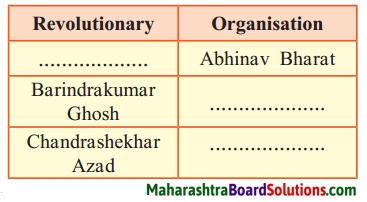
Maharashtra Board Class 8 History Solutions Chapter 10 Armed Revolutionary Movement 1
Answer:

RevolutionaryOrganisation
1. Swatantryaveer SavarkarAbhinav Bharat
2. Barindrakumar GhoshAnushilan Samiti
3. Chandrashekhar AzadHindustan Socialist Republican Army
4. Lala HardayalGadar

3. Explain the following statements with reasons:

Question 1.
Chafekar brothers killed Rand.
Answer:

  1. The Plague epidemic broke out in 1897 in Pune.
  2. Commissioner Rand was appointed to manage the Plague epidemic.
  3. In course of curtailing the epidemic, he resorted to tyranny and force.

As a revenge, the Chafekar brothers Damodar and Balkrishna shot him dead on 22 June, 1897.

Question 2.
Khudiram Bose was hanged to death.
Answer:

  1. Anushilan Samiti worked with the objective to overthrow the British rule with armed rebellion.
  2. Prafulla Chaki and Khudiram Bose were the members of Anushilan Samiti.
  3. They planned to kill a judge named Kingsford.
  4. They threw a bomb at a vehicle, assuming it to be of Kingsford but the vehicle was not the one carrying him.
  5. However, two English women were killed in this attack Khudiram Bose was caught by the police and was hanged.

Maharashtra Board Class 8 History Solutions Chapter 10 Armed Revolutionary Movement

Question 3.
Bhagat Singh and Batukeshwar Dutta threw bombs in the Central Legislative Assembly.
Answer:

  1. The Government had introduced two bills in the Central Legislature.
  2. The Bills curtailed civil rights of the people.
  3. To protest against these bills, Bhagat Singh and Batukeshwar Dutta threw bombs in the Central Legislative Assembly.

4. Answer the following in brief:

Question 1.
Write a detail description of the attack on Chittagong Armoury.
Answer:

  1. Surya Sen drew a plan to attack the armoury at Chittagong.
  2. He and his associates raided two government armouries on the 18th April, 1930.
  3. They seized arms and ammunition from the two armouries.
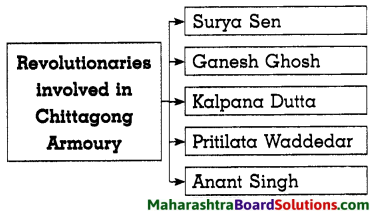
  4. He took revolutionaries like Anant Singh, Ganesh Ghosh, Kalpana Datta and Pritilata Waddedar with him.
  5. They cut off the telephone and telegraph connections and succeeded in paralysing the communication.

Question 2.
Give information about the work of India House.
Answer:

  1. India House, founded by Pandit Shyamji Krishna Verma in London, was the centre of revolutionary activities outside India.
  2. It provided assistance to the revolutionaries staying abroad.
  3. It gave scholarships to the Indian students studying in England.
  4. Swatantryaveer Savarkar received such scholarship.

Maharashtra Board Class 8 History Solutions Chapter 10 Armed Revolutionary Movement

Do you Know?

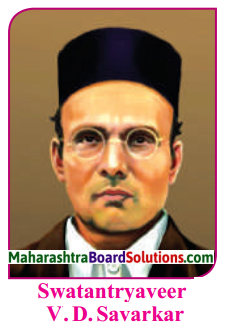
Maharashtra Board Class 8 History Solutions Chapter 10 Armed Revolutionary Movement 2

Literary and Social work of Swatantryaveer Savarkar:

  1. In his autobiography, ‘Majhi Janmathep’ he wrote about his experience of the terrible days in Andaman.
  2. After 10 years, he was taken to Ratnagiri and detained there.
  3. There Savarkar started many social movements such as removal of caste differences, removal of untouchability, common dining, purification of language, etc.
  4. In 1938, he presided over the Marathi Sahitya Sammelan at Mumbai.
  5. He wrote two books one The Indian War of Independence 1857′ and other biography of Joseph Mazzini, an Italian revolutionary.

Project:

Question 1.
Watch a movie or drama based on the life of revolutionaries and enact your favourite incident in the class.

Question 2.
Prepare a manual based on the saga of revolutionaries.

Class 8 History Chapter 10 Armed Revolutionary Movement Additional Important Questions and Answers

Rewrite the statements by choosing the appropriate options:

Question 1.
A youth named ………….. killed Jackson, the collector of Nashik.
Answer:
Anant Laxman Kanhere

Question 2.
Munda tribe in Bihar revolted under the leadership of ………….. .
Answer:
Birsa Munda.

Maharashtra Board Class 8 History Solutions Chapter 10 Armed Revolutionary Movement

Name the following:

Question 1.
Killed Rand
1. …………………………
2. …………………………
Answer:
1. Balkrishna Chafekar
2. Damodar Chafekar

Question 2.
Planned to kill Judge Kingsford and threw bomb on his vehicle
1. …………………………
2. …………………………
Answer:
1. Khudiram Bose
2. Prafulla Chaki

Question 3.
Leaders of Gadar organization
1. …………………………
2. …………………………
Answer:
1. Bhai Parmanand
2. Dr. Pandurang Sadashiv Khankhoje

Maharashtra Board Class 8 History Solutions Chapter 10 Armed Revolutionary Movement

Question 4.
Threw bomb in Central Legislative Assembly
1. …………………………
2. …………………………
Answer:
1. Bhagat Singh ?
2. Batukeshwar Dutta

Question 5.
Killed the District Judge
1. …………………………
2. …………………………
Answer:
1. Shanti Ghosh
2. Suniti Choudhary.

Rewrite the statements by choosing the appropriate options:

Question 1.
Vasudev Balwant Phadke took the training of arms from ………….. .
(a) Damodar Chafekar
(b) Vastad Lahuji Salve
(c) Swatantryaveer Savarkar
(d) Babarao Savarkar
Answer:
(b) Vastad Lahuji Salve

Maharashtra Board Class 8 History Solutions Chapter 10 Armed Revolutionary Movement

Question 2.
Anushilan Samiti’ received counsel and guidance from ……………. .
(a) Aurobindo Ghosh
(b) Barindrakumar Ghosh
(c) Khudiram Bose
(d) Rash Behari Bose
Answer:
(a) Aurobindo Ghosh

Question 3.
……………. raised the issue of India’s independence at the World Socialist Conference.
(a) Pritilata Waddedar
(b) Kalpana Dutta
(c) Madam Cama
(d) Shanti Ghosh
Answer:
(c) Madam Cama

Question 4.
……………. , a young girl shot dead the Governor during the convocation ceremony of Kolkata University.
(a) Shanti Ghosh
(b) Pritilata Waddedar
(c) Suniti Choudhary
(d) Bina Das
Answer:
(d) Bina Das

Question 5.
……………. died in an encounter with police at Alfred Park in Allahabad.
(a) Bhagat Singh
(b) Chandrashekhar Azad
(c) Madanlal Dhingra
(d) Khudiram Bose
Answer:
(b) Chandrashekhar Azad

Maharashtra Board Class 8 History Solutions Chapter 10 Armed Revolutionary Movement

Question 6.
In his autobiography, ……………. wrote about his experience of the terrible days in Andaman jail.
(a) Bhagat Singh
(b) Vasudev Balwant Phadke
(c) Swatantryaveer Savarkar
(d) Baba Savarkar
Answer:
(c) Swatantryaveer Savarkar

Question 7.
The Anushilan Samiti had a bomb manufacturing unit at ……………. .
(a) Kolkata
(b) Dhaka
(c) Maniktala
(d) Chittagong
Answer:
(c) Maniktala

Question 8.
The young men of Hindustan Socialist Republic were influenced by ……………. ideology.
(a) capitalistic
(b) imperialistic
(c) religious
(d) socialist
Answer:
(d) socialist

Question 9.
After the British traced the plan of revolt by Gadar Organisation ……………. escaped to Japan and continued his revolutionary work.
(a) Vishnu Shastri Pingle
(b) Khudiram Bose
(c) Rash Behari Bose
(d) Chandrashekhar Azad
Answer:
(c) Rash Behari Bose

Maharashtra Board Class 8 History Solutions Chapter 10 Armed Revolutionary Movement

Question 10.
……………. was the chief of revolutionary group in Bengal.
(a) Anant Singh
(b) Ganesh Ghosh
(c) Rash Behari Bose
(d) Surya Sen
Answer:
(d) Surya Sen

Identify the wrong pair, correct it and rewrite:

1. Threw bomb on Lord Hardinge – Khudiram Bose
2. Killed British officer Ash – Vanchhi Iyyer
3. Assassinated Curzon Wylie – Bhagat Singh
4. Killed Dyer in London – Sardar Udham Singh
Answer:
Wrong pair:
Assassinated Curzon Wylie – Bhagat Singh

Corrected pair:
Assassinated Curzon Wylie – Madanlal Dhingra.

Answer the following in one sentence each:

Question 1.
Who spread the network of revolutionary work outside Bengal?
Answer:
Rash Behari Bose and Sachindranath Sanyal spread the network of revolutionary organisation outside Bengal.

Question 2.
What was the objective in establishing India House?
Answer:
The revolutionary work in India received assistance from India House in London and Indian youth were given scholarships for higher education in England.

Question 3.
Who prepared anti-British plans with the help of German Foreign ministry?
Answer:
Veerendra Nath Chattopadhyay, Bhupen Dutta and Hardayal prepared anti-British plans with the help of German foreign ministry.

Question 4.
Who established Provincial Government of free India in Kabul?
Answer:
Mahendra Pratap, Barkatullah and Obaidullah Sindhi established Provincial Government of free India in Kabul.

Maharashtra Board Class 8 History Solutions Chapter 10 Armed Revolutionary Movement

Question 5.
What work was entrusted to a separate wing of ‘Hindustan Socialist Republican Army’?
Answer:
The work of gathering arms and execution of programmes was entrusted to a separate wing of Hindustan Socialist Republican Army.

Question 6.
How was the death of Lala Lajpat Rai avenged?
Answer:
Bhagat Singh and Rajguru fired bullets and killed officer Saunders to avenge death of Lala Lajpat Rai.

Do as Directed:

Complete the graphical presentation:

Question 1.
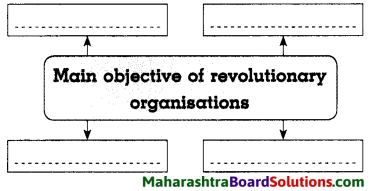
Maharashtra Board Class 8 History Solutions Chapter 10 Armed Revolutionary Movement 3
Answer:
Maharashtra Board Class 8 History Solutions Chapter 10 Armed Revolutionary Movement 4

Question 2.
Maharashtra Board Class 8 History Solutions Chapter 10 Armed Revolutionary Movement 5
Answer:
Maharashtra Board Class 8 History Solutions Chapter 10 Armed Revolutionary Movement 6

Question 3.
Maharashtra Board Class 8 History Solutions Chapter 10 Armed Revolutionary Movement 7
Answer:
Maharashtra Board Class 8 History Solutions Chapter 10 Armed Revolutionary Movement 8

Write short notes:

Question 1.
Vasudev Balwant Phadke:
Answer:

  1. Vasudev Baiwant Phadke gave an armed struggle against the British in Maharashtra.
  2. He was of the opinion that there should be armed struggle to fight against the British.
  3. Vastad Lahuji Salve gave him training of arms.
  4. He organized Ramoshis and led armed struggle in Maharashtra, but was unsuccessful.
  5. He was sent to Eden Jail by the British Government where he died in 1883.

Maharashtra Board Class 8 History Solutions Chapter 10 Armed Revolutionary Movement

Question 2.
Literary and Social work of Swatantryaveer Savarkar:
Answer:

  1. When Swatantryaveer Savarkar was detained in the Ratnagiri jail, he started many social movements such as removal of caste differences, removal of untouchability, common dining, purification of language, etc.
  2. in his autobiography, ‘Majhi Janmathep’ he wrote about his experiences of the terrible days in Andaman where he spent ten years.
  3. He wrote the book ‘The Indian War of Independence 1857’ in which he stated 1857 rebellion as the first war of independence.
  4. He wrote an inspiring biography of Joseph Mazzini.
  5. Savarkar was a great writer, social worker and revolutionary.

Question 3.
Kakori Conspiracy:
Answer:

  1. After Gandhiji suspended Civil Disobedience, many youngsters like Chandrashekhar Azad, Ram Prasad Bismil, Yogesh Chatterjee, Sachindra Nath f Sanyal got diverted to revolutionary ways.
  2. On 9th August, 1925 they looted the Government treasury that was on a train near Kakori railway station in Uttar Pradesh.
  3. However, due to the immediate action of the government the revolutionaries were arrested and put on trial.
  4. Ashfaqulla Khan, Ram Prasad Bismil, Roshan Singh, Rajendra Lahiri were hanged.
  5. Chandrashekhar Azad managed to escape.

Explain the following statements with reasons:

Question 1.
Swatantryaveer Savarkar was sentenced to fifty years of rigorous imprisonment.
Answer:

  1. On knowing the activities of Abhinav Bharat, the government arrested Babarao Savarkar and sentenced to life imprisonment.
  2. Anant Laxman Kanhere killed Jackson, collector of Nashik in retaliation.
  3. The government linked Abhinav Bharat and Savarkar with his murder.
  4. He was arrested and put on trial. So, the court sentenced him to fifty years of rigorous imprisonment.

Question 2.
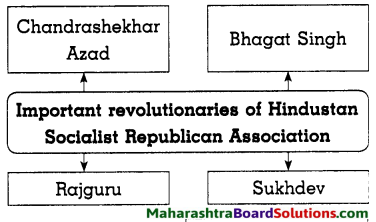
Bhagat Singh, Sukhdev and Rajguru were hanged.
Answer:

  1. Bhagat Singh and Batukeshwar Dutta threw a bomb in Central Legislative Assembly.
  2. The British Government started arresting the revolutionaries. They immediately raided the centres of ‘Hindustan Socialist Republican Army’ and got clues related to the killing of Saunders.
  3. Bhagat Singh, Rajguru and Sukhdev were tried under the charge of sedition.
  4. They were hanged in the Lahore jail on 23 March 1931.

Maharashtra Board Class 8 History Solutions Chapter 10 Armed Revolutionary Movement

Question 3.
Madanlal Dhingra was hanged to death.
Answer:

  1. India House was an important centre which provided assistance to Indian revolutionaries staying abroad.
  2. Madanlal Dhingra was a youth associated with India House.
  3. He killed Curzon Wylie, a British Officer, therefore he was hanged to death.

Answer the following in brief:

Question 1.
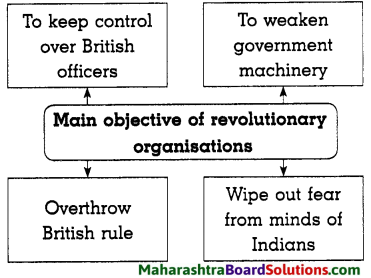
State the aims and objectives of the ‘Hindustan Socialist Republican Association.
Answer:

  1. The main objective of the Hindustan Socialist Republican Association was to free India from British exploitation.
  2. It also aimed at overthrowing the unjust socio-economic order which exploited the farmers and workers.
  3. It aimed at creation of a society based on social justice and equality.

Question 2..
Explain the work of Madam Cama.
Answer:
1. Madam Cama was related with the revolutionary work of India House.
2. She raised the issue of India’s independence at the World Socialist Conference held at Stuttgart in Germany.
3. She unfurled the flag of India at this conference.

Answer the following in detail:

Question 1.
Explain the contribution of Swatantryaveer Savarkar in the armed revolutionary movement.
Answer:

  1. Swatantryaveer Savarkar founded ‘Mitramela’ in 1900 at Nashik and renamed it as ‘Abhinav Bharat’ in 1904.
  2. He went to England for higher studies, despatched revolutionary literature, guns to the members of Abhinav Bharat in India.
  3. The government linked murder of Jackson to Swatantryaveer Savarkar and arrested him.
  4. He was put under trial. The court ordered rigorous punishment for 50 years in Andaman jail.
  5. His contribution is great in the armed revolution of India.

Maharashtra Board Class 8 History Solutions Chapter 10 Armed Revolutionary Movement

Question 2.
Give a brief account of the ‘Anushilan Samiti’.
Answer:

  1. After the partition of Bengal, the outrage against the British became more severe.
  2. In Bengal, a revolutionary organisation called ‘Anushilan Samiti’ was active.
  3. This organisation received counsel and guidance from Aurobindo Ghosh.
  4. Barindrakumar Ghosh was chief of this organisation.
  5. In 1908, members of Anushilan Samiti, Prafulla Chaki and Khudiram Bose made an unsuccessful attempt to kill a judge Kingsford.
  6. During the investigation, police got information about the work of Anushilan Samiti.
  7. So, the government started arresting members of Anushilan Samiti.
  8. The government was unsuccessful in linking Aurobindo Ghosh to the manufacturing of bombs.
  9. Other members were sentenced to jail for longer period.

Question 3.
Write about the activities of Gadar Organisation.
Answer:

  1. The Indians settled in America and Canada established the Gadar Organisation.
  2. The word Gadar means revolt. The objective of the organisation was to revolt against the British and free India from British rule.
  3. Lala Hardayal, Bhai Parmanand, Dr. Pandurang Sadashiv Khankhoje were the important revolutionaries of the organisation.
  4. Gadar’ Journal, the mouthpiece of the organisation voiced the evil effects of the British rule on India and published the news regarding the heroic deeds of the Indian revolutionaries.
  5. It conveyed the message of patriotism and armed rebellion to the Indian people.
  6. During the British rule, the Gadar Organisation decided to take advantage of the discontent against the British rule.
  7. It incited the Indian soldiers to revolt against the government.
  8. Rash Behari Bose and Vishnu Ganesh Pingle were entrusted the responsibility to lead the revolt.
  9. However, the plan could not materialise due to treachery.
  10. Pingle was arrested and hanged.
  11. Rash Behari Bose managed to escape to Japan.

Question 4.
What difference have you noted between the Moderates, Extremists and Revolutionary.
Answer:
The struggle against the British was fought in three ways. The difference in the way is as follows:

1. The moderates advocated peaceful and constitutional means. They believed in appeals and petitions. They tried to disrupt the working of the government from within. After their demands were met, they would put forth new demands. Thus, they believed in constitutional methods.

2. The approach of extremists was severe. They were of the opinion that if lakhs of people take part in the freedom movement and challenge the British government only then success could be achieved.

3. Revolutionary wanted to fight the British in armed way. According to them, there should be armed struggle against the British. They adopted methods like killing the British officers, raiding the government treasury, disrupting transport and communication, etc.
All the three ways are different but had one objective of achieving Independence for India.

Maharashtra Board Class 8 History Solutions Chapter 6 Beginning of Freedom Movement

Balbharti Maharashtra State Board Class 8 History Solutions Chapter 6 Beginning of Freedom Movement Notes, Textbook Exercise Important Questions and Answers.

Maharashtra State Board Class 8 History Solutions Chapter 6 Beginning of Freedom Movement

Class 8 History Chapter 6 Beginning of Freedom Movement Textbook Questions and Answers

1. (A) Rewrite the statements by choosing the appropriate options:

Question 1.
The Servants of India Society was founded by
(a) Ganesh Vasudev Joshi
(b) Bhau Daji Lad
(c) M. G. Ranade
(d) Gopal Krishna Gokhale
Answer:
(d) Gopal Krishna Gokhale

Maharashtra Board Class 8 History Solutions Chapter 6 Beginning of Freedom Movement

Question 2.
The first session of Indian National Congress was held at
(a) Pune
(b) Mumbai
(c) Kolkata
(d) Lucknow
Answer:
(b) Mumbai

Question 3.
wrote Geeta Rahasya.
(a) Lokmanya Tilak
(b) Dadabhai Nowrojee
(c) Lala Lajpat Rai
(d) Bipinchandra Pal
Answer:
(a) Lokmanya Tilak

B. Write the Names :

Question 1.
Moderate leaders
(i) ……… (ii) ………
Answer:
(i) Gopal Krishna Gokhale
(ii) Ferozshah Mehta

Question 2.
Extremist leaders
(i) ……. (ii)………..
Answer:
(i) Lokmanya Tilak
(ii) Lala Lajpat Rai

2. Explain the following statements with reasons:

Question 1.
In the struggle for Independence, a sense of identity was awakened among the Indians.
Answer:

  1. Western education familiarised the educated Indians with modern values such as liberty, equality, democracy and nationalism.
  2. The Asiatic Society at Bengal edited and published hundreds of manuscripts in Sanskrit, Persian and other Indian languages.
  3. The realization that India had a rich ancient heritage aroused the feeling of national pride. This gave a sense of identity to Indians.

Question 2.
Two groups were formed in the Congress.
Answer:
1. Though at a slow pace, the contribution of Indian National Congress was consistent in the initial stage. But the extremists felt to intensify the freedom struggle.
2. Moderates and Extremists were unanimous about the objectives of Congress. But they had differences regarding the methods/ways to achieve it.
3. The moderates insisted on constitutional measures whereas extremists wanted to adopt severe methods.
4. The tension between these groups increased during the Surat session in 1907.
This led to the formation of two groups within the Congress.

Question 3.
Lord Curzon decided to partition Bengal.
Answer:
1. Bengal was a large province. So under the pretext of administrative convenience, the province of Bengal was partitioned by Lord Curzon.
2. Accordingly, the Muslim-majority East Bengal and the Hindu-Majority West Bengal were created in 1905.
3. The real motive was to create a divide between the Hindus and the Muslims and thereby weaken the nationalist movement. The British used the Policy of ‘Divide and Rule’.

Maharashtra Board Class 8 History Solutions Chapter 6 Beginning of Freedom Movement

3. Write short notes:

Question 1.
Objectives of the Indian National Congress :
Answer:
The Indian National Congress was established in 1885 with the following objectives:

  1. To bring together the people of India on a common platform.
  2. To create a feeling of unity among them, irrespective of religion, race, language, geographical territories.
  3. To provide opportunities to understand one another’s problems and views.
  4. To increase the feeling of unity among the people.
  5. To take measures for the upliftment of the country.

Question 2.
Anti Partition Movement :
Answer:

  1. With the motive to create a divide between the Hindus and the Muslims, Lord Curzon divided the province of Bengal in the Muslim-majority East Bengal and the Hindu-majority West Bengal in 1905.
  2. The day of partition, 16th October was observed as the ‘National Mourning Day’.
  3. All over India, protest meetings were organised to condemn the decision of the government.
  4. Singing of Vande Mataram and Raksha-bandhan programmes were arranged to mark the protest.
  5. Government-run schools and colleges were boycotted in large number by the students.
  6. Sensing the intensity and severity of dissatisfaction the British annulled the Partition of Bengal.

Question 3.
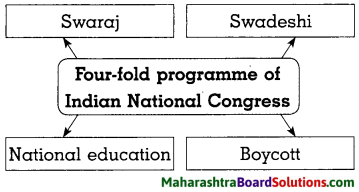
Four Point Programme of the Indian National Congress :
Answer:
In the session of 1906 of the Indian National Congress, the four-point programme was unanimously accepted.

  1. Swadeshi: To make use of capital, resources, manpower in our country so that it becomes self-sufficient.
  2. Boycott: It was decided to boycott foreign goods as a first step, and boycott of foreign rule be the next step. It would be an attack on the roots of British imperialism.
  3. Swaraj: The final objective is to attain freedom.
  4. National Education: To impart education which will create pride for the nation among people.

4. Explain the background behind the establishment of Indian National Congress with the help of following points:
1. Centralisation of administration
2. Economic exploitation
3. Western education
4. Study of Ancient Indian History
5. Role of newspapers
Answer:
The background behind the establishment of the Indian National Congress in 1885:

1. Centralisation of administration :

  1. The uniform policies, identical reforms and equality before law brought the nation under one roof.
  2. The network of roads and railways brought the people of India together.
  3. It developed the feeling of unity among Indians.

2. Economic exploitation :

  1. The economic exploitation of India through the imperialistic policies led to the drain of the Indian wealth to England.
  2. Industries declined and the farmers became bankrupt.
  3. Imposition of taxes on middle class and the exploitation of worker class by the capitalist led to growth of discontent.

3. Western education :

  1. Western education familiarised the educated Indians with modern values and principles such as liberty, equality and democracy.
  2. They accepted principles like rationalism, humanity and nationalism.
  3. They realised that they can carry out work of the country by following them.

4. Study of Ancient Indian History :

  1. The manuscripts in Sanskrit, Persian and many other languages were examined and research was published.
  2. Many western Scholars started to study Indian culture.
  3. The realisation that India had a rich ancient heritage aroused the feeling of national pride among Indians.

5. Role of newspapers :

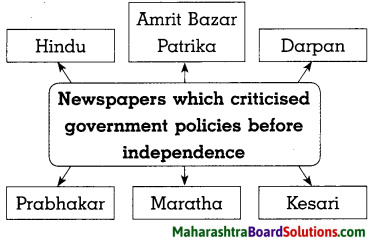
  1. Newspapers in English and vernacular languages carried articles criticising the policies of the government.
  2. It led to social and political awakening.

Maharashtra Board Class 8 History Solutions Chapter 6 Beginning of Freedom Movement

Do you Know?

Maharashtra Board Class 8 History Solutions Chapter 6 Beginning of Freedom Movement 1

Project:

Collect additional information about the leaders of the early phase of Indian National Congress with the help of the internet.

Class 8 History Chapter 6 Beginning of Freedom Movement Additional Important Questions and Answers

Rewrite the statements by choosing the appropriate options:

Question 1.
…………. newspaper was a mouthpiece of extremist ideology in Bengal.
(a) Dnyanoday
(b) Dnyanprakash
(c) Amrit Bazar Patrika
(d) Kesari
Answer:
(c) Amrit Bazar Patrika

Question 2.
………….. declared to give responsible political system to India.
(a) Montague
(b) Morley
(c) Dalhousie
(d) Chelmsford
Answer:
(a) Montague

Maharashtra Board Class 8 History Solutions Chapter 6 Beginning of Freedom Movement

Question 3.
A committee under the leadership of met …………… Governor-General Lord Minto.
(a) Sir Sayyad Ahmad Khan
(b) Abdul Latif
(c) Baddrudin Tayyabji
(d) Aga Khan
Answer:
(d) Aga Khan

Question 4.
The Home Rule Movement was launched in …………. against Colonialism.
(a) South Africa
(b) Ireland
(c) Scotland
(d) Switzerland
Answer:
(b) Ireland

Question 5.
…………… was established in 1906.
(a) The Indian National Congress
(b) Moderate Party
(c) Extremist Party
(d) The Muslim League
Answer:
(d) The Muslim League

Identify the wrong pair and correct it:

(1) The first President of Indian National Congress
– Wyomesh Chandra Banerjee
(2) Assassinated Rand
– The Chapekhar Brothers
(3) He pronounced the word Swaraj for the first time
– Lokmanya Tilak
(4) The British officer who took initiative in forming the Indian National Congress.
– Allen Octavian Hume
Answer:
Wrong Pair: He pronounced the word Swaraj for the first time.
– Lokmanya Tilak
Corrected pair: He pronounced the word Swaraj for the first time
– Dadabhai Nowrojee.

Maharashtra Board Class 8 History Solutions Chapter 6 Beginning of Freedom Movement

Write the Names:

Question 1.
They studied ancient Indian culture
(i) ……… (ii) …….
Answer:
(i) Dr. Bhau Daji Lad
(ii) Dr. R.G. Bhandarkar

Question 2.
Leaders of Home Rule Movement
(i)……… (ii) ……
Answer:
(i) Dr. Annie Besant
(ii) Lokmanya Tilak.

Answer the following questions in one sentence each:

Question 1.
Which institute was established to study ancient Indian culture?
Answer:
The Asiatic Society was established in Bengal to study ancient Indian culture.

Question 2.
Which were the mediums initially used by the extremist leaders to create political awakening?
Answer:
The extremist leaders initially used the mediums of newspapers, national education and national festivals.

Question 3.
What was the objective of the extremist leaders in founding the educational institutions?
Answer:
The extremist leaders established educational institutions for creating a generation which will have concern for their own language and tradition.

Question 4.
Who led the Anti Partition Movement?
Answer:
Surendranath Banerjee, Anand Mohan Bose, Rabindranath Tagore and such other leaders led the Anti-Partition Movement.

Maharashtra Board Class 8 History Solutions Chapter 6 Beginning of Freedom Movement

Question 5.
How did Tilak criticise the Montague-Chelmsford Act?
Answer:
Lokmanya Tilak criticised the Moptague-Chelmsford Act in the following words, “This is neither Swaraj nor its foundation.”

Question 6.
What did Lokmanya Tilak firmly state?
Answer: Lokmanya firmly stated that “Swaraj is my birthright and I shall have it.”

Complete the graphical presentation:

Question 1.
Maharashtra Board Class 8 History Solutions Chapter 6 Beginning of Freedom Movement 2
Answer:
Maharashtra Board Class 8 History Solutions Chapter 6 Beginning of Freedom Movement 3

Question 2.
Maharashtra Board Class 8 History Solutions Chapter 6 Beginning of Freedom Movement 4
Answer:
Maharashtra Board Class 8 History Solutions Chapter 6 Beginning of Freedom Movement 5
Answer:
Maharashtra Board Class 8 History Solutions Chapter 6 Beginning of Freedom Movement 6

Question 3.
Maharashtra Board Class 8 History Solutions Chapter 6 Beginning of Freedom Movement 6
Answer:
Maharashtra Board Class 8 History Solutions Chapter 6 Beginning of Freedom Movement 7

Explain the Concept :

Question 1.
Moderates :
Answer:

  1. The Moderates were the leaders who wanted to carry out nationalistic movement within the constitutional methods and peaceful meAnswer:
  2. The leaders were realistic and highly educated and had faith in the justice of the British.
  3. They had hope that if they place their demands in constitutional manner the British will give justice to their demands.
  4. They were aware that a strong foundation needs to be built through organised work.
  5. The philosophy and principles of western thinkers like liberalism, freedom, equality, fraternity influenced them.

Maharashtra Board Class 8 History Solutions Chapter 6 Beginning of Freedom Movement

Question 2.
Extremists :
Answer:

  1. The leaders of the Indian National Congress who advocated intensification of the struggle to attain freedom were known as Extremists.
  2. Moderates and Extremists were unanimous about the objectives of Congress. The Extremists had no faith in the constitutional methods of the Moderates.
  3. According to Extremists, freedom will be attained only if lakhs of people participated in the freedom movement and challenge the British government.

Write short notes :

Question 1.
First session of Indian National Congress :
Answer:

  1. The founding session of the Indian National Congress took place on 28th December, 1885 at Gokuldas Tejpal Sanskrit school in Mumbai.
  2. It was presided by Wyomesh Chandra Banerjee, a renowned lawyer from Kolkata.
  3. It was attended by seventy-two delegates from different provinces of India.
  4. Allen Oct avian Hume took the initiative in establishing of the Indian National Congress.
  5. Increase in the number of Indians in the administration, reduction in military expenditure were the demands placed before the British government.

Question 2.
Servants of India Society :
Answer:
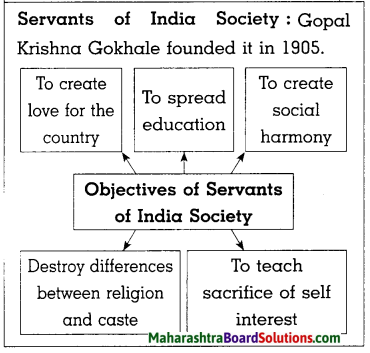
1. Gopal Krishna Gokhale founded the Servants of India Society in 1905.
2. Its main objectives were :

  • to create love for the county.
  • teach them sacrifice of self-interest.
  • no differentiation on the basis of caste and religion.
  • to create social harmony.
  • to spread education.

Question 3.
The Lucknow Pact :
Answer:

  1. An attempt was made under the leadership of Lokmanya Tilak to resolve differences in the Indian National Congress at its Lucknow session in 1916.
  2. In the same year, there was an agreement between Indian National Congress and the Muslim League, known as the Lucknow Pact.
  3. According to this Pact, Indian National Congress agreed to separate electorate for Muslims.
  4. In return, the Muslim League agreed to support the Indian National Congress in its work for getting political rights to India.

Question 4.
Home Rule Movement :
Answer:

  1. Home rule means self-rule or self-government.
  2. It was modelled after the Home Rule Movement in Ireland.
  3. It was led by Dr. Annie Besant and Lokmanya Tilak.
  4. They made extensive tours in different parts of the country so that the demand of self-government could reach the common people.

Maharashtra Board Class 8 History Solutions Chapter 6 Beginning of Freedom Movement

Explain the following statements with reasons:

Question 1.
A feeling of nationalism developed among the IndiAnswer:
Answer:

  1. The British established a centralised administration in India and applied uniform policies all over the country.
  2. They also laid down the principle of equality before law.
  3. They introduced the modern means of transport and communication.
  4. It benefited Indians as well. This made possible for the people living in different parts of India to establish contact with one another. This factors developed a feeling of nationalism among the Indians.

Question 2.
Lokmanya was imprisoned in 1897.
Answer:

  1. In 1897, hundreds of people died in Pune due to the epidemic of Plague.
  2. An officer name Rand was appointed to bring the epidemic under control.
  3. He started a search campaign to find Plague patients and adopted oppressive measures.
  4. To avenge this cruel and oppressive treatment meted out to people, the Chapekar brothers assassinated him.
  5. An unsuccessful attempt was made by the government to connect Lokmanya Tilak with this conspiracy.
  6. When they failed in their attempt, they imprisoned him with revenge.

Question 3.
The National Congress split at its Surat session in 1907.
Answer:

  1. The differences between the moderates and the extremists reached a climax in 1907.
  2. The moderates wanted to keep aside the resolution of Swadeshi and Boycott which was thwarted by the extremists.
  3. Some moderate leaders blamed the extremist leaders for trying to capture the Indian National Congress.
  4. It became impossible to arrive at a compromise between both the groups. As a result the Indian National Congress split at its Surat session in 1907.

Maharashtra Board Class 8 History Solutions Chapter 6 Beginning of Freedom Movement

Question 4.
The charge of sedition was put on Lokmanya Tilak.
Answer:

  1. There was wide protest against the partition of Bengal throughout the country.
  2. With a view to restrain the anti¬partition movements government resorted to many suppressive measures.
  3. Strict action was taken against extremists leaders which caused severe reactions in Bengal.
  4. The revolutionaries adopted means of firing and bomb blasts which was advocated by Lokmanya Tilak through his newspaper Kesari.

Therefore, the charge of sedition was put on Lokmanya Tilak by the British government for which he was sent to Mandalay jail for 6 years.

Question 5.
The government passed the Morley- Minto Act.
Answer:
1. The economic policies of the British increased poverty in India.
2. It created dissatisfaction in the minds of the people against British rule.
3. The oppressive measures adopted by Lord Curzon to suppress the protest of partition of Bengal, exclusion of educated Indians in government services and the unjust treatment towards Indians in Africa all this added to the dissatisfaction among the IndiAnswer:
4. Morley-Minto reforms were passed by the British government as a temporary remedy to calm discontent among the IndiAnswer:

Maharashtra Board Class 8 History Solutions Chapter 6 Beginning of Freedom Movement

Question 6.
The Montague-Chelmsford Act disappointed the people of India.
Answer:
The Montague-Chelmsford Act disappointed the people of India, because

  1. The British Government had declared its intention to gradually grant the right to self-rule and responsible government in 1917.
  2. In 1919, the British Parliament passed an act to bring constitutional reforms in India.
  3. According to the Act, less important departments were transferred to Indian ministers and important departments like Finance, Home affairs and Revenue was kept with the Governor.
  4. Thus, it belied the hope that the Act would lay foundation of responsible government in India and disappointed the people.

Answer the following questions in 25-30 words:

Question 1.
What realisation led to the emergence of a political organisation on all India level?
Answer:

  1. English educated Indians were instrumental to bring about Renaissance.
  2. They launched reform movements in social, political, religious, economic and cultural field in different parts of the country.
  3. The political organisations in different parts of the country formed during various movements felt the need to create a political organisation on an all India level having common goal.
  4. It was necessary to bring together groups and people who had political awareness.
  5. It was necessary to draw attention of the people towards questions of the nation. This led to the emergence of a political organization on all India level.

Maharashtra Board Class 8 History Solutions Chapter 6 Beginning of Freedom Movement

Question 2.
State the impact of imperialistic policy of the British on India.
Answer:

  1. The economic exploitation of India through the imperialistic policies led to the drain of the Indian wealth to England.
  2. The compulsion to grow cash crops, burden of land taxes and recurring famines made conditions of farmers miserable. All these broke the backbone of the Indian agriculture.
  3. With the decline of traditional industries, there was increase in unemployment.
  4. The workers were exploited by the capitalists.
  5. The middle class suffered due to imposition of various new taxes.
    This was the impact of the British imperialist policy which led to discontent among the IndiAnswer:

Question 3.
State the impact of western education?
Answer:

  1. Due to spread of western education, new ideas like Justice, Liberty, Equality, Democracy, etc. were introduced to the IndiAnswer:
  2. The young Indians imbibed the values like rationalism, humanity, nationalism and scientific attitude.
  3. They developed a feeling that they could carry out the work of the country.
  4. English became the new medium of communication.

Question 4.
What message did Dadabhai Nowrojee give at the session of Congress in 1906?
Answer:
At the session of the Indian National Congress in 1906, Dadabhai Nowrojee pronounced the word ‘Swaraj’ for the first time. He gave the message

  1. to remain united.
  2. try sincerely and fulfill the aim of Swaraj so that those who are poor, hungry and having diseases could be saved,
  3. India to get respectable position among the developed countries.

Question 5.
Write about the process of formation of Muslim League.
Answer:

  1. The British got very disturbed by the overwhelming public response to the Indian National Congress in the anti-partition movement.
  2. They once again resorted to the policy of ‘Divide and rule’.
  3. Many British officers suggested that a separate political organisation was necessary to safeguard the interests of the Muslims.
  4. Due to motivation of British government, under the leadership of Aga Khan a committee of upper-class Muslims met Governor-General Lord Minto.
  5. Thus, encouraged by Lord Minto and other British officers, the Muslim League was formed in 1906.

Question 6.
What were the provisions of Morley- Minto Act?
Answer:
1. The Morley-Minto Act of 1909 provided for increase of the number of Indian members in the legislatures and the inclusion of some elected Indian members.
2. It created separate electorates for the Indian Muslims.

Maharashtra Board Class 8 History Solutions Chapter 6 Beginning of Freedom Movement

Question 7.
What is Responsive Cooperation?
Answer:
1. India had to face the brunt of First World War which led to growing dissatisfaction among people.
2. To curb their dissatisfaction and get cooperation, Montague, the Secretary of State for India, declared in 1917 that Britain would gradually grant the right to self-rule and a responsible government to India. ,
3. Lokmanya Tilak declared that if the British Government showed sympathy and a considerate attitude to the demands of the people then the people of India would cooperate with the government. This is called ‘Responsive Cooperation’.

Write answer in details :

Question 1.
Give a brief account of the work of Extremist leaders in India’s freedom struggle.
Answer:

  1. Extremist leaders Lokmanya Tilak, Bipin Chandra Pal, Lala Lajpat Rai advocated intensification of the struggle since the British did not respond to the petitions and appeals.
  2. ) Initially, they used the mediums of newspapers, national festivals and national education to bring about political awakening.
  3. They formed educational institutions to sow the seeds of nationalism in society and to create a generation which will show concern about their language and tradition.
  4. Lokmanya Tilak severely criticised the suppressive policies or the British through the newspapers like ‘Kesari’ and ‘Maratha’.
  5. Lokmanya Tilak started Ganesh Utsav and Shiv Jayanti to bring people together.
  6. The leaders did not adopt the means of armed revolution but insisted on extensive agitations.
  7. Swaraj, Swadeshi, National Education and Boycott was the four-point ‘ programme accepted.
  8. The Moderates laid the foundation of freedom struggle and the Extremists carried it forward.

Question 3.
Which measures were taken by the : British government to suppress the Anti-Partition Movement?
Answer:
The British government adopted following measures to suppress the anti-partition movement:

  1. The public meetings were banned.
  2. Strict punishment was given to those who broke the law.
  3. Even school children were beaten up.
  4. Many restrictions were imposed on the newspapers.
  5. The British confiscated many printing/presses on false ground of criticising the ; government.
  6. Writers and editors were imprisoned.
  7. Strict actions were taken against many extremist leaders.
  8. Lokmanya Tilak was sent to Mandalay jail at Myanmar for 6 years on the charge of sedition.
  9. Bipin Chandra Pal was sent to jail and Lala Lajpat Rai was deported out of Punjab.

Maharashtra Board Class 8 History Solutions Chapter 6 Beginning of Freedom Movement

Identify the picture and write about his contribution to the freedom struggle.
Maharashtra Board Class 8 History Solutions Chapter 6 Beginning of Freedom Movement 8
Answer:

  1. The Above picture is of Lokmanya Tilak.
  2. He started the newspapers Kesari and Maratha.
  3. He started festivals like Ganesh Utsav and Shiv Jayanti for people to come together and get inspiration from contribution of national personalities.
  4. The bomb attacks by the revolutionary was advocated through newspaper Kesari and Maratha.
  5. Due to this, he was charged with sedition and put in Mandalay jail for 6 years.
  6. When he was in Mandalay prison he wrote Geetarahasya which advocated philosophy of Karmayoga and stressed upon the people to always remain in action.
  7. An attempt was made under his leadership to resolve differences between two groups in the Indian National Congress in its session of 1916.
  8. He started the Home Rule Movement along with Dr. Annie Besant.
  9. He travelled in different parts of India so that the demand for self government reach the common man.
  10. He firmly declared, ‘Swaraj is my birth right and I shall have it.’
  11. He criticised the Montague Chelmsford Reform Act when it failed to fulfill the demand of responsible government.

Question 4.
Do you feel the four-fold programme implemented by Indian National Congress needs to be implemented even today? Why?
Answer:
In the pre-independence period, Indian National Congress implemented the four-fold programme of Swaraj, Swadeshi, Boycott and National education. The programme needs to be implemented today but with slight changes.

1. Swaraj: Today we have political freedom but we lack good Governance. Common man, farmer, women and the backward classes still suffer.

2. Swadeshi: In the world of Globalisation, goods from other countries have entered Indian markets. It is necessary for the Indian industries to implement programme of Swadeshi to sustain.

3. Boycott: It is not possible to boycott foreign goods but we should insist on indigenous goods wherever possible.

4. National education: Schools in India impart education catering to different needs and ideologies but they fall short to create national pride and imparting character training.

Maharashtra Board Class 8 Geography Solutions Chapter 5 Ocean Currents

Balbharti Maharashtra State Board Class 8 Geography Solutions Chapter 5 Ocean Currents Notes, Textbook Exercise Important Questions and Answers.

Maharashtra State Board Class 8 Geography Solutions Chapter 5 Ocean Currents

Class 8 Geography Chapter 5 Ocean Currents Textbook Questions and Answers

1. Choose the correct option:

Question a.
In which ocean does the Labrador current flow?
(a) Pacific
(b) South Atlantic
(c) North Atlantic
(d) Indian
Answer:
(c) North Atlantic

Maharashtra Board Class 8 Geography Solutions Chapter 5 Ocean Currents

Question b.
Which current out of the following flows in the Indian Ocean?
(a) East Australian current
(b) Peru current
(c) South Polar current
(d) Somali current
Answer:
(d) Somali current

Question c.
Which factor out of the following does not affect the region along the coast?
(a) Precipitation
(b) Temperature
(c) Land breeze
(d) Salinity
Answer:
(c) Land breeze

Question d.
Which of the following occurs in the area where the cold and warm currents meet?
(a) High temperature
(b) Snow
(c) Low temperature
(d) Thick fog
Answer:
(d) Thick fog

Question e.
Which of these following currents flow from the northern polar regiorTup to Antarctica?
(a) Warm ocean currents
(b) Surface ocean currents
(c) Cold ocean currents
(d) Deep ocean currents
Answer:
(d) Deep ocean currents

2. Examine the given statements and correct the wrong ones:

Question a.
Ocean currents give specific direction and velocity to the water.
Answer:
Correct.

Maharashtra Board Class 8 Geography Solutions Chapter 5 Ocean Currents

Question b.
The deep ocean currents flow with high velocity.
Answer:
Correct.

Question c.
Generally, surface ocean currents are formed in the equatorial regions.
Answer:
Incorrect.
Correct statement: Generally, surface ocean currents are formed in the equatorial region as well as polar region.

Question d.
Ocean currents hold great importance for human life.
Answer:
Correct.

Question e.
The movement of icebergs is not dangerous for water transport.
Answer:
Incorrect.
Correct statement: The movement of icebergs is dangerous for water transport.

Question f.
Water becomes warm near Brazil due to ocean currents. On the other hand, it becomes cold near African coast.
Answer:
Incorrect.
Correct statement: Water becomes warm near Brazil due to ocean currents. Similarly, it also becomes warm near African coast.

3. Explain the effect of-

Question a.
Warm ocean currents on climate.
Answer:

  1. The amount of precipitation increases in the coastal region along with which the warm ocean currents flow.
  2. Similarly, the temperature increases in the coastal region along with which the warm ocean currents flow.

Question b.
Cold ocean currents on the movement of icebergs.
Answer:

  1. Due to cold ocean currents, icebergs are moved away from the polar regions.
  2. These icebergs come along the marine routes and prove hazardous to the ships.

Maharashtra Board Class 8 Geography Solutions Chapter 5 Ocean Currents

Question c.
The shape of the coastline on ocean currents.
Answer:

  1. The extended parts of coastline acts as an obstacle for ocean currents.
  2. The extended parts of coastline alters the direction and velocity of ocean currents.

Question d.
Meeting of warm and cold ocean currents.
Answer:

  1. Dense fog is found in the meeting point of warm and cold ocean currents. Algae, plankton, etc. fish food grow on a large scale in these areas.
  2. Fish come in these areas on a large scale and breed. Therefore, extensive fishing grounds are found in the areas where warm and cold ocean currents meet.

Question e.
The transportation capacity of ocean currents.
Answer:

  1. The transportation capacity of ocean currents alters the amount of precipitation and temperature in the coastal regions along with which they flow.
  2. The transportation capacity of ocean currents leads to transfer of warm water to the bottom from the surface and cold water to the surface from the bottom.

Question f.
Deep ocean currents.
Answer:

  1. Deep ocean currents leads to transfer of warm water to the bottom from the surface and cold water to the surface from the bottom.
  2. Deep ocean currents thus leads to redistribution of sea water.

4. Look at the map of ocean currents and answer the following:

Maharashtra Board Class 8 Geography Solutions Chapter 5 Ocean Currents 3

Question a.
How does the Humboldt current affect the climate of the South America?
Answer:
Humboldt current is a cold ocean current and so it decreases the amount of precipitation and temperature on the western coastal region of the South America.

Maharashtra Board Class 8 Geography Solutions Chapter 5 Ocean Currents

Question b.
In which oceans are counter equatorial currents not observed and why?
Answer:
Counter equatorial currents are not observed in Arctic Ocean and Southern Ocean. These oceans are located near the polar regions. Therefore, the effects of trade winds is found to be less in these oceans Therefore, counter equatorial currents are not observed in these oceans.

Question c.
Which currents are absent in the northern part of the Indian Ocean and why?
Answer:
Cold currents are absent in the northern part of the Indian Ocean. The northern part of Indian Ocean is included in the temperate zone. So cold currents are absent in the northern part of the Indian Ocean.

Question d.
In which regions do the cold and warm ocean currents meet?
Answer:
The cold and warm ocean currents S meet in the following regions:

  1. North Atlantic Ocean (cold Labrador current and warm Gulf stream current)
  2. North Pacific Ocean (cold Oyashio current and warm ! Kurishio current)
  3. South Atlantic Ocean ! (cold Falkland current and warm Brazil current)
  4. South Pacific Ocean (cold South Polar current and warm East Australian current)
  5. Indian Ocean (cold South Polar i current and Agulhas Current)

5. Answer the following questions:

Question a.
What are the reasons responsible for the formation of deep ocean currents?
Answer:

  1. The temperature varies in various parts of ocean.
  2. Similarly, the density of water in various parts of ocean is also found to be different.
  3. The difference in the temperature and density of seawater leads to its circulation and the deep ocean currents are formed. This circulation is known as thermohaline circulation.

Thus, the difference in temperature and density of water in various parts of ocean are the reasons responsible for the formation of deep ocean currents.

Maharashtra Board Class 8 Geography Solutions Chapter 5 Ocean Currents

Question b.
What is the reason behind the dynamics of the ocean water?
Answer:
Planetary winds is the reason behind the dynamics of the ocean water.

Question c.
How do winds give direction to the ocean currents?
Answer:
Winds give clockwise direction to the ocean currents in the northern hemisphere and anti-clockwise direction to the ocean currents in the southern hemisphere.

Question d.
Why do the ports in the eastern coast of Canada freeze in winter?
Answer:

  1. Labrador cold current flows along the eastern coast of Canada.
  2. Due to Labrador cold current, the temperature of sea water near the eastern coast of Canada decreases.
  3. Due to fall in temperature, the sea water along the eastern coast of Canada start freezing. As its effect, the ports in the eastern coast of Canada freeze in winter.

Activity:

Question a.
Look for more funny and interesting information related to ocean currents.

Class 8 Geography Chapter 5 Ocean Currents Additional Important Questions and Answers

Examine the following statements and correct the incorrect ones:

Question a.
Labrador is a warm ocean current.
Answer:
Incorrect.
Correct statement: Labrador is a cold ocean current.

Maharashtra Board Class 8 Geography Solutions Chapter 5 Ocean Currents

Question b.
Surface ocean currents flow with high velocity.
Answer:
Incorrect.
Correct statement: Surface ocean currents flow with slow velocity.

Question c.
Even though the velocity of ocean currents is less, the water carried by them is immense.
Answer:
Correct.

Question d.
The ocean currents flow near the lower boundary of the continental shelf.
Answer:
Correct.

Answer the following questions in one sentence each:

Question a.
What are the main types of ocean currents?
Answer:
Cold ocean currents and warm ocean currents are the main types of ocean currents.

Question b.
In which region are the warm ocean currents formed?
Answer:
The warm ocean currents are formed in the equatorial region.

Maharashtra Board Class 8 Geography Solutions Chapter 5 Ocean Currents

Question c.
In which regions are the cold ocean currents formed?
Answer:
The cold ocean currents are formed in the polar regions.

Question d.
Which factors are responsible for the formation of ocean currents?
Answer:
Difference in temperature of seawater, difference in density of seawater and planetary winds are the factors responsible for the formation of ocean currents.

Question e.
Which factors are responsible for the direction of flow and velocity of ocean currents?
Answer:
Rotation of the earth and continental structure are the factors responsible for the direction of flow and velocity of ocean currents.

Question f.
In which unit is the discharge of water in the oceans measured?
Answer:
The discharge of water in the oceans is measured in the Sverdrup unit.

Question g.
What is meant by 1 Sverdrup discharge?
Answer:
1 Sverdrup discharge means 1 million cu.m./second discharge of ocean water.

Maharashtra Board Class 8 Geography Solutions Chapter 5 Ocean Currents

Question h.
Which two ocean currents meet near Newfoundland Island?
Answer:
Gulf warm ocean current and Labrador cold ocean current meet near Newfoundland Island.

Match the columns and complete the chain:

Question a.

‘A’ Column‘B’ Column‘C’ Column
1. California Currenti. South Atlantic Oceana. Near the eastern coast of the continent of North America
2. Hamboldt Currentii. North Pacific Oceanb. Near the eastern coast of the continent of South America
3. Brazil Currentiii. North Atlantic Oceanc. Near the western coast of the continent of South America
4. Gulf Currentiv. South Pacific Oceand. Near the western coast of the continent of North America

Answer:

‘A’ Column‘B’ Column‘C’ Column
1. California Currentii. North Pacific Oceand. Near the western coast of the continent of North America
2. Hamboldt Currentiv. South Pacific Oceanc. Near the western coast of the continent of South America
3. Brazil Currenti. South Atlantic Ocean b. Near the eastern coast of the continent of South America
4. Gulf Currentiii. North Atlantic Oceana. Near the eastern coast of the continent of North America

Answer the following questions in brief:

Question a.
Write in brief about warm ocean currents.
Answer:
1. Ocean currents that move water away from the Equator to the poles are called warm ocean currents.
2. Warm ocean currents are formed in the equatorial region and they flow towards the poles.

3. The warm currents increase the temperature and precipitation in the coastal areas along with which they flow. For example, the warm ocean currents flowing along with the coastal areas of Western Europe, Southern Alaska and Japan increases the temperature in the coastal areas along with which they flow. As its effect, the ports in the coastal areas of Western Europe, Southern Alaska and Japan do not freeze in winter.

4. Gulf stream, Agulhas, Somali, etc. are some of the warm ocean currents.

Maharashtra Board Class 8 Geography Solutions Chapter 5 Ocean Currents

Question b.
Write in brief about cold ocean currents.
Answer:
1. Ocean currents that move water away from the poles to the Equator are called cold ocean currents.
2. Cold ocean currents are formed in the polar region and they flow towards the equatorial region.

3. The cold currents decrease the temperature and precipitation in the coastal areas along with which they flow. For example, the cold ocean currents flowing along with the coastal areas of Peru, Chile, and southeastern Africa, decreases the amount of precipitation in the coastal areas along with which they flow. As its effect, arid desert areas are formed in Peru, Chile, and southwestern Africa.

4. Falkland, Labrador, Canary, Oyashio, Benguela, etc. are some of the cold ocean currents.

Question c.
Write in brief about conveyor belt.
Answer:

  1. Due to deep ocean currents, the warm water goes down and the cold water comes to the surface of the earth.
  2. Thus, deep ocean currents redistribute the ocean water.
  3. This redistribution of ocean water takes around 500 years to complete.
  4. This redistribution (movement) of sea water is known as conveyor belt.

Question d.
Write in brief about relation between ocean currents and fishing.
Answer:

  1. Algae, plankton, etc. fish food grow on a large scale in the areas where warm ocean current and cold ocean current meet.
  2. Fish come in these areas on a large scale and breed. Therefore, extensive fishing
    grounds are found in the meeting point of warm and cold ocean currents.
  3. For example, Grand Bank in Atlantic Ocean near the coastal region of North America, Dogger Bank near the continent of Europe, etc.

Explain the effect of the following:

Question a.
Cold ocean currents on climate.
Answer:

  1. The amount of precipitation decreases in the coastal region along with which the cold ocean currents flow.
  2. Similarly, the temperature decreases in the coastal region along with which the cold ocean currents flow.

Give geographical reasons:

Question a.
Fog is found near Newfoundland island.
Answer:

  1. Fog is found at the meeting point of warm and cold ocean currents.
  2. Warm Gulf Stream ocean current and cold Labrador ocean current meet near Newfoundland island. Therefore, fog is found near Newfoundland island.

Maharashtra Board Class 8 Geography Solutions Chapter 5 Ocean Currents

Question b.
Ocean transport is carried out along with ocean currents.
Answer:

  1. Ocean transport carried out along with ocean currents increases the speed of ocean transport and so saves the time.
  2. Ocean transport carried out along with ocean currents decreases the cost of fuel. Therefore, ocean transport is carried out along with ocean currents.

Question c.
Extensive fishing ground is found near Newfoundland island.
Answer:

  1. Warm Gulf Stream ocean current and cold Labrador ocean current meet near Newfoundland island.
  2. Algae, plankton, etc. fish food grow on a large scale in the meeting point of warm Gulf Stream ocean current and cold Labrador ocean current.
  3. Fish come in this area on a large scale and breed. Therefore, extensive fishing ground is found near Newfoundland island.

Differentiate between the following:

Question a.
Cold ocean current and Warm ocean current:
Answer:
Maharashtra Board Class 8 Geography Solutions Chapter 5 Ocean Currents 1

Question b.
Surface ocean current and Deep ocean current:
Answer:
Maharashtra Board Class 8 Geography Solutions Chapter 5 Ocean Currents 2

Study the following map/figure /graph and answer the following questions:

Make friends with maps!

Study the Figure and answer the following questions:

Maharashtra Board Class 8 Geography Solutions Chapter 5 Ocean Currents 3

Question a.
What are the major types of ocean currents?
Answer:
Warm ocean currents and cold ocean currents are the major types of ocean currents.

Question b.
What do you call the currents flowing from the equator to the poles?
Answer:
The currents flowing from the equator to the poles are called warm currents.

Maharashtra Board Class 8 Geography Solutions Chapter 5 Ocean Currents

Question c.
What do you call the currents flowing from the poles to the equator?
Answer:
The currents flowing from the poles to the equator are called cold currents.

Question d.
When the currents are moving in a circular manner, what difference is visible in their direction in Northern and Southern Hemisphere respectively?
Answer:
When the currents are moving in a circular manner, they will move in clockwise in Northern Hemisphere and anti-clockwise in the Southern Hemisphere.

Question e.
What might happen at the places where these two currents meet?
Answer:
Dense fog will get formed at the places where these two currents meet.

Question f.
When two different types of currents meet along the coast then what type of human settlements and occupations are seen?
Answer:
When two different types of currents meet along the coast then dense human settlements and fishing occupation are seen there.

Make friends with maps!

Maharashtra Board Class 8 Geography Solutions Chapter 5 Ocean Currents 4

Question a.
Where did a container full of toys fall on 10th January, 1992?
Answer:
A container full of toys fell near the Hawaii Island on 10th January, 1992.

Maharashtra Board Class 8 Geography Solutions Chapter 5 Ocean Currents

Question b.
Where did some of the toys reach on 16th November, 1992?
Answer:
Some of the toys reached the coast of Alaska on 16th November, 1992.

Question c.
Where did some of the toys reach by the year 2000?
Answer:
Some of the toys crossed the Bering Strait and reached the Arctic Ocean by the year 2000.

Question d.
Where did some of the toys reach by the year 2003?
Answer:
Some of the toys reached the eastern coast of America by the year 2003.

Question e.
Where did some of the toys reach by the year 2007?
Answer:
Some of the toys reached the western coast of continent of Europe by the year 2007.

Maharashtra Board Class 8 Geography Solutions Chapter 5 Ocean Currents

Question f.
Why did the toys travel in this way?
Answer:
The toys travelled in this way due to surface ocean currents and mostly due to deep ocean currents.

Thought Provoking Question:

Question a.
What will be the effect of Westerlies on the ocean currents?
Answer:

  1. Due to the influence of the Westerlies, the ocean currents will flow from west to east in the mid-latitudes.
  2. Due to the influence of Westerlies, the ocean currents will flow from east to west in equatorial region. This in turn, will lead to a circular pattern of sea currents.

Open-Ended Question:

Question a.
With which points will you explain the effects of ocean currents?
Answer:
The effects of ocean currents can be explained with the help of the following points:

1. Temperature: Ocean currents brings change in the temperature of the coastal areas along with which they flow. For example, the warm ocean current flowing along the coastal areas of Japan increases the temperature in the coastal areas.

2. Precipitation: Ocean currents brings change in amount of precipitation in the coastal areas along with which they flow. For example, the cold ocean current flowing along the coastal areas of Chile decreases the precipitation in the coastal areas leading to formation of desert areas.

3. Occupation: Ocean currents also supports the growth of fishing occupation. The extensive fishing grounds redeveloped the meeting point of warm and cold ocean currents. For example, Grand Bank near the continent of North America.

4. Transportation: Sea transport carried out along with ocean currents increases the speed and reduces the cost of fuel.

Maharashtra Board Class 8 Geography Solutions Chapter 2 Interior of the Earth

Balbharti Maharashtra State Board Class 8 Geography Solutions Chapter 2 Interior of the Earth Notes, Textbook Exercise Important Questions and Answers.

Maharashtra State Board Class 8 Geography Solutions Chapter 2 Interior of the Earth

Class 8 Geography Chapter 2 Interior of the Earth Textbook Questions and Answers

1. Tick [✓] the correct options in the box:

Question A.
There are two layers in the crust.
(a) Inner and outer crust [ ]
(b) Continental and oceanic crust [ ]
(c) Surface and oceanic crust [ ]
(d) Mantle and core [ ]
Answer:
(b) Continental and oceanic crust [✓]

Question B.
Which element is found in both mantle and crust?
(a) Silica [ ]
(b) Magnesium [ ]
(c) Aluminium [ ]
(d) Iron [ ]
Answer:
(b) Magnesium [✓]

Maharashtra Board Class 8 Geography Solutions Chapter 2 Interior of the Earth

Question C.
Which of these minerals are found in the core of the earth?
(a) Iron – magnesium [ ]
(b) Magnesium – nickel [ ]
(c) Aluminium – iron [ ]
(d) Iron – nickel [ ]
Answer:
(d) Iron – nickel [✓]

Question D.
The inner core is in which state?
(a) Gaseous [ ]
(b) Solid [ ]
(c) Liquid [ ]
(d) Semi-solid [ ]
Answer:
(a) Gaseous [✓]

Question E.
The outer core is made up of
(a) Iron [ ]
(b) Gold [ ]
(c) Hydrogen [ ]
(d) Oxygen [ ]
Answer:
(a) Iron [✓]

Question F.
The layer of the earth on which we live…
(a) Mantle [ ]
(b) Core [ ]
(c) Crust [ ]
(d) Continental crust [ ]
Answer:
(d) Continental crust [✓]

Maharashtra Board Class 8 Geography Solutions Chapter 2 Interior of the Earth

2. Tell whether right or wrong. Correct the wrong statement

Question A.
The density of various materials is not the same in the interior of the earth.
Answer:
Correct.

Question B.
The core of the earth’s interior is made up of hard rocks.
Answer:
Incorrect.
Correct statement: The core of the earth’s interior is made up of elements, viz. iron and nickel.

Question C.
Secondary waves cannot pass through outer core.
Answer:
Correct.

Maharashtra Board Class 8 Geography Solutions Chapter 2 Interior of the Earth

Question D.
Continental crust is made up of silica and magnesium.
Answer:
Incorrect.
Correct statement: Continental crust is made up of silica and aluminum.

3. Answer the following

Question A.
What are the two parts of the crust? What is the basis of classification?
Answer:

  1. Continental crust and the Oceanic crust are the two parts of the crust.
  2. The crust is classified on the basis of whether it lies below the land or the ocean.
  3. The part of the crust lying below the continent is known as the continental crust.
  4. The part of the crust lying below the ocean is known as the oceanic crust.

Question B.
Why is the upper layer of the mantle known as the asthenosphere?
Answer:

  1. The upper layer of the mantle is in liquid state.
  2. The rocks in the upper 100 to 200 km of the mantle melt due to the heat and magma is created. Magma chambers are found in this layer of the earth.
  3. Due to the heat and pressure, the energy waves are created in mantle. These energy waves move in vertical direction and magma comes out on the surface of the earth by volcanic eruptions.
  4. These endogenitic movements continuously occur in the upper layer of the mantle. Therefore, the upper layer of the mantle is known as the asthenosphere.

Maharashtra Board Class 8 Geography Solutions Chapter 2 Interior of the Earth

Question C.
Magnetosphere of the earth is a result of rotation. Explain.
Answer:
1. The average temperature of the outer core of the earth is around 5000° C. The average temperature of the inner core of the earth is around 6000° C. This difference between the temperature results in formation of vertical currents.

2. The rotation of the earth gives eddy (circular) motion to these currents.

3. Electric currents develop in these spiral eddies of liquid iron leading to generation of the magnetic field of the earth. This magnetic field is called magnetosphere. In this way, the magnetosphere is formed due to the rotation of the earth.

4 Draw neat diagrams. label them and explain.

Question A.
The interior of the earth
Answer:
Maharashtra Board Class 8 Geography Solutions Chapter 2 Interior of the Earth 1
Explanation:

  1. Inner Core: It is the center and the hottest layer of the Earth. The inner core is solid and made up of iron and nickel.
  2. Outer Core: The outer core of the Earth is similar to a very hot ball of metals. It is composed of metals such as iron and nickel. The outer core surrounds the inner core.
  3. Mantle: Mantle is the widest section of the Earth. Mantle is mainly made up of semi-molten rock known as magma. The rock is hard in the upper part of the mantle, but lower down the rock is softer and begins to melt. The mantle consists of very hot and dense rock.
  4. Crust: The crust is the outer layer where we live. It’s a solid rock layer divided into two types: Continental crust covers the land and Oceanic crust covers water.

Maharashtra Board Class 8 Geography Solutions Chapter 2 Interior of the Earth

Question B.
Magnetic pole and equator
Answer:
Maharashtra Board Class 8 Geography Solutions Chapter 2 Interior of the Earth 2

5. Give geographical reasons:

Question A.
There are discontinuities in the interior of the earth.
Answer:
1. There is a difference between the elements, temperatures and the pressure found in the three parts of the interior of the earth, viz, crust, mantle and core.

2. In the interiors of the earth, the transitional areas are found between (a) continental crust and oceanic crust (b) crust and mantle (c) upper mantle and lower mantle (d) mantle and core and (e) outer core and inner core. Therefore, there are discontinuities in the interior of the earth.

Maharashtra Board Class 8 Geography Solutions Chapter 2 Interior of the Earth

Question B.
There is correlation between the density of metals and their location in the interior of the earth.
Answer:
1. The rocks found in the crust have predominance of the compounds of silicon, aluminium, magnesium, etc. These compounds are lighter in weight. Therefore, they are found in the upper layer of the interior of the earth.

2. The elements like iron, nickel are found in the core of the earth. These elements are heavier in weight. Thus, metals with low density are found in upper level in the interior of the earth and the metals with high density are found in the lower level in the interior of the earth. Thus, there is correlation between the density of metals and their location in the interior of the earth.

Question C.
Mantle is the centre of earthquake and volcanic eruptions.
Answer:
1. The rocks in the upper 100 to 200 km of the mantle melt due to the heat and the magma is created.
2. Magma chambers are found in this layer of the earth.

3. Due to the heat and pressure, the energy waves are created in mantle. These energy waves move in vertical direction and magma comes out on the surface of the earth by volcanic eruptions. Thus, mantle is the centre of earthquake and volcanic eruptions.

Question D.
The thickness of the crust below the continents is more as compared to oceans.
Answer:
1. The density of the crust below the continents is 2.65 to 2.90 gm/cm3 The density of the crust below the oceans is 2.90 to 3.3 gm/cm3

2. As the density of the crust below the continents is comparatively low, it keeps floating on the mantle. It does not subduct into mantle. As its effect, the thickness of the crust below the continents is found to be high.

3. As the density of the crust below the ocean is comparatively high, it subducts into mantle leading to its low thickness. Thus, the thickness of the crust below the continents is more as compared to oceans.

Maharashtra Board Class 8 Geography Solutions Chapter 2 Interior of the Earth

Question E.
Earth is protected because of the magnetosphere.
Answer:

  1. The ozone layer protects the earth from ultraviolet radiation.
  2. The earth’s magnetosphere serves to deflect most of the solar wind, whose charged particles would otherwise strip away the ozone layer. In this way, the earth is protected because of the magnetosphere.

Know this too:

  1. The average density of the earth is 5.5 gm/cm3.
  2. The rocks in the upper 100 to 200 km of. the mantle melt due to heat.
  3. The mixture of molten rocks, volatiles, etc. found beneath the surface of the earth is called magma.
  4. The mixture of molten rocks, volatiles, etc. erupted from volcano or fissure on the surface of the earth is called lava.

Activity:

Question 1.
Prepare a model of the earth’s interior.
Answer:

  1. The density of the earth goes on increasing from its surface to the centre.
  2. The average density of the crust of the earth is approximately 2.98 gm/cm3.
  3. The average density of the mantle of the earth is approximately 5.7gm/cm3.
  4. The average density of the outer core of the earth is approximately 9.8 gm/cm3.
  5. The density of the inner core at the centre of the earth is approximately 13 gm/cm3.

Class 8 Geography Chapter 2 Interior of the Earth Additional Important Questions and Answers

Tick [✓] the correct options in the box:

Question A.
Which seismic waves can travel through liquid medium?
(a) Primary waves [ ]
(b) Secondary waves [ ]
(c) Surface waves [ ]
(d) Oceanic waves [ ]
Answer:
(a) Primary waves [✓]

Question B.
Which of the following layers of the earth has the highest density?
(a) Crust [ ]
(b) Mantle [ ]
(c) Outer core [ ]
(d) Inner core [ ]
Answer:
(d) Inner core [✓]

Maharashtra Board Class 8 Geography Solutions Chapter 2 Interior of the Earth

Question C.
Which of the following waves can travel through all the layers of the interior of the earth?
(a) Primary [ ]
(b) Secondary [ ]
(c) Tertiary [ ]
(d) Surface [ ]
Answer:
(a) Primary [✓]

Question D.
Which of the following layers of the interior of the earth is in solid form and cool?
(a) Crust [ ]
(b) Mantle [ ]
(C) Outer core [ ]
(d) Inner core [ ]
Answer:
(a) Crust [✓]

Examine the statements and incorrect ones :

Question A.
As we move deeper the surface, temperature keeps decreasing.
Answer:
Incorrect.
Correct statement: As we move deeper the surface, temperature keeps increasing.

Maharashtra Board Class 8 Geography Solutions Chapter 2 Interior of the Earth

Question B.
Magma chambers are found in lower mantle.
Answer:
Incorrect.
Correct statement: Magma chambers are found in upper mantle.

Question C.
The discontinuity is found between the crust, mantle and core.
Answer:
Correct.

Answer the following questions in one sentence each:

Question A.
In which of the layers of the interior of the earth is magma formed?
Answer:
Magma is formed in the mantle (upper mantle) of the earth.

Maharashtra Board Class 8 Geography Solutions Chapter 2 Interior of the Earth

Question B.
What are the two parts of the core?
Answer:
Outer core and inner core are the two parts of the core.

Match the columns and complete the chain :

Question A.

‘A’ Column (The layer of the interior of the earth)‘B’ Column (Density)‘C’ Column (Elements found)
1. Sial(i) 13.3 gm/cm3(a) Silica and Magnesium
2. Sima(ii) 2.65 to 2.90 gm/cm3(b) Nickel and Iron
3. Inner core(iii) 2.90 to 3.3 gm/cm3(c) Silica and Aluminium

Answer:

‘A’ Column (The layer of the interior of the earth)‘B’ Column (Density)‘C’ Column (Elements found)
1. Sial(ii) 2.65 to 2.90 gm/cm3(c) Silica and Aluminium
2. Sima(iii) 2.90 to 3.3 gm/cm3(a) Silica and Magnesium
3. Inner core(i) 13.3 gm/cm3(b) Nickel and Iron

Maharashtra Board Class 8 Geography Solutions Chapter 2 Interior of the Earth

Answer the following questions in brief:

Question A.
Describe the changes that take place in the temperatures from the surface of the earth to its centre.
Answer:

  1. The process of cooling of the earth started from the surface. The temperature goes on increasing from the surface towards the core.
  2. The surface of the earth is cool and solid.
  3. The centre of the earth is extremely hot. The temperature at the centre of the earth is around 5500° to 6000° C.

Question B.
Describe the changes that take place in the density of the earth from its surface to the centre.
Answer:

  1. The density of the earth goes on increasing from its surface to the centre.
  2. The average density of the crust of the earth is approximately 2.98 gm/cm3.
  3. The average density of the mantle of the earth is approximately 5.7gm/cm3.
  4. The average density of the outer core of the earth is approximately 9.8 gm/cm3.
  5. The density of the inner core at the centre of the earth is approximately 13 gm/cm3.

Maharashtra Board Class 8 Geography Solutions Chapter 2 Interior of the Earth

Question C.
Write in brief about the travelling of various types of earthquake waves through the layers of interior of the earth.
Answer:

  1. The primary earthquake waves travel through the mantle as well as the core of the earth.
  2. While travelling through the core of the earth, the direction of the primary earthquake waves gets altered.
  3. While travelling through the core, the speed of the primary earthquake waves decreases.
  4. The secondary earthquake waves can travel only through the mantle of the earth. These waves get absorbed in the core of the earth. Thus, these waves cannot travel through the core of the earth.

Write short notes on the following:

Question A.
The crust.
Answer:
1. The uppermost layer of the interior of the earth is called the crust. Continental crust and the oceanic crust are the two parts of the crust.

2.The thickness of the continental crust is approximately 16 km to 45 km. On the other hand, the thickness of the oceanic crust is approximately 7 km to 10 km

3. The density of the continental crust is approximately 2.65 to 2.90 gm/cm. On the other hand, the density of the oceanic crust is approximately 2.65 to 2.90 gm/cm3.

4. Silica and aluminium are the main elements found in the continental crust. Therefore, it is also called Sial. On the other hand, Silica and Magnesium are the main elements found in the oceanic crust. Therefore, it is also called Sima.

Maharashtra Board Class 8 Geography Solutions Chapter 2 Interior of the Earth

Question B.
The mantle.
Answer:
1. The mantle is located below the crust of the earth. The mantle is divided into the upper mantle and the lower mantle.

2. The thickness of the mantle is approximately 2870 km. The average density of mantle is approximately 4.5 gm/cm3.

3. The rocks in the upper 100 to 200 km of the mantle melt due to the heat and magma is created. Magma chambers are found in this layer of the earth. Due to the heat and pressure, the energy waves are created in mantle. These energy waves move in vertical direction and magma comes out on the surface of the earth by volcanic eruptions.

4. These endogenitic movements continuously occur in the upper layer of the mantle. Therefore, the upper layer of the mantle is known as the asthenosphere.

5. The average thickness of mantle is approximately 2870 km. Its average density is approximately 4.5 gm/cm3. The temperature at the depth of 2400 to 2900 km is around 2200° to 2500° C. The density of the lower mantle is approximately 5.7 gm / cm3.

Question B.
The outer core.
Answer:
1. The outer core is located below the lower mantle.
2. It is located at the depth from 2900 km to 5100 km from the surface of the earth.
3. The average temperature of the outer core of the earth is around 5000° C. The density of the outer core of the earth is approximately 9.8 gm/cm.

4. The secondary earthquake waves cannot travel from the core of the earth. Therefore, it is inferred that the outer core of the earth must be in liquid or semi-liquid form. The primary earthquake waves can travel from the outer core of the earth.
5. The vertical currents originate in the outer core of the earth.

Maharashtra Board Class 8 Geography Solutions Chapter 2 Interior of the Earth

Question C.
The inner core.
Answer:

  1. The inner core is located below the upper core.
  2. It is located at the depth from 5150 km to 6371 km from the surface of the earth.
  3. The average temperature of the inner core of the earth is around 6000° C. The density of the inner core of the earth is approximately 13.3 gm/cm3.
  4. The elements, viz. Iron (Ferrous) and Nickel (Ni) are mainly found in the inner core of the earth. Therefore, it is also called Nife.
  5. The temperature at the centre of the earth is almost equivalent to the surface temperature of the sun.

Give geographical reasons for the following:

Question A.
The secondary waves of earthquake cannot travel through the core of the earth.
Answer:

  1. The secondary waves of earthquake can travel only through the solid state of the interior of the earth.
  2. The outer core of the centre of the earth is in liquid state. Therefore, the secondary waves of earthquake cannot travel through the core of the earth.

Question B.
The inner core is called Nife.
Answer:

  1. The inner core predominantly comprises iron and nickel.
  2. The word Nife is derived from the word Nickel (Ni) and Iron (Ferrous) (Fe). Therefore, the inner core is called (Ni + Fe) Nife.

Maharashtra Board Class 8 Geography Solutions Chapter 2 Interior of the Earth

Question C.
The upper layer of the crust is called Sial.
Answer:

  1. The rocks in the upper layer of the crust have predominance of the compounds of silicon and aluminium.
  2. The word Sial is derived from the word Silica (Si) and Aluminium (Al). Therefore, the upper layer of the crust is called (Si + Al) Sial.

Question D.
The lower layer of the crust is called Sima.
Answer:

  1. The rocks in the lower layer of the crust have predominance of the compounds of silicon and magnesium.
  2. The word Sima is derived from the word Silica (Si) and Magnesium. (Ma). Therefore, the lower layer of the crust is called (Si + Ma) Sima.

Study the following map/ figure /graph and answer the following questions : 

Maharashtra Board Class 8 Geography Solutions Chapter 2 Interior of the Earth 3

Question A.
At what depth does the curve of the secondary waves seem to have ended in figure (A)?
Answer:
The curve of the secondary waves seems to have ended around the depth of 2900 km in figure (A).

Question B.
What is the velocity of the secondary waves around the boundary of the outer core shown in figure (A)?
Answer:
The velocity of the secondary waves is 6 to 8 km/sec around the boundary of the outer core shown in figure (A).

Question C.
What conclusion can be drawn on the basis of the curve of the secondary waves stopping around the depth of 2900 km?
Answer:
On the basis of the curve of the secondary waves stopping around the depth of2900 km, it can be concluded that secondary waves do not enter the core.

Maharashtra Board Class 8 Geography Solutions Chapter 2 Interior of the Earth

Question D.
What is the velocity of the primary waves at the time of entering the outer core shown in figure (A)?
Answer:
The velocity of the primary waves at the time of entering the outer core shown in figure (A) is 8 km/sec.

Question E.
What conclusions can be drawn about the intensity of the gravitational force shown in Figure (B)?
Answer:
The following conclusions can be drawn about the intensity of the gravitational force shown in Figure (B):

  1. Gravitational force increases at certain depth from the surface of the earth and then it reduces according to the depth.
  2. At the centre of the earth, the gravitational force is zero.

Thought-Provoking Question:

Think about it:

Question 1.
Imagine about the earth’s interior and- write 10-12 sentences on it.
Answer:

  1. The interior of the earth will be very hot.
  2. Huge sized rocks will be present I in the upper layers of the interior of the earth.
  3. Due to extreme heat and pressure, the rocks must be melting in the interior of the earth.
  4. Due to the melting of the rocks, magma will be created in the interior of the earth.
  5. Due to endogenous movements in the interior of the earth, volcanic eruptions will occur on the surface of the earth.
  6. The primary earthquake waves will be travelling through the mantle and the core of the earth.
  7. The secondary earthquake waves will be travelling only through the mantle of the earth.
  8. The temperature in the interior of the earth will get increased with the depth.
  9. The highest temperature will be found at the centre of the earth.
  10. The elements like silica, aluminium, magnesium, iron and nickel will be found in the various layers of the interior of the earth.

Maharashtra Board Class 8 Geography Solutions Chapter 2 Interior of the Earth

Open-Ended Question:

Question A.
What precautions can be taken to reduce the damage caused by earthquakes?
Answer:
The following precautions can be taken to reduce the damage caused by earthquakes:

  1. Taking cover under a desk or a table or sturdy piece of furniture to protect oneself.
  2. Finding clear spot away from buildings, trees and power lines. Dropping to the ground and staying there until the shaking stops.
  3. Switching off the power supply, gas in-home/office, etc.
  4. Helping the victims at the earliest.

Maharashtra Board Class 8 History Solutions Chapter 9 Last Phase of Struggle for Independence

Balbharti Maharashtra State Board Class 8 History Solutions Chapter 9 Last Phase of Struggle for Independence Notes, Textbook Exercise Important Questions and Answers.

Maharashtra State Board Class 8 History Solutions Chapter 9 Last Phase of Struggle for Independence

Class 8 History Chapter 9 Last Phase of Struggle for Independence Textbook Questions and Answers

1. Rewrite the statements by choosing the appropriate options :
(Andaman and Nicobar, August Kranti, Vinoba Bhave, Sane Guruji, Indian National Congress)

Question 1.
……………….. was the first satyagrahi of individual satyagraha.
Answer:
Vinoba Bhave

Maharashtra Board Class 8 History Solutions Chapter 9 Last Phase of Struggle for Independence

Question 2.
The nation wide movement of 1942 is also called ……….. .
Answer:
August Kranti

Question 3.
In November 1943, Japan conquered ………. islands and handed them over to Azad Hind Government.
Answer:
Andaman and Nicobar

2. Explain the following statements with reasons:

Question 1.
In November 1939, provincial ministers of Indian National Congress gave their resignations.
Answer:

  1. Viceroy Lord Linlithgo declared in 1939 that India had joined the Second World War on the side of England, without consulting the Indian leaders.
  2. England claimed that it was fighting to save democracy in Europe.
  3. Thereupon, the Congress claimed that if that claim is true then England should grant Independence to India immediately. ’
  4. So the provincial ministries of the Indian National Congress resigned in November 1939 as England did not accept this demand.

Question 2.
The Indian National Army had to lay down their arms.
Answer:

  1. The Indian National Army fought against the British in adverse circumstances under the leadership of Subhash Chandra Bose.
  2. The Imphal Campaign of Indian National Army remained incomplete as the Japanese stopped helping the Indian National Army.
  3. In the same period, Japan accepted defeat in the Second World War.
  4. On 18 August 1945, Subhash Chandra Bose died in a plane crash.

Under these circumstances, the soldiers of the Indian National Army had to lay down their arms.

Maharashtra Board Class 8 History Solutions Chapter 9 Last Phase of Struggle for Independence

Question 3.
The Parallel Government became a source of inspiration to the people.
Answer:
1. During the Quit India Movement, parallel governments were established in many parts of India.
2. It rendered great service by doing work like :

  • Opposition to money lenders
  • Prohibition of liquor
  • Spread of literacy

3. Opposition to caste distinctions, etc. Due to this, the Parallel Government became a source of inspiration for the public.

3. Complete the following table.

Question 1.
Maharashtra Board Class 8 History Solutions Chapter 9 Last Phase of Struggle for Independence 1
Answer:

OrganisationFounder
Forward BlocSubhash Chandra Bose
Indian Independence LeagueRash Behari Bose
Toofan SenaKrantiagrani G.D. alias Bapu Lad

4. Answer the following questions in brief:

Question 1.
Why did the British Prime Minister send Sir Stafford Cripps to India?
Answer:

  1. During the Second World War, England sided with America against Japan.
  2. As England was ruling India, there was possibility of Japan attacking India.
  3. The Japanese forces came closer to the eastern border of India.
  4. It was necessary to have co-operation of India to resist Japanese invasion.

Therefore, the British Prime Minister, Winston Churchill sent Sir Stafford Cripps to India in March 1942.

Maharashtra Board Class 8 History Solutions Chapter 9 Last Phase of Struggle for Independence

Question 2.
What kind of reaction was seen during the spread of news of arrest of main leaders of the Indian National Congress?
Answer:

  1. Quit India Resolution moved by Pandit Jawaharlal Nehru, was passed on 8th August with an overwhelming majority.
  2. On the same night, the leaders of the Indian National Congress were arrested.
  3. The news of these arrest aroused strong resentment.
  4. The angry people took out processions, tried to take control of government offices and attacked jails, police stations and railway stations.
  5. School children took out processions and shouted slogan “Vande Mataram”.
  6. Even though the police resorted to lathi charge and firing, the people were not afraid. The young and old showed determination and courage.

Question 3.
What appeal did Mahatma Gandhi make in the Quit India session of Indian National Congress?
Answer:
Gandhiji made the following appeal to the people of India during the Quit India session of Indian National Congress at Mumbai:

  1. Everyone of you, should from this moment onwards, consider yourself a free man or woman.
  2. Everyone should behave like a citizen of free India.
  3. Either we shall free India or die in the attempt.
  4. Through the appeal he stated that Indians should be ready to make a sacrifice with the feeling of ‘Do or Die’.

Do you Know?

Maharashtra Board Class 8 History Solutions Chapter 9 Last Phase of Struggle for Independence 2
Inspirational account of brave children:

  1. Under the leadership of Shirishkumar, school children carried out procession holding the tricolour at Nandurbar in Maharashtra.
  2. The slogan of Vande Mcrtaram was given.
  3. In the police firing, along with Shirishkumar, Dhansukhlal, Shashidhar, Ghanashyam, Laldas became martyrs.

Maharashtra Board Class 8 History Solutions Chapter 9 Last Phase of Struggle for Independence

Let us Know….:

Maharashtra Board Class 8 History Solutions Chapter 9 Last Phase of Struggle for Independence 3.1
Individual Satyagraha:

  1. As the British government was constantly neglecting the demands, the Indian National Congress decided to start anti war propaganda.
  2. Instead of a collective movement every person should individually disobey the law. This is called Individual Satyagraha.
  3. Acharya Vinoba Bhave was the first individual Satyagrahi.
  4. After him, nearly 25,000 Satyagrahis participated in individual Satyagraha and were imprisoned.

Project:

Question 1.
Prepare a timeline of the events of the struggle of Indian National Army.

Question 2.
With the help of internet collect the pictures of Quit India Movement of 1942 and organise an exhibition on occasion of a national day.

Class 8 History Chapter 9 Last Phase of Struggle for Independence Additional Important Questions and Answers

1. Rewrite the statements by choosing the appropriate options :

Question 1.
Provincial Ministers of …………… resigned in November, 1939.
Answer:
Indian National Congress

Question 2.
Songs of ……………. inspiration during the movement.
Answer:
Sane Guruji

Maharashtra Board Class 8 History Solutions Chapter 9 Last Phase of Struggle for Independence

Identify the wrong pair :

Organisation – Founder
1. Azad Dasta – Bhai Kotwal
2. Lai Sena – General Awari
3. Azad Radio – Aruna Asaf Ali
4. Azad Hind Government – Subhash Chandra Bose
Answer:
Wrong pair: Azad Radio
– Aruna Asaf Ali

Corrected pair: Azad Radio
– Usha Mehta.

Rewrite the statements by choosing the appropriate options :

Question 1.
In 1937 elections, the Indian National Congress gained a majority in ……………
provinces and came to power.
(a) seven
(b) two
(c) eight
(d) three
Answer:
(c) eight

Question 2.
Parallel government was formed by …………… in Satara.
(a) Krantisinh Nana Patil
(b) N.G. Gore
(c) Rashtrasant Tukdoji Maharaj
(d) S.M. Joshi
Answer:
(a) Krantisinh Nana Patil

Question 3.
Netaji founded the …………… in 1943 in Singapore.
(a) Free India Centre
(b) Azad Hind Sena
(c) Parallel Government
(d) Azad Hind Government
Answer:
(d) Azad Hind Government

Question 4.
…………… tried to destroy the railway along with his campaigners in Sindh.
(a) Khudiram Bose
(b) Ashfaqulla Khan
(c) Hemu Kalani
(d) Maganlal Bagdi
Answer:
(c) Hemu Kalani

Maharashtra Board Class 8 History Solutions Chapter 9 Last Phase of Struggle for Independence

Question 5.
…………… had formed the Azad Hind Sena with the help of Captain Mohan Singh.
(a) Rash Behari Bose
(b) Subash Chandra Bose
(c) Anand Mohan Bose
(d) S.M. Gore
Answer:
(a) Rash Behari Bose

Name the following:

Question 1.
Viceroy who announced India’s involvement in Second World War.
Answer:
Lord Linlithgo

Question 2.
President of Mumbai session of Indian National Congress.
Answer:
Maulana Abul Kalam Azad

Question 3.
Leader who put forth Quit India Movement resolution at the Mumbai session of the Congress.
Answer:
Pandit Jawaharlal Nehru

Question 4.
The outburst of Navy and Air Force on this British warship.
Answer:
Talwar

Question 5.
His songs inspired the National Movement.
Answer:
Rashtrasant Tukdcji Maharaj.

Answer the following in one sentence each:

Question 1.
State the resolution passed by the Congress Working Committee in the Wardha session.
Answer:
The Congress Working Committee at its Wardha session passed the resolution that

  • the British rule in India should be ended immediately and
  • India be given independence.

Question 2.
What was the warning given by the Congress Working Committee in the Wardha session?
Answer:
The Congress Working Committee had given the warning that if the demand for complete independence was not met, it would launch a non-violent movement for the freedom of India.

Maharashtra Board Class 8 History Solutions Chapter 9 Last Phase of Struggle for Independence

Question 3.
Why did the British Government imprison Subhash Chandra Bose?
Answer:
The British Government imprisoned Subhash Chandra Bose because through his speeches he made appeal to the people of India to revolt against the British rule.

Question 4.
What did the British Government realise after the Navy and Air Force revolted?
Answer:
After the revolt of Navy and Air Force, the British Government realised that their rule in India was about to end.

Do as Directed:

Complete the graphical presentation:

Question 1.
Maharashtra Board Class 8 History Solutions Chapter 9 Last Phase of Struggle for Independence 4
Answer:
Maharashtra Board Class 8 History Solutions Chapter 9 Last Phase of Struggle for Independence 5

Question 2.
Maharashtra Board Class 8 History Solutions Chapter 9 Last Phase of Struggle for Independence 6
Answer:
Maharashtra Board Class 8 History Solutions Chapter 9 Last Phase of Struggle for Independence 7

Question 3.
Maharashtra Board Class 8 History Solutions Chapter 9 Last Phase of Struggle for Independence 8
Answer:
Maharashtra Board Class 8 History Solutions Chapter 9 Last Phase of Struggle for Independence 9

Question 4.
Maharashtra Board Class 8 History Solutions Chapter 9 Last Phase of Struggle for Independence 10
Answer:
Maharashtra Board Class 8 History Solutions Chapter 9 Last Phase of Struggle for Independence 11

Prepare a Timeline of the events of the struggle of Azad Hind Sena:

Question 1.
Maharashtra Board Class 8 History Solutions Chapter 9 Last Phase of Struggle for Independence 12
Answer:
Maharashtra Board Class 8 History Solutions Chapter 9 Last Phase of Struggle for Independence 13

Write short notes :

Question 1.
Provincial Cabinets :
Answer:

  1. According to the Act of 1935, working of the British administered provinces were transferred to the elected representatives.
  2. Although not satisfied with the act. Congress contested elections to the Provincial Legislatures of eleven provinces in 1937.
  3. Indian National Congress gained a majority in eight provinces.
  4. Congress ministries did a lot of useful work for the benefit of the people.
  5. As the British government refused their demand of Independence the Congress ministries resigned in November 1939.

Maharashtra Board Class 8 History Solutions Chapter 9 Last Phase of Struggle for Independence

Question 2.
Individual Satyagraha :
Answer:

  1. As the British government was constantly neglecting the demands the Indian National Congress decided to start anti-war propaganda.
  2. Instead of a collective movement they decided every person should individually disobey the law. This is known as Individual Satyagraha.
  3. Acharya Vinoba Bhave was the first Individual Satyagrahi.
  4. After him nearly 25,000 satyagrahis participated in individual satyagraha and were imprisoned.

Question 3.
Rash Behari Bose :
Answer:

  1. Rash Behari Bose was living in Japan since 1915.
  2. He had established the ‘Indian Independence League’ by organizing the Indian patriots living in the South East Asia.
  3. Japan conquered the territories of South-East Asia controlled by the British.
  4. Rash Behari Bose, with the help of Captain Mohan Singh, formed the Indian

National Army or Azad Hind Sena from the Indian prisoners of war captured by Japan.

Question 4.
Revolt of Indian Navy and Air Force :
Answer:

  1. Inspired by the heroics of the Indian National Army, the soldiers on the British warship ‘Talwar’ revolted on 8th February 1946.
  2. They hoisted the tricolour flag on the ship and raised slogans against the British Government.
  3. The exchange of fire between the rebels and the British army took place.
  4. The workers and common people extended their support.
  5. To support this uprising, the Air Force from Delhi, Lahore, Karachi, Ambala, Meerut went on strike.
  6. The naval soldiers laid down their arms after the mediation by Sardar Vallabhbhai Patel.

Answer the following questions in brief:

Question 1.
What work did the Azad Radio Centre do during the 1942 underground movement?
Answer:
During the 1942 underground movement Vitthal Zaveri, Usha Mehta and her companions established a secret transmission centre, ‘Azad Radio’.
The work done:

  • News of agitations in the country were broadcast on it.
  • Patriotic songs were sung.
  • Patriotic speeches were telecast.

This gave inspiration to the agitators during the Quit India Movement.

Maharashtra Board Class 8 History Solutions Chapter 9 Last Phase of Struggle for Independence

Question 2.
Explain the significance of the Quit India Movement.
Answer:
1. On 8th August 1942, in the Mumbai session, the Indian National Congress gave the order of ‘Quit India’ to the British government. This was the beginning of a nationwide agitation.
2. To fulfill the objective of independence, lakhs of Indians sacrificed their lives in this movement.
3. The number of people who participated were so large that even all prisons in the country were not enough to contain them.
4. The movement shook the foundation of British rule in India.

Question 3.
State the impact of the events from 1942 to 1946 on the British rule.
Answer:
Many important events took place between 1942 to 1946. The following effects were seen on the British rule :

  1. It shook the foundation of British rule in India.
  2. The Quit India agitation manifested the strong anti-British feeling of the Indian people.
  3. The Army, Navy and Air Force considered to be backbone of the British power revolted against it.
  4. The British rulers realised that now their rule will not last long in India.

Explain the following statements with reasons:

Question 1.
The plan of federation mentioned in 1935 Act did not materialise.
Answer:

  1. The Act of 1935 provided for the formation of a federation of the British administered provinces and the Indian princely states.
  2. The working of the British administered provinces were transferred to the Indian representatives.
  3. On joining the federation, the princely states would lose their autonomy.
  4. So, the proposal of federation did not materialise as the rulers of the princely states refused to join the federation.

Question 2.
The Cripps proposal was rejected.
Answer:

  1. The Indian National Congress rejected the Cripps’ proposal because there was no clear mention of the grant of complete independence to India.
  2. The Muslim League rejected the Cripps’ proposal as it had no mention of creation of Pakistan.

Maharashtra Board Class 8 History Solutions Chapter 9 Last Phase of Struggle for Independence

Question 3.
Subhash Chandra Bose resigned from the office of Congress President.
Answer:
1. Subhash Chandra Bose became the President of Indian National Congress twice.
2. He became the President of Congress when Second World War had commenced. He was of the opinion that as England was engaged in war, the Congress should intensify the agitation by taking advantage of this situation.
3. If needed, India should seek the help of the enemies of England.
4. Other senior leaders of the Congress did not agree with this view.
As a result, Subhash Chandra Bose resigned from the office of the Congress President.

Question 4.
The British government suspended the punishment of INA officers.
Answer:

  1. After surrender of the soldiers of the Indian National Army, the British government charged them with treason.
  2. Expert lawyers like Pandit Nehru, Bhulabhai Desai and Tej Bahadur Sapre defended the INA officers.
  3. But the military tribunal held them guilty and sentenced them to life imprisonment.
  4. There was severe unrest in the minds of the Indian people against the British Government.

So, they had to suspend the punishment given by the military tribunal.

Answer the following in detail:

Question 1.
Write about the Session of Indian National Congress held in Mumbai in August 1942.
Answer:

  1. On 14th July, 1942 the Congress Working Committee passed the Quit India Resolution at Wardha.
  2. It warned the British government of launch of a non-violent struggle for India’s independence.
  3. With this background, Quit India Session of the Indian National Congress began at Gowalia Tank (Kranti Maidan) in Mumbai on 7th August, 1942.
  4. Maulana Abul Kalam Azad presided over this session.
  5. The resolution passed at Wardha § session was finally approved in the Mumbai session.
  6. On 8th August, Quit India Resolution, moved by Pandit Jawaharlal Nehru was passed with an overwhelming majority.
  7. Congress decided to launch a nationwide non-violent movement under the leadership of Gandhiji.
  8. Gandhiji gave inspiring message of ‘Do or Die’ to the people and appealed them to be ready to sacrifice for the nation.

Maharashtra Board Class 8 History Solutions Chapter 9 Last Phase of Struggle for Independence

Question 2.
Give detailed information about Underground Movement.
Answer:

  1. At the end of 1942, the young socialist leaders started the Underground Movement.
  2. S. M. Joshi, Dr. Ram Manohar Lohia, Jayprakash Narayan were among the many leaders who led the movement.
  3. Aruna Asaf Ali, Usha Mehta, Sucheta Kriplani were the women leaders who led the movement.
  4. The activists disrupted transport and communication by breakdown of railway routes, cutting telephone lines, blowing up 8 bridges, etc.
  5. Hemu Kalani tried to destroy railway carrying British troops and supply, in Sindh province.
  6. Groups like Azad Dasta of Bhai Kotwal in Karjat and Lai Sena of General Awari in Nagpur made the government helpless and witless for months.
  7. Usha Mehta and Vitthal Zaveri started a secret transmission centre of Azad Radio in Mumbai.
  8. Many such centres operated at Kolkata, Delhi and Pune.
  9. Krantisinh Nana Patil formed parallel government in Satara.
  10. Parallel governments were formed in Midnapore in Bengal, Ballia and Azamgrah in Uttar Pradesh and Purnia in Bihar.
  11. Krantiagrani GD (Bapu Lad) established ‘Toofan sena’ at Kundal.

Question 3.
Identify the given picture and write information about the work done by him.
Maharashtra Board Class 8 History Solutions Chapter 9 Last Phase of Struggle for Independence 14
Answer:
The given picture is of Netaji Subhash Chandra Bose.

  1. Subhash Chandra Bose became the President of Indian National Congress twice.
  2. He was of the view to intensify the agitation and seek help from the enemies of England during the Second World War.
  3. He had difference of opinion with other senior leaders on these points.
  4. Therefore, he resigned from the office of the Congress President and formed a party, ‘Forward Bloc’.
  5. Subhash Chandra Bose was imprisoned by the British because he made an appeal to the people of India to revolt against the British.
  6. He was interned in his house by the British but he managed to escape in disguise and reached Germany in April 1941.
  7. He founded the ‘Free India Centre’ in Germany.
  8. He made an appeal to the people of India to join in the armed struggle for the independence of India from Berlin radio station.
  9. On the invitation of Rash Behari Bose, he went to Japan and led the Indian National Army.
  10. He formed the Azad Hind Government in Singapore in 1943.
  11. Under his leadership, Azad Hind Army captured the Aarakan province in Myanmar and posts on the eastern border of Assam.
  12. Netaji appealed to the people of India : ‘You give me blood and I will give you independence’.
  13. On 18 August, 1945 Netaji died in a plane crash.

Maharashtra Board Class 8 History Solutions Chapter 9 Last Phase of Struggle for Independence

Question 4.
How do you find the contribution of Shirishkumar to be inspirational?
Answer:

  1. Under the leadership of Shirishkumar, the school children took out a procession holding the tricolour flag at Nandurbar.
  2. ‘Vande Mataram’ was the slogan given to them.
  3. The police fired on them. In the firing Shirishkumar and many other children became martyrs.
  4. His sacrifice gives inspiration to us to do work for the society and country.
  5. Gaining independence is no more our objective but to keep the environment clean, to maintain unity among people, and collectively solve the problems is our responsibility.
  6. As all this is equally challenging we get inspiration from courage and determination of Shirishkumar.
  7. Shirishkumar inspires us to do our work fearlessly without being a victim of injustice and oppression.
  8. He also inspires us to make sacrifice, have faith in work and determination. 1


Maharashtra Board Class 8 Geography Solutions Chapter 4 Structure of Ocean Floor

Balbharti Maharashtra State Board Class 8 Geography Solutions Chapter 4 Structure of Ocean Floor Notes, Textbook Exercise Important Questions and Answers.

Maharashtra State Board Class 8 Geography Solutions Chapter 4 Structure of Ocean Floor

Class 8 Geography Chapter 4 Structure of Ocean Floor Textbook Questions and Answers

1. Choose the correct option:

Question a.
Like there are landforms on land, ocean floor also has submerged landforms because ………….
(i) there is land under water
(ii) there are volcanoes under water
(iii) land is continuous and there is water in deeper parts
(iv) though land is continuous, its level is not the same everywhere like that of water
Answer:
(iv) though land is continuous, its level is not the same everywhere like that of water

Maharashtra Board Class 8 Geography Solutions Chapter 4 Structure of Ocean Floor

Question b.
Which part of the ocean floor is most useful to the man?
(i) Continental shelf
(ii) Continental slope
(iii) Abyssal plains
(iv) Marine deeps
Answer:
(i) Continental shelf

Question c.
Which one of the following option is related to marine deposits?
(i) Rivers, glaciers, continental shelf, remains of plants and animals
(ii) Volcanic ash, continental shelf, remains of plants and animals
(iii) Volcanic ash, lava, fine particles of soil
(iv) Volcanic ash, remains of plants and animals, abyssal plants
Answer:
(iii) Volcanic ash, lava, fine particles of soil

2. Question a.
Name the landforms shown in the following figure.
(Note: The answer is given directly.)
Maharashtra Board Class 8 Geography Solutions Chapter 4 Structure of Ocean Floor 2.2
Answer:
Maharashtra Board Class 8 Geography Solutions Chapter 4 Structure of Ocean Floor 3

Question b.
Which of these landforms are useful for deep sea research?
Answer:
Submarine plateau and marine trench are the landforms useful for deep sea research.

Question c.
Which of these are appropriate to be used for the protection of marine borders and naval base building?
Answer:
Continental shelf is appropriate to be used for the protection of marine borders and naval base building.

Maharashtra Board Class 8 Geography Solutions Chapter 4 Structure of Ocean Floor

3. Give geographical reasons:

Question a.
The study of ocean floor is useful to man.
Answer:

  1. Various minerals, rocks, fine I soil particles are found on the sea floor.
  2. Remains of marine plants and animals are also found on the ocean floor.
  3. To study the marine life, mineral wealth as well as the process of volcanic eruption, the study of ocean floor is useful to man. ‘

Question b.
The continental shelf is a paradise for fishing activity.
Answer:

  1. Being a shallowest part of the ocean bed, sunlight reaches up to continental shelf easily.
  2. As its effect, algae, plankton, etc. grows on a large scale on continental shelf.
  3. Algae, plankton, etc. is food for fish. Therefore, fish are found on a large scale on continental shelf. Therefore, the continental shelf is paradise for fishing activity.

Maharashtra Board Class 8 Geography Solutions Chapter 4 Structure of Ocean Floor

Question c.
Some marine islands are actually the peaks of sea mountains.
Answer:

  1. The hundreds of kilometres wide and thousands of kilometres long hills found on the ocean bed are called submerged hills.
  2. Peaks of some of the submerged hills come above the sea level.
  3. These peaks are the visible land areas surrounded from all sides by water. These peaks are called islands. Thus, some marine islands are actually the peaks of sea mountains.

Question d.
The continental slope is considered to be the boundary of continents.
Answer:

  1. Continental slope lies beyond the continental shelf.
  2. The deep abyssal plain begins beyond the continental slope. Therefore, the continental slope is considered to be the boundary of continents.

Question e.
The disposal of waste materials in the oceans by man is harmful to the 1 environment.
Answer:

  1. The disposal of waste materials in the oceans by man increases the pollution of sea water.
  2. This disposed waste materials harm the life of marine animal life and marine plant. Thus, the disposal of waste materials in the oceans by man is harmful to the environment.

4. Observe the map on Pg 27 in ‘Give it a try’ and answer the following questions:

Question a.
Madagascar and Sri Lanka are related to which landform of the ocean floor?
Answer:
Madagascar and Sri Lanka are related to island of the ocean floor.

Question b.
Near which continent are these landforms located?
Answer:
Madagascar is located near the continent of Africa and Sri Lanka is located near the continent of Asia.

Maharashtra Board Class 8 Geography Solutions Chapter 4 Structure of Ocean Floor

Question c.
Which islands in our country are examples of peaks of submerged mountains?
Answer:
Andaman and Nicobar islands in our country are examples of peaks of submerged mountains.

Activity:

Question a.
prepare a model of the ocean floor.
Answer:
Maharashtra Board Class 8 Geography Solutions Chapter 4 Structure of Ocean Floor 4

1. While studying the ocean floor, we must keep in mind the age of the ocean bed. By studying the deposits on the ocean bed, it occurred to the scientists that the deposits at the ocean floor are not older than 200 million years.

2. The maximum age of the rocks on the continents is supposed to be 3200 million years. Then where have the deposits on the sea bed which are older than 200 million years gone? This made the scientists restless. Then they started the study of the rocks along with the deposits.

3. This made them realize that the rocks are also not older than 200 million years. It was inferred that the ocean floor is very young as compared to the earth’s surface. Now this is unanimously accepted. This research was then used in the study of the concept of plate tectonics.

Class 8 Geography Chapter 4 Structure of Ocean Floor Additional Important Questions and Answers

Choose the correct answer and complete the sentences:

Question a.
Continental slope has slope.
(a) flatter
(b) broader
(c) steeper
(d) lower
Answer:
(c) steeper

Maharashtra Board Class 8 Geography Solutions Chapter 4 Structure of Ocean Floor

Question b.
The average depth of the oceans is around metres.
(a) 7300
(b) 3700
(c) 3900
(d) 3300
Answer:
(b) 3700

Examine the following statements and correct the incorrect ones:

Question a.
Abyssal plain lies beyond the continental shelf.
Answer:
Incorrect.
Correct statement: Abyssal plain lies beyond the continental slope.

Question b.
Around 51 per cent of the surface of the earth is covered by water.
Answer:
Incorrect.
Correct statement: Around 71 per cent of the surface of the earth is covered by water.

Question c.
Natural gas and mineral oil can be obtained from the continental shelf.
Answer:
Correct.

Maharashtra Board Class 8 Geography Solutions Chapter 4 Structure of Ocean Floor

Question d.
For survey purpose in India, the height of sea level at Kanyakumari is considered to be zero.
Answer:
Incorrect.
Correct statement: For survey purpose in India, the height of sea level at Chennai is considered to be zero.

Question e.
Active volcanoes are mostly seen in marine trenches.
Answer:
Correct.

Answer the following questions in one sentence each:

Question a.
What is called continental shelf?
Answer:
The land near the coast and submerged under the sea is called continental shelf.

Question b.
What is called continental slope?
Answer:
The steeper slope of the sea bed beyond the extent of continental shelf is called continental slope.

Maharashtra Board Class 8 Geography Solutions Chapter 4 Structure of Ocean Floor

Question c.
What is called abyssal plain?
Answer:
The flat part of the sea bed that lies
beyond the continental slope is called abyssal plain.

Question d.
What is called submerged hills?
Answer:
The hundreds of kilometres wide and thousands of kilometres long hills found on the ocean bed are called submerged hills.

Question e.
What is called marine islands?
Answer:
Peaks of some of the submerged hills that come above the sea level are called marine islands.

Question f.
What is called submarine plateau?
Answer:
The flat and extensive summit of marine island is called submarine plateau.

Question g.
What is called marine deep?
Answer:
The landforms on the ocean bed that are comparatively less extending and shallower ones are called marine deep.

Maharashtra Board Class 8 Geography Solutions Chapter 4 Structure of Ocean Floor

Question h.
What is called marine trench?
Answer:
The landforms on the ocean bed that are comparatively more extending and deeper ones are called marine trench.

Match the columns and complete the chain:

Question a.

‘A’ Column‘B’ Column‘C’ Column
1. Andaman – Nicobar(i) Submarine plateau(a) Pacific Ocean
2. Chagos(ii) Located on continental shelf(b) Bay of Bengal
3. Mariana(iii) Islands(c) Arabian Sea
4. Mumbai High(iv) Marine deep(d) Indian Ocean

Answer:

‘A’ Column‘B’ Column‘C’ Column
1. Andaman – Nicobar(iii) Islands(b) Bay of Bengal
2. Chagos(i) Submarine plateau(d) Indian Ocean
3. Mariana(iv) Marine deep(a) Pacific Ocean
4. Mumbai High(ii) Located on continental shelf(c) Arabian Sea

Answer the following questions in brief:

Question a.
What is marine deposits?
Answer:

  1. Marine deposit is a type of marine deposition.
  2. The rivers and glaciers flowing from the continent bring pebbles, clay, soil, etc. with them when they meet sea or ocean.
  3. These materials get deposited on the continental shelf. The deposits are known as marine deposits.
  4. Due to pressure of sea water and deposition of layers over layers of sediments, sedimentary rocks are formed.
  5. Marine life and the availability of minerals in the sea bed can be studied with the help of marine deposits.

Maharashtra Board Class 8 Geography Solutions Chapter 4 Structure of Ocean Floor

Question b.
What is marine oozes?
Answer:

  1. Marine oozes is a type of marine deposit.
  2. Lava and ash erupting out of volcano, fine soil particles, remains of plants and animals, etc. get deposited on marine abyssal plains. Deposits of these materials on the abyssal plains are known as marine oozes.
  3. Marine oozes are in the form of fine clay. The percentage of remains of plants and animals in marine oozes is up to 30 per cent.
  4. Marine oozes are also useful to study marine life and the availability of minerals in the sea bed.

Question c.
Write in brief about the continental shelf.
Answer:
1. The land near the seacoast and submerged under the sea is called continental shelf. The depth of continental shelf is about 200 metres below the sea level.

2. Continental shelf is found to be narrow along the coasts of some continents and broad along the coasts of some other continents.

3. Being a shallowest part of the ocean bed, sunlight reaches up to continental shelf easily. As its effect, the food for fish like algae, plankton, etc. grows on a large scale on continental shelf. Therefore, continental shelf is useful for fishing occupation.

4. Various minerals, natural gas and mineral oil, etc. can also be obtained from mining the continental shelf. For example, Mumbai High located on the continental shelf of the Arabian Sea is a source from where the mineral oil and natural gas is obtained.

Maharashtra Board Class 8 Geography Solutions Chapter 4 Structure of Ocean Floor

Question d.
Write in brief about the continental slope.
Answer:

  1. The steep slope of the sea bed beyond the extent of continental shelf is called continental slope.
  2. The depth of the continental slope is from 200 metres to 3600 metres below the sea level.
  3. The continental slope is found to be comparatively narrower.
  4. The lower boundary of the continental slope is considered as the boundary of I continent.

Question f.
Write in brief about the abyssal plains.
Answer:

  1. The flat part of the sea bed that lies beyond the continental slope is called abyssal plains.
  2. Various submerged landforms like
    submerged hills, submerged mountains, etc. are seen on abyssal plains.
  3. Submarine plateaus are also found on the abyssal plains.

Question g.
Write in brief about mean sea level.
Answer:

  1. The average of the highest high tide and the lowest low tide is considered to calculate the mean sea level.
  2. This average is considered to be zero sea level.
  3. The altitude of any place above the sea level is measured and expressed in positive value. (For example, Mount Everest is 8848 metres high.)
  4. The depth of any place below the sea level is measured and expressed in negative value. (For example, Mariana Trench is 11034 metres below sea level.)

Study the following map/figure/graph and answer the following questions:

Can you tell?

Maharashtra Board Class 8 Geography Solutions Chapter 4 Structure of Ocean Floor 3

Question a.
What parameters were used for classifying the landforms on the earth?
Answer:
Altitude and the shape of the land were the parameters used for classifying the landforms on the earth.

Maharashtra Board Class 8 Geography Solutions Chapter 4 Structure of Ocean Floor

Question b.
What parameters were used for naming the landforms below water?
Answer:
Depth from the seafloor and the shape of the land were the parameters used for naming the landforms below water.

Give it a try.

Question a.
Name the submerged landforms shown in the diagram.
(Note: The answer is given directly.)
Maharashtra Board Class 8 Geography Solutions Chapter 4 Structure of Ocean Floor 5
Answer:
Maharashtra Board Class 8 Geography Solutions Chapter 4 Structure of Ocean Floor 6

Question b.
Identify the ocean shown in the map of the ocean floor.
Answer:
The ocean shown in the map of the ocean floor is Indian Ocean.

Maharashtra Board Class 8 Geography Solutions Chapter 4 Structure of Ocean Floor

Question c.
Which region would be ideal for fishing and why?
Answer:
The region near Madagascar island would be ideal for fishing. Madagascar island has a shallow continental shelf. The warm stream and cold stream also meet near Madagascar island. Therefore, the region near Madagascar island would be ideal for fishing.

2. Name the landforms shown in the following figure and answer the following questions:
(Note: The answer is given directly.)

Question a.
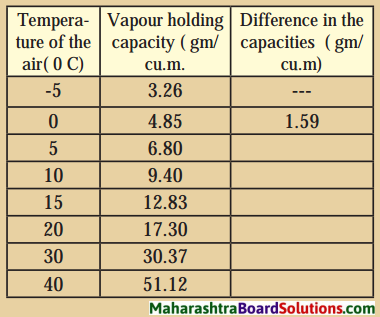
Maharashtra Board Class 8 Geography Solutions Chapter 4 Structure of Ocean Floor 1
Answer:
Maharashtra Board Class 8 Geography Solutions Chapter 4 Structure of Ocean Floor 7

Thought-Provoking Questions

Think about it.

Question a.
If the classification of landforms on land can be done on the basis of altitude and size, then how can the landforms submerged underwater are classified?
Answer:
If the classification of landforms on land can be done on the basis of altitude and size, then the landforms submerged underwater are classified on the basis of the depth from the seafloor and the shape of the land there.

Maharashtra Board Class 8 Geography Solutions Chapter 4 Structure of Ocean Floor

Use your brainpower!

Do this activity when you go to the seashore with your parents or teachers. Observe the materials which have come with the waves. Classify them as per the flowchart given below:
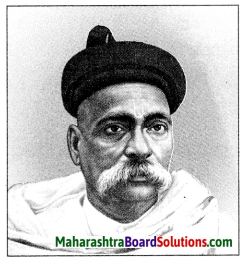
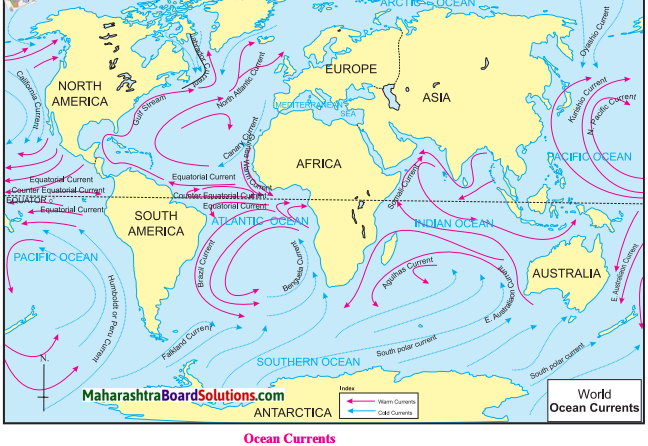
Maharashtra Board Class 8 Geography Solutions Chapter 4 Structure of Ocean Floor 8

Question a.
Which of these are perishable items?
Answer:
Plants, conches and shells, aquatic animals of these are perishable items.

Question b.
Which are non-perishable?
Answer:
Chemicals, metals and plastic/glass are non-perishable.

Question c.
What will happen because of perishable items?
Answer:
Perishable items will not create pollution of seacoast and seawater on a large scale. The remains of perishable items will get deposited in the form of marine oozes on the ocean bed.

Question d.
What will happen because of non-perishable items?
Answer:
Non-perishable items will create pollution of seacoast and seawater on a large scale.

Question f.
Suggest measures to control deposition of non-perishable items on the coast.
Answer:
The following measures can be taken to control deposition of non-perishable items on the coast:

  1. Plastic bags, plastic or glass containers must be prohibited on the seacoasts.
  2. Strict action must be taken against offenders carrying the banned products on the seacoasts.
  3. Hoardings explaining the importance of clean seacoasts must be displayed on all the seacoast.

Maharashtra Board Class 8 Geography Solutions Chapter 4 Structure of Ocean Floor

Question g.
How will you run a campaign of environmental conservation to keep the coasts clean?
Answer:
We will run a campaign of environmental conservation to keep the coasts clean as follows:

  1. We will display hoardings explaining the importance of clean seacoasts on the seacoasts.
  2. We will arrange street plays, dramas, etc. highlighting the importance of clean seacoasts.
  3. We will arrange special programmes during the festivals like Ganeshotsav, Diwali, Christmas, etc. to keep the seacoasts clean.

Open-Ended Questions:

Question a.
Suggest measures to control deposition of non-perishable items on the coast.
Answer:
The following measures can be taken to control deposition of non-perishable items on the coast:

  1. Plastic bags, plastic or glass containers must be prohibited on the seacoasts.
  2. Strict action must be taken against offenders carrying the banned products on the seacoasts.
  3. Hoardings explaining the importance of clean seacoasts must be displayed on all the seacoasts.

Maharashtra Board Class 8 Geography Solutions Chapter 4 Structure of Ocean Floor

Question b.
How will you run a campaign of environmental conservation to keep the coasts clean?
Answer:
We will run a campaign of environmental conservation to keep the coasts clean as follows:

  1. We will display hoardings explaining the importance of clean seacoasts on the seacoasts.
  2. We will arrange street plays, dramas, etc. highlighting the importance of clean seacoasts.
  3. We will arrange special programmes during the festivals like Ganeshotsav, Diwali, Christmas, etc. to keep the seacoasts clean.

Maharashtra Board Class 8 History Solutions Chapter 12 India Gains Independence

Balbharti Maharashtra State Board Class 8 History Solutions Chapter 12 India Gains Independence Notes, Textbook Exercise Important Questions and Answers.

Maharashtra State Board Class 8 History Solutions Chapter 12 India Gains Independence

Class 8 History Chapter 12 India Gains Independence Textbook Questions and Answers

1. Rewrite the statements by choosing the appropriate options :

Question 1.
………………. was the head of the interim Government.
(a) Vallabhbhai Patel
(b) Mahatma Gandhi
(c) Pandit Jawaharlal Nehru
(d) Barrister Jinnah
Answer:
(c) Pandit Jawaharlal Nehru

Question 2.
The plan of creation of two independent nations, India and Pakistan, was made by ………………… .
(a) Lord Wavell
(b) Stafford Cripps
(c) Lord Mountbatten
(d) Pethick Lawrence
Answer:
(c) Lord Mountbatten

2. Answer the following in one sentence:

Question 1.
Which demand was advocated by Barrister Jinnah?
Answer:
The two nation theory and demand of separate Muslim nation named Pakistan was advocated by Barrister Jinnah.

Maharashtra Board Class 8 History Solutions Chapter 12 India Gains Independence

Question 2.
Write the names of the ministers participating in Cabinet Mission.
Answer:
Pethick Lawrence, Stafford Cripps and A.V. Ale ander were the ministers participating in the Cabinet Mission.

3. Explain the following statements with reasons:

Question 1
The Indian National Congress approved the partition.
Answer:

  1. Lord Mountbatten prepared a plan of creation of India and Pakistan as two independent nations.
  2. Indian National Congress opposed the plan of partition as unity of the Nation was its basic stand.
  3. However, the Muslim League remained adamant on the creation of Pakistan.
  4. So, the Indian National Congress was left with no option but to accept the partition with complete helplessness.

Question 2.
The working of Interim Government could not run smoothly.
Answer:

  1. Muslim League demanded a separate Muslim nation of Pakistan.
  2. The followers of the Muslim League resorted to violent ways.
  3. Though the Muslim League declined to participate initially, they later participated in it.
  4. However, the leaders of the Muslim League adopted the policy of obstruction and therefore the Interim Government could not run smoothly.

Maharashtra Board Class 8 History Solutions Chapter 12 India Gains Independence

Question 3.
The Wavell Plan could not succeed.
Answer:
The Wavell Plan could not succeed because

  1. Barrister Jinnah insisted that only Muslim League should have the right to suggest the names of Muslim representatives to the Viceroy’s Executive Council.
  2. The Congress opposed this and as a result, no consensus could be arrived at the meeting called by Lord Wavell.

4. Write the events on the following timeline:

Question 1.
Maharashtra Board Class 8 History Solutions Chapter 12 India Gains Independence 1
Answer:
Maharashtra Board Class 8 History Solutions Chapter 12 India Gains Independence 2

5. Answer the following questions in brief:

Question 1.
Why did the British took steps towards granting freedom to India?
Answer:

  1. The Indian freedom struggle had become very intense during the period of Second World War. The revolt of Navy and Air Force shook the foundation of the British empire.
  2. The demand for independence of India was gaining its strength.
  3. The Muslim League had demanded a separate Muslim nation.
  4. The followers of the Muslim League resorted to violence.
  5. The British government realised that it was necessary to take a serious note of it. They realised that their rule in India will not last long.

Accordingly, the British government started preparing plans for granting Independence to India.

Maharashtra Board Class 8 History Solutions Chapter 12 India Gains Independence

Question 2.
Write information about the Mountbatten Plan.
Answer:

  1. England’s Prime Minister Atlee announced the transfer of power would be before June 1948.
  2. He appointed Lord Mountbatten as the Viceroy of India who was to arrange the transfer of power.
  3. He held discussions with the leaders of India.
  4. Mountbatten prepared a plan for partition of India i.e., creation of two independent nations, India and Pakistan.
  5. The Indian National Congress opposed the plan.
  6. But, due to the adamant behaviour of the Muslim League, the Indian National Congress accepted the Plan, with complete helplessness.
  7. On the basis of Mountbatten Plan, Indian Independence Act was passed.

Question 3.
Why did Muslim League declare to observe 16 August as Direct Action Day? What were its effects?
Answer:

  1. The Muslim League was adamant on the demand of Pakistan.
  2. It was not satisfied with Cabinet Mission plan as it had no provision for a separate Muslim state.
  3. 16th August 1946 was observed as Direct Action Day. ‘
  4. The followers of Muslim League resorted to violent ways.
  5. There were Hindu-Muslim riots in various parts of the country.
  6. There were massacres in the Noakhali region in the province of Bengal.

Project:

Collect information about the response of common people after gaining independence, with the help of various reference books as well as the internet.

Class 8 History Chapter 12 India Gains Independence Additional Important Questions and Answers

Rewrite the statements by choosing the appropriate options:

Question 1.
……………… put forth the two Nation theory and demanded a separate Muslim nation.
(a) Barrister Muhammad Ali Jinnah
(b) Chaudhary Rahmat Ali
(c) Dr. Muhammad Iqbal
(d) Lord Mountbatten
Answer:
(a) Barrister Muhammad Ali Jinnah

Question 2.
……………., Prime Minister of England, declared that England would leave its dominion on India before June 194 .
(a) Winston Churchill
(b) Linlithgo
(c) Atlee
(d) Mountbatten
Answer:
(c) Atlee

Question 3.
The ……………. initially refused to participate in the Interim Government.
(a) Indian National Congress
(b) Muslim League
(c) Hindu Mahasabha
(d) Kisan Sabha
Answer:
(b) Muslim League

Question 4.
The Muslim League decided to observe 16th August as ……………. Day.
(a) Non Violence
(b) Pakistan
(c) Direct Action
(d) Independence
Answer:
(c) Direct Action

Question 5.
As per ………………, India got independence.
(a) Mountbatten Plan
(b) Wctvell Plan
(c) Indian Independence Act
(d) Cabinet Mission
Answer:
(c) Indian Independence Act

Maharashtra Board Class 8 History Solutions Chapter 12 India Gains Independence

Question 6.
Gandhiji was assassinated on ………………….. .
(a) 30 December 1947
(b) 30 January 194
(c) 30 March 194
(d) 2 October 194
Answer:
(b) 30 January 194

Name the following:

Question 1.
First person to present idea of free Muslim nation.
Answer:
Dr. Muhammad Iqbal

Question 2.
Last Viceroy of India.
Answer:
Lord Mountbatten

Question 3.
One who presented idea of Pakistan.
Answer:
Chaudhary Rahmat Ali

Question 4.
Went to Noakhali to stop violence
Answer:
Mahatma Gandhi.

Answer the following in one sentence:

Question 1.
What did Prime Minister Atlee declare in the British Parliament of England?
Answer:
Prime Minister Atlee declared in the British Parliament that England would transfer all of its government responsibility to Indians not later than June 1948.

Maharashtra Board Class 8 History Solutions Chapter 12 India Gains Independence

Question 2.
Why did the Interim Government not work smoothly?
Answer:
The Interim Government could not work smoothly because the Muslim League followed the policy of obstruction.

Answer the following questions in brief:

Question 1.
Which were the important provisions :
of the Wavell Plan?
Answer:

  1. The Wavell Plan provided a proper representation to Muslims, Dalits and minorities in the Central and Provincial Legislatures.
  2. It provided for an equal number of Hindu and Muslim members in Viceroy’s Executive Council.

Question 2.
State the provisions of the Indian Independence Act.
Answer:
The Indian Independence Act was passed on the basis of Mountbatten Plan on 18th July, 1947.
According to the plan :

  1. Two Independent nations of India and Pakistan will come into existence on 15th August, 1947.
  2. Thereafter, the British Parliament would not retain any control over them.
  3. The British supremacy over the princely states would come to an end.
  4. They would be free to join either India or Pakistan or remain independent.

Maharashtra Board Class 8 History Solutions Chapter 12 India Gains Independence

Question 3.
Write about the attainment of independence by India.
Answer:

  1. As per the Indian Independence Act, India was granted Independence on 15th August, 1947.
  2. A meeting of the Constituent Assembly was going on in the hall of Parliament House in Delhi in the midnight of 14th August.
  3. At the stroke of midnight, the Union Jack of Britain was lowered and in its place the Indian tricolour flag was unfurled.

Explain the following statements with reasons:

Question 1.
The Cabinet Mission Plan could not satisfy the political parties in India.
Answer:
The Cabinet Mission Plan could not satisfy the political parties in India because,

  1. The Indian National Congress was not happy with some of its provisions.
  2. The Muslim League was also dissatisfied with the plan as it did not provide for the creation of a separate Muslim state of Pakistan.

Question 2.
The joy of attainment of freedom was not untinted:
Answer:

  1. India attained Independence from the slavery of 150 years.
  2. But, the people were grieved due to the partition of the country and the terrible violence during that period.

So, the joy of attainment of freedom was not untinted.

Maharashtra Board Class 8 History Solutions Chapter 12 India Gains Independence

Answer the following in detail:

Question 1.
State the genesis of Pakistan.
Answer:

  1. To weaken the national movement, the British adopted the policy of ‘divide and rule’. Its consequence was the establishment of ‘Muslim League’.
  2. Famous poet, Dr. Muhammad Iqbal put forth the idea of an independent Muslim state.
  3. Later Chaudhary Rahmat Ali coined the name Pakistan.
  4. Barrister Muhammad Ali Jinnah put forth the two nation theory and demanded a separate state for the Muslims naming Pakistan.
  5. Barrister Jinnah and the Muslim League started the propaganda that Indian National Congress was only a Hindu organisation and the Muslims have no benefit of it.
  6. Since their demand was not fulfilled, they observed ‘Direct Action Day’ and resorted to violence.
  7. The nation witnessed Hindu-Muslim riots in various parts.
  8. After the consent of the Indian National Congress to the Mountbatten Plan, the Indian Independence Act provided for the partition.

Question 2.
Why do you think everyone needs freedom?
Answer:

  1. Freedom is liberation from any kind of bondage.
  2. The rights of people are denied under foreign rule.
  3. Lot of restrictions are imposed by a foreign power.
  4. Under a foreign rule or dictatorship, power is not used for the welfare of the people but for the benefit of few.
  5. All round development of the citizens take place in an independent free state.
  6. Equality, Fraternity, Justice, Humanity are values which are cherished in freedom. Therefore, everyone needs freedom.

Maharashtra Board Class 8 History Solutions Chapter 8 Civil Disobedience Movement

Balbharti Maharashtra State Board Class 8 History Solutions Chapter 8 Civil Disobedience Movement Notes, Textbook Exercise Important Questions and Answers.

Maharashtra State Board Class 8 History Solutions Chapter 8 Civil Disobedience Movement

Class 8 History Chapter 8 Civil Disobedience Movement Textbook Questions and Answers

1. Rewrite the statements by choosing the appropriate options :

(Mahatma Gandhi, Khuda-i-Khidmatgar, [ Ramsay Mac Donald, Sarojini Naidu)

Question 1.
……………. organised the Round Table Conference in London.
Answer:
Ramsay Mac Donald

Maharashtra Board Class 8 History Solutions Chapter 8 Civil Disobedience Movement

Question 2.
Khan Abdul Gafar Khan established the organisation named …………….
Answer:
Khuda-i-Khidmatgar

Question 3.
……………. led the Dharasana Satyagraha.
Answer:
Sarojini Naidu

Question 4.
In the Second Round Table Conference ……………. participated as a representative of Indian National Congress.
Answer:
Mahatma Gandhi.

2. Explain the following statements with reasons :

Question 1.
Chandrasing Thakur was court martialled and severely punished.
Answer:

  1. Khan Abdul Gaffar Khan began Satyagraha at Peshawar on 23rd April, 1930. His organisation Khuda-i Khidmatgar led the satyagraha.
  2. They kept Peshawar town in their control for a week.
  3. The British government ordered Garhwal regiment to fire on the satyagrahis.
  4. Chandrasing Thakur an officer of the Garhwal Regiment refused to fire on the satyagrahis.

Therefore, he was court-martialled and severely punished.

Question 2.
The Government declared Martial Law at Solapur.
Answer:

  1. After the Salt Satyagraha many movements which were integral of Civil Disobedience Movement started.
  2. The mill workers in Solapur observed hartal and organised a huge procession on 6th May 1930.
  3. The District Collector ordered firing on procession. Many volunteers including Shankar Shivdare died in the firing.
  4. People got enraged and attacked railway stations, police stations, courts, municipal buildings, etc.

Therefore, Martial law was imposed in Solapur by the government.

Maharashtra Board Class 8 History Solutions Chapter 8 Civil Disobedience Movement

Question 3.
The deliberation in the First Round Table Conference proved to be meaningless.
Answer:

  1. The Civil Disobedience Movement intensified in India in 1930.
  2. The British Prime Minister, Ramsay Mac Donald organised Round Table Conference at London to discuss constitutional issues related to India.
  3. The representatives of many political parties and princely states participated in the conference. Indian National Congress did not participate in it.
  4. Without the participation of the Congress which was a body that represented the country deliberations were meaningless.

Thus, the deliberation in the First Round Table Conference proved to be meaningless.

Question 4.
Gandhiji began fast unto death in the Yerwada jail.
Answer:

  1. The Communal Award declared by the British Prime Minister Ramsay Mac Donald provided separate electorates for the Dalits.
  2. This division of the society on the basis of caste was not acceptable to Gandhiji.
  3. Therefore, to protest against the Award, Gandhiji began fast unto death in the Yerawada jail.

3. Answer the following questions in 25 to 30 words :

Question 1.
Why did Gandhiji decide to break the Salt Act to begin the Satyagraha?
Answer:
1. Before launching the Civil Disobedience Movement Gandhiji demanded cancellation of salt tax and end the monopoly of the British government to manufacture it.
2. Being an important ingredient in the food of the common people, it was unjust to impose a tax on salt.
3. Gandhiji decided to launch the Salt Satyagraha by a violation of the Salt Act, which was symbolic in breaking all unjust and oppressive laws of the British.

Maharashtra Board Class 8 History Solutions Chapter 8 Civil Disobedience Movement

Question 2.
Why did the Indian National Congress withdraw the Civil Disobedience Movement?
Answer:
1. After the failure of the First Round Table Conference, Prime Minister Ramsay Mac Donald hoped that Indian National Congress would participate in the Second Round Table Conference.
2. In order to create a conducive atmosphere Gandhiji and other political leaders were released from jail.
3. A pact was signed after discussion between Gandhiji and Viceroy Irwin.
4. According to the pact, the British Government gave an assurance of providing Responsible Government in the proposed constitution of India.
5. So, the congress agreed to suspend the Civil Disobedience Movement and participate in the Second Round Table Conference.

4. Complete the following timeline of Civil Disobedience Movement:

Question 1.
Maharashtra Board Class 8 History Solutions Chapter 8 Civil Disobedience Movement 7
Answer:
Maharashtra Board Class 8 History Solutions Chapter 8 Civil Disobedience Movement 8

Maharashtra Board Class 8 History Solutions Chapter 8 Civil Disobedience Movement

Do you Know?

Features of the Civil Disobedience Movement :
1. All the movements, till now, were limited only to urban areas. But this movement became a nationwide movement. People from rural areas registered their participation. Women also took part in large numbers. Kasturba Gandhi, Kamladevi Chattopadhyay, Ayantikaba I Gokha le, Lilavati Munshi, Hansaben Mehta led the satyagraha.

2. This movement was based on complete nonviolence. The British Government was trying to greatly suppress the movement, but the people protested unarmed. Due to this, the Indian people became fearless.

project:

Question 1.
Gather additional information along with photographs about the work of the following personalities in the Civil Disobedience Movement and exhibit it in the class. (a) Sarojini Naidu (b) Khan Abdul Gafar Khan (c) Babu Genu Said.

Maharashtra Board Class 8 History Solutions Chapter 8 Civil Disobedience Movement

Question 2.
The plot on an outline map of India, the places mentioned in the chapter where the Civil Disobedience Movement took place.

Class 8 History Chapter 8 Civil Disobedience Movement Additional Important Questions and Answers

Rewrite the statements by choosing the appropriate options :

Question 1.
After the resolution of Complete Independence was passed in Lahore session, Gandhiji decided to launch ……………. Movement.
(a) Home Rule
(b) Non-co-operation
(c) Quit India
(d) Civil Disobedience
Answer:
(d) Civil Disobedience

Question 2.
During Civil Disobedience Movement, government imposed Martial law in ……………. .
(a) Peshawar
(b) Solapur
(c) Pune
(d) Mumbai
Answer:
(b) Solapur

Question 3.
Gandhiji withdrew the Civil Disobedience Movement in ……………. .
(a) April 1934
(b) March 1930
(c) November 1932
(d) May 1933
Answer:
(a) April 1934

Maharashtra Board Class 8 History Solutions Chapter 8 Civil Disobedience Movement

Question 4.
Gandhiji broke the Salt Act at ……………. .
(a) Dandi
(b) Peshawar
(c) Dharasana
(d) Yerwada
Answer:
(a) Dandi

Question 5.
The British government gave orders to regiment in Peshawar to ……………. open fire on the satyagrahis.
(a) Garhwal
(b) Sikh
(c) Maratha
(d) Rajput
Answer:
(a) Garhwal

Name the following :

Question 1.
Follower of Gandhiji known as Frontier Gandhi.
Answer:
Khan Abdul Gafar Khan

Question 2.
Volunteer who died in firing at Solapur satyagraha.
Answer:
Shankar Shivdare

Question 3.
Laid down his life in front of the truck boycotting foreign goods in Mumbai.
Answer:
Babu Genu Said

Question 4.
Attended the Second Round Table Conference as representative of Dalits.
Answer:
Dr. Babasaheb Ambedkar.

Answer the following questions in one sentence :

Question 1.
What was the objective of Gandhiji in starting the Civil Disobedience?
Answer:
The objective of Gandhiji was to break the oppressive and unjust laws of the British Government through peace and Satyagraha.

Maharashtra Board Class 8 History Solutions Chapter 8 Civil Disobedience Movement

Question 2.
From which place and when did the Dandi March start?
Answer:
The Dandi March started from Sabarmati Ashram in Ahmedabad on 12 March, 1930.

Question 3.
Name the leaders present at the First Round Table Conference.
Answer:
Dr. Babasaheb Ambedkar, Sir Tej Bahadur Sapru, Barrister Jinnah were the leaders present at the First Round Table Conference.

Question 4.
Which issues were discussed in the First Round Table Conference?
Answer:
The issues like Responsible Government at centre and establishment of Federal State in India were discussed.

Question 5.
What decision was made in the Poona Pact?
Answer:
According to the Poona Pact, separate electorates for the Dalits was cancelled and a provision for reserved seats was made.

Do as Directed :

Complete the graphical presentation :

Question 1.
Maharashtra Board Class 8 History Solutions Chapter 8 Civil Disobedience Movement 1
Answer:
Maharashtra Board Class 8 History Solutions Chapter 8 Civil Disobedience Movement 2

Maharashtra Board Class 8 History Solutions Chapter 8 Civil Disobedience Movement

Question 2.
Maharashtra Board Class 8 History Solutions Chapter 8 Civil Disobedience Movement 3
Answer:
Maharashtra Board Class 8 History Solutions Chapter 8 Civil Disobedience Movement 4

Question 3.
Maharashtra Board Class 8 History Solutions Chapter 8 Civil Disobedience Movement 5
Answer:
Maharashtra Board Class 8 History Solutions Chapter 8 Civil Disobedience Movement 6

Write short notes :

Question 1.
Gandhi-Irwin Pact :
Answer:
1. On the appeal of the Prime Minister, the Viceroy released Gandhiji and other political leaders from prison.
2. In this conducive atmosphere, a pact was signed between Gandhiji and Viceroy Irwin. It is known as Gandhi-Irwin Pact.

  • According to the pact, the British Government gave an assurance of providing Responsible Government in the proposed constitution of India.
  • Congress decided to withdraw the Civil Disobedience Movement.
  • Agreed to participate in the Second Round Table Conference.

Maharashtra Board Class 8 History Solutions Chapter 8 Civil Disobedience Movement

Question 2.
Second Round Table Conference :
Answer:

  1. The Second Round Table Conference was held in 1931.
  2. Gandhiji participated as the sole representative of the Indian National Congress.
  3. Dr. Babasaheb Ambedkar represented the Dalits. The representatives of the various castes and communities, political parties and the princely states also participated.
  4. The issues of minority representation and nature of proposed federal constitution were discussed.
  5. Dr. Babasaheb Ambedkar demanded separate electorates for the Dalits.
  6. Gandhiji tried to bring unanimity but he was unsuccessful. ‘
  7. So, he was disappointed and returned to India.

Question 3.
Poona Pact :
Answer:

  1. After the Second Round Table Conference, the British Prime Minister Ramsay Mac Donald declared Communal Awards.
  2. Communal Awards granted separate electorates to the Dalits as demanded by Dr. Ambedkar.
  3. Gandhiji was against the division on the basis of caste. He started fast unto death in Yerwada jail.
  4. The leaders of Indian National Congress requested Dr. Ambedkar to reconsider his demand in the interest of the nation.
  5. So, Dr. Babasaheb Ambedkar signed the. Poona Pact with Gandhiji in 1932.
  6. It provided reserved seats instead of separate electorates for the Dalits.

Question 4.
The Round Table Conference :
Answer:

  1. The British Prime Minister, Ramsay Mac Donald wanted to discuss constitutional issues related to India.
  2. For this purpose, he organised Three Round Table Conferences at London between 1930 and 1932.
  3. Representatives of various communities, castes, political parties and princely states attended the conferences.
  4. Gandhiji attended the Second Round Table Conference as the representative of Indian National Congress.
  5. As no important decision was taken in them, all these conferences proved to be futile.

Answer the following questions in 25 to 30 words :

Question 1.
Write about the sacrifice of Babu Genu.
Answer:

  1. There was agitation against foreign goods in Mumbai.
  2. Babu Genu Said, a mill worker, was at the forefront in this Satyagraha.
  3. He threw himself in front of a truck carrying foreign goods in order to stop it.
  4. He did not budge even after the police threatened him.
  5. In the end, he was crushed under the truck.
  6. His martyrdom was a source of inspiration for the national movement.

Maharashtra Board Class 8 History Solutions Chapter 8 Civil Disobedience Movement

Question 2.
Write features of Civil Disobedience Movement.
Answer:
The Civil Disobedience Movement launched in 1930 had the following features :

  1. All the movements launched till then were limited to urban areas.
  2. But this movement became nationwide as the people from rural areas also participated.
  3. Women participated in large numbers in the movement and even led it at many places.
  4. The movement was based on non-violence. People faced the suppressive measures of the government unarmed and fearlessly.

Question 3.
What suppressive measures were adopted by the British government after the Second Round Table Conference?
Answer:

  1. Gandhiji resumed the Civil Disobedience Movement after he failed and returned from the Second Round Table Conference.
  2. The government responded by resorting to inhuman oppressive measures.
  3. Civic rights were strangled.
  4. The Indian National Congress and associated institutions were declared illegal.
  5. Restrictions were imposed on national newspapers and literature.

Explain the following statements with reasons :

Question 1.
Gandhiji was arrested on 4th May 1930.
Answer:

  1. Gandhiji started Salt Satyagraha on 6th April 1930 at Dandi by breaking the Salt act.
  2. With this the Civil Disobedience Movement started all over India.
  3. In spite of suppressive measures undertaken by the British Government, they could not suppress the movement.

The British government found itself in a difficult situation. So, Gandhiji was arrested on 4th May 1930.

Maharashtra Board Class 8 History Solutions Chapter 8 Civil Disobedience Movement

Question 2.
Gandhiji returned disappointed from the Second Round Table Conference.
Answer:

  1. The British Government raised the issue of representation of the minorities and the nature of the federal constitution.
  2. There were differences of opinion among the representatives.
  3. Moreover, the efforts of Gandhiji to arrive at a consensus did not succeed.
  4. This disappointed Gandhiji and he returned from the Second Round Table Conference.

Read the passage and answer the questions given below:

Passage:
The satyagraha at …………….
………………… Malavan and Shiroda.

Question 1.
Who led the Dharasana Satyagraha?
Answer:
Sarojini Naidu led the Dharasana Satyagraha in Gujarat.

Question 2.
At which places in Maharashtra did Salt Satyagraha take place?
Answer:
The Salt Satyagraha in Maharashtra took place at Wadala, Malvan and Shiroda.

Question 3.
Give a brief account of the Dharasana Satyagraha.
Answer:

  1. The leadership of salt satyagraha was taken over by Sarojini Naidu at Dharasana in Gujarat after the arrest of Gandhiji.
  2. The police lathi-charged the batches of the satyagrahis who came forward to break the Salt Act.
  3. They silently tolerated the blows of the lathis.
  4. The injured were provided medical aid and another batch of satyagrahis would replace them.
  5. This chain of satyagrahis continued endlessly at Dharasana.

Answer the following in detail:

Question 1.
Explain the extensive nature of Civil Disobedience Movement.
Answer:

  1. After the resolution of complete independence was passed, Mahatma Gandhi decided to launch the Civil Disobedience Movement.
  2. he Salt Satyagraha was launched on 6th April 1930 at Dandi. It was a symbolic act by Gandhiji.
  3. The main objective was to break all unjust and oppressive laws of the British through peace and Satyagraha.
  4. Salt Satyagraha took place at Dharasana in Gujarat and at Wadala, Malvan and Shiroda in Maharashtra.
  5. The mill workers were on the forefront in the Solapur Satyagraha.
  6. The forest Satyagraha was undertaken at Bilashi, Sangamner, Kalavan, Chirner and Pusad by tribals in Maharashtra.
  7. In the Northwest Frontier Province, the Satyagraha was organised under the leadership of Khan Abdul Gafar Khan.
  8. The satyagrahis in Mumbai obstructed the trucks loaded with foreign goods.
  9. Women also participated in large numbers.
  10. This movement reached urban as well as the rural areas, thus making it a national movement.

Maharashtra Board Class 8 History Solutions Chapter 8 Civil Disobedience Movement

Question 2.
Write information of Dandi March.
Answer:

  1. Gandhiji decided to launch Civil Disobedience Movement to cancel unjust tax on salt and to end the monopoly of the British Government to manufacture of salt.
  2. Salt, an important ingredient in the food of common people, was chosen by Gandhiji.
  3. On 12th March 1930 he set out from Sabarmati ashram with his 7 followers.
  4. Gandhiji delivered speeches in the villages on his way to Dandi.
  5. Due to Gandhiji’s speech the message of Civil Disobedience spread everywhere and a favorable atmosphere was created.
  6. He appealed to the people to join the movement fearlessly.
  7. Covering a distance of 35 km, Gandhiji reached Dandi, a seashore, on 5th April 1930.
  8. On 6th April, he broke the salt act by picking up the salt lying on the seashore.
  9. With this, the Civil Disobedience Movement started all over the country.

Question 3.
Do you feel Gandhiji’s Civil Disobedience technique can be used in present times?
Answer:

  1. Gandhiji opposed the unjust and oppressive laws of the British and broke them through peace and Satyagraha.
  2. I strongly feel India needs such ways in present times. Political parties and organisations call for strike or start a movement against decisions of government.
  3. They resort to unconstitutional acts such as stopping the vehicles, vandalising public property, setting objects on fire and starting riots.
  4. They destroy property of the nation by involving in all this anti-social activities. Innocent people get killed.
  5. It brings development to a halt, creates a divide in society.
  6. The feeling of unity, co-operation and tolerance remains no more. Society becomes unsafe.
  7. Therefore, I feel that even today the nation requires technique of Civil Disobedience.