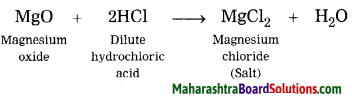
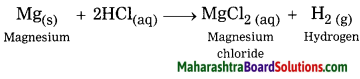
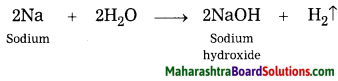
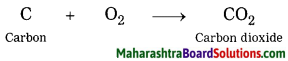
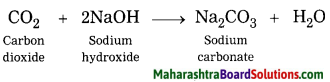
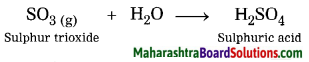
Maharashtra Board Class 8 Science Solutions Chapter 12 Introduction to Acid and Base

Balbharti Maharashtra State Board Class 8 Science Solutions Chapter 12 Introduction to Acid and Base Notes, Textbook Exercise Important Questions and Answers.

Maharashtra State Board Class 8 Science Solutions Chapter 12 Introduction to Acid and Base

Class 8 Science Chapter 12 Introduction to Acid and Base Textbook Questions and Answers

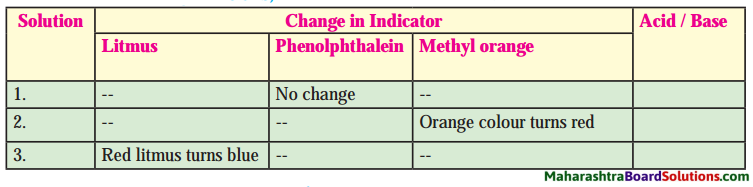
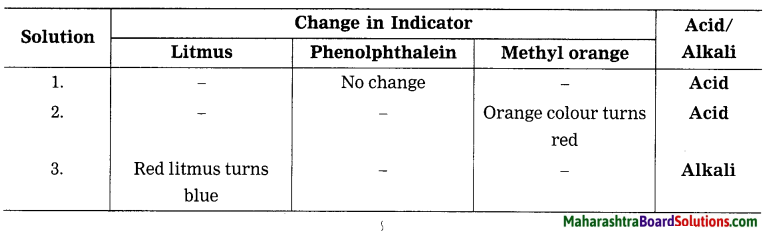
1. Identify the following solutions, whether they are acid or base.

Question a.
Maharashtra Board Class 8 Science Solutions Chapter 12 Introduction to Acid and Base 1
Answer:
Maharashtra Board Class 8 Science Solutions Chapter 12 Introduction to Acid and Base 2

2. Write chemical names from given formulae.
H2SO4, Ca(OH)2, HCl, NaOH, KOH, NH4OH

Question a.
Write the chemical names from given formulae: H2SO4, Ca(OH)2, HCl, NaOH, KOH, NH4OH
Answer:

  1. H2SO4 – Sulphuric acid
  2. Ca(OH)2 – Calcium hydroxide
  3. HCl – Hydrochloric acid
  4. NaOH – Sodium hydroxide
  5. KOH – Potassium hydroxide
  6. NH4OH – Ammonium hydroxide

Maharashtra Board Class 8 Science Solutions Chapter 12 Introduction to Acid and Base

3. Sulphuric acid has highest importance in chemical Industry. Why?

Question a.
Sulphuric acid has highest importance in chemical Industry. Why?
Answer:
Answer:
Sulphuric acid has highest importance in the chemical industry because it is used in the manufacturing of fertilizers like ammonium sulphate and superphosphate of lime. It is used in the manufacturing of hydrochloric acid, nitric acid, phosphoric acid, ether, plastics and metal sulphates. It is also used in the manufacturing of dyes, drugs, perfumes, disinfectants and glue.

4. Give answers.

Question a.
Which acid is used for getting chloride salt?
Answer:
Hydrochloric acid is used for getting chloride salt.

Question b.
By squeezzing lemon on a piece of rock the gas liberated turned lime water milky. Which compound is present in the rock?
Answer:
Metal carbonate is present in the rock.

Question c.
The label on the bottle of chemical is spoiled. How will you find whether the chemical is acidic or not?
Answer:
The chemical is tested with blue litmus paper. If it turns red it is an acidic otherwise tested with red litmus paper, if it turns blue, it is an alkaline.

Maharashtra Board Class 8 Science Solutions Chapter 12 Introduction to Acid and Base

5. Answer the following questions. 

Question a.
Explain the difference between acid and base.
Answer:
Acids:

  1. Acids have sour taste.
  2. Acids turn blue litmus red.

Bases:

  1. Bases have bitter taste.
  2. Bases turn red litmus blue.

Question b.
Why indicator does not affect by salt?
Answer:
Mostly indicators are organic compounds which do not react with a salt.

Question c.
Which substances are produced i by neutralization process?
Answer:
Salt and water are produced in the f neutralization process.

Maharashtra Board Class 8 Science Solutions Chapter 12 Introduction to Acid and Base

Question d.
Which are the industrial uses of acids?
Answer:
Acids which are used in the industry are:

  1. Sulphuric acid
  2. Hydrochloric acid
  3. Nitric acid.;

1. Sulphuric acid: Sulphuric acid is 5 used (a) in the manufacture of chemical? fertilizers like ammonium sulphate, (b) for cleaning gold and silver articles and (c) in car batteries.

2. Hydrochloric acid: Hydrochloric acid is used (a) to clean toilets and (b) to obtain glucose from starch and also for producing gelatine.

3. Nitric acid: Nitric acid is used (a) in the manufacture of perfumes (b) for engraving on copper, brass or silver and (c) in the manufacture of paints and explosives.

6. Select proper word given in bracket and fill in the blanks.

Question a.
Main constituent of acid is ……………. .
Answer:
Main constituent of acid is H+ ion.

Question b.
Main constituent of alkali is …………….. .
Answer:
Main constituent of alkali is OH ion.

Question c.
Tartaric acid is a …………… acid.
Answer:
Tartaric acid is a weak acid.

Maharashtra Board Class 8 Science Solutions Chapter 12 Introduction to Acid and Base

7. Match the pairs. 

Question a.

Group AGroup B
1. Tamarinda. Acetic acid
2. Curdb. Citric acid
3. Lemonc. Tartaric acid
4. Vinegard. Lactic acid

Answer:

Group AGroup B
1. Tamarindc. Tartaric acid
2. Curdd. Lactic acid
3. Lemonb. Citric acid
4. Vinegara. Acetic acid

8. State true or false.

Question a.
Oxides of metals are alkaline in nature.
Answer:
True.

Question b.
Salt is acidic.
Answer:
False. (Salt is neutral)

Question c.
Metal corrodes due to salts.
Answer:
False. (Acids and bases corrode metals)

Question d.
Salts are neutral.
Answer:
True. (Not all salts neutral)

Maharashtra Board Class 8 Science Solutions Chapter 12 Introduction to Acid and Base

9. Classify the following substances into acidic, basic and neutral group:
HCl, NaCl, MgO, KCl, CaO, H2SO4, HNO3, H2O and Na2CO3.

Question a.
Classify the following substances into acidic, basic and neutral group:
HCl, NaCl, MgO, KCl, CaO, H2SO4, HNO3, H2O and Na2CO3.
Answer:

GroupSubstances
AcidHCl, H2SO4, HNO3
BaseCaO, MgO, Na2CO3
NeutralH2O, NaCl, KCl.

Project:

Question a.
Write in your own language the uses and importance of neutralization reaction in daily life.

Class 8 Science Chapter 12 Introduction to Acid and Base Important Questions and Answers

Fill in the blanks:

Question 1.
Acid reacts with metal to form …………. gas.
Answer:
Acid reacts with metal to form hydrogen gas.

Question 2.
DNA is an acid present in our body, it decides …………. properties.
Answer:
DNA is an acid present in our body, it decides heredity properties.

Question 3.
The chemical formula of milk of magnesia is ………….
Answer:
The chemical formula of milk of magnesia is Mg (OH)2.

Question 4.
…………. are used to control hyperacidity.
Answer:
Antacids are used to control hyperacidity.

Question 5.
Alkali has …………. taste.
Answer:
Alkali has bitter taste.

Question 6.
Proteins are made up of ………….
Answer:
Proteins are made up of amino acids.

Question 7.
…………. is used in batteries.
Answer:
Dil. H2SO4 is used in batteries.

Rewrite the following statements by selecting the correct options:

Question 1.
The colour of phenolphthalein indicator in alkaline solution is ………….
(a) yellow
(b) green
(c) orange
(d) pink
Answer:
The colour of phenolphthalein indicator in alkaline solution is pink.

Question 2.
…………. is sour to taste.
(a) An acid
(b) An alkali
(c) A salt
(d) Alcohol
Answer:
An acid is sour to taste.

Question 3.
When phenolphthalein is added to NaOH, the colour of the solution will become ……………… .
(a) colourless
(b) red
(c) pink
(d) yellow
Answer:
When phenolphthalein is added to 5 NaOH, the colour of the solution will become pink.

Question 4.
When phenolphthalein is added to HCl, the colour of the solution will be ………….. .
(a) red
(b) pink
(c) green
(d) colourless
Answer:
When phenolphthalein is added to HCl, the colour of the solution will be colourless.

Question 5.
…………. is a natural indicator.
(a) Phenolphthalein
(b) Methyl orange
(c) Litmus
(d) Methyl red
Answer:
Litmus is a natural indicator.

Question 6.
The litmus paper or the litmus solution is obtained from …………. plants.
(a) moss
(b) rose
(c) hibiscus
(d) lichen
Answer:
The litmus paper or the litmus solution is obtained from lichen plants.

Question 7.
…………. is not an alkali.
(a) Sodium hydroxide
(b) Potassium hydroxide
(c) Copper hydroxide
(d) Calcium hydroxide
Answer:
Copper hydroxide is not an alkali.

Question 8.
…………. is a weak acid.
(a) Hydrochloric acid
(b) Nitric acid
(c) Carbonic acid
(d) Sulphuric acid
Answer:
Carbonic acid is a weak acid.

Question 9.
When methyl orange is added to HCl, the colour of the solution will be …………… .
(a) red
(b) pink
(c) yellow
(d) colourless
Answer:
When methyl orange is added to HCl, the colour of the solution will be pink.

Question 10.
When blue litmus paper is added to NaOH, the colour of the litmus paper will be ……………. .
(a) blue
(b) red
(c) pink
(d) yellow
Answer:
When blue litmus paper is added to NaOH, the colour of the litmus paper will be blue.

State whether the following statements are true or false. If a statement is false, correct it and rewrite:

Question 1.
Red cabbage is a natural indicator.
Answer:
True

Question 2.
Fats of our body are formed by fatty acids.
Answer:
True.

Question 3.
Ammonium hydroxide is used in the production of fertilizers.
Answer:
True.

Question 4.
Lime water is a weak acid.
Answer:
False. (Limewater is a weak base)

Question 5.
Orange colour of methyl orange turns yellow in acid.
Answer:
False. (Orange colour of methyl orange turns pink in acid)

Question 6.
Methyl red turns yellow in alkali.
Answer:
True.

Question 7.
Oxalic acid is used in aerated cold drinks.
Answer:
False. (Carbonic acid is used in aerated cold drinks).

Find the odd one out and justify:

Question 1.
Acetic acid, carbonic acid, hydrochloric acid, nitric acid.
Answer:
Acetic acid. (Others are mineral acids.)

Question 2.
Hydrogen chloride, sodium hydroxide, calcium oxide, ammonia.
Answer:
Hydrogen chloride. (Others are bases.)

Question 3.
HCl, CH3COOH, H2SO4, HNO3
Answer:
CH3COOH. (Others are strong acids.)

Question 4.
NaOH, Ca(OH)2, NH4OH, Ba(OH)2
Answer:
NaOH (Others are weak bases.)

Question 5.
H2SO4, H2CO3, HCl, HNO3
Answer:
H2CO3 (Others are strong acids.)

Question 6.
Citric acid, formic acid, lactic acid, nitric acid.
Answer:
Nitric acid. (Others are organic acids.)

Question 7.
Lime, litmus, phenolphthalein, methyl orange.
Answer:
Lime. (Others are indicators.)

Match the following:

Question 1.

Column ‘A’Column ‘B’
1. Strong acida. Magnesium hydroxide
2. Weak alkalib. Carbonic acid
3. Weak acidc. NaOH
4. Strong alkalid. Nitric acid

Answer:

Column ‘A’Column ‘B’
1. Strong acidd. Nitric acid
2. Weak alkalia. Magnesium hydroxide
3. Weak acidb. Carbonic acid
4. Strong alkalic. NaOH

Maharashtra Board Class 8 Science Solutions Chapter 12 Introduction to Acid and Base

Question 2.

Column ‘A’Column ‘B’
1. Sodium hydroxidea. Whitewashing
2. Magnesium hydroxideb. Fertilizers
3. Calcium hydroxidec. Washing soap
4. Ammonium hydroxided. Antacid

Answer:

Column ‘A’Column ‘B’
1. Sodium hydroxidec. Washing soap
2. Magnesium hydroxided. Antacid
3. Calcium hydroxidea. Whitewashing
4. Ammonium hydroxideb. Fertilizers

Maharashtra Board Class 8 Science Solutions Chapter 12 Introduction to Acid and Base

Define the following:

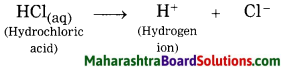
1. Acid: A substance which gives H+ ions in water is called an acid.
Maharashtra Board Class 8 Science Solutions Chapter 12 Introduction to Acid and Base 3

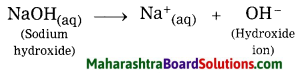
2. Alkali: A substance which gives OH ions in water is called an alkali.
Maharashtra Board Class 8 Science Solutions Chapter 12 Introduction to Acid and Base 4

3. Indicator: Substances which change their colours in presence of acid or base are called indicators.

4. Neutralization: The reaction between an acid and an alkali to form the r salt and water is termed as neutralization.

Answer the following questions in one sentence each:

Question 1.
What are natural acids?
Answer:
Acids present in foodstuffs are called natural acids.

Question 2.
State three vegetables from which natural indicators can be prepared.
Answer:
Natural indicators: Red cabbage, radish, tomato.

Maharashtra Board Class 8 Science Solutions Chapter 12 Introduction to Acid and Base

Question 3.
State names of any three strong acids.
Answer:

  1. Hydrochloric acid
  2. Sulphuric acid
  3. Nitric acid.

Question 4.
State the names of the acids found in lemon juice, Amla, tamarind water and curd.
Answer:

  1. Lemonuice – citric acid
  2. Amla – ascorbic acid
  3. tamarind water – tartaric acid
  4. curd – lactic acid.

Question 5.
State names of any three alkalis.
Answer:

  1. sodium hydroxide
  2. potassium hydroxide
  3. calcium hydroxide.

Question 6.
State the names of three indicators.
Answer:

  1. Litmus paper
  2. Methyl orange
  3. Phenolphthalein.

Maharashtra Board Class 8 Science Solutions Chapter 12 Introduction to Acid and Base

Question 7.
State the names of three weak alkalis.
Answer:

  1. Calcium hydroxide
  2. ammonium hydroxide
  3. magnesium hydroxide.

Question 8.
From which plant is litmus obtained?
Answer:
Litmus is obtained from plants called lichens.

Question 9.
Name the antacid which is used to control the hyper acidity.
Answer:
Milk of magnesia [Mg(OH)2] is used to control the hyper acidity.

Maharashtra Board Class 8 Science Solutions Chapter 12 Introduction to Acid and Base

Question 10.
How will you neutralize the excess of acid present in the soil?
Answer:
Lime stone or lime water is mixed in the soil to neutralize the excess of acid.

Question 11.
When lemonuice falls on a marble kitchen counter, which is the gas that bubbled out?
Answer:
Carbon dioxide.

Answer the following questions:

Question 1.
What are indicators?
Answer:
Substances which change their colours in presence of acid or base are called indicators.

Question 2.
State two acid-base indicators and mention their colour change.
Answer:
Phenolphthalein and methyl orange are two acid-base indicators. Phenolphthalein is colourless in an acidic solution while it turns pink in a basic solution. Methyl orange gives orange colour with an acidic solution and yellow colour with a basic solution.

Question 3.
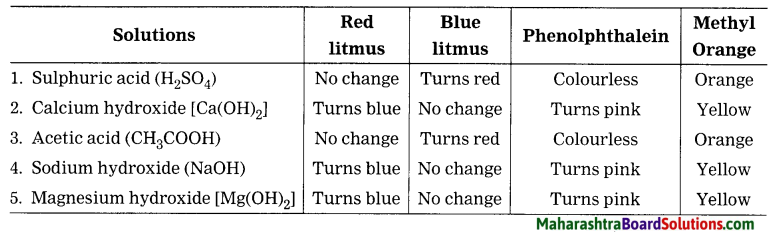
State the colour change for each of the following solutions with red litmus, blue litmus, phenolphthalein and methyl orange solutions.
Answer:
Maharashtra Board Class 8 Science Solutions Chapter 12 Introduction to Acid and Base 5

Question 4.
Name the acid present in (1) Orange (2) Vinegar (3) Tamarind (4) Curd (5) Tomato (6) Lemon.
Answer:

SubstanceAcid
OrangeCitric acid
VinegarAcetic acid
TamarindTartaric acid
CurdLactic acid
TomatoOxalic acid
LemonCitric acid

Maharashtra Board Class 8 Science Solutions Chapter 12 Introduction to Acid and Base

Question 5.
Classify the following into acidic substances, basic substances and salts.
(1) Lime water, (2) soda water, (3) soap water, (4) sea water, (5) sweet limeuice, (6) sugar caneuice, (7) buttermilk, (8) a mixture of ash in water, (9) tamarind water.
Answer:
a. Acidic substances: (1) Soda water, (2) sweet limeuice, (3) buttermilk, (4) tamarind water.
b. Basic substances: (1) Lime water, (2) Soap water, (3) a mixture of ash in water.
c. Salts: (1) Sea water, (2) sugar caneuice.

Question 6.
What happens when sour substances like limeuice, tamarind water falls on shahabad stones or kitchen platform? Why?
Answer:
When sour substances like limeuice, tamarind water falls on shahabad stones or kitchen platform, citric acid present in limeuice and tartaric acid in tamarind water reacts with metal carbonates present in shahabad stones or kitchen platform, carbon dioxide gas is evolved resulting in the formation of uneven surface.

Question 7.
Collect soil samples from your surroundings and find out whether it is acidic or alkaline or neutral?
Answer:
Soil samples collected from the surroundings are acidic in nature.

Question 8.
Which substances are used to clean greenish stains on copper vessels and to shine blackish silver utensils?
Answer:
Tamarind pulp is used to clean greenish stains on copper vessels. To shine blackish silver utensils, ammoniacal solution or limeuice or detergent is used.

Maharashtra Board Class 8 Science Solutions Chapter 12 Introduction to Acid and Base

Question 9.
Why toothpaste is used for brushing teeth?
Answer:

  1. Toothpaste contains fluorides and alkali to neutralize the mouth acid.
  2. Hence, the tooth paste, which is generally alkaline, is used for cleaning the teeth as it can neutralize the excess acid in i the mouth and prevent tooth decay.

Question 10.
State the properties of acids.
Answer:

  1. Acids are sour in taste.
  2. Acid molecules contain hydrogen ion (H+) as a main constituent.
  3. Acid reacts with metal to form hydrogen gas.
  4. Acid reacts with carbonates and liberates CO2 gas.
  5. Blue litmus turns red in acid.

Question 11.
State the uses of acids.
Answer:

  1. Acids are used in the production s of chemical fertilizers.
  2. Acids are used in the production of explosives, oil purification, medicines, dyes and paints.
  3. Hydrochloric acid is used for the preparation of different types of chloride salts.
  4. Dil. H2SO4 acid is used in the batteries (electric cell).
  5. Dil. HCl is used for sterilization of water.
  6. Acid is used for making of white paper from wood pulp.

Maharashtra Board Class 8 Science Solutions Chapter 12 Introduction to Acid and Base

Question 12.
The iron knife shines better after cutting the sour fruits like lemon, raw mangoes. Why?
Answer:
Acids present in sour fruits clean and dissolves the salts present on the surface of iron knife as a result iron knife shines better after cutting the sour fruits.

Question 13.
What is meant by neutralization? Give example.
Answer:
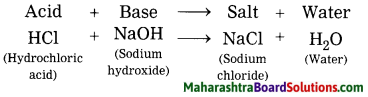
When an acid reacts with an alkali to form a salt and water, it is called neutralization.
Maharashtra Board Class 8 Science Solutions Chapter 12 Introduction to Acid and Base 6

Give scientific reasons:

Question 1.
When we have stomachache, doctors prescribe medicine containing magnesium hydroxide.
Answer:

  1. There is hydrochloric acid in our stomach which helps in the digestion of food.
  2. Sometimes in the stomach, there is more hydrochloric acid than we need.
  3. This excess acid causes acidity and indigestion resulting in stomachache.
  4. When magnesium hydroxide is administered it neutralizes the extra acid in the stomach.
  5. Therefore, magnesium hydroxide is the best cure for stomachache.
  6. So, when we have stomachache, doctors prescribe medicine containing magnesium hydroxide.

Question 2.
Quicklime or slaked lime is added to the soil.
Answer:

  1. When chemical fertilizers are added to the soil, the soil becomes acidic.
  2. To reduce its acidity quicklime or slaked lime is added to the soil.

Maharashtra Board Class 8 Science Solutions Chapter 12 Introduction to Acid and Base

Question 3.
Tarnished and stained copper vessels are brought to a shine by using tamarind pulp.
Answer:
In due course, unus6d copper vessels
are covered with a coating of black copper oxide and other compounds of copper which tarnish the vessel. Tamarind contains tartaric acid. When the vessel is rubbed with tamarind pulp, tartaric acid reacts with copper oxide and removes the layer. Thus, the copper vessel regains its shine.

Question 4.
Copper and brass utensils are tinned.
Answer:
Copper and brass reacts with i organic acids present in food materials and poisonous salts are formed. Tin does not react with organic acids present in food materials. Therefore, copper or brass vessels are tinned.

Distinguish between acid and alkali. OR Distinguish between the following:

Question 1.
Acid and Alkali:
Answer:

AcidAlkali
1. Acid has sour taste.1. Alkali has bitter taste.
2. Acid turns blue litmus red.2. Alkali turns red litmus blue.
3. An acid in an aqueous solution gives H+ ions.3. An alkali in an aqueous solution gives OH+ ions.
4. Oxides of non – metals form acids.4. Oxides of metals form bases.

Maharashtra Board Class 8 Science Solutions Chapter 12 Introduction to Acid and Base

Activity-based questions:

Activity 1:
Apparatus: Hibiscus, rose, turmeric, red cabbage leaves, filter paper, etc.
Activity: Rub red petals of hibiscus flower on the white filter paper. This gives hibiscus indicator paper. Similarly rub, rose petals on the white filter paper. Cut strips of this paper, it is a rose indicator paper. Take turmeric powder, add a little water in it. Dip filter paper or ordinary paper in the turmeric water for some time.

After drying make strips of that paper. Prepare turmeric indicator paper in this way. Put leaves of red cabbage in small quantity of water and heat it. Once solution of cabbage leaves cool down, dip papers in it and dry it. Make strips of dried paper. In this way prepare red cabbage indicator paper. Put some drops of following substances on the indicator papers prepared by the above method and write the effect in the following table:

SubstanceEffect on turmeric paperAcidic/basic
1. Lime juiceYellowAcidic
2. Lime water (calcium hydroxide)RedBasic
3.

Maharashtra Board Class 8 Science Solutions Chapter 12 Introduction to Acid and Base

Activity 2:
Take baking powder. Add a little water to it. Add this solution on to limeuice, vinegar, orangeuice, appleuice, etc. and note the findings.
What do you observe on addition of baking soda solution in the fruituice? Whether bubbles formed or effervescence came out of fruituice?
From the above first activity we came to know that yellow turmeric indicator paper’s turns red in certain solutions. Similarly on addition of baking soda solution in the acidic solution bubbles come out or effervescence is produced.
By these simple and easy activity we can identify acidic or alkaline substance:
[Note for Activity 1 and Activity 2: Students should perform the experiments under the guidance of school teachers and record their observations.]

Maharashtra Board Class 8 Science Solutions Chapter 12 Introduction to Acid and Base

Activity 3:
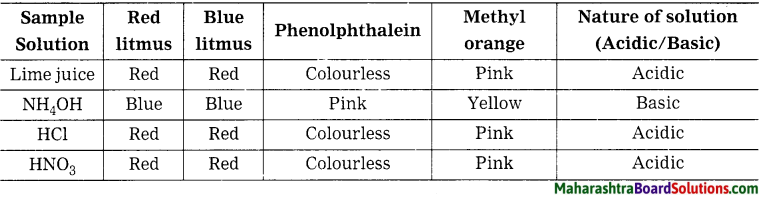
Under the guidance of teacher take limeuice, ammonium hydroxide (NH4OH), dil. hydrochloric acid (dil. HCl) and nitric acid (HNOs) in different test-tubes. Add drops of following indicators in them. Also dip litmus papers in the solutions. Observe and record in the following table.
Maharashtra Board Class 8 Science Solutions Chapter 12 Introduction to Acid and Base 7

Maharashtra Board Class 8 Geography Solutions Chapter 6 Land Use

Balbharti Maharashtra State Board Class 8 Geography Solutions Chapter 6 Land Use Notes, Textbook Exercise Important Questions and Answers.

Maharashtra State Board Class 8 Geography Solutions Chapter 6 Land Use

Class 8 Geography Chapter 6 Land Use Textbook Questions and Answers

1. Examine the following statements and correct the incorrect ones:

Question A.
Mining Is not type of land use.
Answer:
Incorrect.
Correct statement: Mining is a type of land use.

Question B.
There are factories in the Central Business District.
Answer:
Incorrect.
Correct statement: There are many shops, banks and offices in the Central Business District.

Question C.
In urban areas, the largest area is used for residential purposes.
Answer:
Correct.

Maharashtra Board Class 8 Geography Solutions Chapter 6 Land Use

Question D.
The village attendant issues the 7/12 extract.
Answer:
Incorrect.
Correct statement: The village talathi issues the 7/12 extract.

Question E.
In rural areas, residential areas occupy large tracts.
Answer:
Incorrect.
Correct statement: In rural areas, residential areas occupy small tracts.

Question F.
Extract 7 indicates Record of Rights.
Answer:
Correct.

Question G.
Extract 12 indicates change in ownership.
Answer:
Incorrect.
Correct statement: Extract 12 indicates tracts under cultivation.

2. Give geographical reasons.

Question A.
Land use for public facility is extremely important in urban areas.
Answer:

  1. Government provides various services to fulfill the needs of citizens. The land used for fulfilling these needs is known as public utility/ facility area.
  2. The lands used for post offices, police stations, public grounds, public schools, public hospitals, etc. are included public facility land use.
  3. Land use for public facility increases the’ social welfare. Therefore, land use for public facility is extremely important in urban areas.

Maharashtra Board Class 8 Geography Solutions Chapter 6 Land Use

Question B.
The record of ownership of non- agricultural land is same as that of agricultural land.
Answer:
1. The record of agricultural land is maintained in the form of 7/12 extract. Similarly the record of ownership of non-agricultural land is maintained in the form of property card.

2. Like 7/12 extract, property card provides details of ownership of land, city survey number, plot number, amount of tax, area of property assessed, right to access, etc. Thus, the record of ownership of non-agricultural land is same as that of agricultural land.

Question C.
A region can be classified as developed or developing on the basis of land use.
Answer:

  1. The land used in a particular region for agriculture, grazing, etc. indicates that the region is underdeveloped or developing.
  2. The land used in a particular region for commercial purposes, transportation, recreation, etc. indicates that the region is developed. In this way, a region can be classified as developed or developing on the basis of land use.

3. Write answers:

Question A.
Why is agriculture important in rural land use?
Answer:

  1. In India, agriculture is the main occupation of most of people in rural areas.
  2. In India, farming occupation is very important as it satisfies the need of food grain and provides raw material to industries.
  3. The maximum land in rural areas is used for carrying out agricultural activities. Therefore, agriculture is important in rural land use.

Question B.
State the factors affecting land use.
Answer:
(a) The factors affecting rural land use :

  1. The factors like climatic conditions, fertility of soil, altitude and slope of land, irrigational facilities, natural resources, government policies, etc. affect rural land use.
  2. For example, the land with gentle slope is not used for residential purpose, but is used for step farming.

(b) The factors affecting urban land use :

1. The factors like location of land, natural resources, housing development policies of government, transportation routes, industrialisation, trade and commerce, entertainment facilities, government policies, etc. affect urban land use.

2. For example, the land site near the railway station, market, etc. is mostly used for commercial purposes.

Maharashtra Board Class 8 Geography Solutions Chapter 6 Land Use

Question C.
Clarify the differences between rural and urban land use.
Answer:
The differences between rural and urban land use are as follows :

  1. Land in rural areas is used for limited purposes. On the other hand, land in urban areas is used for many purposes.
  2. The pattern of rural land use is comparatively simple. On the other hand, the pattern of urban land use is comparatively complex.
  3. Use of land for cultivation is the major form of rural land use. On the other hand, use of land for commercial activities and residence are the major forms of urban land use.

Question D.
Differentiate between 7/12 extract and property card.
Answer:
The differences between 7/12 extract and property card are as follows :

  1. 7/12 extract is issued by public revenue department of the government. On the other hand, property card is issued by city survey office of government.
  2. 7/12 extract is the land record of ownership and history of ownership of the land in rural areas. Property card is the land record of ownership and history of ownership of the land in urban areas.

Activity:

Question A.
Obtain information about a town close to your village based on the following points and make a presentation in class.
(site, condition. development, land use pattern work)
a. Classify your settlement as rural or urban
b. Note the changes in land use from Central Business District outwards to the periphery in your settlement after consulting elders. Prepare a land use pattern.

Question B.
Study the 7/12 extract or the Property Card in your house and write a note.

Class 8 Geography Chapter 6 Land Use Additional Important Questions and Answers

Choose the correct answer:

Question a.
Recreational land use is use of land for …………………
(A) garden
(B) farming
(C) industry
(D) rail route
Answer:
(A) garden

Question b.
Which of the following is a planned city in India?
(A) Seoul
(B) Zurich
(C) Chandigarh
(D) Brasilia
Answer:
(C) Chandigarh

Maharashtra Board Class 8 Geography Solutions Chapter 6 Land Use

Question c.
Of which city are Bandra, Bhandup, etc. suburbs?
(A) Pune
(B) Nagpur
(C) Nashik
(D) Mumbai
Answer:
(D) Mumbai

Examine the following statements and correct the incorrect ones:

Question A.
Government policies affect the land use.
Answer:
Correct.

Question B.
The areas of mixed land use are found in cities.
Answer:
Correct.

Answer the following questions in one sentence each:

Question A.
What is meant by land use?
Answer:
Land use is the way or purpose for which land in a particular region is used.

Maharashtra Board Class 8 Geography Solutions Chapter 6 Land Use

Question B.
What is called fallow land?
Answer:
The agricultural land which is temporarily not in use is called fallow land.

Question C.
What is called forest land?
Answer:
The land which is reserved for forest area is called forest land.

Question D.
Which products are obtained from forest areas?
Answer:
The products like firewood, flowers, fruits, gum, grass, honey, etc. are obtained from forest areas.

Question E.
What is called grassland?
Answer:
The land owned by Village Panchayat or the government and which is used for grazing is called grassland.

Maharashtra Board Class 8 Geography Solutions Chapter 6 Land Use

Question F.
What is meant by commercial land use?
Answer:
Commercial land use is the use of land in urban areas for commercial purpose.

Question G.
What is meant by mixed land use?
Answer:
Mixed land use is the use of land in urban areas for more than one purpose at a time.

Answer the following questions in brief:

Question A.
How does the pattern of land use get developed?
Answer:

  1. The pattern of land use gets developed through the continuous interactions between man and geographical factors.
  2. The interaction between the factors like availability of land, quality of land, human needs, etc. leads to the development of specific pattern of land use.
  3. For example, mineral rich land is used for carrying out mining activity.
  4. For example, fertile piece of land is used for carrying out farming activity, etc.

Question B.
Write in brief about residential land use in rural areas.
Answer:

  1. The density of population is found to be low in rural areas.
  2. As population in rural areas is comparatively limited, the residential land use in rural areas is found to be limited.
  3. In rural areas, the land close to the areas of main occupations is used for settlements.
  4. For example, farmers’ residences are found near farms, fishermen’s settlements are found near coastal areas, etc.

Maharashtra Board Class 8 Geography Solutions Chapter 6 Land Use

Question C.
Write in brief about features of trAnswer:itional areas.
Answer:
The following are the features of transitional areas:

  1. The intermediate areas between rural settlements and urban settlements are known as transitional areas.
  2. The blend of rural and urban land use and culture is found in transitional areas.
  3. Over time, trAnswer:itional areas are converted into urban areas and they are called suburbs.
  4. For example, Bandra, Bhandup, etc. are the suburbs of Mumbai city.

Question D.
Write in brief about property card.
Answer:
The brief information of property card is as follows:

  1. Property card is the land record of ownership and history of ownership of the land in urban areas.
  2.  It is a land record of non-agricultural land.
  3. Property card is issued by city survey office of government.
  4. Property cards provide details of city survey number, plot number, amount of tax, area of property assessed, right to access, etc.

Answer the following questions in detail:

Question A.
Give information about arable land use and fallow land use in rural areas.
Answer:
The information about arable land : use and fallow land use in rural areas is as follows :
(a) Arable land use :

  1. The use of land for cultivation is called arable land use.
  2. In India, in 2011, nearly 57 per cent of land was under arable land use.
  3. Generally, arable land is owned I individually.
  4. The arable land can be classified on the basis of ownership of the land and types of agriculture.

(b) Fallow land use:

  1. The agricultural land which is temporarily not in use is called fallow land.
  2. Fallow land use is a form of rural land use.
  3. To increase the fertility of soil, farmers do not use a part of agricultural land for few seasons.

Maharashtra Board Class 8 Geography Solutions Chapter 6 Land Use

Question B.
Give information about grassland use and forest land use in rural areas.
Answer:
The information about grassland use and forest land use in rural areas is as follows:
(a) Grassland land use:

  1. The land owned by village panchayat or the government and which is used for grazing purpose is called grassland.
  2. It is also called pastureland.
  3. Mostly, grassland is owned by entire village. Very limited individual ownership of grassland is found.

(b) Forest land use:

  1. The land kept reserved for forest area is called forest land.
  2. Large trees, bushes, creepers and grass are found in forest land.
  3. The forest products like firewood, fruits, flowers, gum, grass, honey, etc. are obtained from forest land.

Question C.
Give information about commercial land use and residential land use in urban areas.
Answer:
The information about commercial land use and residential land use in urban areas is as follows:
(a) Commercial land use:

  1. The use of urban land for commercial use is called commercial land use.
  2. Many shops, banks and offices are found in commercial land areas.
  3. The concept of Central Business District (CBD) has emerged from commercial land use.
  4. For example, Fort area or BKC (Bandra Kurla Complex) in Mumbai are the areas of commercial land use.

(b) Residential land use:

  1. The use of urban land for residential purpose is called residential land use.
  2. Houses and residential buildings are found in residential land areas.
  3. The density of population is found to be high in urban areas. As its effect, the percentage of residential land use in urban areas is increasing day by day.

Maharashtra Board Class 8 Geography Solutions Chapter 6 Land Use

Question D.
Give information about trAnswer:port land use and public utility area in urban areas.
Answer:
The information about transport land use and Public utility area in urban areas is as follows:
(a) TrAnswer:port land use:

  1. The use of urban land for providing transportation facilities is called transport land use.
  2. The land used for roadways, railways, petrol pumps, vehicle repairing centres, etc. is included in transport land use.

(b) Public utility area:

  1. Government provides various services to fulfill the needs of citizens. The land used for fulfilling these needs is known as public utility area.
  2. Post offices, police stations, public grounds, public schools, public hospitals, etc. are included in public utility area.

Question E.
Give information about recreational land use and mixed land use in urban areas.
Answer:
The information about recreational land use and mixed land use in urban areas is as follows:
(a) Recreational land use:

  1. Recreational land use is a use of urban land for fulfilling the needs of entertainment of people.
  2. Public parks, swimming pools, theatres, etc. are included in recreational land use.

(b) Mixed land use:

  1. Mixed land use is a use of urban land for fulfilling more than one wants at a time.
  2. For example, area used for residential and entertainment purposes.

Maharashtra Board Class 8 Geography Solutions Chapter 6 Land Use

Question F.
Write about the features of planned cities.
Answer:
The features of planned cities are as follows:
(a) Need:

  1. After industrial revolution, unplanned urbanisation occurred on a large scale all over the world.
  2. Due to unplanned urbanisation, cities began to develop in a very haphazard manner.
  3. People started migrating to cities in search of employment opportunities.

(b) Nature: City which is developed as per the pre-determined and planned layout of land use is called planned city.

(c) Singapore, Seoul from South Korea, Zurich from Switzerland, Washington D.C. from U.S.A., Brasilia from Brazil, Chandigarh, Bhubaneshwar from India are the examples of planned cities.

Question G.
Give information about 7/12 extract.
Answer:
The information about 7/12 extract is as follows:

  1. 7/12 is an extract published and given by public revenue department of the government.
  2. 7/12 extract gives detailed information of a particular registered land.
  3. The register of the revenue department keeps a record of details of ownership rights of family, status of debt and loans, transfer of ownership, areas under different crops etc. related to registered land.
  4. Village form no. 7 and Village form no. 12 are combined and 7/12 extract is prepared.
  5. These village forms are available with the talathi of every village.
  6. The accurate reading of 7/12 extract gives exact idea about ownership of land, tax levied on land, status of loan taken, etc.

Study the following map/figure/graph and answer the following questions:

Can you tell?

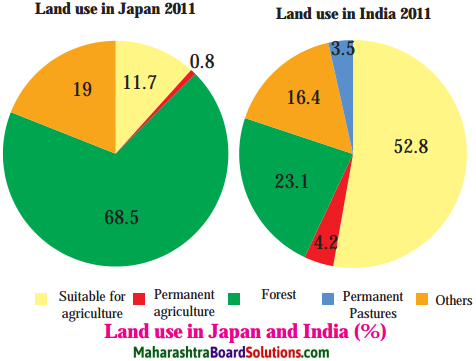
Maharashtra Board Class 8 Geography Solutions Chapter 6 Land Use 1

Study the Figure and answer the following questions:

Question A.
In which country is the land under forests more?
Answer:
The land under forests is more in Japan.

Question B.
In which country is the land under agriculture more?
Answer:
The land under agriculture is more in India.

Maharashtra Board Class 8 Geography Solutions Chapter 6 Land Use

Question C.
Considering the two questions above, how will you relate the physiography and climate of India and Japan with their respective land uses?
Answer:
Due to plains and monsoon climatic conditions, the population in India is more. Therefore, agricultural land use is prominent in India. Due to mountainous region and more proportion of precipitation, the forest land use is prominent in Japan.

Question D.
Correlate their land use and development.
Answer:
The land use in India shows comparatively low development. On the other hand, land use in Japan shows comparatively high development.

Question E.
Which land use is found in Japan?
Answer:
The land use like agricultural land use, forest land use, grassland land use, other land use, etc. are found in Japan.

Question F.
Considering the land use in both the countries, make a list of factors affecting land use.
Answer:
Considering the land use in both the countries, lists of factors affecting land use are as follows:
(a) Factors affecting land use in India:

  1. Fertility of soil
  2. Climatic conditions
  3. Natural resources
  4. Slope of land, etc.

(b) Factors affecting land use in Japan:

  1. Technical advancement
  2. Availability of resources
  3. Government policies, etc.

Can you tell?

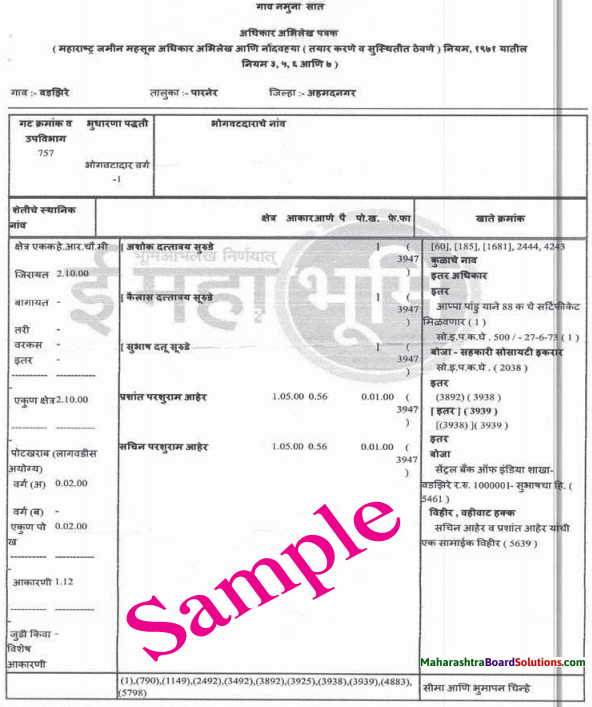
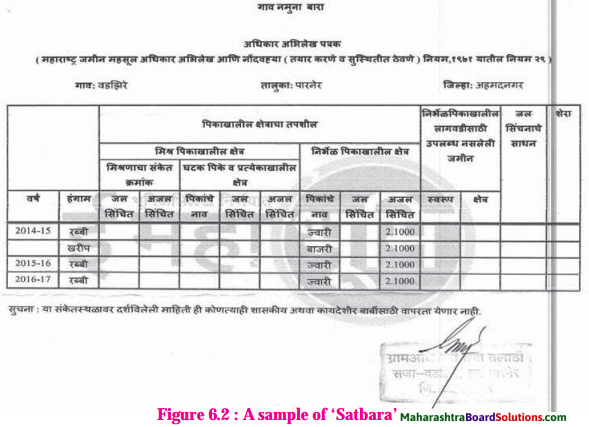
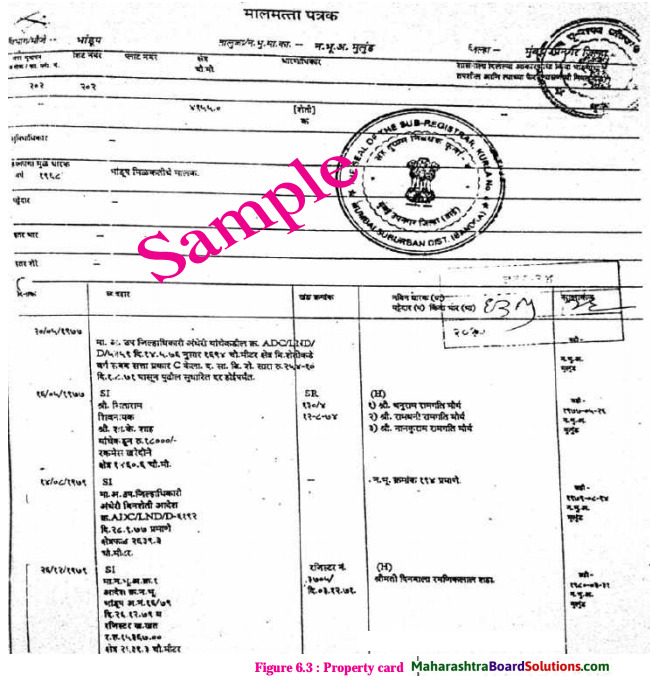
Maharashtra Board Class 8 Geography Solutions Chapter 6 Land Use 5 Maharashtra Board Class 8 Geography Solutions Chapter 6 Land Use 6 Maharashtra Board Class 8 Geography Solutions Chapter 6 Land Use 7

Study the Figure and answer the following questions:

Question A.
What kind of land use is shown in Figure 6.2 and 6.3?
Answer:
Land use shown in Figure 6.2 is agricultural land use and land use shown in Figure 6.3 is non-agricultural land use.

Maharashtra Board Class 8 Geography Solutions Chapter 6 Land Use

Question B.
Can you tell in which area the property is located?
Answer:
The property shown in Figure 6.2 is located in rural areas and the property shown in Figure 6.3 is located in urban areas.

Can you tell?

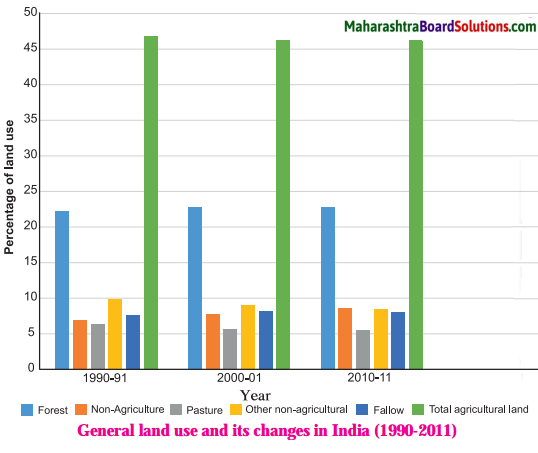
Maharashtra Board Class 8 Geography Solutions Chapter 6 Land Use 2

Study the Figure and answer the following questions:

Question A.
Which are the land uses of 1990-91 that show decline in 2010-11? What could be reasons for this?
Answer:
Total agricultural land use and other non-agricultural land use of 1990-91 show decline in 2010-11. Increased urbanisation could be reason for this.

Question B.
Which type of land use is the maximum? What would be the impact of this on India’s environment?
Answer:
Agricultural land use is the maximum. It indicates that India is an agrarian country and its environment is comparatively more natural.

Maharashtra Board Class 8 Geography Solutions Chapter 6 Land Use

Question C.
Can a decline in the area under agriculture equated with food shortage?
Answer:
A decline in the area under agriculture cannot be equated with food shortage. With modern technology, the maximum agricultural food production can be undertaken in limited areas.

Can you tell?

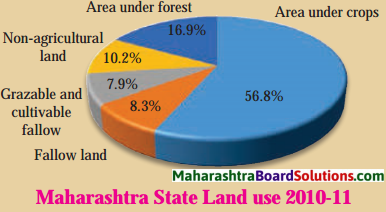
Maharashtra Board Class 8 Geography Solutions Chapter 6 Land Use 3

Study the figure and answer the following questions:

Question A.
What is the percentage of land suitable for cultivation?
Answer:
The percentage of land suitable for cultivation is 56.8.

Question B.
What is the percentage of barren land?
Answer:
The percentage of barren land is 8.3.

Maharashtra Board Class 8 Geography Solutions Chapter 6 Land Use

Question C.
What is the percentage of land under forest in Maharashtra?
Answer:
The percentage of land under forest in Maharashtra is 16.9.

Question D.
What is the percentage of non- agricultural land in Maharashtra?
Answer:
The percentage of non-agricultural land in Maharashtra is 10.2.

Give it a try.

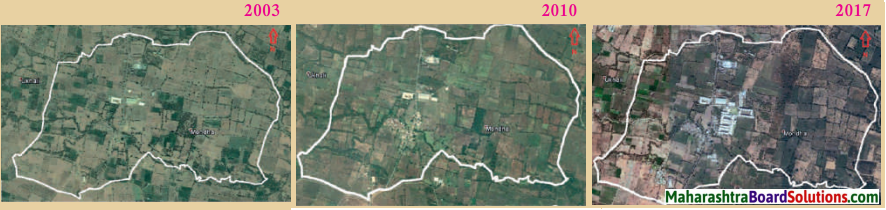
Maharashtra Board Class 8 Geography Solutions Chapter 6 Land Use 4

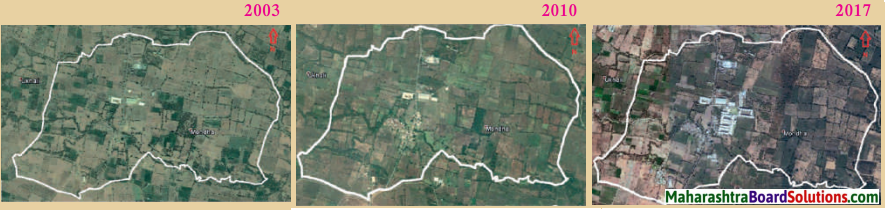
Study the Figure. It shows the satellite images of Mondha Village (Taluka – Hingna, District – Nagpur).

Question A.
Find out the changes in land use pattern over time and write a note.
Answer:

  1. The satellite image of Mondha Village in Hingna taluka in Nagpur district shows that agricultural land use in the village has declined from 2010 to 2017.
  2. The satellite image of Mondha Village in Hingna taluka in Nagpur district shows that residential land use in the village has increased from 2010 to 2017.
  3. Urbanisation, increasing population, etc. factors must be responsible for changes in land use pattern over time in Mondha Village.

Thought Provoking Question:

Think about it.

Question A.
If land is left fallow, or is not in use, then can it be termed as a kind of land use?
Answer:
1. The agricultural land which is temporarily not in use is called fallow land.
2. Fallow land use is a form of rural land use.
3. To increase the fertility of soil, farmers do not use a part of agricultural land for few seasons. After one or two seasons fallow land is again utilized for cultivation. Therefore, if land is left fallow, or is not in use, then it can be termed as a kind of land use.

Maharashtra Board Class 8 Geography Solutions Chapter 6 Land Use

Open-Ended Question:

Question A.
Write the advantages of planned cities in your own words.
Answer:
The advantages of planned cities are as follows:

  1. There will not be a problem of traffic jam in planned cities.
  2. The level of pollution will be the minimum in the planned cities.
  3. The planned cities will be clean and they will maintain environmental balance.
  4. The quality of human life will be superior in planned cities.

Maharashtra Board Class 8 Science Solutions Chapter 11 Human Body and Organ System

Balbharti Maharashtra State Board Class 8 Science Solutions Chapter 11 Human Body and Organ System Notes, Textbook Exercise Important Questions and Answers.

Maharashtra State Board Class 8 Science Solutions Chapter 11 Human Body and Organ System

Class 8 Science Chapter 11 Human Body and Organ System Textbook Questions and Answers

1. Find out my partner.

Question a.

Group ‘A’Group ‘B’
1. Heartbeatsa. 350 ml
2. RBCb. 7.4
3. WBCc. 37° C
4. Blood donationd. 72 per min
5. Normal body temperaturee. 50 – 60 lakh/mm3
6. pH of oxygenated bloodf. 5000 – 6000 per mm3

Answer:

Group ‘A’Group ‘B’
1. Heartbeatsd. 72 per min
2. RBCe. 50 – 60 lakh/mm3
3. WBC f. 5000 – 6000 per mm3
4. Blood donationa. 350 ml
5. Normal body temperaturec. 37° C
6. pH of oxygenated bloodb. 7.4

Maharashtra Board Class 8 Science Solutions Chapter 11 Human Body and Organ System

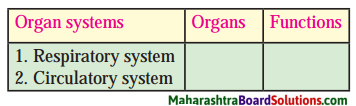
2. Complete the following table.

Question a.
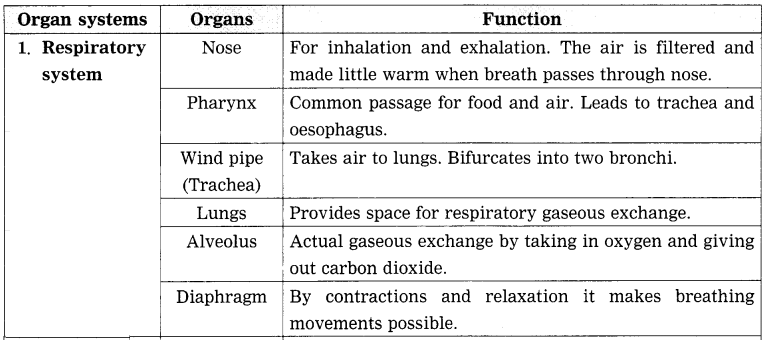
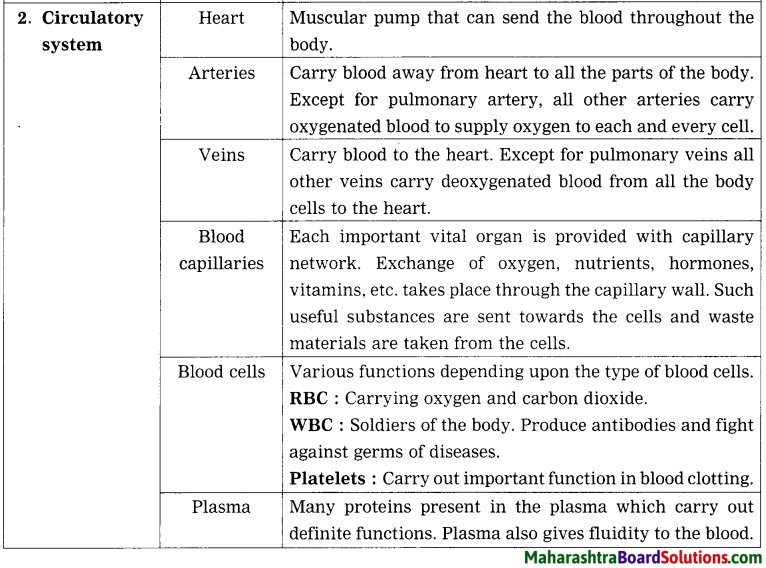
Maharashtra Board Class 8 Science Solutions Chapter 11 Human Body and Organ System 1
Answer:
Maharashtra Board Class 8 Science Solutions Chapter 11 Human Body and Organ System 2 Maharashtra Board Class 8 Science Solutions Chapter 11 Human Body and Organ System 3

3. Draw neat and labeled diagrams. 

Question a.
Respiratory system.
Answer:
Maharashtra Board Class 8 Science Solutions Chapter 11 Human Body and Organ System 4

Question b.
Internal structure of heart.
Answer:
Maharashtra Board Class 8 Science Solutions Chapter 11 Human Body and Organ System 5

4. Explain with reasons.

Question a.
Human blood is red coloured.
Answer:
The red colour of human blood is due to hemoglobin which is a red coloured conjugated protein with iron that is present on the red blood cells. Therefore, it looks red.

Question b.
Upward and downward movement of diaphragm occurs consecutively.
Answer:
The breathing movements are possible due to contraction and relaxation of the diaphragm. The rib muscles also help in these movements. When the ribs rise and diaphragm is lowered at the same time, then there is a decrease in pressure on lungs.

This causes movement of air into the lungs at the time of inhalation. On the other hand, when ribs come back to their normal position and diaphragm is risen, then pressure on the lungs increases. This causes movement of the air out of the body through the nose in the form of exhalation. These movements are possible only due to consecutive upward and downward movement of the diaphragm.

Maharashtra Board Class 8 Science Solutions Chapter 11 Human Body and Organ Systemb

Question c.
Blood donation is considered to be superior of all donations.
Answer:
Blood cannot be manufactured by any artificial chemical process. The only way to obtain blood is by donations of blood from a live donor. Blood is needed at times of emergency. The life of person can be saved if timely blood transfusion is given to the needy victim or a patient. Since such donation can save a valuable human life, it is called superior of all donations.

Question d.
Person with ‘O’ blood group is considered as ‘universal donor’.
Answer:
Person with ‘O’ blood group does not have any antigen on his/her RBCs. The ‘O’ type blood thus cannot cause clotting reactions in the body of the recipients. Such persons with ‘O’ blood group can donate blood to any person having any blood group therefore they are considered as ‘universal donor’.

Question e.
Food must have limited amount of salts.
Answer:
More salt in diet means more sodium ions. These extra sodium salts cause rise in blood pressure. Such condition is called hypertension. This condition can be dangerous and fatal in some cases. Therefore, one must keep control over sodium content of the food.

Maharashtra Board Class 8 Science Solutions Chapter 11 Human Body and Organ System

5. Answer the following questions in your own words.

Question a.
Explain the functional correlation of circulatory system with respiratory, digestive and excretory system.
Answer:
1. Three systems viz. respiratory, digestive and circulatory always work in coordination.
2. Digestive system helps in breaking down complex food molecules into simple soluble nutrients at the end of the digestion process.
3. The soluble nutrients are absorbed in the circulating blood in the villi of the intestine.
4. The blood carries these nutrients to each cell during its circulation.
5. The respiratory system helps the oxygen from the air to be absorbed in the blood.
6. This process takes place in alveolus present in lungs. The oxygen is absorbed in the blood and through haemoglobin it is taken to every cell of the body. At the same time the unwanted carbon dioxide produced in each cell is given out in a process of gaseous exchange.
7. The soluble nutrients, and chiefly glucose is metabolized with the help of oxygen-producing energy. Thus, all the three systems bring about coordinated functions to keep the body alive.

Maharashtra Board Class 8 Science Solutions Chapter 11 Human Body and Organ System

Question b.
Explain the structure and function of human blood.
Answer:
I. Structure, i.e. components of the human blood: Human blood is a fluid connective tissue consisting of blood plasma and blood corpuscles suspended in it.

1. Plasma: Plasma is the fluid part of the blood which is pale yellow in colour. It is slightly alkaline in nature. It has 90-92% water, 6-8 % proteins and 1-2 % inorganic salts.
It contains proteins such as albumin, globulin, fibrinogen, etc. There are inorganic ions such as Ca, Na and K.

2. Blood cells:
a. Blood cells are mainly of three types, viz. RBCs, WBCs and blood platelets. They are produced in the red bone marrow.
b. RBCs are small, circular and enucleated cells. They are full of haemoglobin which is essential in transporting oxygen. RBCs are red blood cells which are 50 to 60 lakh per cubic millimetre. Their life span is 100 to 127 days.
c. WBCs are large, nucleated and colourless. They are of five subtypes, viz. neutrophils, basophils, eosinophils, monocytes and lymphocytes. They are 5 to 10 thousands per millimetre of blood.
d. Platelets are very small disc-shaped blood cells which are 2.5 to 4 lakh per cubic millimetre of blood.

II. Function of human blood:

1. Transport functions:

  • Gases: Oxygen is carried via blood from lungs to cells in various parts of body and carbon dioxide from tissues to lungs.
  • Nutrients: Simple nutrients like glucose, amino acids, fatty acids are taken up by blood from wall of alimentary canal and transported up to each cell in the body.
  • Waste materials: Nitrogenous wastes like ammonia, urea, creatinine are released by tissues into blood which carries those to kidney for excretion.
  • Enzymes and hormones: Blood transports the enzymes and hormones from the site of their production to the site of their action.

2. Protection: Antibodies are produced in the blood and they protect the body from microbes and other harmful particles.
3. Thermoregulation: Body temperature is maintained constant at 37 °C by vasodilation and vasoconstriction.
4. Maintaining the balance of minerals like Na, K in the body.
5. If bleeding occurs at the injury, platelets and a protein called fibrinogen of the blood form a clot and seal the injury.
6. Functions of blood cells:

  • RBCs: With haemoglobin it carries out transport of respiratory gases.
  • WBCs: Soldiers of the body. Produce antibodies and give immunity to body.
  • Platelets: Help in blood clotting.

Maharashtra Board Class 8 Science Solutions Chapter 11 Human Body and Organ System

Question c.
Explain the importance and need of blood donation.
Answer:
Blood can never be synthesized artificially. There is no substitute for natural blood. Every healthy person possesses about 5 litres of blood in his or her body. In case of haemorrhage i.e. blood loss, the blood volume may reduce which can result into threat to life. Moreover, the loss of blood should be immediately taken care of, otherwise it may cost the life.

Therefore blood transfusion is very crucial in case of victims of accidents, patients of surgeries or mothers who suffer from blood loss during childbirth (parturition). Some diseases such as thalassemia, blood cancer, etc. also need regular transfusions. Therefore, blood is always needed in many such conditions. Blood donation is only option for such transfusions.

6. Explain the differences.

Question a.
Arteries and veins.
Answer:

ArteriesVeins
1. Arteries carry blood away from the heart to the tissues of the body.1. Veins carry blood from the tissues of the body back to the heart.
2. Arteries are located deeper within the body.2. Veins are usually located superficially beneath the surface of the skin.
3. Arteries are thick walledVeins are thin walled.
4. Arteries do not have valves.4. Veins have valves.
5. Arteries would generally remain open if blood flow stopped, due to their thick muscular layer.5. Veins would collapse if blood flow stops.
6. Except pulmonary artery, all arteries carry oxygenated blood.6. Except pulmonary vein, all veins carry deoxygenated blood.
7. Arteries are more muscular than veins, which helps in transporting blood that is full of oxygen efficiently to the tissues.7. Veins are less muscular than arteries, but contain valves to help keep blood flowing in the right direction, usually toward the heart.
8. There is maximum blood pressure in the arteries.8. There is minimum blood pressure in the veins.

Maharashtra Board Class 8 Science Solutions Chapter 11 Human Body and Organ System

Question b.
External and internal respiration.
Answer:

External respirationInternal respiration
1. Intake of air from the outside into the body and release of air from the body to outside is called external respiration.1. Exchange of gases between cells and tissue fluid is called internal respiration.
2. External respiration occurs between cells and the external environment.2. Internal respiration occurs only in the cells of the body.
3. It involves processes of inspiration and expiration.3. It involves movement of O2 from blood into tissue fluid and movement of CO2 from tissue.
4. External respiration involves breathing and gaseous exchange.4. Internal respiration involves neither breathing nor gaseous exchange.
5. Oxygen combines with haemoglobin in external respiration.5. Chemical reactions occur in the cells to form energy.

7. Which health parameters of blood donor should be checked? 

Question a.
Which health parameters of blood donor should be checked?
Answer:
Blood donor should be healthy. He or she should have good haemoglobin’s content. The RBC and WBC count should also be normal. They should not carry any parasites in their blood such as malarial parasite or dengue virus. The donor should not be HIV positive or should not have any infectious diseases. He should not have any addictions such s drug-abuse or alcohol consumption.

Maharashtra Board Class 8 Science Solutions Chapter 11 Human Body and Organ System

8. Fill in the blanks using appropriate words given in the bracket.
(hemoglobin, alkaline, diaphragm, red bone marrow, acidic, voluntary, involuntary,)

Question a.
RBCs of the blood contain ……….., an iron compound.
Answer:
RBCs of the blood contain haemoglobin, an iron compound.

Question b.
……………….. is present between thoracic and abdominal cavity.
Answer:
Diaphragm is present between thoracic and abdominal cavity.

Question c.
Cardiac muscles are …………… .
Answer:
Cardiac muscles are involuntary.

Question d.
pH of oxygenated blood is …………… .
Answer:
pH of oxygenated blood is alkaline.

Maharashtra Board Class 8 Science Solutions Chapter 11 Human Body and Organ System

Question e.
Production of RBCs occurs in ……………… .
Answer:
Production of RBCs occurs in red bone marrow.

8. Find odd one out.

Question a.
A, O, K, AB, B.
Answer:
K (All others are blood groups.)

Question b.
Blood plasma, platelets, blood transfusion, blood corpuscles.
Answer:
Blood transfusion (All others are components of blood.)

Question c.
Trachea, alveoli, diaphragm, capillaries.
Answer:
Capillaries (All others are parts of respiratory system. Capillaries exist throughout the body.)

Maharashtra Board Class 8 Science Solutions Chapter 11 Human Body and Organ System

Question d.
Neutrophils, globulins, albumins, prothrombin.
Answer:
Neutrophils (All others are proteins present in the plasma.)

10. Read the following paragraph and identify the disease.

Today, her child became one and half year old. However, that child does not seem to be healthy and happy. It was continuously crying and gradually becoming weak. It has shortness of breath. Its nails have become blue.
Answer:
The heart of the child is not functioning properly. Bluish nails show lack of oxygen, thus the baby may be suffering also from respiratory problems.

11. Your neighboring uncle has been diagnosed with hypertension. What should he do to keep his blood pressure within normal range?

Question a.
Your neighboring uncle has been diagnosed with hypertension. What should he do to keep his blood pressure within normal range?
Answer:
Hypertension has many causes. Try to find out what is the exact cause. Is it lack of exercise, obesity, lots of fast and junk food consumption, over-intake of salt, mental tension, etc. He should visit a proper physician and take prescribed blood pressure control medicines. He should never miss a single tablet. He should avoid salty and preserved food. He should practice yoga and meditation. He should also undertake some stress- management techniques.

Project:

Question a.
Collect information about various modern treatments on heart diseases.

Class 8 Science Chapter 11 Human Body and Organ System Important Questions and Answers

Rewrite the statements after correcting them:

Question 1.
Cells need supply of insoluble nutrients and oxygen for the energy production.
Answer:
Cells need the supply of soluble nutrients and oxygen for the energy production.

Maharashtra Board Class 8 Science Solutions Chapter 11 Human Body and Organ System

Question 2.
Respiratory system and respiration begins with mouth.
Answer:
Respiratory system and respiration begins with nose.

Question 3.
A lung is present on either sides of heart in abdominal cavity.
Answer:
A lung is present on either sides of heart in thoracic cavity.

Question 4.
Continuous upward and downward movement of diaphragm is necessary to bring about the beating of heart.
Answer:
Continuous upward and downward movement of diaphragm is necessary to bring about the breathing.

Question 5.
Blood vessels which carry the blood away from heart are called veins.
Answer:
Blood vessels which carry the blood away from heart are called arteries.

Maharashtra Board Class 8 Science Solutions Chapter 11 Human Body and Organ System

Question 6.
William Harvey described the blood groups in man.
Answer:
William Harvey described the mechanism of circulation in the body.

Question 7.
Capillaries unite together to form the arteries.
Answer:
Capillaries unite together to form the veins.

Match the columns/Find out my partner:

Question 1.

Group ‘A’Group ‘B’
1. William Harveya. Blood group AB.
2. Carl Landsteinerb. A, B, O blood group system.
3. Decastello and Sturlic. Mechanism of circulation of blood.

Answer:

Group ‘A’Group ‘B’
1. William Harveyc. Mechanism of circulation of blood.
2. Carl Landsteinerb. A, B, O blood group system.
3. Decastello and Sturlia. Blood group AB.

Maharashtra Board Class 8 Science Solutions Chapter 11 Human Body and Organ System

Complete the following table:

Question 1.

Maharashtra Board Class 8 Science Solutions Chapter 11 Human Body and Organ System 6
Answer:

TypeSystolic pressureDiastolic pressure
Normal blood pressure90 – 119 mmHg60 – 79 mmHg
Primary hypertension120 – 139 mmHg80 – 89 mmHg
Hypertension stage – I140 – 159 mmHg90 – 99 mmHg
Hypertension stage – II> 160 mmHg> 100 mm

Define the following terms:

  1. Inhalation: Inhalation is taking in air through the nose from the surrounding
  2. Exhalation: Exhalation is giving out the air back to the outer environment.
  3. External respiration: The processes of inhalation and exhalation both together are called external respiration.
  4. Internal respiration: Exchange of gases between cells and tissue fluid is called internal respiration.
  5. Cellular respiration: Production of energy in the form of ATP from oxidation of glucose and other soluble nutrients is called cellular respiration.
  6. Thermoregulation: Maintenance of the body temperature to a constant level by performing vasoconstriction or vasodilation is called thermoregulation.
  7. Blood pressure: Pressure exerted by the flowing blood on the blood vessel wall is called blood pressure.
  8. Systolic pressure: The maximum blood pressure exerted by the flowing blood when the heart is contracting is called systolic pressure.
  9. Diastolic pressure: The minimum blood pressure exerted by the flowing blood when the heart is not contracting but receiving (i.e. relaxing) the blood is called diastolic pressure.
  10. Hypertension or High Blood Pressure: The blood pressure value of 140 – 159 mm Hg which is more than the normal blood pressure is called hypertension or high blood pressure.
  11. Sphygmomanometer: The instru¬ment used for measuring blood pressure is called sphygmomanometer.
  12. Hematology: The branch of medical science in which the blood, haemapoietic organs (organs that produce blood cells) and blood disorders are studied is called haematology.

Maharashtra Board Class 8 Science Solutions Chapter 11 Human Body and Organ System

Answer the following questions in one or two sentences each:

Question 1.
What are the heart sounds and why are they produced?
Answer:
There are two types of heart sounds, one is ‘lubb’ and other is ‘dub’. These are produced due to closure of the heart valves.

Question 2.
What is blood circulation?
Answer:
The process of pumping the blood to all the parts of the body and bringing it back again to the heart is called the blood circulation.

Question 3.
Name any four proteins present in the blood plasma.
Answer:
The proteins present in the blood plasma are albumin, globulins, fibrinogen and prothrombin.

Question 4.
Which inorganic ions control the function of muscles and nerves?
Answer:
Calcium, sodium and potassium control the functions of muscles and nerves.

Maharashtra Board Class 8 Science Solutions Chapter 11 Human Body and Organ System

Question 5.
What is the basis on which blood group is determined?
Answer:
The antigen present on the RBCs: and the antibodies present in the plasma of I the blood determine the type of blood group. The genes of parents are responsible for the type of blood group that the child inherits.

Question 6.
Under which conditions, blood is required for donation?
Answer:
Whenever there is hemorrhage, the patient requires blood. Such patients are accident victims, those who excessively bleed, women during childbirth (parturition) and for patients undergoing surgeries.

Question 7.
How much blood is collected from a person during donation?
Answer:
About 350 ml of blood is collected from a person during donation.

Question 8.
When is National Voluntary Blood Donation Day observed?
Answer:
National Voluntary Blood Donation Day is observed on 1st October every year.

Explain the differences:

Question 1.
Atria and ventricles:
Answer:

AtriaVentricles
1. Atria are the upper chambers of the heart.1. Ventricles are the lower chambers of the heart.
2. Atria are the smaller receiving chambers.2. Ventricles are the larger distributing chambers.
3. Atria are thin walled chambers having lesser blood pressure.3. Ventricles are thick walled chambers with greater blood pressure.
4. Atria do not have inlet valves.4. Ventricles have inlet valves.
5. Right atrium receives deoxygenated blood from whole body through the inferior vena cava (lower body), superior vena cava (from upper body). It pumps blood into right ventricle.5. Right ventricle pumps deoxygenated blood received from right atrium to lungs for oxygenation which is known as pulmonary circulation.
6. Left atrium receives oxygenated blood from lungs through pulmonary veins. It pumps blood into left ventricle.6. Left ventricle pumps oxygenated blood received from left atrium to whole body. This is called systemic circulation.

Maharashtra Board Class 8 Science Solutions Chapter 11 Human Body and Organ System

Question 2.
RBCs and WBCs:
Answer:

RBCsWBCs
1. RBCs are red in colour due to haemoglobin present in them.1. WBCs are colourless as there is no pigment in them.
2. RBCs are produced in red bone marrow.2. WBCs are produced mostly in bone marrow. But they are also produced in lymph nodes, spleen, etc.
3. RBCs are smaller in size and rounded in .shape.3. WBCs are larger in size and are of different shapes.
4. RBCs have an average lifespan of 120 days.4. Life span of WBCs vary according to their role. They have a life span from a few days to 3 weeks.
5. Normal RBC count is 50 – 60 lakh RBCs per cubic mm. of blood.5. Normal WBC count is 5 thousands to 10 thousands per cubic mm. of blood.
6. Their function is to transport the respiratory gases (Oxygen and Carbon Dioxide).6. Their main function is to produce antibodies and fight against the infections. Thus they are called soldiers of the body.

Give scientific reasons:

Question 1.
A very large number of alveoli is present in lungs, which are covered over by capillary network.
Answer:
Due to very large number of alveoli the surface area of the lungs is increased many a times for the gaseous exchange. The alveoli are covered over by capillary network for rapid gaseous exchange. The oxygen is taken in the body and at the same time carbon dioxide is given out of the body only by the gaseous exchange occurring at the alveolar surface.

Maharashtra Board Class 8 Science Solutions Chapter 11 Human Body and Organ System

Question 2.
Heart is covered by double layered pericardial membrane.
Answer:
Pericardium is the protective double membrane that covers the heart. In between the two layers of this membrane there is protective fluid. The pericardium and the fluid together protect the heart from friction and mechanical shock. Since heart is a vital organ, it is well protected by such pericardial membrane.

Question 3.
Veins are provided with valves.
Answer:
Valves prevent the backflow of the blood. Blood in the veins is not under great pressure so it is likely that it may flow back. But valves prevent such movements. Therefore they are provided with valves.

Write short notes on the following:

Question 1.
Cellular respiration:
Answer:

  1. During respiration, the glucose molecules along with some other soluble nutrients are slowly oxidized with the help of oxygen in each cell.
  2. In this process the energy is released in the form of ATP, CO2 and water vapours are produced.
  3. These products are not needed for the body and hence given out of the body in exhalation.
  4. This process of cellular respiration is shown by the following reaction:
    C6H12O6 + 6O2 = 6CO2 + 6H2O + Energy (38ATP)

Question 2.
Lung:
Answer:

  1. Pair of lungs is the main respiratory organ in the human body. They are located in thoracic cavity.
  2. They are present on either sides of heart.
  3. Each lung has double layered pleural membranes.
  4. Trachea bifurcates into two bronchi. Each bronchus enters lung on its side and S divide and re-divide into fine bronchioles.
  5. At the end of each bronchiole there is alveolus. Alveolus is surrounded by capillary network.
  6. Each alveolus is extremely thin walled and hence gaseous exchange can occur through diffusion here. Due to thousands of alveoli, the lung surface is increased many a times.
  7. Deoxygenated blood coming from heart by pulmonary arteries is purified here in the lungs.
  8. It is mixed with oxygen due to gaseous exchange and returned back to the heart by pulmonary veins. Lungs thus continuously help in oxygenation of blood with the help of all of the alveoli.

Maharashtra Board Class 8 Science Solutions Chapter 11 Human Body and Organ System

Question 3.
Diaphragm:
Answer:

  1. Diaphragm is a muscular partition that divides the thoracic and abdominal cavity.
  2. Located at the base of thoracic cage, it is very important in breathing movements.
  3. Diaphragm can undergo consecutive upward and downward movements.
  4. These movements along with movements of thoracic cage cause rise and fall of the pressure in the thoracic cavity.
  5. Rising up of ribs and lowering of diaphragm causes the decrease in air pressure which makes the air to move into the lungs through nose. This is inhalation.
  6. When the pressure rises in the thoracic cavity again, the air is given out. This is exhalation.
  7. This is caused due to ribs returning to their original position and rising diaphragm. This simultaneously increases the pressure in thoracic cavity.

Question 4.
Structure of human heart:
Answer:

  1. Human heart is four chambered muscular organ.
  2. The size of the heart is about one’s own fist and its weight is about 360 gm.
  3. For protection, it is covered over by double-layered pericardium.
  4. The wall of the heart is made up of cardiac muscles which are involuntary in nature. They have the capacity of rhythmic beating.
  5. The upper two chambers are called right and left atrium and lower two chambers are called right and left ventricle.
  6. Between right atrium and right ventricle there is tricuspid valve which guards the opening. Similarly between left atrium and left ventricle there is bicuspid valve.
  7. On entire right side of the heart there is deoxygenated blood.
  8. On entire left side of the heart there is oxygenated blood.
  9. Right atrium receives deoxygenated blood by superior and inferior vena cava. These two major veins bring deoxygenated blood from entire body to the heart.
  10. Left atrium receives oxygenated blood from lungs by pulmonary vein.
  11. Right ventricle sends the deoxygenated blood to lungs for oxygenation, through pulmonary artery.
  12. Left ventricle supplies oxygenated blood to entire body through systemic aorta.

Maharashtra Board Class 8 Science Solutions Chapter 11 Human Body and Organ System

Question 5.
Human Blood Groups:
Answer:

  1. The A, B, O blood group system is the most popular and medically important blood group system of human beings.
  2. The blood group is determined due to antigenic protein present on the RBCs and the antibody present in the plasma.
  3. The four main groups of human blood are A, B, AB and O.
  4. According to the presence or absence of Rh antigen the blood groups are further said to be Rh-positive or Rh-negative.
  5. This makes total eight blood groups which are taken into consideration at the time of blood transfusions.
  6. Blood groups are dependent on genes and are thus hereditary in nature.

Answer the following:

Question 1.
How do the organisms like amoeba, earthworm, cockroach, plants, various aquatic animals, bird, respire? Prepare a chart.
Answer:
Maharashtra Board Class 8 Science Solutions Chapter 11 Human Body and Organ System 7

Diagram – based questions:

Question 1.
Sketch and label structure of alveolus showing gaseous exchange.
Answer:
Maharashtra Board Class 8 Science Solutions Chapter 11 Human Body and Organ System 8

Maharashtra Board Class 8 Science Solutions Chapter 11 Human Body and Organ System

Question 2.
Sketch and label artery and vein showing structural difference between the two.
Answer:
Maharashtra Board Class 8 Science Solutions Chapter 11 Human Body and Organ System 9

Question 3.
Draw a diagram to show formation of capillaries. Also show how capillaries form a vein.
Answer:
Maharashtra Board Class 8 Science Solutions Chapter 11 Human Body and Organ System 10

MCQs based on experiments:

I. Human respiratory system:

Question 1.
From which organ does respiratory system of man begin?
(a) Trachea
(b) Lungs
(c) Alveolus
(d) Nose
Answer:
(d) Nose

Question 2.
Which of the statement given below is correct?
(a) Wind pipe is present in front of food pipe.
(b) Food pipe is present in front of wind pipe.
(c) Wind pipe and food pipe are not near each other.
(d) Wind pipe is same as oesophagus and food pipe is called trachea.
Answer:
(a) Wind pipe is present in front of food pipe.

Question 3.
Which type of respiration includes inhalation and exhalation?
(a) Internal respiration
(b) External respiration
(c) Cellular respiration
(d) None of the above
Answer:
(b) External respiration

Maharashtra Board Class 8 Science Solutions Chapter 11 Human Body and Organ System

Question 4.
How many molecules of ATP are produced from one molecule of glucose ?
(a) 26
(b) 36
(c) 38
(d) 40
Answer:
(c) 38

Question 5.
Where is sound box located in the body?
(a) At the beginning of the wind pipe.
(b) At the beginning of the food pipe.
(c) At the end of the wind pipe.
(d) At the end of the food pipe.
Answer:
(a) At the beginning of the wind pipe.

II. Structure of heart:

Question 1.
What is the location of a bicuspid valve in human heart?
(a) Between right and left ventricle.
(b) Between left and right atrium.
(c) Between left atrium and left ventricle.
(d) Between right atrium and right ventricle.
Answer:
(c) Between left atrium and left ventricle.

Question 2.
Which blood vessels bring deoxygenated blood to the right atrium?
(a) Superior and inferior vena cava
(b) Pulmonary veins
(c) Pulmonary artery
(d) Systemic aorta
Answer:
(a) Superior and inferior vena cava

Question 3.
Which artery carries deoxygenated blood and which vein carries the oxygenated blood respectively?
(a) Dorsal aorta and inferior vena cava respectively.
(b) Pulmonary vein and pulmonary artery respectively
(c) Pulmonary artery and pulmonary vein respectively
(d) Superior vena cava and inferior vena cava respectively.
Answer:
(c) Pulmonary artery and pulmonary vein respectively

Question 4.
Under which of the following condition will rate of heartbeat be faster?
(a) Sleeping
(b) Resting
(c) Running
(d) Sitting
Answer:
(c) Running

Maharashtra Board Class 8 Science Solutions Chapter 11 Human Body and Organ System

Question 5.
Which chambers of the heart are called receiving chamber?
(a) Both atria
(b) Right ventricle
(c) Left ventricle
(d) Only left atria
Answer:
(a) Both atria

Maharashtra Board Class 8 Science Solutions Chapter 6 Composition of Matter

Balbharti Maharashtra State Board Class 8 Science Solutions Chapter 6 Composition of Matter Notes, Textbook Exercise Important Questions and Answers.

Maharashtra State Board Class 8 Science Solutions Chapter 6 Composition of Matter

Class 8 Science Chapter 6 Composition of Matter Textbook Questions and Answers

1. Choose the appropriate option and rewrite the following statements:

Question a.
The intermolecular force is ……………. in the particles of solid.
(a) minimum
(b) moderate
(c) maximum
(d) indefinite
Answer:
(c) maximum

Question b.
Solids retain their volume even when external pressure is applied. This property is called …………… .
(a) plasticity
(b) incompressibility
(c) fluidity
(d) elasticity
Answer:
(d) elasticity

Maharashtra Board Class 8 Science Solutions Chapter 6 Composition of Matter

Question c.
Matter is classified into the types mixture, compound and element, by applying the criterion …………… .
(a) states of matter
(b) phases of matters
(c) chemical composition of matter
(d) all of these
Answer:
(c) chemical composition of matter

Question d.
Matter that contain two or more constituent substances is called ……… .
(a) mixture
(b) compound
(c) element
(d) metalloid
Answer:
(a) mixture

Question e.
Milk is an example of type of matter called …………. .
(a) solution
(b) homogeneous mixture
(c) heterogeneous mixture
(d) suspension
Answer:
(c) heterogeneous mixture

Question f.
Water, mercury and bromine are similar to each other, because the three are ……….. .
(a) liquids
(b) compounds
(c) nonmetals
(d) elements
Answer:
(a) liquids

Question g.
Valency of carbon is 4 and that of oxygen is 2. From this, we understand that there are …………. chemical bond/bonds between the carbon atom and one oxygen atom in the compound- carbon dioxide.
(a) 1
(b) 2
(c) 3
(d) 4.
Answer:
(b) 2

Maharashtra Board Class 8 Science Solutions Chapter 6 Composition of Matter

2. Identify the odd term out and explain.

Question a.
Gold, silver, copper, brass.
Answer:
Brass. (Others are elements.)

Question b.
Hydrogen, hydrogen peroxide, carbon dioxide, water vapour.
Answer:
Hydrogen. (Others are compounds.)

Question c.
Milk, lemon juice, carbon, steel.
Answer:
Carbon. (Others are mixtures.)

Question d.
Water, mercury, bromine, petrol.
Answer:
Petrol. (Others are inorganic compounds.)

Question e.
Sugar, salt, baking soda, blue vitriol.
Answer:
Sugar. (Others are inorganic compounds.)

Maharashtra Board Class 8 Science Solutions Chapter 6 Composition of Matter

Question f.
Hydrogen, sodium, potassium, carbon.
Answer:
Carbon. (Others are monovalent elements)

3. Answer the following question.

Question a.
Plants synthesize glucose in sunlight with the help of chlorophyll from carbon dioxide and water and give away oxygen. Identify the four compounds in this process and name their types.
Answer:
Photosynthesis:

Maharashtra Board Class 8 Science Solutions Chapter 6 Composition of Matter 1
Carbon dioxide, water, glucose, and Chlorophyll are compounds.
Types: Organic compounds: Glucose
Inorganic compounds: Carbon dioxide and water
Complex compounds: Chlorophyll.

Question b.
In one sample of brass, the following ingredients were found: copper (70%) and zinc (30%). Identify the solvent, solute and solution from these.
Answer:
Brass is an alloy, it contains 70% copper and 30% zinc. The largest proportion is solvent, i.e. copper. The smaller proportion is solute, i.e. zinc. The solution is Brass.

Maharashtra Board Class 8 Science Solutions Chapter 6 Composition of Matter

Question c.
Seawater tastes salty due to the dissolved salt. The salinity (the proportion of salts in water) of some water bodies Lonar lake – 7.9%, Pacific Ocean 3.5%, Mediterranean sea – 3.8%, 5 Dead sea – 33.7%. Explain two characteristics of mixtures from the above information.
Answer:

  1. The constituents of a mixture (the proportion of salts in water) do not combine chemically.
  2. Their constituents are present in any proportion by weight.
  3. The constituent of a mixture can be separated by a physical process.

4. Give two examples each.

Question a.
Liquid element.
Answer:
Mercury (Hg), Bromine (Br2)

Question b.
Gaseous element.
Answer:
Hydrogen (H2), Oxygen (O2).

Question c.
Solid element.
Answer:
Iron (Fe), Copper (Cu), Silver (Ag).

Question d.
Homogeneous mixture.
Answer:
Sea water, blue vitriol dissolved in water.

Question e.
Colloid.
Answer:
Milk, blood.

Maharashtra Board Class 8 Science Solutions Chapter 6 Composition of Matter

Question f.
Organic compound.
Answer:
Glucose, urea.

Question g.
Complex compound.
Answer:
Chlorophyll, Haemoglobin.

Question h.
Inorganic compound.
Answer:
Soda, rust, limestone.

Question i.
Metalloid.
Answer:
Silicon, arsenic.

Question j.
Element with valency 1.
Answer:
Sodium (Na), potassium (K), chlorine (Cl).

Question l.
Element with valency 2.
Answer:
Magnesium (Mg), Calcium (Ca).

5. Write the names and symbols of the constituent elements and identify their valencies from their molecular formulae given below:
KCl, HBr, MgBr2. K2O, NaH, CaCl2, CCl4, HI, H2S, Na2S, FeS, BaCl2.

Question a.
Write the names and symbols of the constituent elements and identify their valencies from their molecular formulae given below:
KCl, HBr, MgBr2, K2O, NaH, CaCl2, CCl4, HI, H2S, Na2S, FeS, BaCl2.
Answer:

Molecular formulaConstituent element/Name symbolValency
1. KClPotassium (K)
Chlorine (Cl)
1
1
2. HBrHydrogen (H)
Bromine (Br)
1
1
3. MgBr2Magnesium (Mg)
Bromine (Br)
2
1
4. K2OPotassium (K)
Oxygen (O)
1
2
5. NaHSodium (Na)
Hydrogen (H)
1
1
6. CaCl2Calcium (Ca)
Chlorine (Cl)
2
1
7. CCl4Carbon (C)
Chlorine (Cl)
4
1
8. HIHydrogen (H)
Iodine (I)
1
1
9. H2SHydrogen (H)
Sulphur (S)
1
2
10. Na2SSodium (Na)
Sulphur (S)
1
2
11. FeSIron (Fe)
Sulphur (S)
2
2
12. BaCl2Barium (Ba)
Chlorine (Cl)
2
1

Maharashtra Board Class 8 Science Solutions Chapter 6 Composition of Matter

6. Chemical composition of some matter is given in the following table. Identify the main type of matter from them.
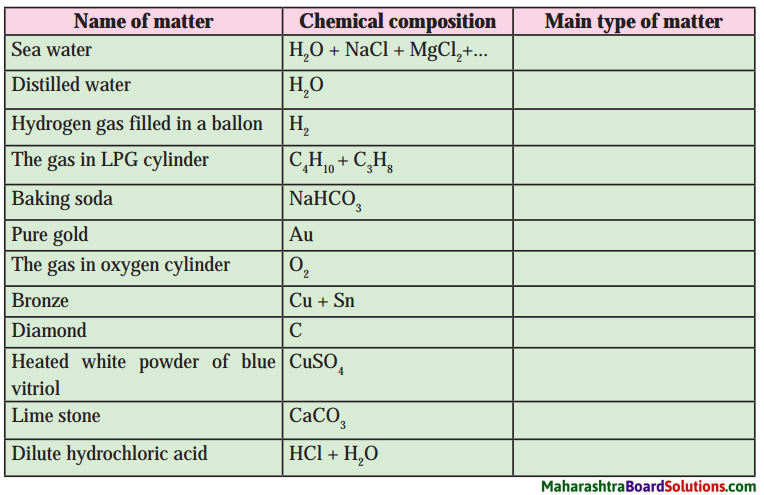
Question a.
Chemical composition of some matter is given in the following table. Identify the main type of matter from them.
Maharashtra Board Class 8 Science Solutions Chapter 6 Composition of Matter 2
Answer:

Name of matterChemical compositionMain type of matter
Sea waterH2O + NaCl + MgCl2 +…Mixture
Distilled waterH2OCompound
Hydrogen gas filled in a balloonH2Element
The gas in LPG cylinderC4H10 + C3H8Mixture
Baking sodaNaHCO3Compound
Pure goldAuElement
The gas in oxygen cylinderO2Element
BronzeCu + SnMixture
DiamondCElement
Heated white powder of blue vitriolCuSO4Compound
LimestoneCaCO3Compound
Dilute hydrochloric acidHCl + H2OMixture

Maharashtra Board Class 8 Science Solutions Chapter 6 Composition of Matter

7. Write scientific reason.

Question a.
Hydrogen is combustible, oxygen helps combustion, but water helps to extinguish fire.
Answer:

  1. Water is a compound of hydrogen and oxygen.
  2. In a compound, the constituents do not retain their individual properties. Hence, hydrogen is combustible and oxygen helps combustion, but water is neither combustible nor supports combustion, it helps to extinguish fire.

Question b.
The constituent substances of a colloid cannot be separated by oridinary filtration.
Answer:

  1. A colloidal solution is heterogeneous.
  2. The diameters of colloidal particles are of the order of 10-5 m.
  3. The particles of a colloid can easily pass through a filter paper as the pore size of a filter paper is big. Hence, the constituents of a colloidal cannot be separated by filtration.

Question c.
Lemon sherbat has sweet, sour and salty taste and it can be poured in a glass.
Answer:

  1. Lemon sherbat is a mixture. It is made up of lemon juice, sugar, salt and water.
  2. Formation of lemon sherbat does not involve any chemical reaction.
  3. The constituents of sherbat retain their individual properties. Hence, lemon sherbat is sweet, sour and salty to taste and it can be poured in a glass.

Maharashtra Board Class 8 Science Solutions Chapter 6 Composition of Matter

Question d.
A solid matter has the properties of definite shape and volume.
Answer:

  1. The forces among the constituent particles (atom/molecules) are called intermolecular forces.
  2. In solids these forces are strong enough to keep the particles together in fixed positions, as a result solids have a definite shape and volume.

8. Deduce the molecular formulae of the compound obtained from the following pairs of elements by the cross multiplication method.

Question a.
C (Valency 4) & Cl (Valency 1)
Answer:
Step 1: Write the symbols of the constituent elements.
Maharashtra Board Class 8 Science Solutions Chapter 6 Composition of Matter 4
Step 2: Write the valency below the respective elements.
Maharashtra Board Class 8 Science Solutions Chapter 6 Composition of Matter 5
Step 3: Cross multiply the valencies.
Maharashtra Board Class 8 Science Solutions Chapter 6 Composition of Matter 6
The molecular formula: CCl4

Question b.
N (Valency 3) & H (Valency 1)
Use your brain power!
Answer:
Step 1: Write the symbols of the constituent elements.
Maharashtra Board Class 8 Science Solutions Chapter 6 Composition of Matter 7
Step 2: Write the valency below the respective elements.
Maharashtra Board Class 8 Science Solutions Chapter 6 Composition of Matter 8
Step 3: Cross multiply the valencies.
Maharashtra Board Class 8 Science Solutions Chapter 6 Composition of Matter 9
The molecular formula: NH3

Maharashtra Board Class 8 Science Solutions Chapter 6 Composition of Matter

Question c.
C (Valency 4) & O (Valency 2)
Answer:
Step 1: Write the symbols of the constituent elements.
Maharashtra Board Class 8 Science Solutions Chapter 6 Composition of Matter 10
Step 2: Write the valency below the respective elements.
Maharashtra Board Class 8 Science Solutions Chapter 6 Composition of Matter 11
Step 3: Cross multiply the valencies.
Maharashtra Board Class 8 Science Solutions Chapter 6 Composition of Matter 12
The formula: C2O4
The number of constituent atoms in the final molecular formula should be the smallest possible whole number. Divide the formula C2O4 by suitable number.
Final molecular formula obtained by dividing by ‘2’.
Molecular formula: CO2

Question d.
Ca (Valency 2) & O (Valency 2)
Answer:
Step 1: Write the symbols of the constituent elements.
Maharashtra Board Class 8 Science Solutions Chapter 6 Composition of Matter 13
Step 2: Write the valency below the respective elements.
Maharashtra Board Class 8 Science Solutions Chapter 6 Composition of Matter 14
Step 3: Cross multiply the valencies.
Maharashtra Board Class 8 Science Solutions Chapter 6 Composition of Matter 15
The formula: Ca2O2
Divide the formula by suitable number ‘2’.
The molecular formula: CaO.

Maharashtra Board Class 8 Science Solutions Chapter 6 Composition of Matter

Project:

Question a.
Collect the wrappers of ready-made foodstuff. Use the information given and prepare a chart of foodstuff and the ingredients in it. Procure the ingredients available. Discuss with friends and teacher, test the procured ingredients with combustion test under the supervision of your teacher. Thereby identify the ingredients as organic or inorganic.

Class 8 Science Chapter 6 Composition of Matter Additional Important Questions and Answers

Rewrite the sentences after filling the blanks:

Question 1.
………….. have no definite shape, but have a definite volume.
Answer:
Liquids have no definite shape, but have a definite volume.

Question 2.
………… have neither a definite shape nor a definite volume.
Answer:
Gases have neither a definite shape nor a definite volume.

Question 3.
The properties of a …………… are different than those of the constitute elements.
Answer:
The properties of a compound are different than those of the constitute elements.

Maharashtra Board Class 8 Science Solutions Chapter 6 Composition of Matter

Question 4.
The part of matter having uniform composition is called ………………. .
Answer:
The part of matter having uniform composition is called phase.

Question 5.
The heterogeneous mixture of a liquid and a solid is called a ……………. .
Answer:
The heterogeneous mixture of a liquid and a solid is called a suspension.

Question 6.
A colloid is a ………………. .
Answer:
A colloid is a heterogeneous mixture.

Question 7.
Bronze contains atoms of the elements ……………. and ………….. .
Answer:
Bronze contains atoms of the elements copper and tin.

Question 8.
When all the components of a mixture form one phase, it is called ………….. .
Answer:
When all the components of a mixture form one phase, it is called homogeneous mixture.

Question 9.
…………… is a mixture of water, lactose, fats and proteins.
Answer:
Milk is a mixture of water, lactose, fats and proteins.

Maharashtra Board Class 8 Science Solutions Chapter 6 Composition of Matter

Question 10.
The intermolecular force is …………….. in the gaseous state.
Answer:
The intermolecular force is very weak in the gaseous state.

Choose the appropriate option and rewrite the following statements:

Question 1.
When a liquid is poured from one container to another, its shape may change, but its volume ………….. .
(a) increases
(b) decreases
(c) remains the same
(d) none of them
Answer:
(c) remains the same

Question 2.
The property by which some solids maintain their shape even when subjected to external forces is called ………. .
(a) elasticity
(b) fluidity
(c) rigidity
(d) plasticity
Answer:
(c) rigidity

Maharashtra Board Class 8 Science Solutions Chapter 6 Composition of Matter

Question 3.
…………… is a complex compound.
(a) Glucose
(b) Blue vitriol
(c) Chlorophyll
(d) Soda
Answer:
(c) Chlorophyll

Question 4.
………….. is a homogeneous mixture.
(a) Sand + water
(b) Flour + water
(c) Salt + water
(d) Oil + water
Answer:
(c) Salt + water

State whether the following statements are True or False:

Question 1.
Liquids do not have a definite shape
Answer:
True.

Question 2.
Gases have a definite shape and volume.
Answer:
False. (Gases do not have shape and volume.)

Question 3.
The crystals of blue vitriol form a single phase.
Answer:
True.

Question 4.
Water is a mixture.
Answer:
False. (Water is a compound)

Question 5.
Milk is a colloid.
Answer:
True.

Question 6.
A suspension does not scatters light.
Answer:
True.

Question 7.
Copper sulphate is a mixture.
Answer:
False. (Copper sulphate is a compound.)

Maharashtra Board Class 8 Science Solutions Chapter 6 Composition of Matter

Question 8.
An atom forms as many chemical bonds with other atom as its valency.
Answer:
True.

Question 9.
The strength of intermolecular forces is weak in the liquid state.
Answer:
False. (The strength of intermolecular forces is moderate in the liquid state.)

Question 10.
All the gases present together constitute a single phase.
Answer:
True.

Match the column:

Question 1.

Column IColumn II
1. Potassium dichromatea. Complex compound
2. Cyanocobalamineb. Element
3. Airc. Compound
4. Silverd. Mixture

Answer:

Column IColumn II
1. Potassium dichromatec. Compound
2. Cyanocobalaminea. Complex compound
3. Aird. Mixture
4. Silverb. Element

Question 2.

Column 1Column II
1. Milka. Alloy
2. Lemonadeb. Colloid
3. Sand and waterc. Solution
4. Brassd. Suspension

Answer:

Column 1Column II
1. Milkb. Colloid
2. Lemonadec. Solution
3. Sand and waterd. Suspension
4. Brassa. Alloy

Maharashtra Board Class 8 Science Solutions Chapter 6 Composition of Matter

Question 3.

Column IColumn II
1. Sea watera. Solid in solid
2. Vinegarb. Solid in liquid
3. Airc. Liquid in liquid
4. Bronzed. Gas in liquid
5. Chlorinated watere. Gas in gas

Answer:

Column IColumn II
1. Sea waterb. Solid in liquid
2. Vinegarc. Liquid in liquid
3. Aire. Gas in gas
4. Bronzea. Solid in solid
5. Chlorinated waterd. Gas in liquid

Answer the following questions in one sentence:

Question 1.
Why does a solid have definite volume ?
Answer:
In solids intermolecular forces are strong enough to keep the particles together in fixed positions, as a result solids have definite volume.

Question 2.
Why does a liquid have indefinite shape?
Answer:
In a liquid intermolecular forces are not strong enough to keep the particles together in fixed positions, as a result liquid has indefinite shape.

Maharashtra Board Class 8 Science Solutions Chapter 6 Composition of Matter

Question 3.
Why does a gas have indefinite volume and shape?
Answer:
In a gas intermolecular forces are very weak and the distance between the particles is very large, as a result gas has indefinite volume and shape.

Question 4.
What can you say about the distance between the neighbouring particles of solid?
Answer:
The particles of solid are very close to each other and the distance between them is minimum.

Question 5.
What can you say about the distance between the constituent particles of gas?
Answer:
The intermolecular force is very weak in gases. The distance between the particles of gas is very large. They move freely and occupy all the available space.

Question 6.
State whether the mixture of oil in water is a homogeneous or heterogeneous mixture.
Answer:
The mixture of oil in water is a heterogeneous mixture.

Question 7.
State whether seawater is a homogeneous or heterogeneous mixture.
Answer:
Seawater is a homogeneous mixture.

Maharashtra Board Class 8 Science Solutions Chapter 6 Composition of Matter

Question 8.
Give two examples of liquid in liquid.
Answer:
Examples of liquid in liquid:
Vinegar, dilute sulphuric acid.

Question 9.
Give two examples of gas in gas.
Answer:
Examples of gas in gas: Air, cooking gas.

Question 10.
Give two examples of solid in solid.
Answer:
Examples of solid in solid: Brass, stainless steel.

Question 11.
Give two examples of gas in liquid.
Answer:
Examples of gas in liquid: Chlorinated water, hydrochloric acid.

Question 12.
Give molecular formulae of 1. potassium chloride, 2. sodium sulphide.
Answer:

  1. Molecular formula of potassium chloride: KCl
  2. Molecular formula of sodium sulphide: Na2S.

Question 13.
State the molecular formula and number of hydrogen atoms in methane.
Answer:
Molecular formula of methane: CH4
The number of hydrogen atoms in methane is 4.

Question 14.
Identify the valency of chlorine in
(i) KCl and (ii) CaCl2.
Answer:
i. The valency of chlorine in KCl is 1.
ii. The valency of chlorine in CaCl2 is 1.

Answer the following questions:

Question 1.
State two principal ways of classifying matter.
Answer:
Two principal ways of classifying matter are:

  1. On the basis of physical state as a solid, liquid or gas.
  2. On the basis of chemical constitution as an element, compound or mixture.

Maharashtra Board Class 8 Science Solutions Chapter 6 Composition of Matter

Question 2.
What are the different states of matter?
Answer:
The different states of matter are solid, liquid and gas.

Question 3.
Define solid.
Answer:
A substance which has a definite shape and volume is called a solid.

Question 4.
State any three characteristics of solids.
Answer:

  1. Solids have a definite shape and volume.
  2. Most of the solids are rigid while some are plastic and some elastic.
  3. Solids have practically negligible compressibility, i.e., their volume is not very much changed by external forces.

Question 5.
What is meant by rigidity of solids?
Answer:
The property by which solids maintain their shapes when subjected to external forces is called rigidity.

Question 6.
What is meant by elasticity of solids?
Answer:
Some solids undergo a change in their shapes and volume when subjected to external forces and regain their original shapes and volume on removal of the forces. This property of solids is called elasticity.

Maharashtra Board Class 8 Science Solutions Chapter 6 Composition of Matter

Question 7.
What is meant by plasticity?
Answer:
Some solids are deformed by external forces and do not regain their original shapes on removal of the forces. This property of solids is called plasticity.

Question 8.
Solids have a high density and negligible compressibility. Explain.
Answer:

  1. The forces among the constituent particles (atoms/molecules) are called intermolecular forces.
  2. In solids these forces are strong enough to keep the particles together in fixed positions, as a result solids have a high density and negligible compressibility.

Question 9.
Define liquid.
Answer:
A substance which does not have a definite shape, but has a definite volume is called a liquid.

Question 10.
State any three characteristics of liquids.
Answer:

  1. Liquids have a definite volume.
  2. Liquids do not have a definite shape. They take the shape of the container in which they are stored.
  3. When they spill on a plane surface, they spread and flow in the surrounding areas, i.e., they have fluidity.
  4. They have very small compressibility.

Question 11.
What is meant by fluidity?
Answer:
Liquids flow easily and change their shapes in response to external forces. This property of liquids is called fluidity. It is exhibited by gases also.

Maharashtra Board Class 8 Science Solutions Chapter 6 Composition of Matter

Question 12.
Liquids have fluidity and they do not have a definite shape. Explain.
Answer:
1. The forces among the constituent particles (atoms/molecules) are called intermolecular forces.
2. In liquids, the intermolecular forces are strong enough to keep the particles within the bulk in aggregation, but not strong enough to keep them in fixed positions. As a result, they flow easily and change shapes according to that of container.

Question 13.
Define gas.
Answer:
A substance which has neither a definite shape nor a definite volume is called a gas.

Question 14.
State any three characteristics of gases.
Answer:

  1. Gases have neither a definite shape nor a definite volume.
  2. They spread in all directions.
  3. They can be compressed or expanded easily.
  4. In gases intermolecular forces are very weak.

Question 15.
Gases have neither a definite shape nor a definite volume. Explain.
Answer:

  1. The forces among the constituent particles (atoms/molecules) are called intermolecular forces.
  2. In gases the intermolecular forces are extremely weak. As a result, the molecules of a gas move freely and a gas occupies all the available space.

Maharashtra Board Class 8 Science Solutions Chapter 6 Composition of Matter

Question 16.
Why are gases more compressible, than liquids?
Answer:
In liquids the distances between the neighbouring molecules are less than those in the gases. The intermolecular forces are extremely weak in gases, but not so weak in liquids. Hence, gases are more compressible than liquids.

Question 17.
What is an element? Give two examples.
Answer:
A type of matter composed of only one kind of substances where each smallest indivisible part of it has the same properties is called an element. It cannot be subdivided into simpler substances by any physical or chemical means.
Examples: Oxygen, nitrogen, silver.

Question 18.
Write any two characteristics of an element.
Answer:

  1. All the atoms/molecules of an element are alike.
  2. Atoms/molecules of different elements are different.
  3. An element cannot be decomposed into simple substances by any chemical reaction or simple physical process.

Question 19.
What is a compound? Give two examples.
Answer:
A substance produced by a chemical reaction of two or more elements combined in a fixed proportion is called a compound.
Examples: Water, common salt, sugar.

Maharashtra Board Class 8 Science Solutions Chapter 6 Composition of Matter

Question 20.
Write any two characteristics of a compound.
Answer:

  1. The proportion of constituent elements in a compound is constant.
  2. The properties of a compound is different than those of the constituent elements.

Question 21.
What is a mixture? Give two examples.
Answer:
When two or more elements or compounds which do not react chemically with each other are mixed in any proportion, a mixture is formed.
Examples: Air, steel, milk.

Question 22.
Write any two characteristics of a mixture.
Answer:

  1. The constituent molecules of mixture are different from each other and notoined by chemical bonds.
  2. The proportion of constituent substances are retained in the mixture.
  3. The constituents of a mixture can be separated by a physical process.

Question 23.
Classify the following into elements, compounds and mixtures:
Sugar, sodium, nitrogen, sodium carbonate, air, sulphuric acid, mercury, stainless steel, cement, potassium dichromate.
Answer:

  • Elements: Sodium, nitrogen, mercury.
  • Compounds: Sugar, sodium carbonate, sulphuric acid, potassium dichromate.
  • Mixtures: Air, stainless steel, cement.

Maharashtra Board Class 8 Science Solutions Chapter 6 Composition of Matter

Question 24.
Write the composition of the following materials by means of chemical formulae and classify them accordingly.
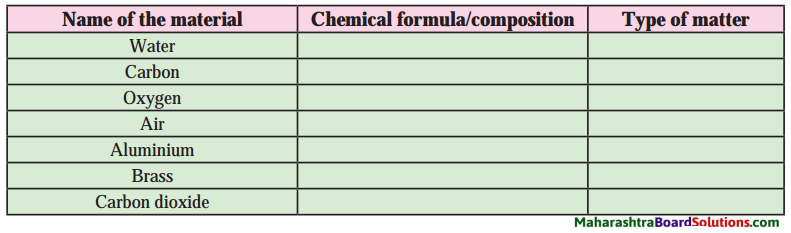
Maharashtra Board Class 8 Science Solutions Chapter 6 Composition of Matter 16
Answer:

Name of the materialChemical formulae/compositionType of matter
WaterH2OCompound
CarbonCElement
OxygenO2Element
AirO2 + N2 + CO2 + other gasesMixture
AluminiumAlElement
BrassCu + ZnMixture
Carbon dioxideCO2Compound

Question 25.
What is meant by an organic compound? Give two examples.
Answer:
The compound which when heated strongly gives black coloured carbon residue is called an organic compound or carbon compound.
Examples: Carbohydrates, proteins, hydrocarbons (petrol, cooking gas).

Maharashtra Board Class 8 Science Solutions Chapter 6 Composition of Matter

Question 26.
What is meant by an inorganic compound? Give two examples.
Answer:
Compounds which when heated strongly decomposes to give a residue behind are called inorganic compounds.
Examples: Common salt, rust, blue vitriol, limestone.

Question 27.
What is meant by complex compounds? Give two examples.
Answer:
The molecules of compounds which have a complex structure formed by many atoms and in the centre of this structure metal atoms are also included are called complex compounds.
Examples: Haemoglobin, chlorophyll.

Question 28.
Classify the following compounds into organic compounds, inorganic compounds and complex compounds.
Petrol, common salt, haemoglobin, blue vitriol, cyanocobalamine, cooking gas.
Answer:

  • Organic compounds: Petrol, cooking gas
  • Inorganic compounds: Common salt, blue vitriol.
  • Complex compounds: Cyano cobalamine, haemoglobin.

Question 29.
What is a phase?
Answer:
The part of matter with uniform composition is called a phase.

Question 29.
What is a homogeneous mixture? Give two examples.
Answer:
When all the components of a mixture form one phase, it is called homogeneous mixture.
Example: Solution of blue vitriol in water, solution of sugar in water.

Maharashtra Board Class 8 Science Solutions Chapter 6 Composition of Matter

Question 30.
What is heterogeneous mixture? Give two examples.
Answer:
When the components of a mixture are distributed into two or more phases, it is called a heterogeneous mixture.
Examples: Oil and water, sand and water.

Question 31.
Define solution or What is meant by a solution? Give two examples.
Answer:
A homogeneous mixture of two or more substances is called a solution.
Examples: Seawater, sugar, syrup.

Question 32.
What is meant by a solvent?
OR
Define solvent. Give two examples.
Answer:
The component which is present in largest proportion in a solution is called a solvent.
Examples:

  1. In sea water, water is the solvent.
  2. In tincture iodine, alcohol is the solvent.

Question 33.
What is meant by a solute?
OR
Define solute. Give two examples.
Answer:
The component of a solution which is present in smaller proportion than the solvent is called a solute.
Examples:

  1. In sea water, salt is a solute.
  2. When a small of amount of sugar is dissolved in water, sugar is the solute in the solution.

Question 34.
Define suspension.
OR
What is meant by a suspension?
Answer:
A heterogeneous mixture of a liquid and a solid is called a suspension. The diameter of the solid particles in a suspension is larger than 10-4 m.

Maharashtra Board Class 8 Science Solutions Chapter 6 Composition of Matter

Question 35.
Define colloid.
Answer:
A heterogeneous mixture in which the particles cannot be seen with a naked eye is called a colloid. The diameter of colloidal particles is around 10-5 m.

Question 36.
State the characteristics of a solution.
Answer:

  1. A solution is clear and transparent, it passes through a filter paper.
  2. The particles are not visible to the naked eye.
  3. A light can easily pass through it without scattering.
  4. A solution is homogeneous mixture.

Question 37.
State the characteristics of a suspension.
Answer:

  1. In suspension, the solute particles do not dissolve but remain suspended in it. The liquid and solid components of suspension are separated by filtration.
  2. The particles are visible to the naked eye.
  3. The particles in suspension are of very small size and scatter a beam of light passing through it.
  4. It is heterogeneous in nature.

Question 38.
State the characteristics of a colloid.
Answer:

  1. In a colloid, the particles are spread uniformly throughout the solution.
  2. The size of the particles is less than that of the particles in a suspension.
  3. The particles are not visible to the naked eye.
  4. The particles scatter a beam of light.
  5. A colloidal solution appears to be homogeneous, but actually it is heterogeneous. ‘

Maharashtra Board Class 8 Science Solutions Chapter 6 Composition of Matter

Question 39.
Give two examples of each of the following:

  1. Phase
  2. Homogeneous matter
  3. Heterogeneous matter
  4. Homogeneous mixture
  5. Heterogeneous mixture
  6. Solution
  7. Suspension
  8. Colloid.

Answer:

  1. Phase: (i) Solid: Sodium chloride, blue vitriol, sand, (ii) Liquid: Water, alcohol, (iii) Gas: Chlorine, ammonia.
  2. Homogeneous matter: Blue vitriol (solid), a solution of blue vitriol in water (a solid in a liquid), chlorinated water (a gas in a liquid).
  3. Heterogeneous matter: Sand and water, sand and alcohol, blue vitriol and sand.
  4. Homogeneous mixture: A solution of sodium chloride in water, air, a mixture of water and alcohol.
  5. Heterogeneous mixture: A mixture of sand and blue vitriol, sodium chloride and iron filings, oil and water.
  6. Solution: Seawater, a solution of sugar in water, a solution of blue vitriol in water.
  7. Suspension: A mixture of sand and water, sand and alcohol, muddy water, limestone in water.
  8. Colloid: Milk, milk of magnesia, blood, printing ink.

Question 40.
State the different types of solutions. Give one example.
Answer:
The different types of solutions:

  • Liquid in liquid. Examples: Vinegar, dilute sulphuric acid.
  • Gas in gas. Example: Air.
  • Solid in solid. Examples: Brass, stainless steel, bronze.
  • Gas in liquid. Examples: Chlorinated water.

Maharashtra Board Class 8 Science Solutions Chapter 6 Composition of Matter

Question 41.
Classify the following into homogeneous solution and heterogeneous solution?
Soda water, potassium permanganate solution, milk, alcohol in water, ink solution, wheat flour in water.
Answer:

  • Homogeneous solution: Soda water, potassium permanganate solution, alcohol in water.
  • Heterogeneous solution: Milk, ink solution, wheat flour in water.

Question 42.
Classify the following into solution, suspension and colloids:
Milk, sand in water, lemonade, smoke, oxygen in water.
Answer:

  • Solution: Lemonade, oxygen in water.
  • Suspension: Sand in water.
  • Colloids: Milk, smoke.

Question 43.
What is meant by molecular formula?
Answer:
The number of atom of each of the constituent elements present in one molecule of a compound is called molecular formula.

Question 44.
What is meant by valency of an element?
Answer:
The capacity of an element to combine with another element is known as valency.

Question 45.
Deduce the molecular formulae of the compound obtained from the following pairs of elements by the cross multiplication method.
Answer:
Question a.
H (Valency 1) and O (Valency 2)
Answer:
Step 1: Write the symbols of the constituent elements.
Maharashtra Board Class 8 Science Solutions Chapter 6 Composition of Matter 17
Step 2: Write the valency below the respective elements.
Maharashtra Board Class 8 Science Solutions Chapter 6 Composition of Matter 18
Step 3: Cross multiply the valencies.
Maharashtra Board Class 8 Science Solutions Chapter 6 Composition of Matter 19
∴ The molecular formula: H2O.

Maharashtra Board Class 8 Science Solutions Chapter 6 Composition of Matter

Question b.
Fe (Valency 2) and S (Valency 2)
Answer:
Step 1: Write the symbols of the constituent elements.
Maharashtra Board Class 8 Science Solutions Chapter 6 Composition of Matter 20
Step 2: Write the valency below the respective elements.
Maharashtra Board Class 8 Science Solutions Chapter 6 Composition of Matter 21
Step 3: Cross multiply the valencies.
Maharashtra Board Class 8 Science Solutions Chapter 6 Composition of Matter 22
The molecular formula: FeS

Question c.
The valencies of the atom H, O and N are 1, 2 and 3 respectively. The molecular formulae of these gaseous elements are H2, O2 and N2 respectively. How many chemical bonds are there in each of these molecules?
Answer:
Chemical bond in H2 is one
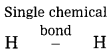
Maharashtra Board Class 8 Science Solutions Chapter 6 Composition of Matter 23
Chemical bond in O2 are two
Maharashtra Board Class 8 Science Solutions Chapter 6 Composition of Matter 24
Chemical bond in N2 are three
Maharashtra Board Class 8 Science Solutions Chapter 6 Composition of Matter 25

Give scientific reasons:

Question 1.
Hydrogen is an element.
Answer:

  1. Hydrogen has only one kind of atoms.
  2. Hydrogen cannot be further divided into new substances by any physical or chemical means. Therefore, hydrogen is an element.

Question 2.
Water is a compound.
Answer:

  1. The composition of water is same throughout i.e., the elements hydrogen and oxygen whose atoms are combined in the ratio by weight is always 1 : 8.
  2. The properties of water are totally different from those of its constituents, i.e. hydrogen and I oxygen. Hence, water is a compound.?

Maharashtra Board Class 8 Science Solutions Chapter 6 Composition of Matter

Question 3.
Air is a mixture.
Answer:

  1. Air contains nitrogen, oxygen and other gases.
  2. These gases retain their original properties. They do not combine with each other. Hence, air is a mixture.

Question 4.
A potassium permanganate solution in water is a homogeneous mixture, while a mixture of oil and water is a heterogeneous mixture.
Answer:

  1. In a potassium permanganate solution in water the constituents, i.e. potassium permanganate and water are uniformly mixed throughout.
  2. The properties and composition of a homogeneous mixture are the same throughout the mixture. Hence, potassium permanganate solution is a homogeneous mixture.
  3. In a mixture of oil and water, the constituents are not uniformly mixed throughout the mixture.
  4. The properties and composition of a heterogeneous mixture are not the same throughout the mixture. Hence, a mixture of oil and water is a heterogeneous mixture.

Question 5.
Milk is a colloid.
Answer:

  1. In milk, the particles are spread uniformly throughout and due to very small size of the particles, milk appears to be homogeneous.
  2. But milk is a colloid solution and it is a heterogeneous mixture. Here, milk is liquid particles of proteins and fats having a diameter around 10-5 m dispersed in the aqueous medium. Hence, a milk is a colloid.

Distinguish between the following:

Question 1.
Answer:

SolidsLiquids
1.  Solids have a definite shape.1. Liquids have no definite shape.
2.  They have very low compressibility.2. They have moderate compressibility.
3. In solids, the intermolecular forces are very strong. E.g. iron, stone, salt.3. In liquids, the intermolecular forces are moderately strong. E.g., water, alcohol, mercury.

Maharashtra Board Class 8 Science Solutions Chapter 6 Composition of Matter

Question 2.
Liquids and Gases:
Answer:

LiquidsGases
1. Liquids have a definite volume.1. Gases do not have a definite volume.
2. They have moderate compressibility.2. They have high compressibility.
3. In liquids, the intermolecular forces are moderately strong. E.g. water, alcohol, mercury.3. In gases, the intermolecular forces are very weak. E.g. oxygen, air.

Question 3.
Solids and Gases:
Answer:

SolidsGases
1. Solids have a definite shape and volume.1. Gases have neither a definite shape nor a definite volume.
2. They have incompressibility.2. They have high compressibility
3. In solids, the intermolecular forces are very strong. E.g. iron, stone.3. In gases, the intermolecular forces are very weak. E.g. hydrogen, oxygen.

Question 4.
Element and Compound:
Answer:

ElementCompound
1. An element consists of only one kind of substance.1. A compound is formed from two or more elements.
2. An element cannot be further divided into simpler substances by any physical or chemical means. E.g. iron, copper, oxygen.2. A compound can be further divided into simple substances by chemical means. E.g. common salt, sugar, water.

Maharashtra Board Class 8 Science Solutions Chapter 6 Composition of Matter

Question 5.
Compound and mixture:
Answer:

CompoundMixture
1. A compound is made of two or more elements chemically combined in a fixed proportion.1. A mixture is obtained by just mixing two or more substances in any proportion.
2. A compound can be further subdivided into simpler substances by chemical means only.2. A mixture can be further subdivided into simpler substances by simple physical processes.
3. The properties of a compound are entirely different from the properties of its constituents. E.g. common salt, sugar, water.3. The constituents of a mixture retain their original properties. E.g. air, seawater.

Question 6.
Colloidals and Suspension:
Answer:

ColloidalsSuspension
1. The particles in a colloidal solution can pass through a filter paper.1. The particles in a suspension cannot pass through a filter paper.
2. The colloidal particles cannot be seen with a naked eye.2. The suspended particles can be seen with a naked eye.
3. The diameter of solid particles is around 10-5 m3. The diameter of the solid particles is larger than 10-4 m.

Activity-based questions:

Activity 1:
Apparatus: Plastic jar, balloon, thread
Material: Mustard seeds
Take some mustard seeds in a transparent plastic jar. Thread a long thread at the centre of a big balloon by means of a needle and tie it tight. Stretch this rubber diaphragm and fix it on the mouth of the jar by means or a rubber band. Pull the diaphragm up and down with the help of the thread first slowly, then with moderate force and then vigorously. Record your observation in the following table.
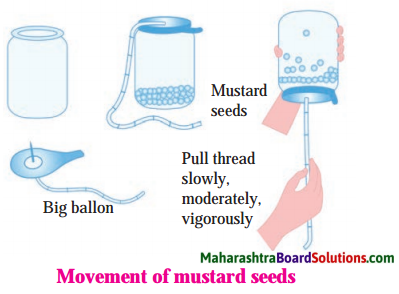
Maharashtra Board Class 8 Science Solutions Chapter 6 Composition of Matter 26

Question 1.
Maharashtra Board Class 8 Science Solutions Chapter 6 Composition of Matter 27
Answer:
Maharashtra Board Class 8 Science Solutions Chapter 6 Composition of Matter 28

Maharashtra Board Class 8 Science Solutions Chapter 6 Composition of Matter

Activity 2:
Apparatus: Hammer, sand paper
Material: Iron nail, copper wire, aluminium wire, coal.
Take the following objects: iron nail/sheet, copper wire, aluminium wire, a piece of coal. Rub each object on a fresh surface of sandpaper and observe. Hammer each object with force. (Take care not to hurt yourself.) Record your observations in the following table.
The objects in the activity are made of the elements iron (Fe), copper (Cu), aluminium (Al) and carbon (C); respectively. Fill the following table on the basis of the observations obtained on doing the above two tests on each of the objects.

Question 1.
Maharashtra Board Class 8 Science Solutions Chapter 6 Composition of Matter 29
Answer:
Maharashtra Board Class 8 Science Solutions Chapter 6 Composition of Matter 30

Maharashtra Board Class 8 Science Solutions Chapter 6 Composition of Matter

Activity 3:
Apparatus: Evaporating dish, tripod stand, burner, etc.
Chemicals: Camphor, washing soda, blue vitriol, sugar, glucose, urea.
Keep the evaporating dish on the tripod stand. Take some camphor in the evaporating dish. Heat the camphor in the dish strongly with the help of a burner. Find out what remains behind in the evaporating dish. Repeat the above procedure using limestone, washing soda, blue vitriol, sugar, glucose and urea instead of camphor. Record your observation in the following table. (Do this activity carefully under the supervision of your teacher, as some of the powders may catch fire.)
Maharashtra Board Class 8 Science Solutions Chapter 6 Composition of Matter 31

Question 1.
Maharashtra Board Class 8 Science Solutions Chapter 6 Composition of Matter 32
Answer:
Maharashtra Board Class 8 Science Solutions Chapter 6 Composition of Matter 33

Maharashtra Board Class 8 Science Solutions Chapter 6 Composition of Matter

Activity 4: (Textbook page 43)
Apparatus: Beakers, rods
Chemicals: Blue vitriol, sand, water, etc.
Take three beakers. Take a little sand and water in the first beaker. Take some crystals of blue vitriol and water in the second beaker. Take some blue vitriol and sand in the third beaker. Stir the materials in all the three beakers and observe. Record your observation in the following table.

Question 1.
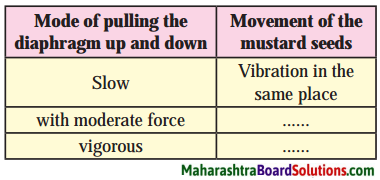
Maharashtra Board Class 8 Science Solutions Chapter 6 Composition of Matter 34
Answer:
Maharashtra Board Class 8 Science Solutions Chapter 6 Composition of Matter 35

Question 2.
In the above activity after stirring a homogeneous mixture is formed in only one beaker? Which is that?
Answer:
The homogeneous mixture is formed in the second beaker. It is a solution of blue vitriol.

Maharashtra Board Class 8 Science Solutions Chapter 6 Composition of Matter

Activity 5:
Apparatus: Beaker, conical flask, funnel, filter paper
Chemicals: Common salt, saw dust, milk.
Procedure: Take three beakers. Take 10 g common salt in the first beaker, 10 g saw dust in the second beaker and 10 ml milk in the third beaker. Add 100 ml water to all the three beakers and stir. Which of the mixtures shows separate water phase ? Place the three beakers in front of a vertically held paper and pass a laser beam through the beakers from the opposite side. (Use the laser beam under the guidance of teacher.) At the same time observe what appears on the paper in front of the beaker. Also look at the beaker from the side. Arrange three filtration assemblies using conical flask, funnel and filter paper for doing filtration. Stir the mixtures in the three beakers and carry out filtration. Record all the observations in the following table.

Question 1.
Maharashtra Board Class 8 Science Solutions Chapter 6 Composition of Matter 36
Answer:
Maharashtra Board Class 8 Science Solutions Chapter 6 Composition of Matter 37

Activity 6: (Textbook page 44)
Apparatus: Horseshoe magnet, evaporating dish, burner. Chemicals: Iron filings, sulphur.
Procedure: Take two evaporating dishes. Take 7 g iron filings in the first dish and 4 g sulphur in the second. Take a horseshoe magnet near the matter in both the dishes and observe. Transfer the entire iron filings from the first dish to the second, stir with a glass rod and observe by taking the horseshoe magnet near the matter. Also observe the colour of the matter. Now heat the matter in the second dish for a while and let it cool. Observe the colour change, if any in the matter and observe whether there is any effect of the horseshoe magnet on it. Record all the observation in the following table.

Question 1.

Maharashtra Board Class 8 Science Solutions Chapter 6 Composition of Matter 38
Answer:
Maharashtra Board Class 8 Science Solutions Chapter 6 Composition of Matter 39

Complete the following:

Question 1.
Complete the table:
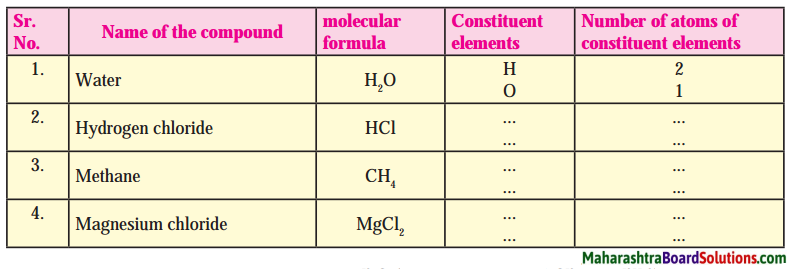
Maharashtra Board Class 8 Science Solutions Chapter 6 Composition of Matter 40
Answer:
Molecular formulae of some compounds are given in the following table. Use these to fill in the gaps in the table.
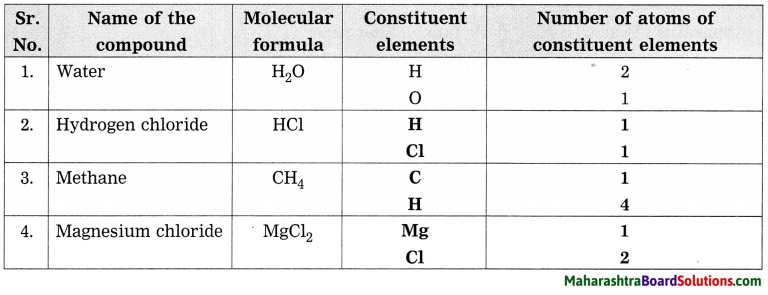
Maharashtra Board Class 8 Science Solutions Chapter 6 Composition of Matter 41

Maharashtra Board Class 8 Science Solutions Chapter 6 Composition of Matter

Question 2.
Complete the table:
Maharashtra Board Class 8 Science Solutions Chapter 6 Composition of Matter 42
Answer:
Molecular formulae of various compounds formed by hydrogen with other elements are given in the following table. From that, deduce the valencies of the concerned elements.
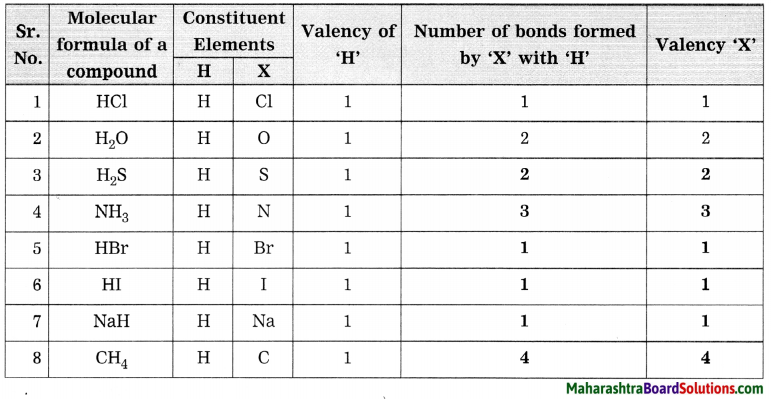
Maharashtra Board Class 8 Science Solutions Chapter 6 Composition of Matter 43

Question 3.
Complete the table:
Maharashtra Board Class 8 Science Solutions Chapter 6 Composition of Matter 44
Answer:
Maharashtra Board Class 8 Science Solutions Chapter 6 Composition of Matter 45

Maharashtra Board Class 8 Geography Solutions Chapter 7 Population

Balbharti Maharashtra State Board Class 8 Geography Solutions Chapter 7 Population Notes, Textbook Exercise Important Questions and Answers.

Maharashtra State Board Class 8 Geography Solutions Chapter 7 Population

Class 8 Geography Chapter 7 Population Textbook Questions and Answers

1. Complete the following sentences:

Question A.
If the birth rate is greater than the death rate then the population …………. .
(i) decreases
(ii) increases
(iii) remains constant
(iv) becomes surplus
Answer:
(ii) increases

Question B.
People of …………… age group are included in the productive population.
(i) 0 to 14
(ii) 14 to 60
(iii) 15 to 60
(iv) 16 to 59
Answer:
(iv) 16 to 59

Question C.
The spread of modern technology in society is mostly dependent on …………….. .
(i) sex ratio
(ii) birth rate
(iii) literacy
(iv) migration
Answer:
(iv) migration

Maharashtra Board Class 8 Geography Solutions Chapter 7 Population

2. Examine the following statements and correct the incorrect ones:

Question a.
The population density of a region can be understood from its area.
Answer:
Incorrect.
Correct sentence: The population density of a region can be understood from its area and the total volume of population living in it.

Question b.
The quality of population is determined on the basis of literacy.
Answer:
Correct.

Question c.
There is an adverse impact on manpower in the regions of out migration.
Answer:
Correct.

Question d.
Greater economic prosperity indicates the development of region.
Answer:
Incorrect.
Correct sentence: Greater economic prosperity as well as higher standards of living, higher quality of life, availability of opportunities, freedom, etc, indicate the development of region.

Maharashtra Board Class 8 Geography Solutions Chapter 7 Population

Question e.
Developing countries have an HDl of 1.
Answer:
Incorrect.
Correct sentence: Developing countries have and HDI of 0.50 to 0.60.

3. Answer in brief.

Question a.
What are the aspects considered in the structure of population?
Answer:
The following are the aspects considered in the structure of the population:

  1. Sex ratio/structure: Sex ratio/structure is a structure that considers the sub division of population on the basis of gender.
  2. Age structure: Age structure is a structure that considers the sub division of population as per age groups.
  3. Occupational structure: Occupational structure is a structure that considers sub division of population on the basis of dependency and workability.
  4. Rural – urban structure: Rural – Urban structure is a structure that considers sub division of population on the basis of area of residence.
  5. Literacy structure: Literacy structure is a structure that considers sub division of population on the basis of capability of reading and writing.

Question b.
Prepare a list of advantageous and disadvantageous factors, affecting population distribution.
Answer:
A list of advantageous factors affecting population distribution is as follows:

  1. Availability of sufficient sunlight, clean air and water.
  2. Region with low altitude
  3. Moderate rainfall and temperature
  4. Fertile soil
  5. Deposits of minerals
  6. Industrialisation
  7. Urbanisation
  8. Availability of transportation facilities
  9. Availability of market
  10. Political stability
  11. International peace
  12. Favourable government policies
  13. Favourable social customs and traditions.

A list of disadvantageous factors affecting population distribution is as follows:

  1. Shortage of sufficient sunlight, clean air and water.
  2. Region with high altitude
  3. Extremely less or more rainfall and temperature
  4. Infertile soil
  5. Scarcity of minerals
  6. Low industrialisation
  7. Lack of urbanisation
  8. Non-availability of transportation facilities
  9. Non-availability of market
  10. Political instability
  11. International disputes
  12. Unfavourable government policies
  13. Evil social customs and traditions.

Maharashtra Board Class 8 Geography Solutions Chapter 7 Population

Question c.
What are the problems in areas of high population densities?
Answer:
The ratio of the population of a country to its area is population density. While discussing population distribution, density of population is also considered. The density is calculated, as per the formula given below.
Density of population = Population of a region/Area of a region.

The problems in areas of high population densities are as follows:
1. Pollution – Pollution is one of the major reasons which people face due to high population density. Due to an increase in land degradation by making houses and flats, land pollution will be caused, water will be contaminated by a huge number of people, resulting in water pollution and huge number of vehicles will cause air pollution.

2. Overcrowded – The areas with high population density become overcrowded, which bring chaos and lack of peace in the society.
3. Lack of open space – High population density makes it difficult to get a free open space.

Question d.
What arc the problems in area of low population densities?
Answer:
The development of a country depends upon its size of population. A lower population is somehow manageable and resources can be distributed equally. But, sometimes the low population leads to lower demands of goods and services and lower tax revenues for the government to provide goods and services.

4. Give geographical reasons:

Question a.
Population is an important resource.
Answer:

  1. The economic and cultural development of any country depends upon the volume and the quality of population.
  2. If a country has a high volume and less quality of population, it has slow economic growth and development.
  3. If a country has optimum population with high quality of population, it has fast economic growth and development. Thus, population is an important resource.

Maharashtra Board Class 8 Geography Solutions Chapter 7 Population

Question b.
Productive population is an important group.
Answer:

  1. People belonging to age group of 16 to 59 age are considered as productive. Therefore this population is called productive population.
  2. People below 16 years of age and above 60 years of age are considered as dependent or non-working population.
  3. Productive population/people are involved in services or businesses. Therefore they play very important role in economic
  4. If country has more proportion of productive population and youth, it develops rapidly. Thus, productive population is an important group.

Question c.
The study of age structure is important.
Answer:

1. The study of age structure helps to know the percentage of children, adolescents, youth, middle aged, and old aged in population.

2. The study of age structure helps to know the proportion of productive people (Working people between 16 years to 59 years of age) and unproductive people (Non working people below 16 years of age and above 60 years of age).

3. The study of age structure helps government in planning various economic, social, educational, medical, etc. schemes for the overall development of country.

4. The study of age structure helps to know the speed of economic growth. Thus, the study of age structure is important.

Question d.
Literacy is directly related to development.
Answer:

  1. The country with high literacy rate, develops rapidly in economic, social and cultural aspects.
  2. The country with low literacy rate, faces many obstacles in its economic, social and cultural growth and development.
  3. Literacy rate is related to quality of life, the opportunities available and freedom. Thus, literacy is directly related to development.

Maharashtra Board Class 8 Geography Solutions Chapter 7 Population

Question e.
The real progress of a country is understood with the help of the Human Development Index.
Answer:
1. Human Development Index is calculated by taking into account the values of economic, health and education parameters.

2. Thus, Human Development Index is calculated on the basis of Gross National Product, life expectancy and literacy rate.

3. Human Development Index indicates the standard of living, economic and social welfare, quality of life, opportunities available and freedom. Therefore, the real progress of a country is understood with the help of the Human Development Index.

5. Write notes.

Question a.
Sex ratio.
Answer:
1. The number of females per thousand males is called sex ratio.

2. The sex ratio is calculated with the help of the following formula :
Maharashtra Board Class 8 Geography Solutions Chapter 7 Population 1

3. If the number of females per thousand males is less, the sex ratio is considered to be low. On the other hand, if the number of females per thousand males is more, the sex ratio is considered to be high.

4. According to Census 2011, the sex ratio was highest (1084) in the state of Kerala. According to Census 2011, the sex ratio was 929 in the state of Maharashtra.

5. Out-migration of males leads to high sex ratio in a region from where males have out-migrated. Less female birth rate leads to low sex ratio.

Question b.
Age structure.
Answer:

  1. Sub division of population as per age groups is known as age structure.
  2. Age structure is helpful in knowing the proportion of children, adolescents, young, middle aged and old people in population.
  3. It is also helpful in knowing proportion of active population (Population between the ages 16 and 59) and dependent population (Population below 16 years of age and above 60 years of age).
  4. Age structure is helpful to the government in framing various policies.

Maharashtra Board Class 8 Geography Solutions Chapter 7 Population

Question c.
Literacy.
Answer:
1. Population above the age of seven can be sub divided on the basis of capability of reading and writing.

2. People above the age of seven and are unable to read and write are considered illiterate. On the other hand, people above the age of seven and are able to read and write are considered literate.

3. High literacy rate is an indicator of social and economic development of society. On the other hand, high illiteracy rate leads to slow economic, social and cultural development of society.

4. Literacy rate is related to quality of life, the opportunities available and freedom. Thus, it is directly related to development.

Activity:

Question a.
Survey 5 families in your neighbourhood on the basis of the following points and make a presentation.
(a) Sex
(b) Age groups
(c) Education
(d) Occupation

Class 8 Geography Chapter 7 Population Additional Important Questions and Answers

Fill in the correct word and complete the sentences:

Question A.
……………… state of India has the highest sex ratio.
(i) Maharashtra
(i) Kerala
(c) Punjab
(d) Haryana
Answer:
(b) Kerala

Question B.
………………. district of Maharashtra has low density of population.
(a) Mumbai City
(b) Mumbai Suburb
(c) Thane
(d) Osmanabad
Answer:
(d) Osmanabad

Examine the following statements and correct the incorrect ones:

Question a.
The state of Maharashtra has a balanced population.
Answer:
Incorrect.
Correct sentence: The state of Maharashtra has imbalanced population.

Maharashtra Board Class 8 Geography Solutions Chapter 7 Population

Question b.
The areas with plenty of natural resources normally have more volume of population.
Answer:
Correct.

Question c.
The region with more proportion of youth in population has a rapid speed of development.
Answer:
Correct.

Question d.
Most of people in rural areas are engaged in tertiary activities.
Answer:
Incorrect.
Correct sentence: Most of people in rural areas are engaged in primary activities.

Question e.
Human Development Index is published by World Health Organisation.
Answer:
Incorrect.
Correct sentence: Human Development Index is published by United National Development Programme.

Question f.
Density of population is found to be more in the state of Goa.
Answer:
Correct.

Maharashtra Board Class 8 Geography Solutions Chapter 7 Population

Question g.
The state of Rajasthan is densely populated.
Answer:
Incorrect.
Correct sentence: The state of Rajasthan is sparsely populated.

Answer the following questions in one sentence each:

Question a.
What is birth rate?
Answer:
Birth rate is the number of live births per one thousand people in a year.

Question b.
What is death rate?
Answer:
Death rate is the number of deaths per one thousand people in a year.

Question c.
What is life expectancy?
Answer:
Life expectancy is the expected average life span of an individual at the time j of his/her birth.

Question d.
What is meant by in-migration?
Answer:
Migration of people in a particular region from outside regions is known as in-migration.

Maharashtra Board Class 8 Geography Solutions Chapter 7 Population

Question e.
What is meant by out-migration?
Answer:
Migration of people from a particular region to outside regions is known as out-migration.

Question f.
What is meant by sex ratio?
Answer:
The total number of females per thousand males is known as sex ratio.

Question g.
In which types of occupations are people in urban areas involved?
Answer:
People in urban areas are involved in secondary and tertiary occupations.

Question h.
Who put forth the concept of Human Development Index?
Answer:
Mahbub Ul Haq and Amartya Sen put forth the concept of Human Development Index.

Answer the following questions in brief:

Question a.
Explain the various types of migration.
Answer:
The various types of migration are as follows:

  1. In-migration: In-migration is migration of people in a particular region from outside regions.
  2. Out-migration: Out-migration is migration of people from a particular region to outside regions.
  3. Short term mfgration: Short term migration is migration of people on a i temporary basis. For example, migration due to tourism or natural disaster or education is a short term migration.
  4. Long term migration: Long term migration is migration of people on a permanent basis. For example, migration due to transfer of service or marriage or war j and partition is a long term migration.

Maharashtra Board Class 8 Geography Solutions Chapter 7 Population

Question b.
Explain the effects of migration.
Answer:
The effects of migration are as follows:

1. Out-migration leads to fall in population of a region from where people have migrated outside. This in turn leads to shortage of manpower in a region from where out-migration has occurred.

2. In-migration leads to increase in population of a region in which people from outside regions have migrated. This in turn, puts a pressure on public amenities and infrastructure of a region in which people have migrated.

3. Migration leads to redistribution of population.
4. Migration also leads to a change in the structure of population in a particular region.

Give geographical reasons:

Question a.
The density of population is found to be high in Mumbai City and Mumbai Suburb district.
Answer:

  1. Mumbai is economic capital of India.
  2. In Mumbai City and Mumbai Suburb district, industrialisation and urbanisation has taken place on a large scale.
  3. Transportation, educational, medical, etc. facilities are available on a large scale in these districts.
  4. Many employment opportunities are also available in these districts.

Due to all these favourable factors, many people from other districts of Maharashtra as well as from other states of India have migrated to Mumbai on a permanent basis. Therefore, the density of population is found to be high in Mumbai City and Mumbai Suburb district.

Study the following map/figure/graph and answer the following questions:

Maharashtra Board Class 8 Geography Solutions Chapter 7 Population 4

Study the Figure is given and answer the following questions:

Question a.
Which state has the highest sex\ratio?
Answer:
Kerala state has the highest sex j ratio.

Maharashtra Board Class 8 Geography Solutions Chapter 7 Population

Question b.
Which state has the lowest sex J ratio?
Answer:
Haryana state has the lowest sex ratio.

Question c.
What changes should take place in Maharashtra, to bring about a balanced > sex ratio and how much change is i necessary?
Answer:
The following changes should take place in Maharashtra to bring about a balanced sex ratio:

  1. Sex ratio must get increased by having total control over female infanticide and launching various government schemes for women empowerment, etc.
  2. The sex ratio must get increased by 71 i.e. the number of females per thousand males must get increased from 929 to 1000.

Try this: 

Question a.
Prepare bar graphs on the basis of the table given below and write a note. (Discuss in group about the issue of literacy in the country.)?
Maharashtra Board Class 8 Geography Solutions Chapter 7 Population 2
Answer:
(A) Bar graph:
Maharashtra Board Class 8 Geography Solutions Chapter 7 Population 3

(B) Note:

  1. From the above bar diagram it can be seen that the literacy rate is found to be high in developed countries, moderate in developing countries and low in underdeveloped countries.
  2. In 2010, the literacy rate was 72.1°/e in India.
  3. In 2010, the literacy rate was 98.1% in Argentina and it was 38.1% in Afghanistan.
  4. Literacy rate is directly or indirectly related to quality of life, opportunities available and the freedom.

Can you tell? 

Maharashtra Board Class 8 Geography Solutions Chapter 7 Population 5

Study Figure is given and answer the following questions:

Question a.
Which are the most densely populated districts?
Answer:
The most densely populated districts are:

  1. Mumbai City
  2. Mumbai Suburb
  3. Thane
  4. Pune
  5. Kolha5ur, etc.

Maharashtra Board Class 8 Geography Solutions Chapter 7 Population

Question b.
Name the sparsely populated districts with a density of less than 100 per sq. km.
Answer:
The sparsely populated districts with a density of less than 100 sq. km:

  1. Gadchiroli
  2. Beed
  3. Osmanabad, etc.

Question c.
Name two districts with moderate population.
Answer:
District with moderate population:

  1. Nashik
  2. Nagpur.

Question d.
What is the density of the dark shaded regions?
Answer:
The density of the dark shaded regions is greater than 1000 person per sq. km.

Question e.
Why is the density of population less in Gadchiroli?
Answer:
The density of population is less in Gadchiroli due to dense forests.

Question f.
Have a discussion in the class on the effect of physiography, climate, area under forest, industries, etc. on the density of population.
Answer:
1. Physiography: The density of population is found to be high in plain areas. On the other hand, the density of population is found to be low in mountainous regions.

2. Climate: The density of population is found to be high in the areas with moderate temperature and moderate rainfall. On the other hand, the density of population is found to be low in the areas of extremely low or high temperature and extremely high or low rainfall.

3. Area under forest: The density of population is found to be high in the area where forest cover is limited. On the other hand, the density of population is found to be low in the area under dense forests.

4. Industries: The density of population is found to be high in industrially developed region. The density of population is found to be low in industrially backward: region.

Thought-Provoking Questions:

Can you tell? 

Maharashtra Board Class 8 Geography Solutions Chapter 7 Population 6

Study the table is given and answer the following questions:

Question a.
Which city has greater number of newly born children?
Answer:
‘B’ City has greater number of newly born children.

Maharashtra Board Class 8 Geography Solutions Chapter 7 Population

Question b.
Which city records greater number of deaths?
Answer:
‘B’ City records greater number of deaths.

Question c.
Looking at the figures of in-migration and out-migration which city has received more migrants?
Answer:
Looking at the figures of in-migration and out-migration, ‘A’ City has received more migrants. .

Question d.
Calculate the population of both the cities in 2017.
Answer:
The population of ‘A’ City in 2017 is 121, 500 and of ‘B’ City in 2017 is 120, 550.

Question e.
After considering all the points, which city has recorded more growth of population in one year?
Answer:
After considering all the points, ‘A’ City has recorded more growth of population in one year. .

Question f.
The total number of births are given. What would be this figure per thousand population? What is the term for this?
Answer:
The total number of births are given. This figure would be 20 per thousand. The term for this is ‘Birth rate’.

Question g.
What would be the number of deaths per thousand population? What is the term used for this?
Answer:
The number of deaths per thousand would be 25. The term used for this is ‘Death rate’.

Complete the following table:
(Note: The answer is given directly.)

Question a.
Maharashtra Board Class 8 Geography Solutions Chapter 7 Population 7.1
Answer:

StatePopulation (2011)Area (Sq. Km)Density
1. Uttar Pradesh19,98,12,3412,40,926829.35
2. Maharashtra11,23,74,3333,07,713356.19
3. Tamil Nadu7,26,26,8091,30,058558.41
4. Rajasthan68,54,8373,42,23920.02
5. Manipur27,21,75622,327121.90
6. Goa14,58,5453,702393.98

Maharashtra Board Class 8 Geography Solutions Chapter 7 Population

Think about it:

Question a.
Even though area wise Rajasthan is a large state, the population is less. Which geographical factors may be responsible for this?
Answer:
The amount of rainfall is comparatively less in the state of Rajasthan. The Thar desert is located in the western part of the state of Rajasthan. Therefore, even though area wise Rajasthan is a large state, the population is less.

Can you tell? 

Question a.
Classify Male, Adolescent, Illiterate, Children, Unemployed, Infants, Literate, Rural, Working population, Urban, Female, Old, Young, Dependent population and Adult into the following categories:

  1. Sex
  2. Age
  3. Rural
  4. Urban
  5. Literacy
  6. Productive population.

Answer:

  1. Sex: Male, Female
  2. Age: Adolescent, Children, Infants, Old, Young, Adult
  3. Rural: Rural
  4. Urban: Urban
  5. Literacy: Illiterate, Literate
  6. Productive population: Unemployed, Working population, Dependent population.

Can you tell? 

Maharashtra Board Class 8 Geography Solutions Chapter 7 Population 8

Study the figure and answer the following questions:

Question a.
What do you think are the reasons for the changing land use pattern of Mondha village?
Answer:
Urbanisation and rise in population are the reasons for the changing land use pattern of Mondha village.

Maharashtra Board Class 8 Geography Solutions Chapter 7 Population

Question b.
What kind of changes have taken place?
Answer:
In Mondha village, the agricultural land use has decreased and the non-agricultural land use (i.e. commercial land use, residential land use) has increased.

Question c.
Due to this change in land use, do you think there has been a change in population? If yes, what is the change and why?
Answer:
Due to this change in land use, there has been a change in population. The population of Mondha has increased due to the in-migration.

Can you tell?

Maharashtra Board Class 8 Geography Solutions Chapter 7 Population 8

Study the table showing percentage of immigrant population of various countries given on page 46 and answer the following questions:

Question a.
Which countries have less than 10% migrant population?
Answer:
Afghanistan, Brazil, Bangladesh, India and Great Britain have less than 10% migrant population.

Question b.
Which are the countries with a migrant population of between 10% and 20%?
Answer:
Germany and U.S.A. are the countries with a migrant population of between 10%
and 20%.

Maharashtra Board Class 8 Geography Solutions Chapter 7 Population

Question c.
Which are the countries with a migrant population of more than 20%
Answer:
Kuwait, Hong Kong, Oman and Saudi Arabia are the countries with a migrant population of more than 20%.

Question d.
Find the reasons behind the migrant population of more than 20%.
Answer:
The reasons behind the migrant population of more than 20% are:

  1. Huge stock of mineral oil and other natural resources
  2. Availability of employment opportunities
  3. Great demand for labour in these countries.

Question c.
Draw pie diagrams for any two countries.
Answer:
1. Kuwait: A pie diagram showing percentage of immigrant population for Kuwait is as follows:

Maharashtra Board Class 8 Geography Solutions Chapter 7 Population 12

2. Oman: A pie diagram showing percentage of immigrant population for Oman is as follows:

Maharashtra Board Class 8 Geography Solutions Chapter 7 Population 13

Question d.
Have a discussion on migration and development.
Answer:
1. Out-migration leads to a shortage of manpower/labour supply. This in turn adversely affects the development of the region from where out-migration has occurred.
2. In-migration leads to increase in population of a region in which in-migration has occurred. This too, adversely affects the development of the respective region.
3. The migration up to certain extent increases the mobility of labourer and it boosts the development of a particular region.

Use your brainpower: 

Question a.
In India, 0.52 % of the population are migrants. What is the actual number of people who have migrated to India?
Answer:
According to Census 2011, the population of India was nearly 121 crore. In India, 0. 52 % of the population are migrants. Thus, according to Census 2011, the actual number of people who have migrated to India is nearly 629,200.

Maharashtra Board Class 8 Geography Solutions Chapter 7 Population

Try this:

Question a.
Write a note on the Human Development Index. (HDI) of various countries on the basis of the following table:
HDI Rank wise Country Value of HDI Level of Development
Maharashtra Board Class 8 Geography Solutions Chapter 7 Population 9 Maharashtra Board Class 8 Geography Solutions Chapter 7 Population 10
Answer:

Maharashtra Board Class 8 Geography Solutions Chapter 7 Population 11

  1. Norway ranks first in the world with respect to Human Development Index (HDI). The value of HDI for Norway is 0.949.
  2. The countries like Japan, United Kingdom, Denmark, Switzerland, Germany and Australia have the value of Human Development Index (HDI) more than 0.900. These countries show very high level of development.
  3. The countries like Sri Lanka, Brazil and China have the value of Human Development Index (HDI) between 0.700 and 0.800. These countries show high level of development.
  4. The countries like India, Bhutan and Pakistan have the value of Human Development Index (HDI) between 0.500 and 0.600. These countries show medium level of development.
  5.  The countries like Niger and Central African Republic have value of Human Development Index (HDI) between 0.300 and 0.400. These countries show less development.
  6. From the above table it can be seen that Human Development Index (HDI) is an indicator of development.
  7. Higher value (around 1) of Human Development Index indicates high level of development and lower value (around 0) of Human Development Index indicates low level of development.

Use your brain power:

Question a.
Discuss and write the advantages and disadvantages of low population or high population with reference to the following factors:
(Note: The answer is given directly.)
Maharashtra Board Class 8 Geography Solutions Chapter 7 Population 14
Answer:

HeadingsLow populationHigh population
Per capita land availabilityPer capita land availability is comparatively more.Per capita land availability is comparatively less.
FoodgrainsFood grains are available in plenty.There is shortage of food grains.
ResourcesResources are available in plenty.There is strain on resources.
Per capita incomePer capita income is comparatively high.Per capita income is comparatively low.
Basic amenities and facilitiesBasic amenities and facilities are available in sufficient quantity.There is strain on basic amenities and facilities.
Percentage of unproductive consumersPercentage of unproductive consumers is comparatively low.Percentage of unproductive consumers is comparatively high.
PlanningPlanning is comparatively more effective.Planning is comparatively less effective.
EmploymentMore employment opportunities are available.Less employment opportunities are available.
UrbanisationThe rate of urbanisation may be comparatively low.The rate of urbanisation may be comparatively high.
HealthThe quality of health may be comparatively high.The quality of health may be comparatively low.
Higher educationThe number of highly qualified people may be comparatively more.The number of highly qualified people may be comparatively low.
Social environmentSocial environment may be comparatively supportive and favourable.Social environment may be comparatively adverse and unfavourable.

Give it a try:

Maharashtra Board Class 8 Geography Solutions Chapter 7 Population 17

Question a.
Since the past two centuries, the size of family is decreasing. But inspite of this the population of the country is increasing. Find out why is this happening.
Answer:
1. Since the past two centuries, the death rate in India has reduced to a great extent. On the other hand, since the past two centuries, the birth rate in India has reduced negligibly. Therefore, since the past two centuries, the size of family is decreasing. But in spite of this the population of country is increasing.

Maharashtra Board Class 8 Geography Solutions Chapter 7 Population

Use your brain power:

Question a.
As per the population Census of 2011, the population of India is 121 crores. For domestic use, the per capita requirement per day is 50 litres of water. Taking this into account, what would be the total amount of water requirement in India for domestic purpose only.
Answer:

  1. As per the Population Census of 2011, the population of India is. 121 crores?
  2. For domestic use, the per capita requirement per day is 50 litres of water.
  3. Taking this into account, the total amount of water requirement in India for domestic purpose only, will be nearly 6050 crores litre.

Open-Ended Questions:

Question a.
What are the problems in areas of high population distribution?
Answer:
The following are the problems in areas of high population distribution:

  1. Increased level of water, air, sound and soil pollution.
  2. Traffic jam
  3. Shortage of residential areas
  4. Increased criminal tendencies, etc.

Question b.
What are the problems in areas of low population densities?
Answer:
The following are the problems in areas of low population densities:

  1. Shortage of labour supply
  2. Low levels of demand for various goods and services
  3. Under utilization of resources, etc.

Give it a try:

Question a.
How do imbalanced sex ratios affect the society?
Answer:
Imbalanced sex ratios affect the society as follows:

  1. Increased problems in society, workplace, etc.
  2. Increased crimes against women.

Maharashtra Board Class 8 Geography Solutions Chapter 7 Population

Question b.
What measures can be taken to strike a balance in the sex ratio?
Answer:
The following measures can be taken to strike a balance in the sex ratio:

  1. Increasing literacy rate of females.
  2. Increasing employment opportunities for women.
  3. Eradicating evil social customs.
  4. Launching government schemes of women empowerment.

Maharashtra Board Class 8 Science Solutions Chapter 13 Chemical Change and Chemical Bond

Balbharti Maharashtra State Board Class 8 Science Solutions Chapter 13 Chemical Change and Chemical Bond Notes, Textbook Exercise Important Questions and Answers.

Maharashtra State Board Class 8 Science Solutions Chapter 13 Chemical Change and Chemical Bond

Class 8 Science Chapter 13 Chemical Change and Chemical Bond Textbook Questions and Answers

1. Complete the statement by filling the gaps using appropriate term from the terms given in the brackets:
(slow, coloured, arrow, fast, smell, milky, physical, product, chemical, reactant, covalent, ionic, octet, duplet, exchange, sharing, equality sign)

Question a.
An ……….. is drawn in between the reactants and products while writing the equation for a chemical reaction.
Answer:
An arrow is drawn in between the reactants and products while writing the equation for a chemical reaction.

Question b.
Rusting of iron is a ……….. chemical change.
Answer:
Rusting of iron is a slow chemical change.

Maharashtra Board Class 8 Science Solutions Chapter 13 Chemical Change and Chemical Bond

Question c.
The spoiling of food is a chemical change which is recognized from the generation of certain …………. due to it.
Answer:
The spoiling of food is a chemical change which is recognized from the generation of certain smell due to it.

Question d.
A colourless solution of calcium hydroxide in a test tube turns ………….. on blowing in it through a blow tube for some time.
Answer:
A colourless solution of calcium hydroxide in a test tube turns milky on blowing in it through a blow tube for some time.

Question e.
The white particles of baking soda disappear when put in lemon juice. This means that it is a ……….. change.
Answer:
The white particles of baking soda disappear when put in lemon juice. This means that it is a chemical change.

Maharashtra Board Class 8 Science Solutions Chapter 13 Chemical Change and Chemical Bond

Question f.
Oxygen is a …………….. in respiration.
Answer:
Oxygen is a reactant in respiration.

Question g.
Sodium chloride is …………… compound while hydrogen chloride is compound.
Answer:
Sodium chloride is ionic compound while hydrogen chloride is covalent compound.

Question h.
Electron …………….. is complete in each hydrogen in a hydrogen molecule.
Answer:
Electron duplet is complete in each hydrogen in a hydrogen molecule.

Question i.
Chlorine (Cl2) molecule is formed by ………….. of electrons between two chlorine atoms.
Answer:
Chlorine (Cl2) molecule is formed by sharing of electrons between two chlorine atoms.

2. Explain by writing a word equation. 

Question a.
Respiration is a chemical change.
Answer:
Respiration is a biological process, in this process air is inhaled, oxygen present in this inhaled air reacts with glucose present in the cells of the body forming carbon dioxide and water. Moreover, we cannot obtain glucose and oxygen from carbon dioxide and water. Hence, respiration is a chemical change.
Word equation:
Maharashtra Board Class 8 Science Solutions Chapter 13 Chemical Change and Chemical Bond 1

Question b.
Hard water gets softened on mixing with a solution of washing soda.
Answer:
Hard water does not form lather with soap and is brackish to taste. This is because hard water contains the chloride and sulphate salts of calcium and magnesium in dissolved state. When a solution of washing soda is added to hard water, it forms a precipitate of calcium carbonate and magnesium carbonate, which is removed by filtration thus water is softened.
Word equation:
Maharashtra Board Class 8 Science Solutions Chapter 13 Chemical Change and Chemical Bond 2

Question c.
Limestone powder disappears on adding to dilute hydrochloric acids.
Answer:
In the reaction of dil. HCl and limestone powder (CaCO3), limestone disappears slowly and carbon dioxide (CO2) liberates slowly.
Word equation:
Maharashtra Board Class 8 Science Solutions Chapter 13 Chemical Change and Chemical Bond 3

Question d.
Bubbles are seen on adding lemon juice to baking soda.
Answer:
When baking soda is added to lemon juice a chemical change takes place in citric acid present in the lemon juice and carbon dioxide gas is formed. Word equation:
Maharashtra Board Class 8 Science Solutions Chapter 13 Chemical Change and Chemical Bond 4
This is a neutralization reaction.

3. Match the pairs.

Question a.

Column IColumn II
1. Photosynthesisa. Tendency to lose electrons
2. Waterb. Reactant in combustion process
3. Sodium chloridec. Chemical change
4. Dissolution of salt in waterd. Covalent bond
5. Carbone. Ionic bond
6. Fluorinef. Physical change
7. Magnesiumg. Tendency to form anion

Answer:

Column IColumn II
1. Photosynthesisc. Chemical change
2. Waterd. Covalent bond
3. Sodium chloridee. Ionic bond
4. Dissolution of salt in waterf. Physical change
5. Carbonb. Reactant in combustion process
6. Fluorineg. Tendency to form anion
7. Magnesiuma. Tendency to lose electrons

Maharashtra Board Class 8 Science Solutions Chapter 13 Chemical Change and Chemical Bond

4. Show with the help of diagram of electronic configuration how the following compounds are formed from the constituent atoms.

Question a.
Sodium Chloride:
Maharashtra Board Class 8 Science Solutions Chapter 13 Chemical Change and Chemical Bond 5
Answer:
1. Sodium has atomic number 11 and electronic configuration 2, 8, 1.
2. Sodium atom has 1 electron in its outermost shell.

3. It loses one electron from its outermost shell, i.e., M shell. Then its L shell becomes the outermost shell with a stable octet. The nucleus of sodium atom has 11 protons but the number of electrons in the atom has become 10. So, there is a net unit positive charge giving a sodium cation (Na+).

4. On the other hand, chlorine has electronic configuration 2, 8, 7. Chlorine atom has 7 electrons in its outermost shell and requires one electron to complete its octet.
5. Thus, the electron lost by sodium is taken up by chlorine.

6. When chlorine atom gains one electron, octet of chlorine is completed and its K, L, M shells have together 18 electrons and the nucleus has 17 protons. This leads to the formation of an ion (CP).

7. Thus, a chlorine atom accepts one electron from a sodium atom and consequently a chloride ion with one unit negative charge and a sodium ion with one unit positive charge are formed.

8. Sodium and chloride ions, being oppositely charged, attract each other due to the electrostatic force of attraction. An ionic bond is formed and this results in the formation of sodium chloride (NaCl) molecule.

Maharashtra Board Class 8 Science Solutions Chapter 13 Chemical Change and Chemical Bond

Question b.
Potassium fluoride:
Answer:
1. Potassium has atomic number 19 and electronic configuration 2, 8, 8, 1.
2. Potassium atom has 1 electron in its outermost shell.

3. It loses one electron from its outermost shell, i.e. N shell. Then its M shell becomes the outermost shell with a stable octet. The nucleus of potassium atom has 19 protons but the number of electrons in the atom has become 18. So there is a net unit positive charge giving a potassium cation (K+).

4. On the other hand, fluorine has electronic configuration 2, 7. Fluorine has 7 electrons in the outermost shell and requires one electron to complete its octet.

5. Thus, the electron lost by potassium is taken up by chlorine.
Maharashtra Board Class 8 Science Solutions Chapter 13 Chemical Change and Chemical Bond 8
6. When fluorine atom gains one electron, octet of fluorine is completed, its K and L shells have together 10 electrons and the nucleus has 9 protons. This leads to the formation of an ion (F).

7. Thus, a fluorine atom accepts one electron from a potassium atom and consequently a fluoride ion with one unit negative charge and a potassium ion with one unit positive charge are formed.

8. Potassium and fluoride ions, being oppositely charged, attract each other due to electrostatic force of attraction. An ionic bond is formed and this results in the formation of potassium fluoride (KF) molecule.

Maharashtra Board Class 8 Science Solutions Chapter 13 Chemical Change and Chemical Bond

Question c.
Water:
Answer:
Maharashtra Board Class 8 Science Solutions Chapter 13 Chemical Change and Chemical Bond 6
1. Hydrogen has atomic number 1 and electronic configuration 1.
2. Hydrogen has 1 electron in its K shell.

3. Oxygen has atomic 8 and electronic configuration 2, 6. There are 6 electrons in the valence shell of oxygen atom. It means that the electron octet in oxygen is short of two electrons and the valency of oxygen is two.

4. In the H2O molecule, the oxygen atom complete its octet by sharing two electrons one each with two hydrogen atoms, thus, forming two covalent bonds. While this happens, the duplets of two hydrogen atoms are completed.

Maharashtra Board Class 8 Science Solutions Chapter 13 Chemical Change and Chemical Bond

Question d.
Hydrogen chloride:
Answer:
1. Hydrogen has atomic number 1 and electronic configuration 1, that means it has 1 electron in its K shell and its duplet is short of one electron therefore, the valency of hydrogen is one.
Maharashtra Board Class 8 Science Solutions Chapter 13 Chemical Change and Chemical Bond 9

2. On the other hand, chlorine has electronic configuration 2, 8, 7. Chlorine atom has 7 electrons in its outermost shell and requires one electron to complete its octet.

3. The two atoms, hydrogen and chlorine share one electron with each other. As a result, the electron duplet of hydrogen and octet of chlorine is complete and a covalent band is formed between them.

Can you recall?

Question a.
What are the methods of classification of changes?
Answer:
The methods of classification of changes: Physical change and chemical change.

Question b.
What is the difference between physical and chemical change?
Answer:

  1. In physical change, the composition of substance does not change. No new substance is formed.
  2. In chemical change, the composition of compounds change and new compounds are formed.

Question c.
Classify the following changes into physical and chemical change. Ripening of mango, melting of ice, boiling of water, dissolution of salt in water, Ripening of banana, fragrance on ripening fruit, darkening of a cut potato, bursting of an inflated balloon, sound of bursting fire cracker, foul smell from a portion of spoiled food.
Answer:

  • Physical change: Melting of ice, boiling of water, dissolution of salt in water.
  • Chemical change: Ripening of mango, ripening of banana, fragrance of ripening fruit, darkening of a cut potato, bursting of an inflated balloon, sound of bursting firecracker, foul smell from a spoiled food.

Maharashtra Board Class 8 Science Solutions Chapter 13 Chemical Change and Chemical Bond

Project:

Question a.
Prepare a list of the chemical changes that occur in your house and surroundings and discuss these in the class.

Class 8 Science Chapter 13 Chemical Change and Chemical Bond Important Questions and Answers

Fill in the blanks:

Question 1.
……………. is a continuously occurring biological process.
Answer:
Respiration is a continuously occurring biological process.

Question 2.
The reaction between citric acid and sodium bicarbonate is a ……………. reaction.
Answer:
The reaction between citric acid and sodium bicarbonate is a neutralization reaction.

Question 3.
Combustion of fuel is a ………… and ……………. chemical change.
Answer:
Combustion of fuel is a fast and irreversible chemical change.

Question 4
Electronic configuration of sodium is …………….
Answer:
Electronic configuration of sodium is 2, 8, 1.

Maharashtra Board Class 8 Science Solutions Chapter 13 Chemical Change and Chemical Bond

Question 5.
Electronic configuration of chlorine is …………….
Answer:
Electronic configuration of chlorine is 2, 8, 7.

Question 6.
A chemical bond formed by sharing of valence electrons of two atoms with each other is called a …………….
Answer:
A chemical bond formed by sharing of valence electrons of two atoms with each other is called a covalent bond.

Question 7.
Hard water contains the chloride and sulphate salts of ……………. and ……………. in dissolved state.
Answer:
Hard water contains the chloride and sulphate salts of calcium and magnesium in dissolved state.

Question 8.
Electronic configuration of fluorine is …………….
Answer:
Electronic configuration of fluorine is 2, 7.

Question 9.
Green plants perform ……………. in sunlight.
Answer:
Green plants perform photosynthesis in sunlight.

Question 10.
Melting of ice is a ……………. change.
Answer:
Melting of ice is a physical change.

Question 11.
The chloride ion has a ……………. charge.
Answer:
The chloride ion has a negative charge.

Maharashtra Board Class 8 Science Solutions Chapter 13 Chemical Change and Chemical Bond

Question 12.
A covalent bond between two atoms is also represented by ……………. joining their symbols.
Answer:
A covalent bond between two atoms is also represented by dash joining their symbols.

Rewrite the following statements by selecting the correct options:

Question 1.
Sodium atoms and sodium ions ………….. .
(a) are chemically the same
(b) have the same number of protons
(c) have the same number of electrons
(d) form covalent bond
Answer:
(b) have the same number of protons

Question 2.
An ionic bond is formed when …………….. .
(a) two metallic elements react
(b) two nonmetallic elements react
(c) a metallic element reacts with a non-metallic element
(d) a pair of elements react
Answer:
(c) a metallic element reacts with a non-metallic element

Maharashtra Board Class 8 Science Solutions Chapter 13 Chemical Change and Chemical Bond

Question 3.
…………….. tries to establish the duplet state in its outermost orbit by sharing electrons.
(a) Sodium
(b) Potassium
(c) Hydrogen
(d) Magnesium
Answer:
(c) Hydrogen

Question 4.
…………… is an electron donor.
(a) Helium
(b) Iodine
(c) Chlorine
(d) Magnesium
Answer:
(d) Magnesium

Question 5.
………………. combine to form an ionic compound.
(a) Hydrogen and chlorine
(b) Hydrogen and oxygen
(c) Potassium and chlorine
(d) Nitrogen and oxygen
Answer:
(c) Potassium and chlorine

Maharashtra Board Class 8 Science Solutions Chapter 13 Chemical Change and Chemical Bond

Question 6.
……………. is an example of chemical change.
(a) Magnetism of iron
(b) Rusting of iron
(c) Heating of iron till it becomes red hot
(d) Dissolution of salt in water
Answer:
(b) Rusting of iron.

State whether the following statements are True or False. (If a statement is false, correct it and rewrite it.)

Question 1.
The preparation of cold drink soda- lemon is a physical change.
Answer:
False. [The preparation of cold drink soda-lemon is a chemical change.]

Question 2.
Hard water contains the chloride and sulphate salts of calcium and magnesium in dissolved state.
Answer:
True.

Question 3.
Combustion of fuel is a fast and irreversible man-made chemical change.
Answer:
True.

Question 4.
Photosynthesis reaction is a man-made chemical change.
Answer:
False. [Photosynthesis reaction is a natural chemical change.]

Question 5.
The atoms with incomplete electron octet/duplet form chemical bonds.
Answer:
True.

Question 6.
Electronic configuration of chlorine is 2, 8, 6.
Answer:
False. (Electronic configuration of chlorine is 2, 8, 7.)

Question 7.
One ionic bond is formed due to the electrical change +1 or -1 on an ion.
Answer:
True.

Maharashtra Board Class 8 Science Solutions Chapter 13 Chemical Change and Chemical Bond

Question 8.
H2O Molecule is an ionic compound.
Answer:
False. (H2O molecule is a covalent compound.)

Question 9.
The bond between two chlorine atoms is a covalent band.
Answer:
True.

Question 10.
Arrow indicates the direction of the reaction.
Answer:
True.

Consider the correlation between the words of the first pair, match the third word/words with the most appropriate answer:

Question 1.
K : 2, 8, 8, 1 : : Mg : ………………
Answer:
2, 8, 2

Question 2.
MgCl2 : Ionic bond : : CaO : ……………..
Answer:
Covalent bond

Maharashtra Board Class 8 Science Solutions Chapter 13 Chemical Change and Chemical Bond

Question 3.
Photosynthesis : Natural chemical change : : Cold drink, soda lemon : ………
Answer:
Man-made chemical change

Question 4.
Respiration: Glucose + Oxygen : : Neutralization : ………….
Answer:
Acid + alkali.

Match the columns:

Question 1.

Column IColumn II
1. Respirationa. Potassium and fluorine
2. Acid + Baseb. Glucose and oxygen
3. Photosynthesisc. Carbon dioxide and water
4. Ionic bondd. Salt and water

Answer:

Column IColumn II
1. Respirationc. Carbon dioxide and water
2. Acid + Based. Salt and water
3. Photosynthesisb. Glucose and oxygen
4. Ionic bonda. Potassium and fluorine

Maharashtra Board Class 8 Science Solutions Chapter 13 Chemical Change and Chemical Bond

Define the following:

  • Chemical change: In a chemical change, the chemical composition of the original matter changes and new substances having different properties and different chemical composition are formed.
  • Ionic bond: The chemical bond formed due to an electrostatic force of attraction between the oppositely charged cation and anion is called an ionic bond or an electrovalent bond.
  • Covalent bond: The chemical bond formed by sharing of valence electrons of two atoms with each other is called a covalent bond.

Answer the following questions in one sentence each:

Question 1.
Name the reactants in respiration.
Answer:
Glucose and oxygen are the reactants in respiration.

Question 2.
Name the products of respiration.
Answer:
Carbon dioxide and water are the products of respiration.

Maharashtra Board Class 8 Science Solutions Chapter 13 Chemical Change and Chemical Bond

Question 3.
Name the reactants in photosynthesis.
Answer:
Carbon dioxide and water are the reactants in photosynthesis.

Question 4.
Name the products of photosynthesis.
Answer:
Glucose and oxygen are the products of photosynthesis.

Question 5.
Name the salts present in hard water.
Answer:
Salts present in hard water are calcium chloride, magnesium chloride, calcium sulphate and magnesium sulphate.

Question 6.
Give two examples of ionic compounds.
Answer:
Ionic compounds: Sodium chloride (NaCl), Potassium fluoride (KF).

Question 7.
Give two examples of covalent compounds.
Answer:
Covalent compounds: Hydrogen (H2), Water (H2O).

Maharashtra Board Class 8 Science Solutions Chapter 13 Chemical Change and Chemical Bond

Question 8.
Name an acid used for cleaning Shahabad tile.
Answer:
An acid used for cleaning Shahabad tile is dilute hydrochloric acid (HCl).

Question 9.
Write a chemical equation for combustion of fuel.
Answer:
Chemical equation:
C + O2 → CO2

Question 10.
Write a chemical equation for photosynthesis.
Answer:
Chemical equation:
Maharashtra Board Class 8 Science Solutions Chapter 13 Chemical Change and Chemical Bond 10

Answer the following questions:

1. Explain by writing a word equation.

Question 1.
Combustion of fuel is a fast and irreversible chemical change.
Answer:
Wood, coal, petrol or cooking gas are burnt for producing energy. Carbon is the common substance that burns in all these fuels. The product carbon dioxide is formed when carbon combines with oxygen in the air during the combustion process. We cannot obtain fuel from carbon dioxide by employing any other method. Properties of carbon dioxide are altogether different from those of fuel. Hence, this change is a irreversible chemical change.
Word equation:
Carbon + Oxygen → Carbon dioxide

Maharashtra Board Class 8 Science Solutions Chapter 13 Chemical Change and Chemical Bond

Question 2.
Dilute hydrochloric acid is used for cleaning Shahabad tiles.
Answer:
The main constituent of Shahabad tile is calcium carbonate. During its cleaning with hydrochloric acid, the upper layer of the tile reacts with hydrochloric acid and three products are formed. One of them is calcium chloride, which being soluble in water, gets washed away with water. The second product is carbon dioxide, it mixes with air. The third product is water.
Word equation:
Maharashtra Board Class 8 Science Solutions Chapter 13 Chemical Change and Chemical Bond 11

2. Write a chemical equation (unbalanced) for the following reactions:

Question 1.
Maharashtra Board Class 8 Science Solutions Chapter 13 Chemical Change and Chemical Bond 12
Answer:
Chemical equation:
CO2 + Ca(OH)2 → CaCO3 + H2O

Question 2.
Maharashtra Board Class 8 Science Solutions Chapter 13 Chemical Change and Chemical Bond 13
Answer:
Chemical equation:
CaCO3 + HCl → CaCl2 + CO2 + H2O

Question 3.
Magnesium salts during the softening of hard water.
Maharashtra Board Class 8 Science Solutions Chapter 13 Chemical Change and Chemical Bond 14
Answer:
Chemical equation:
MgCl2 + Na2CO3 → MgCOg + 2NaCl

3. Show with the help of diagram of electronic configuration how the following compounds are formed from the constituent atoms.

Question 1.
Hydrogen molecule:
Answer:
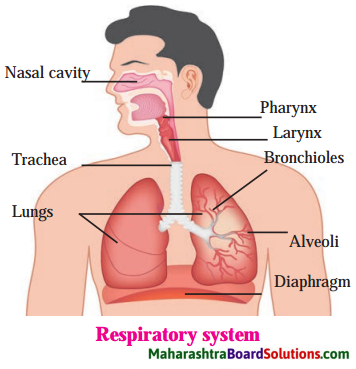
1. Hydrogen has atomic number 1 and electronic configuration 1. That means it has 1 electron in its K shell and its duplet is short of one electron therefore, the valency of hydrogen is one.
Maharashtra Board Class 8 Science Solutions Chapter 13 Chemical Change and Chemical Bond 7

2. The two atoms of hydrogen are identical, they share their electrons with each other.
3. As a result, the electron duplet of both the hydrogen atoms is complete and a covalent band is formed between them.

Maharashtra Board Class 8 Science Solutions Chapter 13 Chemical Change and Chemical Bond

4. There is one covalent bond between the component atoms H and Cl of the molecule HCl. Use this information to represent the formation of HCl molecules from H and Cl atoms diagrammatically.
(Use your brainpower)
Answer:
Hydrogen chloride:
1. Hydrogen has atomic number 1 and electronic configuration 1, that means it has 1 electron in its K shell and its duplet is short of one electron therefore, the valency of hydrogen is one.
Maharashtra Board Class 8 Science Solutions Chapter 13 Chemical Change and Chemical Bond 9

2. On the other hand, chlorine has electronic configuration 2, 8, 7. Chlorine atom has 7 electrons in its outermost shell and requires one electron to complete its octet.

3. The two atoms, hydrogen and chlorine share one electron with each other. As a result, the electron duplet of hydrogen and octet of chlorine is complete and a covalent band is formed between them.

5. Show the formation of the following ionic compounds from the corresponding elements using two methods namely, numerical and diagrammatic representation of electronic configuration.
(a) K+ F, from 19K and 9F, (b) Ca2+ O2- from 20Ca and 8O.
(Use your brainpower)
Answer:
(a) K+F from 19K and 9F
Potassium fluoride:
1. Potassium has atomic number 19 and electronic configuration 2, 8, 8, 1.
2. Potassium atom has 1 electron in its outermost shell.

3. It loses one electron from its outermost shell, i.e. N shell. Then its M shell becomes the outermost shell with a stable octet. The nucleus of potassium atom has 19 protons but the number of electrons in the atom has become 18. So there is a net unit positive charge giving a potassium cation (K+).

4. On the other hand, fluorine has electronic configuration 2, 7. Fluorine has 7 electrons in the outermost shell and requires one electron to complete its octet.

5. Thus, the electron lost by potassium is taken up by chlorine.
Maharashtra Board Class 8 Science Solutions Chapter 13 Chemical Change and Chemical Bond 8
6. When fluorine atom gains one electron, octet of fluorine is completed, its K and L shells have together 10 electrons and the nucleus has 9 protons. This leads to the formation of an ion (F).

7. Thus, a fluorine atom accepts one electron from a potassium atom and consequently a fluoride ion with one unit negative charge and a potassium ion with one unit positive charge are formed.

8. Potassium and fluoride ions, being oppositely charged, attract each other due to electrostatic force of attraction. An ionic bond is formed and this results in the formation of potassium fluoride (KF) molecule.

(b) Ca2+O2- from 20Ca and 8O.
Maharashtra Board Class 8 Science Solutions Chapter 13 Chemical Change and Chemical Bond 15

Distinguish between the following:

Question 1.
Physical change and Chemical change:
Answer:
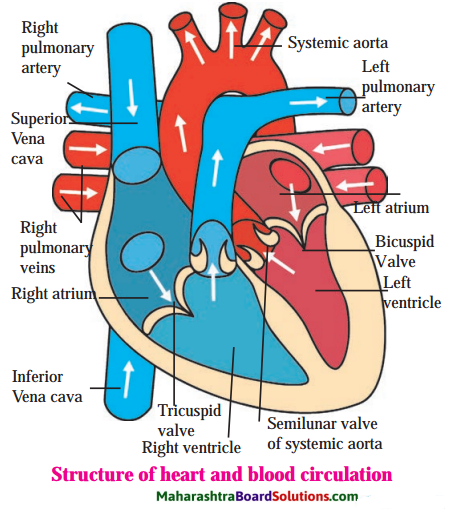
Physical changeChemical change
1. In this change, the composition of the substance does not change. No new substance is formed.1. In this change, the composition of the compounds change and new compounds are formed.
2. In this case, physical properties such as state, colour, density, etc. are changed.2. In this case, physical and chemical properties are entirely changed.
3. This change is temporary.3. This change is permanent.
4. In this case, the original substance can be recovered by simple means or by merely reversing the process.4. In this case, the original substance cannot be recovered by easy means or by reversing the process.

Maharashtra Board Class 8 Science Solutions Chapter 13 Chemical Change and Chemical Bond

Question 2.
Ionic bond and Covalent bond:
Answer:
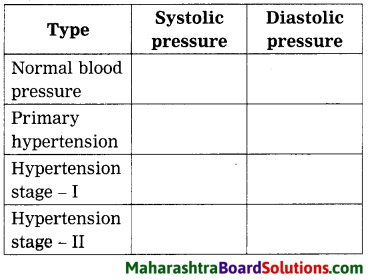
Ionic bondCovalent bond
1.  Ionic bond is formed due to the transfer of electrons from one atom to another.1. Covalent bond is formed due to the sharing of electrons between two or more atoms.
2. Atoms of metals and nonmetals combine to form ionic bonds.2. Atoms of nonmetals combine to form covalent bonds.
3. Molecules of the compounds formed due to ionic bond split up into ions in aqueous solution.3. Molecules of the compounds formed due to covalent bond so not split up into ions in a solution.

Give scientific reasons:

Question 1.
Ionic compounds are formed due to the combination of metallic and nonmetallic atoms.
Answer:
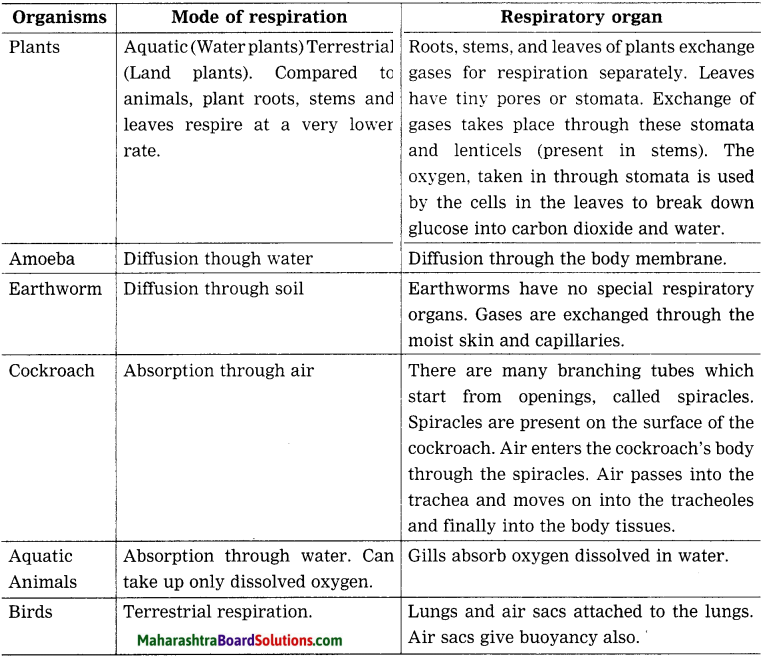
Metallic atoms have a tendency to lose electrons from their outermost orbits to establish the octet state in their penultimate orbits. Conversely, nonmetallic atoms gain electrons to establish the octet state of their outermost orbits.

When a metallic atom and a nonmetallic atom come close together, the metallic atom loses electrons and gets c converted into positively charged ion, while the nonmetallic’ atom gets converted into negatively charged ions so formed, develop an ionic bond and this results in the formation of an ionic compound. Hence, ionic compounds are formed due to the combination of metallic and nonmetallic atoms.

Maharashtra Board Class 8 Science Solutions Chapter 13 Chemical Change and Chemical Bond

Activity-based questions:

Activity 1:
Maharashtra Board Class 8 Science Solutions Chapter 13 Chemical Change and Chemical Bond 17

Take the lemon juice in a clean glass. Take two drops of the lemon juice in a spoon and taste. Add a pinch of baking soda in the glass of lemon juice. Did you notice bubbling around the particles of soda? Did you hear a sound on taking your ear near the glass? Now again taste it. Did it taste as sour as it was in the beginning? (Above activity is to be done using clean apparatus and edible material. Then only it is possible to test the ’taste’, otherwise keep in mind that the testing of ‘taste’ cannot be done.)

Maharashtra Board Class 8 Science Solutions Chapter 13 Chemical Change and Chemical Bond

Activity 2:
Take some freshly prepared lime water (solution of calcium hydroxide) in a test tube. Keep on blowing in it with a blow tube. What is seen after some time? Did the colourless lime water turn milky? After some more time you will find that a white insoluble solid settles at the bottom of the test tube. This is a precipitate of calcium carbonate. The turning lime water milky means that the blown gas mixed in it was carbon dioxide.
Maharashtra Board Class 8 Science Solutions Chapter 13 Chemical Change and Chemical Bond 16

Write a chemical equation for the above word equation.
Chemical equation:
CO2 + Ca(OH)2 → CaCO3 + H2O

Maharashtra Board Class 8 Science Solutions Chapter 10 Cell and Cell Organelles

Balbharti Maharashtra State Board Class 8 Science Solutions Chapter 10 Cell and Cell Organelles Notes, Textbook Exercise Important Questions and Answers.

Maharashtra State Board Class 8 Science Solutions Chapter 10 Cell and Cell Organelles

Class 8 Science Chapter 10 Cell and Cell Organelles Textbook Questions and Answers

1. Who am I?

Question a.
I am ATP producing factory.
Answer:
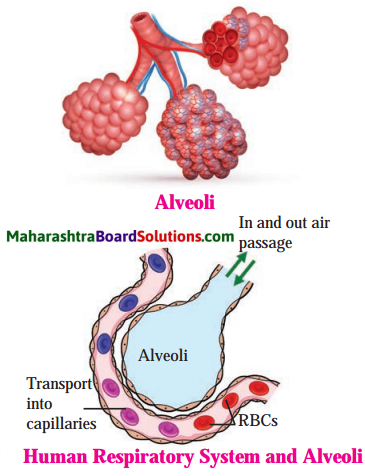
Mitochondria

Question b.
I am single-layered but maintain cellular osmotic pressure.
Answer:
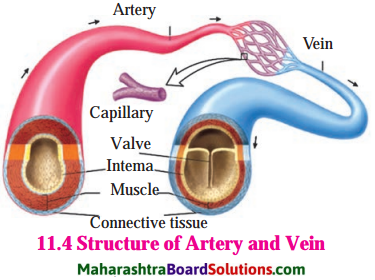
Vacuole

Question c.
I support the cell, but I am not cell wall. I have a body resembling net.
Answer:
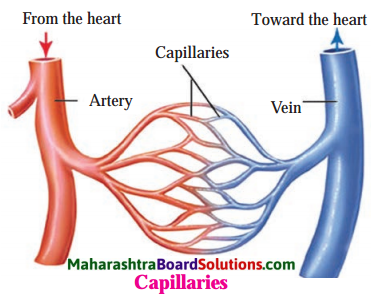
Endoplasmic reticulum

Maharashtra Board Class 8 Science Solutions Chapter 10 Cell and Cell Organelles

Question d.
I am chemical factory of the cell.
Answer:

Chloroplasts in case of plant cells can be called chemical factory as they synthesise carbohydrates. Ribosomes also synthesise proteins, so those can also be called chemical factory. Golgi complex is secretory in function, hence it can be also called factory. Mitochondria though mainly referred to as powerhouse of the cell, it is also mentioned as chemical factory by some authors.

Question e.
Leaves are green because of me.
Answer:
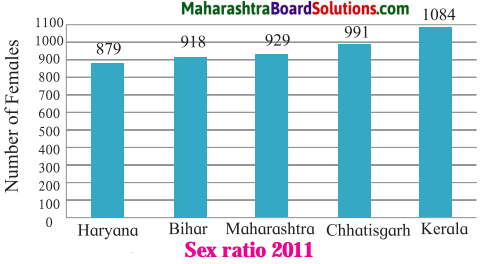
Chloroplast.

2. What would have happened? If……….

Question a.
RBCs had mitochondria.
Answer:
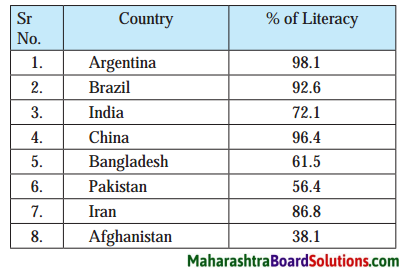
Mitochondria continuously carry out oxidation and form energy inside the cell. They produce energy-rich compound, ATP. In this process, they utilize carbohydrates, fats and proteins present in the cell. If RBCs has mitochondria, they would have used oxygen for this purpose than carrying it to all the cells of the body. The cells would not have obtained oxygen.

Maharashtra Board Class 8 Science Solutions Chapter 10 Cell and Cell Organelles

Question b.
There had been no difference between mitochondria and plastids.
Answer:
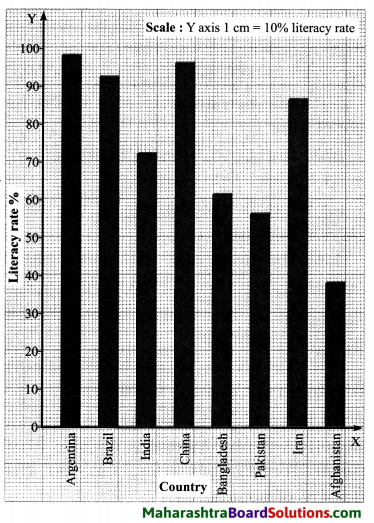
Mitochondria carry out oxidation of carbohydrates, fats, etc. with the help of enzymes. Plastids are synthesising carbohydrates with the help of solar energy and chlorophyll. Both the cell organelles have their own sets of different enzymes as per their role. If there would have been no difference between mitochondria and plastids, the specific functions would not have been taken place.

Question c.
Genes had been absent on the chromosomes.
Answer:
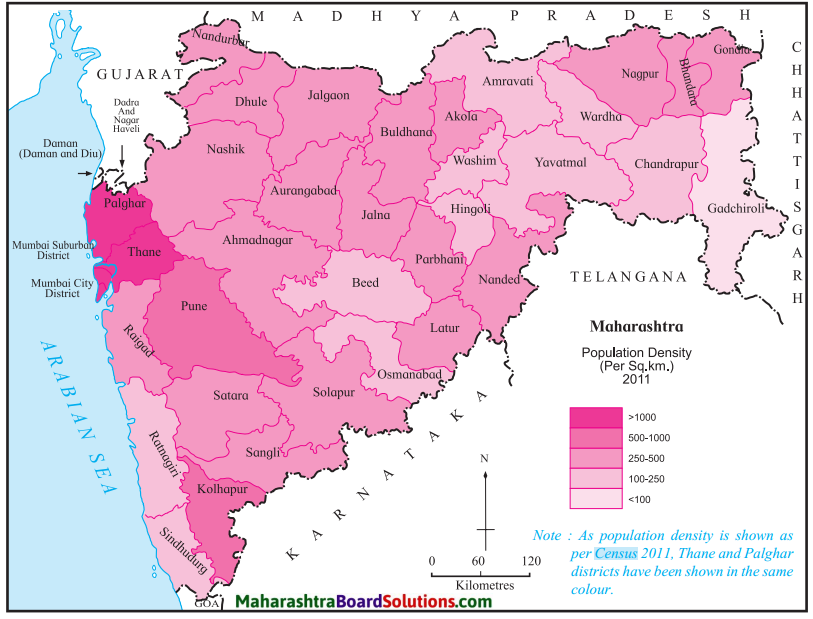
Genes are functional segments on the chromosomes which are responsible for transmitting the hereditary information.

Question d.
Plasma membrane had not been selectively permeable.
Answer:
Selectively permeable membrane allows some substances to enter the cell, while prevents other unwanted or harmful substances. If plasma membrane would not have been selectively permeable, there would be no control over entry and exit of any substances. The process of osmosis would also be erroneous in such case.

Question e.
Plants lacked anthocyanin.
Answer:
If plants lacked anthocyanin, no part of the plant would display purple or blue colour. Anthocyanin attracts the insects for pollination and seed dispersal. These processes will be affected due to lack of anthocyanin. These pigments are also said to be protective in nature for the plant. This protection will not be given to the plant in absence of anthocyanin.

Maharashtra Board Class 8 Science Solutions Chapter 10 Cell and Cell Organelles

3. Who is odd man among us? Give reason.

Question a.
Nucleolus, mitochondria, plastids, endoplasmic reticulum
Answer:
Nucleolus. (All the others are cell organelles but nucleolus is not a cell organelle present in cytoplasm.)

Question b.
DNA, Ribosomes, Chlorophyll
Answer:
Chlorophyll. (DNA and Ribosomes are present in plant as well as in animal cells. Chlorophyll is present only in plant cells.)

4. Give functions.

Question a.
Plasma membrane.
Maharashtra Board Class 8 Science Solutions Chapter 9 Disaster Management 4
Answer:

  1. Plasma membrane acts as a selectively permeable membrane. It allows entry of those useful substances which are needed for the cell. It does not allow entry of the harmful and unwanted substances.
  2. Plasma membrane keeps the homeostasis in the cell. The cell is kept in steady state even if the external environment changes.
  3. Plasma membrane is responsible for processes of endocytosis and exocytosis.
  4. The processes of diffusion and osmosis are possible only due to plasma membrane.
  5. In animal cells, plasma membrane is the outermost protective covering of the cell.

Maharashtra Board Class 8 Science Solutions Chapter 10 Cell and Cell Organelles

Question b.
Cytoplasm.
Answer:

  1. All the cell organelles are spread in the cytoplasm of a cell.
  2. The cytoplasm is the medium for many cellular chemical reactions.
  3. The cytosol which is the part of cytoplasm other than cell organelles stores many vital substances like amino acids, glucose, vitamins, etc.
  4. Cytosol also helps in the cellular movements.

Question c.
Lysosome.
Maharashtra Board Class 8 Science Solutions Chapter 9 Disaster Management 5
Answer:

  1. Lysosome helps in the destruction of attacking viruses and bacteria and thereby help in the immune response.
  2. Lysosomes act as demolition squads. They destroy worn-out cellular organelles and organic debris. This process is called autolysis which All Pagesmeans self-destruction.
  3. They are also called suicide bags as in a worn out, damaged or old cell, lysosomes automatically burst. The lytic enzymes present in the lysosome digest their own cells.
  4. Lysosomes can digest stored proteins, fats during starvation.

Question d.
Vacuole.
Maharashtra Board Class 8 Science Solutions Chapter 9 Disaster Management 6
Answer:

  1. Vacuoles maintain the osmotic pressure of the cell.
  2. Various metabolic byproducts and end products such as glycogen, proteins, water, etc. are stored in the lysosome.
  3. In food vacuole of amoeba, the food is temporarily stored till digestion. In other animal cells, vacuoles can store waste products and food.
  4. Vacuoles of plant cells can provide turgidity and rigidity as it contains good amount of cell sap.

Question e.
Nucleus.
Maharashtra Board Class 8 Science Solutions Chapter 9 Disaster Management 7
Answer:

  1. Nucleus is the controlling centre for the entire cell.
  2. It controls all metabolic activities of the cell.
  3. The cell division is possible due to the nucleus.
  4. The chromosomes present in the nucleus carry the genes. These genes are responsible for the transmission of hereditary characters from parental generation to the next generations.

Maharashtra Board Class 8 Science Solutions Chapter 10 Cell and Cell Organelles

5. Who gives me the colour? (Select the correct option).

Question a.

Column ‘A’Column ‘B’
1. Red tomatoa. Chlorophyll
2. Green leafb. Carotene
3. Carrotc. Anthocyanin
4. Violetd. Lycopene

Answer:

Column ‘A’Column ‘B’
1. Red tomatod. Lycopene
2. Green leafa. Chlorophyll
3. Carrotb. Carotene
4. Violetc. Anthocyanin

Maharashtra Board Class 8 Science Solutions Chapter 10 Cell and Cell Organelles

Project:

Question 1.
Prepare model of a cell using different ecofriendly materials.

Question 2.
Study osmosis using parchment paper or a similar membrane.

Question 3.
Form a friends’ group in your class. Give each one role of a cell organelle. Present a skit accordingly.

Class 8 Science Chapter 10 Cell and Cell Organelles Important Questions and Answers

Rewrite the sentences after filling the blanks:

Question 1.
Cell wall is mainly composed of carbohydrates like ……….. and …………. .
Answer:
Cell wall is mainly composed of carbohydrates like cellulose and pectin.

Question 2.
Plasma membrane is said to be a ……………. …………….. membrane as it allows some substances to enter the cell, while prevents other substances.
Answer:
Plasma membrane is said to be a selectively permeable membrane as it allows some substances to enter the cell, while prevents other substances.

Question 3.
Homeostasis is maintained in the cell by ………….. .
Answer:
Homeostasis is maintained in the cell by plasma membrane.

Maharashtra Board Class 8 Science Solutions Chapter 10 Cell and Cell Organelles

Question 4.
An …………… is a specialized subunit having specific function within the cell.
Answer:
An organelle is a specialized subunit having specific function within the cell.

Question 5.
……………. has ribosome granules on its outer surface.
Answer:
Rough ER has ribosome granules on its outer surface.

Question 6.
During starvation, ………………… digest stored proteins, fats.
Answer:
During starvation, lysosomes digest stored proteins, fats.

Question 7.
……………….. is the secretory organ of the cell.
Answer:
Golgi complex is the secretory organ of the cell.

Maharashtra Board Class 8 Science Solutions Chapter 10 Cell and Cell Organelles

Question 8.
……………. compound ATP is produced in the mitochondria.
Answer:
Energy-rich compound ATP is produced in the mitochondria.

Given below are incorrect statements. Rewrite them after correcting them:

Question 1.
In mitochondria, the inner membrane is porous and the outer membrane is deeply folded.
Answer:
In mitochondria, the outer membrane is porous and the inner membrane is deeply folded.

Question 2.
Vacuole is bound by double membrane.
Answer:
Vacuole is bound by single membrane.

Question 3.
If fruit pieces are kept in thick saturated sugar solution, the water from fruit pieces enter the sugar solution resulting into their swelling.
Answer:
If fruit pieces are kept in a thick saturated sugar solution, the water from fruit pieces enter the sugar solution resulting into their shrinking.

Maharashtra Board Class 8 Science Solutions Chapter 10 Cell and Cell Organelles

Question 4.
Raisins kept in water shrink after an hour.
Answer:
Raisins kept in water swell after an hour.

Question 5.
Lysosome produces vacuoles and secretory vesicles.
Answer:
Golgi complex produces vacuoles and secretory vesicles.

Who gives me the colour? (Select the correct option)

Question 1.

Column ‘A’Column ‘B’
1. Nucleusa. Pipelines of the cell
2. Endoplasmic reticulumb. Powerhouse of the cell
3. Golgi complexc. Suicidal bags
4. Mitochondriad. Packing department
5. Lysosomese. Controlling centre

Answer:

Column ‘A’Column ‘B’
1. Nucleuse. Controlling centre
2. Endoplasmic reticuluma. Pipelines of the cell
3. Golgi complexd. Packing department
4. Mitochondria b. Powerhouse of the cell
5. Lysosomesc. Suicidal bags

Maharashtra Board Class 8 Science Solutions Chapter 10 Cell and Cell Organelles

Find the odd one out by giving suitable reasons:

Question 1.
Demolition squads, Suicide Bags, Immune system, Powerhouse of the cell.
Answer:
A powerhouse of the cell. (All the others are descriptions of the lysosomes.)

Question 2.
Lignin, Suberin, Cutin, Iodine
Answer:
Iodine. (All the others are polymers present in the cell wall.)

Question 3.
Nucleolus, Genes, Chromosomes, Ribosomes
Answer:
Ribosomes. (All the others are inclusions in the nucleus.)

Write definitions/Give meanings:

1. Homeostasis: The tendency of the cell to keep the cellular environment constant in spite of changes in the outer: environment is called homeostasis.

2. Endocytosis: To take in the food or any other substance from outer environment into the cell is called endocytosis.

3. Exocytosis: To give out the unwanted substances from the cell to the outer « environment is called exocytosis.

4. Diffusion: The movement of the molecules from region of higher concentration to the region of lower concentration is called diffusion.

5. Osmosis: The movement of solute from low concentration to high concentration and the movement of solvent from high concentration to the region of low concentration across semipermeable membrane is called osmosis.

6. Plasmolysis: When the cell is kept ?! in hypertonic medium, the water exits through the process of exosmosis causing shrinkage of the cytoplasm, this is known as plasmolysis.

7. Isotonic solution: When the concentration of the cell and that of the medium in which the cell is kept is same, then such solution is called isotonic solution.

8. Hypotonic solution: When the concentration of the water in the cell is less than that of the concentration of the water in the surrounding medium in which the cell is kept, then such solution is called hypotonic solution.

9. Hypertonic solution: When the concentration of the water in the cell is more than that of the concentration of water in the surrounding medium then such solution is called hypertonic solution.

Maharashtra Board Class 8 Science Solutions Chapter 10 Cell and Cell Organelles

Distinguish between the following:

Question 1.
Prokaryotic and eukaryotic cell:
Answer:
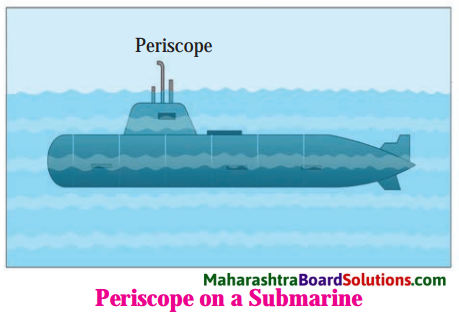
Prokaryotic cellEukaryotic cell
1. Nucleoid is present instead of a well-formed nucleus.1. Nucleus is well-formed with nuclear membrane, chromatin network and nucleolus.
2. Chromosome number is always one.2. Chromosome number is more than one and is specific for every species.
3. Membrane-bound cell organelles are absent.3. There are membrane-bound cell organelles.
4. The size of the cell is 1 to 10 micrometre. Example: Bacteria4. The size of the cell is 5 to 100 micrometre. Example: All highly evolved unicellular and multicellular plants and animals.

Maharashtra Board Class 8 Science Solutions Chapter 10 Cell and Cell Organelles

Question 2.
Plant cell and animal cell
Answer:
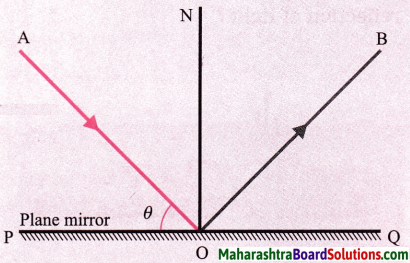
Plant cellAnimal cell
1. The cell wall is the outermost covering on the cell. The plant cells have both cell wall and the cell membrane1. The cell membrane or plasma membrane is the outermost covering of the cell. The animal cells do not have cell wall
2. The vacuoles are large and centrally placed.2. The vacuoles are small and uniformly distributed in the cytoplasm.
3. There are plastids in the plant cells. The chloroplasts have chlorophyll.3. The plastids are absent in the animal cells.
4. The lysosomes are absent in the plant cells.4. Lysosomes are present in the animal cells. They contain digestive enzymes.
5. The cytoplasm is thin and pushed to the periphery due to central vacuole.5. The cytoplasm is dense and granular. It is uniformly spread throughout the cell.

Answer the following questions in one sentence:

Question 1.
What are the components of plasma membrane?
Answer:
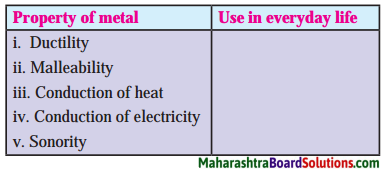
In plasma membrane, protein molecules are embedded in two layers of phospholipids.

Maharashtra Board Class 8 Science Solutions Chapter 10 Cell and Cell Organelles

Question 2.
Which part of the cell maintains the homeostasis?
Answer:
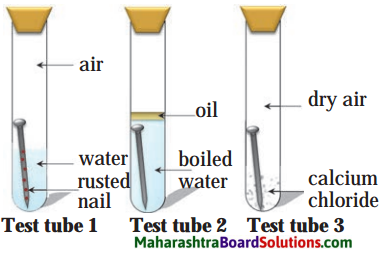
Plasma membrane of the cell maintains the homeostasis.

Question 3.
What are genes?
Answer:
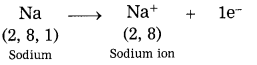
Genes are the functional segments on the chromosomes that carry hereditary i information from the parental generation to the offspring.

Question 4.
What is meant by rough ER?
Answer:
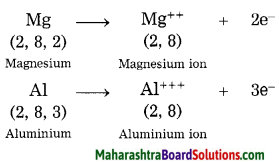
The endoplasmic reticulum that has ribosomes on its outer membrane is called rough ER.

Question 5.
Write the examples of plant pigments.
Answer:
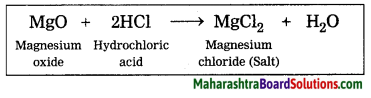
Chlorophyll, Carotene, Xanthophyll, Anthocyanin, Betalains and Lycopene are some of the plant pigments.

Question 6.
What are the inclusions in the stroma of chloroplasts?
Answer:

Enzymes, DNA, ribosomes and carbohydrates that are necessary for photosynthesis are present in the stroma of the chloroplasts.

Maharashtra Board Class 8 Science Solutions Chapter 10 Cell and Cell Organelles

Question 7.
Which staining technique was developed by Camilio Golgi? Where was this technique used?
Answer:

Camilio Golgi developed the staining technique called ‘Black reaction’ which was used in the study of nervous system.

Question 8.
What type of work is done by National Centre for Cell Science?
Answer:

National Centre for Cell Science – NCCS is involved in research in cytology and research about cancer treatment and it also provides services for National Animal cell repository.

Question 9.
Ripe tomatoes appear red.
Answer:
When green tomatoes become ripe they lose chlorophyll and develop red pigment in them called lycopene. Therefore, ripe tomatoes appear red.

Give scientific reasons:

Question 1.
Raisins swell after keeping in plain water.
Answer:
When raisins are placed in plain water, there is action of endosmosis. The outer skin of raisins acts like selectively permeable membrane. Since the concentration of water inside the raisin is lesser than the concentration of water in the outer medium, water enters in the raisin. This causes raisins to swell after keeping them in plain water.

Maharashtra Board Class 8 Science Solutions Chapter 10 Cell and Cell Organelles

Question 2.
The fruit pieces kept in sugar syrup show shrinking.
Answer:
There is more concentration of water in the fruit pieces as compared to the concentration of water in the sugar syrup. Therefore, water is lost out by exosmosis. The membranes of the fruit pieces act as selectively permeable membranes. Thus the process of plasmolysis occurs resulting into shrinking of the fruit pieces.

Question 3.
The nucleus of the sieve tubes of the plant phloem is lost.
Answer:
The sieve tubes of the plant phloem conduct the food in plants. To make this transport easier, the nucleus of the sieve tubes of the plant phloem is lost,

Question 4.
Plant cells have less mitochondria than those of animal cells.
Answer:
Mitochondria are the cell organelles which are called powerhouse of the cell. They produce energy in the form of ATP. Animals are motile and need more energy for walking, running and moving. Plants are stationary. They do not need energy to greater extent. Therefore, they have lesser number of mitochondria.

Question 5.
Vacuoles do not have any typical size or shape.
Answer:
Vacuoles change their shape and size as per the need of the cell. Thus they do not have any fixed shape or size.

Maharashtra Board Class 8 Science Solutions Chapter 10 Cell and Cell Organelles

Question 6.
Ripe tomatoes appear red.
Answer:
When green tomatoes become ripe they lose chlorophyll and develop red pigment in them called lycopene. Therefore, ripe tomatoes appear red.

Give functions:

Question 1.
Endoplasmic reticulum.
Maharashtra Board Class 8 Science Solutions Chapter 9 Disaster Management 8
Answer:

  1. Endoplasmic reticulum or ER is the supporting framework of the cell.
  2. The ribosomes attached to the membrane of the ER synthesize proteins. These proteins are conducted by ER.
  3. The detoxification process is done by ER. The toxins that enter the cell through food, air and water are removed out by making them water soluble.

Question 2.
Golgi complex.
Maharashtra Board Class 8 Science Solutions Chapter 9 Disaster Management 9
Answer:

  1. Different secretions are prepared in the Golgi complex. Hence it is called the secretory organ of the cell.
  2. The secretions are modified and sorted out as per their functions. They are further packed.
  3. The enzymes, mucus, proteins, pigments, etc. are sorted and then dispatched to various target regions like plasma membrane, lysosome, etc.
  4. Golgi complex also produces vacuoles and secretory vesicles.
  5. Formation of cell wall, plasma membrane and lysosomes is aided by Golgi complex.

Maharashtra Board Class 8 Science Solutions Chapter 10 Cell and Cell Organelles

Question 3.
Plastids.
Answer:

  1. Chloroplasts contain chlorophyll. They carry out the process of photosynthesis. They convert solar energy to chemical energy in the form of food.
  2. Chromoplasts with different pigments can impart different colours to flowers and fruits.
  3. Leucoplasts are responsible for the synthesis and storage of food like starch, oils and proteins.

Answer the following questions:

Question 1.
How does endosmosis and exosmosis occur in the cell?
Answer:

  1. When the water concentration inside the cell is less as compared to the medium in which it is present, then the endosmosis takes place. This makes the water to enter inside the cell.
  2. When water concentration inside the cell is more than the water concentration in the medium in which it is present, then the water comes out of the cell. This is called exosmosis.
  3. Since the cell membrane acts as a semipermeable membrane, the processes of endosmosis and exosmosis takes place in the cell.

Question 2.
What is cytoplasm? What are the constituents of cytoplasm?
Answer:

  1. The jelly like material present between the cell membrane and nucleus is called cytoplasm.
  2. Cytoplasm without cell organelles is called cytosol.
  3. All the cell organelles are spread in the cytoplasm.
  4. Cytosol stores many vital constituents such as amino acids, glucose, vitamins, etc.
  5. The cytoplasm of animal cells is dense and granular while that of plant cells is thin and peripheral. It is pushed to sides due to large central vacuole.

Question 3.
Describe the structure of the nucleus in the cell.
Maharashtra Board Class 8 Science Solutions Chapter 9 Disaster Management 7
Answer:

  1. Nucleus is the most important part of the eukaryotic cell.
  2. Inside the nucleus there is round darkly stained nucleolus.
  3. The nucleus is covered over by double membrane which is porous.
  4. The nuclear pores allow the transport of different substances in and out of the nucleus to cytoplasm.
  5. Inside the nucleus is the chromatin network which contains chromosomes. Chromatin fibres are thin which condense to form chromosomes. The chromosomes become clear and distinct at the time of cell division.
  6. In every cell there are specific number of chromosomes. Chromosomes contain genes which are bearers of hereditary characters.

Maharashtra Board Class 8 Science Solutions Chapter 10 Cell and Cell Organelles

Question 4.
Why is endoplasmic reticulum compared with the pipelines?
Answer:

  1. The endoplasmic reticulum works as pipelines to carry different substances in the cell.
  2. It is a net like structure consisting of interconnected small tubes and sheets filled with fluid.
  3. On the inner side the E.R. is connected to nucleus while at the outer side it is in contact with plasma membrane. Therefore, it works like a pipeline.

Question 5.
Write an account of the different structures seen in Golgi complex.
Answer:

  1. Golgi complex is made up of 5-8 hollow and flat sacs called cisternae.
  2. These are placed parallel to each other and are filled with different enzymes.
  3. Golgi complex has two faces called forming face and maturation face.
  4. The proteins packed in vesicles and coming from ER reach Golgi complex through cytoplasm.
  5. They fuse with the formation face of the Golgi membranes for emptying their contents in the cisternae.
  6. When these contents pass through the cisternae, they are chemically modified with the help of enzymes and are again packed in the vesicles.
  7. These vesicles come out of Golgi ‘ complex at the maturation face.

Question 6.
How is energy produced in the mitochondria? How the structures of mitochondria help in this process?
Answer:

  1. Around every mitochondrion there is a double membrane.
  2. The outer membrane of these is porous while the inner membrane is deeply folded.
  3. These folds or ‘cristae’ enclose the matrix filled with proteinaceous gel containing ribosomes, phosphate granules and DNA. Protein synthesis takes place in this matrix.
  4. Mitochondria carry out oxidation of carbohydrates and fats in the cell. This produces energy in the form of ATP, s i.e. Adenosine Tri Phosphate

Maharashtra Board Class 8 Science Solutions Chapter 10 Cell and Cell Organelles

Question 7.
What is the benefit of foldings of inner membrane in mitochondria?
Maharashtra Board Class 8 Science Solutions Chapter 9 Disaster Management 16
Answer:
The structure of the inner mitochondrial membrane is extensively folded and compartmentalized. The numerous imaginations of the membrane are called cristae. This folded inner membrane increases the area which is about 5 times more than that the outer membrane due to cristae. Cristae membranes have small round protein complexes known as Fx particles. In these particles the process of energy production goes on.

Research:

Question 1.
Keep 4 – 5 raisins in water and observe after an hour. Afterward, keep the same raisins in sugar solution and observe after an hour. Note down the observations and discuss in the classroom.
Answer:
When raisins are kept in water its outer skin acts as a semi-permeable membrane. The water content inside the raisin is lesser as compared to the water content in the outside medium. Therefore the water enters in the raisins due to process of endosmosis. Thus if raisins kept in plain water are observed after one hour, they are seen to be swollen.

On the other hand, if raisins are kept in sugar solution, they show plasmolysis and they shrink. The sugar solution acts as hypertonic medium. Water content in the raisin is higher than that present in the sugary solution. Thus water exists from raisins and its content thus shrinks.

Maharashtra Board Class 8 Science Solutions Chapter 10 Cell and Cell Organelles

Question 2.
Wooden doors fit very tightly in rainy season. Why does it happen?
Answer:
During rainy season there is more humidity in air. The doors get soaked in rain water. Though wood is non-living, it has the ability to absorb water. As the moisture is more in the surrounding area, it enters the wood. This is a type of endosmosis. It causes the doors to swell. The swollen doors then fit very tightly.

Diagram based questions:

Question 1.
Structure of the cell:
Maharashtra Board Class 8 Science Solutions Chapter 9 Disaster Management 10
Answer:
Maharashtra Board Class 8 Science Solutions Chapter 9 Disaster Management 11

(iii) Complete the chart:

Maharashtra Board Class 8 Science Solutions Chapter 9 Disaster Management 12
Answer:

ComponentAnimal cellPlant cell
Cell membranePresentPresent
Cell wallAbsentPresent
LysosomesPresentAbsent
PlastidsAbsentPresent
Endoplasmic reticulumPresentPresent
VocuolePresentPresent
Golgi complexPresentPresent
MitochondriaPresentPresent

Maharashtra Board Class 8 Science Solutions Chapter 10 Cell and Cell Organelles

Question 2.
Sketch the diagrams to show how osmosis occurs in plant cell if kept separately in isotonic, hypotonic and hypertonic medium.
Answer:
Maharashtra Board Class 8 Science Solutions Chapter 9 Disaster Management 13

Question 3.
Sketch the diagrams to show how osmosis occurs in animal cell if kept separately in isotonic, hypotonic and hypertonic medium
Answer:
Maharashtra Board Class 8 Science Solutions Chapter 9 Disaster Management 14

Activity-based questions:

Question 1.
Experiment Activity – Take a drop of water on a clean glass slide. Using an ice-cream spoon, gently scrap the inner surface of your cheek. With a needle, transfer a little material from spoon to the water drop on the slide and spread it evenly. Put a drop of methylene blue stain on the smear. Put a cover slip and observe under microscope. Did you observe the cells with blue nucleus?
Answer:
Students should do this activity at school laboratory. There are squamous epithelial cells in the inner side of the cheek. When stained with methylene blue the nucleus takes up dark stain and can be seen clearly.

Maharashtra Board Class 8 Science Solutions Chapter 10 Cell and Cell Organelles

Question 2.
Experiment Activity – Take out a thin peel of Rheo or Croton leaf and observe the chromoplasts under the compound microscope.
Answer:
Students are expected to do the observations in the school laboratory.

Question 3.
Can you recall? Observe the cells of onion peel under the microscope. Have you seen the fully turgid, rectangular cells of onion peelings?
Maharashtra Board Class 8 Science Solutions Chapter 9 Disaster Management 15
Answer:
Students are expected to do the observations in the school laboratory.

Maharashtra Board Class 8 Science Solutions Chapter 16 Reflection of Light

Balbharti Maharashtra State Board Class 8 Science Solutions Chapter 16 Reflection of Light Notes, Textbook Exercise Important Questions and Answers.

Maharashtra State Board Class 8 Science Solutions Chapter 16 Reflection of Light

Class 8 Science Chapter 16 Reflection of Light Textbook Questions and Answers

1. Fill in the blanks:

Question i.
The perpendicular to the mirror at the point of incidence is called …………. .
Answer:
The perpendicular to the mirror at the point of incidence is called the normal.

Question ii.
The reflection of light from a wooden surface is ……….. reflection.
Answer:
The reflection of light from a wooden surface is irregular reflection.

Maharashtra Board Class 8 Science Solutions Chapter 16 Reflection of Light

Question iii.
The working of a kaleidoscope is based on the properties of …………… .
Answer:
The working of a kaleidoscope is based on the properties of reflection of light.

2. Draw a figure describing the following: The reflecting surfaces of two mirrors make an angle of 90° with each other. If a ray incident on one mirror has an angle of incidence of 30°, i draw the ray reflected from the second mirror. What will be its angle of reflection?

Question a.
Draw a figure describing the following: The reflecting surfaces of two mirrors make an angle of 90° with each other. If a ray incident on one mirror has an angle of incidence of 30°, draw the ray reflected from the second mirror. What will be its angle of reflection?
Answer:
For the ray C, the angle of reflection = 60°.
Maharashtra Board Class 8 Science Solutions Chapter 16 Reflection of Light 1

3. How will you explain the statement ‘We cannot see the objects in a dark room’?

Question a.
How will you explain the statement ‘We cannot see the objects in a dark room’?
Answer:
In a room that is completely dark, no light falls on objects. Hence, no light enters our eyes. Hence, there is no sensation of vision, i.e., we cannot see the objects.

4. Explain the difference between regular and irregular reflection of light.

Question a.
Explain the difference between regular and irregular reflection of light.
Answer:
For regular reflection of light, the angles of incidence as well as the angles of reflection are the same for all parallel rays of light incident on the plane and smooth surface. Hence, the reflected rays are also parallel to one another.

For irregular reflection of light, the angles of incidence for parallel rays of light incident on the rough surface are not equal, and hence the angles of reflection are also not equal. Here, the reflected rays are not parallel to one another and spread over a large surface.

Maharashtra Board Class 8 Science Solutions Chapter 16 Reflection of Light

5. Draw a figure showing the following:
(a) Incident ray, (b) Normal, (c) Angle of incidence, (d) Angle of reflection, (e) Point of incidence, (f) Reflected ray.

Question a.
Draw a figure showing the following:
(a) Incident ray
(b) Normal
(c) Angle of incidence
(d) Angle of reflection
(e) Point of incidence
(f) Reflected ray.
Answer:
Maharashtra Board Class 8 Science Solutions Chapter 16 Reflection of Light 2.2

6. Study the following incident.

Swara and Yash were looking in a water-filled vessel. They could see their images clearly in the still water. At that instant, Yash threw a stone in the water. Now their images were blurred. Swara could not understand the reason for the blurring of the images.
Explain the reason for blurring of the images to Swara by answering the following questions:

Question i.
Is there a relation between the reflection of light and the blurring of the images?
Answer:
Yes.

Maharashtra Board Class 8 Science Solutions Chapter 16 Reflection of Light

Question ii.
Which types of reflection of light can you notice from this?
Answer:
Regular reflection of light when light is incident on the still water and irregular reflection of light when light is incident on the water as ripples are produced on its surface when a stone is thrown in the water.
Still water behaves as a plane and smooth surface while oscillating water behaves as a rough surface.

Question iii.
Are the laws of reflection followed in these types of reflection?
Answer:
Yes.

7. Solve the following examples.

Question a.
If the angle between the plane mirror and the incident ray is 40°, what are the angles of incidence and reflection?
Solution:
The angle between the plane mirror and the incident ray is 40°. Therefore, the angle of incidence (i) = the angle made by the incident ray with the normal to the plane mirror = 90° – 40° = 50°. The angle of reflection, r – i – 50°.

Maharashtra Board Class 8 Science Solutions Chapter 16 Reflection of Light

Question b.
If the angle between the mirror and reflected ray is 23°, what is the angle of incidence of the incident ray?
Solution:
The angle between the mirror and the reflected ray is 23°. Therefore, the angle of reflection (r) = the angle made by the reflected ray with the normal to the plane mirror = 90° – 23° = 67°.
∴ The angle of incidence, i = r = 67°.

Project:

Question a.
Apollo astronauts who stepped on the moon have kept some large mirrors there. Collect information about how the distance to the moon is measured using these.

Maharashtra Board Class 8 Science Solutions Chapter 16 Reflection of Light 5

Class 8 Science Chapter 16 Reflection of Light Important Questions and Answers

Rewrite the following statements by selecting the correct option:

Question 1.
If the angle made by the incident ray with the surface of a plane mirror is 30°, the angle of reflection must be …….. .
(a) 30°
(b) 90°
(c) 60°
(d) 15°
Answer:
If the angle made by the incident ray with the surface of a plane mirror is 30°, the angle of reflection must be 60°.

Question 2.
If the angle of incidence is 40°, the angle made by the reflected ray with the surface of the plane mirror must be ……. .
(a) 40°
(b) 50°
(c) 20°
(d) 80°
Answer:
If the angle of incidence is 40°, the angle made by the reflected ray with the surface of the plane mirror must be 50°.

Maharashtra Board Class 8 Science Solutions Chapter 16 Reflection of Light

Question 3.
If the angle of incidence is 20°, the angle made by the reflected ray with the normal to the surface must be ……… .
(a) 20°
(b) 70°
(c) 10°
(d) 40°
Answer:
If the angle of incidence is 20°, the angle made by the reflected ray with the normal to the surface must be 20°.

Question 4.
In a kaleidoscope, the mirrors are inclined to each other at ……. .
(a) 60°
(b) 30°
(c) 45°
(d) 90°
Answer:
In a kaleidoscope, the mirrors are inclined to each other at 60°.

Question 5.
In a periscope, the mirrors are ………….. .
(a) parallel to each other
(b) at right angles to each other
(c) inclined at 45° to each other
(d) inclined at 60° to each other
Answer:
In a periscope, the mirrors are parallel to each other.

Maharashtra Board Class 8 Science Solutions Chapter 16 Reflection of Light

Find the odd one out and give the reason:

Question 1.
Plane mirror, Plywood, Wood, Rough tile.
Answer:
Plane mirror. In this case, regular reflection of light takes place. In other cases, reflection of light is irregular.

State whether the following statements are True or False. (If a statement is false, correct it and rewrite it.)

Question 1.
The sense of vision is the most important among our five senses.
Answer:
True.

Question 2.
In a periscope, the angle between the incident ray and the normal to the mirror is 30°.
Answer:
False. (In a periscope, the angle between the incident ray and the normal to the mirror is 45°.)

Answer the following questions in one sentence each:

Question 1.
What is an incident ray?
OR
Define incident ray.
Answer:
A ray of light falling on a surface is called an incident ray.

Question 2.
What is the point of incidence?
OR
Define point of incidence.
Answer:
The point at which the incident ray strikes the surface is called the point of incidence.
[Note: It is also the point of reflection.]

Maharashtra Board Class 8 Science Solutions Chapter 16 Reflection of Light

Question 3.
What is the normal?
OR
Define normal.
Answer:
The perpendicular to a surface at the point of incidence is called the normal.

Question 4.
What is the reflected ray?
OR
Define reflected ray.
Answer:
The ray of light that leaves the surface at the point of reflection (the same as the point of incidence) is called the reflected ray.

Question 5.
What is the angle of incidence?
OR
Define angle of incidence.
Answer:
The angle between the incident ray and the normal is called the angle of incidence.

Question 6.
What is the angle of reflection?
OR
Define angle of reflection.
Answer:
The angle between the reflected ray and the normal is called the angle of reflection.

Maharashtra Board Class 8 Science Solutions Chapter 16 Reflection of Light

Try this:

Switch off the light in your room at night for some time and then turn it on again.

Question 1.
Could you see the objects in the room clearly when the light was switched off?
Ans.
No.

Question 2.
What did you feel when it was turned on again?
Answer:
We could see the objects clearly. From the above activity you can notice that there is some connection between the sense of vision and light. When we switch off the light at night, the objects in the room cannot be seen and they can be seen as before when the light is switched on again. Thus, we can see objects when the light coming from these objects enters our eyes.

Answer the following questions:

Question 1.
What is reflection of light?
Answer:
When light rays fall on an object, their direction changes and they turn back. This is called the reflection of light.

Try this:

Material:
Torch light, mirror, a stand for hanging the mirror, black paper, comb, white paper, drawing board.
Activity :
1. Fit a white paper tightly over a table or drawing board.
2. Leaving out some portion in the middle of the comb, cover the rest with black paper so that light can only pass through the open central portion.
3. Hold the comb perpendicular to the white paper and throw torch light on its central portion.
4. Adjust the comb and torch so as to get light rays on the white paper. Now keep a mirror in the path of this ray of light as shown in the figure.
5. What do you observe?
Maharashtra Board Class 8 Science Solutions Chapter 16 Reflection of Light 3
Answer:
Light rays which fall on the mirror get reflected and travel in a different direction.

Maharashtra Board Class 8 Science Solutions Chapter 16 Reflection of Light

Question 2.
State the laws of reflection of light.
Answer:

  1. The angle of reflection is equal to the angle of incidence.
  2. The incident ray, the reflected ray and the normal lie in the same plane.
  3. The incident ray and the reflected ray are on the opposite sides of the normal.

Try this:

Verification of the laws of reflection of light.
Equipment: Mirror, drawing board, pins, white paper, protractor, scale, pencil.
Activity:

  1. Fit a white paper on the drawing board tightly as possible.
  2. On the paper draw a line PQ indicating the position of the mirror.
  3. Draw a perpendicular ON to PQ at point O.
  4. Draw a ray AO making an angle of 30° with ON.
  5. Fix two pins S and R along AO.
  6. Fix the mirror to a stand and place it along PQ perpendicular to the drawing board.
  7. Fix pins at T and U along the line joining the bottom of the reflected images of the pins at S and R.
  8. Remove the mirror and join the points T and U and extend it up to O.
  9. Measure ZTON.
  10. Repeat steps 4 to 9 for angle of incidence equal to 45° and 60° and write down the angles in the following table.

Maharashtra Board Class 8 Science Solutions Chapter 16 Reflection of Light 4

What relation do you find between the angle of incidence and the angle of reflection? If you have done the experiment carefully, you will find that the angle of incidence is equal to the angle of reflection in all three cases. This verifies the laws of reflection.

Question a.
What will happen when a light ray is incident perpendicular to the mirror?
Answer:
Maharashtra Board Class 8 Science Solutions Chapter 16 Reflection of Light 6
Here,
r = i = 90°.
Hence the light ray, on reflection, will retrace the path.

Maharashtra Board Class 8 Science Solutions Chapter 16 Reflection of Light

Question 3.
Figures (a) and (b) show three parallel rays, shown in grey, incident on smooth and rough surfaces. The reflected rays drawn using laws of reflection are shown in red.
1. Rays reflected from which surface are parallel to one another?
2. What conclusion can you draw from the figure?
Answer:
1. Rays reflected from the smooth surface are parallel to one another.

Maharashtra Board Class 8 Science Solutions Chapter 16 Reflection of Light 7

2.When the reflecting surface is plane and smooth, the angles of incidence (i) as well as of reflection (r) are the same for all parallel rays incident on the surface. If i1, i2, i3, … are the angles of incidence for incident parallel rays, and r1, r2, r3, …, are the corresponding angles of reflection, then, i1 = i2 = i3 = ……. = r1 = r2 = r3 = ….. This is called regular reflection. Here, the reflected rays are parallel to one another. If the reflecting surface is rough and parallel rays are incident on it, then the angles of incidence are not equal and hence the angles of reflection are also not equal. Here, i1 ≠ i2 ≠ i3 … and r1 ≠ r2 ≠ r3 …, but r1 = i1, r2 = i2, r3 = i3 … as laws of reflection are obeyed. This is called irregular reflection. [Fig.(b)]. Here, the reflected rays are not parallel to one another and spread over a large surface.

Question 4.
What is regular reflection of light?
Answer:
The reflection of light from a plane and smooth surface is called regular reflection of light.

Question 5.
What is irregular reflection of light?
Answer:
The reflection of light from a rough surface is called irregular reflection of light.

Maharashtra Board Class 8 Science Solutions Chapter 16 Reflection of Light

Always remember:

  1. Laws of reflection are followed in both and regular and irregular reflection.
  2. The reflection of light in irregular reflection has not been obtained because the laws of reflection are not followed. They are obtained because the surface is rough (irregular).
  3. In irregular reflection, the angles of incidence at different points are different. But at any one point, the angles of incidence and reflection are equal, i.e. i1 = r1, i2 = r2 …..

Can you recall?

Reflection of reflected light :

Question 1.
How do you see if the barber m a saloon has cut the hair on your neck properly or not?
Answer:
In a saloon, there are mirrors in your front and at back. The image of the back of your head is formed in the mirror at the back. The image of this image is formed in the mirror in front of you. Thus you can see how the hair at the backside of your head is cut.

Question 2.
What type of image do we see in a mirror? What happens to the left and right sides?
Answer:
The image in a plane mirror is upright (erect) and of the same size as the object, but the left and right sides are interchanged. Our right hand appears to be the left hand in the image and the left hand appears to be the right hand in the image. (This is called lateral inversion.)

Question 3.
How do we see the image of the moon in water?
Answer:
The moon is not self luminous. The sunlight falling on the surface of the moon is reflected. This reflected light is again reflected by water to give us the image of the moon.

Maharashtra Board Class 8 Science Solutions Chapter 16 Reflection of Light

Try this:

Kaleidoscope:

Maharashtra Board Class 8 Science Solutions Chapter 16 Reflection of Light 8

Activity:

  1. Take three rectangular mirrors of the same size.
  2. Using sticking tape, stick the mirrors together making a triangle with the reflecting surface facing inwards (see Fig.).
  3. Take a white paper of triangular shape and fix it with a tape at one end of the mirrors closing that end.
  4. Insert 4 – 5 coloured glass pieces in the hollow of the mirrors.
  5. Close the other end also with a paper and make a hole in it.
  6. Look through the hole towards light. You will see innumerable images of the glass pieces. These are formed due to reflections by the three mirrors.

You can see different designs in the kaleidoscope. The speciality of a kaleidoscope is that the designs do not easily repeat themselves. Every time the design is different. People making wall papers which are used to decorate walls and cloth designers use a kaleidoscope for making new designs.

Periscope:
Activity:

  1. Take a cardboard box. Make slits in the top and bottom sides of the box and place two mirrors so that they make an angle of 45° with the sides of the box and are parallel to each other. Fix them with a sticking tape.
  2. Make two windows of 1 inch each near the two mirrors. Now see through the bottom window.
  3. Make note of what you see.

Maharashtra Board Class 8 Science Solutions Chapter 16 Reflection of Light 9
From the bottom window, one can see what is in front of the top window. This device is called a periscope. This is used in submarines to see objects above the surface of water. It is also used to observe and keep a watch on the objects or persons on the ground from an underground bunker. The kaleidoscope and periscope both use the properties of reflection of light.
Maharashtra Board Class 8 Science Solutions Chapter 16 Reflection of Light 10
[Note: In a periscope, the angle of incidence is 45° and the two plane mirrors are parallel to each other. Hence, the emergent ray is parallel to the incident ray.]

Maharashtra Board Class 8 Science Solutions Chapter 16 Reflection of Light

Example questions for practice:

Question 1.
If the angle between the plane mirror and the incident ray is 20°, what is the angle between the reflected ray
and the plane mirror?
Answer:
20°.

Question 2.
See Fig. In terms of O, what are the angles (i) AON (ii) BON (iii) AOB (iv) BOQ?
Maharashtra Board Class 8 Science Solutions Chapter 16 Reflection of Light 11
Answer:
(i) 90° – θ (ii) 90° – θ (iii) 180° – 2θ

Maharashtra Board Class 8 Science Solutions Chapter 7 Metals and Nonmetals

Balbharti Maharashtra State Board Class 8 Science Solutions Chapter 7 Metals and Nonmetals Notes, Textbook Exercise Important Questions and Answers.

Maharashtra State Board Class 8 Science Solutions Chapter 7 Metals and Nonmetals

Class 8 Science Chapter 7 Metals and Nonmetals Textbook Questions and Answers

1. Complete the table:

Question a.
Maharashtra Board Class 8 Science Solutions Chapter 7 Metals and Nonmetals 1
Answer:

Property of metalUse in everyday life
i. Ductilityi. Gold, silver ornaments
ii. Malleabilityii. Aluminium sheets, galvanised sheets
iii. Conduction of heatiii. Stainless steel vessels, copper vessels, boilers
iv. Conduction of electricityiv. Copper wires
v. Sonorityv. Brass articles

Maharashtra Board Class 8 Science Solutions Chapter 7 Metals and Nonmetals

2. Identify the odd term.

Question a.
Gold, Silver, Iron, Diamond.
Answer:
Diamond. (Others are metals.)

Question b.
Ductility, Brittleness, Sonority, Malleability.
Answer:
Brittleness. (Other properties are metallic properties.)

Question c.
Carbon, Bromine, Sulphur, Phosphorus.
Answer:
Bromine. (Others are solids.)

Question d.
Brass, Bronze, Iron, Steel.
Answer:
Iron. (Others are alloys.)

3. Give scientific reasons:

Question a.
The stainless steel vessels in kitchen have copper coating on the bottom.
Answer:

  1. Stainless steel is an alloy of iron ; with carbon, chromium and nickel.
  2. The conductivity of copper is higher than that of iron in steel. Copper heats uniformly and faster. The time for cooking is reduced, as a result it saves fuel. Hence, the stainless steel vessels in kitchen have copper coating on the bottom.

Maharashtra Board Class 8 Science Solutions Chapter 7 Metals and Nonmetals

Question b.
Copper and brass vessels are cleaned with lemon.
Answer:

  1. Copper undergoes oxidation in air to form black copper oxide. Copper oxide reacts slowly with carbon dioxide in air and gains a green coat. This green substance is copper carbonate.
  2. Lemon contains acid. The acid dissolves the green coating of basic copper carbonate present on the surface of a tarnished copper and brass vessels and makes them shiny again.

Question c.
Sodium metal is kept in kerosene.
Answer:

  1. Sodium reacts so vigorously with atmospheric oxygen and water that it catches fire if kept in the open.
  2. It does not react with kerosene and sinks in it. Hence, to protect sodium and to prevent accidental fires it is always kept in kerosene.

4. Answer the following: 

Question a.
What is done to prevent corrosion of metals?
Answer:
By applying a layer of paint, oil, grease or varnish on the surface of a metal to prevent corrosion. Also plating with noncorroding metal is done. Iron is coated with thin layer of zinc. Due to these processes the contact of metal surface with air is lost and corrosion is prevented.

Question b.
What are the metals that make the alloys brass and bronze?
Answer:
The alloy brass is formed from copper and zinc and the alloy bronze is formed from copper and tin.

Maharashtra Board Class 8 Science Solutions Chapter 7 Metals and Nonmetals

Question c.
What are the adverse effects of i corrosion?
Answer:

  1. A reddish coloured deposit (rust) is formed on iron by reaction with oxygen gas.
  2. A greenish coloured deposit (copper carbonate) is formed on copper by reaction with carbon dioxide.
  3. A blackish coloured deposit is formed (silver sulphide) on silver.
  4. Corrosion causes damages to car bodies, bridges, iron railings, ships specially those of iron, silver articles and copper vessels.

Question c.
What are the uses of noble metals?
Answer:
Uses of Noble Metals:

  1. Gold, silver and platinum are used to prepare ornaments.
  2. Silver is used in medicines. (It has antibacterial property).
  3. Gold and silver are also used to make metals and few electronic devices.
  4. Platinum, palladium metals are used as catalyst.

Maharashtra Board Class 8 Science Solutions Chapter 7 Metals and Nonmetals

5. Three experiments to study the process of rusting are given below. Observe the three test tubes and answer the following questions.

Maharashtra Board Class 8 Science Solutions Chapter 7 Metals and Nonmetals 2

Question a.
Why the nail in the test tube 2 is not rusted?
Answer:
In the test tube 2, oil cuts the supply of air to nail due to which oxidation of nail is prevented and boiled water is free from gases. Hence, the nail in the test tube 2 is not rusted.

Question b.
Why is the nail in the test tube 1 is rusted highly?
Answer:
The nail in the test tube 1 is highly rusted because nail is in contact with water and air. The oxidation process is fast.

Maharashtra Board Class 8 Science Solutions Chapter 7 Metals and Nonmetals

Question c.
Would the nail in the test tube 3 get rusted?
Answer:
No change is observed in the test tube 3. Nail remains as it is because the calcium chloride absorbs moisture, making the air dry, thus preventing rusting of the nail.

Project:

Question a.
How is the Varkha or silver foil used in sweets made? Collect the information about which metals are used to make ‘Varkha’.

Class 8 Science Chapter 7 Metals and Nonmetals Additional Important Questions and Answers

Rewrite the sentences after filling the blanks:

Question 1.
Gold of 100% purity is …………… carat gold.
Answer:
Gold of 100% purity is 24 carat gold.

Question 2.
The stainless steel utensils used at home are made of an alloy of iron with carbon, …………… and ……….. .
Answer:
The stainless steel utensils used at home are made of an alloy of iron with carbon, nickel and chromium.

Question 3.
…………….. is used in medicines.
Answer:
Silver is used in medicines.

Maharashtra Board Class 8 Science Solutions Chapter 7 Metals and Nonmetals

Question 4.
To prepare ornaments ………… carat gold is used.
Answer:
To prepare ornaments 22 carat gold is used.

Question 5.
Non-metals are ………… conductors of heat and electricity.
Answer:
Non-metals are bad conductors of heat and electricity.

Question 6.
Non-metals form ………….. oxides.
Answer:
Non-metals form acidic oxides.

Question 7.
Some element can be hammered into thin sheets. This property is called …………….. .
Answer:
Some element can be hammered into thin sheets. This property is called malleability.

Question 8.
Iodine and ……………. are the two non – metals having typical metallic lustre.
Answer:
Iodine and diamond are the two non¬metals having typical metallic lustre.

Question 9.
Non-metals form ………. ions by gain of electrons.
Answer:
Non-metals form negative ions by gain of electrons.

Maharashtra Board Class 8 Science Solutions Chapter 7 Metals and Nonmetals

Question 10.
During formation of positively charged ion, atom of metal ………….. .
Answer:
During formation of positively charged ion, atom of metal lose electrons.

Rewrite the following statements by selecting the correct options:

Question 1.
Metalloids have properties of …………. .
(a) metals
(b) non-metals
(c) both metals and non-metals
(d) neither metals nor non-metals
Answer:
(c) both metals and non-metals

Question 2.
………….. is a metal.
(a) Hg
(b) S
(c) P
(d) Br
Answer:
(a) Hg

Question 3.
…………… is a non-metal.
(a) Aug
(b) Ag
(c) Br
(d) Cu
Answer:
(c) Br

Maharashtra Board Class 8 Science Solutions Chapter 7 Metals and Nonmetals

Question 4.
……………. is a metalloid.
(a) Aluminium
(b) Antimony
(c) Zinc
(d) Mercury
Answer:
(b) Antimony

Question 5.
……………. is a metal which is in liquid form at ordinary temperature.
(a) Gallium
(b) Magnesium
(c) Sodium
(d) Scandium
Answer:
(a) Gallium

Question 6.
…………….. is an acidic oxide.
(a) Na2O
(b) CO2
(c) FeOs
(d) H2O
Answer:
(b) CO2

Question 7.
The valence electron in …………… atom is 1.
(a) magnesium
(b) sodium
(c) silicon
(d) aluminium
Answer:
(b) sodium

Maharashtra Board Class 8 Science Solutions Chapter 7 Metals and Nonmetals

Question 8.
The electronic configuration of oxygen is …………….. .
(a) 2, 5
(b) 2, 6
(c) 2, 4
(d) 2, 8, 6
Answer:
(b) 2, 6

Question 9.
Pure ………… is soft.
(a) aluminium
(b) silver
(c) gold
(d) platinum
Answer:
(c) gold

Question 10.
…………… is a highly malleable metal.
(a) Iron
(b) Nickel
(c) Manganese
(d) Aluminium
Answer:
(d) Aluminium

Question 11.
22 carat gold is gold of …………… purity.
(a) 100%
(b) 91.66%
(c) 75%
(d) 44%
Answer:
(b) 91.66%

State whether the following statements are True or False:

Question 1.
Metals are sonorous.
Answer:
True.

Maharashtra Board Class 8 Science Solutions Chapter 7 Metals and Nonmetals

Question 2.
Diamond is the softest natural substance.
Answer:
False. (Diamond is the hardest natural substance.)

Question 3.
The density of lithium is lower than water.
Answer:
True.

Question 4.
Sulphur is brown in colour.
Answer:
False. (Sulphur is yellow in colour.)

Question 5.
Germanium is a metalloid.
Answer:
True.

Question 6.
Ornaments are made from 24 carat gold.
Answer:
False. (Ornaments are made from 22 carat gold.)

Question 7.
A reddish coloured deposit is formed on iron by reaction with oxygen.
Answer:
True.

Maharashtra Board Class 8 Science Solutions Chapter 7 Metals and Nonmetals

Question 8.
Paladium and rhodium are noble metals.
Answer:
True.

Question 9.
The metal oxides are acidic in nature.
Answer:
False. (The metal oxides are basic in nature.)

Question 10.
The metal reacts with dilute acids to form a metal salt.
Answer:
True.

Identify the odd term:

Question 1.
Magnesium, Mercury, Sodium, Iron.
Answer:
Mercury. (Others metals are in solid state at normal temperature.)

Question 2.
Magnesium, Aluminium, Sulphur, Copper.
Answer:
Sulphur. (Others are metals.)

Maharashtra Board Class 8 Science Solutions Chapter 7 Metals and Nonmetals

Question 3.
Iron, Copper, Graphite, Phosphorus.
Answer:
Phosphorus. (Others are good conductors of electricity.)

Question 4.
Tin, Bronze, Steel, Stainless steel.
Answer:
Tin. (Others are alloys.)

Consider the relation between the items in the first pair and write the correlation for second pair:

Question 1.
Mercury : Metal : : Carbon : …………. .
Answer:
Non-metal

Question 2.
Wood : Bad conductor of electricity : : Copper : ………………… .
Answer:
Good conductor or electricity

Question 3.
Gold : Noble metal : : Copper: ……………. .
Answer:
Metal

Maharashtra Board Class 8 Science Solutions Chapter 7 Metals and Nonmetals

Question 4.
Iron and carbon : Steel : : Copper and Tin : ……….. .
Answer:
Bronze

Question 5.
0 : 2, 6 : : Mg : …………….. .
Answer:
2, 8, 2.

Match the columns:

Question 1.

Column ‘A’Column ‘B’
1. Coppera. Low melting point
2. Sodiumb. Liquid
3. Magnesiumc. High melting point
4. Borond. Conduction of heat
e. 2, 8, 2

Answer:

Column ‘A’Column ‘B’
1. Copperd. Conduction of heat
2. Sodiuma. Low melting point
3. Magnesiume. 2, 8, 2
4. Boronc. High melting point

Maharashtra Board Class 8 Science Solutions Chapter 7 Metals and Nonmetals

Question 2.

Column ‘A’Column ‘B’
1. Silvera. Copper + tin
2. Mercuryb. Medicines
3. Platinumc. Thermometer
4. Brassd. Catalyst

Answer:

Column ‘A’Column ‘B’
1. Silverb. Medicines
2. Mercuryc. Thermometer
3.Platinumd. Catalyst
4. Brassa. Copper + tin

Define the following:

  1. Ductility: The property due to which a substance can be drawn into a thin wire is called ductility.
  2. Malleability: The property due to which a substance can be hammered into a thin sheet is called malleability.
  3. Metalloids: The element which shows the properties of metals as well as those of non-metals is called a metalloid.
  4. Corrosion: Gases in the air react with metals in presence of moisture to form metal compounds on its surface, this destroys the metal gradually and is called corrosion.
  5. Alloy: A homogeneous mixture of two or more metals or a homogeneous mixture of metal with non-metals is called alloy.

Maharashtra Board Class 8 Science Solutions Chapter 7 Metals and Nonmetals

Answer the following questions in one sentence:

Question 1.
Name an alloy of copper and tin.
Answer:
An alloy of copper and tin is termed as bronze.

Question 2.
Name a metal which is in liquid state at ordinary temperature.
Answer:
Mercury is in liquid state at ordinary temperature.

Question 3.
Name two metals which are malleable.
Answer:
Iron and aluminium are malleable metals.

Question 4.
Name two metals which are ductile.
Answer:
Gold and silver are ductile metals.

Question 5.
Name two metals which are good conductors of heat.
Answer:
Silver and copper are good conductors of heat.

Maharashtra Board Class 8 Science Solutions Chapter 7 Metals and Nonmetals

Question 6.
Name two metals which are good conductors of electricity.
Answer:
Copper and aluminium are good conductors of electricity.

Question 7.
Name two non-metals which are in solid state at room temperature.
Answer:
Carbon and sulphur are solids at room temperature.

Question 8.
Name two non-metals which are in gaseous state at room temperature.
Answer:
Hydrogen and oxygen are in gaseous state at room temperature.

Question 9.
Name the non-metal having electrical conductivity.
Answer:
Graphite has electrical conductivity.

Question 10.
Name two non-metals which are lustrous.
Answer:
Iodine and diamond are lustrous in nature.

Question 11.
Name two non-metals having high melting points.
Answer:
Carbon and boron melt at high temperature.

Question 12.
State two metals which can be cut easily with a knife.
Answer:
Sodium and potassium are soft metals and can be cut easily with a knife.

Maharashtra Board Class 8 Science Solutions Chapter 7 Metals and Nonmetals

Question 13.
Which is the hardest natural substance?
Answer:
Diamond, which is a form of carbon is the hardest natural substance.

Question 14.
State the property of the metals for which they can be drawn into wires.
Answer:
The property of the metals due to which they can be drawn into wires is called ductility.

Question 15.
State the property of the metals due to which they can be beaten into thin sheets.
Answer:
The property of the metals due to which they can be beaten into thin sheets is called malleability.

Question 16.
Which of the following metals react with cold water? Sodium, iron, copper, potassium.
Answer:
Sodium and potassium metals react with cold water.

Maharashtra Board Class 8 Science Solutions Chapter 7 Metals and Nonmetals

Question 17.
Which of the following metals do not react with cold water or hot water?
Answer:
Aluminium and iron do not react with cold water or hot water.

Question 18.
What are the constituents of stainless steel?
Answer:
Iron with carbon, chromium and nickel are the constituents of stainless steel.

Question 19.
State the term used to express the purity of gold.
Answer:
The purity of gold is expressed in carat.

Question 20.
Name two metals having low melting points and boiling points.
Answer:
Sodium and potassium having low melting points and boiling points.

Question 21.
Name a non-metal which is in liquid state at room temperature.
Answer:
Bromine is in liquid state at room temperature.

Question 22.
State the atomic number and electronic configuration of sodium.
Answer:
Atomic number of sodium: 11.
Electronic configuration of sodium (Na): 2, 8, 1.

Maharashtra Board Class 8 Science Solutions Chapter 7 Metals and Nonmetals

Question 23.
State the atomic number and electronic configuration of aluminium.
Answer:
Atomic number of aluminium: 13.
Electronic configuration of aluminium (Al): 2, 8, 3.

Question 24.
Give two example of metalloids.
Answer:
Metalloids: Arsenic (As),
germanium (Ge), antimony (Sb).

Question 25.
State the atomic number and electronic configuration of nitrogen.
Answer:
Atomic number of nitrogen: 7.
Electronic configuration of nitrogen (N): 2, 5.

Answer the following questions:

Question 1.
A metal can be drawn into a wire. Explain why.
Answer:

  1. The property due to which a substance can be draw into a thin wire is called ductility.
  2. Metals are ductile. Thus, a metal can be draw into a wire.

Maharashtra Board Class 8 Science Solutions Chapter 7 Metals and Nonmetals

Question 2.
A metal can be hammered into a i thin sheet. Explain why.
Answer:

  1. The property due to which a substance can be hammered (or rolled) into a thin sheet without cracking is called malleability.
  2. Metals are malleable. Thus, a metal can be hammered to form a thin sheet.

Question 3.
State the properties of metals.
Answer:

  1. Metals have a lustre.
  2. Metals are malleable. They can be beaten into thin sheets.
  3. Metals are ductile. They can be drawn into wires.
  4. They are good conductors of heat and electricity.
  5. At ordinary temperature, metals are generally solid. (Exception: Mercury is liquid.)
  6. Metals usually have high density.

Question 4.
State the properties of non-metals.
Answer:

  1. Non-metals lack lustre.
  2. As non-metals are brittle, they are not malleable.
  3. They are not ductile.
  4. Non-metals are poor conductors of heat and electricity.
  5. At ordinary temperature, non-metals are in the solid or gaseous state. (Exception: Bromine is liquid.)
  6. Non-metals have low density in the solid state.

Maharashtra Board Class 8 Science Solutions Chapter 7 Metals and Nonmetals

Question 5.
How are metal ions formed? Give two examples.
Answer:
Metals have a tendency to lose their valence electrons to form positively charged ions, called cations.
Examples:
Maharashtra Board Class 8 Science Solutions Chapter 7 Metals and Nonmetals 3
Maharashtra Board Class 8 Science Solutions Chapter 7 Metals and Nonmetals 4

Question 6.
Classify the following elements into metals and non-metals :
Silicon, gold, silver, sulphur, carbon, aluminium, copper and phosphorus.
Answer:
Metals: Gold, silver, aluminium and copper.
Non-metals: Silicon, sulphur, carbon and phosphorus.

Question 7.
How are metal oxides formed? Explain with an example.
Answer:
Metals combine with oxygen in the ’ air to form their oxides.
Metal + Oxygen → Metal oxide
[Note: Reaction/explanation given in the screen are for better understanding of students. The same are not given in the textbook.]
When magnesium burns in air, it combines with oxygen to form magnesium oxide.
2Mg + O2 → 2MgO
Magnesium Oxygen Magnesium oxide

Maharashtra Board Class 8 Science Solutions Chapter 7 Metals and Nonmetals

Question 8.
How will you show that metal oxides are basic in nature?
Answer:
1. Take magnesium oxide in a test S tube. Add water in the test-tube. Shake the test-tube. Test the solution with red and blue litmus paper. Blue litmus paper remains as it is while red litmus paper turns blue. This shows that metal oxides are basic in nature.

2. Metal oxides react with an acid to form salt and water. Therefore, metal oxides are basic in nature.
Metal oxide + Acid → + Water
Maharashtra Board Class 8 Science Solutions Chapter 7 Metals and Nonmetals 5

Question 9.
How do metals react with acid? Explain with an example.
Answer:
The metals react with dilute acids to form metal salts. Metals liberate hydrogen gas from dilute acids.
Metal + Dilute acid → Metal salt + Hydrogen gas.
Magnesium reacts with dilute HCl to form magnesium chloride and hydrogen gas.
Maharashtra Board Class 8 Science Solutions Chapter 7 Metals and Nonmetals 6

Question 10.
How do metals react with water? Explain with an example.
Answer:
Most metals do not react with cold water. But some metals like sodium and potassium react with cold water to form their hydroxides and hydrogen gas.
Sodium reacts with water to form sodium hydroxide.
Maharashtra Board Class 8 Science Solutions Chapter 7 Metals and Nonmetals 7

Question 11.
How do non-metals react with oxygen? Explain with an example.
Answer:
Non-metals combine with oxyen to form their oxides.
Non-metal + Oxygen → Non-metal oxide
When carbon burns in air, it combines with oxygen to form carbon dioxide.
Maharashtra Board Class 8 Science Solutions Chapter 7 Metals and Nonmetals 8

Question 12.
How will you show that non- metal oxides are acidic in nature?
Answer:
1. Take non-metal oxide in a test tube. Add water in the test tube. Test the solution with blue and red litmus paper. Red litmus paper remains as it is while blue litmus paper turns red. This shows that non¬metal oxides are acidic in nature.

2. The oxides of non-metals are acidic in nature. They react with bases to form soluble salt and water. Therefore, non-metal oxides are acidic in nature.
C + O2 → CO2
CO2 + 2NaOH → Na2CO3 + H2O

Maharashtra Board Class 8 Science Solutions Chapter 7 Metals and Nonmetals

Question 13.
How are non-metal ions formed? Give two examples.
Answer: Non-metals have a tendency to accept electrons in their valence shell to form negatively charged ions called anions.
Examples:
Maharashtra Board Class 8 Science Solutions Chapter 7 Metals and Nonmetals 9

Question 14.
What is meant by noble metals? Give two examples.
Answer:
Some metals like gold, silver, platinum, paladium and rhodium are found in nature in the form of elements. They are not affected by air, water, acids and heat etc. Hence, they are called noble metals.

Give scientific reasons:

Question 1.
Ornaments are generally not made from 24-carat gold.
Answer:

  1. 24-carat gold is considered as gold of 100% purity.
  2. 24-carat pure gold is very soft. 100% pure gold breaks due to pressure or gets bent easily. Therefore, ornaments are generally not made from 24-carat gold.

Maharashtra Board Class 8 Science Solutions Chapter 7 Metals and Nonmetalsc

Question 2.
Ships are painted at frequent intervals.
Answer:
1. The metal sheets of ships are made from iron.
2. Due to salty seawater, the metal sheets of ships get rusted and corroded. Paints contain metals like zinc or magnesium. This prevents the metal surface of the ship coming into direct contact with salty seawater. Therefore, ships are painted at frequent intervals.

Question 3.
Gold and platinum are called noble elements.
Answer:

  1. The metals such as gold and platinum are found in nature in the form of elements.
  2. They are not affected by water, air, acids, heat and also do not take part in chemical reactions. Hence, they are called noble metals.

Explain the following reactions with the help of balanced equations:

Question 1.
Magnesium combines with oxygen.
Answer:
Magnesium combines with oxygen to form magnesium oxide.
Maharashtra Board Class 8 Science Solutions Chapter 7 Metals and Nonmetals 10

Question 2.
Magnesium oxide reacts with dilute HCl.
Answer:
When magnesium oxide reacts with dilute HCl, magnesium chloride (salt) and water are formed.
Maharashtra Board Class 8 Science Solutions Chapter 7 Metals and Nonmetals 11

Maharashtra Board Class 8 Science Solutions Chapter 7 Metals and Nonmetals

Question 3.
Magnesium reacts with dilute HCl.
Answer:
When magnesium reacts with dil.
hydrochloric acid, magnesium chloride is formed and hydrogen gas is evolved.
Maharashtra Board Class 8 Science Solutions Chapter 7 Metals and Nonmetals 12

Question 4.
Sodium reacts with water.
Answer:
When sodium reacts with water, sodium hydroxide and hydrogen gas are formed.
Maharashtra Board Class 8 Science Solutions Chapter 7 Metals and Nonmetals 13

Question 5.
Carbon burns in air.
Answer:
When carbon burns in air, carbon dioxide is formed.
Maharashtra Board Class 8 Science Solutions Chapter 7 Metals and Nonmetals 14

Question 6.
Carbon dioxide reacts with sodium hydroxide.
Answer:
When carbon dioxide reacts with sodium hydroxide, soluble salt sodium ; carbonate and water are formed.
Maharashtra Board Class 8 Science Solutions Chapter 7 Metals and Nonmetals 15

Maharashtra Board Class 8 Science Solutions Chapter 7 Metals and Nonmetals

Question 7.
Carbon dioxide reacts with water.
Answer:
When carbon dioxide reacts with water, carbonic acid is formed.
Maharashtra Board Class 8 Science Solutions Chapter 7 Metals and Nonmetals 16

Question 8.
Sulphur dioxide reacts with water.
Answer:
When sulphur dioxide reacts with water, sulphurous acid is formed.
Maharashtra Board Class 8 Science Solutions Chapter 7 Metals and Nonmetals 17

Question 9.
Sulphur trioxide reacts with water.
Answer:
When sulphur trioxide reacts with water, sulphuric acid is formed.
Maharashtra Board Class 8 Science Solutions Chapter 7 Metals and Nonmetals 18

Write short notes:

Question 1.
The noble metals.
Answer:
Some metals like gold, silver, platinum, paladium and rhodium are found in nature in the form of elements. They are not affected by air, water, acids and heat etc. Hence, they are called noble metals.

Uses of Nobel Metals:

  1. Gold, silver and platinum are used to prepare ornaments.
  2. Silver is used in medicines. (It has antibacterial property).
  3. Gold and silver are also used to make metals and few electronic devices.
  4. Platinum, palladium metals are used as catalyst. .

Maharashtra Board Class 8 Science Solutions Chapter 7 Metals and Nonmetals

Question 2.
The purity of gold.
Answer:
1. The purity of gold is measured in carats.
2. Twenty-four carat gold is considered as gold of 100% purity.
3. 24-carat pure gold is very soft. 100% pure gold bends easily or breaks due to pressure. Therefore, copper or silver is added to gold in the necessary proportion (while making ornaments).
4. Generally, 22-carat gold is used in making ornaments.

Percentage of goldCarat
100%24
91.66%22
75%18
58.33%14
50%12
41.66%10

Question 3.
Corrosion.
Answer:
Corrosion: Gases in the air react with metals in presence of moisture to form metal compounds on its surface, this destroys the metal gradually and is called corrosion.

By applying a layer of paint, oil, grease or varnish on the surface of a metal to prevent corrosion. Also plating with noncorroding metal is done. Iron is coated with thin layer of zinc. Due to these processes, the contact of a metal surface with air is lost and corrosion is prevented.

  1. A reddish coloured deposit (rust) is formed on iron by reaction with oxygen gas.
  2. A greenish coloured deposit (copper carbonate) is formed on copper by reaction with carbon dioxide.
  3. A blackish coloured deposit is formed (silver sulphide) on silver.
  4. Corrosion causes damages to car bodies, bridges, iron railings, ships specially those of iron, silver articles and copper vessels.

Maharashtra Board Class 8 Science Solutions Chapter 7 Metals and Nonmetals

Question 4.
Alloys.
Answer:

  1. A homogeneous mixture of two or more metals or of metals and non-metals is called an alloy.
  2. They contain metals in specific proportions.
  3. The physical properties of an alloy are different from those of its constituents, but chemical properties remain the same.
  4. Copper and tin are used to make an alloy called bronze. It is hard and corrosion resistant.
  5. When iron and carbon are mixed, an alloy steel is formed. It is a stronger material.
  6. The alloy, stainless steel is made from iron, carbon, nickel and chromium. It is more durable, clean and does not rust.

Distinguish between the following:

Question 1.
Metals and Non-metals
Answer:

MetalsNon-metals
1. Metals have lustre.1. Non-metals do not have lustre.
2. Metals are malleable.2. Non-metals are not malleable.
3. Metals are ductile.3. Non-metals are not ductile.
4. Metals are good conductors of heat and electricity.4. Non-metals are poor conductors of heat and electricity.
5. At room temperature, metals are in the solid state. (Exception : Mercury is liquid.)5. At room temperature, non-metals are in the solid, or gaseous state. (Exception Bromine. It is in liquid state.)
6. Generally, metals have high densities.6. Generally, non-metals have lower densities.


Maharashtra Board Class 8 Geography Solutions Chapter 1 Local Time and Standard Time

Balbharti Maharashtra State Board Class 8 Geography Solutions Chapter 1 Local Time and Standard Time Notes, Textbook Exercise Important Questions and Answers.

Maharashtra State Board Class 8 Geography Solutions Chapter 1 Local Time and Standard Time

Class 8 Geography Chapter 1 Local Time and Standard Time Textbook Questions and Answers

1. Complete the sentence by selecting the correct option:

Question a.
The earth requires 24 hours for one rotation. In one hour, ……………. .
(a) 5 longitudes will face the sun
(b) 10 longitudes will face the sun
(c) 15 longitudes will face the sun
(d) 20 longitudes will face the sun
Answer:
(c) 15 longitudes will face the sun

Question b.
To calculate the difference between the local times of any two places on the earth, …………. .
(a) the noon time at both the places should be known
(b) the difference in degrees of their longitudes should be known
(c) the difference in standard times of both the places should be known
(d) changes need to be made according to International Date Line.
Answer:
(b) the difference in degrees of their longitudes should be known

Maharashtra Board Class 8 Geography Solutions Chapter 1 Local Time and Standard Time

Question c.
The difference between the local time of any two consecutive longitudes is …………… .
(a) 15 minutes
(b) 04 minutes
(c) 30 minutes
(d) 60 minutes
Answer:
(b) 04 minutes

2. Give geographical reasons for the following:

Question a.
The local time is decided by the noontime.
Answer:
1. When at a particular place, the sun reaches the maximum height in the sky it is assumed that almost half of the daytime is over and this time is considered 12 noon.

2. The time of a particular place as decided by the overhead position of the sun in the sky is considered as the local time of that place.

3. During the rotation of the earth, when a particular longitude comes exactly in front of the sun, it is considered as noontime (12 noon) on that longitude. This noontime is considered as local time of that longitude.

In this way, the local time is decided by the noontime.

Maharashtra Board Class 8 Geography Solutions Chapter 1 Local Time and Standard Time

Question b.
The local time at Greenwich is considered to be the International Standard Time.
Answer:

  1. The International Standard Time has been decided according to 0° longitude.
  2. 0° longitude passes through Greenwich, England.
  3. For an international coordination, it is essential to bring compatibility between the standard times of various countries in the world.

For this purpose, the local time at Greenwich is considered to be the International Standard Time.

Question c.
The standard time of India has been decided by the local time at 82°30′ E longitude.
Answer:

  1. With respect to the longitudinal extent, 82°30’E longitude passes through the middle of India.
  2. The difference between the local time at 82°30’E longitude and the local time at the extreme east and west longitude passing through India is not more than one hour.

Therefore, the standard time of India has been decided by the local time at 82°30’E longitude.

Question d.
Canada has 6 different standard times.
Answer:

  1. The longitudinal extent of Canada is between 52°37′ W and 141° W.
  2. Thus, the difference between the extreme east and west longitude passing through Canada is of 88 degrees.
  3. The difference between the local time at extreme east and west longitude passing through Canada is of 352 minutes i.e. 5 hours and 52 minutes.

Therefore, it is not practically helpful to consider single standard time in Canada. Therefore, for synchronizing the routine activities in the country, Canada has 6 different standard times.

Maharashtra Board Class 8 Geography Solutions Chapter 1 Local Time and Standard Time

3. Answer in brief:

Question a.
If it is 12 noon at 60° E longitude, then explain what would be the time at 30° W longitude.
Answer:
1. The difference between 60° E longitude and 30° W longitude will be of 90 degrees. (The difference of 60 degrees between 0° and 60° E + the difference of 30 degrees between 0° and 30° W = 90 degrees.)

2. Difference in local time = 90 × 4
= 360 minutes.
= 360 minutes ÷ 60 minutes = 6 hours.
3. Longitudes lying to the east of any longitude are ahead of the time of that longitude while those lying to the west are behind.
4. Therefore, if it is 12 noon at 60° E longitude, then it would be 6 a.m. at 30° W longitude, (behind by 6 hours)

Question b.
How is the standard time of a place determined?
Answer:
1. The local time at the longitude passing through the middle of a country/ place is generally considered as a standard time of that country/place.

2. If the difference between the local time at the extreme east and west longitude passing through a country is less than one or two hours, one standard time is considered for a country. Thus, there exists only one standard time in a country having comparatively less longitudinal (east-west) extent.

3. If the difference between the local time at the extreme east and west longitude passing through a country is more than one or two hours, more than one standard time zones are considered for a country. Thus, there exists more than one standard time zones in a country having comparatively more longitudinal (east-west) extent.

Question c.
A football match being played at Sao Paulo, Brazil started in India at 6 a.m. IST. Explain what would be the local time at Sao Paulo?
Answer:
1. Statement: For any longitude lying to the west of particular longitude, the local time decreases by 4 minutes for every longitude. (Sao Paulo is located to the west of India)

2. The difference between the longitudes of Sao Paulo and India = 127°30’.

3. Difference in local time = 127.5 × 4
= 510 minutes.
= 510 minutes ÷ 60 minutes
= 8 hours 30 minutes.

4. Thus, if it is 6 a.m. at India, it would be 9.30 p.m. of the previous day at Sao Paulo. Therefore, if a football match being played at Sao Paulo, Brazil started in India at 6 a.m. 1ST, the local time at Sao Paulo would be 9.30 p.m. of previous day.

Maharashtra Board Class 8 Geography Solutions Chapter 1 Local Time and Standard Time

4. Complete the following table:

If it is 10 pm on 21st June at Prime Meridian, write the dates and time at A, B and C in the following table:
(Note: The answer is given directly.)

Question 1.
Maharashtra Board Class 8 Geography Solutions Chapter 1 Local Time and Standard Time 1
Answer:
Maharashtra Board Class 8 Geography Solutions Chapter 1 Local Time and Standard Time 2

5. Write the situation of place A shown in these diagrams in the boxes below them:

Question 1.
Write the situation of place A shown in these diagrams in the boxes below them
(i) Sunrise
(ii) Midnight
(iii) Noon
(iv) Sunset
Maharashtra Board Class 8 Geography Solutions Chapter 1 Local Time and Standard Time 3
Answer:

Maharashtra Board Class 8 Geography Solutions Chapter 1 Local Time and Standard Time 4.1

Let’s recall: 

Question 1.
Why does the duration of day and night keep changing?
Answer:
The duration of day and night keeps changing as the earth is tilted at an angle of 23.5 degrees.

Maharashtra Board Class 8 Geography Solutions Chapter 1 Local Time and Standard Time

Question 2.
How many longitudes can be drawn on a world map keeping an interval of 1° each?
Answer:
360 longitudes can be drawn on a world map keeping an interval of 10 each.

Question 3.
The apparent movement of the sun from east to west is a result of what?
Answer:
The apparent movement of the sun from east to west is a result of the rotation of the earth from west to east.

Question 4.
What is the direction of the rotation of the earth?
Answer:
The direction of the rotation of the earth is from west to east.

Question 5.
While the earth rotates, how many longitudes face the sun daily?
Answer:
While the earth rotates, 360 longitudes face the sun dally.

Question 6.
At which longitude does the date change?
Answer:
The date changes at 1800 longitude.

Maharashtra Board Class 8 Geography Solutions Chapter 1 Local Time and Standard Time

Question 7.
How was the time measured in olden days?
Answer:
In olden days, the time was measured with the help of the natural events of sunrise and sunset and the instruments like Ghatikapaatra, sand timer, etc.

Question 8.
In present tunes, what are the instruments used for time measurement?
Answer:
In present times, the instruments like watches, calendars, etc. are used for time measurement.

Maharashtra Board Class 8 Geography Solutions Chapter 1 Local Time and Standard Time

Activity:

Question 1.
Look for the actual granny’s clock in Shri Acharya Atre’s poem: “Aajiche Ghadyal” (Granny’s clock). Look for this poem on the internet or in reference book.

Question 2.
Find out the velocity of the earth’s rotation in km/hour.

Class 8 Geography Chapter 1 Local Time and Standard Time Additional Important Questions and Answers

Complete the sentence by selecting the correct option:

Question a.
There are …………. time zones in the world.
(a) 360
(b) 24
(c) 100
(d) 365
Answer:
(b) 24

Maharashtra Board Class 8 Geography Solutions Chapter 1 Local Time and Standard Time

Question b.
Indian Standard Time is …………..
(a) ahead of Greenwich Mean Time by 5 hours 30 minutes
(b) ahead of Greenwich Mean Time by 3 hours 50 minutes
(c) behind Greenwich Mean Time by 5 hours 30 minutes
(d) behind Greenwich Mean Time by 3 hours 50 minutes
Answer:
(a) ahead of Greenwich Mean Time by 5 hours 30 minutes

Examine the following statements and correct the incorrect ones:

Question 1.
Mumbai is located at 73° E longitude.
Answer:
Correct.

Question 2.
In India, three standard times exist.
Answer:
Incorrect.
Correct statement: In India, one standard time exists.

Question 3.
If the difference between two longitudes is of 20 degrees, the difference in their local times will be of four hours.
Answer:
Incorrect.
Correct statement: If the difference between two longitudes is of 20 degrees, the difference in their local times will be of 1 hour and 20 minutes.

Answer the following questions in one sentence each:

Question 1.
Think about it.
Question a.
What is the maximum number of local times that can there be in the world?
Answer:
The maximum number of local times that can be there in the world is 360.

Maharashtra Board Class 8 Geography Solutions Chapter 1 Local Time and Standard Time

Question b.
How many longitudes pass the sun in one hour?
Answer:
15 longitudes pass the sun in one hour.

Question 2.
How much time does the earth take to complete one rotation?
Answer:
The earth takes nearly 24 hours to complete one rotation.

Question 3.
What is meant by the local time of a place?
Answer:
When the sun is directly overhead at a particular place, it is considered as noon at that place and that time is considered as a local time of that place.

Solve the following:

1. Try this:

Question A.
Mashad, a town in Iran, is located on the 60° E longitude. When it is 12 noon at Greenwich, calculate the local time of Mashad town.
Answer:
1. Statement: As we move towards the east of the Prime Meridian, the local time increases by four minutes for every longitude. (Mashad is located to the east of Greenwich.)

2. The difference between the longitudes of Greenwich and Mashad = 60°.

3. Difference in local time
= 60 × 4
= 240 minutes.
= 240 minutes ÷ 60 minutes
= 4 hours. ‘

4. Therefore, when it is noon at Greenwich, it would be 4 p.m. at Mashad. (Ahead of Greenwich Mean Time by 4 hours.)

Maharashtra Board Class 8 Geography Solutions Chapter 1 Local Time and Standard Time

Question B.
Manaus city in Brazil is located on 60° W longitude. What would be the local time at Manaus when it is 12 noon at Greenwich?
Answer:
1. Statement: As we move towards the west of the Prime Meridian, the local time decrease by four minutes for every longitude. (Manaus is located to the west of Greenwich.)

2. The difference between the longitudes of Greenwich and Manaus = 60°.

3. Difference in local time = 60 × 4
= 240 minutes.
= 240 minutes ÷ 60 minutes
= 4 hours.

4. Therefore, when it is noon at Greenwich, it would be 8 a.m. at Manaus. (Behind Greenwich Mean Time by 4 hours.)

2. Can you tell?

Question A.
Mumbai is located at 73° E longitude. Kolkata is located at 88° E longitude. Find the difference between the longitudes of these two cities.
Answer:
Mumbai is located at 73° E longitude. Kolkata is located at 88° E longitude. Therefore, the difference between the longitudes of these two cities would be of (88 – 73 = 15) 15°.

Question B.
If the local time at Mumbai is 3 p.m. then what would be the local time at Kolkata?
Answer:
1. Statement: For any longitude lying to the east of particular longitude, the local time increases by 4 minutes for every longitude.

2. The difference between the longitudes of Mumbai and Kolkata = 15°.

3. Difference in local time = 15 × 4
= 60 minutes.
= 60 minutes -r- 60 minutes = 1 hour.

4. Kolkata is located to the east of Mumbai. Therefore, if it is 3 p.m. at Mumbai, then it would be 4 p.m. at Kolkata. (ahead by 1 hour)

Answer the following questions in brief:

Question a.
Give brief information about the Indian Standard Time.
Answer:
1. The Indian Standard Time (IST) is calculated on the basis of 82°30’E longitude, passing through Mirzapur, near Allahabad in Uttar Pradesh.

2. With respect to longitudinal extent, 82°30′ E longitude passes through the middle of India.

3. When the sun is directly overhead on this longitude, it is considered that it is 12 noon at every place in India. Thus, the local time at 82°30’E longitude is considered as the Standard time of India.

4. The difference between the local time at 82°30′ E longitude and the local time at the extreme east and west longitude passing through India is not more than one hour.

Maharashtra Board Class 8 Geography Solutions Chapter 1 Local Time and Standard Time

Question b.
Give brief information about Universal Standard Time.
Answer:
1. As the standard time is essential for synchronizing routine activities in a country with comparatively more j longitudinal extent, the universal standard i time is essential for an international coordinating between the countries in the world.

2. For this purpose, the local time at Greenwich (Greenwich Mean Time) in England is considered to be the International/Universal Standard Time (UST).

3. With reference to GMT, the differences in standard times of various countries in the world are calculated.

4. The Indian Standard Time is ahead of GMT by 5 hours and 30 minutes. For example, if it is 12 noon at Greenwich, then it would be 5.30 p.m. in India.

Give geographical reasons for the following:

Question a.
In the countries with larger area, it is convenient to use one standard time instead of more than one local times.
Answer:
1. In the countries with larger area, much difference between the local times at extreme east and west longitude passing through the countries is found.

2. In such countries, if more than one local times are followed, it could lead to lots of confusion and chaos.

3. For example, if more than one local times are followed, it will become difficult to synchronize the timetable of railways, airways, etc. Therefore, in countries with comparatively larger area, it is convenient to use one standard time instead of more than one local times.

Study the following map/ figure/graph and answer the following questions:

1. Can you tell?
Study the figure 1.3 given on page 4 of the textbook and answer the following questions:

Question 1.
Between which longitudes does the region experience daytime?
Answer:
The region shown between 90° W and 90° E in the figure experiences daytime.

Question 2.
Which longitudes experience noon and the midnight respectively?
Answer:
0° longitude and 180° longitude experience noon and the midnight respectively.

Maharashtra Board Class 8 Geography Solutions Chapter 1 Local Time and Standard Time

Question 3.
Edward from New Orleans is on which longitude?
Answer:
Edward from New Orleans is on 90° W longitude.

Question 4.
What is the time at Accra city?
Answer:
It is 12 noon at Accra city.

Question 5.
At the same time, what is Sharad from Patna and Yakaito from Japan doing? What time is it in these cities?
Answer:
At the same time, Sharad is returning home from school and Yakaito from Japan is preparing for the night’s sleep. At the same time, it is 5.30 p.m. at Patna and 9.20 p.m. at Japan.

Question 6.
Select any one longitude. Calculate the local time of the longitudes lying 1° to the west and east of this longitude.
Answer:

  1. The selected longitude: 60° E. The local time of the selected longitude is 4 p.m.
  2. The local time of the longitude lying 1° to the west of the selected longitude (59° E) will be 3.56 p.m.
  3. The local time of the longitude lying 1° to the east of the selected longitude (61° E) will be 4.04 p.m.

2. Can you tell?

Study the figure 1.4 given on page 6 of the textbook and answer the following questions:

Question 1.
Considering the longitudinal extent of India, how many longitudes with a difference of 1° can be drawn on a map?
Answer:
Considering the longitudinal extent of India, 29 longitudes with a difference of 1° can be drawn on a map.

Maharashtra Board Class 8 Geography Solutions Chapter 1 Local Time and Standard Time

Question 2.
By how many minutes do two consecutive longitudes differ?
Answer:
Two consecutive longitudes differ by 4 minutes.

Question 3.
What is the value of degrees of longitude at Mirzapur?
Answer:
The value of longitude at Mirzapur is 82°30′.

Question 4.
If it is 8 a.m. at 82°30′ E, what would be the time in their clocks at the following places: Jammu, Madurai, Jaisalmer, Guwahati.
Answer:
If it is 8 a.m. at 82°30′ E, it would be 8 a.m. in their clocks at Jammu, Madurai, Jaisalmer, Guwahati.
(Note: In India, the time at 82°30′ E is considered as standard time of India and therefore the same time will be considered everywhere in India.)

Question 5.
Though the distance between them is more why doesn’t the standard time differ in these places?
Answer:
In India, the time at 82°30′ E is considered as standard time of India and therefore the same time will be considered everywhere in India. Therefore, though the distance between them is more, the standard time doesn’t differ in these places.

Maharashtra Board Class 8 Geography Solutions Chapter 1 Local Time and Standard Time

Thought-Provoking Questions:

1. Think about it.

Question 1.
At the poles, sunrise occurs on one equinox and sunsets on the next equinox. If you happen to be at any of the poles during this time, then what would be the route of the sun in the daytime?
Answer:
At the poles, sun rises on one equinox and sets on the next equinox. If we happen to be at any of the poles during this time, then the following would be the route of the sun in the daytime:
(A) North Pole:
1. The sun will rise at the North Pole approximately on March 21.

2. Approximately, from March 21 to June 21, the sun will rise higher in the sky with each advancing day. It will reach the maximum height approximately on June 21. Approximately, from June 21 to September 21, the sun will start sinking towards the horizon in the sky with each advancing day.

3. The sun will set at the North Pole approximately on September 21.

(B) South Pole:
1. The sun will rise at the South Pole approximately on September 21.

2. Approximately, from September 21 to December 21, the sun will rise higher in the sky with each advancing day. It will reach the maximum height approximately on December 21.

3. Approximately, from December 21 to March 21, the sun will start sinking towards the horizon in the sky with each advancing day.

4. The sun will set at the South Pole approximately on March 21.

Maharashtra Board Class 8 Geography Solutions Chapter 1 Local Time and Standard Time

Question 2.
On which day, would the sun appear at the highest point in the sky?
Answer:

  1. On the North Pole, approximately on June 21, the sun would appear at the highest point in the sky.
  2. On the South Pole, approximately on December 21, the sun would appear at the highest point in the sky.

2. Use your brainpower:

Question 1.
Tick ✓ the time in the boxes which you can tell without using clock.
(Note: The answer is given directly.)
Maharashtra Board Class 8 Geography Solutions Chapter 1 Local Time and Standard Time 5
Answer:
Maharashtra Board Class 8 Geography Solutions Chapter 1 Local Time and Standard Time 6

3. Give it a try.

Question 1.
If it is 8 a.m. in India, what is the time in Greenwich?
Answer:
If it is 8 a.m. in India, it would be 2.30 a.m. in Greenwich.

Maharashtra Board Class 8 Geography Solutions Chapter 1 Local Time and Standard Time

Question 2.
When it is 2 p.m. in India, in which countries would it be 2 p.m. exactly?
Answer:
When it is 2 p.m. in India, it would be 2 p.m. exactly in Sri Lanka.

Question 3.
When it is 9 a.m. in India, what would be the time at 82°30′ W longitude?
Answer:
When it is 9 a.m. in India, it would be 10 p.m. of the previous day at 82°30′ W longitude.

Question 4.
What would be the time at Prime Meridian when a new day starts at 180° longitude?
Answer:
It would be 12 noon at Prime Meridian when a new day starts at 180° longitude.

4. Think about it.

Question 1.
In which of the following countries, does only one standard time exist? (Mexico, Sri Lanka, New Zealand, China)
Answer:
From the given countries, only one time exists in Sri Lanka, New Zealand and China.

Maharashtra Board Class 8 Geography Solutions Chapter 1 Local Time and Standard Time

Question 2.
Why does a country having a large latitudinal extent have only one standard time?
Answer:
The places lying on the same longitude have the same local time. Therefore, a country having a large latitudinal extent have only one standard time.

Question 3.
Which discrepancies will emerge if more than one local times, instead of one standard time are followed in a country with huge longitudinal extent?
Answer:
The following discrepancies will emerge if more than one local times, instead of one standard time are followed in a country with huge longitudinal extent:

  1. It will become difficult to synchronize the timetable of rail transportation, air transportation, etc. in a country.
  2. It will become difficult to synchronize the timings of schools, colleges, banks, libraries, etc. in a country.
  3. We will always have to adjust the time in watch as we move from one place to another in a country.