Maharashtra Board Class 7 Science Solutions Chapter 17 Effects of Light

Balbharti Maharashtra State Board Class 7 Science Solutions Chapter 17 Effects of Light Notes, Textbook Exercise Important Questions and Answers.

Maharashtra State Board Class 7 Science Solutions Chapter 17 Effects of Light

Class 7 Science Chapter 17 Effects of Light Textbook Questions and Answers

1. Fill in the blanks.

Question a.
When the beams from the headlights of a car fall on an object in the night, the shadows – called ………. and ………… . can be seen.
Answer:
umbra, penumbra

Question b.
During a lunar eclipse the shadow of the …………. falls on the ………. .
Answer:
earth, moon

Maharashtra Board Class 7 Science Solutions Chapter 17 Effects of Light

Question c.
During a solar eclipse the shadow of the ………. falls on the ………… .
Answer:
moon, earth

Question d.
Various shades of colour are seen in the sky at sunrise and sunset due to ……….. .
Answer:
scattering of light

2. Give reasons.

Question a.
Space beyond the earth’s atmosphere appears dark.
Answer:

  1. Space beyond the earth’s atmosphere does have some gas and cosmic dust but there is not any atmosphere.
  2. As there are no particles to scatter the sunlight, the space appears black.

Maharashtra Board Class 7 Science Solutions Chapter 17 Effects of Light

Question b.
We are able to read while sitting in the shade.
Answer:

  1. We are able to read because the sun light which falls on the book is scattered and reaches our eyes.
  2. While sitting in the shade our eyes adjust to the environment and to amount of light available. That is how we are able to read.

Question c.
We should not observe the solar eclipse with naked eyes.
Answer:

  1. During a solar eclipse ultra-violet rays which are harmful to us reach the earth and may lead to eclipse blindness or retinal bums and cataracts.
  2. In order to protect our eyes a solar eclipse should never be watched with the naked eye.
  3. A special type of goggles should be used for this.

Maharashtra Board Class 7 Science Solutions Chapter 17 Effects of Light

3. Give some examples of scattering of light that we come across in day to day life.

Question a.
Give some examples of scattering of light that we come across in day to day life.
Answer:

  1. The formation of rainbow, shift in position of stars, increased day time, mirage, inverted image, glittering of diamond, the working of lens and prism, bending of pen in water are examples of scattering of light.
  2. The blue colour of the sky is due to the scattering of sunlight by the molecules of air.
  3. During sunrise and sunset, sunlight has to travel greater distance, so shorter wavelength gets scattered off and removed and only orange and red with longer wavelengths reach us.
  4. So during sunrise and sunset, sky appears fed and orange.

4. Why is the shadow of a bird flying high not seen on the earth?

Question a.
Why is the shadow of a bird flying high not seen on the earth?
Answer:

  1. Birds flying high in the sky do cast their shadow but because they are shading an area that is very tiny the shadow is not visible.
  2. The higher the bird flies, the smaller the shadow it casts.
  3. Also when the bird flies high, the dark part of the shadow that is called Umbra does not reach the ground so we do not see its shadow.

Maharashtra Board Class 7 Science Solutions Chapter 17 Effects of Light

5. Why is a penumbra not obtained from a point source?

Question a.
Why is a penumbra not obtained from a point source?
Answer:

  1. The umbra, penumbra are the distinct parts of a shadow, created by any light source after striking on an opaque object.
  2. For a point source, only the umbra is cast sharp dark shadow and not penumbra, because all the light of the point source will be blocked by any shadowing object.
  3. Whereas penumbra forms only when some of the light from the source gets blocked by the shadowing object and not all of it does.

Maharashtra Board Class 7 Science Solutions Chapter 17 Effects of Light

6. Answer the following questions in your own words.

Question a.
What is meant by scattering of light?
Answer:

  1. Scattering of light is the deviation of light rays from its straight path.
  2. As light propagates through the atmosphere, it travels in a straight path until it is obstructed by bits of dust or gas molecules in the atmosphere
  3. The process in which light gets deflected by the particles in the medium through which the light passes is called scattering, e.g. The blue colour of the sky is due to the scattering of sunlight by the molecules of air.

Question b.
Does the shadow really vanish in the zero shadow condition?
Answer:
1. Yes, the day on which the sun reaches exactly overhead, at noon, shadow completely disappears.
‘This event can be seen in the region between the Tropic of Cancer (23.5°N) and Tropic of Capricorn (23.5°S).
2. The shadow diminishes and eventually disappears for a while only to reappear later.

Maharashtra Board Class 7 Science Solutions Chapter 17 Effects of Light

Question c.
Will the laser beam be seen if it passes through a glass box which contains a lighted incense stick?
Answer:
Yes, it will be seen.

7. Discuss and write:

Question a.
Write a science based paragraph on ‘What if the sun did not rise’?
Answer:

  1. The sun is a star and the centre of our solar system. Everything in our solar system revolves around the sun.
  2. If the sun were to suddenly disappear, Earth and the other planets would retain their forward motion, effectively flying off into outer space in a straight line.
  3. If the Sun didn’t rise means the Earth’s rotation had come to a screeching halt.
  4. Sunrise and sunset are a result of the earth’s rotation so we will not get to see sunrise or sunset. Earth’s spinning generates the magnetic field at the core and it is saving us from harmful rays from the sun.
  5. Without sun it would be very dark. No sun means no plants and no animals. Of course, without sun none of us would even exist.
  6. Moon will disappear, because the moon dose not produce light. We only see the moon because sunlight is reflected by the moon.
  7. Without the sun’s warmth, Earth would quickly become a much colder place. Life would be difficult, oceans will freeze.
  8. Without sun rays, all photosynthesis on earth would stop. All plants would die.
  9. All animals that rely on plants for food, including humans would die.

Maharashtra Board Class 7 Science Solutions Chapter 17 Effects of Light

Question b.
What efforts will you make to remove the misconceptions about eclipses?
Answer:
Solar, lunar eclipse have been traditionally observed as an ominous sign and therefore superstitions are prevalent in association with these natural phenomena.
1. All these misconceptions should be removed by explaining scientifically the process of eclipse how it happens: (a) Explain with the help of diagram and models of sun, moon and earth, (b) Explain how special glasses which will protect us from UV rays, and excess heat can be used to observe eclipses safely.
2. Also inform that eclipses are natural phenomena and can be predicted in advance.

Question c.
Various eclipses and the conditions during that period.
Answer:
There are two eclipses:

  1. Solar eclipse
  2. Lunar eclipse

1. Solar eclipse:
There are two types of Solar eclipse, (a) Total solar eclipse (b) Partial solar eclipse

a. Total solar eclipse: In total solar eclipse, the moon is between the sun and the earth and the moon shadow covers the sun disc fully by perfect alignment. The part of the earth that lies in the umbra of the moon experiences total solar eclipse.

b. Partial solar eclipse: In partial solar eclipse, the moon is between the sun and the earth arid the moon shadow does not cover the sun disc fully, because of imperfect alignment. The part of the earth that lies in the penumbra of the moon experiences partial solar eclipse.

c. The solar eclipse occur on a new moon day.
d. Solar eclipse last for few minutes.

2. Lunar eclipse:
There are two types of Lunar eclipse, (a) Total lunar eclipse (b) Partial lunar eclipse

a. Total lunar eclipse: In total lunar eclipse, the earth comes in between the sun and the moon and the earth’s shadow covers the moon’s surface fully because of perfect alignment.

b. Partial lunar eclipse: In partial lunar eclipse, the earth’s shadow does not cover the moon’s surface fully because of inperfect alignment. A small part of the moon’s surface is covered by umbra part of earth’s shadow.

c. The lunar eclipse occurs on a full moon night.
d. Lunar eclipse last for few hours.

Maharashtra Board Class 7 Science Solutions Chapter 17 Effects of Light

8. Explain the difference:

Question a.
Point sources and Extended sources.
Answer:

Point sourcesExtended sources
1. A source of radiation light that is concentrated at a point and considered as having no spatial extension.1. An extended source is a source consisting of many point sources separated internally.
2. Shadow we get from a point source is dark called umbra.2. Shadow we get from extended source of light is faint called penumbra and dark called umbra

Maharashtra Board Class 7 Science Solutions Chapter 17 Effects of Light

Question b.
Umbra and Penumbra.
Answer:

UmbraPenumbra
1. The umbra is a central core of darkness which tapers away.1. The penumbra is an outer cone of partial shadow which diverges, instead of tapering.
2. Umbra is shadow formed from a point source of light.2. It is the shadow formed from the extended source of light.
3. It is dark3. It is faint
4. Umbra is the area of total shadow4. Penumbra is the area of partial shadow.

Maharashtra Board Class 7 Science Solutions Chapter 17 Effects of Light

Project:

Question a.
Obtain information about the special goggles used to watch a solar eclipse.

Class 7 Science Chapter 17 Effects of Light Important Questions and Answers

Fill in the blanks.

Question 1.
During solar eclipse ………….. comes between the sun and earth.
Answer:
moon

Question 2.
A solar eclipse is seen only on a ………….. day.
Answer:
new moon day

Question 3.
During lunar eclipse ……………. comes between the sun and the moon.
Answer:
earth

Maharashtra Board Class 7 Science Solutions Chapter 17 Effects of Light

Question 4.
A lunar eclipse is seen only on a ………….. night.
Answer:
full moon

Question 5.
The day on which the sun reaches exactly overhead is called the …………… .
Answer:
zero shadow day

Question 6.
As seen from the earth, when a planet or star passes behind the moon, that state is called a ………….. .
Answer:
occultation

Give scientific reasons:

Question 1.
Sky appears blue to us.
Answer:

  1. Sunlight is scattered by the molecules of gases like nitrogen, oxygen in the atmosphere.
  2. The blue colour in the sunlight which is at shorter wavelength is scattered the most than other colours and therefore the sky appears blue.

Maharashtra Board Class 7 Science Solutions Chapter 17 Effects of Light

Question 2.
Solar eclipse is either partial or total.
Answer:

  1. When the moon comes in between the sun and the earth and the solar disc is corripletely covered by the moon, it is called total solar eclipse.
  2. When the solar disc is not covered fully by the moon, it is partial solar eclipse.

Explain the difference:

Question 1.
Solar eclipse and Lunar eclipse.
Answer:

Solar eclipseLunar eclipse
1. When the moon comes between the sun and the earth, a shadow of the moon is cast on the earth and sun cannot be seen from the part in shadow. This is called a solar eclipse.1. When the earth comes between the sun and the moon a shadow of the earth is cast on the moon and a part of the moon in covered this is called the lunar eclipse.
2. A solar eclipse is seen only on a new moon day.2. A lunar eclipse is seen only on a full moon night.
3. A solar eclipse should never be watched with the naked eye. because ultra violate rays which are harmful to us reach the earth
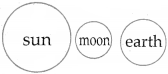
Maharashtra Board Class 7 Science Solutions Chapter 17 Effects of Light 1
3. A lunar eclipse can be seen with the naked eye.
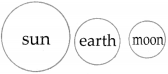
Maharashtra Board Class 7 Science Solutions Chapter 17 Effects of Light 2
4. It can be seen for a few minutes only.4. It can be seen over a period of a few hours.

Maharashtra Board Class 7 Science Solutions Chapter 17 Effects of Light

Explain diagrams:

Question 1.
Explain Solar eclipse with diagram.
Answer:
Solar eclipse:

  1. During its revolution, when the moon comes between the sun and the earth, a shadow of the moon is cast on the earth and the sun cannot be seen from the part in the shadow. This is called a solar eclipse
  2. A solar eclipse is seen only on a new moon day.
  3. The solar eclipse may be either partial or total,
  4. Sometimes the solar disc is completely covered by the moon. This is the total solar eclipse.
  5. When the solar disc is not covered fully by the moon, we have a partial solar eclipse.
  6. During a solar eclipse, ultra-violet rays which are harmful to us reach the earth.
  7. A solar eclipse should never be watched with the naked eye.
  8. A special type of goggles should be used for this purpose.
  9. Solar eclipse can be seen for a few minutes only.
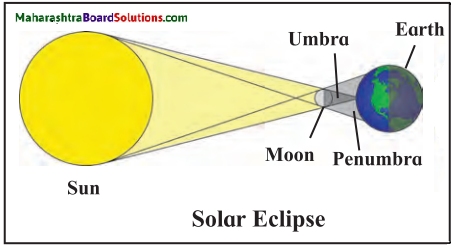
Maharashtra Board Class 7 Science Solutions Chapter 17 Effects of Light 3

Maharashtra Board Class 7 Science Solutions Chapter 17 Effects of Light

Question 2.
Explain Lunar eclipse with diagram
Answer:
Lunar eclipse:

  1. When the earth comes between the sun and the moon a shadow of the earth is cast on the moon and a part of the moon is covered. This is called the lunar eclipse.
  2. A lunar eclipse is seen only on a full moon night. If the whole moon comes in the shadow of the earth, it is a total lunar eclipse.
  3. When the shadow of the earth is cast only on a part of the moon, it is a partial lunar eclipse. You can watch a lunar eclipse with the naked eye.
  4. A lunar eclipse can be seen over a period of a few hours.
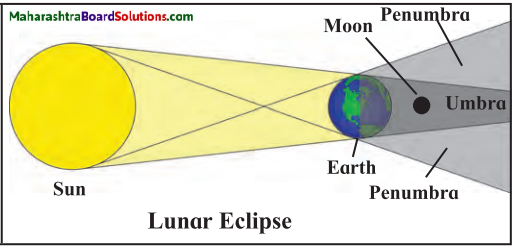
Maharashtra Board Class 7 Science Solutions Chapter 17 Effects of Light 4

Maharashtra Board Class 7 Science Solutions Chapter 17 Effects of Light

Question 3.
Write a short note on Zero Shadow Day.
Answer:

  1. The day on which the sun reaches exactly overhead is called zero shadow day.
  2. On this day, at noon, shadow completely disappears.
  3. This event can be seen in the region between the Tropic of Cancer (23.5°N) and at tropic of Capricon (23.5°S).
  4. The shadow diminishes and eventually disappears for a while only to reappear later
  5. This phenomenon occurs twice every year Mumbai got to witness it on May 14, 2018 last year.

Maharashtra Board Class 7 Science Solutions Chapter 17 Effects of Light

Question 4.
Explain the phenomenon of scattering of light with the help of an experiment.
Answer:

  1. When the sun rises our surroundings appear illuminated. The entire sky appears bright.
  2. This happens because of the dust and other tiny particles in the air. This is the scattering of sunlight by the tiny particles of the various constituents of air.
  3. Had there been no atmosphere, the sky would have appeared dark during the day and of course, the sun would be directly seen.
  4. This has been verified by observations from the rockets and satellites which go out of the earth’s atmosphere.

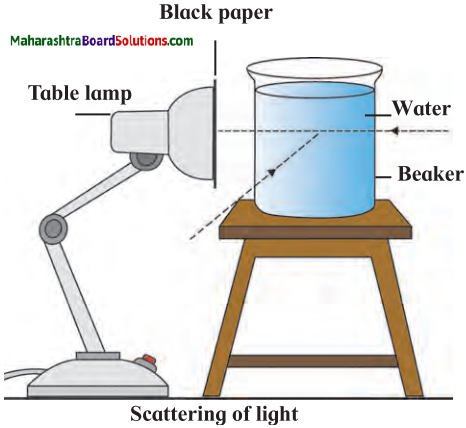
Apparatus: A table lamp with a 60 or 100 W milky bulb (LED will not do), thick black paper, sticking tape, a packing needle, 100/200 ml. glass beaker, milk or milk powder, dropper, spoon, etc.
Maharashtra Board Class 7 Science Solutions Chapter 17 Effects of Light 5

Procedure: Cover the mouth of the lampshade properly with black paper, using sticking tape. Prick a hole of 1 to 2mm diameter in the center of the paper with the help of the packing needle.

  1. Take clear water in the beaker. Light the bulb and place the beaker in contact with the hole.
  2. Observe from the front and at an angle of 90°.
  3. Now add 2-3 drops of milk to the water and stir. Observe again.
  4. A few more drops of milk may have to be added to make the water turbid.
  5. A blue tinge is seen when observed along the 90° angle. This is the scattered blue light.
  6. Because the blue light is scattered, a red-yellow light is seen from the front, and the hole appears reddish.

Maharashtra Board Class 7 Science Solutions Chapter 17 Effects of Light

Question 5.
Short note on Shadow.
Answer:

  1. Shadow is a dark patch formed behind an opaque object when it is placed in the path of light.
  2. A shadow is formed only when a light source, an opaque object and a screen are present, e.g. during a lunar eclipse we see a part of the earth’s shadow on the surface of the moon.
  3. This happens when the earth, the sun, and the moon are in a straight line with the earth between sun and the moon.
  4. Here the sun acts as the light source, the earth as the opaque object and moon as the screen.
  5. Shadows are formed due the rectilinear propagation of light.
  6. The size and the shape of the shadow depend on the position and orientation of the opaque object between the source of light and the screen.
  7. If the distance of the object from the source is decreased, then the size of the shadow increases.
  8. If the object is moved away from the source, then the size of the shadow decreases.
  9. In older days shadows caused by objects placed in the sun were used to measure time. Such a device is called sun dial.

Maharashtra Board Class 7 Science Solutions Chapter 17 Effects of Light

Use your brain power!

Answer the following questions:

Question 1.
Eclipses and transits which will occur recently.
Answer:

  • January 6, 2019 – Partial solar eclipse
  • January 21, 2019 – Total Lunar eclipse
  • July 2, 2019 – Total solar eclipse
  • July 16, 2019 – Partial Lunar eclipse
  • December 26, 2019 – Annular solar eclipse.

Find Out:

Answer the following questions:

Question 1.
If a few drops of milk are added in the experiment given the reddish colour seen from the front becomes an intense red. However, if many more drops are added the reddish colour is not seen. Why is this so?
Answer:

  1. As more and more milk is added, more particles of protein and fat scatter the light and the blue colour is scattered more and more than orange and red light and the beam appears blue from the sides.
  2. If few drops of milk are added, along with blue colour, orange and yellow also are scattered and only the intense red is seen from the front.
  3. But when many more drops are added, even the red colour is scattered and we do not see any colour from the front.

Maharashtra Board Class 7 Science Solutions Chapter 17 Effects of Light

Question 2.
What is Occultation?
Answer:
As seen from the earth, when a planet or a star passes behind the moon, that state is called an Occultation.

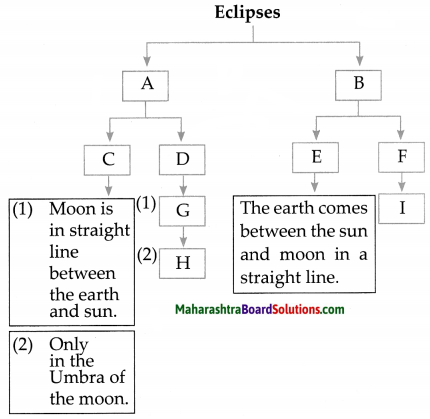
Complete the Chart.

Question 1.
Maharashtra Board Class 7 Science Solutions Chapter 17 Effects of Light 6
Answer:

  • A – Solar B – Lunar
  • C – Total Solar
  • D – Partial Solar
  • E – Total Lunar
  • F – Partial Lunar
  • G – Moon is not in a straight line between earth and sun
  • H – It is in the penumbra region of the moon
  • I – The earth comes in between the sun and moon and they are not in a straight line.
Maharashtra Board Class 7 English Solutions Chapter 1.4 The King’s Choice

Balbharti Maharashtra State Board Class 7 English Solutions Chapter 1.4 The King’s Choice Notes, Textbook Exercise Important Questions and Answers.

Maharashtra State Board Class 7 English Solutions Chapter 1.4 The King’s Choice

Class 7 English Chapter 1.4 The King’s Choice Textbook Questions and Answers

1. Write a character sketch of each of the animals. Write about their actions and thoughts and the qualities that emerge through

Question 1.
Write a character sketch of each of the animals. Write about their actions and thoughts and the qualities that emerge through
Answer:
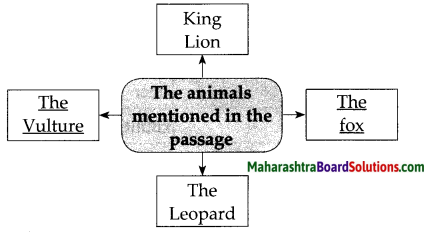
1. Lion: Lion was big and strong and very fierce. All the other animals in the forest called him king. The king promised other animals to give them food and protection. Whenever the king roared other animals stood in awe. Whenever he took a walk, others followed him. The lion was king also very responsible. When he had his meal, he left remains for other. So they always had enough to eat.
2. Fox: He was wise and clever creature and adviser of lion king. The fox took an oath of loyalty to the king.
3. Leopard: He was watchful and swift of foot, and a body of lion king.
4. Vulture: He was bird and can fly high in sky and a messager of lion.

Maharashtra Board Class 7 English Solutions Chapter 1.4 The King’s Choice

2. Using your imagination, write more sentences in the same pattern:
(a) But the more the lion had, the more he wanted.
(b) Whenever he took a walk, they followed him.
(c) To be king is good. But to be kind is better.

Question a.
Using your imagination, write more sentences in the same pattern:
(a) But the more the lion had, the more he wanted.
(b) Whenever he took a walk, they followed him.
(c) To be king is good. But to be kind is better.
Answer:

  1. The more you quieten the mind, the more restless it becomes.
  2. Whenever I speak, he interrupts me.
  3. It is nice to be important. But it is more important to be nice.
  4. To live well on earth is good. But to leave well is better.

Maharashtra Board Class 7 English Solutions Chapter 1.4 The King’s Choice

3. Turn the story into a play as a group activity and present the scenes in the classroom.

Question 1.
Turn the story into a play as a group activity and present the scenes in the classroom.
Answer:
(Curtain opens) The lion is seen pacing back and forth in deep thought.

  • Lion: Hmmm, I think it’s time I’ve courtiers for myself. (Calls his guards.) Tell the fox, the leopard and the vulture to meet me at once.
  • Guard: Yes, Your Majesty! (Enter of fox, leopard and the vulture)
  • Fox, Leopard, Vulture: Our salute to the king of kings! (all bow down)
  • Lion: Mr. Fox, you are known for your wisdom. You shall be my advisor from now on.
  • Mr. Fox: (elated) As you wish, Your Majesty!
  • Lion: And you…. Mr. Leopard, I am impressed by your alertness. You are swift of foot too. You shall be my bodyguard.
  • Mr. Leopard: (humbly) I shall be happy to serve you, Your Majesty!
  • Lion: (gesturing) And dear Vulture, you fly high above. I appoint you as my messenger.
  • Mr. Vulture: I am honoured, Your Majesty! (One day the vulture enters all excited)
  • Mr. Vulture: O great king! I have seen a camel in the desert not far away. I think it will be a good idea for you to taste camel meat.
  • Lion: (looking at his other advisers) What do you say? (Mr. Fox & Mr. Leopard not wanting to show ignorance)
  • Mr. Fox & Mr. Leopard: We don’t mind. But since the vulture has suggested let him lead the way. We shall humbly follow. (All set off on a journey to the forest. It’s hot and the sun is shining brightly.)
  • King: Oh! It’s too hot to bear. My paws are burning.
  • Mr. Vulture: (flying high above in cooler air) Your Majesty! The desert is close by. We shall reach in some time.
  • King: (not able to bear the pain) Stop! We shall return.
  • Mr. Vulture: (in thought) If we return, there will be nothing for us to eat as I will not be able to eat the king. I must stop him from returning. “Your Majesty! If you want we shall rest”.
  • Mr. Fox: O king! We are far away from the forest. Let us continue towards the desert.
  • King: I cannot walk anymore.
  • Mr. Leopard: (thinking to himself) I wish I could run away from here.
  • Fox: Let me ask for help, (leaps towards the desert)
    (In the desert)…

Maharashtra Board Class 7 English Solutions Chapter 1.4 The King’s Choice

4. This story takes an unexpected turn when the lion decides to spare the camel’s life. Choose any fable, story that you like and rewrite it giving it an unexpected turn.

Question 1.
This story takes an unexpected turn when the lion decides to spare the camel’s life. Choose any fable, story that you like and rewrite it giving it an unexpected turn.
Answer:
A ‘friend’ is a position in one’s heart and not the court. A courtier works for money. There is self-interest involved whereas a friend is a far more selfless relation in which one does not expect anything in return. It is a relationship in which friendship itself is the only reward.

5. Talk about the good qualities of any one person you do not like. (You need not name the person.)

Question 1.
Talk about the good qualities of any one person you do not like.
Answer:
I do not like my benchmate in my class as she is very untidy and comes shabbily dressed. However, there are many good qualities in her that I admire. She is an extremely polite girl. I have seen her go out of her way to help my other classmates. Also, she is very regular in her studies besides being a voracious reader. A habit that I long to imbibe in myself.

Maharashtra Board Class 7 English Solutions Chapter 1.4 The King’s Choice

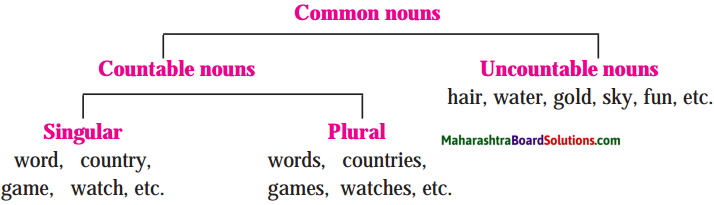
6. Language Study: Common nouns-i: Some things, animals, etc., that is, some nouns can be counted. They are called countable nouns. Some common nouns stand for something that cannot be counted. They are called uncountable nouns. Countable nouns have two forms. A noun that shows one person or thing, etc. is said to be in the singular. For example, ‘boy’, ‘girl’, ‘dog’, ‘tree’, ‘chair. A noun that shows more than one person or thing, etc. is said to be in the plural. For example, ‘boys’, ‘girls’, ‘dogs’, ‘trees’, ‘chairs’.

Maharashtra Board Class 7 English Solutions Chapter 1.4 The King’s Choice 1

Note the expressions ‘a slice of bread’, ‘strands of hair’, ‘two glasses of water’, ‘a cup of milk’ and ‘a bit of fun!’. Here, we do not say ‘breads’, ‘hairs’, ‘waters’, ‘milks’, ‘funs’, etc.

Question 1.
Find five countable nouns from the passage and write their singular and plural forms.
Answer:

  1. life – lives
  2. friend – friends
  3. messenger – messengers
  4. gift – gifts
  5. creature – creatures

Question 2.
List the units that we use to measure the following: water, milk, distance, weight.
Answer:

    • water – litres
    • milk – litres
    • distance – centimetre, metre, kilometre
    • weight – grams, kilograms

Class 7 English Chapter 1.4 The King’s Choice Additional Important Questions and Answers

Answer the following questions:

Question 1.
What qualities are necessary in the following? Why?
Answer:
1. King: A king should be just and kind. His justice will instill faith towards him in his subjects and his kindness will help him win their hearts. A king should not demand respect instead it should be earned with his qualities and virtues.

2. Adviser: An adviser must be very wise and foresighted. He must weigh the pros and cons of a decision and only then advise the king to go ahead with it. This is also because once the decision is taken it cannot be reverted and fate of the entire kingdom largely depends on these decisions.

3. Bodyguard: A bodyguard of a king must be his shadow. Extremely vigilant and alert, the bodyguard should be able to sense trouble and mischief as the king’s life can be in danger if he lacks these qualities. He should not hesitate to risk his life to save the king if required. This also demands physical strength and spirit.

4. Messenger: A messenger should be very quick at carrying messages as sometimes the messages are so important and urgent that any loss of time may cause great harm to the kingdom. Moreover, the messenger should be very faithful and keep the messages of the king confidential. This will safeguard the kingdom from enemies. Also, the messenger should remember that he represents the king himself, hence should be very trustworthy.

Maharashtra Board Class 7 English Solutions Chapter 1.4 The King’s Choice

Question 2.
Write the oath that each of the courtier must have taken.
Answer:
1. Oath taken by the advisor (Fox):
I, Mr. Fox, do hereby solemnly swear that I will remain loyal to my king and the kingdom and to the best of my ability advise the king on matters of administration in order to preserve, protect and defend the kingdom.

2. Oath taken by the messenger (Vulture):
I, Mr. Vulture, do hereby solemnly swear that I will remain loyal to my king and this great kingdom and will to the best of my ability deliver messages as and when required. In doing so I shall not alter the messages, keeping them confidential in the best interest of my kingdom in order to preserve, protect and defend it.

3. Oath taken by the bodyguard (Leopard):
I, Mr. Leopard, do hereby solemnly swear that I shall always be with the king like his shadow and will to the best of my ability protect, guard and defend the king and in doing so with loyalty I shall not hesitate to lay down my life in the general good of my beloved land.

Question 3.
Why was the vulture told to lead the way?
Answer:
The vulture had suggested that the lion should eat the camel it had seen in the desert. As, neither the lion nor the fox, nor the leopard had ever seen a camel and besides, as the fox and leopard didn’t want the vulture to appear wiser than them, they asked the vulture to lead as it was his idea.

Maharashtra Board Class 7 English Solutions Chapter 1.4 The King’s Choice

Question 4.
Why had the lion never seen a camel?
Answer:
The lion stayed in the forest and a camel lives in a desert. So the lion had never seen a camel.

Question 5.
What advice did the fox and the leopard give? Was it based on good and sound thinking?
Answer:
The fox and the leopard advised the king to set off on a camel hunt. This advice was not based on good and sound thinking as they were accustomed to walking in the forest under shady trees and the desert would not provide them this comfort. They didn’t want to appear foolish and ignorant and so the advice.

Question 6.
Do you think the vulture was enjoying the search?
Answer:
Yes, as the vulture was flying high up in the cooler air, it was enjoying the search.

Question 7.
Do you think the king’s decision to go back was right?
Answer:
No, I don’t think the king’s decision to go back was right as he had already walked a long distance not only risking his life but that of his courtiers as well. He could have rested and then continued.

Maharashtra Board Class 7 English Solutions Chapter 1.4 The King’s Choice

Question 8.
Can you guess the plan the fox had thought of?
Answer:
The fox had planned to trick the camel, and use him as a means of transport to go to their forest, kill him and have a feast.

Question 9.
Why does the fox address the camel as friend camel?
Answer:
The fox addressed the camel as ‘friend camel’ to make him believe that he is his well-wisher so that the camel does not see through his wicked intentions.

Question 10.
What qualities of the courtiers emerge in this part of the story when they were in the desert?
Answer:
The lion king comes across as someone who had leapt before looking what he was landing into. He himself didn’t know how he would return to the forest but commanded that they should stop right there. Not a very thoughtful and far sighted king. The vulture appears to be self-centred and greedy. He was only interested in eating the camel. The leopard, though a bodyguard, was a coward who wanted to run away. However, the fox comes across as a problem-solver who rescues everyone from the situation with his wit.

Question 11.
The fox, the leopard and the vulture have the same thought about the camel. Why is it so?
Answer:
By sparing the camel and not eating it, the king had spoilt the plan of the fox, vulture and the leopard. As they had similar interests, they had the same thought about the camel. The animals were all tired and hungry and realised that the camel would make a large meal. The camel being simple minded would not suspect this play and they could easily have a feast and satiate their hunger by fooling him. They were now irritated with their plans having been failed.

Maharashtra Board Class 7 English Solutions Chapter 1.4 The King’s Choice

Question 12.
Did you expect the lion to be kind to the camel? Do you think his decision was right?
Answer:
No, I didn’t expect the lion to be kind to the camel who was his prey. Yes, I think the lion’s decision was right as he was thankful to the camel for saving their lives by carrying them back to the forest. His decision was a mark of gratitude towards the camel.

Answer in one sentence.

Question 1.
Why did the king appoint the leopard as his bodyguard?
Answer:
The king appointed the leopard as his bodyguard as he was watchful and swift on his feet.

Question 2.
What did the lion’s courtiers do when he went hunting?
Answer:
When the lion king went hunting, the courtiers found animals for him to kill.

Question 3.
How does the vulture describe the camel to the lion king?
Answer:
The vulture describes the camel as a lone animal in the desert who was big and fat.

Question 4.
Why couldn’t the lion walk any further?
Answer:
The lion could not walk any further as the hot sand had burned his paws.

Maharashtra Board Class 7 English Solutions Chapter 1.4 The King’s Choice

Question 5.
What does the fox tell the camel?
Answer:
The fox tells that the camel that the lion king had killed his master and it was now free. The lion king, therefore, had invited it to live at his court.

Question 6.
On what condition did the camel agree to serve the lion?
Answer:
The camel agreed to serve the lion in return for a home at his court.

Question 7.
Why were the courtiers shocked to listen to the lion king’s decision?
Answer:
The courtiers were shocked to listen to the lion king’s decision as they had risked their lives to eat the camel’s meat but the king had now decided to spare it.

Reading Skills, Vocabulary and Grammar

Read the following passage and do the activities.

Simple Factual Questions:

Question 1.
Complete the web
Answer:
Maharashtra Board Class 7 English Solutions Chapter 1.4 The King’s Choice 2

Question 2.
Who said to whom
Question i.
“A king must have a court”
Answer:
The king thought to himself.

Maharashtra Board Class 7 English Solutions Chapter 1.4 The King’s Choice

Question ii.
“I want you to be my adviser”
Answer:
The king said the above sentence to the fox.

Question iii.
“I want you to be my bodyguard”
Answer:
The king said the above sentence to the leopard.

Question iv.
“You are to be my messenger”
Answer:
The king said the above sentence to the vulture.

Complex Factual Questions:

Question 1.
Why must a king have a court?
Answer:
A king must have a court for the smooth functioning of his kingdom. Besides, the king cannot do everything on his own so, by delegating work to his courtiers, the king can assure that various departments in his kingdom are serving his subjects well.

Question 2.
How is the human administration similar to that of what we read in the passage?
Answer:
Just as we have different portfolios the Lion king also gave responsibilities to his courtiers. For example the fox who is very wise and clever and we too have a council of ministers who advice the Prime Minister; just like the leopard who is watchful and swift, we too have the defence system in our country and like their vulture who is a messenger we too have the ministry of communication and technology.

Maharashtra Board Class 7 English Solutions Chapter 1.4 The King’s Choice

Question 3.
What is the oath of loyalty?
Answer:
An oath of loyalty is a pledge one takes acknowledging one’s duty and faithfulness towards one’s country or a king.

Vocabulary:

Question 1.
Give the meanings of the following words.
Answer:

  • courtiers – people who attend the royal court
  • adviser – the one who advises
  • bodyguard – a person employed to protect somebody
  • loyal – faithful towards a person or an organisation.

Grammar:

Question 1.
Pick out the Subject and Predicate from the following sentences.
1. They brought him gifts from every corner of the forest.
2. The lion called a leopard to his side.
3. The fox, the vulture and the leopard took an oath of loyalty to the king.
4. The three courtiers never opposed the king.
Answer:

SubjectPredicate
1. Theybrought him gifts from every corner of the forest.
2. The lioncalled a leopard to his side.
3. The fox, the vulture and the leopardtook an oath of loyalty to the king.
4. The three courtiersnever opposed the king.

Maharashtra Board Class 7 English Solutions Chapter 1.4 The King’s Choice

Question 2.
Identify any 4 common nouns from the above passage.
Answer:
king, forest, fox, leopard, animals

Question 3.
Add the question tag for the following sentences.

  1. He called a fox to his side.
  2. You are to be my messenger.
  3. The king promised to give them food and protection.
  4. He was big and strong and very fierce.

Answer:

  1. He called a fox to his side, didn’t he?
  2. You are to be my messenger, aren’t you?
  3. The king promised to give them food and protection, didn’t he?
  4. He was big and strong and very fierce, wasn’t he?

Question 4.
Give the adjective forms for the following.

  1. protection
  2. loyalty
  3. watch
  4. thought

Answer:

  1. protective, protected
  2. loyal
  3. watchful
  4. thoughtful

Maharashtra Board Class 7 English Solutions Chapter 1.4 The King’s Choice

Question 5.
Complete the table using the singular or plural forms of the nouns.
Answer:

SingularPlural
1. appleapples
2. bookbooks
3. classclasses
4. photophotos
5. lifelives
6. womanwomen
7. mousemice
8. childchildren
9. deerdeer
10. countrycountries

Maharashtra Board Class 7 English Solutions Chapter 1.4 The King’s Choice

Question 6.
Find five countable nouns from the passage and write their singular and plural forms.
Answer:

SingularPlural
1. kingkings
2. animalanimals
3. giftgifts
4. foxfoxes
5. birdbirds

Read the following passage and do the activities.

Simple Factual Questions:

Question 1.
State whether the following statements are true or false.
1. The lion ordered his courtiers to eat the camel.
2. The vulture, fox and the leopard offer themselves to the lion king.
Answer:
1. False
2. True

Complex Factual Questions:

Question 1.
Were the courtiers being loyal to their king?
Answer:
No, the courtiers were not being loyal to their king as by getting the camel killed by the lion they would force the lion king to go against his own promise of protecting the camel thereby spoiling the king’s image.

Question 2.
What qualities of the camel are seen in his speech?
Answer:
The camel comes across as very humble and loyal character. He knows very well that he could not be of much use to the lion in the forest. Moreover, he is willing to lay down his life for the sake of his king which means that he is extremely selfless.

Maharashtra Board Class 7 English Solutions Chapter 1.4 The King’s Choice

Question 3.
Why did the lion laugh to see the courtiers go?
Answer:
The lion laughed to see the courtiers go because he knew they were unfaithful courtiers and were only with him to serve their own selfish motives. He had been successful in driving them away without pronouncing a cruel judgment against them.

Question 4.
Why did the king offer his friendship to the camel?
Answer:
The king realized that his courtiers were unfaithful. In contrast, the camel was loyal and good. So, he offered friendship to the camel.

Question 5.
Explain the lines “To be king is good. But to be kind is better”.
Answer:
The king through the lines “To be king is good, but to be kind is better” wants to say that as a king he demanded respect but couldn’t win loyal friends or courtiers. But by being kind to the camel he not only gained respect but also won a true friend.

Vocabulary:

Question
Give homophones for the following words.
(a) accept
(b) seen
Answer:
(a) except
(b) scene

Maharashtra Board Class 7 English Solutions Chapter 1.4 The King’s Choice

Grammar:

Question 2.
Away flew the vulture.
(Separate the subject and predicate.)
Answer:
The vulture – subject, flew away – predicate

Question 3.
They were never seen in the forest again.
(Add a question tag)
Answer:
They were never seen in the forest again, were they?

Question 4.
What qualities of the lion king impresses you the most? Why?
Answer:
The lion king was very witty and wise. He had the skill of teaching his wicked and cunning courtiers a lesson without being cruel to them. He also had the quality of distinguishing between the faithful and the unfaithful. These qualities of the lion king impress me the most.

Language Study:

Do as directed.

Question 1.
The king promised to give them food and protection. (Rewrite using ‘Not only… but also’.)
Answer:
The king promised to give them not only food but also protection. The king not only promised to give them food, but also protection.

Question 2.
Let us go back to the forest.
(State the kind of sentence.)
Answer:
Imperative sentence.

Maharashtra Board Class 7 English Solutions Chapter 1.4 The King’s Choice

Question 3.
They did not want the vulture to seem wiser than them. (Iden tify the degree of comparison.)
Answer:
Comparative degree.

Question 4.
All the other animals in the forest called him king.
(Rewrite beginning with ‘He was’.)
Answer:
He was called king by all the other animals in the forest.

Question 5.
“Our king, the lion, has killed your master” said the fox.
(Change into indirect speech.)
Answer:
The fox informed that their king, the lion, had killed his master.

Maharashtra Board Class 7 English Solutions Chapter 1.4 The King’s Choice

Question 6.
Make sentences using phrases/idioms.
Answer:

  • To set off – We packed our bags and set off on a nature trail.
  • To keep (yourself) from – My grandmother is 70 years old. But that does not keep her from enjoying treks.

Question 7.
Complete the table.
Answer:

NounVerbAdjective
friendshipbefriendfriendly
lifelivelively
thoughtthinkthoughtful
protectionprotectprotective
strengthstrengthenstrong

Maharashtra Board Class 7 English Solutions Chapter 1.4 The King’s Choice

Writing Skills:

Question 1.
Choose any fable, story that you like and rewrite it giving it an unexpected turn.
Answer:
The Thirsts Crow
One hot day, a thirsty crow flew all across the plains in search of water. It had taken him more time than he thought and he felt weak. Losing all hope, he flew down to see if there was water kept outside the houses by the lonely street.

To his delight, he found a jug with water outside a small hut. But, the jug had very little water and it’s neck was too narrow for his head to be put in. He tried picking up the jug but in vain. Finally, he saw some pebbles and decided that if he dropped the pebbles, into the jug the water level would rise and he would be able to quench his thirst. But the crow had no patience to throw each pebble in one by one and wait for water level to rise slowly.

He saw a big stone lying by the side of the jug. He thought to himself, “if I put this big stone inside the jug, the level of water will rise at once”.

In his heart he felt proud about himself for this brilliant idea. So in desperation, he took the big stone and threw it in the jug. But to his disappointment, the stone hit the base of the earthen jug so hard that the jug broke into pieces. All the water from the jug spread all over the place. The crow tried to drink but before he could do so the thirsty earth had soaked in most of it.
Moral: Haste makes waste.

The King’s Choice Summary in English

The folk tale ‘The King’s Choice’ highlights the importance of virtues such as loyalty and kindness. The lion king in the story proves that a king’s might and majesty may win him some untrue and fake followers but kindness alone can give him the gift of faithful friends. On the other hand, the faithful camel’s character underlines the age old maxim, ‘Loyalty always pays’.

Paraphrase:

The story takes us to a forest where the lion king appoints the fox, the vulture and the leopard as his courtiers. However, the vulture due to his selfish and greedy motive of eating up the lion king lures him into going to the desert to eat camel meat. Other courtiers also follow.

When the king and his companions get tired of walking in the scorching sun, the fox comes to their rescue. He, through his wit and craftiness, befriends the camel and tricks him into believing that the king wanted to befriend him. The innocent camel appears before the king and carries the trio back to the forest on his back.

Filled with gratitude towards the camel on saving his life, the king decides to spare him and gives him his protection. Although the three courtiers are unhappy with the decision, they keep quiet.

However, after few days, unable to go hunting, the lion summons his courtiers and orders them to bring him food. The cunning fox once again holds a meeting and they plan to compel the king to eat the camel. But there is a twist in the story, the camel is safe once again due to its loyalty and the betrayers are compelled to flee. Thus, the king outsmarts his crafty and unfaithful courtiers and repays the camel for his loyalty with his kindness.

Maharashtra Board Class 7 English Solutions Chapter 1.4 The King’s Choice

Glossary:

  1. fierce (adj) – physically violent and frightening
  2. swift (adj) – quick
  3. watchful (adj) – alert and vigilant
  4. oath (n) – promise or vow
  5. awe (n) – respect and fear
  6. remains (n) – the parts left over after other parts have been removed
  7. lone (adj) – only one
  8. vulture (n) – a large bird of prey
  9. paws (n) – an animal’s foot
  10. feast (n) – a large meal, typically eaten during celebrations
  11. risked (v) – put in danger
  12. grateful (adj) – thankful

Maharashtra Board Class 7 Civics Solutions Chapter 6 Directive Principles of State Policy and Fundamental Duties

Balbharti Maharashtra State Board Class 7 Civics Solutions Chapter 6 Directive Principles of State Policy and Fundamental Duties Notes, Textbook Exercise Important Questions and Answers.

Maharashtra Board Class 7 Civics Solutions Chapter 6 Directive Principles of State Policy and Fundamental Duties

Class 7 Civics Chapter 6 Directive Principles of State Policy and Fundamental Duties Textbook Questions and Answers

1. List the restrictions on the powers of the Government.
Maharashtra Board Class 7 Civics Solutions Chapter 6 Directive Principles of State Policy and Fundamental Duties 1
Answer:
Restrictions upon the powers of the Government are listed below:

  • State should not discriminate between and among citizens on the basis of caste, religion, race, language or gender.
  • State shall not deny anybody equality before the law and equal protection of the laws.
  • No person shall be deprived of his life.
  • State shall not impose any religious taxes.

Maharashtra Board Class 7 Civics Solutions Chapter 6 Directive Principles of State Policy and Fundamental Duties

2. Say ‘Yes’ or ‘No’.

Question 1.
The jobs advertised in the newspaper are for men and women both.
Answer:
Yes

Question 2.
Men and women doing the same work in a factory get different wages.
Answer:
No

Question 3.
Government implements various schemes for the improvement of public health.
Answer:
Yes

Question 4.
State shall protect all monuments of historic interest and national importance.
Answer:
Yes

Maharashtra Board Class 7 Civics Solutions Chapter 6 Directive Principles of State Policy and Fundamental Duties

3. Tell why:

Question 1.
The State shall protect all monuments of historic interest and national importance.
Answer:

  • It is one of important Directive Principles of State policy.
  • Monuments are a part of India’s rich cultural heritage. A rich source to learn history, it is our collective responsibility to protect them.

Question 2.
A pension scheme is implemented for old people.
Answer:

  • The pension scheme is the State’s way of offering public assistance to citizens who have retired from work.
  • This ensures that the retired person can lead a comfortable life.
  • Hence a pension scheme is implemented for old people.

Question 3.
Free and compulsory education has been made available to children in the age group 6 to 14.
Answer:

  • No child should be deprived of education. So it is made available.
  • Right to Liberty now also includes Right to Education and all children are entitled to get education as a Fundamental right.

4. Say right or wrong. Correct and write the wrong ones:

Question 1.
Not to let the National Flag fall down on the ground.
Answer:
Right: It is our Fundamental Duty to respect the National Flag.

Question 2.
To stand in attention while the National Anthem is playing.
Answer:
Right: It is our Fundamental Duty to respect our National Anthem.

Maharashtra Board Class 7 Civics Solutions Chapter 6 Directive Principles of State Policy and Fundamental Duties

Question 3.
To carve or paint our names on the walls of a historic place like a fort.
Answer:
Wrong: It is our Fundamental Duty to value and preserve the rich heritage of our composite culture.

Question 4.
To give lesser wages to women than to men for the same work.
Answer:
Wrong: Fundamental Rights put restrictions on the power of the government and one of the restriction states that the state should not discriminate between and among citizens on the basis of gender amongst other things.

Question 5.
To keep public places clean.
Answer:
Right: It is our Fundamental Duty to safeguard public property.

5. Write about the following:

Question 1.
The Directive Principles of the Constitution enumerated in the textbook.
Answer:
(i) The State should secure adequate means of livelihood to all citizens without any gender discrimination.

(ii) The State should secure equal pay for equal work for both men and women.

(iii) The State should secure the improvement of public health.

(iv) The State shall endeavour to protect and improve the environment and safeguard the forests and wild-life of the country.

(v) The State shall protect all monuments of historic interest and national importance.

(vi) The State shall promote with special care the educational and economic interests of the weaker sections of the people, especially the Scheduled Castes and Tribes.

(vii) The State shall offer public assistance to citizens in cases of unemployment, old age, sickness, etc.

(viii) The State shall secure a uniform civil code applicable to the entire country.

Question 2.
The provision of a Uniform Civil Code for citizens in the Directive Principles of the Indian Constitution.
Answer:
(i) The provision of a Uniform Civil Code for citizens in mentioned in the Constitution.

(ii) It aims to replace personal laws based on the customs and scriptures of the different religious communities living in India with a common set of laws, which is uniform to all the citizens of India.

Maharashtra Board Class 7 Civics Solutions Chapter 6 Directive Principles of State Policy and Fundamental Duties

Question 3.
Why is it said that the Directive Principles and Fundamental Rights are two sides of the same coin?
Answer:

(i) Directive Principles of State Policy and Fundamental Rights are two sides of the same coin.

(ii) Due to Fundamental Rights, citizens get the most needed liberty, while Directive Principles of State Policy creates an atmosphere conducive to the growth of democracy.

6. What are the ways in which citizens can conserve the environment ? Write with examples.
Answer:
There are various ways in which citizens can conserve the environment:

(i) Citizens can support the endeavour of the State to protect and improve the environment and safeguard the forests and wild-life of the country.

(ii) Citizens should collectively take responsible actions to protect and improve the natural environment we are a part of.

(iii) Citizens should put to an end cruelty towards animals and have compassion for living creatures.

Activities

  • Education is our right. Form groups and discuss our duties in this respect.
  • The State shall protect all monuments of historic interest and national importance. This is one of the Directive Principles. Find out the efforts made by the State about the conservation and protection of forts and make a chart.
  • Gather information about the schemes implemented by the Government for children’s health.

Class 7 Civics Chapter 6 Directive Principles of State Policy and Fundamental Duties Additional Important Questions and Answers

Complete the sentence by choosing the appropriate words from the options given below:

Question 1.
Due to citizens get the most needed liberty. (Fundamental Rights, Directive Principles of State Policy, Fundamental Duties)
Answer:
Fundamental Rights

Question 2.
In order that the Indian citizens become conscious of their responsibilities ______ were included in the Constitution.
(Fundamental Rights, Fundamental Duties, Directive Principles of State Policy)
Answer:
Fundamental Duties

Maharashtra Board Class 7 Civics Solutions Chapter 6 Directive Principles of State Policy and Fundamental Duties

Question 3.
We should perform all the tasks that we have undertaken honestly always striving for ______. (excellence, progress, prosperity)
Answer:
excellence

Question 4.
Fundamental Rights restricts the power of the government to impose any ________. (laws, restrictions, religious taxes)
Answer:
religious taxes

Question 5.
Every citizen of India who is a parent or guardian should provide opportunities of education to his or her child or ward between the age of six and _______years. (eighteen, fourteen, seventeen)
Answer:
fourteen

Say ‘Yes’ or ‘No’:

Question 1.
The state should secure the improvement of public health.
Answer:
Yes

Question 2.
Public assistance is provided to citizens in cases of unemployment, old age, sickness etc.
Answer:
Yes

Name the following:

Question 1.
Put restriction on the power of the government.
Answer:
Fundamental Rights

Question 2.
Direction or guidelines in the Constitution about how to achieve the goals expressed in the Preamble of the Constitution.
Answer:
Directive Principles of the State Policy

Question 3.
Any two challenges faced by India after independence.
Answer:
Establishing order, carrying out smooth administration.

Maharashtra Board Class 7 Civics Solutions Chapter 6 Directive Principles of State Policy and Fundamental Duties

Question 4.
Any one directive which ensures that there is no gender discrimination.
Answer:
State should secure equal pay for equal work for both men and women.

Question 5.
It is our Fundamental Duty to respect these two national symbols.
Answer:
National Flag, National Anthem.

Question 6.
Any one practice we are expected to renounce according to the Fundamental Duties listed in our Constitution.
Answer:
Practices derogatory to the dignity of women.

Question 7.
It is our Fundamental Duty to develop these values.
Answer:
Scientific temper, Humanism, Spirit of inquiry and reform.

Say right or wrong with reason. Correct the write down the corrections:

Question 1.
To sacrifice our life for the sake of our motherland.
Answer:
Right: It is our Fundamental Duty .to defend the country, and to render national service when called upon to do so.

Question 2.
The State protects all monuments of historic interest and national importance.
Answer:
Right: It is one of the important Directive Principles of the State Policy.

Maharashtra Board Class 7 Civics Solutions Chapter 6 Directive Principles of State Policy and Fundamental Duties

Answer in one or two sentence:

Question 1.
Which restrictions on the power of the government by the Fundamental Rights ensure that no discrimination is practised by the State?
Answer:
Fundamental Rights restrains the State from discriminating between and among citizens on the basis of caste, religion, race, language or gender.

Question 2.
When India got independence, why was it necessary to draw up new policies?
Answer:
When India got independence the task of nation building had to be undertaken and for this new policies had to be drawn up.

Question 3.
What is included in the Directive Principles of the State Policy with respect to environment?
Answer:
It is included in the Directive Principles of the State Policy that the State shall endeavour to protect and improve the environment and safeguard the forest and wild-life of the country.

Question 4.
What is stated in the Directive Principles of State Policy with respect to weaker sections of the Society?
Answer:
It is stated in the Directive Principles of the State Policy that State shall promote with special care the educational and economic interest of the weaker sections of the people, especially the Scheduled Castes and Tribes.

Question 5.
What is the State expected to secure as per the Directive Principles of State Policy which is applicable to the entire country?
Answer:
The State is expected to secure a Uniform Civil Code applicable to the entire country according to the Directive Principles of State policy.

Question 6.
What can we do if a Directive is not implemented by the Government.
Answer:
If a Directive is not implemented by the Government, we can put pressure on the Government in various ways to make a policy in order to meet the goals.

Question 7.
When will the benefits of the various schemes of the Government not reach all the people?
Answer:
The benefits of the various schemes of the government cannot reach all the people if they do not fulfil their Fundamental Duties.

Maharashtra Board Class 7 Civics Solutions Chapter 6 Directive Principles of State Policy and Fundamental Duties

Question 8.
Why were the Fundamental Duties included in the Constitution?
Answer:
Fundamental Duties were included in the Constitution so that the Indian citizens become conscious of their responsibilities.

Question 9.
Why is it mentioned in our Fundamental Duties that we should strive towards excellence in all spheres of individual and collective activity?
Answer:
It is mentioned in our Fundamental Duties that we should strive towards excellence in all spheres of individual and collective activity so that the nation can constantly rise to higher levels of endeavour and achievement.

Answer the following in brief:

Question 1.
What are the ways in which citizens can conserve the environment?
Answer:
There are various ways in which citizens can conserve the environment:

  • Citizens can support the endeavour of the State to protect and improve the environment and safeguard the forests and wild-life of the country.
  • Citizens should collectively take responsible actions to protect and improve the natural environment we are a part of.
  • Citizens should put to an end cruelty towards animals and have compassion for living creatures.

Question 2.
State any five Fundamental Duties of the Indian citizens.
Answer:
Fundamental Duties of the Indian citizens are as follows:

  • To abide by the Constitution and respect the National Anthem.
  • To cherish and follow the noble ideals which inspired our national struggle for freedom.
  • To uphold and protect the sovereignty, unity and integrity of India.
  • To defend the country, and to render national service when called upon to do so.
  • To promote harmony and the spirit of common brotherhood transcending diversities; to renounce practices derogatory to the dignity of women.

Maharashtra Board Class 7 Civics Solutions Chapter 6 Directive Principles of State Policy and Fundamental Duties

Give reason:

Question 1.
The State shall protect all monuments of historic interest and national importance.
Answer:

  • It is one of important Directive Principles of State policy.
  • Monuments are a part of India’s rich cultural heritage. A rich source to learn history, it is our collective responsibility to protect them.

Question 2.
A pension scheme is implemented for old people.
Answer:

  • The pension scheme is the State’s way of offering public assistance to citizens who have retired from work.
  • This ensures that the retired person can lead a comfortable life.
    Hence a pension scheme is implemented for old people.

Question 3.
Free and compulsory education has been made available to children in the age group 6 to 14.
Answer:

  • No child should be deprived of education. So it is made available.
  • Right to Liberty now also includes Right to Education and all children are entitled to get education as a Fundamental right.

Give your own response:

Question 1.
What else do you think the Government should do for students? Make a list of your demands. How would you convince others that your demands are just?
Answer:
The list of our demands are:

  • Emphasis on skill training in school.
  • Choice of a wide variety of subjects based on one’s interest.
  • Compulsory training in a particular Sport.
  • Making a foreign language compulsory in the curriculum.
  • Better facilities in schools.
  • Programme of mid-day meals should be implemented in all the schools in the rural areas.
  • Inspection of schools from time to time to check the quality of education imparted.
  • I will convince others through dialogues and discussion and go by the will of the majority.

Maharashtra Board Class 7 Civics Solutions Chapter 6 Directive Principles of State Policy and Fundamental Duties

Question 2.
Which improvements will be possible with the following facilities offered by the Government?
Answer:

  • Public toilets: Maintenance from time to time and continuous water supply.
  • Clean water supply: Ensuring that water treatment to remove contaminants is done before it reaches homes and other places for consumption.
  • Vaccination of children:
  • Create awareness among parents about different vaccinations through different media of communication.
  • Organise vaccination drives from time to time.

Can you tell?

Question 1.
There is a directive to ensure ‘equal pay for equal work’.
Which principles and ideals of the Constitution will be realised with this directive? Why does it happen that inspite of doing the same work, women are paid less than men?
Answer:
(i) Right to Equality and the assurance that State shall not discriminate among citizens will be realised with this objective.

(ii) Due to lack of awareness of rights and no strict implementation of law, we witness gender discrimination at work.

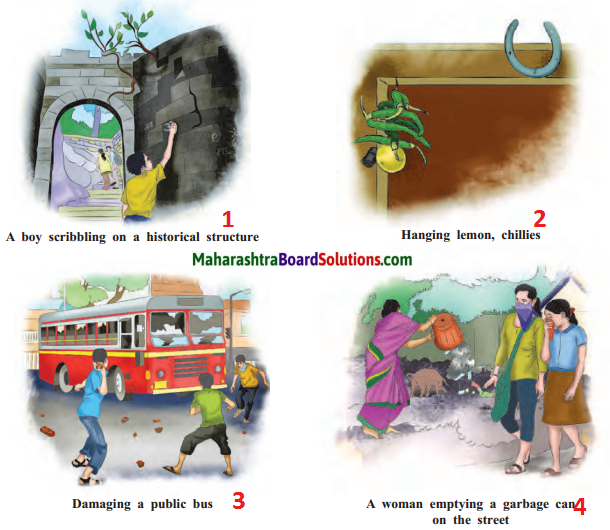
Observe the Picture and answer the questions given below:
Maharashtra Board Class 7 Civics Solutions Chapter 6 Directive Principles of State Policy and Fundamental Duties 2
Which of the Fundamental Duties are not being followed in the situations above?

Question 1.
A boy scribbling on a historical structure.
Answer:
The duty to value and preserve the rich heritage of our composite culture.

Question 2.
Hanging lemon, chillies
Answer:
The duty to develop the scientific temper, humanism and spirit of inquiry and reform.

Question 3.
Damaging a public bus
Answer:
The duty to safeguard public property and to abjure violence.

Question 4.
A woman emptying a garbage can on the street.
Answer:
The duty to protect and improve the natural environment.

What do you think?

Question 1.
Girls and boys between the ages 6 and 14 have got the Right to Education. All the girls and boys in this age group should be in school. Yet many girls and boys are not able to go to school because of many reasons. They have to work to help their parents earn a living for the family. Do you think that it is unfair to such children to insist that they go to school?
Answer:
No I don’t think it is unfair to such children to insist that they go to school.

(i) Practising child labour is a form of exploitation and we have the Right against Exploitation which extends constitutional protection to children.

(ii) Similarly it is the Fundamental Duty of every citizen who is a parent or guardian to provide opportunities of education to his or her child or ward between the age of six and fourteen years.

Maharashtra Board Class 7 Civics Solutions Chapter 6 Directive Principles of State Policy and Fundamental Duties

Question 2.
Which improvements will be possible with the following facilities offered by the Government?
Answer:
(i) Public toilets :

  • Public toilets will eradicate open defecation and will improve the overall public health
  • As the availability of toilets at close proximity to highway will ensure that people do not face inconvenience while traveling.

(ii) Clean water supply:

  • Water is our basic need hence providing clean water is very important
  • It will prevent the spread of water borne diseases like cholera, jaundice, etc.

(iii) Vaccination of children:

  • Vaccination will improve the health of infants
  • Vaccination will reduce the occurrence of diseases like polio in infants

Maharashtra Board Class 7 Science Solutions Chapter 1 The Living World: Adaptations and Classification

Balbharti Maharashtra State Board Class 7 Science Solutions Chapter 1 The Living World: Adaptations and Classification Notes, Textbook Exercise Important Questions and Answers.

Maharashtra State Board Class 7 Science Solutions Chapter 1 The Living World: Adaptations and Classification

Class 7 Science Chapter 1 The Living World: Adaptations and Classification Textbook Questions and Answers

1. Find my match!

Question a.

Column ‘A’Column ‘B’
1. Lotusa. Flower and leaves attract insects
2. Aloeb. Haustorial roots for absoption of food
3. Cuscutac. Adapted to live in deserts
4. Venus fly trapd. Adapted to live in water

Answer:

Column ‘A’Column ‘B’
1. Lotusd. Adapted to live in water
2. Aloec. Adapted to live in deserts
3. Cuscutab. Haustorial roots for absoption of food
4. Venus fly trapa. Flower and leaves attract insects

Maharashtra Board Class 7 Science Solutions Chapter 1 The Living World: Adaptations and Classification

2. Read the paragraph and answer the following questions:

I am a penguin. I live in polar region covered by snow. My abdomen is white. My skin is thick with a layer of fat underneath. My body is spindle-shaped. My wings are small. My toes are webbed. We live in flocks.

Question a.
Why is my skin white and thick and why is there a thick layer of fat underneath?
Answer:

  1. White skin colour camouflage with the snow so penguins cannot be easily spotted and they get protected from enemies.
  2. Thick skin and thick layer of fat underneath gives them protection from severe cold.

Question b.
Why do we live in flocks sticking close to each other?
Answer:
Penguins live in flocks sticking close to each other because sticking close to each other reduce the relative area so there is least loss of heat and they get protection from cold.

Question c.
Which geographical region do I inhabit? Why?
Answer:

  1. Penguins inhabit Antarctica region. Antarctica is surrounded by ocean. Climate is colder, drier and windier.
  2. It does not have human population. This climate is suitable for penguins, so they inhabit Antarctica.

Question d.
Which adaptations should you have to enable you to live permanently in the polar region? Why?
Answer:

  1. I should be a warm blooded animal. This should allow me to permanently live in polar region.
  2. My body has to be covered with thick fur or scale so that loss of heat will be very less and I can survive in severe cold.

3. Who is lying?

Question a.
Cockroach – I have five legs.
Answer:
Cockroach is lying. It has six legs.

Maharashtra Board Class 7 Science Solutions Chapter 1 The Living World: Adaptations and Classification

Question b.
Hen – My toes are webbed.
Answer:
Hen is lying because hen’s toes are not webbed. Duck has webbed toes.

Question c.
Cactus – My fleshy, green part is a leaf.
Answer:
Cactus is lying. It’s fleshy, green part is a stem not a leaf.

4. Read each of the following statements. Write a paragraph about adaptation with reference to each statement.

Question a.
There is extreme heat in deserts.
Answer:

  1. Plant’s stem is fleshy, leaves get modified into thorns to reduce loss of water. Steam perform photosynthesis in the absence of leaves.
  2. Animals have cushioned soles, hump, long legs and nostrils are protected by folds of skin. Eyelashes are long and thick.

Question b.
Grasslands are lush green.
Answer:
Insects like grasshoppers have green colour so they can be camouflaged amidst grasses.

Question c.
We hide.
Answer:
In equatorial region grasses are very tall, so to protect themselves animals like tiger, elephants and deer remain hidden in these tall grasses.

Maharashtra Board Class 7 Science Solutions Chapter 1 The Living World: Adaptations and Classification

Question d.
We have long ears.
Answer:
It helps the animals to receive sounds from long distance, and they can protect themselves from predators.

5. Answer the following:

Question a.
Why is the camel called the ‘ship of the desert’?
Answer:

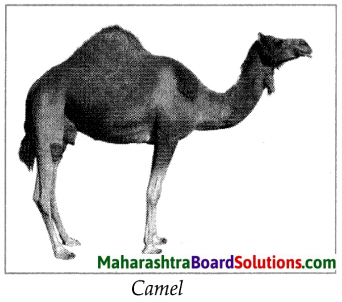
  1. Camel lives in a desert easily due to following adaptations. It has long legs and cushioned soles which keep the body of camel above the sand and cushioned soles do not allow to sink in sand while walking.
  2. The nostrils are protected by folds of skin.
  3. The eyelashes are long and thick.
  4. It has hump which stores fats so it helps camel to survive in desert for many days without food and water.

Due to above adaptations camel is used to carry people and transport goods from one place to another place in the desert. Therefore, camel is called the ship of the desert.

Maharashtra Board Class 7 Science Solutions Chapter 1 The Living World: Adaptations and Classification

Question b.
How can the plants like cactus and acacia live in deserts with scarce water?
Answer:
The plants like cactus and acacia live in deserts with scarce water due to the following adaptations.

  1. Leaves are like small needles or have been modified into thorns, as a result they lose very little water by evaporation.
  2. The stem stores water and food so it is fleshy.
  3. The stems are green as they perform photosynthesis in the absence of leaves.
  4. Their roots penetrate deep into the soil in search of water.
  5. There is a thick layer of a waxy substance on the stems.

Question c.
What is the inter-relationship between adaptations of organisms and their surroundings?
Answer:
1. Adaptations of organisms depend on the changes in the surroundings.

2. To adjust with those changes in the surroundings adaptation takes place gradually and continuously in organisms.

3. Changes that take place in the various organs and life processes of organisms, enable them to live, feed, reproduce to perpetuate themselves and to protect themselves from their enemies in specific surroundings, depending upon the habitat and its geographical conditions, are called adaptations.

Maharashtra Board Class 7 Science Solutions Chapter 1 The Living World: Adaptations and Classification

Question d.
How are organisms classified?
Answer:

  1. Different scientists have used different criteria and independently classified plants and animals.
  2. A hierarchy is formed in the classification that starts with kingdom Animalia or kingdom Plantae, further groups and sub-groups are formed depending upon basic similarities and differences.
  3. This is called the ‘hierarchy of classification’.
  4. Binomial nomenclature is used to identify each organism. Accordingly, a scientific name has been assigned to each organism.
  5. It consists of two parts – first part is ‘genus’ and second ‘species’.
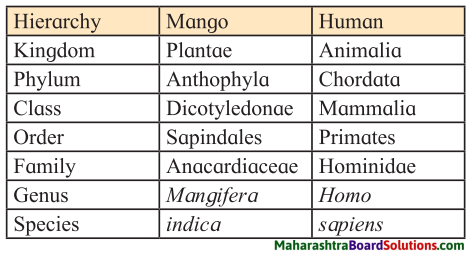
  6. All identified organisms have been assigned a binomial name as per the guidelines of the International code of Nomenclature. For e.g.
GenusSpecies
MangoMangiferaIndica
HumanHomoSapiens

Activity:

Question 1.
Find out how the gradual adaptation from primitive man to modern man must have taken place.

Class 7 Science Chapter 1 The Living World: Adaptations and Classification Important Questions and Answers

Fill in the blanks.

Question 1.
Leaves of some aquatic plants are …………. and …………. ike a ribbon.
Answer:
thin, slender

Question 2.
…………. in stems and …………. of aquatic plants are useful for floating in water.
Answer:
Air spaces, petioles

Question 3.
Leaves of desert plants are modified into …………. .
Answer:
thorns

Maharashtra Board Class 7 Science Solutions Chapter 1 The Living World: Adaptations and Classification

Question 4.
The stems of desert plants are green as they perform …………. in the absence of leaves.
Answer:
photosynthesis

Question 5.
…………. roots of grasses prevent soil erosion.
Answer:
Fibrous

Question 6.
Grasses in the …………. region are very tall.
Answer:
equatorial

Question 7.
…………. are found in hilly areas as well as plains.
Answer:
Vast meadows

Question 8.
Plants need …………., …………. and …………. for growth.
Answer:
nitrogen, phosphorus, potassium

Question 9.
Dodder has …………. roots for absorbing nutrients from the host plant.
Answer:
haustorial (sucking)

Maharashtra Board Class 7 Science Solutions Chapter 1 The Living World: Adaptations and Classification

Question 10.
Fungi do not have …………. so cannot perform photosynthesis.
Answer:
chlorophyll

Question 11.
Fish breathe with …………. instead of a nose.
Answer:
gills

Question 12.
Fish have …………. within the body to help them to float.
Answer:
air bladders

Question 13.
Frog and duck have …………. toes.
Answer:
webbed

Question 14.
Tigers have …………. paws.
Answer:
padded

Question 15.
Bats can fly with the help of …………. .
Answer:
patagium.

Question 16.
Desert plants are either leafless or their leaves are like …………. or modified into …………. .
Answer:
needles, thorns

Maharashtra Board Class 7 Science Solutions Chapter 1 The Living World: Adaptations and Classification

Question 17.
Spring like …………. on the stems of some climbers are examples of their adaptation.
Answer:
Tendrils

Question 18.
…………. is not a sudden process, it is gradual and continuous.
Answer:
Adaptation

Question 19.
…………. proposed the theory of the survival of the fittest.
Answer:
Charles Darwin

Match the columns:

Question 1.

Column ‘A’Column ‘B’
1. Cactusa. Herbivorous animal
2. Pineb. Carnivorous animal
3. Tigerc. Snowy region plant
4. Blackbuckd. Desert plant

Answer:

Column ‘A’Column ‘B’
1. Cactusd. Desert plant
2. Pinec. Snowy region plant
3. Tigerb. Carnivorous animal
4. Blackbucka. Herbivorous animal

Maharashtra Board Class 7 Science Solutions Chapter 1 The Living World: Adaptations and Classification

Question 2.

Column ‘A’Column B’
1. Doga. Hibiscus roso sinensis
2. Cowb. Sorghum bicolor
3. Hibiscusc. Bos taurus
4. Joward. Canis lupus familiarise

Answer:

Column ‘A’Column B’
1. Dogd. Canis lupus familiarise
2. Cowc. Bos taurus
3. Hibiscusa. Hibiscus roso sinensis
4. Jowarb. Sorghum bicolor

Maharashtra Board Class 7 Science Solutions Chapter 1 The Living World: Adaptations and Classification

Name the following:

Question 1.
Animals which live in desert in deep burrows.
Answer:
Rats, snakes, spiders, lizards

Maharashtra Board Class 7 Science Solutions Chapter 1 The Living World: Adaptations and Classification

Question 2.
Animals which have webbed feet.
Answer:
Frog, duck

Question 3.
Plants of snowy regions.
Answer:
Deodar, pine

Question 4.
Plants that eat insects.
Answer:
Drosera, venus flytrap, pitcher plant

Question 5.
World Frog Protection Day.
Answer:
29th April

Maharashtra Board Class 7 Science Solutions Chapter 1 The Living World: Adaptations and Classification

Question 6.
2 parts of bionomial nomenclature.
Answer:
genus and species.

Who am I?

Question 1.
My leaves trap insects.
Answer:
Venus fly trap or pitcher plant.

Question 2.
I have waxy feathers and webbed feet.
Answer:
Duck

Question 3.
I breath through skin in water and through lungs on land.
Answer:
Frog

Question 4.
I have sucking roots through which I take nutrition from my host plant.
Answer:
Dodder (cuscuta)

Question 5.
I have silvery white body with thick long hair
Answer:
Snow animals like polar bear.

Maharashtra Board Class 7 Science Solutions Chapter 1 The Living World: Adaptations and Classification

Question 6.
I have waxy broad leaves and air spaces in my stem.
Answer:
Lotus (or aquatic plants)

Question 7.
My Scientific name is Bos taurus.
Answer:
Cow

Question 8.
I discovered Binomial nomenclature.
Answer:
Carl Linnaeus

Question 9.
I have special thin folds in between my forelegs and hind legs called patagium.
Answer:
Bat

Maharashtra Board Class 7 Science Solutions Chapter 1 The Living World: Adaptations and Classification

Question 10.
I am mango, my genus is?
Answer:
Mangifera

Say whether true or false, correct and rewrite the false statements:

Question 1.
Killing or harming frogs is prohibited by the Wild Life Protection Act.
Answer:
True

Question 2.
Scientific name of jowar is Bos taurus.
Answer:
False. Scientific name of jowar is Sorghum bicolor

Question 3.
Theory of natural selection was found by Charles Darwin.
Answer:
True

Maharashtra Board Class 7 Science Solutions Chapter 1 The Living World: Adaptations and Classification

Question 4.
T.V. Channels like National Geographic, Wild and Discovery show about the feeding habits of animals.
Answer:
True

Question 5.
The spindle shaped body of birds maximizes the resistance of air while flying.
Answer:
False. The spindle shaped body of birds minimises the resistance of air while flying.

Question 6.
House lizard and monitor lizards have webbed toes.
Answer:
False. House lizard and monitor lizards have clawed toes.

Question 7.
Crocodiles use their muscles for creeping.
Answer:
True

Maharashtra Board Class 7 Science Solutions Chapter 1 The Living World: Adaptations and Classification

Question 8.
The eyes of predatory carnivores are located on either side of the head.
Answer:
False. The eyes of predatory carnivores are located in the front of their head.

Question 9.
A frog is an amphibian.
Answer:
True

Question 10.
Diverse types of bushes and grasses are found in the grasslands.
Answer:
True.

Complete the given table:

Question 1.
Maharashtra Board Class 7 Science Solutions Chapter 1 The Living World Adaptations and Classification 1

Question 2.
Give one special adaptation or features of the following plant or animal to suit its habitat surrounding
Answer:

Plant/animalSpecial adaptation/features
1. FishStream lined body
2. BirdHollow bones, feathers
3. CamelThick skin, folds in skin near nosetrils
4. Deerlong and tapering legs with strong hooves
5. TigerPadded paws, sharp canine teeth
6. Duckwaxy feathers, webbed toes
7. FungiRoot like fibers
8. CuscutaLeafless, yellow thread like stem with haustorial (sucking) roots
9. Venus fly trapTrigger hair inside their traps
10. Deodar treeConical shape and needle shaped leaves
11. Grape vineTendrils for support
12. AcaciaFleshy thick green stem with leaves turned into thorns.

Maharashtra Board Class 7 Science Solutions Chapter 1 The Living World: Adaptations and Classification

Who is lying?

Question 1.
Camel has thin skin and short eyelashes.
Answer:
Camel is lying – It has thick skin and long and thick eyelashes.

Answer in one or two sentences:

Question 1.
What is called ‘hierarchy of classification’?
Answer:

  1. A hierarchy is formed in the classification that starts with kingdom Animalia or Kingdom Plantae, further groups and sub-groups are formed depending upon basic similarities and differences.
  2. This is called the ‘hierarchy of classification’.

Question 2.
What theories were proprosed by Charles Darwin
Answer:
The theories of Charles Darwin are Theory of natural selection and theory of survival of the fittest.

Maharashtra Board Class 7 Science Solutions Chapter 1 The Living World: Adaptations and Classification

Question 3.
Explain the terms Autotrophic and Parasitic
Answer:
1. Plants which are able to produce their own food with the help of the process of photosynthesis are called autotrophic plants eg. All green plants.

2. Plants which are not able to produce their own food but depend upon other plants for their nutrition are called parasitic plants They are leafless and non green in colour eg. Dodder (cuscuta). They have haustorial (sucking) roots for absorbing nutrients from the host plant.

Give scientific reasons:

Question 1.
Leaves of some aquatic plants are thin and slender like a ribbon.
Answer:
Leaves of some aquatic plants are thin and slender like a ribbon because this shape helps them to withstand fast currents of water.

Question 2.
Some aquatic plants have air spaces in stems.
Answer:
Some aquatic plants have air spaces in stems because air spaces help the plants to float on water.

Maharashtra Board Class 7 Science Solutions Chapter 1 The Living World: Adaptations and Classification

Question 3.
Desert plants have thorns.
Answer:

  1. Desert plants have thorns because in deserts, due to scarcity of water these plants are either leafless or their leaves are like small needles or modified into thorns.
  2. They lose very little water by evaporation due to little surface area. This helps plants to survive in desert.

Question 4.
Desert plants have green stem.
Answer:
Desert plants have green stem because green stem performs photosynthesis in the absence of leaves.

Question 5.
Desert plants have strong roots.
Answer:
Desert plants have strong roots so they can penetrate deep into the soil in search of water.

Question 6.
Deodar tree is conical in shape.
Answer:
Deodar tree grows in snowy region and conical shape of the tree doesn’t allow snow to accumulate on the tree and thus protect the tree from snow.

Question 7.
Pine tree has thick bark.
Answer:
Pine tree grows in snowy region where it is extremely cold and its thick bark helps the tree to withstand the cold.

Maharashtra Board Class 7 Science Solutions Chapter 1 The Living World: Adaptations and Classification

Question 8.
Plants in forest grow tall.
Answer:
In forest region variety of trees, shrubs and herbs are found. These plants compete amongst themselves for sunlight. Hence trees grow tall to get sunlight.

Question 9.
Cuscuta has haustorial roots.
Answer:

  1. Cuscuta is a parasitic plant. It is leafless and cannot prepare food on its own.
  2. So to get food haustorial (sucking) roots penetrate up to the conducting vessels of the host plant to absorb water and food, the Cuscuta has haustorial roots.

Question 10.
Fungi have root-like fibers.
Answer:

  1. Fungi are parasitic.
  2. They do not have chlorophyll and cannot perform photosynthesis.
  3. So these root-like fibers help to absorb the food from the starchy foodstuffs like bhakri and bread.

Question 11.
Pitcher plant eats insects.
Answer:

  1. Pitcher plant grows in a soil where nitrogen, phosphorous and potassium are very less. But the plant needs these for the growth.
  2. So to fulfill the need for nitrogen, pitcher plant consumes insects.

Maharashtra Board Class 7 Science Solutions Chapter 1 The Living World: Adaptations and Classification

Question 12.
Duck and frog have webbed feet.
Answer:
When duck and frog are in water at that time the webbed feet act as oars and help them to swim in water.

Question 13.
Frogs can swim easily in water.
Answer:
Frogs have webbed toes, slippery, smooth skin and triangular head. This helps the frog to swim easily through water.

Question 14.
Tiger has sharp and pointed canine teeth.
Answer:
Tiger is a carnivorous animal. So the sharp and pointed canine teeth help the tiger to tear the prey and eat.

Question 15.
Blackbuck has eyes on either side of the head.
Answer:
Blackbuck is a herbivore animal and eyes on either side of the head gives them wide angle vision which helps to protect themselves from predators.

Maharashtra Board Class 7 Science Solutions Chapter 1 The Living World: Adaptations and Classification

Question 16.
Tigers have padded paws.
Answer:
Tigers are carnivorous animals. So these padded paws enable them to silently stalk their prey and capture it easily.

Question 17.
The eyes of predatory carnivores are located in the front of their head.
Answer:
The eyes of predatory carnivores are located in the front of their head because it helps them to spot their prey from a long distance.

Question 18.
Camel can live in desert.
Answer:

  1. Camel can live in desert because it has thick skin to prevent loss of water from the body. Their legs are long with flat and cushioned soles.
  2. The nostrils are protected by folds of skin. The eyelashes are long and thick so these adaptations enable Camels to live in desert easily.

Maharashtra Board Class 7 Science Solutions Chapter 1 The Living World: Adaptations and Classification

Question 19.
White fox has white body colour.
Answer:

  1. White fox lives in snowy region which throughout the year is covered with snow.
  2. White colour of fox matches with the snow so it gets camouflaged in snow and it can save itself from predators.

Question 20.
Birds can fly in the air.
Answer:

  1. Birds can fly in the air because the spindle shaped body minimises the resistance of air while flying.
  2. Their hollow bones, body covering of feathers and forelegs being modified into wings, their body being light in weight, all these factors make the birds adapted to fly in the air.

Can you tell?

Answer the following questions:

Question 1.
Arc the plants and animals from Kashmir and Rajasthan of the same type? Can you elaborate on any differences between the two?
Answer:
Plants and animals from Kashmir and Rajasthan are of different types.
Differences in plants:

  1. Plants of Kashmir, which is a snowy region, are conical in shape due to their sloping branches.
  2. This shape prevents the snow accumulation on the tree and the thick bark helps the tree to withstand the cold.
  3. But the plants of Rajasthan, which is a desert region, are either leafless or their leaves are small, needle shaped or have been modified into thorns. So the loss of water can be reduced
  4. The stem stores water and food so they are fleshy. The stem performs photosynthesis in the absence of leaves.

Differences in animals:

  1. Animals of Kashmir have thick hair and white or silver body colour camouflaged with snow. This helps them to get protection in snowy region.
  2. The animals of Rajasthan have long legs with flat and cushioned soles.
  3. The nostrils are protected by folds of skin. The eyelashes are long and thick. It gives protection from sand and heat.

Maharashtra Board Class 7 Science Solutions Chapter 1 The Living World: Adaptations and Classification

Question 2.
In what way are sloping branches useful to plants in a snowy region?
Answer:
In a snowy region sloping branches of a plant gives conical shape to the tree and it doesn’t allow snow to accumulate on tree inspite of heavy snowfall and thus protect the tree from severe cold and snow.

Question 3.
What is the main difference between vehicles on the road and aeroplanes?
Answer:
The two main differences between vehicles on the road and aeroplanes are:

  1. aeroplanes have wings whereas vehicles on the road do not have wings.
  2. The body of aeroplanes are spindle shaped and the body of vehicles on the road depends on the number of wheels they have.

Use your brain power!

Answer the following questions:

Question 1.
Why does water trickle off lotus leaves?
Answer:

  1. Water trickles off lotus leaves because it is coated with waxy covering on it.
  2. It is one of the adaptations of aquatic plants to survive in water without getting wet and rot or sink to the bottom.

Maharashtra Board Class 7 Science Solutions Chapter 1 The Living World: Adaptations and Classification

Question 2.
Why don’t the leaves of lotus plants rotinwatei?
Answer:
leaves of these plants do not rot in water because it is covered with waxy coating on it so that they do not get wet.

Question 3.
Why are roots of lotus plants short and fibrous?
Answer: –

  1. These plants grow in water so the roots do not need to go deep down in search of water. Their roots are not anchored in the soil.
  2. So their roots are short and fibrous.

Question 4.
The lotus stalk has holes or air spaces?
Answer:

  1. The air spaces in stems and petioles of aquatic plants are useful for making them float in water and also to prevent them from rotting
  2. Hence, the lotus stalk has holes or air spaces.

Maharashtra Board Class 7 Science Solutions Chapter 1 The Living World: Adaptations and Classification

Answer in detail:

Question 1.
Explain the Darwin’s theory of evolution.
Answer:
Charles Darwin, a biologist suggested two principles in his theory of evolution.

  1. Theory of survival of the fittest: He said that only those organisms are likely to survive which can best adapt themselves to a changing environment. This is called the theory of survival of the fittest.
  2. Theory of ‘Natural selection’: If an organism is bom with a new beneficial characteristic and is able to survive, this change is preserved in the next generation. This is called the theory of ‘natural selection’.

Diagram based questions:

Draw a neat labelled diagram of fish and answer the following questions.
Answer:
Maharashtra Board Class 7 Science Solutions Chapter 1 The Living World Adaptations and Classification 2

Question a.
Why do fish have a body tapering towards both its ends?
Answer:
Fish have its body tapering towards its ends, to allow them to swim with least resistance in water.

Maharashtra Board Class 7 Science Solutions Chapter 1 The Living World: Adaptations and Classification

Question b.
Why do Fish have transparent eyelids.
Answer:
The transparent eyelids of fish protect the eyes from the substance in the water

Question c.
How are they able to float?
Answer:
Fish have air bladders within their body which help them to float.

Observe the diagram and answer the questions.
Answer:
Maharashtra Board Class 7 Science Solutions Chapter 1 The Living World Adaptations and Classification 3

Question a.
What habitat does this camel live in?
Answer:
Camel lives in desert habitats or in areas where there is scarcity of water.

Maharashtra Board Class 7 Science Solutions Chapter 1 The Living World: Adaptations and Classification

Question b.
State any 2 of its body adaptations to survive in desert?
Answer:

  1. Thick skin to prevent loss of water from the body
  2. The eyelashes are long and thin
  3. Their legs are long and flat with cushioned soles

Question c.
How does a camel protect itself from sand storms or winds carrying sand?
Answer:
Camels have nostrils protected by folds of skin and long thick eyelashes to prevent entry of fir dust and sand into its nose and eyes.

Paragraph based questions:

Compare and contrast:

Question 1.
Compare the lotus plant to the Acacia plant and Hibiscus plant.
Answer:

Lotus plantHibiscus plantAcacia plant
I. Stem have air spaces in themStem do not have air spaces and do not store too much of water and foodStem is fleshy and stores water and food
ii. Leaves have a waxy coatingLeaves do not have a waxy coating and have thin laminaLeaves are not present and if present are very tiny or modified into thorns

Maharashtra Board Class 7 Science Solutions Chapter 1 The Living World: Adaptations and Classification

Question 2.
What is the difference between the plants given in the pictures. Give 2 points of difference taking into consideration their adaptations with their surroundings.
Maharashtra Board Class 7 Science Solutions Chapter 1 The Living World Adaptations and Classification 4
Answer:

A. CactusB. LotusC. Deodar tree
i. Stem is green and fleshyStem is with air spaceShape of tree is conical
ii. leaves are reduced or absent and replaced by thornsLeaves are broad and with a waxy coatingLeaves are needle shaped

Maharashtra Board Class 7 Science Solutions Chapter 9 Heat

Balbharti Maharashtra State Board Class 7 Science Solutions Chapter 9 Heat Notes, Textbook Exercise Important Questions and Answers.

Maharashtra State Board Class 7 Science Solutions Chapter 9 Heat

Class 7 Science Chapter 9 Heat Textbook Questions and Answers

Fill in the blanks:

Question a.
Maximum heat is absorbed by a ………….. coloured object.
Answer:
black

Question b.
……………. of heat does not require a medium.
Answer:
Radiation

Maharashtra Board Class 7 Science Solutions Chapter 9 Heat

Question c.
Conduction of heat takes place through a ……………. substance.
Answer:
solid

Question d.
The shining surface in a thermos flask decreases the outgoing heat by ……………… .
Answer:
reflection

Question e.
Cooking utensils are made from metals due to their property of ……………… .
Answer:
conduction

Question f.
The earth receives heat from the sun by ………………. .
Answer:
radiation

Maharashtra Board Class 7 Science Solutions Chapter 9 Heat

2. What will absorb heat?
Steel spoon, wooden board, glass vessel, iron griddle (lava), glass, wooden spoon, plastic plate, soil, water, wax.

Question a.
What will absorb heat?
Steel spoon, wooden board, glass vessel, iron griddle (lava), glass, wooden spoon, plastic plate, soil, water, wax.
Answer:
Following will absorb heat fast: steel spoon, iron griddle, water, wax. Remaining objects also obsorb heat but very slowly.

3. Write Answers to the following questions. 

Question a.
How does a fever get lowered by putting a cold compress on the forehead of a patient?
Answer:
The water in the cold compress will evaporate by the heat of fever thus taking some local heat of the body and temperature of the body is lowered, therefore the fever gets lowered by putting a cold compress on the forehead of a patient.

Question b.
Why are the houses in Rajasthan painted white?
Answer:
Rajasthan being a desert, temperature is very high. So there is excess heat. White colour doesn’t absorb the heat but reflects back, so houses will not become hot due to excess heat and inside of the house will be cool. So the houses in Rajasthan are painted white.

Maharashtra Board Class 7 Science Solutions Chapter 9 Heat

Question c.
What are the modes of heat transfer?
Answer:
There are three modes of heat transfer:

  1. conduction
  2. convection
  3. radiation.

Question d.
Explain which mode of heat transfer causes sea breezes and land breezes?
Answer:

  1. Unequal heating of air above the sea and land sets up convection currents which cause sea breezes during the day time.
  2. The land near the sea is heated by sunlight to a higher temperature than the sea.
  3. As the air above the land is heated, it becomes lighter and moves upwards, its place is then taken by cooler air moving from the sea towards the land.
  4. Sea breezes are thus set up. At night, the land cools faster than water in the sea. Therefore air above sea water is hotter than air above the land.
  5. So cooler air from the land moves towards the sea forming land breeze.

Question e.
Why is the outer coat of the penguins of Antarctica black?
Answer:
The outer coat of the penguins of Antarctica is black because black colour absorbs heat so penguins get lots of heat due to this black colour and they can live easily in very, very cold Antarctica region.

Maharashtra Board Class 7 Science Solutions Chapter 9 Heat

Question f.
Why are heaters fitted near the floor and air conditioners near the ceiling of a room?
Answer:
1. Due to air conditioners, air becomes cool so its density increases and it becomes heavy. So it goes down and warm air with less density comes up and take the place of cold air. This cycle goes on and on and the whole room becomes cool.
2. If it is fitted near the floor then cool air of high density can’t go up and upper air with low density cannot come down and cooling of the room does not take place properly so air conditioners are fitted near the ceiling of a room.
3. Heaters are fitted near the floor. Due to heating, air becomes hot which is lighter than cold air. So it goes up and upper air with high density comes down.
4. This cycle goes on and on and the full room becomes warm. So heaters are fitted near the floor.

4. Give scientific reasons.

Question a.
An ordinary glass bottle cracks when boiling water is poured into it, but a borosil glass bottle does not.
Answer:

  1. An ordinary glass bottle cracks when we pour boiling water into it because there is a lot of temperature difference between the inner and outer parts of the glass.
  2. The inner part gets hot and expands while the outer part remains cold since glass is a bad conductor of heat.
  3. This unequal expansion causes the crack of glass bottle.
  4. But the borosil glass bottle has a very high melting point so the temperature difference is very less, hence it doesn’t crack.

Maharashtra Board Class 7 Science Solutions Chapter 9 Heat

Question b.
The telephone wires which sag in summer become straight in winter.
Answer:

  1. Telephone wires are made up of copper metal. Metals expand on heating.
  2. In summer the copper wire expands, thus the length of the wire increases between the two poles and instead of remaining straight it sags.
  3. In winter due to cold, it contracts and comes back to the original position, so it becomes straight in winter.

Question c.
Dewdrops form on the grass in winter.
Answer:

  1. During the winter, the temperature of air is low, its capacity to hold the vapour is less.
  2. At such times the excess water vapour is transformed into water droplets due to cold. And so the dew drops form on the grass in winter.

Question d.
In winter, why does an iron pillar feel colder than a wooden pole.
Answer:

  1. Iron is a metal and metals are very good conductors of heat so it transfers heat at a much faster rate than wood.
  2. That means, when we touch them, metals conducts away energy in the form of heat emitted by our hand and temperature of our hand lowers down and we get a cold’ sensation.
  3. This is what makes the metal appear colder than the wood.
  4. The wood is taking away heat at a much slower rate.

Maharashtra Board Class 7 Science Solutions Chapter 9 Heat

Project:

Question 1.
Make a note of the various examples of heat transfer seen in day-to-day life.

Class 7 Science Chapter 9 Heat Important Questions and Answers

Fill in the blanks:

Question 1.
………………… is an indicator of the heat in a substance.
Answer:
Temperature

Question 2.
………………. flows from higher temperature to lower temperature.
Answer:
Heat

Maharashtra Board Class 7 Science Solutions Chapter 9 Heat

Question 3.
Transfer of heat from one place to another takes place by ……………. or ……………. .
Answer:
conduction, convection, radiation

Question 4.
During conduction, particles of the substance …………….. in their place.
Answer:
vibrate

Question 5.
In a convection current, warm air travels …………….. .
Answer:
upwards

Question 6.
A …………….. is necessary for the conduction of heat.
Answer:
medium

Maharashtra Board Class 7 Science Solutions Chapter 9 Heat

Question 7.
The ………………. of conduction of heat through a medium depends on the medium.
Answer:
speed

Question 8.
Convection takes place only in …………… medium.
Answer:
fluid

Question 9.
Transfer of heat in the absence of a medium is called ……………… .
Answer:
radiation

Maharashtra Board Class 7 Science Solutions Chapter 9 Heat

Question 10.
Substances through which heat travels easily and quickly are called …………… .
Answer:
good conductors

Question 11.
Substances through which heat travels very slowly are called ………… of heat.
Answer:
bad conductors

Question 12.
Copper is a better ………… of heat than …………. .
Answer:
conductor, iron

Maharashtra Board Class 7 Science Solutions Chapter 9 Heat

Question 13.
………………. made first thermos flask in 1892.
Answer:
Sir James Dewar

Question 14.
Neither conduction nor convection of the heat occurs in thermos flask due to the ……………… .
Answer:
vacuum.

Match the following:

Question 1.

Column ‘A’Column ‘B’
1. Good conductora. flow of particles
2. Bad conductorb. particles vibrate
3. Conductionc. glass
4. Convectiond. copper

Answer:

Column ‘A’Column ‘B’
1. Good conductord. copper
2. Bad conductorc. glass
3. Conductionb. particles vibrate
4. Convectiona. flow of particles

Maharashtra Board Class 7 Science Solutions Chapter 9 Heat

Question 2.

Column ‘A’Column ‘B’
1. Radiationa. convection current
2. Black bodyb. conduction
3. Vibrationc. absorbs more heat
4. A rotating paper lanternd. no medium

Answer:

Column ‘A’Column ‘B’
1. Radiationd. no medium
2. Black bodyc. absorbs more heat
3. Vibrationb. conduction
4. A rotating paper lanterna. convection current

Maharashtra Board Class 7 Science Solutions Chapter 9 Heat

Say whether true or false, correct and rewrite the false statements:

Question 1.
Glass is a bad conductor of heat.
Answer:
True

Question 2.
In a thermos flask, hot things remain hot and cold things become warm.
Answer:
False. In a thermos flask, hot things remain hot and cold things remain cold.

Question 3.
Radiation of heat depends upon the colours of the outer surface of the body.
Answer:
True

Maharashtra Board Class 7 Science Solutions Chapter 9 Heat

Question 4.
During radiation, the particles of the medium vibrate.
Answer:
True

Question 5.
Copper is better conductor of heat than iron.
Answer:
True

Question 6.
During conduction, particles of the conductor leave their original place.
Answer:
False. During conduction, particles of the conductor do not leave their original place, but only vibrate in their own place.

Question 7.
Hot water is heavier than cold water.
Answer:
False – Hot water is lighter than cold water.

Maharashtra Board Class 7 Science Solutions Chapter 9 Heat

Question 8.
A convection current always travels down wards.
Answer:
False – A convection current always travels upwards.

Question 9.
Every warm substance continuously emits heat in all directions around itself.
Answer:
True

Question 10.
Air is a bad conductor of heat.
Answer:
True

Define the following:

  1. Conduction
  2. convection
  3. radiation
  4. Transfer of heat.

Answer:

  1. Conduction: The transfer of heat from one end of a solid substance to the other, without the particles leaving their original place is called conduction.
  2. Convection: Transfer of heat in fluids due to formation of currents is called convection.
  3. Radiation: Transfer of heat in all directions in the absence of a medium is called radiation.
  4. Transfer of heat: The flow of heat from one place to another is called transfer of heat.

Maharashtra Board Class 7 Science Solutions Chapter 9 Heat

Give scientific reasons:

Question 1.
Cricketers wear white clothes when playing in the sun.
Answer:
White clothes do not absorb heat but reflect back therefore cricketers wear white clothes while playing in the sun.

Question 2.
Sawdust is a bad conductor of heat.
Answer:
Sawdust is a bad conductor of heat because heat travels very slowly through it.

Question 3.
We can feel the heat of table lamp under it.
Answer:
We can feel the heat of table lamp under it because every warm substance continuously emits heat in all directions around itself by radiation.

Maharashtra Board Class 7 Science Solutions Chapter 9 Heat

Question 4.
Medium is necessary for conduction.
Answer:
Conduction is the transfer of heat from one end of a substance to another. Transfer of heat has to be done by particles of a substance and particles of a substance are particles of a medium. Hence, a medium is necessary for conduction.

Question 5.
Explain the structure and functioning of thermometer containers-
Answer:

  1. Thermoware containers keep food hot. These containers consist two boxes fitted one inside the other.
  2. The outer box is made up of plastic while the inner one is made up of a shiny metal, there is air between the two boxes.
  3. Air is a bad conductor of heat. Thus, heat is not lost by either conduction or convection. Also, the shiny inner surface prevents heat loss due to radiation.
  4. The container has a plastic lid. This also prevents any transfer of heat.

Question 6.
what is mailed infrared camera? Write its uses.
Answer:

  1. Radiation of heat takes place from many objects in nature such as trees, mountains, stones and roads.
  2. A camera has been developed which uses these radiations to make our surroundings visible even at night. This is called infrared camera.
  3. It is used to keep watch on the movements of the enemy during the night.
  4. It is also used to track the movements of animals in the wild.

Maharashtra Board Class 7 Science Solutions Chapter 9 Heat

Question 7.
Why is mercury used in a thermometer?
Answer:
Mercury is used in a thermometer because of the following properties.

  1. There is a big difference between the freezing point and boiling point of mercury. Its freezing point is – 39° C and its boiling point is 357° C.
  2. It is shiny and can be easily seen.
  3. It does not stick to glass.
  4. It expands regularly and uniformly in all conditions.

Question 8.
Write the difference between Conduction, Convection and Radiation.
Answer:

ConductionConvectionRadiation
1. It is a mode of transfer of heat from hot part of an object to the cold part.It is a mode of transfer of heat by means of convection currents.It is a mode of transfer of heat in all directions without any medium.
2. It occurs in solids.It occurs in liquids and gases.It occurs in all objects of high temperature and vacuum.
3. It is a slow process.It is a slow processIt is a fast process.

Maharashtra Board Class 7 Science Solutions Chapter 9 Heat

Question 9.
Draw and explain about the Thermos flask or Dewar flask.
Answer:
Maharashtra Board Class 7 Science Solutions Chapter 9 Heat 1

Principle:
1. As there is no medium in the vacuum between the two bottles, no transfer of heat can take place by conduction or convection.
2. Radiant heat is reflected back inside from the shiny surfaces.
3. Glass and plastic are bad conductors of heat hence they do not transfer heat either into or out of the bottle. Thus transfer of heat does not take place by any of the three modes, namely conduction, convection or radiation Hence, hot things in the flask remain hot and cold things cold.

Structure:

  1. A thermos flask consists of two thin glass bottles fitted one inside the other.
  2. The inner surfaces of the bottles have a silver coating to shine like a mirror.
  3. A vacuum is created in the space between the two bottles by removing all the air from it.
  4. A plastic or cork lid is provided to fit on the mouth of the bottle.

Maharashtra Board Class 7 Science Solutions Chapter 9 Heat

Draw neat labelled diagrams of:

Question 1.
The relation between density and convection
Answer:
Maharashtra Board Class 7 Science Solutions Chapter 9 Heat 2

Question 2.
Conduction of heat
Answer:
Maharashtra Board Class 7 Science Solutions Chapter 9 Heat 3

Question 3.
Convection of heat
Answer:
Maharashtra Board Class 7 Science Solutions Chapter 9 Heat 4

Question 4.
Expansion and contraction of a liquid
Answer:
Maharashtra Board Class 7 Science Solutions Chapter 9 Heat 5

Question 5.
Thermos flask
Answer:
Maharashtra Board Class 7 Science Solutions Chapter 9 Heat 1

Can you tell?

Answer the following questions:

Question 1.
Why does the halwai wrap up cloth around the end of his slotted spoon while stirring the boiling milk in his large kadhai?
Answer:
The halwai wrap up cloth around the end of his slotted spoon while stirring the boiling milk in his large kadhai because (i) His slotted spoon is made up of metal and metal is a good conductor of heat so due to constant heating spoon gets very hot which makes hand to get burnt, (ii) But cloth is a bad conductor of heat so it does not allow heat to reach till hand and halwai does not feel hot when he stirs the boiling milk.

Maharashtra Board Class 7 Science Solutions Chapter 9 Heat

Question 2.
Why do we hold a steel glass in a handkerchief while drinking hot milk from it?
Answer:

  1. Steel is metal and it is a good conductor of heat. So due to hot milk it becomes hot and it is difficult to hold. Person’s hand get burnt due to it.
  2. So it is better to hold in a handkerchief because handkerchief is made up of cloth which is a bad conductor of heat. So your hand does not feel hot.

Use your brain power!

Question 1.
Why do we wear woollen clothes in winter?
Answer:
We wear woollen clothes in winter because

  1. Air is a poor conductor of heat and woollen clothes do not allow the transfer of body heat.
  2. Therefore we do not feel cold in woollen clothes and get protected from cold in winter.

Question 2.
Why do we use white clothes in summer and dark or black clothes in winter?
Answer:

  1. White clothes do not absorb heat, so in summer, weather is very hot and white clothes protect us from heat whereas in winter it is very cold so we need more heat.
  2. Dark or black clothes absorb more heat so we get protection from cold.

Maharashtra Board Class 7 Science Solutions Chapter 9 Heat

Question 3.
Why is there a gap at the joints of rails and of cement concrete bridges?
Answer:

  1. The joints of rails and cement concrete bridges are made of iron. Metal is a good conductor of heat so in summer due to heat it expands and its length will be increased.
  2. To allow for this expansion, gaps are kept.
  3. If these gaps are not kept, then after expansion the rails and cement concrete would have buckled upwards due to lack of space.
  4. Due to that bridges would crack and railway tracks get crooked.

Question 4.
Why is mercury or alcohol used in a thermometer?
Answer:
Mercury is used in a thermometer because of the following properties.
Alcohol is used in a thermometer for the following properties.

  1. It can measure a low temperature because its freezing point is low. (-115°C) but it can not measure higher temperature as its boiling point is low.
  2. It can measure the temperature precisely because it has large expansion coefficient.
  3. It’s expansion is regular.
  4. Less hazardous.

Maharashtra Board Class 7 Science Solutions Chapter 9 Heat

Question 5.
Why hot substance does not remain as hot after two or three hours?
Answer:
A little heat is lost from around the lid and by a small amount of conduction through the vessel. So hot substance does not remain as hot after two or three hours.

Diagram based questions.

Observe the diagram and answer the given questions below it.

1.
Maharashtra Board Class 7 Science Solutions Chapter 9 Heat 2

Question a.
What is the diagram about?
Answer:
The diagram is showing us the relation between density and convection.

Question b.
Why is the ice wrapped in wire gauze?
Answer:
Ice floats on water, to make it sink, it is wrapped in wire gauze.

Maharashtra Board Class 7 Science Solutions Chapter 9 Heat

Question c.
What does this experiment prove?
Answer:
When a liquid is heated, its density decreases and it rises upwards. This leads to the convection currents which makes the heated liquid rise upwards and cooler liquid takes it place.

2.
Maharashtra Board Class 7 Science Solutions Chapter 9 Heat 6

Question a.
What is the diagram about?
Answer:
Expansion and contraction of a solid substance.

Question b.
Does the same thing happen in liquids and gases?
Answer:
Yes. Generally substances solids, liquids and gases expand on heating and contract on cooling.

Maharashtra Board Class 7 Science Solutions Chapter 9 Heat

Question c.
Give one example of this property in everyday life.
Answer:
Gaps are present in between two railway line track joints so that they do not bend due to expansion.

3.
Maharashtra Board Class 7 Science Solutions Chapter 9 Heat 7

Question a.
Label parts 1 – 4
Answer:

  1. Vacuum
  2. metal/plastic jar
  3. Spring
  4. silvered surface of the glass.

Question b.
What is the principle of this object?
Answer:
As there is no medium in the vacuum between the two bottles, no transfer of heat takes place due to conduction and convection and radiated heat is reflected back by the shiny surface.

Question c.
State the uses of the given object.
Answer:
The temperature of substances inside it are maintained for some time. Hot things remain hot and cold things cold for 2 – 3 hours.

Maharashtra Board Class 7 Science Solutions Chapter 9 Heat

Question d.
What is an infrared camera?
Answer:
It is a camera which uses radiations to make our surroundings visible at night. Using this camera, it is possible to keep a watch on the movements of the enemy during the night.

Question e.
What is thermoware?
Answer:
Thermoware are object which do not allow heat to escape from them. So things stay warm in them. eg. hot pot, thermos flask.

Maharashtra Board Class 7 Geography Solutions Chapter 7 Soils

Balbharti Maharashtra State Board Class 7 Geography Solutions Chapter 7 Soils Notes, Textbook Exercise Important Questions and Answers.

Maharashtra State Board Class 7 Geography Solutions Chapter 7 Soils

Class 7 Geography Chapter 7 Soils Textbook Questions and Answers

1. Complete the following table.

Factor/ProcessRole in the formation of soil
(1) Parent rock…………….
(2) Regional climate……………
(3) Organic material…………..
(4) Micro­organisms……………..

Answer:

Factor/ProcessRole in the formation of soil
(1) Parent rockThe rock gets weathered depending on the hardness of the rock and the climate of the region. It turns into powdery material which further turns into soil.
(2) Regional climateWhen the rock is exposed to a different climates, the same type of rock gives rise to different types of soil.
(3) Organic materialThe organic material gets mixed into weathered powdery material and turn it into soil.
(4) Micro­organismsMicroorganisms help in decomposing the dead remains of organic materials and get mixed into the soil to form humus.

Maharashtra Board Class 7 Geography Solutions Chapter 7 Soils

2. Why do the following occur?

Question 1.
To the west of Sahyadris, laterite soils are formed from the basalt rock.
Answer:

  • Laterite soils are formed in regions of heavy rainfall.
  • The climate of western Sahyadris is hot & humid.
  • This leads to leaching of basalt rocks due to which there is formation of laterite soils.

Question 2.
Humus content in the soil increases.
Answer:

  • Microorganisms and certain other organism help in decomposing the dead remains of organic materials.
  • The biotic material thus produced is called humus.
  • If organic manures, vermicompost compost are used regularly, the humus content in the soil increases.

Question 3.
Soil formation process is faster in the equatorial climate.
Answer:

  • In the region of high rainfall and higher temperature the process of soil formation is faster.
  • Equatorial climatic region have high temperature and receive high rainfall.
  • Thus soil formation process is faster in the equatorial region.

Question 4.
The salinity of the soil increases.
Answer:

  • Due to excessive irrigation, the salts from the soil are drawn upwards.
  • This increases the salinity of the soil.

Question 5.
Rice is the staple diet of the people from Konkan.
Answer:

  • Hot & humid climate, heavy rainfall & fertile alluvial soil are favourable for rice cultivation.
  • This soil has good water holding capacity. Since these conditions are found in the konkan region, rice is grown on a large scale here.
  • So rice is the staple diet of the people from Konkan.

Maharashtra Board Class 7 Geography Solutions Chapter 7 Soils

3. Give information on:

Question 1.
Measures of soil conservation
Answer:
The following are the measures of soil conservation:

(i) Afforestation / Planting trees: Planting trees can control the velocity of wind. This helps reducing erosion by wind. The plant roots hold the soil and also reduces the erosion of soil.

Maharashtra Board Class 7 Geography Solutions Chapter 7 Soils 1

(ii) Continuous contour trenches: Construction of continuous contour trenches at different height checks the velocity of water running along the slopes & hence reduces soil erosion. The water arrested in these trenches percolates into the ground.

Maharashtra Board Class 7 Geography Solutions Chapter 7 Soils 2

(iii) Implementation of watershed Development program: The Government of Maharashtra has implemented the watershed development programme under which constructing embankment along slopes in rural areas, introducing CCTs along steep slopes etc. are undertaken. This led to the success of the scheme ‘Arrest water, let it percolate’. This has resulted in raising the ground water levels & reducing the erosion of soil.

Maharashtra Board Class 7 Geography Solutions Chapter 7 Soils 3

(iv) Implementation of Jalayukt Shivar: Under the scheme of Jalayukt Shivar, works like construction of farm bunds, arresting waters of small streams, connecting the streams etc. are being carried out on a large scale.

Maharashtra Board Class 7 Geography Solutions Chapter 7 Soils 4

Question 2.
Organic Manures.
Answer:
(i) Organic manures in farming, helps to maintain the pH balance.
(ii) It also increases the proportion of humus, and retain the fertility of soil.

Maharashtra Board Class 7 Geography Solutions Chapter 7 Soils

Question 3.
Place where you will get the information about the suitability of a soil for a particular crop.
Answer:
(i) The information about the suitability of a soil can be obtained from Department of Agriculture of Government of Maharashtra, Natural Resource conservation services, soil testing laboratories in various states and at many agricultural universities.

(ii) The type of soil, soil fertility, pH status of the soil, etc. are determined in soil testing.

(iii) Based on the testing, an analysis of the soil is done & information about the suitability of a soil for a particular crop is provided.

Question 4.
Importance of soils for plant growth.
Answer:
(i) Soil is important for plant as it hold roots that provide support for plants and stores nutrient for the growth of plants.
(ii) Fertile soils favour plant growth.

4. Complete the following table with reference to soil.

ActionEffectResult (W.R.T. fertility)
Construction of embankments.
Wind speed decreased.
Farm land is kept fallow for some period.Helps to maintain the pH balance and increase the proportion of humus.Increases the fertility of soil.
Regular use of organic manures, vermicompost and compost.
Check the velocity of water running along the slopes.
Litter is burnt in the farm.
Decomposed vegetal litters, roots of plants and remains of animals.
Salt content in the soil increases.
Leads to the lowering of humus content in the soil.

Answer:

ActionEffectResult (W.R.T. fertility)
Construction of embankments.Protects soil from being washed away.Protects fertility of soil.
Planting trees.Wind speed decreased.Protects fertility of soil
Farm land is kept fallow for some period.Helps to maintain the pH balance and increase the proportion of humus.Increases the fertility of soil.
Regular use of organic manures, vermicompost[1] and compost.Humus content increased.Increases the fertility of soil.
Trenches are dug across a slope.Check the velocity of water running along the slopes.Protects fertility of soil
Litter is burnt in the farm.Decreases the amount of organic material in soil.Decreases the fertility of soil.
Decomposed vegetal litters, roots of plants and remains of animals.Proves favourable for micro organism.Increases the fertility of soil.
Excessive IrrigationSalt content in the soil increases.Decreases the fertility of soil
Chemical fertilizers used excessively.Leads to the lowering of humus content in the soil.Decreases the fertility of soil

Activity:

  1. Visit a soil testing centre/laboratory and note the work that is carried out in the centre.
  2. Prepare compost at home or in your housing society.
  3. Visit a place where ‘Arrest water, let it percolate’ is being implemented. Collect information about it and make a note of it.

Maharashtra Board Class 7 Geography Solutions Chapter 7 Soils

Class 7 Geography Chapter 7 Soils InText Questions and Answers

Think about it:

Question 1.
Rohit and Prateeksha noted that their field had yielded a bumper crop. But they also noted that a part of their field had a stunted growth of plants. What investigation will you suggest to them?
Answer:
I would suggest that they should check whether organic manures, are used evenly on all the parts of the field. Also, they should check whether that part of the field is getting adequate supply of water or not.

Question 2.
Why do equatorial regions have fertile soils?
Answer:
The sun rays are perpendicular in equatorial
regions so the climate is very hot and humid. This region also receives very heavy rainfall. As the process of soil formation is faster in these regions, equatorial regions have fertile soil. Also vegetal litter roots of plants, remains of animals, etc.; get decomposed adding to soil fertility.

Question 3.
Why is the vegetation sparse in deserts?
Answer:
A desert is a barren area of land where a little precipitation occurs and consequently living conditions for plant and animal life are very hostile. It is an area where the soils are not fertile & hence vegetation is scanty.

Try this:

  • Take three flower pots of the same size.
  • Keep one pot empty. Fill the second pot. With water after closing the hole at the bottom and fill the third pot with soil.
  • Put a few seeds in all of them. (You may use aserio, peas, gram, fenugreek, wheat, green gram, coriander seeds, etc.)
  • Keep all the three pots in the sun. and water the empty pot and the soil-filled pot for 4-5 days. Observe and answer the following.

Question 1.
What happened to the seeds put in the empty pot and pot filled with water?
Answer:
Seeds in the empty pot and the pot filled with water did not germinate and did not show any sign of growth.

Question 2.
What happened to the seeds put in the pot (c) filled with soil?
Answer:
Seeds germinated and we could see some small twigs branching out.

Question 3.
What do you learn from this?
Answer:
We learn that plants need sunlight, water and soil to grow.

Class 7 Geography Chapter 7 Soils Additional Important Questions and Answers

Fill in the blanks:

Question 1.
_____ rock in a region is an important factor in soil. (Parent, Basalt, Granite)
Answer:
Parent

Question 2.
The process of weathering depends on the _____ of the region. (climate, weather, soil)
Answer:
climate

Question 3.
The _____ rock of the Deccan Plateau in Maharashtra turns into black soil after weathering. (granite, basalt, parent)
Answer:
basalt

Question 4.
______ soils along the river beds give higher yields. (Infertile, Fertile, Coarse)
Answer:
Fertile

Question 5.
The _____ material comes from the decomposition of the remains of the plants and animals in that region. (biotic1, abiotic, pH)
Answer:
biotic1

Question 6.
______ is a complete ecosystem.(Soil, Humus, weathered rocks)
Answer:
Soil

Maharashtra Board Class 7 Geography Solutions Chapter 7 Soils

Question 7.
Food crops like jowar and bajra are produced in the _____ soils of Maharashtra Plateau. (regur, coarse, laterite)
Answer:
regur

Question 8.
The local agriculture produce determines the _______ diet of the people. (staple, supplementary, secondary)
Answer:
staple

Question 9.
The proportion of humus is negligible in _____ soil. (coarse, black, laterite)
Answer:
coarse

Question 10.
Planting trees can also control the _____ of the wind. (velocity, direction, temperature)
Answer:
velocity

Question 11.
Rocks like granite or gneiss in South India give rise to ____ soil. (black, red, regur)
Answer:
red

Question 12.
In the humid climate of western Sahyadris the leaching of basalt rocks leads to formation of ___ soil. (black, lateritic, red)
Answer:
lateritic

Question 13.
The excessive spraying of chemicals and use of chemical fertilizers lead to ______; (soil degradation soil fertility, soil powder)
Answer:
soil degradation

Complete the following sentences:

Question 1.
The biotic material comes from _____.
Answer:
the decomposition of the remains of the plants and animals in that region

Question 2
Microorganisms ajnd certain other organisms help decompose the dead remains of ______.
Answer:
organic materials

Question 3.
Production of compost needs sufficient period of time and ______.
Answer:
elements like organic waste, water, heat, etc.

Question 4.
In the region of high rainfall and higher temperatures, _____.
Answer:
the process of soil formation is faster

Question 5.
In regions of low temperatures and low rainfall the _____.
Answer:
soil formation takes more time

Question 6.
High use of chemical fertilizers, insecticides _____.
Answer:
leads to the degradation of soils

Maharashtra Board Class 7 Geography Solutions Chapter 7 Soils

Question 7.
In the areas where the soil is not fertile, _______.
Answer:
egetation is scanty

Question 8.
When man realized that sowing of seeds in the soil leads to the growth of plants and yields crops, ______.
Answer:
he started using soil as a resource

Question 9.
Excessive irrigation draws the salts from the soil upwards and ______.
Answer:
makes the soil saline and then unproductive

Question 10.
Keeping the farmland fallow for some period and cultivating different crops alternatively is important ________.
Answer:
to help retain the fertility of soils.

Give one word for the following:

Question 1.
Soil formed due to weathering of basalt rock.
Answer:
Black soil

Question 2
Soil formed due to the leaching of the basalt rock.
Answer:
Lateritic soil

Question 3.
Biotic material mixed into the soils.
Answer:
Humus

Question 4.
The excessive spraying of chemicals and use of chemical fertilizers.
Answer:
Soil degradation

Question 5.
The govt, scheme, work like construction of farm bunds, arresting waters of small streams, etc.
Answer:
Jalayukt Shivar.

Who am I?

Question 1.
I am a very important rock factor in soil formation.
Answer:
Parent rock

Question 2
I form due to weathering of basalt rock. Jowar and Bajra mostly grow on this soil.
Answer:
Regur soil / Black soil

Maharashtra Board Class 7 Geography Solutions Chapter 7 Soils

Question 3.
I am found in the hilltops of the western part of the Deccan plateau.
Answer:
Coarse soil

Question 4.
I am black in colour and have less organic components.
Answer:
Regur or Black soil

Question 5.
I am orange in colour and mostly found in the coastal belt of Konkan.
Laterite soil

Question 6.
I am found at the mouth of the river in the western coastal strip.
Answer:
Alluvial soil of the coastal strip

Question 7.
I am mainly found in areas of extreme rainfall but not very useful for agriculture.
Answer:
Yellow brown soil

Question 8.
I am a method of soil conservation which controls the velocity of wind.
Answer:
Afforestation / planting trees

Match the columns:

Question 1.

Column IColumn II
(1) Coarse soil(a) Alluvium deposition
(2) Regur soil(b) Eastern part of Bhandara
(3) Laterite soil(c) Ajanta, Balaghat, Mahaden hills
(4) Alluvial soil(d) Coastal belt of konkan
(5) Yellow-brown soil(e) Weathering of basalt rock

Answer:
1 – c
2 – e
3 – d
4 – a
5 – b

Answer the following questions in short:

Question 1.
What do you mean by ‘Soil’?
Answer:
(i) The uppermost layer of the earth’s crust is called ‘Soil’.
(ii) It contains the organic as well as mineral matter necessary for the growth of plants.

Maharashtra Board Class 7 Geography Solutions Chapter 7 Soils

Question 2
What are the factors necessary for the soil formation?
Answer:
Soil is formed by:

  • Weathering of the parent rock material.
  • Climatic conditions of the region.
  • The decomposition of plant remains.
  • Animal manures and dead animals.
  • Very long period of time.

Question 3.
What is leaching ?
Answer:
(i) Leaching is a process is which the salts & other soluble material are washed out of the rock through percolation of water.
(ii) This process is dominant in the areas of high rainfall & humid climate.

Question 4.
What is Humus?
Answer:
(i) The decaying of organic material such as dead leaves, stems, root of the plant, vegetal litters, decomposed remains of animals get mixed into the soil.
(ii) This results in the formation of “Humus” thus retaining the fertility of soil.
(iii) If the proportion of humus in the soil is greater, the soil becomes fertile.

Question 5.
What leads to the degradation of soils?
Answer:
(i) For getting higher production, different types of chemical fertilizers, insecticides are used profusely.
(ii) This leads to the degradation of soils.

Question 6.
What led to record agricultural production?
Ans,
(i) To get richer harvests man made efforts to increase the fertility of soils.
(ii) In the process, use of different fertilizers became a practice which led to record agricultural production.

Question 7.
What is soil erosion?
Answer:
(i) When a layer of soil (top layer of soil) get removed due to wind or water it is called soil erosion.
(ii) Running water, climate and diversity in physiography are the reasons of soil erosion.

Question 8.
What helps to maintain the pH balance of the soil?
Answer:
(i) Organic manures, vermicompost, compost are used regularly.
(ii) It helps in maintaining the pH balance and retaining the fertility of the soil.

Maharashtra Board Class 7 Geography Solutions Chapter 7 Soils

Why do the following occur:

Question 1.
Rice is the staple diet of the people from Konkan.
Answer:
(i) Hot & humid climate, heavy rainfall & fertile alluvial soil are favourable for rice cultivation.
(ii) This soil has good water holding capacity. Since these conditions are found in the konkan region, rice is grown on a large scale here.
(iii) So rice is the staple diet of the people from Konkan.

Question 2.
Soil Erosion.
(i) A layer of soil gets removed due to wind or water.
(ii) Running water, climate and diversity in physiography are the reasons of soil erosion.

Question 3.
Soil degradation.
Answer:
(i) To obtain a higher agricultural yield, chemical fertilizers, insecticides, weedicides, etc. are used.
(ii) The excessive spraying of chemicals and use of chemical fertilizers leads to soil degradation.

Give geographical reasons:

Question 1.
Planting trees is necessary to conserve the soil.
Answer:
(i) A layer of soil gets removed due to wind or water which leads to soil erosion.
(ii) Planting trees controls the velocity of the wind, thus reducing the erosion of soil by wind.
(iii) The roots of the plants hold the soil which also prevents soil erosion.

Question 2
Continuous contour trenches are constructed along the slopes.
Answer:
(i) Construction of continuous contour trenches (CCTs) at different heights checks the velocity of water running along the slopes.
(ii) This reduces soil erosion.

Question 3.
It is advisable to use organic manures, vermicompost and compost regularly.
Answer:
(i) Use of organic manures, vermicompost, compost helps maintain the pH balance.
(ii) It also increases the proportion of humus thus retaining the fertility of soil.
(iii) Hence, it is advisable to use organic manures, vermicompost & compost regularly.

Question 4.
There emerged competition among the people to discover fertile lands and settle there.
Answer:
(i) Man started producing greater amount of food crops for the growing population.
(ii) He realized that crop production and prosperity in agriculture depends on the fertility of soil and the optimum availability of water.
Hence, there emerged competition among the people to discover fertile lands & settle there.

Question 5.
There was a rise of Indus civilization.
Answer:
(i) When man realized that the fertile soils along the river beds give higher yields.
(ii) He settled in the valleys and started living there in groups.
(iii) This led to the rise of Indus civilization.

Question 6.
Countries like Saudi Arabia, Qatar, Oman, etc., fulfil their requirements by importing food from other countries.
Answer:
(i) In countries like Saudi Arabia, Qatar, Oman etc. the soils are not arable so there is need to fulfil their food requirement.
(ii) Hence, countries like Saudi Arabia, Qatar, Oman import food from other countries.

Maharashtra Board Class 7 Geography Solutions Chapter 7 Soils

Question 7.
Lets find the names of the soils we have learnt and which regions they are found?
Answer:

SoilsAnswersRegions
(1) RUGERRegur(a) Western part of Deccan Plateau and eastern part of Vidarbha.
(2) LUILALVAAlluvial(b) Panvel, Uran Coast, Dharamtar creek.
(3) OARCSECoarse(c) Ajanta, Balaghat and Mahadeo hills.
(4) AEILTRITELaterite(d) Coastal belt of Konkan, West of Sahyadris and East of Vidarbha.

Make Friends with maps!
Observe the map given below and answer the following questions:
Maharashtra Board Class 7 Geography Solutions Chapter 7 Soils 5
Question 1.
Which soil occupies most of the areas in Maharashtra?
Answer:
Black (Regur) soil occupies most of the areas in Maharashtra.

Question 2
In which areas are laterite soils found?
Answer:
Laterite soil is found in Raigad, Ratnagiri,Sindhudurg and some parts of Gadchiroli and Nashik.

Question 3.
Which soil is found in parts of the Sahyadri ranges?
Answer:
Yellow Brown soil is found in parts of the Sahyadri ranges.

Question 4.
In which region is alluvial soil found?
Answer:
Alluvial soil is found in Mumbai Suburban District, Mumbai city district some parts of Thane & Palghar district.

Question 5.
Which soil is found in the river valleys of Maharashtra?
Answer:
Fertile Alluvial Soil is found in the river valleys of Maharashtra.

Maharashtra Board Class 7 Geography Solutions Chapter 11 Contour Maps and Landforms

Balbharti Maharashtra State Board Class 7 Geography Solutions Chapter 11 Contour Maps and Landforms Notes, Textbook Exercise Important Questions and Answers.

Maharashtra State Board Class 7 Geography Solutions Chapter 11 Contour Maps and Landforms

Class 7 Geography Chapter 11 Contour Maps and Landforms Textbook Questions and Answers

1. Answer the following questions:

Question 1.
How can the distribution of the height and landform in a region be shown?
Answer:
(i) While studying different landforms on the surface of the earth, one has to consider various facets of landforms like altitude, relief, slope, direction of slope and the drainage.
(ii) For this maps prepared using mathematical survey methods are used.
(iii) These maps help us to understand the above characteristics of the landforms.

Question 2.
To whom are contour maps useful?
Answer:
(i) Contour maps are useful to mountaineers, trekkers, soldiers, defence officers.
(ii) The nature of the ground and its shape can be estimated .
(iii) Defence officers use contour maps for strategic planning.
(iv) It is possible to identify suitable site for any project from the contour map of the region.

Question 3.
What do you understand by observing contour lines?
Answer:
(i) Contour lines are isolines of height.
(ii) These are drawn by joining the places of equal altitude.
(iii) These help in identification of land forms and their altitude from sea level.
(iv) These lines also help us to understand the nature and direction of the slope.

Maharashtra Board Class 7 Geography Solutions Chapter 11 Contour Maps and Landforms

Question 4.
How will a contour map be useful to a fanner?
Answer:
(i) It is helpful selecting the type of farming to be practiced plantation farming in hilly regions, intensive farming in low lying region.
(ii) In order to reduce the erosion of soil, trenches are dug out in the direction perpendicular to the slope of the land.
(iii) Trees are planted along such trenches. When the farmer digs out such trenches, he will be careful in maintaining the level.

2. Fill the blanks with appropriate words:

Question 1.
If the contour lines are closer to each other, the slope is ______.
Answer:
steep

Question 2.
The contour lines on the map represent ______.
Answer:
places of same altitude

Question 3.
The slope can be understood from the distance between the ______.
Answer:
contour lines

Maharashtra Board Class 7 Geography Solutions Chapter 11 Contour Maps and Landforms

Question 4.
If the distance between two contour lines is more then the ______ is gentle.
Answer:
slope

3. Identify the landforms in the following map:

Maharashtra Board Class 7 Geography Solutions Chapter 11 Contour Maps and Landforms 1

Class 7 Geography Chapter 11 Contour Maps and Landforms InText Questions and Answers

A model of the relief in an area is shown in fig. Observe it carefully and answer the following questions:
Maharashtra Board Class 7 Geography Solutions Chapter 11 Contour Maps and Landforms 6
Question 1.
Which landforms do you seen in the model?
Answer:
Mountains & river valleys are seen in the model.

Maharashtra Board Class 7 Geography Solutions Chapter 11 Contour Maps and Landforms

Question 2.
Which colours have been used on them?
Answer:
Yellow & blue colours have been used in the model.

Model of the Earth’s surface:
Maharashtra Board Class 7 Geography Solutions Chapter 11 Contour Maps and Landforms 2
Maharashtra Board Class 7 Geography Solutions Chapter 11 Contour Maps and Landforms 7

Question 1.
What all you seen in the map?
Answer:
We can see many contour lines on the map showing a hilly region. We can see the altitude of the hill ranges as well as its slope.

Question 2.
What is the general direction of the ranges shown in the map?
Answer:
The general direction of the ranges shown in the map is east-west

Question 3.
Towards which direction is the flat land located in the map?
Answer:
The flat land is located towards the east.

Question 4.
What are the maximum and minimum values of the lines in the map?
Answer:
The maximum value of the lines in the map is 800 & minimum value is 600.

Question 5.
What do these values indicate?
Answer:
These lines indicate the altitude of the region from the sea level.

Question 6.
Do you find any similarities in the map and the model in fig. (a)? What are those?
Answer:
The model in figure (a) & the contour line map in figure (b) are of the same region. The values of latitudes & longitudes are same on both the maps.

Maharashtra Board Class 7 Geography Solutions Chapter 11 Contour Maps and Landforms

Question 7.
Which figure give us more information and what is that information?
Answer:
Fig. (b) Contour line map gives more information. It gives us information about the altitude of the landforms slope of the land forms with latitudes & longitudes

Question 8.
Is there any similarity between this map and the sketch map of the potato hill?
Answer:
Yes, similar to the sketch map of the potato hill,
the contour line map too is a 3D figure (Model of earth’s surface) which has been converted into a 2D map. The Contour line map is depicting contour line intervals.

Consider you have gone for mountaineering. You have to conquer a peak on the hill “A”. A map of this hill is given below. Studying the contour lines in the map, find the side from which you will reach the peak safely and easily. Mark your path on the map with a pencil.
Maharashtra Board Class 7 Geography Solutions Chapter 11 Contour Maps and Landforms 9
Answer:
I will climb from eastwards to reach the peak safely as the slope eastwards is gentle and not steep. Lesser distance between the contour lines, indicates steep slope. The distance between the lines is greater eastwards, which shows the slope is more gentle on that side.

Class 7 Geography Chapter 11 Contour Maps and Landforms Additional Important Questions and Answers

Fill in the blanks:

Question 1.
Contour lines join places with the same on a map.
Answer:
altitude

Question 2.
Generally, contour lines do not _______ each other.
Answer:
cross.

Maharashtra Board Class 7 Geography Solutions Chapter 11 Contour Maps and Landforms

Answer the following questions:

Question 1.
How are contour maps helpful to us?
Answer:
(i) Contour maps help us to understand various facets of landforms, like altitude, relief, slope, direction of slope and the drainage.
(ii) These maps are of immense use to mountaineers, trekkers, soldiers, defence officers, etc.
(iii) These maps prove to be of great use in planning of a region.

Question 2.
Contour lines generally do not cross each other. Give reason.
Answer:
(i) Contour lines join places with the same altitude on a map.
(ii) Therefore they generally do not cross each other.

Observe the model and the map given below and answer the following questions:
Maharashtra Board Class 7 Geography Solutions Chapter 11 Contour Maps and Landforms 8
A 3D model is given in fig. (a) The northern part of the model shows the basin of the rivers Mula-Mutha. To its south is the Katraj. Diveghat range extending from the west to the east. Beyond that some portion of Karha basin is seen.

Question 1.
In which direction does fort Purandar lie?
Answer:
Fort Purandar lies in the south direction.

Question 2.
What is the direction of flow of the river Karha?
Answer:
River Karha flows from west to east.

Maharashtra Board Class 7 Geography Solutions Chapter 11 Contour Maps and Landforms

Question 3.
In which parts are the hill ranges not observed?
Answer:
The hill ranges are not observed in the eastern parts.

Question 4.
Which part of the model is not seen in the map? Why?
Answer:
The Karha river & the direction of its flow, the contour height and the slope of the land are part of map & not seen in the model.

Question 5.
In which direction does the altitude of Katraj- Diveghat range decrease?
Answer:
The altitude of katraj-Diveghat range decreases from west to east.

Question 6.
In which direction are higher hill ranges located?
Answer:
Higher hill ranges are located in the southern direction.

Use your brain!

When one sees a landform on a contour map, what is the observer’s position with respect to landform? For example, a hill is shown with the help of contours on a map. From where do you think you are looking at it?
Answer:
Aerial view. From somewhere above, may be from an aeroplane or helicopter.

Maharashtra Board Class 7 Science Solutions Chapter 3 Properties of Natural Resources

Balbharti Maharashtra State Board Class 7 Science Solutions Chapter 3 Properties of Natural Resources Notes, Textbook Exercise Important Questions and Answers.

Maharashtra State Board Class 7 Science Solutions Chapter 3 Properties of Natural Resources

Class 7 Science Chapter 3 Properties of Natural Resources Textbook Questions and Answers

Fill in the blanks with the appropriate term.

Question 1.
The capacity of air to hold moisture depends upon the …………… of the air.
Answer:
temperature

Question 2.
Water does not have a …………… but has definite ………… and ………. .
Answer:
shape, volume, mass

Maharashtra Board Class 7 Science Solutions Chapter 3 Properties of Natural Resources

Question 3.
While freezing, the ………….. of water is lowered.
Answer:
density

Question 4.
…………….. soil has pH 7.
Answer:
neutral

2. Why is the said that –

Question a.
Air is a homogeneous mixture of various gases.
Answer:

  1. Air is made of oxygen, nitrogen, carbondioxide, water vapour and dust particles.
  2. All these are in different proportions. Therefore air is a mixture.

Maharashtra Board Class 7 Science Solutions Chapter 3 Properties of Natural Resources

Question b.
Water is a universal solvent.
Answer:

  1. Water dissolves more substances than any other liquid. It dissolves solids, other liquids and even gases in it. Therefore, it is called as Universal solvent.
  2. Water is used as a solvent in factories, laboratories, foodstuffs and in various types of biological processes occurring in the body such as digestion, excretion, etc.

Question c.
There is no alternative to water for cleaning purposes.
Answer:
Water is a universal solvent. It dissolves more substances than any other liquid so there is no alternative to water for cleaning purposes.

3. What will happen if……

Question a.
The amount of water vapour in the air increases.
Answer:
We feel the dampness or the humidity.

Maharashtra Board Class 7 Science Solutions Chapter 3 Properties of Natural Resources

Question b.
Only one crop is grown repeatedly in the soil.
Answer:
The fertility of the soil decreases.

4. With whom should I pair up? 

Question a.

Column ‘A’Column ‘B’
1. Aira. Excretion
2. Waterb. Scattering of light
3. Soilc. Plasticity

Answer:

Column ‘A’Column ‘B’
1. Airb. Scattering of light
2. Watera. Excretion
3. Soilc. Plasticity

Maharashtra Board Class 7 Science Solutions Chapter 3 Properties of Natural Resources

5. State whether the following statements are true or false.

Question a.
Sandy soil has low capacity for holding water.
Answer:
True

Question b.
Sea water is a bad conductor of electricity.
Answer:
False. Sea water is a good conductor of electricity

Question c.
The substance in which a solute dissolves is called a solvent.
Answer:
True

Maharashtra Board Class 7 Science Solutions Chapter 3 Properties of Natural Resources

Question d.
The pressure exerted by air is called atmospheric pressure.
Answer:
True

6. Explain the picture in your own words. 

Question a.
Explain the picture in your own words.
Maharashtra Board Class 7 Science Solutions Chapter 3 Properties of Natural Resources 1
Answer:

  • Diagram (a): Water is filled in the crack.
  • Diagram (b): Water in the crack turns to ice due to decrease in temperature. When it turns to ice the volume increases and it expands. Due to expansion, the size of crack widens more than in diagram (a).

Maharashtra Board Class 7 Science Solutions Chapter 3 Properties of Natural Resources

 7. Write answers to the following questions in your own words. 

Question a.
How is light scattered by the air?
Answer:
Air is a mixture of very fine particles of some gases, dust, smoke and moisture. When rays of light fall on these minute particles, the particles spread the light in all the directions. This natural phenomenon is called scattering of light.

Question b
Explain the various properties of water.
Answer:
Various properties of water are as follows:

  1. It is a fluid substance because it can flow.
  2. It does not have its own shape, it takes the shape of a container in which it is kept.
  3. It has a definite volume.
  4. It is a transparent liquid and it has no colour.
  5. It is tasteless and odourless.
  6. It is a universal solvent.

Question c.
Why is the density of seawater is more than that of rainwater?
Answer:
Seawater has many minerals dissolved in it as compared to rainwater. So due to more dissolved salts, density of seawater is more than that of rainwater.

Maharashtra Board Class 7 Science Solutions Chapter 3 Properties of Natural Resources

Question d.
What is the importance of good soil structure?
Answer:
The fertility of soil depends upon soil structure. So importance of good soil structure is as follows: (a) Roots get sufficient supply of oxygen, (b) Water drainage is good therefore the roots of plants grow well.

Question e.
What are the various uses of soil?
Answer:
The uses of soil are as follows:
Plant conservation: To help plants grow. Water conservation: Soil holds water. As a result, by means of bunds and lakes, we can get water for use throughout the year.
Plasticity: (a) Soil can be given any required shape. This property of soil is called plasticity, (b) Because of its plasticity, we can use it to make articles of a variety of shapes, (c) These articles can be baked to make them hard, (d) Water storage earthen pots, earthen lamps, idols, bricks etc. are articles made from soil.

Maharashtra Board Class 7 Science Solutions Chapter 3 Properties of Natural Resources

Question f.
What is the need and importance of soil testing from the point of view of farmers?
Answer:

  1. The properties of the various ingredients of soil can be determined by soil testing.
  2. During soil testing, the soil is examined for colour, texture and the proportion of organic matter in it.
  3. Soil is tested to find out if there is a deficiency of any ingredients and to decide what measures should be taken to remove the deficiency. These information would enable the farmers to maintain the fertility of the soil.

Question g.
What is the importance of air in transmission of sound?
Answer:

  1. Air is useful as a medium for the transmission of sound. Density of the air changes with temperature.
  2. If the density of air increases, we can hear the sound more loud and clear.

Question h.
Why should a glass bottle completely filled with water never be kept in a freezer?
Answer:

  1. Due to anomalous behaviour of water, when you cool water below 4°C, the volume of the water increases.
  2. Therefore when the glass bottle completely filled with water is kept in a freezer, water expands on cooling and its volume increases so glass bottle breaks.
  3. To avoid this, completely filled bottle is never kept in a freezer.

Maharashtra Board Class 7 Science Solutions Chapter 3 Properties of Natural Resources

Project:

Question a.
Visit a soil testing laboratory. Learn the process of soil testing and share it with others.

Class 7 Science Chapter 3 Properties of Natural Resources Important Questions and Answers

Fill in the blanks with the appropriate term.

Question 1.
Air is a …………… of gases.
Answer:
mixture

Question 2.
Atmospheric pressure is the …………… in all the directions.
Answer:
same

Question 3.
…………… is used to measure atmospheric pressure.
Answer:
Barometer

Maharashtra Board Class 7 Science Solutions Chapter 3 Properties of Natural Resources

Question 4.
As we go higher the sea level and the atmospheric pressure …………… .
Answer:
decreases

Question 5.
Pressure of air …………… when its velocity …………… .
Answer:
increases, decreases

Question 6.
…………… an effect of the difference in air pressure.
Answer:
Wind

Question 7.
The level of …………… in the air is determined by its capacity to hold water vapour.
Answer:
humidity

Question 8.
When the temperature of air is low, its capacity to hold the vapour is …………… .
Answer:
less

Maharashtra Board Class 7 Science Solutions Chapter 3 Properties of Natural Resources

Question 9.
Air is useful as a …………… for the transmission of sound.
Answer:
medium

Question 10.
Water is a …………… substance.
Answer:
fluid

Question 11.
Ice is …………… than water.
Answer:
lighter

Question 12.
Density of ice is …………… than that of water.
Answer:
less

Question 13.
The space occupied by a substance is its …………… .
Answer:
volume

Maharashtra Board Class 7 Science Solutions Chapter 3 Properties of Natural Resources

Question 14.
The storage of matter in a substance is its …………… .
Answer:
mass

Question 15.
The density of water is maximum at …………… °C.
Answer:
4°C

Question 16.
The substance in which the solute dissolves is called …………… .
Answer:
solvent

Question 17.
The particles of sandy soil are made of the mineral called …………… .
Answer:
silicon dioxide (quartz)

Question 18.
…………… soil has a highest water holding capacity.
Answer:
clay

Maharashtra Board Class 7 Science Solutions Chapter 3 Properties of Natural Resources

Question 19.
…………… soil is red in colour.
Answer:
Terracotta

Question 20.
…………… soil is used in cosmetics.
Answer:
Multani

Question 21.
…………… is celebrated as World Soil Day.
Answer:
5th December

Question 22.
The excess of water vapour during the night or dawn is transformed into ………….. .
Answer:
dew

Maharashtra Board Class 7 Science Solutions Chapter 3 Properties of Natural Resources

Question 23.
Under ordinary conditions atmospheric pressure at sea level is …………… Newtons per square mater.
Answer:
101400

Question 24.
Swedish Scientist …………… put forth the important principle that the pressure of air decreases when its velocity increases.
Answer:
Daniel Bernoulli

Question 25.
When rays of light fall on fine particles of air, the particles spread light in all the directions, this is called …………… of light.
Answer:
Scattering

Question 26.
…………… soil is easy to plough but less fertile.
Answer:
Sandy

Say whether true or false, correct and rewrite the false statements.

Question 1.
Terracotta soil is white in colour.
Answer:
False. Terracotta soil is red in colour

Question 2.
The fertility of soil depends upon soil structure.
Answer:
True

Maharashtra Board Class 7 Science Solutions Chapter 3 Properties of Natural Resources

Question 3.
Multani soil is used to make statues and idols.
Answer:
False. Shadu soil is used to make statues and idols

Question 4.
Clay soil has the maximum proportion of small particles.
Answer:
True

Question 5.
Silt soil is not as ploughable as sandy soil.
Answer:
True

Question 6.
The colour of soil near land surface is darker than the colour of the lower layers.
Answer:
True

Question 7.
Kerosene is a universal solvent.
Answer:
False. Water is an universal solvent

Question 8.
The density of substance is the inter-relation between the volume and mass of a substance.
Answer:
True

Question 9.
Water is lighter than ice.
Answer:
False. Ice is lighter than water

Maharashtra Board Class 7 Science Solutions Chapter 3 Properties of Natural Resources

Question 10.
Rotation of crops decreases the fertility of the soil.
Answer:
False. Rotation of crop increases the fertility of the soil.

Match the columns:

Question 1.

Column ‘A’Column ‘B’
1. Concept of pHa. pH higher than 7.5
2. Acidic Soilb. pH 6.5 – 7.5
3. Neutral Soilc. pH less than 6.5
4. Alkaline Soild. Sorensen

Answer:

Column ‘A’Column ‘B’
1. Concept of pHd. Sorensen
2. Acidic Soilc. pH less than 6.5
3. Neutral Soilb. pH 6.5 – 7.5
4. Alkaline Soila. pH higher than 7.5

Write short answers.

Question 1.
What is atmospheric pressure?
Answer:
The molecules of the gases in the air are in constant motion. When these molecules strike a body, they create pressure on that body. This pressure of air is called atmospheric pressure.

Maharashtra Board Class 7 Science Solutions Chapter 3 Properties of Natural Resources

Question 2.
What is Bernoulli’s principle?
Answer:
Bernoulli’s principle is that the pressure of air ‘ decreases when its velocity increases while the pressure of air increases when its velocity decreases.

Give scientific reasons.

Question 1.
When the piston of a syringe is released, it is immediately pushed in.
Answer:

  1. On pulling the piston of a syringe with the inlet hole of the syringe closed, more space becomes available to the air in the syringe, and it becomes rarified.
  2. As a result, the pressure of the air in the syringe is lowered.
  3. Comparatively the pressure of the outside air is very high. So when the pulled out piston is A released, it is immediately pushed in.

Question 2.
Water droplets are seen on the outer surface of a glass having ice cubes in it.
Answer:

  1. Due to the ice cubes in the glass, the air surrounding the glass cools down.
  2. As the water vapour in this air cools down, it condenses and gets transformed into water.
  3. It is this water that collects on the outer surface of the glass.

Question 3.
Early morning dew drops are found on the grass.
Answer:

  1. During the dawn (early morning) when the temperature of air is low, its capacity to hold the vapour is less.
  2. At such times, the excess vapour is transformed into water droplets and we call them as dew drops.

Maharashtra Board Class 7 Science Solutions Chapter 3 Properties of Natural Resources

Question 4.
During the afternoon we feel that the air is dry.
Answer:

  1. In the afternoon, when the temperature of the air is high, the capacity of the air to hold the moisture also increases.
  2. Then, compared to its full capacity to hold water the proportion of moisture in the air is less and we feel that the air is dry.

Question 5.
Earth’s surface remains warm and suitable for the living world on the earth.
Answer:

  1. The earth receives energy from the sun. This energy is reflected by the earth in the form of heat.
  2. The constituents of air surrounding the earth, such as water vapour, carbon dioxide, absorb a part of this heat and give it to the other constituents of air.
  3. So the Earth’s surface remains warm and suitable for the living world on the earth.

Question 6.
We can hear the whistle of a distant train clearly early in the morning in winter.
Answer:

  1. The density of air changes due to change in its temperature.
  2. In winter, temperature is low so the density of the air is more. So we can hear the whistle of a distant train clearly early in the morning in winter.

Question 7.
Ice floats on water.
Answer:

  1. When water freezes means it transforms into the soild state therefore its volume increases.
  2. When volume increases its density decreases
  3. Therefore, density of ice is less than the water, so ice floats on water.

Maharashtra Board Class 7 Science Solutions Chapter 3 Properties of Natural Resources

Question 8.
In cold countries aquatic animals remain alive even after the rivers or lakes freeze in water.
Answer:
1. Due to anomalous behaviour of water, in cold countries when water gets cool and turn to ice, its volume increases, so its density decreases
2. Due to less density ice floats on water.
3.  (a) Ice is a bad conductor of heat and electricity, (b) It doesn’t allow outside heat to go from the ice to water so water temperature below the ice doesn’t change, (c) It remains as water so aquatic animals remain alive even after the rivers or lakes freeze in winter.

Question 9.
It is easier to swim in the sea than in a well or a lake.
Answer:

  1. Sea water is saline. It contains salt whereas it is not so in well or a lake water.
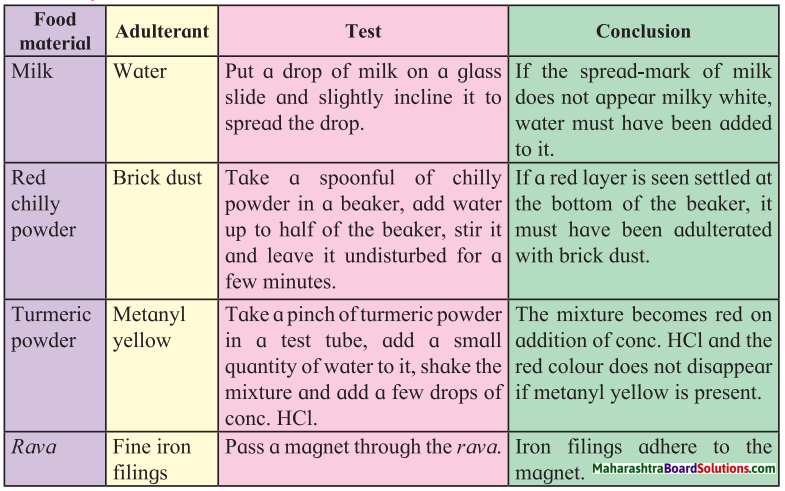
  2. Due to salts dissolved in sea water, density of sea water is more, so the swijnmer will not sink.
  3. Hence, it is easier to swim in the sea than in a well or a lake.

Question 10.
Sandy soil is less fertile.
Answer:

  1. Sandy soil is made up of large particles and these particles of sandy soil are made of the mineral called silicon dioxide.
  2. These particles do not dissolve in water therefore soil has very little capacity to supply nutrients, so sandy soil is less fertile.

Maharashtra Board Class 7 Science Solutions Chapter 3 Properties of Natural Resources

Question 11.
China clay is used for making crockery.
Answer:
China clay is used for making crockery because on heating, this clay acquires a glaze and hardness. It can be moulded into any shape and being a bad conductor of heat, it is easy to handle.

Answer the following:

Question 1.
Write the properties of air.
Answer:

  1. Air is a mixture of gases.
  2. Air has mass and volume.
  3. It spreads in all directions.
  4. It exerts pressure.
  5. It is colourless.

Question 2.
Name the tests for finding out the characteristic of soil. Describe any one method of it.
Answer:
There are two tests for finding out the characteristics of soil: (1) pH (2) electrical conductivity tests.
1. pH tests: The Danish scientist Sorensen put forth the concept of pH, based on the concentration of hydrogen ions. To determine the pH of soil, a mixture of water and soil in the proportion of 1 : 2 is taken and tested using several indicators.
Accordingly, soil may be found to be one of the following types.

  • Acidic soil – pH less than 6.5
  • Neutral soil – pH 6.5 – 7.5
  • Alkaline soil – pH higher than 7.5

2. By Electrical conductivity tests we come to know how many nutrients are present in the soil.

Maharashtra Board Class 7 Science Solutions Chapter 3 Properties of Natural Resources

Question 3.
Write the causes of diminished soil fertility.
Answer:
Following are the causes of diminished soil fertility.

  1. Soil pH less than 6 or higher than 8.
  2. Low proportion of organic matter.
  3. No proper drainage of water.
  4. Repeated cultivation of the same crop.
  5. Continuous use of saline water.
  6. Excessive use of chemical fertilizers and pesticides.

Question 4.
Which crops reduce the fertility of soil and Which crops increase the fertility of soil?
Answer:
Wheat reduces the fertility of soil and leguminous crops like peanut, moong, moth bean, pea, lentil, Bengal gram, soyabean increase the fertility of soil.

Question 5.
Name and explain some useful types of soil.
Answer:
Following are some useful types of soil.

  1. China clay (Kaolin): (a) It is white in colour, (b) It is used to make crockery, bathroom tiles, tanks, laboratory apparatus, masks, jars etc.
  2. Shadu soil: (a) It is whitish in colour, (b) It is used for making statues and idols.
  3. Terracotta soil: (a) This soil is red in colour, (b) Decorative articles and pots used for growing plants are made from this soil.
  4. Multani soil: This soil is used in cosmetics.

Maharashtra Board Class 7 Science Solutions Chapter 3 Properties of Natural Resources

Question 6.
Explain the types of soil on the basis of its texture.
Answer:
There are 3 types of soil on the basis of its texture.
1. Sandy soil: (a) Large particles are high in sandy soil, (b) Water drains rapidly through sandy soil, (c) It is easy to plough this soil, (d) It is less fertile because the particles of sandy soil are made of the mineral called silicon dioxide (quartz), (e) These particles do not dissolve in water and therefore the soil has very little capacity to supply dissolved nutrients.

2. Silt soil: (a) The particles of silt soil are of medium size, (b) Silt soil is not as ploughable as sandy soil but is much more ploughable than clay soil, (c) This soil contains a large proportion of organic materials, (d) Its capacity to supply nutrients is much greater, (e) Silt soil is also called sedimentary soil.

3. Clay soil: (a) The proportion of small particles is maximum, (b) The particles of clay soil feel smooth to touch, (c) Clay soil has a high water holding capacity.

Explain the given picture in your own words.

Question 1.
Maharashtra Board Class 7 Science Solutions Chapter 3 Properties of Natural Resources 3
Answer:
1. The potato will sink in water as potato’s density is more than water.
2. This is the effect of density. The potato will float in salt solution as the density of salt solution is more than potato. The density of the water becomes greater due to the dissolved salt. That is why it is easier to swim in sea than in a well or a lake.

Can you tell?

Answer the following questions.

Question 1.
What change takes place in a balloon on filling air in it?
Answer:
On filling air in balloon, the shape of the balloon changes. Its size increases due to expansion.

Maharashtra Board Class 7 Science Solutions Chapter 3 Properties of Natural Resources

Question 2.
Why is it easier to swim in the sea than in a well or a lake?
Answer:

  1. Sea water is salty due to minerals in it. Whereas it is absent in well or a lake water.
  2. Due to presence of salts, density of seawater is more than well or lake water, so it is easier to swim in the sea than in a well or lake.

Use your brain power!

Answer the following questions.

Question 1.
What is the effect of increased temperature on the pressure of air?
Answer:
Condition for closed environment:

  1. When the temperature increases, the pressure of air also increases.
  2. For example, as the air warms up, the molecules in the air become more active.
  3. They use up more individual space even though there is same number of molecules. T1 s causes an increase in the air pressure.

Question 2.
Dip an uncorked inverted empty bottle in a slanting position into the water in a wide container. What do you observe?
Maharashtra Board Class 7 Science Solutions Chapter 3 Properties of Natural Resources 2
Answer:

  1. When an uncorked inverted empty bottle is kept slanting in the water container bubbling sound will be heard.
  2. Air bubbles come out from the empty bottle and water enters the bottle.
  3. Empty bottle is actually not empty but it is occupied by air.
  4. When this air comes out, its place is taken by water. This shows that air occupies space.

Maharashtra Board Class 7 Science Solutions Chapter 3 Properties of Natural Resources

Question 3.
In cold countries how do aquatic animals remain alive even after the rivers or lakes freeze in winter.
Answer:

  1. Due to anomalous behaviour of water, in cold countries, water changes to ice.
  2. Due to this change, its volume increases and density decreases. So ice floats on water.
  3. Ice is a bad conductor of heat so it doesn’t allow heat to go inside so the water below ice remains as it is. So aquatic animals remain alive even after the rivers or lakes freeze in winter.

Question 4.
Why is it difficult to plough clay soil?
Answer:
It is difficult to plough clay soil because in clay soil the proportion of small particles is maximum. The particles of clay soil feel smooth to touch and has high water holding capacity, making it very difficult to penetrate through it.

Question 5.
Why is it easy to plough sandy soil?
Answer:

  1. Sandy soil has large sized particles. It has weak structure due to less organic matter and large spaces between them.
  2. The water also drains quickly through it making it dry and allows the plough to penetrate through it.

Question 6.
What is the water holding capacity of silt soil?
Answer:
Silt occurs as a deposit in riverbeds. The size of silt particles is between those of sand and clay. This soil also has humus in it which makes it the best soil to hold the right amount of water.

Maharashtra Board Class 7 Science Solutions Chapter 3 Properties of Natural Resources

Question 7.
Which soil is suitable for cultivation? Why?
Answer:
The silt soil is suitable for cultivation.

  1. The particles of silt soil is of medium size.
  2. Silt soil is much more ploughable than clayey soil.
  3. It contains large proportions of organic material.
  4. This helps the soil in retention of water for a proper amount of time and makes it suitable for crops to grow.

Maharashtra Board Class 7 Civics Solutions Chapter 2 Preamble to the Constitution

Balbharti Maharashtra State Board Class 7 Civics Solutions Chapter 2 Preamble to the Constitution Notes, Textbook Exercise Important Questions and Answers.

Maharashtra Board Class 7 Civics Solutions Chapter 2 Preamble to the Constitution

Class 7 Civics Chapter 2 Preamble to the Constitution Textbook Questions and Answers

1. Find the following words in the grid:

Maharashtra Board Class 7 Civics Solutions Chapter 2 Preamble to the Constitution 1
Question 1.
A sense of ‘we-feeling’ and empathy towards fellow citizens
Answer:
Fraternity.

Maharashtra Board Class 7 Civics Solutions Chapter 2 Preamble to the Constitution

Question 2.
A system in which sovereign power is in the hands of the people
Answer:
Democracy.

Question 3.
Introduction to the Constitution
Answer:
Preamble.

Question 4.
A system in which all religions are considered equal
Answer:
Secular

Maharashtra Board Class 7 Civics Solutions Chapter 2 Preamble to the Constitution 2

2. Answer the following questions.

Question 1.
What are the provisions in a secular Constitution?
Answer:

  • In a Secular State, all religions are considered as equal.
  • No religion is considered to be the state religion. The citizens are free to follow their own religion.
  • The state cannot discriminate among citizens on the basis of religion.

Maharashtra Board Class 7 Civics Solutions Chapter 2 Preamble to the Constitution

Question 2.
What is meant by adult franchise?
Answer:

  • Adult franchise means all citizens completing 18 years of age have the right to vote in the elections.
  • This enables equal participation of citizens in the running of our country.

Question 3.
What right does economic justice ensure?
Answer:
Economic justice ensures our right to a source of livelihood so as to look after oneself and one’s family.

Question 4.
How will human dignity be established in a society?
Answer:
When every individual respects another and honours their freedom and rights, dignity of the individual will be established.

3. How should we make use of our freedom ? Write your views about it.
Answer:

  • Pandit Jawaharlal Nehru has rightly said. ‘We have to assume the responsibility ourselves of what we do’.
  • Freedom must be exercised with care, with a sense of responsibility.
  • Our freedom and independence which we gained after innumerable sacrificies must be safeguarded.
  • We should use the different freedoms endowed on us by our Constitution to bring out the best in us and build a better nation, a better world
  • The future lies in our hands.

4. Explain the following concepts.

Question 1.
Socialist State
Answer:

  • A Socialist State is such a State where the gap between the rich and the poor is minimum.
  • All have a right over the wealth of the country.
  • It is ensured that wealth is not concentrated in the hands of a few people.

Question 2.
Equality
Answer:
(i) The Preamble guarantees the Indian citizens equality of status and there will be no discrimination based on caste, creed, race, sex, place of birth, etc.

(ii) The guarantee of equality means that there should be no discrimination between people in terms of high-low, superior-inferior.

Question 3.
Sovereign State
Answer:
The word sovereign means that a state is not under the control of a foreign power. The most important goal of our freedom struggle was to acquire sovereignty. ‘Sovereignty’ means the ultimate authority to govern oneself. In a democracy, sovereignty rests with the people

Maharashtra Board Class 7 Civics Solutions Chapter 2 Preamble to the Constitution

Question 4.
Equality of opportunity.
Answer:
Equality means the state of being equal in status, rights or opportunities. Equality of status, and of opportunity means that all have equal human status and there will be no discrimination based on caste, creed, race, sex, place of birth, etc. All will get the opportunities for development without any discrimination.

5. Make a list of the key words in the Preamble. Look for their meanings in a dictionary. Prepare a chart in the following way:
Maharashtra Board Class 7 Civics Solutions Chapter 2 Preamble to the Constitution 4
Answer:
Maharashtra Board Class 7 Civics Solutions Chapter 2 Preamble to the Constitution 3

Activities:

  1. Visit your Tehsil office with your teacher to understand how a vote is cast and how the electronic voting machine works.
  2. Make a list of newspapers available in your locality.

Class 7 Civics Chapter 2 Preamble to the Constitution InText Questions and Answers

Answer the following concepts:

Question 1.
Liberty
Answer:
(i) Liberty implies that there should be no coercive, unfair restrictions upon us and that ’ there should be an atmosphere conducive to the development of our inherent capacities.

(ii) In a democracy, citizens enjoy liberty. In fact, democracy becomes mature only if the citizens enjoy freedom.

Discuss:

Question 1.
Some statements regarding freedom have been given below for discussion. Express your views.
(a) While publicly celebrating our festivals, we need to follow some rules. That does not restrict our freedom,
(b) Freedom means behaving in a responsible way, not as per our whims and fancies.
Answer:
Yes, With freedom comes responsibilities. Rules should be followed while exercising freedom for a smooth life and to ensure that we work towards responsible citizenship.

Maharashtra Board Class 7 Civics Solutions Chapter 2 Preamble to the Constitution

Question 2.
Read what Deepa has written on the topic: “My Family’.
Answer:
Democracy does not only imply elections. My parents do all the household work together. We also participate in it. We ensure that we talk cordially with each other. Even if we happen to fight, we try to listen to each others views by stopping the fight as soon as possible. If any change has to be made, even the grandparents are consulted. Anuja wants to take up agricultural research as her career. Her decision was appreciated by everybody.

Question 3.
Do you think that Deepa’s house functions in a democratic way? Which features of democracy can be found in this passage.
Answer:
Yes. They function in a democratic way and the features of democracy displayed here are:

  • Carrying out responsibilities collectively as a unit.
  • Mutual respect.
  • Honouring opinions which are not in line with our views.
  • Consensus in decision making.
  • Freedom of thought and expression.
  • Freedom of occupation.

Activities:

Question 1.
Visit your Tehsil office with your teacher to understand how a vote is cast and how the electronic voting ntachine (EVM) works.
Answer:
The voting machines used in India are a combination of two components. First component is called the Balloting unit on which the voters press the button. The other part is called the Control unit. This unit gives supervising power to the polling officer stationed at the poll booth.

The two units are connected by a five-meter cable. The voter places his /her vote on the Balloting unit which is placed inside the Voting compartment.

An EVM runs on 6-volt batteries to eliminate the need of any external power source. It is designed to record 64 candidate names and 3,840 votes at the max. The 64 candidate names can be split across (a maximum of) 4 balloting units connected in parallel, with 16 candidate names on each of the unit.

Maharashtra Board Class 7 Civics Solutions Chapter 2 Preamble to the Constitution

Question 2.
Make a list of newspapers available in your locality.
Answer:

English News Papers:

  • The Times of India
  • Economic Times
  • Financial Express
  • Indian Express
  • Mumbai Mirror
  • Mid-day
  • DNA (Daily News and Analysis)
  • Business- Standard
  • Hindustan Times
  • Free Press Journal

Hindi News Papers (Including Urdu Daily):

  • Hindi Mid-Day
  • Tehalka News
  • Navbharat Times
  • Humara Mahanagar
  • Aaj Ka Anand
  • YashoBhoomi
  • Dopahar
  • Saamna
  • Hindmata
  • Mumbai Sandhya

Marathi News Papers:

  • Loksatta
  • Maharashtra Times
  • Navshakti
  • Navakal
  • Vartahar
  • Saamna (saamana)
  • Sakai
  • Sandesh
  • Lokmat
  • Divyabhaskar
  • Mumbai Mitra
  • Sandhyanand
  • Punya Nagri
  • Samrat

Class 7 Civics Chapter 2 Preamble to the Constitution Additional Important Questions and Answers

Complete the sentence by choosing the appropriate words from the options given below:

Question 1.
The _______ to the Indian Constitution is called the ‘Preamble’. (Preface, Preview, Annexure)
Answer:
Preface

Question 2.
The Preamble sets out the ______ of our Constitution. (declaration, objectives, theme of the Articles)
Answer:
objectives

Maharashtra Board Class 7 Civics Solutions Chapter 2 Preamble to the Constitution

Question 3.
It talks about the resolve of the Indians to constitute India into a ‘Sovereign, Socialist, _______ Democratic Republic’. (Theocratic, Autocratic, Secular)
Answer:
Secular

Question 4.
Our country became independent on _______. (15th August 1947, 26th January 1950, 26th November 1949)
Answer:
15th August 1947

Question 5.
The word _______ means that a state is not under the control of a foreign power. (Sovereign, Secular, Socialist)
Answer:
Sovereign

Question 6.
A Socialist State is such a State where the gap between the rich and the poor ______. (is maximum, is minimum, does not exist)
Answer:
is minimum

Question 7.
In _________ State, all religions are considered equal and no religion is considered as a State religion. (secular, socialist, sovereign)
Answer:
secular

Question 8.
In a _______ the sovereign power is in thehands of the people. (democracy, autocracy, monarchy)
Answer:
democracy

Question 9.
Elections are conducted in India after a fixed period when voters elect their ______. (President, Vice-president, Representatives)
Answer:
Representatives

Question 10.
The Parliament or Legislature and the Executive take decisions for the entire population as per the procedure laid down by the ______.(High Court, Supreme Court, Constitution)
Answer:
Constitution

Question 11.
________ implies removal of injustice and ensuring that everybody has the opportunity for progress. (Liberty, Justice, Equality)
Answer:
Justice

Maharashtra Board Class 7 Civics Solutions Chapter 2 Preamble to the Constitution

Question 12.
________ ensures that as human beings all have the right to the same dignity and respect, the same status. (Political justice, Social justice, Economic justice)
Answer:
Social justice

Question 13.
Since we have adopted universal adult franchise, all citizens completing ________ years of age have the right to vote in the elections. (18, 20, 21)
Answer:
18

Question 14.
The liberty of belief, faith and worship implies ______ freedom. (economic, social, religious)
Answer:
religious

Question 15.
_____ implies a ‘we-feeling’ towards one another. (Fraternity, Empathy, Sympathy)
Answer:
Fraternity

Question 16.
________ implies equal respect to each (Human Rights, Equality, Dignity)
Answer:
Equality

Match the following:

Question 1.

(1) Sovereignty

(2) Socialist State

(3) Secular

(4) Democratic

(a) Equal right over the wealth of the country.

(b) No discrimination on the basis of religion.

(c) Sovereign power is in the hands of the people.

(d) Public positions elected by the people.

(e) Ultimate authority to govern ownself.

Answer:
1 – e
2 – a
3 – b
4 – c

Name the following:

Question 1.
The fundamental and the highest law of the land which is an important document clarifying the rules of the administration.
Answer:
Constitution.

Question 2.
A systematic arrangement of all the aims and objectives of a law which is the preface to the Constitution.
Answer:
Preamble

Question 3.
The words with which the Preamble begins,
Answer:
’We, the people of India’.

Question 4.
The word that means that a State is not under the control of a foreign power.
Answer:
Sovereign

Question 5.
A state where the gap between the rich and poor is minimum.
Answer:
Socialist.

Question 6.
A state wherein all religions are considered equal.
Answer:
Secular state.

Question 7.
In this form of governance, the sovereign power is in the hands of the people.
Answer:
Democracy.

Maharashtra Board Class 7 Civics Solutions Chapter 2 Preamble to the Constitution

Question 8.
Institutions in India created by our Constitution.
Answer:

  • Parliament
  • Legislature
  • Executive.

Question 9.
In this form of government, all positions are elected by the people and no public position is occupied on the basis of hereditary succession.
Answer:
Republic.

Question 10.
Three types of Justice talked of in the Constitution.
Answer:
Social Justice, Economic Justice, Political Justice.

Question 11.
This implies that there should be no coercive, unfair restrictions upon us and that there should be an atmosphere conducive to the development of our inherent capacities.
Answer:
Liberty

Question 12.
The most fundamental freedom of an individual.
Answer:
Freedom of Thought and Expression.

Question 13.
The liberty of belief, faith and worship implies this value.
Answer:
Religious freedom.

Question 14.
The goal which is included in the Constitution which implies a ‘we-feeling ‘ and feeling of empathy.
Answer:
Fraternity.

State whether the following statements are true or false with reason:

Question 1.
The Preamble begins with the mention that the people of India have given the Constitution to themselves.
Answer:
False : The Preamble begins with the words ‘We, the People of India’.

Question 2.
In a democracy, the sovereign power is in the hands of the people.
Answer:
True: Democracy is the Government of the people, by the people and for the people.

Maharashtra Board Class 7 Civics Solutions Chapter 2 Preamble to the Constitution

Question 3.
In a democracy, citizens enjoy liberty.
Answer:
True : In fact democracy becomes mature only if citizens enjoy liberty.

Answer the following questions:

Question 1.
The Preamble guarantees the Indian citizens equality of status and of opportunity. Explain.
Answer:

  • It means that all have equal human status and there will be no discrimination based on caste, creed, race, sex, place of birth, high or low status or superior-inferior.
  • The Preamble has given great importance to equality of opportunity as well.
  • Each one gets the opportunities for development without discrimination.

Answer the following concepts:

Question 1.
Constitution and Preamble
Answer:

  • Our Constitution is the fundamental and the highest law of the land.
  • There are definite aims or purposes in making any law.
  • Basic provisions in the law are made, after clarifying these objectives.
  • A systematic arrangement of all the aims and objectives of a law is the Preface to the law.
  • The Preface to the Indian Constitution is called the ‘Preamble’. The Preamble sets out the objectives of our Constitution.

Question 2.
Republic and how is it different from Monarchy.
Answer:

  • Along with being a democracy, we are a Republic. All public positions in a Republic are elected by the people.
  • No public position is occupied on the basis of hereditary succession.
  • The position like the President, the Prime Minister, the Governor, the Chief Minister, the , Mayor, the Sarpanch, etc. are public positions.
  • Any Indian citizen fulfilling the prescribed age criterion can get himself/herself elected to any of these positions.

Question 3.
Fraternity
Answer:

  • Fraternity implies a ‘we-feeling’ towards one another.
  • It creates a feeling of empathy.
  • People become more understanding towards each other’s problems and needs.

Explain the terms:

Question 1.
Justice
Answer:

  • Justice implies removal of injustice and ensuring that everybody has the opportunity for progress.
  • Establishing justice is adopting such policies that will promote public good.

Maharashtra Board Class 7 Civics Solutions Chapter 2 Preamble to the Constitution

Question 2.
Social Justice
Answer:

  • There should be no discrimination among individuals on the basis of caste, creed, race, language, region, place of birth or sex.
  • As human beings, all have the right to the same dignity and respect, the same status.

Question 3.
Economic Justice
Answer:

  • Poverty leads to the evils of hunger, hunger -deaths or malnourishment.
  • If poverty is to be eradicated, everyone should have the right to a source of livelihood so as to look after oneself and one’s family.
  • Our Constitution has given this right to every citizen without any discrimination.

Question 4.
Political Justice
Answer:

  • We have adopted universal adult franchise to enable equal participation in the running of the country.
  • Accordingly, all citizens completing 18 years of age have the right to vote in elections.

Give reason:

Question 1.
India is a sovereign state.
Answer:

  • India was ruled by Britain for a long period.
  • The British rule ended on 15th August, 1947. Our country became independent and India became sovereign i.e a state not under the control of a foreign power.

Question 2.
India is a secular state.
Answer:

  • In India, all religions are considered as equal.
  • No one religion is considered to be a state religion. The citizens are free to follow their own religion. So, India is a secular state.

Question 3.
Freedom of thought and expression is the most fundamental freedom for an individual.
Answer:

  • Freedom of thought and expression is the most fundamental freedom for an individual.
  • Everyone is free to express their own views and opinions. A give-and-take of ideas enhances the spirit of cooperation and unity amongst us.
  • Similarly, it also enables us to understand the various dimensions of any problem.

Maharashtra Board Class 7 Civics Solutions Chapter 2 Preamble to the Constitution

Question 4.
Promotions of fraternity has been included in the Preamble as a goal.
Answer:

  • The makers of the Constitution believed that merely guaranteeing justice, freedom and equality would not lead to establishing equality in Indian society.
  • No amount of laws would help us achieve these goals if fraternity is lacking among Indians.
  • Hence the promotion of fraternity has been included in the Preamble as a goal.

Question 5.
Fraternity is closely related with human dignity.
Answer:

  • Human dignity implies equal respect to each individual as a human being. .
  • It does not depend upon the criteria of caste, creed, race, sex, language, etc.
  • Just as we would like to be treated with dignity and respect by others, we should treat others with the same dignity and respect.
  • When every individual respects another and honours their freedom and rights, dignity of the individual will get established.
  • This will also develop fraternity, a ‘we-feeling’ towards one another.

Maharashtra Board Class 7 Science Solutions Chapter 5 Food Safety

Balbharti Maharashtra State Board Class 7 Science Solutions Chapter 5 Food Safety Notes, Textbook Exercise Important Questions and Answers.

Maharashtra State Board Class 7 Science Solutions Chapter 5 Food Safety

Class 7 Science Chapter 5 Food Safety Textbook Questions and Answers

1. Complete the following statements by using the correct option from those given below.
(Irradiation, dehydration, pasteurization, natural, chemical)

Question a.
Drying the food grains from farms under the hot sun is called …………. .
Answer:
dehydration

Maharashtra Board Class 7 Science Solutions Chapter 5 Food Safety

Question b.
Materials like milk are instantly cooled after heating up to a certain high temperature. This method of food preservation is called ……….. .
Answer:
pasteurization

Question c.
Salt is a ……….. type of food preservative.
Answer:
natural

Question d.
Vinegar is a …………. type of food preservative.
Answer:
chemical

2. Answer the following questions in your own words. 

Question a.
How is milk pasteurised?
Answer:
Boil the milk at 80°C for 15 minutes and cool it quickly. This destroys the microbes present in the milk and it can remain for a longer duration. This process is called pasteurization of milk.

Maharashtra Board Class 7 Science Solutions Chapter 5 Food Safety

Question b.
Why should we not consume adulterated food materials?
Answer:
Different types of adulterants affect our health in different ways. Some adulterants cause abdominal discomfort or poisoning while some may affect the functioning of some organs if consumed over a long period of time or even cause cancer.

Question c.
What precautions do your parents take to keep foodstuffs safe?
Answer:
Our parents take following care to keep foodstuffs safe

  1. Drying of grains.
  2. Boiling of milk, soups and curries from time to time.
  3. Refrigeration of vegetables, fruits, milk and cooked food.
  4. Candying of jams.
  5. Use natural preservatives like oil, spices, neem leaves, salt, etc.
  6. Use chemical preservatives in sauces, ketchups, pickles, jams and squashes.

Question d.
How does food spoilage occur? Which are the various factors spoiling the food?
Answer:
Food spoilage is the process in which food deteriorates to the point in which it is not edible to humans or its quality of edibility becomes reduced.
Following are the factors for spoiling of food:

  1. Bacteria causes food to spoil
  2. Incorrect storage may spoil the food.
  3. Infestation by pests.
  4. Chemical reaction takes place in food and it gets spoiled.

Maharashtra Board Class 7 Science Solutions Chapter 5 Food Safety

Question e.
Which methods of food preservation would you use?
Answer:
I use following methods to preserve the food:

  1. Freezing
  2. Boiling
  3. Salting of pickles
  4. drying of grains
  5. candying of jams.

3. What shall we do?

Question a.
There are vendors selling uncovered sweet-meats in open places in the market.
Answer:
We should tell them to sell the covered sweets because uncovered sweets are harmful to eat because it contains dust, dirt and germs. And buyers also should not purchase these uncovered sweets.

Question b.
A ‘pani-puriwala’ is serving the panipuri with dirty hands.
Answer:
We should tell him to wear gloves before serving panipuri because dirty hands contain dirt and germs which are harmful to us.

Question c.
We have purchased a large quantity of fruits and vegetables.
Answer:
We should keep them in refrigerator because in refrigerator, due to low temperature, fruits and vegetables do not spoil and biological and chemical reactions in fruits and vegetables are slowed down at low temperature.

Maharashtra Board Class 7 Science Solutions Chapter 5 Food Safety

Question d.
We need to protect foodstuffs from pests like rats, cockroaches, wall-lizards etc.
Answer:

  1. If we do not protect foodstuffs from pests like rats, cockroaches, wall-lizards etc. then the food get spoiled by them and germs carried by them enters into the food.
  2. If we eat this food then we may get food poisoning and we fall sick so we need to protect foodstuffs from pests like rat, cockroaches, wall lizards etc.

4. Find the odd-man-out. 

Question a.
Salt, vinegar, citric acid, sodium benzoate.
Answer:
Salt

Question b.
Lakhi dal, brick dust, metanyl yellow, turmeric powder.
Answer:
Turmeric powder

Question c.
Banana, apple, guava, almond.
Answer:
Almond

Maharashtra Board Class 7 Science Solutions Chapter 5 Food Safety

Question d.
Storing, freezing, settling, drying
Answer:
Storing

5. Complete the chart below.

Question a.
Maharashtra Board Class 7 Science Solutions Chapter 5 Food Safety 1
Answer:

FoodstuffAdulterant
1. Turmeric powderMetanil yellow
2. Black pepperDried papaya seeds
3. RavaIron filings
4. HoneySugar, water and jaggery

Maharashtra Board Class 7 Science Solutions Chapter 5 Food Safety

6. Explain why this happens and suggest possible remedies.

Question a.
Qualitative wastage of food.
Answer:
Qualitative wastage of food happens due to wrong methods of protecting food, excessive use of food preservatives, over-cooking, washing the vegetables after cutting them, mis¬handling of fruits like grapes and mangoes, miscalculation of the time required to transport food from producers to consumers are some of the reasons of qualitative wastage of food.
Possible remedies:

  1. Avoid overcooking of food.
  2. Store grains and other perishable foodstuffs like vegetables, fruits, milk etc. using proper methods.
  3. Wash fruits and vegetables before cutting it.

Question b.
The cooked rice is underdone.
Answer:
Sometimes in a hurry if we cook the rice it is underdone.
Possible remedies: Use proper pressure cooker to cook the rice.

Question c.
The wheat that was bought is a bit moist.
Answer:
Sometimes due to sudden rain, wheat gets a bit moist. Possible remedies: Do not store the moist wheat, it gets spoiled due to fungus so first sundry it and then store in a clean and dry container to avoid microbial growth.

Question d.
The taste of yoghurt is too sour/slightly bitter.
Answer:
The taste of yoghurt is too sour/slightly bitter means it is spoiled. This happens if it is not kept in the refrigerator.
Possible remedies:- Always keep the yoghurt in refrigerator to avoid biological and chemical reactions in food materials.

Maharashtra Board Class 7 Science Solutions Chapter 5 Food Safety

Question e.
Cut fruits turned black.
Answer:
Fruit contains an enzyme called polyphenol oxidase or tyrosinase that reacts with oxygen. The oxidation reaction basically forms a sort of rust on the surface of fruits so it turns black.
Possible remedies:

  1. Coat the fruits with sugar syrup
  2. Add lemon juice on fruits.

7. Give reasons.

Question 1.
Food remains safe at 5° Celsius.
Answer:
Food remains safe at 5° Celsius because at 5°C, micro-organisms stop growing.

Maharashtra Board Class 7 Science Solutions Chapter 5 Food Safety

Question 2.
Nowadays, food is served in buffet style during large gatherings.
Answer:
Nowadays, food is served buffet style during large gatherings because due to buffet style quantitative wastage of food can be avoided, as people take only as much as they could eat.

Project:

Question 1.
Go to your kitchen und take notes about the food safety measures and the food wastage you see there.

Question 2.
In a science exhibition demonstrate the various methods of detecting food adulteration.

Class 7 Science Chapter 5 Food Safety Important Questions and Answers

Complete the following statements by using the correct option from those given below.
(Irradiation, dehydration, pasteurization, natural, chemical)

Question 1.
………………………. is celebrated as “World Food Day”.
Answer:
16th October

Maharashtra Board Class 7 Science Solutions Chapter 5 Food Safety

Question 2.
FSSAI means ………………………. .
Answer:
Food Safety and Standardization Authority of India

Question 3.
………………………. gas is filled in tight packets of potato wafers.
Answer:
Nitrogen

Question 4.
Common name of acetic acid is ……………………….
Answer:
Vinegar

Question 5.
………………………. is sprayed on the gunny bags containing food grains.
Answer:
Melathion

Maharashtra Board Class 7 Science Solutions Chapter 5 Food Safety

Question 6.
………………………. is used in smoking method.
Answer:
Aluminium phosphide

Question 7.
………………………. and ………………………. are emitted by radioactive isotopes in irradiation method.
Answer:
X – rays, gamma rays

Question 8.
In Maharashtra, irradiation plants have been installed at ………………………. for onions and potatoes and at for spices and condiments.
Answer:
Lasalgaon, Navi Mumbai

Question 9.
………………………. found the pasteurisation method.
Answer:
Louis Pasteur

Question 10.
………………………. adulterant is added to turmeric powder.
Answer:
Metanyl yellow

Maharashtra Board Class 7 Science Solutions Chapter 5 Food Safety

Question 11.
………………………. adulterant is added to red chilly powder.
Answer:
Brickdust

Question 12.
………………………. is used to make fruits more attractive.
Answer:
calcium carbide

Question 13.
………………………. and ………………………. harmful chemicals are mixed with cold drinks.
Answer:
carbonated soda, phosphoric acid

Maharashtra Board Class 7 Science Solutions Chapter 5 Food Safety

Question 14.
Shopkeepers change the of the ………………………. food packets fo avoid a financial loss.
Answer:
expiry date

Question 15.
Milk vendors add ………………………. to the milk to appear as higher fat content.
Answer:
urea

Question 16.
The shelf life of potatoes and onions ………………………. due to slowed-down of sprouting.
Answer:
increases

Question 17.
Serving too much food to guests at traditional feasts and banquets leads to ………………………. wastage of food.
Answer:
Quantitative

Maharashtra Board Class 7 Science Solutions Chapter 5 Food Safety

Question 18.
Miscalculation of the time required to transport food from producers to consumers leads to ……………………… . wastage of food.
Answer:
Qualitative

Question 19.
Prevention of food spoilage by microbial growth and infestation by pests is called ………………………. .
Answer:
food protection

Question 20.
………………………. is an example of a chemical preservative.
Answer:
Sodium benzoate.

Say whether True or False,, Correct and rewrite the false statement.

Question 1.
To prevent adulteration of food, it is inspected by the “Food and Drug Administration department of the government”.
Answer:
True

Maharashtra Board Class 7 Science Solutions Chapter 5 Food Safety

Question 2.
Overcooking of food increases the quality of food.
Answer:
False. Over cooking of food spoils it

Question 3.
Peanuts become rancid then, it is not good to eat.
Answer:
True

Question 4.
Oil and ghee contain fats.
Answer:
True

Question 5.
Prevention of food spoilage by microbial growth and infestation by pests is called food wastage.
Answer:
False. Prevention of food spoilage by microbial growth and infestation by pests is called food protection.

Maharashtra Board Class 7 Science Solutions Chapter 5 Food Safety

Question 6.
Serve yourself only as much as you can eat.
Answer:
True

Question 7.
Salt, sugar and oil are naturally available preservatives.
Answer:
True

Question 8.
Pickles can be preserved by salting.
Answer:
True

Question 9.
Milk vendors add urea to the milk so that it appears to have higher fat content.
Answer:
True

Maharashtra Board Class 7 Science Solutions Chapter 5 Food Safety

Question 10.
Shelf life of fruits and vegetables decreases by gamma rays emitted by radio-active isotopes.
Answer:
False. Shelf life of fruits and ‘ vegetables increases by gamma rays emitted by radioactive isotopes.

Give scientific reasons.

Question 1.
Refrigerators are used in the kitchen.
Answer:

  1. Biological and chemical reactions in food materials are slowed down at low temperature.
  2. As a result food remains in good condition for a longer period. Therefore refrigerators are used in the kitchen.

Question 2.
Potatoes and onions are treated with gamma rays.
Answer:
Potatoes and onions are treated with gamma rays because irradiation with gamma rays prevents their wastage due to sprouting and increases their shelf life.

Question 3.
Grains are sun-dried.
Answer:
Grains are sun-dried to preserve them because on sun drying their water content gets reduced and hence they last longer.

Maharashtra Board Class 7 Science Solutions Chapter 5 Food Safety

Question 4.
We boil milk from time to time.
Answer:
We boil milk from time to time to kill microorganisms in it and thus prevent it from getting spoilt.

Question 5.
Jams or pickles get spoilt if their jars are not sealed properly.
Answer:
If the jar is not sealed properly, micro¬organisms from the air enter in the jar and start growing on the food. Oxygen in the air helps the micro-organisms and fungi to grow faster and hence bring about the spoilage of the jams and pickles.

Question 6.
Some vendors add urea to the milk.
Answer:
Some vendors add urea to the milk so that it appears to have higher fat content.

Question 7.
Food wastage should be avoided.
Answer:
In countries like India, the food requirement is plenty and people do not get proper meals even once in a day. If food is not wasted then it could have met the need of many others. Therefore, food should not be wasted and proper measures should be implemented to stop quantitative and qualitative wastage of food.

Question 8.
Adulterated food should not be consumed.’
Answer:

  1. The health of all people is endangered by food adulteration.
  2. Different types of adulterants affect our health in different ways.
  3. Some adulterants cause abdominal discomfort or poisoning, while some may affect the functioning of some organs if consumed over a long period of time or even cause cancer.

Maharashtra Board Class 7 Science Solutions Chapter 5 Food Safety

Can you tell?

Answer the following questions:

Question 1.
How and where food is wasted?
Answer:
Quantitative wastage of food:
1. Wrong methods of farming like hand sowing of, ts seeds, inadequate threshing, improper storage and wrong methods of distribution are some reasons for quantitative wastage of food.

2. Besides, much food is wasted as a result of the custom of offering and serving too much food to guests at traditional feasts or banquets.

3. Had it not been wasted, all this food could have met the need of many others Qualitative wastage of food: Using wrong methods of protecting food, excessive use of food preservatives, over-cooking, washing the vegetables after cutting them, mis-handling of fruits like grapes and mangoes, mis-calculation of the time required to transport food from producers to consumers, are some of the causes of quantitative wastage of food.

Maharashtra Board Class 7 Science Solutions Chapter 5 Food Safety

Question 2.
How is the food adulterated?
Answer:
Food is adulterated by the following ways:

  1. Removal of some important components of food. e.g. removal of fat content of milk, essence of cloves, cardamoms, etc.
  2. Mixing of a low quality inedible or cheaper material or harmful colour with food.
  3. Mixing of some harmful materials like small stones, fine sand, iron filings, urea, dung of horse, sawdust etc.

How will you find out if food has been adulterated?

Maharashtra Board Class 7 Science Solutions Chapter 5 Food Safety 2