Maharashtra Board Class 10 Science Solutions Part 1 Chapter 1 Gravitation

Balbharti Maharashtra State Board Class 10 Science Solutions Part 1 Chapter 1 Gravitation Notes, Textbook Exercise Important Questions and Answers.

Maharashtra State Board Class 10 Science Solutions Part 1 Chapter 1 Gravitation

Class 10 Science Chapter 1 Gravitation Exercise Question 1.
Study the entries in the following table and rewrite them putting the connected items in a single row :

IIIIII
Massm/s2Zero at the centre of the earth
WeightkgMeasure of inertia
Acceleration due to gravityN.m2/kg2Same in the entire universe
Gravitational constantNDepends on height

Answer:

IIIIII
MasskgMeasure of inertia
WeightNDepends on height
Acceleration due to gravitym/s2Zero at the centre of the earth
Gravitational constantN.m2/kg2Same in the entire universe

Maharashtra Board Class 10 Science Solutions Part 1 Chapter 1 Gravitation

Gravitation Class 10 Maharashtra Board Question 2.
Answer the following questions.
(a) What is the difference between mass and weight of an object? Will the mass and weight of an object on the earth be the same as their values on Mars? Why?
Answer:
The mass of an object is the amount of matter present in it. It is same everywhere in the Universe and is never zero. It is a scalar quantity and its SI unit is kg. The weight of an object is the force with which the earth (or any other planet/ moon/star) attracts it. It is directed towards the centre of the earth. The weight of an object is different at different places on the earth. It is zero at the earth’s centre. It is a vector quantity and its SI unit is the newton (N). The magnitude of weight = mg.

The mass of an object will be the same on the earth and Mars, but the weight will not be the same because the value of g on Mars is different from that on the earth.

(b) what are (i) free fall, (ii) acceleration due to gravity (iii) escape velocity (iv) centripetal force?
Answer:
(i) Free fall:
Whenever an object moves under the influence of the force of gravity alone, it is said to be falling freely.

(ii) Acceleration due to gravity:
The acceleration produced in a body due to the gravitational force of the earth is called the acceleration due to gravity.
[Note: On the earth’s surface, the value of the acceleration due to gravity is almost uniform. If a body falls from a low altitude, the value of the acceleration due to gravity is almost the same.]

(iii) Escape velocity:
When a body is thrown vertically upward from the surface of the earth, the minimum initial velocity of the body for which the body is able to overcome the downward pull by the earth and can escape the earth forever is called the escape velocity.

(iv) Centripetal force:
In uniform circular motion of a body, the force acting on the body is directed towards the centre of the circle. This force is called centripetal force.

(c) Write the three laws given by Kepler. How did they help Newton to arrive at the inverse square law of gravity?
Kepler’s first law :
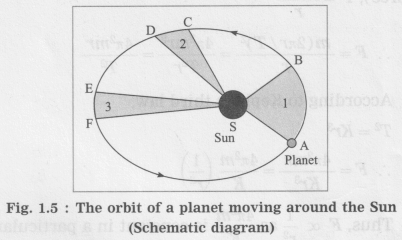
The orbit of a planet is an ellipse with the Sun at one of the foci.
Maharashtra Board Class 10 Science Solutions Part 1 Chapter 1 Gravitation 1
Figure 1.5 shows the elliptical orbit of a planet revolving around the Sun (S).

Kepler’s second law :
The line joining the planet and the Sun sweeps equal areas in equal intervals of time.
A → B, C → D and E → F are the displacements of the planet in equal intervals of time.
The straight lines AS, CS and ES sweep equal areas in equal intervals of time.
Area ASB = area CSD = area ESF.

Kepler’s third law :
The square of the period of revolution of a planet around the Sun is directly proportional to the cube of the mean distance of the planet from the Sun.
Thus, if r is the average distance of the planet from the Sun and T is its period of revolution, then,
T2 ∝ r2, i.e., \(\frac{T^{2}}{r^{3}}\) = constant = K

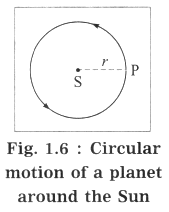
For simplicity, we shall assume the orbit to be a circle.
Maharashtra Board Class 10 Science Solutions Part 1 Chapter 1 Gravitation 2
In Fig. 1.6,
S denotes the position of the Sun, P denotes the position of a planet at a given instant and r denotes the radius of the orbit (= the distance of the planet from the Sun). Here, the speed of the planet is uniform.
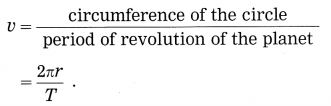
Maharashtra Board Class 10 Science Solutions Part 1 Chapter 1 Gravitation 3
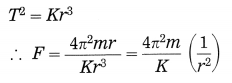
If m is the mass of the planet, the centripetal force exerted on the planet by the Sun (= gravitational force),
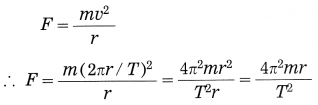
Maharashtra Board Class 10 Science Solutions Part 1 Chapter 1 Gravitation 4
According to Kepler’s third law,
Maharashtra Board Class 10 Science Solutions Part 1 Chapter 1 Gravitation 5
Thus, F ∝ \(\frac{1}{r^{2}}\) as \(\frac{4 \pi^{2} m}{K}\) is constant in a particular case.

(d) A stone thrown vertically upwards with initial velocity u reaches a height ‘h’ before coming down. Show that the time taken to go up is same as the time taken to come down.
Answer:
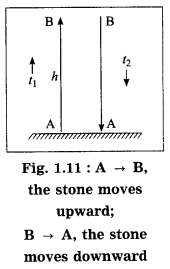
Maharashtra Board Class 10 Science Solutions Part 1 Chapter 1 Gravitation 6
We have, v = u + at …..(1)
and s = ut + \(\frac{1}{2}\) at2 …..(2)
∴ s = (v – at) t + \(\frac{1}{2}\) at2
= vt – at2 + \(\frac{1}{2}\) at2
∴ s = vt – \(\frac{1}{2}\) at2 …..(3)
As the stone moves upward from A → B,
s = AB = h, t = t1,
a = -g (retardation),
u = u and v = 0
∴ From Eq. (3), h = 0 – \(\frac{1}{2}\) (-g)t12
∴ h = \(\frac{1}{2}\)gt12 …..(4)
As the stone moves downward from B → A,
t = t2, u = 0, s = h and a = g
∴ from Eq. (2), h = \(\frac{1}{2}\) gt2 …..(5)
From Eqs. (4) and (5), t12 = t22
∴ t1 = t2 (∵ t1 and t2 are positive)

(e) If the value of g suddenly becomes twice its value, it will become two times more difficult to pull a heavy object along the floor. Why?
Answer:
To pull an object along the floor, it is necessary to do work against the force of friction between the object and the surface of the floor. This force of friction is proportional to the weight, mg, of the object. If the value of g becomes twice its value, the weight of the object and hence the force of friction will become double. Therefore, it will become two times more difficult to pull a heavy object along the floor.

10th Gravitation Chapter Exercise Question 3.
Explain why the value of g is zero at the centre of the earth.
The value of g changes while going deep inside the earth. It goes on decreasing as we go from the earth’s surface towards the earth’s centre.

We shall treat the earth as a sphere of uniform density. If we consider a particle of mass m at point P at a distance (R – d) from the earth’s centre, where R is the radius of the earth and d is the depth below the earth’s surface, the gravitational force on the particle due to the earth is
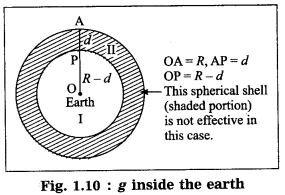
Maharashtra Board Class 10 Science Solutions Part 1 Chapter 1 Gravitation 7
F = \(\frac{G m M^{\prime}}{(R-d)^{2}}\), where ‘M’ is the mass of the sphere of radius (R – d).
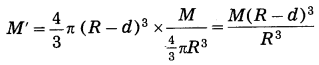
Maharashtra Board Class 10 Science Solutions Part 1 Chapter 1 Gravitation 8
because the outer spherical shell is not effective (Fig. 1.10). In this case, the acceleration due to gravity is

Maharashtra Board Class 10 Science Solutions Part 1 Chapter 1 Gravitation 9
where M is the mass of the earth. Thus, g decreases as d increases. It is less than that at the earth’s surface (\(\frac{G M}{R^{2}}\)) At the earth’s centre, d = R
∴ g = 0.

[Note : The formulae given in the answer are not given in the textbook. The formula density = \(\frac{\text { mass }}{\text { volume }}\) is used to find M’.]

Maharashtra Board Class 10 Science Solutions Part 1 Chapter 1 Gravitation

Std 10 Science Chapter 1 Gravitation Question Answer Question 4.
Let the period of revolution of a planet at a distance R from a star be T. Prove that if it was at a distance of 2R from the star, its period of revolution will be \(\sqrt{8} T\).
Answer:
T= \(\frac{2 \pi}{\sqrt{G M}} \quad r^{3 / 2}\), where T = period of revolution of a planet around the Sun, M = mass of the Sun, G = gravitational constant and r = radius of the orbit assumed to be circular = distance of the planet from the Sun.
For r = R, T =T1.
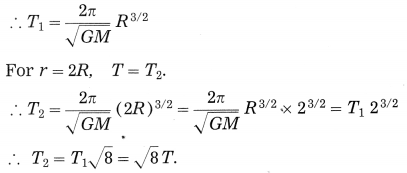
Maharashtra Board Class 10 Science Solutions Part 1 Chapter 1 Gravitation 10

Class 10 Science 1 Chapter 1 Gravitation Question 5.
Solve the following examples.
(a) An object takes 5 s to reach the ground from a height of 5 m on a planet. What is the value of g on the planet?
Solution:
Data: u = 0 m/s, s = 5m, t = 5s, g = ?
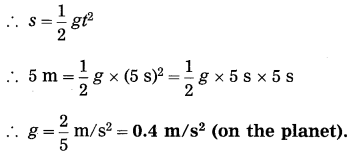
Maharashtra Board Class 10 Science Solutions Part 1 Chapter 1 Gravitation 11

(b) The radius of planet A is half the radius of planet B. If the mass of A is MA, what must be the mass of B so that the value of g on B is half that of its value on A?  (Practice Activity Sheet – 4)
Solution:
Data : RA = RB/2, gB = \(\frac{1}{2}\) gA, MB = ?
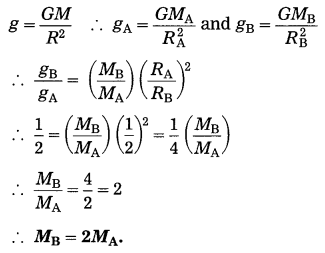
Maharashtra Board Class 10 Science Solutions Part 1 Chapter 1 Gravitation 12

(c) The mass and weight of an object on the earth are 5 kg and 49 N respectively. What will be their values on the moon? Assume that the acceleration due to gravity on the moon is l/6th of that on the earth.
Solution:
Data: m = 5 kg, W = 49 N,
gM = \(\frac{g_{E}}{6}\),m (on the moon) = ?, W(on the moon) = ?
(i) The mass of the object on the moon = the mass of the object on the earth = 5 kg
(ii) W = mg
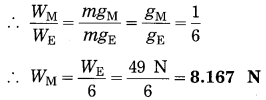
Maharashtra Board Class 10 Science Solutions Part 1 Chapter 1 Gravitation 13
(weight of the object on the moon).

(d) An object thrown vertically upwards reaches a height of 500 m. what was its initial velocity? How long will the object take to come back to the earth? Assume g = 10 m/s2
Solution:
100 mn/s and 20 s

(e) A ball falls off a table and reaches the ground in 1 s. Assuming g = 10 m/s2, calculate its speed on reaching the ground and the height of the table.
Solution:
Data: t = 1s, g = 10 m/s2, u = 0 m/s,
s = ?, v = ?
(i) s = ut + \(\frac{1}{2}\)gt2
= \(\frac{1}{2}\)gt2 for u = 0 m/s
∴ s = \(\frac{1}{2}\) × 10 m/s2 × (1s)2
=5 m
∴ The height of the table = 5 m.

(ii) v = u +at = u + gt
= 0 m/s + 10 m/s2 × 1 s
= 10m/s
∴ The velocity of the ball on reaching the ground = 10 m/s.

(f) The masses of the earth and moon are 6 × 1024 kg and 7.4 × 10²² kg, respectively. The distance between them is 3.84 × 10⁵ km. Calculate the gravitational force of attraction between the two. Use G = 6.7 × 10⁻¹¹ N.m2 kg-2.
Solution:
Data : m1 = 6 × 1024 kg,
m2 = 7.4 × 10²² kg,
r = 3.84 × 10⁵ km = 3.84 × 10⁸ m,
G = 6.7 × 10⁻¹¹ N.m2 kg-2, F = ?
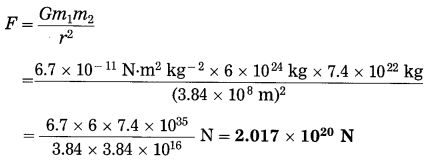
Maharashtra Board Class 10 Science Solutions Part 1 Chapter 1 Gravitation 14
This is (the magnitude of) the gravitational force between the earth and the moon.

(g) The mass of the earth is 6 × 1024 kg. The distance between the earth and the Sun is 1.5 × 10¹¹ m. If the gravitational force between the two is 3.5 × 10²² N, what is the mass of the Sun? (Use G = 6.7 × 10⁻¹¹ N.m2 kg-2)
Solution:
Data : m1 = 6 × 1024 kg,
r = 1.5 × 10¹¹ m, F = 3.5 × 10²² N,
G = 6.7 × 10⁻¹¹ N.m2kg-2, m2 = ?
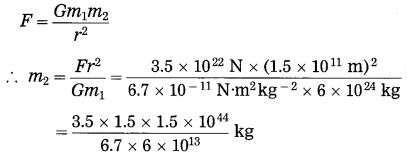
Maharashtra Board Class 10 Science Solutions Part 1 Chapter 1 Gravitation 15
= 1.96 × 1030 kg (mass of the sun)

Gravitation Class 10 Exercise Answers Project:
Take weights of five of your friends. Find out what their weights will be on the moon and the Mars.
Answer:
Help: The weight of a body
(i) On the earth. W1 = mg1
(ii) on the moon, W2 = mg2
(iii) on Mars, W3 = mg3
∴ W2 = W1 × \(\frac{g_{2}}{g_{1}}\) and W3 = W1 × \(\frac{g_{3}}{g_{1}}\)
Now, g1 = 9.81 m/s2, g2 = 1.67 m/s2 and g3 = 3.72 m/s2
If W1 = 500 N,
W2 = 500 × \(\frac{1.67}{9.81}\)N = 85.12N(approx.)
and W3 = 500 × \(\frac{3.72}{9.81}\)N = 189.6 N (approx.)

Can you recall? (Text Book Page No. 1)

10th Class Science Part 1 Chapter 1 Gravitation Exercise Question 1.
What are the effects of a force acting on an object? (Note: a body ≡ an object)
Answer:

  • A force can set a body in motion. For example, if a ball at rest on the floor is pushed, it rolls on the floor.
  • A force can stop a moving body. For example, a moving bicycle can be brought to rest by application of brakes.
  • A force acting on a body can change the speed of the body. For example, when brakes are applied to a moving bicycle, its speed decreases due to the friction between the brake shoes and the rim of the tire.
  • A force can change the direction of motion of the body. For example, in a uniform circular motion of a body, the direction of motion of the body keeps on changing due to the applied force.
  • A force can change the speed as well as the direction of motion of the body. For example, when a ball bowled by a bowler is hit by a batsman, there occurs a*change in the speed as well as the direction of motion of the ball.
  • A force can change the shape and size of the body on which it acts. For example, when a rubber ball is pressed, it gets deformed and hence no longer remains spherical. Also, there can be a decrease in its volume.

1 Gravitation Exercise Question 2.
What types of forces are you familiar with?
Answer:
The gravitational force between the earth and the moon, the electromagnetic force between two charged particles in motion, the nuclear force between a proton and a neutron in the nucleus of an atom.

Gravitation 10th Class Exercise Question 3.
What do you know about the gravitational force?
Answer:
The gravitational force is a universal force, i.e., it acts between any two objects in the universe.

Maharashtra Board Class 10 Science Solutions Part 1 Chapter 1 Gravitation

Can you recall? (Text Book Page No. 1)

Science Part 1 Gravitation Exercise Question 1.
What are Newton’s laws of motion?
Answer:
(1) Newton’s first law of motion: An object continues to remain at rest or in a state of uniform motion along a straight line unless an external unbalanced force acts on it.

(2) Newton’s second law of motion: The rate of change of momentum is proportional to the applied force and the change of momentum occurs in the direction of the force.

(3) Newton’s third law of motion: Every action force has an equal and opposite reaction force that acts simultaneously.
[Note: Equal in magnitude and opposite in direction.]

Use your brainpower! (Text Book Page No. 4)

10th Science Part 1 Gravitation Exercise Question 1.
If area ESF in figure 1.5 is equal to area ASB, what will you infer about EF?
Answer:
The time taken by the planet to move from E to F equals the time taken by the planet to move from A to B.

Use your brainpower (Text Book Page No. 7)

Gravitation Exercise 10th Class Question 1.
According to Newton’s law of gravitation, every object attracts every other object.
Thus, if the earth attracts an apple towards itself, the apple also attracts the earth towards itself with the same force. Why then does the apple fall towards the earth, but the earth does not move towards the apple?
Answer:
The earth and the apple move towards each other, but the magnitude of the displacement of the earth is negligible relative to that of the apple. Also the observer is located on the earth.
[Note: The mass of the earth is far greater than that of an apple. Hence, the magnitude of the acceleration of the earth is negligible relative to that of the apple.]

Gravitation Class 10 Question And Answer Question 2.
The gravitational force due to the earth also acts on the moon because of which it revolves around the earth. Similar situation exists for the artificial satellites orbiting the earth. The moon and the artificial satellites orbit the earth. The earth attracts them towards itself but unlike the falling apple, they do not fall on the earth, why?
Answer:
This is because of the velocity of the moon and the satellites along their orbits. If this velocity was not there, they would have fallen on the earth.

Think about it (Text Book Page No. 8)

Std 10 Science Chapter 1 Gravitation Exercise Question 1.
What would happen if there were no gravity?
Answer:
There would be no gravitational attraction between any two particles and hence no formation of the solar system, galaxy, etc.

Science 1 Gravitation Question 2.
What would happen if the value of G was twice as large?
Answer:
The gravitational force between any two particles would become double, also the value of g would become double.

Maharashtra Board Class 10 Science Solutions Part 1 Chapter 1 Gravitation

Can you tell? (Text Book Page No. 8)

Gravitation Class 10 Exercise Question 1.
What would be the value of g on the surface of the earth if its mass was twice as large and its radius half of what it is now? (March 2019)
Answer:
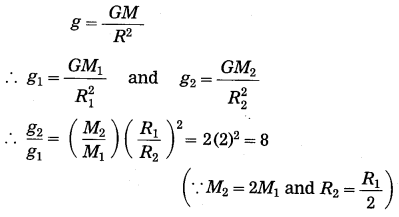
Maharashtra Board Class 10 Science Solutions Part 1 Chapter 1 Gravitation 16
∴ g2 = 8g1
Thus, the value of g on the surface of the earth would be eight times the present value.

Think about it (Text Book Page No. 9)

Std 10 Science Chapter 1 Gravitation Answers Question 1.
Will the direction of the gravitational force change as we go inside the earth?
Answer:
No.

Gravitation Class 11 Exercise Solutions State Board Question 2.
What will be the value of g at the centre of the earth?
Answer:
Zero.

Use your brain power! (Text Book Page No. 10)

10th Ssc Science Chapter 1 Gravitation Question 1.
Will your weight remain constant as you go above the surface of the earth?
Answer:
No. As we go above the surface of the earth, our weight will go on decreasing.

Class 10 Science Chapter 1 Gravitation Question 2.
Suppose you are standing on a tall ladder. If your distance from the centre of the earth is 2R, what will be your weight?
Answer:
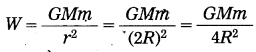
Maharashtra Board Class 10 Science Solutions Part 1 Chapter 1 Gravitation 17
= \(\frac{1}{4}\left(\frac{G M m}{R^{2}}\right)\)

Maharashtra Board Class 10 Science Solutions Part 1 Chapter 1 Gravitation 18

Use your brain power! (Text Book Page No. 12)

Gravitation Class 11 Maharashtra Board Question 1.
According to Newton’s law of gravitation, the earth’s gravitational force is higher on an object of larger mass. Why doesn’t that object fall down with higher velocity as compared to an object with lower mass?
Answer:
F = ma and F = \(\frac{G M m}{r^{2}}\)
∴ Acceleration, a = \(\frac{G M}{r^{2}}\). This is independent of the mass (m) of the object. Hence, an object of larger mass and an object of lower mass fall down with the same velocity.

Use your brain power! (Text Book Page No. 6)

Question 1.
Assuming the acceleration in Example 2 above remains constant, how long will Mahendra take to move 1 cm towards Virat?
Answer:
Here, u = 0
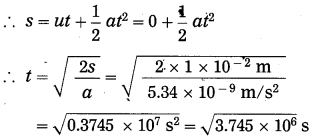
Maharashtra Board Class 10 Science Solutions Part 1 Chapter 1 Gravitation 19
= 1935 s = 32 minutes 15 seconds.

Maharashtra Board Class 10 Science Solutions Part 1 Chapter 1 Gravitation

Fill in the blanks with appropriate words and write the completed sentences :

Question 1.
The ratio g(earth)/g(moon) is equal to……..
Answer:
The ratio g(earth)/g(moon) is equal to 6 (approximately)

Question 2.
The value of the acceleration due to gravity……..as we move from the equator to a pole.
Answer:
The value of the acceleration due to gravity increases as we move from the equator to a pole.

Question 3.
If the earth shrinks to half of its radius, its mass remaining the same, the weight of an object on the earth will become……..times.
Answer:
If the earth shrinks to half of its radius, its mass remaining the same, the weight of an object on the earth will become four times.

Question 4.
The SI unit of weight is the……..
Answer:
The SI unit of weight is the newton.

Question 5.
The CGS unit of weight is the……..
Answer:
The CGS unit of weight is the dyne

Question 6.
The weight of a body is ……..at the poles.
Answer:
The weight of a body is maximum at the poles.

Question 7.
Outside the earth, the weight of a body varies as……..
Answer:
Outside the earth, the weight of a body varies as 1/(R + h)2

Question 8.
Due to the …….. force, the earth attracts all objects towards it.
Answer:
Due to the gravitational force, the earth attracts all objects towards it. Gravitational

Question 9.
The acceleration due to gravity does not depend on the …….. of the body.
Answer:
The acceleration due to gravity does not depend on the mass of the body. Mass

Question 10.
According to Kepler’s first law, the orbit of a planet is …….. with the Sun at one of the……..
Answer:
According to Kepler’s first law, the orbit of a planet is an ellipse with the Sun at one of the foci

Question 11.
According to Kepler’s second law, the line joining the planet and the Sun …….. in equal intervals of time.
Answer:
According to Kepler’s second law, the line joining the planet and the Sun Sweeps equal areas in equal intervals of time.

Question 12.
According to Kepler’s third law T2 ∝ rn, where n = ……..
Answer:
According to Kepler’s third law T2 ∝ rn, where n = 3

Question 13.
For a freely falling object, we can write Newton’s second equation of motion as ……..
Answer:
For a freely falling object, we can write Newton’s second equation of motion as S = \(\frac{1}{2}\)gt2

Question 1.
(A) Write the proper answer in the square.  (Practice Activity Sheet – 1)
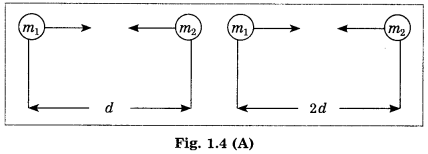
Maharashtra Board Class 10 Science Solutions Part 1 Chapter 1 Gravitation 20
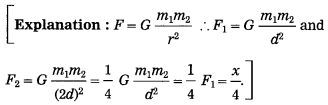
If this F = x
Then F =
Answer:
F = \(\frac{x}{4}\)
Maharashtra Board Class 10 Science Solutions Part 1 Chapter 1 Gravitation 21

(B) Write the proper answer in the square.  (March 2019)
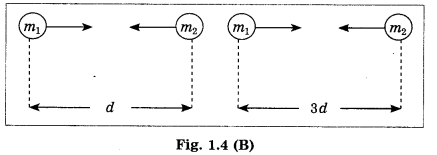
Maharashtra Board Class 10 Science Solutions Part 1 Chapter 1 Gravitation 22
If F = \(\frac{G m_{1} m_{2}}{d^{2}}\),
then F =
Answer:
F = \(\frac{G m_{1} m_{2}}{9 d^{2}}\)

Choose the correct alternative and rewrite the statements:

Question 1.
The gravitational force between two particles separated by a distance r varies as ……..
(a) \(\frac{1}{r}\)
(b) r
(c) r2
(d) \(\frac{1}{r^{2}}\)
Answer:
(d) \(\frac{1}{r^{2}}\)

Question 2.
In the usual notation, the acceleration due to gravity at a height h from the surface of the earth is ……..
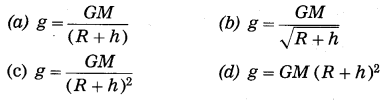
Maharashtra Board Class 10 Science Solutions Part 1 Chapter 1 Gravitation 23
Answer:
(c) g = \(\frac{G M}{(R+h)^{2}}\)

Maharashtra Board Class 10 Science Solutions Part 1 Chapter 1 Gravitation

Question 3.
The SI unit of the universal constant of gravitation is ……..
(a) N.m2/kg2
(b) N.kg2/m2
(c) m/s2
(d) kg.m/s2
Answer:
(a) N.m2/kg2

Question 4.
The escape velocity of a body from the earth’s surface, vsec = …….
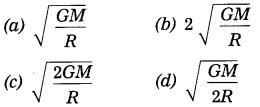
Maharashtra Board Class 10 Science Solutions Part 1 Chapter 1 Gravitation 24
Answer:
(c) \(\sqrt{\frac{2 G M}{R}}\)

Question 5.
How much will a person with 72 N weight on the earth, weigh on the moon?  (Practice Activity Sheet-1)
(a) 12 N
(b) 36 N
(c) 21 N
(d) 63 N
Answer:
(a) 12 N

Question 6.
What will be the weight of a person on the earth, who weighs 9N on the moon? (Practice Activity Sheet – 2)
(a) 3 N
(b) 15 N
(c) 45 N
(d) 54 N
Answer:
(d) 54 N

State whether the following statements are True or False :  (If a statement is false, correct it and rewrite it.)

Question 1.
If the separation between two particles is doubled, the gravitational force between the particles becomes half the initial force.
Answer:
False. (If the separation between two particles is doubled, the gravitational force between the particles becomes \(\frac{1}{4}\) times the initial force.)

Question 2.
The CGS unit of the universal constant or gravitation is the dyne cm2/gram2?
Answer:
True.

Question 3.
At the centre of the earth, the value of the acceleration due to gravity becomes zero.
Answer:
True.

Question 4.
The weight of a body is minimum at the poles.
Answer:
False. (The weight of a body is maximum at the poles.)

Question 5.
Mass is a vector quantity.
Answer:
False. (Mass is a scalar quantity.)

Question 6.
weight is a vector quantity.
Answer:
True.

Question 7.
g has maximum value at the equator.
Answer:
False. (g has maximum value at the poles.)

Question 8.
Outside the earth, g varies as 1/(R + h)2.
Answer:
True.

Question 9.
The value of G changes from place to place.
Answer:
False. (The value of G is the same throughout the universe.)

Question 10.
The value of g increases with altitude.
Answer:
False. (The value of g decreases with altitude.)

Question 11.
The escape velocity of a body does not depend on the mass of the body.
Answer:
True

Question 12.
The mass of a body is the amount of matter present in it.
Answer:
True

Maharashtra Board Class 10 Science Solutions Part 1 Chapter 1 Gravitation

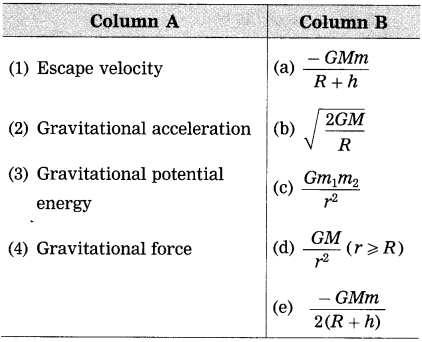
Match the following :

Maharashtra Board Class 10 Science Solutions Part 1 Chapter 1 Gravitation 25
Answer:
(1) Escape velocity : \(\sqrt{\frac{2 G M}{R}}\)
(2) Gravitational acceleration : \(\frac{G M}{r^{2}}\) (r ≥ R)
(3) Gravitational potential energy : \(\frac{-G M m}{R+h}\)
(4) Gravitational force : \(\frac{G m_{1} m_{2}}{r^{2}}\)

Answer the following questions in one sentence each:

Question 1.
State the SI and CGS units of G.
Answer:
The SI unit of G is N.m2/kg2 and CGS unit is the dyne.cm2/g2.

Question 2.
State any one characteristic of gravitational force.
Answer:
Gravitational force between two particles does not depend on the nature of the medium between them.

Question 3.
Name the force that keeps a satellite in the orbit around the earth.
Answer:
The gravitational force due to the earth keeps a satellite in the orbit around the earth.

Question 4.
Name the force due to which the earth revolves around the Sun.
Answer:
The earth revolves around the Sun due to the gravitational force of attraction exerted on it by the Sun.

Question 5.
What is the acceleration due to gravity at a height h ( = radius of the earth) from the surface of the earth? (g = 9.8 m/s2)
Answer:
The acceleration due to gravity at a height h ( = radius of the earth) from the surface of the earth is 2.45 m/s2.
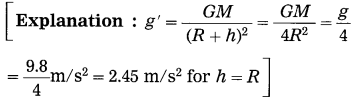
Maharashtra Board Class 10 Science Solutions Part 1 Chapter 1 Gravitation 26

Question 6.
What is the relation between the SI unit of weight and the CGS unit of weight?
Answer:
The relation between the SI unit of weight (the newton) and the CGS unit of weight (the dyne) is 1 newton = 105 dynes.

Question 7.
Write the formula for the centripetal force acting on a body performing circular motion.
Answer:
F = \(\frac{m v^{2}}{r}\)

Question 8.
Write the formula for the escape velocity of a body from the earth’s surface.
Answer:
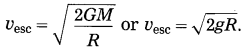
Maharashtra Board Class 10 Science Solutions Part 1 Chapter 1 Gravitation 27

Question 9.
What is the value of the acceleration due to gravity at the centre of the earth?
Answer:
Zero.

Question 10.
What are the factors on which the maximum height attained by a body thrown upwards depends?
Answer:
The initial velocity of the body, the acceleration due to gravity at that place, the buoyant force and frictional force due to air.

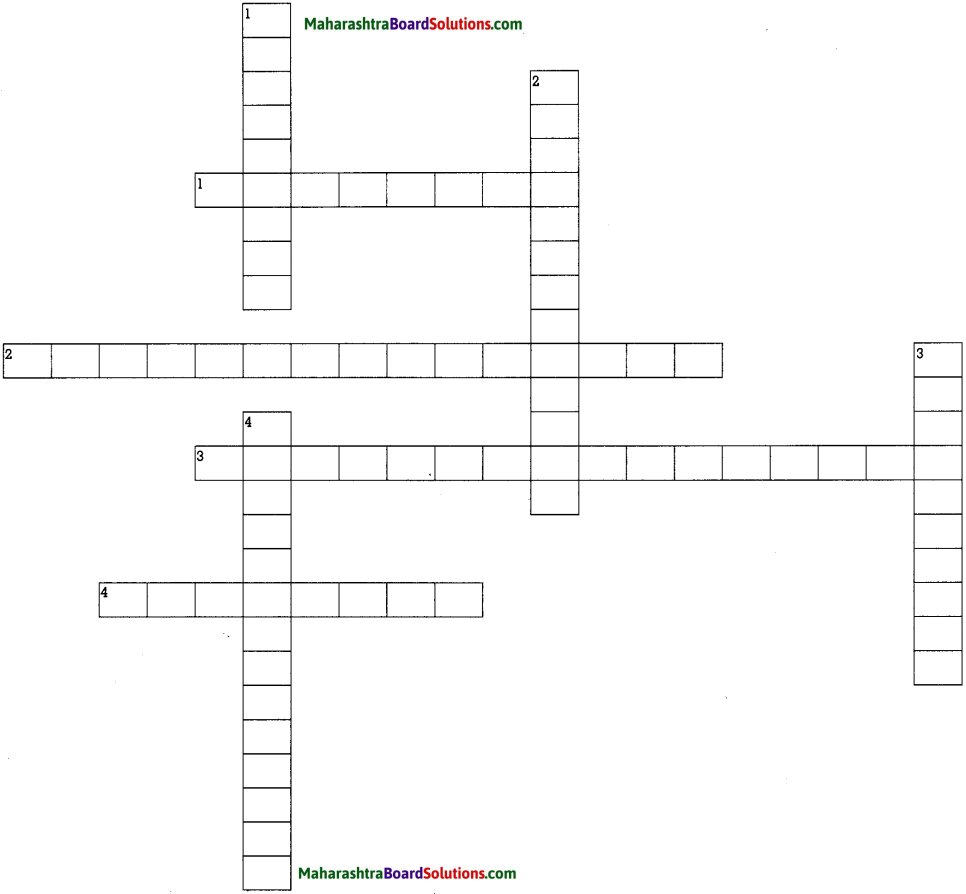
Some of the important terms in chapter Gravitation are given in the following box. Find them :
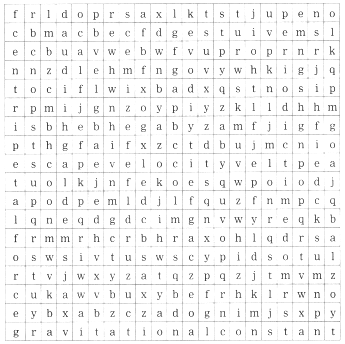
Maharashtra Board Class 10 Science Solutions Part 1 Chapter 1 Gravitation 28
Answer:
(1) centripetal force
(2) escape velocity
(3) periodic time
(4) gravitational constant.

Answer the following questions:

Question 1.
What is centripetal force?
(OR)
Define centripetal force.
Answer:
In uniform circular motion of a body, the force acting on the body is directed towards the centre of the circle. This force is called centripetal force.

Question 2.
Give one example of centripetal force.
Answer:
The moon revolves around the earth due to the gravitational force exerted on it by the earth. This force is directed towards the centre of the earth and is thus a centripetal force.

Question 3.
Name the source responsible for the motion of a planet around the Sun.
Answer:
A planet revolves around the Sun due to the gravitational force exerted on it by the Sun.

Maharashtra Board Class 10 Science Solutions Part 1 Chapter 1 Gravitation

Answer the following questions:

Question 1.
In the following figure, an orbit of a planet around the Sun (S) has been shown. AB and CD are the distances covered by the planet in equal time. Lines AS ad CS sweep equal areas in equal intervals of time. Hence, areas ASB and CSD are equal.  (Practice Activity Sheet-1)
(a) Which laws do we understand from the above description?
(b) Write the law regarding the area swept.
(c) Write the law T2 ∝ r3 in your words.
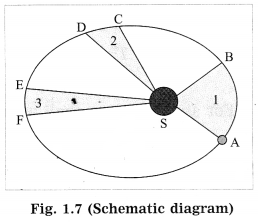
Maharashtra Board Class 10 Science Solutions Part 1 Chapter 1 Gravitation 29
Answer:
(a) From the given description we understand Kepler’s three laws.
(b) Kepler’s law of areas: The line joining the planet and the Sun sweeps equal areas in equal intervals of time.
(c) Kepler’s law of periods: The square of the period of revolution of a planet around the Sun is directly proportional to the cube of the mean distance of the planet from the Sun.

Question 2.
Identify the law shown in Fig. 1.7 and state the three respective laws. (Practice Activity Sheet – 3)
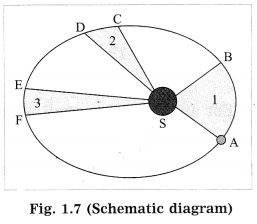
Maharashtra Board Class 10 Science Solutions Part 1 Chapter 1 Gravitation 30
Answer:
(a) From the given description we understand Kepler’s three laws.
(b) Kepler’s law of areas: The line joining the planet and the Sun sweeps equal areas in equal intervals of time.
(c) Kepler’s law of periods: The square of the period of revolution or a planet around the Sun is directly proportional to the cube of the mean distance of the planet from the Sun.

Question 3.
Explain the term gravitational force. What is gravitation?
Answer:
There exists a force of attraction between any two particles of matter in the universe such that the force depends only on the masses of the particles and the separation between them. It is called the gravitational force and the mutual attraction is called gravitation.

Question 4.
State Newton’s universal law of gravitation. Express it in mathematical form.
Answer:
Newton’s universal law of gravitation :
Every object in the Universe attracts every other object with a definite force. This force is directly proportional to the product of the masses of the two objects and inversely proportional to the square of the distance between them.

Mathematical form: Consider two objects of masses m1 and m2. We assume that the objects are very small spheres of uniform density and the distance r between their centers is very large compared to the radii of the spheres (Fig. 1.8).
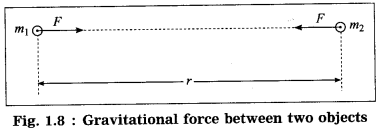
Maharashtra Board Class 10 Science Solutions Part 1 Chapter 1 Gravitation 31
The magnitude (F) of the gravitational force of attraction between the objects is directly proportional to m1m2 and inversely proportional to r2
∴ F ∝ \(\frac{m_{1} m_{2}}{r^{2}}\)
∴ F = \(G\frac{m_{1} m_{2}}{r^{2}}\)
where G is the constant of proportionality, called the universal gravitational constant.
[Note: In the textbook, the word object/body is used.
Newton’s law of gravitation applies to particles.]

Maharashtra Board Class 10 Science Solutions Part 1 Chapter 1 Gravitation

Question 5.
(i) Why is the constant of gravitation called a universal constant?
(ii) Newton’s law of gravitation is called the universal law of gravitation. Why?
Answer:
(i) The value of the constant of gravitation does not change with the nature, mass or the size of the material particles. It does not vary with the distance between the two particles. It is also independent of the nature of the medium between the two particles. Hence, it is called a universal constant.

(ii) As the law of gravitation given by Newton is applicable throughout the universe and to all particles, it is called universal law.

[ Note: The centre of mass of an object is the point inside or outside the object at which the total mass of the object can be assumed to be concentrated to study the effect of an applied force. The centre of mass of a spherical object having uniform density is at its geometrical centre. The centre of mass of an object having uniform density is at its centroid. If the two bodies are spherical and of uniform density, the gravitational force between them is always along the line joining the centres of the two bodies and the distance between the centres is taken to be r. When the bodies are not spherical or have irregular shape or have nonuniform density, the force is along the line joining their centres of mass and r is taken to be the distance between the two centres of mass.]

Question 6.
If the distance between two bodies is increased by a factor of 5, (i) by what factor will the gravitational force change if the masses are kept constant? (ii) by what factor will the mass of one of them have to be altered, keeping the other mass the same, to maintain the same gravitational force between the two bodies?
Answer:
If the distance between two bodies is increased by a factor of 5,
(i) the gravitational force between the bodies will decrease by a factor of 25 if the masses of the bodies are kept constant.
(ii) the mass of one of them will have to be increased by a factor of 25, keeping the mass of the other body the same, to maintain the same gravitational force between the two bodies.
[Note : Gravitational force F ∝ \(\frac{1}{r^{2}}\) and F ∝ m1m2.]

Question 7.
(i) Determine the SI unit of the universal constant of gravitation from the formula for the gravitational force between two particles. Hence, state the CGS unit of the constant of gravitation. (ii) Define G (universal gravitational constant).
Ans. (i) According to Newton’s law of gravitation, the gravitational force between two particles is
F = \(G\frac{m_{1} m_{2}}{r^{2}}\)
where m1 and m2 are the masses of the two particles, r is the distance between them and G is the universal constant of gravitation.
∴ G = \(\frac{F r^{2}}{m_{1} m_{2}}\)

The SI unit of force is the newton (N), that of distance is the metre (m) and that of mass is the kilogram (kg).
The SI unit of G is \(\frac{\mathrm{N} \cdot \mathrm{m}^{2}}{\mathrm{kg}^{2}}\).
The CGS unit of G is \(\frac{\text { dyne } \cdot \mathrm{cm}^{2}}{\mathrm{g}^{2}}\).

(ii) F = \(G\frac{m_{1} m_{2}}{r^{2}}\).
∴ G = \(\frac{F r^{2}}{m_{1} m_{2}}\)
If we take m1 = m2 = unit mass and r = unit distance, numerically, G = F, i.e., G (universal gravitational constant) represents the magnitude of the gravitational force of attraction between two unit masses, separated by a unit distance.

Maharashtra Board Class 10 Science Solutions Part 1 Chapter 1 Gravitation

Question 8.
State the importance of Newton’s universal law of gravitation.
Answer:
The importance of Newton’s universal law of gravitation :
This law explains successfully, i.e., with great accuracy,

  • The force that binds the objects on the earth to the earth
  • The motion of the moon and artificial satellites around the earth
  • The motion of the planets, asteroids, comets, etc., around the Sun
  • The tides of the sea due to the moon and the Sun.

Question 9.
Compare the gravitational force on a body of mass 1 kg due to the earth with the force on the same body due to another body of mass 1 kg at a distance of 1 m from the first body. (Mass of the earth = 6 × 1024 kg, radius of the earth = 6400 km)
Answer:
In the first case, m1 = 1kg,
m2 = 6 × 1024 kg and r = 6400 km = 6.4 × 10⁶ m
The gravitational force on the body.

Maharashtra Board Class 10 Science Solutions Part 1 Chapter 1 Gravitation 32
= \(\frac{G \times 6 \times 10^{24} \mathrm{kg}^{2}}{(6.4)^{2} \times 10^{12} \mathrm{m}^{2}}\)
In second case, m1 = 1 kg
m2 = 1 kg and r = 1m
Gravitational force on the body,
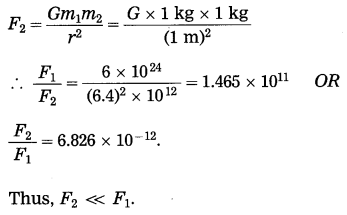
Maharashtra Board Class 10 Science Solutions Part 1 Chapter 1 Gravitation 33

Question 10.
Explain the term the earth’s gravitational force.
(OR)
Write a short note on the earth’s gravitational force.
Answer:
The earth attracts every object towards it because of the gravitational force. As the earth’s centre of mass is at its centre, the gravitational force exerted by the earth on an object is directed towards the earth’s centre. Hence, an object released from a point above the earth’s surface falls vertically downward towards the earth.

If an object is thrown vertically upward, its velocity goes on decreasing due to the earth’s gravitational force on the object. At one stage, the velocity of the body becomes zero and later the body falls back to the earth.

Question 11.
Take two balls of different masses, go to the top of a building, drop them simultaneously and observe what happens to the balls.
Answer:
The balls reach the ground almost at the same time.

Question 12.
Take two similar pages from your notebook. Crumple one paper and allow this and the other paper to fall on the ground simultaneously. What do you observe?
Answer:
The crumpled paper reaches the ground before the other one.

Question 13.
Take a feather and a paper. Allow them to fall to the ground simultaneously. Which will reach the ground earlier? Why?
Answer:
There is no unique answer. It depends on the feather and paper. Upthrust due to air and force due to friction with air play very important roles here. The acceleration of a body depends on the resultant of the earth’s gravitational force on the body and the upthrust and the force of friction due to air.

Question 14.
From Newton’s law of gravitation, derive the formula for the acceleration due to gravity.
Answer:
Suppose that a body of mass m is released from a distance r from the centre (O) of the earth (Fig. 1.9). Let M be the mass of the earth. According to Newton’s law of gravitation, the magnitude of the earth’s gravitational force acting on the body Is
F = G\(\frac{M m}{r^{2}}\)
where G is the universal constant of gravitation.
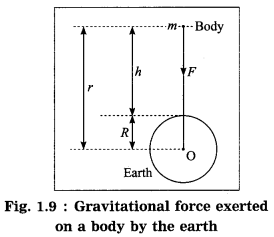
Maharashtra Board Class 10 Science Solutions Part 1 Chapter 1 Gravitation 34
The acceleration produced by this force, force F
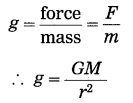
Maharashtra Board Class 10 Science Solutions Part 1 Chapter 1 Gravitation 35

This is the formula for the acceleration due to gravity or the gravitational acceleration due to the earth. This acceleration is directed towards the earth’s centre.

If h denotes the altitude, r = R + h, where R is the radius of the earth.
∴ g = \(\frac{G M}{(R+h)^{2}}\)
For a body on the earth’s surface, h = 0 ∴ g = \(\frac{G M}{R^{2}}\)
[Note: When we consider the gravitational interaction between the earth and a body on the surface of the earth or at some height above the surface of the earth, for many practical purposes we can assume that the earth behaves as if its mass were concentrated at the earth’s centre. The proof is not expected here.]

Maharashtra Board Class 10 Science Solutions Part 1 Chapter 1 Gravitation

Question 15.
Explain the factors affecting the value of g.
Answer:
The value of the acceleration due to gravity, g, changes from place to place on the earth. It also varies with the altitude and depth below the earth’s surface. The factors affecting the’ value of g are the shape of the earth, altitude and depth below the earth’s surface.

(1) The earth is not perfectly spherical. It is somewhat flat at the poles and bulging at the equator. At the surface of the earth, the value of g is maximum (9.832 m/s2) at the poles as the polar radius is minimum, while it is minimum (9.78 m/s2) at the equator as the equatorial radius is maximum.

(2) As the height (h) above the earth’s surface increases, the value of g decreases. It varies as \(\frac{1}{(R+h)^{2}}\), where R is radius of the earth.

(3) In the interior of the earth, on average, the value of g is less than that at the earth’s surface. As the depth below the earth’s surface increases, the value of g decreases and finally it becomes zero at the centre of the earth.

Question 16.
If g = GM/r2, then where will the value^ of g be high, at Goa Beach or on the top of the Mount Everest? (Practice Activity Sheet – 3)
Answer:
The value of g will be high at Goa Beach.

Question 17.
Why does an object released from the hand, fall on the earth?
Answer:
When an object is held in the hand, the gravitational force acting on the object due to the earth is balanced by the person holding the object. When the object is released from the hand, it falls on the earth due to the earth’s gravitational force.

Question 18.
Does the value of g depend on the mass of the falling body? Why?
Answer:
The value of g does not depend on the mass of the falling body.
The reason is the gravitational force on a body due to the earth is directly proportional to the mass of the body and for a given force, the acceleration of a body is inversely proportional to the mass of the body.

Question 19.
Define mass. State its SI and CGS units.
Answer:
The mass of a body is the amount of matter present in it. Its SI unit is the kilogram (kg) and CGS unit is the gram (g).
[Note: Mass has only magnitude, not direction. Thus, it is a scalar quantity.]

Question 20.
Define weight. State its SI and CGS units.
Answer:
The weight of a body is defined as the force with which the earth attracts it. Its SI unit is the newton and CGS unit is the dyne.

[Note : In the usual notation, the magnitude of the weight of a body on the earth s surface is W = \(\frac{G m M}{R^{2}}\) = \(m\frac{G M}{R^{2}}\) = mg. Thus, W ∝ g. Hence, weight varies just like the acceleration due to gravity. It is maximum at the poles and minimum at the equator. It decreases with altitude (ft) and depth (d) below the earth’s surface. It becomes zero at the earth’s centre. At a height above the earth’s surface, W = \(\frac{G m M}{(R+h)^{2}}\) at a depth d below the earth’s surface, W = \(\frac{G m M(R-d)}{R^{3}}\). Weight has magnitude and direction (towards the earth’s centre). It is a vector quantity.]

Question 21.
As per the request of one of his friends from the equator, Rahul buys 100 grams of silver at the north pole. He hands it over to his friend at the equator. Will the friend agree with the weight of the silver bought? If not, why?
Answer:
The weight of a body is given by W = mg, where m is the mass of the body and g is the acceleration due to gravity, g varies from place to place. The value of g at the equator is less than that at the north pole (as well as the south pole). Hence, the weight of the silver bought at the north pole would be less when the silver is weighed at the equator. Therefore, Rahul’s friend will disagree about the weight of the silver.
[Note: The mass being independent of the value of g, Rahul’s friends will agree about the mass of the silver.]

Question 22.
What is the difference between mass and weight of an object? Will the mass and weight of an object on the earth be the same as their values on Mars? Why?
Answer:
The mass of an object is the amount of matter present in it. It is same everywhere in the Universe and is never zero. It is a scalar quantity and its SI unit is kg. The weight of an object is the force with which the earth (or any other planet/ moon/star) attracts it. It is directed towards the centre of the earth. The weight of an object is different at different places on the earth. It is zero at the earth’s centre. It is a vector quantity and its SI unit is the newton (N). The magnitude of weight = mg.

The mass of an object will be the same on the earth and Mars, but the weight will not be the same because the value of g on Mars is different from that on the earth.

Maharashtra Board Class 10 Science Solutions Part 1 Chapter 1 Gravitation

Question 23.
Explain the term free fall and state the corresponding kinematical equations of motion in the usual notation.
Answer:
When a body falls in air, there are three forces acting on the body : (1) the gravitational force due to the earth, acting downward (2) the force of buoyancy (upthrust) due to air, acting upward I (3) the force due to friction with air (called air resistance), acting upward (being always in the direction opposite to that of the velocity of the body).

Under certain conditions, the force of buoyancy due to air and friction with air can be ignored compared to the gravitational force of the earth. In that case (near the earth’s surface) the body falls with almost uniform acceleration (g). Whenever a body moves under the influence of the force of gravity alone, it is said to be falling freely. Strictly speaking, this is true only if the body falls in vacuum.

The kinematical equations of motion, in the usual i notation, are
v = u + gt, s = ut + \(\frac{1}{2}\) gt2 and v2 = u2 + 2gs.
If the initial velocity (u) of the body is zero,
v = gt, s = \(\frac{1}{2}\)gt2 and v2 = 2 gs.

Question 24.
During a free fall, will a heavier object accelerate more than a lighter one?
Answer:
No. The two objects will have the same acceleration.

Question 25.
If you had to calculate the mass of the earth, how would you do it?
Answer:
If the acceleration due to gravity (g), the constant of gravitation (G) and the radius of the earth (R) are known, the mass of the earth (M) can be calculated using the formula g = \(\frac{G M}{R^{2}}\)

Question 26.
What is gravitational potential energy?
(OR)
Define gravitational potential energy.
Write the formula for it.
Answer:
The energy stored in a body due to the gravitational force between the body and the earth is called the gravitational potential energy.

Gravitational potential energy of a body of mass m = \(-\frac{G M m}{R+h}\), where G = gravitational constant, M = mass of the earth, R = radius of the earth, h = height of the body from the surface of the earth.

[Note : As the body is bound to the earth due to the earth’s gravitational froce, the gravitational potential energy of the body is negative. If the body is given kinetic energy equal to \(\frac{G M m}{R+h}\) the body will overcome the earth’s gravitational force. It will then move to infinity and come to rest there.]

Question 27.
What is escape Velocity?
(OR)
Define escape velocity.
Answer:
When a body is thrown vertically upward from the surface of the earth, the minimum initial velocity of the body for which the body is able to overcome the downward pull by the earth and can escape the earth forever is called the escape velocity.

Question 28.
Explain the term escape velocity.
(OR)
Write a short note on escape velocity.
Answer:
In general, when a body is thrown vertically upward from the earth’s surface, its velocity goes on decreasing and after some time the body falls back to the ground. If its initial velocity is increased, the maximum height attained by it is more, but it does fall back to the ground. If the initial velocity is increased continuously, for a particular initial velocity, the body can overcome the earth’s gravitational force and move to infinity and come to rest there. This velocity is called the escape velocity.

Maharashtra Board Class 10 Science Solutions Part 1 Chapter 1 Gravitation

Question 29.
Using the law of conservation of energy, obtain the expression for the escape velocity.
Answer:
Here, we shall not consider the effects of air. Suppose a body of mass m is thrown vertically upward from the surface of the earth. Let the initial velocity of the body be the escape velocity (vsec).

When the body is on the earth’s surface, its total energy Ex = kinetic energy + potential energy = \(\frac{1}{2} m v^{2} \text { esc }\) + \(\left(-\frac{G m M}{R}\right)\) where G = universal gravitational constant, M = mass of the earth and R = radius of the earth.
Thus, E1 = \(\frac{1}{2} m v_{\mathrm{esc}}^{2}-\frac{G m M}{R}\)
When the body moves to infinity and comes to rest there, its total energy,

Maharashtra Board Class 10 Science Solutions Part 1 Chapter 1 Gravitation 36
According to the law of conservation of energy,
E1 = E2.
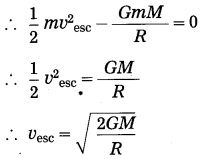
Maharashtra Board Class 10 Science Solutions Part 1 Chapter 1 Gravitation 37
This is the required expression.

Question 30.
Express escape velocity in terms of g and R.
Answer:
Escape velocity, vesc = \(\sqrt{\frac{2 G M}{R}}\)
Now, g = \(\frac{G M}{R^{2}}\)
∴ GM = gR2
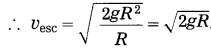
Maharashtra Board Class 10 Science Solutions Part 1 Chapter 1 Gravitation 38

Question 31.
Express escape velocity in terms of G, R and ρ (the earth’s density)
Answer:
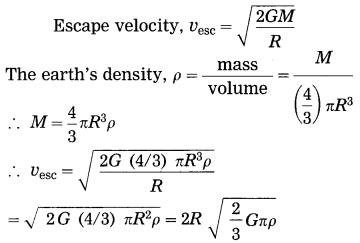
Maharashtra Board Class 10 Science Solutions Part 1 Chapter 1 Gravitation 39

Give scientific reasons:

Question 1.
If a feather and a stone are released from the top of a building simultaneously, the stone reaches the ground earlier than the feather.
Answer:
(a) The motion of a body falling in air accelerated due to the earth’s gravitational force on the body. The force due to buoyancy of air acts on the body in the upward direction. As the body falls, the friction with air opposes its motion.

(b) This opposition due to air depends on the size, shape, density and velocity of the body. It Is greater for a feather than for a stone. Hence, the stone has greater downward acceleration than the feather. Therefore, the stone reaches the ground earlier than the feather though ‘they are released simultaneously from the same height.

Question 2.
The weight of a body is different on different planets.
Answer:
(1) The weight of a body of mass m on the surface of a planet of mass M and radius R is
W = \(\frac{G m M}{R^{2}}\) usuai notation).

(2) For a given body, its mass is constant. G is the universal constant of gravitation. Different planets have different masses and radii such that the ratio (M/R2) is not the same. Hence, the weight of a body is different on different planets.

Maharashtra Board Class 10 Science Solutions Part 1 Chapter 1 Gravitation

Question 3.
With a specific initial velocity, we can jump higher on the moon than on the earth.
Answer:
The acceleration due to gravity on the moon is about \(\frac{1}{6}\) of that on the earth. Hence, with a specific initial velocity, we can jump higher on the moon than on the earth. This can be seen from the equation h = u2/2g.

Distinguish between the following:

Question 1.
mass and weight (2) universal gravitational constant and gravitational acceleration of the earth.
Answer:
(1) Mass:

  • The mass of a body is the amount of matter present in it.
  • It has magnitude, but not direction.
  • It does not change from place to place.
  • It can never be zero.
  • Its SI unit is the kilogram.

Weight:

  • The weight of a body is the force with which the earth attracts it.
  • It has both magnitude and direction.
  • It changes from place to place.
  • It is zero at the centre of the earth.
  • Its SI unit is the newton.

Question 2.
Universal gravitational constant:

  • The universal gravitational constant numerically equals the force of attraction masses separated by a unit distance.
  • Its value remains constant throughout the universe.
  • It has magnitude but not direction.
  • Its SI unit is N.m2/kg2.

Gravitational acceleration of the earth:

  • The gravitational between two unit acceleration of the earth is the acceleration produced in a body due to the gravitational force of the earth.
  • Its value changes from place to place.
  • It has both magnitude and direction.
  • Its SI unit is m/s2

Solve the following examples/numerical problems:
(G 6.67 × 10⁻¹¹ N.m2/kg2, g = 9.8 m/s2)

Question 1.
The time taken by the earth to complete one revolution around the Sun is 3.156 × 10⁷ s. The distance between the earth and the Sun is 1.5 × 10¹¹ m. Find the speed of revolution of the earth.
Solution:
Data : T = 3.156 × 10⁷ s,
r = 1.5 × 10¹¹ m, v =?

Maharashtra Board Class 10 Science Solutions Part 1 Chapter 1 Gravitation 40
= 2.987 × 10⁴ m/s = 29.87 km/s
This is the speed of revolution of the earth.

Question 2.
Assuming that the earth performs uniform circular motion around the Sun, flnd the centripetal acceleration of the earth. [Speed of the earth =3 × 10⁴ m/s, distance between the earth and the Sun = 1.5 × 10¹¹ m]
Solution:
Data: v = 3 × 10⁴ m/s, r=1.5 × 10¹¹ m
Centripetal force = \(\frac{m v^{2}}{r}\) = ma
∴ Centripetal acceleration of the earth,

Maharashtra Board Class 10 Science Solutions Part 1 Chapter 1 Gravitation 41
= 6 × 10⁻³ m/s2
It is directed towards the centre of the Sun.

Maharashtra Board Class 10 Science Solutions Part 1 Chapter 1 Gravitation

Question 3.
What will be the gravitational force on 60 kg man on the Moon, Mars and Jupiter? Are they the same? Why?
M (Moon) = 7.36 × 10²² kg, R (Moon) = 1.74 × 10⁶m,
M (Mars) = 6.4 × 10²³ kg, R (Mars) = 3.395 × 10⁶ m,
M (Jupiter) = 1.9 × 1027 kg.
R (Jupiter) = 7.15 × 10⁷ m,
G = 6.67 × 10⁻¹¹ N.m/kg2
Solution:
(1) Data : m1 = 60 kg, m2 = 7.36 × 10²² kg,
R = 1.74 × 10⁶ m, F = ?
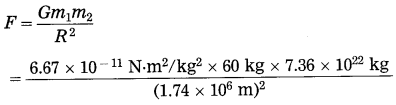
Maharashtra Board Class 10 Science Solutions Part 1 Chapter 1 Gravitation 42
= 97.29 N
On the moon’s surface, the gravitational force on the man due to the moon = 97.29 N.

(2) Data : m1 = 60 kg, m2 = 6.4 × 10²³ kg,
R = 3.395 × 10⁶m, F = ?
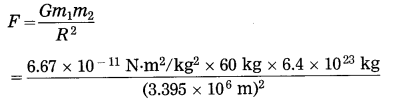
Maharashtra Board Class 10 Science Solutions Part 1 Chapter 1 Gravitation 43
= 222.2 N
On the surface of Mars, the gravitational force on the man due to Mars = 222.2 N.

(3) Data : m1 = 60 kg, m2 = 1.9 × 1027 kg,
R = 7.15 × 10⁷ m, F = ?
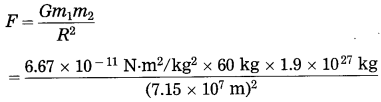
Maharashtra Board Class 10 Science Solutions Part 1 Chapter 1 Gravitation 44
= 1487 N
On the surface of Jupiter, the gravitational force on the man due to Jupiter = 1487 N.

Thus, the forces on the man are not the same because the ratio (M/R2) is not the same in the case of the moon, Mars, and Jupiter.

Question 4.
Mahendra and Virat are sitting at a distance of 1 meter from each other. Their masses are 75 kg and 80 kg respectively. What is the gravitational force between them? G = 6.67 × 10⁻¹¹ N.m2/kg2. (Practice Activity Sheet – 3)
Solution:
Given: r = 1 m,
m1 = 75 kg,
m2 = 80 kg
G = 6.67 × 10⁻¹¹ N.m2/kg2

Maharashtra Board Class 10 Science Solutions Part 1 Chapter 1 Gravitation 45
= 4.002 × 10⁻⁷ N
The gravitational force between Mahendra and Virat is 4.002 × 10⁻⁷ N.

Question 5.
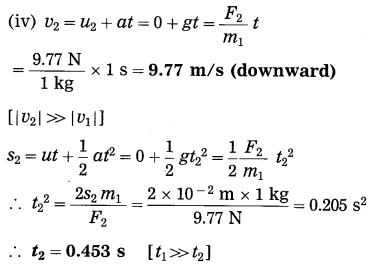
Spheres A and B of uniform density have masses 1 kg and 100 kg respectively. Their centres are separated by 100 m. (i) Find the gravitational force between them, (ii) Find the gravitational force on A due to the earth, (iii) Suppose A and B are initially at rest and A can move freely towards B. What will be the velocity of A one second after it starts moving towards B? How will this velocity change with time? How much time will A take to move towards B by 1 cm? (iv) if A begins to fall, starting from rest, due to the earth’s downward pull, what will be its velocity after one second? How much time will it take to fall through 1cm?
[M(earth) = 6 × 1024 kg, R(earth) = 6400 km]
Solution:Data: m1 = 1 kg, m2 = 100 kg, r = 100 m,
M =6 × 1024 kg,
R = 64o0 km = 6400 × 103 m,
t = 1 s, s = 1 cm = 1 × 10⁻² m,
G = 6.67 × 10⁻¹¹ N.m2/kg
F1 =?, F2 =?, v1 =?, t1 =?, v2 =?, t1 =?
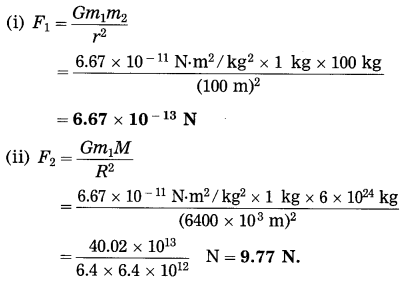
Maharashtra Board Class 10 Science Solutions Part 1 Chapter 1 Gravitation 46
This is far greater than F1.
(iii) Ignoring variation of acceleration with distance,
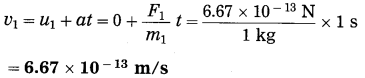
Maharashtra Board Class 10 Science Solutions Part 1 Chapter 1 Gravitation 47
This velocity is directed from A to B. As the separation between A and B decreases, the acceleration of A and hence the velocity of A will increase.

Ignoring variation of acceleration with distance,
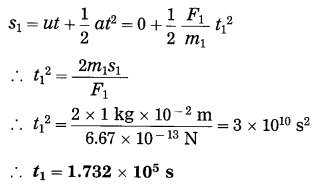
Maharashtra Board Class 10 Science Solutions Part 1 Chapter 1 Gravitation 48
Maharashtra Board Class 10 Science Solutions Part 1 Chapter 1 Gravitation 49

Maharashtra Board Class 10 Science Solutions Part 1 Chapter 1 Gravitation

Question 6.
Two spheres of uniform density have masses 10 kg and 40 kg. The distance between the centres of the spheres is 200 m. Find the gravitational force between them.
Solution:
Data: m1 = 10 kg, m2 = 40 kg,
r = 200 m, G = 6.67 × 10⁻¹¹ N.m2/kg2, F = ?
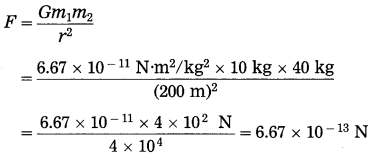
Maharashtra Board Class 10 Science Solutions Part 1 Chapter 1 Gravitation 50
The gravitational force between the two spheres = 6.67 × 10⁻¹³ N.

Question 7.
Find the gravitational force between a man of mass 50 kg and a car of mass 1500 kg separated by 10 m.
Solution: Data : m1 = 50 kg, m2 = 1500 kg,
r = 10 m, G = 6.67 × 10⁻¹¹ N.m2/kg2, F = ?
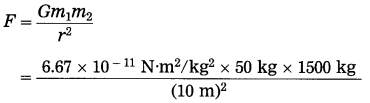
Maharashtra Board Class 10 Science Solutions Part 1 Chapter 1 Gravitation 51
= 5.0025 × 10⁻⁸ N
The gravitational force between the man and the car = 5.0025 × 10⁻⁸ N.

Question 8.
Find the magnitude of the gravitational force between the Sun and the earth. (Mass of the Sun = 2 × 1024 kg, mass of the earth=6 × 1024 kg and the thstance between the centres of the Sun and the earth 1.5 × 10¹¹ m,
G = 6.67 × 10⁻¹¹ N.m2/kg2)
Solution:
Data: m1 = 2 × 1030 kg,
m2 = 6 × 1024 kg, r = 1.5 × 10¹¹ m,
G = 6.67 × 10⁻¹¹ N.m2/kg2, F =?
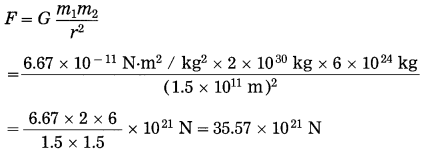
Maharashtra Board Class 10 Science Solutions Part 1 Chapter 1 Gravitation 52
∴ F = 3.557 × 10²² N
The magnitude of the gravitational force between the Sun and the earth = 3.557 × 10²² N.

Question 9.
Find the magnitude of the acceleration due to gravity at the surface of the earth. (M= 6 × 1024 kg, R = 6400 km)
Solution:
Data: M = 6 × 1024 kg,
R = 6400km = 6.4 × 10⁶m,
G = 6.67 × 10⁻¹¹ N.m2/kg2, g =?
g = \(\frac{G M}{R^{2}}\)
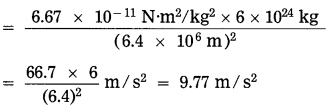
Maharashtra Board Class 10 Science Solutions Part 1 Chapter 1 Gravitation 53
The magnitude of the acceleration due to gravity at the surface of the earth = 9.77 m/s2.

Question 10.
The mass of an imaginary planet is 3 times the mass of the earth. Its diameter is 25600 km arid the earth’s diameter is 12800 km. Find the acceleration due to gravity at the surface of the planet, [g (earth) = 9.8 m/s2]
Solution:
Data: \(\frac{M_{2}(\text { planet })}{M_{1}(\text { earth })}\) = 3
D1 (earth) = 12800 km
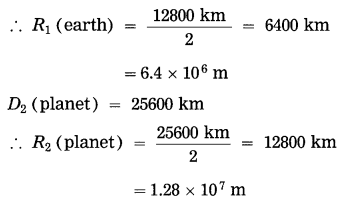
Maharashtra Board Class 10 Science Solutions Part 1 Chapter 1 Gravitation 54
g1 (earth) = 9.5 m/s2, g2 (planet) = ?
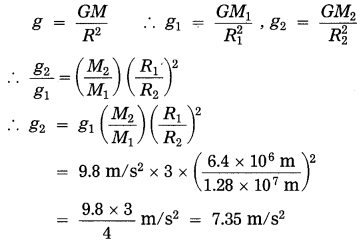
Maharashtra Board Class 10 Science Solutions Part 1 Chapter 1 Gravitation 55
The acceleration due to gravity at the surface of the planet = 7.35 m/s2.

Question 11.
If the acceleration due to gravity on the surface of the earth is 9.8 m/s2, what will be the acceleration due to gravity on the surface of a planet whose mass and radius both are two times the corresponding quantities for the earth?
Solution:
Data: ge = 9.8 m/s2, Mp = 2Me,
Rp = 2Re, gp = ?
Acceleration due to gravity, g = \(\frac{G M}{R^{2}}\)
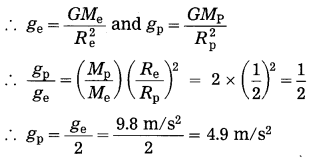
Maharashtra Board Class 10 Science Solutions Part 1 Chapter 1 Gravitation 56
acceleration due to gravity on the surface of the planet = 4.9 m/s2.

Maharashtra Board Class 10 Science Solutions Part 1 Chapter 1 Gravitation

Question 12.
A body is released from the top of a building of height 19.6 m. Find the velocity with which the body hits the ground.
Solution:
Data: h = 19.6 m, u = 0 m/s,
g = 9.8 m/s2, s = 19.6 m, v = ?
v2 = u2 + 2 gs .
=2 gs …..(as u = 0 m/s)
= 2 × 9.8 m/s2 × 19.6 m
= (19.6 m/s)2
∴ v = 19.6 m/s (downward velocity)
The velocity with which the body hits the i ground = 19.6 m/s (downward).

Question 13.
A stone on a bridge on a river falls into the river. If it takes 3 seconds to reach the surface of water, find (i) the velocity of the stone at the instant it touches the surface of water (ii) the height of the bridge from the surface of water.
Solution:
Data: u = 0 m/s, t = 3 s,
g = 9.8 m/s2, v = ?, h = ?
(i) v = u + gt = 0 m/s + 9.8 m/s2 × 3 s
= 29.4 m/s
The velocity of the stone at the instant it touches the surface of water = 29.4 m/s

(ii) s = ut + \(\frac{1}{2}\)gt2
= 0 m/s × 3 s + \(\frac{1}{2}\) (9.8 m/s2) (3 s)2
= 4.9 × 9 m = 44.1 m
∴ The height of the bridge from the surface of water = 44.1 m.

Question 14.
A stone is dropped from rest from the top of a building 44.1 m high. It takes 3 s to reach the ground. Use this information to 1 calculate g.
Solution:
Data: u = 0 m/s, h = 44.1 m
∴ s = 44.1 m, t = 3 s, g =?
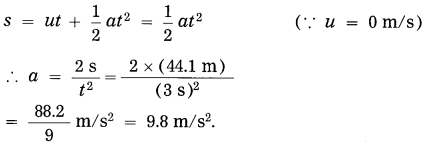
Maharashtra Board Class 10 Science Solutions Part 1 Chapter 1 Gravitation 57
It is the acceleration due to gravity.
g = 9.8 m/s2.

Question 15.
A metal ball of mass 5 kg falls from a height of 490 m. How much time will it take to reach the ground? (g = 9.8 m/s2) (March 2019)
Solution:
Data: s = 490 m, a = g = 9.8 m/s2,
u = 0 m/s, s = ut + \(\frac{1}{2}\)at2
∴ 490 = 0 × t + \(\frac{1}{2}\) × 9.8 × t2 = 4.9t2
∴ t2 = \(\frac{490}{4.9}\)
∴ t = 10 s This is the required time.

Question 16.
If the weight of a body on the surface of the moon is 100 N, what is its mass?  (g = 1.63 m/s2)
Solution:
Data: W= 100 N, g = 1.63 m/s2, m = ?
∴ W = mg

Maharashtra Board Class 10 Science Solutions Part 1 Chapter 1 Gravitation 58
∴ The mass of the body = 61.35 kg.

Question 17.
A 100 kg bag of wheat is placed on a plank of wood. What is the weight of the bag and what is the reaction force exerted by the plank?
Solution:
Data: m = 100 kg, g = 9.8 m/s2,
W = ?, reaction force = ?
Magnitude of the weight,
W = mg = 100 kg × 9.8 m/s2 = 980 N
The weight of the bag = 980 N acting downward.
The reaction force exerted by the plank on the bag = 980 N acting upward.

Question 18.
Find the gravitational potential energy of a body of mass 10 kg when it is on the earth’s surface. [M(earth) = 6 × 1024 kg, it(earth) = 6.4 × 10⁶m, G = 6.67 × 10⁻¹¹ N. m2/kg2]
Solution:
Data: m = 10 kg, M = 6 × 1024 kg,
R = 6.4 × 10⁶ m, G = 6.67 × 10⁻¹¹ N.m2/kg2
The gravitational potential energy of the body
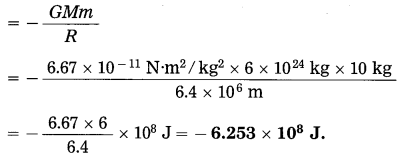
Maharashtra Board Class 10 Science Solutions Part 1 Chapter 1 Gravitation 59

Question 19.
If the body in Ex. (26) performs uniform circular motion around the earth at a height of 3600 km from the earth’s surface, what will be its gravitational potential energy?
Solution:
Here, h = 3600 km = 3.6 × 10⁶ m
∴ The gravitational potential energy of the body
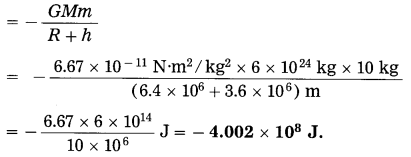
Maharashtra Board Class 10 Science Solutions Part 1 Chapter 1 Gravitation 60

Question 20.
A body of mass 20 kg is at rest on the earth’s surface, (i) Find its gravitational potential energy, (ii) Find the kinetic energy to be provided to the body to make it free from the gravitational influence of the earth. (g = 9.8 m/s2, R = 6400 km)
Solution:
Data : m = 20 kg, g = 9.8 m/s2,
R = 6400 km = 6.4 × 10⁶ m
(i) The gravitational potential energy of the body =

Maharashtra Board Class 10 Science Solutions Part 1 Chapter 1 Gravitation 61
= – 20 kg × 9.8 m/s2 × 6.4 × 106 m
= – 1.2544 × 10⁹ J.

(ii) To make the body free from the gravitational influence of the earth, it should be provided kinetic energy equal to 1.2544 × 10⁹ J.

Question 21.
If the body in Ex. (28) is moving at 100 m/s on-the earth’s surface, what will be its (i) kinetic energy (ii) total energy?
Solution:
Data : m = 20 kg, u = 100 m/s .
(i) The kinetic energy of the body
= \(\frac{1}{2}\)mv2 = \(\frac{1}{2}\) × 20 kg × (100 m/s)2 = 105 J.

(ii) The total energy of the body = kinetic energy + potential energy = 105 J + (- 1.2544 × 10⁹ J)
= (1 – 12544) × 105 J = – 12543 × 105 J
= – 1.2543 × 10⁹ J.

Question 22.
A satellite of mass 100 kg performs uniform circular motion around the earth at a height of 6400 km from the earth’s surface. Find its gravitational potential energy.  [g = 9.8 m/s2, R = 6400 km]
Solution:
Data: m = 100 kg, g = 9.8 m/s2,
R = 6400 km = 6.4 × 10⁶ m, h = 6.4 × 10⁶ m
The gravitational potential energy of the satellite
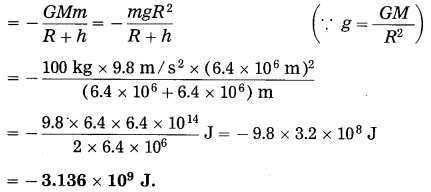
Maharashtra Board Class 10 Science Solutions Part 1 Chapter 1 Gravitation 62

Maharashtra Board Class 10 Science Solutions Part 1 Chapter 1 Gravitation

Question 23.
Find the escape velocity of a body from the earth. [M(earth) = 6 × 1024 kg, R (earth) = 6.4 × 10⁶ m, G = 6.67 × 10⁻¹¹ N.m2/ kg2]
Solution:
Data: M = 6 × 1024 kg, R = 6.4 × 10⁶ m,
G = 6.67 × 10⁻¹¹ N.m2/kg2
The escape velocity of a body from the earth,
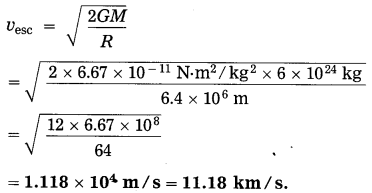
Maharashtra Board Class 10 Science Solutions Part 1 Chapter 1 Gravitation 63

Question 24.
Find the escape velocity of a body from the earth. [R (earth) = 6.4 × 10⁶ m, ρ(earth) = 5.52 × 10³ kg/m3, G = 6.67 × 10⁻¹¹ N.m2/kg2]
Solution:
Data: R = 6.4 × 10⁶ m, ρ = 5.52 × 10³ kg/ m3, G = 6.67 × 10⁻¹¹ N.m2/kg2
The escape velocity of a body from the earth
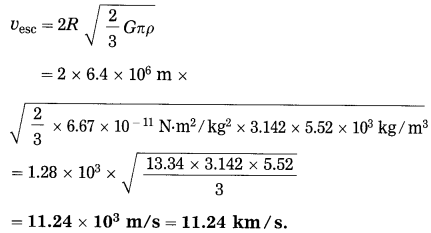
Maharashtra Board Class 10 Science Solutions Part 1 Chapter 1 Gravitation 64

Question 25.
Calculate the escape velocity of a body from the moon. [g(moon) = 1.67 m/s2, R(moon) = 1.74 × 10⁶ m]
Solution:
Data: g = 1.67 m/s2, R = 1.74 × 10⁶ m
The escape velocity of a body from the moon,
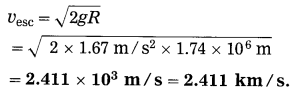
Maharashtra Board Class 10 Science Solutions Part 1 Chapter 1 Gravitation 65

Question 26.
The mass of (an imaginary) planet is four times that of the earth and its radius is double the rathus of the earth. The escape velocity of a body from the earth is 11.2 × 10³ mn/s. Find the escape velocity or a body from the planet.
Solution:
Data: M2 = 4M1, R2 = 2R1,
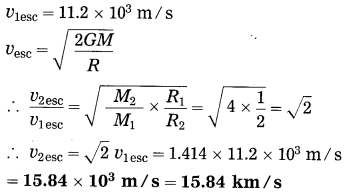
Maharashtra Board Class 10 Science Solutions Part 1 Chapter 1 Gravitation 66
This is the escape velocity or a body from the planet.

Numerical Problems For Practice

[G = 6.67 × 1O-11 N.m2/kg2, mass or the earth =6 × 1024 kg, radius or the earthe 6.4 × 10⁶ m]

Question 1.
A satellite of mass 1000 kg revolves around the earth in a circular path. If the distance between the satellite and the centre of the earth is 40000 km, find the gravitational force exerted on the satellite by the earth.
Answer:
250.1 N

Question 2.
The masses of two spheres are 10 kg and 20 kg respectively. If the distance between their centers is 100 m, find the magnitude of the gravitational force between them.
Answer:
1.334 × 10⁻¹² N)

Question 3.
A satellite revolves around the earth along a circular path. If the mass of the satellite is 1000 kg and its distance from the center of the earth is 20000 km, find the magnitude of the earth’s gravitational force acting on the satellite.
Answer:
1000.5

Question 4.
Find the acceleration due to gravity at a distance of 20000 km from the center of the earth.
Answer:
1.0 m/s2

Question 5.
What is the weight of a body of mass 100 kg at the south pole? (g = 9.832 m/s2)
Answer:
983.2 N (downward)

Question 6.
What is the weight of a body of mass 20 kg at the equator? (g = 9.78 m/s2)
Answer:
195.6 N (downward)

Question 7.
A body is released from the top of a tower of height 50 m. Find the velocity with which the body hits the ground, (g = 9.8 m/s2)
Answer:
31.3 m/s (downward)

Question 8.
A body is thrown vertically upward with a velocity of 9.8 m/s. Calculate the maximum height attained by the body. (g = 9.8 m/s2)
Answer:
4.9 m

Question 9.
A particle of mass 10-6 kg performs uniform circular motion. Its period is 10 s and the radius of the circle is 2 m. Find (i) the speed of the particle (ii) the centripetal acceleration of the particle (iii) the centripetal force on the particle.
Answer:
(i) 1.257 m/s
(ii) 0.79 m/s2
(iii) 7.9 × 10⁻⁷ N

Question 10.
Find the gravitational potential energy of a body of mass 200 kg on the earth’s surface. [M(earth) = 6 × 1024 kg, R(earth) = 6400 km]
Answer:
-1.251 × 10¹⁰J

Question 11.
Find the gravitational potential energy of a body of mass 10 kg when it is at a height of 6400 km from the earth’s surface.  [Given: a mass of the earth and radius of the earth. See Ex. 10 above.]
Answer:
-3.127 × 10⁸ J

Maharashtra Board Class 10 Science Solutions Part 1 Chapter 1 Gravitation

Question 12.
Find the escape velocity of a body from the moon.
[M(moon) = 7.36 × 10²² kg, R(moon) = 1.74 × 10⁶ m]
Answer:
2.375 km/s

Maharashtra Board Class 10 History Solutions Chapter 1 Historiography Development in the West

Balbharti Maharashtra State Board Class 10 History Solutions Chapter 1 Historiography Development in the West Notes, Textbook Exercise Important Questions and Answers.

Maharashtra State Board Class 10 History Solutions Chapter 1 Historiography Development in the West

History Class 10 Chapter 1 Historiography Development In The West

Question 1.
(A) Choose the correct option from the given options and complete the statement.
(1) It may be said that …….. was the founder of modern historiography.
(a) Voltaire
(b) Rene Descartes
(c) Leopold Ranke
(d) Karl Marx
Answer:
(a) Voltaire

Maharashtra Board Solutions

(2) ………… wrote the book entitled ‘Archaeology of Knowledge’.
(a) Karl Marx
(b) Michel Foucault
(c) Lucien Febvre
(d) Voltaire
Answer:
(b) Michel Foucault

(B) Identify and write the wrong pair in the following set.
(1) Georg Wilhelm Friedrich Hegel – ‘Reason in History’
(2) Leopold von Ranké – ‘The theory and Practice of History’
(3) Herodotus – ‘The Histories’
(4) Karl Marx – ‘Discourse on the Method’
Answer:
(1) Right pair: Georg Wilhelm Friedrich Hegel – ‘Reason in History’
(2) Right pair: Leopold von Ranké – ‘The theory and Practice of History’
(3) Right pair: Herodotus – ‘The Histories’
(4) Wrong pair: Karl Marx – Discourse on the Method.

Question 2.
Explain the following concepts.
(1) Dialectics
Answer:

  • In order to understand the true nature of an event, one needs to know its opposite for e.g. True — False, Good — Bad, etc.
  • A German philosopher, Georg Wilhelm Friedrich Hegel had put forward this method of analysis of history.
  • A theory called ‘Thesis’ is proposed at the beginning. It is followed by another theory called Antithesis’ which is, contrary to ‘Thesis’.
  • After a thorough logical discussion of both new thesis is proposed having gist of both (Thesis and Antithesis).
  • This process of orriving at a new thesis is called Synthesis.
  • This method of analysis of history which is based on opposites is known as ‘Dialectics’.

(2) Annales School
Answer:

  • At the dawn of the twentieth century, the writing ¿f history got a new direction.
  • Along with political events, kings, great leaders, the study of climate, local people, agriculture, trade, technology, means of communication, social divisions and their collective psychology of a group was also considered important in the study of history.
  • This new school of thought is known as Annales School. Annales School was started by French historians.

Question 3.
Explain the following with its reason.
(1) Historical research was driven to focus in depth on various aspects of women’s life.
Answer:

  • Initially, there was a lot of dominance of male perspective on historical writing. Simone de Beauvoir, a French scholar, insisted on inclusion of women perspective in historiography.
  • She emphasised on the inclusion of women in the process of writing history.
  • She insisted on rethinking of the male dominated perspective of history.
  • Because of her efforts historical research was driven to focus in depth on various aspects of women’s lives their employment, their role in trade unions, institution working for their cause, and their family life.

Maharashtra Board Solutions

(2) Foucault called his method, ‘the archaeology of knowledge’.
Answer:

  • According to Michel Foucault, the prevailing method of arranging historical events in a chronological order was not right.
  • He threw light on the fact that archaeology does not strive to reach the ultimate historical truth.
  • It attempts to explain various transitions in the past.
  • Foucault gave more importance for explaining the transitions in history. Hence, his method is called ‘the archaeology of knowledge’.

Question 4.
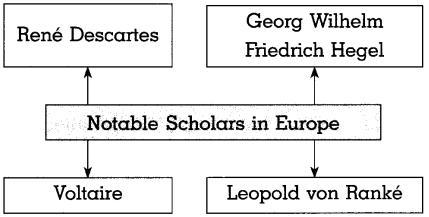
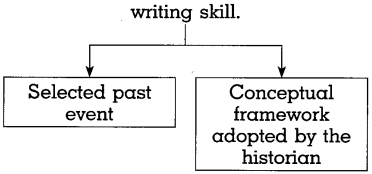
Complete the concept chart.
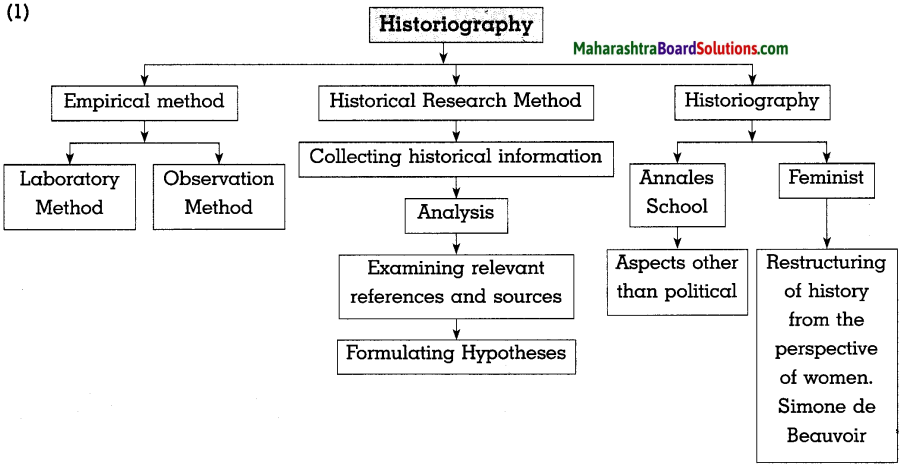
Maharashtra Board Class 10 History Solutions Chapter 1 Working of the Constitution 12
Answer:
Maharashtra Board Class 10 History Solutions Chapter 1 Working of the Constitution 7

Question 5.
Answer the following in detail.
(1) Explain Karl Marx’s ‘Class Theory’.

Answer:
In the latter part of nineteenth century, German thinker, Karl Marx put forward ‘Class Theory’ in his book ‘Das Kapital’.

According to him:

  1. History i not about abstract ideas but living people. The fullillment of basic needs of people depends on the nature of prevalent means of production and the ownership.
  2. All the different strata of the society do not get equal access to these means of production which causes the division of the society into classes. It rešults into class struggle.
  3. The class which owns means of production $ economically exploits the rest of the classes. Human history, according to him, is the history of class struggle.

(2) What are the four characteristics of modern historiography?
Answer:
The following are the four characteristics of modern historiography:

  1. Its method is based on scientific principles and begins with formation of relevant questions.
  2. These questions are anthropocentric i.e. they are about ancient human societies and their deeds in that period of time. No interrelation between the divine and human needs is suggested.
  3. Answers to these questions are supported by reliable evidence and they are presented in a logical order.
  4. History presents a graph of man’s progress with the help of his deeds in the past.

(3) What is feminist historiography?
Answer:

  • Feminist historiography means writing history with women perspective. There was a lot of dominance of male perspective on historical writing.
  • Simone de Beauvoir, a French scholar, insisted on rethinking on the male dominated perspective and including the women’s perspective in historiography.
  • The idea of feminist historiography was accepted.
  • Because of her efforts various aspects of women’s lives like their employment, their role in trade unions and their family life became part of historiography.

(4) Explain Leopold von Ranké’s perspective of history?
Answer:
Leopold’s view on ways to write history throws light on his perspective of history:

  1. He spoke about the critical method of historical research. He gave importance to information gathered through original documents.
  2. He also stated that all types of original documents related to the historical event should be examined in detail and with great care.
  3. He believed that with this method it was possible to reach the historical truth. He was critical of imagination in narration of history.

Maharashtra Board Solutions

Historiography : Development In The West Questions And Answers Pdf Project
Obtain detailed information on your favourite subject and write its history. For example :
– History of Pen
– History of Printing technology
– History of Computers
Answer:

Memory Map
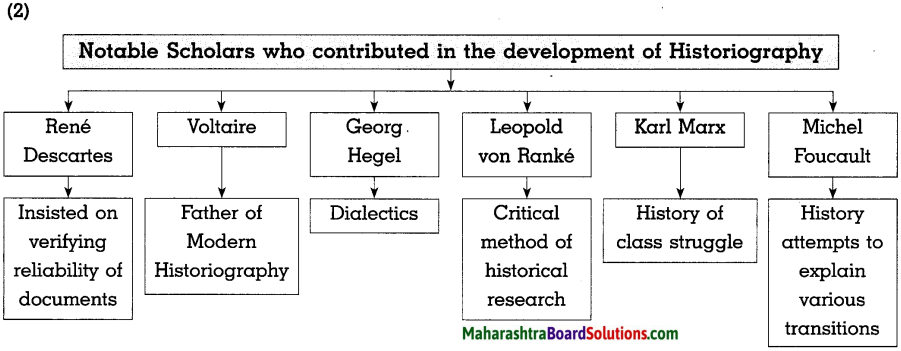
Maharashtra Board Class 10 History Solutions Chapter 1 Working of the Constitution 4
Maharashtra Board Class 10 History Solutions Chapter 1 Working of the Constitution 5

Question 6.
Choose the correct option from the given options and complete the sentences:

(a) A scholar who writes critical historical narratives is known as ………………………… .
(a) an archaeologist
(b) a historian
(c) a social scientist
(d) a language expert
Answer:
(b) a historian

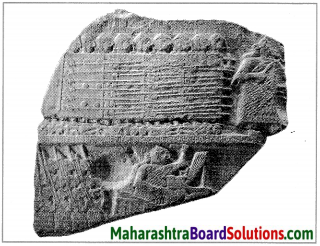
(b) The earliest inscription in the world is displayed at Louvre museum in ………………………… .
(a) England
(b) France
(c) Germany
(d) Portugal
Answer:
(b) France

(c) The tradition of recording historical events can be traced back to ………………………… civilization in Mesopotamia.
(a) Sumer
(b) Egyptian
(c) Arab
(d) Mohenjodaro
Answer:
(a) Sumer

(d) The tradition of modern historiography has its roots in the writings of ………………….. historiAnswer:
(a) Roman
(b) Greek
(c) German
(d) French
Answer:
(b) Greek

Maharashtra Board Solutions

(e) ………………….., a Greek historian of the fifth century B.C.E., had used the term ‘History’ for the first time for his book entitled, ‘The Histories’.
(a) Leopold Ranke
(b) Georg Hegel
(c) Michel Foucault
(d) Herodotus
Answer:
(d) Herodotus

(f) In 1737 C.E., the ………………….. university in Germany had an independent department for history.
(a) Oxford
(b) Cambridge
(c) Gottingen
(d) Stanford
Answer:
(c) Gottingen

(g) Historiography of the nineteenth century was greatly influenced by the thoughts of …………………..
(a) Karl Marx
(b) Voltaire
(c) Georg Hegel
(d) Leopold von Ranke
Answer:
(d) Leopold von Ranke

(h) A new school of historiography arose in France known as ………………….. school.
(a) Translation
(b) Annales
(c) Nationalism
(d) Communist
Answer:
(b) Annales

(i) The method of analysis which is based on opposites is known as …………………. .
(a) Numismatics
(b) Arithmetic
(c) Polynomial
(d) Dialectics
Answer:
(d) Dialectics

(j) ………………….. considered subjects like psychological disorders, science of medicine, prison administration for historical analysis.
(a) Michel Foucault
(b) Leopold Ranke
(c) Karl Marx
(d) Voltaire
Answer:
(a) Michel Foucault

(k) After 1990, ………………….. were considered as an independent social class.
(a) labourers
(b) women
(c) men
(d) farmers
Answer:
(b) women

Maharashtra Board Solutions

(l) According to ………………….., historical realities should be presented in a logical manner.
(a) Georg Hegel
(b) Voltaire
(c) Simone de Beauvoir
(d) Herodotus
Answer:
(a) Georg Hegel

(m) According to ………………….., one should never accept anything as the truth till all the doubts are solved.
(a) Rene Descartes
(b) Karl Marx
(c) Voltaire
(d) Herodotus
Answer:
(a) Rene Descartes.

Question 7.
Identify the wrong pair in the following and write it:
(1)

ThinkerBook
(1) Georg Wilhelm Friedrich Hegel(a) Reason in History
(2) Leopold von Ranke(b) The Theory and Practice of History
(3) Herodotus(c) The Histories
(4) Karl Marx(d) Discourse on the Method

Answer:
Wrong pair: Karl Marx – Discourse on the Method.

(2)

HistorianCountry
(1) HerodotusGreece
(2) Simone de BeauvoirGermany
(3) Michel FoucaultFrance
(4) Rene DescartesFrance

Answer:
Wrong pair: Simone de Beauvoir Germany.

(3)

Thoughts/OpinionHistorian
(1) All aspects of human life is important in the historiographyVoltaire
(2) He criticized imaginative narration.Leopold von Ranke
(3) History is not about abstract ideas but about living people.Rene Descartes
(4) Emphasized the rethinking of the male-dominated perspective of history.Simone de Beauvoir

Answer:
Wrong pair: History is not about abstract ideas but about living people – René Descartes.

Maharashtra Board Solutions

Question 8.
Complete the concept chart

Maharashtra Board Class 10 History Solutions Chapter 1 Working of the Constitution 8
Answer:
Maharashtra Board Class 10 History Solutions Chapter 1 Working of the Constitution 9

Maharashtra Board Class 10 History Solutions Chapter 1 Working of the Constitution 10
Answer:
Maharashtra Board Class 10 History Solutions Chapter 1 Working of the Constitution 11

Question 9.
Prepare a flow chart on the given topic:
Stages of historiography
Answer:
Maharashtra Board Class 10 History Solutions Chapter 1 Working of the Constitution 12

Question 10.
Write short notes:

(1) Georg Wilhelm Friedrich Hegel:
Answer:

  • Georg Hegel was a German philosopher.
  • He was of the view that the historical realities should be presented in a logical manner. According to him, Timelme was indicative of progress.
  • He believed that presentation of history is bound to change as time passes because new evidence surfaces.
  • His philosophy convinced many scholars that historical methods were not of lesser quality, though they differed from the scientific method.
  • His lectures and articles are published in a book called ‘Encyclopaedia of Philosophical Sciences’.
  • His book ‘Reason in History’ is well known. He devised a method of analysis based on opposites known as Dialectics’.

Maharashtra Board Solutions

(2) Karl Marx:
Answer:

  1. Karl Marx was a German thinker in the nineteenth century. He wrote the world famous treatise Das Kapital’. According to him, history was not about abstract ideas but about living people.
  2. He believed that human relationships are shaped by the fundamental needs of people and the ownership of prevalent ineczns of production to meet those needs.
  3. He stated that unequal accessibility to the means of production creates à division in socièty leading to class struggle. His theory of class struggle is considered significant all over the world.
  4. According to Marx, human history is the history of class struggle because the class which owns the means of production economically exploits the rest of the classes.

(3) Michel Foucault:
Answer:

  • Michel Foucault was a twentieth century historian from France.
  • He wrote the book ‘Archaeology of Knowledge’.
  • In this book, he insisted that the prevailing practice of arranging historical events in a chronological order is not right.
  • He gave importance to explaining the transitions that took place in history.
  • He acknowledged the role of subjects such as science of medicine, psychological disorders, prison.
  • Administration in historical analysis. This was not acknowledged by earlier historiAnswer:

(4) Leopold von Ranke:
Answer:

  1. Leopold von Ranke, a German philosopher, laid emphasis on utmost importance of information gathered through original documents.
  2. In order to reach historical truth, it was necessary to examine all documents related to historical event. He critcised the imaginative narration of history.
  3. Collection of his articles are published in two books, entitled ‘The Theory and Practice of History’ and ‘The Secret of World History’.
  4. Ranke had great influence on historiography of nineteenth century.

Question 11.
Give reasons:
(a) In historical research, it may not be possible to use the method of experiments and observation.
Answer:

  1. In physical and natural sciences, experiment and observation method is used to establish laws that remain true irrespective of the time and space.
  2. These laws can be tested and proved again and again.
  3. In historical research, the events had already taken place in the past and we were not present in the historical time and space.
  4. Moreover, these events cannot be recreated in the present time and space. Hence, experiment and observation method may not be used in historical research.

(b) Historiography in the 18th century gave importance to objectivity in history.
Answer:

  • A remarkable progress was achieved in the fields of Philosophy and Science till the eighteenth century in Europe.
  • It was believed that by applying scientific methods it was possible to study social and historical truths.
  • In the later period, history and historiography witnessed a lot of philosophical discussion.
  • This eliminated the imaginative and divine context in history and gave importance to objectivity.

Maharashtra Board Solutions

Question 12.
Answer the following in 25-30 words:
(a) What is Historiography?
Answer:

  1. The writing of critical historical narrative is called Historiography. A person who writes it is known as ‘Historian’. The following steps are helpful in writing historical narrative:
  2. Information related to history is collected and analyzed.
  3. The various sources are critically examined to understand the references regarding time and space in the given information as well as the conceptual framework used.
  4. After examining the references of historical information, relevant questions related to these historical references are framed and hypotheseis are formulated.
  5. In short, writing of critical historical narrative by following this method is known as historiography.

(b) What did Rene Descartes insist upon?
Answer:
French Philosopher Rene Descartes insisted on the following in writing historiography:

  1. ‘Never to accept anything as true till all grounds of doubt are excluded’.
  2. Hence, the reliability of a source like historical documents should be verified by critically examining them while writing history.

(c) Why is Voltaire said to be the founder of modern historiography?
Answer:
Voltaire, a french scholar, opined that it was important to consider the following aspects while writing history:

  1. objective truth and chronology of events;
  2. prevalent social traditions, agriculture, trade and economic system. It was because of his view that all aspects of human life was considered for history writing. Therefore, he is said to be the founder of modern historiography.

(d) What are the objectives of writing history?
Answer:
History is researched and written down with following objectives:

  • To analyse the events in the past.
  • To verify information about the historical events and their interconnections.
  • To study in detail and remove imaginative element and bring forth the truth.
  • To put the past events in chronological order.

(e) What progress was achieved in historiography in the eighteenth century?
Answer:
The following progress was achieved in historiography in the eighteenth century:

  • Scientific methods were applied to study social and historical truths.
  • Philosophical discourses revolving around divine phenomena were given less importance.
  • Philosophical discussions focused more on the objectivity in history and historiography.
  • Since the universities got an independent department of history, they became centres of historical studies.

Question 13.
Head the given passage carefully and answer the questions given below:
(a) Who is called a Historian?
Answer:
A scholar who writes critical historical narratives is called a Historian.

(b) Complete the concept chart.
Factors which determined historian’s
Maharashtra Board Class 10 History Solutions Chapter 1 Working of the Constitution 1
Answer:
Factors which determined historian’s
Maharashtra Board Class 10 History Solutions Chapter 1 Working of the Constitution 2

(c) How did the people in ancient societies preserve the events in the past?
Answer:
The ancient people preserved the events in the past so that they can pass them to the next generation. They used various means to do this:

  • Narrating the stories of valour of ancestors to the next generation.
  • Stories of their life preserved through cave paintings.
  • Adopting story telling technique.
  • Singing songs and ballads to impress events upon the minds of the new generation.

Maharashtra Board Solutions

Question 14.
Answer the following questions in detail:
(a) Which experts do we need in order to prove the reliability of historical documents?
Answer:
The following experts are required to prove the reliability of historical documents:

  • Language expert who can decipher the language and meaning of the document or the script on the inscription.
  • One who can recognise the type of paper used and the period in which it was used.
  • One who can understand the lettering style and the writing style of the author.
  • Expert who has knowledge of different seals, i.e. stamps of authority used by the rulers.
  • Historian who can interpret and do a comparative study of the references given in the document.

(b) Write Hegel’s view on history.
Answer:

  • Georg Wilhelm Friedrich Hegel was a German philosopher.
  • He was of the view that the historical realities should be presented in a logical manner.
  • He believed that presentation of history is bound to change as time passes because new evidence surfaces.
  • He proposed a method of analysis based on opposites known as ‘Dialectics’.
  • Hegel’s philosophy convinced many scholars that historical methods were not of lesser quality, though they differed from scientific methods.
  • His lectures and articles are published in a book called ‘Encyclopaedia of Philosophical Sciences’. His book ‘Reason in History’ is well known.

Question 15.
Observe the inscription in the picture and write information it:
Maharashtra Board Class 10 History Solutions Chapter 1 Working of the Constitution 13
Answer:

  1. A fragment of the earliest inscription is shown in the above picture. It dates back to 4500 BCE.
  2. It is displayed at the Louvre museum in France.
  3. The inscriptions have names of Sumerian kings and stories of battles fought by them.
  4. It shows a forward marching file of soldiers holding shields and spears. The General is in the front.
    Brain Teaser
    Hints:
    Down:

    • He used the word ‘History’ for the first time
    • He wrote the book ‘Discourse on the Method’
    • Presented Theory of ‘Dialectics’
    • He called his method ‘Archaeology of Knowledge’

Maharashtra Board Solutions

Across:

  • founder of modern historiography
  • Criticised imaginative narration of history. Articles published in ‘The Secret of World History’
  • Her writings helped in establishing the fundamentals of feminism
  • He wrote ‘Das Kapital’
    Maharashtra Board Class 10 History Solutions Chapter 1 Working of the Constitution 14

Maharashtra Board Class 10 Science Solutions Part 2 Chapter 6 Animal Classification

Balbharti Maharashtra State Board Class 10 Science Solutions Part 2 Chapter 6 Animal Classification Notes, Textbook Exercise Important Questions and Answers.

Maharashtra State Board Class 10 Science Solutions Part 2 Chapter 6 Animal Classification

Question 1.
a. I am diploblastic and acoelomate. Which phylum do I belong to ?
Answer:
I am from phylum Cnidaria or Coelenterata.

b. My body is radially symmetrical. Water vascular system is present in my body. I am referred as fish though I am not. What is my name?
Answer:
Starfish. I am from Echinodermata phylum.

c. I live in your small intestine. Pseudocoelom is present in my thread like body. In which phylum will you include me?
Answer:
I am Ascaris. I am included in Aschelminthes.

d. Though I am multicellular, there are no tissues in my body. What is the name of my phylum?
Answer:
Sponge, Porifera.

Maharashtra Board Class 10 Science Solutions Part 2 Chapter 6 Animal Classification

Question 2.
Write the characters of each of the following animals with the help of classification chart:
a. Bath sponge.
Answer:
Classification:
Kingdom: Animalia
Sub-kingdom: Non-chordata
Phylum: Porifera
Characters:

  • Multicellular organisms without cell wall
  • Cellular grade organization.
  • Asymmetrical body
  • Acoelomate

Bath sponge is a marine animal. Blackish in colour and round in shape having porous body. It has spongin fibres and spicules which serve as skeleton. Bath sponges have good water-holding capacity. It is sedentary animal which is fixed to some substratum in the aquatic environment. Reproduction is by budding. It also has a good regeneration capacity.

b. Grasshopper.
Answer:
Classification:
Kingdom: Animalia
Sub-kingdom: Non-chordata
Phylum: Arthropoda
Class: Insecta
Characters:

  • Multicellular organisms without cell wall
  • Organ-system grade organization
  • Bilaterally symmetrical
  • Triploblastic and Eucoelomate.

Grasshopper is an insect included under class insecta of phylum arthropoda because it has jointed appendages. There are three pairs of legs and two pairs of wings. It is a terrestrial insect which is well adapted to the surrounding environment by showing camouflage. It has chitinous exoskeleton. The respiration by tracheae.

c. Rohu.
Answer:
Classification:
Kingdom: Animalia
Phylum: Chordata
Class: Pisces
Subclass: Teleostei (Bony fish)
Characters:

  • Multicellular organisms without cell wall
  • Organ-system grade organization
  • Bilaterally symmetrical
  • Triploblastic and Eucoelomate.

Rohu is a fresh water bony fish. It is a chordate having a vertebral column, hence included under subphylum vertebrata. The body is well adapted for aquatic mode of life. The shape of the body is streamlined. The exoskeleton is of scales. The gills Eire present which are used for respiration. The endoskeleton is of bones, hence called bony fish. There are paired fins and a impaired caudal fin which is used in steering and changing the direction during swimming.

d. Penguin.
Answer:
Classification:
Kingdom: Animalia
Phylum: Chordata
Class: Aves
Characters:

  • Multicellular organisms without cell wall
  • Organ-system grade organization
  • Bilaterally symmetrical
  • Triploblastic and Eucoelomate.

Penguin is a flightless bird inhabitant of cold snow-clad regions. It has exoskeleton of feathers. The body is well adapted to survive in cold regions.

It is a warm-blooded bird. The forelimbs are modified into wings. But due. to excessive body weight, the penguins are not seen flying. It can wade in the water with modified hind limbs.

e. Frog.
Answer:
Classification:
Kingdom: Animalia
Phylum: Chordata
Class: Amphibia
Characters:

  • Multicellular organisms without cell wall
  • Organ-system grade organization
  • Bilaterally symmetrical
  • Triploblastic and Eucoelomate.

The frog is a true amphibian that can live in water as well as on land. When on land it respires with the help of lungs while in water it uses its skin for breathing. It does not have exoskeleton. The skin is soft, slimy and moist. It is suitably coloured and hence the frog can camouflage in the surroundings. Body is divisible into head and trunk. Two pairs of limbs are seen. The forelimbs are short and used for support during locomotion. The hind limbs are long and strong, used for jumping when on land and for swimming when in water.

The eyes are large and protruding. Since the neck is absent, such eyes help in looking around. The tympanum is present.

f. Lizard.
Answer:
Classification:
Kingdom: Animalia
Phylum: Chordata
Class: Reptilia
Characters:

  • Multicellular organisms without cell wall
  • Organ-system grade organization
  • Bilaterally symmetrical
  • Triploblastic and Eucoelomate.

The lizard is a cold-blooded reptile. The limbs are weak and do not support the body weight, hence lizard is seen creeping. But the feet are provided with pads and suckers due to which lizards are well- adapted to climb on the vertical walls. The exoskeleton has fine scales. The body is divisible into head, neck and trunk. The capacity to regenerate is developed in lizards, hence it can produce the lost tail or limbs. The mode of reproduction is egg laying. It feeds on insects with the help of long and sticky tongue.

g. Elephant.
f. Lizard.
Answer:
Classification:
Kingdom: Animalia
Phylum: Chordata
Class: Mammalia
Characters:

  • Multicellular organisms without cell wall
  • Organ-system grade organization
  • Bilaterally symmetrical
  • Triploblastic and Eucoelomate.

Elephant is the terrestrial, herbivorous mammal adapted to survive in hot and humid tropical forests.
It is a mammal and hence shows viviparity and milk secretion. The body is divisible into head, neck, trunk, and tail. The proboscis is a characteristic feature of the elephant which is actually modified nose.

h. Jellyfish.
Answer:
Classification:
Kingdom: Animalia
Sub-kingdom: Non-chordata
Phylum: Cnidaria or Coelenterata
Characters:

  • Multicellular organisms without cell wall
  • Tissue grade organization
  • Radially symmetrical
  • Diploplastic and Acoelomate

Jellyfish or Aurelia is a coelenterate. Its body is medusa. It appears as a transparent balloon seen floating in the marine waters. Since it has appearance like a jelly, it is known commonly as jellyfish. There are tentacles provided with cnidoblasts or stinging cells. Tentacles are used for catching the prey. Cnidoblasts are used to secrete a toxin which paralyses the prey.

Maharashtra Board Class 10 Science Solutions Part 2 Chapter 6 Animal Classification

Question 3.
Write in brief about progressive changes in animal classification.
Answer:
There were different methods of classification of animals.

  1. The first classification method was given by the Greek philosopher Aristotle. He took into account the criteria like body size, habits and habitats of the animals. This method was called artificial method of classification.
  2. The same artificial method was used by other scientists such as Theophrastus, Pliny, John Ray, Linnaeus, etc.
  3. Further due to advances in science the references were changed and there were some new methods of classification proposed.
  4. The system of classification called ‘Natural system of classification’ was then proposed. This system of classification was based on criteria such as body organization, types of cells, chromosomes, bio-chemical properties, etc.
  5. Later, Dobzhansky and Meyer gave the system of classification based on evolution.
  6. In 1977, Carl Woese has also proposed the three domain system of animal classification.

Question 4.
What is the exact difference between grades of organization and symmetry? Explain with examples.
Answer:
I. Grades of organization:
(1) The grades of organization mean the way an organism has different body formation.
(2) Unicellular organisms like amoeba have a single cell in the body and hence the organization in its body is called protoplasmic grade of organization.
(3) Some organisms have only cells in their body which is called cellular grade of organization, e.g. Poriferans.
(4) Some have tissues e.g. Coelenterates. They are said to have tissue grade organization. Some have organs, they are said to have organization-organ grade, e.g. Platyhelminthes. All other higher animals have organ-system grade organization.

II. Symmetry:
(1) Symmetry on the other hand shows the base of the body formation.
(2) The symmetry can be understood by taking an imaginary cut through the animal body.
(3) Based on the symmetry there can be three types.
(4) In asymmetric animals, there is no symmetry in any plane, e.g. Amoeba.
(5) The bilateral symmetry is the one in which an imaginary axis can pass through only one median plane to divide the body into two equal halves. Most of the animals have bilateral symmetry and hence their organs are arranged in symmetric way on both the sides.
(6) The imaginary cut passing through the central axis but any plane of body aan -give more than one equal half. The organs of such animals are arranged in a radius of an imaginary circle, e.g. Cnidarians and some echinoderms.
Both grades of organization and symmetry are the bases for classifying animals into different phyla.

Question 5.
Answer in brief.
a. Give scientific classification of shark upto class.
Answer:
Kingdom: Animalia
Phylum: Chordata
Subphylum: Vertebrata
Class: Pisces
Subclass: Elasmobranchii (Cartilaginous)
Example: Scientific name: Scoliodon sorrakowah.
Common name: Shark

b. Write four distinguishing characters of phylum – Echinodermata.
Answer:
Distinguishing characters of Echinodermata:

  1. Marine organisms with skeleton made up of calcareous spines. Calcareous material on the body hence the name is Echiodermata. Some are sedentary while some are free swimming.
  2. Body is triploblastic, eucoelomate and radially symmetrical when adult. The larvae are bilateral symmetrical.
  3. Locomotion with the help of tube-feet which are also used for capturing the prey.
  4. Echinoderms have regeneration capability. Hence they can restore their lost parts.
  5. Most of them are unisexual.
  6. Examples; Starfish, sea-urchin, brittle star, sea cucumber, etc.

c. Distinguish between butterfly and bat with the help of four distinguish properties.
Answer:
Butterfly:

  1. Butterfly is classified as Non-chordate.
  2. It is included in class Insecta of phylum Arthropoda.
  3. Butterfly has three pairs of legs and two pairs of chitinous wings.
  4. Butterfly is a diurnal (active during day) insect.
  5. Butterfly lays eggs which hatch into larva. Larva develops into pupa and pupa metamorphoses into an adult.

Bat:

  1. Bat is classified as a Chordate.
  2. It is included in class Mammalia of subphylum Vertebrata.
  3. Bat has one pair of legs and a pair of patagium which are used for flying. Patagium has bones.
  4. Bat is a nocturnal (active at night) mammal.
  5. Bat is a viviparous animal that gives birth to live young ones. Young ones are fed by milk secreted by mammary glands.

d. To which phylum does Cockroach belong? Justify your answer with scientific reasons.
Answer:
(1) Cockroach belongs to the phylum Arthropoda and class Insecta.
(2) Scientific reasons for placement of Cockroach in the phylum Arthropoda:

  • The body is covered by chitinous exoskeleton.
  • Jointed appendages present, three pairs of walking legs and two pairs of membranous wings.
  • Body is eucoelomate, triploblastic, bilaterally segmented and segmented.
  • Respiration by spiracles and tracheal tubes.

Maharashtra Board Class 10 Science Solutions Part 2 Chapter 6 Animal Classification

Question 6.
Give scientific reasons.
a. Though tortoise lives on land as well as in water, it cannot be included in class-Amphibia.
Answer:

  • When tortoise lives on the land, it respires with the help of lungs.
  • When in water, it puts out its nares (nasal openings) out of the water and breathes air.
  • It cannot take up oxygen dissolved in water. In both the habitats it respires with the help of lungs. In case of true amphibians, this is not the case.
  • They can breathe in water with the help of skin and on land with the help of lungs.
  • Tortoise also has exo-skeleton which is lacking in Amphibia. Therefore, tortoise cannot be included in class Amphibia.

b. Our body irritates if it comes in contact with jellyfish.
Answer:

  • Jellyfish is a coelenterate that has cnidoblasts bearing tentacles.
  • These cnidoblasts inject toxins to paralyse the prey at the time of feeding.
  • When jellyfish comes in contact with our body, this toxin is released causing reaction to our skin.
  • Therefore, our body gets irritation when we come in contact with jellyfish.

c. All vertebrates are chordates but all chordates are not vertebrates.
Answer:

  • All chordates possess notochord in some period of their development.
  • All vertebrates also have notochord during embryonic life, which is later replaced by vertebral column.
  • Therefore all vertebrates are chordates.
  • But some chrodate’s like Urochordata and cephalochordata do not possess vertebral column and hence they are not vertebrates.

d. Balanoglossus is connecting link between non-chordates and chordates.
Answer:

  • Balanoglossus shows some characters of non-chordates.
  • It also has notochord as in case of chordates.
  • Since it shares the characters of non-chordates and chordates, from the view point of evolution, it is called connecting link between them.

e. Body temperature of reptiles is not constant. (Board’s Model Activity Sheet)
Answer:

  1. Reptiles are cold-blooded animals.
  2. The thermoregulatory system is not there in their bodies.
  3. Their body temperatures, fluctuate as per the environmental temperatures.
  4. Therefore, the body temperature is not maintained at constant level in reptiles.

Question 7.
Answer the following questions by choosing correct option.
a. Which special cells are present in the body of sponges (Porifera)?
1. Collar cells
2. Cnidoblasts
3. Germ cells
4. Ectodermal cells
Answer:
1. Collar cells
Explanation: Porifera animals are attached to the substratum. They do not show locomotion. For gathering and catching the food, they need to produce a current in the water. For this purpose, they have characteristic collar cells in their body. Germ cells and ectodermal cells are seen in all other phyla. Cnidoblasts are characteristic feature of coelenterates.

b. Which of the following animals’ body shows bilateral symmetry?
1. Starfish
2. Jellyfish
3. Earthworm
4. Sponge
Answer:
3. Earthworm
Explanation: When an imaginary plane passing through only one axis can divide the body into two equal halves, then it is called bilateral symmetry. Such symmetry is shown only by earthworm. Sponge body is asymmetrical while starfish and jellyfish are radially symmetrical.

c. Which of the following animals can regenerate it’s broken body part?
1. Cockroach
2. Frog
3. Sparrow
4. Starfish
Answer:
4. Starfish
Explanation: Cockroach, sparrow and frog cannot perform regeneration. Only echinoderms show power of regeneration. So only starfish can regenerate its broken part.

d. Bat is included in which class?
1. Amphibia
2. Reptilia
3. Aves
4. Mammalia
Answer:
4. Mammalia
Explanation: Bat gives birth to young ones and they also possess mammary glands. Amphibia, Reptilia and Aves do not show such features. Therefore, bat is included in Mammalia.

Maharashtra Board Class 10 Science Solutions Part 2 Chapter 6 Animal Classification

Question 8.

Body cavityGerm LayerPhylum
Absent_____________Porifera
AbsentTriploblastic_____________
Pseudocoelom_____________Aschelminthes
Present_____________Arthropoda

Answer:

Body cavityGerm LayerPhylum
AbsentDiploblasticPorifera
AbsentTriploblasticPlatyhelminthes
PseudocoelomTriploblasticAschelminthes
PresentTriploblasticArthropoda

Question 9.

TypeCharacterExamples
Cyclostomata…………………………
……………Gill respiration……………
Amphibia…………………………
…………………………Whale, Cat, Man
……………Poikilotherms……………

Answer:

TypeCharacterExamples
CyclostomataJawless mouth with suckersPetromyzon, Myxine
PiscesGill respirationPomfret, Sea horse, Shark
AmphibiaMoist skin without exoskeletonFrog, Toad, Salamander
MammaliaMammary glandsWhale, Cat, Man
ReptiliaPoikilothermsTortoise, Lizard, Snake

Maharashtra Board Class 10 Science Solutions Part 2 Chapter 6 Animal Classification

Question 10.
Sketch, labell and classify.
1. Hydra.
Answer:
Maharashtra Board Class 10 Science Solutions Part 2 Chapter 6 Animal Classification 1
Classification:
Kingdom: Animalia
Division: Non-chordata
Phylum: Coelenterata
Example: Hydra

2. Jellyfish
Answer:
Maharashtra Board Class 10 Science Solutions Part 2 Chapter 6 Animal Classification 2
Classification:
Kingdom: Animalia
Division: Non-chordata
Phylum: Coelenterata
Example: Jellyfish

3. Planaria
Answer:
Maharashtra Board Class 10 Science Solutions Part 2 Chapter 6 Animal Classification 3
Classification:
Kingdom: Animalia
Division: Non-chordata
Phylum: Platyhelminthes
Example: Planaria

4. Roundworm
Answer:
Maharashtra Board Class 10 Science Solutions Part 2 Chapter 6 Animal Classification 4
Classification:
Kingdom: Animalia
Division: Non-Chordata
Phylum: Aschelminthes
Example: Ascaris (Roundworm)

5. Butterfly
Answer:
Maharashtra Board Class 10 Science Solutions Part 2 Chapter 6 Animal Classification 5
Classification:
Kingdom: Animalia
Division: Non-chordata
Phylum: Arthopoda
Class: Insecta
Example: Butterfly

6. Earthworm
Answer:
Maharashtra Board Class 10 Science Solutions Part 2 Chapter 6 Animal Classification 6
Classification:
Kingdom: Animalia
Division: Non-chordata
Phylum: Annelida
Example: Earthworm

7. Octopus
Answer:
Maharashtra Board Class 10 Science Solutions Part 2 Chapter 6 Animal Classification 7
Classification:
Kingdom: Animalia
Division: Non-chordata
Phylum: Mollusca
Example: Octopus

8. star fish
Answer:
Maharashtra Board Class 10 Science Solutions Part 2 Chapter 6 Animal Classification 8
Classification:
Kingdom: Animalia
Division: Non-chordata
Phylum: Echinodermata
Example: Star fish

9. Shark
Answer:
Maharashtra Board Class 10 Science Solutions Part 2 Chapter 6 Animal Classification 9
Classification:
Kingdom: Animalia
Phylum: Chordata
Sub Phylum: Vertebrata
Class: Pisces
Example: Scoliodon (Shark)

10. Frog
Answer:
Maharashtra Board Class 10 Science Solutions Part 2 Chapter 6 Animal Classification 10
Classification:
Kingdom: Animalia
Phylum: Chordata
Sub Phylum: Vertebrata
Class: Amphibia
Example: Frog

11. Wall Lizard
Answer:
Maharashtra Board Class 10 Science Solutions Part 2 Chapter 6 Animal Classification 11
Classification:
Kingdom: Animalia
Phylum: Chordata
Sub Phylum: Vertebrata
Class: Reptilia
Example: Wall Lizard

12. Pigeon.
Answer:
Maharashtra Board Class 10 Science Solutions Part 2 Chapter 6 Animal Classification 16
Classification:
Kingdom: Animalia
Phylum: Chordata
Sub-Phylum: Vertebrata
Class: Aves
Example: Pigeon

Question 11.
Maharashtra Board Class 10 Science Solutions Part 2 Chapter 6 Animal Classification 12
Answer:
(1) Jellyfish
(2) Nereis
(3) Flatworm/Planaria
(4) Bony fish.

Project: (Do it your self)

1. In each week, on a specific day of your convenience, observe the animals present around your school and residence. Perform this activity for six months. Keep date-wise record of your observations. After the observation period of six months, analyse your observations with respect to seasons. With the help of your teacher, classify the reported animals.

Maharashtra Board Class 10 Science Solutions Part 2 Chapter 6 Animal Classification

Can you recall? (Text Book Page No. 61)

Question 1.
Which criteria are used for classification of organisms?
Answer:
The living organisms are classified according to their basic characteristics, such as presence or absence of nucleus, unicellular body or multicellular body, presence or absence of cell wall and the mode of nutrition in them.

Question 2.
How are the plants classified?
Answer:
The plants are classified according to the following basis:

  1. Presence or absence of the organs.
  2. Presence or absence of separate

Use your brain power: (Text Book Page No. 74)

(A) Animals like gharial and crocodile live in water as well as on land. Are they amphibians or reptiles?
Answer:
Ghariyal and crocodile are reptiles. They can swim in water and crawl on land. But they can respire only with the help of lungs. Their breathing is through nostrils. Even when in water, they have to inhale and exhale by coming up to the surface of water for air. Amphibians can breathe through the skin when in water and by lungs when on land. They also have hard exoskeleton which amphibians do not have. Hence, ghariyal and crocodile are not amphibians, but they are reptiles.

(B) Animals like whale, walrus live in water (ocean). Are they included in Pisces or Mammalia?
Answer:
Whale and walrus are aquatic and marine mammals. They do not belong to class Pisces. They do not have gills to breathe in dissolved oxygen in water. Neither they have scales on the body nor can they lay eggs. Whales and walrus have mammary glands like all other mammals. They give birth to live young one. They breathe only with the help of lungs by putting their nostrils out of the water at surface. Hence they are included in Mammalia.

Choose the correct alternative and write its alphabet against the sub-question number:

Question 1.
System of classification based on evolution was brought into practice by ……….. and …………
(a) Darwin, Mendel
(b) Lamarck, De Vries
(c) Morgan, Mayor
(d) Dobzansky, Meyer
Answer:
(d) Dobzansky, Meyer

Question 2.
Artificial method of animal classification was proposed by ………….
(a) Aristotle
(b) Darwin
(c) Lamarck
(d) Whittaker
Answer:
(a) Aristotle

Question 3.
Animals attached to substratum are called ……….. animals.
(a) sessile
(b) sedentary
(c) lame
(d) motionless
Answer:
(b) sedentary

Question 4.
In coelenterates, ………… are useful for capturing the prey whereas ………. inject the toxin in the body of prey.
(a) tentacles, cnidoblast
(b) hands, legs
(c) flagella, sting
(d) cilia, sting cells
Answer:
(a) tentacles, cnidoblast

Question 5.
Body of annelidan animals is long, cylindrical and …………. segmented.
(a) annular
(b) metamerically
(c) jointed
(d) cuticular
Answer:
(b) metamerically

Question 6.
…………. is second largest phylum in animal kingdom.
(a) Mollusca
(b) Arthropoda
(c) Porifera
(d) Platyhelminthes
Answer:
(a) Mollusca

Maharashtra Board Class 10 Science Solutions Part 2 Chapter 6 Animal Classification

Question 7.
Endoskeleton of Cyclostomata animals is …………..
(a) bony
(b) bony and cartilaginous
(c) cartilaginous
(d) none of the above
Answer:
(c) cartilaginous

Question 8.
Body cavity between the body and internal organs is called ………….
(a) gastrocoel
(b) enteron
(c) coelom
(d) cave
Answer:
(c) coelom

Question 9.
Larvae of ……….. metamorphose into adults after settling down at bottom of the sea.
(a) Hemichdrdata
(b) Urochordata
(c) Cephalochordata
(d) Cyclostomata
Answer:
(b) Urochordata

Question 10.
The body organization of unicellular organisms is of …………. grade.
(a) cellular
(b) tissue
(c) protoplasmic
(d) organ
Answer:
(c) protoplasmic

Question 11.
………….. is a cold blooded animal. (March 2019)
(a) Bat
(b) Snake
(c) Rabbit
(d) Elephant
Answer:
(b) Snake

Question 12.
Calcareous spines are present on the body of ………… animal. (July 2019)
(a) fish
(b) snail
(c) sponge
(d) starfish
Answer:
(d) starfish

Question 13.
Due to which similar characteristic honey bee and cockroach are included in the same phylum?
(a) Wings
(b) Three pair of legs
(c) Jointed appendages
(d) Antenna
Answer:
(c) Jointed appendages

Write whether the following statements are true or false with proper explanation:

Question 1.
Greek philosopher Linnaeus was the first to perform the animal classification.
Answer:
False. (Greek philosopher Aristotle was the first to perform the animal classification.)

Question 2.
Heart if present in the non-chordates is on dorsal side of body.
Answer:
True.

Question 3.
Arthropoda animals bear numerous pores on their body.
Answer:
False. (Porifera animals bear numerous pores on their body.)

Question 4.
Porifera animals have special type of collar cells.
Answer:
True.

Question 5.
Aschelminthes have acoelomate and bilaterally symmetrical body.
Answer:
False. (Platyhelminthes have acoelomate and bilaterally symmetrical body. OR Aschelminthes have pseudocoelomate and bilaterally symmetrical body.

Maharashtra Board Class 10 Science Solutions Part 2 Chapter 6 Animal Classification

Question 6.
Planet Earth has highest number of animals from phylum Arthropoda.
Answer:
True.

Question 7.
Animals belonging to phylum Annelida perform locomotion with the help of tube-feet.
Answer:
False. (Animals belonging to phylum Echinodermata perform locomotion with the help of tube-feet.)

Question 8.
Herdmania has notochord in only tail region and hence it is called Urochordate.
Answer:
True.

Question 9.
Mammals breathe with the help of lungs.
Answer:
True.

Question 10.
Amphibians are warm blooded.
Answer:
False. (Amphibians are cold-blooded. OR Mammals are warm blooded.)

Match the columns:

Question 1.

PhylumCharacteristics
(1) Mollusca(a) Collar cells
(2) Hemichordata(b) Mantle
(c) Trunk
(d) Cnidoblasts

Answer:
(1) Mollusca – Mantle
(2) Hemichordata – Trunk.

Question 2.

PhylumCharacteristics
(1) Porifera(a) Tunic
(2) Coelenterata(b) Collar cells
(c) Tentacles bearing cnidoblasts
(d) Mantle

Answer:
(1) Porifera – Collar cells
(2) Coelenterata – Tentacles bearing cnidoblasts.

Question 3.

Subphylum/ClassCharacteristics
(1) Cyclostomata(a) Collar cells
(2) Urochordat(b) Sucker
(c) Tunic
(d) Chitinous exoskeleton

Answer:
(1) Cyclostomata – Sucker
(2) Urochordata – Tunic.

Maharashtra Board Class 10 Science Solutions Part 2 Chapter 6 Animal Classification

Find the odd one out:

Question 1.
Physalia, Hyalonema, Ruplectella, Spongilla
Answer:
Physalia. (Physalia belongs to Coelenterata, all the remaining are poriferans.)

Question 2.
Planaria, Liverfluke, Filarial worm, Tapeworm
Answer:
Filarial worm. (Filarial worm is Aschelminthes remaining are Platyhelminthes.)

Question 3.
Star fish, Sea-urchin, Nereis, Sea-cucumber
Answer:
Nereis. (Nereis belongs to Annelida all the remaining are Echinoderm animals.)

Question 4.
Cockroach, Butterfly, Spider, Honey bee
Answer:
Spider. (Spider is eight-legged Arachnid, remaining are insects.)

Question 5.
Amphioxus, Herdmania, Doliolum,Oikopleura
Answer:
Amphioxus. (Amphioxus is Cepholochordate all the remaining are Urochordates.)

Question 6.
Frog, Tortoise, Toad, Salamander
Answer:
Tortoise. (Tortoise is a reptile, the remaining are amphibians.)

Question 7.
Tube feet, Setae, Parapodia, Sucker
Answer:
Tube feet. (Tube feet are locomotory organs of Echinoderms, the remaining are locomotory organs of Annelids.)

Question 8.
Shark, Sting ray, Electric ray, Pomfret
Answer:
Pomfret. (Pomfret is a bony fish, all the remaining are cartilaginous fish.)

Find the correlation:

Question 1.
Annelida : Earthworm : : Platyhelminthes : …………
Answer:
Annelida : Earthworm : : Platyhelminthes : Planaria/Liverfluke

Question 2.
Horse : Mammal : : Seahorse : ………….
Answer:
Horse : Mammal : : Seahorse : Pisces

Question 3.
Parapodia : Annelida : : Tube feet : ………..
Answer:
Parapodia : Annelida : : Tube feet : Echinodermata

Maharashtra Board Class 10 Science Solutions Part 2 Chapter 6 Animal Classification

Question 4.
Frog : Amphibia : : Turtle : …………..
Answer:
Frog : Amphibia : : Turtle : Reptilia

Question 5.
Proboscis : Hemichordata : : Suctorial mouth : …………
Answer:
Proboscis : Hemichordata : : Suctorial mouth : Cyclostomata

Question 6.
Bird from very cold regions : Penguin : : Aquatic Mammal from very cold regions : ………..
Answer:
Bird from very cold regions : Penguin : : Aquatic Mammal from very cold regions : Whale.

Distinguish between:

Question 1.
Non-chordates and Chordates.
Answer:
Non-chordates

  1. Non-chordates are less evolved animals and are on the lower levels of evolution.
  2. Non-chordates do not have notochord.
  3. In non-chordates, there are no pharyngeal gill slits.
  4. Nerve cord, if present is double and solid.
  5. Nerve cord is located on the ventral side of the body.
  6. Heart if present is on the dorsal side of the body.

Chordates:

  1. Chordates are more evolved animals and are on the higher levels of evolution.
  2. Chordates have notochord at least in some stage of development.
  3. In chordates, there are pharyngeal gill slits.
  4. Nerve cord is single and hollow.
  5. Nerve cord is located on the dorsal side of the body.
  6. Heart if present is on the ventral side of the body.

Question 2.
Phylum Platyhelminthes and Phylum Aschelminthes. OR Write any two points of differences between flat worms and round worms.
Answer:
Phylum Platyhelminthes (Flat worms):

  1. Platyhelminth worms have slender and flat leaf or strip like body hence called flat worms.
  2. Platyhelminthes are triploblastic and acoelomate.
  3. Most of them are hermaphrodite or bisexual having both male and female reproductive systems in the same body.
  4. Examples: Planaria, Liver fluke, Tapeworm, etc.

Phylum Aschelminthes (Round worms):

  1. Aschelminthes have long thread-like or Cylindrical body, hence called round worms.
  2. Aschelminthes are triploblastic and pseudocoelomate.
  3. They are unisexual with male and female sexes separate. There is sexual dimorphism.
  4. Examples: Ascaris (Intestinal worm), Filarial worm, Loa loa (Eye worm), etc.

Maharashtra Board Class 10 Science Solutions Part 2 Chapter 6 Animal Classification

Question 3.
Urochordata and Cephalochordata.
Answer:
Urochordata:

  1. Urochordates have notochord in the tail region of the adult body.
  2. These animals look like small sacs.
  3. Usually urochordates are hermaphrodites.
  4. Body of urochordate is covered over by skin-like test or tunic.
  5. Examples: Herdmania, Doliolum, Oikopleura, etc.

Cephalochordata:

  1. Cephalochrodates have notochord in the entire length of the body.
  2. These animals look like small fish.
  3. Cephalochordates are unisexual.
  4. Body of cephalochordate is not covered in a test.
  5. Example: Amphioxus.

Question 4.
Cyclostomata and Pisces.
Answer:
Cyclostomata:

  1. Cyclostomata are the poorly evolved first class of vertebrate animals.
  2. Cyclostomata have circular jawless mouth with suckers.
  3. Paired appendages are absent in cyclostomates.
  4. Cyclostomes have soft skin which is without any scales.
  5. Endoskeleton is cartilaginous.
  6. Examples: Petromyzon, Myxine, etc.

Pisces:

  1. Pisces are the better evolved class of vertebrates which is well adapted for aquatic living.
  2. Pisces have mouth with upper and lower jaws. Teeth are present in the mouth.
  3. Paired and unpaired fins present in all kinds of fishes.
  4. Fishes have different types of scales on the body.
  5. Endoskeleton may be cartilaginous, or it may be bony.
  6. Examples: Shark (Scoliodoh), rays which are cartilaginous fishes and pomfret, makerel, sardines, rohu which are bony fishes.

Question 5.
Amphibia and Reptilia.
Answer:
Amphibia:

  1. Amphibians can inhabit both land and water. They can survive on both environments by breathing there.
  2. The exoskeleton is absent in amphibians. The skin is soft, slimy and moist.
  3. Body is divided into head and trunk. Neck is absent.
  4. The digits do not have claws.
  5. The respiration is by skin when in water and by lungs when on land. The larvae breathe by gills.
  6. There is external fertilization at the time of sexual reproduction.
  7. The developmental stages are eggs and tadpole. Metamorphosis is seen in amphibians.
  8. Examples : Frog, Toad, Salamander, etc.

Reptilia:

  1. Reptilians are terrestrial animals. Though turtle and sea snakes can stay in water, they cannot breathe in water.
  2. The exoskeleton in the form of scales. Some animals have plates or scutes (e.g. tortoise and crocodile).
  3. Body is divided into head, neck and trunk.
  4. The digits have claws.
  5. The respiration is only by lungs.
  6. There is internal fertilization at the time of sexual reproduction.
  7. The developmental stages are eggs and juvenile. Metamorphosis is not seen in reptiles.
  8. Examples : Tortoise, Lizard, Snake, etc.

Maharashtra Board Class 10 Science Solutions Part 2 Chapter 6 Animal Classification

Question 6.
Aves and Mammalia.
Answer:
Aves:

  1. Aves are totally adapted for the aerial mode of life.
  2. Body is spindle shaped. Body is divisible into head, neck and trunk. There are two pairs of limbs. The forelimbs are modified to form wings for flight.
  3. Digits have scales and claws.
  4. The exoskeleton is in the form of feathers.
  5. Jaws are modified into a beak.
  6. Birds are oviparous. The eggs hatch into nestlings.
  7. The incubation of eggs and feeding of nestlings is done by both parents.
  8. Examples: Crow, Sparrow, Peacock, Parrot, Pigeon, Duck, Penguin, etc.

Mammalia:

  1. Mammals are adapted for terrestrial life.
  2. Body is not spindle shaped. It is divisible into head, neck, trunk and tail. There are two pairs of limbs. They are adapted for walking or running on the ground.
  3. Digits have nails or hoofs. Few have claws.
  4. The exoskeleton is in the form of fur, hair, wool, etc.
  5. Jaws have teeth and they surround the mouth.
  6. Mammals are viviparous. They give birth to live young ones. (Exception: Platypus)
  7. Parental care is shown only by mother, who feeds, the babies with milk from mammary glands.
  8. Examples: Cat, Dog, Tiger, Lion, Elephant, Human, Kangaroo, Dolphin, Bat, etc.

Classification-based questions:

Question 1.
Identify me:
(1) I am metamerically segmented, blood sucking, ectoparasite. I have suckers. Who am I and to what phylum do I belong to? (OR) Who am I? (July 2019)
I have suckers. I am blood sucking.
Answer:
Leech, Phylum Annelida.

(2) I have chitinous exoskeleton, I have four pairs of walking appendages. I can sting you. Who am I? What phylum do I belong to?
Answer:
Scorpion. Phylum Arthropoda.

Question 2.
Characters of a phylum are given below. Read them carefully and answer the questions:
(a) Spines of calcium carbonate are present on the body, (b) These animals are exclusively marine, (c) They perform the locomotion with the help of tube feet, (d) Their skeleton is made up of calcareous plates or spicules.
(i) Animals of which phylum show the above character?
Answer:
Animals belonging to phylum Echinodermata show the above characters.

(ii) Give an example from that phylum.
Answer:
Starfish, brittlestar, sea urchin.

(iii) These animals can be classified with the help of which criteria of new system of animals classification.
Answer:
Animals are classified on the basis of criteria such as body organization, body symmetry, body cavity, etc.

Question 3.
Identify my class/phylum and give one example of it: (March 2019)
(a) I have mammary glands and exoskeleton in the form of hair.
(b) We form the highest number of animals on the planet. We have bilateral symmetry and our exoskeleton is in the form of chitin.
(c) I live in your small intestine, my body is long and thread like and pseudocoelomate.
Answer:
(a) Class: Mammalia, Example: Cat, Dog, Man.
(b) Phylum: Arthropoda, Example: Prawn, Crab.
(c) Phylum: Aschelminthes, Example: Ascaris or round worm, Filarial worm.

Maharashtra Board Class 10 Science Solutions Part 2 Chapter 6 Animal Classification

Question 4.
Tell me who am I? What is my class/ phylum?
1. My body is divided into proboscis, collar and trunk. I am marine animal.
Answer:
Balanoglossus; Phylum: Hemichordata.

2. I stay inside two shells. My body is divided into head, foot and visceral mass.
Answer:
Bivalve or Oyster; Phylum: Mollusca.

3. I am male as well as female. I am endoparasite having a coelomate and bilaterally symmetrical and flattened body.
Answer:
Liver fluke or tape worm; Phylum: Platyhelminthes.

4. I am sedentary marine animal drinking water all the time through numerous pores on the body.
Answer:
Sponge; Phylum: Porifera.

5. I am venomous, eight legged creature having chitinous exoskeleton.
Answer:
Scorpion; Phylum: Arthropoda.

6. My body is covered by tunic. As a larva I swim but as an adult I settle down.
Answer:
Doliolum or Salpa; Phylum: Chordata subphylum : Urochordata.

Question 5.
Identify the class of given animals and write one characteristic of each animal:
(1) Kangaroq (2) Penguin (3) Crocodile (4) Frog (5) Sea-horse. (July 2019)
Answer:
(1) Kangaroo: Class Mammalia. It is a marsupial animal with pouch for development of offspring. Long hind limbs for jumping.
(2) Penguin: Class Aves. It is flightless bird. Body covered with thick feathery coat. Oviparous mode.
(3) Crocodile: Class Reptilia. It is a large animal seen near water bodies. Can swim in water but cannot respire in water. Body covered with exoskeleton of scaly plates. Limbs very weak in comparison with huge bodies.
(4) Frog: Class Amphibia. Shows aquatic as well as terrestrial mode. Can breathe with lungs and skin. No exoskeleton and skin is slimy.
(5) Sea-horse: Class Pisces. Bony fish. Highly modified body structure showing brood pouch for development of offspring gills for respiration, fins for swimming.

Answer the following questions:

Question 1.
State any four benefits of animal classification. (March 2019)
Answer:

  1. Studying the different animals becomes easy when they are placed under different groups.
  2. When few representative animals of the particular group are studied then the idea about other animals belonging to that group also becomes clear.
  3. The animal evolution becomes easier to follow after studying classification.
  4. The identification of animals can be done accurately.
  5. Relationship of the different animals with each other and with other groups can be understood clearly.
  6. Habitat of each animal and its role in nature is understood by classification.
  7. Various adaptations are understood by learning classification.

Question 2.
Into which phyla is Non-chordata divided? In which three subphyla are Chordates divided?
Answer:
I. The phyla of Non-chordata:

  • Protozoa
  • Porifera
  • Coelenterata or Cnidaria
  • Platyhelminthes
  • Aschelminthes
  • Annelida
  • Arthropoda
  • Mollusca
  • Echinodermata
  • Hemichordata

II. The subphyla of Chordata:

  • Urochordata
  • Cephalochordata
  • Vertebrata

Maharashtra Board Class 10 Science Solutions Part 2 Chapter 6 Animal Classification

Question 3.
Write the characteristics of chordates.
Answer:
Characteristics of Chordates:

  1. All chordates possess notochord and pharyngeal gill slits in at least during some developmental stage.
  2. Presence of single, tubular and dorsally located spinal cord and ventrally located heart.

Question 4.
Write the characteristics of vertebrates.
Answer:
Characteristics of vertebrates:

  • In vertebrates, notochord is replaced by vertebral column.
  • Development of head is complete.
  • Well-developed cranium which protects the brain.
  • Presence of endoskeleton which is either cartilaginous or bony.
  • Presence of jaws as in Gnathostomata or absence of jaws as in Agantha.

Write short notes on:

Question 1.
(1) Benefits of classification.
Answer:

  • Studying the different animals becomes easy when they are placed under different groups.
  • When few representative animals of the particular group are studied then the idea about other animals belonging to that group also becomes clear.
  • The animal evolution becomes easier to follow after studying classification.
  • The identification of animals can be done accurately.
  • Relationship of the different animals with each other and with other groups can be understood clearly.
  • Habitat of each animal and its role in nature is understood by classification.
  • Various adaptations are understood by learning classification.

Question 2.
Germinal layers.
Answer:

  • During the initial embryonic period of any multicellular animal there is formation of germinal layers or germ layer.
  • These germ layers give rise to new tissues in the developing animal.
  • The primitive animals were diploblastic i.e. they have only two germ layers called ectoderm and endoderm.
  • The higher animals are triploblastic, having three germ layers; ectoderm, mesoderm and endoderm.
  • Cnidarians are diploblastic while all other animals are triploblastic.

Question 3.
Coelom.
Answer:

  • Coelom means body cavity. It is situated between the body wall and the internal organs of the body.
  • The coelom is formed during early embryonic life in case of multicellular animals. It is formed from either mesoderm or gut.
  • Coelom when present in the body, those animals are called eucoelomate. Phylum Annelida onwards are eucoelomate animals. They are animals with true body cavity.
  • Those animals in which coelom are absent are called acoelomate animals. Porifera, Cnidaria and Platyhelminthes are acoelomate animals.
  • When coelom is not formed from mesoderm or gut, but formed from other tissues, it is called pseudocoelom. Only Aschelminthes animals have such coelom and hence they are called pseudocoelomate.

Maharashtra Board Class 10 Science Solutions Part 2 Chapter 6 Animal Classification

Question 4.
Notochord.
Answer:

  • Notochord is an important feature of Chordates.
  • Notochord is supporting rod like structure.
  • This structure is present on the dorsal side of the animals.
  • It keeps the nervous tissue separated from the rest of the tissues.
  • In Hemichordates, the notochord is present in the proboscis.
  • In Urochordates, the notochord is present in the tail region of the free swimming larvae.
  • In Cephalochordates, the notochord lies throughout the length of the body.
  • In vertebrates, notochord is replaced by the vertebral column.

Complete the paragraph by choosing the appropriate words given in the brackets:

Question 1.
(Linnaeus, Dobzhansky, Carl Woese, Theophrastus, Artificial method, Aristotle, Natural system, Traditional system)
Time to time, different scientists have tried to classify the animals. Greek philosopher ………… was the first to perform the animal classification. Aristotle classified the animals, according to the criteria like body size, habits and habitats. Classification proposed by Aristotle is known as ………… Besides Aristotle, artificial method of classification was followed by ……….., Pliny, John Ray and ……….. Later on,’………… of classification’ was followed. Natural system of classification was based on various other criteria. By the time, system of classification based on evolution was also brought into practice. It was used by …………. and Meyer. Recently, ……….. has also proposed the animal classification.
Answer:
Time to time, different scientists have tried to classify the animals. Greek philosopher Aristotle was the first to perform the animal classification. Aristotle classified the animals, according to the criteria like body size, habits and habitats. Classification proposed by Aristotle is known as ‘Artificial method’. Besides Aristotle, artificial method of classification was followed by Theophrastus, Pliny, John Ray and Linnaeus. Later on, ‘Natural system of classification’ was followed. Natural system of classification was based on various other criteria. By the time, system of classification based on evolution was also brought into practice. It was used by Dobzansky and Meyer. Recently, Carl Woese has also proposed the animal classification.

Question 2.
(neck, lungs, skin, exoskeleton, amphibian, metamorphose, aquatic, gills)
Class Amphibia consist of animals which are strictly ……….. only during their larval stages. At that time they breathe through their …………. Tadpoles are such stages which later ………… to form adult frog. Adult frog respires with the help of ………… when in water and with when on land. Thus, it is a true …………. For performing cutaneous respiration, i.e. respiration through skin, they lack ………. in any form. The skin is also kept moist by staying near the water bodies. Amphibians do not have a ………… but eyes are bulging and prominent, this solves the problems of vision.
Answer:
Class Amphibia consist of animals which are strictly aquatic only during their larval stages. At that time they breathe through their gills. Tadpoles are such stages which later metamorphose to form adult frog. Adult frog respires with the help of skin when in water and with lungs when on land. Thus, it is a true amphibian. For performing cutaneous respiration, i.e. respiration through skin, they lack exoskeleton in any form. The skin is also kept moist by staying near the water bodies. Amphibians do not have a neck but eyes are bulging and prominent, this solves the problems of vision.

Paragraph based questions:

1. Read the paragraph and answer the questions given below:
Locomotion is considered as an important j characteristics of the animals. However, animals belonging to Porifera are said to be sedentary. Every 1 other phylum has typical locomotory organs. E.g. Nereis crawls with the help of parapodia, whereas earthworm buries in soil by setae. Spiders have four pairs of walking legs, crab has five while all insects have three pairs of walking legs. The walking legs are also called appendages. Starfish moves with the help of tube feet. Snails and bivalves use muscular foot for locomotion. Birds flying with their spread out wings and fish swimming with their fins, both have spindle-shaped body tapering at both the ends. While flying or swimming such body offers least resistance during locomotion. Mammals have two pairs of limbs while animals like snakes are limbless. Other animals belonging to the class of snakes also have very weak limbs which make them creep on the ground.

Questions and Answers:

Question 1.
What are the locomotory organs in phylum Annelida?
Answer:
Annelidans have parapodia and setae as the locomotory organs.

Question 2.
Which phylum has a characteristic of jointed appendages?
Answer:
Phylum Arthropoda has a characteristic of jointed appendages.

Question 3.
Which the locomotory organ of animals belong to Phylum Mollusca?
Answer:
Animals belonging to Phylum Mollusca have strong muscular foot which is used for locomotion.

Question 4.
Which class of animals show weak legs?
Answer:
Class Reptilia belonging to subphylum vertebrata show weak legs.

Question 5.
In which class of animals the forelimbs are modified?
Answer:
Class Aves belonging to subphylum vertebrata have wings which are modified forelimbs.

Maharashtra Board Class 10 Science Solutions Part 2 Chapter 6 Animal Classification

Diagram based questions:

Question 1.
Sketch, label and classify the following organisms:
1. Liverfluke.
Answer:
Maharashtra Board Class 10 Science Solutions Part 2 Chapter 6 Animal Classification 13
Classification:
Kingdom: Animalia
Division: Non-chordata
Phylum: Platyhelminthes
Example: Liverfluke

2. Leench.
Answer:
Maharashtra Board Class 10 Science Solutions Part 2 Chapter 6 Animal Classification 14
Classification:
Kingdom: Animalia
Division: Non-chordata
Phylum: Annelida
Example: Leech

3. Cockroach:
Answer:
Maharashtra Board Class 10 Science Solutions Part 2 Chapter 6 Animal Classification 15
Classification:
Kingdom: Animalia
Division: Non-chordata
Phylum: Arthopoda
Class: Insecta
Example: Cockroach

Question 2.
Identify the animal given in the figure and label the figure:
1.
Maharashtra Board Class 10 Science Solutions Part 2 Chapter 6 Animal Classification 17
Answer:
Balanoglossus
Maharashtra Board Class 10 Science Solutions Part 2 Chapter 6 Animal Classification 18

2.
Maharashtra Board Class 10 Science Solutions Part 2 Chapter 6 Animal Classification 19
Answer:
Herdmania.
Maharashtra Board Class 10 Science Solutions Part 2 Chapter 6 Animal Classification 20

3.
Maharashtra Board Class 10 Science Solutions Part 2 Chapter 6 Animal Classification 21
Answer:
Amphioxus
Maharashtra Board Class 10 Science Solutions Part 2 Chapter 6 Animal Classification 22

4.
Maharashtra Board Class 10 Science Solutions Part 2 Chapter 6 Animal Classification 23
Answer:
Petromyzon.
Maharashtra Board Class 10 Science Solutions Part 2 Chapter 6 Animal Classification 24

5.
Maharashtra Board Class 10 Science Solutions Part 2 Chapter 6 Animal Classification 25
Answer:
bat
Maharashtra Board Class 10 Science Solutions Part 2 Chapter 6 Animal Classification 26

Question 3.
Identify the class of the animal shown in the figure and write any two characteristics.
Answer:
(1) The animal shown in the figure is bat.
(2) It belongs to class Mammalia of Subphylum Vertebrata. Phylum Chordata.
(3) Characteristics:
(i) Body is divided into head, neck, torso and tail. Patagium present for the flying mode. Nocturnal in habit. It is warm blooded.
(ii) Gives birth to live young ones. Mammary glands present for nourishing young ones.

Maharashtra Board Class 10 Science Solutions Part 2 Chapter 6 Animal Classification

Question 4.
Observe the figure and answer the following questions.
Maharashtra Board Class 10 Science Solutions Part 2 Chapter 6 Animal Classification 27
(a) To which phylum these organisms belong?
(b) Name the substance with which their body is covered.
(c) Name their organs of locomotion.
Answer:
(a) The starfish and the sea urchin shown in the figure belong to phylum Echinodermata.
(b) The body of echinoderm animal is covered with calcareous spines or ossicles/plates.
This is the substance covering the body is mostly calcium salts and compounds.
(c) Their locomotory organs are tube feet.

Question 5.
Observe the figures given below and answer the given questions: (Board’s Model Activity Sheet)
Maharashtra Board Class 10 Science Solutions Part 2 Chapter 6 Animal Classification 28
(a) In which phylum are these animals included?
(b) Which substance forms the outer layer of their exoskeleton?
(c) What are their locomotory organs?
Answer:
(a) These animals are included in phylum Arthropoda.
(b) The outer layer of their exoskeleton is covered by chitinous substance.
(c) Their locomotory organs are jointed paired appendages.

Question 6.
Identify the phylum of the given animal and write any two characteristics of this phylum. (Board’s Model Activity Sheet)
Answer:
Maharashtra Board Class 10 Science Solutions Part 2 Chapter 6 Animal Classification 29
This animal is Sycon sponge and its phylum in Porifera.
Characteristics of phylum Porifera
(a) Asymmetrical body.
(b) Many pores on body. Large osculum and smaller ostia.

Question 7.
(a) Identify the animal given here.
(b) Write the phylum to which it belongs.
(c) Identify the pointed parts; p, q, r and s.
Maharashtra Board Class 10 Science Solutions Part 2 Chapter 6 Animal Classification 30
Answer:
(a) The given animal is Octopus.
(b) It belongs to the phylum Mollusca.
(c) p = eye, q = sucker, s = siphon and r = tentacle.

Complete the following charts:

Question 1.
Complete the chart by taking into consideration the criteria for classification: (Text Book Page No. 61)
Maharashtra Board Class 10 Science Solutions Part 2 Chapter 6 Animal Classification 31
Answer:
Maharashtra Board Class 10 Science Solutions Part 2 Chapter 6 Animal Classification 32

Question 2.
Complete the following flow-chart.
Maharashtra Board Class 10 Science Solutions Part 2 Chapter 6 Animal Classification 33
Answer:
(A) Eukaryotes
(B) Monera.

Maharashtra Board Class 10 Science Solutions Part 2 Chapter 6 Animal Classification

Activity based questions:

Question 1.
Observe: (Text Book Page No. 65)
(1) Body organization of human has been shown in the following figure. Use appropriate labels for different organs present in human body.
Maharashtra Board Class 10 Science Solutions Part 2 Chapter 6 Animal Classification 34
Answer:
There are different organs in the human body. The liver, pancreas, stomach, intestine, etc. related to the digestive system and a pair of kidney concerned with excretion is present in the abdominal cavity. The cranial cavity shows brain and sense organs. In the thoracic cavity there are lungs and heart. In addition to these organs, there are network of blood capillaries, nerve network, etc. which is spread from head to toes.

Question 2.
Why is earthworm called as friend of farmers? (Get Information: Text Book Page No. 69)
Answer:
Earthworms move through the soil in the farms and fields. They feed on the detritus in the soil. They also help in decomposition of the organic matter. When the soil is loosened due to their activities, the roots of the crops grow well. They enrich the soil by their excreta which act as fertilizers. All these facts make earthworm, a farmer’s friend.

Question 3.
In what way the leech is used in ayurvedic system of treatment? (Get Information: Text Book Page No. 69)
Answer:
Leeches are blood sucking ectoparasite. In Ayurveda leech is used to remove impure blood and blood clots. Such blood is sucked up by leeches and then the patient gets some relief. In the leech body there is. a substance called hirudine which prevent blood clotting as it sucks up the blood. This hirudine is also used for medicinal purpose.

Question 4.
What is chitin? (Find out: Text Book Page No. 70)
Answer:
Chitin is a type of polysaccharide. Its chemical formula is (C8H13O5N)n. It is a long-chain polymer of N-acetylglucosamine, which is actually a derivative of glucose. It is a primary component of cell walls in fungi, the exoskeletons of arthropods, such as crustaceans and insects. In many medicines chitin is used. The industrial processes and the biotechnological experiments also use chitin.

Question 5.
Let’s Think: (Text Book Page No. 70)
(i) What types of benefit and harm occur to human from animals of phylum-Arthropoda?
Answer:
Some insects are very useful for us. We get many products from them. e.g. Honey bee, Lac insect, Silk worm, are the insects that provide us with honey and wax, lac and silk respectively. The culture experiments are done on these insects for large scale production of these substances. Butterflies help in the pollination of crops and are thus helpful for the farmers and gardeners. Lady bug beetle is an insect which acts as a natural pest control as it attacks the other harmful insect pests.

In biological pest control methods it is widely used. Some insects, on the contrary are very harmful. Mosquito, bed bugs, lice are blood sucking parasites which can spread the diseases. Mosquito is a vector for dengue, filariasis and malaria. Some are biting insects that can cause wounds, some cause allergies of various kinds. The grains and crops are destroyed to great extent by the insects. In this way the insects belonging to the phylum Arthropods are harmful to health, wealth and peace of mind too.

(ii) Which are the animals from phylum Arthropoda those have shortest and longest life span?
Answer:
The shortest life span: May fly – About 24 hours. The longest life span : Lobster (Homarus americanus) – About 100 years.

(iii) Why has it been said that only insects directly compete with humans for food?
Answer:
The standing crop in the fields can be totally ruined by insects. The locust can damage the crops when they attack in thousands at a time. The grains are also infested by variety of insects like ants, weevils, beetles, etc. Therefore, we can say that only insects compete with humans for food.

Maharashtra Board Class 10 Science Solutions Part 2 Chapter 6 Animal Classification

Project: (Do it your self)

Project 1.
How does the infection of tapeworm in man, liver fluke in grazing animals like goat and sheep occur and what are their preventive measures? (Collect the Information, Internet is my friend: Textbook page no. 69)

Project 2.
How does the infection of round worms like Ascaris, filarial worm and plant nematodes occur and what are their preventive measures and treatment? (Collect the Information, Internet is my friend: Textbook page no. 69)

Project 3.
Books are my friend: Collect the information about pearl production from bivalves by reading appropriate books. (Textbook page no. 70)

Project 4.
Book are my friends: The Animal Kingdom: Libbie Hyman and some other similar books.
(Textbook page no. 75)

Project 5.
Use of Information Technology: (Textbook page no. 75)
Prepare the presentation of animal classification using video clips downloaded from internet.

Maharashtra Board Class 10 Hindi Solutions Chapter 10 बूढ़ी काकी

Balbharti Maharashtra State Board Class 10 Hindi Solutions Chapter 10 बूढ़ी काकी Notes, Textbook Exercise Important Questions, and Answers.

Maharashtra State Board Class 10 Hindi Chapter 10 बूढ़ी काकी

Hindi Lokbharti 10th Std Digest Chapter 10 बूढ़ी काकी Textbook Questions and Answers

कृति

(कृतिपत्रिका के प्रश्न 3 (अ) के लिए

* सूचना के अनुसार कृतियाँ कीजिए :

प्रश्न 1.

 स्वभाव के आधार पर पात्र का नाम
१. क्रोधी ………………….
२. लालची ………………….
३. शरारती ………………….
४. स्नेहिल ………………….

उत्तर:

 स्वभाव के आधार पर पात्र का नाम
१. क्रोधीरूपा
२. लालचीबुद्धिराम
३. शरारतीदोनों लड़के
४. स्नेहिललाड़ली

प्रश्न 2.
कृति पूर्ण कीजिए:
Maharashtra Board Class 10 Hindi Solutions Chapter 10 बूढ़ी काकी 1
उत्तर:
Maharashtra Board Class 10 Hindi Solutions Chapter 10 बूढ़ी काकी 17

Maharashtra Board Class 10 Hindi Solutions Chapter 10 बूढ़ी काकी

प्रश्न 3.
बुद्धिराम का काकी के प्रति दुर्व्यवहार दर्शाने वाली चार बातें :
१) ………………….
४) ………………….
२) ………………….
४) ………………….
उत्तर :
(i) बूढ़ी काकी की संपत्ति अपने नाम लिखाते समय किए गए लंबे-चौड़े वादों को बुद्धिराम द्वारा न निभाना।
(i) बूढ़ी काकी को भरपेट भोजन न देना।
(iii) भोजन कर रहे मेहमानों के बीच रेंगती हुई बूढ़ी काकी के पहुँच जाने पर बुद्धिराम द्वारा निर्दयतापूर्वक पकड़कर उनकी कोठरी में ले जाकर पटक देना।
(iv) बूढ़ी काकी के व्यवहार से रुष्ट होने के कारण तिलक उत्सव में सभी मेहमानों और घरवालों के भोजन कर लेने के बाद भी बुद्धिराम द्वारा उन्हें खाने के लिए न पूछना।

प्रश्न 4.
कारण लिखिए :
a. बूढ़ी काकी ने भतीजे के नाम सारी संपत्ति लिख दी _____________________
b. लाड़ली ने पूड़ियाँ छिपाकर रखीं _____________________
c. बुद्धिराम ने काकी को अँधेरी कोठरी में धम से पटक दिया _____________________
d. अंग्रेजी पढ़े नवयुवक उदासीन थे _____________________
उत्तर:
a. बूढ़ी काकी के परिवार में अब एक भतीजे के सिवाय और कोई नहीं था, इसलिए उन्होंने भतीजे के नाम सारी संपत्ति लिख दी।
b. बुद्धिराम और रूपा दोनों ने ही बूढ़ी काकी को उनकी निर्लज्जता के लिए दंड देने का निश्चय कर लिया था। इसलिए बूढ़ी काकी को किसी ने नहीं पूछा।
c. बूढ़ी काकी रेंगती हुई भोजन कर रहे मेहमान मंडली के बीच पहुँच गई थी। इससे कई लोग चौंककर उठ खड़े हुए थे। बुद्धिराम को इससे गुस्सा आया और उसने काकी को वहाँ से उठाकर कोठरी में ले जाकर धम से पटक दिया।
d. अंग्रेजी पढ़े नवयुवक उदासीन थे, क्योंकि वे गँवार मंडली में बोलना अथवा सम्मिलित होना अपनी प्रतिष्ठा के प्रतिकूल समझते थे।

Maharashtra Board Class 10 Hindi Solutions Chapter 10 बूढ़ी काकी

प्रश्न 5.
सूचना के अनुसार शब्द में परिवर्तन कीजिए :
Maharashtra Board Class 10 Hindi Solutions Chapter 10 बूढ़ी काकी 2
उत्तर :
Maharashtra Board Class 10 Hindi Solutions Chapter 10 बूढ़ी काकी 30

अभिव्यक्ति

‘बुजुर्ग आदर-सम्मान के पात्र होते हैं, दया के नहीं इस सुवचन पर अपने विचार लिखिए।
उत्तर :
हमें यह बात याद रखनी चाहिए कि आज जो व्यक्ति बुजुर्ग है वह हमेशा बूढ़ा और असहाय नहीं था। वह भी पहले युवा था। उसने अपने परिवार का पालन-पोषण और उसकी देखरेख की थी। उसने तरह-तरह की समस्याओं का सामना किया था और उन्हें अपने तरीके से हल किया था। उसे जीवन जीने का अनुभव है। लेकिन वृद्ध हो जाने पर किसी-किसी परिवार में बुजुर्गों को किनारे कर दिया जाता है। उनकी सलाह या सुझाव को कोई महत्त्व नहीं दिया जाता। इस तरह के व्यवहार से बुजुर्गों को अपने सम्मान पर ठेस लगती महसूस होती है।

किसी-किसी परिवार में तो बुजुर्गों के खाने-पीने की भी किसी को चिंता नहीं रहती। घर के लोग अपने में मगन रहते हैं और बुजुर्गों का कोई ख्याल नहीं रखता। बुजुर्गों को खाने-पीने के लिए उनका मुँह ताकना पड़ता है। हमें यह बात नहीं भूलनी चाहिए कि हम इन बुजुर्गों की संतान हैं। उनको पर्याप्त सम्मान देना और उनकी हर प्रकार से देखरेख करना हमारा फर्ज है। बुजुर्गों की प्रसन्नता और उनके आशीर्वाद से ही परिवार फूलता-फलता और खुशहाल रहता है। इसलिए बुजुर्गों को हमें सदा आदर-सम्मान देना चाहिए और उनकी देखरेख करनी चाहिए।

भाषा बिंदु

प्रश्न 1.
निम्नलिखित क्रियाओं के प्रथम तथा द्वितीय प्रेरणार्थक रूप लिखिए :

मूल क्रिया प्रथम प्रेरणार्थक रूप द्वितीय प्रेरणार्थक रूप
भूलना ………………………. ……………………….
पीसना ………………………. ……………………….
माँगना ………………………. ……………………….
तोड़ना ………………………. ……………………….
बेचना ………………………. ……………………….
कहना ………………………. ……………………….
नहाना ………………………. ……………………….
खेलना ………………………. ……………………….
खाना ………………………. ……………………….
फैलना ………………………. ……………………….
बैठना ………………………. ……………………….
लिखना ………………………. ……………………….
जुटना ………………………. ……………………….
दौड़ना ………………………. ……………………….
देखना ………………………. ……………………….
जीना ………………………. ……………………….

उत्तर :
Maharashtra Board Class 10 Hindi Solutions Chapter 10 बूढ़ी काकी 31

Maharashtra Board Class 10 Hindi Solutions Chapter 10 बूढ़ी काकी

प्रश्न 2.
पठित पाठों से किन्हीं दस मूल क्रियाओं का चयन करके उनके प्रथम तथा द्वितीय प्रेरणार्थक रूप निम्न तालिका में लिखिए :

मूल क्रिया प्रथम प्रेरणार्थक रूप द्वितीय प्रेरणार्थक रूप
………………………. ………………………. ……………………….
………………………. ………………………. ……………………….
………………………. ………………………. ……………………….
………………………. ………………………. ……………………….
………………………. ………………………. ……………………….
………………………. ………………………. ……………………….
………………………. ………………………. ……………………….
………………………. ………………………. ……………………….
………………………. ………………………. ……………………….
………………………. ………………………. ……………………….
………………………. ………………………. ……………………….
………………………. ………………………. ……………………….
………………………. ………………………. ……………………….
………………………. ………………………. ……………………….
………………………. ………………………. ……………………….
………………………. ………………………. ……………………….

उत्तर :
Maharashtra Board Class 10 Hindi Solutions Chapter 10 बूढ़ी काकी 32
Maharashtra Board Class 10 Hindi Solutions Chapter 10 बूढ़ी काकी 33

Maharashtra Board Class 10 Hindi Solutions Chapter 10 बूढ़ी काकी

उपयोजित लेखन

मेरा प्रिय वैज्ञानिक’ विषय पर निबंध लेखन कीजिए।
उत्तर :
यों तो दुनिया में एक-से-एक बड़े वैज्ञानिक हैं, पर मेरे प्रिय वैज्ञानिक तो सर जगदीशचंद्र बोस ही हैं। सर जगदीशचंद्र बोस की बात ही निराली है। उन्होंने यह सिद्ध करके बता दिया कि पेड़-पौधे भी हमारी तरह साँस लेते हैं और उन्हें पानी और भोजन की आवश्यकता होती है। उनमें भी जान होती है। यदि पेड़-पौधों को सताया या कष्ट दिया जाए, तो वे बीमार हो जाते हैं और उनकी प्रकृति के विरुद्ध उन्हें भोजन दिया जाए अथवा जहरीला रसायन दिया जाए, तो वे मर जाते हैं। वैसे पेड़-पौधों के संपर्क में रहने वाले प्रत्येक व्यक्ति को मालूम होता है कि पेड़-पौधों को नुकसान पहुँचाने या विषैले पदार्थों के संपर्क में आने से वे क्षतिग्रस्त या मृत हो सकते हैं, पर इस बात को सिद्ध किया था सर जगदीशचंद्र बोस ने।

अपने शोध को सिद्ध करने के लिए उन्होंने खुद चुंबकीय क्रेश्कोग्राफ नामक यंत्र तैयार किया। उन्होंने इस यंत्र की सहायता से सब के सामने अपने प्रयोग से यह सिद्ध कर दिया कि पेड़-पौधों में जीवन होता है और प्राणियों की तरह उनमें भी विभिन्न क्रियाएँ होती हैं। इस प्रकार के सूक्ष्म रहस्य का उद्घाटन करने वाले वे पहले वैज्ञानिक थे। वे सच्चे अर्थों में एक महान वैज्ञानिक थे। ऐसे महान वैज्ञानिक पर हमें गर्व है।

Hindi Lokbharti 10th Textbook Solutions Chapter 10 बूढ़ी काकी Additional Important Questions and Answers

गद्यांश क्र.1
प्रश्न. निम्नलिखित पठित गद्यांश पढ़कर दी गई सूचनाओं के अनुसार कृतियाँ कीजिए :

कृति 1 : (आकलन)

प्रश्न 1.
आकृति पूर्ण कीजिए :
Maharashtra Board Class 10 Hindi Solutions Chapter 10 बूढ़ी काकी 3
Maharashtra Board Class 10 Hindi Solutions Chapter 10 बूढ़ी काकी 4
उत्तर:
Maharashtra Board Class 10 Hindi Solutions Chapter 10 बूढ़ी काकी 6
Maharashtra Board Class 10 Hindi Solutions Chapter 10 बूढ़ी काकी 7

Maharashtra Board Class 10 Hindi Solutions Chapter 10 बूढ़ी काकी

प्रश्न 2.
उत्तर लिखिए :
(i) बूढ़ी काकी का शारीरिक स्वास्थ्य –
(ii) बूढ़ी काकी के परिवार में अब बचा एकमात्र सदस्य –
(iii) बुद्धिराम ने इस तरह लिखाई बूढ़ी काकी की संपत्ति –
(iv) बूढ़ी काकी के रोने का ढंग –
उत्तर:
(i) बूढ़ी काकी के नेत्र, हाथ, पैर आदि सभी अंग जवाब दे चुके थे।
(ii) उनका भतीजा बुद्धिराम।
(iii) खूब लंबे-चौड़े वादे करके।
(iv) बूढ़ी काकी गला-फाड़कर रोती थीं।

प्रश्न 3.
आकृति में दिए गए रिक्त स्थानों में उत्तर लिखकर आकृति पूर्ण कीजिए :
Maharashtra Board Class 10 Hindi Solutions Chapter 10 बूढ़ी काकी 5
उत्तर:
Maharashtra Board Class 10 Hindi Solutions Chapter 10 बूढ़ी काकी 8

कृति 2 : (स्वमत अभिव्यक्ति)

प्रश्न.
बुढ़ापा बहुधा बचपन का पुनरागमन होता है’ इस विषय पर अपने विचार 25 से 30 शब्दों में व्यक्त कीजिए।
उत्तर :
कहते हैं, बुढ़ापा बचपन का ही एक रूप है। वृद्धावस्था : में मनुष्य की हरकतें बच्चों जैसी हो जाती हैं। इस अवस्था में मनुष्य के अंग-प्रत्यंग कमजोर हो जाते हैं और उन्हें बच्चों की तरह दूसरों का सहारा लेना पड़ता है। दिमाग कमजोर हो जाता है। दाँत गिर जाते हैं और मनुष्य का मुँह बच्चों की तरह पोपला हो जाता है। इतना ही नहीं, बच्चों की तरह ही वृद्धों को भी मान-अपमान की परवाह नहीं होती। जिस तरह लोग बच्चों की बातों पर ध्यान नहीं देते, उसी तरह वृद्धों की बातों पर भी कोई ध्यान नहीं देता। उनकी इच्छा-अनिच्छा का भी कोई महत्त्व नहीं होता। इस तरह वृद्धावस्था और बचपन की अधिकांश बातों में समानता होती है। इसलिए कहा जा सकता है कि बुढ़ापा बहुधा बचपन का पुनरागमन होता है।

गद्यांश क्र.2
प्रश्न. निम्नलिखित पठित गद्यांश पढ़कर दी गई सूचनाओं के अनुसार कृतियाँ कीजिए :

कृति 1 : (आकलन)

प्रश्न 1.
संजाल पूर्ण कीजिए :
Maharashtra Board Class 10 Hindi Solutions Chapter 10 बूढ़ी काकी 9
उत्तर:
Maharashtra Board Class 10 Hindi Solutions Chapter 10 बूढ़ी काकी 11
Maharashtra Board Class 10 Hindi Solutions Chapter 10 बूढ़ी काकी 12

Maharashtra Board Class 10 Hindi Solutions Chapter 10 बूढ़ी काकी

प्रश्न 2.
आकृति पूर्ण कीजिए :
Maharashtra Board Class 10 Hindi Solutions Chapter 10 बूढ़ी काकी 10
उत्तर:
Maharashtra Board Class 10 Hindi Solutions Chapter 10 बूढ़ी काकी 13

प्रश्न 3.
कारण लिखिए :
(i) उत्सव के दिन बूढ़ी काकी को अपनी स्थिति पर रोना आया, पर वे रो नहीं सकीं।
उत्तर:
(i) उत्सव के दिन बूढ़ी काकी को अपनी स्थिति पर रोना आया, पर वे रो नहीं सकीं, क्योंकि उन्हें रूपा का डर था।

प्रश्न 4.
त्तर लिखिए :
मुखराम के तिलक उत्सव की तैयारियाँ :
उत्तर:
मुखराम के तिलक उत्सव की तैयारियाँ :
(i) पूड़ियाँ-कचौड़ियाँ निकल रही थीं।
(ii) एक बड़े हंडे में मसालेदार तरकारी पक रही थी।

कृति 2 : (स्वमत अभिव्यक्ति)

प्रश्न.
‘बुढ़ापा तृष्णा रोग का अंतिम समय है’ इस विषय पर अपने विचार 25 से 30 शब्दों में लिखिए।
उत्तर :
मनुष्य के जीवन की चार अवस्थाएँ होती हैं – बचपन, किशोरावस्था, युवावस्था और बुढ़ापा। अपने जीवन में मनुष्य की तरह-तरह की कामनाएँ होती हैं और उनकी पूर्ति करने का वह भरसक प्रयास करता है। बचपन से लेकर युवावस्था तक मनुष्य को अपनी कामनाओं की जल्द से जल्द पूरी होने की उतनी चिंता नहीं रहती, जितनी बुढ़ापे में। वृद्धावस्था में मनुष्य के जीवन के गिने-चुने वर्ष ही बचे होते हैं। इसलिए उसका प्रयास यह होता है कि अपने बचे-खुचे दिनों में वह अपनी सारी कामनाएं पूरी कर ले। ऐसे में उसे किसी भी तरह अपने उद्देश्य को पूरा कर लेना उचित जान पड़ता है। उसके लिए उसे बुरे-भले, मान-अपमान की परवाह नहीं होती। उसका लक्ष्य येनकेन प्रकारेण अपनी इच्छा पूरी करना होता है। इस प्रकार बुढ़ापा तृष्णा रोग का अंतिम समय है।

गद्यांश क्र.3
प्रश्न. निम्नलिखित पठित गद्यांश पढ़कर दी गई सूचनाओं के अनुसार कृतियाँ कीजिए:

कृति 1 : (आकलन)

प्रश्न 1.
उत्तर लिखिए :
Maharashtra Board Class 10 Hindi Solutions Chapter 10 बूढ़ी काकी 15
उत्तर :
Maharashtra Board Class 10 Hindi Solutions Chapter 10 बूढ़ी काकी 18
Maharashtra Board Class 10 Hindi Solutions Chapter 10 बूढ़ी काकी 19

Maharashtra Board Class 10 Hindi Solutions Chapter 10 बूढ़ी काकी

प्रश्न 2.
आकृति पूर्ण कीजिए :
Maharashtra Board Class 10 Hindi Solutions Chapter 10 बूढ़ी काकी 16
उत्तर :
Maharashtra Board Class 10 Hindi Solutions Chapter 10 बूढ़ी काकी 20

कृति 2 : (स्वमत अभिव्यक्ति)

प्रश्न.
‘लड़कों का बूढों से स्वाभाविक विवेष होता ही है’ इस विषय पर अपने विचार 25 से 30 शब्दों में लिखिए।
उत्तर :
लड़कों और बूढ़ों के बीच पीढ़ियों का अंतर होता है। लड़कों और बूढ़ों में हर बात को लेकर अंतर होना स्वाभाविक है। अधिकांश बूढ़ों की आदत होती है कि वे हर बात को अपने ढंग से सोचते हैं। वे उसमें अपने जमाने की विचारधारा थोपने की कोशिश करते हैं। इसका कारण यह है कि किसी चीज के बारे में उनकी एक धारणा बनी होती हैं। हर बात को वे अपने पैमाने पर कसने की कोशिश करते हैं। जब कि नई पीढ़ी के लड़कों की सोच अलग ढंग की होती हैं। उन्हें पुराने दकियानूसी विचार पसंद नहीं आते। इसलिए बात-बात पर दोनों के विचारों में टकराव होता है। इस तरह लड़कों और बूढ़ों में स्वाभाविक विद्वेष होता है।

गद्यांश क्र. 4
प्रश्न. निम्नलिखित पठित गद्यांश पढ़कर दी गई । सूचनाओं के अनुसार कृतियाँ कीजिए :

कृति 1 : (आकलन)

प्रश्न 1.
संजाल पूर्ण कीजिए :
Maharashtra Board Class 10 Hindi Solutions Chapter 10 बूढ़ी काकी 21
उत्तर:
Maharashtra Board Class 10 Hindi Solutions Chapter 10 बूढ़ी काकी 23

Maharashtra Board Class 10 Hindi Solutions Chapter 10 बूढ़ी काकी

प्रश्न 2.
उत्तर लिखिए :
Maharashtra Board Class 10 Hindi Solutions Chapter 10 बूढ़ी काकी 22
उत्तर:
Maharashtra Board Class 10 Hindi Solutions Chapter 10 बूढ़ी काकी 24

प्रश्न 3.
कारण लिखिए :
(i) घरवालों ने भोजन किया, परंतु बूढ़ी काकी को किसी ने नहीं पूछा –
(ii) रात के ग्यारह बज गए थे। लाड़ली की आँखों में नींद न थी –
उत्तर:
(i) लाड़ली उन पूड़ियों को बूढ़ी काकी के पास ले जाना चाहती थी, ताकि वे उन्हें खा सके।
(ii) बूढ़ी काकी को पूड़ियाँ खिलाने की खुशी लाड़ली को सोने न देती थी।

गद्यांश क्र.5
प्रश्न. निम्नलिखित पठित गद्यांश पढ़कर दी गई सूचनाओं के अनुसार कृतियाँ कीजिए :

कृति 1 : (आकलन)

प्रश्न 1.
आकृति पूर्ण कीजिए :
Maharashtra Board Class 10 Hindi Solutions Chapter 10 बूढ़ी काकी 25
Maharashtra Board Class 10 Hindi Solutions Chapter 10 बूढ़ी काकी 26
उत्तर :
Maharashtra Board Class 10 Hindi Solutions Chapter 10 बूढ़ी काकी 27
Maharashtra Board Class 10 Hindi Solutions Chapter 10 बूढ़ी काकी 28

Maharashtra Board Class 10 Hindi Solutions Chapter 10 बूढ़ी काकी

प्रश्न 2.
कारण लिखिए :
(i) रूपा का हृदय सन्न हो गया –
(ii) रूपा बैठी स्वर्गीय दृश्य का आनंद लेने में निमग्न थी –
उत्तर:
(i) रूपा का हृदय सन्न हो गया, क्योंकि उसने देखा कि बूढ़ी काकी पत्तलों पर से पूड़ियों के टुकड़े उठा-उठाकर खा रही हैं।
(ii) रूपा बैठी स्वर्गीय दृश्य का आनंद लेने में निमग्न थी, क्योंकि बूढ़ी काकी भोले बच्चों की तरह सब कुछ भूलकर बैठी हुई खाना खा रही थीं और उनके एक-एक रोएँ से सच्ची सदिच्छाएँ निकल रही थीं।

प्रश्न 3.
रिश्ता पहचानिए :
(i) बूढ़ी काकी, रूपा की लगती हैं –
(ii) रूपा, बूढ़ी काकी की लगती हैं –
उत्तर:
(i) बूढ़ी काकी, रूपा की लगती हैं – चचेरी सास।
(ii) रूपा, बूढ़ी काकी की लगती है – बहू।

कृति 2 : (स्वमत अभिव्यक्ति)

प्रश्न.
शादी-ब्याह अथवा पारिवारिक समारोहों में प्रीतिभोज में अनाप-शनाप खर्च करना कितना उचित’ विषय पर अपने विचार 25 से 30 शब्दों में लिखिए।
उत्तर :
हमारे देश में शादी-ब्याह तथा छोटे-मोटे पारिवारिक समारोहों में प्रीतिभोज में लोगों को खिलाने-पिलाने की पुरानी परंपरा चली आ रही है। समर्थ व्यक्तियों को इस तरह का खर्च करना ज्यादा नहीं अखरता, पर आर्थिक दृष्टि से कमजोर लोगों के लिए इस तरह के ३ खर्च का भार उठाना मुश्किल होता है। पर सामाजिक बंधनों तथा अपने ३ नाम के लिए ऐसे समारोह आयोजित करना आज एक फैशन हो गया । हैं। यह फैशन दिनोदिन बढ़ता ही जा रहा है। कुछ लोग तो अपनी प्रतिष्ठा बढ़ाने के लिए कर्ज लेकर लोगों को बुलाकर खिलाते-पिलाते ३ हैं। बाद में यह कर्ज चुकाना उनके लिए समस्या बन जाता है और उन्हें अपनी जायदाद बक बेचनी पड़ जाती है। लोगों को इस तरह के उत्सवों में अनावश्यक रूप से पैसे उड़ाने से बाज आना चाहिए। इस तरह के उत्सवों-समारोहों में अनाप-शनाप खर्च करना अपने ऊपर एक तरह का आर्थिक बोझ लादना है, जिससे कोई लाभ नहीं होता।

उपक्रम/कृति/परियोजना

श्रवणीय
बड़ों से कोई ऐसी कहानी सुनिए जिसके आखिरी हिस्से में कठिन परिस्थितियों से जीतने का संदेश मिल रहा हो।

संभाषणीय
वृद्धाश्रम’ के बारे में जानकारी इकट्ठा करके चर्चा कीजिए।

लेखनीय
‘भारतीय कुटुंब व्यवस्था’ पर भाषण के मुद्दे लिखिए।
उत्तर:
भारतीय कुटुंब व्यवस्था के मुद्दे :

  • कुटुंब किसे कहते हैं?
  • प्राचीन भारतीय कुटुंब।
  • आधुनिक कुटुंब।
  • कुटुंब व्यवस्था में बदलाव के कारण।
  • कुटुंब व्यवस्था के आधार।
  • कुटुंब बनने-टूटने के कारण।
  • कुटुंब की आवश्यकता।
  • संयुक्त कुटुंब एवं एकल कुटुंब से लाभ-हानि।
  • वसुधैव कुटुंबकम्।

Maharashtra Board Class 10 Hindi Solutions Chapter 10 बूढ़ी काकी

पठनीय
‘चलती-फिरती पाठशाला’ उपक्रम के बारे में जानकारी इकट्ठी करके पढ़िए और सुनाइए।

बूढ़ी काकी Summary in Hindi

विषय – प्रवेश : ‘बूढ़ी काकी’ कथा उन दयनीय व्यक्तियों की व्यथा है, जिन्हें परिस्थितिवश मजबूरी में अपनी पूरी संपत्ति किसी अन्य व्यक्ति को सौंपनी पड़ती है और खुद उसकी दया पर जीना पड़ता है। बूढ़ी काकी अपने पति और जवान बेटों की मृत्यु के पश्चात अपने एकमात्र भतीजे बुद्धिराम के वादों पर विश्वास करके अपनी सारी संपत्ति उसके नाम लिख देती हैं। लेकिन थोड़े दिनों के बाद ही ऐसी स्थिति हो जाती है कि उसे पेट भर भोजन मिलना भी मुश्किल हो जाता है। एक बार तो बूढ़ी काकी के जीवन में ऐसी घटना घटती है, जिसके बारे में जानकर दिल दहल उठता है।

बुद्धिराम के बेटे के तिलक समारोह में सभी मेहमान और घर के सभी लोग भोजन कर सोने चले जाते हैं, पर बूढ़ी काकी को खाने के लिए कोई नहीं पूछता। भूख से व्याकुल बूढ़ी काकी रात के अंधेरे में कूड़े में फेंकी गई पत्तलों पर छूटे जूठन को बीन–बीनकर खाकर अपना पेट भरती हैं। बुद्धिराम की पत्नी रूपा यह दृश्य देखती है, तो उसकी रूह काँप उठती है और वह इस अधर्म के लिए ईश्वर से क्षमा करने की प्रार्थना करती है और बूढ़ी काकी को परोसकर भरपेट भोजन कराती है और उससे अपनी भूल के लिए बुरा न मानने के लिए कहती है।

बूढ़ी काकी मुहावरे – अर्थ

  • सब्जबाग दिखाना – बड़े–बड़े झूठे वादे करना।
  • गला फाड़ना – शोर करना, चिल्लाना।
  • लाले पड़ना – किसी चीज के लिए तरसना।
  • उबल पड़ना – क्रोधित होना।
  • पानी उतर जाना – बेइज्जत होना।
  • होंठ चाटना – कोई स्वादिष्ट पदार्थ अधिक खाने की इच्छा रखना।
  • कलेजे में हूक सी उठना – मन में दुख होना।
  • कलेजा पसीजना – दया आना।
  • हृदय सन्न रह जाना – घोर आश्चर्य में डूब जाना।
  • छाती पर सवार होना – सामने अड़े रहना।
  • दम घुटना – हवा की कमी के कारण या गर्मी की अधिकता से साँस रुकना।

Maharashtra Board Class 10 English Solutions Unit 1.2 The Thief’s Story

Balbharti Maharashtra State Board Class 10 English Solutions Unit 1.2 The Thief’s Story Notes, Textbook Exercise Important Questions and Answers.

Maharashtra State Board Class 10 English Kumarbharati Textbook Solutions Unit 1.2 The Thief’s Story

Maharashtra Board Class 10 English Solutions Unit 1.2 Warming Up Questions and Answers

The Thief’s Story Class 10 Questions and Answers Maharashtra Board Question 1.
Read the following incident.
Lokesh had always been a class-topper in tests and examinations. However, invariably, he used foul means during exams to gain those high marks.

Once, on the day of History examination, Lokesh realized that his classmate and friend Farhan came all prepared for Maths instead of History. Farhan had become desperate. So Lokesh offered to let him copy from his answer-sheet, since Farhan sat just behind him.

Farhan refused. He said, ‘‘It’s all right even if I get a zero, but I can call it my own zero. I do not want to score a single mark, unearned. Cheating in exams is for cowards. Not me!’’

These words were a turning point in Lokesh’s life. He gave up cheating for ever. He worked hard for what he desired and never, ever used false measures to acquire anything.

Maharashtra Board Solutions

(a) In the given story, which words/phrases can be replaced by the following ones?
(i) became aware …………………………
(ii) always …………………………
(iii) very upset and helpless …………………………
(iv) cheating …………………………
(v) without working for it …………………………
(vi) a sudden change …………………………
(vii) gain/achieve …………………………
Answer:
(i) became aware – realized
(ii) always – invariably
(iii) very upset and helpless – desperate
(iv) cheating – foul means
(v) without working for it – unearned
(vi) a sudden change – a turning point
(vii) gain/achieve – acquire

(b) Summarize the incident in 6 to 8 lines making Lokesh, the narrator :
Begin with : ‘I was always a class topper.
………………………………………………………………………………
………………………………………………………………………………
………………………………………………………………………………
………………………………………………………………………………
………………………………………………………………………………
………………………………………………………………………………
Answer:
I was always a class topper in tests and examinations. However, I have to accept that I invariably used false means to gain those high marks. Once, on the day of the History examination, Farhan became desperate as he had come prepared for Maths instead of History. I offered to let him copy from my answer sheet, but Farhan refused, saying that he did not want to score a single unearned mark, and that cheating was for cowards. This was the turning point in my life, and from that day I gave up cheating and learnt to work hard for whatever I wanted.

The Thief’s Story Class 10 English Workshop Questions and Answers Maharashtra Board

Question 1.
Complete the web diagram.
The Thief's Story Class 10 Questions and Answers Maharashtra Board
Answer:
The Thief's Story Question And Answers Pdf Ssc

Maharashtra Board Solutions

The Thief’s Story English Workshop Question 2.
Insert the appropriate word/phrase given below, in the sentences that follow. ( flattery, appealing, by fits and starts, dashed to, undetected, spirits rose )

(a) I …………………………… the school gate when I heard the school-bell ring.
Answer:
I dashed to the school gate when I heard the school-bell ring.

(b) After the death of my pet dog, my …………………………… when dad got me a new pup.
Answer:
After the death of my pet dog, my spirits rose when dad got me a new pup.

(c) Do not stoop to …………………………… just to gain something from someone.
Answer:
Do not stoop to flattery just to gain: something from someone.

(d) The artist completes his paintings …………………………… .
Answer:
The artist completes his paintings by fits and starts.

(e) The crime went …………………………… for 11 years.
Answer:
The crime went undetected for 11 years.

(f) When the baby saw its mother it gave an …………………………… smile.
Answer:
When the baby saw its mother, it gave an appealing smile.

The Thief’s Story Question And Answers Pdf SSC Question 3.
(a) Find from the text the collocation for the following.
(i) ……………………… dog
(ii) ……………………… man
(iii) ticket ………………………
(iv) ……………………… slowly
(v) ……………………… drizzle
(vi) ……………………… sentences
(vii) ……………………… spirits.
Answer:
(i) stray dog
(ii) greedy man
(iii) ticket office
(iv) walked slowly
(v) light drizzle
(vi) whole sentences
(vii) spirits rose

Maharashtra Board Solutions

(b) Complete the compound words from the story.
(i) oil ………………………
(ii) fifty ………………………
(iii) easy ………………………
(iv) tower ………………………
(v) moon ………………………
Answer:
(i) oil rich
(ii) fifty rupee
(iii) easy going
(iv) clock tower
(v) moon light.

(c) Pick out from the story 3 or 4 examples of Code-mixing (Indian words used in English).
Answer:
Examples of code-mixing are:

  • bazaar,
  • maidan,
  • pajamas.

The Thief Story Class 10 Question 4.
Read the story carefully and complete the table.

Total no. of charactersNamesAgePhysical appearanceEarned money byQualities
Maharashtra Board Solutions

Answer:

Total no. of charactersNamesAgesPhysical appearanceEarned money byQualities
2Anil25tall, lean, with a clear, unlined facewriting for magazines; writing bookskind, simple, easy-going, pleasant, forgiving, tactful
Hari15thin, with many scars on the facestealing and cheating peoplecunning, shrewd, insincere, untruthful, ambitious, grateful

The Thief Story Class 10 Solutions Question 5.
Complete the given sentences.

(a) Anil kept Hari as a cook because ………………………..
(b) Hari was grateful ………………………..
(c) Hari continued making money ………………………..
(d) Anil didn’t hand Hari over to the police ………………………..
(e) The moral of the story is ………………………..
Answer:
(a) Anil kept Hari as a cook because he wanted someone to cook for him. He perhaps also felt sorry for Hari.
(b) Hari was grateful because Anil was teaching him to read, write and add numbers, and all this would be useful to him in his life.
(c) Hari continued making money by cheating Anil while buying the day’s supplies.
(d) Anil was probably too kind-hearted to hand Hari over to the police. He might also have thought that he could try to make an honest man of Hari. If he had handed Hari over to the police, Hari would’ probably have been very bitter and angry, and would have continued in his dishonest ways.
(e) The moral of the story is that if we are good, people are good to us in return. Even thieves respect goodness and kindness.

Maharashtra Board Solutions

Question 6.
Think and write in your own words, in your notebook.

(a) Why did Anil employ Hari as a cook, although he could not afford to pay him?
Answer:
Anil wanted someone to cook for him. He felt that perhaps Hari could cook for him, and in i return he could feed him, as he could not afford to pay him. Anil was also kind-hearted and probably felt / sorry for Hari.

(b) What did Hari learn from Anil in the beginning?
Answer:
In the beginning, Anil taught Hari to cook and write his name.

(c) Why didn’t Anil hand over Hari to the police? What effect would it have had on Hari?
Answer:
Anil was probably too kind-hearted to hand Hari over to the police. He might also have thought that he could try to make an honest man of Hari. If he had handed Hari over to the police, Hari would’ probably have been very bitter and angry, and would have continued in his dishonest ways. Not handing him over to the police had a positive effect on Hari, and may have changed the way he lived his life.

(d) Do you feel Anil’s way of handling a thief like Hari was effective? Justify your answer.
Answer:
Yes, Anil’s way of handling a thief like Hari was effective. Anil knew that Hari was not a hardened seasoned thief. He had realized that Hari really wished to learn to write whole sentences, get an education and become a big man. So by forgiving him and giving him the motivation to learn, he changed Hari. Handing him over to the police would have branded Hari a thief for life and the sudden reform might never have been possible.

(e) What tact had Anil used to change Hari’s dishonest ways?
Answer:
Anil had ignored Hari’s attempts at robbing him. He had then encouraged Hari by saying that they would start writing sentences, for he knew that I this was what Hari wished for wholeheartedly. Anilprovided motivation for Hari to change his ways.

(f) ‘And the smile came by itself without any effort.’ Say why. When do people give fake smiles?
Answer:
People give fake smiles when they are not happy with the situation they are in, or they realize that the other person is trying to cheat them or they want to get something.

Maharashtra Board Solutions

Question 7.
Write a character sketch of ‘Hari Singh’ with the help of the following points, using the paragraph format.
Hari Singh’ s background ……………………….
His dishonesty ……………………….
His aspirations ……………………….
His courage to change himself. ……………………….
Answer:
Hari Singh was fifteen years old, but already an experienced and fairly successful thief. He used to change his name frequently so as to hoodwink his former employers and the police. He even cheated Anil when he went to buy the daily supply of groceries. However, he wished to get an education so that he could become a big and respected man, who would be able to achieve a lot.

He stole a large sum of money from Anil, but regretted it when he realized that in doing so he had lost his only chance of getting an education. He was courageous enough to return the money, even though he knew that he might be caught in the process. However, his desire to change himself is so great that it motivates him and gives him courage to return to Anil.

Question 8.
Frame ‘Wh’ questions to get the answers underlined below. (Change the first-person pronouns to the second person where necessary.)
(a) I hurried back to the room.
(b) I had made a study of men’s faces.
(c) I drew them out, without a sound.
(d) The poor man showed acceptance.
(e) I made tea in the morning.
Answer:
(a) Where did you hurry back to?
(b) What had you made?
(c) How did you draw them out?
(d) Who showed acceptance?
(e) When did you make tea?

Maharashtra Board Solutions

Question 9.
Imagine that Anil catches Hari red-handed when Hari is stealing the money from under the mattress. Compose a short dialogue between the two, which reflects Anil’s shock and Hari’s repeated apologies.
Answer:
Anil: Who’s that? Hari? What are you doing?
Hari: Um..nothing; I was just seeing if your money was safe.
Anil: You mean you were trying to steal my money. You are dressed; you were planning to rob me and run away! Yes, that’s it!
Hari: I’m sorry, Anil, I’m sorry.
Anil: How can you steal from the hand that feeds you? I thought you would have improved! Don’t you want to read and write properly? Do maths?
Hari: I did not think about it. I’m sorry, really sorry.
Anil: Alright, I’ll overlook this, providing you promise I me never to steal again, from me or from anyone else.
Hari: Yes, yes, I promise. Will you really forgive me and continue to teach me?
Anil: Yes. I hope you keep your word,
Hari: Thank you. I’ll keep my word. I promise. Sorry once again.

Question 10.
Choose the correct alternatives from the given options and rewrite the sentences:
(The answers are given directly and underlined.) (appealing, casually, flattery, well-oiled)
Answer:

  • I followed casually.
  • Anil talked about the well-oiled wrestlers.
  • I gave him my most appealing smile.
  • A little flattery helps in making friends.

Question 11.
The narrator changed his name every month.
Answer:
The narrator was a thief. He changed his name every month to fool the police and his former employers.

Question 12.
Find similar meanings from the passage for the following:
(1) endearing
(2) miscalculated
(3) humbly
(4) awful
Answer:
(1) appealing
(2) misjudged
(3) modestly
(4) terrible.

Maharashtra Board Solutions

Question 13.
I can’t pay you. (Rewrite making it affirmative.)
Answer:
I am unable to pay you.

Question 14.
“I want to work for you,” I said.
(Change into indirect speech.)
Answer:
I said that I wanted to work for him.

Question 15.
‘We should learn from our own mistakes.’ Explain.
Answer:
First of all, we should accept and understand that we have made a mistake. Then we should analyse and find out what went wrong. Everyone makes l mistakes, but we should learn our lesson from them,Only then will we be able to progress and become good human beings. However, learning from the mistakes of others is probably a better option.

Question 16.
Write whether the following sentences are True or False: (The answers are given directly and: underlined.)
Answer:
(1) In the beginning, Anil taught Hari to cook and write his name. – True
(2) Anil writes for magazines for a living. – True
(3) Hari liked working for Anil. – True
(4) Anil kept a small bundle of notes in a cupboard. – False

Question 17.
Describe the favors Anil did for the narrator.
Answer:
Anil took Hari to his room and told him that he could sleep on the balcony. Even though the meal that Hari cooked that night was terrible, Anil allowed him to live with him. He later taught Hari to cook and write his name. He also ignored the fact that Hari made a little money by cheating him while buying the day’s supplies.

Maharashtra Board Solutions

Question 18.
What proves that the narrator still practiced deceit?
Answer:
The narrator cheated his employer Anil while buying the day’s supplies. This proves that he still practiced deceit.

Question 19.
Anil gave it to a stray dog and told me to be off.
Answer:
gave, told – simple past tense.

Question 20.
It seems he wrote for magazines – a queer way to make a living.
Answer:
seems – simple present tense; wrote – simple past tense.

Question 21.
Add a question tag:
Anil kept worrying about his next cheque.
Answer:
Anil kept worrying about his next cheque, didn’t he?

Question 22.
Anil knew he was being robbed yet he did not say anything. What would you have done in Anil’s place?
Answer:
Cheating and robbing small amounts can lead to bigger thefts. If I were Anil, the moment I knew that I was being robbed, I would have warned him. If he cheated again, I would certainly have told him to be off.

Question 23.
Explain how Hari justified his intention of < stealing the money.
Answer:
Hari thought that he was out of practice and that it was time that he stole some big amount. He also felt that it was alright to take the money for Anil ! did not pay him a salary. Hari tried to justify his act s by convincing himself that Anil, otherwise, would.havewasted that money on his friends.

Question 24.
Write the adjective forms of the following words:
(1) opportunity
(2) pleasure
(3) sleep
(4) situation
Answer:
(1) opportune
(2) pleasant
(3) sleepy/sleepless
(4) situational

Maharashtra Board Solutions

Question 25.
Cross the odd man out: (The answer words are crossed out directly and explanation is given in brackets under each group.)
Answer:

  1. blanket, magazine, maintain, mattress.
    (maintain is a verb; the others are nouns)
  2. rob, take, search.
    (time is a noun; the others are verbs)
  3. queer, small, greedy, plettspre.
    (pleasure is a noun; the others are adjectives)
  4. quickly, mostly, rfipqty, peacefully
    (money is a noun; the others are adverbs)

Question 26.
He was the most trusting person I had ever met. (Rewrite using ‘never’.)
Answer:
I had never met a more trusting person than he is.

Question 27.
I had not done anything in my line of work. (Rewrite without ‘not’)
Answer:
I had yet to do something in my line of work.

Question 28.
Rewrite the following sentences by adding the correct tail tag from those given in the brackets: (does he?, didn’t he?, isn’t it?, wasn’t he?, doesn’t he?, is it?)
(1) Anil was sleeping peacefully.
(2) He doesn’t even notice he’s been robbed.
(3) It’s difficult to rob a careless man.
Answer:
(1) Anil was sleeping peacefully, wasn’t he?
(2) He doesn’t even notice he’s been robbed, does
(3) It’s difficult to rob a careless man, isn’t it?

Question 29.
What could have caused the scars on Hari’sface?
Answer:
Hari was a thief. He probably had got into fights while robbing people. He could also have been inbad company and got into fights with his companions, and someone might have injured him with a knife or any other sharp object. This could have led to scars on his face.

Maharashtra Board Solutions

Question 30.
What will you do if you are robbed by ! someone you know very well? !
Answer:
If I am robbed by someone I know very well, I will firstly thrash out the matter with the thief frankly. I will then cut off my friendship with him/her and take care to keep my belongings under lock and key. I will also keep a close watch on his/her actions,

Question 31.
Choose the correct alternatives from the given options:
Answer:
(1) The Lucknow Express had picked up/not picked up speed. not picked up
(2) Hari wanted to/did not want to stay at a hotel. did not want to
(3) On discovering the theft, Anil would feel sad for the loss of his money/the loss of trust. the loss of trust
(4) Hari had never bought/always bought a ticket in his life. never bought

Question 32.
Hari believed that friends were more trouble than help.
Answer:
Hari was a thief. In his line of work, friends would probably try to borrow from him or give away his whereabouts to the police. Or perhaps they would create trouble for him to save themselves. Hence he felt that friends were more trouble.

Question 33.
When I reached the station I did not stop at the ticket office.
Answer:
(a) Compound sentence: 1 reached the station but (I) did not stop at the ticket office.
(b) Simple sentence: I did not stop at the ticket office on reaching the station/After reaching the station, I did not stop at the ticket office.

Question 34.
When the train had gone, I found myself standing alone on the deserted platform.
Answer:
(a) Compound sentence: The train had gone and I found myself standing alone on the deserted platform.
(b) Simple sentence: The train having gone, I found myself standing alone on the deserted platform.

Question 35.
What is face-reading? Can you read faces?
Answer:
Face-reading is observing the expressions and emotions on thc faces of people and Interpreting them correctly. I am observant and read faces quite well. I am trying to improve this ability.

Question 36.
Fill in the blanks with the correct options from the brackets: (The answers are given directly and underlined.)
Answer:
(1) Han felt very nervous when he returned to the room that night. (nervous/excited)
(2) Han slipped the notes under the edge of the mattress. (bed / mattress)
(3) Hail’s heart sank when he thought that his theft had been discovered. (undetected /discovered)
(4) Anil was asleep when Hart returned to the room. (awake/asleep)

Maharashtra Board Solutions

Question 37.
Rearrange the sentences in the order of occurrence:
(1) He crept to the head of the bed.
(2) He slipped the notes under the mattress.
(3) He opened the door quietly.
(4) He went back to the room.
Answer:
(4) He went back to the room.
(3) He opened the door quietly.
(1) He crept to the head of the bed.
(2) He slipped the notes under the mattress.

Question 38.
Describe Hari’s regrets as he pondered over his theft.
Answer:
As he pondered over his theft, Hari regretted ! that henceforth he could not cook Anil’s meals, runto the bazaar or learn to write whole sentences any S more. He regretted that he would not become a big! man, clever and respected.

Question 39.
Does Anil realize that he has been robbed?
Answer:
Yes, Anil realises that he has been robbed.

Question 40.
‘And the smile came by itself without any effort.’ Say why.
OR
Explain why Hari gave a genuine appeal! smile.
Answer:
Hari regretted what he had done. He went; back to Anil in order to get an education. He realised that Anil knew about the theft. He was relieved and happy that Anil had decided to ignore what had happened and to teach him to write whole sentences.

Anil’s response brought forth a change of heart in – Hari. So, instead of his usual affected smile, a genuine appealing smile came upon Hari’s face.

Question 41.
What tact had Anil used to change Hari’s dishonest ways?

Question 42.
Rewrite using the modal auxiliary ‘might’.
He would probably have given me two or three rupees to go to the cinema.
Answer:
He might have given me two or three rupees to go to the cinema.

Question 43.
Whole sentences, I knew, could one day bring me more than a few hundred rupees.
Answer:
Whole sentences, I knew, might one day bring me more than a few hundred rupees.

Question 44.
Why didn’t Anil hand Hari over to the police? What effect would it have on Hari?
Answer:
Anil was probably too kind-hearted to hand Hari over to the police. He might also have thought that he could try to make an honest man of Hari. If he had handed Hari over to the police, Hari would’ probably have been very bitter and angry, and would have continued in his dishonest ways. Not handing him over to the police had a positive effect on Hari, and may have changed the way he lived his life.

Maharashtra Board Solutions

Question 45.
Do you feel Anil’s way of handling a thief like Hari was effective? Justify your answer.
Answer:
Yes, Anil’s way of handling a thief like Hari was effective. Anil knew that Hari was not a hardened seasoned thief. He had realized that Hari really wished to learn to write whole sentences, get an education and become a big man. So by forgiving him and giving him the motivation to learn, he changed Hari. Handing him over to the police would have branded Hari a thief for life and the sudden reform might never have been possible.

Question 46.
Punctuate: I asked can you feed me
Answer:

  • There was a touch of sadness in the face of the beautiful woman.
  • My hand found the edge of the mattress.
  • publisher – publish, brush, (blush, plush, slurp).
  • I wanted to get a good book from the library.
  • Interrogative sentence.
  • present participle-robbing; past participle- robbed.
  • I asked, “Can you feed me?”

Question 47.
Do as directed (Medium Level Activities):
(1) Use the following word and its homophone in two separate sentences: knew
(2) I took a new name every month. (Change the voice beginning A new …)
(3) Anil talked about the well-oiled wrestlers. (Rewrite using the past progressive tense of the verb.)
(4) “Well,” I said modestly, “I do wrestle a bit.” (Rewrite in reported speech.)
Answer:
(1) (i) The boy knew the poem very well,
(ii) The jacket was new and expensive.
(2) A new name was taken by me every month.
(3) Anil was talking about the well-oiled wrestlers.
(4) I modestly said that I did wrestle a bit.

Question 48.
Do as directed (Challenging Activities):
(1) Use the following word as a verb and a noun in two separate sentences: cook
(2) Analyse the sentence:
I was still a thief when I met Anil.
Answer:
(1) (i) We cook fresh meals daily at home. (verb)
(ii) The new cook resigned from his job after just two days, (noun)

(2) Complex Sentence:
I was still a thief – Main Clause ; when
I met Anil – adverb clause of time.

Maharashtra Board Solutions

Question 49.
Prepare a short character sketch of Anil.
Answer:
Anil was a kind, simple and easy-going young man. He was tall and lean in stature and interested in sports like wrestling. He was not very rich, and could not afford to employ Hari as a cook. He had the patience and goodness to not only teach Hari to cook but also to read, write and add numbers. Though he knew that Hari was making a profit out of the grocery purchase, he ignored this fact.

Anil was a writer who wrote for magazines and made money in fits and starts. He was a very trusting person. Even when he earned a large amount of money, he kept the money under his mattress and not under lock and key. He was generous and paid Hari when he got some money, even though he knew that Hari had tried to steal the money from him. He was forgiving, for he forgave Hari the theft and continued to be good to him.

Read More:

HINDUNILVR Pivot Point Calculator

Maharashtra Board Class 10 My English Coursebook Solutions Chapter 2.6 World Heritage

Balbharti Maharashtra State Board Class 10 English Solutions My English Coursebook Chapter 2.6 World Heritage Notes, Textbook Exercise Important Questions and Answers.

Maharashtra State Board Class 10 My English Coursebook Solutions Chapter 2.6 World Heritage

My English Coursebook Standard Ten Guide Chapter 2.6 World Heritage Textbook Questions and Answers

Warming up!

Chit-chat:

1. I can talk about the world:
Form groups of 6 to 8 students. Each group should select any one Continent and share the following information about each.
1. Important cities
2. Sight-seeing places of tourist interest
3. Food speciality-cuisine
4. Wild life
5. Different types of region and vegetation.
6. Human life.
Now each group representative from the previously formed groups, should narrate the information to the class, using proper attractive sentences.

Question 1.
I can talk about the world:
Form groups of 6 to 8 students. Each group should select any one Continent and share the following information about each.

  1. Important cities
  2. Sight-seeing places of tourist interest
  3. Food specialty-cuisine
  4. Wild life
  5. Different types of region and vegetation.
  6. Human life.

Now each group representative from the previously formed groups, should narrate the information to the class, using proper attractive sentences.
Answer:
1. Important cities:
Mumbai, Tokyo, Hong Kong, Singapore, Dubai

2. Sight-seeing places of tourist interest:
Taj Mahal, Great Wall of China, Mount Fuji, Burj Khalifa etc.

3. Food speciality-cuisine:
Indian, Chinese, Middle-eastern

4. Wild life:
Tigers are naturally found in India. Panda’s are native to China.

5. Different types of region and vegetation:
Asia is blessed with a variety of regions including mountains, desserts, meadows, oceans etc. Some of the main crops grown in Asia are rice, grains, pulses, spices etc.

6. Human life:
Being the biggest continent in the world, Asia has diverse culture and each region within the continent have their own languages, festivals, religions etc.

Maharashtra Board Class 10 My English Coursebook Solutions Chapter 2.6 World Heritage

2. Prepare a Travel Brochure or leaflet of your native place or any town/historical place/hill station to attract tourist using the points below.

Maharashtra Board Class 10 My English Coursebook Solutions Chapter 2.6 World Heritage 1
Answer:
Tourist Place: Koihapur
How to reach there?

  • Nearest Railway Station: Chhatrapati Shahumaharaj Terminus (Koihapur)
  • Nearest Air Port: Chhatrapati Rajaram Maharaj Airport, Kothapur Domestic Airport.
  • Nearest Bus Stand: S.T. stand, Koihapur. Local transport is available.

Top five spots to visit: Mahalaxmi Temple, Panhala Fort, Rankala Lake, Maharaja Palace, Chhatrapati Shahumaharaj Museum, Gandharva Resort and Amusement Park.

Special features of these spots:

  • Mahalaxmi Temple: Holy seat of Amba Mata.
  • Rankala Lake: Famous for its beauty.
  • Maharaj Palace: Magnificent structure of Chhatrapati Shahumaharaj’s palace, Indo-British architecture.
  • Maharaj Museum: Great collections of historical period.
  • Gandharva Resort and Amusement Park: Pleasant and attractive, beautiful site with amusing games.

Mouth-watering /special cuisines: Delightful tasty non-veg food, Pandhara Rassa, Tambda Rassa, Kothapur Misal/Bhel, Mohak lassi,
Davangiri Dosa, etc.

Other nearby sight-seeing spots: Panhala Fort, Kanheri Math, Radhanagari, Wildlife sanctuary.
For Further details contact
Vikas Tours & Travels
Mob.: 98xxxxxx34
email: [email protected]

Maharashtra Board Class 10 My English Coursebook Solutions Chapter 2.6 World Heritage

English Workshop:

1. Write the importance of the years given below, with reference to World Heritage Sites.

Question 1.
Write the importance of the years given below, with reference to World Heritage Sites.
Maharashtra Board Class 10 My English Coursebook Solutions Chapter 2.6 World Heritage 2
Answer:

YearImportance
1959UNESCO launched an International campaign to protect temples and artifacts.
1965White House Conference in United States called for a ‘World Heritage Trust’.
1968The International Union for Conservation of Nature similar goals and presented them at the United Nations Conference on Human Environment.
1972The Convention Concerning the Protection of World Cultural and Natural Heritage was adopted by UNESCO’s General Conference.
2009890 World Heritage Sites were located in 148 countries.

Maharashtra Board Class 10 My English Coursebook Solutions Chapter 2.6 World Heritage

2. Name the following.

Question 1.
(a) The country where Mount Huangshan is situated ……………………
(b) The famous dam in Egypt on River Nile …………………..
(c) The place where the conference based on Human Environment was held …………………..
(d) The country in which the highest number of World Heritage Sites are ……………………
(e) The body which can exclude a site from World Heritage list ……………………
Answer:
(a) The country where Mount Huangshan is situated in – China
(b) The famous dam in Egypt on River Nile – Anwan High Dam
(c) The place where the conference based on Human Environment was held – Stockholm, Sweden.
(d) The country in which the highest number of World Heritage Sites are – Italy
(e) The body which can exclude a site from World Heritage list – World Heritage Committee.

Maharashtra Board Class 10 My English Coursebook Solutions Chapter 2.6 World Heritage

3. Complete the following sentences.

Question 1.
Complete the following sentences.
(a) The World Heritage Sites include ……………….. .
(b) There are around ……………. World Heritage Sites in the world.
(c) The Role of World Heritage Committee is ………………. .
(d) The tenure of World Heritage Committee is ……………… .
(e) We can get more information about World Heritage Sites from its …………………. .
Answer:
(a) The World Heritage Sites include cultural and natural areas.
(b) There are around 890 World Heritage Sites in the world.
(c) The Role of World Heritage Committee is to be responsible for establishing which sites will be listed as a UNESCO World heritage site.
(d) The tenure of World Heritage Committee is six years.
(e) We can get more information about World Heritage Sites from its website at whc.unesco.org.

Maharashtra Board Class 10 My English Coursebook Solutions Chapter 2.6 World Heritage

4. Complete the following Web by giving reasons why World Heritage Sites are in danger.

Question 1.
Complete the following Web by giving reasons why World Heritage Sites are in danger.
Maharashtra Board Class 10 My English Coursebook Solutions Chapter 2.6 World Heritage 3
Answer:
Maharashtra Board Class 10 My English Coursebook Solutions Chapter 2.6 World Heritage 4

5. Answer in your own words:

Question a.
What are our duties towards preservation of any historical site?
Answer:
Historical sites like forts, monuments, palaces, etc. are our national heritage. They have stood all the vagaries of time and weather and are on the verge of losing their splendour. It is our duty to preserve them carefully. When you visit these places don’t spoil their beauty and grandeur by scratching, writing and carving names and making them look ugly and dirty. We must renovate them with the help of the residence in the area or NGOs. We should persuade and insist the government to take complete responsibility of preserving them as their foremost duty.

Maharashtra Board Class 10 My English Coursebook Solutions Chapter 2.6 World Heritage

Question b.
Why should we preserve the World Heritage Sites?
Answer:
Our ancestors all over the world have bestowed upon us the spectacular, wonderful monuments, structures and sculptures, etc. They are the wonders of arts and architectures. The whole world feels proud of these ancestral treasures. They remind us of the past glory, art, culture and great, glorious memorials. They will continue to inspire us and give knowledge of patient and prolonged human endeavours such as the Taj Mahal, Ajanta Caves, Pyramids, China’s Great Wall and many other majestic structures. So, we must preserve them with utmost care.

Question c.
What is the role of World Heritage Sites in promoting tourism in any country?
Answer:
The ‘World Heritage Sites’ plays a very important role in promoting tourism in countries like India. The organisation is responsible, with the country’s contribution, for preserving the site and if required restore it, providing funds. If the site retains its original grandeur, splendour and beauty, flocks of passionate tourists from all over the world are sure to visit the site. Naturally, tourism of the site will flourish and it also will provide employment.

Maharashtra Board Class 10 My English Coursebook Solutions Chapter 2.6 World Heritage

6. Read the following duties towards preservation of any historical site and make sentences about each of our duties.

  • Obey rules and regulations – Visitors must obey the rules and regulations, displayed at the Entrance.
  • Maintain discipline and order
  • Maintain cleanliness
  • Use dustbins and garbage bags
  • Observe silence
  • Maintain environmental safety
  • Protect our country’s history/heritage.

Question 1.
Read the following duties towards preservation of any historical site and make sentences about each of our duties.

  • Obey rules and regulations – Visitors must obey the rules and regulations, displayed at the Entrance.
  • Maintain discipline and order
  • Maintain cleanliness
  • Use dustbins and garbage bags
  • Observe silence
  • Maintain environmental safety
  • Protect our country’s history/heritage.

Answer:

  • Obey rules and regulations – Visitors must obey the rules and regulations, displayed at the Entrance.
  • Maintain discipline and order – All visitors must maintain discipline and order in the place.
  • Maintain cleanliness – They should maintain cleanliness in the area.
  • Use dustbins and garbage bags – They must use dustbins and garbage bags for throwing leftovers.
  • Observe silence – Visitors must observe complete silence at the site.
  • Maintain environmental safety – They should maintain environment safety for their own safety.
  • Protect our country’s history/heritage – It is our duty to protect our countries historical heritage.

Maharashtra Board Class 10 My English Coursebook Solutions Chapter 2.6 World Heritage

7. Complete the following flow – chart by choosing from the options given below to show how any site of any country can become a World Heritage Site.

Question 1.
Complete the following flow – chart by choosing from the options given below to show how any site of any country can become a World Heritage Site.
Maharashtra Board Class 10 My English Coursebook Solutions Chapter 2.6 World Heritage 5

  1. Inclusion of the name of a site from the tentative list to the nomination file.
  2. Name of the site is inscribed on the World Heritage list after meeting the criteria.
  3. Inclusion of the name of site for the nomination in a tentative list after an inventory in the country or the state.
  4. Decision of the World Heritage Committee after review of the nominated file.
  5. A review of the file included by the advisory bodies.

Answer:
Maharashtra Board Class 10 My English Coursebook Solutions Chapter 2.6 World Heritage 6

8. Match the pairs to defme different roles of the World Heritage Sites.

Question 1.
Match the pairs to defme different roles of the World Heritage Sites.
Maharashtra Board Class 10 My English Coursebook Solutions Chapter 2.6 World Heritage 7
Answer:

Column ‘A’Column ‘B’
1. Identify cultural and natural sites(b) of outstanding universal value across countries.
2. Identify sites of(h) special importance for everyone.
3. Identify sites that represent(g) best examples of world’s cultural and/or natural heritage.
4. UNESCO seeks to(c) preserve outstanding sites and natural resources.
5. World Heritage Sites should have(i) relevant development plan policies.
6. World Heritage Site should(f) protect these sites.
7. World Heritage Site serve as(e) an asset for economic development and investment.
8. World Heritage Site should ensure(a) green, local based, stable and decent jobs.
9. It should at large develop(d) tourism.

Maharashtra Board Class 10 My English Coursebook Solutions Chapter 2.6 World Heritage

9. Do you know the difference between Maharashtra Board Class 10 My English Coursebook Solutions Chapter 2.6 World Heritage 8
Refer to a dictionary/encyclopedia/reference books/website/google search to get the detailed meaning.

Question 1.
Do you know the difference between:

  • World heritage.
  • Cultural heritage.

Refer to a dictionary/encyclopedia/reference books/website/google search to get the detailed meaning.
Answer:
World Heritage: As per UNESCO, World Heritage is the designation for places on Earth that are of outstanding universal value to humanity and as such, have been inscribed on the World Heritage List to be protected for future generations to appreciate and enjoy.

Cultural Heritage: Cultural Heritage means elements of great human value and creation. These could be tangible or intangible cultural heritage. Tangible Cultural Heritage include paintings, coins, sculptures, monuments, shipwrecks ruins, archaeological sites etc. Intangible Cultural Heritage can include traditions, performance arts, rituals etc.

Maharashtra Board Class 10 My English Coursebook Solutions Chapter 2.6 World Heritage

10. Following are the ways to preserve ‘World Heritage Sites.’ Transfer these points into a small paragraph. Suggest a suitable title.

  • Practical conservation of posterity
  • Humanlanimal trespassing
  • Unmonitored/uncontrolled/unrestricted access
  • Threat of local administrative negligence

Question 1.
Following are the ways to preserve ‘World Heritage Sites.’ Transfer these points into a small paragraph. Suggest a suitable title.

  • Practical conservation of posterity
  • Humanlanimal trespassing
  • Unmonitored/uncontrolled/unrestricted access
  • Threat of local administrative negligence

Answer:
Preserving ‘World Heritage Sites’ for Future Generations Let us be sensible and practical to preserve our World Heritage Sites for future generations. It depends on well-organized and well-managed plan, The plan should be skillfully monitored and implemented to the details. It is the responsibility of the country where it is situated. So it is our national duty to protect or restore the Heritage Sites.

To maintain the original, natural characteristics of the site we must take utmost care and prevent them from being lost, damaged or destroyed. We must use funds and resources allocated by our state and the World Heritage Fund for mending and repairing work. Many a times, human and animal trespassing damage, deface and make them ugly and insecure.

Their activities and disturbances should be controlled and restricted to retain their natural beauty and grandeur. Buildings, structures, historical monuments and natural beauty should be taken care of.

In many cases, the local administrators are lethargic and they are responsible for the damages. The administrative apathy and negligence are the threats to our Heritage sites. Strict actions should be taken against them for their neglect to protect the sites.
Everyone of us, who visit the sites, should have a sense of national pride in preserving our World Heritage sites for the sake of our future generations.

Maharashtra Board Class 10 My English Coursebook Solutions Chapter 2.6 World Heritage

11. Find from the text minimum 8 words related to cultural heritage and make a word register. Arrange them in an alphabetical order: 

Question 1.
Find from the text minimum 8 words related to cultural heritage and make a word register. Arrange them in an alphabetical order:
Answer:
Words related to cultural heritage:

  1. temples
  2. culture
  3. literature
  4. artefacts
  5. sites
  6. territory
  7. monuments
  8. art

Alphabetical order: art, artefacts, culture, literature, monuments, sites, temples, territory.

Maharashtra Board Class 10 My English Coursebook Solutions Chapter 2.6 World Heritage

13. Rewrite the following sentences using ‘not only but also’ and ‘as well as’ in 2 seperate sentences.

Question i.
UNESCO and the International Council on monuments initiated a draft convention to create an international organisation responsible for protecting cultural heritage.
Answer
1. Not only UNESCO but also the international council on monuments initiated a draft convention to create an international organisation responsible for protecting cultural heritage.
2. UNESCO as well as the International council on monuments initiated a draft convention to create an international organisation responsible for protecting cultural heritage.

Question ii.
The state parties are responsible for identifying and nominating new sites.
Answer
1. The State Parties are responsible not only for identifying but also for nominating new sites.
2. The State Parties are responsible for identifying as well as nominating new sites.

Maharashtra Board Class 10 My English Coursebook Solutions Chapter 2.6 World Heritage

Question iii.
Opera House in Australia and the Historic Center of Vienna in Austria are cultural sites of World Heritage.
Answer
1. Not only Opera House in Australia but also the Historic Center of Vienna in Austria are cultural sites of the World Heritage.
2. Opera House in Australia as well as the Historic Center of Vienna in Austria are cultural sites of the World Heritage.

Question iv.
World Heritage Sites can be a combination of both cultural and natural areas.
Answer
1. World Heritage Sites can be a combination of not only cultural but also natural areas.
2. World Heritage Sites can be a combination of cultural as well as natural areas.

Question v.
To protect the temples and artifacts. UNESCO launched an international campaign.
Answer
1. To protect not only the temples but also artifacts, UNESCO launched an international campaign.
2. To protect the temples as well as artifacts, UNESCO launched an international campaign.

Maharashtra Board Class 10 My English Coursebook Solutions Chapter 2.6 World Heritage

14. Rewrite the following sentences replacing ‘as soon as’ by ‘No sooner than.’
(Note: The phrase, ‘No sooner’ must always be followed by an auxiliary
(helping verb).
For example : As soon as he came, they all gave an applause.
No sooner did he come, than all gave an applause.
(a) As soon as the Bill is passed, it will become an Act.
(b) As soon as the thief escaped, the family informed the police.
(c) As soon as you have finished, you can submit your answer – papers.
(d) As soon as they can manage, they should change their house.
(e) As soon as the bell will ring, the School Assembly will start.

Question 1.
Rewrite the following sentences replacing ‘as soon as’ by ‘No sooner… than…’
(a) As soon as the Bill is passed, it will become an Act.
(b) As soon as the thief escaped, the family informed the police.
(c) As soon as you have finished, you can submit your answer-papers.
(d) As soon as they can manage, they should change their house.
(e) As soon as the bell will ring, the School Assembly will start.
Answer:
(a) No sooner is the Bill passed than it will become an Act.
(b) No sooner did the thief escape than the family informed the police.
(c) No sooner have you finished than you can submit your answer papers.
(d) No sooner can they manage than they should change their house.
(e) No sooner will the bell ring than the School Assembly will start.

Maharashtra Board Class 10 My English Coursebook Solutions Chapter 2.6 World Heritage

15. Prepare a ‘tourism leaflet’ on any one of the following. (You may refer to the points given in Warming Up.)
(A) Your Home Town
(B) A Historical Place
(C) A Place of Natural Beauty
(D) A Place of Pilgrimage

Question 1.
Prepare a ‘tourism leaflet’ on any one of the following. (You may refer to the points given in Warming Up.)
(A) Your Home Town
(B) A Historical Place
(C) A Place of Natural Beauty
(D) A Place of Pilgrimage
Answer:
(उत्तराकरिता Warming Up! मधील Kolhapur विषयी दिलेले पर्यटन माहितीपत्रक पाहा.)

16.Project :

Question a.
Make a list of sites from our State that are included in the World Heritage Sites. Try to visit one of them. Write the importance of that World Heritage Site. Also write your impression of it in your notebook.

Maharashtra Board Class 10 My English Coursebook Solutions Chapter 2.6 World Heritage

Live English:

Question a.
Making PowerPoint Presentation:
Answer:
Maharashtra Board Class 10 My English Coursebook Solutions Chapter 2.6 World Heritage 12 Maharashtra Board Class 10 My English Coursebook Solutions Chapter 2.6 World Heritage 13 Maharashtra Board Class 10 My English Coursebook Solutions Chapter 2.6 World Heritage 14

Question b.
Rearrange the following steps of creating a PowerPoint slide in proper sequence:
(Answers is directly given.)
Answer:

  1. Open Microsoft PowerPoint.
  2. Click ‘New’ to create Blank Presentation.
  3. Add New Slide from Home menu.
  4. Click to add Text and Title in the slide.
  5. Add Pictures by clicking ‘Insert’ button.
  6. Resize your pictures or graphics.
  7. Add effects from “Transition” menu.
  8. Add New slide from Home menu.
  9. Save your slide and start slide show from the beginning.

Maharashtra Board Class 10 My English Coursebook Solutions Chapter 2.6 World Heritage

Question c.
Follow the slide Handout on ‘Types of Sentences’ given on coursebook page No. 85. Create similar slide Handout on any one of given topics:
Maharashtra Board Class 10 My English Coursebook Solutions Chapter 2.6 World Heritage 15

  1. pollution
  2. Modes of Transport
  3. Our Solar System
  4. The United Nations

Maharashtra Board Class 10 My English Coursebook Solutions Chapter 2.6 World Heritage

Question d.
Tips for writing an effective Slide Handout
Answer:

  1. Begin with writing a Title and name of presenter on the Slide 1.
  2. Write points you want to explain in main bullet points in the Slide 2.
  3. Give meanings, definitions and exanples in bullet points.
  4. Use aphoristic style of language, give only main points.
  5. Give your contact number and email ID for feedback towards the en)

Question e.
Tips for making an effective Power point Presentation
Answer:

  1. While speaking, show your passion and use positive body gestures.
  2. Start strongly try to connect with your audience using propertone.
  3. Keep it simple: concentrate on your core message.
  4. Smile and make eye contact with your audience.
  5. Conclude on positive note.

Maharashtra Board Class 10 My English Coursebook Solutions Chapter 2.6 World Heritage

Question f.
The 10/20/30 rule of Power Point
Answer:
( If you are notfamiliarwith the 10/20/30 Ruleof PowerPoint created way back in 2005 by Guy Kawasaki, here’s how it goes:
“The most effective Power Poin t presentations should
containno more than lOslides,
Iastno longer than 20 minutes,
and feature fontno smaller than 30 points.”

My English Coursebook 10th Digest Chapter 2.6 World Heritage Additional Important Questions and Answers

Read the following passage and do the activities:

Simple Factual Activities:

Question 1.
Name the following:
(Answers are directly given and underlined.)
Answer:
i. The International World Heritage Programme is administered by – The UNESCO WORLD Heritage Committee
ii. The Nile valley contains many ancient – Egyptian artifacts.

Question 2.
Complete the following sentences:
(Answers are directly given and underlined.)
Answer:
A draft convention was started for creating an international organization responsible for protecting cultural heritage.

Maharashtra Board Class 10 My English Coursebook Solutions Chapter 2.6 World Heritage

Question 3.
Name the following:
(Answers are directly given and underlined.)
Answer:
State parties are elected by the World Heritage Centre’s General Assembly.

Question 4.
Complete the following sentences:
(Answers are directly given and underlined)
Answer:

  1. The role of World Heritage Committee is to list the sites as – a UNESCO World Heritage Site.
  2. The tenure of World Heritage Committee is – six years.
  3. The World Heritage Committee consists of representatives from – 21 State Parties.

Maharashtra Board Class 10 My English Coursebook Solutions Chapter 2.6 World Heritage

Question 5.
Complete the following sentences:
(Answers are directly given and underlined.)
Answer:

  1. The inventory of the State Party is called the Tentative List.
  2. Tentative List is included on the Nomination File.
  3. Two advisory bodies make recommendations to the World Heritage Committee.
  4. When the site is chosen it also becomes considered within the international community.
  5. 25 of the World Heritage Sites are considered mixed.

Complex Factual Activities:

Question 1.
Complete the web:
(Answer is directly given and underlined.)
Answer:
Maharashtra Board Class 10 My English Coursebook Solutions Chapter 2.6 World Heritage 9

Question 2.
Why did UNESCO launch an international campaign in 1959?
Answer:
Egypt started plans to build the Aswan High Dam to collect and control water from the Nile River. The dam’s construction would have flooded the Nile valley containing the Abu Simbel Temples and many of ancient Egyptian artefacts. To protect the temples and the artefacts UNESCO launched an international campaign in 1959.

Maharashtra Board Class 10 My English Coursebook Solutions Chapter 2.6 World Heritage

Question 3.
Complete the web:
(Answer is directly given.)
answer:
Maharashtra Board Class 10 My English Coursebook Solutions Chapter 2.6 World Heritage 11

Question 4.
Why did a White House Conference in the United States call for a ‘World Heritage Trust’?
Answer:
A White House Conference in the United States called for a ‘World Heritage Trust’ to protect historic cultural sites and also for protecting the world’s significant natural and scenic sites.

Question 5.
What measures are taken about the World Heritage Sites that are in danger?
Answer:
The World Heritage Committee first prepares a separate list of sites that are in danger. The World Heritage Committee allocates resources from the World Heritage Fund to that site to restore it. In addition, different plans are put into place to protect and/or restore the site. However, if a site loses its characteristics which allowed it to be originally included on the World Heritage List, the World Heritage Committee can delete the site from the list.

Maharashtra Board Class 10 My English Coursebook Solutions Chapter 2.6 World Heritage

Activities based on Vocabulary:

Question 1.
Look at the words and their meanings. Underline the correct alternatives:
(Answers are directly underlined.)
Answer:
(i) determine:
(a) think over
(b) decide
(c) ask for
(d) look over

(ii) monument:
(a) statue
(b) pillar
(c) memorial building
(d) fort

(iii) significant:
(a) clever
(b) effective
(c) systematic
(d) important

(iv) disaster:
(a) problem
(b) incident
(c) calamity
(d) accident

Maharashtra Board Class 10 My English Coursebook Solutions Chapter 2.6 World Heritage

Question 2.
Find from the passage adjective forms for the following:

  1. culture
  2. history
  3. nature
  4. significance

Answer:

  1. cultural
  2. historical
  3. natural
  4. significant

Maharashtra Board Class 10 My English Coursebook Solutions Chapter 2.6 World Heritage

Question 3.
Write the long form of ‘UNESCO’.
Answer:
United Nations Educational Scientific and Cultural Organisation.

Question 4.
Write from the passage nouns for the following:

  1. present
  2. protect
  3. conserve
  4. include

Answer:

  1. presentation
  2. protection
  3. conservation
  4. inclusion

Question 5.
Write the list of adjectives from the passage.
Answer:
historic, cultural, significant, natural, scenic, international, similar, general, main, responsible, six.

Maharashtra Board Class 10 My English Coursebook Solutions Chapter 2.6 World Heritage

Question 6.
Match the words in Column ‘A’ with their meanings in Column ‘B’:

Column ‘A’Column ‘B’
1. inventory(a) fixed basis to judge
2. territory(b) suggestions
3. criteria(c) region
4. recommendations(d) a written list of material

Answer:

Column ‘A’Column ‘B’
1. inventory(d) a written list of material
2. territory(c) region
3. criteria(a) fixed basis to judge
4. recommendations(b) suggestions

Maharashtra Board Class 10 My English Coursebook Solutions Chapter 2.6 World Heritage

Question 7.
Find from the passage the antonyms for the following:

  1. exclude
  2. artificial
  3. insignificant
  4. final

Answer:

  1. exclude × include
  2. artificial × natural
  3. insignificant × significant
  4. final × tentative

Question 8.
Find out opposites from the passage for the following:
Answer:

  1. artificial × natural
  2. lowest × highest
  3. exclude × include
  4. safe × danger

Maharashtra Board Class 10 My English Coursebook Solutions Chapter 2.6 World Heritage

Question 9.
Find from the passage the nouns of the following :

  1. locate
  2. urbanize
  3. pollute
  4. add

Answer:

  1. locate – location
  2. urbanize – urbanization
  3. pollute – pollution
  4. add – addition

Personal Response:

Question 1.
Why do you like to visit tourist spots?
Answer:
I like to visit some tourist spots not only for comfort and relaxation but for expanding my knowledge and for knowing our culture, history and glory of the past. They enhance our knowledge, vision of life and enlighten your intelligence. These visits give us true education of life and soothe our minds.

Activity-based on Contextual Grammar:

Rewrite the sentences using ‘not only….but also’ and ‘as well as’ in two separate sentences:

Question 1.
A White House Conference called for a ‘World Heritage Trust’ to protect historic cultural sites and the world’s significant natural and scenic sites.
Answer:
i. A White House Conference called for a ‘World Heritage Trust’ to protect not only historic cultural sites but also the world’s significant natural and scenic sites.
ii. A White House Conference called for a ‘World Heritage Trust’ to protect historical cultural sites as well as the world’s significant natural and scenic sites.

Maharashtra Board Class 10 My English Coursebook Solutions Chapter 2.6 World Heritage

Question 2.
Write the following sentence using ‘as soon as’ and ‘no sooner …… in two separate sentences.
Immediately after the World Heritage Sites are in danger, they are inscribed on a separate list.
Answer:
(i) As soon as the World Heritage Sites are in danger, they are inscribed on a separate list.
(ii) No sooner are the World Heritage Sites in danger than they are inscribed on a separate list.

English Workshop:
(based on whole lesson).

Question 1.
What is the difference between the words ‘World Heritage’ and ‘Cultural Heritage’?
Answer:
The word ‘World Heritage’ is related with the natural or man-made places that are recognized as having international importance, cultural values of the world and humanity in general. Whereas ‘Cultural Heritage’ is related with a particular society or groups, its ideas, customs, beliefs, art and literature, etc. that have existed and inherited from past generations, maintained in the present and preserved for the benefits of future generation.

Maharashtra Board Class 10 My English Coursebook Solutions Chapter 2.6 World Heritage

Activities based on Language Study

(A) Do as directed:

Question 1.
Complete the words by using correct letters:

  1. w o _ l d
  2. l a k _ s
  3. s i _ e s
  4. s _ a t e

Answer:

  1. w o r l d
  2. l a k e s
  3. s i t e s
  4. s t a t e

Question 2.
Put the following words in alphabetical order:
1. world, becoming, property, territory
2. step, site, selection, significant
Answer:
1. becoming, property, territory, world
2. selection, significant, site, step

Question 3.
Punctuate the following sentences:
1. Then what’s the secret of your energy I asked
2. No there isn’t anyone like Raghu veer
Answer:
1. “Then what’s the secret of your energy?” I asked.
2. “No, there isn’t anyone like Raghuveer.”

Maharashtra Board Class 10 My English Coursebook Solutions Chapter 2.6 World Heritage

Question 4.
Make four words (minimum 3 letters each) using letters in the word ‘ mountain ’
Answer:
mount, out, main, tin

Question 5.
Write related words as shown in the example:
(Answers are directly given and underlined.)
Answer:
Maharashtra Board Class 10 My English Coursebook Solutions Chapter 2.6 World Heritage 10

Question 6.
Complete the following word-chain of the adjectives. Add four words each beginning with the last letter of the previous word: ;
dear → …………… → …………… → …………… → …………… .
Answer:
dear → real → large → eager → red.

Maharashtra Board Class 10 My English Coursebook Solutions Chapter 2.6 World Heritage

(B) Do as directed:

1. Attempt anyone:

Question a.
Make your own meaningful sentence using the phrase ‘to fall prey’:
Answer:
Young people fall prey to attractive, tasty food.

OR

Question b.
Add a clause to the following sentence to expand it meaningfully:
This is how I …………….
Answer: This is how the poor man got shelter in the Old age Home.

Maharashtra Board Class 10 My English Coursebook Solutions Chapter 2.6 World Heritage

2. Attempt anyone:

Question a.
Add a prefix or suffix to make new words:
1. agree
2. satisfy
Answer:
1. disagree/agreement
2. satisfaction/dissatisfy

OR

Question b.
Make a meaningful sentence using any one of the following words:
1. agree
2. satisfy
Answer:
1. Do you agree with my opinion?
2. The food he got did not satisfy his hunger.

Maharashtra Board Class 10 My English Coursebook Solutions Chapter 4.4 Unbeatable Super Mom – Mary Kom

Balbharti Maharashtra State Board Class 10 English Solutions My English Coursebook Chapter 4.4 Unbeatable Super Mom – Mary Kom Notes, Textbook Exercise Important Questions and Answers.

Maharashtra State Board Class 10 My English Coursebook Solutions Chapter 4.4 Unbeatable Super Mom – Mary Kom

My English Coursebook Standard Ten Guide Chapter 4.4 Unbeatable Super Mom – Mary Kom Textbook Questions and Answers

Warming Up:
Chit-Chat

1. Discuss in your class.

Question 1.
Indian women who have made it to International Levels in sports and games. Discuss the following points about each of them.
Answer:
(a) Name of the sportsperson. – Lauta Shivaji Babar
(b) Sport or Game-Long distance running.
(c) Level reached-World championship, Olympic Games.
(d) Outstanding achievem ents-Sportsperson of the Year Award 2015.
(e) Awards/Prizes/Titles-Arjuna Award by Government of India.
Indian Sports Award by FICCI and Ministry of Youth Affairs and Sports.

Maharashtra Board Class 10 My English Coursebook Solutions Chapter 4.4 Unbeatable Super Mom - Mary Kom

1. Fill in the Table:

Question 1.
Fill in the Table: (Answers are directly given.)
Maharashtra Board Class 10 My English Coursebook Solutions Chapter 4.4 Unbeatable Super Mom - Mary Kom 1
Answer:

Name of Sport/GamePlace where playedIndividual or Team EventSports Equipment
1. BoxingRingIndividualBoxing gloves
2. ShootingShooting rangeIndividualRifle, shooting stand
3. HockeyGroundTeamHockey stick and ball
4. FootballGroundTeamFootball, Net
5. BadmintonCourtIndividual/PairRacket and Shuttlecock
6. KabaddiGroundTeam

Question 2.
Complete the interview with an imaginary captain of Ladies Cricket Team of your Town/City/State. Conclude with a farewell message.
Answer:

Interview

Interviewer – J. Prasad (J. P.)
Captain – Vijetha Bhide (V. B.)

  • J.P.: Good Morning. We are simply privileged and delighted to have the presence of the Captain j of our State Women’s Cricket Team, which won the final of the Inter State series in Mumbai, last week. Hello Vijetha, welcome to our show.
  • V.B.: Thank you for inviting me. I am really grateful to the Government of Maharastra for recognizing my services to state women’s cricket team.
  • J.P.: That’s great. You have shown your talent and performance in this Inter State series in Mumbai.
  • V.B.: That’s right. The girls gave commendable performances, so the credit goes to the whole team.
  • J.P.: Your individual performance was also great. It was a great feat for you.
  • V.B.: Thank you. 48 runs in 40 balls is quite good and helping score for the team. Anjali co-ordinated well with me and so it was easy to reach the score.
  • J.P.: Do you think regular practice is needed at the domestic level?
  • V.B.: Yes, of course! More importantly there is huge need for more tournaments at the domestic level so that the girls can intermingle with the different talents in cricket.
  • J.P.: Absolutely right. It gives confidence to girls. Do you think, the coach plays important role in your success? What is your opinion?
  • V.B.: You are right. Without a coach how can we develop our game? He guides us at every stage and so we have reached up to this level.
  • J.P.: What will be your next move and dream?
  • V.B.: Now we will practise for the National level tournaments. And I think the girls have that calibre to pull off some trophies at the National level.
  • J.P.: That’s really great. Wish you all the best for your future cricketing career.
  • V.B.: Thanks a lot!

English Workshop:

1. Choose the correct alternatives:

Question (a)
What kind of text is it?
(i) story
(ii) speech
(iii) interview
(iv) essay
Answer:
(iii) interview

Maharashtra Board Class 10 My English Coursebook Solutions Chapter 4.4 Unbeatable Super Mom - Mary Kom

Question (b)
Which State does Mary Kom belong to?
(i) Maharashtra
(ii) Tamil Nadu
(iii) Kerala
(iv) Manipur
Answer:
(iv) Manipur

Question (c)
Who inspired Mary Kom and other youngsters in Manipur to choose boxing as a career?
(i) Dingko Singh
(ii) Charles Atkinson
(iii) Mangte Tanpa Kom
(iv) Adams
Answer:
(i) Dingko Singh

Question (d)
When did Mary Kom start her career?
(i) 2012
(ii) 2000
(iii) 2001
Answer:
(ii) 2000

2. Go through the text again and find out the name of cities and their importance in Mary Kom’s life. One is given for you. 

Question 1.
Go through the text again and find out the name of cities and their importance in Mary Kom’s life. One is given for you. (Answers are directly given.)
Answer:
(a) Kangthei – Mary Korn’s birth place.
(b) West-Bengal – Regional championship
(c) Pune – Preparation for the Olympics with male boxers.
(d) Manipur – State women’s boxing championship.

Maharashtra Board Class 10 My English Coursebook Solutions Chapter 4.4 Unbeatable Super Mom - Mary Kom

3. Write down the full forms of-

Question 1.
Write down the full forms of-
Answer:
(a) OGQ – Olympic Gold Quest
(b) IBN – Indian Broadcasting Network
(c) MTV – Music Television
(d) YPA – Yearly Plan of Action
(e) AIBA – The Amateur International Boxing Association.
(f) CNN – Cable News Network

4. Write the Factfile of Mary Kom, in your notebook.

Question 1.
Write the Factfile of Mary Kom, in your notebook.
Answer:
(a) Full Name – Mary Mangte Kom
(b) Native of – Kangthei village, Moirang Lamkhai in Churachandpur district of rural Manipur in eastern India.

(c) Early life and interests – Grown in humble surroundings of tenant farmers and helping her parents in farm related chores. She was interested in athletics initially and later turned to boxing.

(d) Special sports taken up – Boxing was her main sport.

(e) Inspired by – Dingko Singh who returned from Bangkok Asian games with a gold medal.

(f) Coach – Charles Atkinson.

(g) Early achievements:
1. Victory in the Manipur State Women’s Boxing Championship and the Regional Championship in West Bengal.
2. International debut at the first AIBA Women’s World Boxing Championship in United States.

(h) International achievement:
1. Five times World Boxing Champion and the only boxer to win a medal in every one of the six World Championships.
2. In 2012 Olympics she won a Bronze medal.

(i) Her passion – To make boxing popular among all Indians, especially women and girls.

(j) Future plan – To coach Indian women in boxing in future.

Maharashtra Board Class 10 My English Coursebook Solutions Chapter 4.4 Unbeatable Super Mom - Mary Kom

5. Glance through the text and find the special qualities of Mary Kom. Complete the web by putting different qualities of Mary Kom in the boxes: (Answers are directly given.)

Question 1.
Glance through the text and find the special qualities of Mary Kom. Complete the web by putting different qualities of Mary Kom in the boxes: (Answers are directly given.)
Maharashtra Board Class 10 My English Coursebook Solutions Chapter 4.4 Unbeatable Super Mom - Mary Kom 2
Answer:
Maharashtra Board Class 10 My English Coursebook Solutions Chapter 4.4 Unbeatable Super Mom - Mary Kom 3

6. ‘Super mom’ refers to an excellent mother. Give three reasons why ‘super’ has been added to the word ‘mom’ as in the title?

Question 1.
‘Super mom’ refers to an excellent mother. Give three reasons why ‘super’ has been added to the word ‘mom’ as in the title?
1. …………………………………………..
……………………………………………..
2. …………………………………………..
……………………………………………..
3. …………………………………………..
……………………………………………..
Answer:
1. It is quite difficult to balance home and profession and she has managed it like an outstanding woman.
2. Even though she is a successful sportswoman she gives more importance to her family so she has that super understanding.
3. Though a mother, she is an exceptional woman in Indian society to go out and make boxing a career. So she is a super mother.

7. Answer in your own words.

Question (a)
What makes the writer call Mary Kom ‘a legend’?
Answer:
A legend is a famous person, icon or superstar in a particular field. Mary Kom is a famous woman as an Indian boxer. The field is male dominated, but with her efforts and determination she earned name and fame, so in real sense she is a legend not only to the writer but also to all Indians and a real ‘torch-bearer’ for Indian women.

Maharashtra Board Class 10 My English Coursebook Solutions Chapter 4.4 Unbeatable Super Mom - Mary Kom

Question (b)
What prime quality did Mary Kom display during her first attempt in Olympic Games? What was her bad luck?
Answer:
Mary practised for Olympics with the male boxers. Her coach was not allowed to accompany her but she went on with confidence, because she had done her homework and was well prepared with her coach. She could play with good tactical knowledge. In semi-finals she was fighting against Adams, a clever counter puncher but Mary was scoring well, but the judges were not pressing the buttons and favouring her rival. So it was her bad luck that she lost in the semi-finals.

Question (c)
What does Mary Kom suggest, for India to win more Olympic Gold Medals?

8. Fill in the flow chart after rearranging the facts below in their proper order, as per the text:

Question 1.
Fill in the flow chart after rearranging the facts below in their proper order, as per the text:
(a) Mary Kom made her first appearance at international level.
(b) She sparred with male boxers in Pune.
(c) Mary Kom won the Manipur State Women’s Boxing Championship.
(d) She won a bronze medal in the 2012 Olympics.
(e) Mary Kom decided to take up boxing.
Maharashtra Board Class 10 My English Coursebook Solutions Chapter 4.4 Unbeatable Super Mom - Mary Kom 4
Answer:
Maharashtra Board Class 10 My English Coursebook Solutions Chapter 4.4 Unbeatable Super Mom - Mary Kom 5

9. Make sentences of your own using the following words:

Question (a)
debut:
Answer:
Sonu Nigam made his singing debut at a very early age.

Maharashtra Board Class 10 My English Coursebook Solutions Chapter 4.4 Unbeatable Super Mom - Mary Kom

Question (b)
elation:
Answer:
My father is a man who seldom gives away to elation of mind.

Question (c)
sponsor:
Answer:
The sports events of the club were sponsored by Seth Narayandas Zaveri.

Question (d)
reinforced:
Answer:
The pockets on my jeans are reinforced with double stitching.

Question (e)
humble surroundings:
Answer:
Many people in India live in humble surroundings.

10. Find antonyms of the following words from the text:

Question 1.
Find antonyms of the following words from the text:
(Answers are directly given and underlined.)
Answer:

  1. arrogant × humble
  2. disqualify × qualify
  3. finally × initially

Maharashtra Board Class 10 My English Coursebook Solutions Chapter 4.4 Unbeatable Super Mom - Mary Kom

11. Imagine that you are the Captain of your team. A famous cricketer is going to visit your school. You are assigned the task to conduct an interview of that famous cricketer. Frame a set of 10 questions that you will ask the cricketer. Take help of the points given below:

Question 1.
Imagine that you are the Captain of your team. A famous cricketer is going to visit your school. You are assigned the task to conduct an interview of that famous cricketer. Frame a set of 10 questions that you will ask the cricketer. Take help of the points given below:
(a) Early Life
(b) Interest in this field
(c) Inspiration
(d) Coaching and guidance
(e) Achievement/Records
(f) Future plans
(g) Advice to youngsters
Answer:
Interview Questions to be asked to the cricketer:

  1. Was it your passion to become a cricketer from your childhood?
  2. Who inspired you to become a cricketer?
  3. Did your parents help you in your decision? What was their role?
  4. What are some of your superstitions before going in to bat?
  5. Who is your idol in other games other than cricket?
  6. In whose bowling did you score the most runs?
  7. If you were not a cricketer what would you be then?
  8. What are your future plans?
  9. What message would you like to give to the young generation?
  10. What is your best achievement till today?

12. Imagine that you are Captain of your team. A famous cricketer is going to visit your school. You are assigned the task to conduct an interview of that famous cricketer. Frame a set of 10 questions that you will ask the cricketer. Take help of the points given below.

Question 1.
Imagine that you are Captain of your team. A famous cricketer is going to visit your school. You are assigned the task to conduct an interview of that famous cricketer. Frame a set of 10 questions that you will ask the cricketer. Take help of the points given below.
(a) Early Life
(b) Training
(c) Achievement
(d) Future plans
Answer:
Mary Kom is a sportswoman who has made India proud with her glorious achievements as a boxer. Basically from Manipur, India, she was the eldest of four siblings and had to work hard from young age to support her family. She took care of her younger siblings and worked in the field with her parents to help them. She is the only Indian woman boxer to have qualified for the 2012 summer Olympics where she won a Bronze Medal.

She is also the first Indian woman boxer to get a Gold medal in Asian games and Commonwealth Games. She was trained by Charles Atkinson. Mary set a new standard in amateur boxing without ever competing in professional boxing. The AIBA awarded Mary Kom with the first AIBA Legends Award for promising boxing career. She is also the recipient of Padma Bhushan, Padma Shri and Arjuna Award for her tremendous achievement in Boxing. She is a legend for Indian women.

Maharashtra Board Class 10 My English Coursebook Solutions Chapter 4.4 Unbeatable Super Mom - Mary Kom

13. ‘What Men can do, Women can do better’. Divide your class in 2 groups. Let one group offer points ‘For the topic’ and the other, ‘against the topic’ given above. Note down the points in your notebooks, expand the points in two separate paragraphs of about 15 to 20 lines each. Suggest suitable titles for each:

Question 1.
‘What Men can do, Women can do better’. Divide your class in 2 groups. Let one group offer points ‘For the topic’ and the other, ‘against the topic’ given above. Note down the points in your notebooks, expand the points in two separate paragraphs of about 15 to 20 lines each. Suggest suitable titles for each:
Answer:
Two beautiful Creations of God-Men and Women

For the topic

Men cannot look after their family well compared : to women. It is still believed that men are supposed to be the bread winners and be able to support their wives and children. But now a days many women do this work very easily. Women have proved that they can do anything if given a chance. Now they have started working in Army with men.

In politics, they have proved that they can work better than men. Games like cricket, football, wrestling were the monopoly of men but now by entering in these fields they are proving they can do anything better than men. In astronomy, medicines, teaching they are in the forefront. It is important to remember that differences between men and women do not mean that one gender is less important than the other.

Against the topic

Being raised in a socially conscious environment, we believe men and women are generally equal and should be treated as such. But there are certain fields in which women can’t work as they do not possess the physical strength to work in adverse conditions like protecting our borders. They are rarely found as coal miners. Women cannot climb electricity poles and work on power transformers. They cannot fight in wars or battles. They are not found in off-shore oil drilling platforms.

My English Coursebook 10th Digest Chapter 4.4 Unbeatable Super Mom – Mary Kom Additional Important Questions and Answers

Simple Factual Activities:

Question 1.
Name the following:

  1. The warrior mentioned in the passage –
  2. Native place of Mary Kom –
  3. Mary Korn’s parents –
  4. The sportsperson who won gold medal in Asian games –

Answer:

  1. Mary Mangte Kom
  2. Kangthei village, Moirang Lamkhai in Churachandpur district of rural Manipur in eastern India.
  3. Mangte Tonpa Kom and Mangte Akham Kom.
  4. Dingko Singh.

Maharashtra Board Class 10 My English Coursebook Solutions Chapter 4.4 Unbeatable Super Mom - Mary Kom

Complete the sentences:

Question 1.
Complete the sentences:

  1. Kom grew up in
  2. She came from a
  3. She had an eager interest in
  4. Mary Korn’s career started in

Answer:

  1. Kom grew up in humble surroundings.
  2. She came from a poor family.
  3. She had an eager interest in athletics.
  4. Mary Korn’s career started in 2000.

Question 2.
Answer in one-two words:
Answer:

  1. Coach -Charles Atkinson
  2. Interviewer – Sportskeeda correspondent Taru- kal Srivastava
  3. Place of Training – Pune
  4. Total medals won in 2012 Olympics by India – 6

Question 3.
State whether you Agree or Disagree with the following statements:
Answer:

  1. Mary Korn’s coach was allowed to accompany her during her preparation for Olympics – Disagree
  2. Mary practised with male boxers in Pune – Agree
  3. Mary is the first Indian female boxer to win an Olympics medal for India – Agree
  4. Dodgy judging was not at all the part of the reason for her loss in the semi-finals. – Disagree

Maharashtra Board Class 10 My English Coursebook Solutions Chapter 4.4 Unbeatable Super Mom - Mary Kom

Question 4.
Complete the following web chart. (Answers are directly given.)
Answer:
Maharashtra Board Class 10 My English Coursebook Solutions Chapter 4.4 Unbeatable Super Mom - Mary Kom 6

Choose the correct alternatives:

Question 1.
What did Mary Kom prefer being called?
(i) Super mom
(ii) Super woman
(iii) Super being
(iv) Super Boxer
Answer:
(i) Super mom

Question 2.
What would be a key factor in your conditioning for the Olympics?
(i) saturated fats
(ii) diet and nutrition
(iii) trophies and medals
Answer:
(ii) Diet and nutrition

Question 3.
Which traditional feminine activity is mentioned in the extract?
(i) washing
(ii) dusting
(iii) cooking
Answer:
(iii) cooking

Question 4.
Which award did Mary receive in 2009?
(i) Sahara Sports Award
(ii) Rajiv Gandhi Khel Ratna Award
(iii) Arjuna Award
Answer:
(ii) Rajiv Gandhi Khel Ratna Award

Maharashtra Board Class 10 My English Coursebook Solutions Chapter 4.4 Unbeatable Super Mom - Mary Kom

Complex Factual Activities:

Question 1.
Complete the following sentences:
(Answers are directly given and underlined.)
Answer:
1. Mary Korn’s exceptional achievement is she is famed as a five times world Boxing Champion and the only boxer to win a medal in every one of the six world championships.
2. Mary Korn’s parents made their living by working as tenant farmers in jhum fields.

Question 2.
What has added to Mary Kom’s greatness as a boxing champion?
Answer:
Mary Kom made her debut at the first AIBA Women’s World Boxing Championship in United States and won silver medal in the 48 kg weight category. Her greatness is strengthened by the way she apologized to the whole nation for not being able to win the Gold Medal. It has added to Mary Kom’s greatness as a boxing champion.

Question 3.
How did Mary spend her childhood?
Answer:
Mary grew up in humble surroundings. She used to help her parents with farm related chores. She used to learn athletics initially and later boxing simultaneously. She had an eager interest in athletics since childhood.

Maharashtra Board Class 10 My English Coursebook Solutions Chapter 4.4 Unbeatable Super Mom - Mary Kom

Question 4.
Complete the following web:
(Answer is directly given and underlined.)
Answer:
Maharashtra Board Class 10 My English Coursebook Solutions Chapter 4.4 Unbeatable Super Mom - Mary Kom 7

Question 5.
What failed to pressurize Mary Kom during the Olympics?
Answer:
She was the only female representative from India and her coach Charles Atkinson was not allowed to accompany her to the Olympics failed to pressurize Mary Kom during the Olympics.

Question 6.
What can help Indian sportsmen to win more Olympic medals?
Answer:
More corporates should come in and sponsor players, so that the players don’t have to face financial pressure and can just focus on their game. More and more people should take up sports as a full-time career if we want to win more gold medals. This can help Indian sportsmen to win more Olympic medals.

Question 7.
What did OGQ do for Mary Kom?
Answer:
OGQ played a big role in shaping the boxing scene in India. OGQ really played an important part in Mary’s success. They helped her out whenever she needed something. They took care of everything Which helped her focus on her boxing and kept her stress-free.

Maharashtra Board Class 10 My English Coursebook Solutions Chapter 4.4 Unbeatable Super Mom - Mary Kom

Question 8.
What is Mary’s opinion about future of Indian boxing?
Answer:
According to Mary Kom the future of Indian boxing is bright. She is also sure that many boxers would win medals for India.

Question 9.
How did Mary Kom increase her weight?
Answer:
According to Mary diet and nutrition must be the key factor in conditioning body, but that is a neglected area in Indian sports. She had to focus on what to eat. When she started diet and nutritions, she put on her weight by 3 kg. And she could compete in 51 kg event instead of usual 48 kg.

Activities based on Vocabulary:

Question 1.
Give one word for the following explanation:
Answer:

  1. The first public appearance – debut
  2. One who makes history – legend
  3. Farming, shifting cultivation – Jhum
  4. Successful ending of a struggle or contest – victory

Question 2.
Find the full form of:
(Answers are directly given and underlined.)
Answer:
U.S. – United States

Maharashtra Board Class 10 My English Coursebook Solutions Chapter 4.4 Unbeatable Super Mom - Mary Kom

Use the following words in your own sentences:

Question 1.
legend:
Answer:
Lata is a legend in her own lifetime.

Find out antonyms of the following words from the text:

Question 1.
Find out antonyms of the following words from the text:
(Answers are directly given and underlined.)
Answer:

  1. failure × success
  2. rich × poor
  3. died × born
  4. urban × rural
  5. defeat × victory

Question 2.
Pick out from the passage the verb forms of:
Answer:
1. birth – born
2. qualification – qualify

Maharashtra Board Class 10 My English Coursebook Solutions Chapter 4.4 Unbeatable Super Mom - Mary Kom

Question 3.
Pick out from the passage the noun forms of:
1. succeed
2. prepare
Answer:
1. succeed – success
2. prepare – preparation

Question 4.
Pick out from the passage the adjective forms of:
1. dodge
2. tactic
Answer:
1. dodge – dodgy
2. tactic – tactical

Find out opposite words for the following from the passage.

Question 1.
Find out opposite words for the following from the passage.
Answer:

  1. hated × adored/admired
  2. fair × unfair
  3. inclusive × exclusive
  4. losing × winning

Pick out from the passage the verb forms of the following:

Question 1.
Pick out from the passage the verb forms of the following:
Answer:

  1. company – accompany
  2. practice – practise
  3. decision – decide
  4. requirement – require

Maharashtra Board Class 10 My English Coursebook Solutions Chapter 4.4 Unbeatable Super Mom - Mary Kom

Pick out the noun forms of the following:

Question 1.
Pick out the noun forms of the following:
Answer:

  1. add – addition
  2. achieve – achievement
  3. represent – representative
  4. change – change

Pick out the adjective form of the following:

Question 1.
Pick out the adjective form of the following:
Answer:

  1. finance – financial
  2. confidence – confident
  3. favour – favourite
  4. proportion. – proportionate

Question 2.
Write down the full forms of –
Answer:

  1. OGQ – Olympic Gold Quest
  2. CNN – Cable News Network
  3. IBN – Indian Broadcasting Network
  4. MTV – Music Television
  5. YPA – Yearly Plan of Action

Question 3.
Pick out from the passage the adjective forms of.
Answer:

  1. nutrition – nutritional
  2. female – feminine
  3. tradition – traditional
  4. saturate – saturated
  5. addition – additional

Maharashtra Board Class 10 My English Coursebook Solutions Chapter 4.4 Unbeatable Super Mom - Mary Kom

Question 4.
Pick out from the passage the verb forms of. (Answers are directly given and underlined)
Answer:

  1. competition – compete
  2. negligence – neglect
  3. cooking – cook
  4. preference – prefer

Question 5.
Pick out from the passage the noun forms of.
(Answers are directly given and underlined.)
Answer:
1. aware – awareness
2. require – requirement

Question 6.
Pick out from the passage the adjective forms of.
Answer:

  1. nutrition – nutritional
  2. female – feminine
  3. tradition – traditional
  4. saturate – saturated
  5. addition – additional

Question 7.
Pick out from the passage the verb forms of. (Answers are directly given and underlined)
Answer:

  1. competition – compete
  2. negligence – neglect
  3. cooking – cook
  4. preference – prefer

Question 8.
Pick out from the passage the noun forms of.
(Answers are directly given and underlined.)
Answer:

  1. aware – awareness
  2. require – requirement

Maharashtra Board Class 10 My English Coursebook Solutions Chapter 4.4 Unbeatable Super Mom - Mary Kom

Activities based on Contextual Grammar:

Question 1.
Choose the tail tags given in the brackets and complete the following sentences:
(isn’t she?, hadn’t he?, wasn’t he?, weren’t they?) (Answers are directly given and underlined.)
Answer:

  1. Her father was a keen wrestler in his younger age; wasn’t he?
  2. Dingko Singh had inspired many youngsters in Manipur, hadn’t he?
  3. Her parents were tenant farmers in jhum fields, weren’t they?
  4. She is famed as a five times World Boxing Champion, isn’t she?

Question 2.
Underline the subordinate clause in the given sentence and state its kind.
Enough has been said about this great warrior, who conquered the world.
Answer:
Enough has been said about this great warrior who conquered the world – Adjective clause.

Question 3.
Identify the tense:

  1. Sometimes it becomes really difficult to keep them under control.
  2. They took care of everything.
  3. In a few years boxing will be very popular among everyone in India.
  4. You have broken several stereotypes about the women in India.

Answer:

  1. Simple Present Tense
  2. Simple Past Tense
  3. Simple Future Tense
  4. Present Perfect Tense.

Maharashtra Board Class 10 My English Coursebook Solutions Chapter 4.4 Unbeatable Super Mom - Mary Kom

Pick out the subordinate clause and state its kind:

Question 1.
Do you think nutrition is a neglected area in Indian sports?
Answer:
Subordinate clause – (that) nutrition is a neglected area in Indian sports?
Kind-Noun clause.

Question 2.
Identify the tense:

  1. Sometimes it becomes really difficult to keep them under control.
  2. They took care of everything.
  3. In a few years boxing will be very popular among everyone in India.
  4. You have several stereotypes about the women in India.

Answer:

  1. Simple Present Tense
  2. Simple Past Tense
  3. Simple Future Tense
  4. Present Perfect Tense.

Pick out the subordinate clause and state its kind:

Question 1.
Do you think nutrition is a neglected area in Indian sports?
Answer:
Subordinate clause – (that) nutrition is a neglected area in Indian sports?
Kind-Noun clause.

Maharashtra Board Class 10 My English Coursebook Solutions Chapter 4.4 Unbeatable Super Mom - Mary Kom

Question 2.
That’s the best thing, that has happened to me
Answer:
Subordinate clause – that has happened to me.
Kind-Adjective clause.

Do as directed:

Question 1.
She came from a poor family.
(Rewrite as a negative sentence without changing its meaning.)
Answer:
She didn’t come from a rich family.

Question 2.
Her father was a keen wrestler.
(Rewrite the sentence in simple present tense.)
Answer:
Her father is a keen wrestler.

Question 3.
Charles Atkinson was not allowed to accompany Mary to the Olympics.
Answer:
Charles Atkinson was prevented from accompanying Mary to the Olympics.

Question 4.
Mary was the only female representative from India in boxing. (Make it negative.)
Answer:
No other female representative except Mary represented India in boxing.

Maharashtra Board Class 10 My English Coursebook Solutions Chapter 4.4 Unbeatable Super Mom - Mary Kom

Question 5.
Some of the decisions were unfortunate. (Make it negative.)
Answer:
Some of the decisions were not fortunate.

Question 6.
Some of the decisions did not work to my benefit. (Make it Affirmative.)
Answer:
Some of the decisions hardly worked to my benefit.

Underline the subordinate clause and state its kind: (Subordinate clauses are directly underlined.)

Question 1.
Underline the subordinate clause and state its kind:
(Subordinate clauses are directly underlined.)
Answer:
1. The male boxers were kind enough to practise with me, whenever I required them.
Kind: Adverb clause of time
2. I think more and more people should take up sports as a full-time career.
Kind: Noun clause.
3. India managed just 6 medals in the 2012 Olympics, even though we are a nation of 1.3 billion people.
Kind: Adverb clause of contrast/condition.

Question 2.
Complete the words by using correct letters:
Answer:

  1. b o _ e r – boxer
  2. t r _ i n – train
  3. sp_rts – sports
  4. f i _ h t – fight

Maharashtra Board Class 10 My English Coursebook Solutions Chapter 4.4 Unbeatable Super Mom - Mary Kom

Question 3.
Put the words in alphabetical order:
1. boxing, elation, success, change
2. awareness, award, already, achievement
Answer:
1. boxing, change, elation, success
2. achievement, already, award, awareness

Question 4.
Punctuate the following sentences:
1. mary said trained hard in pune and the male boxers were kind enough to practise with me whenever required them
2. interviewer asked mary kom what do you prefer being called super mom or super boxer
Answer:
1. Mary said, “I trained hard in Pune and the male boxers were kind enough to practise with me whenever I required them.”
2. Interviewer asked Mary Kom, “What do you prefer being called-Super Mom or Super Boxer?”

Question 5.
Make four words (minimum 3 letters each) using the letters in the word: ‘representative’
Answer:

  1. present
  2. native
  3. rent
  4. rate

Maharashtra Board Class 10 My English Coursebook Solutions Chapter 4.4 Unbeatable Super Mom - Mary Kom

Question 6.
Write related words as shown in the example: (Answer is directly given and underlined.)
Answer:
Maharashtra Board Class 10 My English Coursebook Solutions Chapter 4.4 Unbeatable Super Mom - Mary Kom 8

Question 7.
Complete the word-chain of verbs. Add four words, each beginning with the last letter of the previous word.
start, → t…………., …………., …………., ………….
Answer:
start, → treat, take, enter, redress.

1. Attempt anyone:

Question (a)
Make a meaningful sentence by using the phrase ‘to be successful.’ :
Ans.
Hardwork and perseverance are the key ; components to be successful in life.

OR

Question (b)
Add a clause to the sentence to expand it meaningfully:
This is our world
Ans.
This is our world where we can get strange experiences.

Maharashtra Board Class 10 My English Coursebook Solutions Chapter 4.4 Unbeatable Super Mom - Mary Kom

2. Attempt anyone:

Question (a)
Add prefix or suffix to make new words:
1. amaze
2. educate
Answer:
1. amaze – amazing
2. educate – educated, education

OR

Question (b)
Make a meaningful sentence using any one of the following words:
1. amaze
2. educate
Answer:
1. I was amazed at her general knowledge.
2. It is the duty of our government to educate every child of our country.

Personal Response:

Question 1.
Describe your favourite sportswoman.
Answer:
Saina Nehwal is my favorite sports woman. She is the ace badminton player representing India. She started playing badminton at a tender age of eight. She was trained by Nani Prasad and was under strict fitness regime prepared by her trainer. She proved her mettle in 2006 when she became under-19 National Champion in badminton. She is one of the athletes supported by ‘Olympic Gold Quest’-a foundation that supports athletes, who have potential to win Olympic gold.

Maharashtra Board Class 10 My English Coursebook Solutions Chapter 4.4 Unbeatable Super Mom - Mary Kom

Question 2.
Do you like games? Why?
Answer:
Yes. I like games because it makes me active and energetic. It builds my mental and physical power. It develops my concentration. Overall, it develops my personality so I play different games.

Question 3.
Do you think financial support is very necessary for the sportsmen? Why?
Answer:
The sportsmen whose financial condition is not good cannot afford proper diet due to lack of money. They can neither buy sports material necessary for them nor participate in some important events due to shortage of money. If they get good financial support, they can get training from a good coach to improve their game. So it is very necessary for them to get financial support.

Question 4.
Name some sportswomen you know:
Answer:

  1. Saina Nehwal
  2. P.V. Sindhu
  3. Mithali Raj
  4. Geeta Phogat
  5. Sania Mirza
  6. Anjali Bhagwat

Maharashtra Board Class 10 My English Coursebook Solutions Chapter 4.4 Unbeatable Super Mom - Mary Kom

Question 5.
What is Mary Kom more proud of being a boxer or a mother?
Answer:
It is well said, ‘The hand that rocks the cradle rules the world.’ She is more proud of being a mother because she knows with her hands she can make lives of her kids. Mother is next to God-in fact a visible God, so even on the ground she thinks about her children. Children are the first priority in her life, because she has to nurture her children and bring them up with love and care.

Maharashtra Board Class 10 English Solutions Unit 3.1 Night of the Scorpion

Balbharti Maharashtra State Board Class 10 English Solutions Unit 3.1 Night of the Scorpion Notes, Textbook Exercise Important Questions and Answers.

Maharashtra State Board Class 10 English Kumarbharati Textbook Solutions Unit 3.1 Night of the Scorpion

Night Of The Scorpion Poem Questions And Answers

Maharashtra Board Class 10 English Solutions Unit 3.1 Warming Up Questions and Answers

Night Of The Scorpion Poem Questions And Answers Question 1.
Get into pairs and discuss the following with your partners and complete the table.
Many people are superstitious. This means that they have belief for which they have no logical reason.
An example of superstition is that – walking under a ladder brings bad luck.
In pairs, list any superstitions that you know of.

SuperstitionWhat it implies
(1) Smashing a mirror
(2)
(3)
(4)
(5)
(6)
(7)
Brings seven years of bad luck.
Maharashtra Board Solutions

Answer:

SuperstitionWhat it implies
(1) Walking under a ladderBrings bad luck.
(2) Smashing a mirrorBrings seven years of bad luck.
(3) A black cat crossing your pathA bad omen.
(4) Twitching of the eyeBrings bad luck.
(5) Sweeping your house after sunsetGoddess Lakshmi will walk out.
(6) Going near a peepal tree at nightThe ghosts will kill you.
(7) Putting a black dot on your child’s faceWill ward off the evil eye.

Night Of The Scorpion Questions And Answers Question 2.
Brainstorm what you know about Scorpions. Use the points given below.
The Night Of The Scorpion Questions And Answers
Answer:
The Night Of The Scorpion Questions And Answers

Maharashtra Board Solutions

Night of the Scorpion Class 10 English Workshop Questions and Answers Maharashtra Board

Night Of The Scorpion Question 1.
After reading the poem, complete the following. What happens? There are three main parts of the poem. Do you know what they are about? The first one is done for you.

LinesWhat is happening?
1-7The scorpion comes into the home to escape the rain and stings the poet’s mother.
8-33
34-48

Answer:

LinesWhat is happening
1-17The scorpion comes into the house to escape the rain and stings the poet’s mother. It then braves the rain again. The peasants come when they hear the news and search for the scorpion. They click their tongues to show their disappointment. They say that with eveiy movement the scorpion makes, the poison moves in the victim’s blood.
18-33The villagers sympathize with the mother and offer consolation in various ways. They sit round the floor with the mother in the centre. More neighbours came in to help, with more candles and more lanterns.
34-48The father is desperate and though he is a rationalist, he tries all sorts of things to cure the mother. He calls a holy man to perform rites and even poured paraffin on the bitten toe and set fire to it. After twenty hours the scorpion loses Its sting. All that the mother says Is that she is thankful to God that the scorpion picked her and spared her children.

Night Of Scorpion Question Answers Question 2.
Complete the following tables.
(A)

Background/setting of the poem
TypeEvidence (Quote lines from the poem)
Rural/Urban……………………………………….

Answer:

Background/setting of the poem
TypeEvidence (Quote lines from the poem)
Rural


(1) ‘The peasants came like swarms of flies’.
(2) ‘and buzzed,the name of God a hundred times’.
(3) To paralyse the evil one’.
(4) ‘With candles and with lanterns’
(5) ‘on‘the mud-baked walls’
(6) ‘His poison moved in Mother’s blood, they said.’
(7) They sat around on the floor with my mother in the centre’
(8) More candles, more lanterns’.
(9) groaning on a mat
(10) trying every curse and blessing, powder, mixture, herb and hybrid
(11) I watched the holy man perform his rites Maharashtra Board Solutions

(B)

Scorpion
Many images of the scorpion contrast in the opening lines of the poem. Find examples of each and add them to the columns below.
TimidDangerous
(1) hides ………………….
(2) …………………. back
(i) Diabolic ………………….
(ii) ………………….

Answer:

Scorpion
TimidDangerous
(1) Hides beneath a sack of rice(1) Diabolic tail
(2) Is afraid of the people and goes back(2) The Evil One
(3) His poison moved in Mother’s blood

(C)

Imagery
Look at the description of the village peasants. What does the imagery suggest about them?
The ImagesWhat images suggest
They came like swarms of flies.
They buzzed the name of God.
They threw giant scorpion shadows on the mud-baked walls.
They clicked their tongues.

Answer:

Imagery
The imageswhat the images suggest
1) They came swarms of flies.(1) They came it very large numbers, a huge crowd of people moving towards the house, like a swarm of flies.
(2) They buzzed the name of God.(2) They kept repeating the name of God softly and continuously, like the buzzing of bees.
(3) They threw giant scorpion shadows on the mud-baked walls.(3) The lanterns they carried threw shadows on the walls, which looked like huge scorpion shadows to the frightened villagers.
(4) They clicked their tongues.(4) They made sorrowful and frightening sounds with their tongues.

Maharashtra Board Solutions

Night Of The Scorpion Question Answers Question 3.
Choose the correct alternative.

1. The child is afraid but admires …………………………
(a) the initiative of the peasants.
(b) his father trying every way to cure.
(c) the bravery of his mother.
Answer:
(c) the bravery of his mother

2. His father and the villagers panic and hastily suggest ………………………….
(a) to take her to the hospital.
(b) ayurvedic treatment.
(c) religious remedies to help.
Answer:
(c) religious remedies to help

3. The poet seems to see the villagers as impractical and almost irritating which suggests that …………………………
(a) the poet is critical of caste
(b) the poet is critical of religion
(c) the poet is critical of tradition.
Answer:
(c) the poet is critical of tradition

4. This is a ………………………… poem as it tells a story.
(a) reflective
(b) imaginative
(c) narrative
Answer:
(c) narrative

5. Using the first person gives the feeling that it is told from …………………………
(a) personal experience
(b) public experience
(c) private experience
Answer:
(a) personal experience

6. ‘The scorpion picked on me. And spared my children’ depicts …………………………
(a) mother’s bravery
(b) mother’s endurance
(c) selfless and unconditional love of mother.
Answer:
(c) selfless and unconditional love of a mother

7. The poem does not have a rhyme scheme, which means the poem is a perfect example of a …………………………
(a) Ballad
(b) Sonnet
(c) Free verse
Answer:
(c) free verse

Maharashtra Board Solutions

8. The poem is titled ‘Night of the Scorpion’, for, the major part of the poem, …………………………
(a) the mother remains triumphant at the end.
(b) the scorpion is the victor.
(c) the father succeeds in curing the mother.
Answer:
(b) the scorpion is the victor

9. The peasants chant the name of God to …………………………
(a) nullify the stinging experience
(b) praise God.
(c) appease God.
Answer:
(a) nullify the stinging experience

10. The click of tongues reflects their ………………………… to the predicament.
(a) individual response
(b) collective response
(c) group response
Answer:
(b) collective response

Night Of The Scorpion Questions Question 4.
From the poem provide evidence for the following :

StagesEvidence (lines from the poem)
(a) the attempts by the peasants to help alleviate the mother’s pain.
(b) the action of these same peasants to kill the scorpion
(c) the reaction of the rational father.
(d) the various superstitions versus the ‘scientific’
(e) evil versus good.
Maharashtra Board Solutions

Answer:

StagesEvidence (lines from the extract)
(a) the attempts by the peasants to help alleviate the mother’s pain.(1) The peasants came like swarms of flies’
(2) ‘and buzzed the name of God a hundred times to paralyse the Evil One.’
(3) ‘With candles and with lanterns’
(b) the action of these same peasants to kill the scorpion.(1) ‘they searched for him’
(2) ‘they clicked their tongues’
(c) evil versus good‘and buzzed the name of God a hundred times to paralyse the Evil One.’                                                ‘

Night Of Scorpion Question Answers Question 5.
Read the poem and complete the table showing the qualities of the father and mother giving sufficient evidences from the poem.

Qualities
FatherMother

Answer:

Qualities
FatherMother
sceptic, rationalist,  loving, desperatepatient, long-suffering, brave, self-sacrificing, selfless
Lines as evidence:
My father, sceptic, rationalist, Trying every curse and blessing, Powder, mixture, herb and hybrid. He even poured a little paraffin Upon the bitten toe and put a match to it. I watched the holy man perform his rites to tame the poison with an incantation.
Lines as evidence :
My mother twisted through and through, groaning on a mat. My mother only said Thank God the scorpion picked on me and spared my children.
Maharashtra Board Solutions

Night Of The Scorpion Question Answers Question 6.
(A) Match the Figures of Speech with the correct definition.

Poetic Devices
FigureDefinition
(1) Metaphor
(2) Alliteration
(3) Onomatopoeia
(4) Simile
(a) The use of the same sound at the beginning of words
(b) An implied comparison.
(c) A comparison between two different things, especially a phrase, containing the words ‘like’ or ‘as’
(d) A word which resembles the sound it represents.

Answer:

Poetic Devices
FigureDefinition
(1) Metaphor
(2) Alliteration
(3) Onomatopoeia
(4) Simile
(b) An implied comparison.
(a) The use of the same sound at the beginning of words
(d) A word which resembles the sound it represents.
(c) A comparison between two different things, especially a phrase, containing the words ‘like’ or ‘as’

(B) Find examples from the poem that contain :
Similie : …………………………
Metaphor : …………………………
Onomatopoeia : …………………………
Answer:
Similie: A comparison between two different things, especially a phrase, containing the words ‘like’ or ‘as’
Metaphor: An implied comparison.
Onomatopoeia: A word which resembles the sound it represents.

Maharashtra Board Solutions

Question 7.
Expand the flow chart in writing a paragraph in your own words.
Maharashtra Board Class 10 English Solutions 3.1 Night of the Scorpion 3
Answer:
The poet’s mother is bitten by a scorpion and is in great agony. She fights the venom of the scorpion with the help of her husband and the villagers. She is unable to say anything, but only groans in pain. Finally, the poison is tamed after twenty hours. In the end, the mother thanks God that she has survived the ordeal, and that the scorpion had picked on her and spared her children.

Question 8.
The poet has used various kinds of imagery to create an image which appeal to our senses. Pick out various kinds of imagery and complete the table.

Visual imagery appealing to eyesTactile imagery (sense of touch)Sound imageryInternal sensations, feelings and emotions
(1) Scropion crawling beneath a sack of rice(1) ……………………………
……………………………
……………………………
(1) buzzed the name of God(1) fear
(2)(2) Father pouring paraffin on the toe(2) ……………………………
……………………………
……………………………
(2) ……………………………

Answer:

Visual imagery appealing to eyasTactile imagery (Sense of touch)Sound imageryInternal sensations, feelings and emotions
(1) Scorpion crawling beneath a sack of rice(1) I watched the flame feeding on my mother(1) buzzed the name of God(1) fear
(2) With Candles and lanterns throwing giant scorpion shadows on the mud-baked walls.(2) Father pouring paraffin on the toe(2) They clicked their tongues(2) pain

Maharashtra Board Solutions

Question 9.
Write an appreciation of the poem in a paragraph format.
Answer:
Point Format
(for understanding)
The title of the poem : Night of the Scorpion’
The poet: Nissirn Ezekiel
Rhyme scheme : written In frcc verse without any rhyme scheme or mctrc
Figures of speech : Onomatopoeia, Metaphor, Alliteraüon, Sim Ile, Antithesis, etc.
Theme/Central idea : The poet depicts the selflessness and unconditional love of a mother who stung by a scorpion.

Paragraph Format
Thc poem ‘Night of the Scorpion’ is written by Nissim Ezekiel. The poem is written in free verse without any rhyme scheme or metre. There are many figures of speech e.g. Onomatopoeia like ‘and buzzed the name of God a hundred times’. Here, we feel we can actually hear the buzzing of the prayers of the many peasants. The other figures of speech are Metaphor. Alliteration. Simile. Antithesis, etc.

The theme of the poem is the sense of sacrifice shown by a devoted mother. Even as she suffers the pangs of a scorpion-bite, she thanks God for sparing her children from such an ordeal.

Question 10
Project

Prepare a Presentation (on paper or on a PC) as a piece of reference to other students. Make use of the following points.
(1) Title page
(2) Introduction of the poet
(3) The Complete poem (All 48 lines)
(4) Learning objectives
Maharashtra Board Class 10 English Solutions 3.1 Night of the Scorpion 4
(5) Style of writing
(6) Scorpion lines (1-7)
(7) The peasants
(8) The poet’s father
(10) The poet’s mother
(11) Vocabulary
(12) Credits (positive aspects)

Maharashtra Board Solutions

Question 11.
Complete the following: (The answers are given directly and underlined.)
(1) The scorpion was forced to take shelter in the poet’s house to …………………
(2) In line no. 3, the word ‘him’ refers to …………………
(3) To ‘paralyse the Evil One’ in stanza 3 means ………………….
(4) ‘They’ in stanza 4 refers to ………………….
Answer:
(1) escape the heavy rain.
(2) the scorpion.
(3) to stop the activity of the devil, the scorpion.
(4) the peasants M10 had come to help.

Question 12.
Explain why the poem begins with the poet \ remembering the night.
Answer:
The poem begins with the poet remembering | the night because the whole incident that is narrated in the poem was very memorable and took place in the night. It created a strong impression on the poet.

Question 13.
Write the reactions of the people when they knew that the mother was stung by a scorpion.
Answer:
When the people knew that the poet’s mother was stung by a scorpion:
(i) The peasants came in swarms to help.
(ii) They buzzed the name of God a hundred times.
(iii) They searched for the scorpion with candles and lanterns.
(iv) They clicked their tongues because he was not found.

Question 14.
Pick out an example of Simile from the extract.
Answer:
The peasants came like swarms of flies. The peasants are compared directly to swarms of flies, with the use of the word like’.

Maharashtra Board Solutions

Question 15.
Pick out an example of Metaphor from the extract.
Answer:
to paralyse the Evil One’. The scorpion is Implicitly compared to the devil.

Question 16.
Pick out examples of Onomatopoeia from the extract.
Answer:
(1) ‘and buzzed the name of God’
The word ‘buzzed’ indicates sound.

(2) ‘They clicked their tongues.’
The word ‘clicked’ indicates sound.

Question 17.
Pick out examples of Alliteration from the extract.
Answer:
(1) Parting with his poison-flash
Repetition of the sound of the letter ‘p’.

(2) of diabolic tail in the dark room
Repetition of the sound of the letter ‘d’.

(3) throwing giant scorpion shadows.
Repetition of the sound of the letter ‘s’.

Question 18.
Pick out an example of Antithesis from the extract:
Answer:
‘they searched for him: he was not found’ Words having opposite or contradictory meanings are used in the same line.

Question 19.
Write down the rhyming words from the stanzas for the following:
(i) fight
(ii) clash
Answer:
(i) fight-night
(ii) clash-flash.

Maharashtra Board Solutions

Question 20.
Complete the following: The peasants consoled the mother, saying:
(1) the poison will burn away ………………………
(2) her suffering will decrease …………………….
(3) the evil in this world will be …………………………
(4) the poison will purify her …………………………..
Answer:
(1) the sins of her previous birth
(2) the misfortunes of her next birth
(3) diminished by her pain.
(4) flesh of desire and her spirit of ambition.

Question 21.
(a) Pick out examples of Alliteration from the extract:
Answer:
(1) ‘May he sit still, they said’.
Repetition of the sound of the letter ‘s’.

(2) ‘May the poison purify your flesh’
Repetition of the sound of the letter ‘p’.

(b) Pick out an example of Antithesis from the extract:
Answer:
‘May the sum of all evil balanced in this unreal world against the sum of good’ Words having opposite meanings are placed close for contrast.

(c) Pick out an example of Repetition from the extract:
Answer:
‘More candles, more lanterns, more. neighbours’ Repetition of the word ‘more’ for emphasis.

Question 22.
Complete the following: (The answers are given directly and underlined.)
(1) The mother found relief …………………….
(2) All through the ordeal, the poet’s mother ………………..
Answer:
(1) after twenty hours.
(2) twisted and groaned in pain.

Maharashtra Board Solutions

Question 23.
(1) Pick out an example of Onomatopoeia from the extract.
Answer:
‘groaning on a mat’ The word ‘groaning’ indicates sound.

Question 24.
Pick out examples of Alliteration from the extract.
Answer:
(1) ‘powder, mixture, herb and hybrid’
Repetition of the sound of the letter ‘h’.

(2) ‘He even poured a little paraffin’
Repetition of the sound of the letter ‘p’.

(3) ‘I watched the flame feeding on my mother’
Repetition of the sound of the letter ‘f.

Question 25.
Pick out an example of Antithesis from the extract:
Answer:
‘trying every curse and blessing’ Words having opposite meanings are placed close for contrast.

Question 26.
Pick out an example of Personification from the extract:
Answer:
‘I watched the flame feeding on my mother’ The flame is given the human quality of feeding.

Maharashtra Board Class 10 English Solutions Unit 4.6 The Gift of the Magi

Balbharti Maharashtra State Board Class 10 English Solutions Unit 4.6 The Gift of the Magi Notes, Textbook Exercise Important Questions and Answers.

Maharashtra State Board Class 10 English Kumarbharati Textbook Solutions Unit 4.6 The Gift of the Magi

The Gift Of The Magi Questions and Answers

Maharashtra Board Class 10 English Solutions Unit 4.6 Warming Up Questions and Answers

The Gift Of The Magi Questions And Answers Question 1.
The moment you hear the word ‘Gift’, what feelings do you experience? Complete the web with those feelings.
The Gift Of The Magi Questions And Answers For Class 10
Answer:
The Gift Of Magi Question Answers

Maharashtra Board Solutions

Gift Of Magi Questions And Answers Question 2.
‘Gifts’ need not be material gifts. They can be abstract and yet priceless. For example, favours, kindness, help in times of need etc.
Think of and enlist such unforgettable gifts given to you by :
(1) Parents/ Grand parents : ………………………………………..
(2) Siblings/ relatives : ………………………………………..
(3) Friends : ………………………………………..
(4) Strangers : ………………………………………..
Answer:
(1) love, kindness, etc.
(2) support, empathy, etc.
(3) loyalty, sympathy, etc.
(4) courtesy, help, etc.

Gift Of The Magi Questions And Answers Question 3.
Say whether the words underlined are infinitives/ participles or gerunds.
(1) The athletes wanted to take part in the running race.
(a) ………………………………………..
(b) ………………………………………..
Answer:
(a) to take – infinitive:
(b) running – participle

(2) Would you like to eat at the dinning table?
(a) ………………………………………..
(b) ………………………………………..
Answer:
(a) to eat – infinitive;
(b) dining – participle

(3) Reading is good for the mind and soul. So take up reading books.
(a) ………………………………………..
(b) ………………………………………..
Answer:
(a) Reading – gerund;
(b) reading – gerund

(4) I like to eat fruits rather than eating sweets.
(a) ………………………………………..
(b) ………………………………………..
Answer:
(a) to eat – infinitive;
(b) eating – gerund

Maharashtra Board Solutions

(5) Listening and speaking sharpen your language skills.
(a) ………………………………………..
(b) ………………………………………..
Answer:
(a) Listening – gerund;
(b) speaking-gerund

The Gift of the Magi Class 10 English Workshop Questions and Answers Maharashtra Board

The Gift Of The Magi Answers Question 1.
Complete the following.
(a) Della had saved ………………………………………..
(b) Della wanted to buy ………………………………………..
(c) Della’s beautiful hair tell about ………………………………………..
Answer:
(a) one dollar and eighty-seven cents.
(b) a Christmas present for Jim
(c) her rippling and shining like a cascade of brown waters.

The Gift Of The Magi Questions Question 2.
Answer the following questions:
(a) How much did Della save for Christmas ? What does it show ?
(b) Why did Della take pride in the beauty of her hair?
(c) Why and how did Della sell her hair? Do you think she did well ?
(d) Why did Jim sell his gold watch? Do you think he did well ?
(e) Why did Jim and Della want to present the gifts?
(f) Why did Della feel sad on losing her hair?
(g) What did Jim bring out from his coat? Describe the scene.
(h) How beautiful was the gold watch chain? Would you have liked to own it?
(i) How did the Magi want to celebrate their Christmas (OR) Who were the first people to give Christmas gifts ?
(j) What is the moral of the story?
Answer:
(a) Della saved one dollar and eighty-seven cents for Christmas. It shows that she was very poor.
(b) because Jim thought that she was pretty because of her hair.
(c) Della sold her lovely long hair to get money to buy a Christmas present for Jim.
(d) She sold it to a woman who dealt in hair goods of all kinds. Yes, she did it willingly even though it was her prized possession.
(e) it was Christmas Eve, a time for giving gifts.
(f) it was very beautiful and her prized possession.
(g) Jim brought out a package from his coat.
(h) The watch chain was very beautiful. It was made of platinum, and simple and chaste in design. No, I would not have liked to own it, because I do not carry a watch that needs a chain. It is old-fashioned.
(i) The Magi wanted to celebrate their Christmas by exchanging gifts. They werejhe first people to give Christmas gifts.
(j) The moral of the story is that unselfish love is the greatest of all gifts, and those who realize this fact are the wisest.

Maharashtra Board Solutions

The Gift Of The Magi Question Answers Question 3.
Complete the following activity :
Map the problems and solutions in “The Gift of the Magi” on the diagram below. Two problems have already been filled in.
Maharashtra Board Class 10 English Solutions Unit 4.6 The Gift of the Magi 2
Answer:

The Gift Of Magi Solutions Question 4.
Read the following and answer.
(A) Say WHAT
(a) ……………………………….. troubled Della on Christmas Eve?
(b) ……………………………….. was the current family income?
(c) ……………………………….. could have outshone Queen of Sheba’s jewels?
(d) ……………………………….. was the cost of the fob chain?
(e) ……………………………….. sent Jim into a trance, on his return?
Answer:
(a) The next day was Christmas Day and Della had only one dollar and eighty-seven cents with which to buy Jim a present. She had spent a lot of time thinking about a good present for him. but with the money she had saved she would not get anything worthy of him. Hence, she was feeling disturbed.
(b) $20 per week.
(c) Della’s beautiful hair
(d) twenty-one dollars.
(e) Jim saw that Della had cut off her beautiful hair. It was seeing this that sent him into a trance.

Maharashtra Board Solutions

(B) Say WHY
(a) ……………………………….. did Della sell her lovely long hair ?
(b) ……………………………….. was Della a bit apprehensive after she had sold her hair ?
(c) ……………………………….. did Jim avoid checking the time in his gold watch, in a public place?
(d) ……………………………….. did Della’s scream of joy change to loud wails ?
(e) ……………………………….. in the end, did Jim ask Della to put the chops on?
Answer:
(a) to get money to buy a Christmas present for Jim.
(b) she was afraid of Jim’s reaction.
(c) the leather strap he used in place of a chain was old.
(d) Jim’s gift to Della was the set of tortoise shell combs that she had adored. She had craved and yearned for them, so that they could adorn her beautiful hair. When she opened the package and saw them, she was first ecstatic with joy that she had got what she had coveted; but her scream of joy turned to wails when she remembered that the beautiful hair they would have adorned was now cut off. The gift was hence useless.
(e) Jim knew that neither of them could use their Christmas gifts for the time being. Hence, he wanted to put them away and keep them for some time. He wanted to get back to daily life. Hence, he asked Della to put the chops on.

(C) Say WHEN
(a) ……………………………….. had Jim added ‘Dillingham’ as his middle name ?
(b) ……………………………….. did a tear or two drop on the old red carpet ?
(c) ……………………………….. did Della go through goods in the stores ?
(d) ……………………………….. did Della say a silent prayer to God ?
(e) ……………………………….. did Jim try to divert their attention for ten seconds, at least?
Answer:
(a) a former period of prosperity, when he was earning $30 per week.
(b) Della made up her mind to cut off her beautiful hair.
(c) she was searching for a suitable present for Jim.
(d) she heard Jim’s step on the stairway down on the first flight.
(e) Jim realized that Della was afraid of his reaction to her short hair. In order to console her, he probably hugged her and the narrator tries to divert our attention to something else, to give them privacy. It could also mean that the narrator is asking us to think about the importance of riches-how important is it to happiness.

Maharashtra Board Solutions

The Gift Of The Magi Question Answer Question 5.
Complete Use the chart below to explain situational irony in ‘The Gift of the Magi’. For each character, identify what is expected to happen and what actually happens.

SITUATIONAL IRONY
What Della plans :What actually happens
What Jim plans :What actually happens :

Answer:

SITUATIONAL IRONY
What Della plans : To give Jim a wonderful Christmas gift in the form of a fob chain.What actually happens : Jim cannot use Della’s gift of a fob chain for his watch because he has sold his watch to get her gift.
What Jim plans : To give Della a wonderful Christmas gift in the form of a set of tortoise shell combs.What actually happens : Della cannot use Jim’s gift of combs because she has cut and sold her hair to get him his gift.

The Gift Of Magi Question Answer Question 6.
Complete the following activity.
Word List :
agile, cascade, coveted, instigate, prudence, assertion, chronicle, inconsequential, predominating, subside, gobbling.

Fill in each set of blanks with the correct word from the word list. The boxed letters will spell out something that Della receives.

1. A small waterfall
2. You wished greedily for something.
3. This describes something important.
4. You hope a loud siren will do this.
5. Troublemakers do this.

Answer:

(1) A small waterfallCAS[C]ADE
(2) You wished greedily for somethingC[O]VETED
(3) This describes something importantPREDO[M]INATING
(4) You hope a loud siren, will do thisSU[B]SIDE
(5) Troublemakers do thisIN[S]TIGATE

COMBS

The Gift Of The Magi Questions And Answers For Class 6 Question 7.
Complete the following basic plot diagram :
Maharashtra Board Class 10 English Solutions Unit 4.6 The Gift of the Magi 3
Answer:

Maharashtra Board Solutions

A Gift For Christmas 10th Class Question Answer Question 8.
Pick out from the story words that mean the following.
Against each consumer write (N) if it is a Noun (V) for Verb and (Adj) for Adjective.
(1) reluctance to spend money …………………………….. (  )
(2) relating to …………………………….. (  )
(3) urge …………………………….. (  )
(4) reduce in value …………………………….. (  )
(5) wisdom …………………………….. (  )
(6) very huge …………………………….. (  )
(7) foolishness …………………………….. (  )
Answer:
(1) reluctance to spend money …………………………….. (  )
(2) relating to …………………………….. (  )
(3) urge …………………………….. (  )
(4) reduce in value – depreciate ( Verb )
(5) wisdom – prudence ( Noun )
(6) very huge – mammoth ( Adjective )
(7) foolishness – idiocy (Noun)

The Gift Of Magi Question And Answers Question 9.
Think and answer on your own in a few sentences, in your notebook.
(a) What would you do if you ran short of money, to buy a birthday gift for one of your parents/siblings?
Answer:
If I ran short of money to buy a gift for one of my parents/siblings, I would borrow from someone else close to me. For example, if I wanted to buy a bag for my sister and fell short of money, I would ask my mother to lend it to me. If I wanted to buy something for Mom and did not have the money for it, I would borrow from dad.

(b) Think of two alternatives that could have prevented Della as well as Jim from selling their most precious possessions.
Answer:
Both knew that they were poor and couldn’t afford expensive gifts. So they could have just given each other small token gifts of flowers or cards. This would have prevented them from selling their most precious possessions.

(c) Justify the title of the story, ‘The Gift of the Magi’.
Answer:
The Magi were three wise men who brought gifts for baby Jesus during Christmas. They knew how to give and gave unique gifts with special emphasis. In the same way, Della and Jim gave each other unique gifts. The author compares their giving to the gifts the Magi gave to baby Jesus, ffe calls them tire ‘Magi’ because of their wisdom in realizing that unselfish love is the greatest of all gifts.

(d) Gifts that you buy have fixed prices/ rates. How can the buyer increase the value of a gift bought for someone very dear in the family?
Answer:
The buyer can increase the value of a gift bought for someone very dear in the family by giving it with words of love and gratitude. He /She can also write something loving on a card and attach it to the gift.

(e) What situation is the climax of the story ? How does it end up as an Anticlimax?
Answer:
The climax should have been the happiness and joy on the faces of Jim and Della when they see their gifts. It ends up as an anti-climax because though they had got what they coveted, neither of them could now use the gifts.

Maharashtra Board Solutions

(f) If you share this story with some friends in a junior class, how would they react in the end?
Answer:
They would probably just feel that all the sacrifice was wasted. They would not have realized the deeper meaning of the story.

(g) Who were the very first people to give Christmas gifts? What had inspired them to do so?
Answer:
The Magi visited Jesus after his birth to give gifts to honour him. The Magi wanted to celebrate their Christmas by exchanging gifts. They werejhe first people to give Christmas gifts.

(h) At the end of the story, O Henry remarks that of all who give gifts, Della and Jim were the wisest. Think and explain this paradoxial remark.
Answer:
Jim and Della were initially foolish enough to believe that they needed to give material gifts in order to show their love for one another and that they had to sacrifice their most precious possessions to do so. However, they were also wise enough to know later that unselfish love is the greatest of all gifts.

The Gift Of Magi Question And Answer Question 10.
Pick out and rewrite the exact sentence which indirectly imply the following :
(a) Della was not too happy about bargaining for grocery etc.
……………………………………………………………………………………………………
Answer:
Pennies saved one and two at a time by bulldozing the grocer and the vegetable man and the butcher until one’s cheeks burned.

(b) The flat was in a dilapidated condition.
……………………………………………………………………………………………………
Answer:
It did not actually beggar description, but certainly had that word on the look out for the mendicancy squad.

(c) King Soloman would express his jealousy of Jim.
……………………………………………………………………………………………………
Answer:
Had King Solomon been the janitor, with all his treasures piled up in the basement, Jim would have pulled out his watch every time he passed, just to see him pluck at his beard with envy.

(d) Della spent a joyful time, for two hours.
……………………………………………………………………………………………………
Answer:
The next two hours tripped by on rosy wings.

(e) Della’s elated mood underwent a change as she opened her gift.
……………………………………………………………………………………………………
Answer:
An ecstatic scream of joy; and then alas! A quick feminine change to hysterical tears and wails.

(f) The weekly income amount does not matter.
……………………………………………………………………………………………………
Answer:
Whenever Mr. James Dillingham Young came home and reached his flat above he was called ‘Jim’ and greatly hugged by Mrs. James Dillingham Young.

Maharashtra Board Solutions

The Gift Of The Magi Class 10 Question 11.
Frame wh-questions to get the underlined answers.
(1) Life is made up of sobs, sniffles and smiles.
……………………………………………………………………………………………………
Answer:
What is life made up of?

(2) Many a happy hour she had spent planning for something nice for him.
……………………………………………………………………………………………………
Answer:
Who had spent many a happy hour planning something nice for him?

(3) Her hair reached below her knee.
……………………………………………………………………………………………………
Answer:
Where did her hair reach?

(4) She was ransacking the stores for Jim’s present.
……………………………………………………………………………………………………
Answer:
She has been ransacking the stores for Jim’s present.

(5) At 7 o’clock the coffee was made.
……………………………………………………………………………………………………
Answer:
When was the coffee made?

(6) The magi were wise men.
……………………………………………………………………………………………………
Answer:
Who were the magi?

The Gift Of The Magi Questions And Answers Pdf Question 12.
(A) Add appropriate question tags.
(1) Della leaped up, …………………….?
(2) You’ll have to look at the time, ………………….?
(3) They were expensive combs, ………………..?
(4) I just had to do it, ……………………..?
(5) I am still pretty, ………………………..?
(6) Give it to me quick, …………………?
(7) There was clearly nothing to do,…………..?
(8) My hair grows so fast, …………………?
(9) Let’s put our Christmas presents away, ………………….?
(10) She had a habit for saying a silent prayer, ………………….. ?
Answer:
(1) Della leaped up, didn’t she?
(2) You’ll have to look at the time, won’t you?
(3) They were expensive combs, weren’t they?
(4) I just had to do it, didn’t I?
(5) I am still pretty, aren’t I?
(6) Give it to me quick, won’t you?
(7) There was clearly nothing to do, was there?
(8) My hair grows so fast, doesn’t it?
(9) Let’s put our Christmas presents away, shall we?
(10) of saying a little silent prayer about the simplest everyday things.

Maharashtra Board Solutions

(B) Supply short answers (Pronoun + Auxiliary Verb)
Questions – Answers
(1) Don’t you like me ? Yes, ………………..
(2) Have you cut off your hair ? Yes, ………………..
(3) Shall I put the chops on ? Yes, ………………..
(4) Isn’t it a dandy ? Yes, ………………..
(5) Does it make difference ? No, ………………..
(6) Will you buy my hair ? No, ………………..
(7) Can you afford it ? No, ………………..
(8) Are you fooling me ? No, ………………..
Answer:
(1) Yes, I do.
(2) Yes, I have.
(3) Yes, you shall/can.
(4) Yes, it is.
(5) No, It doesn’t.
(6) No, I won’t.
(7) No, I can’t.
(8) No, I’m not.

The Gift Of The Magi Story Questions And Answers Question 13.
Pick out the infinitives/ gerunds/ participles from the following sentences and state what each one is.
(1) I want to see how it looks.
………………………………………………………….

(2) I don’t like frightening stories.
………………………………………………………….

(3) We decided to settle in Pune.
………………………………………………………….

(4) Playing sitar is Arjun’s hobby.
………………………………………………………….

(5) It was a horrifying experience for all of us.
………………………………………………………….
Answer:
(1) to see – infinitive
(2) frightening – participle
(3) to settle – infinitive
(4) playing – gerund
(5) horrifying – participle

Maharashtra Board Solutions

The Gift Of The Magi Solution Question 14.
List the signs that indicate that Della was very poor.
Answer:
The following things show us that Della was very poor:
(i) The house was a poorly furnished flat at $8 per week.
(ii) The couch was small and shabby.
(iii) In the vestibule below was a letter-box and an electric bell, both of which were not functioning.
(iv) The current family income was $20 per week.
(v) After a lot of bargaining and penny-pinching, Della had saved only one dollar and eighty-seven cents for Christmas.

The Gift Of Magi Questions And Answers Question 15.
Pick out from the passage words that mean the following, and state if it is a Noun, Verb or Adjective: (The answers are given directly and underline.)
Answer:

PhraseWord From the passagePart of Speech
(1) Reluctance to spend moneyparsimonyNoun
(2) Relating toappertainingVerb
(3) UrgecoaxVerb
(4) provokesinstigatesVerb

The Gift Of The Magi Question And Answer Question 16.
Rearrange the letters given below to form sensible words:
(i) stedoih
(ii) eilpmid
(iii) teccirle
(iv) ectubrh.
Answer:
(i) stedom – modest
(ii) teccirle – electric
(iii) eilpmid – implied
(iv) ectubrh – butcher

Question 17.
Della counted the money thrice. Explain what you think the reason for this may be.
Answer:
Della had struggled and bargained a lot to save money. She had hoped that she had saved enough money to buy Jim a proper Christmas present. She could not believe that it was only 1 dollar and 87 cents. She probably counted the money thrice in the hope that it was actually more than that.

Question 18.
Write whether the following statements are True or False:
(1) Della wanted to buy a Christmas present for Jim.
(2) There was a pier glass between the windows of the room.
(3) Jim now earned $30 per week.
(4) It was Christmas Eve.
Answer:
(1) True
(2) True
(3) False
(4) True

Maharashtra Board Solutions

Question 19.
(1) Write the part of speech of each of the words given below:
(1) fairly accurate conception.
(ii) very agile person.
Answer:
(i) fairly-adverb
accurate – adj ective
conception – noun

(ii) very-adverb
agile-adjective
person-noun

Question 20.
Find from the passage the antonyms of the following words:
(1) common
(2) slow
(3) spending
(4) dully
Answer:
(1) common x rare
(2) slow x agile
(3) spending X saving
(4) dully x brilliantly

Question 21.
Rewrite the following sentence as an interrogative sentence: Twenty dollars a week doesn’t go far.
Answer:
Does twenty dollars a week go far?

Question 22.
Rewrite the following sentence beginning ‘Though ’: Her eyes were shining brilliantly, but her face had lost its colour.
Answer:
Though her eyes were shining brilliantly, her face had lost its colour.

Question 23.
Complete the following:
(1) The couple’s prized possessions were …………………………
(2) Della’s beautiful hair fell about ………………….
(3) Della felt sad on losing her hair because …………………….
Answer:
(1) Jim’s gold watch and Della’s beautiful hair.
(2) her rippling and shining like a cascade of brown waters.
(3) it was very beautiful and her prized possession.

Question 24.
Write the adjective forms of the following words and pick out those that are participles:
(1) possessions
(2) treasures
(3) envy
(4) sparkle
Answer:
(1) possessions – possessive
(2) treasures – treasured (past participle)
(3) envy – envious
(4) sparkle – sparkling (present participle)

Maharashtra Board Solutions

Question 25.
Complete the following:
(a) The gift Della bought for Jim was ………………………
Answer:
(a) a platinum fob chain.

Question 26.
Explain why Della looked at her reflection critically.
Answer:
Della had cut off her beautiful hair, which Jim had loved. She was worried about his reaction to her short hair, and to make it look better she had curled her newly-cut hair. She looked at her reflection critically hoping that Jim would like it.

Question 27.
Pick out 4 adverbs of manner from the passage.
Answer:
properly, wonderfully, carefully, critically.

Question 28.
Frame a Wh-question to get the underlined part as the answer: She was ransacking the store for Jim’s present.
Answer:
Why was she ransacking the store?

Question 29.
Rewrite the following sentence using ‘No sooner., than..’: As soon as she saw it she knew that it must be Jim’s.
Answer:
No sooner did she see it, than she knew that it must be Jim’s.

Question 30.
Complete the following: (The answers are given directly and underlined.)
(a) Jim stared at Della ………………….
(b) Della took pride in the beauty of her hair ………………….
Answer:
(a) because she had cut off her hair.
(b) because Jim thought that she was pretty because of her hair.

Question 31.
Complete the web with words to describe Jim.
Answer:

Maharashtra Board Solutions

Question 32.
Pick out two words from the passage formed by using prefixes:
Answer:
immovable, disapproval.

Question 33.
Match the adjectives in column ‘A’ with the nouns in column ‘B’:

‘A’‘B’
(1) new(a) prayer
(2) silent(b) overcoat
(3) first(c) expression
(4) peculiar(d) flight

Answer:

‘A’‘B’
(1) new(b) overcoat
(2) silent(a) prayer
(3) first(d) flight
(4) peculiar(c) expression

Question 34.
Give your opinion: ‘It is important to give gifts.’
Answer:
Yes, it is. When you give gifts, you show your love and affection for the person. You also show that you have remembered the occasion-maybe a birthday or an anniversary. However, the gift should be thoughtfully chosen, keeping the likes and dislikes of the receiver in mind.

Question 35.
Put the following statements in the correct order of occurrence:
(1) “If you’ll unwrap that package you may see why you had me going a while at first.”
(2) “It’s Christmas Eve, boy.”
(3) “Don’t you like me just as well, anyhow?”
(4) “It’s sold, I tell you.”
Answer:
(3) “Don’t you like me just as well, anyhow?”
(4) “It’s sold, I tell you.”
(2) “It’s Christmas Eve, boy.”
(1) “If you’ll unwrap that package you may see why you had me going a while at first.”

Maharashtra Board Solutions

Question 36.
Give reason: Della asked Jim to be good to her.
Answer:
Della asked Jim to be good to her for she had cut off her hair for his sake.

Question 37.
Complete the following:
This conversation took place on ………………….
Answer:
Christmas Eve.

Question 38.
Complete the following table:
Answer:

NounAdjectiveAdverb
(1) labourlaboriouslaboriously
(2) idiocyidioticidiotically
(3) discretiondiscreetdiscreetly
(4) curiositycuriouscuriously

Question 39.
(1) Jim drew a package from his overcoat pocket and threw it upon the table. (Rewrite beginning ‘Drawing….’.)
(2) The magi brought valuable gifts, but that was not among them. (Rewrite beginning ‘Though ’.)
Answer:
(1) Drawing a package from his overcoat pocket, Jim threw it upon the table.
(2) Though the magi brought valuable gifts, that was not among them.

Question 40.
(1) The gift Jim had brought for Della was ………………………
(2) The beautiful present flashed with ……………………
(3) Jim and Della wanted to present the gifts because ………………….
Answer:
(1) a set of beautiful, pure tortoise shell combs, with jewelled rims.
(2) a reflection of Della’s bright and ardent spirit.
(3) it was Christmas Eve, a time for giving gifts.

Question 41.
Jim wanted to put the Christmas presents away and get back to daily life.
Answer:
And now, suppose you put the chops on.

Maharashtra Board Solutions

Question 42.
Describe the scene when Della opened the package that Jim gave her.
Answer:
Della opened the package that Jim had given her with nimble fingers. She first gave an ecstatic scream of joy, which soon changed to hysterical tears and wails. Jim had to immediately comfort and soothe her. However, she hugged the gift lovingly to her bosom.

Question 43.
why Jim sold his gold watch. Do you think he did it willingly?
Answer:
Jim sold his gold watch to buy a Christmas gift for Della. Yes, he did it willingly, even though it was his prized possession.

Question 44.
why Jim and Della are referred to as the Magi.
Answer:
Jim and Della are referred to as the Magi because first each willingly sacrificed his/her prized possession for the sake of the loved one. Then they wisely realized that unselfish love is the greatest of all gifts.

Question 45.
Pick out from the story the word that means the following, and state if it is a Noun, Verb or Adjective: sought after
Answer:
sought after – coveted (Adjective)

Question 46.
Fill in the blanks with words from the passage that are the opposites of the underlined words: (The answers are given directly and underlined.)
(1) Something that is not ……………………..
(2) Something that is not ………………
(3) Men who are not ……………….. are ………………..
(4) Something that is not ………………… is ………………
Answer:
(1) cheap is expensive.
(2) bright is dull.
(3) foolish, wise.
(4) hated, worshipped.

Question 47.
(1) Pick out two compound words from the lesson.
(2) Pick out a gerund from the lesson and use it in your own sentence.
(3) Punctuate: youve cut off your hair asked jim laboriously
(4) Find out five hidden words from the given word: ornamentation
(5) Use the following phrase in your own sentence: on the corner of the table
(6) Spot the error and rewrite the correct sentence: Jim be never late.
(7) Identify the type of sentence: Isn’t it a dandy. Jim?
(8) Arrange the following in alphabetical order: Christmas, cheeks, chaste, chain, chops, coveted
(9) Complete the word chain of animal names: duck, k……., o……., h……., e……. .
Answer:
(1) backyard, letter-box
(2) saying: He had the habit of saying cruel things with a smile on his face.
(3) “You’ve cut off your hair?” asked Jim, laboriously.
(4) ornamentation: ornament, remain, mentor, meant, rotate
(5) The little boy sat on the corner of the table.
(6) Jim was never late.
(7) Interrogative and negative.
(8) chain, chaste, cheeks, chops, Christmas, coveted
(9) duck, kangaroo, ostrich, hare, elephant.

Maharashtra Board Solutions

Question 48.
“You say your hair is gone?” he said, with an air almost of idiocy. (Rewrite in reported speech.)
Answer:
He asked her, with an air of almost idiocy, whether she said that her hair was gone.

Question 49.
(1) Use the following word as a verb and a noun in two separate sentences: look
(2) Use the given two words in a single sentence of your own: reflection, terrified
Answer:
(1) (i) “Look to your left and right before crossing the road,” said the policeman, (verb)
(ii) The woman gave the shopkeeper an angry look, (noun)
(2) The lion was terrified when it saw its reflection in the water.

Maharashtra Board Class 10 English Solutions Unit 3.2 The Night I Met Einstein

Balbharti Maharashtra State Board Class 10 English Solutions Unit 3.2 The Night I Met Einstein Notes, Textbook Exercise Important Questions and Answers.

Maharashtra State Board Class 10 English Kumarbharati Textbook Solutions Unit 3.2 The Night I Met Einstein

The Night I Met Einstein Questions And Answers

Maharashtra Board Class 10 English Solutions Unit 3.2 Warming Up Questions and Answers

The Night I Met Einstein Questions And Answers Question 1.
With your bench-mate prepare a profile of Albert Einstein.
ALBERT EINSTEIN

  • Profession : ………………………………….
  • Field of Science : ………………………………….
  • World-famous theory proposed : ………………………………….
  • Awards : ………………………………….
  • Disability in childhood : ………………………………….
  • Books wrote: ………………………………….

Answer:
ALBERT EINSTEIN

  • Profession : Scientist
  • Field of Science : Theoretical Physics
  • World famous theory proposed : Theory of Relativity
  • Awards : Nobel Prize in Physics (1921), Copley j Medal by the Royal Society (1925), Gold Medal of the Royal Astronomical Society (1926), Max Planck medal of the German Physical Society (1929), Prix Jules Janssen (1931)
  • Disability in childhood : Dyslexia (Asperger’s Syndrome, Autism)
  • Books written :
    • The World as I see it
    • Relativity : The Special and the General Theory
    • The Evolution of Physics
    • The Meaning of Relativity
    • Einstein’s Essays in Science
    • Einstein on Peace
    • Why War?
    • Essays in Humanism

Maharashtra Board Solutions

The Night I Met Einstein English Workshop Question 2.
Look at the picures of musical instruments and write their names; what the player of the instrument is called and a famous player of the instrument.
The Night I Met Einstein Pdf Questions And Answers
Answer:
The Night I Met Einstein Pdf Questions And Answers

Maharashtra Board Solutions

The Night I Met Einstein Pdf Questions And Answers Question 3.
Separate the words in the columns they belong to.
(chorus, ballet, melody, swar, kathak, raga, salsa, symphony, mudra, serenade, choreography, tune, audience, tango, allegro, duet, odissi, choir, concert, performance, hip-hop)

MusicCommon to both artsDance

Answer:

MusicCommon to both artsDance
chorussalsaballet
melodyaudiencekathak
swarconcertmudra
ragaperformancetango
symphonyodissi
serenadehip-hop
tunechoreography
allegro
duet
choir

The Night I Met Einstein Class 10 English Workshop Questions and Answers Maharashtra Board

The Night I Met Einstein Question 1.
Complete the following sentences.
(a) The narrator was not happy about the concert because …………………………………….. .
(b) When the narrator turned to look at his neighbour, he …………………………………….. .
(c) Einstein was surprised to hear that …………………………………….. .
(d) The narrator’s memory has an image of Einstein as …………………………………….. .
(e) The greatest act towards human beings is …………………………………….. .
Answer:
(a) he did not understand classical music.
(b) he saw a very famous face with a shock of white hair and a pipe.
(c) the narrator had never heard any of Bach’s music and did not know anything about him.

Question 2.
Who said to whom?

StatementWhoTo whomEffect on the listener
“We are going to listen to a very good pianist.”
“I do not know anything about Bach.”
“You are not tone-deaf.”
“Just allow yourself to listen that’s all there is to it”

Answer:

StatementWhoTo WhomEffect on the listener
“We are going to listen to a very good pianist.”The hostessThe narratornot very happy
“You’re fond of Bach?”A guest at the party (Albert Einstein)The narratorwanted to say something ordinary to get out of the situation
“You are not tone deaf.”Albert EinsteinThe narrator/writerThe listener tried to justify himself
“Just allow yourself to listen. That’s all there is to it.”Einsteinthe narrator
Maharashtra Board Solutions
The listener was able to appreciate the concert and clap sincerçy.

Question 3.
List all the words from the story related to ‘Music’.
……………………………………………………………………………………………….
……………………………………………………………………………………………….
Answer:
concert, pianist. classical music, tone-deaf, piece, Bach, gramophone, song, tune, Bing Crosby, John McCormack. The Trumpeter.

Question 4.
Rewrite the following sentences inserting the appropriate phrases in their proper form.
(to get out of, to come up, to turn on, to give in, to get into, to come down, to work out, to turn off, to give off, to give out, to work in)
(a) He ………………………….. bed and ………………………….. the living room, to see if the door was closed.
(b) To enjoy the music and relax, he ………………………….. the music and ………………………….. the lights.
(c) Smita ………………………….. to her desire and ………………………….. her favourite toys to the poor.
(d) You should ………………………….. Mathematics so that you can ………………………….. problem.
Answer:
(a) got out of, came down
(b) turned on, turned off
(c) gave In, gave off
(d) get into, work out

Question 5.
(A) Give two points of difference between :

Instrumental MusicVocal Music
(1)
(2)

Answer:

Instrumental MusicVocal Music
(1) Instruments are used.The voice (vocal cords) are used.
(2) Some part of the body is used as a medium to produce the sound, but the final sound is produced by the instrument.Some parts of the body aid the production of sound (e.g., lungs, vocal tract, etc.), but the final sound emerges through the mouth.
(3) The output of the instrument is more or less of the same type, although the way the musician plays can give it an individualistic flavour.Individual voices vary from the very low bass to the very high tenor. Hence the output varies and is very individualistic.
(4) An instrument can hardly be expected to sound like a voice (although some musicians try).The voice can be used to imithte the sound of an instrument.
Maharashtra Board Solutions

(B)

Light musicClassical musicFolk music

Answer:

Light musicClassical musicFolk music
(1) Pleasant to hear
(2) Does not demand any great attention or effort from the listener
(3) Could be from any genre.
(1) Based on discipline
(2) Strict rules of rhythm and patterns
(1) Comes from the heart
(2) Voices popular emotion s
(3) No strict rules

Question 6.
Prepare a word list of occupations in alphabetical order from the letters A upto
T. (You may skip ‘K’ and ‘Q’)
Maharashtra Board Class 10 English Solutions Unit 3.2 The Night I Met Einstein 2
Answer:
Actor – Banker – Carpenter
Driver – Engineer – Farmer
Gardener – Hairdresser – Inspector
Jockey – Keyboardist – Labourer
Musician – Neurosurgeon – Optician
Painter – Quarryworker – Radiologist
Singer – Tailor – Upholsterer
Vendor – Walter – Zoologist

Question 7.
Rewrite the following in indirect narration.
(a) ‘‘You are not tone-deaf’’, he said to me.
(b) ‘‘Could you have done it?’’, said Einstein.
(c) ‘‘Sing that back’’, he ordered me.
(d) He said, ‘‘What kind of music do you like?’’
(e) ‘‘I’m so sorry, Dr. Einstein’’, she said.
Answer:
(a) He told me that I was not tone-deaf.
(b) Einstein asked whether (if) I could have done it.
(c) He ordered me to sing that back.
(d) He asked what kind of music I (the narrator) liked.
(e) She told Dr Einstein that she was very sorry.

Question 8.
(A) Degrees of Comparison (Positive / Comparative / Superlative) Insert the appropriate expressions, choosing from those given after each sentences, for the positive degree.
(1) I am not ……………………………. my friend.
(taller than/ more taller/just as tall as)

(2) They are ……………………………. their neighbours.
(as helpful as/most helpful/more helpful)

Maharashtra Board Solutions

(3) No other desert in Africa is ……………………………. the Sahara Desert.
(biggest of all/nearly so big as/bigger as)

(4) Very few animals in the wild are ……………………………. an elephant.
(exactly huger than/exactly as huge as/hugest than)

(5) Some snacks are ……………………………. a pizza.
(at least as tasty as/tastier as/most tasty as)
Answer:
(1) as tall as
(2) as helpful as
(3) nearly as big as
(4) exactly as huge as
(5) at least as tasty as

(B) Change the Degree of Comparision, as directed and rewrite without changing the meaning.
(1) No one in the class is as brilliant as Tanvi. (Superlative)
……………………………………………………………………………………………………………………….
Answer:
Tanvi is the most brilliant one in class.

(2) A diamond is one of the most precious of all stones. (Comparative)
……………………………………………………………………………………………………………………….
Answer:
A diamond is more precious than most other stones.

(3) Her handwriting is better than that of her sister. (Positive)
……………………………………………………………………………………………………………………….
Answer:
Her sister’s handwriting is not as good as hers.

(4) Jupiter is the largest of all planets. (Comparative)
……………………………………………………………………………………………………………………….
Answer:
Jupiter is larger than any other planet.

(5) He is not the greatest of all leaders. (Positive)
……………………………………………………………………………………………………………………….
Answer:
He is not as great as some of the other leaders.

(6) This painting is better than any other painting in the palace. (Superlative)
……………………………………………………………………………………………………………………….
Answer:
This is the best painting in the palace.

Question 9.
Prepare a word chain.
Maharashtra Board Class 10 English Solutions Unit 3.2 The Night I Met Einstein 3
Answer:
Maharashtra Board Class 10 English Solutions Unit 3.2 The Night I Met Einstein 5

Maharashtra Board Solutions

Question 10.
Pick out words that refer to the following:
(1) A musical performance in public …………………………….
(2) A lady who invites and looks after guests …………………………….
(3) A device used to play recorded music …………………………….
(4) One who is poor at deciphering musical notes …………………………….
(5) Boundaries or limits of a field …………………………….
Answer:
(1) concert
(2) hostess
(3) gramophone
(4) tone-deaf
(5) frontiers

Question 11.
‘Music is the medicine of the mind’. Narrate an experience that leads to the above conclusion. Write it in your own words, in
your notebook.
Answer:
Music is the medicine of the mind Music is good therapy. It is particularly effective because it registers on multiple sites of the brain. This means that even if the brain is very badly affected by a stroke or illness, there are s^till parts of the brain that recognise music.

I remember how upset all of us were when Grandfather suffered a stroke. The left side of his body and almost all of his face were affected. The once great and active Grandpa now lay still on the bed and had to be fed through a tube going down his nostrils. Little Rani could not stop weeping.

Grandfather had once presented me with a mobile phone. He knew my love for music and had told me I could download my favourite songs and create a playlist and listen to them whenever I wanted to.

I would sit by Grandfather’s bed whenever I was at home and had finished my studies and play the songs and listen to them.

One evening, to my surprise, I saw a shadow of a smile beginning to appear on Grandpa’s face. At first I couldn’t believe it. Then it became more definite and prominent. Grandpa was actually smiling!

I called Mom and Dad and Rani and everyone to see. Yes, Grandpa was indeed smiling. The music had reached out to him and had drawn out a response from him.

That was one of the happiest moments during his illness.

Question 12.
You will come across many famous personalities in the story. Go to library or search on internet the following names and write a few lines about the personalities given below.
(a) Albert Einstein
(b) Johann S. Bach
(c) Bing Crosby
(d) John McCormack
Answer:
(a) The last line tells us that Einstein believes in making others understand the joy there is in knowing the beauty that is all around us.
(b) Einstein then made him hear a little more advanced song by John.
(c) Two singers mentioned in the passage are : Bing Crosby
(d) The singer whose song was more advanced was : John McCormack

Maharashtra Board Solutions

Question 13.
Imagine you are the monitor of the class. You are asked to conduct an interview of a famous scientist who is in your city/village. Frame 8 to 10 interview questions with the help of the following points.
(1) Early life and education
(2) Interest for this particular field
(3) Any inspirational incident that occurred in his/her life
(4) Guru or mentor
(5) Inventions and awards
(6) Future plans
(7) Advice/Message to youngsters
Answer:
Interview questions to be asked to the scientist :
(1) Good morning, Sir. I ani prMleged to interview an eminent scientist like you. Sir, could you tell me about your early life and education?
(2) Apart from science were there any other subjects that Interested you in school or college?
(3) Is there any specific incident you can mention that Inspired you to go ahead and achieve greatness?
(4) Who would you say was your Guru or mentor?
(5) Sir, could you give us a brief idea about your Inventions?
(6) WhIch awards have you received?
(7) Sir, what are your future plans?
(8) What advice do you have for the youngsters of today?

Question 14.
Project :
Divide the class into four groups. Collect pictures or draw images of various musical instruments, of the following categories.
(a) Stringed Instruments (Guitar)
(b) Wind Instruments (Flute)
(c) Percussion Instruments (Tabla)
(d) Solid Metal Instruments (Cymbals)
Paste and decorate pictures on separate sheets of paper. Give proper headings and names. Compile into a file with a cover and suitable file-title.

Question 15.
Complete the following sentences :
(a) The entertainment arranged-for by the hostess was a concert where everyone ……………………..
Answer:
(a) would listen to a very good pianist.

Question 16.
What was the writer’s reaction to classical music?
Answer:
The writer did not understand classical music.

Question 17.
Rewrite the following sentences using the phrases given in the brackets : (to pay attention to, to be fond of, to get out of shock of hair)
(a) Sachin ………………….. of playing cricket.
(b) The teacher asked her students ………………….. their studies.
(c) The rabbit trapped in the snare was trying to ……………….. it.
(d) He moved and I saw a ………………….. gleaming in the sun.
Answer:
(a) was fond
(b) to pay attention to
(c) get out of
(d) shock of hair

Maharashtra Board Solutions

Question 18.
Write one word for :
(a) a man who helps the poor by giving them money
(b) one who plays the piano
Answer:
(a) philanthropist
(b) pIanist

Question 19.
Chairs were being arranged. (Change to the active voice.)
Answer:
They were arranging chairs.

Question 20.
I heard a gentle, but firm, voice saying, “You’re fond of Bach?” (Rewrite using the indirect form of narration.)
Answer:
I heard a gentie, but firm voice asking if (whether) I was fond of Bach.

Question 21.
I heard everyone clapping, so I realised that the piece was over. (Rewrite using ‘when/because’.)
Answer:
I realized that the piece was over when/because I heard everyone clapping.

Question 22.
Have you ever attended a concert? Write a few lines about it.
Answer:
Yes, I have’ attended a concert of Justin Bieber. It was so exciting to see my favourite popstar live on stage and to hear him singing my favouritesongs. It was quite ecstatic to be part of a crowd that were equally enthusiastic fans.

Question 23.
Write True or False for the statements :
(a) The narrator had heard of Bach.
(b) The narrator’s answer displeased Einstein.
(c) The upper room had a gramophone.
(d) The narrator liked the kind of music where he could follow the words.
Answer:
(a) False
(b) True
(c) True
(d) False

Question 24.
Complete the following sentences : (The answers are given directly and underlined.)
(a) The narrator could not understand music because …………………..
Answer:
(a) he was tone-deaf.

Question 25.
How were Einstein and the writer different in the way they listened to music?
Answer:
Einstein was used to listening to classical music, whereas the writer preferred songs that had words and the kind of music where he could follow the tune. Einstein had a keen ear for music, but the writer was tone-deaf and so could not understand music.

Maharashtra Board Solutions

Question 26.
I’m not able to. (Rewrite using a modal auxiliary.)
Answer:
I cannot.

Question 27.
State what the underlined modal auxiliaries indicate :
(a) I must tell this man the truth.
(b) You can give me an example, perhaps?
Answer:
(a) compulsion – obligation
(b) formal request.

Question 28.
What do you learn from Einstein’s treatment of the young man?
Answer:
From Einstein’s treatment of the young man, we learn that Einstein expected others to be truthful. He questioned the young man and managed to persuade him into trying to understand another point of view. This shows Einstein as a man who gave importance to the perceptions of others, but at the same time, was quite persistent about his own viewpoint. Being a man of science, he liked to use the question-answer method to put across his point of view.

Question 29.
Complete the following :
(a) The writer thought that the simplest answerwas ……………………
Answer:
(a) to sing the lines back to him.

Question 30.
How did Einstein help the narrator appreciate music?
Answer:
Einstein made the narrator first hear Bing Crosby, who sang popular songs. The narrator was able to sing the lines back to Einstein. This was because he had heard it hundreds of times before. Not stopping at this, Einstein then made him hear a little more advanced song by John McCormack. Thus they went from lower level to higher level. In this way, Einstein helped the narrator to appreciate higher forms of music.

Question 31
Rewrite the sentences inserting the appropriate phrases in their proper form : (in order to, to get into, to work out)
(a) You should ……………………. Mathematics so that you can ………………. problems.
(b) He read the passage two or three times in ……………. understand it.
Answer:
(a) get Into, work out
(b) order to

Question 32.
The simplest answer seemed to be to sing the lines. So I sang it back to him.

Answer:
The simplest answer seemed to be to sing the lines. So I sang it back to him.

Maharashtra Board Solutions

Question 33.
Add question tags:
(a) It proves everything.
(b) It’s like learning maths.
(c) Sing that back.
Answer:
(a) It proves everything, doesn’t it?
(b) It’s like learning maths, isn’t it?
(c) Sing that back, will you?

Question 34.
(1) What do you learn from Einstein’s treatment of the young man?
Answer:
From Einstein’s treatment of the young man we learn how patient and polite Einstein was. We come to know that he was a very good teacher, moving step by step in attempting to teach the young man to appreciate classical music. Also by using a comparison from maths and the question and answer method, Einstein comes across as a true scientist.

Question 35.
Do you think the comparison between music and arithmetic was a good one? In what way?
Answer:
Yes, I think that the comparison between music and arithmetic was a good one because music too involves timing, rhythm and beats that require some mathematical knowledge. Also Einstein showed how when we are taught arithmetic, we begin with the simple and then move on to the complicated. It is the same thing with music. From music with words – which is within the grasp of the average listener, Einstein progressed to music without words – which is what classical music is all about.

Question 36.
Choose the correct alternatives and fill in the blanks:
(1) Whenever the narrator hears the piece of Bach, he remembers ………………… (Einstein/the hostess)
(2) The hostess was …………. with the narrator. (happy/angry)
(3) Finally, the narrator …………….. the concert. (enjoyed/did not enjoy)
(4) Einstein was …………… with the narrator. (pleased/displeased)
Answer:
(1) Einstein
(2) angry
(3) enjoyed
(4) pleased

Question 37.
Complete the following:
(a) The narrator’s memory has an image of Einstein as …………………………
(b) The greatest act towards human beings is ……………………..
Answer:
(a) a small man with a shock of untidy hair and a pipe in his mouth.
(b) opening up the frontiers of beauty.

Maharashtra Board Solutions

Question 38.
What does the last line tell you about Einstein?
Answer:
The last line tells us that Einstein believes in making others understand the joy there is in knowing the beauty that is all around us.

Question 39.
(1) Choose the correct meaning in the context of the passage:

(i) down:
(a) southwards
(b) downstairs
(c) soft feathers
Answer:
(b) down – downstairs

(ii) piece:
(a) a thing
(b) an example of artistic workmanship
(c) musical composition
Answer:
(c) piece – musical composition.

Question 40.
Rewrite the sentences inserting the appropriate phrases in their proper form: (to open up, to turn on, to turn off)
(a) His new discovery is …………………. new areas of research in digital technology.
Answer:
(a) opening-up

Question 41.
Write from the passage words that sound the same as:
(a) grate
(b) knew
(c) their
(d) peace
(e) sew
(f) two.
Answer:
(a) great
(b) new
(c) there
(d) piece
(e) so
(f) to.

Maharashtra Board Solutions

Question 42.
Pick out from the passage words that refer to:
(a) an unfriendly expression on the face: ………………..
Answer:
(a) a cold look

Question 43.
I was the most important person in the world. (Rewrite in the comparative and positive degree.)
Answer:
(a) I was more important than any other person in the world. (Comparative)
(b) No other person in the world was as important as I was. (Positive)

Question 44.
Why, do you think, did the lady look ‘puzzled’?
Answer:
The lady believed that listening to classical music was the highest form of human activity. Einstein did not stay to listen. Instead he took the narrator to the next room and played songs on the gramophone. Through his efforts he was able to make the narrator really appreciate classical music. For Einstein, opening the minds of others to the appreciation of beauty was the highest form of human activity. This viewpoint ‘puzzled’ the lady.

Question 45.
(1) Write two compound words from the lesson.
(2) Identify the type of sentence: Please come with me.
(3) Punctuate the sentence: can you give me an example perhaps he said
(4) Write the hidden words in the given words: understand
(5) Frame a sentence using given the phrase: in order to
(6) Pick out the gerund and use it in your own sentence: It’s like learning maths.
(7) Spot the error and correct the sentence: I was hear everyone is clapping.
(8) Write the present and past participles of the given verbs: clap, rot.
Answer:
(1) anything, everything
(2) Imperative sentence
(3) “ Can you give me an example, perhaps?” he said.
(4) under, stand, sand, rest
(5) In order to succeed, one must work hard.
(6) gerund: learning Sentence: She is interested in learning French.
(7) I heard everyone clapping.
(8) clapping, clapped; rotting, rotted.

Maharashtra Board Solutions

Question 46.
(1) The word ‘kind’ has two different meanings. Write sentences to bring out the two meanings.
(2) Rewrite the following sentence using the underlined verb in the present perfect continuous tense : Can you tell me what you just heard?
(3) I must tell this man the truth. (Rewrite beginning ‘This man…’)
Answer:
(1) (a) This was a different kind of music that he had never heard before, (a group of things having the same characteristics)
(b) The old lady was kind to the little children in the neighbourhood, (generous or considerate)
(2) Can you tell me what you have just been hearing?
(3) This man must be told the truth. (by me)

Question 47.
(1) Change to the positive degree of comparison. He was one of the kindest persons I ever met.
(2) Use the word ‘face’ as a noun as well as a verb in sentences.
Answer:
(1) Not many people I had ever met were as kind as he was.
(2) (a) He has an aristocratic face. (noun)
(b) Let us face the danger together.