Maharashtra Board 10th Class Maths Part 1 Practice Set 6.2 Solutions Chapter 6 Statistics

Balbharti Maharashtra State Board Class 10 Maths Solutions covers the Practice Set 6.2 Algebra 10th Class Maths Part 1 Answers Solutions Chapter 6 Statistics.

Practice Set 6.2 Algebra 10th Std Maths Part 1 Answers Chapter 6 Statistics

Statistics Practice Set 6.2 Question 1.
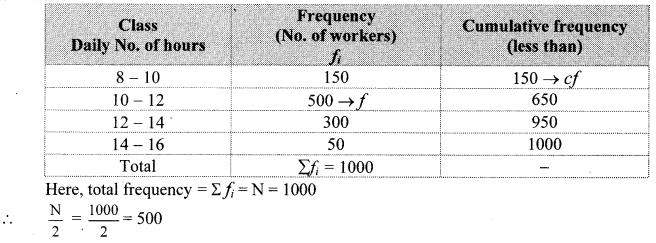
The following table shows classification of number of workers and the number of hours they work in a software company. Find the median of the number of hours they work.
Maharashtra Board Class 10 Maths Solutions Chapter 6 Statistics Practice Set 6.2 1
Solution:
Maharashtra Board Class 10 Maths Solutions Chapter 6 Statistics Practice Set 6.2 2
Cumulative frequency which is just greater than (or equal) to 500 is 650.
∴ The median class is 10 – 12.
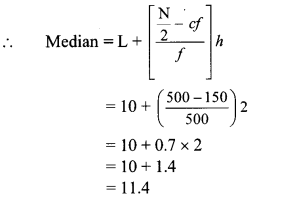
Now, L = 10, f = 500, cf = 150, h = 2
Maharashtra Board Class 10 Maths Solutions Chapter 6 Statistics Practice Set 6.2 3
∴ The median of the number of hours the workers work is 11.4 hours.

10th Class Algebra Practice Set 6.2 Question 2.
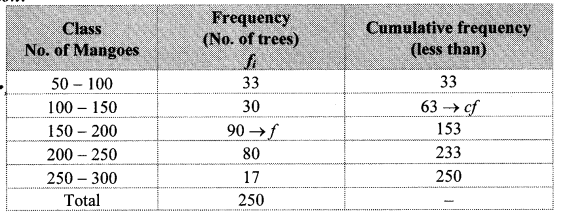
The frequency distribution table shows the number of mango trees in a grove and their yield of mangoes. Find the median of data.
Maharashtra Board Class 10 Maths Solutions Chapter 6 Statistics Practice Set 6.2 4
Solution:
Maharashtra Board Class 10 Maths Solutions Chapter 6 Statistics Practice Set 6.2 5
Here, total frequency = ∑fi = N = 250
∴ \(\frac { N }{ 2 } \) = \(\frac { 250 }{ 2 } \) = 125
Cumulative frequency which is just greater than (or equal) to 125 is 153.
∴ The median class is 150 – 200.
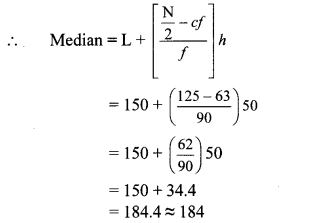
Now, L = 150, f = 90, cf = 63, h = 50
Maharashtra Board Class 10 Maths Solutions Chapter 6 Statistics Practice Set 6.2 6
∴ The median of the given data is 184 mangoes (approx).

Statistics Class 10 Practice Set 6.2 Question 3.
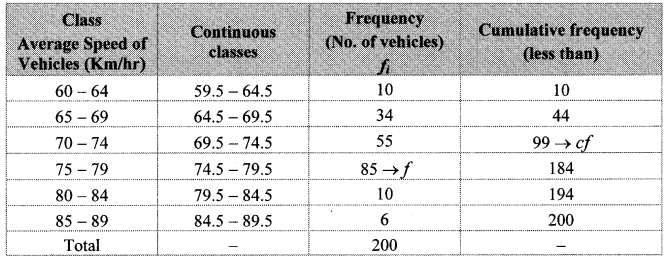
The following table shows the classification of number of vehicles and their speeds on Mumbai-Pune express way. Find the median of the data.
Maharashtra Board Class 10 Maths Solutions Chapter 6 Statistics Practice Set 6.2 7
Solution:
Maharashtra Board Class 10 Maths Solutions Chapter 6 Statistics Practice Set 6.2 8
Here, total frequency = ∑fi = N = 200
∴ \(\frac { N }{ 2 } \) = \(\frac { 200 }{ 2 } \) = 100
Cumulative frequency which is just greater than (or equal) to 100 is 184.
∴ The median class is 74.5 – 79.5.
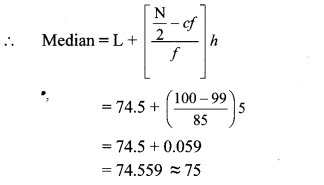
Now, L = 74.5, f = 85, cf = 99, h = 5
Maharashtra Board Class 10 Maths Solutions Chapter 6 Statistics Practice Set 6.2 9
∴ The median of the given data is 75 km/hr (approx.).

Practice Set 6.2 Geometry Class 10 Question 4.
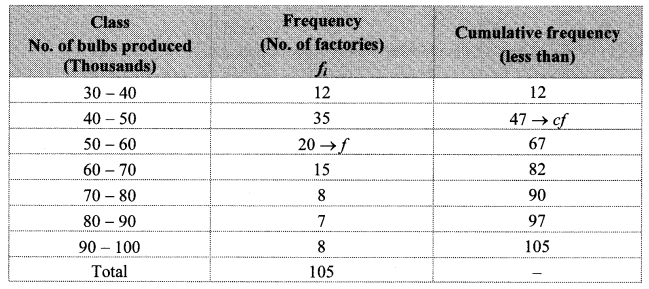
The production of electric bulbs in different factories is shown in the following table. Find the median of the productions.
Maharashtra Board Class 10 Maths Solutions Chapter 6 Statistics Practice Set 6.2 10
Solution:
Maharashtra Board Class 10 Maths Solutions Chapter 6 Statistics Practice Set 6.2 11
Cumulative frequency which is just greater than (or equal) to 52.5 is 67.
∴ The median class is 50 – 60.
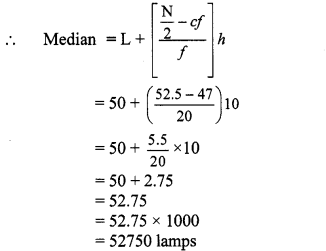
Now, L = 50, f = 20, cf = 47, h = 10
Maharashtra Board Class 10 Maths Solutions Chapter 6 Statistics Practice Set 6.2 12
∴ The median of the productions is 52750 bulbs (approx.).

Practice Set 6.2 Question 1.
If the number of scores is odd, then the (\(\frac { n+1 }{ 2 } \))th score is the median of the data. That is, the number of scores below as well as above \({ K }_{ \frac { n+1 }{ 2 } }\) is \(\frac { n-1 }{ 2 } \) Verify the fact by taking n = 2m + I. (Textbk pg. no. 139)
Solution:
Maharashtra Board Class 10 Maths Solutions Chapter 6 Statistics Practice Set 6.2 13
The sequence of the terms of scores is 1,2, 3, …….., m, m + 1, m + 2, …, 2m + 1
Thus, we have to prove that m + 1 is the middle term if the number of scores is 2m + 1
i.e. to prove
number of terms from 1 to m = number of terms from m + 2 to 2m + 1 …(i)
Consider the L.H.S. of equation (i)
The sequence is an A.P. with a = 1,d = 1, tn1 = m
tn1 = a + (n1 – 1) d
∴ m = 1 + (n1 – 1)1
∴ m = 1 + n1 – 1
∴ m = n1
Consider the R.H.S. of equation (ii)
The sequence is an A.P. with a = m + 2, d = 1, tn2 = 2m + 1
tn2 = a + (n2 – 1)d
∴ 2m + 1 = m + 2 + (n2 – 1)1
∴ 2m + 1 = m + n2 + 1
∴ m = n2
∴ number of terms from 1 to m = number of terms from m + 2 to 2m + 1 = m = \(\frac { n-1 }{ 2 } \)
∴ m + 1 is the middle term if the number of scores is 2m + 1.

Question 2.
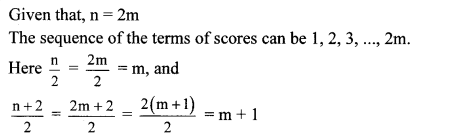
If the number of the scores is even, then the mean of the middle two terms is the median. This is because the number of terms below \({ K }_{ \frac { n }{ 2 } }\) and above \({ K }_{ \frac { n+2 }{ 2 } }\) is equal, which is \(\frac { n-2 }{ 2 } \). Verify this by taking n = 2m. (Textbook pg. no. 139)
Solution:
Maharashtra Board Class 10 Maths Solutions Chapter 6 Statistics Practice Set 6.2 14
The sequence of the terms of scores is 1, 2, 3 … m – 1, m, m + 1, m + 2,…., 2m
Thus, we have to prove that m and m + 1 are the middlemost terms if the number of scores is 2m.
i.e. to prove
number of terms from 1 to m – 1 = number of terms from m + 2 to 2m …(i)
Consider the L.H.S. of equation (i)
The sequence is an A.P. with a = 1, d = 1, tn1 = m – 1
tn1 = a + (n1 – 1)d
∴ m – 1 = 1 + (n1 – 1)1
∴m – 1 = 1 + n1 – 1
∴ n1 = m – 1
Consider the R.H.S. of equation (i)
The sequence is an A.P. with a = m + 2, d = 1, tn2= 2m
tn2= a + (n2 – 1) d
∴ 2m = m + 2 + (n2 – 1)1
∴ 2m = m + 2 + n2 – 1
∴ n2 = m – 1
∴ number of terms from 1 to m – 1 = number of terms from m + 2 to 2m = m – 1 = \(\frac { n-2 }{ 2 } \)
∴ m and m + 1 are the middlemost terms if the number of scores is 2m.

Maharashtra Board 10th Class Maths Part 1 Problem Set 5 Solutions Chapter 5 Probability

Balbharti Maharashtra State Board Class 10 Maths Solutions covers the Problem Set 5 Algebra 10th Class Maths Part 1 Answers Solutions Chapter 5 Probability.

Problem Set 5 Algebra 10th Std Maths Part 1 Answers Chapter 5 Probability

Question 1.
Choose the correct alternative answer for each of the following questions.

i. Which number cannot represent a probability?
(A) \(\frac { 2 }{ 3 } \)
(B) 1.5
(C) 15%
(D) 0.7
Answer:
The probability of any 0 to 1 or 0% to 100%. event is from
(B)

ii. A die is rolled. What is the probability that the number appearing on upper face is less than 3?
(A) \(\frac { 1 }{ 6 } \)
(B) \(\frac { 1 }{ 3 } \)
(C) \(\frac { 1 }{ 2 } \)
(D) 0
Answer:
(B)

iii. What is the probability of the event that a number chosen from 1 to 100 is a prime number?
(A) \(\frac { 1 }{ 5 } \)
(B) \(\frac { 6 }{ 25 } \)
(C) \(\frac { 1 }{ 4 } \)
(D) \(\frac { 13 }{ 50 } \)
Answer:
n(S) = 100
Let A be the event that the number chosen is a prime number.
∴ A = {2, 3, 5. , 7, 11, 13, 17, 19, 23, 29, 31, 37, 41, 43, 47, 53, 59, 61, 67, 71, 73, 79, 83, 89, 97}
∴ n(A) = 25
∴ P(A) = \(\frac { n(A) }{ n(S) } \) = \(\frac { 25 }{ 100 } \) = \(\frac { 1 }{ 4 } \)
(C)

iv. There are 40 cards in a bag. Each bears a number from 1 to 40. One card is drawn at random. What is the probability that the card bears a number which is a multiple of 5?
(A) \(\frac { 1 }{ 5 } \)
(B) \(\frac { 3 }{ 5 } \)
(C) \(\frac { 4 }{ 5 } \)
(D) \(\frac { 1 }{ 3 } \)
Answer:
(A)

v. If n(A) = 2, P(A) = \(\frac { 1 }{ 5 } \), then n(S) = ?
(A) 10
(B) \(\frac { 5 }{ 2 } \)
(C) \(\frac { 2 }{ 5 } \)
(D) \(\frac { 1 }{ 3 } \)
Answer:
(A)

Question 2.
Basketball players John, Vasim, Akash were practising the ball drop in the basket. The probabilities of success for John, Vasim and Akash are \(\frac { 4 }{ 5 } \), 0.83 and 58% respectively. Who had the greatest probability of success ?
Solution:
The probability that the ball is dropped in the basket by John = \(\frac { 4 }{ 5 } \) = 0.80
The probability that the ball is dropped in the basket by Vasim = 0.83
The probability that the ball is dropped in the basket by Akash = 58% = \(\frac { 58 }{ 100 } \) = 0.58
0.83 > 0.80 > 0.58
∴ Vasim has the greatest probability of success.

Question 3.
In a hockey team there are 6 defenders , 4 offenders and 1 goalie. Out of these, one player is to be selected randomly as a captain. Find the probability of the selection that:
i. The goalie will be selected.
ii. A defender will be selected.
Solution:
Total number of players in the hockey team
= 6 + 4 + 1 = 11
∴ n(S) = 11

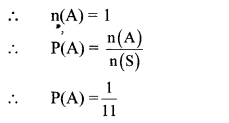
i. Let A be the event that the captain selected will be a goalie.
There is only one goalie in the hockey team.
Maharashtra Board Class 10 Maths Solutions Chapter 5 Probability Problem Set 5 1

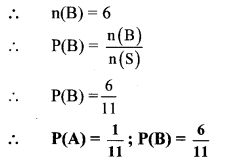
ii. Let B be the event that the captain selected will be a defender.
There are 6 defenders in the hockey team.
Maharashtra Board Class 10 Maths Solutions Chapter 5 Probability Problem Set 5 2

Question 4.
Joseph kept 26 cards in a cap, bearing one English alphabet on each card. One card is drawn at random. What is the probability that the card drawn is a vowel card ?
Solution:
Each card bears an English alphabet.
∴ n(S) = 26
Let A be the event that the card drawn is a vowel card.
There are 5 vowels in English alphabets.
∴ A = {a, e, i, o, u}
∴ n(A) = 5
Maharashtra Board Class 10 Maths Solutions Chapter 5 Probability Problem Set 5 3
∴ The probability that the card drawn is a vowel card is \(\frac { 5 }{ 26 } \).

Question 5.
A balloon vendor has 2 red, 3 blue and 4 green balloons. He wants to choose one of them at random to give it to Pranali. What is the probability of the event that Pranali gets,
i. a red balloon.
ii. a blue balloon,
iii. a green balloon.
Solution:
Let the 2 red balloon be R1, R2,
3 blue balloons be B1, B2, B3, and
4 green balloons be G1, G2, G3, G4.
∴ Sample space
S = {R1, R2, B1, B2, B3, G1, G2, G3, G4}
∴ n(S) = 9

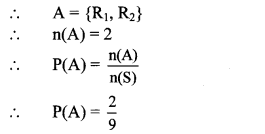
i. Let A be the event that Pranali gets a red balloon.
Maharashtra Board Class 10 Maths Solutions Chapter 5 Probability Problem Set 5 4
∴ The probability that Pranali gets a red balloon is \(\frac { 2 }{ 9 } \)

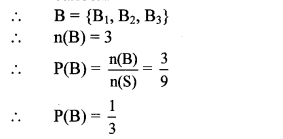
ii. Let B be the event that Pranali gets a blue balloon.
Maharashtra Board Class 10 Maths Solutions Chapter 5 Probability Problem Set 5 5
∴ The probability that Pranali gets a blue balloon is \(\frac { 1 }{ 3 } \).

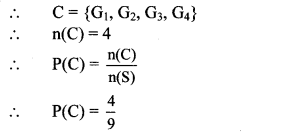
iii. Let C be the event that Pranali gets a green balloon.
Maharashtra Board Class 10 Maths Solutions Chapter 5 Probability Problem Set 5 6
∴ The probability that Pranali gets a green balloon is \(\frac { 4 }{ 9 } \).

Question 6.
A box contains 5 red, 8 blue and 3 green pens. Rutuja wants to pick a pen at random. What is the probability that the pen is blue?
Solution:
Let 5 red pens be R1, R2, R3, R4, R5.
8 blue pens be B1, B2, B3, B4, B5, B6, B7, B8. and
3 green pens be G1, G2, G3.
∴ Sample space
S = {R1, R2, R3, R4, R5, B1, B2, B3, B4, B5, B6, B7, B8, G1, G2, G3}
∴ n(S) = 16
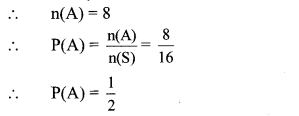
Let A be the event that Rutuja picks a blue pen.
∴ A = {B1, B2, B3, B4, B5, B6, B7, B8}
Maharashtra Board Class 10 Maths Solutions Chapter 5 Probability Problem Set 5 7
∴ The probability that Rutuja picks a blue pen is \(\frac { 1 }{ 2 } \).

Question 7.
Six faces of a die are as shown below.
Maharashtra Board Class 10 Maths Solutions Chapter 5 Probability Problem Set 5 8
If the die is rolled once, find the probability of
i. ‘A’ appears on upper face.
ii. ‘D’ appears on upper face.
Solution:
Sample space
S = {A, B, C, D, E, A}
∴ n (S) = 6
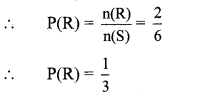
i. Let R be the event that ‘A’ appears on the upper face.
∴ R = {A, A}
∴ n(R) = 2
Maharashtra Board Class 10 Maths Solutions Chapter 5 Probability Problem Set 5 9

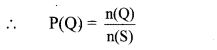
ii. Let Q be the event that ‘D’ appears on the upper face.
Total number of faces having ‘D’ on it = 1
Q = {D}
∴ n(Q) = 1
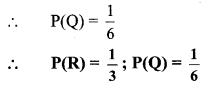
Maharashtra Board Class 10 Maths Solutions Chapter 5 Probability Problem Set 5 10
Maharashtra Board Class 10 Maths Solutions Chapter 5 Probability Problem Set 5 11

Question 8.
A box contains 30 tickets, bearing only one number from 1 to 30 on each. If one ticket is drawn at random, find the probability of an event that the ticket drawn bears
i. an odd number.
ii. a complete square number.
Solution:
Sample space,
S = {1, 2, 3, 4, 5, 6, 7, 8, 9, 10, 11, 12, 13, 14, 15, 16, 17, 18, 19, 20, 21, 22, 23, 24, 25, 26, 27, 28, 29, 30}
∴ n(S) = 30

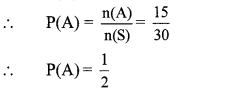
i. Let A be the event that the ticket drawn bears an odd number.
∴ A = {1,3,5,7,9,11,13,15,17,19,21, 23,25,27,29}
∴ n(A) =15
E:\Prasanna\Learncram\Class 10 Maths\ch 5\Maharashtra Board Class 10 Maths Solutions Chapter 5 Probability Problem Set 5 14.png

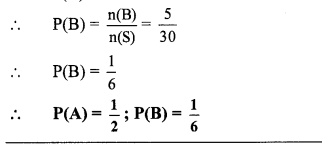
ii. Let B be the event that the ticket drawn bears a complete square number.
∴ B = {1,4,9,16,25}
∴ n(B) = 5
Maharashtra Board Class 10 Maths Solutions Chapter 5 Probability Problem Set 5 13

Question 9.
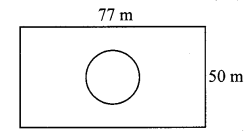
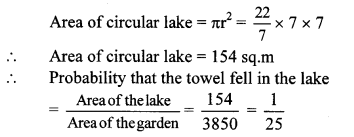
Length and breadth of a rectangular garden are 77 m and 50 m. There is a circular lake in the garden having diameter 14 m. Due to wind, a towel from a terrace on a nearby building fell into the garden. Then find the probability of the event that it fell in the lake.
Maharashtra Board Class 10 Maths Solutions Chapter 5 Probability Problem Set 5 14
Solution:
Area of the rectangular garden
= length × breadth
= 77 × 50
∴ Area of the rectangular garden = 3850 sq.m
Radius of the lake = \(\frac { 14 }{ 2 } \) = 7 m
Maharashtra Board Class 10 Maths Solutions Chapter 5 Probability Problem Set 5 15
∴ The probability of the event that the towel tell in the lake is \(\frac { 1 }{ 25 } \).

Question 10.
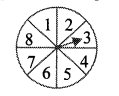
In a game of chance, a spinning arrow comes to rest at one of the numbers 1, 2, 3, 4, 5, 6, 7, 8. All these are equally likely outcomes. Find the probability that it will rest at
i. 8.
ii. an odd number.
iii. a number greater than 2.
iv. a number less than 9.
Maharashtra Board Class 10 Maths Solutions Chapter 5 Probability Problem Set 5 16
Solution:
Sample space (S) = {1,2, 3, 4, 5, 6, 7, 8}
∴ n(S) = 8
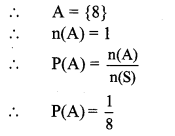
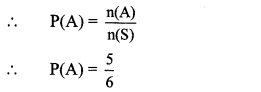
i. Let A be the event that the spinning arrow comes to rest at 8.
Maharashtra Board Class 10 Maths Solutions Chapter 5 Probability Problem Set 5 17
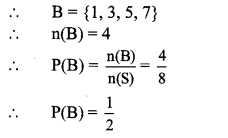
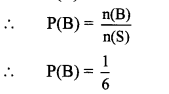
ii. Let B be the event that the spinning arrow comes to rest at an odd number.
Maharashtra Board Class 10 Maths Solutions Chapter 5 Probability Problem Set 5 18
iii. Let C be the event that the spinning arrow comes to rest at a number greater than 2.
Maharashtra Board Class 10 Maths Solutions Chapter 5 Probability Problem Set 5 19
iv. Let D be the event that the spinning arrow comes to rest at a number less than 9.
∴ D = {1,2, 3, 4, 5, 6, 7, 8}
Maharashtra Board Class 10 Maths Solutions Chapter 5 Probability Problem Set 5 20

Question 11.
There are six cards in a box, each bearing a number from 0 to 5. Find the probability of each of the following events, that a card drawn shows,
i. a natural number.
ii. a number less than 1.
iii. a whole number.
iv. a number greater than 5.
Solution:
Sample space (S) = {0, 1, 2, 3, 4, 5}
∴ n(S) = 6

i. Let A be the event that the card drawn shows a natural number.
∴ A = {1,2,3,4,5}
∴ n(A) = 5
Maharashtra Board Class 10 Maths Solutions Chapter 5 Probability Problem Set 5 21

ii. Let B be the event that the card drawn shows a number less than 1.
∴ B = {0}
∴ n(B) = 1
Maharashtra Board Class 10 Maths Solutions Chapter 5 Probability Problem Set 5 22

iii. Let C be the event that the card drawn shows a whole number.
∴ C = {0,1, 2, 3, 4, 5}
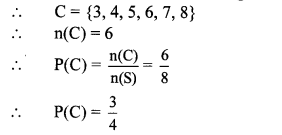
∴ n(C) = 6
Maharashtra Board Class 10 Maths Solutions Chapter 5 Probability Problem Set 5 23

iv. Let D be the event that the card drawn shows a number greater than 5.
Here, the greatest number is 5.
∴ Event D is an impossible event.
∴ D = { }
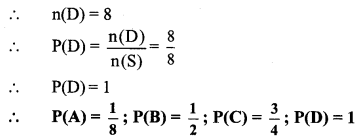
∴ n(D) = 0
Maharashtra Board Class 10 Maths Solutions Chapter 5 Probability Problem Set 5 24

Question 12.
A bag contains 3 red, 3 white and 3 green balls. One ball is taken out of the bag at random. What is the probability that the ball drawn is:
i. red.
ii. not red.
iii. either red or white.
Solution:
Let the three red balls be R1, R2, R3, three white balls be W1, W2, W3 and three green balls be G1, G2, G3.
∴ Sample space,
S = {R1, R2, R3, W1, W2, W3, G1, G2, G3}
∴ n(S) = 9

i. Let A be the event that the ball drawn is red.
∴ A = {R1, R2, R3}
∴ n(A) = 3
Maharashtra Board Class 10 Maths Solutions Chapter 5 Probability Problem Set 5 25

ii. Let B be the event that the ball drawn is not red.
B = {W1,W2,W3,G1,G2,G3}
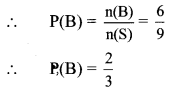
∴ n(B) = 6
Maharashtra Board Class 10 Maths Solutions Chapter 5 Probability Problem Set 5 26

iii. Let C be the event that the ball drawn is red or white.
∴ C = {R1, R2, R3, W1, W2, W3}
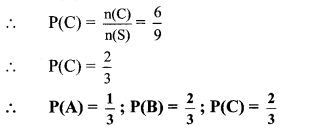
∴ n(C) = 6
Maharashtra Board Class 10 Maths Solutions Chapter 5 Probability Problem Set 5 27

Question 13.
Each card bears one letter from the word ‘mathematics’. The cards are placed on a table upside down. Find the probability that a card drawn bears the letter ‘m’.
Solution:
Sample space
= {m, a, t, h, e, m, a, t, i, c, s}
∴ n(S) = 11
Let A be the event that the card drawn bears the letter ‘m’
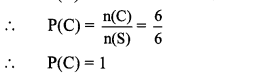
∴ A = {m, m}
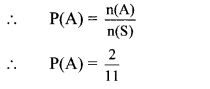
∴ n(A) = 2
Maharashtra Board Class 10 Maths Solutions Chapter 5 Probability Problem Set 5 28
∴ The probability that a card drawn bears letter ‘m’ is \(\frac { 2 }{ 11 } \).

Question 14.
Out of 200 students from a school, 135 like Kabaddi and the remaining students do not like the game. If one student is selected at random from all the students, find the probability that the student selected dosen’t like Kabaddi.
Solution:
Total number of students in the school = 200
∴ n(S) = 200
Number of students who like Kabaddi = 135
∴ Number of students who do not like Kabaddi
= 200 – 135 = 65
Let A be the event that the student selected does not like Kabaddi.
∴ n(A) = 65
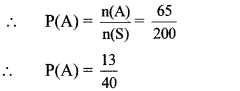
Maharashtra Board Class 10 Maths Solutions Chapter 5 Probability Problem Set 5 29
∴ The probability that the student selected doesn’t like kabaddi is \(\frac { 13 }{ 40 } \).

Question 15.
A two digit number is to be formed from the digits 0, 1, 2, 3, 4. Repetition of the digits is allowed. Find the probability that the number so formed is a:
i. prime number.
ii. multiple of 4.
iii multiple of 11.
Solution:
Sample space
(S) = {10, 11, 12, 13, 14,
20, 21, 22, 23, 24,
30, 31, 32, 33, 34,
40, 41, 42, 43, 44}
∴ n(S) = 20

i. Let A be the event that the number so formed is a prime number.
∴ A = {11,13,23,31,41,43}
∴ n(A) = 6
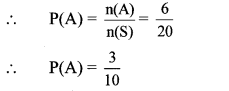
Maharashtra Board Class 10 Maths Solutions Chapter 5 Probability Problem Set 5 30

ii. Let B be the event that the number so formed is a multiple of 4.
∴ B = {12,20,24,32,40,44}
∴ n(B) = 6
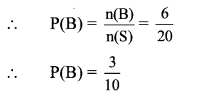
Maharashtra Board Class 10 Maths Solutions Chapter 5 Probability Problem Set 5 31

iii. Let C be the event that the number so formed is a multiple of 11.
∴ C = {11,22,33,44}
∴ n(C) = 4
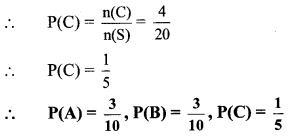
Maharashtra Board Class 10 Maths Solutions Chapter 5 Probability Problem Set 5 32

Question 16.
The faces of a die bear numbers 0,1, 2, 3,4, 5. If the die is rolled twice, then find the probability that the product of digits on the upper face is zero.
Solution:
Sample space,
S = {(0, 0), (0,1), (0,2),
(1,0), (1,1), (1,2),
(2,0), (2,1), (2,2),
(3.0), (3,1), (3,2),
(4.0), (4,1), (4,2),
(5.0), (5,1), (5,2),
∴ n(S) = 36
Let A be the event that the product of digits on the upper face is zero.
∴ A = {(0, 0), (0, 1), (0, 2), (0, 3), (0, 4), (0, 5), (1,0), (2, 0), (3,0), (4, 0), (5,0)}
∴ n(A) = 11
Maharashtra Board Class 10 Maths Solutions Chapter 5 Probability Problem Set 5 33
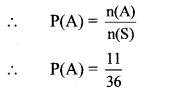
∴ The probability that the product of the digits on the upper face is zero is \(\frac { 11 }{ 36 } \).

Maharashtra Board 10th Class Maths Part 1 Practice Set 6.1 Solutions Chapter 6 Statistics

Balbharti Maharashtra State Board Class 10 Maths Solutions covers the Practice Set 6.1 Algebra 10th Class Maths Part 1 Answers Solutions Chapter 6 Statistics.

Practice Set 6.1 Algebra 10th Std Maths Part 1 Answers Chapter 6 Statistics

Question 1.
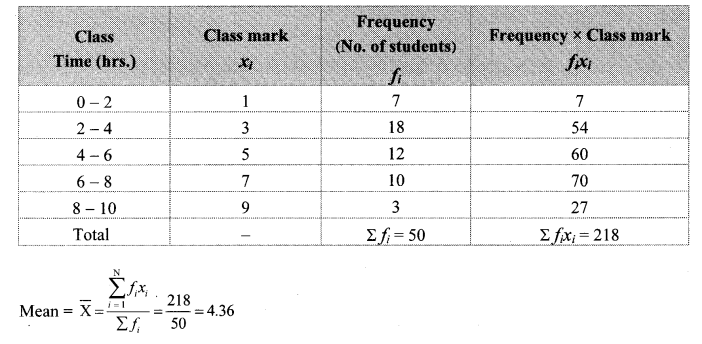
The following table shows the number of students and the time they utilized daily for their studies. Find the mean time spent by students for their studies by direct method.
Maharashtra Board Class 10 Maths Solutions Chapter 6 Statistics Practice Set 6.1 1
Solution:
Maharashtra Board Class 10 Maths Solutions Chapter 6 Statistics Practice Set 6.1 2
∴ The mean of the time spent by the students for their studies is 4.36 hours.

Question 2.
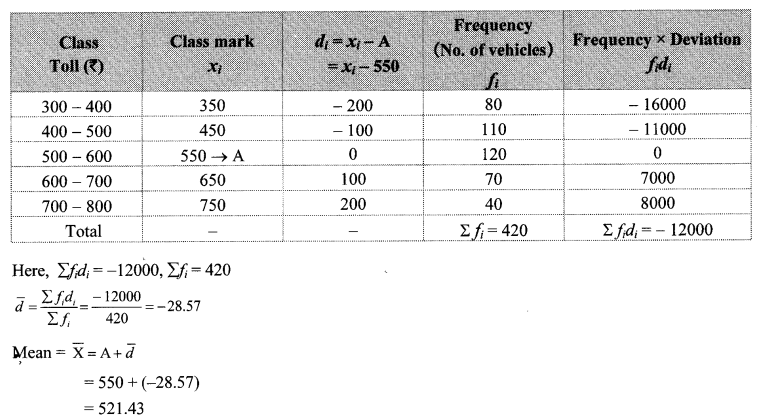
In the following table, the toll paid by drivers and the number of vehicles is shown. Find the mean of the toll by ‘assumed mean’ method.
Maharashtra Board Class 10 Maths Solutions Chapter 6 Statistics Practice Set 6.1 3
Solution:
Let us take the assumed mean (A) = 550
Maharashtra Board Class 10 Maths Solutions Chapter 6 Statistics Practice Set 6.1 4
∴ The mean of the toll paid by the drivers is ₹ 521.43.

Question 3.
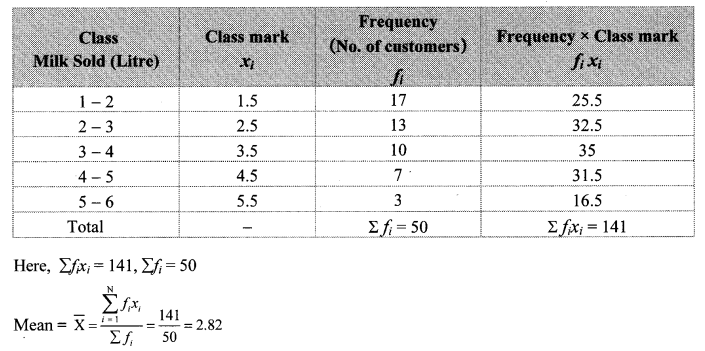
A milk centre sold milk to 50 customers. The table below gives the number of customers and the milk they purchased. Find the mean of the milk sold by direct method.
Maharashtra Board Class 10 Maths Solutions Chapter 6 Statistics Practice Set 6.1 5
Solution:
Maharashtra Board Class 10 Maths Solutions Chapter 6 Statistics Practice Set 6.1 6
∴ The mean of the milk sold is 2.82 litres.

Question 4.
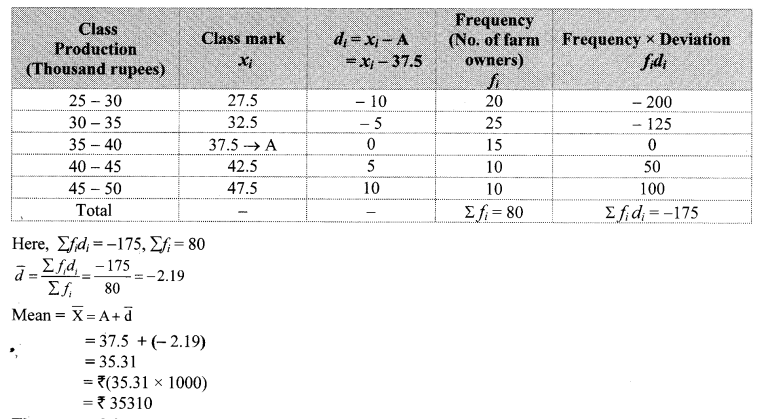
A frequency distribution table for the production of oranges of some farm owners is given below. Find the mean production of oranges by ‘assumed mean’ method.
Maharashtra Board Class 10 Maths Solutions Chapter 6 Statistics Practice Set 6.1 7
Solution:
Let us take the assumed mean (A) = 37.5
Maharashtra Board Class 10 Maths Solutions Chapter 6 Statistics Practice Set 6.1 8
∴ The mean of the production of oranges is ₹ 35310.

Question 5.
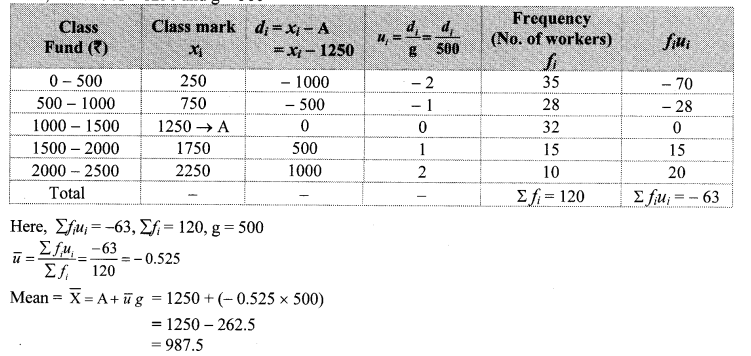
A frequency distribution of funds collected by 120 workers in a company for the drought affected people are given in the following table. Find the mean of he funds by ‘step deviation’ method.
Maharashtra Board Class 10 Maths Solutions Chapter 6 Statistics Practice Set 6.1 9
Solution:
Here, we take A = 1250 and g = 500
Maharashtra Board Class 10 Maths Solutions Chapter 6 Statistics Practice Set 6.1 10
∴ The mean of the funds collected is ₹ 987.5.

Question 6.
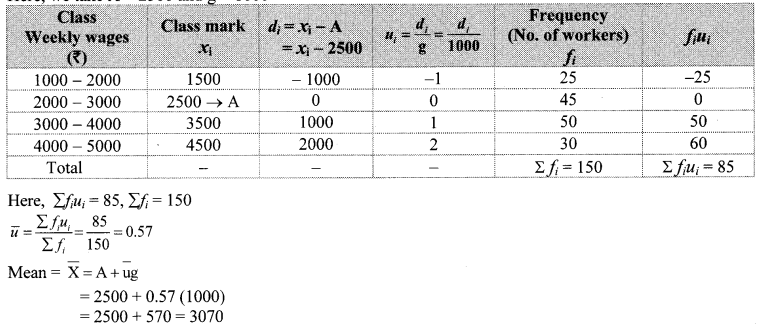
The following table gives the information of frequency distribution of weekly wages of 150 workers of a company. Find the mean of the weekly wages by ‘step deviation’ method.
Maharashtra Board Class 10 Maths Solutions Chapter 6 Statistics Practice Set 6.1 11
Solution:
Here, we take A = 2500 and g = 1000.
Maharashtra Board Class 10 Maths Solutions Chapter 6 Statistics Practice Set 6.1 12
∴ The mean of the weekly wages is ₹ 3070.

Question 1.
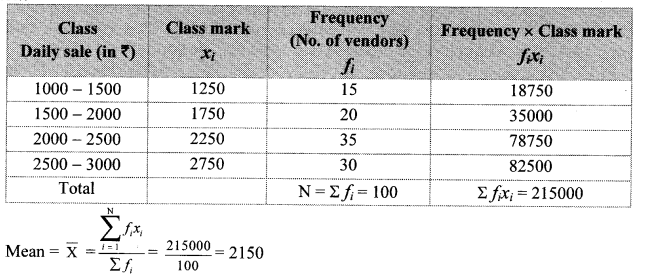
The daily sale of 100 vegetable vendors is given in the following table. Find the mean of the sale by direct method. (Textbook pg. no. 133 and 134)
Maharashtra Board Class 10 Maths Solutions Chapter 6 Statistics Practice Set 6.1 13
Solution:
Maharashtra Board Class 10 Maths Solutions Chapter 6 Statistics Practice Set 6.1 14
The mean of the sale is 2150.

Question 2.
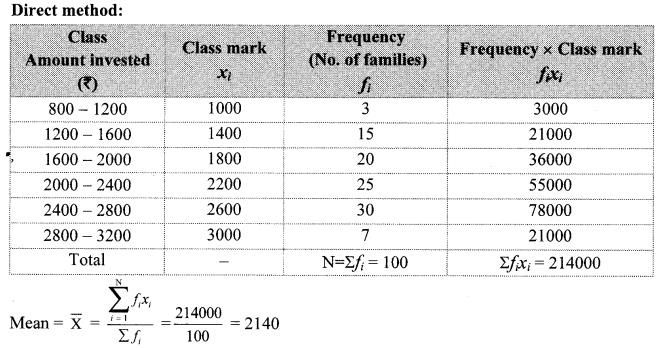
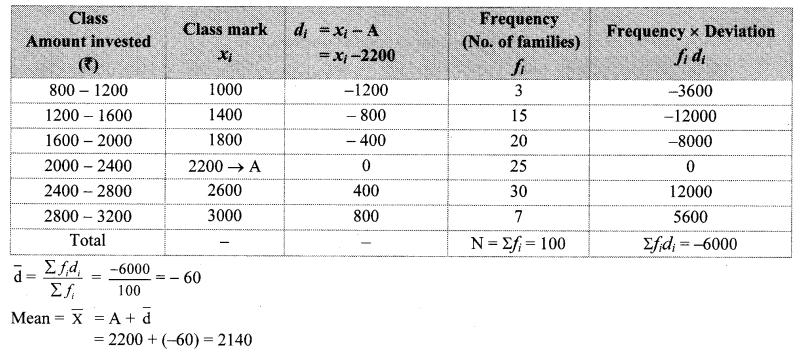
The amount invested in health insurance by 100 families is given in the following frequency table. Find the mean of investments using direct method and assumed mean method. Check whether the mean found by the two methods is the same as calculated by step deviation method (Ans: ₹ 2140). (Textbook pg. no. 135 and 136)
Maharashtra Board Class 10 Maths Solutions Chapter 6 Statistics Practice Set 6.1 15
Solution:
Maharashtra Board Class 10 Maths Solutions Chapter 6 Statistics Practice Set 6.1 16
∴ The mean of investments in health insurance is ₹ 2140.
Assumed mean method:
Maharashtra Board Class 10 Maths Solutions Chapter 6 Statistics Practice Set 6.1 17
∴ The mean of investments in health insurance is ₹ 2140.
∴ Mean found by direct method and assumed mean method is the same as calculated by step deviation method.

Question 3.
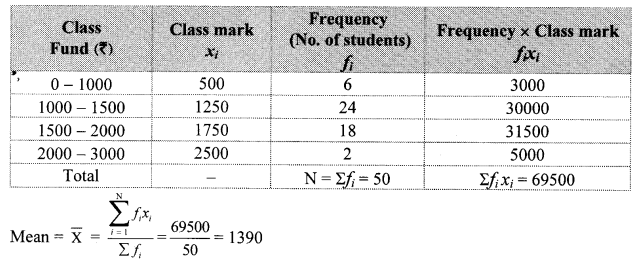
The following table shows the funds collected by 50 students for flood affected people. Find the mean of the funds.
Maharashtra Board Class 10 Maths Solutions Chapter 6 Statistics Practice Set 6.1 18
If the number of scores in two consecutive classes is very low, it is convenient to club them. So, in the above example, we club the classes 0 – 500, 500 – 1000 and 2000 – 2500, 2500 – 3000. Now the new table is as follows
Maharashtra Board Class 10 Maths Solutions Chapter 6 Statistics Practice Set 6.1 19
i. Solve by direct method.
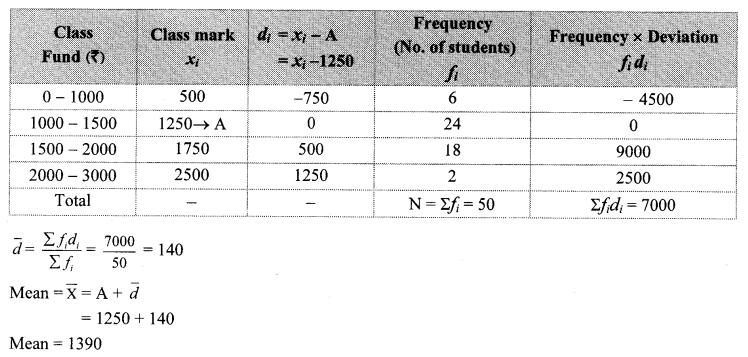
ii. Verily that the mean calculated by assumed mean method is the same.
iii. Find the mean in the above example by taking A = 1750. (Textbook pg. no. 137)
Solution:
i. Direct method:
Maharashtra Board Class 10 Maths Solutions Chapter 6 Statistics Practice Set 6.1 20
∴ The mean of the funds is ₹ 1390.

ii. Assumed mean method:
Here, A = 1250
Maharashtra Board Class 10 Maths Solutions Chapter 6 Statistics Practice Set 6.1 21
∴ The mean calculated by assumed mean method is the same.

iii. Step deviation method:
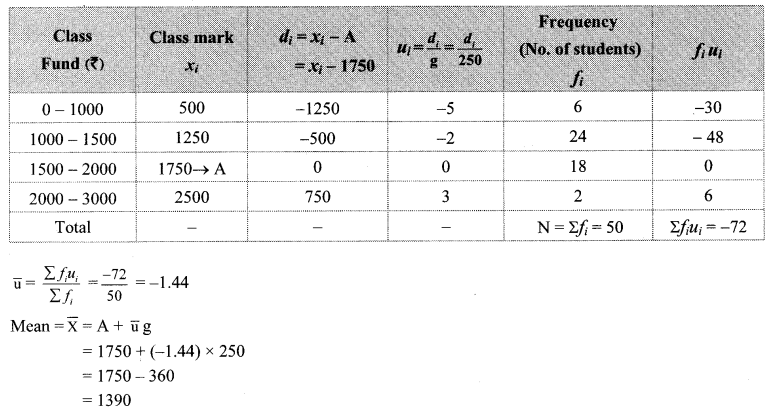
Here, we take A = 1750 and g = 250
Maharashtra Board Class 10 Maths Solutions Chapter 6 Statistics Practice Set 6.1 22
∴ The mean of the funds is ₹ 1390.

Maharashtra Board 10th Class Maths Part 1 Practice Set 5.4 Solutions Chapter 5 Probability

Balbharti Maharashtra State Board Class 10 Maths Solutions covers the Practice Set 5.4 Algebra 10th Class Maths Part 1 Answers Solutions Chapter 5 Probability.

Practice Set 5.4 Algebra 10th Std Maths Part 1 Answers Chapter 5 Probability

Question 1.
If two coins are tossed, find the probability of the following events.
i. Getting at least one head.
ii. Getting no head.
Solution:
Sample space,
S = {HH, HT, TH, TT}
∴ n(S) = 4

i. Let A be the event of getting at least one head.
∴ A = {HT, TH, HH}
∴ n(A) = 3
∴ P(A) = \(\frac { n(A) }{ n(S) } \)
∴ P(A) = \(\frac { 3 }{ 4 } \)

ii. Let B be the event of getting no head.
∴ B = {TT}
∴ n(B) = 1
∴ P(B) = \(\frac { n(B) }{ n(S) } \)
∴ P(B) = \(\frac { 1 }{ 4 } \)
∴ P(A) = \(\frac { 3 }{ 4 } \); P(B) = \(\frac { 1 }{ 4 } \)

Question 2.
If two dice are rolled simultaneously, find the probability of the following events.
i. The sum of the digits on the upper faces is at least 10.
ii. The sum of the digits on the upper faces is 33.
iii. The digit on the first die is greater than the digit on second die.
Solution:
Sample space,
s = {(1,1), (1,2), (1,3), (1,4), (1, 5), (1,6),
(2, 1), (2, 2), (2,3), (2,4), (2, 5), (2,6),
(3, 1), (3, 2), (3, 3), (3,4), (3, 5), (3, 6),
(4, 1), (4, 2), (4,3), (4,4), (4, 5), (4,6),
(5, 1), (5, 2), (5,3), (5,4), (5, 5), (5, 6),
(6, 1), (6, 2), (6, 3), (6,4), (6, 5), (6,6)}
∴ n(S) = 36

i. Let A be the event that the sum of the digits on the upper faces is at least 10.
∴ A = {(4, 6), (5, 5), (5, 6), (6, 4), (6, 5), (6, 6)}
∴ n(A) = 6
∴ P(A) = \(\frac { n(A) }{ n(S) } \) = \(\frac { 6 }{ 36 } \)
∴ P(A) = \(\frac { 1 }{ 6 } \)

ii. Let B be the event that the sum of the digits on the upper faces is 33.
The sum of the digits on the upper faces can be maximum 12.
∴ Event B is an impossible event.
∴ B = { }
∴ n(B) = 0
∴ P(B) = \(\frac { n(B) }{ n(S) } \) = \(\frac { 0 }{ 36 } \)
∴ P(B) = 0

iii. Let C be the event that the digit on the first die is greater than the digit on the second die.
C = {(2, 1), (3, 1), (3,2), (4,1), (4,2), (4, 3), (5, 1), (5,2), (5,3), (5,4), (6,1), (6,2), (6, 3), (6, 4), (6, 5),
∴ n(C) = 15
∴ P(C) = \(\frac { n(c) }{ n(S) } \) = \(\frac { 15 }{ 36 } \)
∴ P(C) = \(\frac { 5 }{ 12 } \)
∴ P(A) = \(\frac { 1 }{ 6 } \) ; P(B) = 0; P(C) = \(\frac { 5 }{ 12 } \)

Question 3.
There are 15 tickets in a box, each bearing one of the numbers from 1 to 15. One ticket is drawn at random from the box. Find the probability of event that the ticket drawn:
i. shows an even number.
ii. shows a number which is a multiple of 5.
Solution:
Sample space,
S = {1,2, 3, 4, 5, 6, 7, 8, 9, 10, 11, 12, 13,14, 15}
∴ n(S) = 15

i. Let A be the event that the ticket drawn shows an even number.
∴ A = {2, 4, 6, 8, 10, 12, 14}
∴ n(A) = 7
∴ P(A) = \(\frac { n(A) }{ n(S) } \)
∴ P(A) = \(\frac { 7 }{ 15 } \)

ii. Let B be the event that the ticket drawn shows a number which is a multiple of 5.
∴ B = {5, 10, 15}
∴ n(B) = 3
∴ P(B) = \(\frac { n(B) }{ n(S) } \) = \(\frac { 3 }{ 15 } \)
∴ P(B) = \(\frac { 1 }{ 5 } \)
∴ P(A) = \(\frac { 7 }{ 15 } \) ; P(B) = \(\frac { 1 }{ 5 } \)

Question 4.
A two digit number is formed with digits 2, 3, 5, 7, 9 without repetition. What is the probability that the number formed is
i. an odd number?
ii. a multiple of 5?
Solution:
Sample space
(S) = {23, 25, 27, 29,
32, 35, 37, 39,
52, 53, 57, 59,
72, 73, 75, 79,
92, 93, 95, 97}
∴ n(S) = 20
i. Let A be the event that the number formed is an odd number.
∴ A = {23, 25, 27, 29, 35, 37, 39, 53, 57, 59, 73, 75,79,93,95,97}
∴ n(A) = 16
∴ P(A) = \(\frac { n(A) }{ n(S) } \) = \(\frac { 16 }{ 20 } \)
∴ P(A) = \(\frac { 4 }{ 5 } \)

ii. Let B be the event that the number formed is a multiple of 5.
∴ B = {25,35,75,95}
∴ n(B) = 4
∴ P(B) = \(\frac { n(B) }{ n(S) } \) = \(\frac { 4 }{ 20 } \)
∴ P(B) = \(\frac { 1 }{ 5 } \)
∴ P(A) = \(\frac { 4 }{ 5 } \) ; P(B) = \(\frac { 1 }{ 5 } \)

Question 5.
A card is drawn at random from a pack of well shuffled 52 playing cards. Find the probability that the card drawn is
i. an ace.
ii. a spade.
Solution:
There are 52 playing cards.
∴ n(S) = 52
i. Let A be the event that the card drawn is an ace.
∴ n(A) = 4
∴ P(A) = \(\frac { n(A) }{ n(S) } \) = \(\frac { 4 }{ 52 } \)
∴ P(A) = \(\frac { 1 }{ 13 } \)

ii. Let B be the event that the card drawn is a spade.
∴ n(B) = 13
∴ P(B) = \(\frac { n(B) }{ n(S) } \) = \(\frac { 13 }{ 52 } \)
∴ P(B) = \(\frac { 1 }{ 4 } \)
∴ P(A) = \(\frac { 1 }{ 13 } \) ; P(B) = \(\frac { 1 }{ 4 } \)

Maharashtra Board 10th Class Maths Part 2 Practice Set 1.4 Solutions Chapter 1 Similarity

Balbharti Maharashtra State Board Class 10 Maths Solutions covers the Practice Set 1.4 Algebra 10th Class Maths Part 2 Answers Solutions Chapter 1 Similarity.

Practice Set 1.4 Algebra 10th Std Maths Part 2 Answers Chapter 1 Similarity

Question 1.
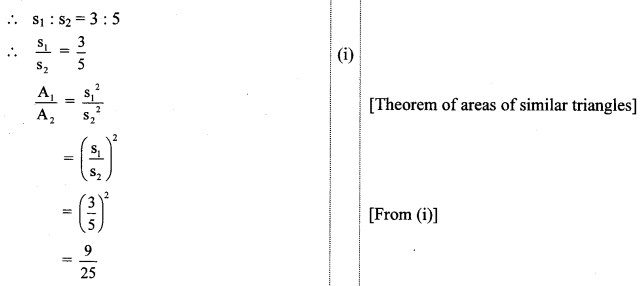
The ratio of corresponding sides of similar triangles is 3 : 5, then find the ratio of their areas.
Solution:
Let the corresponding sides of similar triangles be S1 and S2.
Let A1 and A2 be their corresponding areas.
Maharashtra Board Class 10 Maths Solutions Chapter 1 Similarity Practice Set 1.4 1
∴ Ratio of areas of similar triangles = 9 : 25

Question 2.
If ∆ABC ~ ∆PQR and AB : PQ = 2:3, then fill in the blanks.
Solution:
Maharashtra Board Class 10 Maths Solutions Chapter 1 Similarity Practice Set 1.4

Question 3.
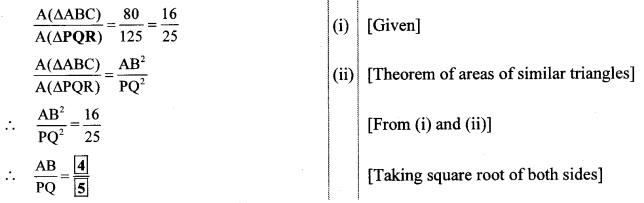
If ∆ABC ~ ∆PQR, A(∆ABC) = 80, A(∆PQR) = 125, then fill in the blanks.
Solution:
Maharashtra Board Class 10 Maths Solutions Chapter 1 Similarity Practice Set 1.4 2

Question 4.
∆LMN ~ ∆PQR, 9 × A(∆PQR) = 16 × A(∆LMN). If QR = 20, then find MN.
Solution:
9 × A(∆PQR) = 16 × A(∆LMN) [Given]
∴ \(\frac{\mathrm{A}(\Delta \mathrm{LMN})}{\mathrm{A}(\Delta \mathrm{PQR})}=\frac{9}{16}\) (i)
Now, ∆LMN ~ ∆PQR [Given]
∴ \(\frac{\mathrm{A}(\Delta \mathrm{LMN})}{\mathrm{A}(\Delta \mathrm{PQR})}=\frac{\mathrm{MN}^{2}}{\mathrm{QR}^{2}}\) (ii) [Theorem of areas of similar triangles]
∴ \(\frac{\mathrm{MN}^{2}}{\mathrm{QR}^{2}}=\frac{9}{16}\) [From (i) and (ii)]
∴ \(\frac{M N}{Q R}=\frac{3}{4}\) [Taking square root of both sides]
∴ \(\frac{\mathrm{MN}}{20}=\frac{3}{4}\)
∴ MN = \(\frac{20 \times 3}{4}\)
∴ MN = 15 units

Question 5.
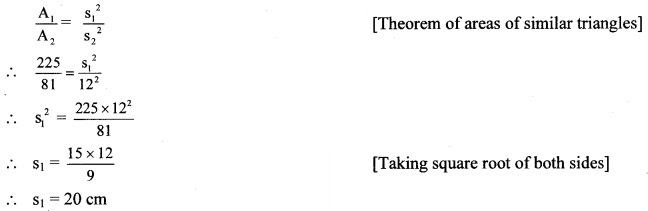
Areas of two similar triangles are 225 sq. cm. and 81 sq. cm. If a side of the smaller triangle is 12 cm, then find corresponding side of the bigger triangle.
Solution:
Let the areas of two similar triangles be A1 and A2.
A1 = 225 sq. cm. A2 = 81 sq. cm.
Let the corresponding sides of triangles be S1 and S2 respectively.
S1 = 12 cm
Maharashtra Board Class 10 Maths Solutions Chapter 1 Similarity Practice Set 1.4
∴ The length of the corresponding side of the bigger triangle is 20 cm.

Question 6.
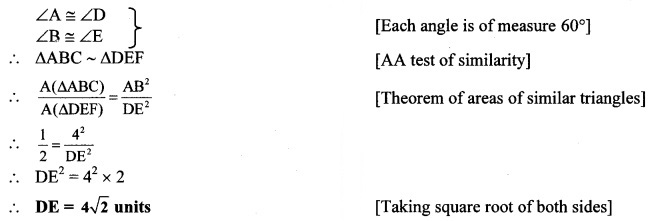
∆ABC and ∆DEF are equilateral triangles. If A(∆ABC): A(∆DEF) = 1:2 and AB = 4, find DE.
Solution:
In ∆ABC and ∆DEF,
Maharashtra Board Class 10 Maths Solutions Chapter 1 Similarity Practice Set 1.4

Question 7.
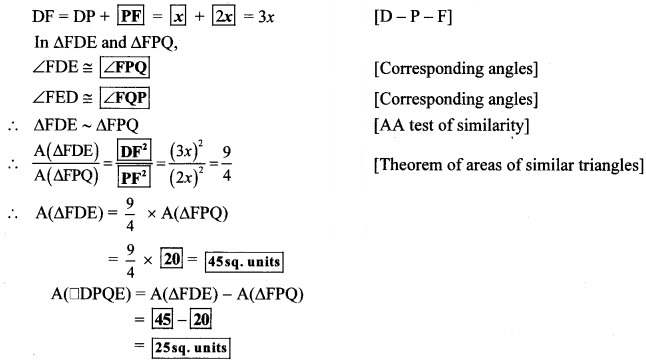
In the adjoining figure, seg PQ || seg DE, A(∆PQF) = 20 sq. units, PF = 2 DP, then find A (꠸ DPQE) by completing the following activity.
Solution:
A(∆PQF) = 20 sq.units, PF = 2 DP, [Given]
Let us assume DP = x.
∴ PF = 2x
Maharashtra Board Class 10 Maths Solutions Chapter 1 Similarity Practice Set 1.4

Maharashtra Board 10th Class Maths Part 1 Practice Set 2.3 Solutions Chapter 2 Quadratic Equations

Balbharti Maharashtra State Board Class 10 Maths Solutions covers the Practice Set 2.3 Algebra 10th Class Maths Part 1 Answers Solutions Chapter 2 Quadratic Equations.

Practice Set 2.3 Algebra 10th Std Maths Part 1 Answers Chapter 2 Quadratic Equations

Question 1.
Solve the following quadratic equations by completing the square method.
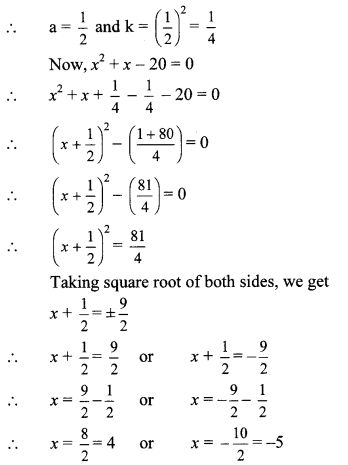
1. x2 + x – 20 = 0
2. x2 + 2x – 5 = 0
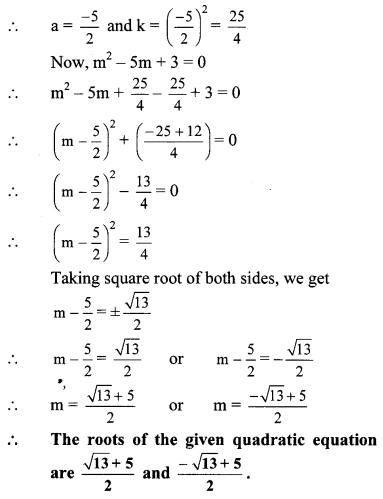
3. m2 – 5m = -3
4. 9y2 – 12y + 2 = 0
5. 2y2 + 9y + 10 = 0
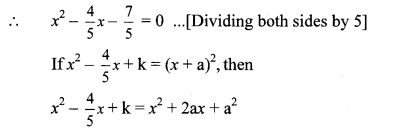
6. 5x2 = 4x + 7
Solution:
1. x2 + x – 20 = 0
If x2 + x + k = (x + a)2, then
x2 + x + k = x2 + 2ax + a2
Comparing the coefficients, we get
1 = 2a and k = a2
Maharashtra Board Class 10 Maths Solutions Chapter 2 Quadratic Equations Practice Set 2.3 1
∴ The roots of the given quadratic equation are 4 and -5.

2. x2 + 2x – 5 = 0
If x2 + 2x + k = (x + a)2, then
x2 + 2x + k = x2 + 2ax + a2
Comparing the coefficients, we get
2 = 2a and k = a2
∴ a = 1 and k = (1)2 = 1
Now, x2 + 2x – 5 = 0
∴ x2 + 2x + 1 – 1 – 5 = 0
∴ (x + 1)2 – 6 = 0
∴ (x + 1)2 = 6
Taking square root of both sides, we get
x + 1 = ± √6
∴ x + 1 √6 or x + 1 = √6
∴ x = √6 – 1 or x = -√6 – 1
∴ The roots of the given quadratic equation are √6 -1 and – √6 -1.

3. m2 – 5m = -3
∴ m2 – 5m + 3 = 0
If m2 – 5m + k = (m + a)2, then
m2 – 5m + k = m2 + 2am + a2
Comparing the coefficients, we get
-5 = 2a and k = a2
Maharashtra Board Class 10 Maths Solutions Chapter 2 Quadratic Equations Practice Set 2.3 2

4. 9y2 – 12y + 2 = 0
Maharashtra Board Class 10 Maths Solutions Chapter 2 Quadratic Equations Practice Set 2.3 3
Maharashtra Board Class 10 Maths Solutions Chapter 2 Quadratic Equations Practice Set 2.3 4

5. 2y2 + 9y + 10 = 0
Maharashtra Board Class 10 Maths Solutions Chapter 2 Quadratic Equations Practice Set 2.3 5
Taking square root of both sides, we get
Maharashtra Board Class 10 Maths Solutions Chapter 2 Quadratic Equations Practice Set 2.3 6
∴ The roots of the given quadratic equation are -2 and \(\frac { -5 }{ 2 } \).

6. 5x2 = 4x + 7
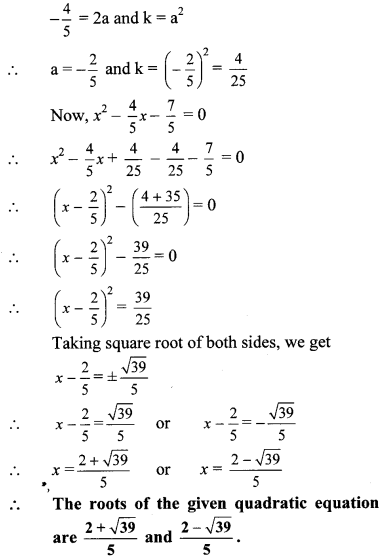
∴ 5x2 – 4x – 7 = 0
Maharashtra Board Class 10 Maths Solutions Chapter 2 Quadratic Equations Practice Set 2.3 7
Comparing the coefficients, we get
Maharashtra Board Class 10 Maths Solutions Chapter 2 Quadratic Equations Practice Set 2.3 8

Maharashtra Board 10th Class Maths Part 2 Practice Set 7.4 Solutions Chapter 7 Mensuration

Balbharti Maharashtra State Board Class 10 Maths Solutions covers the Practice Set 7.4 Geometry 10th Class Maths Part 2 Answers Solutions Chapter 7 Mensuration.

Practice Set 7.4 Geometry 10th Std Maths Part 2 Answers Chapter 7 Mensuration

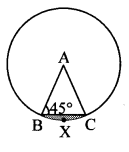
Practice Set 7.4 Geometry Class 10 Question 1. In the adjoining figure, A is the centre of the circle. ∠ABC = 45° and AC = 7\(\sqrt { 2 }\) cm. Find the area of segment BXC, (π = 3.14)
Maharashtra Board Class 10 Maths Solutions Chapter 7 Mensuration Practice Set 7.4 1
Solution:
In ∆ABC,
AC = AB … [Radii of same circle]
∴ ∠ABC = ∠ACB …[Isosceles triangle theorem]
∴ ∠ABC = ∠ACB = 45°
In ∆ABC,
∠ABC + ∠ACB + ∠BAC = 180° … [Sum of the measures of angles of a triangle is 180° ]
∴ 45° + 45° + ∠BAC = 180°
∴ 90° + ∠BAC = 180°
∴ ∠BAC = 90°
Let ∠BAC = θ = 90°
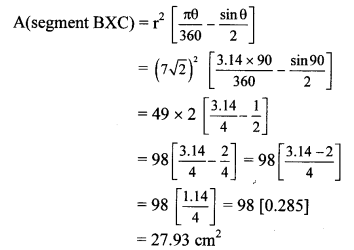
Maharashtra Board Class 10 Maths Solutions Chapter 7 Mensuration Practice Set 7.4 2
∴ The area of segment BXC is 27.93 cm2.

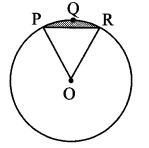
10th Class Geometry Practice Set 7.4 Question 2. In the adjoining figure, O is the centre of the circle.
m(arc PQR) = 60°, OP = 10 cm. Find the area of the shaded region.
(π = 3.14, \(\sqrt { 3 }\) = 1.73)
Maharashtra Board Class 10 Maths Solutions Chapter 7 Mensuration Practice Set 7.4 3
Given: m(arc PQR) = 60°, radius (r) = OP = 10 cm
To find: Area of shaded region.
Solution:
∠POR = m (arc PQR) …[Measure of central angle]
∴ ∠POR = θ = 60°
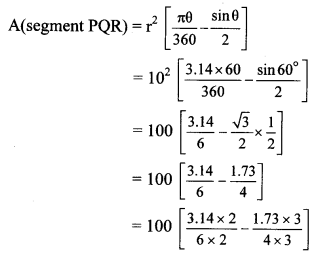
Maharashtra Board Class 10 Maths Solutions Chapter 7 Mensuration Practice Set 7.4 4
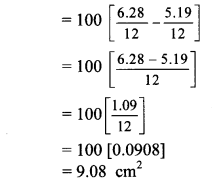
Maharashtra Board Class 10 Maths Solutions Chapter 7 Mensuration Practice Set 7.4 5
∴ The area of the shaded region is 9.08 cm2.

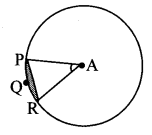
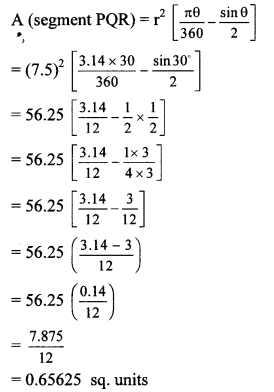
7.4 Class 10 Question 3. In the adjoining figure, if A is the centre of the circle, ∠PAR = 30°, AP = 7.5, find the area of the segment PQR. (π = 3.14)
Maharashtra Board Class 10 Maths Solutions Chapter 7 Mensuration Practice Set 7.4 6
Given: Central angle (θ) = ∠PAR = 30°,
radius (r) = AP = 7.5
To find: Area of segment PQR.
Solution:
Let ∠PAR = θ = 30°
Maharashtra Board Class 10 Maths Solutions Chapter 7 Mensuration Practice Set 7.4 7
∴ The area of segment PQR is 0.65625 sq. units.

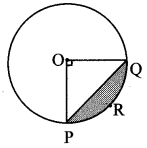
Chapter 7 Maths Class 10 Question 4. In the adjoining figure, if O is the centre of the circle, PQ is a chord, ∠POQ = 90°, area of shaded region is 114 cm2, find the radius of the circle, (π = 3.14)
Maharashtra Board Class 10 Maths Solutions Chapter 7 Mensuration Practice Set 7.4 8
Given: Central angle (θ) = ∠POQ= 90°,
A (segment PRQ) = 114 cm2
To find: Radius (r).
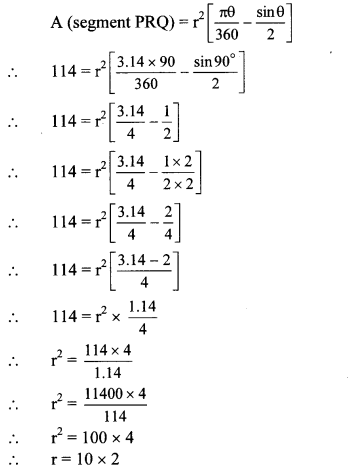
Solution:
Maharashtra Board Class 10 Maths Solutions Chapter 7 Mensuration Practice Set 7.4 9
…[Taking square root of both sides]
∴ r = 20 cm
∴ The radius of the circle is 20 cm.

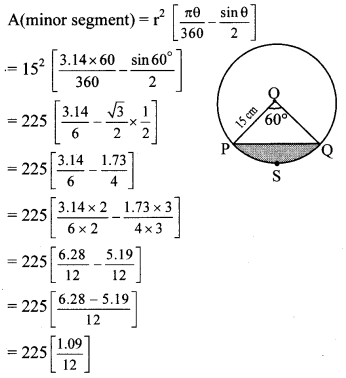
Mensuration Questions for Class 10 Question 5. A chord PQ of a circle with radius 15 cm subtends an angle of 60° with the centre of the circle. Find the area of the minor as well as the major segment. (π = 3.14, \(\sqrt { 3 }\) = 1.73)
Given: Radius (r) =15 cm, central angle (θ) = 60°
To find: Areas of major and minor segments.
Solution:
Let chord PQ subtend ∠POQ = 60° at centre.
∴ θ = 60°
Maharashtra Board Class 10 Maths Solutions Chapter 7 Mensuration Practice Set 7.4 10
= 225 [0.0908]
= 20.43 cm2
∴ area of minor segment = 20.43 cm2
Area of circle = πr2
= 3.14 × 15 × 15
= 3.14 × 225
= 706.5 cm2
Area of major segment
= Area of circle – area of minor segment
= 706.5 – 20.43
= 686.07 cm2
Area of major segment 686.07 cm2
∴ The area of minor segment Is 20.43 cm2 and the area of major segment is 686.07 cm2.

Maharashtra Board Class 10 Sanskrit Anand Solutions Chapter 11 मानवताधर्मः

Balbharti Maharashtra State Board Class 10 Sanskrit Solutions Anand Chapter 11 मानवताधर्मः Notes, Textbook Exercise Important Questions and Answers.

Maharashtra State Board Class 10 Sanskrit Anand Solutions Chapter 11 मानवताधर्मः

Sanskrit Anand Std 10 Digest Chapter 11 मानवताधर्मः Textbook Questions and Answers

भाषाभ्यास:

1. पूर्णवाक्येन उत्तरं लिखत ।

प्रश्न अ.
सकला नद्यः कं प्रविशन्ति ?
उत्तरम् :
सकला नद्य: महोदधिं प्रविशन्ति।

Maharashtra Board Class 10 Sanskrit Anand Solutions Chapter 11 मानवताधर्मः

प्रश्न आ.
सङ्गीते स्वराः कीदृशाः ?
उत्तरम् :
सङ्गीते स्वरा: षड्जमूलाः।

प्रश्न इ.
कः सर्वधर्मान् व्याप्नोति ?
उत्तरम् :
मानवताधर्म : सर्वधर्मान् व्याप्नोति।

प्रश्न ई.
भानुः कं प्रकाशयति ?
उत्तरम् :
भानुः भुवनमण्डलं प्रकाशयति।

प्रश्न उ.
कां भज इति कविः वदति ?
उत्तरम् :
मानवतां भज इति कविः वदति।

Maharashtra Board Class 10 Sanskrit Anand Solutions Chapter 11 मानवताधर्मः

2. सन्धिविग्रहं कुरुत ।

प्रश्न अ.
भानुर्भुवनमण्डलम् = ………… + भुवनमण्डलम् ।
उत्तरम् :
भानुर्भुवनमण्डलम् – भानु: + भुवनमण्डलम्।

प्रश्न आ.
प्रकाशयत्येकस्तथा = + ……. + तथा ।
उत्तरम् :
प्रकाशयत्येकस्तथा – प्रकाशयति + एकः + तथा।

Maharashtra Board Class 10 Sanskrit Anand Solutions Chapter 11 मानवताधर्मः

प्रश्न इ.
व्यवहरेल्लोके = ……….. + लोके ।
उत्तरम् :
व्यवहरेल्लोके – व्यवहरेत् + लोके।

प्रश्न ई.
एषोऽभ्युदयकृत् = एषः + ………….. ।
उत्तरम् :
एषोऽभ्युदयकृत् – एष: + अभ्युदयकृत्।

3. पाठात् ल्यबन्त-अव्ययानि चित्वा लिखत

प्रश्न 1.
पाठात् ल्यबन्त-अव्ययानि चित्वा लिखत
उत्तरम् :
एकीभूय, सम्भूय, समाश्रित्य, परित्यज्य

Maharashtra Board Class 10 Sanskrit Anand Solutions Chapter 11 मानवताधर्मः

4. माध्यमभाषया उत्तरं लिखत।

प्रश्न अ.
मानवताधर्मः अभ्युदयकृत् कथं वर्तते?

प्रश्न आ.
‘मानवताधर्मः’ इति काव्यस्य आधारेण मानवताधर्मस्य वर्णनं कुरुत ।

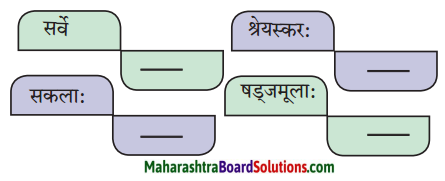
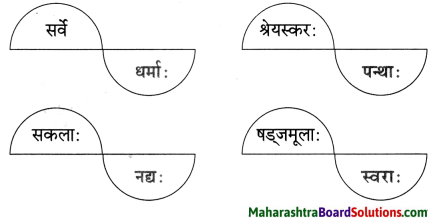
5. जालरेखाचित्रं पूरयत

प्रश्न 1.
Maharashtra Board Class 10 Sanskrit Anand Solutions Chapter 11 मानवताधर्मः 1
उत्तरम् :
Maharashtra Board Class 10 Sanskrit Anand Solutions Chapter 11 मानवताधर्मः 2

6. समानार्थकशब्दमेलनं कुरुत

प्रश्न 1.
समानार्थकशब्दमेलनं कुरुत

1. सरित्(अ) वर्णः
2. रङ्गः(आ) भानुः
3. अम्भः(इ) नदी
4. दिनकृत्(ई) पन्थाः
5. मार्गः(उ) सलिलम्

उत्तरम् :

1. सरित्(इ) नदी
2. रङ्गः(अ) वर्णः
3. अम्भः(उ) सलिलम्
4. दिनकृत्(आ) भानुः
5. मार्गः(ई) पन्थाः

Maharashtra Board Class 10 Sanskrit Anand Solutions Chapter 11 मानवताधर्मः

Sanskrit Anand Class 10 Textbook Solutions Chapter 11 मानवताधर्मः Additional Important Questions and Answers

समस्तपदम्अर्थसमासविग्रहःसमासनाम
1. मानवताधर्म:humanity is religionमानवता एव धर्मः।कर्मधारयः समासः।
2. सर्वधर्माःall religionsसर्वे धर्माः।कर्मधारयः समासः।
3. अभ्युदयकृत्one who does welfareअभ्युदयं करोति इति।उपपद-तत्पुरुषः समासः।

Maharashtra Board Class 10 Sanskrit Anand Solutions Chapter 11 मानवताधर्मः

मानवताधर्मः Summary in Marathi and English

प्रस्तावना :

‘धर्म’ हा पुष्कळ अर्थ असलेली बहुआयामी व सर्वसमावेशक अशी संकल्पना आहे. ‘य: धारयति सः धर्मः’ ही व्याख्या सर्वश्रुत आहे याचा अर्थ, जो धारण करतो तो धर्म. प्रत्येक प्रकारच्या योग्य आचरणाचा अंतर्भाव ‘धर्म’ या संकल्पनेत होतो. म्हणूनच ‘स्वकर्तव्यस्य पालनं नाम धर्मः’, असे योग्यरित्या म्हटले आहे.

समाजातील लोकांनी आचरलेल्या धर्मामुळे मानवी समाज टिकून राहतो. उदा.- पालकांनी मुलांचे रक्षण करणे (पितृधर्म, मातृधर्म), मुलांनी पालकांच्या आज्ञेचे पालन करणे (कन्याधर्म, पुत्रधर्म), राजाने प्रजेचे रक्षण करणे, (राजधर्म).

याखेरीज, पतिधर्म, पत्नीधर्म इ. महाभारतानुसार, ज्याने सुनिश्चितपणे मानवाचे कल्याण होते, तो धर्म. म्हणून सर्वांनी मानवताधर्माचा अवलंब केला पाहिजे जेणेकरून, मनुष्यजातीची उन्नती व कल्याण होईल.

मानवता सर्वधर्माणां मूलम्। मानवता हे सर्व धर्माचे मूळ आहे. हा मानवताधर्म अतिशय समर्पक पद्धतीने ‘मानवताधर्म’ पाठात विशद केला आहे. या काव्याचे रचनाकार डॉ. देवीप्रसाद खरवण्डीकर हे संस्कृतच्या प्रचार – प्रसारात लीन आहेत.

धर्म is a multifaceted and all-inclusive term with many meanings. य: धारयति स: धर्म: is a well-known definition of धर्म which means, that which is followed is धर्म. धर्म embraces every type of righteous conduct.

So, it is rightly said स्वकर्तव्यस्य पालनं नाम धर्मः Human society is upheld by performed by its members for eg, parents protecting/nurturing children (पितृधर्म-मातृधर्म), children obeying parents (कन्याधर्म, पुत्रधर्म) king protecting the citizens (राज धर्म) apart from this पतिधर्म, पत्नीधर्म etc. महाभारत says, that which ensures the welfare of human beings is surely धर्म.

Hence, all should resort to मानवताधर्म (Humanity) which will lead to upliftment and welfare of living beings. मानवता सर्वधर्माणां मूलम् – Humanity is the origin of all us. Thus, the humanity, (मानवता) is well described by respected Dr. देवीप्रसाद खरवण्डीकर who has engaged himself in popularising of Sanskrit language.

Maharashtra Board Class 10 Sanskrit Anand Solutions Chapter 11 मानवताधर्मः

श्लोक: 1

यथैव सकला नद्यः प्रविशन्ति महोदधिम्।
तथा मानवताधर्म सर्वे धर्मा: समाश्रिताः ।।1।।

अनुवाद:

ज्याप्रमाणे सर्व नद्या (अखेरीस) समुद्रास जाऊन मिळतात, त्याप्रमाणे, सर्व धर्म मानवताधर्माचाच आश्रय घेतात.
Just as, all rivers enter the ocean, likewise, all religions resort to humanity.

श्लोक: 2

षड्जमूला यथा सर्वे सङ्गीते विविधाः स्वराः। .
तथा मानवताधर्म सर्वे धर्मा : समाश्रिताः ।।2।।

अनुवादः

ज्याप्रमाणे संगीतातील स्वरांचे मूळ हे शेवटी षड्ज च असते त्याप्रमाणे, सर्व धर्म मानवताधर्माचाच आश्रय घेतात.
Just as, different musical notes have a base of षड्ज likewise all es resort to humanity.

Maharashtra Board Class 10 Sanskrit Anand Solutions Chapter 11 मानवताधर्मः

श्लोकः 3

एकीभूय यथा सर्वे वर्णा गच्छन्ति शुक्लताम्।
तथा सम्भूय शंसन्ति धर्मा मानवतागुणम् ।।3।।

अनुवादः

ज्याप्रमाणे सर्व रंग शुभ्रतेकडे जातात त्याप्रमाणे, सर्व धर्म (अखेर) मानवताधर्माची प्रशंसा करतात.
Just as, all colours coming together attain whiteness likewise, all धर्मs praise the humanity together.

श्लोकः 4

सर्व व्याप्नोति सलिलं शर्करा लवणं यथा।
एवं मानवताधर्मो धर्मान् व्याप्नोति सर्वथा ।।4।।

अनुवादः

ज्याप्रमाणे पाणी हे गोड, खारट (या चवी) सर्व व्यापते त्याप्रमाणे – मानवता धर्मांना सर्व प्रकारे व्यापून राहते.
Just as, water covers everything sweet as well as salty .similarly, humanity pervades all धर्मs from all sides.

Maharashtra Board Class 10 Sanskrit Anand Solutions Chapter 11 मानवताधर्मः

श्लोकः 5

यथा प्रकाशयत्येको भानुर्भुवनमण्डलम्।
धर्मान् प्रकाशयत्येकस्तथा मानवतागुणः।।5।।

अनुवादः

ज्याप्रमाणे एकटा सूर्य संपूर्ण जगाला प्रकाशित करतो त्याप्रमाणे मानवता हा गुण सर्व धर्माना उजळून टाकतो.
Just as the sun alone lightens the entire world; (similarly, humanity alone illuminates all धर्मs.

श्लोकः 6

आत्मौपम्यं समाश्रित्य मानवो मानवैः सह।
यदा व्यवहरेल्लोके तदा मानवता भवेत् ।।6।।

अनुवादः

या विश्वात, आत्माच्या समानतेचे तत्त्व पाळून, जेव्हा मानव इतर मानवांशी समानतेने व्यवहार करेल/ वागेल, तेव्हा खरी मानवता
अस्तित्वात येईल.

In the world, when a man would behave (with others) equally, following the principle of similarity of the soul then humanity would take place.

Maharashtra Board Class 10 Sanskrit Anand Solutions Chapter 11 मानवताधर्मः

श्लोक: 7

सर्वधर्मान् परित्यज्य भज मानवतां धूवम्।
एषोऽभ्युदयकृत् पन्थाः तथा श्रेयस्करोऽपि च ।।7।।

अनुवादः

(हे माणसा), निश्चितच सर्व धर्मांना सोडून मानवताधर्मास पूजावे. (मानवतेचा) मार्ग (अखंड विश्वाचे) उन्नयन करणारा आहे. तसेच तो हितकारक आहे.
(O man) Leaving all धर्मs, resort humanity surely. This path leads to the upliftment and it is beneficial.

सन्धिविग्रहः

  • यथैव – यथा + एव।
  • सकला नद्यः – सकला: + नद्यः।
  • षड्जमूला यथा – षड्जमूला : + यथा ।
  • सकला नद्यः – सकलाः + नद्यः।
  • वर्णा गच्छन्ति – वर्णाः + गच्छन्ति।
  • धर्मा मानवतागुणम् – धर्माः + मानवतागुणम्।
  • मानवो मानव : – मानवः + मानवैः ।
  • श्रेयस्करोऽपि – श्रेयस्करः + अपि।
  • मानवताधर्मो धर्मान् – मानवताधर्मः + धर्मान्।

Maharashtra Board Class 10 Sanskrit Anand Solutions Chapter 11 मानवताधर्मः

शब्दार्थाः

  1. महोदधिम् – to the ocean – समुद्राला
  2. समाश्रिताः – are resorted – आश्रय घेतला आहे.
  3. षड्जमूलाः – has a base of षड्ज – षड्ज हे मूळ आहे
  4. सलिलम् – water – पाणी
  5. व्याप्नोति – covers – व्यापते
  6. सर्वथा – by all ways – सर्व बाजूंनी/ सर्व प्रकारे
  7. प्रकाशयति – lightens – प्रकाशित करतो
  8. भुवनमण्डलम् – entire world – संपूर्ण जग
  9. औपम्यम् – following – समानतेचे तत्त्व
  10. similarity – पाळून
  11. व्यवहरेत् – would behave – व्यवहार करेल / वागेल
  12. लोके – in the world – विश्वात / जगात
  13. अभ्युदयकृत् – path that – उन्नयन करणारा मार्ग
  14. पन्थाः – leads to upliftment
  15. श्रेयस्करः – beneficial – हितकारक

Maharashtra Board Class 10 Sanskrit Anand Solutions Chapter 9 आदिशङ्कराचार्यः

Balbharti Maharashtra State Board Class 10 Sanskrit Solutions Anand Chapter 9 आदिशङ्कराचार्यः Notes, Textbook Exercise Important Questions and Answers.

Maharashtra State Board Class 10 Sanskrit Anand Solutions Chapter 9 आदिशङ्कराचार्यः

Sanskrit Anand Std 10 Digest Chapter 9 आदिशङ्कराचार्यः Textbook Questions and Answers

भाषाभ्यास:

1. पूर्णवाक्येन उत्तरं लिखत ।

प्रश्न अ.
गुरुमुपगम्य शङ्करः किम् अधीतवान् ?
उत्तरम् :
गुरुमुपगम्य शङ्करः वेद-वेदाङ्गानि, विविधशास्त्राणि च अधीतवान्।

Maharashtra Board Class 10 Sanskrit Anand Solutions Chapter 9 आदिशङ्कराचार्यः

प्रश्न आ.
शङ्करः किमर्थम् आक्रोशत् ?
उत्तरम् :
यदा शकर स्नाने मग्नः आसीत् तदा एक: ननतस्य पादम् अगृह्णात् अत: भीत्या शङ्करः उच्चैः आक्रोशत्।

प्रश्न इ.
शङ्करः मात्रे किं प्रतिश्रुत्य गृहाद् निरगच्छत् ?
उत्तरम् :
‘मात: यदा त्वं स्मरिष्यसि तदा एवं त्वत्समीपमागमिष्यामि’ इति मात्रे प्रतिश्रुत्य शङ्करः गृहद् निरगच्छत्।

प्रश्न ई.
शङ्करः कस्य शिष्यः अभवत् ?
उत्तरम् :
शङ्कर: गोविन्दभगवत्पादानां शिष्यः अभवत्।

प्रश्न उ.
शङ्करः संन्यासदीक्षां गृहीत्वा किम् अकरोत्?
उत्तरम् :
शङ्कर: संन्यासदीक्षां गृहीत्वा वैदिकधर्मस्य प्रचारार्थ प्रस्थानम् अकरोत्।

Maharashtra Board Class 10 Sanskrit Anand Solutions Chapter 9 आदिशङ्कराचार्यः

2. माध्यमभाषया उत्तरत।

प्रश्न अ.
शङ्करेण संन्यासार्थ कथम् अनुमतिः लब्धा ?
उत्तरम् :
‘आदिशङ्कराचार्य:’ या पाठामध्ये शंकराचार्यांच्या जीवनातील दोन प्रसंग उद्धृत करण्यात आले आहेत. पहिल्या प्रसंगात, एका अटळ परिस्थितीत सापडले असताना, संन्यासी बनू इच्छिणाऱ्या शंकराचार्यांना त्यांची माता कशी अनुमती देते, याचे वर्णन आले आहे.

एकदा शंकर स्नानासाठी पूर्णा नदीवर गेले होते. स्नान करत असताना अनपेक्षितपणे एका मगरीने त्यांचा पाय पकडला. वेदना असहा झाल्याने शंकर जोरात ओरडू लागले. तेव्हा त्यांची आई आर्याबा तिथे पोहोचली. अशा दयनीय अवस्थेत शंकराला रडताना पाहून त्याची आई सुद्धा गांगरून गेली.

हा अनावस्था प्रसंग म्हणजे आयुष्याचा शेवट अशी शंकराची समजूत झाली व त्याने संन्यासी होण्याची अतृप्त इच्छा आईकडे बोलून दाखविली. हतबल झालेल्या आबिने मनात नसतानाही ही शंकराची शेवटची इच्छा मानून, संन्यास घेण्यासाठी अनुमती दिली.

In the lesson, आदिशङ्कराचार्यः, two incidents of शंकराचार्य’s life are given. The first incident explains how आदिशङ्कराचार्य, who was keen to become a monk was granted permission by his mother for practising monkship due to an inescapable situation.

Once, it went to पूर्ण river for bathing, a crocodile caught his leg. शंकर screamed loudly with pain. His mother अर्याम्बा came there. Seeing शंकर crying in miserable condition, even his mother got perturbed.

शंकर finding / thinking this situation as the end of his life, expressed his unfulfilled wish to become a monk to his mother and requested her to permit for the same. Unwillingly, helpless अर्याम्बा granted शंकर for monkship, considering this as his last wish.

3. सन्धिविग्रहं कुरुत।

प्रश्न अ.
चास्ताम्
उत्तरम् :
चास्ताम् – च + आस्ताम्।

Maharashtra Board Class 10 Sanskrit Anand Solutions Chapter 9 आदिशङ्कराचार्यः

प्रश्न आ.
त्वत्समीपमागमिष्यामि
उत्तरम् :
त्वत्समीपमागमिष्यामि – त्वत् + समीपम् + आगमिष्यामि।

प्रश्न इ.
गुरुमुपागच्छत्
उत्तरम् :
गुरुमुपागच्छत् – गुरुम् + उपागच्छत्।

प्रश्न ई
मुनिरभ्यगात्
उत्तरम् :
मुनिरभ्यगात् – मुनिः + अभ्यगात्।

Maharashtra Board Class 10 Sanskrit Anand Solutions Chapter 9 आदिशङ्कराचार्यः

प्रश्न उ.
मातैव
उत्तरम् :
मातैव – तस्मात् + माता + एव।

4. मेलनं कुरुत ।

प्रश्न 1.
विशेष्यम् – शिवगुरुः, आर्याम्बा, शङ्करः, जगत्, मनुष्यः ।
विशेषणम् – मलिनकायः, प्रसन्नः, विशालम्, दिवङ्गतः, विरक्तः, चिन्तामना ।
उत्तरम् :

विशेषणम्विशेष्यम्
1. मलिनकायःमनुष्यः
2. विशालम्जगत्
3. दिवङ्गतःशिवगुरुः
4. विरक्तःशङ्करः
5. चिन्तामग्नाआर्याम्बा

Maharashtra Board Class 10 Sanskrit Anand Solutions Chapter 9 आदिशङ्कराचार्यः

5. समानार्थकशब्दं लिखत ।

प्रश्न 1.
समानार्थकशब्दं लिखत
दिवङ्गतः, शीघ्रम्, मग्नः, नक्र:, पादः, पुत्रः, शिष्यः।
उत्तरम् :

  • दिवङ्गतः – परिंगतः, परलोकगतः, मृतः।
  • शीघ्रम् – झटिति, सत्वरम्, तूर्णम्, त्वरितम्।
  • मग्नः – लीनः, रत: व्यग्रः।
  • नक्रः – मकरः, गुम्भीरः, कुटिचर:, मायादः ।
  • पादः – चरण:, पदम्।
  • पुत्रः . – तनयः, आत्मजः, सुतः, सूनुः ।
  • शिष्यः – विद्यार्थी, छात्रः, अन्तेवासी।

Maharashtra Board Class 10 Sanskrit Anand Solutions Chapter 9 आदिशङ्कराचार्यः

6. स्थानाधारण शब्दपेटिकां पूरयत ।

प्रश्न 1.
स्थानाधारण शब्दपेटिकां पूरयत
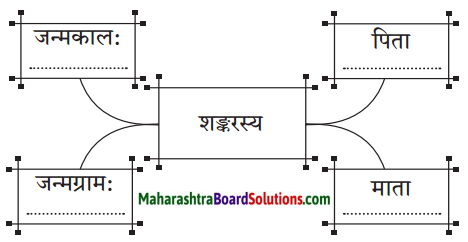
Maharashtra Board Class 10 Sanskrit Anand Solutions Chapter 9 आदिशङ्कराचार्यः 1
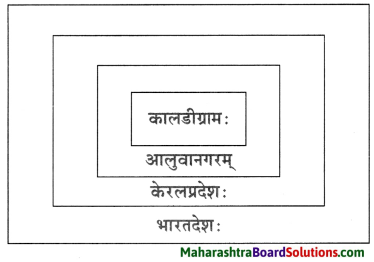
(कालडीग्रामः, केरलप्रदेशः, भारतदेशः, आलुवानगरम्,)
उत्तरम् :
Maharashtra Board Class 10 Sanskrit Anand Solutions Chapter 9 आदिशङ्कराचार्यः 5

7. प्रवाहि जालचित्रं पूरयत ।

प्रश्न 1.
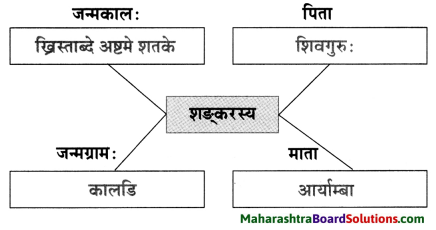
प्रवाहि जालचित्रं पूरयत ।
Maharashtra Board Class 10 Sanskrit Anand Solutions Chapter 9 आदिशङ्कराचार्यः 2
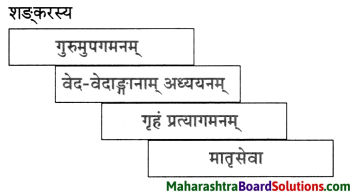
(गृहं प्रत्यागमनम्, गुरुमुपगमनम्, मातृसेवा, वेद-वेदाङ्गानाम् अध्ययनम्)
उत्तरम् :
Maharashtra Board Class 10 Sanskrit Anand Solutions Chapter 9 आदिशङ्कराचार्यः 6

8. जालरेखाचित्रं पूरयत ।

प्रश्न अ.
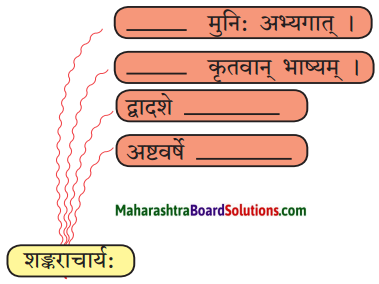
Maharashtra Board Class 10 Sanskrit Anand Solutions Chapter 9 आदिशङ्कराचार्यः 3
उत्तरम् :
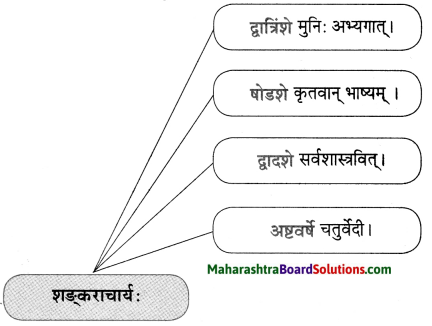
Maharashtra Board Class 10 Sanskrit Anand Solutions Chapter 9 आदिशङ्कराचार्यः 7

प्रश्न आ.
Maharashtra Board Class 10 Sanskrit Anand Solutions Chapter 9 आदिशङ्कराचार्यः 4
उत्तरम् :
Maharashtra Board Class 10 Sanskrit Anand Solutions Chapter 9 आदिशङ्कराचार्यः 8

Sanskrit Anand Class 10 Textbook Solutions Chapter 9 आदिशङ्कराचार्यः Additional Important Questions and Answers

अवबोधनम् :

उचितं कारणं चित्वा वाक्यं पुनर्लिखत।

प्रश्न 1.
शङ्करस्य मातैव पुत्रस्य पालनम् अकरोत् यतः …………………
(अ) शङ्कराय केवलं माता अरोचत।
(ब) बाल्ये एव तस्य पिता शिवगुरुः दिवङ्गतः।
उत्तरम् :
(ब) बाल्ये एव तस्य पिता शिवगुरुः दिवङ्गतः।

प्रश्न 2.
आर्याम्बा चिन्तामग्ना जाता यतः ……………….
(अ) शङ्कर: ऐहिकविषयेषु अरुचिं प्रादर्शयत्।
(ब) शङ्करः ऐहिकविषयेषु रुचिं प्रादर्शयत्।
उत्तरम् :
(अ) शङ्करः ऐहिकविषयेषु अरुचिं प्रदर्शयत् ।

Maharashtra Board Class 10 Sanskrit Anand Solutions Chapter 9 आदिशङ्कराचार्यः

प्रश्न 3.
शङ्कर: उच्चैः आक्रोशत् यतः ………………
(अ) सः नदीजले अमज्जत्।
(ब) नक्र: तस्य पादम् अगृह्णात्।
उत्तरम् :
(ब) नक्र: तस्य पादम् अगृणात्।

प्रश्न 4.
आर्याम्बा रोदनम् आरभत यतः ………………………
(अ) शङ्करं नक्रेण गृहीतं दृष्ट्वा सा भीता जाता।
(ब) नक्र: तस्याः पादम् अगृह्णात्।
उत्तरम् :
(अ) शकरं नक्रेण गृहीतं दृष्ट्वा सा भीता जाता।

प्रश्न 5.
शङ्कर: मलिनकायं मनुष्य प्रणनाम यतः ………………………
(अ) मलिनकाय: मनुष्यः शङ्करं सङ्कटात् अरक्षत्।
(ब) स: मलिनकाय; मनुष्य: वेदान्तस्य सारं जानाति स्म।
उत्तरम् :
(ब) स: मलिनकाय; मनुष्य : वेदान्तस्य सारं जानाति स्म।

Maharashtra Board Class 10 Sanskrit Anand Solutions Chapter 9 आदिशङ्कराचार्यः

उचितं पर्यायं चित्वा वाक्यं पुनर्लिखत।

प्रश्न 1.

  1. शङ्करस्य ……………… शिवगुरुः आसीत्। (पिता/माता)
  2. ……………. एव शङ्करस्य पालनम् अकरोत्। (पिता / माता)
  3. पठनादिकं समाप्य शङ्करः …………. प्रत्यागतवान्। (गृह/नदी)
  4. ……. वयसि उपनीतः सः पठनार्थ गुरुम् उपागच्छत्। (पञ्चमे/दशमे)

उत्तरम् :

  1. पिता
  2. माता
  3. गृहं
  4. पञ्चमे

प्रश्न 2.

  1. आर्याम्बा पुत्रं ……. गृहीतम् अपश्यत्। (नक्रेण, मत्स्येन)
  2. शङ्करः …………… आर्ततया प्रार्थयत। (गुरुम्, मातरम्)
  3. शङ्कर: मातरं …………. महत्त्वम् अवाबोधयत्। (संन्यासस्य, संसारस्य)
  4. शङ्कराचार्य: …………… शिष्यः अभवत्। (गोविन्दहरदासानां गोविन्दभगवात्पादानां)

उत्तरम् :

  1. चक्रेण
  2. मातरम्
  3. संन्यासस्य
  4. गोविन्दभगवात्पादाना

Maharashtra Board Class 10 Sanskrit Anand Solutions Chapter 9 आदिशङ्कराचार्यः

प्रश्न 3.

  1. आचार्य: शिष्यगणेन सह …………. अगच्छत्। (गङ्गास्नानार्थम्/समुद्रस्नानार्थम्)
  2. यस्मात् ज्ञानं लभते सः ………….. (ज्येष्ठः / गुरु:)
  3. शिष्या: मलिनकायं मनुष्यं …………. इति अवदन्। (अपसर/आगच्छ)
  4. सर्वेषां …………….. पञ्चमहाभूतात्मकानि। (स्तोत्राणि / शरीराणि)
  5. स: ……… सिद्धान्तस्य प्रचारम् अकरोत्। (अद्वैत / परमाणु)

उत्तरम् :

  1. गङ्गास्नानार्थम्
  2. गुरु:
  3. अपसर
  4. शरीराणि
  5. अद्वैत

(ग) पूर्णवाक्येन उत्तरत।

प्रश्न 1.
शङ्कराचार्यस्य जन्म कदा अभवत्?
उत्तरम् :
शङ्कराचार्यस्य जन्म ख्रिस्ताब्दे अष्टमे शतके अभवत्।

Maharashtra Board Class 10 Sanskrit Anand Solutions Chapter 9 आदिशङ्कराचार्यः

प्रश्न 2.
शङ्कर: गृहं प्राप्य किम् अकरोत् ?
उत्तरम् :
शङ्करः गृहं प्राप्य मातृसेवाम् आरभत।

प्रश्न 3.
किमर्थम् आर्याम्बा चिन्तामग्ना जाता?
उत्तरम् :
शङ्करस्य ऐहिकविषयेषु अरुचि दृष्ट्वा आर्याम्बा चिन्तामग्ना जाता।

प्रश्न 4.
शङ्कर: मातरं किं प्रार्थयत?
उत्तरम् :
शङ्कर: मातरम् प्रार्थयत यत् सः जीवितुं न शक्नोति। अत: मरणात् पूर्वं स: संन्यासी भवितुम् इच्छति।

प्रश्न 5.
शङ्कराचार्यानुसारेण कः गुरुः?
उत्तरम् :
शङ्कराचार्यानुसारेण यस्माद् ज्ञानं लभते स: गुरुः ।

Maharashtra Board Class 10 Sanskrit Anand Solutions Chapter 9 आदिशङ्कराचार्यः

वाक्यं पुनलिखित्वा सत्यम् असत्यम् इति लिखत।

प्रश्न 1.
1. शङ्कराचार्यस्य जन्म एकोनविंशतितमे शतके अभवत्।
2. शङ्कर: अतीव प्रज्ञावान् बालकः ।
उत्तरम् :
1. असत्यम्।
2. सत्यम्।

शब्दज्ञानम्

सन्धिविग्रहः।

  1. बालकोऽयम् – बालकः + अयम्।
  2. सदैव – सदा + एव।
  3. गृहीतमपश्यत् – गृहीतम् + अपश्यत्।
  4. तथैव – तथा + एव।
  5. इदानीमेव – इदानीम् + एव।
  6. नक्राद् मुक्तः – नक्रात् + मुक्तः ।
  7. जगद् एव – जगत् + एव।
  8. शिष्यो भूत्वा – शिष्यः + भूत्वा।
  9. यस्माद् ज्ञानम् – यस्मात् + ज्ञानम्।
  10. स गुरुः – सः + गुरुः।
  11. कोऽपि – कः + अपि।
  12. शरीराद् भिन्नम् – शरीरात् + भिन्नम्।
  13. त्वद् भिन्नः – त्वत् + भिन्नः ।
  14. कस्मादपि – कस्मात् + अपि।
  15. गुरुरेव – गुरु: + एव।
  16. तत्रैव – तत्र + एव।

Maharashtra Board Class 10 Sanskrit Anand Solutions Chapter 9 आदिशङ्कराचार्यः

त्वान्त-ल्यबन्त-तुमन्त-अव्ययानि ।

त्वान्त अव्यय धातु + त्वा / ध्या / ट्वा / वा / इत्वा/अयित्वाल्यबन्त अव्यय उपसर्ग + धातु + य / त्यतुमन्त अव्यय धातु + तुम् / धुम् / ट्म् / ट्म् / इतुम् अयित्वा
दृष्ट्वा, श्रुत्वा, भूत्वासमाप्य, प्राप्य, आगत्यभवितुम्

प्रश्ननिर्माणं कुरुत।

प्रश्न 1.
माता आर्याम्बा पुत्रस्य विवाहविषये सदैव चिन्तयति स्म।
उत्तरम् :
माता आर्याम्बा कस्य विवाहविषये सदैव चिन्तयति स्म?

Maharashtra Board Class 10 Sanskrit Anand Solutions Chapter 9 आदिशङ्कराचार्यः

प्रश्न 2.
कालडी ग्राम : पूर्णानदीतीरे वर्तते।
उत्तरम् :
कालडी ग्रामः कुत्र वर्तते?

प्रश्न 3.
माता शङ्करस्य पालनम् अकरोत्।
उत्तरम् :
का पुत्रशङ्करस्य पालनम् अकरोत्?

प्रश्न 4.
शङ्करः गृहं प्राप्य मातृसेवाम् आरभत।
उत्तरम् :
शङ्करः गृहं प्राप्य किम् आरभत?

प्रश्न 5.
आर्याम्बा पुत्रं नक्रेण गृहीतम् अपश्यत्।
उत्तरम् :
आर्याम्बा कं नक्रेण गृहीतम् अपश्यत्?

Maharashtra Board Class 10 Sanskrit Anand Solutions Chapter 9 आदिशङ्कराचार्यः

प्रश्न 6.
शङ्कर: मातरं आर्ततया प्रार्थयत।
उत्तरम् :
शङ्कर: मातरं पूर्व कथं प्रार्थयत?

प्रश्न 7.
शङ्कर: मरणात् पूर्व संन्यासी भवितुम् इच्छति।
उत्तरम् :
शङ्कर: मरणात् पूर्व कः भवितुम् इच्छति?

प्रश्न 8.
विवशा माता शङ्कराय संन्यासार्थम् अनुमतिम् अयच्छत्।
उत्तरम् :
कीदृशी माता शङ्कराय संन्यासार्थम् अनुमतिम् अयच्छत्।

प्रश्न 9.
शङ्कर: मातरं संन्यासस्य महत्वम् अवाबोधयत्।
उत्तरम् :
शङ्कर: का संन्यासस्य महत्त्वम् अवाबोधयत्?

प्रश्न 10.
विशालं जगद् संन्यासिनः गृहम्।
उत्तरम् :
विशालं जगद् कस्य गृहम्?

Maharashtra Board Class 10 Sanskrit Anand Solutions Chapter 9 आदिशङ्कराचार्यः

प्रश्न 11.
वैदिकधर्मस्य स्थापनार्थ शङ्कर: प्रस्थानम् अकरोत्।
उत्तरम् :
किमर्थं शङ्करः प्रस्थानम् अकरोत् ?

प्रश्न 12.
दरिद्रः मनुष्य: मार्गे आचार्यस्य पुरतः आगच्छत्।
उत्तरम् :
कीदृशः मनुष्यः मार्गे आचार्यस्य पुरतः आगच्छत्?

प्रश्न 13.
आत्मा परमेश्वरस्य अंशः।
उत्तरम् :
कः परमेश्वरस्य अंश:?

प्रश्न 14.
आचार्यः षोडशे भाष्यं कृतवान्।
उत्तरम् :
आचार्यः कदा भाष्यं कृतवान् ?

Maharashtra Board Class 10 Sanskrit Anand Solutions Chapter 9 आदिशङ्कराचार्यः

विभक्त्यन्तरूपाणि।

  • प्रथमा – सः, नक्र:, सा, अहम्, संन्यासी, त्वम्, सः, गुरुः, कः, जीर्णवस्त्रधारी, शिष्याः, आत्मा, अहम्, सः, सः, जन्म, पिता, माता, अयम्।
  • द्वितीया – पादम्, मातरम्, अनुमतिम्, संन्यासम्, चरणौ, जगत, दीक्षाम्, सर्वाणि, दर्शनानि, ज्ञानम्, तम्, कम्, शरीरम, आत्मानम्, शरीराणि, गुरुम्, शास्त्राणि, सेवाम्।
  • तृतीया – नक्रेण, आर्ततया, चेतसा। चतुर्थी – तुभ्यम्, मात्रे, गणेन, मनसा, वचसा, कर्मणा।
  • पञमी – नक्रात्, वशात, तेभ्यः, गृहात्, शरीरात्, त्वत्, मुखात, कस्मात, यस्मात्।
  • षष्ठी – मातुः, एकस्याः, धर्मस्य, तस्यतस्य, परमेश्वरस्य, सर्वेषाम्, तत्त्वस्य, नगरस्य, गुरोः, तस्य, पुत्रस्य, आचार्यस्य, शङ्करस्य।
  • सप्तमी – एकस्मिन्, दिने, स्नाने, एकस्मिन्, दिने, मार्गे, द्वादशे, षोडशे, दिशि, प्रदेशे, तीरे, शतके, बाल्ये, पञ्चमे, वयसि।
  • सम्बोधन – अम्ब, वत्स, मातः।

विशेषण – विशेष्य – सम्बन्धः।

विशेषणम्विशेष्यम्
1. जगद्गुरोःशङ्कराचार्यस्य
2. अष्टमेशतके
3. दिवङ्गतःशिवगुरुः
4. पञमेवयसि
5. विरक्तःशङ्करः
6. चिन्तामग्नाआर्याम्बा
7. एकस्मिन्दिने
8. एक:नक्र:
9. भयाकुलासा
10. विवशामाता
11. विशालम्जगत्
12. सर्वाणिदर्शनानि
13. दरिद्रमनुष्यः
14. मलिनकायःमनुष्यः
15. जीर्णवस्त्रधारीमनुष्यः
16. पञ्चमहाभूतात्मकानिशरीराणि

Maharashtra Board Class 10 Sanskrit Anand Solutions Chapter 9 आदिशङ्कराचार्यः

लकारं लिखत।

प्रश्न 1.
शङ्करस्य पिता शिवगुरु: माता आर्याम्बा च आस्ताम्।
उत्तरम् :
लङ्लकारः

प्रश्न 2.

  1. यदा त्वं स्मरिष्यसि तदा एव त्वसमीपमागमिष्यामि।
  2. शङ्कर; उच्चैः आक्रोशत्।
  3. नक्रात् त्रायस्व।
  4. देहि अनुमतिम्।
  5. यथा तुभ्यं रोचते तथैव भवतु।
  6. इदानीमेव संन्यासं स्वीकुरु।
  7. शङ्कर: मातरं संन्यासस्य महत्वम् अवाबोधयत्।

उत्तरम् :

  1. लृट्लकारः
  2. लङ्लकारः
  3. लोट्लकारः
  4. लोट्लकारः
  5. लट्लकारः
  6. लोट्लकार:
  7. लङ्लकार:

प्रश्न 3.

  1. आचार्य: तं प्रणनाम।
  2. शिष्या: अपसर इति अवदन्।
  3. शिष्या: अपसर इति अवदन्।

उत्तरम् :

  1. लिट्लकार :
  2. लोट्लकार:
  3. लल्लकार:

Maharashtra Board Class 10 Sanskrit Anand Solutions Chapter 9 आदिशङ्कराचार्यः

पृथक्करणम्

1. क्रमेण योजयत।

  1. शङ्करस्य पठनार्थं गुरुं प्रति गमनम्।
  2. शिवगुरु: दिवङ्गतः।
  3. शङ्कराचार्यस्य जन्म।
  4. मात्रा शङ्करस्य पालनम्।
  5. गोविन्दभगवत्पादानां शिष्यत्वम्।
  6. मात्रै प्रतिश्रुत्य गृहात् निर्गमनम्।
  7. वैदिकधर्मस्य स्थापनार्थ प्रस्थानम्।
  8. मातरं संन्यासस्य महत्वबोधनम्।
  9. संन्यासार्थम् अनुमतियाचना।
  10. नक्रेण पादग्रहणम्।
  11. मात्रा अनुमतिप्रदानम्।
  12. शङ्करस्य आक्रोशः।

उत्तरम् :

  1. शङ्कराचार्यस्य जन्म।
  2. शिवगुरु: दिवङ्गतः।
  3. मात्रा शङ्करस्य पालनम्।
  4. शङ्करस्य पठनार्थं गुरुं प्रति गमनम्।
  5. मातरं संन्यासस्य महत्त्वबोधनम्।।
  6. मात्रे प्रतिश्रुत्य गृहात् निर्गमनम्।
  7. गोविन्दभगवत्पादानां शिष्यत्वम्।
  8. वैदिकधर्मस्य स्थापनार्थं प्रस्थानम्।
  9. नक्रेण पादग्रहणम्।
  10. शङ्करस्य आक्रोशः।
  11. संन्यासार्थम् अनुमतियाचना।
  12. मात्रा अनुमतिप्रदानम्।

Maharashtra Board Class 10 Sanskrit Anand Solutions Chapter 9 आदिशङ्कराचार्यः

कः कं वदति।

प्रश्न 1.
नक्रात् त्रायस्व!
उत्तरम् :
शङ्कर: मातरं वदति।

प्रश्न 2.
इतः परम् अहं न जीवामि।
उत्तरम् :
शङ्कर : मातरं वदति।

प्रश्न 3.
यथा तुभ्यं रोचते तथैव भवतु।
उत्तरम् :
माता शङ्करं वदति।

Maharashtra Board Class 10 Sanskrit Anand Solutions Chapter 9 आदिशङ्कराचार्यः

प्रश्न 4.
मम अनुमतिः अस्ति।
उत्तरम् :
माता शङ्करं वदति।

प्रश्न 5.
‘अपसर, अपसर!’
उत्तरम् :
शिष्या: मलि कायं / दरिद्रं / जीर्णवस्त्रधारिणं मनुष्यं वदन्ति।

प्रश्न 6.
आत्मा तु परमेश्वरस्य अंशः एव।
उत्तरम् :
दरिद्रः/मलिनकाय:/जीर्णवस्वधारी मनुष्य : शिष्यान् वदति।

प्रश्न 7.
कथं तव शरीरं मम शरीराद् भिन्नम्?
उत्तरम् :
दरिद्रः/मलिनकाय:/जीर्णवस्त्रधारी मनुष्य : शिष्यान् वदति।

Maharashtra Board Class 10 Sanskrit Anand Solutions Chapter 9 आदिशङ्कराचार्यः

वाक्यं पुनलिखित्वा सत्यम् असत्यम् इति लिखत।

प्रश्न 1.

  1. सर्वेषां शरीराणि सप्तमहाभूतात्मकानि ।
  2. आचार्यः तत्रैव कनकधारास्तोत्रं रचितवान्।
  3. आत्मा तु ईश्वरस्य / भगवतः अंशः।
  4. आचार्य: दरिद्राय अकुप्यत्।

उत्तरम् :

  1. असत्यम्।
  2. असत्यम्।
  3. सत्यम्।
  4. असत्यम्।

प्रश्न 2.
एष: गद्यांश: कस्मात् पाठात् उद्धृतः?
उत्तरम् :
एषः गद्यांश: ‘आदिशङ्कराचार्यः’ इति पाठात् उद्धृतः ।

Maharashtra Board Class 10 Sanskrit Anand Solutions Chapter 9 आदिशङ्कराचार्यः

पृथक्करणम्

क्रमेण योजयत।

प्रश्न 1.
1. मार्गे मलिनकायपुरुषस्य आगमनम्।
2. शिष्यगणेन सह गङ्गास्नानार्थ गमनम्।
3. ‘मनीषापञ्चकम्’ इति स्तोत्रस्य रचना।
4. मलिनकायपुरुषस्य मुखात् वेदान्ततत्त्वसारस्य श्रवणम्।
उत्तरम् :
2. शिष्यगणेन सह गङ्गास्नानार्थं गमनम्।
1. मार्गे मलिनकायपुरुषस्य आगमनम्।
4. मलिनकायपुरुषस्य मुखात् वेदान्ततत्त्वसारस्य श्रवणम्।
3. ‘मनीषापञ्चकम्’ इति स्तोत्रस्य रचना।

भाषाभ्यासः

समानार्थकशब्दाः

  1. अनुमतिः – अनुज्ञा।
  2. पिता – तातः, जनकः ।
  3. माता – अम्बा, जननी, जनयित्री।
  4. बाल्ये – शैशवे।
  5. श्रुत्वा – निशम्य, आकर्ण्य।
  6. दृष्ट्वा – अवलोक्य, विलोक्य, वीक्ष्य।
  7. चेतसा – मनसा ।
  8. दरिद्रः – निर्धनः, दीनः।
  9. शरीरम् – वपुः, देहम् ।
  10. गुरुः – उपाध्यायः, अध्यापकः, निषेकादिकृत्।

Maharashtra Board Class 10 Sanskrit Anand Solutions Chapter 9 आदिशङ्कराचार्यः

विरुद्धार्थकशब्दाः

  1. अनुमतिः × नकारः, अपतापः ।
  2. असाधारण: × साधारणः।
  3. समाप्य × आरभ्य ।
  4. झटिति × शनैः शनैः, मृदुः मुदुः ।
  5. रोदनम् × हास्यम्।
  6. अधुना × अनन्तरम्।
  7. मुक्तः × बद्धः।
  8. समीपम् × दूरम्।
  9. दरिद्रः × धनवान्।
  10. भिन्नः × समानः ।

पूर्वकालवाचकं निष्कासयत।

प्रश्न 1.
शङ्कर: गृहं प्राप्य मातृसेवाम् आरभत।
उत्तरम् :
शङ्कर: गृहं प्राप्नोत् मातृसेवाम् आरभत च।

प्रश्न 2.
प्रश्नं श्रुत्वा सर्वे आश्चर्यचकिताः अभवन्।
उत्तरम् :
प्रश्नं अश्रुण्वन् सर्वे आश्चर्यचकिता: अभवन् च।

वचनं परिवर्तयत।

प्रश्न 1.
सः गृहात् निरगच्छत्। (बहुवचनं कुरुत।)
उत्तरम् :
ते गृहात् निरगच्छन्।

Maharashtra Board Class 10 Sanskrit Anand Solutions Chapter 9 आदिशङ्कराचार्यः

प्रश्न 2.
सः मनुष्यः अपृच्छत्। (बहुवचनं कुरुत।)
उत्तरम् :
ते मनुष्या: अपृच्छन्।

लकारं परिवर्तयत।

प्रश्न 1.
मम अनुमतिः अस्ति । (लङ्लकारे परिवर्तयत।)
उत्तरम् :
मम अनुमतिः आसीत्।

समासा:

समस्तपदम्अर्थसमासविग्रहःसमासनाम
भयाकुलाperplexed with fearभयेन आकुला।तृतीया तत्पुरुष समास
अरुचिःno interestन रुचिः ।नञ्तत्पुरुष समास
अनिच्छन्तीnot desiringन इच्छन्ती।नञ्तत्पुरुष समास
मलिनकायःone who has unclean bodyमलिनः कायः यस्य सः।बहुव्रीहि समास
जीर्णवस्त्रधारीwearing torn clothesजीर्णवस्वं धारयति इति।उपपद तत्पुरुष समास
सर्वशास्वस्ववित्knows all scripturesसर्वशास्त्राणि वेत्ति इति।उपपद तत्पुरुष समास
पूर्णानदीriver named पूर्णापूर्णा नाम नदी।कर्मधारय समास
चिन्तामग्नाengrossed in worryचिन्तायां मग्ना।सप्तमी तत्पुरुष समास
मातृसेवाservice to motherमातुः सेवा।षष्ठी तत्पुरुष समास

Maharashtra Board Class 10 Sanskrit Anand Solutions Chapter 9 आदिशङ्कराचार्यः

आदिशङ्कराचार्यः Summary in Marathi and English

प्रस्तावना :

शंकराचार्य हे आठव्या शतकातील अद्वैत वेदांताचे उद्गाते व भारतीय तत्त्वज्ञ मानले जातात. शंकराचार्यांनी द्वारका, जगन्नाथपुरी, शृंगेरी व ज्योतिर्मठ येथे चार पीठे स्थापून त्यांच्या चार मुख्य शिष्यांना पीठासीन आचार्य नेमून आचार्य परंपरा घालून दिली व लोकांना मार्गदर्शन करणे सुरू ठेवले. त्यांनी प्रस्थानत्रयींवर (वेद, उपनिषदे, गीता) विपुल भाष्य लिहिले. तसेच त्यांनी आज प्रचलित असणाऱ्या अनेक काव्यात्मक स्तोत्रांची रचना केली.

‘आदिशङ्कराचार्यः’ या पाठामध्ये त्यांच्या जीवनातील दोन प्रसंग उद्धृत करण्यात आले आहेत. पहिल्या प्रसंगात, एका अटळ परिस्थितीत सापडले असताना, संन्यासी बनू इच्छिणाऱ्या शंकराचार्यांना त्यांची माता कशी अनुमती देते, याचे वर्णन आले आहे. दुसऱ्या प्रसंगातून शंकराचार्यांच्या शिकवणीचा उलगडा होतो. ती शिकवण अशी – जो (कोणी) ज्ञान देतो, तो गुरु मानावा.

शङ्कराचार्य runs an early eigth century Indian philosopher and theologian who consolidated the doctrine of अद्वैत वेदान्त. शङ्कराचार्य is reputed to have founded four mathas (monasteries) at द्वारका, जगन्नाथपुरी, शृंगेरी and ज्योतिर्मठ. He placed his primary four disciples to head it and guide people.

He wrote copious commentaries on the vedic canon (ब्रह्मसूत्र). principal उपनिषद् and भगवद्गीता. Also, he composed poetic words in the form of 45, which are prevalant even today. In the lesson, आदिशङ्कराचार्य:, two incidents of his life are given.

The first incident explains how आदिशङ्कराचार्य, who was keen to become a monk was granted by his mother for practising monkship, due to an inescapable situation. The second event unfolds आदिशङ्कराचार्य’s preaching – whosoever imparts knowledge is the preceptor.

Maharashtra Board Class 10 Sanskrit Anand Solutions Chapter 9 आदिशङ्कराचार्यः

परिच्छेदः 1

भारतस्य दक्षिणदिशि ……………… चिन्तामग्ना जाता।

अनुवादः

Maharashtra Board Class 10 Sanskrit Anand Solutions Chapter 9 आदिशङ्कराचार्यः 9

पहिला प्रसंग :

संन्यासाकरिता अनुमती मिळाली.
भारताच्या दक्षिणदिशेस, केरळ प्रदेशात आलुवा नगराच्या जवळ कालडी नावाचे गाव आहे. ते गाव पूर्णा नदीजवळ आहे. तेथे आठव्या शतकात जगद्गुरु शंकराचार्यांचा जन्म झाला.

शिवगुरु हे त्यांचे वडील आणि आर्यांबा त्यांची आई होती. लहानपणीच त्यांचे वडील शिवगुरु यांचे निधन झाले. त्यामुळे केवळ आईनेच मुलाचे पालनपोषण केले. जेव्हा ते पाच वर्षांचे झाले, तेव्हा मुंज झाल्यावर शिकण्यासाठी ते गुरुंजवळ गेले. तिथे या बालकाने वेद-वेदांगे व विविधशास्त्रे असामान्य वेगाने आत्मसात केली.

अभ्यास संपल्यावर शंकर घरी परतला. घरी परतल्यावर त्यांनी मातृसेवा सुरू केली. आर्यांबा सतत त्याच्या विवाहाचा विचार करत असे. पण मनाने, वाणीने व कर्माने (सांसारिक सुखापासून) विरक्त असलेल्या शंकरने आईकडे संन्यास घेण्याकरिता परवानगी मागितली. शंकराची ऐहिक विषयांतील नावड (अलिप्तता) पाहून आर्यांबा चिंतातुर झाल्या.

First incident :

Received permission for renunciation
In the southern direction of India, there is a village named कालडी near आलुवा city in केरळ region. That village is near पृर्णा river. There, the world’s preceptor 1844 was born in eight century CE. His father was शिवगुरु and mother was आर्यांम्बा.

In his childhood itself, his father शिवगुरु passed away. Therefore, the mother alone reared her son. He who was initiated at the age of five approached the preceptor for studying. There, this child acquired knowledge of वेद-वेदाङ्ग and many scriptures with exceptional speed. After completing studies, शङ्कर returned home.

After coming home, he started serving his mother. Mother आर्यांबा always used to think about his marriage. But, शङ्कर who was detached (from worldly objects) by mind (mentally), speech and by his deeds, asked for permission (from his mother) for renunciation. आर्यांबा was distressed seeing the disinterest of शङ्कर in worldly pleasures.

Maharashtra Board Class 10 Sanskrit Anand Solutions Chapter 9 आदिशङ्कराचार्यः

परिच्छेदः 2

एकस्मिन् दिने ……………….. मुनिरभ्यगात्।

अनुवादः

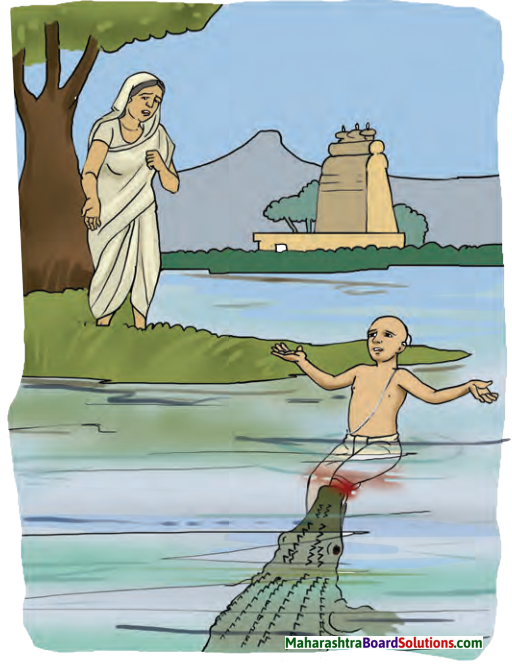
एके दिवशी शंकर पूर्णानदीवर स्नानासाठी गेला. जेव्हा तो स्नान करण्यात मग्न होता, तेव्हा एक मगर तेथे आली.

मगरीने पटकन त्याचा पाय पकडला. तेव्हा शंकर जोरात ओरडला. “आई! मला वाचव! या मगरीपासून मला वाचव!” तो आक्रोश ऐकून, नदीवर पोहोचल्या आर्यांबेने मुलाला मगरीने धरलेले पाहिले.

भीतीने गांगरलेल्या तिनेही रडणे सुरू केले. शंकराने, आईला आर्ततेने विनवणी केली. “हे आई, यापुढे मी जगू शकणार नाही. मरण्यापूर्वी मला संन्यासी होण्याची इच्छा आहे. तेव्हा आता तरी मला अनुमती दे.” मनात नसताना सुद्धा हतबल आई (त्याला) म्हणाली – “बाळा, जशी तुझी इच्छा आहे, तसेच होऊ दे.

आताच संन्यास स्वीकार. माझी अनुमती आहे.” त्याच क्षणी आश्चर्य घडले. देवकृपेने मगरीने शंकराला मुक्त केले. नदीकाठी येऊन त्याने आईच्या चरणांना नमस्कार केला.

नंतर शंकराने आईला संन्यासाचे महत्व समजावून दिले. संन्यासी फक्त एकीचा पुत्र नाही.

हे विशाल जगच, त्याचे घर आहे. ‘हे माते, तू जेव्हा माझी आठवण काढशील, तेव्हा मी तुझ्याकडे येईन’ असे आईला वचन देऊन तो घरातून निघून गेला.

त्यानंतर, गोविन्दभगवात्पादांचे शिष्य होऊन सर्व दर्शनांचे अध्ययन केले. त्यांच्याकडून संन्यासदीक्षा घेऊन वैदिक धर्म स्थापनेसाठी प्रस्थान केले.

मुनींनी (शंकराचार्यांनी) वयाच्या आठव्या वर्षी चार वेद जाणले. बाराव्या वर्षी सर्वशास्त्रांचे जाणकार झाले. सोळाव्या वर्षी भाष्यांची रचना केली. (आणि) बत्तीसाव्या वर्षी ते स्वगृही (पंचत्वात विलीन) निघून गेले.

One day शंकर went to the river पूर्ण for a bath. When he was busy in taking a bath, a crocodile came there. A crocodile caught his leg swiftly. At that time, ist screamed loudly. “O mother! Please save me. Save me from (this) crocodile.”

Listening to the loud cry, अर्याम्बा who had reached the river-bank, saw her son seized by the crocodile. Perplexed with fear, even she started crying. शंकर requested mother intensely.

“O mother! Henceforth, I shall not live. I wish to become a monk, before I die. Now please give me permission.” Unwillingly helpless mother said- “o child, whatever you wish, let it happen. Now itself you accept renunciation. I grant you permission.” At that very moment, a wonder happened.

By god’s grace, शंकर it was realased by the crocodile. Coming to the river-bank, he bowed down to mother’s feet. Later imade mother realise the importance of renunciation. A monk is not a son of a lady alone.

This big world itself is his home. He went from his house after assuring the mother ‘O mother, whenever you will remember me, I will come to you.” Then, he learnt all दर्शन by becoming a desciple of गोविन्दभगवत्पाद.

He proceeded further to establish वैदिक धर्म, after receiving an initiation from (गोविन्दभगवत्पाद) to become a monk. He (शङ्कराचार्य) grasped the four वेदs at the age of eight, he mastered all the scriptures at the age of twelve. He composed (magnificent) भाष्य (commentary) at the age of sixteen. He reached the heavenly abode at the age of thirty-two.

Maharashtra Board Class 10 Sanskrit Anand Solutions Chapter 9 आदिशङ्कराचार्यः

शब्दार्थाः

    1. दिवङ्गतः – passed away – वारले
    2. विरक्तः – detached – विरक्त
    3. अधीतवान् – studied – अभ्यास केला
    4. अनुमतिः – permission – परवानगी
    5. चिन्तामग्ना जाता – was distressed – चिंतातुर झाली
    6. वचसा – by speech – वाणीने
    7. जगद्गुरोः – of the world’s preceptor – जगद्गुरुंचा
    8. ऐहिकविषयेषु – in worldly pleasures – सांसारिक सुखामध्ये
    9. संन्यासार्थम् – for renunciation – संन्यास घेण्यासाठी
    10. मग्न: – engaged – मग्न होते
    11. नक्र: – crocodile – मगर
    12. संन्यास – renunciation – ऐहिक जगाचा त्याग
    13. भयाकुला – perplexed with fear – भीतीने गांगरलेली
    14. विवशा – helpless – हतबल
    15. अनिच्छन्ती – not desiring – इच्छा नसताना
    16. आर्ततया – intensely – आर्ततेने
    17. अगृह्णात् – caught – पकडले
    18. आक्रोशत् – screamed – ओरडला
    19. अवाबोधयत् – made realise – समजावून दिले
    20. त्रायस्व – please save – वाचव
    21. प्रतिश्रुत्य – having promised – वचन देऊन
    22. झटिति – quickly /swiftly – झटकन/पटकन
    23. इत:परम् – henceforth – यापुढे
    24. प्रस्थानम् अकरोत् – set off – प्रस्थान केले
    25. जीर्णवस्वधारी – one who was wearing tom clothes – फाटके-तुटके कपडे घातलेला
    26. आत्मा – soul – आत्मा
    27. सर्वशास्त्रवित् – knower of all scriptures – सर्व शास्त्रे जाणणारा
    28. पर्यटन् – wandering – हिंडून
    29. सारम् – essence (real meaning) – सार (मूलतत्त्व)
    30. ग्रहाम् – should be comprehended – ग्रहण करण्यायोग्य
    31. पञ्चमहाभूता – consisting of five – पंचमहाभूतांनी युक्त
    32. त्मकानि – eternal elments
    33. आसेतुहिमाचलम् – from Himalyas to सेतू (whole India) – हिमालयापासून सेतू (संपूर्ण भारत)
    34. अपसर – get aside/go back – बाजूला हो/मागे हो
    35. प्रणनाम – saluted – नमस्कार केला
    36. प्रचारम् अकरोत् – propogated – प्रचार केला

Maharashtra Board Class 10 Sanskrit Anand Solutions Chapter 10 चित्रकाव्यम्

Balbharti Maharashtra State Board Class 10 Sanskrit Solutions Anand Chapter 10 चित्रकाव्यम् Notes, Textbook Exercise Important Questions and Answers.

Maharashtra State Board Class 10 Sanskrit Anand Solutions Chapter 10 चित्रकाव्यम्

Sanskrit Anand Std 10 Digest Chapter 10 चित्रकाव्यम् Textbook Questions and Answers

भाषाभ्यास:

श्लोकः 1

1. पूर्णवाक्येन उत्तरत।

प्रश्न अ.
कृष्णः कं जघान?
उत्तरम् :
कृष्ण: कंसं जघान।

प्रश्न आ.
दारपोषणे के रताः?
उत्तरम् :
केदारपोषणरता: दारपोषणे रताः।

Maharashtra Board Class 10 Sanskrit Anand Solutions Chapter 10 चित्रकाव्यम्

प्रश्न इ.
कं शीतं न बाधते?
उत्तरम् :
कम्बलवन्तं शीतं न बाधते।

2. समानार्थकं शब्द लिखत ।

प्रश्न 1.
समानार्थकं शब्द लिखत ।
कृष्णः, गङ्गा, रतः, बलवान् ।
उत्तरम् :

  • कृष्णः – माधवः, केशवः, मुरारिः, दामोदरः।
  • गङ्गा – विष्णुपदी, जहुतनया, सुरनिम्नगा, जाह्नवी, भागीरथी।
  • रतः – लीनः, मग्नः ।
  • बलवान् – शक्तिशाली।

3. ‘गङ्गा’ इति पदस्य विशेषणम् अन्विष्यत लिखत च ।

प्रश्न 1.
‘गङ्गा’ इति पदस्य विशेषणम् अन्विष्यत लिखत च ।
उत्तरम् :

विशेषणम्विशेष्यम्
शीतलवाहिनीगङ्गा

Maharashtra Board Class 10 Sanskrit Anand Solutions Chapter 10 चित्रकाव्यम्

4. ‘कं संजघान’ इति श्लोकं माध्यमभाषया स्पष्टीकुरुत ।

प्रश्न 1.
‘कं संजघान’ इति श्लोकं माध्यमभाषया स्पष्टीकुरुत ।
उत्तरम् :
चित्रकाव्यम् हे काल्पनिक काव्य आहे. असे काव्य कवीची अफाट बुद्धिमत्ता तर दर्शवितात, त्याच बरोबर मनोरंजन व आनंदही निर्माण करतात. ‘के संजघान’ हे त्याचे उत्तम उदाहरण आहे. हे अन्तरालापाचे उदाहरण आहे.

येथे श्लोकात विचारलेल्या चार प्रश्नांची उत्तरेही तिथेच दडली आहेत. शब्दालंकारावर आधारित असा हा श्लोक आहे. काही अक्षरे जोडल्यास अथवा विभाजित केल्यास विचारलेल्या प्रश्नांची उत्तरे मिळू शकतात.

ज्याप्रमाणे (1) कं संजघान कृष्ण म्हणजे, कृष्णाने कोणाला ठार मारले? येथे, प्रथम चरणातील पहिली दोन अक्षरे जोडल्यास कंस असे योग्य उत्तर मिळते. (2) का शीतलवाहिनी गंगा? शीतल वाहणारी गंगा नदी कोणती? दुसऱ्या चरणातील पहिली दोन अक्षरे जोडल्यास काशी म्हणजे काशीक्षेत्र असे उत्तर मिळते. याचा अर्थ, काशीक्षेत्रात वाहणारी गङ्गा.

(3) कुटुंबाचे पोषण करण्यात कोण मग्न असतात? तिसऱ्या चरणातील पहिली दोन अक्षरे जोडल्यास केदारपोषणरताः (शेतकरी) असे उत्तर मिळते. (4) कोणत्या बलवानास थंडी बाधत नाही? येथेही, चौथ्या चरणातील तीन अक्षरे जोडल्यास कंबलवन्तं असा शब्द म्हणजेच उत्तर मिळते, त्याचा अर्थ, कांबळे धारण करणाऱ्या बलवानास थंडी वाजत नाही.

चित्रकाव्यम् is image poetry. Such poems show the prodigious intellect of the poets as well as arouse amusement and pleasure.

This श्लोक is the example of अन्तरालाप, Here are four different questions along with their answers within. It is based on शब्दालङ्कार. One can obtain the answer of given question either by joining or dividing letters. Just as, (1) कं संजधान कृष्णः means, whom did कृष्ण kill? The answer the can be obtained by joining first two letters together.

(2) का शीतलवाहिनी गङ्गा? Which is cool river गङ्गा? Answer (काशी) तलवाहिनी is obtained by joining the first two letters. (3)Who is engrossed in looking after wife? के दारपोषणरता: The answer केदारपोषणरताः (They who are engaged in taking care of fields – farmers), can be found by joining first three letters.

(4) कं बलवन्तं न बाधते शीतम्? which strong man is not affected by the cold? the one who has alc, means blanket. This is obtained by joining first three letters.

Maharashtra Board Class 10 Sanskrit Anand Solutions Chapter 10 चित्रकाव्यम्

श्लोक: 2.

1. पूर्णवाक्येन उत्तरत ।

प्रश्न अ.
कवि: कं नमति?
उत्तरम् :
कविः वैद्यराजं नमति।

प्रश्न आ.
को प्राणान् हरतः?
उत्तरम् :
वैद्यराज तथा यमराज: प्राणान् हरतः।

प्रश्न इ.
वैद्यः किं किं हरति?
उत्तरम् :
वैद्यः प्राणान् धनानि च हरति।

2. सम्बोधनान्तपदद्वयम् अन्विष्य लिखत ।

प्रश्न 1.
सम्बोधनान्तपदद्वयम् अन्विष्य लिखत ।
उत्तरम् :
1. वैद्यराज
2. यमराजसहोदर

Maharashtra Board Class 10 Sanskrit Anand Solutions Chapter 10 चित्रकाव्यम्

3. समानार्थकशब्द लिखत ।

प्रश्न 1.
समानार्थकशब्द लिखत
यमः, वैद्यः, सहोदरः, धनम्
उत्तरम् :

  • यमः – त्रिदशेश्वरः, अन्तकः, दण्डी।
  • वैद्यः – भिषक्, चिकित्सकः।
  • सहोदरः – भ्राता, बन्धुः।
  • धनम् – द्रव्यम्, वित्तम्, स्थापतेयम्, रिक्यम्, ऋक्यम्, वसुः।

4. ‘वैद्यराज नमस्तुभ्यम्’ अस्य श्लोकस्य स्पष्टीकरण माध्यमभाषया लिखत।

प्रश्न 1.
‘वैद्यराज नमस्तुभ्यम्’ अस्य श्लोकस्य स्पष्टीकरण माध्यमभाषया लिखत।
उत्तरम् :
चित्रकाव्यम् हे काल्पनिक काव्य आहे. असे काव्य कवीची अफाट बुद्धिमत्ता तर दर्शवितात, त्याच बरोबर मनोरंजन व आनंदही निर्माण करतात. ‘वैद्यराज नमस्तुभ्यम्’ हा उपहास त्याचे उत्तम उदाहरण आहे. या श्लोकात कवी वैद्यराजास उपरोधात्मक वृत्तीने नमस्कार सांगतो.

खरे तर वैद्यराज म्हणजे जो वैद्यकशास्त्राचा अवलंब करून आजारी लोकांना बरे करतो व त्याबदल्यात धन घेतो. पण येथे कवी वैद्यराजास मानवातील प्राणतत्व घेऊन जाणाऱ्या यमराजाचा भाऊ म्हणतो.

कवीच्या मते, जे कार्य यम करतो, ते वैद्यही करतो. वैद्य तर पैसे घेतोच त्याच बरोबर यमासारखे माणसांचे प्राणही हरण करतो. मुख्यत: अपरिपक्व अशा वैद्यांना उद्देशून हा श्लोक कवीने लिहिला आहे.

चित्रकाव्यम् is an image poetry. Such poems show the prodigious intellect of the poets as well as arouse amusement and pleasure.

वैद्यराज नमस्तुभ्यम् – This satire is the appropriate example of it. Here, a poet sarcastically offers his salutations to वैद्यराज, that means a person who practises medicine, treats sick pepole and charges fee in return of money.

However, the poet terms वैद्यराज, as a real brother of यम, who is the god assigned to the job of taking life force out of person.

The poet further explains वैद्यराज too does the same that यम does, वैद्यराज along with the money takes even life of a person. This is intended for an incompetent doctor, who just takes money from people, without curing them.

Maharashtra Board Class 10 Sanskrit Anand Solutions Chapter 10 चित्रकाव्यम्

5. जालरेखाचित्रं पूरयत ।

प्रश्न 1.
जालरेखाचित्रं पूरयत ।
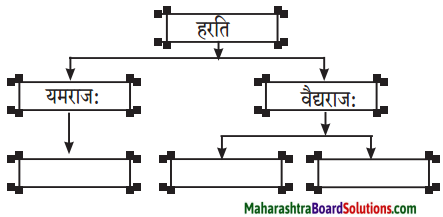
Maharashtra Board Class 10 Sanskrit Anand Solutions Chapter 10 चित्रकाव्यम् 1
उत्तरम् :
Maharashtra Board Class 10 Sanskrit Anand Solutions Chapter 10 चित्रकाव्यम् 2

श्लोक: 3.

1. पूर्णवाक्येन उत्तरत।

प्रश्न अ.
कः धनं याचते?
उत्तरम् :
याचक: / निर्धनः / लोकयानवाहक: धनं याचते।

Maharashtra Board Class 10 Sanskrit Anand Solutions Chapter 10 चित्रकाव्यम्

प्रश्न आ.
‘अयं न भक्तो’ इति प्रहेलिकाया: उत्तरं किम्?
उत्तरम् :
‘अयं न भक्तो’ इति प्रहेलिकाया: उत्तरं “लोकयानवाहकः ।

2. रेखाचित्रं पूरयत ।

प्रश्न 1.
रेखाचित्रं पूरयत ।
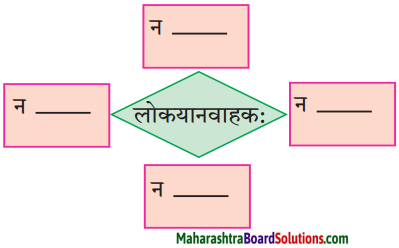
Maharashtra Board Class 10 Sanskrit Anand Solutions Chapter 10 चित्रकाव्यम् 3
उत्तरम् :
Maharashtra Board Class 10 Sanskrit Anand Solutions Chapter 10 चित्रकाव्यम् 4

3. सन्धिविग्रहं कुरुत।

प्रश्न अ.
याचतेऽयम् = याचते + ……..
उत्तरम् :
याचतेऽयम् – याचते + अयम्।

Maharashtra Board Class 10 Sanskrit Anand Solutions Chapter 10 चित्रकाव्यम्

प्रश्न आ.
याचको वा = ………. + वा।
उत्तरम् :
याचको वा = याचकः + वा।

श्लोक: 4.

1. पूर्णवाक्येन उत्तरत ।

प्रश्न अ.
कः शब्दं करोति?
उत्तरम् :
हेमघट: शब्दं करोति।

प्रश्न आ.
कस्याः हस्तात् सुवर्णघटः पतितः?
उत्तरम् :
युवत्याः हस्तात् सुवर्णघटः पतितः।

2. समानार्थकशब्दं लिखत ।

प्रश्न 1.
समानार्थकशब्दं लिखत ।
हेम, जलम्, शब्दः ।
उत्तरम् :

  • हेम .- कनकम, स्वर्णम्, सुवर्णम्, हिरण्यम्, हाटकम्।
  • जलम् – पयः, कौलालम्, अमृतम्, जीवनम, भुवनम्।
  • शब्दः – पदम्।

Maharashtra Board Class 10 Sanskrit Anand Solutions Chapter 10 चित्रकाव्यम्

3. ‘रामाभिषेके’ अस्य श्लोकस्य स्पष्टीकरण माध्यमभाषया लिखत ।

प्रश्न 1.
‘रामाभिषेके’ अस्य श्लोकस्य स्पष्टीकरण माध्यमभाषया लिखत ।
उत्तरम् :
चित्रकाव्यम् हे काल्पनिक काव्य आहे. असे काव्य कवीची अफाट बुद्धिमत्ता तर दर्शवितात, त्याच बरोबर मनोरंजन व आनंदही निर्माण करतात. ‘रामाभिषेके’ ही समस्यापूर्ती याचे उत्तम उदाहरण आहे.

समस्यापूर्ति या काव्यप्रकारात शेवटचा चरण दिलेला असतो. हा चरण बहुदा विचित्र असतो. उरलेल्या तीन चरणांसहित अर्थपूर्ण श्लोक/ काव्य तयार करणे हे कवीचे आव्हान असते.

या श्लोकात, ‘ठंठं ठठं ठं ठठ ठं ठठं ठ’, हा चरण दिलेला होता व कवीने चातुर्याने उरलेले तीन चरण त्यास जोडून अर्थपूर्ण श्लोक तयार करणे अपेक्षित होते. कवीने हे चातुर्य पुढीलप्रमाणे दाखविले. रामाच्या राज्याभिषेकासमयी एक युवती पाणी आणण्याकारिता सोन्याचा घडा घेऊन जात असताना, तो घडा तिच्या हातातून निसटतो व जिन्यावरून आवाज करत जातो. तो आवाज म्हणजेच ठंठं ठठं ठं ठठ ठं ठठंठ।

चित्रकाव्यम् is an image poetry, such poems show the prodigious intellect of the poets as well as arouse amusement and pleasure. ‘रामाभिषेके’ is the best example of समस्यापूर्ती. In समस्यापूर्ती, last चरण is stated but it is often absurd. The poet’s challenge is to create a meaningful poetry /etc.

In this श्लोक, चरण ‘ठठं ठठं ठं ठठ ठ ठठं ठः’ is already given. The poet wisely composes remaining three us to make meaningful श्लोक. The poet composes it as – at the time of राम’s coronation, certain young lady having gold pot in her hand, went to bring water.

While going, the gold pot was fallen from her hands. At that time, the sound that was generated is ठंठं ठठं ठं ठठ ठं ठठं ठः। Thus, he completes the समस्या.

उपक्रम:

1. ‘समस्यापूर्ति’-श्लोकानां सङ्ग्रहं कुरुत । 

प्रश्न अ.
मृगात् सिंहः पलायते ।

प्रश्न आ.
शतचन्द्रं नभस्तलम् ।

2. अन्योक्तिश्लोकानां सङ्ग्रहं कुरुत ।

3. कामपि अन्याम् एका प्रहेलिकां लिखत ।

Maharashtra Board Class 10 Sanskrit Anand Solutions Chapter 10 चित्रकाव्यम्

Sanskrit Anand Class 10 Textbook Solutions Chapter 10 चित्रकाव्यम् Additional Important Questions and Answers

अवबोधनम्

पूर्णवाक्येन उत्तरत।

प्रश्न 1.
शीतलवाहिनी का?
उत्तरम् :
गङ्गा शीतलवाहिनी।

प्रश्न 2.
जलदा: काभि: वसुधाम् आर्द्रयन्ति?
उत्तरम् :
जलदाः वृष्टिभि: वसुधाम् आर्द्रयन्ति।

प्रश्न 3.
कः यमराजसहोदरः?
उत्तरम् :
वैद्यराज: यमराजसहोदरः।

विभक्त्यन्तरूपाणि।

प्रश्न 1.
श्लोकात् प्रथमान्तपदानि चित्वा लिखत।
उत्तरम् :
कृष्णः, शीतलवाहिनी, गङ्गा, दारपोषणरताः,शीतम्।

Maharashtra Board Class 10 Sanskrit Anand Solutions Chapter 10 चित्रकाव्यम्

प्रश्न 2.
श्लोकात् द्वितीयान्तपदे चित्वा लिखत।
उत्तरम् :
कं, बलवन्तम्।

प्रश्न 3.
श्लोकात् तृतीयाविभक्त्यन्तपदे चित्वा लिखत।
उत्तरम् :
सावधानमनसा, वृष्टिभिः।।

प्रश्न 4.
श्लोकात् सम्बोधनविभक्त्यन्तपदे चित्वा लिखत।
उत्तरम् :
चातक, मित्र।

प्रश्न 5.
लोकयानवाहक: किं नादयते?
उत्तरम् :
लोकयानवाहक: घण्टां नादयते।

सन्थिविग्रहः

  1. बहवोऽपि – बहवः + अपि।
  2. सर्वेऽपि – सर्वे + अपि।
  3. केचिद् वृष्टिभिरार्द्रयन्ति – केचित् + वृष्टिभिः + आर्द्रयन्ति।
  4. केचिद् वृथा – केचित् + ‘वृथा।
  5. पुरतो मा – पुरतः + मा।
  6. नमस्तुभ्यम् – नमः + तुभ्यम्।
  7. यमस्तु – यमः + तु।
  8. यो जानाति – यः + जानाति।
  9. स पण्डितः – सः + पण्डितः।
  10. भक्तो न – भक्तः + न।
  11. पूजको वा – पूजक:+ वा।
  12. तथापि – तथा + अपि।
  13. निर्धनो वा – निर्धनः + वा।
  14. जलमाहरन्त्या – जलम् + आहरन्त्या।
  15. सृतो हेमघटो युवत्याः – सूतः + हेमघट: + युवत्याः ।
  16. क्वास्ति – क्व + अस्ति।
  17. बलेर्मखे – बले: + मखे।
  18. नास्त्यसौ – न + अस्ति + असौ।
  19. तस्योपरि – तस्य + उपरि।
  20. विषादमाशु – विषादम् + आशु।
  21. नाहम् – न+ अहम्।
  22. चेत्थम् – च + इत्थम्।

Maharashtra Board Class 10 Sanskrit Anand Solutions Chapter 10 चित्रकाव्यम्

अमरकोषात् योग्यं समानार्थक शब्दं योजयित्वा वाक्यं पुनर्लिखत।

प्रश्न 1.
गङ्गा शीतलवाहिनी अस्ति।
उत्तरम् :
विष्णुपदी / जहुतनया / सुरनिम्नगा शीतलवाहिनी अस्ति।

भाषाभ्यास:

समानार्थकशब्दाः

  1. मित्र – वयस्यः, सखा।
  2. अम्भोदः – मेषः, धाराधरः, जलधरः, तडित्वान्, वारिदः, अम्बुभृत, जलदः, वारिवाहः।
  3. बहवः – भूरयः, विपुलाः ।
  4. गगनम् – व्योम, आकाशम् ।
  5. वृष्टिः – पर्जन्यः।
  6. वसुधा – पृथ्वी, धरा, वसुन्धरा।
  7. पुरतः – पुरस्तात्।
  8. गुप्तम् – प्रच्छन्नम् ।
  9. किल – ननु, खलु।
  10. निर्धनः – धनहीनः ।
  11. आशु – सत्वरम्, त्वरितम्।

Maharashtra Board Class 10 Sanskrit Anand Solutions Chapter 10 चित्रकाव्यम्

विरुद्धार्थकशब्दाः

  1. शीतम् × उष्णम्।
  2. पुरतः × पृष्ठतः।
  3. बहवः × अल्पाः।
  4. आशु × शनैः शनैः।
  5. पण्डित: × मूढः, मूर्खः ।
  6. निर्धनः × धनिकः ।
  7. चला × स्थिरा।

पृथक्करणम्

जालरेखाचित्रं पूरयत।

1.
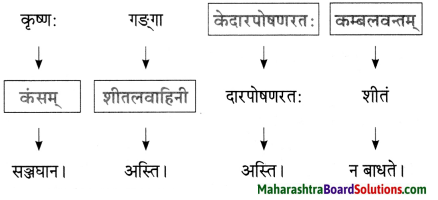
Maharashtra Board Class 10 Sanskrit Anand Solutions Chapter 10 चित्रकाव्यम् 5

2.
Maharashtra Board Class 10 Sanskrit Anand Solutions Chapter 10 चित्रकाव्यम् 6

त्वं स्थाने भवान् / भवती अथवा भवान् / भवती स्थाने त्वं योजयत।

प्रश्न 1.
त्वं प्राणान् धनानि च हरसि।
उत्तरम् :
भवान् प्राणान् धनानि च हरति।

Maharashtra Board Class 10 Sanskrit Anand Solutions Chapter 10 चित्रकाव्यम्

प्रश्न 2.
त्वं आशु विषादं मुञ्च।
उत्तरम् :
भवान्/भवती आशु विषादं मुञ्चतु।

वचनं परिवर्तयत ।

प्रश्न 1.
भिक्षुः क्व अस्ति? (बहुवचने परिवर्तयत।)
उत्तरम् :
भिक्षवः क्व सन्ति?

समासा:

समस्तपदम्अर्थसमासविग्रहःसमासनाम
1. गिरिजासमुद्रसुतयोःof गिरिजा and समुद्रसुतागिरिजा च समुद्रसुता च, तयोः।इतरेतर-द्वन्द्वः समासः।
2. दारपोषणरता:engaged in looking after wifeदारपोषणे रताः।सप्तमी-तत्पुरुषः समासः।
3. यमराजसहोदरःbrother of यमयमराजस्य सहोदरः।षष्ठी-तत्पुरुषः समासः।
4. रामाभिषेक:coronation of रामरामस्य अभिषेकः।षष्ठी-तत्पुरुषः समासः।
5. हेमघट:pot of goldहेम्न: घटः।षष्ठी-तत्पुरुषः समासः।
6. पशुपतिःlord of animalsपशूनां पतिः।षष्ठी-तत्पुरुषः समासः।
7. समुद्रसुताdaughter of an oceanसमुद्रस्य सुता।षष्ठी-तत्पुरुषः समासः।
8. पन्नगभूषण:one whose ornament is a snakeपन्नगः भूषणं यस्य सः ।बहुव्रीहिः समासः।
9. अम्भोदा:water givingअम्भः ददति इति।उपपद-तत्पुरुषः समासः।
10. सावधानमनःattentive mindसावधानं मनः।कर्मधारयः समासः।

Maharashtra Board Class 10 Sanskrit Anand Solutions Chapter 10 चित्रकाव्यम्

चित्रकाव्यम् Summary in Marathi and English

प्रस्तावना :

संस्कृत भाषा विविध वैशिष्ट्यपूर्ण सुभाषितांनी अलंकृत झाली आहे. “चित्रकाव्यम्’ हे यातीलच एक. ‘बुद्धिविकासकानि सुभाषितानि नाम चित्रकाव्यानि’ याचा अर्थ बुद्धीचा विकास करणारी सुभाषिते म्हणजे चित्रकाव्ये. काही विशिष्ट वृत्तांच्या बांधणीने व नावीन्यपूर्ण काव्यात्मक रचनेद्वारा चमत्कृतीकाव्य तयार करणे हा चित्रकाव्यांचा हेतू आहे. यातून मनोरंजन व आनंदही प्राप्त होतो.

चित्रकाव्यम् हे ‘काल्पनिक काव्य’ आहे. असे काव्य कवीची अफाट बुद्धिमत्ता व त्यांचे भाषेवरील प्रभुत्व दर्शविते. प्रस्तुत ‘चित्रकाव्यम्’ काव्यामध्ये, अन्तरालाप, अन्योक्ति, हास्योक्ति, कर्तृगुप्ता प्रहेलिका, समस्यापूर्ति, वाकोवाक्यम् इ. काव्याच्या विविध प्रकारांचा अंतर्भाव झाला आहे.

Sanskrit language is adorned with curious peculiar सुभाषितs. चित्रकाव्य is one of them. ‘बुद्धिविकासकानि सुभाषितानि नाम चित्रकाव्यानि’ that means, सुभाषितs developing/ provoking the intelligence is चित्रकाव्य, Aim of चित्रकाव्य is to generate a sense of wonder by resorting to unusual management of certain meters and innovative poetic structures. It also arouses amusement and pleasure.

चित्रकाव्य is an image poetry. Such poems show the prodigious intellect of the poets and their command over language. The given foc poetry consists of varied types of poetry such as अन्तरालाप, अन्योक्ति, हास्योक्ति, कर्तृगुप्ता प्रहेलिका, समस्यापूर्ति, वाकोवाक्यम् etc.

Maharashtra Board Class 10 Sanskrit Anand Solutions Chapter 10 चित्रकाव्यम्

श्लोकः 1

के संजघान कृष्ण का शीतलवाहिनी गङ्गा।
के दारपोषणरता: कं बलवन्तं न बाधते शीतम्।।1।। (अन्तरालाप:)

अनुवादः

कृष्णाने कोणाला मारले? (कंस), शीतल वाहणारी गंगा कोणती आहे? (काशीक्षेत्रात वाहणारी). बायकोचे पोषण करण्यात कोण मग्न असतात? (केदारपोषणरत) कोणत्या बलवानाला थंडी बाधत नाही ? (कंबलवंत-कांबळे धारण करणाऱ्याला) स्पष्टीकरण – हे अन्तरालापाचे उदाहरण आहे.

येथे श्लोकात विचारलेल्या चार प्रश्नांची उत्तरेही तिथेच दडली आहेत. शब्दालंकारावर आधारित असा हा श्लोक आहे. काही अक्षरांना जोडल्यास अथवा विभाजित केल्यास विचारलेल्या प्रश्नांची उत्तरे मिळू शकतात, ज्याप्रमाणे

1. के संजघान’ कृष्ण म्हणजे, कृष्णाने कोणाला ठार मारले? येथे, प्रथम चरणातील पहिली दोन अक्षरे जोडल्यास ‘कंस’ असे योग्य उत्तर मिळते. 2. ‘का शीतलवाहिनी गंगा?’ शीतल वाहणारी गंगा नदी कोणती? दुसऱ्या चरणातील पहिली दोन अक्षरे जोडल्यास काशी म्हणजे काशीक्षेत्र असे उत्तर मिळते. याचा अर्थ, काशी क्षेत्रात वाहणारी गंगा शीतल आहे.

3. बायकोचे पोषण करण्यात कोण मग्न असतात? तिसऱ्या चरणातील पहिली दोन अक्षरे जोडल्यास केदार (शेत) असे उत्तर मिळते. येथे केदारपोषणरत याचा अर्थ शेतकरी असा होतो. 4. कोणत्या बलवानास थंडी बाधत नाही? येथेही, चौथ्या चरणातील तीन अक्षरे जोडल्यास कम्बलवन्त असा शब्द म्हणजेच उत्तर मिळते, त्याचा अर्थ, कांबळे धारण करणाऱ्या बलवानास थंडी वाजत नाही.

Whom did कृष्ण kill? (कंस). Which is cool flowing river गङ्गा? (in काशी). Who is engrossed in looking after the wife?

(केदारपोषणरत – the one who is engrossed in taking care of the field) Which strong man is not affected by the cold? (chade the one who has a means blanket) Explanation – This श्लोक is the example of अन्तरालाप. Here are four different questions along with their answers within. It is based on शब्दालङ्कार.

One can obtain the answer of a given question either by joining or dividing letters. Just as, (1) कसजधानकृष्णmeans, who did कृष्ण kill? The answer ‘कंसं’ is obtained by joining the first two letters. (2) का शीतलवाहिनी गङ्गा? Which is cool river गङ्गा? The answer is flowing in काशी. (3) Who is engrossed in looking after a wife? The answer is केदारपोषणरता.

which means the ones who are engrossed in taking care of the field (4) कंबलवन्तं न बाधते शीतम्? Which strong man is not affected by the cold? The answer is कंबलवन्तं This is obtained by joining the first three letters.

श्लोक: 2

रे रे चातक सावधानमनसा मित्र क्षणं श्रूयताम्
अम्भोदा बहवोऽपि सन्ति गगने सर्वेऽपि नैतादृशाः।
केचिद् वृष्टिभिरार्द्रयन्ति वसुधां गर्जन्ति केचिद् वृथा .
यं यं पश्यसि तस्य तस्य पुरतो मा ब्रूहि दीनं वचः ।।2।। (अन्योक्तिः ) (वृत्तम् – शार्दूलविक्रीडितम्)
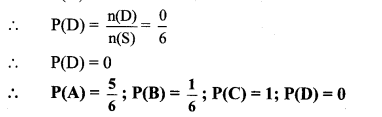
Maharashtra Board Class 10 Sanskrit Anand Solutions Chapter 10 चित्रकाव्यम्

अनुवादः

रे रे चातक मित्रा, क्षणभर लक्ष देऊन (सावधानपूर्वक) ऐक, आकाशात असंख्य (पुष्कळ) ढग असतात (परंतु) सगळेच सारखे नसतात. काही ढग पावसाच्या वर्षावांनी पृथ्वी जलमय करतात, तर काही व्यर्थ (विना कारण) गर्जना करतात. (म्हणून) तुला जो जो ढग दिसेल त्याच्यापुढे दीनवाणीने बोलू नकोस.
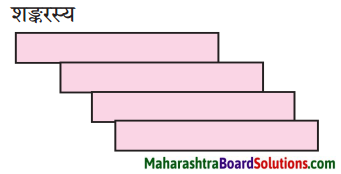
स्पष्टीकरण – हे ‘अन्योक्ती’ – ‘दुसऱ्याला उद्देशून बोलणे’ या काव्यप्रकारचे उदाहरण आहे. येथे, चातक पक्षी वर्षाकाळाचा अग्रदूत (सूचक) मानला आहे व तो पावसाचे पाणी पिऊन तहान भागवतो असे समजतात. येथे दोन प्रकाराच्या ढगांच्या गुणवैशिष्ट्यांना दर्शवत कवीने त्यांच्यातील फरक स्पष्ट केला आहे. काही ढग केवळ गर्जना करतात, तर काही खरोखरच पाणी देतात.

कवी चातकास केवळ गर्जना करणाऱ्या ढगांकडे पाणी न मागण्याचा सल्ला देतो. कवीला दीनजनांना उद्देशून सांगायचे आहे की सर्वच धनी माणसे उदार नसतात. चातकाला उद्देशून दीन लोकांना सल्ला देणारी ही अन्योक्ती आहे.

O चातक, my friend, please listen carefully for a moment. There are innumerable clouds in the sky but all are not alike. Few humidify the earth by showering rain. (However) Few just roars in vain, (therefore) Do not speak pitiable words in front of whichever cloud you see.

Explanation – This is the example of a poetic form named अन्योक्ति- ‘speech directed to other’. Here, the Ellah bird is a harbinger of monsoon and it is assumed to drink water directly from the cloud.

Some clouds are best givers of water but some mere roar. So, the poet suggests चातक not to ask for water to the roaring clouds. In a way, the poet wants to indicate poor people, not to beg to all people are not generous.

श्लोक: 3

वैद्यराज नमस्तुभ्यं यमराजसहोदर।
यमस्तु हरति प्राणान् त्वं तु प्राणान् धनानि च ।।3।। (हास्योक्तिः ) (वृत्तम् – अनुष्टुप्)

अनुवादः

हे वैद्यराजा, यमराजाच्या सख्ख्या भावा, तुला नमस्कार असो! यम (केवळ) प्राणच हरतो, पण तू प्राण व धनही दोन्ही हरतोस. स्पष्टीकरण – हा श्लोक हास्योक्तीचे उदाहरण असून, येथे अपरिपक्व आणि लोभी वैद्याची निंदा विनोदी पद्धतीने केली आहे.

O great doctor, salutation to you as a real brother of यमराज while यमराज takes away only the life (of people) but you fetch both life as well as wealth. Explanation – This is an example of a satire about an incompetent and greedy doctor, in a humorous way.

Maharashtra Board Class 10 Sanskrit Anand Solutions Chapter 10 चित्रकाव्यम्

श्लोकः 4

राक्षसेभ्य: सुतां हत्वा जनकस्य पुरीं ययौ।
अत्र कर्तृपदं गुप्तं यो जानाति स पण्डितः ।।4।। (कर्तृगुप्ता प्रहेलिका) (वृत्तम् – अनुष्टुप)

अनुवादः

(कोणी एक जण) राक्षसांकडून कन्येचे हरण करून जनकाच्या नगरीस गेला किंवा (कोणी एक जण ) जनकाच्या मुलीचे हरण करून नगरीस गेला. येथे कर्ता गुप्त आहे. जो जाणतो तो खरा विद्वान.

स्पष्टीकरण – वरील श्लोक हा चित्रकाव्याचा वेगळा प्रकार आहे. ही कर्तृगुप्त- प्रहेलिका आहे. येथे ‘राक्षसेभ्यः’ या शब्दात कर्ता गुप्त आहे. या शब्दाचे दोन भाग केले असता, राक्षस व इभ्यः असे दोन शब्द मिळतात.

‘इभ्यः’ चा अर्थ राजा असा होतो. याचाच अर्थ राक्षसांचा राजा. राक्षसानाम् इभ्यः म्हणजे रावण. या रीतीने, एक अर्थपूर्ण वाक्य तयार होते. राक्षसांचा राजा रावण जनकाच्या कन्येचे हरण करून नगरीस गेला.

(Someone) had gone to He’s city abducting the daughter from the demons or (Someone) had gone to the city abducting जनक’s daughter. The subject (कर्तृपदम्) is hidden here. The one who knows is the scholar.

Explanation – The above ce is a different kind of चित्रकाव्य. It is कर्तृगुप्त-प्रहेलिका, The subject is hidden in the word राक्षसेभ्यः, If we split the word, we get two words राक्षस and इभ्यः. इभ्यः means ‘aking’. It means राक्षसानाम् इभ्य: a king of demons that is रावण. Thus, we get a meaningful sentence, ‘A king of demons’, रावण abducting जनक’s daughter (सीता), had gone to the city.

श्लोक: 5

अयं न भक्तो न च पूजको वा
घण्टां स्वयं नादयते तथापि।
धनं जनेभ्यः किल याचतेऽयं
न याचको वा न च निर्धनो वा ।।5।। (प्रहेलिका) (वृत्तम् – उपजाति:)

Maharashtra Board Class 10 Sanskrit Anand Solutions Chapter 10 चित्रकाव्यम्

अनुवादः

हा भक्त नाही व पूजकहीं नाही तरीही स्वत:हून घंटा वाजवितो. खरोखर याचक व धनहीन नसतानाही. हा लोकांकडून पैसे घेतो. (तर मग सांगा कोण बरे आहे हा?)

स्पष्टीकरण – श्री सदाशिव त्र्यंबक रहातेकर लिखित हा श्लोक काव्यप्रवाह या काव्यसंग्रहातून घेण्यात आला आहे. हे अपहनुति अलंकाराचे उदाहरण आहे. या श्लोकाचे उत्तर ‘क:हवानयाकलो’ असे आहे. उलट दिशेने वाचले असता आपल्याला योग्य उत्तर मिळते ते असे, लोकयानवाहक:- याचा अर्थ बस-कंडक्टर अथवा बस-वाहक,

This is neither the devotee nor a worshipper. Yet rings the bell on its own. Indeed this one asks for money from people, but is not beggar or poor. (Then who is this?) Explanation – This श्लोक is taken from काव्यप्रवाह, composed by श्री सदाशिव त्र्यंबक रहातेकर, It is the example ofअपहनुति अलङ्कार.

The answer to this श्लोक is’क:हवानयाकलो,’ reading it in the inverse order, one gets the correct answer that is, लोकयानवाहकः means a bus-conductor because we hear a bell-sound in a bus, though it is not necessarily done by any devotee or a worshipper.)

श्लोकः 6

रामाभिषेके जलमाहरन्त्या हस्तात् मृतो हेमघटो युवत्याः।
सोपानमार्गेण करोति शब्दं ठंठं ठठं ठं ठठठं ठठं ठः।।6।। (समस्यापूर्तिः) (वृत्तम् – इन्द्रवज्रा)

अनुवादः

रामाच्या राज्याभिषेकासमयी युवतीच्या हतातून पाण्याने भरलेला सोन्याचा घडा निसटला, तो जिन्यावरुन आवाज करत गेला. ठंठ ठठं ठं ठठठं ठठं ठः.

At the time of राम’s coronation, the golden pot filled with water was skipped from the hands of a young lady. It made the voice from the stairs ठंठं ठठं ठंठठठं ठठंठ:.

Maharashtra Board Class 10 Sanskrit Anand Solutions Chapter 10 चित्रकाव्यम्

श्लोक : 7

भिक्षुः क्वास्ति बलेर्मखे पशुपति: किं नास्त्यसौ गोकुले
मुग्धे पन्नगभूषण: सखि सदा शेते च तस्योपरि।
आर्ये मुज्ञ विषादमाशु कमले नाहं प्रकृत्या चला
चेत्यं वै गिरिजासमुद्रसुतयोः सम्भाषणं पातु वः ।।7।। (वाकोवाक्यम्) (वृत्तम् – शार्दूलविक्रीडितम्)

अनुवादः

(लक्ष्मी विचारते) तो भिक्षुक कोठे आहे ? (पार्वती उत्तर देते) बळीच्या यज्ञात. पशूपती कोठे आहेत? ते गोकुळात नाहीत का? प्रिये, ज्याचा अलंकारच साप आहे तो कोठे आहे? सखि, तो त्यावरच नेहमी निद्रासुख घेतो.

आर्ये, दु:ख (विष खाणाऱ्याला) सोडून दे. अगं लक्ष्मी, मी तुझ्यासारखी चंचल नाही. अशा रितीने पार्वती (पर्वताची कन्या) व लक्ष्मी (समुद्राची कन्या) यातील हे संभाषण आपले रक्षण करो.

(वरील संवादात, लक्ष्मी पार्वतीला विचित्र विशेषणांचा प्रयोग करून शंकराबद्दल विचारते. याला चोख प्रत्युतर देण्याच्या हेतूने, पार्वती देखील तीच विशेषणे विष्णूकरिता वापरून तिचे चातुर्य दर्शविते.)

Where is the mendicant? He is in the sacrifice performed by बलि. Where is the lord of animals? Is he not in Gokul? O dear one where is the one whose ornament is a snake? O friend, he sleeps on the same always.

O noble one, leave disappointment (the one who consumes poison) at once! O Laxmi I am not fickle minded like you. In this way, this conversation between पार्वती (daughter of mountain) and लक्ष्मी (daughter of an ocean) may protect us.

(In the above dialogue, लक्ष्मी asks about lord शंकर by using strange adjectives. Witty पार्वती reverts to लक्ष्मी using the same adjectives intended for लक्ष्मी’s husband i.e. Lord विष्णु.)

Maharashtra Board Class 10 Sanskrit Anand Solutions Chapter 10 चित्रकाव्यम्

शब्दार्थाः

  1. संजधान – had killed – मारले
  2. कंसं जघान – had killed – कंसाला मारले
  3. शीतलवाहिनी – cool flowing – थंड वाहणारी
  4. दारपोषणरताः – engrossed in – बायकोचे पोषण
  5. nurturing wife – करण्यात मग्न
  6. केदार – field – शेत
  7. कं बलवन्तम् – to which strong man – कोणत्या बलवान माणसाला
  8. न बाधते – does not affect – बाधत नाही
  9. कंबलवन्तम् – one who has a blanket – ज्याच्याकडे कांबळे आहे त्याला
  10. चातक – a bird named चातक – चातक पक्षी
  11. सावधानमनसा – with attentive mind – सावधानपूर्वक
  12. श्रूयताम् – may listen – कृपया ऐकावे
  13. अम्भोदा: – clouds – ढग
  14. वृष्टिभिः – by rain shower – पावसाच्या वर्षावाने
  15. आर्द्रयन्ति – humidify – जलमय करतात
  16. वृथा गन्ति – roar in vain – व्यर्थ गर्जना करतात
  17. तस्य पुरतः – in front of him – त्याच्या समोर
  18. मा ब्रूहि – do not speak – बोलू नकोस
  19. दीनं वचः – pitiable words – दीनवाणी
  20. यमराजसहोदर – Othe real brother of यमराज – यमराजाच्या हे सख्ख्या भावा
  21. वैद्यराज – O great doctor – वैद्यराज
  22. सुता – daughter – कन्या
  23. पूरी – city – नगरी
  24. ययो – had gone – गेला
  25. स्वयं नादयते – makes sound on its own – स्वतःहून वाजवते
  26. किल – indeed – खरोखर
  27. याचकः – beggar – याचक
  28. निर्धनः – poor – धनहीन
  29. रामाभिषेके – at the time of – रामाच्या
  30. राम’s coronation – राज्याभिषेकासमयी
  31. आहरन्त्या – taking – घेऊन जाणाऱ्या
  32. सूतः – escaped/skipped – निसटलेला
  33. हेमघट: – golden pot – सोन्याचा घडा
  34. युवत्याः – from a young lady – तरुणीकडून
  35. सोपानमार्गेण – from stairs – जिन्यावरून
  36. क्व – where – कुठे
  37. बलेमखे – in the sacrifice of बली – बळीच्या यज्ञात
  38. पशुपतिः – lord of animals – शंकर
  39. पनगभूषण: – whose ornament – ज्याचा अलंकार
  40. is a snake – सर्प आहे तो
  41. शेते – sleeps – झोपलेला आहे
  42. मुञ्च विषादम् – leave the disappointment – दु:ख सोडून दे
  43. कमले – o goddess Laxmi – लक्ष्मी
  44. गिरिजा – Goddess Parvati – पार्वती
  45. समुद्रसुता – daughter of an ocean – समुद्राची कन्या
  46. पातु वः – may protect us – आपले संरक्षण करो