Maharashtra Board 8th Class Maths Practice Set 10.1 Solutions Chapter 10 Division of Polynomials

Balbharti Maharashtra State Board Class 8 Maths Solutions covers the Practice Set 10.1 8th Std Maths Answers Solutions Chapter 10 Division of Polynomials.

Practice Set 10.1 8th Std Maths Answers Chapter 10 Division of Polynomials

Question 1.
Divide and write the quotient and the remainder.
i. 21m² ÷ 7m
ii. 40a³ ÷ (-10a)
iii. (- 48p4) ÷ (- 9p2)
iv. 40m5 ÷ 30m3
v. (5x3 – 3x2) ÷ x²
vi. (8p3 – 4p2) ÷ 2p2
vii. (2y3 + 4y2 + 3 ) ÷ 2y2
viii. (21x4 – 14x2 + 7x) ÷ 7x3
ix. (6x5 – 4x4 + 8x3 + 2x2) ÷ 2x2
x. (25m4 – 15m3 + 10m + 8) ÷ 5m3
Solution:
i. 21m² ÷ 7m
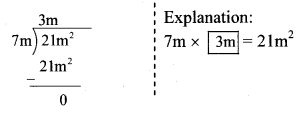
Maharashtra Board Class 8 Maths Solutions Chapter 10 Division of Polynomials Practice Set 10.1 1
∴ Quotient = 3m
Remainder = 0

ii. 40a³ ÷ (-10a)
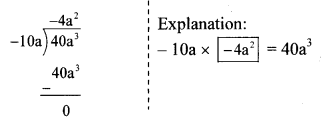
Maharashtra Board Class 8 Maths Solutions Chapter 10 Division of Polynomials Practice Set 10.1 2
∴ Quotient = -4a²
Remainder = 0

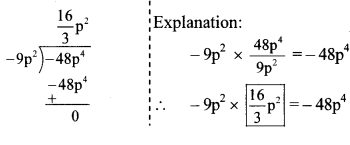
iii. (- 48p4) ÷ (- 9p2)
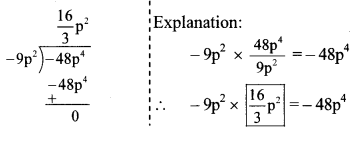
Maharashtra Board Class 8 Maths Solutions Chapter 10 Division of Polynomials Practice Set 10.1 3
∴ Quotient = \(\frac { 16 }{ 3 }\) p²
Remainder = 0

iv. 40m5 ÷ 30m3
Maharashtra Board Class 8 Maths Solutions Chapter 10 Division of Polynomials Practice Set 10.1 4
∴ Quotient = \(\frac { 4 }{ 3 }\) m²
Remainder = 0

v. (5x3 – 3x2) ÷ x²
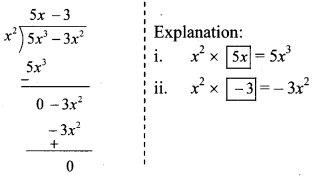
Maharashtra Board Class 8 Maths Solutions Chapter 10 Division of Polynomials Practice Set 10.1 5
∴ Quotient = 5x – 3
Remainder = 0

vi. (8p3 – 4p2) ÷ 2p2
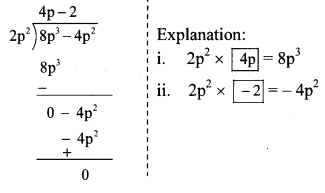
Maharashtra Board Class 8 Maths Solutions Chapter 10 Division of Polynomials Practice Set 10.1 6
∴ Quotient = 4p – 2
Remainder = 0

vii. (2y3 + 4y2 + 3 ) ÷ 2y2
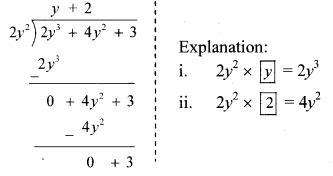
Maharashtra Board Class 8 Maths Solutions Chapter 10 Division of Polynomials Practice Set 10.1 7
∴ Quotient = y + 2
Remainder = 3

viii. (21x4 – 14x2 + 7x) ÷ 7x3
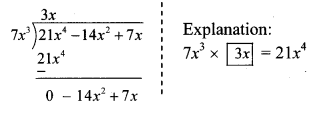
Maharashtra Board Class 8 Maths Solutions Chapter 10 Division of Polynomials Practice Set 10.1 8
∴ Quotient = 3x
Remainder = -14x² + 7x

ix. (6x5 – 4x4 + 8x3 + 2x2) ÷ 2x2
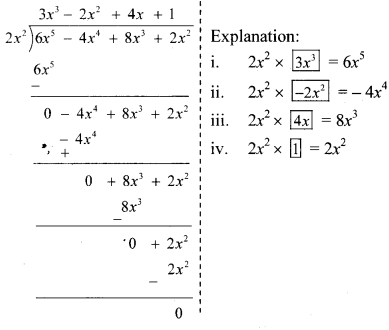
Maharashtra Board Class 8 Maths Solutions Chapter 10 Division of Polynomials Practice Set 10.1 9
∴ Quotient = 3x³ – 2x² + 4x + 1
Remainder = 0

x. (25m4 – 15m3 + 10m + 8) ÷ 5m3
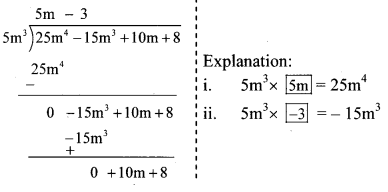
Maharashtra Board Class 8 Maths Solutions Chapter 10 Division of Polynomials Practice Set 10.1 10
∴ Quotient = 5m – 3
Remainder = 10m + 8

Maharashtra Board Class 8 Maths Chapter 10 Division of Polynomials Practice Set 10.1 Intext Questions and Activities

Question 1.
Fill in the blanks in the following examples. (Textbook pg. no. 61)

  1. 2a + 3a = __
  2. 7b – 4b = __
  3. 3p × p² = __
  4. 5m² × 3m² = __
  5. (2x + 5y) × \(\frac { 3 }{ x }\) = __
  6. (3x² + 4y) × (2x + 3y) = __

Solution:

  1. 2a + 3a = 5a
  2. 7b – 4b = 3b
  3. 3p × p² = 3p³
  4. 5m² × 3m² = 15m4
  5. (2x + 5y) × \(\frac { 3 }{ x }\) = \(6+\frac { 15y }{ x }\)
  6. (3x² + 4y) × (2x + 3y) = 6x³ + 9x²y + 8xy + 12y²
Maharashtra Board 8th Class Maths Practice Set 11.1 Solutions Chapter 11 Statistics

Balbharti Maharashtra State Board Class 8 Maths Solutions covers the Practice Set 11.1 8th Std Maths Answers Solutions Chapter 11 Statistics.

Practice Set 11.1 8th Std Maths Answers Chapter 11 Statistics

Question 1.
The following table shows the number of saplings planted by 30 students. Fill in the boxes and find the average number of saplings planted by each student.

No. of saplings (Scores) xiNo. of students (frequency) fifi × xi
144
26__
312__
48__
N = __∑ fi × xi = __

Maharashtra Board Class 8 Maths Solutions Chapter 11 Statistics Practice Set 11.1 1
Solution:

No. of saplings (Scores) xiNo. of students (frequency) fifi × xi
144
2612
31236
4832
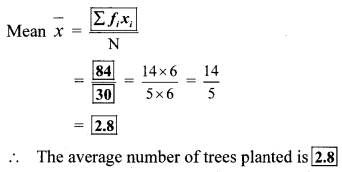
N = __∑ fi × xi = 84

Maharashtra Board Class 8 Maths Solutions Chapter 11 Statistics Practice Set 11.1 2

Question 2.
The following table shows the electricity (in units) used by 25 families of Eklara village in a month of May. Complete the table and answer the following questions.

Electricity used (Units) xiNo. of families (frequency) fifi × xi
304
456
6012
758
903
N = __∑ fi × xi =

i. How many families use 45 units electricity?
ii. State the score, the frequency of which is 5.
iii. Find N, and ∑ fi × xi .
iv. Find the mean of electricity used by each family in the month of May.
Solution:

Electricity used (Units) xiNo. of families (frequency) fifi × xi
307210
45290
608480
755375
903270
N = 25∑ fi × xi = 1425

i. 2 families used 45 units of electricity.
ii. The score for which the frequency is 5 is 75
iii. N = 25 and ∑ fi × xi = 1425
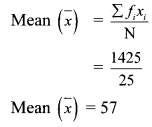
iv.
Maharashtra Board Class 8 Maths Solutions Chapter 11 Statistics Practice Set 11.1 3
The mean of electricity used by each.

Question 3.
The number of members in the 40 families in Bhilar are as follows:
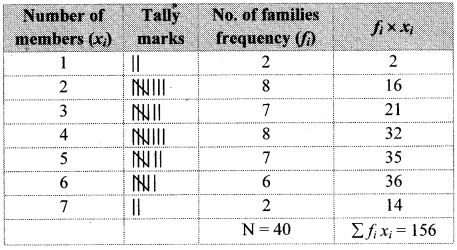
1, 6, 5, 4, 3, 2, 7, 2, 3, 4, 5, 6, 4, 6, 2, 3, 2, 1, 4, 5, 6, 7, 3, 4, 5, 2, 4, 3, 2, 3, 5, 5, 4, 6, 2,3, 5, 6, 4, 2. Prepare a frequency table and And the mean of members of 40 families.
Solution:
Maharashtra Board Class 8 Maths Solutions Chapter 11 Statistics Practice Set 11.1 4
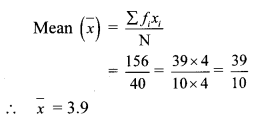
Maharashtra Board Class 8 Maths Solutions Chapter 11 Statistics Practice Set 11.1 5
∴ The mean of the members of 40 families is 3.9.

Question 4.
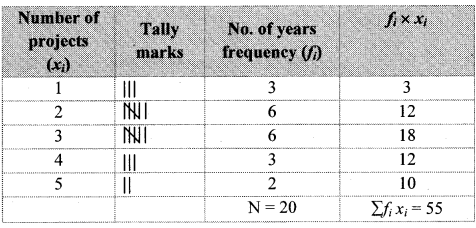
The number of Science and Mathematics projects submitted by Model high school, Nandpur in last 20 years at the state level science exhibition is:
2, 3 ,4, 1, 2, 3, 1, 5, 4, 2, 3, 1, 3, 5, 4, 3, 2, 2, 3, 2. Prepare a frequency table and find the mean of the data.
Solution:
Maharashtra Board Class 8 Maths Solutions Chapter 11 Statistics Practice Set 11.1 6
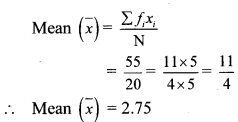
Maharashtra Board Class 8 Maths Solutions Chapter 11 Statistics Practice Set 11.1 7
∴ The mean of the given data is 2.75.

Maharashtra Board Class 8 Maths Chapter 11 Statistics Practice Set 11.1 Intext Questions and Activities

Question 1.
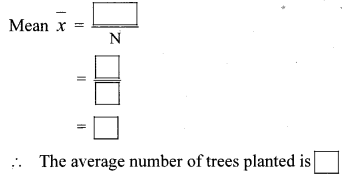
The number of pages of a book Ninad read for five consecutive days were 60, 50, 54, 46, 50. Find the average number of pages he read everyday. (Textbook pg. no. 67)
Solution:
\(\frac{60+[50]+[54]+[46]+50}{[5]}=\frac{260}{[5]}=[52]\)
∴ Average number of pages read daily is 52

Maharashtra Board Practice Set 35 Class 7 Maths Solutions Chapter 8 Algebraic Expressions and Operations on them

Balbharti Maharashtra State Board Class 7 Maths Solutions covers the 7th Std Maths Practice Set 35 Answers Solutions Chapter 8 Algebraic Expressions and Operations on them.

Algebraic Expressions and Operations on them Class 7 Practice Set 35 Answers Solutions Chapter 8

Question 1.
Multiply:
i. 16xy × 18xy
ii. 23xy² × 4yz²
iii. (12a + 17b) × 4c
iv. (4x + 5y) × (9x + 7y)
Solution:
i. 16xy × 18xy
= 16 × 18 × xy × xy
= 288x²y²

ii. 23xy² × 4yz²
= 23 × 4 × xy² × yz²
= 92xy³z²

iii. (12a + 17b) × 4c = 12a × 4c + 17b × 4c
= 48ac + 68bc

iv. (4x + 5y) × (9x + 7y)
= 4x × (9x + 7y) + 5y × (9x + 7y)
= (4x × 9x) + (4x × 7y) + (5y × 9x) + (5y × 7y)
= 36x² + 28xy + 45xy + 35y²
= 36x² + 73xy + 35y²

Question 2.
A rectangle is (8x + 5) cm long and (5x + 3) cm broad. Find its area. Solution:
Length of the rectangle = (8x + 5) cm
Breadth of the rectangle = (5x + 3) cm
∴ Area of the rectangle = length × breadth
= (8x + 5) × (5x + 3)
= 8x × (5x + 3) + 5 × (5x + 3)
= (8x × 5x) + (8x × 3) + (5 × 5x) + (5 × 3)
= 40x² + 24x + 25x + 15
= 40x² + 49x + 15
∴ The area of the rectangle is (40x² + 49x + 15) sq. cm.

Maharashtra Board Practice Set 36 Class 7 Maths Solutions Chapter 8 Algebraic Expressions and Operations on them

Balbharti Maharashtra State Board Class 7 Maths Solutions covers the 7th Std Maths Practice Set 36 Answers Solutions Chapter 8 Algebraic Expressions and Operations on them.

Algebraic Expressions and Operations on them Class 7 Practice Set 36 Answers Solutions Chapter 8

Question 1.
Simplify (3x – 11y) – (17x + 13y) and choose the right answer.
(A) 7x – 12y
(B) -14x – 54y
(C) -3(5x + 4y)
(D) -2(7x + 12y)
Solution:
(D) -2(7x + 12y)

Hints:
(3x – 11y) – (17x + 13y) = 3x – 11y – 17x – 13y
= – 14x – 24y
= – 2 × 7x – 2 × 12y
= – 2(7x + 12y)

Question 2.
The product of (23x²y³z) and (-15x³yz²) is __
(A) -34x5y4z3
(B) 34x2y3z5
(C) 145x3y2z
(D) 170x3y2z3
Solution:
(A) -34x5y4z3

Question 3.
Solve the following equations:
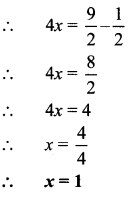
i. \(4 x+\frac{1}{2}=\frac{9}{2}\)
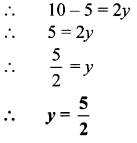
ii. 10 = 2y + 5
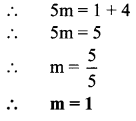
iii. 5m – 4 = 1
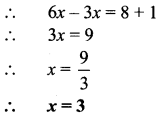
iv. 6x – 1 = 3x + 8
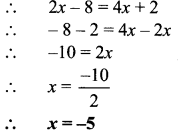
v. 2(x – 4) = 4x + 2
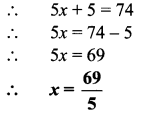
vi. 5(x + 1) = 74
Solution:
i. \(4 x+\frac{1}{2}=\frac{9}{2}\)
Maharashtra Board Class 7 Maths Solutions Chapter 8 Algebraic Expressions and Operations on them Practice Set 36 1

ii. 10 = 2y + 5
Maharashtra Board Class 7 Maths Solutions Chapter 8 Algebraic Expressions and Operations on them Practice Set 36 2

iii. 5m – 4 = 1
Maharashtra Board Class 7 Maths Solutions Chapter 8 Algebraic Expressions and Operations on them Practice Set 36 3

iv. 6x – 1 = 3x + 8
Maharashtra Board Class 7 Maths Solutions Chapter 8 Algebraic Expressions and Operations on them Practice Set 36 4

v. 2(x – 4) = 4x + 2
Maharashtra Board Class 7 Maths Solutions Chapter 8 Algebraic Expressions and Operations on them Practice Set 36 5

vi. 5(x + 1) = 74
Maharashtra Board Class 7 Maths Solutions Chapter 8 Algebraic Expressions and Operations on them Practice Set 36 6

Question 4.
Rakesh’s age is less than Sania’s age by 5 years. The sum of their ages is 27 years. How old are they?
Solution:
Let the age of Rakesh be x years.
∴ Sania’s age = (x + 5) years.
According to the given condition,
x + (x + 5) = 27
∴ 2x + 5 = 27
∴ 2x = 27 – 5
∴ 2x = 22
∴ \(x=\frac { 22 }{ 2 }=11\)
Sania’s age = x + 5 = 11 + 5 = 16 years
∴ The ages of Rakesh and Sania are 11 years and 16 years respectively.

Question 5.
When planting a forest, the number of jambhul trees planted was greater than the number of ashoka trees by 60. If there are altogether 200 trees of these two types, how many jambhul trees were planted?
Solution:
Let the number of jambhul trees planted be x.
∴ Number of ashoka trees = x – 60
According to the given condition, x + x – 60 = 200
∴ 2x = 200 + 60
∴ 2x = 260
∴ \(x=\frac { 260 }{ 2 }=130\)
∴ 130 jambhul trees were planted.

Question 6.
Shubhangi has twice as many 20-rupee notes as she has 50-rupee notes. Altogether, she has 2700 rupees. How many 50-rupee notes does she have?
Solution:
Let the number of 50-rupee notes with shubhangi be x.
∴ Number of 20-rupee notes = 2x
∴ Total amount with Shubhangi = Number of 50-rupee notes × 50 + Number of 20-rupee notes × 20
= x × 50 + 2x × 20
= 50x + 40x
= 90x
According to the given condition,
90x = 2700
∴ \(x=\frac { 2700 }{ 90 }=30\)
∴ Shubhangi has 30 notes of 50 rupees.

Question 7.
virat made twice as many runs as Rohit. The total of their scores is 2 less than a double century. How many runs did each of them make?
Solution:
Let the runs made by Rohit be x.
∴ Runs made by Virat = 2x
According to the given condition,
x + 2x = 200 – 2
∴ 3x = 198
∴ \(x=\frac { 198 }{ 3 }=66\)
∴ Runs made by Virat = 2x = 2 × 66 = 132
∴ The runs made by Virat and Rohit are 132 and 66 respectively.

Maharashtra Board Class 7 Maths Chapter 8 Algebraic Expressions and Operations on them Practice Set 36 Intext Questions and Activities

Question 1.
Solve the following equations. (Textbook pg. no. 59)
i. x + 7 = 4
ii. 4p = 12
iii. m – 5 = 4
iv. \(\frac { t }{ 3 }=6\)
Solution:
i. x + 7 = 4
∴ x + 7 – 7 = 4 – 7 ….(Subtracting 7 from both sides)
∴ x + 0 = -3
∴ x = -3

ii. 4p = 12
∴ \(\frac{4 p}{4}=\frac{12}{4}\) ….(Dividing both sides by 4)
∴ p = 3

iii. m – 5 = 4
∴ m – 5 + 5 = 4 + 5
…. (Adding 5 to both sides)
∴ m + 0 = 9
∴ m = 9

iv. \(\frac { t }{ 3 }=6\)
∴ \(\frac { t }{ 3 }\) × 3 = 6 × 3 …. (Multiplying both sides by 3)
∴ t = 18

Maharashtra Board Practice Set 34 Class 7 Maths Solutions Chapter 8 Algebraic Expressions and Operations on them

Balbharti Maharashtra State Board Class 7 Maths Solutions covers the 7th Std Maths Practice Set 34 Answers Solutions Chapter 8 Algebraic Expressions and Operations on them.

Algebraic Expressions and Operations on them Class 7 Practice Set 34 Answers Solutions Chapter 8

Question 1.
Subtract the second expression from the first.
i. (4xy – 9z); (3xy – 16z)
ii. (5x + 4y + 7z); (x + 2y + 3z)
iii. (14x² + 8xy + 3y²); (26x² – 8xy – 17y²)
iv. (6x² + 7xy + 16y²); (16x² – 17xy)
v. (4x + 16z); (19y – 14z + 16x)
Solution:
i. (4xy – 9z) – (3xy – 16z)
= 4xy – 9z – 3xy + 16z
= (4xy – 3xy) + (16z – 9z)
= xy + 7z

ii. (5x + 4y + 7z) – (x + 2y + 3z)
= 5x + 4y + 7z – x – 2y – 3z
= (5x – x) + (4y – 2y) + (7z – 3z)
= 4x + 2y + 4z

iii. (14x² + 8xy + 3y²) – (26x² – 8xy – 17y²)
= 14x² + 8xy + 3y² – 26x² + 8xy + 17y²
= (14x² – 26x²) + (8xy + 8xy) + (3y² + 17y²)
= -12x² + 16xy + 20y²

iv. (6x² + 7xy + 16y²) – (16x² – 17xy)
= 6x² + 7xy + 16y² – 16x² + 17xy
= (6x² – 16x²) + (7xy + 17xy) + 16y²
= -10x² + 24xy + 16y²

v. (4x + 16z) – (19y— 14z + 16x)
= 4x + 16z – 19y + 14z – 16x
= (4x – 16x) – 19y + (16z + 14z)
= -12x – 19y + 30z

Maharashtra Board Practice Set 32 Class 7 Maths Solutions Chapter 8 Algebraic Expressions and Operations on them

Balbharti Maharashtra State Board Class 7 Maths Solutions covers the 7th Std Maths Practice Set 32  Answers Solutions Chapter 8 Algebraic Expressions and Operations on them.

Algebraic Expressions and Operations on them Class 7 Practice Set 32 Answers Solutions Chapter 8

Question 1.
Classify the following algebraic expressions as monomials, binomials, trinomials or polynomials.
i. 7x
ii. 5y – 7z
iii. 3x³ – 5x² – 11
iv. 1 – 8a – 7a² – 7a³
v. 5m – 3
vi. a
vii. 4
viii. 3y² – 7y + 5
Solution:
i. Monomial
ii. Binomial
iii. Trinomial
iv. Polynomial
v. Binomial
vi. Monomial
vii. Monomial
viii. Trinomial

Maharashtra Board Practice Set 33 Class 7 Maths Solutions Chapter 8 Algebraic Expressions and Operations on them

Balbharti Maharashtra State Board Class 7 Maths Solutions covers the 7th Std Maths Practice Set 33 Answers Solutions Chapter 8 Algebraic Expressions and Operations on them.

Algebraic Expressions and Operations on them Class 7 Practice Set 33 Answers Solutions Chapter 8

Question 1.
Add:
i. 9p + 16q; 13p + 2q
ii. 2a + 6b + 8c; 16a + 13c + 18b
iii. 13x² – 12y²; 6x² – 8y²
iv. 17a²b² + 16c; 28c – 28a²b²
v. 3y² – 10y + 16; 2y – 7
vi. – 3y² + 10y – 16; 7y² + 8
Solution:
i. (9p + 16q) + (13p + 2q)
= (9p + 13p) + (16q + 2q)
= 22p + 18q

ii. (2a + 6b + 8c) + (16a + 13c + 18b)
= (2a + 16a) + (6b + 18b) + (8c + 13c)
= 18a + 24b + 21c

iii. (13x² – 12y²) + (6x² – 8y²)
= (13x² + 6x²) + [(-12y²) + (-8y²)]
= 19x² + (-20y²)
= 19x² – 20y²

iv. (17a²b² + 16c) + (28c – 28a²b²)
= [17a²b² + (-28a²b²)] + (16c + 28c)
= -11a²b² + 44c

v. (3y² – 10y + 16) + (2y – 7)
= 3y² + (-10y + 2y) + (16 – 7)
= 3y² – 8y + 9

vi. (-3y² + 10y – 16) + (7y² + 8)
= (-3y² + 7y²) + (10y) + (-16 + 8)
= 4y² + 10y – 8

Maharashtra Board Class 7 Maths Chapter 8 Algebraic Expressions and Operations on them Practice Set 33 Intext Questions and Activities

Question 1.
Answer the following questions. (Textbook pg. no. 57)

  1. 3x + 4y = How many?
  2. 3 guavas + 4 mangoes = 7 guavas.
  3. 7m – 2n = 5m.

Solution:

  1. 3x and 4y are unlike terms. Hence, they cannot be added, further to get a single term.
  2. No. Guava and mango are different fruits. Hence, 3 guavas + 4 mangoes & 7 guavas.
  3. No. 7m and 2n are unlike terms. Hence, 7m – 2n ≠ 5m.

Maharashtra Board 8th Class Maths Practice Set 9.2 Solutions Chapter 9 Discount and Commission

Balbharti Maharashtra State Board Class 8 Maths Solutions covers the Practice Set 9.2 8th Std Maths Answers Solutions Chapter 9 Discount and Commission.

Practice Set 9.2 8th Std Maths Answers Chapter 9 Discount and Commission

Question 1.
John sold books worth Rs 4500 for a publisher. For this he received 15% commission. Complete the following activity to find the total commission John obtained.
Solution:
Selling price of the books = Rs 4500
Rate of commission = 15%
Commission obtained = 15% of selling price
\(=\frac{[15]}{[100]} \times[4500]\)
= 15 × 45
∴ Commission obtained = 675 Rupees.
∴ The total commission obtained by John is Rs 675.

Question 2.
Rafique sold flowers worth Rs 15,000 by giving 4% commission to the agent. Find the commission he paid. Find the amount received by Rafique.
Solution:
Here, selling price of flowers = Rs 15,000,
Rate of commission = 4%
i. Commission = 4% of selling price
= \(\frac { 4 }{ 100 }\) × 15,000
= 4 x 150
∴ Commission = Rs 600

ii. Amount received by Rafique = selling price – commission
= 15,000 – 600
= Rs 14,400
∴ Rafique paid Rs 600 as commission and the amount received by him was Rs 14,400.

Question 3.
A farmer sold food grains for Rs 9200 through an agent. The rate of commission was 2%. How much amount did the agent get ?
Solution:
Here, selling price of food grains = Rs 9200,
Rate of commission = 2%
Commission = 2% of selling price
= \(\frac { 2 }{ 100 }\) × 9200
= 2 × 92
= Rs 184
∴ The agent got a commission of Rs 184.

Question 4.
Umatai purchased following items from a Khadi – Bhandar.
i. 3 sarees for Rs 560 each.
ii. 6 bottles of honey for Rs 90 each.
On the purchase, she received a rebate of 12%. How much total amount did Umatai pay?
Solution:
Here, number of sarees = 3,
Price of each saree = Rs 560
∴ Cost of 3 sarees = 560 × 3
= Rs 1680 …(i)
Also, number of honey bottles = 6,
Price of each bottle = Rs 90
∴ Cost of 6 honey bottles = 90 × 6
= Rs 540
Total amount of purchase
= cost of 3 sarees + cost of 6 honey bottles
= 1680 + 540 … [From (i) and (ii)]
= Rs 2220 …(iii)
Rate of rebate = 12%
Rebate = 12% of total amount of purchase
= \(\frac { 12 }{ 100 }\) × 2220
= 12 × 22.20
= Rs 266.40 ..(iv)
Amount paid by Umatai
= Total amount of purchase – Rebate
= 2,220 – 266.40 … [From (iii) and (iv)]
= Rs 1953.60
∴ The total amount paid by Umatai is Rs 1953.60.

Question 5.
Use the given information and fill in the boxes with suitable numbers.
Smt. Deepanjali purchased a house for Rs 7,50,000 from Smt. Leelaben through an agent. Agent has charged 2 % brokerage from both of them.
Solution:
i. Smt. Deepanjali paid 7,50,000 × \(\frac { 2 }{ 100 }\)
= 7,500 × 2 = Rs 15,000 brokerage for purchasing the house.

ii. Smt. Leelaben paid brokerage of Rs 15,000

iii. Total brokerage received by the agent is = 15,000 + 15,000 = Rs 30,000

iv. The cost of house Smt. Deepanjali paid is = 7,50,000 + 15,000 = Rs 7,65,000

v. The selling price of house for Smt.Leelaben is = 7,50,000 – 15,000
= Rs 7,35,000

Maharashtra Board 8th Class Maths Practice Set 8.1 Solutions Chapter 8 Quadrilateral: Constructions and Types

Balbharti Maharashtra State Board Class 8 Maths Solutions covers the Practice Set 8.1 8th Std Maths Answers Solutions Chapter 8 Quadrilateral: Constructions and Types.

Practice Set 8.1 8th Std Maths Answers Chapter 8 Quadrilateral: Constructions and Types

Construct the following quadrilaterals of given measures.

Question 1.
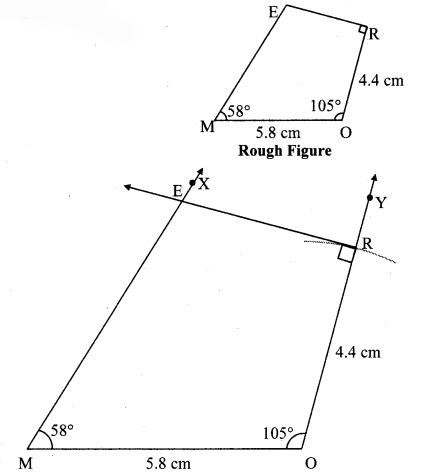
In ∆MORE, l(MO) = 5.8 cm, l(OR) = 4.4 cm, m∠M = 58°, m∠O = 105°, m∠R = 90°.
Solution:
Maharashtra Board Class 8 Maths Solutions Chapter 8 Quadrilateral Constructions and Types Practice Set 8.1 1

Question 2.
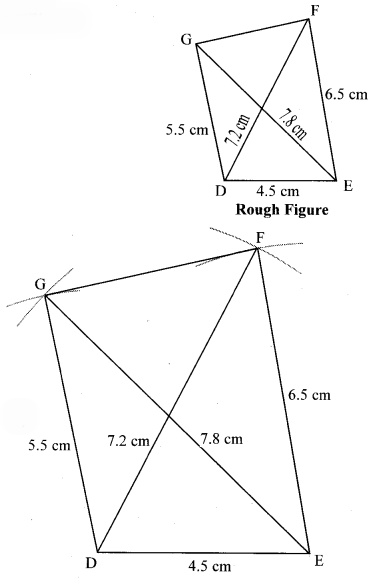
Construct ∆DEFG such that l(DE) = 4.5 cm, l(EF) = 6.5 cm, l(DG) = 5.5 cm, l(DF) = 7.2 cm, l(EG) = 7.8 cm.
Solution:
Maharashtra Board Class 8 Maths Solutions Chapter 8 Quadrilateral Constructions and Types Practice Set 8.1 2

Question 3.
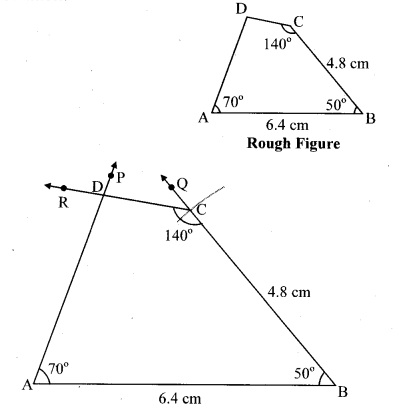
In ∆ABCD, l(AB) = 6.4 cm, l(BC) = 4.8 cm, m∠A = 70°, m∠B = 50°, m∠C = 140°.
Solution:
Maharashtra Board Class 8 Maths Solutions Chapter 8 Quadrilateral Constructions and Types Practice Set 8.1 3

Question 4.
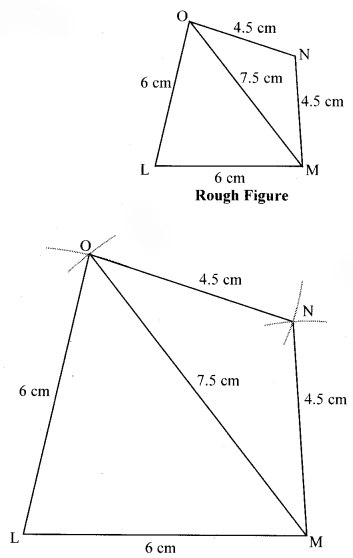
Construct ₹LMNO such that
l(LM) = l(LO) = 6 cm,
l(ON) = l(NM) = 4.5 cm, l(OM) = 7.5 cm.
Solution:
Maharashtra Board Class 8 Maths Solutions Chapter 8 Quadrilateral Constructions and Types Practice Set 8.1 4

Maharashtra Board Class 8 Maths Chapter 8 Quadrilateral: Constructions and Types Practice Set 8.1 Intext Questions and Activities

Question 1.
Construction of a triangle:
Construct the triangles with given measures. (Textbook pg. no. 41)
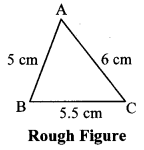
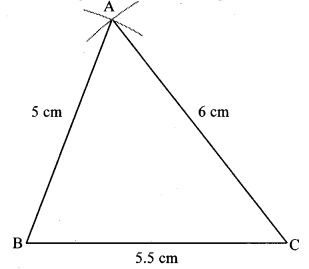
i. ∆ABC: l(AB) = 5 cm, l(BC) = 5.5, l(AC) = 6 cm.
Solution:
Maharashtra Board Class 8 Maths Solutions Chapter 8 Quadrilateral Constructions and Types Practice Set 8.1 5
Steps of construction:
Step 1 : As shown in the rough figure, draw seg BC of length 5.5 cm as the base.
Step 2 : By taking a distance of 5 cm on the compass and placing the metal tip of the compass on point B, draw an arc on one side of BC.
Step 3 : By taking a distance 6 cm on the compass and placing the metal tip of the t compass on point C and draw an arc ’ such that it intersects the previous arc. Name the point as A.
Step 4 : Draw segments AB and AC to get the triangle. ∆ABC is the required triangle.
Maharashtra Board Class 8 Maths Solutions Chapter 8 Quadrilateral Constructions and Types Practice Set 8.1 6

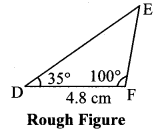
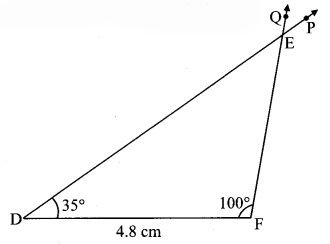
ii. ∆DEF: m∠D = 35°, m∠F = 100°, l(DF) = 4.8 cm.
Solution:
Maharashtra Board Class 8 Maths Solutions Chapter 8 Quadrilateral Constructions and Types Practice Set 8.1 7
Steps of construction:
Step 1 : As shown in the rough figure, draw seg DF of length 4.8 cm as the base.
Step 2 : Placing the centre of the protractor at point D, mark point P such that m∠PDF = 35°.
Step 3 : Placing the centre of the protractor at point F, mark point Q such that m∠QFD = 100°.
Step 4 : Draw ray DP and ray FQ. Name their point of intersection as E.
∆DEF is required triangle.
Maharashtra Board Class 8 Maths Solutions Chapter 8 Quadrilateral Constructions and Types Practice Set 8.1 8

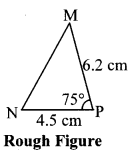
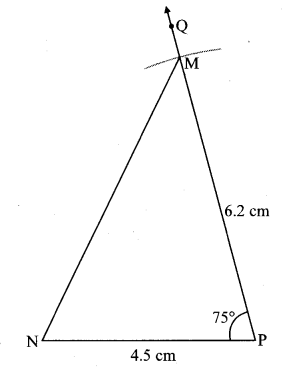
iii. ∆MNP: l(MP) = 6.2 cm, l(NP) = 4.5 cm, m∠P = 75°.
Solution:
Maharashtra Board Class 8 Maths Solutions Chapter 8 Quadrilateral Constructions and Types Practice Set 8.1 9
Steps of construction:
Step 1 : As shown in the rough figure, draw seg PN of length 4.5 cm as the base.
Step 2 : Placing the centre of the protractor at point P, mark point Q such that m∠QPN = 75°.
Step 3 : By taking a distance of 6.2 cm on the compass and placing the metal tip at point P, draw an arc on ray PQ. Name the point as M.
Step 4 : Draw seg MN to get the triangle. ∆MNP is the required triangle.
Maharashtra Board Class 8 Maths Solutions Chapter 8 Quadrilateral Constructions and Types Practice Set 8.1 10

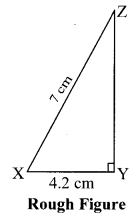
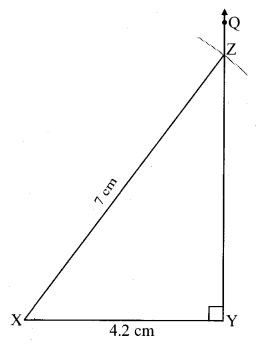
iv. ∆XYZ: m∠Y = 90°, l(XY) = 4.2 cm, l(XZ) = 7 cm.
Solution:
Maharashtra Board Class 8 Maths Solutions Chapter 8 Quadrilateral Constructions and Types Practice Set 8.1 11
Steps of construction:
Step 1 : As shown in the rough figure, draw seg XY of 4.2 cm as the base.
Step 2 : Placing the centre of the protractor at point Y, mark point Q such that m∠QYX = 90°.
Step 3 : By taking a distance of 7 cm on the compass and placing the metal tip on point X, draw an arc on ray YQ. Name the point as Z.
Step 4 : Draw seg XZ to get the triangle. ∆XYZ is the required triangle.
Maharashtra Board Class 8 Maths Solutions Chapter 8 Quadrilateral Constructions and Types Practice Set 8.1 12

Maharashtra Board Class 8 Maths Solutions Chapter 8 Quadrilateral: Constructions and Types Practice Set 8.3

Balbharti Maharashtra State Board Class 8 Maths Solutions covers the Practice Set 8.3 8th Std Maths Answers Solutions Chapter 8 Quadrilateral: Constructions and Types.

Practice Set 8.3 8th Std Maths Answers Chapter 8 Quadrilateral: Constructions and Types

Question 1.
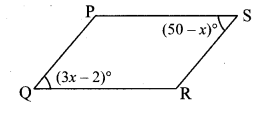
Measures of opposite angles of a parallelogram are (3x – 2)° and (50 – x)°. Find the measure of its each angle.
Solution:
Let ₹PQRS be the parallelogram.
m∠Q = (3x – 2)° and m∠S = (50 – x)°
Maharashtra Board Class 8 Maths Solutions Chapter 8 Quadrilateral Constructions and Types Practice Set 8.3 1
m∠Q = m∠S
…..(i)
[Opposite angles of a parallelogram are congruent]
∴ 3x – 2 = 50 – x
∴ 3x + x = 50 + 2
∴ 4x = 52
∴ x = \(\frac { 52 }{ 4 }\)
∴ x = 13
Now, m∠Q = (3x – 2)°
= (3 x 13 – 2)° = (39 – 2)° = 37°
∴ m∠S = m∠Q = 37° …[From(i)]
m∠P + m∠Q = 180°
….[Adjacent angles of a parallelogram are supplementary]
∴ m∠P + 37° = 180°
∴ m∠P = 180° – 37° = 143°
∴ m∠R = m∠P = 143°
…..[Opposite angles of a parallelogram are congruent]
∴ The measures of the angles of the parallelogram are 37°, 143°, 37° and 143°.

Question 2.
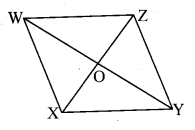
Referring the given figure of a parallelogram, write the answers of questions given below.
i. If l(WZ) = 4.5 cm, then l(XY) = ?
ii. If l(YZ) = 8.2 cm, then l(XW) = ?
iii. If l(OX) = 2.5 cm, then l(OZ) = ?
iv. If l(WO) = 3.3 cm, then l(WY) = ?
v. If m∠WZY = 120°, then m∠WXY = ? and m∠XWZ = ?
Maharashtra Board Class 8 Maths Solutions Chapter 8 Quadrilateral Constructions and Types Practice Set 8.3 2
Solution:
i. l(WZ) = 4.5 cm … [Given]
l(X Y) = l(WZ) ….[Opposite sides of a parallelogram are congrument ]
∴ l(X Y) = 4.5cm

ii. l(YZ) = 8.2 cm …[Given]
l(XW) = l(YZ)
…[Opposite sides of a parallelogram are congruent]
∴ l(XW) = 8.2cm … [Given]

iii. l(OX) = 2.5 cm …[Given]
l(OZ) = l(OX)
….[Diagonals of a parallelogram bisect each other]
∴ l(OZ) = 2.5cm

iv. l(WO) = 3.3 cm … [Given]
l(WO) = \(\frac { 1 }{ 2 }\) l(WY)
….[Diagonals of a parallelogram bisect each other]
∴ 3.3 = \(\frac { 1 }{ 2 }\) l(WY)
∴ 3.3 x 2 = l(WY)
∴ l(WY) = 6.6cm

v. m∠WZY =120° … [Given]
m∠WXY = m∠WZY
…..[Opposite angles of a parallelogram are congrument]
∴ m∠WXY = 120° …(i)
m∠XWZ + m∠WXY = 180°
….[Adjacent angles of a parallelogram are supplementary]
∴ m∠XWZ + 120° = 180° … [From (i)]
∴ m∠XWZ = 180°- 120°
∴ m∠XWZ = 60°

Question 3.
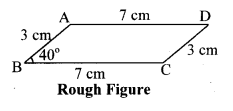
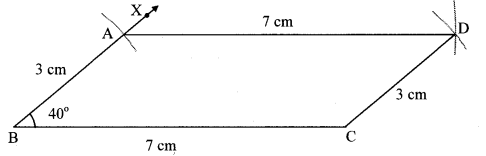
Construct a parallelogram ABCD such that l(BC) = 7 cm, m∠ABC = 40°, l(AB) = 3 cm
Solution:
Maharashtra Board Class 8 Maths Solutions Chapter 8 Quadrilateral Constructions and Types Practice Set 8.3 3
Opposite sides of a parallelogram are congruent.
∴ l(AB) = l(CD) = 3cm
l(BC) = l(AD) = 7 cm
Maharashtra Board Class 8 Maths Solutions Chapter 8 Quadrilateral Constructions and Types Practice Set 8.3 4

Question 4.
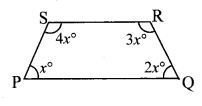
Ratio of consecutive angles of a quadrilateral is 1 : 2 : 3 : 4. Find the measure of its each angle. Write with reason, what type of a quadrilateral it is.
Solution:
Let ₹PQRS be the quadrilateral.
Ratio of consecutive angles of a quadrilateral is 1 : 2 : 3 : 4.
Let the common multiple be x.
∴m∠P = x°, m∠Q = 2x°, m∠R = 3x° and m∠S = 4x°
In ₹PQRS,
m∠P + m∠Q + m∠R + m∠S = 360°
…[Sum of the measures of the angles of a quadrilateral is 360°]
∴x° + 2x° + 3x° + 4x° = 360°
∴10 x° = 360°
∴x° = \(\frac { 360 }{ 10 }\)
∴x° = 36°
∴m∠P = x° = 36°
Maharashtra Board Class 8 Maths Solutions Chapter 8 Quadrilateral Constructions and Types Practice Set 8.3 5
m∠Q = 2x° = 2 × 36° = 72°
m∠R = 3x° = 3 × 36° = 108° and
m∠S = 4x° = 4 × 36° = 144°
∴The measures of the angles of the quadrilateral are 36°, 72°, 108°, 144°.
Here, m∠P + m∠S = 36° + 144° = 180°
Since, interior angles are supplementary,
∴side PQ || side SR
m∠P + m∠Q = 36° + 72° = 108° ≠ 180°
∴side PS is not parallel to side QR.
Since, one pair of opposite sides of the given quadrilateral is parallel.
∴The given quadrilateral is a trapezium.

Question 5.
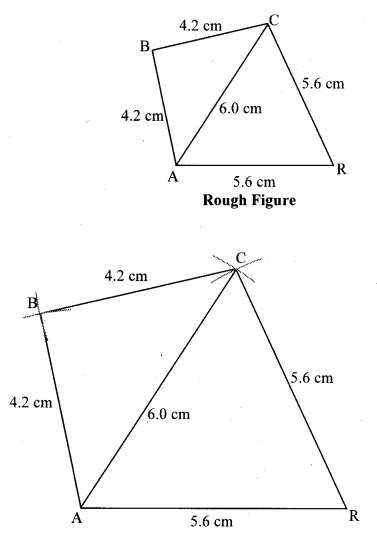
Construct ₹BARC such that
l(BA) = l(BC) = 4.2 cm, l(AC) = 6.0 cm, l(AR) = l(CR) = 5.6 cm
Solution:
Maharashtra Board Class 8 Maths Solutions Chapter 8 Quadrilateral Constructions and Types Practice Set 8.3 6

Question 6.
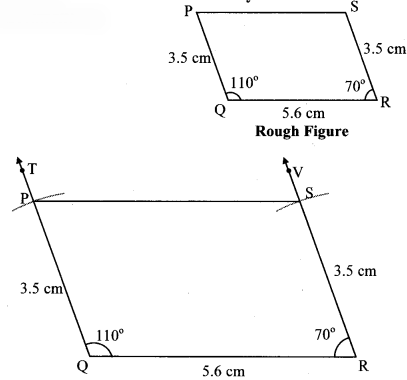
Construct ₹PQRS, such that l(PQ) = 3.5 cm, l(QR) = 5.6 cm, l(RS) = 3.5 cm, m∠Q = 110°, m∠R = 70°. If it is given that ₹PQRS is a parallelogram, which of the given information is unnecessary?
Solution:
Maharashtra Board Class 8 Maths Solutions Chapter 8 Quadrilateral Constructions and Types Practice Set 8.3 7

  1. Since, the opposite sides of a parallelogram are congruent.
    ∴ Either l(PQ) or l(SR) is required.
  2. To construct a parallelogram lengths of adjacent sides and measure of one angle is required.
    ∴ Either l(PQ) and m∠Q or l(SR) and m∠R is the unnecessary information given in the question.

Maharashtra Board Class 8 Maths Chapter 8 Quadrilateral: Constructions and Types Practice Set 8.3 Intext Questions and Activities

Question 1.
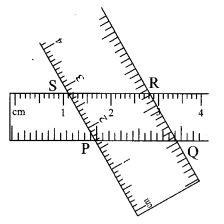
Draw a parallelogram PQRS. Take two rulers of different widths, place one ruler horizontally and draw lines along its edges. Now place the other ruler in slant position over the lines drawn and draw lines along its edges. We get a parallelogram. Draw the diagonals of it and name the point of intersection as T.

  1. Measure the opposite angles of the parallelogram.
  2. Measure the lengths of opposite sides.
  3. Measure the lengths of diagonals.
  4. Measure the lengths of parts of the diagonals made by point T. (Textbook pg. no. 47)

Maharashtra Board Class 8 Maths Solutions Chapter 8 Quadrilateral Constructions and Types Practice Set 8.3 8

Solution:
[Students should attempt the above activities on their own.]

Question 2.
In the given figure of ₹ABCD, verify with a divider that seg AB ≅ seg CB and seg AD ≅ seg CD. Similarly measure ∠BAD and ∠BCD and verify that they are congruent. (Textbook pg. no. 48)
Maharashtra Board Class 8 Maths Solutions Chapter 8 Quadrilateral Constructions and Types Practice Set 8.3 9
Solution:
[Students should attempt the above activities on their own.]