Maharashtra Board Practice Set 1 Class 7 Maths Solutions Chapter 1 Geometrical Constructions

Balbharti Maharashtra State Board Class 7 Maths Solutions covers the 7th Std Maths Practice Set 1 Answers Solutions Chapter 1 Geometrical Constructions.

Geometrical Constructions Class 7 Practice Set 1 Answers Solutions Chapter 1

Question 1.
Draw line segments of the lengths given below and draw their perpendicular bisectors:
i. 5.3 cm
ii. 6.7 cm
iii. 3.8 cm
Solution:
i.
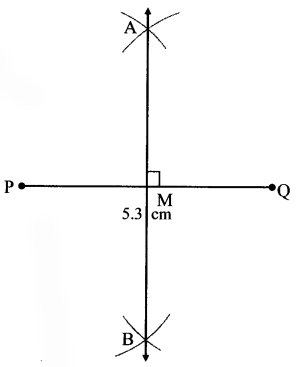
Maharashtra Board Class 7 Maths Solutions Chapter 1 Geometrical Constructions Practice Set 1 1
Line AB is the perpendicular bisector of seg PQ.

ii.
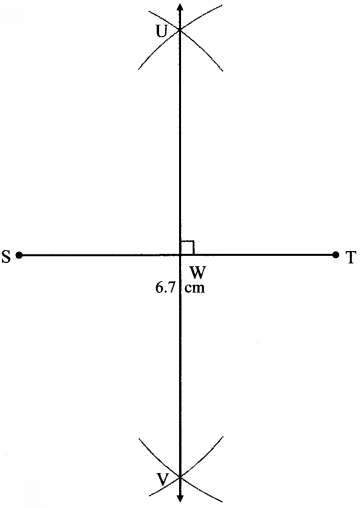
Maharashtra Board Class 7 Maths Solutions Chapter 1 Geometrical Constructions Practice Set 1 2
Line UV is the perpendicular bisector of seg ST.

iii.
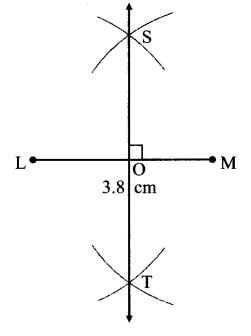
Maharashtra Board Class 7 Maths Solutions Chapter 1 Geometrical Constructions Practice Set 1 3
Line ST is the perpendicular bisector of seg LM.

Question 2.
Draw angles of the measures given below and draw their bisectors:
i. 105°
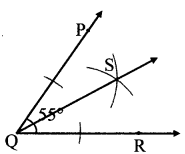
ii. 55°
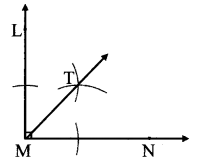
iii. 90°
Solution:
i. 105°
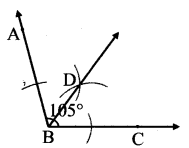
Maharashtra Board Class 7 Maths Solutions Chapter 1 Geometrical Constructions Practice Set 1 4

ii. 55°
Maharashtra Board Class 7 Maths Solutions Chapter 1 Geometrical Constructions Practice Set 1 5

iii. 90°
Maharashtra Board Class 7 Maths Solutions Chapter 1 Geometrical Constructions Practice Set 1 6

Question 3.
Draw, an obtuse-angled triangle and a right-angled triangle. Find the points of concurrence of the angle bisectors of each triangle. Where do the points of concurrence lie?
Solution:
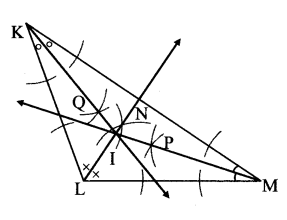
Maharashtra Board Class 7 Maths Solutions Chapter 1 Geometrical Constructions Practice Set 1 7
The points of concurrence of the angle bisectors of both the triangles lie in the interior of the triangles.

Question 4.
Draw a right-angled triangle. Draw the perpendicular bisectors of its sides. Where does the point of concurrence lie?
Solution:
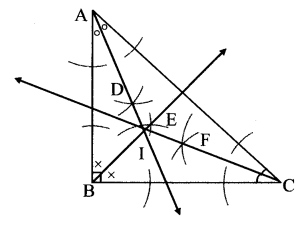
Maharashtra Board Class 7 Maths Solutions Chapter 1 Geometrical Constructions Practice Set 1 8
The point of concurrence of the perpendicular bisectors of the sides of the right angled triangle lies on the hypotenuse.

Question 5.
Maithili, Shaila and Ajay live in three different places in the city. A toy shop is equidistant from the three houses. Which geometrical construction should be used to represent this? Explain your answer.
Solution:
Since, Maithili, Shaila and Ajay live in three different places, lines joining their houses will form a triangle.
The position of the toy shop which is equidistant from three houses can be found out by drawing the perpendicular bisector of the sides of the triangle joining the three houses.
The shop will be at the point of concurrence of the perpendicular bisectors.

Maharashtra Board Class 7 Maths Chapter 1 Geometrical Constructions Practice Set 1 Intext Questions and Activities

Question 1.
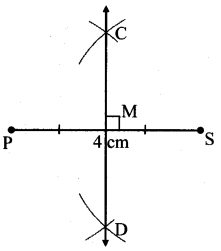
Draw a line segment PS of length 4cm and draw its perpendicular bisector. (Textbook pg. no. 1)

  1. How will your verify that CD is the perpendicular bisector? m∠CMS = __°
  2. Is l(PM) = l(SM)?

Solution:
Maharashtra Board Class 7 Maths Solutions Chapter 1 Geometrical Constructions Practice Set 1 9

  1. Here, m∠CMS = 90°
  2. Also, l(PM) = l(SM) = 2cm
    ∴ line CD is the perpendicular bisector of seg PS.

Maharashtra Board Practice Set 23 Class 6 Maths Solutions Chapter 9 HCF-LCM

Balbharti Maharashtra State Board Class 6 Maths Solutions covers the Std 6 Maths Chapter 9 HCF-LCM Class 6 Practice Set 23 Answers Solutions.
6th Standard Maths Practice Set 23 Answers Chapter 9 HCF-LCM

Question 1.
Write all the factors of the given numbers and list their common factors:
i. 12, 16
ii. 21, 24
iii. 25, 30
iv. 24, 25
v. 56, 72
Solution:
i. Factors of 12 = 1, 2, 3, 4, 6, 12
Factors of 16 = 1, 2, 4, 8, 16
∴ Common factors of 12 and 16 = 1, 2, 4

ii. Factors of 21 = 1, 3, 7, 21
Factors of 24 = 1, 2, 3, 4, 6, 8, 12, 24
∴ Common factors of 21 and 24 = 1, 3

iii. Factors of 25 = 1, 5, 25
Factors of 30 = 1, 2, 3, 5, 6, 10, 15, 30
∴ Common factors of 25 and 30 = 1, 5

iv. Factors of 24 = 1, 2, 3, 4, 6, 8, 12, 24
Factors of 25 = 1,5, 25
∴ Common factor of 24 and 25 = 1

v. Factors of 56 = 1, 2, 4, 7, 8, 14, 28, 56
Factors of 72 = 1, 2, 3, 4, 6, 8, 9, 12, 18, 24, 36, 72
∴ Common factors of 56 and 72 = 1, 2, 4, 8

Maharashtra Board Class 6 Maths Chapter 9 HCF-LCM Practice Set 23 Intext Questions and Activities

Question 1.
In the empty boxes, write the proper words: dividend, divisor, quotient, remainder. (Textbook pg. no. 46)
Maharashtra Board Class 6 Maths Solutions Chapter 9 HCF-LCM Practice Set 23 1
Solution:
Maharashtra Board Class 6 Maths Solutions Chapter 9 HCF-LCM Practice Set 23 2

When we divide 36 by 4, the remainder is zero. Therefore, 4 is a factor of 36 and 36 is a multiple of 4. But, when we divide 65 by 9, the remainder is not zero. Therefore, 9 is not a factor of 65. Also, 65 is not a multiple of 9.

Question 2.
Write all the factors of the numbers 36 and 48. Also, list their common factors. (Textbook pg. no. 46)
Solution:
36 = 1 × 36
= 2 × 18
= 3 × 12
= 4 × 9
= 6 × 6

48 = 1 × 48
= 2 × 24
= 3 × 16
= 4 × 12
= 6 × 8

∴ Factors of 36: 1, 2, 3, 4, 6, 9, 12, 18, 36
Factors of 48: 1, 2, 3, 4, 6, 8, 12, 16, 24, 48
Common factors of 36 and 48: [1] ,[2], [3], [4], [6], [12]

Maharashtra Board Practice Set 32 Class 6 Maths Solutions Chapter 13 Profit-Loss

Balbharti Maharashtra State Board Class 6 Maths Solutions covers the Std 6 Maths Chapter 13 Profit-Loss Class 6 Practice Set 32 Answers Solutions.

6th Standard Maths Practice Set 32 Answers Chapter 13 Profit-Loss

Question 1.
From a wholesaler, Santosh bought 400 eggs for Rs 1500 and spent Rs 300 on transport. 50 eggs fell down and broke. He sold the rest at Rs 5 each. Did he make a profit or a loss? How much?
Solution:
Cost price of 400 eggs = Rs 1500
Transportation cost = Rs 300
∴ Total cost price of 400 eggs = Cost price of 400 eggs + Transportation cost
= 1500 + 300 = Rs 1800
50 eggs fell and broke
∴ Remaining eggs = 400 – 50 = 350
Selling price of 1 egg = Rs 5
∴ Selling price of 350 eggs = 5 x 350 = Rs 1750
Total cost price is greater than the selling price.
∴ Santosh suffered a loss.
Loss = Total cost price – Selling price
= 1800 – 1750
= Rs 50
∴ Santosh incurred a loss of Rs 50.

Question 2.
Abraham bought goods worth Rs 50000 and spent Rs 7000 on transport and octroi. If he sold the goods for Rs 65000, did he make a profit or a loss? How much?
Solution:
Cost price of goods = Rs 50000
Transportation cost and octroi = Rs 7000
∴ Total cost price for buying goods = Cost price of goods + Transportation cost and octroi
= 50000 + 7000 = Rs 57000
Selling price of goods = Rs 65000
Selling price is greater than the total cost price
∴ Abraham made a profit.
Profit = Selling price – Total cost price
= 65000 – 57000
= Rs 8000
∴ Abraham made a profit of Rs 8000.

Question 3.
Ajit Kaur bought a 50 kg sack of sugar for Rs 1750, but as sugar prices fell, she had to sell it at Rs 32 per kg. How much loss did she incur?
Solution:
Cost price of 50 kg sugar = Rs 1750
Selling price of 1 kg sugar = Rs 32
∴ Selling price of 50 kg sugar = 50 x 32 = Rs 1600
Loss = Total cost price – Selling price
= 1750 – 1600 = Rs 150
∴ Ajit Kaur incurred a loss of Rs 150.

Question 4.
Kusumtai bought 80 cookers at Rs 700 each. Transport cost her Rs 1280. If she wants a profit of Rs 18000, what should be the selling price per cooker?
Solution:
Cost price of one cooker = Rs 700
∴ Cost price of 80 cookers = 700 x 80 = Rs 56000
Transportation cost = Rs 1280
∴ Total cost price = Cost price of 80 cookers + Transportation cost
= 56000 + 1280
= Rs 57280
Profit = Rs 18000
Profit = Selling Price – Total Cost Price
∴ Required selling price = Total cost price + profit
= 57280 + 18000
= Rs 75280
∴ Selling price of 80 cookers = Rs 75280
∴ Selling price of 1 cooker = \(\frac { 75280 }{ 80 }\) = Rs 941
∴ The selling price per cooker should be Rs 941.

Question 5.
Indrajit bought 10 refrigerators at Rs 12000 each and spent Rs 5000 on transport. For how much should he sell each refrigerator in order to make a profit of Rs 20000?
Solution:
Cost price of 1 refrigerator = Rs 12000
Cost price of 10 refrigerator = 10 x 12000 = Rs 120000
Transportation cost = Rs 5000
∴ Total cost price of 10 refrigerators = Cost price of 10 refrigerators + Transportation cost
= 120000 + 5000 = Rs 125000
Profit = Rs 20000
Profit = Selling Price – Total Cost Price
∴ Required selling price = Total cost price + Profit
= 125000 + 20000 = Rs 145000
∴ Selling price of 10 refrigerators = Rs 145000
∴ Selling price of 1 refrigerator = \(\frac { 145000 }{ 10 }\) = Rs 14500
∴ Indrajit must sell each refrigerator at Rs 14500 to make a profit of Rs 20000.

Question 6.
Lalitabai sowed seeds worth Rs 13700 in her field. She had to spend Rs 5300 on fertilizers and spraying pesticides and Rs 7160 on labor. If, on selling her produce, she earned Rs 35400 what was her profit or her loss?
Solution:
Cost price of seeds = Rs 13700
Cost of fertilizers and pesticides = Rs 5300
Labor cost = Rs 7160
∴ Total cost price = Cost price of seeds + Cost of fertilizers and pesticides + Labor cost
= 13700 + 5300 + 7160
= Rs 26160
Selling price = Rs 35400
Selling price is greater than the total cost price.
∴ Lalitabai made a profit.
Profit = Selling price – Cost price
= 35400 – 26160
= Rs 9240
∴ Lalitabai made a profit of Rs 9240.

Maharashtra Board Class 6 Maths Chapter 13 Profit-Loss Practice Set 32 Intext Questions and Activities

Question 1.
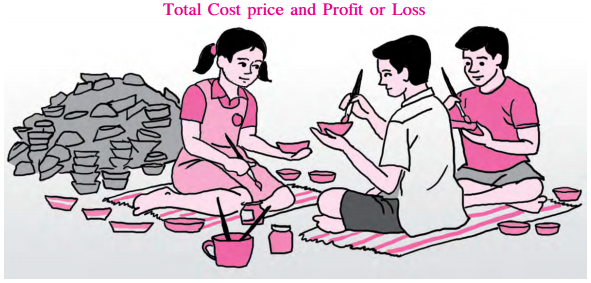
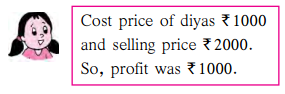
At Diwali, in a certain school, the students undertook a Design a Diya project. They bought 1000 diyas for Rs 1000 and some paint for Rs 200. To bring the diyas to the school, they spent Rs 100 on transport. They sold the painted lamps at Rs 2 each. Did they make a profit or incur a loss? (Textbook pg. no. 67 and 68)
Maharashtra Board Class 6 Maths Solutions Chapter 13 Profit-Loss Practice Set 32 1
i. Is Anju right?
ii. What about the money spent on paints and transport?
iii. How much money was actually spent before the diyas could be sold?
iv. How much actual profit was made in this project of colouring the diyas and selling them?
Maharashtra Board Class 6 Maths Solutions Chapter 13 Profit-Loss Practice Set 32 2
Ans:
i. No, Anju is wrong.
Cost price of diyas also includes the painting and transportation cost.
∴ Total cost price of diyas = Cost of diyas + Cost of paint + Transportation cost
= 1000 + 200+ 100
= Rs 1300
ii. The cost of paint was Rs 200 and that for transportation was Rs 100. These costs are also to be added to the cost price of diyas.
iii. Rs 1300 was actually spent before the diyas could be sold.
iv. Total Cost Price of 1000 Diyas = Rs 1300
Selling Price of 1 Diya = Rs 2
∴ Selling Price of 1000 Diyas = 2 x 1000 = Rs 2000
∴ Profit = Selling Price – Total Cost Price
= 2000 – 1300
= Rs 700
∴ The profit made by coloring the diyas and selling them was Rs 700.

Question 2.
A farmer sells what he grows in his fields. How is the total cost price calculated? What does a farmer spend on his produce before he can sell it? What are the other expenses besides seeds, fertilizers and transport? (Textbook pg. no. 68)
Solution:
The farmer, in order to calculate the total cost price of his produce, needs to consider all the expenses associated with the growing and selling of his produce.

Following are the things on which farmer spends money before he can sell it.

  1. Time and energy
  2. Ploughing and tilling
  3. Irrigation and electricity cost
  4. Harvesting and cleaning
  5. Packing

As given above, there are a multiple of costs to be included besides seeds, fertilizers and transport for the farmer to price its produce appropriately.

Maharashtra Board Practice Set 10 Class 6 Maths Solutions Chapter 4 Operations on Fractions

Balbharti Maharashtra State Board Class 6 Maths Solutions covers the Std 6 Maths Chapter 4 Operations on Fractions Class 6 Practice Set 10 Answers Solutions.

6th Standard Maths Practice Set 10 Answers Chapter 4 Operations on Fractions

Question 1.
Add:
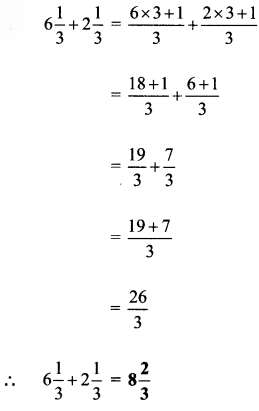
i. \(6 \frac{1}{3}+2 \frac{1}{3}\)
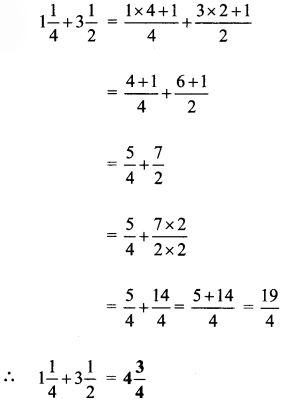
ii. \(1 \frac{1}{4}+3 \frac{1}{2}\)
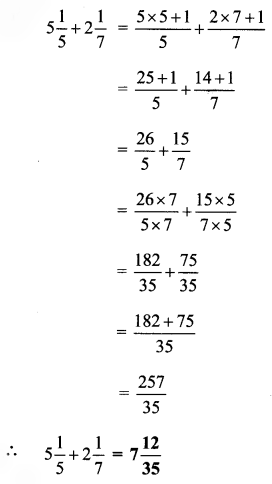
iii. \(5 \frac{1}{5}+2 \frac{1}{7}\)
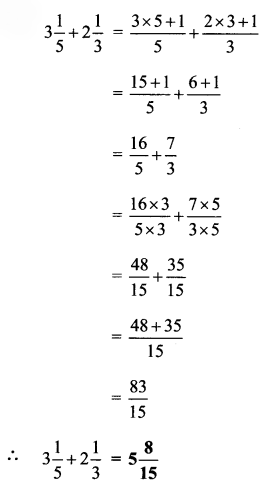
iv. \(3 \frac{1}{5}+2 \frac{1}{3}\)
Solution:
i. \(6 \frac{1}{3}+2 \frac{1}{3}\)
Maharashtra Board Class 6 Maths Solutions Chapter 4 Operations on Fractions Practice Set 10 1

ii. \(1 \frac{1}{4}+3 \frac{1}{2}\)
Maharashtra Board Class 6 Maths Solutions Chapter 4 Operations on Fractions Practice Set 10 2

iii. \(5 \frac{1}{5}+2 \frac{1}{7}\)
Maharashtra Board Class 6 Maths Solutions Chapter 4 Operations on Fractions Practice Set 10 3

iv. \(3 \frac{1}{5}+2 \frac{1}{3}\)
Maharashtra Board Class 6 Maths Solutions Chapter 4 Operations on Fractions Practice Set 10 4

Question 2.
Subtract:
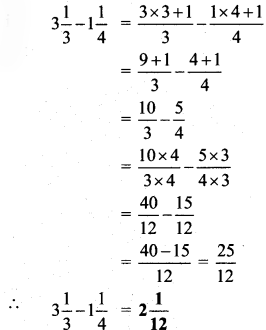
i. \(3 \frac{1}{3}-1 \frac{1}{4}\)
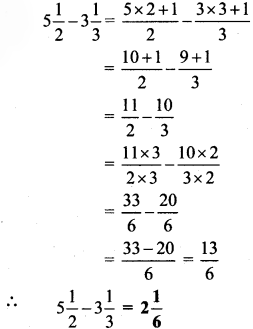
ii. \(5 \frac{1}{2}-3 \frac{1}{3}\)
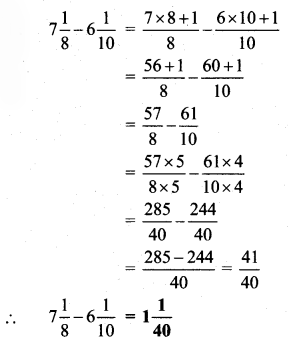
iii. \(7 \frac{1}{8}-6 \frac{1}{10}\)
iv. \(7 \frac{1}{2}-3 \frac{1}{5}\)
Solution:
i. \(3 \frac{1}{3}-1 \frac{1}{4}\)
Maharashtra Board Class 6 Maths Solutions Chapter 4 Operations on Fractions Practice Set 10 5

ii. \(5 \frac{1}{2}-3 \frac{1}{3}\)
Maharashtra Board Class 6 Maths Solutions Chapter 4 Operations on Fractions Practice Set 10 6

iii. \(7 \frac{1}{8}-6 \frac{1}{10}\)
Maharashtra Board Class 6 Maths Solutions Chapter 4 Operations on Fractions Practice Set 10 7

iv. \(7 \frac{1}{2}-3 \frac{1}{5}\)
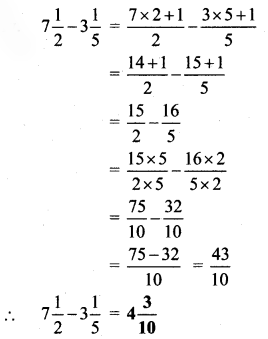
Maharashtra Board Class 6 Maths Solutions Chapter 4 Operations on Fractions Practice Set 10 8

Question 3.
Solve:
i. Suyash bought \(2\frac { 1 }{ 2 }\) kg of sugar and Ashish bought \(3\frac { 1 }{ 2 }\) kg. How much sugar did they buy altogether? If sugar costs Rs 32 per kg, how much did they spend on the sugar they bought?

ii. Aradhana grows potatoes in \(\frac { 2 }{ 5 }\) part of her garden, greens in \(\frac { 1 }{ 3 }\) part and brinjals in the remaining part. On how much of her plot did she plant brinjals?

iii. Sandeep filled water in \(\frac { 4 }{ 7 }\) of an empty tank. After that, Ramakant filled \(\frac { 1 }{ 4 }\) part more of the same tank. Then Umesh used \(\frac { 3 }{ 14 }\) part of the tank to water the garden. If the tank has a maximum capacity of 560 litres, how many litres of water will be left in the tank?
Solution:
i. Sugar bought by Suyash = \(2\frac { 1 }{ 2 }\) kg
Sugar bought by Ashish = \(3\frac { 1 }{ 2 }\) kg
∴ Total sugar bought by both
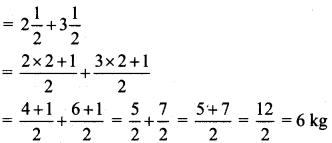
Maharashtra Board Class 6 Maths Solutions Chapter 4 Operations on Fractions Practice Set 10 9
Cost of 1 kg of sugar = Rs 32
∴ Cost of 6 kg of sugar = 32 x 6
= Rs 192
∴ They bought 6 kg sugar altogether and the total money spent on sugar is Rs 192.

ii. Part of garden occupied by potatoes = \(\frac { 2 }{ 5 }\)
Part of garden occupied by greens = \(\frac { 1 }{ 3 }\)
Since brinjals are planted in the remaining part,
∴ (Part occupied by potatoes) + (part occupied by greens) + (part occupied by brinjals) = 1 entire garden.
∴ Part of garden occupied by brinjals = 1 – (part of garden occupied by potatoes + part of garden occupied by greens)
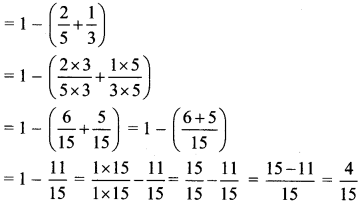
Maharashtra Board Class 6 Maths Solutions Chapter 4 Operations on Fractions Practice Set 10 10
∴ Aradhana planted brinjals on \(\frac { 4 }{ 15 }\) part of her plot.

iii. Part of tank filled by Sandeep = \(\frac { 4 }{ 7 }\)
Part of tank filled by Ramakant = \(\frac { 1 }{ 4 }\)
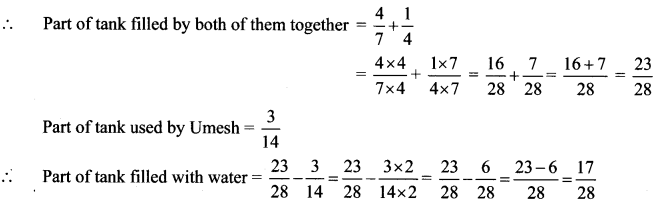
Maharashtra Board Class 6 Maths Solutions Chapter 4 Operations on Fractions Practice Set 10 11
Since maximum capacity of tank is 560 litres
∴ Quantity of water left in tank = \(\frac { 17 }{ 28 }\times560\) = 340 litres
∴ The quantity of water left in the tank is 340 litres.

Maharashtra Board Class 6 Maths Chapter 4 Operations on Fractions Practice Set 10 Intext Questions and Activities

Question 1.
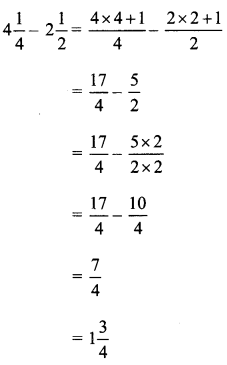
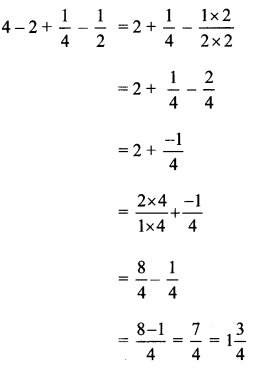
How to do this subtraction: \(4 \frac{1}{4}-2 \frac{1}{2}\) ? Is it same as \(\left[4-2+\frac{1}{4}-\frac{1}{2}\right]\) ? (Textbook pg. no. 23)
Solution:
\(4 \frac{1}{4}-2 \frac{1}{2}\)
Maharashtra Board Class 6 Maths Solutions Chapter 4 Operations on Fractions Practice Set 10 12

\(\left[4-2+\frac{1}{4}-\frac{1}{2}\right]\)
Maharashtra Board Class 6 Maths Solutions Chapter 4 Operations on Fractions Practice Set 10 13

The subtraction \(4 \frac{1}{4}-2 \frac{1}{2}\) is the same as \(\left[4-2+\frac{1}{4}-\frac{1}{2}\right]\).

Maharashtra Board Practice Set 31 Class 6 Maths Solutions Chapter 13 Profit-Loss

Balbharti Maharashtra State Board Class 6 Maths Solutions covers the Std 6 Maths Chapter 13 Profit-Loss Class 6 Practice Set 31 Answers Solutions.

6th Standard Maths Practice Set 31 Answers Chapter 13 Profit-Loss

Question 1.
The cost price and selling price are given in the following table. Find out whether there was a profit or a loss and how much it was.

Ex.Cost price (in Rs)Selling price (in Rs)Profit or LossHow much?
i.45005000
ii.41004090
iii.700799
iv.1000920

Solution:

i. Cost price = Rs 4500
Selling price = Rs 5000
Selling price is greater than cost price.
∴ There is a profit.
∴ Profit = Selling price – Cost price
= 5000 – 4500
Profit = Rs 500

ii. Cost price = Rs 4100
Selling price = Rs 4090
Cost price is greater than selling price.
∴ There is a loss.
∴ Loss = Cost price – Selling price
= 4100 – 4090
∴ Loss = Rs 10

iii. Cost price = Rs 700
Selling price = Rs 799
Selling price is greater than cost price.
∴ There is a profit.
∴ Profit = Selling price – Cost price
= 799 – 700
∴ Profit = Rs 99

iv. Cost price = Rs 1000
Selling price = Rs 920
Cost price is greater than selling price.
∴ There is a loss.
∴ Loss = Cost price – Selling price
= 1000 – 920
∴ Loss = Rs 80

Ex.Cost price (in Rs)Selling price (in Rs)Profit or LossHow much?
i.45005000ProfitRs 500
ii.41004090LossRs 10
iii.700799ProfitRs 99
iv.1000920LossRs 80

Question 2.
A shopkeeper bought a bicycle for Rs 3000 and sold the same for Rs 3400. How much was his profit?
Solution:
Cost price = Rs 3000, Selling price = Rs 3400
∴ Profit = Selling price – Cost price
= 3400 – 3000
= Rs 400
The shopkeeper’s profit was Rs 400.

Question 3.
Sunandabai bought milk for Rs 475. She converted it into yogurt and sold it for Rs 700. How much profit did she make?
Solution:
∴ Cost price = Rs 475, Selling price = Rs 700
∴ Profit = Selling price – Cost price
= 700 – 475
= Rs 225
∴ Sunandabai made a profit of Rs 225.

Question 4.
The Jijamata Women’s Saving Group bought raw materials worth Rs 15000 for making chakalis.
They sold the chakalis for Rs 22050. How much profit did the WSG make?
Solution:
Cost price of raw materials = Rs 15000
Selling price of chakalis = Rs 22050
∴ Profit = Selling price – Cost price
= 22050 – 15000
= Rs 7050
∴ The Women’s Saving Group made a profit of Rs 7050.

Question 5.
Pramod bought 100 bunches of methi greens for Rs 400. In a sudden downpour, 30 of the bunches on his handcart got spoil. He sold the rest at the rate of Rs 5 each. Did he make a profit or a loss? How much?
Solution:
Cost price of 100 bunches of methi green = Rs 400
Since, 30 bunches got spoil,
∴ Remaining bunches of methi green = 100 – 30 = 70
Selling price of 1 bunch of methi green = Rs 5
∴ Selling price of 70 bunches of methi green = 5 x 70 = Rs 350
Cost price is greater than selling price
∴ Pramod suffered a loss.
Loss = Cost price – Selling price
= 400 – 350
= Rs 50
∴ Pramod suffered a loss of Rs 50.

Question 6.
Sharad bought one quintal of onions for Rs 2000. Later he sold them all at the rate of Rs 18 per kg. Did he make a profit or incur a loss? How much was it?
Solution:
Cost price of one quintal onions = Rs 2000
Selling price of 1 kg onions = Rs 18
Since, 1 quintal = 100 kg
∴ Selling price of 1 quintal (100 kg) onions = 18 x 100 = Rs 1800
Cost price is greater than selling price
∴ Sharad suffered a loss.
∴ Loss = Cost price – Selling price
= Rs 2000 – Rs 1800
= Rs 200
∴ Sharad incurred a loss of Rs 200.

Question 7.
Kantabai bought 25 saris from a wholesale merchant for Rs 10000 and sold them all at Rs 460 each. How much profit did Kantabai get in this transaction?
Solution:
Cost price of 25 saris = Rs 10000
Selling price of 1 sari = Rs 460
∴ Selling price of 25 saris = 460 x 25 = Rs 11500
Selling price is greater than cost price.
∴ Profit = Selling price – Cost price
= 11500 – 10000
= Rs 1500
∴ Kantabai made a profit of Rs 1500.

Maharashtra Board Class 6 Maths Chapter 13 Profit-Loss Practice Set 31 Intext Questions and Activities

Question 1.
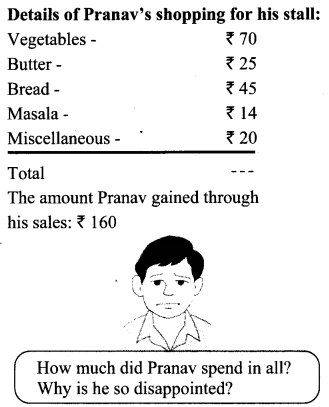
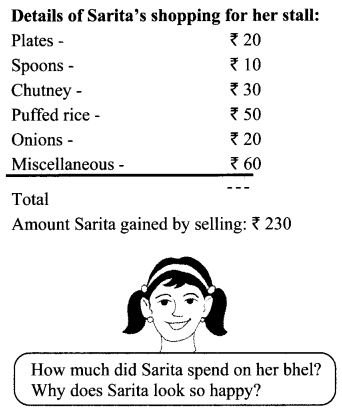
Pranav and sarita had set up stalls in a fun fair. Study the data given below and answer the questions. (Textbook pg. no. 65)
Maharashtra Board Class 6 Maths Solutions Chapter 13 Profit-Loss Practice Set 31 1
Maharashtra Board Class 6 Maths Solutions Chapter 13 Profit-Loss Practice Set 31 2
Solution:
Total amount invested by Pranav = 70 + 25 + 45 + 14 + 20 = Rs 174
Amount gained through sale = Rs 160
∴ Selling price is less than invested price.
∴ Pranav incurred a loss in his Pav Bhaji business. Hence, he is disappointed.

Total amount invested by Sarita = 20 + 10 + 30 + 50 + 20 + 60 = Rs 190
Amount gained by selling = Rs 230
∴ Selling price is more than invested price.
∴ Sarita made profit in her business. Hence, she is happy.

Question 2.
For the above example,

  1. If Sarita had bought twice as much, would she have gained twice as much?
  2. What should Pranav do the next time he sets up a stall to sell more pav bhaji and make more gains? (Textbook pg. no. 66)

Solution:

  1. If Sarita would have bought twice as much, she would have prepared double quantity of food items. Hence, she would have gained twice as much.
  2. Next time Pranav sets a stall, he must sell pav bhaji at a higher cost than he had sold earlier in order to make more gains.

Maharashtra Board Practice Set 31 Class 7 Maths Solutions Chapter 7 Joint Bar Graph

Balbharti Maharashtra State Board Class 7 Maths Solutions covers the 7th Std Maths Practice Set 31 Answers Solutions Chapter 7 Joint Bar Graph.

Joint Bar Graph Class 7 Practice Set 31 Answers Solutions Chapter 7

Question 1.
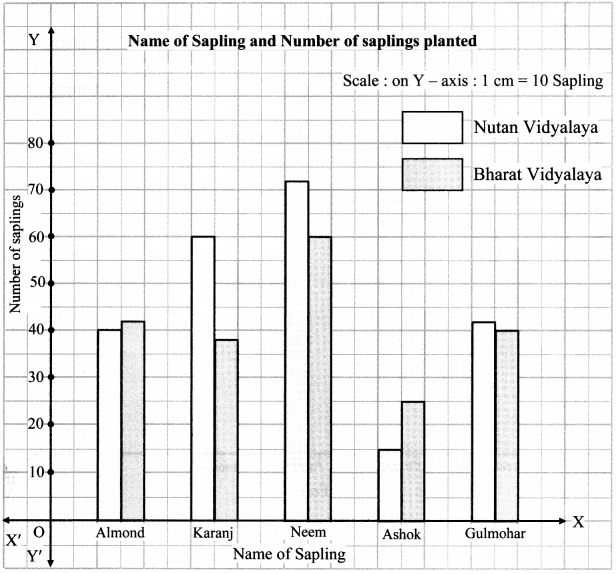
The number of saplings planted by schools on World Tree Day is given in the table below. Draw a joint bar graph to show these figures.

School Name\Name of SaplingAlmondKaranjNeemAshokGulmohar
Nutan Vidyalaya4060721542
Bharat Vidyalaya4238602540

Solution:
Maharashtra Board Class 7 Maths Solutions Chapter 7 Joint Bar Graph Practice Set 31 1

Question 2.
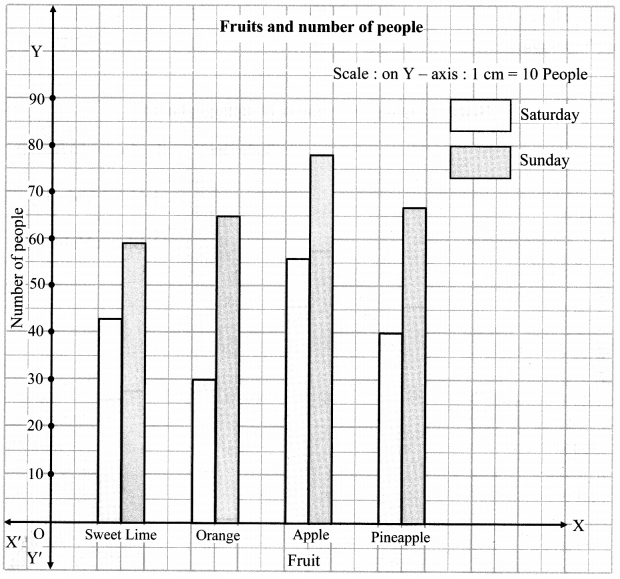
The table below shows the number of people who had the different juices at a juice bar on a Saturday and a Sunday. Draw a joint bar graph for this data.

Days\FruitsSweet LimeOrangeApplePineapple
Saturday43305640
Sunday59657867

Solution:
Maharashtra Board Class 7 Maths Solutions Chapter 7 Joint Bar Graph Practice Set 31 2

Question 3.
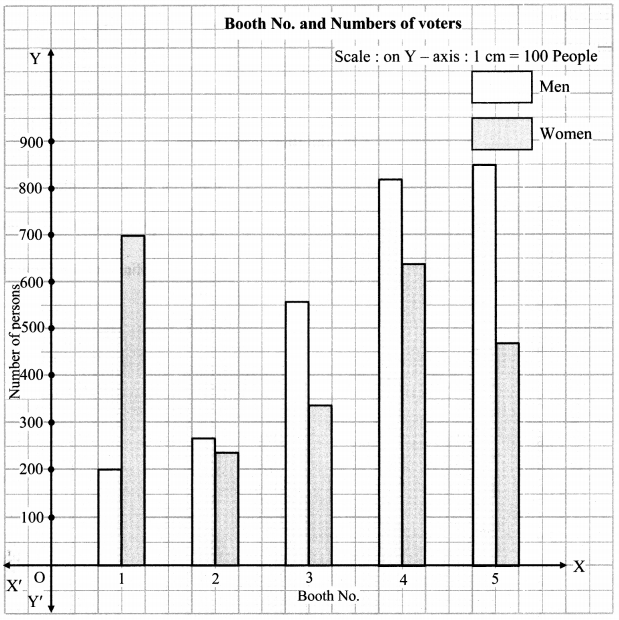
The following numbers of votes were cast at 5 polling booths during the Gram Panchayat elections. Draw a joint bar graph for this data.

Persons\Booth No.12345
Men200270560820850
Women700240340640470

Solution:
Maharashtra Board Class 7 Maths Solutions Chapter 7 Joint Bar Graph Practice Set 31 3

Question 4.
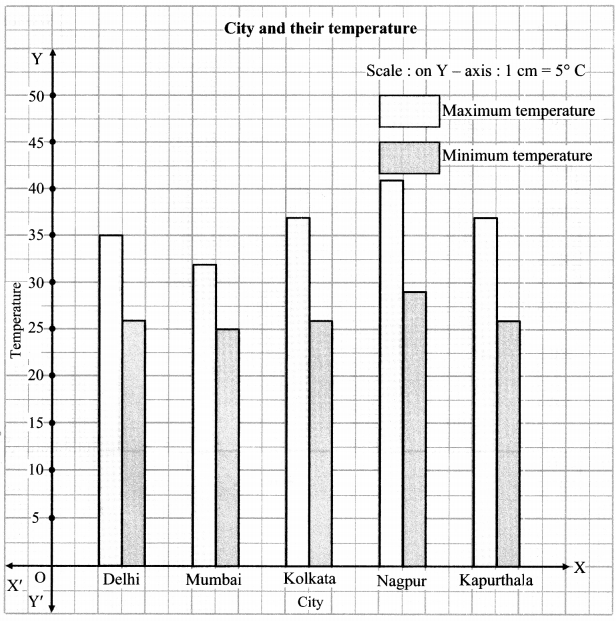
The maximum and minimum temperatures of five Indian cities are given in °C. Draw a joint bar graph for this data.

City\TemperatureDelhiMumbaiKolkataNagpurKapurthala
Maximum temperature3532374137
Minimum temperature2625262926

Solution:
Maharashtra Board Class 7 Maths Solutions Chapter 7 Joint Bar Graph Practice Set 31 4

Question 5.
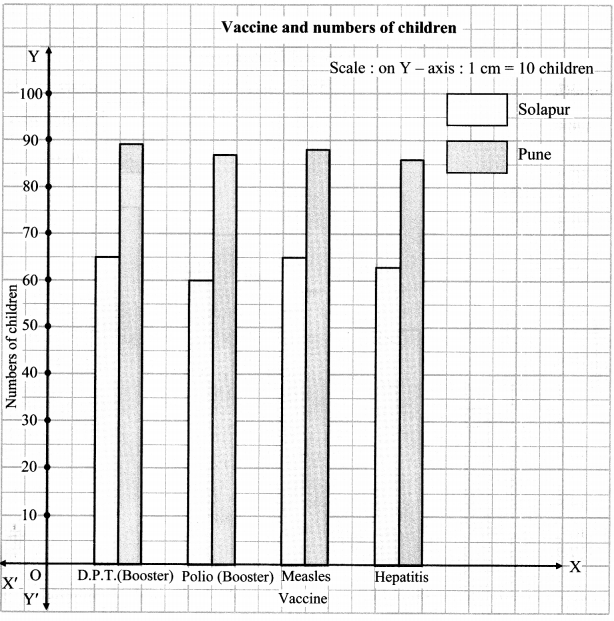
The numbers of children vaccinated in one day at the government hospitals in Solapur and Pune are given in the table. Draw a joint bar graph for this data:

City\VaccineD.P.T. (Booster)Polio (Booster)MeaslesHepatitis
Solapur65606563
Pune89878886

Solution:
Maharashtra Board Class 7 Maths Solutions Chapter 7 Joint Bar Graph Practice Set 31 5

Question 6.
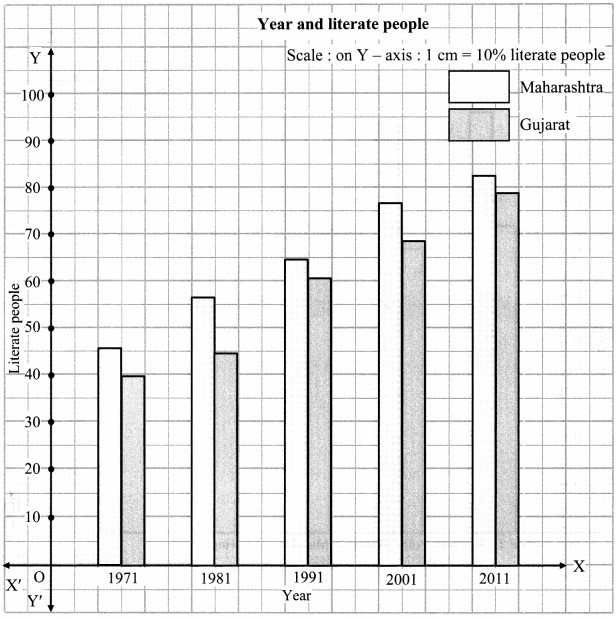
The percentage of literate people in the states of Maharashtra and Gujarat are given below. Draw a joint bar graph for this data.

State\Year19711981199120012011
Maharashtra4657657783
Gujarat4045616979

Solution:
Maharashtra Board Class 7 Maths Solutions Chapter 7 Joint Bar Graph Practice Set 31 6

Maharashtra Board Class 7 Maths Chapter 7 Joint Bar Graph Practice Set 31 Intext Questions and Activities

Question 1.
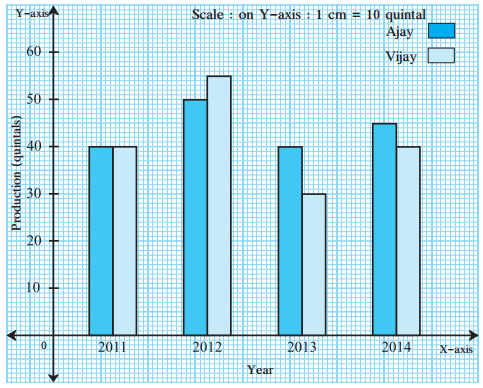
Observe the graph shown below and answer the following questions. (Textbook pg. no. 51)

  1. In which year did Ajay and Vijay both produce equal quantities of wheat?
  2. In year 2014, who produced more wheat?
  3. In year 2013, how much wheat did Ajay and Vijay each produce?

Maharashtra Board Class 7 Maths Solutions Chapter 7 Joint Bar Graph Practice Set 31 7

Solution:

  1. Both produced equal quantities of wheat in the year 2011.
  2. Ajay produced more wheat in the year 2014.
  3. Ajay’s wheat production in 2013 = 40 quintal.
    Vijay’s wheat production in 2013 = 30 quintal.

Question 2.
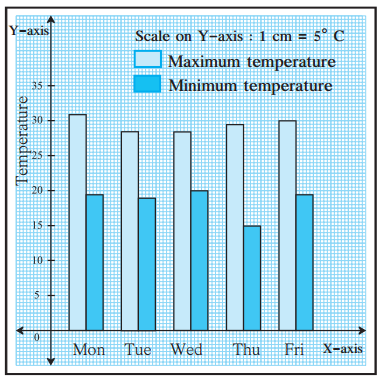
The minimum and maximum temperature in Pune for five days is given. Read the joint bar graph and answer the questions below: (Textbook pg. no. 52)
Maharashtra Board Class 7 Maths Solutions Chapter 7 Joint Bar Graph Practice Set 31 8

  1. What data is shown on X- axis?
  2. What data is shown on Y- axis?
  3. Which day had the highest temperature?
  4. On which day is the minimum temperature the highest?
  5. On Thursday, what is the difference between the minimum and maximum temperature?
  6. On which day is the difference between the minimum and maximum temperature the greatest?

Solution:

  1. Five days of a week are shown on X – axis.
  2. Temperature in the city of Pune is shown on Y – axis.
  3. Monday had the highest temperature.
  4. The minimum temperature was highest on Wednesday.
  5. Maximum temperature = 29.5° C
    Minimum temperature = 15° C
    ∴ Difference in temperature = 29.5° C – 15° C = 14.5 ° C
  6. The difference in minimum and maximum temperature is greatest on Thursday.

Question 3.
Collect various kinds of graphs from newspapers and discuss them. (Textbook pg. no. 53)
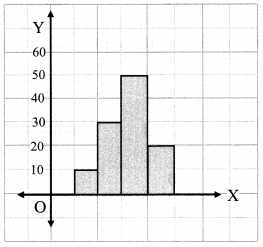
i. Histogram
Maharashtra Board Class 7 Maths Solutions Chapter 7 Joint Bar Graph Practice Set 31 9
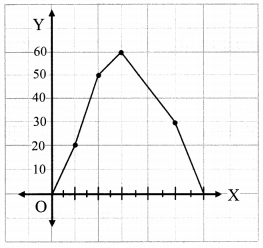
ii. Line graph
Maharashtra Board Class 7 Maths Solutions Chapter 7 Joint Bar Graph Practice Set 31 10
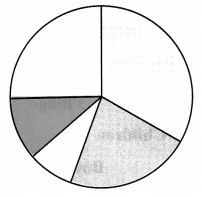
iii. Pie chart
Maharashtra Board Class 7 Maths Solutions Chapter 7 Joint Bar Graph Practice Set 31 11
Solution:
(Students should attempt the above activities on their own.)

Maharashtra Board Practice Set 22 Class 6 Maths Solutions Chapter 8 Divisibility

Balbharti Maharashtra State Board Class 6 Maths Solutions covers the Std 6 Maths Chapter 8 Divisibility Class 6 Practice Set 22 Answers Solutions.

6th Standard Maths Practice Set 22 Answers Chapter 8 Divisibility

Question 1.
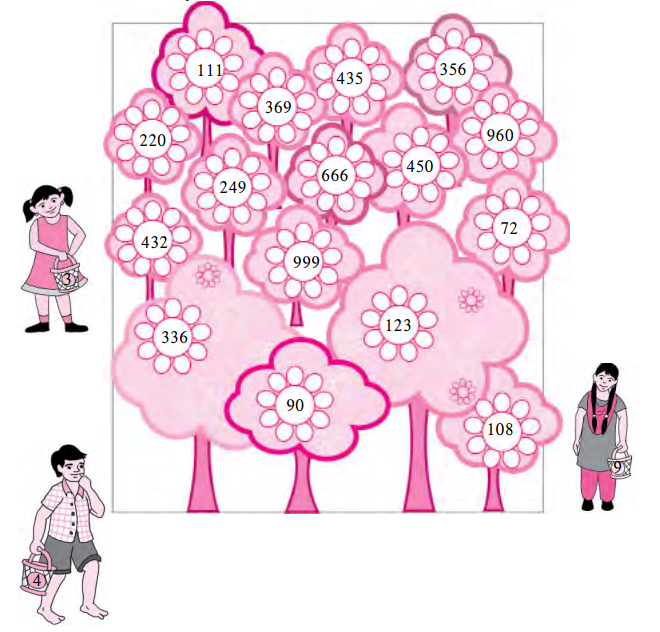
There are some flowering trees in a garden. Each tree bears many flowers with the same number printed on it. Three children took a basket each to pick flowers. Each basket has one of the numbers, 3, 4 or 9 on it. Each child picks those flowers which have numbers divisible by the number on his or her basket. If He / She takes only 1 flower from each tree. Can you tell which numbers the flowers in each basket will have?
Maharashtra Board Class 6 Maths Solutions Chapter 8 Divisibility Practice Set 22 1
Solution:
Each child will have flowers bearing the following numbers:
Girl with basket number 3: 111, 369, 435, 249, 666, 450, 960, 432, 999, 72, 336, 90, 123, 108
Boy with basket number 4: 356, 220, 432, 960, 72, 336, 108
Girl with basket number 9: 369, 666, 450, 432, 999, 72, 90, 108

Maharashtra Board Class 6 Maths Chapter 8 Divisibility Practice Set 22 Intext Questions and Activities

Question 1.
Read the numbers given below. Which of these numbers are divisible by 2, by 5, or by 10? Write them in the empty boxes. 125,364,475,750,800,628,206,508,7009,5345,8710. (Textbook pg. no. 43)

Divisible by 2Divisible by 5Divisible by 10

Solution:

Divisible by 2Divisible by 5Divisible by 10
364,750, 800, 628, 206, 508, 8710125,475, 750, 800, 5345, 8710750, 800, 8710

Question 2.
Complete the following table: (Textbook pg. no. 43)

NumberSum of digits in the numberIs the sum divisible by 3?Is the given number divisible by 3?
636 + 3 = 9
87217XX
91
552
9336
4527

Solution:

NumberSum of digits in the numberIs the sum divisible by 3?Is the given number divisible by 3?
636 + 3 = 9
8728 + 7 + 2 = 17XX
919 + 1 = 10XX
5525 + 5 + 2 = 12
93369 + 3 + 3 + 6 = 21
45274 + 5 + 2 + 7 = 18

Question 3.
Complete the following table: (Textbook pg. no. 44)

NumberDivide the number by 4. Is it completely divisible?The number formed by the digits in the tens and units places.Is this number divisible by 4?
99292
7314
6448
8116
7773
3024

Solution:

NumberDivide the number by 4. Is it completely divisible?The number formed by the digits in the tens and units places.Is this number divisible by 4?
99292
7314X14X
644848
811616
7773X73X
302424

Question 4.
Complete the following table: (Textbook pg. no. 44)

NumberDivide the number by 9. Is it completely divisible?Sum of the digits in the number.Is the sum divisible by 9?
19801 + 9 + 8 + 0 = 18
2999X2 + 9 + 9 + 9 = 29X
5004
13389
7578
69993

Solution:

NumberDivide the number by 9. Is it completely divisible?Sum of the digits in the number.Is the sum divisible by 9?
19801 + 9 + 8 + 0 = 18
2999X2 + 9 + 9 + 9 = 29X
50045 + 0 + 0 + 4 = 9
13389X1 + 3 + 3 + 8 + 9 = 24X
75787 + 5 + 7 + 8 = 27
699936 + 9 + 9 + 9 + 3 = 36

Maharashtra Board Practice Set 9 Class 6 Maths Solutions Chapter 4 Operations on Fractions

Balbharti Maharashtra State Board Class 6 Maths Solutions covers the Std 6 Maths Chapter 4 Operations on Fractions Class 6 Practice Set 9 Answers Solutions.

6th Standard Maths Practice Set 9 Answers Chapter 4 Operations on Fractions

Question 1.
Convert into improper fractions:
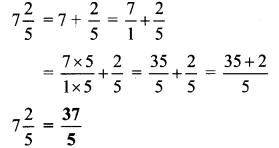
i. \(7 \frac{2}{5}\)
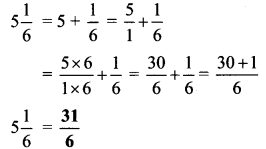
ii. \(5 \frac{1}{6}\)
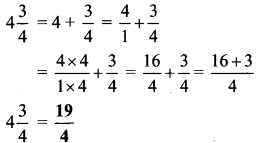
iii. \(4 \frac{3}{4}\)
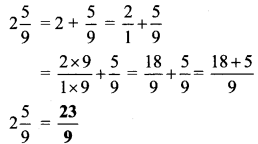
iv. \(2 \frac{5}{9}\)
v. \(1 \frac{5}{7}\)
Solution:
i. \(7 \frac{2}{5}\)
Maharashtra Board Class 6 Maths Solutions Chapter 4 Operations on Fractions Practice Set 9 1

ii. \(5 \frac{1}{6}\)
Maharashtra Board Class 6 Maths Solutions Chapter 4 Operations on Fractions Practice Set 9 2

iii. \(4 \frac{3}{4}\)
Maharashtra Board Class 6 Maths Solutions Chapter 4 Operations on Fractions Practice Set 9 3

iv. \(2 \frac{5}{9}\)
Maharashtra Board Class 6 Maths Solutions Chapter 4 Operations on Fractions Practice Set 9 4

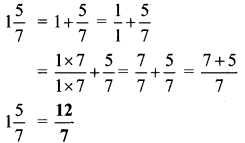
v. \(1 \frac{5}{7}\)
Maharashtra Board Class 6 Maths Solutions Chapter 4 Operations on Fractions Practice Set 9 5

Question 2.
Convert into mixed numbers:
i. \(\frac { 30 }{ 7 }\)
ii. \(\frac { 7 }{ 4 }\)
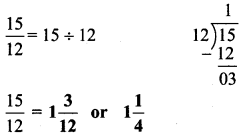
iii. \(\frac { 15 }{ 12 }\)
iv. \(\frac { 11 }{ 8 }\)
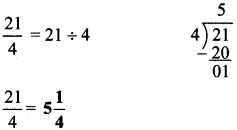
v. \(\frac { 21 }{ 4 }\)
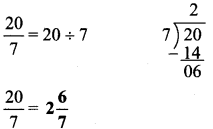
v. \(\frac { 20 }{ 7 }\)
Solution:
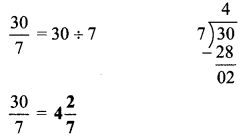
i. \(\frac { 30 }{ 7 }\)
Maharashtra Board Class 6 Maths Solutions Chapter 4 Operations on Fractions Practice Set 9 6

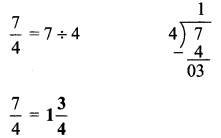
ii. \(\frac { 7 }{ 4 }\)
Maharashtra Board Class 6 Maths Solutions Chapter 4 Operations on Fractions Practice Set 9 7

iii. \(\frac { 15 }{ 12 }\)
Maharashtra Board Class 6 Maths Solutions Chapter 4 Operations on Fractions Practice Set 9 8

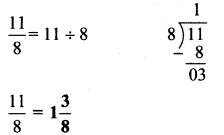
iv. \(\frac { 11 }{ 8 }\)
Maharashtra Board Class 6 Maths Solutions Chapter 4 Operations on Fractions Practice Set 9 9

v. \(\frac { 21 }{ 4 }\)
Maharashtra Board Class 6 Maths Solutions Chapter 4 Operations on Fractions Practice Set 9 10

v. \(\frac { 20 }{ 7 }\)
Maharashtra Board Class 6 Maths Solutions Chapter 4 Operations on Fractions Practice Set 9 11

Question 3.
Write the following examples using fraction:
i. If 9 kg rice is shared among 5 people, how many kilograms of rice does each person get?
ii. To make 5 shirts of the same size, 11 meters of cloth is needed. How much cloth is needed for one shirt?
Solution:
i. Total quantity of rice = 9 kg
Number of people = 5
∴ Kilograms of rice received by each person = \(\frac { 9 }{ 5 }\)
∴ Each person will get \(\frac { 9 }{ 5 }\) kg of rice.

ii. Total meters of cloth = 11 meters
Number of shirts to be made = 5
Meters of cloth needed to make 1 shirt = \(\frac { 11 }{ 5 }\)
∴ Cloth needed to make 1 shirt is \(\frac { 11 }{ 5 }\) meters.

Maharashtra Board Practice Set 21 Class 6 Maths Solutions Chapter 7 Symmetry

Balbharti Maharashtra State Board Class 6 Maths Solutions covers the Std 6 Maths Chapter 7 Symmetry Class 6 Practice Set 21 Answers Solutions.

6th Standard Maths Practice Set 21 Answers Chapter 7 Symmetry

Question 1.
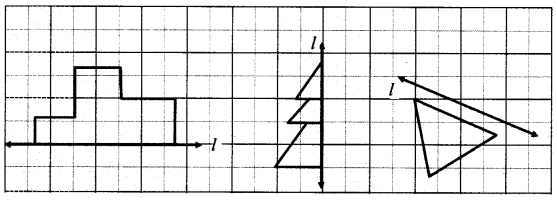
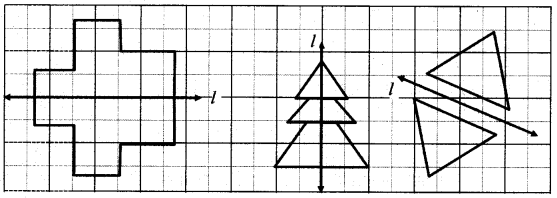
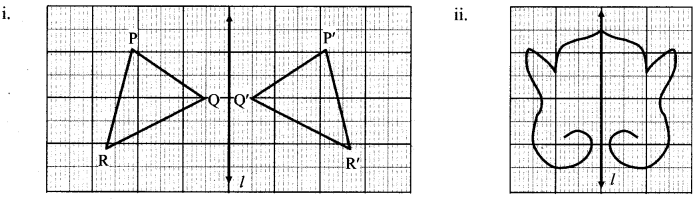
Along each figure shown below, a line l has been drawn. Complete the symmetrical figures by drawing a figure on the other side such that the line l becomes the line of symmetry.
Maharashtra Board Class 6 Maths Solutions Chapter 7 Symmetry Practice Set 21 1
Solution:
Maharashtra Board Class 6 Maths Solutions Chapter 7 Symmetry Practice Set 21 2

Maharashtra Board Class 6 Maths Chapter 7 Symmetry Practice Set 21 Intext Questions and Activities

Question 1.
In the figures below, the line l divides the figure in two parts. Do these parts fall on each other? Verify? (Textbook pg. no. 42)
Maharashtra Board Class 6 Maths Solutions Chapter 7 Symmetry Practice Set 21 3
Solution:
Yes, the two parts of both the figures fall on each other on folding along the line l.

Maharashtra Board Practice Set 30 Class 6 Maths Solutions Chapter 12 Percentage

Balbharti Maharashtra State Board Class 6 Maths Solutions covers the Std 6 Maths Chapter 12 Percentage Class 6 Practice Set 30 Answers Solutions.

6th Standard Maths Practice Set 30 Answers Chapter 12 Percentage

Question 1.
Shabana scored 736 marks out of 800 in her exams. What was the percentage she scored?
Solution:
Total marks of the examination = 800
Marks scored by Shabana = 736
Suppose Shabana scored A% marks.
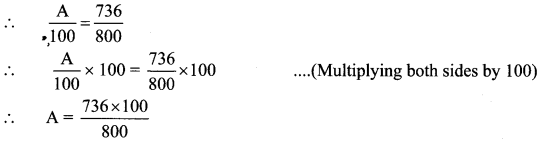
Maharashtra Board Class 6 Maths Solutions Chapter 12 Percentage Practice Set 30 1
∴ A = 92%
∴ Shabana scored 92% marks.

Question 2.
There are 500 students in the school in Dahihanda village. If 350 of them can swim, what percent of them can swim and what percent cannot?
Solution:
Total number of students in the school = 500
Number of students who can swim = 350
Suppose A% students can swim.
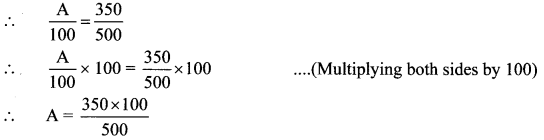
Maharashtra Board Class 6 Maths Solutions Chapter 12 Percentage Practice Set 30 2
∴ A = 70%
Percentage of students who cannot swim = 100% – Percentage of students who can swim .
= 100% – 70% = 30%
∴ 70% of the students can swim and 30% cannot swim.

Question 3.
If Prakash sowed jowar on 75% of the 19500 sq. m. of his land, on how many sq. m. did he actually plant jowar?
Solution:
Total area of the land = 19500 sq. m.
Percentage of area in which Prakash sowed jowar = 75%
Suppose Prakash planted jowar in A sq. m.
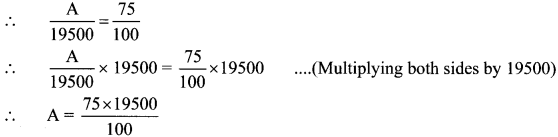
Maharashtra Board Class 6 Maths Solutions Chapter 12 Percentage Practice Set 30 3
∴ A = 14,625 sq. m.
∴ Prakash planted jowar in 14,625 sq.m.

Question 4.
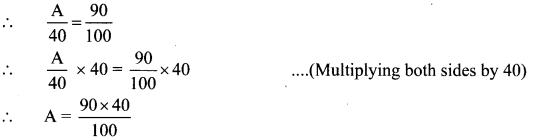
Soham received 40 messages on his birthday. Of these, 90% were birthday greetings. How many other messages did he get besides the greetings?
Solution:
Total messages received by Soham on his birthday = 40
Percentage of messages received for birthday greetings = 90%
Suppose Soham got A number of birthday greetings.
Maharashtra Board Class 6 Maths Solutions Chapter 12 Percentage Practice Set 30 4
∴ A = 36
∴ Number of messages received other than birthday greetings
= total messages received – total number of birthday greetings
= 40 – 36 = 4
∴ The number of messages received other than birthday greetings is 4.

Question 5.
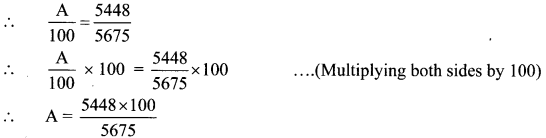
Of the 5675 people in a village 5448 are literate. What is the percentage of literacy in the village?
Solution:
Number of people in the village = 5675
Number of people who are literate = 5448
Suppose the percentage of literacy in the village is A%.
Maharashtra Board Class 6 Maths Solutions Chapter 12 Percentage Practice Set 30 5
∴ A = 96%
∴ The percentage of literacy in the village is 96%.

Question 6.
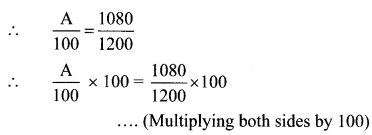
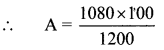
In the elections, 1080 of the 1200 women in Jambhulgaon cast their vote, while 1360 of the 1700 in Wadgaon cast theirs. In which village did a greater proportion of women cast their votes?
Solution:
Total number of women in Jambhulgaon = 1200
Number of women in Jambhulgaon who voted = 1080
Suppose A% women cast their vote in Jambhulgaon village.
Maharashtra Board Class 6 Maths Solutions Chapter 12 Percentage Practice Set 30 6
Maharashtra Board Class 6 Maths Solutions Chapter 12 Percentage Practice Set 30 7
∴ A = 90%
In Jambhulgaon, the percentage of women who voted in the elections was 90%.
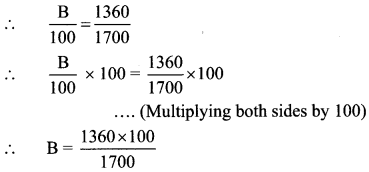
Total number of women in Wadgaon = 1700 Number of women in Wadgaon who voted = 1360
Suppose B% women cast their vote in Wadgaon.
Maharashtra Board Class 6 Maths Solutions Chapter 12 Percentage Practice Set 30 8
∴ B = 80%
∴ In Wadgaon, the percentage of women who voted in the elections was 80%.
∴ A greater proportion of women cast their votes in Jambhulgaon.

Maharashtra Board Class 6 Maths Chapter 12 Percentage Practice Set 30 Intext Questions and Activities

Question 1.
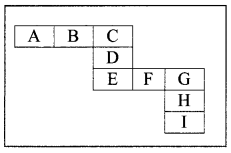
There are 9 squares in the figure alongside. The letters ABCDEFGHI are written in squares. Give each of the letters a unique number from 1 to 9 so that every letter has a different number.
Besides, A + B + C = C + D + E = E + F + G = G + H + I should also be true. (Textbook pg. no. 64)
Maharashtra Board Class 6 Maths Solutions Chapter 12 Percentage Practice Set 30 9
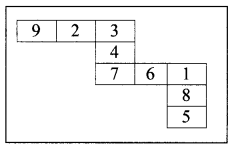
Solution:
Maharashtra Board Class 6 Maths Solutions Chapter 12 Percentage Practice Set 30 10
(This is one of the possible solutions of the above riddle. There are more solutions possible.)